Cambridge IGCSE Italian - Foreign Language 0535 — 2022 May/June Paper 2 · Variant 1
0535/21/M/J/22 · 45 marks · ≈51 min
The question paper and its mark scheme, free to read here and free to download. This is Cambridge’s own paper, exactly as it was sat.
Question paper12 pages

Mark scheme10 pages
Answers below. Sit the paper first if you are practising.
Paper as text
Question paper, page 1
This document has 12 pages. Any blank pages are indicated. [Turn over Cambridge IGCSE™ DC (CE/SG) 302780/2 © UCLES 2022 ITALIAN 0535/21 Paper 2 Reading May/June 2022 1 hour You must answer on the question paper. No additional materials are needed. INSTRUCTIONS ● Answer all questions. ● Use a black or dark blue pen. ● Write your name, centre number and candidate number in the boxes at the top of the page. ● Write your answer to each question in the space provided. ● Do not use an erasable pen or correction fluid. ● Do not write on any bar codes. ● Dictionaries are not allowed. INFORMATION ● The total mark for this paper is 45. ● The number of marks for each question or part question is shown in brackets [ ]. * 4 8 8 3 7 5 9 4 8 0 *
Question paper, page 2
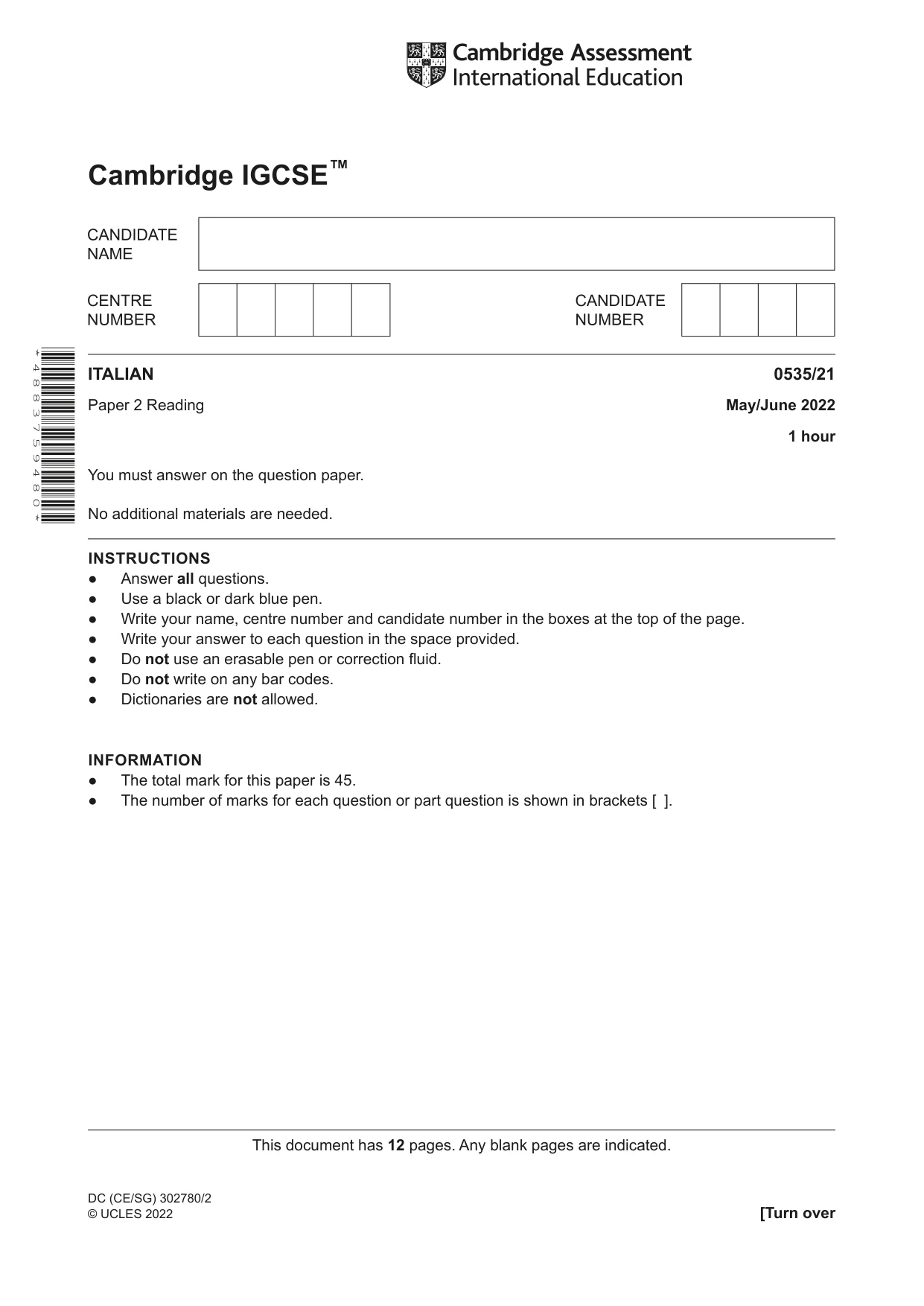
2 0535/21/M/J/22 © UCLES 2022 1 Guarda le immagini. B C E F A D Per ogni domanda, scrivi la lettera corretta (A–F) nella casella. (a) La mattina porto fuori il cane. [1] (b) Mi piace giocare a carte. [1] (c) Dopo la scuola faccio merenda. [1] (d) Il sabato suono il flauto. [1] (e) La sera leggo un libro. [1] [Totale: 5]
Question paper, page 3
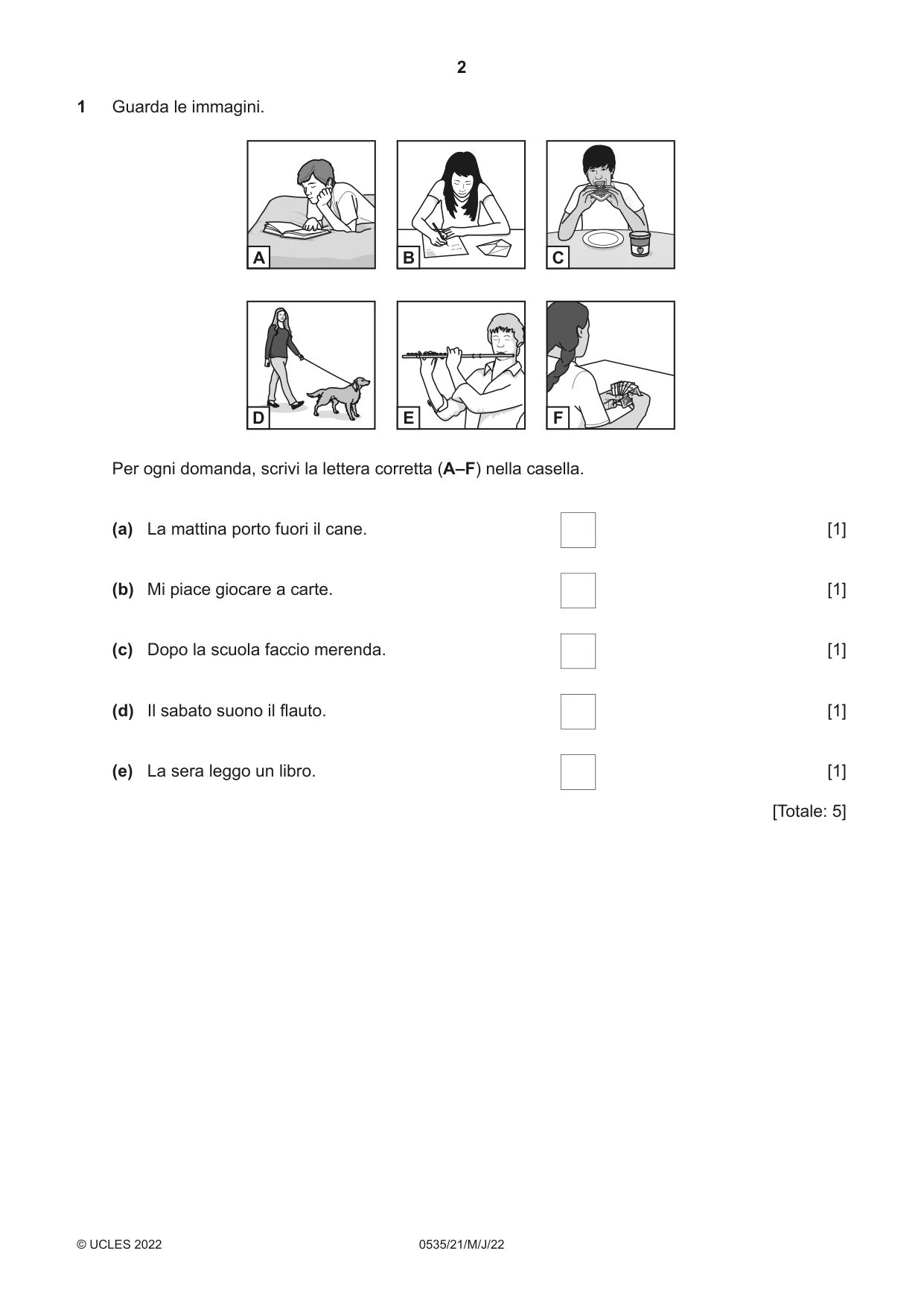
3 0535/21/M/J/22 © UCLES 2022 [Turn over 2 Leggi i cartelli e le insegne. Alla stazione ferroviaria A CAFFETTERIA UFFICIO INFORMAZIONI SALA D’ATTESA VIETATO ATTRAVERSARE I BINARI SOTTOPASSAGGIO DEPOSITO BAGAGLI BIGLIETTERIA BAGNI B C D E F G H Per ogni domanda, scrivi la lettera corretta (A–H) nella casella. (a) Vai qui per comprare un biglietto. [1] (b) Vai qui per lasciare la valigia per alcune ore. [1] (c) Vai qui per aspettare la partenza. [1] (d) Vai qui per chiedere una piantina della città. [1] (e) Vai qui per bere o mangiare qualcosa. [1] [Totale: 5]
Question paper, page 4
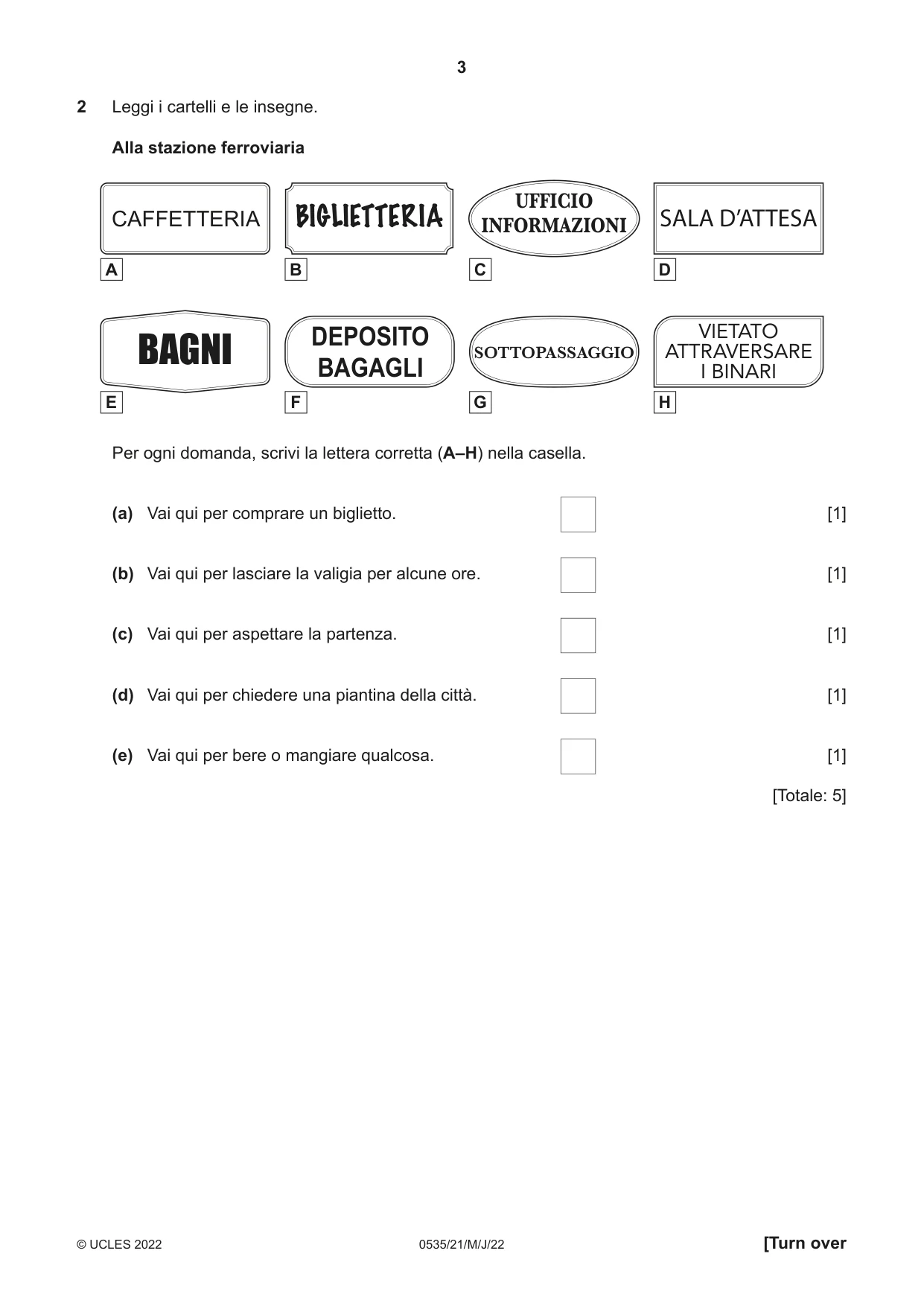
4 0535/21/M/J/22 © UCLES 2022 3 Leggi l’email. Per ogni domanda, segna con una crocetta (X) la casella corretta (A–C). Ciao Sabina! Scusa il mio silenzio ma in questi giorni ho un forte raffreddore! Ti racconto un po’. Tutto è cominciato con un mal di gola terribile. Poi, durante il weekend è iniziata una brutta febbre: è arrivata fino a 39 °C, altissima! Ancora adesso non riesco a mangiare niente. Riesco solo a bere un bicchiere d’acqua piano piano. Perciò ho anche un gran mal di testa. In questi giorni non posso né leggere né guardare la tivù. Sto sul divano e ascolto la radio. Per fortuna ci sono alcuni programmi molto interessanti ed informativi. Anche se non faccio i compiti per la scuola, imparo comunque qualcosa! Non vedo l’ora di tornare a scuola per vedere i miei compagni di classe. A presto, Giorgio (a) Giorgio scrive a Sabina per dirle che è ... A ammalato. B in vacanza. C sul giornale. [1] (b) Qual è stato il primo sintomo di Giorgio? A Mal di testa B Mal di gola C Febbre [1]
Question paper, page 5
5 0535/21/M/J/22 © UCLES 2022 [Turn over (c) Quando è cominciata la febbre? A Martedì sera B Mercoledì mattina C Il fine settimana [1] (d) Che cosa beve Giorgio? A Acqua B Nulla C Tè [1] (e) Che cosa fa Giorgio in questo periodo? A Guarda la tivù. B Legge un libro. C Ascolta la radio. [1] (f) Giorgio sembra contento perché può ... A fare i compiti. B imparare cose interessanti. C riposarsi a letto. [1] (g) Giorgio è impaziente di ... A vedere gli amici. B tornare a letto. C andare in campagna. [1] [Totale: 7]
Question paper, page 6
6 0535/21/M/J/22 © UCLES 2022 4 Leggi la lettera di Chiara e rispondi alle domande in italiano. Cara Ana, Volevi sapere che cosa faccio a scuola, allora ti descrivo un giovedì tipico. Arrivo a scuola alle otto di mattina, quindici minuti prima della mia prima lezione – matematica. Questa è una materia obbligatoria per noi tutti. Siamo in 22 studenti in ogni lezione, 10 ragazzi, 12 ragazze. Mi piace abbastanza la matematica ma non sono tra i migliori studenti. Per fortuna Ahmed, il ragazzo che si siede accanto a me, è non solo bravo ma anche simpatico. Mi aiuta molto con gli esercizi. C’è una pausa alle dieci e un quarto, quando faccio una merenda rapida e chiacchiero con gli amici. Ne ho veramente bisogno dopo due ore di matematica! La lezione successiva è italiano, che adoro. Per i compiti questo trimestre devo fare la cosa che mi piace di più al mondo – leggere romanzi. Che sogno! Il problema sarà il prossimo trimestre quando dovrò scrivere un lungo tema sull’autore Italo Calvino. Preferisco leggere che scrivere! L’ultima lezione della mattina è scienze. Questo trimestre studiamo chimica, e passiamo l’ora nel laboratorio. È interessante, ma a volte gli esperimenti creano troppo fumo. Non è bello subito prima del pranzo! I professori sono per lo più anziani, ma per me è meglio così. Hanno una profonda conoscenza delle materie che insegnano. Altri studenti preferirebbero insegnanti più giovani, perché hanno più energia, ma io non sono d’accordo. Spero di averti dato un’idea della mia vita a scuola. La tua è molto diversa? Un abbraccio, Chiara (a) A che ora entra a scuola Chiara la mattina? … [1] (b) Quanti alunni ci sono nella classe di Chiara? … [1] (c) Come descrive Chiara la sua abilità in matematica? … [1]
Question paper, page 7
7 0535/21/M/J/22 © UCLES 2022 [Turn over (d) Perché Chiara considera simpatico Ahmed? … [1] (e) Che cosa fa Chiara durante la pausa? Menziona due dettagli. 1. … [1] 2. … [1] (f) Che cosa deve fare Chiara per i compiti d’italiano questo trimestre? … [1] (g) Perché Chiara pensa che il trimestre prossimo sarà più difficile per lei? … [1] (h) Quale delle scienze studia Chiara questo trimestre? … [1] (i) Qual è il risultato negativo di alcuni esperimenti secondo Chiara? … [1] (j) Per Chiara, qual è il vantaggio di avere professori anziani? … [1] (k) Perché altri studenti preferirebbero insegnanti meno vecchi? … [1] [Totale: 12]
Question paper, page 8
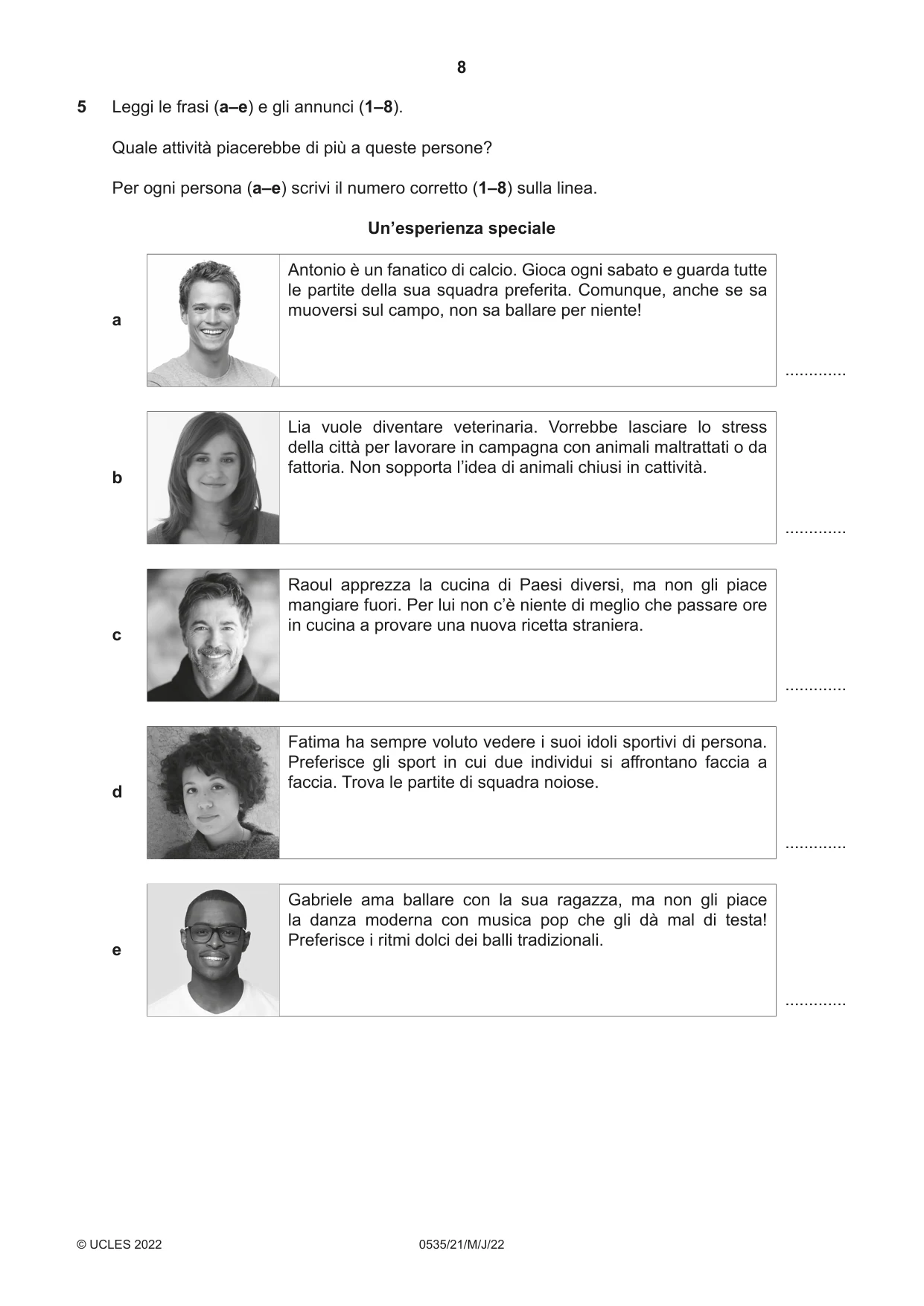
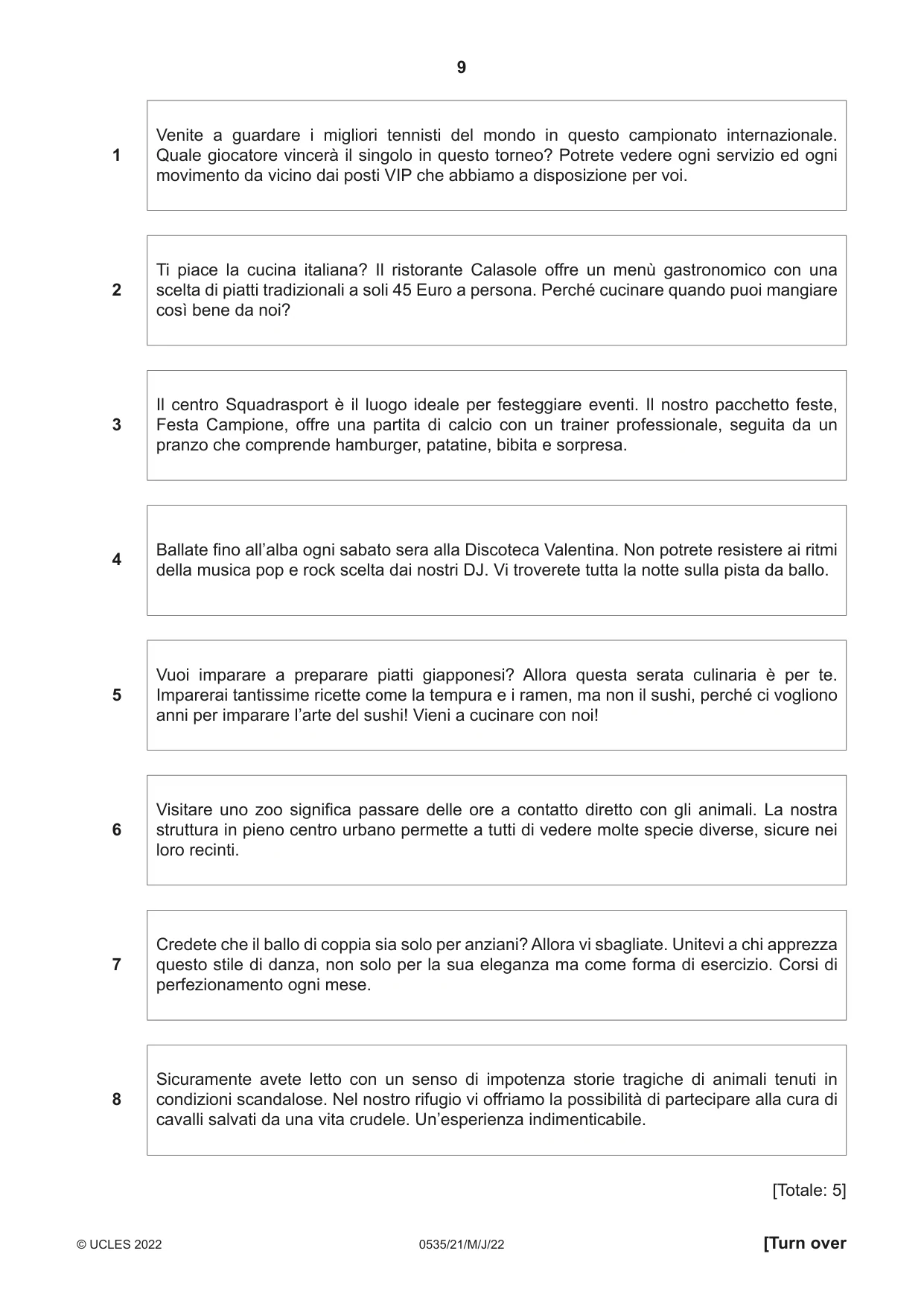
8 0535/21/M/J/22 © UCLES 2022 5 Leggi le frasi (a–e) e gli annunci (1–8). Quale attività piacerebbe di più a queste persone? Per ogni persona (a–e) scrivi il numero corretto (1–8) sulla linea. Un’esperienza speciale a Antonio è un fanatico di calcio. Gioca ogni sabato e guarda tutte le partite della sua squadra preferita. Comunque, anche se sa muoversi sul campo, non sa ballare per niente! … b Lia vuole diventare veterinaria. Vorrebbe lasciare lo stress della città per lavorare in campagna con animali maltrattati o da fattoria. Non sopporta l’idea di animali chiusi in cattività. … c Raoul apprezza la cucina di Paesi diversi, ma non gli piace mangiare fuori. Per lui non c’è niente di meglio che passare ore in cucina a provare una nuova ricetta straniera. … d Fatima ha sempre voluto vedere i suoi idoli sportivi di persona. Preferisce gli sport in cui due individui si affrontano faccia a faccia. Trova le partite di squadra noiose. … e Gabriele ama ballare con la sua ragazza, ma non gli piace la danza moderna con musica pop che gli dà mal di testa! Preferisce i ritmi dolci dei balli tradizionali. …
Question paper, page 9
9 0535/21/M/J/22 © UCLES 2022 [Turn over 1 Venite a guardare i migliori tennisti del mondo in questo campionato internazionale. Quale giocatore vincerà il singolo in questo torneo? Potrete vedere ogni servizio ed ogni movimento da vicino dai posti VIP che abbiamo a disposizione per voi. 2 Ti piace la cucina italiana? Il ristorante Calasole offre un menù gastronomico con una scelta di piatti tradizionali a soli 45 Euro a persona. Perché cucinare quando puoi mangiare così bene da noi? 3 Il centro Squadrasport è il luogo ideale per festeggiare eventi. Il nostro pacchetto feste, Festa Campione, offre una partita di calcio con un trainer professionale, seguita da un pranzo che comprende hamburger, patatine, bibita e sorpresa. 4 Ballate fino all’alba ogni sabato sera alla Discoteca Valentina. Non potrete resistere ai ritmi della musica pop e rock scelta dai nostri DJ. Vi troverete tutta la notte sulla pista da ballo. 5 Vuoi imparare a preparare piatti giapponesi? Allora questa serata culinaria è per te. Imparerai tantissime ricette come la tempura e i ramen, ma non il sushi, perché ci vogliono anni per imparare l’arte del sushi! Vieni a cucinare con noi! 6 Visitare uno zoo significa passare delle ore a contatto diretto con gli animali. La nostra struttura in pieno centro urbano permette a tutti di vedere molte specie diverse, sicure nei loro recinti. 7 Credete che il ballo di coppia sia solo per anziani? Allora vi sbagliate. Unitevi a chi apprezza questo stile di danza, non solo per la sua eleganza ma come forma di esercizio. Corsi di perfezionamento ogni mese. 8 Sicuramente avete letto con un senso di impotenza storie tragiche di animali tenuti in condizioni scandalose. Nel nostro rifugio vi offriamo la possibilità di partecipare alla cura di cavalli salvati da una vita crudele. Un’esperienza indimenticabile. [Totale: 5]
Question paper, page 10
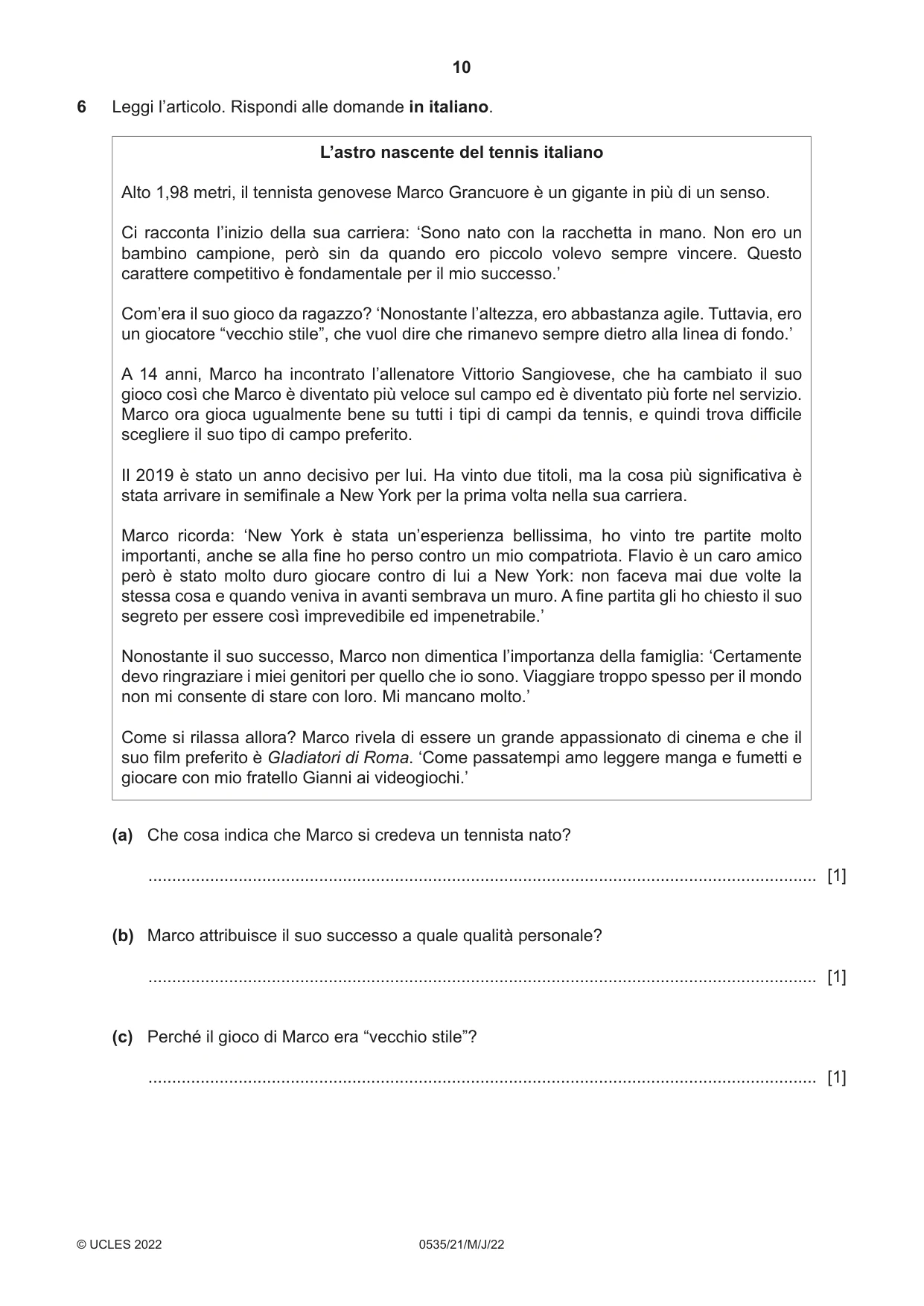
10 0535/21/M/J/22 © UCLES 2022 6 Leggi l’articolo. Rispondi alle domande in italiano. L’astro nascente del tennis italiano Alto 1,98 metri, il tennista genovese Marco Grancuore è un gigante in più di un senso. Ci racconta l’inizio della sua carriera: ‘Sono nato con la racchetta in mano. Non ero un bambino campione, però sin da quando ero piccolo volevo sempre vincere. Questo carattere competitivo è fondamentale per il mio successo.’ Com’era il suo gioco da ragazzo? ‘Nonostante l’altezza, ero abbastanza agile. Tuttavia, ero un giocatore “vecchio stile”, che vuol dire che rimanevo sempre dietro alla linea di fondo.’ A 14 anni, Marco ha incontrato l’allenatore Vittorio Sangiovese, che ha cambiato il suo gioco così che Marco è diventato più veloce sul campo ed è diventato più forte nel servizio. Marco ora gioca ugualmente bene su tutti i tipi di campi da tennis, e quindi trova difficile scegliere il suo tipo di campo preferito. Il 2019 è stato un anno decisivo per lui. Ha vinto due titoli, ma la cosa più significativa è stata arrivare in semifinale a New York per la prima volta nella sua carriera. Marco ricorda: ‘New York è stata un’esperienza bellissima, ho vinto tre partite molto importanti, anche se alla fine ho perso contro un mio compatriota. Flavio è un caro amico però è stato molto duro giocare contro di lui a New York: non faceva mai due volte la stessa cosa e quando veniva in avanti sembrava un muro. A fine partita gli ho chiesto il suo segreto per essere così imprevedibile ed impenetrabile.’ Nonostante il suo successo, Marco non dimentica l’importanza della famiglia: ‘Certamente devo ringraziare i miei genitori per quello che io sono. Viaggiare troppo spesso per il mondo non mi consente di stare con loro. Mi mancano molto.’ Come si rilassa allora? Marco rivela di essere un grande appassionato di cinema e che il suo film preferito è Gladiatori di Roma. ‘Come passatempi amo leggere manga e fumetti e giocare con mio fratello Gianni ai videogiochi.’ (a) Che cosa indica che Marco si credeva un tennista nato? … [1] (b) Marco attribuisce il suo successo a quale qualità personale? … [1] (c) Perché il gioco di Marco era “vecchio stile”? … [1]
Question paper, page 11
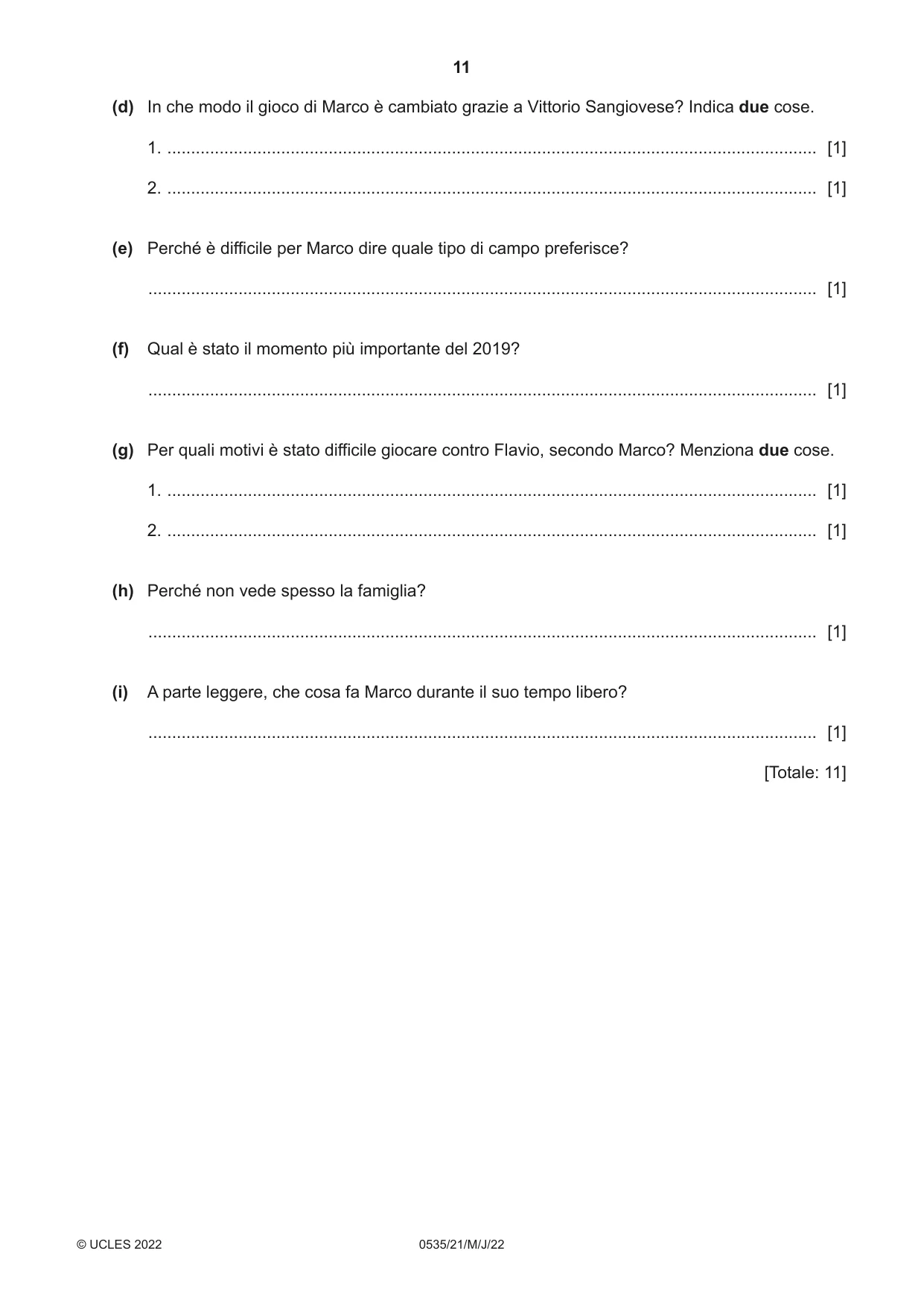
11 0535/21/M/J/22 © UCLES 2022 (d) In che modo il gioco di Marco è cambiato grazie a Vittorio Sangiovese? Indica due cose. 1. … [1] 2. … [1] (e) Perché è difficile per Marco dire quale tipo di campo preferisce? … [1] (f) Qual è stato il momento più importante del 2019? … [1] (g) Per quali motivi è stato difficile giocare contro Flavio, secondo Marco? Menziona due cose. 1. … [1] 2. … [1] (h) Perché non vede spesso la famiglia? … [1] (i) A parte leggere, che cosa fa Marco durante il suo tempo libero? … [1] [Totale: 11]
Question paper, page 12
12 0535/21/M/J/22 © UCLES 2022 Permission to reproduce items where third-party owned material protected by copyright is included has been sought and cleared where possible. Every reasonable effort has been made by the publisher (UCLES) to trace copyright holders, but if any items requiring clearance have unwittingly been included, the publisher will be pleased to make amends at the earliest possible opportunity. To avoid the issue of disclosure of answer-related information to candidates, all copyright acknowledgements are reproduced online in the Cambridge Assessment International Education Copyright Acknowledgements Booklet. This is produced for each series of examinations and is freely available to download at www.cambridgeinternational.org after the live examination series. Cambridge Assessment International Education is part of Cambridge Assessment. Cambridge Assessment is the brand name of the University of Cambridge Local Examinations Syndicate (UCLES), which is a department of the University of Cambridge. BLANK PAGE
Mark scheme, page 1
This document consists of 10 printed pages. © UCLES 2022 [Turn over Cambridge IGCSE™ ITALIAN 0535/21 Paper 2 Reading May/June 2022 MARK SCHEME Maximum Mark: 45 Published This mark scheme is published as an aid to teachers and candidates, to indicate the requirements of the examination. It shows the basis on which Examiners were instructed to award marks. It does not indicate the details of the discussions that took place at an Examiners’ meeting before marking began, which would have considered the acceptability of alternative answers. Mark schemes should be read in conjunction with the question paper and the Principal Examiner Report for Teachers. Cambridge International will not enter into discussions about these mark schemes. Cambridge International is publishing the mark schemes for the May/June 2022 series for most Cambridge IGCSE, Cambridge International A and AS Level and Cambridge Pre-U components, and some Cambridge O Level components.
Mark scheme, page 2
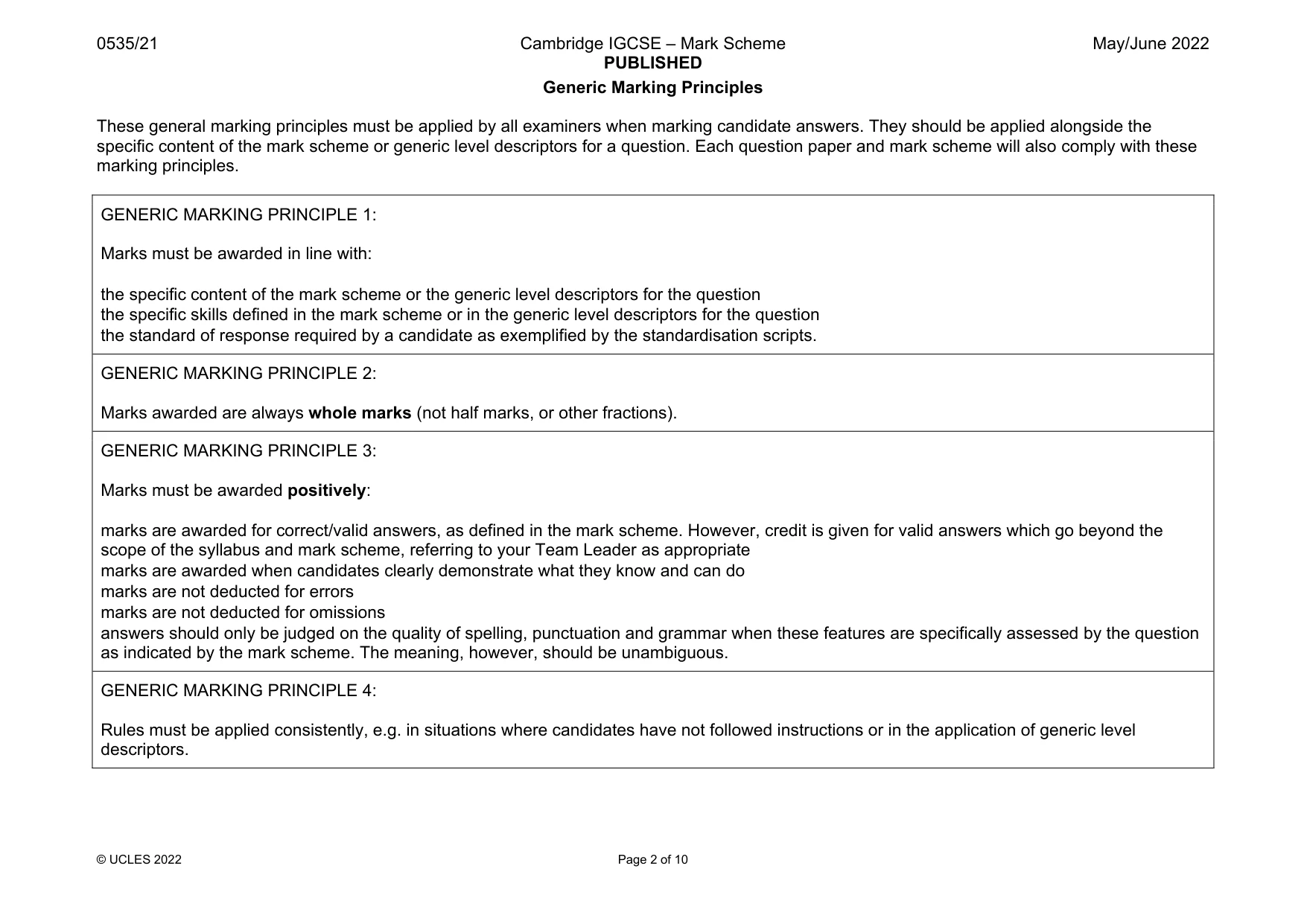
0535/21 Cambridge IGCSE – Mark Scheme PUBLISHED May/June 2022 © UCLES 2022 Page 2 of 10 Generic Marking Principles These general marking principles must be applied by all examiners when marking candidate answers. They should be applied alongside the specific content of the mark scheme or generic level descriptors for a question. Each question paper and mark scheme will also comply with these marking principles. GENERIC MARKING PRINCIPLE 1: Marks must be awarded in line with: the specific content of the mark scheme or the generic level descriptors for the question the specific skills defined in the mark scheme or in the generic level descriptors for the question the standard of response required by a candidate as exemplified by the standardisation scripts. GENERIC MARKING PRINCIPLE 2: Marks awarded are always whole marks (not half marks, or other fractions). GENERIC MARKING PRINCIPLE 3: Marks must be awarded positively: marks are awarded for correct/valid answers, as defined in the mark scheme. However, credit is given for valid answers which go beyond the scope of the syllabus and mark scheme, referring to your Team Leader as appropriate marks are awarded when candidates clearly demonstrate what they know and can do marks are not deducted for errors marks are not deducted for omissions answers should only be judged on the quality of spelling, punctuation and grammar when these features are specifically assessed by the question as indicated by the mark scheme. The meaning, however, should be unambiguous. GENERIC MARKING PRINCIPLE 4: Rules must be applied consistently, e.g. in situations where candidates have not followed instructions or in the application of generic level descriptors.
Mark scheme, page 3
0535/21 Cambridge IGCSE – Mark Scheme PUBLISHED May/June 2022 © UCLES 2022 Page 3 of 10 GENERIC MARKING PRINCIPLE 5: Marks should be awarded using the full range of marks defined in the mark scheme for the question (however; the use of the full mark range may be limited according to the quality of the candidate responses seen). GENERIC MARKING PRINCIPLE 6: Marks awarded are based solely on the requirements as defined in the mark scheme. Marks should not be awarded with grade thresholds or grade descriptors in mind.
Mark scheme, page 4
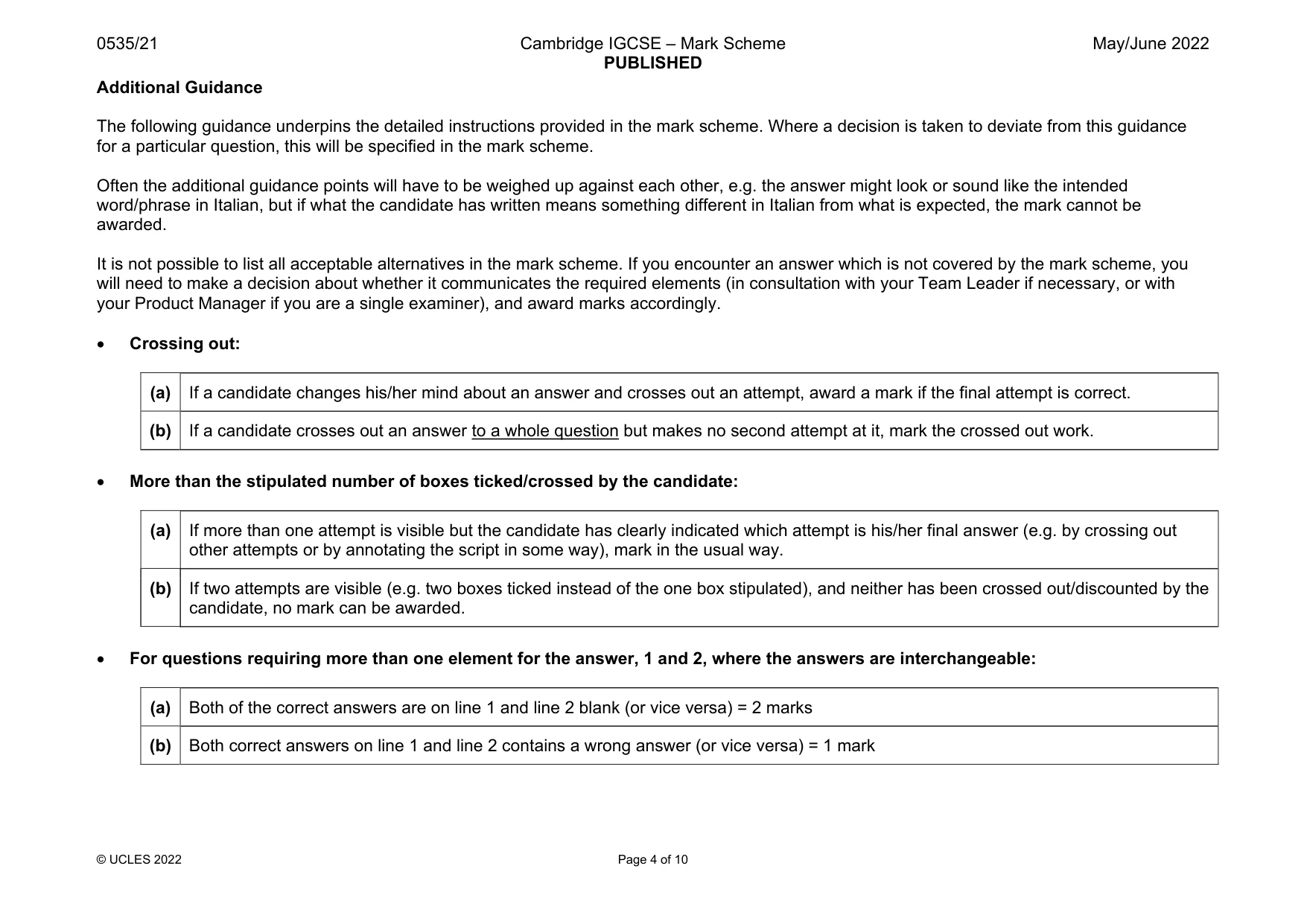
0535/21 Cambridge IGCSE – Mark Scheme PUBLISHED May/June 2022 © UCLES 2022 Page 4 of 10 Additional Guidance The following guidance underpins the detailed instructions provided in the mark scheme. Where a decision is taken to deviate from this guidance for a particular question, this will be specified in the mark scheme. Often the additional guidance points will have to be weighed up against each other, e.g. the answer might look or sound like the intended word/phrase in Italian, but if what the candidate has written means something different in Italian from what is expected, the mark cannot be awarded. It is not possible to list all acceptable alternatives in the mark scheme. If you encounter an answer which is not covered by the mark scheme, you will need to make a decision about whether it communicates the required elements (in consultation with your Team Leader if necessary, or with your Product Manager if you are a single examiner), and award marks accordingly. Crossing out: (a) If a candidate changes his/her mind about an answer and crosses out an attempt, award a mark if the final attempt is correct. (b) If a candidate crosses out an answer to a whole question but makes no second attempt at it, mark the crossed out work. More than the stipulated number of boxes ticked/crossed by the candidate: (a) If more than one attempt is visible but the candidate has clearly indicated which attempt is his/her final answer (e.g. by crossing out other attempts or by annotating the script in some way), mark in the usual way. (b) If two attempts are visible (e.g. two boxes ticked instead of the one box stipulated), and neither has been crossed out/discounted by the candidate, no mark can be awarded. For questions requiring more than one element for the answer, 1 and 2, where the answers are interchangeable: (a) Both of the correct answers are on line 1 and line 2 blank (or vice versa) = 2 marks (b) Both correct answers on line 1 and line 2 contains a wrong answer (or vice versa) = 1 mark
Mark scheme, page 5
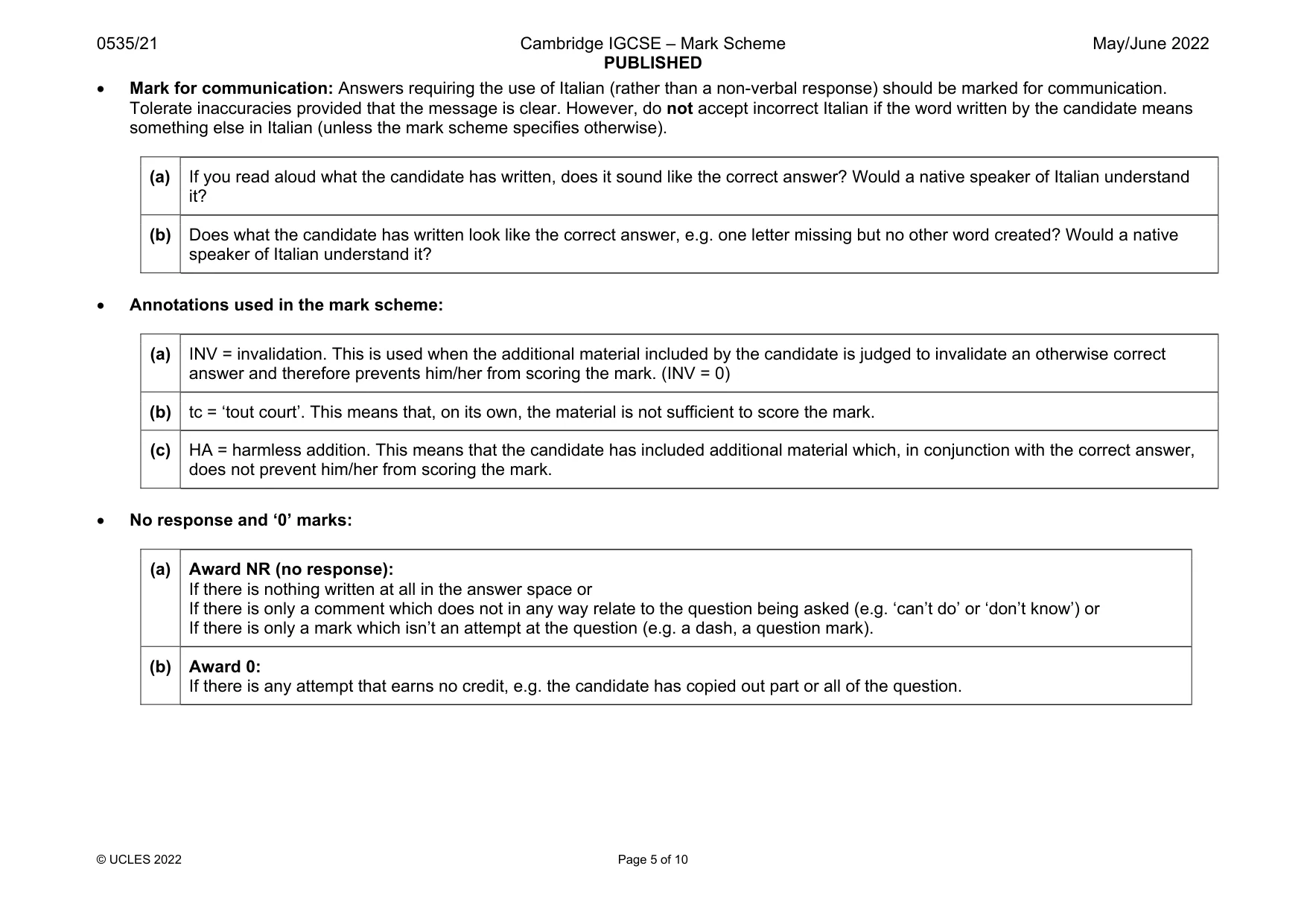
0535/21 Cambridge IGCSE – Mark Scheme PUBLISHED May/June 2022 © UCLES 2022 Page 5 of 10 Mark for communication: Answers requiring the use of Italian (rather than a non-verbal response) should be marked for communication. Tolerate inaccuracies provided that the message is clear. However, do not accept incorrect Italian if the word written by the candidate means something else in Italian (unless the mark scheme specifies otherwise). (a) If you read aloud what the candidate has written, does it sound like the correct answer? Would a native speaker of Italian understand it? (b) Does what the candidate has written look like the correct answer, e.g. one letter missing but no other word created? Would a native speaker of Italian understand it? Annotations used in the mark scheme: (a) INV = invalidation. This is used when the additional material included by the candidate is judged to invalidate an otherwise correct answer and therefore prevents him/her from scoring the mark. (INV = 0) (b) tc = ‘tout court’. This means that, on its own, the material is not sufficient to score the mark. (c) HA = harmless addition. This means that the candidate has included additional material which, in conjunction with the correct answer, does not prevent him/her from scoring the mark. No response and ‘0’ marks: (a) Award NR (no response): If there is nothing written at all in the answer space or If there is only a comment which does not in any way relate to the question being asked (e.g. ‘can’t do’ or ‘don’t know’) or If there is only a mark which isn’t an attempt at the question (e.g. a dash, a question mark). (b) Award 0: If there is any attempt that earns no credit, e.g. the candidate has copied out part or all of the question.
Mark scheme, page 6
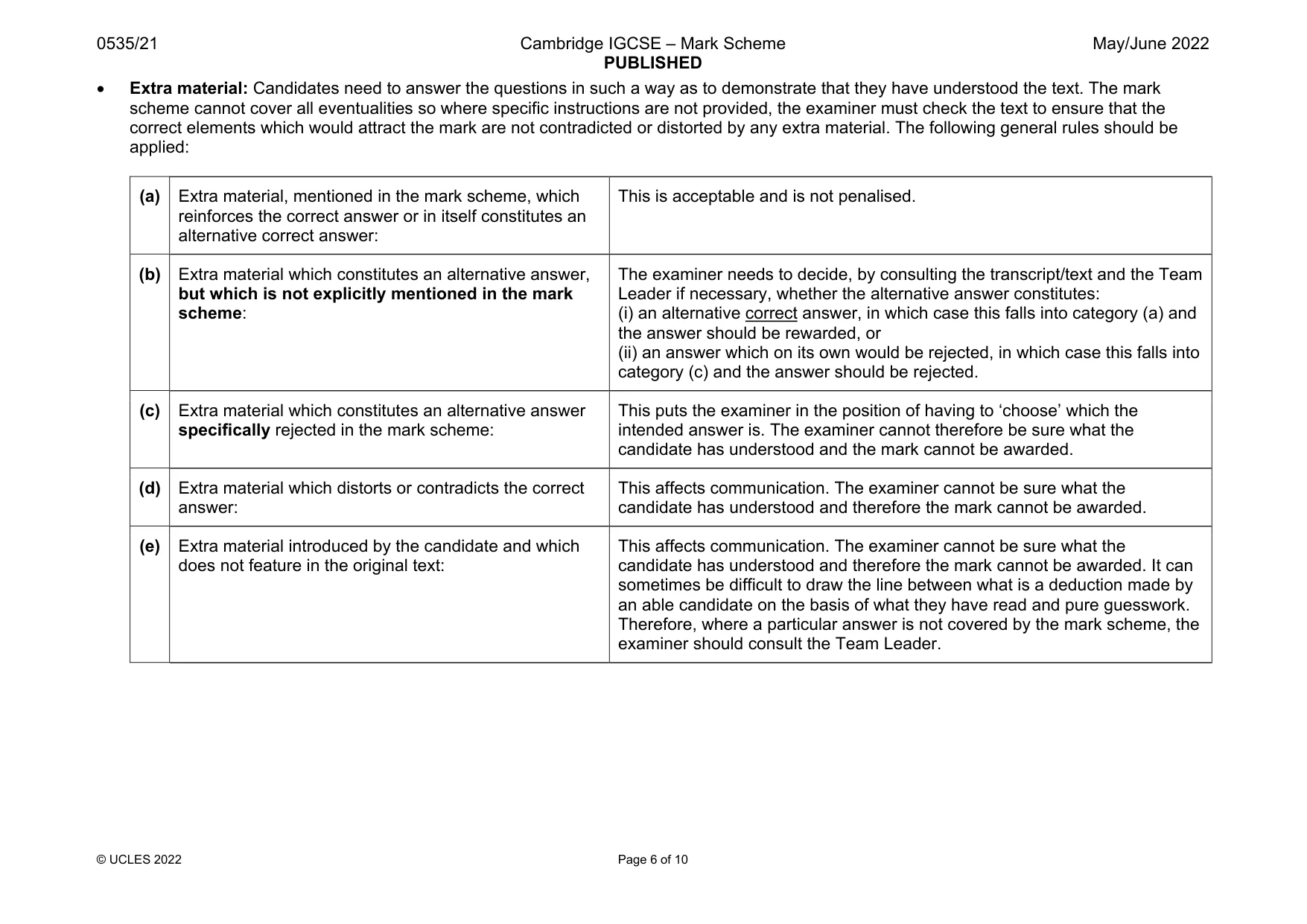
0535/21 Cambridge IGCSE – Mark Scheme PUBLISHED May/June 2022 © UCLES 2022 Page 6 of 10 Extra material: Candidates need to answer the questions in such a way as to demonstrate that they have understood the text. The mark scheme cannot cover all eventualities so where specific instructions are not provided, the examiner must check the text to ensure that the correct elements which would attract the mark are not contradicted or distorted by any extra material. The following general rules should be applied: (a) Extra material, mentioned in the mark scheme, which reinforces the correct answer or in itself constitutes an alternative correct answer: This is acceptable and is not penalised. (b) Extra material which constitutes an alternative answer, but which is not explicitly mentioned in the mark scheme: The examiner needs to decide, by consulting the transcript/text and the Team Leader if necessary, whether the alternative answer constitutes: (i) an alternative correct answer, in which case this falls into category (a) and the answer should be rewarded, or (ii) an answer which on its own would be rejected, in which case this falls into category (c) and the answer should be rejected. (c) Extra material which constitutes an alternative answer specifically rejected in the mark scheme: This puts the examiner in the position of having to ‘choose’ which the intended answer is. The examiner cannot therefore be sure what the candidate has understood and the mark cannot be awarded. (d) Extra material which distorts or contradicts the correct answer: This affects communication. The examiner cannot be sure what the candidate has understood and therefore the mark cannot be awarded. (e) Extra material introduced by the candidate and which does not feature in the original text: This affects communication. The examiner cannot be sure what the candidate has understood and therefore the mark cannot be awarded. It can sometimes be difficult to draw the line between what is a deduction made by an able candidate on the basis of what they have read and pure guesswork. Therefore, where a particular answer is not covered by the mark scheme, the examiner should consult the Team Leader.
Mark scheme, page 7
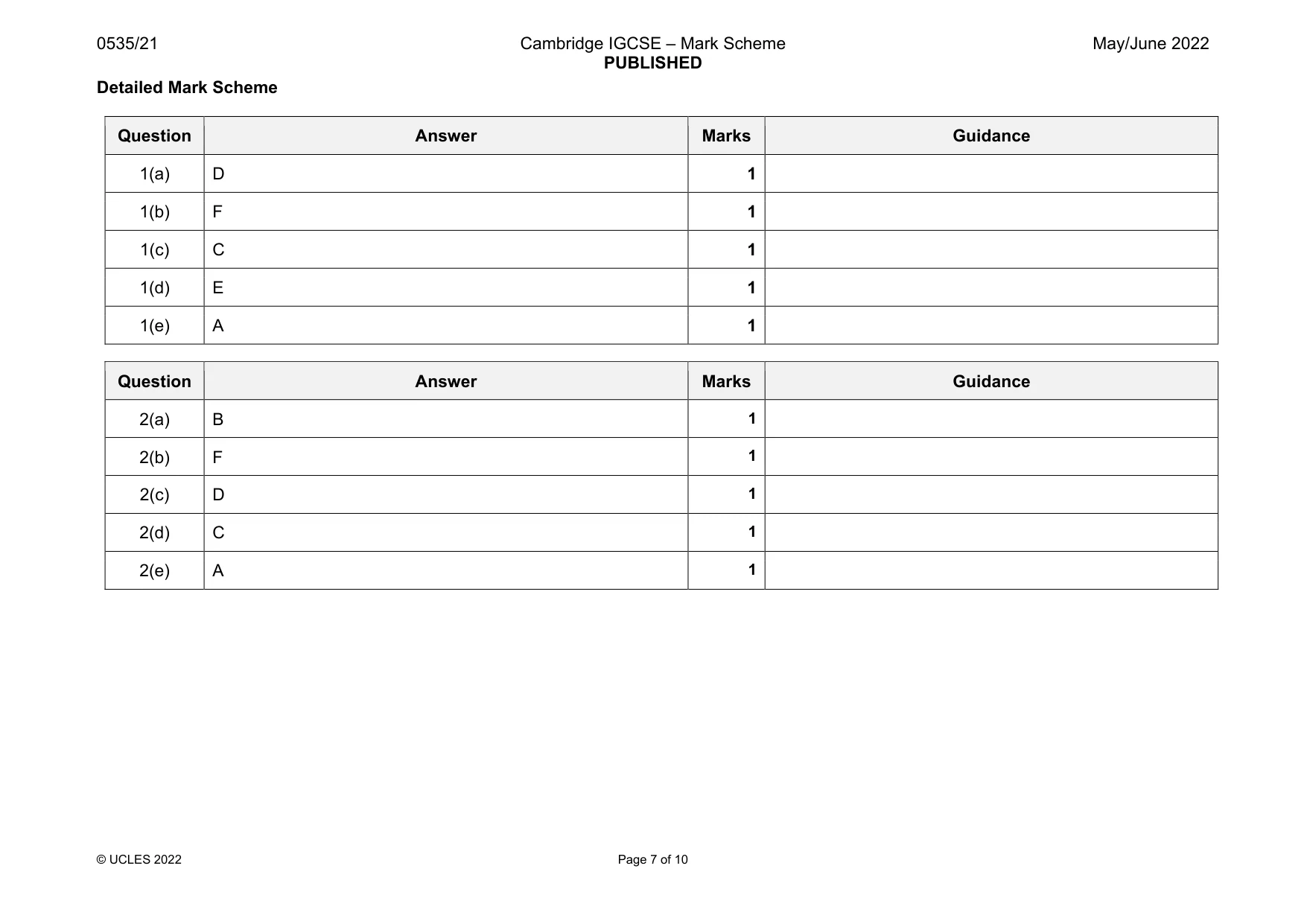
0535/21 Cambridge IGCSE – Mark Scheme PUBLISHED May/June 2022 © UCLES 2022 Page 7 of 10 Detailed Mark Scheme Question Answer Marks Guidance 1(a) D 1 1(b) F 1 1(c) C 1 1(d) E 1 1(e) A 1 Question Answer Marks Guidance 2(a) B 1 2(b) F 1 2(c) D 1 2(d) C 1 2(e) A 1
Mark scheme, page 8
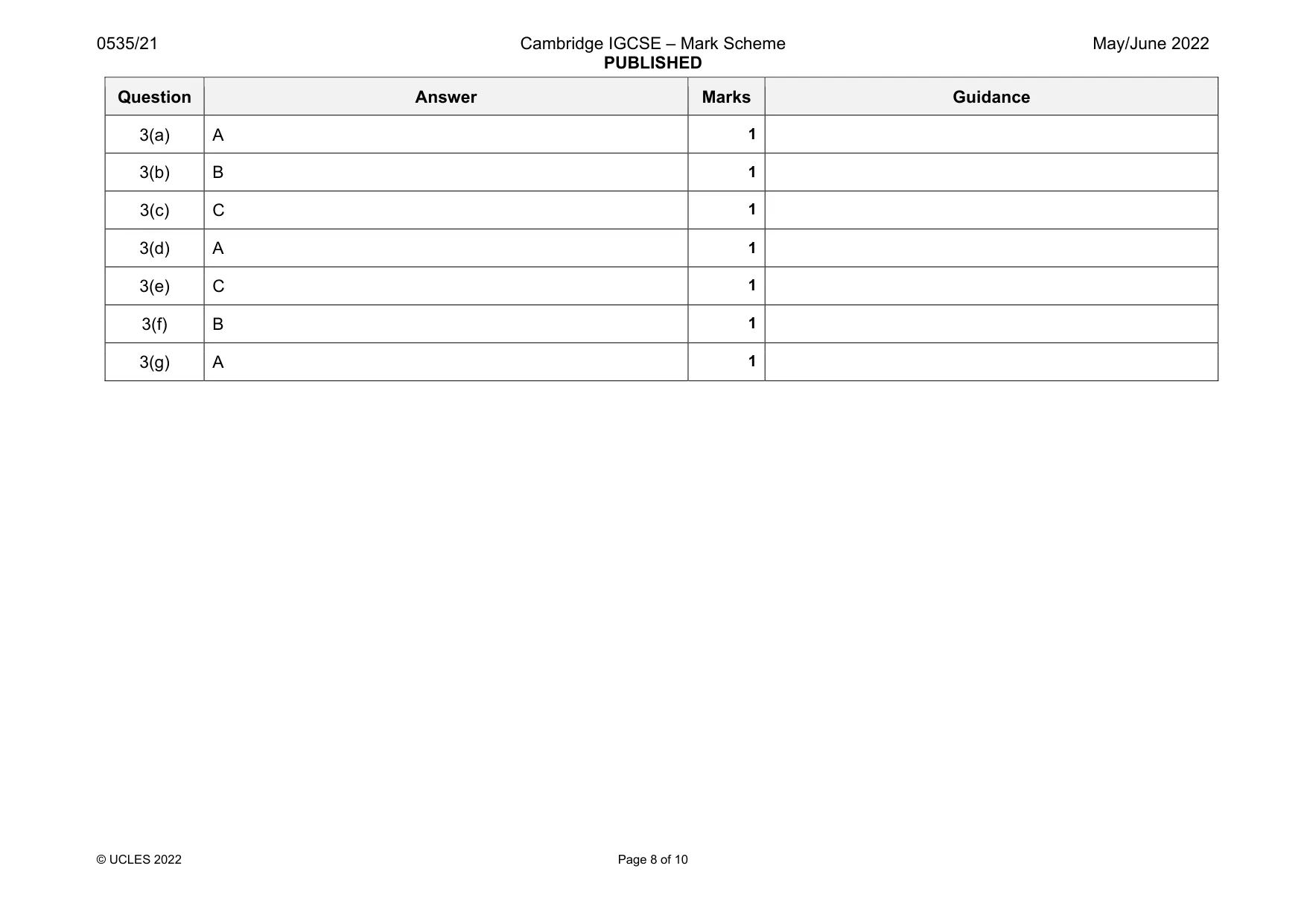
0535/21 Cambridge IGCSE – Mark Scheme PUBLISHED May/June 2022 © UCLES 2022 Page 8 of 10 Question Answer Marks Guidance 3(a) A 1 3(b) B 1 3(c) C 1 3(d) A 1 3(e) C 1 3(f) B 1 3(g) A 1
Mark scheme, page 9
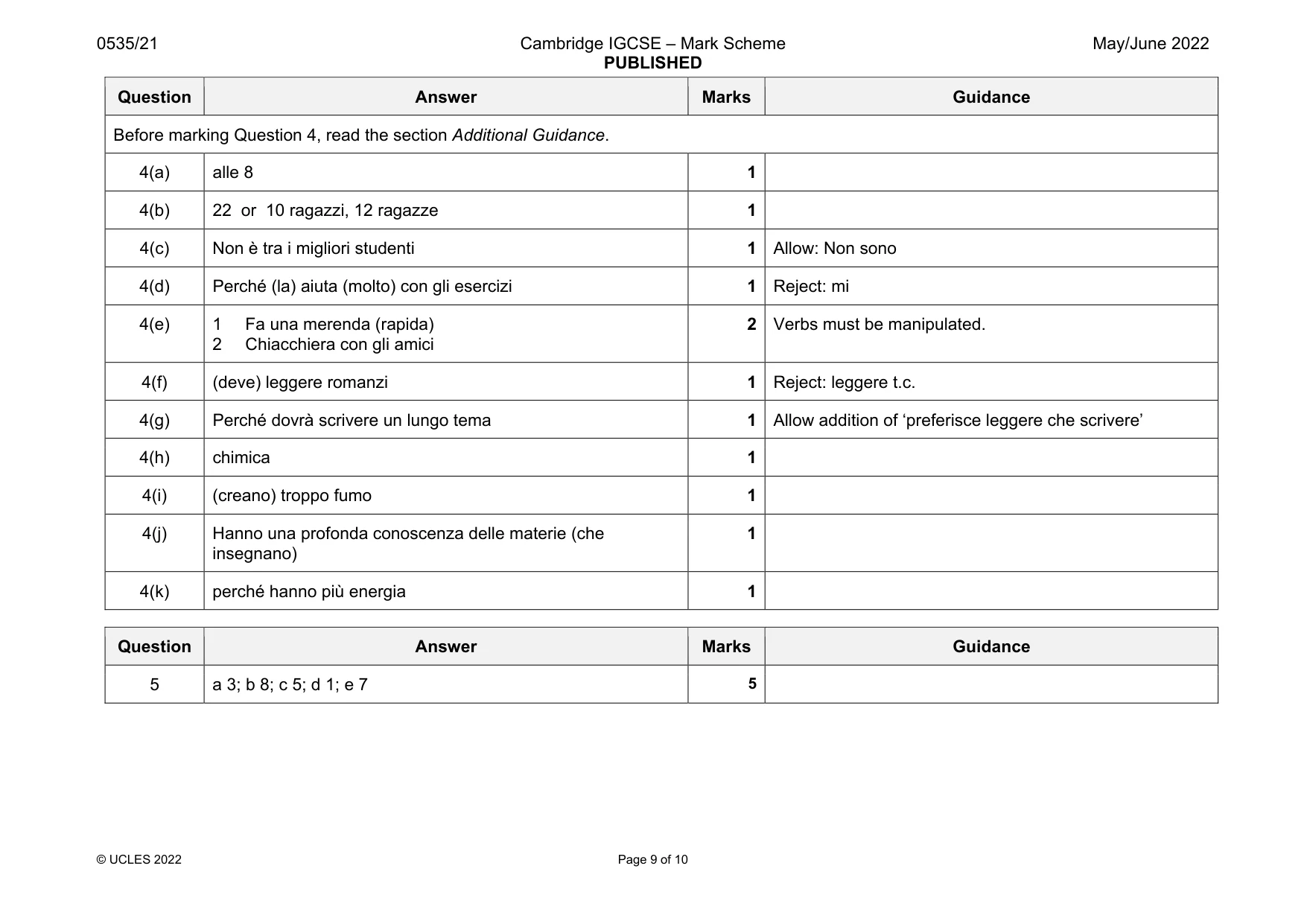
0535/21 Cambridge IGCSE – Mark Scheme PUBLISHED May/June 2022 © UCLES 2022 Page 9 of 10 Question Answer Marks Guidance Before marking Question 4, read the section Additional Guidance. 4(a) alle 8 1 4(b) 22 or 10 ragazzi, 12 ragazze 1 4(c) Non è tra i migliori studenti 1 Allow: Non sono 4(d) Perché (la) aiuta (molto) con gli esercizi 1 Reject: mi 4(e) 1 Fa una merenda (rapida) 2 Chiacchiera con gli amici 2 Verbs must be manipulated. 4(f) (deve) leggere romanzi 1 Reject: leggere t.c. 4(g) Perché dovrà scrivere un lungo tema 1 Allow addition of ‘preferisce leggere che scrivere’ 4(h) chimica 1 4(i) (creano) troppo fumo 1 4(j) Hanno una profonda conoscenza delle materie (che insegnano) 1 4(k) perché hanno più energia 1 Question Answer Marks Guidance 5 a 3; b 8; c 5; d 1; e 7 5
Mark scheme, page 10
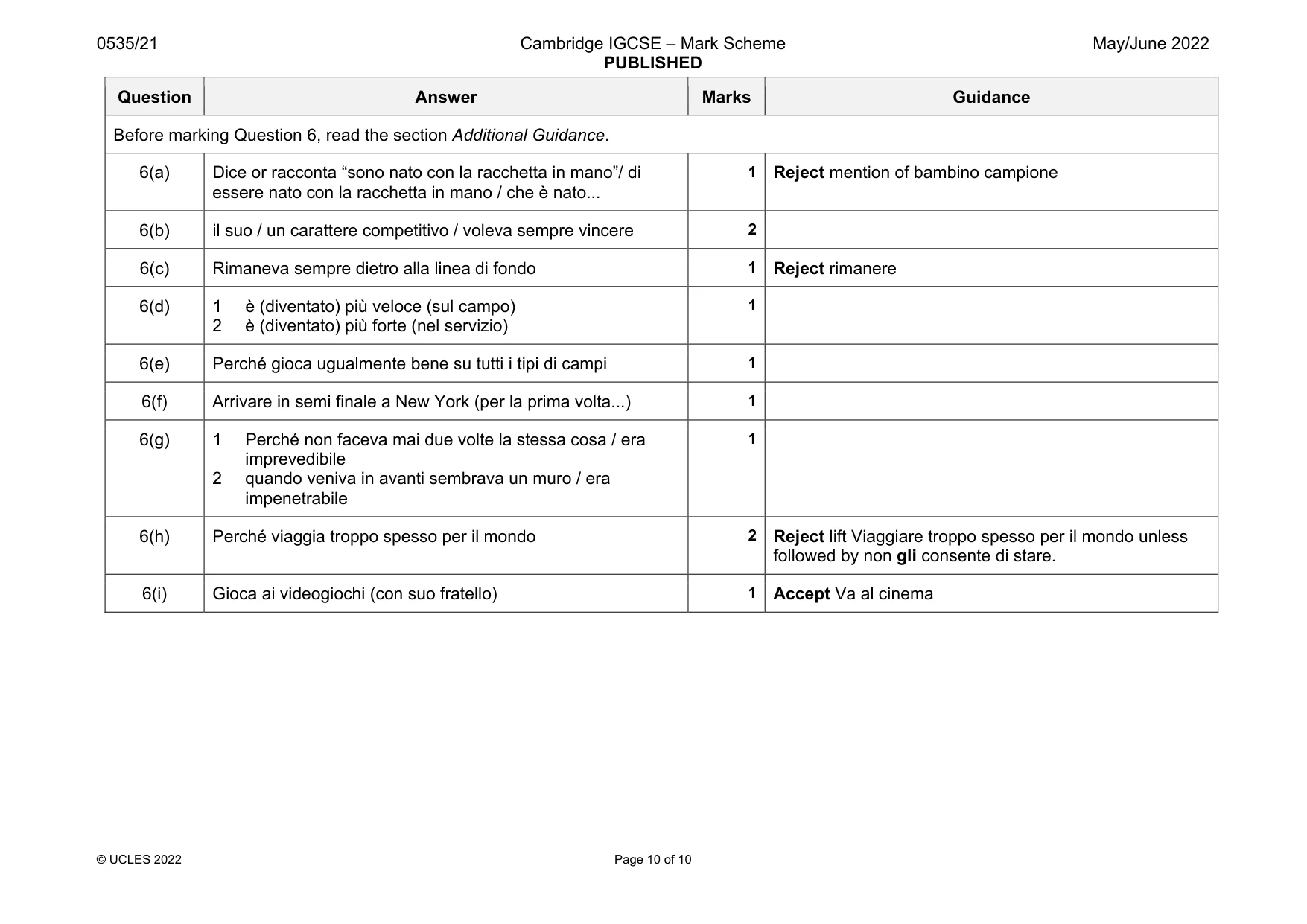
0535/21 Cambridge IGCSE – Mark Scheme PUBLISHED May/June 2022 © UCLES 2022 Page 10 of 10 Question Answer Marks Guidance Before marking Question 6, read the section Additional Guidance. 6(a) Dice or racconta “sono nato con la racchetta in mano”/ di essere nato con la racchetta in mano / che è nato... 1 Reject mention of bambino campione 6(b) il suo / un carattere competitivo / voleva sempre vincere 2 6(c) Rimaneva sempre dietro alla linea di fondo 1 Reject rimanere 6(d) 1 è (diventato) più veloce (sul campo) 2 è (diventato) più forte (nel servizio) 1 6(e) Perché gioca ugualmente bene su tutti i tipi di campi 1 6(f) Arrivare in semi finale a New York (per la prima volta...) 1 6(g) 1 Perché non faceva mai due volte la stessa cosa / era imprevedibile 2 quando veniva in avanti sembrava un muro / era impenetrabile 1 6(h) Perché viaggia troppo spesso per il mondo 2 Reject lift Viaggiare troppo spesso per il mondo unless followed by non gli consente di stare. 6(i) Gioca ai videogiochi (con suo fratello) 1 Accept Va al cinema
What you needed in this session
Cambridge’s own grade thresholds for 2022 May/June, Paper 2 · Variant 1. A higher threshold means an easier paper — the bar moves with how the cohort did.