Cambridge IGCSE Italian - Foreign Language 0535 — 2017 May/June Paper 2 · Variant 1
0535/21/M/J/17 · 45 marks · ≈51 min
The question paper and its mark scheme, free to read here and free to download. This is Cambridge’s own paper, exactly as it was sat.
Question paper16 pages


Mark scheme11 pages
Answers below. Sit the paper first if you are practising.
Paper as text
Question paper, page 1
This document consists of 14 printed pages and 2 blank pages. DC (CE/SW) 134605/2 © UCLES 2017 [Turn over Cambridge International Examinations Cambridge International General Certificate of Secondary Education * 5 9 6 1 7 9 6 1 8 0 * ITALIAN 0535/02 Paper 2 Reading May/June 2017 1 hour Candidates answer on the Question Paper. No Additional Materials are required. READ THESE INSTRUCTIONS FIRST Write your Centre number, candidate number and name in the spaces at the top of this page. Write in dark blue or black pen. Do not use staples, paper clips, glue or correction fluid. DO NOT WRITE IN ANY BARCODES. Answer all questions. The number of marks is given in brackets [ ] at the end of each question or part question. The syllabus is approved for use in England, Wales and Northern Ireland as a Cambridge International Level 1/Level 2 Certificate.
Question paper, page 2
2 0535/02/M/J/17 © UCLES 2017 BLANK PAGE
Question paper, page 3
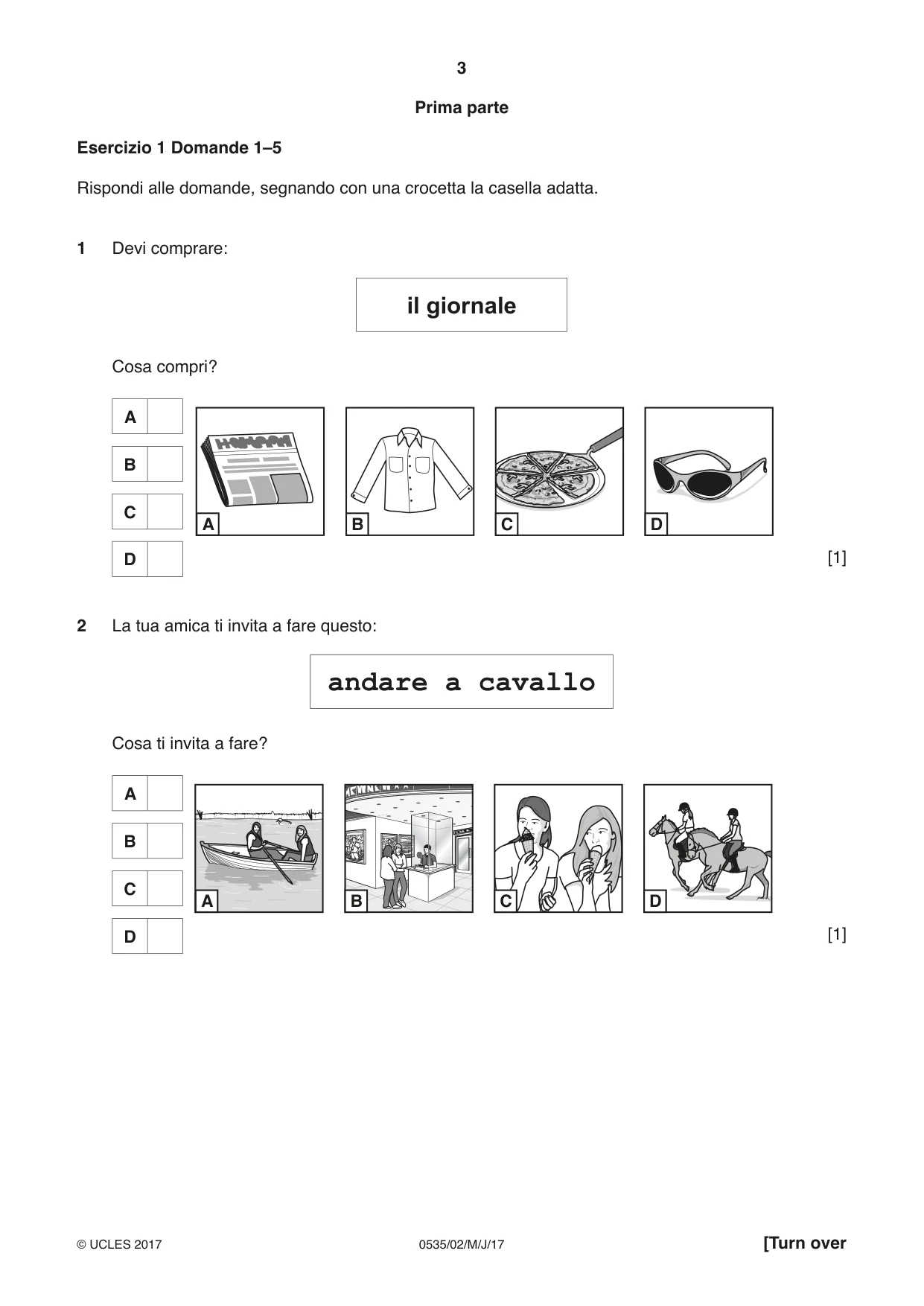
3 0535/02/M/J/17 © UCLES 2017 [Turn over Prima parte Esercizio 1 Domande 1–5 Rispondi alle domande, segnando con una crocetta la casella adatta. 1 Devi comprare: il giornale Cosa compri? A B C D A [1] B C D 2 La tua amica ti invita a fare questo: andare a cavallo Cosa ti invita a fare? A 3 B C D A [1] B C D
Question paper, page 4
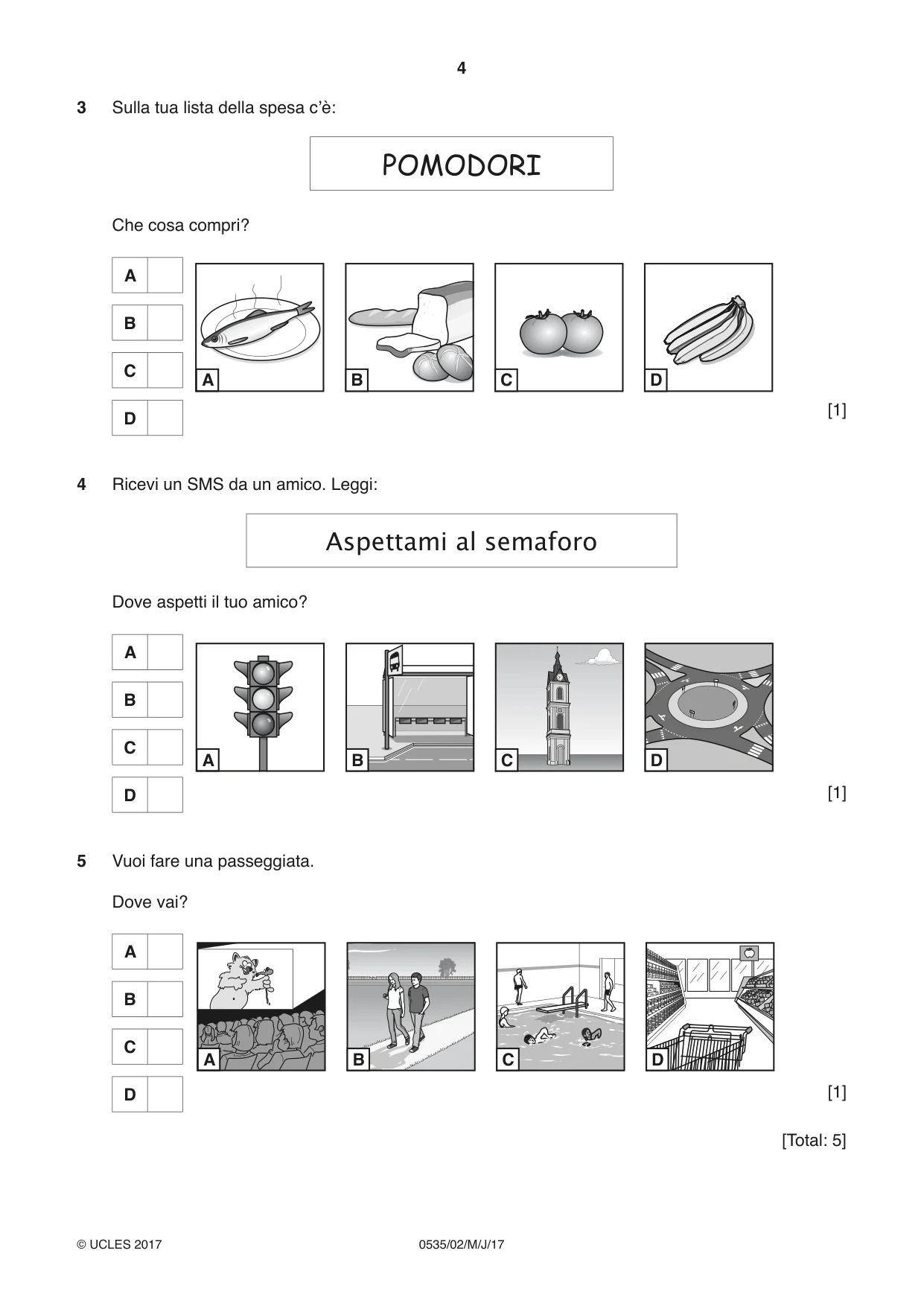
4 0535/02/M/J/17 © UCLES 2017 3 Sulla tua lista della spesa c’è: POMODORI Che cosa compri? A B C D A [1] B C D 4 Ricevi un SMS da un amico. Leggi: Aspettami al semaforo Dove aspetti il tuo amico? A B C D A [1] B C D 5 Vuoi fare una passeggiata. Dove vai? A B C D A [1] B C D [Total: 5]
Question paper, page 5
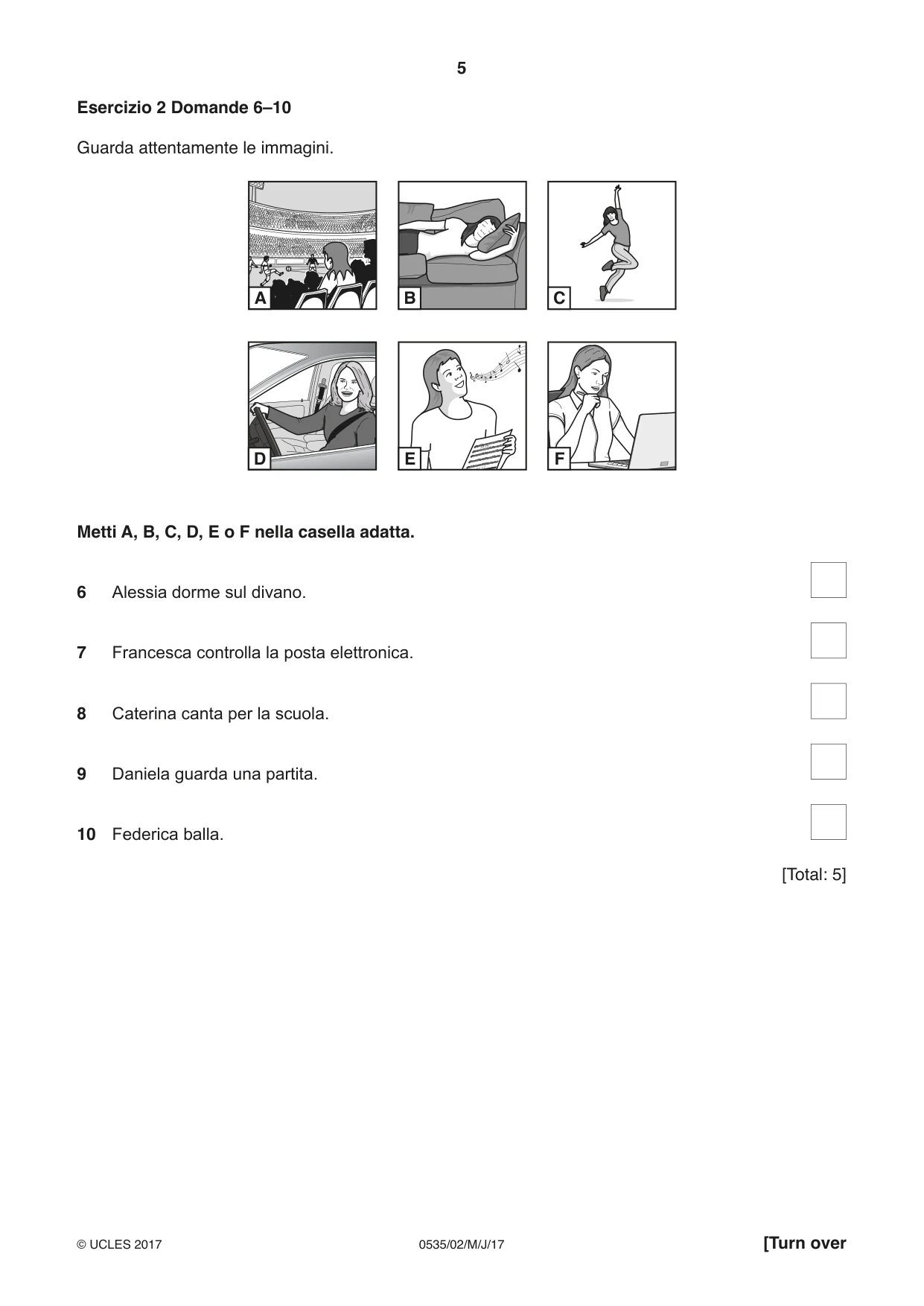
5 0535/02/M/J/17 © UCLES 2017 [Turn over Esercizio 2 Domande 6–10 Guarda attentamente le immagini. B C E F A D Metti A, B, C, D, E o F nella casella adatta. 6 Alessia dorme sul divano. 7 Francesca controlla la posta elettronica. 8 Caterina canta per la scuola. 9 Daniela guarda una partita. 10 Federica balla. [Total: 5]
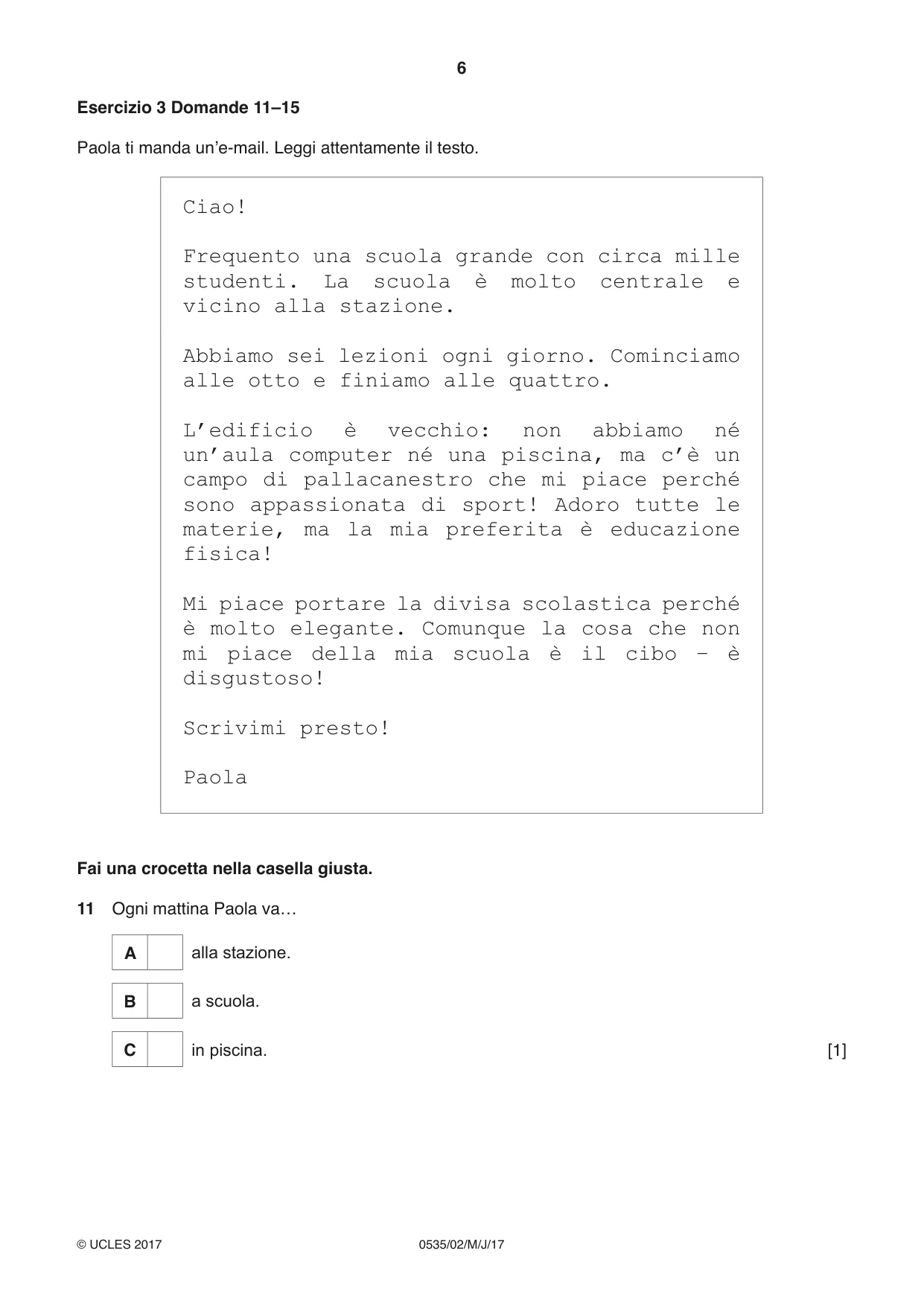
Question paper, page 6
6 0535/02/M/J/17 © UCLES 2017 Esercizio 3 Domande 11–15 Paola ti manda un’e-mail. Leggi attentamente il testo. Ciao! Frequento una scuola grande con circa mille studenti. La scuola è molto centrale e vicino alla stazione. Abbiamo sei lezioni ogni giorno. Cominciamo alle otto e finiamo alle quattro. L’edificio è vecchio: non abbiamo né un’aula computer né una piscina, ma c’è un campo di pallacanestro che mi piace perché sono appassionata di sport! Adoro tutte le materie, ma la mia preferita è educazione fisica! Mi piace portare la divisa scolastica perché è molto elegante. Comunque la cosa che non mi piace della mia scuola è il cibo – è disgustoso! Scrivimi presto! Paola Fai una crocetta nella casella giusta. 11 Ogni mattina Paola va… A alla stazione. B a scuola. C in piscina. [1]
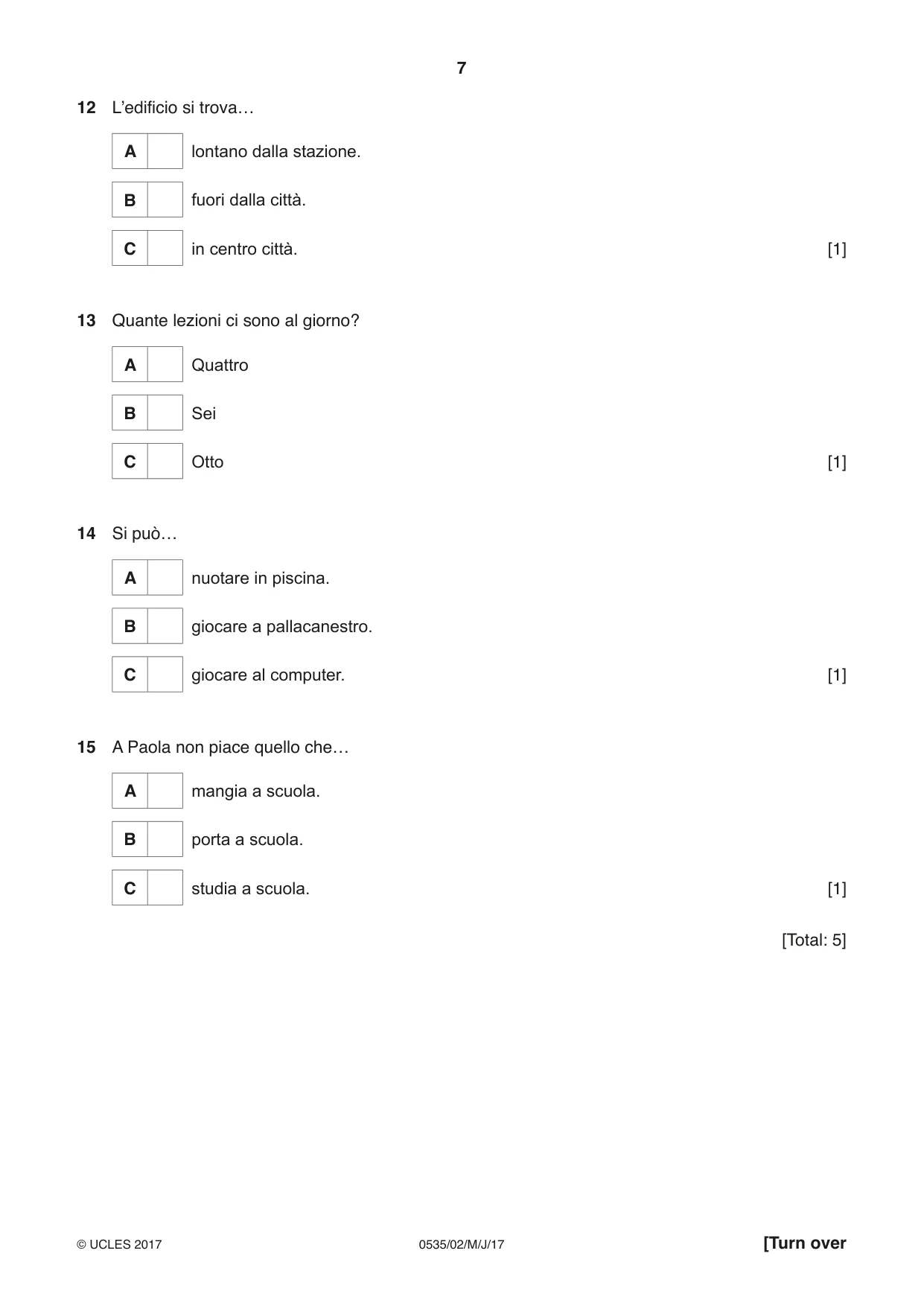
Question paper, page 7
7 0535/02/M/J/17 © UCLES 2017 [Turn over 12 L’edificio si trova… A lontano dalla stazione. B fuori dalla città. C in centro città. [1] 13 Quante lezioni ci sono al giorno? A Quattro B Sei C Otto [1] 14 Si può… A nuotare in piscina. B giocare a pallacanestro. C giocare al computer. [1] 15 A Paola non piace quello che… A mangia a scuola. B porta a scuola. C studia a scuola. [1] [Total: 5]
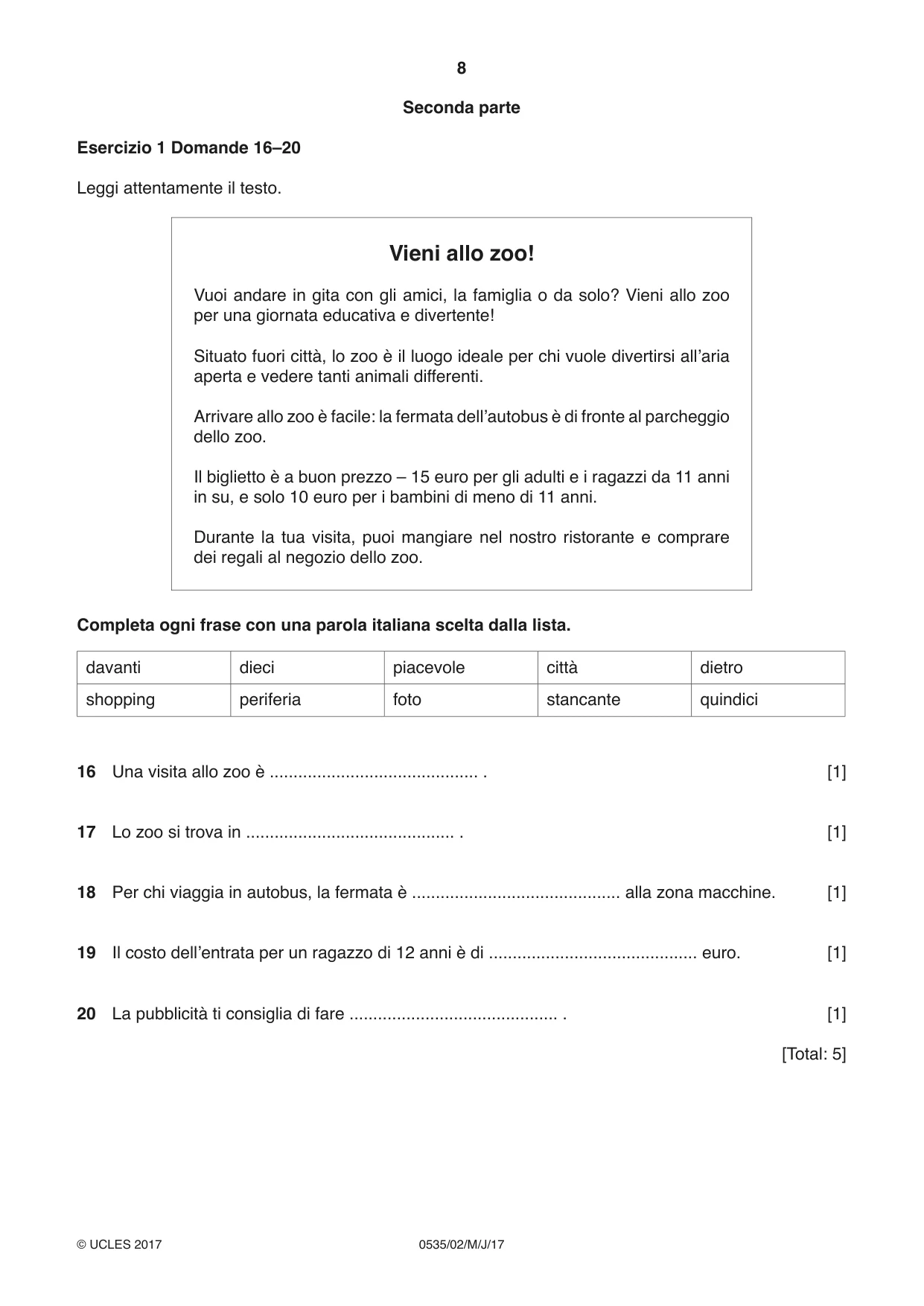
Question paper, page 8
8 0535/02/M/J/17 © UCLES 2017 Seconda parte Esercizio 1 Domande 16–20 Leggi attentamente il testo. Vieni allo zoo! Vuoi andare in gita con gli amici, la famiglia o da solo? Vieni allo zoo per una giornata educativa e divertente! Situato fuori città, lo zoo è il luogo ideale per chi vuole divertirsi all’aria aperta e vedere tanti animali differenti. Arrivare allo zoo è facile: la fermata dell’autobus è di fronte al parcheggio dello zoo. Il biglietto è a buon prezzo – 15 euro per gli adulti e i ragazzi da 11 anni in su, e solo 10 euro per i bambini di meno di 11 anni. Durante la tua visita, puoi mangiare nel nostro ristorante e comprare dei regali al negozio dello zoo. Completa ogni frase con una parola italiana scelta dalla lista. davanti dieci piacevole città dietro shopping periferia foto stancante quindici 16 Una visita allo zoo è … . [1] 17 Lo zoo si trova in … . [1] 18 Per chi viaggia in autobus, la fermata è … alla zona macchine. [1] 19 Il costo dell’entrata per un ragazzo di 12 anni è di … euro. [1] 20 La pubblicità ti consiglia di fare … . [1] [Total: 5]
Question paper, page 9
9 0535/02/M/J/17 © UCLES 2017 [Turn over Voltare la pagina per l’Esercizio 2.
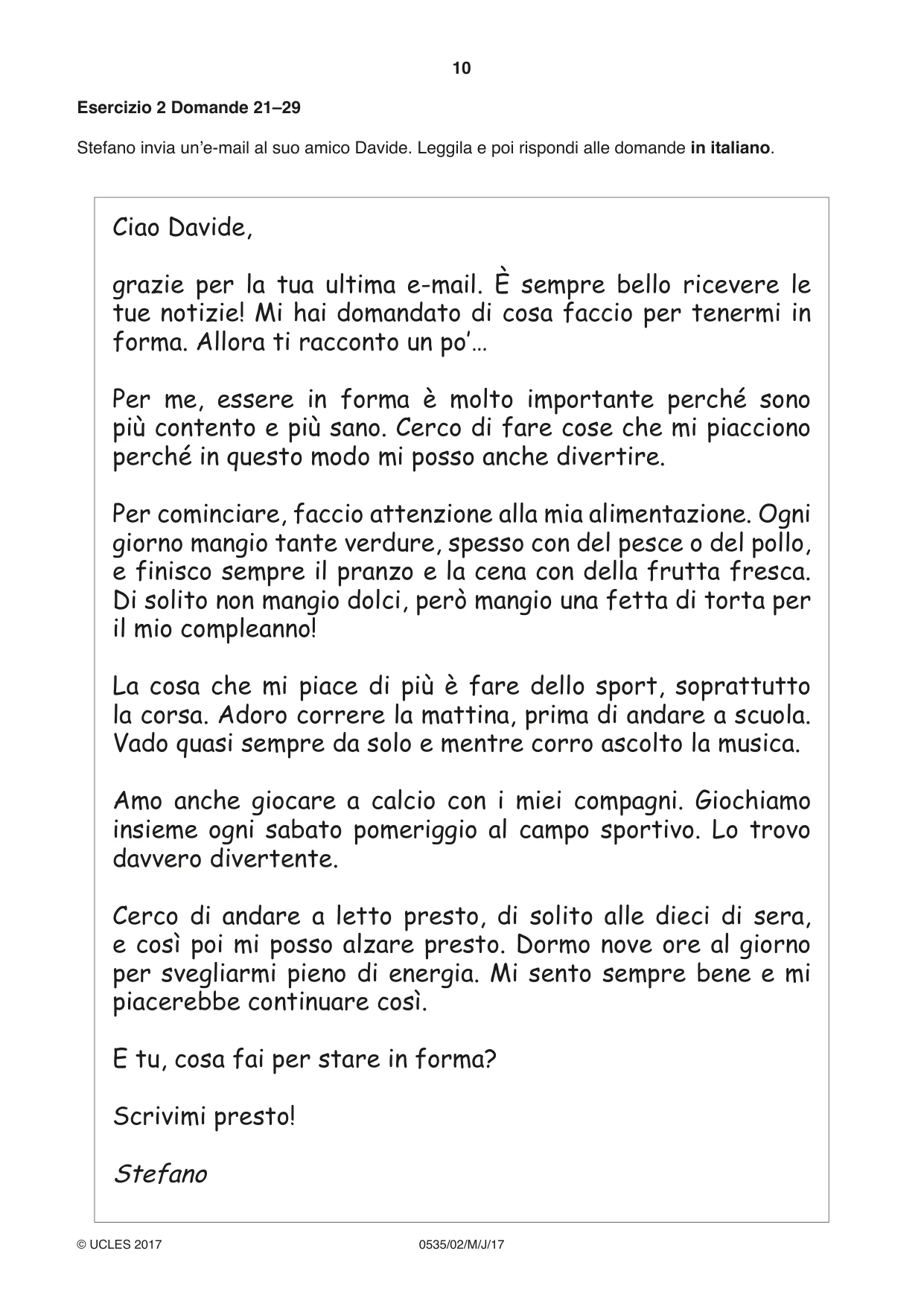
Question paper, page 10
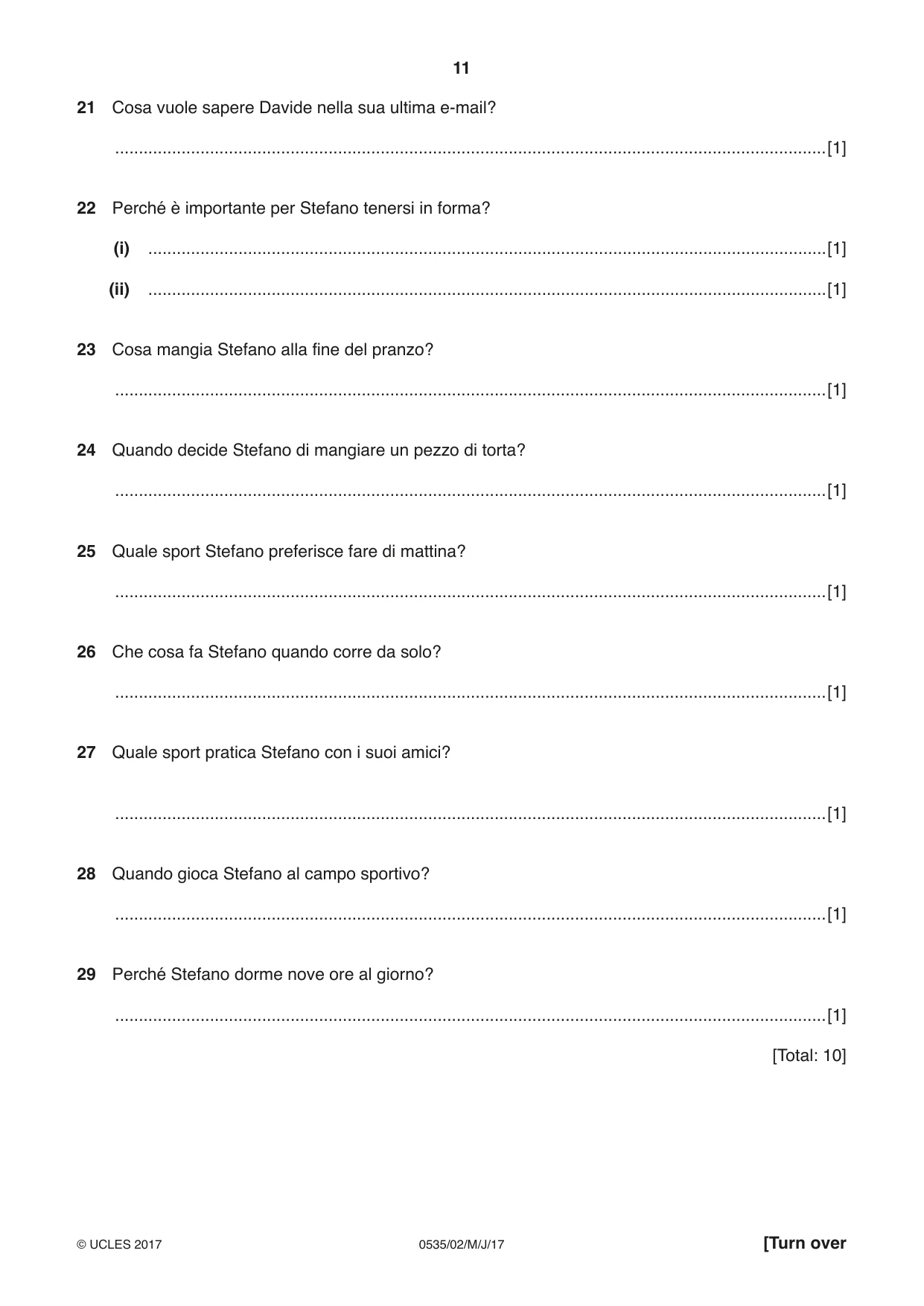
10 0535/02/M/J/17 © UCLES 2017 Esercizio 2 Domande 21–29 Stefano invia un’e-mail al suo amico Davide. Leggila e poi rispondi alle domande in italiano. Ciao Davide, grazie per la tua ultima e-mail. È sempre bello ricevere le tue notizie! Mi hai domandato di cosa faccio per tenermi in forma. Allora ti racconto un po’… Per me, essere in forma è molto importante perché sono più contento e più sano. Cerco di fare cose che mi piacciono perché in questo modo mi posso anche divertire. Per cominciare, faccio attenzione alla mia alimentazione. Ogni giorno mangio tante verdure, spesso con del pesce o del pollo, e finisco sempre il pranzo e la cena con della frutta fresca. Di solito non mangio dolci, però mangio una fetta di torta per il mio compleanno! La cosa che mi piace di più è fare dello sport, soprattutto la corsa. Adoro correre la mattina, prima di andare a scuola. Vado quasi sempre da solo e mentre corro ascolto la musica. Amo anche giocare a calcio con i miei compagni. Giochiamo insieme ogni sabato pomeriggio al campo sportivo. Lo trovo davvero divertente. Cerco di andare a letto presto, di solito alle dieci di sera, e così poi mi posso alzare presto. Dormo nove ore al giorno per svegliarmi pieno di energia. Mi sento sempre bene e mi piacerebbe continuare così. E tu, cosa fai per stare in forma? Scrivimi presto! Stefano
Question paper, page 11
11 0535/02/M/J/17 © UCLES 2017 [Turn over 21 Cosa vuole sapere Davide nella sua ultima e-mail? …[1] 22 Perché è importante per Stefano tenersi in forma? (i) …[1] (ii) …[1] 23 Cosa mangia Stefano alla fine del pranzo? …[1] 24 Quando decide Stefano di mangiare un pezzo di torta? …[1] 25 Quale sport Stefano preferisce fare di mattina? …[1] 26 Che cosa fa Stefano quando corre da solo? …[1] 27 Quale sport pratica Stefano con i suoi amici? …[1] 28 Quando gioca Stefano al campo sportivo? …[1] 29 Perché Stefano dorme nove ore al giorno? …[1] [Total: 10]
Question paper, page 12
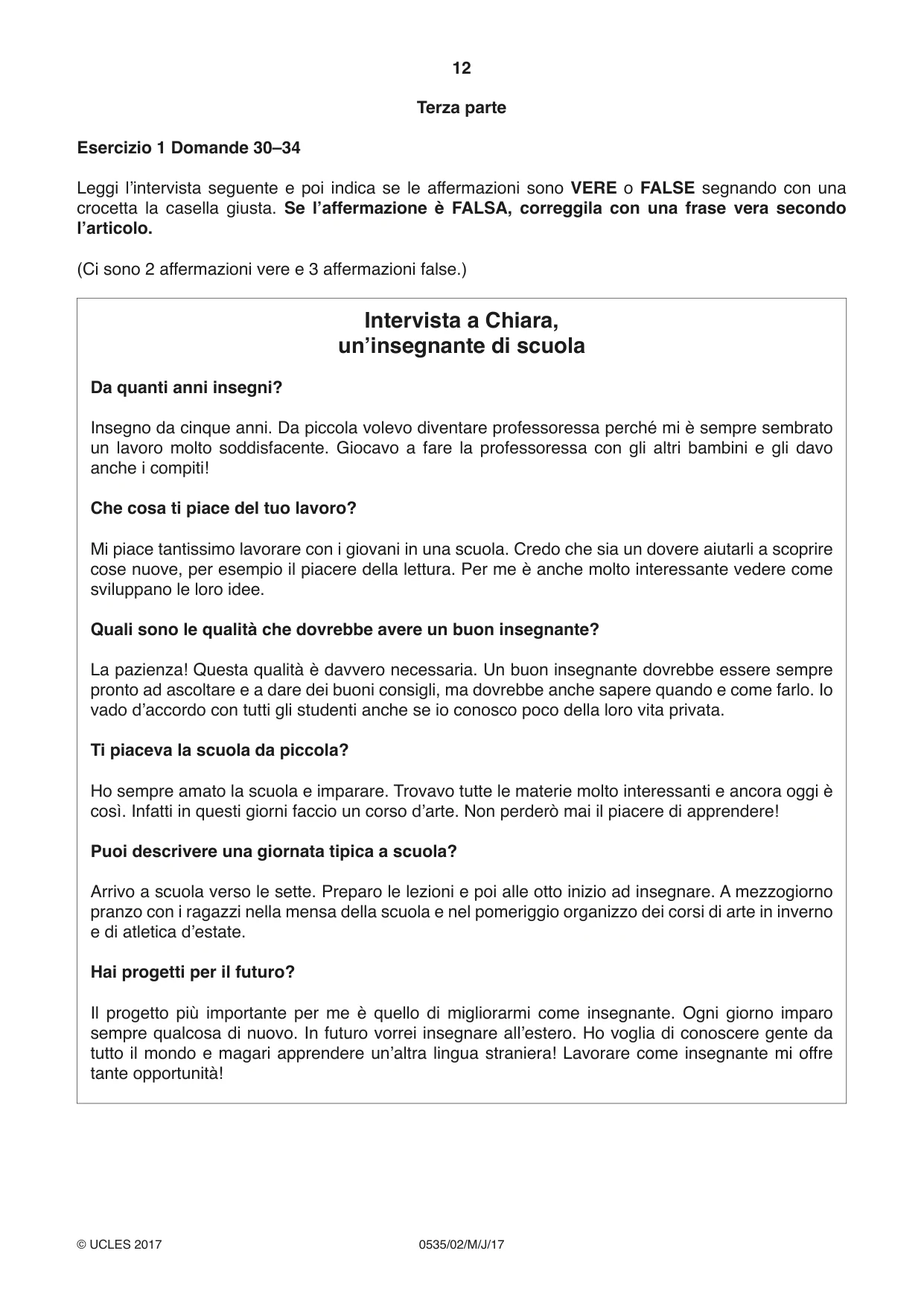
12 0535/02/M/J/17 © UCLES 2017 Terza parte Esercizio 1 Domande 30–34 Leggi l’intervista seguente e poi indica se le affermazioni sono VERE o FALSE segnando con una crocetta la casella giusta. Se l’affermazione è FALSA, correggila con una frase vera secondo l’articolo. (Ci sono 2 affermazioni vere e 3 affermazioni false.) Intervista a Chiara, un’insegnante di scuola Da quanti anni insegni? Insegno da cinque anni. Da piccola volevo diventare professoressa perché mi è sempre sembrato un lavoro molto soddisfacente. Giocavo a fare la professoressa con gli altri bambini e gli davo anche i compiti! Che cosa ti piace del tuo lavoro? Mi piace tantissimo lavorare con i giovani in una scuola. Credo che sia un dovere aiutarli a scoprire cose nuove, per esempio il piacere della lettura. Per me è anche molto interessante vedere come sviluppano le loro idee. Quali sono le qualità che dovrebbe avere un buon insegnante? La pazienza! Questa qualità è davvero necessaria. Un buon insegnante dovrebbe essere sempre pronto ad ascoltare e a dare dei buoni consigli, ma dovrebbe anche sapere quando e come farlo. Io vado d’accordo con tutti gli studenti anche se io conosco poco della loro vita privata. Ti piaceva la scuola da piccola? Ho sempre amato la scuola e imparare. Trovavo tutte le materie molto interessanti e ancora oggi è così. Infatti in questi giorni faccio un corso d’arte. Non perderò mai il piacere di apprendere! Puoi descrivere una giornata tipica a scuola? Arrivo a scuola verso le sette. Preparo le lezioni e poi alle otto inizio ad insegnare. A mezzogiorno pranzo con i ragazzi nella mensa della scuola e nel pomeriggio organizzo dei corsi di arte in inverno e di atletica d’estate. Hai progetti per il futuro? Il progetto più importante per me è quello di migliorarmi come insegnante. Ogni giorno imparo sempre qualcosa di nuovo. In futuro vorrei insegnare all’estero. Ho voglia di conoscere gente da tutto il mondo e magari apprendere un’altra lingua straniera! Lavorare come insegnante mi offre tante opportunità!
Question paper, page 13
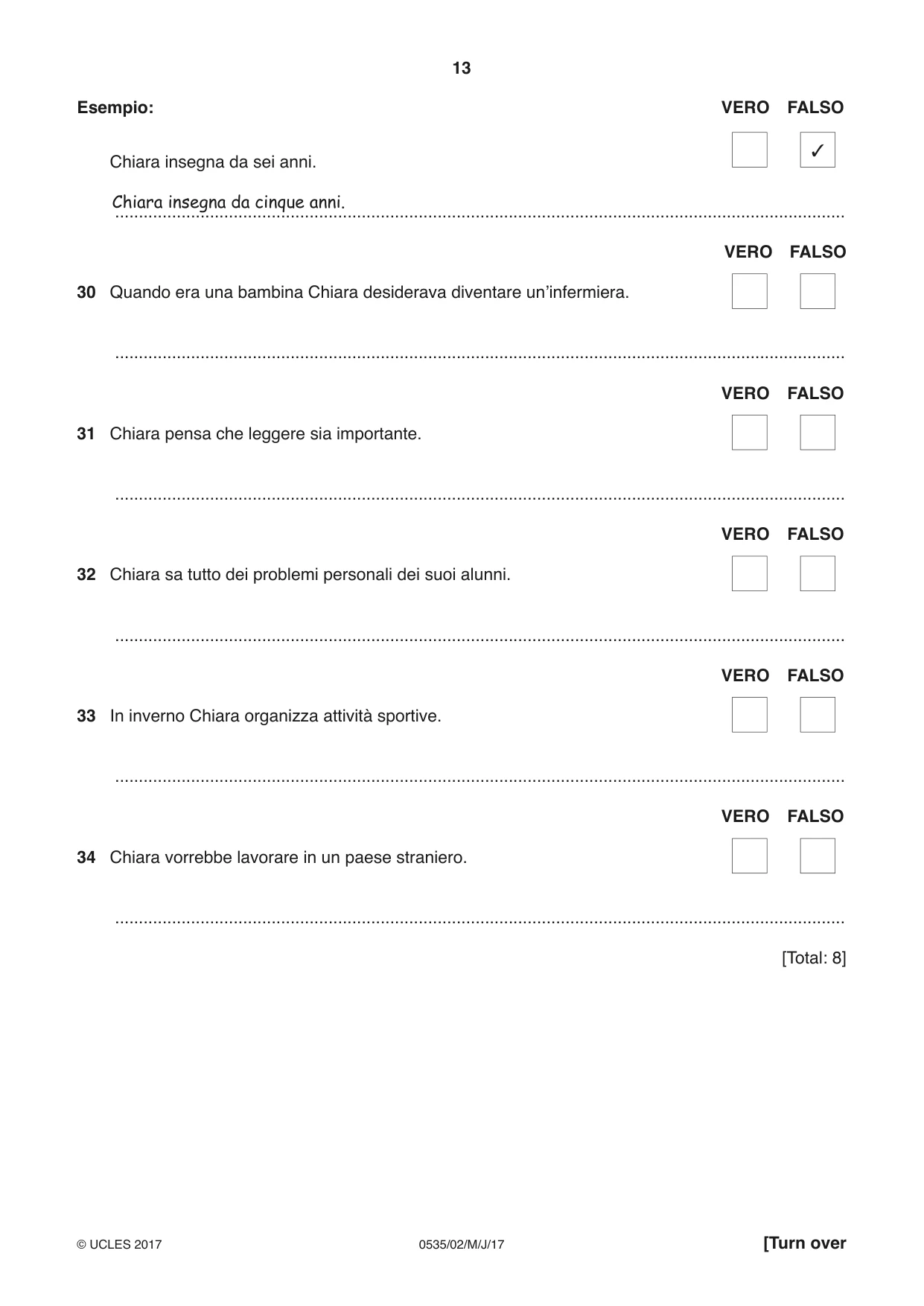
13 0535/02/M/J/17 © UCLES 2017 [Turn over Esempio: VERO FALSO Chiara insegna da sei anni. 3 Chiara insegna da cinque anni. … VERO FALSO 30 Quando era una bambina Chiara desiderava diventare un’infermiera. … VERO FALSO 31 Chiara pensa che leggere sia importante. … VERO FALSO 32 Chiara sa tutto dei problemi personali dei suoi alunni. … VERO FALSO 33 In inverno Chiara organizza attività sportive. … VERO FALSO 34 Chiara vorrebbe lavorare in un paese straniero. … [Total: 8]
Question paper, page 14
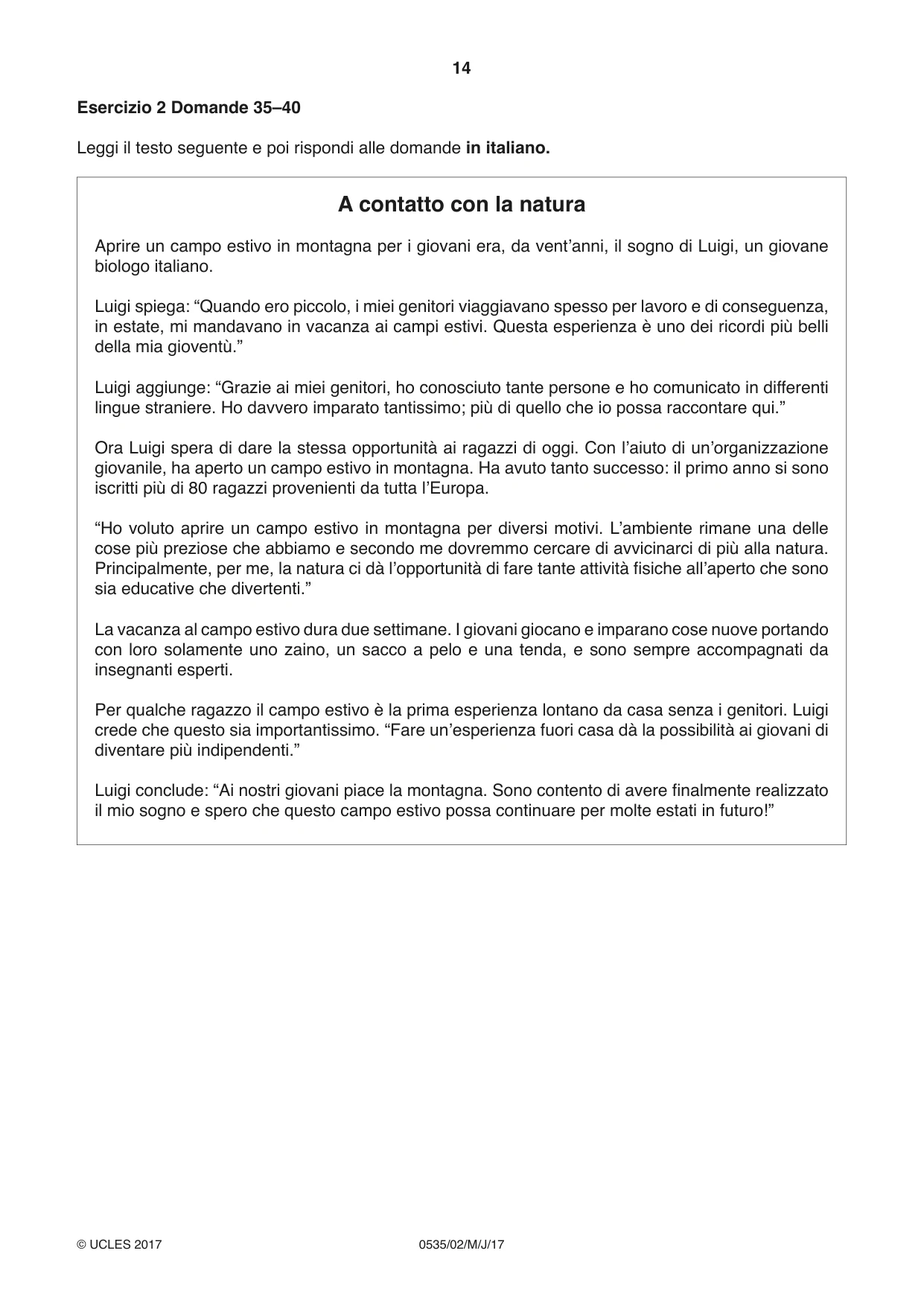
14 0535/02/M/J/17 © UCLES 2017 Esercizio 2 Domande 35–40 Leggi il testo seguente e poi rispondi alle domande in italiano. A contatto con la natura Aprire un campo estivo in montagna per i giovani era, da vent’anni, il sogno di Luigi, un giovane biologo italiano. Luigi spiega: “Quando ero piccolo, i miei genitori viaggiavano spesso per lavoro e di conseguenza, in estate, mi mandavano in vacanza ai campi estivi. Questa esperienza è uno dei ricordi più belli della mia gioventù.” Luigi aggiunge: “Grazie ai miei genitori, ho conosciuto tante persone e ho comunicato in differenti lingue straniere. Ho davvero imparato tantissimo; più di quello che io possa raccontare qui.” Ora Luigi spera di dare la stessa opportunità ai ragazzi di oggi. Con l’aiuto di un’organizzazione giovanile, ha aperto un campo estivo in montagna. Ha avuto tanto successo: il primo anno si sono iscritti più di 80 ragazzi provenienti da tutta l’Europa. “Ho voluto aprire un campo estivo in montagna per diversi motivi. L’ambiente rimane una delle cose più preziose che abbiamo e secondo me dovremmo cercare di avvicinarci di più alla natura. Principalmente, per me, la natura ci dà l’opportunità di fare tante attività fisiche all’aperto che sono sia educative che divertenti.” La vacanza al campo estivo dura due settimane. I giovani giocano e imparano cose nuove portando con loro solamente uno zaino, un sacco a pelo e una tenda, e sono sempre accompagnati da insegnanti esperti. Per qualche ragazzo il campo estivo è la prima esperienza lontano da casa senza i genitori. Luigi crede che questo sia importantissimo. “Fare un’esperienza fuori casa dà la possibilità ai giovani di diventare più indipendenti.” Luigi conclude: “Ai nostri giovani piace la montagna. Sono contento di avere finalmente realizzato il mio sogno e spero che questo campo estivo possa continuare per molte estati in futuro!”
Question paper, page 15
15 0535/02/M/J/17 © UCLES 2017 35 Che cosa ha sognato di fare Luigi per molto tempo? …[1] 36 Perché da piccolo Luigi andava ai campi estivi? …[1] 37 Perché Luigi ringrazia i suoi genitori? Indica due motivi. (i) …[1] (ii) …[1] 38 Con chi ha lavorato Luigi per realizzare il suo sogno? …[1] 39 Secondo Luigi, qual è il vantaggio principale di passare tanto tempo all’aria aperta? …[1] 40 Perché è importante per Luigi che i giovani passino del tempo lontano dalla famiglia? …[1] [Total: 7]
Question paper, page 16
16 0535/02/M/J/17 © UCLES 2017 BLANK PAGE Permission to reproduce items where third-party owned material protected by copyright is included has been sought and cleared where possible. Every reasonable effort has been made by the publisher (UCLES) to trace copyright holders, but if any items requiring clearance have unwittingly been included, the publisher will be pleased to make amends at the earliest possible opportunity. To avoid the issue of disclosure of answer-related information to candidates, all copyright acknowledgements are reproduced online in the Cambridge International Examinations Copyright Acknowledgements Booklet. This is produced for each series of examinations and is freely available to download at www.cie.org.uk after the live examination series. Cambridge International Examinations is part of the Cambridge Assessment Group. Cambridge Assessment is the brand name of University of Cambridge Local Examinations Syndicate (UCLES), which is itself a department of the University of Cambridge.
Mark scheme, page 1
® IGCSE is a registered trademark. This syllabus is approved for use in England, Wales and Northern Ireland as a Cambridge International Level 1/Level 2 Certificate. This document consists of 11 printed pages. © UCLES 2017 [Turn over Cambridge International Examinations Cambridge International General Certificate of Secondary Education ITALIAN 0535/02 Paper 2 Reading May/June 2017 MARK SCHEME Maximum Mark: 45 Published This mark scheme is published as an aid to teachers and candidates, to indicate the requirements of the examination. It shows the basis on which Examiners were instructed to award marks. It does not indicate the details of the discussions that took place at an Examiners’ meeting before marking began, which would have considered the acceptability of alternative answers. Mark schemes should be read in conjunction with the question paper and the Principal Examiner Report for Teachers. Cambridge will not enter into discussions about these mark schemes. Cambridge is publishing the mark schemes for the May/June 2017 series for most Cambridge IGCSE®, Cambridge International A and AS Level and Cambridge Pre-U components, and some Cambridge O Level components.
Mark scheme, page 2
0535/02 Cambridge IGCSE – Mark Scheme PUBLISHED May/June 2017 © UCLES 2017 Page 2 of 11 1 General Marking Principles 1.1 It is not possible to list all acceptable alternatives in the Detailed Mark Scheme provided in Section 2. You will need to consider all alternative answers and unexpected approaches in candidates’ scripts, make a decision on whether they communicate the required elements and award marks accordingly. The following marking principles underpin the detailed instructions provided in Section 2 of the Mark Scheme. Where a decision is taken to deviate from these principles for a particular question, this will be specified in the Mark Scheme. Often the general principles will have to be weighed up against each other, e.g. the answer might pass the look-alike test (1.5 (b)), but if the candidate has produced an answer that is another word in Italian, they will not score (1.6). 1.2 Crossing out: (a) If a candidate changes his/her mind over an answer and crosses out an attempt, award a mark if the final attempt is correct. (b) If a candidate crosses out an answer to a whole question but makes no second attempt at it, mark the crossed out work. 1.3 More than the stipulated number of boxes ticked/crossed by the candidate: (a) If more than one attempt is visible, but the candidate has clearly indicated which attempt is his/her final answer (e.g. by crossing out other attempts or by annotating the script in some way), mark in the usual way. (b) If two attempts are visible (e.g. 2 boxes ticked instead of the 1 box stipulated), and neither has been crossed out/discounted by the candidate, no mark can be awarded. (c) Where candidates must tick a number of boxes (e.g. tick the 6 true statements) and tick too many, apply the following rule: deduct the number of ‘extra’ answers indicated by the candidate from their number of correct answers. The remaining number is the mark awarded, e.g. the candidate is asked to tick 6 statements, but ticks 8. 5 of the ticks are correctly placed, but 2 are ‘extras’ (8 ticks placed by candidate minus 6 ticks required by rubric = 2 ‘extras’). Therefore the candidate is awarded a mark of 3. (d) Answers in pen do not take precedence over answers in pencil, e.g. if a candidate is asked to tick 1 box and ticks 2, one in pen and the other in pencil, the mark cannot be awarded unless there is explicit indication from the candidate as to which is his/her final answer.
Mark scheme, page 3
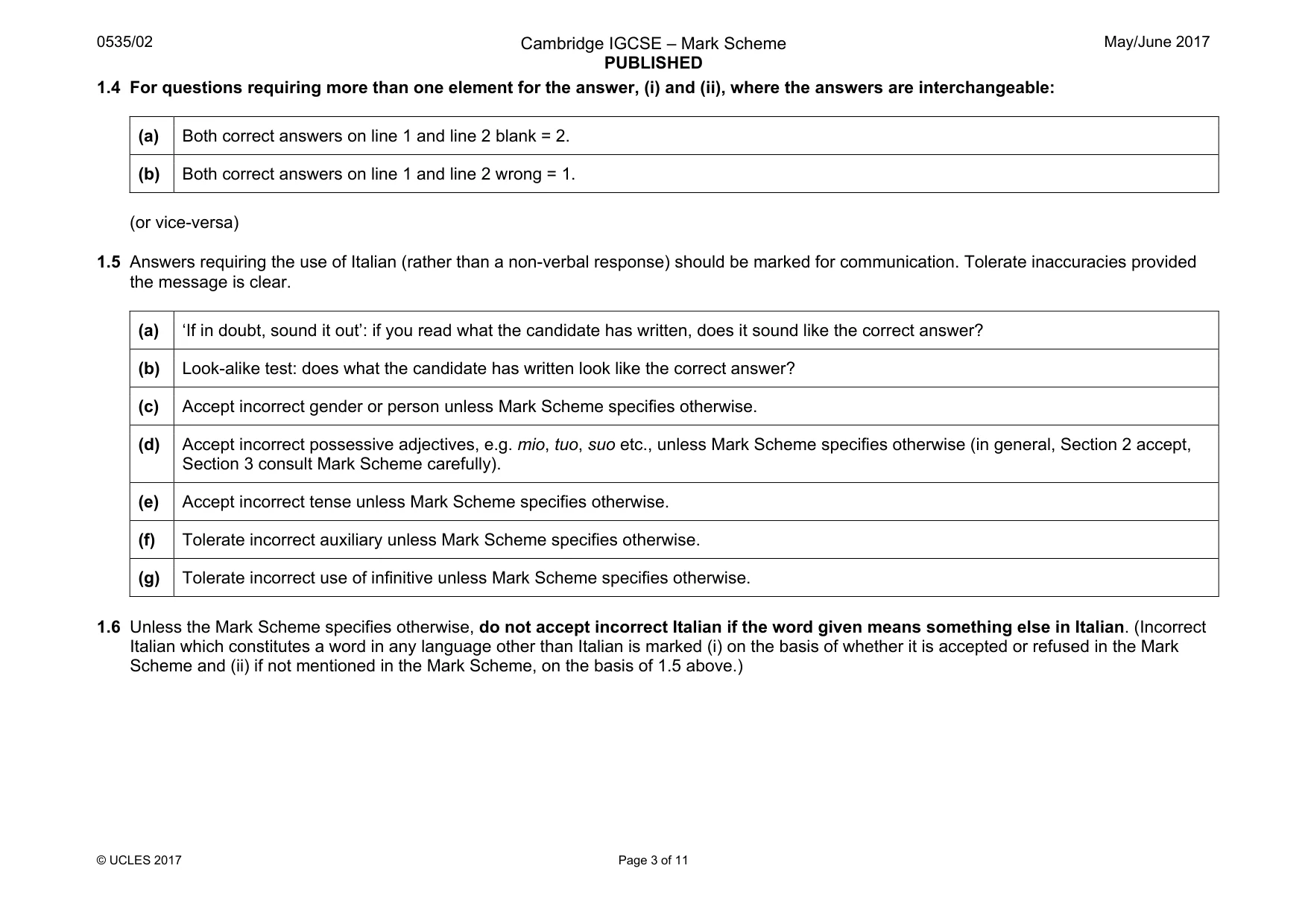
0535/02 Cambridge IGCSE – Mark Scheme PUBLISHED May/June 2017 © UCLES 2017 Page 3 of 11 1.4 For questions requiring more than one element for the answer, (i) and (ii), where the answers are interchangeable: (a) Both correct answers on line 1 and line 2 blank = 2. (b) Both correct answers on line 1 and line 2 wrong = 1. (or vice-versa) 1.5 Answers requiring the use of Italian (rather than a non-verbal response) should be marked for communication. Tolerate inaccuracies provided the message is clear. (a) ‘If in doubt, sound it out’: if you read what the candidate has written, does it sound like the correct answer? (b) Look-alike test: does what the candidate has written look like the correct answer? (c) Accept incorrect gender or person unless Mark Scheme specifies otherwise. (d) Accept incorrect possessive adjectives, e.g. mio, tuo, suo etc., unless Mark Scheme specifies otherwise (in general, Section 2 accept, Section 3 consult Mark Scheme carefully). (e) Accept incorrect tense unless Mark Scheme specifies otherwise. (f) Tolerate incorrect auxiliary unless Mark Scheme specifies otherwise. (g) Tolerate incorrect use of infinitive unless Mark Scheme specifies otherwise. 1.6 Unless the Mark Scheme specifies otherwise, do not accept incorrect Italian if the word given means something else in Italian. (Incorrect Italian which constitutes a word in any language other than Italian is marked (i) on the basis of whether it is accepted or refused in the Mark Scheme and (ii) if not mentioned in the Mark Scheme, on the basis of 1.5 above.)
Mark scheme, page 4
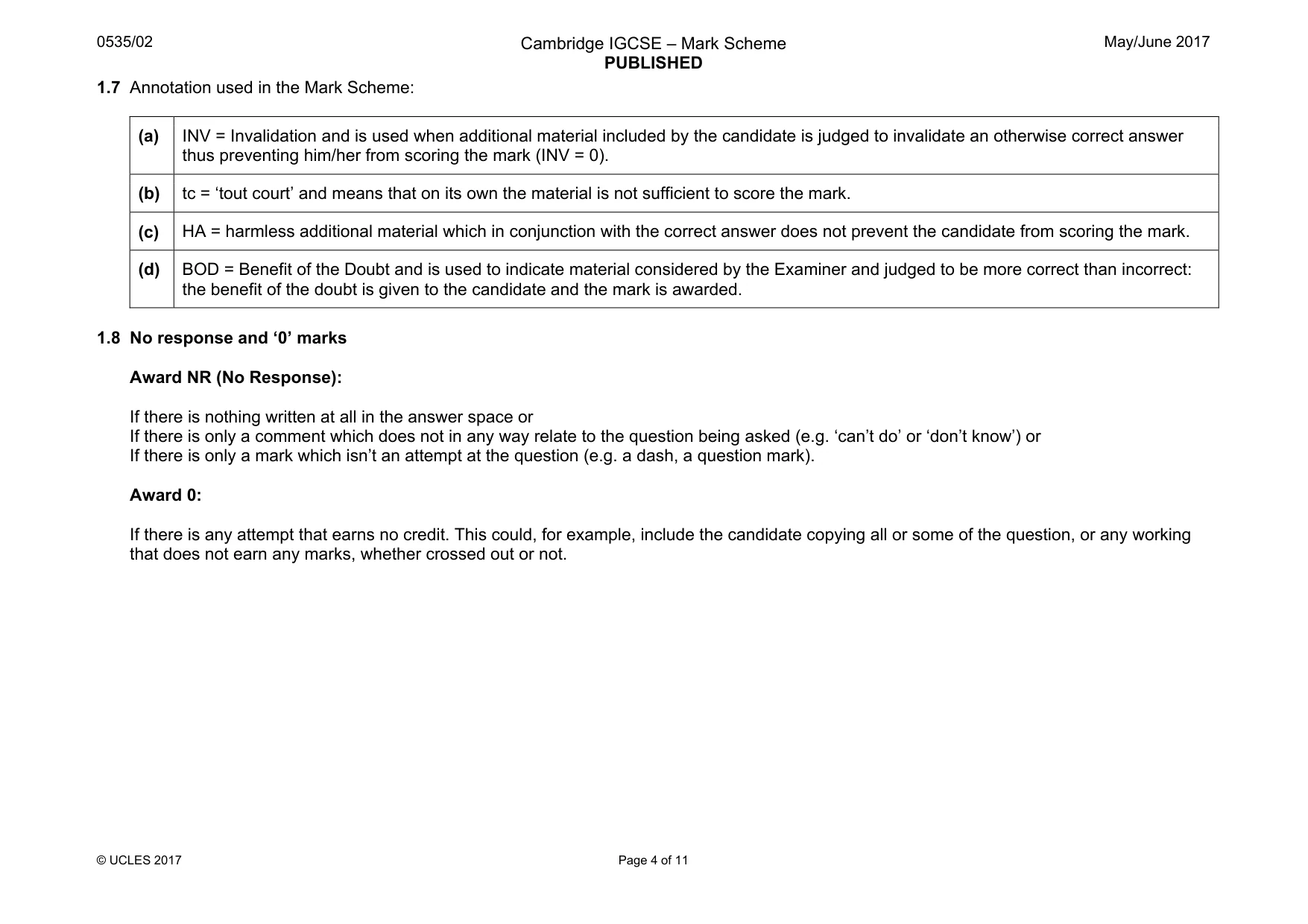
0535/02 Cambridge IGCSE – Mark Scheme PUBLISHED May/June 2017 © UCLES 2017 Page 4 of 11 1.7 Annotation used in the Mark Scheme: (a) INV = Invalidation and is used when additional material included by the candidate is judged to invalidate an otherwise correct answer thus preventing him/her from scoring the mark (INV = 0). (b) tc = ‘tout court’ and means that on its own the material is not sufficient to score the mark. (c) HA = harmless additional material which in conjunction with the correct answer does not prevent the candidate from scoring the mark. (d) BOD = Benefit of the Doubt and is used to indicate material considered by the Examiner and judged to be more correct than incorrect: the benefit of the doubt is given to the candidate and the mark is awarded. 1.8 No response and ‘0’ marks Award NR (No Response): If there is nothing written at all in the answer space or If there is only a comment which does not in any way relate to the question being asked (e.g. ‘can’t do’ or ‘don’t know’) or If there is only a mark which isn’t an attempt at the question (e.g. a dash, a question mark). Award 0: If there is any attempt that earns no credit. This could, for example, include the candidate copying all or some of the question, or any working that does not earn any marks, whether crossed out or not.
Mark scheme, page 5
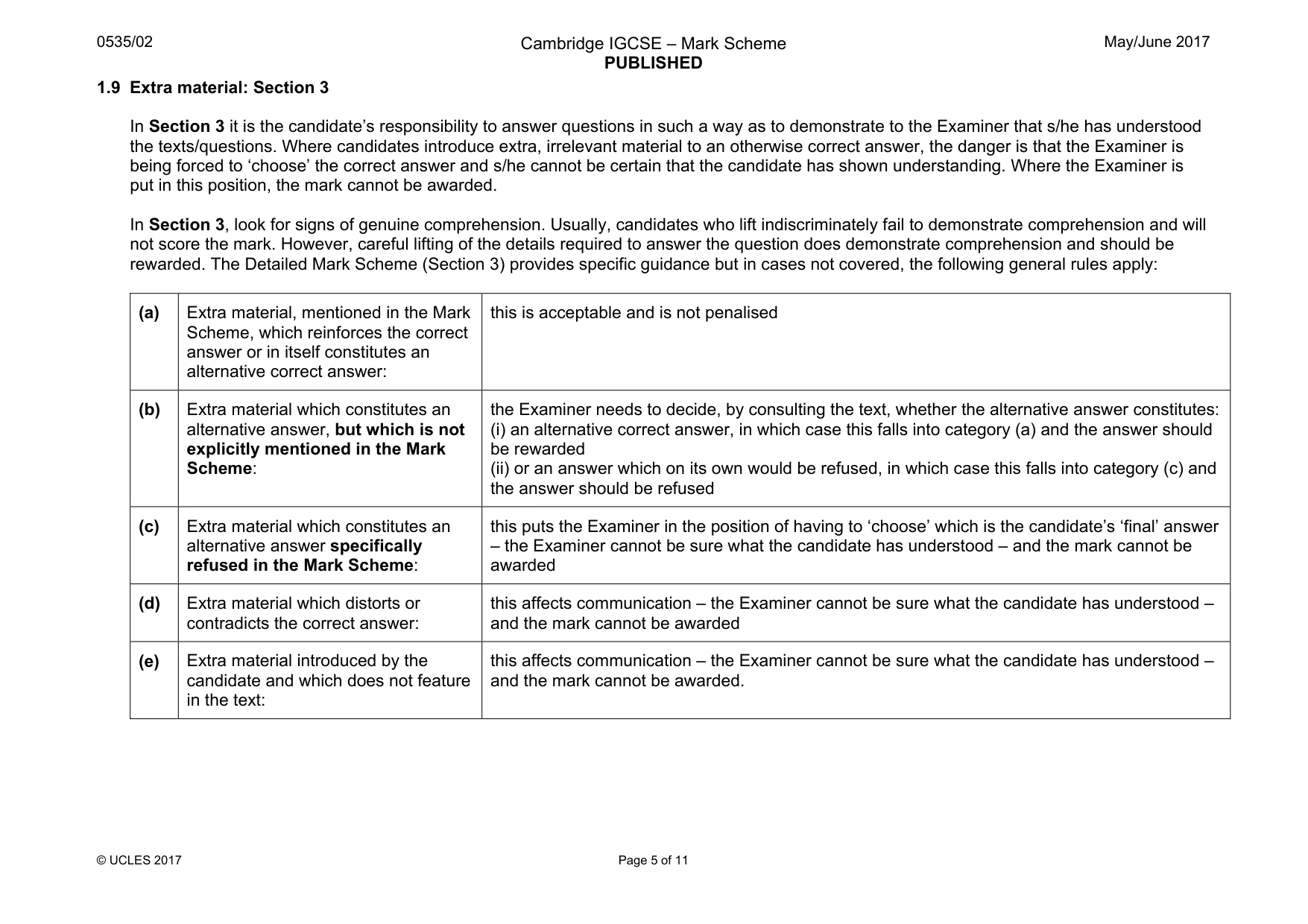
0535/02 Cambridge IGCSE – Mark Scheme PUBLISHED May/June 2017 © UCLES 2017 Page 5 of 11 1.9 Extra material: Section 3 In Section 3 it is the candidate’s responsibility to answer questions in such a way as to demonstrate to the Examiner that s/he has understood the texts/questions. Where candidates introduce extra, irrelevant material to an otherwise correct answer, the danger is that the Examiner is being forced to ‘choose’ the correct answer and s/he cannot be certain that the candidate has shown understanding. Where the Examiner is put in this position, the mark cannot be awarded. In Section 3, look for signs of genuine comprehension. Usually, candidates who lift indiscriminately fail to demonstrate comprehension and will not score the mark. However, careful lifting of the details required to answer the question does demonstrate comprehension and should be rewarded. The Detailed Mark Scheme (Section 3) provides specific guidance but in cases not covered, the following general rules apply: (a) Extra material, mentioned in the Mark Scheme, which reinforces the correct answer or in itself constitutes an alternative correct answer: this is acceptable and is not penalised (b) Extra material which constitutes an alternative answer, but which is not explicitly mentioned in the Mark Scheme: the Examiner needs to decide, by consulting the text, whether the alternative answer constitutes: (i) an alternative correct answer, in which case this falls into category (a) and the answer should be rewarded (ii) or an answer which on its own would be refused, in which case this falls into category (c) and the answer should be refused (c) Extra material which constitutes an alternative answer specifically refused in the Mark Scheme: this puts the Examiner in the position of having to ‘choose’ which is the candidate’s ‘final’ answer – the Examiner cannot be sure what the candidate has understood – and the mark cannot be awarded (d) Extra material which distorts or contradicts the correct answer: this affects communication – the Examiner cannot be sure what the candidate has understood – and the mark cannot be awarded (e) Extra material introduced by the candidate and which does not feature in the text: this affects communication – the Examiner cannot be sure what the candidate has understood – and the mark cannot be awarded.
Mark scheme, page 6
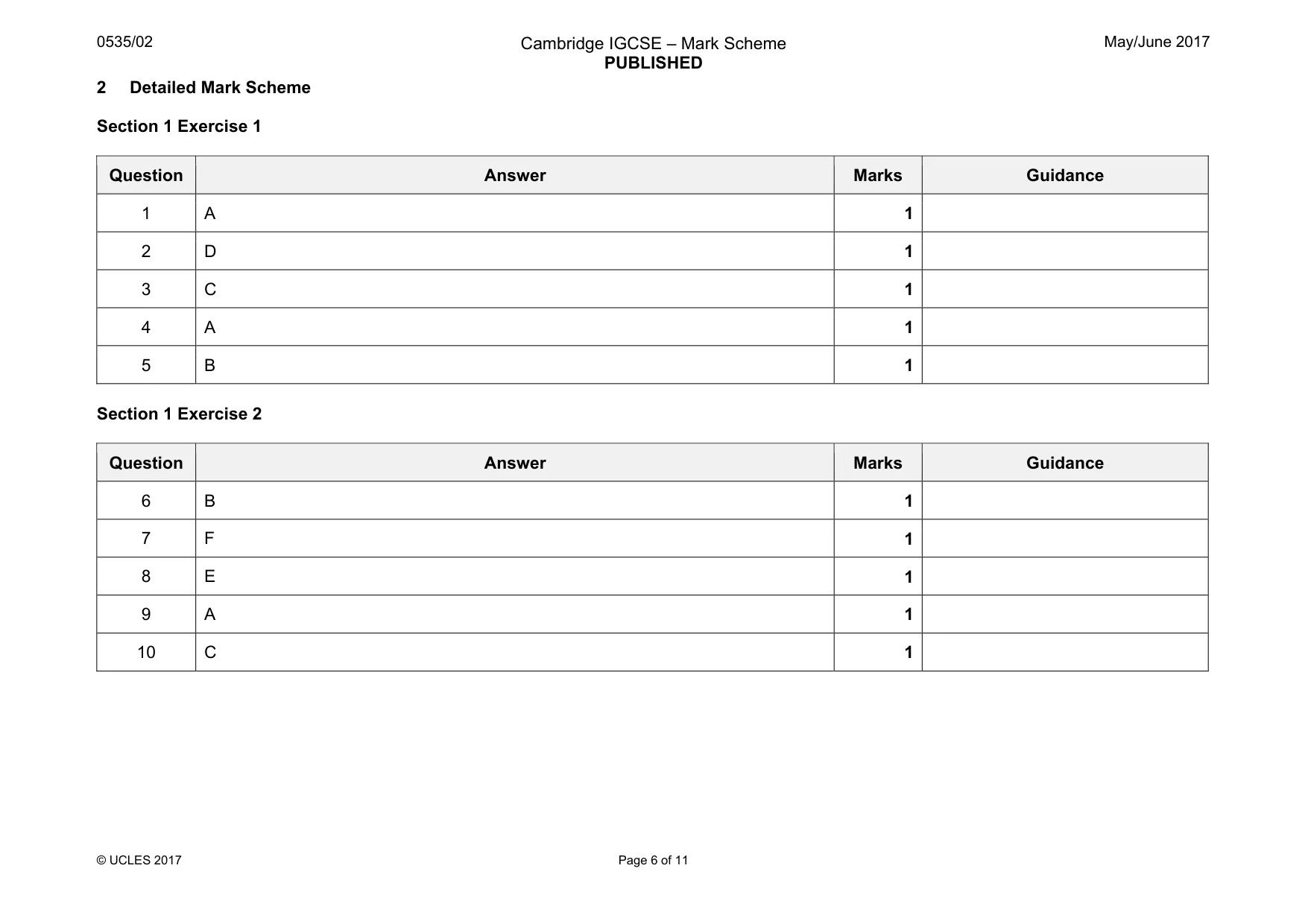
0535/02 Cambridge IGCSE – Mark Scheme PUBLISHED May/June 2017 © UCLES 2017 Page 6 of 11 2 Detailed Mark Scheme Section 1 Exercise 1 Question Answer Marks Guidance 1 A 1 2 D 1 3 C 1 4 A 1 5 B 1 Section 1 Exercise 2 Question Answer Marks Guidance 6 B 1 7 F 1 8 E 1 9 A 1 10 C 1
Mark scheme, page 7
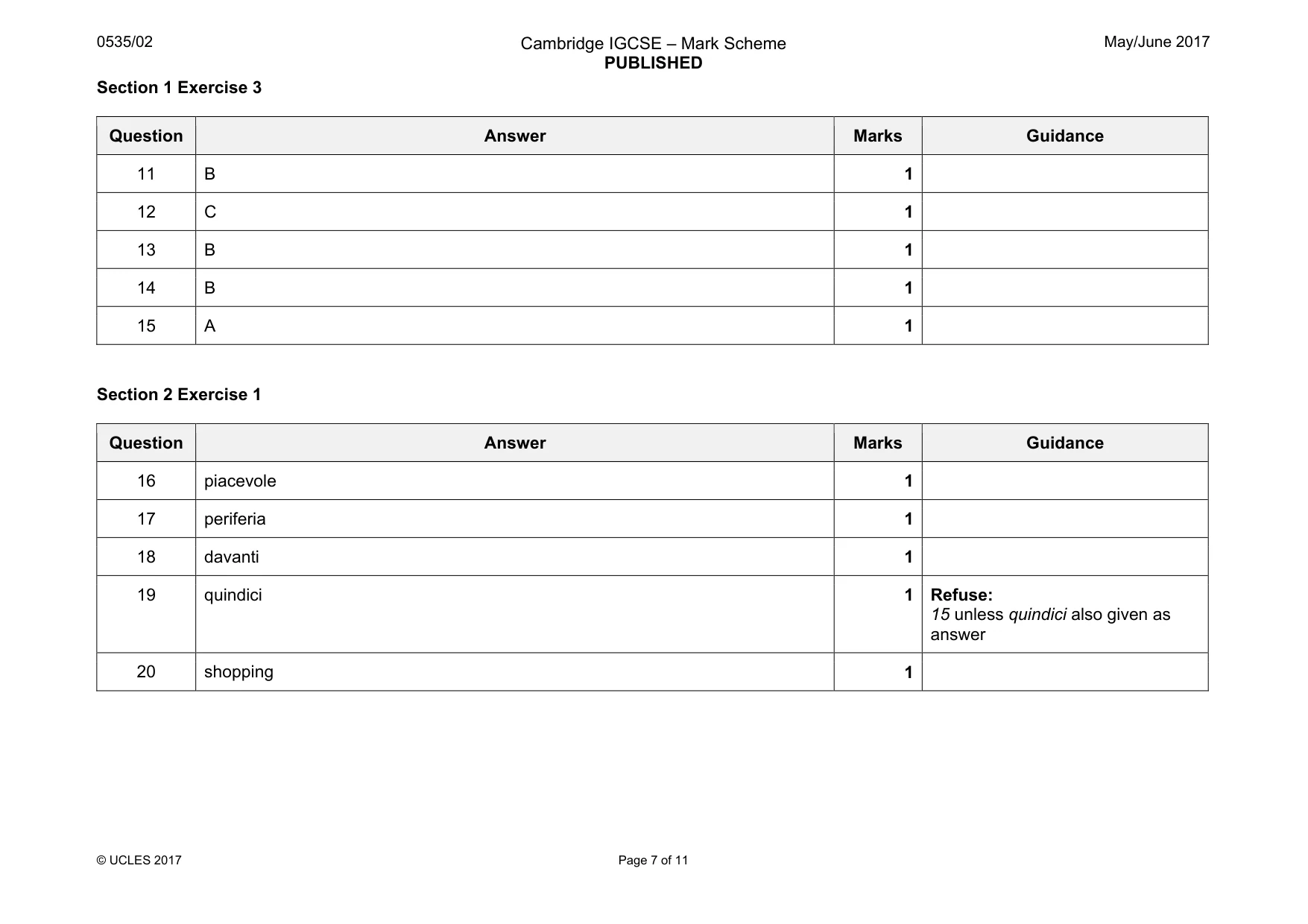
0535/02 Cambridge IGCSE – Mark Scheme PUBLISHED May/June 2017 © UCLES 2017 Page 7 of 11 Section 1 Exercise 3 Question Answer Marks Guidance 11 B 1 12 C 1 13 B 1 14 B 1 15 A 1 Section 2 Exercise 1 Question Answer Marks Guidance 16 piacevole 1 17 periferia 1 18 davanti 1 19 quindici 1 Refuse: 15 unless quindici also given as answer 20 shopping 1
Mark scheme, page 8
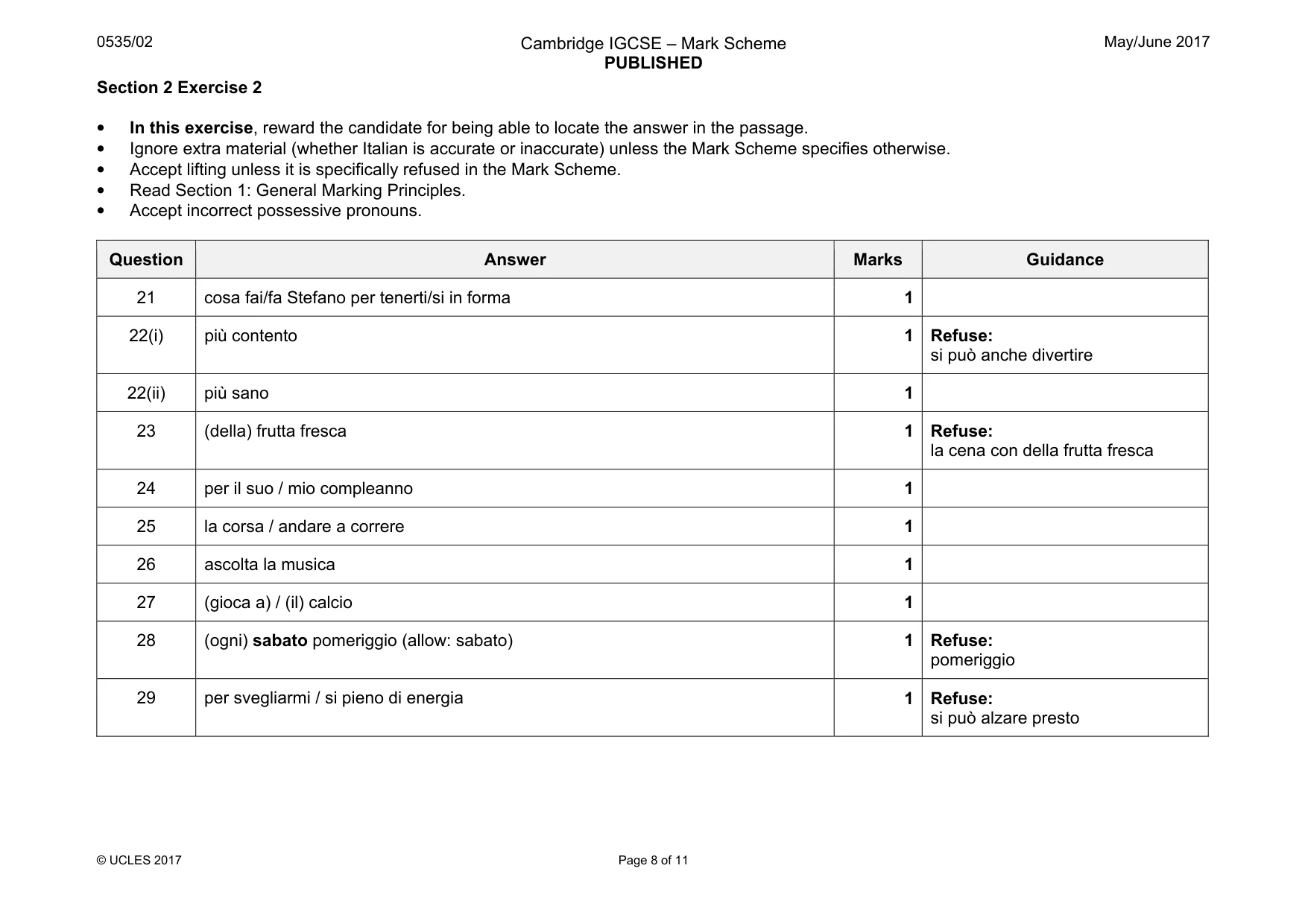
0535/02 Cambridge IGCSE – Mark Scheme PUBLISHED May/June 2017 © UCLES 2017 Page 8 of 11 Section 2 Exercise 2 • In this exercise, reward the candidate for being able to locate the answer in the passage. • Ignore extra material (whether Italian is accurate or inaccurate) unless the Mark Scheme specifies otherwise. • Accept lifting unless it is specifically refused in the Mark Scheme. • Read Section 1: General Marking Principles. • Accept incorrect possessive pronouns. Question Answer Marks Guidance 21 cosa fai/fa Stefano per tenerti/si in forma 1 22(i) più contento 1 Refuse: si può anche divertire 22(ii) più sano 1 23 (della) frutta fresca 1 Refuse: la cena con della frutta fresca 24 per il suo / mio compleanno 1 25 la corsa / andare a correre 1 26 ascolta la musica 1 27 (gioca a) / (il) calcio 1 28 (ogni) sabato pomeriggio (allow: sabato) 1 Refuse: pomeriggio 29 per svegliarmi / si pieno di energia 1 Refuse: si può alzare presto
Mark scheme, page 9
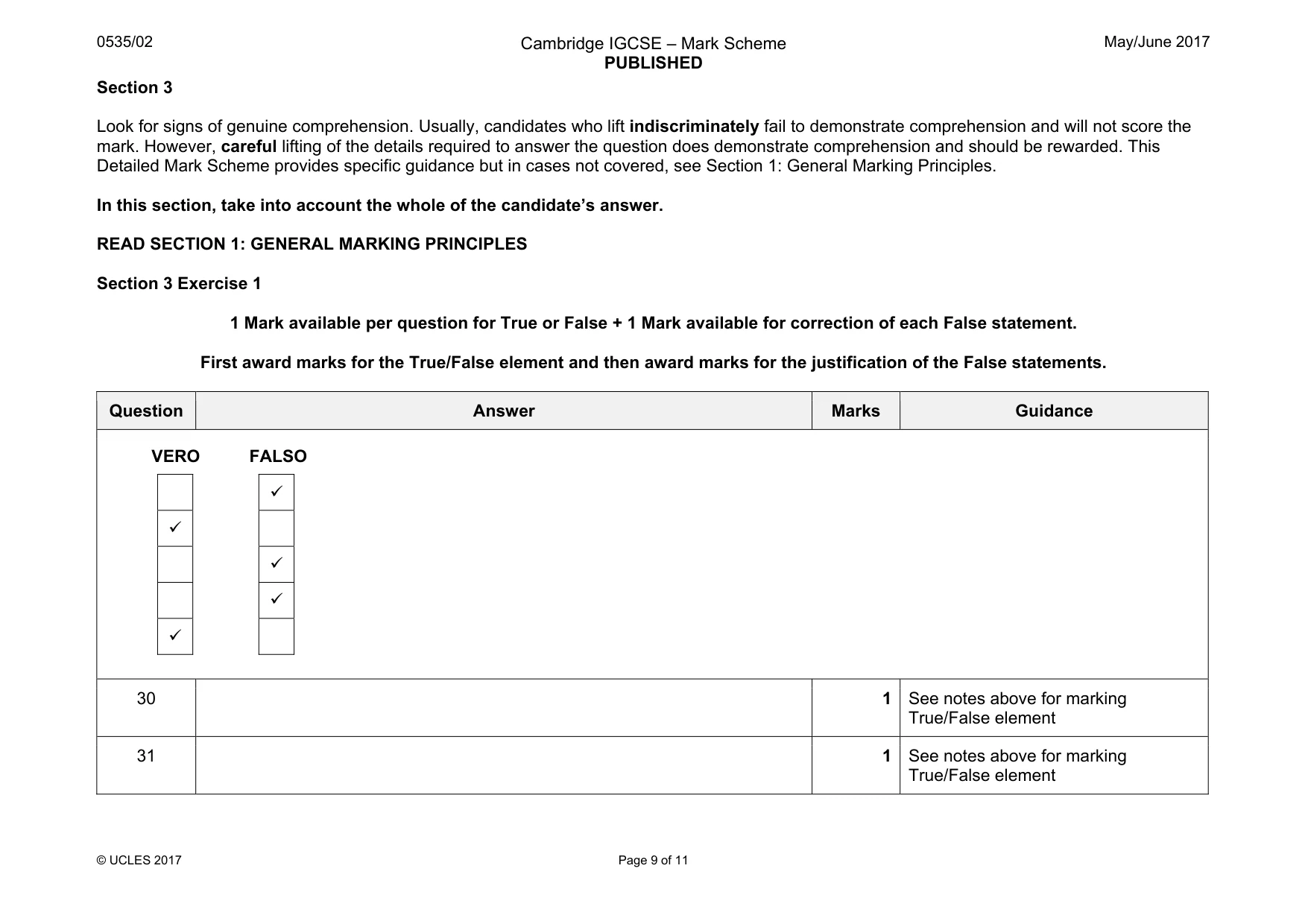
0535/02 Cambridge IGCSE – Mark Scheme PUBLISHED May/June 2017 © UCLES 2017 Page 9 of 11 Section 3 Look for signs of genuine comprehension. Usually, candidates who lift indiscriminately fail to demonstrate comprehension and will not score the mark. However, careful lifting of the details required to answer the question does demonstrate comprehension and should be rewarded. This Detailed Mark Scheme provides specific guidance but in cases not covered, see Section 1: General Marking Principles. In this section, take into account the whole of the candidate’s answer. READ SECTION 1: GENERAL MARKING PRINCIPLES Section 3 Exercise 1 1 Mark available per question for True or False + 1 Mark available for correction of each False statement. First award marks for the True/False element and then award marks for the justification of the False statements. Question Answer Marks Guidance VERO FALSO 9 9 9 9 9 30 1 See notes above for marking True/False element 31 1 See notes above for marking True/False element
Mark scheme, page 10
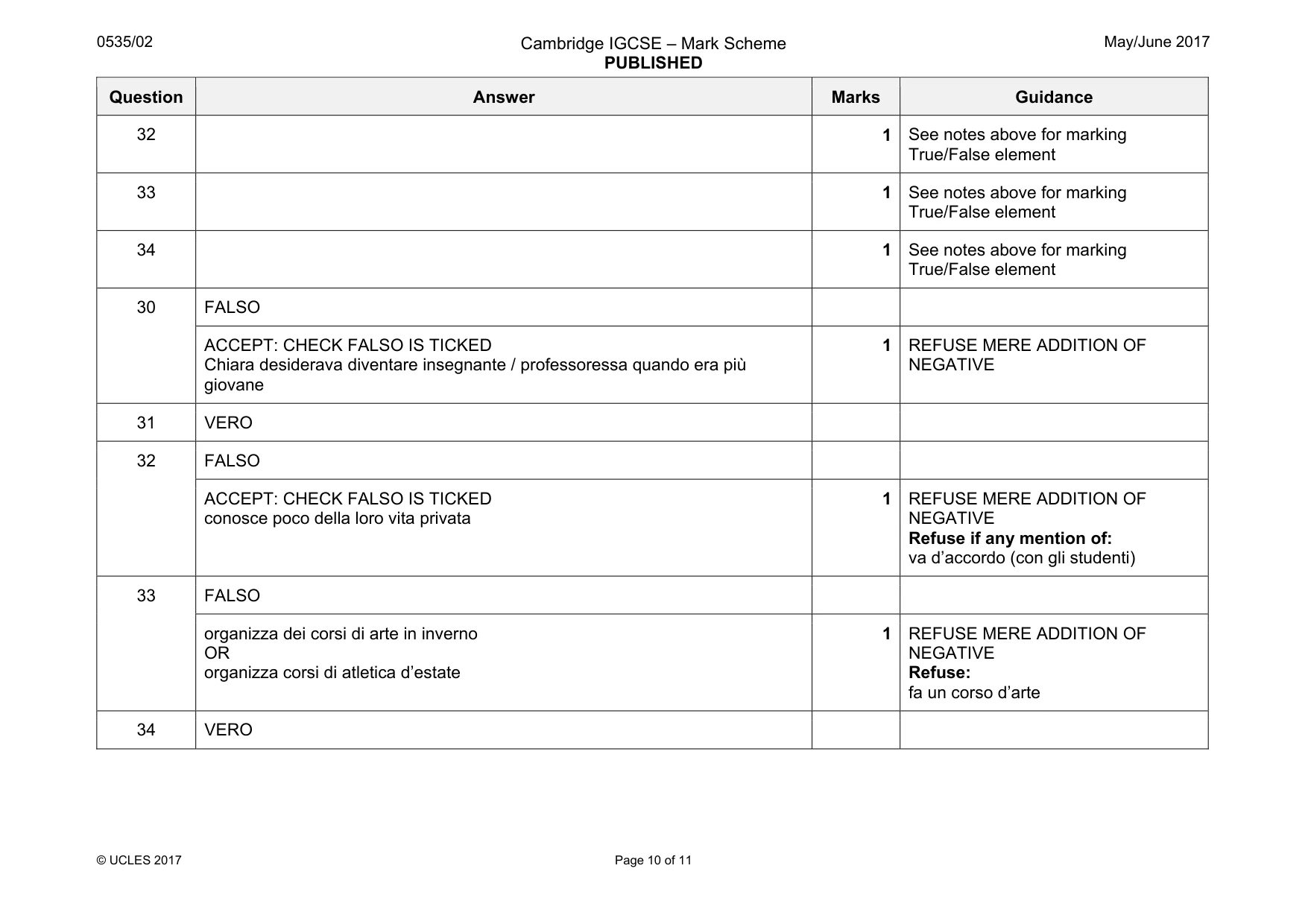
0535/02 Cambridge IGCSE – Mark Scheme PUBLISHED May/June 2017 © UCLES 2017 Page 10 of 11 Question Answer Marks Guidance 32 1 See notes above for marking True/False element 33 1 See notes above for marking True/False element 34 1 See notes above for marking True/False element 30 FALSO ACCEPT: CHECK FALSO IS TICKED Chiara desiderava diventare insegnante / professoressa quando era più giovane 1 REFUSE MERE ADDITION OF NEGATIVE 31 VERO 32 FALSO ACCEPT: CHECK FALSO IS TICKED conosce poco della loro vita privata 1 REFUSE MERE ADDITION OF NEGATIVE Refuse if any mention of: va d’accordo (con gli studenti) 33 FALSO organizza dei corsi di arte in inverno OR organizza corsi di atletica d’estate 1 REFUSE MERE ADDITION OF NEGATIVE Refuse: fa un corso d’arte 34 VERO
Mark scheme, page 11
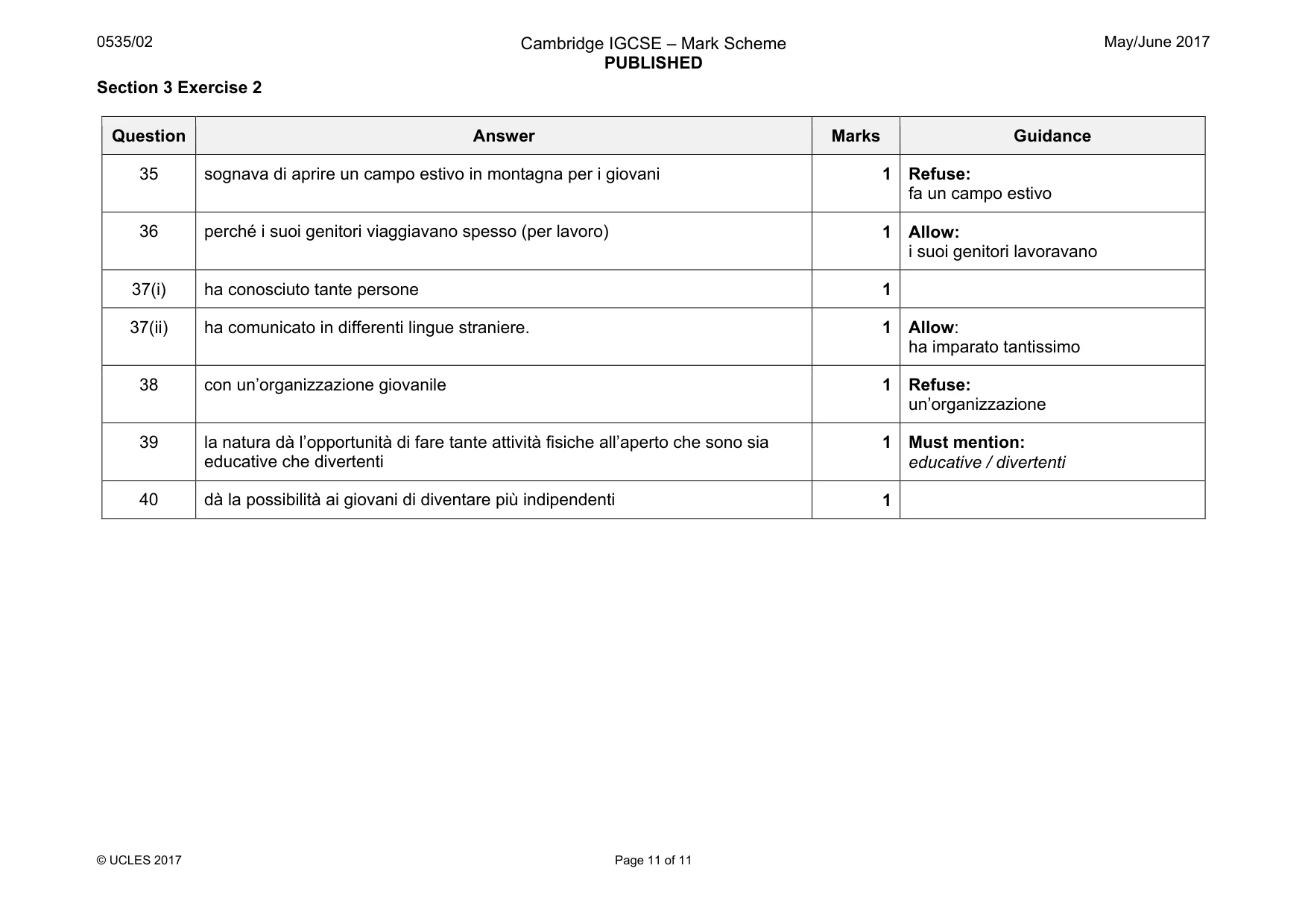
0535/02 Cambridge IGCSE – Mark Scheme PUBLISHED May/June 2017 © UCLES 2017 Page 11 of 11 Section 3 Exercise 2 Question Answer Marks Guidance 35 sognava di aprire un campo estivo in montagna per i giovani 1 Refuse: fa un campo estivo 36 perché i suoi genitori viaggiavano spesso (per lavoro) 1 Allow: i suoi genitori lavoravano 37(i) ha conosciuto tante persone 1 37(ii) ha comunicato in differenti lingue straniere. 1 Allow: ha imparato tantissimo 38 con un’organizzazione giovanile 1 Refuse: un’organizzazione 39 la natura dà l’opportunità di fare tante attività fisiche all’aperto che sono sia educative che divertenti 1 Must mention: educative / divertenti 40 dà la possibilità ai giovani di diventare più indipendenti 1
What you needed in this session
Cambridge’s own grade thresholds for 2017 May/June, Paper 2 · Variant 1. A higher threshold means an easier paper — the bar moves with how the cohort did.