Cambridge IGCSE Italian - Foreign Language 0535 — 2021 May/June Paper 2 · Variant 3
0535/23/M/J/21 · 45 marks · ≈51 min
The question paper and its mark scheme, free to read here and free to download. This is Cambridge’s own paper, exactly as it was sat.
Question paper12 pages

Mark scheme10 pages
Answers below. Sit the paper first if you are practising.
Paper as text
Question paper, page 1
This document has 12 pages. Any blank pages are indicated. DC (CJ) 215373 © UCLES 2021 [Turn over * 6 7 0 7 1 0 1 5 1 0 * ITALIAN 0535/23 Paper 2 Reading May/June 2021 1 hour You must answer on the question paper. No additional materials are needed. INSTRUCTIONS ● Answer all questions. ● Use a black or dark blue pen. ● Write your name, centre number and candidate number in the boxes at the top of the page. ● Write your answer to each question in the space provided. ● Do not use an erasable pen or correction fluid. ● Do not write on any bar codes. ● Dictionaries are not allowed. INFORMATION ● The total mark for this paper is 45. ● The number of marks for each question or part question is shown in brackets [ ]. Cambridge IGCSE™
Question paper, page 2
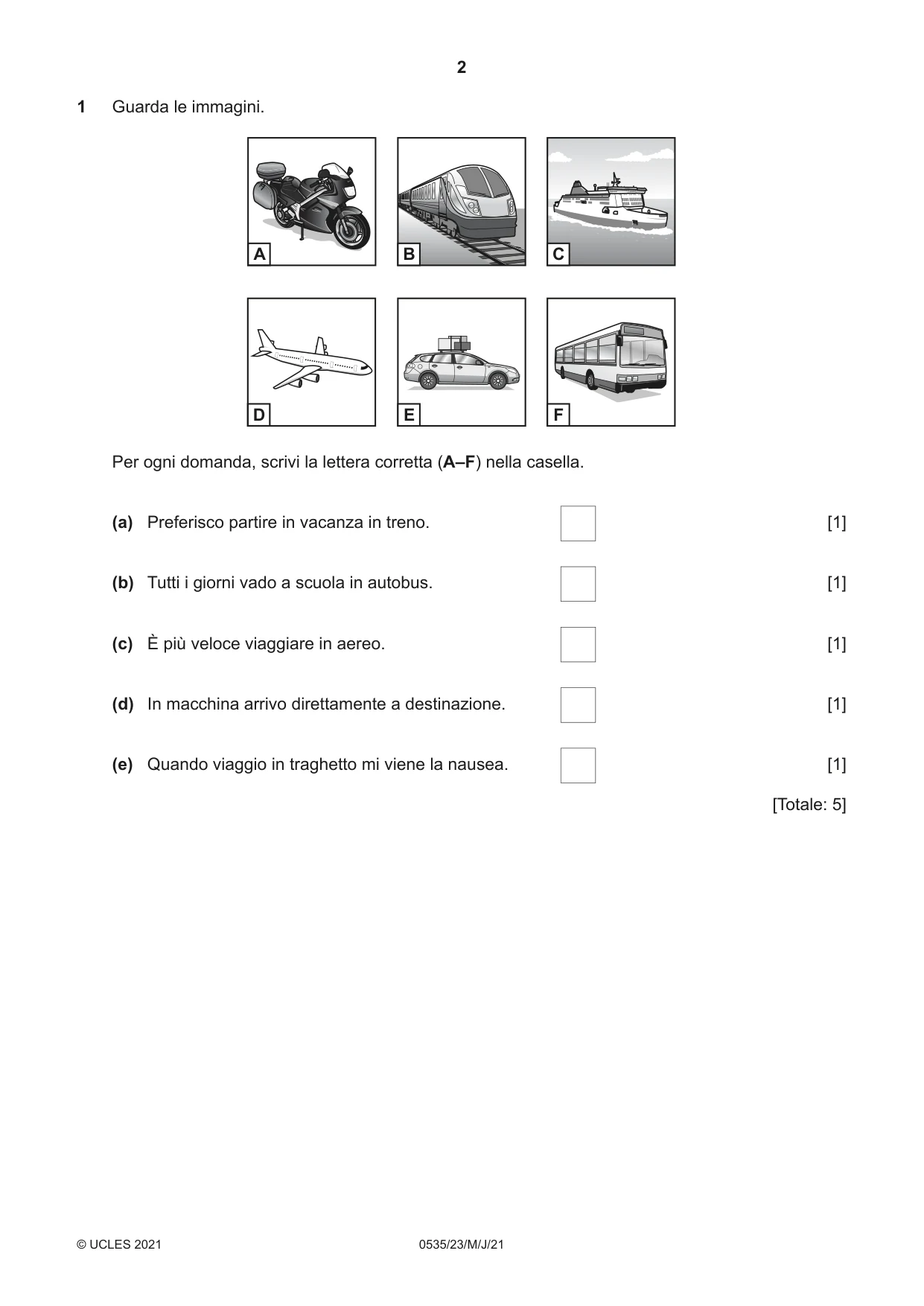
2 0535/23/ M / J /21 © UCLES 2021 1 Guarda le immagini. B C E F A D Per ogni domanda, scrivi la lettera corretta (A–F) nella casella. (a) Preferisco partire in vacanza in treno. [1] (b) Tutti i giorni vado a scuola in autobus. [1] (c) È più veloce viaggiare in aereo. [1] (d) In macchina arrivo direttamente a destinazione. [1] (e) Quando viaggio in traghetto mi viene la nausea. [1] [Totale: 5]
Question paper, page 3
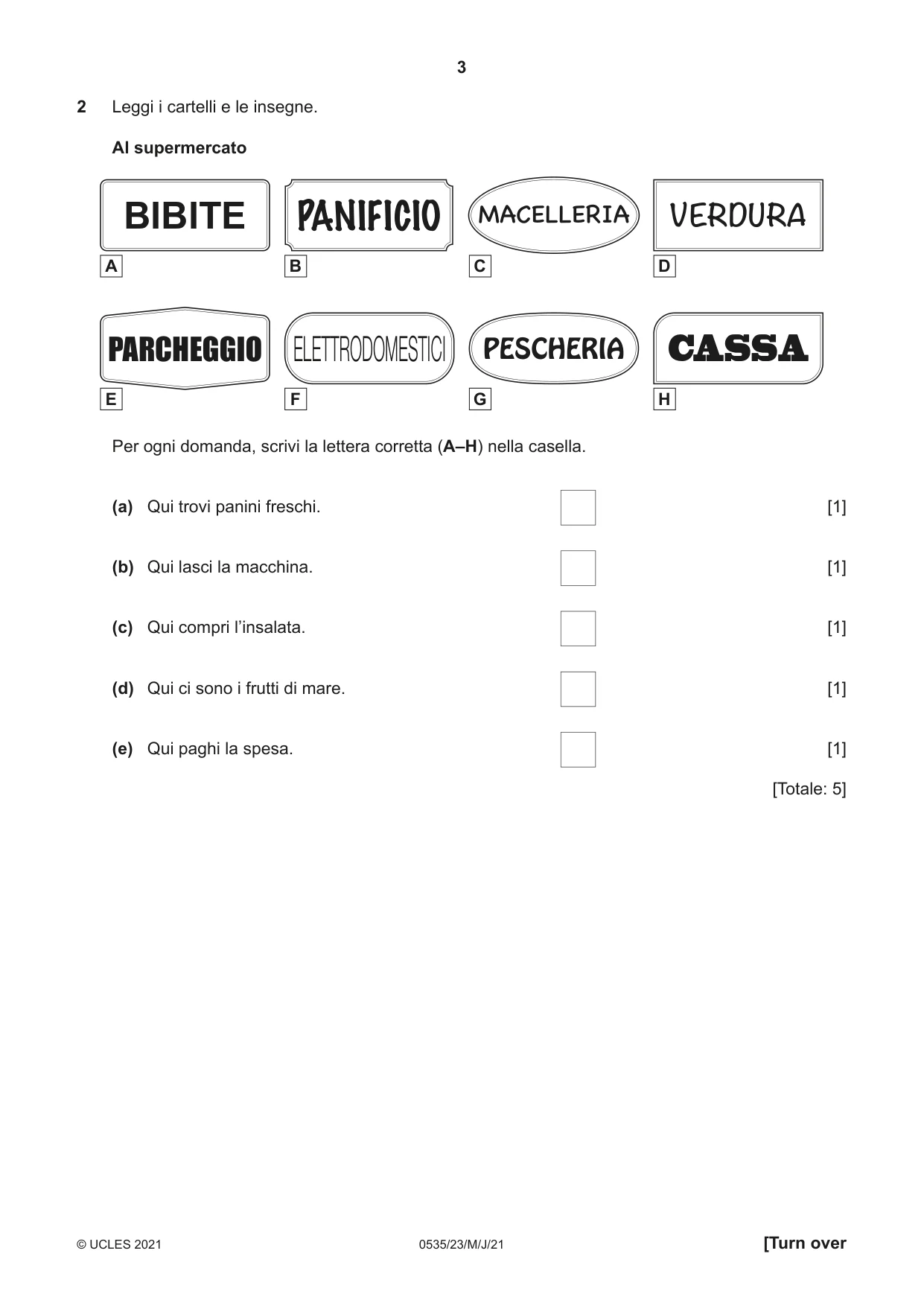
3 0535/23/M/J/21 © UCLES 2021 [Turn over 2 Leggi i cartelli e le insegne. Al supermercato A BIBITE MACELLERIA VERDURA CASSA PESCHERIA ELETTRODOMESTICI PANIFICIO PARCHEGGIO B C D E F G H Per ogni domanda, scrivi la lettera corretta (A–H) nella casella. (a) Qui trovi panini freschi. [1] (b) Qui lasci la macchina. [1] (c) Qui compri l’insalata. [1] (d) Qui ci sono i frutti di mare. [1] (e) Qui paghi la spesa. [1] [Totale: 5]
Question paper, page 4
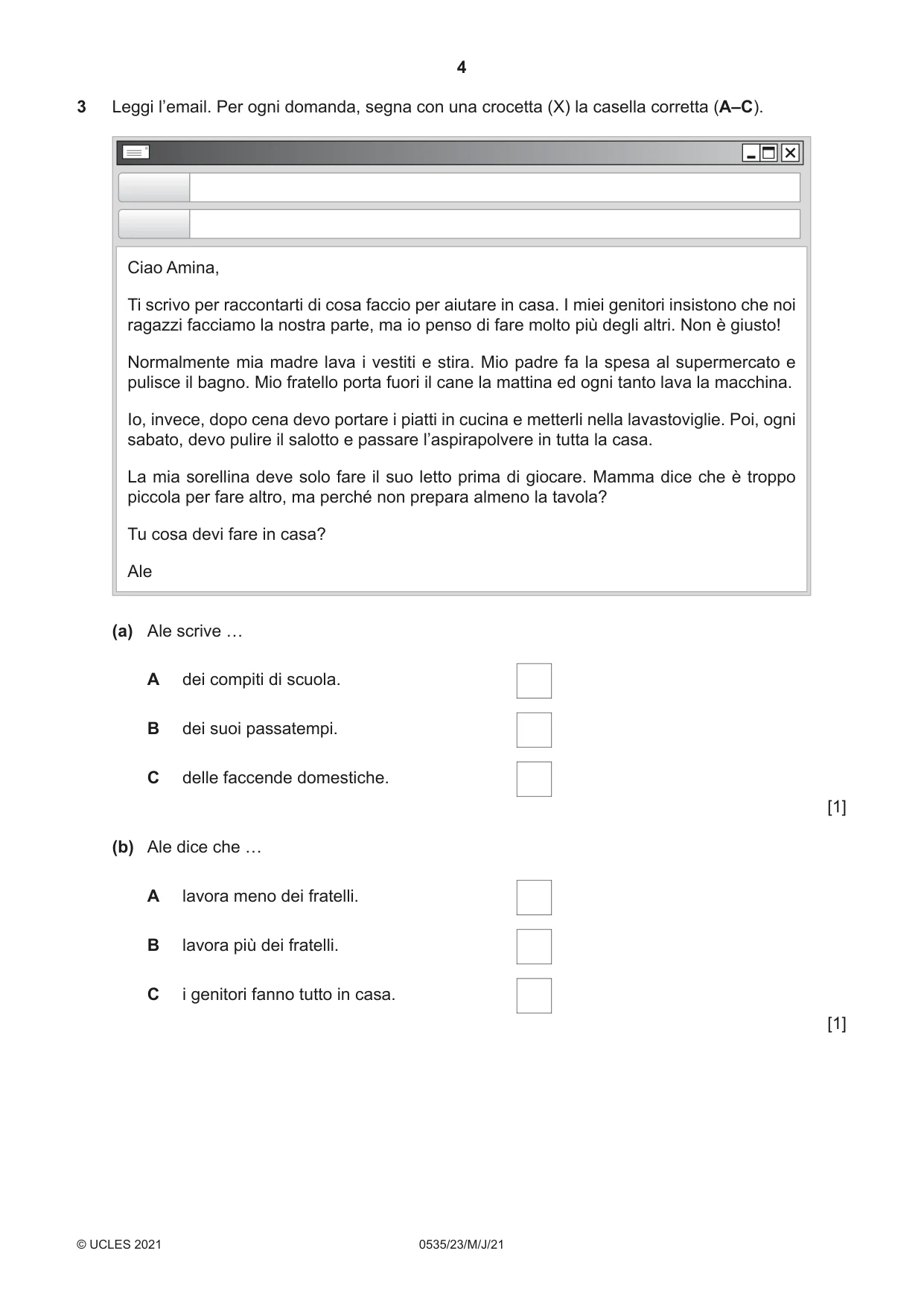
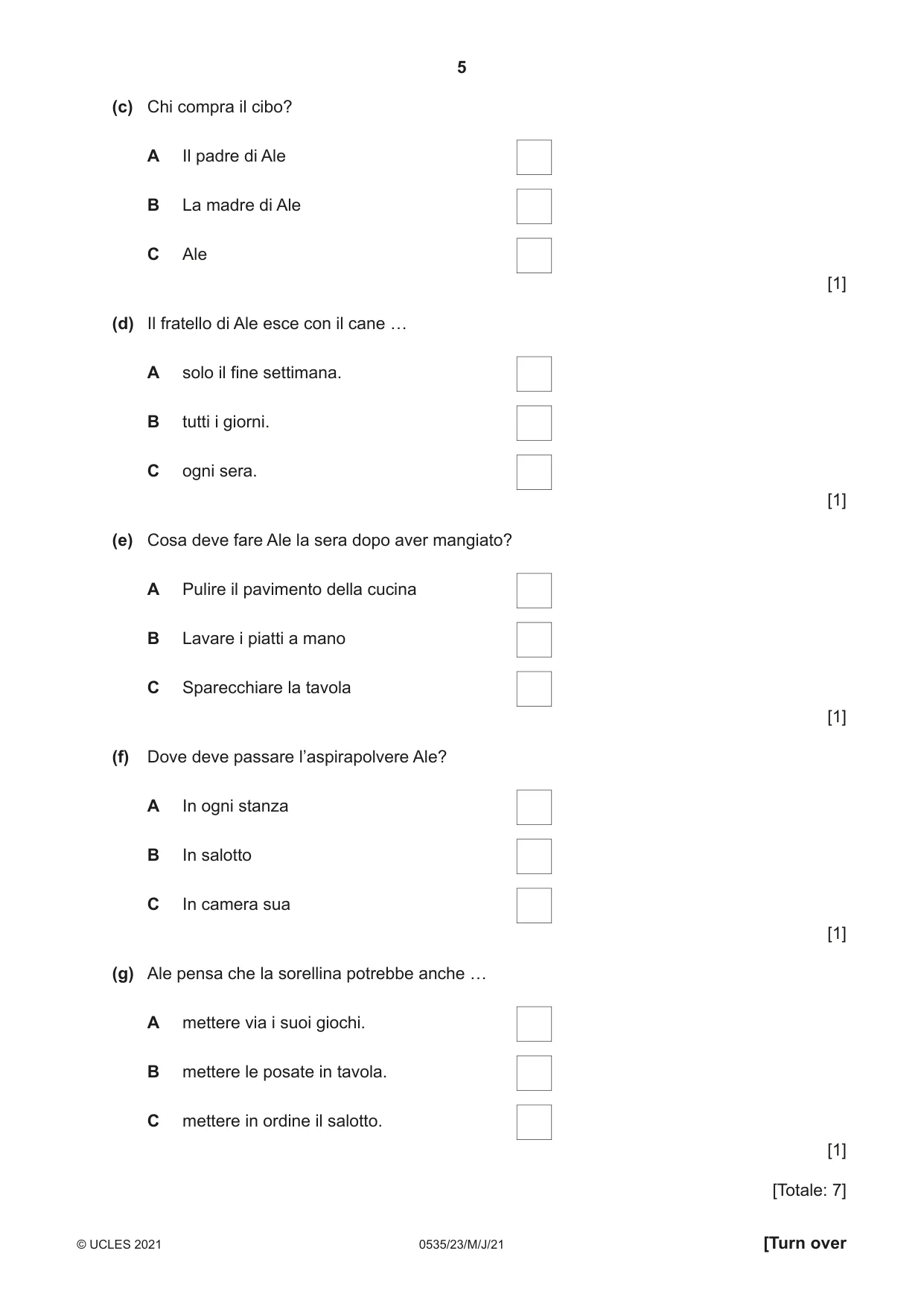
4 0535/23/M/J/21 © UCLES 2021 3 Leggi l’email. Per ogni domanda, segna con una crocetta (X) la casella corretta (A–C). Ciao Amina, Ti scrivo per raccontarti di cosa faccio per aiutare in casa. I miei genitori insistono che noi ragazzi facciamo la nostra parte, ma io penso di fare molto più degli altri. Non è giusto! Normalmente mia madre lava i vestiti e stira. Mio padre fa la spesa al supermercato e pulisce il bagno. Mio fratello porta fuori il cane la mattina ed ogni tanto lava la macchina. Io, invece, dopo cena devo portare i piatti in cucina e metterli nella lavastoviglie. Poi, ogni sabato, devo pulire il salotto e passare l’aspirapolvere in tutta la casa. La mia sorellina deve solo fare il suo letto prima di giocare. Mamma dice che è troppo piccola per fare altro, ma perché non prepara almeno la tavola? Tu cosa devi fare in casa? Ale (a) Ale scrive … A dei compiti di scuola. B dei suoi passatempi. C delle faccende domestiche. [1] (b) Ale dice che … A lavora meno dei fratelli. B lavora più dei fratelli. C i genitori fanno tutto in casa. [1]
Question paper, page 5
5 0535/23/M/J/21 © UCLES 2021 [Turn over (c) Chi compra il cibo? A Il padre di Ale B La madre di Ale C Ale [1] (d) Il fratello di Ale esce con il cane … A solo il fine settimana. B tutti i giorni. C ogni sera. [1] (e) Cosa deve fare Ale la sera dopo aver mangiato? A Pulire il pavimento della cucina B Lavare i piatti a mano C Sparecchiare la tavola [1] (f) Dove deve passare l’aspirapolvere Ale? A In ogni stanza B In salotto C In camera sua [1] (g) Ale pensa che la sorellina potrebbe anche … A mettere via i suoi giochi. B mettere le posate in tavola. C mettere in ordine il salotto. [1] [Totale: 7]
Question paper, page 6
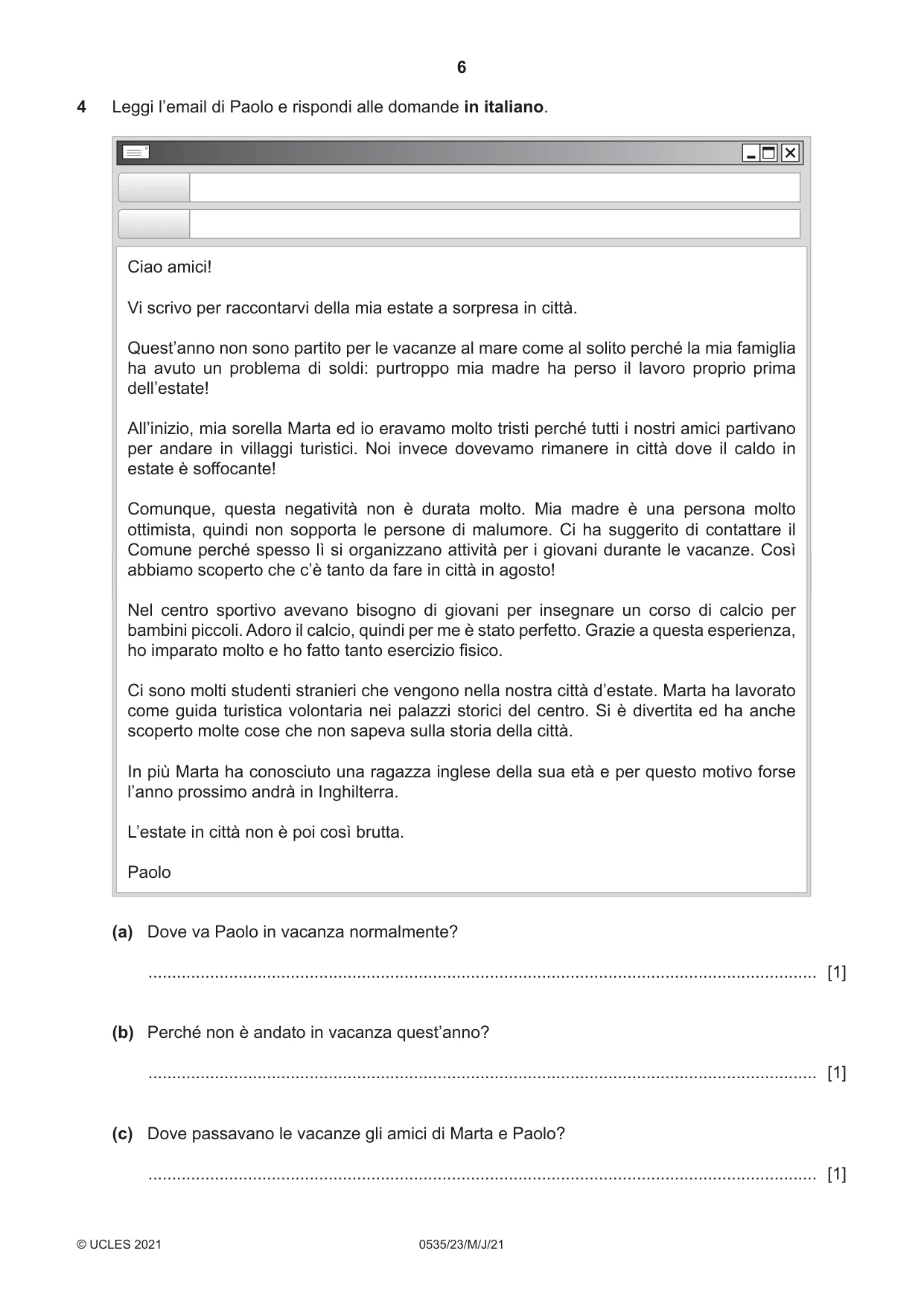
6 0535/23/M/J/21 © UCLES 2021 4 Leggi l’email di Paolo e rispondi alle domande in italiano. Ciao amici! Vi scrivo per raccontarvi della mia estate a sorpresa in città. Quest’anno non sono partito per le vacanze al mare come al solito perché la mia famiglia ha avuto un problema di soldi: purtroppo mia madre ha perso il lavoro proprio prima dell’estate! All’inizio, mia sorella Marta ed io eravamo molto tristi perché tutti i nostri amici partivano per andare in villaggi turistici. Noi invece dovevamo rimanere in città dove il caldo in estate è soffocante! Comunque, questa negatività non è durata molto. Mia madre è una persona molto ottimista, quindi non sopporta le persone di malumore. Ci ha suggerito di contattare il Comune perché spesso lì si organizzano attività per i giovani durante le vacanze. Così abbiamo scoperto che c’è tanto da fare in città in agosto! Nel centro sportivo avevano bisogno di giovani per insegnare un corso di calcio per bambini piccoli. Adoro il calcio, quindi per me è stato perfetto. Grazie a questa esperienza, ho imparato molto e ho fatto tanto esercizio fisico. Ci sono molti studenti stranieri che vengono nella nostra città d’estate. Marta ha lavorato come guida turistica volontaria nei palazzi storici del centro. Si è divertita ed ha anche scoperto molte cose che non sapeva sulla storia della città. In più Marta ha conosciuto una ragazza inglese della sua età e per questo motivo forse l’anno prossimo andrà in Inghilterra. L’estate in città non è poi così brutta. Paolo (a) Dove va Paolo in vacanza normalmente? … [1] (b) Perché non è andato in vacanza quest’anno? … [1] (c) Dove passavano le vacanze gli amici di Marta e Paolo? … [1]
Question paper, page 7
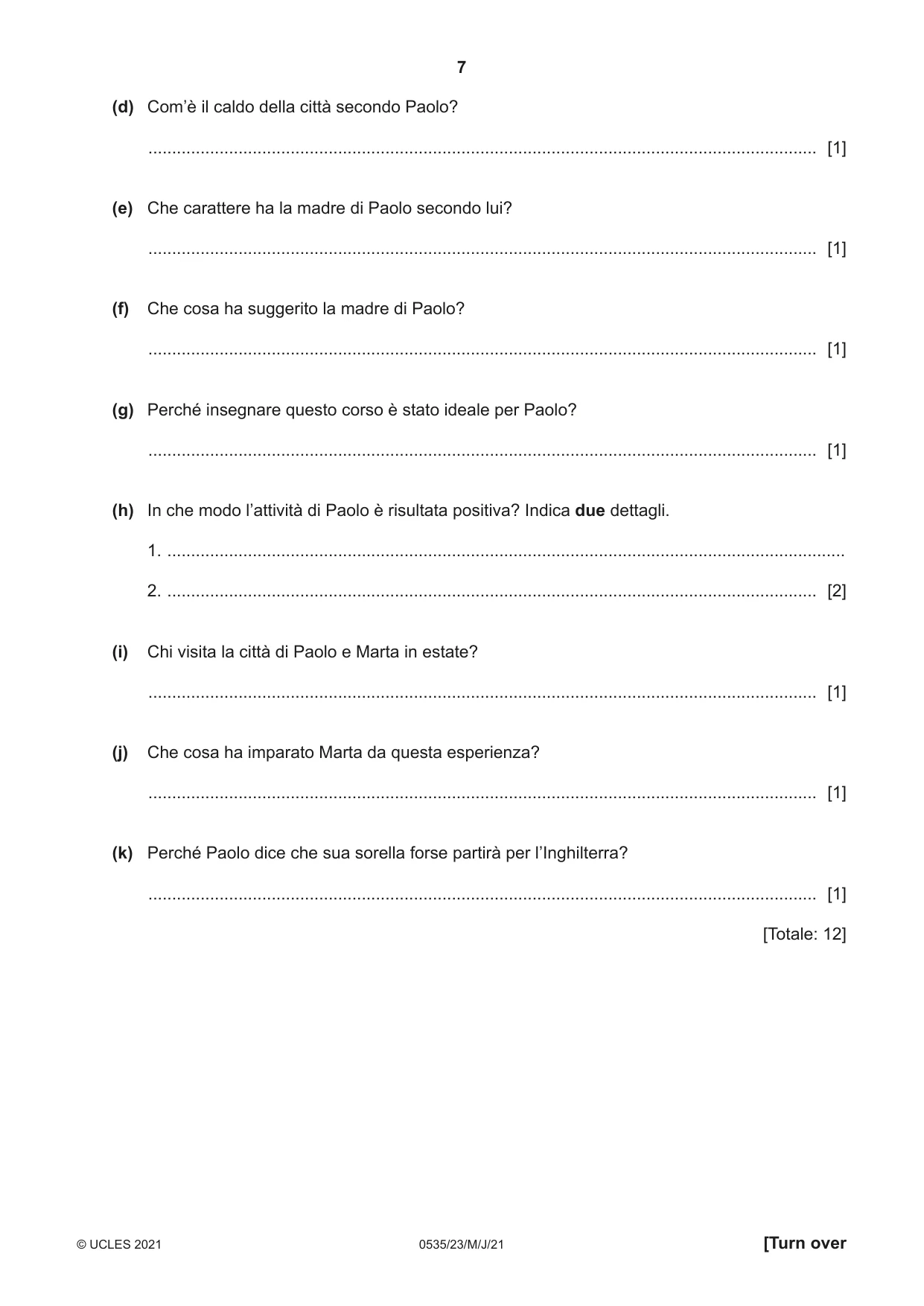
7 0535/23/M/J/21 © UCLES 2021 [Turn over (d) Com’è il caldo della città secondo Paolo? … [1] (e) Che carattere ha la madre di Paolo secondo lui? … [1] (f) Che cosa ha suggerito la madre di Paolo? … [1] (g) Perché insegnare questo corso è stato ideale per Paolo? … [1] (h) In che modo l’attività di Paolo è risultata positiva? Indica due dettagli. 1. … 2. … [2] (i) Chi visita la città di Paolo e Marta in estate? … [1] (j) Che cosa ha imparato Marta da questa esperienza? … [1] (k) Perché Paolo dice che sua sorella forse partirà per l’Inghilterra? … [1] [Totale: 12]
Question paper, page 8
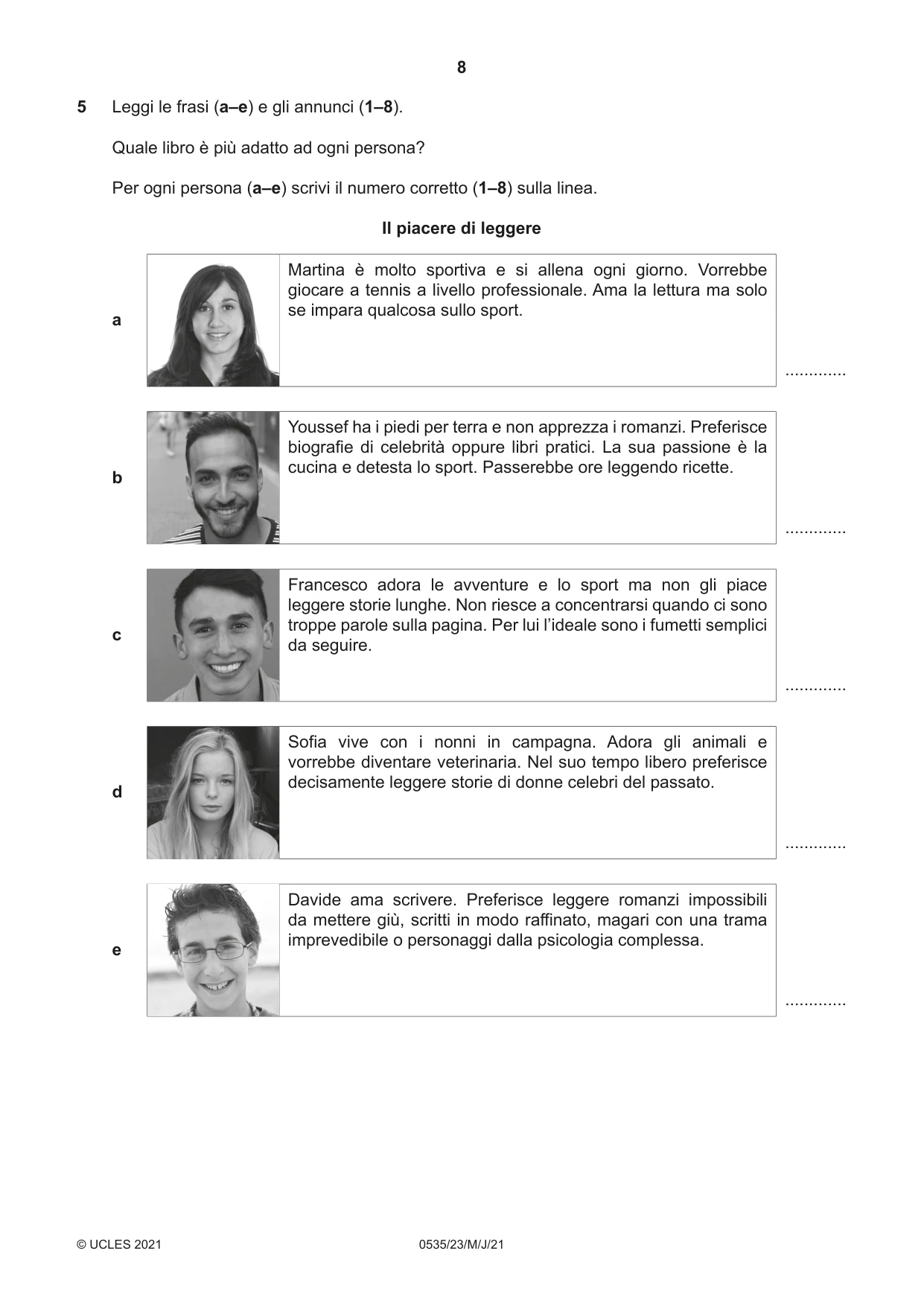
8 0535/23/M/J/21 © UCLES 2021 5 Leggi le frasi (a–e) e gli annunci (1–8). Quale libro è più adatto ad ogni persona? Per ogni persona (a–e) scrivi il numero corretto (1–8) sulla linea. Il piacere di leggere a Martina è molto sportiva e si allena ogni giorno. Vorrebbe giocare a tennis a livello professionale. Ama la lettura ma solo se impara qualcosa sullo sport. … b Youssef ha i piedi per terra e non apprezza i romanzi. Preferisce biografie di celebrità oppure libri pratici. La sua passione è la cucina e detesta lo sport. Passerebbe ore leggendo ricette. … c Francesco adora le avventure e lo sport ma non gli piace leggere storie lunghe. Non riesce a concentrarsi quando ci sono troppe parole sulla pagina. Per lui l’ideale sono i fumetti semplici da seguire. … d Sofia vive con i nonni in campagna. Adora gli animali e vorrebbe diventare veterinaria. Nel suo tempo libero preferisce decisamente leggere storie di donne celebri del passato. … e Davide ama scrivere. Preferisce leggere romanzi impossibili da mettere giù, scritti in modo raffinato, magari con una trama imprevedibile o personaggi dalla psicologia complessa. …
Question paper, page 9
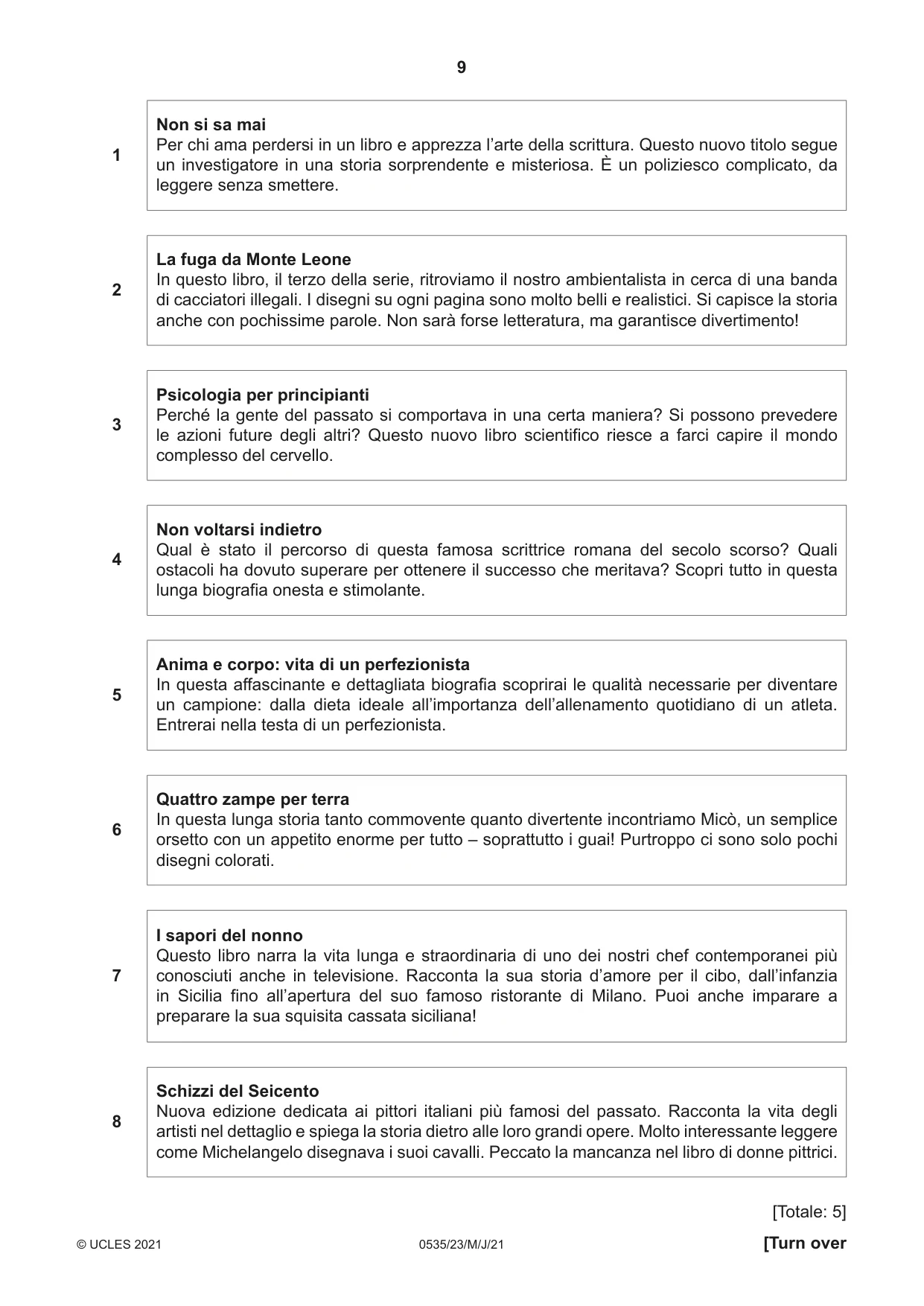
9 0535/23/M/J/21 © UCLES 2021 [Turn over 1 Non si sa mai Per chi ama perdersi in un libro e apprezza l’arte della scrittura. Questo nuovo titolo segue un investigatore in una storia sorprendente e misteriosa. È un poliziesco complicato, da leggere senza smettere. 2 La fuga da Monte Leone In questo libro, il terzo della serie, ritroviamo il nostro ambientalista in cerca di una banda di cacciatori illegali. I disegni su ogni pagina sono molto belli e realistici. Si capisce la storia anche con pochissime parole. Non sarà forse letteratura, ma garantisce divertimento! 3 Psicologia per principianti Perché la gente del passato si comportava in una certa maniera? Si possono prevedere le azioni future degli altri? Questo nuovo libro scientifico riesce a farci capire il mondo complesso del cervello. 4 Non voltarsi indietro Qual è stato il percorso di questa famosa scrittrice romana del secolo scorso? Quali ostacoli ha dovuto superare per ottenere il successo che meritava? Scopri tutto in questa lunga biografia onesta e stimolante. 5 Anima e corpo: vita di un perfezionista In questa affascinante e dettagliata biografia scoprirai le qualità necessarie per diventare un campione: dalla dieta ideale all’importanza dell’allenamento quotidiano di un atleta. Entrerai nella testa di un perfezionista. 6 Quattro zampe per terra In questa lunga storia tanto commovente quanto divertente incontriamo Micò, un semplice orsetto con un appetito enorme per tutto – soprattutto i guai! Purtroppo ci sono solo pochi disegni colorati. 7 I sapori del nonno Questo libro narra la vita lunga e straordinaria di uno dei nostri chef contemporanei più conosciuti anche in televisione. Racconta la sua storia d’amore per il cibo, dall’infanzia in Sicilia fino all’apertura del suo famoso ristorante di Milano. Puoi anche imparare a preparare la sua squisita cassata siciliana! 8 Schizzi del Seicento Nuova edizione dedicata ai pittori italiani più famosi del passato. Racconta la vita degli artisti nel dettaglio e spiega la storia dietro alle loro grandi opere. Molto interessante leggere come Michelangelo disegnava i suoi cavalli. Peccato la mancanza nel libro di donne pittrici. [Totale: 5]
Question paper, page 10
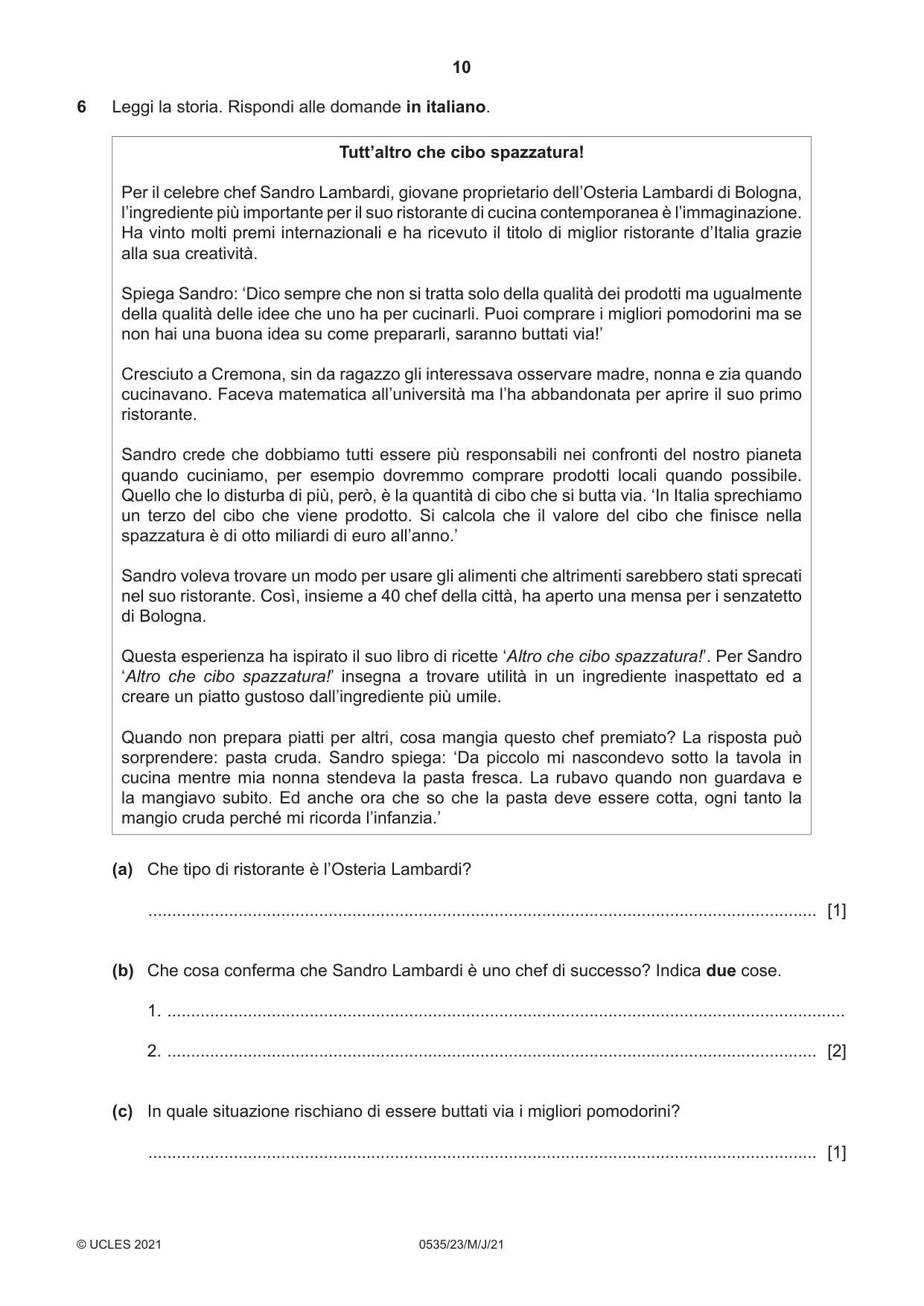
10 0535/23/M/J/21 © UCLES 2021 6 Leggi la storia. Rispondi alle domande in italiano. Tutt’altro che cibo spazzatura! Per il celebre chef Sandro Lambardi, giovane proprietario dell’Osteria Lambardi di Bologna, l’ingrediente più importante per il suo ristorante di cucina contemporanea è l’immaginazione. Ha vinto molti premi internazionali e ha ricevuto il titolo di miglior ristorante d’Italia grazie alla sua creatività. Spiega Sandro: ‘Dico sempre che non si tratta solo della qualità dei prodotti ma ugualmente della qualità delle idee che uno ha per cucinarli. Puoi comprare i migliori pomodorini ma se non hai una buona idea su come prepararli, saranno buttati via!’ Cresciuto a Cremona, sin da ragazzo gli interessava osservare madre, nonna e zia quando cucinavano. Faceva matematica all’università ma l’ha abbandonata per aprire il suo primo ristorante. Sandro crede che dobbiamo tutti essere più responsabili nei confronti del nostro pianeta quando cuciniamo, per esempio dovremmo comprare prodotti locali quando possibile. Quello che lo disturba di più, però, è la quantità di cibo che si butta via. ‘In Italia sprechiamo un terzo del cibo che viene prodotto. Si calcola che il valore del cibo che finisce nella spazzatura è di otto miliardi di euro all’anno.’ Sandro voleva trovare un modo per usare gli alimenti che altrimenti sarebbero stati sprecati nel suo ristorante. Così, insieme a 40 chef della città, ha aperto una mensa per i senzatetto di Bologna. Questa esperienza ha ispirato il suo libro di ricette ‘Altro che cibo spazzatura!’. Per Sandro ‘Altro che cibo spazzatura!’ insegna a trovare utilità in un ingrediente inaspettato ed a creare un piatto gustoso dall’ingrediente più umile. Quando non prepara piatti per altri, cosa mangia questo chef premiato? La risposta può sorprendere: pasta cruda. Sandro spiega: ‘Da piccolo mi nascondevo sotto la tavola in cucina mentre mia nonna stendeva la pasta fresca. La rubavo quando non guardava e la mangiavo subito. Ed anche ora che so che la pasta deve essere cotta, ogni tanto la mangio cruda perché mi ricorda l’infanzia.’ (a) Che tipo di ristorante è l’Osteria Lambardi? … [1] (b) Che cosa conferma che Sandro Lambardi è uno chef di successo? Indica due cose. 1. … 2. … [2] (c) In quale situazione rischiano di essere buttati via i migliori pomodorini? … [1]
Question paper, page 11
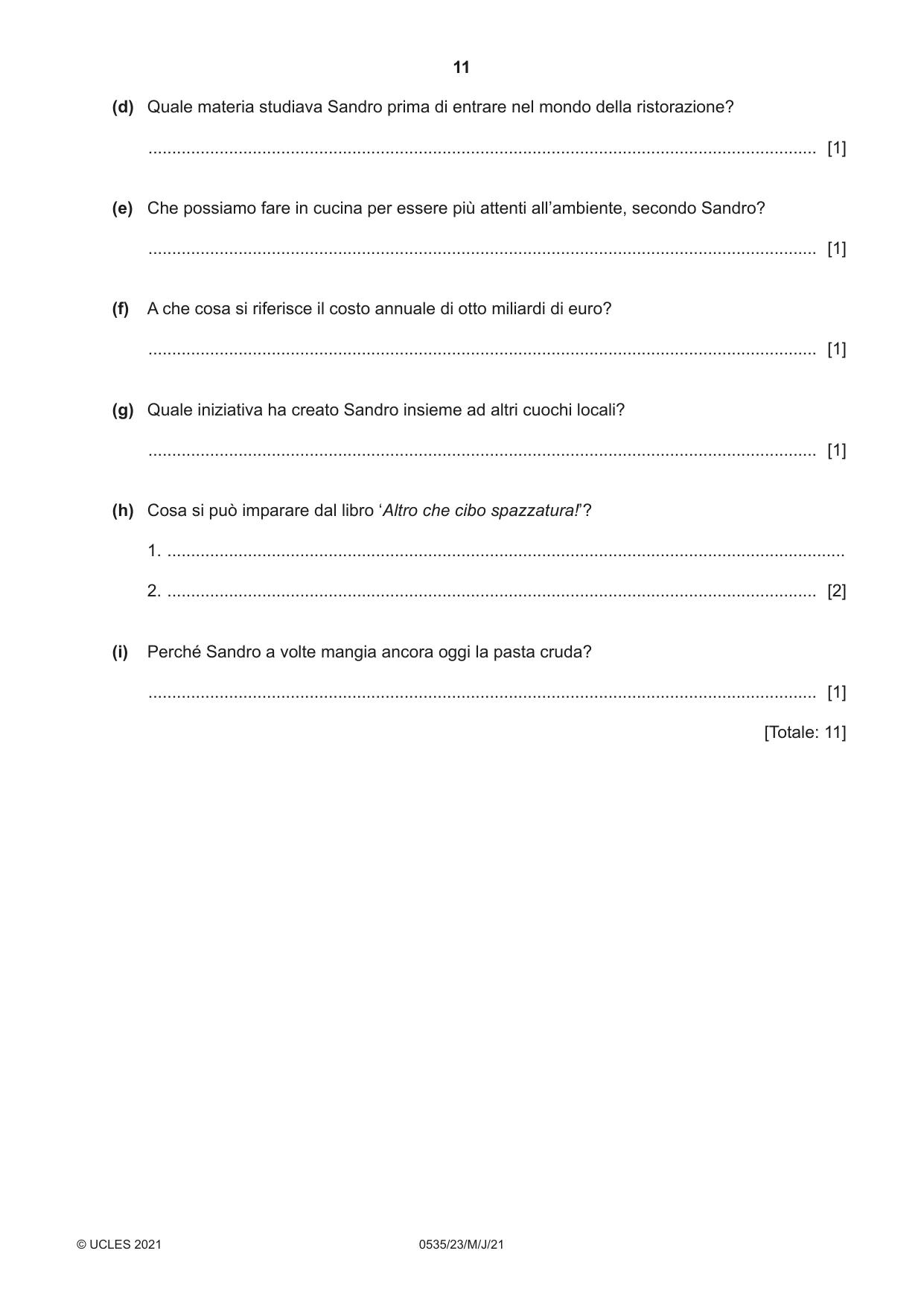
11 0535/23/M/J/21 © UCLES 2021 (d) Quale materia studiava Sandro prima di entrare nel mondo della ristorazione? … [1] (e) Che possiamo fare in cucina per essere più attenti all’ambiente, secondo Sandro? … [1] (f) A che cosa si riferisce il costo annuale di otto miliardi di euro? … [1] (g) Quale iniziativa ha creato Sandro insieme ad altri cuochi locali? … [1] (h) Cosa si può imparare dal libro ‘Altro che cibo spazzatura!’? 1. … 2. … [2] (i) Perché Sandro a volte mangia ancora oggi la pasta cruda? … [1] [Totale: 11]
Question paper, page 12
12 0535/23/M/J/21 © UCLES 2021 Permission to reproduce items where third-party owned material protected by copyright is included has been sought and cleared where possible. Every reasonable effort has been made by the publisher (UCLES) to trace copyright holders, but if any items requiring clearance have unwittingly been included, the publisher will be pleased to make amends at the earliest possible opportunity. To avoid the issue of disclosure of answer-related information to candidates, all copyright acknowledgements are reproduced online in the Cambridge Assessment International Education Copyright Acknowledgements Booklet. This is produced for each series of examinations and is freely available to download at www.cambridgeinternational.org after the live examination series. Cambridge Assessment International Education is part of the Cambridge Assessment Group. Cambridge Assessment is the brand name of the University of Cambridge Local Examinations Syndicate (UCLES), which itself is a department of the University of Cambridge. BLANK PAGE
Mark scheme, page 1
This document consists of 10 printed pages. © UCLES 2021 [Turn over Cambridge IGCSE™ ITALIAN 0535/23 Paper 2 Reading May/June 2021 MARK SCHEME Maximum Mark: 45 Published This mark scheme is published as an aid to teachers and candidates, to indicate the requirements of the examination. It shows the basis on which Examiners were instructed to award marks. It does not indicate the details of the discussions that took place at an Examiners’ meeting before marking began, which would have considered the acceptability of alternative answers. Mark schemes should be read in conjunction with the question paper and the Principal Examiner Report for Teachers. Cambridge International will not enter into discussions about these mark schemes. Cambridge International is publishing the mark schemes for the May/June 2021 series for most Cambridge IGCSE™, Cambridge International A and AS Level components and some Cambridge O Level components.
Mark scheme, page 2
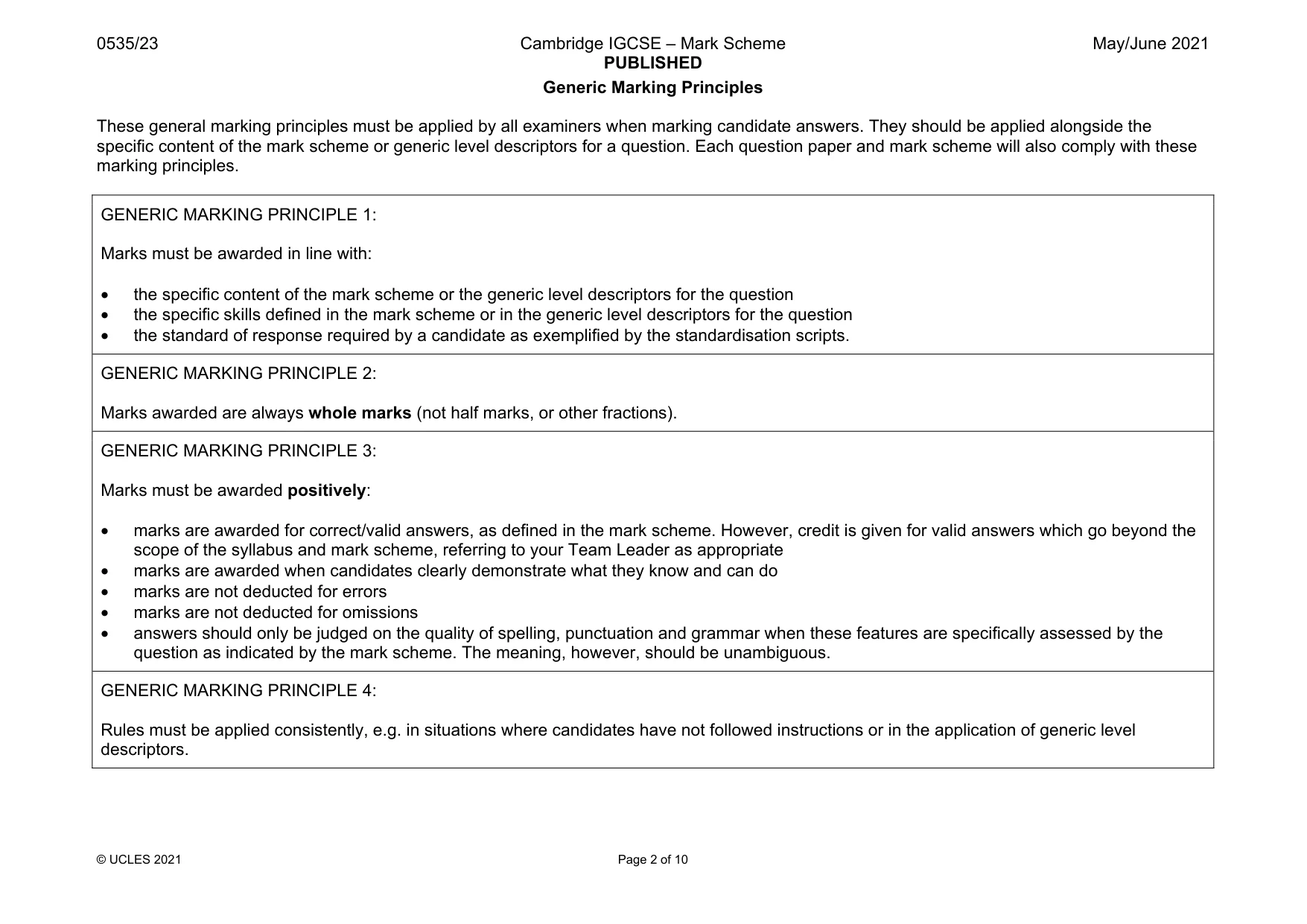
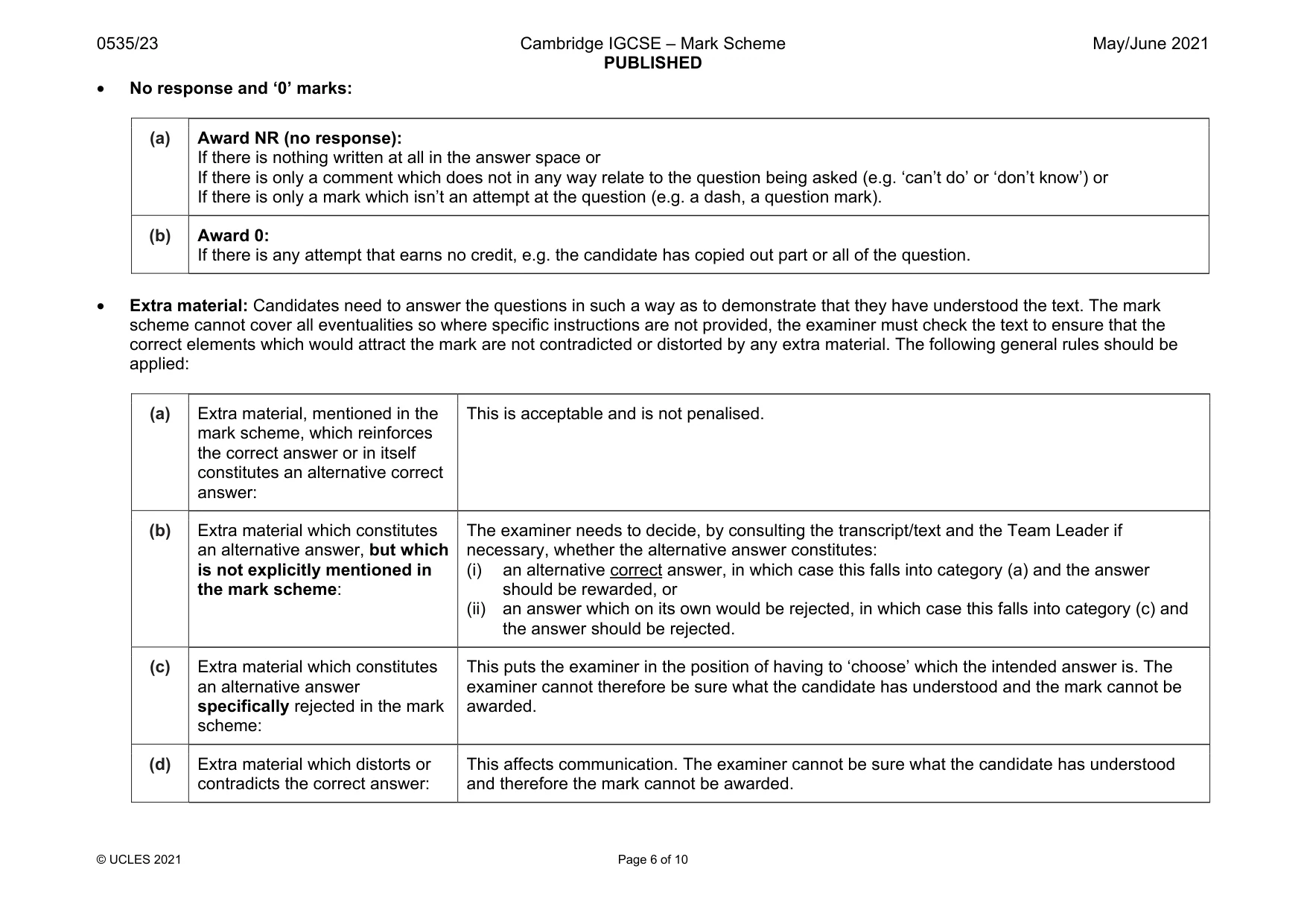
0535/23 Cambridge IGCSE – Mark Scheme PUBLISHED May/June 2021 © UCLES 2021 Page 2 of 10 Generic Marking Principles These general marking principles must be applied by all examiners when marking candidate answers. They should be applied alongside the specific content of the mark scheme or generic level descriptors for a question. Each question paper and mark scheme will also comply with these marking principles. GENERIC MARKING PRINCIPLE 1: Marks must be awarded in line with: • the specific content of the mark scheme or the generic level descriptors for the question • the specific skills defined in the mark scheme or in the generic level descriptors for the question • the standard of response required by a candidate as exemplified by the standardisation scripts. GENERIC MARKING PRINCIPLE 2: Marks awarded are always whole marks (not half marks, or other fractions). GENERIC MARKING PRINCIPLE 3: Marks must be awarded positively: • marks are awarded for correct/valid answers, as defined in the mark scheme. However, credit is given for valid answers which go beyond the scope of the syllabus and mark scheme, referring to your Team Leader as appropriate • marks are awarded when candidates clearly demonstrate what they know and can do • marks are not deducted for errors • marks are not deducted for omissions • answers should only be judged on the quality of spelling, punctuation and grammar when these features are specifically assessed by the question as indicated by the mark scheme. The meaning, however, should be unambiguous. GENERIC MARKING PRINCIPLE 4: Rules must be applied consistently, e.g. in situations where candidates have not followed instructions or in the application of generic level descriptors.
Mark scheme, page 3
0535/23 Cambridge IGCSE – Mark Scheme PUBLISHED May/June 2021 © UCLES 2021 Page 3 of 10 GENERIC MARKING PRINCIPLE 5: Marks should be awarded using the full range of marks defined in the mark scheme for the question (however; the use of the full mark range may be limited according to the quality of the candidate responses seen). GENERIC MARKING PRINCIPLE 6: Marks awarded are based solely on the requirements as defined in the mark scheme. Marks should not be awarded with grade thresholds or grade descriptors in mind.
Mark scheme, page 4
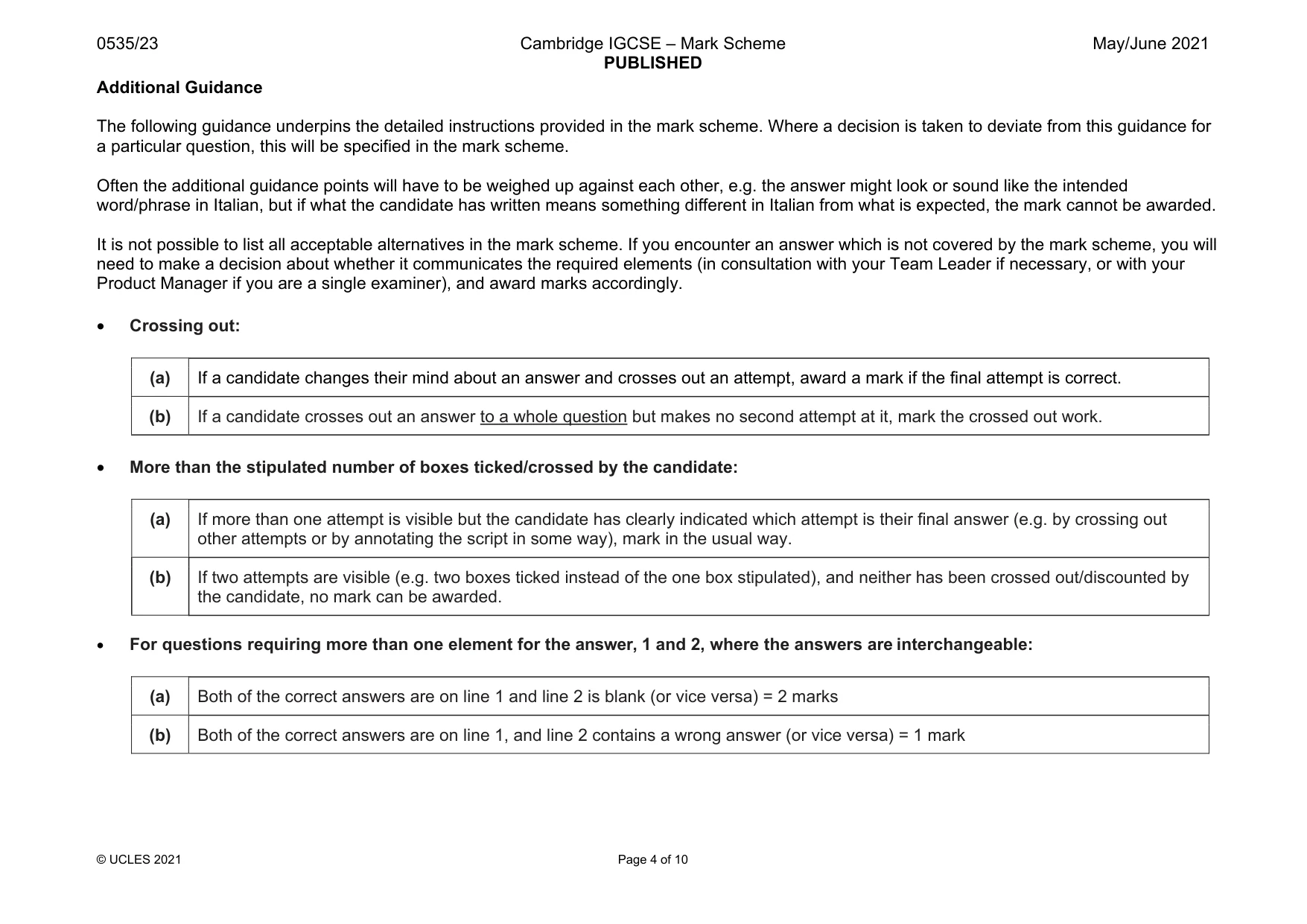
0535/23 Cambridge IGCSE – Mark Scheme PUBLISHED May/June 2021 © UCLES 2021 Page 4 of 10 Additional Guidance The following guidance underpins the detailed instructions provided in the mark scheme. Where a decision is taken to deviate from this guidance for a particular question, this will be specified in the mark scheme. Often the additional guidance points will have to be weighed up against each other, e.g. the answer might look or sound like the intended word/phrase in Italian, but if what the candidate has written means something different in Italian from what is expected, the mark cannot be awarded. It is not possible to list all acceptable alternatives in the mark scheme. If you encounter an answer which is not covered by the mark scheme, you will need to make a decision about whether it communicates the required elements (in consultation with your Team Leader if necessary, or with your Product Manager if you are a single examiner), and award marks accordingly. • Crossing out: (a) If a candidate changes their mind about an answer and crosses out an attempt, award a mark if the final attempt is correct. (b) If a candidate crosses out an answer to a whole question but makes no second attempt at it, mark the crossed out work. • More than the stipulated number of boxes ticked/crossed by the candidate: (a) If more than one attempt is visible but the candidate has clearly indicated which attempt is their final answer (e.g. by crossing out other attempts or by annotating the script in some way), mark in the usual way. (b) If two attempts are visible (e.g. two boxes ticked instead of the one box stipulated), and neither has been crossed out/discounted by the candidate, no mark can be awarded. • For questions requiring more than one element for the answer, 1 and 2, where the answers are interchangeable: (a) Both of the correct answers are on line 1 and line 2 is blank (or vice versa) = 2 marks (b) Both of the correct answers are on line 1, and line 2 contains a wrong answer (or vice versa) = 1 mark
Mark scheme, page 5
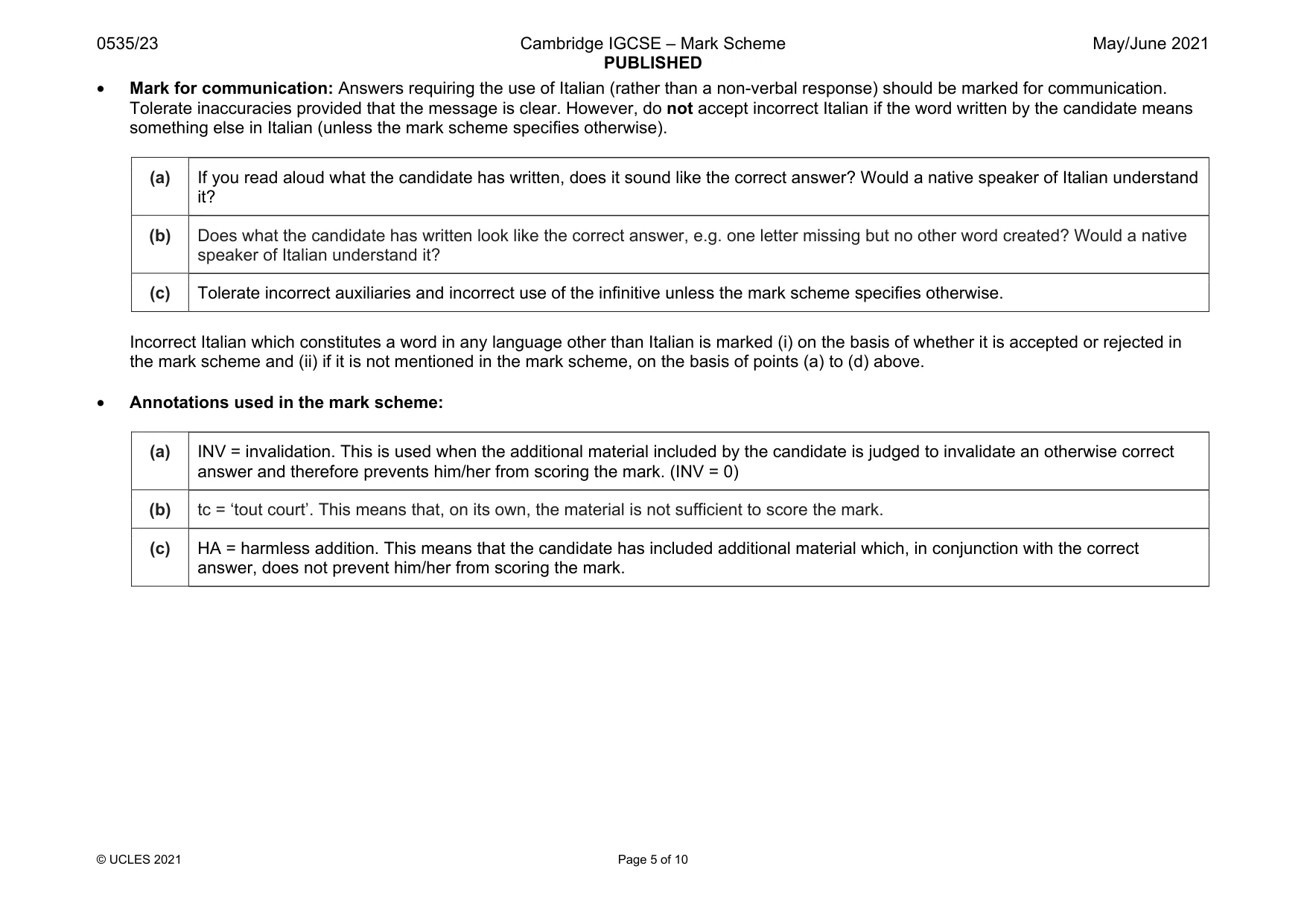
0535/23 Cambridge IGCSE – Mark Scheme PUBLISHED May/June 2021 © UCLES 2021 Page 5 of 10 • Mark for communication: Answers requiring the use of Italian (rather than a non-verbal response) should be marked for communication. Tolerate inaccuracies provided that the message is clear. However, do not accept incorrect Italian if the word written by the candidate means something else in Italian (unless the mark scheme specifies otherwise). (a) If you read aloud what the candidate has written, does it sound like the correct answer? Would a native speaker of Italian understand it? (b) Does what the candidate has written look like the correct answer, e.g. one letter missing but no other word created? Would a native speaker of Italian understand it? (c) Tolerate incorrect auxiliaries and incorrect use of the infinitive unless the mark scheme specifies otherwise. Incorrect Italian which constitutes a word in any language other than Italian is marked (i) on the basis of whether it is accepted or rejected in the mark scheme and (ii) if it is not mentioned in the mark scheme, on the basis of points (a) to (d) above. • Annotations used in the mark scheme: (a) INV = invalidation. This is used when the additional material included by the candidate is judged to invalidate an otherwise correct answer and therefore prevents him/her from scoring the mark. (INV = 0) (b) tc = ‘tout court’. This means that, on its own, the material is not sufficient to score the mark. (c) HA = harmless addition. This means that the candidate has included additional material which, in conjunction with the correct answer, does not prevent him/her from scoring the mark.
Mark scheme, page 6
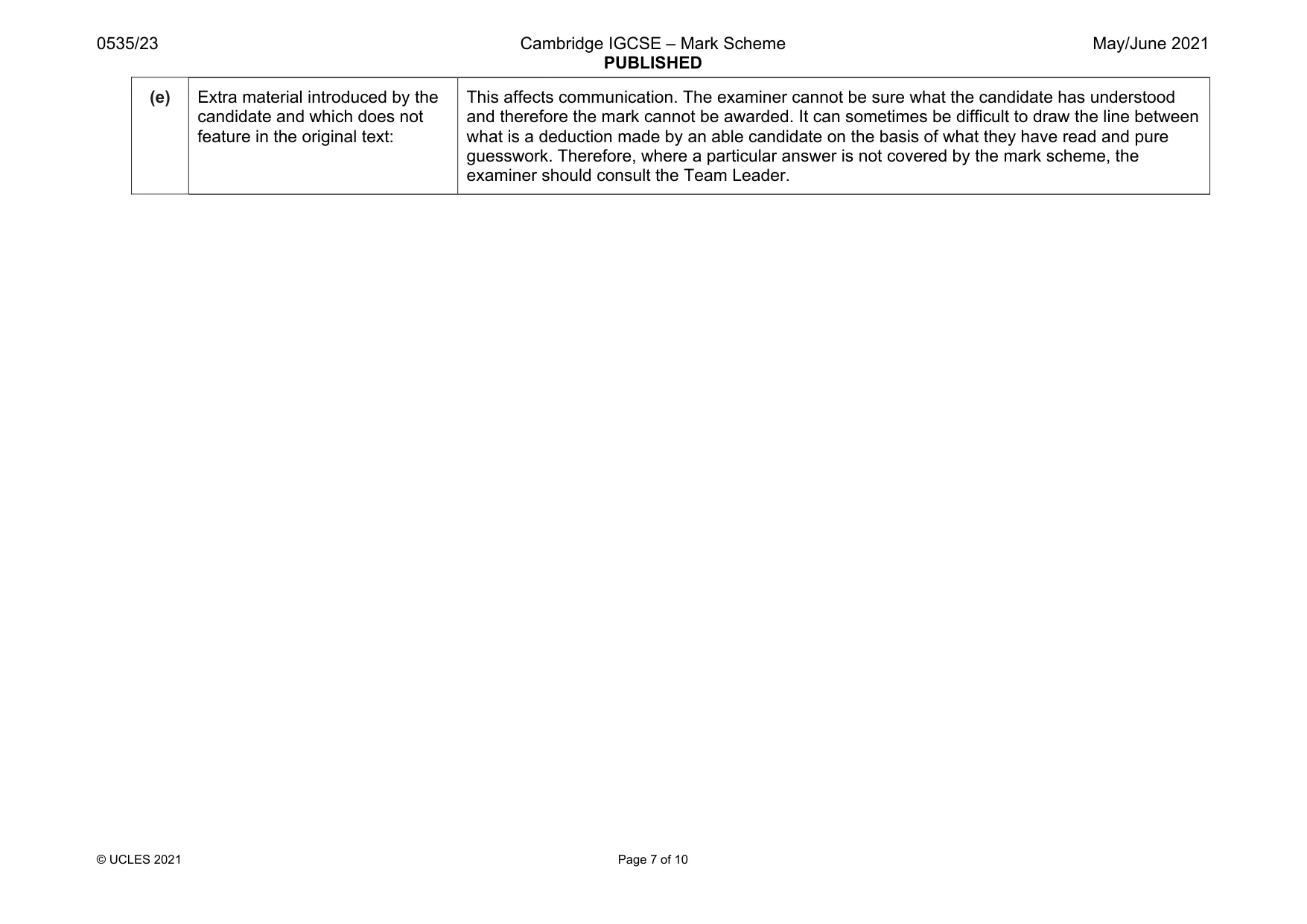
0535/23 Cambridge IGCSE – Mark Scheme PUBLISHED May/June 2021 © UCLES 2021 Page 6 of 10 • No response and ‘0’ marks: (a) Award NR (no response): If there is nothing written at all in the answer space or If there is only a comment which does not in any way relate to the question being asked (e.g. ‘can’t do’ or ‘don’t know’) or If there is only a mark which isn’t an attempt at the question (e.g. a dash, a question mark). (b) Award 0: If there is any attempt that earns no credit, e.g. the candidate has copied out part or all of the question. • Extra material: Candidates need to answer the questions in such a way as to demonstrate that they have understood the text. The mark scheme cannot cover all eventualities so where specific instructions are not provided, the examiner must check the text to ensure that the correct elements which would attract the mark are not contradicted or distorted by any extra material. The following general rules should be applied: (a) Extra material, mentioned in the mark scheme, which reinforces the correct answer or in itself constitutes an alternative correct answer: This is acceptable and is not penalised. (b) Extra material which constitutes an alternative answer, but which is not explicitly mentioned in the mark scheme: The examiner needs to decide, by consulting the transcript/text and the Team Leader if necessary, whether the alternative answer constitutes: (i) an alternative correct answer, in which case this falls into category (a) and the answer should be rewarded, or (ii) an answer which on its own would be rejected, in which case this falls into category (c) and the answer should be rejected. (c) Extra material which constitutes an alternative answer specifically rejected in the mark scheme: This puts the examiner in the position of having to ‘choose’ which the intended answer is. The examiner cannot therefore be sure what the candidate has understood and the mark cannot be awarded. (d) Extra material which distorts or contradicts the correct answer: This affects communication. The examiner cannot be sure what the candidate has understood and therefore the mark cannot be awarded.
Mark scheme, page 7
0535/23 Cambridge IGCSE – Mark Scheme PUBLISHED May/June 2021 © UCLES 2021 Page 7 of 10 (e) Extra material introduced by the candidate and which does not feature in the original text: This affects communication. The examiner cannot be sure what the candidate has understood and therefore the mark cannot be awarded. It can sometimes be difficult to draw the line between what is a deduction made by an able candidate on the basis of what they have read and pure guesswork. Therefore, where a particular answer is not covered by the mark scheme, the examiner should consult the Team Leader.
Mark scheme, page 8
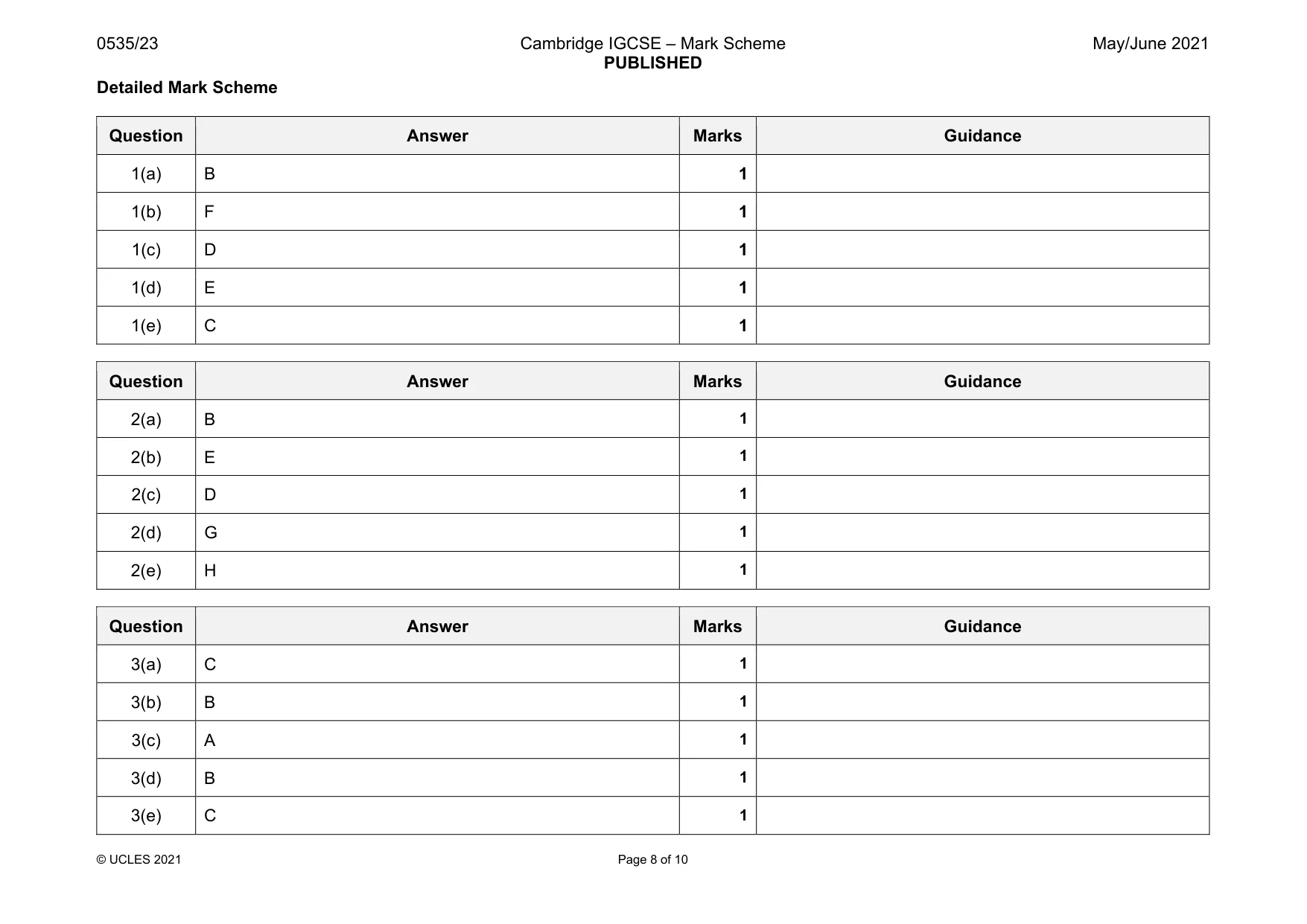
0535/23 Cambridge IGCSE – Mark Scheme PUBLISHED May/June 2021 © UCLES 2021 Page 8 of 10 Detailed Mark Scheme Question Answer Marks Guidance 1(a) B 1 1(b) F 1 1(c) D 1 1(d) E 1 1(e) C 1 Question Answer Marks Guidance 2(a) B 1 2(b) E 1 2(c) D 1 2(d) G 1 2(e) H 1 Question Answer Marks Guidance 3(a) C 1 3(b) B 1 3(c) A 1 3(d) B 1 3(e) C 1
Mark scheme, page 9
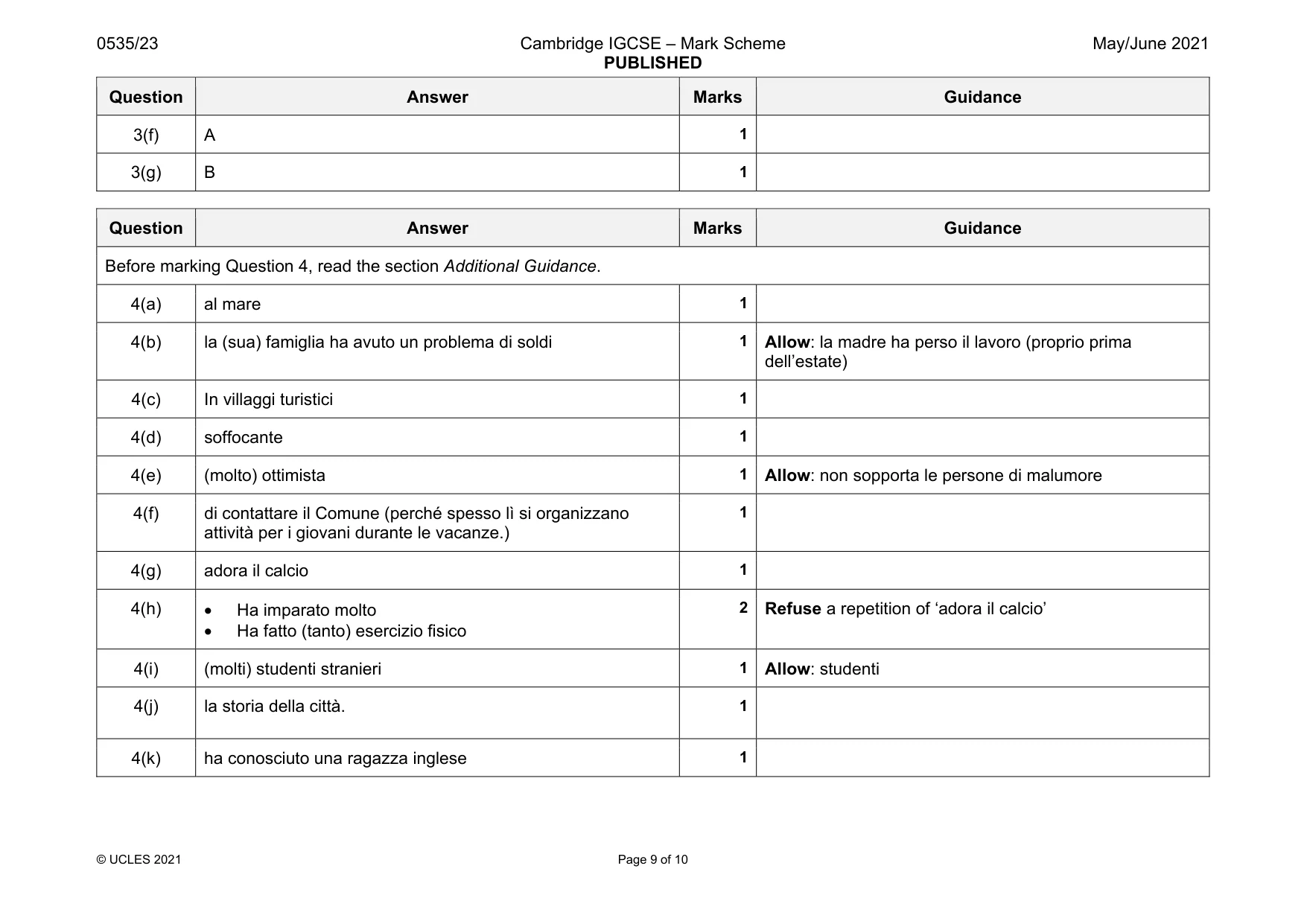
0535/23 Cambridge IGCSE – Mark Scheme PUBLISHED May/June 2021 © UCLES 2021 Page 9 of 10 Question Answer Marks Guidance 3(f) A 1 3(g) B 1 Question Answer Marks Guidance Before marking Question 4, read the section Additional Guidance. 4(a) al mare 1 4(b) la (sua) famiglia ha avuto un problema di soldi 1 Allow: la madre ha perso il lavoro (proprio prima dell’estate) 4(c) In villaggi turistici 1 4(d) soffocante 1 4(e) (molto) ottimista 1 Allow: non sopporta le persone di malumore 4(f) di contattare il Comune (perché spesso lì si organizzano attività per i giovani durante le vacanze.) 1 4(g) adora il calcio 1 4(h) • Ha imparato molto • Ha fatto (tanto) esercizio fisico 2 Refuse a repetition of ‘adora il calcio’ 4(i) (molti) studenti stranieri 1 Allow: studenti 4(j) la storia della città. 1 4(k) ha conosciuto una ragazza inglese 1
Mark scheme, page 10
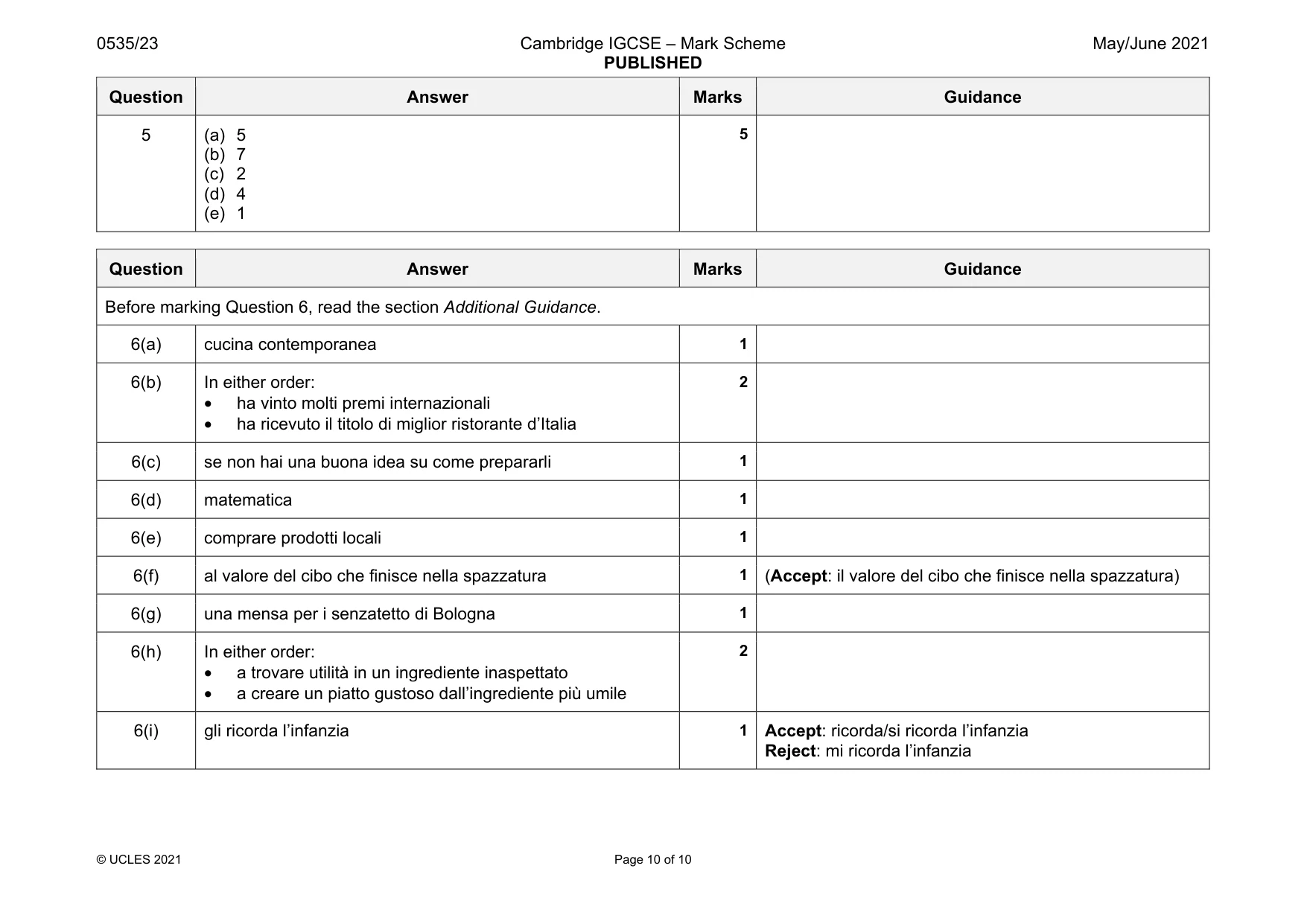
0535/23 Cambridge IGCSE – Mark Scheme PUBLISHED May/June 2021 © UCLES 2021 Page 10 of 10 Question Answer Marks Guidance 5 (a) 5 (b) 7 (c) 2 (d) 4 (e) 1 5 Question Answer Marks Guidance Before marking Question 6, read the section Additional Guidance. 6(a) cucina contemporanea 1 6(b) In either order: • ha vinto molti premi internazionali • ha ricevuto il titolo di miglior ristorante d’Italia 2 6(c) se non hai una buona idea su come prepararli 1 6(d) matematica 1 6(e) comprare prodotti locali 1 6(f) al valore del cibo che finisce nella spazzatura 1 (Accept: il valore del cibo che finisce nella spazzatura) 6(g) una mensa per i senzatetto di Bologna 1 6(h) In either order: • a trovare utilità in un ingrediente inaspettato • a creare un piatto gustoso dall’ingrediente più umile 2 6(i) gli ricorda l’infanzia 1 Accept: ricorda/si ricorda l’infanzia Reject: mi ricorda l’infanzia
What you needed in this session
Cambridge’s own grade thresholds for 2021 May/June, Paper 2 · Variant 3. A higher threshold means an easier paper — the bar moves with how the cohort did.