Cambridge IGCSE Islamiyat 0493 — 2024 May/June Paper 1 · Variant 2
0493/12/M/J/24 · 50 marks · ≈56 min
The question paper and its mark scheme, free to read here and free to download. This is Cambridge’s own paper, exactly as it was sat.
Question paper20 pages













Mark scheme18 pages
Answers below. Sit the paper first if you are practising.
Paper as text
Question paper, page 1
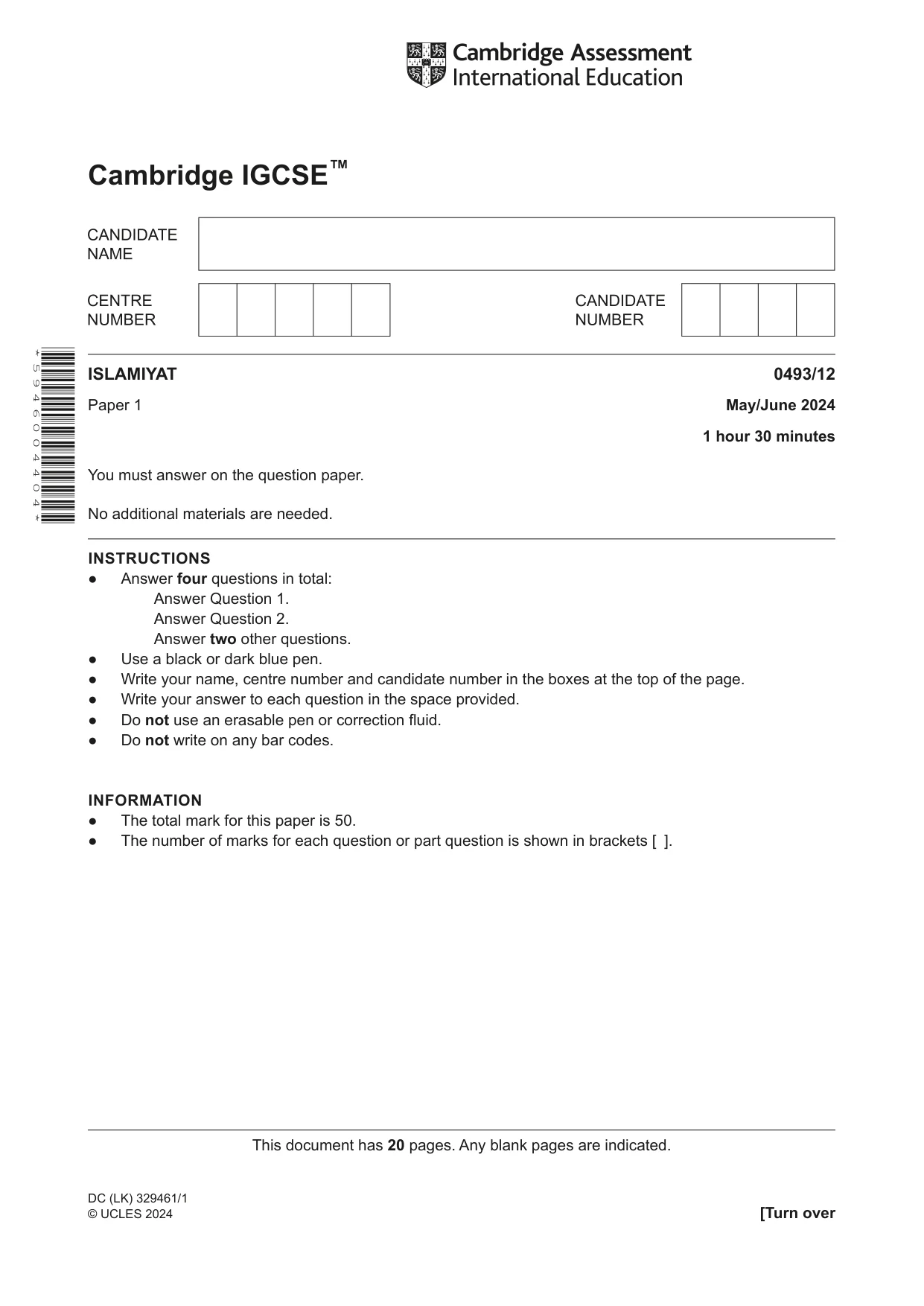
This document has 20 pages. Any blank pages are indicated. [Turn over Cambridge IGCSE™ ISLAMIYAT 0493/12 Paper 1 May/June 2024 1 hour 30 minutes You must answer on the question paper. No additional materials are needed. INSTRUCTIONS ● Answer four questions in total: Answer Question 1. Answer Question 2. Answer two other questions. ● Use a black or dark blue pen. ● Write your name, centre number and candidate number in the boxes at the top of the page. ● Write your answer to each question in the space provided. ● Do not use an erasable pen or correction fluid. ● Do not write on any bar codes. INFORMATION ● The total mark for this paper is 50. ● The number of marks for each question or part question is shown in brackets [ ]. * 5 9 4 6 0 0 4 4 0 4 * DC (LK) 329461/1 © UCLES 2024
Question paper, page 2
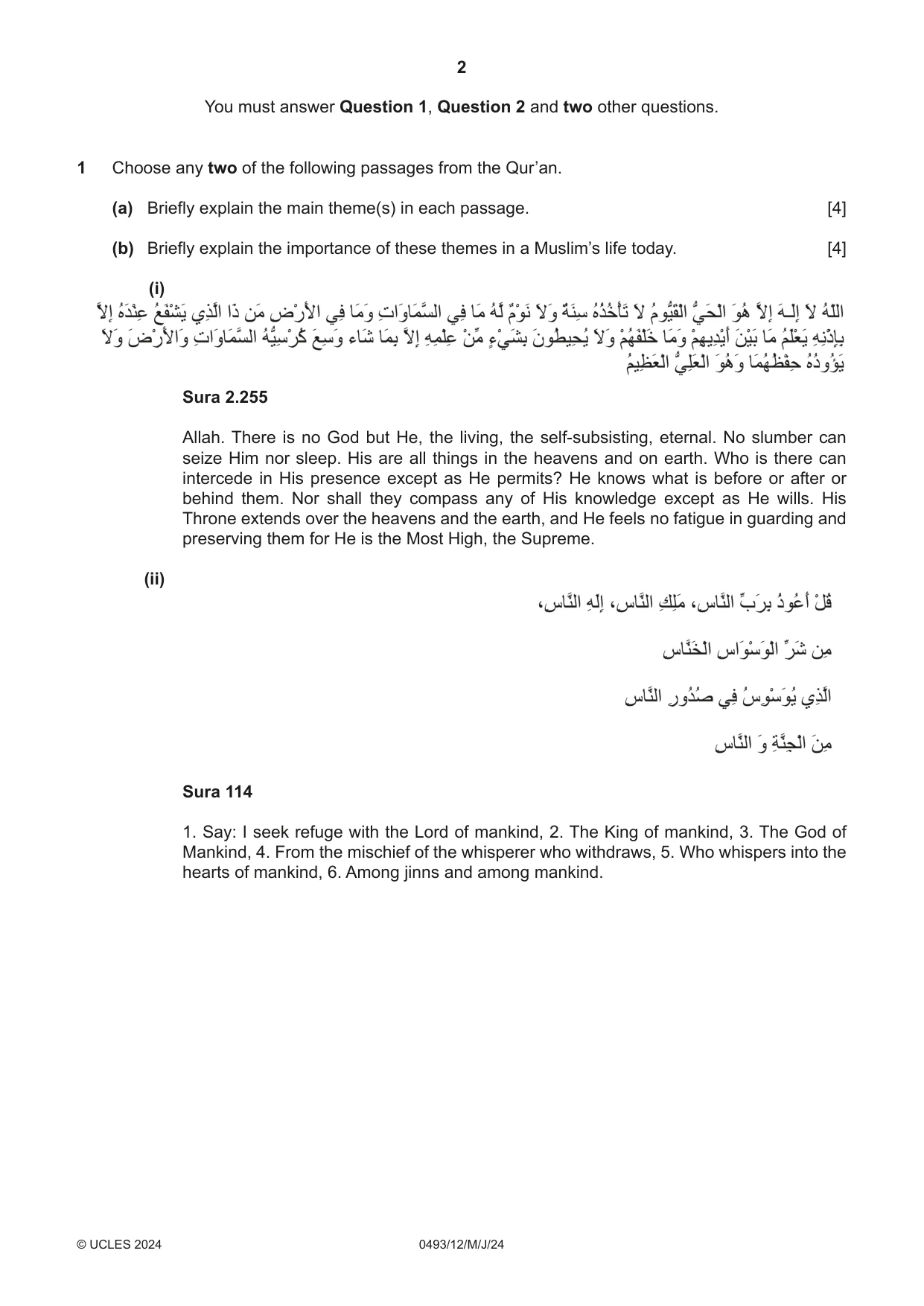
2 0493/12/M/J/24 © UCLES 2024 You must answer Question 1, Question 2 and two other questions. 1 Choose any two of the following passages from the Qur’an. (a) Briefly explain the main theme(s) in each passage. [4] (b) Briefly explain the importance of these themes in a Muslim’s life today. [4] (i) Sura 2.255 Allah. There is no God but He, the living, the self-subsisting, eternal. No slumber can seize Him nor sleep. His are all things in the heavens and on earth. Who is there can intercede in His presence except as He permits? He knows what is before or after or behind them. Nor shall they compass any of His knowledge except as He wills. His Throne extends over the heavens and the earth, and He feels no fatigue in guarding and preserving them for He is the Most High, the Supreme. (ii) Sura 114 1. Say: I seek refuge with the Lord of mankind, 2. The King of mankind, 3. The God of Mankind, 4. From the mischief of the whisperer who withdraws, 5. Who whispers into the hearts of mankind, 6. Among jinns and among mankind.
Question paper, page 3
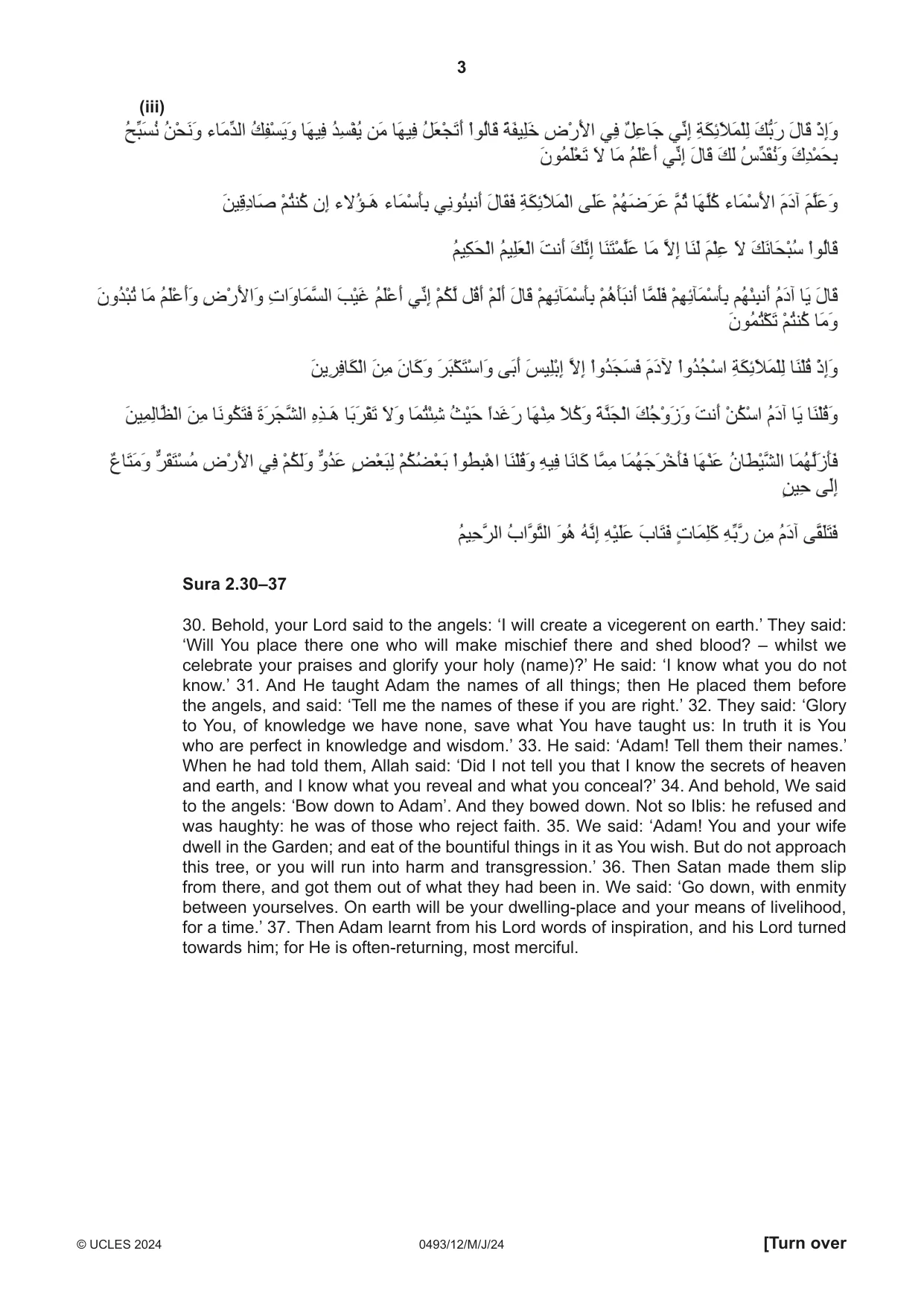
3 0493/12/M/J/24 © UCLES 2024 [Turn over (iii) Sura 2.30–37 30. Behold, your Lord said to the angels: ‘I will create a vicegerent on earth.’ They said: ‘Will You place there one who will make mischief there and shed blood? – whilst we celebrate your praises and glorify your holy (name)?’ He said: ‘I know what you do not know.’ 31. And He taught Adam the names of all things; then He placed them before the angels, and said: ‘Tell me the names of these if you are right.’ 32. They said: ‘Glory to You, of knowledge we have none, save what You have taught us: In truth it is You who are perfect in knowledge and wisdom.’ 33. He said: ‘Adam! Tell them their names.’ When he had told them, Allah said: ‘Did I not tell you that I know the secrets of heaven and earth, and I know what you reveal and what you conceal?’ 34. And behold, We said to the angels: ‘Bow down to Adam’. And they bowed down. Not so Iblis: he refused and was haughty: he was of those who reject faith. 35. We said: ‘Adam! You and your wife dwell in the Garden; and eat of the bountiful things in it as You wish. But do not approach this tree, or you will run into harm and transgression.’ 36. Then Satan made them slip from there, and got them out of what they had been in. We said: ‘Go down, with enmity between yourselves. On earth will be your dwelling-place and your means of livelihood, for a time.’ 37. Then Adam learnt from his Lord words of inspiration, and his Lord turned towards him; for He is often-returning, most merciful.
Question paper, page 4
4 0493/12/M/J/24 © UCLES 2024 … … … … … … … … … … … … … … … … … … … … … … … … … … … …
Question paper, page 5
5 0493/12/M/J/24 © UCLES 2024 [Turn over … … … … … … … … … … … … … … … … … … … … … … … … … … … …
Question paper, page 6
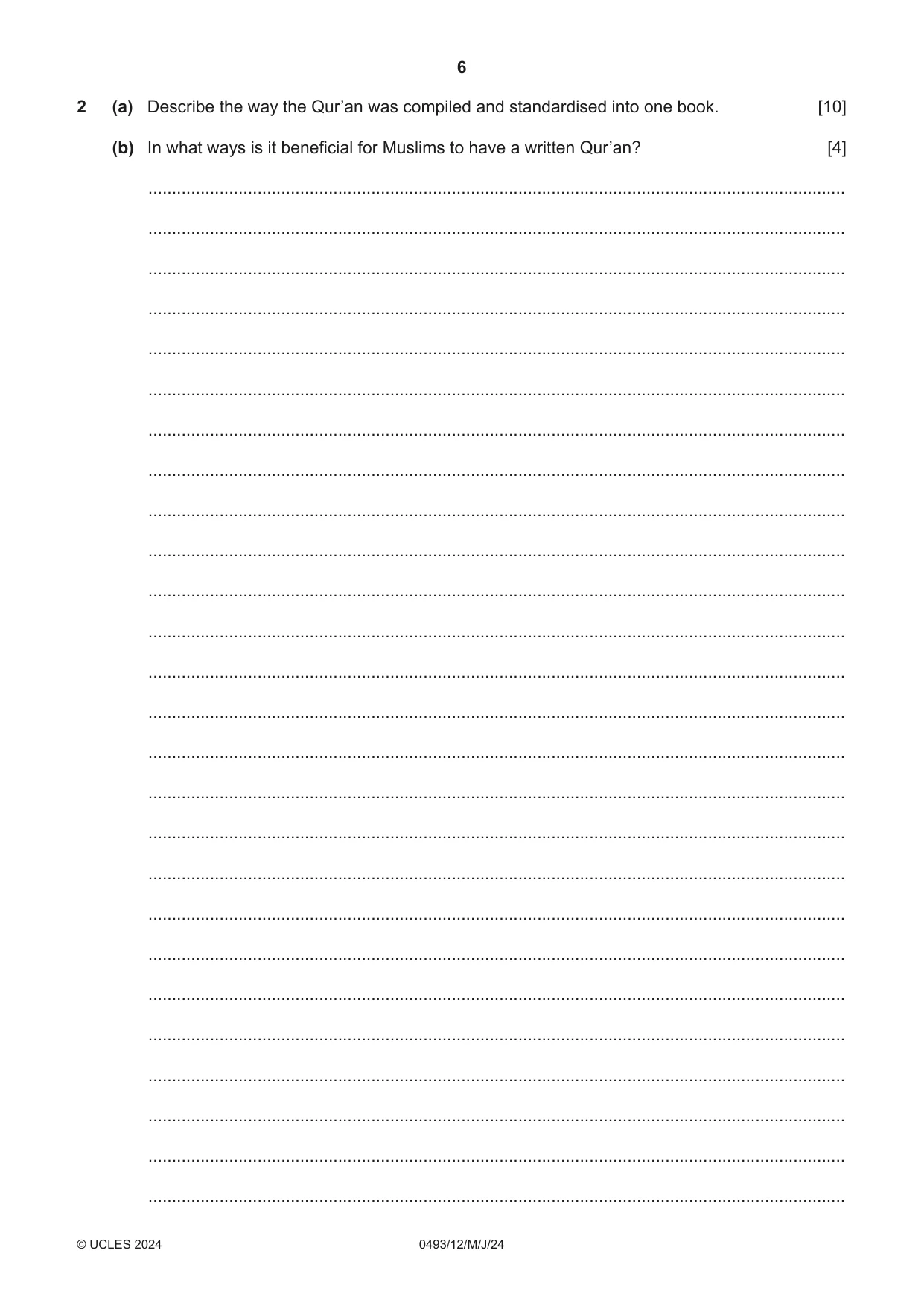
6 0493/12/M/J/24 © UCLES 2024 2 (a) Describe the way the Qur’an was compiled and standardised into one book. [10] (b) In what ways is it beneficial for Muslims to have a written Qur’an? [4] … … … … … … … … … … … … … … … … … … … … … … … … … …
Question paper, page 7
7 0493/12/M/J/24 © UCLES 2024 [Turn over … … … … … … … … … … … … … … … … … … … … … … … … … … … …
Question paper, page 8
8 0493/12/M/J/24 © UCLES 2024 … … … … … … … … … … … … … … … … … … … … … … … … … … … …
Question paper, page 9
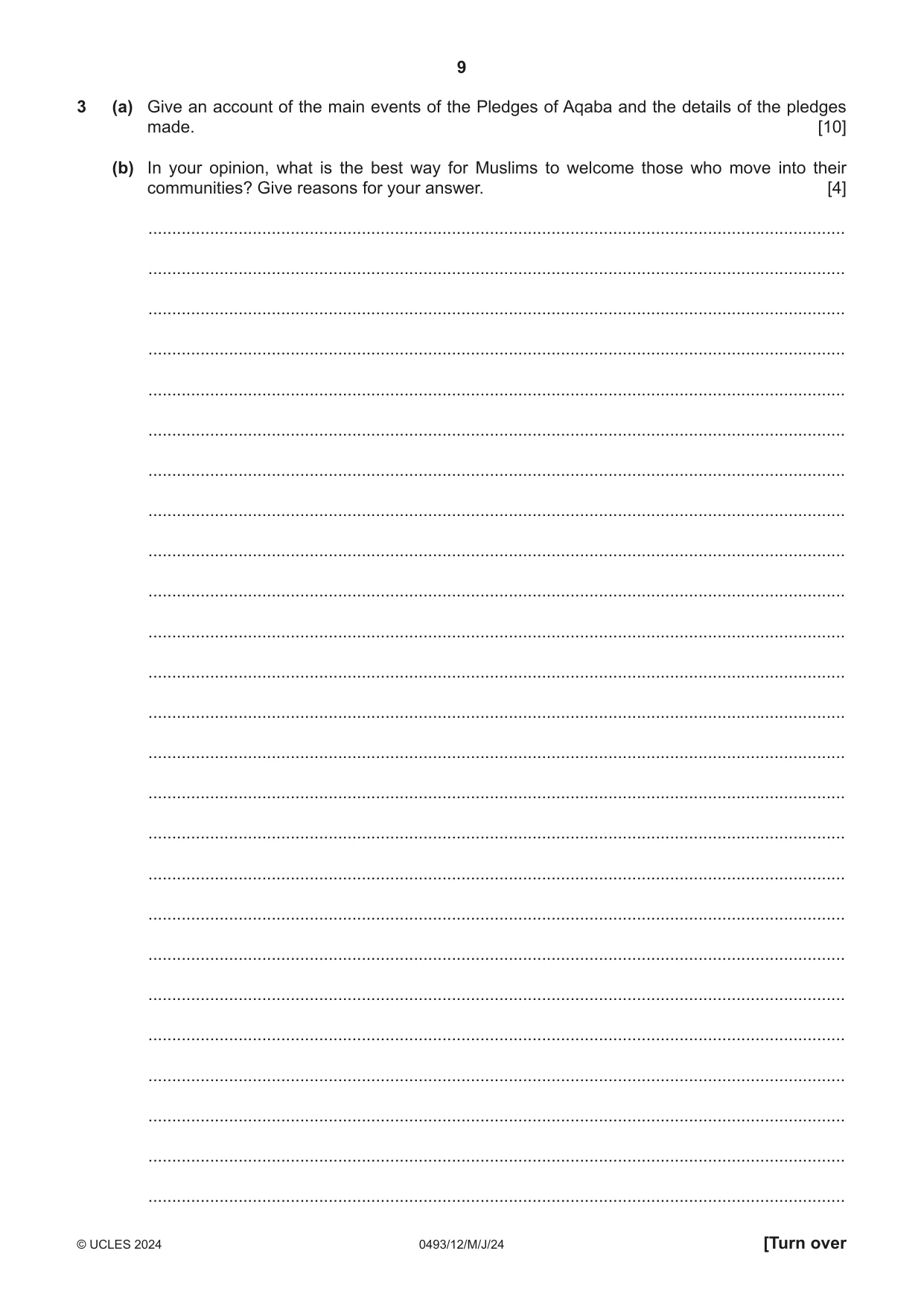
9 0493/12/M/J/24 © UCLES 2024 [Turn over 3 (a) Give an account of the main events of the Pledges of Aqaba and the details of the pledges made. [10] (b) In your opinion, what is the best way for Muslims to welcome those who move into their communities? Give reasons for your answer. [4] … … … … … … … … … … … … … … … … … … … … … … … … …
Question paper, page 10
10 0493/12/M/J/24 © UCLES 2024 … … … … … … … … … … … … … … … … … … … … … … … … … … … …
Question paper, page 11
11 0493/12/M/J/24 © UCLES 2024 [Turn over … … … … … … … … … … … … … … … … … … … … … … … … … … … …
Question paper, page 12
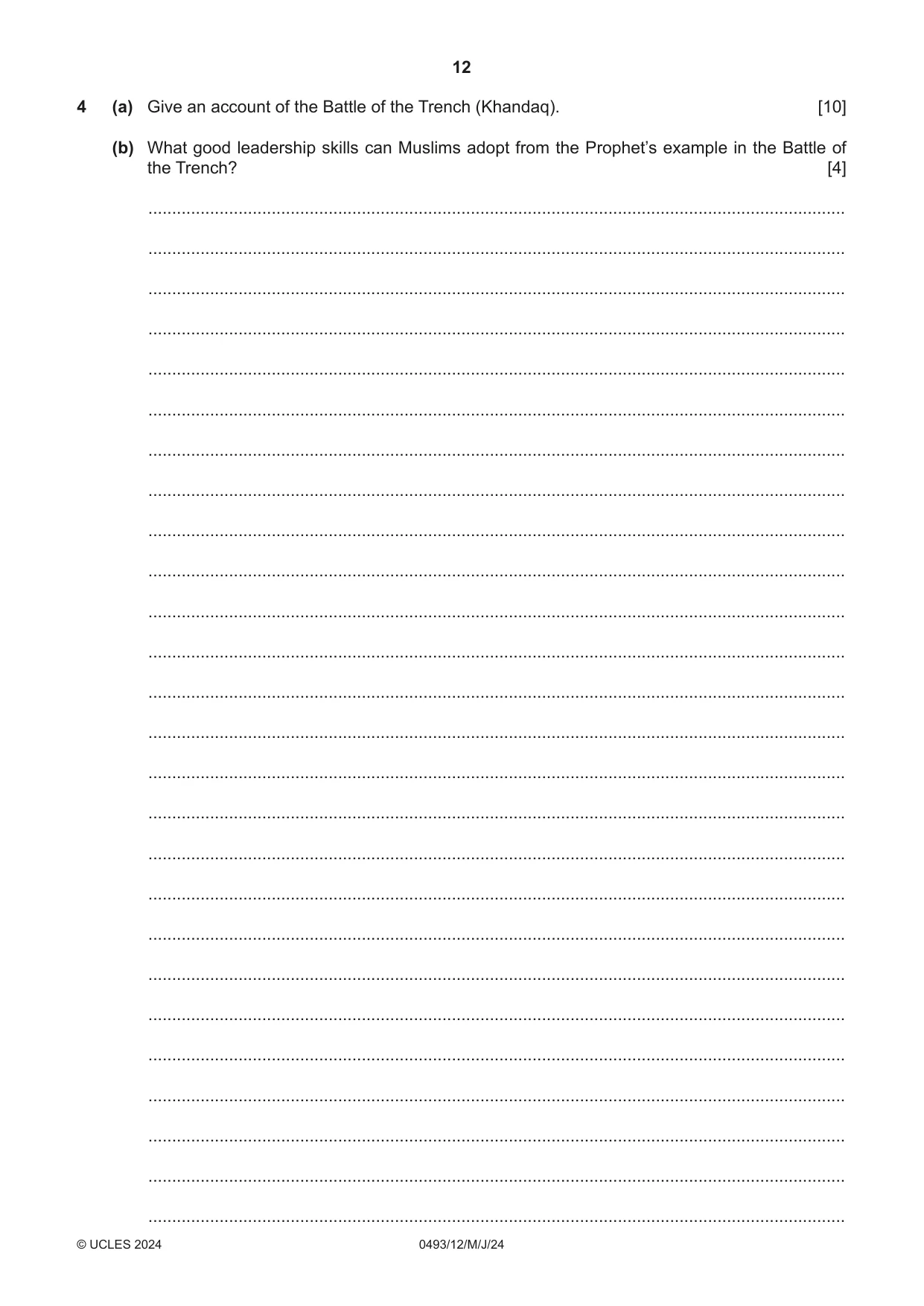
12 0493/12/M/J/24 © UCLES 2024 4 (a) Give an account of the Battle of the Trench (Khandaq). [10] (b) What good leadership skills can Muslims adopt from the Prophet’s example in the Battle of the Trench? [4] … … … … … … … … … … … … … … … … … … … … … … … … … …
Question paper, page 13
13 0493/12/M/J/24 © UCLES 2024 [Turn over … … … … … … … … … … … … … … … … … … … … … … … … … … … …
Question paper, page 14
14 0493/12/M/J/24 © UCLES 2024 … … … … … … … … … … … … … … … … … … … … … … … … … … … …
Question paper, page 15
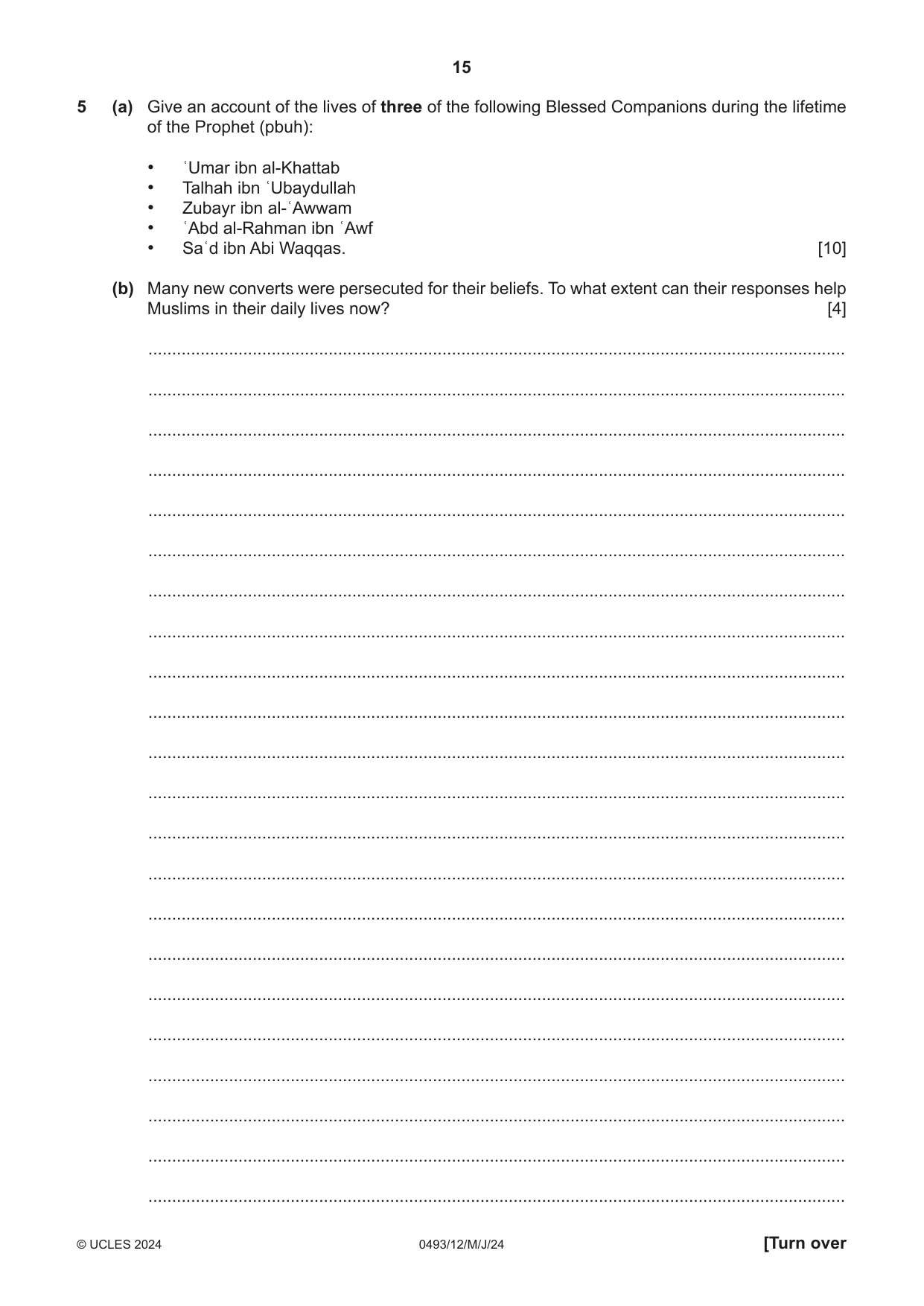
15 0493/12/M/J/24 © UCLES 2024 [Turn over 5 (a) Give an account of the lives of three of the following Blessed Companions during the lifetime of the Prophet (pbuh): • ʿUmar ibn al-Khattab • Talhah ibn ʿUbaydullah • Zubayr ibn al-ʿAwwam • ʿAbd al-Rahman ibn ʿAwf • Saʿd ibn Abi Waqqas. [10] (b) Many new converts were persecuted for their beliefs. To what extent can their responses help Muslims in their daily lives now? [4] … … … … … … … … … … … … … … … … … … … … … …
Question paper, page 16
16 0493/12/M/J/24 © UCLES 2024 … … … … … … … … … … … … … … … … … … … … … … … … … … … …
Question paper, page 17
17 0493/12/M/J/24 © UCLES 2024 … … … … … … … … … … … … … … … … … … … … … … … … … … … …
Question paper, page 18
18 0493/12/M/J/24 © UCLES 2024 BLANK PAGE
Question paper, page 19
19 0493/12/M/J/24 © UCLES 2024 BLANK PAGE
Question paper, page 20
20 0493/12/M/J/24 © UCLES 2024 Permission to reproduce items where third-party owned material protected by copyright is included has been sought and cleared where possible. Every reasonable effort has been made by the publisher (UCLES) to trace copyright holders, but if any items requiring clearance have unwittingly been included, the publisher will be pleased to make amends at the earliest possible opportunity. To avoid the issue of disclosure of answer-related information to candidates, all copyright acknowledgements are reproduced online in the Cambridge Assessment International Education Copyright Acknowledgements Booklet. This is produced for each series of examinations and is freely available to download at www.cambridgeinternational.org after the live examination series. Cambridge Assessment International Education is part of Cambridge Assessment. Cambridge Assessment is the brand name of the University of Cambridge Local Examinations Syndicate (UCLES), which is a department of the University of Cambridge. BLANK PAGE
Mark scheme, page 1
This document consists of 18 printed pages. © Cambridge University Press & Assessment 2024 [Turn over Cambridge IGCSE™ ISLAMIYAT 0493/12 Paper 1 May/June 2024 MARK SCHEME Maximum Mark: 50 Published This mark scheme is published as an aid to teachers and candidates, to indicate the requirements of the examination. It shows the basis on which Examiners were instructed to award marks. It does not indicate the details of the discussions that took place at an Examiners’ meeting before marking began, which would have considered the acceptability of alternative answers. Mark schemes should be read in conjunction with the question paper and the Principal Examiner Report for Teachers. Cambridge International will not enter into discussions about these mark schemes. Cambridge International is publishing the mark schemes for the May/June 2024 series for most Cambridge IGCSE, Cambridge International A and AS Level and Cambridge Pre-U components, and some Cambridge O Level components.
Mark scheme, page 2
0493/12 Cambridge IGCSE – Mark Scheme PUBLISHED May/June 2024 © Cambridge University Press & Assessment 2024 Page 2 of 18 Generic Marking Principles These general marking principles must be applied by all examiners when marking candidate answers. They should be applied alongside the specific content of the mark scheme or generic level descriptions for a question. Each question paper and mark scheme will also comply with these marking principles. GENERIC MARKING PRINCIPLE 1: Marks must be awarded in line with: the specific content of the mark scheme or the generic level descriptors for the question the specific skills defined in the mark scheme or in the generic level descriptors for the question the standard of response required by a candidate as exemplified by the standardisation scripts. GENERIC MARKING PRINCIPLE 2: Marks awarded are always whole marks (not half marks, or other fractions). GENERIC MARKING PRINCIPLE 3: Marks must be awarded positively: marks are awarded for correct/valid answers, as defined in the mark scheme. However, credit is given for valid answers which go beyond the scope of the syllabus and mark scheme, referring to your Team Leader as appropriate marks are awarded when candidates clearly demonstrate what they know and can do marks are not deducted for errors marks are not deducted for omissions answers should only be judged on the quality of spelling, punctuation and grammar when these features are specifically assessed by the question as indicated by the mark scheme. The meaning, however, should be unambiguous. GENERIC MARKING PRINCIPLE 4: Rules must be applied consistently, e.g. in situations where candidates have not followed instructions or in the application of generic level descriptors. GENERIC MARKING PRINCIPLE 5: Marks should be awarded using the full range of marks defined in the mark scheme for the question (however; the use of the full mark range may be limited according to the quality of the candidate responses seen). GENERIC MARKING PRINCIPLE 6: Marks awarded are based solely on the requirements as defined in the mark scheme. Marks should not be awarded with grade thresholds or grade descriptors in mind.
Mark scheme, page 3
0493/12 Cambridge IGCSE – Mark Scheme PUBLISHED May/June 2024 © Cambridge University Press & Assessment 2024 Page 3 of 18 GUIDE TO MARKING IGCSE ISLAMIYAT- 0493 In an examination of this kind, it is impossible to devise a mark scheme that will cover all acceptable answers. This mark scheme provides guidance on what to look out for in the answers given by the candidates. This means that you must be prepared to use discretion in deciding what constitutes an acceptable answer. To ensure that all examiners mark at a uniform level, you are expected regularly to discuss your marking with your Team Leader, especially any examples or forms of answer that differ greatly from the agreed mark scheme. Team Leaders are expected to discuss answers with the Principal Examiner. The mark scheme is discussed at the co-ordination meeting. When marking, all examiners are expected to adhere to what has been agreed. GENERAL POINTS Before starting to mark scripts, please ensure that you are familiar with the following: (a) The syllabus (b) The prescribed passages (where appropriate) PRINCIPLES UNDERLYING THE MARK SCHEME Candidates are tested on their ability to satisfy two general Assessment Objectives (AOs): AO1 To recall, select and present relevant facts from the main elements of the faith and history of Islam. Thus, AO1 is primarily concerned with knowledge. AO2 To demonstrate understanding of the significance of the selected information in the teachings of Islam and in the lives of Muslims. Thus, AO2 is concerned with understanding and evaluation of the material. The paper is marked out of 50. Candidates answer Question 1, Question 2, and any two of the other three questions. Question 1 carries a maximum of 8 marks, and the four other questions carry 14 marks each. In each question, part (a) tests AO1 and earns a maximum of 4 marks in Question 1, and 10 marks in Questions 2–5, while part (b) tests AO2 and earns up to 4 marks in Question 1 and 4 marks in Questions 2–5. Marks are awarded according to the four levels of response for each AO, following the level descriptors detailed below.
Mark scheme, page 4
0493/12 Cambridge IGCSE – Mark Scheme PUBLISHED May/June 2024 © Cambridge University Press & Assessment 2024 Page 4 of 18 LEVELS OF RESPONSE The statements which follow should be used to determine the appropriate level of response for each objective. They should be applied as appropriate to the question and as the assessment of the work of an average 16-year-old. The guiding principle for Examiners in applying the Mark Scheme to answers is to remember the concept of Positive Awarding. Therefore, marks should be awarded for appropriate responses to reasonable interpretations of the question. In the Mark Scheme there are no instances where answers are specifically excluded or required. What is included is information for Examiners, provided as guidance for what one might reasonably expect to find on a script. All appropriate answers therefore have the potential to be credited. It is perfectly possible for a candidate to achieve the highest level of response using a different argument or different information from that which appears in the Mark Scheme. It must be assumed that Examiners can answer the questions on the paper and so they can award the appropriate level of response to the candidate. The detailed marking schemes are there as suggestions of what might be found in the answer. Examiners should not check whether the content of the marking schemes is in the answers but rather be guided by the Levels of Response and the concept of Positive Awarding. Checking on what is not in the answer almost always leads to lower marks than are indicated by the Levels of Response. Examiners should use the full range of marks available within the Levels of Response and not hesitate to award the maximum where it is deserved. Examiners must not exceed the total marks allowable for the Level achieved or the total allowable for the part of the question.
Mark scheme, page 5
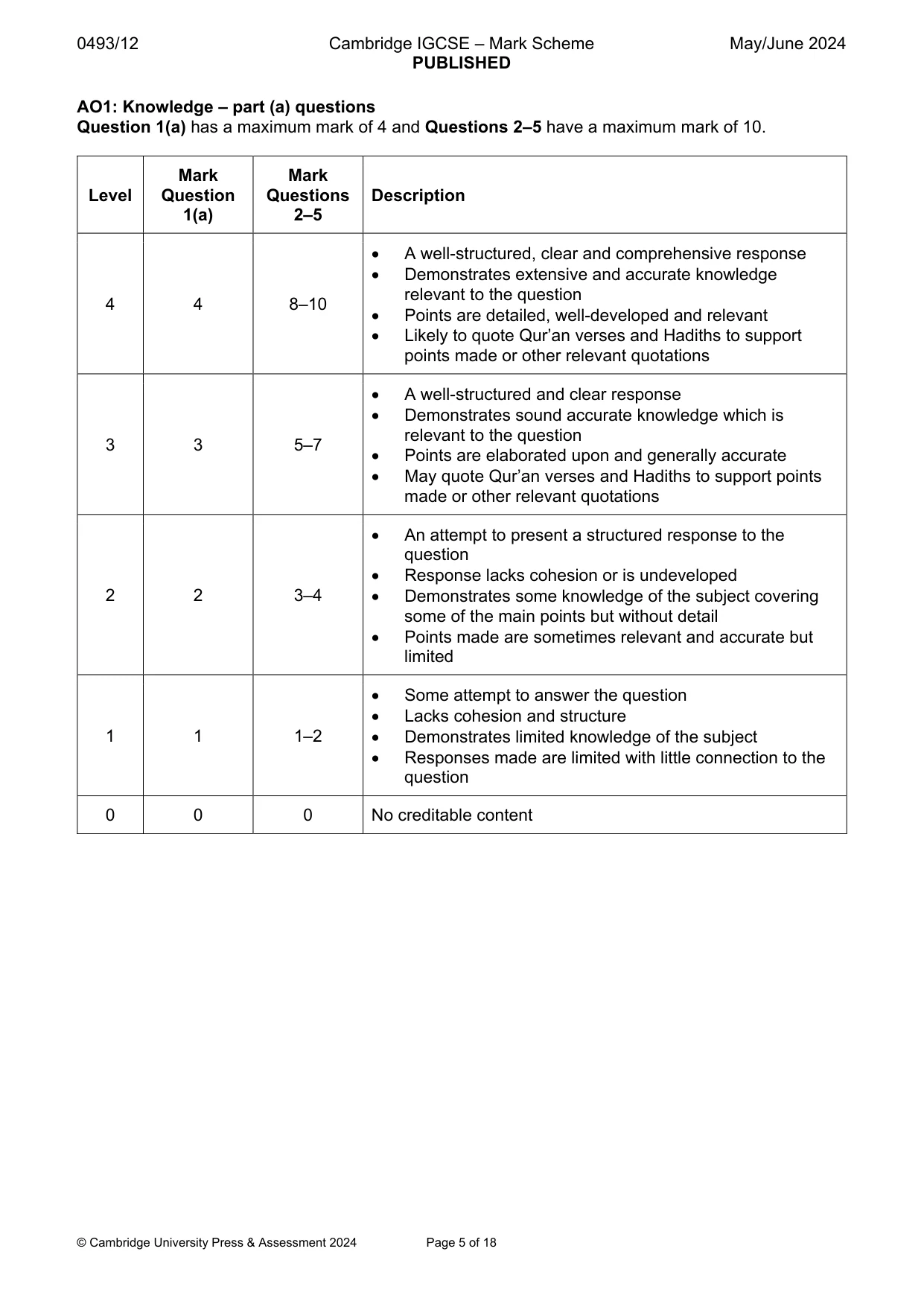
0493/12 Cambridge IGCSE – Mark Scheme PUBLISHED May/June 2024 © Cambridge University Press & Assessment 2024 Page 5 of 18 AO1: Knowledge – part (a) questions Question 1(a) has a maximum mark of 4 and Questions 2–5 have a maximum mark of 10. Level Mark Question 1(a) Mark Questions 2–5 Description 4 4 8–10 A well-structured, clear and comprehensive response Demonstrates extensive and accurate knowledge relevant to the question Points are detailed, well-developed and relevant Likely to quote Qur’an verses and Hadiths to support points made or other relevant quotations 3 3 5–7 A well-structured and clear response Demonstrates sound accurate knowledge which is relevant to the question Points are elaborated upon and generally accurate May quote Qur’an verses and Hadiths to support points made or other relevant quotations 2 2 3–4 An attempt to present a structured response to the question Response lacks cohesion or is undeveloped Demonstrates some knowledge of the subject covering some of the main points but without detail Points made are sometimes relevant and accurate but limited 1 1 1–2 Some attempt to answer the question Lacks cohesion and structure Demonstrates limited knowledge of the subject Responses made are limited with little connection to the question 0 0 0 No creditable content
Mark scheme, page 6
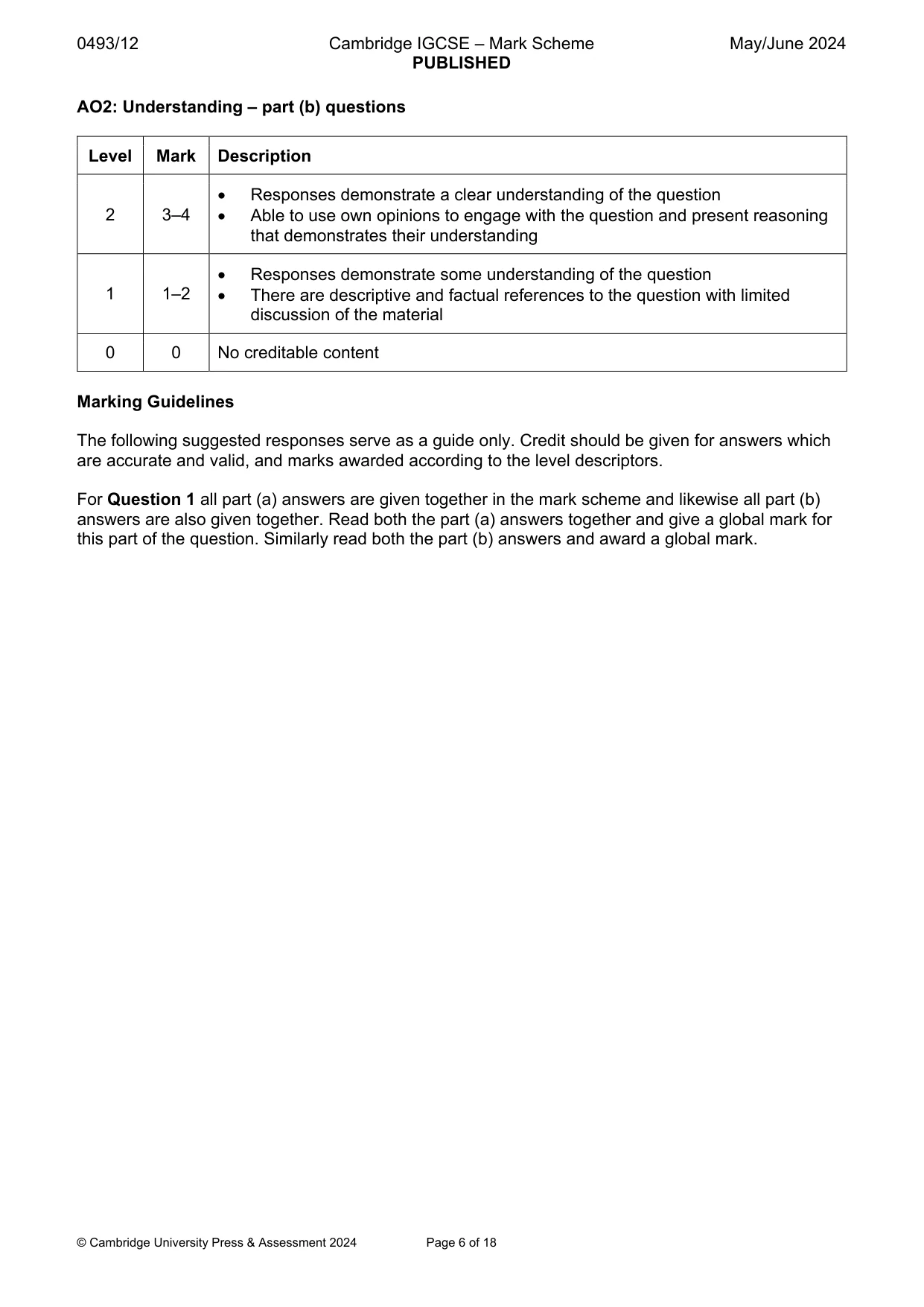
0493/12 Cambridge IGCSE – Mark Scheme PUBLISHED May/June 2024 © Cambridge University Press & Assessment 2024 Page 6 of 18 AO2: Understanding – part (b) questions Level Mark Description 2 3–4 Responses demonstrate a clear understanding of the question Able to use own opinions to engage with the question and present reasoning that demonstrates their understanding 1 1–2 Responses demonstrate some understanding of the question There are descriptive and factual references to the question with limited discussion of the material 0 0 No creditable content Marking Guidelines The following suggested responses serve as a guide only. Credit should be given for answers which are accurate and valid, and marks awarded according to the level descriptors. For Question 1 all part (a) answers are given together in the mark scheme and likewise all part (b) answers are also given together. Read both the part (a) answers together and give a global mark for this part of the question. Similarly read both the part (b) answers and award a global mark.
Mark scheme, page 7
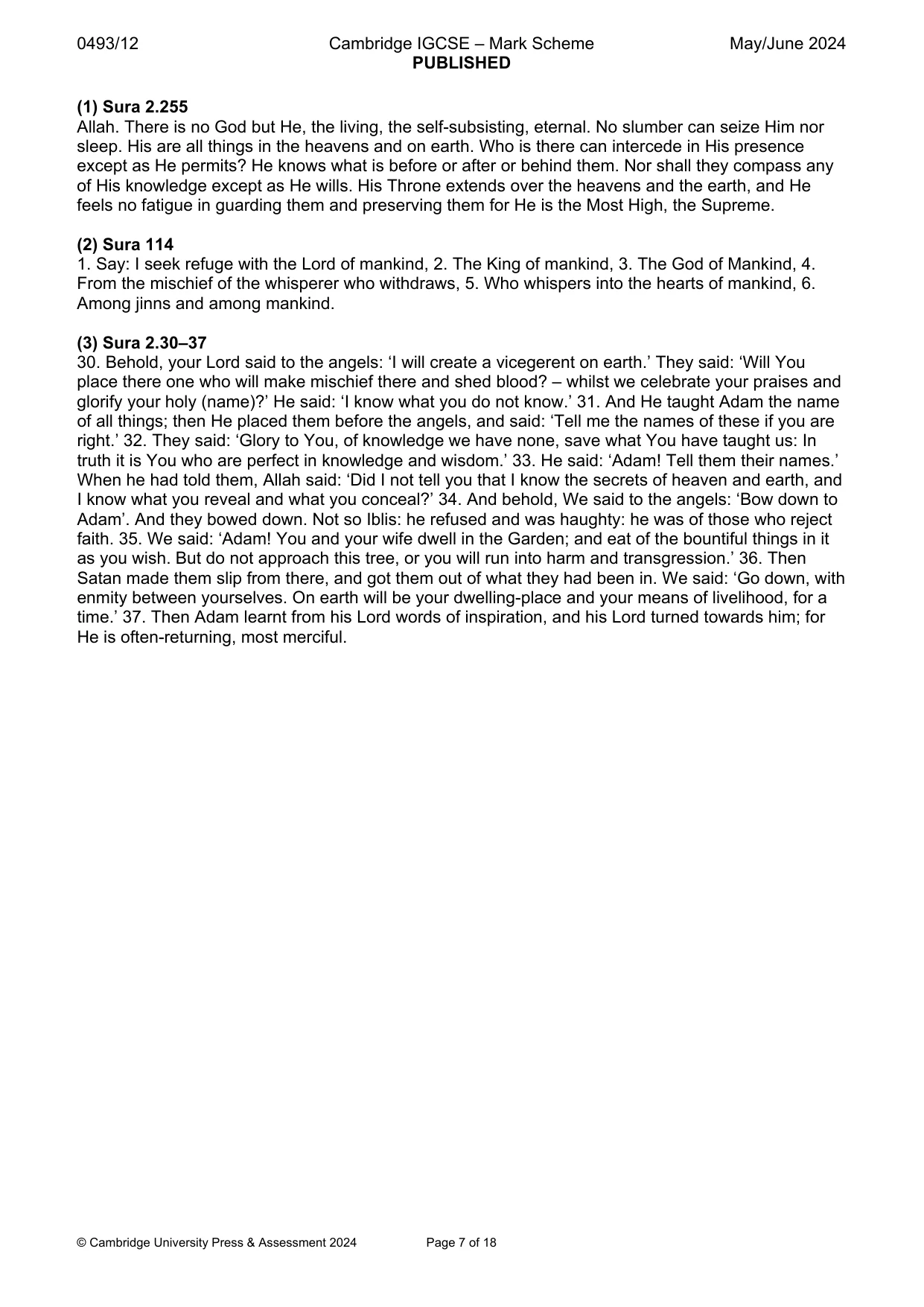
0493/12 Cambridge IGCSE – Mark Scheme PUBLISHED May/June 2024 © Cambridge University Press & Assessment 2024 Page 7 of 18 (1) Sura 2.255 Allah. There is no God but He, the living, the self-subsisting, eternal. No slumber can seize Him nor sleep. His are all things in the heavens and on earth. Who is there can intercede in His presence except as He permits? He knows what is before or after or behind them. Nor shall they compass any of His knowledge except as He wills. His Throne extends over the heavens and the earth, and He feels no fatigue in guarding them and preserving them for He is the Most High, the Supreme. (2) Sura 114 1. Say: I seek refuge with the Lord of mankind, 2. The King of mankind, 3. The God of Mankind, 4. From the mischief of the whisperer who withdraws, 5. Who whispers into the hearts of mankind, 6. Among jinns and among mankind. (3) Sura 2.30–37 30. Behold, your Lord said to the angels: ‘I will create a vicegerent on earth.’ They said: ‘Will You place there one who will make mischief there and shed blood? – whilst we celebrate your praises and glorify your holy (name)?’ He said: ‘I know what you do not know.’ 31. And He taught Adam the name of all things; then He placed them before the angels, and said: ‘Tell me the names of these if you are right.’ 32. They said: ‘Glory to You, of knowledge we have none, save what You have taught us: In truth it is You who are perfect in knowledge and wisdom.’ 33. He said: ‘Adam! Tell them their names.’ When he had told them, Allah said: ‘Did I not tell you that I know the secrets of heaven and earth, and I know what you reveal and what you conceal?’ 34. And behold, We said to the angels: ‘Bow down to Adam’. And they bowed down. Not so Iblis: he refused and was haughty: he was of those who reject faith. 35. We said: ‘Adam! You and your wife dwell in the Garden; and eat of the bountiful things in it as you wish. But do not approach this tree, or you will run into harm and transgression.’ 36. Then Satan made them slip from there, and got them out of what they had been in. We said: ‘Go down, with enmity between yourselves. On earth will be your dwelling-place and your means of livelihood, for a time.’ 37. Then Adam learnt from his Lord words of inspiration, and his Lord turned towards him; for He is often-returning, most merciful.
Mark scheme, page 8
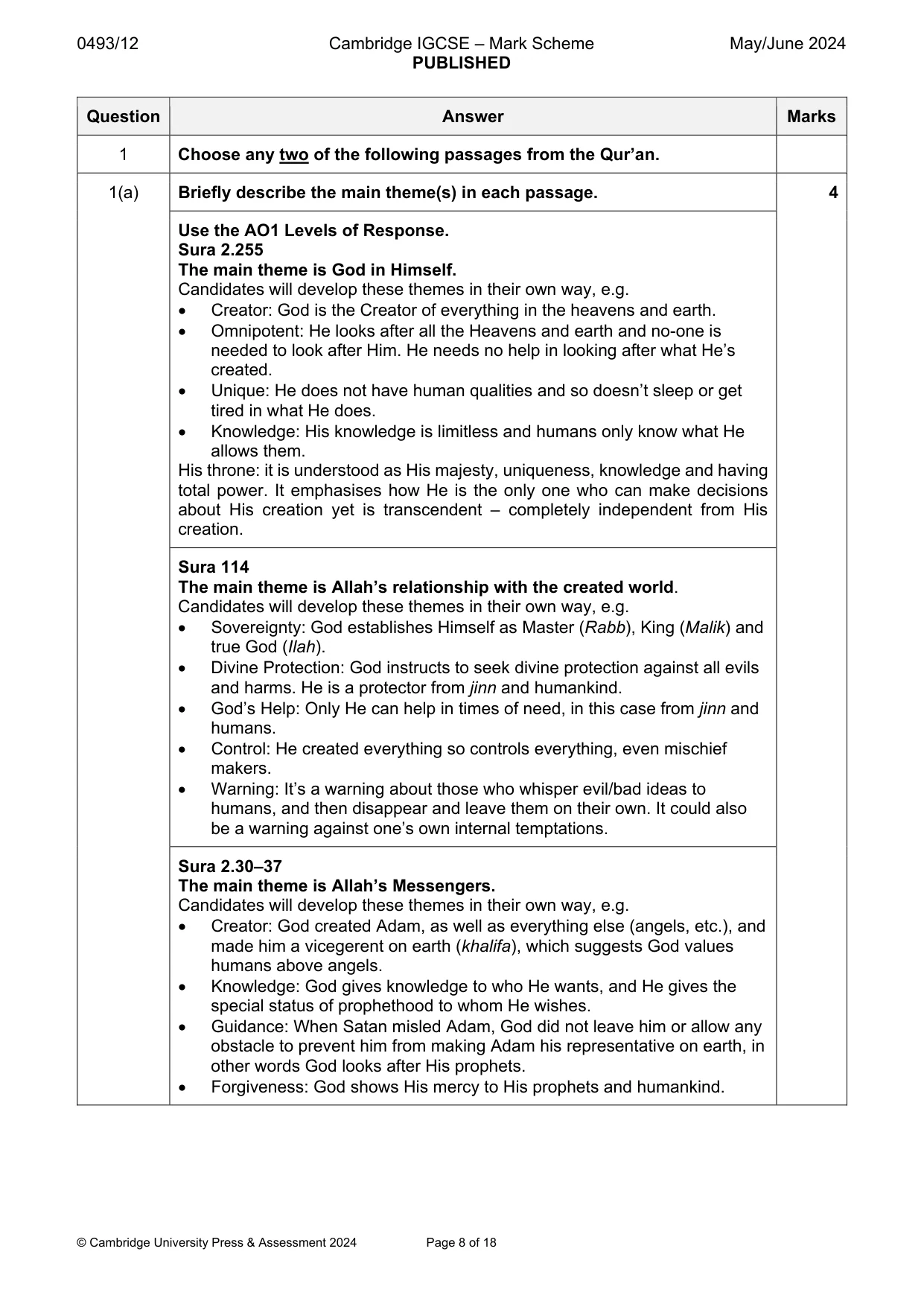
0493/12 Cambridge IGCSE – Mark Scheme PUBLISHED May/June 2024 © Cambridge University Press & Assessment 2024 Page 8 of 18 Question Answer Marks 1 Choose any two of the following passages from the Qur’an. 1(a) Briefly describe the main theme(s) in each passage. 4 Use the AO1 Levels of Response. Sura 2.255 The main theme is God in Himself. Candidates will develop these themes in their own way, e.g. Creator: God is the Creator of everything in the heavens and earth. Omnipotent: He looks after all the Heavens and earth and no-one is needed to look after Him. He needs no help in looking after what He’s created. Unique: He does not have human qualities and so doesn’t sleep or get tired in what He does. Knowledge: His knowledge is limitless and humans only know what He allows them. His throne: it is understood as His majesty, uniqueness, knowledge and having total power. It emphasises how He is the only one who can make decisions about His creation yet is transcendent – completely independent from His creation. Sura 114 The main theme is Allah’s relationship with the created world. Candidates will develop these themes in their own way, e.g. Sovereignty: God establishes Himself as Master (Rabb), King (Malik) and true God (Ilah). Divine Protection: God instructs to seek divine protection against all evils and harms. He is a protector from jinn and humankind. God’s Help: Only He can help in times of need, in this case from jinn and humans. Control: He created everything so controls everything, even mischief makers. Warning: It’s a warning about those who whisper evil/bad ideas to humans, and then disappear and leave them on their own. It could also be a warning against one’s own internal temptations. Sura 2.30–37 The main theme is Allah’s Messengers. Candidates will develop these themes in their own way, e.g. Creator: God created Adam, as well as everything else (angels, etc.), and made him a vicegerent on earth (khalifa), which suggests God values humans above angels. Knowledge: God gives knowledge to who He wants, and He gives the special status of prophethood to whom He wishes. Guidance: When Satan misled Adam, God did not leave him or allow any obstacle to prevent him from making Adam his representative on earth, in other words God looks after His prophets. Forgiveness: God shows His mercy to His prophets and humankind.
Mark scheme, page 9
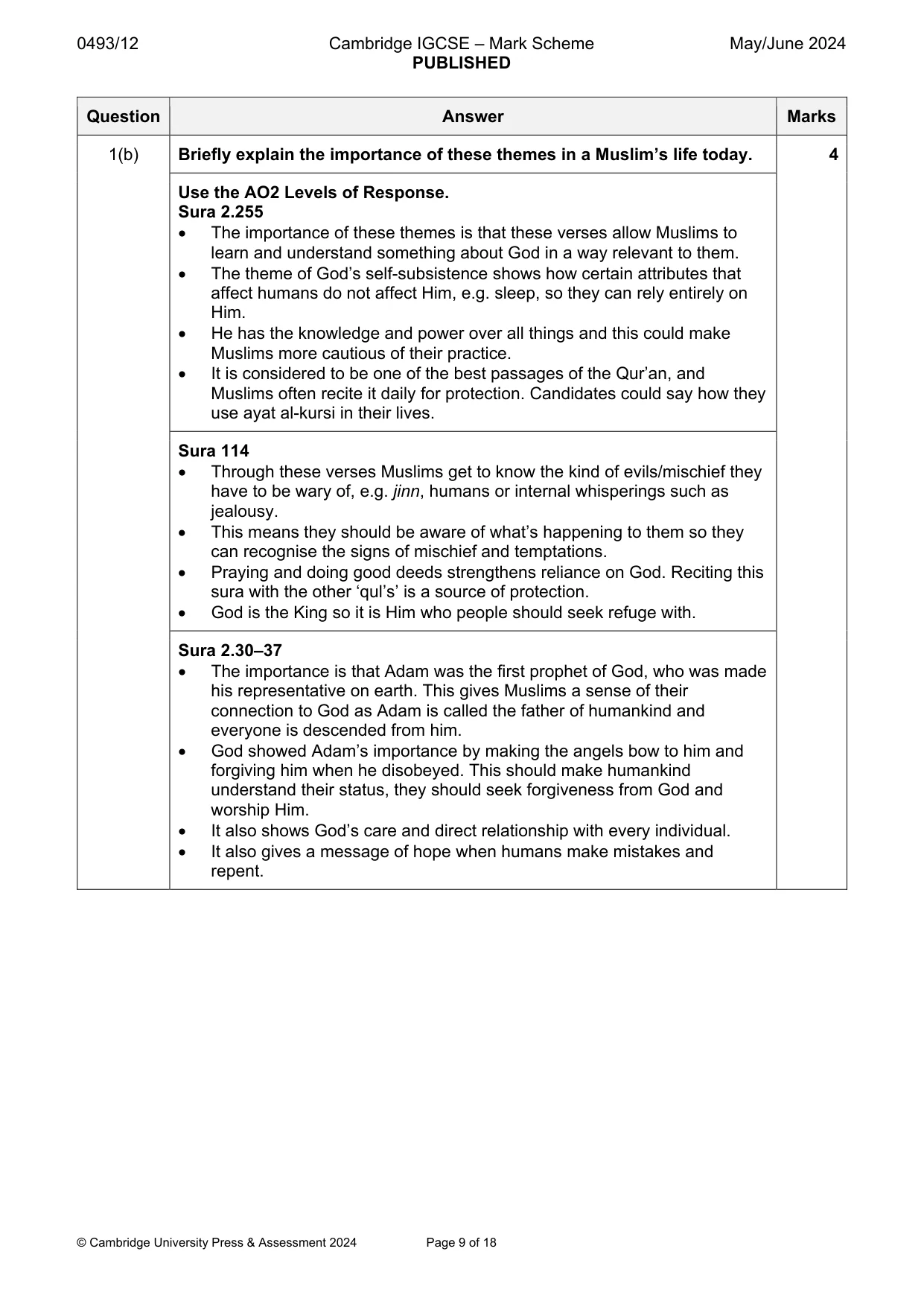
0493/12 Cambridge IGCSE – Mark Scheme PUBLISHED May/June 2024 © Cambridge University Press & Assessment 2024 Page 9 of 18 Question Answer Marks 1(b) Briefly explain the importance of these themes in a Muslim’s life today. 4 Use the AO2 Levels of Response. Sura 2.255 The importance of these themes is that these verses allow Muslims to learn and understand something about God in a way relevant to them. The theme of God’s self-subsistence shows how certain attributes that affect humans do not affect Him, e.g. sleep, so they can rely entirely on Him. He has the knowledge and power over all things and this could make Muslims more cautious of their practice. It is considered to be one of the best passages of the Qur’an, and Muslims often recite it daily for protection. Candidates could say how they use ayat al-kursi in their lives. Sura 114 Through these verses Muslims get to know the kind of evils/mischief they have to be wary of, e.g. jinn, humans or internal whisperings such as jealousy. This means they should be aware of what’s happening to them so they can recognise the signs of mischief and temptations. Praying and doing good deeds strengthens reliance on God. Reciting this sura with the other ‘qul’s’ is a source of protection. God is the King so it is Him who people should seek refuge with. Sura 2.30–37 The importance is that Adam was the first prophet of God, who was made his representative on earth. This gives Muslims a sense of their connection to God as Adam is called the father of humankind and everyone is descended from him. God showed Adam’s importance by making the angels bow to him and forgiving him when he disobeyed. This should make humankind understand their status, they should seek forgiveness from God and worship Him. It also shows God’s care and direct relationship with every individual. It also gives a message of hope when humans make mistakes and repent.
Mark scheme, page 10
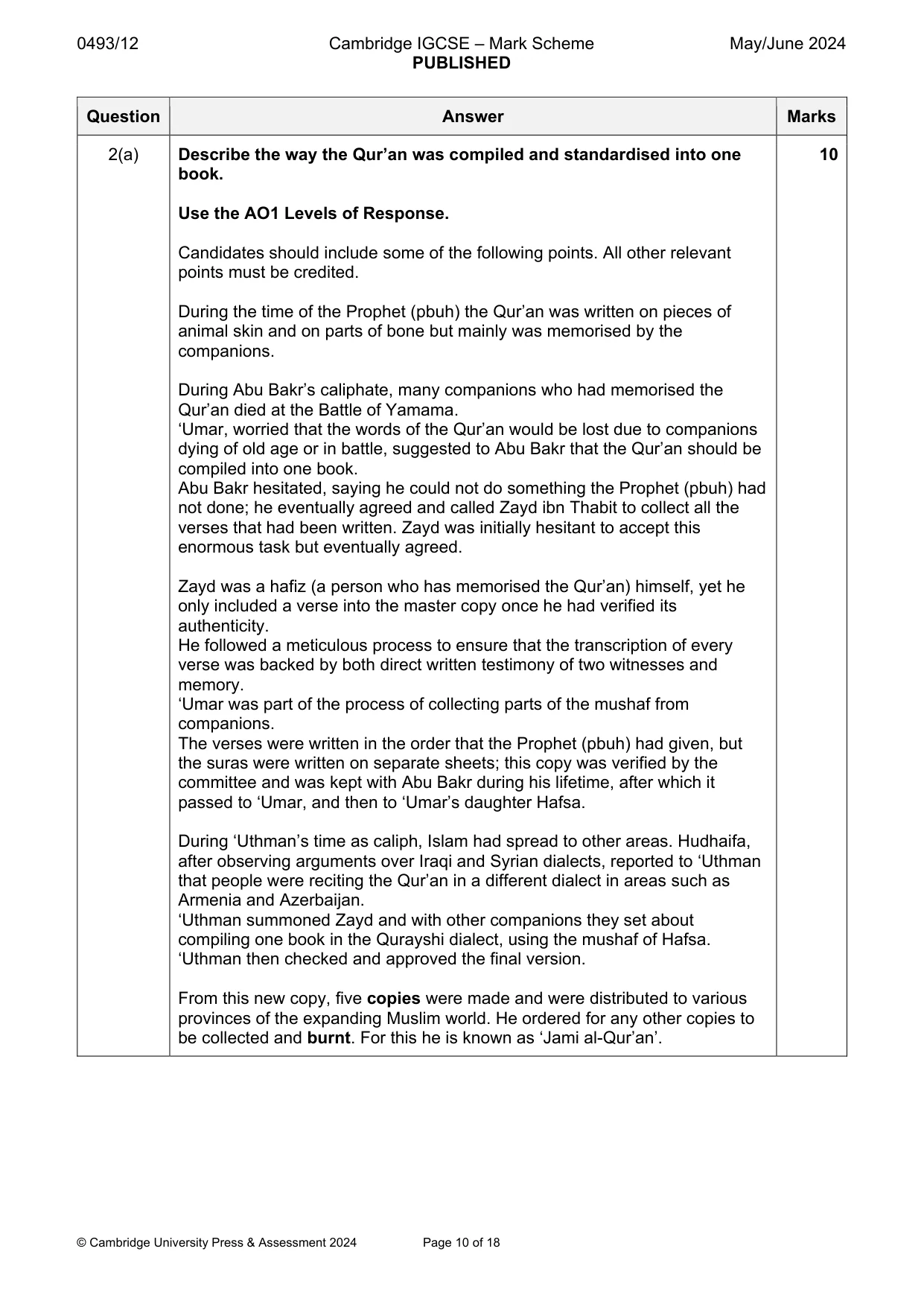
0493/12 Cambridge IGCSE – Mark Scheme PUBLISHED May/June 2024 © Cambridge University Press & Assessment 2024 Page 10 of 18 Question Answer Marks 2(a) Describe the way the Qur’an was compiled and standardised into one book. Use the AO1 Levels of Response. Candidates should include some of the following points. All other relevant points must be credited. During the time of the Prophet (pbuh) the Qur’an was written on pieces of animal skin and on parts of bone but mainly was memorised by the companions. During Abu Bakr’s caliphate, many companions who had memorised the Qur’an died at the Battle of Yamama. ‘Umar, worried that the words of the Qur’an would be lost due to companions dying of old age or in battle, suggested to Abu Bakr that the Qur’an should be compiled into one book. Abu Bakr hesitated, saying he could not do something the Prophet (pbuh) had not done; he eventually agreed and called Zayd ibn Thabit to collect all the verses that had been written. Zayd was initially hesitant to accept this enormous task but eventually agreed. Zayd was a hafiz (a person who has memorised the Qur’an) himself, yet he only included a verse into the master copy once he had verified its authenticity. He followed a meticulous process to ensure that the transcription of every verse was backed by both direct written testimony of two witnesses and memory. ‘Umar was part of the process of collecting parts of the mushaf from companions. The verses were written in the order that the Prophet (pbuh) had given, but the suras were written on separate sheets; this copy was verified by the committee and was kept with Abu Bakr during his lifetime, after which it passed to ‘Umar, and then to ‘Umar’s daughter Hafsa. During ‘Uthman’s time as caliph, Islam had spread to other areas. Hudhaifa, after observing arguments over Iraqi and Syrian dialects, reported to ‘Uthman that people were reciting the Qur’an in a different dialect in areas such as Armenia and Azerbaijan. ‘Uthman summoned Zayd and with other companions they set about compiling one book in the Qurayshi dialect, using the mushaf of Hafsa. ‘Uthman then checked and approved the final version. From this new copy, five copies were made and were distributed to various provinces of the expanding Muslim world. He ordered for any other copies to be collected and burnt. For this he is known as ‘Jami al-Qur’an’. 10
Mark scheme, page 11
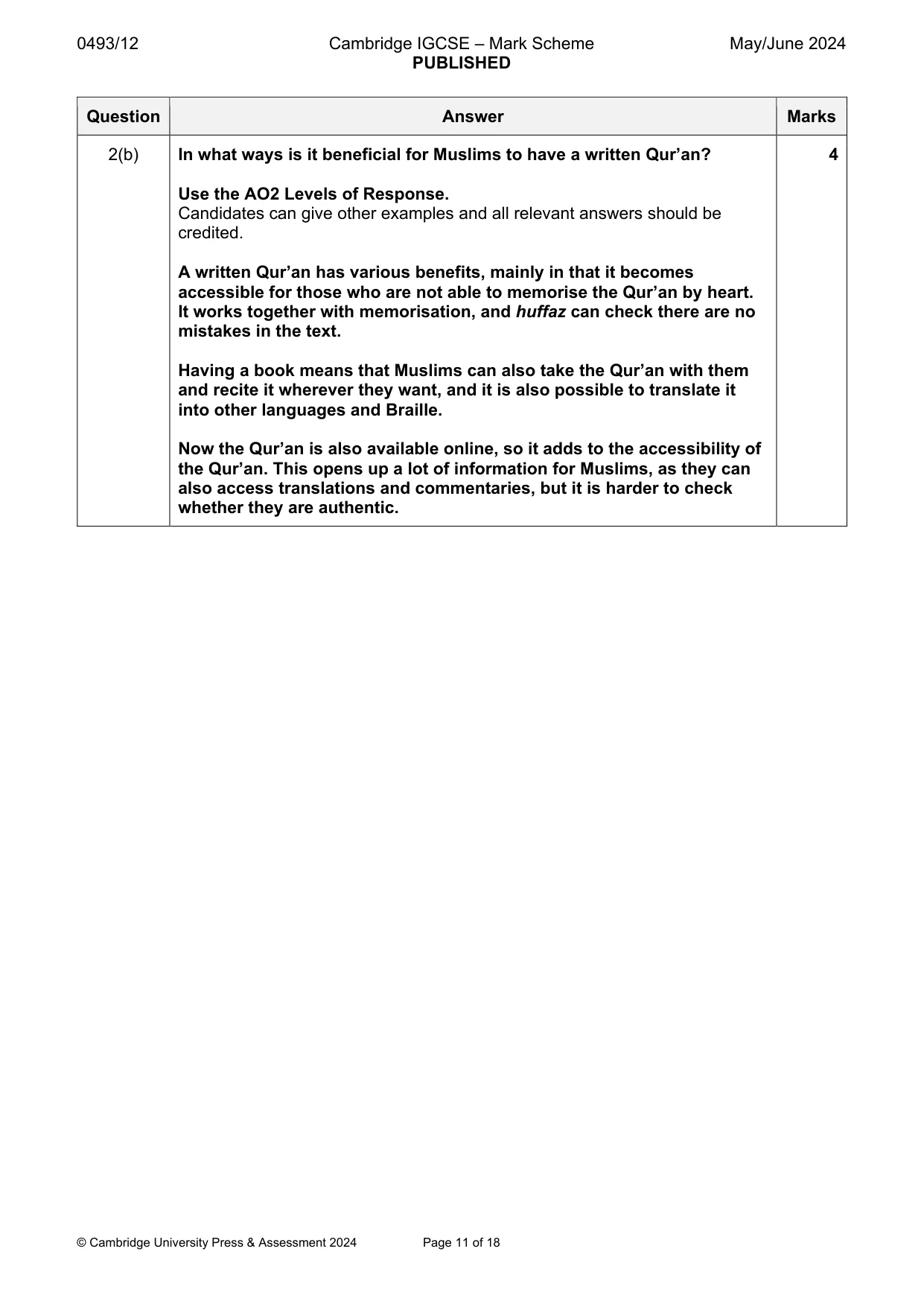
0493/12 Cambridge IGCSE – Mark Scheme PUBLISHED May/June 2024 © Cambridge University Press & Assessment 2024 Page 11 of 18 Question Answer Marks 2(b) In what ways is it beneficial for Muslims to have a written Qur’an? Use the AO2 Levels of Response. Candidates can give other examples and all relevant answers should be credited. A written Qur’an has various benefits, mainly in that it becomes accessible for those who are not able to memorise the Qur’an by heart. It works together with memorisation, and huffaz can check there are no mistakes in the text. Having a book means that Muslims can also take the Qur’an with them and recite it wherever they want, and it is also possible to translate it into other languages and Braille. Now the Qur’an is also available online, so it adds to the accessibility of the Qur’an. This opens up a lot of information for Muslims, as they can also access translations and commentaries, but it is harder to check whether they are authentic. 4
Mark scheme, page 12
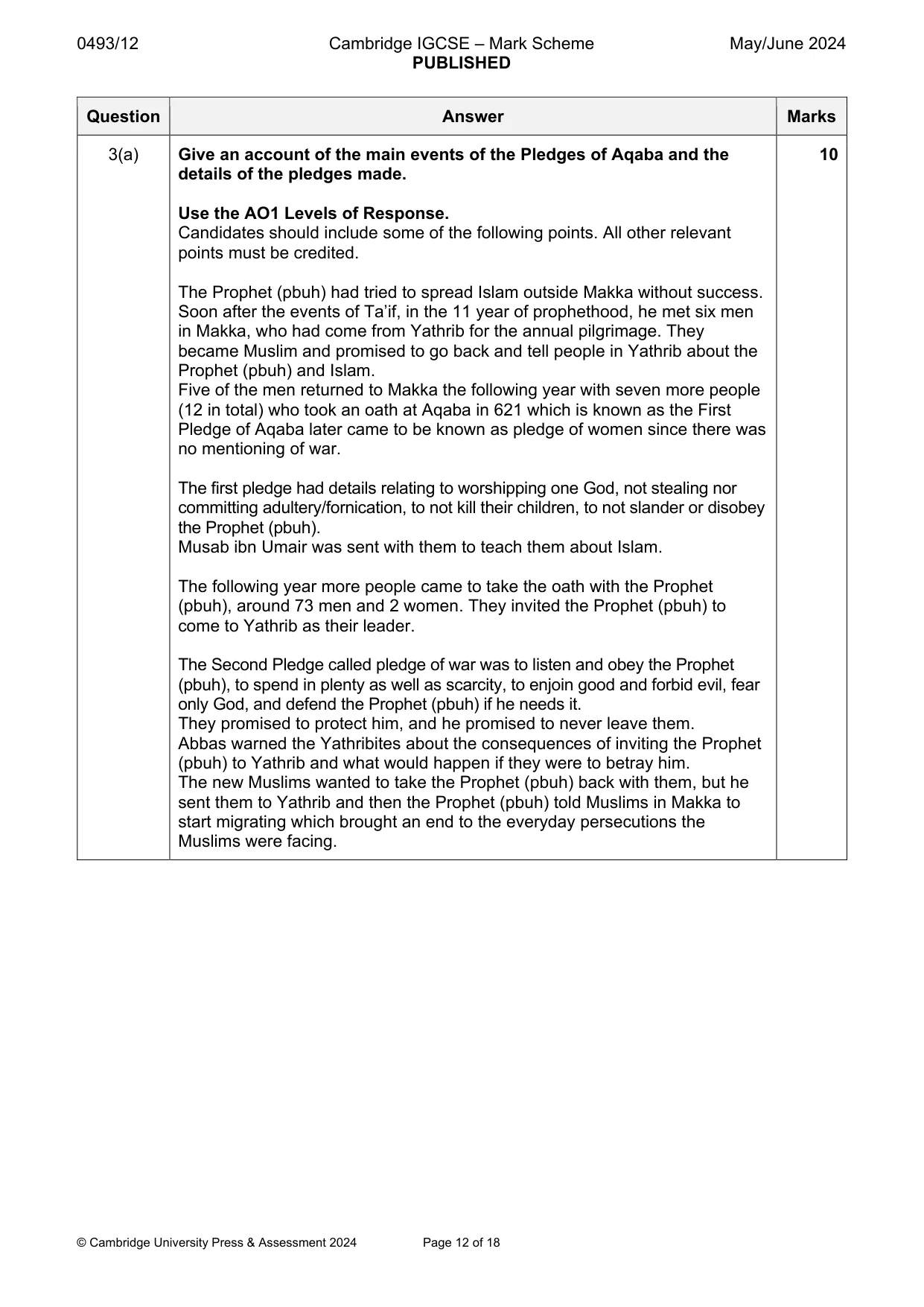
0493/12 Cambridge IGCSE – Mark Scheme PUBLISHED May/June 2024 © Cambridge University Press & Assessment 2024 Page 12 of 18 Question Answer Marks 3(a) Give an account of the main events of the Pledges of Aqaba and the details of the pledges made. Use the AO1 Levels of Response. Candidates should include some of the following points. All other relevant points must be credited. The Prophet (pbuh) had tried to spread Islam outside Makka without success. Soon after the events of Ta’if, in the 11 year of prophethood, he met six men in Makka, who had come from Yathrib for the annual pilgrimage. They became Muslim and promised to go back and tell people in Yathrib about the Prophet (pbuh) and Islam. Five of the men returned to Makka the following year with seven more people (12 in total) who took an oath at Aqaba in 621 which is known as the First Pledge of Aqaba later came to be known as pledge of women since there was no mentioning of war. The first pledge had details relating to worshipping one God, not stealing nor committing adultery/fornication, to not kill their children, to not slander or disobey the Prophet (pbuh). Musab ibn Umair was sent with them to teach them about Islam. The following year more people came to take the oath with the Prophet (pbuh), around 73 men and 2 women. They invited the Prophet (pbuh) to come to Yathrib as their leader. The Second Pledge called pledge of war was to listen and obey the Prophet (pbuh), to spend in plenty as well as scarcity, to enjoin good and forbid evil, fear only God, and defend the Prophet (pbuh) if he needs it. They promised to protect him, and he promised to never leave them. Abbas warned the Yathribites about the consequences of inviting the Prophet (pbuh) to Yathrib and what would happen if they were to betray him. The new Muslims wanted to take the Prophet (pbuh) back with them, but he sent them to Yathrib and then the Prophet (pbuh) told Muslims in Makka to start migrating which brought an end to the everyday persecutions the Muslims were facing. 10
Mark scheme, page 13
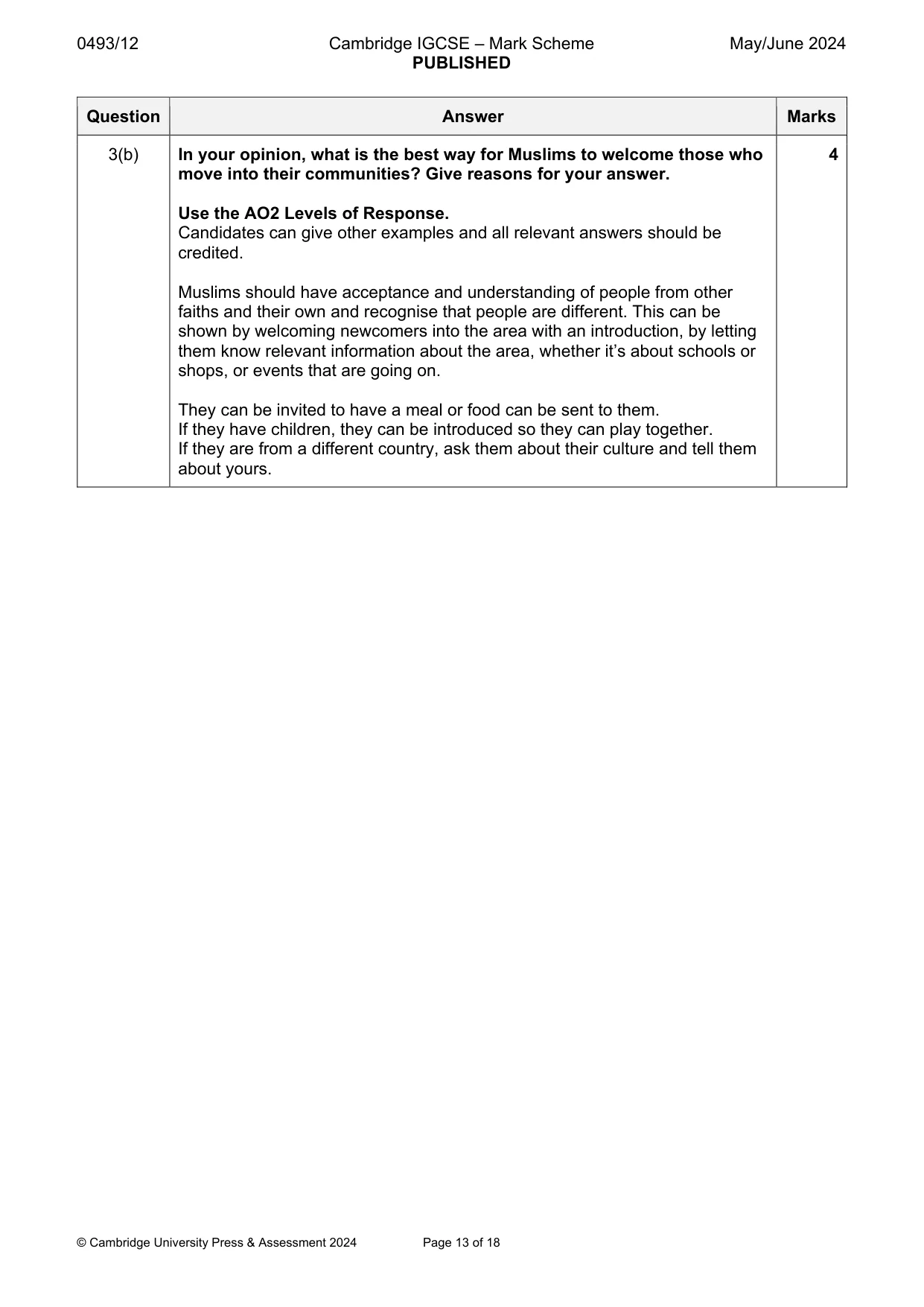
0493/12 Cambridge IGCSE – Mark Scheme PUBLISHED May/June 2024 © Cambridge University Press & Assessment 2024 Page 13 of 18 Question Answer Marks 3(b) In your opinion, what is the best way for Muslims to welcome those who move into their communities? Give reasons for your answer. Use the AO2 Levels of Response. Candidates can give other examples and all relevant answers should be credited. Muslims should have acceptance and understanding of people from other faiths and their own and recognise that people are different. This can be shown by welcoming newcomers into the area with an introduction, by letting them know relevant information about the area, whether it’s about schools or shops, or events that are going on. They can be invited to have a meal or food can be sent to them. If they have children, they can be introduced so they can play together. If they are from a different country, ask them about their culture and tell them about yours. 4
Mark scheme, page 14
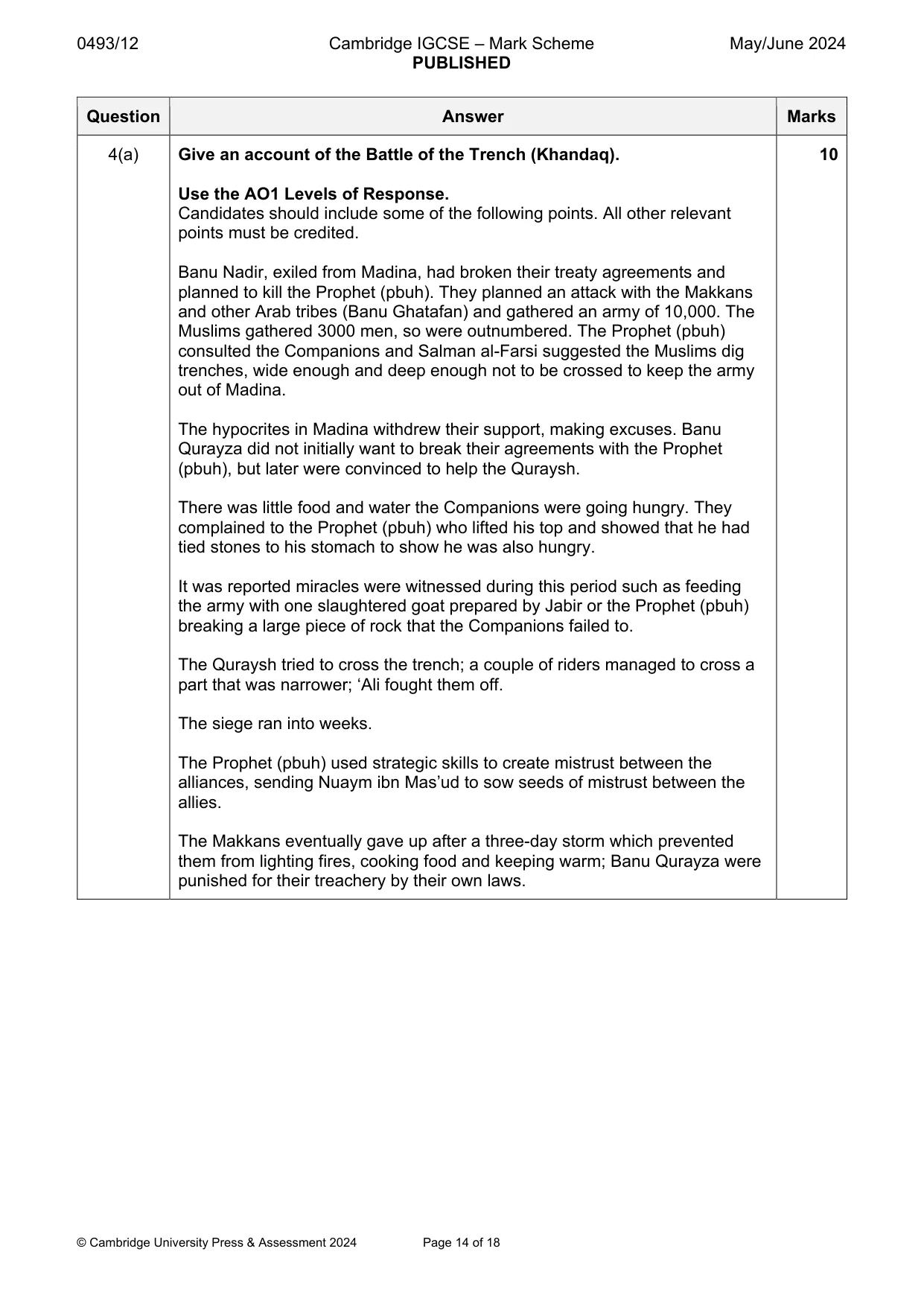
0493/12 Cambridge IGCSE – Mark Scheme PUBLISHED May/June 2024 © Cambridge University Press & Assessment 2024 Page 14 of 18 Question Answer Marks 4(a) Give an account of the Battle of the Trench (Khandaq). Use the AO1 Levels of Response. Candidates should include some of the following points. All other relevant points must be credited. Banu Nadir, exiled from Madina, had broken their treaty agreements and planned to kill the Prophet (pbuh). They planned an attack with the Makkans and other Arab tribes (Banu Ghatafan) and gathered an army of 10,000. The Muslims gathered 3000 men, so were outnumbered. The Prophet (pbuh) consulted the Companions and Salman al-Farsi suggested the Muslims dig trenches, wide enough and deep enough not to be crossed to keep the army out of Madina. The hypocrites in Madina withdrew their support, making excuses. Banu Qurayza did not initially want to break their agreements with the Prophet (pbuh), but later were convinced to help the Quraysh. There was little food and water the Companions were going hungry. They complained to the Prophet (pbuh) who lifted his top and showed that he had tied stones to his stomach to show he was also hungry. It was reported miracles were witnessed during this period such as feeding the army with one slaughtered goat prepared by Jabir or the Prophet (pbuh) breaking a large piece of rock that the Companions failed to. The Quraysh tried to cross the trench; a couple of riders managed to cross a part that was narrower; ‘Ali fought them off. The siege ran into weeks. The Prophet (pbuh) used strategic skills to create mistrust between the alliances, sending Nuaym ibn Mas’ud to sow seeds of mistrust between the allies. The Makkans eventually gave up after a three-day storm which prevented them from lighting fires, cooking food and keeping warm; Banu Qurayza were punished for their treachery by their own laws. 10
Mark scheme, page 15
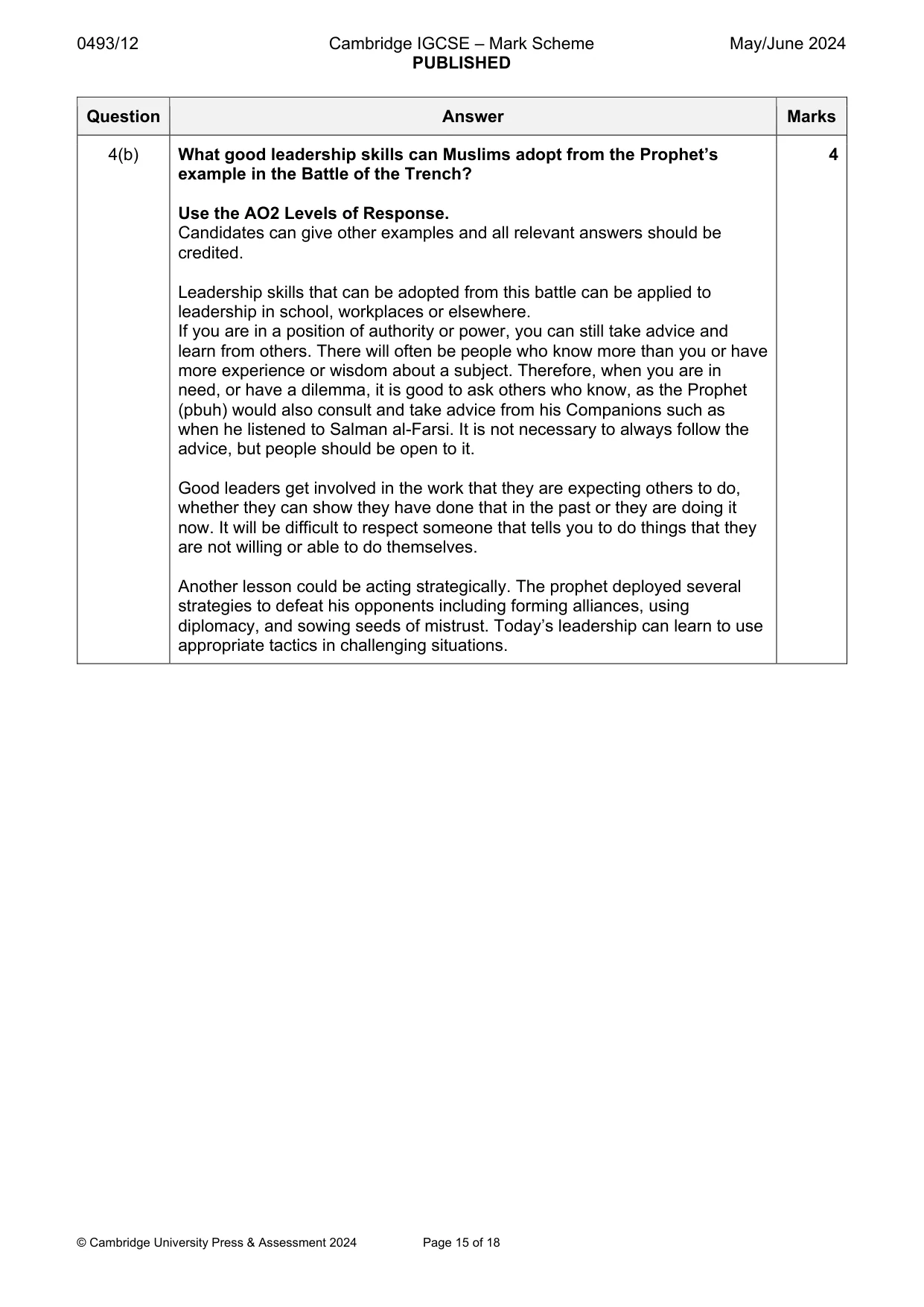
0493/12 Cambridge IGCSE – Mark Scheme PUBLISHED May/June 2024 © Cambridge University Press & Assessment 2024 Page 15 of 18 Question Answer Marks 4(b) What good leadership skills can Muslims adopt from the Prophet’s example in the Battle of the Trench? Use the AO2 Levels of Response. Candidates can give other examples and all relevant answers should be credited. Leadership skills that can be adopted from this battle can be applied to leadership in school, workplaces or elsewhere. If you are in a position of authority or power, you can still take advice and learn from others. There will often be people who know more than you or have more experience or wisdom about a subject. Therefore, when you are in need, or have a dilemma, it is good to ask others who know, as the Prophet (pbuh) would also consult and take advice from his Companions such as when he listened to Salman al-Farsi. It is not necessary to always follow the advice, but people should be open to it. Good leaders get involved in the work that they are expecting others to do, whether they can show they have done that in the past or they are doing it now. It will be difficult to respect someone that tells you to do things that they are not willing or able to do themselves. Another lesson could be acting strategically. The prophet deployed several strategies to defeat his opponents including forming alliances, using diplomacy, and sowing seeds of mistrust. Today’s leadership can learn to use appropriate tactics in challenging situations. 4
Mark scheme, page 16
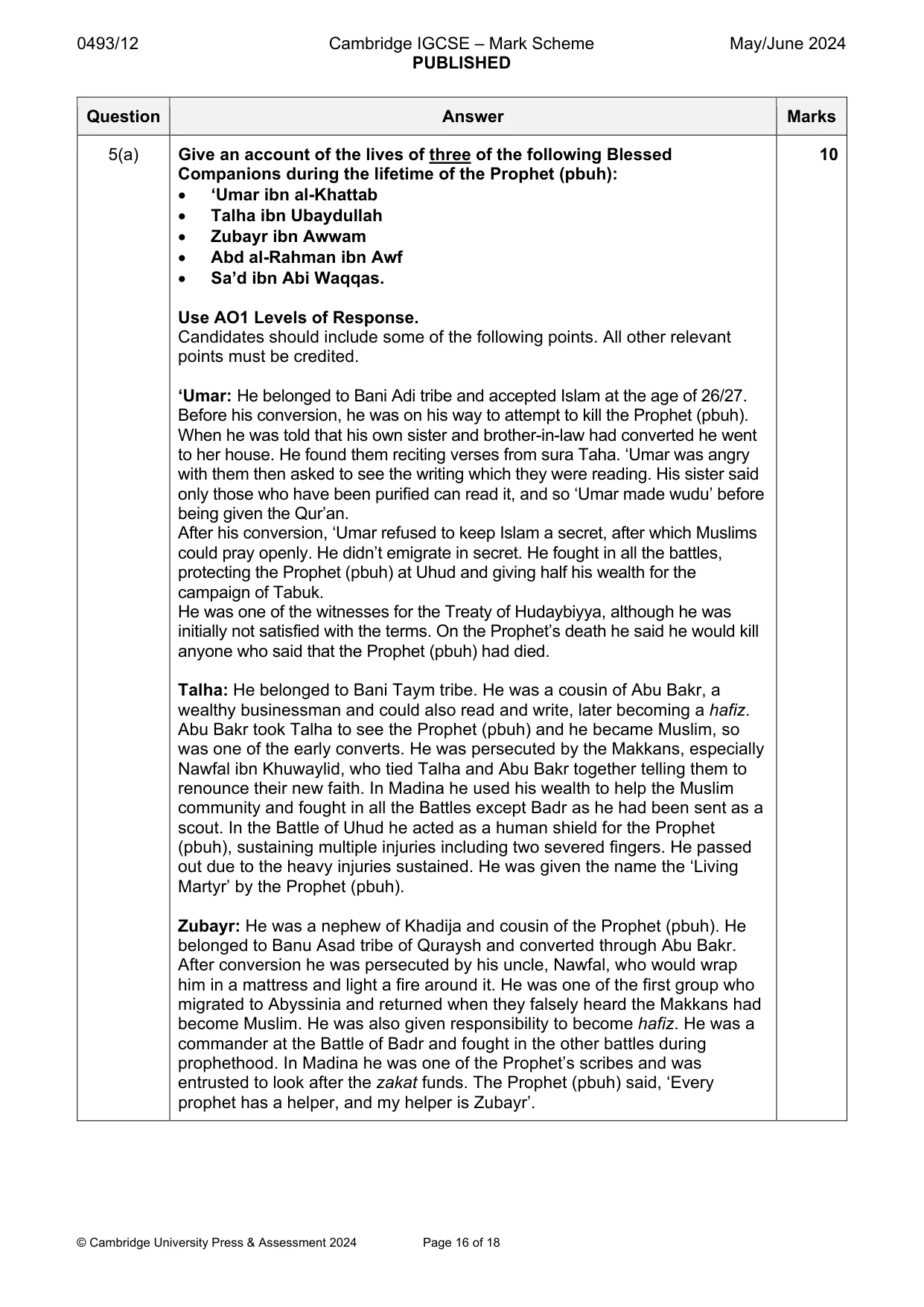
0493/12 Cambridge IGCSE – Mark Scheme PUBLISHED May/June 2024 © Cambridge University Press & Assessment 2024 Page 16 of 18 Question Answer Marks 5(a) Give an account of the lives of three of the following Blessed Companions during the lifetime of the Prophet (pbuh): ‘Umar ibn al-Khattab Talha ibn Ubaydullah Zubayr ibn Awwam Abd al-Rahman ibn Awf Sa’d ibn Abi Waqqas. Use AO1 Levels of Response. Candidates should include some of the following points. All other relevant points must be credited. ‘Umar: He belonged to Bani Adi tribe and accepted Islam at the age of 26/27. Before his conversion, he was on his way to attempt to kill the Prophet (pbuh). When he was told that his own sister and brother-in-law had converted he went to her house. He found them reciting verses from sura Taha. ‘Umar was angry with them then asked to see the writing which they were reading. His sister said only those who have been purified can read it, and so ‘Umar made wudu’ before being given the Qur’an. After his conversion, ‘Umar refused to keep Islam a secret, after which Muslims could pray openly. He didn’t emigrate in secret. He fought in all the battles, protecting the Prophet (pbuh) at Uhud and giving half his wealth for the campaign of Tabuk. He was one of the witnesses for the Treaty of Hudaybiyya, although he was initially not satisfied with the terms. On the Prophet’s death he said he would kill anyone who said that the Prophet (pbuh) had died. Talha: He belonged to Bani Taym tribe. He was a cousin of Abu Bakr, a wealthy businessman and could also read and write, later becoming a hafiz. Abu Bakr took Talha to see the Prophet (pbuh) and he became Muslim, so was one of the early converts. He was persecuted by the Makkans, especially Nawfal ibn Khuwaylid, who tied Talha and Abu Bakr together telling them to renounce their new faith. In Madina he used his wealth to help the Muslim community and fought in all the Battles except Badr as he had been sent as a scout. In the Battle of Uhud he acted as a human shield for the Prophet (pbuh), sustaining multiple injuries including two severed fingers. He passed out due to the heavy injuries sustained. He was given the name the ‘Living Martyr’ by the Prophet (pbuh). Zubayr: He was a nephew of Khadija and cousin of the Prophet (pbuh). He belonged to Banu Asad tribe of Quraysh and converted through Abu Bakr. After conversion he was persecuted by his uncle, Nawfal, who would wrap him in a mattress and light a fire around it. He was one of the first group who migrated to Abyssinia and returned when they falsely heard the Makkans had become Muslim. He was also given responsibility to become hafiz. He was a commander at the Battle of Badr and fought in the other battles during prophethood. In Madina he was one of the Prophet’s scribes and was entrusted to look after the zakat funds. The Prophet (pbuh) said, ‘Every prophet has a helper, and my helper is Zubayr’. 10
Mark scheme, page 17
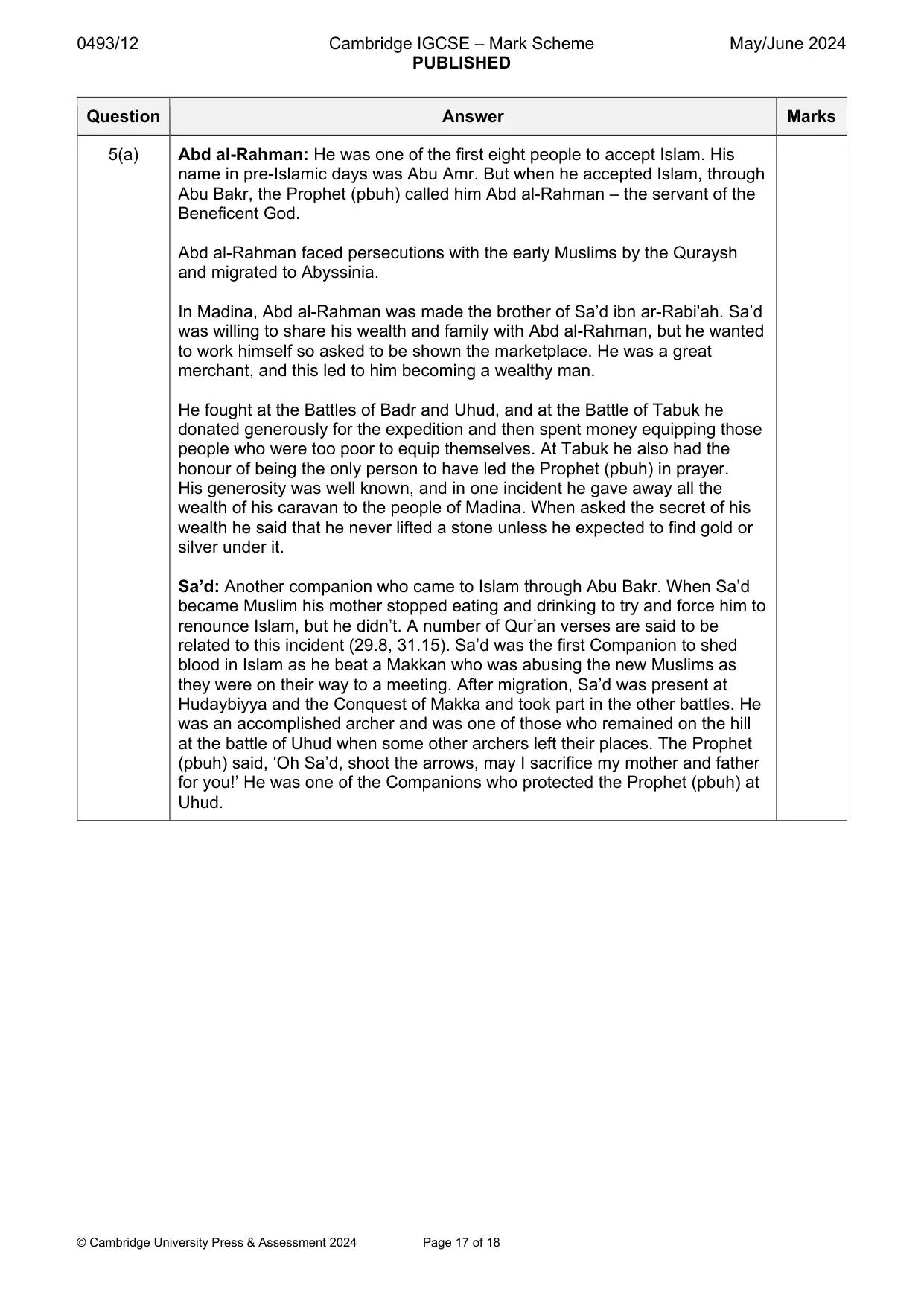
0493/12 Cambridge IGCSE – Mark Scheme PUBLISHED May/June 2024 © Cambridge University Press & Assessment 2024 Page 17 of 18 Question Answer Marks 5(a) Abd al-Rahman: He was one of the first eight people to accept Islam. His name in pre-Islamic days was Abu Amr. But when he accepted Islam, through Abu Bakr, the Prophet (pbuh) called him Abd al-Rahman – the servant of the Beneficent God. Abd al-Rahman faced persecutions with the early Muslims by the Quraysh and migrated to Abyssinia. In Madina, Abd al-Rahman was made the brother of Sa’d ibn ar-Rabi'ah. Sa’d was willing to share his wealth and family with Abd al-Rahman, but he wanted to work himself so asked to be shown the marketplace. He was a great merchant, and this led to him becoming a wealthy man. He fought at the Battles of Badr and Uhud, and at the Battle of Tabuk he donated generously for the expedition and then spent money equipping those people who were too poor to equip themselves. At Tabuk he also had the honour of being the only person to have led the Prophet (pbuh) in prayer. His generosity was well known, and in one incident he gave away all the wealth of his caravan to the people of Madina. When asked the secret of his wealth he said that he never lifted a stone unless he expected to find gold or silver under it. Sa’d: Another companion who came to Islam through Abu Bakr. When Sa’d became Muslim his mother stopped eating and drinking to try and force him to renounce Islam, but he didn’t. A number of Qur’an verses are said to be related to this incident (29.8, 31.15). Sa’d was the first Companion to shed blood in Islam as he beat a Makkan who was abusing the new Muslims as they were on their way to a meeting. After migration, Sa’d was present at Hudaybiyya and the Conquest of Makka and took part in the other battles. He was an accomplished archer and was one of those who remained on the hill at the battle of Uhud when some other archers left their places. The Prophet (pbuh) said, ‘Oh Sa’d, shoot the arrows, may I sacrifice my mother and father for you!’ He was one of the Companions who protected the Prophet (pbuh) at Uhud.
Mark scheme, page 18
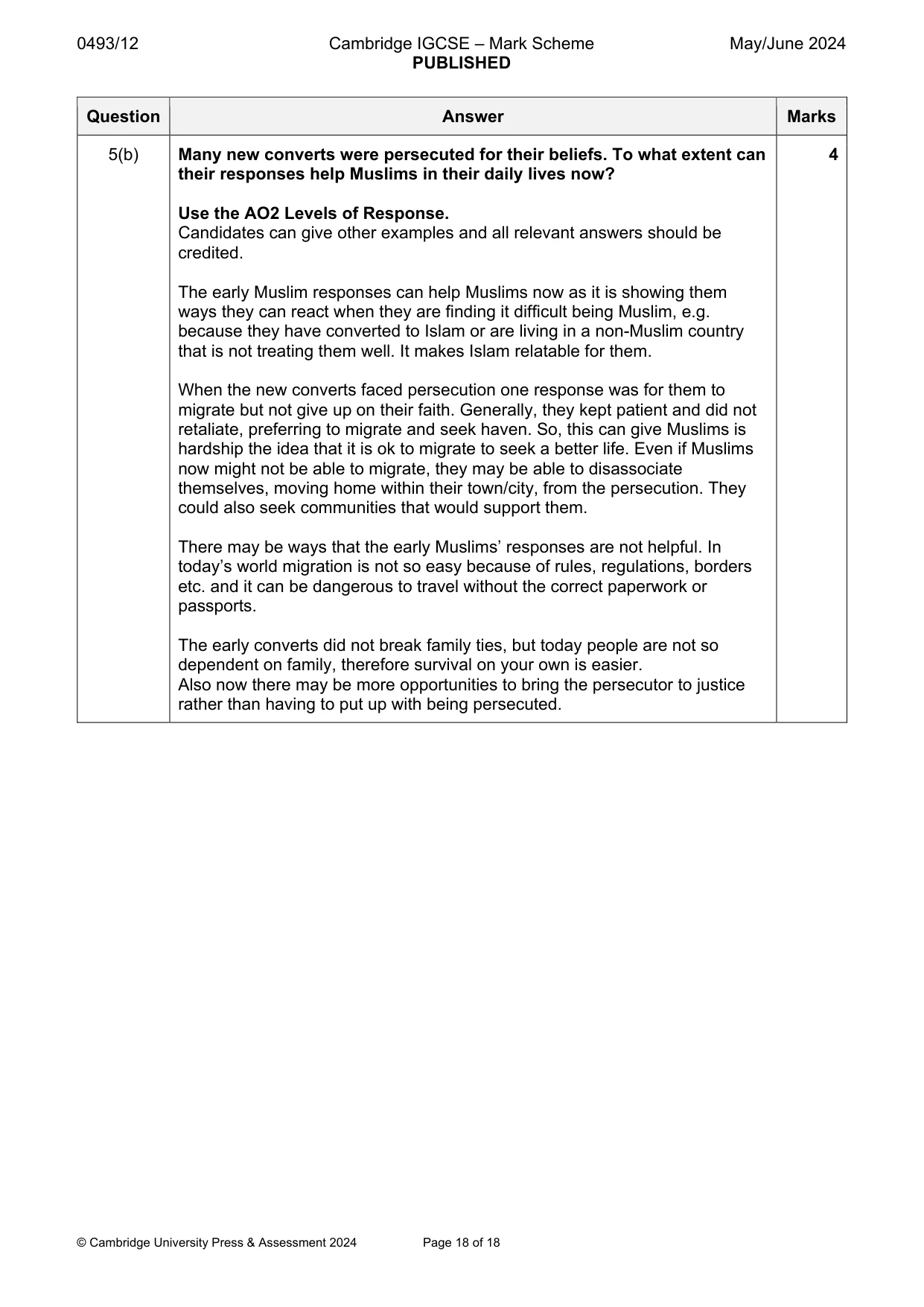
0493/12 Cambridge IGCSE – Mark Scheme PUBLISHED May/June 2024 © Cambridge University Press & Assessment 2024 Page 18 of 18 Question Answer Marks 5(b) Many new converts were persecuted for their beliefs. To what extent can their responses help Muslims in their daily lives now? Use the AO2 Levels of Response. Candidates can give other examples and all relevant answers should be credited. The early Muslim responses can help Muslims now as it is showing them ways they can react when they are finding it difficult being Muslim, e.g. because they have converted to Islam or are living in a non-Muslim country that is not treating them well. It makes Islam relatable for them. When the new converts faced persecution one response was for them to migrate but not give up on their faith. Generally, they kept patient and did not retaliate, preferring to migrate and seek haven. So, this can give Muslims is hardship the idea that it is ok to migrate to seek a better life. Even if Muslims now might not be able to migrate, they may be able to disassociate themselves, moving home within their town/city, from the persecution. They could also seek communities that would support them. There may be ways that the early Muslims’ responses are not helpful. In today’s world migration is not so easy because of rules, regulations, borders etc. and it can be dangerous to travel without the correct paperwork or passports. The early converts did not break family ties, but today people are not so dependent on family, therefore survival on your own is easier. Also now there may be more opportunities to bring the persecutor to justice rather than having to put up with being persecuted. 4
What you needed in this session
Cambridge’s own grade thresholds for 2024 May/June, Paper 1 · Variant 2. A higher threshold means an easier paper — the bar moves with how the cohort did.