Cambridge IGCSE Islamiyat 0493 — 2023 Oct/Nov Paper 1 · Variant 2
0493/12/O/N/23 · 50 marks · ≈56 min
The question paper and its mark scheme, free to read here and free to download. This is Cambridge’s own paper, exactly as it was sat.
Question paper20 pages









Mark scheme16 pages
Answers below. Sit the paper first if you are practising.
Paper as text
Question paper, page 1
This document has 20 pages. Any blank pages are indicated. [Turn over Cambridge IGCSE™ * 5 1 1 2 4 7 7 7 7 8 * DC (RW) 311887/3 © UCLES 2023 ISLAMIYAT 0493/12 Paper 1 October/November 2023 1 hour 30 minutes You must answer on the question paper. No additional materials are needed. INSTRUCTIONS ● Answer four questions in total: Answer Question 1. Answer Question 2. Answer two other questions. ● Use a black or dark blue pen. ● Write your name, centre number and candidate number in the boxes at the top of the page. ● Write your answer to each question in the space provided. ● Do not use an erasable pen or correction fluid. ● Do not write on any bar codes. INFORMATION ● The total mark for this paper is 50. ● The number of marks for each question or part question is shown in brackets [ ].
Question paper, page 2
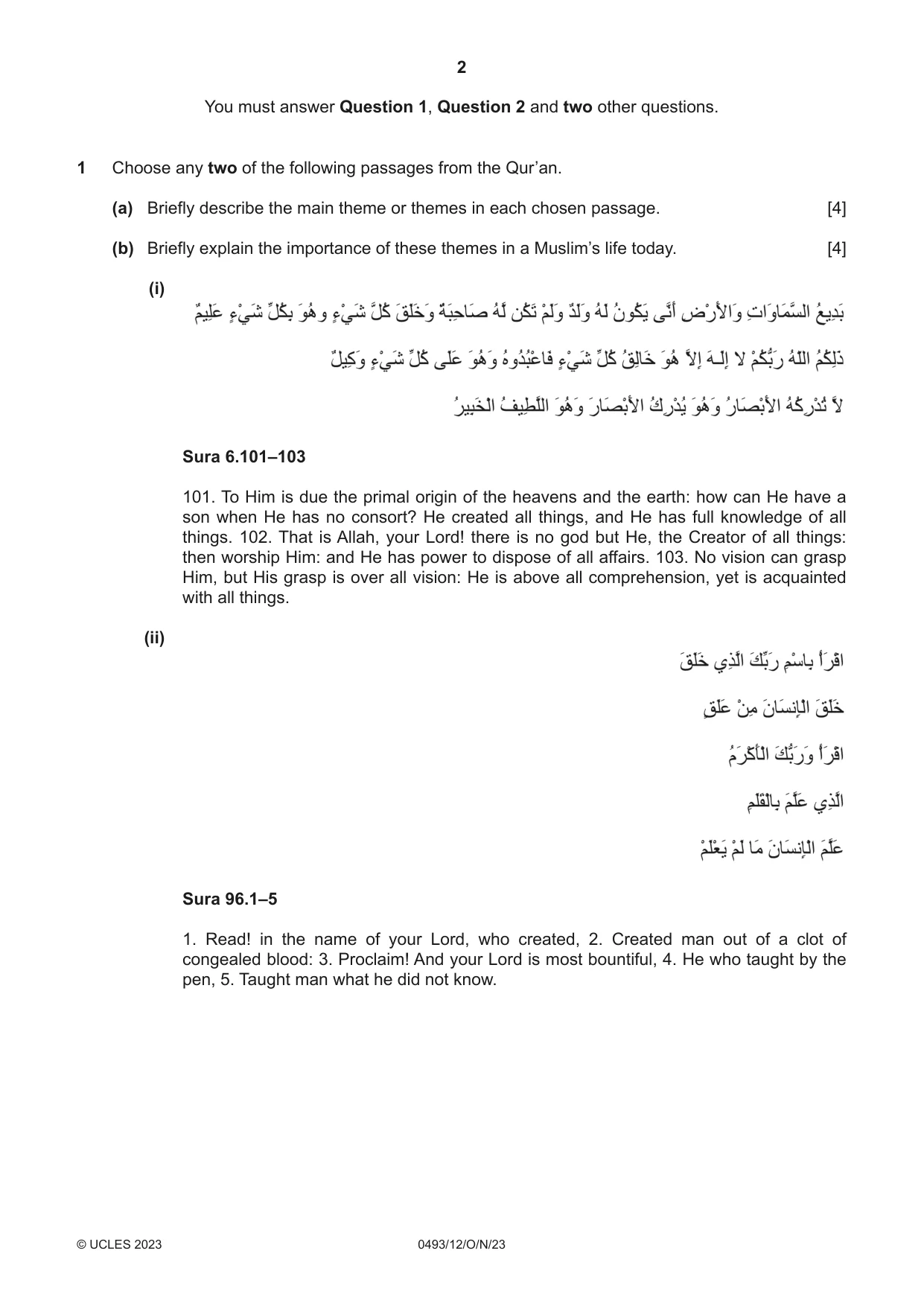
2 0493/12/O/N/23 © UCLES 2023 You must answer Question 1, Question 2 and two other questions. 1 Choose any two of the following passages from the Qur’an. (a) Briefly describe the main theme or themes in each chosen passage. [4] (b) Briefly explain the importance of these themes in a Muslim’s life today. [4] (i) Sura 6.101–103 101. To Him is due the primal origin of the heavens and the earth: how can He have a son when He has no consort? He created all things, and He has full knowledge of all things. 102. That is Allah, your Lord! there is no god but He, the Creator of all things: then worship Him: and He has power to dispose of all affairs. 103. No vision can grasp Him, but His grasp is over all vision: He is above all comprehension, yet is acquainted with all things. (ii) Sura 96.1–5 1. Read! in the name of your Lord, who created, 2. Created man out of a clot of congealed blood: 3. Proclaim! And your Lord is most bountiful, 4. He who taught by the pen, 5. Taught man what he did not know.
Question paper, page 3
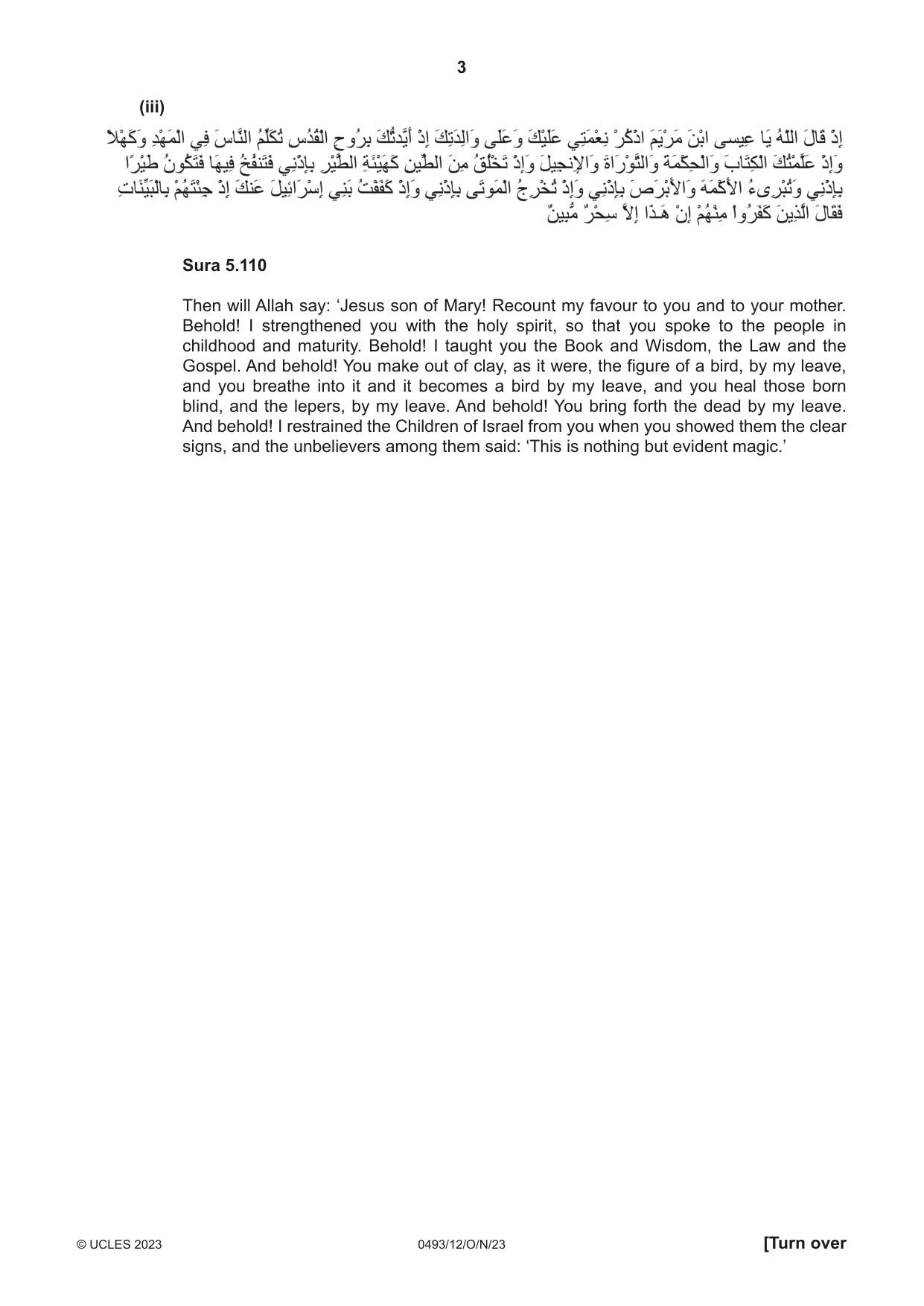
3 0493/12/O/N/23 © UCLES 2023 [Turn over (iii) Sura 5.110 Then will Allah say: ‘Jesus son of Mary! Recount my favour to you and to your mother. Behold! I strengthened you with the holy spirit, so that you spoke to the people in childhood and maturity. Behold! I taught you the Book and Wisdom, the Law and the Gospel. And behold! You make out of clay, as it were, the figure of a bird, by my leave, and you breathe into it and it becomes a bird by my leave, and you heal those born blind, and the lepers, by my leave. And behold! You bring forth the dead by my leave. And behold! I restrained the Children of Israel from you when you showed them the clear signs, and the unbelievers among them said: ‘This is nothing but evident magic.’
Question paper, page 4
4 0493/12/O/N/23 © UCLES 2023 … … … … … … … … … … … … … … … … … … … … … … … … … … … …
Question paper, page 5
5 0493/12/O/N/23 © UCLES 2023 [Turn over … … … … … … … … … … … … … … … … … … … … … … … … … … … …
Question paper, page 6
6 0493/12/O/N/23 © UCLES 2023 2 (a) Using the set passages you have studied, outline the relationship between God and his Messengers: Adam and Abraham. [10] (b) How can Muslims use the Qur’an to develop a closer connection with God? [4] … … … … … … … … … … … … … … … … … … … … … … … … … …
Question paper, page 7
7 0493/12/O/N/23 © UCLES 2023 [Turn over … … … … … … … … … … … … … … … … … … … … … … … … … … … …
Question paper, page 8
8 0493/12/O/N/23 © UCLES 2023 … … … … … … … … … … … … … … … … … … … … … … … … … … … …
Question paper, page 9
9 0493/12/O/N/23 © UCLES 2023 [Turn over 3 (a) Describe the events relating to the Prophet’s efforts to spread Islam in Ta’if. [10] (b) What is the most important lesson Muslims might learn from the Prophet’s example at Ta’if? Give reasons to support your answer. [4] … … … … … … … … … … … … … … … … … … … … … … … … … …
Question paper, page 10
10 0493/12/O/N/23 © UCLES 2023 … … … … … … … … … … … … … … … … … … … … … … … … … … … …
Question paper, page 11
11 0493/12/O/N/23 © UCLES 2023 [Turn over … … … … … … … … … … … … … … … … … … … … … … … … … … … …
Question paper, page 12
12 0493/12/O/N/23 © UCLES 2023 4 (a) Give an account of the persecution faced by the early followers of Islam. [10] (b) What might the early followers’ response to persecution teach Muslims about facing difficulties? Give examples to support your answer. [4] … … … … … … … … … … … … … … … … … … … … … … … … … …
Question paper, page 13
13 0493/12/O/N/23 © UCLES 2023 [Turn over … … … … … … … … … … … … … … … … … … … … … … … … … … … …
Question paper, page 14
14 0493/12/O/N/23 © UCLES 2023 … … … … … … … … … … … … … … … … … … … … … … … … … … … …
Question paper, page 15
15 0493/12/O/N/23 © UCLES 2023 [Turn over 5 (a) Give an account of the life of ʿAli ibn Abi Talib during the life of the Prophet (pbuh). [10] (b) How might ʿAli ibn Abi Talib’s life with the Prophet (pbuh) inspire young people in their lives today? [4] … … … … … … … … … … … … … … … … … … … … … … … … … …
Question paper, page 16
16 0493/12/O/N/23 © UCLES 2023 … … … … … … … … … … … … … … … … … … … … … … … … … … … …
Question paper, page 17
17 0493/12/O/N/23 © UCLES 2023 … … … … … … … … … … … … … … … … … … … … … … … … … … … …
Question paper, page 18
18 0493/12/O/N/23 © UCLES 2023 BLANK PAGE
Question paper, page 19
19 0493/12/O/N/23 © UCLES 2023 BLANK PAGE
Question paper, page 20
20 0493/12/O/N/23 © UCLES 2023 Permission to reproduce items where third-party owned material protected by copyright is included has been sought and cleared where possible. Every reasonable effort has been made by the publisher (UCLES) to trace copyright holders, but if any items requiring clearance have unwittingly been included, the publisher will be pleased to make amends at the earliest possible opportunity. To avoid the issue of disclosure of answer-related information to candidates, all copyright acknowledgements are reproduced online in the Cambridge Assessment International Education Copyright Acknowledgements Booklet. This is produced for each series of examinations and is freely available to download at www.cambridgeinternational.org after the live examination series. Cambridge Assessment International Education is part of Cambridge Assessment. Cambridge Assessment is the brand name of the University of Cambridge Local Examinations Syndicate (UCLES), which is a department of the University of Cambridge. BLANK PAGE
Mark scheme, page 1
This document consists of 16 printed pages. © UCLES 2023 [Turn over Cambridge IGCSE™ ISLAMIYAT 0493/12 Paper 1 October/November 2023 MARK SCHEME Maximum Mark: 50 Published This mark scheme is published as an aid to teachers and candidates, to indicate the requirements of the examination. It shows the basis on which Examiners were instructed to award marks. It does not indicate the details of the discussions that took place at an Examiners’ meeting before marking began, which would have considered the acceptability of alternative answers. Mark schemes should be read in conjunction with the question paper and the Principal Examiner Report for Teachers. Cambridge International will not enter into discussions about these mark schemes. Cambridge International is publishing the mark schemes for the October/November 2023 series for most Cambridge IGCSE, Cambridge International A and AS Level components, and some Cambridge O Level components.
Mark scheme, page 2
0493/12 Cambridge IGCSE – Mark Scheme PUBLISHED October/November 2023 © UCLES 2023 Page 2 of 16 Generic Marking Principles These general marking principles must be applied by all examiners when marking candidate answers. They should be applied alongside the specific content of the mark scheme or generic level descriptors for a question. Each question paper and mark scheme will also comply with these marking principles. GENERIC MARKING PRINCIPLE 1: Marks must be awarded in line with: • the specific content of the mark scheme or the generic level descriptors for the question • the specific skills defined in the mark scheme or in the generic level descriptors for the question • the standard of response required by a candidate as exemplified by the standardisation scripts. GENERIC MARKING PRINCIPLE 2: Marks awarded are always whole marks (not half marks, or other fractions). GENERIC MARKING PRINCIPLE 3: Marks must be awarded positively: • marks are awarded for correct/valid answers, as defined in the mark scheme. However, credit is given for valid answers which go beyond the scope of the syllabus and mark scheme, referring to your Team Leader as appropriate • marks are awarded when candidates clearly demonstrate what they know and can do • marks are not deducted for errors • marks are not deducted for omissions • answers should only be judged on the quality of spelling, punctuation and grammar when these features are specifically assessed by the question as indicated by the mark scheme. The meaning, however, should be unambiguous. GENERIC MARKING PRINCIPLE 4: Rules must be applied consistently, e.g. in situations where candidates have not followed instructions or in the application of generic level descriptors. GENERIC MARKING PRINCIPLE 5: Marks should be awarded using the full range of marks defined in the mark scheme for the question (however; the use of the full mark range may be limited according to the quality of the candidate responses seen). GENERIC MARKING PRINCIPLE 6: Marks awarded are based solely on the requirements as defined in the mark scheme. Marks should not be awarded with grade thresholds or grade descriptors in mind.
Mark scheme, page 3
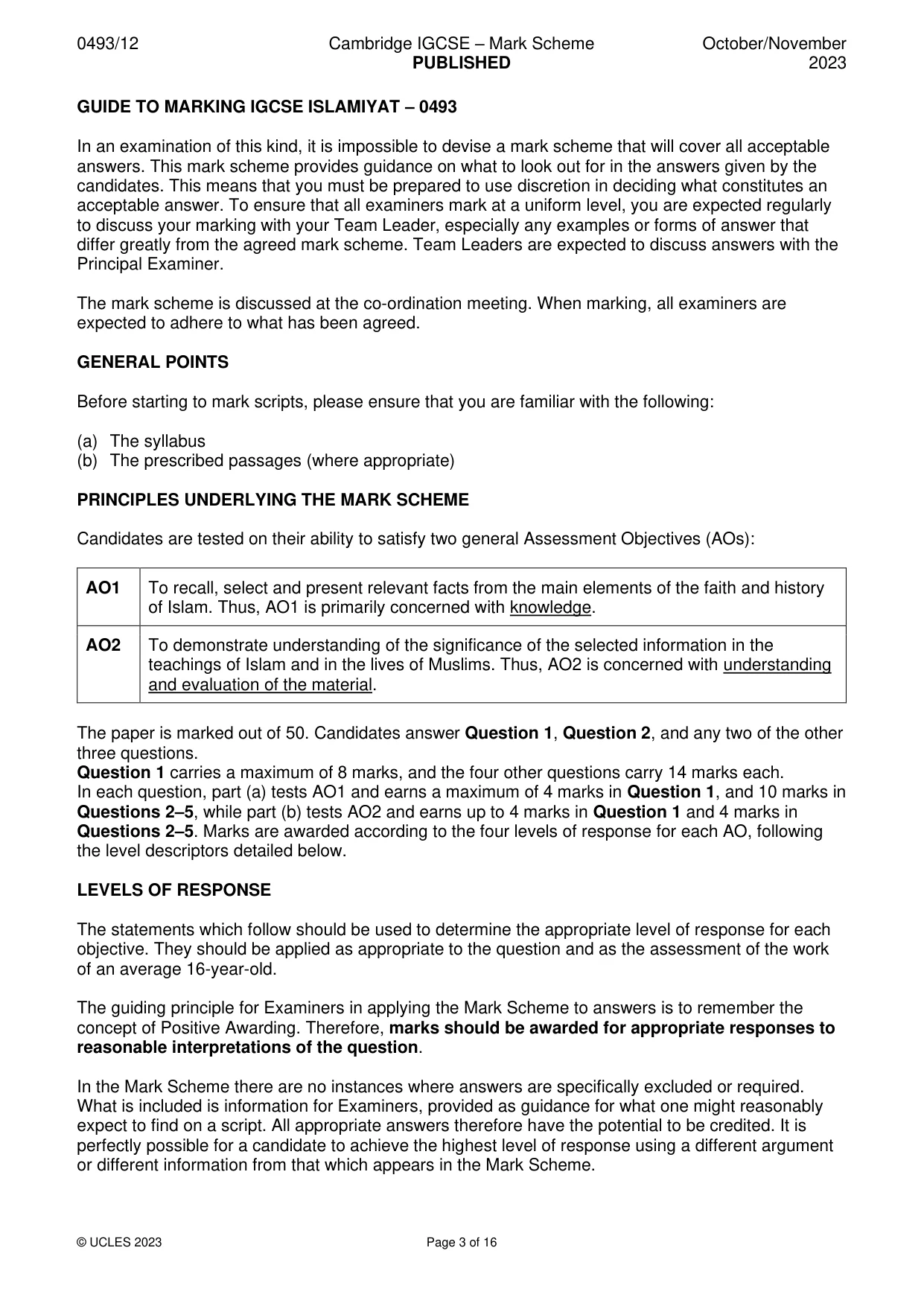
0493/12 Cambridge IGCSE – Mark Scheme PUBLISHED October/November 2023 © UCLES 2023 Page 3 of 16 GUIDE TO MARKING IGCSE ISLAMIYAT – 0493 In an examination of this kind, it is impossible to devise a mark scheme that will cover all acceptable answers. This mark scheme provides guidance on what to look out for in the answers given by the candidates. This means that you must be prepared to use discretion in deciding what constitutes an acceptable answer. To ensure that all examiners mark at a uniform level, you are expected regularly to discuss your marking with your Team Leader, especially any examples or forms of answer that differ greatly from the agreed mark scheme. Team Leaders are expected to discuss answers with the Principal Examiner. The mark scheme is discussed at the co-ordination meeting. When marking, all examiners are expected to adhere to what has been agreed. GENERAL POINTS Before starting to mark scripts, please ensure that you are familiar with the following: (a) The syllabus (b) The prescribed passages (where appropriate) PRINCIPLES UNDERLYING THE MARK SCHEME Candidates are tested on their ability to satisfy two general Assessment Objectives (AOs): AO1 To recall, select and present relevant facts from the main elements of the faith and history of Islam. Thus, AO1 is primarily concerned with knowledge. AO2 To demonstrate understanding of the significance of the selected information in the teachings of Islam and in the lives of Muslims. Thus, AO2 is concerned with understanding and evaluation of the material. The paper is marked out of 50. Candidates answer Question 1, Question 2, and any two of the other three questions. Question 1 carries a maximum of 8 marks, and the four other questions carry 14 marks each. In each question, part (a) tests AO1 and earns a maximum of 4 marks in Question 1, and 10 marks in Questions 2–5, while part (b) tests AO2 and earns up to 4 marks in Question 1 and 4 marks in Questions 2–5. Marks are awarded according to the four levels of response for each AO, following the level descriptors detailed below. LEVELS OF RESPONSE The statements which follow should be used to determine the appropriate level of response for each objective. They should be applied as appropriate to the question and as the assessment of the work of an average 16-year-old. The guiding principle for Examiners in applying the Mark Scheme to answers is to remember the concept of Positive Awarding. Therefore, marks should be awarded for appropriate responses to reasonable interpretations of the question. In the Mark Scheme there are no instances where answers are specifically excluded or required. What is included is information for Examiners, provided as guidance for what one might reasonably expect to find on a script. All appropriate answers therefore have the potential to be credited. It is perfectly possible for a candidate to achieve the highest level of response using a different argument or different information from that which appears in the Mark Scheme.
Mark scheme, page 4
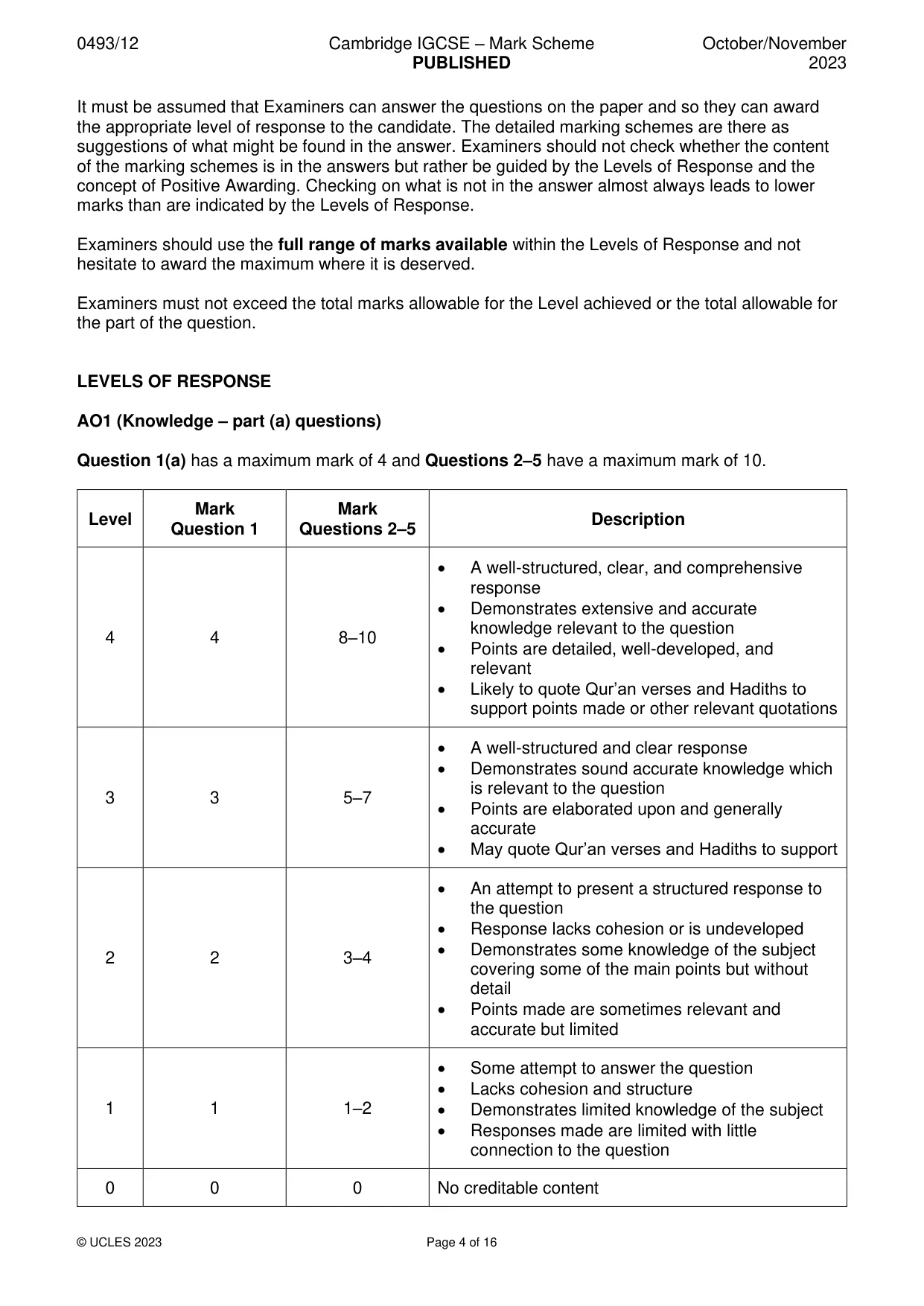
0493/12 Cambridge IGCSE – Mark Scheme PUBLISHED October/November 2023 © UCLES 2023 Page 4 of 16 It must be assumed that Examiners can answer the questions on the paper and so they can award the appropriate level of response to the candidate. The detailed marking schemes are there as suggestions of what might be found in the answer. Examiners should not check whether the content of the marking schemes is in the answers but rather be guided by the Levels of Response and the concept of Positive Awarding. Checking on what is not in the answer almost always leads to lower marks than are indicated by the Levels of Response. Examiners should use the full range of marks available within the Levels of Response and not hesitate to award the maximum where it is deserved. Examiners must not exceed the total marks allowable for the Level achieved or the total allowable for the part of the question. LEVELS OF RESPONSE AO1 (Knowledge – part (a) questions) Question 1(a) has a maximum mark of 4 and Questions 2–5 have a maximum mark of 10. Level Mark Question 1 Mark Questions 2–5 Description 4 4 8–10 • A well-structured, clear, and comprehensive response • Demonstrates extensive and accurate knowledge relevant to the question • Points are detailed, well-developed, and relevant • Likely to quote Qur’an verses and Hadiths to support points made or other relevant quotations 3 3 5–7 • A well-structured and clear response • Demonstrates sound accurate knowledge which is relevant to the question • Points are elaborated upon and generally accurate • May quote Qur’an verses and Hadiths to support 2 2 3–4 • An attempt to present a structured response to the question • Response lacks cohesion or is undeveloped • Demonstrates some knowledge of the subject covering some of the main points but without detail • Points made are sometimes relevant and accurate but limited 1 1 1–2 • Some attempt to answer the question • Lacks cohesion and structure • Demonstrates limited knowledge of the subject • Responses made are limited with little connection to the question 0 0 0 No creditable content
Mark scheme, page 5
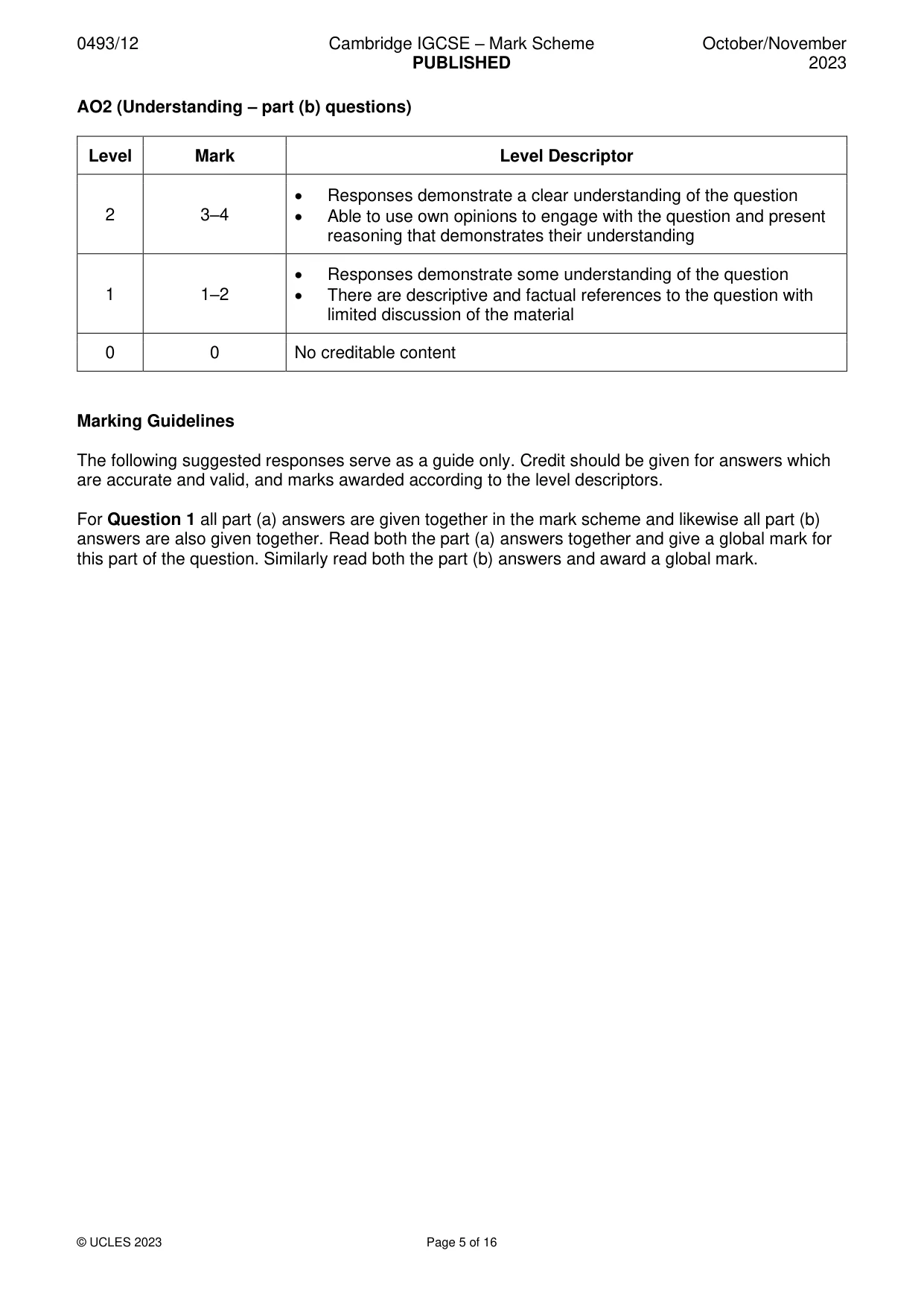
0493/12 Cambridge IGCSE – Mark Scheme PUBLISHED October/November 2023 © UCLES 2023 Page 5 of 16 AO2 (Understanding – part (b) questions) Level Mark Level Descriptor 2 3–4 • Responses demonstrate a clear understanding of the question • Able to use own opinions to engage with the question and present reasoning that demonstrates their understanding 1 1–2 • Responses demonstrate some understanding of the question • There are descriptive and factual references to the question with limited discussion of the material 0 0 No creditable content Marking Guidelines The following suggested responses serve as a guide only. Credit should be given for answers which are accurate and valid, and marks awarded according to the level descriptors. For Question 1 all part (a) answers are given together in the mark scheme and likewise all part (b) answers are also given together. Read both the part (a) answers together and give a global mark for this part of the question. Similarly read both the part (b) answers and award a global mark.
Mark scheme, page 6
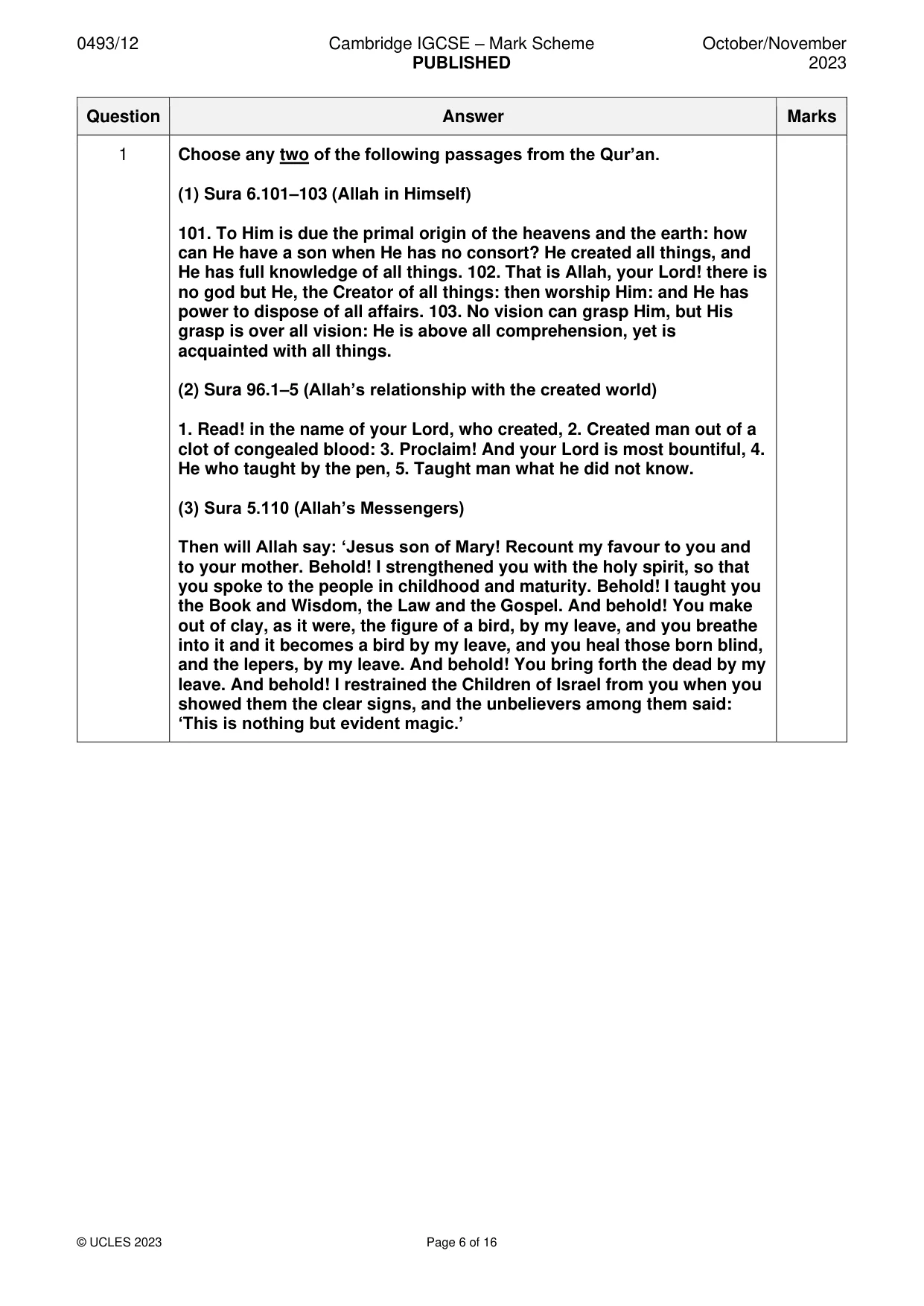
0493/12 Cambridge IGCSE – Mark Scheme PUBLISHED October/November 2023 © UCLES 2023 Page 6 of 16 Question Answer Marks 1 Choose any two of the following passages from the Qur’an. (1) Sura 6.101–103 (Allah in Himself) 101. To Him is due the primal origin of the heavens and the earth: how can He have a son when He has no consort? He created all things, and He has full knowledge of all things. 102. That is Allah, your Lord! there is no god but He, the Creator of all things: then worship Him: and He has power to dispose of all affairs. 103. No vision can grasp Him, but His grasp is over all vision: He is above all comprehension, yet is acquainted with all things. (2) Sura 96.1–5 (Allah’s relationship with the created world) 1. Read! in the name of your Lord, who created, 2. Created man out of a clot of congealed blood: 3. Proclaim! And your Lord is most bountiful, 4. He who taught by the pen, 5. Taught man what he did not know. (3) Sura 5.110 (Allah’s Messengers) Then will Allah say: ‘Jesus son of Mary! Recount my favour to you and to your mother. Behold! I strengthened you with the holy spirit, so that you spoke to the people in childhood and maturity. Behold! I taught you the Book and Wisdom, the Law and the Gospel. And behold! You make out of clay, as it were, the figure of a bird, by my leave, and you breathe into it and it becomes a bird by my leave, and you heal those born blind, and the lepers, by my leave. And behold! You bring forth the dead by my leave. And behold! I restrained the Children of Israel from you when you showed them the clear signs, and the unbelievers among them said: ‘This is nothing but evident magic.’
Mark scheme, page 7
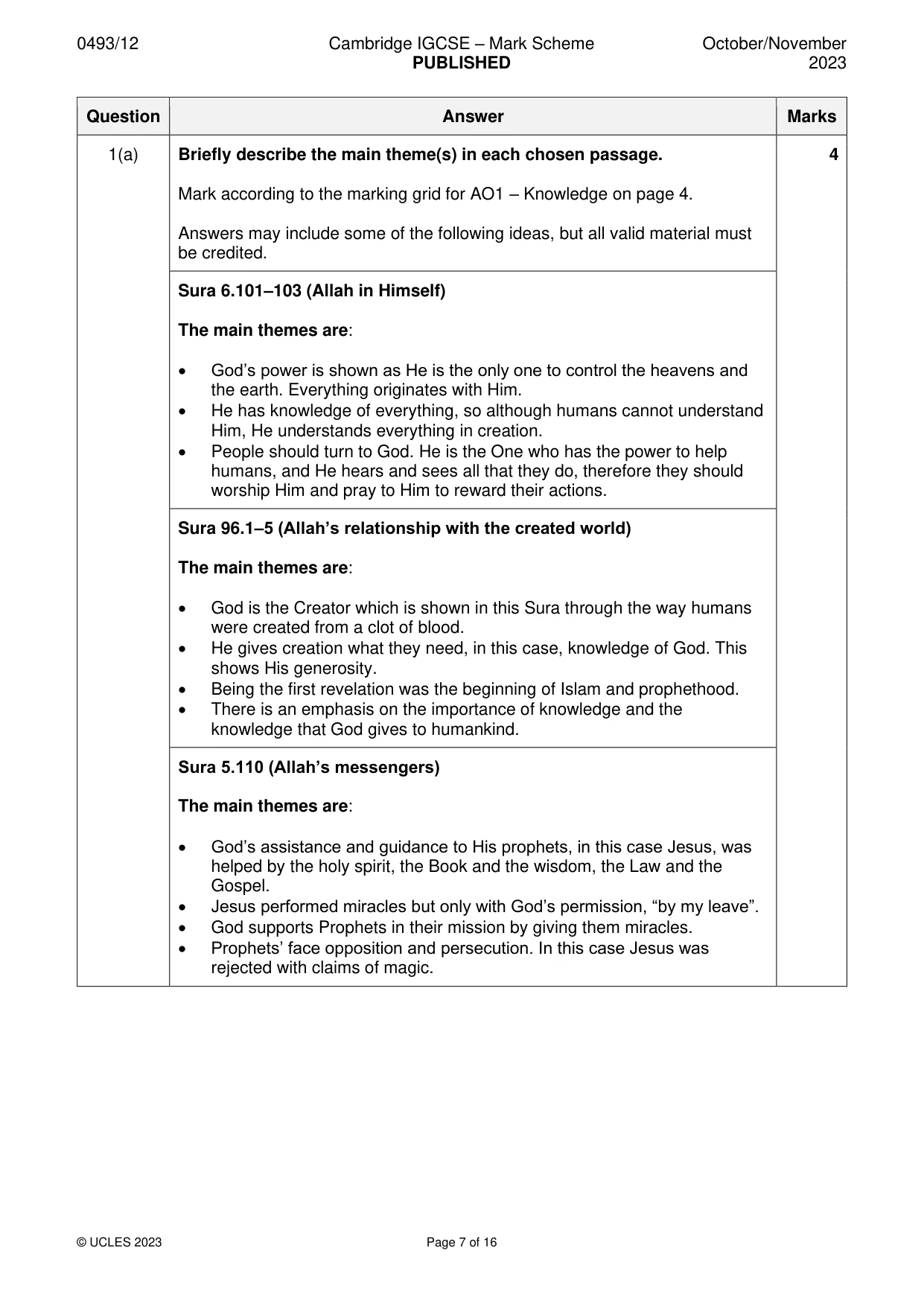
0493/12 Cambridge IGCSE – Mark Scheme PUBLISHED October/November 2023 © UCLES 2023 Page 7 of 16 Question Answer Marks 1(a) Briefly describe the main theme(s) in each chosen passage. Mark according to the marking grid for AO1 – Knowledge on page 4. Answers may include some of the following ideas, but all valid material must be credited. 4 Sura 6.101–103 (Allah in Himself) The main themes are: • God’s power is shown as He is the only one to control the heavens and the earth. Everything originates with Him. • He has knowledge of everything, so although humans cannot understand Him, He understands everything in creation. • People should turn to God. He is the One who has the power to help humans, and He hears and sees all that they do, therefore they should worship Him and pray to Him to reward their actions. Sura 96.1–5 (Allah’s relationship with the created world) The main themes are: • God is the Creator which is shown in this Sura through the way humans were created from a clot of blood. • He gives creation what they need, in this case, knowledge of God. This shows His generosity. • Being the first revelation was the beginning of Islam and prophethood. • There is an emphasis on the importance of knowledge and the knowledge that God gives to humankind. Sura 5.110 (Allah’s messengers) The main themes are: • God’s assistance and guidance to His prophets, in this case Jesus, was helped by the holy spirit, the Book and the wisdom, the Law and the Gospel. • Jesus performed miracles but only with God’s permission, “by my leave”. • God supports Prophets in their mission by giving them miracles. • Prophets’ face opposition and persecution. In this case Jesus was rejected with claims of magic.
Mark scheme, page 8
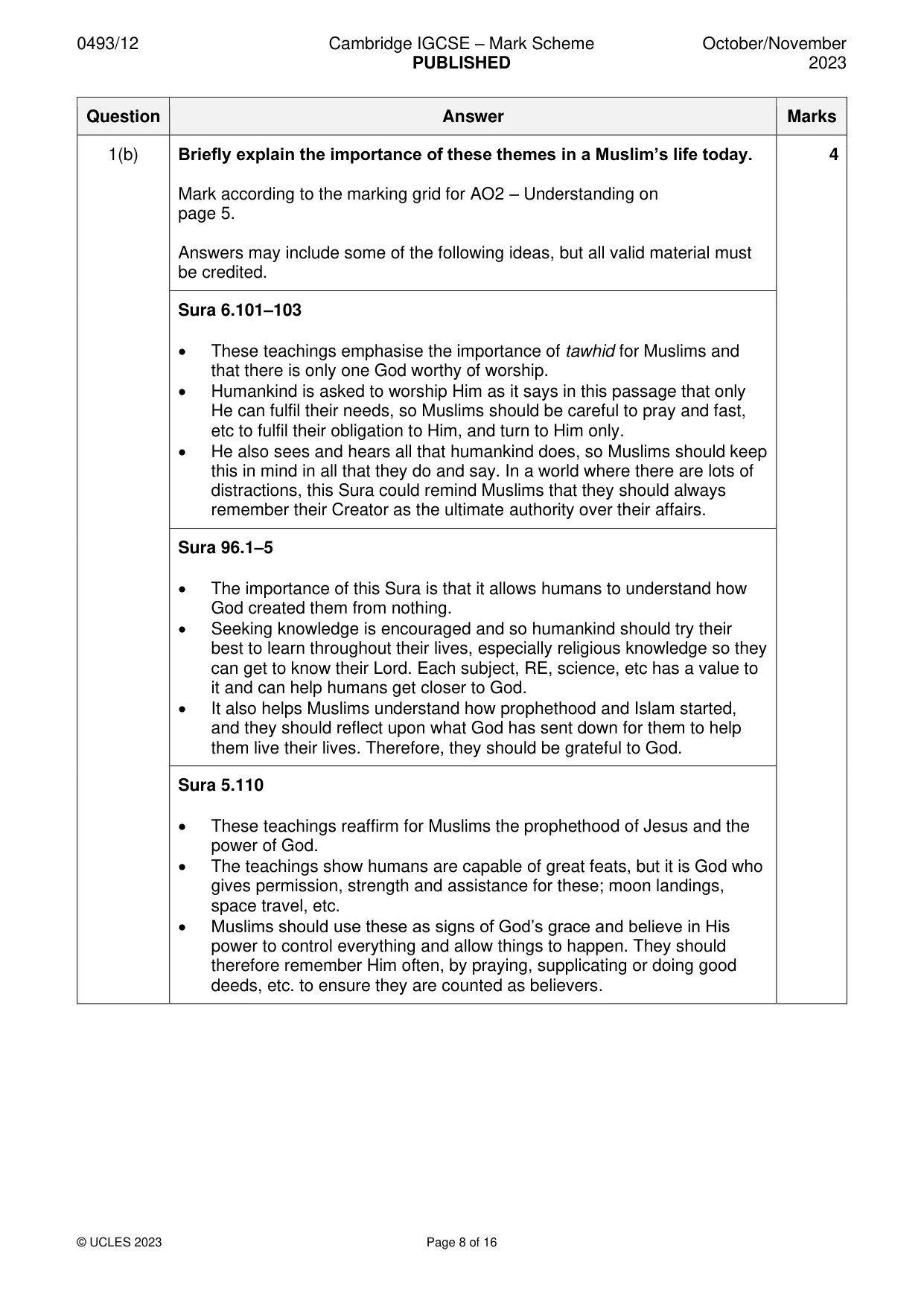
0493/12 Cambridge IGCSE – Mark Scheme PUBLISHED October/November 2023 © UCLES 2023 Page 8 of 16 Question Answer Marks 1(b) Briefly explain the importance of these themes in a Muslim’s life today. Mark according to the marking grid for AO2 – Understanding on page 5. Answers may include some of the following ideas, but all valid material must be credited. 4 Sura 6.101–103 • These teachings emphasise the importance of tawhid for Muslims and that there is only one God worthy of worship. • Humankind is asked to worship Him as it says in this passage that only He can fulfil their needs, so Muslims should be careful to pray and fast, etc to fulfil their obligation to Him, and turn to Him only. • He also sees and hears all that humankind does, so Muslims should keep this in mind in all that they do and say. In a world where there are lots of distractions, this Sura could remind Muslims that they should always remember their Creator as the ultimate authority over their affairs. Sura 96.1–5 • The importance of this Sura is that it allows humans to understand how God created them from nothing. • Seeking knowledge is encouraged and so humankind should try their best to learn throughout their lives, especially religious knowledge so they can get to know their Lord. Each subject, RE, science, etc has a value to it and can help humans get closer to God. • It also helps Muslims understand how prophethood and Islam started, and they should reflect upon what God has sent down for them to help them live their lives. Therefore, they should be grateful to God. Sura 5.110 • These teachings reaffirm for Muslims the prophethood of Jesus and the power of God. • The teachings show humans are capable of great feats, but it is God who gives permission, strength and assistance for these; moon landings, space travel, etc. • Muslims should use these as signs of God’s grace and believe in His power to control everything and allow things to happen. They should therefore remember Him often, by praying, supplicating or doing good deeds, etc. to ensure they are counted as believers.
Mark scheme, page 9
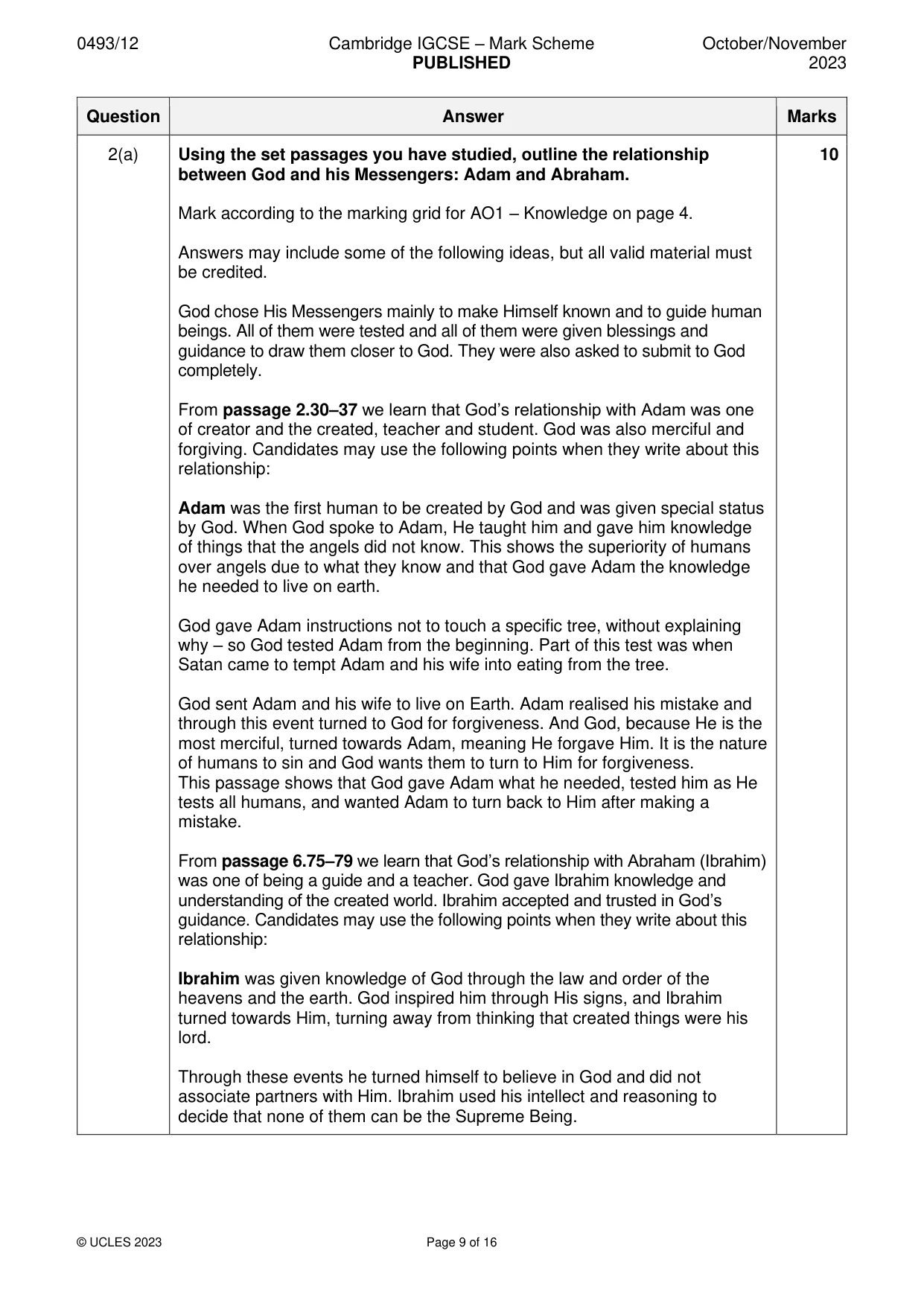
0493/12 Cambridge IGCSE – Mark Scheme PUBLISHED October/November 2023 © UCLES 2023 Page 9 of 16 Question Answer Marks 2(a) Using the set passages you have studied, outline the relationship between God and his Messengers: Adam and Abraham. Mark according to the marking grid for AO1 – Knowledge on page 4. Answers may include some of the following ideas, but all valid material must be credited. God chose His Messengers mainly to make Himself known and to guide human beings. All of them were tested and all of them were given blessings and guidance to draw them closer to God. They were also asked to submit to God completely. From passage 2.30–37 we learn that God’s relationship with Adam was one of creator and the created, teacher and student. God was also merciful and forgiving. Candidates may use the following points when they write about this relationship: Adam was the first human to be created by God and was given special status by God. When God spoke to Adam, He taught him and gave him knowledge of things that the angels did not know. This shows the superiority of humans over angels due to what they know and that God gave Adam the knowledge he needed to live on earth. God gave Adam instructions not to touch a specific tree, without explaining why – so God tested Adam from the beginning. Part of this test was when Satan came to tempt Adam and his wife into eating from the tree. God sent Adam and his wife to live on Earth. Adam realised his mistake and through this event turned to God for forgiveness. And God, because He is the most merciful, turned towards Adam, meaning He forgave Him. It is the nature of humans to sin and God wants them to turn to Him for forgiveness. This passage shows that God gave Adam what he needed, tested him as He tests all humans, and wanted Adam to turn back to Him after making a mistake. From passage 6.75–79 we learn that God’s relationship with Abraham (Ibrahim) was one of being a guide and a teacher. God gave Ibrahim knowledge and understanding of the created world. Ibrahim accepted and trusted in God’s guidance. Candidates may use the following points when they write about this relationship: Ibrahim was given knowledge of God through the law and order of the heavens and the earth. God inspired him through His signs, and Ibrahim turned towards Him, turning away from thinking that created things were his lord. Through these events he turned himself to believe in God and did not associate partners with Him. Ibrahim used his intellect and reasoning to decide that none of them can be the Supreme Being. 10
Mark scheme, page 10
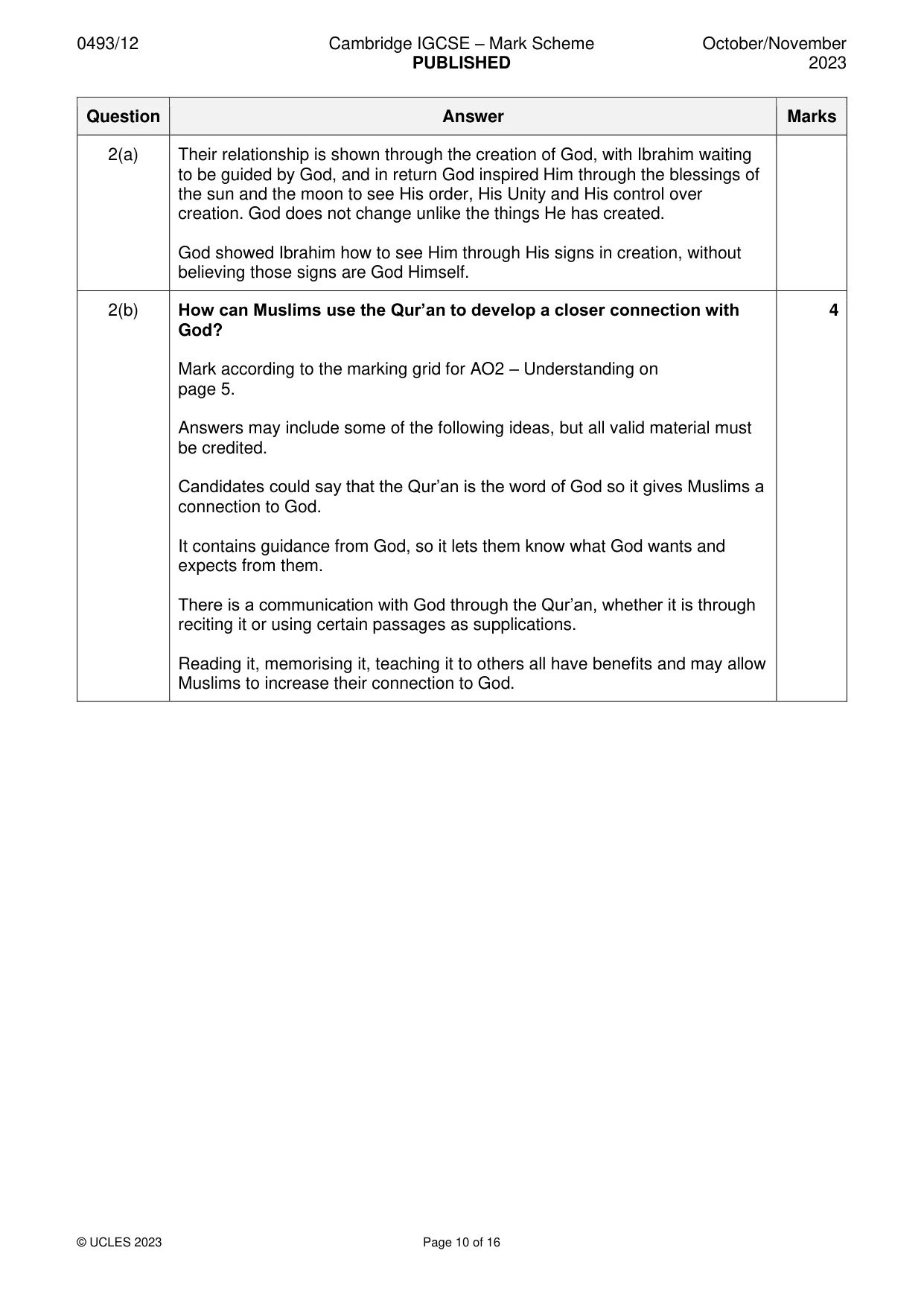
0493/12 Cambridge IGCSE – Mark Scheme PUBLISHED October/November 2023 © UCLES 2023 Page 10 of 16 Question Answer Marks 2(a) Their relationship is shown through the creation of God, with Ibrahim waiting to be guided by God, and in return God inspired Him through the blessings of the sun and the moon to see His order, His Unity and His control over creation. God does not change unlike the things He has created. God showed Ibrahim how to see Him through His signs in creation, without believing those signs are God Himself. 2(b) How can Muslims use the Qur’an to develop a closer connection with God? Mark according to the marking grid for AO2 – Understanding on page 5. Answers may include some of the following ideas, but all valid material must be credited. Candidates could say that the Qur’an is the word of God so it gives Muslims a connection to God. It contains guidance from God, so it lets them know what God wants and expects from them. There is a communication with God through the Qur’an, whether it is through reciting it or using certain passages as supplications. Reading it, memorising it, teaching it to others all have benefits and may allow Muslims to increase their connection to God. 4
Mark scheme, page 11
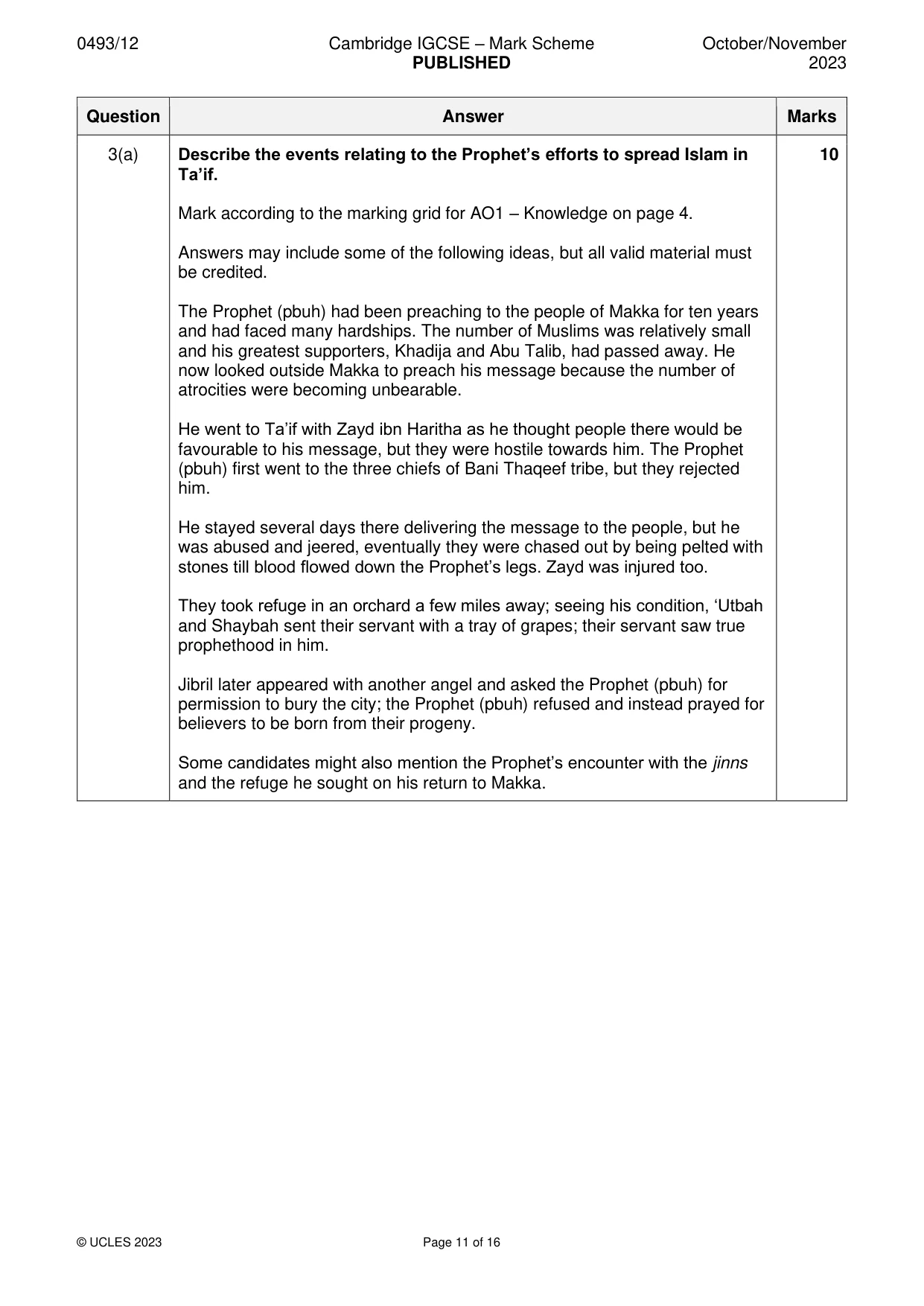
0493/12 Cambridge IGCSE – Mark Scheme PUBLISHED October/November 2023 © UCLES 2023 Page 11 of 16 Question Answer Marks 3(a) Describe the events relating to the Prophet’s efforts to spread Islam in Ta’if. Mark according to the marking grid for AO1 – Knowledge on page 4. Answers may include some of the following ideas, but all valid material must be credited. The Prophet (pbuh) had been preaching to the people of Makka for ten years and had faced many hardships. The number of Muslims was relatively small and his greatest supporters, Khadija and Abu Talib, had passed away. He now looked outside Makka to preach his message because the number of atrocities were becoming unbearable. He went to Ta’if with Zayd ibn Haritha as he thought people there would be favourable to his message, but they were hostile towards him. The Prophet (pbuh) first went to the three chiefs of Bani Thaqeef tribe, but they rejected him. He stayed several days there delivering the message to the people, but he was abused and jeered, eventually they were chased out by being pelted with stones till blood flowed down the Prophet’s legs. Zayd was injured too. They took refuge in an orchard a few miles away; seeing his condition, ‘Utbah and Shaybah sent their servant with a tray of grapes; their servant saw true prophethood in him. Jibril later appeared with another angel and asked the Prophet (pbuh) for permission to bury the city; the Prophet (pbuh) refused and instead prayed for believers to be born from their progeny. Some candidates might also mention the Prophet’s encounter with the jinns and the refuge he sought on his return to Makka. 10
Mark scheme, page 12
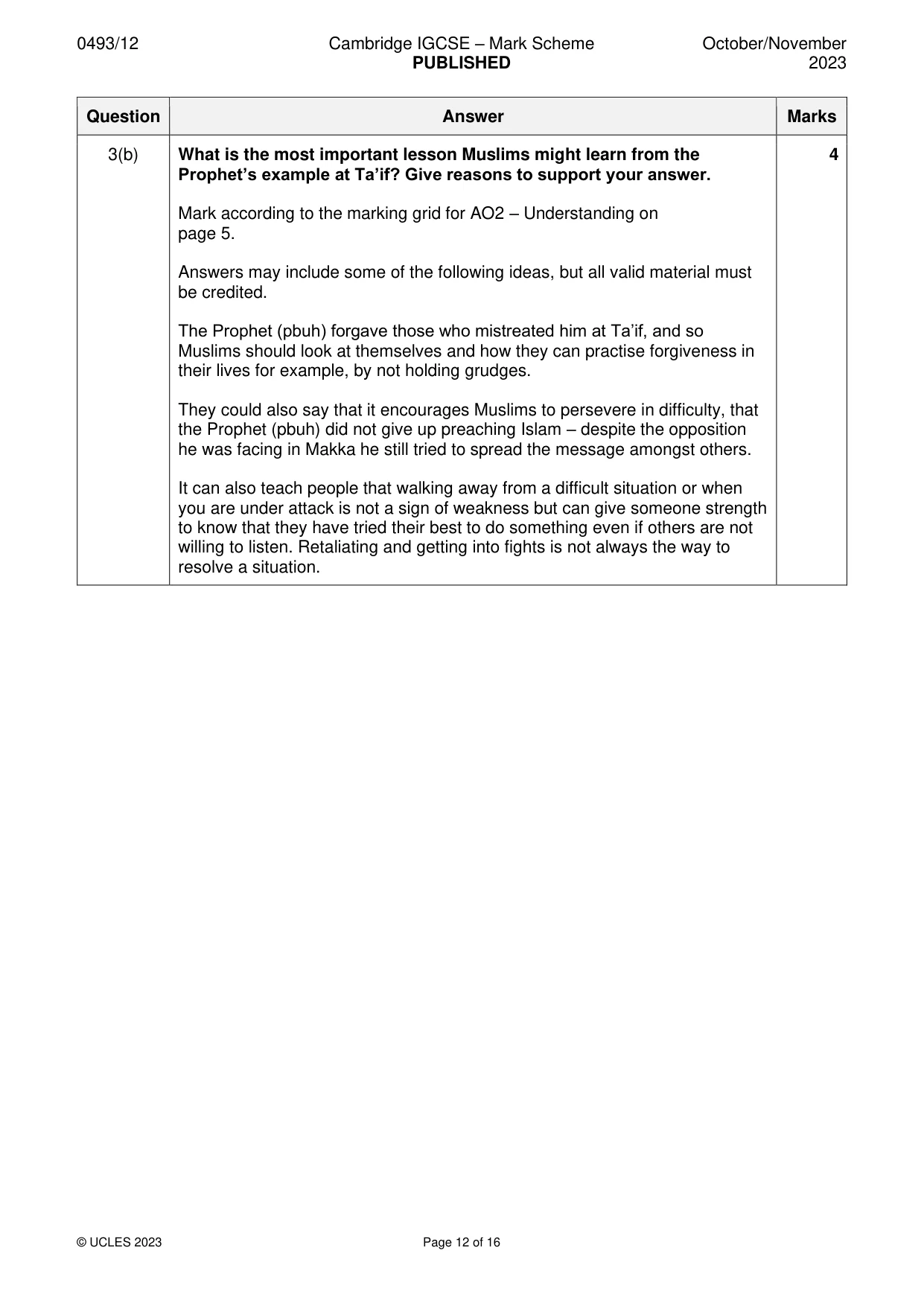
0493/12 Cambridge IGCSE – Mark Scheme PUBLISHED October/November 2023 © UCLES 2023 Page 12 of 16 Question Answer Marks 3(b) What is the most important lesson Muslims might learn from the Prophet’s example at Ta’if? Give reasons to support your answer. Mark according to the marking grid for AO2 – Understanding on page 5. Answers may include some of the following ideas, but all valid material must be credited. The Prophet (pbuh) forgave those who mistreated him at Ta’if, and so Muslims should look at themselves and how they can practise forgiveness in their lives for example, by not holding grudges. They could also say that it encourages Muslims to persevere in difficulty, that the Prophet (pbuh) did not give up preaching Islam – despite the opposition he was facing in Makka he still tried to spread the message amongst others. It can also teach people that walking away from a difficult situation or when you are under attack is not a sign of weakness but can give someone strength to know that they have tried their best to do something even if others are not willing to listen. Retaliating and getting into fights is not always the way to resolve a situation. 4
Mark scheme, page 13
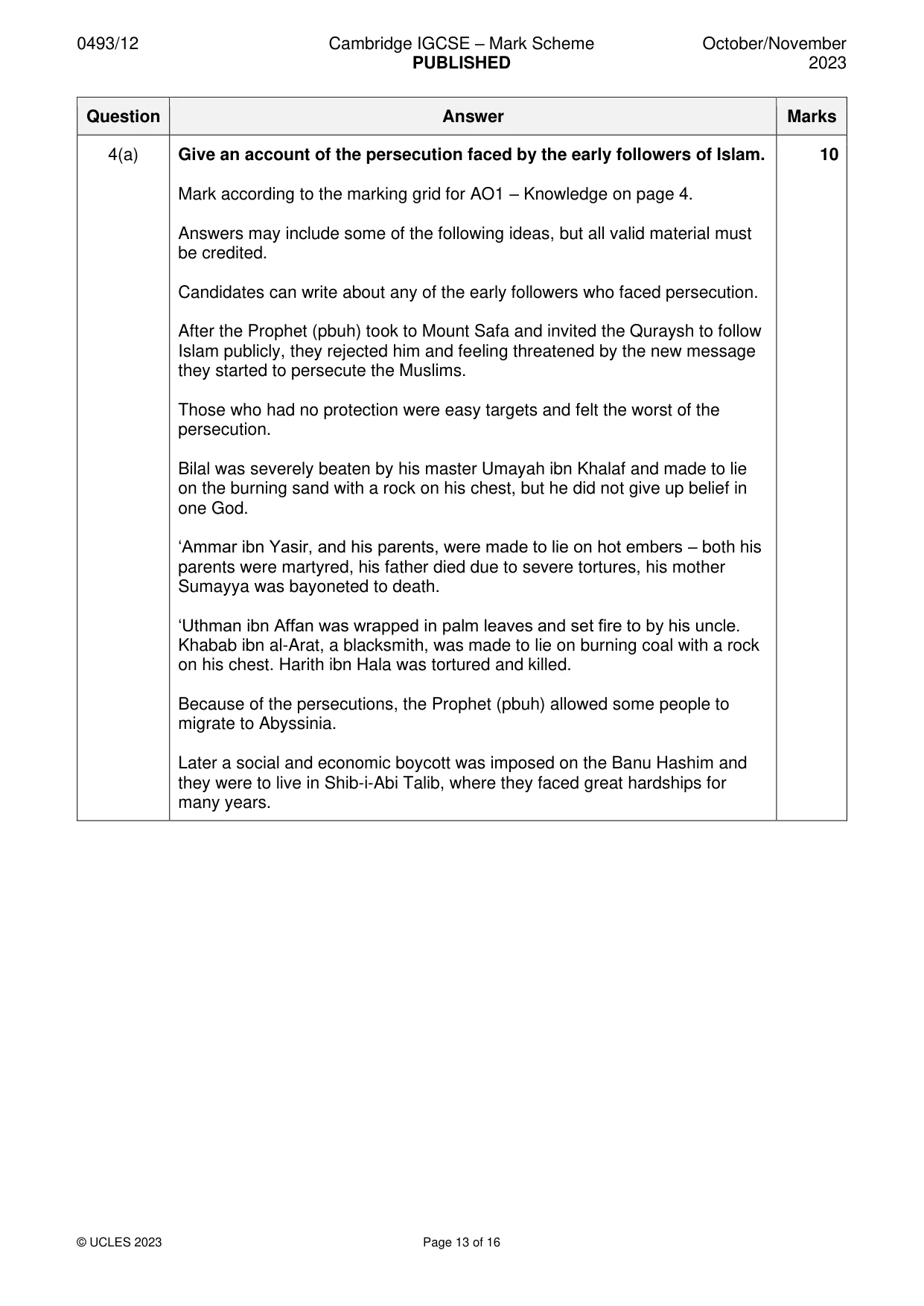
0493/12 Cambridge IGCSE – Mark Scheme PUBLISHED October/November 2023 © UCLES 2023 Page 13 of 16 Question Answer Marks 4(a) Give an account of the persecution faced by the early followers of Islam. Mark according to the marking grid for AO1 – Knowledge on page 4. Answers may include some of the following ideas, but all valid material must be credited. Candidates can write about any of the early followers who faced persecution. After the Prophet (pbuh) took to Mount Safa and invited the Quraysh to follow Islam publicly, they rejected him and feeling threatened by the new message they started to persecute the Muslims. Those who had no protection were easy targets and felt the worst of the persecution. Bilal was severely beaten by his master Umayah ibn Khalaf and made to lie on the burning sand with a rock on his chest, but he did not give up belief in one God. ‘Ammar ibn Yasir, and his parents, were made to lie on hot embers – both his parents were martyred, his father died due to severe tortures, his mother Sumayya was bayoneted to death. ‘Uthman ibn Affan was wrapped in palm leaves and set fire to by his uncle. Khabab ibn al-Arat, a blacksmith, was made to lie on burning coal with a rock on his chest. Harith ibn Hala was tortured and killed. Because of the persecutions, the Prophet (pbuh) allowed some people to migrate to Abyssinia. Later a social and economic boycott was imposed on the Banu Hashim and they were to live in Shib-i-Abi Talib, where they faced great hardships for many years. 10
Mark scheme, page 14
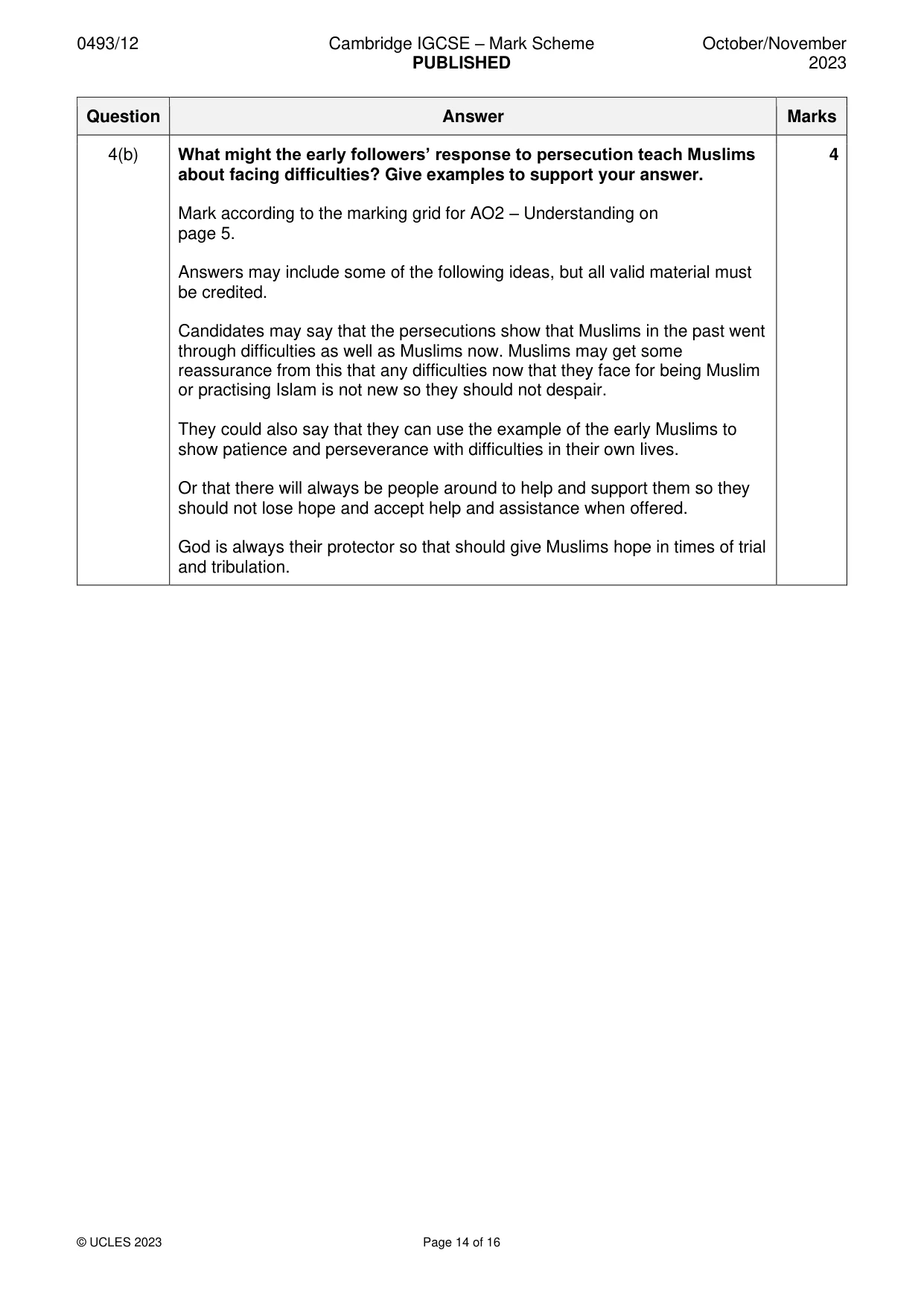
0493/12 Cambridge IGCSE – Mark Scheme PUBLISHED October/November 2023 © UCLES 2023 Page 14 of 16 Question Answer Marks 4(b) What might the early followers’ response to persecution teach Muslims about facing difficulties? Give examples to support your answer. Mark according to the marking grid for AO2 – Understanding on page 5. Answers may include some of the following ideas, but all valid material must be credited. Candidates may say that the persecutions show that Muslims in the past went through difficulties as well as Muslims now. Muslims may get some reassurance from this that any difficulties now that they face for being Muslim or practising Islam is not new so they should not despair. They could also say that they can use the example of the early Muslims to show patience and perseverance with difficulties in their own lives. Or that there will always be people around to help and support them so they should not lose hope and accept help and assistance when offered. God is always their protector so that should give Muslims hope in times of trial and tribulation. 4
Mark scheme, page 15
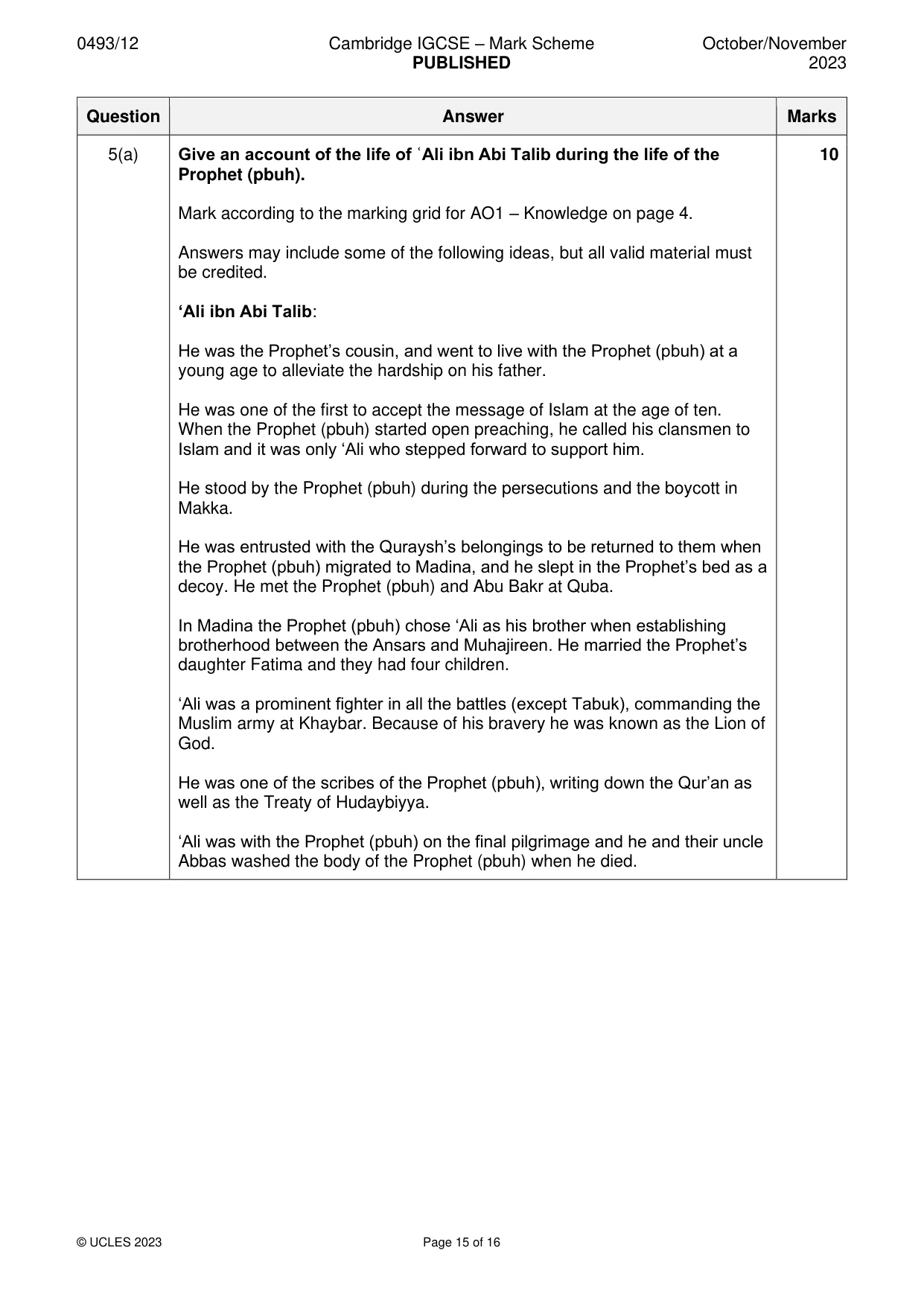
0493/12 Cambridge IGCSE – Mark Scheme PUBLISHED October/November 2023 © UCLES 2023 Page 15 of 16 Question Answer Marks 5(a) Give an account of the life of ʿAli ibn Abi Talib during the life of the Prophet (pbuh). Mark according to the marking grid for AO1 – Knowledge on page 4. Answers may include some of the following ideas, but all valid material must be credited. ‘Ali ibn Abi Talib: He was the Prophet’s cousin, and went to live with the Prophet (pbuh) at a young age to alleviate the hardship on his father. He was one of the first to accept the message of Islam at the age of ten. When the Prophet (pbuh) started open preaching, he called his clansmen to Islam and it was only ‘Ali who stepped forward to support him. He stood by the Prophet (pbuh) during the persecutions and the boycott in Makka. He was entrusted with the Quraysh’s belongings to be returned to them when the Prophet (pbuh) migrated to Madina, and he slept in the Prophet’s bed as a decoy. He met the Prophet (pbuh) and Abu Bakr at Quba. In Madina the Prophet (pbuh) chose ‘Ali as his brother when establishing brotherhood between the Ansars and Muhajireen. He married the Prophet’s daughter Fatima and they had four children. ‘Ali was a prominent fighter in all the battles (except Tabuk), commanding the Muslim army at Khaybar. Because of his bravery he was known as the Lion of God. He was one of the scribes of the Prophet (pbuh), writing down the Qur’an as well as the Treaty of Hudaybiyya. ‘Ali was with the Prophet (pbuh) on the final pilgrimage and he and their uncle Abbas washed the body of the Prophet (pbuh) when he died. 10
Mark scheme, page 16
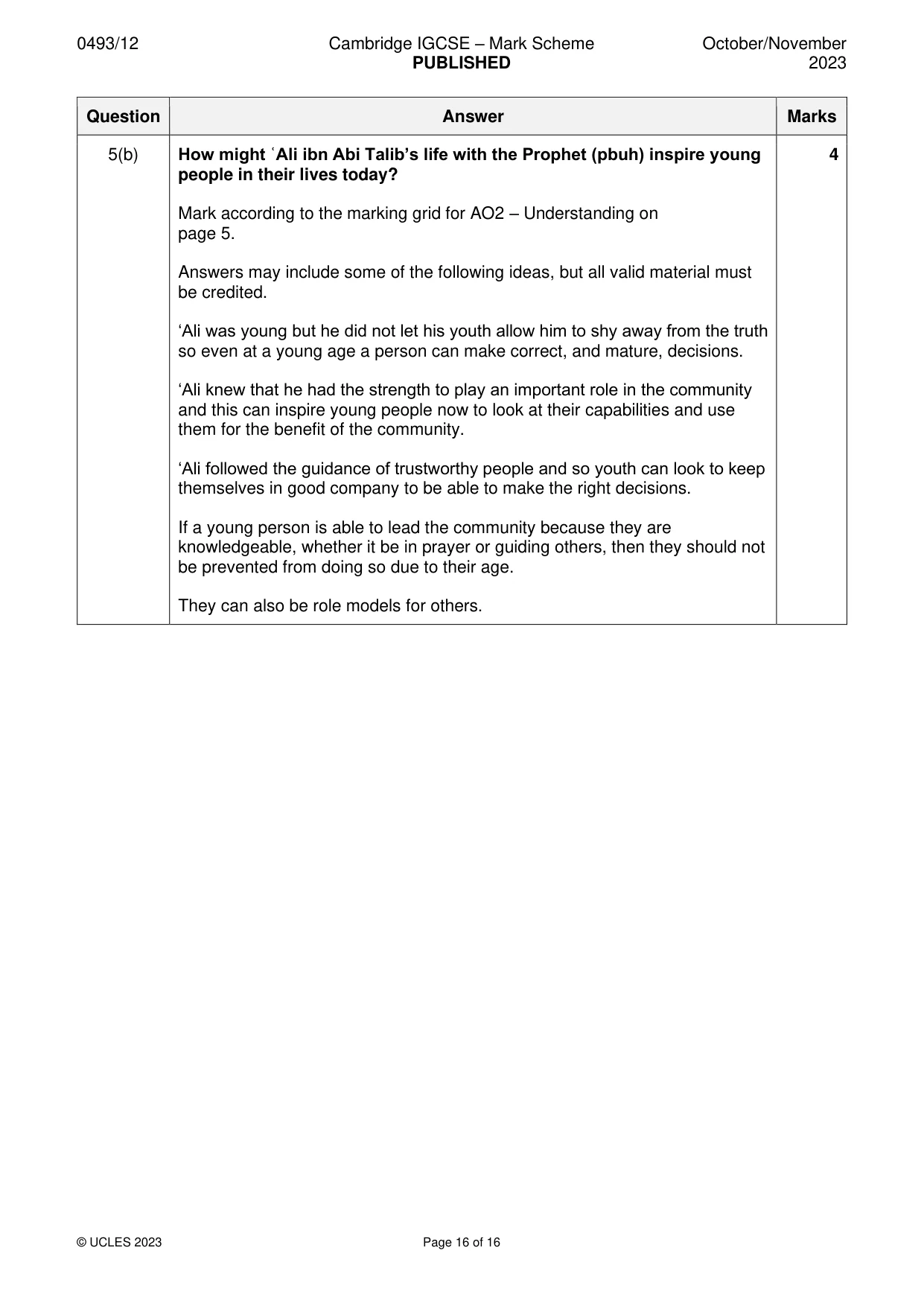
0493/12 Cambridge IGCSE – Mark Scheme PUBLISHED October/November 2023 © UCLES 2023 Page 16 of 16 Question Answer Marks 5(b) How might ʿAli ibn Abi Talib’s life with the Prophet (pbuh) inspire young people in their lives today? Mark according to the marking grid for AO2 – Understanding on page 5. Answers may include some of the following ideas, but all valid material must be credited. ‘Ali was young but he did not let his youth allow him to shy away from the truth so even at a young age a person can make correct, and mature, decisions. ‘Ali knew that he had the strength to play an important role in the community and this can inspire young people now to look at their capabilities and use them for the benefit of the community. ‘Ali followed the guidance of trustworthy people and so youth can look to keep themselves in good company to be able to make the right decisions. If a young person is able to lead the community because they are knowledgeable, whether it be in prayer or guiding others, then they should not be prevented from doing so due to their age. They can also be role models for others. 4
What you needed in this session
Cambridge’s own grade thresholds for 2023 Oct/Nov, Paper 1 · Variant 2. A higher threshold means an easier paper — the bar moves with how the cohort did.