Cambridge IGCSE Islamiyat 0493 — 2022 Oct/Nov Paper 1 · Variant 2
0493/12/O/N/22 · 50 marks · ≈56 min
The question paper and its mark scheme, free to read here and free to download. This is Cambridge’s own paper, exactly as it was sat.
Question paper20 pages












Mark scheme15 pages
Answers below. Sit the paper first if you are practising.
Paper as text
Question paper, page 1
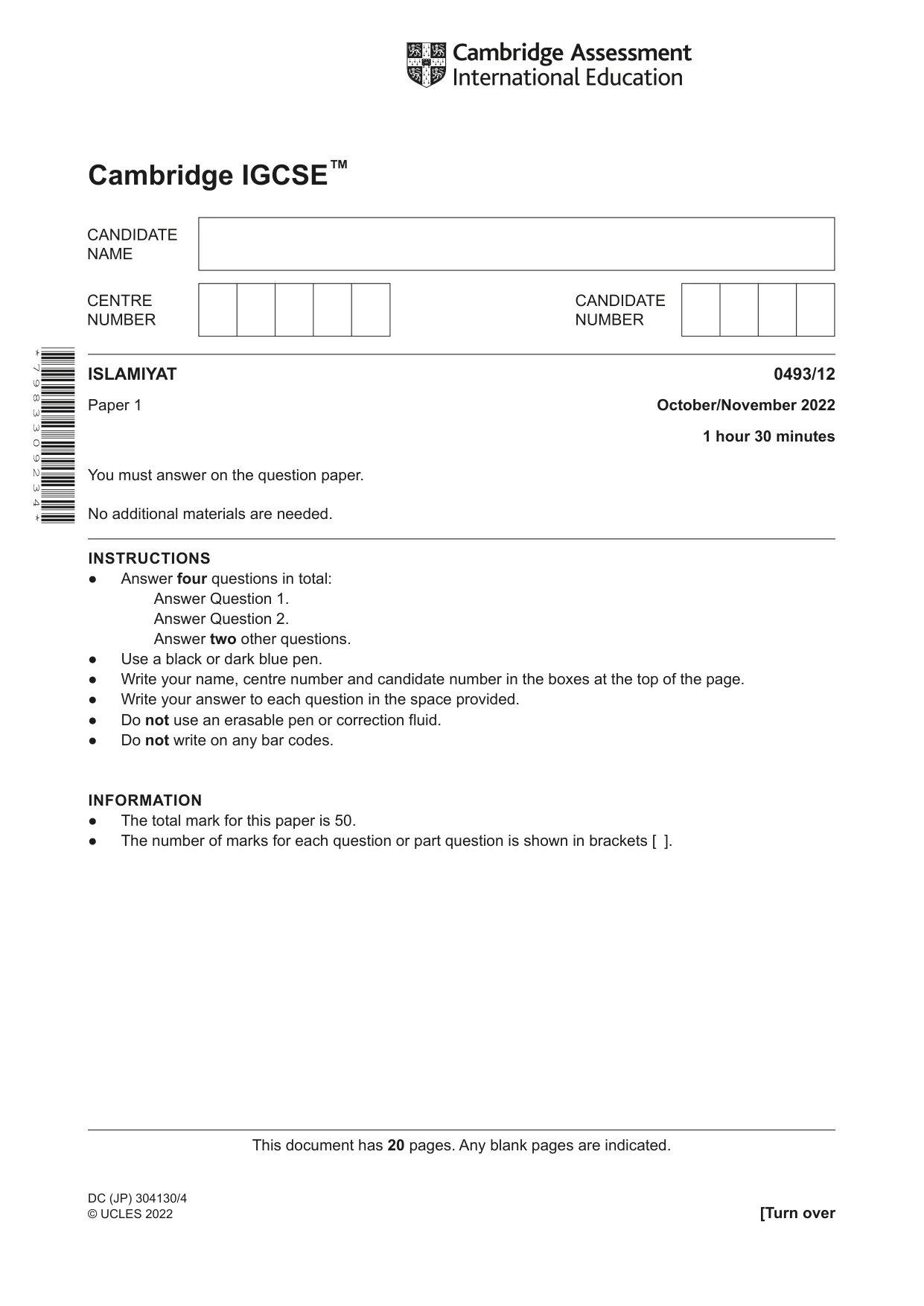
This document has 20 pages. Any blank pages are indicated. [Turn over DC (JP) 304130/4 © UCLES 2022 * 7 9 8 3 3 0 9 2 3 4 * ISLAMIYAT 0493/12 Paper 1 October/November 2022 1 hour 30 minutes You must answer on the question paper. No additional materials are needed. INSTRUCTIONS ● Answer four questions in total: Answer Question 1. Answer Question 2. Answer two other questions. ● Use a black or dark blue pen. ● Write your name, centre number and candidate number in the boxes at the top of the page. ● Write your answer to each question in the space provided. ● Do not use an erasable pen or correction fluid. ● Do not write on any bar codes. INFORMATION ● The total mark for this paper is 50. ● The number of marks for each question or part question is shown in brackets [ ]. Cambridge IGCSE™
Question paper, page 2
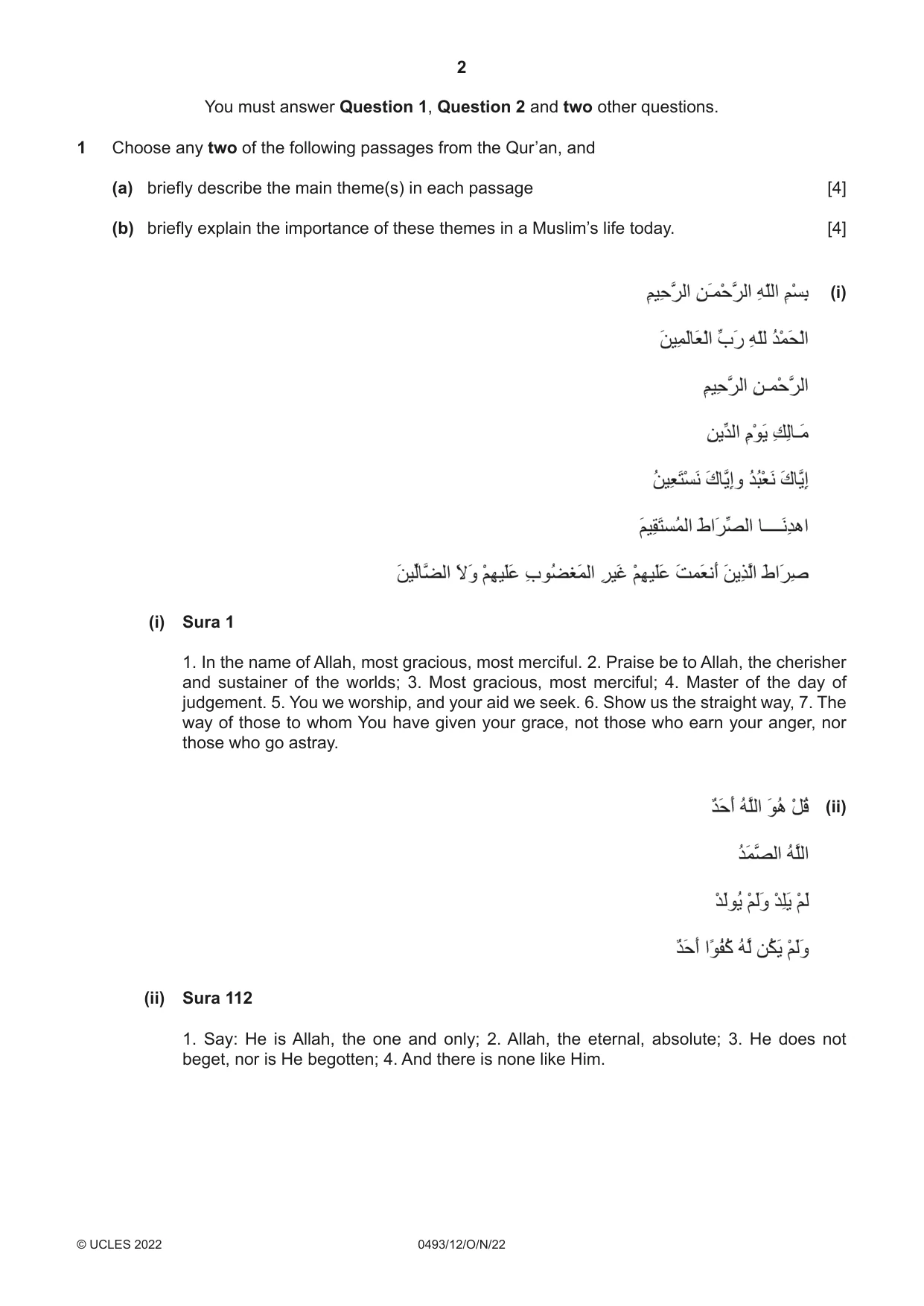
2 0493/12/O/N/22 © UCLES 2022 You must answer Question 1, Question 2 and two other questions. 1 Choose any two of the following passages from the Qur’an, and (a) briefly describe the main theme(s) in each passage [4] (b) briefly explain the importance of these themes in a Muslim’s life today. [4] (i) (i) Sura 1 1. In the name of Allah, most gracious, most merciful. 2. Praise be to Allah, the cherisher and sustainer of the worlds; 3. Most gracious, most merciful; 4. Master of the day of judgement. 5. You we worship, and your aid we seek. 6. Show us the straight way, 7. The way of those to whom You have given your grace, not those who earn your anger, nor those who go astray. (ii) (ii) Sura 112 1. Say: He is Allah, the one and only; 2. Allah, the eternal, absolute; 3. He does not beget, nor is He begotten; 4. And there is none like Him.
Question paper, page 3
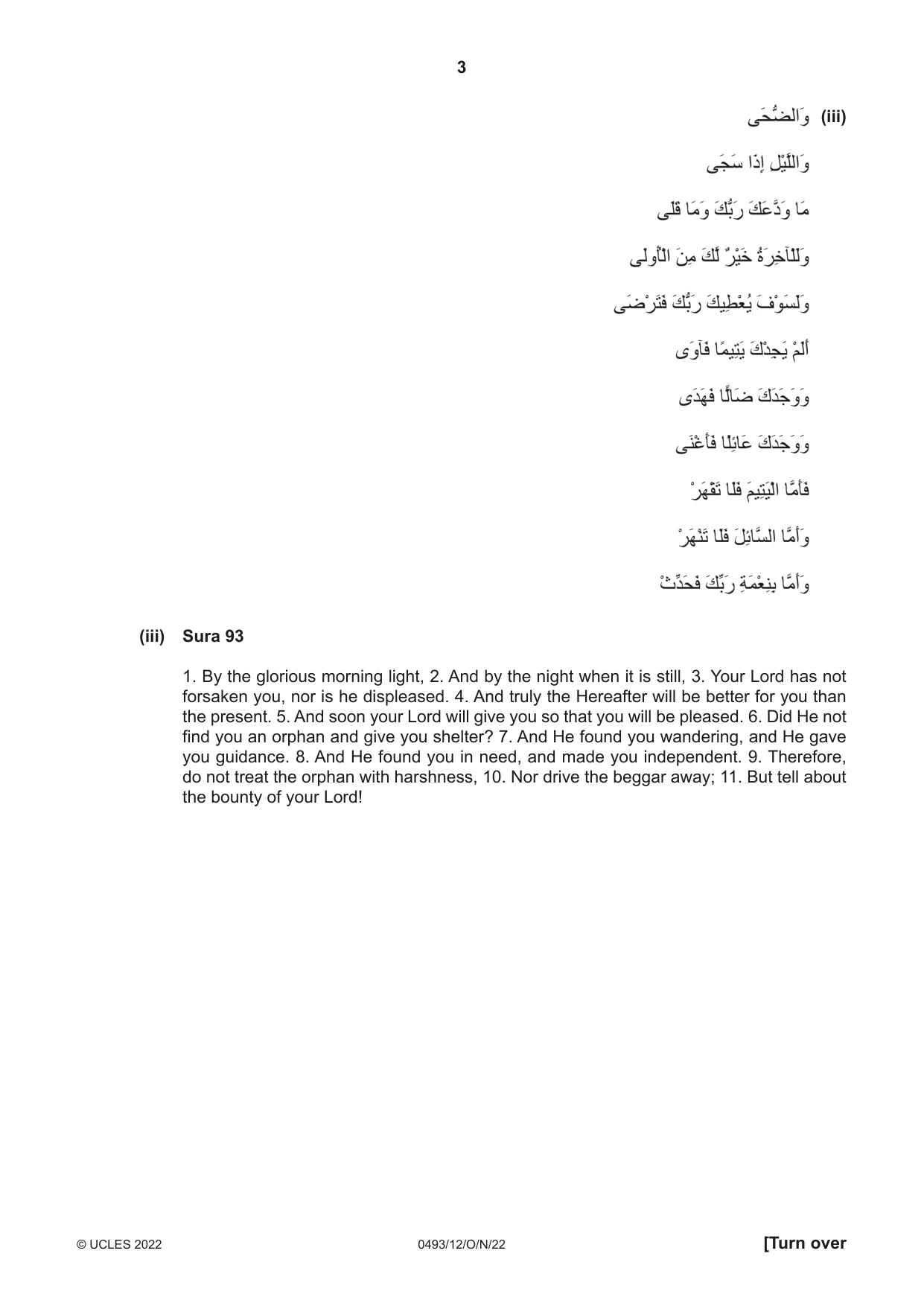
3 0493/12/O/N/22 © UCLES 2022 [Turn over (iii) (iii) Sura 93 1. By the glorious morning light, 2. And by the night when it is still, 3. Your Lord has not forsaken you, nor is he displeased. 4. And truly the Hereafter will be better for you than the present. 5. And soon your Lord will give you so that you will be pleased. 6. Did He not find you an orphan and give you shelter? 7. And He found you wandering, and He gave you guidance. 8. And He found you in need, and made you independent. 9. Therefore, do not treat the orphan with harshness, 10. Nor drive the beggar away; 11. But tell about the bounty of your Lord!
Question paper, page 4
4 0493/12/O/N/22 © UCLES 2022 … … … … … … … … … … … … … … … … … … … … … … … … … … … …
Question paper, page 5
5 0493/12/O/N/22 © UCLES 2022 [Turn over … … … … … … … … … … … … … … … … … … … … … … … … … … … …
Question paper, page 6
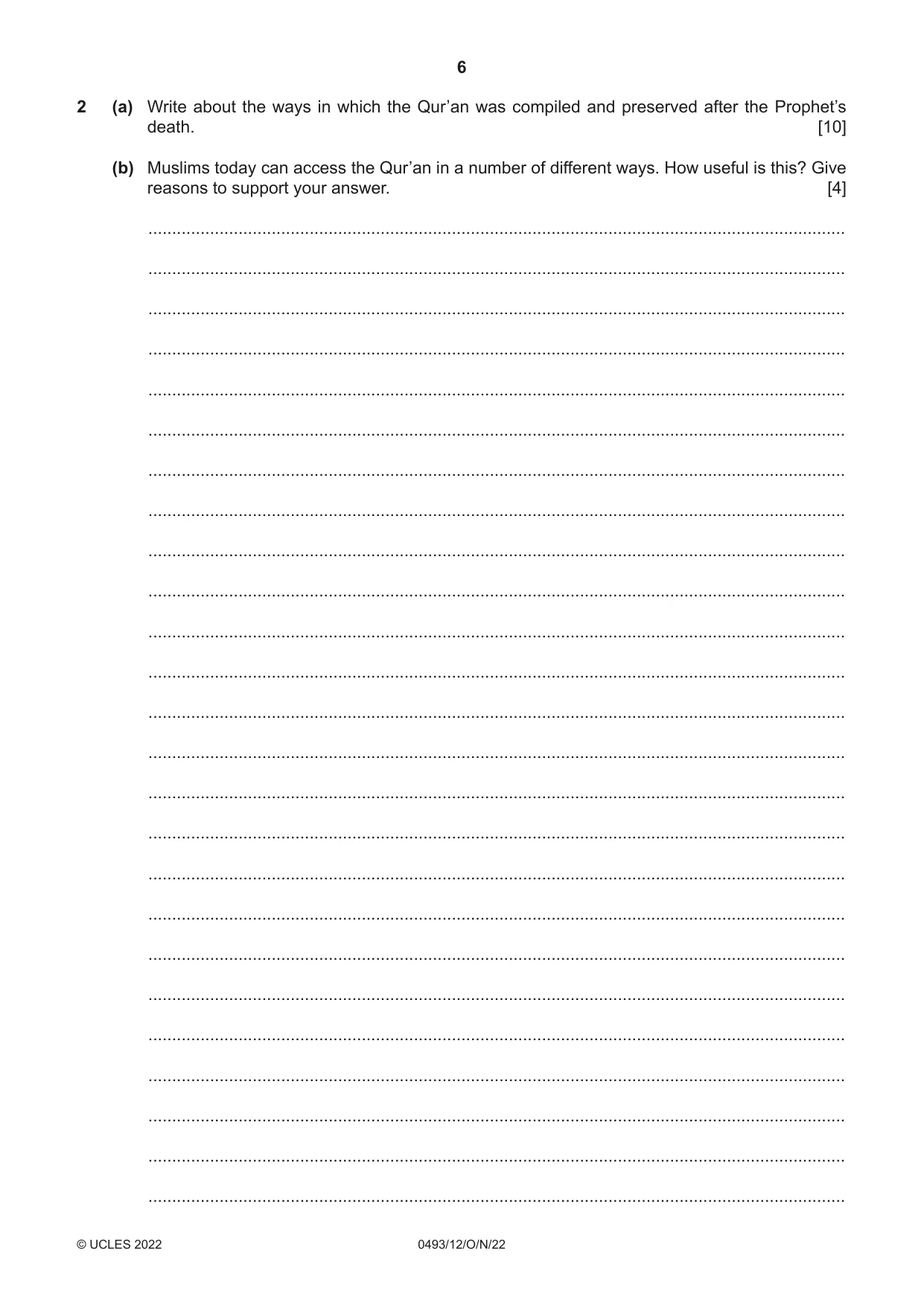
6 0493/12/O/N/22 © UCLES 2022 2 (a) Write about the ways in which the Qur’an was compiled and preserved after the Prophet’s death. [10] (b) Muslims today can access the Qur’an in a number of different ways. How useful is this? Give reasons to support your answer. [4] … … … … … … … … … … … … … … … … … … … … … … … … …
Question paper, page 7
7 0493/12/O/N/22 © UCLES 2022 [Turn over … … … … … … … … … … … … … … … … … … … … … … … … … … … …
Question paper, page 8
8 0493/12/O/N/22 © UCLES 2022 … … … … … … … … … … … … … … … … … … … … … … … … … … … …
Question paper, page 9
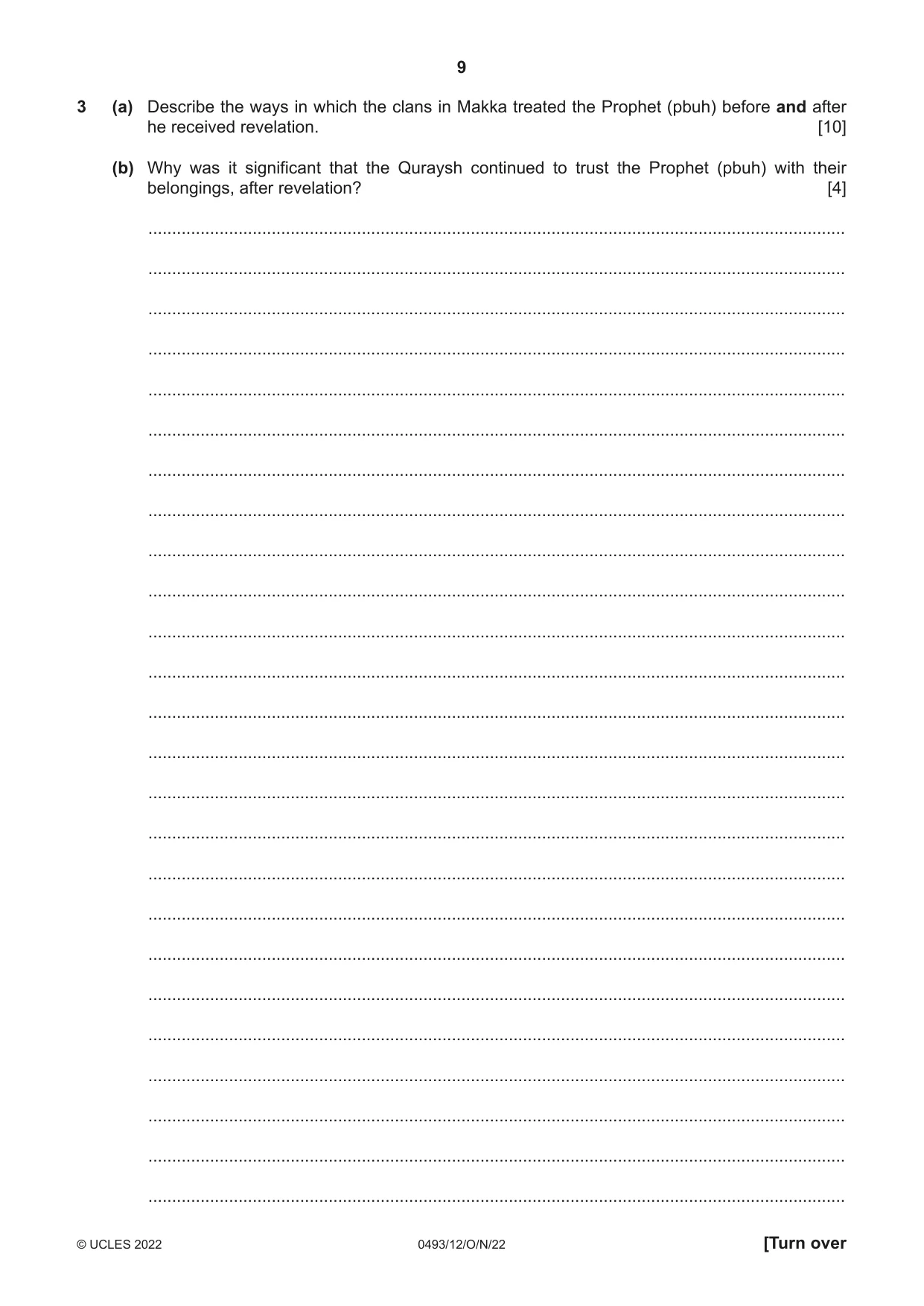
9 0493/12/O/N/22 © UCLES 2022 [Turn over 3 (a) Describe the ways in which the clans in Makka treated the Prophet (pbuh) before and after he received revelation. [10] (b) Why was it significant that the Quraysh continued to trust the Prophet (pbuh) with their belongings, after revelation? [4] … … … … … … … … … … … … … … … … … … … … … … … … …
Question paper, page 10
10 0493/12/O/N/22 © UCLES 2022 … … … … … … … … … … … … … … … … … … … … … … … … … … … …
Question paper, page 11
11 0493/12/O/N/22 © UCLES 2022 [Turn over … … … … … … … … … … … … … … … … … … … … … … … … … … … …
Question paper, page 12
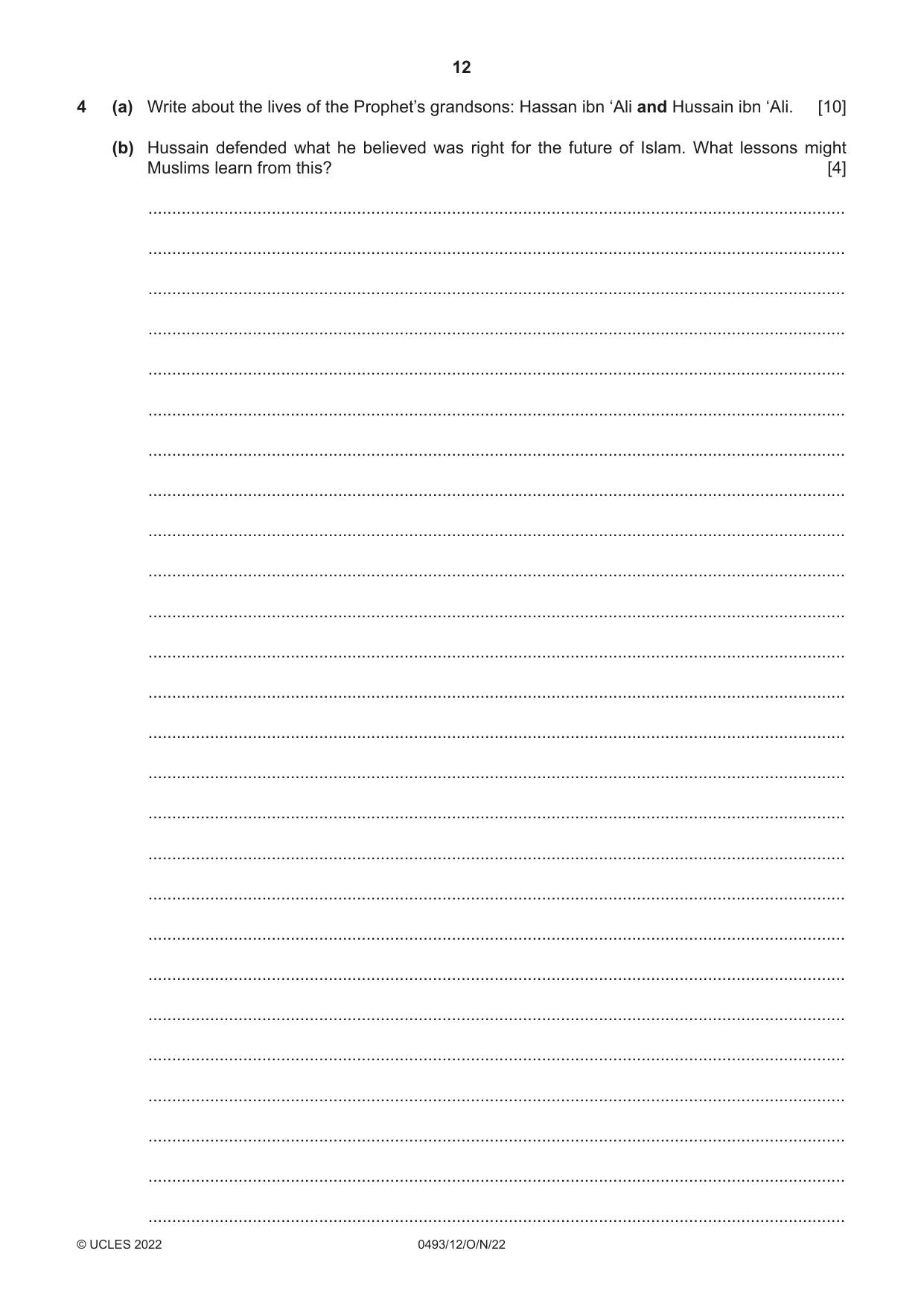
12 0493/12/O/N/22 © UCLES 2022 4 (a) Write about the lives of the Prophet’s grandsons: Hassan ibn ‘Ali and Hussain ibn ‘Ali. [10] (b) Hussain defended what he believed was right for the future of Islam. What lessons might Muslims learn from this? [4] … … … … … … … … … … … … … … … … … … … … … … … … … …
Question paper, page 13
13 0493/12/O/N/22 © UCLES 2022 [Turn over … … … … … … … … … … … … … … … … … … … … … … … … … … … …
Question paper, page 14
14 0493/12/O/N/22 © UCLES 2022 … … … … … … … … … … … … … … … … … … … … … … … … … … … …
Question paper, page 15
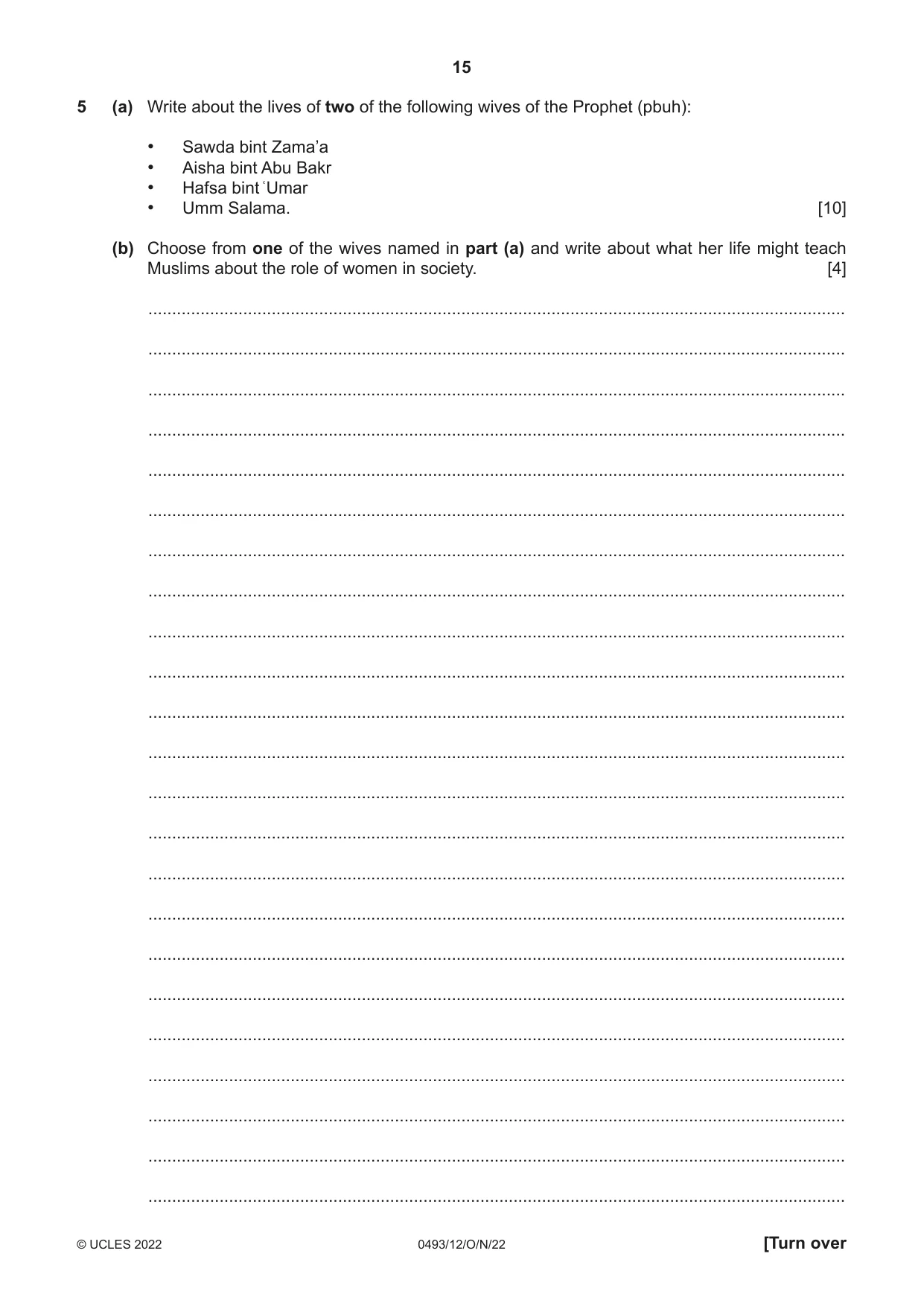
15 0493/12/O/N/22 © UCLES 2022 [Turn over 5 (a) Write about the lives of two of the following wives of the Prophet (pbuh): • Sawda bint Zama’a • Aisha bint Abu Bakr • Hafsa bint ͑ Umar • Umm Salama. [10] (b) Choose from one of the wives named in part (a) and write about what her life might teach Muslims about the role of women in society. [4] … … … … … … … … … … … … … … … … … … … … … … …
Question paper, page 16
16 0493/12/O/N/22 © UCLES 2022 … … … … … … … … … … … … … … … … … … … … … … … … … … … …
Question paper, page 17
17 0493/12/O/N/22 © UCLES 2022 … … … … … … … … … … … … … … … … … … … … … … … … … … … …
Question paper, page 18
18 0493/12/O/N/22 © UCLES 2022 BLANK PAGE
Question paper, page 19
19 0493/12/O/N/22 © UCLES 2022 BLANK PAGE
Question paper, page 20
20 0493/12/O/N/22 © UCLES 2022 Permission to reproduce items where third-party owned material protected by copyright is included has been sought and cleared where possible. Every reasonable effort has been made by the publisher (UCLES) to trace copyright holders, but if any items requiring clearance have unwittingly been included, the publisher will be pleased to make amends at the earliest possible opportunity. To avoid the issue of disclosure of answer-related information to candidates, all copyright acknowledgements are reproduced online in the Cambridge Assessment International Education Copyright Acknowledgements Booklet. This is produced for each series of examinations and is freely available to download at www.cambridgeinternational.org after the live examination series. Cambridge Assessment International Education is part of Cambridge Assessment. Cambridge Assessment is the brand name of the University of Cambridge Local Examinations Syndicate (UCLES), which is a department of the University of Cambridge. BLANK PAGE
Mark scheme, page 1
This document consists of 15 printed pages. © UCLES 2022 [Turn over Cambridge IGCSE™ ISLAMIYAT 0493/12 Paper 1 October/November 2022 MARK SCHEME Maximum Mark: 50 Published This mark scheme is published as an aid to teachers and candidates, to indicate the requirements of the examination. It shows the basis on which Examiners were instructed to award marks. It does not indicate the details of the discussions that took place at an Examiners’ meeting before marking began, which would have considered the acceptability of alternative answers. Mark schemes should be read in conjunction with the question paper and the Principal Examiner Report for Teachers. Cambridge International will not enter into discussions about these mark schemes. Cambridge International is publishing the mark schemes for the October/November 2022 series for most Cambridge IGCSE™, Cambridge International A and AS Level components and some Cambridge O Level components.
Mark scheme, page 2
0493/12 Cambridge IGCSE – Mark Scheme PUBLISHED October/November 2022 © UCLES 2022 Page 2 of 15 Generic Marking Principles These general marking principles must be applied by all examiners when marking candidate answers. They should be applied alongside the specific content of the mark scheme or generic level descriptors for a question. Each question paper and mark scheme will also comply with these marking principles. GENERIC MARKING PRINCIPLE 1: Marks must be awarded in line with: • the specific content of the mark scheme or the generic level descriptors for the question • the specific skills defined in the mark scheme or in the generic level descriptors for the question • the standard of response required by a candidate as exemplified by the standardisation scripts. GENERIC MARKING PRINCIPLE 2: Marks awarded are always whole marks (not half marks, or other fractions). GENERIC MARKING PRINCIPLE 3: Marks must be awarded positively: • marks are awarded for correct/valid answers, as defined in the mark scheme. However, credit is given for valid answers which go beyond the scope of the syllabus and mark scheme, referring to your Team Leader as appropriate • marks are awarded when candidates clearly demonstrate what they know and can do • marks are not deducted for errors • marks are not deducted for omissions • answers should only be judged on the quality of spelling, punctuation and grammar when these features are specifically assessed by the question as indicated by the mark scheme. The meaning, however, should be unambiguous. GENERIC MARKING PRINCIPLE 4: Rules must be applied consistently, e.g. in situations where candidates have not followed instructions or in the application of generic level descriptors. GENERIC MARKING PRINCIPLE 5: Marks should be awarded using the full range of marks defined in the mark scheme for the question (however; the use of the full mark range may be limited according to the quality of the candidate responses seen). GENERIC MARKING PRINCIPLE 6: Marks awarded are based solely on the requirements as defined in the mark scheme. Marks should not be awarded with grade thresholds or grade descriptors in mind.
Mark scheme, page 3
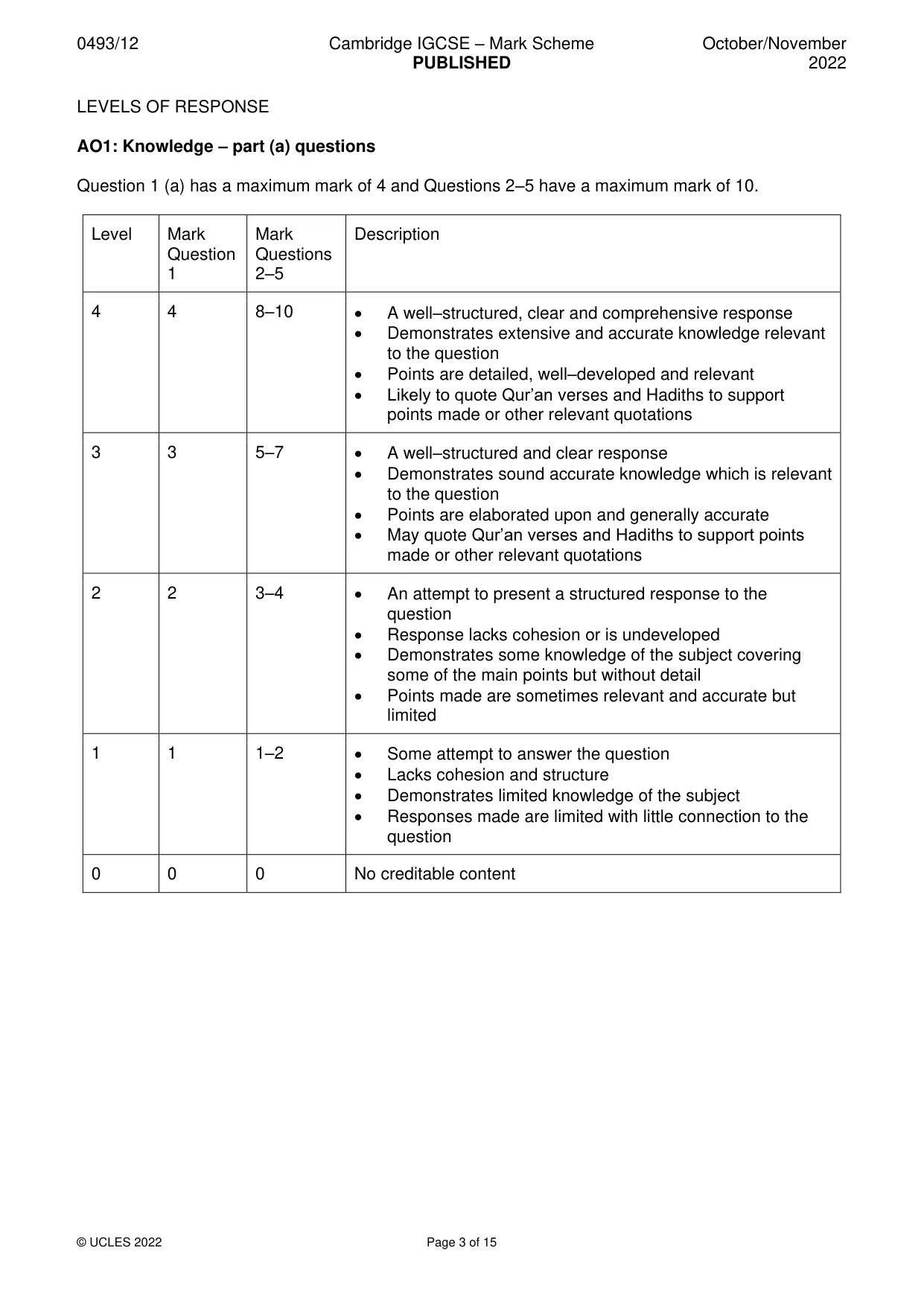
0493/12 Cambridge IGCSE – Mark Scheme PUBLISHED October/November 2022 © UCLES 2022 Page 3 of 15 LEVELS OF RESPONSE AO1: Knowledge – part (a) questions Question 1 (a) has a maximum mark of 4 and Questions 2–5 have a maximum mark of 10. Level Mark Question 1 Mark Questions 2–5 Description 4 4 8–10 • A well–structured, clear and comprehensive response • Demonstrates extensive and accurate knowledge relevant to the question • Points are detailed, well–developed and relevant • Likely to quote Qur’an verses and Hadiths to support points made or other relevant quotations 3 3 5–7 • A well–structured and clear response • Demonstrates sound accurate knowledge which is relevant to the question • Points are elaborated upon and generally accurate • May quote Qur’an verses and Hadiths to support points made or other relevant quotations 2 2 3–4 • An attempt to present a structured response to the question • Response lacks cohesion or is undeveloped • Demonstrates some knowledge of the subject covering some of the main points but without detail • Points made are sometimes relevant and accurate but limited 1 1 1–2 • Some attempt to answer the question • Lacks cohesion and structure • Demonstrates limited knowledge of the subject • Responses made are limited with little connection to the question 0 0 0 No creditable content
Mark scheme, page 4
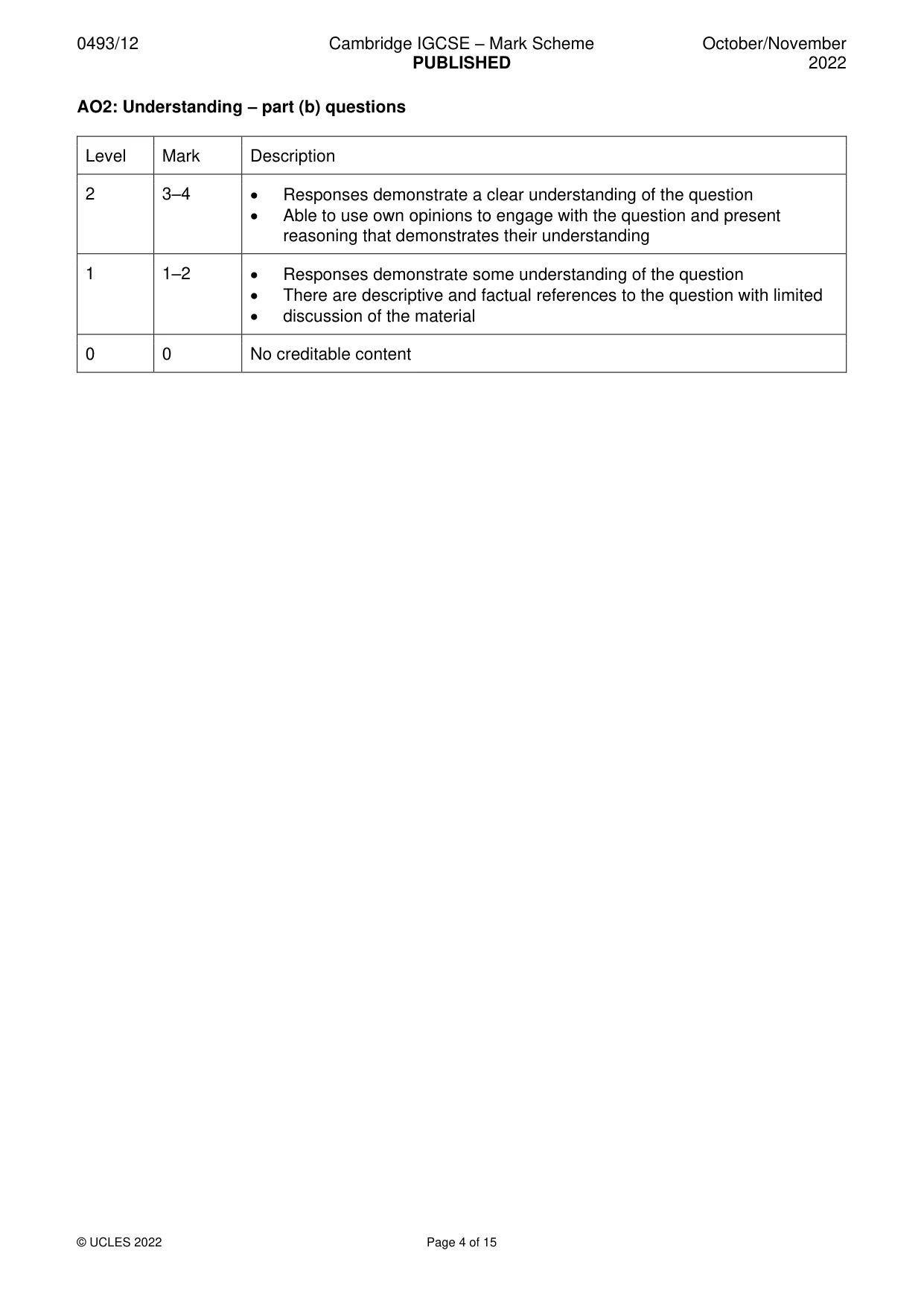
0493/12 Cambridge IGCSE – Mark Scheme PUBLISHED October/November 2022 © UCLES 2022 Page 4 of 15 AO2: Understanding – part (b) questions Level Mark Description 2 3–4 • Responses demonstrate a clear understanding of the question • Able to use own opinions to engage with the question and present reasoning that demonstrates their understanding 1 1–2 • Responses demonstrate some understanding of the question • There are descriptive and factual references to the question with limited • discussion of the material 0 0 No creditable content
Mark scheme, page 5
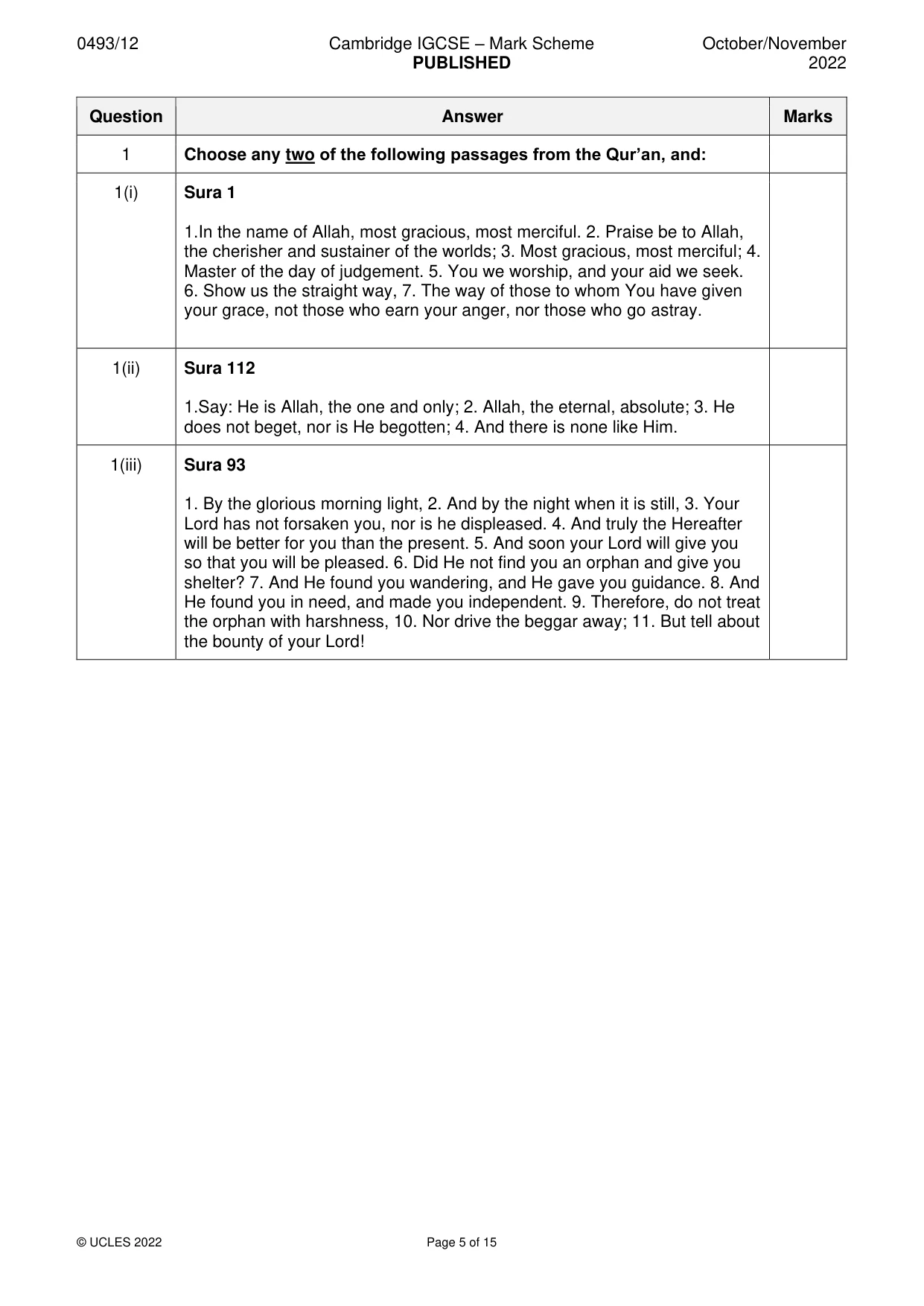
0493/12 Cambridge IGCSE – Mark Scheme PUBLISHED October/November 2022 © UCLES 2022 Page 5 of 15 Question Answer Marks 1 Choose any two of the following passages from the Qur’an, and: 1(i) Sura 1 1.In the name of Allah, most gracious, most merciful. 2. Praise be to Allah, the cherisher and sustainer of the worlds; 3. Most gracious, most merciful; 4. Master of the day of judgement. 5. You we worship, and your aid we seek. 6. Show us the straight way, 7. The way of those to whom You have given your grace, not those who earn your anger, nor those who go astray. 1(ii) Sura 112 1.Say: He is Allah, the one and only; 2. Allah, the eternal, absolute; 3. He does not beget, nor is He begotten; 4. And there is none like Him. 1(iii) Sura 93 1. By the glorious morning light, 2. And by the night when it is still, 3. Your Lord has not forsaken you, nor is he displeased. 4. And truly the Hereafter will be better for you than the present. 5. And soon your Lord will give you so that you will be pleased. 6. Did He not find you an orphan and give you shelter? 7. And He found you wandering, and He gave you guidance. 8. And He found you in need, and made you independent. 9. Therefore, do not treat the orphan with harshness, 10. Nor drive the beggar away; 11. But tell about the bounty of your Lord!
Mark scheme, page 6
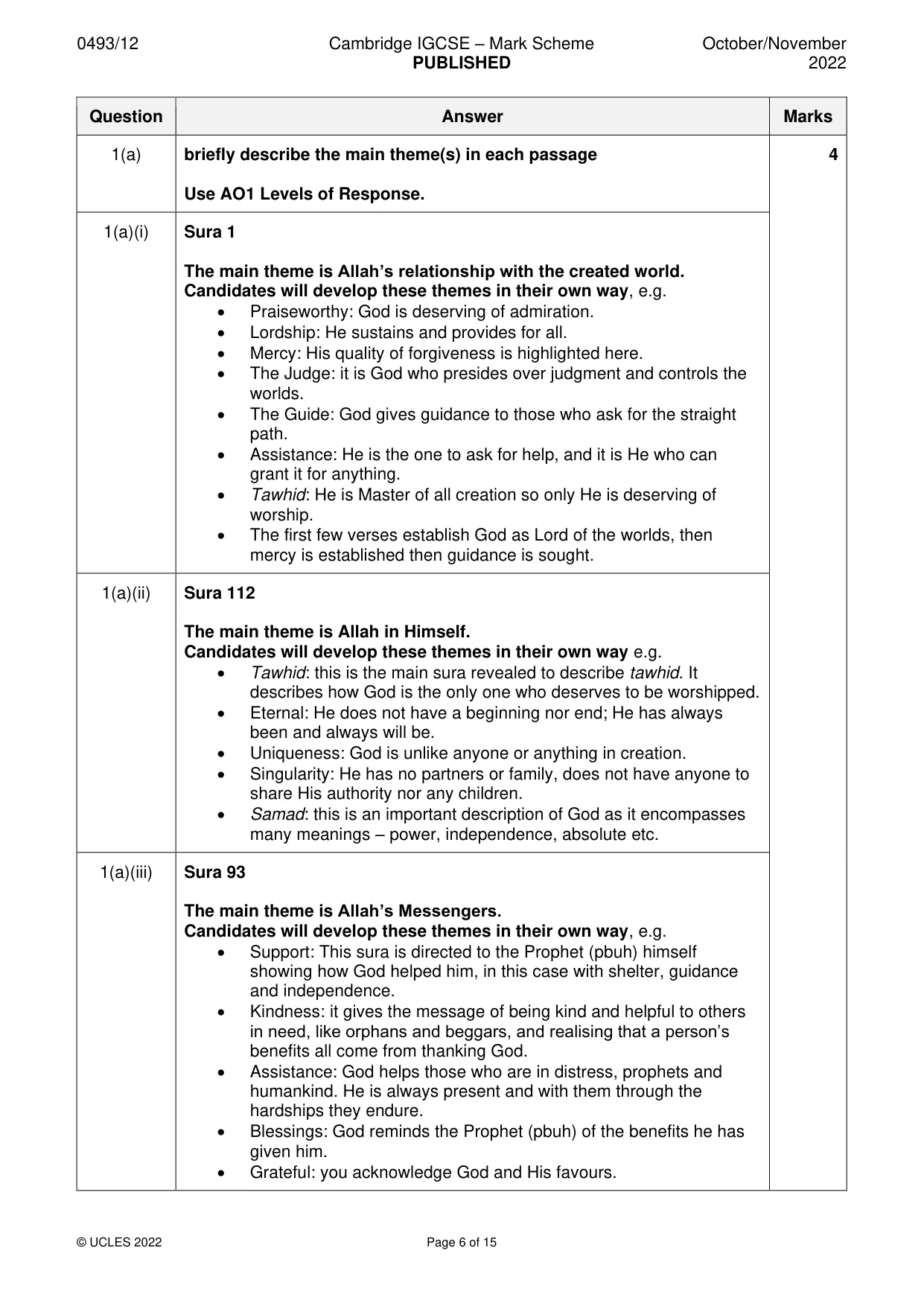
0493/12 Cambridge IGCSE – Mark Scheme PUBLISHED October/November 2022 © UCLES 2022 Page 6 of 15 Question Answer Marks 1(a) briefly describe the main theme(s) in each passage Use AO1 Levels of Response. 4 1(a)(i) Sura 1 The main theme is Allah’s relationship with the created world. Candidates will develop these themes in their own way, e.g. • Praiseworthy: God is deserving of admiration. • Lordship: He sustains and provides for all. • Mercy: His quality of forgiveness is highlighted here. • The Judge: it is God who presides over judgment and controls the worlds. • The Guide: God gives guidance to those who ask for the straight path. • Assistance: He is the one to ask for help, and it is He who can grant it for anything. • Tawhid: He is Master of all creation so only He is deserving of worship. • The first few verses establish God as Lord of the worlds, then mercy is established then guidance is sought. 1(a)(ii) Sura 112 The main theme is Allah in Himself. Candidates will develop these themes in their own way e.g. • Tawhid: this is the main sura revealed to describe tawhid. It describes how God is the only one who deserves to be worshipped. • Eternal: He does not have a beginning nor end; He has always been and always will be. • Uniqueness: God is unlike anyone or anything in creation. • Singularity: He has no partners or family, does not have anyone to share His authority nor any children. • Samad: this is an important description of God as it encompasses many meanings – power, independence, absolute etc. 1(a)(iii) Sura 93 The main theme is Allah’s Messengers. Candidates will develop these themes in their own way, e.g. • Support: This sura is directed to the Prophet (pbuh) himself showing how God helped him, in this case with shelter, guidance and independence. • Kindness: it gives the message of being kind and helpful to others in need, like orphans and beggars, and realising that a person’s benefits all come from thanking God. • Assistance: God helps those who are in distress, prophets and humankind. He is always present and with them through the hardships they endure. • Blessings: God reminds the Prophet (pbuh) of the benefits he has given him. • Grateful: you acknowledge God and His favours.
Mark scheme, page 7
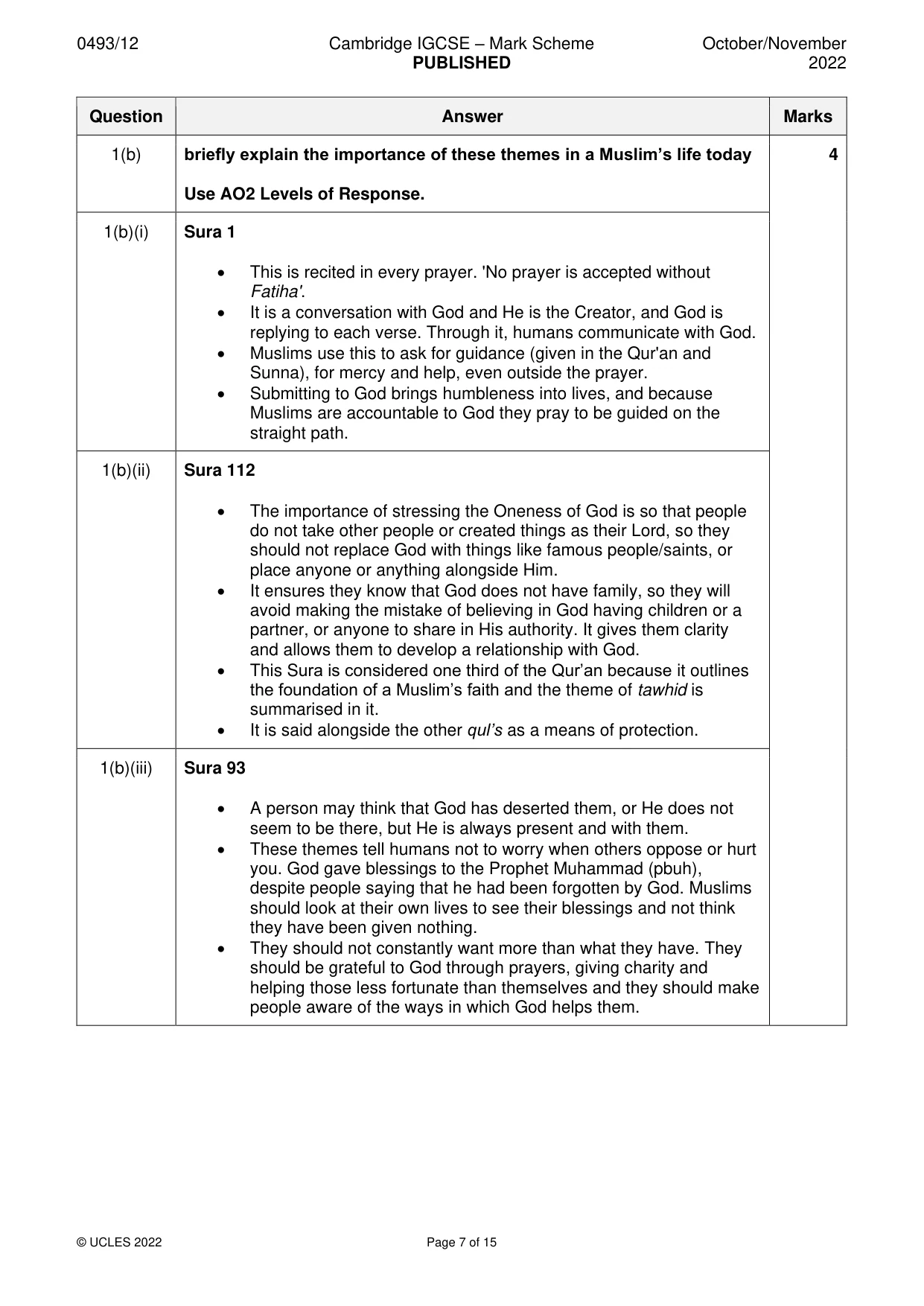
0493/12 Cambridge IGCSE – Mark Scheme PUBLISHED October/November 2022 © UCLES 2022 Page 7 of 15 Question Answer Marks 1(b) briefly explain the importance of these themes in a Muslim’s life today Use AO2 Levels of Response. 4 1(b)(i) Sura 1 • This is recited in every prayer. 'No prayer is accepted without Fatiha'. • It is a conversation with God and He is the Creator, and God is replying to each verse. Through it, humans communicate with God. • Muslims use this to ask for guidance (given in the Qur'an and Sunna), for mercy and help, even outside the prayer. • Submitting to God brings humbleness into lives, and because Muslims are accountable to God they pray to be guided on the straight path. 1(b)(ii) Sura 112 • The importance of stressing the Oneness of God is so that people do not take other people or created things as their Lord, so they should not replace God with things like famous people/saints, or place anyone or anything alongside Him. • It ensures they know that God does not have family, so they will avoid making the mistake of believing in God having children or a partner, or anyone to share in His authority. It gives them clarity and allows them to develop a relationship with God. • This Sura is considered one third of the Qur’an because it outlines the foundation of a Muslim’s faith and the theme of tawhid is summarised in it. • It is said alongside the other qul’s as a means of protection. 1(b)(iii) Sura 93 • A person may think that God has deserted them, or He does not seem to be there, but He is always present and with them. • These themes tell humans not to worry when others oppose or hurt you. God gave blessings to the Prophet Muhammad (pbuh), despite people saying that he had been forgotten by God. Muslims should look at their own lives to see their blessings and not think they have been given nothing. • They should not constantly want more than what they have. They should be grateful to God through prayers, giving charity and helping those less fortunate than themselves and they should make people aware of the ways in which God helps them.
Mark scheme, page 8
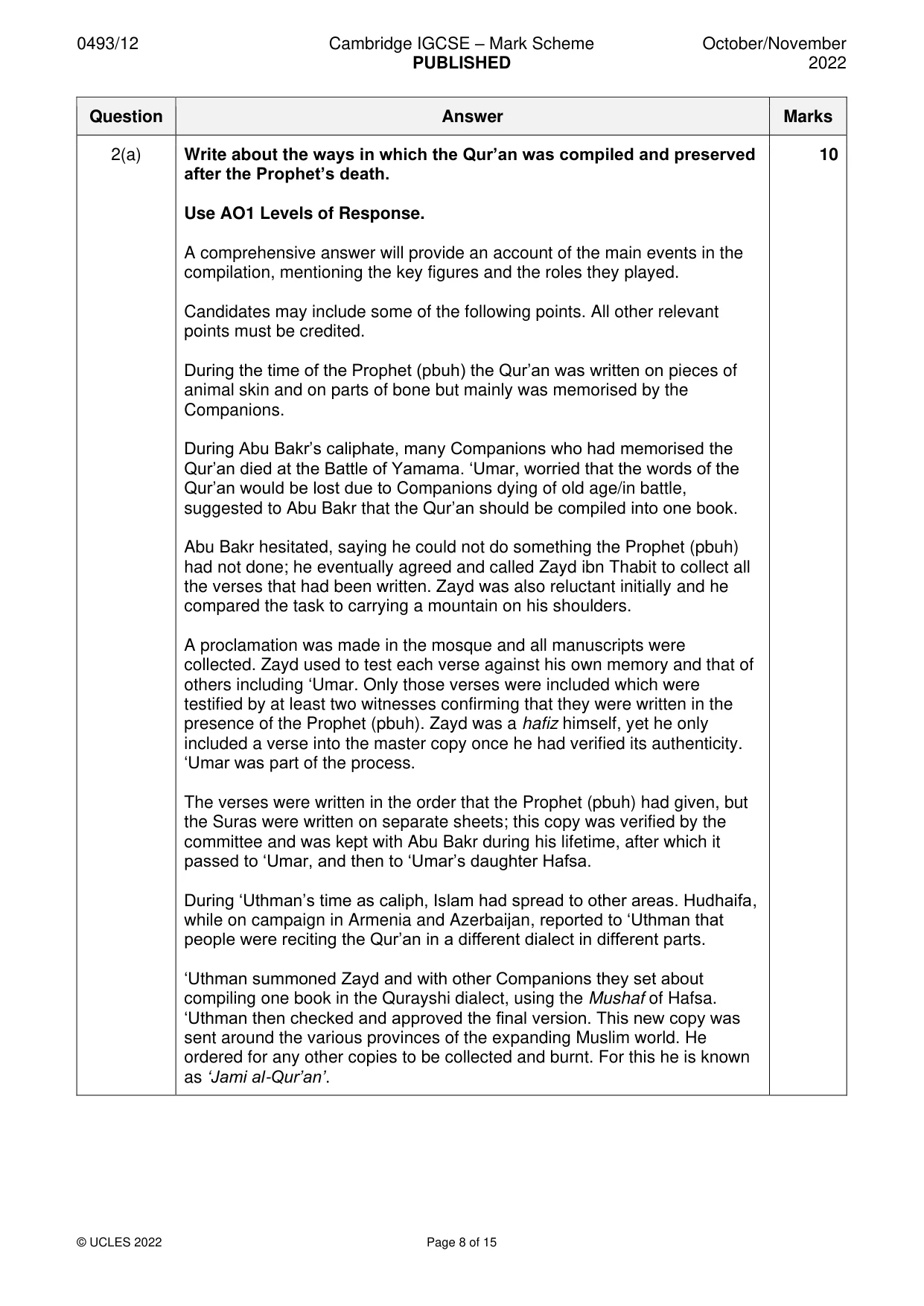
0493/12 Cambridge IGCSE – Mark Scheme PUBLISHED October/November 2022 © UCLES 2022 Page 8 of 15 Question Answer Marks 2(a) Write about the ways in which the Qur’an was compiled and preserved after the Prophet’s death. Use AO1 Levels of Response. A comprehensive answer will provide an account of the main events in the compilation, mentioning the key figures and the roles they played. Candidates may include some of the following points. All other relevant points must be credited. During the time of the Prophet (pbuh) the Qur’an was written on pieces of animal skin and on parts of bone but mainly was memorised by the Companions. During Abu Bakr’s caliphate, many Companions who had memorised the Qur’an died at the Battle of Yamama. ‘Umar, worried that the words of the Qur’an would be lost due to Companions dying of old age/in battle, suggested to Abu Bakr that the Qur’an should be compiled into one book. Abu Bakr hesitated, saying he could not do something the Prophet (pbuh) had not done; he eventually agreed and called Zayd ibn Thabit to collect all the verses that had been written. Zayd was also reluctant initially and he compared the task to carrying a mountain on his shoulders. A proclamation was made in the mosque and all manuscripts were collected. Zayd used to test each verse against his own memory and that of others including ‘Umar. Only those verses were included which were testified by at least two witnesses confirming that they were written in the presence of the Prophet (pbuh). Zayd was a hafiz himself, yet he only included a verse into the master copy once he had verified its authenticity. ‘Umar was part of the process. The verses were written in the order that the Prophet (pbuh) had given, but the Suras were written on separate sheets; this copy was verified by the committee and was kept with Abu Bakr during his lifetime, after which it passed to ‘Umar, and then to ‘Umar’s daughter Hafsa. During ‘Uthman’s time as caliph, Islam had spread to other areas. Hudhaifa, while on campaign in Armenia and Azerbaijan, reported to ‘Uthman that people were reciting the Qur’an in a different dialect in different parts. ‘Uthman summoned Zayd and with other Companions they set about compiling one book in the Qurayshi dialect, using the Mushaf of Hafsa. ‘Uthman then checked and approved the final version. This new copy was sent around the various provinces of the expanding Muslim world. He ordered for any other copies to be collected and burnt. For this he is known as ‘Jami al-Qur’an’. 10
Mark scheme, page 9
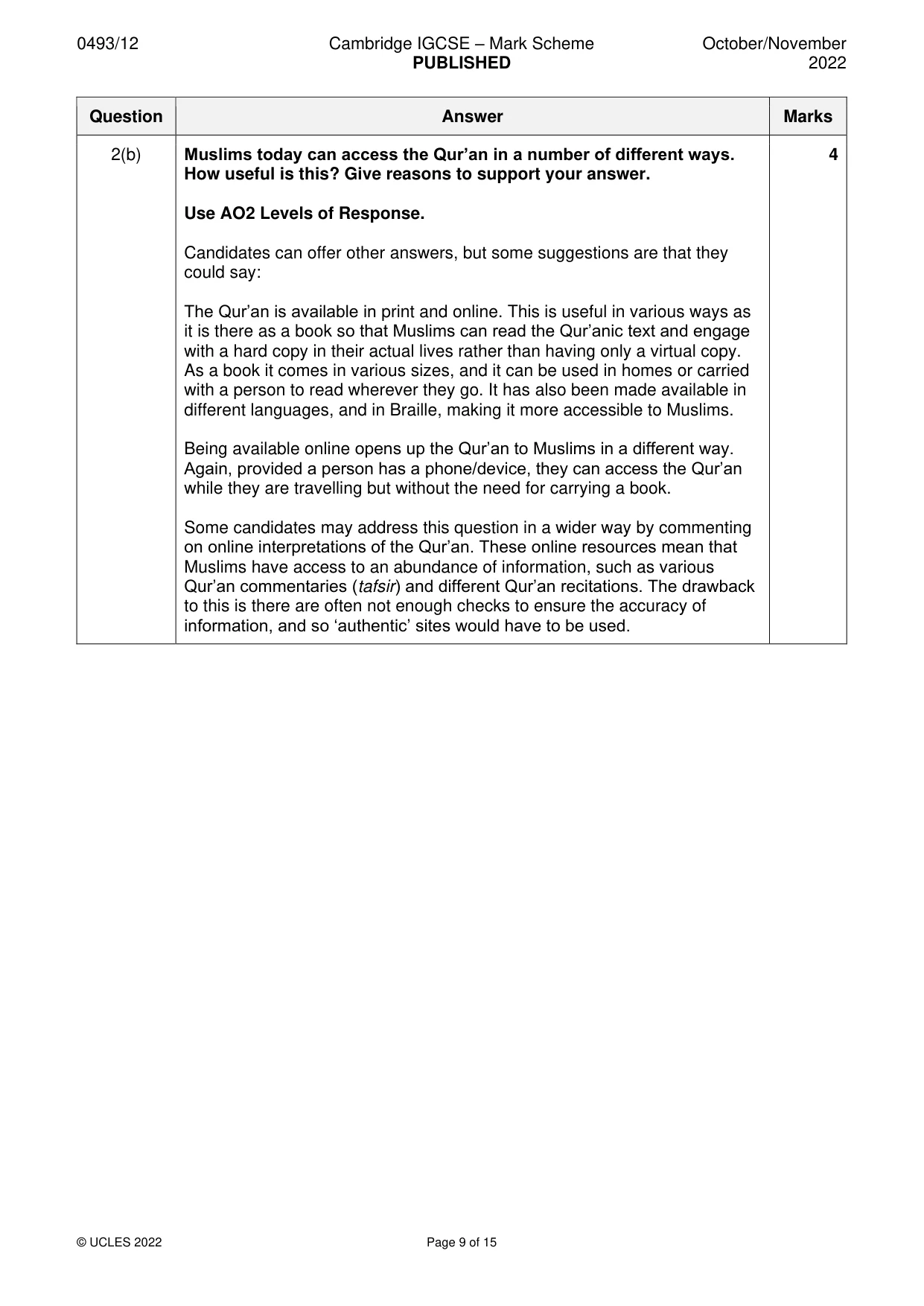
0493/12 Cambridge IGCSE – Mark Scheme PUBLISHED October/November 2022 © UCLES 2022 Page 9 of 15 Question Answer Marks 2(b) Muslims today can access the Qur’an in a number of different ways. How useful is this? Give reasons to support your answer. Use AO2 Levels of Response. Candidates can offer other answers, but some suggestions are that they could say: The Qur’an is available in print and online. This is useful in various ways as it is there as a book so that Muslims can read the Qur’anic text and engage with a hard copy in their actual lives rather than having only a virtual copy. As a book it comes in various sizes, and it can be used in homes or carried with a person to read wherever they go. It has also been made available in different languages, and in Braille, making it more accessible to Muslims. Being available online opens up the Qur’an to Muslims in a different way. Again, provided a person has a phone/device, they can access the Qur’an while they are travelling but without the need for carrying a book. Some candidates may address this question in a wider way by commenting on online interpretations of the Qur’an. These online resources mean that Muslims have access to an abundance of information, such as various Qur’an commentaries (tafsir) and different Qur’an recitations. The drawback to this is there are often not enough checks to ensure the accuracy of information, and so ‘authentic’ sites would have to be used. 4
Mark scheme, page 10
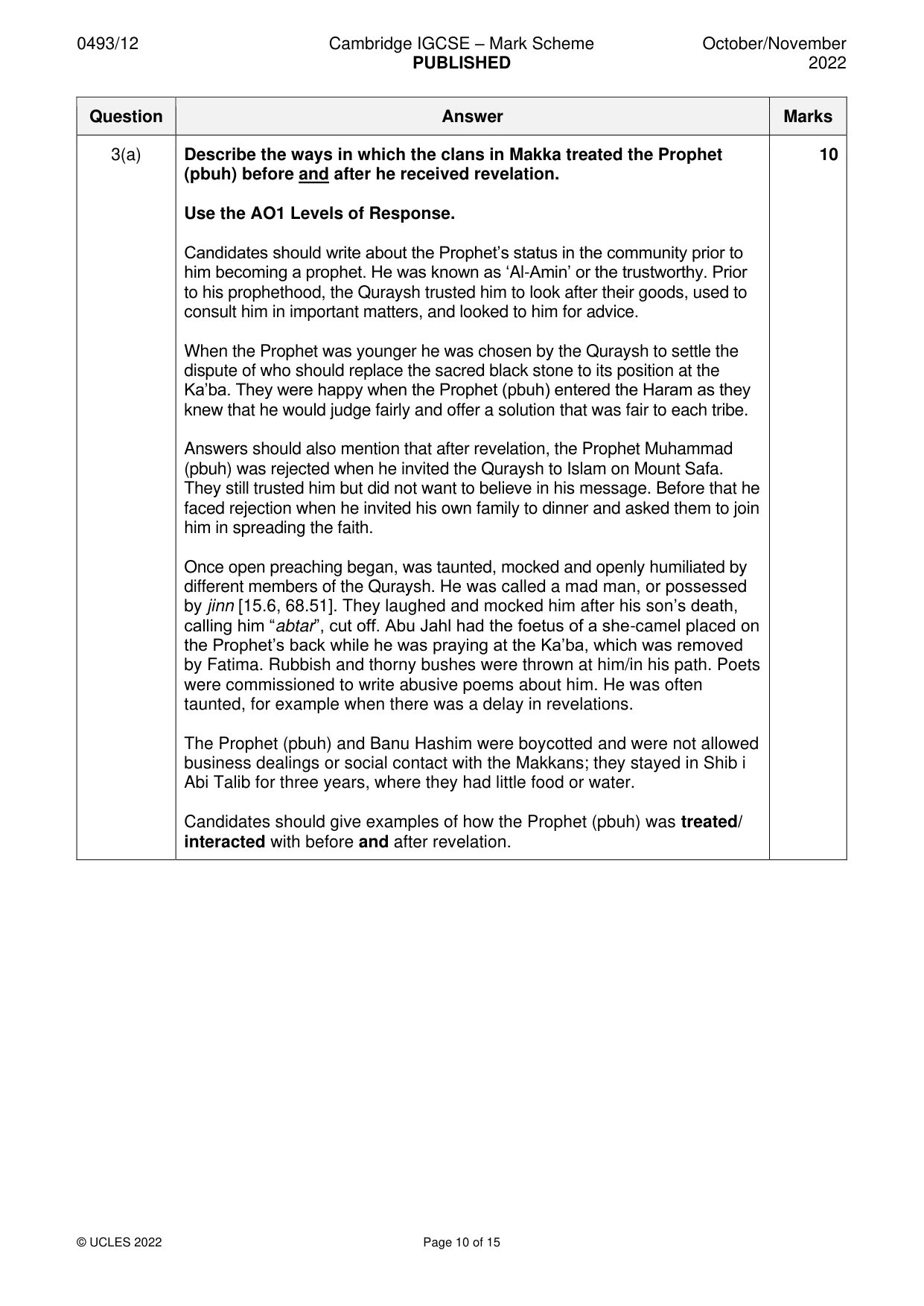
0493/12 Cambridge IGCSE – Mark Scheme PUBLISHED October/November 2022 © UCLES 2022 Page 10 of 15 Question Answer Marks 3(a) Describe the ways in which the clans in Makka treated the Prophet (pbuh) before and after he received revelation. Use the AO1 Levels of Response. Candidates should write about the Prophet’s status in the community prior to him becoming a prophet. He was known as ‘Al-Amin’ or the trustworthy. Prior to his prophethood, the Quraysh trusted him to look after their goods, used to consult him in important matters, and looked to him for advice. When the Prophet was younger he was chosen by the Quraysh to settle the dispute of who should replace the sacred black stone to its position at the Ka’ba. They were happy when the Prophet (pbuh) entered the Haram as they knew that he would judge fairly and offer a solution that was fair to each tribe. Answers should also mention that after revelation, the Prophet Muhammad (pbuh) was rejected when he invited the Quraysh to Islam on Mount Safa. They still trusted him but did not want to believe in his message. Before that he faced rejection when he invited his own family to dinner and asked them to join him in spreading the faith. Once open preaching began, was taunted, mocked and openly humiliated by different members of the Quraysh. He was called a mad man, or possessed by jinn [15.6, 68.51]. They laughed and mocked him after his son’s death, calling him “abtar”, cut off. Abu Jahl had the foetus of a she-camel placed on the Prophet’s back while he was praying at the Ka’ba, which was removed by Fatima. Rubbish and thorny bushes were thrown at him/in his path. Poets were commissioned to write abusive poems about him. He was often taunted, for example when there was a delay in revelations. The Prophet (pbuh) and Banu Hashim were boycotted and were not allowed business dealings or social contact with the Makkans; they stayed in Shib i Abi Talib for three years, where they had little food or water. Candidates should give examples of how the Prophet (pbuh) was treated/ interacted with before and after revelation. 10
Mark scheme, page 11
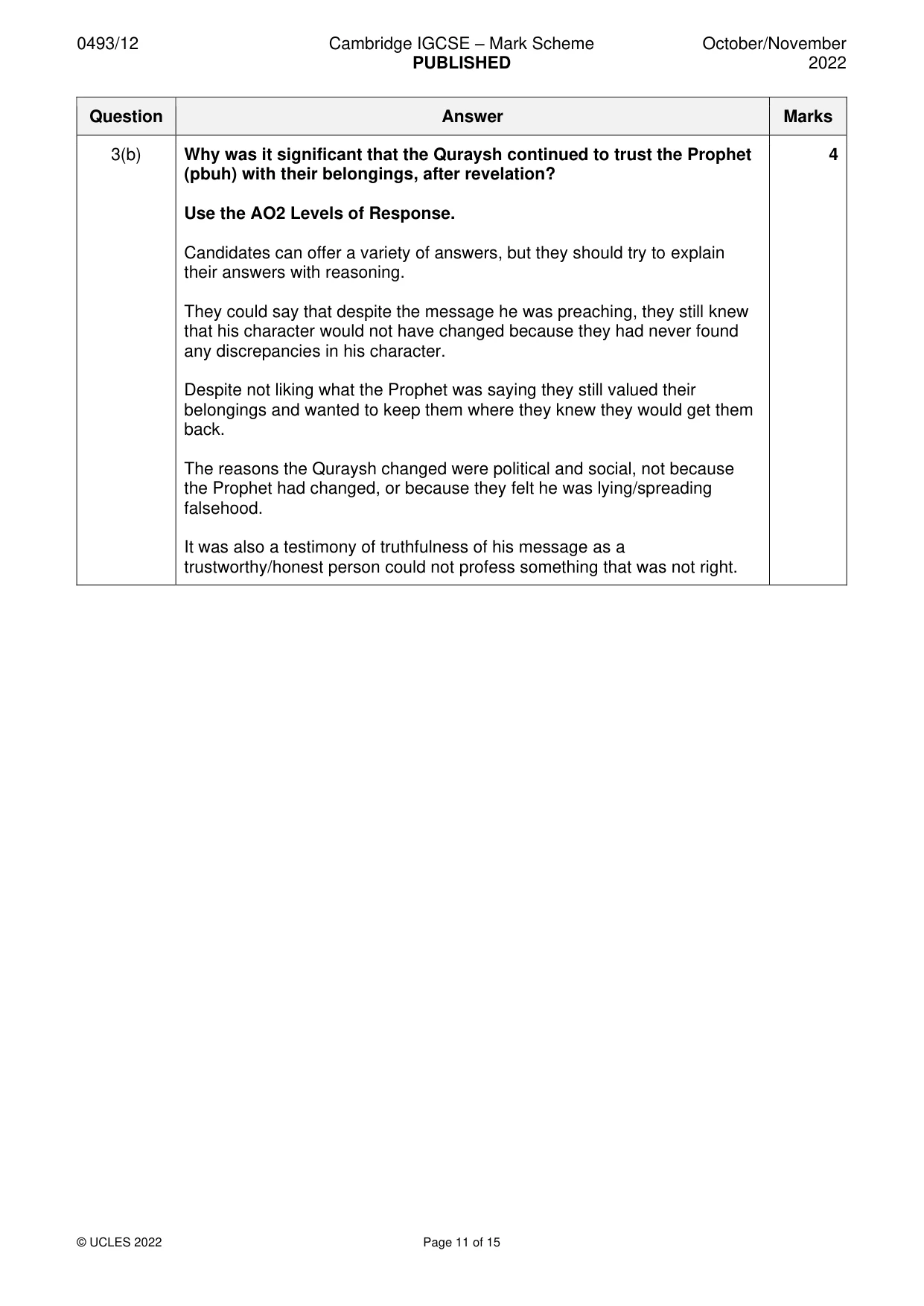
0493/12 Cambridge IGCSE – Mark Scheme PUBLISHED October/November 2022 © UCLES 2022 Page 11 of 15 Question Answer Marks 3(b) Why was it significant that the Quraysh continued to trust the Prophet (pbuh) with their belongings, after revelation? Use the AO2 Levels of Response. Candidates can offer a variety of answers, but they should try to explain their answers with reasoning. They could say that despite the message he was preaching, they still knew that his character would not have changed because they had never found any discrepancies in his character. Despite not liking what the Prophet was saying they still valued their belongings and wanted to keep them where they knew they would get them back. The reasons the Quraysh changed were political and social, not because the Prophet had changed, or because they felt he was lying/spreading falsehood. It was also a testimony of truthfulness of his message as a trustworthy/honest person could not profess something that was not right. 4
Mark scheme, page 12
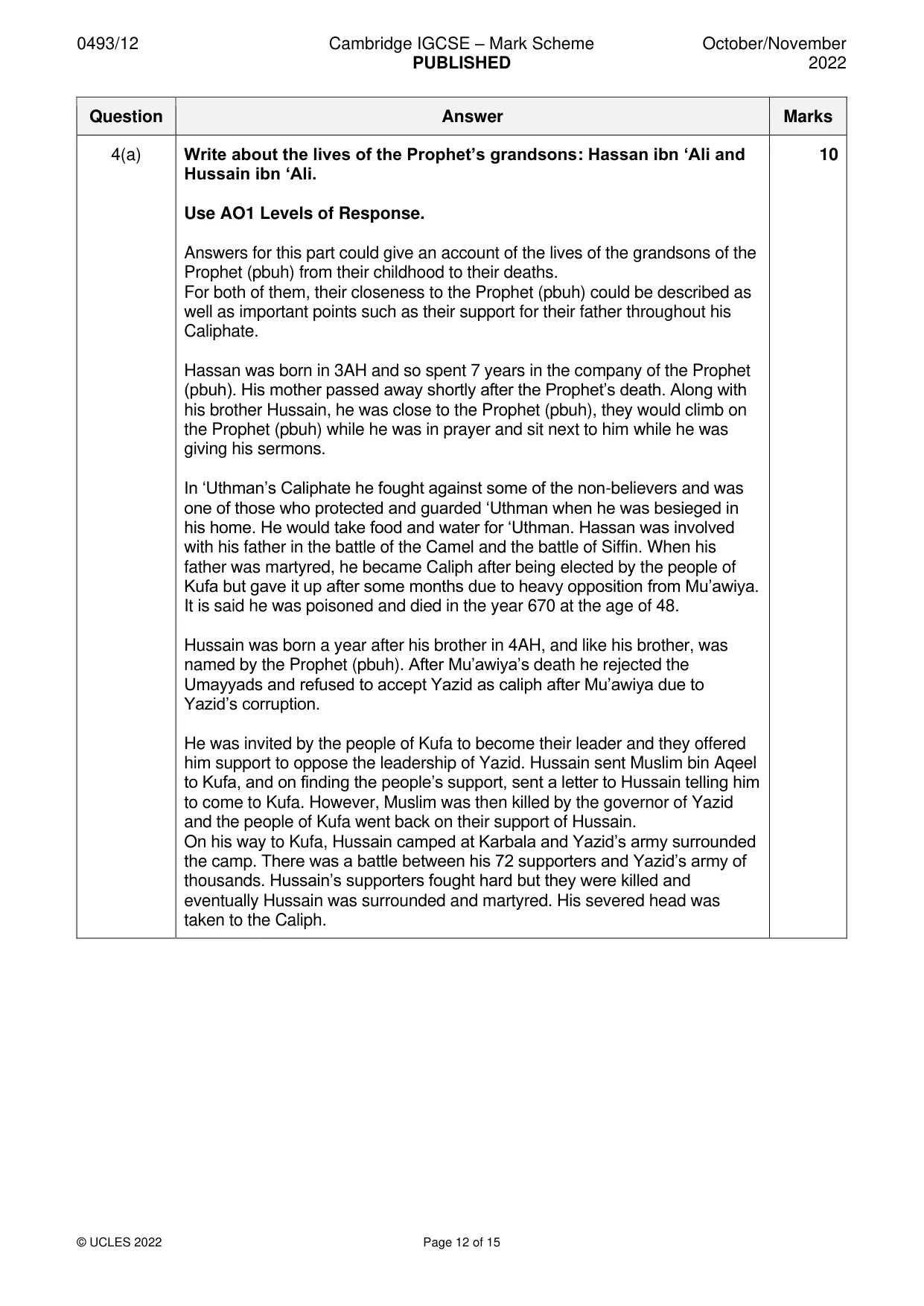
0493/12 Cambridge IGCSE – Mark Scheme PUBLISHED October/November 2022 © UCLES 2022 Page 12 of 15 Question Answer Marks 4(a) Write about the lives of the Prophet’s grandsons: Hassan ibn ‘Ali and Hussain ibn ‘Ali. Use AO1 Levels of Response. Answers for this part could give an account of the lives of the grandsons of the Prophet (pbuh) from their childhood to their deaths. For both of them, their closeness to the Prophet (pbuh) could be described as well as important points such as their support for their father throughout his Caliphate. Hassan was born in 3AH and so spent 7 years in the company of the Prophet (pbuh). His mother passed away shortly after the Prophet’s death. Along with his brother Hussain, he was close to the Prophet (pbuh), they would climb on the Prophet (pbuh) while he was in prayer and sit next to him while he was giving his sermons. In ‘Uthman’s Caliphate he fought against some of the non-believers and was one of those who protected and guarded ‘Uthman when he was besieged in his home. He would take food and water for ‘Uthman. Hassan was involved with his father in the battle of the Camel and the battle of Siffin. When his father was martyred, he became Caliph after being elected by the people of Kufa but gave it up after some months due to heavy opposition from Mu’awiya. It is said he was poisoned and died in the year 670 at the age of 48. Hussain was born a year after his brother in 4AH, and like his brother, was named by the Prophet (pbuh). After Mu’awiya’s death he rejected the Umayyads and refused to accept Yazid as caliph after Mu’awiya due to Yazid’s corruption. He was invited by the people of Kufa to become their leader and they offered him support to oppose the leadership of Yazid. Hussain sent Muslim bin Aqeel to Kufa, and on finding the people’s support, sent a letter to Hussain telling him to come to Kufa. However, Muslim was then killed by the governor of Yazid and the people of Kufa went back on their support of Hussain. On his way to Kufa, Hussain camped at Karbala and Yazid’s army surrounded the camp. There was a battle between his 72 supporters and Yazid’s army of thousands. Hussain’s supporters fought hard but they were killed and eventually Hussain was surrounded and martyred. His severed head was taken to the Caliph. 10
Mark scheme, page 13
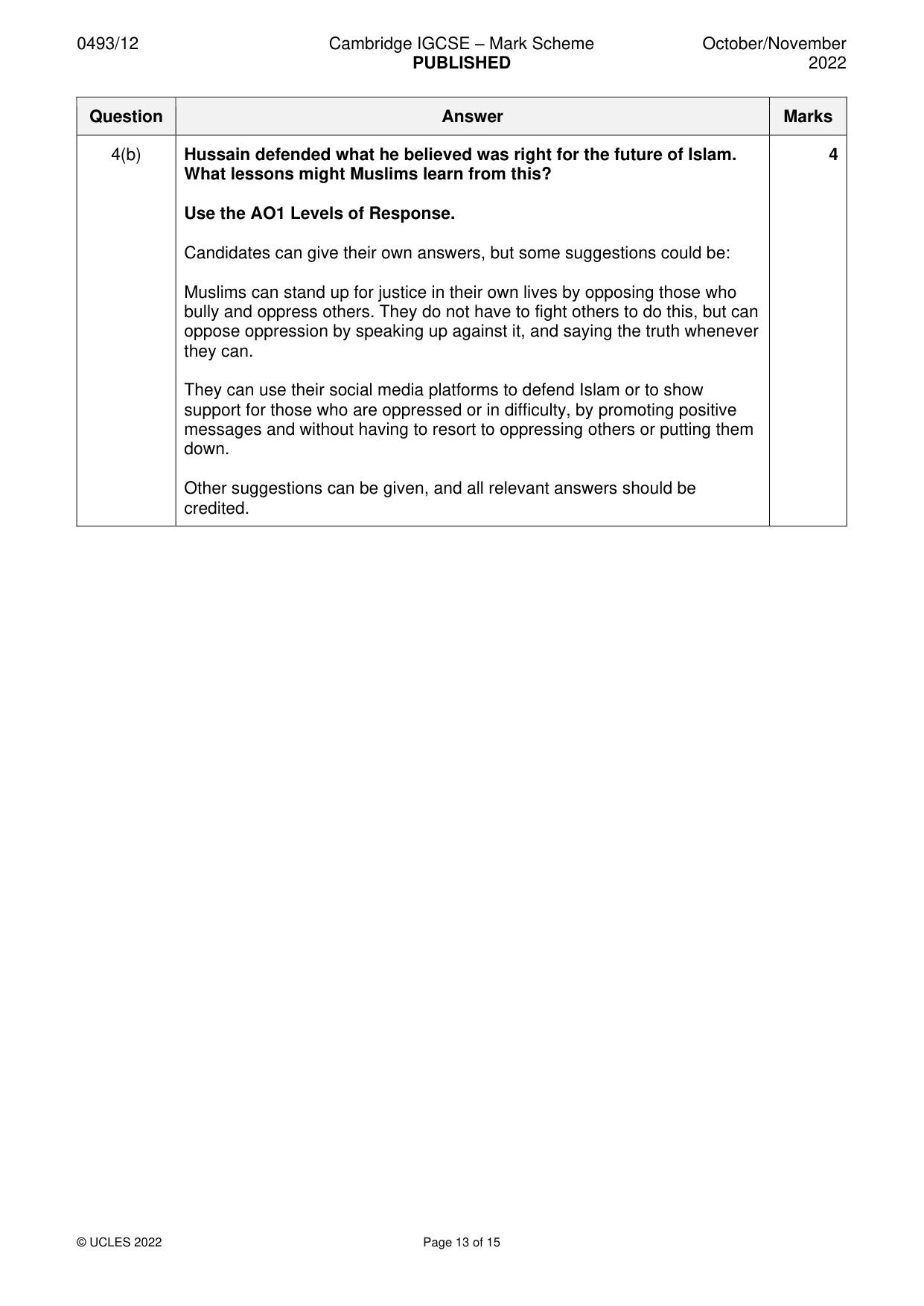
0493/12 Cambridge IGCSE – Mark Scheme PUBLISHED October/November 2022 © UCLES 2022 Page 13 of 15 Question Answer Marks 4(b) Hussain defended what he believed was right for the future of Islam. What lessons might Muslims learn from this? Use the AO1 Levels of Response. Candidates can give their own answers, but some suggestions could be: Muslims can stand up for justice in their own lives by opposing those who bully and oppress others. They do not have to fight others to do this, but can oppose oppression by speaking up against it, and saying the truth whenever they can. They can use their social media platforms to defend Islam or to show support for those who are oppressed or in difficulty, by promoting positive messages and without having to resort to oppressing others or putting them down. Other suggestions can be given, and all relevant answers should be credited. 4
Mark scheme, page 14
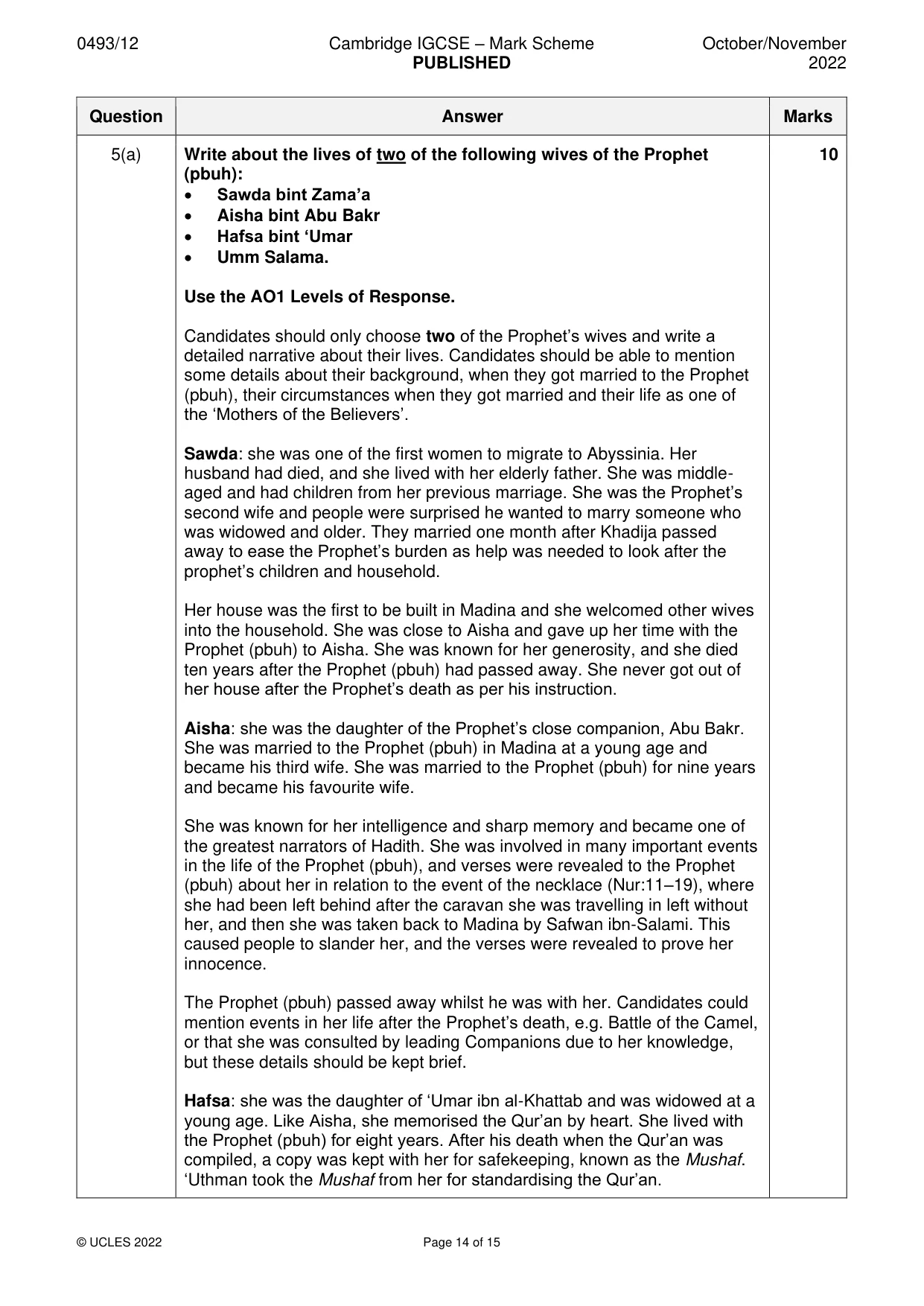
0493/12 Cambridge IGCSE – Mark Scheme PUBLISHED October/November 2022 © UCLES 2022 Page 14 of 15 Question Answer Marks 5(a) Write about the lives of two of the following wives of the Prophet (pbuh): • Sawda bint Zama’a • Aisha bint Abu Bakr • Hafsa bint ‘Umar • Umm Salama. Use the AO1 Levels of Response. Candidates should only choose two of the Prophet’s wives and write a detailed narrative about their lives. Candidates should be able to mention some details about their background, when they got married to the Prophet (pbuh), their circumstances when they got married and their life as one of the ‘Mothers of the Believers’. Sawda: she was one of the first women to migrate to Abyssinia. Her husband had died, and she lived with her elderly father. She was middle- aged and had children from her previous marriage. She was the Prophet’s second wife and people were surprised he wanted to marry someone who was widowed and older. They married one month after Khadija passed away to ease the Prophet’s burden as help was needed to look after the prophet’s children and household. Her house was the first to be built in Madina and she welcomed other wives into the household. She was close to Aisha and gave up her time with the Prophet (pbuh) to Aisha. She was known for her generosity, and she died ten years after the Prophet (pbuh) had passed away. She never got out of her house after the Prophet’s death as per his instruction. Aisha: she was the daughter of the Prophet’s close companion, Abu Bakr. She was married to the Prophet (pbuh) in Madina at a young age and became his third wife. She was married to the Prophet (pbuh) for nine years and became his favourite wife. She was known for her intelligence and sharp memory and became one of the greatest narrators of Hadith. She was involved in many important events in the life of the Prophet (pbuh), and verses were revealed to the Prophet (pbuh) about her in relation to the event of the necklace (Nur:11–19), where she had been left behind after the caravan she was travelling in left without her, and then she was taken back to Madina by Safwan ibn-Salami. This caused people to slander her, and the verses were revealed to prove her innocence. The Prophet (pbuh) passed away whilst he was with her. Candidates could mention events in her life after the Prophet’s death, e.g. Battle of the Camel, or that she was consulted by leading Companions due to her knowledge, but these details should be kept brief. Hafsa: she was the daughter of ‘Umar ibn al-Khattab and was widowed at a young age. Like Aisha, she memorised the Qur’an by heart. She lived with the Prophet (pbuh) for eight years. After his death when the Qur’an was compiled, a copy was kept with her for safekeeping, known as the Mushaf. ‘Uthman took the Mushaf from her for standardising the Qur’an. 10
Mark scheme, page 15
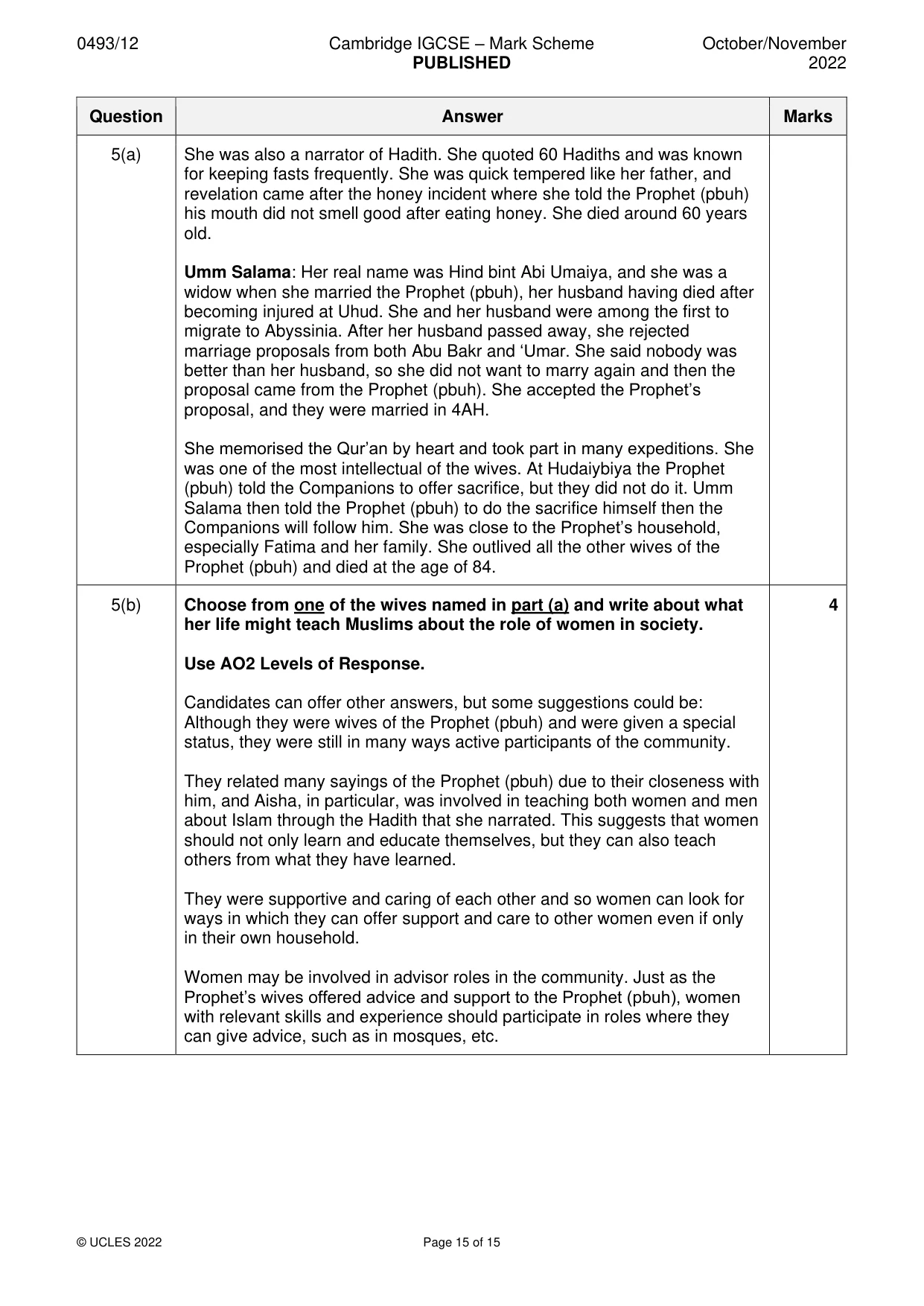
0493/12 Cambridge IGCSE – Mark Scheme PUBLISHED October/November 2022 © UCLES 2022 Page 15 of 15 Question Answer Marks 5(a) She was also a narrator of Hadith. She quoted 60 Hadiths and was known for keeping fasts frequently. She was quick tempered like her father, and revelation came after the honey incident where she told the Prophet (pbuh) his mouth did not smell good after eating honey. She died around 60 years old. Umm Salama: Her real name was Hind bint Abi Umaiya, and she was a widow when she married the Prophet (pbuh), her husband having died after becoming injured at Uhud. She and her husband were among the first to migrate to Abyssinia. After her husband passed away, she rejected marriage proposals from both Abu Bakr and ‘Umar. She said nobody was better than her husband, so she did not want to marry again and then the proposal came from the Prophet (pbuh). She accepted the Prophet’s proposal, and they were married in 4AH. She memorised the Qur’an by heart and took part in many expeditions. She was one of the most intellectual of the wives. At Hudaiybiya the Prophet (pbuh) told the Companions to offer sacrifice, but they did not do it. Umm Salama then told the Prophet (pbuh) to do the sacrifice himself then the Companions will follow him. She was close to the Prophet’s household, especially Fatima and her family. She outlived all the other wives of the Prophet (pbuh) and died at the age of 84. 5(b) Choose from one of the wives named in part (a) and write about what her life might teach Muslims about the role of women in society. Use AO2 Levels of Response. Candidates can offer other answers, but some suggestions could be: Although they were wives of the Prophet (pbuh) and were given a special status, they were still in many ways active participants of the community. They related many sayings of the Prophet (pbuh) due to their closeness with him, and Aisha, in particular, was involved in teaching both women and men about Islam through the Hadith that she narrated. This suggests that women should not only learn and educate themselves, but they can also teach others from what they have learned. They were supportive and caring of each other and so women can look for ways in which they can offer support and care to other women even if only in their own household. Women may be involved in advisor roles in the community. Just as the Prophet’s wives offered advice and support to the Prophet (pbuh), women with relevant skills and experience should participate in roles where they can give advice, such as in mosques, etc. 4
What you needed in this session
Cambridge’s own grade thresholds for 2022 Oct/Nov, Paper 1 · Variant 2. A higher threshold means an easier paper — the bar moves with how the cohort did.