Cambridge IGCSE Islamiyat 0493 — 2024 May/June Paper 1 · Variant 1
0493/11/M/J/24 · 50 marks · ≈56 min
The question paper and its mark scheme, free to read here and free to download. This is Cambridge’s own paper, exactly as it was sat.
Question paper20 pages













Mark scheme17 pages
Answers below. Sit the paper first if you are practising.
Paper as text
Question paper, page 1
This document has 20 pages. Any blank pages are indicated. [Turn over Cambridge IGCSE™ ISLAMIYAT 0493/11 Paper 1 May/June 2024 1 hour 30 minutes You must answer on the question paper. No additional materials are needed. INSTRUCTIONS ● Answer four questions in total: Answer Question 1. Answer Question 2. Answer two other questions. ● Use a black or dark blue pen. ● Write your name, centre number and candidate number in the boxes at the top of the page. ● Write your answer to each question in the space provided. ● Do not use an erasable pen or correction fluid. ● Do not write on any bar codes. INFORMATION ● The total mark for this paper is 50. ● The number of marks for each question or part question is shown in brackets [ ]. * 5 4 1 6 0 1 4 1 9 5 * DC (PQ) 329460/1 © UCLES 2024
Question paper, page 2
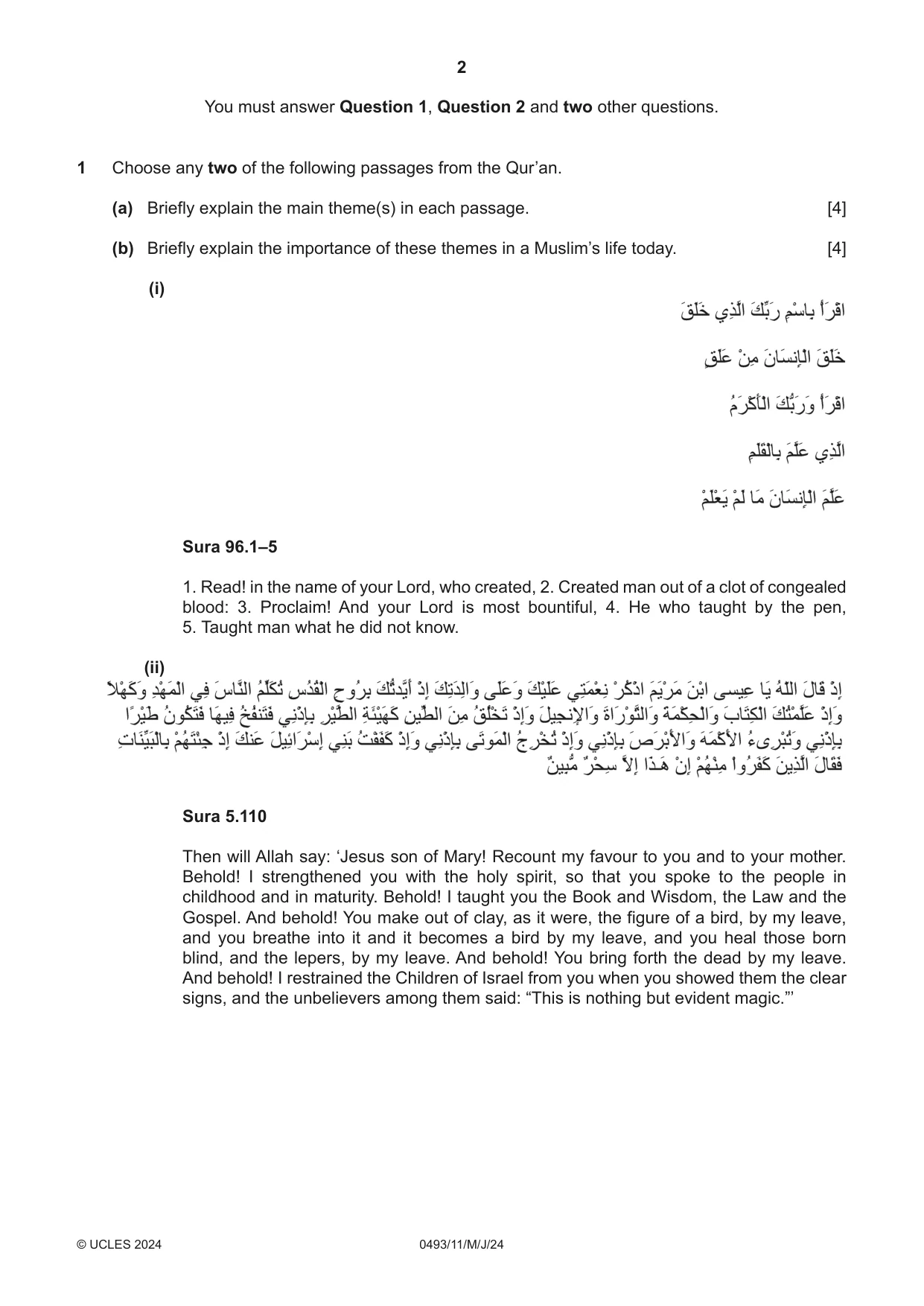
2 0493/11/M/J/24 © UCLES 2024 You must answer Question 1, Question 2 and two other questions. 1 Choose any two of the following passages from the Qur’an. (a) Briefly explain the main theme(s) in each passage. [4] (b) Briefly explain the importance of these themes in a Muslim’s life today. [4] (i) Sura 96.1–5 1. Read! in the name of your Lord, who created, 2. Created man out of a clot of congealed blood: 3. Proclaim! And your Lord is most bountiful, 4. He who taught by the pen, 5. Taught man what he did not know. (ii) Sura 5.110 Then will Allah say: ‘Jesus son of Mary! Recount my favour to you and to your mother. Behold! I strengthened you with the holy spirit, so that you spoke to the people in childhood and in maturity. Behold! I taught you the Book and Wisdom, the Law and the Gospel. And behold! You make out of clay, as it were, the figure of a bird, by my leave, and you breathe into it and it becomes a bird by my leave, and you heal those born blind, and the lepers, by my leave. And behold! You bring forth the dead by my leave. And behold! I restrained the Children of Israel from you when you showed them the clear signs, and the unbelievers among them said: “This is nothing but evident magic.”’
Question paper, page 3
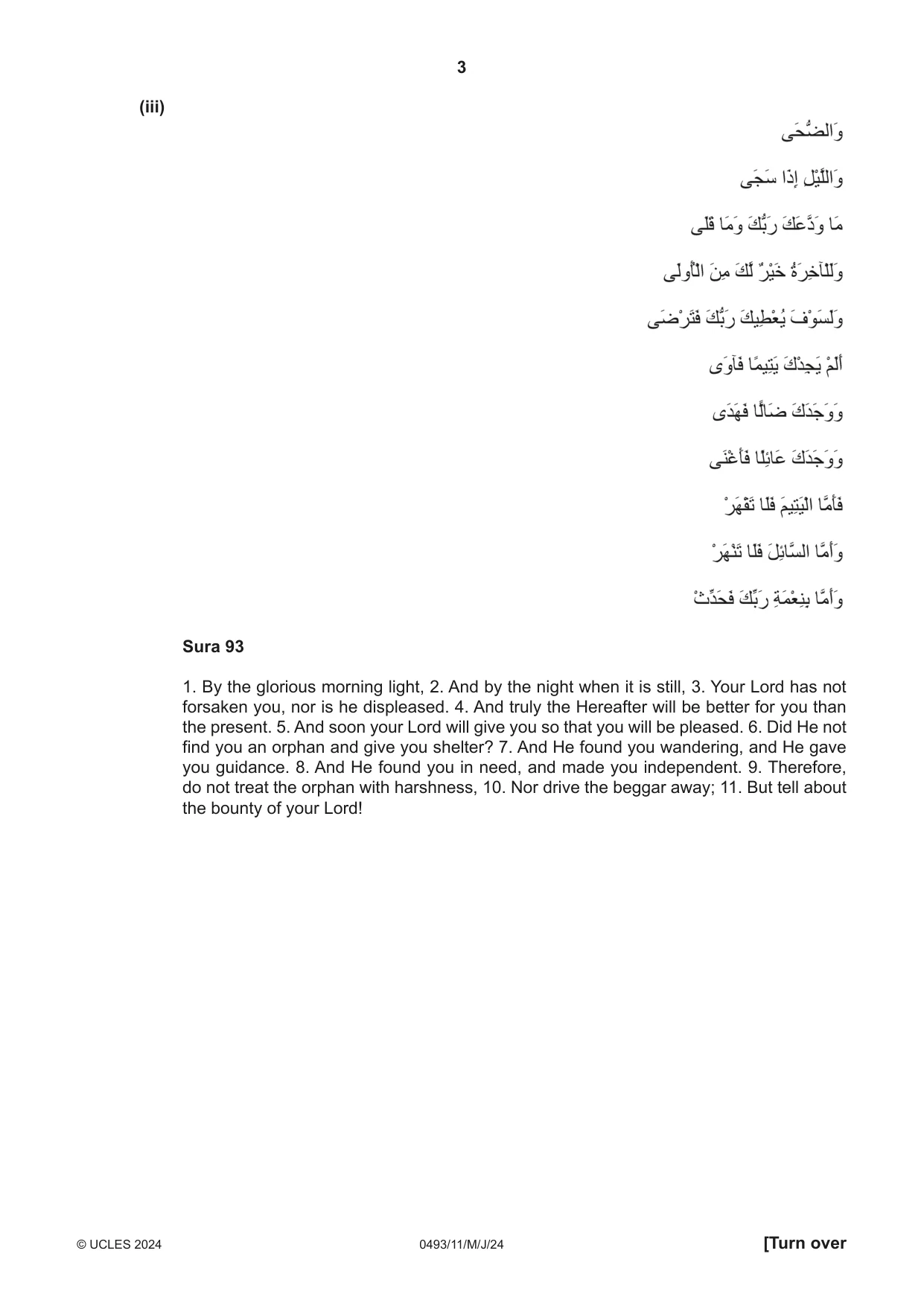
3 0493/11/M/J/24 © UCLES 2024 [Turn over (iii) Sura 93 1. By the glorious morning light, 2. And by the night when it is still, 3. Your Lord has not forsaken you, nor is he displeased. 4. And truly the Hereafter will be better for you than the present. 5. And soon your Lord will give you so that you will be pleased. 6. Did He not find you an orphan and give you shelter? 7. And He found you wandering, and He gave you guidance. 8. And He found you in need, and made you independent. 9. Therefore, do not treat the orphan with harshness, 10. Nor drive the beggar away; 11. But tell about the bounty of your Lord!
Question paper, page 4
4 0493/11/M/J/24 © UCLES 2024 … … … … … … … … … … … … … … … … … … … … … … … … … … … …
Question paper, page 5
5 0493/11/M/J/24 © UCLES 2024 [Turn over … … … … … … … … … … … … … … … … … … … … … … … … … … … …
Question paper, page 6
6 0493/11/M/J/24 © UCLES 2024 2 (a) Write about how God describes Himself using: (i) Sura 6.101–103 (al-Anʾam) (ii) Sura 41.37 (Fussilat) (iii) Sura 42.4–5 (ash-Shura). [10] (b) In your opinion, how can the knowledge God gives about Himself help Muslims in times of hardship? [4] … … … … … … … … … … … … … … … … … … … … … … …
Question paper, page 7
7 0493/11/M/J/24 © UCLES 2024 [Turn over … … … … … … … … … … … … … … … … … … … … … … … … … … … …
Question paper, page 8
8 0493/11/M/J/24 © UCLES 2024 … … … … … … … … … … … … … … … … … … … … … … … … … … … …
Question paper, page 9
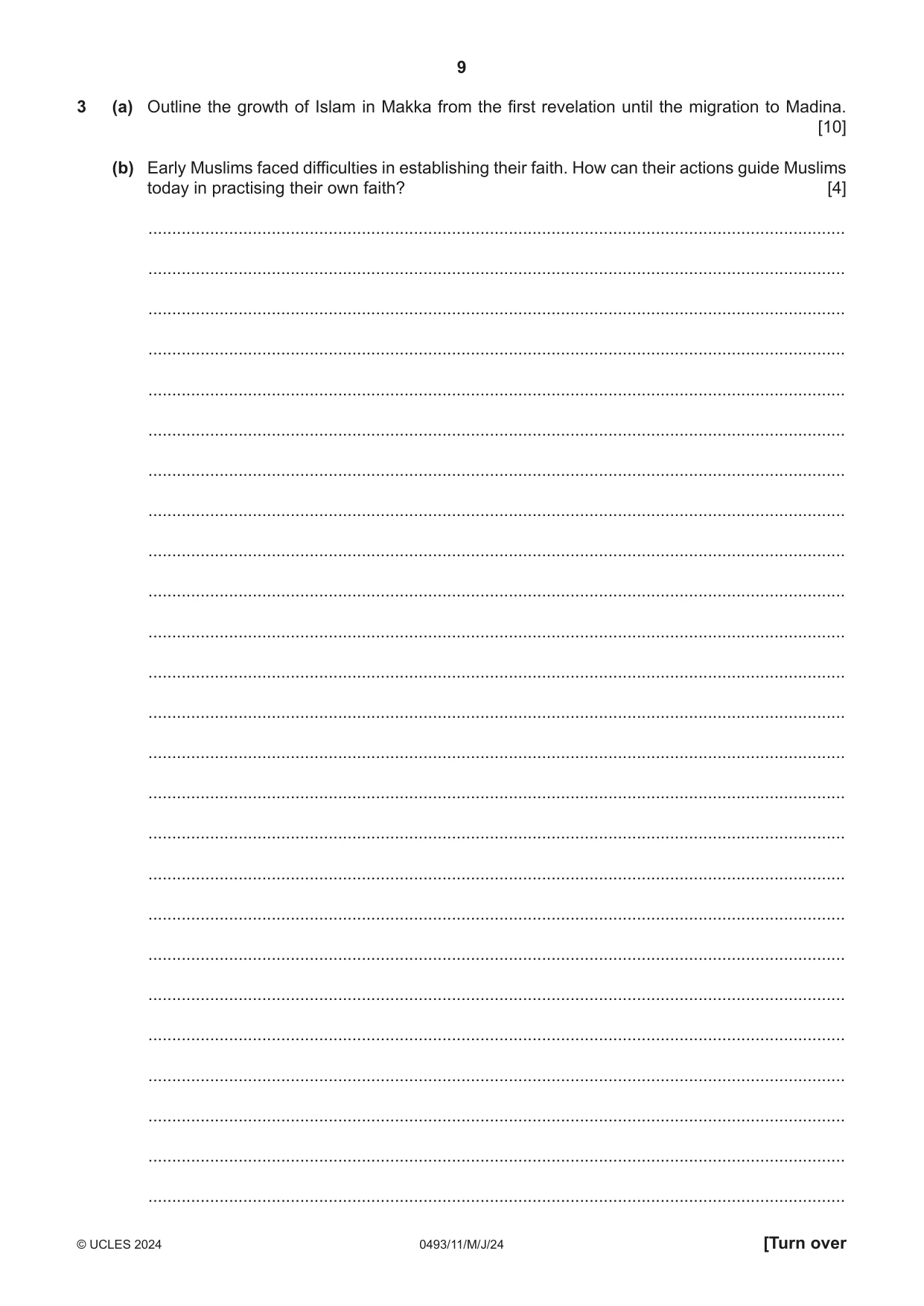
9 0493/11/M/J/24 © UCLES 2024 [Turn over 3 (a) Outline the growth of Islam in Makka from the first revelation until the migration to Madina. [10] (b) Early Muslims faced difficulties in establishing their faith. How can their actions guide Muslims today in practising their own faith? [4] … … … … … … … … … … … … … … … … … … … … … … … … …
Question paper, page 10
10 0493/11/M/J/24 © UCLES 2024 … … … … … … … … … … … … … … … … … … … … … … … … … … … …
Question paper, page 11
11 0493/11/M/J/24 © UCLES 2024 [Turn over … … … … … … … … … … … … … … … … … … … … … … … … … … … …
Question paper, page 12
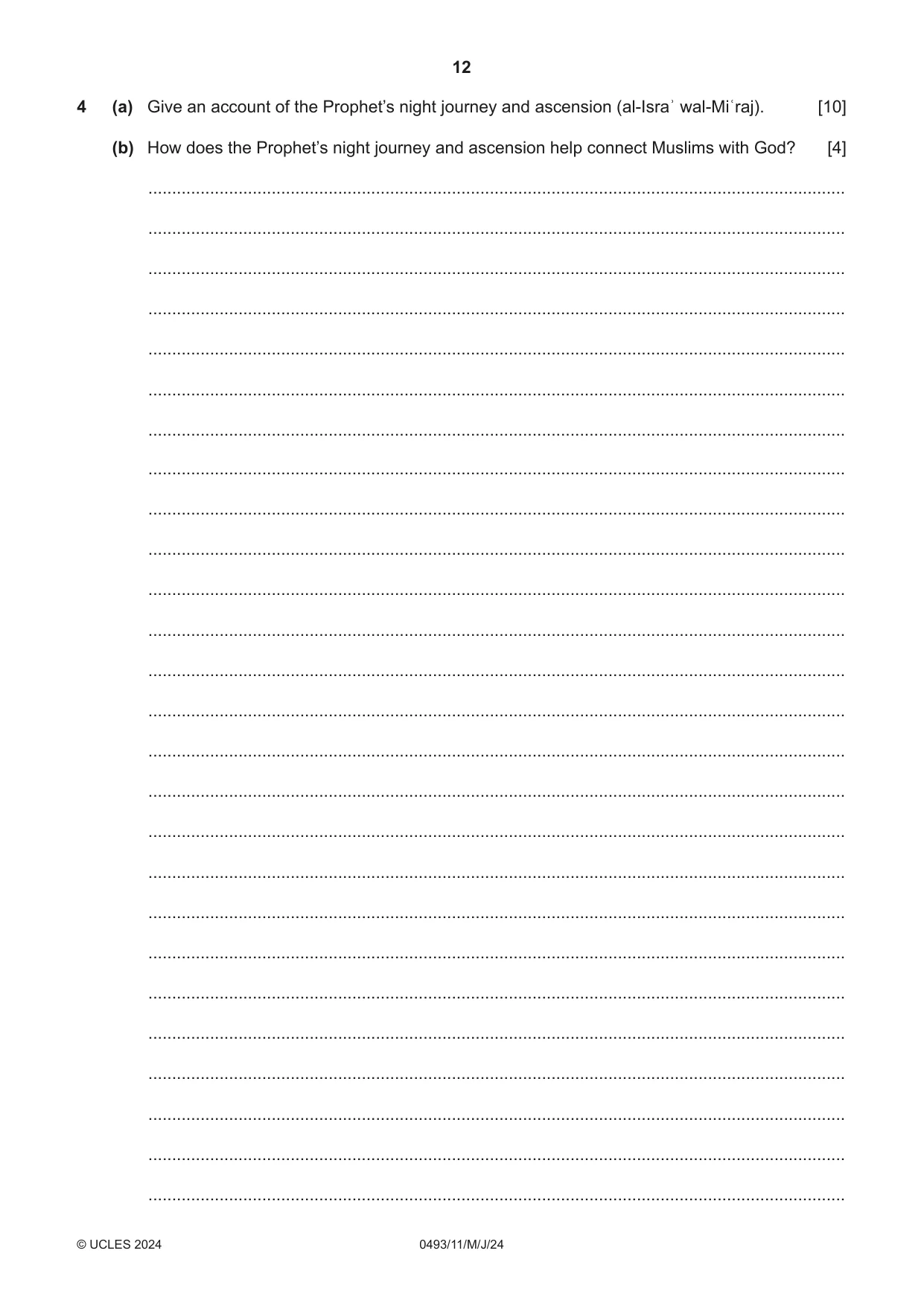
12 0493/11/M/J/24 © UCLES 2024 4 (a) Give an account of the Prophet’s night journey and ascension (al-Israʾ wal-Miʿraj). [10] (b) How does the Prophet’s night journey and ascension help connect Muslims with God? [4] … … … … … … … … … … … … … … … … … … … … … … … … … …
Question paper, page 13
13 0493/11/M/J/24 © UCLES 2024 [Turn over … … … … … … … … … … … … … … … … … … … … … … … … … … … …
Question paper, page 14
14 0493/11/M/J/24 © UCLES 2024 … … … … … … … … … … … … … … … … … … … … … … … … … … … …
Question paper, page 15
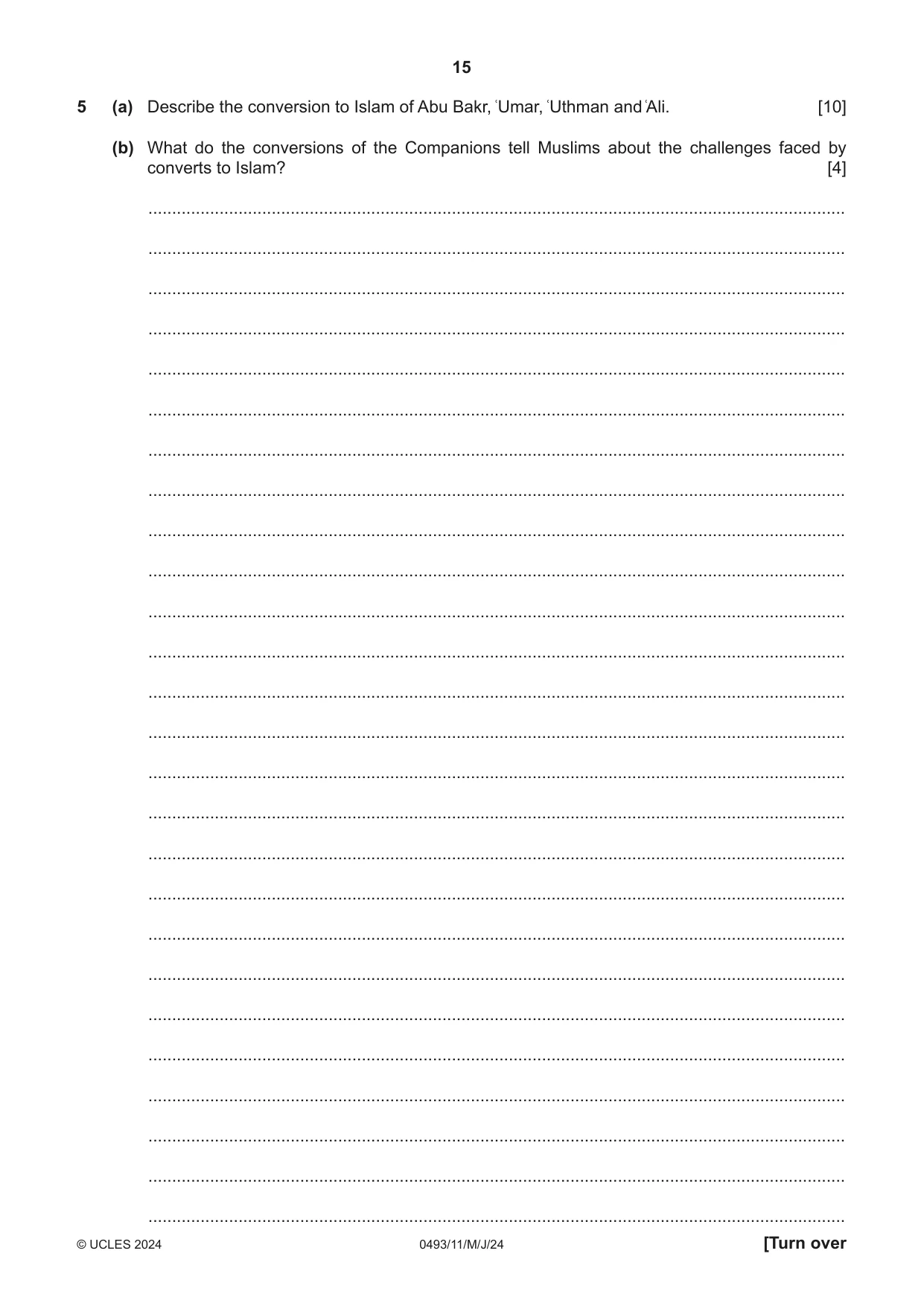
15 0493/11/M/J/24 © UCLES 2024 [Turn over 5 (a) Describe the conversion to Islam of Abu Bakr, ͑ Umar, ͑ Uthman and ͑Ali. [10] (b) What do the conversions of the Companions tell Muslims about the challenges faced by converts to Islam? [4] … … … … … … … … … … … … … … … … … … … … … … … … … …
Question paper, page 16
16 0493/11/M/J/24 © UCLES 2024 … … … … … … … … … … … … … … … … … … … … … … … … … … … …
Question paper, page 17
17 0493/11/M/J/24 © UCLES 2024 … … … … … … … … … … … … … … … … … … … … … … … … … … … …
Question paper, page 18
18 0493/11/M/J/24 © UCLES 2024 BLANK PAGE
Question paper, page 19
19 0493/11/M/J/24 © UCLES 2024 BLANK PAGE
Question paper, page 20
20 0493/11/M/J/24 © UCLES 2024 Permission to reproduce items where third-party owned material protected by copyright is included has been sought and cleared where possible. Every reasonable effort has been made by the publisher (UCLES) to trace copyright holders, but if any items requiring clearance have unwittingly been included, the publisher will be pleased to make amends at the earliest possible opportunity. To avoid the issue of disclosure of answer-related information to candidates, all copyright acknowledgements are reproduced online in the Cambridge Assessment International Education Copyright Acknowledgements Booklet. This is produced for each series of examinations and is freely available to download at www.cambridgeinternational.org after the live examination series. Cambridge Assessment International Education is part of Cambridge Assessment. Cambridge Assessment is the brand name of the University of Cambridge Local Examinations Syndicate (UCLES), which is a department of the University of Cambridge. BLANK PAGE
Mark scheme, page 1
This document consists of 17 printed pages. © Cambridge University Press & Assessment 2024 [Turn over Cambridge IGCSE™ ISLAMIYAT 0493/11 Paper 1 May/June 2024 MARK SCHEME Maximum Mark: 50 Published This mark scheme is published as an aid to teachers and candidates, to indicate the requirements of the examination. It shows the basis on which Examiners were instructed to award marks. It does not indicate the details of the discussions that took place at an Examiners’ meeting before marking began, which would have considered the acceptability of alternative answers. Mark schemes should be read in conjunction with the question paper and the Principal Examiner Report for Teachers. Cambridge International will not enter into discussions about these mark schemes. Cambridge International is publishing the mark schemes for the May/June 2024 series for most Cambridge IGCSE, Cambridge International A and AS Level and Cambridge Pre-U components, and some Cambridge O Level components.
Mark scheme, page 2
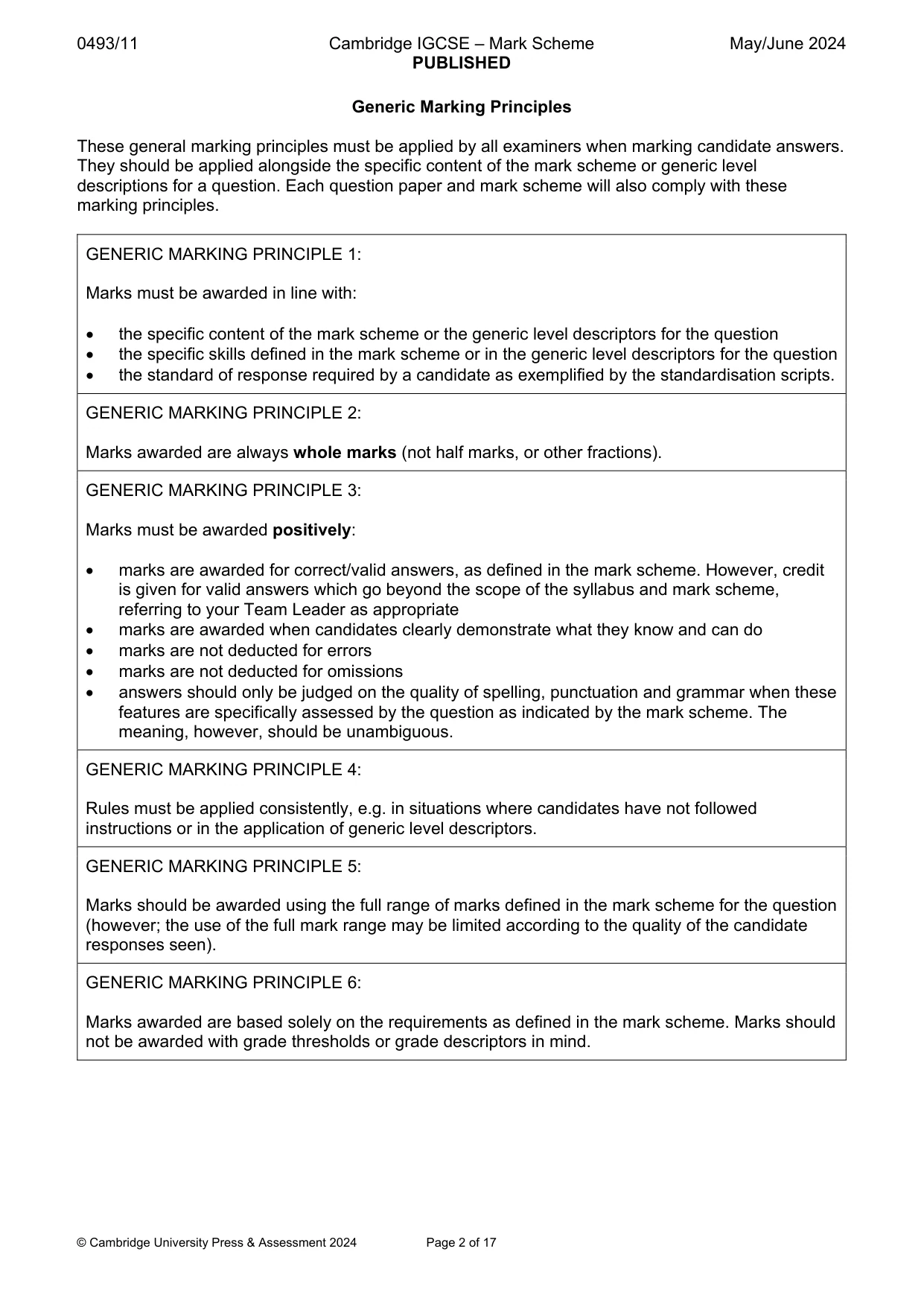
0493/11 Cambridge IGCSE – Mark Scheme PUBLISHED May/June 2024 © Cambridge University Press & Assessment 2024 Page 2 of 17 Generic Marking Principles These general marking principles must be applied by all examiners when marking candidate answers. They should be applied alongside the specific content of the mark scheme or generic level descriptions for a question. Each question paper and mark scheme will also comply with these marking principles. GENERIC MARKING PRINCIPLE 1: Marks must be awarded in line with: the specific content of the mark scheme or the generic level descriptors for the question the specific skills defined in the mark scheme or in the generic level descriptors for the question the standard of response required by a candidate as exemplified by the standardisation scripts. GENERIC MARKING PRINCIPLE 2: Marks awarded are always whole marks (not half marks, or other fractions). GENERIC MARKING PRINCIPLE 3: Marks must be awarded positively: marks are awarded for correct/valid answers, as defined in the mark scheme. However, credit is given for valid answers which go beyond the scope of the syllabus and mark scheme, referring to your Team Leader as appropriate marks are awarded when candidates clearly demonstrate what they know and can do marks are not deducted for errors marks are not deducted for omissions answers should only be judged on the quality of spelling, punctuation and grammar when these features are specifically assessed by the question as indicated by the mark scheme. The meaning, however, should be unambiguous. GENERIC MARKING PRINCIPLE 4: Rules must be applied consistently, e.g. in situations where candidates have not followed instructions or in the application of generic level descriptors. GENERIC MARKING PRINCIPLE 5: Marks should be awarded using the full range of marks defined in the mark scheme for the question (however; the use of the full mark range may be limited according to the quality of the candidate responses seen). GENERIC MARKING PRINCIPLE 6: Marks awarded are based solely on the requirements as defined in the mark scheme. Marks should not be awarded with grade thresholds or grade descriptors in mind.
Mark scheme, page 3
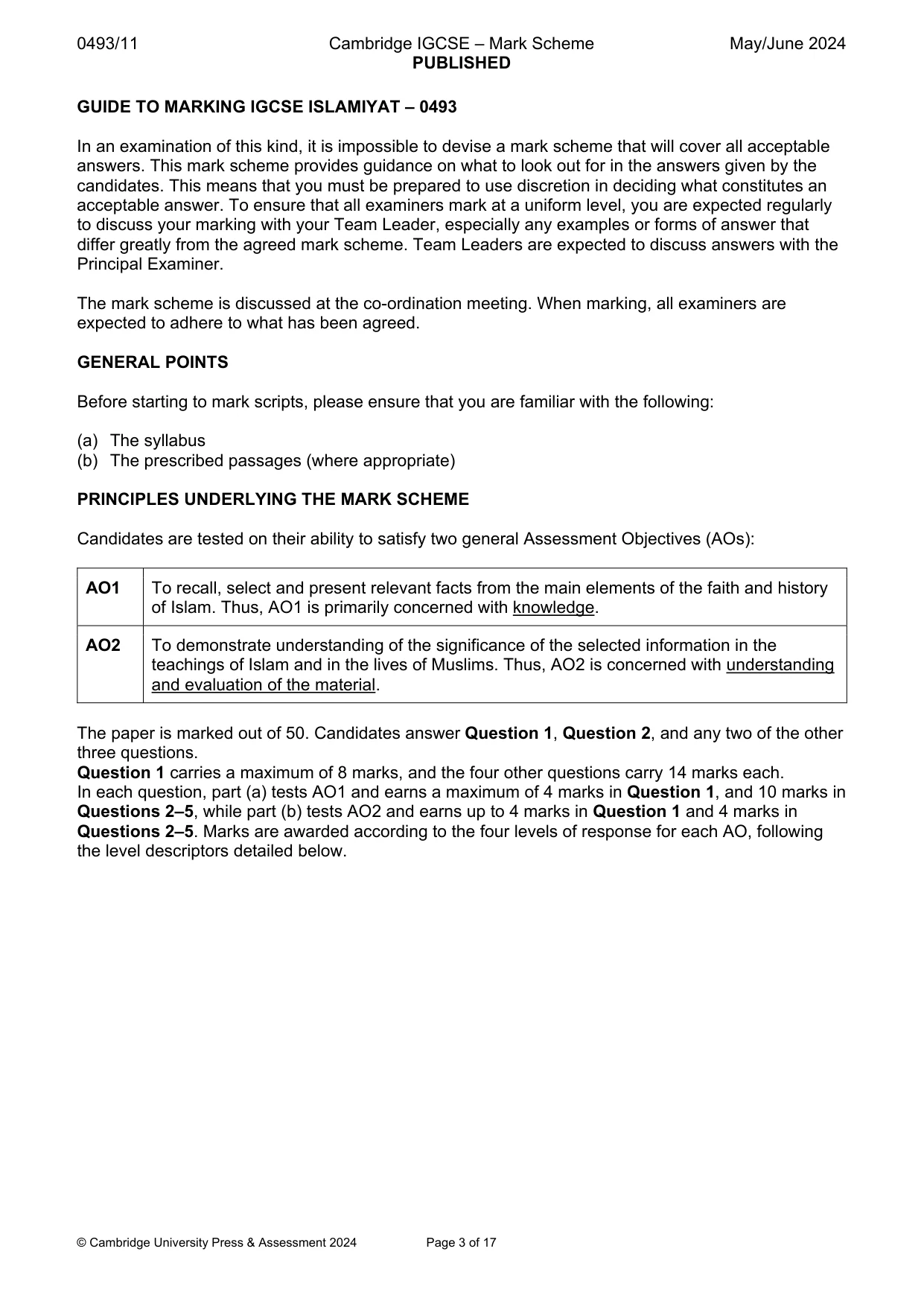
0493/11 Cambridge IGCSE – Mark Scheme PUBLISHED May/June 2024 © Cambridge University Press & Assessment 2024 Page 3 of 17 GUIDE TO MARKING IGCSE ISLAMIYAT – 0493 In an examination of this kind, it is impossible to devise a mark scheme that will cover all acceptable answers. This mark scheme provides guidance on what to look out for in the answers given by the candidates. This means that you must be prepared to use discretion in deciding what constitutes an acceptable answer. To ensure that all examiners mark at a uniform level, you are expected regularly to discuss your marking with your Team Leader, especially any examples or forms of answer that differ greatly from the agreed mark scheme. Team Leaders are expected to discuss answers with the Principal Examiner. The mark scheme is discussed at the co-ordination meeting. When marking, all examiners are expected to adhere to what has been agreed. GENERAL POINTS Before starting to mark scripts, please ensure that you are familiar with the following: (a) The syllabus (b) The prescribed passages (where appropriate) PRINCIPLES UNDERLYING THE MARK SCHEME Candidates are tested on their ability to satisfy two general Assessment Objectives (AOs): AO1 To recall, select and present relevant facts from the main elements of the faith and history of Islam. Thus, AO1 is primarily concerned with knowledge. AO2 To demonstrate understanding of the significance of the selected information in the teachings of Islam and in the lives of Muslims. Thus, AO2 is concerned with understanding and evaluation of the material. The paper is marked out of 50. Candidates answer Question 1, Question 2, and any two of the other three questions. Question 1 carries a maximum of 8 marks, and the four other questions carry 14 marks each. In each question, part (a) tests AO1 and earns a maximum of 4 marks in Question 1, and 10 marks in Questions 2–5, while part (b) tests AO2 and earns up to 4 marks in Question 1 and 4 marks in Questions 2–5. Marks are awarded according to the four levels of response for each AO, following the level descriptors detailed below.
Mark scheme, page 4
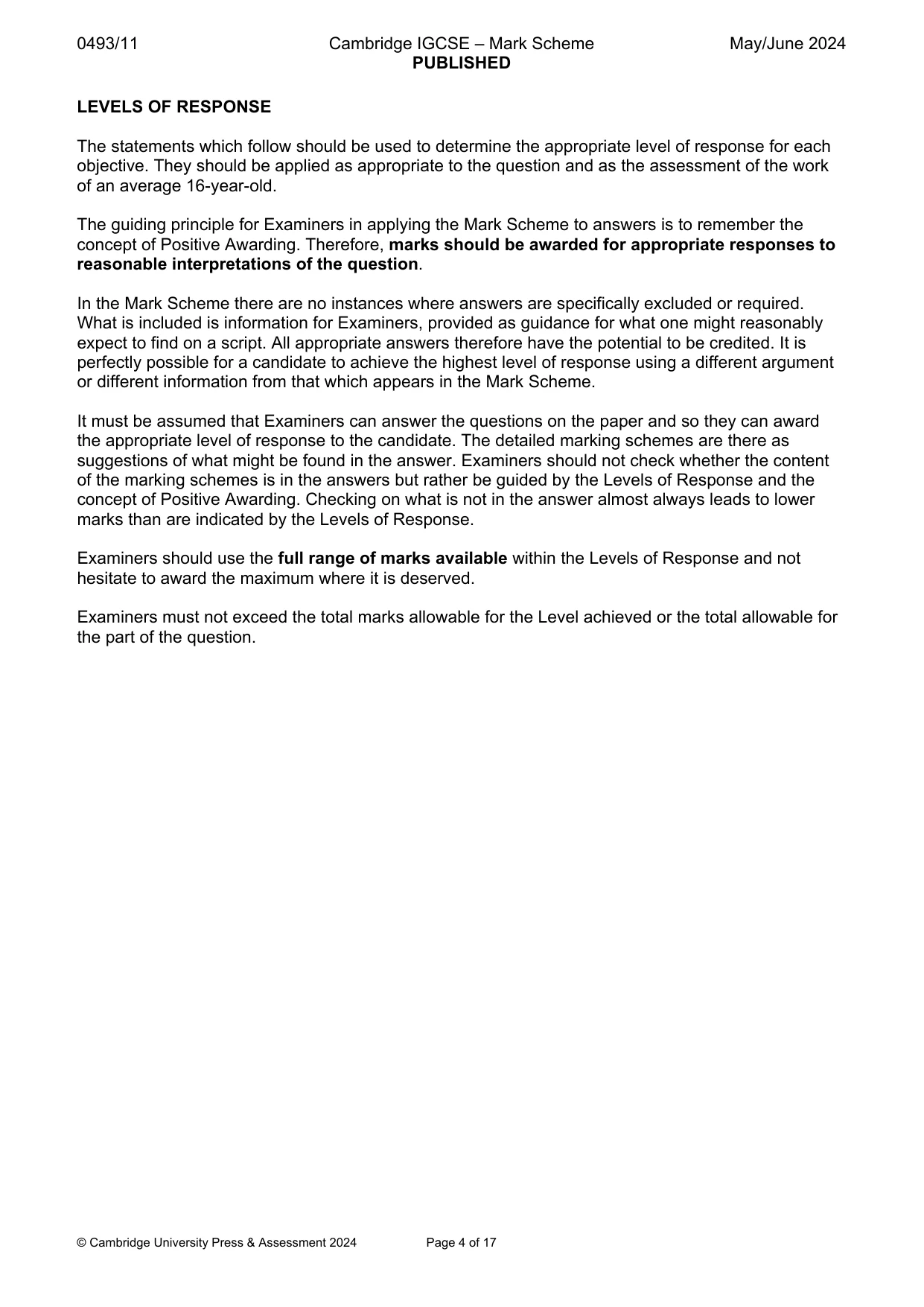
0493/11 Cambridge IGCSE – Mark Scheme PUBLISHED May/June 2024 © Cambridge University Press & Assessment 2024 Page 4 of 17 LEVELS OF RESPONSE The statements which follow should be used to determine the appropriate level of response for each objective. They should be applied as appropriate to the question and as the assessment of the work of an average 16-year-old. The guiding principle for Examiners in applying the Mark Scheme to answers is to remember the concept of Positive Awarding. Therefore, marks should be awarded for appropriate responses to reasonable interpretations of the question. In the Mark Scheme there are no instances where answers are specifically excluded or required. What is included is information for Examiners, provided as guidance for what one might reasonably expect to find on a script. All appropriate answers therefore have the potential to be credited. It is perfectly possible for a candidate to achieve the highest level of response using a different argument or different information from that which appears in the Mark Scheme. It must be assumed that Examiners can answer the questions on the paper and so they can award the appropriate level of response to the candidate. The detailed marking schemes are there as suggestions of what might be found in the answer. Examiners should not check whether the content of the marking schemes is in the answers but rather be guided by the Levels of Response and the concept of Positive Awarding. Checking on what is not in the answer almost always leads to lower marks than are indicated by the Levels of Response. Examiners should use the full range of marks available within the Levels of Response and not hesitate to award the maximum where it is deserved. Examiners must not exceed the total marks allowable for the Level achieved or the total allowable for the part of the question.
Mark scheme, page 5
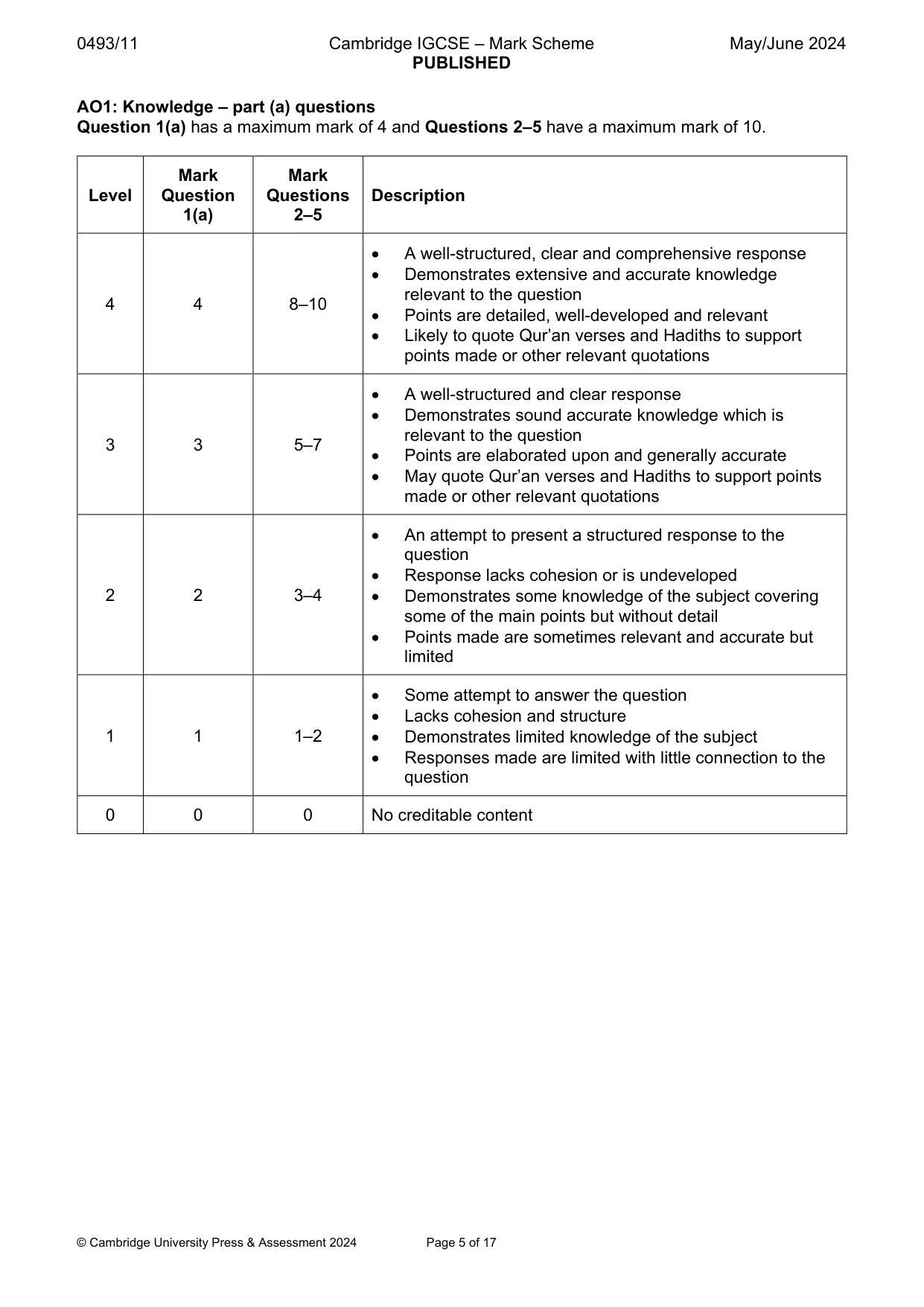
0493/11 Cambridge IGCSE – Mark Scheme PUBLISHED May/June 2024 © Cambridge University Press & Assessment 2024 Page 5 of 17 AO1: Knowledge – part (a) questions Question 1(a) has a maximum mark of 4 and Questions 2–5 have a maximum mark of 10. Level Mark Question 1(a) Mark Questions 2–5 Description 4 4 8–10 A well-structured, clear and comprehensive response Demonstrates extensive and accurate knowledge relevant to the question Points are detailed, well-developed and relevant Likely to quote Qur’an verses and Hadiths to support points made or other relevant quotations 3 3 5–7 A well-structured and clear response Demonstrates sound accurate knowledge which is relevant to the question Points are elaborated upon and generally accurate May quote Qur’an verses and Hadiths to support points made or other relevant quotations 2 2 3–4 An attempt to present a structured response to the question Response lacks cohesion or is undeveloped Demonstrates some knowledge of the subject covering some of the main points but without detail Points made are sometimes relevant and accurate but limited 1 1 1–2 Some attempt to answer the question Lacks cohesion and structure Demonstrates limited knowledge of the subject Responses made are limited with little connection to the question 0 0 0 No creditable content
Mark scheme, page 6
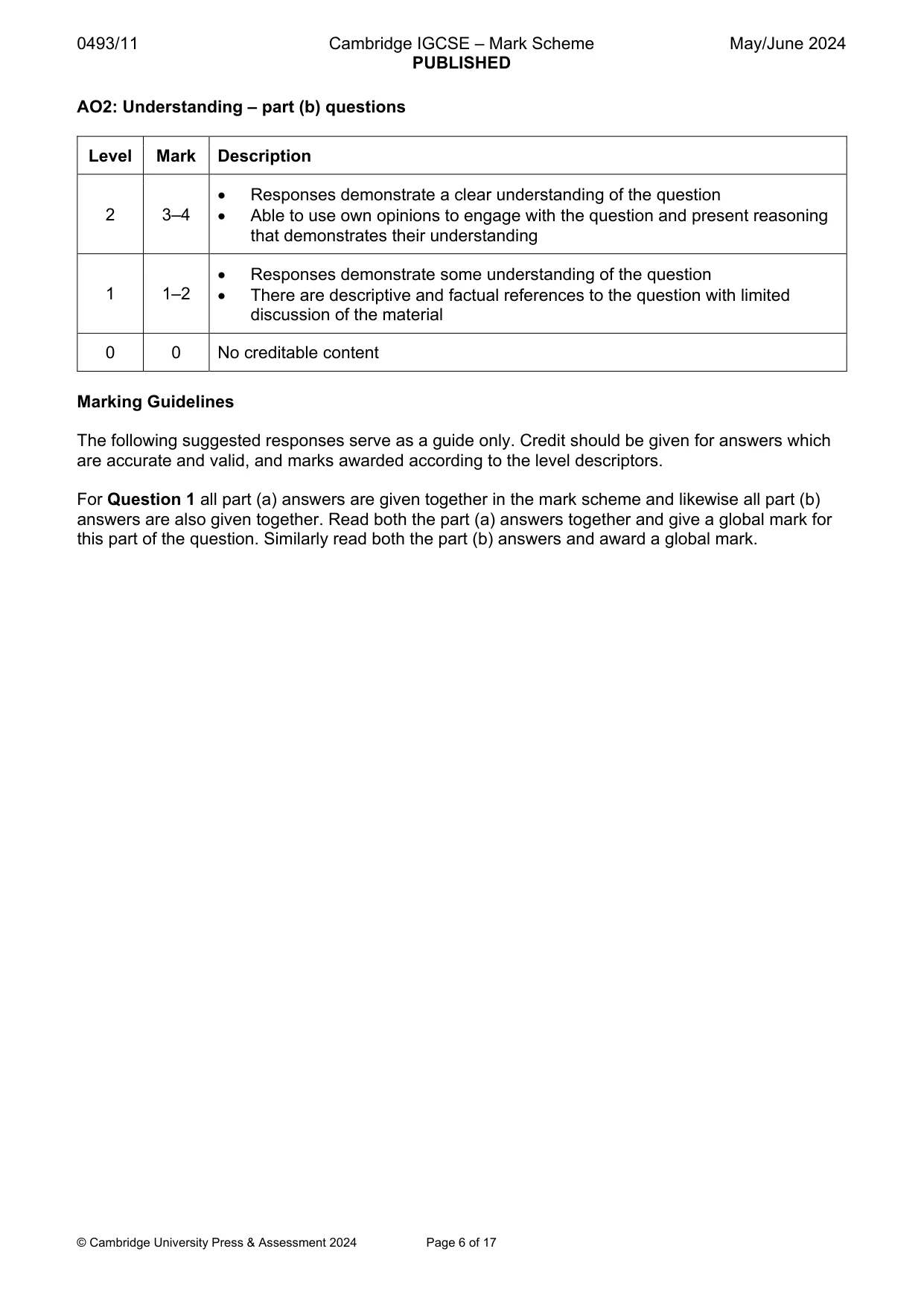
0493/11 Cambridge IGCSE – Mark Scheme PUBLISHED May/June 2024 © Cambridge University Press & Assessment 2024 Page 6 of 17 AO2: Understanding – part (b) questions Level Mark Description 2 3–4 Responses demonstrate a clear understanding of the question Able to use own opinions to engage with the question and present reasoning that demonstrates their understanding 1 1–2 Responses demonstrate some understanding of the question There are descriptive and factual references to the question with limited discussion of the material 0 0 No creditable content Marking Guidelines The following suggested responses serve as a guide only. Credit should be given for answers which are accurate and valid, and marks awarded according to the level descriptors. For Question 1 all part (a) answers are given together in the mark scheme and likewise all part (b) answers are also given together. Read both the part (a) answers together and give a global mark for this part of the question. Similarly read both the part (b) answers and award a global mark.
Mark scheme, page 7
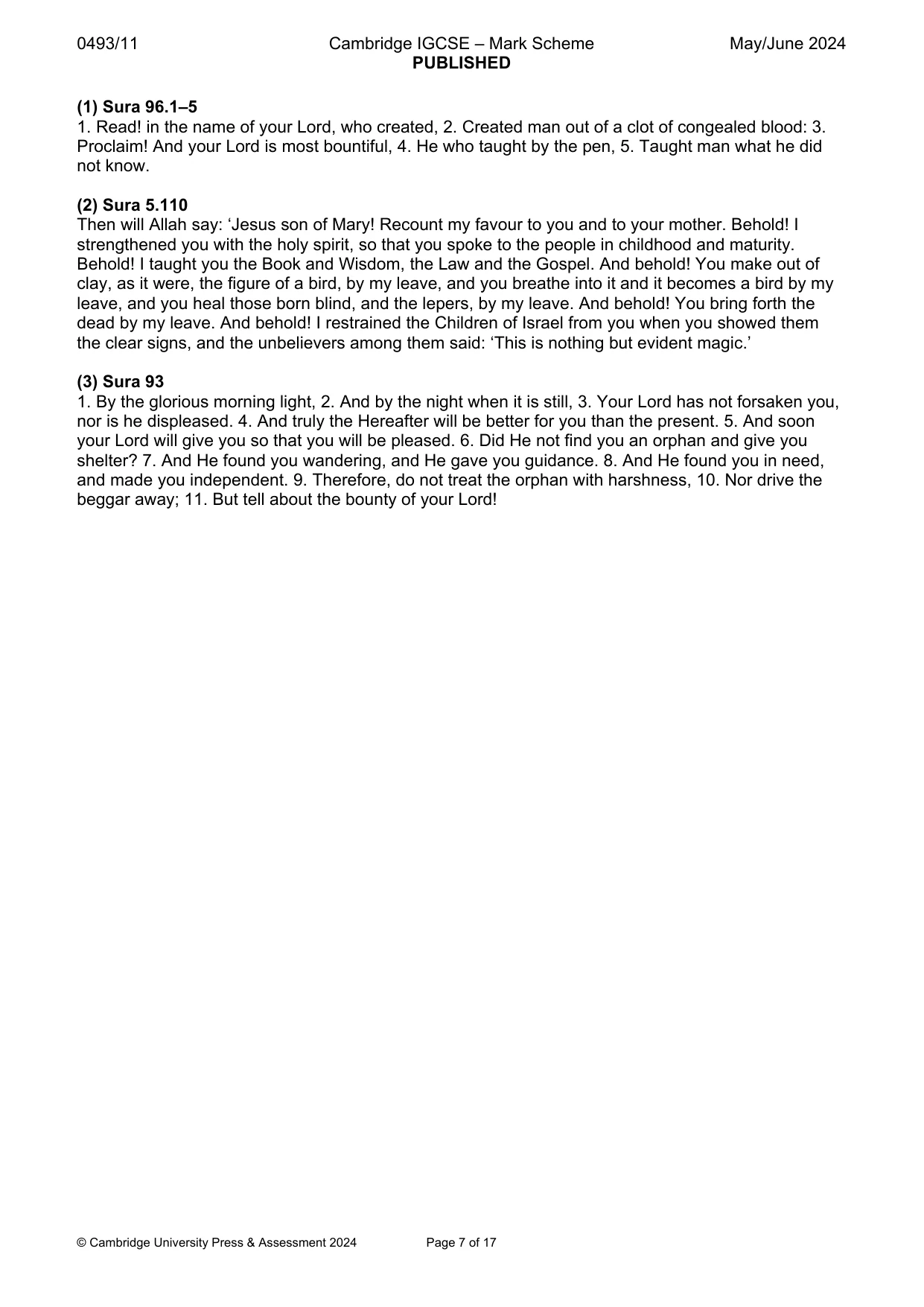
0493/11 Cambridge IGCSE – Mark Scheme PUBLISHED May/June 2024 © Cambridge University Press & Assessment 2024 Page 7 of 17 (1) Sura 96.1–5 1. Read! in the name of your Lord, who created, 2. Created man out of a clot of congealed blood: 3. Proclaim! And your Lord is most bountiful, 4. He who taught by the pen, 5. Taught man what he did not know. (2) Sura 5.110 Then will Allah say: ‘Jesus son of Mary! Recount my favour to you and to your mother. Behold! I strengthened you with the holy spirit, so that you spoke to the people in childhood and maturity. Behold! I taught you the Book and Wisdom, the Law and the Gospel. And behold! You make out of clay, as it were, the figure of a bird, by my leave, and you breathe into it and it becomes a bird by my leave, and you heal those born blind, and the lepers, by my leave. And behold! You bring forth the dead by my leave. And behold! I restrained the Children of Israel from you when you showed them the clear signs, and the unbelievers among them said: ‘This is nothing but evident magic.’ (3) Sura 93 1. By the glorious morning light, 2. And by the night when it is still, 3. Your Lord has not forsaken you, nor is he displeased. 4. And truly the Hereafter will be better for you than the present. 5. And soon your Lord will give you so that you will be pleased. 6. Did He not find you an orphan and give you shelter? 7. And He found you wandering, and He gave you guidance. 8. And He found you in need, and made you independent. 9. Therefore, do not treat the orphan with harshness, 10. Nor drive the beggar away; 11. But tell about the bounty of your Lord!
Mark scheme, page 8
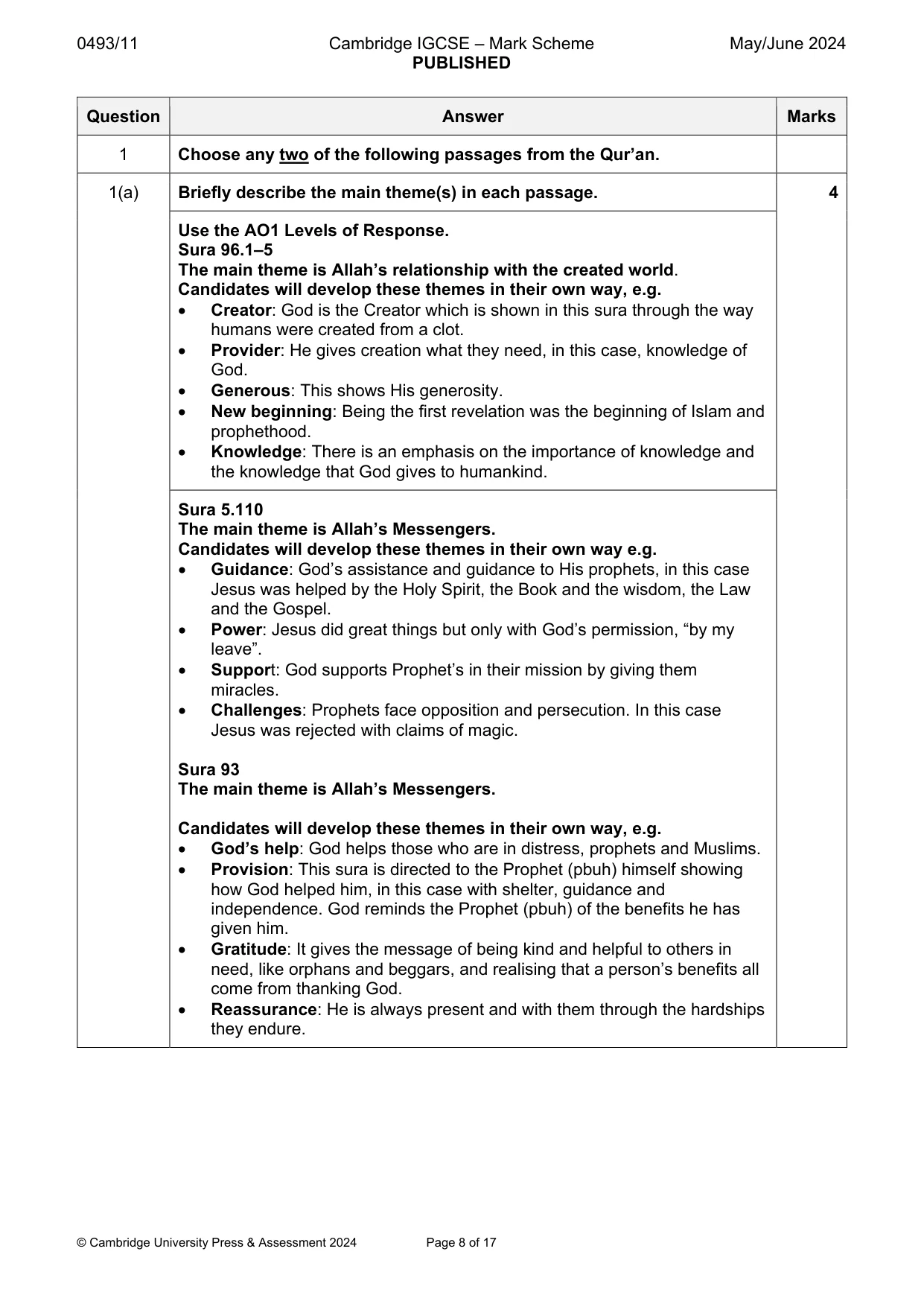
0493/11 Cambridge IGCSE – Mark Scheme PUBLISHED May/June 2024 © Cambridge University Press & Assessment 2024 Page 8 of 17 Question Answer Marks 1 Choose any two of the following passages from the Qur’an. 1(a) Briefly describe the main theme(s) in each passage. 4 Use the AO1 Levels of Response. Sura 96.1–5 The main theme is Allah’s relationship with the created world. Candidates will develop these themes in their own way, e.g. Creator: God is the Creator which is shown in this sura through the way humans were created from a clot. Provider: He gives creation what they need, in this case, knowledge of God. Generous: This shows His generosity. New beginning: Being the first revelation was the beginning of Islam and prophethood. Knowledge: There is an emphasis on the importance of knowledge and the knowledge that God gives to humankind. Sura 5.110 The main theme is Allah’s Messengers. Candidates will develop these themes in their own way e.g. Guidance: God’s assistance and guidance to His prophets, in this case Jesus was helped by the Holy Spirit, the Book and the wisdom, the Law and the Gospel. Power: Jesus did great things but only with God’s permission, “by my leave”. Support: God supports Prophet’s in their mission by giving them miracles. Challenges: Prophets face opposition and persecution. In this case Jesus was rejected with claims of magic. Sura 93 The main theme is Allah’s Messengers. Candidates will develop these themes in their own way, e.g. God’s help: God helps those who are in distress, prophets and Muslims. Provision: This sura is directed to the Prophet (pbuh) himself showing how God helped him, in this case with shelter, guidance and independence. God reminds the Prophet (pbuh) of the benefits he has given him. Gratitude: It gives the message of being kind and helpful to others in need, like orphans and beggars, and realising that a person’s benefits all come from thanking God. Reassurance: He is always present and with them through the hardships they endure.
Mark scheme, page 9
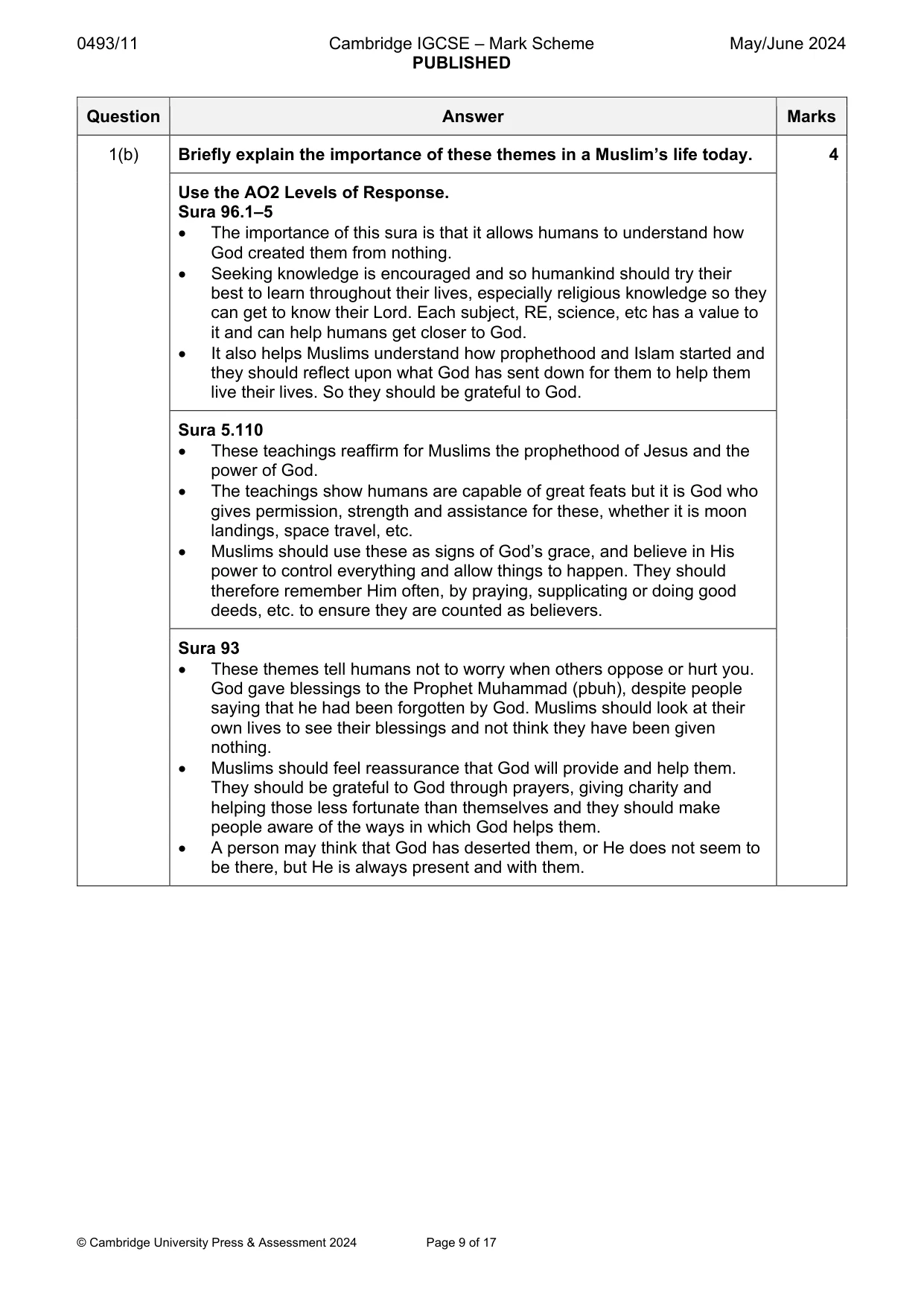
0493/11 Cambridge IGCSE – Mark Scheme PUBLISHED May/June 2024 © Cambridge University Press & Assessment 2024 Page 9 of 17 Question Answer Marks 1(b) Briefly explain the importance of these themes in a Muslim’s life today. 4 Use the AO2 Levels of Response. Sura 96.1–5 The importance of this sura is that it allows humans to understand how God created them from nothing. Seeking knowledge is encouraged and so humankind should try their best to learn throughout their lives, especially religious knowledge so they can get to know their Lord. Each subject, RE, science, etc has a value to it and can help humans get closer to God. It also helps Muslims understand how prophethood and Islam started and they should reflect upon what God has sent down for them to help them live their lives. So they should be grateful to God. Sura 5.110 These teachings reaffirm for Muslims the prophethood of Jesus and the power of God. The teachings show humans are capable of great feats but it is God who gives permission, strength and assistance for these, whether it is moon landings, space travel, etc. Muslims should use these as signs of God’s grace, and believe in His power to control everything and allow things to happen. They should therefore remember Him often, by praying, supplicating or doing good deeds, etc. to ensure they are counted as believers. Sura 93 These themes tell humans not to worry when others oppose or hurt you. God gave blessings to the Prophet Muhammad (pbuh), despite people saying that he had been forgotten by God. Muslims should look at their own lives to see their blessings and not think they have been given nothing. Muslims should feel reassurance that God will provide and help them. They should be grateful to God through prayers, giving charity and helping those less fortunate than themselves and they should make people aware of the ways in which God helps them. A person may think that God has deserted them, or He does not seem to be there, but He is always present and with them.
Mark scheme, page 10
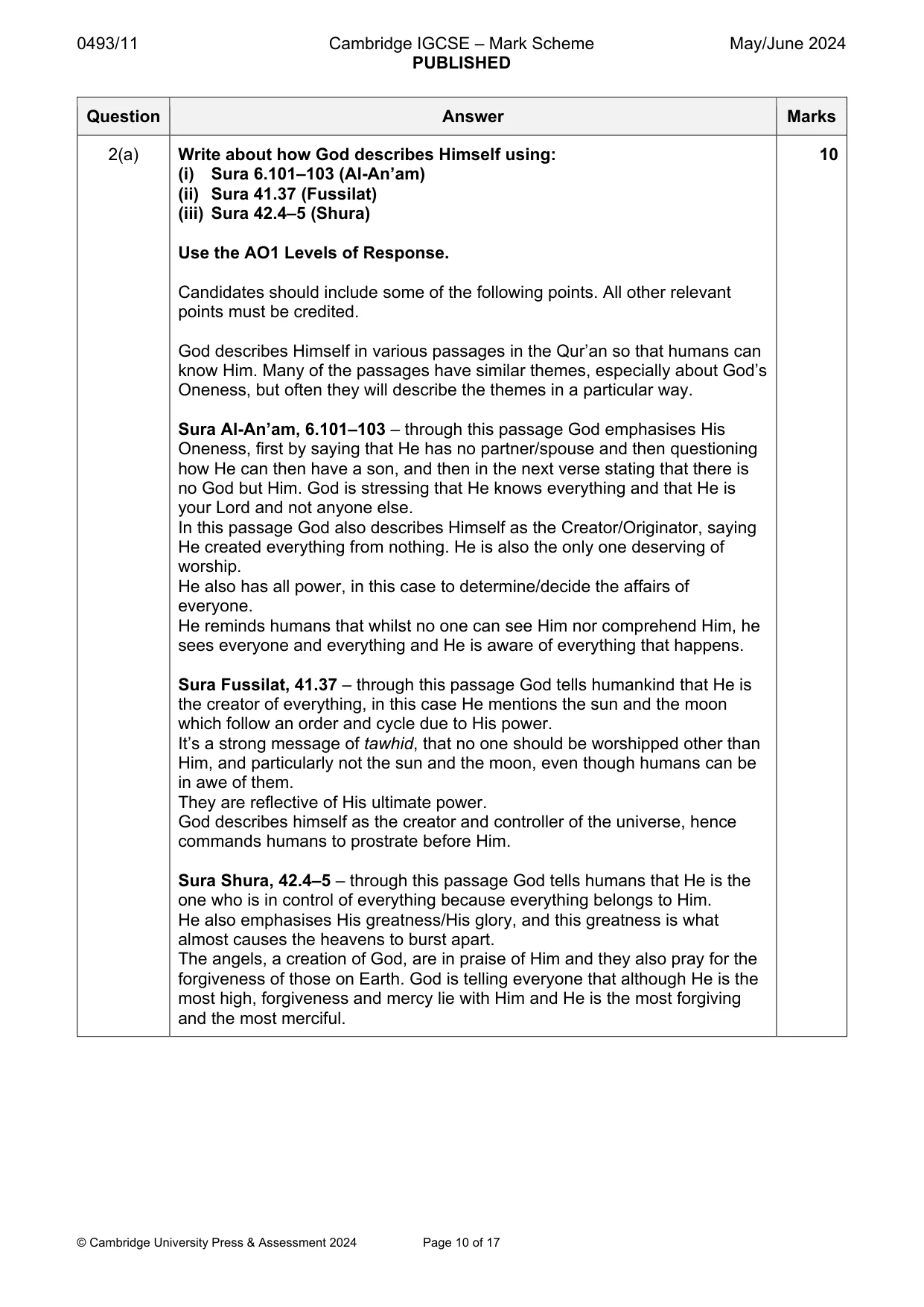
0493/11 Cambridge IGCSE – Mark Scheme PUBLISHED May/June 2024 © Cambridge University Press & Assessment 2024 Page 10 of 17 Question Answer Marks 2(a) Write about how God describes Himself using: (i) Sura 6.101–103 (Al-An’am) (ii) Sura 41.37 (Fussilat) (iii) Sura 42.4–5 (Shura) Use the AO1 Levels of Response. Candidates should include some of the following points. All other relevant points must be credited. God describes Himself in various passages in the Qur’an so that humans can know Him. Many of the passages have similar themes, especially about God’s Oneness, but often they will describe the themes in a particular way. Sura Al-An’am, 6.101–103 – through this passage God emphasises His Oneness, first by saying that He has no partner/spouse and then questioning how He can then have a son, and then in the next verse stating that there is no God but Him. God is stressing that He knows everything and that He is your Lord and not anyone else. In this passage God also describes Himself as the Creator/Originator, saying He created everything from nothing. He is also the only one deserving of worship. He also has all power, in this case to determine/decide the affairs of everyone. He reminds humans that whilst no one can see Him nor comprehend Him, he sees everyone and everything and He is aware of everything that happens. Sura Fussilat, 41.37 – through this passage God tells humankind that He is the creator of everything, in this case He mentions the sun and the moon which follow an order and cycle due to His power. It’s a strong message of tawhid, that no one should be worshipped other than Him, and particularly not the sun and the moon, even though humans can be in awe of them. They are reflective of His ultimate power. God describes himself as the creator and controller of the universe, hence commands humans to prostrate before Him. Sura Shura, 42.4–5 – through this passage God tells humans that He is the one who is in control of everything because everything belongs to Him. He also emphasises His greatness/His glory, and this greatness is what almost causes the heavens to burst apart. The angels, a creation of God, are in praise of Him and they also pray for the forgiveness of those on Earth. God is telling everyone that although He is the most high, forgiveness and mercy lie with Him and He is the most forgiving and the most merciful. 10
Mark scheme, page 11
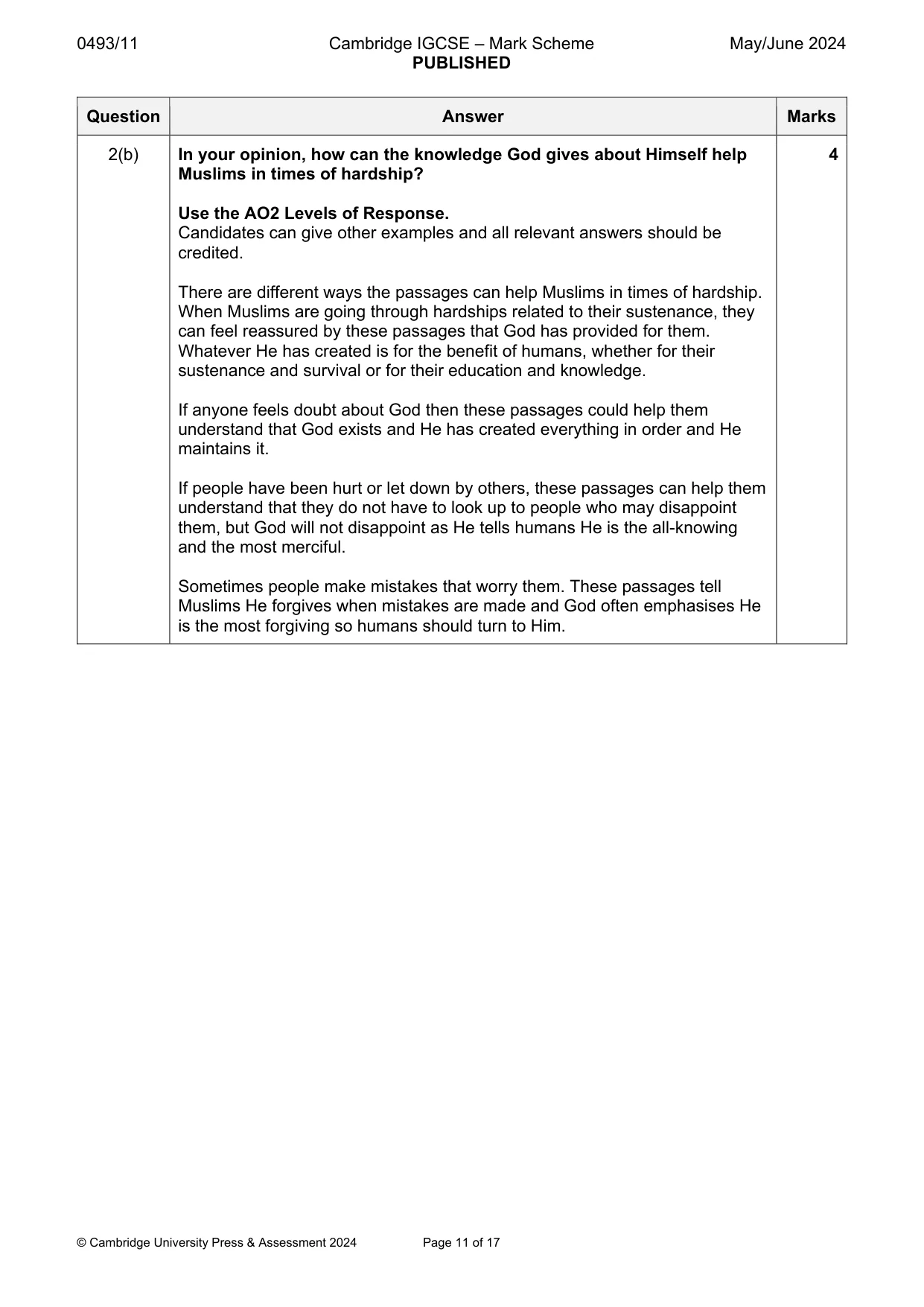
0493/11 Cambridge IGCSE – Mark Scheme PUBLISHED May/June 2024 © Cambridge University Press & Assessment 2024 Page 11 of 17 Question Answer Marks 2(b) In your opinion, how can the knowledge God gives about Himself help Muslims in times of hardship? Use the AO2 Levels of Response. Candidates can give other examples and all relevant answers should be credited. There are different ways the passages can help Muslims in times of hardship. When Muslims are going through hardships related to their sustenance, they can feel reassured by these passages that God has provided for them. Whatever He has created is for the benefit of humans, whether for their sustenance and survival or for their education and knowledge. If anyone feels doubt about God then these passages could help them understand that God exists and He has created everything in order and He maintains it. If people have been hurt or let down by others, these passages can help them understand that they do not have to look up to people who may disappoint them, but God will not disappoint as He tells humans He is the all-knowing and the most merciful. Sometimes people make mistakes that worry them. These passages tell Muslims He forgives when mistakes are made and God often emphasises He is the most forgiving so humans should turn to Him. 4
Mark scheme, page 12
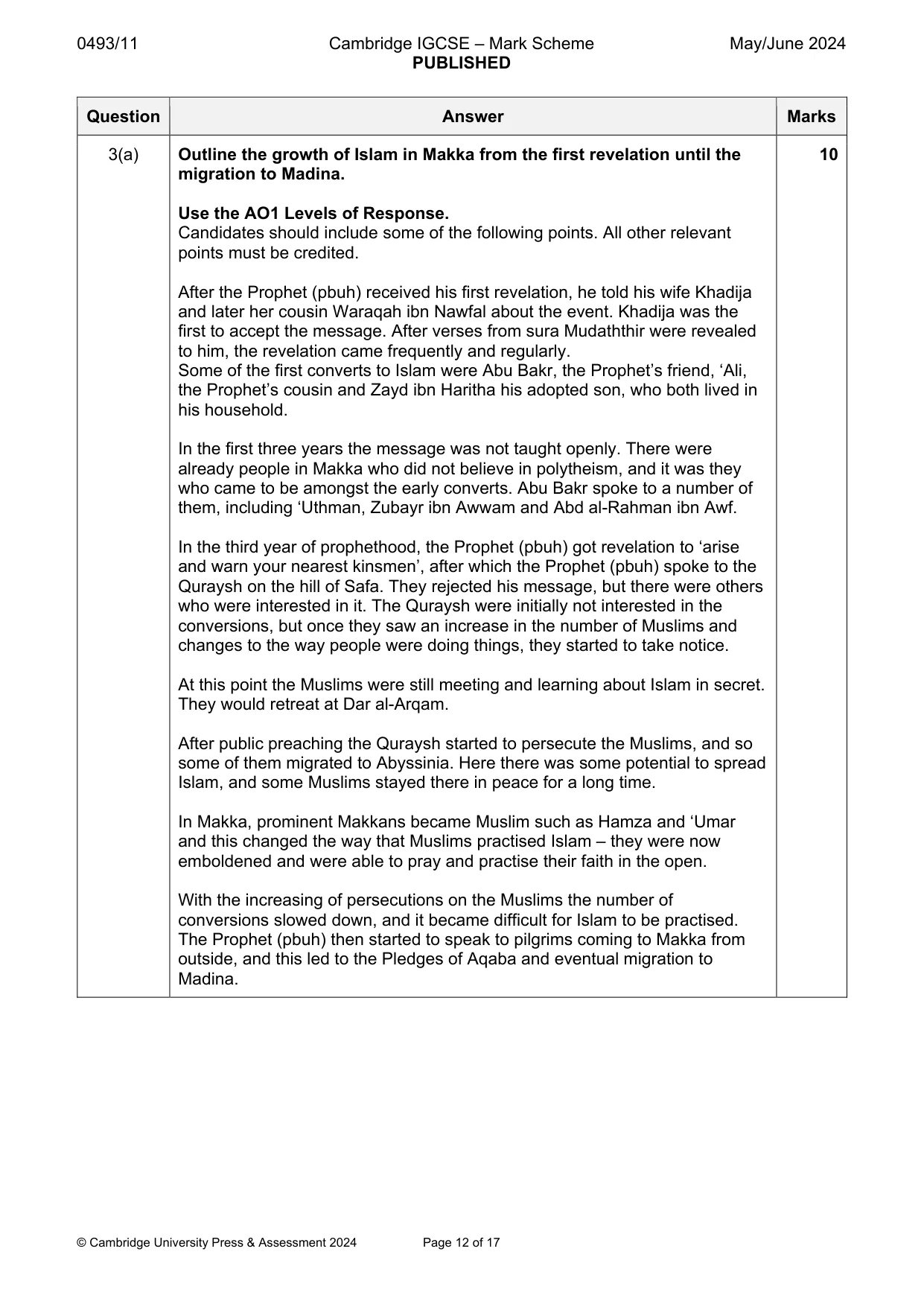
0493/11 Cambridge IGCSE – Mark Scheme PUBLISHED May/June 2024 © Cambridge University Press & Assessment 2024 Page 12 of 17 Question Answer Marks 3(a) Outline the growth of Islam in Makka from the first revelation until the migration to Madina. Use the AO1 Levels of Response. Candidates should include some of the following points. All other relevant points must be credited. After the Prophet (pbuh) received his first revelation, he told his wife Khadija and later her cousin Waraqah ibn Nawfal about the event. Khadija was the first to accept the message. After verses from sura Mudaththir were revealed to him, the revelation came frequently and regularly. Some of the first converts to Islam were Abu Bakr, the Prophet’s friend, ‘Ali, the Prophet’s cousin and Zayd ibn Haritha his adopted son, who both lived in his household. In the first three years the message was not taught openly. There were already people in Makka who did not believe in polytheism, and it was they who came to be amongst the early converts. Abu Bakr spoke to a number of them, including ‘Uthman, Zubayr ibn Awwam and Abd al-Rahman ibn Awf. In the third year of prophethood, the Prophet (pbuh) got revelation to ‘arise and warn your nearest kinsmen’, after which the Prophet (pbuh) spoke to the Quraysh on the hill of Safa. They rejected his message, but there were others who were interested in it. The Quraysh were initially not interested in the conversions, but once they saw an increase in the number of Muslims and changes to the way people were doing things, they started to take notice. At this point the Muslims were still meeting and learning about Islam in secret. They would retreat at Dar al-Arqam. After public preaching the Quraysh started to persecute the Muslims, and so some of them migrated to Abyssinia. Here there was some potential to spread Islam, and some Muslims stayed there in peace for a long time. In Makka, prominent Makkans became Muslim such as Hamza and ‘Umar and this changed the way that Muslims practised Islam – they were now emboldened and were able to pray and practise their faith in the open. With the increasing of persecutions on the Muslims the number of conversions slowed down, and it became difficult for Islam to be practised. The Prophet (pbuh) then started to speak to pilgrims coming to Makka from outside, and this led to the Pledges of Aqaba and eventual migration to Madina. 10
Mark scheme, page 13
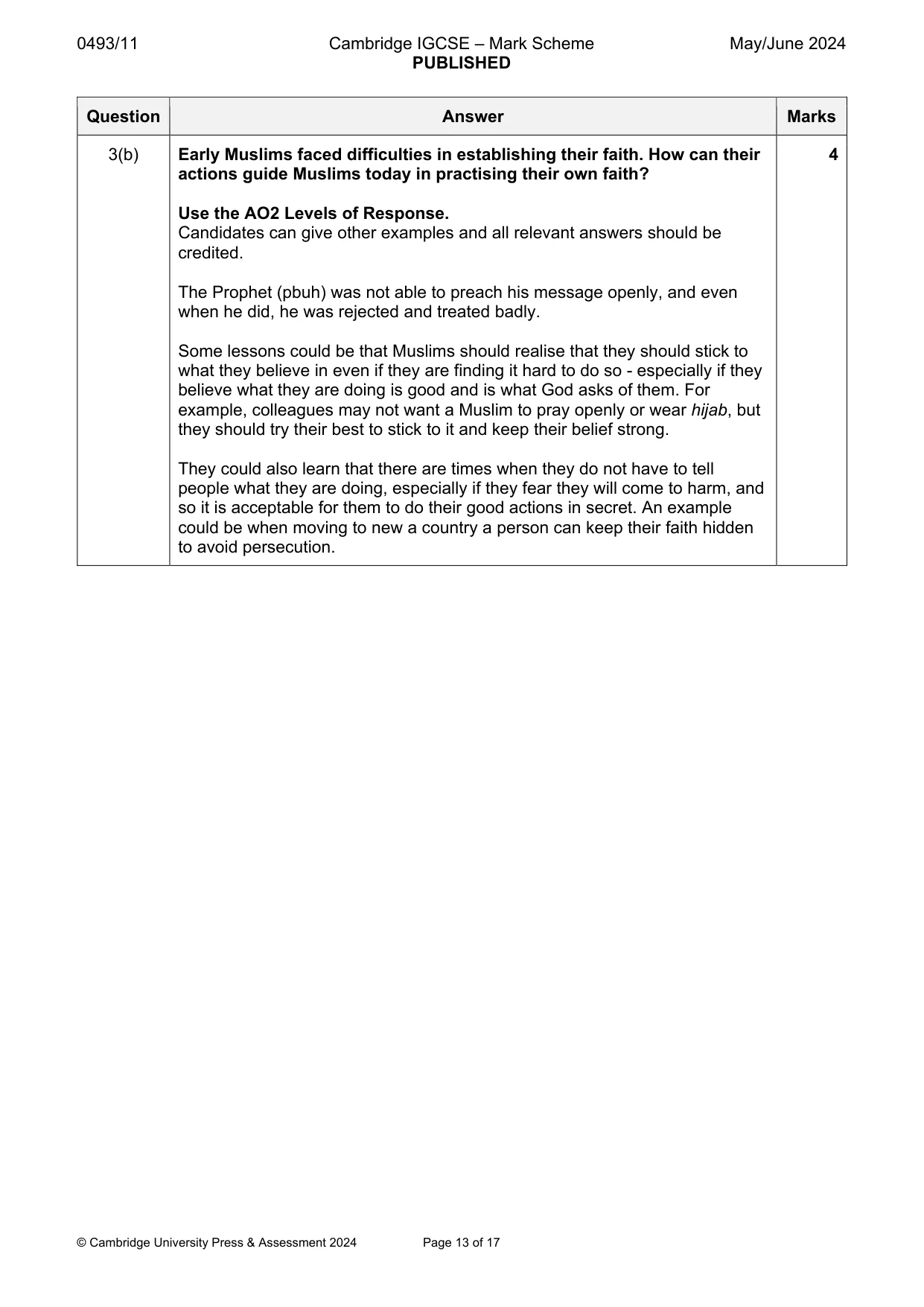
0493/11 Cambridge IGCSE – Mark Scheme PUBLISHED May/June 2024 © Cambridge University Press & Assessment 2024 Page 13 of 17 Question Answer Marks 3(b) Early Muslims faced difficulties in establishing their faith. How can their actions guide Muslims today in practising their own faith? Use the AO2 Levels of Response. Candidates can give other examples and all relevant answers should be credited. The Prophet (pbuh) was not able to preach his message openly, and even when he did, he was rejected and treated badly. Some lessons could be that Muslims should realise that they should stick to what they believe in even if they are finding it hard to do so - especially if they believe what they are doing is good and is what God asks of them. For example, colleagues may not want a Muslim to pray openly or wear hijab, but they should try their best to stick to it and keep their belief strong. They could also learn that there are times when they do not have to tell people what they are doing, especially if they fear they will come to harm, and so it is acceptable for them to do their good actions in secret. An example could be when moving to new a country a person can keep their faith hidden to avoid persecution. 4
Mark scheme, page 14
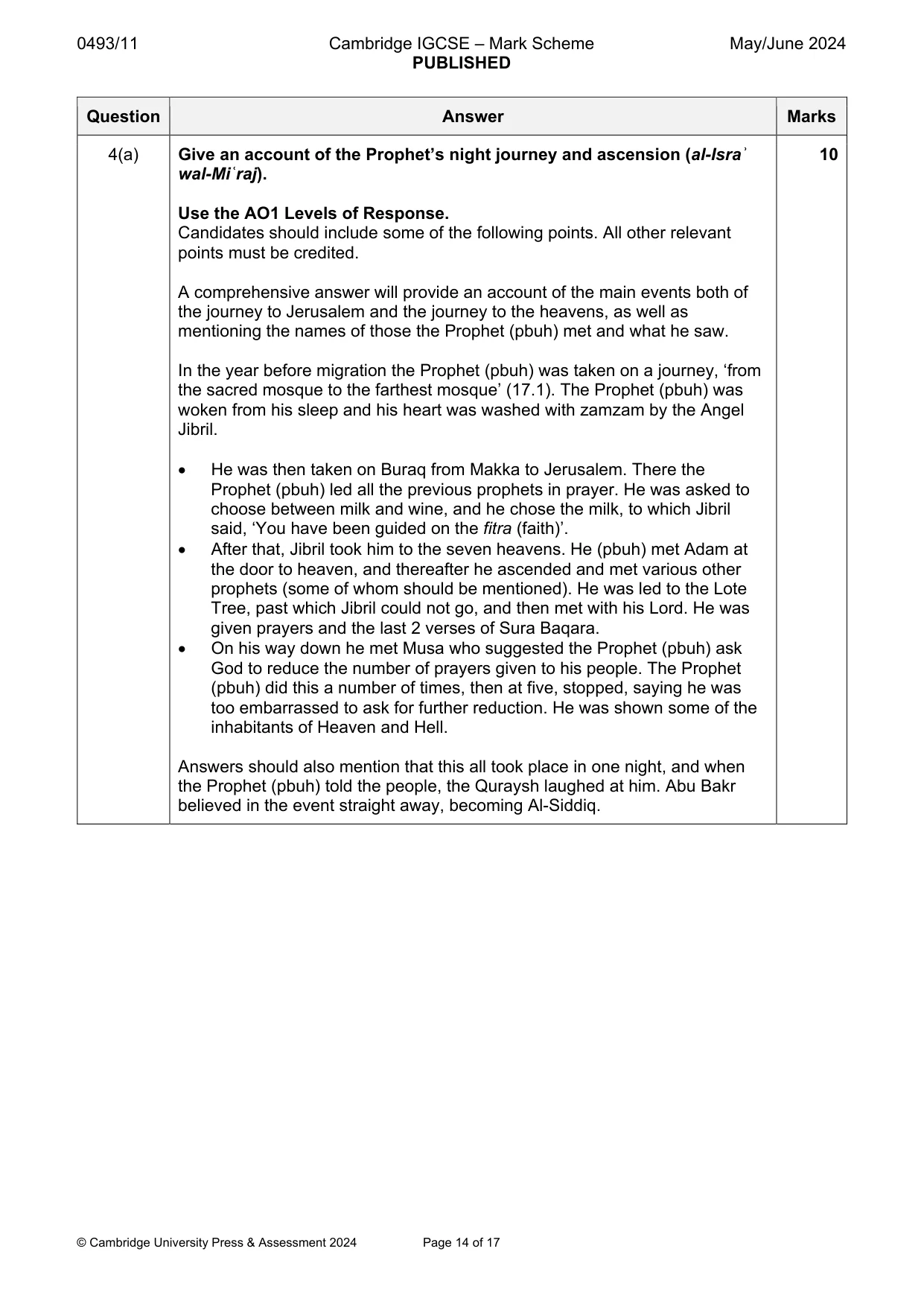
0493/11 Cambridge IGCSE – Mark Scheme PUBLISHED May/June 2024 © Cambridge University Press & Assessment 2024 Page 14 of 17 Question Answer Marks 4(a) Give an account of the Prophet’s night journey and ascension (al-Israʾ wal-Miʿraj). Use the AO1 Levels of Response. Candidates should include some of the following points. All other relevant points must be credited. A comprehensive answer will provide an account of the main events both of the journey to Jerusalem and the journey to the heavens, as well as mentioning the names of those the Prophet (pbuh) met and what he saw. In the year before migration the Prophet (pbuh) was taken on a journey, ‘from the sacred mosque to the farthest mosque’ (17.1). The Prophet (pbuh) was woken from his sleep and his heart was washed with zamzam by the Angel Jibril. He was then taken on Buraq from Makka to Jerusalem. There the Prophet (pbuh) led all the previous prophets in prayer. He was asked to choose between milk and wine, and he chose the milk, to which Jibril said, ‘You have been guided on the fitra (faith)’. After that, Jibril took him to the seven heavens. He (pbuh) met Adam at the door to heaven, and thereafter he ascended and met various other prophets (some of whom should be mentioned). He was led to the Lote Tree, past which Jibril could not go, and then met with his Lord. He was given prayers and the last 2 verses of Sura Baqara. On his way down he met Musa who suggested the Prophet (pbuh) ask God to reduce the number of prayers given to his people. The Prophet (pbuh) did this a number of times, then at five, stopped, saying he was too embarrassed to ask for further reduction. He was shown some of the inhabitants of Heaven and Hell. Answers should also mention that this all took place in one night, and when the Prophet (pbuh) told the people, the Quraysh laughed at him. Abu Bakr believed in the event straight away, becoming Al-Siddiq. 10
Mark scheme, page 15
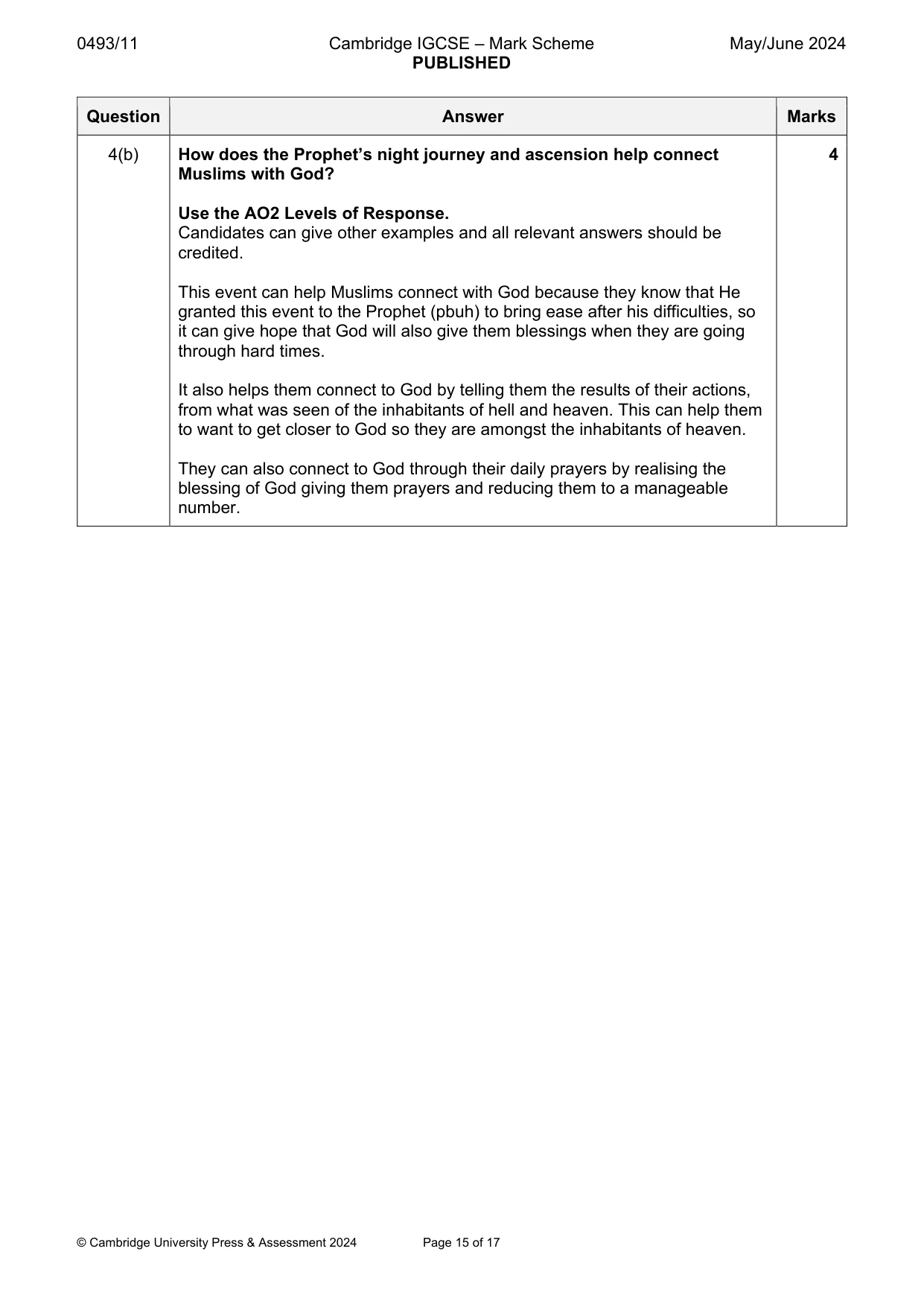
0493/11 Cambridge IGCSE – Mark Scheme PUBLISHED May/June 2024 © Cambridge University Press & Assessment 2024 Page 15 of 17 Question Answer Marks 4(b) How does the Prophet’s night journey and ascension help connect Muslims with God? Use the AO2 Levels of Response. Candidates can give other examples and all relevant answers should be credited. This event can help Muslims connect with God because they know that He granted this event to the Prophet (pbuh) to bring ease after his difficulties, so it can give hope that God will also give them blessings when they are going through hard times. It also helps them connect to God by telling them the results of their actions, from what was seen of the inhabitants of hell and heaven. This can help them to want to get closer to God so they are amongst the inhabitants of heaven. They can also connect to God through their daily prayers by realising the blessing of God giving them prayers and reducing them to a manageable number. 4
Mark scheme, page 16
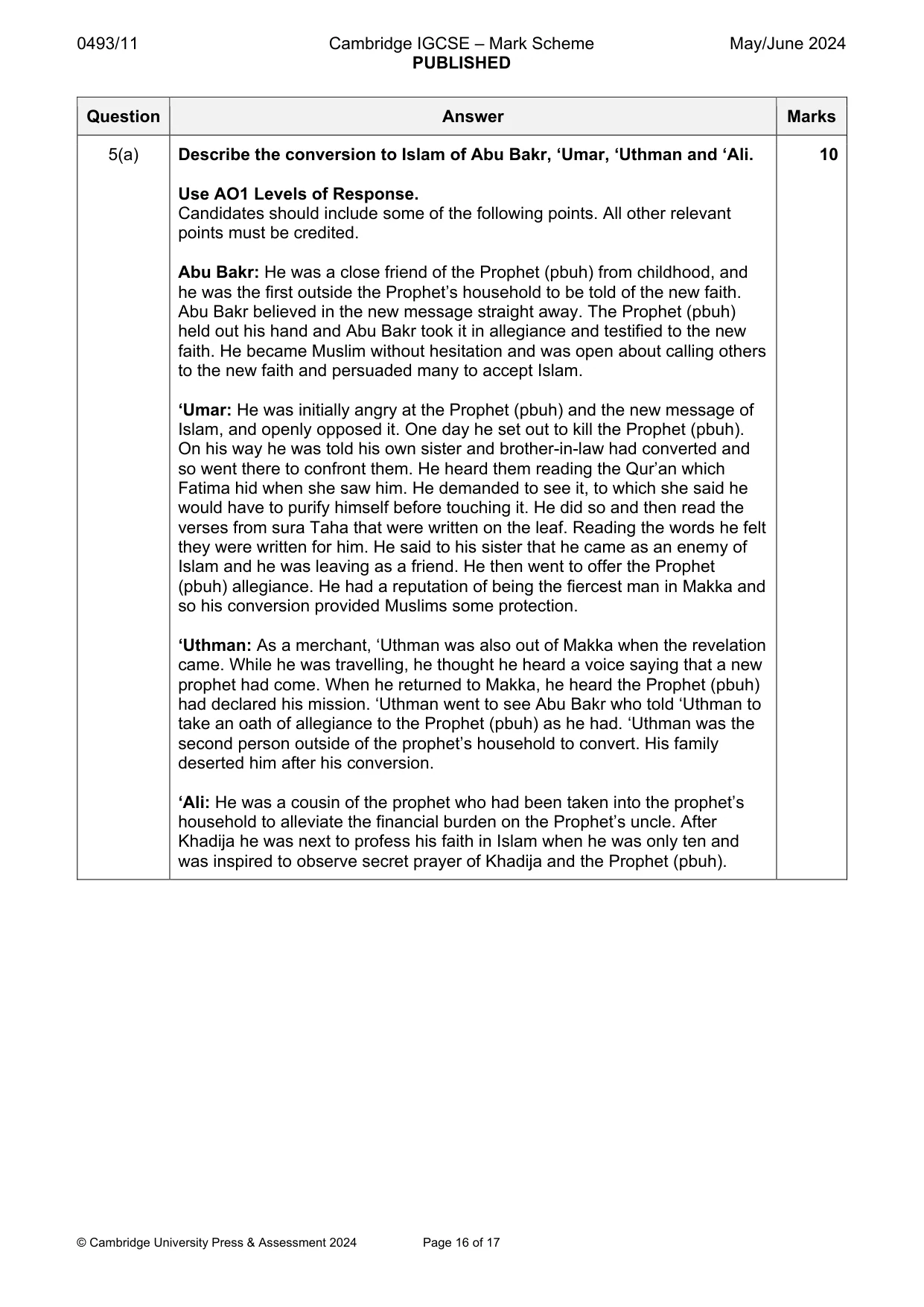
0493/11 Cambridge IGCSE – Mark Scheme PUBLISHED May/June 2024 © Cambridge University Press & Assessment 2024 Page 16 of 17 Question Answer Marks 5(a) Describe the conversion to Islam of Abu Bakr, ‘Umar, ‘Uthman and ‘Ali. Use AO1 Levels of Response. Candidates should include some of the following points. All other relevant points must be credited. Abu Bakr: He was a close friend of the Prophet (pbuh) from childhood, and he was the first outside the Prophet’s household to be told of the new faith. Abu Bakr believed in the new message straight away. The Prophet (pbuh) held out his hand and Abu Bakr took it in allegiance and testified to the new faith. He became Muslim without hesitation and was open about calling others to the new faith and persuaded many to accept Islam. ‘Umar: He was initially angry at the Prophet (pbuh) and the new message of Islam, and openly opposed it. One day he set out to kill the Prophet (pbuh). On his way he was told his own sister and brother-in-law had converted and so went there to confront them. He heard them reading the Qur’an which Fatima hid when she saw him. He demanded to see it, to which she said he would have to purify himself before touching it. He did so and then read the verses from sura Taha that were written on the leaf. Reading the words he felt they were written for him. He said to his sister that he came as an enemy of Islam and he was leaving as a friend. He then went to offer the Prophet (pbuh) allegiance. He had a reputation of being the fiercest man in Makka and so his conversion provided Muslims some protection. ‘Uthman: As a merchant, ‘Uthman was also out of Makka when the revelation came. While he was travelling, he thought he heard a voice saying that a new prophet had come. When he returned to Makka, he heard the Prophet (pbuh) had declared his mission. ‘Uthman went to see Abu Bakr who told ‘Uthman to take an oath of allegiance to the Prophet (pbuh) as he had. ‘Uthman was the second person outside of the prophet’s household to convert. His family deserted him after his conversion. ‘Ali: He was a cousin of the prophet who had been taken into the prophet’s household to alleviate the financial burden on the Prophet’s uncle. After Khadija he was next to profess his faith in Islam when he was only ten and was inspired to observe secret prayer of Khadija and the Prophet (pbuh). 10
Mark scheme, page 17
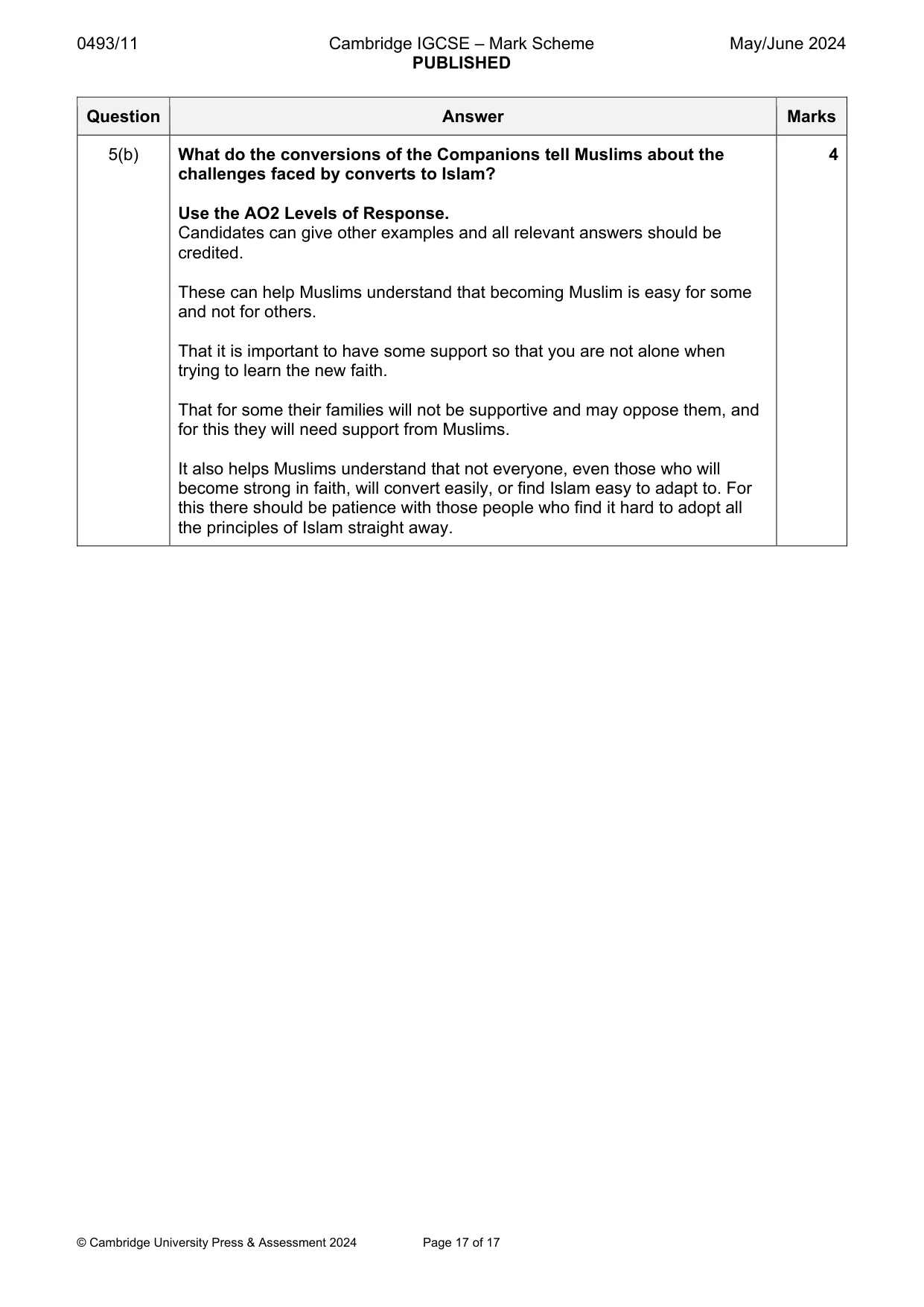
0493/11 Cambridge IGCSE – Mark Scheme PUBLISHED May/June 2024 © Cambridge University Press & Assessment 2024 Page 17 of 17 Question Answer Marks 5(b) What do the conversions of the Companions tell Muslims about the challenges faced by converts to Islam? Use the AO2 Levels of Response. Candidates can give other examples and all relevant answers should be credited. These can help Muslims understand that becoming Muslim is easy for some and not for others. That it is important to have some support so that you are not alone when trying to learn the new faith. That for some their families will not be supportive and may oppose them, and for this they will need support from Muslims. It also helps Muslims understand that not everyone, even those who will become strong in faith, will convert easily, or find Islam easy to adapt to. For this there should be patience with those people who find it hard to adopt all the principles of Islam straight away. 4
What you needed in this session
Cambridge’s own grade thresholds for 2024 May/June, Paper 1 · Variant 1. A higher threshold means an easier paper — the bar moves with how the cohort did.