Cambridge IGCSE Islamiyat 0493 — 2023 May/June Paper 1 · Variant 2
0493/12/M/J/23 · 50 marks · ≈56 min
The question paper and its mark scheme, free to read here and free to download. This is Cambridge’s own paper, exactly as it was sat.
Question paper16 pages




Mark scheme16 pages
Answers below. Sit the paper first if you are practising.
Paper as text
Question paper, page 1
This document has 16 pages. [Turn over Cambridge IGCSE™ ISLAMIYAT 0493/12 Paper 1 May/June 2023 1 hour 30 minutes You must answer on the question paper. No additional materials are needed. INSTRUCTIONS ● Answer four questions in total: Answer Question 1. Answer Question 2. Answer two other questions. ● Use a black or dark blue pen. ● Write your name, centre number and candidate number in the boxes at the top of the page. ● Write your answer to each question in the space provided. ● Do not use an erasable pen or correction fluid. ● Do not write on any bar codes. INFORMATION ● The total mark for this paper is 50. ● The number of marks for each question or part question is shown in brackets [ ]. * 1 0 6 3 4 7 8 9 6 6 * DC (CJ) 311868/2 © UCLES 2023
Question paper, page 2
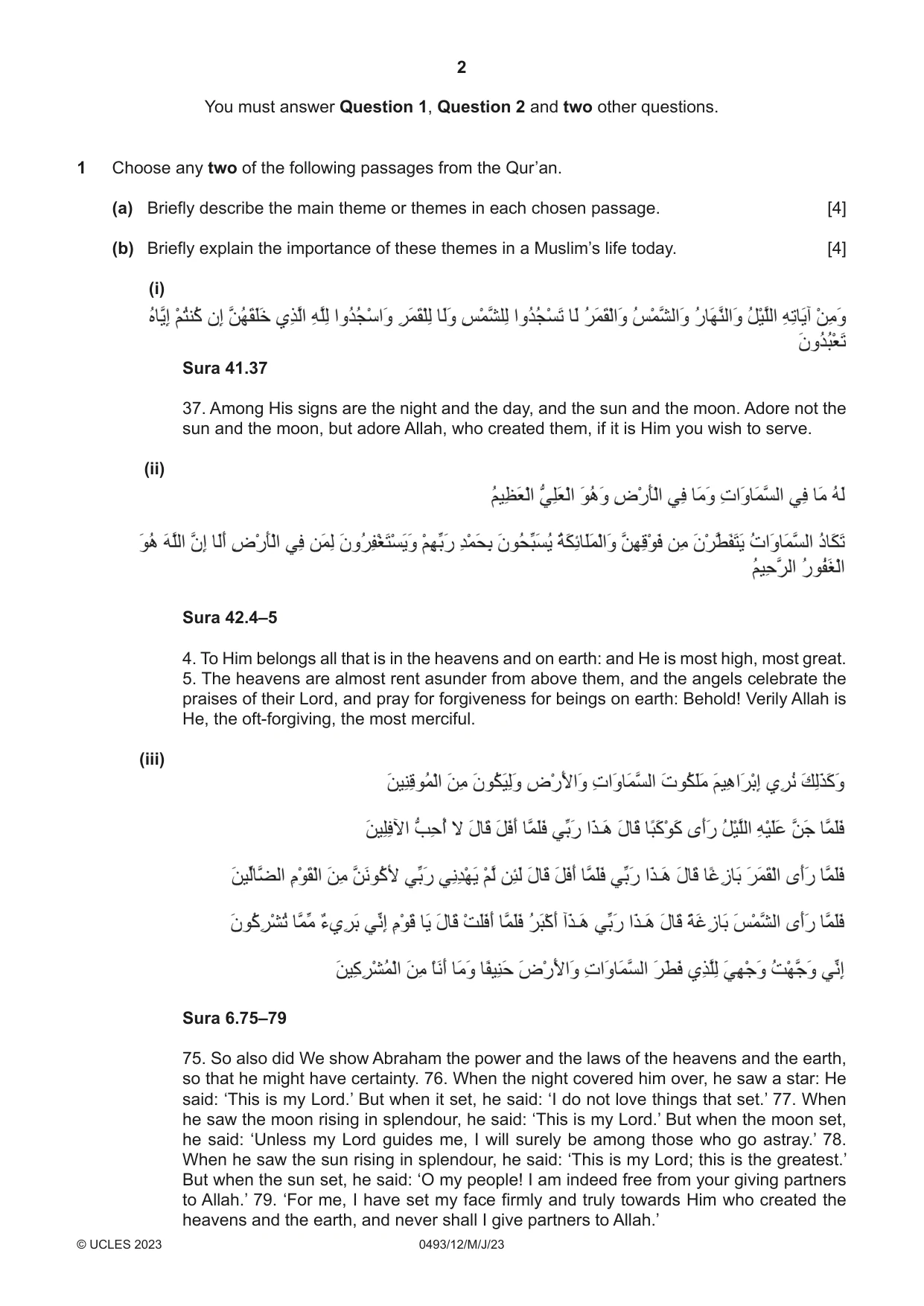
2 0493/12/M/J/23 © UCLES 2023 You must answer Question 1, Question 2 and two other questions. 1 Choose any two of the following passages from the Qur’an. (a) Briefly describe the main theme or themes in each chosen passage. [4] (b) Briefly explain the importance of these themes in a Muslim’s life today. [4] (i) Sura 41.37 37. Among His signs are the night and the day, and the sun and the moon. Adore not the sun and the moon, but adore Allah, who created them, if it is Him you wish to serve. (ii) Sura 42.4–5 4. To Him belongs all that is in the heavens and on earth: and He is most high, most great. 5. The heavens are almost rent asunder from above them, and the angels celebrate the praises of their Lord, and pray for forgiveness for beings on earth: Behold! Verily Allah is He, the oft-forgiving, the most merciful. (iii) Sura 6.75–79 75. So also did We show Abraham the power and the laws of the heavens and the earth, so that he might have certainty. 76. When the night covered him over, he saw a star: He said: ‘This is my Lord.’ But when it set, he said: ‘I do not love things that set.’ 77. When he saw the moon rising in splendour, he said: ‘This is my Lord.’ But when the moon set, he said: ‘Unless my Lord guides me, I will surely be among those who go astray.’ 78. When he saw the sun rising in splendour, he said: ‘This is my Lord; this is the greatest.’ But when the sun set, he said: ‘O my people! I am indeed free from your giving partners to Allah.’ 79. ‘For me, I have set my face firmly and truly towards Him who created the heavens and the earth, and never shall I give partners to Allah.’
Question paper, page 3
3 0493/12/M/J/23 © UCLES 2023 [Turn over … … … … … … … … … … … … … … … … … … … … … … … … … … … …
Question paper, page 4
4 0493/12/M/J/23 © UCLES 2023 … … … … … … … … … … … … … … … … … … … … … … … … … … … …
Question paper, page 5
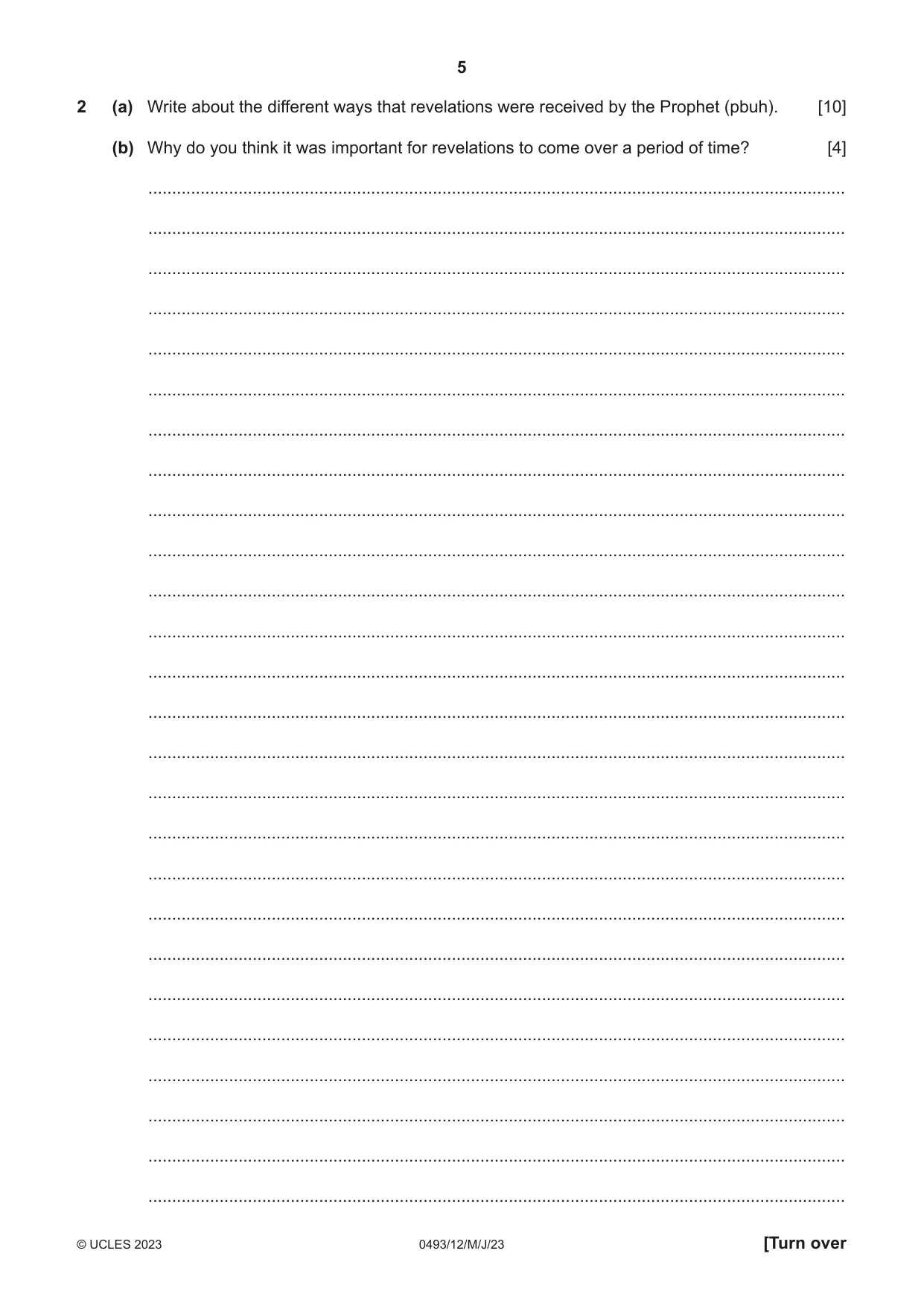
5 0493/12/M/J/23 © UCLES 2023 [Turn over 2 (a) Write about the different ways that revelations were received by the Prophet (pbuh). [10] (b) Why do you think it was important for revelations to come over a period of time? [4] … … … … … … … … … … … … … … … … … … … … … … … … … …
Question paper, page 6
6 0493/12/M/J/23 © UCLES 2023 … … … … … … … … … … … … … … … … … … … … … … … … … … … …
Question paper, page 7
7 0493/12/M/J/23 © UCLES 2023 [Turn over … … … … … … … … … … … … … … … … … … … … … … … … … … … …
Question paper, page 8
8 0493/12/M/J/23 © UCLES 2023 3 (a) Write about when the Prophet (pbuh) showed patience and self-restraint while living in Makka. [10] (b) How can Muslims demonstrate patience and self-restraint in their own lives? [4] … … … … … … … … … … … … … … … … … … … … … … … … … …
Question paper, page 9
9 0493/12/M/J/23 © UCLES 2023 [Turn over … … … … … … … … … … … … … … … … … … … … … … … … … … … …
Question paper, page 10
10 0493/12/M/J/23 © UCLES 2023 … … … … … … … … … … … … … … … … … … … … … … … … … … … …
Question paper, page 11
11 0493/12/M/J/23 © UCLES 2023 [Turn over 4 (a) Write an account of the Prophet’s conquest of Makka in 630. [10] (b) What was the significance of the conquest of Makka for the development of Islam? [4] … … … … … … … … … … … … … … … … … … … … … … … … … …
Question paper, page 12
12 0493/12/M/J/23 © UCLES 2023 … … … … … … … … … … … … … … … … … … … … … … … … … … … …
Question paper, page 13
13 0493/12/M/J/23 © UCLES 2023 [Turn over … … … … … … … … … … … … … … … … … … … … … … … … … … … …
Question paper, page 14
14 0493/12/M/J/23 © UCLES 2023 5 (a) Write an account of the lives of Amina bint Wahb and Halima Sa’adia during their time with the Prophet (pbuh). [10] (b) The Prophet (pbuh) was an orphan and raised by various people. How might this be an example for Muslims today? [4] … … … … … … … … … … … … … … … … … … … … … … … … …
Question paper, page 15
15 0493/12/M/J/23 © UCLES 2023 [Turn over … … … … … … … … … … … … … … … … … … … … … … … … … … … …
Question paper, page 16
16 0493/12/M/J/23 © UCLES 2023 Permission to reproduce items where third-party owned material protected by copyright is included has been sought and cleared where possible. Every reasonable effort has been made by the publisher (UCLES) to trace copyright holders, but if any items requiring clearance have unwittingly been included, the publisher will be pleased to make amends at the earliest possible opportunity. To avoid the issue of disclosure of answer-related information to candidates, all copyright acknowledgements are reproduced online in the Cambridge Assessment International Education Copyright Acknowledgements Booklet. This is produced for each series of examinations and is freely available to download at www.cambridgeinternational.org after the live examination series. Cambridge Assessment International Education is part of Cambridge Assessment. Cambridge Assessment is the brand name of the University of Cambridge Local Examinations Syndicate (UCLES), which is a department of the University of Cambridge. … … … … … … … … … … … … … … … … … … … … … … …
Mark scheme, page 1
This document consists of 16 printed pages. © UCLES 2023 [Turn over Cambridge IGCSE™ ISLAMIYAT 0493/12 Paper 1 May/June 2023 MARK SCHEME Maximum Mark: 50 Published This mark scheme is published as an aid to teachers and candidates, to indicate the requirements of the examination. It shows the basis on which Examiners were instructed to award marks. It does not indicate the details of the discussions that took place at an Examiners’ meeting before marking began, which would have considered the acceptability of alternative answers. Mark schemes should be read in conjunction with the question paper and the Principal Examiner Report for Teachers. Cambridge International will not enter into discussions about these mark schemes. Cambridge International is publishing the mark schemes for the May/June 2023 series for most Cambridge IGCSE, Cambridge International A and AS Level and Cambridge Pre-U components, and some Cambridge O Level components.
Mark scheme, page 2
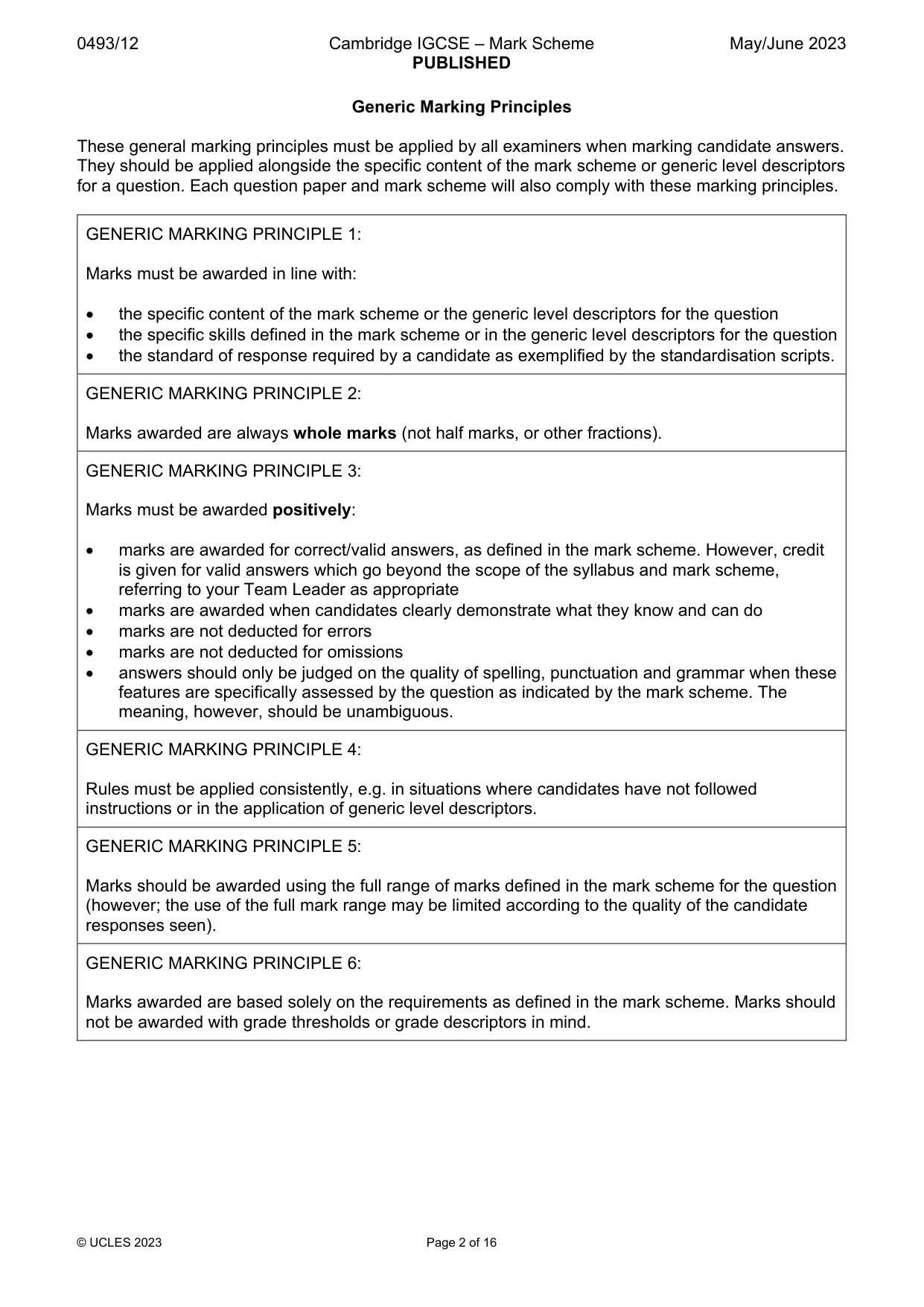
0493/12 Cambridge IGCSE – Mark Scheme PUBLISHED May/June 2023 © UCLES 2023 Page 2 of 16 Generic Marking Principles These general marking principles must be applied by all examiners when marking candidate answers. They should be applied alongside the specific content of the mark scheme or generic level descriptors for a question. Each question paper and mark scheme will also comply with these marking principles. GENERIC MARKING PRINCIPLE 1: Marks must be awarded in line with: the specific content of the mark scheme or the generic level descriptors for the question the specific skills defined in the mark scheme or in the generic level descriptors for the question the standard of response required by a candidate as exemplified by the standardisation scripts. GENERIC MARKING PRINCIPLE 2: Marks awarded are always whole marks (not half marks, or other fractions). GENERIC MARKING PRINCIPLE 3: Marks must be awarded positively: marks are awarded for correct/valid answers, as defined in the mark scheme. However, credit is given for valid answers which go beyond the scope of the syllabus and mark scheme, referring to your Team Leader as appropriate marks are awarded when candidates clearly demonstrate what they know and can do marks are not deducted for errors marks are not deducted for omissions answers should only be judged on the quality of spelling, punctuation and grammar when these features are specifically assessed by the question as indicated by the mark scheme. The meaning, however, should be unambiguous. GENERIC MARKING PRINCIPLE 4: Rules must be applied consistently, e.g. in situations where candidates have not followed instructions or in the application of generic level descriptors. GENERIC MARKING PRINCIPLE 5: Marks should be awarded using the full range of marks defined in the mark scheme for the question (however; the use of the full mark range may be limited according to the quality of the candidate responses seen). GENERIC MARKING PRINCIPLE 6: Marks awarded are based solely on the requirements as defined in the mark scheme. Marks should not be awarded with grade thresholds or grade descriptors in mind.
Mark scheme, page 3
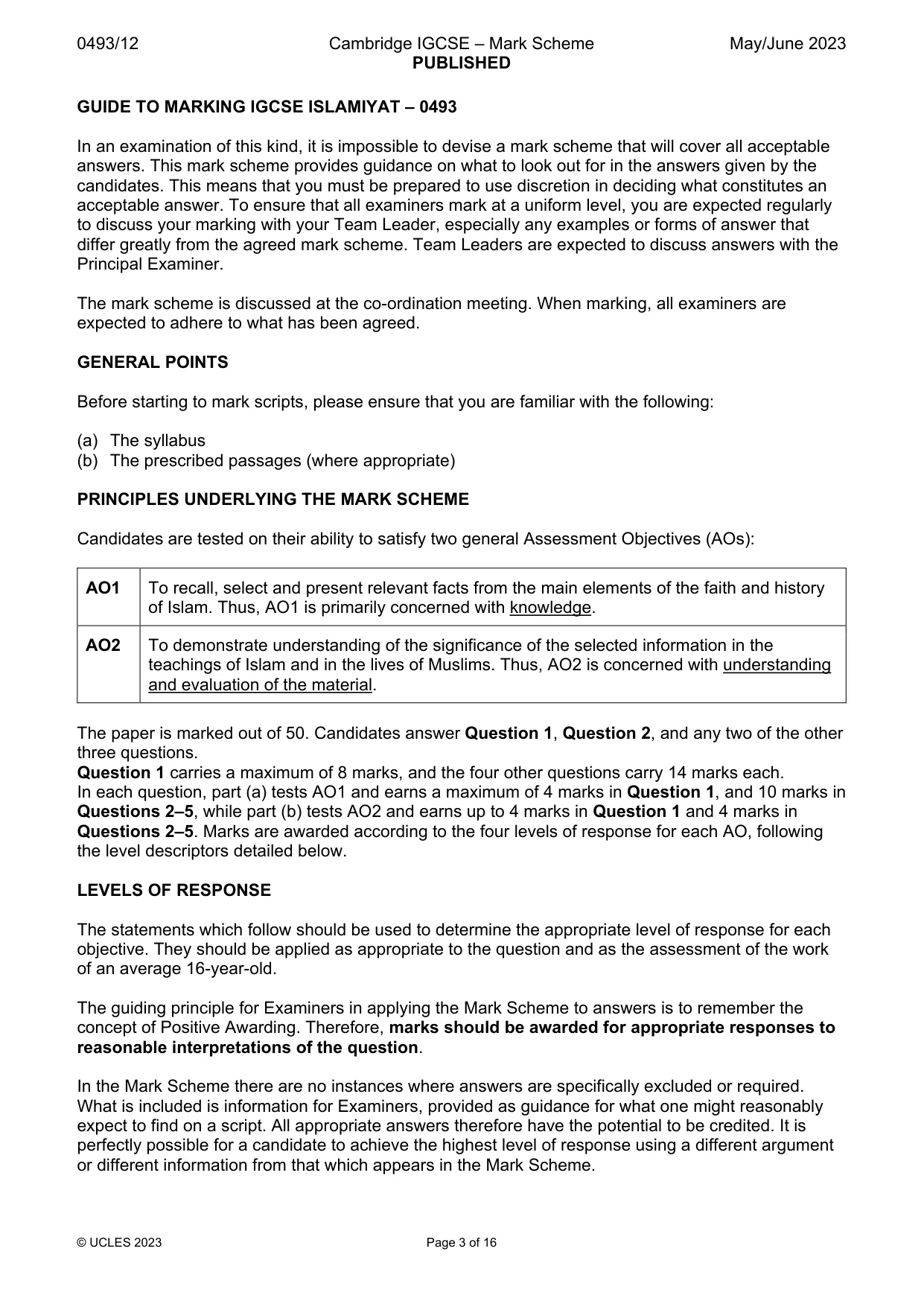
0493/12 Cambridge IGCSE – Mark Scheme PUBLISHED May/June 2023 © UCLES 2023 Page 3 of 16 GUIDE TO MARKING IGCSE ISLAMIYAT – 0493 In an examination of this kind, it is impossible to devise a mark scheme that will cover all acceptable answers. This mark scheme provides guidance on what to look out for in the answers given by the candidates. This means that you must be prepared to use discretion in deciding what constitutes an acceptable answer. To ensure that all examiners mark at a uniform level, you are expected regularly to discuss your marking with your Team Leader, especially any examples or forms of answer that differ greatly from the agreed mark scheme. Team Leaders are expected to discuss answers with the Principal Examiner. The mark scheme is discussed at the co-ordination meeting. When marking, all examiners are expected to adhere to what has been agreed. GENERAL POINTS Before starting to mark scripts, please ensure that you are familiar with the following: (a) The syllabus (b) The prescribed passages (where appropriate) PRINCIPLES UNDERLYING THE MARK SCHEME Candidates are tested on their ability to satisfy two general Assessment Objectives (AOs): AO1 To recall, select and present relevant facts from the main elements of the faith and history of Islam. Thus, AO1 is primarily concerned with knowledge. AO2 To demonstrate understanding of the significance of the selected information in the teachings of Islam and in the lives of Muslims. Thus, AO2 is concerned with understanding and evaluation of the material. The paper is marked out of 50. Candidates answer Question 1, Question 2, and any two of the other three questions. Question 1 carries a maximum of 8 marks, and the four other questions carry 14 marks each. In each question, part (a) tests AO1 and earns a maximum of 4 marks in Question 1, and 10 marks in Questions 2–5, while part (b) tests AO2 and earns up to 4 marks in Question 1 and 4 marks in Questions 2–5. Marks are awarded according to the four levels of response for each AO, following the level descriptors detailed below. LEVELS OF RESPONSE The statements which follow should be used to determine the appropriate level of response for each objective. They should be applied as appropriate to the question and as the assessment of the work of an average 16-year-old. The guiding principle for Examiners in applying the Mark Scheme to answers is to remember the concept of Positive Awarding. Therefore, marks should be awarded for appropriate responses to reasonable interpretations of the question. In the Mark Scheme there are no instances where answers are specifically excluded or required. What is included is information for Examiners, provided as guidance for what one might reasonably expect to find on a script. All appropriate answers therefore have the potential to be credited. It is perfectly possible for a candidate to achieve the highest level of response using a different argument or different information from that which appears in the Mark Scheme.
Mark scheme, page 4
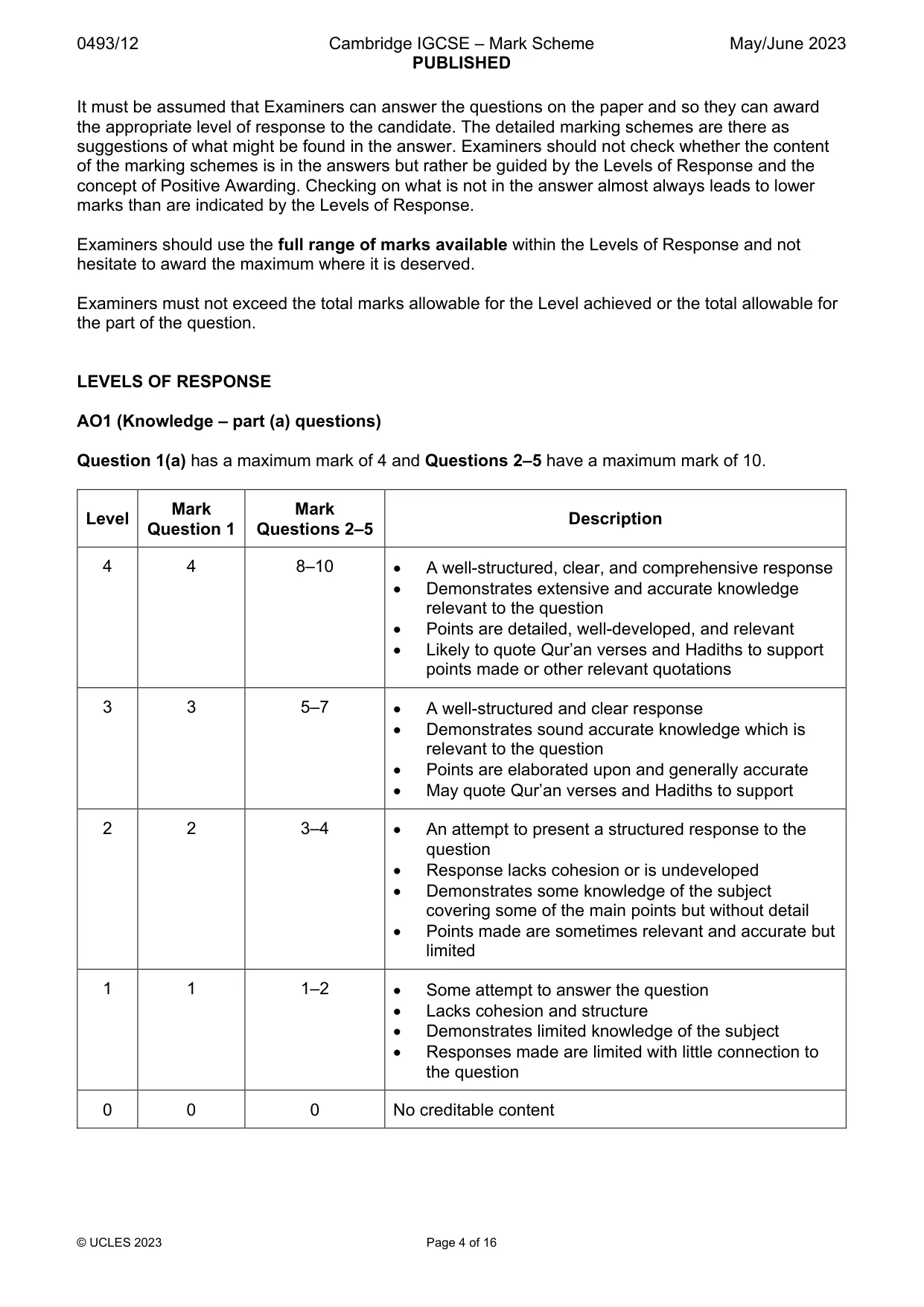
0493/12 Cambridge IGCSE – Mark Scheme PUBLISHED May/June 2023 © UCLES 2023 Page 4 of 16 It must be assumed that Examiners can answer the questions on the paper and so they can award the appropriate level of response to the candidate. The detailed marking schemes are there as suggestions of what might be found in the answer. Examiners should not check whether the content of the marking schemes is in the answers but rather be guided by the Levels of Response and the concept of Positive Awarding. Checking on what is not in the answer almost always leads to lower marks than are indicated by the Levels of Response. Examiners should use the full range of marks available within the Levels of Response and not hesitate to award the maximum where it is deserved. Examiners must not exceed the total marks allowable for the Level achieved or the total allowable for the part of the question. LEVELS OF RESPONSE AO1 (Knowledge – part (a) questions) Question 1(a) has a maximum mark of 4 and Questions 2–5 have a maximum mark of 10. Level Mark Question 1 Mark Questions 2–5 Description 4 4 8–10 A well-structured, clear, and comprehensive response Demonstrates extensive and accurate knowledge relevant to the question Points are detailed, well-developed, and relevant Likely to quote Qur’an verses and Hadiths to support points made or other relevant quotations 3 3 5–7 A well-structured and clear response Demonstrates sound accurate knowledge which is relevant to the question Points are elaborated upon and generally accurate May quote Qur’an verses and Hadiths to support 2 2 3–4 An attempt to present a structured response to the question Response lacks cohesion or is undeveloped Demonstrates some knowledge of the subject covering some of the main points but without detail Points made are sometimes relevant and accurate but limited 1 1 1–2 Some attempt to answer the question Lacks cohesion and structure Demonstrates limited knowledge of the subject Responses made are limited with little connection to the question 0 0 0 No creditable content
Mark scheme, page 5
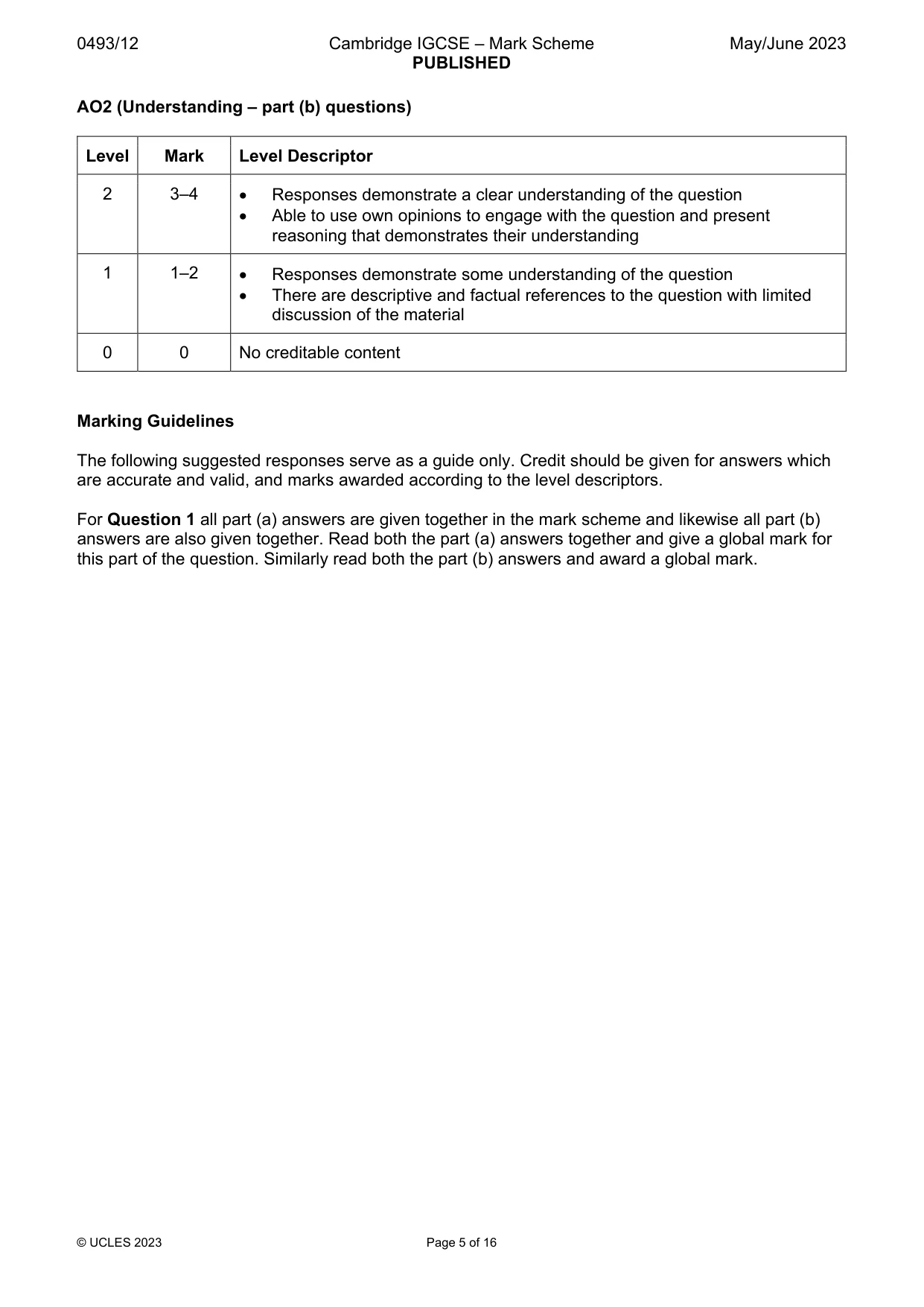
0493/12 Cambridge IGCSE – Mark Scheme PUBLISHED May/June 2023 © UCLES 2023 Page 5 of 16 AO2 (Understanding – part (b) questions) Level Mark Level Descriptor 2 3–4 Responses demonstrate a clear understanding of the question Able to use own opinions to engage with the question and present reasoning that demonstrates their understanding 1 1–2 Responses demonstrate some understanding of the question There are descriptive and factual references to the question with limited discussion of the material 0 0 No creditable content Marking Guidelines The following suggested responses serve as a guide only. Credit should be given for answers which are accurate and valid, and marks awarded according to the level descriptors. For Question 1 all part (a) answers are given together in the mark scheme and likewise all part (b) answers are also given together. Read both the part (a) answers together and give a global mark for this part of the question. Similarly read both the part (b) answers and award a global mark.
Mark scheme, page 6
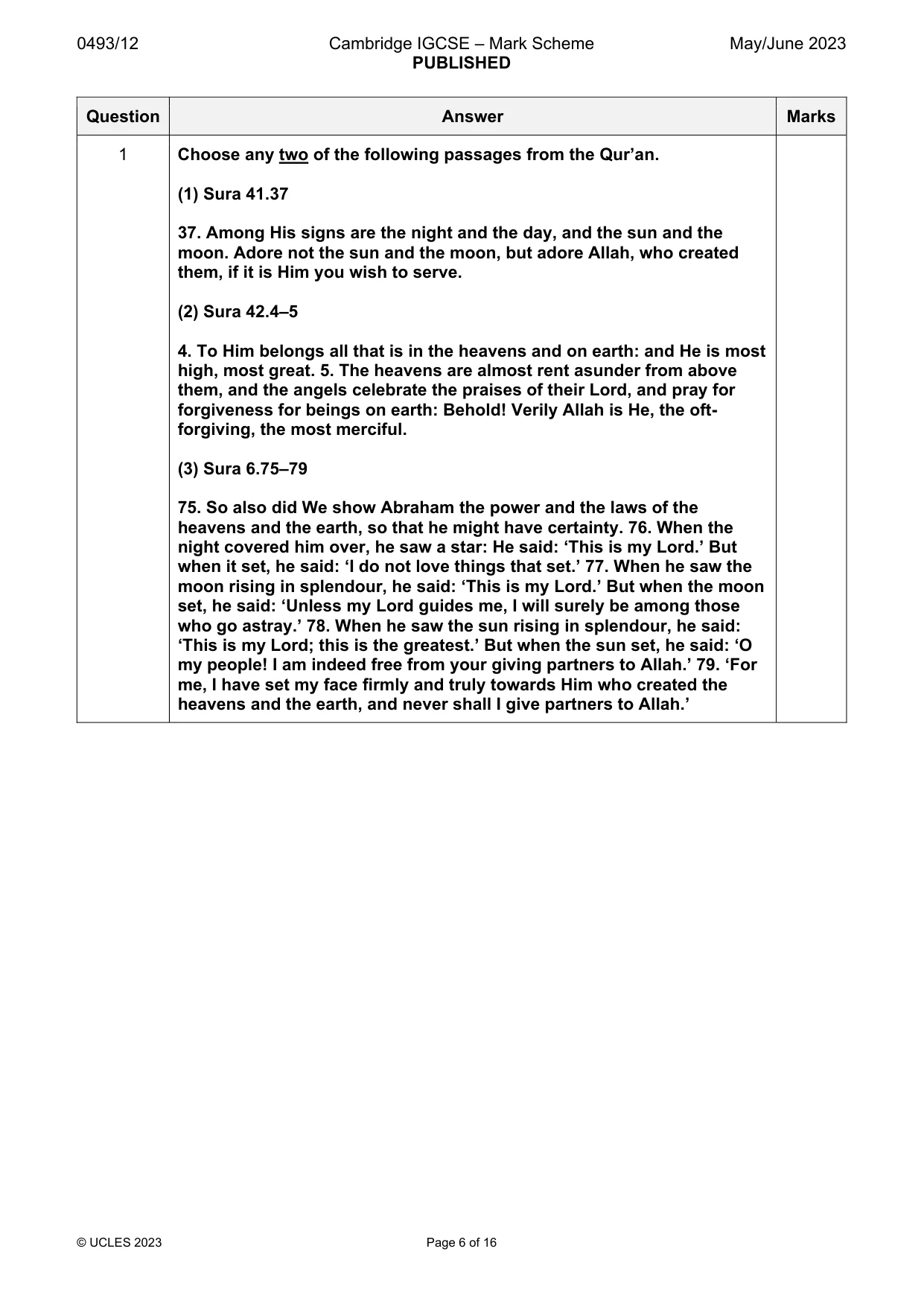
0493/12 Cambridge IGCSE – Mark Scheme PUBLISHED May/June 2023 © UCLES 2023 Page 6 of 16 Question Answer Marks 1 Choose any two of the following passages from the Qur’an. (1) Sura 41.37 37. Among His signs are the night and the day, and the sun and the moon. Adore not the sun and the moon, but adore Allah, who created them, if it is Him you wish to serve. (2) Sura 42.4–5 4. To Him belongs all that is in the heavens and on earth: and He is most high, most great. 5. The heavens are almost rent asunder from above them, and the angels celebrate the praises of their Lord, and pray for forgiveness for beings on earth: Behold! Verily Allah is He, the oft- forgiving, the most merciful. (3) Sura 6.75–79 75. So also did We show Abraham the power and the laws of the heavens and the earth, so that he might have certainty. 76. When the night covered him over, he saw a star: He said: ‘This is my Lord.’ But when it set, he said: ‘I do not love things that set.’ 77. When he saw the moon rising in splendour, he said: ‘This is my Lord.’ But when the moon set, he said: ‘Unless my Lord guides me, I will surely be among those who go astray.’ 78. When he saw the sun rising in splendour, he said: ‘This is my Lord; this is the greatest.’ But when the sun set, he said: ‘O my people! I am indeed free from your giving partners to Allah.’ 79. ‘For me, I have set my face firmly and truly towards Him who created the heavens and the earth, and never shall I give partners to Allah.’
Mark scheme, page 7
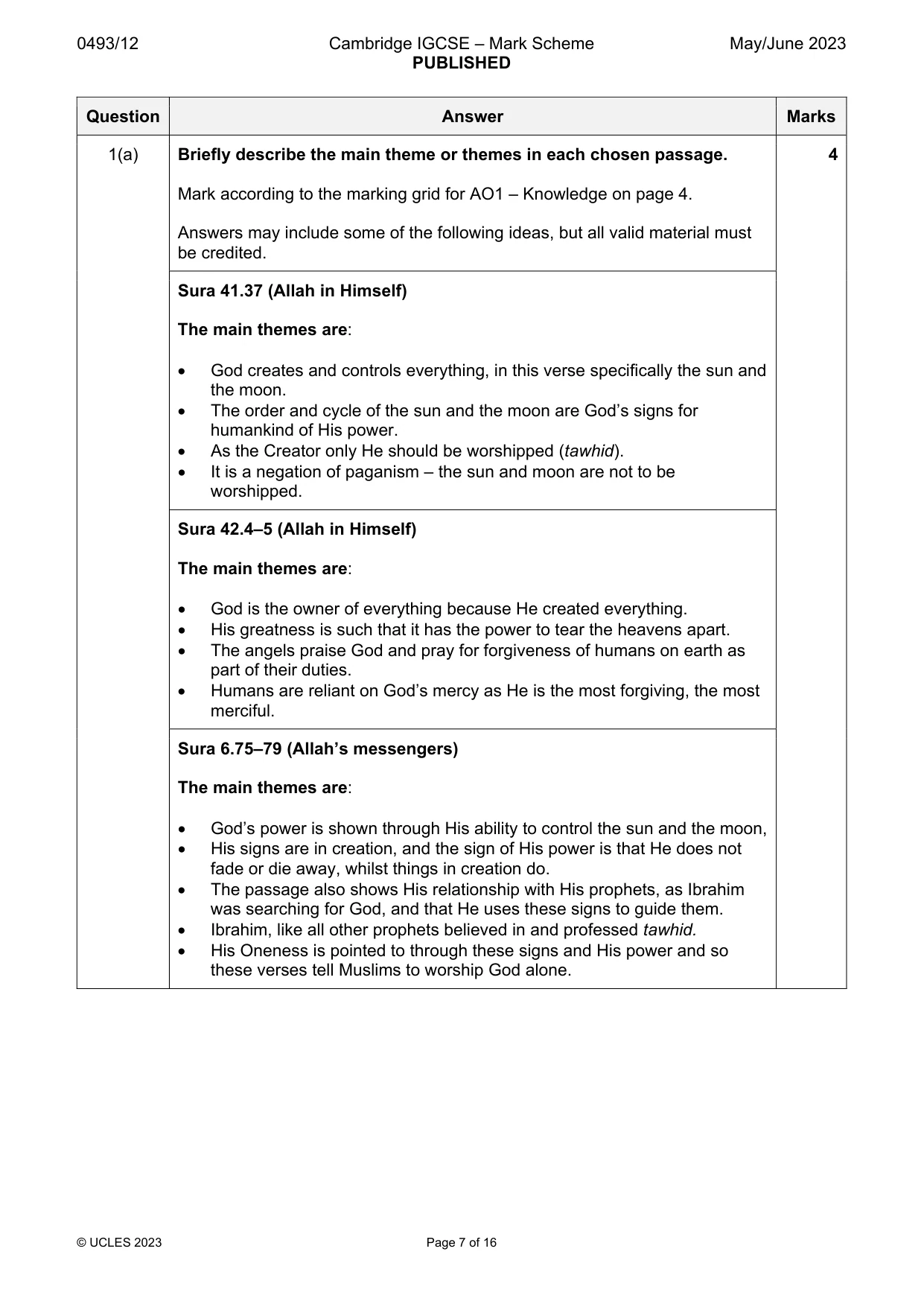
0493/12 Cambridge IGCSE – Mark Scheme PUBLISHED May/June 2023 © UCLES 2023 Page 7 of 16 Question Answer Marks 1(a) Briefly describe the main theme or themes in each chosen passage. Mark according to the marking grid for AO1 – Knowledge on page 4. Answers may include some of the following ideas, but all valid material must be credited. 4 Sura 41.37 (Allah in Himself) The main themes are: God creates and controls everything, in this verse specifically the sun and the moon. The order and cycle of the sun and the moon are God’s signs for humankind of His power. As the Creator only He should be worshipped (tawhid). It is a negation of paganism – the sun and moon are not to be worshipped. Sura 42.4–5 (Allah in Himself) The main themes are: God is the owner of everything because He created everything. His greatness is such that it has the power to tear the heavens apart. The angels praise God and pray for forgiveness of humans on earth as part of their duties. Humans are reliant on God’s mercy as He is the most forgiving, the most merciful. Sura 6.75–79 (Allah’s messengers) The main themes are: God’s power is shown through His ability to control the sun and the moon, His signs are in creation, and the sign of His power is that He does not fade or die away, whilst things in creation do. The passage also shows His relationship with His prophets, as Ibrahim was searching for God, and that He uses these signs to guide them. Ibrahim, like all other prophets believed in and professed tawhid. His Oneness is pointed to through these signs and His power and so these verses tell Muslims to worship God alone.
Mark scheme, page 8
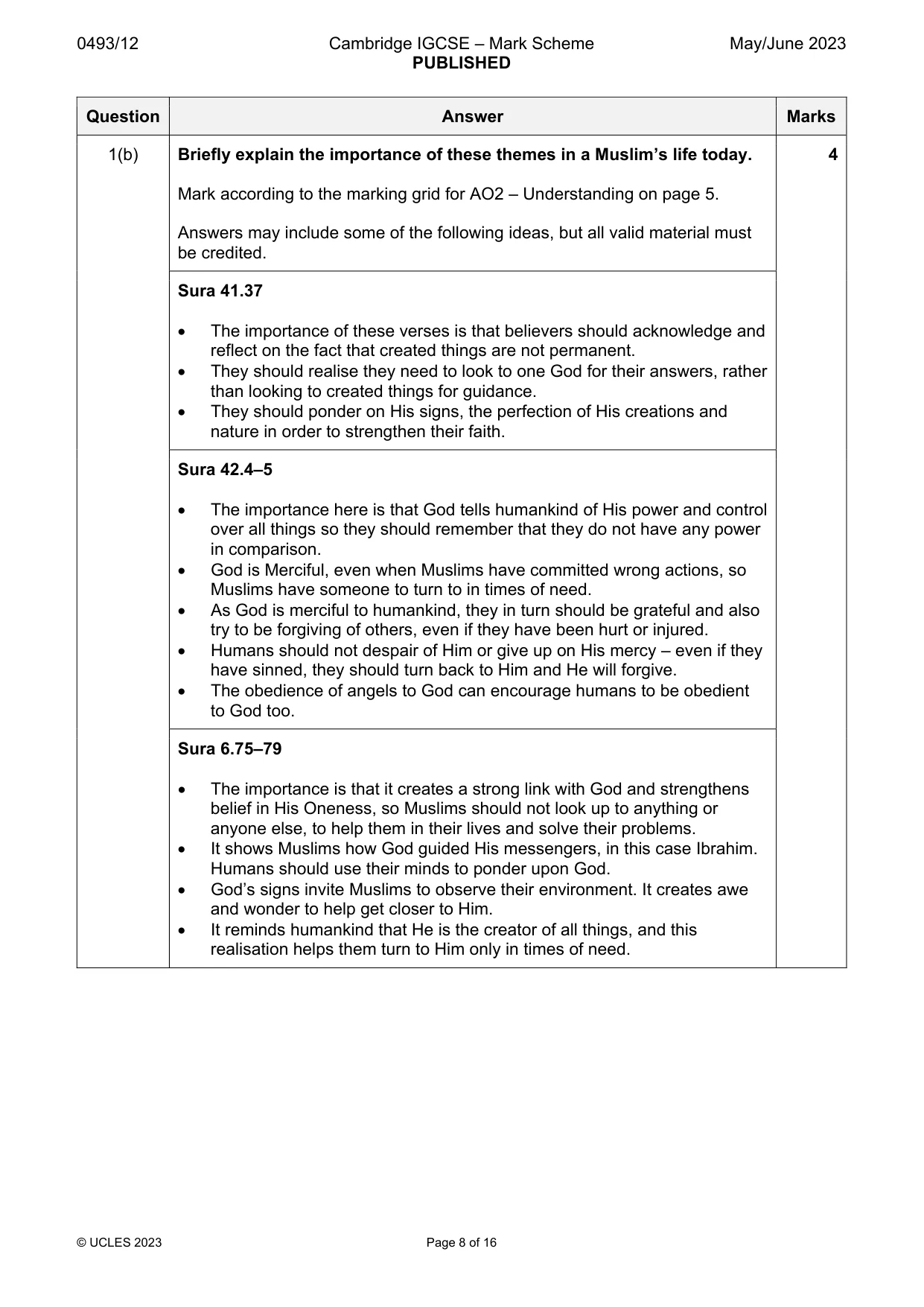
0493/12 Cambridge IGCSE – Mark Scheme PUBLISHED May/June 2023 © UCLES 2023 Page 8 of 16 Question Answer Marks 1(b) Briefly explain the importance of these themes in a Muslim’s life today. Mark according to the marking grid for AO2 – Understanding on page 5. Answers may include some of the following ideas, but all valid material must be credited. 4 Sura 41.37 The importance of these verses is that believers should acknowledge and reflect on the fact that created things are not permanent. They should realise they need to look to one God for their answers, rather than looking to created things for guidance. They should ponder on His signs, the perfection of His creations and nature in order to strengthen their faith. Sura 42.4–5 The importance here is that God tells humankind of His power and control over all things so they should remember that they do not have any power in comparison. God is Merciful, even when Muslims have committed wrong actions, so Muslims have someone to turn to in times of need. As God is merciful to humankind, they in turn should be grateful and also try to be forgiving of others, even if they have been hurt or injured. Humans should not despair of Him or give up on His mercy – even if they have sinned, they should turn back to Him and He will forgive. The obedience of angels to God can encourage humans to be obedient to God too. Sura 6.75–79 The importance is that it creates a strong link with God and strengthens belief in His Oneness, so Muslims should not look up to anything or anyone else, to help them in their lives and solve their problems. It shows Muslims how God guided His messengers, in this case Ibrahim. Humans should use their minds to ponder upon God. God’s signs invite Muslims to observe their environment. It creates awe and wonder to help get closer to Him. It reminds humankind that He is the creator of all things, and this realisation helps them turn to Him only in times of need.
Mark scheme, page 9
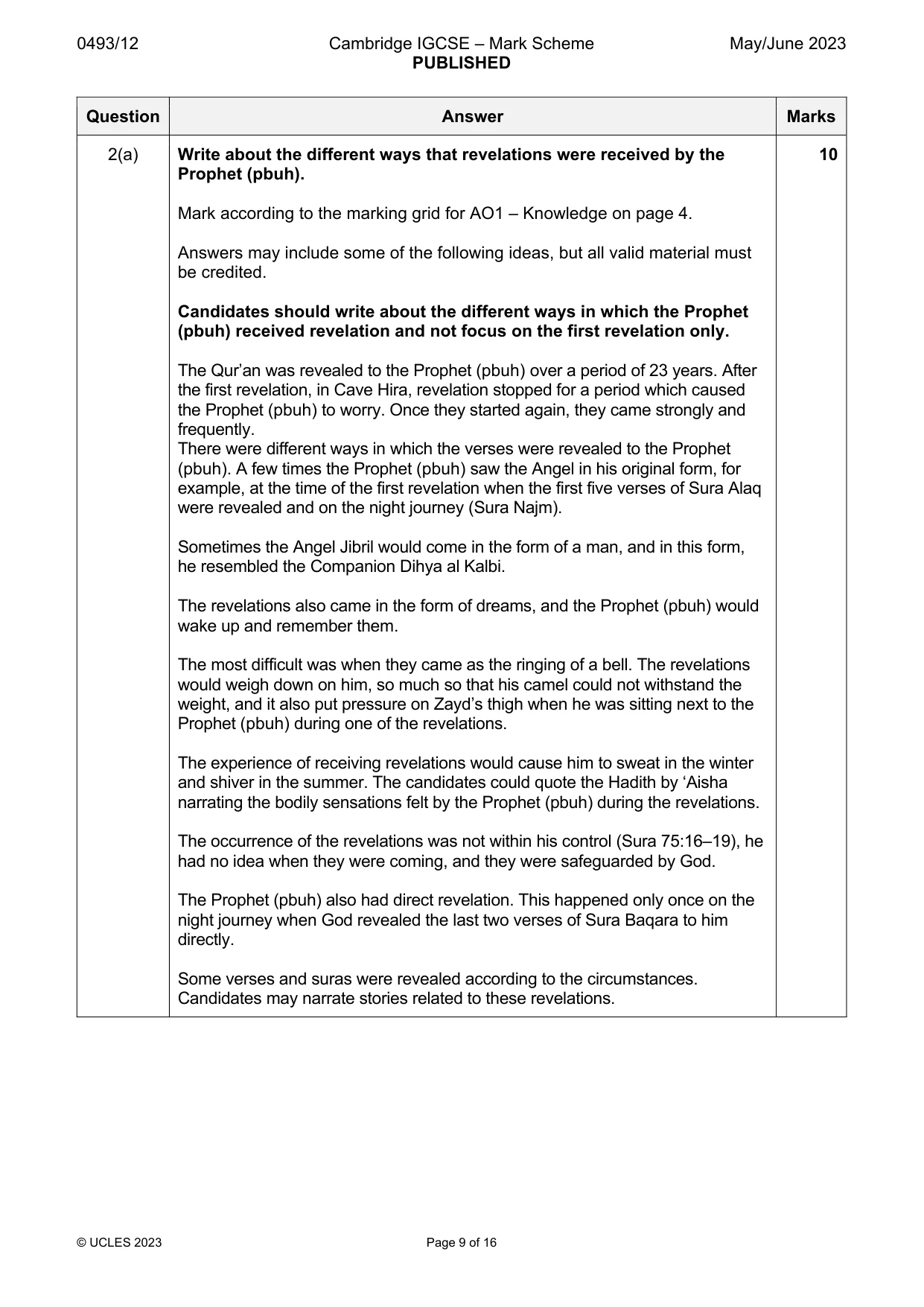
0493/12 Cambridge IGCSE – Mark Scheme PUBLISHED May/June 2023 © UCLES 2023 Page 9 of 16 Question Answer Marks 2(a) Write about the different ways that revelations were received by the Prophet (pbuh). Mark according to the marking grid for AO1 – Knowledge on page 4. Answers may include some of the following ideas, but all valid material must be credited. Candidates should write about the different ways in which the Prophet (pbuh) received revelation and not focus on the first revelation only. The Qur’an was revealed to the Prophet (pbuh) over a period of 23 years. After the first revelation, in Cave Hira, revelation stopped for a period which caused the Prophet (pbuh) to worry. Once they started again, they came strongly and frequently. There were different ways in which the verses were revealed to the Prophet (pbuh). A few times the Prophet (pbuh) saw the Angel in his original form, for example, at the time of the first revelation when the first five verses of Sura Alaq were revealed and on the night journey (Sura Najm). Sometimes the Angel Jibril would come in the form of a man, and in this form, he resembled the Companion Dihya al Kalbi. The revelations also came in the form of dreams, and the Prophet (pbuh) would wake up and remember them. The most difficult was when they came as the ringing of a bell. The revelations would weigh down on him, so much so that his camel could not withstand the weight, and it also put pressure on Zayd’s thigh when he was sitting next to the Prophet (pbuh) during one of the revelations. The experience of receiving revelations would cause him to sweat in the winter and shiver in the summer. The candidates could quote the Hadith by ‘Aisha narrating the bodily sensations felt by the Prophet (pbuh) during the revelations. The occurrence of the revelations was not within his control (Sura 75:16–19), he had no idea when they were coming, and they were safeguarded by God. The Prophet (pbuh) also had direct revelation. This happened only once on the night journey when God revealed the last two verses of Sura Baqara to him directly. Some verses and suras were revealed according to the circumstances. Candidates may narrate stories related to these revelations. 10
Mark scheme, page 10
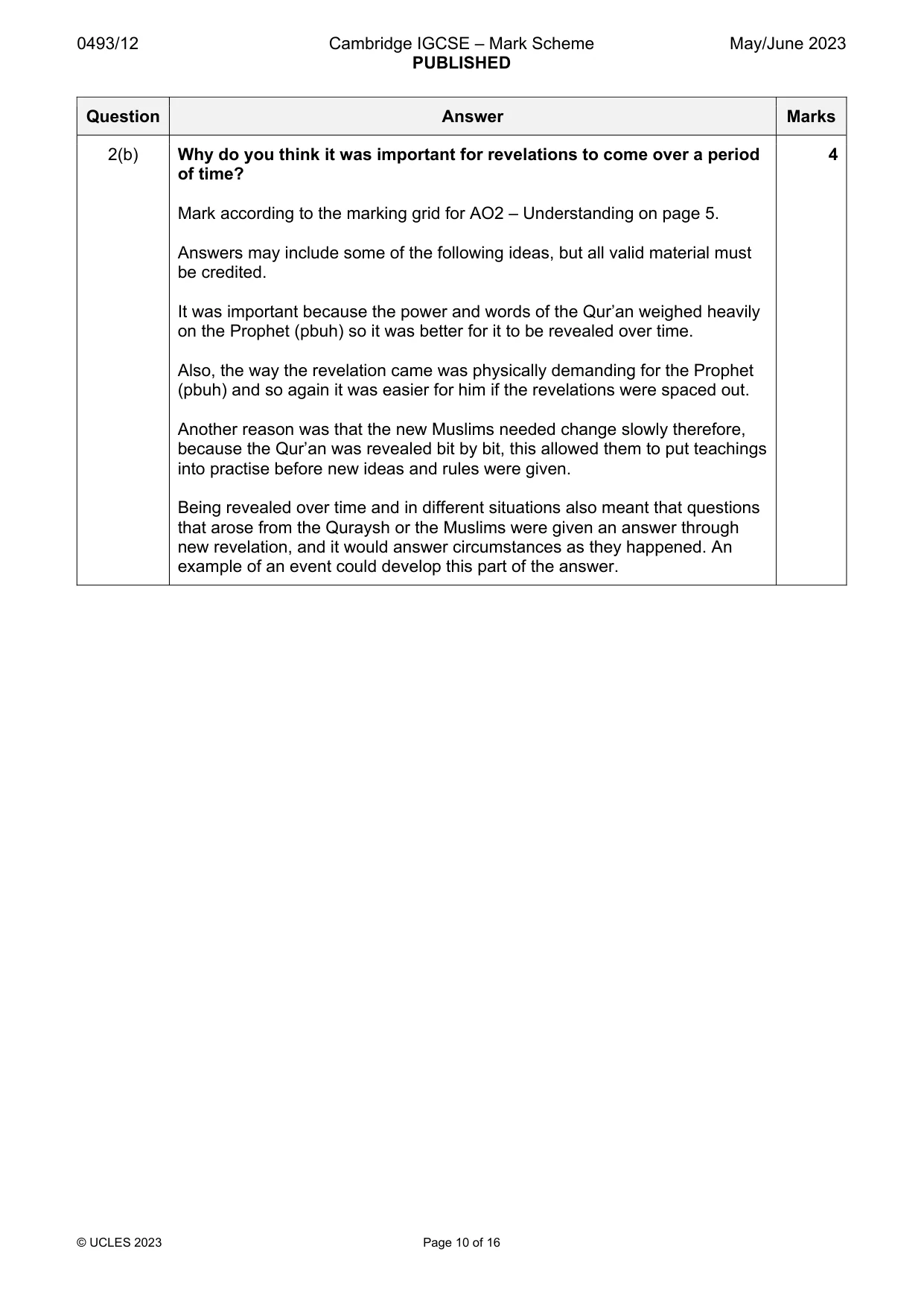
0493/12 Cambridge IGCSE – Mark Scheme PUBLISHED May/June 2023 © UCLES 2023 Page 10 of 16 Question Answer Marks 2(b) Why do you think it was important for revelations to come over a period of time? Mark according to the marking grid for AO2 – Understanding on page 5. Answers may include some of the following ideas, but all valid material must be credited. It was important because the power and words of the Qur’an weighed heavily on the Prophet (pbuh) so it was better for it to be revealed over time. Also, the way the revelation came was physically demanding for the Prophet (pbuh) and so again it was easier for him if the revelations were spaced out. Another reason was that the new Muslims needed change slowly therefore, because the Qur’an was revealed bit by bit, this allowed them to put teachings into practise before new ideas and rules were given. Being revealed over time and in different situations also meant that questions that arose from the Quraysh or the Muslims were given an answer through new revelation, and it would answer circumstances as they happened. An example of an event could develop this part of the answer. 4
Mark scheme, page 11
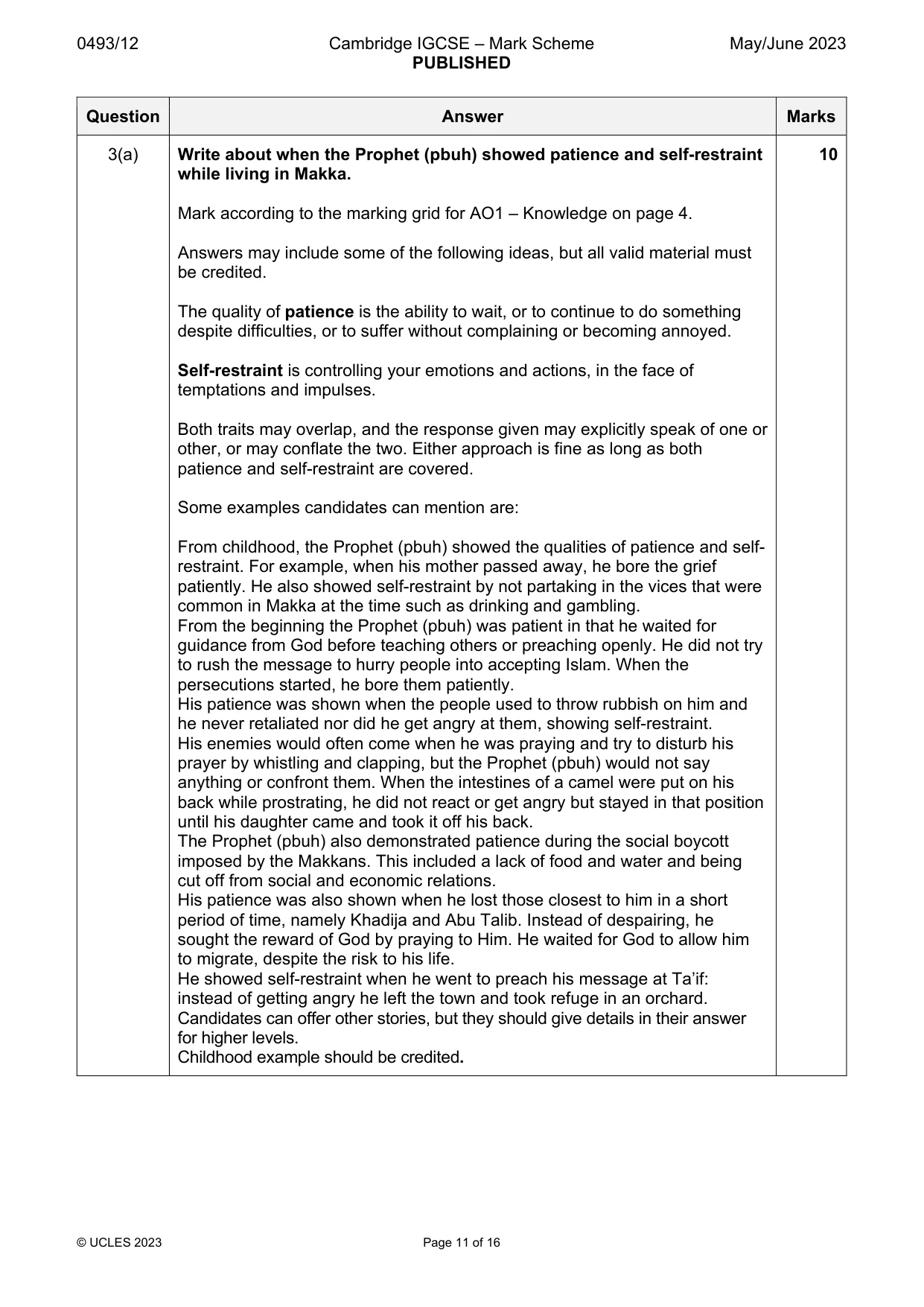
0493/12 Cambridge IGCSE – Mark Scheme PUBLISHED May/June 2023 © UCLES 2023 Page 11 of 16 Question Answer Marks 3(a) Write about when the Prophet (pbuh) showed patience and self-restraint while living in Makka. Mark according to the marking grid for AO1 – Knowledge on page 4. Answers may include some of the following ideas, but all valid material must be credited. The quality of patience is the ability to wait, or to continue to do something despite difficulties, or to suffer without complaining or becoming annoyed. Self-restraint is controlling your emotions and actions, in the face of temptations and impulses. Both traits may overlap, and the response given may explicitly speak of one or other, or may conflate the two. Either approach is fine as long as both patience and self-restraint are covered. Some examples candidates can mention are: From childhood, the Prophet (pbuh) showed the qualities of patience and self- restraint. For example, when his mother passed away, he bore the grief patiently. He also showed self-restraint by not partaking in the vices that were common in Makka at the time such as drinking and gambling. From the beginning the Prophet (pbuh) was patient in that he waited for guidance from God before teaching others or preaching openly. He did not try to rush the message to hurry people into accepting Islam. When the persecutions started, he bore them patiently. His patience was shown when the people used to throw rubbish on him and he never retaliated nor did he get angry at them, showing self-restraint. His enemies would often come when he was praying and try to disturb his prayer by whistling and clapping, but the Prophet (pbuh) would not say anything or confront them. When the intestines of a camel were put on his back while prostrating, he did not react or get angry but stayed in that position until his daughter came and took it off his back. The Prophet (pbuh) also demonstrated patience during the social boycott imposed by the Makkans. This included a lack of food and water and being cut off from social and economic relations. His patience was also shown when he lost those closest to him in a short period of time, namely Khadija and Abu Talib. Instead of despairing, he sought the reward of God by praying to Him. He waited for God to allow him to migrate, despite the risk to his life. He showed self-restraint when he went to preach his message at Ta’if: instead of getting angry he left the town and took refuge in an orchard. Candidates can offer other stories, but they should give details in their answer for higher levels. Childhood example should be credited. 10
Mark scheme, page 12
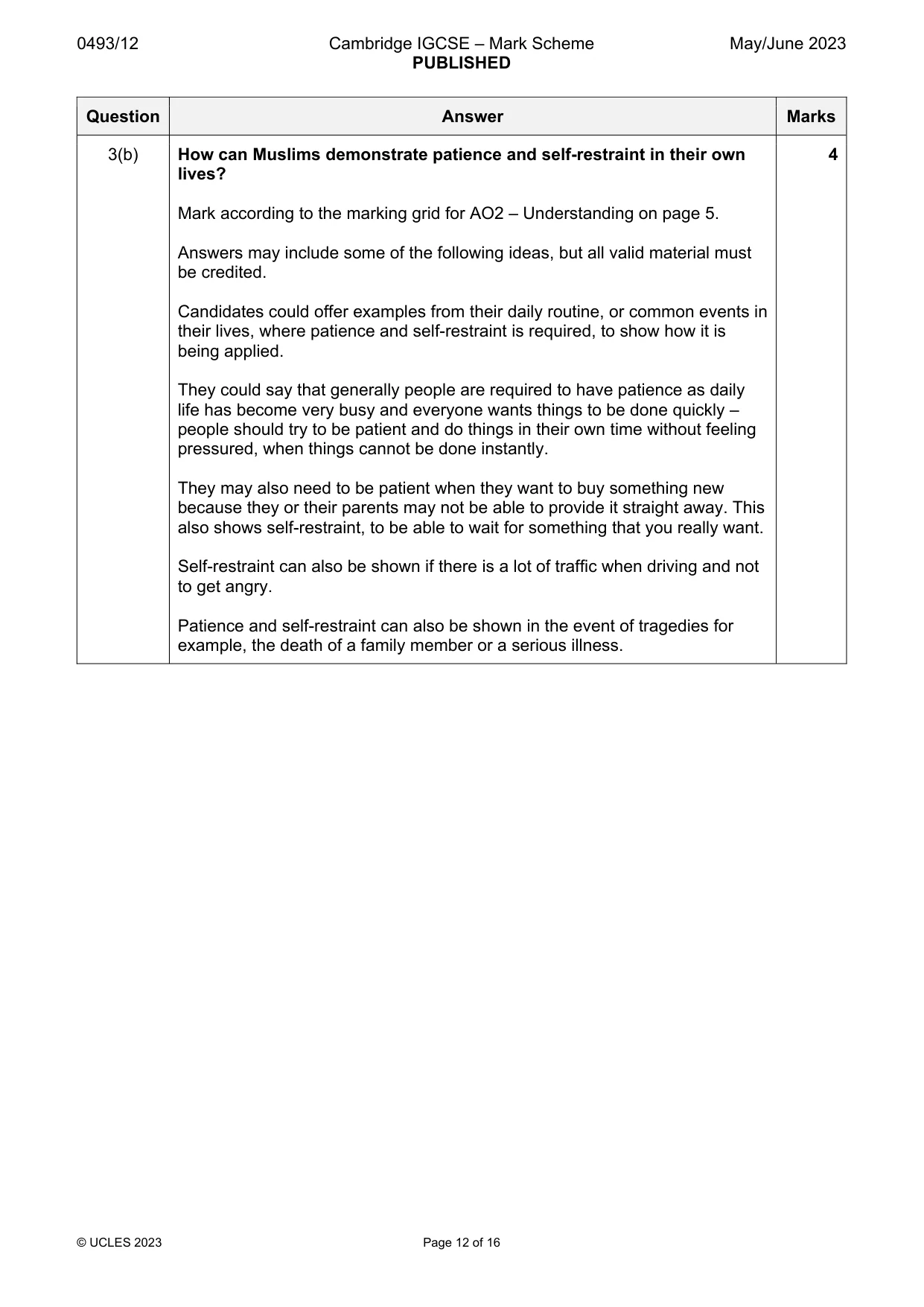
0493/12 Cambridge IGCSE – Mark Scheme PUBLISHED May/June 2023 © UCLES 2023 Page 12 of 16 Question Answer Marks 3(b) How can Muslims demonstrate patience and self-restraint in their own lives? Mark according to the marking grid for AO2 – Understanding on page 5. Answers may include some of the following ideas, but all valid material must be credited. Candidates could offer examples from their daily routine, or common events in their lives, where patience and self-restraint is required, to show how it is being applied. They could say that generally people are required to have patience as daily life has become very busy and everyone wants things to be done quickly – people should try to be patient and do things in their own time without feeling pressured, when things cannot be done instantly. They may also need to be patient when they want to buy something new because they or their parents may not be able to provide it straight away. This also shows self-restraint, to be able to wait for something that you really want. Self-restraint can also be shown if there is a lot of traffic when driving and not to get angry. Patience and self-restraint can also be shown in the event of tragedies for example, the death of a family member or a serious illness. 4
Mark scheme, page 13
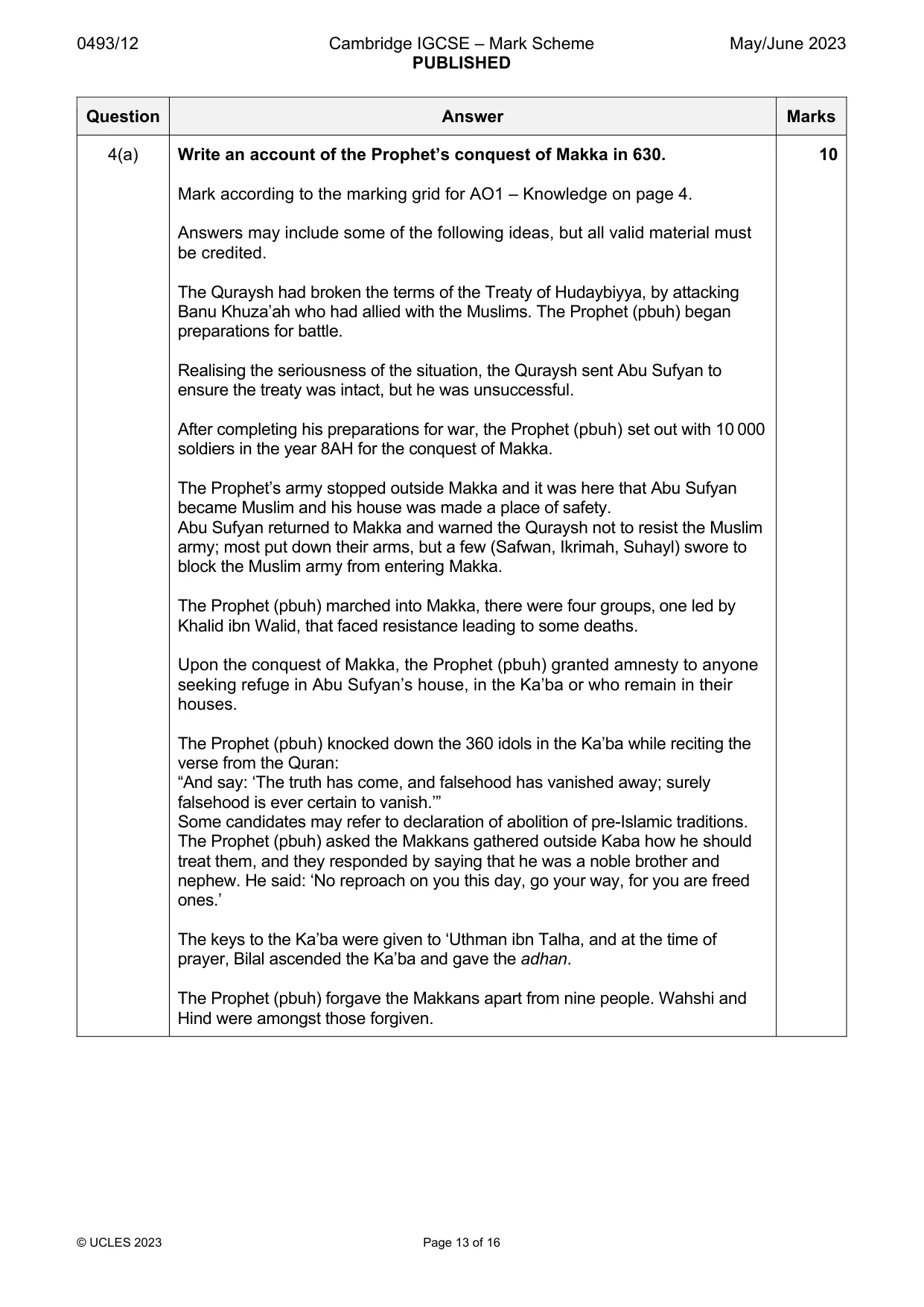
0493/12 Cambridge IGCSE – Mark Scheme PUBLISHED May/June 2023 © UCLES 2023 Page 13 of 16 Question Answer Marks 4(a) Write an account of the Prophet’s conquest of Makka in 630. Mark according to the marking grid for AO1 – Knowledge on page 4. Answers may include some of the following ideas, but all valid material must be credited. The Quraysh had broken the terms of the Treaty of Hudaybiyya, by attacking Banu Khuza’ah who had allied with the Muslims. The Prophet (pbuh) began preparations for battle. Realising the seriousness of the situation, the Quraysh sent Abu Sufyan to ensure the treaty was intact, but he was unsuccessful. After completing his preparations for war, the Prophet (pbuh) set out with 10 000 soldiers in the year 8AH for the conquest of Makka. The Prophet’s army stopped outside Makka and it was here that Abu Sufyan became Muslim and his house was made a place of safety. Abu Sufyan returned to Makka and warned the Quraysh not to resist the Muslim army; most put down their arms, but a few (Safwan, Ikrimah, Suhayl) swore to block the Muslim army from entering Makka. The Prophet (pbuh) marched into Makka, there were four groups, one led by Khalid ibn Walid, that faced resistance leading to some deaths. Upon the conquest of Makka, the Prophet (pbuh) granted amnesty to anyone seeking refuge in Abu Sufyan’s house, in the Ka’ba or who remain in their houses. The Prophet (pbuh) knocked down the 360 idols in the Ka’ba while reciting the verse from the Quran: “And say: ‘The truth has come, and falsehood has vanished away; surely falsehood is ever certain to vanish.’” Some candidates may refer to declaration of abolition of pre-Islamic traditions. The Prophet (pbuh) asked the Makkans gathered outside Kaba how he should treat them, and they responded by saying that he was a noble brother and nephew. He said: ‘No reproach on you this day, go your way, for you are freed ones.’ The keys to the Ka’ba were given to ‘Uthman ibn Talha, and at the time of prayer, Bilal ascended the Ka’ba and gave the adhan. The Prophet (pbuh) forgave the Makkans apart from nine people. Wahshi and Hind were amongst those forgiven. 10
Mark scheme, page 14
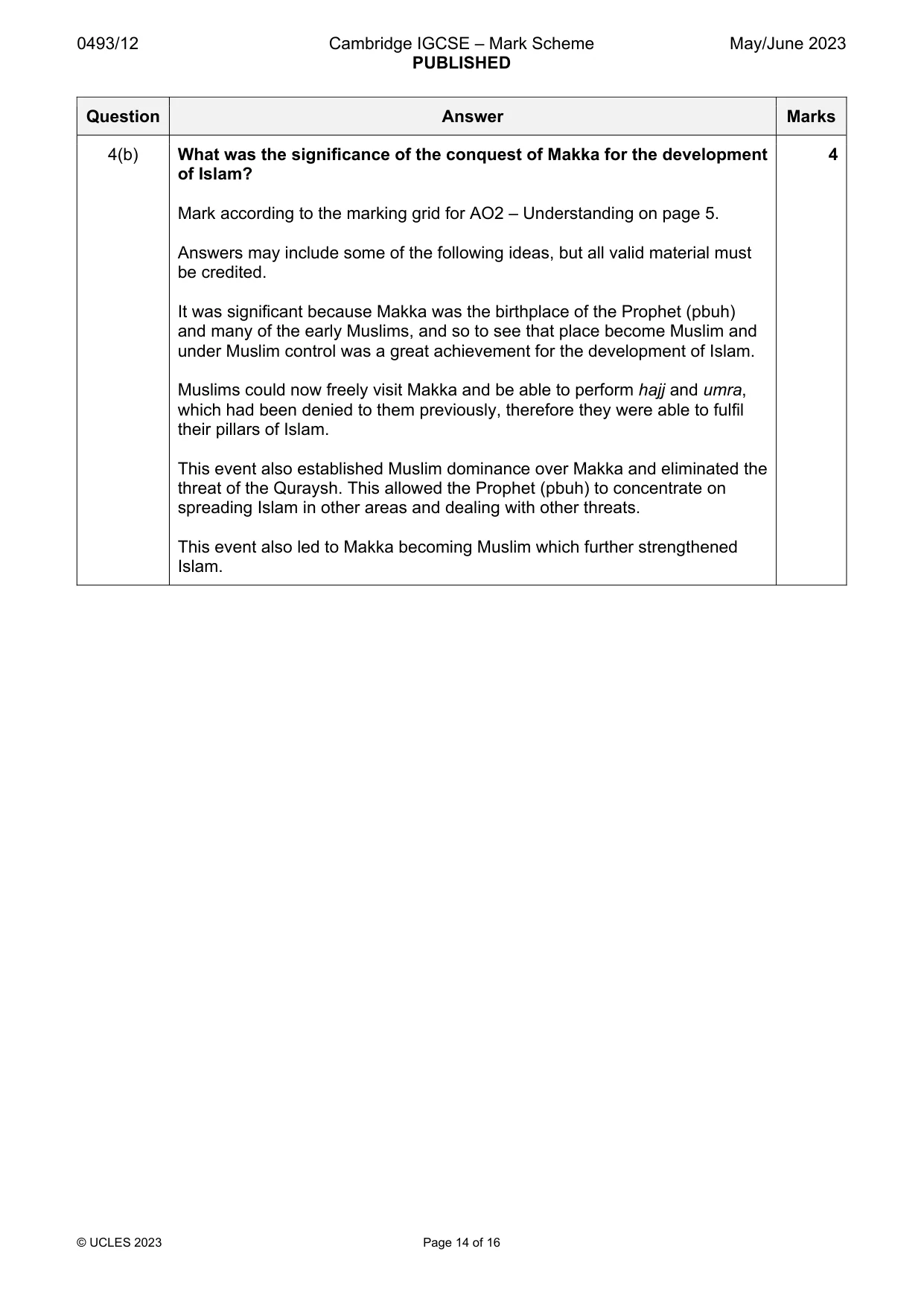
0493/12 Cambridge IGCSE – Mark Scheme PUBLISHED May/June 2023 © UCLES 2023 Page 14 of 16 Question Answer Marks 4(b) What was the significance of the conquest of Makka for the development of Islam? Mark according to the marking grid for AO2 – Understanding on page 5. Answers may include some of the following ideas, but all valid material must be credited. It was significant because Makka was the birthplace of the Prophet (pbuh) and many of the early Muslims, and so to see that place become Muslim and under Muslim control was a great achievement for the development of Islam. Muslims could now freely visit Makka and be able to perform hajj and umra, which had been denied to them previously, therefore they were able to fulfil their pillars of Islam. This event also established Muslim dominance over Makka and eliminated the threat of the Quraysh. This allowed the Prophet (pbuh) to concentrate on spreading Islam in other areas and dealing with other threats. This event also led to Makka becoming Muslim which further strengthened Islam. 4
Mark scheme, page 15
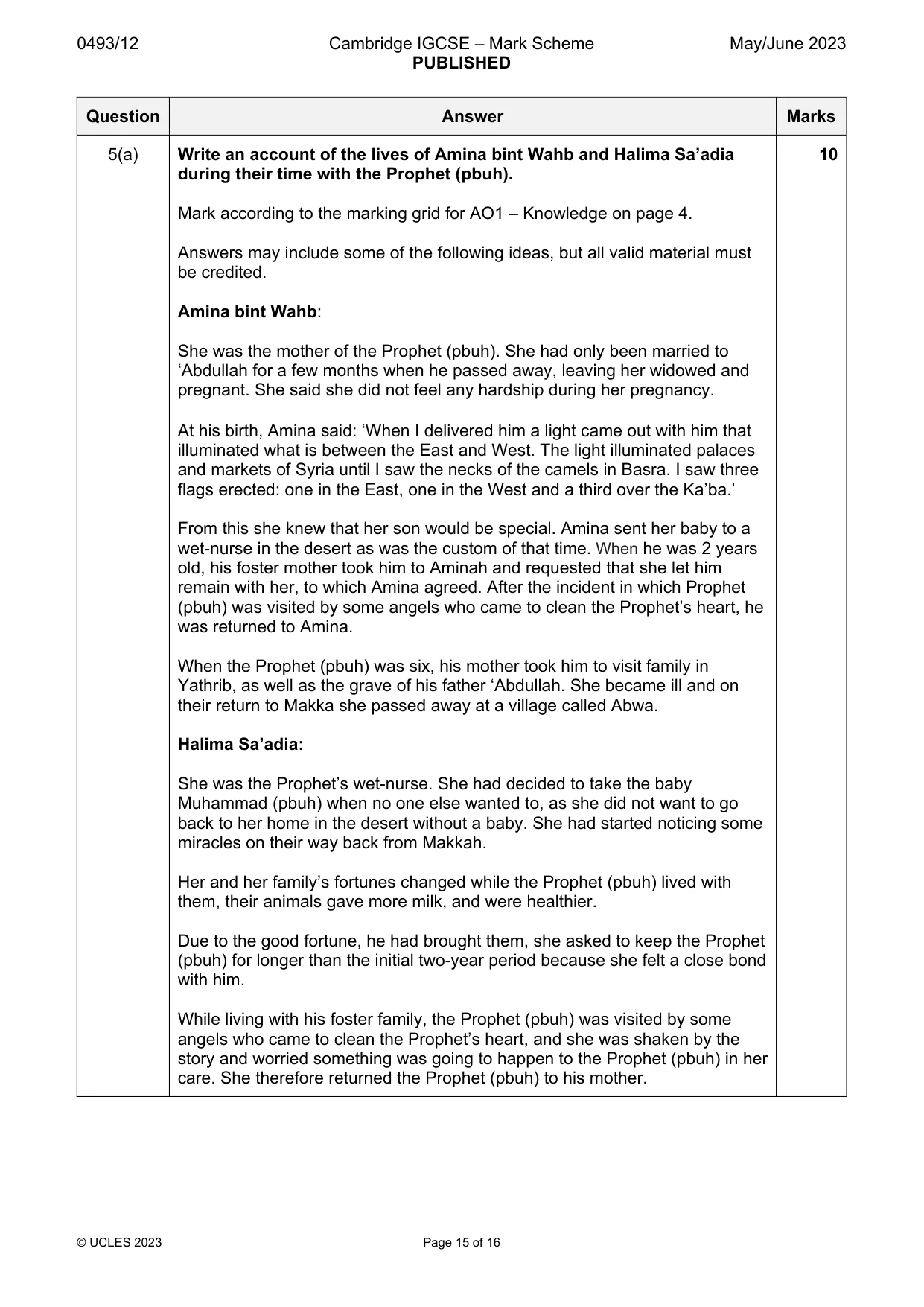
0493/12 Cambridge IGCSE – Mark Scheme PUBLISHED May/June 2023 © UCLES 2023 Page 15 of 16 Question Answer Marks 5(a) Write an account of the lives of Amina bint Wahb and Halima Sa’adia during their time with the Prophet (pbuh). Mark according to the marking grid for AO1 – Knowledge on page 4. Answers may include some of the following ideas, but all valid material must be credited. Amina bint Wahb: She was the mother of the Prophet (pbuh). She had only been married to ‘Abdullah for a few months when he passed away, leaving her widowed and pregnant. She said she did not feel any hardship during her pregnancy. At his birth, Amina said: ‘When I delivered him a light came out with him that illuminated what is between the East and West. The light illuminated palaces and markets of Syria until I saw the necks of the camels in Basra. I saw three flags erected: one in the East, one in the West and a third over the Ka’ba.’ From this she knew that her son would be special. Amina sent her baby to a wet-nurse in the desert as was the custom of that time. When he was 2 years old, his foster mother took him to Aminah and requested that she let him remain with her, to which Amina agreed. After the incident in which Prophet (pbuh) was visited by some angels who came to clean the Prophet’s heart, he was returned to Amina. When the Prophet (pbuh) was six, his mother took him to visit family in Yathrib, as well as the grave of his father ‘Abdullah. She became ill and on their return to Makka she passed away at a village called Abwa. Halima Sa’adia: She was the Prophet’s wet-nurse. She had decided to take the baby Muhammad (pbuh) when no one else wanted to, as she did not want to go back to her home in the desert without a baby. She had started noticing some miracles on their way back from Makkah. Her and her family’s fortunes changed while the Prophet (pbuh) lived with them, their animals gave more milk, and were healthier. Due to the good fortune, he had brought them, she asked to keep the Prophet (pbuh) for longer than the initial two-year period because she felt a close bond with him. While living with his foster family, the Prophet (pbuh) was visited by some angels who came to clean the Prophet’s heart, and she was shaken by the story and worried something was going to happen to the Prophet (pbuh) in her care. She therefore returned the Prophet (pbuh) to his mother. 10
Mark scheme, page 16
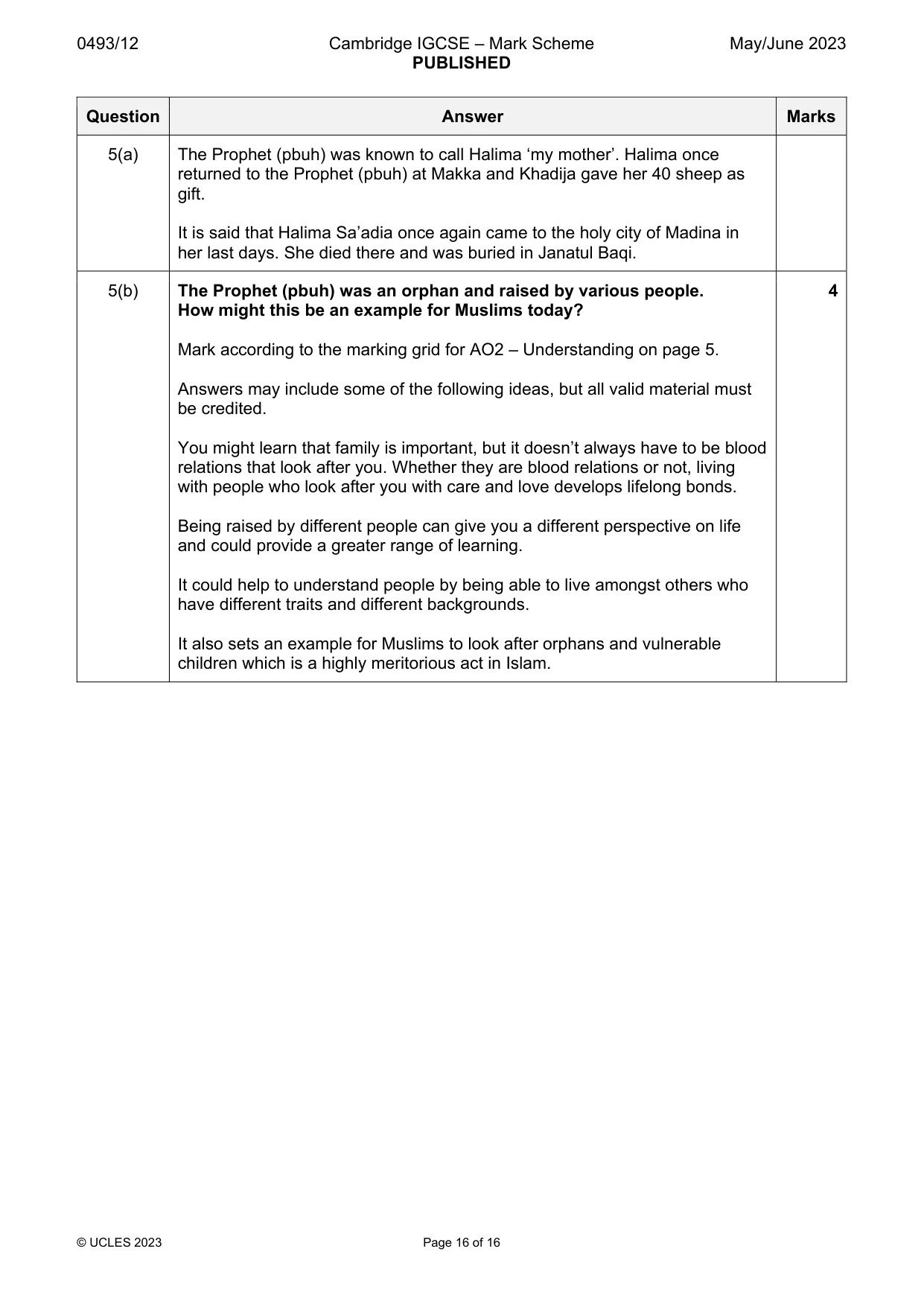
0493/12 Cambridge IGCSE – Mark Scheme PUBLISHED May/June 2023 © UCLES 2023 Page 16 of 16 Question Answer Marks 5(a) The Prophet (pbuh) was known to call Halima ‘my mother’. Halima once returned to the Prophet (pbuh) at Makka and Khadija gave her 40 sheep as gift. It is said that Halima Sa’adia once again came to the holy city of Madina in her last days. She died there and was buried in Janatul Baqi. 5(b) The Prophet (pbuh) was an orphan and raised by various people. How might this be an example for Muslims today? Mark according to the marking grid for AO2 – Understanding on page 5. Answers may include some of the following ideas, but all valid material must be credited. You might learn that family is important, but it doesn’t always have to be blood relations that look after you. Whether they are blood relations or not, living with people who look after you with care and love develops lifelong bonds. Being raised by different people can give you a different perspective on life and could provide a greater range of learning. It could help to understand people by being able to live amongst others who have different traits and different backgrounds. It also sets an example for Muslims to look after orphans and vulnerable children which is a highly meritorious act in Islam. 4
What you needed in this session
Cambridge’s own grade thresholds for 2023 May/June, Paper 1 · Variant 2. A higher threshold means an easier paper — the bar moves with how the cohort did.