Cambridge IGCSE Islamiyat 0493 — 2022 May/June Paper 1 · Variant 2
0493/12/M/J/22 · 50 marks · ≈56 min
The question paper and its mark scheme, free to read here and free to download. This is Cambridge’s own paper, exactly as it was sat.
Question paper16 pages






Mark scheme20 pages
Answers below. Sit the paper first if you are practising.
Paper as text
Question paper, page 1
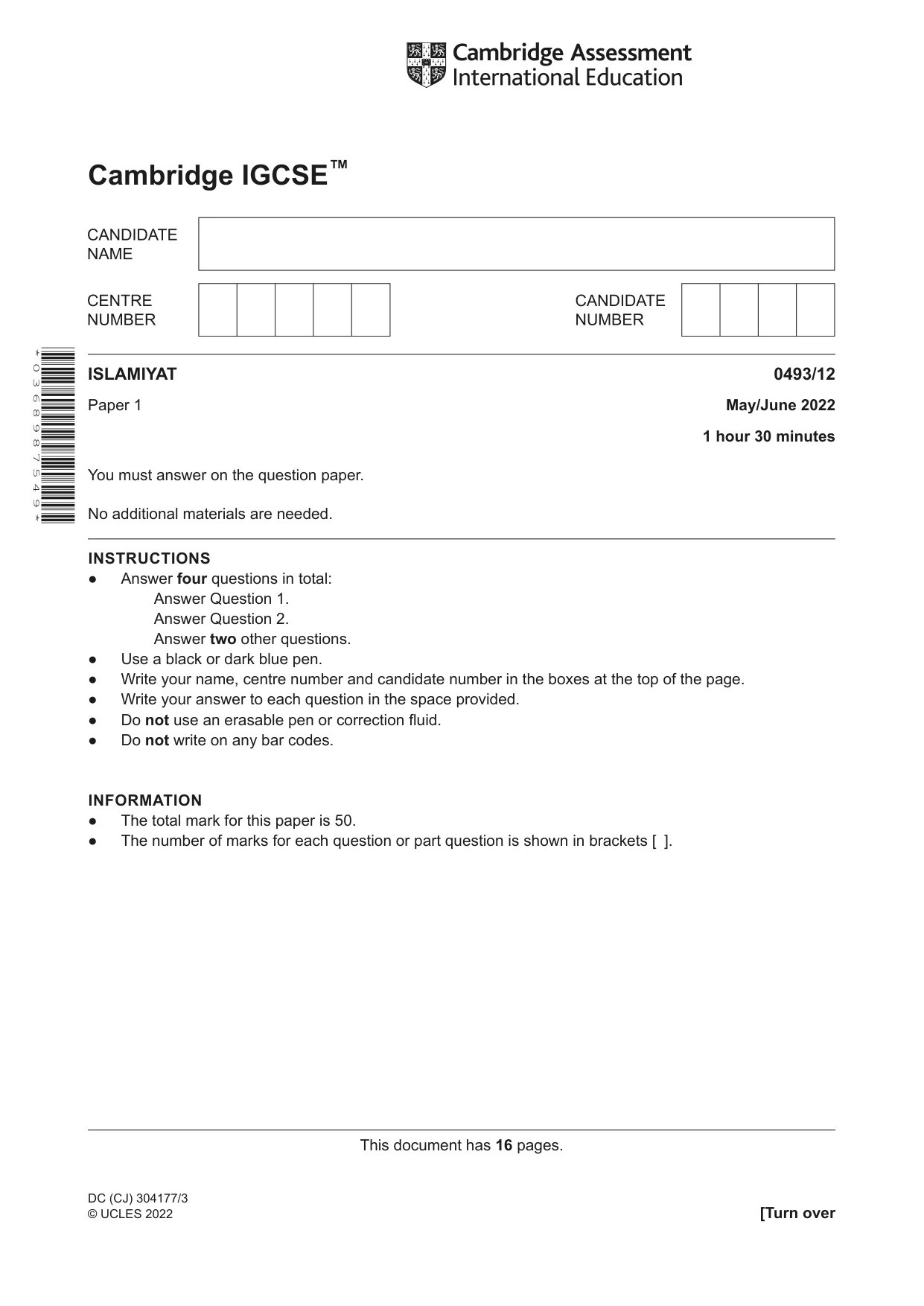
This document has 16 pages. [Turn over Cambridge IGCSE™ ISLAMIYAT 0493/12 Paper 1 May/June 2022 1 hour 30 minutes You must answer on the question paper. No additional materials are needed. INSTRUCTIONS ● Answer four questions in total: Answer Question 1. Answer Question 2. Answer two other questions. ● Use a black or dark blue pen. ● Write your name, centre number and candidate number in the boxes at the top of the page. ● Write your answer to each question in the space provided. ● Do not use an erasable pen or correction fluid. ● Do not write on any bar codes. INFORMATION ● The total mark for this paper is 50. ● The number of marks for each question or part question is shown in brackets [ ]. * 0 3 6 8 9 8 7 5 4 9 * DC (CJ) 304177/3 © UCLES 2022
Question paper, page 2
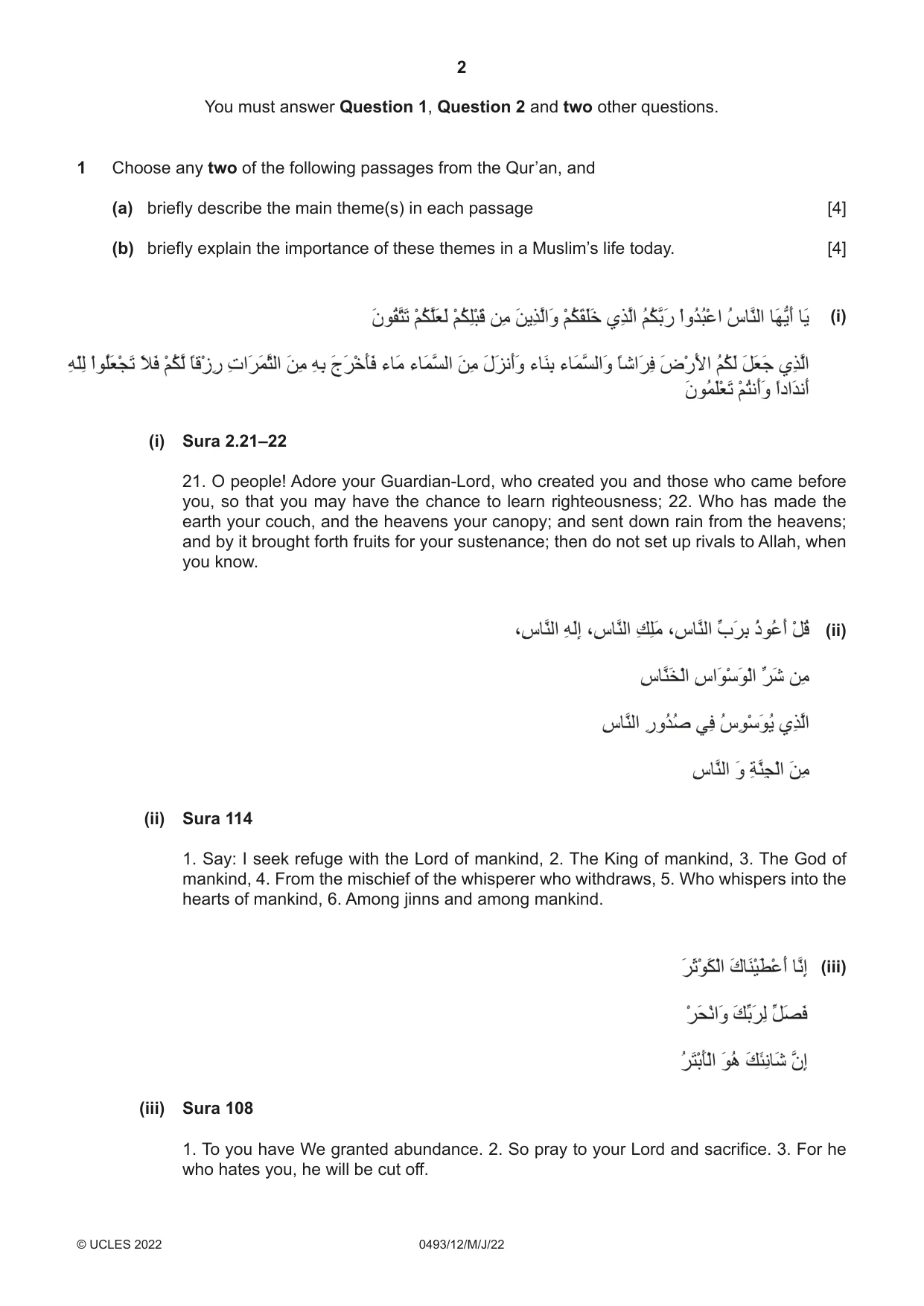
2 0493/12/M/J/22 © UCLES 2022 You must answer Question 1, Question 2 and two other questions. 1 Choose any two of the following passages from the Qur’an, and (a) briefly describe the main theme(s) in each passage [4] (b) briefly explain the importance of these themes in a Muslim’s life today. [4] (i) (i) Sura 2.21–22 21. O people! Adore your Guardian-Lord, who created you and those who came before you, so that you may have the chance to learn righteousness; 22. Who has made the earth your couch, and the heavens your canopy; and sent down rain from the heavens; and by it brought forth fruits for your sustenance; then do not set up rivals to Allah, when you know. (ii) (ii) Sura 114 1. Say: I seek refuge with the Lord of mankind, 2. The King of mankind, 3. The God of mankind, 4. From the mischief of the whisperer who withdraws, 5. Who whispers into the hearts of mankind, 6. Among jinns and among mankind. (iii) (iii) Sura 108 1. To you have We granted abundance. 2. So pray to your Lord and sacrifice. 3. For he who hates you, he will be cut off.
Question paper, page 3
3 0493/12/M/J/22 © UCLES 2022 [Turn over … … … … … … … … … … … … … … … … … … … … … … … … … … … …
Question paper, page 4
4 0493/12/M/J/22 © UCLES 2022 … … … … … … … … … … … … … … … … … … … … … … … … … … … …
Question paper, page 5
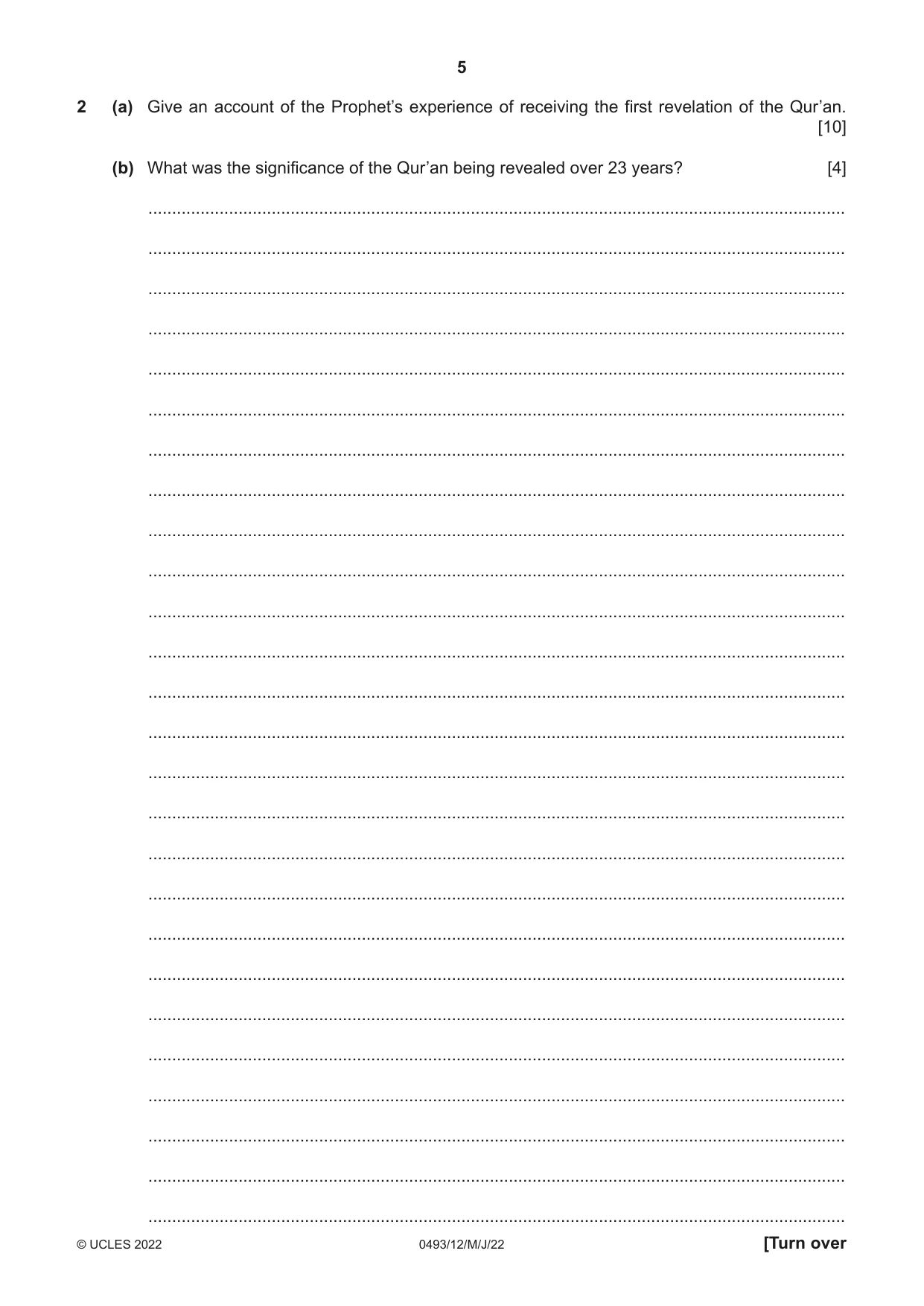
5 0493/12/M/J/22 © UCLES 2022 [Turn over 2 (a) Give an account of the Prophet’s experience of receiving the first revelation of the Qur’an. [10] (b) What was the significance of the Qur’an being revealed over 23 years? [4] … … … … … … … … … … … … … … … … … … … … … … … … … …
Question paper, page 6
6 0493/12/M/J/22 © UCLES 2022 … … … … … … … … … … … … … … … … … … … … … … … … … … … …
Question paper, page 7
7 0493/12/M/J/22 © UCLES 2022 [Turn over … … … … … … … … … … … … … … … … … … … … … … … … … … … …
Question paper, page 8
8 0493/12/M/J/22 © UCLES 2022 3 (a) Give an account of the tribes living in Madina and the details of the Constitution of Madina that brought them all together. [10] (b) In your opinion, what important lesson(s) can be learned from the Constitution of Madina by Muslims today? Give reasons to support your answer. [4] … … … … … … … … … … … … … … … … … … … … … … … … …
Question paper, page 9
9 0493/12/M/J/22 © UCLES 2022 [Turn over … … … … … … … … … … … … … … … … … … … … … … … … … … … …
Question paper, page 10
10 0493/12/M/J/22 © UCLES 2022 … … … … … … … … … … … … … … … … … … … … … … … … … … … …
Question paper, page 11
11 0493/12/M/J/22 © UCLES 2022 [Turn over 4 (a) Describe the main events of the Battle of Khaybar and the Battle of Tabuk. [10] (b) Despite their difficulties in the Battle of Khaybar the Muslims never gave up. What might Muslims learn from this in their everyday lives? [4] … … … … … … … … … … … … … … … … … … … … … … … … … …
Question paper, page 12
12 0493/12/M/J/22 © UCLES 2022 … … … … … … … … … … … … … … … … … … … … … … … … … … … …
Question paper, page 13
13 0493/12/M/J/22 © UCLES 2022 [Turn over … … … … … … … … … … … … … … … … … … … … … … … … … … … …
Question paper, page 14
14 0493/12/M/J/22 © UCLES 2022 5 (a) Write about the lives of the Companions Bilal ibn Rabah and Abu Sufyan ibn Harb. [10] (b) What lessons can be learned about equality from either Bilal’s or Abu Sufyan’s conversion to Islam? [4] … … … … … … … … … … … … … … … … … … … … … … … … … …
Question paper, page 15
15 0493/12/M/J/22 © UCLES 2022 [Turn over … … … … … … … … … … … … … … … … … … … … … … … … … … … …
Question paper, page 16
16 0493/12/M/J/22 © UCLES 2022 … … … … … … … … … … … … … … … … … … … … … … … … Permission to reproduce items where third-party owned material protected by copyright is included has been sought and cleared where possible. Every reasonable effort has been made by the publisher (UCLES) to trace copyright holders, but if any items requiring clearance have unwittingly been included, the publisher will be pleased to make amends at the earliest possible opportunity. To avoid the issue of disclosure of answer-related information to candidates, all copyright acknowledgements are reproduced online in the Cambridge Assessment International Education Copyright Acknowledgements Booklet. This is produced for each series of examinations and is freely available to download at www.cambridgeinternational.org after the live examination series. Cambridge Assessment International Education is part of Cambridge Assessment. Cambridge Assessment is the brand name of the University of Cambridge Local Examinations Syndicate (UCLES), which is a department of the University of Cambridge.
Mark scheme, page 1
This document consists of 20 printed pages. © UCLES 2022 [Turn over Cambridge IGCSE™ ISLAMIYAT 0493/12 Paper 1 May/June 2022 MARK SCHEME Maximum Mark: 50 Published This mark scheme is published as an aid to teachers and candidates, to indicate the requirements of the examination. It shows the basis on which Examiners were instructed to award marks. It does not indicate the details of the discussions that took place at an Examiners’ meeting before marking began, which would have considered the acceptability of alternative answers. Mark schemes should be read in conjunction with the question paper and the Principal Examiner Report for Teachers. Cambridge International will not enter into discussions about these mark schemes. Cambridge International is publishing the mark schemes for the May/June 2022 series for most Cambridge IGCSE, Cambridge International A and AS Level and Cambridge Pre-U components, and some Cambridge O Level components.
Mark scheme, page 2
0493/12 Cambridge IGCSE – Mark Scheme PUBLISHED May/June 2022 © UCLES 2022 Page 2 of 20 Generic Marking Principles These general marking principles must be applied by all examiners when marking candidate answers. They should be applied alongside the specific content of the mark scheme or generic level descriptors for a question. Each question paper and mark scheme will also comply with these marking principles. GENERIC MARKING PRINCIPLE 1: Marks must be awarded in line with: the specific content of the mark scheme or the generic level descriptors for the question the specific skills defined in the mark scheme or in the generic level descriptors for the question the standard of response required by a candidate as exemplified by the standardisation scripts. GENERIC MARKING PRINCIPLE 2: Marks awarded are always whole marks (not half marks, or other fractions). GENERIC MARKING PRINCIPLE 3: Marks must be awarded positively: marks are awarded for correct/valid answers, as defined in the mark scheme. However, credit is given for valid answers which go beyond the scope of the syllabus and mark scheme, referring to your Team Leader as appropriate marks are awarded when candidates clearly demonstrate what they know and can do marks are not deducted for errors marks are not deducted for omissions answers should only be judged on the quality of spelling, punctuation and grammar when these features are specifically assessed by the question as indicated by the mark scheme. The meaning, however, should be unambiguous. GENERIC MARKING PRINCIPLE 4: Rules must be applied consistently, e.g. in situations where candidates have not followed instructions or in the application of generic level descriptors. GENERIC MARKING PRINCIPLE 5: Marks should be awarded using the full range of marks defined in the mark scheme for the question (however; the use of the full mark range may be limited according to the quality of the candidate responses seen). GENERIC MARKING PRINCIPLE 6: Marks awarded are based solely on the requirements as defined in the mark scheme. Marks should not be awarded with grade thresholds or grade descriptors in mind.
Mark scheme, page 3
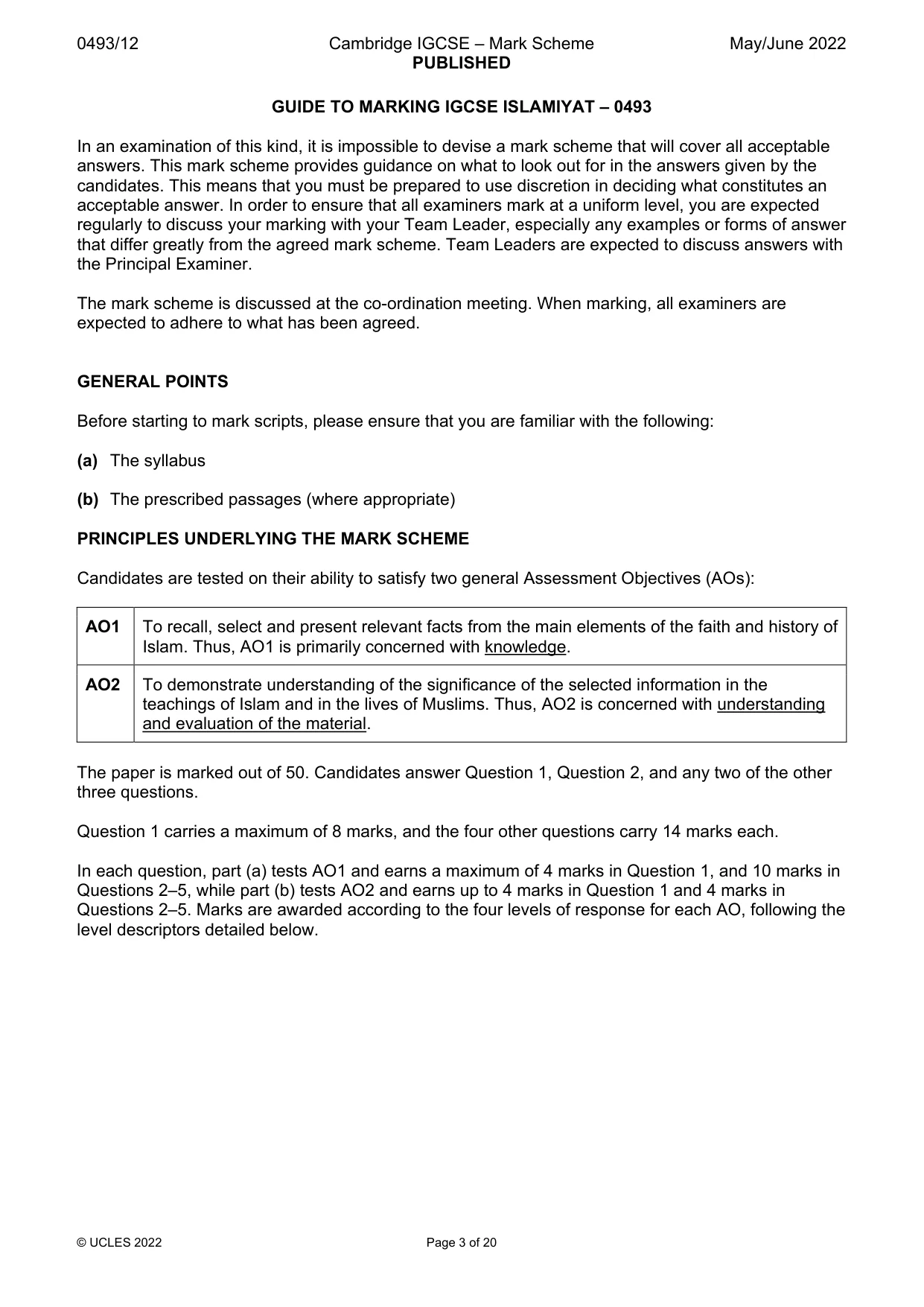
0493/12 Cambridge IGCSE – Mark Scheme PUBLISHED May/June 2022 © UCLES 2022 Page 3 of 20 GUIDE TO MARKING IGCSE ISLAMIYAT – 0493 In an examination of this kind, it is impossible to devise a mark scheme that will cover all acceptable answers. This mark scheme provides guidance on what to look out for in the answers given by the candidates. This means that you must be prepared to use discretion in deciding what constitutes an acceptable answer. In order to ensure that all examiners mark at a uniform level, you are expected regularly to discuss your marking with your Team Leader, especially any examples or forms of answer that differ greatly from the agreed mark scheme. Team Leaders are expected to discuss answers with the Principal Examiner. The mark scheme is discussed at the co-ordination meeting. When marking, all examiners are expected to adhere to what has been agreed. GENERAL POINTS Before starting to mark scripts, please ensure that you are familiar with the following: (a) The syllabus (b) The prescribed passages (where appropriate) PRINCIPLES UNDERLYING THE MARK SCHEME Candidates are tested on their ability to satisfy two general Assessment Objectives (AOs): AO1 To recall, select and present relevant facts from the main elements of the faith and history of Islam. Thus, AO1 is primarily concerned with knowledge. AO2 To demonstrate understanding of the significance of the selected information in the teachings of Islam and in the lives of Muslims. Thus, AO2 is concerned with understanding and evaluation of the material. The paper is marked out of 50. Candidates answer Question 1, Question 2, and any two of the other three questions. Question 1 carries a maximum of 8 marks, and the four other questions carry 14 marks each. In each question, part (a) tests AO1 and earns a maximum of 4 marks in Question 1, and 10 marks in Questions 2–5, while part (b) tests AO2 and earns up to 4 marks in Question 1 and 4 marks in Questions 2–5. Marks are awarded according to the four levels of response for each AO, following the level descriptors detailed below.
Mark scheme, page 4
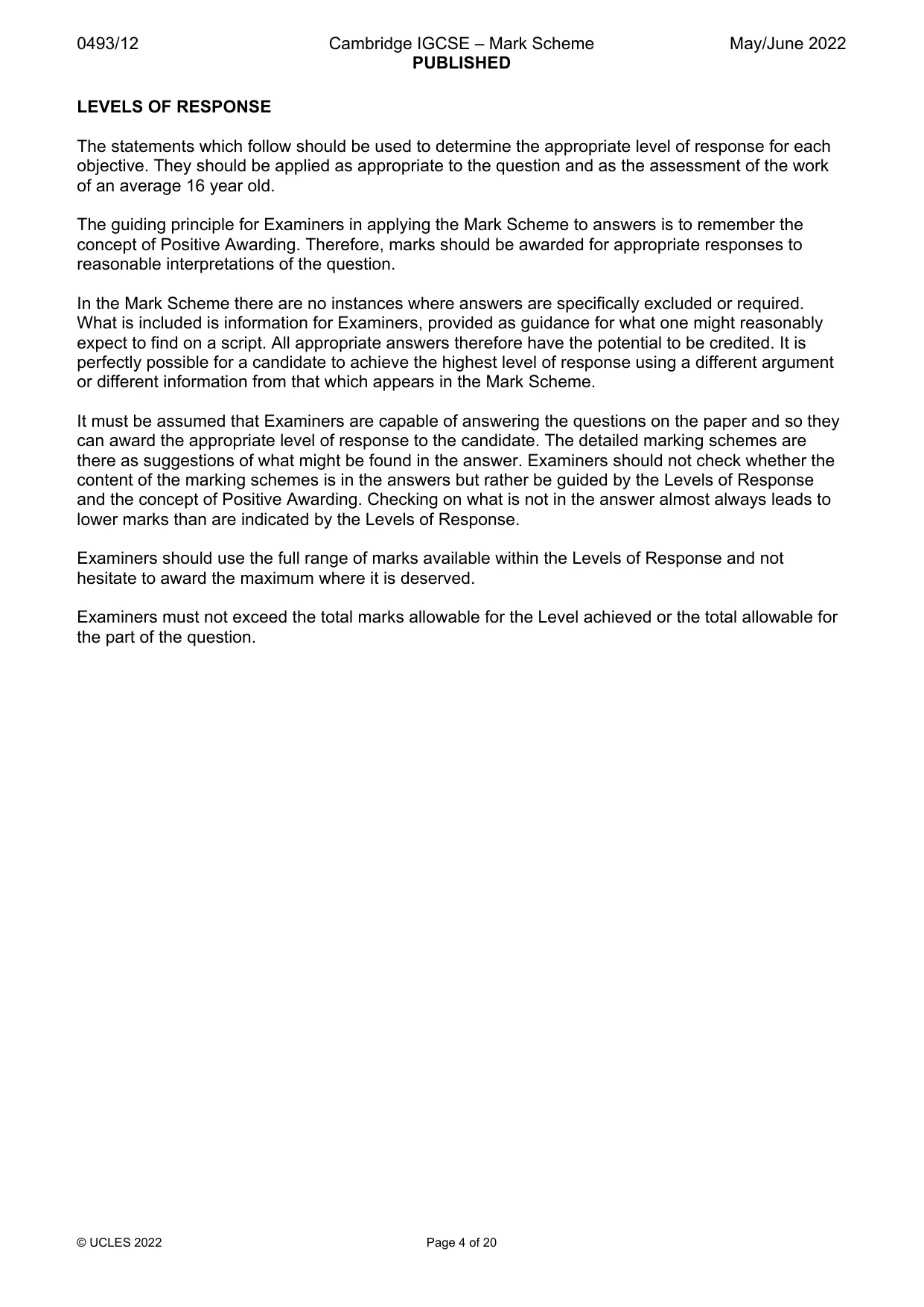
0493/12 Cambridge IGCSE – Mark Scheme PUBLISHED May/June 2022 © UCLES 2022 Page 4 of 20 LEVELS OF RESPONSE The statements which follow should be used to determine the appropriate level of response for each objective. They should be applied as appropriate to the question and as the assessment of the work of an average 16 year old. The guiding principle for Examiners in applying the Mark Scheme to answers is to remember the concept of Positive Awarding. Therefore, marks should be awarded for appropriate responses to reasonable interpretations of the question. In the Mark Scheme there are no instances where answers are specifically excluded or required. What is included is information for Examiners, provided as guidance for what one might reasonably expect to find on a script. All appropriate answers therefore have the potential to be credited. It is perfectly possible for a candidate to achieve the highest level of response using a different argument or different information from that which appears in the Mark Scheme. It must be assumed that Examiners are capable of answering the questions on the paper and so they can award the appropriate level of response to the candidate. The detailed marking schemes are there as suggestions of what might be found in the answer. Examiners should not check whether the content of the marking schemes is in the answers but rather be guided by the Levels of Response and the concept of Positive Awarding. Checking on what is not in the answer almost always leads to lower marks than are indicated by the Levels of Response. Examiners should use the full range of marks available within the Levels of Response and not hesitate to award the maximum where it is deserved. Examiners must not exceed the total marks allowable for the Level achieved or the total allowable for the part of the question.
Mark scheme, page 5
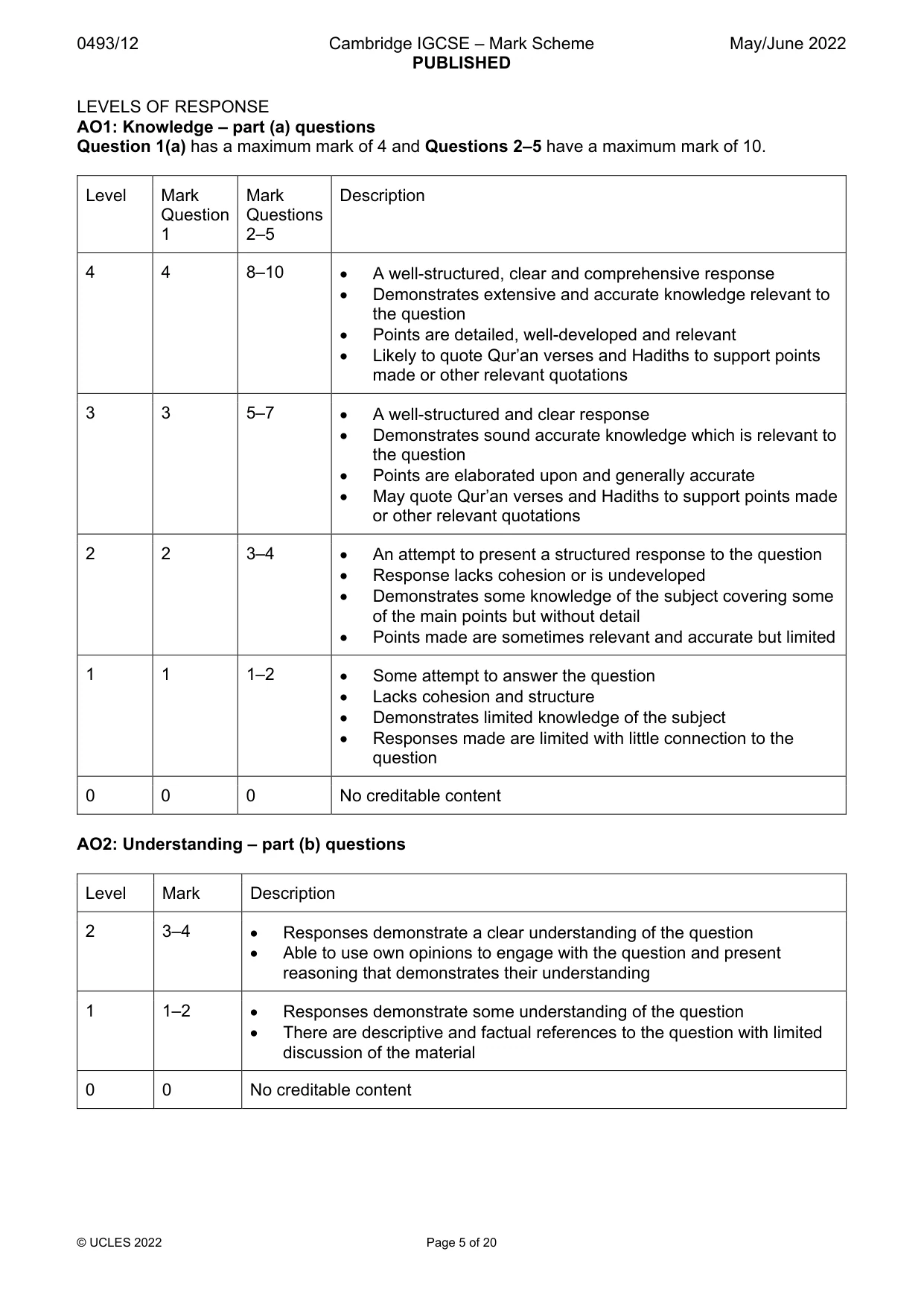
0493/12 Cambridge IGCSE – Mark Scheme PUBLISHED May/June 2022 © UCLES 2022 Page 5 of 20 LEVELS OF RESPONSE AO1: Knowledge – part (a) questions Question 1(a) has a maximum mark of 4 and Questions 2–5 have a maximum mark of 10. Level Mark Question 1 Mark Questions 2–5 Description 4 4 8–10 A well-structured, clear and comprehensive response Demonstrates extensive and accurate knowledge relevant to the question Points are detailed, well-developed and relevant Likely to quote Qur’an verses and Hadiths to support points made or other relevant quotations 3 3 5–7 A well-structured and clear response Demonstrates sound accurate knowledge which is relevant to the question Points are elaborated upon and generally accurate May quote Qur’an verses and Hadiths to support points made or other relevant quotations 2 2 3–4 An attempt to present a structured response to the question Response lacks cohesion or is undeveloped Demonstrates some knowledge of the subject covering some of the main points but without detail Points made are sometimes relevant and accurate but limited 1 1 1–2 Some attempt to answer the question Lacks cohesion and structure Demonstrates limited knowledge of the subject Responses made are limited with little connection to the question 0 0 0 No creditable content AO2: Understanding – part (b) questions Level Mark Description 2 3–4 Responses demonstrate a clear understanding of the question Able to use own opinions to engage with the question and present reasoning that demonstrates their understanding 1 1–2 Responses demonstrate some understanding of the question There are descriptive and factual references to the question with limited discussion of the material 0 0 No creditable content
Mark scheme, page 6
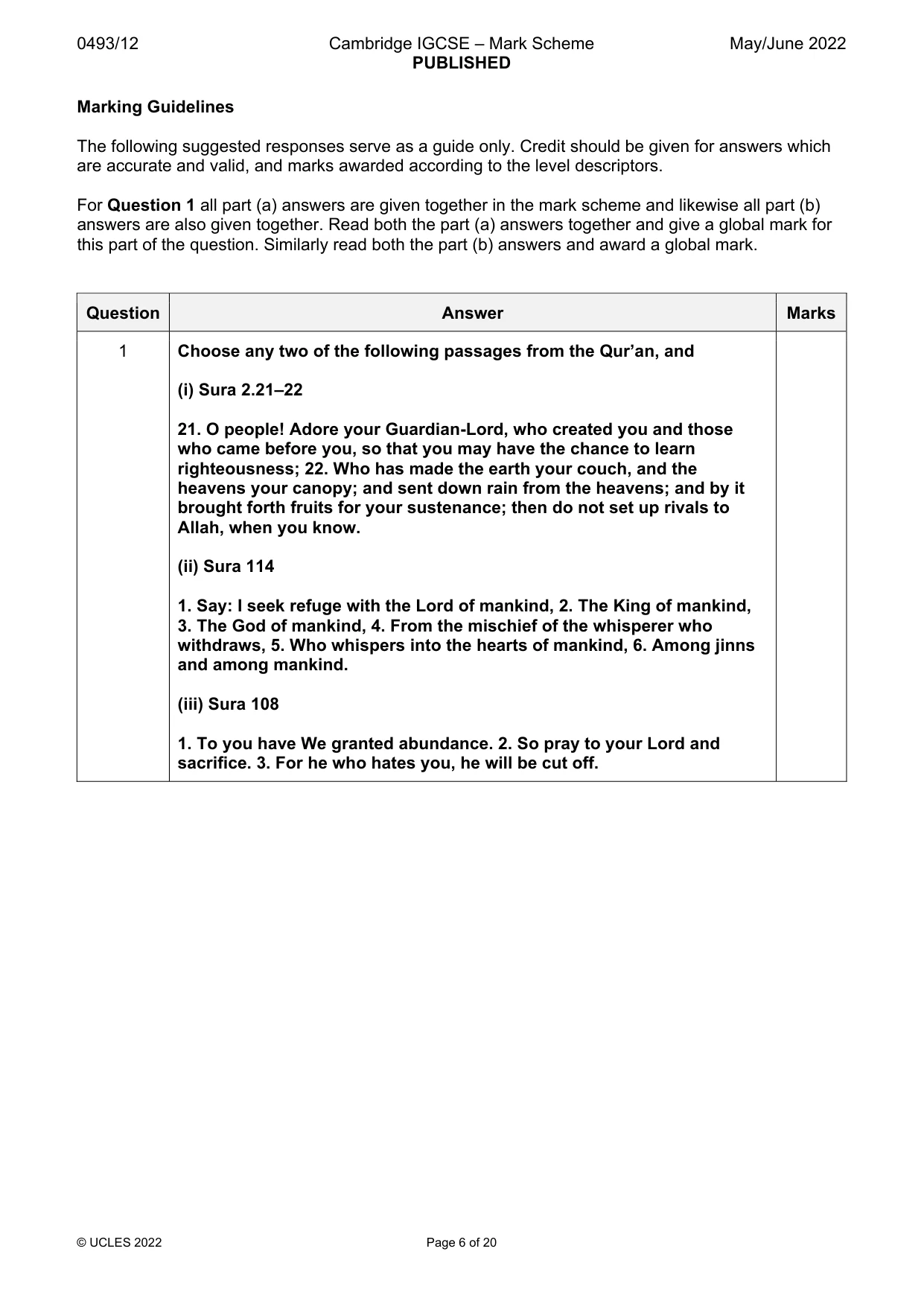
0493/12 Cambridge IGCSE – Mark Scheme PUBLISHED May/June 2022 © UCLES 2022 Page 6 of 20 Marking Guidelines The following suggested responses serve as a guide only. Credit should be given for answers which are accurate and valid, and marks awarded according to the level descriptors. For Question 1 all part (a) answers are given together in the mark scheme and likewise all part (b) answers are also given together. Read both the part (a) answers together and give a global mark for this part of the question. Similarly read both the part (b) answers and award a global mark. Question Answer Marks 1 Choose any two of the following passages from the Qur’an, and (i) Sura 2.21–22 21. O people! Adore your Guardian-Lord, who created you and those who came before you, so that you may have the chance to learn righteousness; 22. Who has made the earth your couch, and the heavens your canopy; and sent down rain from the heavens; and by it brought forth fruits for your sustenance; then do not set up rivals to Allah, when you know. (ii) Sura 114 1. Say: I seek refuge with the Lord of mankind, 2. The King of mankind, 3. The God of mankind, 4. From the mischief of the whisperer who withdraws, 5. Who whispers into the hearts of mankind, 6. Among jinns and among mankind. (iii) Sura 108 1. To you have We granted abundance. 2. So pray to your Lord and sacrifice. 3. For he who hates you, he will be cut off.
Mark scheme, page 7
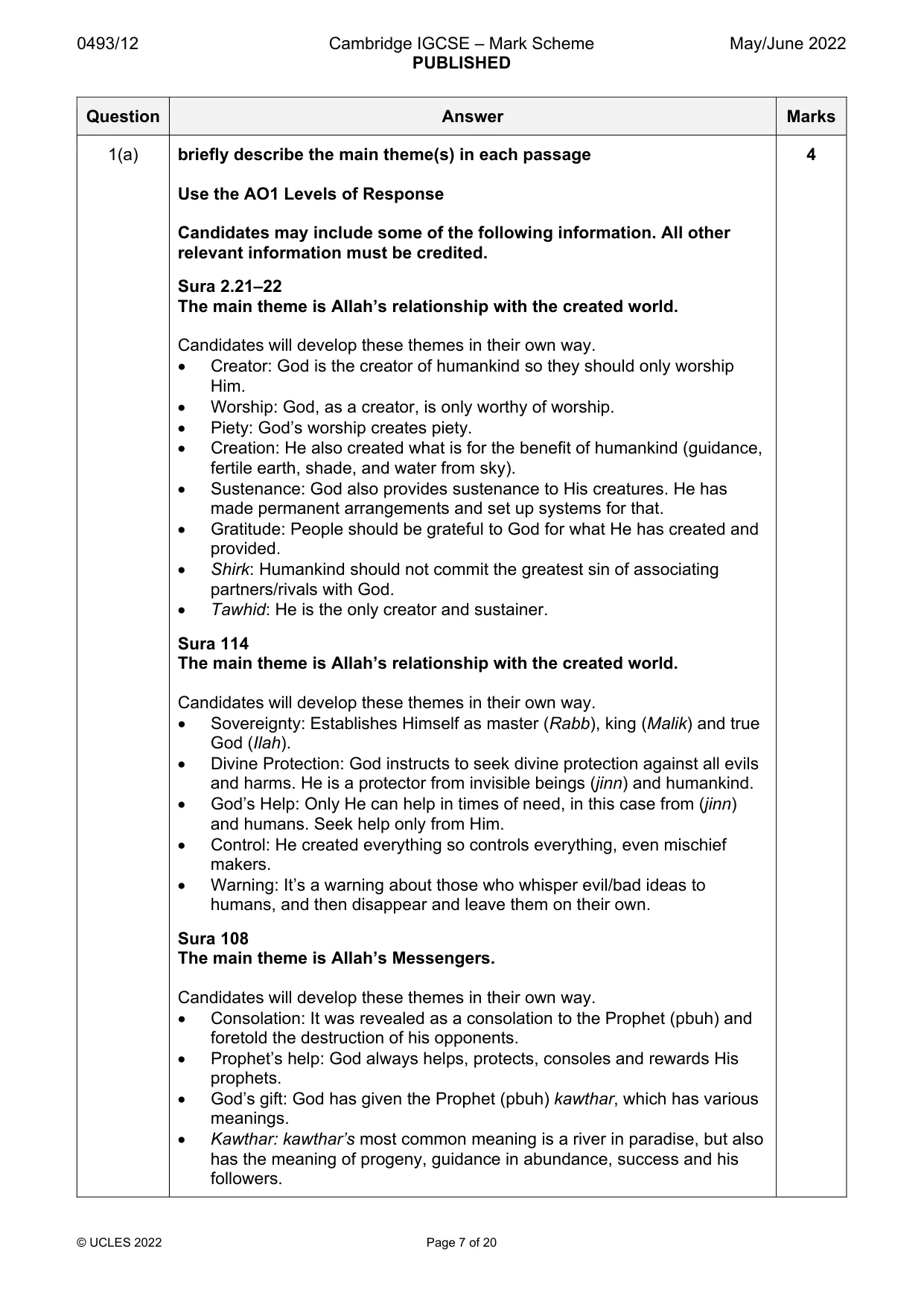
0493/12 Cambridge IGCSE – Mark Scheme PUBLISHED May/June 2022 © UCLES 2022 Page 7 of 20 Question Answer Marks 1(a) briefly describe the main theme(s) in each passage Use the AO1 Levels of Response Candidates may include some of the following information. All other relevant information must be credited. Sura 2.21–22 The main theme is Allah’s relationship with the created world. Candidates will develop these themes in their own way. Creator: God is the creator of humankind so they should only worship Him. Worship: God, as a creator, is only worthy of worship. Piety: God’s worship creates piety. Creation: He also created what is for the benefit of humankind (guidance, fertile earth, shade, and water from sky). Sustenance: God also provides sustenance to His creatures. He has made permanent arrangements and set up systems for that. Gratitude: People should be grateful to God for what He has created and provided. Shirk: Humankind should not commit the greatest sin of associating partners/rivals with God. Tawhid: He is the only creator and sustainer. Sura 114 The main theme is Allah’s relationship with the created world. Candidates will develop these themes in their own way. Sovereignty: Establishes Himself as master (Rabb), king (Malik) and true God (Ilah). Divine Protection: God instructs to seek divine protection against all evils and harms. He is a protector from invisible beings (jinn) and humankind. God’s Help: Only He can help in times of need, in this case from (jinn) and humans. Seek help only from Him. Control: He created everything so controls everything, even mischief makers. Warning: It’s a warning about those who whisper evil/bad ideas to humans, and then disappear and leave them on their own. Sura 108 The main theme is Allah’s Messengers. Candidates will develop these themes in their own way. Consolation: It was revealed as a consolation to the Prophet (pbuh) and foretold the destruction of his opponents. Prophet’s help: God always helps, protects, consoles and rewards His prophets. God’s gift: God has given the Prophet (pbuh) kawthar, which has various meanings. Kawthar: kawthar’s most common meaning is a river in paradise, but also has the meaning of progeny, guidance in abundance, success and his followers. 4
Mark scheme, page 8
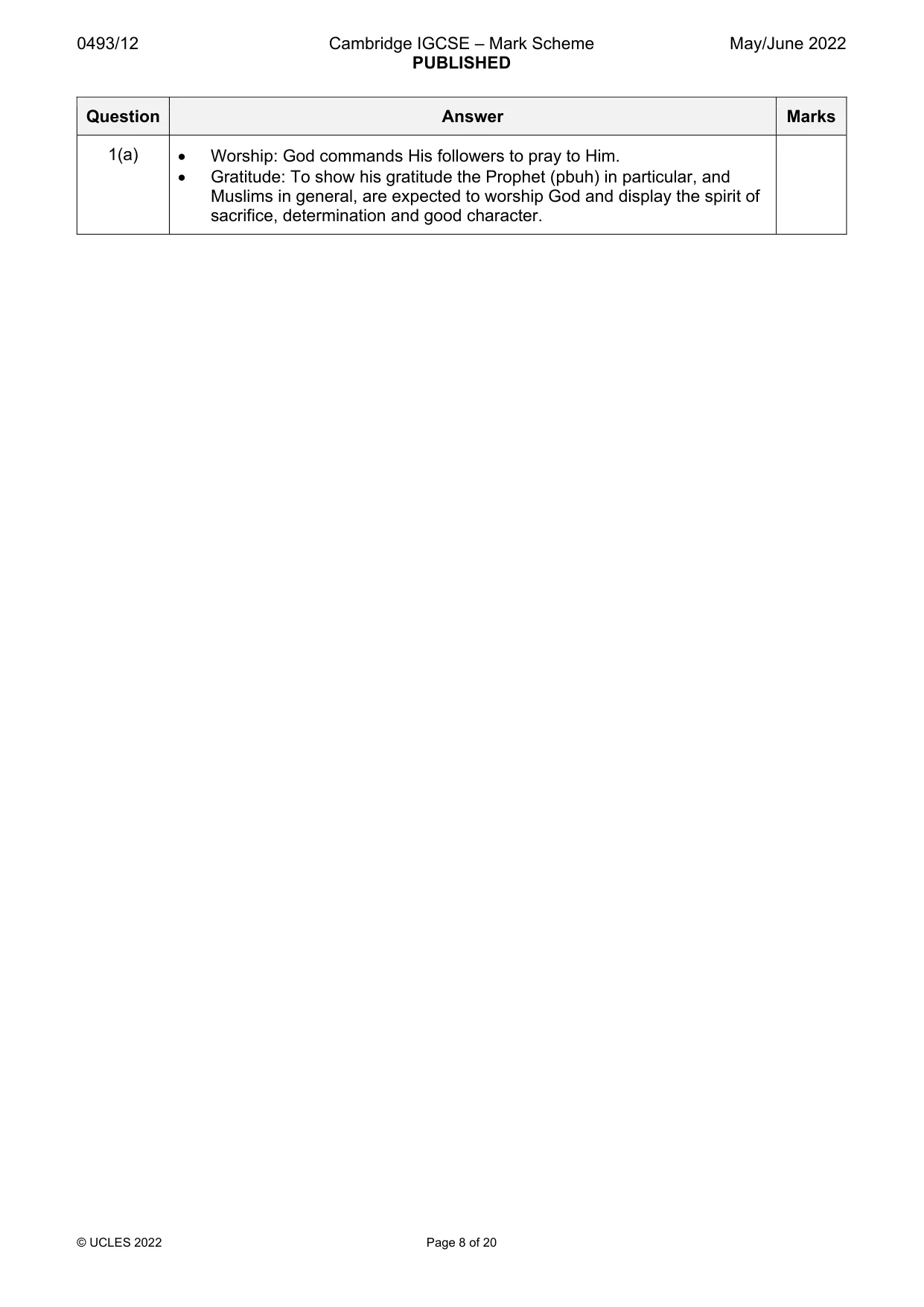
0493/12 Cambridge IGCSE – Mark Scheme PUBLISHED May/June 2022 © UCLES 2022 Page 8 of 20 Question Answer Marks 1(a) Worship: God commands His followers to pray to Him. Gratitude: To show his gratitude the Prophet (pbuh) in particular, and Muslims in general, are expected to worship God and display the spirit of sacrifice, determination and good character.
Mark scheme, page 9
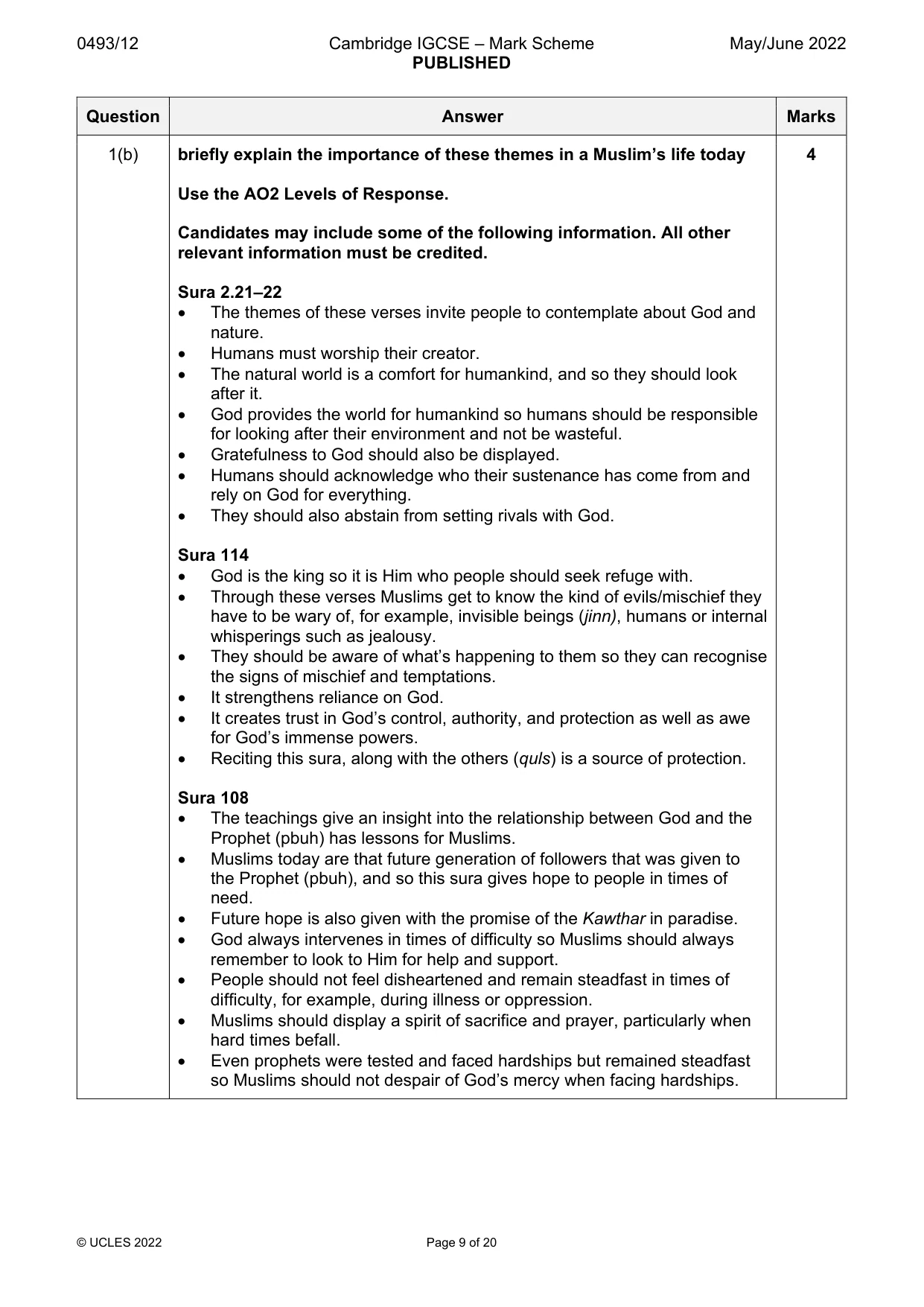
0493/12 Cambridge IGCSE – Mark Scheme PUBLISHED May/June 2022 © UCLES 2022 Page 9 of 20 Question Answer Marks 1(b) briefly explain the importance of these themes in a Muslim’s life today Use the AO2 Levels of Response. Candidates may include some of the following information. All other relevant information must be credited. Sura 2.21–22 The themes of these verses invite people to contemplate about God and nature. Humans must worship their creator. The natural world is a comfort for humankind, and so they should look after it. God provides the world for humankind so humans should be responsible for looking after their environment and not be wasteful. Gratefulness to God should also be displayed. Humans should acknowledge who their sustenance has come from and rely on God for everything. They should also abstain from setting rivals with God. Sura 114 God is the king so it is Him who people should seek refuge with. Through these verses Muslims get to know the kind of evils/mischief they have to be wary of, for example, invisible beings (jinn), humans or internal whisperings such as jealousy. They should be aware of what’s happening to them so they can recognise the signs of mischief and temptations. It strengthens reliance on God. It creates trust in God’s control, authority, and protection as well as awe for God’s immense powers. Reciting this sura, along with the others (quls) is a source of protection. Sura 108 The teachings give an insight into the relationship between God and the Prophet (pbuh) has lessons for Muslims. Muslims today are that future generation of followers that was given to the Prophet (pbuh), and so this sura gives hope to people in times of need. Future hope is also given with the promise of the Kawthar in paradise. God always intervenes in times of difficulty so Muslims should always remember to look to Him for help and support. People should not feel disheartened and remain steadfast in times of difficulty, for example, during illness or oppression. Muslims should display a spirit of sacrifice and prayer, particularly when hard times befall. Even prophets were tested and faced hardships but remained steadfast so Muslims should not despair of God’s mercy when facing hardships. 4
Mark scheme, page 10
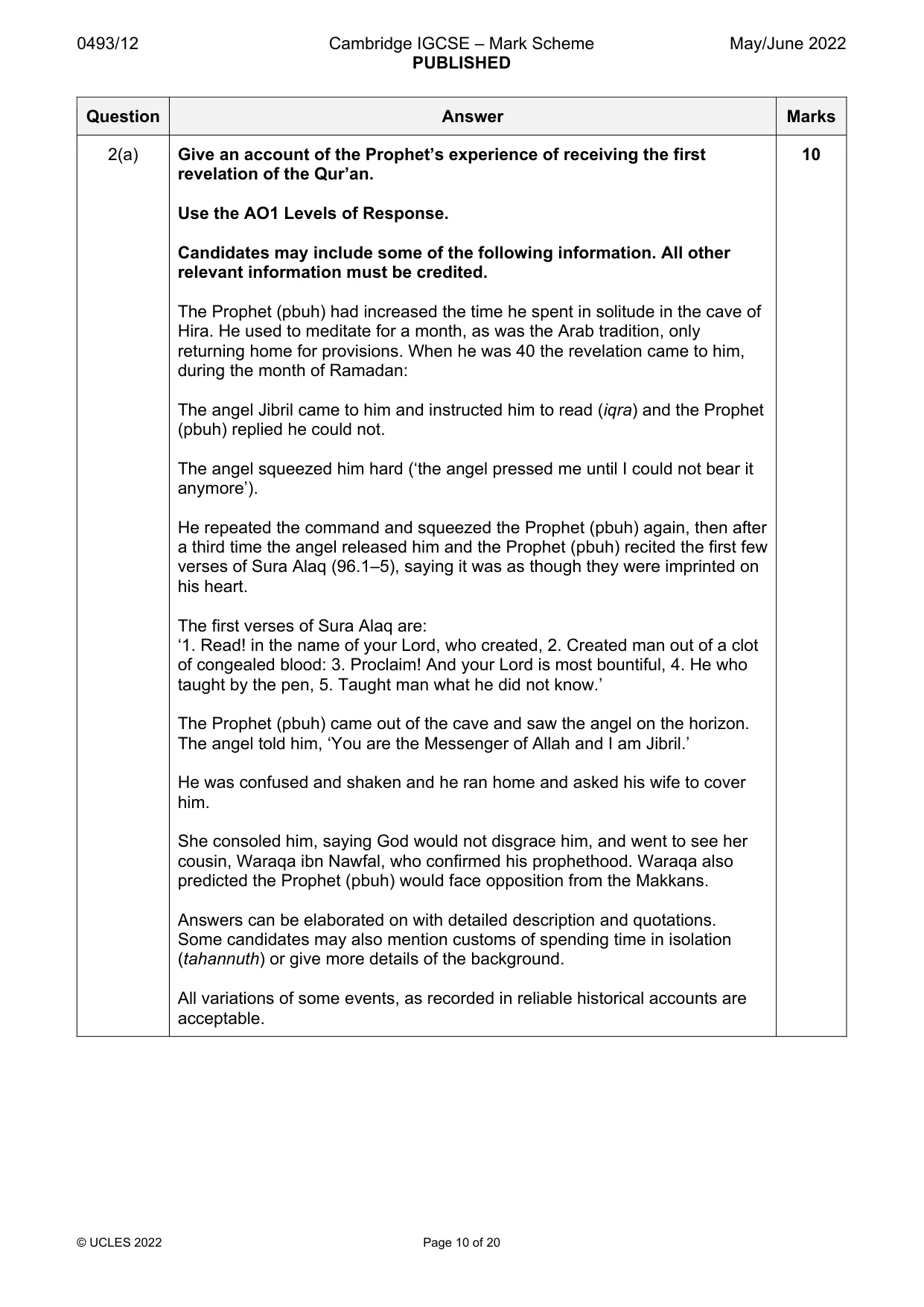
0493/12 Cambridge IGCSE – Mark Scheme PUBLISHED May/June 2022 © UCLES 2022 Page 10 of 20 Question Answer Marks 2(a) Give an account of the Prophet’s experience of receiving the first revelation of the Qur’an. Use the AO1 Levels of Response. Candidates may include some of the following information. All other relevant information must be credited. The Prophet (pbuh) had increased the time he spent in solitude in the cave of Hira. He used to meditate for a month, as was the Arab tradition, only returning home for provisions. When he was 40 the revelation came to him, during the month of Ramadan: The angel Jibril came to him and instructed him to read (iqra) and the Prophet (pbuh) replied he could not. The angel squeezed him hard (‘the angel pressed me until I could not bear it anymore’). He repeated the command and squeezed the Prophet (pbuh) again, then after a third time the angel released him and the Prophet (pbuh) recited the first few verses of Sura Alaq (96.1–5), saying it was as though they were imprinted on his heart. The first verses of Sura Alaq are: ‘1. Read! in the name of your Lord, who created, 2. Created man out of a clot of congealed blood: 3. Proclaim! And your Lord is most bountiful, 4. He who taught by the pen, 5. Taught man what he did not know.’ The Prophet (pbuh) came out of the cave and saw the angel on the horizon. The angel told him, ‘You are the Messenger of Allah and I am Jibril.’ He was confused and shaken and he ran home and asked his wife to cover him. She consoled him, saying God would not disgrace him, and went to see her cousin, Waraqa ibn Nawfal, who confirmed his prophethood. Waraqa also predicted the Prophet (pbuh) would face opposition from the Makkans. Answers can be elaborated on with detailed description and quotations. Some candidates may also mention customs of spending time in isolation (tahannuth) or give more details of the background. All variations of some events, as recorded in reliable historical accounts are acceptable. 10
Mark scheme, page 11
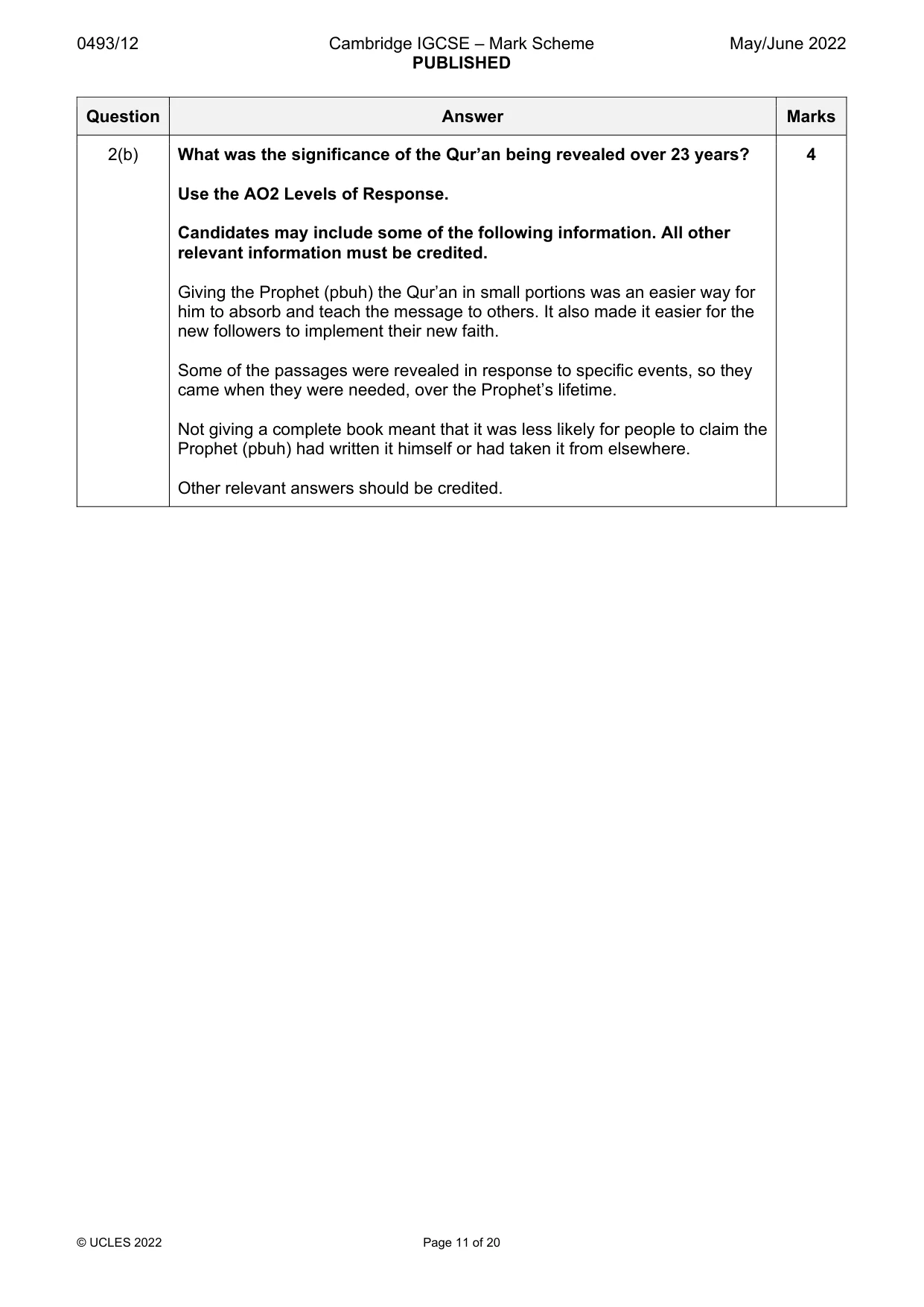
0493/12 Cambridge IGCSE – Mark Scheme PUBLISHED May/June 2022 © UCLES 2022 Page 11 of 20 Question Answer Marks 2(b) What was the significance of the Qur’an being revealed over 23 years? Use the AO2 Levels of Response. Candidates may include some of the following information. All other relevant information must be credited. Giving the Prophet (pbuh) the Qur’an in small portions was an easier way for him to absorb and teach the message to others. It also made it easier for the new followers to implement their new faith. Some of the passages were revealed in response to specific events, so they came when they were needed, over the Prophet’s lifetime. Not giving a complete book meant that it was less likely for people to claim the Prophet (pbuh) had written it himself or had taken it from elsewhere. Other relevant answers should be credited. 4
Mark scheme, page 12
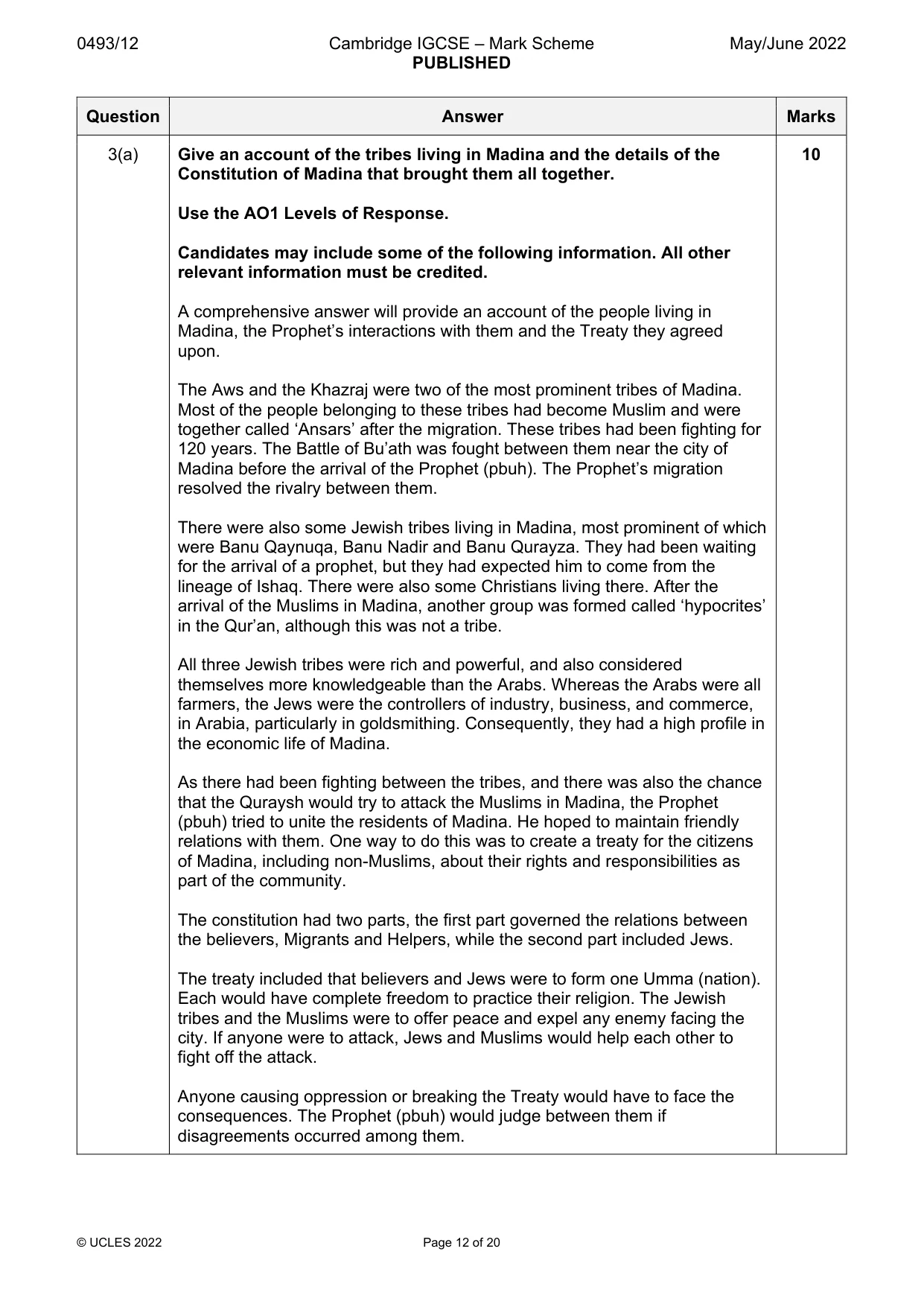
0493/12 Cambridge IGCSE – Mark Scheme PUBLISHED May/June 2022 © UCLES 2022 Page 12 of 20 Question Answer Marks 3(a) Give an account of the tribes living in Madina and the details of the Constitution of Madina that brought them all together. Use the AO1 Levels of Response. Candidates may include some of the following information. All other relevant information must be credited. A comprehensive answer will provide an account of the people living in Madina, the Prophet’s interactions with them and the Treaty they agreed upon. The Aws and the Khazraj were two of the most prominent tribes of Madina. Most of the people belonging to these tribes had become Muslim and were together called ‘Ansars’ after the migration. These tribes had been fighting for 120 years. The Battle of Bu’ath was fought between them near the city of Madina before the arrival of the Prophet (pbuh). The Prophet’s migration resolved the rivalry between them. There were also some Jewish tribes living in Madina, most prominent of which were Banu Qaynuqa, Banu Nadir and Banu Qurayza. They had been waiting for the arrival of a prophet, but they had expected him to come from the lineage of Ishaq. There were also some Christians living there. After the arrival of the Muslims in Madina, another group was formed called ‘hypocrites’ in the Qur’an, although this was not a tribe. All three Jewish tribes were rich and powerful, and also considered themselves more knowledgeable than the Arabs. Whereas the Arabs were all farmers, the Jews were the controllers of industry, business, and commerce, in Arabia, particularly in goldsmithing. Consequently, they had a high profile in the economic life of Madina. As there had been fighting between the tribes, and there was also the chance that the Quraysh would try to attack the Muslims in Madina, the Prophet (pbuh) tried to unite the residents of Madina. He hoped to maintain friendly relations with them. One way to do this was to create a treaty for the citizens of Madina, including non-Muslims, about their rights and responsibilities as part of the community. The constitution had two parts, the first part governed the relations between the believers, Migrants and Helpers, while the second part included Jews. The treaty included that believers and Jews were to form one Umma (nation). Each would have complete freedom to practice their religion. The Jewish tribes and the Muslims were to offer peace and expel any enemy facing the city. If anyone were to attack, Jews and Muslims would help each other to fight off the attack. Anyone causing oppression or breaking the Treaty would have to face the consequences. The Prophet (pbuh) would judge between them if disagreements occurred among them. 10
Mark scheme, page 13
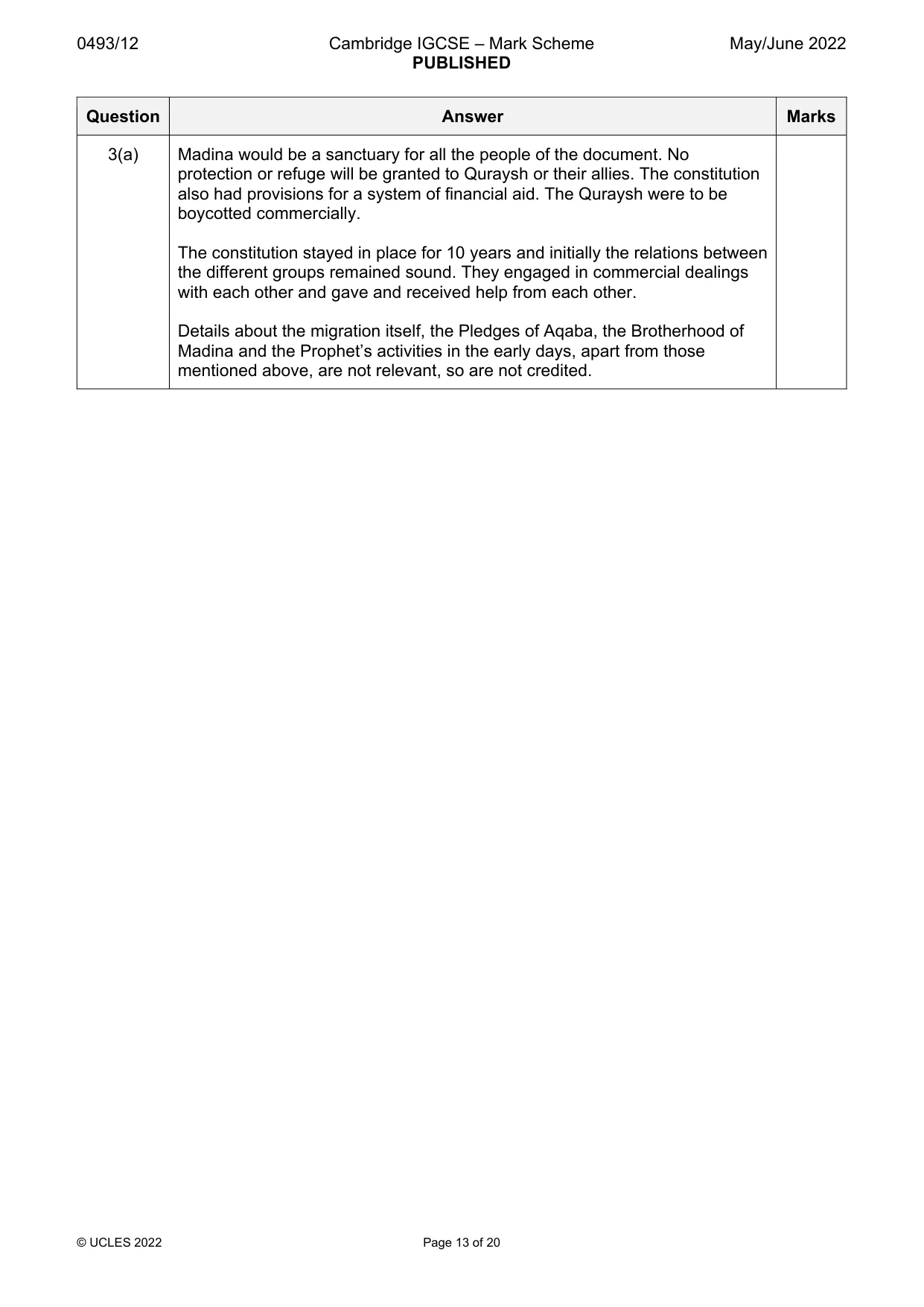
0493/12 Cambridge IGCSE – Mark Scheme PUBLISHED May/June 2022 © UCLES 2022 Page 13 of 20 Question Answer Marks 3(a) Madina would be a sanctuary for all the people of the document. No protection or refuge will be granted to Quraysh or their allies. The constitution also had provisions for a system of financial aid. The Quraysh were to be boycotted commercially. The constitution stayed in place for 10 years and initially the relations between the different groups remained sound. They engaged in commercial dealings with each other and gave and received help from each other. Details about the migration itself, the Pledges of Aqaba, the Brotherhood of Madina and the Prophet’s activities in the early days, apart from those mentioned above, are not relevant, so are not credited.
Mark scheme, page 14
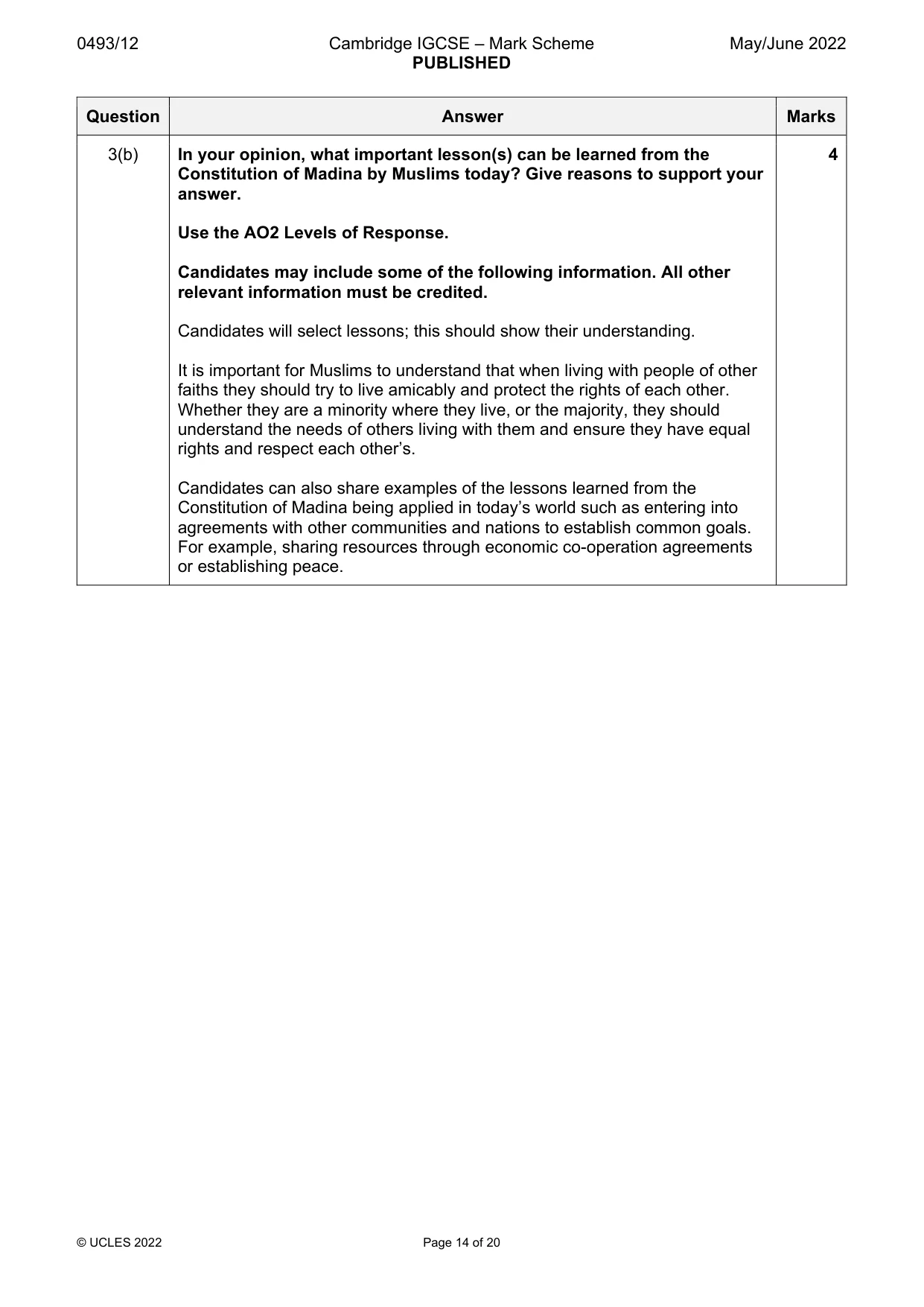
0493/12 Cambridge IGCSE – Mark Scheme PUBLISHED May/June 2022 © UCLES 2022 Page 14 of 20 Question Answer Marks 3(b) In your opinion, what important lesson(s) can be learned from the Constitution of Madina by Muslims today? Give reasons to support your answer. Use the AO2 Levels of Response. Candidates may include some of the following information. All other relevant information must be credited. Candidates will select lessons; this should show their understanding. It is important for Muslims to understand that when living with people of other faiths they should try to live amicably and protect the rights of each other. Whether they are a minority where they live, or the majority, they should understand the needs of others living with them and ensure they have equal rights and respect each other’s. Candidates can also share examples of the lessons learned from the Constitution of Madina being applied in today’s world such as entering into agreements with other communities and nations to establish common goals. For example, sharing resources through economic co-operation agreements or establishing peace. 4
Mark scheme, page 15
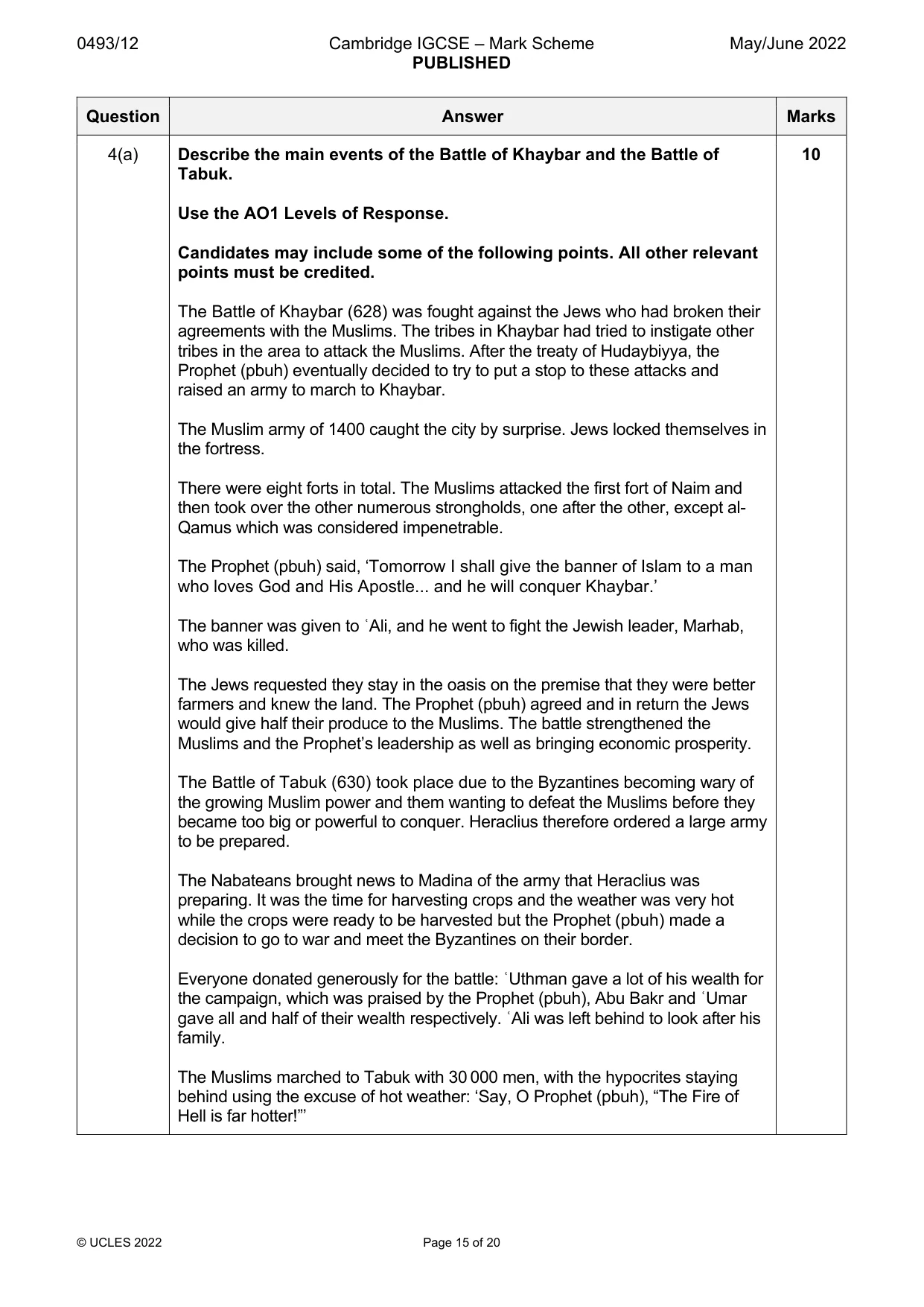
0493/12 Cambridge IGCSE – Mark Scheme PUBLISHED May/June 2022 © UCLES 2022 Page 15 of 20 Question Answer Marks 4(a) Describe the main events of the Battle of Khaybar and the Battle of Tabuk. Use the AO1 Levels of Response. Candidates may include some of the following points. All other relevant points must be credited. The Battle of Khaybar (628) was fought against the Jews who had broken their agreements with the Muslims. The tribes in Khaybar had tried to instigate other tribes in the area to attack the Muslims. After the treaty of Hudaybiyya, the Prophet (pbuh) eventually decided to try to put a stop to these attacks and raised an army to march to Khaybar. The Muslim army of 1400 caught the city by surprise. Jews locked themselves in the fortress. There were eight forts in total. The Muslims attacked the first fort of Naim and then took over the other numerous strongholds, one after the other, except al- Qamus which was considered impenetrable. The Prophet (pbuh) said, ‘Tomorrow I shall give the banner of Islam to a man who loves God and His Apostle... and he will conquer Khaybar.’ The banner was given to ʿAli, and he went to fight the Jewish leader, Marhab, who was killed. The Jews requested they stay in the oasis on the premise that they were better farmers and knew the land. The Prophet (pbuh) agreed and in return the Jews would give half their produce to the Muslims. The battle strengthened the Muslims and the Prophet’s leadership as well as bringing economic prosperity. The Battle of Tabuk (630) took place due to the Byzantines becoming wary of the growing Muslim power and them wanting to defeat the Muslims before they became too big or powerful to conquer. Heraclius therefore ordered a large army to be prepared. The Nabateans brought news to Madina of the army that Heraclius was preparing. It was the time for harvesting crops and the weather was very hot while the crops were ready to be harvested but the Prophet (pbuh) made a decision to go to war and meet the Byzantines on their border. Everyone donated generously for the battle: ʿUthman gave a lot of his wealth for the campaign, which was praised by the Prophet (pbuh), Abu Bakr and ʿUmar gave all and half of their wealth respectively. ʿAli was left behind to look after his family. The Muslims marched to Tabuk with 30 000 men, with the hypocrites staying behind using the excuse of hot weather: ‘Say, O Prophet (pbuh), “The Fire of Hell is far hotter!”’ 10
Mark scheme, page 16
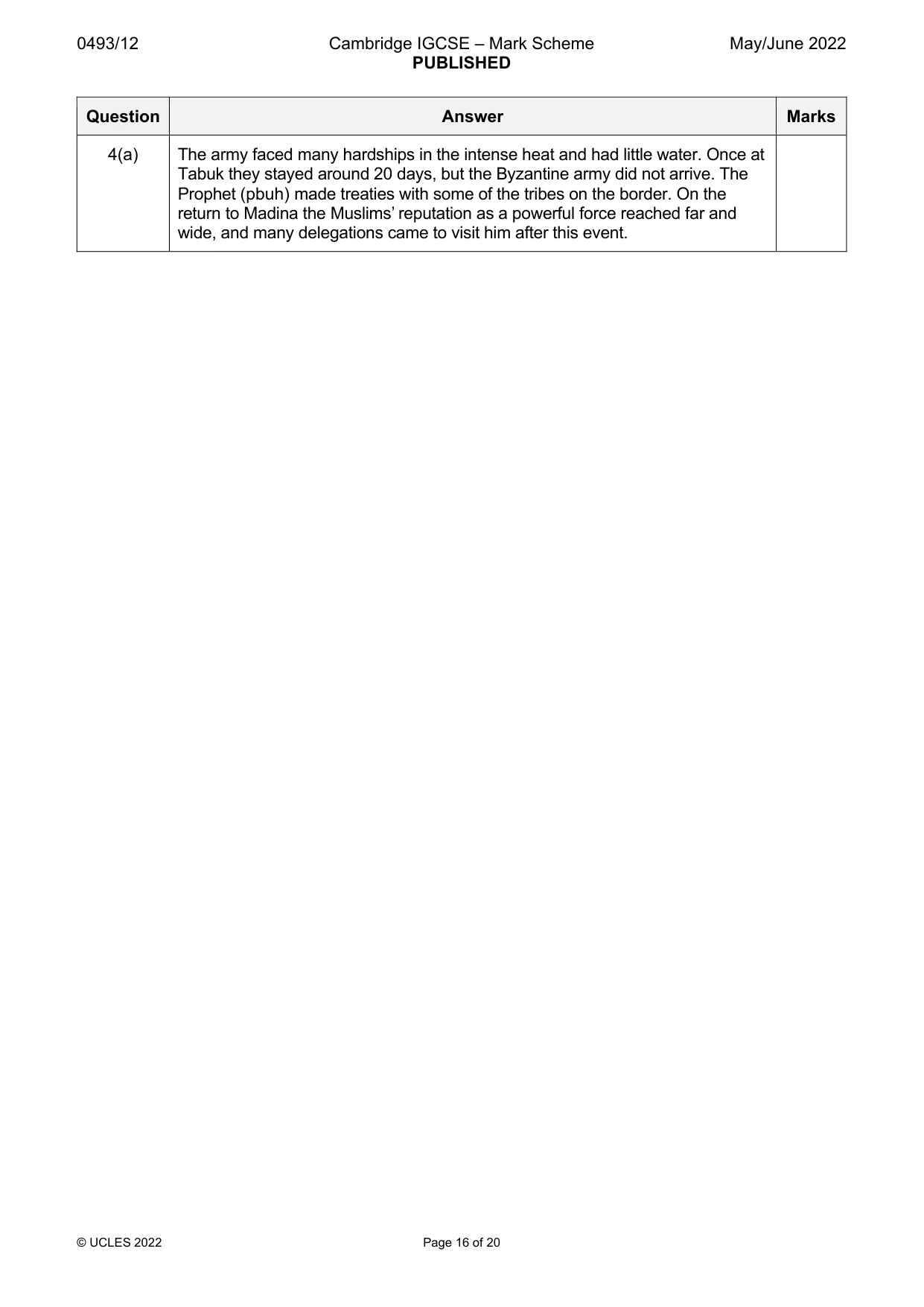
0493/12 Cambridge IGCSE – Mark Scheme PUBLISHED May/June 2022 © UCLES 2022 Page 16 of 20 Question Answer Marks 4(a) The army faced many hardships in the intense heat and had little water. Once at Tabuk they stayed around 20 days, but the Byzantine army did not arrive. The Prophet (pbuh) made treaties with some of the tribes on the border. On the return to Madina the Muslims’ reputation as a powerful force reached far and wide, and many delegations came to visit him after this event.
Mark scheme, page 17
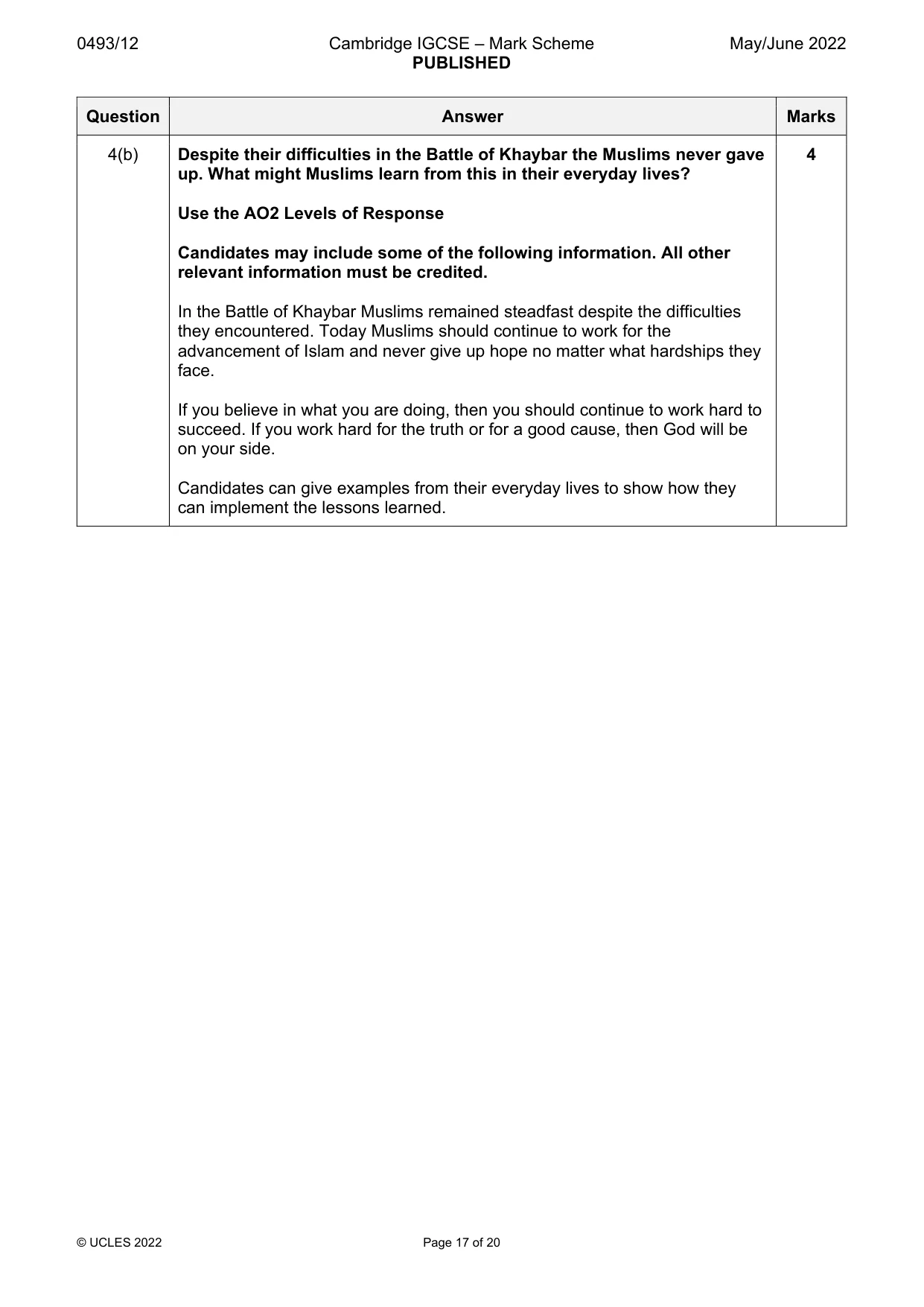
0493/12 Cambridge IGCSE – Mark Scheme PUBLISHED May/June 2022 © UCLES 2022 Page 17 of 20 Question Answer Marks 4(b) Despite their difficulties in the Battle of Khaybar the Muslims never gave up. What might Muslims learn from this in their everyday lives? Use the AO2 Levels of Response Candidates may include some of the following information. All other relevant information must be credited. In the Battle of Khaybar Muslims remained steadfast despite the difficulties they encountered. Today Muslims should continue to work for the advancement of Islam and never give up hope no matter what hardships they face. If you believe in what you are doing, then you should continue to work hard to succeed. If you work hard for the truth or for a good cause, then God will be on your side. Candidates can give examples from their everyday lives to show how they can implement the lessons learned. 4
Mark scheme, page 18
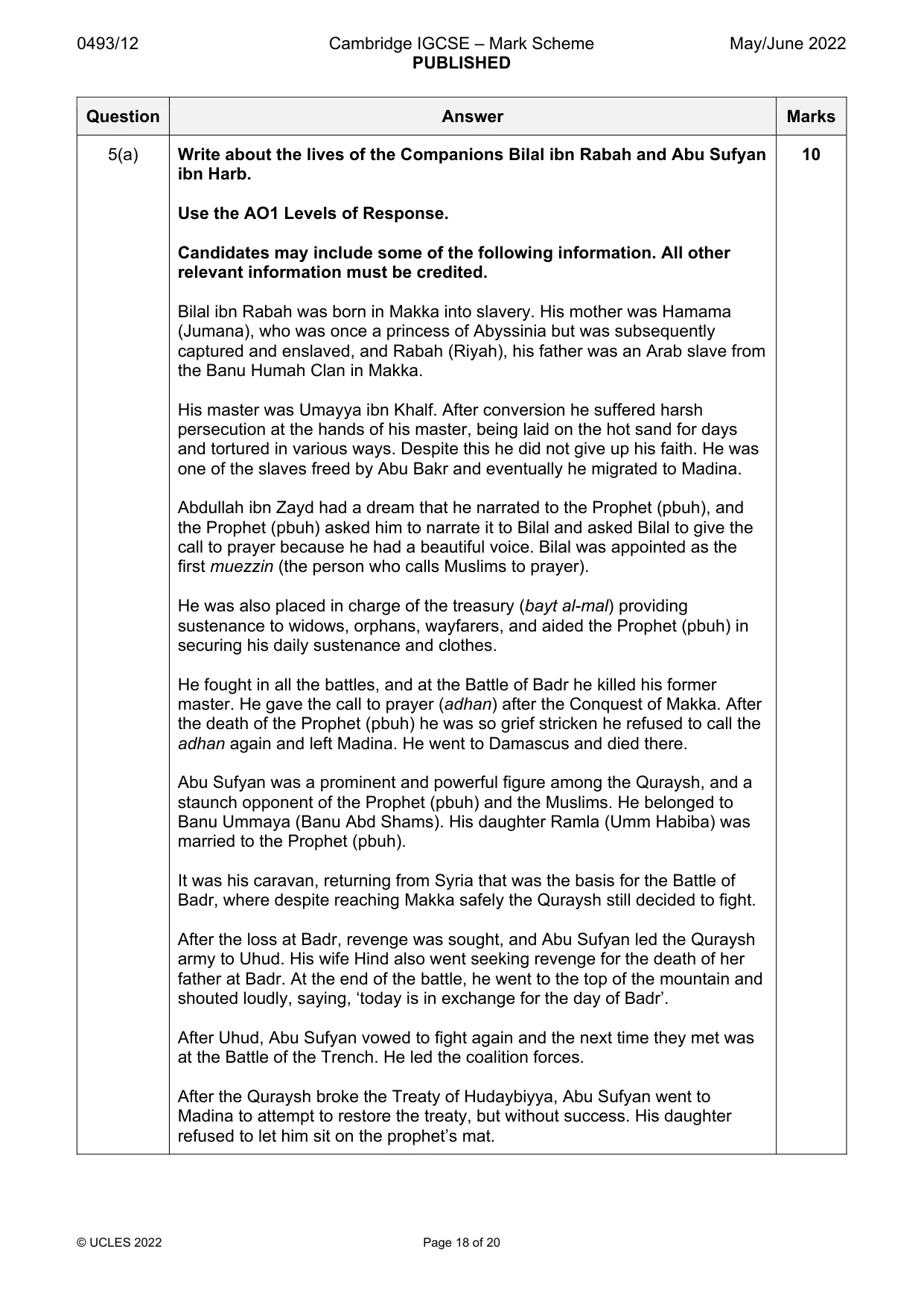
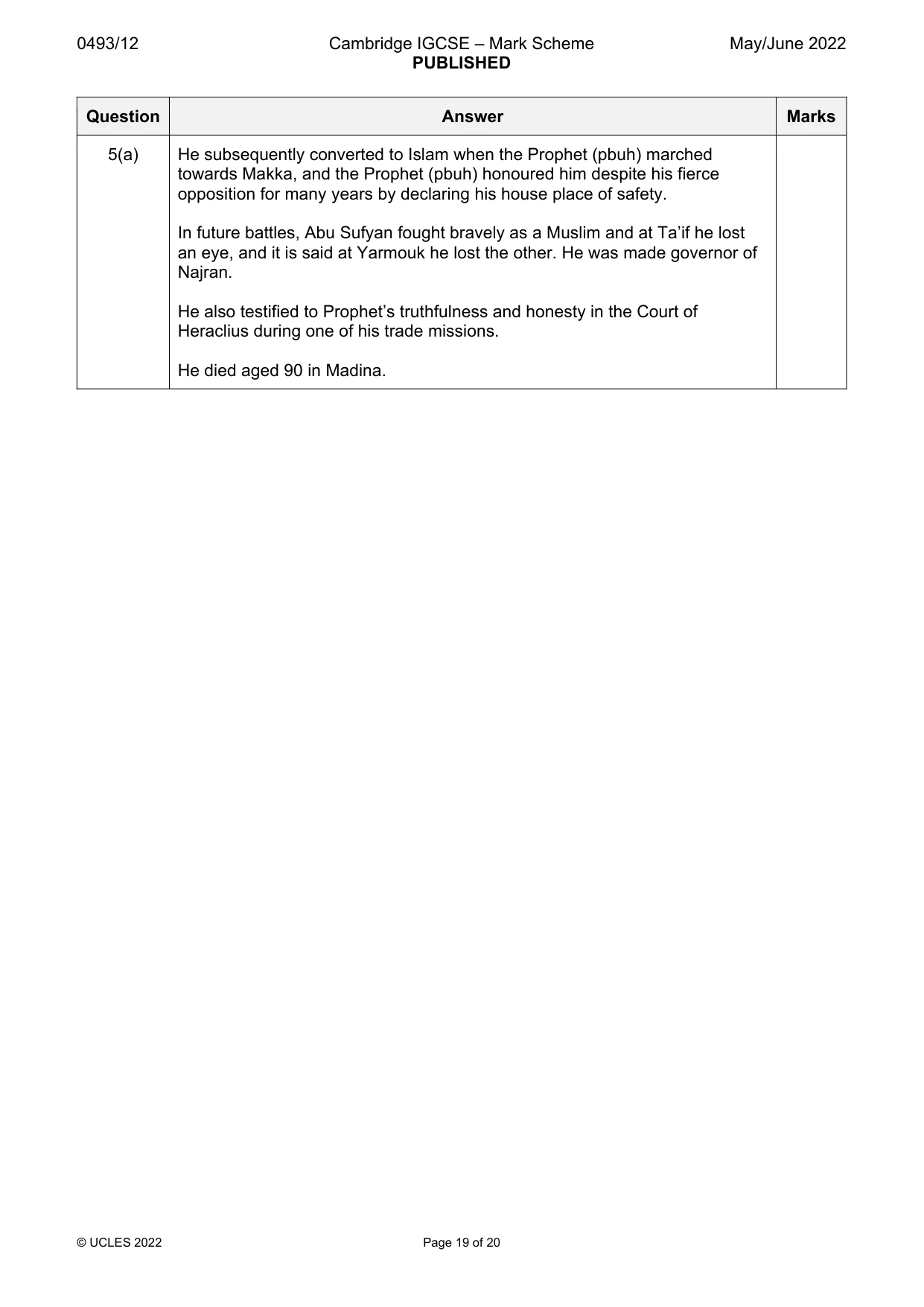
0493/12 Cambridge IGCSE – Mark Scheme PUBLISHED May/June 2022 © UCLES 2022 Page 18 of 20 Question Answer Marks 5(a) Write about the lives of the Companions Bilal ibn Rabah and Abu Sufyan ibn Harb. Use the AO1 Levels of Response. Candidates may include some of the following information. All other relevant information must be credited. Bilal ibn Rabah was born in Makka into slavery. His mother was Hamama (Jumana), who was once a princess of Abyssinia but was subsequently captured and enslaved, and Rabah (Riyah), his father was an Arab slave from the Banu Humah Clan in Makka. His master was Umayya ibn Khalf. After conversion he suffered harsh persecution at the hands of his master, being laid on the hot sand for days and tortured in various ways. Despite this he did not give up his faith. He was one of the slaves freed by Abu Bakr and eventually he migrated to Madina. Abdullah ibn Zayd had a dream that he narrated to the Prophet (pbuh), and the Prophet (pbuh) asked him to narrate it to Bilal and asked Bilal to give the call to prayer because he had a beautiful voice. Bilal was appointed as the first muezzin (the person who calls Muslims to prayer). He was also placed in charge of the treasury (bayt al-mal) providing sustenance to widows, orphans, wayfarers, and aided the Prophet (pbuh) in securing his daily sustenance and clothes. He fought in all the battles, and at the Battle of Badr he killed his former master. He gave the call to prayer (adhan) after the Conquest of Makka. After the death of the Prophet (pbuh) he was so grief stricken he refused to call the adhan again and left Madina. He went to Damascus and died there. Abu Sufyan was a prominent and powerful figure among the Quraysh, and a staunch opponent of the Prophet (pbuh) and the Muslims. He belonged to Banu Ummaya (Banu Abd Shams). His daughter Ramla (Umm Habiba) was married to the Prophet (pbuh). It was his caravan, returning from Syria that was the basis for the Battle of Badr, where despite reaching Makka safely the Quraysh still decided to fight. After the loss at Badr, revenge was sought, and Abu Sufyan led the Quraysh army to Uhud. His wife Hind also went seeking revenge for the death of her father at Badr. At the end of the battle, he went to the top of the mountain and shouted loudly, saying, ‘today is in exchange for the day of Badr’. After Uhud, Abu Sufyan vowed to fight again and the next time they met was at the Battle of the Trench. He led the coalition forces. After the Quraysh broke the Treaty of Hudaybiyya, Abu Sufyan went to Madina to attempt to restore the treaty, but without success. His daughter refused to let him sit on the prophet’s mat. 10
Mark scheme, page 19
0493/12 Cambridge IGCSE – Mark Scheme PUBLISHED May/June 2022 © UCLES 2022 Page 19 of 20 Question Answer Marks 5(a) He subsequently converted to Islam when the Prophet (pbuh) marched towards Makka, and the Prophet (pbuh) honoured him despite his fierce opposition for many years by declaring his house place of safety. In future battles, Abu Sufyan fought bravely as a Muslim and at Ta’if he lost an eye, and it is said at Yarmouk he lost the other. He was made governor of Najran. He also testified to Prophet’s truthfulness and honesty in the Court of Heraclius during one of his trade missions. He died aged 90 in Madina.
Mark scheme, page 20
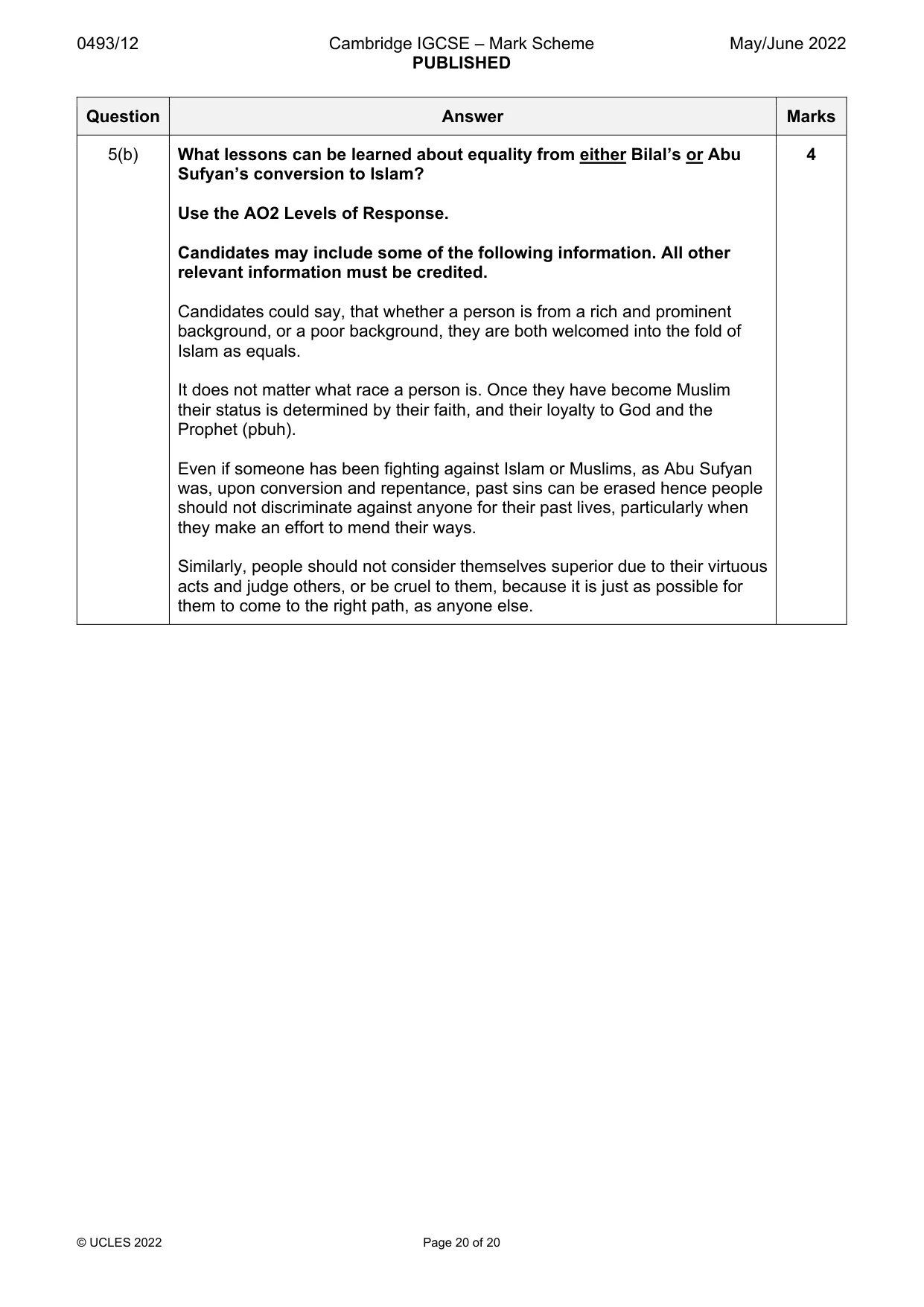
0493/12 Cambridge IGCSE – Mark Scheme PUBLISHED May/June 2022 © UCLES 2022 Page 20 of 20 Question Answer Marks 5(b) What lessons can be learned about equality from either Bilal’s or Abu Sufyan’s conversion to Islam? Use the AO2 Levels of Response. Candidates may include some of the following information. All other relevant information must be credited. Candidates could say, that whether a person is from a rich and prominent background, or a poor background, they are both welcomed into the fold of Islam as equals. It does not matter what race a person is. Once they have become Muslim their status is determined by their faith, and their loyalty to God and the Prophet (pbuh). Even if someone has been fighting against Islam or Muslims, as Abu Sufyan was, upon conversion and repentance, past sins can be erased hence people should not discriminate against anyone for their past lives, particularly when they make an effort to mend their ways. Similarly, people should not consider themselves superior due to their virtuous acts and judge others, or be cruel to them, because it is just as possible for them to come to the right path, as anyone else. 4
What you needed in this session
Cambridge’s own grade thresholds for 2022 May/June, Paper 1 · Variant 2. A higher threshold means an easier paper — the bar moves with how the cohort did.