Cambridge IGCSE Islamiyat 0493 — 2023 Oct/Nov Paper 1 · Variant 1
0493/11/O/N/23 · 50 marks · ≈56 min
The question paper and its mark scheme, free to read here and free to download. This is Cambridge’s own paper, exactly as it was sat.
Question paper20 pages


Mark scheme16 pages
Answers below. Sit the paper first if you are practising.
Paper as text
Question paper, page 1
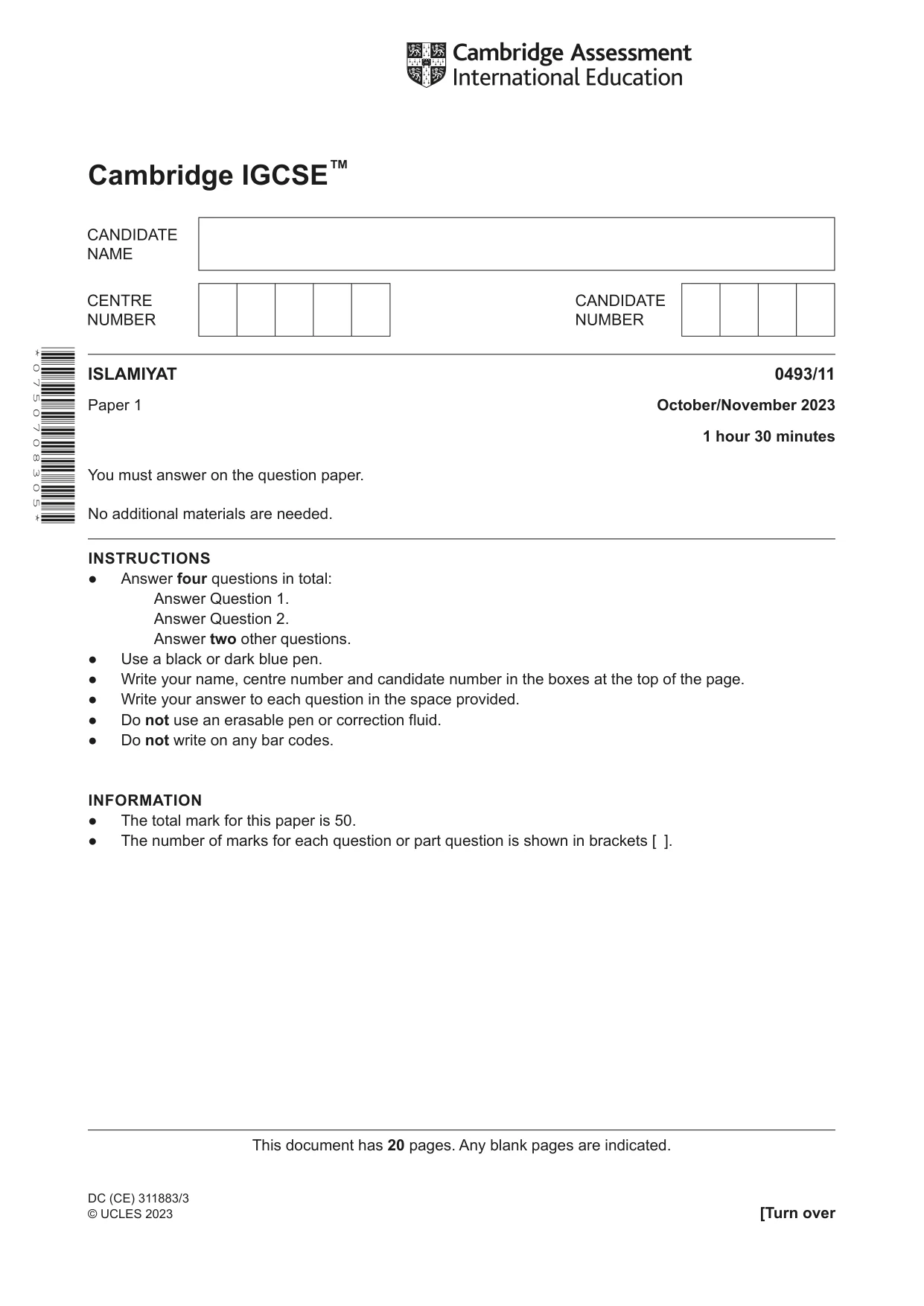
This document has 20 pages. Any blank pages are indicated. [Turn over Cambridge IGCSE™ ISLAMIYAT 0493/11 Paper 1 October/November 2023 1 hour 30 minutes You must answer on the question paper. No additional materials are needed. INSTRUCTIONS ● Answer four questions in total: Answer Question 1. Answer Question 2. Answer two other questions. ● Use a black or dark blue pen. ● Write your name, centre number and candidate number in the boxes at the top of the page. ● Write your answer to each question in the space provided. ● Do not use an erasable pen or correction fluid. ● Do not write on any bar codes. INFORMATION ● The total mark for this paper is 50. ● The number of marks for each question or part question is shown in brackets [ ]. * 0 7 5 0 7 0 8 3 0 5 * DC (CE) 311883/3 © UCLES 2023
Question paper, page 2
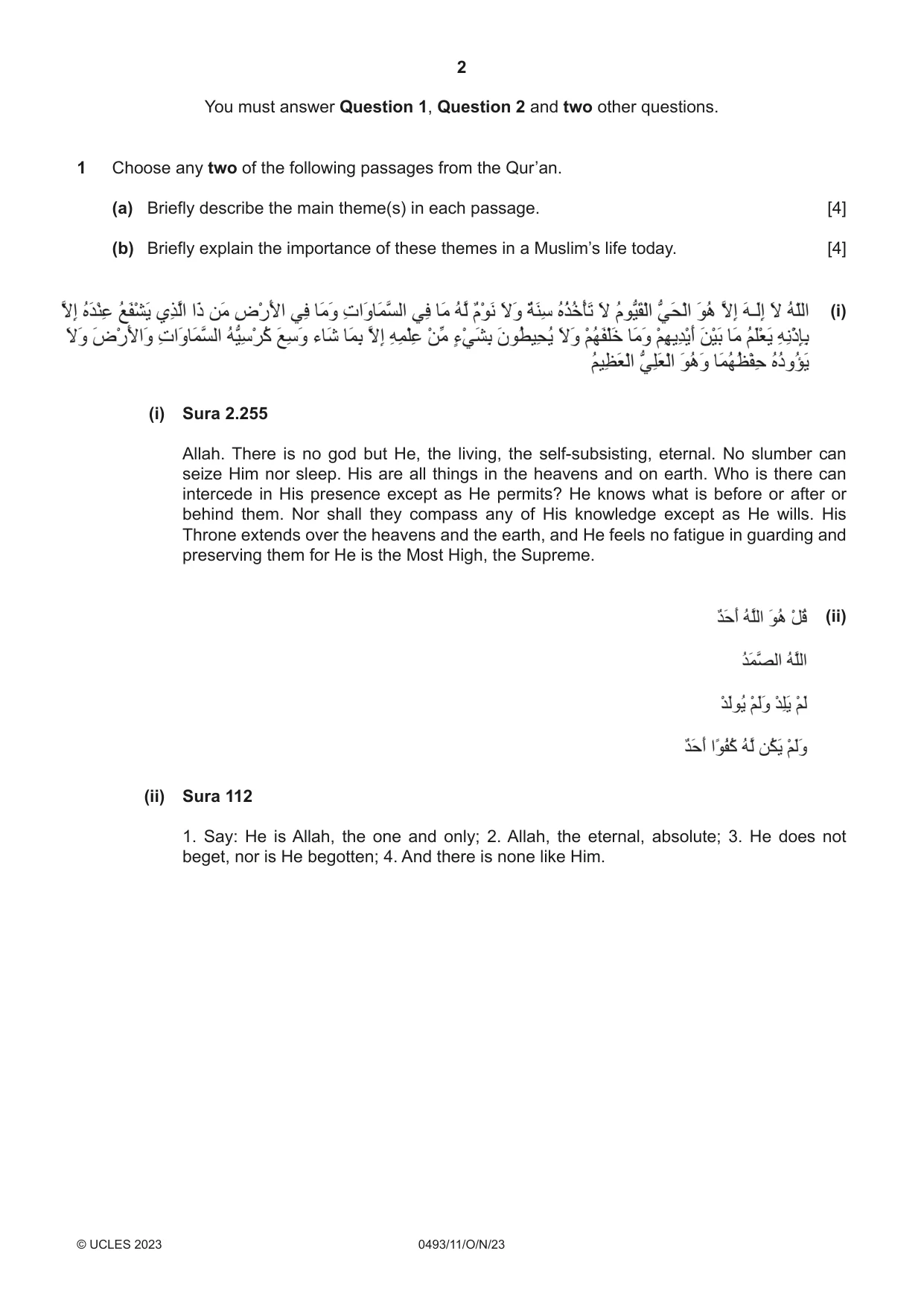
2 0493/11/O/N/23 © UCLES 2023 You must answer Question 1, Question 2 and two other questions. 1 Choose any two of the following passages from the Qur’an. (a) Briefly describe the main theme(s) in each passage. [4] (b) Briefly explain the importance of these themes in a Muslim’s life today. [4] (i) (i) Sura 2.255 Allah. There is no god but He, the living, the self-subsisting, eternal. No slumber can seize Him nor sleep. His are all things in the heavens and on earth. Who is there can intercede in His presence except as He permits? He knows what is before or after or behind them. Nor shall they compass any of His knowledge except as He wills. His Throne extends over the heavens and the earth, and He feels no fatigue in guarding and preserving them for He is the Most High, the Supreme. (ii) (ii) Sura 112 1. Say: He is Allah, the one and only; 2. Allah, the eternal, absolute; 3. He does not beget, nor is He begotten; 4. And there is none like Him.
Question paper, page 3
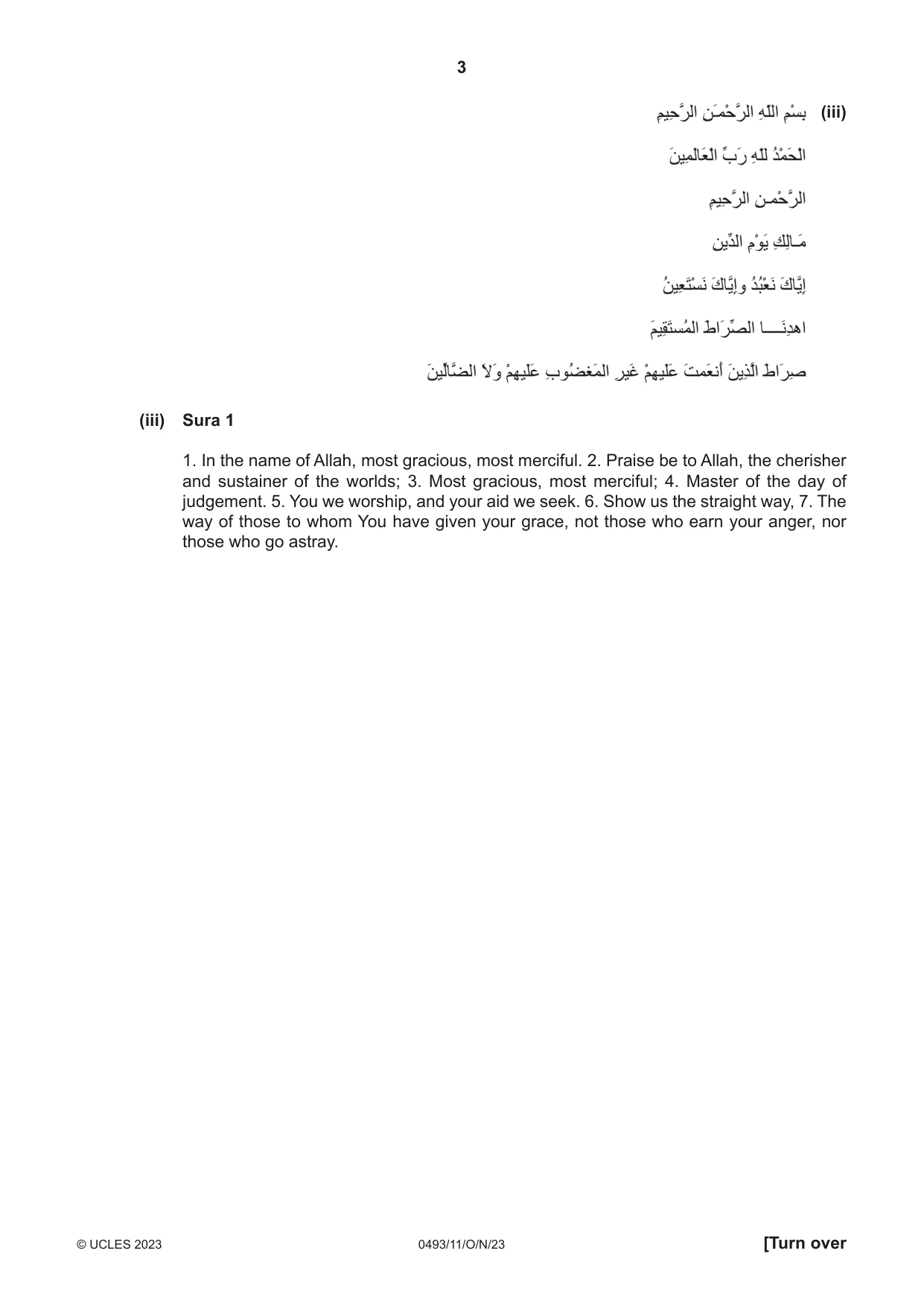
3 0493/11/O/N/23 © UCLES 2023 [Turn over (iii) (iii) Sura 1 1. In the name of Allah, most gracious, most merciful. 2. Praise be to Allah, the cherisher and sustainer of the worlds; 3. Most gracious, most merciful; 4. Master of the day of judgement. 5. You we worship, and your aid we seek. 6. Show us the straight way, 7. The way of those to whom You have given your grace, not those who earn your anger, nor those who go astray.
Question paper, page 4
4 0493/11/O/N/23 © UCLES 2023 … … … … … … … … … … … … … … … … … … … … … … … … … … … …
Question paper, page 5
5 0493/11/O/N/23 © UCLES 2023 [Turn over … … … … … … … … … … … … … … … … … … … … … … … … … … … …
Question paper, page 6
6 0493/11/O/N/23 © UCLES 2023 2 (a) Using the set passages you have studied, write about God’s relationship with the created world. [10] (b) What do these passages teach Muslims about responsibility towards their environment? [4] … … … … … … … … … … … … … … … … … … … … … … … … … …
Question paper, page 7
7 0493/11/O/N/23 © UCLES 2023 [Turn over … … … … … … … … … … … … … … … … … … … … … … … … … … … …
Question paper, page 8
8 0493/11/O/N/23 © UCLES 2023 … … … … … … … … … … … … … … … … … … … … … … … … … … … …
Question paper, page 9
9 0493/11/O/N/23 © UCLES 2023 [Turn over 3 (a) The Prophet (pbuh) stopped at Hudaybiyya on his way to Makka. Give an account of the events that took place here. [10] (b) In your opinion, what is the most important lesson that Muslims might learn from the events at Hudaybiyya? Give reasons to support your answer. [4] … … … … … … … … … … … … … … … … … … … … … … … … …
Question paper, page 10
10 0493/11/O/N/23 © UCLES 2023 … … … … … … … … … … … … … … … … … … … … … … … … … … … …
Question paper, page 11
11 0493/11/O/N/23 © UCLES 2023 [Turn over … … … … … … … … … … … … … … … … … … … … … … … … … … … …
Question paper, page 12
12 0493/11/O/N/23 © UCLES 2023 4 (a) Some of the early Muslims migrated to Abyssinia. Give an account of the events of this migration. [10] (b) To what extent can this migration be considered similar to Muslim migrations today? Give reasons for your answer. [4] … … … … … … … … … … … … … … … … … … … … … … … … …
Question paper, page 13
13 0493/11/O/N/23 © UCLES 2023 [Turn over … … … … … … … … … … … … … … … … … … … … … … … … … … … …
Question paper, page 14
14 0493/11/O/N/23 © UCLES 2023 … … … … … … … … … … … … … … … … … … … … … … … … … … … …
Question paper, page 15
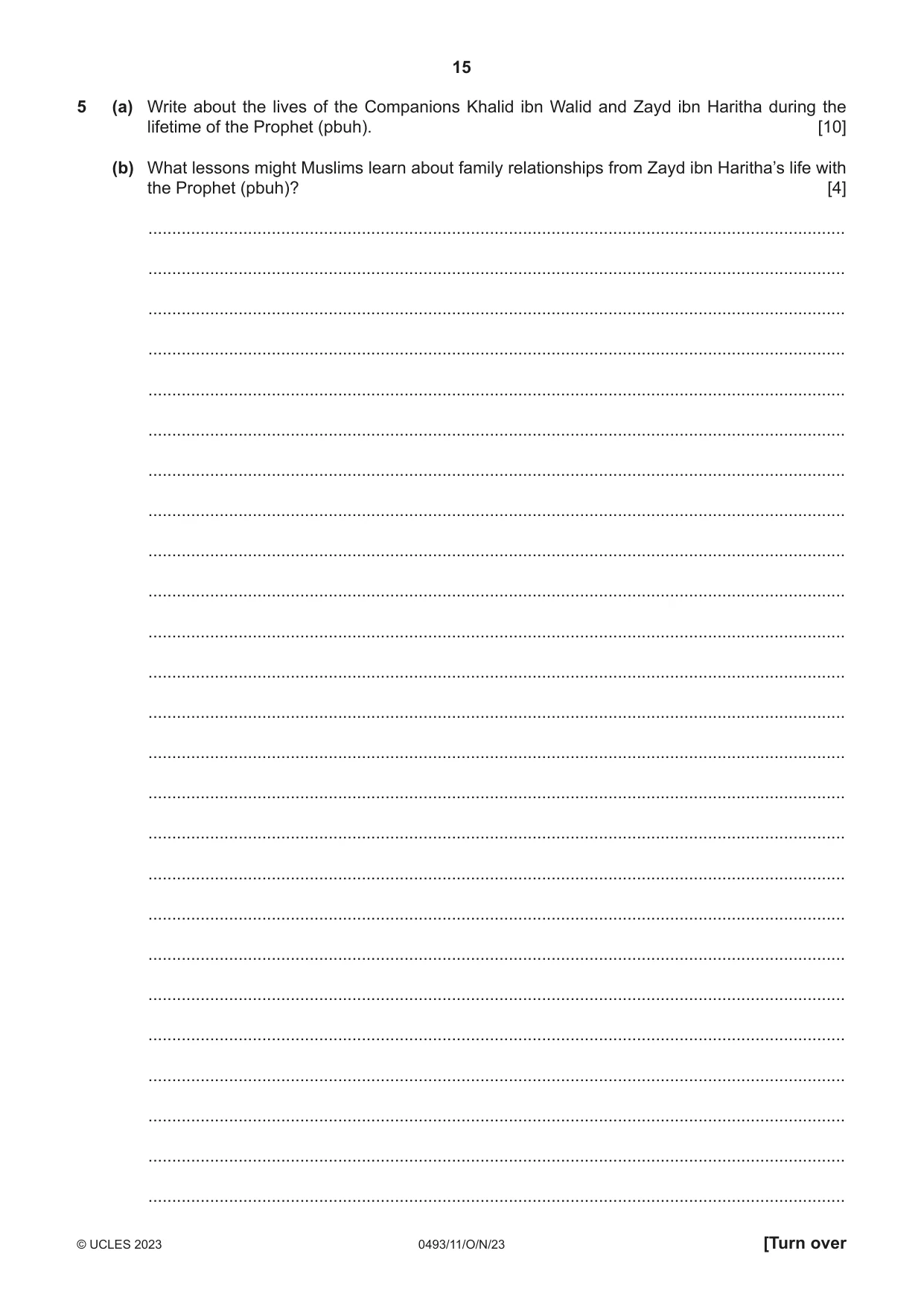
15 0493/11/O/N/23 © UCLES 2023 [Turn over 5 (a) Write about the lives of the Companions Khalid ibn Walid and Zayd ibn Haritha during the lifetime of the Prophet (pbuh). [10] (b) What lessons might Muslims learn about family relationships from Zayd ibn Haritha’s life with the Prophet (pbuh)? [4] … … … … … … … … … … … … … … … … … … … … … … … … …
Question paper, page 16
16 0493/11/O/N/23 © UCLES 2023 … … … … … … … … … … … … … … … … … … … … … … … … … … … …
Question paper, page 17
17 0493/11/O/N/23 © UCLES 2023 … … … … … … … … … … … … … … … … … … … … … … … … … … … …
Question paper, page 18
18 0493/11/O/N/23 © UCLES 2023 BLANK PAGE
Question paper, page 19
19 0493/11/O/N/23 © UCLES 2023 BLANK PAGE
Question paper, page 20
20 0493/11/O/N/23 © UCLES 2023 Permission to reproduce items where third-party owned material protected by copyright is included has been sought and cleared where possible. Every reasonable effort has been made by the publisher (UCLES) to trace copyright holders, but if any items requiring clearance have unwittingly been included, the publisher will be pleased to make amends at the earliest possible opportunity. To avoid the issue of disclosure of answer-related information to candidates, all copyright acknowledgements are reproduced online in the Cambridge Assessment International Education Copyright Acknowledgements Booklet. This is produced for each series of examinations and is freely available to download at www.cambridgeinternational.org after the live examination series. Cambridge Assessment International Education is part of Cambridge Assessment. Cambridge Assessment is the brand name of the University of Cambridge Local Examinations Syndicate (UCLES), which is a department of the University of Cambridge. BLANK PAGE
Mark scheme, page 1
This document consists of 16 printed pages. © UCLES 2023 [Turn over Cambridge IGCSE™ ISLAMIYAT 0493/11 Paper 1 October/November 2023 MARK SCHEME Maximum Mark: 50 Published This mark scheme is published as an aid to teachers and candidates, to indicate the requirements of the examination. It shows the basis on which Examiners were instructed to award marks. It does not indicate the details of the discussions that took place at an Examiners’ meeting before marking began, which would have considered the acceptability of alternative answers. Mark schemes should be read in conjunction with the question paper and the Principal Examiner Report for Teachers. Cambridge International will not enter into discussions about these mark schemes. Cambridge International is publishing the mark schemes for the October/November 2023 series for most Cambridge IGCSE, Cambridge International A and AS Level components, and some Cambridge O Level components.
Mark scheme, page 2
0493/11 Cambridge IGCSE – Mark Scheme PUBLISHED October/November 2023 © UCLES 2023 Page 2 of 16 Generic Marking Principles These general marking principles must be applied by all examiners when marking candidate answers. They should be applied alongside the specific content of the mark scheme or generic level descriptors for a question. Each question paper and mark scheme will also comply with these marking principles. GENERIC MARKING PRINCIPLE 1: Marks must be awarded in line with: • the specific content of the mark scheme or the generic level descriptors for the question • the specific skills defined in the mark scheme or in the generic level descriptors for the question • the standard of response required by a candidate as exemplified by the standardisation scripts. GENERIC MARKING PRINCIPLE 2: Marks awarded are always whole marks (not half marks, or other fractions). GENERIC MARKING PRINCIPLE 3: Marks must be awarded positively: • marks are awarded for correct/valid answers, as defined in the mark scheme. However, credit is given for valid answers which go beyond the scope of the syllabus and mark scheme, referring to your Team Leader as appropriate • marks are awarded when candidates clearly demonstrate what they know and can do • marks are not deducted for errors • marks are not deducted for omissions • answers should only be judged on the quality of spelling, punctuation and grammar when these features are specifically assessed by the question as indicated by the mark scheme. The meaning, however, should be unambiguous. GENERIC MARKING PRINCIPLE 4: Rules must be applied consistently, e.g. in situations where candidates have not followed instructions or in the application of generic level descriptors. GENERIC MARKING PRINCIPLE 5: Marks should be awarded using the full range of marks defined in the mark scheme for the question (however; the use of the full mark range may be limited according to the quality of the candidate responses seen). GENERIC MARKING PRINCIPLE 6: Marks awarded are based solely on the requirements as defined in the mark scheme. Marks should not be awarded with grade thresholds or grade descriptors in mind.
Mark scheme, page 3
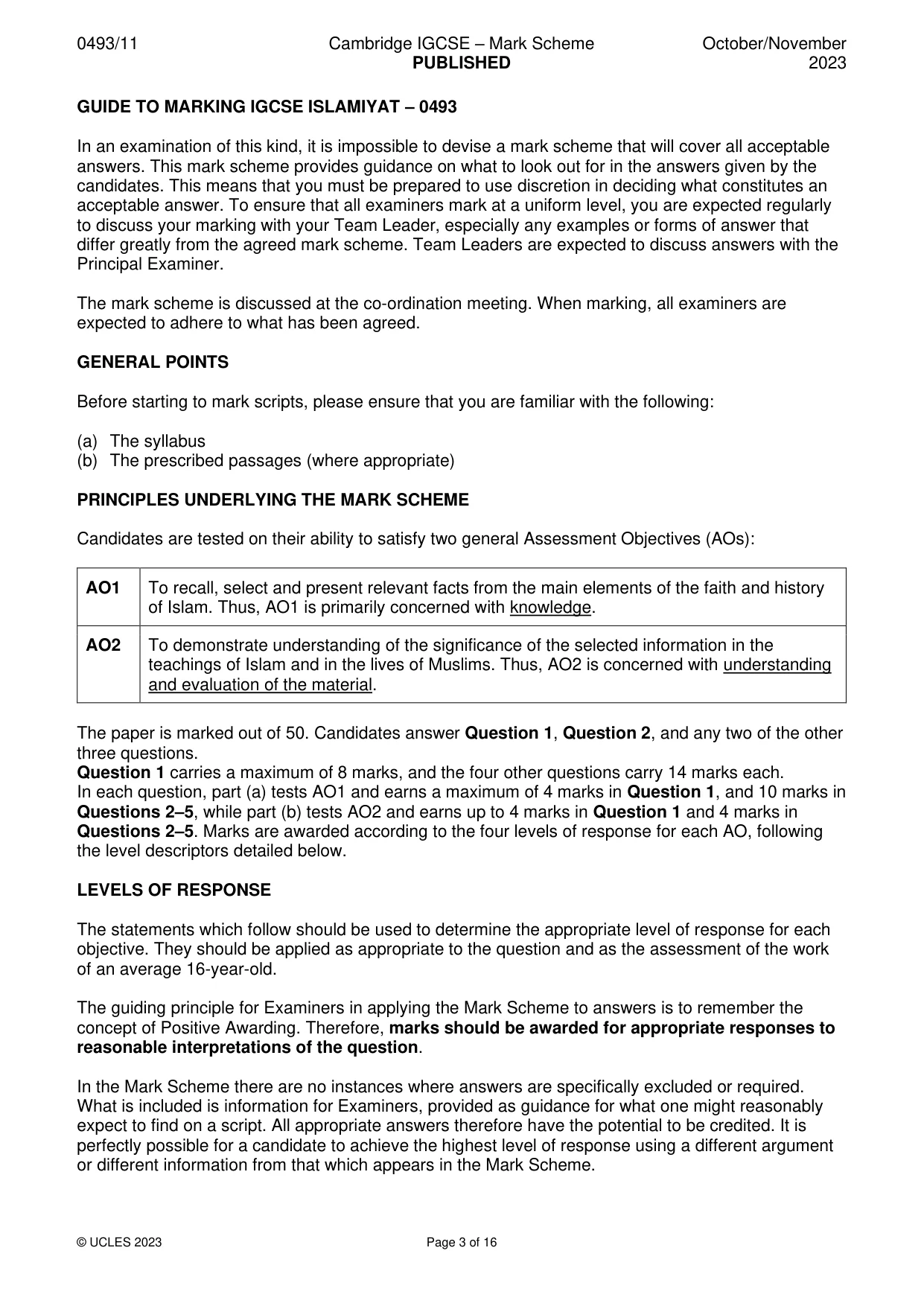
0493/11 Cambridge IGCSE – Mark Scheme PUBLISHED October/November 2023 © UCLES 2023 Page 3 of 16 GUIDE TO MARKING IGCSE ISLAMIYAT – 0493 In an examination of this kind, it is impossible to devise a mark scheme that will cover all acceptable answers. This mark scheme provides guidance on what to look out for in the answers given by the candidates. This means that you must be prepared to use discretion in deciding what constitutes an acceptable answer. To ensure that all examiners mark at a uniform level, you are expected regularly to discuss your marking with your Team Leader, especially any examples or forms of answer that differ greatly from the agreed mark scheme. Team Leaders are expected to discuss answers with the Principal Examiner. The mark scheme is discussed at the co-ordination meeting. When marking, all examiners are expected to adhere to what has been agreed. GENERAL POINTS Before starting to mark scripts, please ensure that you are familiar with the following: (a) The syllabus (b) The prescribed passages (where appropriate) PRINCIPLES UNDERLYING THE MARK SCHEME Candidates are tested on their ability to satisfy two general Assessment Objectives (AOs): AO1 To recall, select and present relevant facts from the main elements of the faith and history of Islam. Thus, AO1 is primarily concerned with knowledge. AO2 To demonstrate understanding of the significance of the selected information in the teachings of Islam and in the lives of Muslims. Thus, AO2 is concerned with understanding and evaluation of the material. The paper is marked out of 50. Candidates answer Question 1, Question 2, and any two of the other three questions. Question 1 carries a maximum of 8 marks, and the four other questions carry 14 marks each. In each question, part (a) tests AO1 and earns a maximum of 4 marks in Question 1, and 10 marks in Questions 2–5, while part (b) tests AO2 and earns up to 4 marks in Question 1 and 4 marks in Questions 2–5. Marks are awarded according to the four levels of response for each AO, following the level descriptors detailed below. LEVELS OF RESPONSE The statements which follow should be used to determine the appropriate level of response for each objective. They should be applied as appropriate to the question and as the assessment of the work of an average 16-year-old. The guiding principle for Examiners in applying the Mark Scheme to answers is to remember the concept of Positive Awarding. Therefore, marks should be awarded for appropriate responses to reasonable interpretations of the question. In the Mark Scheme there are no instances where answers are specifically excluded or required. What is included is information for Examiners, provided as guidance for what one might reasonably expect to find on a script. All appropriate answers therefore have the potential to be credited. It is perfectly possible for a candidate to achieve the highest level of response using a different argument or different information from that which appears in the Mark Scheme.
Mark scheme, page 4
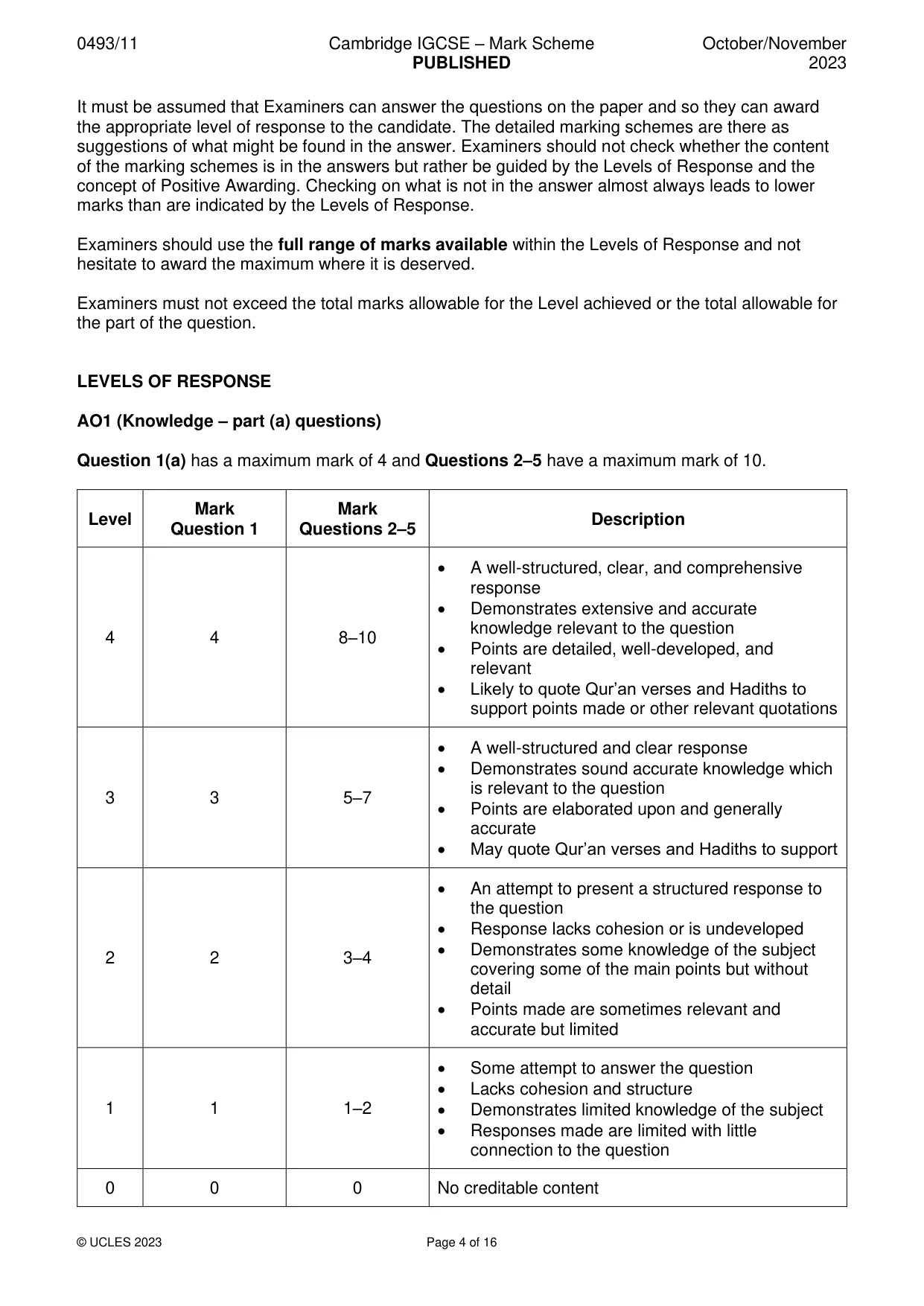
0493/11 Cambridge IGCSE – Mark Scheme PUBLISHED October/November 2023 © UCLES 2023 Page 4 of 16 It must be assumed that Examiners can answer the questions on the paper and so they can award the appropriate level of response to the candidate. The detailed marking schemes are there as suggestions of what might be found in the answer. Examiners should not check whether the content of the marking schemes is in the answers but rather be guided by the Levels of Response and the concept of Positive Awarding. Checking on what is not in the answer almost always leads to lower marks than are indicated by the Levels of Response. Examiners should use the full range of marks available within the Levels of Response and not hesitate to award the maximum where it is deserved. Examiners must not exceed the total marks allowable for the Level achieved or the total allowable for the part of the question. LEVELS OF RESPONSE AO1 (Knowledge – part (a) questions) Question 1(a) has a maximum mark of 4 and Questions 2–5 have a maximum mark of 10. Level Mark Question 1 Mark Questions 2–5 Description 4 4 8–10 • A well-structured, clear, and comprehensive response • Demonstrates extensive and accurate knowledge relevant to the question • Points are detailed, well-developed, and relevant • Likely to quote Qur’an verses and Hadiths to support points made or other relevant quotations 3 3 5–7 • A well-structured and clear response • Demonstrates sound accurate knowledge which is relevant to the question • Points are elaborated upon and generally accurate • May quote Qur’an verses and Hadiths to support 2 2 3–4 • An attempt to present a structured response to the question • Response lacks cohesion or is undeveloped • Demonstrates some knowledge of the subject covering some of the main points but without detail • Points made are sometimes relevant and accurate but limited 1 1 1–2 • Some attempt to answer the question • Lacks cohesion and structure • Demonstrates limited knowledge of the subject • Responses made are limited with little connection to the question 0 0 0 No creditable content
Mark scheme, page 5
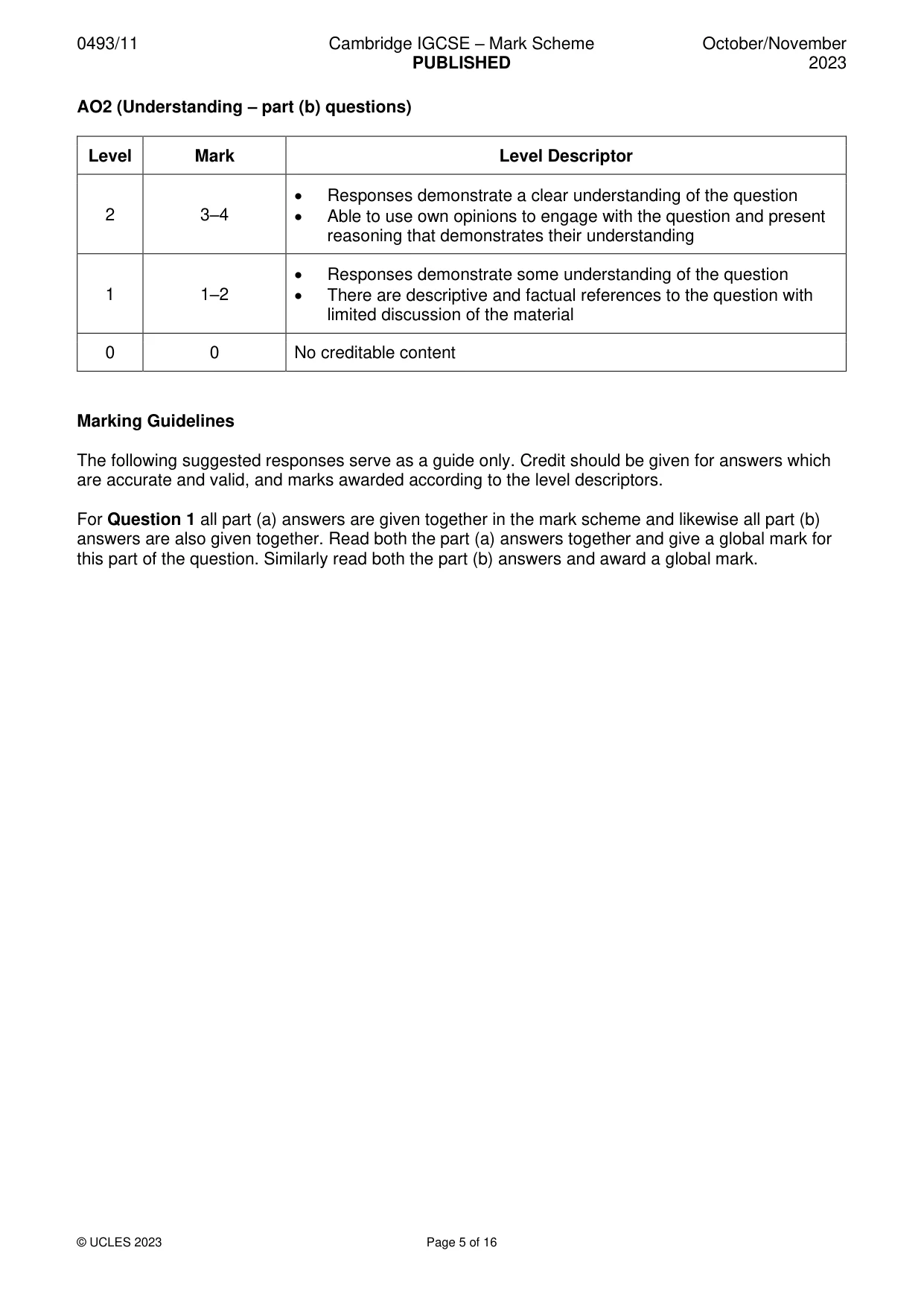
0493/11 Cambridge IGCSE – Mark Scheme PUBLISHED October/November 2023 © UCLES 2023 Page 5 of 16 AO2 (Understanding – part (b) questions) Level Mark Level Descriptor 2 3–4 • Responses demonstrate a clear understanding of the question • Able to use own opinions to engage with the question and present reasoning that demonstrates their understanding 1 1–2 • Responses demonstrate some understanding of the question • There are descriptive and factual references to the question with limited discussion of the material 0 0 No creditable content Marking Guidelines The following suggested responses serve as a guide only. Credit should be given for answers which are accurate and valid, and marks awarded according to the level descriptors. For Question 1 all part (a) answers are given together in the mark scheme and likewise all part (b) answers are also given together. Read both the part (a) answers together and give a global mark for this part of the question. Similarly read both the part (b) answers and award a global mark.
Mark scheme, page 6
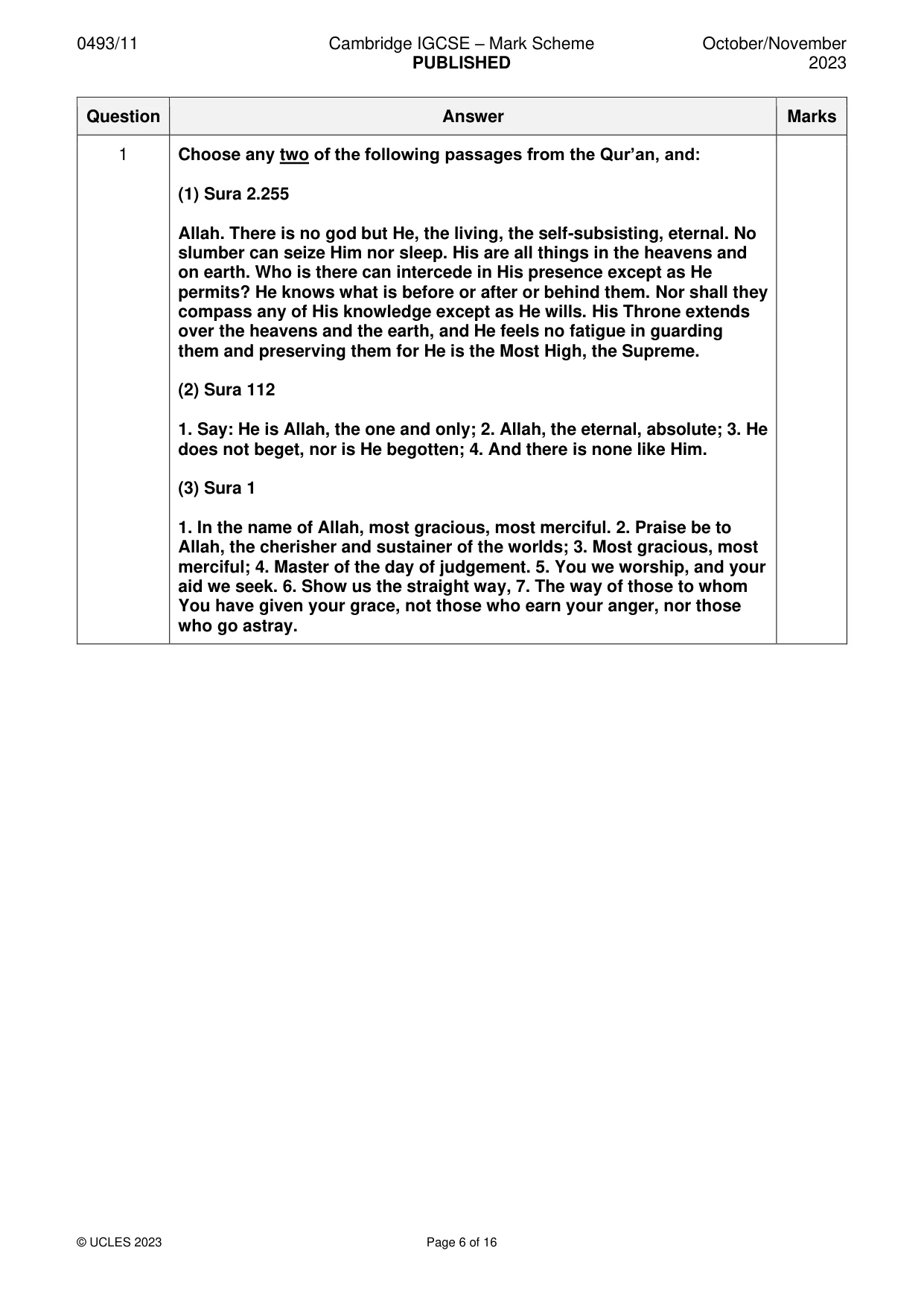
0493/11 Cambridge IGCSE – Mark Scheme PUBLISHED October/November 2023 © UCLES 2023 Page 6 of 16 Question Answer Marks 1 Choose any two of the following passages from the Qur’an, and: (1) Sura 2.255 Allah. There is no god but He, the living, the self-subsisting, eternal. No slumber can seize Him nor sleep. His are all things in the heavens and on earth. Who is there can intercede in His presence except as He permits? He knows what is before or after or behind them. Nor shall they compass any of His knowledge except as He wills. His Throne extends over the heavens and the earth, and He feels no fatigue in guarding them and preserving them for He is the Most High, the Supreme. (2) Sura 112 1. Say: He is Allah, the one and only; 2. Allah, the eternal, absolute; 3. He does not beget, nor is He begotten; 4. And there is none like Him. (3) Sura 1 1. In the name of Allah, most gracious, most merciful. 2. Praise be to Allah, the cherisher and sustainer of the worlds; 3. Most gracious, most merciful; 4. Master of the day of judgement. 5. You we worship, and your aid we seek. 6. Show us the straight way, 7. The way of those to whom You have given your grace, not those who earn your anger, nor those who go astray.
Mark scheme, page 7
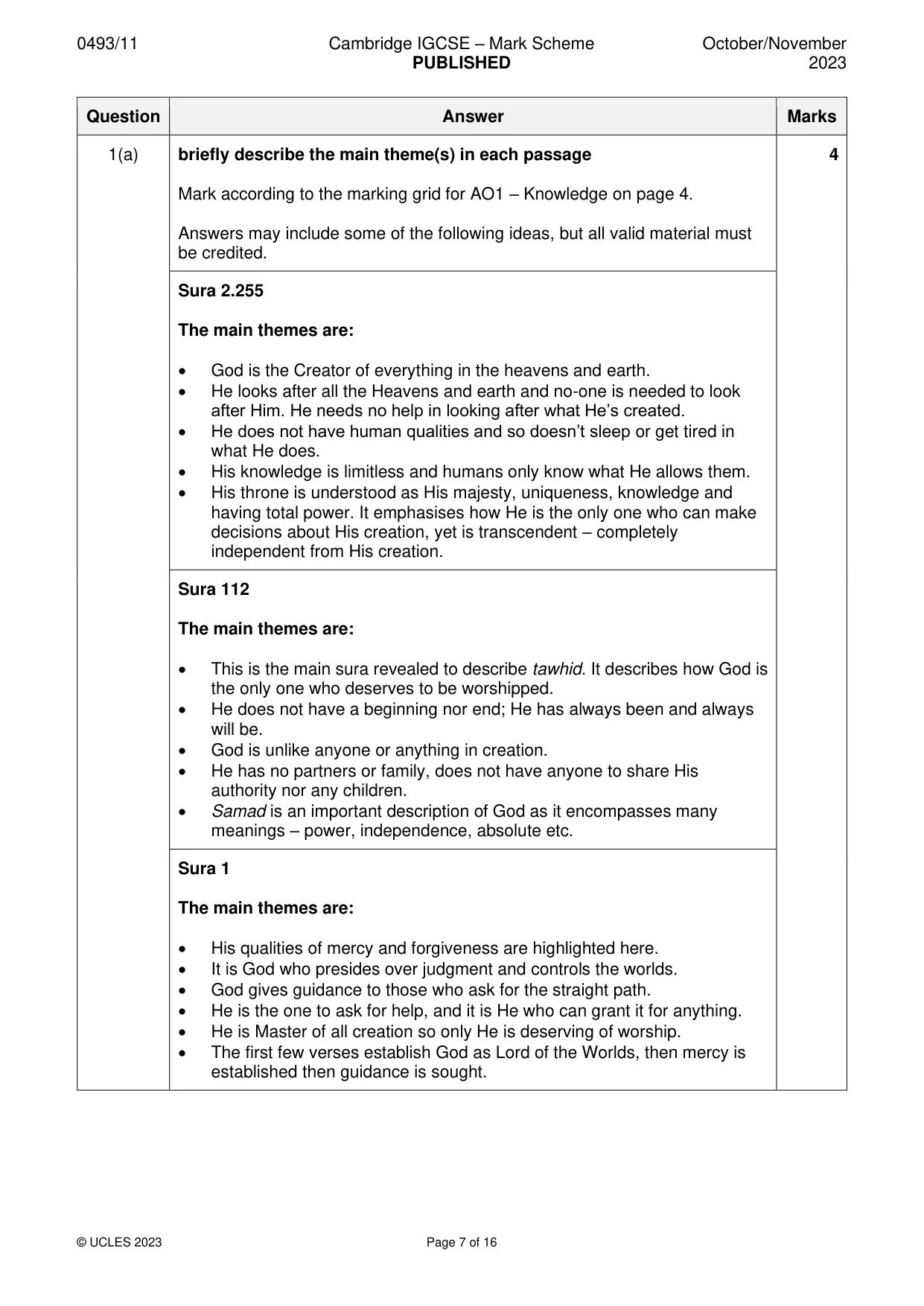
0493/11 Cambridge IGCSE – Mark Scheme PUBLISHED October/November 2023 © UCLES 2023 Page 7 of 16 Question Answer Marks 1(a) briefly describe the main theme(s) in each passage Mark according to the marking grid for AO1 – Knowledge on page 4. Answers may include some of the following ideas, but all valid material must be credited. 4 Sura 2.255 The main themes are: • God is the Creator of everything in the heavens and earth. • He looks after all the Heavens and earth and no-one is needed to look after Him. He needs no help in looking after what He’s created. • He does not have human qualities and so doesn’t sleep or get tired in what He does. • His knowledge is limitless and humans only know what He allows them. • His throne is understood as His majesty, uniqueness, knowledge and having total power. It emphasises how He is the only one who can make decisions about His creation, yet is transcendent – completely independent from His creation. Sura 112 The main themes are: • This is the main sura revealed to describe tawhid. It describes how God is the only one who deserves to be worshipped. • He does not have a beginning nor end; He has always been and always will be. • God is unlike anyone or anything in creation. • He has no partners or family, does not have anyone to share His authority nor any children. • Samad is an important description of God as it encompasses many meanings – power, independence, absolute etc. Sura 1 The main themes are: • His qualities of mercy and forgiveness are highlighted here. • It is God who presides over judgment and controls the worlds. • God gives guidance to those who ask for the straight path. • He is the one to ask for help, and it is He who can grant it for anything. • He is Master of all creation so only He is deserving of worship. • The first few verses establish God as Lord of the Worlds, then mercy is established then guidance is sought.
Mark scheme, page 8
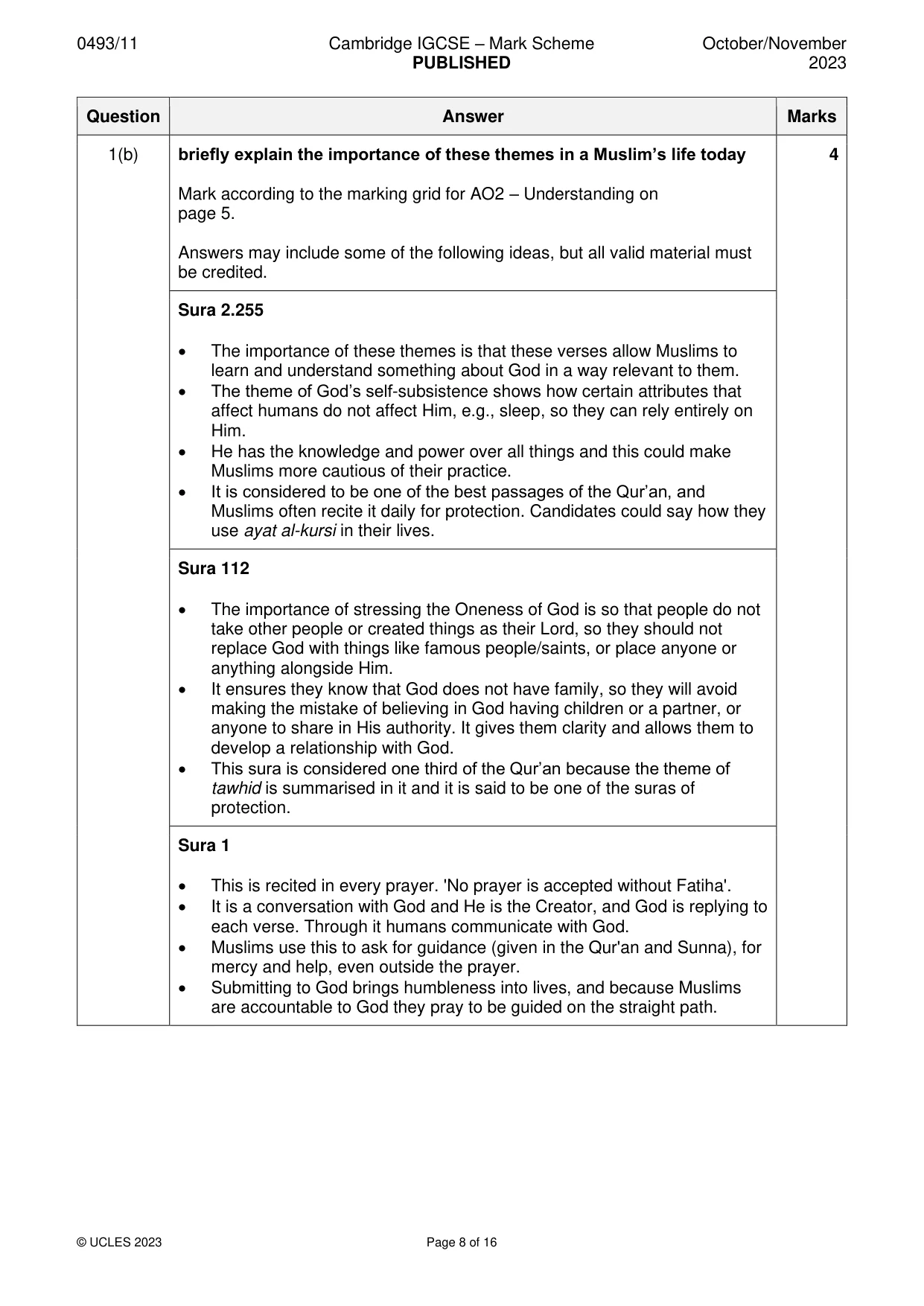
0493/11 Cambridge IGCSE – Mark Scheme PUBLISHED October/November 2023 © UCLES 2023 Page 8 of 16 Question Answer Marks 1(b) briefly explain the importance of these themes in a Muslim’s life today Mark according to the marking grid for AO2 – Understanding on page 5. Answers may include some of the following ideas, but all valid material must be credited. 4 Sura 2.255 • The importance of these themes is that these verses allow Muslims to learn and understand something about God in a way relevant to them. • The theme of God’s self-subsistence shows how certain attributes that affect humans do not affect Him, e.g., sleep, so they can rely entirely on Him. • He has the knowledge and power over all things and this could make Muslims more cautious of their practice. • It is considered to be one of the best passages of the Qur’an, and Muslims often recite it daily for protection. Candidates could say how they use ayat al-kursi in their lives. Sura 112 • The importance of stressing the Oneness of God is so that people do not take other people or created things as their Lord, so they should not replace God with things like famous people/saints, or place anyone or anything alongside Him. • It ensures they know that God does not have family, so they will avoid making the mistake of believing in God having children or a partner, or anyone to share in His authority. It gives them clarity and allows them to develop a relationship with God. • This sura is considered one third of the Qur’an because the theme of tawhid is summarised in it and it is said to be one of the suras of protection. Sura 1 • This is recited in every prayer. 'No prayer is accepted without Fatiha'. • It is a conversation with God and He is the Creator, and God is replying to each verse. Through it humans communicate with God. • Muslims use this to ask for guidance (given in the Qur'an and Sunna), for mercy and help, even outside the prayer. • Submitting to God brings humbleness into lives, and because Muslims are accountable to God they pray to be guided on the straight path.
Mark scheme, page 9
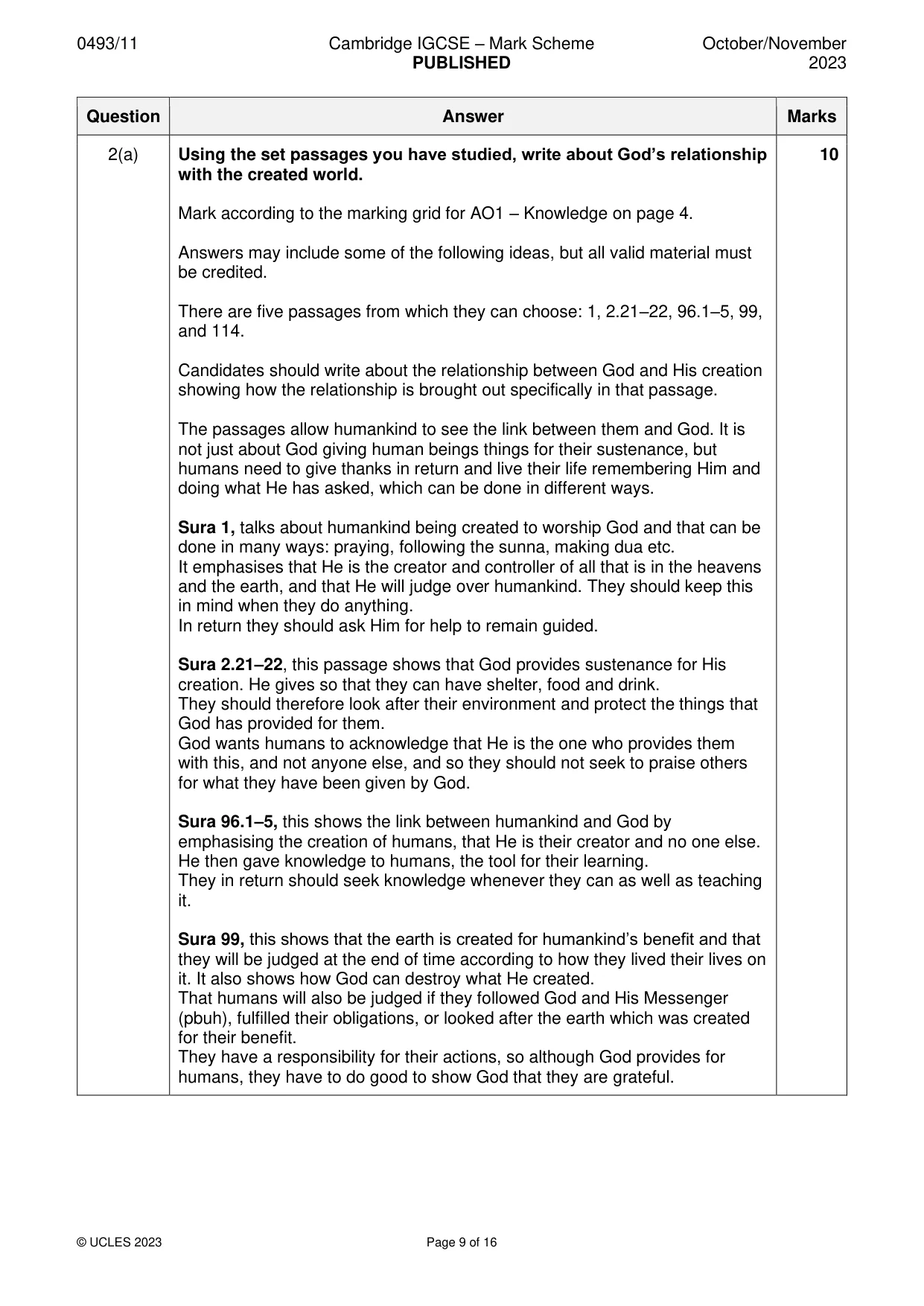
0493/11 Cambridge IGCSE – Mark Scheme PUBLISHED October/November 2023 © UCLES 2023 Page 9 of 16 Question Answer Marks 2(a) Using the set passages you have studied, write about God’s relationship with the created world. Mark according to the marking grid for AO1 – Knowledge on page 4. Answers may include some of the following ideas, but all valid material must be credited. There are five passages from which they can choose: 1, 2.21–22, 96.1–5, 99, and 114. Candidates should write about the relationship between God and His creation showing how the relationship is brought out specifically in that passage. The passages allow humankind to see the link between them and God. It is not just about God giving human beings things for their sustenance, but humans need to give thanks in return and live their life remembering Him and doing what He has asked, which can be done in different ways. Sura 1, talks about humankind being created to worship God and that can be done in many ways: praying, following the sunna, making dua etc. It emphasises that He is the creator and controller of all that is in the heavens and the earth, and that He will judge over humankind. They should keep this in mind when they do anything. In return they should ask Him for help to remain guided. Sura 2.21–22, this passage shows that God provides sustenance for His creation. He gives so that they can have shelter, food and drink. They should therefore look after their environment and protect the things that God has provided for them. God wants humans to acknowledge that He is the one who provides them with this, and not anyone else, and so they should not seek to praise others for what they have been given by God. Sura 96.1–5, this shows the link between humankind and God by emphasising the creation of humans, that He is their creator and no one else. He then gave knowledge to humans, the tool for their learning. They in return should seek knowledge whenever they can as well as teaching it. Sura 99, this shows that the earth is created for humankind’s benefit and that they will be judged at the end of time according to how they lived their lives on it. It also shows how God can destroy what He created. That humans will also be judged if they followed God and His Messenger (pbuh), fulfilled their obligations, or looked after the earth which was created for their benefit. They have a responsibility for their actions, so although God provides for humans, they have to do good to show God that they are grateful. 10
Mark scheme, page 10
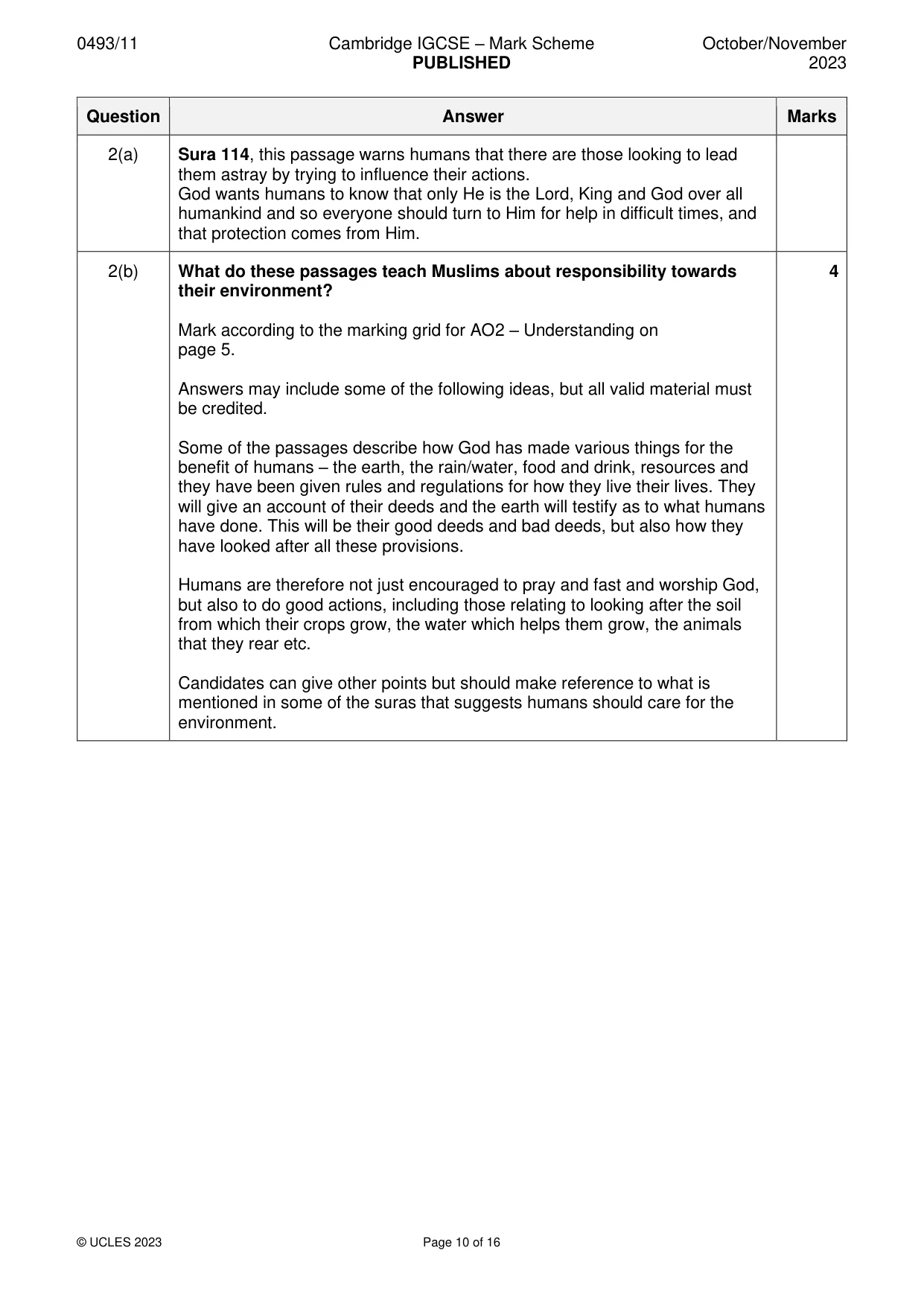
0493/11 Cambridge IGCSE – Mark Scheme PUBLISHED October/November 2023 © UCLES 2023 Page 10 of 16 Question Answer Marks 2(a) Sura 114, this passage warns humans that there are those looking to lead them astray by trying to influence their actions. God wants humans to know that only He is the Lord, King and God over all humankind and so everyone should turn to Him for help in difficult times, and that protection comes from Him. 2(b) What do these passages teach Muslims about responsibility towards their environment? Mark according to the marking grid for AO2 – Understanding on page 5. Answers may include some of the following ideas, but all valid material must be credited. Some of the passages describe how God has made various things for the benefit of humans – the earth, the rain/water, food and drink, resources and they have been given rules and regulations for how they live their lives. They will give an account of their deeds and the earth will testify as to what humans have done. This will be their good deeds and bad deeds, but also how they have looked after all these provisions. Humans are therefore not just encouraged to pray and fast and worship God, but also to do good actions, including those relating to looking after the soil from which their crops grow, the water which helps them grow, the animals that they rear etc. Candidates can give other points but should make reference to what is mentioned in some of the suras that suggests humans should care for the environment. 4
Mark scheme, page 11
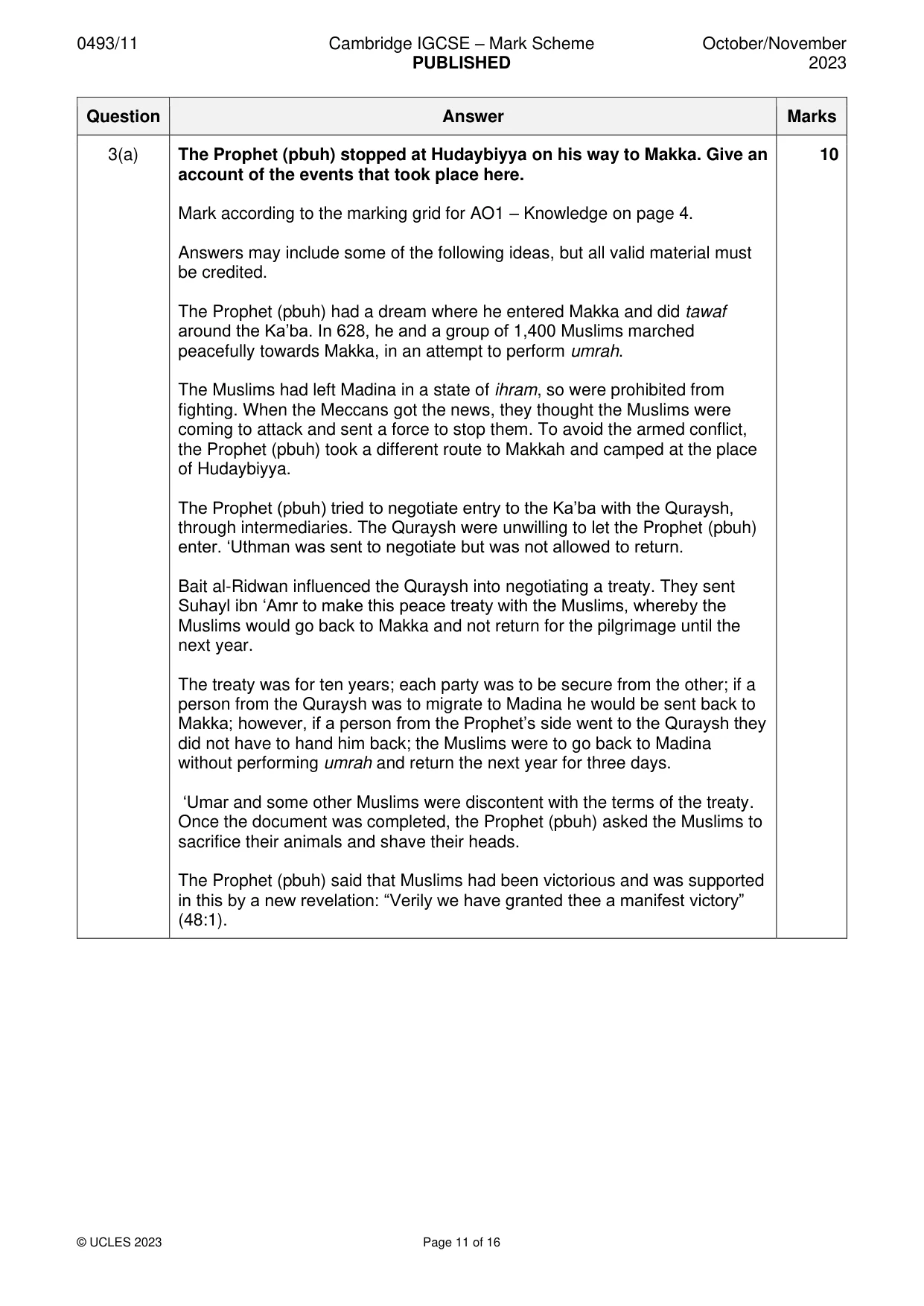
0493/11 Cambridge IGCSE – Mark Scheme PUBLISHED October/November 2023 © UCLES 2023 Page 11 of 16 Question Answer Marks 3(a) The Prophet (pbuh) stopped at Hudaybiyya on his way to Makka. Give an account of the events that took place here. Mark according to the marking grid for AO1 – Knowledge on page 4. Answers may include some of the following ideas, but all valid material must be credited. The Prophet (pbuh) had a dream where he entered Makka and did tawaf around the Ka’ba. In 628, he and a group of 1,400 Muslims marched peacefully towards Makka, in an attempt to perform umrah. The Muslims had left Madina in a state of ihram, so were prohibited from fighting. When the Meccans got the news, they thought the Muslims were coming to attack and sent a force to stop them. To avoid the armed conflict, the Prophet (pbuh) took a different route to Makkah and camped at the place of Hudaybiyya. The Prophet (pbuh) tried to negotiate entry to the Ka’ba with the Quraysh, through intermediaries. The Quraysh were unwilling to let the Prophet (pbuh) enter. ‘Uthman was sent to negotiate but was not allowed to return. Bait al-Ridwan influenced the Quraysh into negotiating a treaty. They sent Suhayl ibn ‘Amr to make this peace treaty with the Muslims, whereby the Muslims would go back to Makka and not return for the pilgrimage until the next year. The treaty was for ten years; each party was to be secure from the other; if a person from the Quraysh was to migrate to Madina he would be sent back to Makka; however, if a person from the Prophet’s side went to the Quraysh they did not have to hand him back; the Muslims were to go back to Madina without performing umrah and return the next year for three days. ‘Umar and some other Muslims were discontent with the terms of the treaty. Once the document was completed, the Prophet (pbuh) asked the Muslims to sacrifice their animals and shave their heads. The Prophet (pbuh) said that Muslims had been victorious and was supported in this by a new revelation: “Verily we have granted thee a manifest victory” (48:1). 10
Mark scheme, page 12
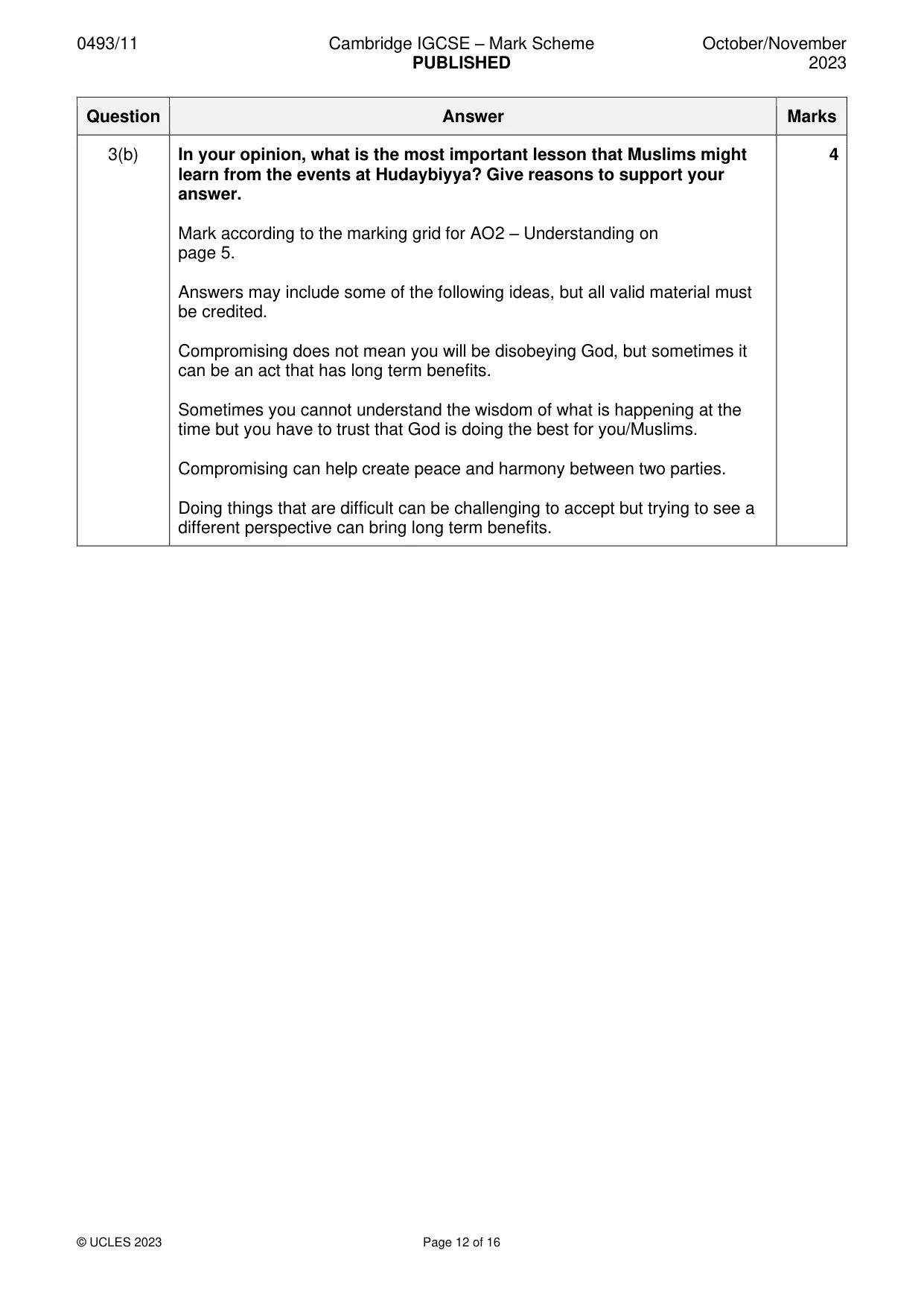
0493/11 Cambridge IGCSE – Mark Scheme PUBLISHED October/November 2023 © UCLES 2023 Page 12 of 16 Question Answer Marks 3(b) In your opinion, what is the most important lesson that Muslims might learn from the events at Hudaybiyya? Give reasons to support your answer. Mark according to the marking grid for AO2 – Understanding on page 5. Answers may include some of the following ideas, but all valid material must be credited. Compromising does not mean you will be disobeying God, but sometimes it can be an act that has long term benefits. Sometimes you cannot understand the wisdom of what is happening at the time but you have to trust that God is doing the best for you/Muslims. Compromising can help create peace and harmony between two parties. Doing things that are difficult can be challenging to accept but trying to see a different perspective can bring long term benefits. 4
Mark scheme, page 13
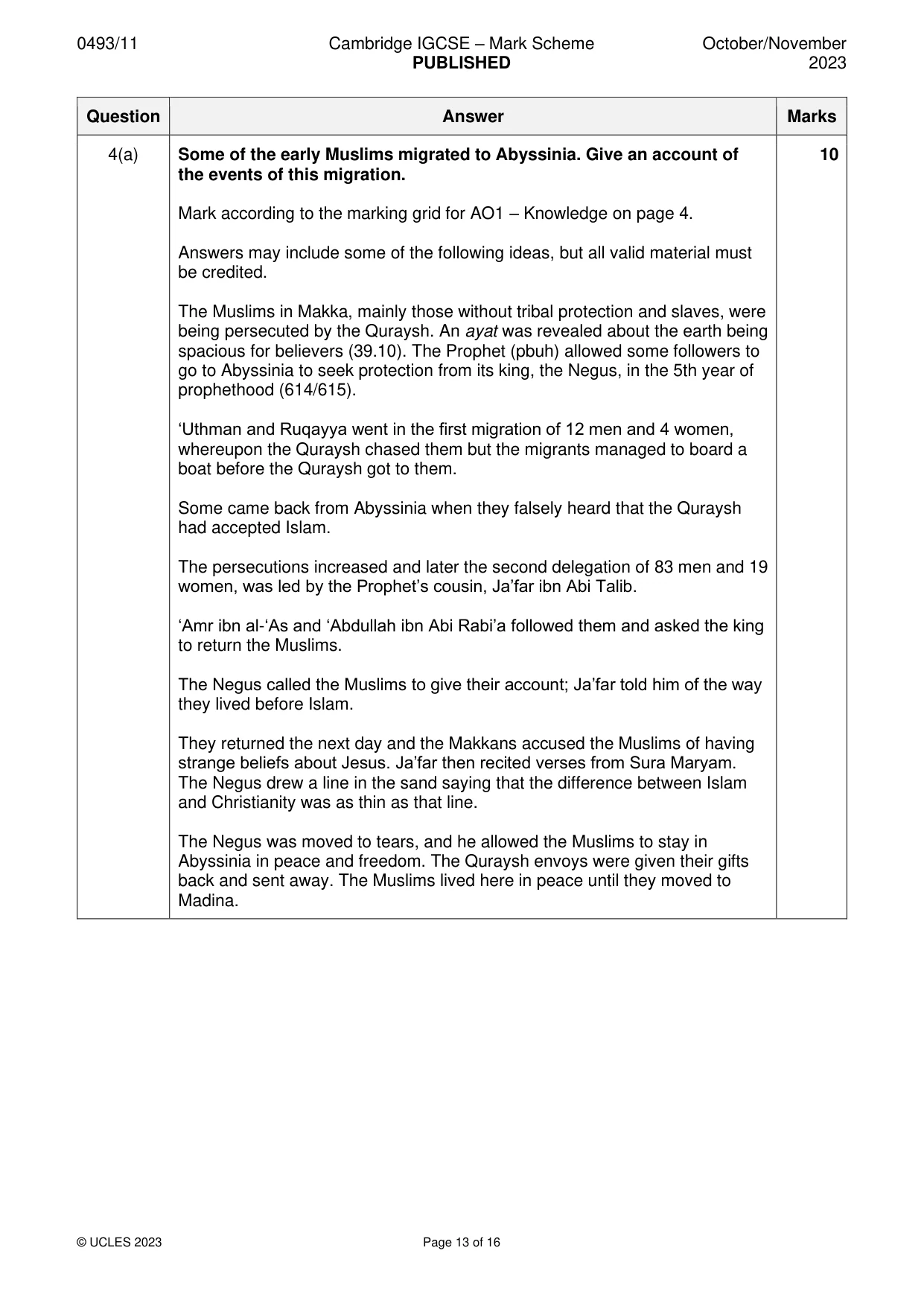
0493/11 Cambridge IGCSE – Mark Scheme PUBLISHED October/November 2023 © UCLES 2023 Page 13 of 16 Question Answer Marks 4(a) Some of the early Muslims migrated to Abyssinia. Give an account of the events of this migration. Mark according to the marking grid for AO1 – Knowledge on page 4. Answers may include some of the following ideas, but all valid material must be credited. The Muslims in Makka, mainly those without tribal protection and slaves, were being persecuted by the Quraysh. An ayat was revealed about the earth being spacious for believers (39.10). The Prophet (pbuh) allowed some followers to go to Abyssinia to seek protection from its king, the Negus, in the 5th year of prophethood (614/615). ‘Uthman and Ruqayya went in the first migration of 12 men and 4 women, whereupon the Quraysh chased them but the migrants managed to board a boat before the Quraysh got to them. Some came back from Abyssinia when they falsely heard that the Quraysh had accepted Islam. The persecutions increased and later the second delegation of 83 men and 19 women, was led by the Prophet’s cousin, Ja’far ibn Abi Talib. ‘Amr ibn al-‘As and ‘Abdullah ibn Abi Rabi’a followed them and asked the king to return the Muslims. The Negus called the Muslims to give their account; Ja’far told him of the way they lived before Islam. They returned the next day and the Makkans accused the Muslims of having strange beliefs about Jesus. Ja’far then recited verses from Sura Maryam. The Negus drew a line in the sand saying that the difference between Islam and Christianity was as thin as that line. The Negus was moved to tears, and he allowed the Muslims to stay in Abyssinia in peace and freedom. The Quraysh envoys were given their gifts back and sent away. The Muslims lived here in peace until they moved to Madina. 10
Mark scheme, page 14
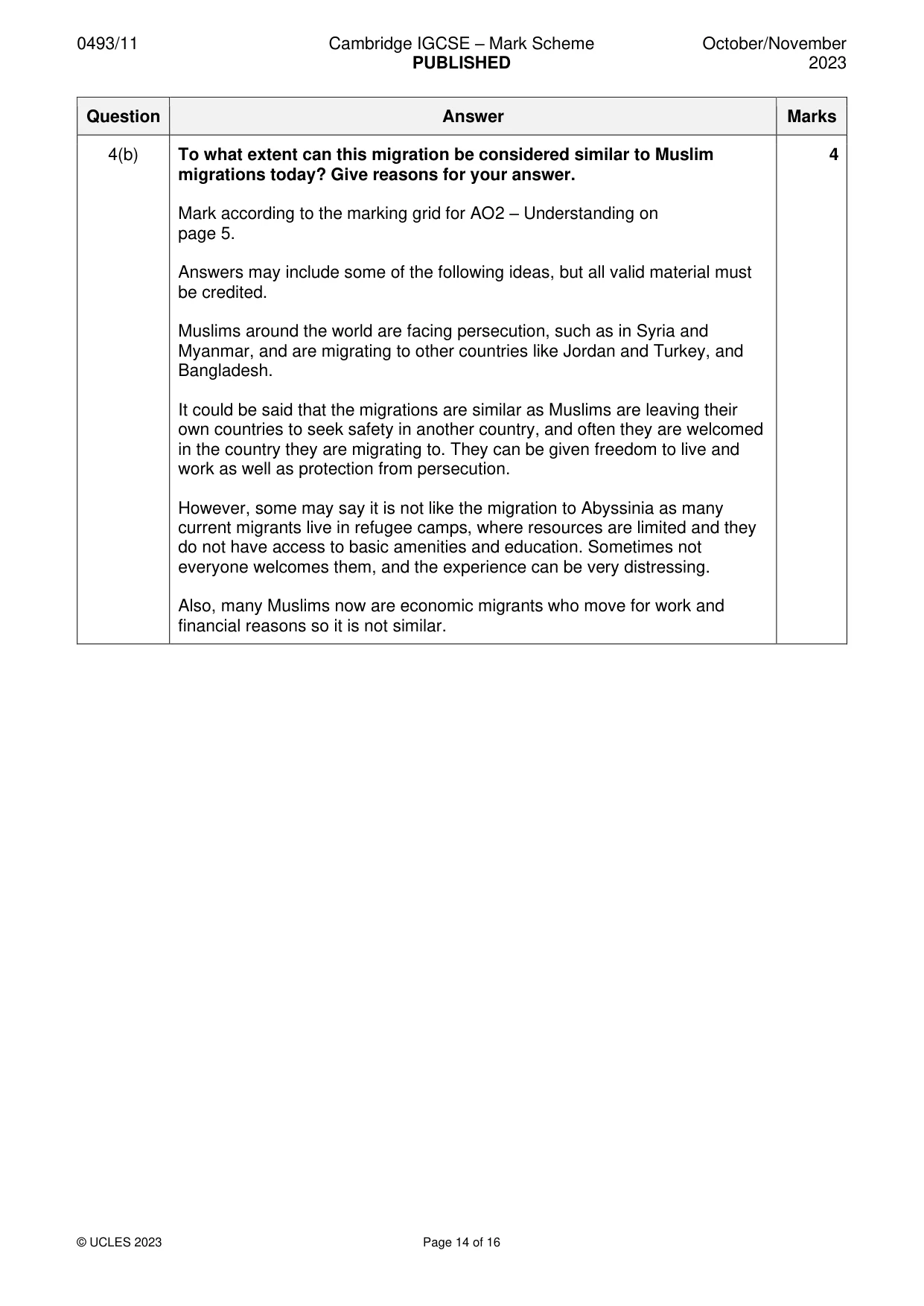
0493/11 Cambridge IGCSE – Mark Scheme PUBLISHED October/November 2023 © UCLES 2023 Page 14 of 16 Question Answer Marks 4(b) To what extent can this migration be considered similar to Muslim migrations today? Give reasons for your answer. Mark according to the marking grid for AO2 – Understanding on page 5. Answers may include some of the following ideas, but all valid material must be credited. Muslims around the world are facing persecution, such as in Syria and Myanmar, and are migrating to other countries like Jordan and Turkey, and Bangladesh. It could be said that the migrations are similar as Muslims are leaving their own countries to seek safety in another country, and often they are welcomed in the country they are migrating to. They can be given freedom to live and work as well as protection from persecution. However, some may say it is not like the migration to Abyssinia as many current migrants live in refugee camps, where resources are limited and they do not have access to basic amenities and education. Sometimes not everyone welcomes them, and the experience can be very distressing. Also, many Muslims now are economic migrants who move for work and financial reasons so it is not similar. 4
Mark scheme, page 15
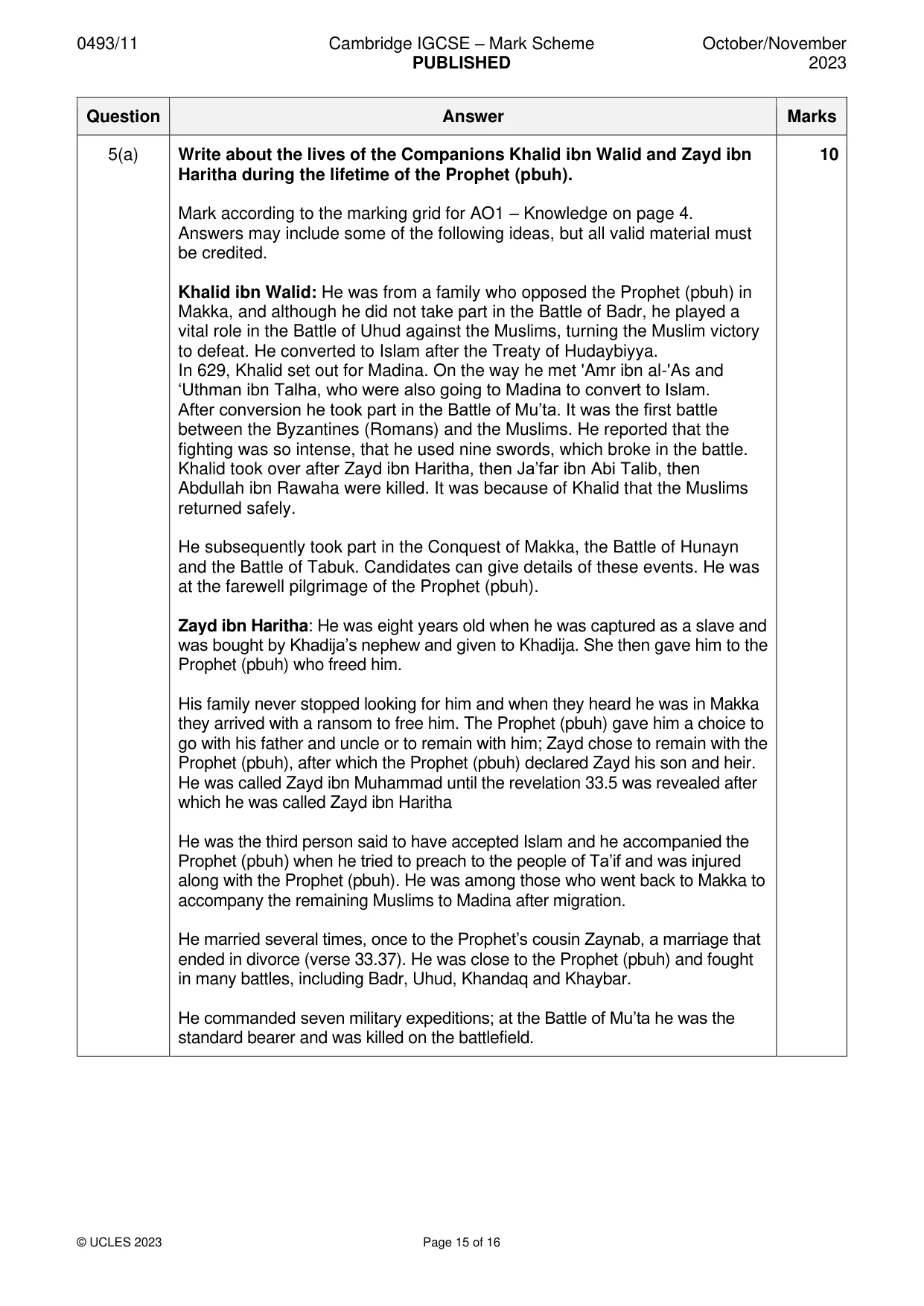
0493/11 Cambridge IGCSE – Mark Scheme PUBLISHED October/November 2023 © UCLES 2023 Page 15 of 16 Question Answer Marks 5(a) Write about the lives of the Companions Khalid ibn Walid and Zayd ibn Haritha during the lifetime of the Prophet (pbuh). Mark according to the marking grid for AO1 – Knowledge on page 4. Answers may include some of the following ideas, but all valid material must be credited. Khalid ibn Walid: He was from a family who opposed the Prophet (pbuh) in Makka, and although he did not take part in the Battle of Badr, he played a vital role in the Battle of Uhud against the Muslims, turning the Muslim victory to defeat. He converted to Islam after the Treaty of Hudaybiyya. In 629, Khalid set out for Madina. On the way he met 'Amr ibn al-'As and ‘Uthman ibn Talha, who were also going to Madina to convert to Islam. After conversion he took part in the Battle of Mu’ta. It was the first battle between the Byzantines (Romans) and the Muslims. He reported that the fighting was so intense, that he used nine swords, which broke in the battle. Khalid took over after Zayd ibn Haritha, then Ja’far ibn Abi Talib, then Abdullah ibn Rawaha were killed. It was because of Khalid that the Muslims returned safely. He subsequently took part in the Conquest of Makka, the Battle of Hunayn and the Battle of Tabuk. Candidates can give details of these events. He was at the farewell pilgrimage of the Prophet (pbuh). Zayd ibn Haritha: He was eight years old when he was captured as a slave and was bought by Khadija’s nephew and given to Khadija. She then gave him to the Prophet (pbuh) who freed him. His family never stopped looking for him and when they heard he was in Makka they arrived with a ransom to free him. The Prophet (pbuh) gave him a choice to go with his father and uncle or to remain with him; Zayd chose to remain with the Prophet (pbuh), after which the Prophet (pbuh) declared Zayd his son and heir. He was called Zayd ibn Muhammad until the revelation 33.5 was revealed after which he was called Zayd ibn Haritha He was the third person said to have accepted Islam and he accompanied the Prophet (pbuh) when he tried to preach to the people of Ta’if and was injured along with the Prophet (pbuh). He was among those who went back to Makka to accompany the remaining Muslims to Madina after migration. He married several times, once to the Prophet’s cousin Zaynab, a marriage that ended in divorce (verse 33.37). He was close to the Prophet (pbuh) and fought in many battles, including Badr, Uhud, Khandaq and Khaybar. He commanded seven military expeditions; at the Battle of Mu’ta he was the standard bearer and was killed on the battlefield. 10
Mark scheme, page 16
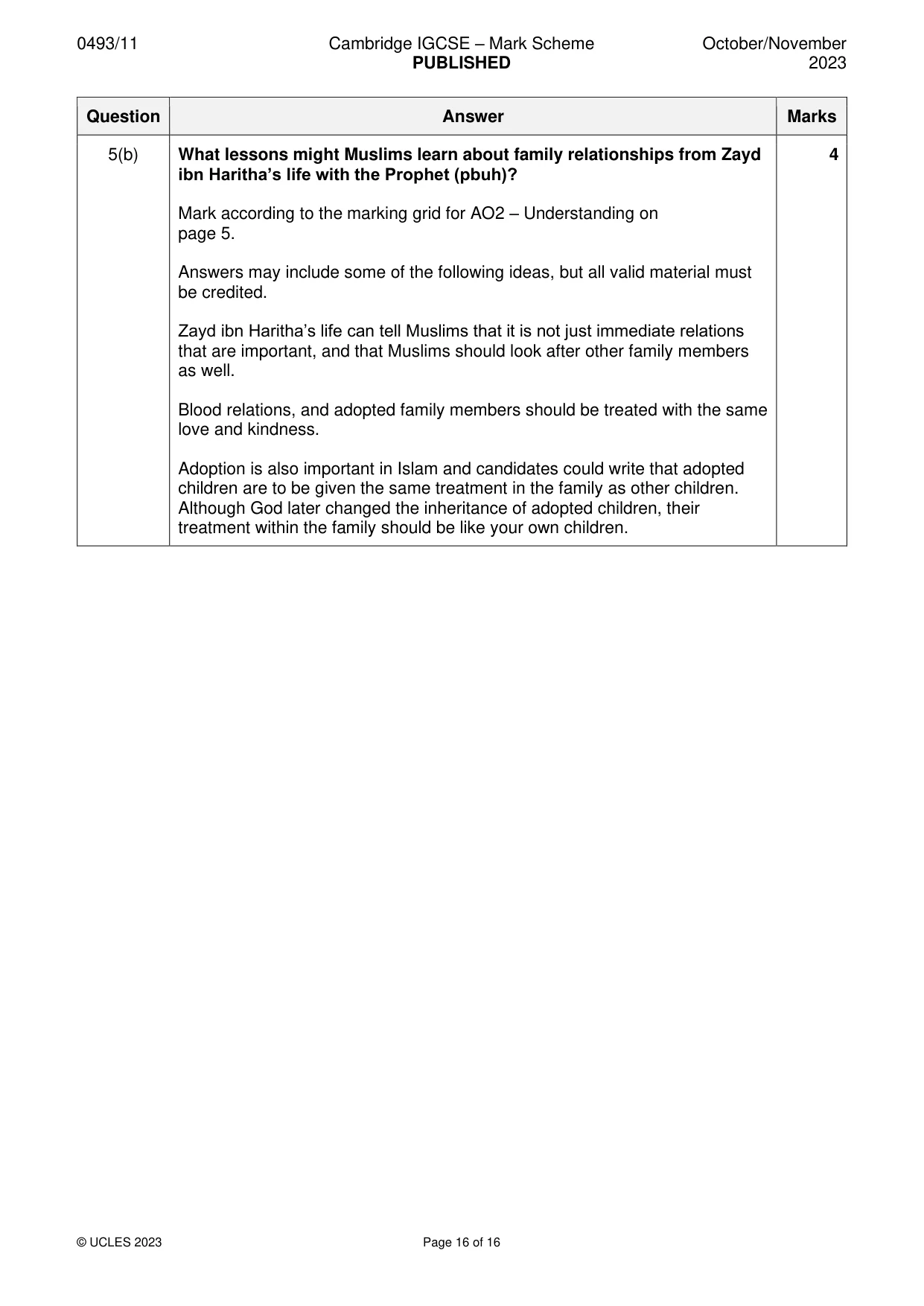
0493/11 Cambridge IGCSE – Mark Scheme PUBLISHED October/November 2023 © UCLES 2023 Page 16 of 16 Question Answer Marks 5(b) What lessons might Muslims learn about family relationships from Zayd ibn Haritha’s life with the Prophet (pbuh)? Mark according to the marking grid for AO2 – Understanding on page 5. Answers may include some of the following ideas, but all valid material must be credited. Zayd ibn Haritha’s life can tell Muslims that it is not just immediate relations that are important, and that Muslims should look after other family members as well. Blood relations, and adopted family members should be treated with the same love and kindness. Adoption is also important in Islam and candidates could write that adopted children are to be given the same treatment in the family as other children. Although God later changed the inheritance of adopted children, their treatment within the family should be like your own children. 4
What you needed in this session
Cambridge’s own grade thresholds for 2023 Oct/Nov, Paper 1 · Variant 1. A higher threshold means an easier paper — the bar moves with how the cohort did.