Cambridge IGCSE Islamiyat 0493 — 2022 Oct/Nov Paper 1 · Variant 1
0493/11/O/N/22 · 50 marks · ≈56 min
The question paper and its mark scheme, free to read here and free to download. This is Cambridge’s own paper, exactly as it was sat.
Question paper20 pages











Mark scheme13 pages
Answers below. Sit the paper first if you are practising.
Paper as text
Question paper, page 1
This document has 20 pages. Any blank pages are indicated. [Turn over Cambridge IGCSE™ ISLAMIYAT 0493/11 Paper 1 October/November 2022 1 hour 30 minutes You must answer on the question paper. No additional materials are needed. INSTRUCTIONS ● Answer four questions in total: Answer Question 1. Answer Question 2. Answer two other questions. ● Use a black or dark blue pen. ● Write your name, centre number and candidate number in the boxes at the top of the page. ● Write your answer to each question in the space provided. ● Do not use an erasable pen or correction fluid. ● Do not write on any bar codes. INFORMATION ● The total mark for this paper is 50. ● The number of marks for each question or part question is shown in brackets [ ]. * 1 5 3 6 5 7 1 6 5 5 * DC (CJ) 304218/3 © UCLES 2022
Question paper, page 2
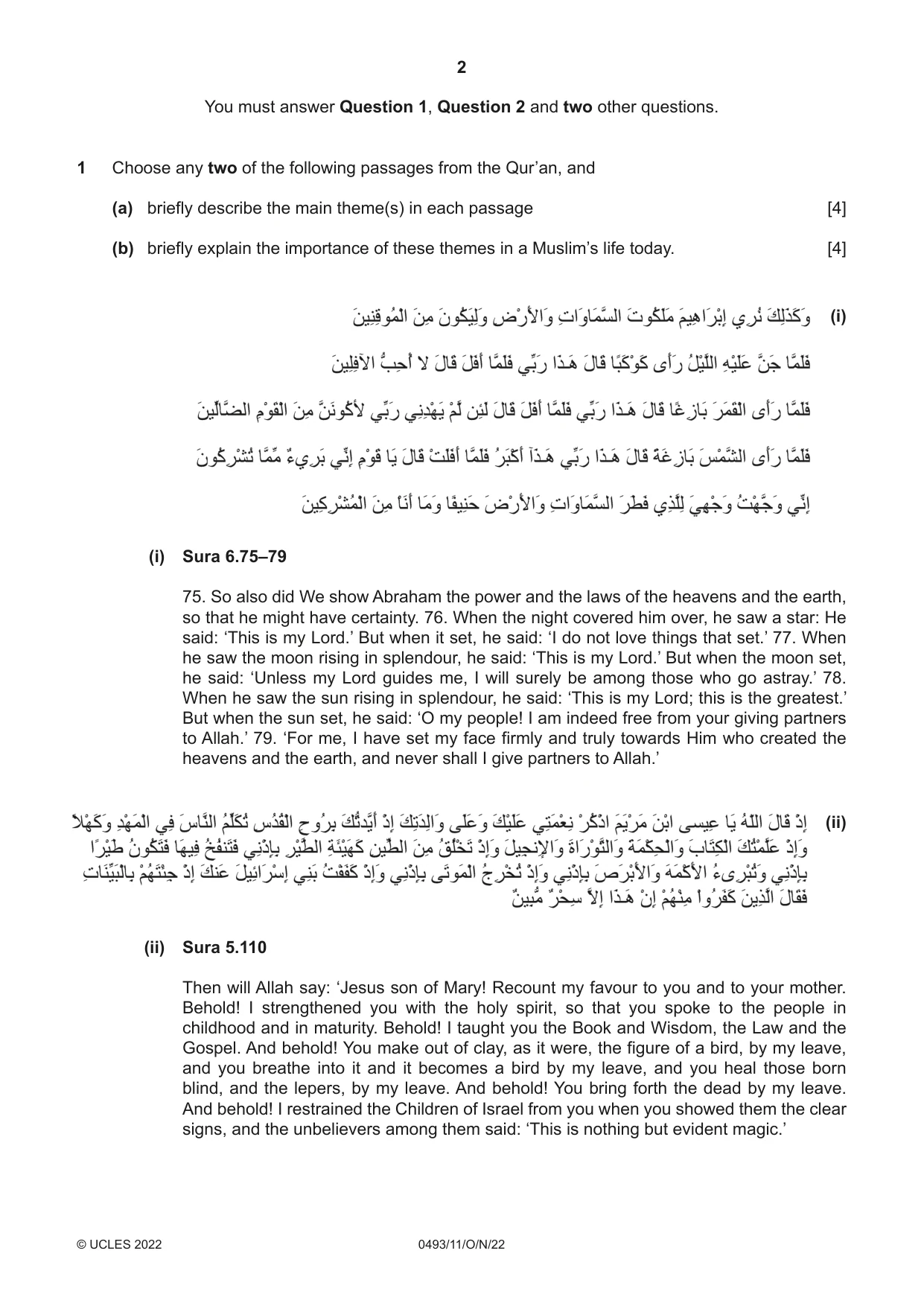
2 0493/11/O/N/22 © UCLES 2022 You must answer Question 1, Question 2 and two other questions. 1 Choose any two of the following passages from the Qur’an, and (a) briefly describe the main theme(s) in each passage [4] (b) briefly explain the importance of these themes in a Muslim’s life today. [4] (i) (i) Sura 6.75–79 75. So also did We show Abraham the power and the laws of the heavens and the earth, so that he might have certainty. 76. When the night covered him over, he saw a star: He said: ‘This is my Lord.’ But when it set, he said: ‘I do not love things that set.’ 77. When he saw the moon rising in splendour, he said: ‘This is my Lord.’ But when the moon set, he said: ‘Unless my Lord guides me, I will surely be among those who go astray.’ 78. When he saw the sun rising in splendour, he said: ‘This is my Lord; this is the greatest.’ But when the sun set, he said: ‘O my people! I am indeed free from your giving partners to Allah.’ 79. ‘For me, I have set my face firmly and truly towards Him who created the heavens and the earth, and never shall I give partners to Allah.’ (ii) (ii) Sura 5.110 Then will Allah say: ‘Jesus son of Mary! Recount my favour to you and to your mother. Behold! I strengthened you with the holy spirit, so that you spoke to the people in childhood and in maturity. Behold! I taught you the Book and Wisdom, the Law and the Gospel. And behold! You make out of clay, as it were, the figure of a bird, by my leave, and you breathe into it and it becomes a bird by my leave, and you heal those born blind, and the lepers, by my leave. And behold! You bring forth the dead by my leave. And behold! I restrained the Children of Israel from you when you showed them the clear signs, and the unbelievers among them said: ‘This is nothing but evident magic.’
Question paper, page 3
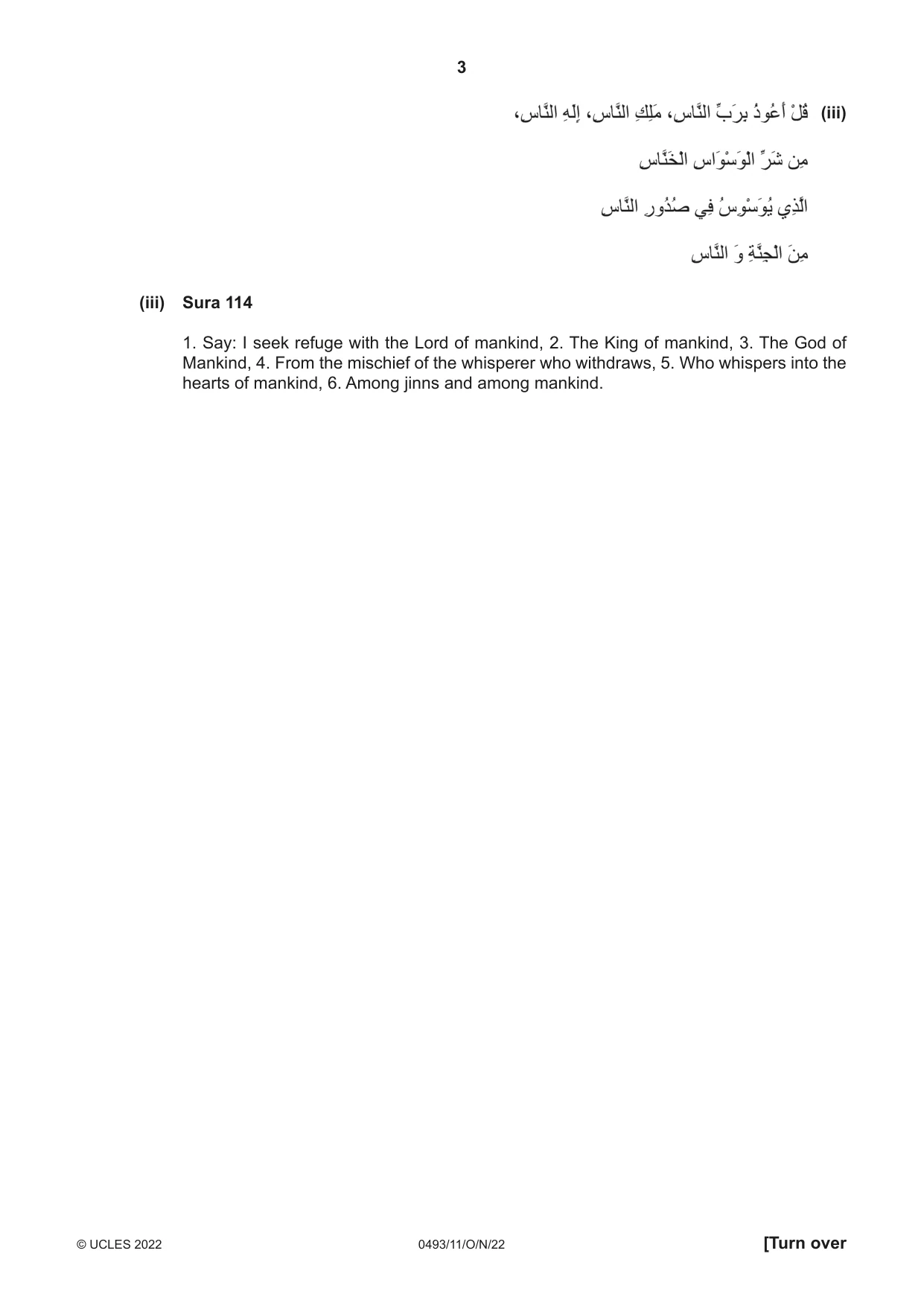
3 0493/11/O/N/22 © UCLES 2022 [Turn over (iii) (iii) Sura 114 1. Say: I seek refuge with the Lord of mankind, 2. The King of mankind, 3. The God of Mankind, 4. From the mischief of the whisperer who withdraws, 5. Who whispers into the hearts of mankind, 6. Among jinns and among mankind.
Question paper, page 4
4 0493/11/O/N/22 © UCLES 2022 … … … … … … … … … … … … … … … … … … … … … … … … … … … …
Question paper, page 5
5 0493/11/O/N/22 © UCLES 2022 [Turn over … … … … … … … … … … … … … … … … … … … … … … … … … … … …
Question paper, page 6
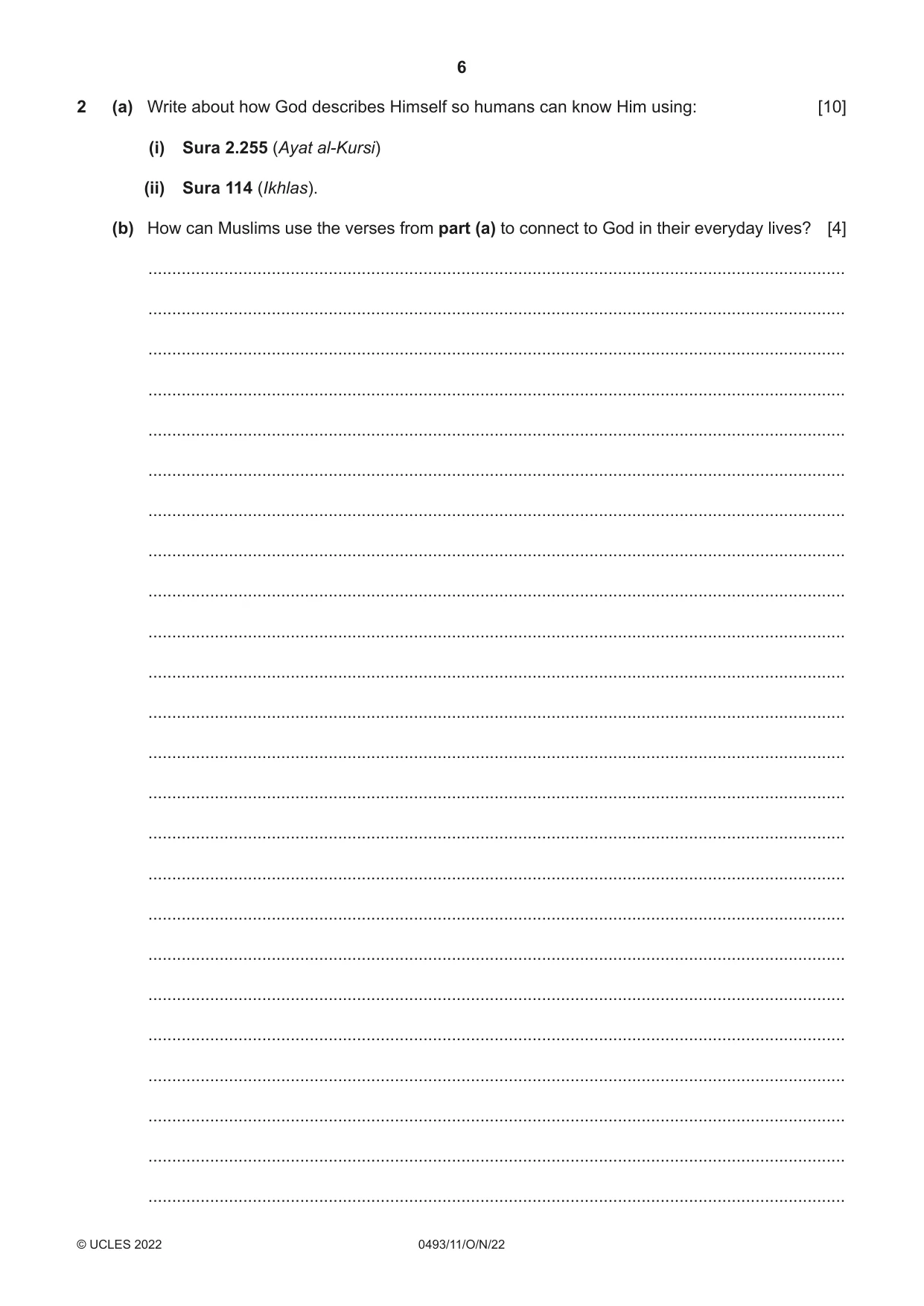
6 0493/11/O/N/22 © UCLES 2022 2 (a) Write about how God describes Himself so humans can know Him using: [10] (i) Sura 2.255 (Ayat al-Kursi) (ii) Sura 114 (Ikhlas). (b) How can Muslims use the verses from part (a) to connect to God in their everyday lives? [4] … … … … … … … … … … … … … … … … … … … … … … … …
Question paper, page 7
7 0493/11/O/N/22 © UCLES 2022 [Turn over … … … … … … … … … … … … … … … … … … … … … … … … … … … …
Question paper, page 8
8 0493/11/O/N/22 © UCLES 2022 … … … … … … … … … … … … … … … … … … … … … … … … … … … …
Question paper, page 9
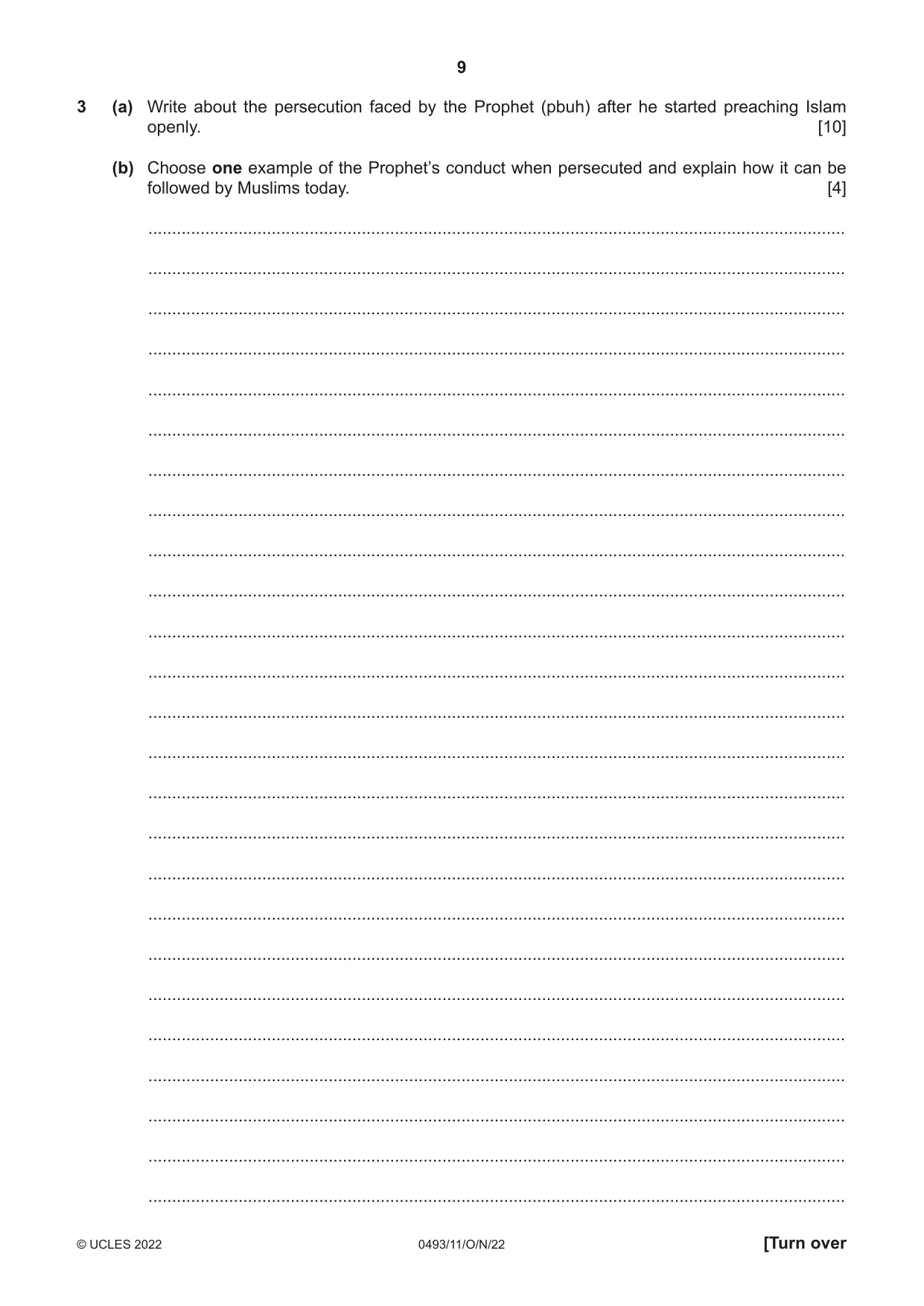
9 0493/11/O/N/22 © UCLES 2022 [Turn over 3 (a) Write about the persecution faced by the Prophet (pbuh) after he started preaching Islam openly. [10] (b) Choose one example of the Prophet’s conduct when persecuted and explain how it can be followed by Muslims today. [4] … … … … … … … … … … … … … … … … … … … … … … … … …
Question paper, page 10
10 0493/11/O/N/22 © UCLES 2022 … … … … … … … … … … … … … … … … … … … … … … … … … … … …
Question paper, page 11
11 0493/11/O/N/22 © UCLES 2022 [Turn over … … … … … … … … … … … … … … … … … … … … … … … … … … … …
Question paper, page 12
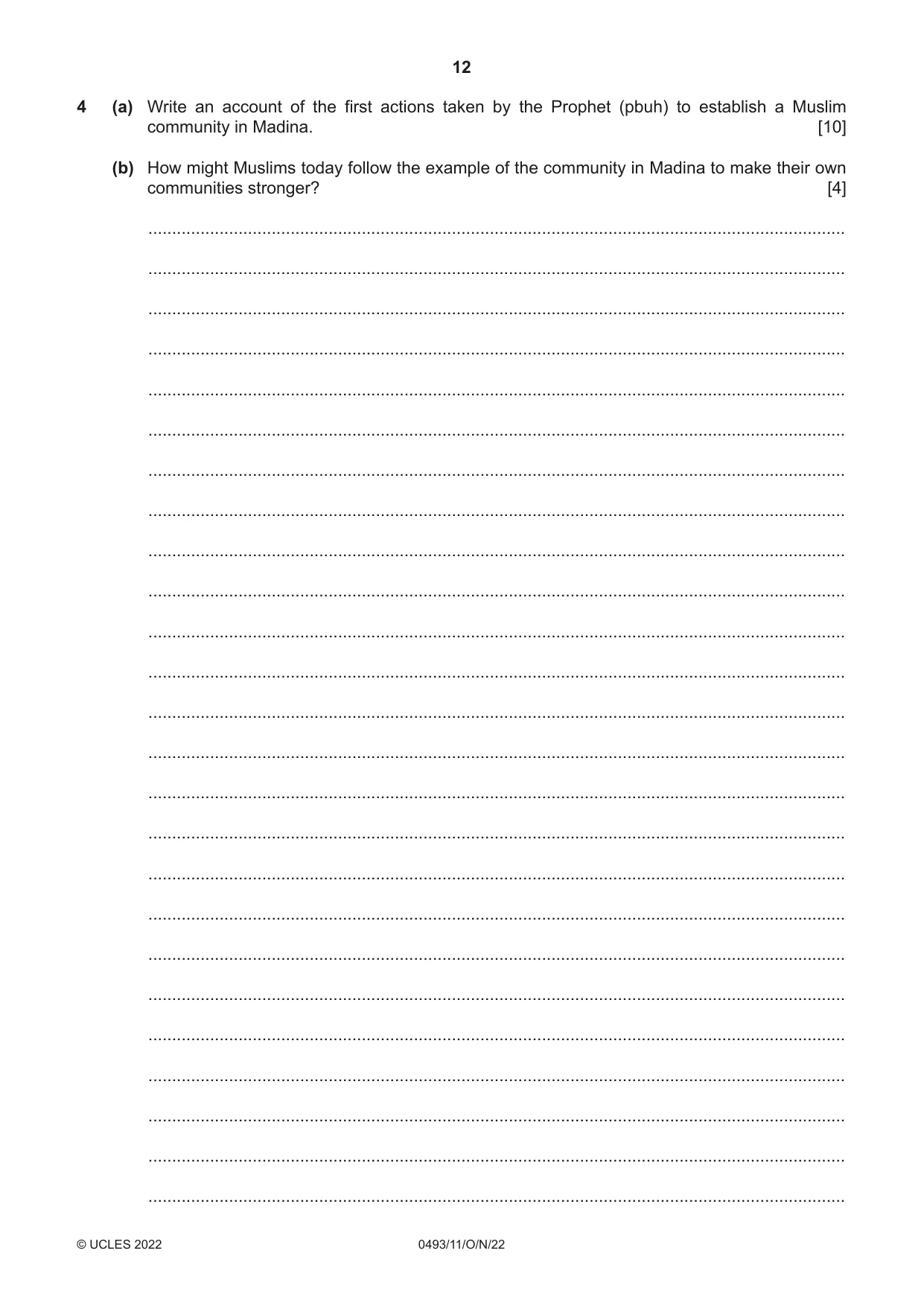
12 0493/11/O/N/22 © UCLES 2022 4 (a) Write an account of the first actions taken by the Prophet (pbuh) to establish a Muslim community in Madina. [10] (b) How might Muslims today follow the example of the community in Madina to make their own communities stronger? [4] … … … … … … … … … … … … … … … … … … … … … … … … …
Question paper, page 13
13 0493/11/O/N/22 © UCLES 2022 [Turn over … … … … … … … … … … … … … … … … … … … … … … … … … … … …
Question paper, page 14
14 0493/11/O/N/22 © UCLES 2022 … … … … … … … … … … … … … … … … … … … … … … … … … … … …
Question paper, page 15
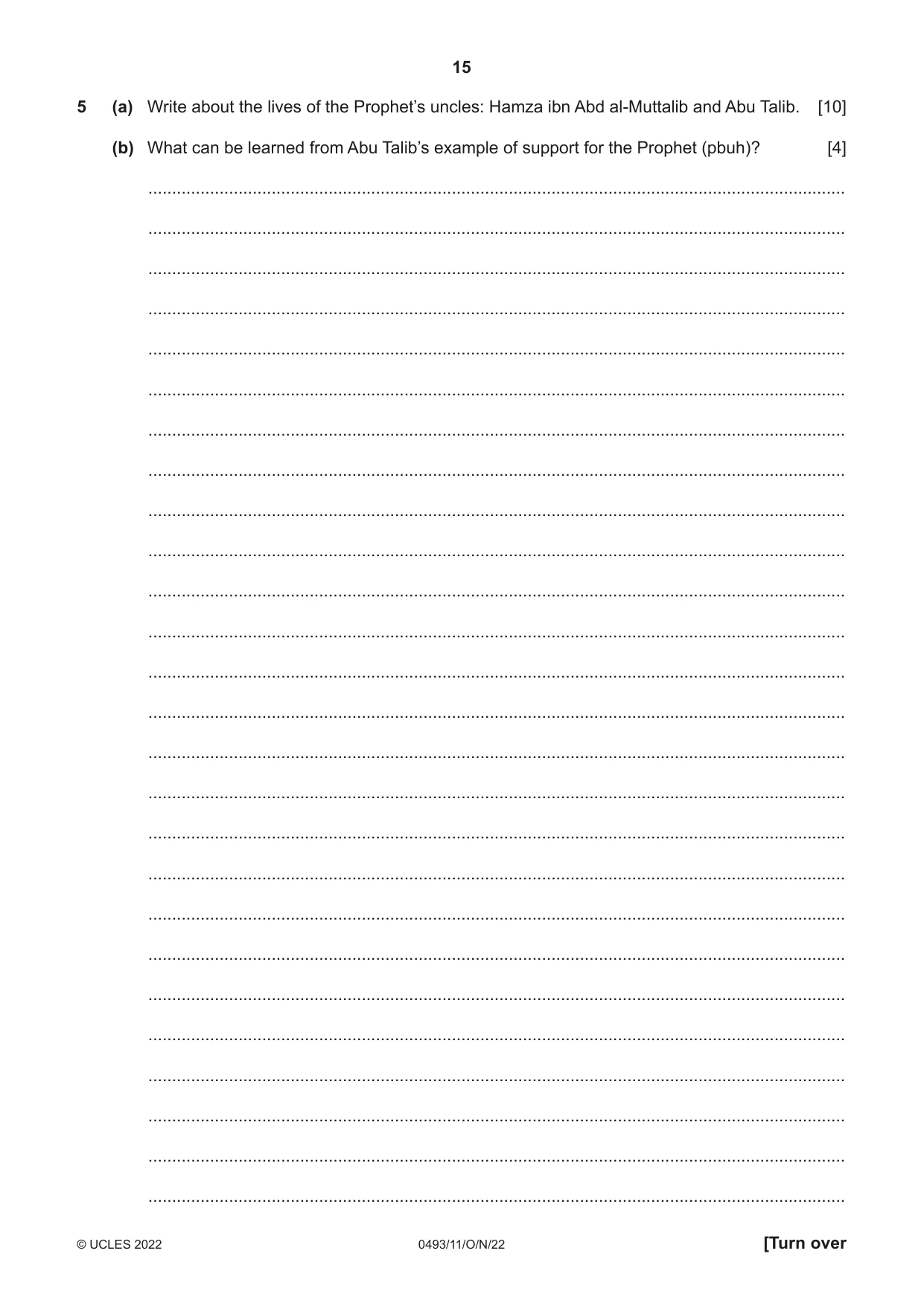
15 0493/11/O/N/22 © UCLES 2022 [Turn over 5 (a) Write about the lives of the Prophet’s uncles: Hamza ibn Abd al-Muttalib and Abu Talib. [10] (b) What can be learned from Abu Talib’s example of support for the Prophet (pbuh)? [4] … … … … … … … … … … … … … … … … … … … … … … … … … …
Question paper, page 16
16 0493/11/O/N/22 © UCLES 2022 … … … … … … … … … … … … … … … … … … … … … … … … … … … …
Question paper, page 17
17 0493/11/O/N/22 © UCLES 2022 … … … … … … … … … … … … … … … … … … … … … … … … … … … …
Question paper, page 18
18 0493/11/O/N/22 © UCLES 2022 BLANK PAGE
Question paper, page 19
19 0493/11/O/N/22 © UCLES 2022 BLANK PAGE
Question paper, page 20
20 0493/11/O/N/22 © UCLES 2022 Permission to reproduce items where third-party owned material protected by copyright is included has been sought and cleared where possible. Every reasonable effort has been made by the publisher (UCLES) to trace copyright holders, but if any items requiring clearance have unwittingly been included, the publisher will be pleased to make amends at the earliest possible opportunity. To avoid the issue of disclosure of answer-related information to candidates, all copyright acknowledgements are reproduced online in the Cambridge Assessment International Education Copyright Acknowledgements Booklet. This is produced for each series of examinations and is freely available to download at www.cambridgeinternational.org after the live examination series. Cambridge Assessment International Education is part of Cambridge Assessment. Cambridge Assessment is the brand name of the University of Cambridge Local Examinations Syndicate (UCLES), which is a department of the University of Cambridge. BLANK PAGE
Mark scheme, page 1
This document consists of 13 printed pages. © UCLES 2022 [Turn over Cambridge IGCSE™ ISLAMIYAT 0493/11 Paper 1 October/November 2022 MARK SCHEME Maximum Mark: 50 Published This mark scheme is published as an aid to teachers and candidates, to indicate the requirements of the examination. It shows the basis on which Examiners were instructed to award marks. It does not indicate the details of the discussions that took place at an Examiners’ meeting before marking began, which would have considered the acceptability of alternative answers. Mark schemes should be read in conjunction with the question paper and the Principal Examiner Report for Teachers. Cambridge International will not enter into discussions about these mark schemes. Cambridge International is publishing the mark schemes for the October/November 2022 series for most Cambridge IGCSE™, Cambridge International A and AS Level components and some Cambridge O Level components.
Mark scheme, page 2
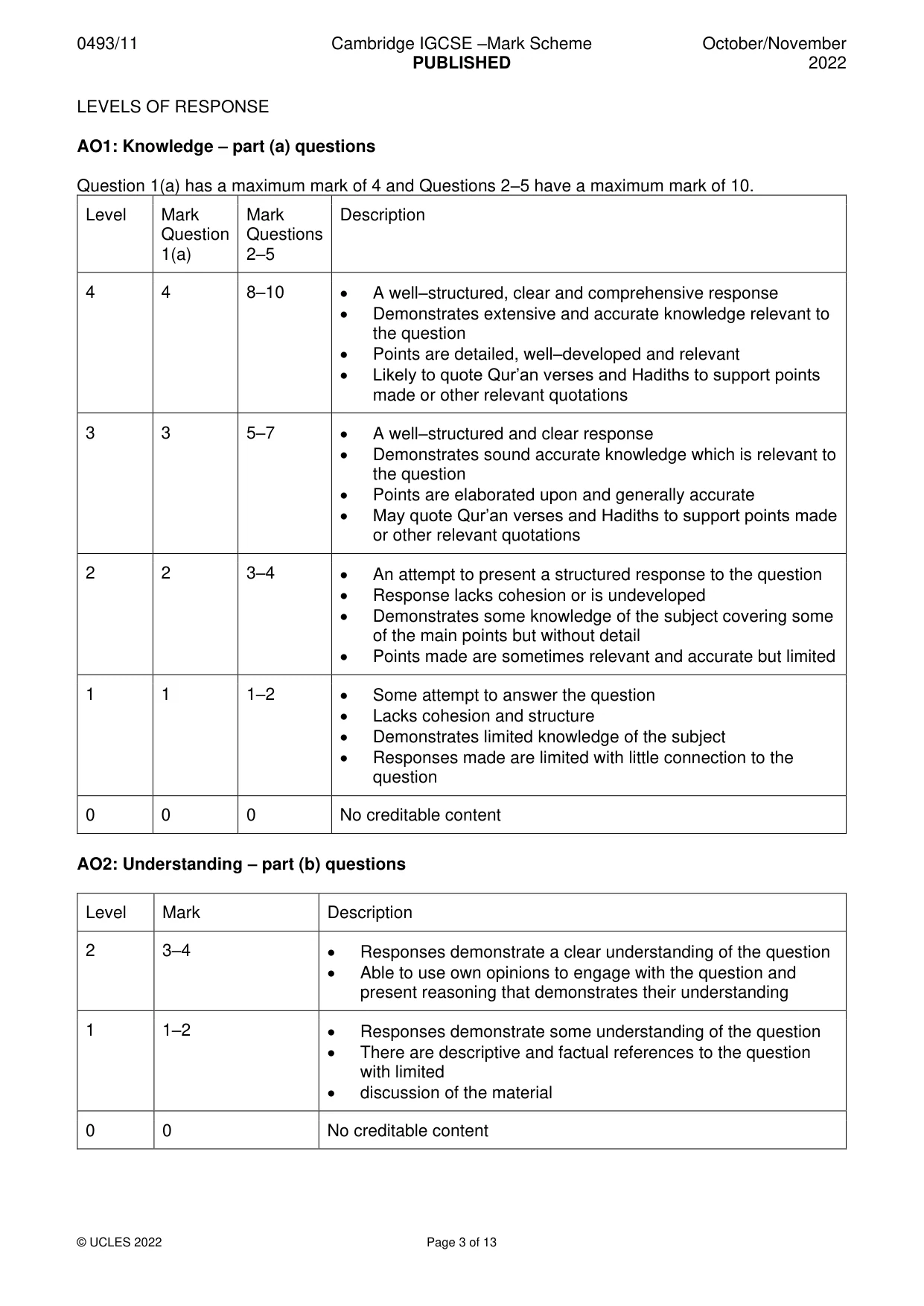
0493/11 Cambridge IGCSE –Mark Scheme PUBLISHED October/November 2022 © UCLES 2022 Page 2 of 13 Generic Marking Principles These general marking principles must be applied by all examiners when marking candidate answers. They should be applied alongside the specific content of the mark scheme or generic level descriptors for a question. Each question paper and mark scheme will also comply with these marking principles. GENERIC MARKING PRINCIPLE 1: Marks must be awarded in line with: • the specific content of the mark scheme or the generic level descriptors for the question • the specific skills defined in the mark scheme or in the generic level descriptors for the question • the standard of response required by a candidate as exemplified by the standardisation scripts. GENERIC MARKING PRINCIPLE 2: Marks awarded are always whole marks (not half marks, or other fractions). GENERIC MARKING PRINCIPLE 3: Marks must be awarded positively: • marks are awarded for correct/valid answers, as defined in the mark scheme. However, credit is given for valid answers which go beyond the scope of the syllabus and mark scheme, referring to your Team Leader as appropriate • marks are awarded when candidates clearly demonstrate what they know and can do • marks are not deducted for errors • marks are not deducted for omissions • answers should only be judged on the quality of spelling, punctuation and grammar when these features are specifically assessed by the question as indicated by the mark scheme. The meaning, however, should be unambiguous. GENERIC MARKING PRINCIPLE 4: Rules must be applied consistently, e.g. in situations where candidates have not followed instructions or in the application of generic level descriptors. GENERIC MARKING PRINCIPLE 5: Marks should be awarded using the full range of marks defined in the mark scheme for the question (however; the use of the full mark range may be limited according to the quality of the candidate responses seen). GENERIC MARKING PRINCIPLE 6: Marks awarded are based solely on the requirements as defined in the mark scheme. Marks should not be awarded with grade thresholds or grade descriptors in mind.
Mark scheme, page 3
0493/11 Cambridge IGCSE –Mark Scheme PUBLISHED October/November 2022 © UCLES 2022 Page 3 of 13 LEVELS OF RESPONSE AO1: Knowledge – part (a) questions Question 1(a) has a maximum mark of 4 and Questions 2–5 have a maximum mark of 10. Level Mark Question 1(a) Mark Questions 2–5 Description 4 4 8–10 • A well–structured, clear and comprehensive response • Demonstrates extensive and accurate knowledge relevant to the question • Points are detailed, well–developed and relevant • Likely to quote Qur’an verses and Hadiths to support points made or other relevant quotations 3 3 5–7 • A well–structured and clear response • Demonstrates sound accurate knowledge which is relevant to the question • Points are elaborated upon and generally accurate • May quote Qur’an verses and Hadiths to support points made or other relevant quotations 2 2 3–4 • An attempt to present a structured response to the question • Response lacks cohesion or is undeveloped • Demonstrates some knowledge of the subject covering some of the main points but without detail • Points made are sometimes relevant and accurate but limited 1 1 1–2 • Some attempt to answer the question • Lacks cohesion and structure • Demonstrates limited knowledge of the subject • Responses made are limited with little connection to the question 0 0 0 No creditable content AO2: Understanding – part (b) questions Level Mark Description 2 3–4 • Responses demonstrate a clear understanding of the question • Able to use own opinions to engage with the question and present reasoning that demonstrates their understanding 1 1–2 • Responses demonstrate some understanding of the question • There are descriptive and factual references to the question with limited • discussion of the material 0 0 No creditable content
Mark scheme, page 4
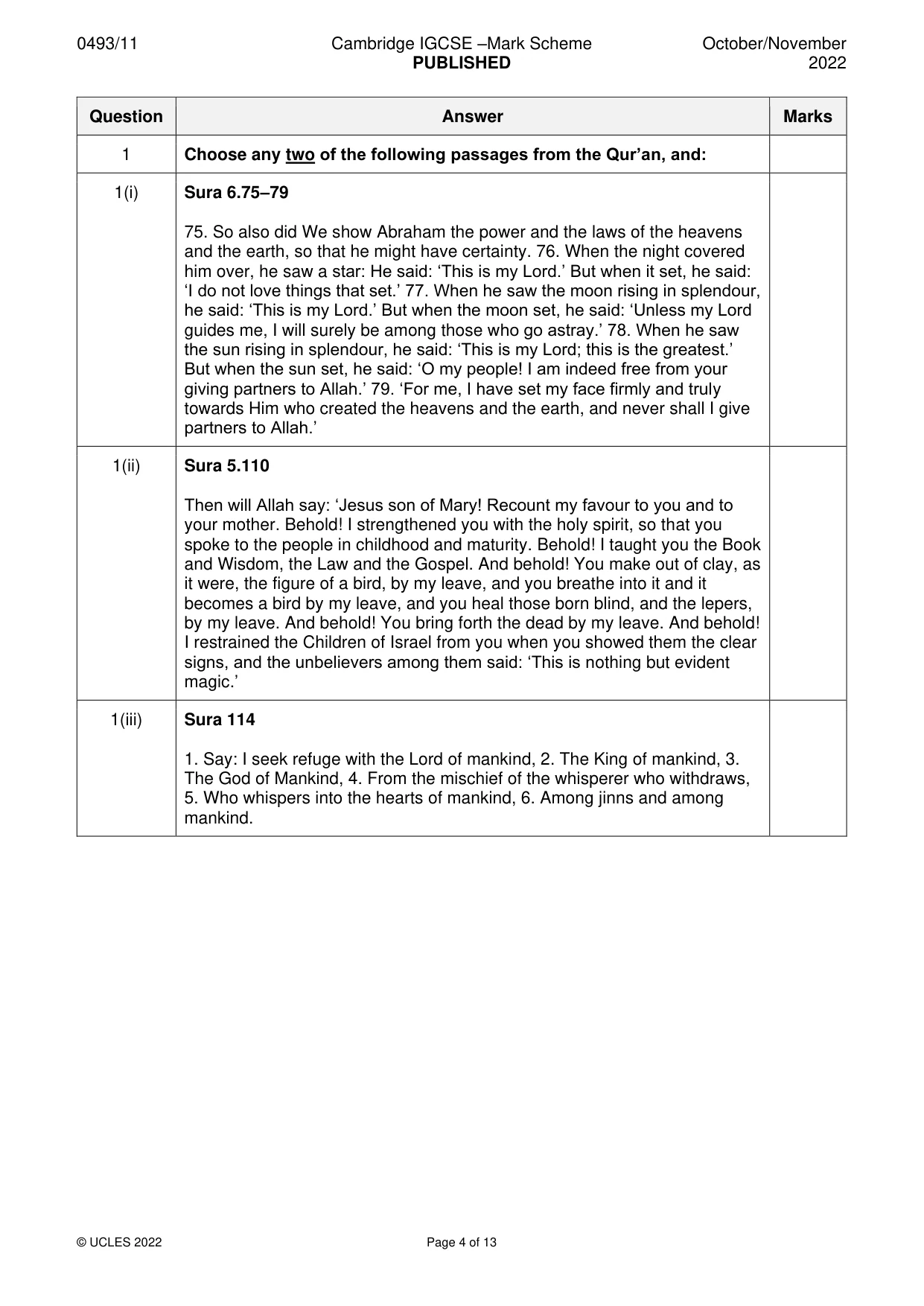
0493/11 Cambridge IGCSE –Mark Scheme PUBLISHED October/November 2022 © UCLES 2022 Page 4 of 13 Question Answer Marks 1 Choose any two of the following passages from the Qur’an, and: 1(i) Sura 6.75–79 75. So also did We show Abraham the power and the laws of the heavens and the earth, so that he might have certainty. 76. When the night covered him over, he saw a star: He said: ‘This is my Lord.’ But when it set, he said: ‘I do not love things that set.’ 77. When he saw the moon rising in splendour, he said: ‘This is my Lord.’ But when the moon set, he said: ‘Unless my Lord guides me, I will surely be among those who go astray.’ 78. When he saw the sun rising in splendour, he said: ‘This is my Lord; this is the greatest.’ But when the sun set, he said: ‘O my people! I am indeed free from your giving partners to Allah.’ 79. ‘For me, I have set my face firmly and truly towards Him who created the heavens and the earth, and never shall I give partners to Allah.’ 1(ii) Sura 5.110 Then will Allah say: ‘Jesus son of Mary! Recount my favour to you and to your mother. Behold! I strengthened you with the holy spirit, so that you spoke to the people in childhood and maturity. Behold! I taught you the Book and Wisdom, the Law and the Gospel. And behold! You make out of clay, as it were, the figure of a bird, by my leave, and you breathe into it and it becomes a bird by my leave, and you heal those born blind, and the lepers, by my leave. And behold! You bring forth the dead by my leave. And behold! I restrained the Children of Israel from you when you showed them the clear signs, and the unbelievers among them said: ‘This is nothing but evident magic.’ 1(iii) Sura 114 1. Say: I seek refuge with the Lord of mankind, 2. The King of mankind, 3. The God of Mankind, 4. From the mischief of the whisperer who withdraws, 5. Who whispers into the hearts of mankind, 6. Among jinns and among mankind.
Mark scheme, page 5
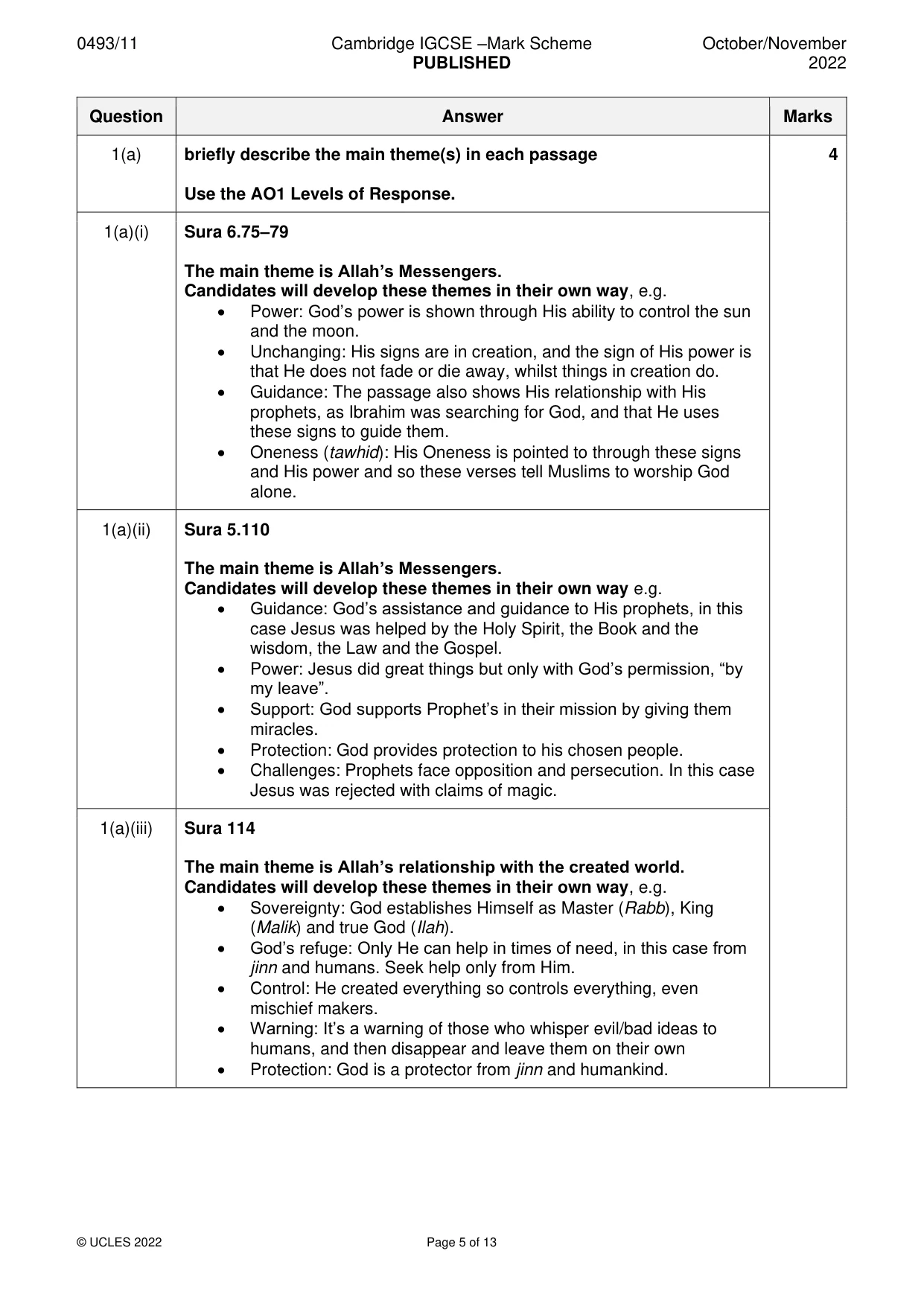
0493/11 Cambridge IGCSE –Mark Scheme PUBLISHED October/November 2022 © UCLES 2022 Page 5 of 13 Question Answer Marks 1(a) briefly describe the main theme(s) in each passage Use the AO1 Levels of Response. 4 1(a)(i) Sura 6.75–79 The main theme is Allah’s Messengers. Candidates will develop these themes in their own way, e.g. • Power: God’s power is shown through His ability to control the sun and the moon. • Unchanging: His signs are in creation, and the sign of His power is that He does not fade or die away, whilst things in creation do. • Guidance: The passage also shows His relationship with His prophets, as Ibrahim was searching for God, and that He uses these signs to guide them. • Oneness (tawhid): His Oneness is pointed to through these signs and His power and so these verses tell Muslims to worship God alone. 1(a)(ii) Sura 5.110 The main theme is Allah’s Messengers. Candidates will develop these themes in their own way e.g. • Guidance: God’s assistance and guidance to His prophets, in this case Jesus was helped by the Holy Spirit, the Book and the wisdom, the Law and the Gospel. • Power: Jesus did great things but only with God’s permission, “by my leave”. • Support: God supports Prophet’s in their mission by giving them miracles. • Protection: God provides protection to his chosen people. • Challenges: Prophets face opposition and persecution. In this case Jesus was rejected with claims of magic. 1(a)(iii) Sura 114 The main theme is Allah’s relationship with the created world. Candidates will develop these themes in their own way, e.g. • Sovereignty: God establishes Himself as Master (Rabb), King (Malik) and true God (Ilah). • God’s refuge: Only He can help in times of need, in this case from jinn and humans. Seek help only from Him. • Control: He created everything so controls everything, even mischief makers. • Warning: It’s a warning of those who whisper evil/bad ideas to humans, and then disappear and leave them on their own • Protection: God is a protector from jinn and humankind.
Mark scheme, page 6
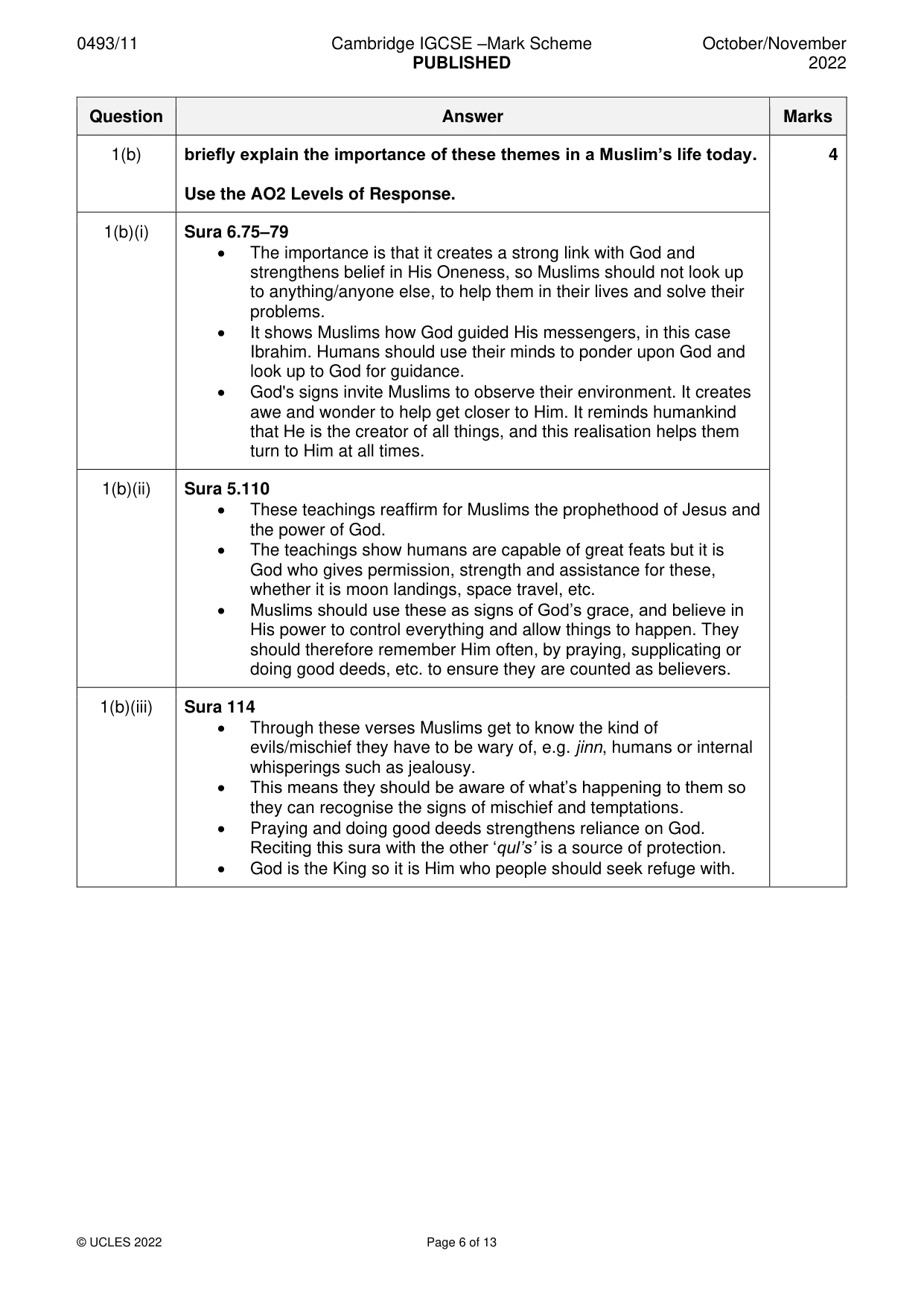
0493/11 Cambridge IGCSE –Mark Scheme PUBLISHED October/November 2022 © UCLES 2022 Page 6 of 13 Question Answer Marks 1(b) briefly explain the importance of these themes in a Muslim’s life today. Use the AO2 Levels of Response. 4 1(b)(i) Sura 6.75–79 • The importance is that it creates a strong link with God and strengthens belief in His Oneness, so Muslims should not look up to anything/anyone else, to help them in their lives and solve their problems. • It shows Muslims how God guided His messengers, in this case Ibrahim. Humans should use their minds to ponder upon God and look up to God for guidance. • God's signs invite Muslims to observe their environment. It creates awe and wonder to help get closer to Him. It reminds humankind that He is the creator of all things, and this realisation helps them turn to Him at all times. 1(b)(ii) Sura 5.110 • These teachings reaffirm for Muslims the prophethood of Jesus and the power of God. • The teachings show humans are capable of great feats but it is God who gives permission, strength and assistance for these, whether it is moon landings, space travel, etc. • Muslims should use these as signs of God’s grace, and believe in His power to control everything and allow things to happen. They should therefore remember Him often, by praying, supplicating or doing good deeds, etc. to ensure they are counted as believers. 1(b)(iii) Sura 114 • Through these verses Muslims get to know the kind of evils/mischief they have to be wary of, e.g. jinn, humans or internal whisperings such as jealousy. • This means they should be aware of what’s happening to them so they can recognise the signs of mischief and temptations. • Praying and doing good deeds strengthens reliance on God. Reciting this sura with the other ‘qul’s’ is a source of protection. • God is the King so it is Him who people should seek refuge with.
Mark scheme, page 7
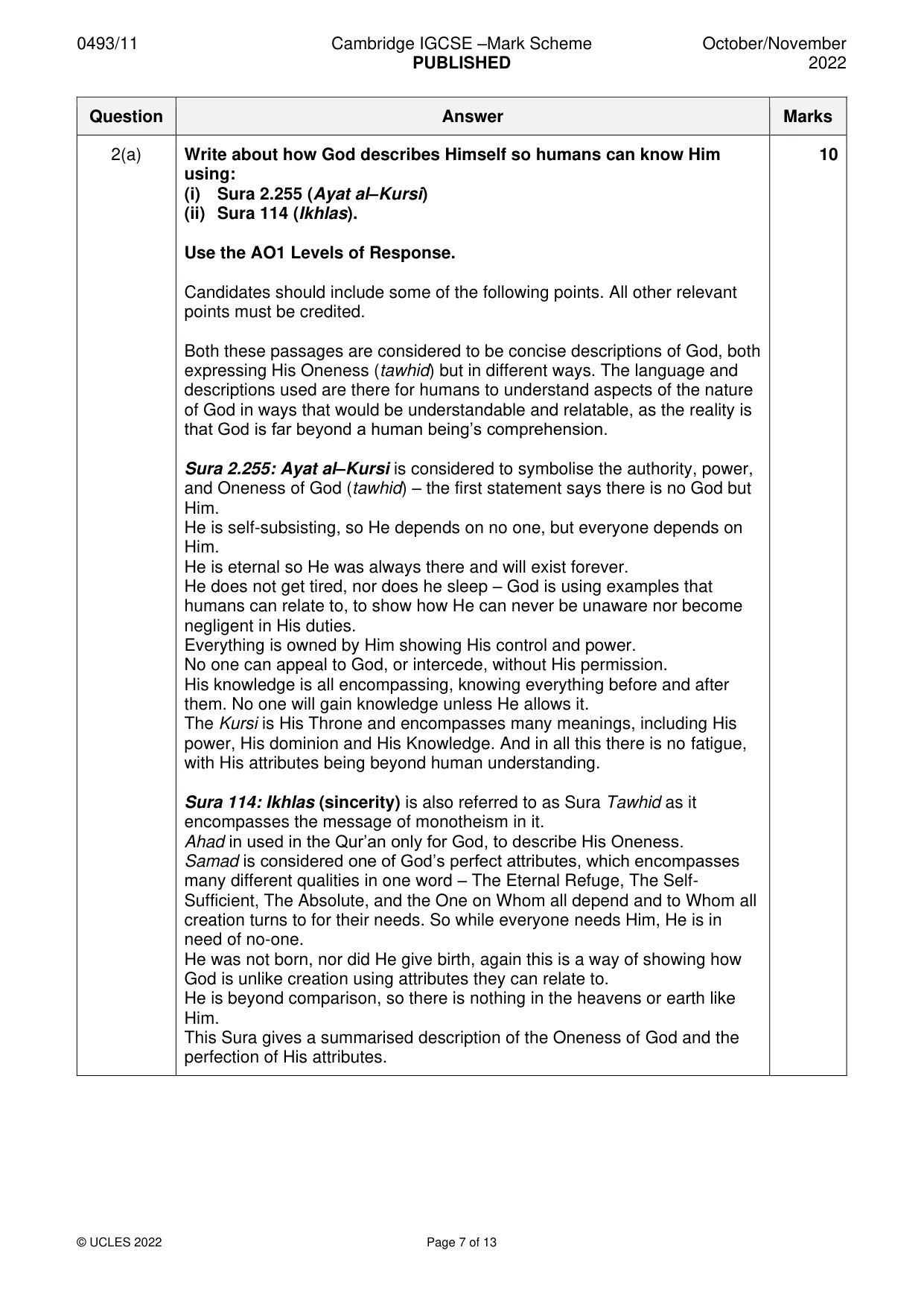
0493/11 Cambridge IGCSE –Mark Scheme PUBLISHED October/November 2022 © UCLES 2022 Page 7 of 13 Question Answer Marks 2(a) Write about how God describes Himself so humans can know Him using: (i) Sura 2.255 (Ayat al–Kursi) (ii) Sura 114 (Ikhlas). Use the AO1 Levels of Response. Candidates should include some of the following points. All other relevant points must be credited. Both these passages are considered to be concise descriptions of God, both expressing His Oneness (tawhid) but in different ways. The language and descriptions used are there for humans to understand aspects of the nature of God in ways that would be understandable and relatable, as the reality is that God is far beyond a human being’s comprehension. Sura 2.255: Ayat al–Kursi is considered to symbolise the authority, power, and Oneness of God (tawhid) – the first statement says there is no God but Him. He is self-subsisting, so He depends on no one, but everyone depends on Him. He is eternal so He was always there and will exist forever. He does not get tired, nor does he sleep – God is using examples that humans can relate to, to show how He can never be unaware nor become negligent in His duties. Everything is owned by Him showing His control and power. No one can appeal to God, or intercede, without His permission. His knowledge is all encompassing, knowing everything before and after them. No one will gain knowledge unless He allows it. The Kursi is His Throne and encompasses many meanings, including His power, His dominion and His Knowledge. And in all this there is no fatigue, with His attributes being beyond human understanding. Sura 114: Ikhlas (sincerity) is also referred to as Sura Tawhid as it encompasses the message of monotheism in it. Ahad in used in the Qur’an only for God, to describe His Oneness. Samad is considered one of God’s perfect attributes, which encompasses many different qualities in one word – The Eternal Refuge, The Self- Sufficient, The Absolute, and the One on Whom all depend and to Whom all creation turns to for their needs. So while everyone needs Him, He is in need of no-one. He was not born, nor did He give birth, again this is a way of showing how God is unlike creation using attributes they can relate to. He is beyond comparison, so there is nothing in the heavens or earth like Him. This Sura gives a summarised description of the Oneness of God and the perfection of His attributes. 10
Mark scheme, page 8
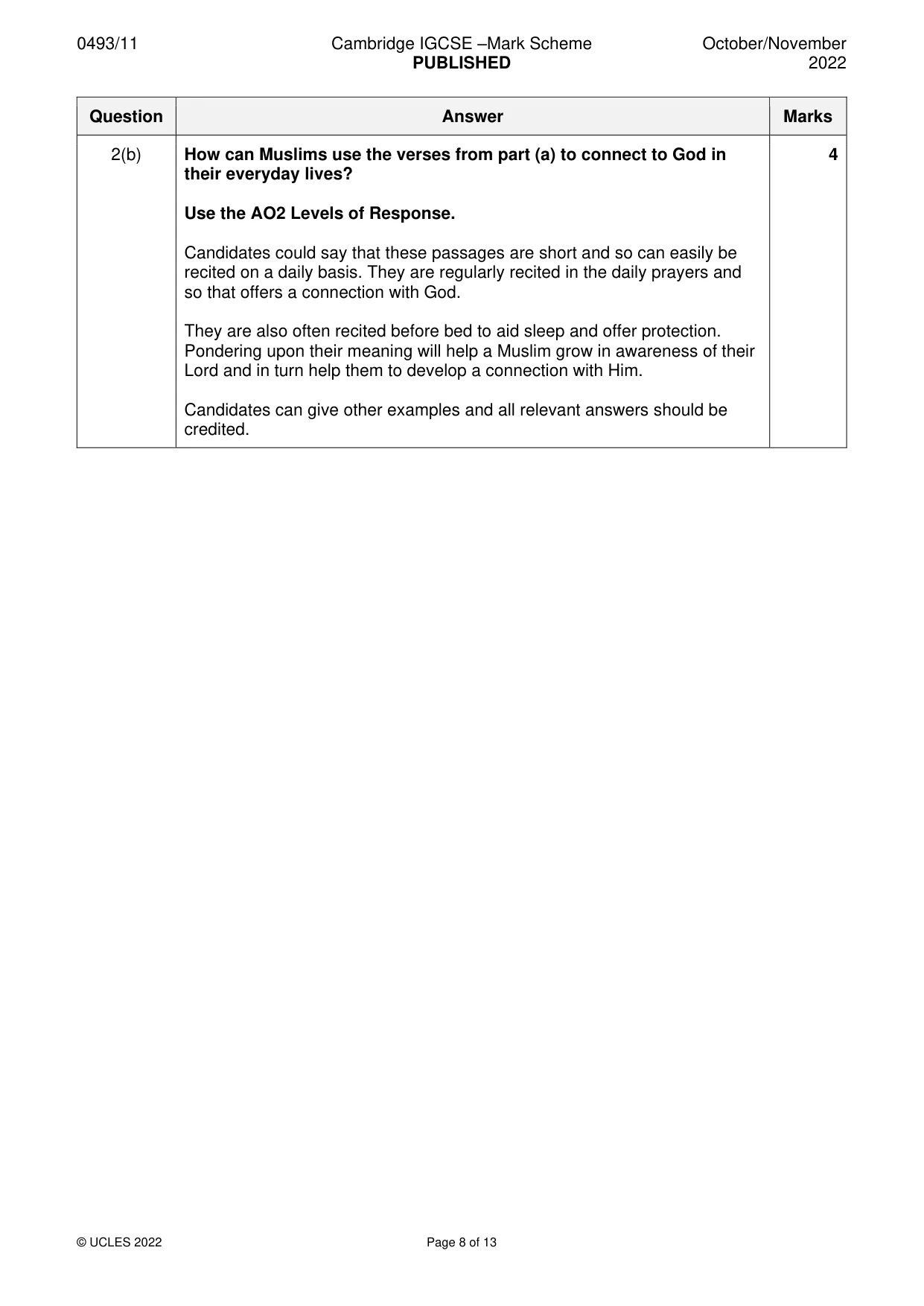
0493/11 Cambridge IGCSE –Mark Scheme PUBLISHED October/November 2022 © UCLES 2022 Page 8 of 13 Question Answer Marks 2(b) How can Muslims use the verses from part (a) to connect to God in their everyday lives? Use the AO2 Levels of Response. Candidates could say that these passages are short and so can easily be recited on a daily basis. They are regularly recited in the daily prayers and so that offers a connection with God. They are also often recited before bed to aid sleep and offer protection. Pondering upon their meaning will help a Muslim grow in awareness of their Lord and in turn help them to develop a connection with Him. Candidates can give other examples and all relevant answers should be credited. 4
Mark scheme, page 9
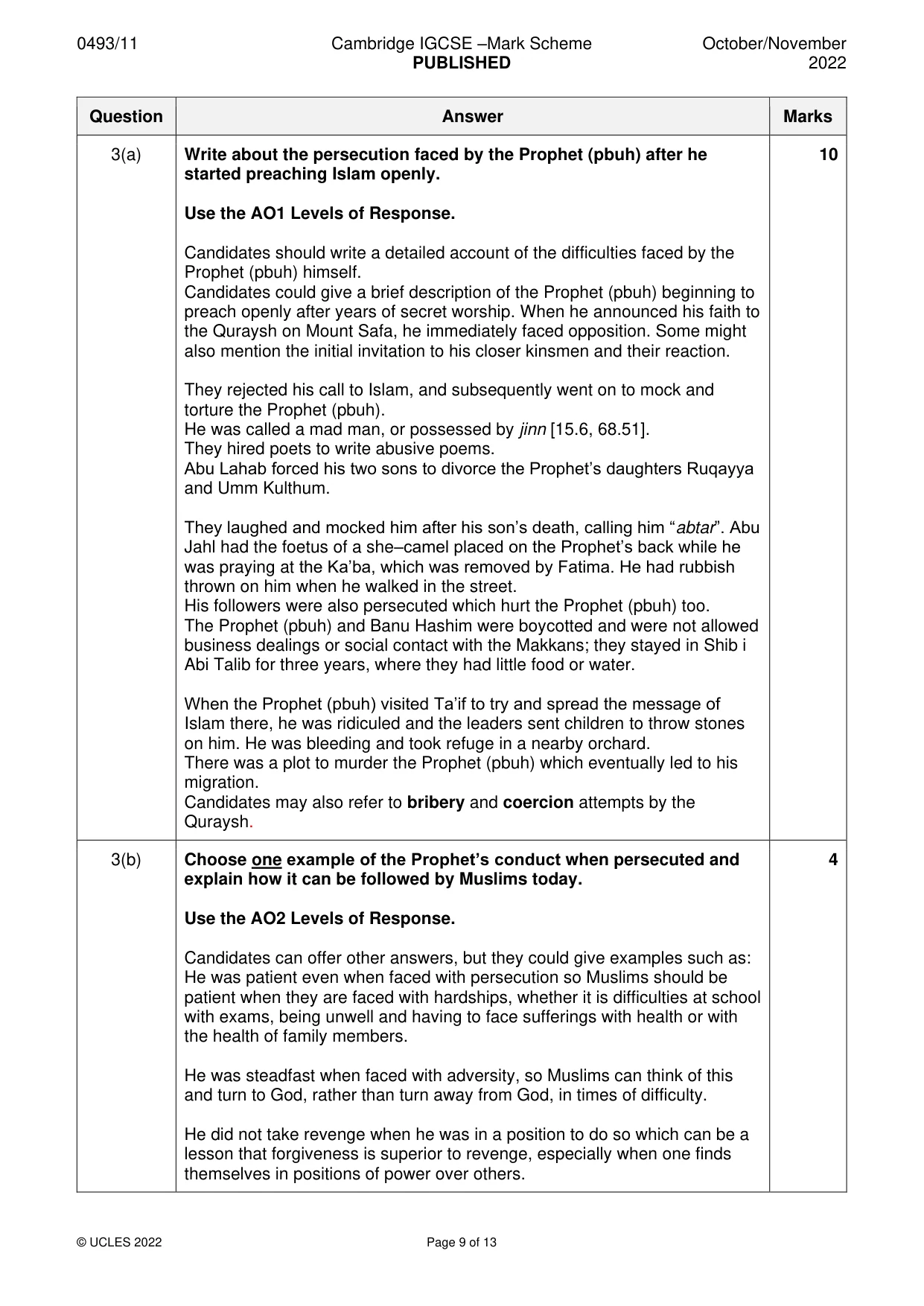
0493/11 Cambridge IGCSE –Mark Scheme PUBLISHED October/November 2022 © UCLES 2022 Page 9 of 13 Question Answer Marks 3(a) Write about the persecution faced by the Prophet (pbuh) after he started preaching Islam openly. Use the AO1 Levels of Response. Candidates should write a detailed account of the difficulties faced by the Prophet (pbuh) himself. Candidates could give a brief description of the Prophet (pbuh) beginning to preach openly after years of secret worship. When he announced his faith to the Quraysh on Mount Safa, he immediately faced opposition. Some might also mention the initial invitation to his closer kinsmen and their reaction. They rejected his call to Islam, and subsequently went on to mock and torture the Prophet (pbuh). He was called a mad man, or possessed by jinn [15.6, 68.51]. They hired poets to write abusive poems. Abu Lahab forced his two sons to divorce the Prophet’s daughters Ruqayya and Umm Kulthum. They laughed and mocked him after his son’s death, calling him “abtar”. Abu Jahl had the foetus of a she–camel placed on the Prophet’s back while he was praying at the Ka’ba, which was removed by Fatima. He had rubbish thrown on him when he walked in the street. His followers were also persecuted which hurt the Prophet (pbuh) too. The Prophet (pbuh) and Banu Hashim were boycotted and were not allowed business dealings or social contact with the Makkans; they stayed in Shib i Abi Talib for three years, where they had little food or water. When the Prophet (pbuh) visited Ta’if to try and spread the message of Islam there, he was ridiculed and the leaders sent children to throw stones on him. He was bleeding and took refuge in a nearby orchard. There was a plot to murder the Prophet (pbuh) which eventually led to his migration. Candidates may also refer to bribery and coercion attempts by the Quraysh. 10 3(b) Choose one example of the Prophet’s conduct when persecuted and explain how it can be followed by Muslims today. Use the AO2 Levels of Response. Candidates can offer other answers, but they could give examples such as: He was patient even when faced with persecution so Muslims should be patient when they are faced with hardships, whether it is difficulties at school with exams, being unwell and having to face sufferings with health or with the health of family members. He was steadfast when faced with adversity, so Muslims can think of this and turn to God, rather than turn away from God, in times of difficulty. He did not take revenge when he was in a position to do so which can be a lesson that forgiveness is superior to revenge, especially when one finds themselves in positions of power over others. 4
Mark scheme, page 10
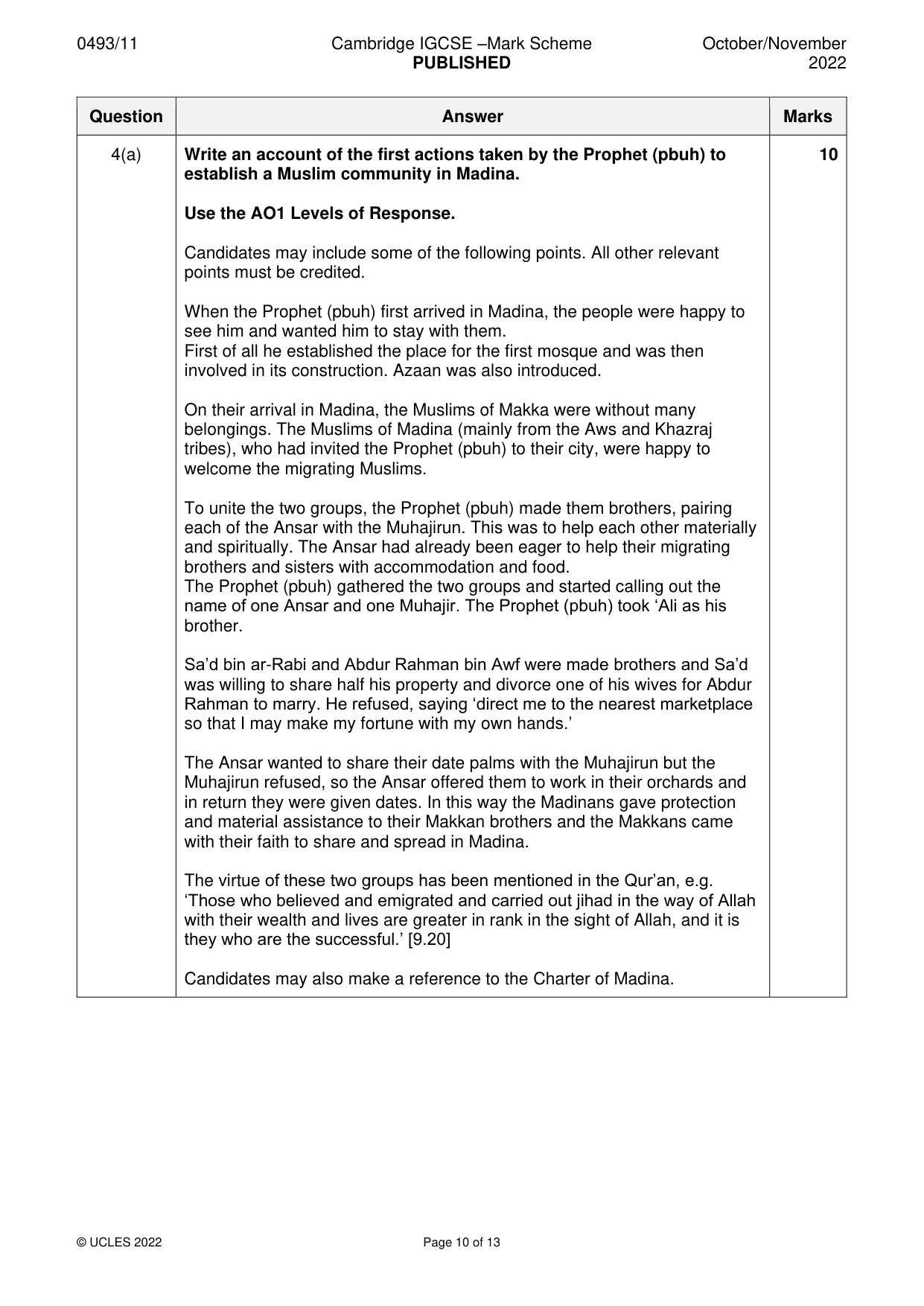
0493/11 Cambridge IGCSE –Mark Scheme PUBLISHED October/November 2022 © UCLES 2022 Page 10 of 13 Question Answer Marks 4(a) Write an account of the first actions taken by the Prophet (pbuh) to establish a Muslim community in Madina. Use the AO1 Levels of Response. Candidates may include some of the following points. All other relevant points must be credited. When the Prophet (pbuh) first arrived in Madina, the people were happy to see him and wanted him to stay with them. First of all he established the place for the first mosque and was then involved in its construction. Azaan was also introduced. On their arrival in Madina, the Muslims of Makka were without many belongings. The Muslims of Madina (mainly from the Aws and Khazraj tribes), who had invited the Prophet (pbuh) to their city, were happy to welcome the migrating Muslims. To unite the two groups, the Prophet (pbuh) made them brothers, pairing each of the Ansar with the Muhajirun. This was to help each other materially and spiritually. The Ansar had already been eager to help their migrating brothers and sisters with accommodation and food. The Prophet (pbuh) gathered the two groups and started calling out the name of one Ansar and one Muhajir. The Prophet (pbuh) took ‘Ali as his brother. Sa’d bin ar-Rabi and Abdur Rahman bin Awf were made brothers and Sa’d was willing to share half his property and divorce one of his wives for Abdur Rahman to marry. He refused, saying ‘direct me to the nearest marketplace so that I may make my fortune with my own hands.’ The Ansar wanted to share their date palms with the Muhajirun but the Muhajirun refused, so the Ansar offered them to work in their orchards and in return they were given dates. In this way the Madinans gave protection and material assistance to their Makkan brothers and the Makkans came with their faith to share and spread in Madina. The virtue of these two groups has been mentioned in the Qur’an, e.g. ‘Those who believed and emigrated and carried out jihad in the way of Allah with their wealth and lives are greater in rank in the sight of Allah, and it is they who are the successful.’ [9.20] Candidates may also make a reference to the Charter of Madina. 10
Mark scheme, page 11
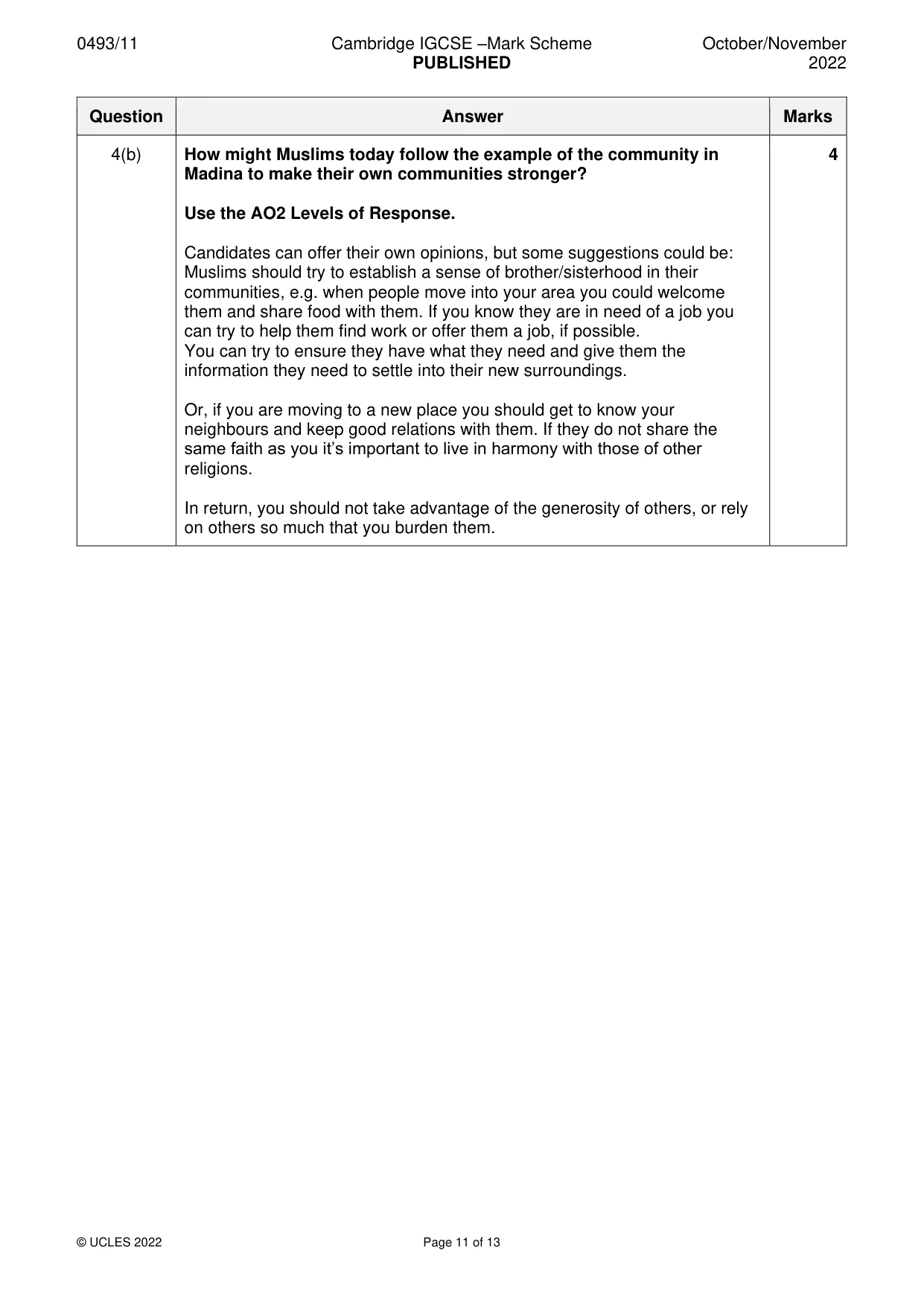
0493/11 Cambridge IGCSE –Mark Scheme PUBLISHED October/November 2022 © UCLES 2022 Page 11 of 13 Question Answer Marks 4(b) How might Muslims today follow the example of the community in Madina to make their own communities stronger? Use the AO2 Levels of Response. Candidates can offer their own opinions, but some suggestions could be: Muslims should try to establish a sense of brother/sisterhood in their communities, e.g. when people move into your area you could welcome them and share food with them. If you know they are in need of a job you can try to help them find work or offer them a job, if possible. You can try to ensure they have what they need and give them the information they need to settle into their new surroundings. Or, if you are moving to a new place you should get to know your neighbours and keep good relations with them. If they do not share the same faith as you it’s important to live in harmony with those of other religions. In return, you should not take advantage of the generosity of others, or rely on others so much that you burden them. 4
Mark scheme, page 12
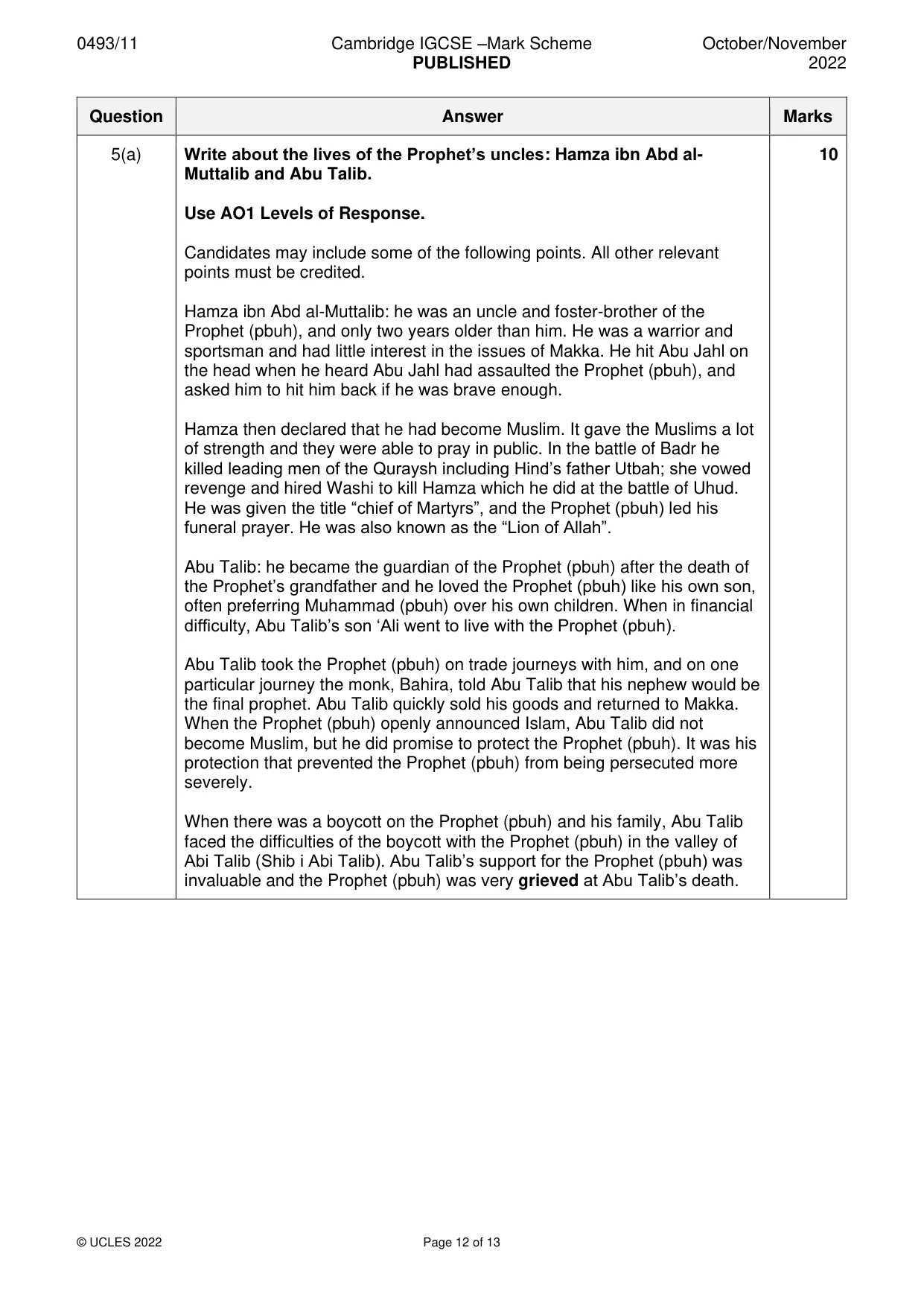
0493/11 Cambridge IGCSE –Mark Scheme PUBLISHED October/November 2022 © UCLES 2022 Page 12 of 13 Question Answer Marks 5(a) Write about the lives of the Prophet’s uncles: Hamza ibn Abd al- Muttalib and Abu Talib. Use AO1 Levels of Response. Candidates may include some of the following points. All other relevant points must be credited. Hamza ibn Abd al-Muttalib: he was an uncle and foster-brother of the Prophet (pbuh), and only two years older than him. He was a warrior and sportsman and had little interest in the issues of Makka. He hit Abu Jahl on the head when he heard Abu Jahl had assaulted the Prophet (pbuh), and asked him to hit him back if he was brave enough. Hamza then declared that he had become Muslim. It gave the Muslims a lot of strength and they were able to pray in public. In the battle of Badr he killed leading men of the Quraysh including Hind’s father Utbah; she vowed revenge and hired Washi to kill Hamza which he did at the battle of Uhud. He was given the title “chief of Martyrs”, and the Prophet (pbuh) led his funeral prayer. He was also known as the “Lion of Allah”. Abu Talib: he became the guardian of the Prophet (pbuh) after the death of the Prophet’s grandfather and he loved the Prophet (pbuh) like his own son, often preferring Muhammad (pbuh) over his own children. When in financial difficulty, Abu Talib’s son ‘Ali went to live with the Prophet (pbuh). Abu Talib took the Prophet (pbuh) on trade journeys with him, and on one particular journey the monk, Bahira, told Abu Talib that his nephew would be the final prophet. Abu Talib quickly sold his goods and returned to Makka. When the Prophet (pbuh) openly announced Islam, Abu Talib did not become Muslim, but he did promise to protect the Prophet (pbuh). It was his protection that prevented the Prophet (pbuh) from being persecuted more severely. When there was a boycott on the Prophet (pbuh) and his family, Abu Talib faced the difficulties of the boycott with the Prophet (pbuh) in the valley of Abi Talib (Shib i Abi Talib). Abu Talib’s support for the Prophet (pbuh) was invaluable and the Prophet (pbuh) was very grieved at Abu Talib’s death. 10
Mark scheme, page 13
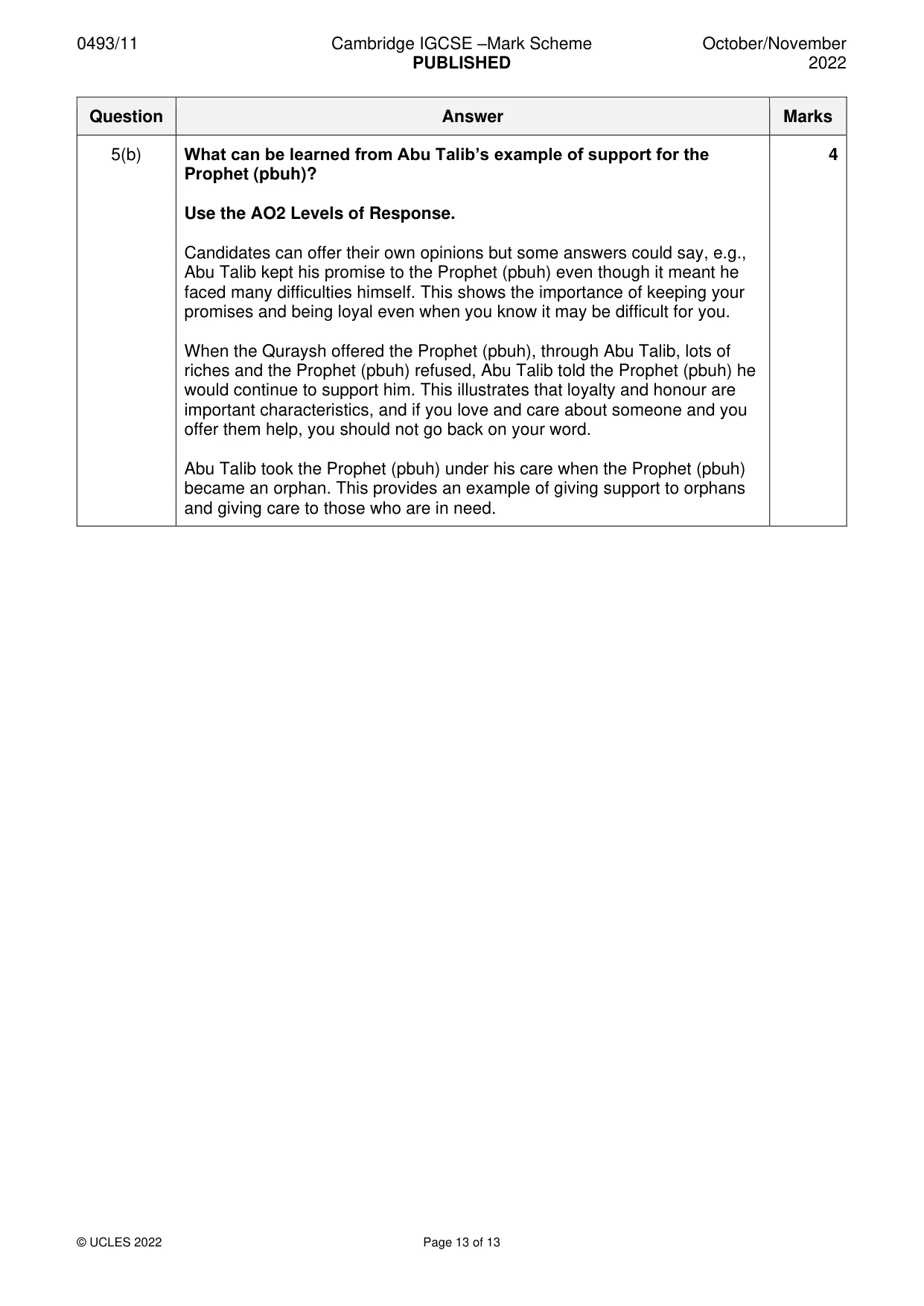
0493/11 Cambridge IGCSE –Mark Scheme PUBLISHED October/November 2022 © UCLES 2022 Page 13 of 13 Question Answer Marks 5(b) What can be learned from Abu Talib’s example of support for the Prophet (pbuh)? Use the AO2 Levels of Response. Candidates can offer their own opinions but some answers could say, e.g., Abu Talib kept his promise to the Prophet (pbuh) even though it meant he faced many difficulties himself. This shows the importance of keeping your promises and being loyal even when you know it may be difficult for you. When the Quraysh offered the Prophet (pbuh), through Abu Talib, lots of riches and the Prophet (pbuh) refused, Abu Talib told the Prophet (pbuh) he would continue to support him. This illustrates that loyalty and honour are important characteristics, and if you love and care about someone and you offer them help, you should not go back on your word. Abu Talib took the Prophet (pbuh) under his care when the Prophet (pbuh) became an orphan. This provides an example of giving support to orphans and giving care to those who are in need. 4
What you needed in this session
Cambridge’s own grade thresholds for 2022 Oct/Nov, Paper 1 · Variant 1. A higher threshold means an easier paper — the bar moves with how the cohort did.