Cambridge IGCSE Islamiyat 0493 — 2021 Oct/Nov Paper 1 · Variant 2
0493/12/O/N/21 · 50 marks · ≈56 min
The question paper and its mark scheme, free to read here and free to download. This is Cambridge’s own paper, exactly as it was sat.
Question paper20 pages







Mark scheme17 pages
Answers below. Sit the paper first if you are practising.
Paper as text
Question paper, page 1
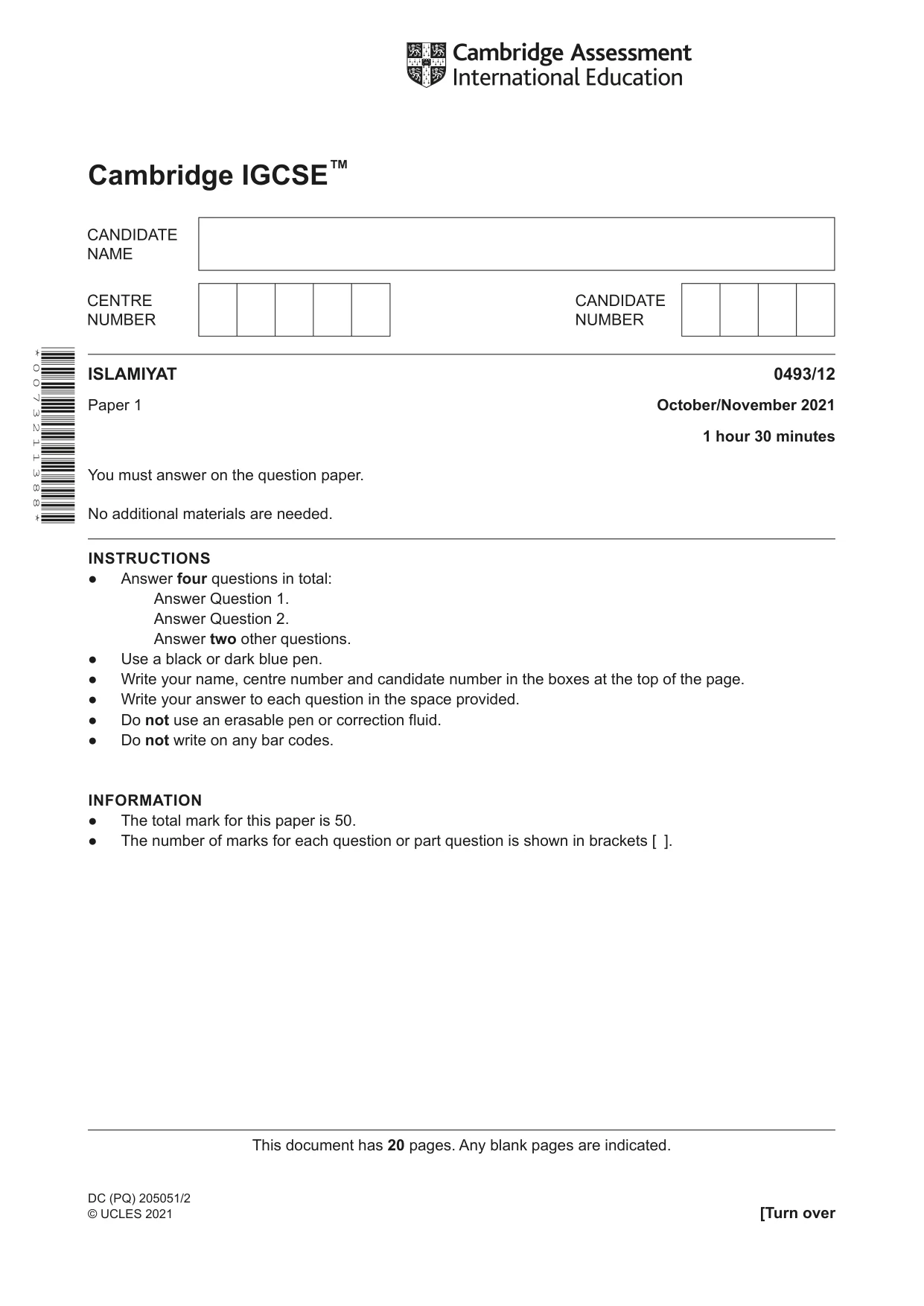
This document has 20 pages. Any blank pages are indicated. Cambridge IGCSE™ DC (PQ) 205051/2 © UCLES 2021 [Turn over * 0 0 7 3 2 1 1 3 8 8 * ISLAMIYAT 0493/12 Paper 1 October/November 2021 1 hour 30 minutes You must answer on the question paper. No additional materials are needed. INSTRUCTIONS ● Answer four questions in total: Answer Question 1. Answer Question 2. Answer two other questions. ● Use a black or dark blue pen. ● Write your name, centre number and candidate number in the boxes at the top of the page. ● Write your answer to each question in the space provided. ● Do not use an erasable pen or correction fluid. ● Do not write on any bar codes. INFORMATION ● The total mark for this paper is 50. ● The number of marks for each question or part question is shown in brackets [ ].
Question paper, page 2
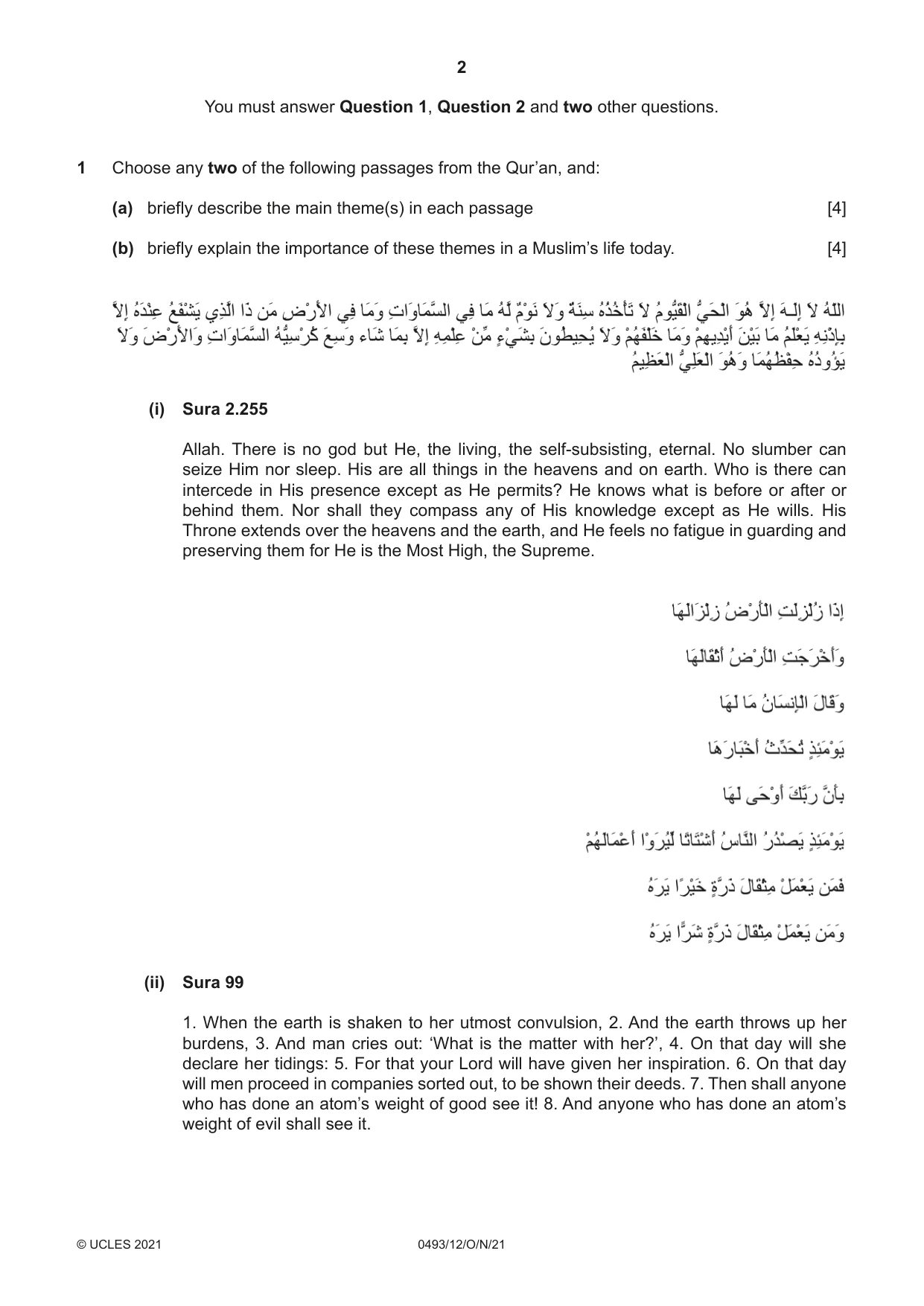
2 0493/12/O/N/21 © UCLES 2021 You must answer Question 1, Question 2 and two other questions. 1 Choose any two of the following passages from the Qur’an, and: (a) briefly describe the main theme(s) in each passage [4] (b) briefly explain the importance of these themes in a Muslim’s life today. [4] (i) Sura 2.255 Allah. There is no god but He, the living, the self-subsisting, eternal. No slumber can seize Him nor sleep. His are all things in the heavens and on earth. Who is there can intercede in His presence except as He permits? He knows what is before or after or behind them. Nor shall they compass any of His knowledge except as He wills. His Throne extends over the heavens and the earth, and He feels no fatigue in guarding and preserving them for He is the Most High, the Supreme. (ii) Sura 99 1. When the earth is shaken to her utmost convulsion, 2. And the earth throws up her burdens, 3. And man cries out: ‘What is the matter with her?’, 4. On that day will she declare her tidings: 5. For that your Lord will have given her inspiration. 6. On that day will men proceed in companies sorted out, to be shown their deeds. 7. Then shall anyone who has done an atom’s weight of good see it! 8. And anyone who has done an atom’s weight of evil shall see it.
Question paper, page 3
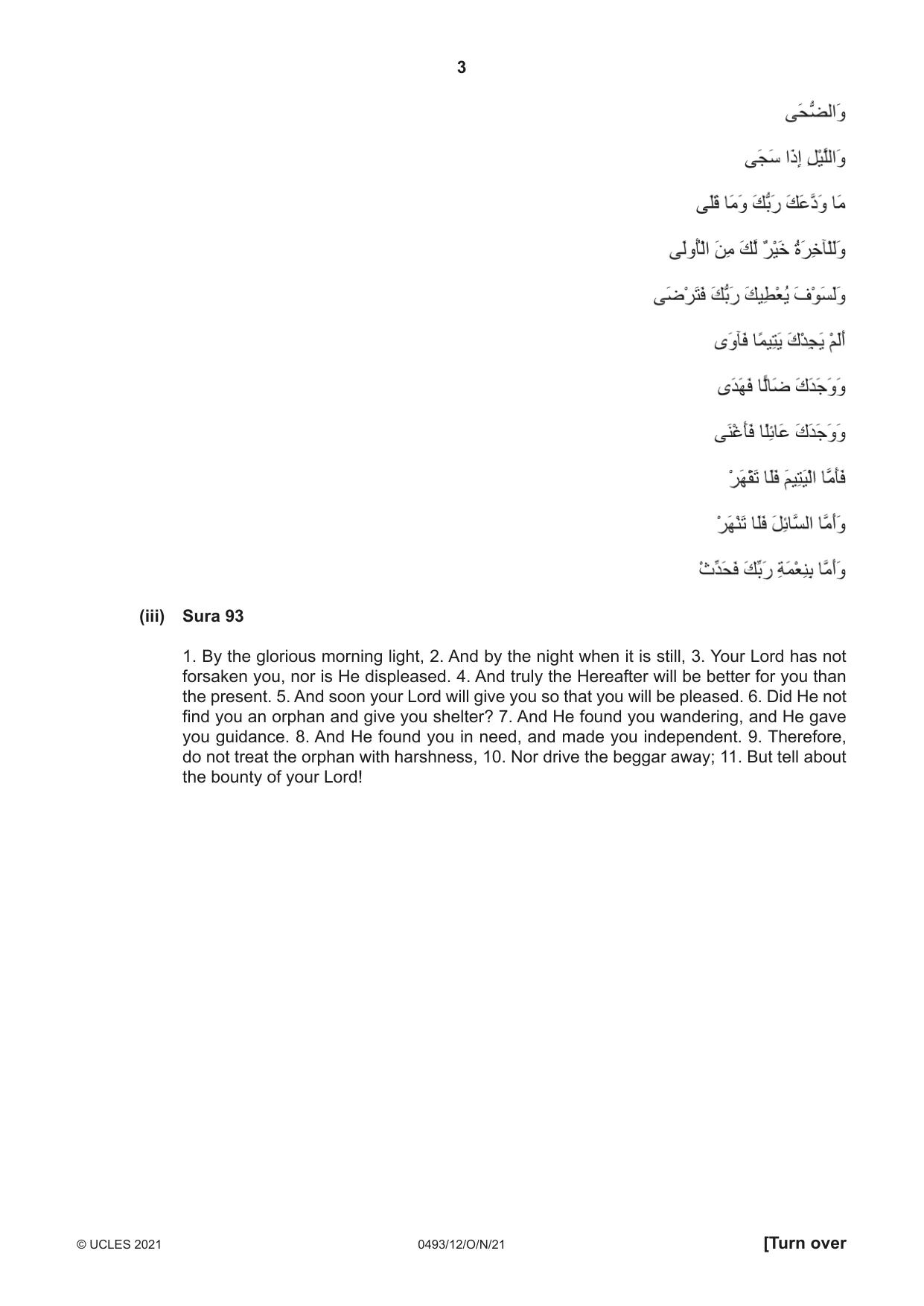
3 0493/12/O/N/21 © UCLES 2021 [Turn over (iii) Sura 93 1. By the glorious morning light, 2. And by the night when it is still, 3. Your Lord has not forsaken you, nor is He displeased. 4. And truly the Hereafter will be better for you than the present. 5. And soon your Lord will give you so that you will be pleased. 6. Did He not find you an orphan and give you shelter? 7. And He found you wandering, and He gave you guidance. 8. And He found you in need, and made you independent. 9. Therefore, do not treat the orphan with harshness, 10. Nor drive the beggar away; 11. But tell about the bounty of your Lord!
Question paper, page 4
4 0493/12/O/N/21 © UCLES 2021 … … … … … … … … … … … … … … … … … … … … … … … … … … … …
Question paper, page 5
5 0493/12/O/N/21 © UCLES 2021 [Turn over … … … … … … … … … … … … … … … … … … … … … … … … … … … …
Question paper, page 6
6 0493/12/O/N/21 © UCLES 2021 2 (a) Write about the way in which the Qur’an and Sunna are used in Islamic Law. [10] (b) Give one example where using ijma or qiyas has been significant for Muslims today. [4] … … … … … … … … … … … … … … … … … … … … … … … … … …
Question paper, page 7
7 0493/12/O/N/21 © UCLES 2021 [Turn over … … … … … … … … … … … … … … … … … … … … … … … … … … … …
Question paper, page 8
8 0493/12/O/N/21 © UCLES 2021 … … … … … … … … … … … … … … … … … … … … … … … … … … … …
Question paper, page 9
9 0493/12/O/N/21 © UCLES 2021 [Turn over 3 (a) Outline the main events from the Prophet’s night journey and ascension (al-isra wal-mi’raj). [10] (b) In what way did this event give hope to the Prophet (pbuh)? [4] … … … … … … … … … … … … … … … … … … … … … … … … … …
Question paper, page 10
10 0493/12/O/N/21 © UCLES 2021 … … … … … … … … … … … … … … … … … … … … … … … … … … … …
Question paper, page 11
11 0493/12/O/N/21 © UCLES 2021 [Turn over … … … … … … … … … … … … … … … … … … … … … … … … … … … …
Question paper, page 12
12 0493/12/O/N/21 © UCLES 2021 4 (a) Write about the events of the migration to Abyssinia by some of the early Muslims. [10] (b) What might be learned from the way the Muslims were treated in Abyssinia? [4] … … … … … … … … … … … … … … … … … … … … … … … … … …
Question paper, page 13
13 0493/12/O/N/21 © UCLES 2021 [Turn over … … … … … … … … … … … … … … … … … … … … … … … … … … … …
Question paper, page 14
14 0493/12/O/N/21 © UCLES 2021 … … … … … … … … … … … … … … … … … … … … … … … … … … … …
Question paper, page 15
15 0493/12/O/N/21 © UCLES 2021 [Turn over 5 (a) Write about the lives of ‘Umar and ‘Uthman during the lifetime of the Prophet (pbuh). [10] (b) What lessons can be learned from ‘Uthman’s life before he became Caliph? [4] … … … … … … … … … … … … … … … … … … … … … … … … … …
Question paper, page 16
16 0493/12/O/N/21 © UCLES 2021 … … … … … … … … … … … … … … … … … … … … … … … … … … … …
Question paper, page 17
17 0493/12/O/N/21 © UCLES 2021 … … … … … … … … … … … … … … … … … … … … … … … … … … … …
Question paper, page 18
18 0493/12/O/N/21 © UCLES 2021 BLANK PAGE
Question paper, page 19
19 0493/12/O/N/21 © UCLES 2021 BLANK PAGE
Question paper, page 20
20 0493/12/O/N/21 © UCLES 2021 Permission to reproduce items where third-party owned material protected by copyright is included has been sought and cleared where possible. Every reasonable effort has been made by the publisher (UCLES) to trace copyright holders, but if any items requiring clearance have unwittingly been included, the publisher will be pleased to make amends at the earliest possible opportunity. To avoid the issue of disclosure of answer-related information to candidates, all copyright acknowledgements are reproduced online in the Cambridge Assessment International Education Copyright Acknowledgements Booklet. This is produced for each series of examinations and is freely available to download at www.cambridgeinternational.org after the live examination series. Cambridge Assessment International Education is part of the Cambridge Assessment Group. Cambridge Assessment is the brand name of the University of Cambridge Local Examinations Syndicate (UCLES), which itself is a department of the University of Cambridge. BLANK PAGE
Mark scheme, page 1
This document consists of 17 printed pages. © UCLES 2021 [Turn over Cambridge IGCSE™ ISLAMIYAT 0493/12 Paper 1 October/November 2021 MARK SCHEME Maximum Mark: 50 Published This mark scheme is published as an aid to teachers and candidates, to indicate the requirements of the examination. It shows the basis on which Examiners were instructed to award marks. It does not indicate the details of the discussions that took place at an Examiners’ meeting before marking began, which would have considered the acceptability of alternative answers. Mark schemes should be read in conjunction with the question paper and the Principal Examiner Report for Teachers. Cambridge International will not enter into discussions about these mark schemes. Cambridge International is publishing the mark schemes for the October/November 2021 series for most Cambridge IGCSE™, Cambridge International A and AS Level components and some Cambridge O Level components.
Mark scheme, page 2
0493/12 Cambridge IGCSE – Mark Scheme PUBLISHED October/November 2021 © UCLES 2021 Page 2 of 17 Generic Marking Principles These general marking principles must be applied by all examiners when marking candidate answers. They should be applied alongside the specific content of the mark scheme or generic level descriptors for a question. Each question paper and mark scheme will also comply with these marking principles. GENERIC MARKING PRINCIPLE 1: Marks must be awarded in line with: • the specific content of the mark scheme or the generic level descriptors for the question • the specific skills defined in the mark scheme or in the generic level descriptors for the question • the standard of response required by a candidate as exemplified by the standardisation scripts. GENERIC MARKING PRINCIPLE 2: Marks awarded are always whole marks (not half marks, or other fractions). GENERIC MARKING PRINCIPLE 3: Marks must be awarded positively: • marks are awarded for correct/valid answers, as defined in the mark scheme. However, credit is given for valid answers which go beyond the scope of the syllabus and mark scheme, referring to your Team Leader as appropriate • marks are awarded when candidates clearly demonstrate what they know and can do • marks are not deducted for errors • marks are not deducted for omissions • answers should only be judged on the quality of spelling, punctuation and grammar when these features are specifically assessed by the question as indicated by the mark scheme. The meaning, however, should be unambiguous. GENERIC MARKING PRINCIPLE 4: Rules must be applied consistently, e.g. in situations where candidates have not followed instructions or in the application of generic level descriptors. GENERIC MARKING PRINCIPLE 5: Marks should be awarded using the full range of marks defined in the mark scheme for the question (however; the use of the full mark range may be limited according to the quality of the candidate responses seen). GENERIC MARKING PRINCIPLE 6: Marks awarded are based solely on the requirements as defined in the mark scheme. Marks should not be awarded with grade thresholds or grade descriptors in mind.
Mark scheme, page 3
0493/12 Cambridge IGCSE – Mark Scheme PUBLISHED October/November 2021 © UCLES 2021 Page 3 of 17 GUIDE TO MARKING IGCSE ISLAMIYAT – 0493 In an examination of this kind, it is impossible to devise a mark scheme that will cover all acceptable answers. This mark scheme provides guidance on what to look out for in the answers given by the candidates. This means that you must be prepared to use discretion in deciding what constitutes an acceptable answer. In order to ensure that all examiners mark at a uniform level, you are expected regularly to discuss your marking with your Team Leader, especially any examples or forms of answer that differ greatly from the agreed mark scheme. Team Leaders are expected to discuss answers with the Principal Examiner. The mark scheme is discussed at the co-ordination meeting. When marking, all examiners are expected to adhere to what has been agreed. GENERAL POINTS Before starting to mark scripts, please ensure that you are familiar with the following: (a) The syllabus (b) The prescribed passages (where appropriate) PRINCIPLES UNDERLYING THE MARK SCHEME Candidates are tested on their ability to satisfy two general Assessment Objectives (AOs): AO1 To recall, select and present relevant facts from the main elements of the faith and history of Islam. Thus AO1 is primarily concerned with knowledge. AO2 To demonstrate understanding of the significance of the selected information in the teachings of Islam and in the lives of Muslims. Thus AO2 is concerned with understanding and evaluation of the material. The paper is marked out of 50. Candidates answer Question 1, Question 2, and any two of the other three questions. Question 1 carries a maximum of 8 marks, and the four other questions carry 14 marks each. In each question, part (a) tests AO1 and earns a maximum of 4 marks in Question 1, and 10 marks in Questions 2–5, while part (b) tests AO2 and earns up to 4 marks in Question 1 and 4 marks in Questions 2–5. Marks are awarded according to the four levels of response for each AO, following the level descriptors detailed below.
Mark scheme, page 4
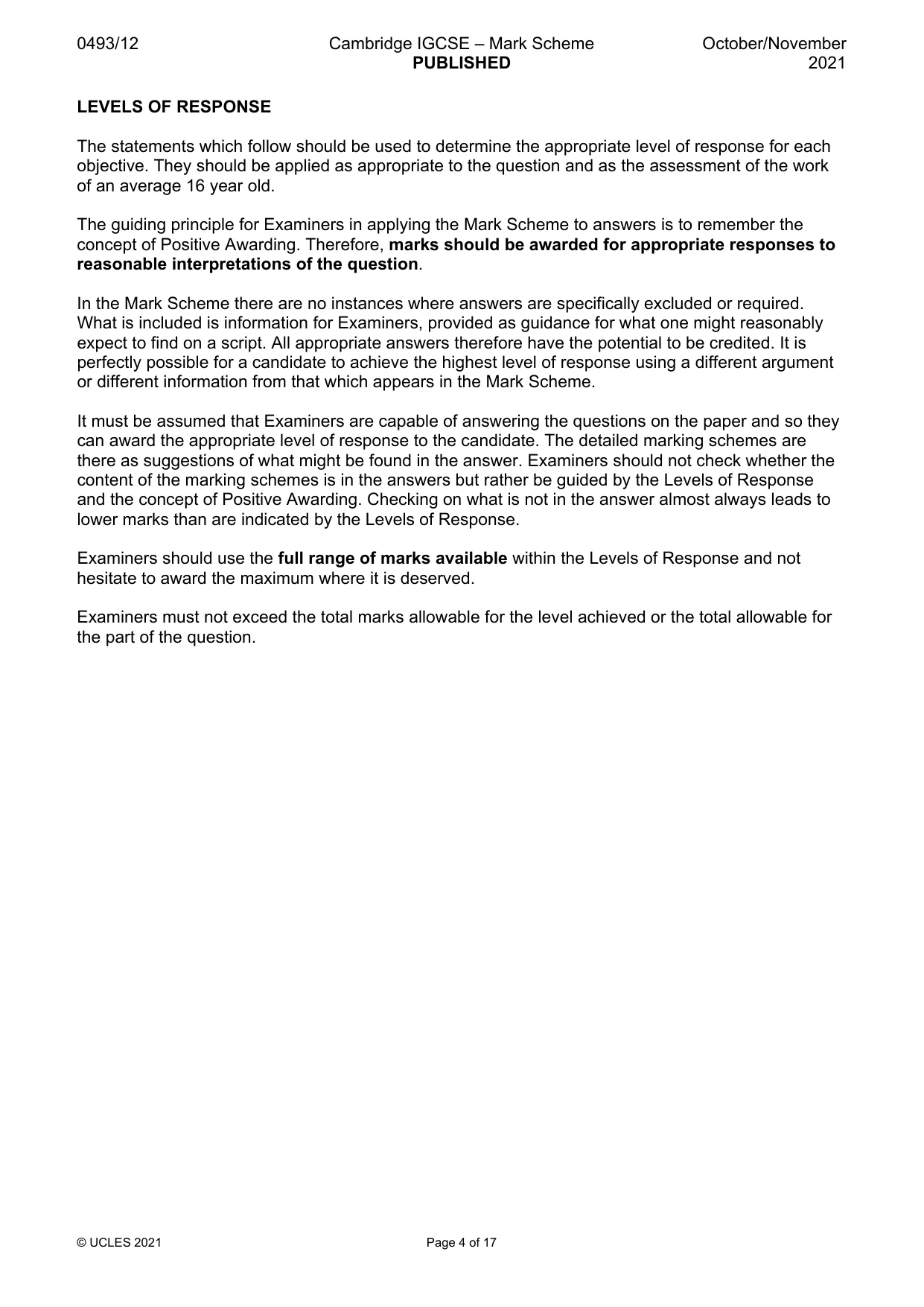
0493/12 Cambridge IGCSE – Mark Scheme PUBLISHED October/November 2021 © UCLES 2021 Page 4 of 17 LEVELS OF RESPONSE The statements which follow should be used to determine the appropriate level of response for each objective. They should be applied as appropriate to the question and as the assessment of the work of an average 16 year old. The guiding principle for Examiners in applying the Mark Scheme to answers is to remember the concept of Positive Awarding. Therefore, marks should be awarded for appropriate responses to reasonable interpretations of the question. In the Mark Scheme there are no instances where answers are specifically excluded or required. What is included is information for Examiners, provided as guidance for what one might reasonably expect to find on a script. All appropriate answers therefore have the potential to be credited. It is perfectly possible for a candidate to achieve the highest level of response using a different argument or different information from that which appears in the Mark Scheme. It must be assumed that Examiners are capable of answering the questions on the paper and so they can award the appropriate level of response to the candidate. The detailed marking schemes are there as suggestions of what might be found in the answer. Examiners should not check whether the content of the marking schemes is in the answers but rather be guided by the Levels of Response and the concept of Positive Awarding. Checking on what is not in the answer almost always leads to lower marks than are indicated by the Levels of Response. Examiners should use the full range of marks available within the Levels of Response and not hesitate to award the maximum where it is deserved. Examiners must not exceed the total marks allowable for the level achieved or the total allowable for the part of the question.
Mark scheme, page 5
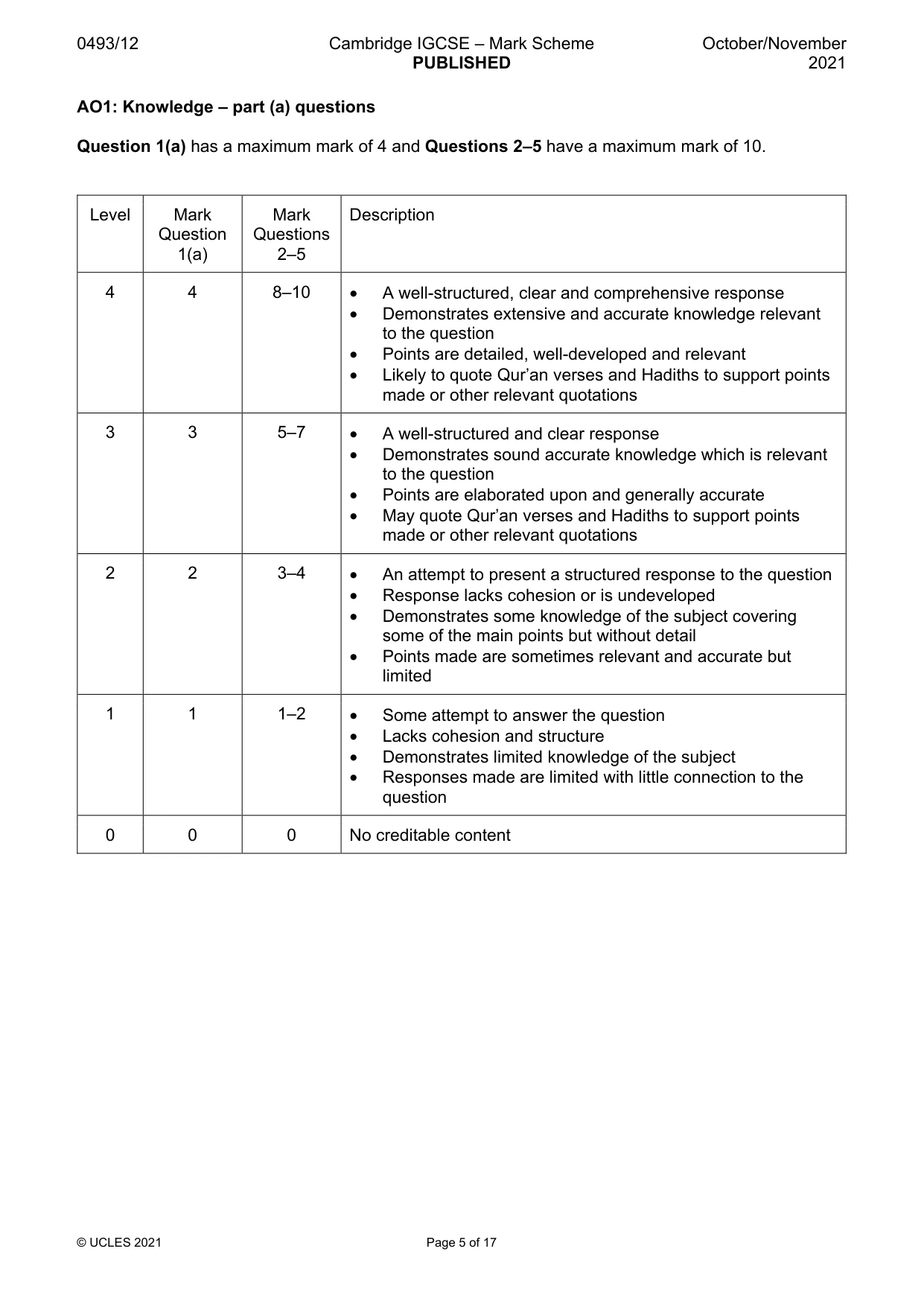
0493/12 Cambridge IGCSE – Mark Scheme PUBLISHED October/November 2021 © UCLES 2021 Page 5 of 17 AO1: Knowledge – part (a) questions Question 1(a) has a maximum mark of 4 and Questions 2–5 have a maximum mark of 10. Level Mark Question 1(a) Mark Questions 2–5 Description 4 4 8–10 • A well-structured, clear and comprehensive response • Demonstrates extensive and accurate knowledge relevant to the question • Points are detailed, well-developed and relevant • Likely to quote Qur’an verses and Hadiths to support points made or other relevant quotations 3 3 5–7 • A well-structured and clear response • Demonstrates sound accurate knowledge which is relevant to the question • Points are elaborated upon and generally accurate • May quote Qur’an verses and Hadiths to support points made or other relevant quotations 2 2 3–4 • An attempt to present a structured response to the question • Response lacks cohesion or is undeveloped • Demonstrates some knowledge of the subject covering some of the main points but without detail • Points made are sometimes relevant and accurate but limited 1 1 1–2 • Some attempt to answer the question • Lacks cohesion and structure • Demonstrates limited knowledge of the subject • Responses made are limited with little connection to the question 0 0 0 No creditable content
Mark scheme, page 6
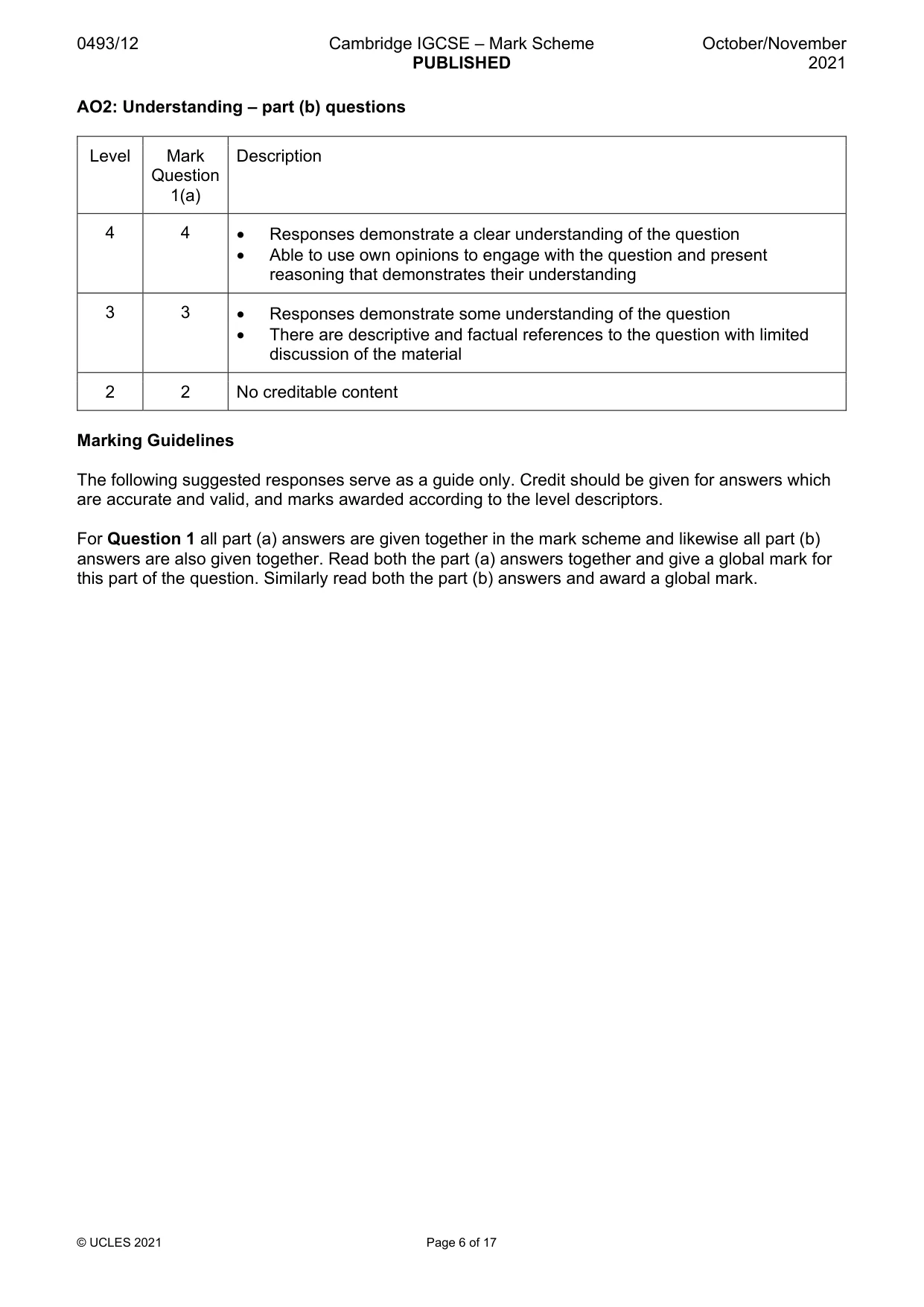
0493/12 Cambridge IGCSE – Mark Scheme PUBLISHED October/November 2021 © UCLES 2021 Page 6 of 17 AO2: Understanding – part (b) questions Level Mark Question 1(a) Description 4 4 • Responses demonstrate a clear understanding of the question • Able to use own opinions to engage with the question and present reasoning that demonstrates their understanding 3 3 • Responses demonstrate some understanding of the question • There are descriptive and factual references to the question with limited discussion of the material 2 2 No creditable content Marking Guidelines The following suggested responses serve as a guide only. Credit should be given for answers which are accurate and valid, and marks awarded according to the level descriptors. For Question 1 all part (a) answers are given together in the mark scheme and likewise all part (b) answers are also given together. Read both the part (a) answers together and give a global mark for this part of the question. Similarly read both the part (b) answers and award a global mark.
Mark scheme, page 7
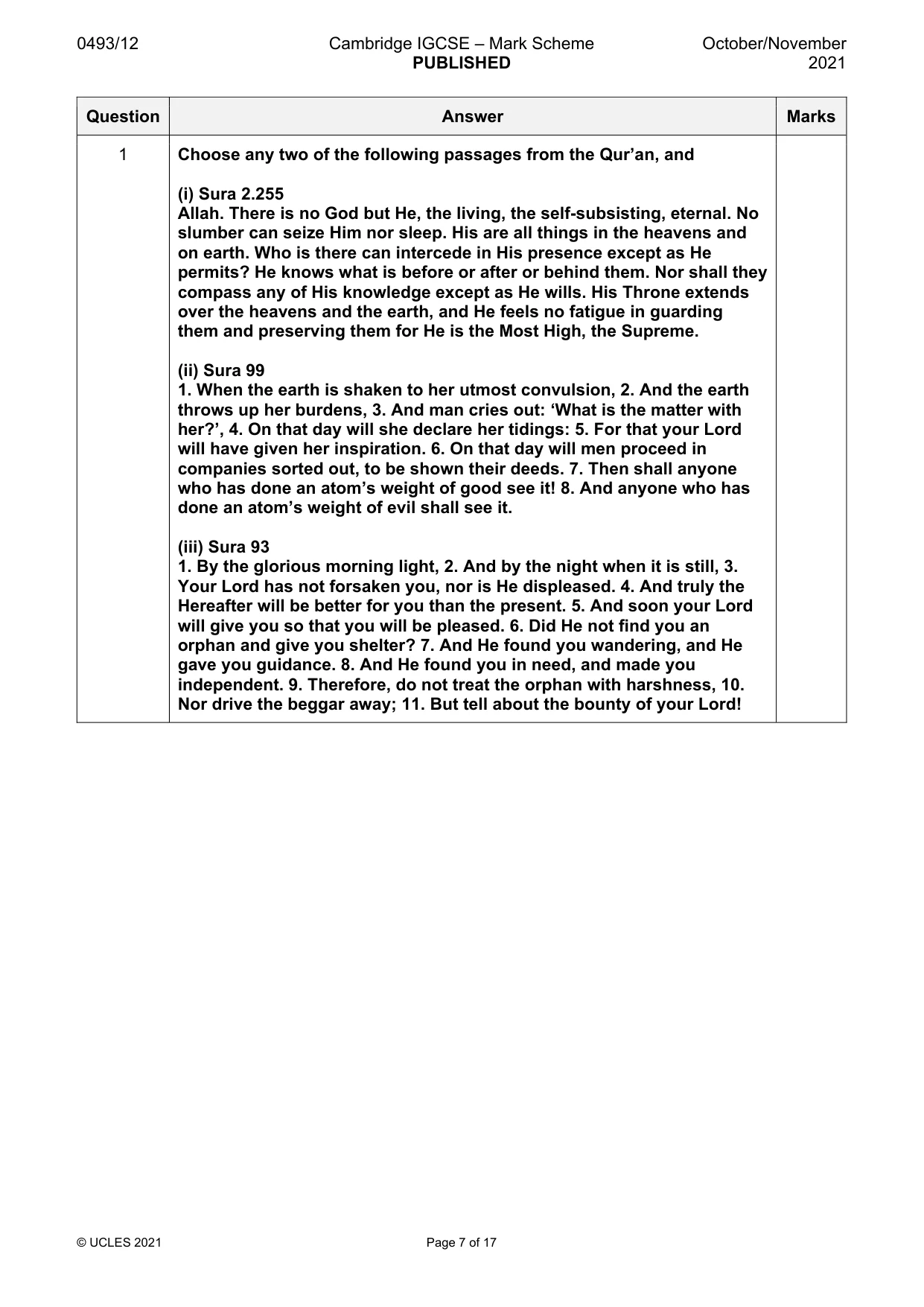
0493/12 Cambridge IGCSE – Mark Scheme PUBLISHED October/November 2021 © UCLES 2021 Page 7 of 17 Question Answer Marks 1 Choose any two of the following passages from the Qur’an, and (i) Sura 2.255 Allah. There is no God but He, the living, the self-subsisting, eternal. No slumber can seize Him nor sleep. His are all things in the heavens and on earth. Who is there can intercede in His presence except as He permits? He knows what is before or after or behind them. Nor shall they compass any of His knowledge except as He wills. His Throne extends over the heavens and the earth, and He feels no fatigue in guarding them and preserving them for He is the Most High, the Supreme. (ii) Sura 99 1. When the earth is shaken to her utmost convulsion, 2. And the earth throws up her burdens, 3. And man cries out: ‘What is the matter with her?’, 4. On that day will she declare her tidings: 5. For that your Lord will have given her inspiration. 6. On that day will men proceed in companies sorted out, to be shown their deeds. 7. Then shall anyone who has done an atom’s weight of good see it! 8. And anyone who has done an atom’s weight of evil shall see it. (iii) Sura 93 1. By the glorious morning light, 2. And by the night when it is still, 3. Your Lord has not forsaken you, nor is He displeased. 4. And truly the Hereafter will be better for you than the present. 5. And soon your Lord will give you so that you will be pleased. 6. Did He not find you an orphan and give you shelter? 7. And He found you wandering, and He gave you guidance. 8. And He found you in need, and made you independent. 9. Therefore, do not treat the orphan with harshness, 10. Nor drive the beggar away; 11. But tell about the bounty of your Lord!
Mark scheme, page 8
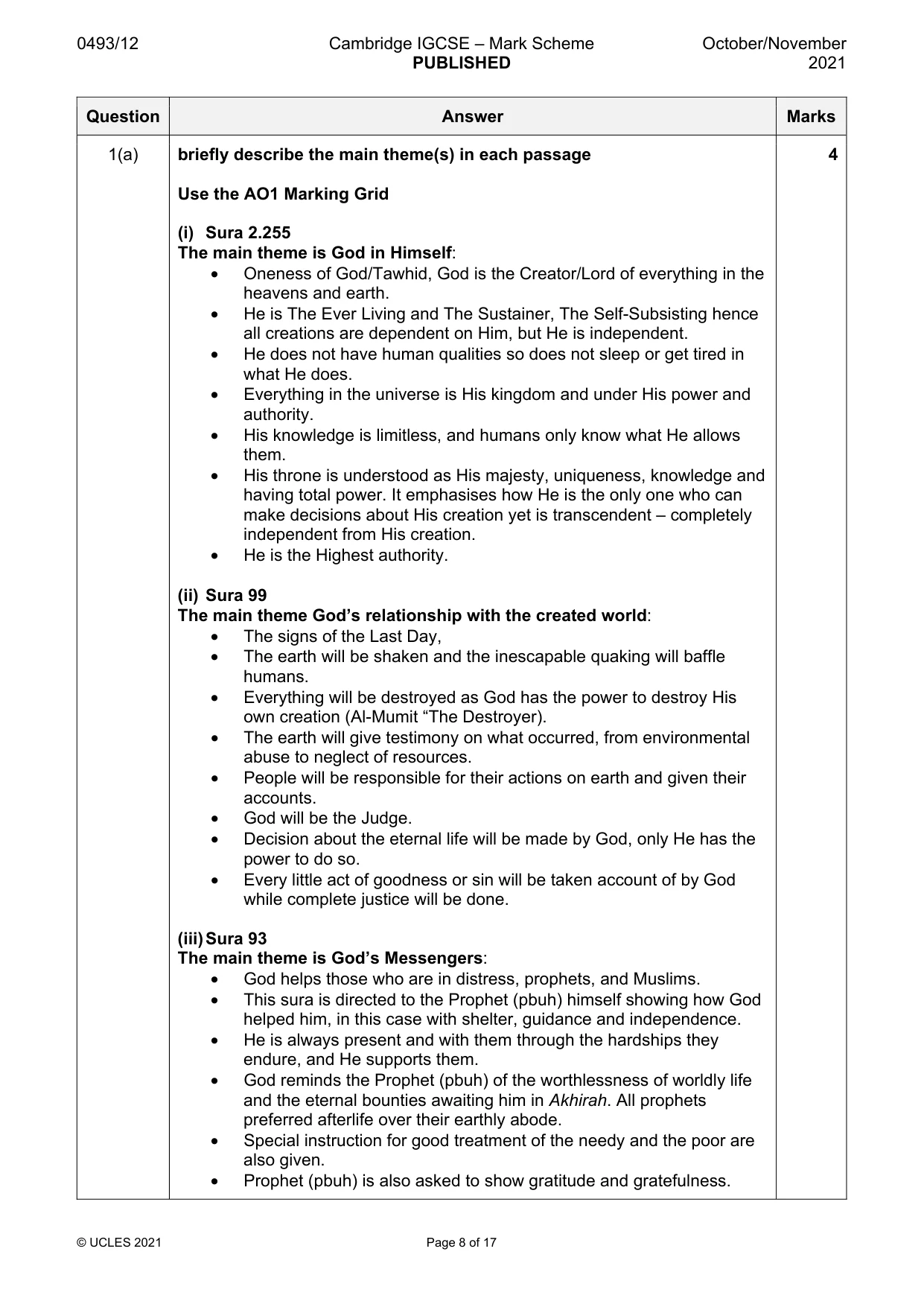
0493/12 Cambridge IGCSE – Mark Scheme PUBLISHED October/November 2021 © UCLES 2021 Page 8 of 17 Question Answer Marks 1(a) briefly describe the main theme(s) in each passage Use the AO1 Marking Grid (i) Sura 2.255 The main theme is God in Himself: • Oneness of God/Tawhid, God is the Creator/Lord of everything in the heavens and earth. • He is The Ever Living and The Sustainer, The Self-Subsisting hence all creations are dependent on Him, but He is independent. • He does not have human qualities so does not sleep or get tired in what He does. • Everything in the universe is His kingdom and under His power and authority. • His knowledge is limitless, and humans only know what He allows them. • His throne is understood as His majesty, uniqueness, knowledge and having total power. It emphasises how He is the only one who can make decisions about His creation yet is transcendent – completely independent from His creation. • He is the Highest authority. (ii) Sura 99 The main theme God’s relationship with the created world: • The signs of the Last Day, • The earth will be shaken and the inescapable quaking will baffle humans. • Everything will be destroyed as God has the power to destroy His own creation (Al-Mumit “The Destroyer). • The earth will give testimony on what occurred, from environmental abuse to neglect of resources. • People will be responsible for their actions on earth and given their accounts. • God will be the Judge. • Decision about the eternal life will be made by God, only He has the power to do so. • Every little act of goodness or sin will be taken account of by God while complete justice will be done. (iii) Sura 93 The main theme is God’s Messengers: • God helps those who are in distress, prophets, and Muslims. • This sura is directed to the Prophet (pbuh) himself showing how God helped him, in this case with shelter, guidance and independence. • He is always present and with them through the hardships they endure, and He supports them. • God reminds the Prophet (pbuh) of the worthlessness of worldly life and the eternal bounties awaiting him in Akhirah. All prophets preferred afterlife over their earthly abode. • Special instruction for good treatment of the needy and the poor are also given. • Prophet (pbuh) is also asked to show gratitude and gratefulness. 4
Mark scheme, page 9
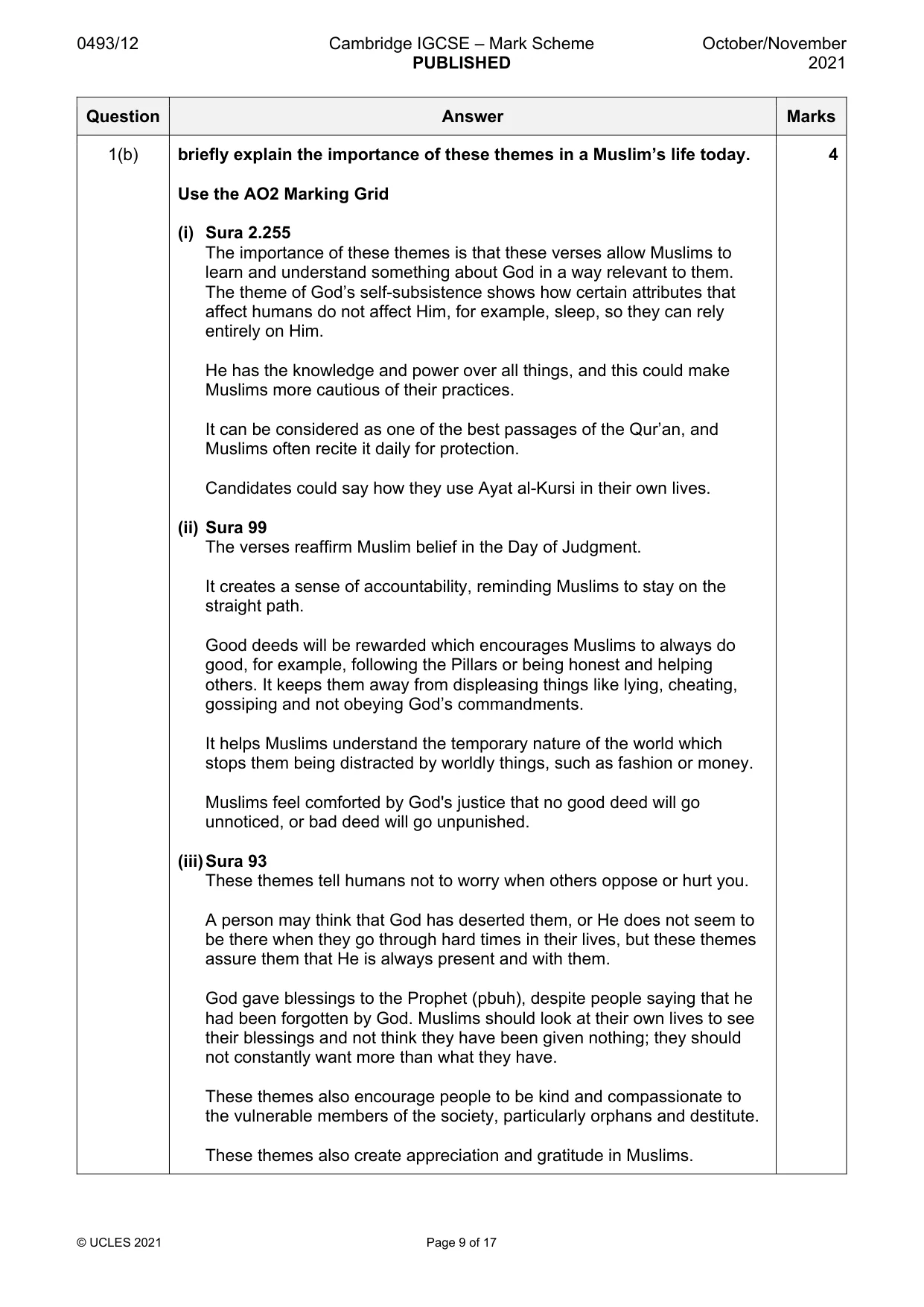
0493/12 Cambridge IGCSE – Mark Scheme PUBLISHED October/November 2021 © UCLES 2021 Page 9 of 17 Question Answer Marks 1(b) briefly explain the importance of these themes in a Muslim’s life today. Use the AO2 Marking Grid (i) Sura 2.255 The importance of these themes is that these verses allow Muslims to learn and understand something about God in a way relevant to them. The theme of God’s self-subsistence shows how certain attributes that affect humans do not affect Him, for example, sleep, so they can rely entirely on Him. He has the knowledge and power over all things, and this could make Muslims more cautious of their practices. It can be considered as one of the best passages of the Qur’an, and Muslims often recite it daily for protection. Candidates could say how they use Ayat al-Kursi in their own lives. (ii) Sura 99 The verses reaffirm Muslim belief in the Day of Judgment. It creates a sense of accountability, reminding Muslims to stay on the straight path. Good deeds will be rewarded which encourages Muslims to always do good, for example, following the Pillars or being honest and helping others. It keeps them away from displeasing things like lying, cheating, gossiping and not obeying God’s commandments. It helps Muslims understand the temporary nature of the world which stops them being distracted by worldly things, such as fashion or money. Muslims feel comforted by God's justice that no good deed will go unnoticed, or bad deed will go unpunished. (iii) Sura 93 These themes tell humans not to worry when others oppose or hurt you. A person may think that God has deserted them, or He does not seem to be there when they go through hard times in their lives, but these themes assure them that He is always present and with them. God gave blessings to the Prophet (pbuh), despite people saying that he had been forgotten by God. Muslims should look at their own lives to see their blessings and not think they have been given nothing; they should not constantly want more than what they have. These themes also encourage people to be kind and compassionate to the vulnerable members of the society, particularly orphans and destitute. These themes also create appreciation and gratitude in Muslims. 4
Mark scheme, page 10
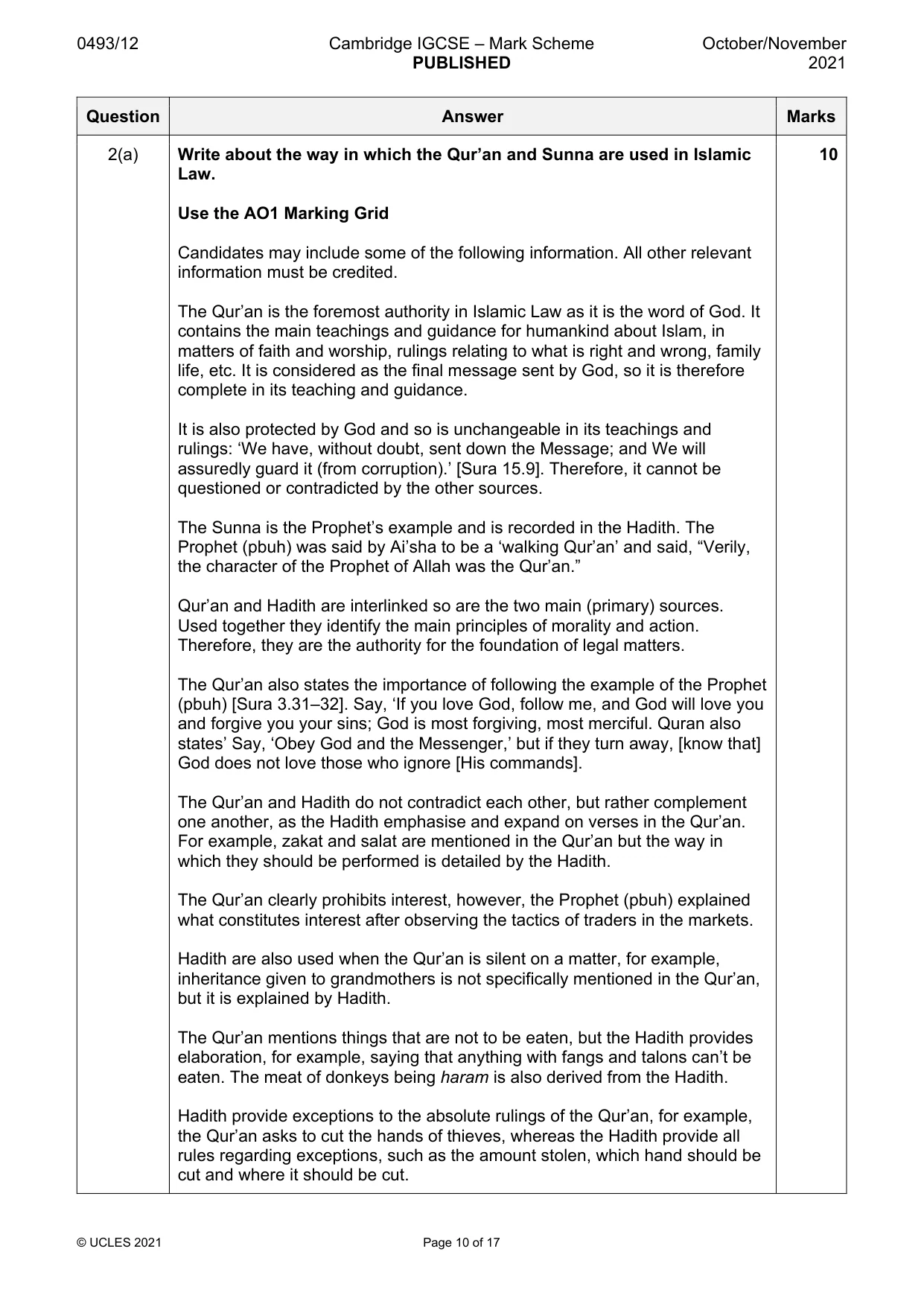
0493/12 Cambridge IGCSE – Mark Scheme PUBLISHED October/November 2021 © UCLES 2021 Page 10 of 17 Question Answer Marks 2(a) Write about the way in which the Qur’an and Sunna are used in Islamic Law. Use the AO1 Marking Grid Candidates may include some of the following information. All other relevant information must be credited. The Qur’an is the foremost authority in Islamic Law as it is the word of God. It contains the main teachings and guidance for humankind about Islam, in matters of faith and worship, rulings relating to what is right and wrong, family life, etc. It is considered as the final message sent by God, so it is therefore complete in its teaching and guidance. It is also protected by God and so is unchangeable in its teachings and rulings: ‘We have, without doubt, sent down the Message; and We will assuredly guard it (from corruption).’ [Sura 15.9]. Therefore, it cannot be questioned or contradicted by the other sources. The Sunna is the Prophet’s example and is recorded in the Hadith. The Prophet (pbuh) was said by Ai’sha to be a ‘walking Qur’an’ and said, “Verily, the character of the Prophet of Allah was the Qur’an.” Qur’an and Hadith are interlinked so are the two main (primary) sources. Used together they identify the main principles of morality and action. Therefore, they are the authority for the foundation of legal matters. The Qur’an also states the importance of following the example of the Prophet (pbuh) [Sura 3.31–32]. Say, ‘If you love God, follow me, and God will love you and forgive you your sins; God is most forgiving, most merciful. Quran also states’ Say, ‘Obey God and the Messenger,’ but if they turn away, [know that] God does not love those who ignore [His commands]. The Qur’an and Hadith do not contradict each other, but rather complement one another, as the Hadith emphasise and expand on verses in the Qur’an. For example, zakat and salat are mentioned in the Qur’an but the way in which they should be performed is detailed by the Hadith. The Qur’an clearly prohibits interest, however, the Prophet (pbuh) explained what constitutes interest after observing the tactics of traders in the markets. Hadith are also used when the Qur’an is silent on a matter, for example, inheritance given to grandmothers is not specifically mentioned in the Qur’an, but it is explained by Hadith. The Qur’an mentions things that are not to be eaten, but the Hadith provides elaboration, for example, saying that anything with fangs and talons can’t be eaten. The meat of donkeys being haram is also derived from the Hadith. Hadith provide exceptions to the absolute rulings of the Qur’an, for example, the Qur’an asks to cut the hands of thieves, whereas the Hadith provide all rules regarding exceptions, such as the amount stolen, which hand should be cut and where it should be cut. 10
Mark scheme, page 11
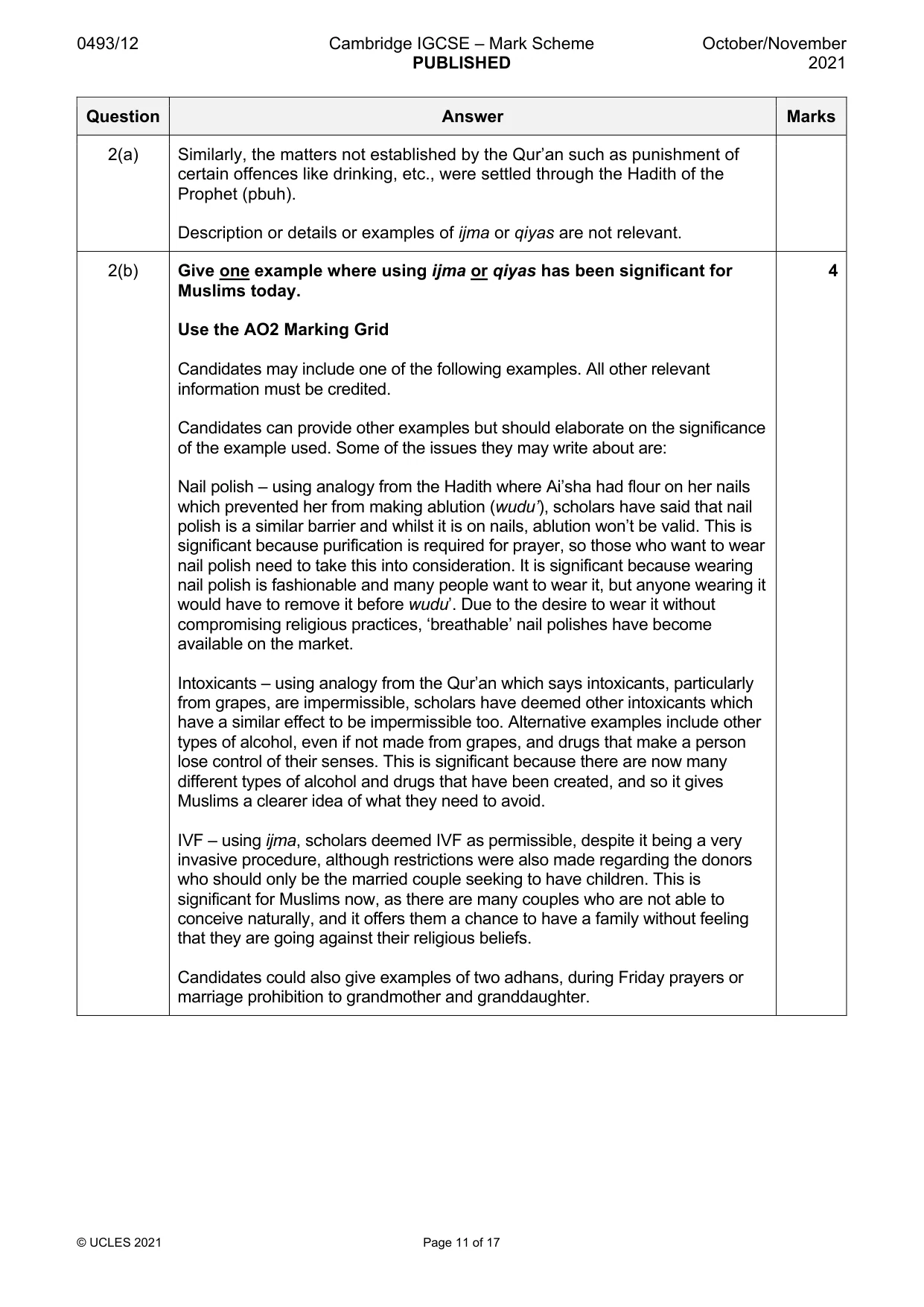
0493/12 Cambridge IGCSE – Mark Scheme PUBLISHED October/November 2021 © UCLES 2021 Page 11 of 17 Question Answer Marks 2(a) Similarly, the matters not established by the Qur’an such as punishment of certain offences like drinking, etc., were settled through the Hadith of the Prophet (pbuh). Description or details or examples of ijma or qiyas are not relevant. 2(b) Give one example where using ijma or qiyas has been significant for Muslims today. Use the AO2 Marking Grid Candidates may include one of the following examples. All other relevant information must be credited. Candidates can provide other examples but should elaborate on the significance of the example used. Some of the issues they may write about are: Nail polish – using analogy from the Hadith where Ai’sha had flour on her nails which prevented her from making ablution (wudu’), scholars have said that nail polish is a similar barrier and whilst it is on nails, ablution won’t be valid. This is significant because purification is required for prayer, so those who want to wear nail polish need to take this into consideration. It is significant because wearing nail polish is fashionable and many people want to wear it, but anyone wearing it would have to remove it before wudu’. Due to the desire to wear it without compromising religious practices, ‘breathable’ nail polishes have become available on the market. Intoxicants – using analogy from the Qur’an which says intoxicants, particularly from grapes, are impermissible, scholars have deemed other intoxicants which have a similar effect to be impermissible too. Alternative examples include other types of alcohol, even if not made from grapes, and drugs that make a person lose control of their senses. This is significant because there are now many different types of alcohol and drugs that have been created, and so it gives Muslims a clearer idea of what they need to avoid. IVF – using ijma, scholars deemed IVF as permissible, despite it being a very invasive procedure, although restrictions were also made regarding the donors who should only be the married couple seeking to have children. This is significant for Muslims now, as there are many couples who are not able to conceive naturally, and it offers them a chance to have a family without feeling that they are going against their religious beliefs. Candidates could also give examples of two adhans, during Friday prayers or marriage prohibition to grandmother and granddaughter. 4
Mark scheme, page 12
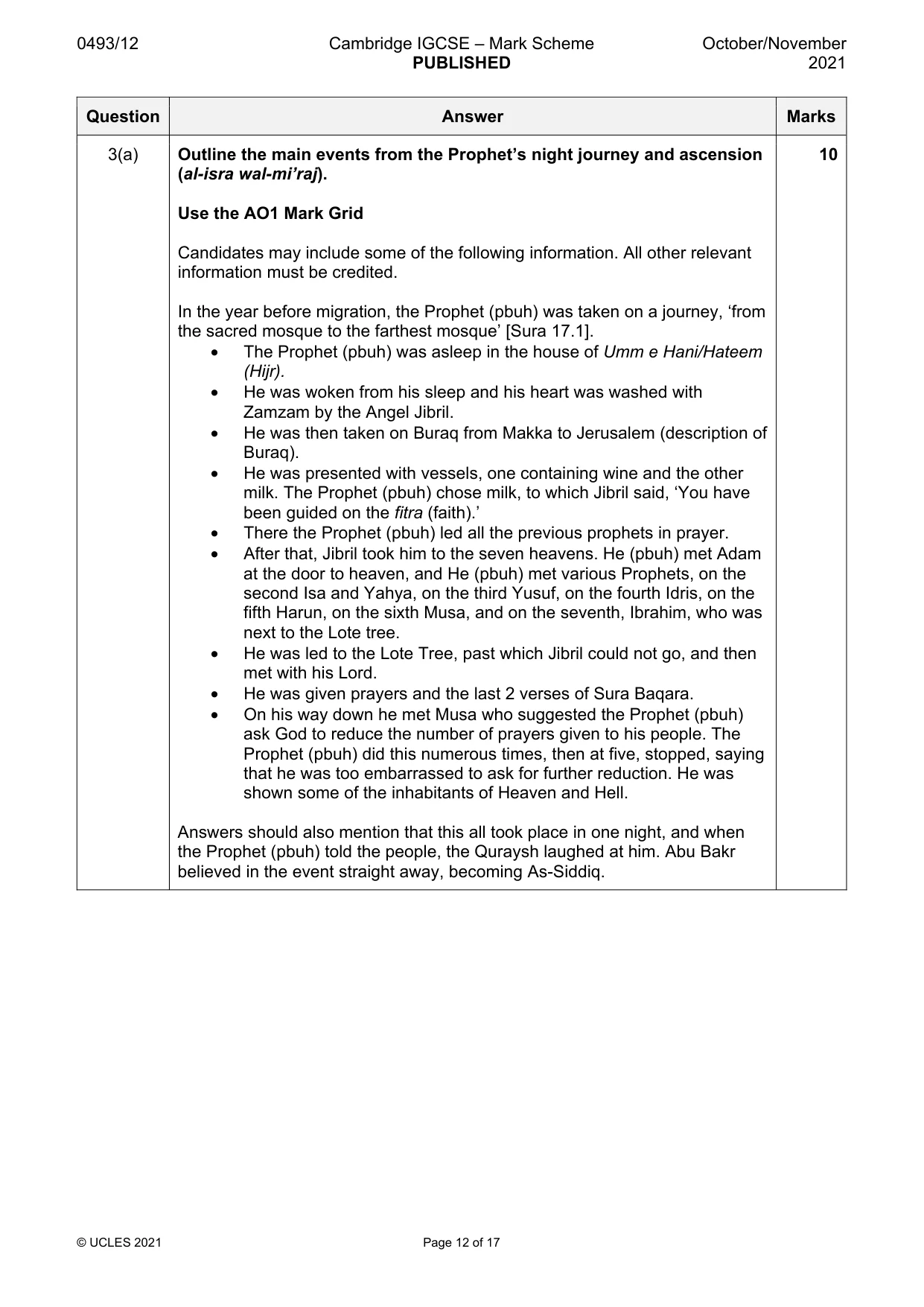
0493/12 Cambridge IGCSE – Mark Scheme PUBLISHED October/November 2021 © UCLES 2021 Page 12 of 17 Question Answer Marks 3(a) Outline the main events from the Prophet’s night journey and ascension (al-isra wal-mi’raj). Use the AO1 Mark Grid Candidates may include some of the following information. All other relevant information must be credited. In the year before migration, the Prophet (pbuh) was taken on a journey, ‘from the sacred mosque to the farthest mosque’ [Sura 17.1]. • The Prophet (pbuh) was asleep in the house of Umm e Hani/Hateem (Hijr). • He was woken from his sleep and his heart was washed with Zamzam by the Angel Jibril. • He was then taken on Buraq from Makka to Jerusalem (description of Buraq). • He was presented with vessels, one containing wine and the other milk. The Prophet (pbuh) chose milk, to which Jibril said, ‘You have been guided on the fitra (faith).’ • There the Prophet (pbuh) led all the previous prophets in prayer. • After that, Jibril took him to the seven heavens. He (pbuh) met Adam at the door to heaven, and He (pbuh) met various Prophets, on the second Isa and Yahya, on the third Yusuf, on the fourth Idris, on the fifth Harun, on the sixth Musa, and on the seventh, Ibrahim, who was next to the Lote tree. • He was led to the Lote Tree, past which Jibril could not go, and then met with his Lord. • He was given prayers and the last 2 verses of Sura Baqara. • On his way down he met Musa who suggested the Prophet (pbuh) ask God to reduce the number of prayers given to his people. The Prophet (pbuh) did this numerous times, then at five, stopped, saying that he was too embarrassed to ask for further reduction. He was shown some of the inhabitants of Heaven and Hell. Answers should also mention that this all took place in one night, and when the Prophet (pbuh) told the people, the Quraysh laughed at him. Abu Bakr believed in the event straight away, becoming As-Siddiq. 10
Mark scheme, page 13
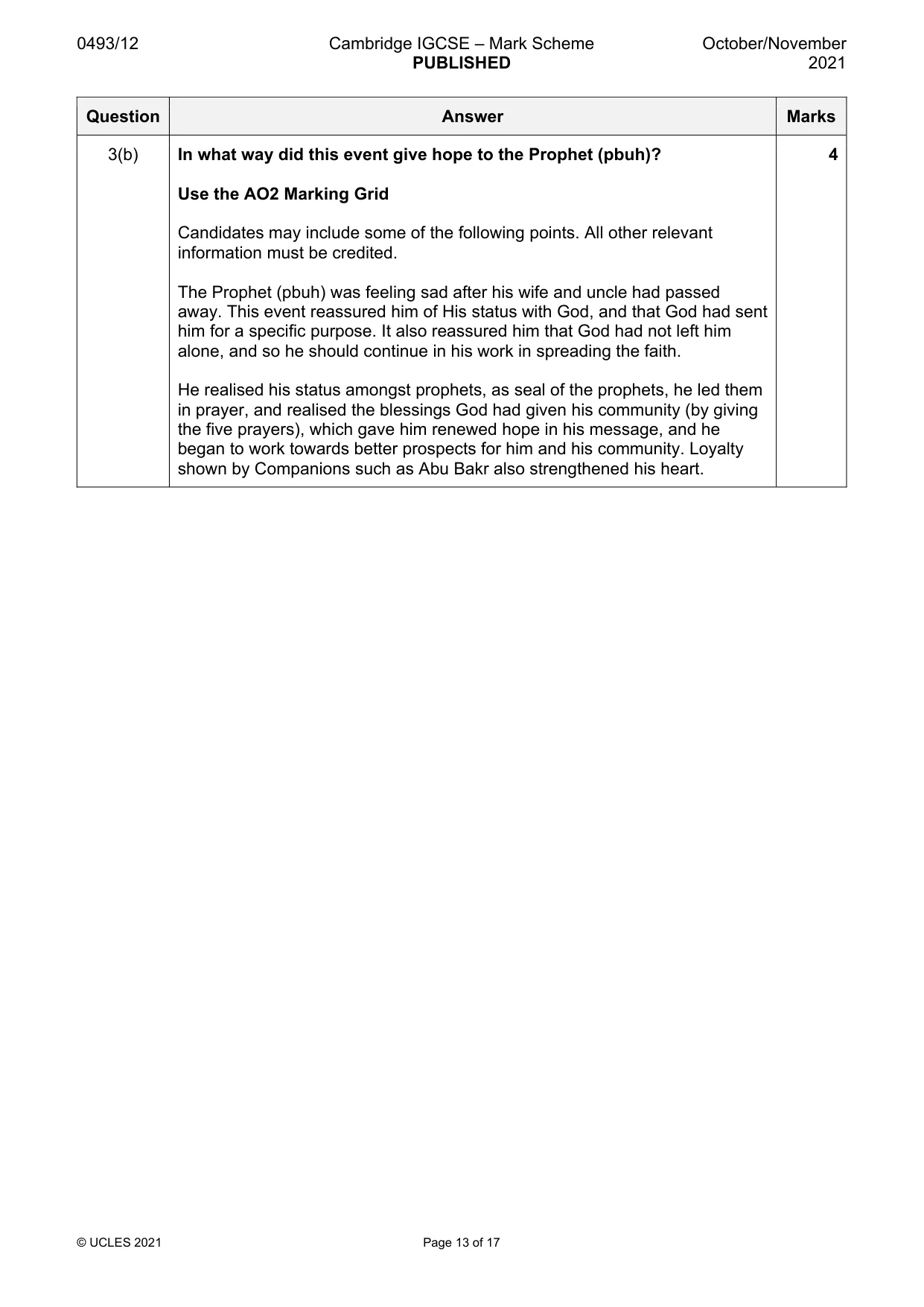
0493/12 Cambridge IGCSE – Mark Scheme PUBLISHED October/November 2021 © UCLES 2021 Page 13 of 17 Question Answer Marks 3(b) In what way did this event give hope to the Prophet (pbuh)? Use the AO2 Marking Grid Candidates may include some of the following points. All other relevant information must be credited. The Prophet (pbuh) was feeling sad after his wife and uncle had passed away. This event reassured him of His status with God, and that God had sent him for a specific purpose. It also reassured him that God had not left him alone, and so he should continue in his work in spreading the faith. He realised his status amongst prophets, as seal of the prophets, he led them in prayer, and realised the blessings God had given his community (by giving the five prayers), which gave him renewed hope in his message, and he began to work towards better prospects for him and his community. Loyalty shown by Companions such as Abu Bakr also strengthened his heart. 4
Mark scheme, page 14
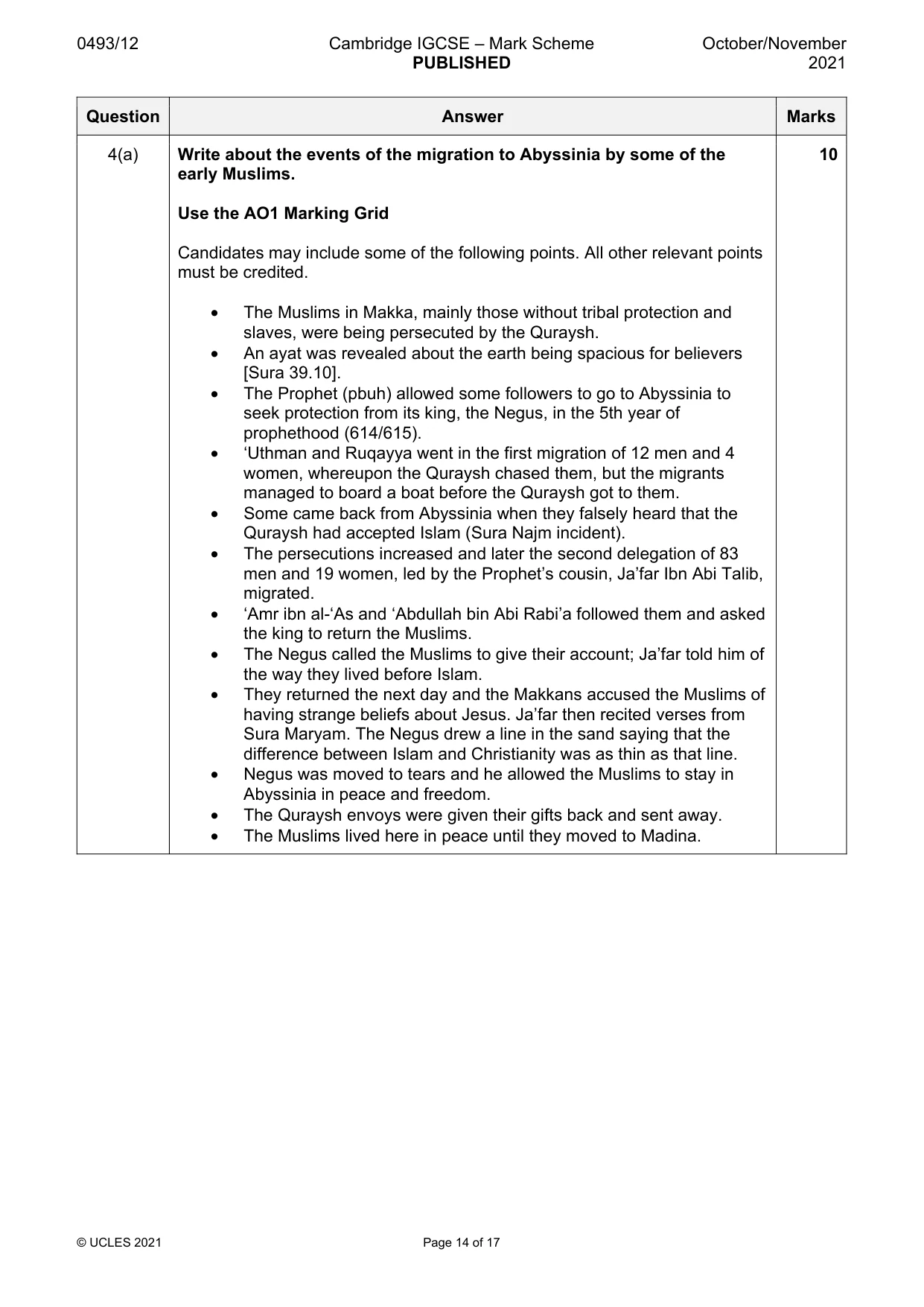
0493/12 Cambridge IGCSE – Mark Scheme PUBLISHED October/November 2021 © UCLES 2021 Page 14 of 17 Question Answer Marks 4(a) Write about the events of the migration to Abyssinia by some of the early Muslims. Use the AO1 Marking Grid Candidates may include some of the following points. All other relevant points must be credited. • The Muslims in Makka, mainly those without tribal protection and slaves, were being persecuted by the Quraysh. • An ayat was revealed about the earth being spacious for believers [Sura 39.10]. • The Prophet (pbuh) allowed some followers to go to Abyssinia to seek protection from its king, the Negus, in the 5th year of prophethood (614/615). • ‘Uthman and Ruqayya went in the first migration of 12 men and 4 women, whereupon the Quraysh chased them, but the migrants managed to board a boat before the Quraysh got to them. • Some came back from Abyssinia when they falsely heard that the Quraysh had accepted Islam (Sura Najm incident). • The persecutions increased and later the second delegation of 83 men and 19 women, led by the Prophet’s cousin, Ja’far Ibn Abi Talib, migrated. • ‘Amr ibn al-‘As and ‘Abdullah bin Abi Rabi’a followed them and asked the king to return the Muslims. • The Negus called the Muslims to give their account; Ja’far told him of the way they lived before Islam. • They returned the next day and the Makkans accused the Muslims of having strange beliefs about Jesus. Ja’far then recited verses from Sura Maryam. The Negus drew a line in the sand saying that the difference between Islam and Christianity was as thin as that line. • Negus was moved to tears and he allowed the Muslims to stay in Abyssinia in peace and freedom. • The Quraysh envoys were given their gifts back and sent away. • The Muslims lived here in peace until they moved to Madina. 10
Mark scheme, page 15
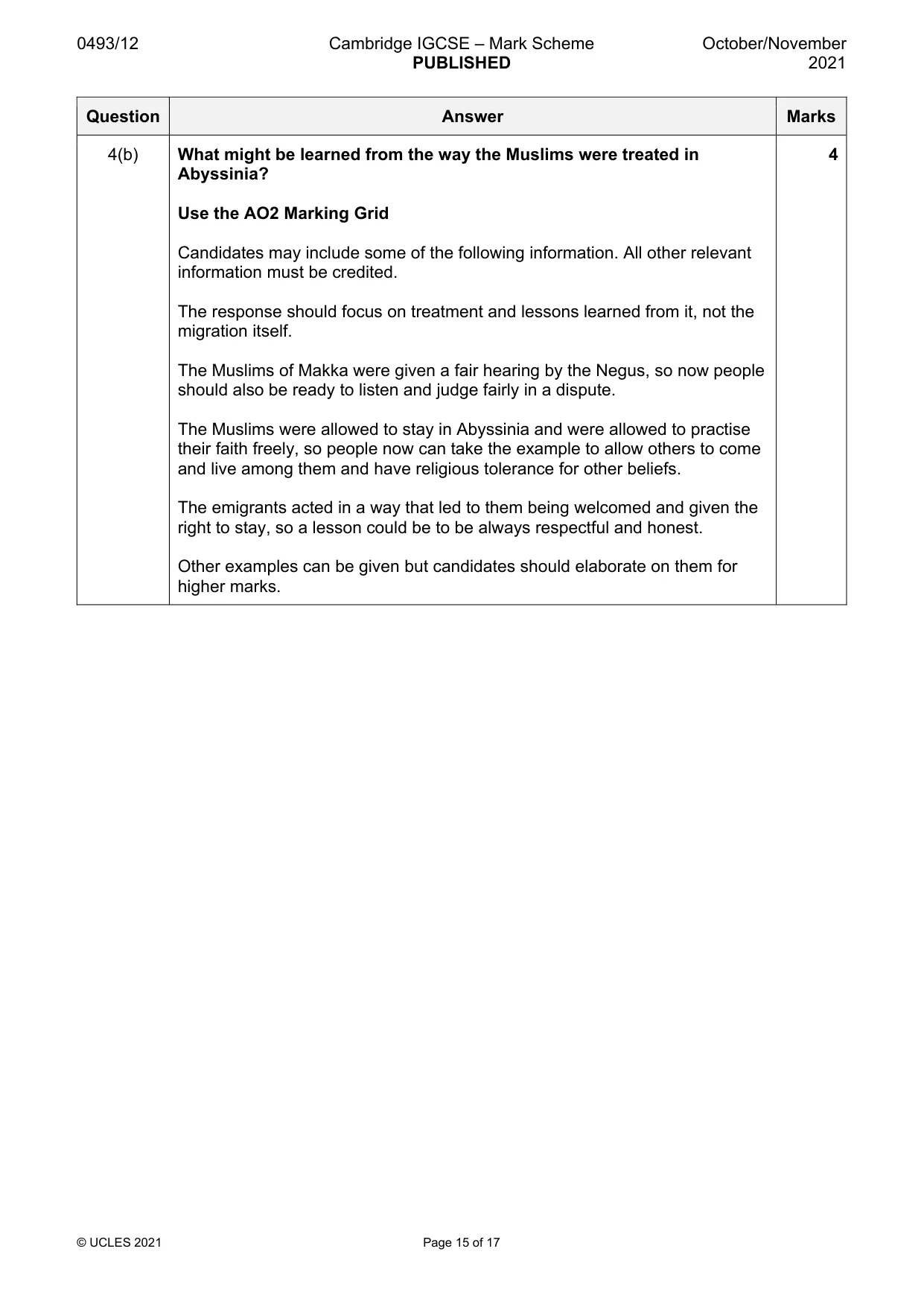
0493/12 Cambridge IGCSE – Mark Scheme PUBLISHED October/November 2021 © UCLES 2021 Page 15 of 17 Question Answer Marks 4(b) What might be learned from the way the Muslims were treated in Abyssinia? Use the AO2 Marking Grid Candidates may include some of the following information. All other relevant information must be credited. The response should focus on treatment and lessons learned from it, not the migration itself. The Muslims of Makka were given a fair hearing by the Negus, so now people should also be ready to listen and judge fairly in a dispute. The Muslims were allowed to stay in Abyssinia and were allowed to practise their faith freely, so people now can take the example to allow others to come and live among them and have religious tolerance for other beliefs. The emigrants acted in a way that led to them being welcomed and given the right to stay, so a lesson could be to be always respectful and honest. Other examples can be given but candidates should elaborate on them for higher marks. 4
Mark scheme, page 16
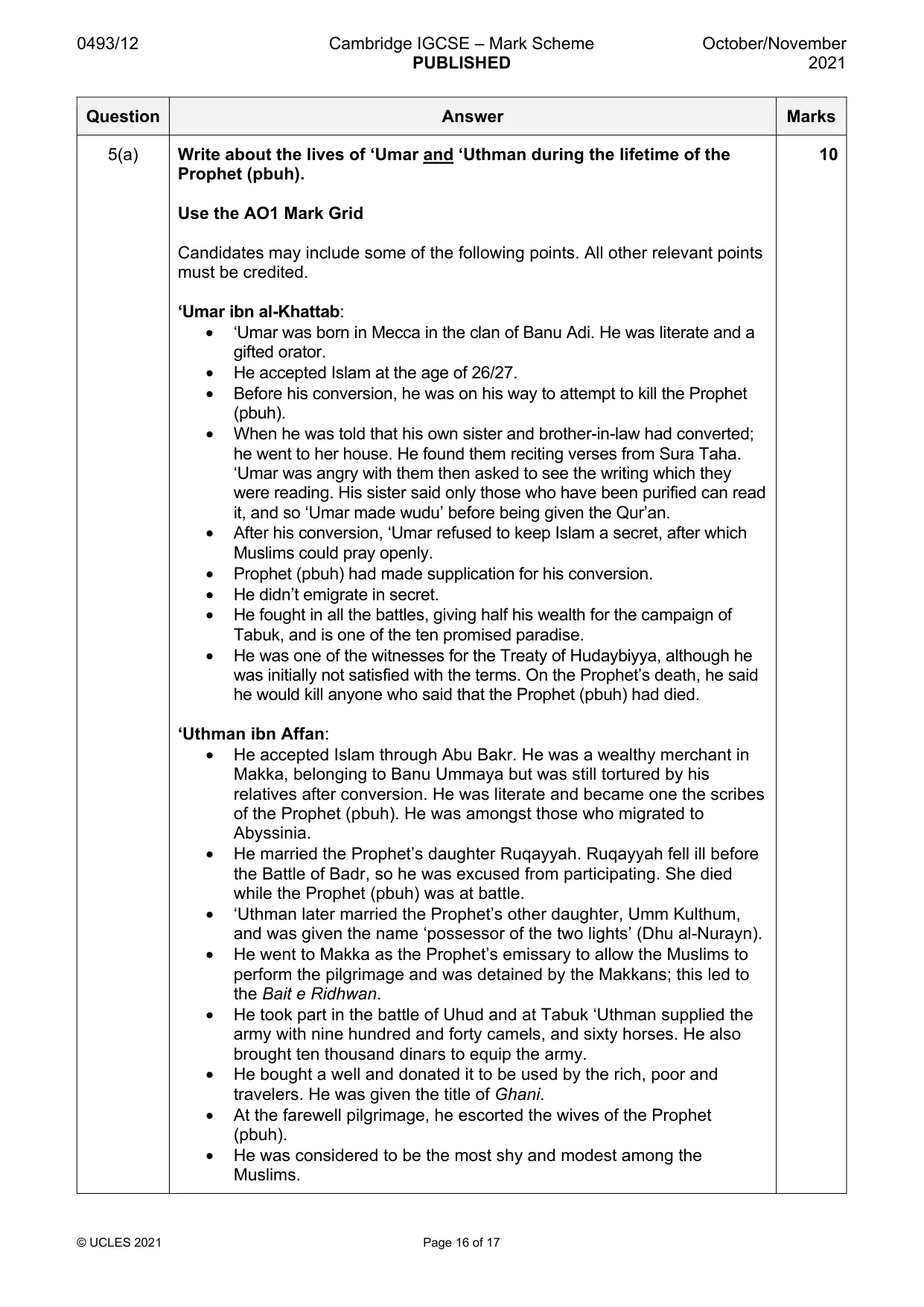
0493/12 Cambridge IGCSE – Mark Scheme PUBLISHED October/November 2021 © UCLES 2021 Page 16 of 17 Question Answer Marks 5(a) Write about the lives of ‘Umar and ‘Uthman during the lifetime of the Prophet (pbuh). Use the AO1 Mark Grid Candidates may include some of the following points. All other relevant points must be credited. ‘Umar ibn al-Khattab: • ‘Umar was born in Mecca in the clan of Banu Adi. He was literate and a gifted orator. • He accepted Islam at the age of 26/27. • Before his conversion, he was on his way to attempt to kill the Prophet (pbuh). • When he was told that his own sister and brother-in-law had converted; he went to her house. He found them reciting verses from Sura Taha. ‘Umar was angry with them then asked to see the writing which they were reading. His sister said only those who have been purified can read it, and so ‘Umar made wudu’ before being given the Qur’an. • After his conversion, ‘Umar refused to keep Islam a secret, after which Muslims could pray openly. • Prophet (pbuh) had made supplication for his conversion. • He didn’t emigrate in secret. • He fought in all the battles, giving half his wealth for the campaign of Tabuk, and is one of the ten promised paradise. • He was one of the witnesses for the Treaty of Hudaybiyya, although he was initially not satisfied with the terms. On the Prophet’s death, he said he would kill anyone who said that the Prophet (pbuh) had died. ‘Uthman ibn Affan: • He accepted Islam through Abu Bakr. He was a wealthy merchant in Makka, belonging to Banu Ummaya but was still tortured by his relatives after conversion. He was literate and became one the scribes of the Prophet (pbuh). He was amongst those who migrated to Abyssinia. • He married the Prophet’s daughter Ruqayyah. Ruqayyah fell ill before the Battle of Badr, so he was excused from participating. She died while the Prophet (pbuh) was at battle. • ‘Uthman later married the Prophet’s other daughter, Umm Kulthum, and was given the name ‘possessor of the two lights’ (Dhu al-Nurayn). • He went to Makka as the Prophet’s emissary to allow the Muslims to perform the pilgrimage and was detained by the Makkans; this led to the Bait e Ridhwan. • He took part in the battle of Uhud and at Tabuk ‘Uthman supplied the army with nine hundred and forty camels, and sixty horses. He also brought ten thousand dinars to equip the army. • He bought a well and donated it to be used by the rich, poor and travelers. He was given the title of Ghani. • At the farewell pilgrimage, he escorted the wives of the Prophet (pbuh). • He was considered to be the most shy and modest among the Muslims. 10
Mark scheme, page 17
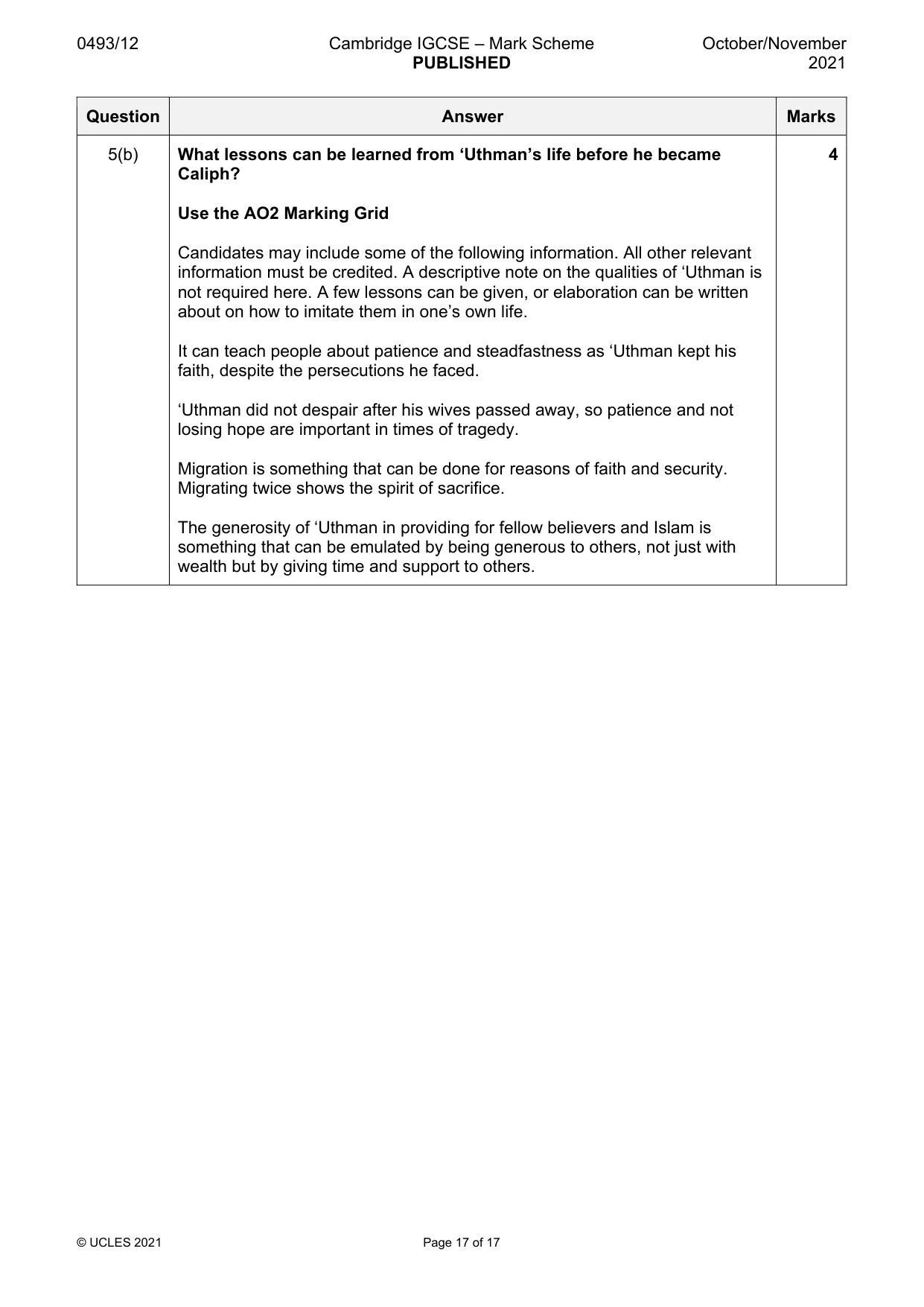
0493/12 Cambridge IGCSE – Mark Scheme PUBLISHED October/November 2021 © UCLES 2021 Page 17 of 17 Question Answer Marks 5(b) What lessons can be learned from ‘Uthman’s life before he became Caliph? Use the AO2 Marking Grid Candidates may include some of the following information. All other relevant information must be credited. A descriptive note on the qualities of ‘Uthman is not required here. A few lessons can be given, or elaboration can be written about on how to imitate them in one’s own life. It can teach people about patience and steadfastness as ‘Uthman kept his faith, despite the persecutions he faced. ‘Uthman did not despair after his wives passed away, so patience and not losing hope are important in times of tragedy. Migration is something that can be done for reasons of faith and security. Migrating twice shows the spirit of sacrifice. The generosity of ‘Uthman in providing for fellow believers and Islam is something that can be emulated by being generous to others, not just with wealth but by giving time and support to others. 4
What you needed in this session
Cambridge’s own grade thresholds for 2021 Oct/Nov, Paper 1 · Variant 2. A higher threshold means an easier paper — the bar moves with how the cohort did.