Cambridge IGCSE Islamiyat 0493 — 2021 Oct/Nov Paper 1 · Variant 1
0493/11/O/N/21 · 50 marks · ≈56 min
The question paper and its mark scheme, free to read here and free to download. This is Cambridge’s own paper, exactly as it was sat.
Question paper20 pages












Mark scheme15 pages
Answers below. Sit the paper first if you are practising.
Paper as text
Question paper, page 1
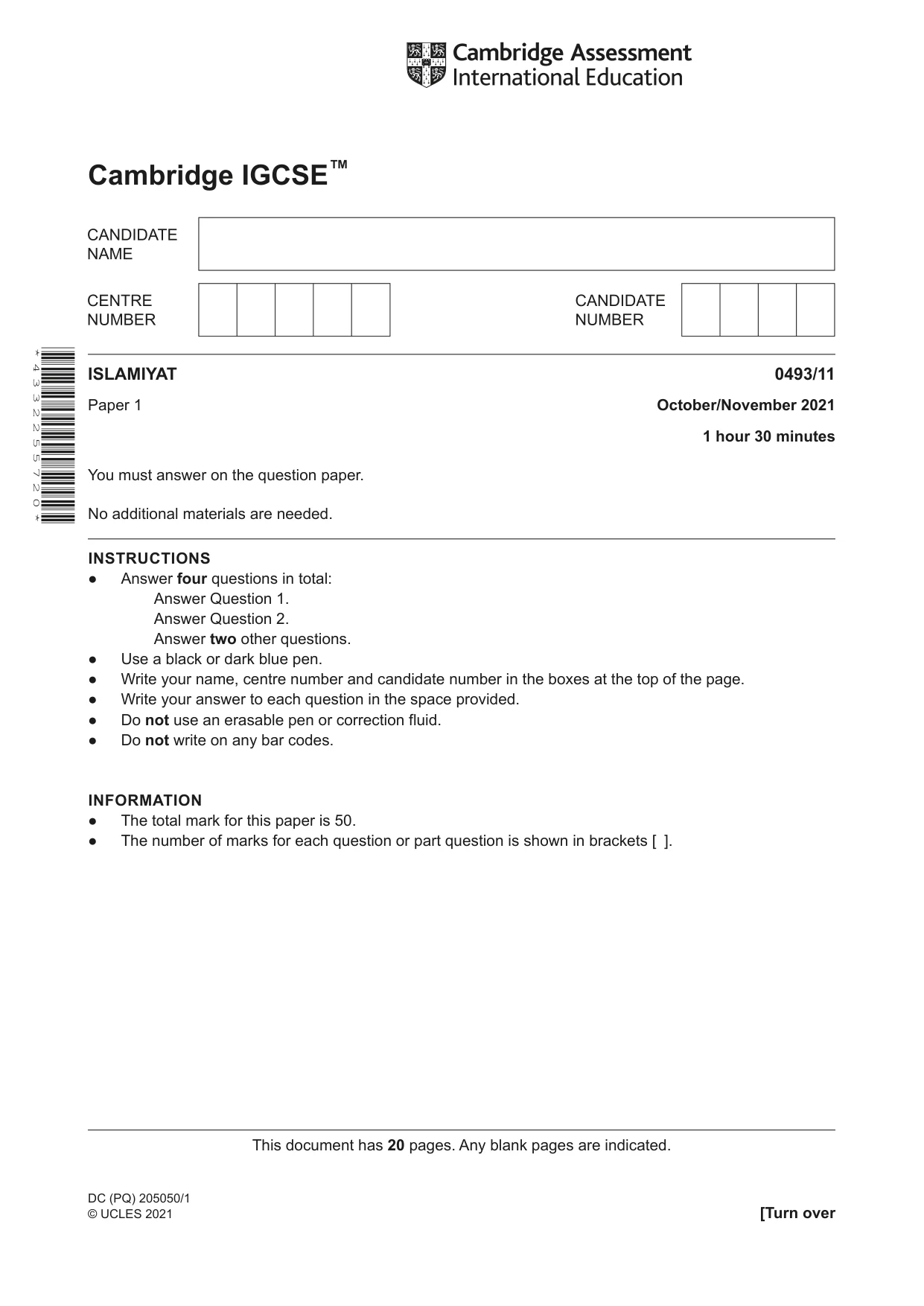
This document has 20 pages. Any blank pages are indicated. Cambridge IGCSE™ DC (PQ) 205050/1 © UCLES 2021 [Turn over * 4 3 3 2 2 5 5 7 2 0 * ISLAMIYAT 0493/11 Paper 1 October/November 2021 1 hour 30 minutes You must answer on the question paper. No additional materials are needed. INSTRUCTIONS ● Answer four questions in total: Answer Question 1. Answer Question 2. Answer two other questions. ● Use a black or dark blue pen. ● Write your name, centre number and candidate number in the boxes at the top of the page. ● Write your answer to each question in the space provided. ● Do not use an erasable pen or correction fluid. ● Do not write on any bar codes. INFORMATION ● The total mark for this paper is 50. ● The number of marks for each question or part question is shown in brackets [ ].
Question paper, page 2
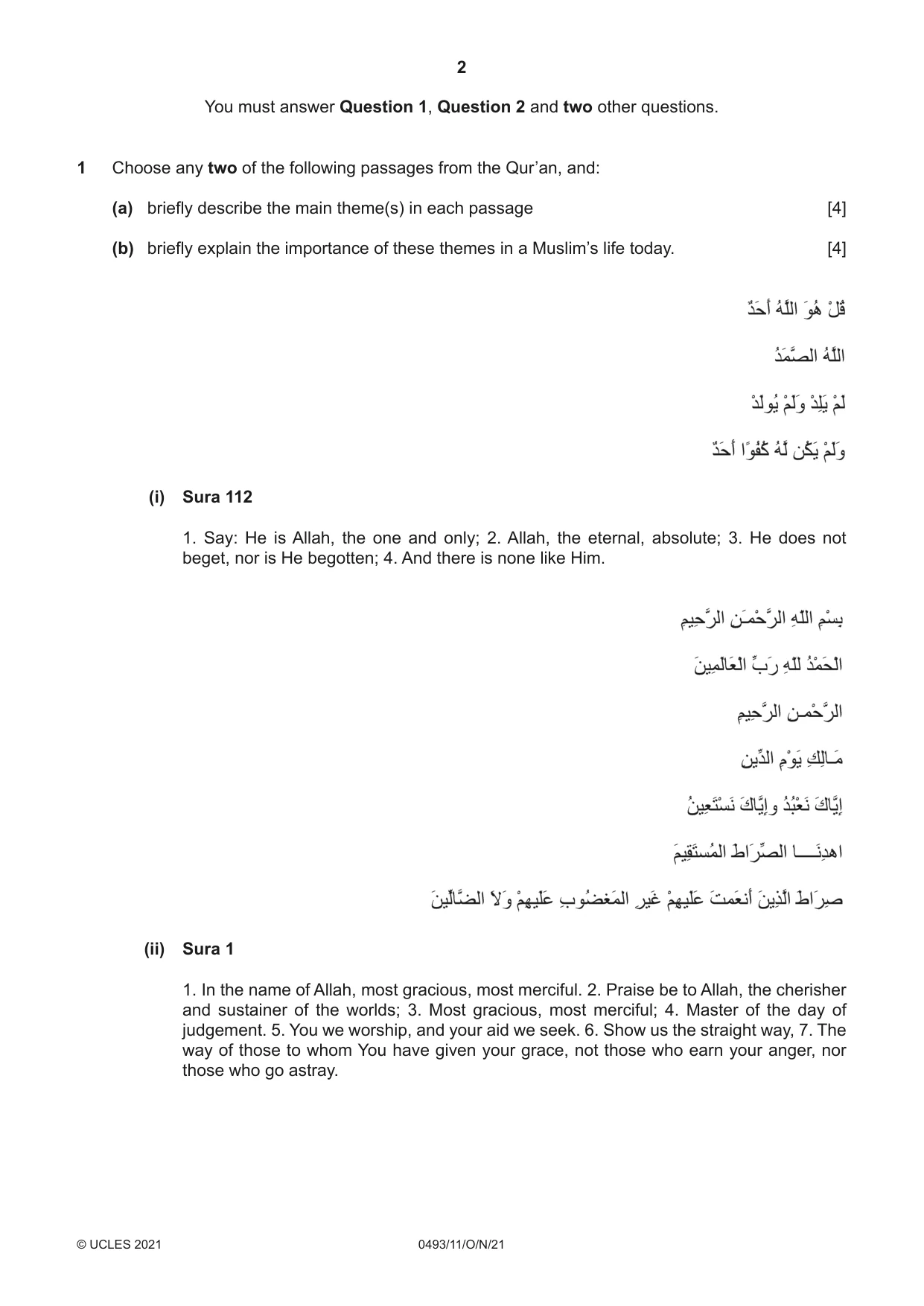
2 0493/11/O/N/21 © UCLES 2021 You must answer Question 1, Question 2 and two other questions. 1 Choose any two of the following passages from the Qur’an, and: (a) briefly describe the main theme(s) in each passage [4] (b) briefly explain the importance of these themes in a Muslim’s life today. [4] (i) Sura 112 1. Say: He is Allah, the one and only; 2. Allah, the eternal, absolute; 3. He does not beget, nor is He begotten; 4. And there is none like Him. (ii) Sura 1 1. In the name of Allah, most gracious, most merciful. 2. Praise be to Allah, the cherisher and sustainer of the worlds; 3. Most gracious, most merciful; 4. Master of the day of judgement. 5. You we worship, and your aid we seek. 6. Show us the straight way, 7. The way of those to whom You have given your grace, not those who earn your anger, nor those who go astray.
Question paper, page 3
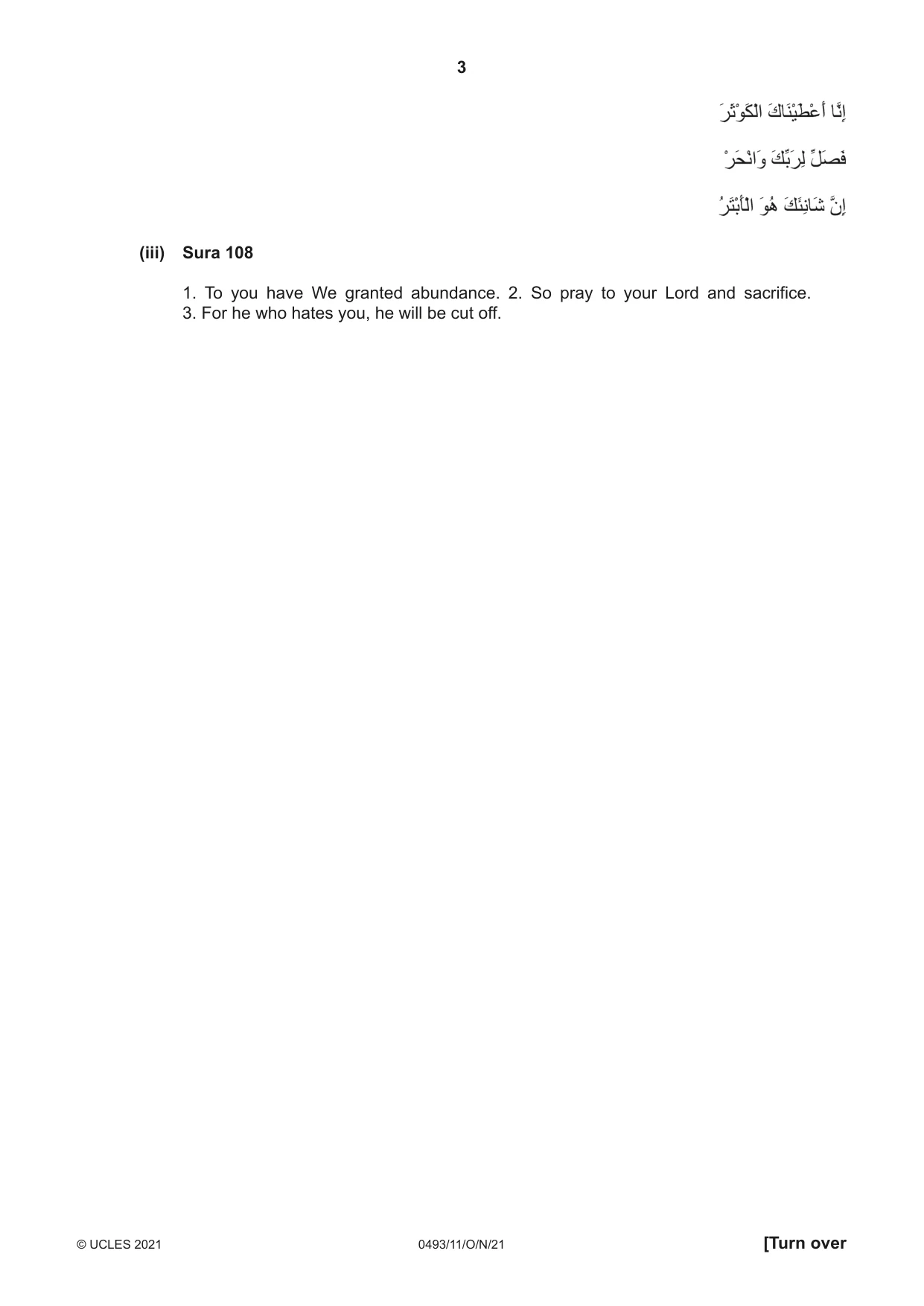
3 0493/11/O/N/21 © UCLES 2021 [Turn over (iii) Sura 108 1. To you have We granted abundance. 2. So pray to your Lord and sacrifice. 3. For he who hates you, he will be cut off.
Question paper, page 4
4 0493/11/O/N/21 © UCLES 2021 … … … … … … … … … … … … … … … … … … … … … … … … … … … …
Question paper, page 5
5 0493/11/O/N/21 © UCLES 2021 [Turn over … … … … … … … … … … … … … … … … … … … … … … … … … … … …
Question paper, page 6
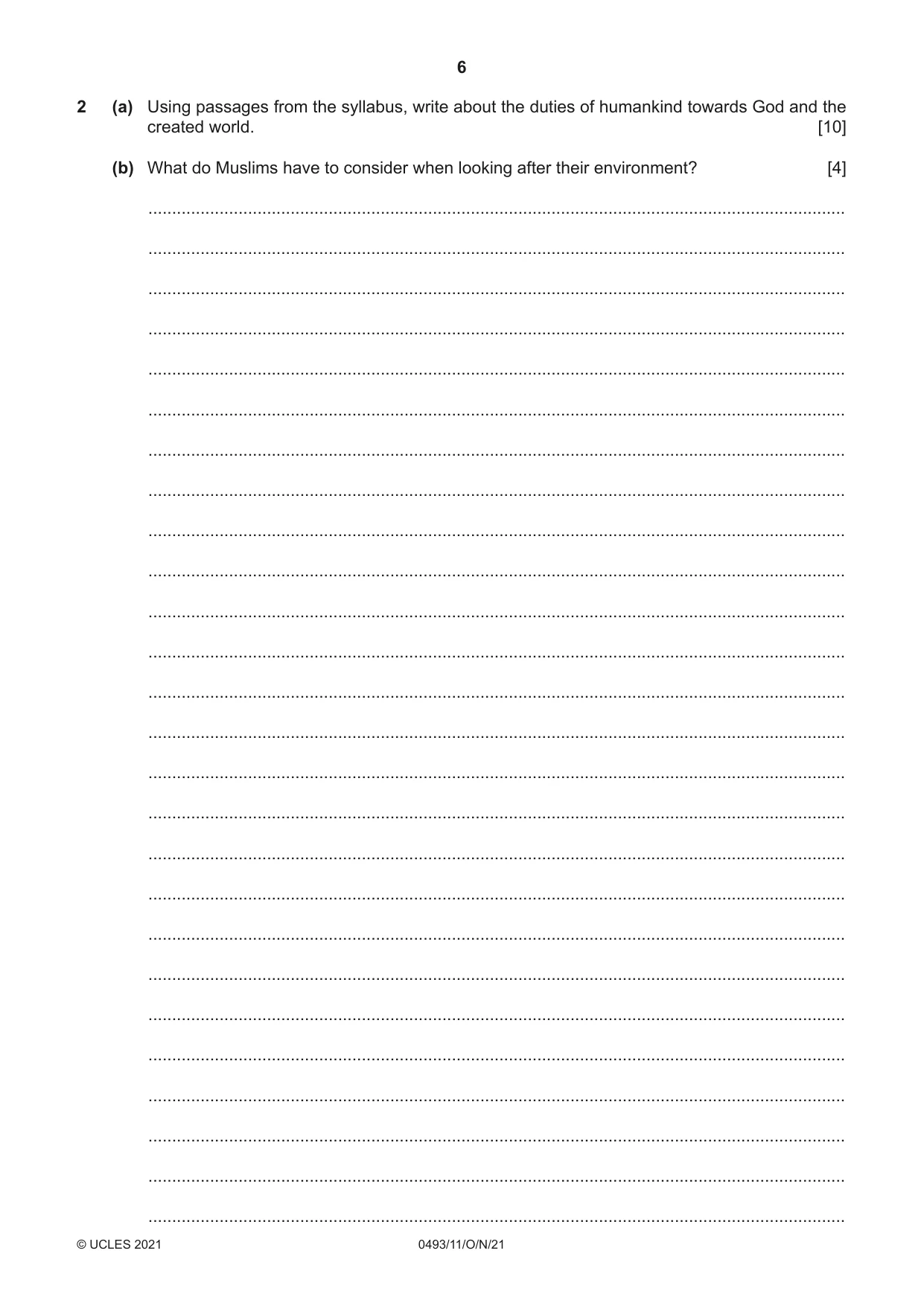
6 0493/11/O/N/21 © UCLES 2021 2 (a) Using passages from the syllabus, write about the duties of humankind towards God and the created world. [10] (b) What do Muslims have to consider when looking after their environment? [4] … … … … … … … … … … … … … … … … … … … … … … … … … …
Question paper, page 7
7 0493/11/O/N/21 © UCLES 2021 [Turn over … … … … … … … … … … … … … … … … … … … … … … … … … … … …
Question paper, page 8
8 0493/11/O/N/21 © UCLES 2021 … … … … … … … … … … … … … … … … … … … … … … … … … … … …
Question paper, page 9
9 0493/11/O/N/21 © UCLES 2021 [Turn over 3 (a) Describe the main events of the Pledges of Aqaba and the details in the Pledges. [10] (b) What might Muslims do to set an example and welcome others who move to their areas? [4] … … … … … … … … … … … … … … … … … … … … … … … … … …
Question paper, page 10
10 0493/11/O/N/21 © UCLES 2021 … … … … … … … … … … … … … … … … … … … … … … … … … … … …
Question paper, page 11
11 0493/11/O/N/21 © UCLES 2021 [Turn over … … … … … … … … … … … … … … … … … … … … … … … … … … … …
Question paper, page 12
12 0493/11/O/N/21 © UCLES 2021 4 (a) Write about the main events of the Battle of Badr. [10] (b) What can the events of the Battle of Badr teach Muslims? [4] … … … … … … … … … … … … … … … … … … … … … … … … … …
Question paper, page 13
13 0493/11/O/N/21 © UCLES 2021 [Turn over … … … … … … … … … … … … … … … … … … … … … … … … … … … …
Question paper, page 14
14 0493/11/O/N/21 © UCLES 2021 … … … … … … … … … … … … … … … … … … … … … … … … … … … …
Question paper, page 15
15 0493/11/O/N/21 © UCLES 2021 [Turn over 5 (a) Write about the lives of two of the following Companions: Salman al-Farsi, Ja’far ibn Abi Talib, Abd al-Rahman ibn Awf. [10] (b) Even when they had wealth, some Companions lived simple lives. How can Muslims show simplicity in their everyday lives? [4] … … … … … … … … … … … … … … … … … … … … … … … … …
Question paper, page 16
16 0493/11/O/N/21 © UCLES 2021 … … … … … … … … … … … … … … … … … … … … … … … … … … … …
Question paper, page 17
17 0493/11/O/N/21 © UCLES 2021 … … … … … … … … … … … … … … … … … … … … … … … … … … … …
Question paper, page 18
18 0493/11/O/N/21 © UCLES 2021 BLANK PAGE
Question paper, page 19
19 0493/11/O/N/21 © UCLES 2021 BLANK PAGE
Question paper, page 20
20 0493/11/O/N/21 © UCLES 2021 BLANK PAGE Permission to reproduce items where third-party owned material protected by copyright is included has been sought and cleared where possible. Every reasonable effort has been made by the publisher (UCLES) to trace copyright holders, but if any items requiring clearance have unwittingly been included, the publisher will be pleased to make amends at the earliest possible opportunity. To avoid the issue of disclosure of answer-related information to candidates, all copyright acknowledgements are reproduced online in the Cambridge Assessment International Education Copyright Acknowledgements Booklet. This is produced for each series of examinations and is freely available to download at www.cambridgeinternational.org after the live examination series. Cambridge Assessment International Education is part of the Cambridge Assessment Group. Cambridge Assessment is the brand name of the University of Cambridge Local Examinations Syndicate (UCLES), which itself is a department of the University of Cambridge.
Mark scheme, page 1
This document consists of 15 printed pages. © UCLES 2021 [Turn over Cambridge IGCSE™ ISLAMIYAT 0493/11 Paper 1 October/November 2021 MARK SCHEME Maximum Mark: 50 Published This mark scheme is published as an aid to teachers and candidates, to indicate the requirements of the examination. It shows the basis on which Examiners were instructed to award marks. It does not indicate the details of the discussions that took place at an Examiners’ meeting before marking began, which would have considered the acceptability of alternative answers. Mark schemes should be read in conjunction with the question paper and the Principal Examiner Report for Teachers. Cambridge International will not enter into discussions about these mark schemes. Cambridge International is publishing the mark schemes for the October/November 2021 series for most Cambridge IGCSE™, Cambridge International A and AS Level components and some Cambridge O Level components.
Mark scheme, page 2
0493/11 Cambridge IGCSE – Mark Scheme PUBLISHED October/November 2021 © UCLES 2021 Page 2 of 15 Generic Marking Principles These general marking principles must be applied by all examiners when marking candidate answers. They should be applied alongside the specific content of the mark scheme or generic level descriptors for a question. Each question paper and mark scheme will also comply with these marking principles. GENERIC MARKING PRINCIPLE 1: Marks must be awarded in line with: • the specific content of the mark scheme or the generic level descriptors for the question • the specific skills defined in the mark scheme or in the generic level descriptors for the question • the standard of response required by a candidate as exemplified by the standardisation scripts. GENERIC MARKING PRINCIPLE 2: Marks awarded are always whole marks (not half marks, or other fractions). GENERIC MARKING PRINCIPLE 3: Marks must be awarded positively: • marks are awarded for correct/valid answers, as defined in the mark scheme. However, credit is given for valid answers which go beyond the scope of the syllabus and mark scheme, referring to your Team Leader as appropriate • marks are awarded when candidates clearly demonstrate what they know and can do • marks are not deducted for errors • marks are not deducted for omissions • answers should only be judged on the quality of spelling, punctuation and grammar when these features are specifically assessed by the question as indicated by the mark scheme. The meaning, however, should be unambiguous. GENERIC MARKING PRINCIPLE 4: Rules must be applied consistently, e.g. in situations where candidates have not followed instructions or in the application of generic level descriptors. GENERIC MARKING PRINCIPLE 5: Marks should be awarded using the full range of marks defined in the mark scheme for the question (however; the use of the full mark range may be limited according to the quality of the candidate responses seen). GENERIC MARKING PRINCIPLE 6: Marks awarded are based solely on the requirements as defined in the mark scheme. Marks should not be awarded with grade thresholds or grade descriptors in mind.
Mark scheme, page 3
0493/11 Cambridge IGCSE – Mark Scheme PUBLISHED October/November 2021 © UCLES 2021 Page 3 of 15 GUIDE TO MARKING IGCSE ISLAMIYAT- 0493 In an examination of this kind, it is impossible to devise a mark scheme that will cover all acceptable answers. This mark scheme provides guidance on what to look out for in the answers given by the candidates. This means that you must be prepared to use discretion in deciding what constitutes an acceptable answer. In order to ensure that all examiners mark at a uniform level, you are expected regularly to discuss your marking with your Team Leader, especially any examples or forms of answer that differ greatly from the agreed mark scheme. Team Leaders are expected to discuss answers with the Principal Examiner. The mark scheme is discussed at the co-ordination meeting. When marking, all examiners are expected to adhere to what has been agreed. GENERAL POINTS Before starting to mark scripts, please ensure that you are familiar with the following: (a) The syllabus (b) The prescribed passages (where appropriate) PRINCIPLES UNDERLYING THE MARK SCHEME Candidates are tested on their ability to satisfy two general Assessment Objectives (AOs): AO1 To recall, select and present relevant facts from the main elements of the faith and history of Islam. Thus AO1 is primarily concerned with knowledge. AO2 To demonstrate understanding of the significance of the selected information in the teachings of Islam and in the lives of Muslims. Thus AO2 is concerned with understanding and evaluation of the material. The paper is marked out of 50. Candidates answer Question 1, Question 2, and any two of the other three questions. Question 1 carries a maximum of 8 marks, and the four other questions carry 14 marks each. In each question, part (a) tests AO1 and earns a maximum of 4 marks in Question 1, and 10 marks in Questions 2–5, while part (b) tests AO2 and earns up to 4 marks in Question 1 and 4 marks in Questions 2–5. Marks are awarded according to the four levels of response for each AO, following the level descriptors detailed below. LEVELS OF RESPONSE The statements which follow should be used to determine the appropriate level of response for each objective. They should be applied as appropriate to the question and as the assessment of the work of an average 16 year old. The guiding principle for Examiners in applying the Mark Scheme to answers is to remember the concept of Positive Awarding. Therefore, marks should be awarded for appropriate responses to reasonable interpretations of the question. In the Mark Scheme there are no instances where answers are specifically excluded or required. What is included is information for Examiners, provided as guidance for what one might reasonably expect to find on a script. All appropriate answers therefore have the potential to be credited. It is perfectly possible for a candidate to achieve the highest level of response using a different argument or different information from that which appears in the Mark Scheme.
Mark scheme, page 4
0493/11 Cambridge IGCSE – Mark Scheme PUBLISHED October/November 2021 © UCLES 2021 Page 4 of 15 It must be assumed that Examiners are capable of answering the questions on the paper and so they can award the appropriate level of response to the candidate. The detailed marking schemes are there as suggestions of what might be found in the answer. Examiners should not check whether the content of the marking schemes is in the answers but rather be guided by the Levels of Response and the concept of Positive Awarding. Checking on what is not in the answer almost always leads to lower marks than are indicated by the Levels of Response. Examiners should use the full range of marks available within the Levels of Response and not hesitate to award the maximum where it is deserved. Examiners must not exceed the total marks allowable for the level achieved or the total allowable for the part of the question.
Mark scheme, page 5
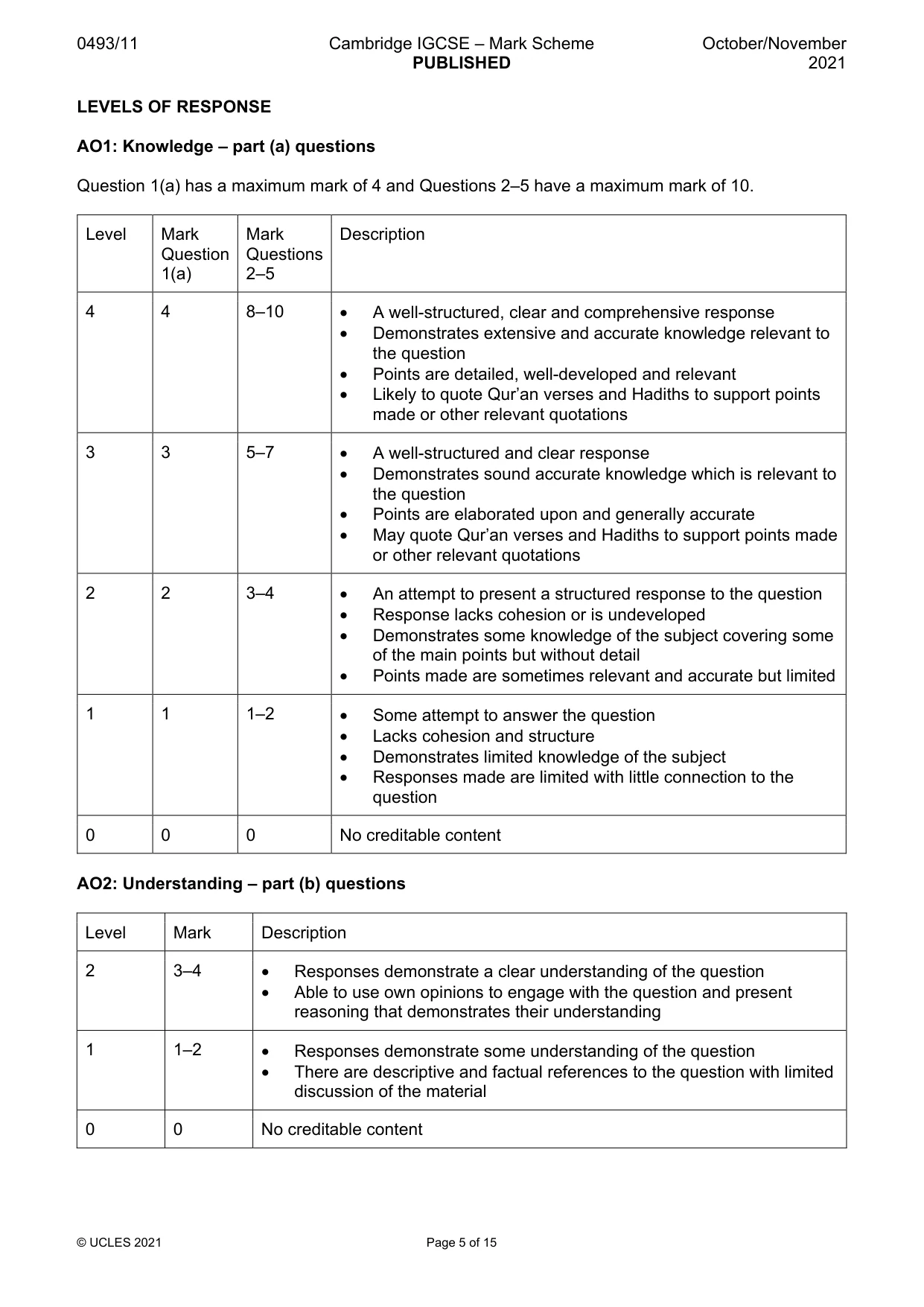
0493/11 Cambridge IGCSE – Mark Scheme PUBLISHED October/November 2021 © UCLES 2021 Page 5 of 15 LEVELS OF RESPONSE AO1: Knowledge – part (a) questions Question 1(a) has a maximum mark of 4 and Questions 2–5 have a maximum mark of 10. Level Mark Question 1(a) Mark Questions 2–5 Description 4 4 8–10 • A well-structured, clear and comprehensive response • Demonstrates extensive and accurate knowledge relevant to the question • Points are detailed, well-developed and relevant • Likely to quote Qur’an verses and Hadiths to support points made or other relevant quotations 3 3 5–7 • A well-structured and clear response • Demonstrates sound accurate knowledge which is relevant to the question • Points are elaborated upon and generally accurate • May quote Qur’an verses and Hadiths to support points made or other relevant quotations 2 2 3–4 • An attempt to present a structured response to the question • Response lacks cohesion or is undeveloped • Demonstrates some knowledge of the subject covering some of the main points but without detail • Points made are sometimes relevant and accurate but limited 1 1 1–2 • Some attempt to answer the question • Lacks cohesion and structure • Demonstrates limited knowledge of the subject • Responses made are limited with little connection to the question 0 0 0 No creditable content AO2: Understanding – part (b) questions Level Mark Description 2 3–4 • Responses demonstrate a clear understanding of the question • Able to use own opinions to engage with the question and present reasoning that demonstrates their understanding 1 1–2 • Responses demonstrate some understanding of the question • There are descriptive and factual references to the question with limited discussion of the material 0 0 No creditable content
Mark scheme, page 6
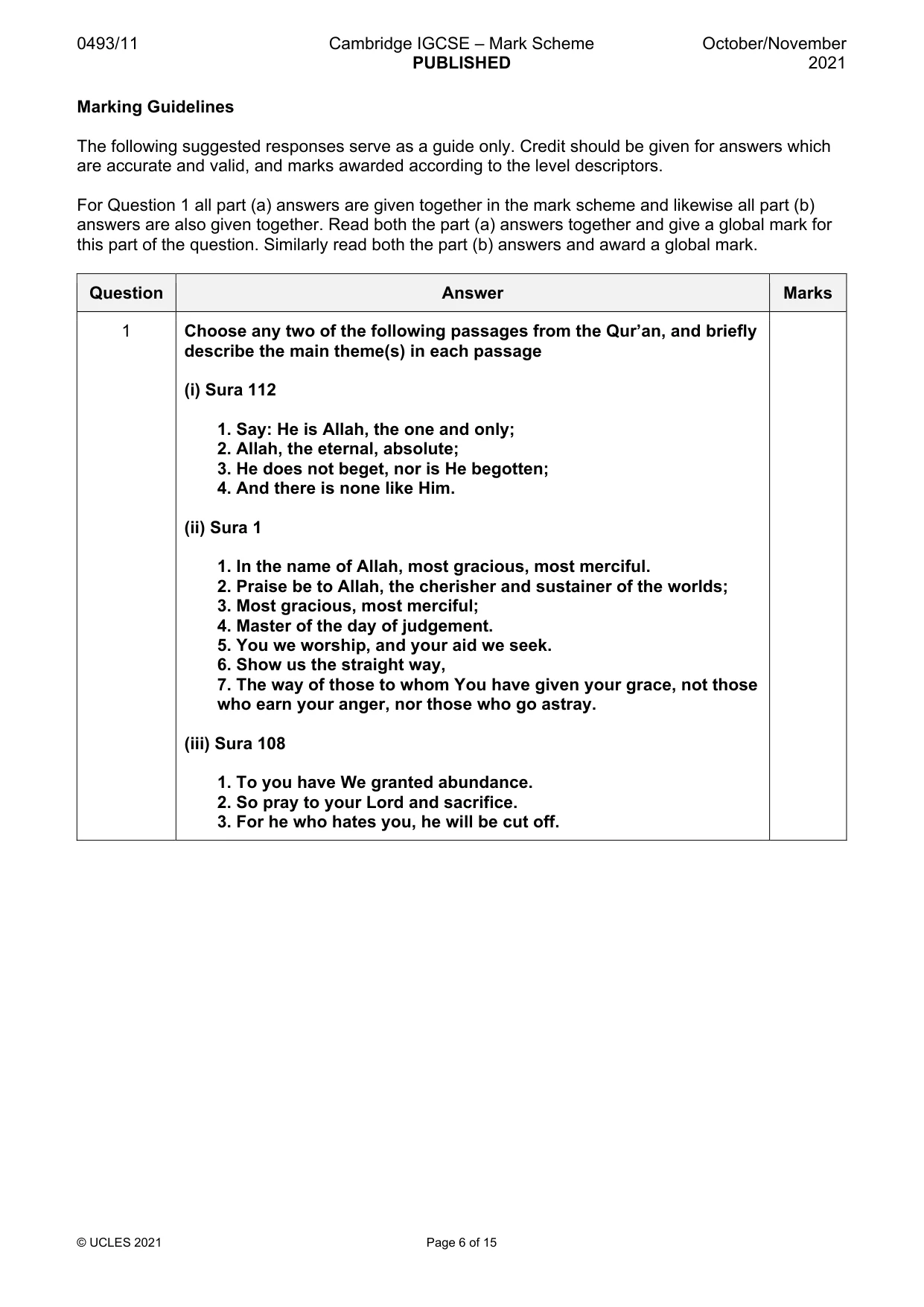
0493/11 Cambridge IGCSE – Mark Scheme PUBLISHED October/November 2021 © UCLES 2021 Page 6 of 15 Marking Guidelines The following suggested responses serve as a guide only. Credit should be given for answers which are accurate and valid, and marks awarded according to the level descriptors. For Question 1 all part (a) answers are given together in the mark scheme and likewise all part (b) answers are also given together. Read both the part (a) answers together and give a global mark for this part of the question. Similarly read both the part (b) answers and award a global mark. Question Answer Marks 1 Choose any two of the following passages from the Qur’an, and briefly describe the main theme(s) in each passage (i) Sura 112 1. Say: He is Allah, the one and only; 2. Allah, the eternal, absolute; 3. He does not beget, nor is He begotten; 4. And there is none like Him. (ii) Sura 1 1. In the name of Allah, most gracious, most merciful. 2. Praise be to Allah, the cherisher and sustainer of the worlds; 3. Most gracious, most merciful; 4. Master of the day of judgement. 5. You we worship, and your aid we seek. 6. Show us the straight way, 7. The way of those to whom You have given your grace, not those who earn your anger, nor those who go astray. (iii) Sura 108 1. To you have We granted abundance. 2. So pray to your Lord and sacrifice. 3. For he who hates you, he will be cut off.
Mark scheme, page 7
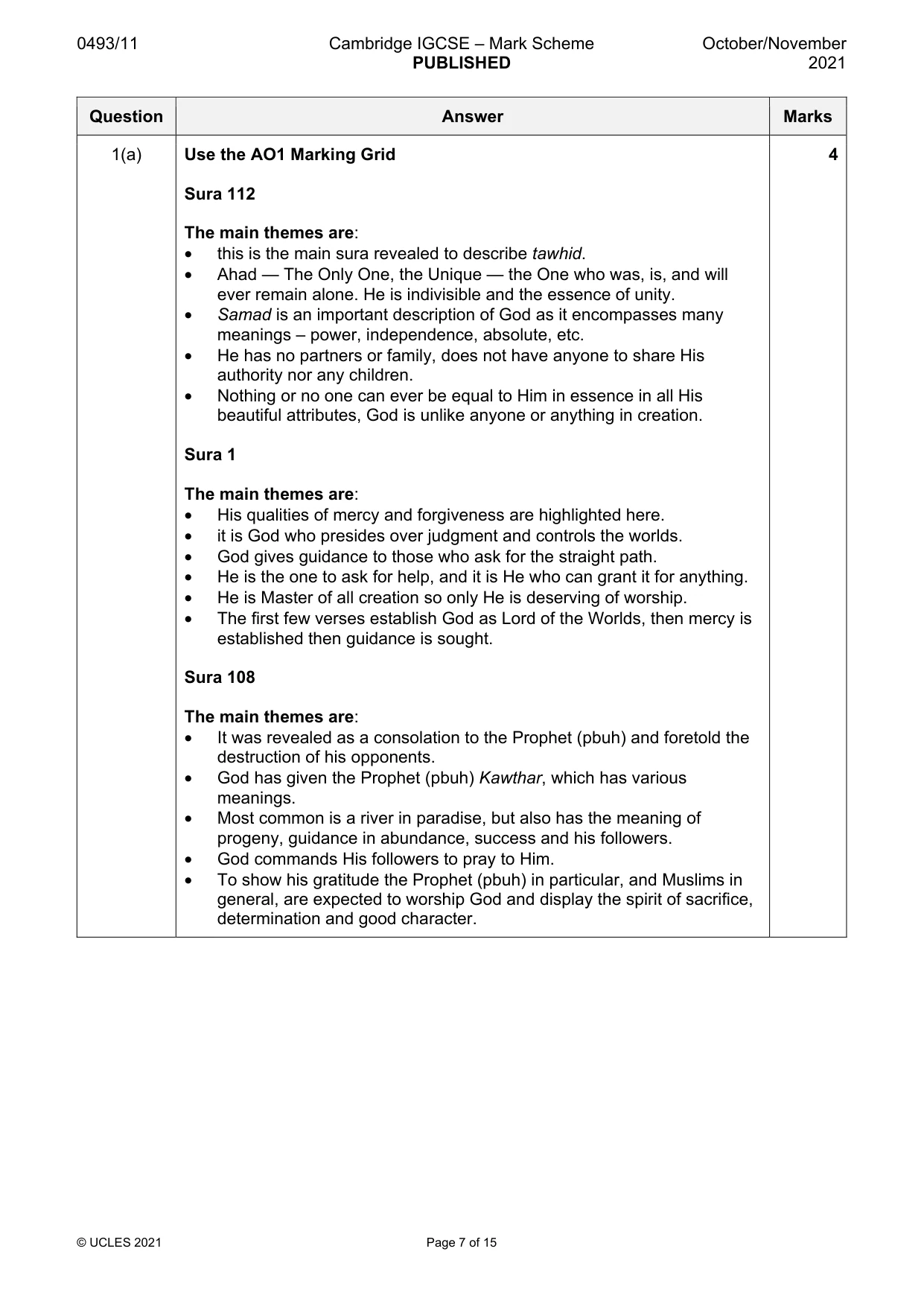
0493/11 Cambridge IGCSE – Mark Scheme PUBLISHED October/November 2021 © UCLES 2021 Page 7 of 15 Question Answer Marks 1(a) Use the AO1 Marking Grid Sura 112 The main themes are: • this is the main sura revealed to describe tawhid. • Ahad — The Only One, the Unique — the One who was, is, and will ever remain alone. He is indivisible and the essence of unity. • Samad is an important description of God as it encompasses many meanings – power, independence, absolute, etc. • He has no partners or family, does not have anyone to share His authority nor any children. • Nothing or no one can ever be equal to Him in essence in all His beautiful attributes, God is unlike anyone or anything in creation. Sura 1 The main themes are: • His qualities of mercy and forgiveness are highlighted here. • it is God who presides over judgment and controls the worlds. • God gives guidance to those who ask for the straight path. • He is the one to ask for help, and it is He who can grant it for anything. • He is Master of all creation so only He is deserving of worship. • The first few verses establish God as Lord of the Worlds, then mercy is established then guidance is sought. Sura 108 The main themes are: • It was revealed as a consolation to the Prophet (pbuh) and foretold the destruction of his opponents. • God has given the Prophet (pbuh) Kawthar, which has various meanings. • Most common is a river in paradise, but also has the meaning of progeny, guidance in abundance, success and his followers. • God commands His followers to pray to Him. • To show his gratitude the Prophet (pbuh) in particular, and Muslims in general, are expected to worship God and display the spirit of sacrifice, determination and good character. 4
Mark scheme, page 8
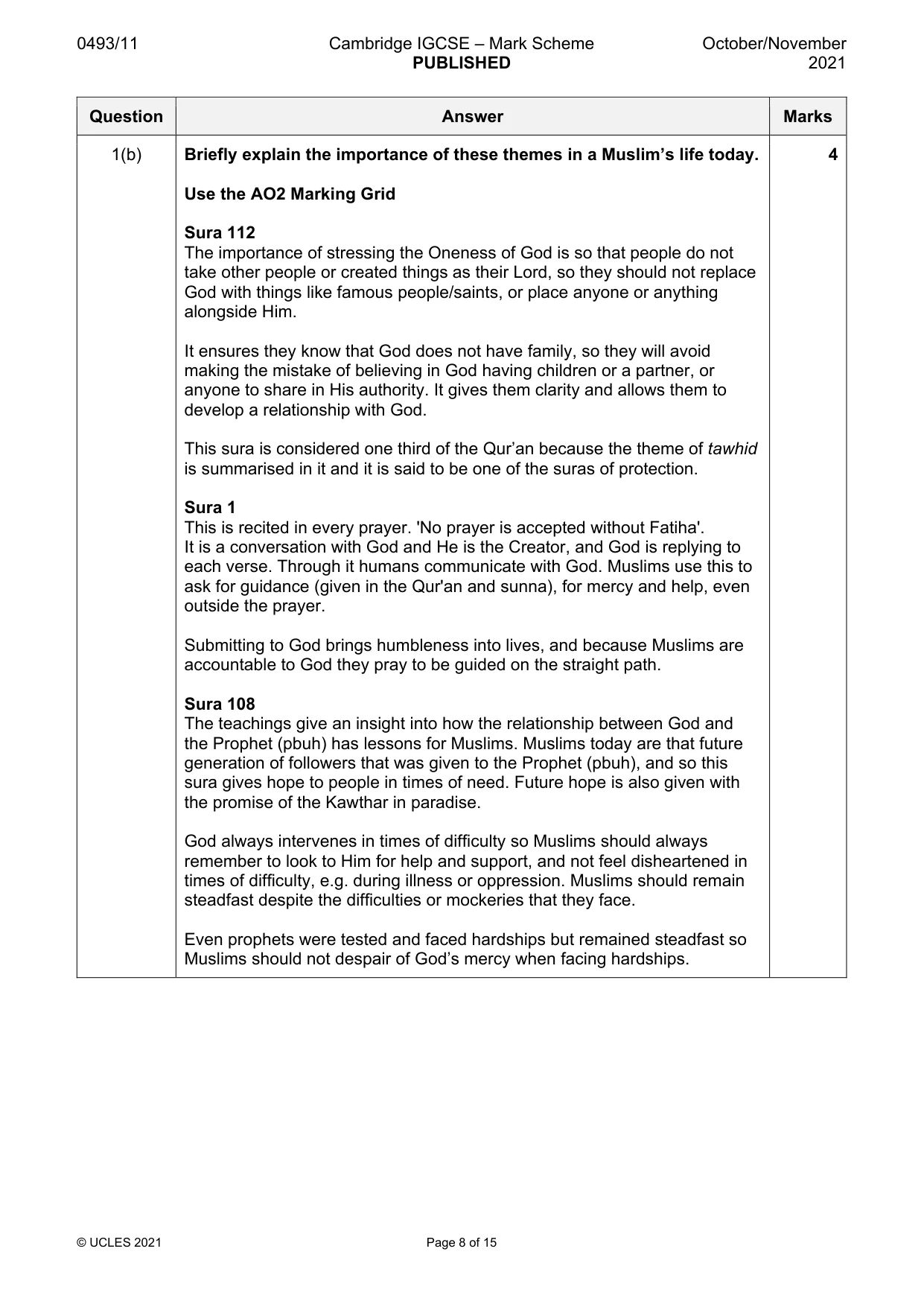
0493/11 Cambridge IGCSE – Mark Scheme PUBLISHED October/November 2021 © UCLES 2021 Page 8 of 15 Question Answer Marks 1(b) Briefly explain the importance of these themes in a Muslim’s life today. Use the AO2 Marking Grid Sura 112 The importance of stressing the Oneness of God is so that people do not take other people or created things as their Lord, so they should not replace God with things like famous people/saints, or place anyone or anything alongside Him. It ensures they know that God does not have family, so they will avoid making the mistake of believing in God having children or a partner, or anyone to share in His authority. It gives them clarity and allows them to develop a relationship with God. This sura is considered one third of the Qur’an because the theme of tawhid is summarised in it and it is said to be one of the suras of protection. Sura 1 This is recited in every prayer. 'No prayer is accepted without Fatiha'. It is a conversation with God and He is the Creator, and God is replying to each verse. Through it humans communicate with God. Muslims use this to ask for guidance (given in the Qur'an and sunna), for mercy and help, even outside the prayer. Submitting to God brings humbleness into lives, and because Muslims are accountable to God they pray to be guided on the straight path. Sura 108 The teachings give an insight into how the relationship between God and the Prophet (pbuh) has lessons for Muslims. Muslims today are that future generation of followers that was given to the Prophet (pbuh), and so this sura gives hope to people in times of need. Future hope is also given with the promise of the Kawthar in paradise. God always intervenes in times of difficulty so Muslims should always remember to look to Him for help and support, and not feel disheartened in times of difficulty, e.g. during illness or oppression. Muslims should remain steadfast despite the difficulties or mockeries that they face. Even prophets were tested and faced hardships but remained steadfast so Muslims should not despair of God’s mercy when facing hardships. 4
Mark scheme, page 9
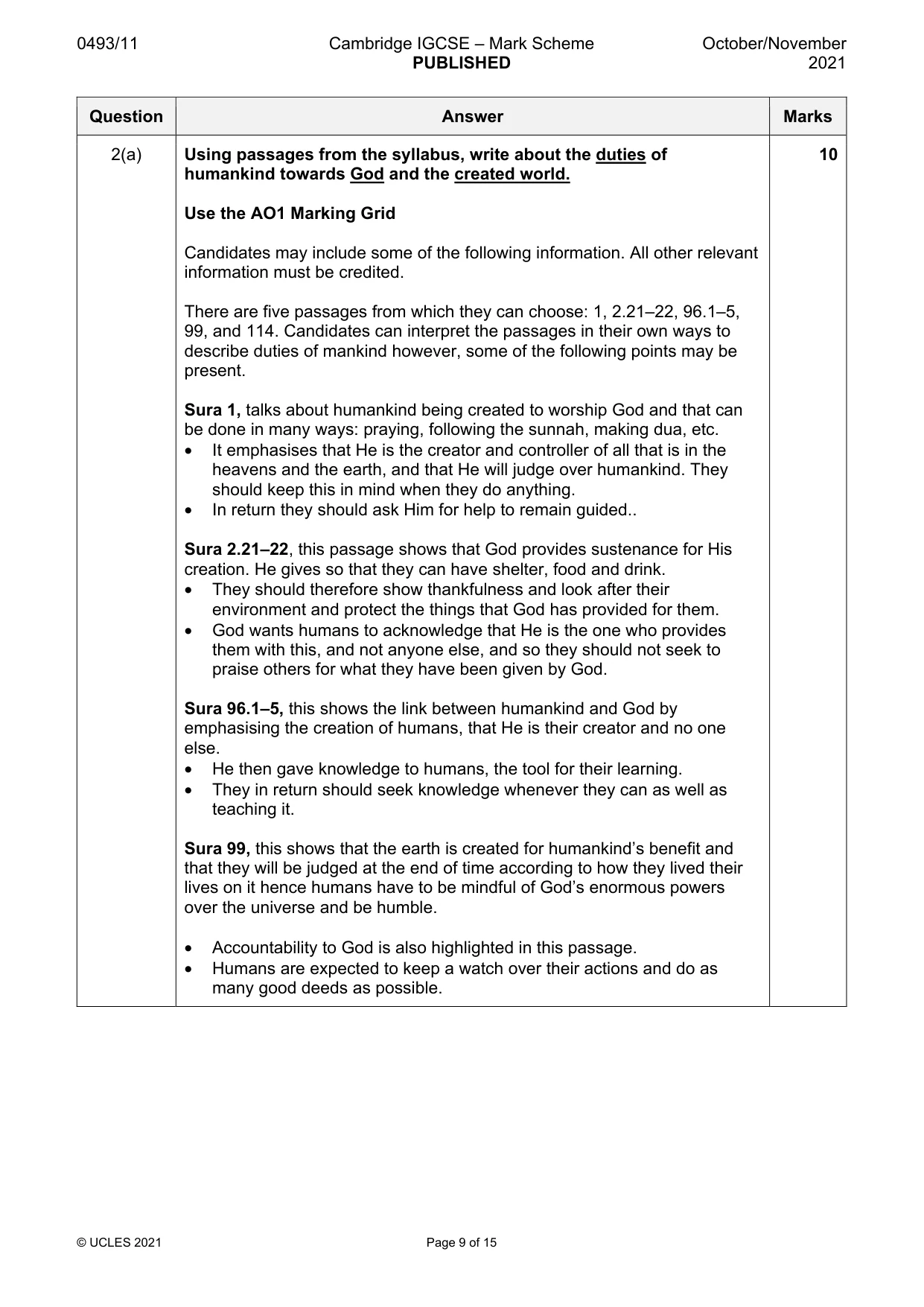
0493/11 Cambridge IGCSE – Mark Scheme PUBLISHED October/November 2021 © UCLES 2021 Page 9 of 15 Question Answer Marks 2(a) Using passages from the syllabus, write about the duties of humankind towards God and the created world. Use the AO1 Marking Grid Candidates may include some of the following information. All other relevant information must be credited. There are five passages from which they can choose: 1, 2.21–22, 96.1–5, 99, and 114. Candidates can interpret the passages in their own ways to describe duties of mankind however, some of the following points may be present. Sura 1, talks about humankind being created to worship God and that can be done in many ways: praying, following the sunnah, making dua, etc. • It emphasises that He is the creator and controller of all that is in the heavens and the earth, and that He will judge over humankind. They should keep this in mind when they do anything. • In return they should ask Him for help to remain guided.. Sura 2.21–22, this passage shows that God provides sustenance for His creation. He gives so that they can have shelter, food and drink. • They should therefore show thankfulness and look after their environment and protect the things that God has provided for them. • God wants humans to acknowledge that He is the one who provides them with this, and not anyone else, and so they should not seek to praise others for what they have been given by God. Sura 96.1–5, this shows the link between humankind and God by emphasising the creation of humans, that He is their creator and no one else. • He then gave knowledge to humans, the tool for their learning. • They in return should seek knowledge whenever they can as well as teaching it. Sura 99, this shows that the earth is created for humankind’s benefit and that they will be judged at the end of time according to how they lived their lives on it hence humans have to be mindful of God’s enormous powers over the universe and be humble. • Accountability to God is also highlighted in this passage. • Humans are expected to keep a watch over their actions and do as many good deeds as possible. 10
Mark scheme, page 10
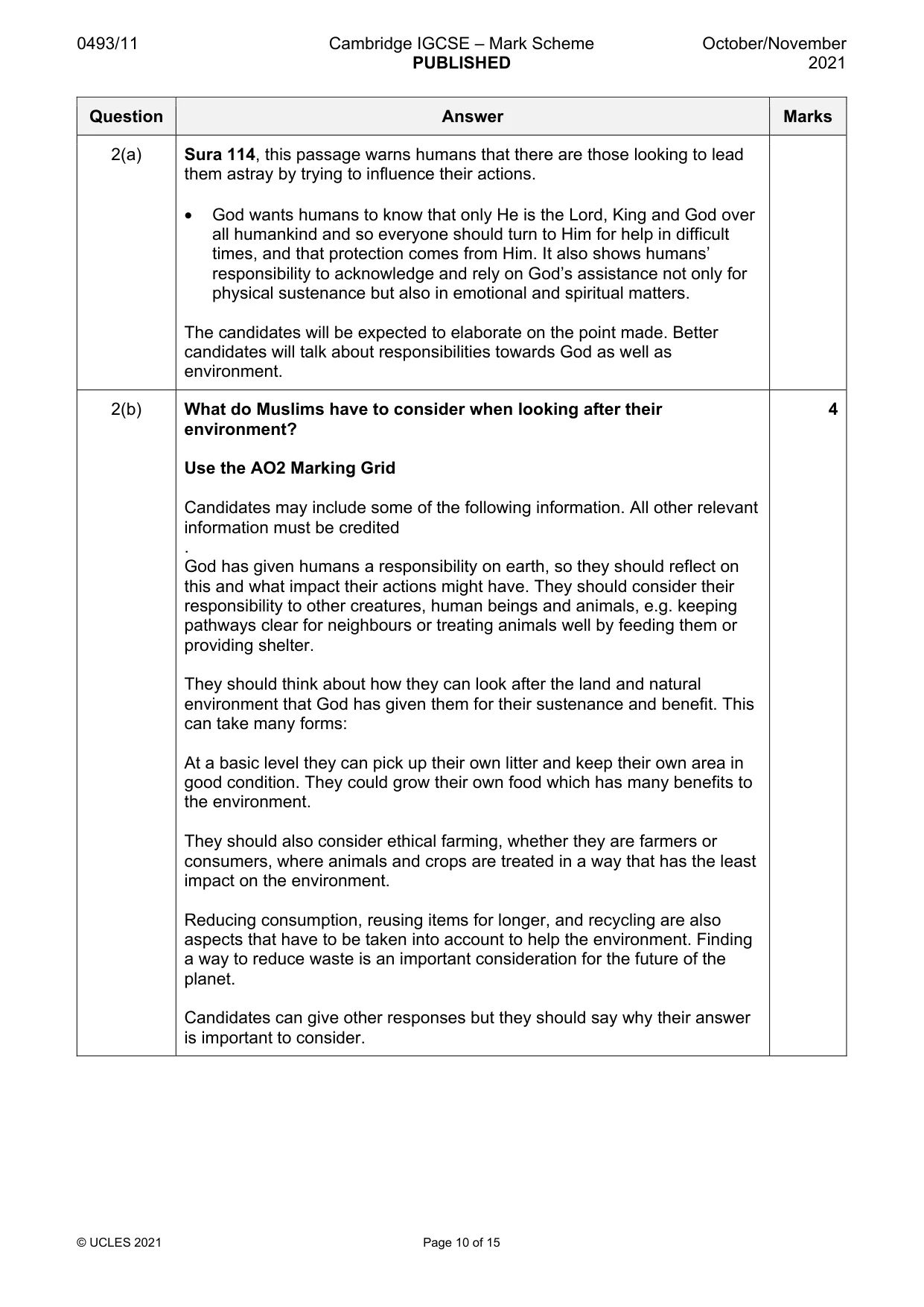
0493/11 Cambridge IGCSE – Mark Scheme PUBLISHED October/November 2021 © UCLES 2021 Page 10 of 15 Question Answer Marks 2(a) Sura 114, this passage warns humans that there are those looking to lead them astray by trying to influence their actions. • God wants humans to know that only He is the Lord, King and God over all humankind and so everyone should turn to Him for help in difficult times, and that protection comes from Him. It also shows humans’ responsibility to acknowledge and rely on God’s assistance not only for physical sustenance but also in emotional and spiritual matters. The candidates will be expected to elaborate on the point made. Better candidates will talk about responsibilities towards God as well as environment. 2(b) What do Muslims have to consider when looking after their environment? Use the AO2 Marking Grid Candidates may include some of the following information. All other relevant information must be credited . God has given humans a responsibility on earth, so they should reflect on this and what impact their actions might have. They should consider their responsibility to other creatures, human beings and animals, e.g. keeping pathways clear for neighbours or treating animals well by feeding them or providing shelter. They should think about how they can look after the land and natural environment that God has given them for their sustenance and benefit. This can take many forms: At a basic level they can pick up their own litter and keep their own area in good condition. They could grow their own food which has many benefits to the environment. They should also consider ethical farming, whether they are farmers or consumers, where animals and crops are treated in a way that has the least impact on the environment. Reducing consumption, reusing items for longer, and recycling are also aspects that have to be taken into account to help the environment. Finding a way to reduce waste is an important consideration for the future of the planet. Candidates can give other responses but they should say why their answer is important to consider. 4
Mark scheme, page 11
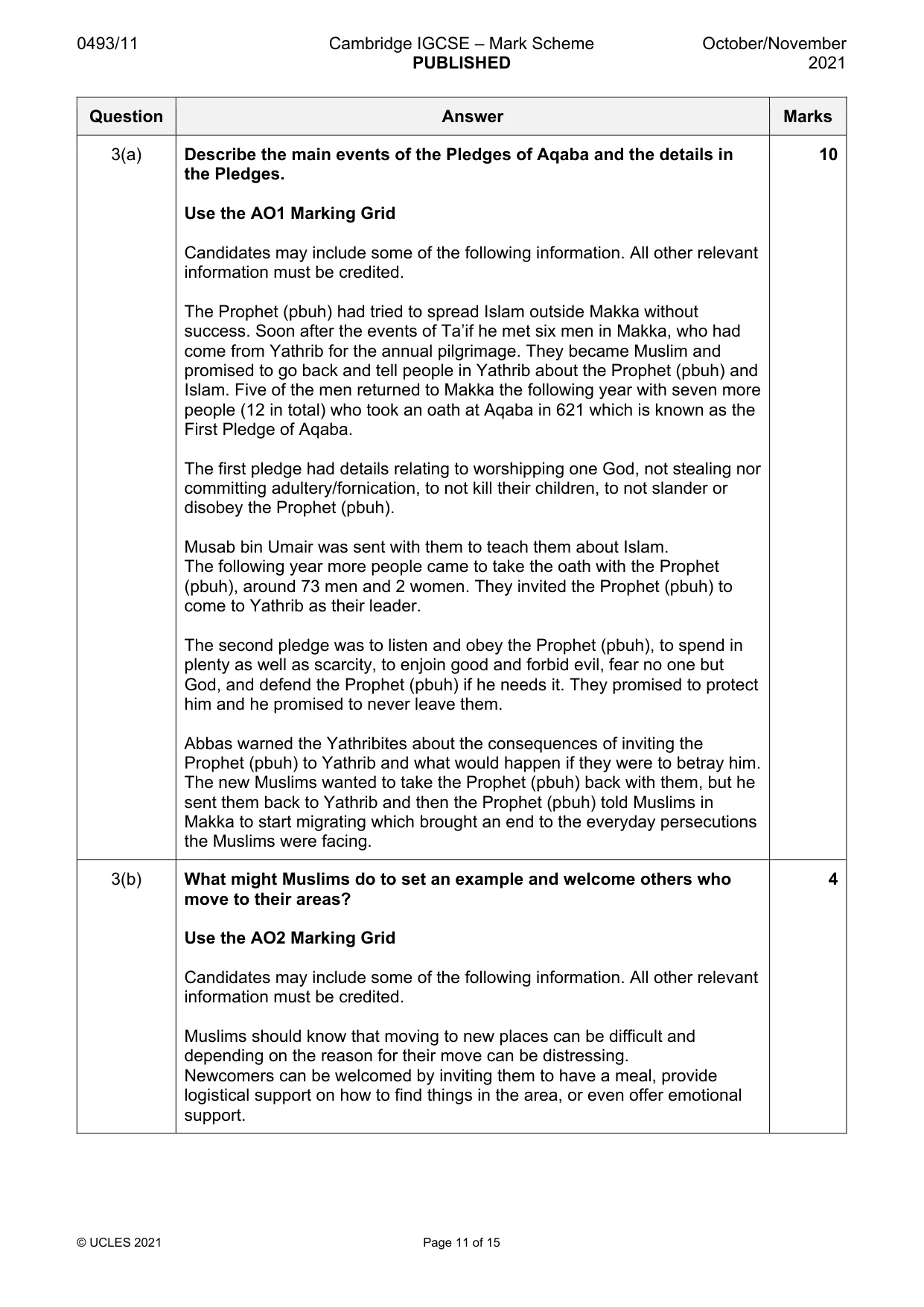
0493/11 Cambridge IGCSE – Mark Scheme PUBLISHED October/November 2021 © UCLES 2021 Page 11 of 15 Question Answer Marks 3(a) Describe the main events of the Pledges of Aqaba and the details in the Pledges. Use the AO1 Marking Grid Candidates may include some of the following information. All other relevant information must be credited. The Prophet (pbuh) had tried to spread Islam outside Makka without success. Soon after the events of Ta’if he met six men in Makka, who had come from Yathrib for the annual pilgrimage. They became Muslim and promised to go back and tell people in Yathrib about the Prophet (pbuh) and Islam. Five of the men returned to Makka the following year with seven more people (12 in total) who took an oath at Aqaba in 621 which is known as the First Pledge of Aqaba. The first pledge had details relating to worshipping one God, not stealing nor committing adultery/fornication, to not kill their children, to not slander or disobey the Prophet (pbuh). Musab bin Umair was sent with them to teach them about Islam. The following year more people came to take the oath with the Prophet (pbuh), around 73 men and 2 women. They invited the Prophet (pbuh) to come to Yathrib as their leader. The second pledge was to listen and obey the Prophet (pbuh), to spend in plenty as well as scarcity, to enjoin good and forbid evil, fear no one but God, and defend the Prophet (pbuh) if he needs it. They promised to protect him and he promised to never leave them. Abbas warned the Yathribites about the consequences of inviting the Prophet (pbuh) to Yathrib and what would happen if they were to betray him. The new Muslims wanted to take the Prophet (pbuh) back with them, but he sent them back to Yathrib and then the Prophet (pbuh) told Muslims in Makka to start migrating which brought an end to the everyday persecutions the Muslims were facing. 10 3(b) What might Muslims do to set an example and welcome others who move to their areas? Use the AO2 Marking Grid Candidates may include some of the following information. All other relevant information must be credited. Muslims should know that moving to new places can be difficult and depending on the reason for their move can be distressing. Newcomers can be welcomed by inviting them to have a meal, provide logistical support on how to find things in the area, or even offer emotional support. 4
Mark scheme, page 12
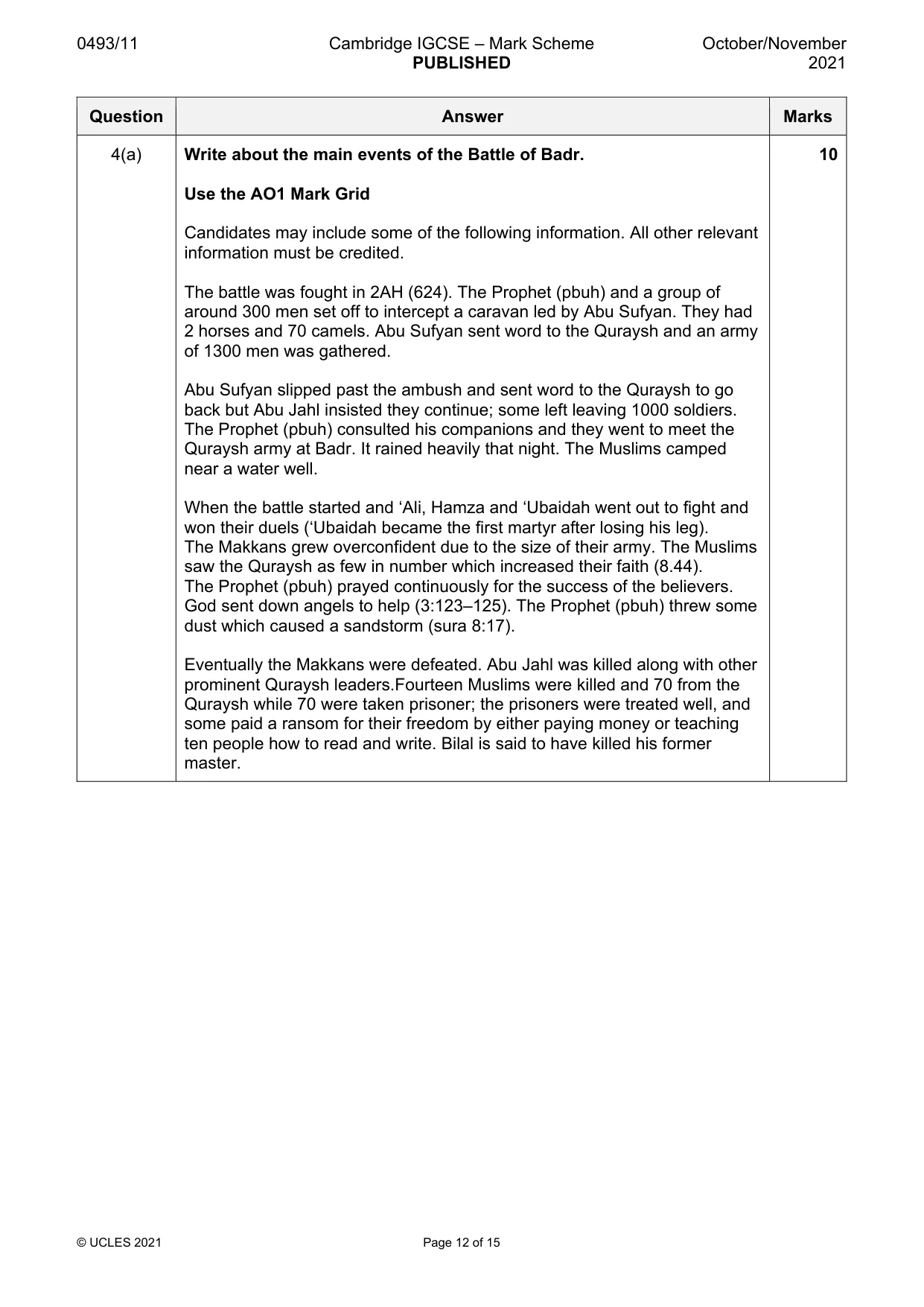
0493/11 Cambridge IGCSE – Mark Scheme PUBLISHED October/November 2021 © UCLES 2021 Page 12 of 15 Question Answer Marks 4(a) Write about the main events of the Battle of Badr. Use the AO1 Mark Grid Candidates may include some of the following information. All other relevant information must be credited. The battle was fought in 2AH (624). The Prophet (pbuh) and a group of around 300 men set off to intercept a caravan led by Abu Sufyan. They had 2 horses and 70 camels. Abu Sufyan sent word to the Quraysh and an army of 1300 men was gathered. Abu Sufyan slipped past the ambush and sent word to the Quraysh to go back but Abu Jahl insisted they continue; some left leaving 1000 soldiers. The Prophet (pbuh) consulted his companions and they went to meet the Quraysh army at Badr. It rained heavily that night. The Muslims camped near a water well. When the battle started and ‘Ali, Hamza and ‘Ubaidah went out to fight and won their duels (‘Ubaidah became the first martyr after losing his leg). The Makkans grew overconfident due to the size of their army. The Muslims saw the Quraysh as few in number which increased their faith (8.44). The Prophet (pbuh) prayed continuously for the success of the believers. God sent down angels to help (3:123–125). The Prophet (pbuh) threw some dust which caused a sandstorm (sura 8:17). Eventually the Makkans were defeated. Abu Jahl was killed along with other prominent Quraysh leaders.Fourteen Muslims were killed and 70 from the Quraysh while 70 were taken prisoner; the prisoners were treated well, and some paid a ransom for their freedom by either paying money or teaching ten people how to read and write. Bilal is said to have killed his former master. 10
Mark scheme, page 13
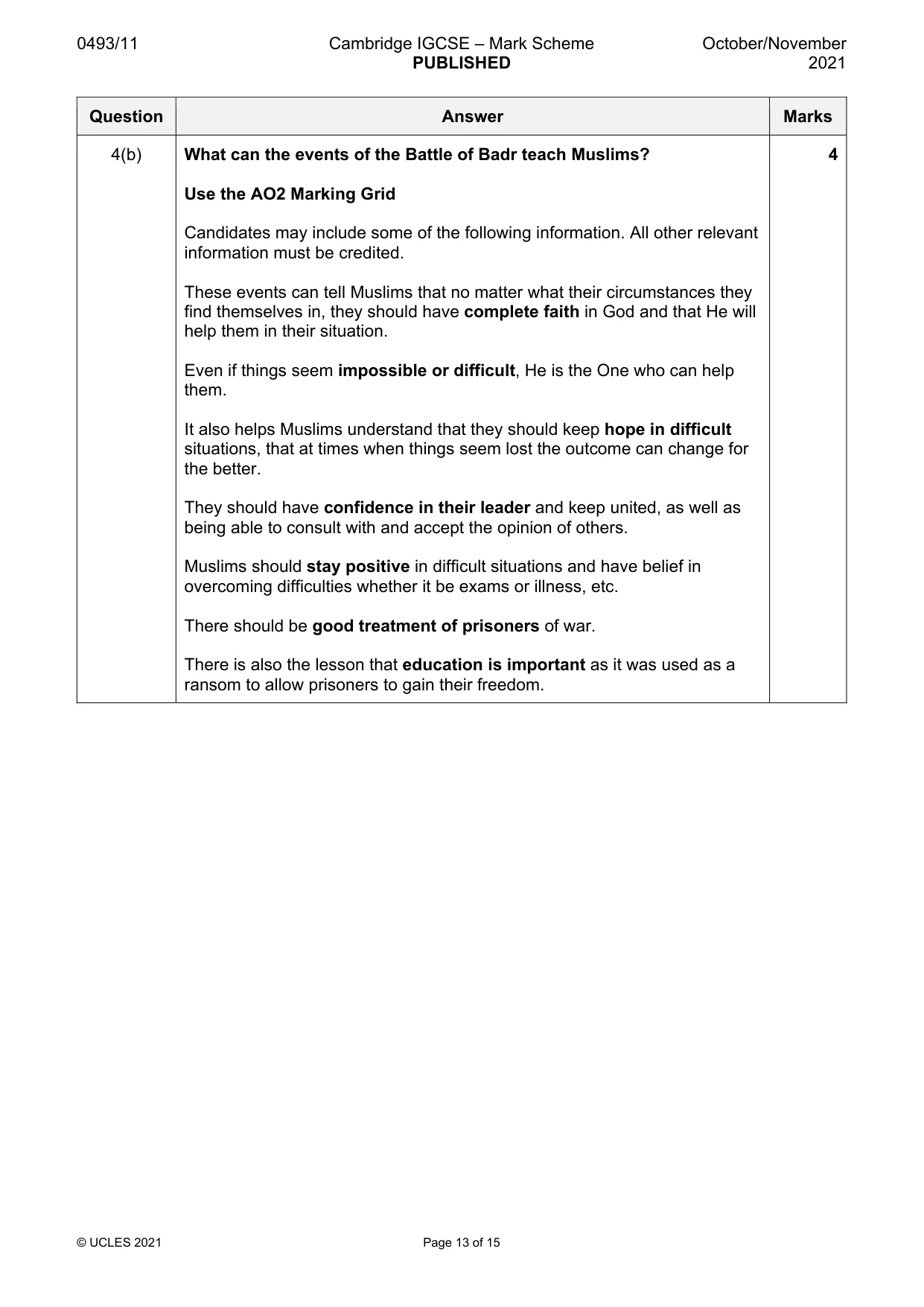
0493/11 Cambridge IGCSE – Mark Scheme PUBLISHED October/November 2021 © UCLES 2021 Page 13 of 15 Question Answer Marks 4(b) What can the events of the Battle of Badr teach Muslims? Use the AO2 Marking Grid Candidates may include some of the following information. All other relevant information must be credited. These events can tell Muslims that no matter what their circumstances they find themselves in, they should have complete faith in God and that He will help them in their situation. Even if things seem impossible or difficult, He is the One who can help them. It also helps Muslims understand that they should keep hope in difficult situations, that at times when things seem lost the outcome can change for the better. They should have confidence in their leader and keep united, as well as being able to consult with and accept the opinion of others. Muslims should stay positive in difficult situations and have belief in overcoming difficulties whether it be exams or illness, etc. There should be good treatment of prisoners of war. There is also the lesson that education is important as it was used as a ransom to allow prisoners to gain their freedom. 4
Mark scheme, page 14
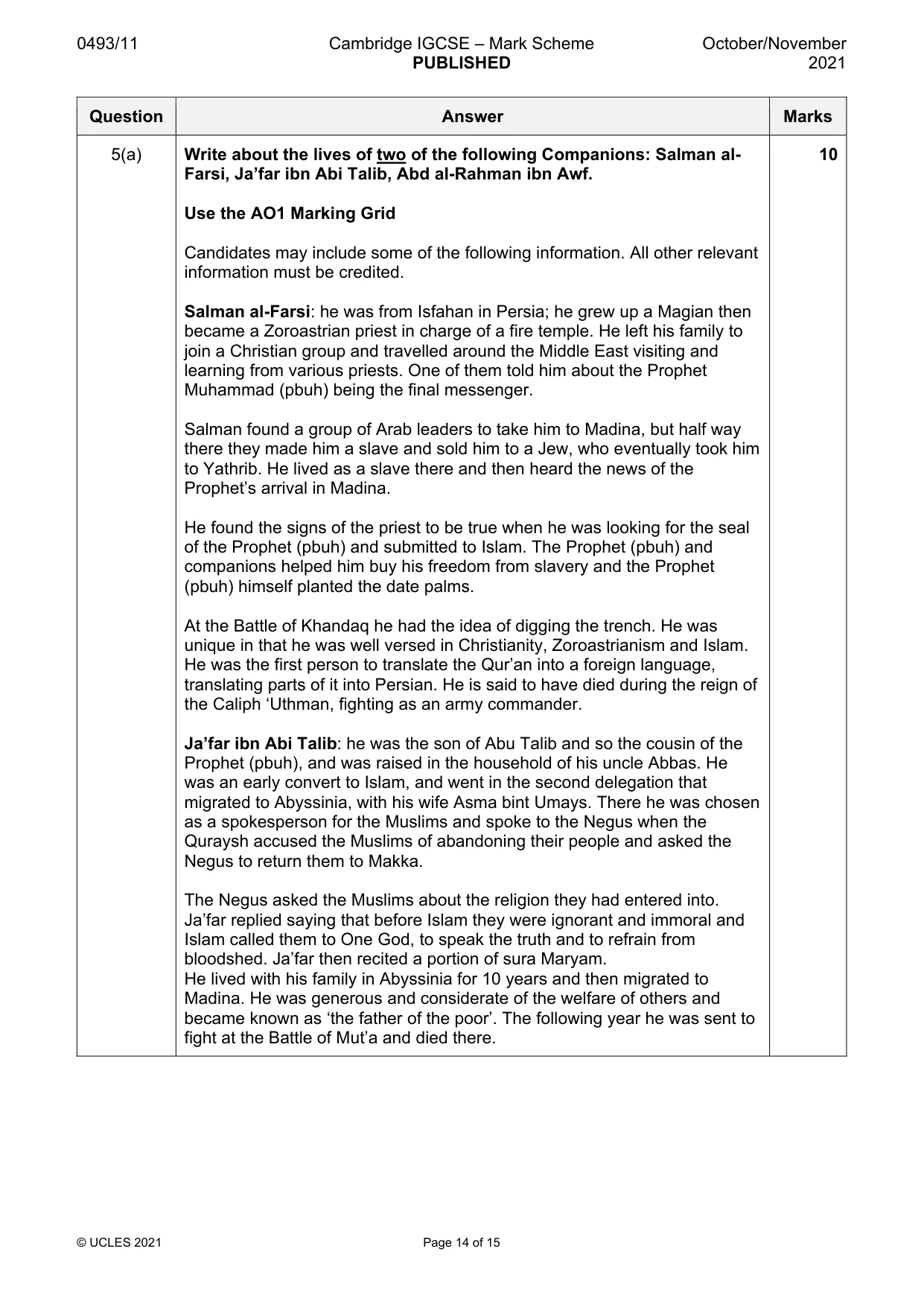
0493/11 Cambridge IGCSE – Mark Scheme PUBLISHED October/November 2021 © UCLES 2021 Page 14 of 15 Question Answer Marks 5(a) Write about the lives of two of the following Companions: Salman al- Farsi, Ja’far ibn Abi Talib, Abd al-Rahman ibn Awf. Use the AO1 Marking Grid Candidates may include some of the following information. All other relevant information must be credited. Salman al-Farsi: he was from Isfahan in Persia; he grew up a Magian then became a Zoroastrian priest in charge of a fire temple. He left his family to join a Christian group and travelled around the Middle East visiting and learning from various priests. One of them told him about the Prophet Muhammad (pbuh) being the final messenger. Salman found a group of Arab leaders to take him to Madina, but half way there they made him a slave and sold him to a Jew, who eventually took him to Yathrib. He lived as a slave there and then heard the news of the Prophet’s arrival in Madina. He found the signs of the priest to be true when he was looking for the seal of the Prophet (pbuh) and submitted to Islam. The Prophet (pbuh) and companions helped him buy his freedom from slavery and the Prophet (pbuh) himself planted the date palms. At the Battle of Khandaq he had the idea of digging the trench. He was unique in that he was well versed in Christianity, Zoroastrianism and Islam. He was the first person to translate the Qur’an into a foreign language, translating parts of it into Persian. He is said to have died during the reign of the Caliph ‘Uthman, fighting as an army commander. Ja’far ibn Abi Talib: he was the son of Abu Talib and so the cousin of the Prophet (pbuh), and was raised in the household of his uncle Abbas. He was an early convert to Islam, and went in the second delegation that migrated to Abyssinia, with his wife Asma bint Umays. There he was chosen as a spokesperson for the Muslims and spoke to the Negus when the Quraysh accused the Muslims of abandoning their people and asked the Negus to return them to Makka. The Negus asked the Muslims about the religion they had entered into. Ja’far replied saying that before Islam they were ignorant and immoral and Islam called them to One God, to speak the truth and to refrain from bloodshed. Ja’far then recited a portion of sura Maryam. He lived with his family in Abyssinia for 10 years and then migrated to Madina. He was generous and considerate of the welfare of others and became known as ‘the father of the poor’. The following year he was sent to fight at the Battle of Mut’a and died there. 10
Mark scheme, page 15
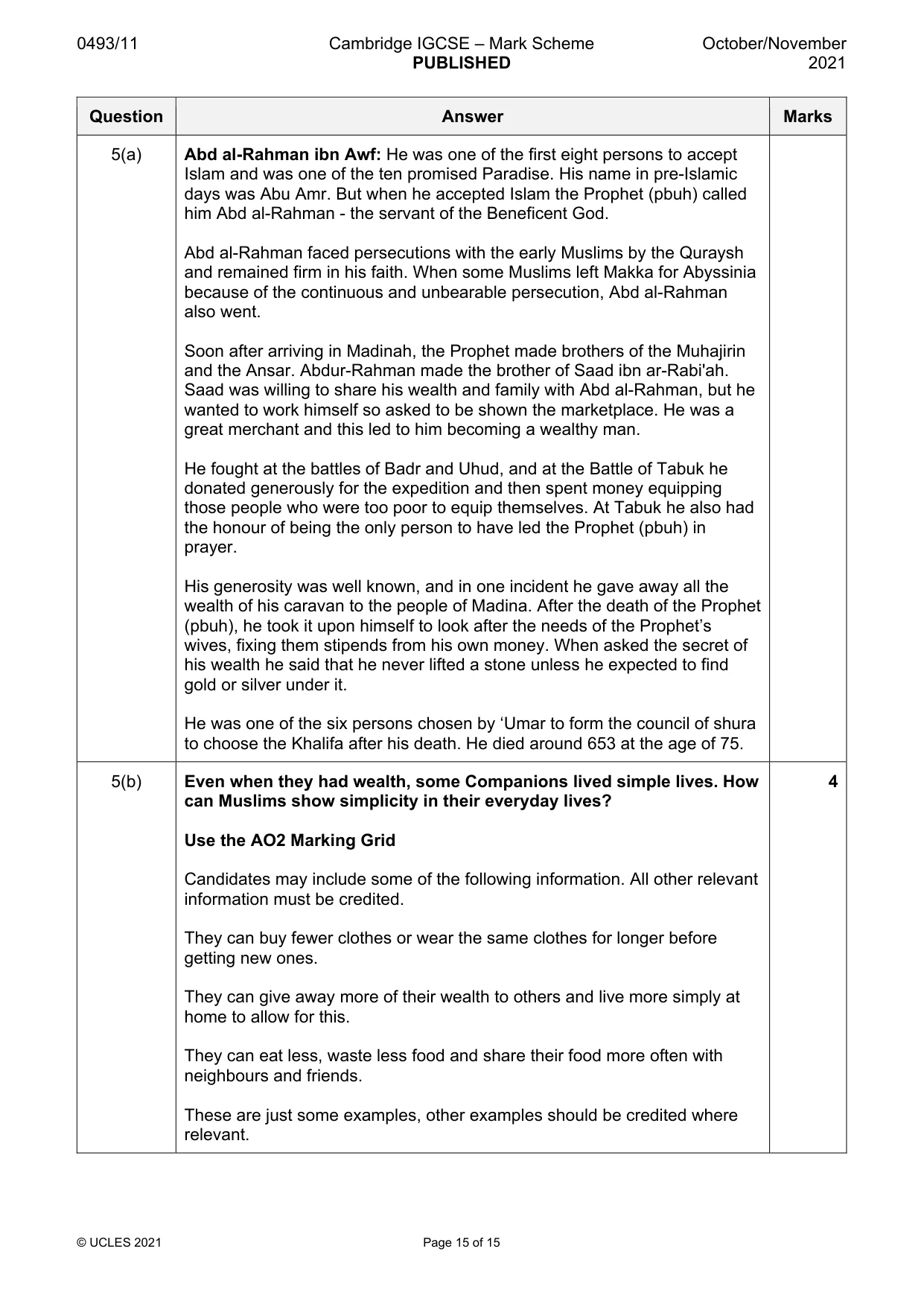
0493/11 Cambridge IGCSE – Mark Scheme PUBLISHED October/November 2021 © UCLES 2021 Page 15 of 15 Question Answer Marks 5(a) Abd al-Rahman ibn Awf: He was one of the first eight persons to accept Islam and was one of the ten promised Paradise. His name in pre-Islamic days was Abu Amr. But when he accepted Islam the Prophet (pbuh) called him Abd al-Rahman - the servant of the Beneficent God. Abd al-Rahman faced persecutions with the early Muslims by the Quraysh and remained firm in his faith. When some Muslims left Makka for Abyssinia because of the continuous and unbearable persecution, Abd al-Rahman also went. Soon after arriving in Madinah, the Prophet made brothers of the Muhajirin and the Ansar. Abdur-Rahman made the brother of Saad ibn ar-Rabi'ah. Saad was willing to share his wealth and family with Abd al-Rahman, but he wanted to work himself so asked to be shown the marketplace. He was a great merchant and this led to him becoming a wealthy man. He fought at the battles of Badr and Uhud, and at the Battle of Tabuk he donated generously for the expedition and then spent money equipping those people who were too poor to equip themselves. At Tabuk he also had the honour of being the only person to have led the Prophet (pbuh) in prayer. His generosity was well known, and in one incident he gave away all the wealth of his caravan to the people of Madina. After the death of the Prophet (pbuh), he took it upon himself to look after the needs of the Prophet’s wives, fixing them stipends from his own money. When asked the secret of his wealth he said that he never lifted a stone unless he expected to find gold or silver under it. He was one of the six persons chosen by ‘Umar to form the council of shura to choose the Khalifa after his death. He died around 653 at the age of 75. 5(b) Even when they had wealth, some Companions lived simple lives. How can Muslims show simplicity in their everyday lives? Use the AO2 Marking Grid Candidates may include some of the following information. All other relevant information must be credited. They can buy fewer clothes or wear the same clothes for longer before getting new ones. They can give away more of their wealth to others and live more simply at home to allow for this. They can eat less, waste less food and share their food more often with neighbours and friends. These are just some examples, other examples should be credited where relevant. 4
What you needed in this session
Cambridge’s own grade thresholds for 2021 Oct/Nov, Paper 1 · Variant 1. A higher threshold means an easier paper — the bar moves with how the cohort did.