Cambridge IGCSE Islamiyat 0493 — 2019 May/June Paper 1 · Variant 2
0493/12/M/J/19 · 50 marks · ≈56 min
The question paper and its mark scheme, free to read here and free to download. This is Cambridge’s own paper, exactly as it was sat.
Question paper16 pages









Mark scheme16 pages
Answers below. Sit the paper first if you are practising.
Paper as text
Question paper, page 1
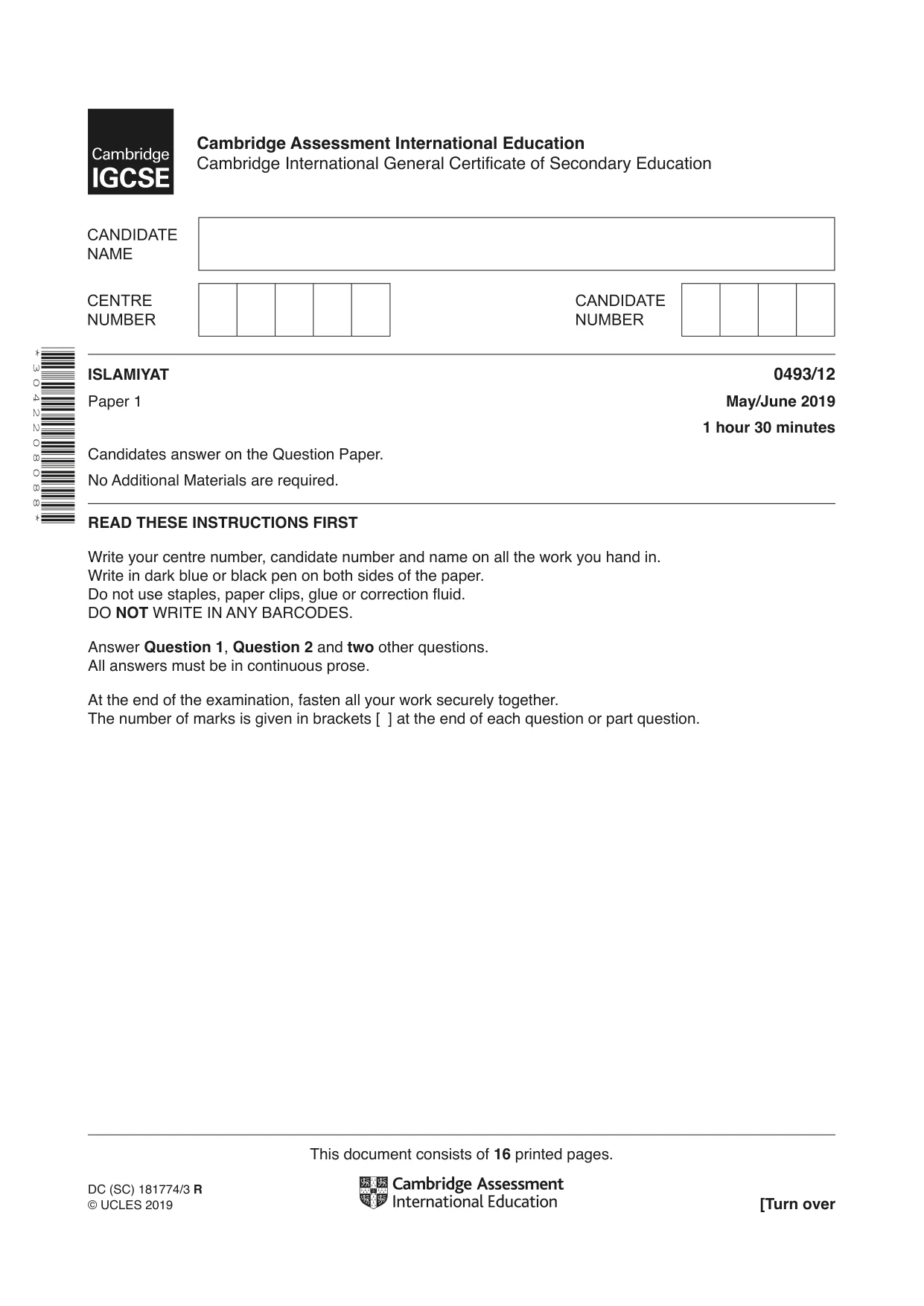
This document consists of 16 printed pages. DC (SC) 181774/3 R © UCLES 2019 [Turn over * 3 0 4 2 2 0 8 0 8 8 * ISLAMIYAT 0493/12 Paper 1 May/June 2019 1 hour 30 minutes Candidates answer on the Question Paper. No Additional Materials are required. READ THESE INSTRUCTIONS FIRST Write your centre number, candidate number and name on all the work you hand in. Write in dark blue or black pen on both sides of the paper. Do not use staples, paper clips, glue or correction fluid. DO NOT WRITE IN ANY BARCODES. Answer Question 1, Question 2 and two other questions. All answers must be in continuous prose. At the end of the examination, fasten all your work securely together. The number of marks is given in brackets [ ] at the end of each question or part question. Cambridge Assessment International Education Cambridge International General Certificate of Secondary Education
Question paper, page 2
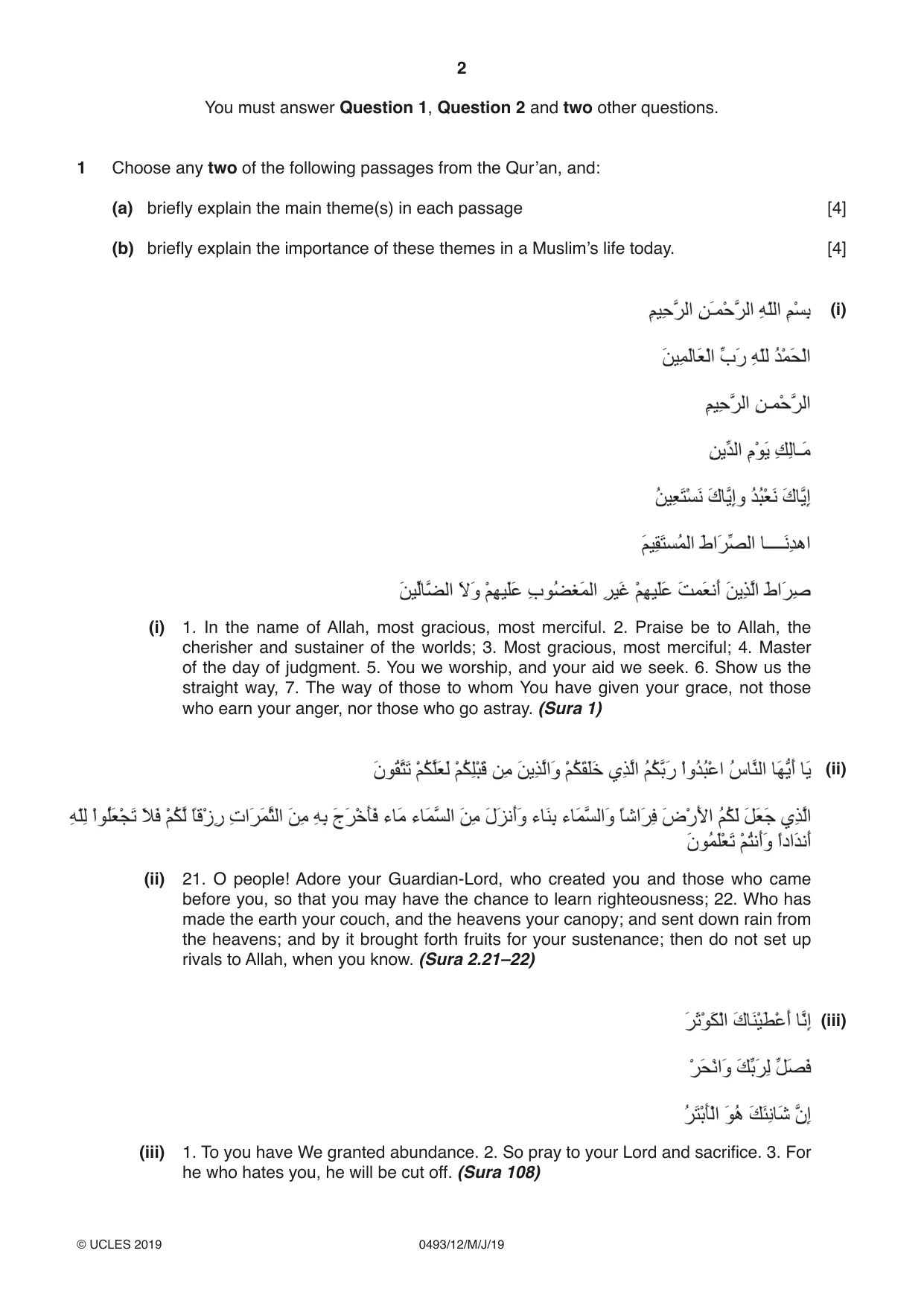
2 0493/12/M/J/19 © UCLES 2019 You must answer Question 1, Question 2 and two other questions. 1 Choose any two of the following passages from the Qur’an, and: (a) briefly explain the main theme(s) in each passage [4] (b) briefly explain the importance of these themes in a Muslim’s life today. [4] (i) (i) 1. In the name of Allah, most gracious, most merciful. 2. Praise be to Allah, the cherisher and sustainer of the worlds; 3. Most gracious, most merciful; 4. Master of the day of judgment. 5. You we worship, and your aid we seek. 6. Show us the straight way, 7. The way of those to whom You have given your grace, not those who earn your anger, nor those who go astray. (Sura 1) (ii) (ii) 21. O people! Adore your Guardian-Lord, who created you and those who came before you, so that you may have the chance to learn righteousness; 22. Who has made the earth your couch, and the heavens your canopy; and sent down rain from the heavens; and by it brought forth fruits for your sustenance; then do not set up rivals to Allah, when you know. (Sura 2.21–22) (iii) (iii) 1. To you have We granted abundance. 2. So pray to your Lord and sacrifice. 3. For he who hates you, he will be cut off. (Sura 108)
Question paper, page 3
3 0493/12/M/J/19 © UCLES 2019 [Turn over … … … … … … … … … … … … … … … … … … … … … … … … … … … …
Question paper, page 4
4 0493/12/M/J/19 © UCLES 2019 … … … … … … … … … … … … … … … … … … … … … … … … … … … …
Question paper, page 5
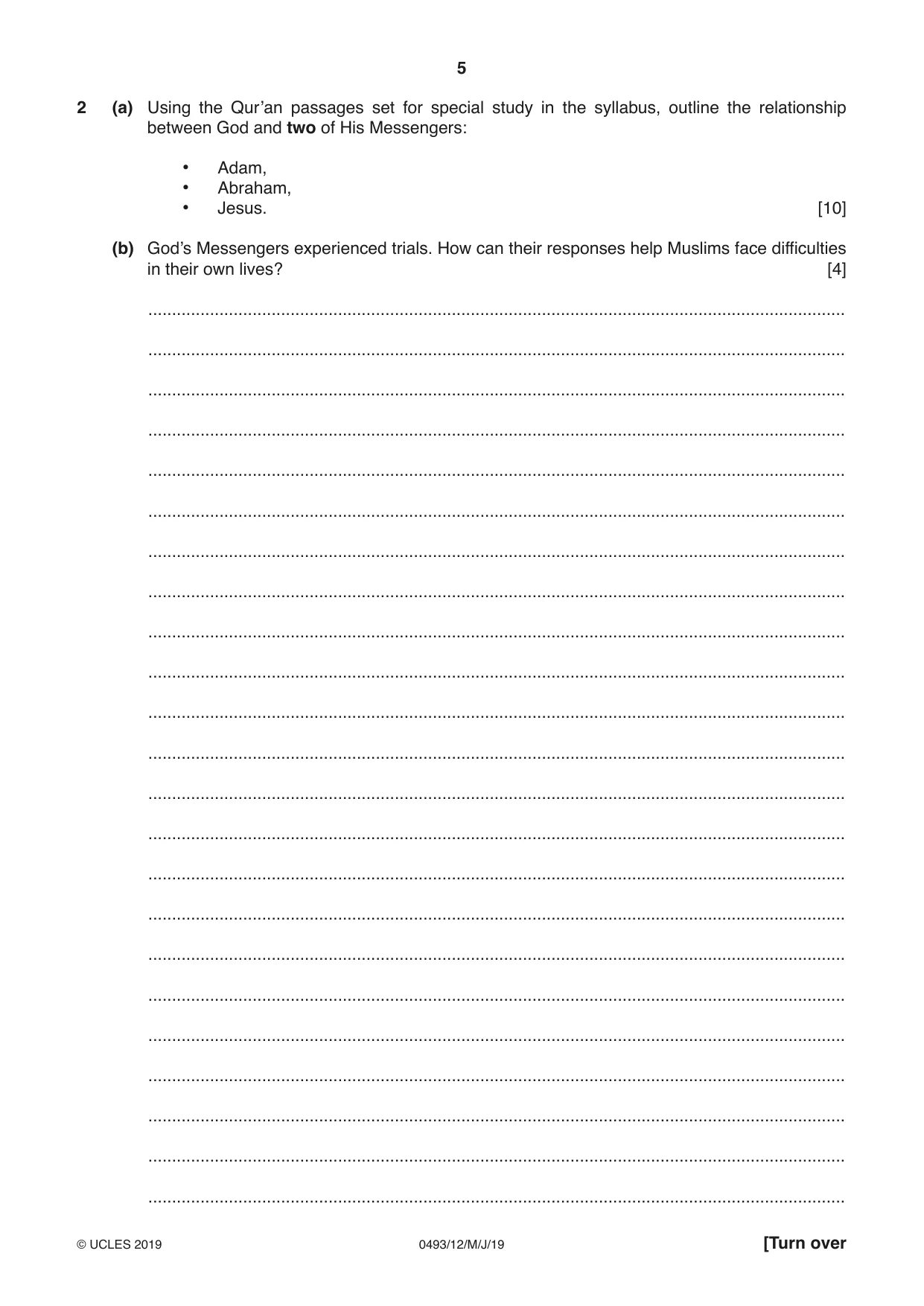
5 0493/12/M/J/19 © UCLES 2019 [Turn over 2 (a) Using the Qur’an passages set for special study in the syllabus, outline the relationship between God and two of His Messengers: • Adam, • Abraham, • Jesus. [10] (b) God’s Messengers experienced trials. How can their responses help Muslims face difficulties in their own lives? [4] … … … … … … … … … … … … … … … … … … … … … … …
Question paper, page 6
6 0493/12/M/J/19 © UCLES 2019 … … … … … … … … … … … … … … … … … … … … … … … … … … … …
Question paper, page 7
7 0493/12/M/J/19 © UCLES 2019 [Turn over … … … … … … … … … … … … … … … … … … … … … … … … … … … …
Question paper, page 8
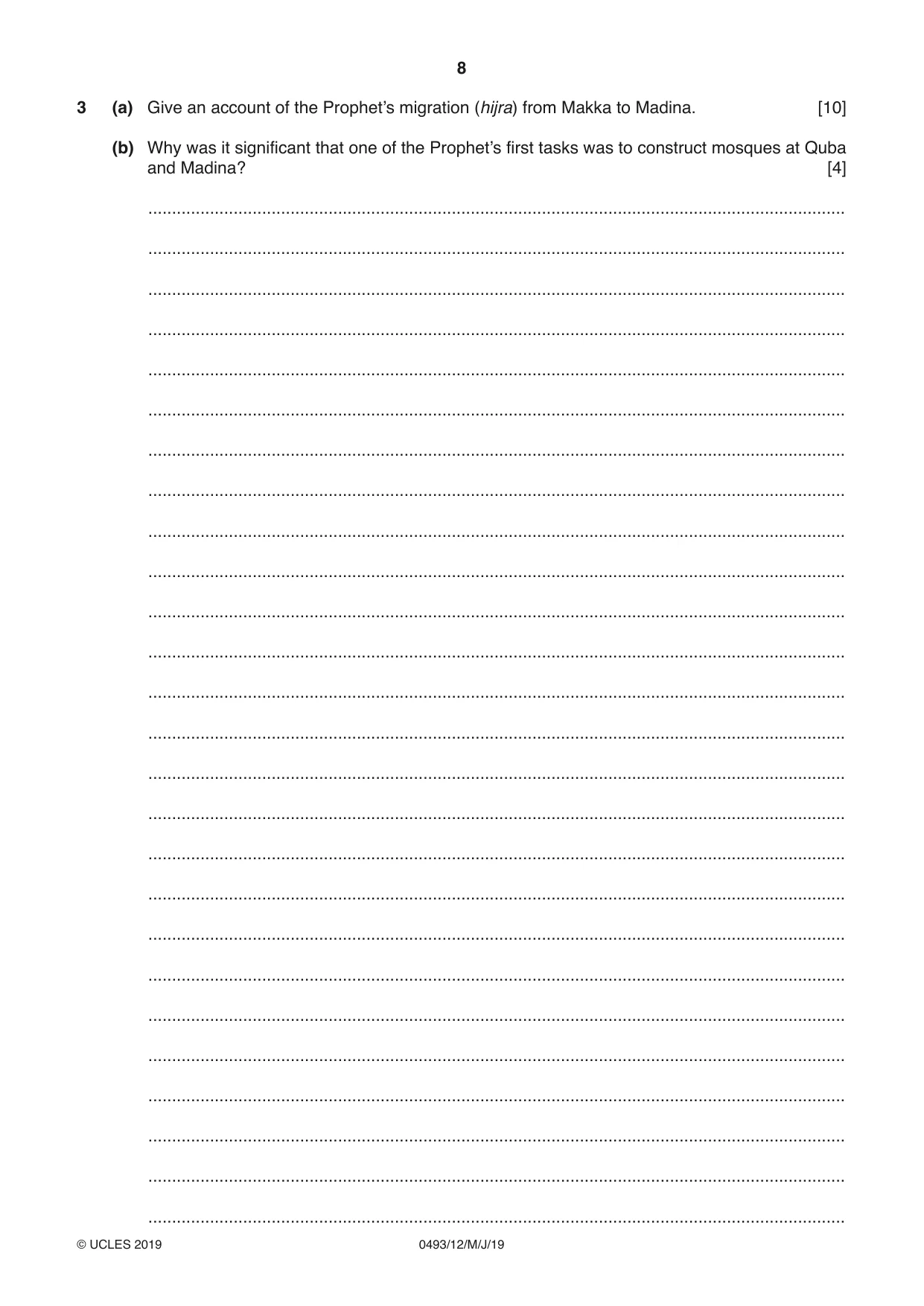
8 0493/12/M/J/19 © UCLES 2019 3 (a) Give an account of the Prophet’s migration (hijra) from Makka to Madina. [10] (b) Why was it significant that one of the Prophet’s first tasks was to construct mosques at Quba and Madina? [4] … … … … … … … … … … … … … … … … … … … … … … … … … …
Question paper, page 9
9 0493/12/M/J/19 © UCLES 2019 [Turn over … … … … … … … … … … … … … … … … … … … … … … … … … … … …
Question paper, page 10
10 0493/12/M/J/19 © UCLES 2019 … … … … … … … … … … … … … … … … … … … … … … … … … … … …
Question paper, page 11
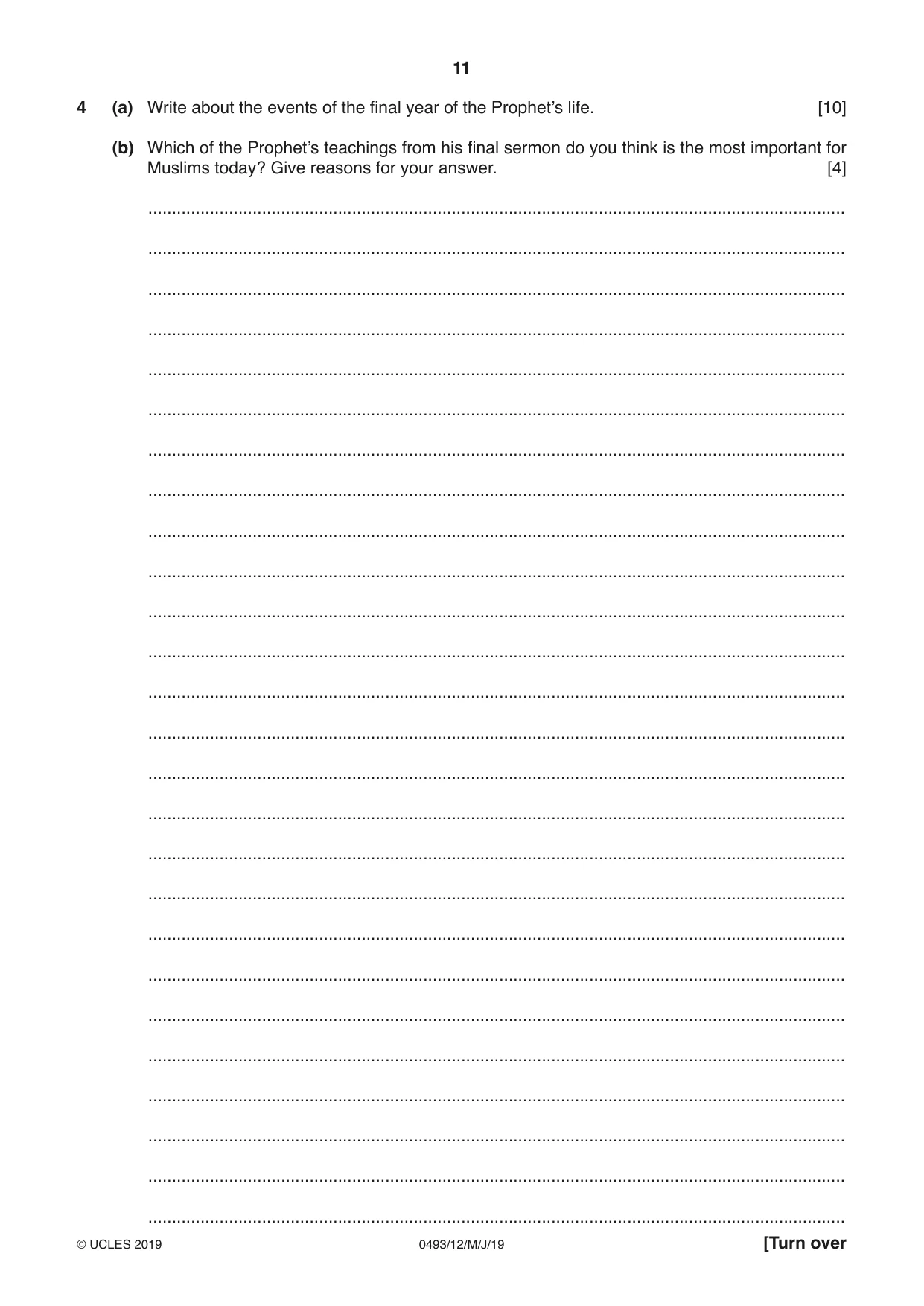
11 0493/12/M/J/19 © UCLES 2019 [Turn over 4 (a) Write about the events of the final year of the Prophet’s life. [10] (b) Which of the Prophet’s teachings from his final sermon do you think is the most important for Muslims today? Give reasons for your answer. [4] … … … … … … … … … … … … … … … … … … … … … … … … … …
Question paper, page 12
12 0493/12/M/J/19 © UCLES 2019 … … … … … … … … … … … … … … … … … … … … … … … … … … … …
Question paper, page 13
13 0493/12/M/J/19 © UCLES 2019 [Turn over … … … … … … … … … … … … … … … … … … … … … … … … … … … …
Question paper, page 14
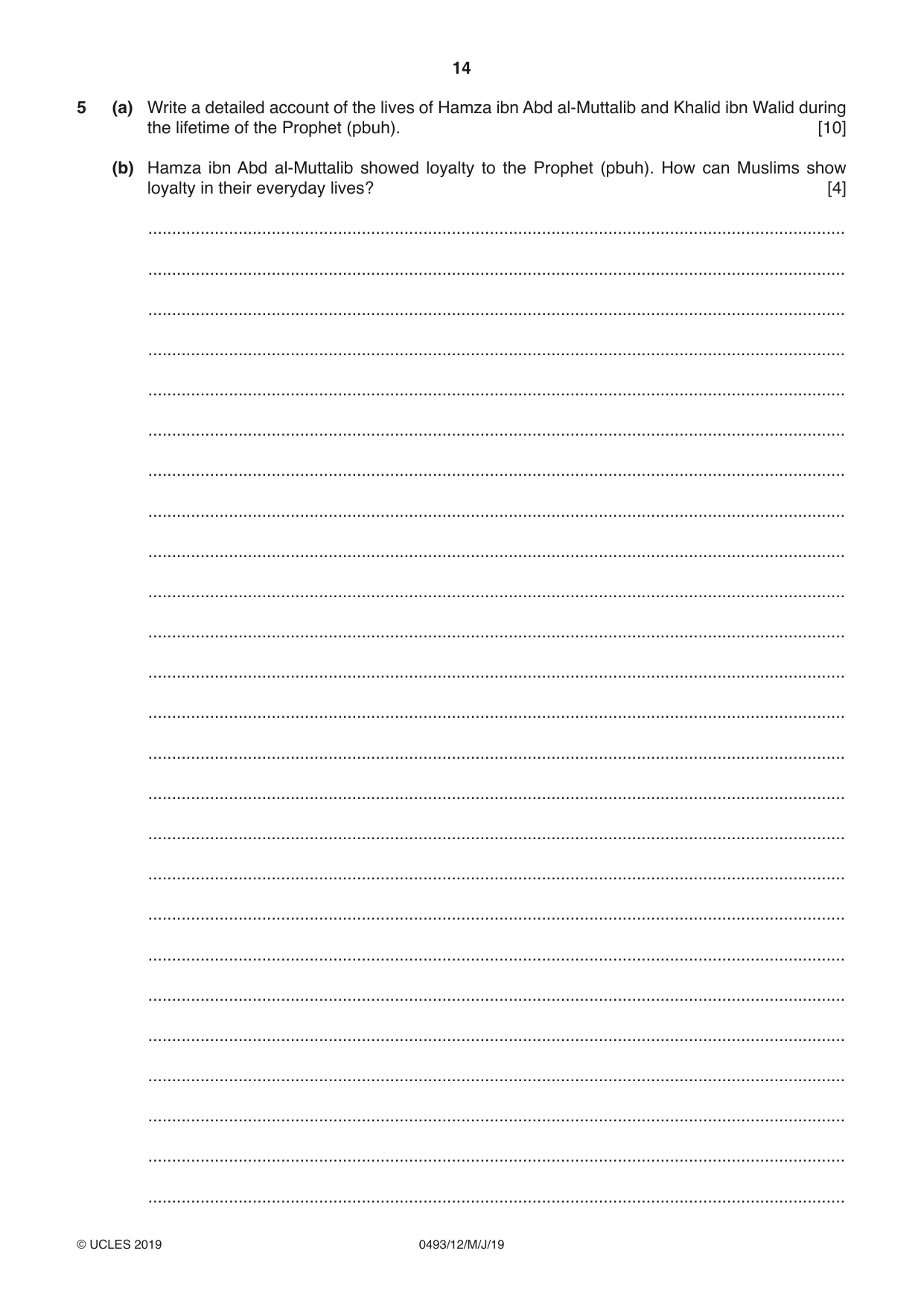
14 0493/12/M/J/19 © UCLES 2019 5 (a) Write a detailed account of the lives of Hamza ibn Abd al-Muttalib and Khalid ibn Walid during the lifetime of the Prophet (pbuh). [10] (b) Hamza ibn Abd al-Muttalib showed loyalty to the Prophet (pbuh). How can Muslims show loyalty in their everyday lives? [4] … … … … … … … … … … … … … … … … … … … … … … … … …
Question paper, page 15
15 0493/12/M/J/19 © UCLES 2019 [Turn over … … … … … … … … … … … … … … … … … … … … … … … … … … … …
Question paper, page 16
16 0493/12/M/J/19 © UCLES 2019 Permission to reproduce items where third-party owned material protected by copyright is included has been sought and cleared where possible. Every reasonable effort has been made by the publisher (UCLES) to trace copyright holders, but if any items requiring clearance have unwittingly been included, the publisher will be pleased to make amends at the earliest possible opportunity. To avoid the issue of disclosure of answer-related information to candidates, all copyright acknowledgements are reproduced online in the Cambridge Assessment International Education Copyright Acknowledgements Booklet. This is produced for each series of examinations and is freely available to download at www.cambridgeinternational.org after the live examination series. Cambridge Assessment International Education is part of the Cambridge Assessment Group. Cambridge Assessment is the brand name of the University of Cambridge Local Examinations Syndicate (UCLES), which itself is a department of the University of Cambridge. … … … … … … … … … … … … … … … … … … … … … … … …
Mark scheme, page 1
This document consists of 16 printed pages. © UCLES 2019 [Turn over Cambridge Assessment International Education Cambridge International General Certificate of Secondary Education ISLAMIYAT 0493/12 Paper 1 May/June 2019 MARK SCHEME Maximum Mark: 50 Published This mark scheme is published as an aid to teachers and candidates, to indicate the requirements of the examination. It shows the basis on which Examiners were instructed to award marks. It does not indicate the details of the discussions that took place at an Examiners’ meeting before marking began, which would have considered the acceptability of alternative answers. Mark schemes should be read in conjunction with the question paper and the Principal Examiner Report for Teachers. Cambridge International will not enter into discussions about these mark schemes. Cambridge International is publishing the mark schemes for the May/June 2019 series for most Cambridge IGCSE™, Cambridge International A and AS Level and Cambridge Pre-U components, and some Cambridge O Level components.
Mark scheme, page 2
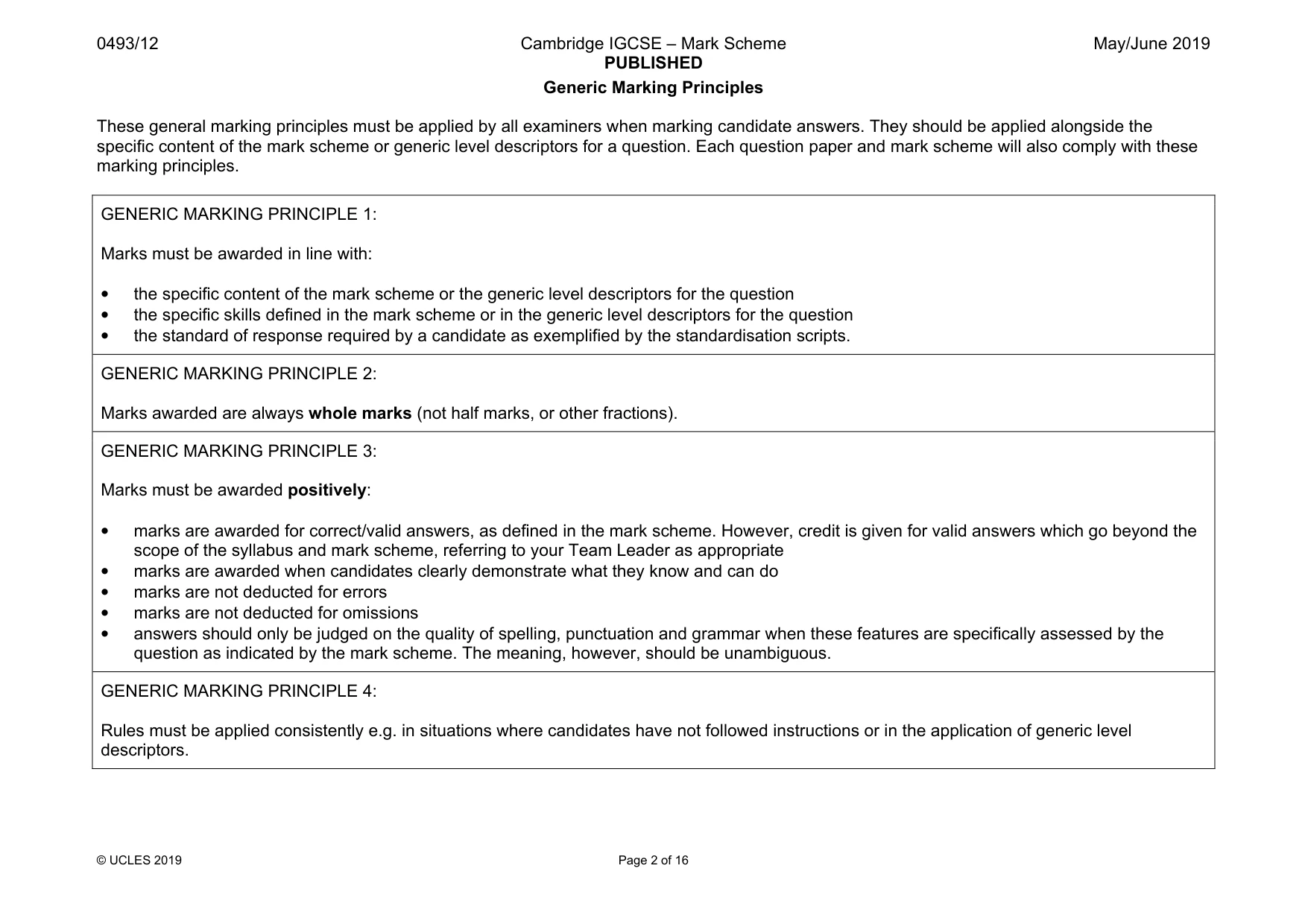
0493/12 Cambridge IGCSE – Mark Scheme PUBLISHED May/June 2019 © UCLES 2019 Page 2 of 16 Generic Marking Principles These general marking principles must be applied by all examiners when marking candidate answers. They should be applied alongside the specific content of the mark scheme or generic level descriptors for a question. Each question paper and mark scheme will also comply with these marking principles. GENERIC MARKING PRINCIPLE 1: Marks must be awarded in line with: • the specific content of the mark scheme or the generic level descriptors for the question • the specific skills defined in the mark scheme or in the generic level descriptors for the question • the standard of response required by a candidate as exemplified by the standardisation scripts. GENERIC MARKING PRINCIPLE 2: Marks awarded are always whole marks (not half marks, or other fractions). GENERIC MARKING PRINCIPLE 3: Marks must be awarded positively: • marks are awarded for correct/valid answers, as defined in the mark scheme. However, credit is given for valid answers which go beyond the scope of the syllabus and mark scheme, referring to your Team Leader as appropriate • marks are awarded when candidates clearly demonstrate what they know and can do • marks are not deducted for errors • marks are not deducted for omissions • answers should only be judged on the quality of spelling, punctuation and grammar when these features are specifically assessed by the question as indicated by the mark scheme. The meaning, however, should be unambiguous. GENERIC MARKING PRINCIPLE 4: Rules must be applied consistently e.g. in situations where candidates have not followed instructions or in the application of generic level descriptors.
Mark scheme, page 3
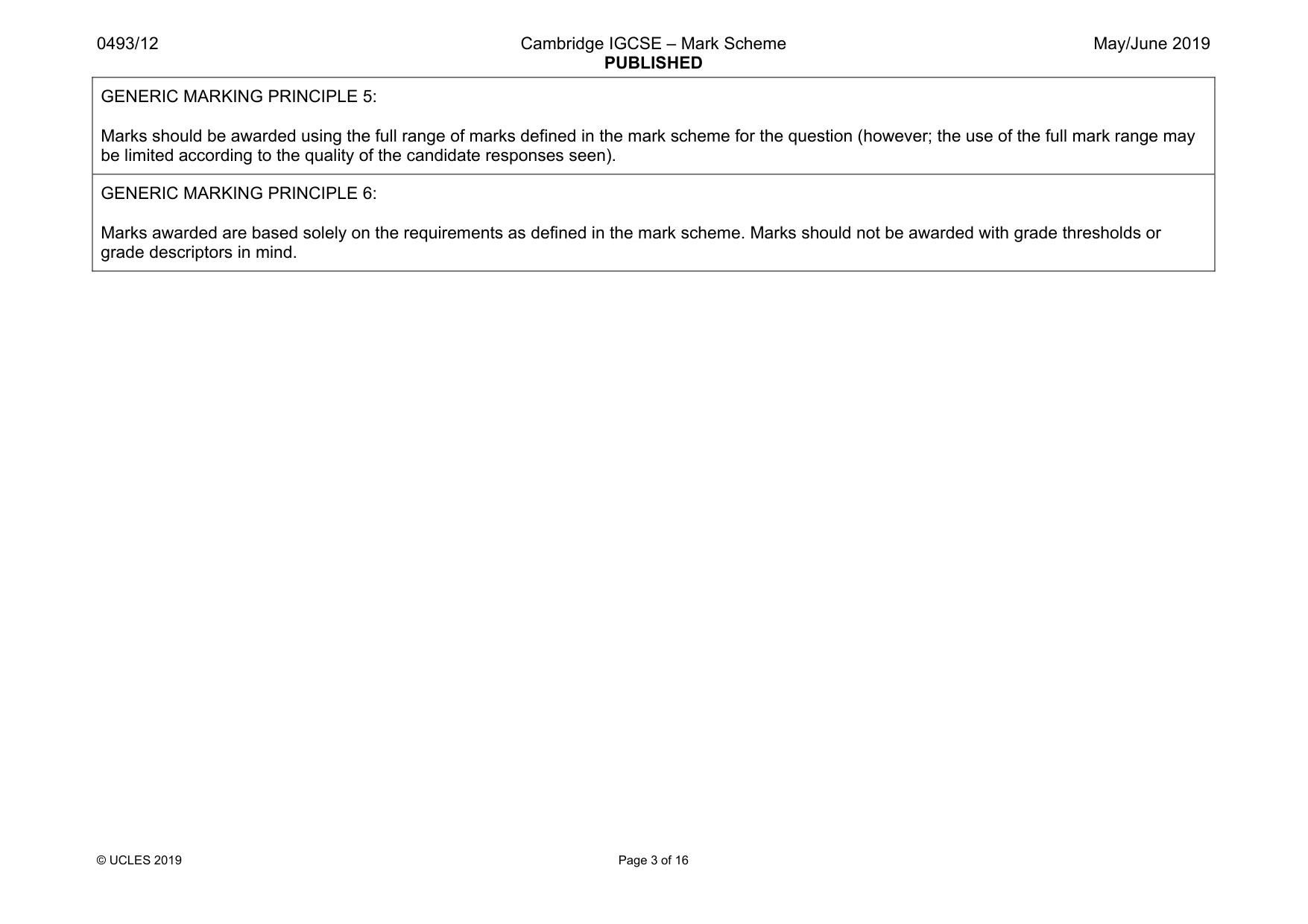
0493/12 Cambridge IGCSE – Mark Scheme PUBLISHED May/June 2019 © UCLES 2019 Page 3 of 16 GENERIC MARKING PRINCIPLE 5: Marks should be awarded using the full range of marks defined in the mark scheme for the question (however; the use of the full mark range may be limited according to the quality of the candidate responses seen). GENERIC MARKING PRINCIPLE 6: Marks awarded are based solely on the requirements as defined in the mark scheme. Marks should not be awarded with grade thresholds or grade descriptors in mind.
Mark scheme, page 4
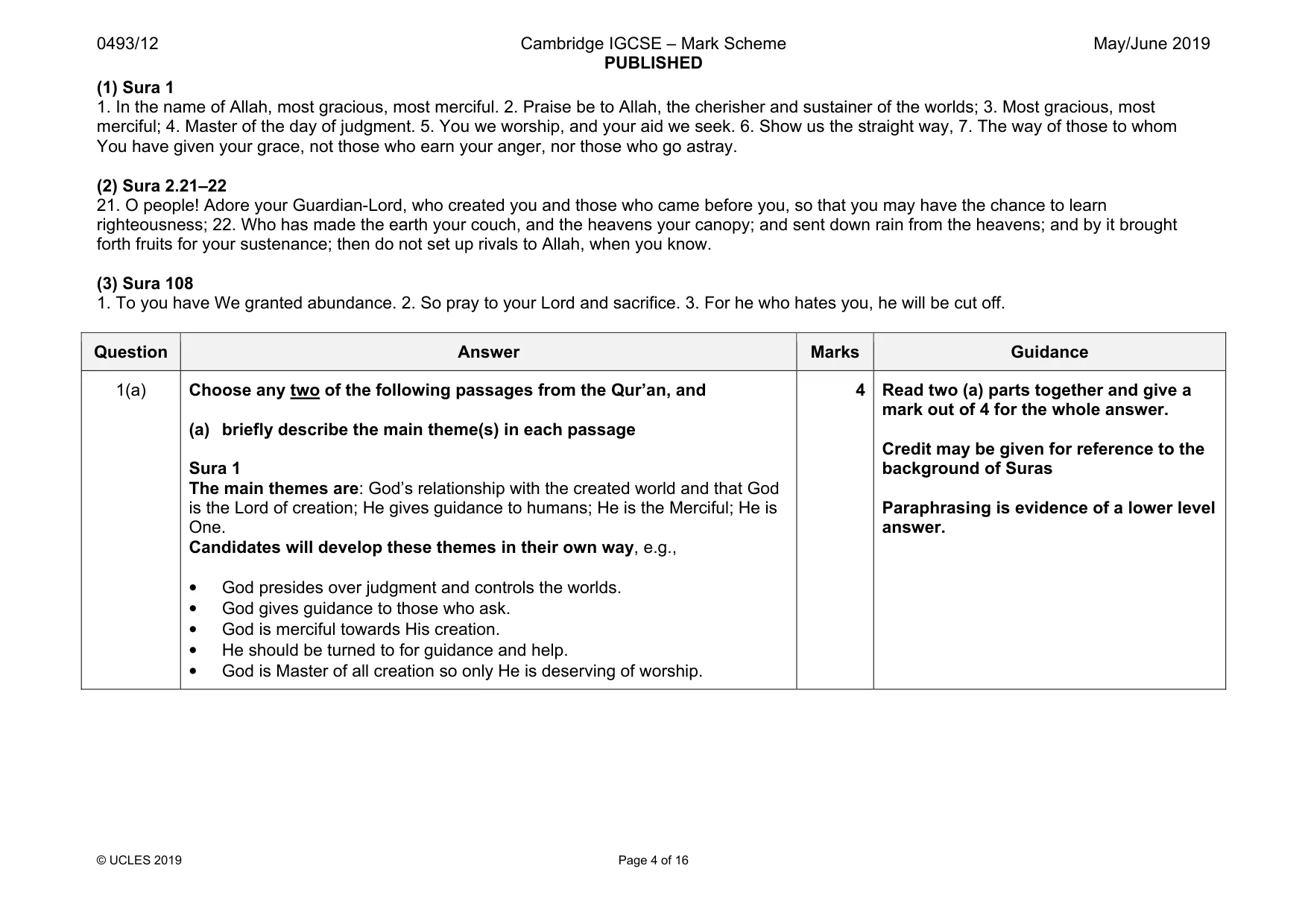
0493/12 Cambridge IGCSE – Mark Scheme PUBLISHED May/June 2019 © UCLES 2019 Page 4 of 16 (1) Sura 1 1. In the name of Allah, most gracious, most merciful. 2. Praise be to Allah, the cherisher and sustainer of the worlds; 3. Most gracious, most merciful; 4. Master of the day of judgment. 5. You we worship, and your aid we seek. 6. Show us the straight way, 7. The way of those to whom You have given your grace, not those who earn your anger, nor those who go astray. (2) Sura 2.21–22 21. O people! Adore your Guardian-Lord, who created you and those who came before you, so that you may have the chance to learn righteousness; 22. Who has made the earth your couch, and the heavens your canopy; and sent down rain from the heavens; and by it brought forth fruits for your sustenance; then do not set up rivals to Allah, when you know. (3) Sura 108 1. To you have We granted abundance. 2. So pray to your Lord and sacrifice. 3. For he who hates you, he will be cut off. Question Answer Marks Guidance 1(a) Choose any two of the following passages from the Qur’an, and (a) briefly describe the main theme(s) in each passage Sura 1 The main themes are: God’s relationship with the created world and that God is the Lord of creation; He gives guidance to humans; He is the Merciful; He is One. Candidates will develop these themes in their own way, e.g., • God presides over judgment and controls the worlds. • God gives guidance to those who ask. • God is merciful towards His creation. • He should be turned to for guidance and help. • God is Master of all creation so only He is deserving of worship. 4 Read two (a) parts together and give a mark out of 4 for the whole answer. Credit may be given for reference to the background of Suras Paraphrasing is evidence of a lower level answer.
Mark scheme, page 5
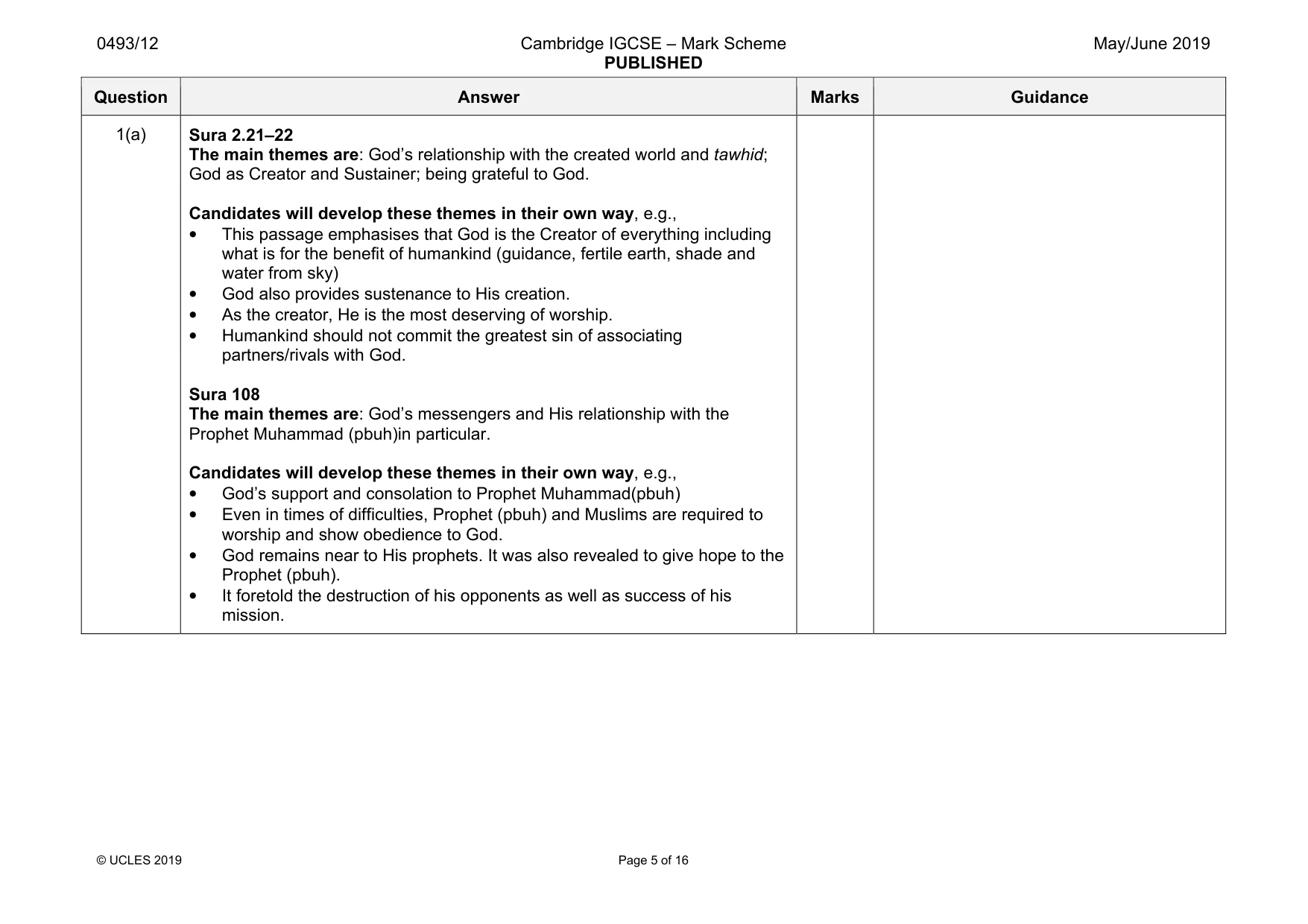
0493/12 Cambridge IGCSE – Mark Scheme PUBLISHED May/June 2019 © UCLES 2019 Page 5 of 16 Question Answer Marks Guidance 1(a) Sura 2.21–22 The main themes are: God’s relationship with the created world and tawhid; God as Creator and Sustainer; being grateful to God. Candidates will develop these themes in their own way, e.g., • This passage emphasises that God is the Creator of everything including what is for the benefit of humankind (guidance, fertile earth, shade and water from sky) • God also provides sustenance to His creation. • As the creator, He is the most deserving of worship. • Humankind should not commit the greatest sin of associating partners/rivals with God. Sura 108 The main themes are: God’s messengers and His relationship with the Prophet Muhammad (pbuh)in particular. Candidates will develop these themes in their own way, e.g., • God’s support and consolation to Prophet Muhammad(pbuh) • Even in times of difficulties, Prophet (pbuh) and Muslims are required to worship and show obedience to God. • God remains near to His prophets. It was also revealed to give hope to the Prophet (pbuh). • It foretold the destruction of his opponents as well as success of his mission.
Mark scheme, page 6
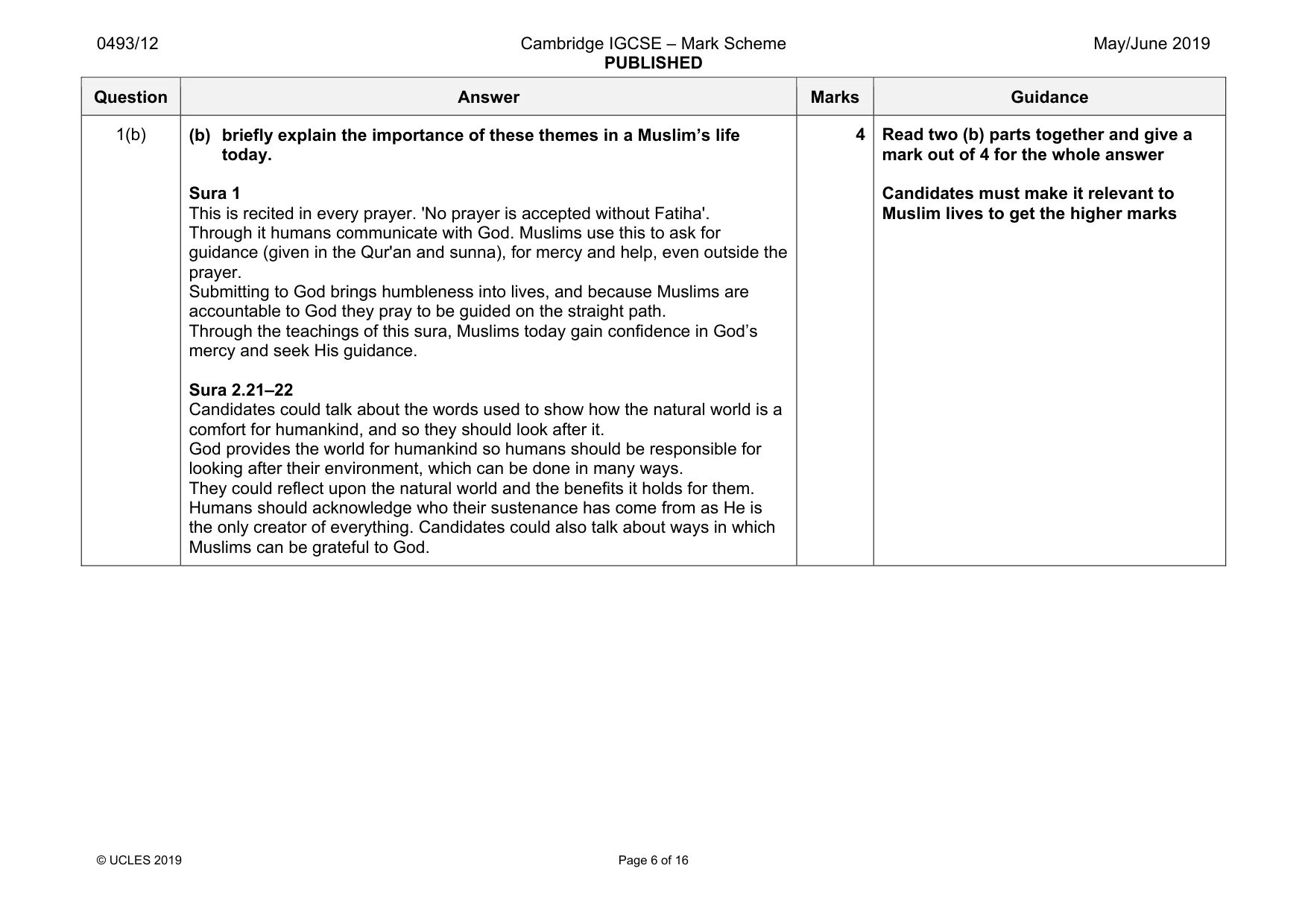
0493/12 Cambridge IGCSE – Mark Scheme PUBLISHED May/June 2019 © UCLES 2019 Page 6 of 16 Question Answer Marks Guidance 1(b) (b) briefly explain the importance of these themes in a Muslim’s life today. Sura 1 This is recited in every prayer. 'No prayer is accepted without Fatiha'. Through it humans communicate with God. Muslims use this to ask for guidance (given in the Qur'an and sunna), for mercy and help, even outside the prayer. Submitting to God brings humbleness into lives, and because Muslims are accountable to God they pray to be guided on the straight path. Through the teachings of this sura, Muslims today gain confidence in God’s mercy and seek His guidance. Sura 2.21–22 Candidates could talk about the words used to show how the natural world is a comfort for humankind, and so they should look after it. God provides the world for humankind so humans should be responsible for looking after their environment, which can be done in many ways. They could reflect upon the natural world and the benefits it holds for them. Humans should acknowledge who their sustenance has come from as He is the only creator of everything. Candidates could also talk about ways in which Muslims can be grateful to God. 4 Read two (b) parts together and give a mark out of 4 for the whole answer Candidates must make it relevant to Muslim lives to get the higher marks
Mark scheme, page 7
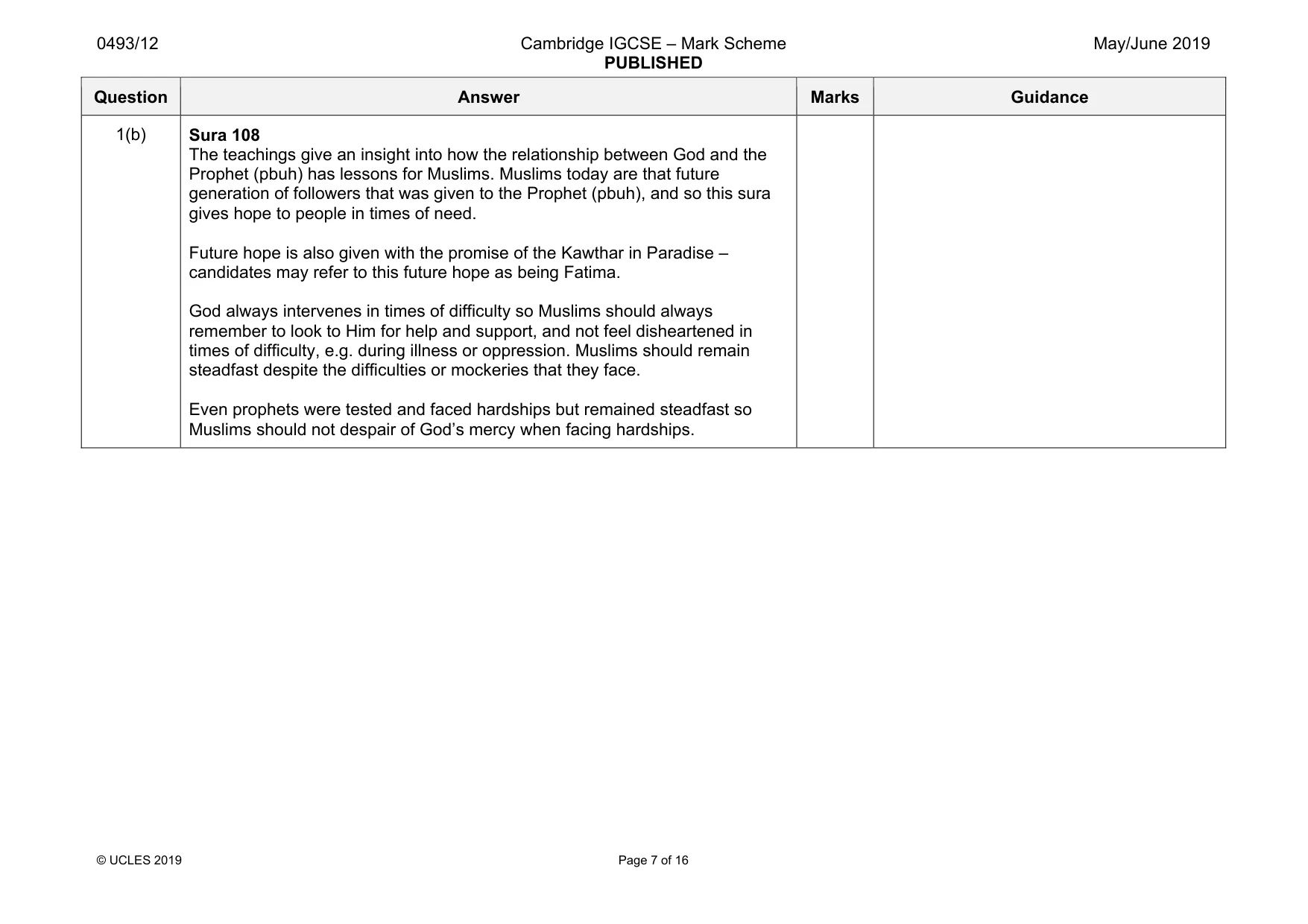
0493/12 Cambridge IGCSE – Mark Scheme PUBLISHED May/June 2019 © UCLES 2019 Page 7 of 16 Question Answer Marks Guidance 1(b) Sura 108 The teachings give an insight into how the relationship between God and the Prophet (pbuh) has lessons for Muslims. Muslims today are that future generation of followers that was given to the Prophet (pbuh), and so this sura gives hope to people in times of need. Future hope is also given with the promise of the Kawthar in Paradise – candidates may refer to this future hope as being Fatima. God always intervenes in times of difficulty so Muslims should always remember to look to Him for help and support, and not feel disheartened in times of difficulty, e.g. during illness or oppression. Muslims should remain steadfast despite the difficulties or mockeries that they face. Even prophets were tested and faced hardships but remained steadfast so Muslims should not despair of God’s mercy when facing hardships.
Mark scheme, page 8
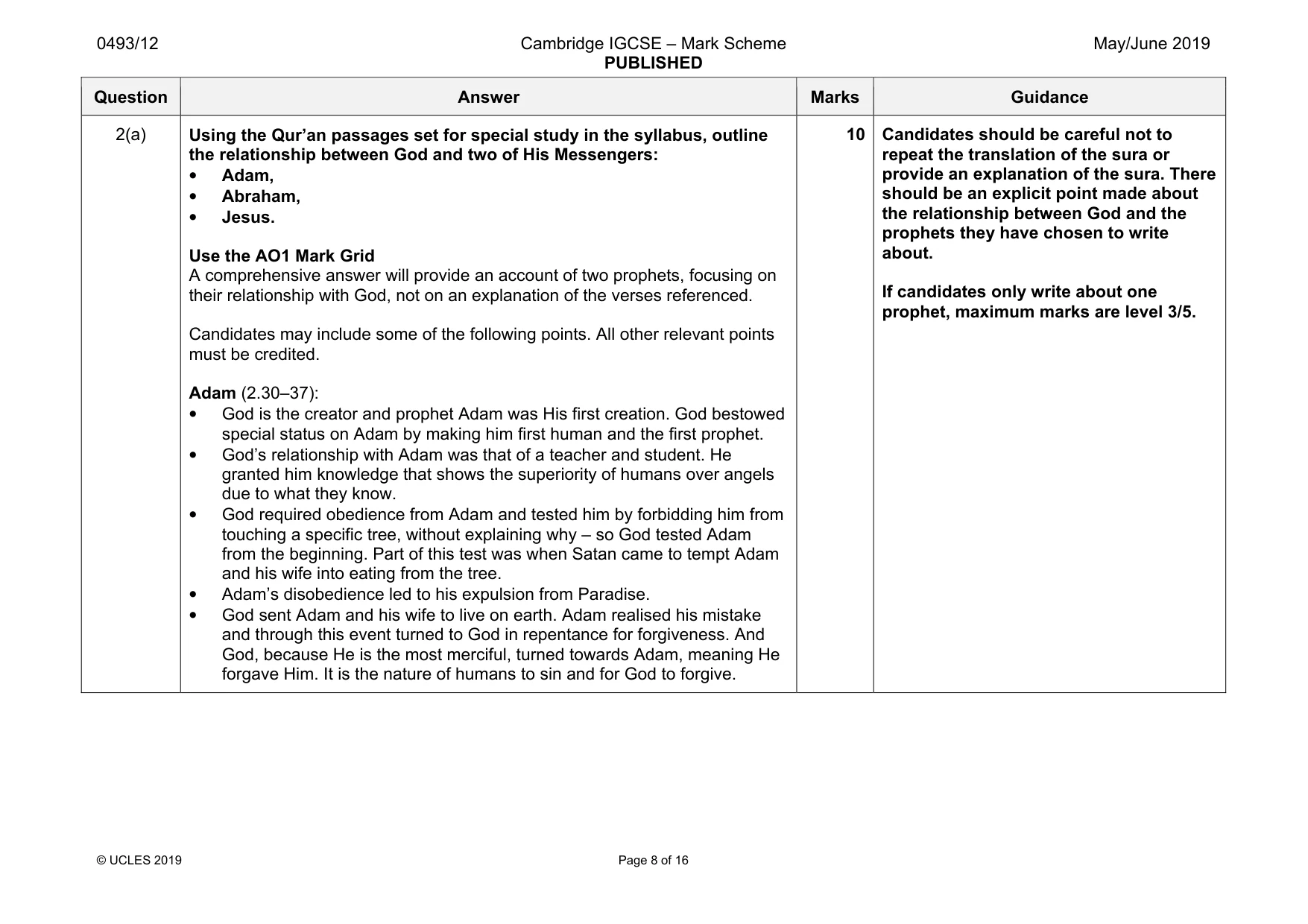
0493/12 Cambridge IGCSE – Mark Scheme PUBLISHED May/June 2019 © UCLES 2019 Page 8 of 16 Question Answer Marks Guidance 2(a) Using the Qur’an passages set for special study in the syllabus, outline the relationship between God and two of His Messengers: • Adam, • Abraham, • Jesus. Use the AO1 Mark Grid A comprehensive answer will provide an account of two prophets, focusing on their relationship with God, not on an explanation of the verses referenced. Candidates may include some of the following points. All other relevant points must be credited. Adam (2.30–37): • God is the creator and prophet Adam was His first creation. God bestowed special status on Adam by making him first human and the first prophet. • God’s relationship with Adam was that of a teacher and student. He granted him knowledge that shows the superiority of humans over angels due to what they know. • God required obedience from Adam and tested him by forbidding him from touching a specific tree, without explaining why – so God tested Adam from the beginning. Part of this test was when Satan came to tempt Adam and his wife into eating from the tree. • Adam’s disobedience led to his expulsion from Paradise. • God sent Adam and his wife to live on earth. Adam realised his mistake and through this event turned to God in repentance for forgiveness. And God, because He is the most merciful, turned towards Adam, meaning He forgave Him. It is the nature of humans to sin and for God to forgive. 10 Candidates should be careful not to repeat the translation of the sura or provide an explanation of the sura. There should be an explicit point made about the relationship between God and the prophets they have chosen to write about. If candidates only write about one prophet, maximum marks are level 3/5.
Mark scheme, page 9
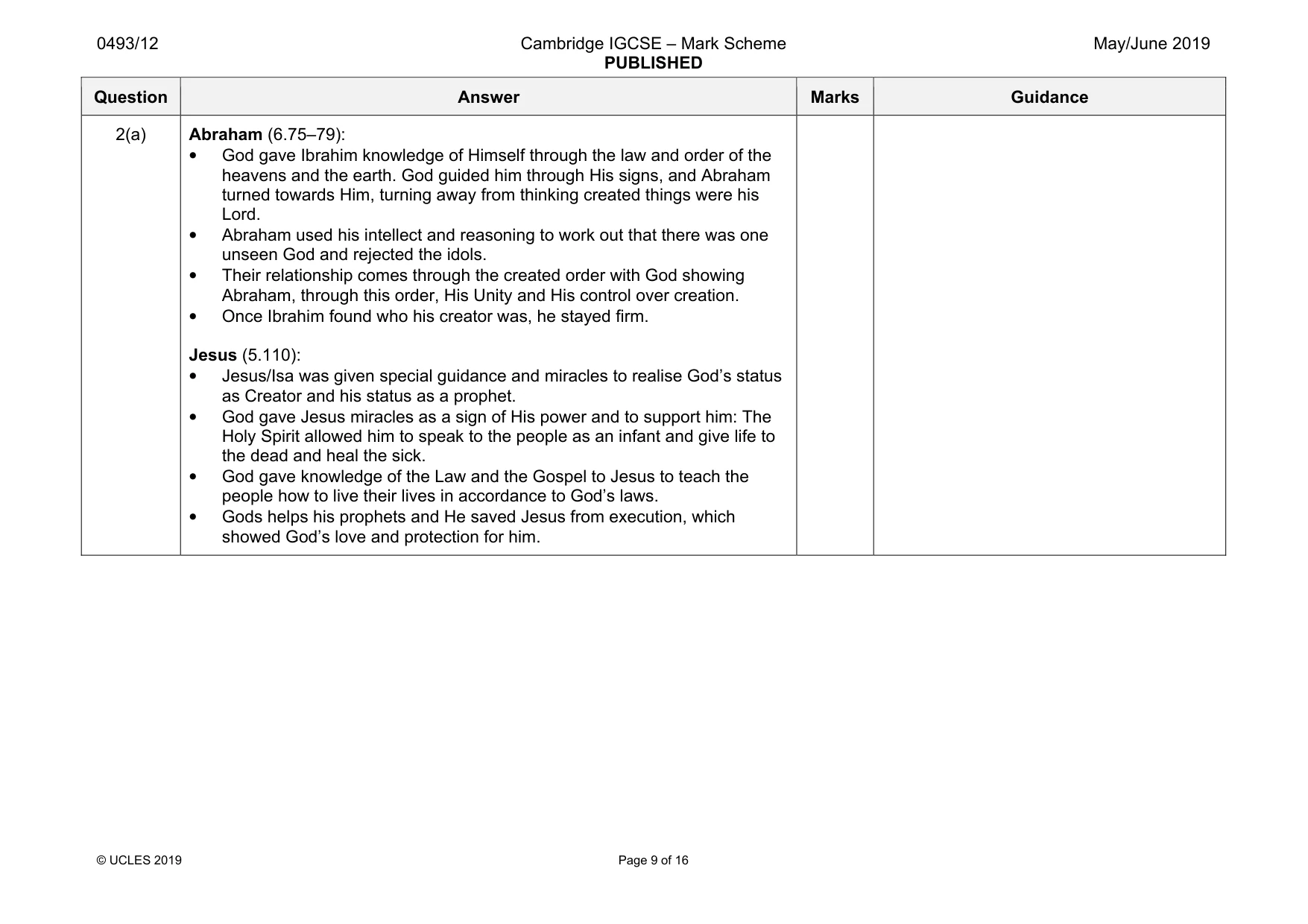
0493/12 Cambridge IGCSE – Mark Scheme PUBLISHED May/June 2019 © UCLES 2019 Page 9 of 16 Question Answer Marks Guidance 2(a) Abraham (6.75–79): • God gave Ibrahim knowledge of Himself through the law and order of the heavens and the earth. God guided him through His signs, and Abraham turned towards Him, turning away from thinking created things were his Lord. • Abraham used his intellect and reasoning to work out that there was one unseen God and rejected the idols. • Their relationship comes through the created order with God showing Abraham, through this order, His Unity and His control over creation. • Once Ibrahim found who his creator was, he stayed firm. Jesus (5.110): • Jesus/Isa was given special guidance and miracles to realise God’s status as Creator and his status as a prophet. • God gave Jesus miracles as a sign of His power and to support him: The Holy Spirit allowed him to speak to the people as an infant and give life to the dead and heal the sick. • God gave knowledge of the Law and the Gospel to Jesus to teach the people how to live their lives in accordance to God’s laws. • Gods helps his prophets and He saved Jesus from execution, which showed God’s love and protection for him.
Mark scheme, page 10
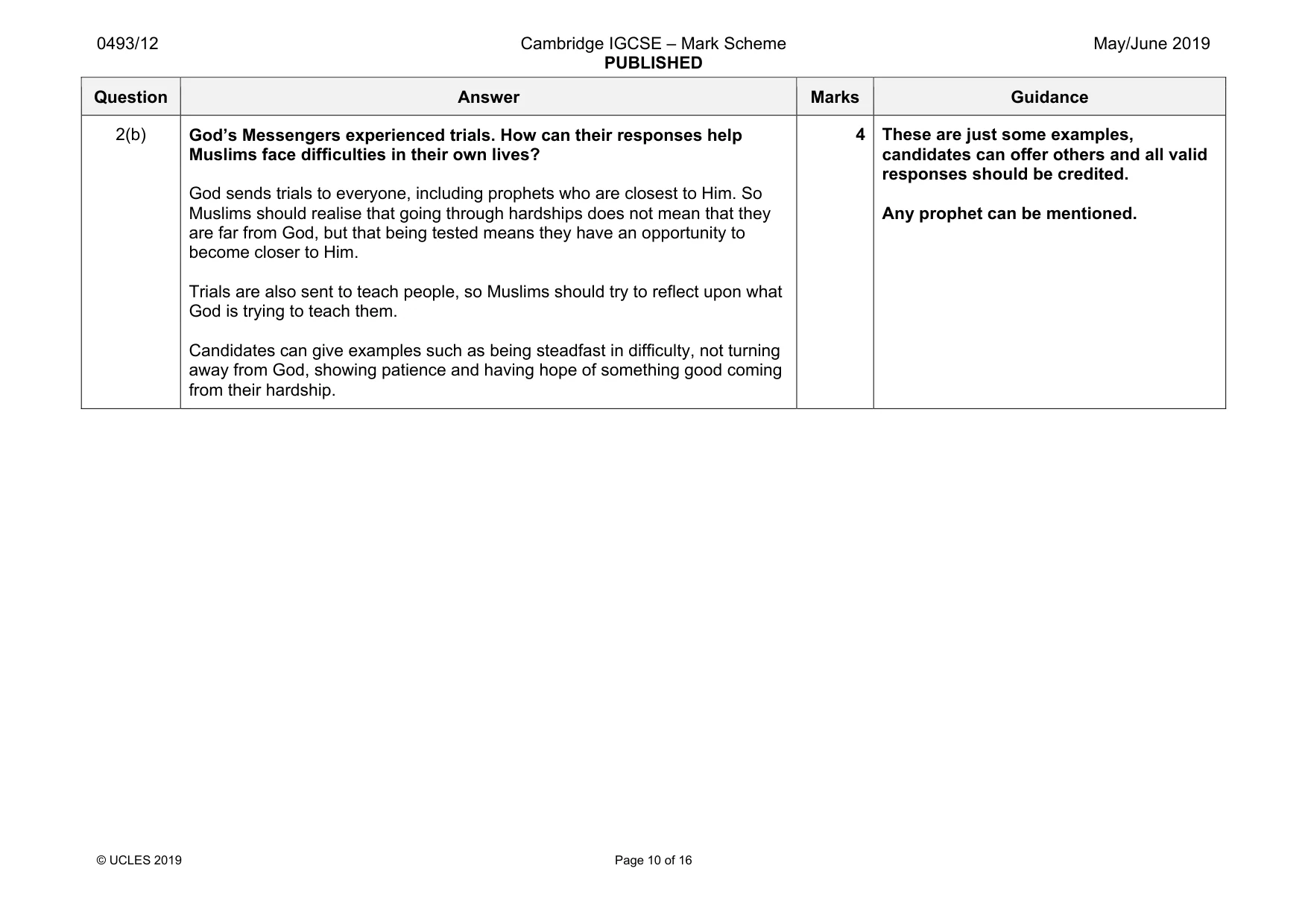
0493/12 Cambridge IGCSE – Mark Scheme PUBLISHED May/June 2019 © UCLES 2019 Page 10 of 16 Question Answer Marks Guidance 2(b) God’s Messengers experienced trials. How can their responses help Muslims face difficulties in their own lives? God sends trials to everyone, including prophets who are closest to Him. So Muslims should realise that going through hardships does not mean that they are far from God, but that being tested means they have an opportunity to become closer to Him. Trials are also sent to teach people, so Muslims should try to reflect upon what God is trying to teach them. Candidates can give examples such as being steadfast in difficulty, not turning away from God, showing patience and having hope of something good coming from their hardship. 4 These are just some examples, candidates can offer others and all valid responses should be credited. Any prophet can be mentioned.
Mark scheme, page 11
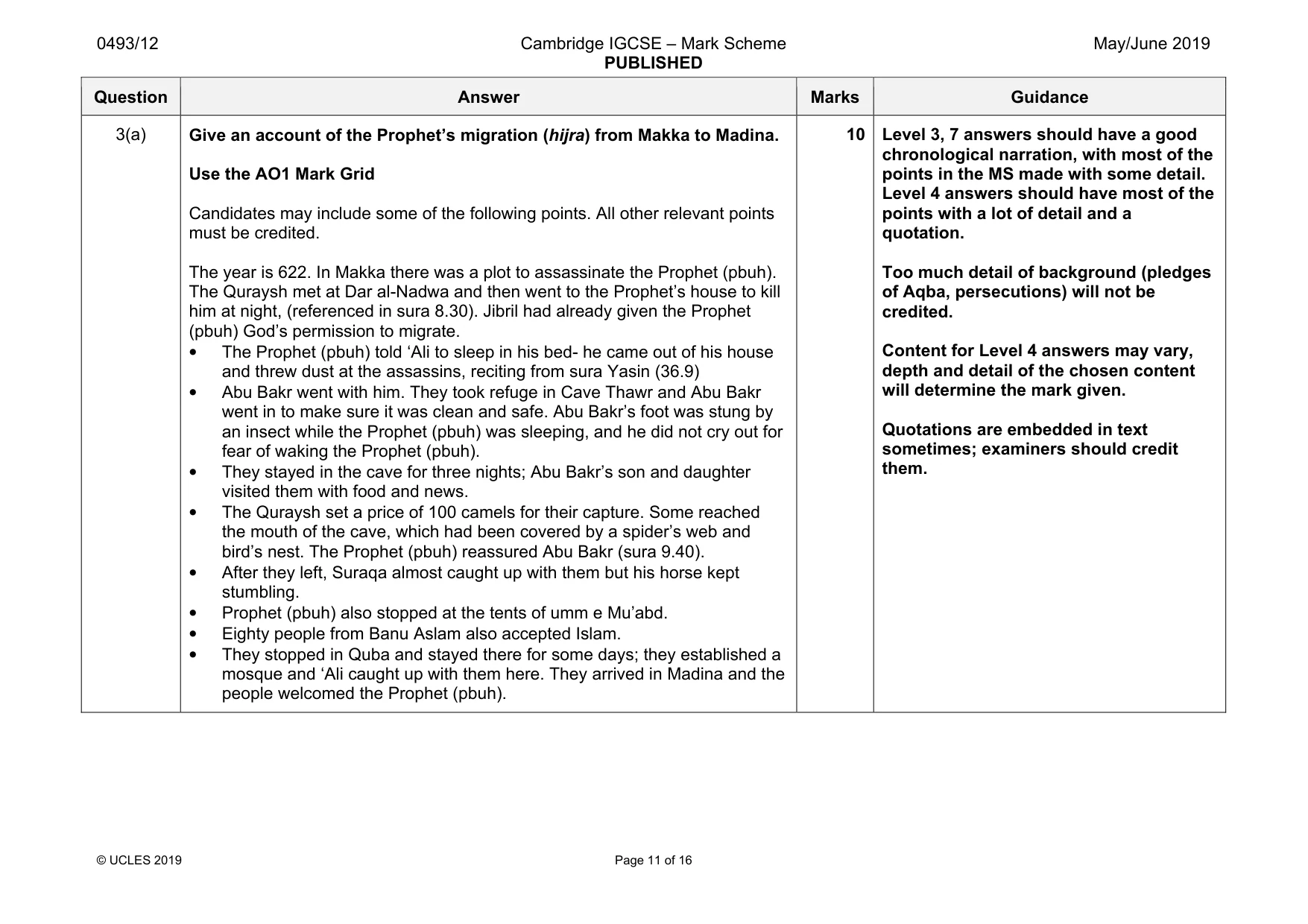
0493/12 Cambridge IGCSE – Mark Scheme PUBLISHED May/June 2019 © UCLES 2019 Page 11 of 16 Question Answer Marks Guidance 3(a) Give an account of the Prophet’s migration (hijra) from Makka to Madina. Use the AO1 Mark Grid Candidates may include some of the following points. All other relevant points must be credited. The year is 622. In Makka there was a plot to assassinate the Prophet (pbuh). The Quraysh met at Dar al-Nadwa and then went to the Prophet’s house to kill him at night, (referenced in sura 8.30). Jibril had already given the Prophet (pbuh) God’s permission to migrate. • The Prophet (pbuh) told ‘Ali to sleep in his bed- he came out of his house and threw dust at the assassins, reciting from sura Yasin (36.9) • Abu Bakr went with him. They took refuge in Cave Thawr and Abu Bakr went in to make sure it was clean and safe. Abu Bakr’s foot was stung by an insect while the Prophet (pbuh) was sleeping, and he did not cry out for fear of waking the Prophet (pbuh). • They stayed in the cave for three nights; Abu Bakr’s son and daughter visited them with food and news. • The Quraysh set a price of 100 camels for their capture. Some reached the mouth of the cave, which had been covered by a spider’s web and bird’s nest. The Prophet (pbuh) reassured Abu Bakr (sura 9.40). • After they left, Suraqa almost caught up with them but his horse kept stumbling. • Prophet (pbuh) also stopped at the tents of umm e Mu’abd. • Eighty people from Banu Aslam also accepted Islam. • They stopped in Quba and stayed there for some days; they established a mosque and ‘Ali caught up with them here. They arrived in Madina and the people welcomed the Prophet (pbuh). 10 Level 3, 7 answers should have a good chronological narration, with most of the points in the MS made with some detail. Level 4 answers should have most of the points with a lot of detail and a quotation. Too much detail of background (pledges of Aqba, persecutions) will not be credited. Content for Level 4 answers may vary, depth and detail of the chosen content will determine the mark given. Quotations are embedded in text sometimes; examiners should credit them.
Mark scheme, page 12
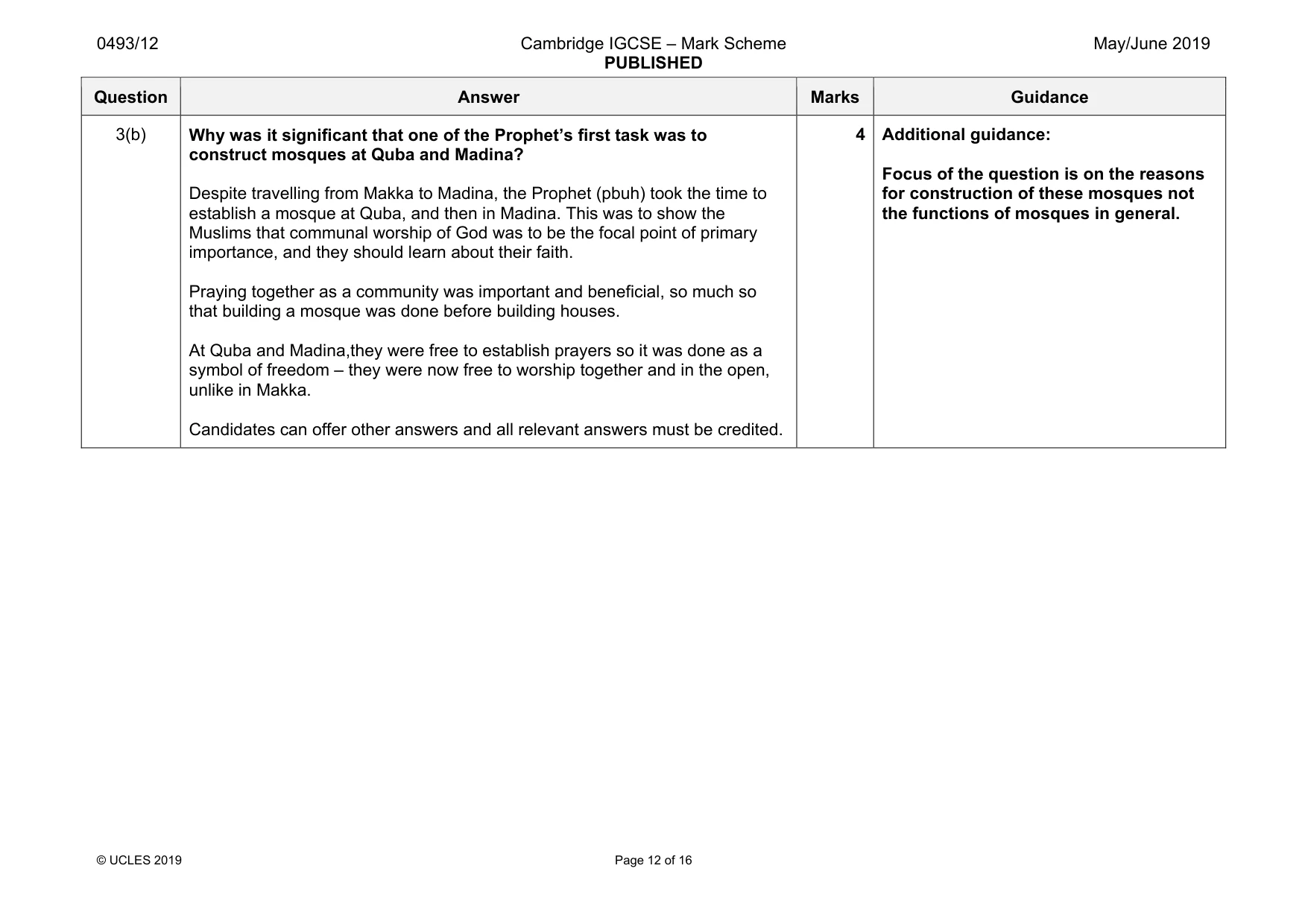
0493/12 Cambridge IGCSE – Mark Scheme PUBLISHED May/June 2019 © UCLES 2019 Page 12 of 16 Question Answer Marks Guidance 3(b) Why was it significant that one of the Prophet’s first task was to construct mosques at Quba and Madina? Despite travelling from Makka to Madina, the Prophet (pbuh) took the time to establish a mosque at Quba, and then in Madina. This was to show the Muslims that communal worship of God was to be the focal point of primary importance, and they should learn about their faith. Praying together as a community was important and beneficial, so much so that building a mosque was done before building houses. At Quba and Madina,they were free to establish prayers so it was done as a symbol of freedom – they were now free to worship together and in the open, unlike in Makka. Candidates can offer other answers and all relevant answers must be credited. 4 Additional guidance: Focus of the question is on the reasons for construction of these mosques not the functions of mosques in general.
Mark scheme, page 13
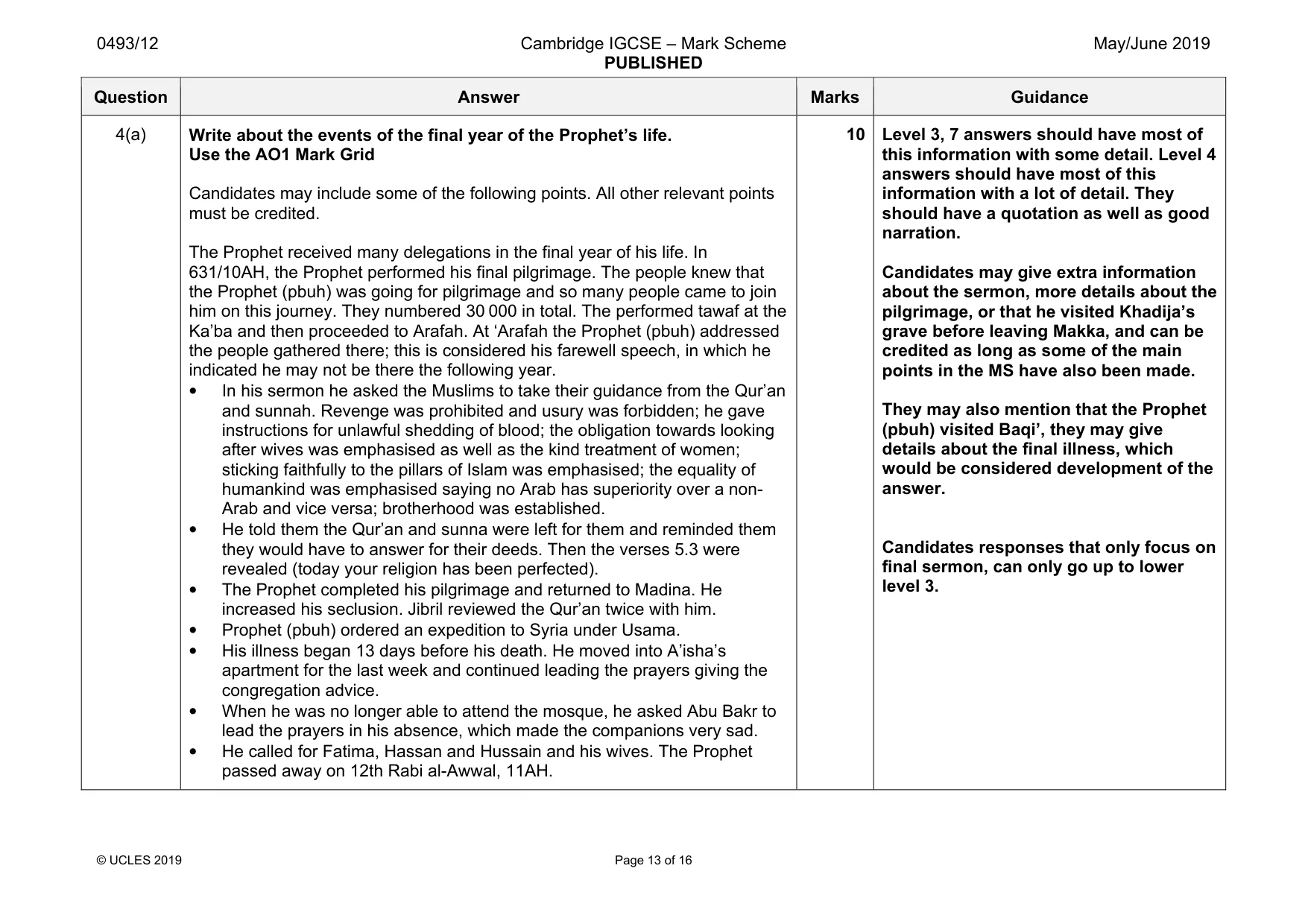
0493/12 Cambridge IGCSE – Mark Scheme PUBLISHED May/June 2019 © UCLES 2019 Page 13 of 16 Question Answer Marks Guidance 4(a) Write about the events of the final year of the Prophet’s life. Use the AO1 Mark Grid Candidates may include some of the following points. All other relevant points must be credited. The Prophet received many delegations in the final year of his life. In 631/10AH, the Prophet performed his final pilgrimage. The people knew that the Prophet (pbuh) was going for pilgrimage and so many people came to join him on this journey. They numbered 30 000 in total. The performed tawaf at the Ka’ba and then proceeded to Arafah. At ‘Arafah the Prophet (pbuh) addressed the people gathered there; this is considered his farewell speech, in which he indicated he may not be there the following year. • In his sermon he asked the Muslims to take their guidance from the Qur’an and sunnah. Revenge was prohibited and usury was forbidden; he gave instructions for unlawful shedding of blood; the obligation towards looking after wives was emphasised as well as the kind treatment of women; sticking faithfully to the pillars of Islam was emphasised; the equality of humankind was emphasised saying no Arab has superiority over a non- Arab and vice versa; brotherhood was established. • He told them the Qur’an and sunna were left for them and reminded them they would have to answer for their deeds. Then the verses 5.3 were revealed (today your religion has been perfected). • The Prophet completed his pilgrimage and returned to Madina. He increased his seclusion. Jibril reviewed the Qur’an twice with him. • Prophet (pbuh) ordered an expedition to Syria under Usama. • His illness began 13 days before his death. He moved into A’isha’s apartment for the last week and continued leading the prayers giving the congregation advice. • When he was no longer able to attend the mosque, he asked Abu Bakr to lead the prayers in his absence, which made the companions very sad. • He called for Fatima, Hassan and Hussain and his wives. The Prophet passed away on 12th Rabi al-Awwal, 11AH. 10 Level 3, 7 answers should have most of this information with some detail. Level 4 answers should have most of this information with a lot of detail. They should have a quotation as well as good narration. Candidates may give extra information about the sermon, more details about the pilgrimage, or that he visited Khadija’s grave before leaving Makka, and can be credited as long as some of the main points in the MS have also been made. They may also mention that the Prophet (pbuh) visited Baqi’, they may give details about the final illness, which would be considered development of the answer. Candidates responses that only focus on final sermon, can only go up to lower level 3.
Mark scheme, page 14
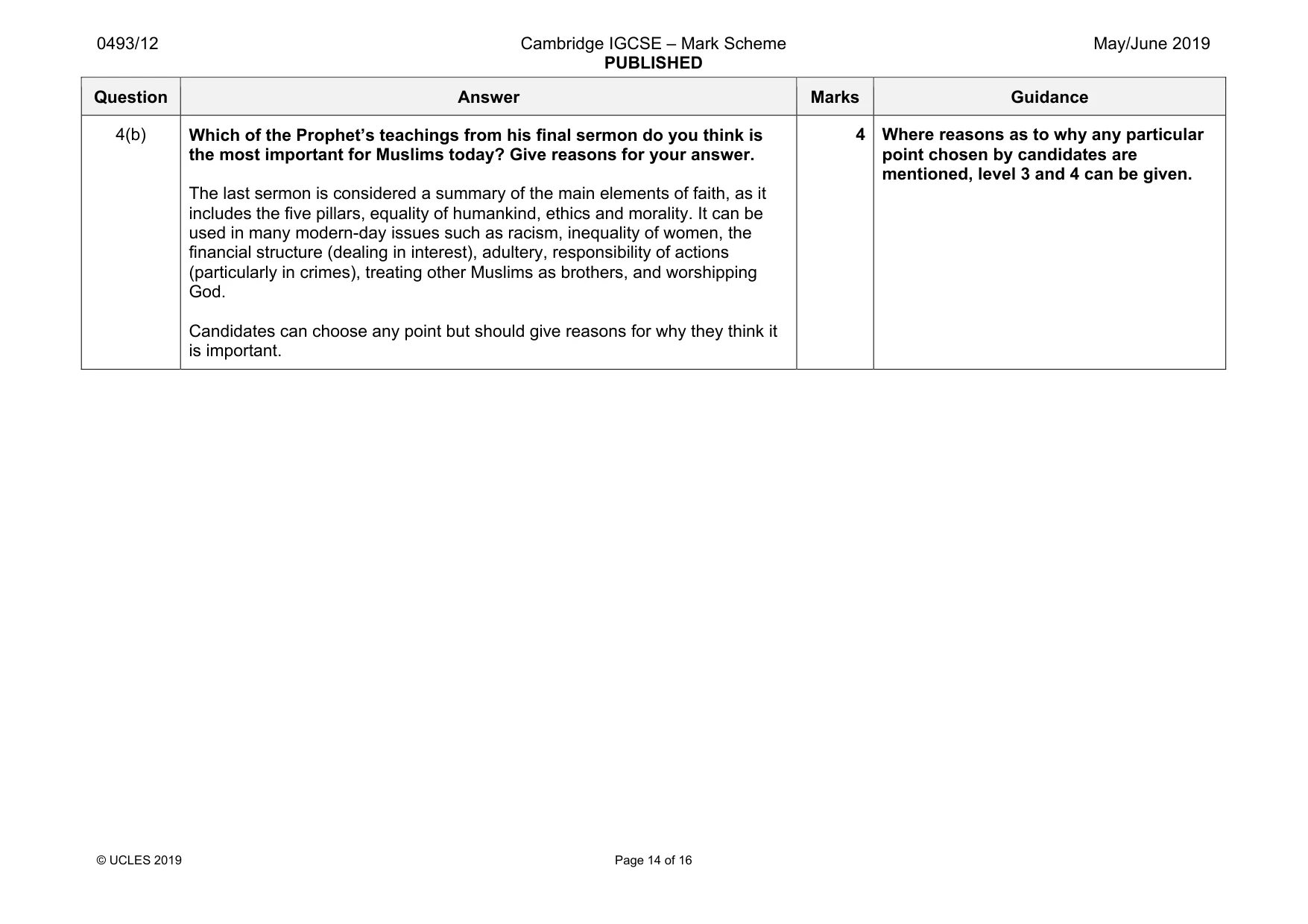
0493/12 Cambridge IGCSE – Mark Scheme PUBLISHED May/June 2019 © UCLES 2019 Page 14 of 16 Question Answer Marks Guidance 4(b) Which of the Prophet’s teachings from his final sermon do you think is the most important for Muslims today? Give reasons for your answer. The last sermon is considered a summary of the main elements of faith, as it includes the five pillars, equality of humankind, ethics and morality. It can be used in many modern-day issues such as racism, inequality of women, the financial structure (dealing in interest), adultery, responsibility of actions (particularly in crimes), treating other Muslims as brothers, and worshipping God. Candidates can choose any point but should give reasons for why they think it is important. 4 Where reasons as to why any particular point chosen by candidates are mentioned, level 3 and 4 can be given.
Mark scheme, page 15
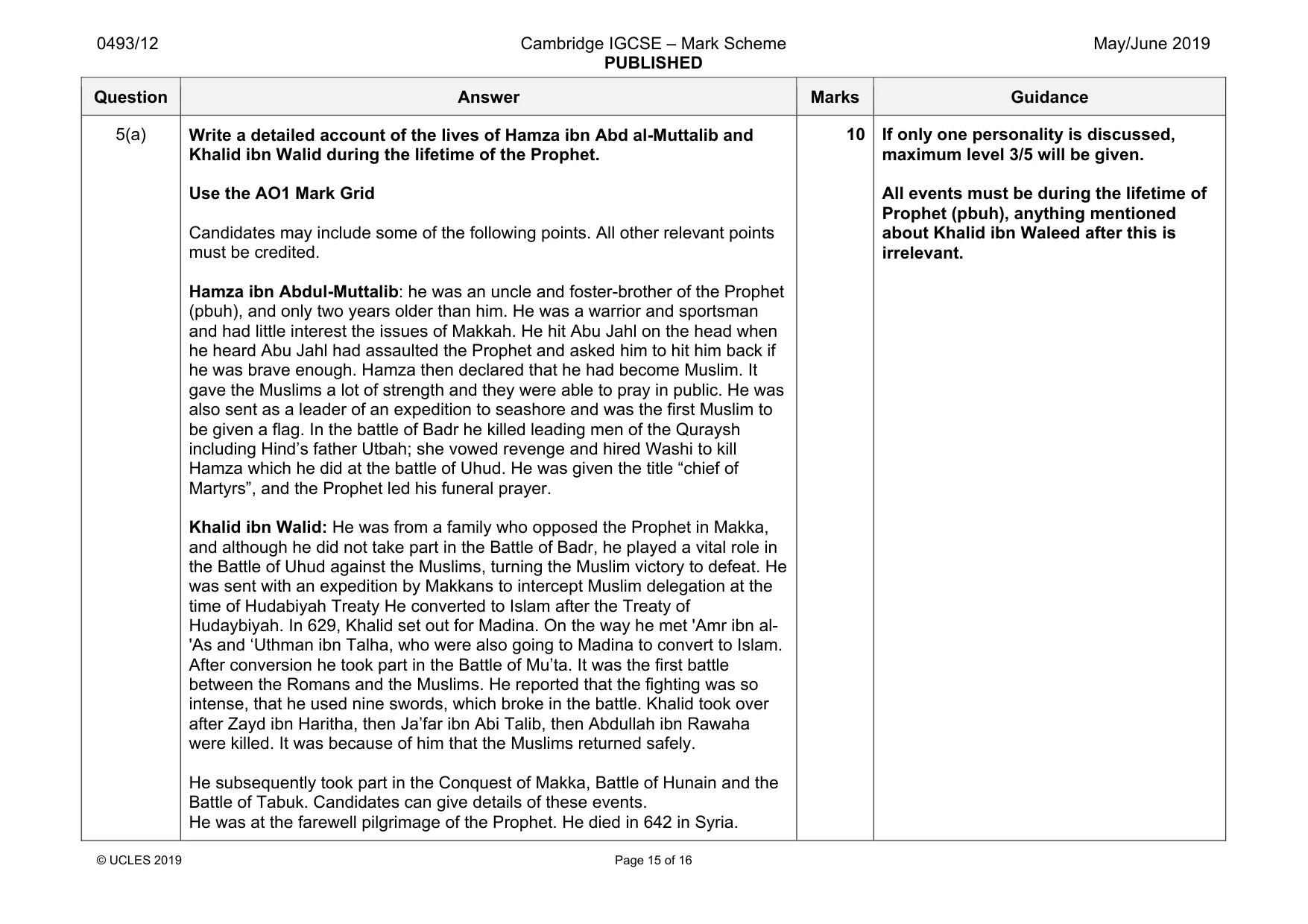
0493/12 Cambridge IGCSE – Mark Scheme PUBLISHED May/June 2019 © UCLES 2019 Page 15 of 16 Question Answer Marks Guidance 5(a) Write a detailed account of the lives of Hamza ibn Abd al-Muttalib and Khalid ibn Walid during the lifetime of the Prophet. Use the AO1 Mark Grid Candidates may include some of the following points. All other relevant points must be credited. Hamza ibn Abdul-Muttalib: he was an uncle and foster-brother of the Prophet (pbuh), and only two years older than him. He was a warrior and sportsman and had little interest the issues of Makkah. He hit Abu Jahl on the head when he heard Abu Jahl had assaulted the Prophet and asked him to hit him back if he was brave enough. Hamza then declared that he had become Muslim. It gave the Muslims a lot of strength and they were able to pray in public. He was also sent as a leader of an expedition to seashore and was the first Muslim to be given a flag. In the battle of Badr he killed leading men of the Quraysh including Hind’s father Utbah; she vowed revenge and hired Washi to kill Hamza which he did at the battle of Uhud. He was given the title “chief of Martyrs”, and the Prophet led his funeral prayer. Khalid ibn Walid: He was from a family who opposed the Prophet in Makka, and although he did not take part in the Battle of Badr, he played a vital role in the Battle of Uhud against the Muslims, turning the Muslim victory to defeat. He was sent with an expedition by Makkans to intercept Muslim delegation at the time of Hudabiyah Treaty He converted to Islam after the Treaty of Hudaybiyah. In 629, Khalid set out for Madina. On the way he met 'Amr ibn al- 'As and ‘Uthman ibn Talha, who were also going to Madina to convert to Islam. After conversion he took part in the Battle of Mu’ta. It was the first battle between the Romans and the Muslims. He reported that the fighting was so intense, that he used nine swords, which broke in the battle. Khalid took over after Zayd ibn Haritha, then Ja’far ibn Abi Talib, then Abdullah ibn Rawaha were killed. It was because of him that the Muslims returned safely. He subsequently took part in the Conquest of Makka, Battle of Hunain and the Battle of Tabuk. Candidates can give details of these events. He was at the farewell pilgrimage of the Prophet. He died in 642 in Syria. 10 If only one personality is discussed, maximum level 3/5 will be given. All events must be during the lifetime of Prophet (pbuh), anything mentioned about Khalid ibn Waleed after this is irrelevant.
Mark scheme, page 16
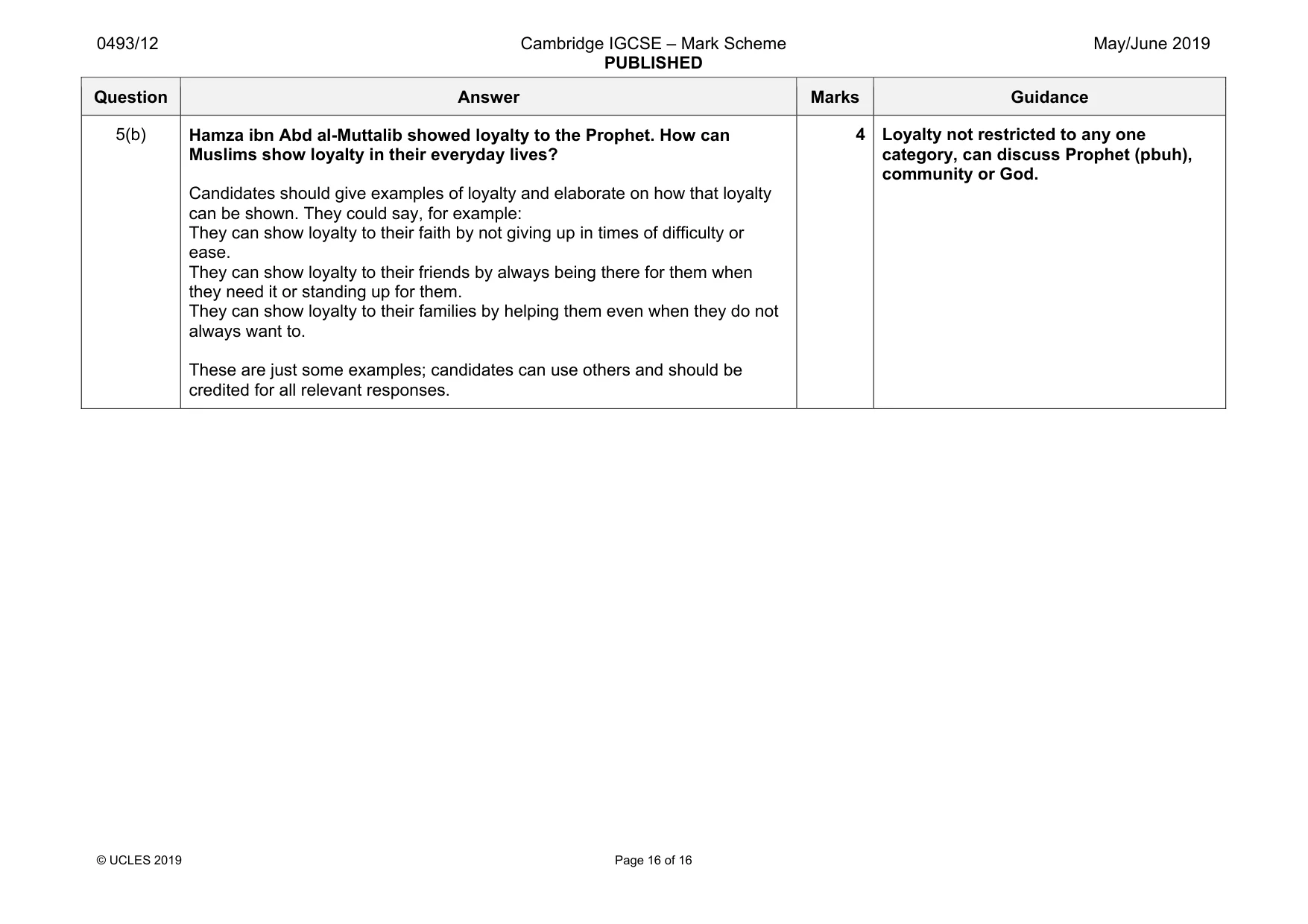
0493/12 Cambridge IGCSE – Mark Scheme PUBLISHED May/June 2019 © UCLES 2019 Page 16 of 16 Question Answer Marks Guidance 5(b) Hamza ibn Abd al-Muttalib showed loyalty to the Prophet. How can Muslims show loyalty in their everyday lives? Candidates should give examples of loyalty and elaborate on how that loyalty can be shown. They could say, for example: They can show loyalty to their faith by not giving up in times of difficulty or ease. They can show loyalty to their friends by always being there for them when they need it or standing up for them. They can show loyalty to their families by helping them even when they do not always want to. These are just some examples; candidates can use others and should be credited for all relevant responses. 4 Loyalty not restricted to any one category, can discuss Prophet (pbuh), community or God.
What you needed in this session
Cambridge’s own grade thresholds for 2019 May/June, Paper 1 · Variant 2. A higher threshold means an easier paper — the bar moves with how the cohort did.