Cambridge IGCSE Islamiyat 0493 — 2019 May/June Paper 1 · Variant 1
0493/11/M/J/19 · 50 marks · ≈56 min
The question paper and its mark scheme, free to read here and free to download. This is Cambridge’s own paper, exactly as it was sat.
Question paper16 pages










Mark scheme14 pages
Answers below. Sit the paper first if you are practising.
Paper as text
Question paper, page 1
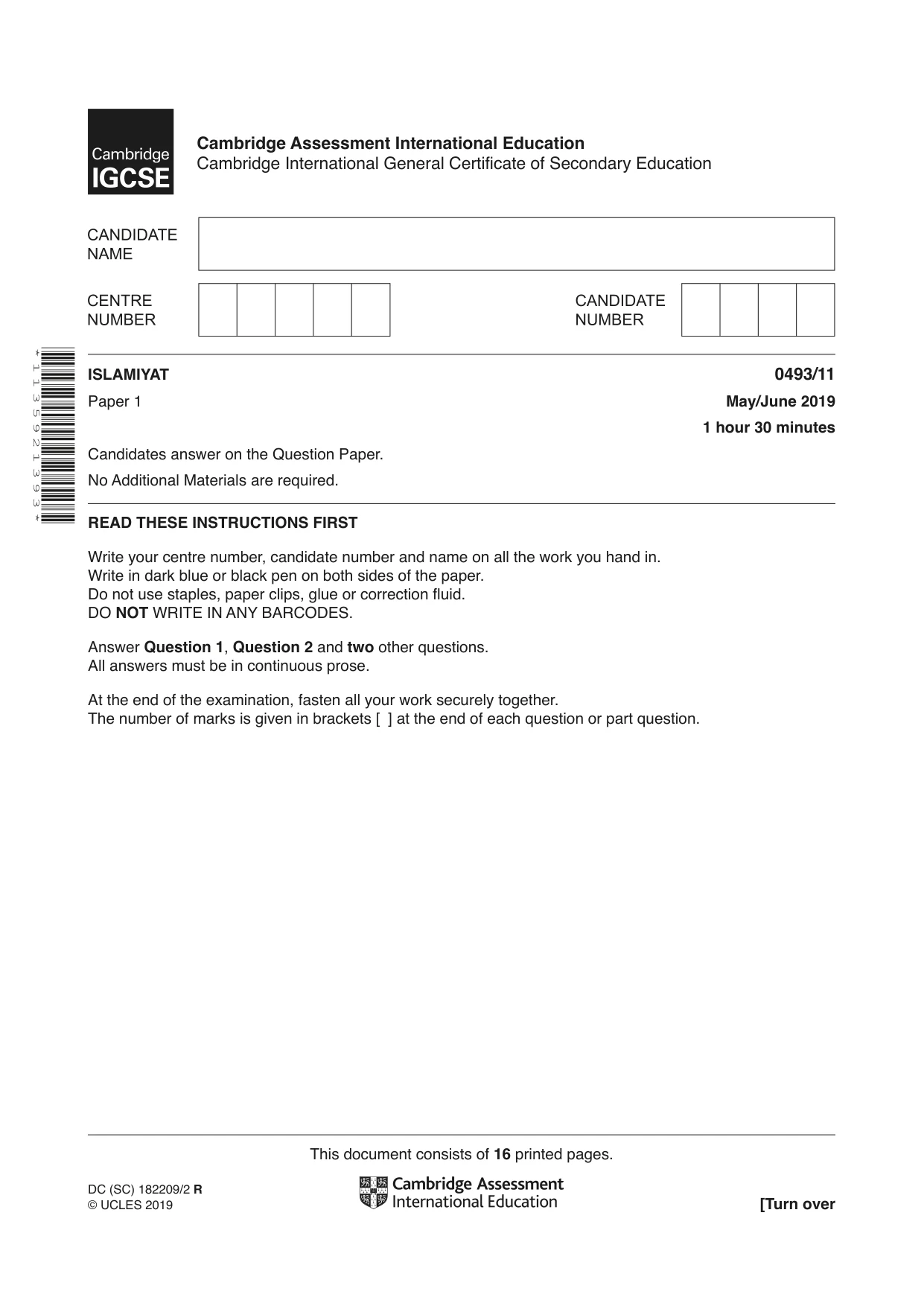
This document consists of 16 printed pages. DC (SC) 182209/2 R © UCLES 2019 [Turn over * 1 1 3 5 9 2 1 3 9 3 * ISLAMIYAT 0493/11 Paper 1 May/June 2019 1 hour 30 minutes Candidates answer on the Question Paper. No Additional Materials are required. READ THESE INSTRUCTIONS FIRST Write your centre number, candidate number and name on all the work you hand in. Write in dark blue or black pen on both sides of the paper. Do not use staples, paper clips, glue or correction fluid. DO NOT WRITE IN ANY BARCODES. Answer Question 1, Question 2 and two other questions. All answers must be in continuous prose. At the end of the examination, fasten all your work securely together. The number of marks is given in brackets [ ] at the end of each question or part question. Cambridge Assessment International Education Cambridge International General Certificate of Secondary Education
Question paper, page 2
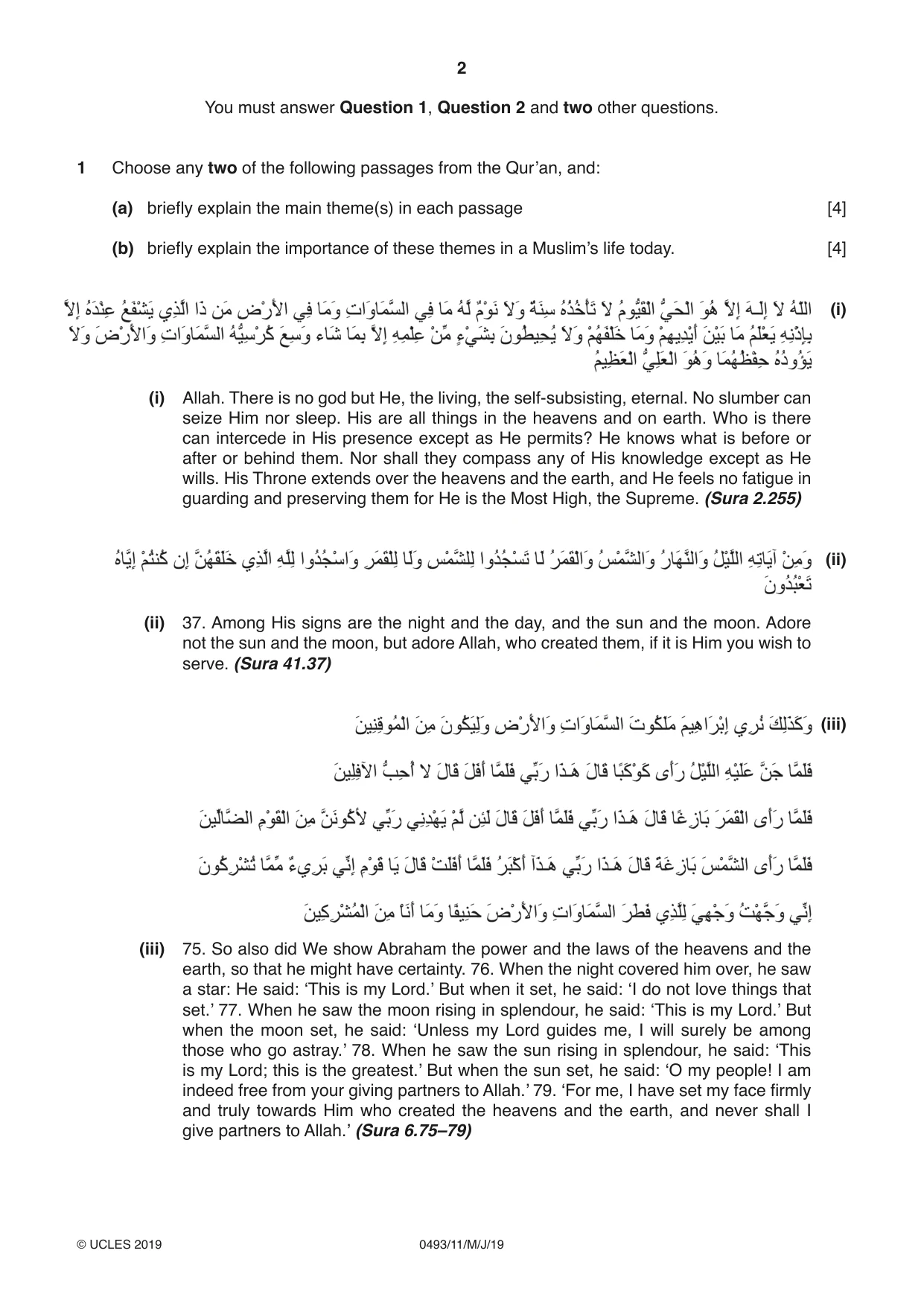
2 0493/11/M/J/19 © UCLES 2019 You must answer Question 1, Question 2 and two other questions. 1 Choose any two of the following passages from the Qur’an, and: (a) briefly explain the main theme(s) in each passage [4] (b) briefly explain the importance of these themes in a Muslim’s life today. [4] (i) (i) Allah. There is no god but He, the living, the self-subsisting, eternal. No slumber can seize Him nor sleep. His are all things in the heavens and on earth. Who is there can intercede in His presence except as He permits? He knows what is before or after or behind them. Nor shall they compass any of His knowledge except as He wills. His Throne extends over the heavens and the earth, and He feels no fatigue in guarding and preserving them for He is the Most High, the Supreme. (Sura 2.255) (ii) (ii) 37. Among His signs are the night and the day, and the sun and the moon. Adore not the sun and the moon, but adore Allah, who created them, if it is Him you wish to serve. (Sura 41.37) (iii) (iii) 75. So also did We show Abraham the power and the laws of the heavens and the earth, so that he might have certainty. 76. When the night covered him over, he saw a star: He said: ‘This is my Lord.’ But when it set, he said: ‘I do not love things that set.’ 77. When he saw the moon rising in splendour, he said: ‘This is my Lord.’ But when the moon set, he said: ‘Unless my Lord guides me, I will surely be among those who go astray.’ 78. When he saw the sun rising in splendour, he said: ‘This is my Lord; this is the greatest.’ But when the sun set, he said: ‘O my people! I am indeed free from your giving partners to Allah.’ 79. ‘For me, I have set my face firmly and truly towards Him who created the heavens and the earth, and never shall I give partners to Allah.’ (Sura 6.75–79)
Question paper, page 3
3 0493/11/M/J/19 © UCLES 2019 [Turn over … … … … … … … … … … … … … … … … … … … … … … … … … … … …
Question paper, page 4
4 0493/11/M/J/19 © UCLES 2019 … … … … … … … … … … … … … … … … … … … … … … … … … … … …
Question paper, page 5
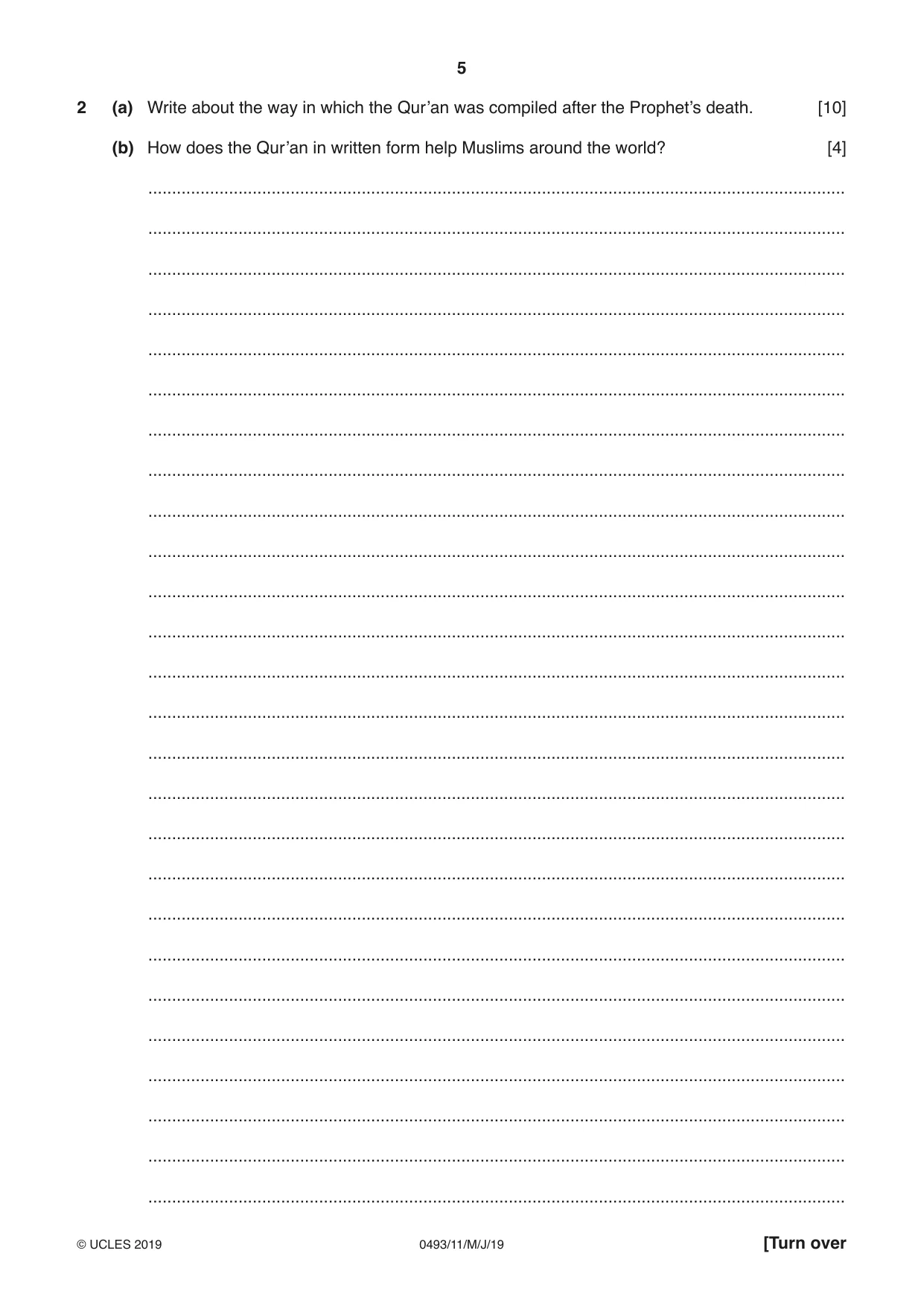
5 0493/11/M/J/19 © UCLES 2019 [Turn over 2 (a) Write about the way in which the Qur’an was compiled after the Prophet’s death. [10] (b) How does the Qur’an in written form help Muslims around the world? [4] … … … … … … … … … … … … … … … … … … … … … … … … … …
Question paper, page 6
6 0493/11/M/J/19 © UCLES 2019 … … … … … … … … … … … … … … … … … … … … … … … … … … … …
Question paper, page 7
7 0493/11/M/J/19 © UCLES 2019 [Turn over … … … … … … … … … … … … … … … … … … … … … … … … … … … …
Question paper, page 8
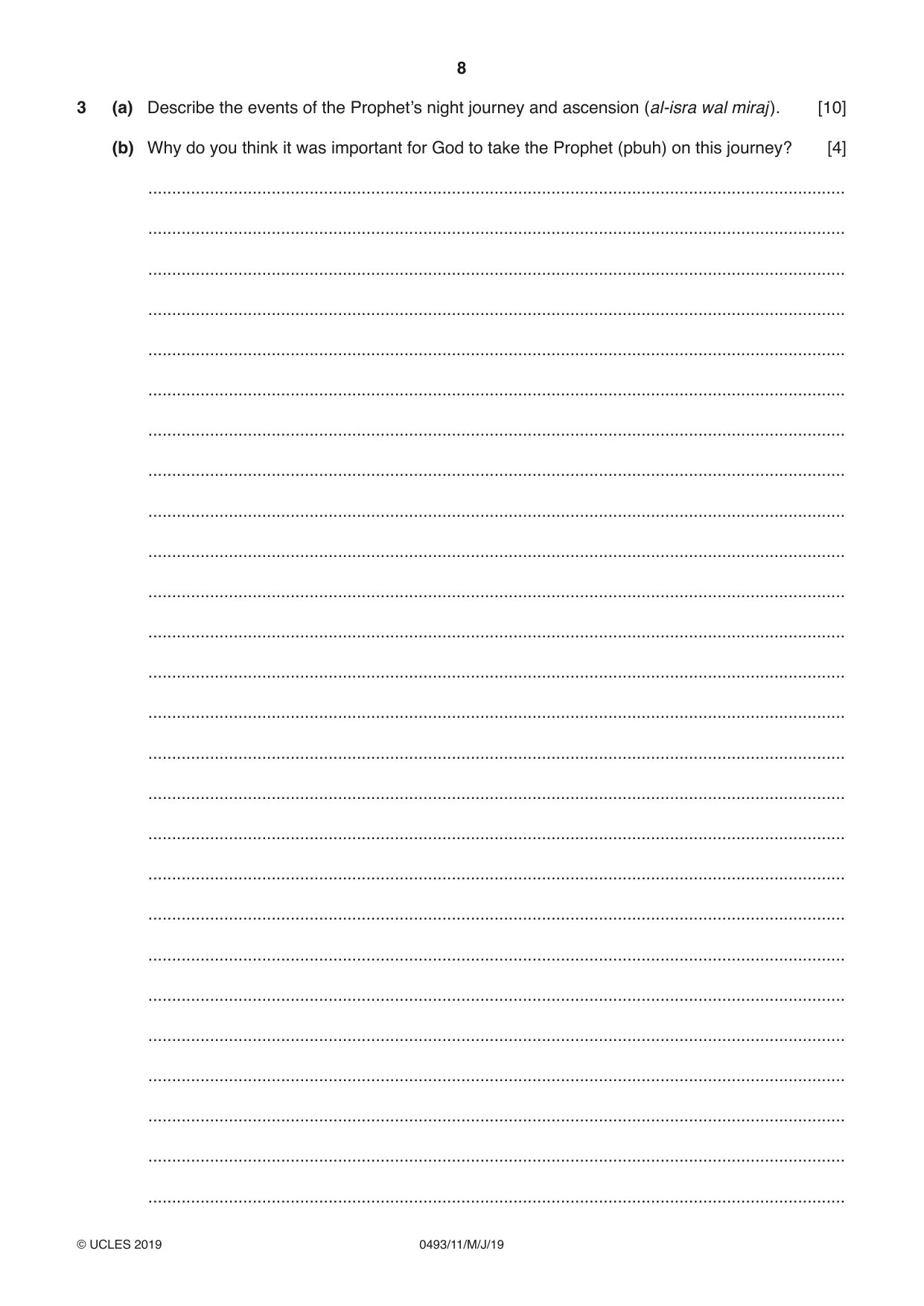
8 0493/11/M/J/19 © UCLES 2019 3 (a) Describe the events of the Prophet’s night journey and ascension (al-isra wal miraj). [10] (b) Why do you think it was important for God to take the Prophet (pbuh) on this journey? [4] … … … … … … … … … … … … … … … … … … … … … … … … … …
Question paper, page 9
9 0493/11/M/J/19 © UCLES 2019 [Turn over … … … … … … … … … … … … … … … … … … … … … … … … … … … …
Question paper, page 10
10 0493/11/M/J/19 © UCLES 2019 … … … … … … … … … … … … … … … … … … … … … … … … … … … …
Question paper, page 11
11 0493/11/M/J/19 © UCLES 2019 [Turn over 4 (a) Describe the main events in the life of the Prophet Muhammad (pbuh) from his childhood until he received revelation. [10] (b) The Prophet (pbuh) faced challenges in his early years but maintained his good character. How can Muslims learn from this today? [4] … … … … … … … … … … … … … … … … … … … … … … … … …
Question paper, page 12
12 0493/11/M/J/19 © UCLES 2019 … … … … … … … … … … … … … … … … … … … … … … … … … … … …
Question paper, page 13
13 0493/11/M/J/19 © UCLES 2019 [Turn over … … … … … … … … … … … … … … … … … … … … … … … … … … … …
Question paper, page 14
14 0493/11/M/J/19 © UCLES 2019 5 (a) In Madina, the Helpers (Ansar) and Emigrants (Muhajirun) were made brothers. Give an account of the main developments of this relationship. [10] (b) How can Muslims apply this model of brotherhood to help their communities? [4] … … … … … … … … … … … … … … … … … … … … … … … … … …
Question paper, page 15
15 0493/11/M/J/19 © UCLES 2019 [Turn over … … … … … … … … … … … … … … … … … … … … … … … … … … … …
Question paper, page 16
16 0493/11/M/J/19 © UCLES 2019 Permission to reproduce items where third-party owned material protected by copyright is included has been sought and cleared where possible. Every reasonable effort has been made by the publisher (UCLES) to trace copyright holders, but if any items requiring clearance have unwittingly been included, the publisher will be pleased to make amends at the earliest possible opportunity. To avoid the issue of disclosure of answer-related information to candidates, all copyright acknowledgements are reproduced online in the Cambridge Assessment International Education Copyright Acknowledgements Booklet. This is produced for each series of examinations and is freely available to download at www.cambridgeinternational.org after the live examination series. Cambridge Assessment International Education is part of the Cambridge Assessment Group. Cambridge Assessment is the brand name of the University of Cambridge Local Examinations Syndicate (UCLES), which itself is a department of the University of Cambridge. … … … … … … … … … … … … … … … … … … … … … … … …
Mark scheme, page 1
This document consists of 14 printed pages. © UCLES 2019 [Turn over Cambridge Assessment International Education Cambridge International General Certificate of Secondary Education ISLAMIYAT 0493/11 Paper 1 May/June 2019 MARK SCHEME Maximum Mark: 50 Published This mark scheme is published as an aid to teachers and candidates, to indicate the requirements of the examination. It shows the basis on which Examiners were instructed to award marks. It does not indicate the details of the discussions that took place at an Examiners’ meeting before marking began, which would have considered the acceptability of alternative answers. Mark schemes should be read in conjunction with the question paper and the Principal Examiner Report for Teachers. Cambridge International will not enter into discussions about these mark schemes. Cambridge International is publishing the mark schemes for the May/June 2019 series for most Cambridge IGCSE™, Cambridge International A and AS Level and Cambridge Pre-U components, and some Cambridge O Level components.
Mark scheme, page 2
0493/11 Cambridge IGCSE – Mark Scheme PUBLISHED May/June 2019 © UCLES 2019 Page 2 of 14 Generic Marking Principles These general marking principles must be applied by all examiners when marking candidate answers. They should be applied alongside the specific content of the mark scheme or generic level descriptors for a question. Each question paper and mark scheme will also comply with these marking principles. GENERIC MARKING PRINCIPLE 1: Marks must be awarded in line with: • the specific content of the mark scheme or the generic level descriptors for the question • the specific skills defined in the mark scheme or in the generic level descriptors for the question • the standard of response required by a candidate as exemplified by the standardisation scripts. GENERIC MARKING PRINCIPLE 2: Marks awarded are always whole marks (not half marks, or other fractions). GENERIC MARKING PRINCIPLE 3: Marks must be awarded positively: • marks are awarded for correct/valid answers, as defined in the mark scheme. However, credit is given for valid answers which go beyond the scope of the syllabus and mark scheme, referring to your Team Leader as appropriate • marks are awarded when candidates clearly demonstrate what they know and can do • marks are not deducted for errors • marks are not deducted for omissions • answers should only be judged on the quality of spelling, punctuation and grammar when these features are specifically assessed by the question as indicated by the mark scheme. The meaning, however, should be unambiguous. GENERIC MARKING PRINCIPLE 4: Rules must be applied consistently e.g. in situations where candidates have not followed instructions or in the application of generic level descriptors.
Mark scheme, page 3
0493/11 Cambridge IGCSE – Mark Scheme PUBLISHED May/June 2019 © UCLES 2019 Page 3 of 14 GENERIC MARKING PRINCIPLE 5: Marks should be awarded using the full range of marks defined in the mark scheme for the question (however; the use of the full mark range may be limited according to the quality of the candidate responses seen). GENERIC MARKING PRINCIPLE 6: Marks awarded are based solely on the requirements as defined in the mark scheme. Marks should not be awarded with grade thresholds or grade descriptors in mind.
Mark scheme, page 4
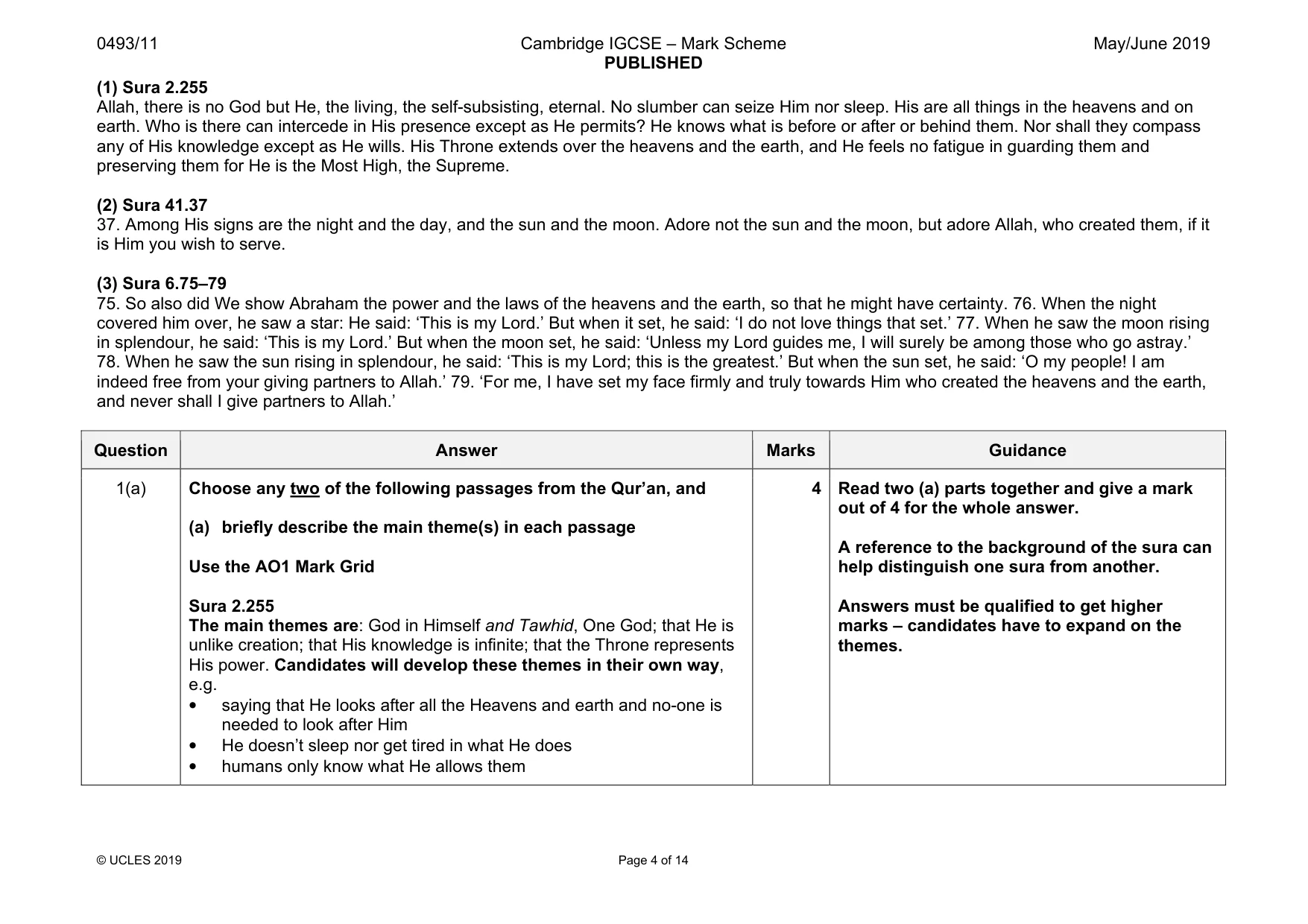
0493/11 Cambridge IGCSE – Mark Scheme PUBLISHED May/June 2019 © UCLES 2019 Page 4 of 14 (1) Sura 2.255 Allah, there is no God but He, the living, the self-subsisting, eternal. No slumber can seize Him nor sleep. His are all things in the heavens and on earth. Who is there can intercede in His presence except as He permits? He knows what is before or after or behind them. Nor shall they compass any of His knowledge except as He wills. His Throne extends over the heavens and the earth, and He feels no fatigue in guarding them and preserving them for He is the Most High, the Supreme. (2) Sura 41.37 37. Among His signs are the night and the day, and the sun and the moon. Adore not the sun and the moon, but adore Allah, who created them, if it is Him you wish to serve. (3) Sura 6.75–79 75. So also did We show Abraham the power and the laws of the heavens and the earth, so that he might have certainty. 76. When the night covered him over, he saw a star: He said: ‘This is my Lord.’ But when it set, he said: ‘I do not love things that set.’ 77. When he saw the moon rising in splendour, he said: ‘This is my Lord.’ But when the moon set, he said: ‘Unless my Lord guides me, I will surely be among those who go astray.’ 78. When he saw the sun rising in splendour, he said: ‘This is my Lord; this is the greatest.’ But when the sun set, he said: ‘O my people! I am indeed free from your giving partners to Allah.’ 79. ‘For me, I have set my face firmly and truly towards Him who created the heavens and the earth, and never shall I give partners to Allah.’ Question Answer Marks Guidance 1(a) Choose any two of the following passages from the Qur’an, and (a) briefly describe the main theme(s) in each passage Use the AO1 Mark Grid Sura 2.255 The main themes are: God in Himself and Tawhid, One God; that He is unlike creation; that His knowledge is infinite; that the Throne represents His power. Candidates will develop these themes in their own way, e.g. • saying that He looks after all the Heavens and earth and no-one is needed to look after Him • He doesn’t sleep nor get tired in what He does • humans only know what He allows them 4 Read two (a) parts together and give a mark out of 4 for the whole answer. A reference to the background of the sura can help distinguish one sura from another. Answers must be qualified to get higher marks – candidates have to expand on the themes.
Mark scheme, page 5
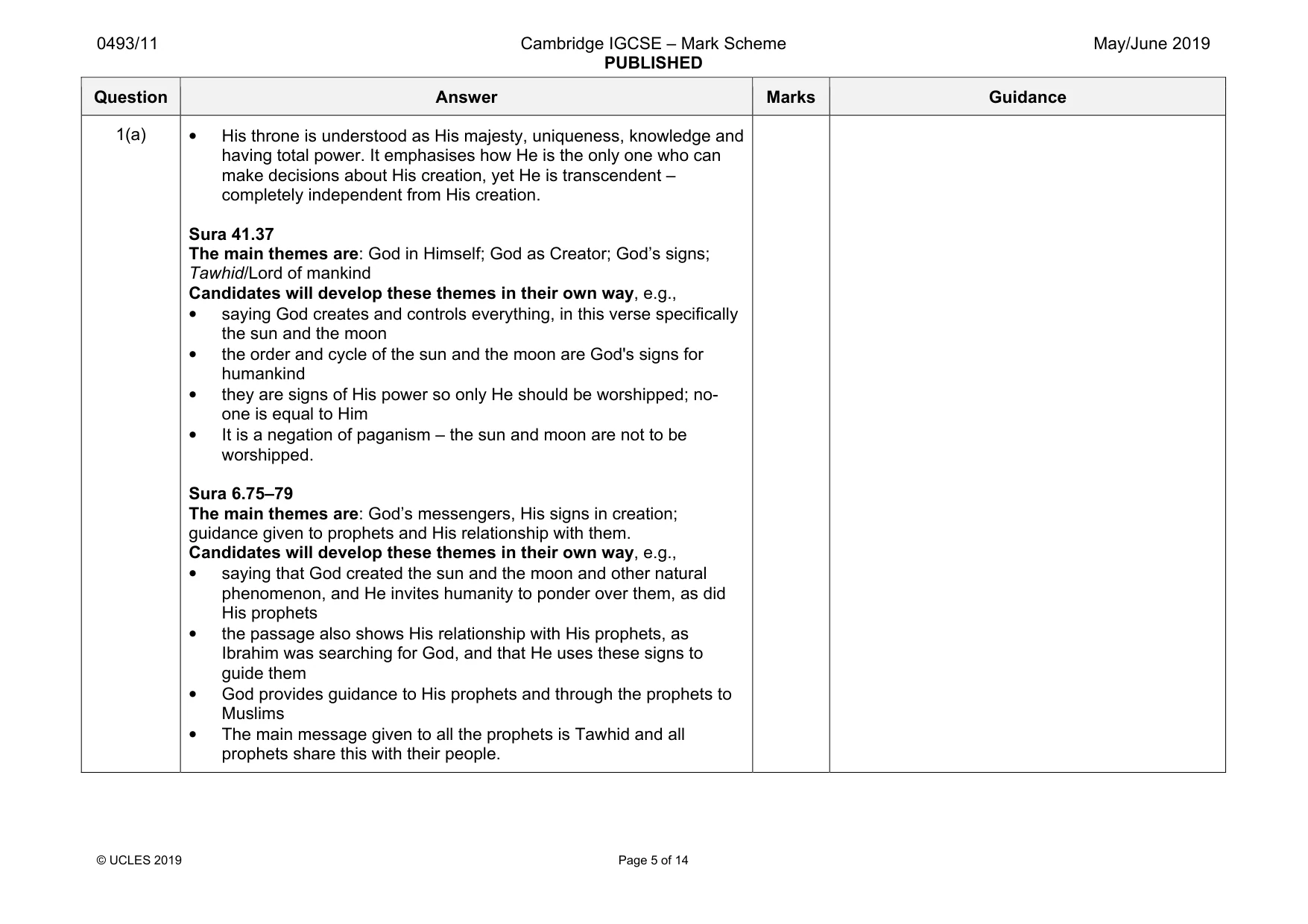
0493/11 Cambridge IGCSE – Mark Scheme PUBLISHED May/June 2019 © UCLES 2019 Page 5 of 14 Question Answer Marks Guidance 1(a) • His throne is understood as His majesty, uniqueness, knowledge and having total power. It emphasises how He is the only one who can make decisions about His creation, yet He is transcendent – completely independent from His creation. Sura 41.37 The main themes are: God in Himself; God as Creator; God’s signs; Tawhid/Lord of mankind Candidates will develop these themes in their own way, e.g., • saying God creates and controls everything, in this verse specifically the sun and the moon • the order and cycle of the sun and the moon are God's signs for humankind • they are signs of His power so only He should be worshipped; no- one is equal to Him • It is a negation of paganism – the sun and moon are not to be worshipped. Sura 6.75–79 The main themes are: God’s messengers, His signs in creation; guidance given to prophets and His relationship with them. Candidates will develop these themes in their own way, e.g., • saying that God created the sun and the moon and other natural phenomenon, and He invites humanity to ponder over them, as did His prophets • the passage also shows His relationship with His prophets, as Ibrahim was searching for God, and that He uses these signs to guide them • God provides guidance to His prophets and through the prophets to Muslims • The main message given to all the prophets is Tawhid and all prophets share this with their people.
Mark scheme, page 6
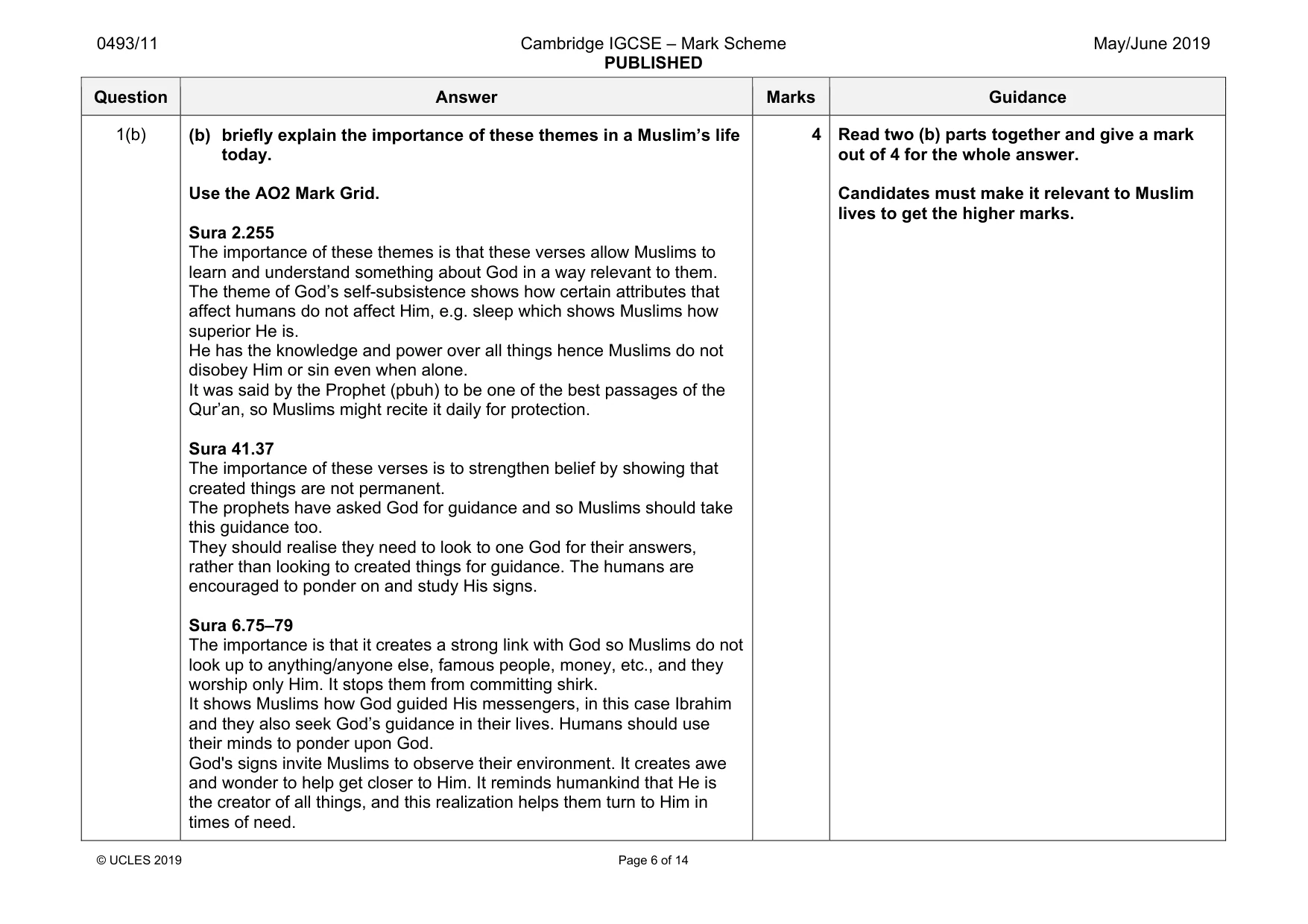
0493/11 Cambridge IGCSE – Mark Scheme PUBLISHED May/June 2019 © UCLES 2019 Page 6 of 14 Question Answer Marks Guidance 1(b) (b) briefly explain the importance of these themes in a Muslim’s life today. Use the AO2 Mark Grid. Sura 2.255 The importance of these themes is that these verses allow Muslims to learn and understand something about God in a way relevant to them. The theme of God’s self-subsistence shows how certain attributes that affect humans do not affect Him, e.g. sleep which shows Muslims how superior He is. He has the knowledge and power over all things hence Muslims do not disobey Him or sin even when alone. It was said by the Prophet (pbuh) to be one of the best passages of the Qur’an, so Muslims might recite it daily for protection. Sura 41.37 The importance of these verses is to strengthen belief by showing that created things are not permanent. The prophets have asked God for guidance and so Muslims should take this guidance too. They should realise they need to look to one God for their answers, rather than looking to created things for guidance. The humans are encouraged to ponder on and study His signs. Sura 6.75–79 The importance is that it creates a strong link with God so Muslims do not look up to anything/anyone else, famous people, money, etc., and they worship only Him. It stops them from committing shirk. It shows Muslims how God guided His messengers, in this case Ibrahim and they also seek God’s guidance in their lives. Humans should use their minds to ponder upon God. God's signs invite Muslims to observe their environment. It creates awe and wonder to help get closer to Him. It reminds humankind that He is the creator of all things, and this realization helps them turn to Him in times of need. 4 Read two (b) parts together and give a mark out of 4 for the whole answer. Candidates must make it relevant to Muslim lives to get the higher marks.
Mark scheme, page 7
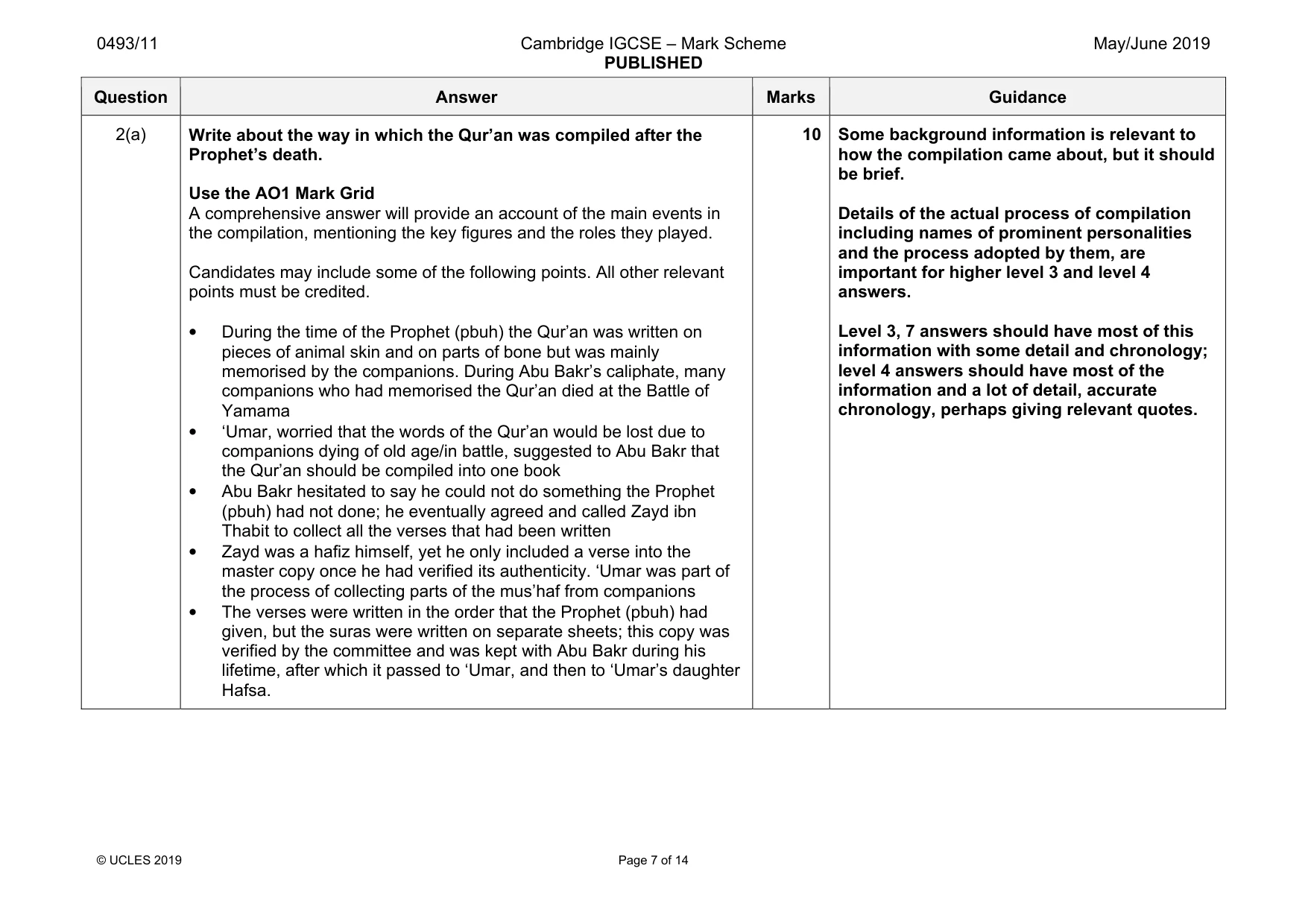
0493/11 Cambridge IGCSE – Mark Scheme PUBLISHED May/June 2019 © UCLES 2019 Page 7 of 14 Question Answer Marks Guidance 2(a) Write about the way in which the Qur’an was compiled after the Prophet’s death. Use the AO1 Mark Grid A comprehensive answer will provide an account of the main events in the compilation, mentioning the key figures and the roles they played. Candidates may include some of the following points. All other relevant points must be credited. • During the time of the Prophet (pbuh) the Qur’an was written on pieces of animal skin and on parts of bone but was mainly memorised by the companions. During Abu Bakr’s caliphate, many companions who had memorised the Qur’an died at the Battle of Yamama • ‘Umar, worried that the words of the Qur’an would be lost due to companions dying of old age/in battle, suggested to Abu Bakr that the Qur’an should be compiled into one book • Abu Bakr hesitated to say he could not do something the Prophet (pbuh) had not done; he eventually agreed and called Zayd ibn Thabit to collect all the verses that had been written • Zayd was a hafiz himself, yet he only included a verse into the master copy once he had verified its authenticity. ‘Umar was part of the process of collecting parts of the mus’haf from companions • The verses were written in the order that the Prophet (pbuh) had given, but the suras were written on separate sheets; this copy was verified by the committee and was kept with Abu Bakr during his lifetime, after which it passed to ‘Umar, and then to ‘Umar’s daughter Hafsa. 10 Some background information is relevant to how the compilation came about, but it should be brief. Details of the actual process of compilation including names of prominent personalities and the process adopted by them, are important for higher level 3 and level 4 answers. Level 3, 7 answers should have most of this information with some detail and chronology; level 4 answers should have most of the information and a lot of detail, accurate chronology, perhaps giving relevant quotes.
Mark scheme, page 8
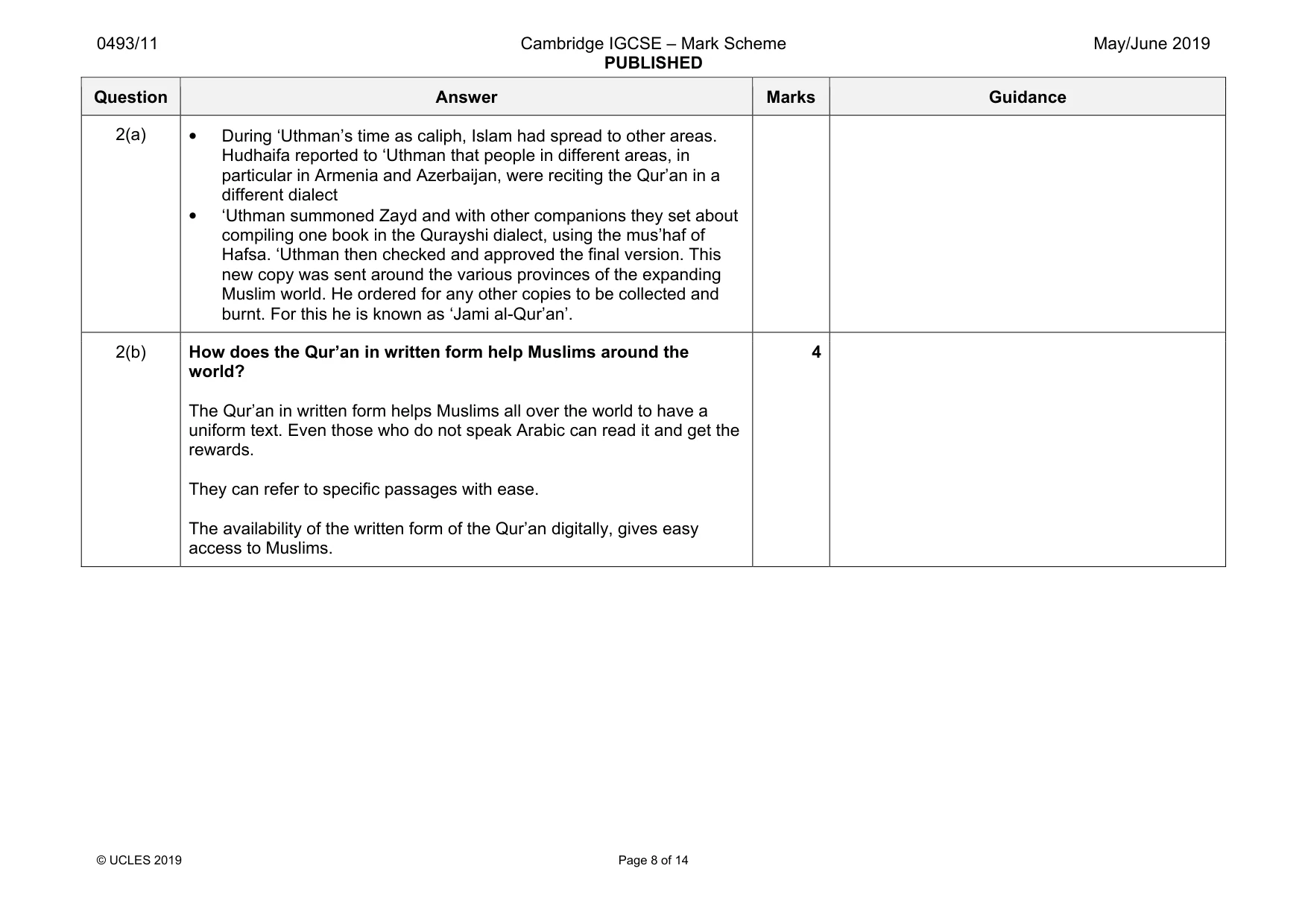
0493/11 Cambridge IGCSE – Mark Scheme PUBLISHED May/June 2019 © UCLES 2019 Page 8 of 14 Question Answer Marks Guidance 2(a) • During ‘Uthman’s time as caliph, Islam had spread to other areas. Hudhaifa reported to ‘Uthman that people in different areas, in particular in Armenia and Azerbaijan, were reciting the Qur’an in a different dialect • ‘Uthman summoned Zayd and with other companions they set about compiling one book in the Qurayshi dialect, using the mus’haf of Hafsa. ‘Uthman then checked and approved the final version. This new copy was sent around the various provinces of the expanding Muslim world. He ordered for any other copies to be collected and burnt. For this he is known as ‘Jami al-Qur’an’. 2(b) How does the Qur’an in written form help Muslims around the world? The Qur’an in written form helps Muslims all over the world to have a uniform text. Even those who do not speak Arabic can read it and get the rewards. They can refer to specific passages with ease. The availability of the written form of the Qur’an digitally, gives easy access to Muslims. 4
Mark scheme, page 9
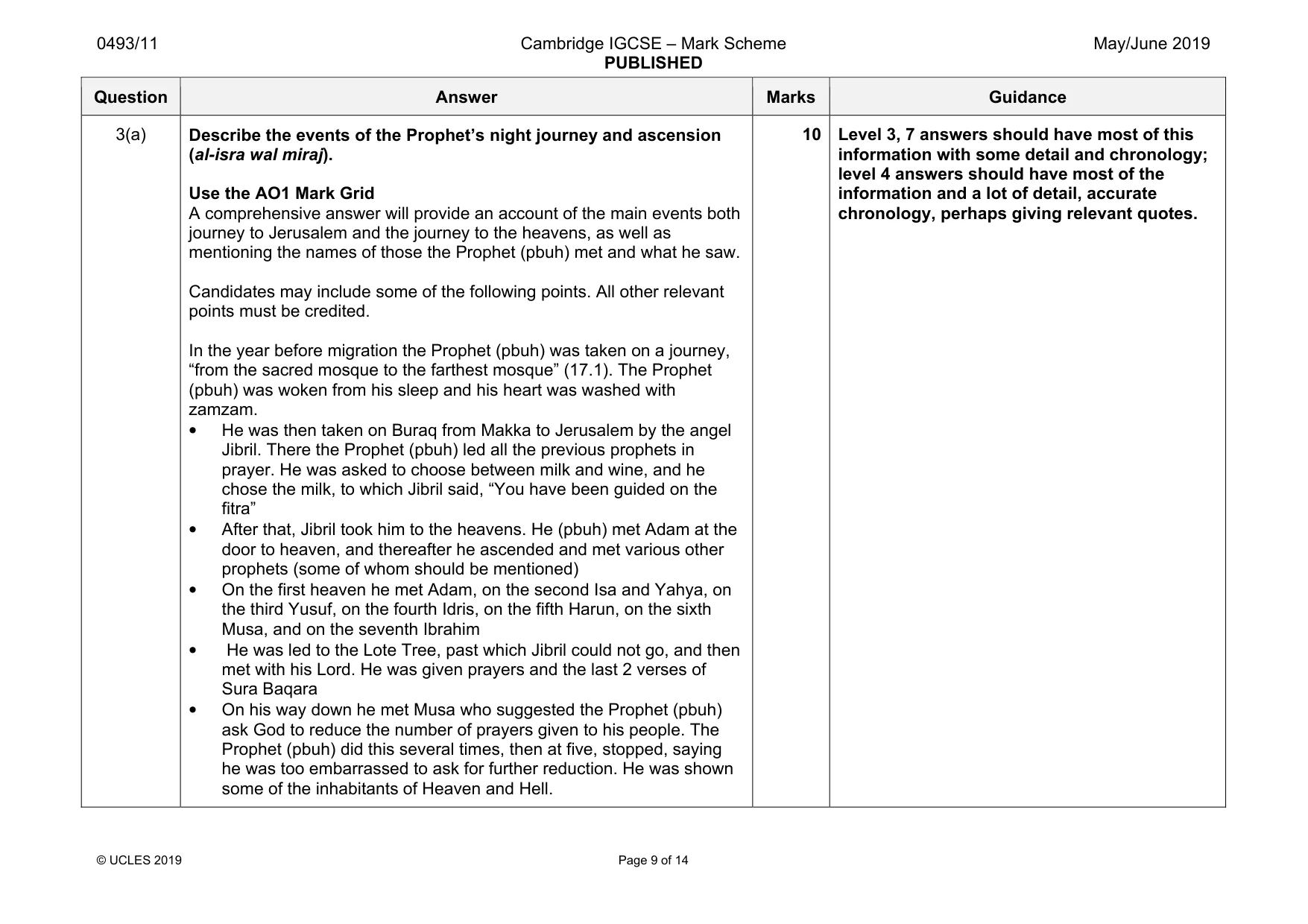
0493/11 Cambridge IGCSE – Mark Scheme PUBLISHED May/June 2019 © UCLES 2019 Page 9 of 14 Question Answer Marks Guidance 3(a) Describe the events of the Prophet’s night journey and ascension (al-isra wal miraj). Use the AO1 Mark Grid A comprehensive answer will provide an account of the main events both journey to Jerusalem and the journey to the heavens, as well as mentioning the names of those the Prophet (pbuh) met and what he saw. Candidates may include some of the following points. All other relevant points must be credited. In the year before migration the Prophet (pbuh) was taken on a journey, “from the sacred mosque to the farthest mosque” (17.1). The Prophet (pbuh) was woken from his sleep and his heart was washed with zamzam. • He was then taken on Buraq from Makka to Jerusalem by the angel Jibril. There the Prophet (pbuh) led all the previous prophets in prayer. He was asked to choose between milk and wine, and he chose the milk, to which Jibril said, “You have been guided on the fitra” • After that, Jibril took him to the heavens. He (pbuh) met Adam at the door to heaven, and thereafter he ascended and met various other prophets (some of whom should be mentioned) • On the first heaven he met Adam, on the second Isa and Yahya, on the third Yusuf, on the fourth Idris, on the fifth Harun, on the sixth Musa, and on the seventh Ibrahim • He was led to the Lote Tree, past which Jibril could not go, and then met with his Lord. He was given prayers and the last 2 verses of Sura Baqara • On his way down he met Musa who suggested the Prophet (pbuh) ask God to reduce the number of prayers given to his people. The Prophet (pbuh) did this several times, then at five, stopped, saying he was too embarrassed to ask for further reduction. He was shown some of the inhabitants of Heaven and Hell. 10 Level 3, 7 answers should have most of this information with some detail and chronology; level 4 answers should have most of the information and a lot of detail, accurate chronology, perhaps giving relevant quotes.
Mark scheme, page 10
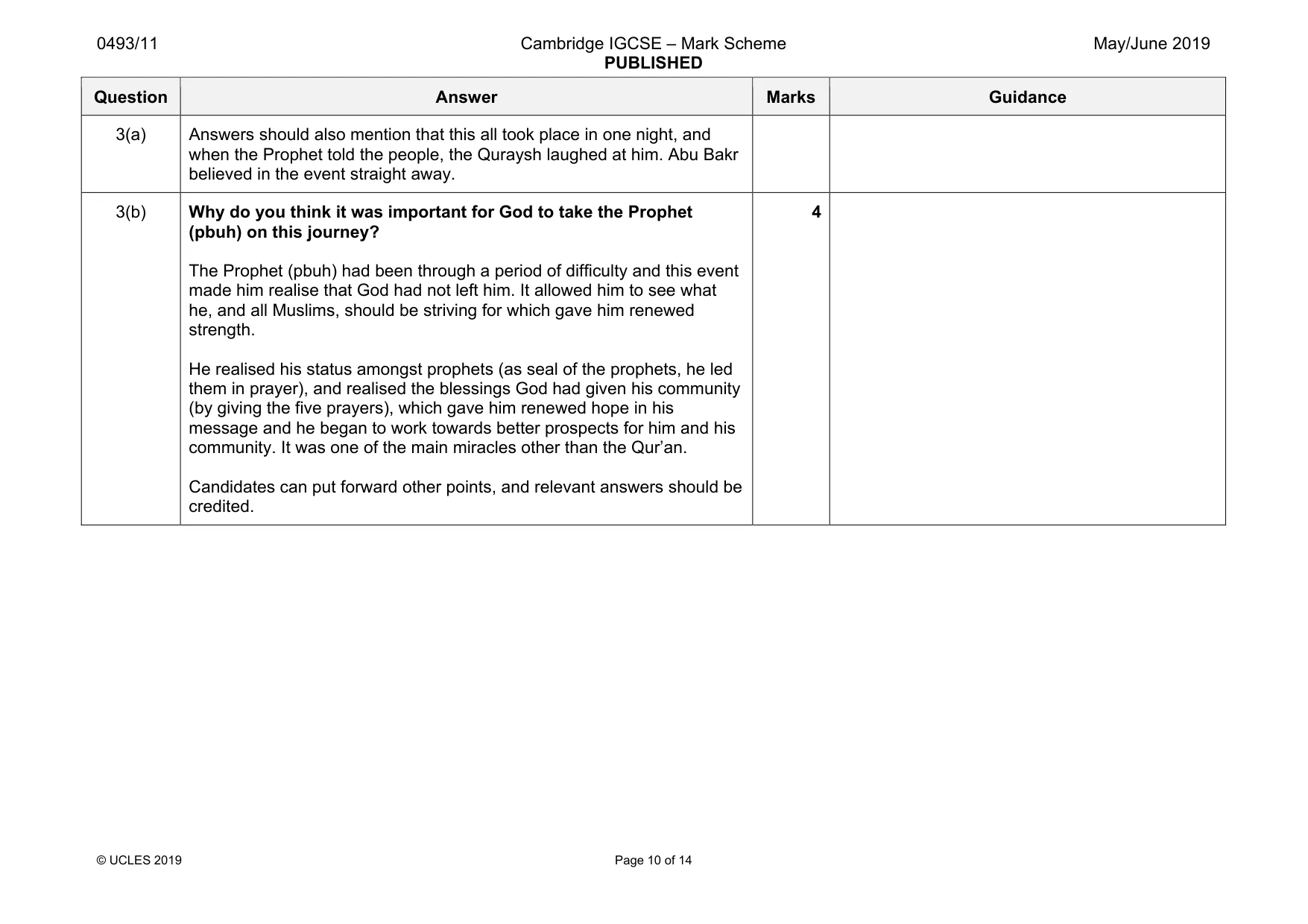
0493/11 Cambridge IGCSE – Mark Scheme PUBLISHED May/June 2019 © UCLES 2019 Page 10 of 14 Question Answer Marks Guidance 3(a) Answers should also mention that this all took place in one night, and when the Prophet told the people, the Quraysh laughed at him. Abu Bakr believed in the event straight away. 3(b) Why do you think it was important for God to take the Prophet (pbuh) on this journey? The Prophet (pbuh) had been through a period of difficulty and this event made him realise that God had not left him. It allowed him to see what he, and all Muslims, should be striving for which gave him renewed strength. He realised his status amongst prophets (as seal of the prophets, he led them in prayer), and realised the blessings God had given his community (by giving the five prayers), which gave him renewed hope in his message and he began to work towards better prospects for him and his community. It was one of the main miracles other than the Qur’an. Candidates can put forward other points, and relevant answers should be credited. 4
Mark scheme, page 11
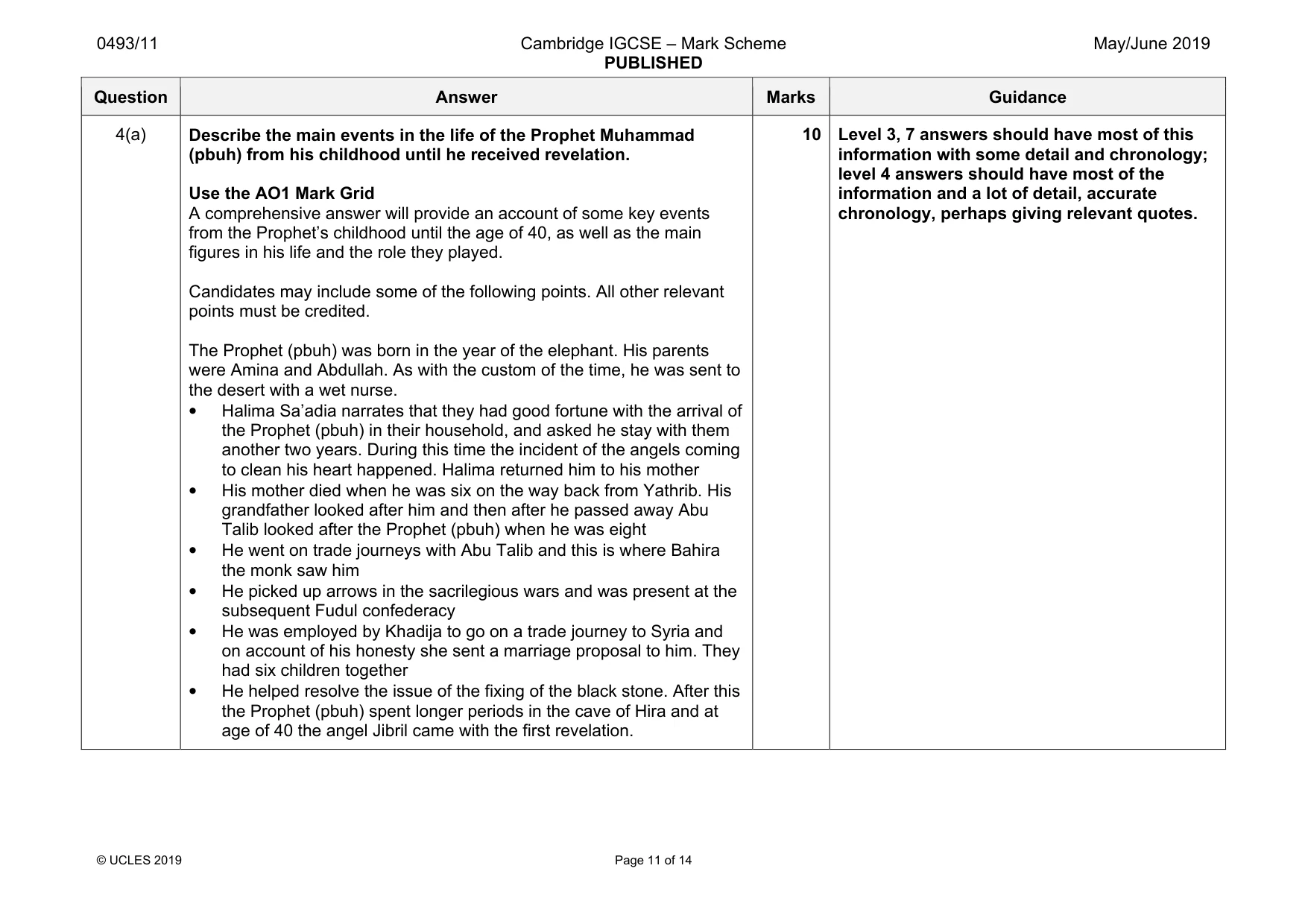
0493/11 Cambridge IGCSE – Mark Scheme PUBLISHED May/June 2019 © UCLES 2019 Page 11 of 14 Question Answer Marks Guidance 4(a) Describe the main events in the life of the Prophet Muhammad (pbuh) from his childhood until he received revelation. Use the AO1 Mark Grid A comprehensive answer will provide an account of some key events from the Prophet’s childhood until the age of 40, as well as the main figures in his life and the role they played. Candidates may include some of the following points. All other relevant points must be credited. The Prophet (pbuh) was born in the year of the elephant. His parents were Amina and Abdullah. As with the custom of the time, he was sent to the desert with a wet nurse. • Halima Sa’adia narrates that they had good fortune with the arrival of the Prophet (pbuh) in their household, and asked he stay with them another two years. During this time the incident of the angels coming to clean his heart happened. Halima returned him to his mother • His mother died when he was six on the way back from Yathrib. His grandfather looked after him and then after he passed away Abu Talib looked after the Prophet (pbuh) when he was eight • He went on trade journeys with Abu Talib and this is where Bahira the monk saw him • He picked up arrows in the sacrilegious wars and was present at the subsequent Fudul confederacy • He was employed by Khadija to go on a trade journey to Syria and on account of his honesty she sent a marriage proposal to him. They had six children together • He helped resolve the issue of the fixing of the black stone. After this the Prophet (pbuh) spent longer periods in the cave of Hira and at age of 40 the angel Jibril came with the first revelation. 10 Level 3, 7 answers should have most of this information with some detail and chronology; level 4 answers should have most of the information and a lot of detail, accurate chronology, perhaps giving relevant quotes.
Mark scheme, page 12
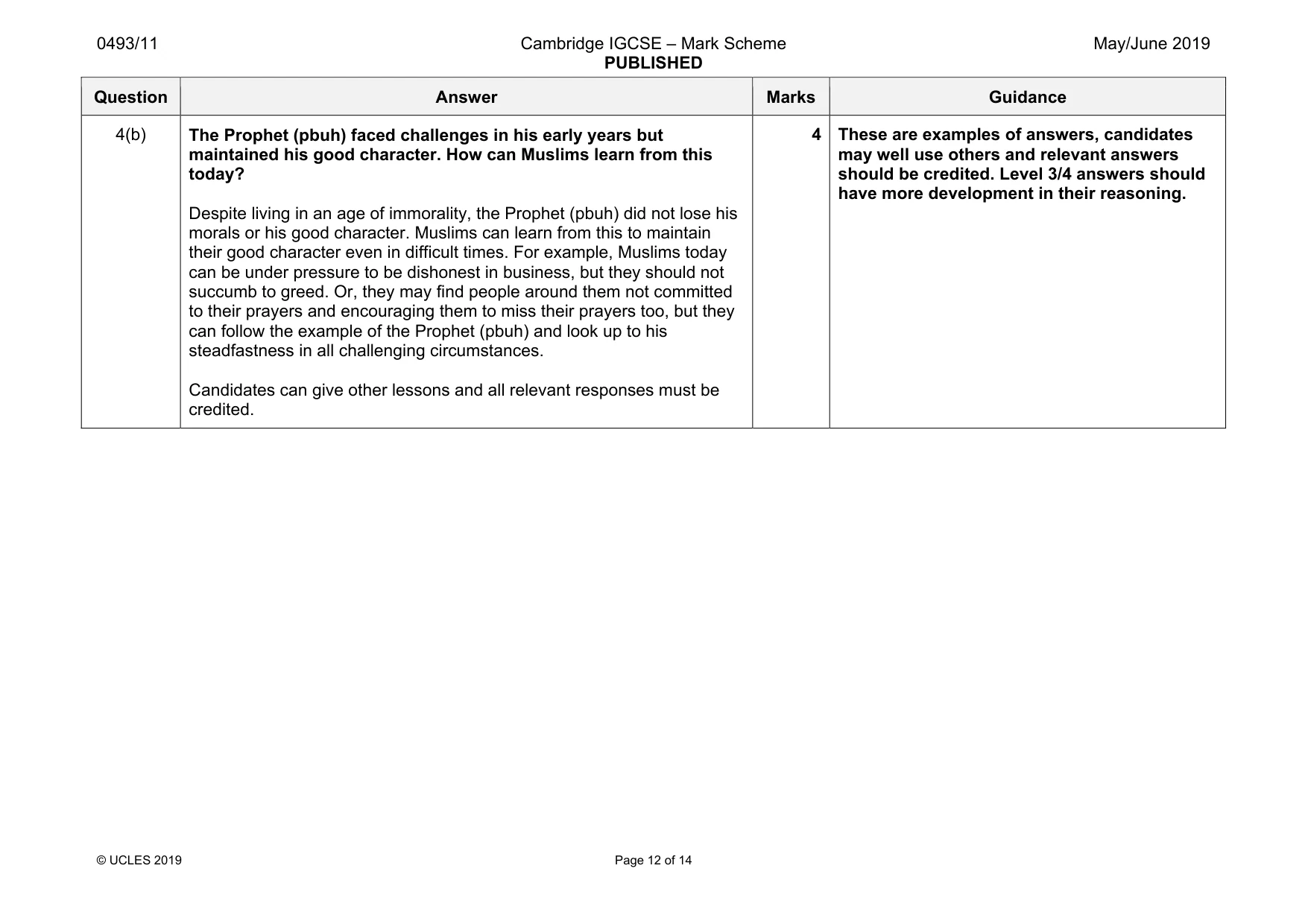
0493/11 Cambridge IGCSE – Mark Scheme PUBLISHED May/June 2019 © UCLES 2019 Page 12 of 14 Question Answer Marks Guidance 4(b) The Prophet (pbuh) faced challenges in his early years but maintained his good character. How can Muslims learn from this today? Despite living in an age of immorality, the Prophet (pbuh) did not lose his morals or his good character. Muslims can learn from this to maintain their good character even in difficult times. For example, Muslims today can be under pressure to be dishonest in business, but they should not succumb to greed. Or, they may find people around them not committed to their prayers and encouraging them to miss their prayers too, but they can follow the example of the Prophet (pbuh) and look up to his steadfastness in all challenging circumstances. Candidates can give other lessons and all relevant responses must be credited. 4 These are examples of answers, candidates may well use others and relevant answers should be credited. Level 3/4 answers should have more development in their reasoning.
Mark scheme, page 13
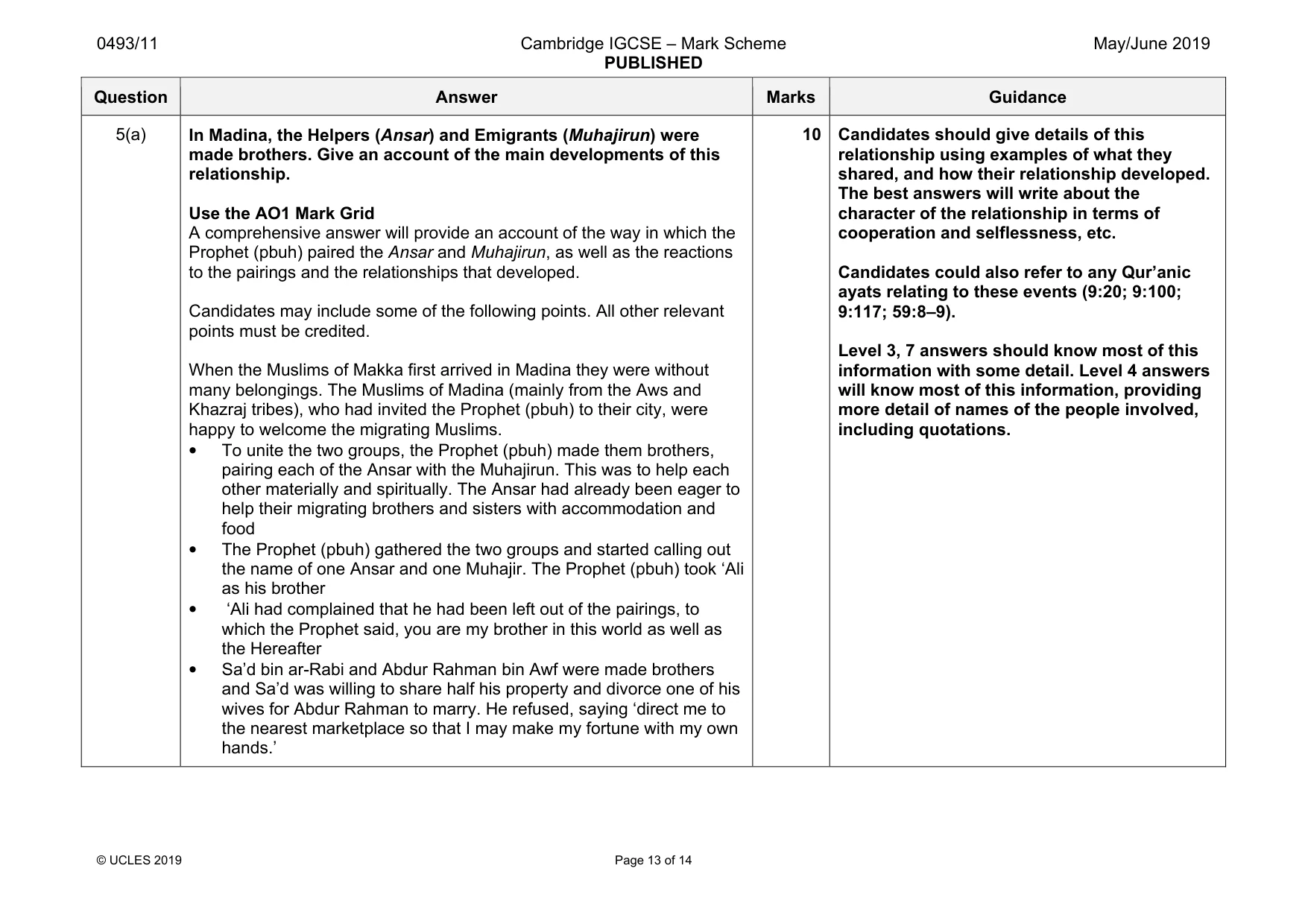
0493/11 Cambridge IGCSE – Mark Scheme PUBLISHED May/June 2019 © UCLES 2019 Page 13 of 14 Question Answer Marks Guidance 5(a) In Madina, the Helpers (Ansar) and Emigrants (Muhajirun) were made brothers. Give an account of the main developments of this relationship. Use the AO1 Mark Grid A comprehensive answer will provide an account of the way in which the Prophet (pbuh) paired the Ansar and Muhajirun, as well as the reactions to the pairings and the relationships that developed. Candidates may include some of the following points. All other relevant points must be credited. When the Muslims of Makka first arrived in Madina they were without many belongings. The Muslims of Madina (mainly from the Aws and Khazraj tribes), who had invited the Prophet (pbuh) to their city, were happy to welcome the migrating Muslims. • To unite the two groups, the Prophet (pbuh) made them brothers, pairing each of the Ansar with the Muhajirun. This was to help each other materially and spiritually. The Ansar had already been eager to help their migrating brothers and sisters with accommodation and food • The Prophet (pbuh) gathered the two groups and started calling out the name of one Ansar and one Muhajir. The Prophet (pbuh) took ‘Ali as his brother • ‘Ali had complained that he had been left out of the pairings, to which the Prophet said, you are my brother in this world as well as the Hereafter • Sa’d bin ar-Rabi and Abdur Rahman bin Awf were made brothers and Sa’d was willing to share half his property and divorce one of his wives for Abdur Rahman to marry. He refused, saying ‘direct me to the nearest marketplace so that I may make my fortune with my own hands.’ 10 Candidates should give details of this relationship using examples of what they shared, and how their relationship developed. The best answers will write about the character of the relationship in terms of cooperation and selflessness, etc. Candidates could also refer to any Qur’anic ayats relating to these events (9:20; 9:100; 9:117; 59:8–9). Level 3, 7 answers should know most of this information with some detail. Level 4 answers will know most of this information, providing more detail of names of the people involved, including quotations.
Mark scheme, page 14
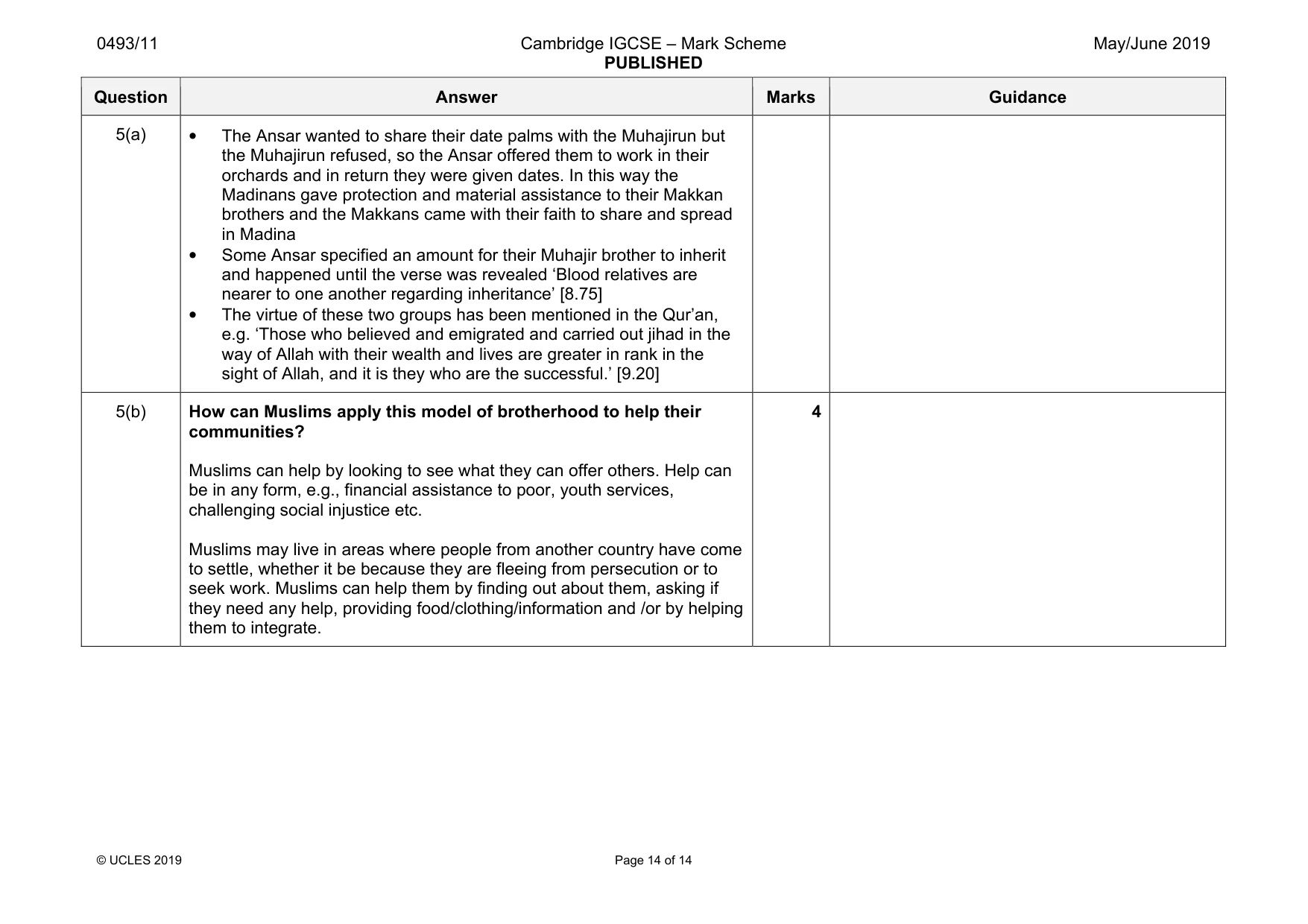
0493/11 Cambridge IGCSE – Mark Scheme PUBLISHED May/June 2019 © UCLES 2019 Page 14 of 14 Question Answer Marks Guidance 5(a) • The Ansar wanted to share their date palms with the Muhajirun but the Muhajirun refused, so the Ansar offered them to work in their orchards and in return they were given dates. In this way the Madinans gave protection and material assistance to their Makkan brothers and the Makkans came with their faith to share and spread in Madina • Some Ansar specified an amount for their Muhajir brother to inherit and happened until the verse was revealed ‘Blood relatives are nearer to one another regarding inheritance’ [8.75] • The virtue of these two groups has been mentioned in the Qur’an, e.g. ‘Those who believed and emigrated and carried out jihad in the way of Allah with their wealth and lives are greater in rank in the sight of Allah, and it is they who are the successful.’ [9.20] 5(b) How can Muslims apply this model of brotherhood to help their communities? Muslims can help by looking to see what they can offer others. Help can be in any form, e.g., financial assistance to poor, youth services, challenging social injustice etc. Muslims may live in areas where people from another country have come to settle, whether it be because they are fleeing from persecution or to seek work. Muslims can help them by finding out about them, asking if they need any help, providing food/clothing/information and /or by helping them to integrate. 4
What you needed in this session
Cambridge’s own grade thresholds for 2019 May/June, Paper 1 · Variant 1. A higher threshold means an easier paper — the bar moves with how the cohort did.