Cambridge IGCSE History American BES 0409 — 2025 May/June Paper 1 · Variant 0
0409/10/M/J/25 · 60 marks · 120 min
The question paper and its mark scheme, free to read here and free to download. This is Cambridge’s own paper, exactly as it was sat.
Question paper8 pages


Mark scheme
No mark scheme is in the library for this paper.
Paper as text
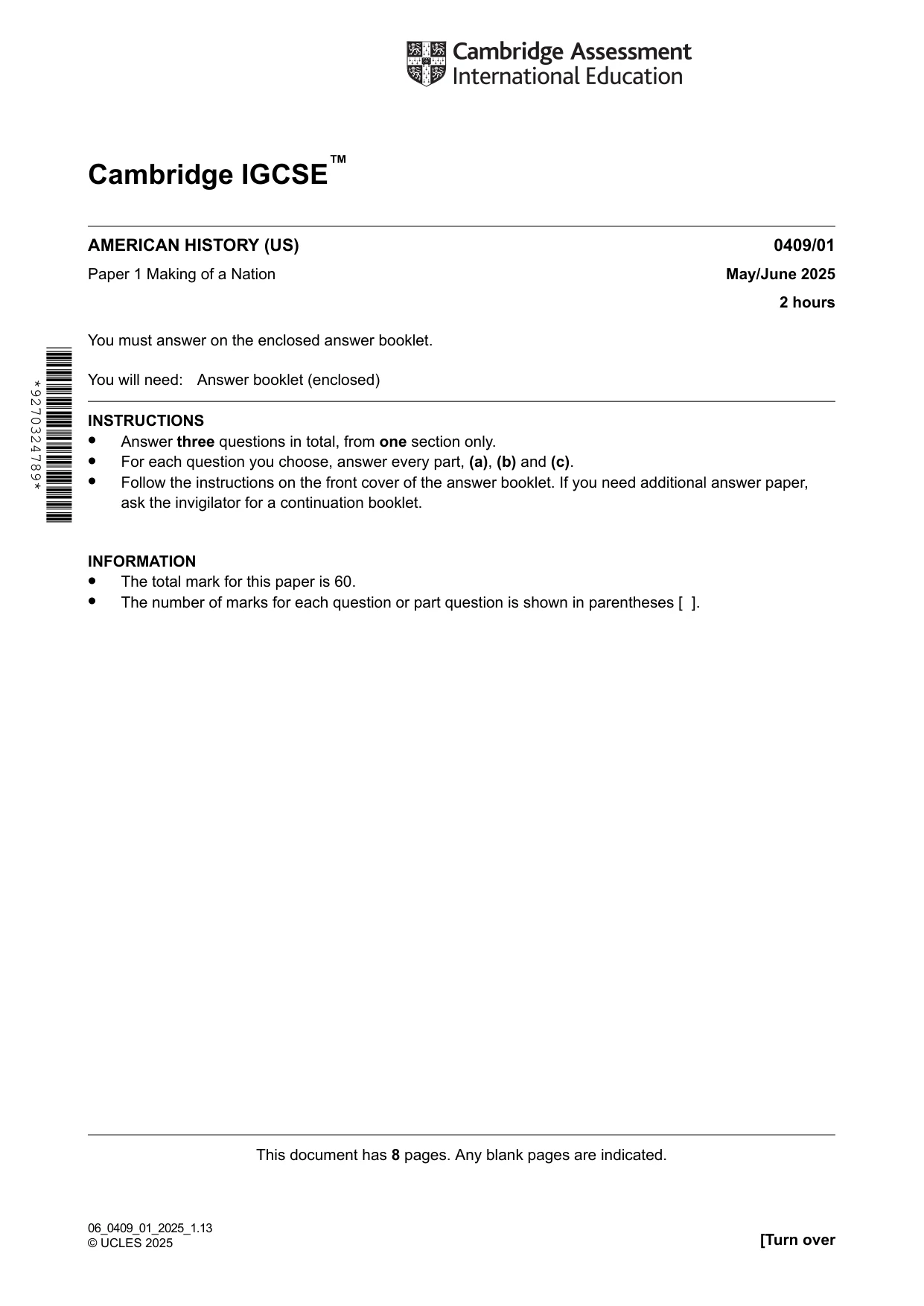
Question paper, page 1
Cambridge IGCSE™ 0409/01 AMERICAN HISTORY (US) May/June 2025 Paper 1 Making of a Nation 2 hours You must answer on the enclosed answer booklet. You will need: Answer booklet (enclosed) INSTRUCTIONS • Answer three questions in total, from one section only. • For each question you choose, answer every part, (a), (b) and (c). • Follow the instructions on the front cover of the answer booklet. If you need additional answer paper, ask the invigilator for a continuation booklet. INFORMATION • The total mark for this paper is 60. • The number of marks for each question or part question is shown in parentheses [ ]. This document has 8 pages. Any blank pages are indicated. [Turn over 06_0409_01_2025_1.13 © UCLES 2025 *9270324789*
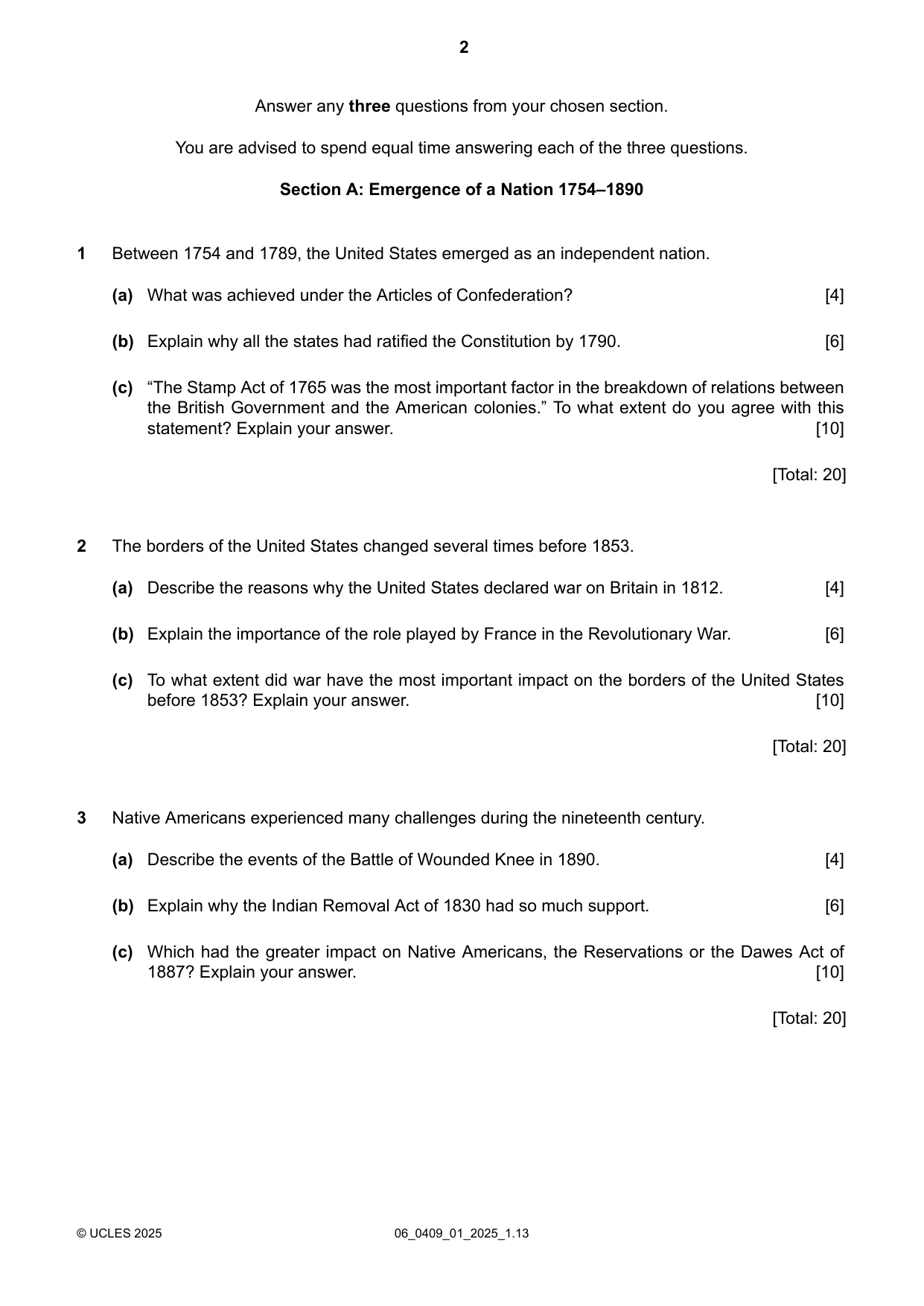
Question paper, page 2
Answer any three questions from your chosen section. You are advised to spend equal time answering each of the three questions. Section A: Emergence of a Nation 1754–1890 Between 1754 and 1789, the United States emerged as an independent nation. 1 What was achieved under the Articles of Confederation? [4] (a) Explain why all the states had ratified the Constitution by 1790. [6] (b) “The Stamp Act of 1765 was the most important factor in the breakdown of relations between the British Government and the American colonies.” To what extent do you agree with this statement? Explain your answer. [10] (c) [Total: 20] The borders of the United States changed several times before 1853. 2 Describe the reasons why the United States declared war on Britain in 1812. [4] (a) Explain the importance of the role played by France in the Revolutionary War. [6] (b) To what extent did war have the most important impact on the borders of the United States before 1853? Explain your answer. [10] (c) [Total: 20] Native Americans experienced many challenges during the nineteenth century. 3 Describe the events of the Battle of Wounded Knee in 1890. [4] (a) Explain why the Indian Removal Act of 1830 had so much support. [6] (b) Which had the greater impact on Native Americans, the Reservations or the Dawes Act of 1887? Explain your answer. [10] (c) [Total: 20] 06_0409_01_2025_1.13 © UCLES 2025 2
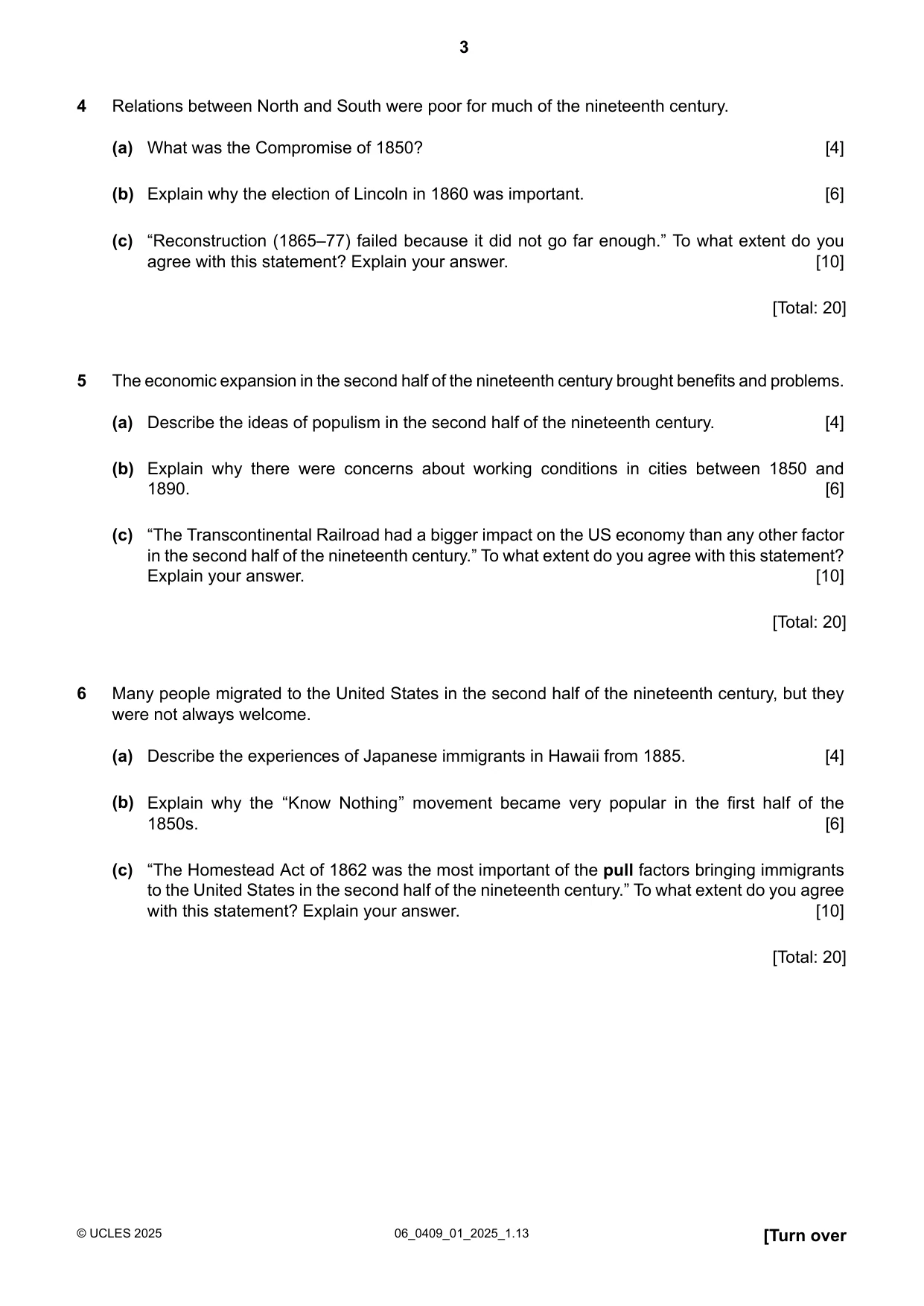
Question paper, page 3
Relations between North and South were poor for much of the nineteenth century. 4 What was the Compromise of 1850? [4] (a) Explain why the election of Lincoln in 1860 was important. [6] (b) “Reconstruction (1865–77) failed because it did not go far enough.” To what extent do you agree with this statement? Explain your answer. [10] (c) [Total: 20] The economic expansion in the second half of the nineteenth century brought benefits and problems. 5 Describe the ideas of populism in the second half of the nineteenth century. [4] (a) Explain why there were concerns about working conditions in cities between 1850 and 1890. [6] (b) “The Transcontinental Railroad had a bigger impact on the US economy than any other factor in the second half of the nineteenth century.” To what extent do you agree with this statement? Explain your answer. [10] (c) [Total: 20] Many people migrated to the United States in the second half of the nineteenth century, but they were not always welcome. 6 Describe the experiences of Japanese immigrants in Hawaii from 1885. [4] (a) Explain why the “Know Nothing” movement became very popular in the first half of the 1850s. [6] (b) “The Homestead Act of 1862 was the most important of the pull factors bringing immigrants to the United States in the second half of the nineteenth century.” To what extent do you agree with this statement? Explain your answer. [10] (c) [Total: 20] [Turn over 06_0409_01_2025_1.13 © UCLES 2025 3
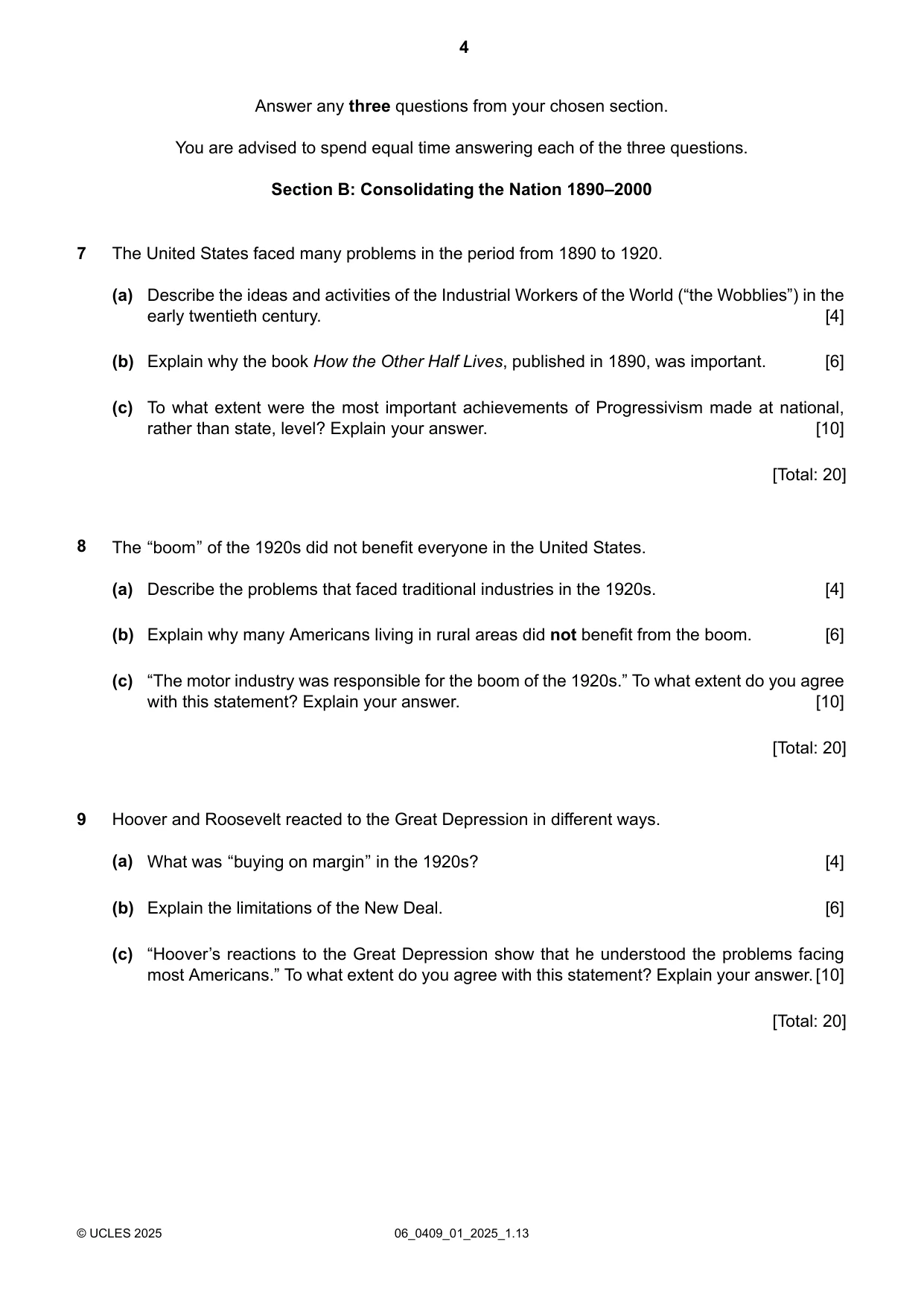
Question paper, page 4
Answer any three questions from your chosen section. You are advised to spend equal time answering each of the three questions. Section B: Consolidating the Nation 1890–2000 The United States faced many problems in the period from 1890 to 1920. 7 Describe the ideas and activities of the Industrial Workers of the World (“the Wobblies”) in the early twentieth century. [4] (a) Explain why the book How the Other Half Lives, published in 1890, was important. [6] (b) To what extent were the most important achievements of Progressivism made at national, rather than state, level? Explain your answer. [10] (c) [Total: 20] The “boom” of the 1920s did not benefit everyone in the United States. 8 Describe the problems that faced traditional industries in the 1920s. [4] (a) Explain why many Americans living in rural areas did not benefit from the boom. [6] (b) “The motor industry was responsible for the boom of the 1920s.” To what extent do you agree with this statement? Explain your answer. [10] (c) [Total: 20] Hoover and Roosevelt reacted to the Great Depression in different ways. 9 What was “buying on margin” in the 1920s? [4] (a) Explain the limitations of the New Deal. [6] (b) “Hoover’s reactions to the Great Depression show that he understood the problems facing most Americans.” To what extent do you agree with this statement? Explain your answer.[10] (c) [Total: 20] 06_0409_01_2025_1.13 © UCLES 2025 4
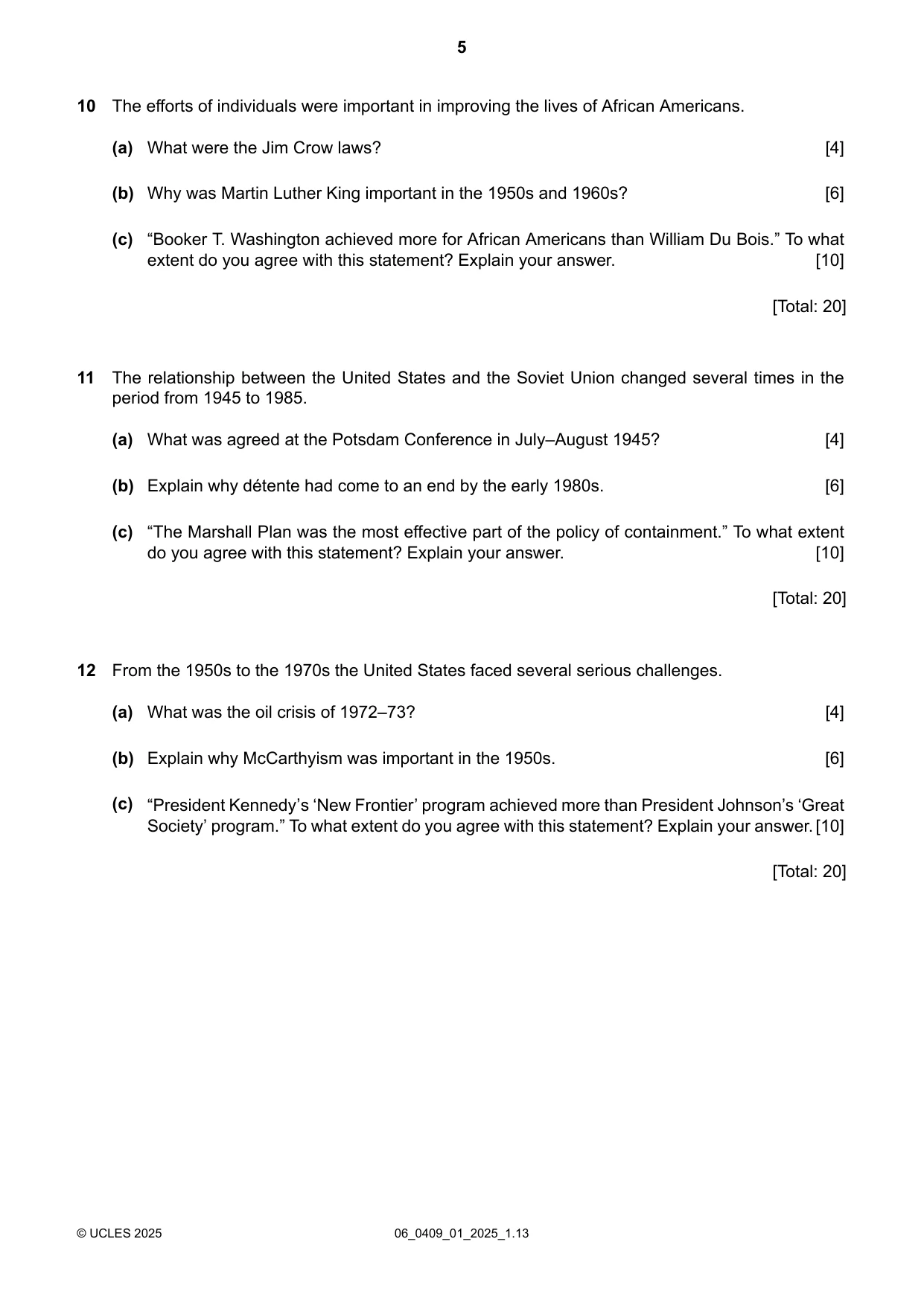
Question paper, page 5
The efforts of individuals were important in improving the lives of African Americans. 10 What were the Jim Crow laws? [4] (a) Why was Martin Luther King important in the 1950s and 1960s? [6] (b) “Booker T. Washington achieved more for African Americans than William Du Bois.” To what extent do you agree with this statement? Explain your answer. [10] (c) [Total: 20] The relationship between the United States and the Soviet Union changed several times in the period from 1945 to 1985. 11 What was agreed at the Potsdam Conference in July–August 1945? [4] (a) Explain why détente had come to an end by the early 1980s. [6] (b) “The Marshall Plan was the most effective part of the policy of containment.” To what extent do you agree with this statement? Explain your answer. [10] (c) [Total: 20] From the 1950s to the 1970s the United States faced several serious challenges. 12 What was the oil crisis of 1972–73? [4] (a) Explain why McCarthyism was important in the 1950s. [6] (b) “President Kennedy’s ‘New Frontier’ program achieved more than President Johnson’s ‘Great Society’ program.” To what extent do you agree with this statement? Explain your answer.[10] (c) [Total: 20] 06_0409_01_2025_1.13 © UCLES 2025 5
Question paper, page 6
BLANK PAGE 06_0409_01_2025_1.13 © UCLES 2025 6
Question paper, page 7
BLANK PAGE 06_0409_01_2025_1.13 © UCLES 2025 7
Question paper, page 8
BLANK PAGE Permission to reproduce items where third-party owned material protected by copyright is included has been sought and cleared where possible. Every reasonable effort has been made by the publisher (UCLES) to trace copyright holders, but if any items requiring clearance have unwittingly been included, the publisher will be pleased to make amends at the earliest possible opportunity. To avoid the issue of disclosure of answer-related information to candidates, all copyright acknowledgements are reproduced online in the Cambridge Assessment International Education Copyright Acknowledgements Booklet. This is produced for each series of examinations and is freely available to download at www.cambridgeinternational.org after the live examination series. Cambridge Assessment International Education is part of Cambridge Assessment. Cambridge Assessment is the brand name of the University of Cambridge Local Examinations Syndicate (UCLES), which is a department of the University of Cambridge. 06_0409_01_2025_1.13 © UCLES 2025 8
What you needed in this session
Cambridge’s own grade thresholds for 2025 May/June, Paper 1 · Variant 0. A higher threshold means an easier paper — the bar moves with how the cohort did.