Cambridge IGCSE History 0470 — 2022 Feb/March Paper 1 · Variant 2
0470/12/F/M/22 · 60 marks · ≈68 min
The question paper and its mark scheme, free to read here and free to download. This is Cambridge’s own paper, exactly as it was sat.
Question paper12 pages


Mark scheme92 pages
Answers below. Sit the paper first if you are practising.
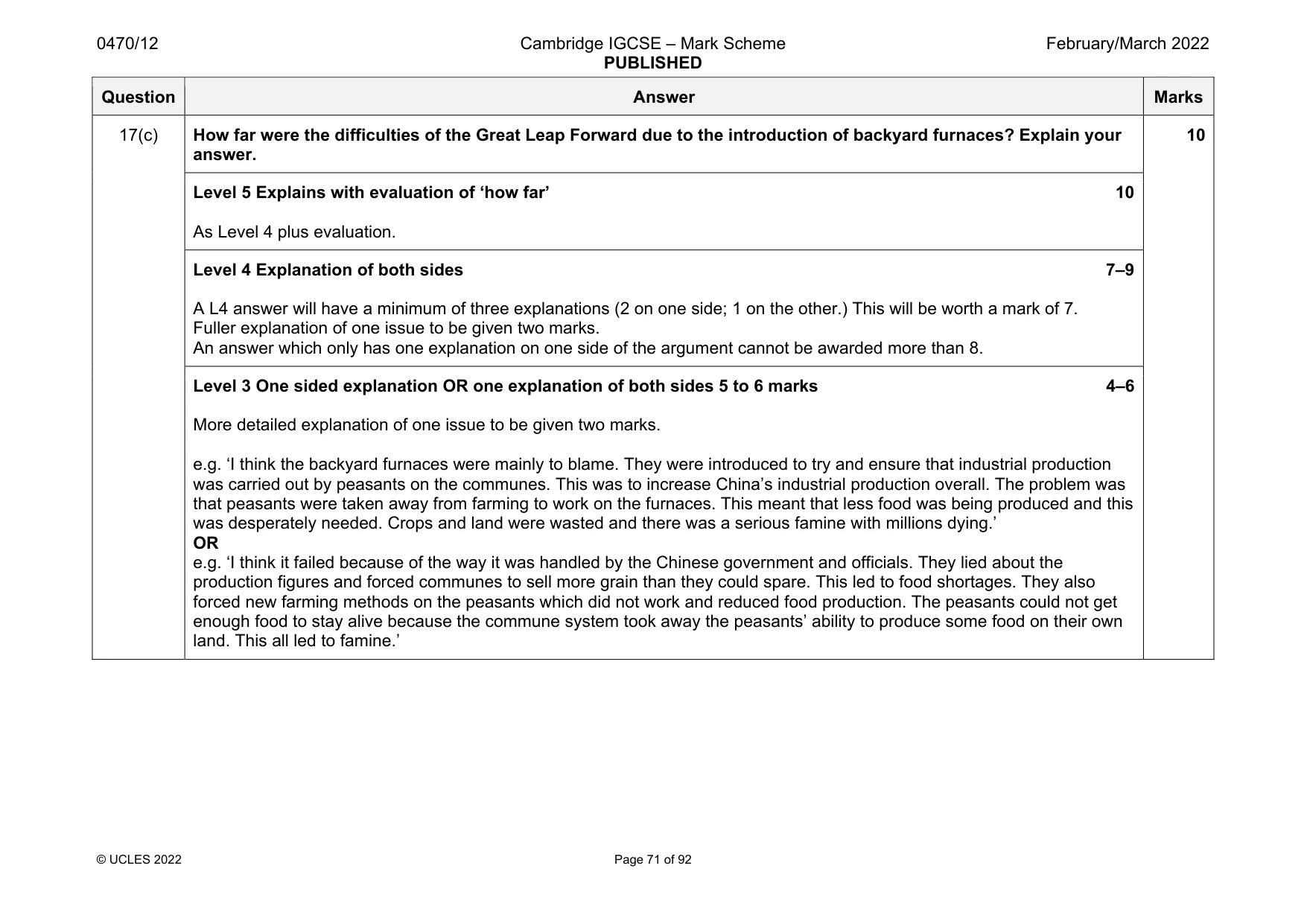
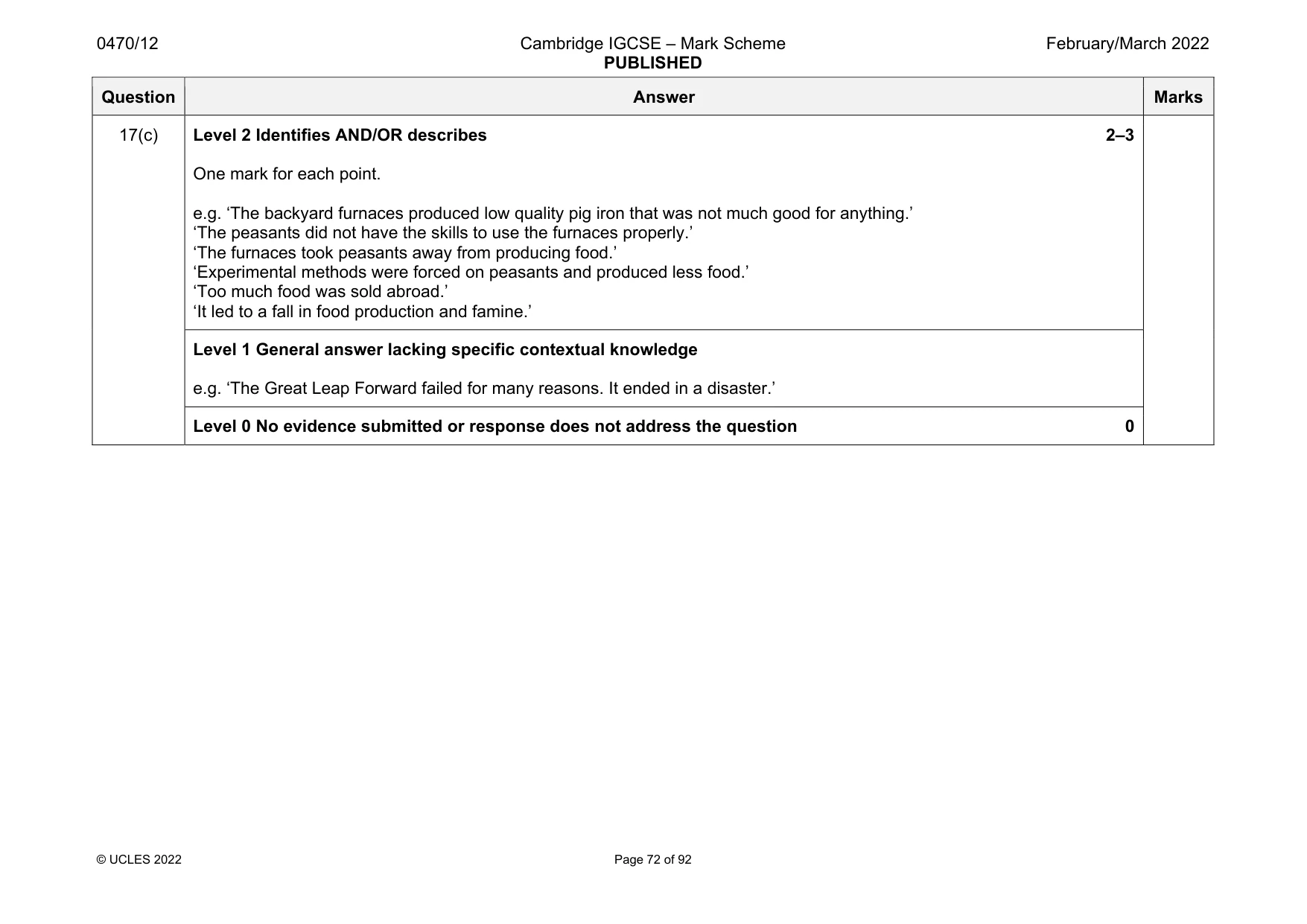
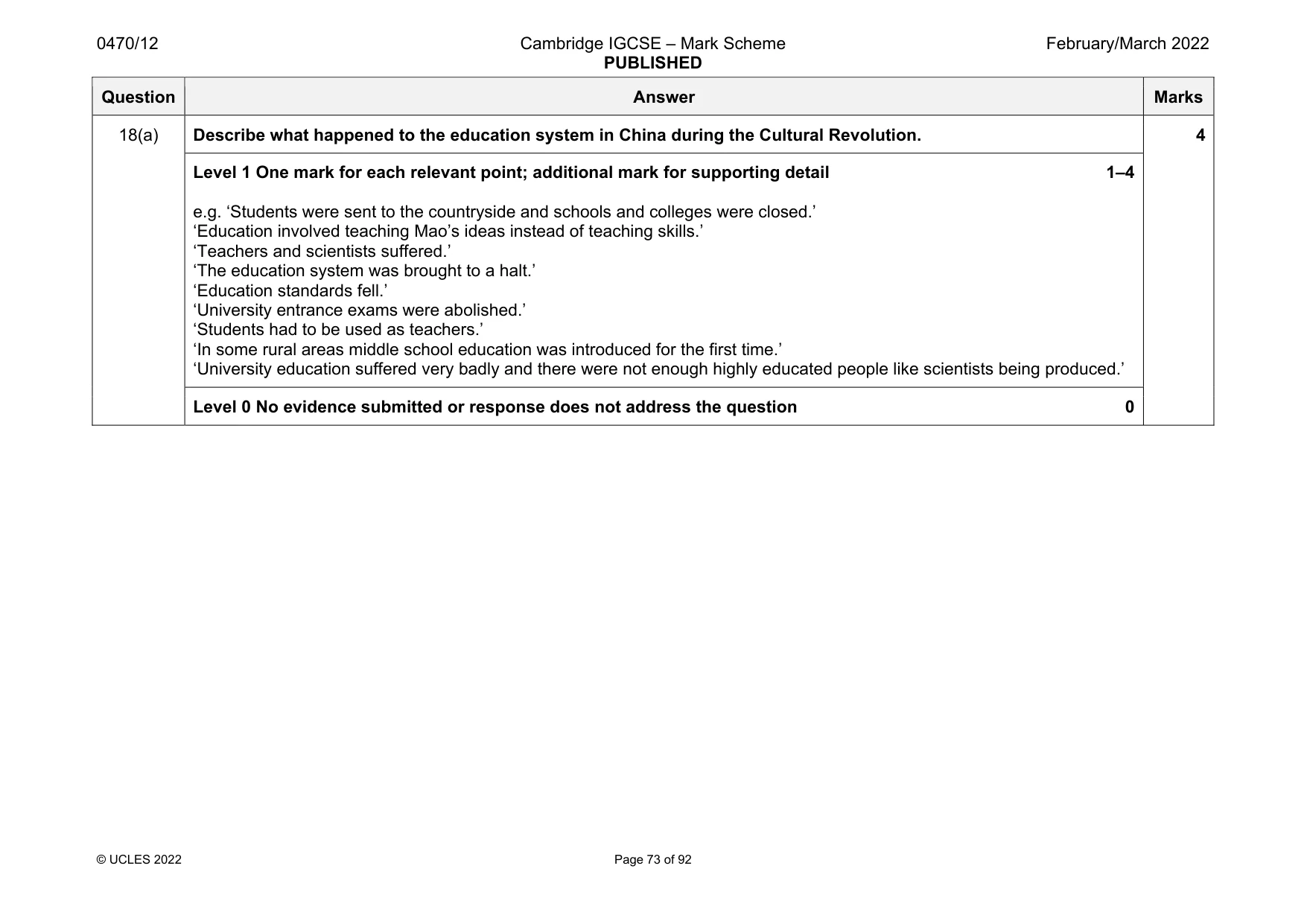
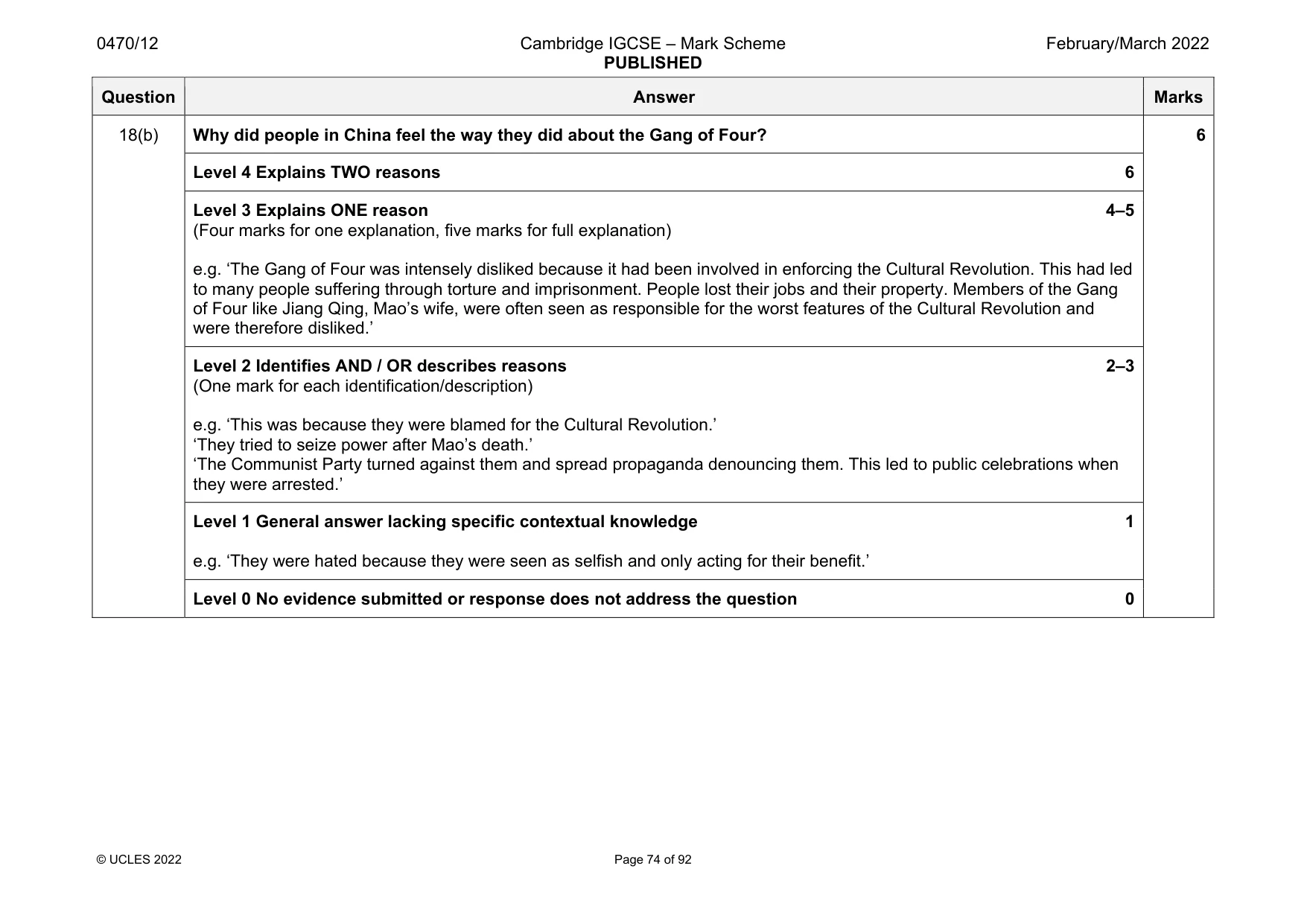
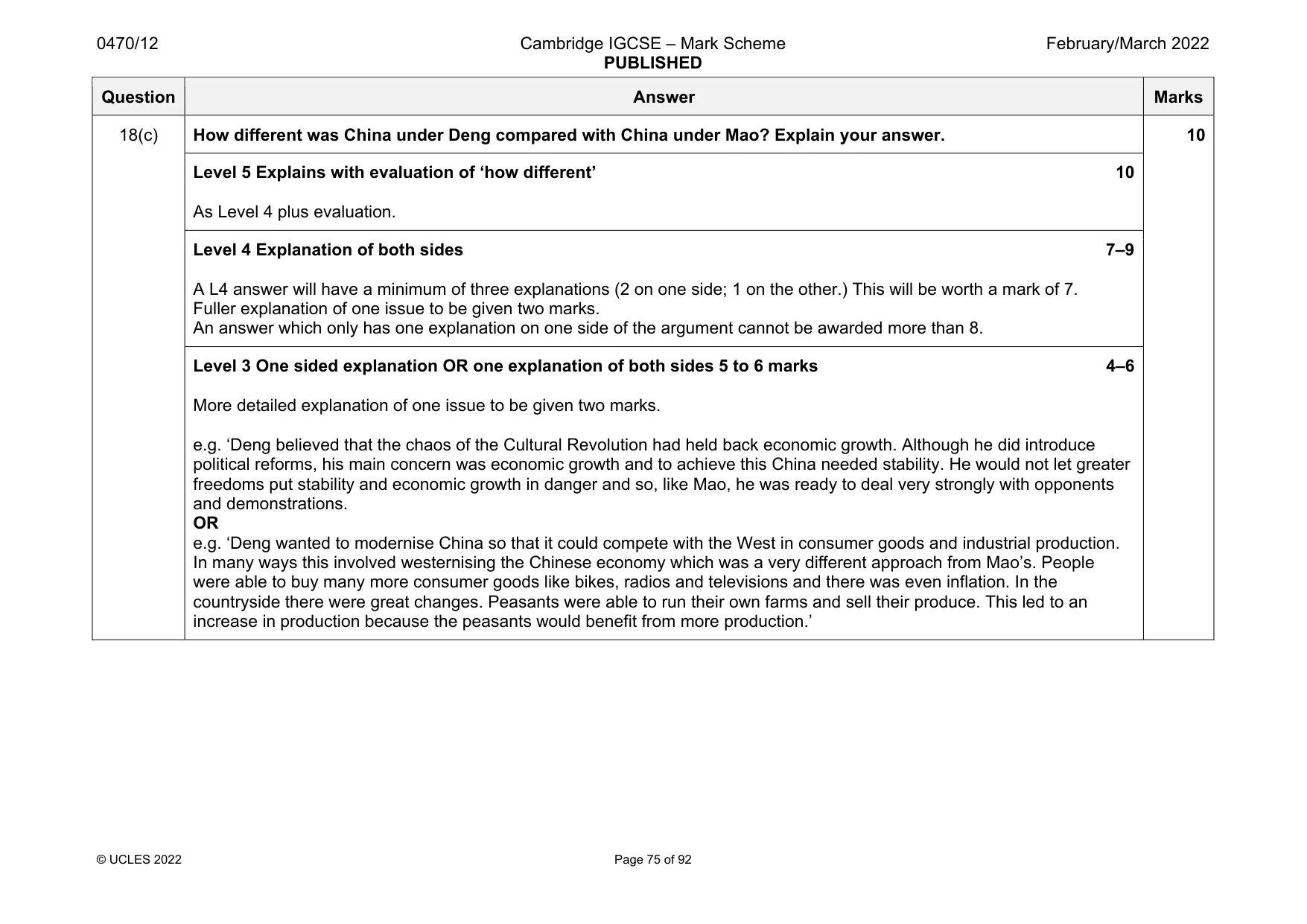
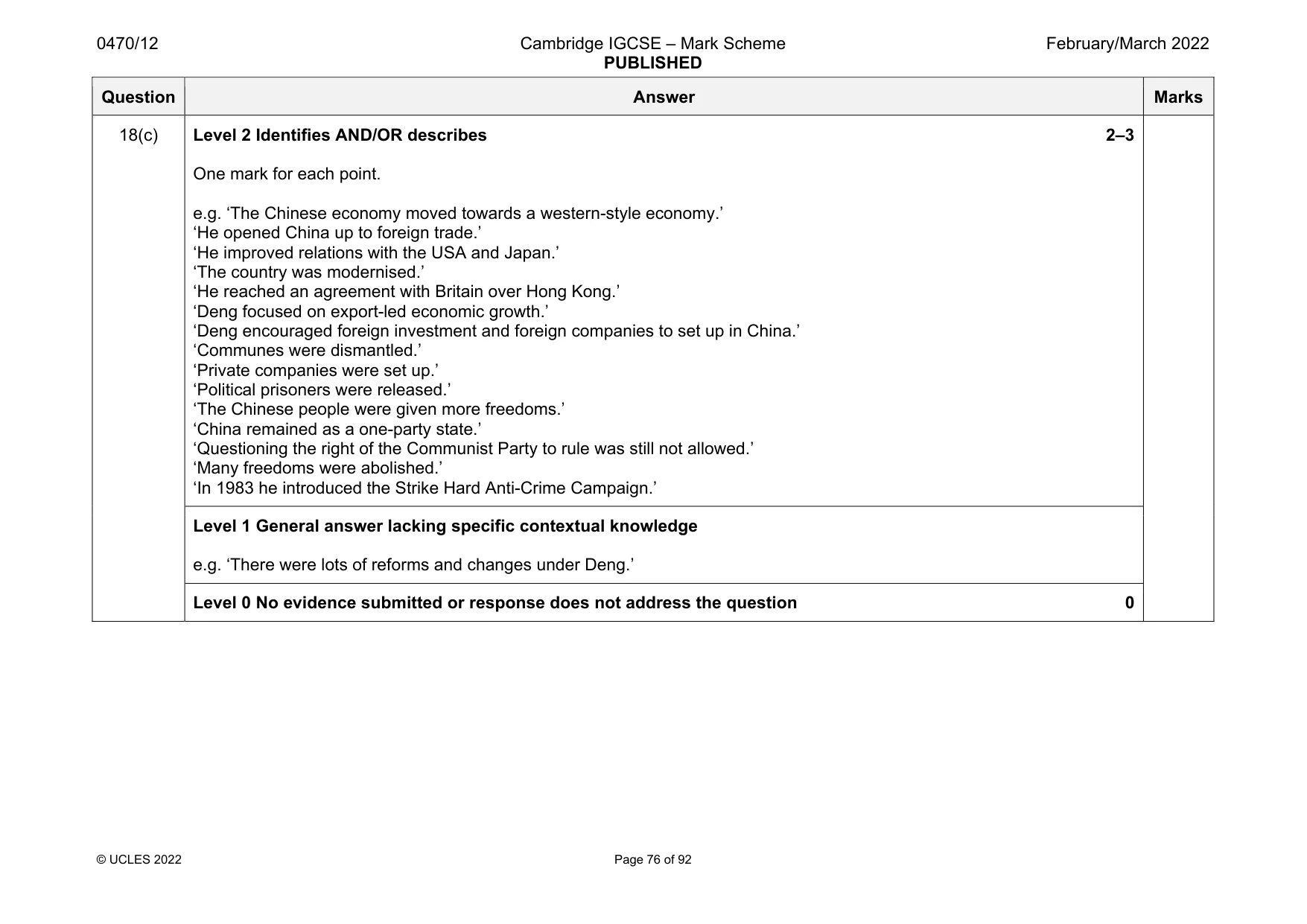
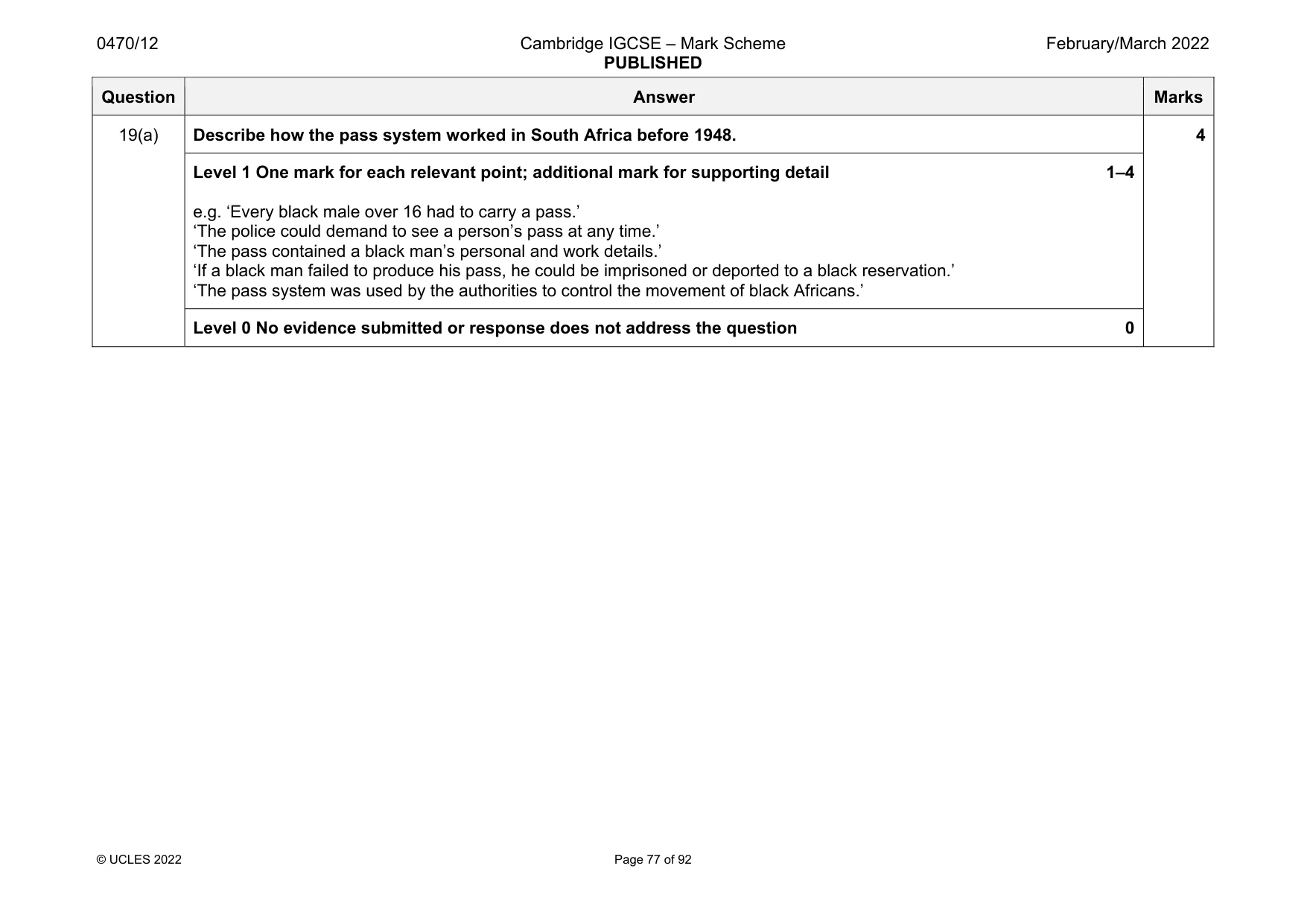
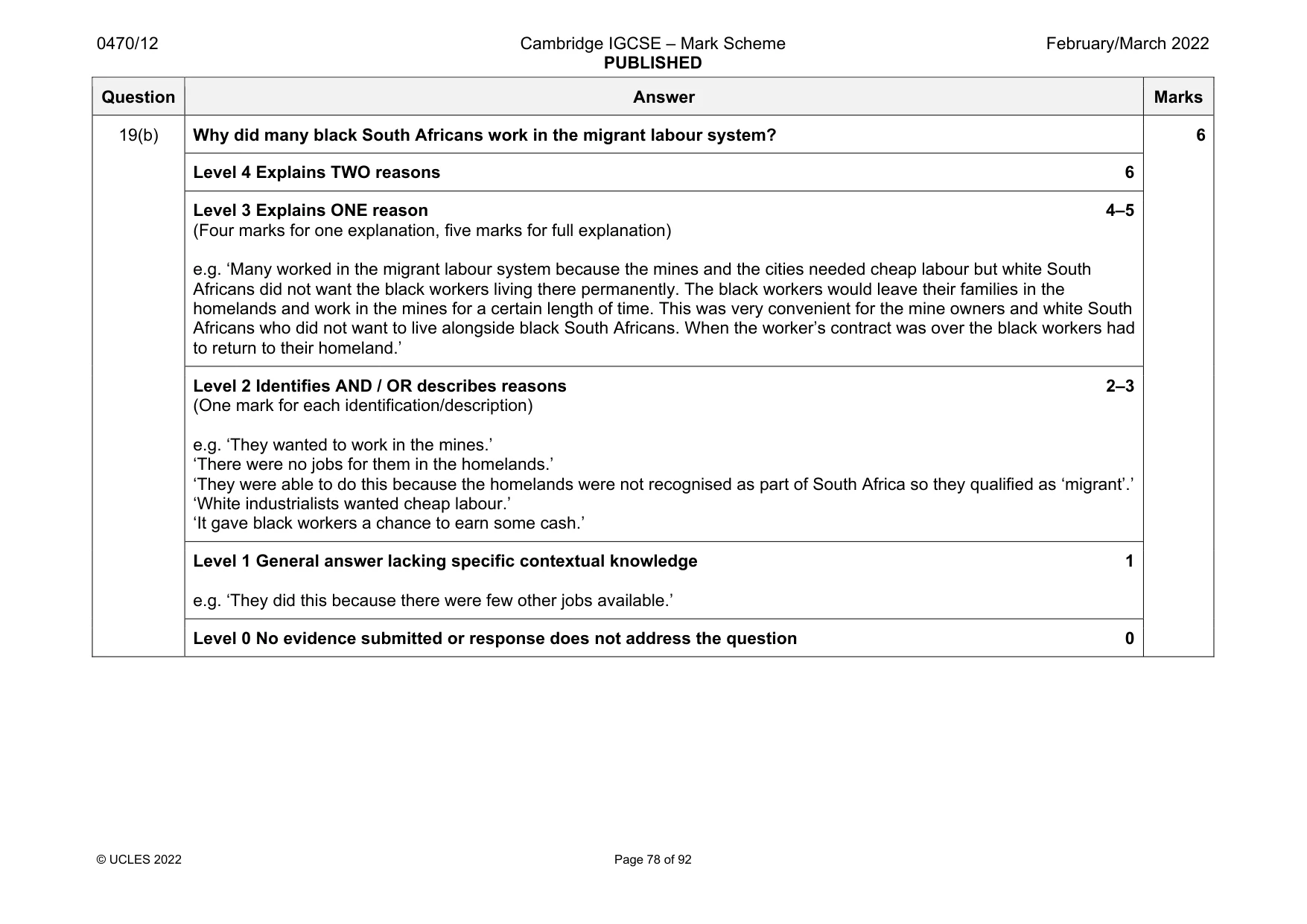
Paper as text
Question paper, page 1
This document has 12 pages. Any blank pages are indicated. [Turn over Cambridge IGCSE™ HISTORY 0470/12 Paper 1 February/March 2022 2 hours You must answer on the enclosed answer booklet. You will need: Answer booklet (enclosed) INSTRUCTIONS ● Answer three questions in total: Section A (Core Content): answer two questions. Section B (Depth Studies): answer one question. ● Follow the instructions on the front cover of the answer booklet. If you need additional answer paper, ask the invigilator for a continuation booklet. INFORMATION ● The total mark for this paper is 60. ● The number of marks for each question or part question is shown in brackets [ ]. DC (LK) 304753/2 © UCLES 2022 * 6 7 3 3 7 3 9 1 4 5 *
Question paper, page 2
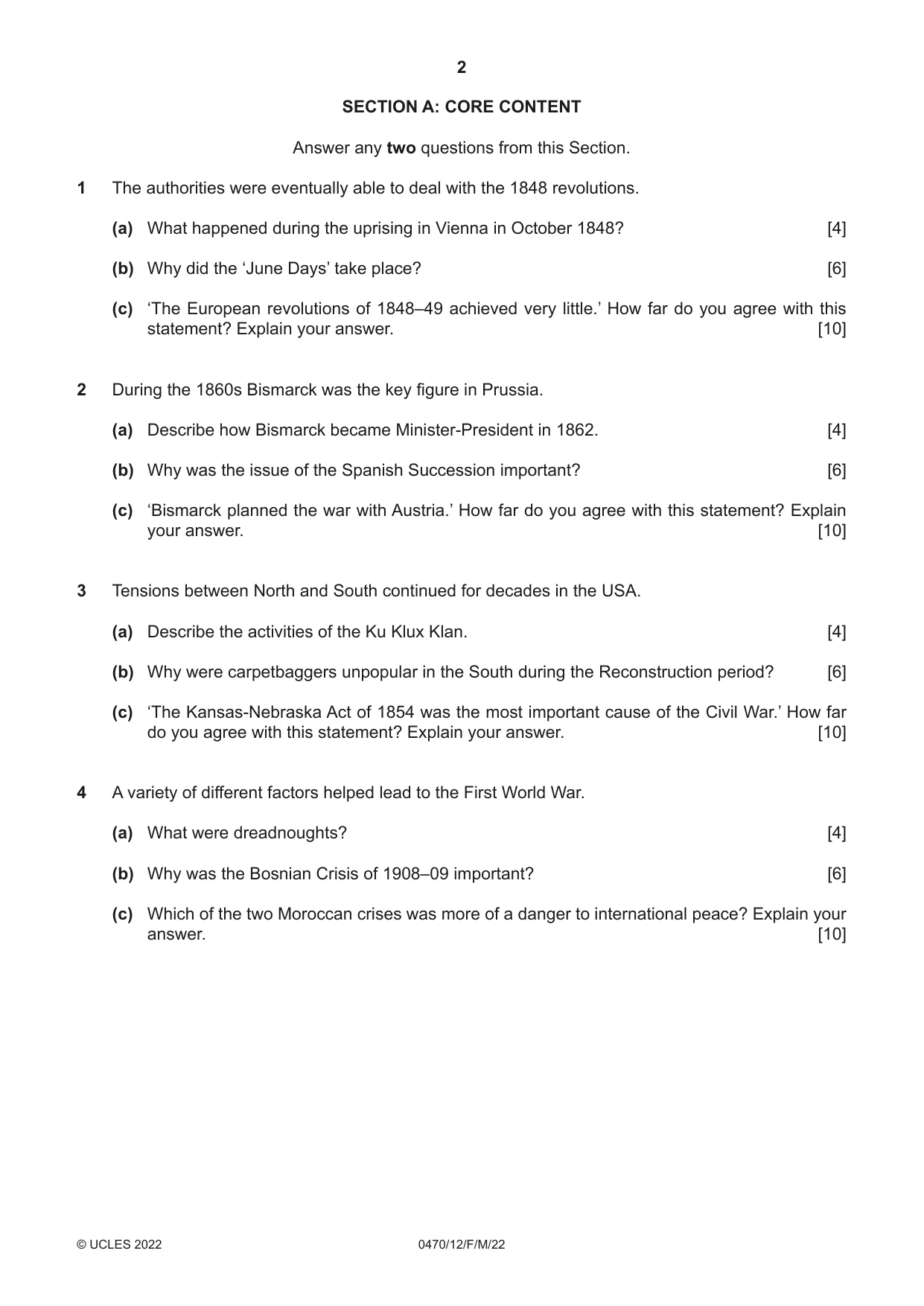
2 0470/12/F/M/22 © UCLES 2022 SECTION A: CORE CONTENT Answer any two questions from this Section. 1 The authorities were eventually able to deal with the 1848 revolutions. (a) What happened during the uprising in Vienna in October 1848? [4] (b) Why did the ‘June Days’ take place? [6] (c) ‘The European revolutions of 1848–49 achieved very little.’ How far do you agree with this statement? Explain your answer. [10] 2 During the 1860s Bismarck was the key figure in Prussia. (a) Describe how Bismarck became Minister-President in 1862. [4] (b) Why was the issue of the Spanish Succession important? [6] (c) ‘Bismarck planned the war with Austria.’ How far do you agree with this statement? Explain your answer. [10] 3 Tensions between North and South continued for decades in the USA. (a) Describe the activities of the Ku Klux Klan. [4] (b) Why were carpetbaggers unpopular in the South during the Reconstruction period? [6] (c) ‘The Kansas-Nebraska Act of 1854 was the most important cause of the Civil War.’ How far do you agree with this statement? Explain your answer. [10] 4 A variety of different factors helped lead to the First World War. (a) What were dreadnoughts? [4] (b) Why was the Bosnian Crisis of 1908–09 important? [6] (c) Which of the two Moroccan crises was more of a danger to international peace? Explain your answer. [10]
Question paper, page 3
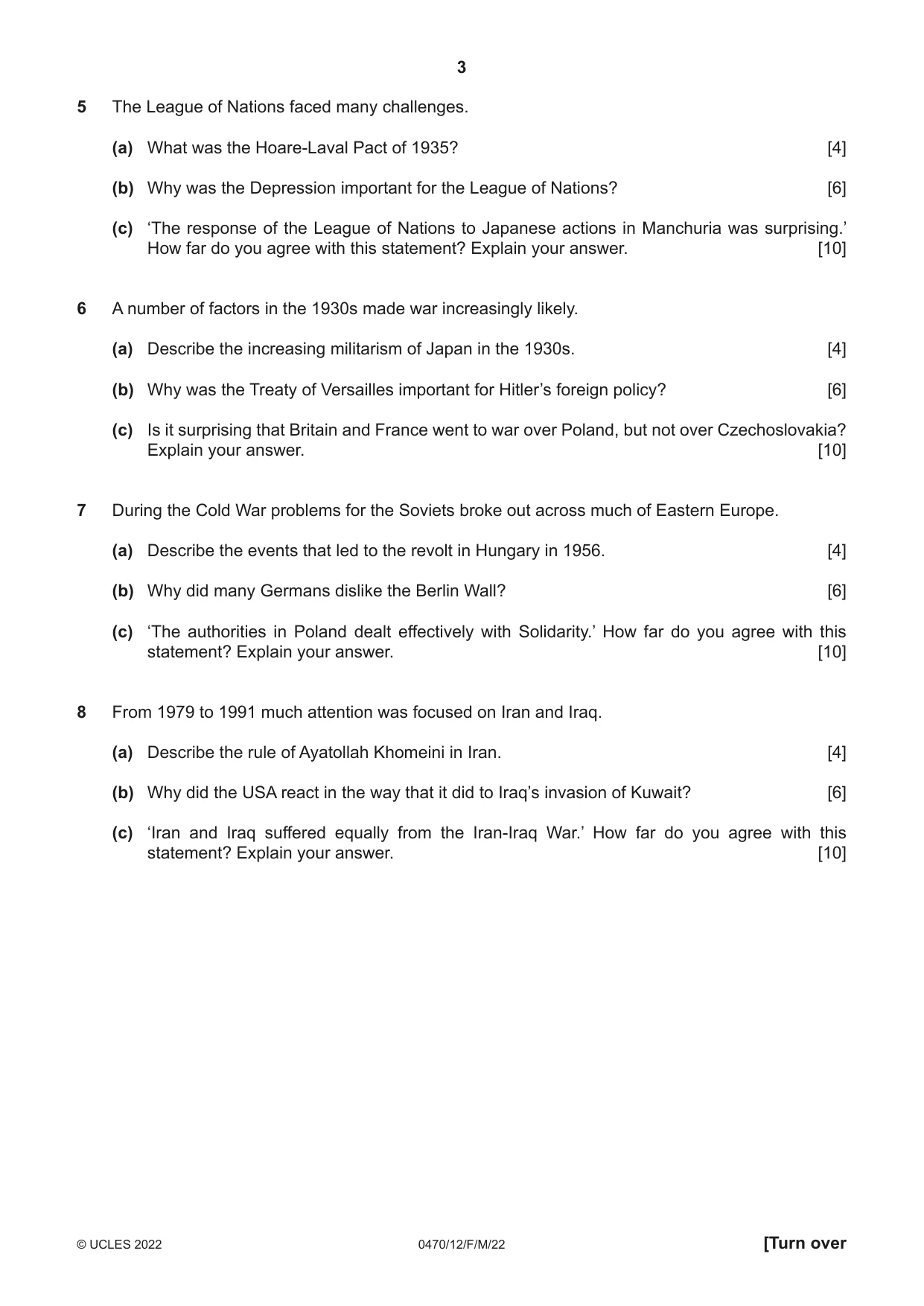
3 0470/12/F/M/22 © UCLES 2022 [Turn over 5 The League of Nations faced many challenges. (a) What was the Hoare-Laval Pact of 1935? [4] (b) Why was the Depression important for the League of Nations? [6] (c) ‘The response of the League of Nations to Japanese actions in Manchuria was surprising.’ How far do you agree with this statement? Explain your answer. [10] 6 A number of factors in the 1930s made war increasingly likely. (a) Describe the increasing militarism of Japan in the 1930s. [4] (b) Why was the Treaty of Versailles important for Hitler’s foreign policy? [6] (c) Is it surprising that Britain and France went to war over Poland, but not over Czechoslovakia? Explain your answer. [10] 7 During the Cold War problems for the Soviets broke out across much of Eastern Europe. (a) Describe the events that led to the revolt in Hungary in 1956. [4] (b) Why did many Germans dislike the Berlin Wall? [6] (c) ‘The authorities in Poland dealt effectively with Solidarity.’ How far do you agree with this statement? Explain your answer. [10] 8 From 1979 to 1991 much attention was focused on Iran and Iraq. (a) Describe the rule of Ayatollah Khomeini in Iran. [4] (b) Why did the USA react in the way that it did to Iraq’s invasion of Kuwait? [6] (c) ‘Iran and Iraq suffered equally from the Iran-Iraq War.’ How far do you agree with this statement? Explain your answer. [10]
Question paper, page 4
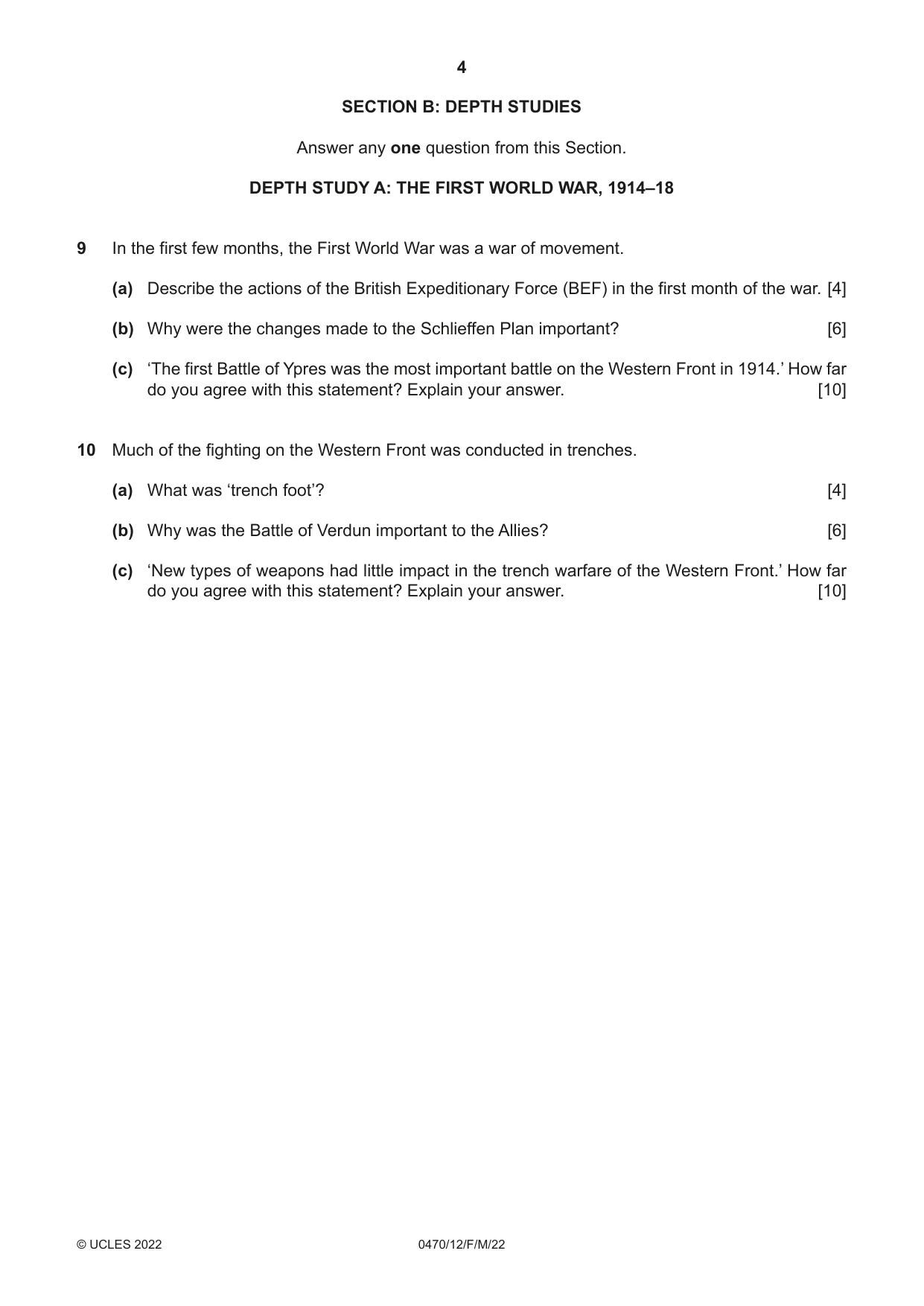
4 0470/12/F/M/22 © UCLES 2022 SECTION B: DEPTH STUDIES Answer any one question from this Section. DEPTH STUDY A: THE FIRST WORLD WAR, 1914–18 9 In the first few months, the First World War was a war of movement. (a) Describe the actions of the British Expeditionary Force (BEF) in the first month of the war. [4] (b) Why were the changes made to the Schlieffen Plan important? [6] (c) ‘The first Battle of Ypres was the most important battle on the Western Front in 1914.’ How far do you agree with this statement? Explain your answer. [10] 10 Much of the fighting on the Western Front was conducted in trenches. (a) What was ‘trench foot’? [4] (b) Why was the Battle of Verdun important to the Allies? [6] (c) ‘New types of weapons had little impact in the trench warfare of the Western Front.’ How far do you agree with this statement? Explain your answer. [10]
Question paper, page 5
5 0470/12/F/M/22 © UCLES 2022 [Turn over DEPTH STUDY B: GERMANY, 1918–45 11 There were many factors that helped the Nazis rise to power. (a) Describe the role of Goebbels in the Nazi Party during the 1920s. [4] (b) Why did the economy of the Weimar Republic collapse so quickly after 1929? [6] (c) ‘The Enabling Act was the most important reason why Hitler was able to consolidate his power by 1934.’ How far do you agree with this statement? Explain your answer. [10] 12 The Nazi government tried to control every part of German society. (a) Describe Nazi policies towards the churches in Germany. [4] (b) Why did the Nazi master race theory lead to the persecution of certain groups in German society? [6] (c) How successful was the Nazi government in controlling the German people? Explain your answer. [10]
Question paper, page 6
6 0470/12/F/M/22 © UCLES 2022 DEPTH STUDY C: RUSSIA, 1905–41 13 Tsar Nicholas II was not a popular ruler. (a) What were the features of the Tsar’s Russification policy? [4] (b) Why was the 1905 Revolution important? [6] (c) ‘By 1916 the main reason for the Tsar’s unpopularity was Rasputin.’ How far do you agree with this statement? Explain your answer. [10] 14 When he came to power Stalin was determined to make important changes. (a) Describe what replaced the New Economic Policy (NEP) in the late 1920s. [4] (b) Why did Stalin’s policies bring about changes in the lives of Soviet women? [6] (c) ‘Stalin changed Soviet agriculture for political rather than economic reasons.’ How far do you agree with this statement? Explain your answer. [10]
Question paper, page 7
7 0470/12/F/M/22 © UCLES 2022 [Turn over DEPTH STUDY D: THE UNITED STATES, 1919–41 15 Some people did well in the 1920s, others did not. (a) What were sharecroppers? [4] (b) Why were many American farmers in the 1920s producing more than they could sell? [6] (c) How far was the car industry responsible for America’s economic boom of the 1920s? Explain your answer. [10] 16 The New Deal was not a complete success. (a) Who was Huey Long? [4] (b) Why was unemployment still high at the end of the 1930s? [6] (c) ‘The first and second New Deals were very different.’ How far do you agree with this statement? Explain your answer. [10]
Question paper, page 8
8 0470/12/F/M/22 © UCLES 2022 DEPTH STUDY E: CHINA, c.1930–c.1990 17 There were reforms in China in the 1950s. (a) What were collective farms? [4] (b) Why did Mao introduce social reforms in the 1950s? [6] (c) How far were the difficulties of the Great Leap Forward due to the introduction of backyard furnaces? Explain your answer. [10] 18 China experienced much change over the years. (a) Describe what happened to the education system in China during the Cultural Revolution. [4] (b) Why did people in China feel the way they did about the Gang of Four? [6] (c) How different was China under Deng compared with China under Mao? Explain your answer. [10]
Question paper, page 9
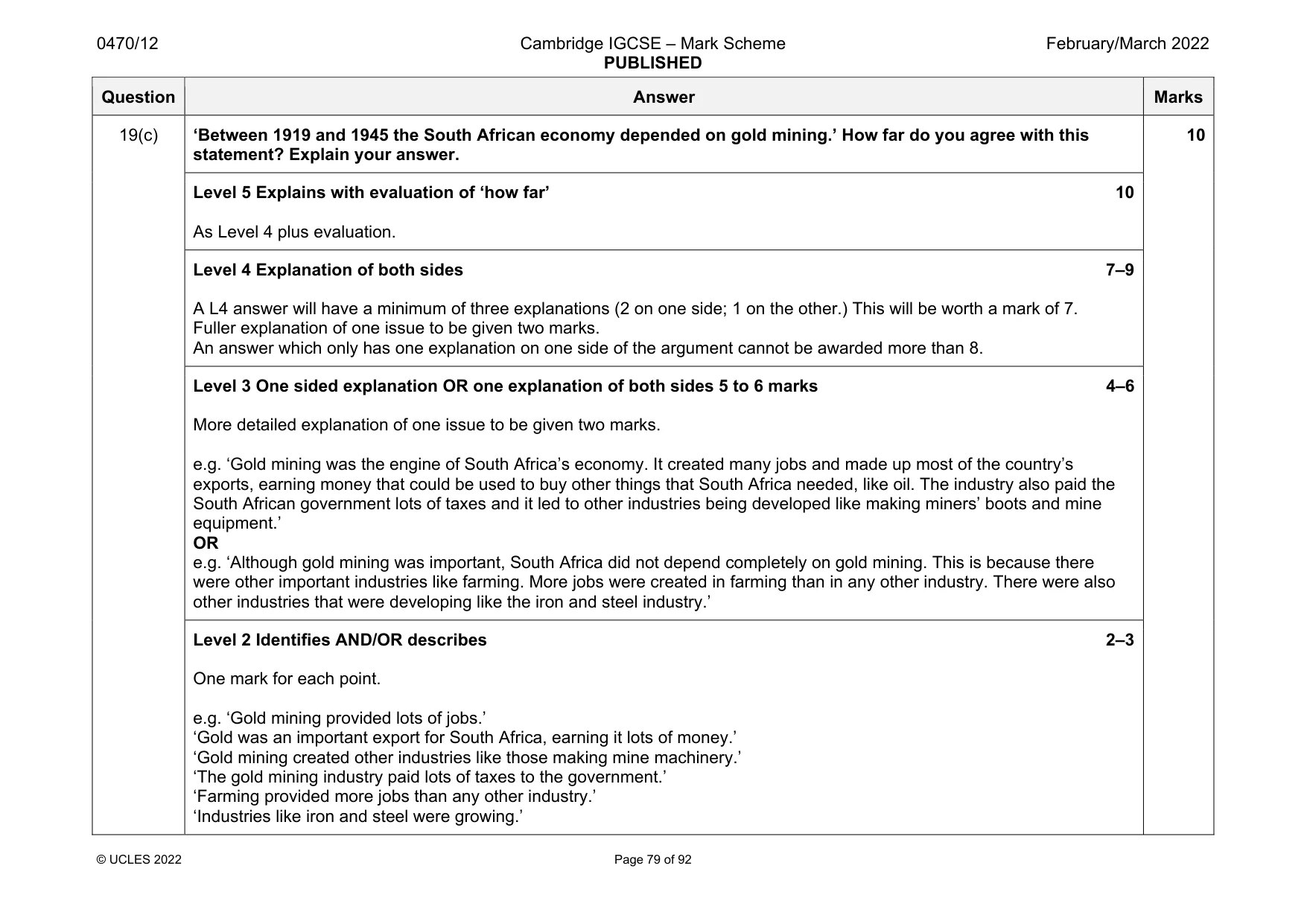
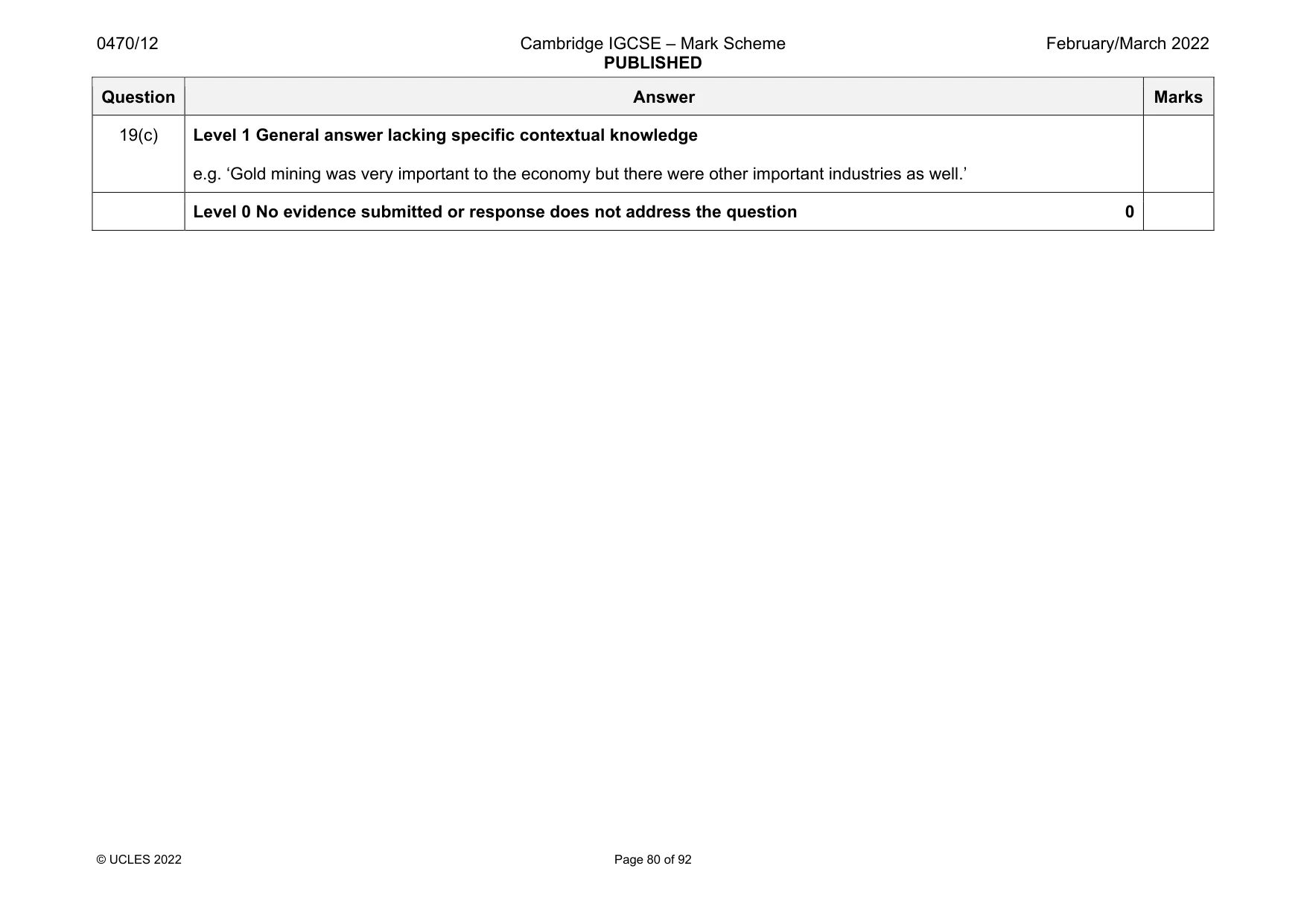
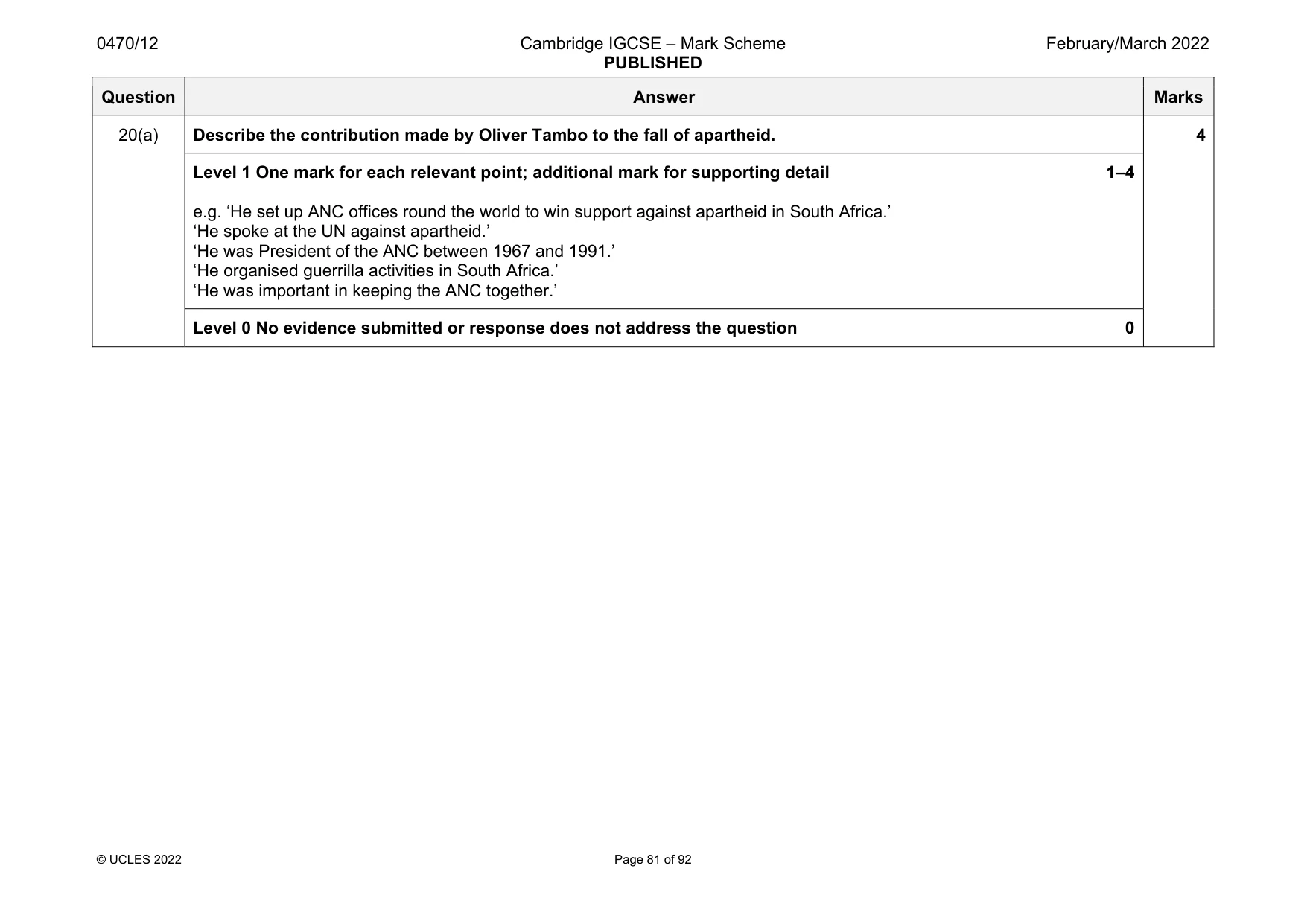
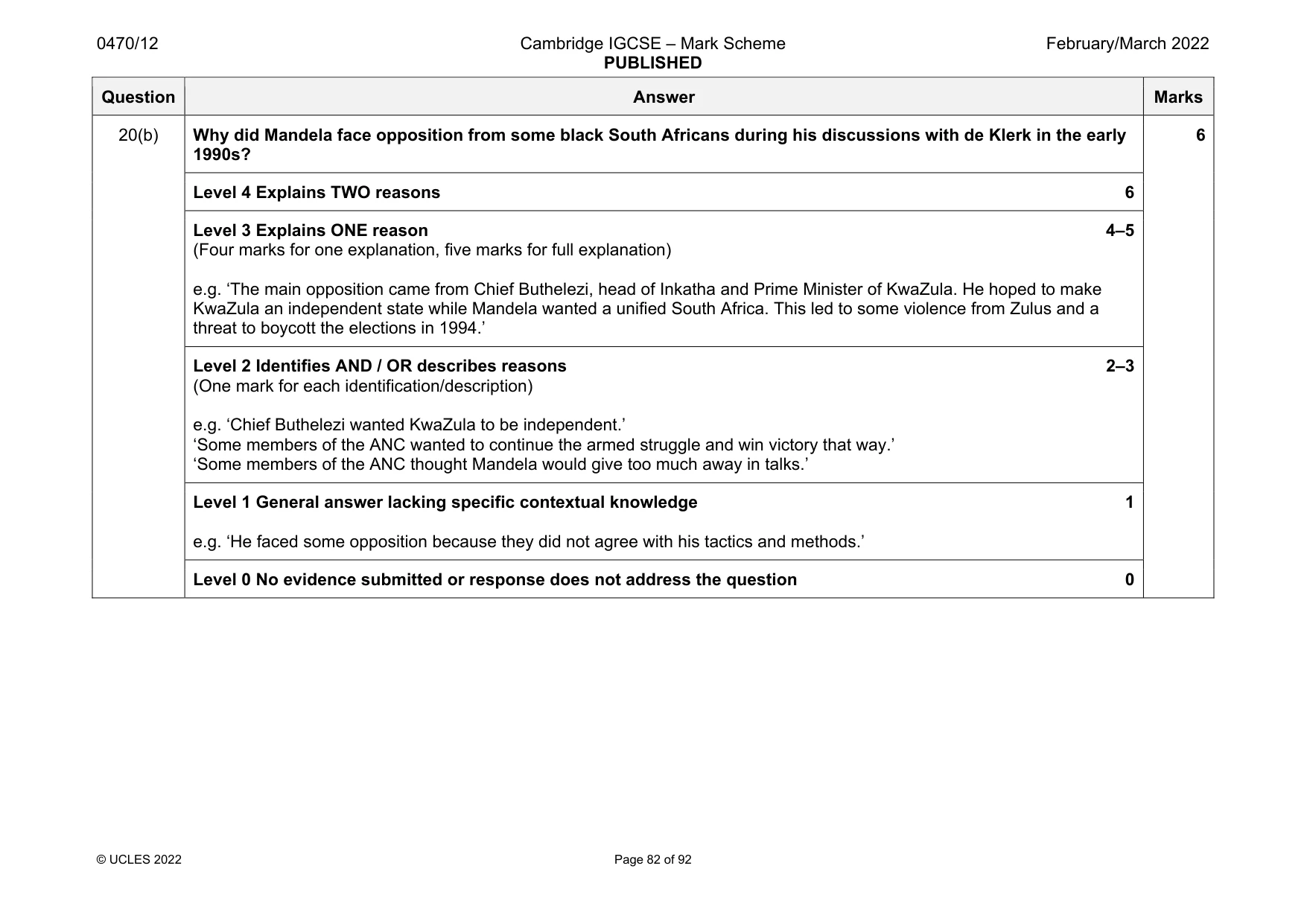
9 0470/12/F/M/22 © UCLES 2022 [Turn over DEPTH STUDY F: SOUTH AFRICA, c.1940–c.1994 19 Before 1948 the lives of black South Africans were very restricted. (a) Describe how the pass system worked in South Africa before 1948. [4] (b) Why did many black South Africans work in the migrant labour system? [6] (c) ‘Between 1919 and 1945 the South African economy depended on gold mining.’ How far do you agree with this statement? Explain your answer. [10] 20 By the mid-1980s apartheid was coming to an end. (a) Describe the contribution made by Oliver Tambo to the fall of apartheid. [4] (b) Why did Mandela face opposition from some black South Africans during his discussions with de Klerk in the early 1990s? [6] (c) How far did the State of Emergency called by Botha in 1985 help the government to stay in control? Explain your answer. [10]
Question paper, page 10
10 0470/12/F/M/22 © UCLES 2022 DEPTH STUDY G: ISRAELIS AND PALESTINIANS SINCE 1945 21 Palestine saw much violence after the Second World War. (a) Who was David Ben-Gurion? [4] (b) Why was there a Jewish insurgency in Palestine between 1944 and 1948? [6] (c) How surprising was the defeat of the Arab states in the war of 1948–49? Explain your answer. [10] 22 Israel and the Arab states found it difficult to live together peacefully. (a) Who was Moshe Dayan? [4] (b) Why did President Sadat decide to go to war against Israel in 1973? [6] (c) Who benefited most from the war of 1956? Explain your answer. [10]
Question paper, page 11
11 0470/12/F/M/22 © UCLES 2022 BLANK PAGE
Question paper, page 12
12 0470/12/F/M/22 © UCLES 2022 Permission to reproduce items where third-party owned material protected by copyright is included has been sought and cleared where possible. Every reasonable effort has been made by the publisher (UCLES) to trace copyright holders, but if any items requiring clearance have unwittingly been included, the publisher will be pleased to make amends at the earliest possible opportunity. To avoid the issue of disclosure of answer-related information to candidates, all copyright acknowledgements are reproduced online in the Cambridge Assessment International Education Copyright Acknowledgements Booklet. This is produced for each series of examinations and is freely available to download at www.cambridgeinternational.org after the live examination series. Cambridge Assessment International Education is part of Cambridge Assessment. Cambridge Assessment is the brand name of the University of Cambridge Local Examinations Syndicate (UCLES), which is a department of the University of Cambridge. BLANK PAGE
Mark scheme, page 1
This document consists of 92 printed pages. © UCLES 2022 [Turn over Cambridge IGCSE™ HISTORY 0470/12 Paper 1 February/March 2022 MARK SCHEME Maximum Mark: 60 Published This mark scheme is published as an aid to teachers and candidates, to indicate the requirements of the examination. It shows the basis on which Examiners were instructed to award marks. It does not indicate the details of the discussions that took place at an Examiners’ meeting before marking began, which would have considered the acceptability of alternative answers. Mark schemes should be read in conjunction with the question paper and the Principal Examiner Report for Teachers. Cambridge International will not enter into discussions about these mark schemes. Cambridge International is publishing the mark schemes for the February/March 2022 series for most Cambridge IGCSE™, Cambridge International A and AS Level components and some Cambridge O Level components.
Mark scheme, page 2
0470/12 Cambridge IGCSE – Mark Scheme PUBLISHED February/March 2022 © UCLES 2022 Page 2 of 92 Generic Marking Principles These general marking principles must be applied by all examiners when marking candidate answers. They should be applied alongside the specific content of the mark scheme or generic level descriptors for a question. Each question paper and mark scheme will also comply with these marking principles. GENERIC MARKING PRINCIPLE 1: Marks must be awarded in line with: • the specific content of the mark scheme or the generic level descriptors for the question • the specific skills defined in the mark scheme or in the generic level descriptors for the question • the standard of response required by a candidate as exemplified by the standardisation scripts. GENERIC MARKING PRINCIPLE 2: Marks awarded are always whole marks (not half marks, or other fractions). GENERIC MARKING PRINCIPLE 3: Marks must be awarded positively: • marks are awarded for correct/valid answers, as defined in the mark scheme. However, credit is given for valid answers which go beyond the scope of the syllabus and mark scheme, referring to your Team Leader as appropriate • marks are awarded when candidates clearly demonstrate what they know and can do • marks are not deducted for errors • marks are not deducted for omissions • answers should only be judged on the quality of spelling, punctuation and grammar when these features are specifically assessed by the question as indicated by the mark scheme. The meaning, however, should be unambiguous. GENERIC MARKING PRINCIPLE 4: Rules must be applied consistently, e.g. in situations where candidates have not followed instructions or in the application of generic level descriptors.
Mark scheme, page 3
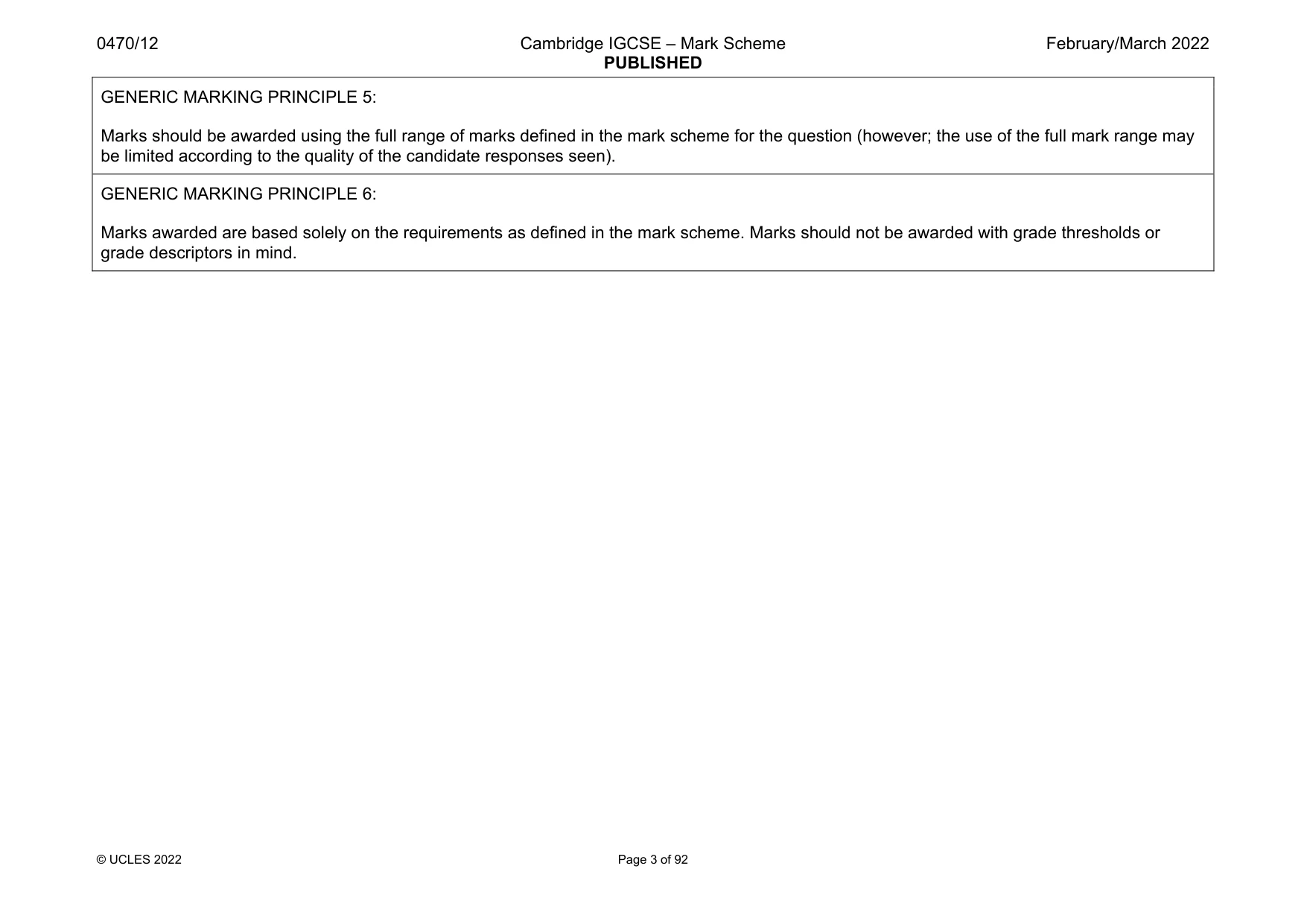
0470/12 Cambridge IGCSE – Mark Scheme PUBLISHED February/March 2022 © UCLES 2022 Page 3 of 92 GENERIC MARKING PRINCIPLE 5: Marks should be awarded using the full range of marks defined in the mark scheme for the question (however; the use of the full mark range may be limited according to the quality of the candidate responses seen). GENERIC MARKING PRINCIPLE 6: Marks awarded are based solely on the requirements as defined in the mark scheme. Marks should not be awarded with grade thresholds or grade descriptors in mind.
Mark scheme, page 4
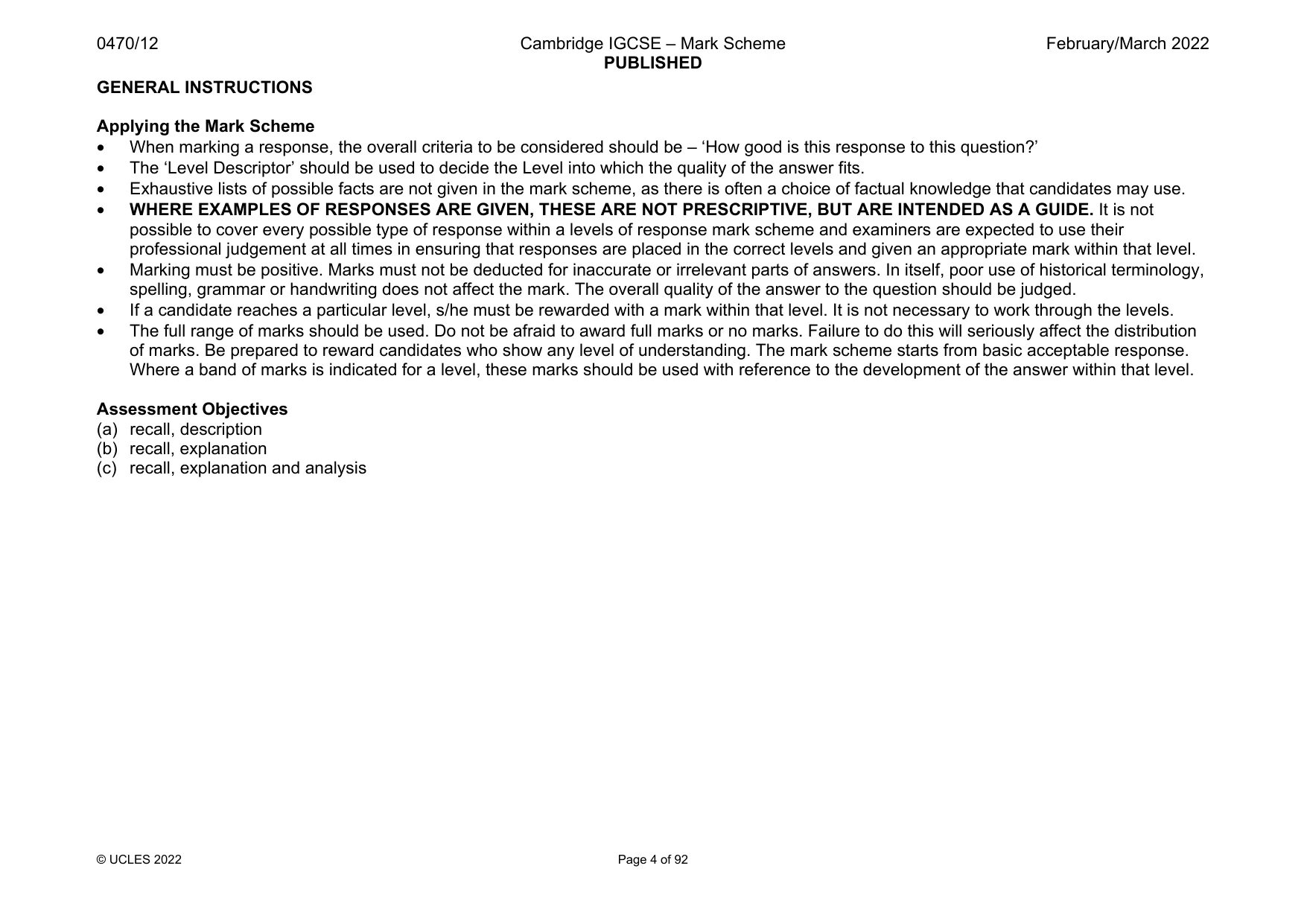
0470/12 Cambridge IGCSE – Mark Scheme PUBLISHED February/March 2022 © UCLES 2022 Page 4 of 92 GENERAL INSTRUCTIONS Applying the Mark Scheme • When marking a response, the overall criteria to be considered should be – ‘How good is this response to this question?’ • The ‘Level Descriptor’ should be used to decide the Level into which the quality of the answer fits. • Exhaustive lists of possible facts are not given in the mark scheme, as there is often a choice of factual knowledge that candidates may use. • WHERE EXAMPLES OF RESPONSES ARE GIVEN, THESE ARE NOT PRESCRIPTIVE, BUT ARE INTENDED AS A GUIDE. It is not possible to cover every possible type of response within a levels of response mark scheme and examiners are expected to use their professional judgement at all times in ensuring that responses are placed in the correct levels and given an appropriate mark within that level. • Marking must be positive. Marks must not be deducted for inaccurate or irrelevant parts of answers. In itself, poor use of historical terminology, spelling, grammar or handwriting does not affect the mark. The overall quality of the answer to the question should be judged. • If a candidate reaches a particular level, s/he must be rewarded with a mark within that level. It is not necessary to work through the levels. • The full range of marks should be used. Do not be afraid to award full marks or no marks. Failure to do this will seriously affect the distribution of marks. Be prepared to reward candidates who show any level of understanding. The mark scheme starts from basic acceptable response. Where a band of marks is indicated for a level, these marks should be used with reference to the development of the answer within that level. Assessment Objectives (a) recall, description (b) recall, explanation (c) recall, explanation and analysis
Mark scheme, page 5
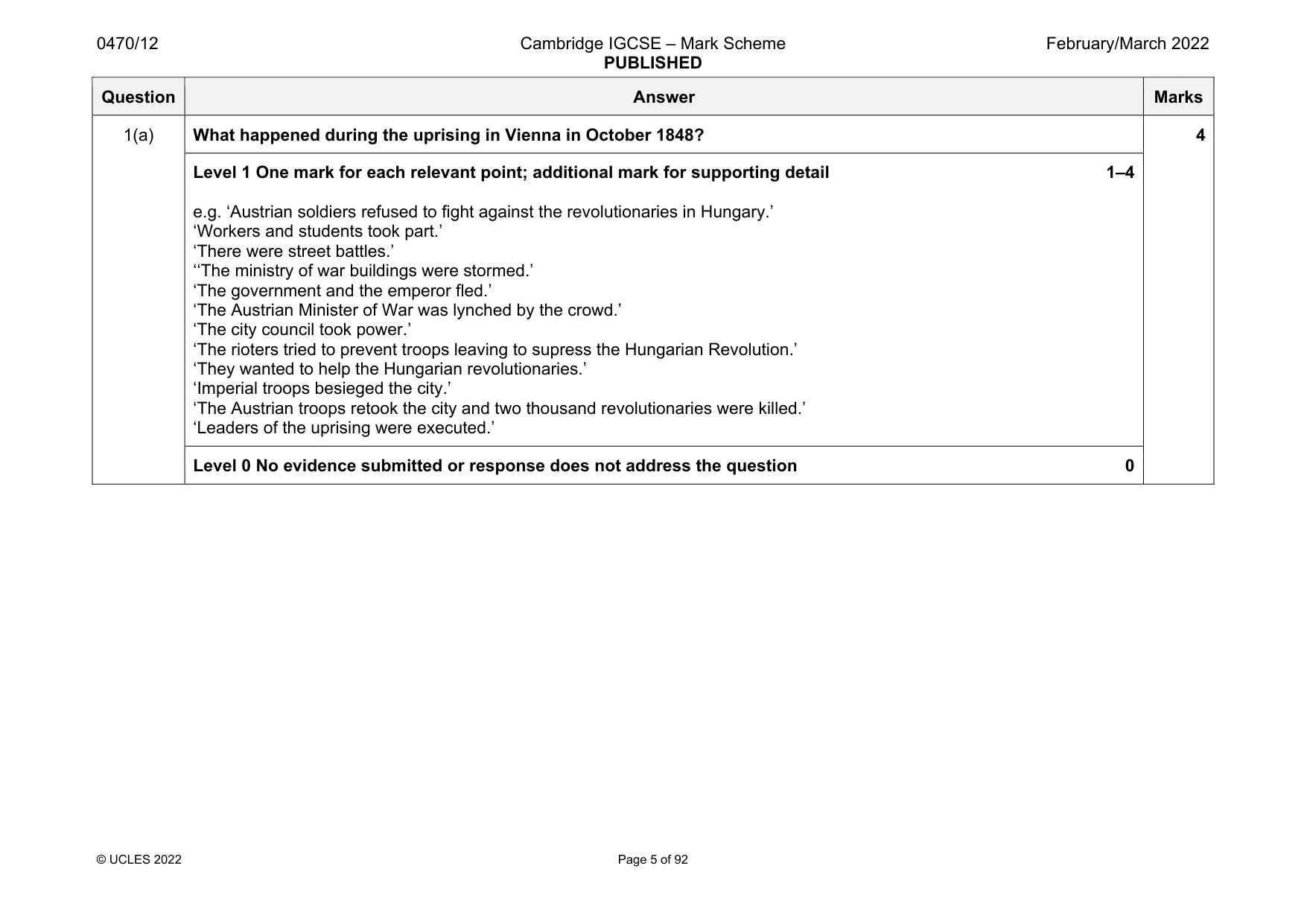
0470/12 Cambridge IGCSE – Mark Scheme PUBLISHED February/March 2022 © UCLES 2022 Page 5 of 92 Question Answer Marks 1(a) What happened during the uprising in Vienna in October 1848? 4 Level 1 One mark for each relevant point; additional mark for supporting detail 1–4 e.g. ‘Austrian soldiers refused to fight against the revolutionaries in Hungary.’ ‘Workers and students took part.’ ‘There were street battles.’ ‘‘The ministry of war buildings were stormed.’ ‘The government and the emperor fled.’ ‘The Austrian Minister of War was lynched by the crowd.’ ‘The city council took power.’ ‘The rioters tried to prevent troops leaving to supress the Hungarian Revolution.’ ‘They wanted to help the Hungarian revolutionaries.’ ‘Imperial troops besieged the city.’ ‘The Austrian troops retook the city and two thousand revolutionaries were killed.’ ‘Leaders of the uprising were executed.’ Level 0 No evidence submitted or response does not address the question 0
Mark scheme, page 6
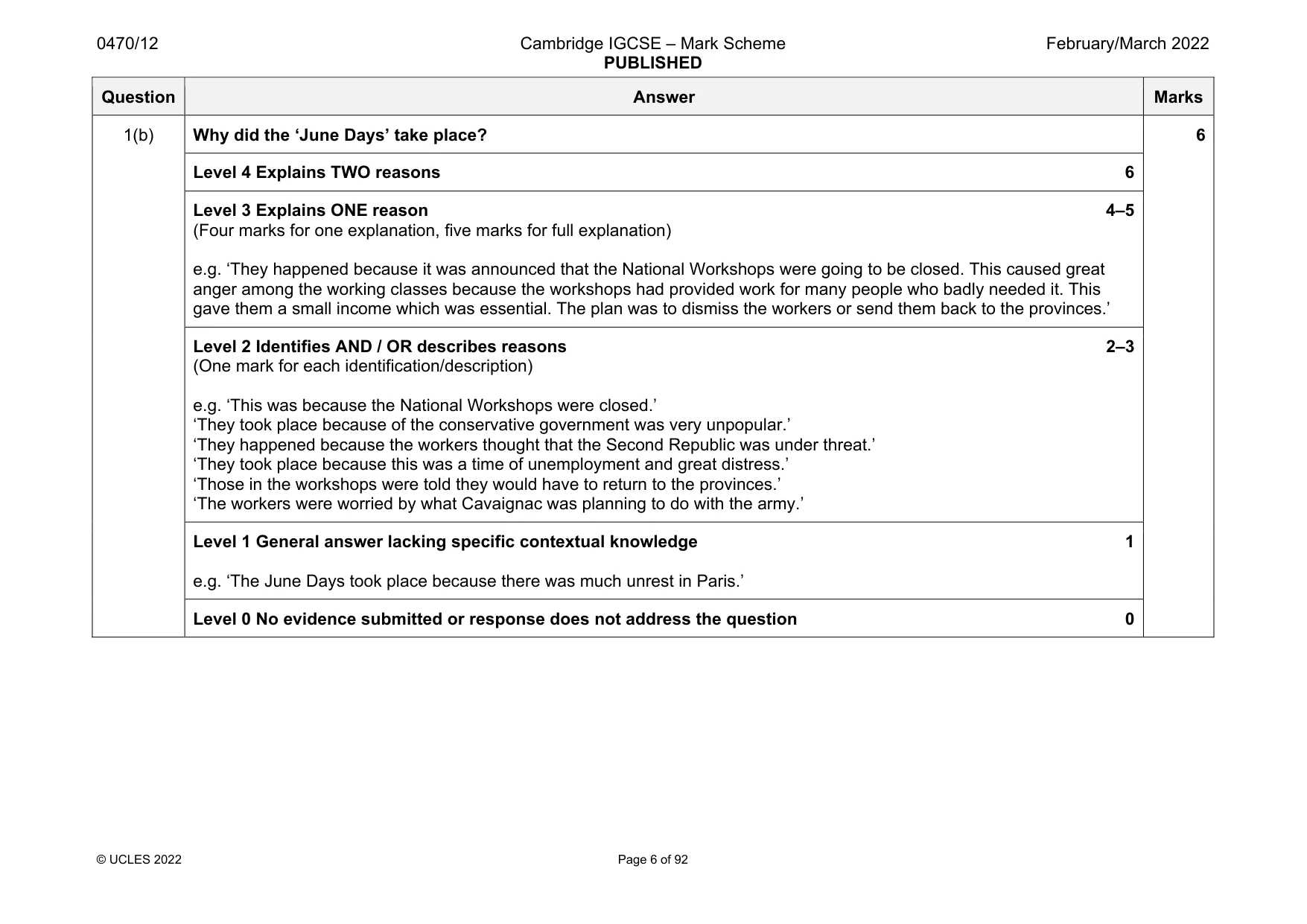
0470/12 Cambridge IGCSE – Mark Scheme PUBLISHED February/March 2022 © UCLES 2022 Page 6 of 92 Question Answer Marks 1(b) Why did the ‘June Days’ take place? 6 Level 4 Explains TWO reasons 6 Level 3 Explains ONE reason 4–5 (Four marks for one explanation, five marks for full explanation) e.g. ‘They happened because it was announced that the National Workshops were going to be closed. This caused great anger among the working classes because the workshops had provided work for many people who badly needed it. This gave them a small income which was essential. The plan was to dismiss the workers or send them back to the provinces.’ Level 2 Identifies AND / OR describes reasons 2–3 (One mark for each identification/description) e.g. ‘This was because the National Workshops were closed.’ ‘They took place because of the conservative government was very unpopular.’ ‘They happened because the workers thought that the Second Republic was under threat.’ ‘They took place because this was a time of unemployment and great distress.’ ‘Those in the workshops were told they would have to return to the provinces.’ ‘The workers were worried by what Cavaignac was planning to do with the army.’ Level 1 General answer lacking specific contextual knowledge 1 e.g. ‘The June Days took place because there was much unrest in Paris.’ Level 0 No evidence submitted or response does not address the question 0
Mark scheme, page 7
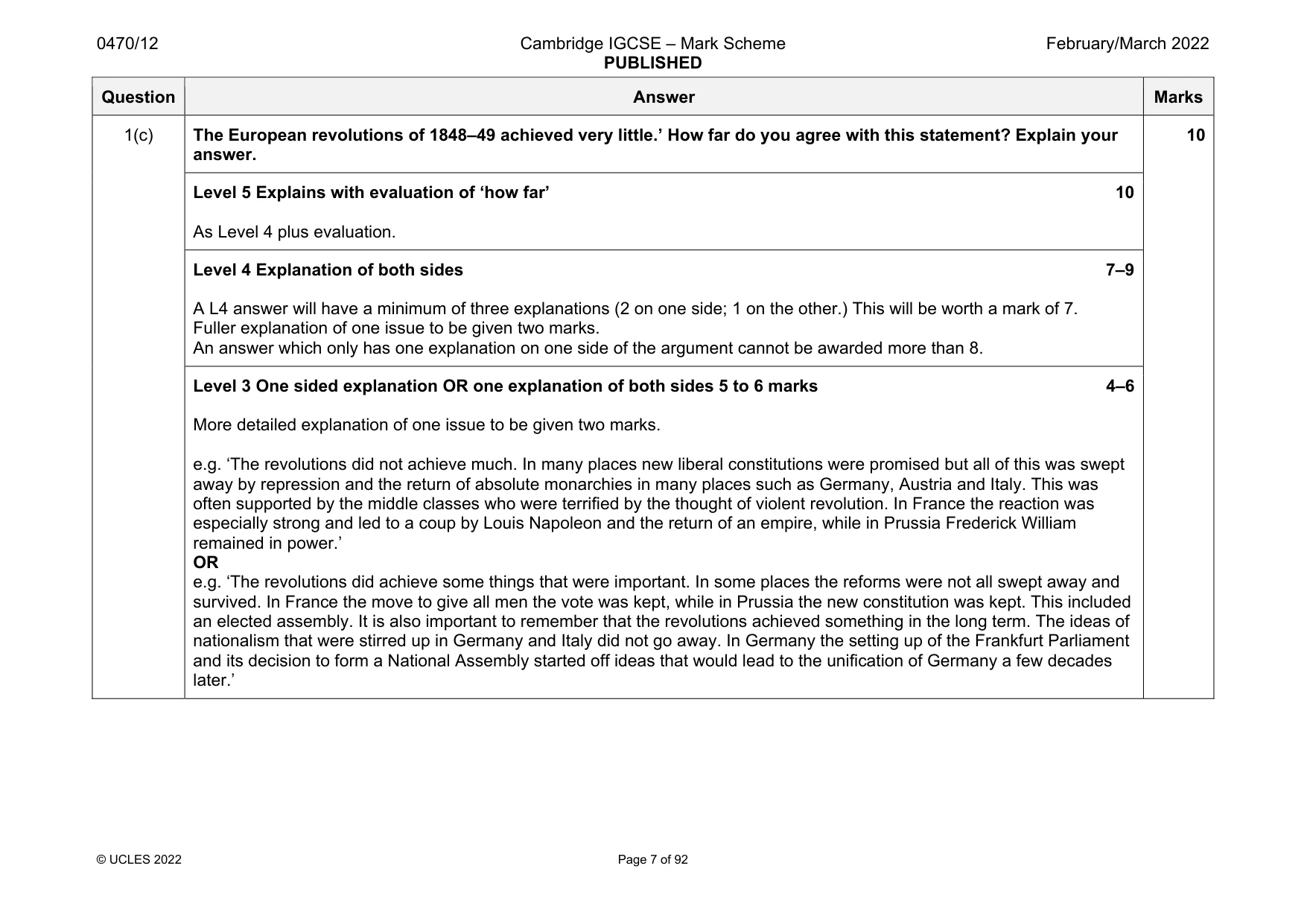
0470/12 Cambridge IGCSE – Mark Scheme PUBLISHED February/March 2022 © UCLES 2022 Page 7 of 92 Question Answer Marks 1(c) The European revolutions of 1848–49 achieved very little.’ How far do you agree with this statement? Explain your answer. 10 Level 5 Explains with evaluation of ‘how far’ 10 As Level 4 plus evaluation. Level 4 Explanation of both sides 7–9 A L4 answer will have a minimum of three explanations (2 on one side; 1 on the other.) This will be worth a mark of 7. Fuller explanation of one issue to be given two marks. An answer which only has one explanation on one side of the argument cannot be awarded more than 8. Level 3 One sided explanation OR one explanation of both sides 5 to 6 marks 4–6 More detailed explanation of one issue to be given two marks. e.g. ‘The revolutions did not achieve much. In many places new liberal constitutions were promised but all of this was swept away by repression and the return of absolute monarchies in many places such as Germany, Austria and Italy. This was often supported by the middle classes who were terrified by the thought of violent revolution. In France the reaction was especially strong and led to a coup by Louis Napoleon and the return of an empire, while in Prussia Frederick William remained in power.’ OR e.g. ‘The revolutions did achieve some things that were important. In some places the reforms were not all swept away and survived. In France the move to give all men the vote was kept, while in Prussia the new constitution was kept. This included an elected assembly. It is also important to remember that the revolutions achieved something in the long term. The ideas of nationalism that were stirred up in Germany and Italy did not go away. In Germany the setting up of the Frankfurt Parliament and its decision to form a National Assembly started off ideas that would lead to the unification of Germany a few decades later.’
Mark scheme, page 8
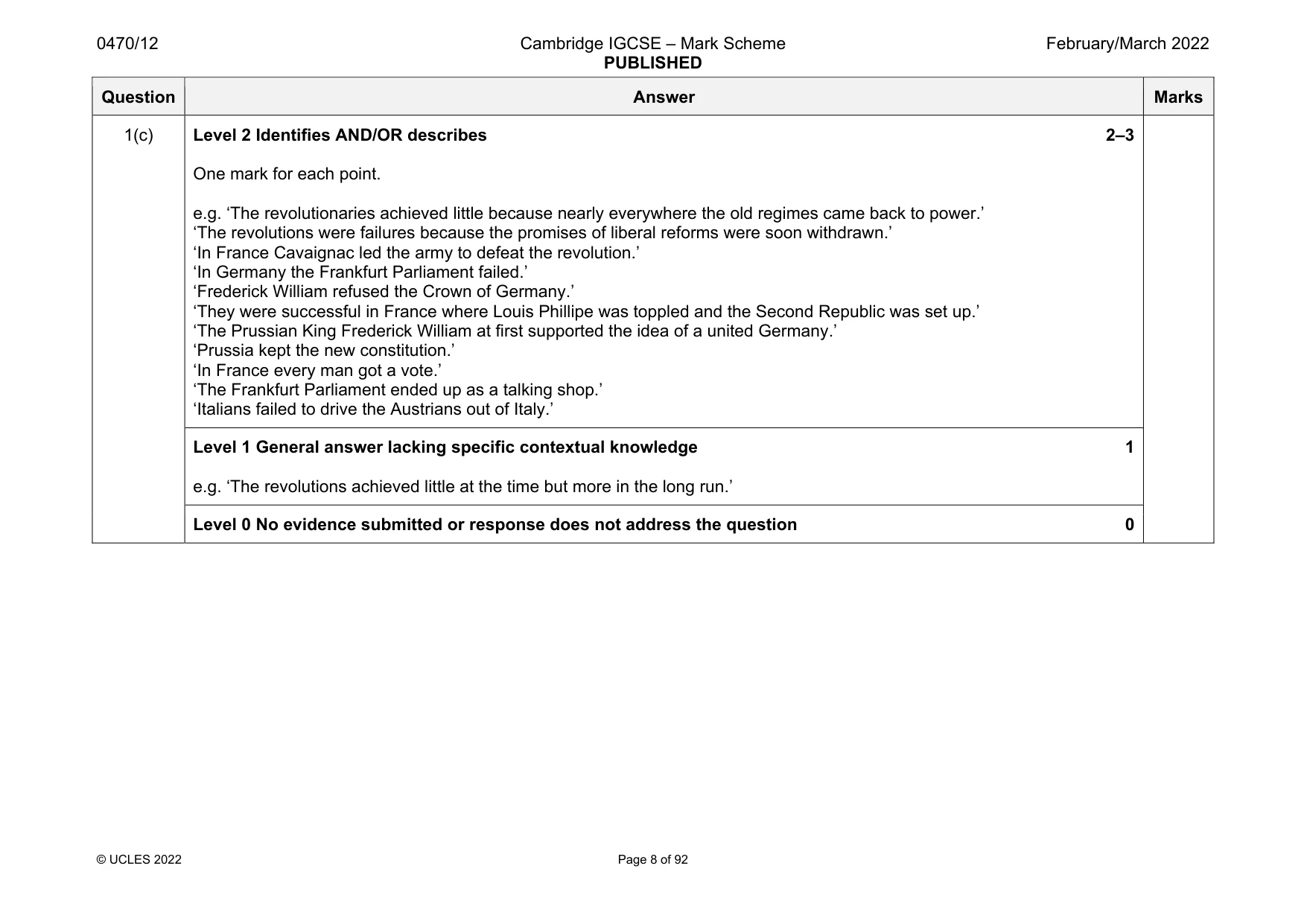
0470/12 Cambridge IGCSE – Mark Scheme PUBLISHED February/March 2022 © UCLES 2022 Page 8 of 92 Question Answer Marks 1(c) Level 2 Identifies AND/OR describes 2–3 One mark for each point. e.g. ‘The revolutionaries achieved little because nearly everywhere the old regimes came back to power.’ ‘The revolutions were failures because the promises of liberal reforms were soon withdrawn.’ ‘In France Cavaignac led the army to defeat the revolution.’ ‘In Germany the Frankfurt Parliament failed.’ ‘Frederick William refused the Crown of Germany.’ ‘They were successful in France where Louis Phillipe was toppled and the Second Republic was set up.’ ‘The Prussian King Frederick William at first supported the idea of a united Germany.’ ‘Prussia kept the new constitution.’ ‘In France every man got a vote.’ ‘The Frankfurt Parliament ended up as a talking shop.’ ‘Italians failed to drive the Austrians out of Italy.’ Level 1 General answer lacking specific contextual knowledge 1 e.g. ‘The revolutions achieved little at the time but more in the long run.’ Level 0 No evidence submitted or response does not address the question 0
Mark scheme, page 9
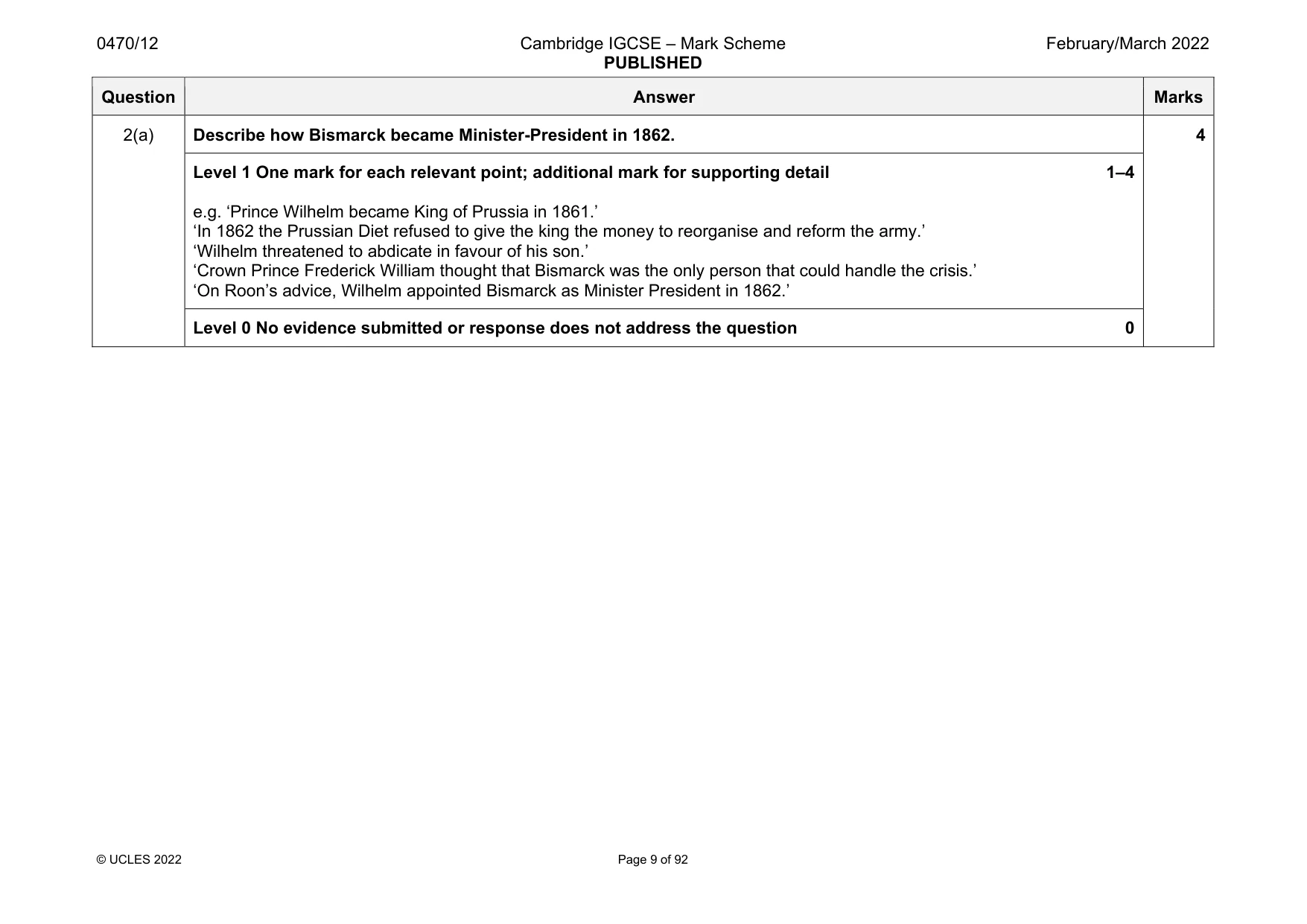
0470/12 Cambridge IGCSE – Mark Scheme PUBLISHED February/March 2022 © UCLES 2022 Page 9 of 92 Question Answer Marks 2(a) Describe how Bismarck became Minister-President in 1862. 4 Level 1 One mark for each relevant point; additional mark for supporting detail 1–4 e.g. ‘Prince Wilhelm became King of Prussia in 1861.’ ‘In 1862 the Prussian Diet refused to give the king the money to reorganise and reform the army.’ ‘Wilhelm threatened to abdicate in favour of his son.’ ‘Crown Prince Frederick William thought that Bismarck was the only person that could handle the crisis.’ ‘On Roon’s advice, Wilhelm appointed Bismarck as Minister President in 1862.’ Level 0 No evidence submitted or response does not address the question 0
Mark scheme, page 10
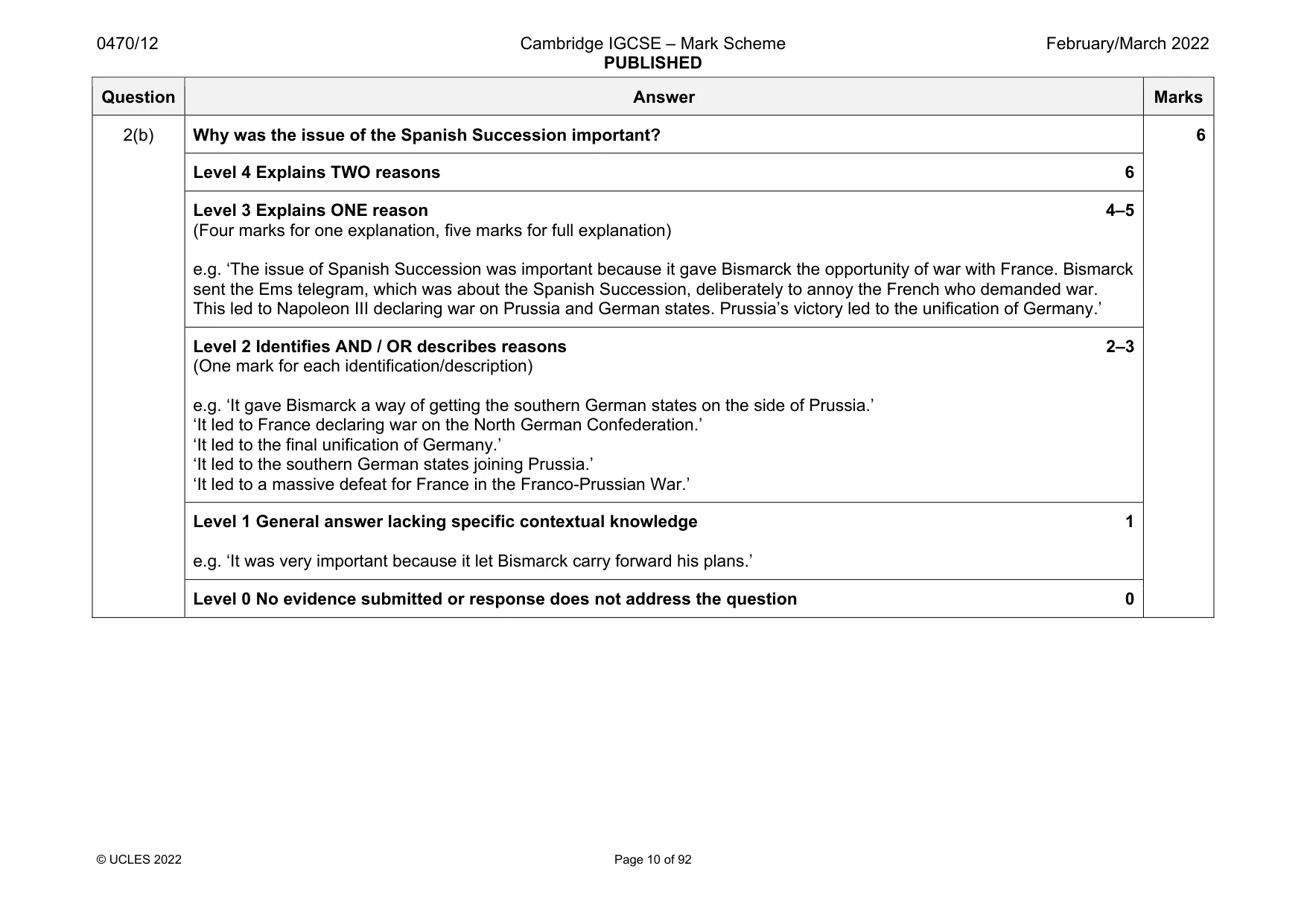
0470/12 Cambridge IGCSE – Mark Scheme PUBLISHED February/March 2022 © UCLES 2022 Page 10 of 92 Question Answer Marks 2(b) Why was the issue of the Spanish Succession important? 6 Level 4 Explains TWO reasons 6 Level 3 Explains ONE reason 4–5 (Four marks for one explanation, five marks for full explanation) e.g. ‘The issue of Spanish Succession was important because it gave Bismarck the opportunity of war with France. Bismarck sent the Ems telegram, which was about the Spanish Succession, deliberately to annoy the French who demanded war. This led to Napoleon III declaring war on Prussia and German states. Prussia’s victory led to the unification of Germany.’ Level 2 Identifies AND / OR describes reasons 2–3 (One mark for each identification/description) e.g. ‘It gave Bismarck a way of getting the southern German states on the side of Prussia.’ ‘It led to France declaring war on the North German Confederation.’ ‘It led to the final unification of Germany.’ ‘It led to the southern German states joining Prussia.’ ‘It led to a massive defeat for France in the Franco-Prussian War.’ Level 1 General answer lacking specific contextual knowledge 1 e.g. ‘It was very important because it let Bismarck carry forward his plans.’ Level 0 No evidence submitted or response does not address the question 0
Mark scheme, page 11
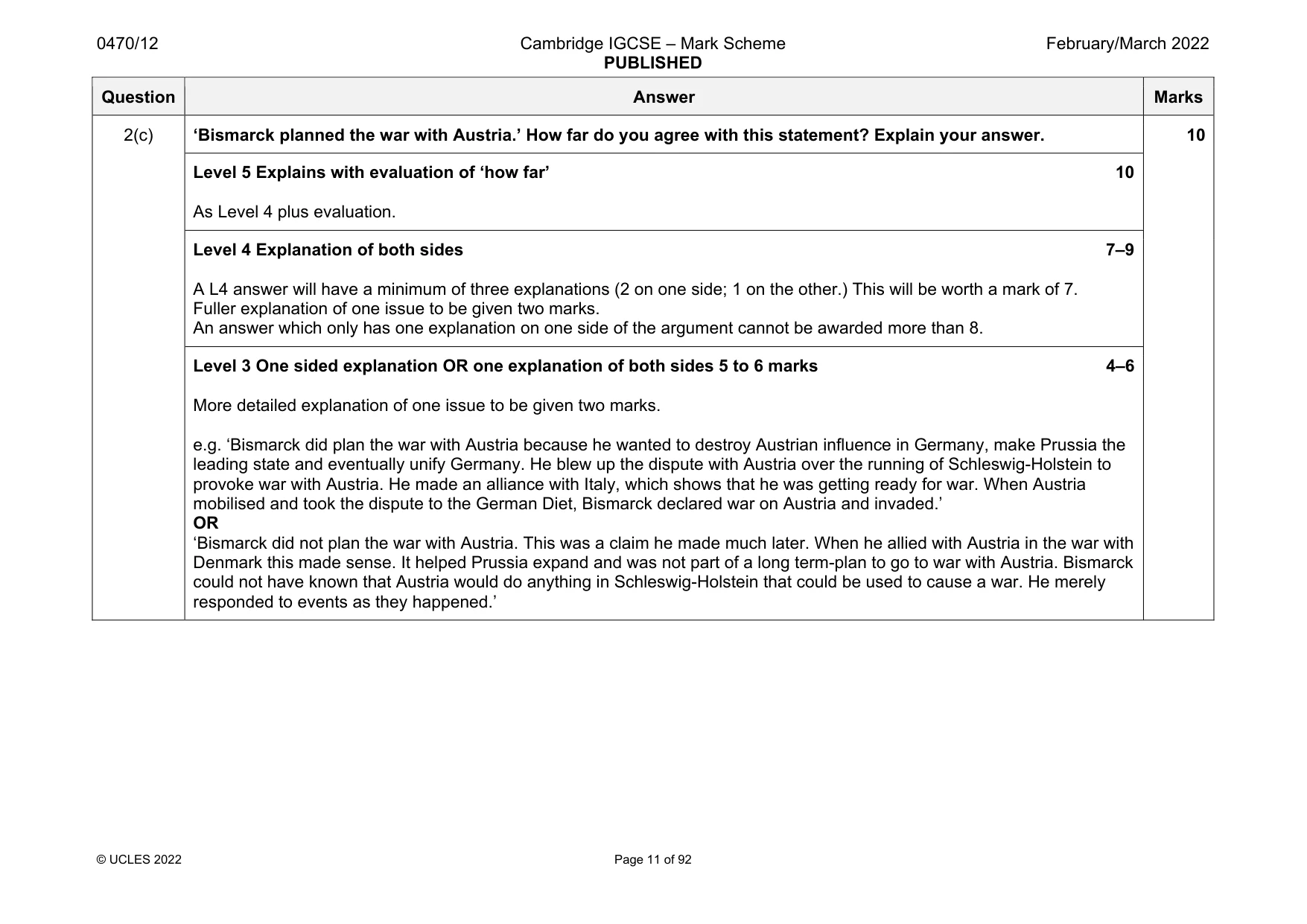
0470/12 Cambridge IGCSE – Mark Scheme PUBLISHED February/March 2022 © UCLES 2022 Page 11 of 92 Question Answer Marks 2(c) ‘Bismarck planned the war with Austria.’ How far do you agree with this statement? Explain your answer. 10 Level 5 Explains with evaluation of ‘how far’ 10 As Level 4 plus evaluation. Level 4 Explanation of both sides 7–9 A L4 answer will have a minimum of three explanations (2 on one side; 1 on the other.) This will be worth a mark of 7. Fuller explanation of one issue to be given two marks. An answer which only has one explanation on one side of the argument cannot be awarded more than 8. Level 3 One sided explanation OR one explanation of both sides 5 to 6 marks 4–6 More detailed explanation of one issue to be given two marks. e.g. ‘Bismarck did plan the war with Austria because he wanted to destroy Austrian influence in Germany, make Prussia the leading state and eventually unify Germany. He blew up the dispute with Austria over the running of Schleswig-Holstein to provoke war with Austria. He made an alliance with Italy, which shows that he was getting ready for war. When Austria mobilised and took the dispute to the German Diet, Bismarck declared war on Austria and invaded.’ OR ‘Bismarck did not plan the war with Austria. This was a claim he made much later. When he allied with Austria in the war with Denmark this made sense. It helped Prussia expand and was not part of a long term-plan to go to war with Austria. Bismarck could not have known that Austria would do anything in Schleswig-Holstein that could be used to cause a war. He merely responded to events as they happened.’
Mark scheme, page 12
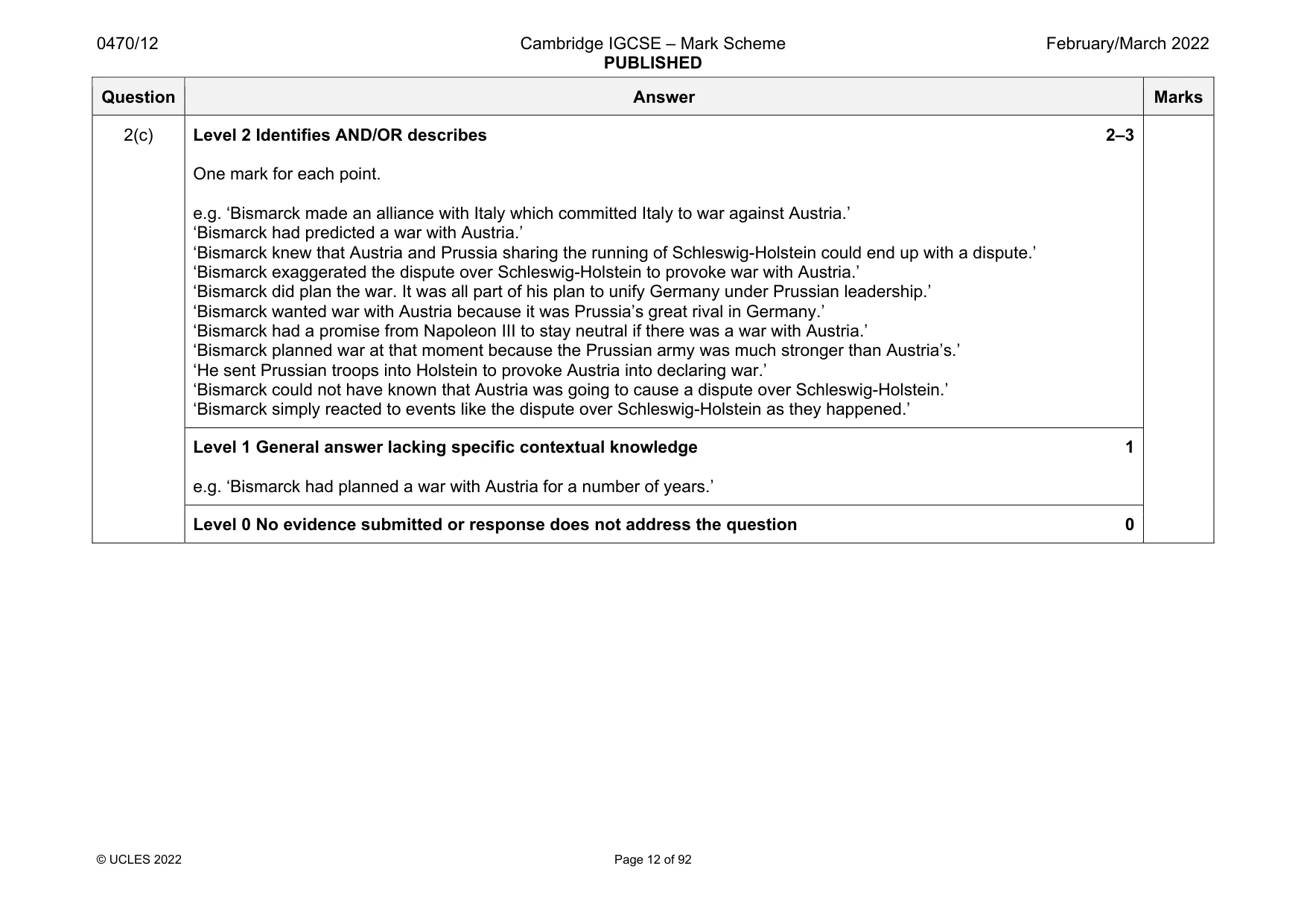
0470/12 Cambridge IGCSE – Mark Scheme PUBLISHED February/March 2022 © UCLES 2022 Page 12 of 92 Question Answer Marks 2(c) Level 2 Identifies AND/OR describes 2–3 One mark for each point. e.g. ‘Bismarck made an alliance with Italy which committed Italy to war against Austria.’ ‘Bismarck had predicted a war with Austria.’ ‘Bismarck knew that Austria and Prussia sharing the running of Schleswig-Holstein could end up with a dispute.’ ‘Bismarck exaggerated the dispute over Schleswig-Holstein to provoke war with Austria.’ ‘Bismarck did plan the war. It was all part of his plan to unify Germany under Prussian leadership.’ ‘Bismarck wanted war with Austria because it was Prussia’s great rival in Germany.’ ‘Bismarck had a promise from Napoleon III to stay neutral if there was a war with Austria.’ ‘Bismarck planned war at that moment because the Prussian army was much stronger than Austria’s.’ ‘He sent Prussian troops into Holstein to provoke Austria into declaring war.’ ‘Bismarck could not have known that Austria was going to cause a dispute over Schleswig-Holstein.’ ‘Bismarck simply reacted to events like the dispute over Schleswig-Holstein as they happened.’ Level 1 General answer lacking specific contextual knowledge 1 e.g. ‘Bismarck had planned a war with Austria for a number of years.’ Level 0 No evidence submitted or response does not address the question 0
Mark scheme, page 13
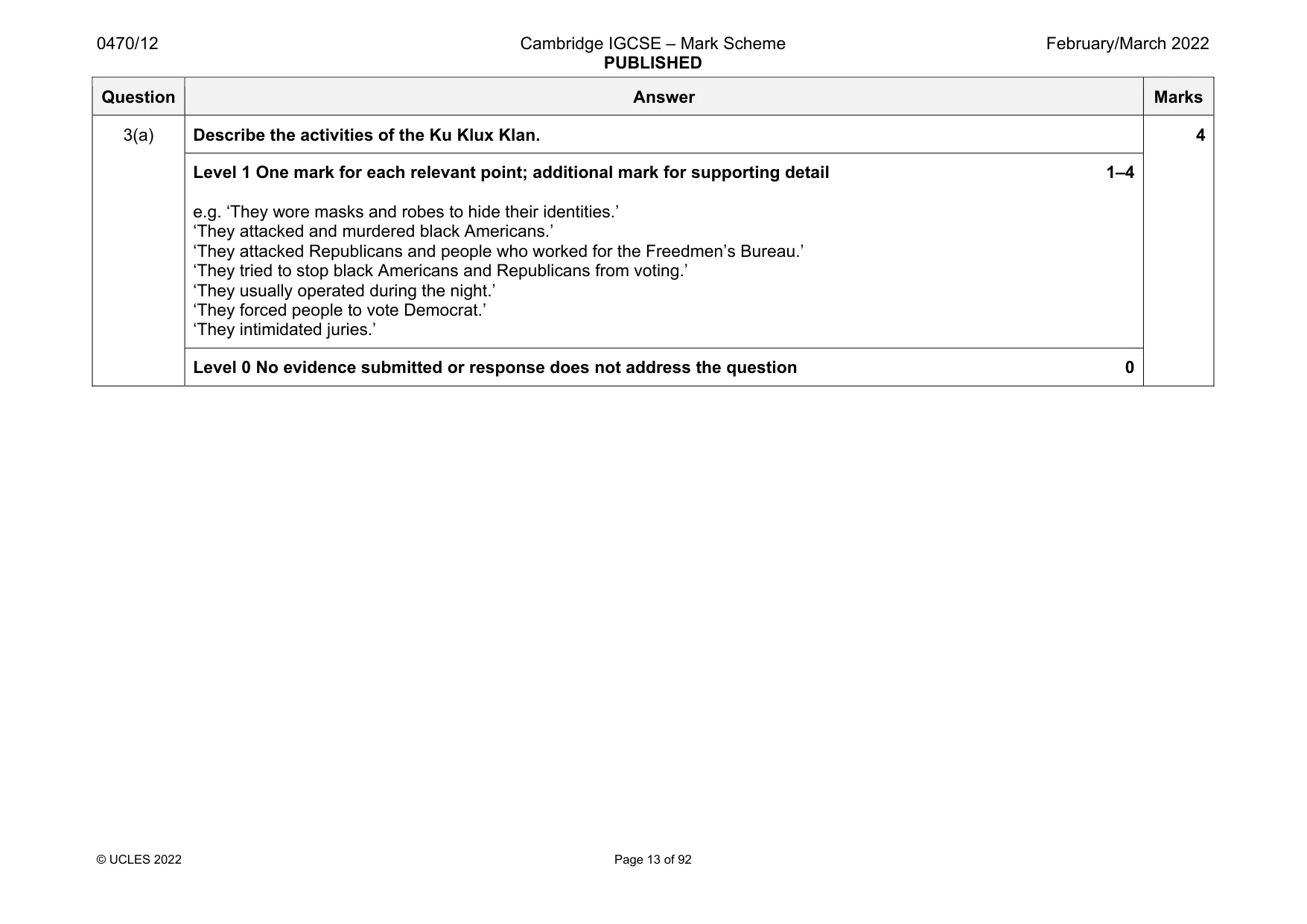
0470/12 Cambridge IGCSE – Mark Scheme PUBLISHED February/March 2022 © UCLES 2022 Page 13 of 92 Question Answer Marks 3(a) Describe the activities of the Ku Klux Klan. 4 Level 1 One mark for each relevant point; additional mark for supporting detail 1–4 e.g. ‘They wore masks and robes to hide their identities.’ ‘They attacked and murdered black Americans.’ ‘They attacked Republicans and people who worked for the Freedmen’s Bureau.’ ‘They tried to stop black Americans and Republicans from voting.’ ‘They usually operated during the night.’ ‘They forced people to vote Democrat.’ ‘They intimidated juries.’ Level 0 No evidence submitted or response does not address the question 0
Mark scheme, page 14
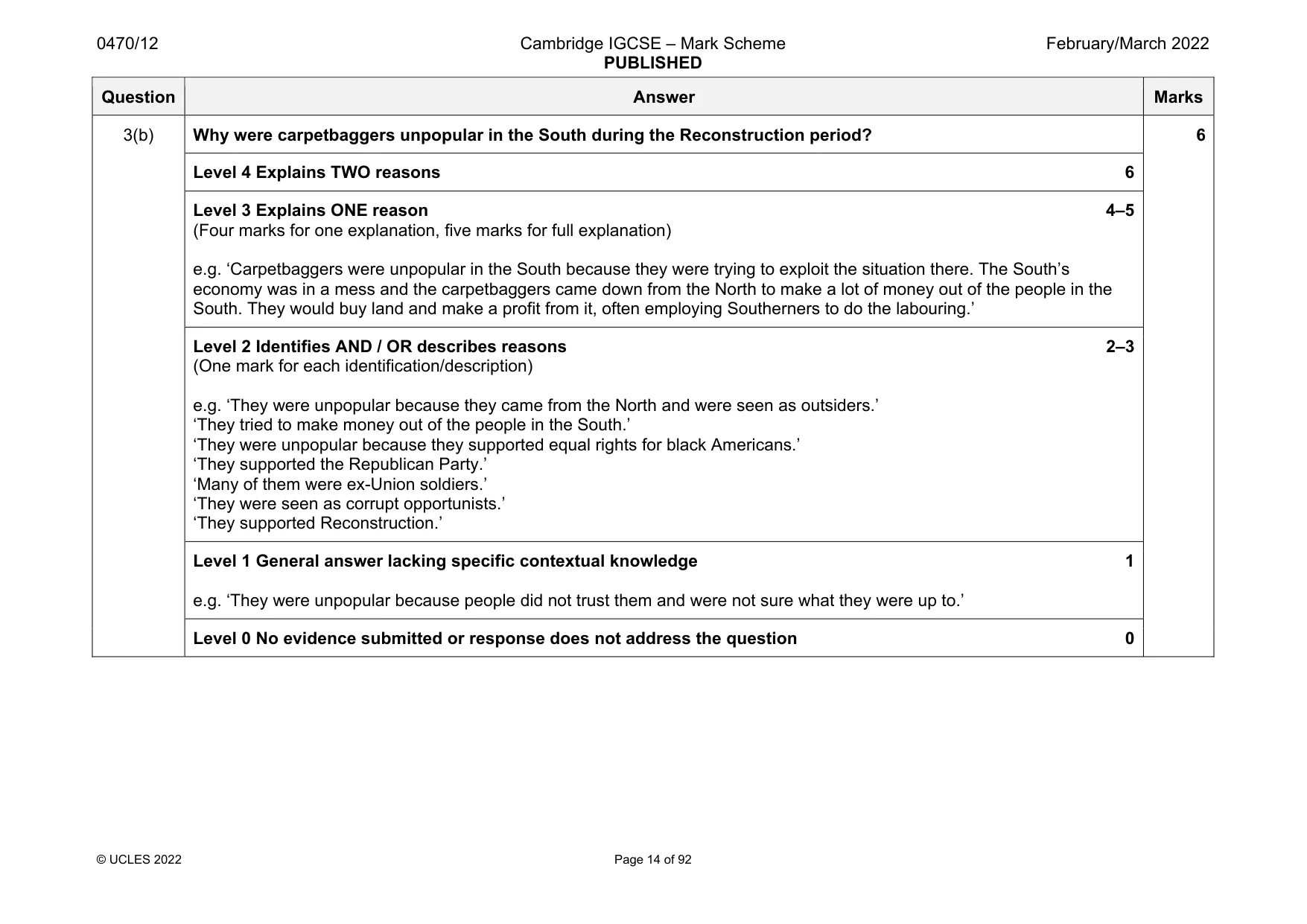
0470/12 Cambridge IGCSE – Mark Scheme PUBLISHED February/March 2022 © UCLES 2022 Page 14 of 92 Question Answer Marks 3(b) Why were carpetbaggers unpopular in the South during the Reconstruction period? 6 Level 4 Explains TWO reasons 6 Level 3 Explains ONE reason 4–5 (Four marks for one explanation, five marks for full explanation) e.g. ‘Carpetbaggers were unpopular in the South because they were trying to exploit the situation there. The South’s economy was in a mess and the carpetbaggers came down from the North to make a lot of money out of the people in the South. They would buy land and make a profit from it, often employing Southerners to do the labouring.’ Level 2 Identifies AND / OR describes reasons 2–3 (One mark for each identification/description) e.g. ‘They were unpopular because they came from the North and were seen as outsiders.’ ‘They tried to make money out of the people in the South.’ ‘They were unpopular because they supported equal rights for black Americans.’ ‘They supported the Republican Party.’ ‘Many of them were ex-Union soldiers.’ ‘They were seen as corrupt opportunists.’ ‘They supported Reconstruction.’ Level 1 General answer lacking specific contextual knowledge 1 e.g. ‘They were unpopular because people did not trust them and were not sure what they were up to.’ Level 0 No evidence submitted or response does not address the question 0
Mark scheme, page 15
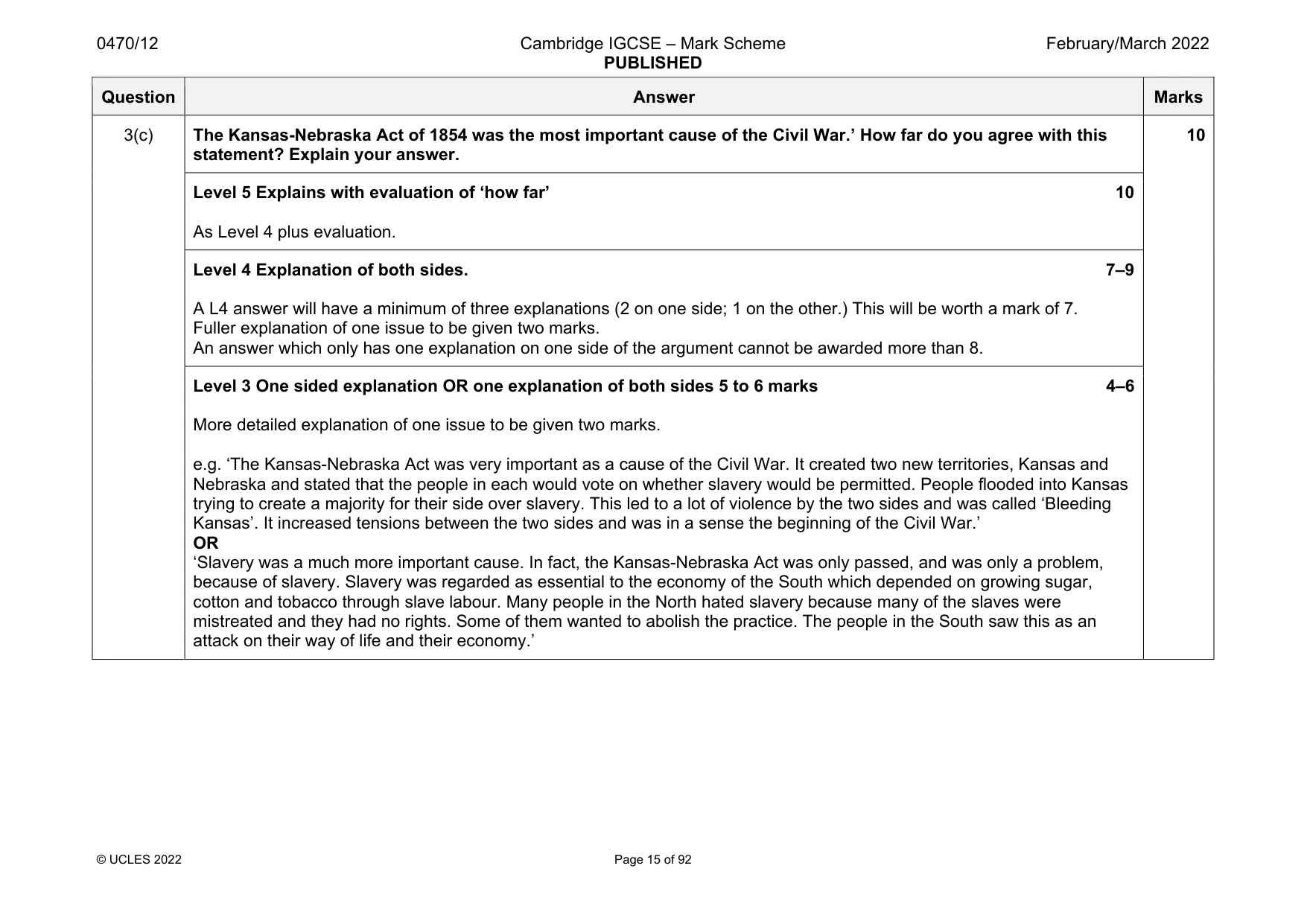
0470/12 Cambridge IGCSE – Mark Scheme PUBLISHED February/March 2022 © UCLES 2022 Page 15 of 92 Question Answer Marks 3(c) The Kansas-Nebraska Act of 1854 was the most important cause of the Civil War.’ How far do you agree with this statement? Explain your answer. 10 Level 5 Explains with evaluation of ‘how far’ 10 As Level 4 plus evaluation. Level 4 Explanation of both sides. 7–9 A L4 answer will have a minimum of three explanations (2 on one side; 1 on the other.) This will be worth a mark of 7. Fuller explanation of one issue to be given two marks. An answer which only has one explanation on one side of the argument cannot be awarded more than 8. Level 3 One sided explanation OR one explanation of both sides 5 to 6 marks 4–6 More detailed explanation of one issue to be given two marks. e.g. ‘The Kansas-Nebraska Act was very important as a cause of the Civil War. It created two new territories, Kansas and Nebraska and stated that the people in each would vote on whether slavery would be permitted. People flooded into Kansas trying to create a majority for their side over slavery. This led to a lot of violence by the two sides and was called ‘Bleeding Kansas’. It increased tensions between the two sides and was in a sense the beginning of the Civil War.’ OR ‘Slavery was a much more important cause. In fact, the Kansas-Nebraska Act was only passed, and was only a problem, because of slavery. Slavery was regarded as essential to the economy of the South which depended on growing sugar, cotton and tobacco through slave labour. Many people in the North hated slavery because many of the slaves were mistreated and they had no rights. Some of them wanted to abolish the practice. The people in the South saw this as an attack on their way of life and their economy.’
Mark scheme, page 16
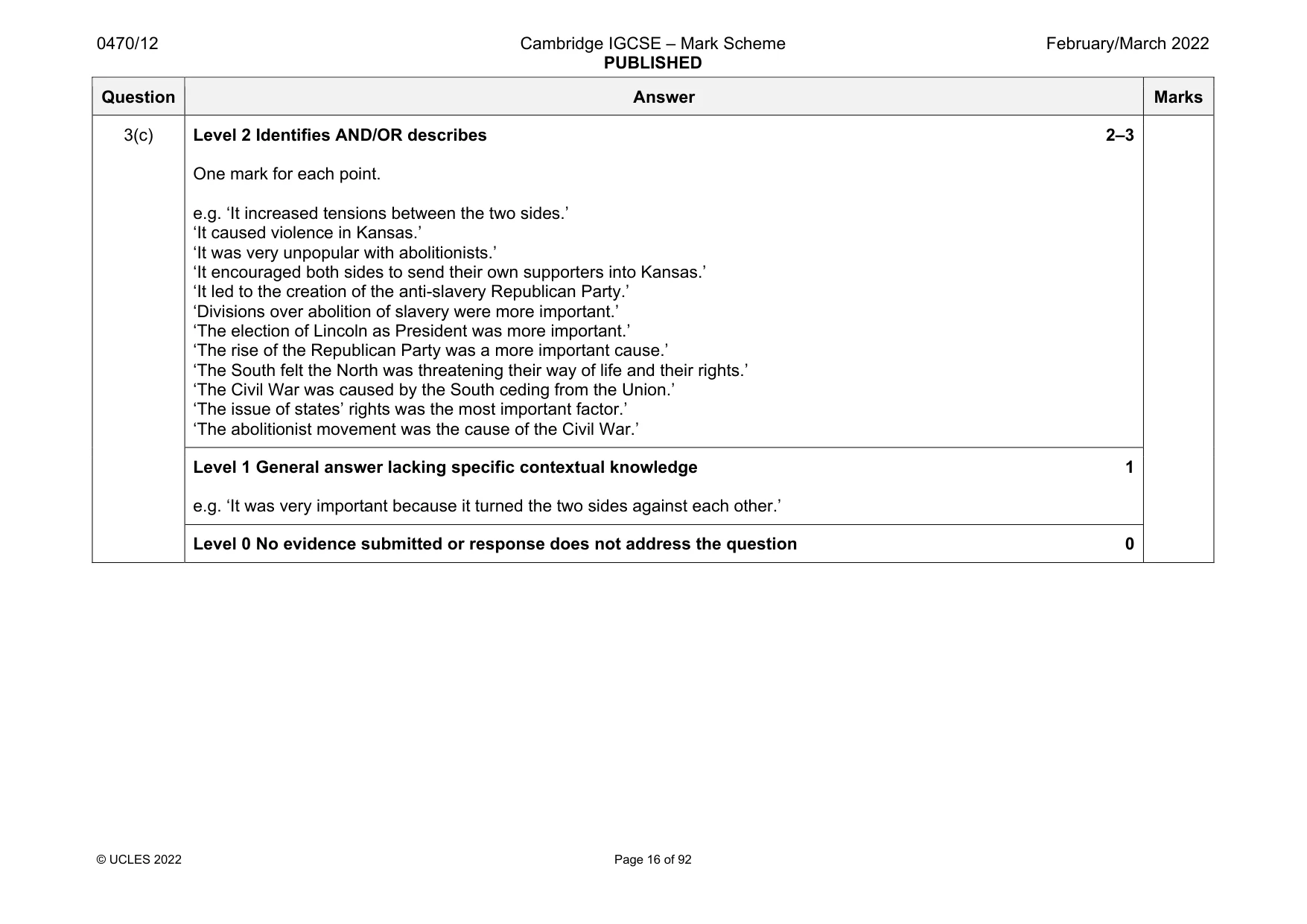
0470/12 Cambridge IGCSE – Mark Scheme PUBLISHED February/March 2022 © UCLES 2022 Page 16 of 92 Question Answer Marks 3(c) Level 2 Identifies AND/OR describes 2–3 One mark for each point. e.g. ‘It increased tensions between the two sides.’ ‘It caused violence in Kansas.’ ‘It was very unpopular with abolitionists.’ ‘It encouraged both sides to send their own supporters into Kansas.’ ‘It led to the creation of the anti-slavery Republican Party.’ ‘Divisions over abolition of slavery were more important.’ ‘The election of Lincoln as President was more important.’ ‘The rise of the Republican Party was a more important cause.’ ‘The South felt the North was threatening their way of life and their rights.’ ‘The Civil War was caused by the South ceding from the Union.’ ‘The issue of states’ rights was the most important factor.’ ‘The abolitionist movement was the cause of the Civil War.’ Level 1 General answer lacking specific contextual knowledge 1 e.g. ‘It was very important because it turned the two sides against each other.’ Level 0 No evidence submitted or response does not address the question 0
Mark scheme, page 17
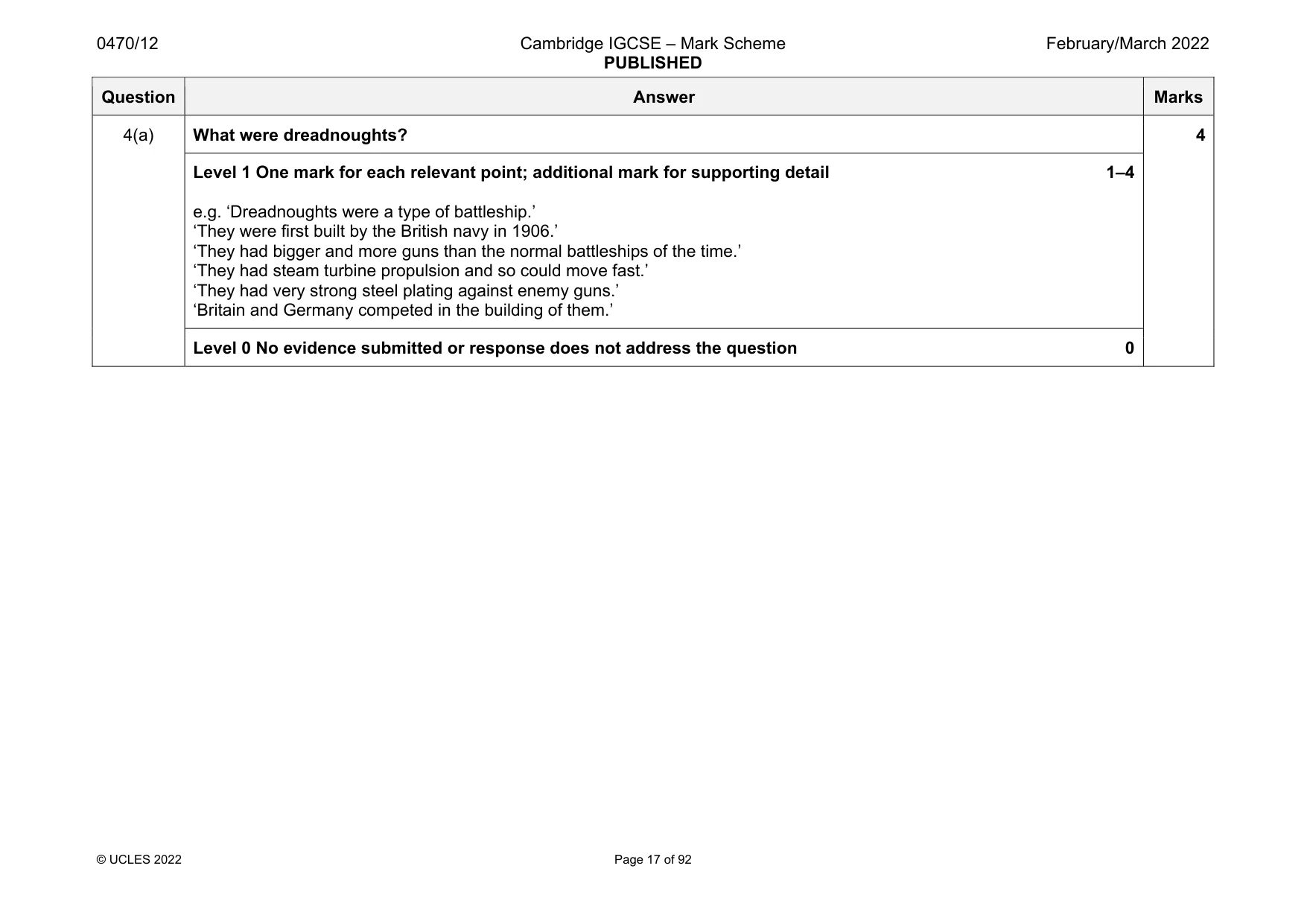
0470/12 Cambridge IGCSE – Mark Scheme PUBLISHED February/March 2022 © UCLES 2022 Page 17 of 92 Question Answer Marks 4(a) What were dreadnoughts? 4 Level 1 One mark for each relevant point; additional mark for supporting detail 1–4 e.g. ‘Dreadnoughts were a type of battleship.’ ‘They were first built by the British navy in 1906.’ ‘They had bigger and more guns than the normal battleships of the time.’ ‘They had steam turbine propulsion and so could move fast.’ ‘They had very strong steel plating against enemy guns.’ ‘Britain and Germany competed in the building of them.’ Level 0 No evidence submitted or response does not address the question 0
Mark scheme, page 18
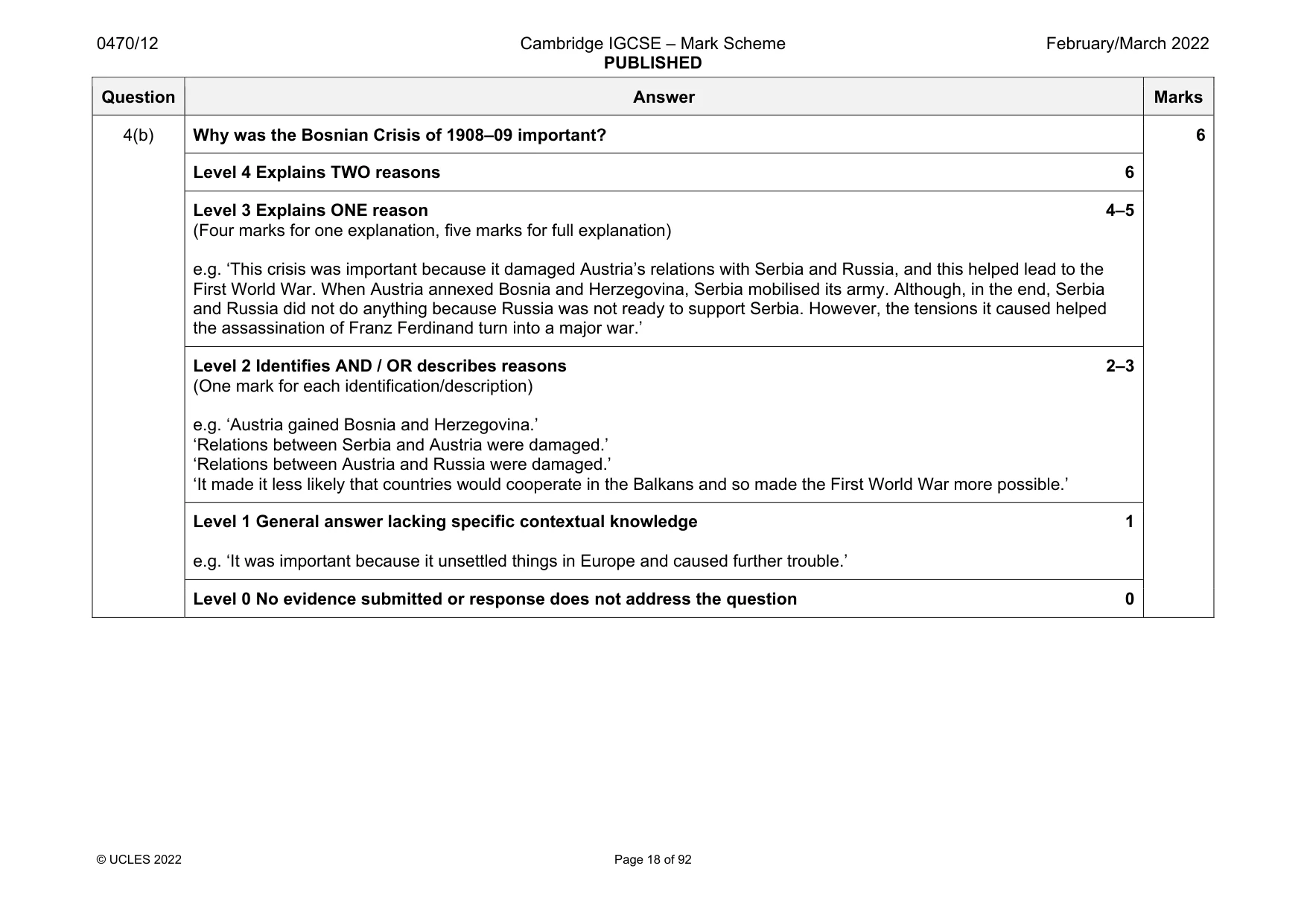
0470/12 Cambridge IGCSE – Mark Scheme PUBLISHED February/March 2022 © UCLES 2022 Page 18 of 92 Question Answer Marks 4(b) Why was the Bosnian Crisis of 1908–09 important? 6 Level 4 Explains TWO reasons 6 Level 3 Explains ONE reason 4–5 (Four marks for one explanation, five marks for full explanation) e.g. ‘This crisis was important because it damaged Austria’s relations with Serbia and Russia, and this helped lead to the First World War. When Austria annexed Bosnia and Herzegovina, Serbia mobilised its army. Although, in the end, Serbia and Russia did not do anything because Russia was not ready to support Serbia. However, the tensions it caused helped the assassination of Franz Ferdinand turn into a major war.’ Level 2 Identifies AND / OR describes reasons 2–3 (One mark for each identification/description) e.g. ‘Austria gained Bosnia and Herzegovina.’ ‘Relations between Serbia and Austria were damaged.’ ‘Relations between Austria and Russia were damaged.’ ‘It made it less likely that countries would cooperate in the Balkans and so made the First World War more possible.’ Level 1 General answer lacking specific contextual knowledge 1 e.g. ‘It was important because it unsettled things in Europe and caused further trouble.’ Level 0 No evidence submitted or response does not address the question 0
Mark scheme, page 19
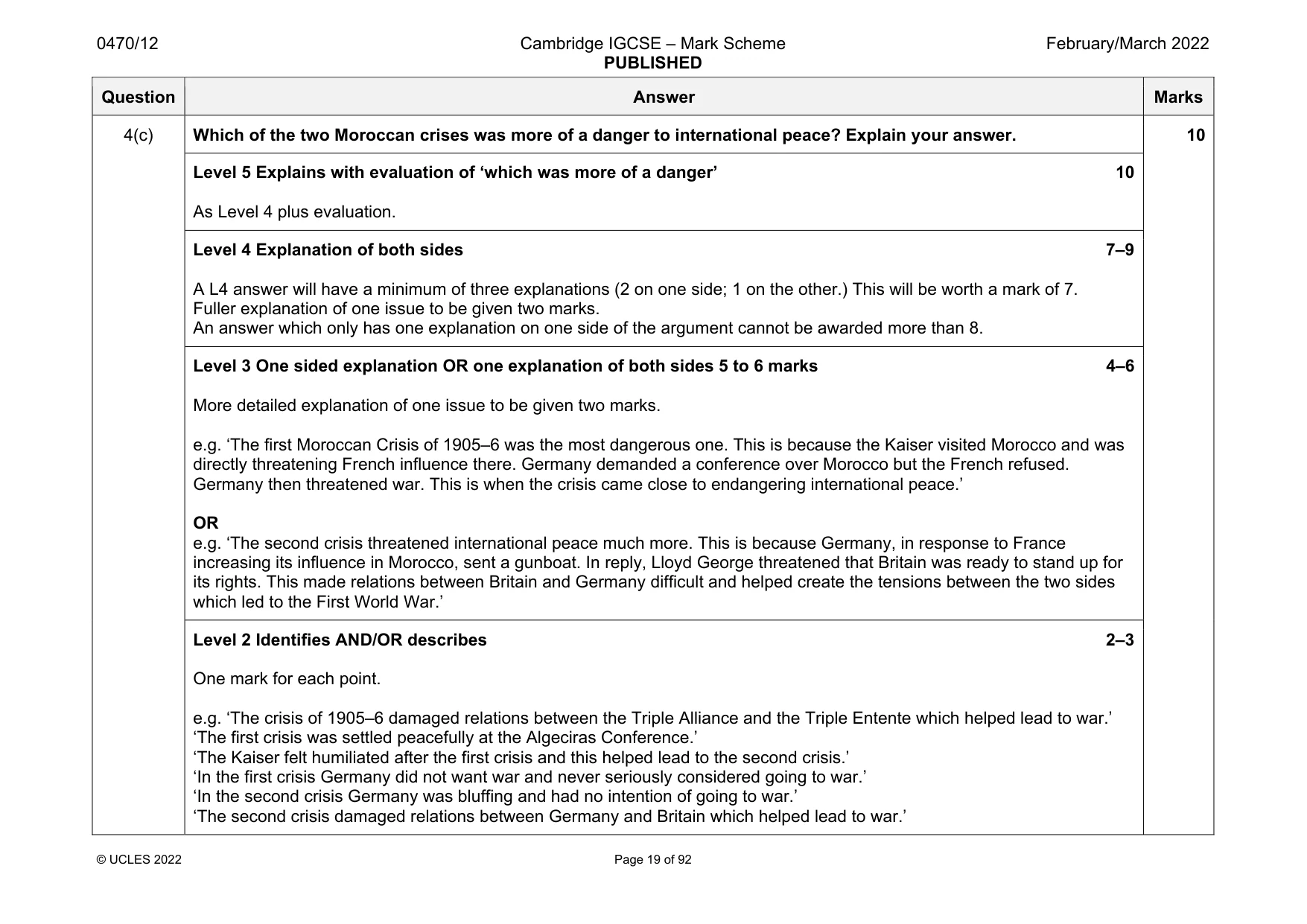
0470/12 Cambridge IGCSE – Mark Scheme PUBLISHED February/March 2022 © UCLES 2022 Page 19 of 92 Question Answer Marks 4(c) Which of the two Moroccan crises was more of a danger to international peace? Explain your answer. 10 Level 5 Explains with evaluation of ‘which was more of a danger’ 10 As Level 4 plus evaluation. Level 4 Explanation of both sides 7–9 A L4 answer will have a minimum of three explanations (2 on one side; 1 on the other.) This will be worth a mark of 7. Fuller explanation of one issue to be given two marks. An answer which only has one explanation on one side of the argument cannot be awarded more than 8. Level 3 One sided explanation OR one explanation of both sides 5 to 6 marks 4–6 More detailed explanation of one issue to be given two marks. e.g. ‘The first Moroccan Crisis of 1905–6 was the most dangerous one. This is because the Kaiser visited Morocco and was directly threatening French influence there. Germany demanded a conference over Morocco but the French refused. Germany then threatened war. This is when the crisis came close to endangering international peace.’ OR e.g. ‘The second crisis threatened international peace much more. This is because Germany, in response to France increasing its influence in Morocco, sent a gunboat. In reply, Lloyd George threatened that Britain was ready to stand up for its rights. This made relations between Britain and Germany difficult and helped create the tensions between the two sides which led to the First World War.’ Level 2 Identifies AND/OR describes 2–3 One mark for each point. e.g. ‘The crisis of 1905–6 damaged relations between the Triple Alliance and the Triple Entente which helped lead to war.’ ‘The first crisis was settled peacefully at the Algeciras Conference.’ ‘The Kaiser felt humiliated after the first crisis and this helped lead to the second crisis.’ ‘In the first crisis Germany did not want war and never seriously considered going to war.’ ‘In the second crisis Germany was bluffing and had no intention of going to war.’ ‘The second crisis damaged relations between Germany and Britain which helped lead to war.’
Mark scheme, page 20
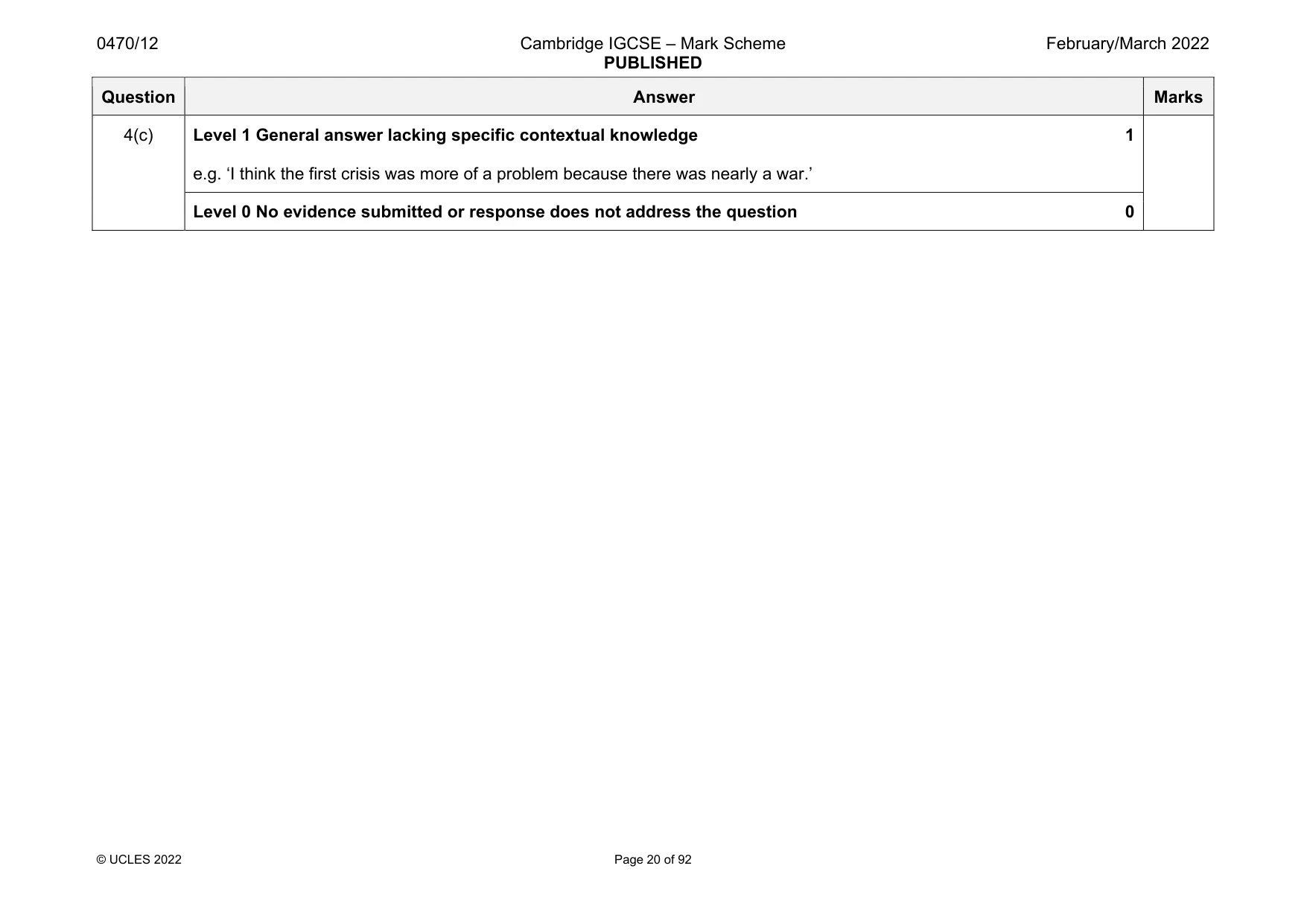
0470/12 Cambridge IGCSE – Mark Scheme PUBLISHED February/March 2022 © UCLES 2022 Page 20 of 92 Question Answer Marks 4(c) Level 1 General answer lacking specific contextual knowledge 1 e.g. ‘I think the first crisis was more of a problem because there was nearly a war.’ Level 0 No evidence submitted or response does not address the question 0
Mark scheme, page 21
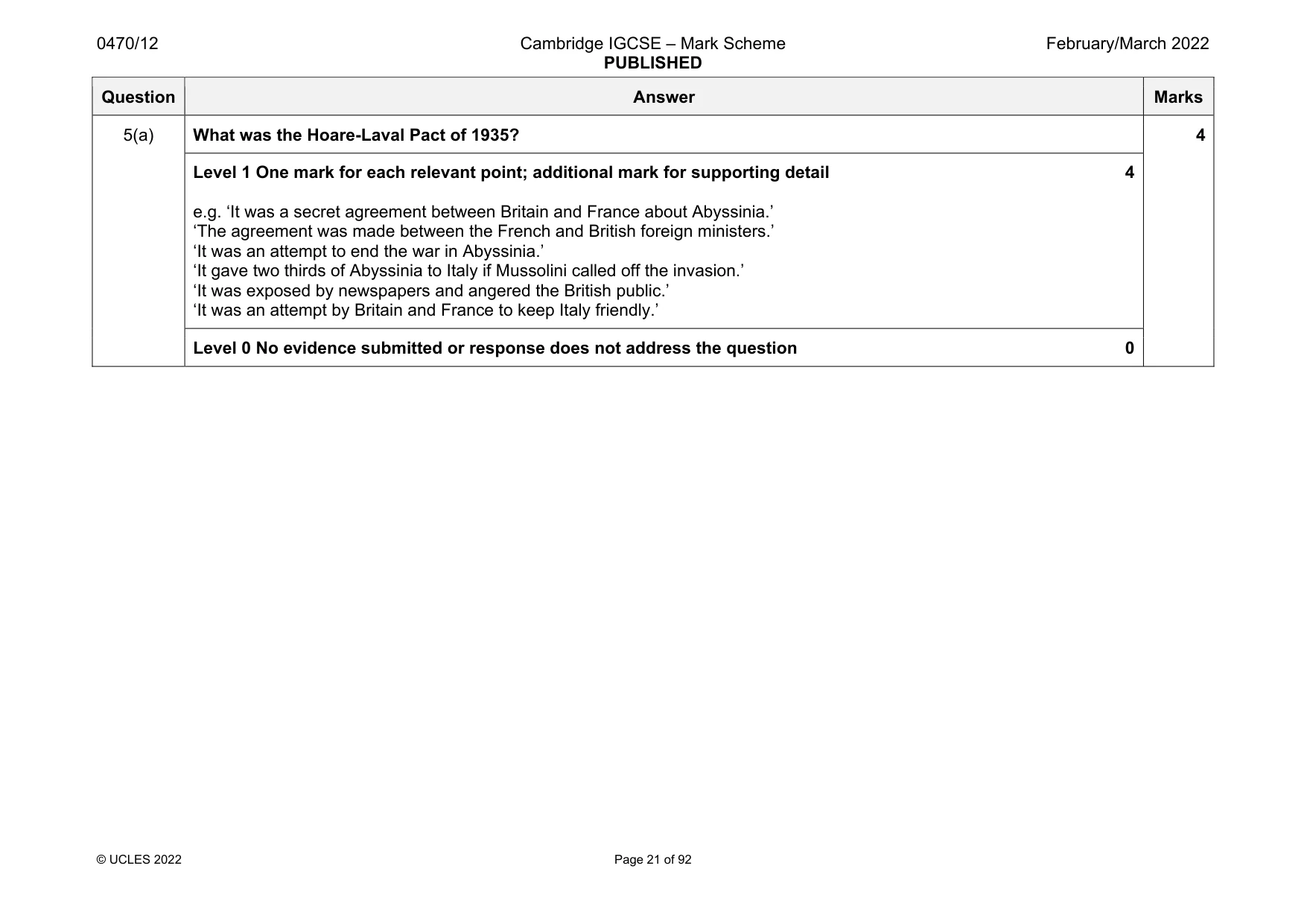
0470/12 Cambridge IGCSE – Mark Scheme PUBLISHED February/March 2022 © UCLES 2022 Page 21 of 92 Question Answer Marks 5(a) What was the Hoare-Laval Pact of 1935? 4 Level 1 One mark for each relevant point; additional mark for supporting detail 4 e.g. ‘It was a secret agreement between Britain and France about Abyssinia.’ ‘The agreement was made between the French and British foreign ministers.’ ‘It was an attempt to end the war in Abyssinia.’ ‘It gave two thirds of Abyssinia to Italy if Mussolini called off the invasion.’ ‘It was exposed by newspapers and angered the British public.’ ‘It was an attempt by Britain and France to keep Italy friendly.’ Level 0 No evidence submitted or response does not address the question 0
Mark scheme, page 22
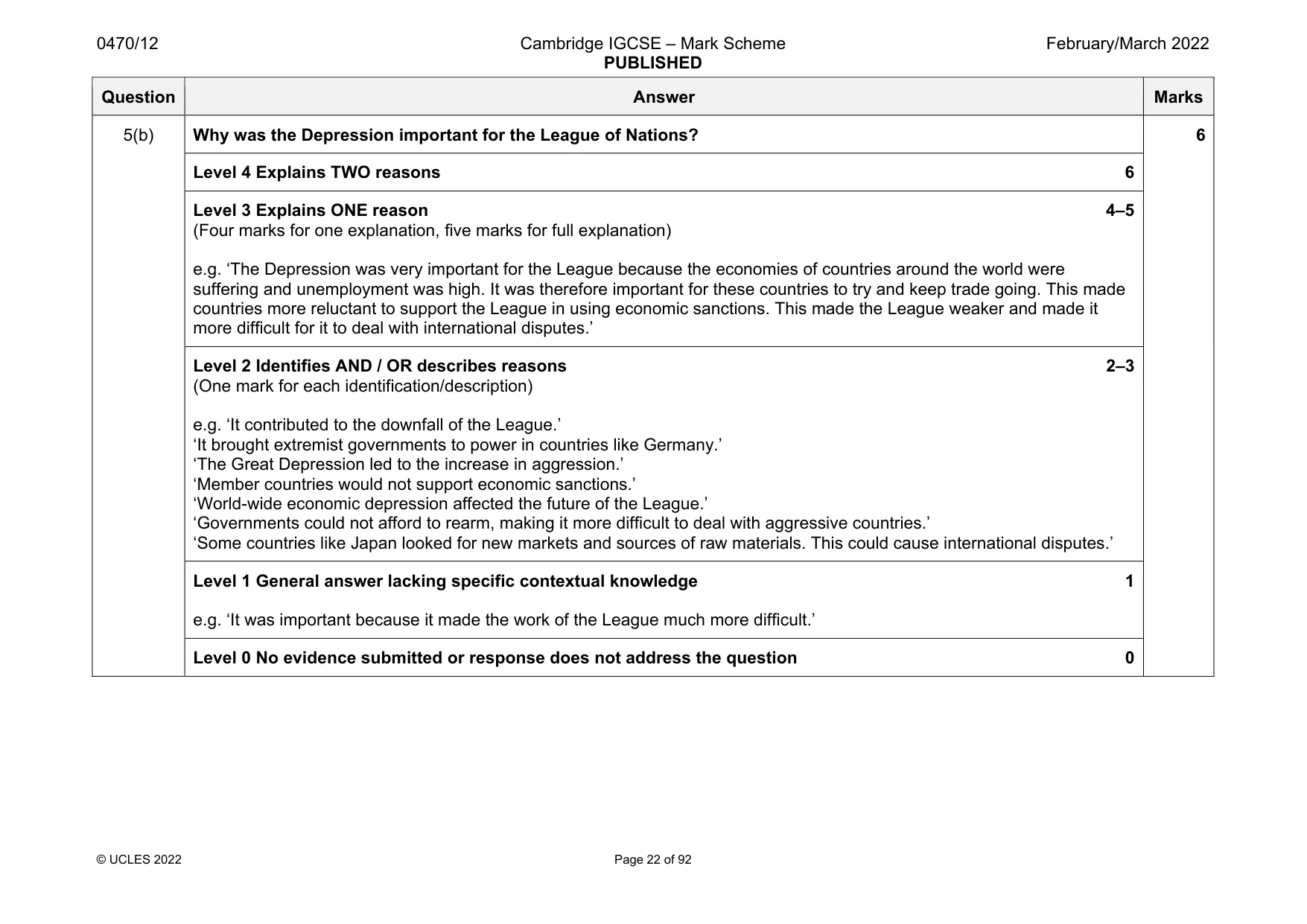
0470/12 Cambridge IGCSE – Mark Scheme PUBLISHED February/March 2022 © UCLES 2022 Page 22 of 92 Question Answer Marks 5(b) Why was the Depression important for the League of Nations? 6 Level 4 Explains TWO reasons 6 Level 3 Explains ONE reason 4–5 (Four marks for one explanation, five marks for full explanation) e.g. ‘The Depression was very important for the League because the economies of countries around the world were suffering and unemployment was high. It was therefore important for these countries to try and keep trade going. This made countries more reluctant to support the League in using economic sanctions. This made the League weaker and made it more difficult for it to deal with international disputes.’ Level 2 Identifies AND / OR describes reasons 2–3 (One mark for each identification/description) e.g. ‘It contributed to the downfall of the League.’ ‘It brought extremist governments to power in countries like Germany.’ ‘The Great Depression led to the increase in aggression.’ ‘Member countries would not support economic sanctions.’ ‘World-wide economic depression affected the future of the League.’ ‘Governments could not afford to rearm, making it more difficult to deal with aggressive countries.’ ‘Some countries like Japan looked for new markets and sources of raw materials. This could cause international disputes.’ Level 1 General answer lacking specific contextual knowledge 1 e.g. ‘It was important because it made the work of the League much more difficult.’ Level 0 No evidence submitted or response does not address the question 0
Mark scheme, page 23
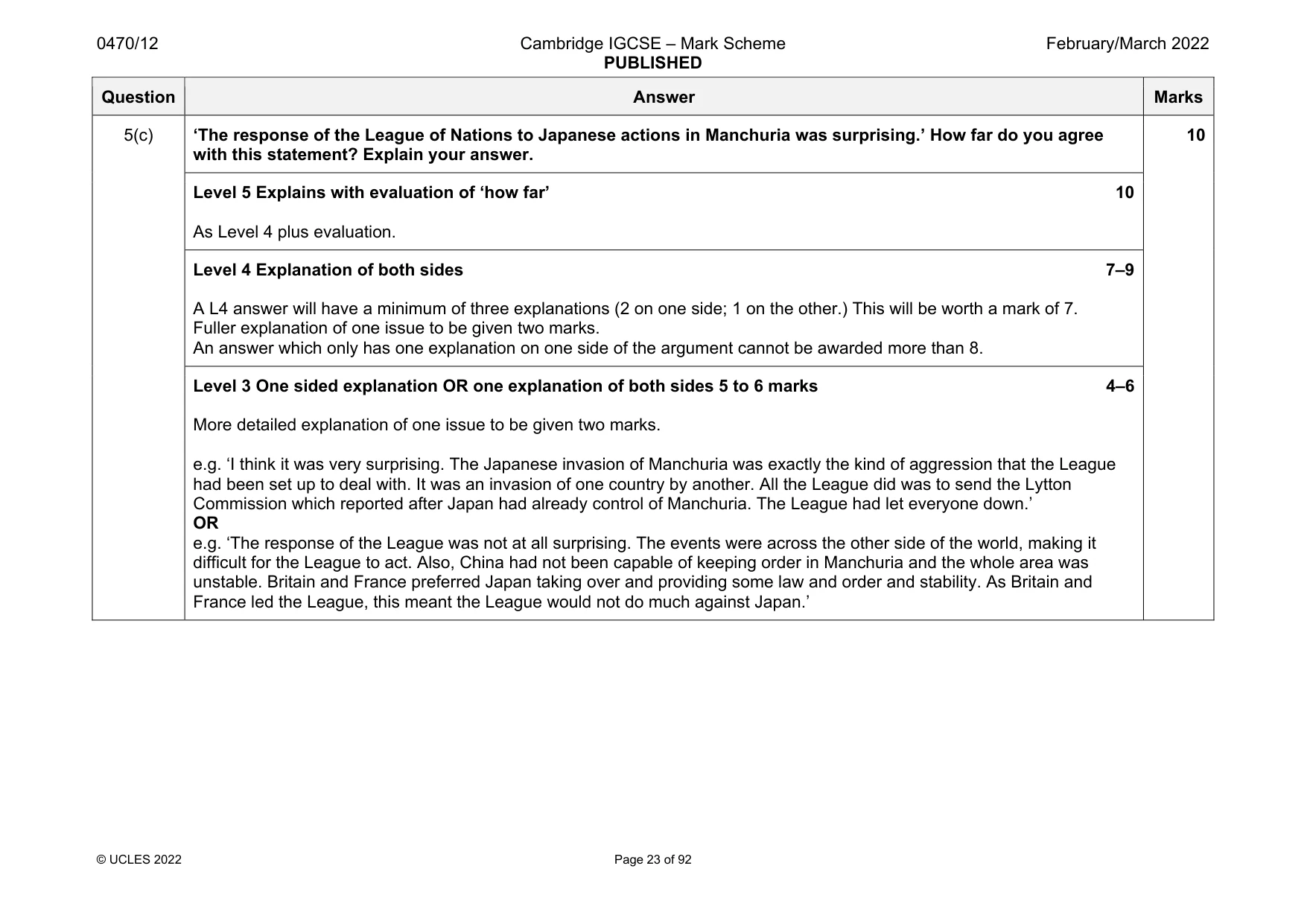
0470/12 Cambridge IGCSE – Mark Scheme PUBLISHED February/March 2022 © UCLES 2022 Page 23 of 92 Question Answer Marks 5(c) ‘The response of the League of Nations to Japanese actions in Manchuria was surprising.’ How far do you agree with this statement? Explain your answer. 10 Level 5 Explains with evaluation of ‘how far’ 10 As Level 4 plus evaluation. Level 4 Explanation of both sides 7–9 A L4 answer will have a minimum of three explanations (2 on one side; 1 on the other.) This will be worth a mark of 7. Fuller explanation of one issue to be given two marks. An answer which only has one explanation on one side of the argument cannot be awarded more than 8. Level 3 One sided explanation OR one explanation of both sides 5 to 6 marks 4–6 More detailed explanation of one issue to be given two marks. e.g. ‘I think it was very surprising. The Japanese invasion of Manchuria was exactly the kind of aggression that the League had been set up to deal with. It was an invasion of one country by another. All the League did was to send the Lytton Commission which reported after Japan had already control of Manchuria. The League had let everyone down.’ OR e.g. ‘The response of the League was not at all surprising. The events were across the other side of the world, making it difficult for the League to act. Also, China had not been capable of keeping order in Manchuria and the whole area was unstable. Britain and France preferred Japan taking over and providing some law and order and stability. As Britain and France led the League, this meant the League would not do much against Japan.’
Mark scheme, page 24
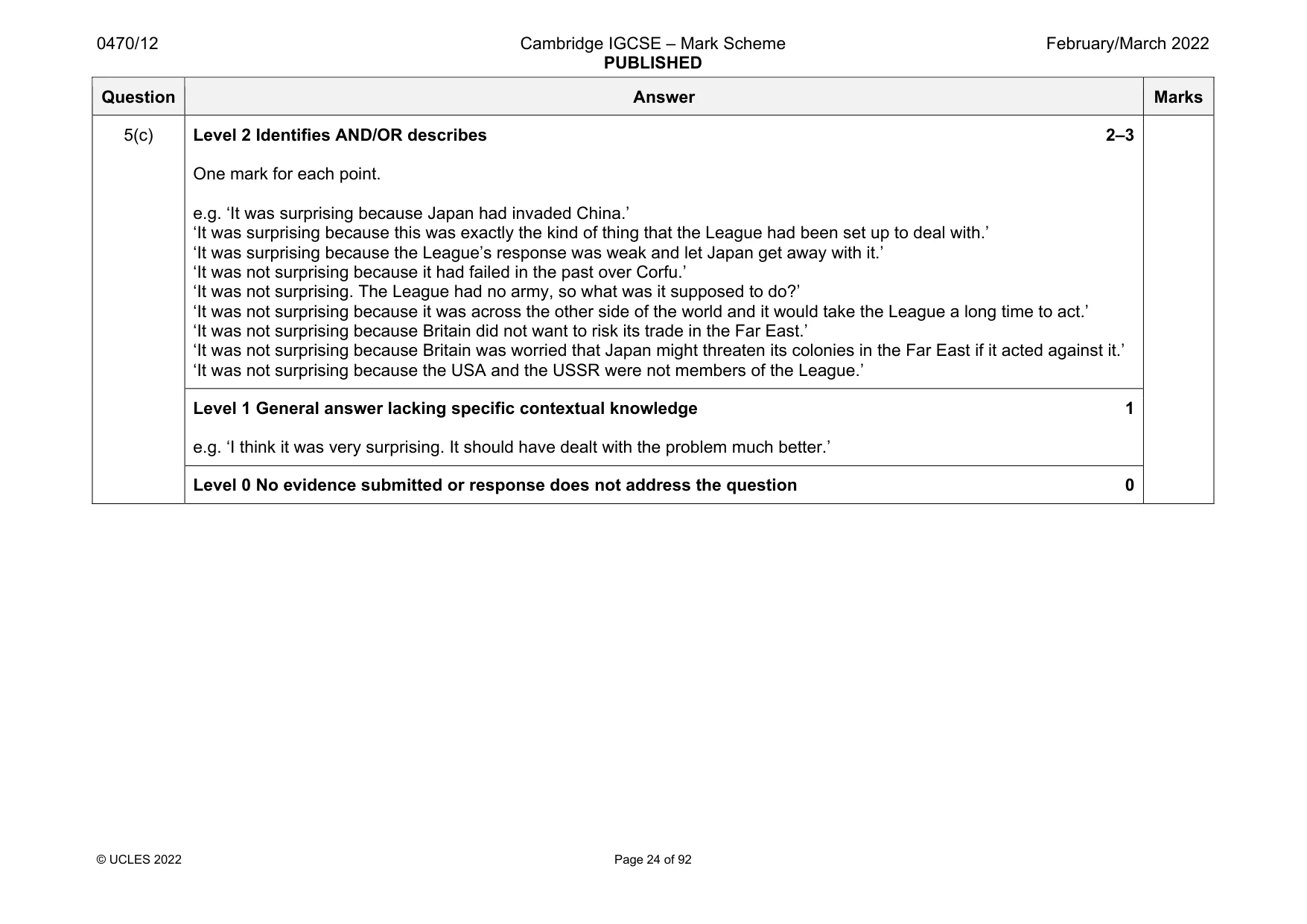
0470/12 Cambridge IGCSE – Mark Scheme PUBLISHED February/March 2022 © UCLES 2022 Page 24 of 92 Question Answer Marks 5(c) Level 2 Identifies AND/OR describes 2–3 One mark for each point. e.g. ‘It was surprising because Japan had invaded China.’ ‘It was surprising because this was exactly the kind of thing that the League had been set up to deal with.’ ‘It was surprising because the League’s response was weak and let Japan get away with it.’ ‘It was not surprising because it had failed in the past over Corfu.’ ‘It was not surprising. The League had no army, so what was it supposed to do?’ ‘It was not surprising because it was across the other side of the world and it would take the League a long time to act.’ ‘It was not surprising because Britain did not want to risk its trade in the Far East.’ ‘It was not surprising because Britain was worried that Japan might threaten its colonies in the Far East if it acted against it.’ ‘It was not surprising because the USA and the USSR were not members of the League.’ Level 1 General answer lacking specific contextual knowledge 1 e.g. ‘I think it was very surprising. It should have dealt with the problem much better.’ Level 0 No evidence submitted or response does not address the question 0
Mark scheme, page 25
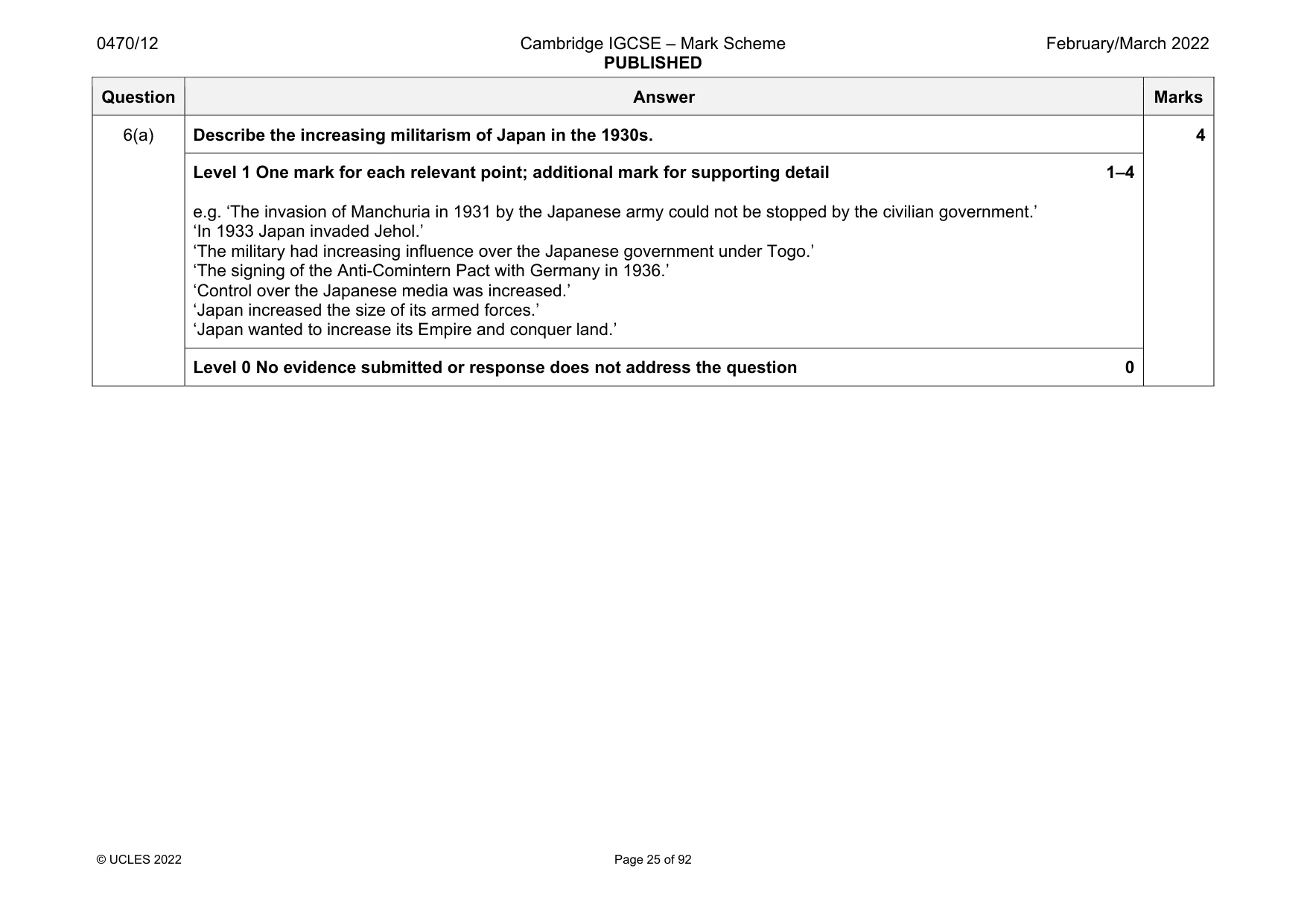
0470/12 Cambridge IGCSE – Mark Scheme PUBLISHED February/March 2022 © UCLES 2022 Page 25 of 92 Question Answer Marks 6(a) Describe the increasing militarism of Japan in the 1930s. 4 Level 1 One mark for each relevant point; additional mark for supporting detail 1–4 e.g. ‘The invasion of Manchuria in 1931 by the Japanese army could not be stopped by the civilian government.’ ‘In 1933 Japan invaded Jehol.’ ‘The military had increasing influence over the Japanese government under Togo.’ ‘The signing of the Anti-Comintern Pact with Germany in 1936.’ ‘Control over the Japanese media was increased.’ ‘Japan increased the size of its armed forces.’ ‘Japan wanted to increase its Empire and conquer land.’ Level 0 No evidence submitted or response does not address the question 0
Mark scheme, page 26
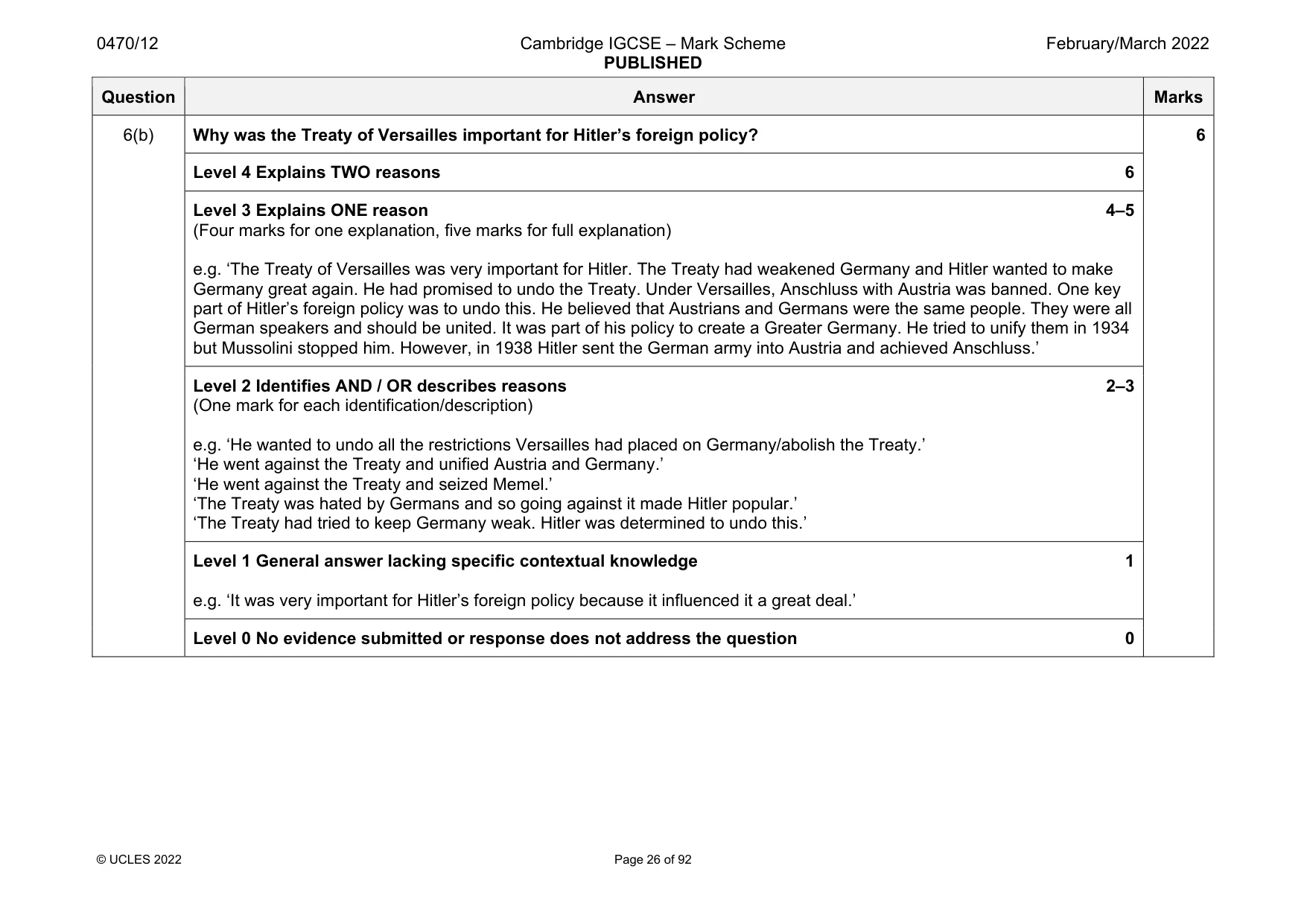
0470/12 Cambridge IGCSE – Mark Scheme PUBLISHED February/March 2022 © UCLES 2022 Page 26 of 92 Question Answer Marks 6(b) Why was the Treaty of Versailles important for Hitler’s foreign policy? 6 Level 4 Explains TWO reasons 6 Level 3 Explains ONE reason 4–5 (Four marks for one explanation, five marks for full explanation) e.g. ‘The Treaty of Versailles was very important for Hitler. The Treaty had weakened Germany and Hitler wanted to make Germany great again. He had promised to undo the Treaty. Under Versailles, Anschluss with Austria was banned. One key part of Hitler’s foreign policy was to undo this. He believed that Austrians and Germans were the same people. They were all German speakers and should be united. It was part of his policy to create a Greater Germany. He tried to unify them in 1934 but Mussolini stopped him. However, in 1938 Hitler sent the German army into Austria and achieved Anschluss.’ Level 2 Identifies AND / OR describes reasons 2–3 (One mark for each identification/description) e.g. ‘He wanted to undo all the restrictions Versailles had placed on Germany/abolish the Treaty.’ ‘He went against the Treaty and unified Austria and Germany.’ ‘He went against the Treaty and seized Memel.’ ‘The Treaty was hated by Germans and so going against it made Hitler popular.’ ‘The Treaty had tried to keep Germany weak. Hitler was determined to undo this.’ Level 1 General answer lacking specific contextual knowledge 1 e.g. ‘It was very important for Hitler’s foreign policy because it influenced it a great deal.’ Level 0 No evidence submitted or response does not address the question 0
Mark scheme, page 27
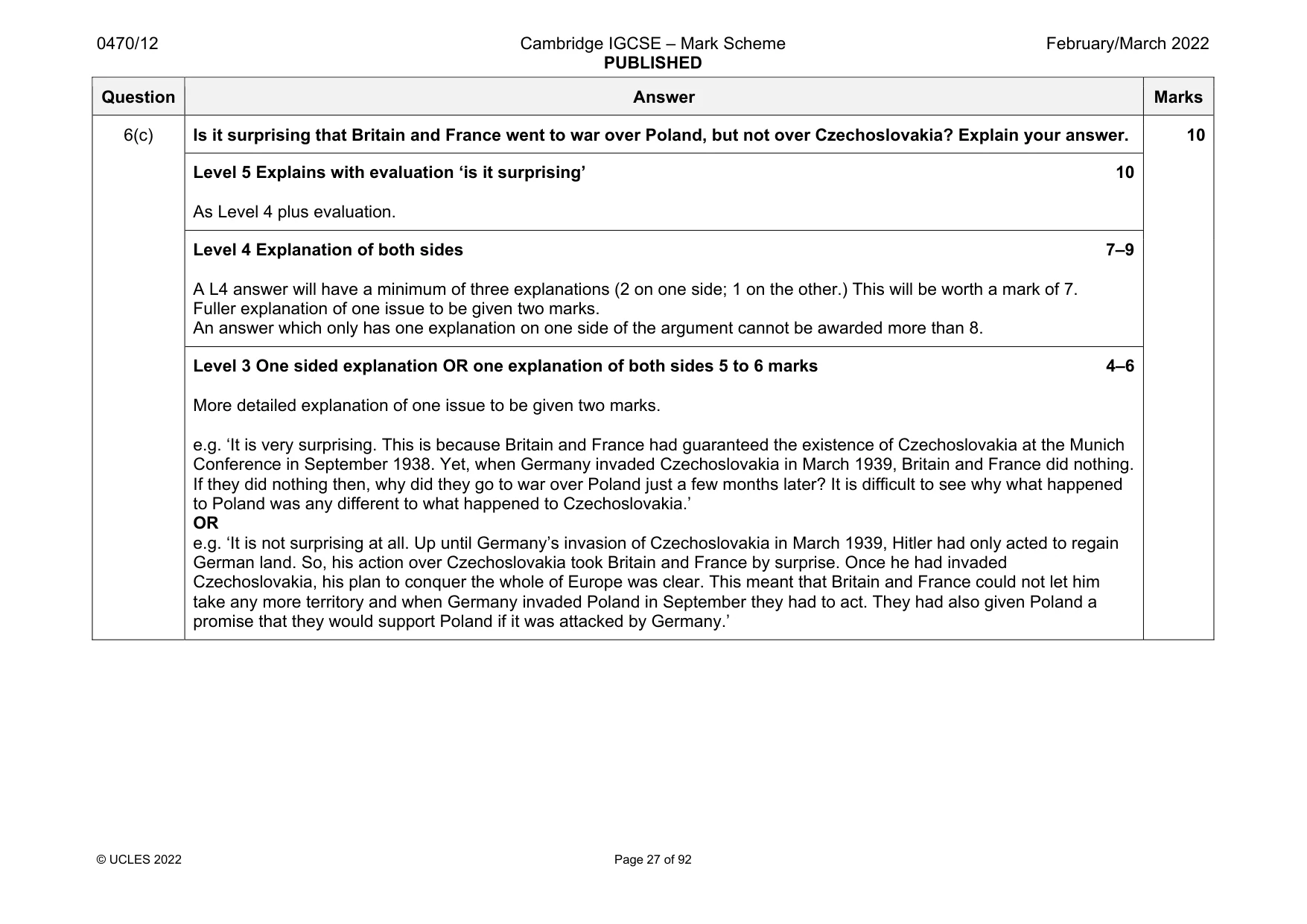
0470/12 Cambridge IGCSE – Mark Scheme PUBLISHED February/March 2022 © UCLES 2022 Page 27 of 92 Question Answer Marks 6(c) Is it surprising that Britain and France went to war over Poland, but not over Czechoslovakia? Explain your answer. 10 Level 5 Explains with evaluation ‘is it surprising’ 10 As Level 4 plus evaluation. Level 4 Explanation of both sides 7–9 A L4 answer will have a minimum of three explanations (2 on one side; 1 on the other.) This will be worth a mark of 7. Fuller explanation of one issue to be given two marks. An answer which only has one explanation on one side of the argument cannot be awarded more than 8. Level 3 One sided explanation OR one explanation of both sides 5 to 6 marks 4–6 More detailed explanation of one issue to be given two marks. e.g. ‘It is very surprising. This is because Britain and France had guaranteed the existence of Czechoslovakia at the Munich Conference in September 1938. Yet, when Germany invaded Czechoslovakia in March 1939, Britain and France did nothing. If they did nothing then, why did they go to war over Poland just a few months later? It is difficult to see why what happened to Poland was any different to what happened to Czechoslovakia.’ OR e.g. ‘It is not surprising at all. Up until Germany’s invasion of Czechoslovakia in March 1939, Hitler had only acted to regain German land. So, his action over Czechoslovakia took Britain and France by surprise. Once he had invaded Czechoslovakia, his plan to conquer the whole of Europe was clear. This meant that Britain and France could not let him take any more territory and when Germany invaded Poland in September they had to act. They had also given Poland a promise that they would support Poland if it was attacked by Germany.’
Mark scheme, page 28
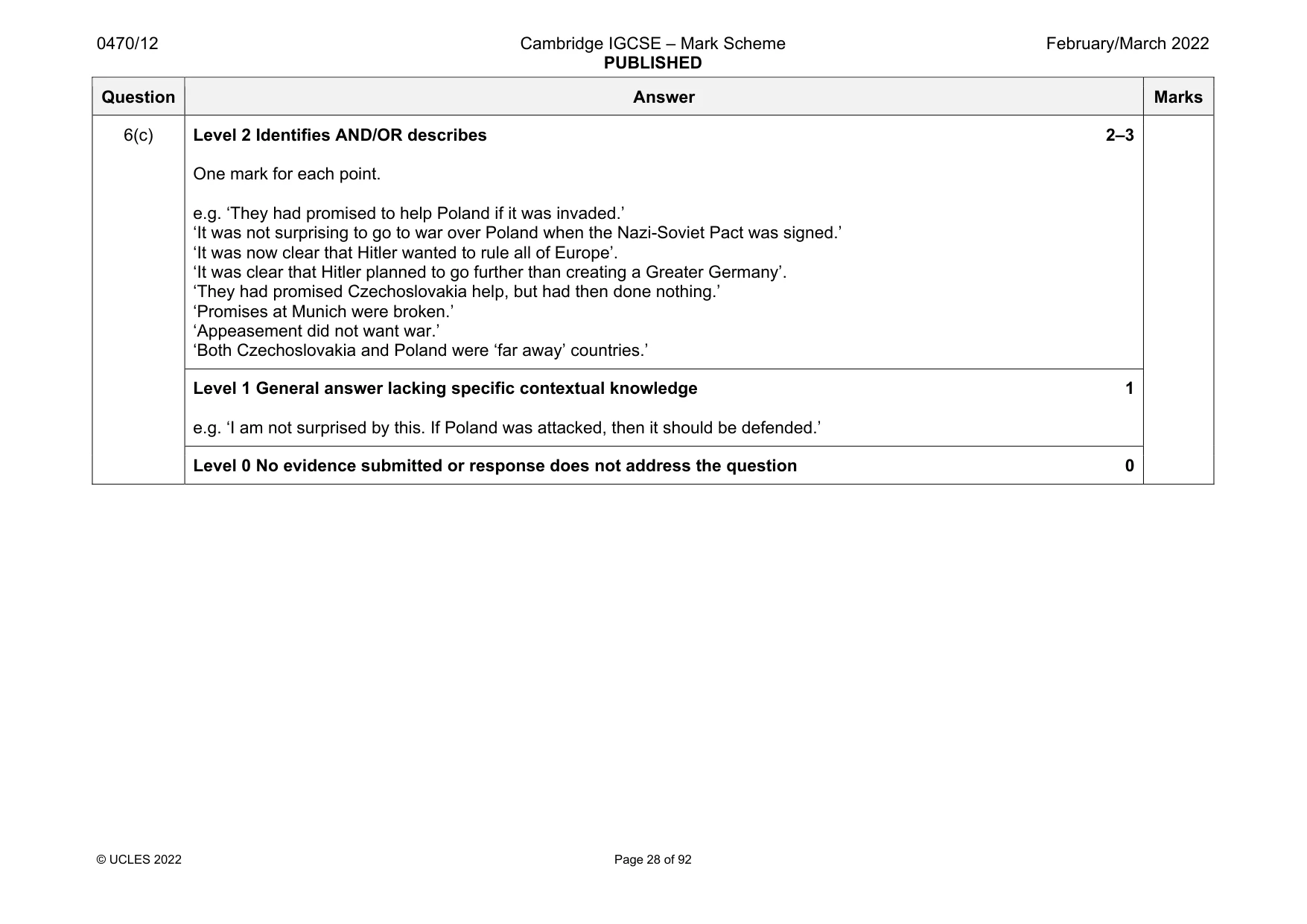
0470/12 Cambridge IGCSE – Mark Scheme PUBLISHED February/March 2022 © UCLES 2022 Page 28 of 92 Question Answer Marks 6(c) Level 2 Identifies AND/OR describes 2–3 One mark for each point. e.g. ‘They had promised to help Poland if it was invaded.’ ‘It was not surprising to go to war over Poland when the Nazi-Soviet Pact was signed.’ ‘It was now clear that Hitler wanted to rule all of Europe’. ‘It was clear that Hitler planned to go further than creating a Greater Germany’. ‘They had promised Czechoslovakia help, but had then done nothing.’ ‘Promises at Munich were broken.’ ‘Appeasement did not want war.’ ‘Both Czechoslovakia and Poland were ‘far away’ countries.’ Level 1 General answer lacking specific contextual knowledge 1 e.g. ‘I am not surprised by this. If Poland was attacked, then it should be defended.’ Level 0 No evidence submitted or response does not address the question 0
Mark scheme, page 29
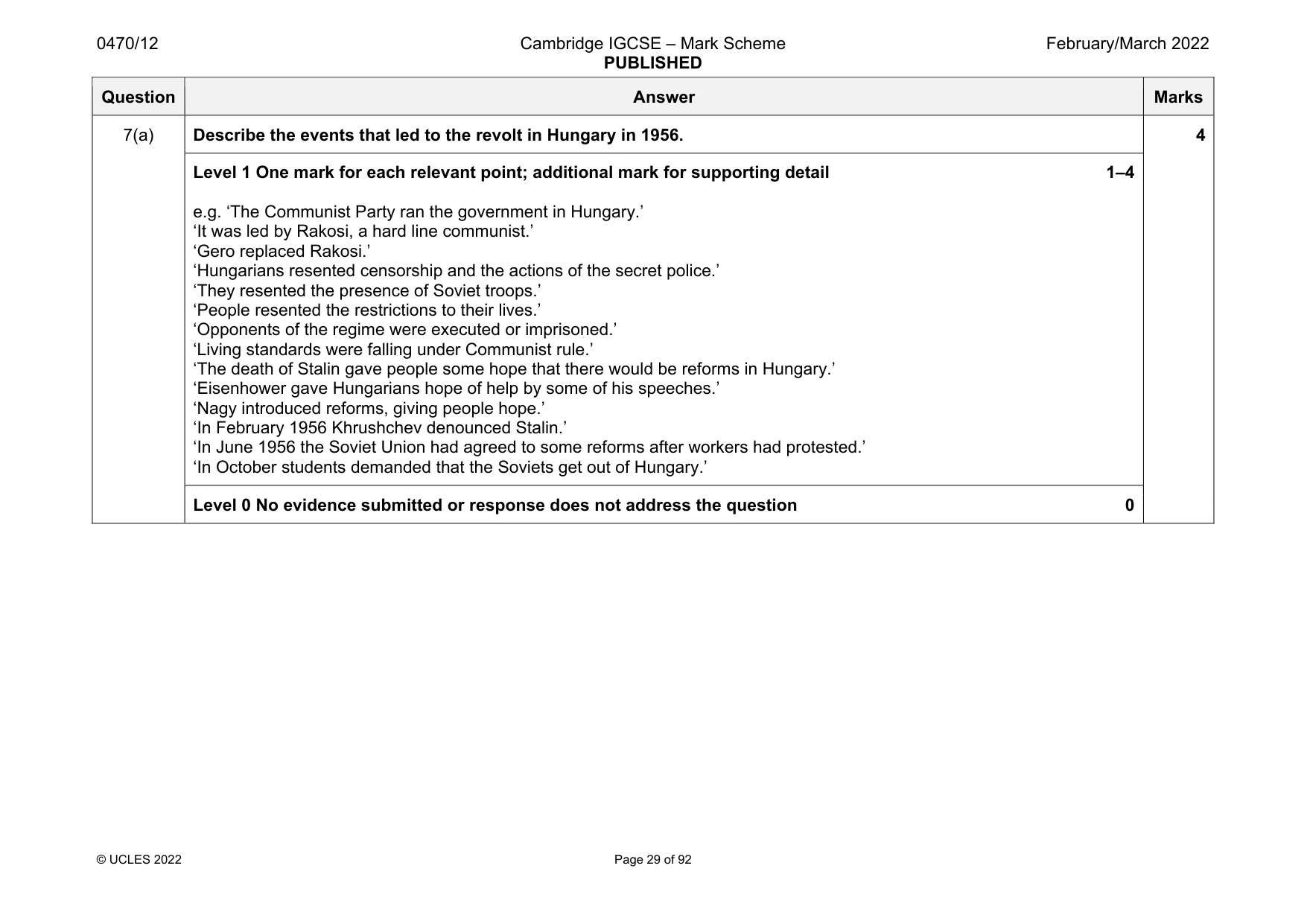
0470/12 Cambridge IGCSE – Mark Scheme PUBLISHED February/March 2022 © UCLES 2022 Page 29 of 92 Question Answer Marks 7(a) Describe the events that led to the revolt in Hungary in 1956. 4 Level 1 One mark for each relevant point; additional mark for supporting detail 1–4 e.g. ‘The Communist Party ran the government in Hungary.’ ‘It was led by Rakosi, a hard line communist.’ ‘Gero replaced Rakosi.’ ‘Hungarians resented censorship and the actions of the secret police.’ ‘They resented the presence of Soviet troops.’ ‘People resented the restrictions to their lives.’ ‘Opponents of the regime were executed or imprisoned.’ ‘Living standards were falling under Communist rule.’ ‘The death of Stalin gave people some hope that there would be reforms in Hungary.’ ‘Eisenhower gave Hungarians hope of help by some of his speeches.’ ‘Nagy introduced reforms, giving people hope.’ ‘In February 1956 Khrushchev denounced Stalin.’ ‘In June 1956 the Soviet Union had agreed to some reforms after workers had protested.’ ‘In October students demanded that the Soviets get out of Hungary.’ Level 0 No evidence submitted or response does not address the question 0
Mark scheme, page 30
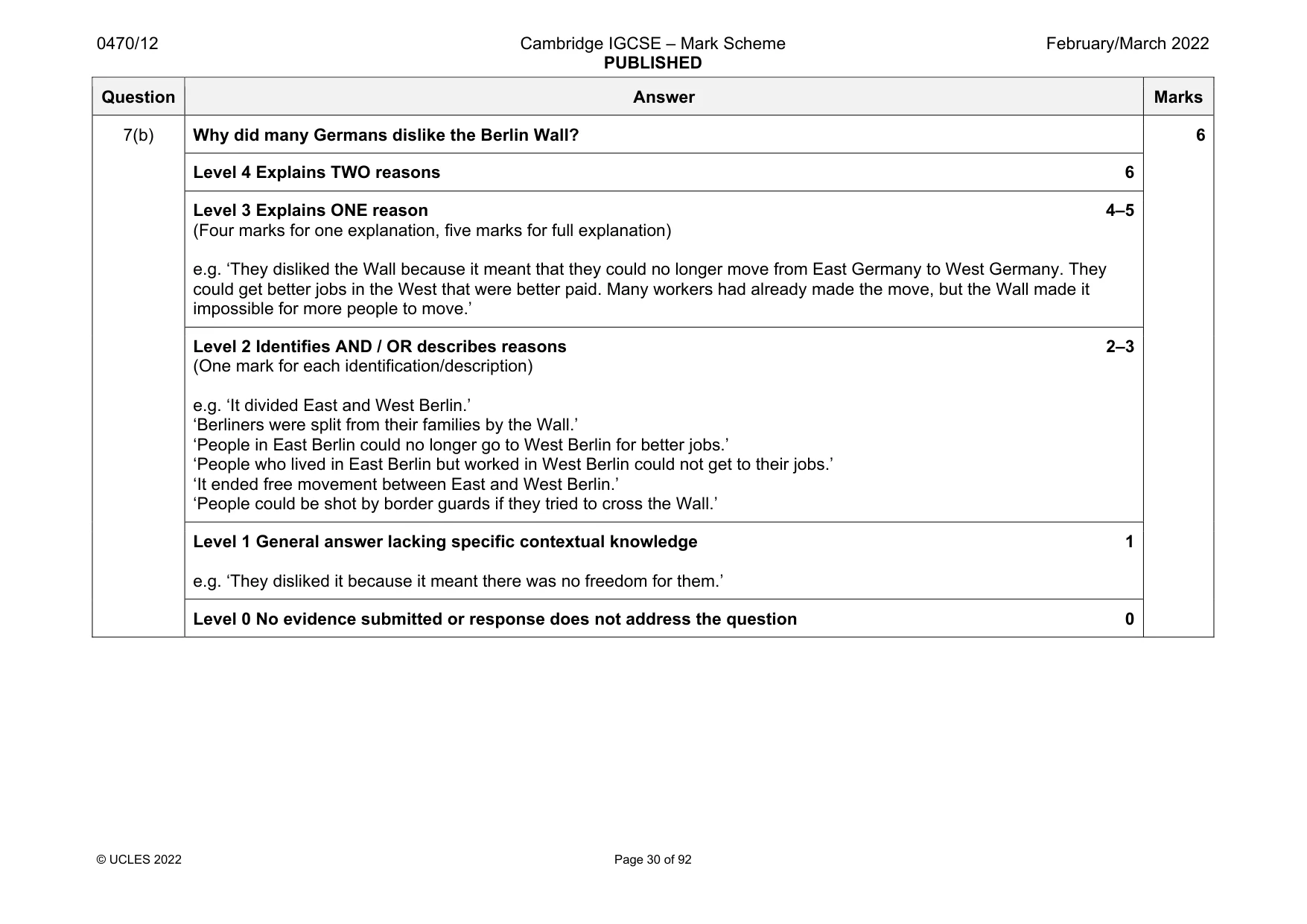
0470/12 Cambridge IGCSE – Mark Scheme PUBLISHED February/March 2022 © UCLES 2022 Page 30 of 92 Question Answer Marks 7(b) Why did many Germans dislike the Berlin Wall? 6 Level 4 Explains TWO reasons 6 Level 3 Explains ONE reason 4–5 (Four marks for one explanation, five marks for full explanation) e.g. ‘They disliked the Wall because it meant that they could no longer move from East Germany to West Germany. They could get better jobs in the West that were better paid. Many workers had already made the move, but the Wall made it impossible for more people to move.’ Level 2 Identifies AND / OR describes reasons 2–3 (One mark for each identification/description) e.g. ‘It divided East and West Berlin.’ ‘Berliners were split from their families by the Wall.’ ‘People in East Berlin could no longer go to West Berlin for better jobs.’ ‘People who lived in East Berlin but worked in West Berlin could not get to their jobs.’ ‘It ended free movement between East and West Berlin.’ ‘People could be shot by border guards if they tried to cross the Wall.’ Level 1 General answer lacking specific contextual knowledge 1 e.g. ‘They disliked it because it meant there was no freedom for them.’ Level 0 No evidence submitted or response does not address the question 0
Mark scheme, page 31
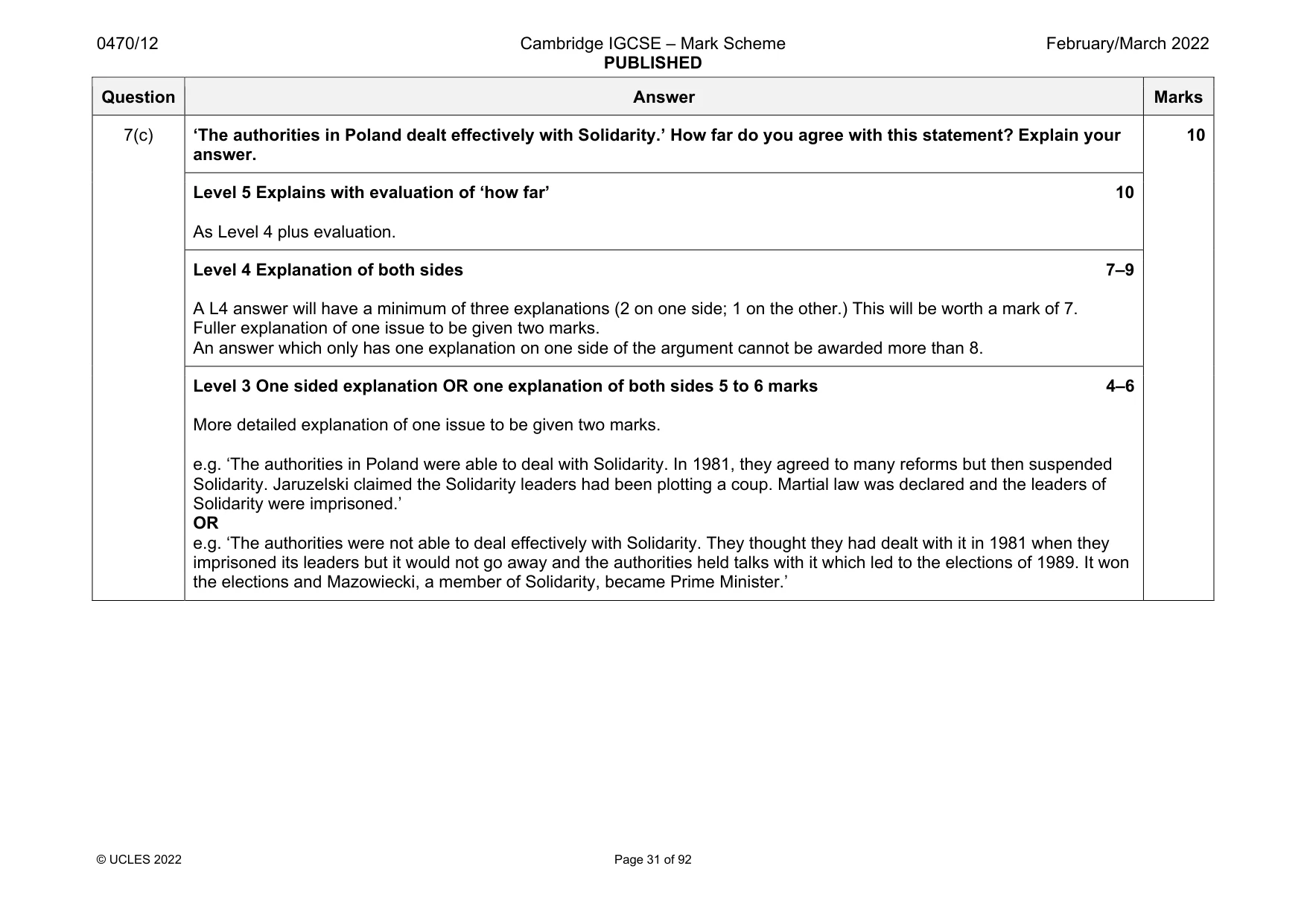
0470/12 Cambridge IGCSE – Mark Scheme PUBLISHED February/March 2022 © UCLES 2022 Page 31 of 92 Question Answer Marks 7(c) ‘The authorities in Poland dealt effectively with Solidarity.’ How far do you agree with this statement? Explain your answer. 10 Level 5 Explains with evaluation of ‘how far’ 10 As Level 4 plus evaluation. Level 4 Explanation of both sides 7–9 A L4 answer will have a minimum of three explanations (2 on one side; 1 on the other.) This will be worth a mark of 7. Fuller explanation of one issue to be given two marks. An answer which only has one explanation on one side of the argument cannot be awarded more than 8. Level 3 One sided explanation OR one explanation of both sides 5 to 6 marks 4–6 More detailed explanation of one issue to be given two marks. e.g. ‘The authorities in Poland were able to deal with Solidarity. In 1981, they agreed to many reforms but then suspended Solidarity. Jaruzelski claimed the Solidarity leaders had been plotting a coup. Martial law was declared and the leaders of Solidarity were imprisoned.’ OR e.g. ‘The authorities were not able to deal effectively with Solidarity. They thought they had dealt with it in 1981 when they imprisoned its leaders but it would not go away and the authorities held talks with it which led to the elections of 1989. It won the elections and Mazowiecki, a member of Solidarity, became Prime Minister.’
Mark scheme, page 32
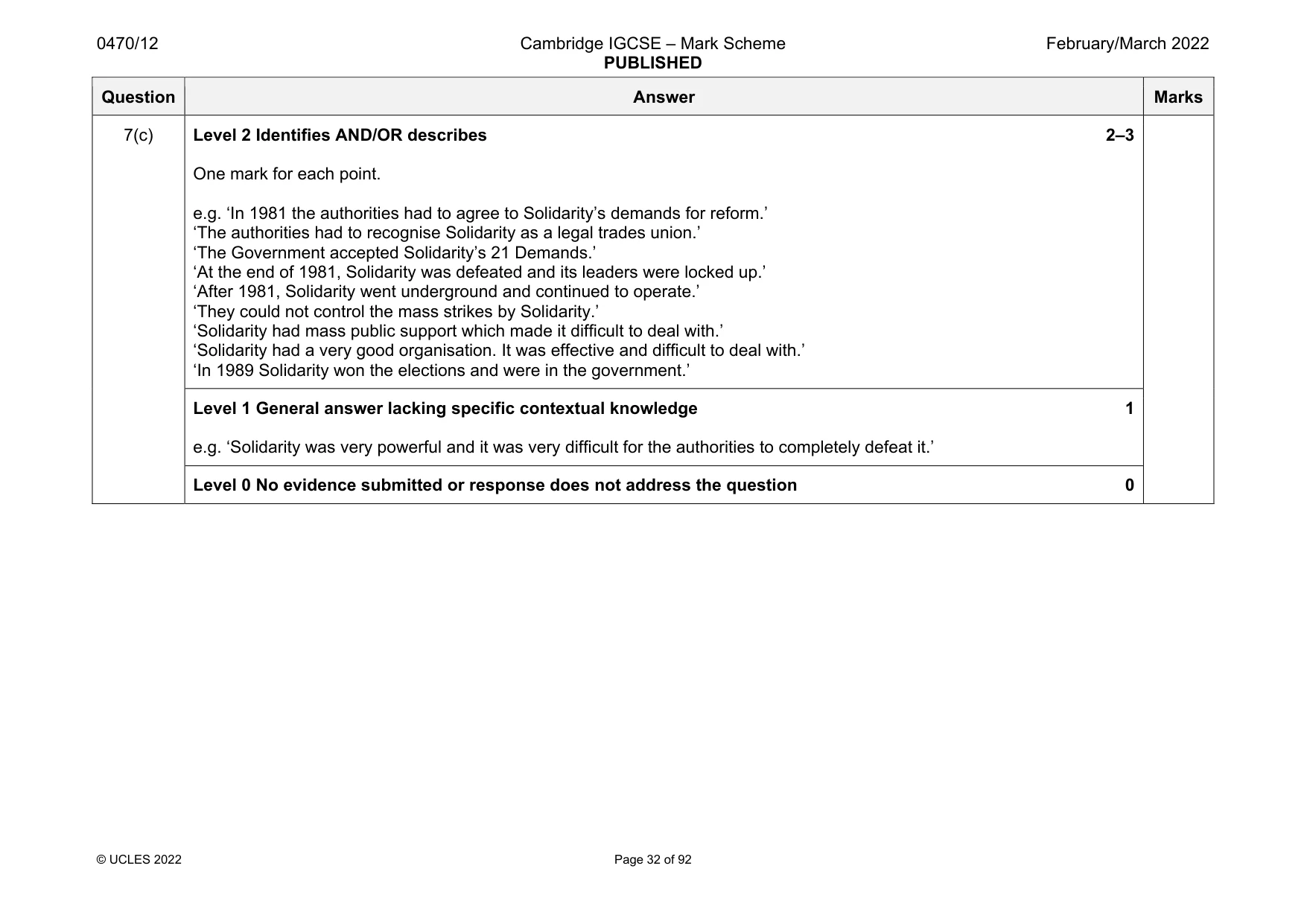
0470/12 Cambridge IGCSE – Mark Scheme PUBLISHED February/March 2022 © UCLES 2022 Page 32 of 92 Question Answer Marks 7(c) Level 2 Identifies AND/OR describes 2–3 One mark for each point. e.g. ‘In 1981 the authorities had to agree to Solidarity’s demands for reform.’ ‘The authorities had to recognise Solidarity as a legal trades union.’ ‘The Government accepted Solidarity’s 21 Demands.’ ‘At the end of 1981, Solidarity was defeated and its leaders were locked up.’ ‘After 1981, Solidarity went underground and continued to operate.’ ‘They could not control the mass strikes by Solidarity.’ ‘Solidarity had mass public support which made it difficult to deal with.’ ‘Solidarity had a very good organisation. It was effective and difficult to deal with.’ ‘In 1989 Solidarity won the elections and were in the government.’ Level 1 General answer lacking specific contextual knowledge 1 e.g. ‘Solidarity was very powerful and it was very difficult for the authorities to completely defeat it.’ Level 0 No evidence submitted or response does not address the question 0
Mark scheme, page 33
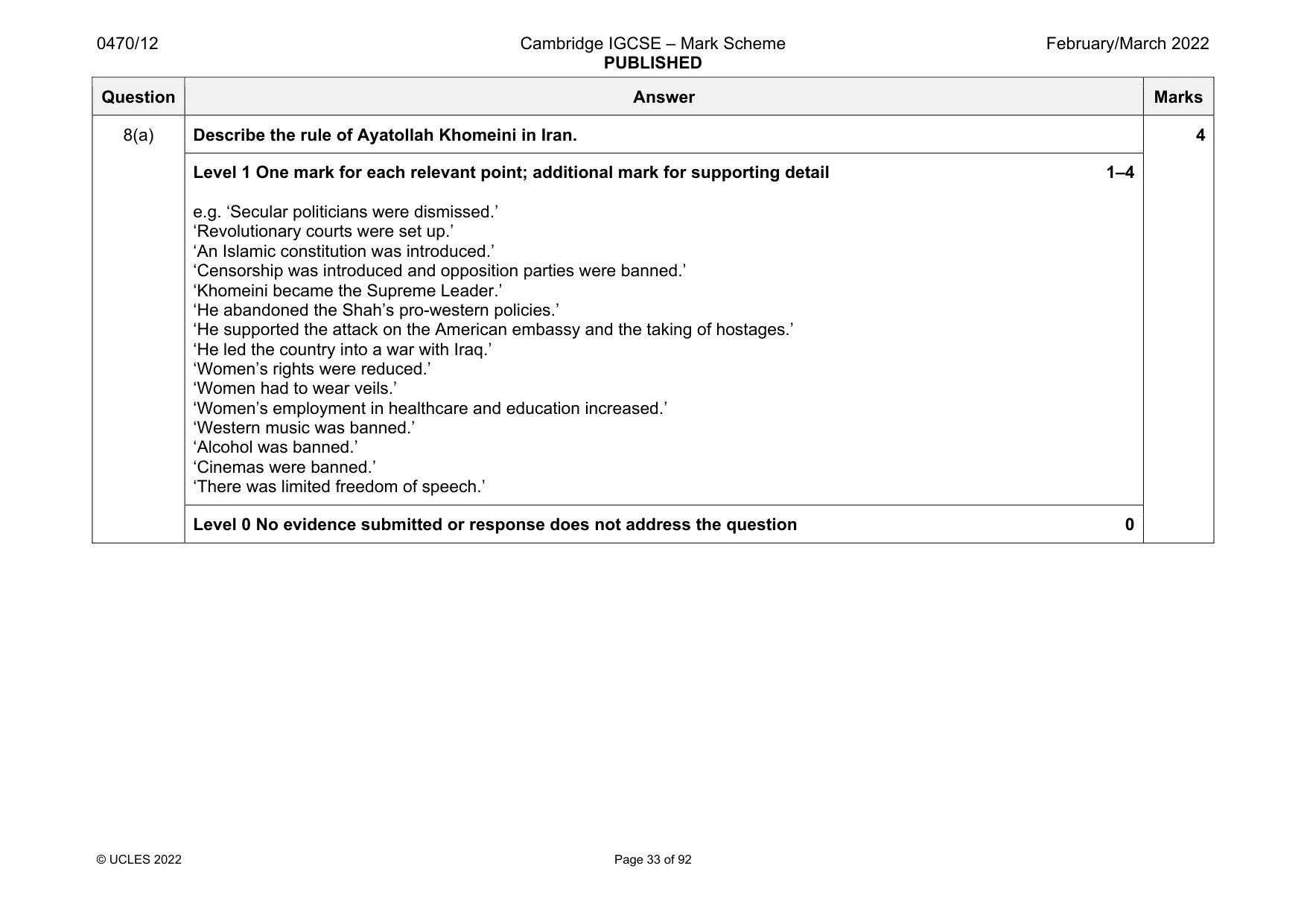
0470/12 Cambridge IGCSE – Mark Scheme PUBLISHED February/March 2022 © UCLES 2022 Page 33 of 92 Question Answer Marks 8(a) Describe the rule of Ayatollah Khomeini in Iran. 4 Level 1 One mark for each relevant point; additional mark for supporting detail 1–4 e.g. ‘Secular politicians were dismissed.’ ‘Revolutionary courts were set up.’ ‘An Islamic constitution was introduced.’ ‘Censorship was introduced and opposition parties were banned.’ ‘Khomeini became the Supreme Leader.’ ‘He abandoned the Shah’s pro-western policies.’ ‘He supported the attack on the American embassy and the taking of hostages.’ ‘He led the country into a war with Iraq.’ ‘Women’s rights were reduced.’ ‘Women had to wear veils.’ ‘Women’s employment in healthcare and education increased.’ ‘Western music was banned.’ ‘Alcohol was banned.’ ‘Cinemas were banned.’ ‘There was limited freedom of speech.’ Level 0 No evidence submitted or response does not address the question 0
Mark scheme, page 34
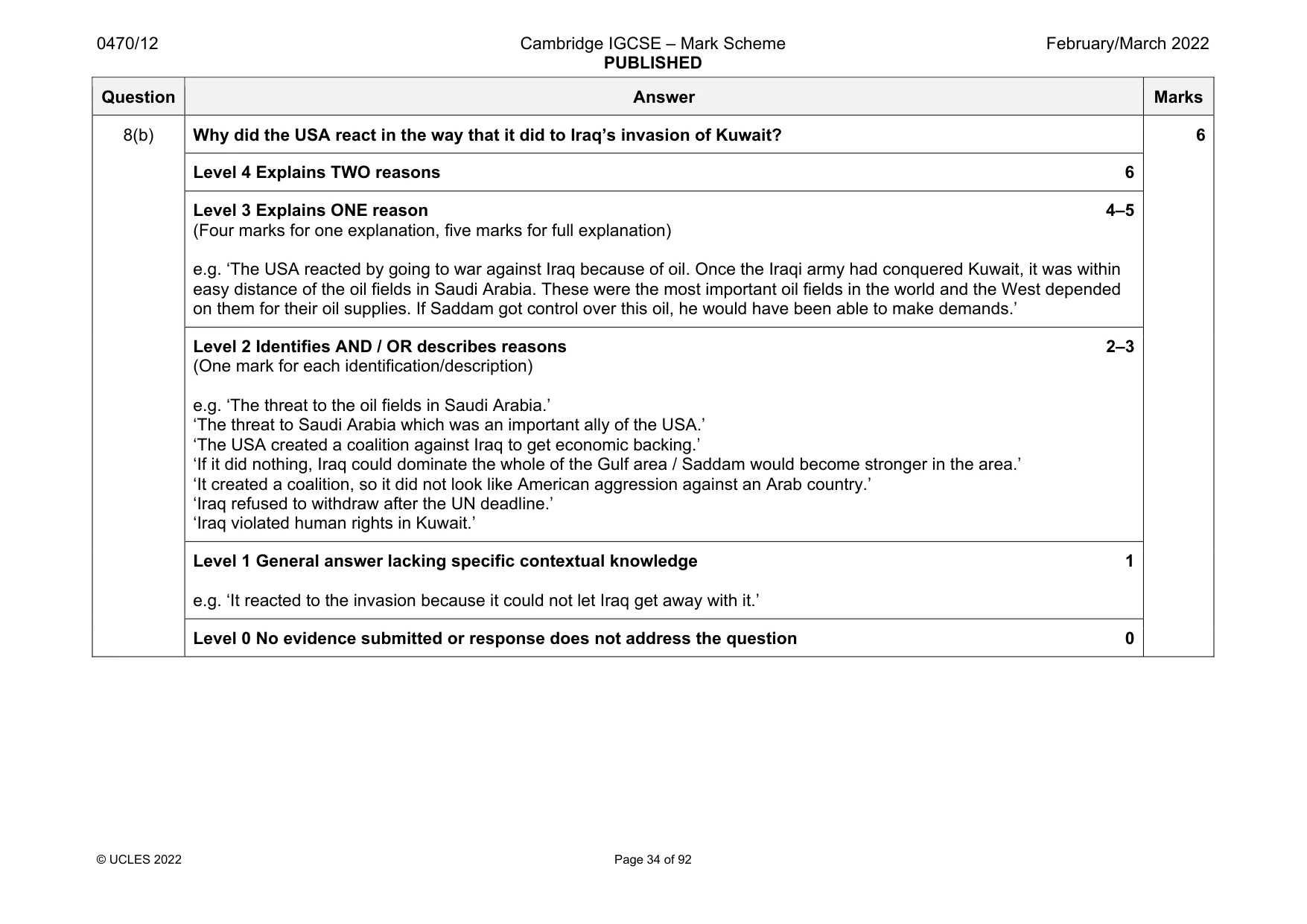
0470/12 Cambridge IGCSE – Mark Scheme PUBLISHED February/March 2022 © UCLES 2022 Page 34 of 92 Question Answer Marks 8(b) Why did the USA react in the way that it did to Iraq’s invasion of Kuwait? 6 Level 4 Explains TWO reasons 6 Level 3 Explains ONE reason 4–5 (Four marks for one explanation, five marks for full explanation) e.g. ‘The USA reacted by going to war against Iraq because of oil. Once the Iraqi army had conquered Kuwait, it was within easy distance of the oil fields in Saudi Arabia. These were the most important oil fields in the world and the West depended on them for their oil supplies. If Saddam got control over this oil, he would have been able to make demands.’ Level 2 Identifies AND / OR describes reasons 2–3 (One mark for each identification/description) e.g. ‘The threat to the oil fields in Saudi Arabia.’ ‘The threat to Saudi Arabia which was an important ally of the USA.’ ‘The USA created a coalition against Iraq to get economic backing.’ ‘If it did nothing, Iraq could dominate the whole of the Gulf area / Saddam would become stronger in the area.’ ‘It created a coalition, so it did not look like American aggression against an Arab country.’ ‘Iraq refused to withdraw after the UN deadline.’ ‘Iraq violated human rights in Kuwait.’ Level 1 General answer lacking specific contextual knowledge 1 e.g. ‘It reacted to the invasion because it could not let Iraq get away with it.’ Level 0 No evidence submitted or response does not address the question 0
Mark scheme, page 35
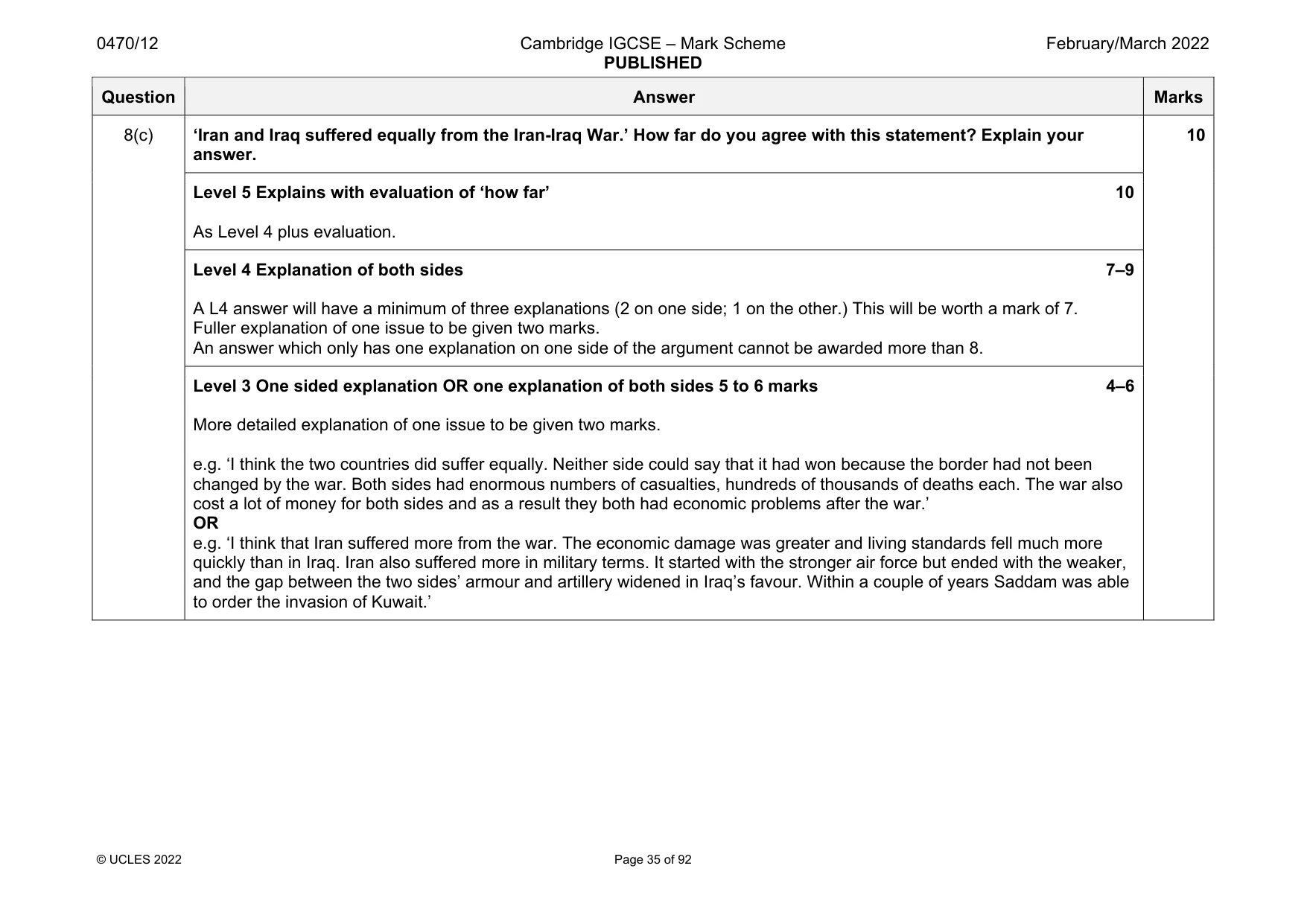
0470/12 Cambridge IGCSE – Mark Scheme PUBLISHED February/March 2022 © UCLES 2022 Page 35 of 92 Question Answer Marks 8(c) ‘Iran and Iraq suffered equally from the Iran-Iraq War.’ How far do you agree with this statement? Explain your answer. 10 Level 5 Explains with evaluation of ‘how far’ 10 As Level 4 plus evaluation. Level 4 Explanation of both sides 7–9 A L4 answer will have a minimum of three explanations (2 on one side; 1 on the other.) This will be worth a mark of 7. Fuller explanation of one issue to be given two marks. An answer which only has one explanation on one side of the argument cannot be awarded more than 8. Level 3 One sided explanation OR one explanation of both sides 5 to 6 marks 4–6 More detailed explanation of one issue to be given two marks. e.g. ‘I think the two countries did suffer equally. Neither side could say that it had won because the border had not been changed by the war. Both sides had enormous numbers of casualties, hundreds of thousands of deaths each. The war also cost a lot of money for both sides and as a result they both had economic problems after the war.’ OR e.g. ‘I think that Iran suffered more from the war. The economic damage was greater and living standards fell much more quickly than in Iraq. Iran also suffered more in military terms. It started with the stronger air force but ended with the weaker, and the gap between the two sides’ armour and artillery widened in Iraq’s favour. Within a couple of years Saddam was able to order the invasion of Kuwait.’
Mark scheme, page 36
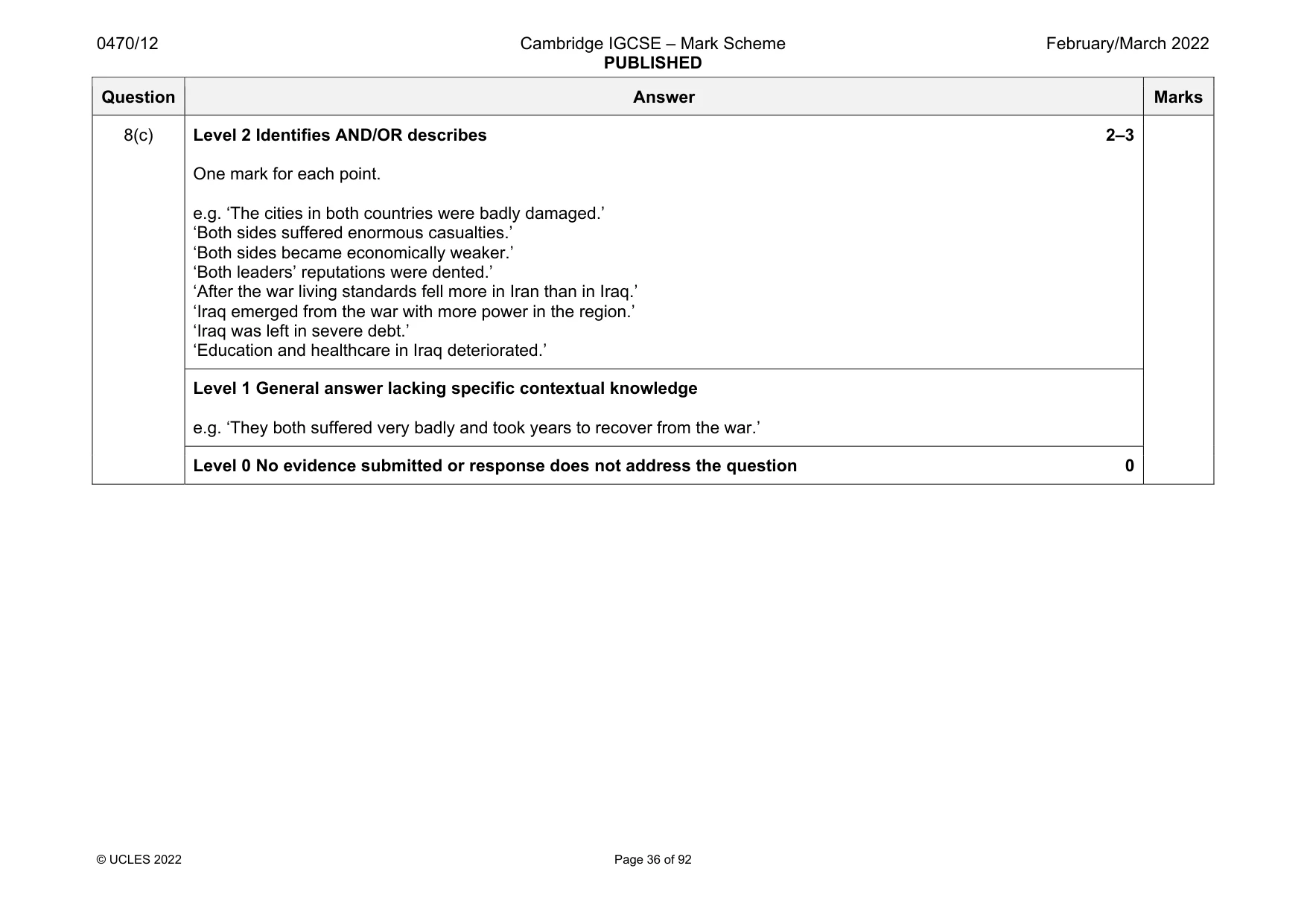
0470/12 Cambridge IGCSE – Mark Scheme PUBLISHED February/March 2022 © UCLES 2022 Page 36 of 92 Question Answer Marks 8(c) Level 2 Identifies AND/OR describes 2–3 One mark for each point. e.g. ‘The cities in both countries were badly damaged.’ ‘Both sides suffered enormous casualties.’ ‘Both sides became economically weaker.’ ‘Both leaders’ reputations were dented.’ ‘After the war living standards fell more in Iran than in Iraq.’ ‘Iraq emerged from the war with more power in the region.’ ‘Iraq was left in severe debt.’ ‘Education and healthcare in Iraq deteriorated.’ Level 1 General answer lacking specific contextual knowledge e.g. ‘They both suffered very badly and took years to recover from the war.’ Level 0 No evidence submitted or response does not address the question 0
Mark scheme, page 37
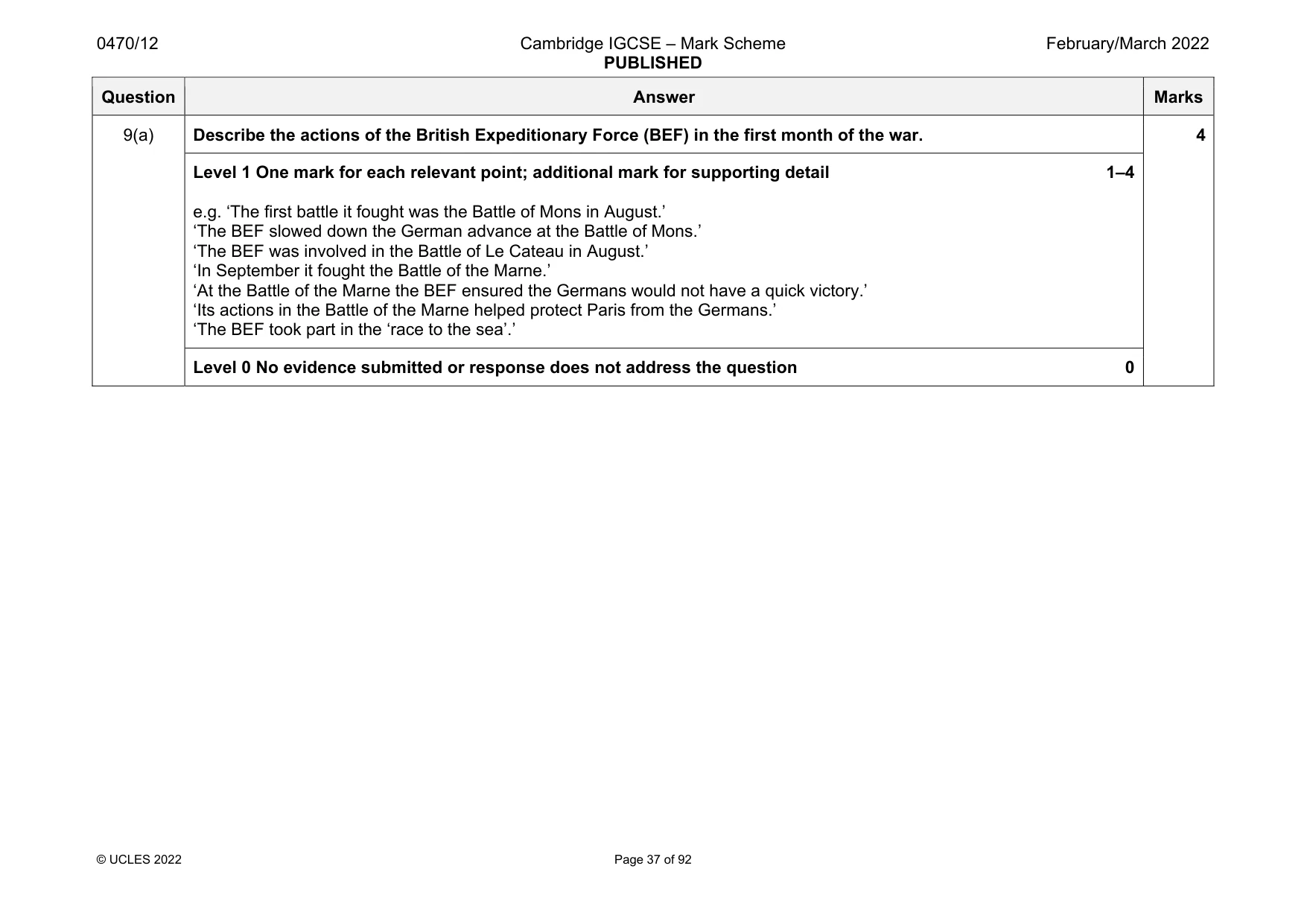
0470/12 Cambridge IGCSE – Mark Scheme PUBLISHED February/March 2022 © UCLES 2022 Page 37 of 92 Question Answer Marks 9(a) Describe the actions of the British Expeditionary Force (BEF) in the first month of the war. 4 Level 1 One mark for each relevant point; additional mark for supporting detail 1–4 e.g. ‘The first battle it fought was the Battle of Mons in August.’ ‘The BEF slowed down the German advance at the Battle of Mons.’ ‘The BEF was involved in the Battle of Le Cateau in August.’ ‘In September it fought the Battle of the Marne.’ ‘At the Battle of the Marne the BEF ensured the Germans would not have a quick victory.’ ‘Its actions in the Battle of the Marne helped protect Paris from the Germans.’ ‘The BEF took part in the ‘race to the sea’.’ Level 0 No evidence submitted or response does not address the question 0
Mark scheme, page 38
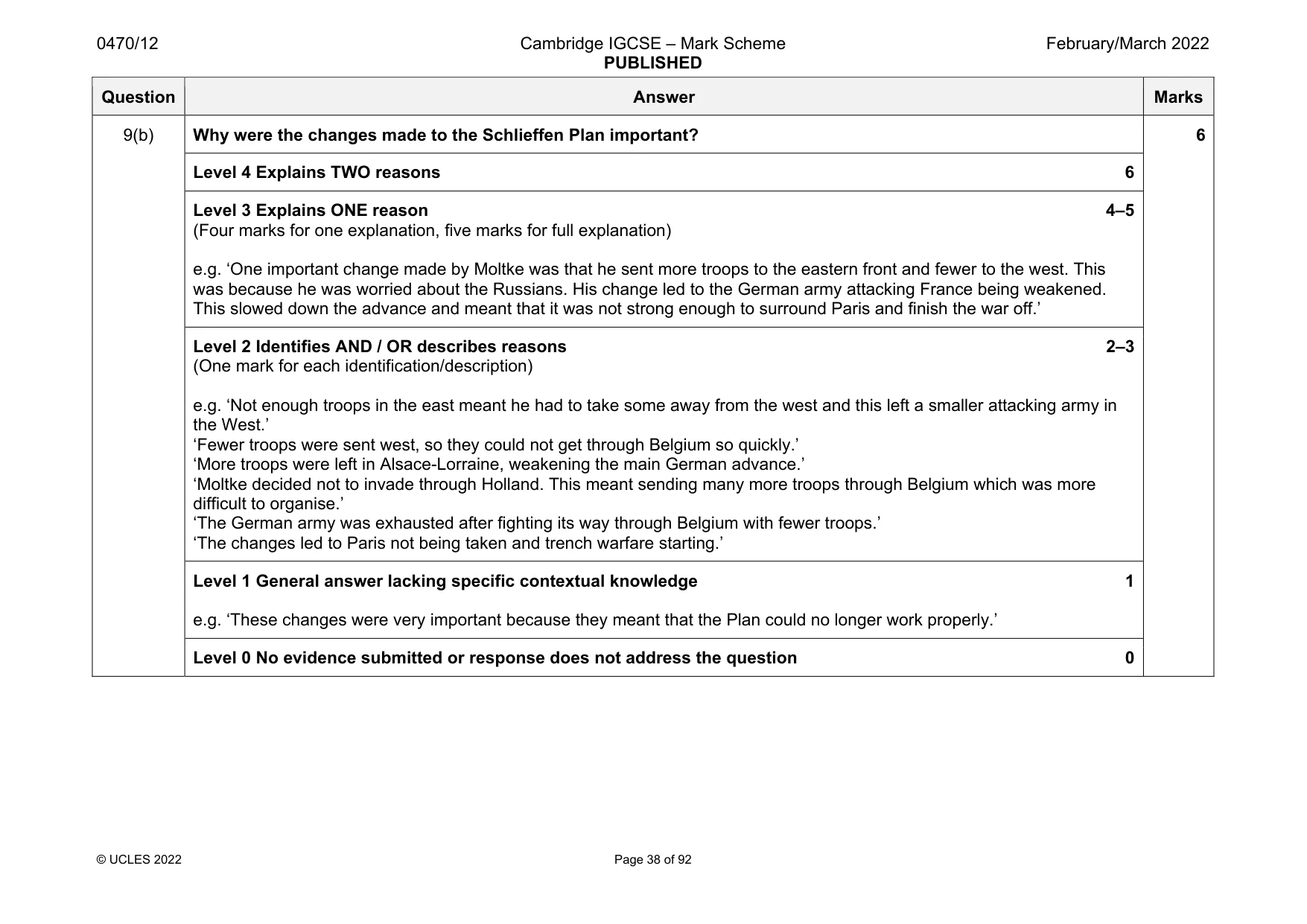
0470/12 Cambridge IGCSE – Mark Scheme PUBLISHED February/March 2022 © UCLES 2022 Page 38 of 92 Question Answer Marks 9(b) Why were the changes made to the Schlieffen Plan important? 6 Level 4 Explains TWO reasons 6 Level 3 Explains ONE reason 4–5 (Four marks for one explanation, five marks for full explanation) e.g. ‘One important change made by Moltke was that he sent more troops to the eastern front and fewer to the west. This was because he was worried about the Russians. His change led to the German army attacking France being weakened. This slowed down the advance and meant that it was not strong enough to surround Paris and finish the war off.’ Level 2 Identifies AND / OR describes reasons 2–3 (One mark for each identification/description) e.g. ‘Not enough troops in the east meant he had to take some away from the west and this left a smaller attacking army in the West.’ ‘Fewer troops were sent west, so they could not get through Belgium so quickly.’ ‘More troops were left in Alsace-Lorraine, weakening the main German advance.’ ‘Moltke decided not to invade through Holland. This meant sending many more troops through Belgium which was more difficult to organise.’ ‘The German army was exhausted after fighting its way through Belgium with fewer troops.’ ‘The changes led to Paris not being taken and trench warfare starting.’ Level 1 General answer lacking specific contextual knowledge 1 e.g. ‘These changes were very important because they meant that the Plan could no longer work properly.’ Level 0 No evidence submitted or response does not address the question 0
Mark scheme, page 39
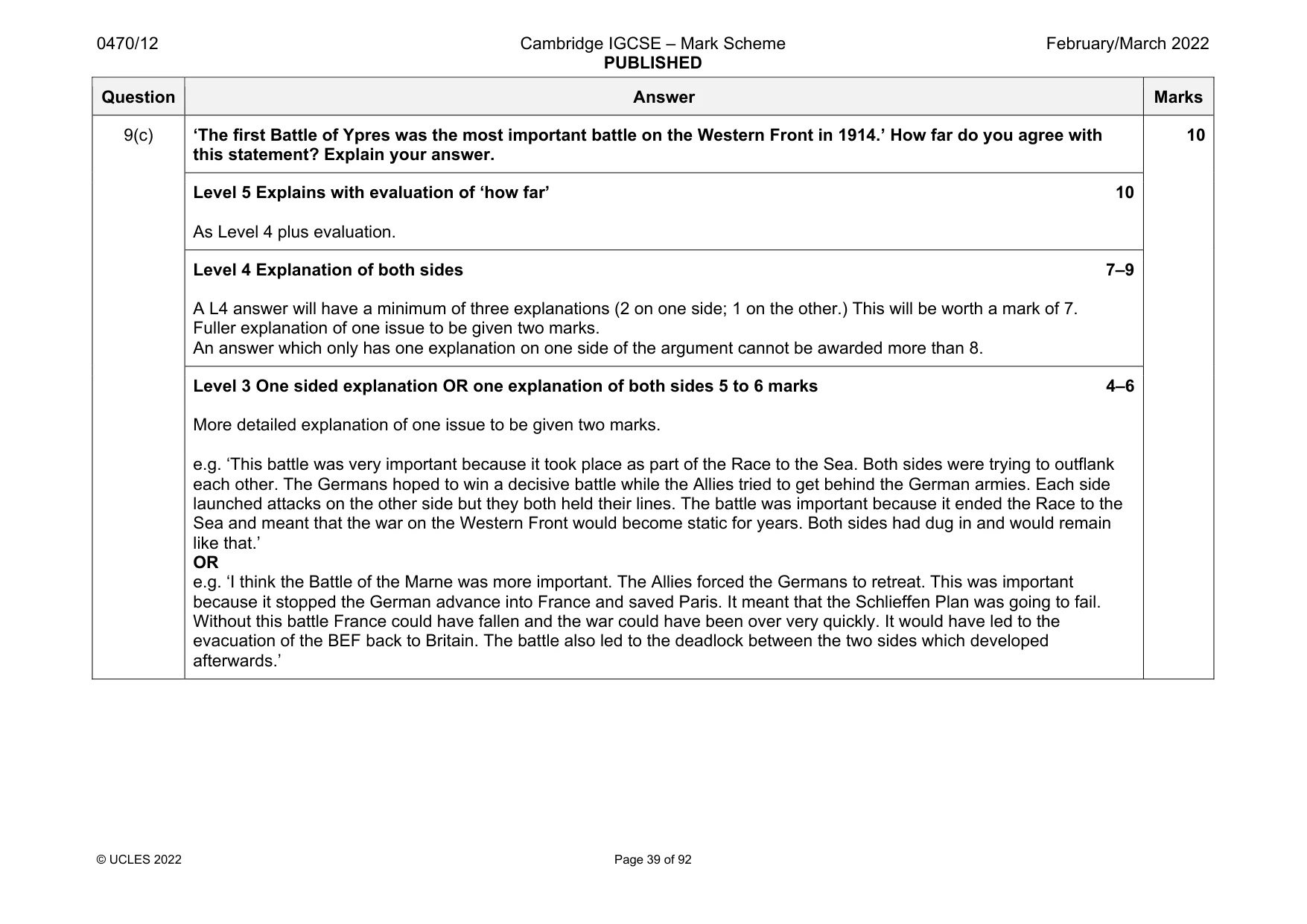
0470/12 Cambridge IGCSE – Mark Scheme PUBLISHED February/March 2022 © UCLES 2022 Page 39 of 92 Question Answer Marks 9(c) ‘The first Battle of Ypres was the most important battle on the Western Front in 1914.’ How far do you agree with this statement? Explain your answer. 10 Level 5 Explains with evaluation of ‘how far’ 10 As Level 4 plus evaluation. Level 4 Explanation of both sides 7–9 A L4 answer will have a minimum of three explanations (2 on one side; 1 on the other.) This will be worth a mark of 7. Fuller explanation of one issue to be given two marks. An answer which only has one explanation on one side of the argument cannot be awarded more than 8. Level 3 One sided explanation OR one explanation of both sides 5 to 6 marks 4–6 More detailed explanation of one issue to be given two marks. e.g. ‘This battle was very important because it took place as part of the Race to the Sea. Both sides were trying to outflank each other. The Germans hoped to win a decisive battle while the Allies tried to get behind the German armies. Each side launched attacks on the other side but they both held their lines. The battle was important because it ended the Race to the Sea and meant that the war on the Western Front would become static for years. Both sides had dug in and would remain like that.’ OR e.g. ‘I think the Battle of the Marne was more important. The Allies forced the Germans to retreat. This was important because it stopped the German advance into France and saved Paris. It meant that the Schlieffen Plan was going to fail. Without this battle France could have fallen and the war could have been over very quickly. It would have led to the evacuation of the BEF back to Britain. The battle also led to the deadlock between the two sides which developed afterwards.’
Mark scheme, page 40
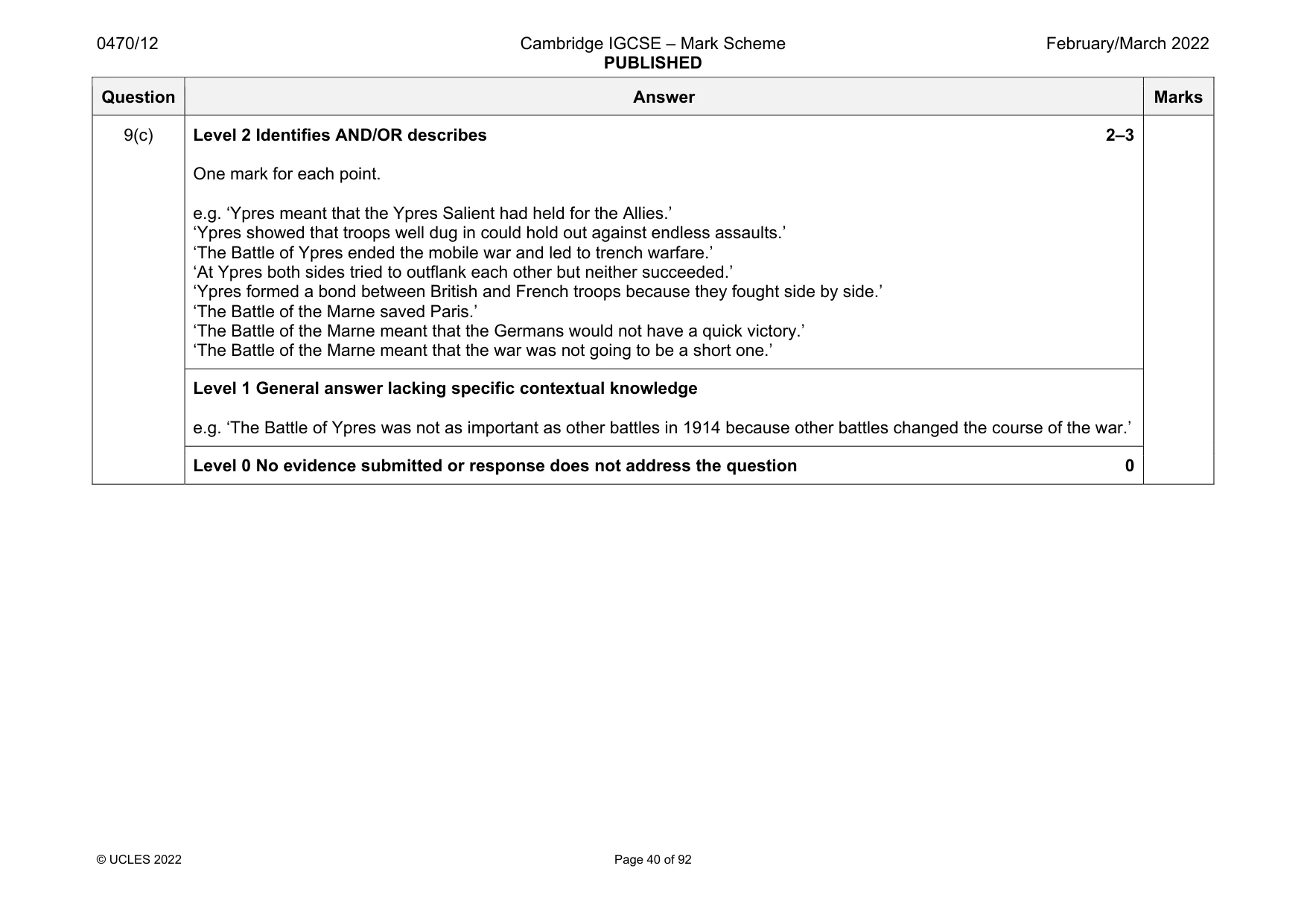
0470/12 Cambridge IGCSE – Mark Scheme PUBLISHED February/March 2022 © UCLES 2022 Page 40 of 92 Question Answer Marks 9(c) Level 2 Identifies AND/OR describes 2–3 One mark for each point. e.g. ‘Ypres meant that the Ypres Salient had held for the Allies.’ ‘Ypres showed that troops well dug in could hold out against endless assaults.’ ‘The Battle of Ypres ended the mobile war and led to trench warfare.’ ‘At Ypres both sides tried to outflank each other but neither succeeded.’ ‘Ypres formed a bond between British and French troops because they fought side by side.’ ‘The Battle of the Marne saved Paris.’ ‘The Battle of the Marne meant that the Germans would not have a quick victory.’ ‘The Battle of the Marne meant that the war was not going to be a short one.’ Level 1 General answer lacking specific contextual knowledge e.g. ‘The Battle of Ypres was not as important as other battles in 1914 because other battles changed the course of the war.’ Level 0 No evidence submitted or response does not address the question 0
Mark scheme, page 41
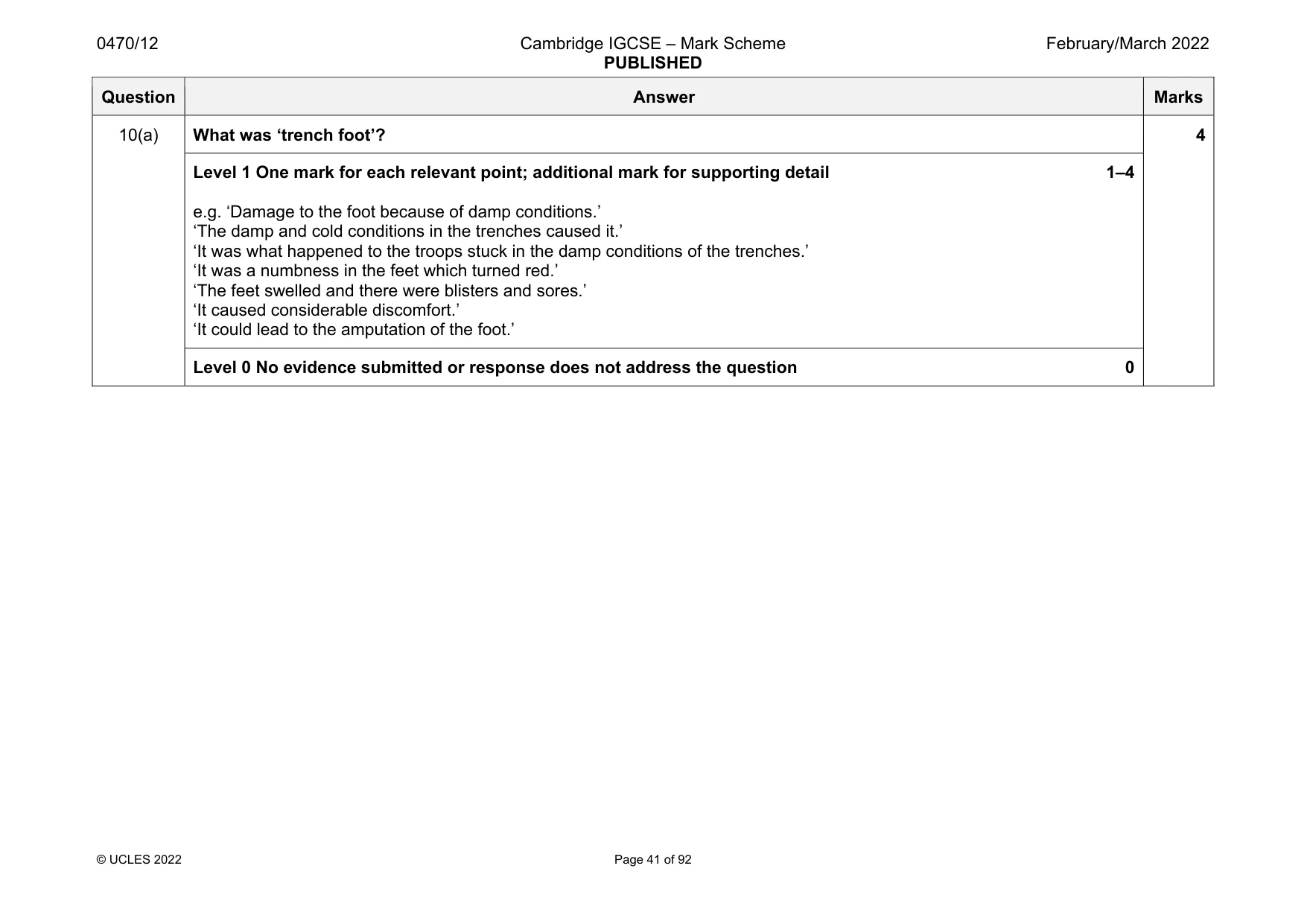
0470/12 Cambridge IGCSE – Mark Scheme PUBLISHED February/March 2022 © UCLES 2022 Page 41 of 92 Question Answer Marks 10(a) What was ‘trench foot’? 4 Level 1 One mark for each relevant point; additional mark for supporting detail 1–4 e.g. ‘Damage to the foot because of damp conditions.’ ‘The damp and cold conditions in the trenches caused it.’ ‘It was what happened to the troops stuck in the damp conditions of the trenches.’ ‘It was a numbness in the feet which turned red.’ ‘The feet swelled and there were blisters and sores.’ ‘It caused considerable discomfort.’ ‘It could lead to the amputation of the foot.’ Level 0 No evidence submitted or response does not address the question 0
Mark scheme, page 42
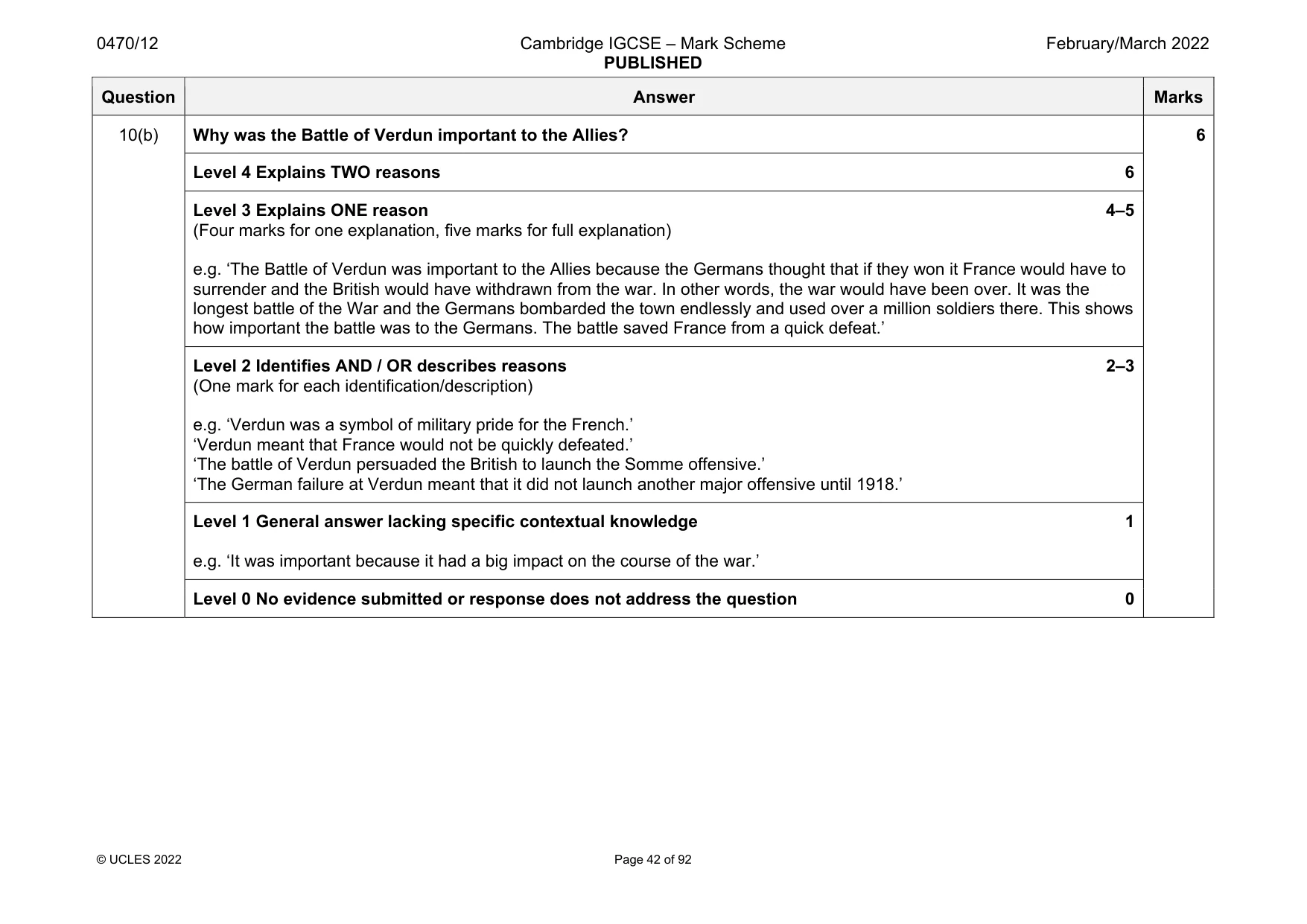
0470/12 Cambridge IGCSE – Mark Scheme PUBLISHED February/March 2022 © UCLES 2022 Page 42 of 92 Question Answer Marks 10(b) Why was the Battle of Verdun important to the Allies? 6 Level 4 Explains TWO reasons 6 Level 3 Explains ONE reason 4–5 (Four marks for one explanation, five marks for full explanation) e.g. ‘The Battle of Verdun was important to the Allies because the Germans thought that if they won it France would have to surrender and the British would have withdrawn from the war. In other words, the war would have been over. It was the longest battle of the War and the Germans bombarded the town endlessly and used over a million soldiers there. This shows how important the battle was to the Germans. The battle saved France from a quick defeat.’ Level 2 Identifies AND / OR describes reasons 2–3 (One mark for each identification/description) e.g. ‘Verdun was a symbol of military pride for the French.’ ‘Verdun meant that France would not be quickly defeated.’ ‘The battle of Verdun persuaded the British to launch the Somme offensive.’ ‘The German failure at Verdun meant that it did not launch another major offensive until 1918.’ Level 1 General answer lacking specific contextual knowledge 1 e.g. ‘It was important because it had a big impact on the course of the war.’ Level 0 No evidence submitted or response does not address the question 0
Mark scheme, page 43
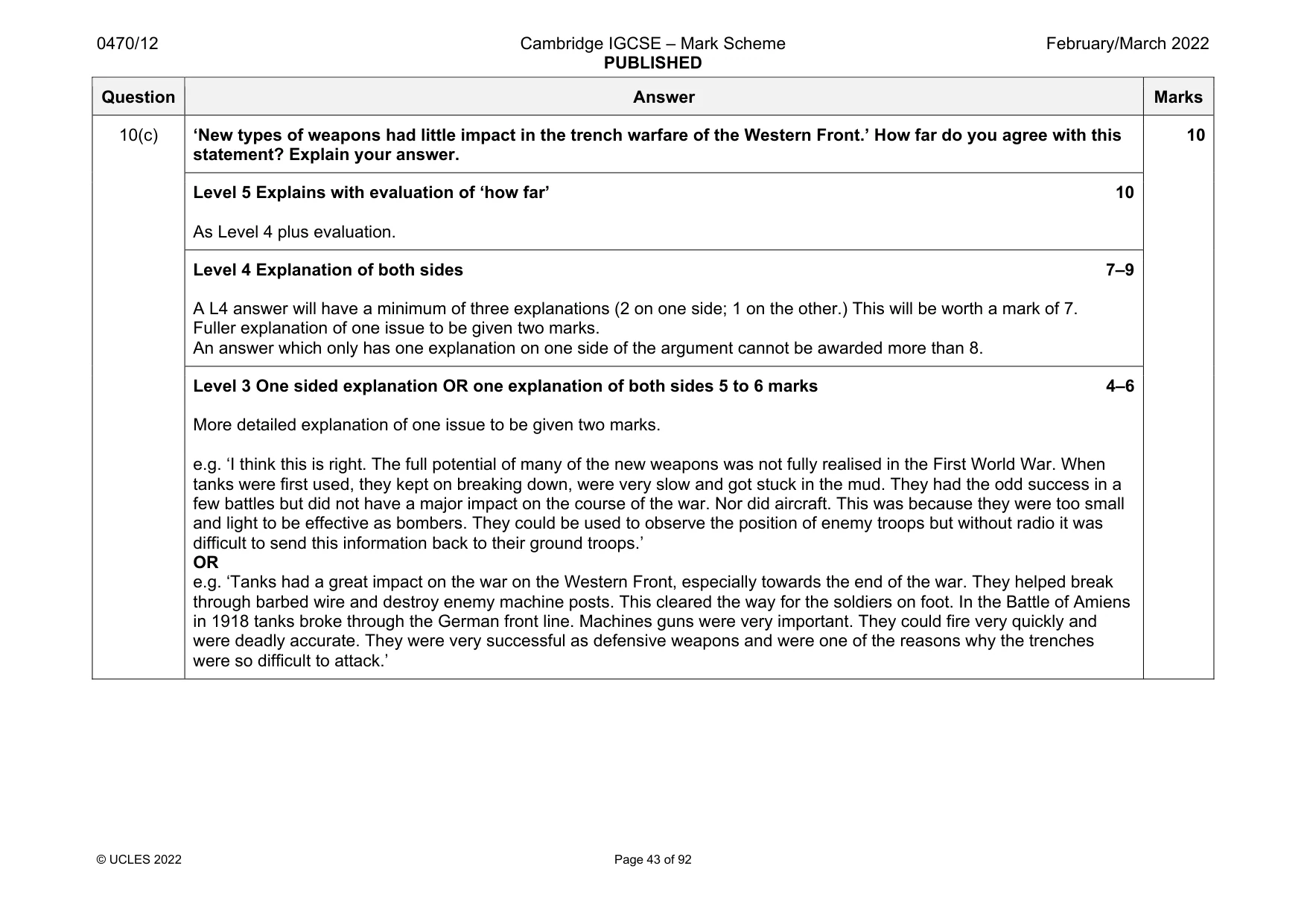
0470/12 Cambridge IGCSE – Mark Scheme PUBLISHED February/March 2022 © UCLES 2022 Page 43 of 92 Question Answer Marks 10(c) ‘New types of weapons had little impact in the trench warfare of the Western Front.’ How far do you agree with this statement? Explain your answer. 10 Level 5 Explains with evaluation of ‘how far’ 10 As Level 4 plus evaluation. Level 4 Explanation of both sides 7–9 A L4 answer will have a minimum of three explanations (2 on one side; 1 on the other.) This will be worth a mark of 7. Fuller explanation of one issue to be given two marks. An answer which only has one explanation on one side of the argument cannot be awarded more than 8. Level 3 One sided explanation OR one explanation of both sides 5 to 6 marks 4–6 More detailed explanation of one issue to be given two marks. e.g. ‘I think this is right. The full potential of many of the new weapons was not fully realised in the First World War. When tanks were first used, they kept on breaking down, were very slow and got stuck in the mud. They had the odd success in a few battles but did not have a major impact on the course of the war. Nor did aircraft. This was because they were too small and light to be effective as bombers. They could be used to observe the position of enemy troops but without radio it was difficult to send this information back to their ground troops.’ OR e.g. ‘Tanks had a great impact on the war on the Western Front, especially towards the end of the war. They helped break through barbed wire and destroy enemy machine posts. This cleared the way for the soldiers on foot. In the Battle of Amiens in 1918 tanks broke through the German front line. Machines guns were very important. They could fire very quickly and were deadly accurate. They were very successful as defensive weapons and were one of the reasons why the trenches were so difficult to attack.’
Mark scheme, page 44
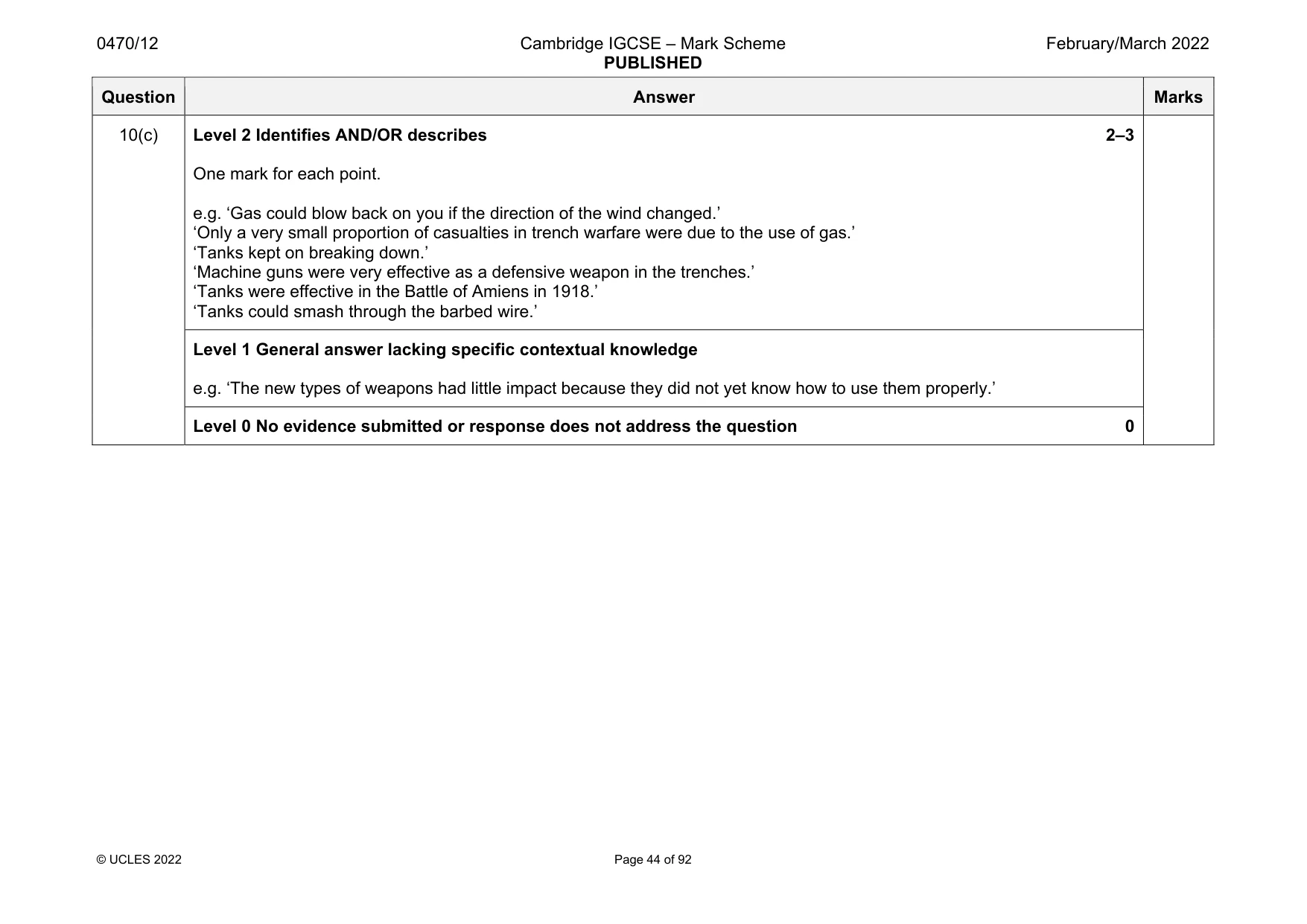
0470/12 Cambridge IGCSE – Mark Scheme PUBLISHED February/March 2022 © UCLES 2022 Page 44 of 92 Question Answer Marks 10(c) Level 2 Identifies AND/OR describes 2–3 One mark for each point. e.g. ‘Gas could blow back on you if the direction of the wind changed.’ ‘Only a very small proportion of casualties in trench warfare were due to the use of gas.’ ‘Tanks kept on breaking down.’ ‘Machine guns were very effective as a defensive weapon in the trenches.’ ‘Tanks were effective in the Battle of Amiens in 1918.’ ‘Tanks could smash through the barbed wire.’ Level 1 General answer lacking specific contextual knowledge e.g. ‘The new types of weapons had little impact because they did not yet know how to use them properly.’ Level 0 No evidence submitted or response does not address the question 0
Mark scheme, page 45
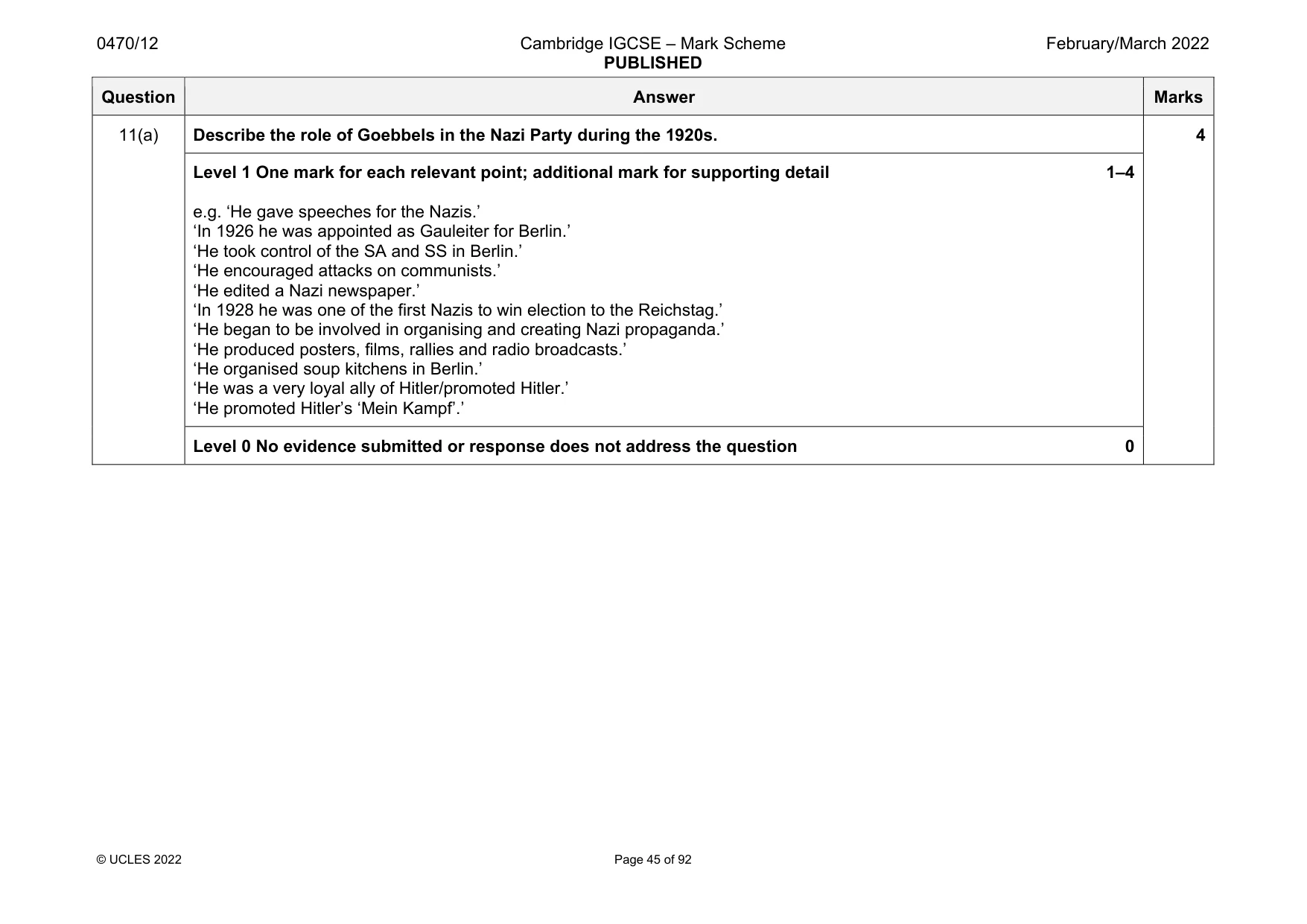
0470/12 Cambridge IGCSE – Mark Scheme PUBLISHED February/March 2022 © UCLES 2022 Page 45 of 92 Question Answer Marks 11(a) Describe the role of Goebbels in the Nazi Party during the 1920s. 4 Level 1 One mark for each relevant point; additional mark for supporting detail 1–4 e.g. ‘He gave speeches for the Nazis.’ ‘In 1926 he was appointed as Gauleiter for Berlin.’ ‘He took control of the SA and SS in Berlin.’ ‘He encouraged attacks on communists.’ ‘He edited a Nazi newspaper.’ ‘In 1928 he was one of the first Nazis to win election to the Reichstag.’ ‘He began to be involved in organising and creating Nazi propaganda.’ ‘He produced posters, films, rallies and radio broadcasts.’ ‘He organised soup kitchens in Berlin.’ ‘He was a very loyal ally of Hitler/promoted Hitler.’ ‘He promoted Hitler’s ‘Mein Kampf’.’ Level 0 No evidence submitted or response does not address the question 0
Mark scheme, page 46
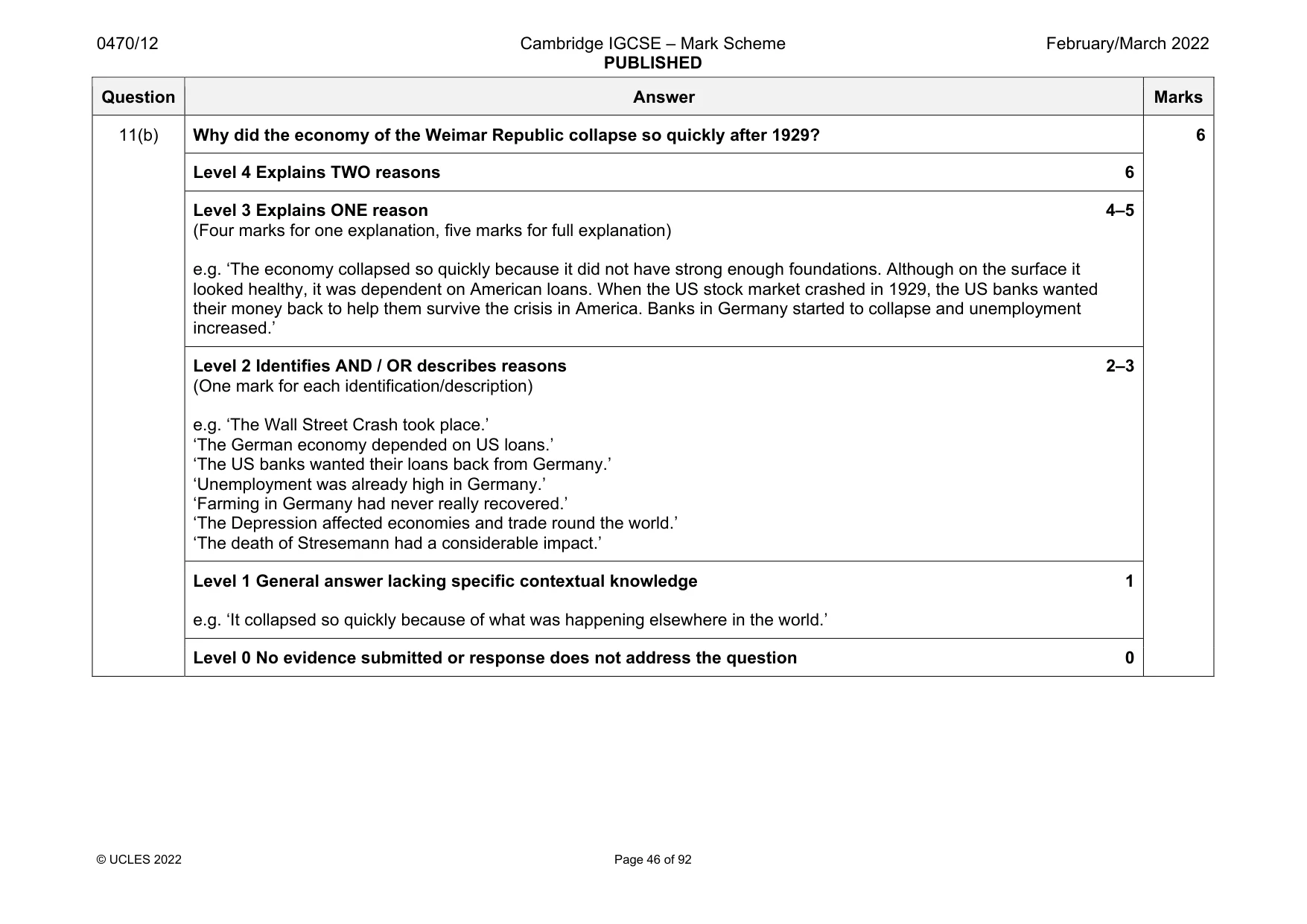
0470/12 Cambridge IGCSE – Mark Scheme PUBLISHED February/March 2022 © UCLES 2022 Page 46 of 92 Question Answer Marks 11(b) Why did the economy of the Weimar Republic collapse so quickly after 1929? 6 Level 4 Explains TWO reasons 6 Level 3 Explains ONE reason 4–5 (Four marks for one explanation, five marks for full explanation) e.g. ‘The economy collapsed so quickly because it did not have strong enough foundations. Although on the surface it looked healthy, it was dependent on American loans. When the US stock market crashed in 1929, the US banks wanted their money back to help them survive the crisis in America. Banks in Germany started to collapse and unemployment increased.’ Level 2 Identifies AND / OR describes reasons 2–3 (One mark for each identification/description) e.g. ‘The Wall Street Crash took place.’ ‘The German economy depended on US loans.’ ‘The US banks wanted their loans back from Germany.’ ‘Unemployment was already high in Germany.’ ‘Farming in Germany had never really recovered.’ ‘The Depression affected economies and trade round the world.’ ‘The death of Stresemann had a considerable impact.’ Level 1 General answer lacking specific contextual knowledge 1 e.g. ‘It collapsed so quickly because of what was happening elsewhere in the world.’ Level 0 No evidence submitted or response does not address the question 0
Mark scheme, page 47
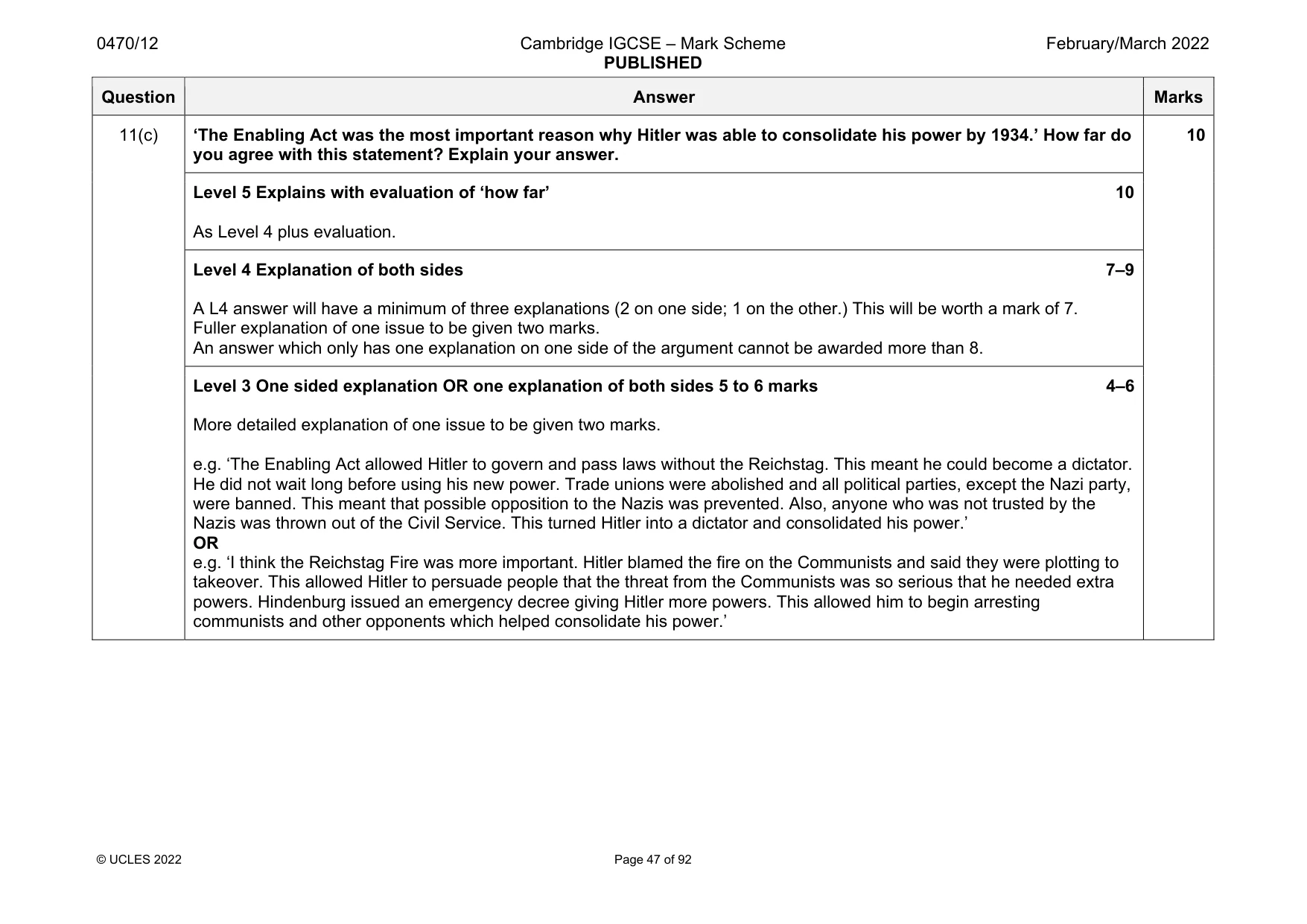
0470/12 Cambridge IGCSE – Mark Scheme PUBLISHED February/March 2022 © UCLES 2022 Page 47 of 92 Question Answer Marks 11(c) ‘The Enabling Act was the most important reason why Hitler was able to consolidate his power by 1934.’ How far do you agree with this statement? Explain your answer. 10 Level 5 Explains with evaluation of ‘how far’ 10 As Level 4 plus evaluation. Level 4 Explanation of both sides 7–9 A L4 answer will have a minimum of three explanations (2 on one side; 1 on the other.) This will be worth a mark of 7. Fuller explanation of one issue to be given two marks. An answer which only has one explanation on one side of the argument cannot be awarded more than 8. Level 3 One sided explanation OR one explanation of both sides 5 to 6 marks 4–6 More detailed explanation of one issue to be given two marks. e.g. ‘The Enabling Act allowed Hitler to govern and pass laws without the Reichstag. This meant he could become a dictator. He did not wait long before using his new power. Trade unions were abolished and all political parties, except the Nazi party, were banned. This meant that possible opposition to the Nazis was prevented. Also, anyone who was not trusted by the Nazis was thrown out of the Civil Service. This turned Hitler into a dictator and consolidated his power.’ OR e.g. ‘I think the Reichstag Fire was more important. Hitler blamed the fire on the Communists and said they were plotting to takeover. This allowed Hitler to persuade people that the threat from the Communists was so serious that he needed extra powers. Hindenburg issued an emergency decree giving Hitler more powers. This allowed him to begin arresting communists and other opponents which helped consolidate his power.’
Mark scheme, page 48
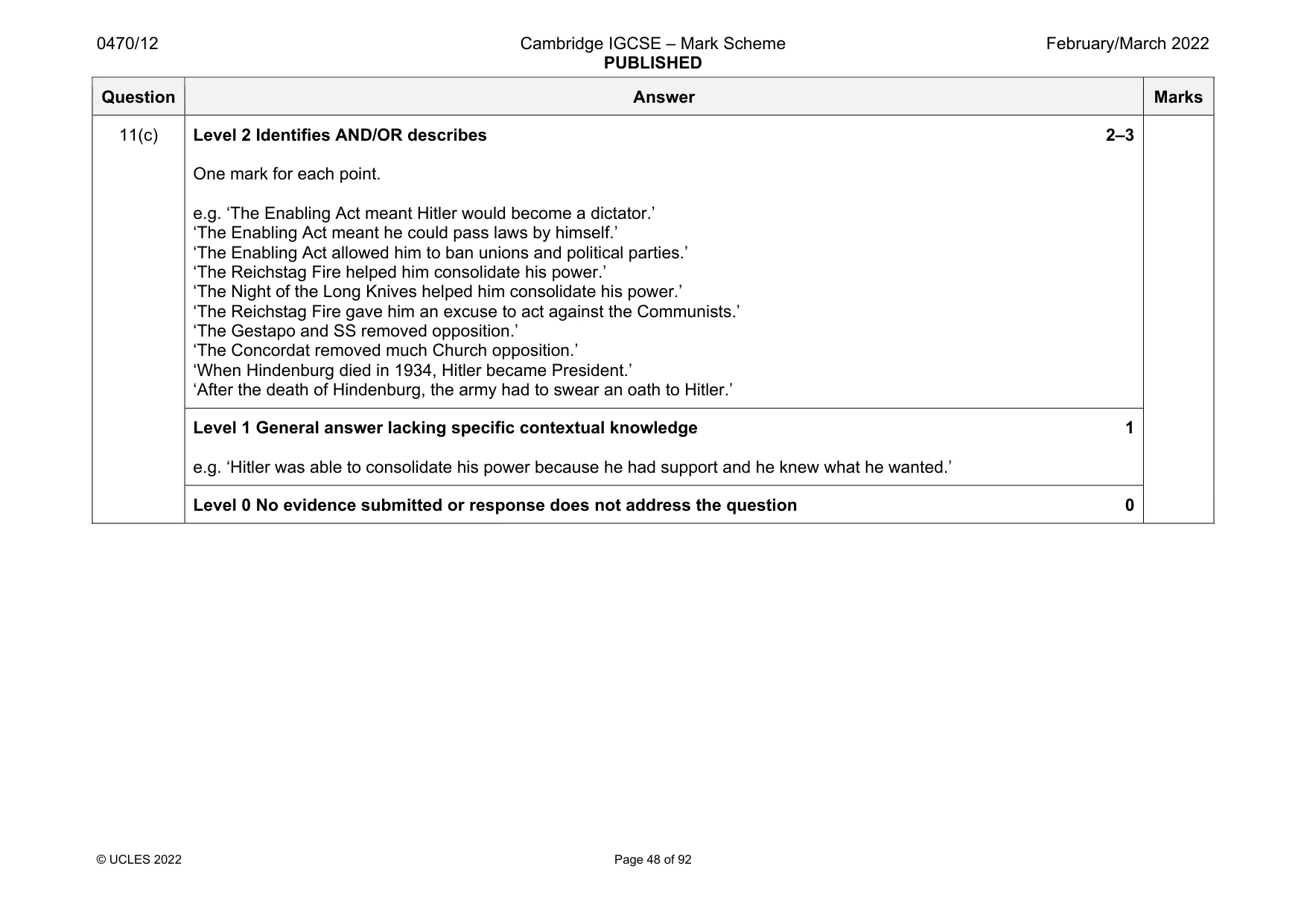
0470/12 Cambridge IGCSE – Mark Scheme PUBLISHED February/March 2022 © UCLES 2022 Page 48 of 92 Question Answer Marks 11(c) Level 2 Identifies AND/OR describes 2–3 One mark for each point. e.g. ‘The Enabling Act meant Hitler would become a dictator.’ ‘The Enabling Act meant he could pass laws by himself.’ ‘The Enabling Act allowed him to ban unions and political parties.’ ‘The Reichstag Fire helped him consolidate his power.’ ‘The Night of the Long Knives helped him consolidate his power.’ ‘The Reichstag Fire gave him an excuse to act against the Communists.’ ‘The Gestapo and SS removed opposition.’ ‘The Concordat removed much Church opposition.’ ‘When Hindenburg died in 1934, Hitler became President.’ ‘After the death of Hindenburg, the army had to swear an oath to Hitler.’ Level 1 General answer lacking specific contextual knowledge 1 e.g. ‘Hitler was able to consolidate his power because he had support and he knew what he wanted.’ Level 0 No evidence submitted or response does not address the question 0
Mark scheme, page 49
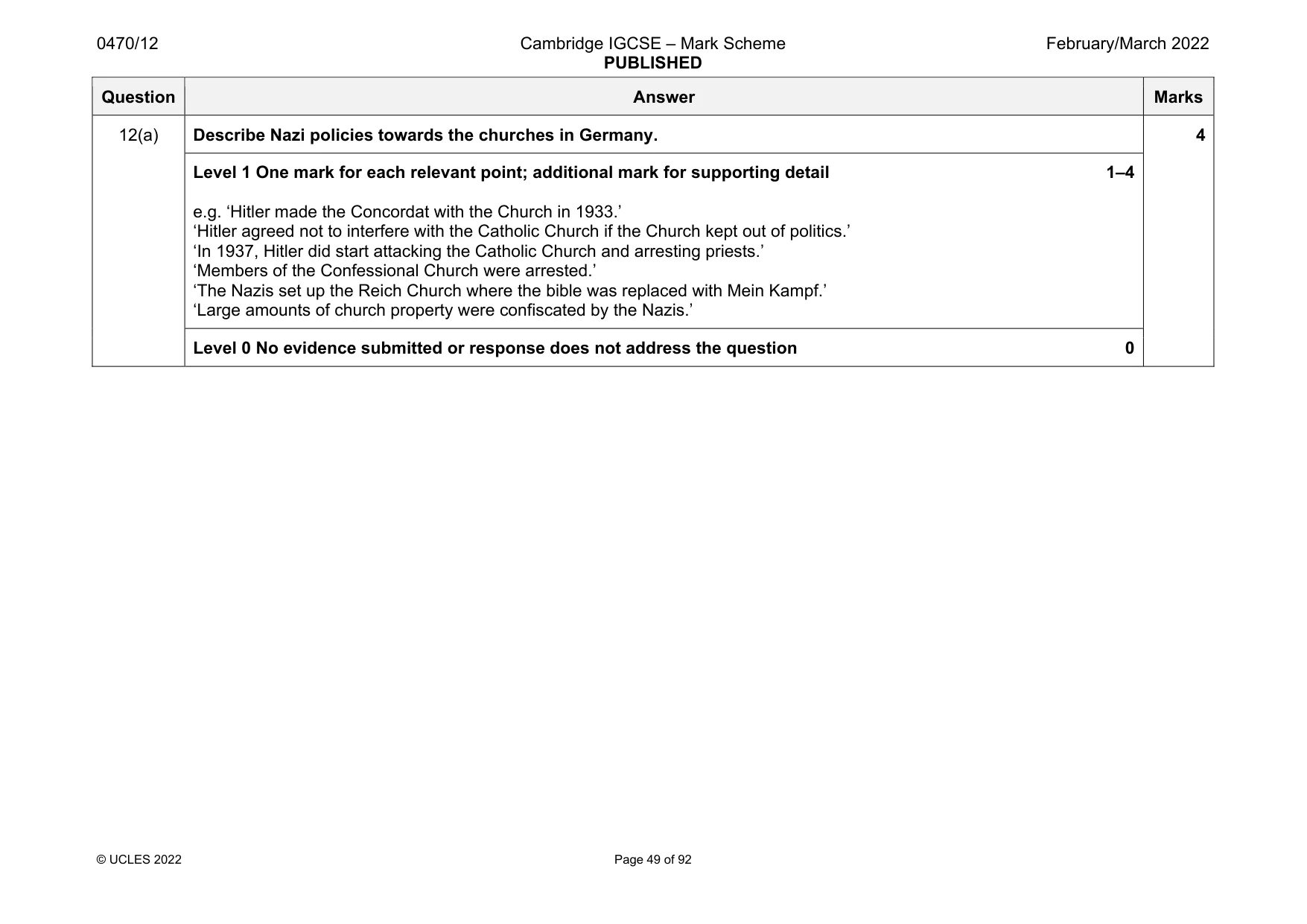
0470/12 Cambridge IGCSE – Mark Scheme PUBLISHED February/March 2022 © UCLES 2022 Page 49 of 92 Question Answer Marks 12(a) Describe Nazi policies towards the churches in Germany. 4 Level 1 One mark for each relevant point; additional mark for supporting detail 1–4 e.g. ‘Hitler made the Concordat with the Church in 1933.’ ‘Hitler agreed not to interfere with the Catholic Church if the Church kept out of politics.’ ‘In 1937, Hitler did start attacking the Catholic Church and arresting priests.’ ‘Members of the Confessional Church were arrested.’ ‘The Nazis set up the Reich Church where the bible was replaced with Mein Kampf.’ ‘Large amounts of church property were confiscated by the Nazis.’ Level 0 No evidence submitted or response does not address the question 0
Mark scheme, page 50
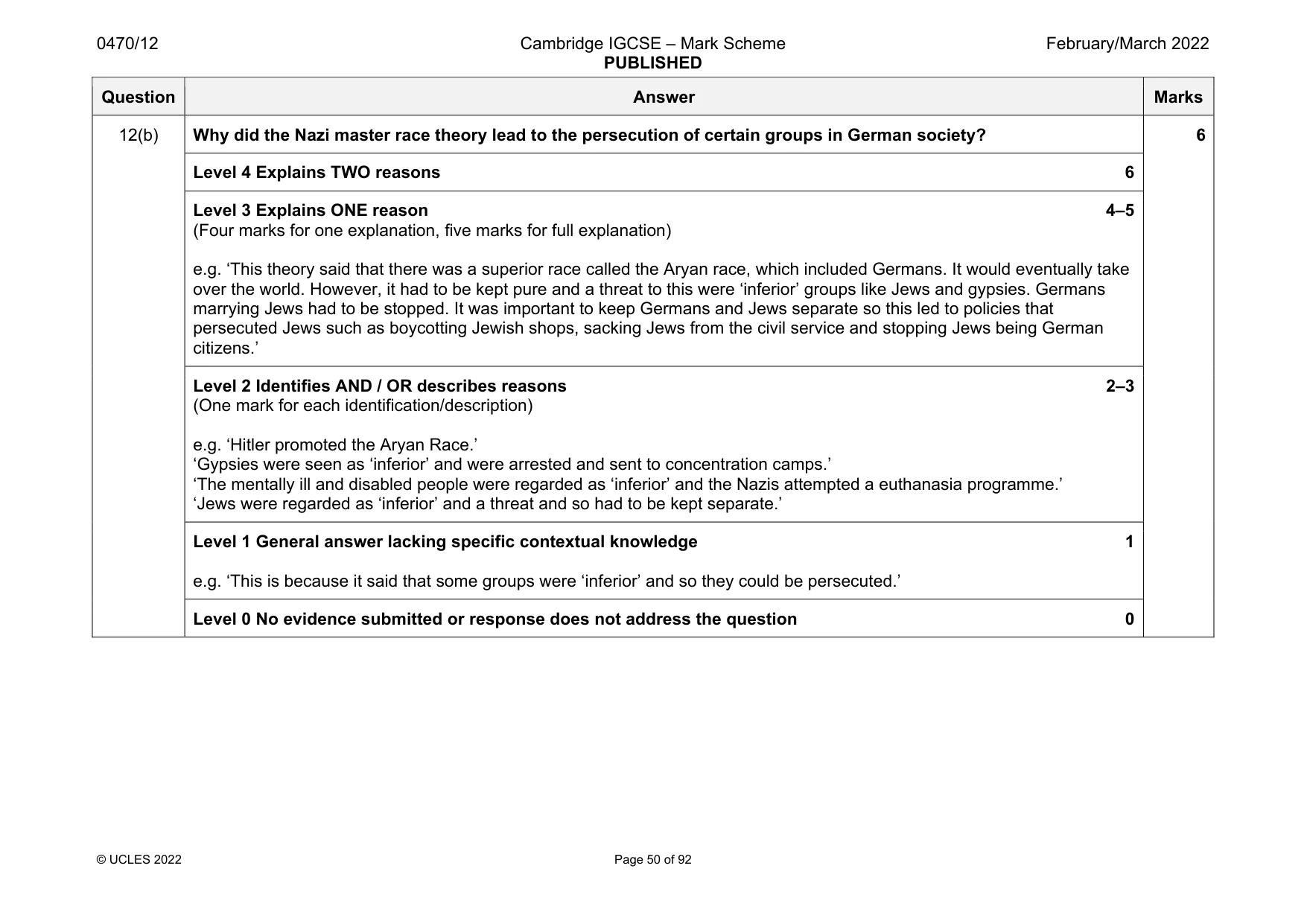
0470/12 Cambridge IGCSE – Mark Scheme PUBLISHED February/March 2022 © UCLES 2022 Page 50 of 92 Question Answer Marks 12(b) Why did the Nazi master race theory lead to the persecution of certain groups in German society? 6 Level 4 Explains TWO reasons 6 Level 3 Explains ONE reason 4–5 (Four marks for one explanation, five marks for full explanation) e.g. ‘This theory said that there was a superior race called the Aryan race, which included Germans. It would eventually take over the world. However, it had to be kept pure and a threat to this were ‘inferior’ groups like Jews and gypsies. Germans marrying Jews had to be stopped. It was important to keep Germans and Jews separate so this led to policies that persecuted Jews such as boycotting Jewish shops, sacking Jews from the civil service and stopping Jews being German citizens.’ Level 2 Identifies AND / OR describes reasons 2–3 (One mark for each identification/description) e.g. ‘Hitler promoted the Aryan Race.’ ‘Gypsies were seen as ‘inferior’ and were arrested and sent to concentration camps.’ ‘The mentally ill and disabled people were regarded as ‘inferior’ and the Nazis attempted a euthanasia programme.’ ‘Jews were regarded as ‘inferior’ and a threat and so had to be kept separate.’ Level 1 General answer lacking specific contextual knowledge 1 e.g. ‘This is because it said that some groups were ‘inferior’ and so they could be persecuted.’ Level 0 No evidence submitted or response does not address the question 0
Mark scheme, page 51
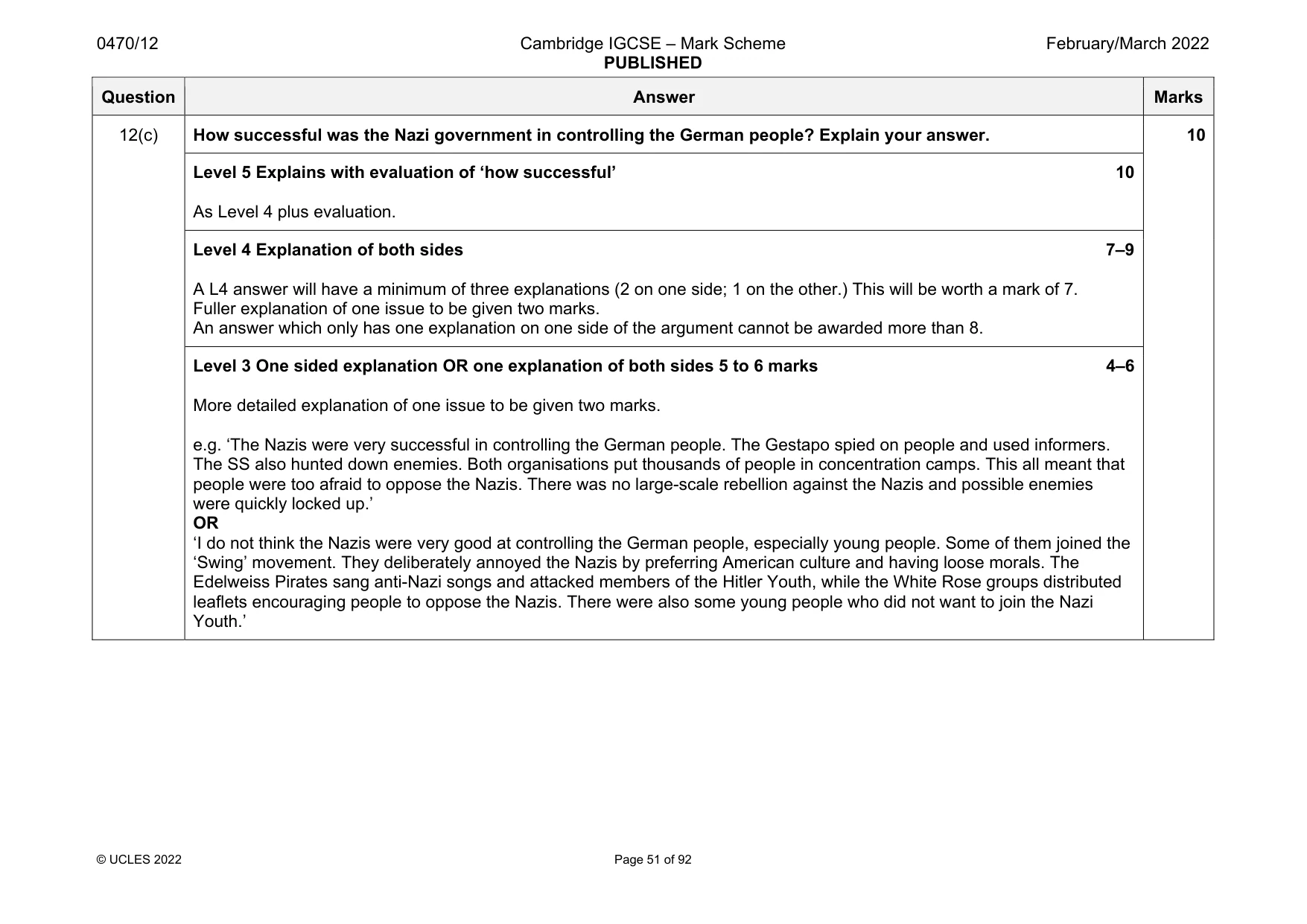
0470/12 Cambridge IGCSE – Mark Scheme PUBLISHED February/March 2022 © UCLES 2022 Page 51 of 92 Question Answer Marks 12(c) How successful was the Nazi government in controlling the German people? Explain your answer. 10 Level 5 Explains with evaluation of ‘how successful’ 10 As Level 4 plus evaluation. Level 4 Explanation of both sides 7–9 A L4 answer will have a minimum of three explanations (2 on one side; 1 on the other.) This will be worth a mark of 7. Fuller explanation of one issue to be given two marks. An answer which only has one explanation on one side of the argument cannot be awarded more than 8. Level 3 One sided explanation OR one explanation of both sides 5 to 6 marks 4–6 More detailed explanation of one issue to be given two marks. e.g. ‘The Nazis were very successful in controlling the German people. The Gestapo spied on people and used informers. The SS also hunted down enemies. Both organisations put thousands of people in concentration camps. This all meant that people were too afraid to oppose the Nazis. There was no large-scale rebellion against the Nazis and possible enemies were quickly locked up.’ OR ‘I do not think the Nazis were very good at controlling the German people, especially young people. Some of them joined the ‘Swing’ movement. They deliberately annoyed the Nazis by preferring American culture and having loose morals. The Edelweiss Pirates sang anti-Nazi songs and attacked members of the Hitler Youth, while the White Rose groups distributed leaflets encouraging people to oppose the Nazis. There were also some young people who did not want to join the Nazi Youth.’
Mark scheme, page 52
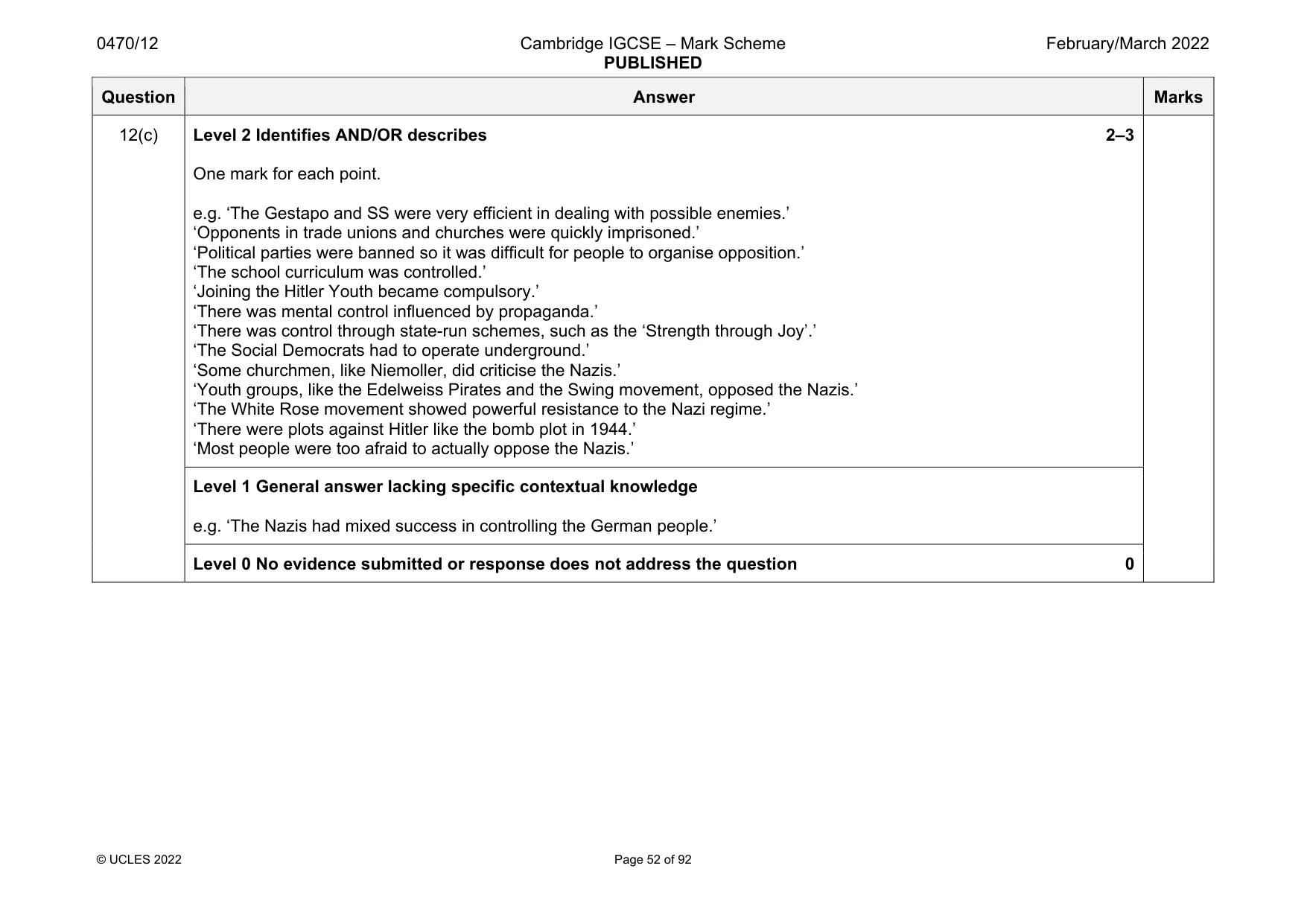
0470/12 Cambridge IGCSE – Mark Scheme PUBLISHED February/March 2022 © UCLES 2022 Page 52 of 92 Question Answer Marks 12(c) Level 2 Identifies AND/OR describes 2–3 One mark for each point. e.g. ‘The Gestapo and SS were very efficient in dealing with possible enemies.’ ‘Opponents in trade unions and churches were quickly imprisoned.’ ‘Political parties were banned so it was difficult for people to organise opposition.’ ‘The school curriculum was controlled.’ ‘Joining the Hitler Youth became compulsory.’ ‘There was mental control influenced by propaganda.’ ‘There was control through state-run schemes, such as the ‘Strength through Joy’.’ ‘The Social Democrats had to operate underground.’ ‘Some churchmen, like Niemoller, did criticise the Nazis.’ ‘Youth groups, like the Edelweiss Pirates and the Swing movement, opposed the Nazis.’ ‘The White Rose movement showed powerful resistance to the Nazi regime.’ ‘There were plots against Hitler like the bomb plot in 1944.’ ‘Most people were too afraid to actually oppose the Nazis.’ Level 1 General answer lacking specific contextual knowledge e.g. ‘The Nazis had mixed success in controlling the German people.’ Level 0 No evidence submitted or response does not address the question 0
Mark scheme, page 53
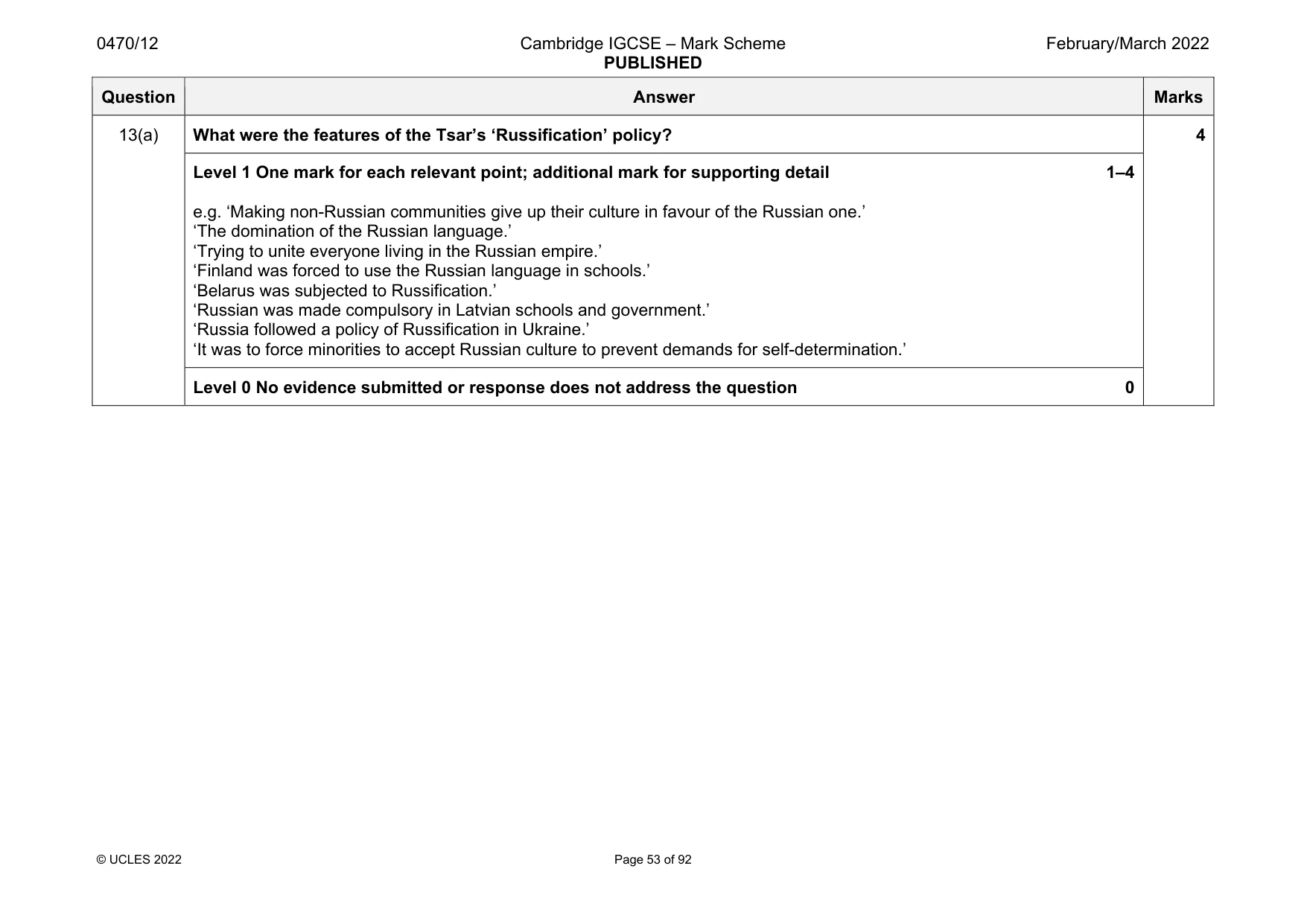
0470/12 Cambridge IGCSE – Mark Scheme PUBLISHED February/March 2022 © UCLES 2022 Page 53 of 92 Question Answer Marks 13(a) What were the features of the Tsar’s ‘Russification’ policy? 4 Level 1 One mark for each relevant point; additional mark for supporting detail 1–4 e.g. ‘Making non-Russian communities give up their culture in favour of the Russian one.’ ‘The domination of the Russian language.’ ‘Trying to unite everyone living in the Russian empire.’ ‘Finland was forced to use the Russian language in schools.’ ‘Belarus was subjected to Russification.’ ‘Russian was made compulsory in Latvian schools and government.’ ‘Russia followed a policy of Russification in Ukraine.’ ‘It was to force minorities to accept Russian culture to prevent demands for self-determination.’ Level 0 No evidence submitted or response does not address the question 0
Mark scheme, page 54
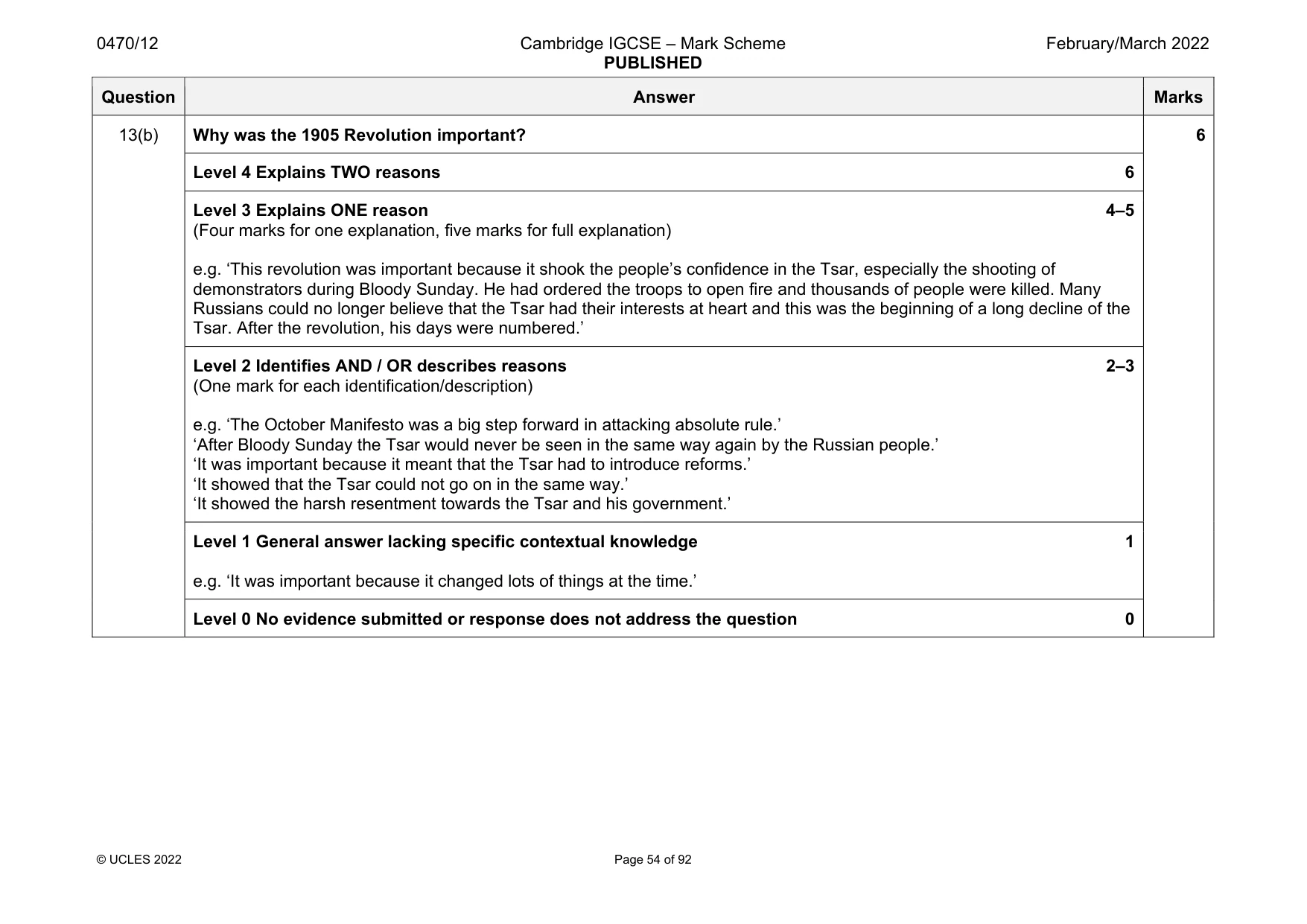
0470/12 Cambridge IGCSE – Mark Scheme PUBLISHED February/March 2022 © UCLES 2022 Page 54 of 92 Question Answer Marks 13(b) Why was the 1905 Revolution important? 6 Level 4 Explains TWO reasons 6 Level 3 Explains ONE reason 4–5 (Four marks for one explanation, five marks for full explanation) e.g. ‘This revolution was important because it shook the people’s confidence in the Tsar, especially the shooting of demonstrators during Bloody Sunday. He had ordered the troops to open fire and thousands of people were killed. Many Russians could no longer believe that the Tsar had their interests at heart and this was the beginning of a long decline of the Tsar. After the revolution, his days were numbered.’ Level 2 Identifies AND / OR describes reasons 2–3 (One mark for each identification/description) e.g. ‘The October Manifesto was a big step forward in attacking absolute rule.’ ‘After Bloody Sunday the Tsar would never be seen in the same way again by the Russian people.’ ‘It was important because it meant that the Tsar had to introduce reforms.’ ‘It showed that the Tsar could not go on in the same way.’ ‘It showed the harsh resentment towards the Tsar and his government.’ Level 1 General answer lacking specific contextual knowledge 1 e.g. ‘It was important because it changed lots of things at the time.’ Level 0 No evidence submitted or response does not address the question 0
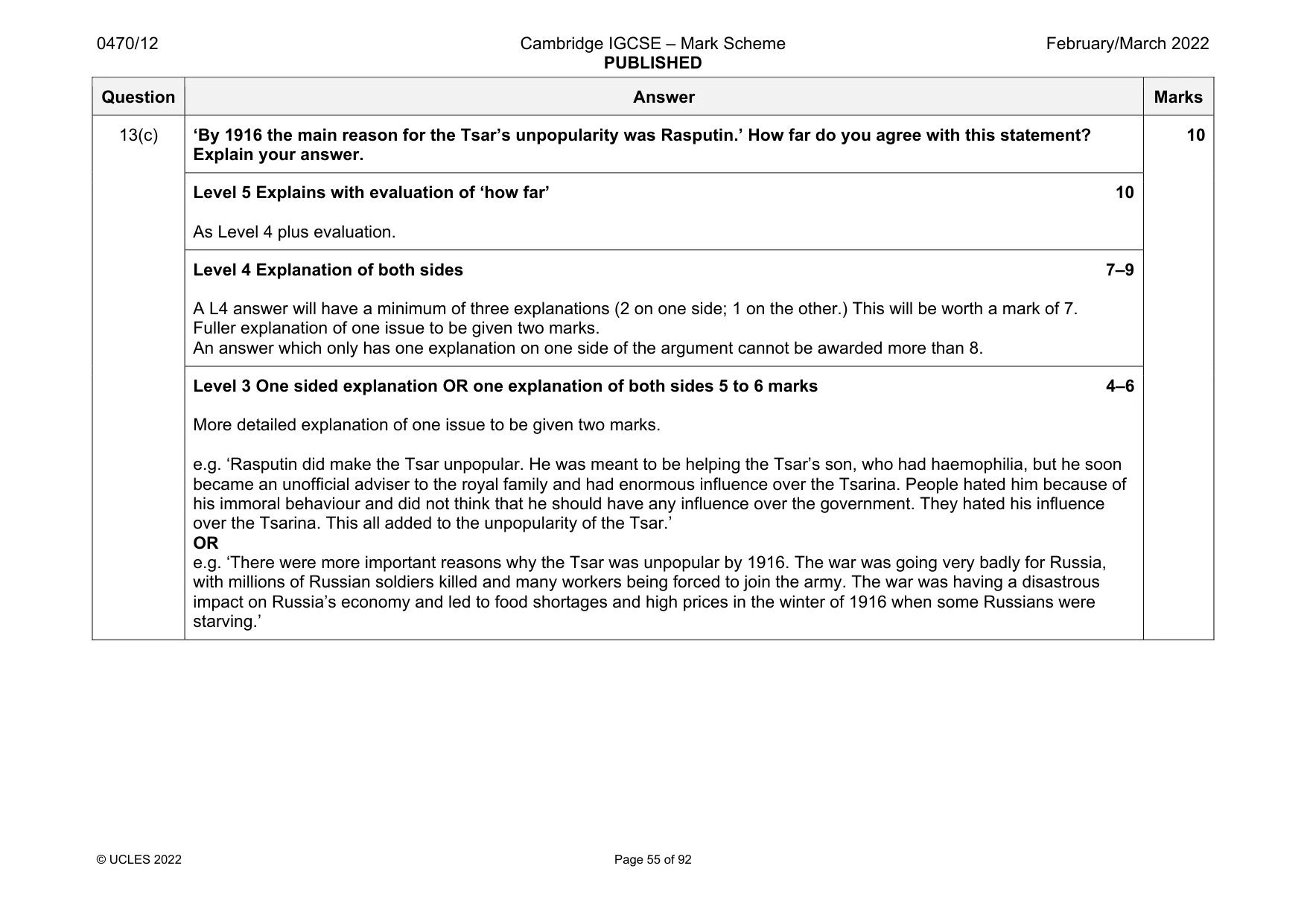
Mark scheme, page 55
0470/12 Cambridge IGCSE – Mark Scheme PUBLISHED February/March 2022 © UCLES 2022 Page 55 of 92 Question Answer Marks 13(c) ‘By 1916 the main reason for the Tsar’s unpopularity was Rasputin.’ How far do you agree with this statement? Explain your answer. 10 Level 5 Explains with evaluation of ‘how far’ 10 As Level 4 plus evaluation. Level 4 Explanation of both sides 7–9 A L4 answer will have a minimum of three explanations (2 on one side; 1 on the other.) This will be worth a mark of 7. Fuller explanation of one issue to be given two marks. An answer which only has one explanation on one side of the argument cannot be awarded more than 8. Level 3 One sided explanation OR one explanation of both sides 5 to 6 marks 4–6 More detailed explanation of one issue to be given two marks. e.g. ‘Rasputin did make the Tsar unpopular. He was meant to be helping the Tsar’s son, who had haemophilia, but he soon became an unofficial adviser to the royal family and had enormous influence over the Tsarina. People hated him because of his immoral behaviour and did not think that he should have any influence over the government. They hated his influence over the Tsarina. This all added to the unpopularity of the Tsar.’ OR e.g. ‘There were more important reasons why the Tsar was unpopular by 1916. The war was going very badly for Russia, with millions of Russian soldiers killed and many workers being forced to join the army. The war was having a disastrous impact on Russia’s economy and led to food shortages and high prices in the winter of 1916 when some Russians were starving.’
Mark scheme, page 56
0470/12 Cambridge IGCSE – Mark Scheme PUBLISHED February/March 2022 © UCLES 2022 Page 56 of 92 Question Answer Marks 13(c) Level 2 Identifies AND/OR describes 2–3 One mark for each point. e.g. ‘Rasputin had a lot of influence over the Tsarina.’ ‘Rasputin’s immoral behaviour made him and the Tsar unpopular.’ ‘People hated the fact that Rasputin was influencing government decisions.’ ‘The war led to food shortages and high prices.’ ‘The war was going badly and the Tsar got the blame for this.’ ‘The repression by the Tsar’s government had made him unpopular.’ Level 1 General answer lacking specific contextual knowledge e.g. ‘Rasputin was a controversial figure and hated by many people. He made the Tsar unpopular.’ Level 0 No evidence submitted or response does not address the question 0
Mark scheme, page 57
0470/12 Cambridge IGCSE – Mark Scheme PUBLISHED February/March 2022 © UCLES 2022 Page 57 of 92 Question Answer Marks 14(a) Describe what replaced the New Economic Policy (NEP) in the late 1920s. 4 Level 1 One mark for each relevant point; additional mark for supporting detail 1–4 e.g. ‘It was replaced by the Five-Year Plan.’ ‘More central control of the economy was introduced.’ ‘There was much more of a focus on developing heavy industry.’ ‘Targets were set for heavy industry centrally by GOSPLAN.’ ‘Huge factories were to be built.’ ‘The industrial workforce and production were to be increased.’ ‘Collective farms were introduced.’ ‘Farming was to be more efficient.’ ‘Fewer peasants would own their own farms.’ ‘The government had more control over the production of grain.’ ‘Private ownership was under attack.’ Level 0 No evidence submitted or response does not address the question 0
Mark scheme, page 58
0470/12 Cambridge IGCSE – Mark Scheme PUBLISHED February/March 2022 © UCLES 2022 Page 58 of 92 Question Answer Marks 14(b) Why did Stalin’s policies bring about changes in the lives of Soviet women? 6 Level 4 Explains TWO reasons 6 Level 3 Explains ONE reason 4–5 (Four marks for one explanation, five marks for full explanation) e.g. ‘Stalin wanted Russia to become a leading modern industrial state with heavy industry and increased production. He could not achieve this if half the population (women) was not involved. To encourage women to go out to work, free health care was introduced and creches for working mothers. After a time, there were many women engineers and doctors and they made up nearly half the industrial workforce.’ Level 2 Identifies AND / OR describes reasons 2–3 (One mark for each identification/description) e.g. ‘Stalin wanted to increase industrial production and needed women workers.’ ‘The skills of women needed to be used if the Soviet Union was to become a great power.’ ‘The introduction of paid holidays and creches encouraged more women to go out to work.’ Level 1 General answer lacking specific contextual knowledge 1 e.g. ‘These changes happened because women were needed to help the Soviet Union develop.’ Level 0 No evidence submitted or response does not address the question 0
Mark scheme, page 59
0470/12 Cambridge IGCSE – Mark Scheme PUBLISHED February/March 2022 © UCLES 2022 Page 59 of 92 Question Answer Marks 14(c) ‘Stalin changed Soviet agriculture for political rather than economic reasons.’ How far do you agree with this statement? Explain your answer. 10 Level 5 Explains with evaluation of ‘how far’ 10 As Level 4 plus evaluation. Level 4 Explanation of both sides 7–9 A L4 answer will have a minimum of three explanations (2 on one side; 1 on the other.) This will be worth a mark of 7. Fuller explanation of one issue to be given two marks. An answer which only has one explanation on one side of the argument cannot be awarded more than 8. Level 3 One sided explanation OR one explanation of both sides 5 to 6 marks 4–6 More detailed explanation of one issue to be given two marks. e.g. ‘I think he made these changes for political reasons. Collectivisation was the socialist way of farming. The ideas were that the peasants had to live and work together and learn to share. They would be working for the Soviet Union and all the people rather than just for themselves. It also involved an attack on the ‘kulaks’, the rich peasants, who went against socialist beliefs and were seen as the enemies of the people.’ OR e.g. ‘He did this for economic reasons. Stalin wanted the Soviet Union to be more efficient and produce more food. This was needed to feed more and more industrial workers and to pay for imports of technology that were needed to modernise Russia. This would be achieved by merging peasants’ farms into large collective farms where tools and animals would be shared. This was more efficient, and it was hoped would increase production.’
Mark scheme, page 60
0470/12 Cambridge IGCSE – Mark Scheme PUBLISHED February/March 2022 © UCLES 2022 Page 60 of 92 Question Answer Marks 14(c) Level 2 Identifies AND/OR describes 2–3 One mark for each point. e.g. ‘Stalin wanted to bring people more in line with Socialist principles.’ ‘The peasants would have to share and work together.’ ‘The change was aimed at destroying the ‘kulaks’.’ ‘The aim was to increase the production of food.’ ‘Russia needed more grain to export to pay for modern equipment.’ ‘More food had to be produced to feed the industrial workers.’ ‘The change would make farming more efficient and would produce more food.’ Level 1 General answer lacking specific contextual knowledge e.g. ‘Stalin changed agriculture for economic reasons because the Russian economy needed to be improved a lot.’ Level 0 No evidence submitted or response does not address the question 0
Mark scheme, page 61
0470/12 Cambridge IGCSE – Mark Scheme PUBLISHED February/March 2022 © UCLES 2022 Page 61 of 92 Question Answer Marks 15(a) What were sharecroppers? 4 Level 1 One mark for each relevant point; additional mark for supporting detail 1–4 e.g. ‘Tenants had small plots of land to farm themselves.’ ‘In return, the tenants paid the landowner a share of the crops they produced.’ ‘Sharecroppers worked the land independently.’ ‘Sharecroppers grew cotton, tobacco and rice and received part of the crops.’ ‘Sharecroppers were to be found in the south of the USA.’ Sharecroppers were American farmers who did not own their land.’ Level 0 No evidence submitted or response does not address the question 0
Mark scheme, page 62
0470/12 Cambridge IGCSE – Mark Scheme PUBLISHED February/March 2022 © UCLES 2022 Page 62 of 92 Question Answer Marks 15(b) Why were many American farmers in the 1920s producing more than they could sell? 6 Level 4 Explains TWO reasons 6 Level 3 Explains ONE reason 4–5 (Four marks for one explanation, five marks for full explanation) e.g. ‘During the First World War, demand from Europe for food had gone up and farmers invested in their farms. After the end of the war, demand went down and farmers found they were producing more than they could sell because improved machinery, especially the combine harvester, and improved fertilisers, made their farms very efficient. The result was that the US farmer was producing surpluses which nobody wanted.’ Level 2 Identifies AND / OR describes reasons 2–3 (One mark for each identification/description) e.g. ‘Food exports to Europe were reduced.’ ‘There was competition from Canada and Argentina.’ ‘Improved efficiency on farms meant that they produced more.’ ‘European nations would not take US farm products as the US had placed tariffs on imports.’ ‘Not so much grain was needed in the USA because tastes were changing to more luxurious foods.’ ‘Europe began producing more of its own food.’ Level 1 General answer lacking specific contextual knowledge 1 e.g. ‘American farmers were producing large amounts of food but no one wanted to buy it.’ Level 0 No evidence submitted or response does not address the question 0
Mark scheme, page 63
0470/12 Cambridge IGCSE – Mark Scheme PUBLISHED February/March 2022 © UCLES 2022 Page 63 of 92 Question Answer Marks 15(c) How far was the car industry responsible for America’s economic boom of the 1920s? Explain your answer. 10 Level 5 Explains with evaluation of ‘how far’ 10 As Level 4 plus evaluation. Level 4 Explanation of both sides 7–9 A L4 answer will have a minimum of three explanations (2 on one side; 1 on the other.) This will be worth a mark of 7. Fuller explanation of one issue to be given two marks. An answer which only has one explanation on one side of the argument cannot be awarded more than 8. Level 3 One sided explanation OR one explanation of both sides 5 to 6 marks 4–6 More detailed explanation of one issue to be given two marks. e.g. ‘The car industry did drive America’s boom in the 1920s. The mass production methods using the assembly line meant that large numbers of cars could be produced at low prices. Many people in the USA could afford one. The explosion of the car industry created a demand for other products such as tyres, steel, rubber and glass. Suburbs developed because people could drive to work and garages and hotels also multiplied. All this caused the economic boom.’ OR e.g. ‘I think the main reasons for America’s economic boom were factors like advertising and hire purchase. This encouraged people to spend more. Advertisements appeared everywhere – in the cinema, on posters and in newspapers. They made all kinds of goods look attractive and necessary and people bought them. Hire purchase meant that people did not have to have all the money to buy goods, they could spread the cost over years. This also encouraged them to spend more. This increase in spending meant that industry could sell lots of good and many jobs were created.’
Mark scheme, page 64
0470/12 Cambridge IGCSE – Mark Scheme PUBLISHED February/March 2022 © UCLES 2022 Page 64 of 92 Question Answer Marks 15(c) Level 2 Identifies AND/OR describes 2–3 One mark for each point. e.g. ‘The car industry led to the development and building of suburbs.’ ‘The car industry led to a demand for rubber, leather and glass.’ ‘The car industry led to a lot of building work - garages and cinemas.’ ‘The car industry led to much road building and opening of hotels, providing employment.’ ‘Hire purchase meant people could buy things that they could not otherwise have afforded.’ ‘Mass production made goods cheaper, so people bought more of them.’ ‘Electrification in homes led to people buying fridges, washing machines and vacuum cleaners.’ ‘Republican policies of low taxation and laissez-faire encouraged growth.’ ‘There was a confidence after the First World War.’ ‘There was increased activity in stocks and shares.’ Level 1 General answer lacking specific contextual knowledge e.g. ‘Numerous economic factors combined to produce the boom, not just the car industry.’ Level 0 No evidence submitted or response does not address the question 0
Mark scheme, page 65
0470/12 Cambridge IGCSE – Mark Scheme PUBLISHED February/March 2022 © UCLES 2022 Page 65 of 92 Question Answer Marks 16(a) Who was Huey Long? 4 Level 1 One mark for each relevant point; additional mark for supporting detail 1–4 e.g. ‘Huey Long was Democratic politician.’ ‘He was Governor of Louisiana.’ ‘He was a Senator in 1932.’ ‘Huey Long wanted the New Deal to be more radical.’ ‘He wanted to redistribute wealth in the USA more/Share Our Wealth scheme.’ ‘He was a critic of the New Deal/Roosevelt.’ ‘He had millions of supporters.’ ‘He wanted higher taxes for the rich.’ ‘He wanted pensions for those over 60 years.’ ‘He wanted free education for all.’ ‘He planned to stand in the presidential election.’ ‘He was assassinated in 1935.’ Level 0 No evidence submitted or response does not address the question 0
Mark scheme, page 66
0470/12 Cambridge IGCSE – Mark Scheme PUBLISHED February/March 2022 © UCLES 2022 Page 66 of 92 Question Answer Marks 16(b) Why was unemployment still high at the end of the 1930s? 6 Level 4 Explains TWO reasons 6 Level 3 Explains ONE reason 4–5 (Four marks for one explanation, five marks for full explanation) e.g. ‘One reason why unemployment was still high was that the wages of many workers were low throughout the 1930s. In rural areas farming had not recovered much and many farmers had little money. This meant that many people in the USA could not buy new goods made by US industry so the factories could not offer many new jobs.’ Level 2 Identifies AND / OR describes reasons 2–3 (One mark for each identification/description) e.g. ‘People’s wages remained low.’ ‘In 1937 Roosevelt reduced public spending and this slowed down the economy.’ ‘Use of modern machinery in farming and industry reduced the number of jobs.’ ‘Farming had to reduce production so there were fewer jobs.’ ‘Other countries were suffering from the Depression.’ ‘Some sections of society did not benefit from the New Deal.’ Level 1 General answer lacking specific contextual knowledge 1 e.g. ‘Unemployment was still high because America had not solved all of its economic problems.’ Level 0 No evidence submitted or response does not address the question 0
Mark scheme, page 67
0470/12 Cambridge IGCSE – Mark Scheme PUBLISHED February/March 2022 © UCLES 2022 Page 67 of 92 Question Answer Marks 16(c) ‘The first and second New Deals were very different.’ How far do you agree with this statement? Explain your answer. 10 Level 5 Explains with evaluation of ‘how far’ 10 As Level 4 plus evaluation. Level 4 Explanation of both sides 7–9 A L4 answer will have a minimum of three explanations (2 on one side; 1 on the other.) This will be worth a mark of 7. Fuller explanation of one issue to be given two marks. An answer which only has one explanation on one side of the argument cannot be awarded more than 8. Level 3 One sided explanation OR one explanation of both sides 5 to 6 marks 4–6 More detailed explanation of one issue to be given two marks. e.g. ‘They were very different. This is because the focus of the second New Deal was very much on helping people who were suffering from the Depression and making society fairer. An insurance scheme was introduced to provide money for pensions and unemployment help. Farm workers were helped by being resettled and laws were introduced allowing workers to form trade unions. The First New Deal had been more about rebuilding the economy and the banking system. The Second New Deal was more about helping the victims of the Depression through social justice and workers’ rights.’ OR e.g. ‘I do not think they were very different. They were both about dealing with the Depression and helping people that were struggling. There was help for the unemployed through public works in the First New Deal and the Second New Deal also did this through building schools and hospitals and work against soil erosion. Both helped farmers and the poor. The First New Deal provided soup kitchens and clothing, while the Second New Deal provided unemployment money.’
Mark scheme, page 68
0470/12 Cambridge IGCSE – Mark Scheme PUBLISHED February/March 2022 © UCLES 2022 Page 68 of 92 Question Answer Marks 16(c) Level 2 Identifies AND/OR describes 2–3 One mark for each point. e.g. ‘The Second New Deal was more about providing social justice and a fair society.’ ‘The Second New Deal set up unemployment money paid for by taxes for the first time in the USA.’ ‘The First New Deal was more about getting the economy going again.’ ‘The First New Deal saved the banking system, the Second New Deal had other aims.’ ‘They both helped the poor.’ ‘They both were aimed at creating jobs.’ ‘They both dealt with agricultural issues.’ Level 1 General answer lacking specific contextual knowledge 1 e.g. ‘The two New Deals were aimed at different kinds of problems.’ Level 0 No evidence submitted or response does not address the question 0
Mark scheme, page 69
0470/12 Cambridge IGCSE – Mark Scheme PUBLISHED February/March 2022 © UCLES 2022 Page 69 of 92 Question Answer Marks 17(a) What were collective farms? 4 Level 1 One mark for each relevant point; additional mark for supporting detail 1–4 e.g. ‘Many families joined their land together to form one large farm.’ ‘Collective farms meant that private ownership of land stopped.’ ‘The workers on the collective farm received a wage from the state.’ ‘The idea was that they would be more efficient than lots of small farms.’ Level 0 No evidence submitted or response does not address the question 0
Mark scheme, page 70
0470/12 Cambridge IGCSE – Mark Scheme PUBLISHED February/March 2022 © UCLES 2022 Page 70 of 92 Question Answer Marks 17(b) Why did Mao introduce social reforms in the 1950s? 6 Level 4 Explains TWO reasons 6 Level 3 Explains ONE reason 4–5 (Four marks for one explanation, five marks for full explanation) e.g. ‘Mao introduced social reforms because he wanted to modernise China and make it an industrial country. If workers were going to be able to help industrial development, they needed to be educated so that they could operate machinery and run factories. The most important thing was to improve literacy and by the 1960s Mao had achieved a 90% literacy rate.’ Level 2 Identifies AND / OR describes reasons 2–3 (One mark for each identification/description) e.g. ‘To help industrial development.’ ‘Education was important so that people could understand and learn Mao’s ideas.’ ‘Mao wanted to achieve an equal socialist society and so marriage reforms gave women equal rights.’ ‘Maternity leave and child-care allowed women to have jobs to help China’s development.’ ‘Religion was discouraged so that people could use Mao’s thoughts as their belief system.’ ‘Improved medical treatments led to improved life expectancy. This helped China’s modernisation and economic growth.’ Level 1 General answer lacking specific contextual knowledge 1 e.g. ‘Social reforms were introduced to give people more help.’ Level 0 No evidence submitted or response does not address the question 0
Mark scheme, page 71
0470/12 Cambridge IGCSE – Mark Scheme PUBLISHED February/March 2022 © UCLES 2022 Page 71 of 92 Question Answer Marks 17(c) How far were the difficulties of the Great Leap Forward due to the introduction of backyard furnaces? Explain your answer. 10 Level 5 Explains with evaluation of ‘how far’ 10 As Level 4 plus evaluation. Level 4 Explanation of both sides 7–9 A L4 answer will have a minimum of three explanations (2 on one side; 1 on the other.) This will be worth a mark of 7. Fuller explanation of one issue to be given two marks. An answer which only has one explanation on one side of the argument cannot be awarded more than 8. Level 3 One sided explanation OR one explanation of both sides 5 to 6 marks 4–6 More detailed explanation of one issue to be given two marks. e.g. ‘I think the backyard furnaces were mainly to blame. They were introduced to try and ensure that industrial production was carried out by peasants on the communes. This was to increase China’s industrial production overall. The problem was that peasants were taken away from farming to work on the furnaces. This meant that less food was being produced and this was desperately needed. Crops and land were wasted and there was a serious famine with millions dying.’ OR e.g. ‘I think it failed because of the way it was handled by the Chinese government and officials. They lied about the production figures and forced communes to sell more grain than they could spare. This led to food shortages. They also forced new farming methods on the peasants which did not work and reduced food production. The peasants could not get enough food to stay alive because the commune system took away the peasants’ ability to produce some food on their own land. This all led to famine.’
Mark scheme, page 72
0470/12 Cambridge IGCSE – Mark Scheme PUBLISHED February/March 2022 © UCLES 2022 Page 72 of 92 Question Answer Marks 17(c) Level 2 Identifies AND/OR describes 2–3 One mark for each point. e.g. ‘The backyard furnaces produced low quality pig iron that was not much good for anything.’ ‘The peasants did not have the skills to use the furnaces properly.’ ‘The furnaces took peasants away from producing food.’ ‘Experimental methods were forced on peasants and produced less food.’ ‘Too much food was sold abroad.’ ‘It led to a fall in food production and famine.’ Level 1 General answer lacking specific contextual knowledge e.g. ‘The Great Leap Forward failed for many reasons. It ended in a disaster.’ Level 0 No evidence submitted or response does not address the question 0
Mark scheme, page 73
0470/12 Cambridge IGCSE – Mark Scheme PUBLISHED February/March 2022 © UCLES 2022 Page 73 of 92 Question Answer Marks 18(a) Describe what happened to the education system in China during the Cultural Revolution. 4 Level 1 One mark for each relevant point; additional mark for supporting detail 1–4 e.g. ‘Students were sent to the countryside and schools and colleges were closed.’ ‘Education involved teaching Mao’s ideas instead of teaching skills.’ ‘Teachers and scientists suffered.’ ‘The education system was brought to a halt.’ ‘Education standards fell.’ ‘University entrance exams were abolished.’ ‘Students had to be used as teachers.’ ‘In some rural areas middle school education was introduced for the first time.’ ‘University education suffered very badly and there were not enough highly educated people like scientists being produced.’ Level 0 No evidence submitted or response does not address the question 0
Mark scheme, page 74
0470/12 Cambridge IGCSE – Mark Scheme PUBLISHED February/March 2022 © UCLES 2022 Page 74 of 92 Question Answer Marks 18(b) Why did people in China feel the way they did about the Gang of Four? 6 Level 4 Explains TWO reasons 6 Level 3 Explains ONE reason 4–5 (Four marks for one explanation, five marks for full explanation) e.g. ‘The Gang of Four was intensely disliked because it had been involved in enforcing the Cultural Revolution. This had led to many people suffering through torture and imprisonment. People lost their jobs and their property. Members of the Gang of Four like Jiang Qing, Mao’s wife, were often seen as responsible for the worst features of the Cultural Revolution and were therefore disliked.’ Level 2 Identifies AND / OR describes reasons 2–3 (One mark for each identification/description) e.g. ‘This was because they were blamed for the Cultural Revolution.’ ‘They tried to seize power after Mao’s death.’ ‘The Communist Party turned against them and spread propaganda denouncing them. This led to public celebrations when they were arrested.’ Level 1 General answer lacking specific contextual knowledge 1 e.g. ‘They were hated because they were seen as selfish and only acting for their benefit.’ Level 0 No evidence submitted or response does not address the question 0
Mark scheme, page 75
0470/12 Cambridge IGCSE – Mark Scheme PUBLISHED February/March 2022 © UCLES 2022 Page 75 of 92 Question Answer Marks 18(c) How different was China under Deng compared with China under Mao? Explain your answer. 10 Level 5 Explains with evaluation of ‘how different’ 10 As Level 4 plus evaluation. Level 4 Explanation of both sides 7–9 A L4 answer will have a minimum of three explanations (2 on one side; 1 on the other.) This will be worth a mark of 7. Fuller explanation of one issue to be given two marks. An answer which only has one explanation on one side of the argument cannot be awarded more than 8. Level 3 One sided explanation OR one explanation of both sides 5 to 6 marks 4–6 More detailed explanation of one issue to be given two marks. e.g. ‘Deng believed that the chaos of the Cultural Revolution had held back economic growth. Although he did introduce political reforms, his main concern was economic growth and to achieve this China needed stability. He would not let greater freedoms put stability and economic growth in danger and so, like Mao, he was ready to deal very strongly with opponents and demonstrations. OR e.g. ‘Deng wanted to modernise China so that it could compete with the West in consumer goods and industrial production. In many ways this involved westernising the Chinese economy which was a very different approach from Mao’s. People were able to buy many more consumer goods like bikes, radios and televisions and there was even inflation. In the countryside there were great changes. Peasants were able to run their own farms and sell their produce. This led to an increase in production because the peasants would benefit from more production.’
Mark scheme, page 76
0470/12 Cambridge IGCSE – Mark Scheme PUBLISHED February/March 2022 © UCLES 2022 Page 76 of 92 Question Answer Marks 18(c) Level 2 Identifies AND/OR describes 2–3 One mark for each point. e.g. ‘The Chinese economy moved towards a western-style economy.’ ‘He opened China up to foreign trade.’ ‘He improved relations with the USA and Japan.’ ‘The country was modernised.’ ‘He reached an agreement with Britain over Hong Kong.’ ‘Deng focused on export-led economic growth.’ ‘Deng encouraged foreign investment and foreign companies to set up in China.’ ‘Communes were dismantled.’ ‘Private companies were set up.’ ‘Political prisoners were released.’ ‘The Chinese people were given more freedoms.’ ‘China remained as a one-party state.’ ‘Questioning the right of the Communist Party to rule was still not allowed.’ ‘Many freedoms were abolished.’ ‘In 1983 he introduced the Strike Hard Anti-Crime Campaign.’ Level 1 General answer lacking specific contextual knowledge e.g. ‘There were lots of reforms and changes under Deng.’ Level 0 No evidence submitted or response does not address the question 0
Mark scheme, page 77
0470/12 Cambridge IGCSE – Mark Scheme PUBLISHED February/March 2022 © UCLES 2022 Page 77 of 92 Question Answer Marks 19(a) Describe how the pass system worked in South Africa before 1948. 4 Level 1 One mark for each relevant point; additional mark for supporting detail 1–4 e.g. ‘Every black male over 16 had to carry a pass.’ ‘The police could demand to see a person’s pass at any time.’ ‘The pass contained a black man’s personal and work details.’ ‘If a black man failed to produce his pass, he could be imprisoned or deported to a black reservation.’ ‘The pass system was used by the authorities to control the movement of black Africans.’ Level 0 No evidence submitted or response does not address the question 0
Mark scheme, page 78
0470/12 Cambridge IGCSE – Mark Scheme PUBLISHED February/March 2022 © UCLES 2022 Page 78 of 92 Question Answer Marks 19(b) Why did many black South Africans work in the migrant labour system? 6 Level 4 Explains TWO reasons 6 Level 3 Explains ONE reason 4–5 (Four marks for one explanation, five marks for full explanation) e.g. ‘Many worked in the migrant labour system because the mines and the cities needed cheap labour but white South Africans did not want the black workers living there permanently. The black workers would leave their families in the homelands and work in the mines for a certain length of time. This was very convenient for the mine owners and white South Africans who did not want to live alongside black South Africans. When the worker’s contract was over the black workers had to return to their homeland.’ Level 2 Identifies AND / OR describes reasons 2–3 (One mark for each identification/description) e.g. ‘They wanted to work in the mines.’ ‘There were no jobs for them in the homelands.’ ‘They were able to do this because the homelands were not recognised as part of South Africa so they qualified as ‘migrant’.’ ‘White industrialists wanted cheap labour.’ ‘It gave black workers a chance to earn some cash.’ Level 1 General answer lacking specific contextual knowledge 1 e.g. ‘They did this because there were few other jobs available.’ Level 0 No evidence submitted or response does not address the question 0
Mark scheme, page 79
0470/12 Cambridge IGCSE – Mark Scheme PUBLISHED February/March 2022 © UCLES 2022 Page 79 of 92 Question Answer Marks 19(c) ‘Between 1919 and 1945 the South African economy depended on gold mining.’ How far do you agree with this statement? Explain your answer. 10 Level 5 Explains with evaluation of ‘how far’ 10 As Level 4 plus evaluation. Level 4 Explanation of both sides 7–9 A L4 answer will have a minimum of three explanations (2 on one side; 1 on the other.) This will be worth a mark of 7. Fuller explanation of one issue to be given two marks. An answer which only has one explanation on one side of the argument cannot be awarded more than 8. Level 3 One sided explanation OR one explanation of both sides 5 to 6 marks 4–6 More detailed explanation of one issue to be given two marks. e.g. ‘Gold mining was the engine of South Africa’s economy. It created many jobs and made up most of the country’s exports, earning money that could be used to buy other things that South Africa needed, like oil. The industry also paid the South African government lots of taxes and it led to other industries being developed like making miners’ boots and mine equipment.’ OR e.g. ‘Although gold mining was important, South Africa did not depend completely on gold mining. This is because there were other important industries like farming. More jobs were created in farming than in any other industry. There were also other industries that were developing like the iron and steel industry.’ Level 2 Identifies AND/OR describes 2–3 One mark for each point. e.g. ‘Gold mining provided lots of jobs.’ ‘Gold was an important export for South Africa, earning it lots of money.’ ‘Gold mining created other industries like those making mine machinery.’ ‘The gold mining industry paid lots of taxes to the government.’ ‘Farming provided more jobs than any other industry.’ ‘Industries like iron and steel were growing.’
Mark scheme, page 80
0470/12 Cambridge IGCSE – Mark Scheme PUBLISHED February/March 2022 © UCLES 2022 Page 80 of 92 Question Answer Marks 19(c) Level 1 General answer lacking specific contextual knowledge e.g. ‘Gold mining was very important to the economy but there were other important industries as well.’ Level 0 No evidence submitted or response does not address the question 0
Mark scheme, page 81
0470/12 Cambridge IGCSE – Mark Scheme PUBLISHED February/March 2022 © UCLES 2022 Page 81 of 92 Question Answer Marks 20(a) Describe the contribution made by Oliver Tambo to the fall of apartheid. 4 Level 1 One mark for each relevant point; additional mark for supporting detail 1–4 e.g. ‘He set up ANC offices round the world to win support against apartheid in South Africa.’ ‘He spoke at the UN against apartheid.’ ‘He was President of the ANC between 1967 and 1991.’ ‘He organised guerrilla activities in South Africa.’ ‘He was important in keeping the ANC together.’ Level 0 No evidence submitted or response does not address the question 0
Mark scheme, page 82
0470/12 Cambridge IGCSE – Mark Scheme PUBLISHED February/March 2022 © UCLES 2022 Page 82 of 92 Question Answer Marks 20(b) Why did Mandela face opposition from some black South Africans during his discussions with de Klerk in the early 1990s? 6 Level 4 Explains TWO reasons 6 Level 3 Explains ONE reason 4–5 (Four marks for one explanation, five marks for full explanation) e.g. ‘The main opposition came from Chief Buthelezi, head of Inkatha and Prime Minister of KwaZula. He hoped to make KwaZula an independent state while Mandela wanted a unified South Africa. This led to some violence from Zulus and a threat to boycott the elections in 1994.’ Level 2 Identifies AND / OR describes reasons 2–3 (One mark for each identification/description) e.g. ‘Chief Buthelezi wanted KwaZula to be independent.’ ‘Some members of the ANC wanted to continue the armed struggle and win victory that way.’ ‘Some members of the ANC thought Mandela would give too much away in talks.’ Level 1 General answer lacking specific contextual knowledge 1 e.g. ‘He faced some opposition because they did not agree with his tactics and methods.’ Level 0 No evidence submitted or response does not address the question 0
Mark scheme, page 83
0470/12 Cambridge IGCSE – Mark Scheme PUBLISHED February/March 2022 © UCLES 2022 Page 83 of 92 Question Answer Marks 20(c) How far did the State of Emergence called by Botha in 1985 help the government to stay in control? Explain your answer. 10 Level 5 Explains with evaluation of ‘how far’ 10 As Level 4 plus evaluation. Level 4 Explanation of both sides 7–9 A L4 answer will have a minimum of three explanations (2 on one side; 1 on the other.) This will be worth a mark of 7. Fuller explanation of one issue to be given two marks. An answer which only has one explanation on one side of the argument cannot be awarded more than 8. Level 3 One sided explanation OR one explanation of both sides 5 to 6 marks 4–6 More detailed explanation of one issue to be given two marks. e.g. ‘The State of Emergency did not help at all. It gave the government enormous power and many people were arrested and tortured. All this did was to lead to a more violent response from black South Africans because violence was the only method they had left. The situation was almost like a civil war. There were attacks on government buildings and the townships were completely out of government control.’ OR e.g. ‘The State of Emergency gave the government sweeping powers to deal with the situation. It could control the press and arrest people without warrants and imprison them. This allowed them to detain nearly 30 000 people who could no longer cause trouble for them.’ Level 2 Identifies AND/OR describes 2–3 One mark for each point. e.g. ‘It mean that many demonstrators could be locked up.’ ‘It gave the government enormous powers to deal with the situation.’ ‘It allowed the government to imprison and torture people.’ ‘It led to the bombing of city centres, shops and cinemas.’ ‘It meant the demonstrators had no choice but to use violence.’
Mark scheme, page 84
0470/12 Cambridge IGCSE – Mark Scheme PUBLISHED February/March 2022 © UCLES 2022 Page 84 of 92 Question Answer Marks 20(c) Level 1 General answer lacking specific contextual knowledge e.g. ‘It did this by changing the situation to make it easy for Botha to govern.’ Level 0 No evidence submitted or response does not address the question 0
Mark scheme, page 85
0470/12 Cambridge IGCSE – Mark Scheme PUBLISHED February/March 2022 © UCLES 2022 Page 85 of 92 Question Answer Marks 21(a) Who was David Ben Gurion? 4 Level 1 One mark for each relevant point; additional mark for supporting detail 1–4 e.g. ‘He was the first Prime Minister of Israel.’ ‘He led the struggle for an independent Jewish state.’ ‘He proclaimed the establishment of the State of Israel.’ ‘He helped create the Israel Defence Forces.’ ‘He led Israel during the 1948 War.’ ‘He led Israel during the Suez Crisis of 1956.’ ‘He is known as Israel’s ‘founding father’.’ Level 0 No evidence submitted or response does not address the question 0
Mark scheme, page 86
0470/12 Cambridge IGCSE – Mark Scheme PUBLISHED February/March 2022 © UCLES 2022 Page 86 of 92 Question Answer Marks 21(b) Why was there a Jewish insurgency in Palestine between 1944 and 1948? 6 Level 4 Explains TWO reasons 6 Level 3 Explains ONE reason 4–5 (Four marks for one explanation, five marks for full explanation) e.g. ‘This happened because the Jews believed that a Jewish homeland would be created in Palestine as soon as the war was over. However, the British government did not do this and said that it would keep control of Palestine. The Jews wanted the British to leave and, to encourage them to do so, started to wage a violent campaign. Hundreds of British soldiers were killed and hotels, bridges and railways were attacked.’ Level 2 Identifies AND / OR describes reasons 2–3 (One mark for each identification/description) e.g. ‘The British stayed in Palestine.’ ‘Britain tried to limit Jewish immigration.’ ‘The British Labour Party had promised a Jewish homeland.’ ‘Britain wanted to stay in the area to maintain access to oil.’ Level 1 General answer lacking specific contextual knowledge 1 e.g. ‘There was an insurgency because the Jews had grievances and wanted to sort them out.’ Level 0 No evidence submitted or response does not address the question 0
Mark scheme, page 87
0470/12 Cambridge IGCSE – Mark Scheme PUBLISHED February/March 2022 © UCLES 2022 Page 87 of 92 Question Answer Marks 21(c) How surprising was the defeat of the Arab states in the war of 1948–49? Explain your answer. 10 Level 5 Explains with evaluation of ‘how surprsing’ 10 As Level 4 plus evaluation. Level 4 Explanation of both sides 7–9 A L4 answer will have a minimum of three explanations (2 on one side; 1 on the other.) This will be worth a mark of 7. Fuller explanation of one issue to be given two marks. An answer which only has one explanation on one side of the argument cannot be awarded more than 8. Level 3 One sided explanation OR one explanation of both sides 5 to 6 marks 4–6 More detailed explanation of one issue to be given two marks. e.g. ‘It was not at all surprising because the Haganah had had much experience of fighting in the Second World War. Thousands had fought for the British in the War so they were battle hardened. It did not take much to turn it into a proper army. This meant that the Jews were well organised and led, and well equipped.’ OR e.g. ‘It was rather surprising because at the beginning the Arabs were on the offensive and attacked the Jews from several different Arab countries. The Egyptians attacked from the south, Jordan from the east and Syrian forces from the north. After a few weeks they occupied a large part of Israel.’
Mark scheme, page 88
0470/12 Cambridge IGCSE – Mark Scheme PUBLISHED February/March 2022 © UCLES 2022 Page 88 of 92 Question Answer Marks 21(c) Level 2 Identifies AND/OR describes 2–3 One mark for each point. e.g. ‘Many Israelis had experience of fighting in the Second World War.’ ‘The Israeli Army was better armed than the Arab forces.’ ‘Israel had total air superiority.’ ‘Israeli military leadership was far superior to that of the Arab nations.’ ‘The Israelis were fighting for their survival, they were determined to win.’ ‘The Arab countries were divided.’ ‘The Arab League refused to help.’ ‘The Arabs had forces from four different Arab countries.’ ‘At first the Arabs were on the offensive.’ ‘After the first phase of the fighting, the Arabs occupied one third of Israel’s territory.’ Level 1 General answer lacking specific contextual knowledge e.g. ‘It was not very surprising because the Arab states had not got themselves prepared properly.’ Level 0 No evidence submitted or response does not address the question 0
Mark scheme, page 89
0470/12 Cambridge IGCSE – Mark Scheme PUBLISHED February/March 2022 © UCLES 2022 Page 89 of 92 Question Answer Marks 22(a) Who was Moshe Dayan? 4 Level 1 One mark for each relevant point; additional mark for supporting detail 1–4 e.g. ‘He was head of the Israel Defence Forces during the Suez Crisis.’ ‘He was Defence Minister during the Six-Day War in 1967.’ ‘He had a leading role in the Haganah.’ ‘He fought under the British in the Second World War.’ ‘He became a national hero after the Six-Day War of 1967.’ ‘He was responsible for Israel’s mistakes at the beginning of the Yom Kippur War.’ Level 0 No evidence submitted or response does not address the question 0
Mark scheme, page 90
0470/12 Cambridge IGCSE – Mark Scheme PUBLISHED February/March 2022 © UCLES 2022 Page 90 of 92 Question Answer Marks 22(b) Why did President Sadat decide to go to war against Israel in 1973? 6 Level 4 Explains TWO reasons 6 Level 3 Explains ONE reason 4–5 (Four marks for one explanation, five marks for full explanation) e.g. ‘He wanted to reclaim land lost to Israel in earlier wars and tried to do this by winning the support of the USA and the UN. He even expelled all Russians from Egypt. However, the USA refused to help him get the land back and so he decided to use the method of war instead. In October 1973, Egypt and Syria attacked Israel.’ Level 2 Identifies AND / OR describes reasons 2–3 (One mark for each identification/description) e.g. ‘He did this because he wanted to regain land lost in 1967.’ ‘He went to war because the USA would not help him regain lost land.’ ‘He did this because Israel began building houses for its people in the occupied territories.’ ‘He went to war because Saudi Arabia was ready to finance a war.’ ‘He went to war because Syria was ready to fight as well.’ Level 1 General answer lacking specific contextual knowledge 1 e.g. ‘He decided to go to war against Israel at that time because he thought that the Arabs could win.’ Level 0 No evidence submitted or response does not address the question 0
Mark scheme, page 91
0470/12 Cambridge IGCSE – Mark Scheme PUBLISHED February/March 2022 © UCLES 2022 Page 91 of 92 Question Answer Marks 22(c) Who benefited most from the war of 1956? Explain your answer. 10 Level 5 Explains with evaluation of ‘who benefited most’ 10 As Level 4 plus evaluation. Level 4 Explanation of both sides 7–9 A L4 answer will have a minimum of three explanations (2 on one side; 1 on the other.) This will be worth a mark of 7. Fuller explanation of one issue to be given two marks. An answer which only has one explanation on one side of the argument cannot be awarded more than 8. Level 3 One sided explanation OR one explanation of both sides 5 to 6 marks 4–6 More detailed explanation of one issue to be given two marks. e.g. ‘I think Egypt and President Nasser benefited the most. Egypt kept control of the Suez Canal which he had seized at the beginning of the crisis and received weapons and money from the USSR for the Aswan Dam. After the British and French were made to withdraw by the USA, Nasser appeared as a hero of the Arab world for standing up to the western countries.’ OR e.g. ‘Israel was the country that benefited most. Although the USA had forced it to give land back, it still had many gains. It had showed that it could defeat the Arab countries on the battlefield, going as far as capturing Sharm-el-Sheikh. It was also able to reopen the Straits of Tiran and it had managed to form a firm and strong understanding with the USA.’ Level 2 Identifies AND/OR describes 2–3 One mark for each point. e.g. ‘Egypt kept control of the Suez Canal.’ ‘Egypt had shown it could stand up to western countries.’ ‘Nasser had become the hero of the Arab world.’ ‘Israel had shown it could defeat the Arab armies.’ ‘Israel reopened the Straits of Tiran.’ ‘Israel formed a close relationship with the USA.’
Mark scheme, page 92
0470/12 Cambridge IGCSE – Mark Scheme PUBLISHED February/March 2022 © UCLES 2022 Page 92 of 92 Question Answer Marks 22(c) Level 1 General answer lacking specific contextual knowledge e.g. ‘I do not think any of the countries benefited from the war because they all had setbacks of some kind.’ Level 0 No evidence submitted or response does not address the question 0
What you needed in this session
Cambridge’s own grade thresholds for 2022 Feb/March, Paper 1 · Variant 2. A higher threshold means an easier paper — the bar moves with how the cohort did.