Cambridge IGCSE History 0470 — 2021 May/June Paper 1 · Variant 3
0470/13/M/J/21 · 60 marks · ≈68 min
The question paper and its mark scheme, free to read here and free to download. This is Cambridge’s own paper, exactly as it was sat.
Question paper12 pages

Mark scheme91 pages
Answers below. Sit the paper first if you are practising.
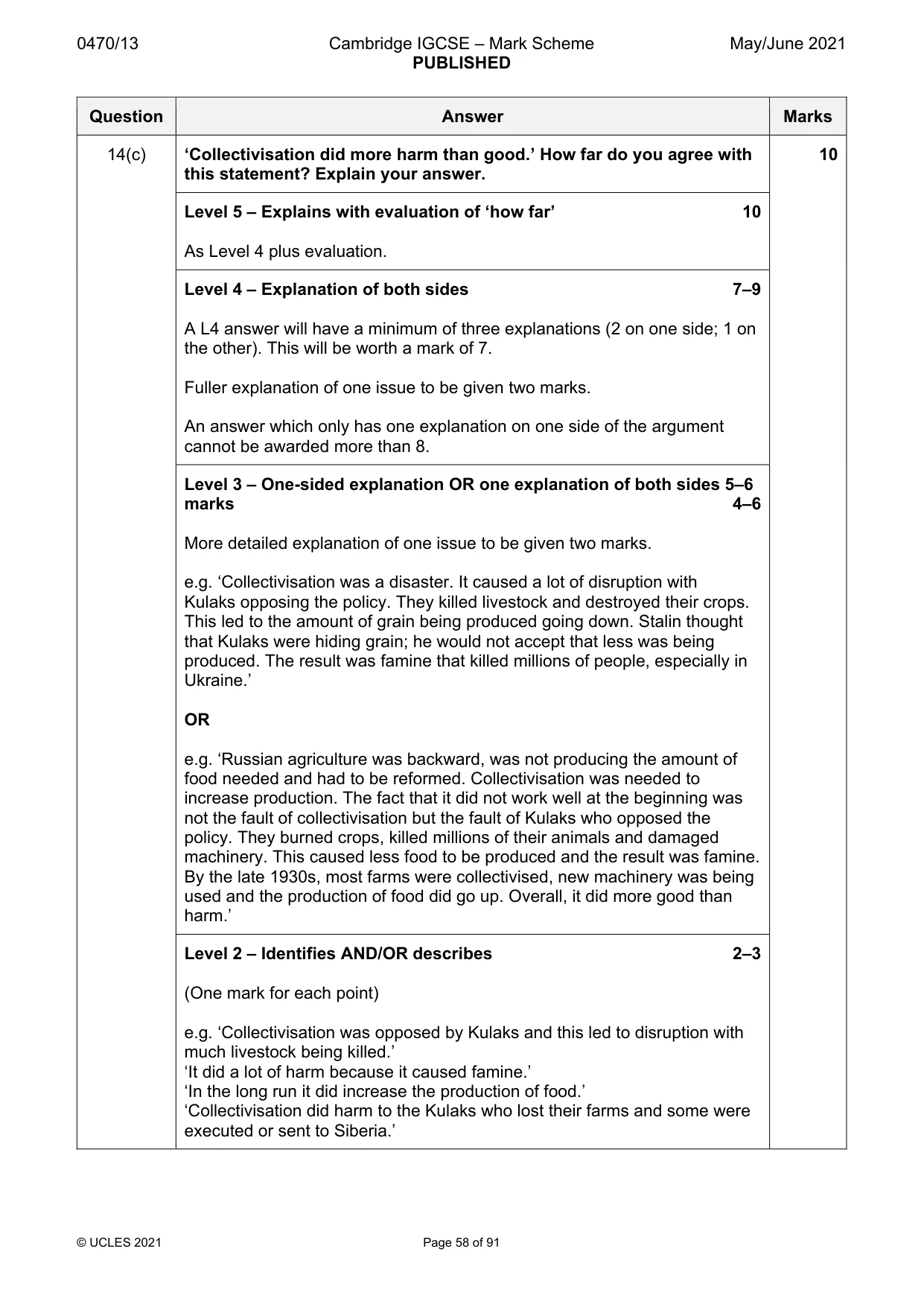
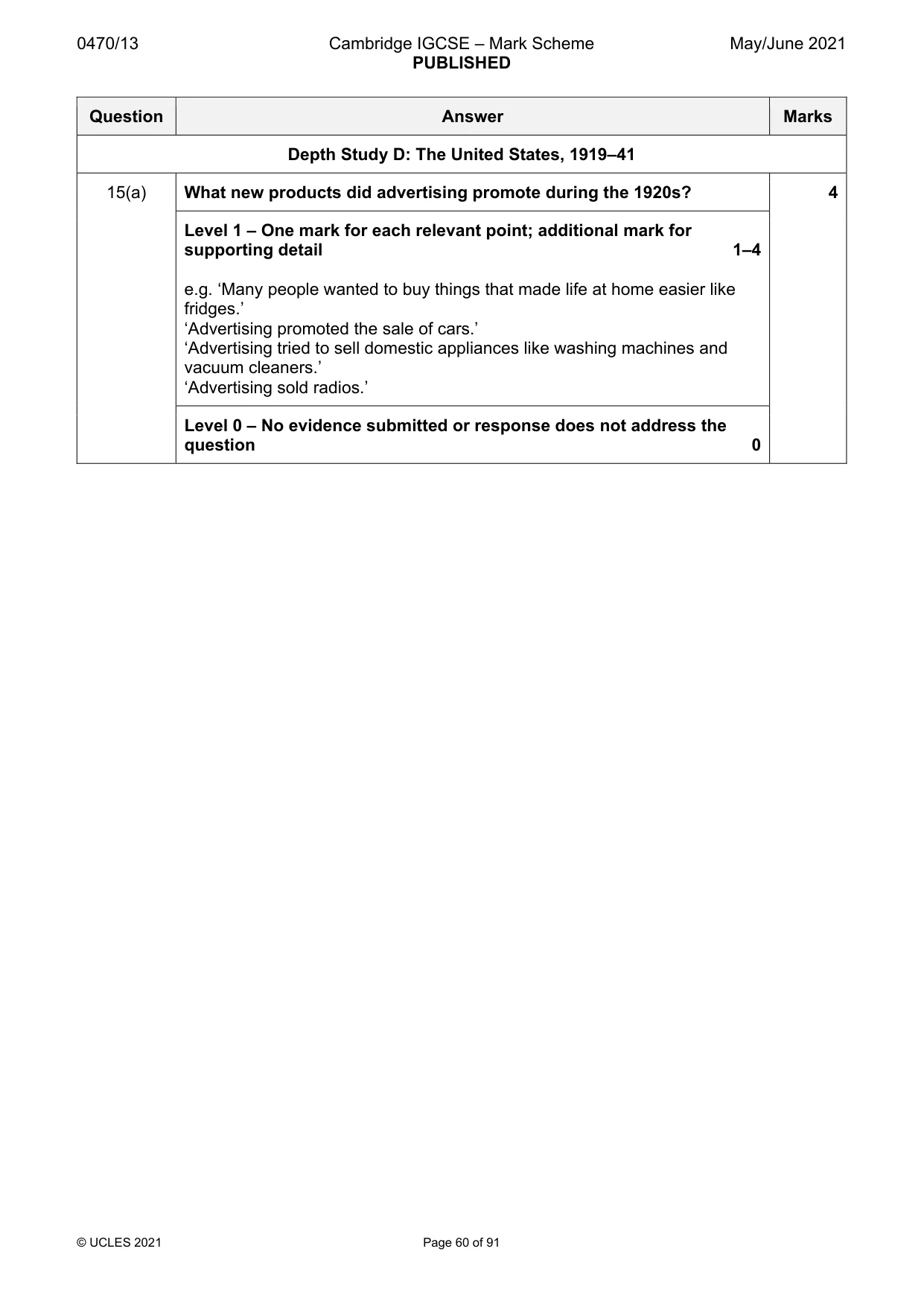
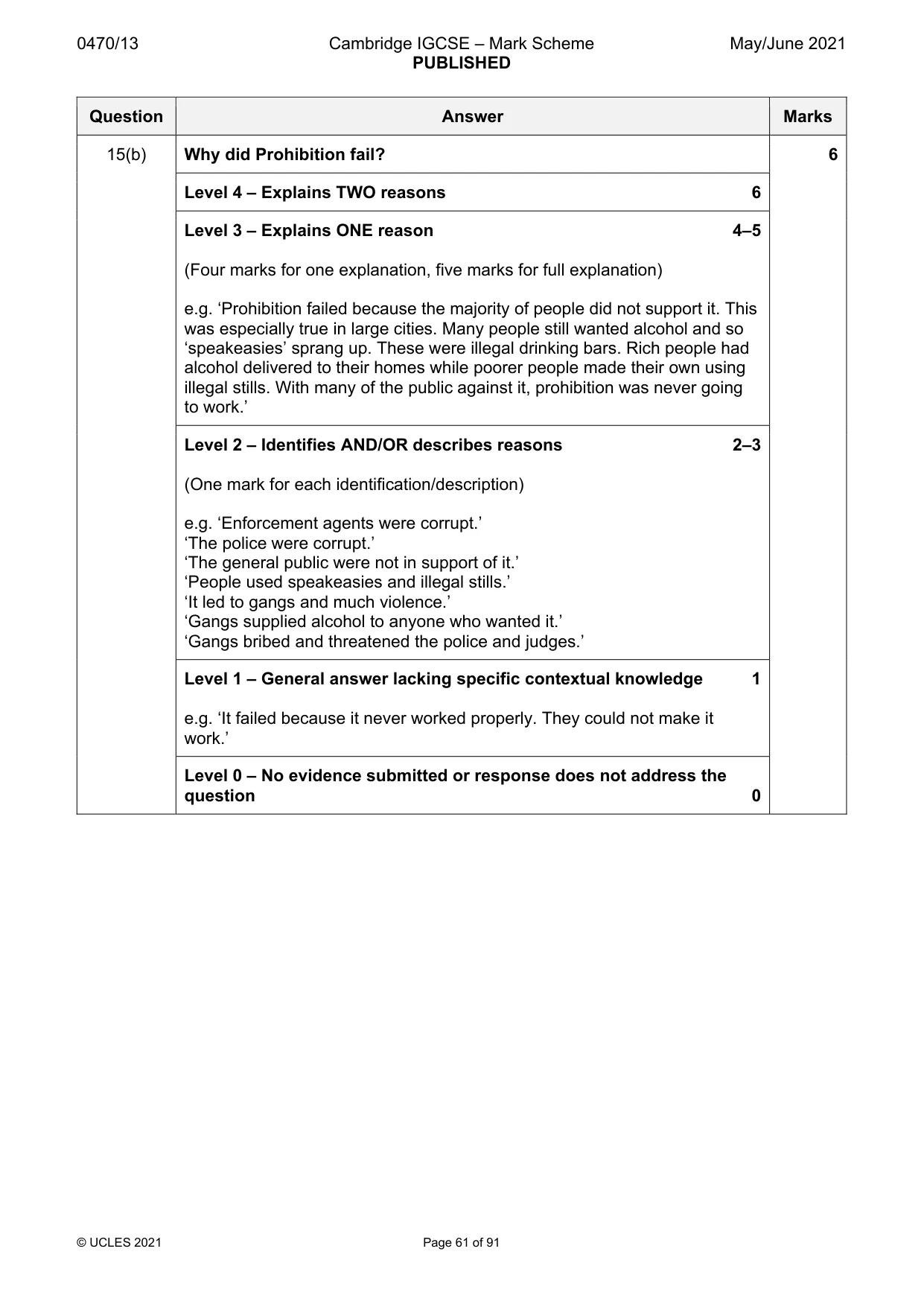
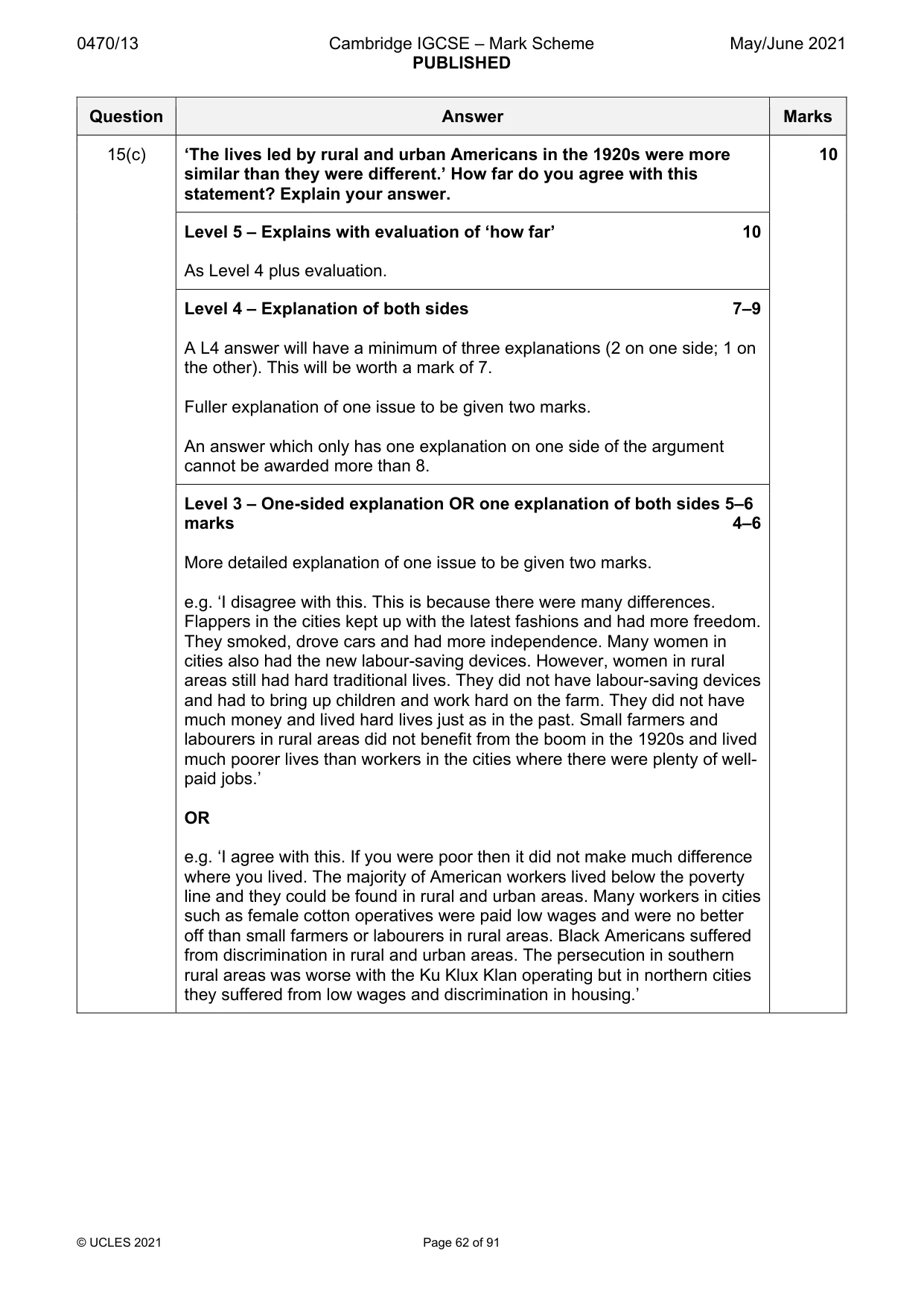
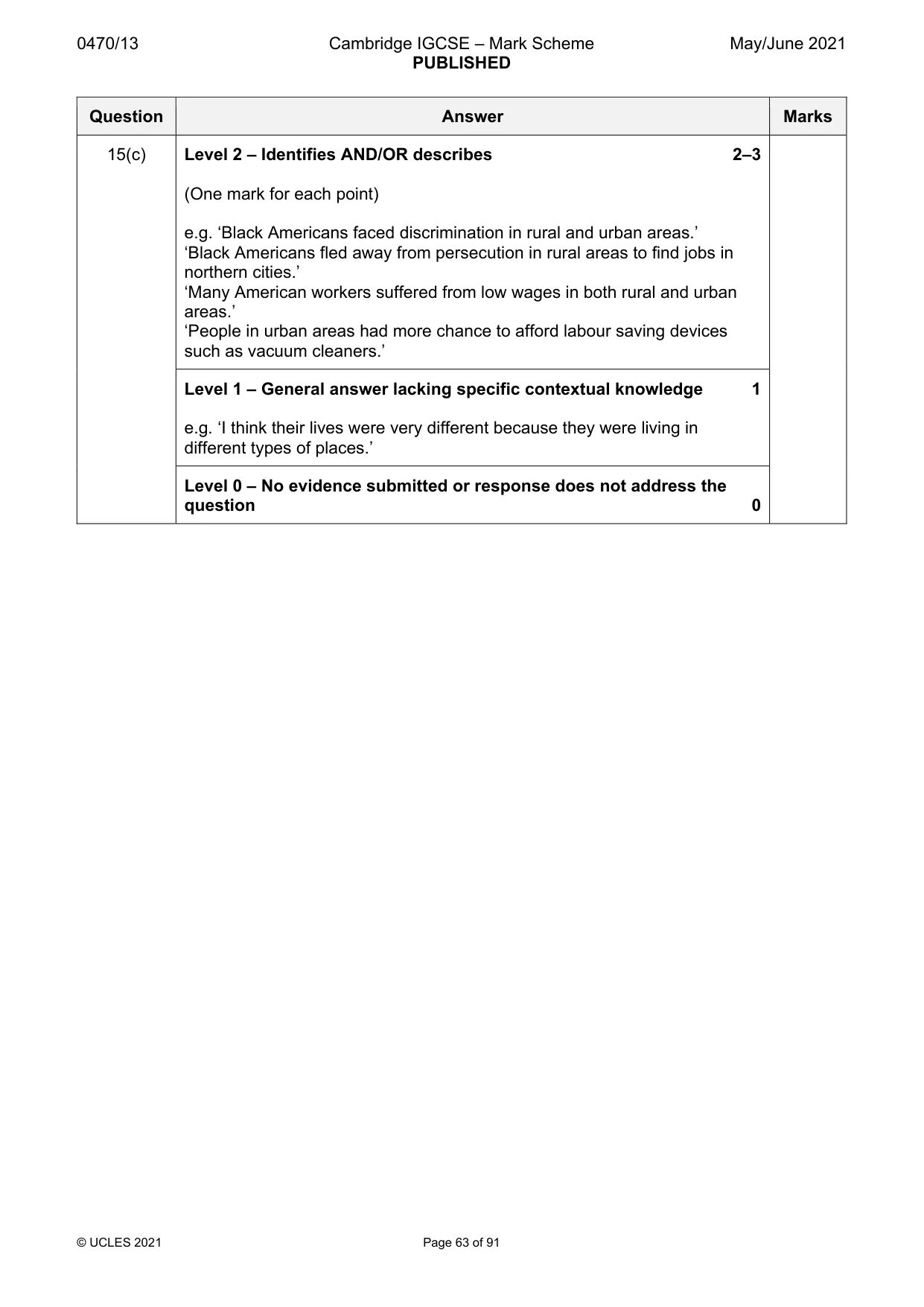
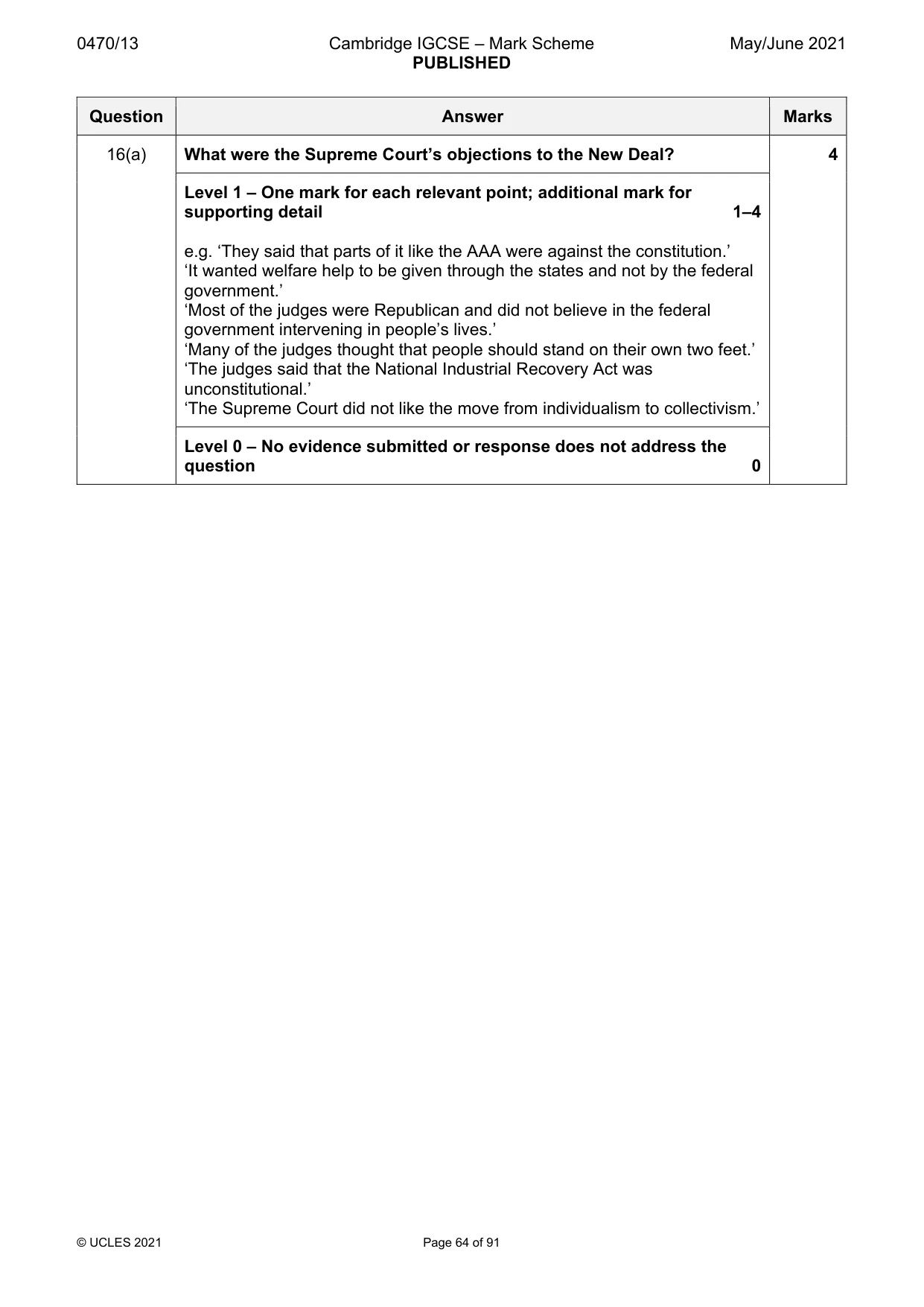
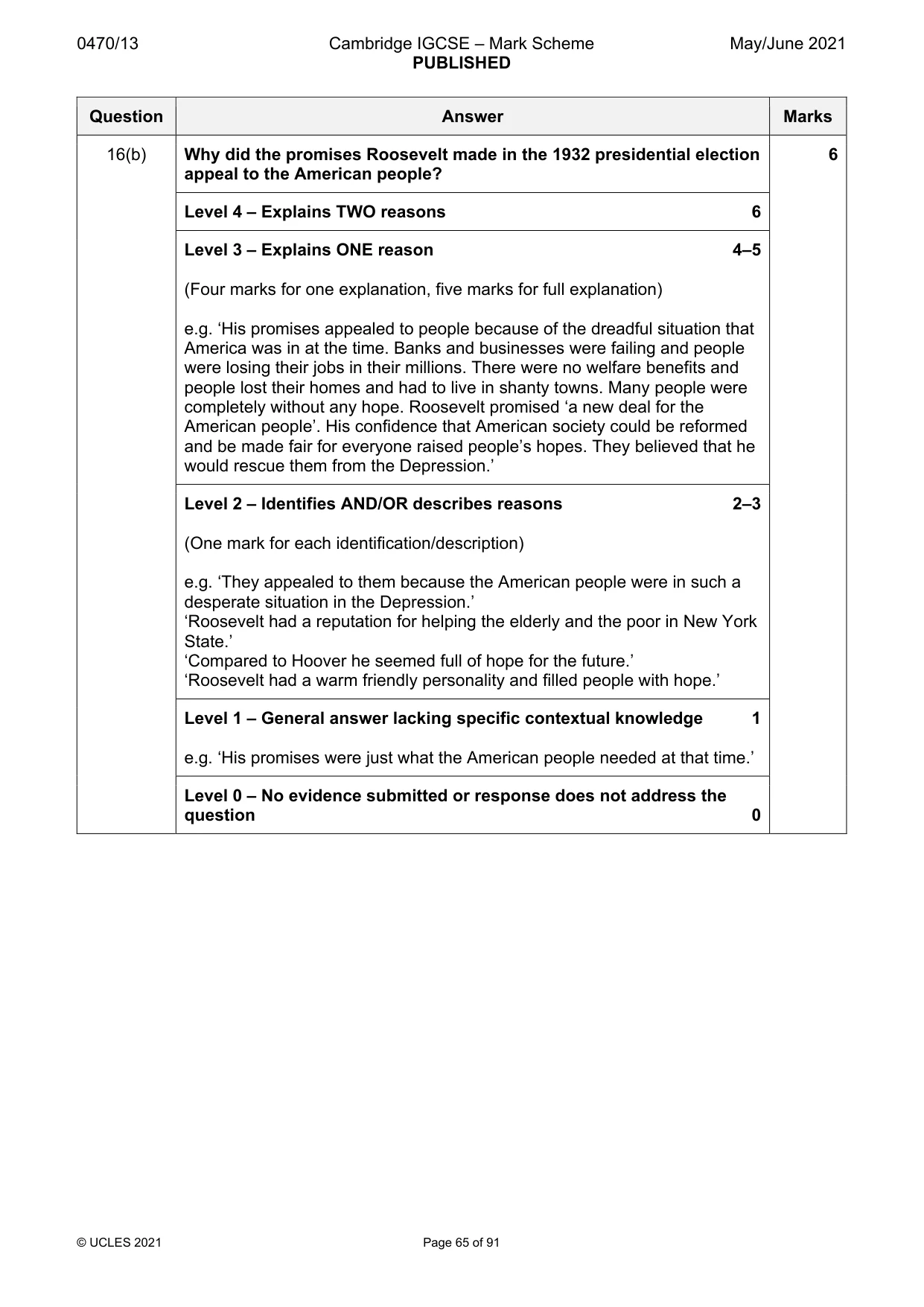
Paper as text
Question paper, page 1
This document has 12 pages. Any blank pages are indicated. Cambridge IGCSE™ * 1 8 6 1 1 2 8 1 5 1 * DC (MB) 216022/7 R © UCLES 2021 [Turn over HISTORY 0470/13 Paper 1 May/June 2021 2 hours You must answer on the enclosed answer booklet. You will need: Answer booklet (enclosed) INSTRUCTIONS ● Answer three questions in total: Section A (Core Content): answer two questions. Section B (Depth Studies): answer one question. ● Follow the instructions on the front cover of the answer booklet. If you need additional answer paper, ask the invigilator for a continuation booklet. INFORMATION ● The total mark for this paper is 60. ● The number of marks for each question or part question is shown in brackets [ ].
Question paper, page 2
2 0470/13/M/J/21 © UCLES 2021 SECTION A: CORE CONTENT Answer any two questions from this Section. 1 Europe witnessed several struggles for power in 1848–49. (a) Describe the part played by Garibaldi in Italy in the years 1848–49. [4] (b) Why was there much support for liberalism in Europe in 1848? [6] (c) Who were the stronger in France in 1848, conservatives or radicals? Explain your answer. [10] 2 German unification was finally achieved in 1871. (a) What was the Zollverein? [4] (b) Why was the Frankfurt Parliament set up in 1848? [6] (c) How far was German unification brought about by the policies of Bismarck? Explain your answer. [10] 3 There was much hatred and fear in the USA in the period 1850 to 1877. (a) Describe the events between 1854 and 1861 known as ‘Bleeding Kansas’. [4] (b) Why was the Ku Klux Klan founded soon after the Civil War ended? [6] (c) How far was Lincoln to blame for the fact that he was hated and feared in the South? Explain your answer. [10] 4 Little more than a month after the assassination of Franz Ferdinand, most of Europe was at war. (a) What was the Austrian ultimatum to Serbia in July 1914? [4] (b) Why did Britain go to war in August 1914? [6] (c) Who was more to blame for the outbreak of war in 1914, Germany or Russia? Explain your answer. [10]
Question paper, page 3
3 0470/13/M/J/21 © UCLES 2021 [Turn over 5 The League of Nations often struggled to carry out its peacekeeping duties effectively. (a) Describe how the League dealt with the dispute over the Aaland (Aland) Islands. [4] (b) Why were some major powers not members of the League? [6] (c) ‘Britain was responsible for the failure of the League in the 1930s.’ How far do you agree with this statement? Explain your answer. [10] 6 Hitler’s foreign policy involved taking risks. (a) Describe the reactions of Britain and France to the remilitarisation of the Rhineland in 1936. [4] (b) Why were the failures of the League of Nations in the 1930s important to Hitler? [6] (c) Are you surprised that Germany invaded Poland in September 1939? Explain your answer. [10] 7 The USA and the USSR both wanted to influence developments in Europe after the Second World War. (a) What was the purpose of the North Atlantic Treaty Organization (NATO)? [4] (b) Why did the USSR and the West disagree about what to do with Germany after the end of the Second World War? [6] (c) ‘The USA offered the Marshall Plan to European countries to help its own economy.’ How far do you agree with this statement? Explain your answer. [10] 8 Iran and Iraq were rivals in the Gulf region. (a) Describe Saddam Hussein’s rise to power in the 1970s. [4] (b) Why was the Iran-Iraq War important to the West? [6] (c) How surprising was the establishment of an Islamic republic in Iran by April 1979? Explain your answer. [10]
Question paper, page 4
4 0470/13/M/J/21 © UCLES 2021 SECTION B: DEPTH STUDIES Answer any one question from this Section. DEPTH STUDY A: THE FIRST WORLD WAR, 1914–18 9 For most of the First World War there was little movement. (a) Describe conditions in the trenches. [4] (b) Why were tanks important in the First World War? [6] (c) ‘The Battle of Verdun was more important than the Battle of the Somme.’ How far do you agree with this statement? Explain your answer. [10] 10 There were several important fronts in the First World War. (a) Describe what happened at the Battle of Jutland. [4] (b) Why were the Home Fronts in Britain and Germany important in the First World War? [6] (c) How important was the failure of the Gallipoli campaign in the First World War? Explain your answer. [10]
Question paper, page 5
5 0470/13/M/J/21 © UCLES 2021 [Turn over DEPTH STUDY B: GERMANY, 1918–45 11 After a long struggle to get into power, Hitler was quick to consolidate his position. (a) Describe the events of 1932–33 that led to Hitler becoming Chancellor. [4] (b) Why did the Nazis fail to win much support between 1924 and 1929? [6] (c) ‘The Reichstag Fire was more important to Hitler than the Night of the Long Knives.’ How far do you agree with this statement? Explain your answer. [10] 12 Many, but not all, Germans supported the Nazis. (a) Describe what happened at the Nuremberg rallies. [4] (b) Why did some young people rebel against the Hitler Youth? [6] (c) ‘The Nazis managed to stay in power because they had popular support.’ How far do you agree with this statement? Explain your answer. [10]
Question paper, page 6
6 0470/13/M/J/21 © UCLES 2021 DEPTH STUDY C: RUSSIA, 1905–41 13 Tsar Nicholas II faced many problems. (a) What were the consequences for Russia of the Russo-Japanese War? [4] (b) Why was Bloody Sunday important? [6] (c) Are you surprised that the Tsar managed to remain in power until 1917? Explain your answer. [10] 14 Stalin attempted to change the Soviet Union in many ways. (a) Describe the impact of Stalin’s rule on ethnic minorities in the Soviet Union. [4] (b) Why did Stalin think it was necessary to reform Soviet industry? [6] (c) ‘Collectivisation did more harm than good.’ How far do you agree with this statement? Explain your answer. [10]
Question paper, page 7
7 0470/13/M/J/21 © UCLES 2021 [Turn over DEPTH STUDY D: THE UNITED STATES, 1919–41 15 Many people benefited from the economic boom of the 1920s. (a) What new products did advertising promote during the 1920s? [4] (b) Why did Prohibition fail? [6] (c) ‘The lives led by rural and urban Americans in the 1920s were more similar than they were different.’ How far do you agree with this statement? Explain your answer. [10] 16 The New Deal promised much to the American people. (a) What were the Supreme Court’s objections to the New Deal? [4] (b) Why did the promises Roosevelt made in the 1932 presidential election appeal to the American people? [6] (c) ‘The fact that Roosevelt introduced the Second New Deal in 1935–36 shows that the First New Deal had failed.’ How far do you agree with this statement? Explain your answer. [10]
Question paper, page 8
8 0470/13/M/J/21 © UCLES 2021 DEPTH STUDY E: CHINA, c.1930–c.1990 17 The struggle between the Nationalists and the Communists went on for a long time. (a) What happened during the Shanghai Massacre of 1927? [4] (b) Why did Chiang Kai-shek think that the five extermination campaigns were necessary? [6] (c) ‘Leadership was the main factor that determined the outcome of the Civil War.’ How far do you agree with this statement? Explain your answer. [10] 18 China experienced many changes. (a) What was the policy adopted by China from 1979 in relation to population growth? [4] (b) Why was China able to achieve economic growth from the late 1970s? [6] (c) ‘Economic development in China in the period 1980 to 1990 produced much change.’ How far do you agree with this statement? Explain your answer. [10]
Question paper, page 9
9 0470/13/M/J/21 © UCLES 2021 [Turn over DEPTH STUDY F: SOUTH AFRICA, c.1940–c.1994 19 Support for segregationist policies gradually increased amongst white South Africans. (a) What was the migrant labour system? [4] (b) Why was the Natives Land Act of 1913 unpopular with black South Africans? [6] (c) How far was the victory of the National Party in the 1948 election caused by the failings of the United Party? Explain your answer. [10] 20 Opposition to apartheid grew in the 1960s and 1970s. (a) Describe what it was like living in a Bantustan (Homeland). [4] (b) Why was there opposition to apartheid from outside South Africa? [6] (c) ‘The Soweto Uprising in 1976 was a turning point in the opposition to the apartheid state.’ How far do you agree with this statement? Explain your answer. [10]
Question paper, page 10
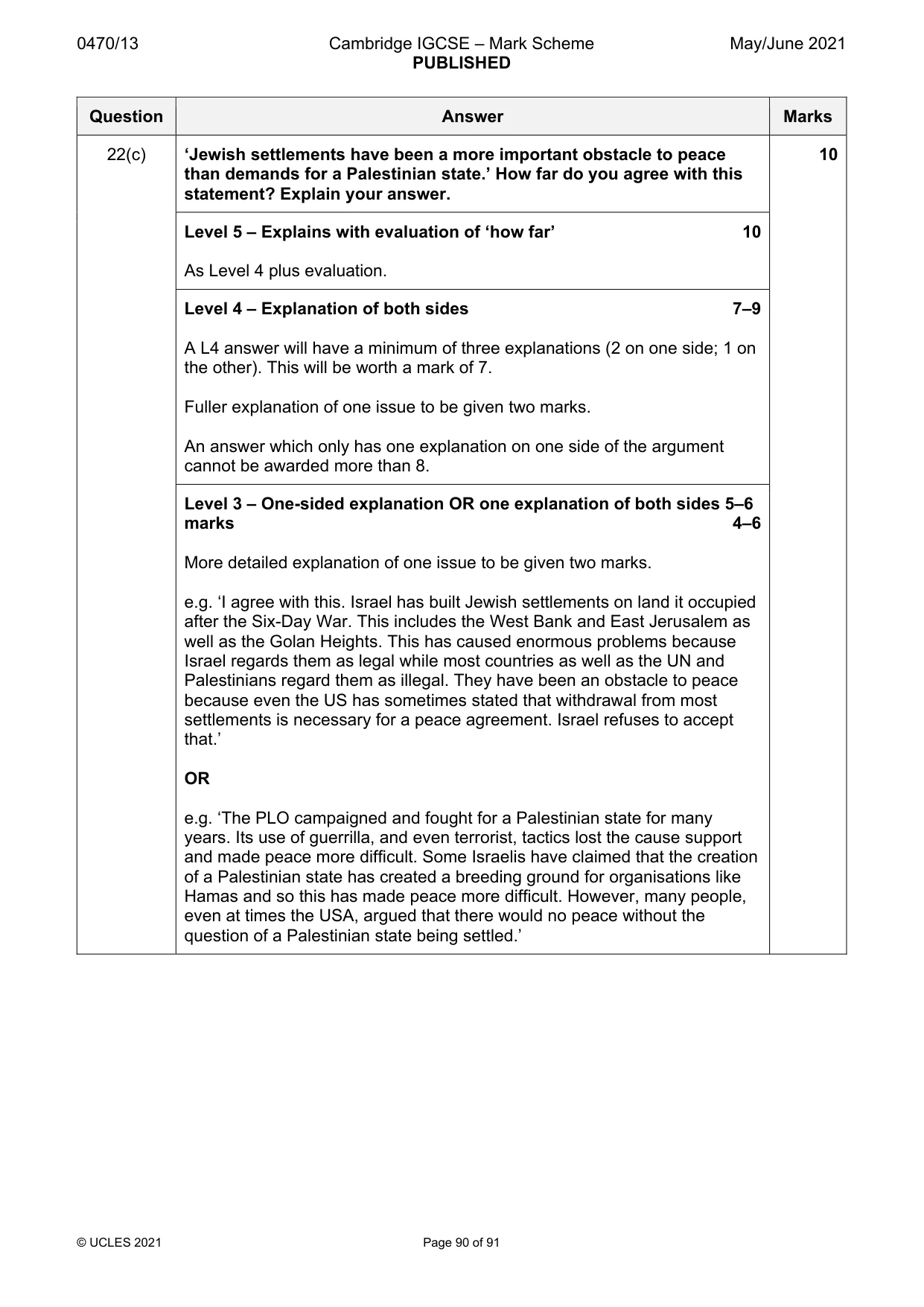
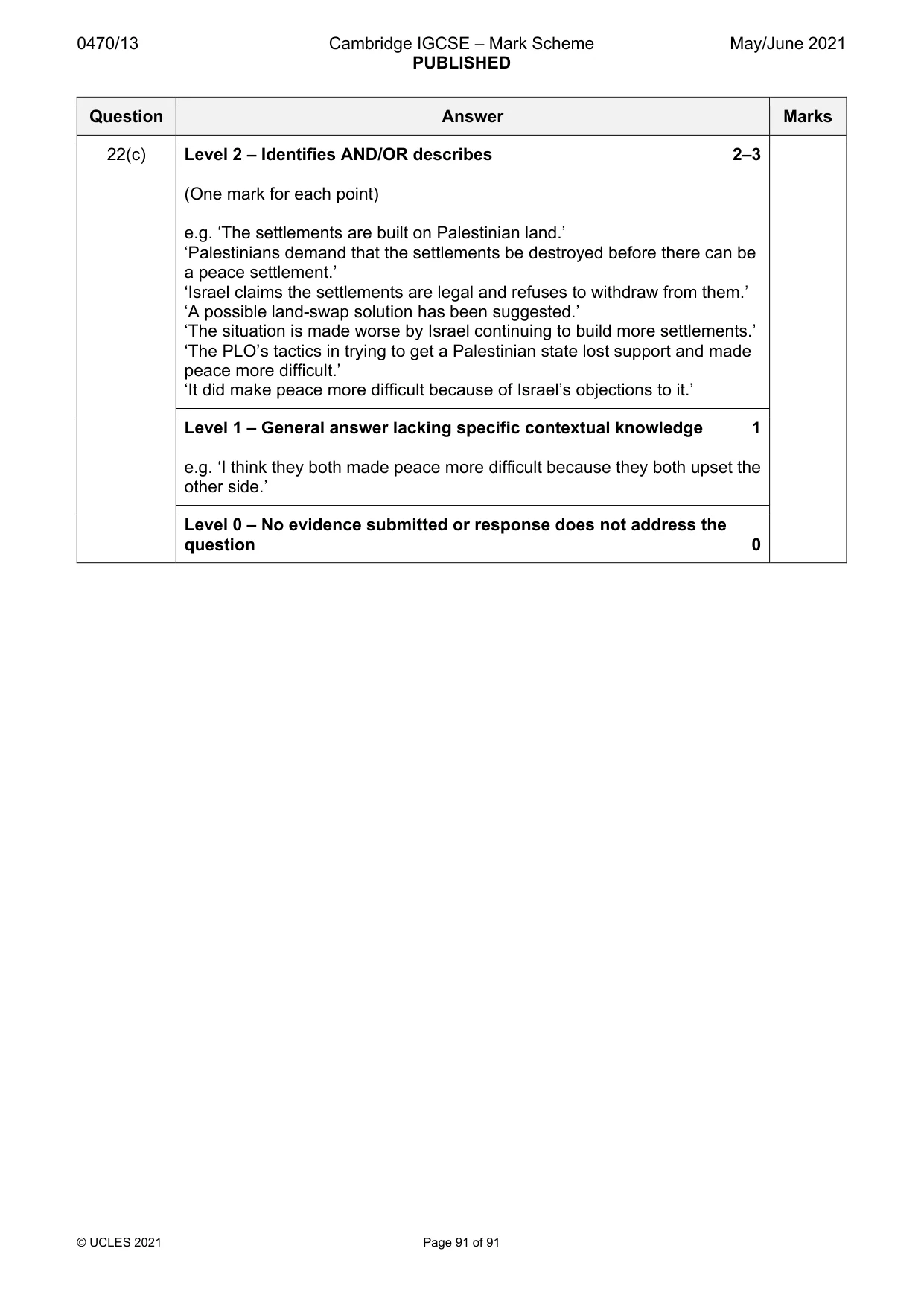
10 0470/13/M/J/21 © UCLES 2021 DEPTH STUDY G: ISRAELIS AND PALESTINIANS SINCE 1945 21 Wars have done little to improve the situation in the Middle East. (a) Describe the role of Britain in the Suez Crisis of 1956. [4] (b) Why were the consequences of the Yom Kippur War of 1973 important? [6] (c) ‘The Six-Day War of 1967 solved Israel’s problems.’ How far do you agree with this statement? Explain your answer. [10] 22 There have been many obstacles to peace in the Middle East. (a) What is the Gaza Strip? [4] (b) Why has Hezbollah been a problem for Israel? [6] (c) ‘Jewish settlements have been a more important obstacle to peace than demands for a Palestinian state.’ How far do you agree with this statement? Explain your answer. [10]
Question paper, page 11
11 0470/13/M/J/21 © UCLES 2021 BLANK PAGE
Question paper, page 12
12 0470/13/M/J/21 © UCLES 2021 Permission to reproduce items where third-party owned material protected by copyright is included has been sought and cleared where possible. Every reasonable effort has been made by the publisher (UCLES) to trace copyright holders, but if any items requiring clearance have unwittingly been included, the publisher will be pleased to make amends at the earliest possible opportunity. To avoid the issue of disclosure of answer-related information to candidates, all copyright acknowledgements are reproduced online in the Cambridge Assessment International Education Copyright Acknowledgements Booklet. This is produced for each series of examinations and is freely available to download at www.cambridgeinternational.org after the live examination series. Cambridge Assessment International Education is part of the Cambridge Assessment Group. Cambridge Assessment is the brand name of the University of Cambridge Local Examinations Syndicate (UCLES), which itself is a department of the University of Cambridge. BLANK PAGE
Mark scheme, page 1
This document consists of 91 printed pages. © UCLES 2021 [Turn over Cambridge IGCSE™ HISTORY 0470/13 Paper 1 May/June 2021 MARK SCHEME Maximum Mark: 60 Published This mark scheme is published as an aid to teachers and candidates, to indicate the requirements of the examination. It shows the basis on which Examiners were instructed to award marks. It does not indicate the details of the discussions that took place at an Examiners’ meeting before marking began, which would have considered the acceptability of alternative answers. Mark schemes should be read in conjunction with the question paper and the Principal Examiner Report for Teachers. Cambridge International will not enter into discussions about these mark schemes. Cambridge International is publishing the mark schemes for the May/June 2021 series for most Cambridge IGCSE™, Cambridge International A and AS Level components and some Cambridge O Level components.
Mark scheme, page 2
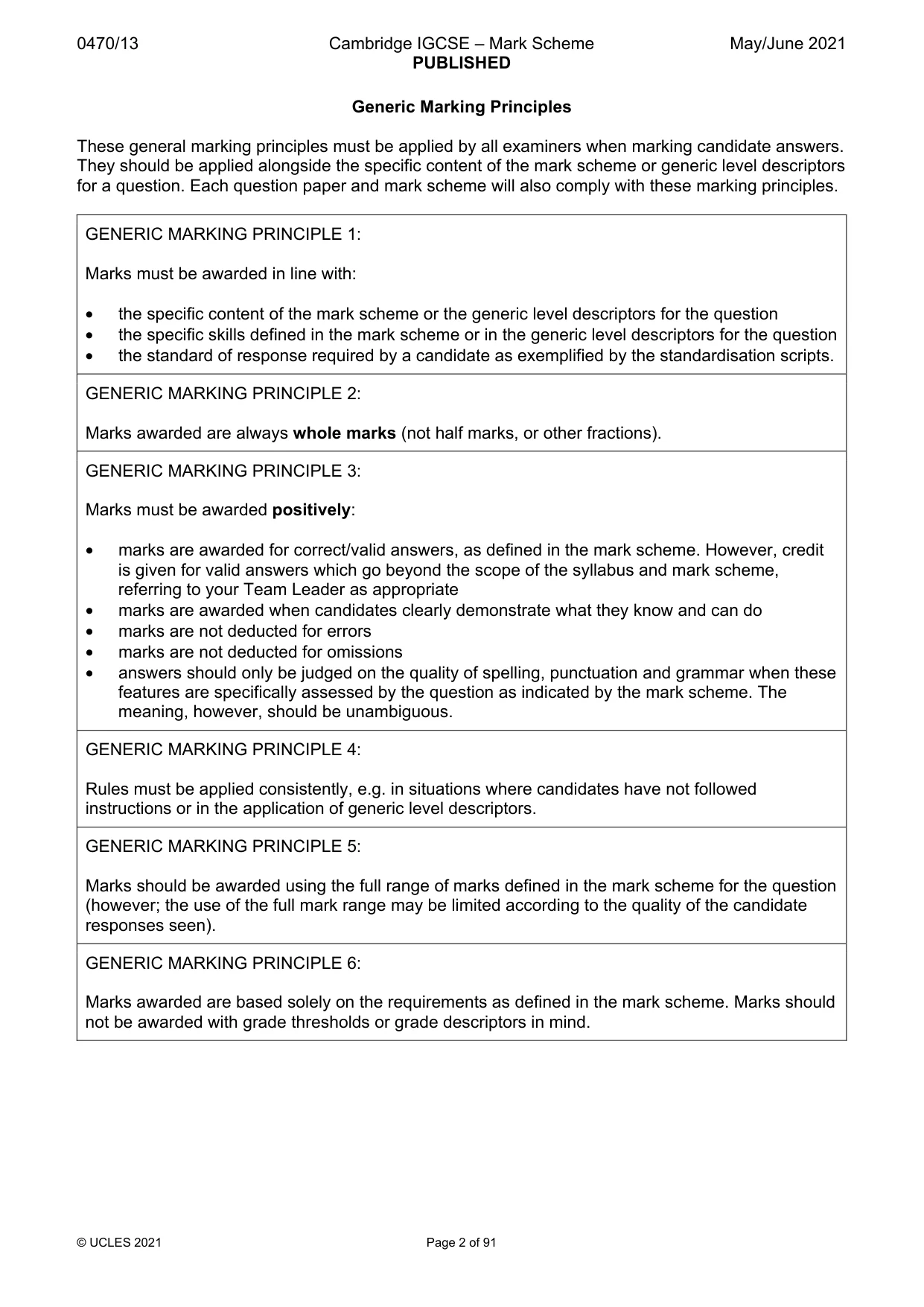
0470/13 Cambridge IGCSE – Mark Scheme PUBLISHED May/June 2021 © UCLES 2021 Page 2 of 91 Generic Marking Principles These general marking principles must be applied by all examiners when marking candidate answers. They should be applied alongside the specific content of the mark scheme or generic level descriptors for a question. Each question paper and mark scheme will also comply with these marking principles. GENERIC MARKING PRINCIPLE 1: Marks must be awarded in line with: • the specific content of the mark scheme or the generic level descriptors for the question • the specific skills defined in the mark scheme or in the generic level descriptors for the question • the standard of response required by a candidate as exemplified by the standardisation scripts. GENERIC MARKING PRINCIPLE 2: Marks awarded are always whole marks (not half marks, or other fractions). GENERIC MARKING PRINCIPLE 3: Marks must be awarded positively: • marks are awarded for correct/valid answers, as defined in the mark scheme. However, credit is given for valid answers which go beyond the scope of the syllabus and mark scheme, referring to your Team Leader as appropriate • marks are awarded when candidates clearly demonstrate what they know and can do • marks are not deducted for errors • marks are not deducted for omissions • answers should only be judged on the quality of spelling, punctuation and grammar when these features are specifically assessed by the question as indicated by the mark scheme. The meaning, however, should be unambiguous. GENERIC MARKING PRINCIPLE 4: Rules must be applied consistently, e.g. in situations where candidates have not followed instructions or in the application of generic level descriptors. GENERIC MARKING PRINCIPLE 5: Marks should be awarded using the full range of marks defined in the mark scheme for the question (however; the use of the full mark range may be limited according to the quality of the candidate responses seen). GENERIC MARKING PRINCIPLE 6: Marks awarded are based solely on the requirements as defined in the mark scheme. Marks should not be awarded with grade thresholds or grade descriptors in mind.
Mark scheme, page 3
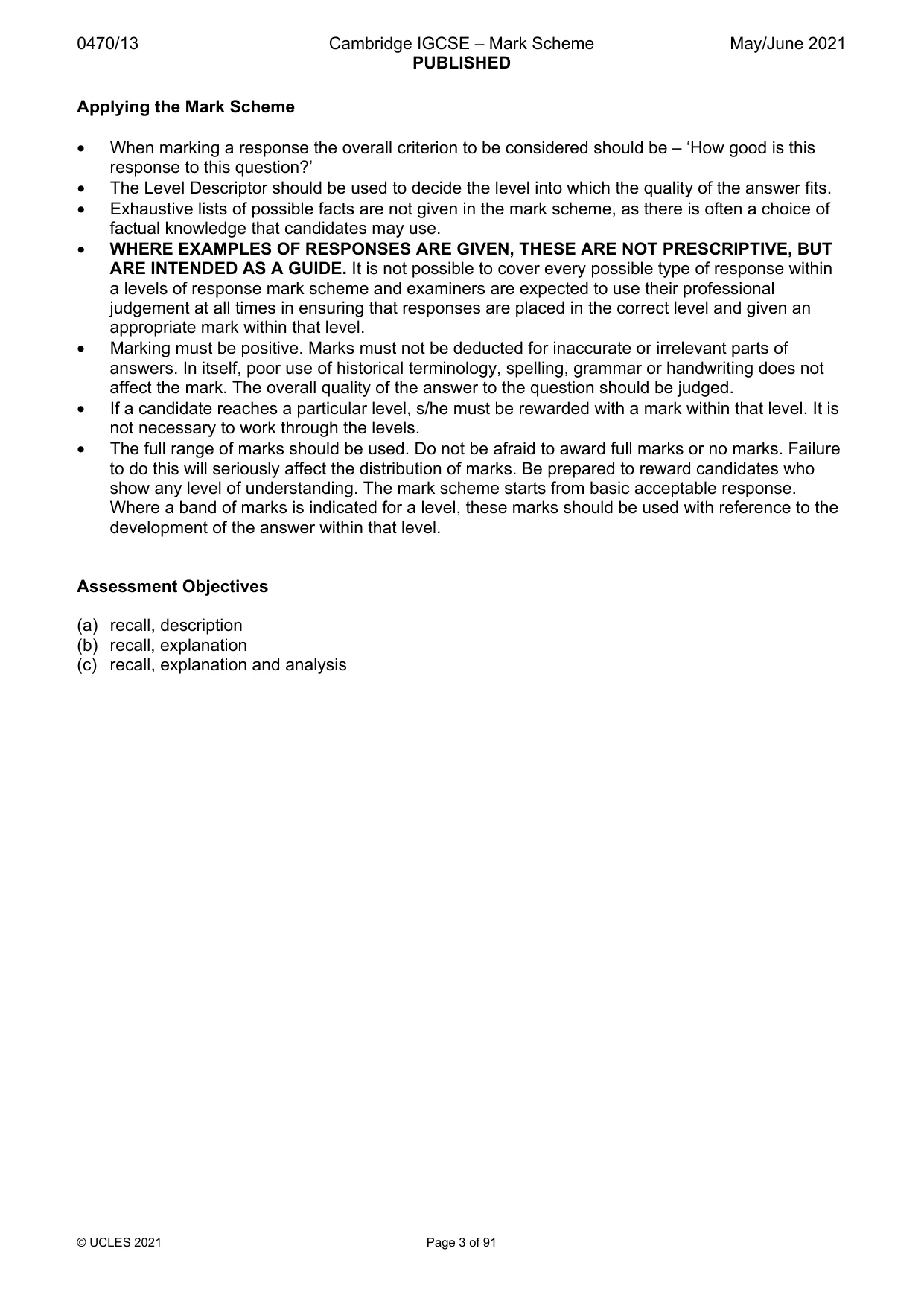
0470/13 Cambridge IGCSE – Mark Scheme PUBLISHED May/June 2021 © UCLES 2021 Page 3 of 91 Applying the Mark Scheme • When marking a response the overall criterion to be considered should be – ‘How good is this response to this question?’ • The Level Descriptor should be used to decide the level into which the quality of the answer fits. • Exhaustive lists of possible facts are not given in the mark scheme, as there is often a choice of factual knowledge that candidates may use. • WHERE EXAMPLES OF RESPONSES ARE GIVEN, THESE ARE NOT PRESCRIPTIVE, BUT ARE INTENDED AS A GUIDE. It is not possible to cover every possible type of response within a levels of response mark scheme and examiners are expected to use their professional judgement at all times in ensuring that responses are placed in the correct level and given an appropriate mark within that level. • Marking must be positive. Marks must not be deducted for inaccurate or irrelevant parts of answers. In itself, poor use of historical terminology, spelling, grammar or handwriting does not affect the mark. The overall quality of the answer to the question should be judged. • If a candidate reaches a particular level, s/he must be rewarded with a mark within that level. It is not necessary to work through the levels. • The full range of marks should be used. Do not be afraid to award full marks or no marks. Failure to do this will seriously affect the distribution of marks. Be prepared to reward candidates who show any level of understanding. The mark scheme starts from basic acceptable response. Where a band of marks is indicated for a level, these marks should be used with reference to the development of the answer within that level. Assessment Objectives (a) recall, description (b) recall, explanation (c) recall, explanation and analysis
Mark scheme, page 4
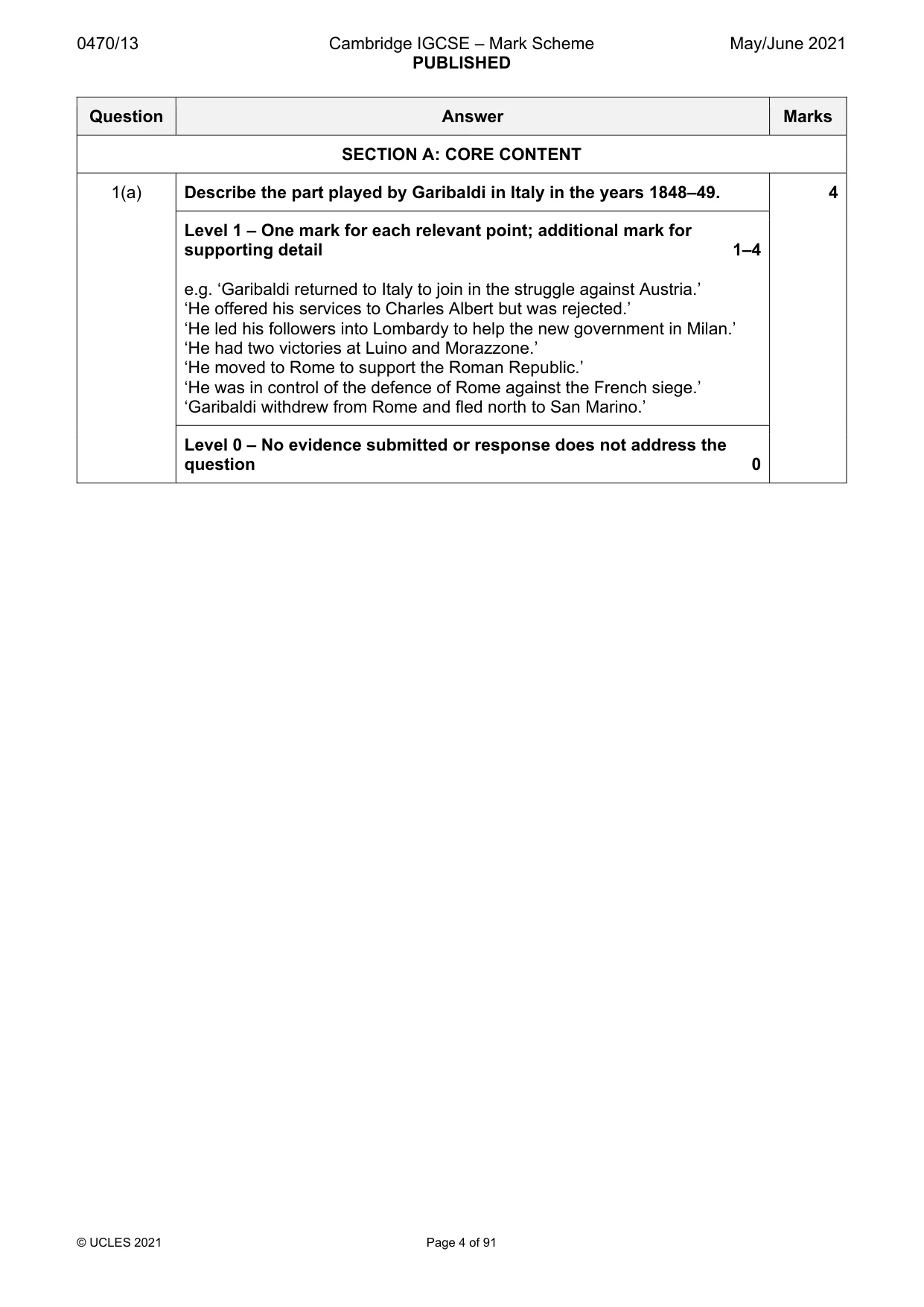
0470/13 Cambridge IGCSE – Mark Scheme PUBLISHED May/June 2021 © UCLES 2021 Page 4 of 91 Question Answer Marks SECTION A: CORE CONTENT 1(a) Describe the part played by Garibaldi in Italy in the years 1848–49. 4 Level 1 – One mark for each relevant point; additional mark for supporting detail 1–4 e.g. ‘Garibaldi returned to Italy to join in the struggle against Austria.’ ‘He offered his services to Charles Albert but was rejected.’ ‘He led his followers into Lombardy to help the new government in Milan.’ ‘He had two victories at Luino and Morazzone.’ ‘He moved to Rome to support the Roman Republic.’ ‘He was in control of the defence of Rome against the French siege.’ ‘Garibaldi withdrew from Rome and fled north to San Marino.’ Level 0 – No evidence submitted or response does not address the question 0
Mark scheme, page 5
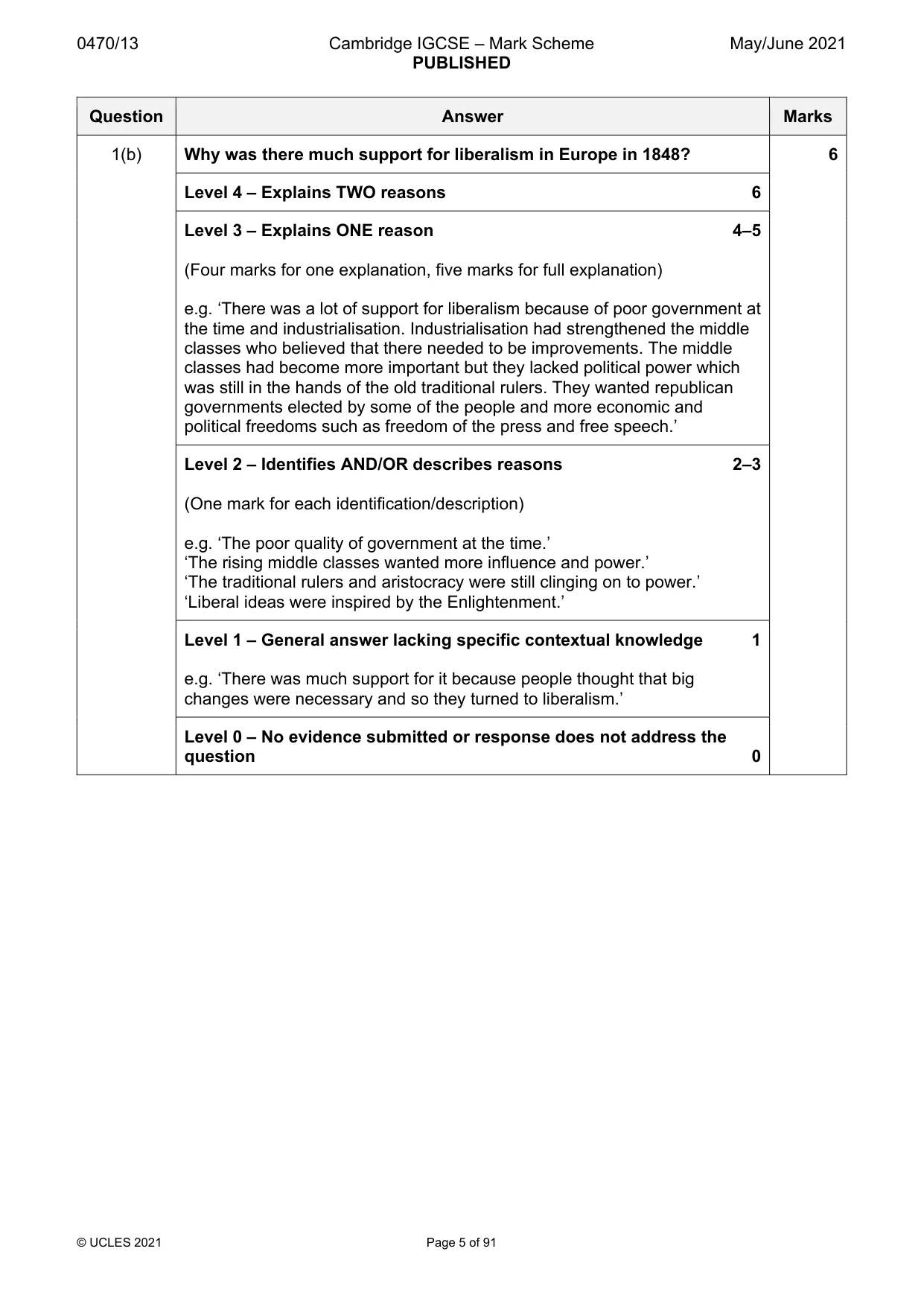
0470/13 Cambridge IGCSE – Mark Scheme PUBLISHED May/June 2021 © UCLES 2021 Page 5 of 91 Question Answer Marks 1(b) Why was there much support for liberalism in Europe in 1848? 6 Level 4 – Explains TWO reasons 6 Level 3 – Explains ONE reason 4–5 (Four marks for one explanation, five marks for full explanation) e.g. ‘There was a lot of support for liberalism because of poor government at the time and industrialisation. Industrialisation had strengthened the middle classes who believed that there needed to be improvements. The middle classes had become more important but they lacked political power which was still in the hands of the old traditional rulers. They wanted republican governments elected by some of the people and more economic and political freedoms such as freedom of the press and free speech.’ Level 2 – Identifies AND/OR describes reasons 2–3 (One mark for each identification/description) e.g. ‘The poor quality of government at the time.’ ‘The rising middle classes wanted more influence and power.’ ‘The traditional rulers and aristocracy were still clinging on to power.’ ‘Liberal ideas were inspired by the Enlightenment.’ Level 1 – General answer lacking specific contextual knowledge 1 e.g. ‘There was much support for it because people thought that big changes were necessary and so they turned to liberalism.’ Level 0 – No evidence submitted or response does not address the question 0
Mark scheme, page 6
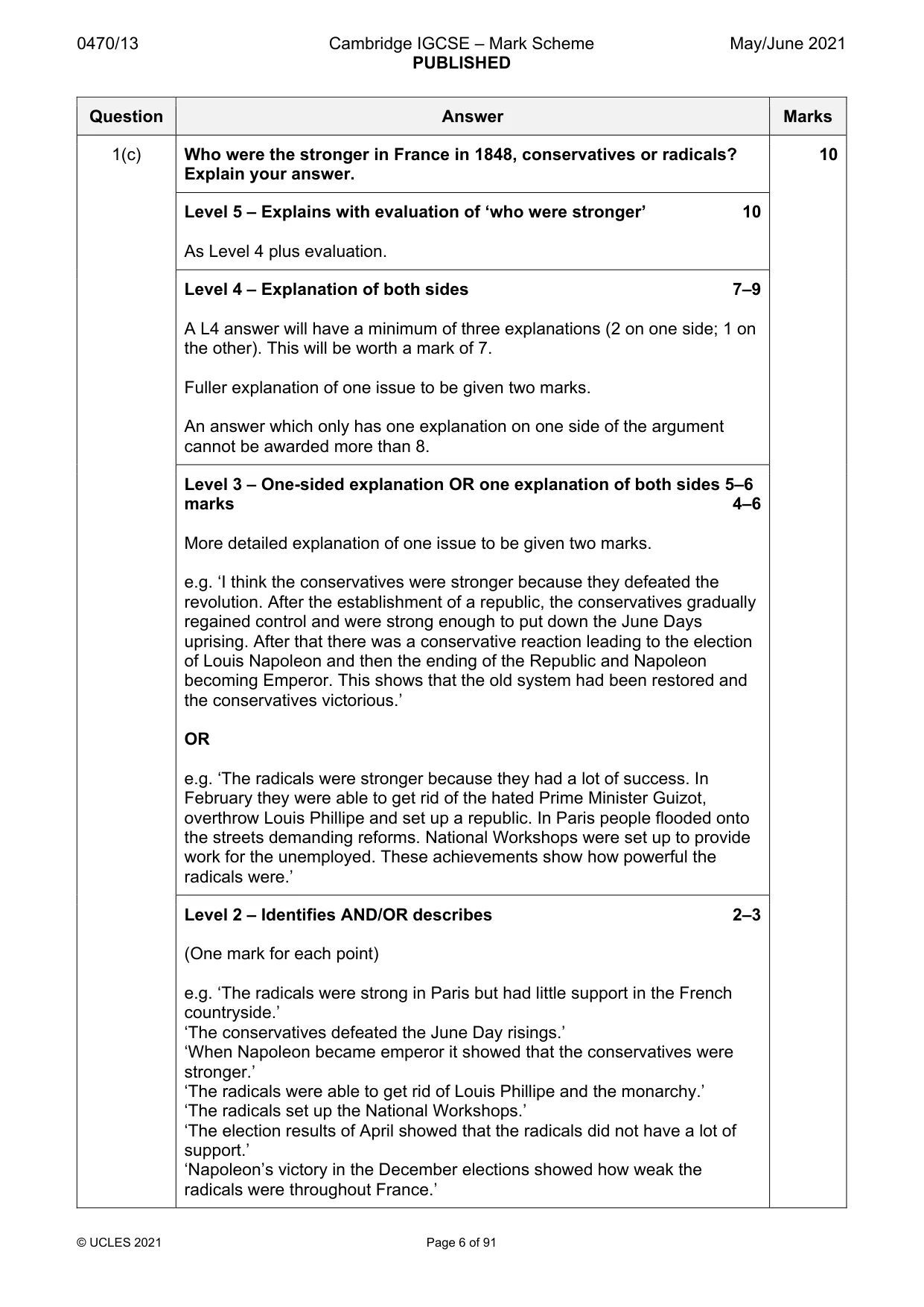
0470/13 Cambridge IGCSE – Mark Scheme PUBLISHED May/June 2021 © UCLES 2021 Page 6 of 91 Question Answer Marks 1(c) Who were the stronger in France in 1848, conservatives or radicals? Explain your answer. 10 Level 5 – Explains with evaluation of ‘who were stronger’ 10 As Level 4 plus evaluation. Level 4 – Explanation of both sides 7–9 A L4 answer will have a minimum of three explanations (2 on one side; 1 on the other). This will be worth a mark of 7. Fuller explanation of one issue to be given two marks. An answer which only has one explanation on one side of the argument cannot be awarded more than 8. Level 3 – One-sided explanation OR one explanation of both sides 5–6 marks 4–6 More detailed explanation of one issue to be given two marks. e.g. ‘I think the conservatives were stronger because they defeated the revolution. After the establishment of a republic, the conservatives gradually regained control and were strong enough to put down the June Days uprising. After that there was a conservative reaction leading to the election of Louis Napoleon and then the ending of the Republic and Napoleon becoming Emperor. This shows that the old system had been restored and the conservatives victorious.’ OR e.g. ‘The radicals were stronger because they had a lot of success. In February they were able to get rid of the hated Prime Minister Guizot, overthrow Louis Phillipe and set up a republic. In Paris people flooded onto the streets demanding reforms. National Workshops were set up to provide work for the unemployed. These achievements show how powerful the radicals were.’ Level 2 – Identifies AND/OR describes 2–3 (One mark for each point) e.g. ‘The radicals were strong in Paris but had little support in the French countryside.’ ‘The conservatives defeated the June Day risings.’ ‘When Napoleon became emperor it showed that the conservatives were stronger.’ ‘The radicals were able to get rid of Louis Phillipe and the monarchy.’ ‘The radicals set up the National Workshops.’ ‘The election results of April showed that the radicals did not have a lot of support.’ ‘Napoleon’s victory in the December elections showed how weak the radicals were throughout France.’
Mark scheme, page 7
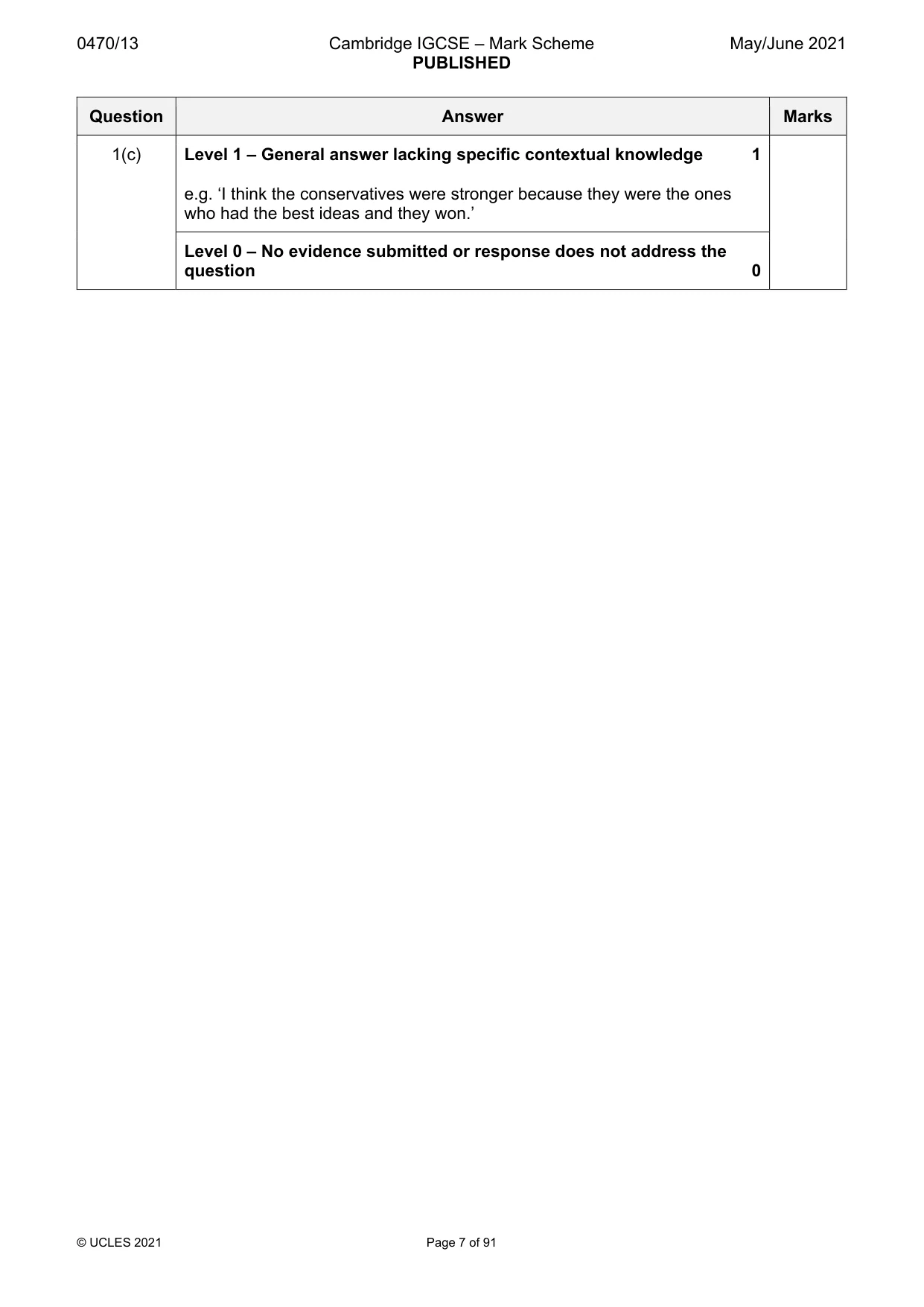
0470/13 Cambridge IGCSE – Mark Scheme PUBLISHED May/June 2021 © UCLES 2021 Page 7 of 91 Question Answer Marks 1(c) Level 1 – General answer lacking specific contextual knowledge 1 e.g. ‘I think the conservatives were stronger because they were the ones who had the best ideas and they won.’ Level 0 – No evidence submitted or response does not address the question 0
Mark scheme, page 8
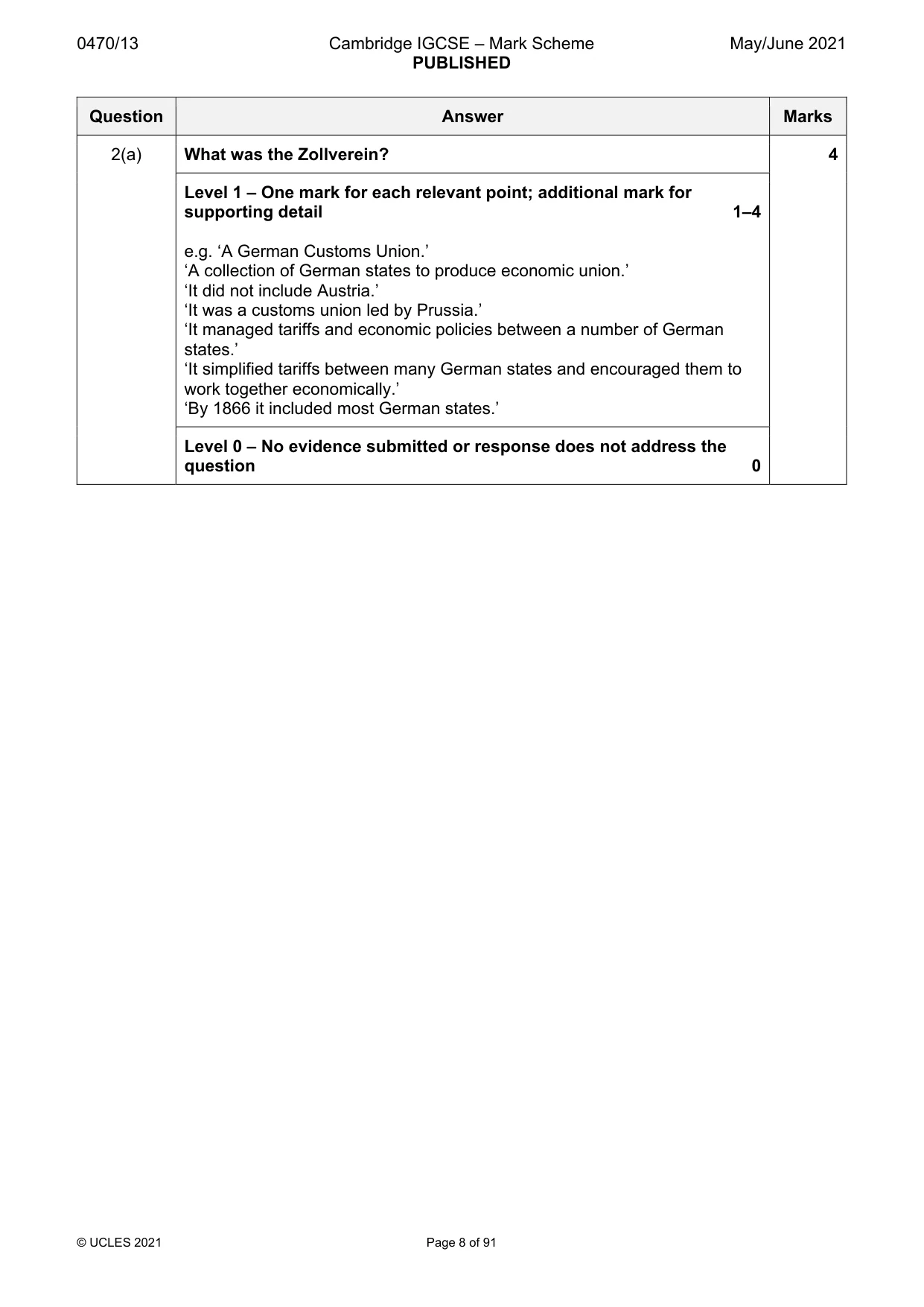
0470/13 Cambridge IGCSE – Mark Scheme PUBLISHED May/June 2021 © UCLES 2021 Page 8 of 91 Question Answer Marks 2(a) What was the Zollverein? 4 Level 1 – One mark for each relevant point; additional mark for supporting detail 1–4 e.g. ‘A German Customs Union.’ ‘A collection of German states to produce economic union.’ ‘It did not include Austria.’ ‘It was a customs union led by Prussia.’ ‘It managed tariffs and economic policies between a number of German states.’ ‘It simplified tariffs between many German states and encouraged them to work together economically.’ ‘By 1866 it included most German states.’ Level 0 – No evidence submitted or response does not address the question 0
Mark scheme, page 9
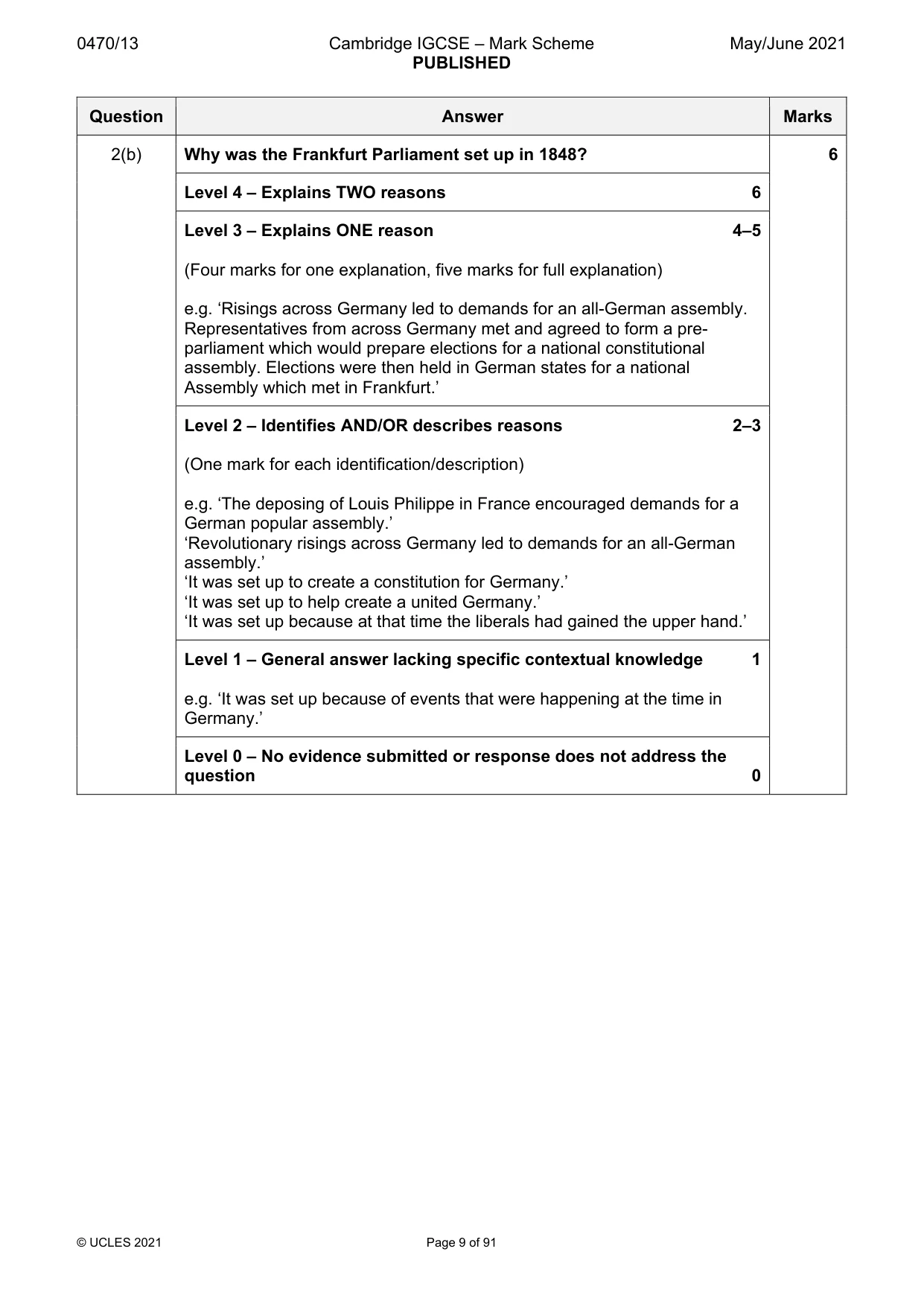
0470/13 Cambridge IGCSE – Mark Scheme PUBLISHED May/June 2021 © UCLES 2021 Page 9 of 91 Question Answer Marks 2(b) Why was the Frankfurt Parliament set up in 1848? 6 Level 4 – Explains TWO reasons 6 Level 3 – Explains ONE reason 4–5 (Four marks for one explanation, five marks for full explanation) e.g. ‘Risings across Germany led to demands for an all-German assembly. Representatives from across Germany met and agreed to form a pre- parliament which would prepare elections for a national constitutional assembly. Elections were then held in German states for a national Assembly which met in Frankfurt.’ Level 2 – Identifies AND/OR describes reasons 2–3 (One mark for each identification/description) e.g. ‘The deposing of Louis Philippe in France encouraged demands for a German popular assembly.’ ‘Revolutionary risings across Germany led to demands for an all-German assembly.’ ‘It was set up to create a constitution for Germany.’ ‘It was set up to help create a united Germany.’ ‘It was set up because at that time the liberals had gained the upper hand.’ Level 1 – General answer lacking specific contextual knowledge 1 e.g. ‘It was set up because of events that were happening at the time in Germany.’ Level 0 – No evidence submitted or response does not address the question 0
Mark scheme, page 10
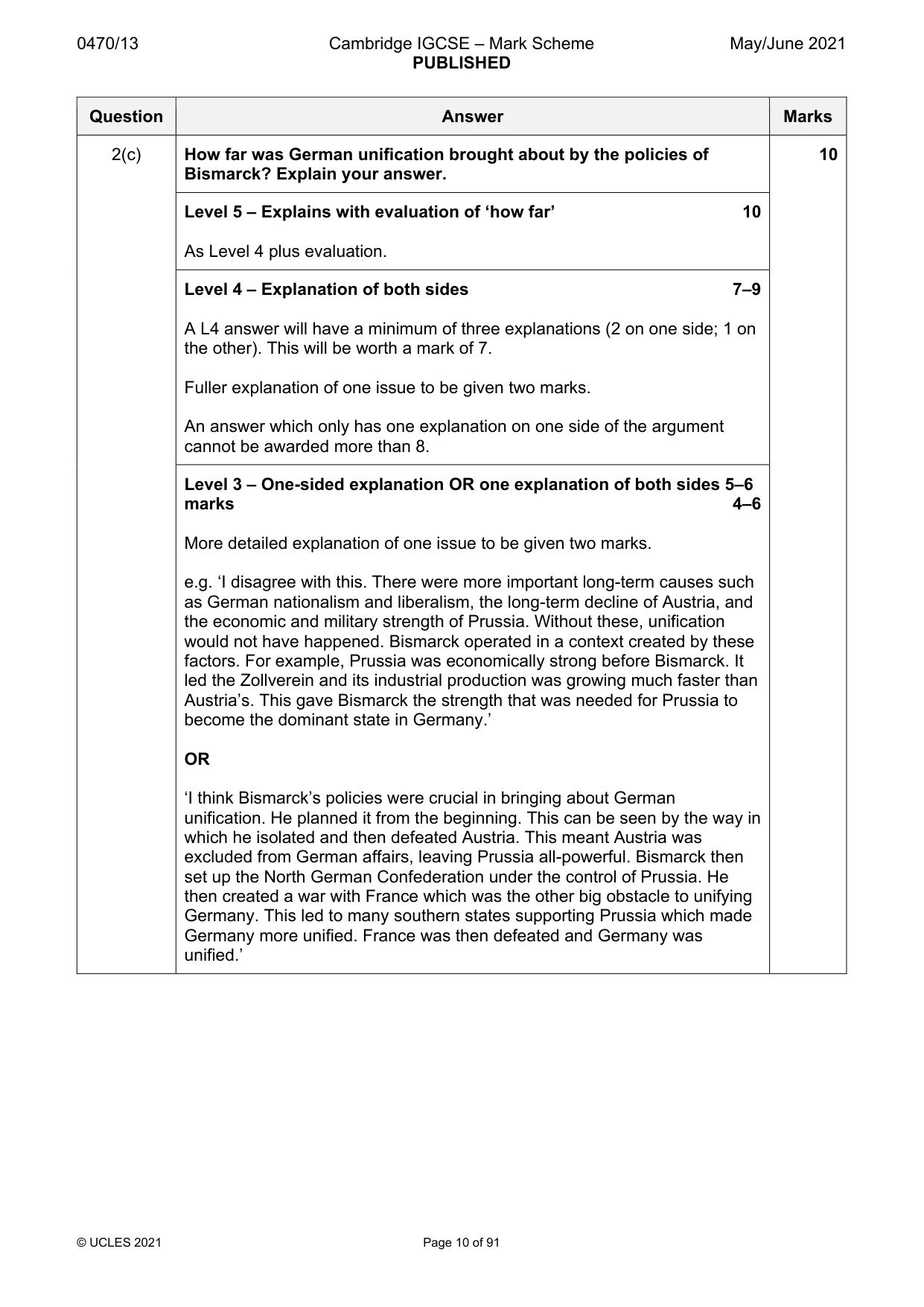
0470/13 Cambridge IGCSE – Mark Scheme PUBLISHED May/June 2021 © UCLES 2021 Page 10 of 91 Question Answer Marks 2(c) How far was German unification brought about by the policies of Bismarck? Explain your answer. 10 Level 5 – Explains with evaluation of ‘how far’ 10 As Level 4 plus evaluation. Level 4 – Explanation of both sides 7–9 A L4 answer will have a minimum of three explanations (2 on one side; 1 on the other). This will be worth a mark of 7. Fuller explanation of one issue to be given two marks. An answer which only has one explanation on one side of the argument cannot be awarded more than 8. Level 3 – One-sided explanation OR one explanation of both sides 5–6 marks 4–6 More detailed explanation of one issue to be given two marks. e.g. ‘I disagree with this. There were more important long-term causes such as German nationalism and liberalism, the long-term decline of Austria, and the economic and military strength of Prussia. Without these, unification would not have happened. Bismarck operated in a context created by these factors. For example, Prussia was economically strong before Bismarck. It led the Zollverein and its industrial production was growing much faster than Austria’s. This gave Bismarck the strength that was needed for Prussia to become the dominant state in Germany.’ OR ‘I think Bismarck’s policies were crucial in bringing about German unification. He planned it from the beginning. This can be seen by the way in which he isolated and then defeated Austria. This meant Austria was excluded from German affairs, leaving Prussia all-powerful. Bismarck then set up the North German Confederation under the control of Prussia. He then created a war with France which was the other big obstacle to unifying Germany. This led to many southern states supporting Prussia which made Germany more unified. France was then defeated and Germany was unified.’
Mark scheme, page 11
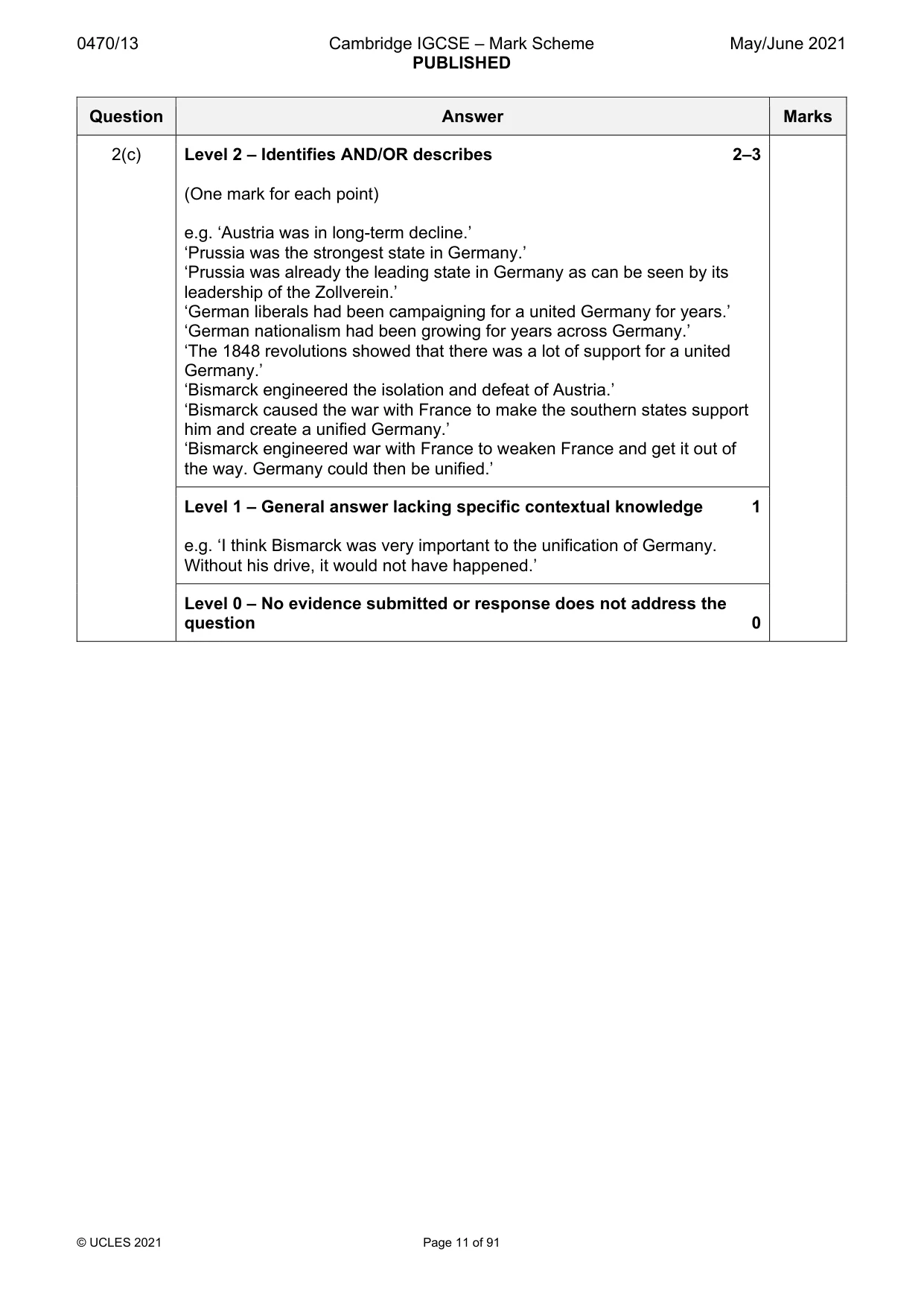
0470/13 Cambridge IGCSE – Mark Scheme PUBLISHED May/June 2021 © UCLES 2021 Page 11 of 91 Question Answer Marks 2(c) Level 2 – Identifies AND/OR describes 2–3 (One mark for each point) e.g. ‘Austria was in long-term decline.’ ‘Prussia was the strongest state in Germany.’ ‘Prussia was already the leading state in Germany as can be seen by its leadership of the Zollverein.’ ‘German liberals had been campaigning for a united Germany for years.’ ‘German nationalism had been growing for years across Germany.’ ‘The 1848 revolutions showed that there was a lot of support for a united Germany.’ ‘Bismarck engineered the isolation and defeat of Austria.’ ‘Bismarck caused the war with France to make the southern states support him and create a unified Germany.’ ‘Bismarck engineered war with France to weaken France and get it out of the way. Germany could then be unified.’ Level 1 – General answer lacking specific contextual knowledge 1 e.g. ‘I think Bismarck was very important to the unification of Germany. Without his drive, it would not have happened.’ Level 0 – No evidence submitted or response does not address the question 0
Mark scheme, page 12
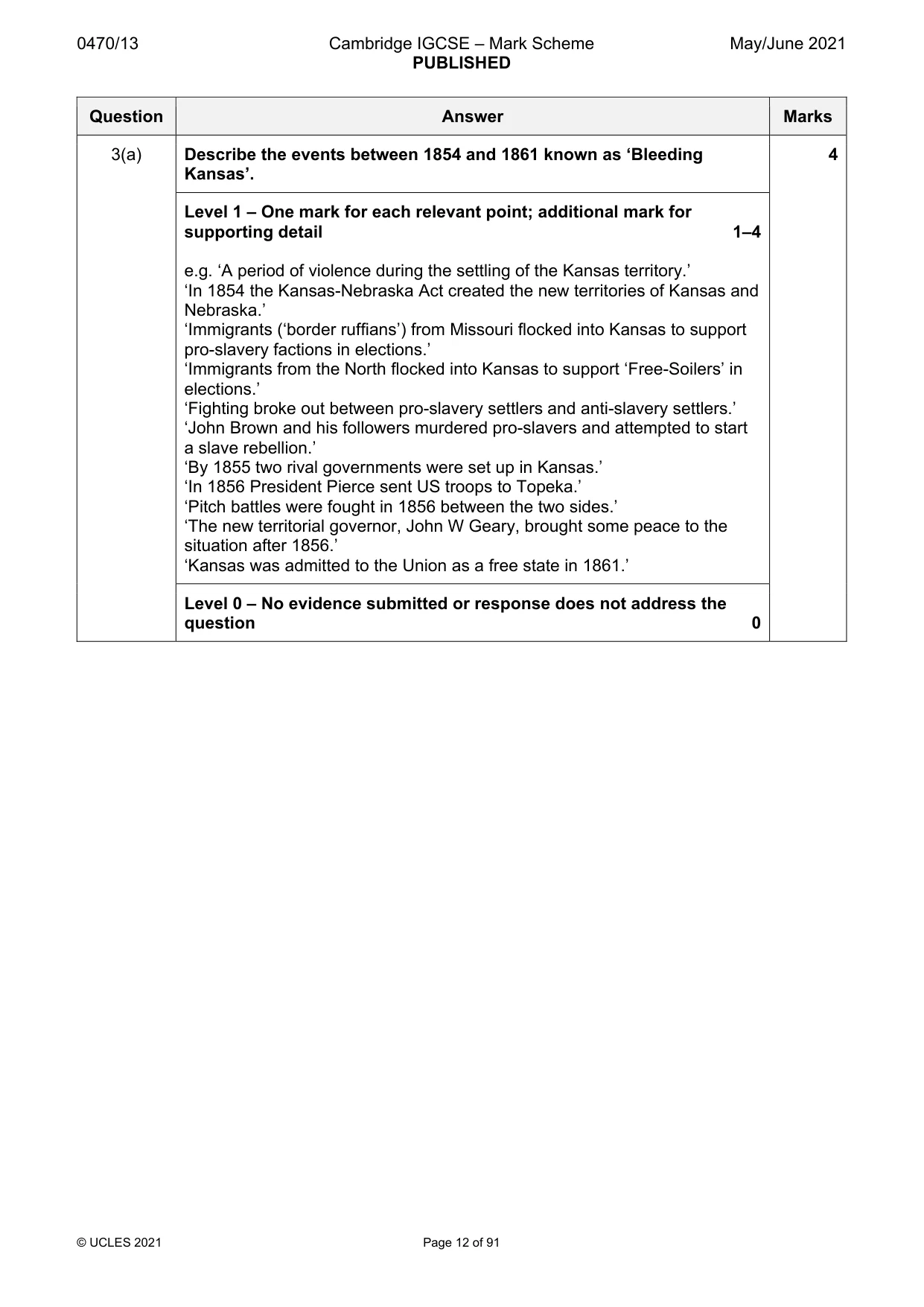
0470/13 Cambridge IGCSE – Mark Scheme PUBLISHED May/June 2021 © UCLES 2021 Page 12 of 91 Question Answer Marks 3(a) Describe the events between 1854 and 1861 known as ‘Bleeding Kansas’. 4 Level 1 – One mark for each relevant point; additional mark for supporting detail 1–4 e.g. ‘A period of violence during the settling of the Kansas territory.’ ‘In 1854 the Kansas-Nebraska Act created the new territories of Kansas and Nebraska.’ ‘Immigrants (‘border ruffians’) from Missouri flocked into Kansas to support pro-slavery factions in elections.’ ‘Immigrants from the North flocked into Kansas to support ‘Free-Soilers’ in elections.’ ‘Fighting broke out between pro-slavery settlers and anti-slavery settlers.’ ‘John Brown and his followers murdered pro-slavers and attempted to start a slave rebellion.’ ‘By 1855 two rival governments were set up in Kansas.’ ‘In 1856 President Pierce sent US troops to Topeka.’ ‘Pitch battles were fought in 1856 between the two sides.’ ‘The new territorial governor, John W Geary, brought some peace to the situation after 1856.’ ‘Kansas was admitted to the Union as a free state in 1861.’ Level 0 – No evidence submitted or response does not address the question 0
Mark scheme, page 13
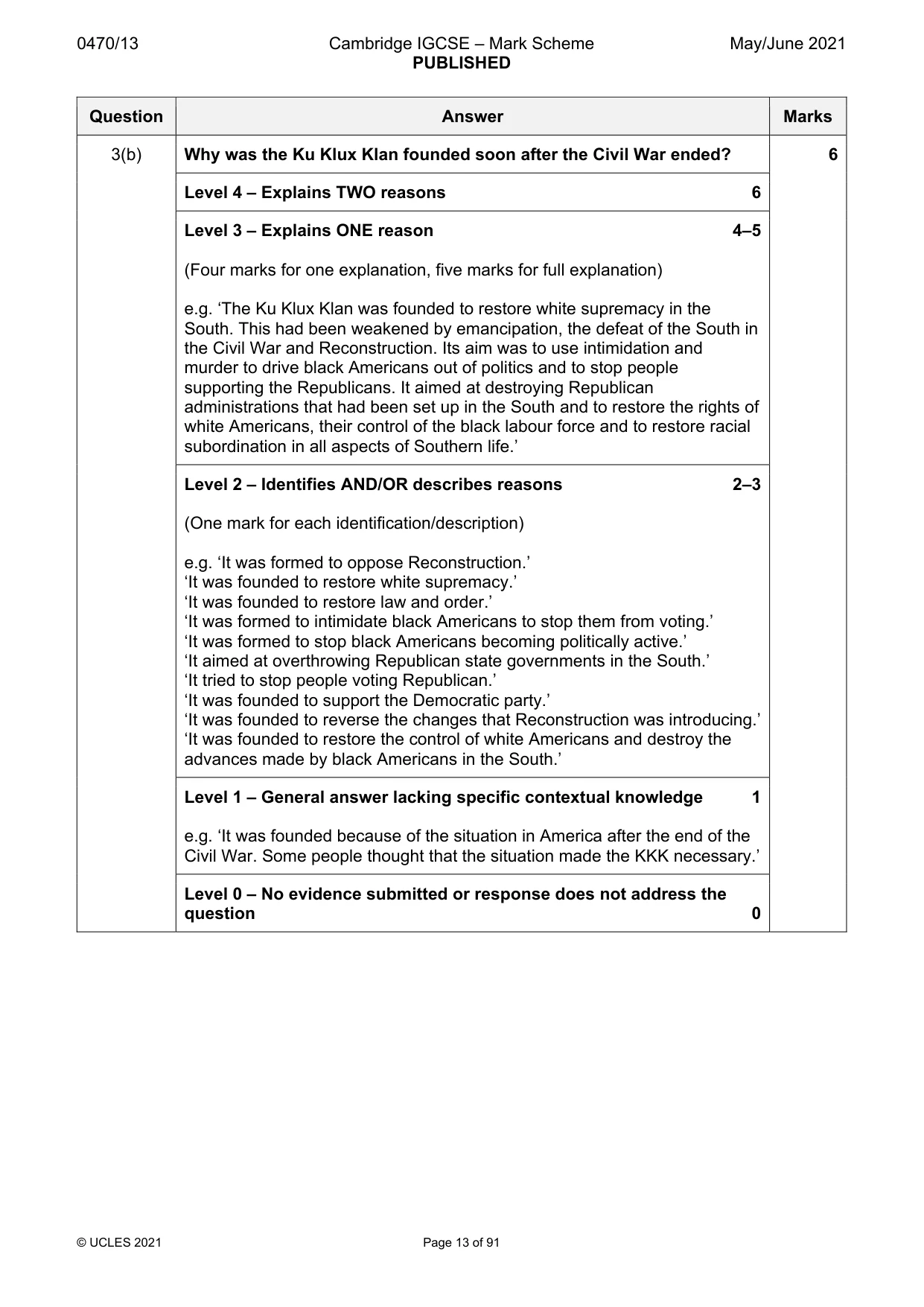
0470/13 Cambridge IGCSE – Mark Scheme PUBLISHED May/June 2021 © UCLES 2021 Page 13 of 91 Question Answer Marks 3(b) Why was the Ku Klux Klan founded soon after the Civil War ended? 6 Level 4 – Explains TWO reasons 6 Level 3 – Explains ONE reason 4–5 (Four marks for one explanation, five marks for full explanation) e.g. ‘The Ku Klux Klan was founded to restore white supremacy in the South. This had been weakened by emancipation, the defeat of the South in the Civil War and Reconstruction. Its aim was to use intimidation and murder to drive black Americans out of politics and to stop people supporting the Republicans. It aimed at destroying Republican administrations that had been set up in the South and to restore the rights of white Americans, their control of the black labour force and to restore racial subordination in all aspects of Southern life.’ Level 2 – Identifies AND/OR describes reasons 2–3 (One mark for each identification/description) e.g. ‘It was formed to oppose Reconstruction.’ ‘It was founded to restore white supremacy.’ ‘It was founded to restore law and order.’ ‘It was formed to intimidate black Americans to stop them from voting.’ ‘It was formed to stop black Americans becoming politically active.’ ‘It aimed at overthrowing Republican state governments in the South.’ ‘It tried to stop people voting Republican.’ ‘It was founded to support the Democratic party.’ ‘It was founded to reverse the changes that Reconstruction was introducing.’ ‘It was founded to restore the control of white Americans and destroy the advances made by black Americans in the South.’ Level 1 – General answer lacking specific contextual knowledge 1 e.g. ‘It was founded because of the situation in America after the end of the Civil War. Some people thought that the situation made the KKK necessary.’ Level 0 – No evidence submitted or response does not address the question 0
Mark scheme, page 14
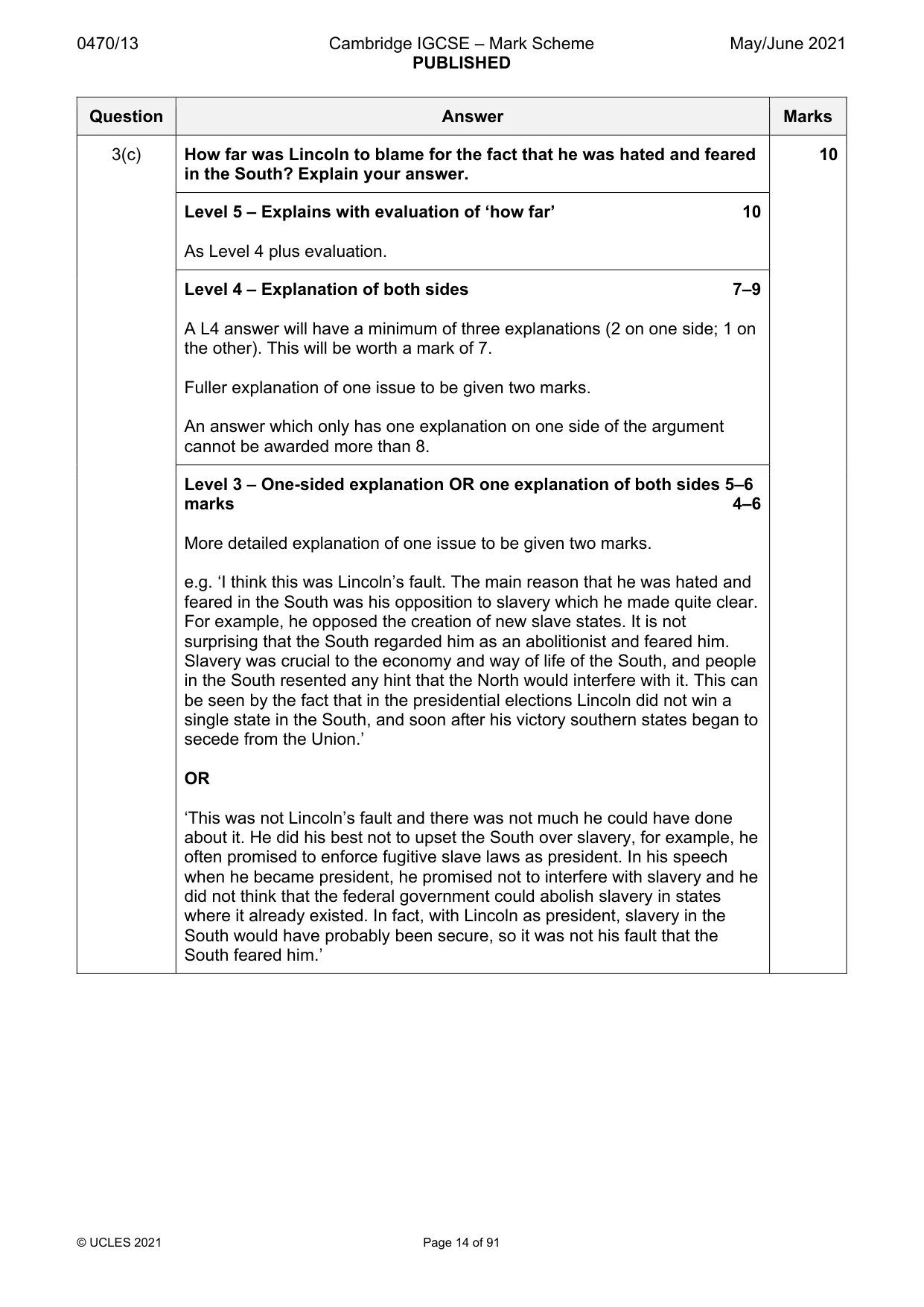
0470/13 Cambridge IGCSE – Mark Scheme PUBLISHED May/June 2021 © UCLES 2021 Page 14 of 91 Question Answer Marks 3(c) How far was Lincoln to blame for the fact that he was hated and feared in the South? Explain your answer. 10 Level 5 – Explains with evaluation of ‘how far’ 10 As Level 4 plus evaluation. Level 4 – Explanation of both sides 7–9 A L4 answer will have a minimum of three explanations (2 on one side; 1 on the other). This will be worth a mark of 7. Fuller explanation of one issue to be given two marks. An answer which only has one explanation on one side of the argument cannot be awarded more than 8. Level 3 – One-sided explanation OR one explanation of both sides 5–6 marks 4–6 More detailed explanation of one issue to be given two marks. e.g. ‘I think this was Lincoln’s fault. The main reason that he was hated and feared in the South was his opposition to slavery which he made quite clear. For example, he opposed the creation of new slave states. It is not surprising that the South regarded him as an abolitionist and feared him. Slavery was crucial to the economy and way of life of the South, and people in the South resented any hint that the North would interfere with it. This can be seen by the fact that in the presidential elections Lincoln did not win a single state in the South, and soon after his victory southern states began to secede from the Union.’ OR ‘This was not Lincoln’s fault and there was not much he could have done about it. He did his best not to upset the South over slavery, for example, he often promised to enforce fugitive slave laws as president. In his speech when he became president, he promised not to interfere with slavery and he did not think that the federal government could abolish slavery in states where it already existed. In fact, with Lincoln as president, slavery in the South would have probably been secure, so it was not his fault that the South feared him.’
Mark scheme, page 15
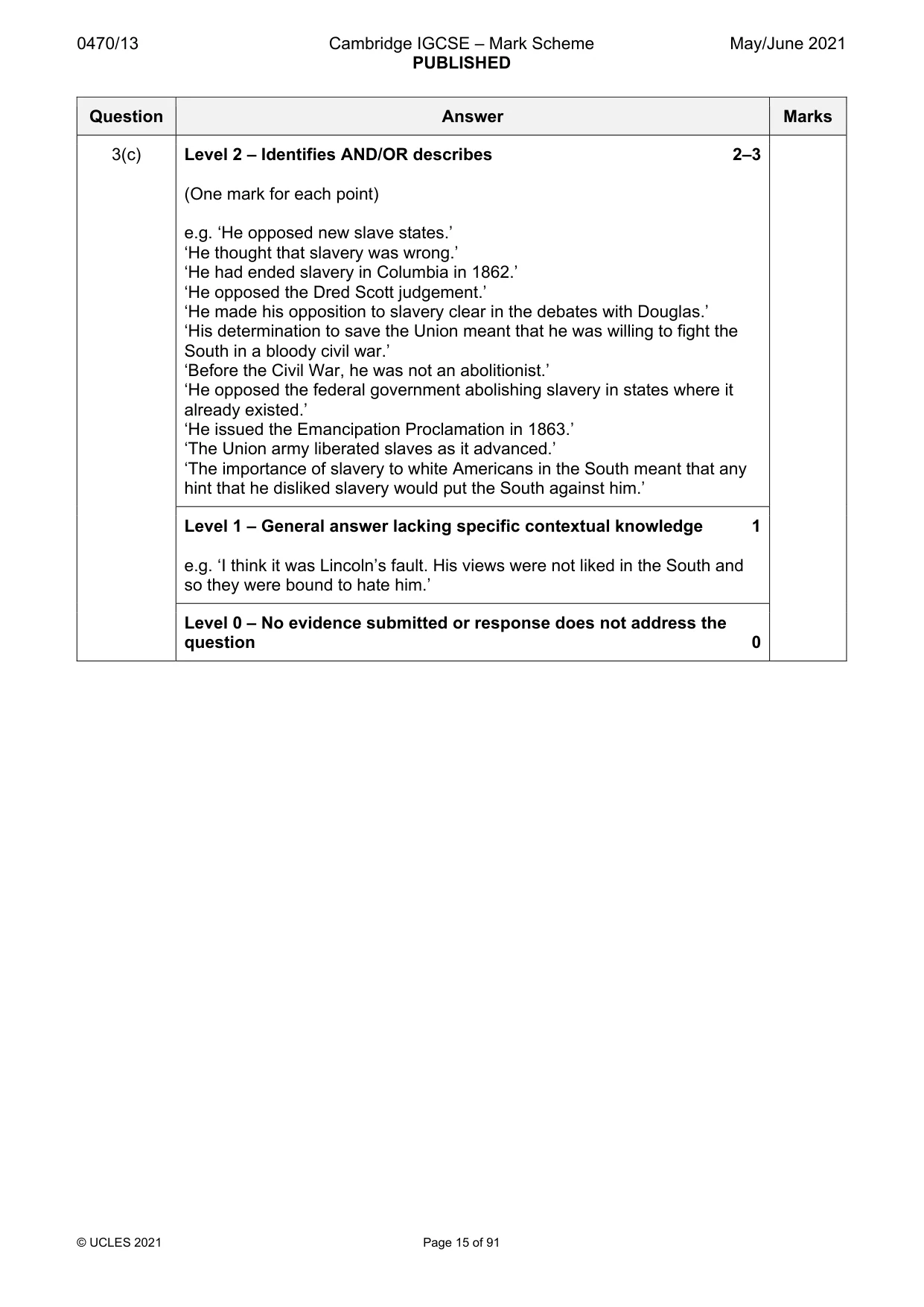
0470/13 Cambridge IGCSE – Mark Scheme PUBLISHED May/June 2021 © UCLES 2021 Page 15 of 91 Question Answer Marks 3(c) Level 2 – Identifies AND/OR describes 2–3 (One mark for each point) e.g. ‘He opposed new slave states.’ ‘He thought that slavery was wrong.’ ‘He had ended slavery in Columbia in 1862.’ ‘He opposed the Dred Scott judgement.’ ‘He made his opposition to slavery clear in the debates with Douglas.’ ‘His determination to save the Union meant that he was willing to fight the South in a bloody civil war.’ ‘Before the Civil War, he was not an abolitionist.’ ‘He opposed the federal government abolishing slavery in states where it already existed.’ ‘He issued the Emancipation Proclamation in 1863.’ ‘The Union army liberated slaves as it advanced.’ ‘The importance of slavery to white Americans in the South meant that any hint that he disliked slavery would put the South against him.’ Level 1 – General answer lacking specific contextual knowledge 1 e.g. ‘I think it was Lincoln’s fault. His views were not liked in the South and so they were bound to hate him.’ Level 0 – No evidence submitted or response does not address the question 0
Mark scheme, page 16
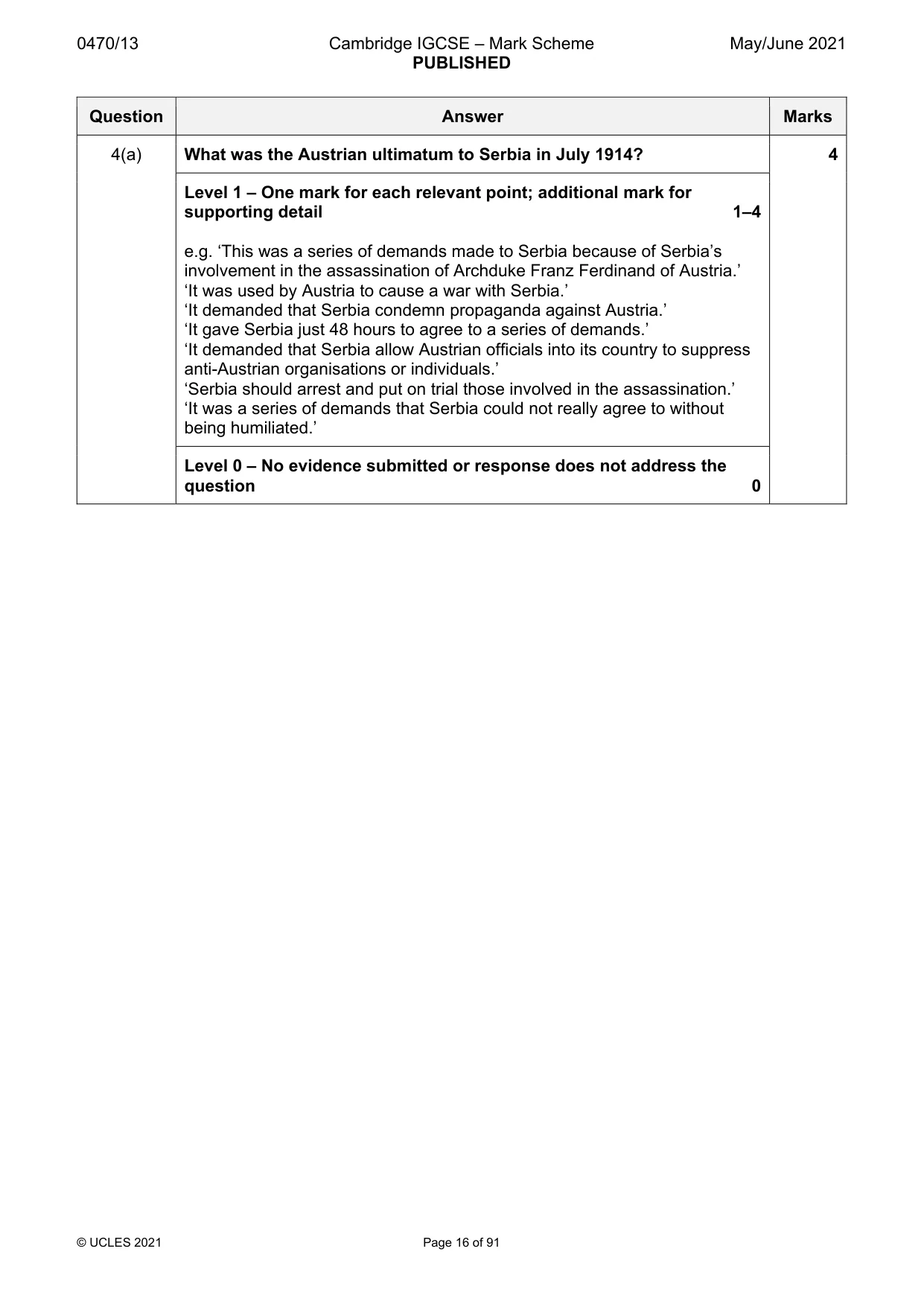
0470/13 Cambridge IGCSE – Mark Scheme PUBLISHED May/June 2021 © UCLES 2021 Page 16 of 91 Question Answer Marks 4(a) What was the Austrian ultimatum to Serbia in July 1914? 4 Level 1 – One mark for each relevant point; additional mark for supporting detail 1–4 e.g. ‘This was a series of demands made to Serbia because of Serbia’s involvement in the assassination of Archduke Franz Ferdinand of Austria.’ ‘It was used by Austria to cause a war with Serbia.’ ‘It demanded that Serbia condemn propaganda against Austria.’ ‘It gave Serbia just 48 hours to agree to a series of demands.’ ‘It demanded that Serbia allow Austrian officials into its country to suppress anti-Austrian organisations or individuals.’ ‘Serbia should arrest and put on trial those involved in the assassination.’ ‘It was a series of demands that Serbia could not really agree to without being humiliated.’ Level 0 – No evidence submitted or response does not address the question 0
Mark scheme, page 17
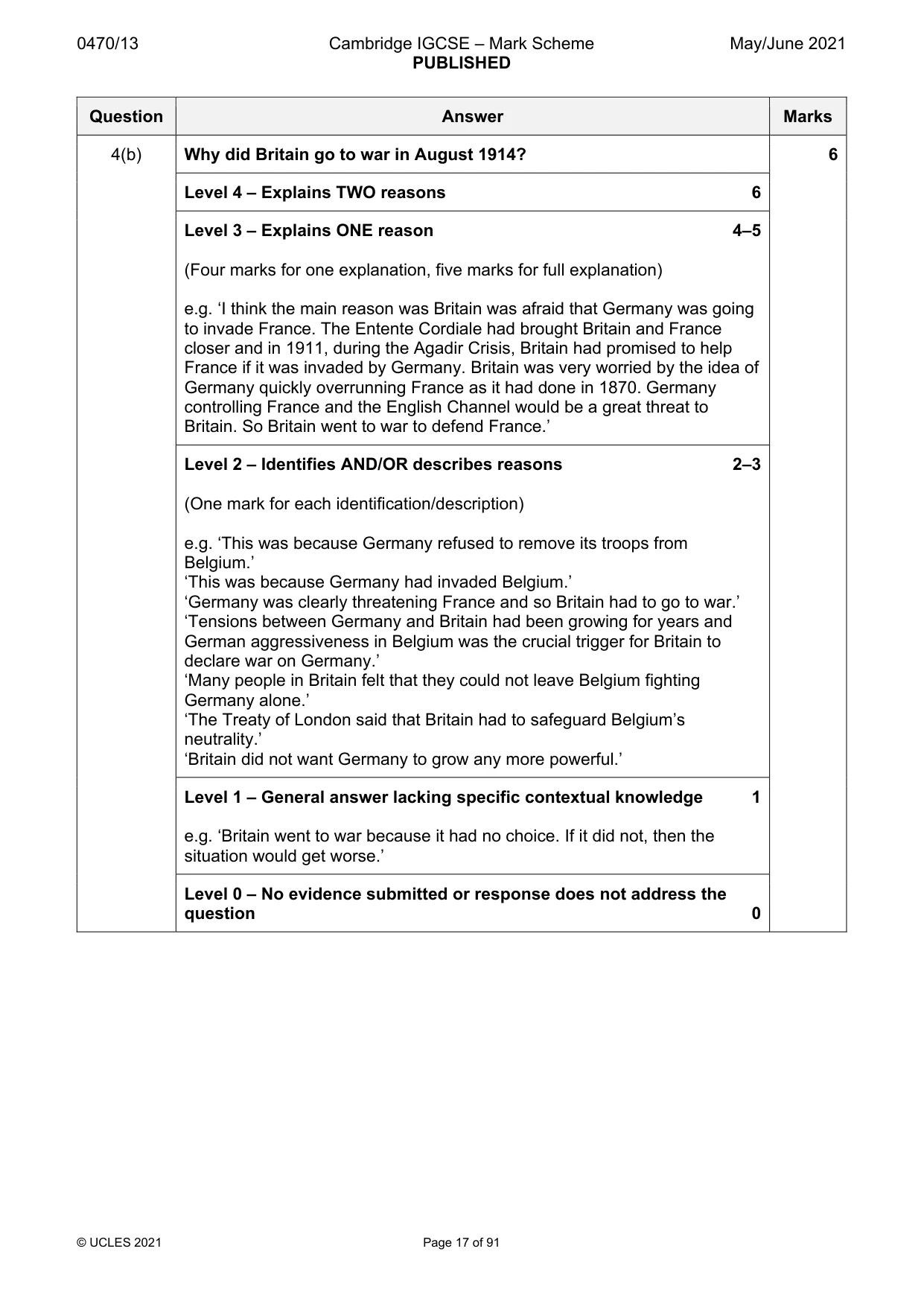
0470/13 Cambridge IGCSE – Mark Scheme PUBLISHED May/June 2021 © UCLES 2021 Page 17 of 91 Question Answer Marks 4(b) Why did Britain go to war in August 1914? 6 Level 4 – Explains TWO reasons 6 Level 3 – Explains ONE reason 4–5 (Four marks for one explanation, five marks for full explanation) e.g. ‘I think the main reason was Britain was afraid that Germany was going to invade France. The Entente Cordiale had brought Britain and France closer and in 1911, during the Agadir Crisis, Britain had promised to help France if it was invaded by Germany. Britain was very worried by the idea of Germany quickly overrunning France as it had done in 1870. Germany controlling France and the English Channel would be a great threat to Britain. So Britain went to war to defend France.’ Level 2 – Identifies AND/OR describes reasons 2–3 (One mark for each identification/description) e.g. ‘This was because Germany refused to remove its troops from Belgium.’ ‘This was because Germany had invaded Belgium.’ ‘Germany was clearly threatening France and so Britain had to go to war.’ ‘Tensions between Germany and Britain had been growing for years and German aggressiveness in Belgium was the crucial trigger for Britain to declare war on Germany.’ ‘Many people in Britain felt that they could not leave Belgium fighting Germany alone.’ ‘The Treaty of London said that Britain had to safeguard Belgium’s neutrality.’ ‘Britain did not want Germany to grow any more powerful.’ Level 1 – General answer lacking specific contextual knowledge 1 e.g. ‘Britain went to war because it had no choice. If it did not, then the situation would get worse.’ Level 0 – No evidence submitted or response does not address the question 0
Mark scheme, page 18
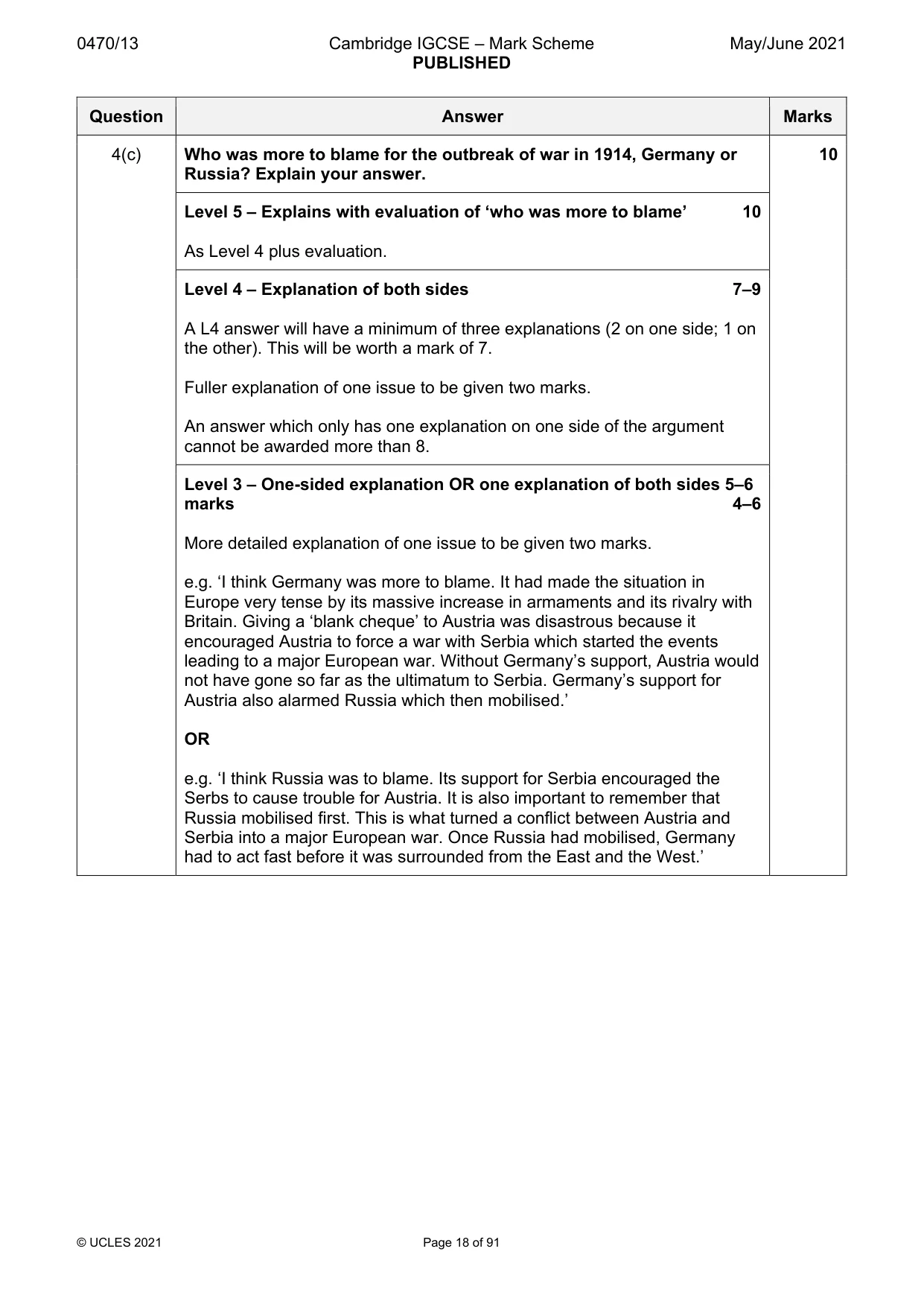
0470/13 Cambridge IGCSE – Mark Scheme PUBLISHED May/June 2021 © UCLES 2021 Page 18 of 91 Question Answer Marks 4(c) Who was more to blame for the outbreak of war in 1914, Germany or Russia? Explain your answer. 10 Level 5 – Explains with evaluation of ‘who was more to blame’ 10 As Level 4 plus evaluation. Level 4 – Explanation of both sides 7–9 A L4 answer will have a minimum of three explanations (2 on one side; 1 on the other). This will be worth a mark of 7. Fuller explanation of one issue to be given two marks. An answer which only has one explanation on one side of the argument cannot be awarded more than 8. Level 3 – One-sided explanation OR one explanation of both sides 5–6 marks 4–6 More detailed explanation of one issue to be given two marks. e.g. ‘I think Germany was more to blame. It had made the situation in Europe very tense by its massive increase in armaments and its rivalry with Britain. Giving a ‘blank cheque’ to Austria was disastrous because it encouraged Austria to force a war with Serbia which started the events leading to a major European war. Without Germany’s support, Austria would not have gone so far as the ultimatum to Serbia. Germany’s support for Austria also alarmed Russia which then mobilised.’ OR e.g. ‘I think Russia was to blame. Its support for Serbia encouraged the Serbs to cause trouble for Austria. It is also important to remember that Russia mobilised first. This is what turned a conflict between Austria and Serbia into a major European war. Once Russia had mobilised, Germany had to act fast before it was surrounded from the East and the West.’
Mark scheme, page 19
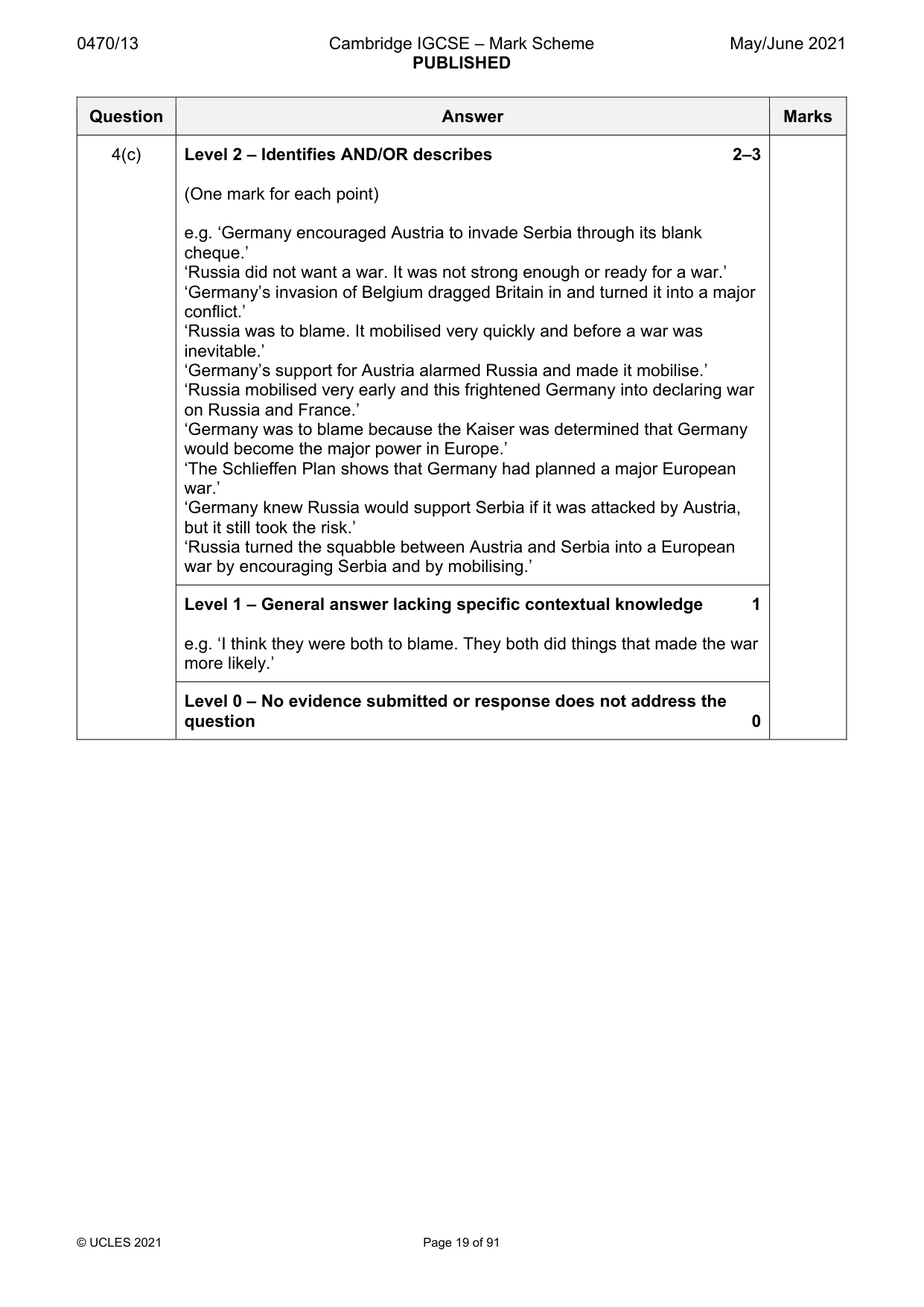
0470/13 Cambridge IGCSE – Mark Scheme PUBLISHED May/June 2021 © UCLES 2021 Page 19 of 91 Question Answer Marks 4(c) Level 2 – Identifies AND/OR describes 2–3 (One mark for each point) e.g. ‘Germany encouraged Austria to invade Serbia through its blank cheque.’ ‘Russia did not want a war. It was not strong enough or ready for a war.’ ‘Germany’s invasion of Belgium dragged Britain in and turned it into a major conflict.’ ‘Russia was to blame. It mobilised very quickly and before a war was inevitable.’ ‘Germany’s support for Austria alarmed Russia and made it mobilise.’ ‘Russia mobilised very early and this frightened Germany into declaring war on Russia and France.’ ‘Germany was to blame because the Kaiser was determined that Germany would become the major power in Europe.’ ‘The Schlieffen Plan shows that Germany had planned a major European war.’ ‘Germany knew Russia would support Serbia if it was attacked by Austria, but it still took the risk.’ ‘Russia turned the squabble between Austria and Serbia into a European war by encouraging Serbia and by mobilising.’ Level 1 – General answer lacking specific contextual knowledge 1 e.g. ‘I think they were both to blame. They both did things that made the war more likely.’ Level 0 – No evidence submitted or response does not address the question 0
Mark scheme, page 20
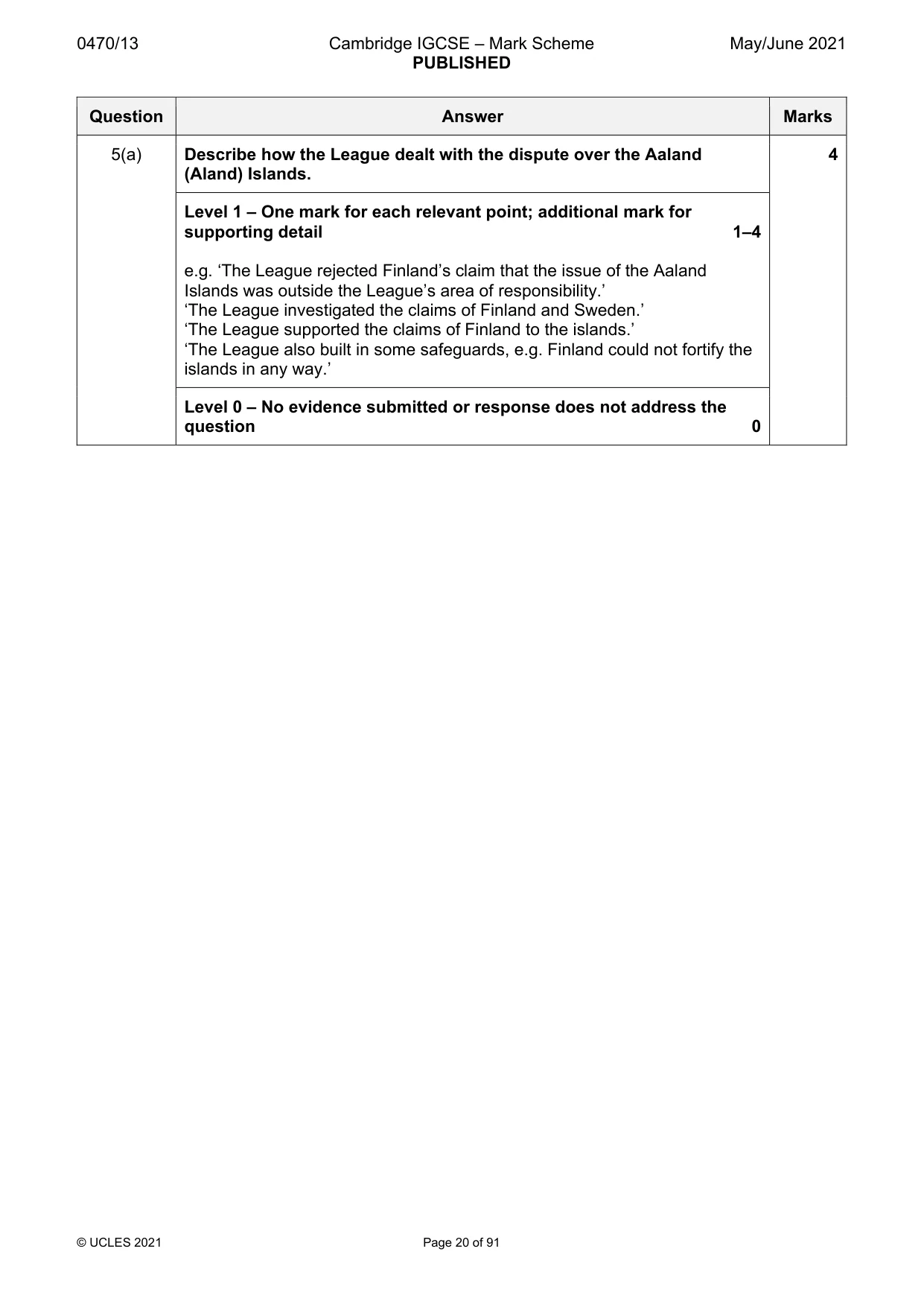
0470/13 Cambridge IGCSE – Mark Scheme PUBLISHED May/June 2021 © UCLES 2021 Page 20 of 91 Question Answer Marks 5(a) Describe how the League dealt with the dispute over the Aaland (Aland) Islands. 4 Level 1 – One mark for each relevant point; additional mark for supporting detail 1–4 e.g. ‘The League rejected Finland’s claim that the issue of the Aaland Islands was outside the League’s area of responsibility.’ ‘The League investigated the claims of Finland and Sweden.’ ‘The League supported the claims of Finland to the islands.’ ‘The League also built in some safeguards, e.g. Finland could not fortify the islands in any way.’ Level 0 – No evidence submitted or response does not address the question 0
Mark scheme, page 21
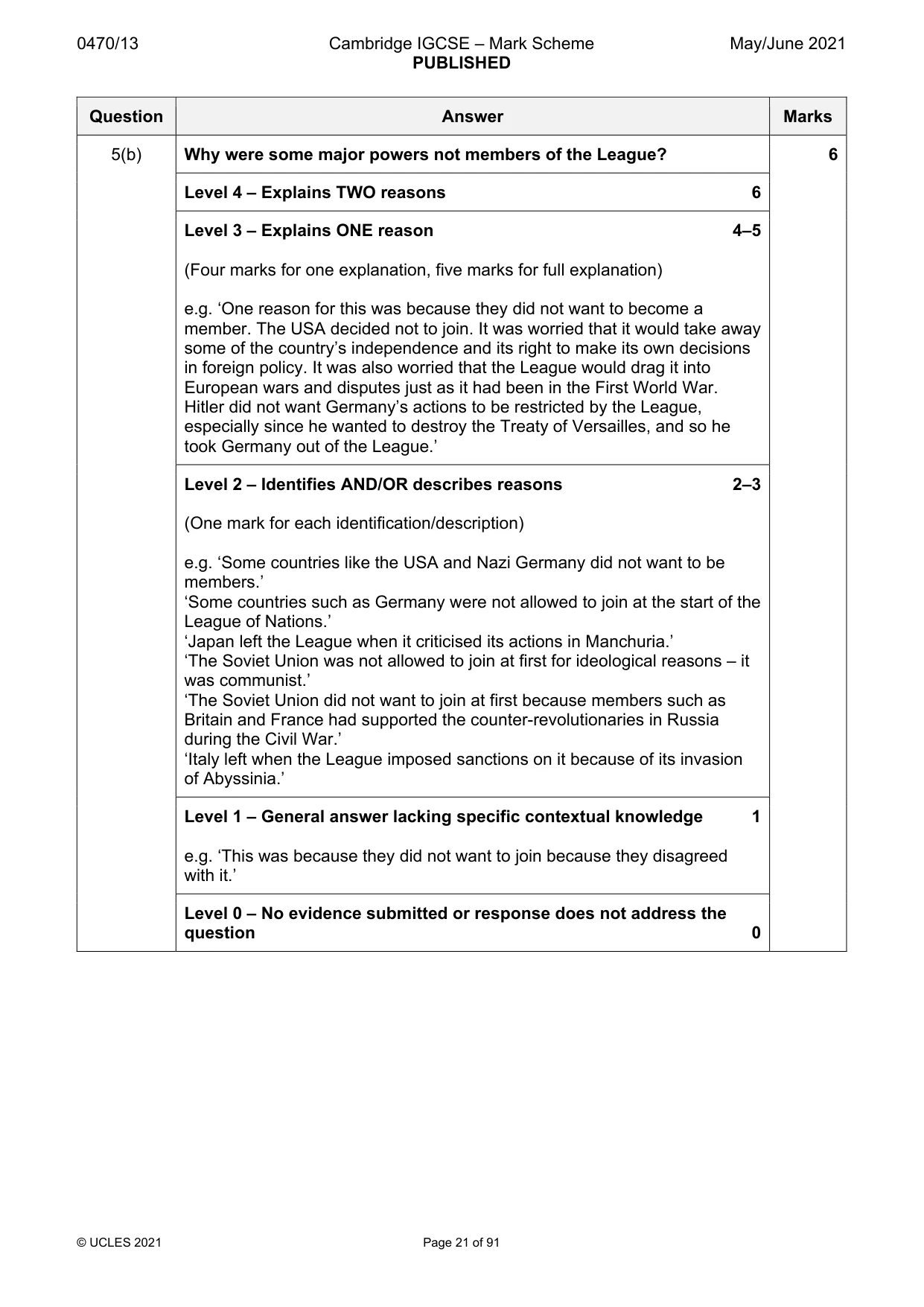
0470/13 Cambridge IGCSE – Mark Scheme PUBLISHED May/June 2021 © UCLES 2021 Page 21 of 91 Question Answer Marks 5(b) Why were some major powers not members of the League? 6 Level 4 – Explains TWO reasons 6 Level 3 – Explains ONE reason 4–5 (Four marks for one explanation, five marks for full explanation) e.g. ‘One reason for this was because they did not want to become a member. The USA decided not to join. It was worried that it would take away some of the country’s independence and its right to make its own decisions in foreign policy. It was also worried that the League would drag it into European wars and disputes just as it had been in the First World War. Hitler did not want Germany’s actions to be restricted by the League, especially since he wanted to destroy the Treaty of Versailles, and so he took Germany out of the League.’ Level 2 – Identifies AND/OR describes reasons 2–3 (One mark for each identification/description) e.g. ‘Some countries like the USA and Nazi Germany did not want to be members.’ ‘Some countries such as Germany were not allowed to join at the start of the League of Nations.’ ‘Japan left the League when it criticised its actions in Manchuria.’ ‘The Soviet Union was not allowed to join at first for ideological reasons – it was communist.’ ‘The Soviet Union did not want to join at first because members such as Britain and France had supported the counter-revolutionaries in Russia during the Civil War.’ ‘Italy left when the League imposed sanctions on it because of its invasion of Abyssinia.’ Level 1 – General answer lacking specific contextual knowledge 1 e.g. ‘This was because they did not want to join because they disagreed with it.’ Level 0 – No evidence submitted or response does not address the question 0
Mark scheme, page 22
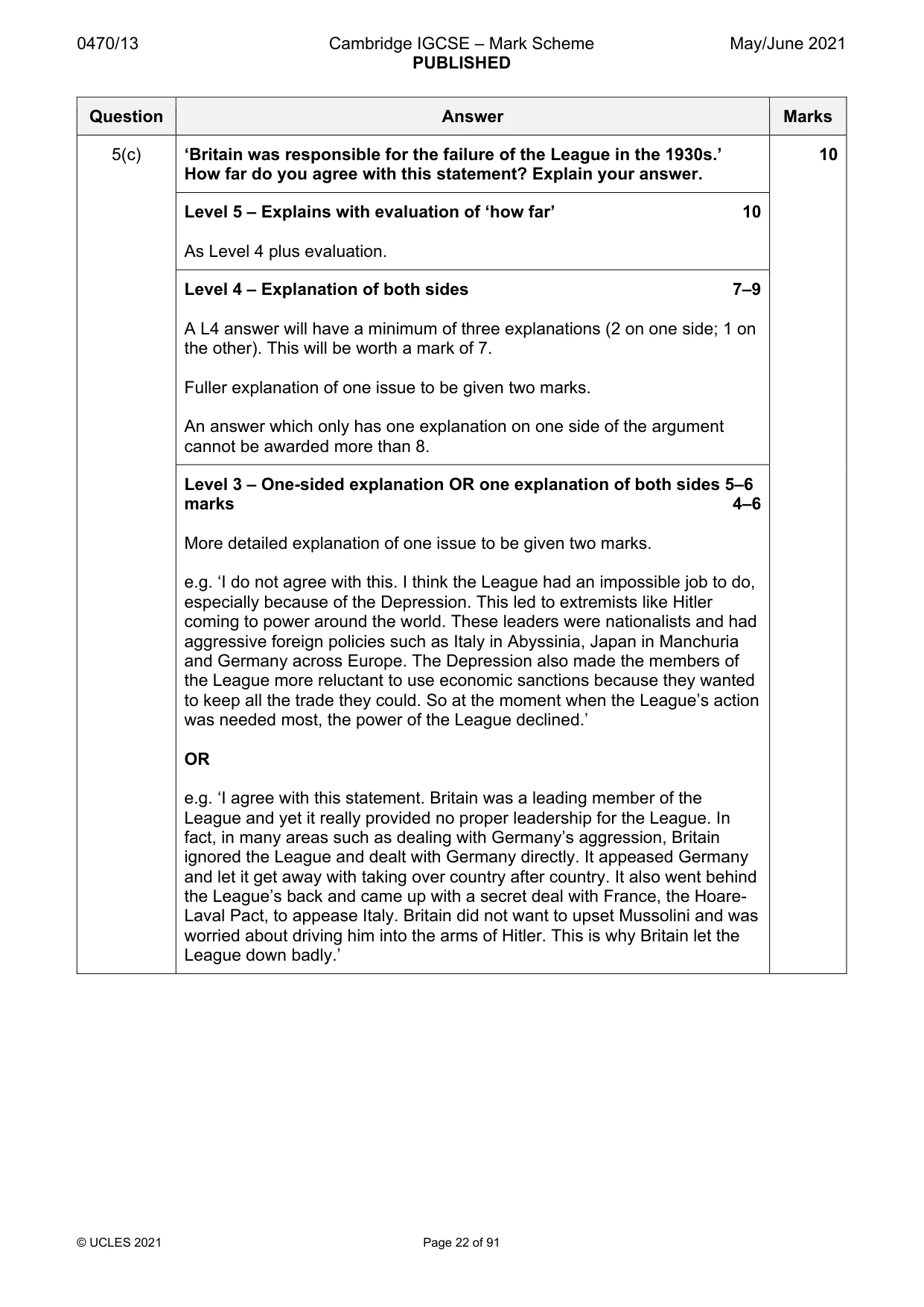
0470/13 Cambridge IGCSE – Mark Scheme PUBLISHED May/June 2021 © UCLES 2021 Page 22 of 91 Question Answer Marks 5(c) ‘Britain was responsible for the failure of the League in the 1930s.’ How far do you agree with this statement? Explain your answer. 10 Level 5 – Explains with evaluation of ‘how far’ 10 As Level 4 plus evaluation. Level 4 – Explanation of both sides 7–9 A L4 answer will have a minimum of three explanations (2 on one side; 1 on the other). This will be worth a mark of 7. Fuller explanation of one issue to be given two marks. An answer which only has one explanation on one side of the argument cannot be awarded more than 8. Level 3 – One-sided explanation OR one explanation of both sides 5–6 marks 4–6 More detailed explanation of one issue to be given two marks. e.g. ‘I do not agree with this. I think the League had an impossible job to do, especially because of the Depression. This led to extremists like Hitler coming to power around the world. These leaders were nationalists and had aggressive foreign policies such as Italy in Abyssinia, Japan in Manchuria and Germany across Europe. The Depression also made the members of the League more reluctant to use economic sanctions because they wanted to keep all the trade they could. So at the moment when the League’s action was needed most, the power of the League declined.’ OR e.g. ‘I agree with this statement. Britain was a leading member of the League and yet it really provided no proper leadership for the League. In fact, in many areas such as dealing with Germany’s aggression, Britain ignored the League and dealt with Germany directly. It appeased Germany and let it get away with taking over country after country. It also went behind the League’s back and came up with a secret deal with France, the Hoare- Laval Pact, to appease Italy. Britain did not want to upset Mussolini and was worried about driving him into the arms of Hitler. This is why Britain let the League down badly.’
Mark scheme, page 23
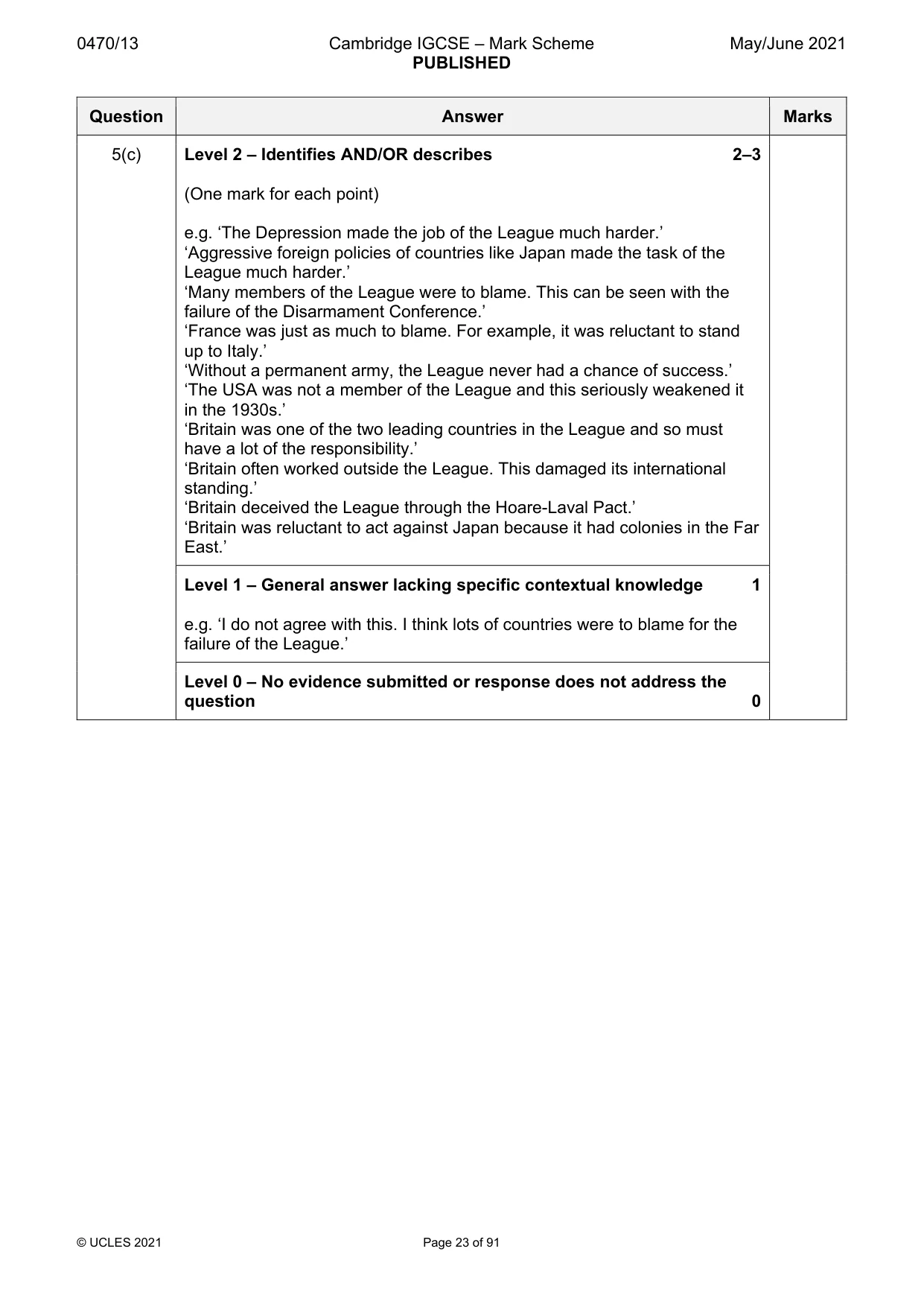
0470/13 Cambridge IGCSE – Mark Scheme PUBLISHED May/June 2021 © UCLES 2021 Page 23 of 91 Question Answer Marks 5(c) Level 2 – Identifies AND/OR describes 2–3 (One mark for each point) e.g. ‘The Depression made the job of the League much harder.’ ‘Aggressive foreign policies of countries like Japan made the task of the League much harder.’ ‘Many members of the League were to blame. This can be seen with the failure of the Disarmament Conference.’ ‘France was just as much to blame. For example, it was reluctant to stand up to Italy.’ ‘Without a permanent army, the League never had a chance of success.’ ‘The USA was not a member of the League and this seriously weakened it in the 1930s.’ ‘Britain was one of the two leading countries in the League and so must have a lot of the responsibility.’ ‘Britain often worked outside the League. This damaged its international standing.’ ‘Britain deceived the League through the Hoare-Laval Pact.’ ‘Britain was reluctant to act against Japan because it had colonies in the Far East.’ Level 1 – General answer lacking specific contextual knowledge 1 e.g. ‘I do not agree with this. I think lots of countries were to blame for the failure of the League.’ Level 0 – No evidence submitted or response does not address the question 0
Mark scheme, page 24
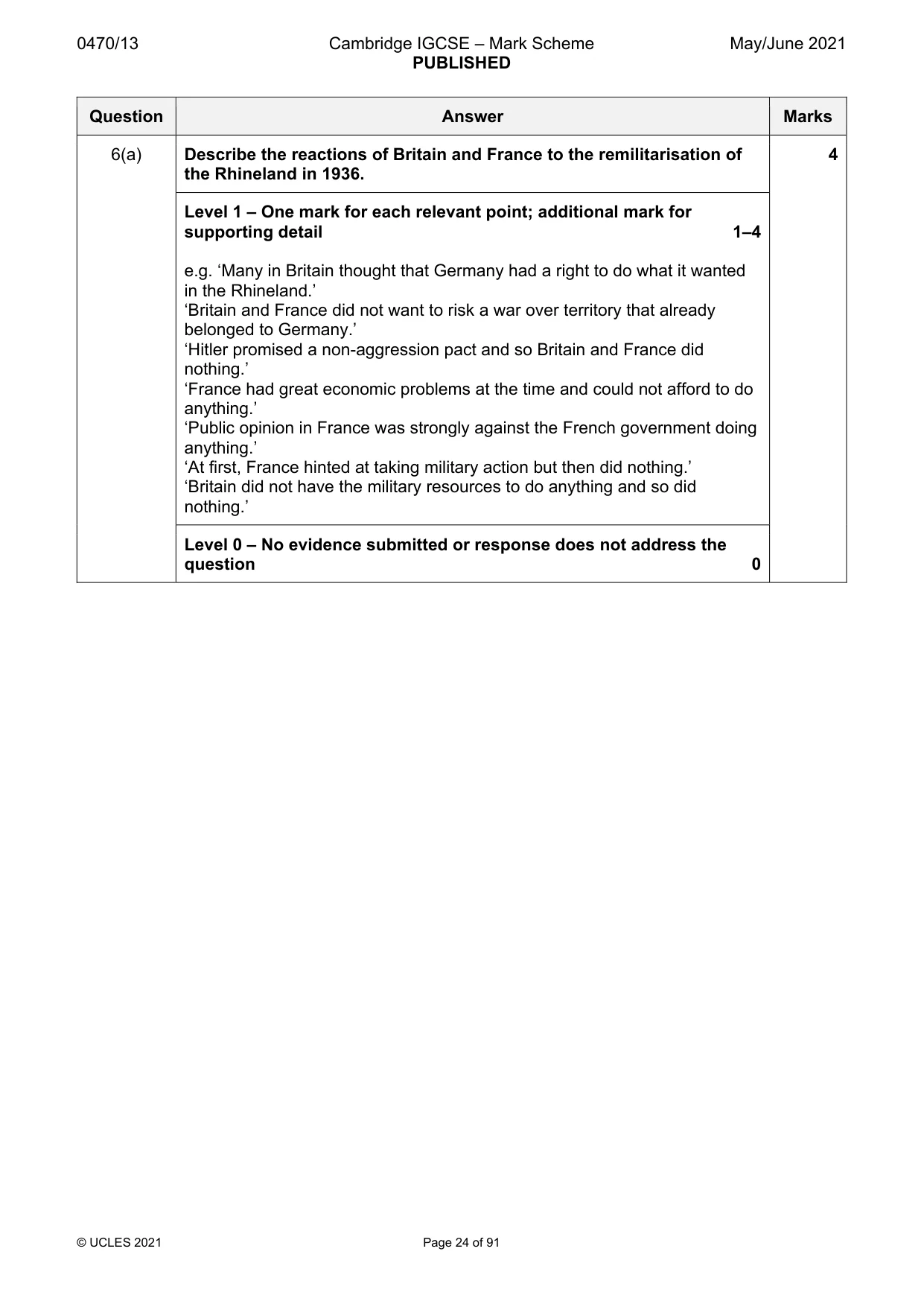
0470/13 Cambridge IGCSE – Mark Scheme PUBLISHED May/June 2021 © UCLES 2021 Page 24 of 91 Question Answer Marks 6(a) Describe the reactions of Britain and France to the remilitarisation of the Rhineland in 1936. 4 Level 1 – One mark for each relevant point; additional mark for supporting detail 1–4 e.g. ‘Many in Britain thought that Germany had a right to do what it wanted in the Rhineland.’ ‘Britain and France did not want to risk a war over territory that already belonged to Germany.’ ‘Hitler promised a non-aggression pact and so Britain and France did nothing.’ ‘France had great economic problems at the time and could not afford to do anything.’ ‘Public opinion in France was strongly against the French government doing anything.’ ‘At first, France hinted at taking military action but then did nothing.’ ‘Britain did not have the military resources to do anything and so did nothing.’ Level 0 – No evidence submitted or response does not address the question 0
Mark scheme, page 25
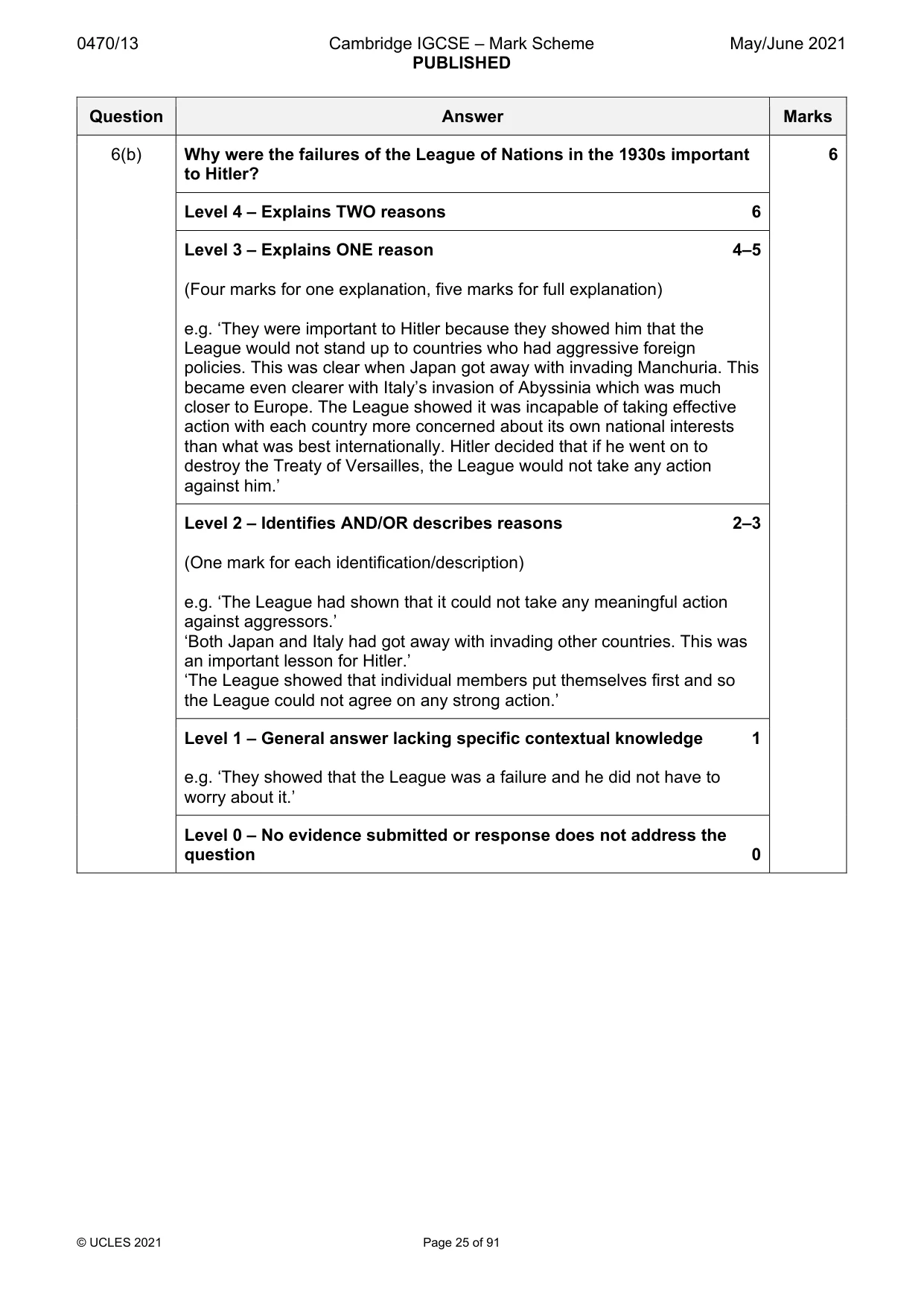
0470/13 Cambridge IGCSE – Mark Scheme PUBLISHED May/June 2021 © UCLES 2021 Page 25 of 91 Question Answer Marks 6(b) Why were the failures of the League of Nations in the 1930s important to Hitler? 6 Level 4 – Explains TWO reasons 6 Level 3 – Explains ONE reason 4–5 (Four marks for one explanation, five marks for full explanation) e.g. ‘They were important to Hitler because they showed him that the League would not stand up to countries who had aggressive foreign policies. This was clear when Japan got away with invading Manchuria. This became even clearer with Italy’s invasion of Abyssinia which was much closer to Europe. The League showed it was incapable of taking effective action with each country more concerned about its own national interests than what was best internationally. Hitler decided that if he went on to destroy the Treaty of Versailles, the League would not take any action against him.’ Level 2 – Identifies AND/OR describes reasons 2–3 (One mark for each identification/description) e.g. ‘The League had shown that it could not take any meaningful action against aggressors.’ ‘Both Japan and Italy had got away with invading other countries. This was an important lesson for Hitler.’ ‘The League showed that individual members put themselves first and so the League could not agree on any strong action.’ Level 1 – General answer lacking specific contextual knowledge 1 e.g. ‘They showed that the League was a failure and he did not have to worry about it.’ Level 0 – No evidence submitted or response does not address the question 0
Mark scheme, page 26
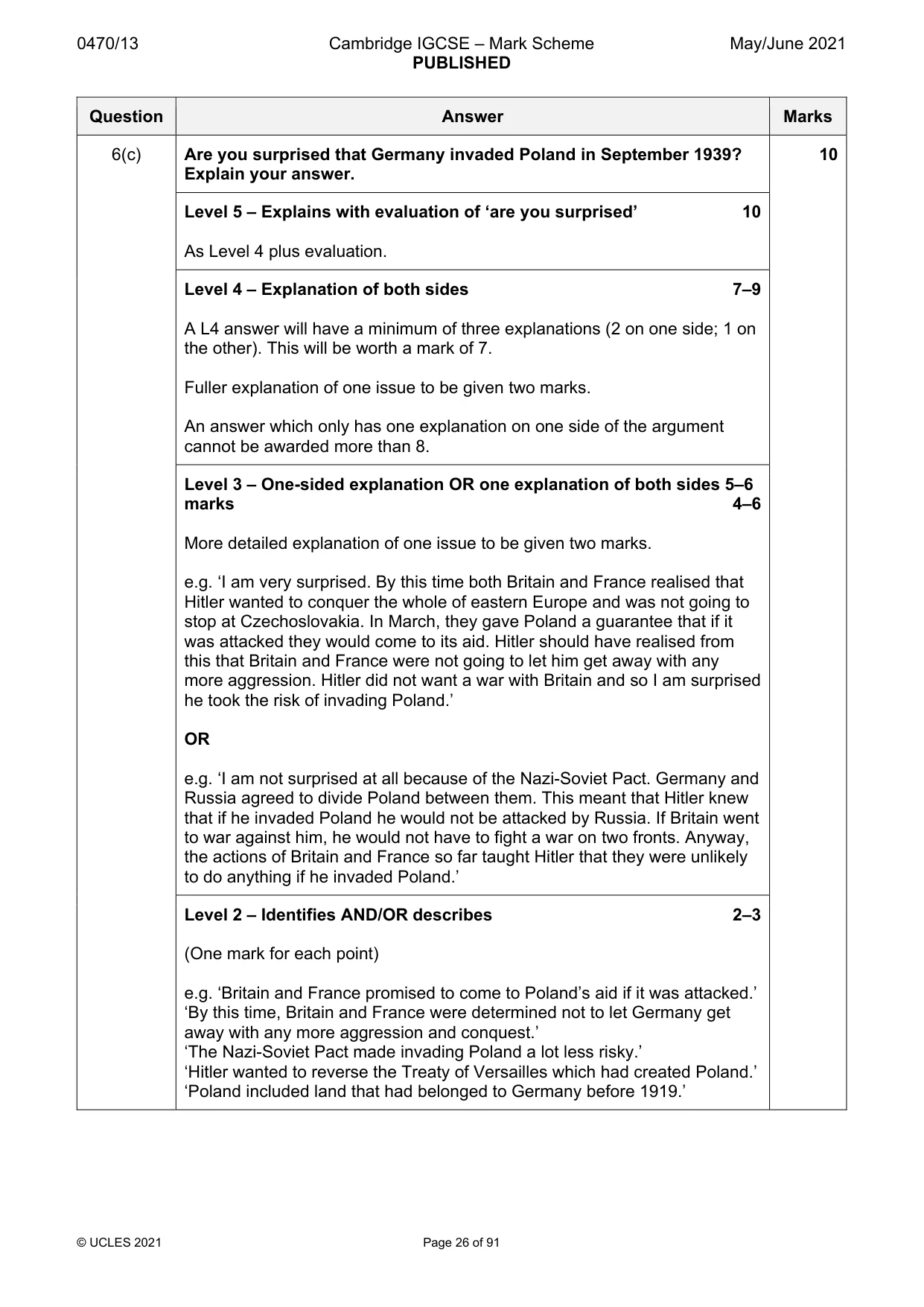
0470/13 Cambridge IGCSE – Mark Scheme PUBLISHED May/June 2021 © UCLES 2021 Page 26 of 91 Question Answer Marks 6(c) Are you surprised that Germany invaded Poland in September 1939? Explain your answer. 10 Level 5 – Explains with evaluation of ‘are you surprised’ 10 As Level 4 plus evaluation. Level 4 – Explanation of both sides 7–9 A L4 answer will have a minimum of three explanations (2 on one side; 1 on the other). This will be worth a mark of 7. Fuller explanation of one issue to be given two marks. An answer which only has one explanation on one side of the argument cannot be awarded more than 8. Level 3 – One-sided explanation OR one explanation of both sides 5–6 marks 4–6 More detailed explanation of one issue to be given two marks. e.g. ‘I am very surprised. By this time both Britain and France realised that Hitler wanted to conquer the whole of eastern Europe and was not going to stop at Czechoslovakia. In March, they gave Poland a guarantee that if it was attacked they would come to its aid. Hitler should have realised from this that Britain and France were not going to let him get away with any more aggression. Hitler did not want a war with Britain and so I am surprised he took the risk of invading Poland.’ OR e.g. ‘I am not surprised at all because of the Nazi-Soviet Pact. Germany and Russia agreed to divide Poland between them. This meant that Hitler knew that if he invaded Poland he would not be attacked by Russia. If Britain went to war against him, he would not have to fight a war on two fronts. Anyway, the actions of Britain and France so far taught Hitler that they were unlikely to do anything if he invaded Poland.’ Level 2 – Identifies AND/OR describes 2–3 (One mark for each point) e.g. ‘Britain and France promised to come to Poland’s aid if it was attacked.’ ‘By this time, Britain and France were determined not to let Germany get away with any more aggression and conquest.’ ‘The Nazi-Soviet Pact made invading Poland a lot less risky.’ ‘Hitler wanted to reverse the Treaty of Versailles which had created Poland.’ ‘Poland included land that had belonged to Germany before 1919.’
Mark scheme, page 27
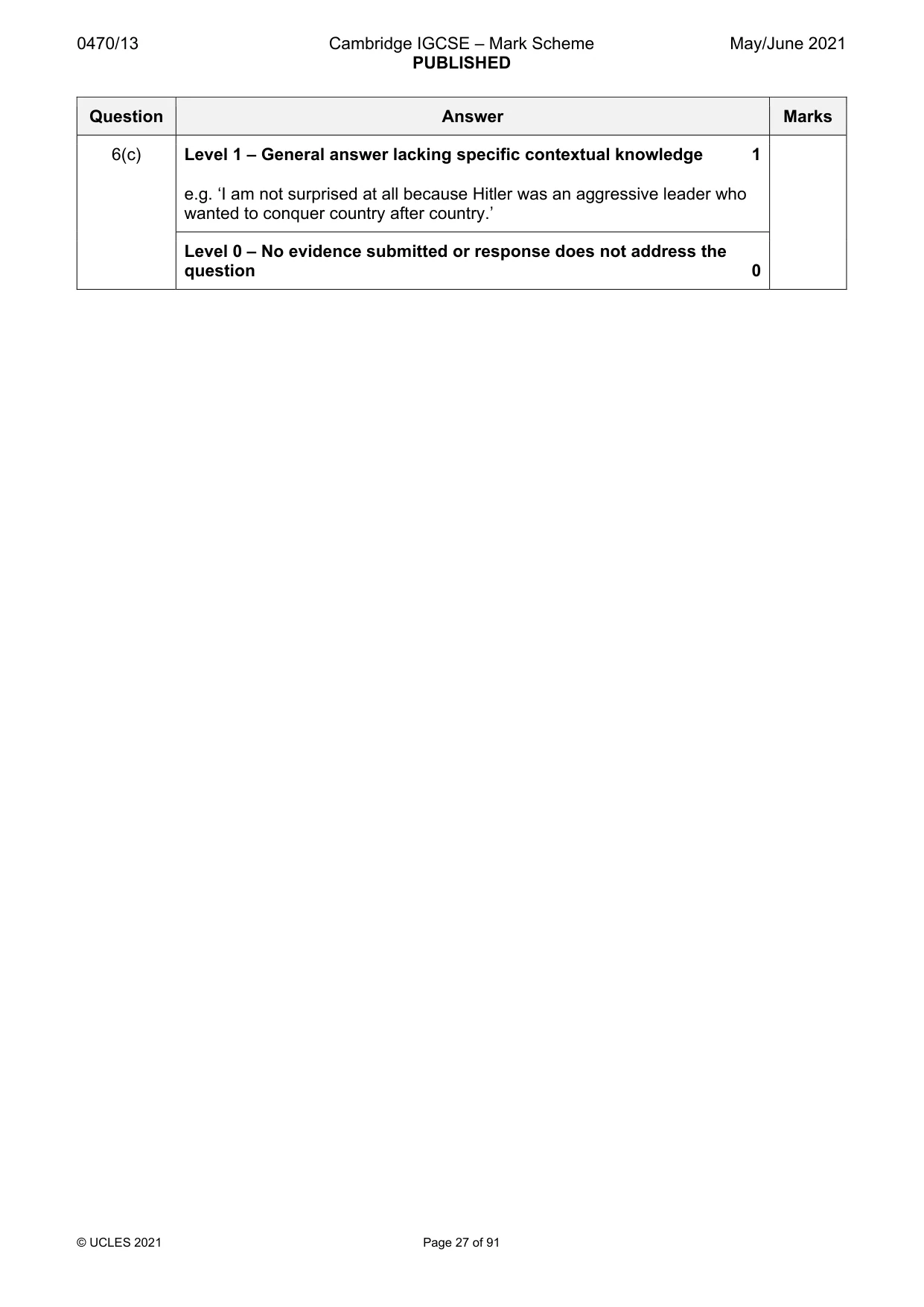
0470/13 Cambridge IGCSE – Mark Scheme PUBLISHED May/June 2021 © UCLES 2021 Page 27 of 91 Question Answer Marks 6(c) Level 1 – General answer lacking specific contextual knowledge 1 e.g. ‘I am not surprised at all because Hitler was an aggressive leader who wanted to conquer country after country.’ Level 0 – No evidence submitted or response does not address the question 0
Mark scheme, page 28
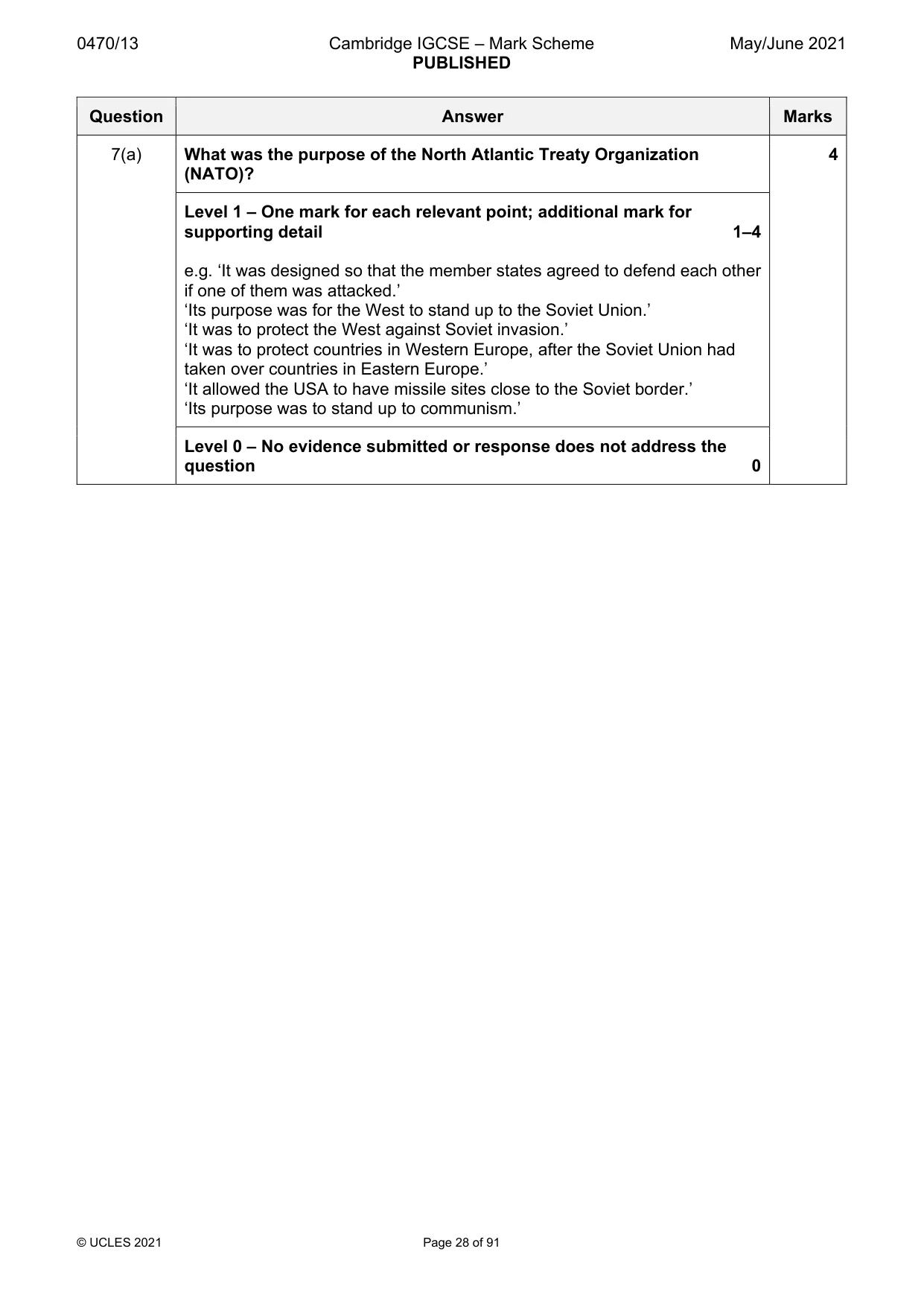
0470/13 Cambridge IGCSE – Mark Scheme PUBLISHED May/June 2021 © UCLES 2021 Page 28 of 91 Question Answer Marks 7(a) What was the purpose of the North Atlantic Treaty Organization (NATO)? 4 Level 1 – One mark for each relevant point; additional mark for supporting detail 1–4 e.g. ‘It was designed so that the member states agreed to defend each other if one of them was attacked.’ ‘Its purpose was for the West to stand up to the Soviet Union.’ ‘It was to protect the West against Soviet invasion.’ ‘It was to protect countries in Western Europe, after the Soviet Union had taken over countries in Eastern Europe.’ ‘It allowed the USA to have missile sites close to the Soviet border.’ ‘Its purpose was to stand up to communism.’ Level 0 – No evidence submitted or response does not address the question 0
Mark scheme, page 29
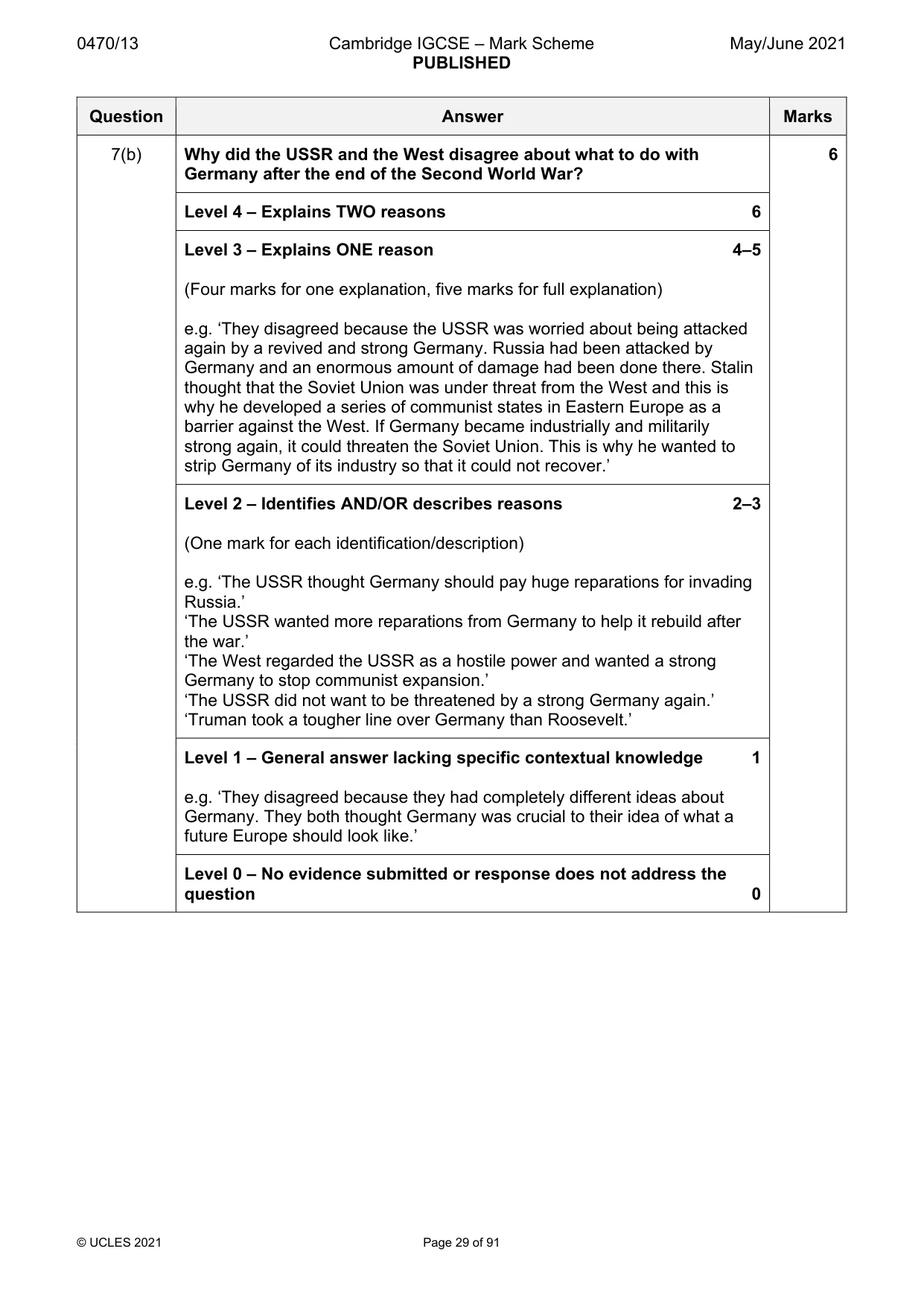
0470/13 Cambridge IGCSE – Mark Scheme PUBLISHED May/June 2021 © UCLES 2021 Page 29 of 91 Question Answer Marks 7(b) Why did the USSR and the West disagree about what to do with Germany after the end of the Second World War? 6 Level 4 – Explains TWO reasons 6 Level 3 – Explains ONE reason 4–5 (Four marks for one explanation, five marks for full explanation) e.g. ‘They disagreed because the USSR was worried about being attacked again by a revived and strong Germany. Russia had been attacked by Germany and an enormous amount of damage had been done there. Stalin thought that the Soviet Union was under threat from the West and this is why he developed a series of communist states in Eastern Europe as a barrier against the West. If Germany became industrially and militarily strong again, it could threaten the Soviet Union. This is why he wanted to strip Germany of its industry so that it could not recover.’ Level 2 – Identifies AND/OR describes reasons 2–3 (One mark for each identification/description) e.g. ‘The USSR thought Germany should pay huge reparations for invading Russia.’ ‘The USSR wanted more reparations from Germany to help it rebuild after the war.’ ‘The West regarded the USSR as a hostile power and wanted a strong Germany to stop communist expansion.’ ‘The USSR did not want to be threatened by a strong Germany again.’ ‘Truman took a tougher line over Germany than Roosevelt.’ Level 1 – General answer lacking specific contextual knowledge 1 e.g. ‘They disagreed because they had completely different ideas about Germany. They both thought Germany was crucial to their idea of what a future Europe should look like.’ Level 0 – No evidence submitted or response does not address the question 0
Mark scheme, page 30
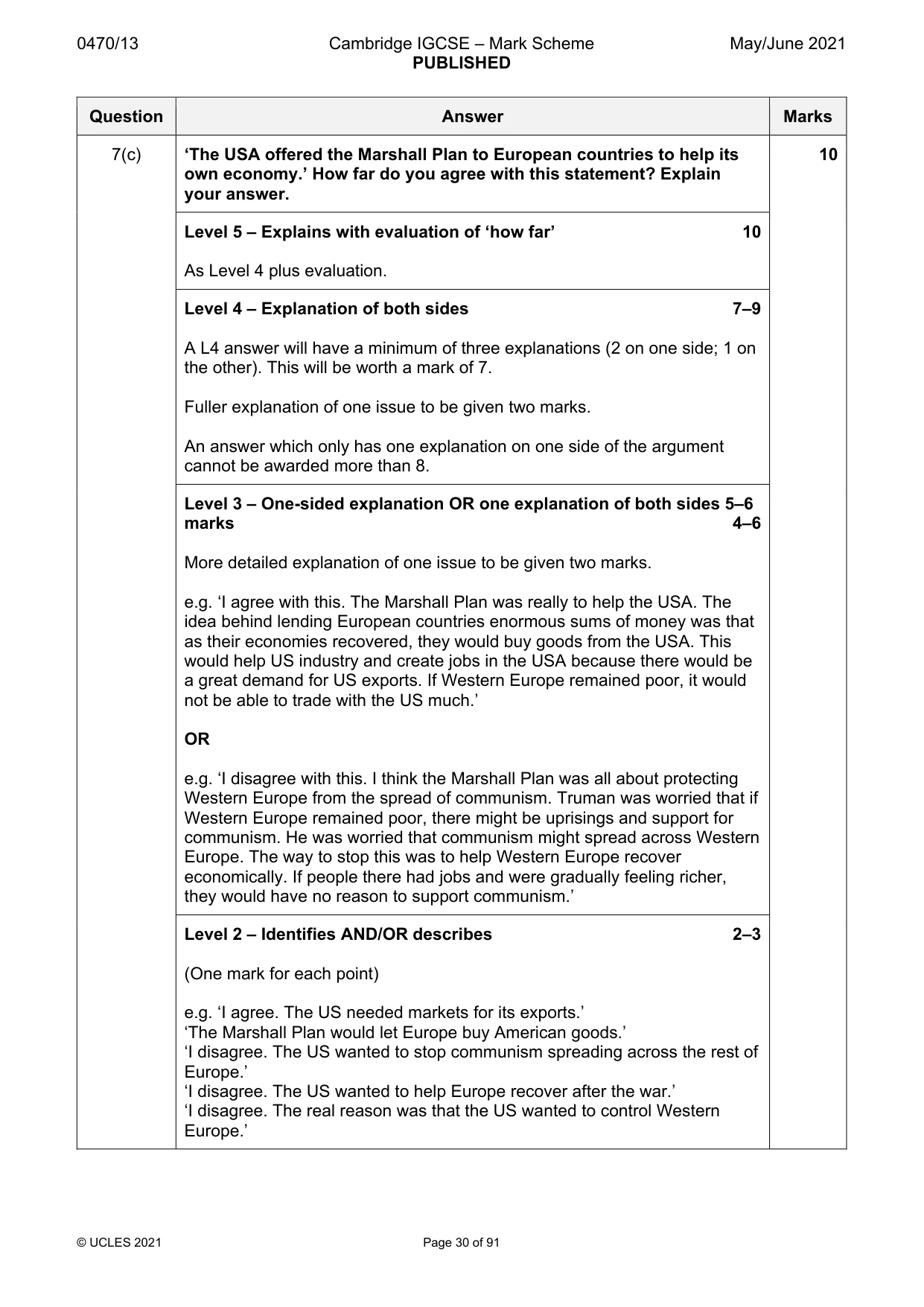
0470/13 Cambridge IGCSE – Mark Scheme PUBLISHED May/June 2021 © UCLES 2021 Page 30 of 91 Question Answer Marks 7(c) ‘The USA offered the Marshall Plan to European countries to help its own economy.’ How far do you agree with this statement? Explain your answer. 10 Level 5 – Explains with evaluation of ‘how far’ 10 As Level 4 plus evaluation. Level 4 – Explanation of both sides 7–9 A L4 answer will have a minimum of three explanations (2 on one side; 1 on the other). This will be worth a mark of 7. Fuller explanation of one issue to be given two marks. An answer which only has one explanation on one side of the argument cannot be awarded more than 8. Level 3 – One-sided explanation OR one explanation of both sides 5–6 marks 4–6 More detailed explanation of one issue to be given two marks. e.g. ‘I agree with this. The Marshall Plan was really to help the USA. The idea behind lending European countries enormous sums of money was that as their economies recovered, they would buy goods from the USA. This would help US industry and create jobs in the USA because there would be a great demand for US exports. If Western Europe remained poor, it would not be able to trade with the US much.’ OR e.g. ‘I disagree with this. I think the Marshall Plan was all about protecting Western Europe from the spread of communism. Truman was worried that if Western Europe remained poor, there might be uprisings and support for communism. He was worried that communism might spread across Western Europe. The way to stop this was to help Western Europe recover economically. If people there had jobs and were gradually feeling richer, they would have no reason to support communism.’ Level 2 – Identifies AND/OR describes 2–3 (One mark for each point) e.g. ‘I agree. The US needed markets for its exports.’ ‘The Marshall Plan would let Europe buy American goods.’ ‘I disagree. The US wanted to stop communism spreading across the rest of Europe.’ ‘I disagree. The US wanted to help Europe recover after the war.’ ‘I disagree. The real reason was that the US wanted to control Western Europe.’
Mark scheme, page 31
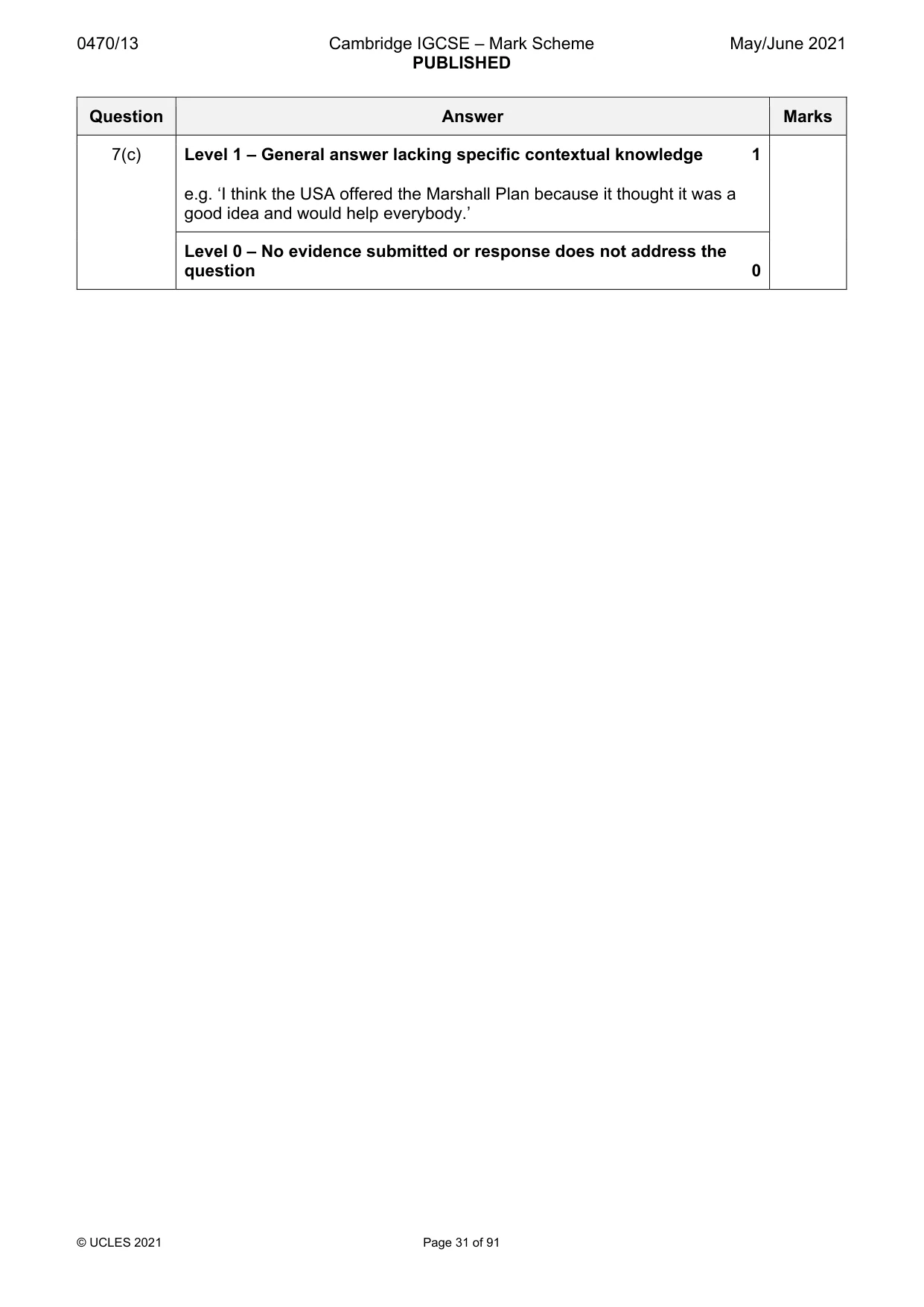
0470/13 Cambridge IGCSE – Mark Scheme PUBLISHED May/June 2021 © UCLES 2021 Page 31 of 91 Question Answer Marks 7(c) Level 1 – General answer lacking specific contextual knowledge 1 e.g. ‘I think the USA offered the Marshall Plan because it thought it was a good idea and would help everybody.’ Level 0 – No evidence submitted or response does not address the question 0
Mark scheme, page 32
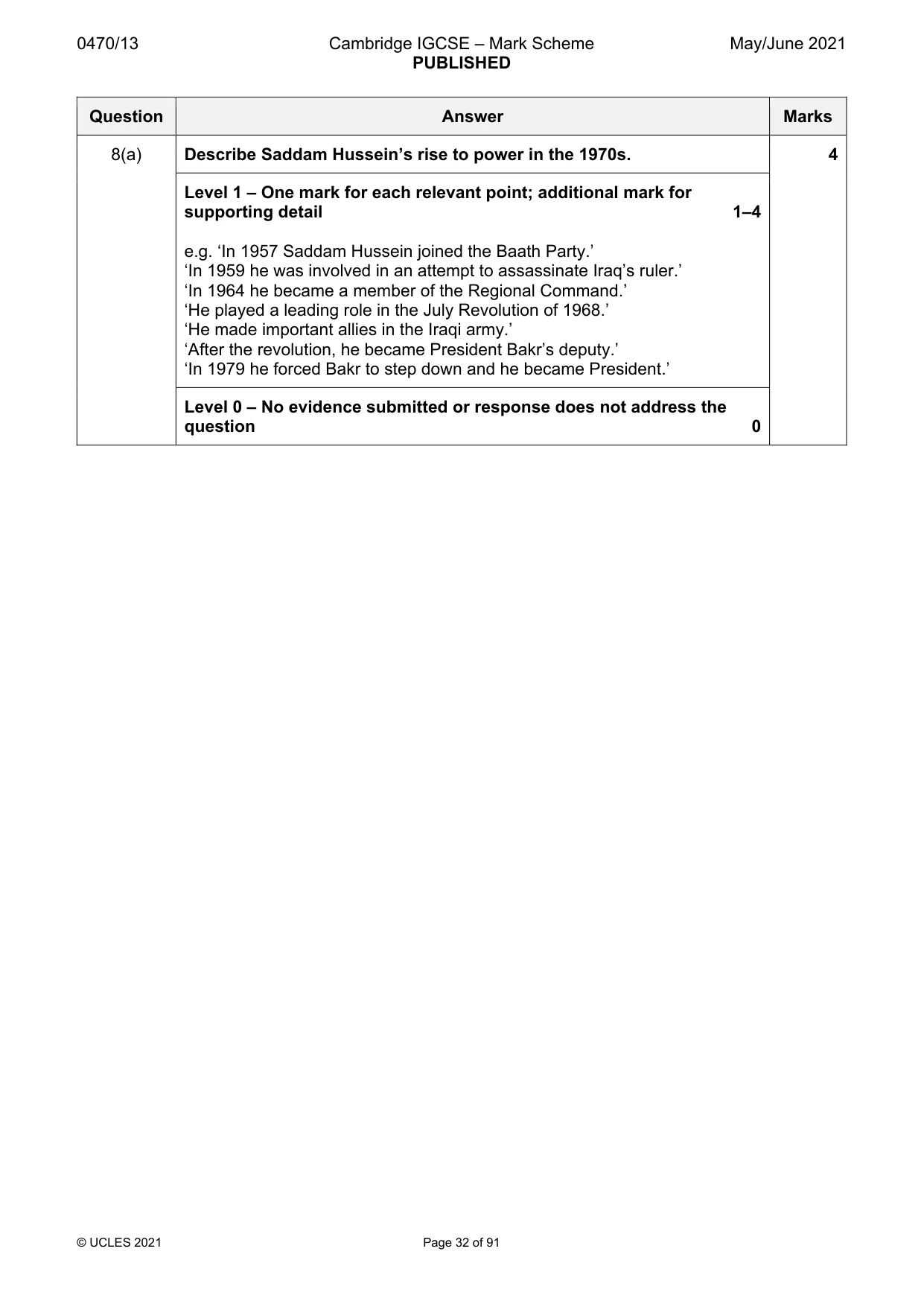
0470/13 Cambridge IGCSE – Mark Scheme PUBLISHED May/June 2021 © UCLES 2021 Page 32 of 91 Question Answer Marks 8(a) Describe Saddam Hussein’s rise to power in the 1970s. 4 Level 1 – One mark for each relevant point; additional mark for supporting detail 1–4 e.g. ‘In 1957 Saddam Hussein joined the Baath Party.’ ‘In 1959 he was involved in an attempt to assassinate Iraq’s ruler.’ ‘In 1964 he became a member of the Regional Command.’ ‘He played a leading role in the July Revolution of 1968.’ ‘He made important allies in the Iraqi army.’ ‘After the revolution, he became President Bakr’s deputy.’ ‘In 1979 he forced Bakr to step down and he became President.’ Level 0 – No evidence submitted or response does not address the question 0
Mark scheme, page 33
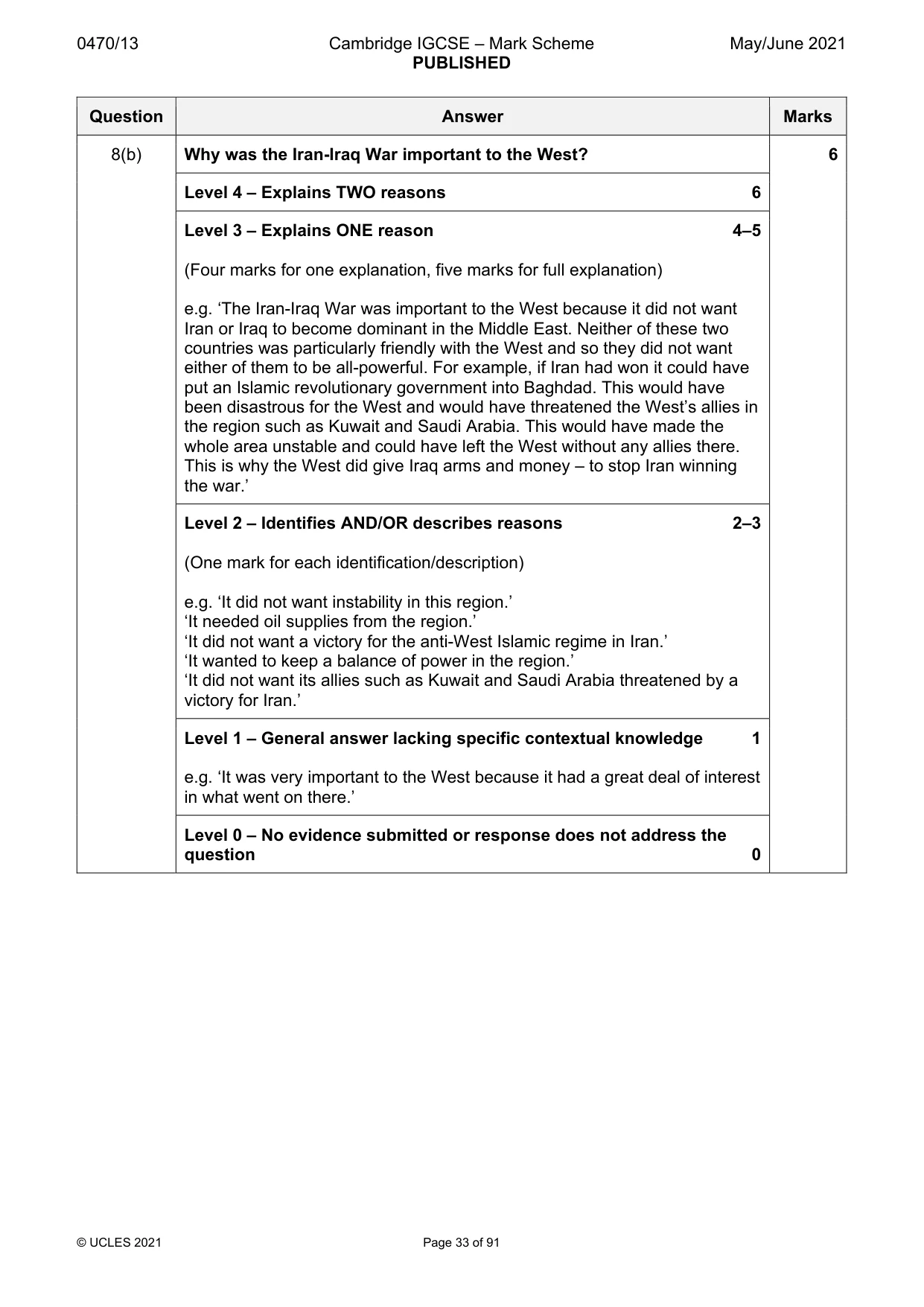
0470/13 Cambridge IGCSE – Mark Scheme PUBLISHED May/June 2021 © UCLES 2021 Page 33 of 91 Question Answer Marks 8(b) Why was the Iran-Iraq War important to the West? 6 Level 4 – Explains TWO reasons 6 Level 3 – Explains ONE reason 4–5 (Four marks for one explanation, five marks for full explanation) e.g. ‘The Iran-Iraq War was important to the West because it did not want Iran or Iraq to become dominant in the Middle East. Neither of these two countries was particularly friendly with the West and so they did not want either of them to be all-powerful. For example, if Iran had won it could have put an Islamic revolutionary government into Baghdad. This would have been disastrous for the West and would have threatened the West’s allies in the region such as Kuwait and Saudi Arabia. This would have made the whole area unstable and could have left the West without any allies there. This is why the West did give Iraq arms and money – to stop Iran winning the war.’ Level 2 – Identifies AND/OR describes reasons 2–3 (One mark for each identification/description) e.g. ‘It did not want instability in this region.’ ‘It needed oil supplies from the region.’ ‘It did not want a victory for the anti-West Islamic regime in Iran.’ ‘It wanted to keep a balance of power in the region.’ ‘It did not want its allies such as Kuwait and Saudi Arabia threatened by a victory for Iran.’ Level 1 – General answer lacking specific contextual knowledge 1 e.g. ‘It was very important to the West because it had a great deal of interest in what went on there.’ Level 0 – No evidence submitted or response does not address the question 0
Mark scheme, page 34
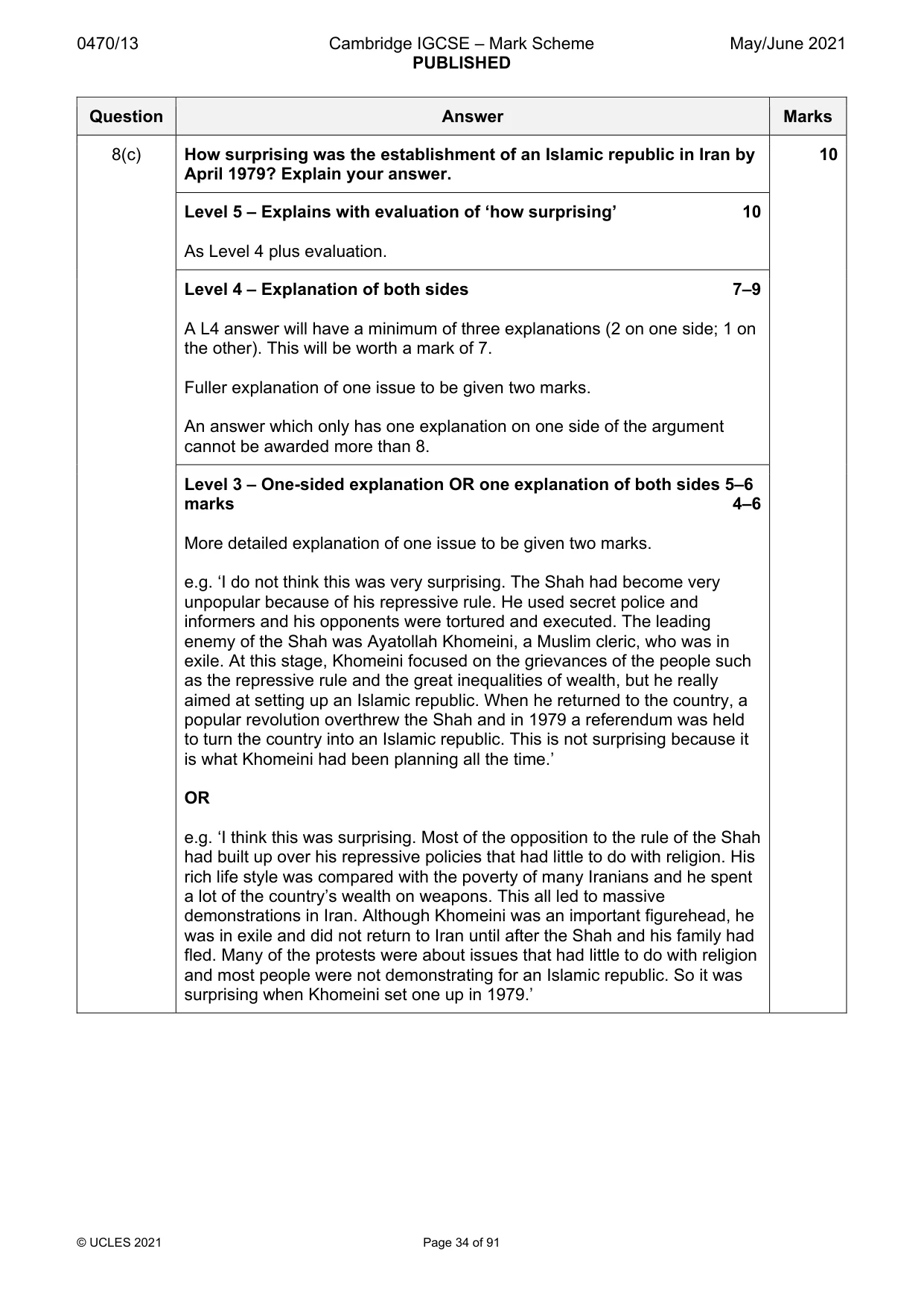
0470/13 Cambridge IGCSE – Mark Scheme PUBLISHED May/June 2021 © UCLES 2021 Page 34 of 91 Question Answer Marks 8(c) How surprising was the establishment of an Islamic republic in Iran by April 1979? Explain your answer. 10 Level 5 – Explains with evaluation of ‘how surprising’ 10 As Level 4 plus evaluation. Level 4 – Explanation of both sides 7–9 A L4 answer will have a minimum of three explanations (2 on one side; 1 on the other). This will be worth a mark of 7. Fuller explanation of one issue to be given two marks. An answer which only has one explanation on one side of the argument cannot be awarded more than 8. Level 3 – One-sided explanation OR one explanation of both sides 5–6 marks 4–6 More detailed explanation of one issue to be given two marks. e.g. ‘I do not think this was very surprising. The Shah had become very unpopular because of his repressive rule. He used secret police and informers and his opponents were tortured and executed. The leading enemy of the Shah was Ayatollah Khomeini, a Muslim cleric, who was in exile. At this stage, Khomeini focused on the grievances of the people such as the repressive rule and the great inequalities of wealth, but he really aimed at setting up an Islamic republic. When he returned to the country, a popular revolution overthrew the Shah and in 1979 a referendum was held to turn the country into an Islamic republic. This is not surprising because it is what Khomeini had been planning all the time.’ OR e.g. ‘I think this was surprising. Most of the opposition to the rule of the Shah had built up over his repressive policies that had little to do with religion. His rich life style was compared with the poverty of many Iranians and he spent a lot of the country’s wealth on weapons. This all led to massive demonstrations in Iran. Although Khomeini was an important figurehead, he was in exile and did not return to Iran until after the Shah and his family had fled. Many of the protests were about issues that had little to do with religion and most people were not demonstrating for an Islamic republic. So it was surprising when Khomeini set one up in 1979.’
Mark scheme, page 35
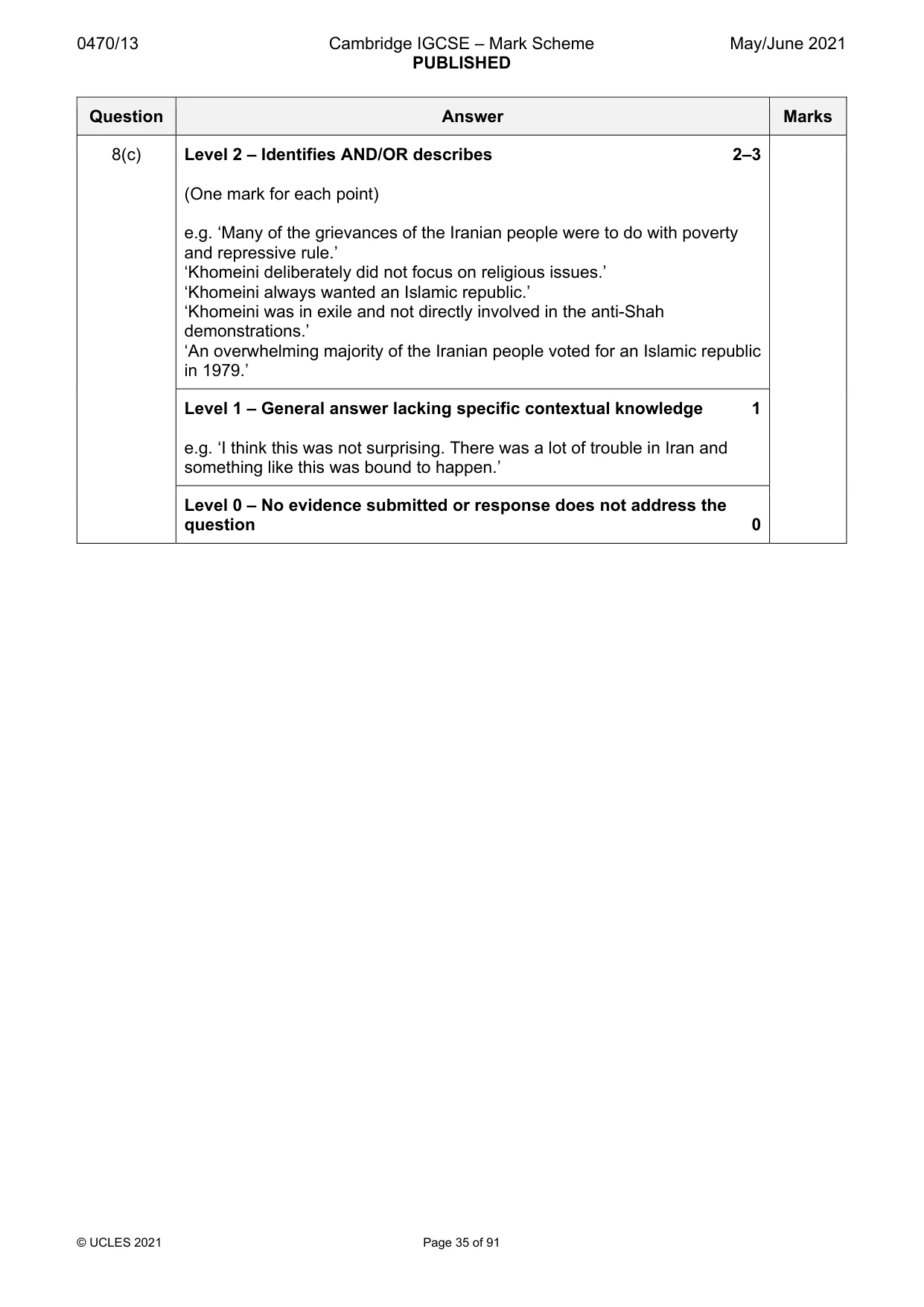
0470/13 Cambridge IGCSE – Mark Scheme PUBLISHED May/June 2021 © UCLES 2021 Page 35 of 91 Question Answer Marks 8(c) Level 2 – Identifies AND/OR describes 2–3 (One mark for each point) e.g. ‘Many of the grievances of the Iranian people were to do with poverty and repressive rule.’ ‘Khomeini deliberately did not focus on religious issues.’ ‘Khomeini always wanted an Islamic republic.’ ‘Khomeini was in exile and not directly involved in the anti-Shah demonstrations.’ ‘An overwhelming majority of the Iranian people voted for an Islamic republic in 1979.’ Level 1 – General answer lacking specific contextual knowledge 1 e.g. ‘I think this was not surprising. There was a lot of trouble in Iran and something like this was bound to happen.’ Level 0 – No evidence submitted or response does not address the question 0
Mark scheme, page 36
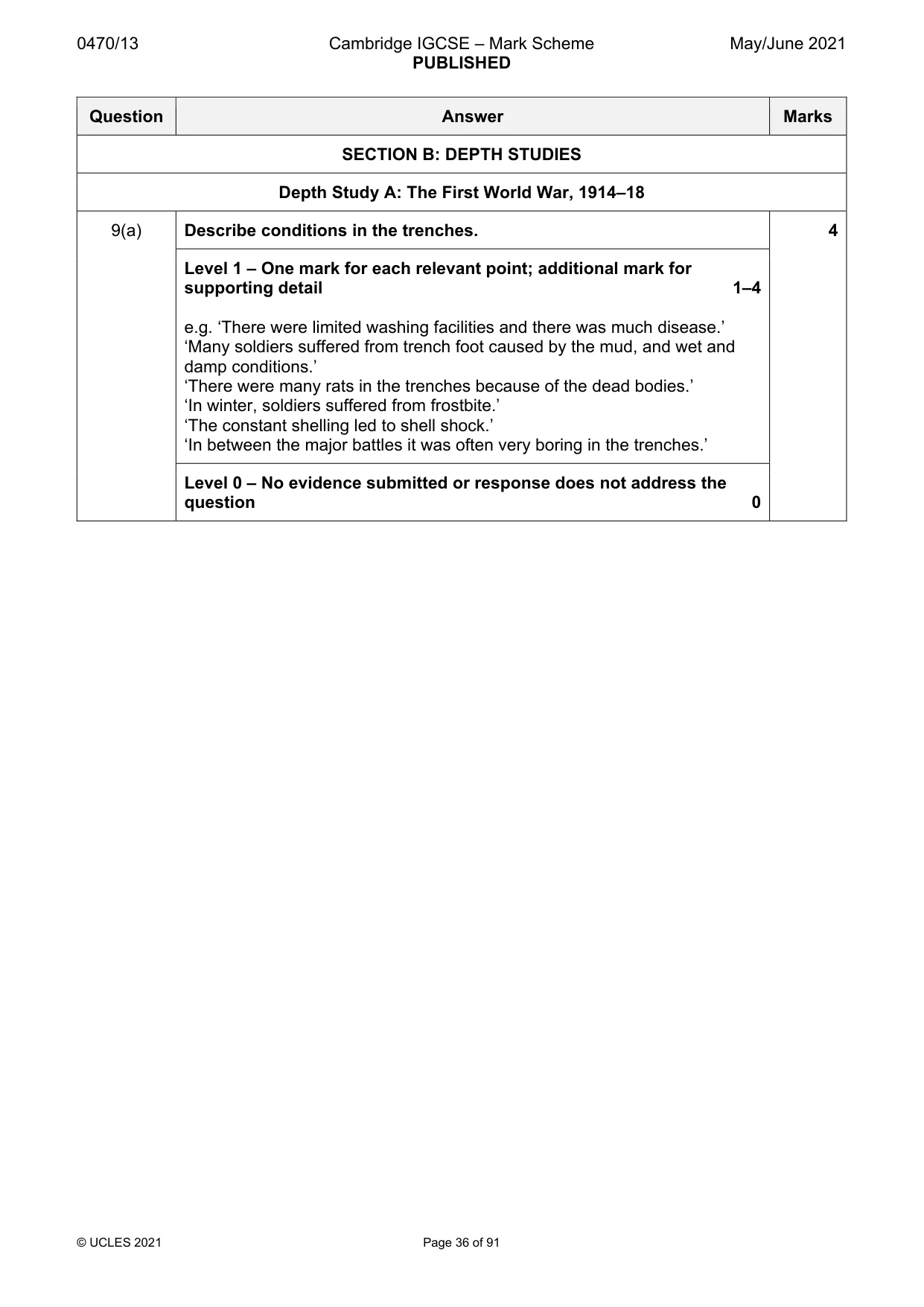
0470/13 Cambridge IGCSE – Mark Scheme PUBLISHED May/June 2021 © UCLES 2021 Page 36 of 91 Question Answer Marks SECTION B: DEPTH STUDIES Depth Study A: The First World War, 1914–18 9(a) Describe conditions in the trenches. 4 Level 1 – One mark for each relevant point; additional mark for supporting detail 1–4 e.g. ‘There were limited washing facilities and there was much disease.’ ‘Many soldiers suffered from trench foot caused by the mud, and wet and damp conditions.’ ‘There were many rats in the trenches because of the dead bodies.’ ‘In winter, soldiers suffered from frostbite.’ ‘The constant shelling led to shell shock.’ ‘In between the major battles it was often very boring in the trenches.’ Level 0 – No evidence submitted or response does not address the question 0
Mark scheme, page 37
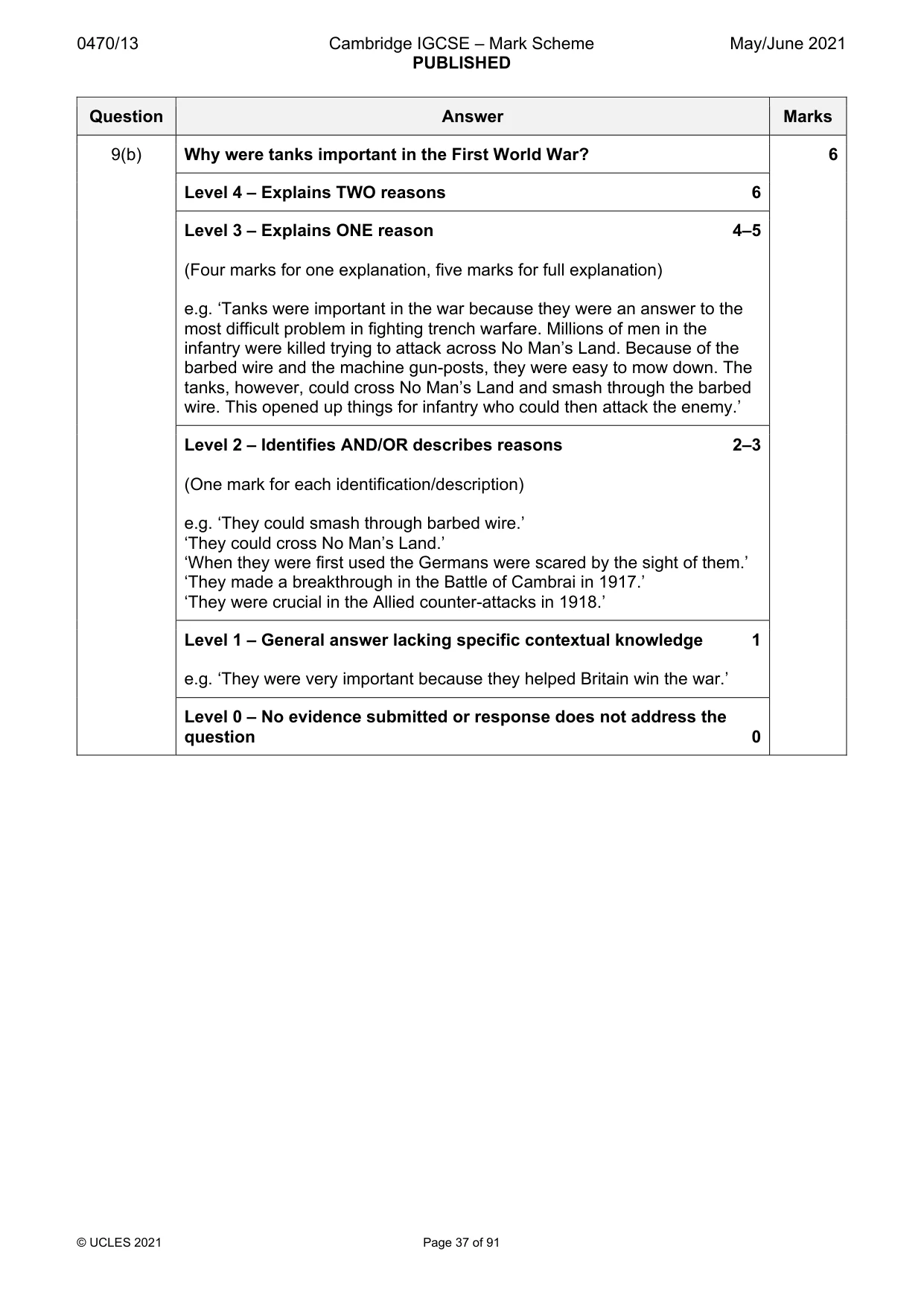
0470/13 Cambridge IGCSE – Mark Scheme PUBLISHED May/June 2021 © UCLES 2021 Page 37 of 91 Question Answer Marks 9(b) Why were tanks important in the First World War? 6 Level 4 – Explains TWO reasons 6 Level 3 – Explains ONE reason 4–5 (Four marks for one explanation, five marks for full explanation) e.g. ‘Tanks were important in the war because they were an answer to the most difficult problem in fighting trench warfare. Millions of men in the infantry were killed trying to attack across No Man’s Land. Because of the barbed wire and the machine gun-posts, they were easy to mow down. The tanks, however, could cross No Man’s Land and smash through the barbed wire. This opened up things for infantry who could then attack the enemy.’ Level 2 – Identifies AND/OR describes reasons 2–3 (One mark for each identification/description) e.g. ‘They could smash through barbed wire.’ ‘They could cross No Man’s Land.’ ‘When they were first used the Germans were scared by the sight of them.’ ‘They made a breakthrough in the Battle of Cambrai in 1917.’ ‘They were crucial in the Allied counter-attacks in 1918.’ Level 1 – General answer lacking specific contextual knowledge 1 e.g. ‘They were very important because they helped Britain win the war.’ Level 0 – No evidence submitted or response does not address the question 0
Mark scheme, page 38
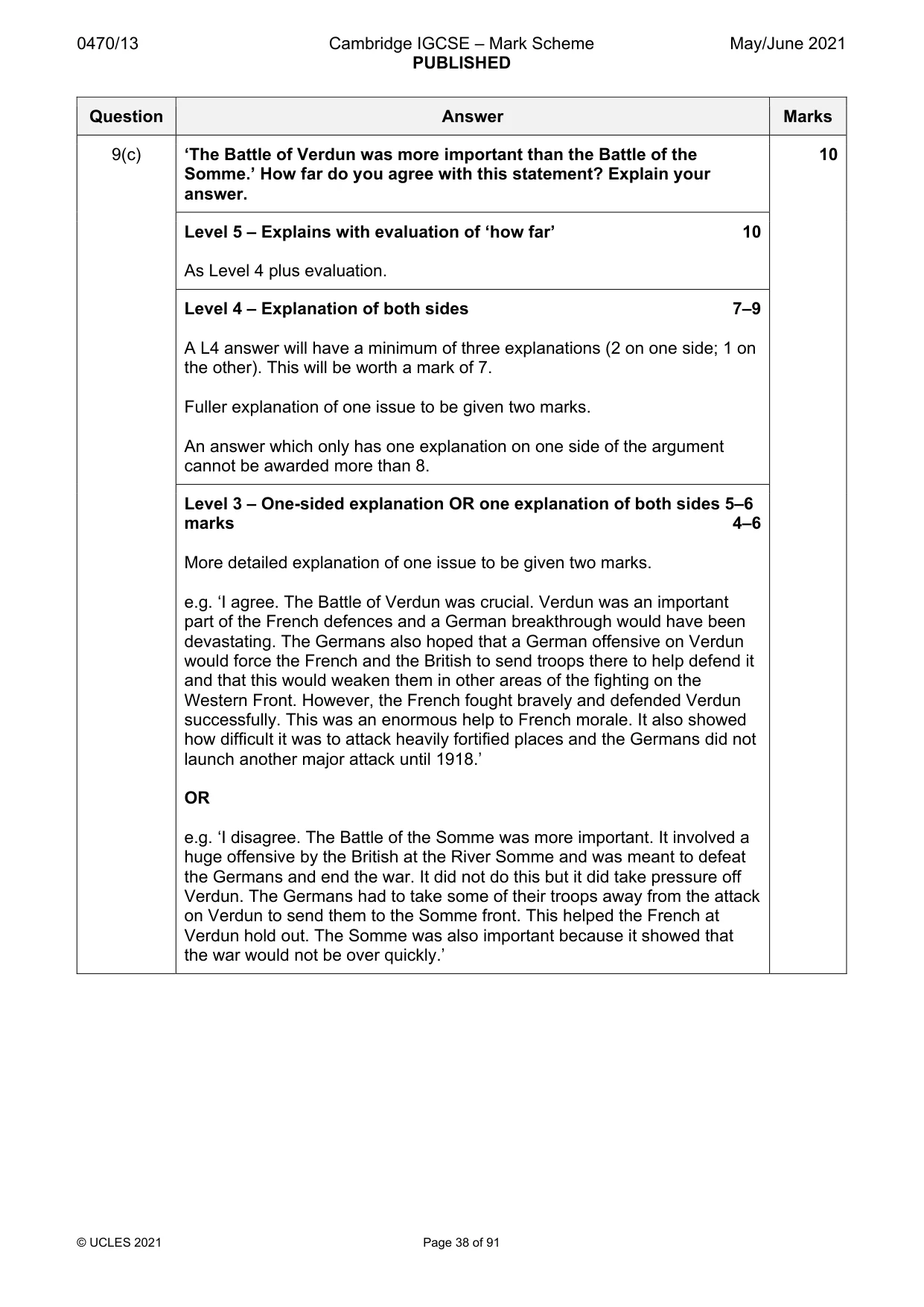
0470/13 Cambridge IGCSE – Mark Scheme PUBLISHED May/June 2021 © UCLES 2021 Page 38 of 91 Question Answer Marks 9(c) ‘The Battle of Verdun was more important than the Battle of the Somme.’ How far do you agree with this statement? Explain your answer. 10 Level 5 – Explains with evaluation of ‘how far’ 10 As Level 4 plus evaluation. Level 4 – Explanation of both sides 7–9 A L4 answer will have a minimum of three explanations (2 on one side; 1 on the other). This will be worth a mark of 7. Fuller explanation of one issue to be given two marks. An answer which only has one explanation on one side of the argument cannot be awarded more than 8. Level 3 – One-sided explanation OR one explanation of both sides 5–6 marks 4–6 More detailed explanation of one issue to be given two marks. e.g. ‘I agree. The Battle of Verdun was crucial. Verdun was an important part of the French defences and a German breakthrough would have been devastating. The Germans also hoped that a German offensive on Verdun would force the French and the British to send troops there to help defend it and that this would weaken them in other areas of the fighting on the Western Front. However, the French fought bravely and defended Verdun successfully. This was an enormous help to French morale. It also showed how difficult it was to attack heavily fortified places and the Germans did not launch another major attack until 1918.’ OR e.g. ‘I disagree. The Battle of the Somme was more important. It involved a huge offensive by the British at the River Somme and was meant to defeat the Germans and end the war. It did not do this but it did take pressure off Verdun. The Germans had to take some of their troops away from the attack on Verdun to send them to the Somme front. This helped the French at Verdun hold out. The Somme was also important because it showed that the war would not be over quickly.’
Mark scheme, page 39
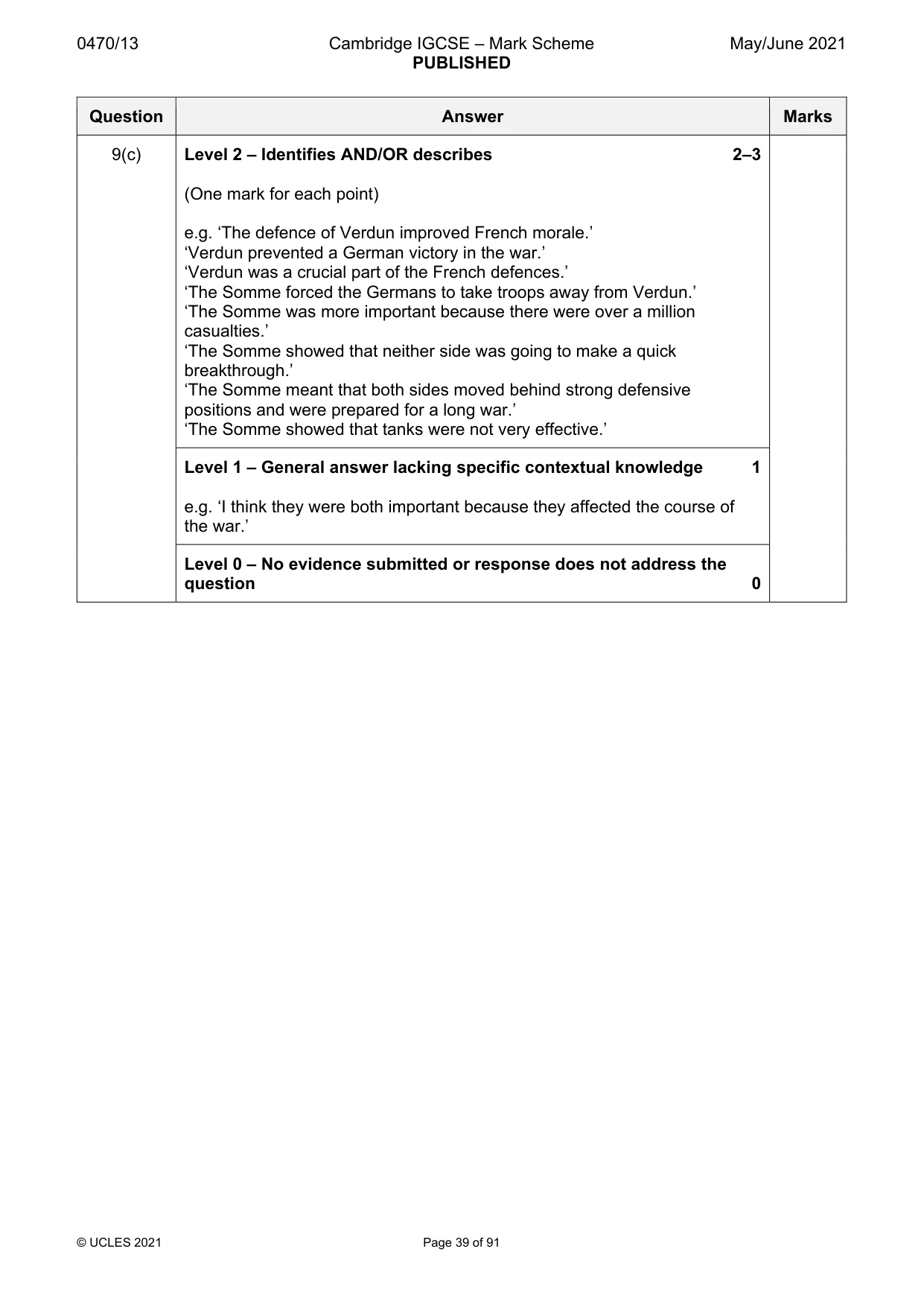
0470/13 Cambridge IGCSE – Mark Scheme PUBLISHED May/June 2021 © UCLES 2021 Page 39 of 91 Question Answer Marks 9(c) Level 2 – Identifies AND/OR describes 2–3 (One mark for each point) e.g. ‘The defence of Verdun improved French morale.’ ‘Verdun prevented a German victory in the war.’ ‘Verdun was a crucial part of the French defences.’ ‘The Somme forced the Germans to take troops away from Verdun.’ ‘The Somme was more important because there were over a million casualties.’ ‘The Somme showed that neither side was going to make a quick breakthrough.’ ‘The Somme meant that both sides moved behind strong defensive positions and were prepared for a long war.’ ‘The Somme showed that tanks were not very effective.’ Level 1 – General answer lacking specific contextual knowledge 1 e.g. ‘I think they were both important because they affected the course of the war.’ Level 0 – No evidence submitted or response does not address the question 0
Mark scheme, page 40
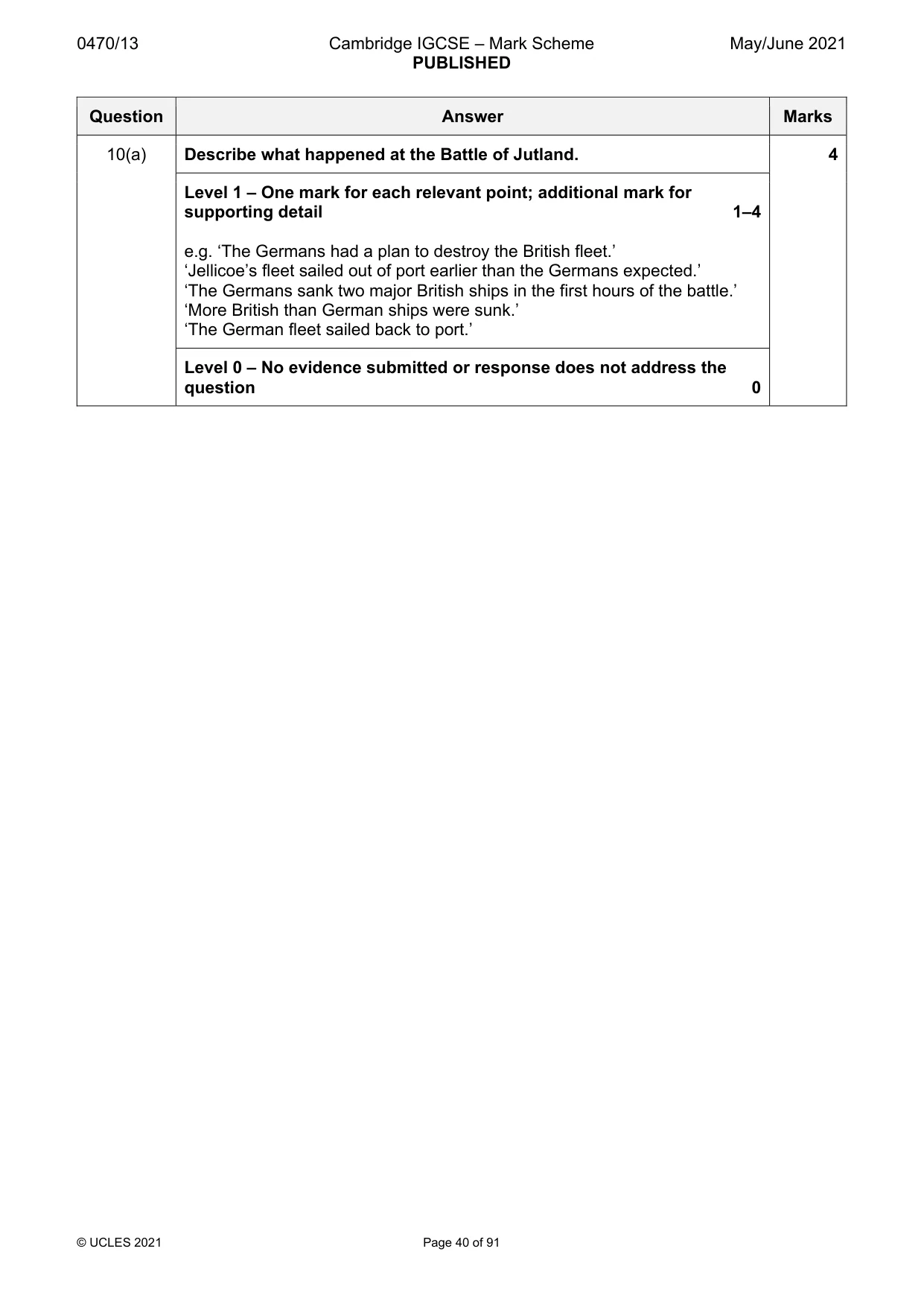
0470/13 Cambridge IGCSE – Mark Scheme PUBLISHED May/June 2021 © UCLES 2021 Page 40 of 91 Question Answer Marks 10(a) Describe what happened at the Battle of Jutland. 4 Level 1 – One mark for each relevant point; additional mark for supporting detail 1–4 e.g. ‘The Germans had a plan to destroy the British fleet.’ ‘Jellicoe’s fleet sailed out of port earlier than the Germans expected.’ ‘The Germans sank two major British ships in the first hours of the battle.’ ‘More British than German ships were sunk.’ ‘The German fleet sailed back to port.’ Level 0 – No evidence submitted or response does not address the question 0
Mark scheme, page 41
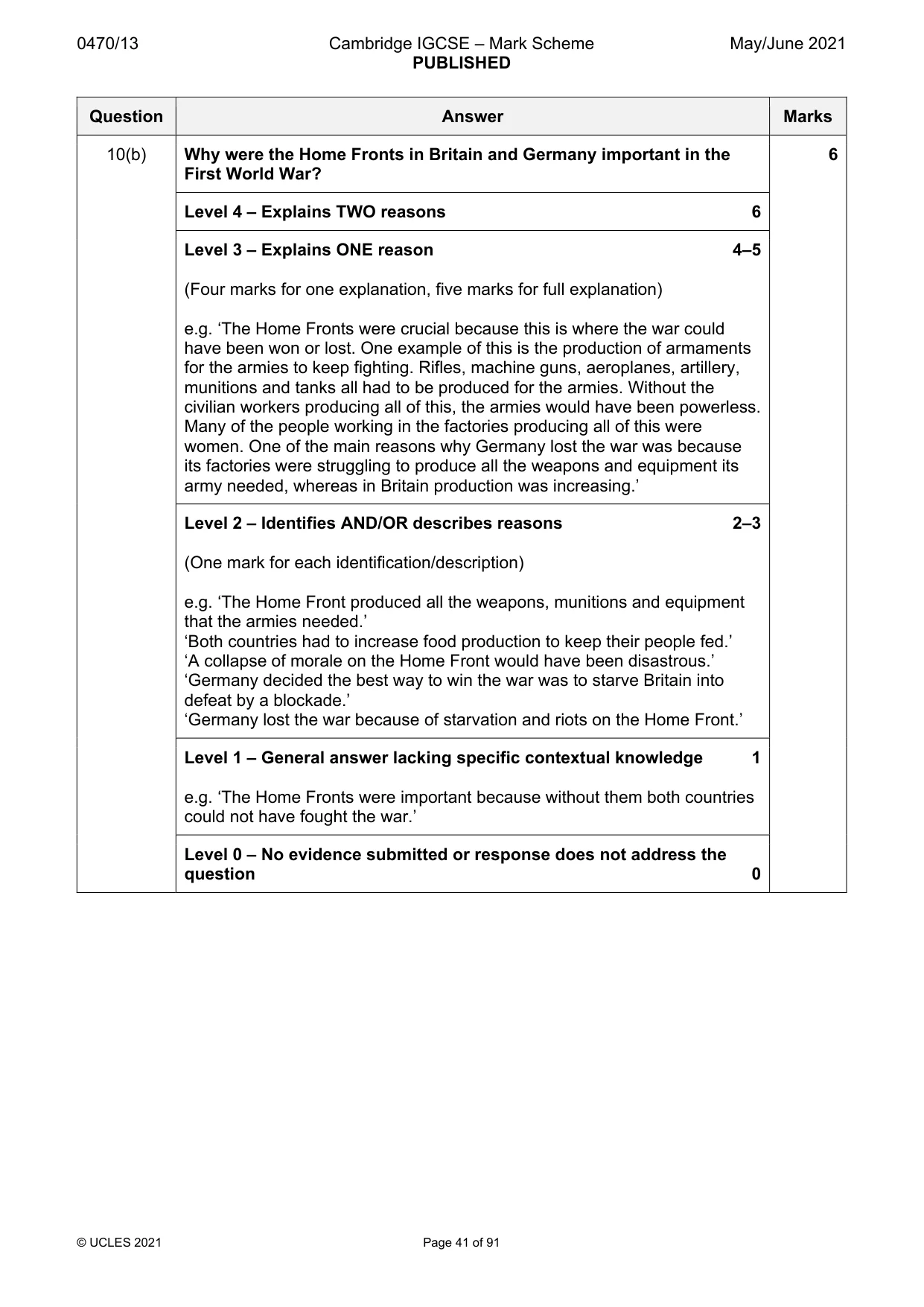
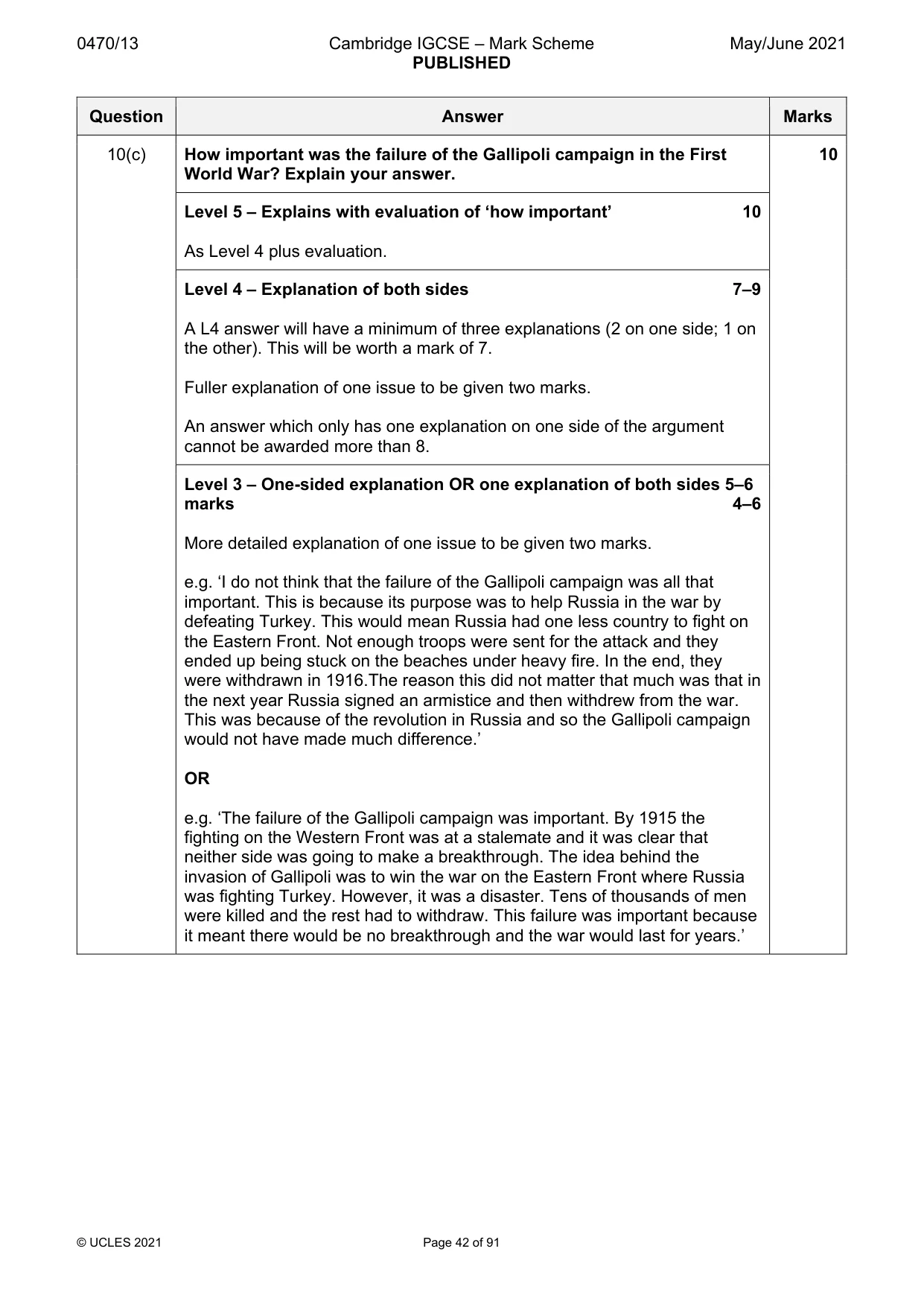
0470/13 Cambridge IGCSE – Mark Scheme PUBLISHED May/June 2021 © UCLES 2021 Page 41 of 91 Question Answer Marks 10(b) Why were the Home Fronts in Britain and Germany important in the First World War? 6 Level 4 – Explains TWO reasons 6 Level 3 – Explains ONE reason 4–5 (Four marks for one explanation, five marks for full explanation) e.g. ‘The Home Fronts were crucial because this is where the war could have been won or lost. One example of this is the production of armaments for the armies to keep fighting. Rifles, machine guns, aeroplanes, artillery, munitions and tanks all had to be produced for the armies. Without the civilian workers producing all of this, the armies would have been powerless. Many of the people working in the factories producing all of this were women. One of the main reasons why Germany lost the war was because its factories were struggling to produce all the weapons and equipment its army needed, whereas in Britain production was increasing.’ Level 2 – Identifies AND/OR describes reasons 2–3 (One mark for each identification/description) e.g. ‘The Home Front produced all the weapons, munitions and equipment that the armies needed.’ ‘Both countries had to increase food production to keep their people fed.’ ‘A collapse of morale on the Home Front would have been disastrous.’ ‘Germany decided the best way to win the war was to starve Britain into defeat by a blockade.’ ‘Germany lost the war because of starvation and riots on the Home Front.’ Level 1 – General answer lacking specific contextual knowledge 1 e.g. ‘The Home Fronts were important because without them both countries could not have fought the war.’ Level 0 – No evidence submitted or response does not address the question 0
Mark scheme, page 42
0470/13 Cambridge IGCSE – Mark Scheme PUBLISHED May/June 2021 © UCLES 2021 Page 42 of 91 Question Answer Marks 10(c) How important was the failure of the Gallipoli campaign in the First World War? Explain your answer. 10 Level 5 – Explains with evaluation of ‘how important’ 10 As Level 4 plus evaluation. Level 4 – Explanation of both sides 7–9 A L4 answer will have a minimum of three explanations (2 on one side; 1 on the other). This will be worth a mark of 7. Fuller explanation of one issue to be given two marks. An answer which only has one explanation on one side of the argument cannot be awarded more than 8. Level 3 – One-sided explanation OR one explanation of both sides 5–6 marks 4–6 More detailed explanation of one issue to be given two marks. e.g. ‘I do not think that the failure of the Gallipoli campaign was all that important. This is because its purpose was to help Russia in the war by defeating Turkey. This would mean Russia had one less country to fight on the Eastern Front. Not enough troops were sent for the attack and they ended up being stuck on the beaches under heavy fire. In the end, they were withdrawn in 1916.The reason this did not matter that much was that in the next year Russia signed an armistice and then withdrew from the war. This was because of the revolution in Russia and so the Gallipoli campaign would not have made much difference.’ OR e.g. ‘The failure of the Gallipoli campaign was important. By 1915 the fighting on the Western Front was at a stalemate and it was clear that neither side was going to make a breakthrough. The idea behind the invasion of Gallipoli was to win the war on the Eastern Front where Russia was fighting Turkey. However, it was a disaster. Tens of thousands of men were killed and the rest had to withdraw. This failure was important because it meant there would be no breakthrough and the war would last for years.’
Mark scheme, page 43
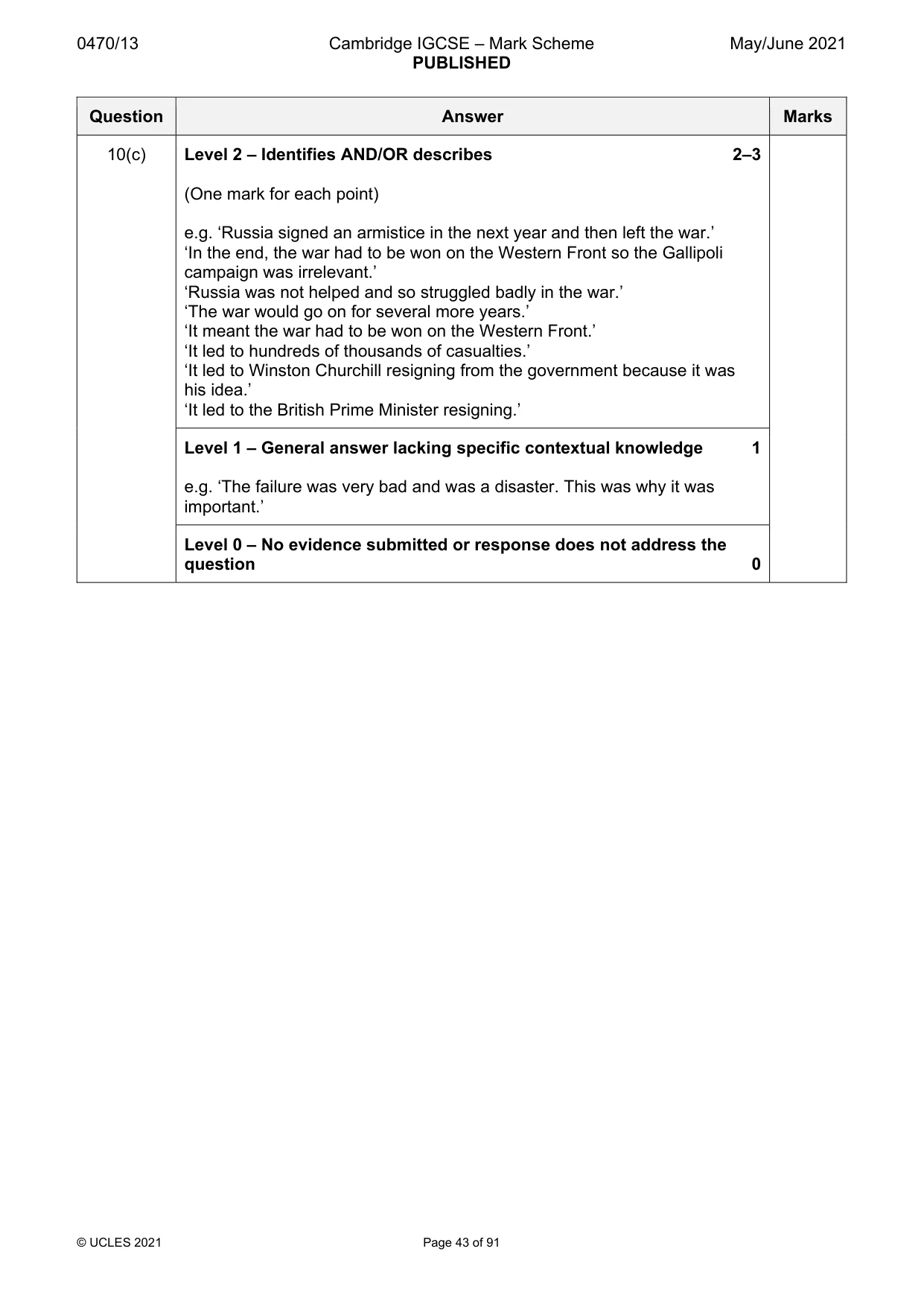
0470/13 Cambridge IGCSE – Mark Scheme PUBLISHED May/June 2021 © UCLES 2021 Page 43 of 91 Question Answer Marks 10(c) Level 2 – Identifies AND/OR describes 2–3 (One mark for each point) e.g. ‘Russia signed an armistice in the next year and then left the war.’ ‘In the end, the war had to be won on the Western Front so the Gallipoli campaign was irrelevant.’ ‘Russia was not helped and so struggled badly in the war.’ ‘The war would go on for several more years.’ ‘It meant the war had to be won on the Western Front.’ ‘It led to hundreds of thousands of casualties.’ ‘It led to Winston Churchill resigning from the government because it was his idea.’ ‘It led to the British Prime Minister resigning.’ Level 1 – General answer lacking specific contextual knowledge 1 e.g. ‘The failure was very bad and was a disaster. This was why it was important.’ Level 0 – No evidence submitted or response does not address the question 0
Mark scheme, page 44
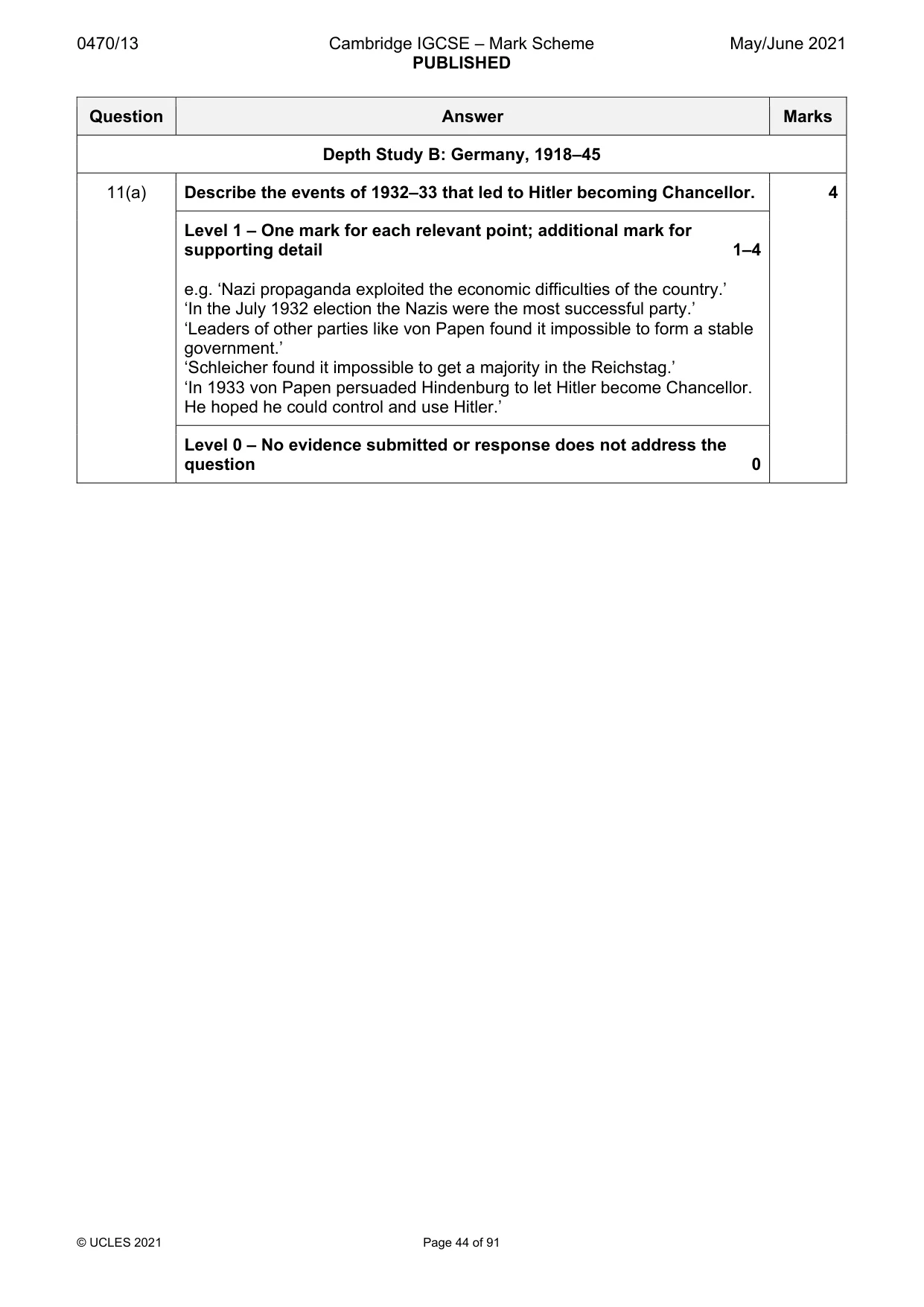
0470/13 Cambridge IGCSE – Mark Scheme PUBLISHED May/June 2021 © UCLES 2021 Page 44 of 91 Question Answer Marks Depth Study B: Germany, 1918–45 11(a) Describe the events of 1932–33 that led to Hitler becoming Chancellor. 4 Level 1 – One mark for each relevant point; additional mark for supporting detail 1–4 e.g. ‘Nazi propaganda exploited the economic difficulties of the country.’ ‘In the July 1932 election the Nazis were the most successful party.’ ‘Leaders of other parties like von Papen found it impossible to form a stable government.’ ‘Schleicher found it impossible to get a majority in the Reichstag.’ ‘In 1933 von Papen persuaded Hindenburg to let Hitler become Chancellor. He hoped he could control and use Hitler.’ Level 0 – No evidence submitted or response does not address the question 0
Mark scheme, page 45
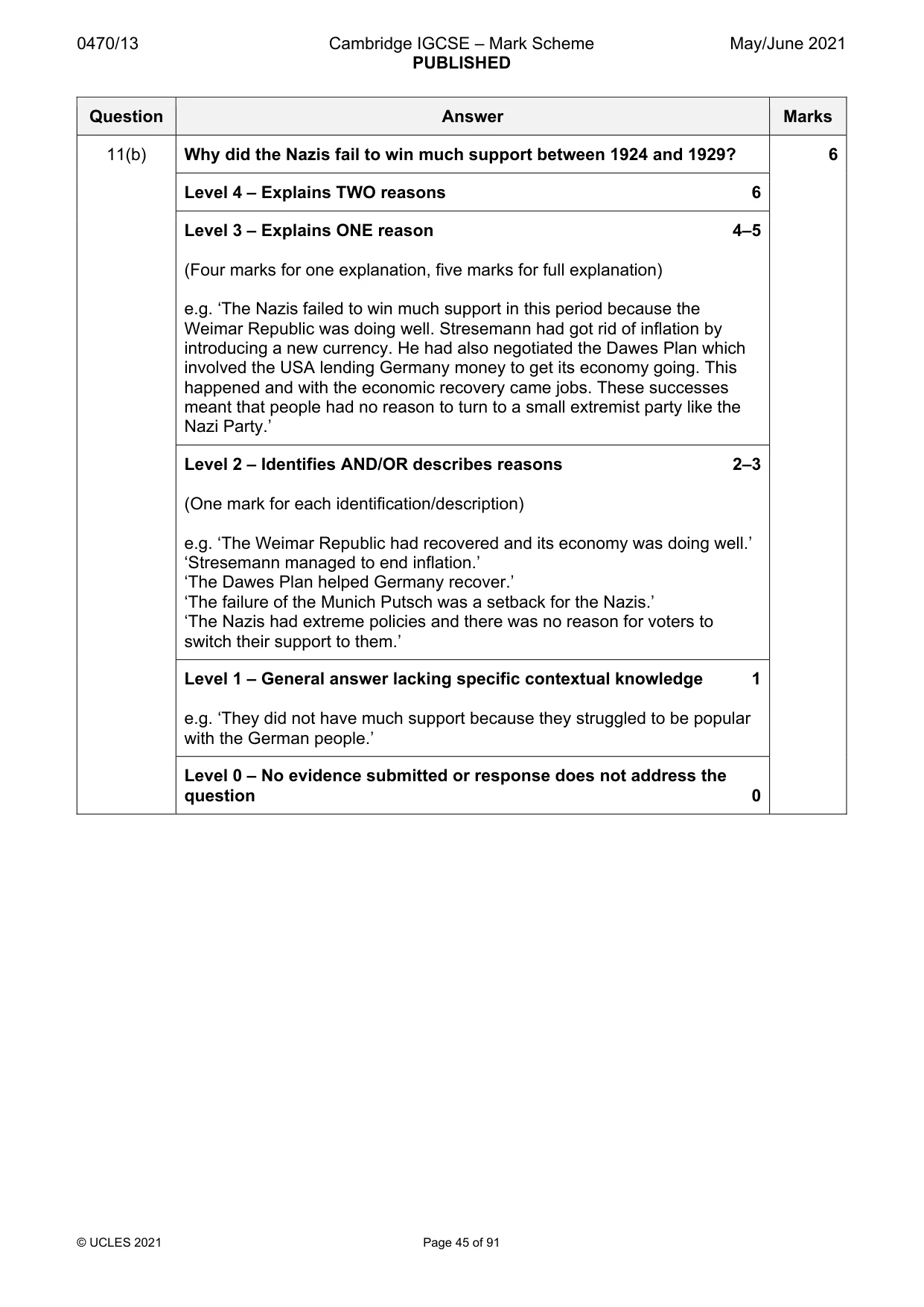
0470/13 Cambridge IGCSE – Mark Scheme PUBLISHED May/June 2021 © UCLES 2021 Page 45 of 91 Question Answer Marks 11(b) Why did the Nazis fail to win much support between 1924 and 1929? 6 Level 4 – Explains TWO reasons 6 Level 3 – Explains ONE reason 4–5 (Four marks for one explanation, five marks for full explanation) e.g. ‘The Nazis failed to win much support in this period because the Weimar Republic was doing well. Stresemann had got rid of inflation by introducing a new currency. He had also negotiated the Dawes Plan which involved the USA lending Germany money to get its economy going. This happened and with the economic recovery came jobs. These successes meant that people had no reason to turn to a small extremist party like the Nazi Party.’ Level 2 – Identifies AND/OR describes reasons 2–3 (One mark for each identification/description) e.g. ‘The Weimar Republic had recovered and its economy was doing well.’ ‘Stresemann managed to end inflation.’ ‘The Dawes Plan helped Germany recover.’ ‘The failure of the Munich Putsch was a setback for the Nazis.’ ‘The Nazis had extreme policies and there was no reason for voters to switch their support to them.’ Level 1 – General answer lacking specific contextual knowledge 1 e.g. ‘They did not have much support because they struggled to be popular with the German people.’ Level 0 – No evidence submitted or response does not address the question 0
Mark scheme, page 46
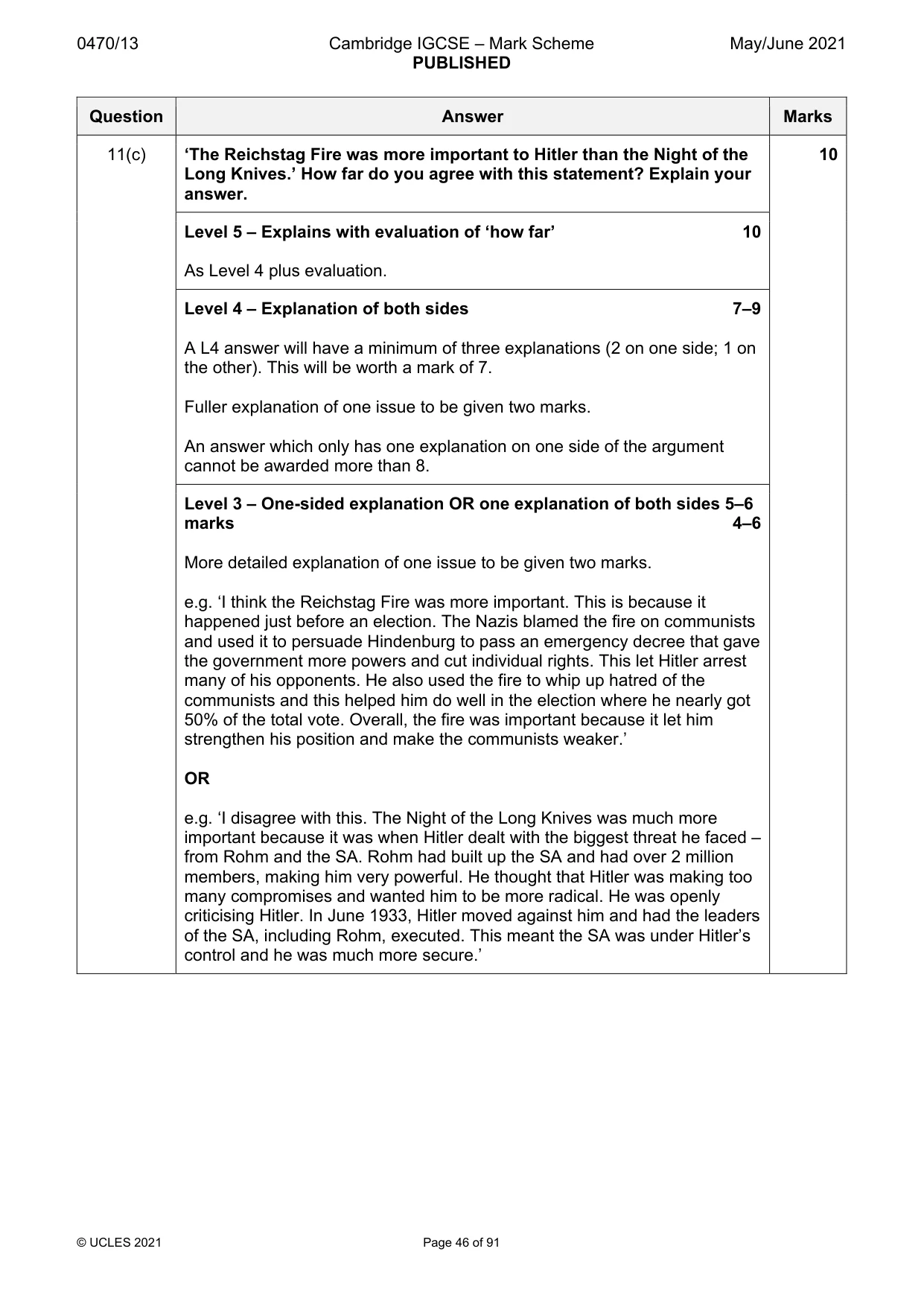
0470/13 Cambridge IGCSE – Mark Scheme PUBLISHED May/June 2021 © UCLES 2021 Page 46 of 91 Question Answer Marks 11(c) ‘The Reichstag Fire was more important to Hitler than the Night of the Long Knives.’ How far do you agree with this statement? Explain your answer. 10 Level 5 – Explains with evaluation of ‘how far’ 10 As Level 4 plus evaluation. Level 4 – Explanation of both sides 7–9 A L4 answer will have a minimum of three explanations (2 on one side; 1 on the other). This will be worth a mark of 7. Fuller explanation of one issue to be given two marks. An answer which only has one explanation on one side of the argument cannot be awarded more than 8. Level 3 – One-sided explanation OR one explanation of both sides 5–6 marks 4–6 More detailed explanation of one issue to be given two marks. e.g. ‘I think the Reichstag Fire was more important. This is because it happened just before an election. The Nazis blamed the fire on communists and used it to persuade Hindenburg to pass an emergency decree that gave the government more powers and cut individual rights. This let Hitler arrest many of his opponents. He also used the fire to whip up hatred of the communists and this helped him do well in the election where he nearly got 50% of the total vote. Overall, the fire was important because it let him strengthen his position and make the communists weaker.’ OR e.g. ‘I disagree with this. The Night of the Long Knives was much more important because it was when Hitler dealt with the biggest threat he faced – from Rohm and the SA. Rohm had built up the SA and had over 2 million members, making him very powerful. He thought that Hitler was making too many compromises and wanted him to be more radical. He was openly criticising Hitler. In June 1933, Hitler moved against him and had the leaders of the SA, including Rohm, executed. This meant the SA was under Hitler’s control and he was much more secure.’
Mark scheme, page 47
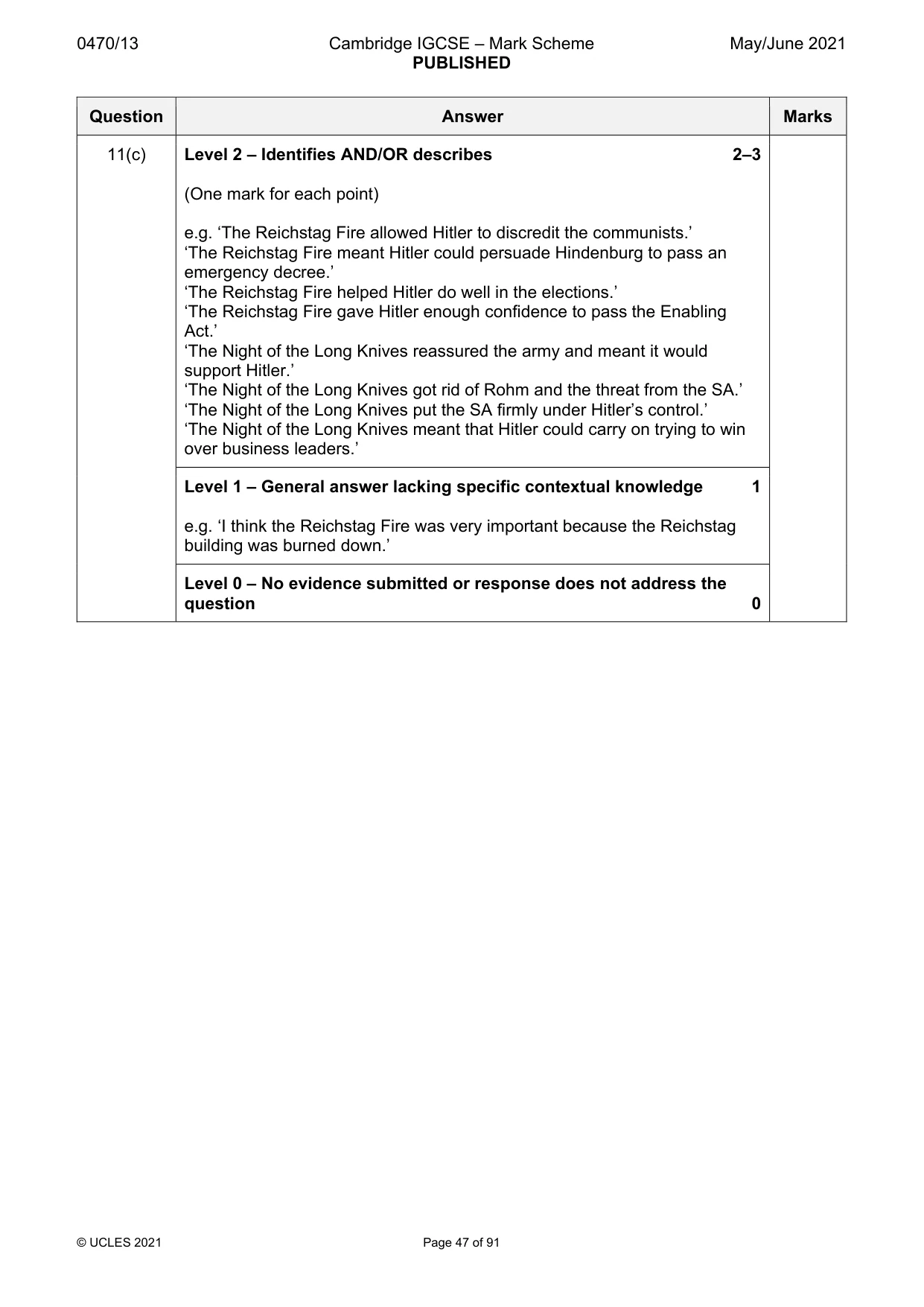
0470/13 Cambridge IGCSE – Mark Scheme PUBLISHED May/June 2021 © UCLES 2021 Page 47 of 91 Question Answer Marks 11(c) Level 2 – Identifies AND/OR describes 2–3 (One mark for each point) e.g. ‘The Reichstag Fire allowed Hitler to discredit the communists.’ ‘The Reichstag Fire meant Hitler could persuade Hindenburg to pass an emergency decree.’ ‘The Reichstag Fire helped Hitler do well in the elections.’ ‘The Reichstag Fire gave Hitler enough confidence to pass the Enabling Act.’ ‘The Night of the Long Knives reassured the army and meant it would support Hitler.’ ‘The Night of the Long Knives got rid of Rohm and the threat from the SA.’ ‘The Night of the Long Knives put the SA firmly under Hitler’s control.’ ‘The Night of the Long Knives meant that Hitler could carry on trying to win over business leaders.’ Level 1 – General answer lacking specific contextual knowledge 1 e.g. ‘I think the Reichstag Fire was very important because the Reichstag building was burned down.’ Level 0 – No evidence submitted or response does not address the question 0
Mark scheme, page 48
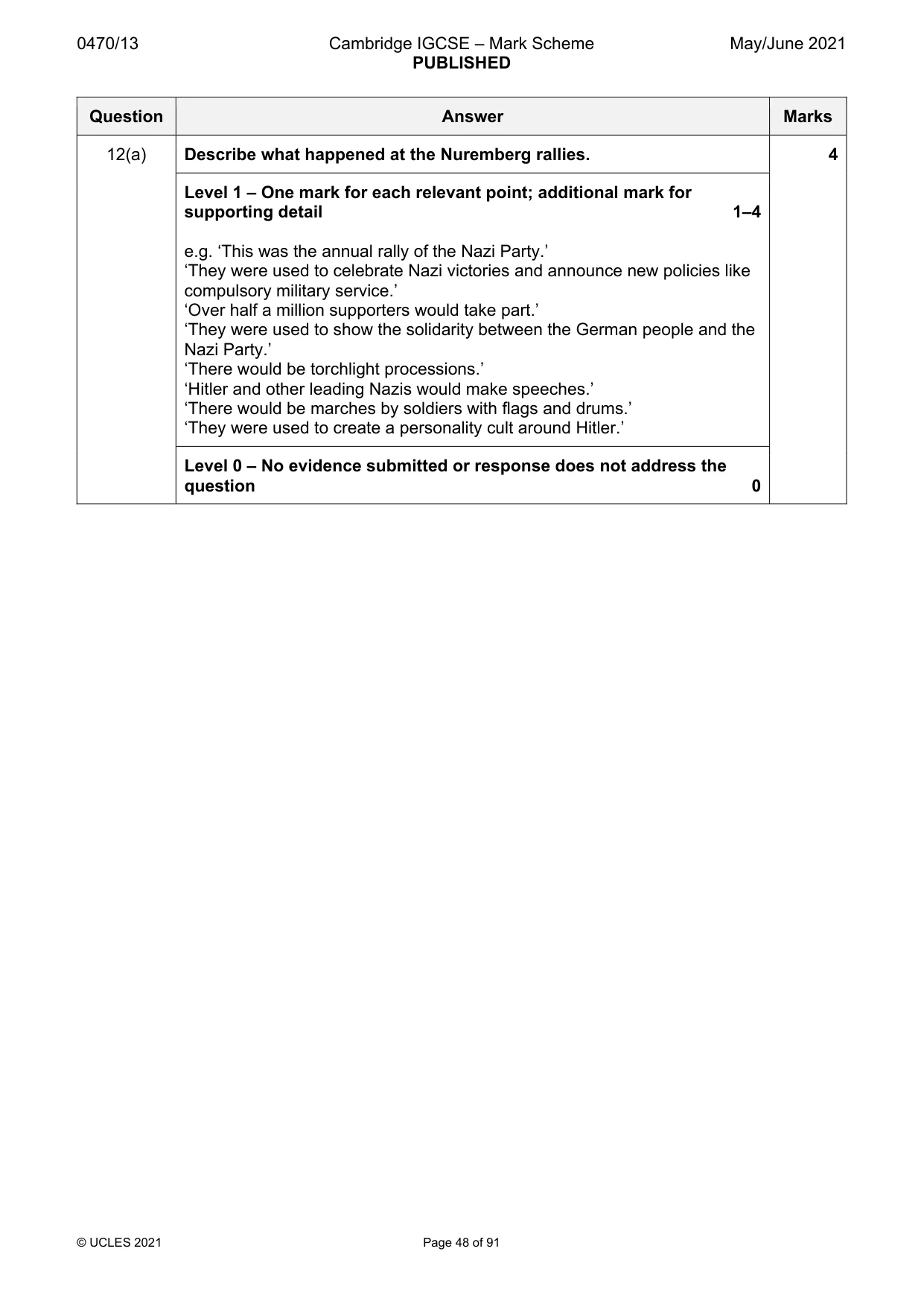
0470/13 Cambridge IGCSE – Mark Scheme PUBLISHED May/June 2021 © UCLES 2021 Page 48 of 91 Question Answer Marks 12(a) Describe what happened at the Nuremberg rallies. 4 Level 1 – One mark for each relevant point; additional mark for supporting detail 1–4 e.g. ‘This was the annual rally of the Nazi Party.’ ‘They were used to celebrate Nazi victories and announce new policies like compulsory military service.’ ‘Over half a million supporters would take part.’ ‘They were used to show the solidarity between the German people and the Nazi Party.’ ‘There would be torchlight processions.’ ‘Hitler and other leading Nazis would make speeches.’ ‘There would be marches by soldiers with flags and drums.’ ‘They were used to create a personality cult around Hitler.’ Level 0 – No evidence submitted or response does not address the question 0
Mark scheme, page 49
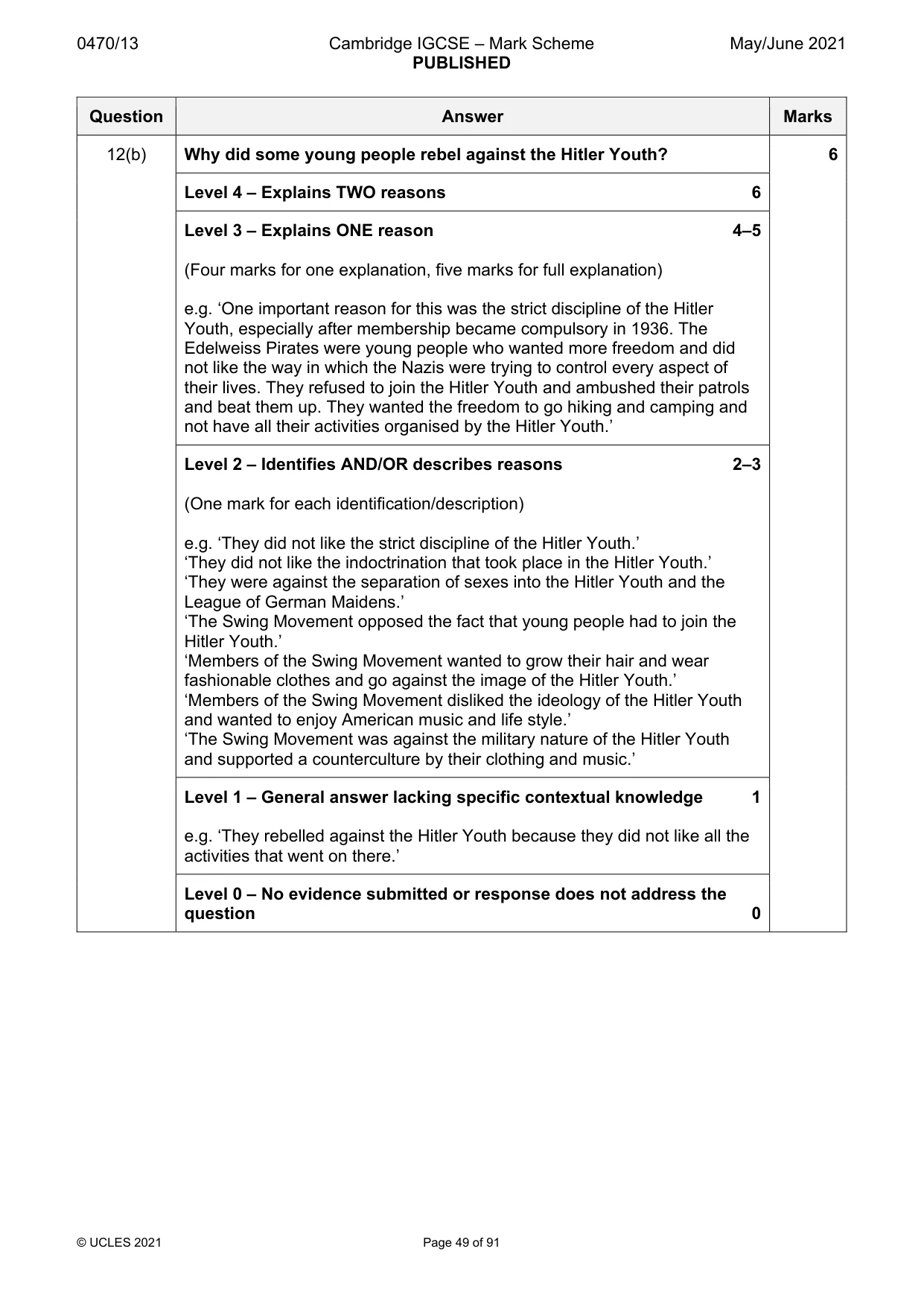
0470/13 Cambridge IGCSE – Mark Scheme PUBLISHED May/June 2021 © UCLES 2021 Page 49 of 91 Question Answer Marks 12(b) Why did some young people rebel against the Hitler Youth? 6 Level 4 – Explains TWO reasons 6 Level 3 – Explains ONE reason 4–5 (Four marks for one explanation, five marks for full explanation) e.g. ‘One important reason for this was the strict discipline of the Hitler Youth, especially after membership became compulsory in 1936. The Edelweiss Pirates were young people who wanted more freedom and did not like the way in which the Nazis were trying to control every aspect of their lives. They refused to join the Hitler Youth and ambushed their patrols and beat them up. They wanted the freedom to go hiking and camping and not have all their activities organised by the Hitler Youth.’ Level 2 – Identifies AND/OR describes reasons 2–3 (One mark for each identification/description) e.g. ‘They did not like the strict discipline of the Hitler Youth.’ ‘They did not like the indoctrination that took place in the Hitler Youth.’ ‘They were against the separation of sexes into the Hitler Youth and the League of German Maidens.’ ‘The Swing Movement opposed the fact that young people had to join the Hitler Youth.’ ‘Members of the Swing Movement wanted to grow their hair and wear fashionable clothes and go against the image of the Hitler Youth.’ ‘Members of the Swing Movement disliked the ideology of the Hitler Youth and wanted to enjoy American music and life style.’ ‘The Swing Movement was against the military nature of the Hitler Youth and supported a counterculture by their clothing and music.’ Level 1 – General answer lacking specific contextual knowledge 1 e.g. ‘They rebelled against the Hitler Youth because they did not like all the activities that went on there.’ Level 0 – No evidence submitted or response does not address the question 0
Mark scheme, page 50
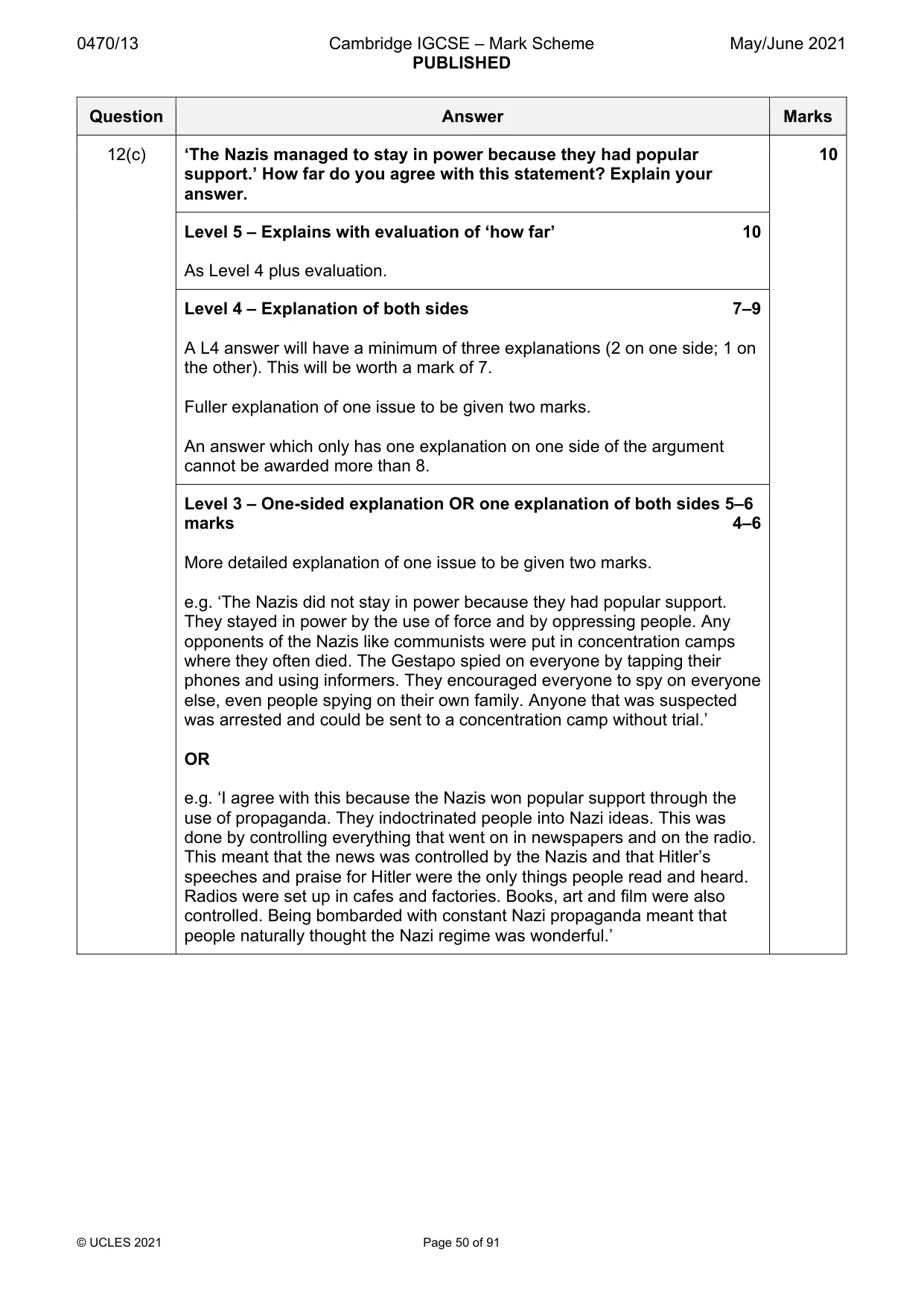
0470/13 Cambridge IGCSE – Mark Scheme PUBLISHED May/June 2021 © UCLES 2021 Page 50 of 91 Question Answer Marks 12(c) ‘The Nazis managed to stay in power because they had popular support.’ How far do you agree with this statement? Explain your answer. 10 Level 5 – Explains with evaluation of ‘how far’ 10 As Level 4 plus evaluation. Level 4 – Explanation of both sides 7–9 A L4 answer will have a minimum of three explanations (2 on one side; 1 on the other). This will be worth a mark of 7. Fuller explanation of one issue to be given two marks. An answer which only has one explanation on one side of the argument cannot be awarded more than 8. Level 3 – One-sided explanation OR one explanation of both sides 5–6 marks 4–6 More detailed explanation of one issue to be given two marks. e.g. ‘The Nazis did not stay in power because they had popular support. They stayed in power by the use of force and by oppressing people. Any opponents of the Nazis like communists were put in concentration camps where they often died. The Gestapo spied on everyone by tapping their phones and using informers. They encouraged everyone to spy on everyone else, even people spying on their own family. Anyone that was suspected was arrested and could be sent to a concentration camp without trial.’ OR e.g. ‘I agree with this because the Nazis won popular support through the use of propaganda. They indoctrinated people into Nazi ideas. This was done by controlling everything that went on in newspapers and on the radio. This meant that the news was controlled by the Nazis and that Hitler’s speeches and praise for Hitler were the only things people read and heard. Radios were set up in cafes and factories. Books, art and film were also controlled. Being bombarded with constant Nazi propaganda meant that people naturally thought the Nazi regime was wonderful.’
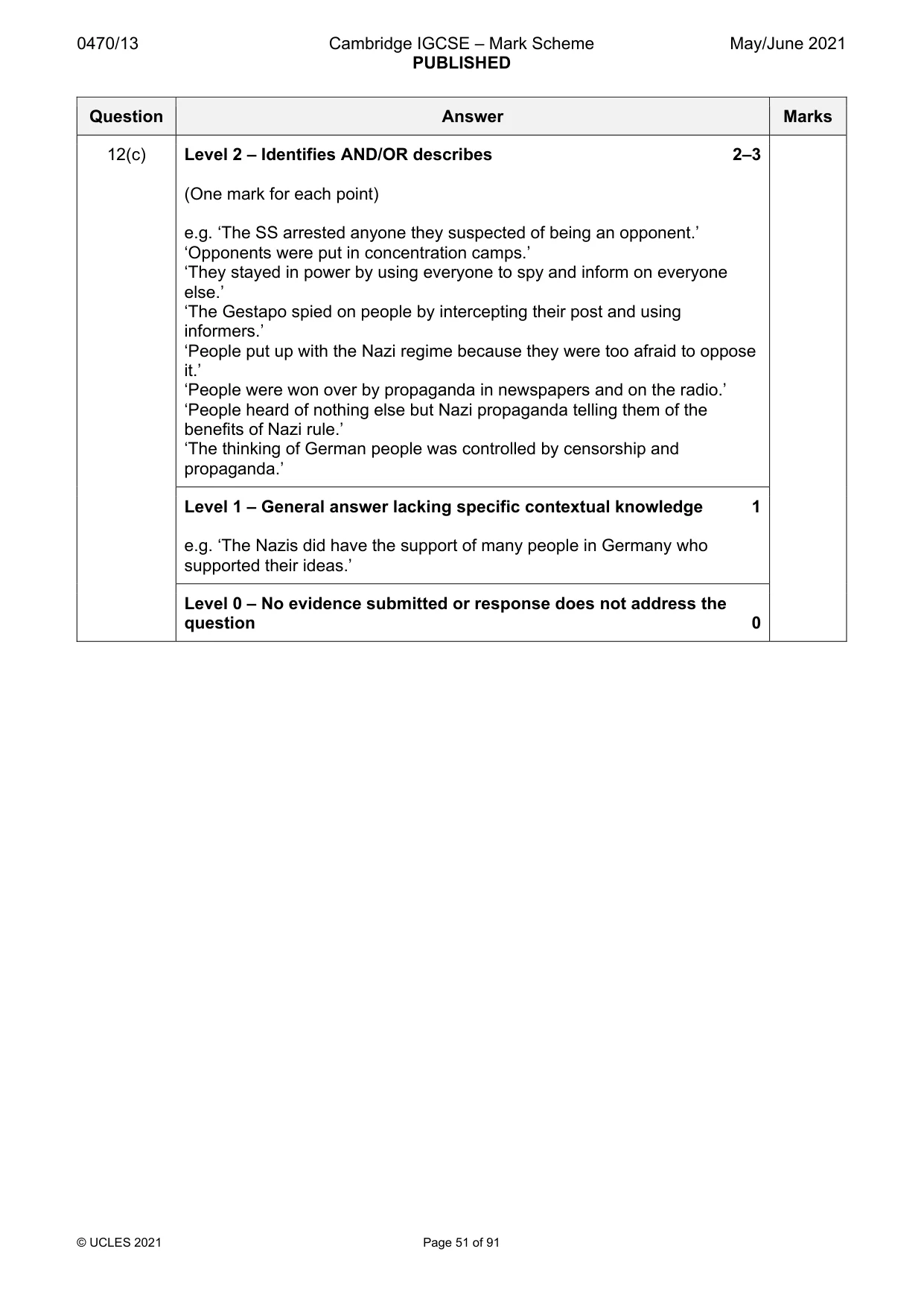
Mark scheme, page 51
0470/13 Cambridge IGCSE – Mark Scheme PUBLISHED May/June 2021 © UCLES 2021 Page 51 of 91 Question Answer Marks 12(c) Level 2 – Identifies AND/OR describes 2–3 (One mark for each point) e.g. ‘The SS arrested anyone they suspected of being an opponent.’ ‘Opponents were put in concentration camps.’ ‘They stayed in power by using everyone to spy and inform on everyone else.’ ‘The Gestapo spied on people by intercepting their post and using informers.’ ‘People put up with the Nazi regime because they were too afraid to oppose it.’ ‘People were won over by propaganda in newspapers and on the radio.’ ‘People heard of nothing else but Nazi propaganda telling them of the benefits of Nazi rule.’ ‘The thinking of German people was controlled by censorship and propaganda.’ Level 1 – General answer lacking specific contextual knowledge 1 e.g. ‘The Nazis did have the support of many people in Germany who supported their ideas.’ Level 0 – No evidence submitted or response does not address the question 0
Mark scheme, page 52
0470/13 Cambridge IGCSE – Mark Scheme PUBLISHED May/June 2021 © UCLES 2021 Page 52 of 91 Question Answer Marks Depth Study C: Russia, 1905–41 13(a) What were the consequences for Russia of the Russo-Japanese War? 4 Level 1 – One mark for each relevant point; additional mark for supporting detail 1–4 e.g. ‘This war led to Bloody Sunday where an end to the war was one of the demands.’ ‘It was one of the causes of the 1905 revolution.’ ‘It increased criticism of the Tsar’s rule of Russia.’ ‘Soldiers returning from the war protested.’ ‘There were naval mutinies at Sevastopol and aboard the battleship Potemkin.’ ‘It led to reforms of the Russian army.’ ‘It led to the rise of Japan as a great power.’ ‘It was a great blow to Russian pride and prestige.’ Level 0 – No evidence submitted or response does not address the question 0
Mark scheme, page 53
0470/13 Cambridge IGCSE – Mark Scheme PUBLISHED May/June 2021 © UCLES 2021 Page 53 of 91 Question Answer Marks 13(b) Why was Bloody Sunday important? 6 Level 4 – Explains TWO reasons 6 Level 3 – Explains ONE reason 4–5 (Four marks for one explanation, five marks for full explanation) e.g. ‘In January 1905, Father Gapon led protestors in a march to present a petition for reforms to the Tsar. But before they could get to the Winter Palace they were fired on by soldiers. Hundreds of people were killed and many more injured. This sent shocks through Russia. People had believed that the Tsar was their ‘father’ and would look after them. These killings destroyed this belief and from then on things were never the same. Although the Tsar survived in 1905, he never really recovered and Bloody Sunday can be seen as the first important event that led to his downfall in 1917.’ Level 2 – Identifies AND/OR describes reasons 2–3 (One mark for each identification/description) e.g. ‘It was important because it started the 1905 revolution.’ ‘Hundreds of people were killed by the Tsar’s soldiers and many more wounded.’ ‘It led to the mutiny on the battleship Potemkin.’ ‘It led to people no longer trusting the Tsar.’ ‘It was the first step to the eventual downfall of the Tsar.’ Level 1 – General answer lacking specific contextual knowledge 1 e.g. ‘Bloody Sunday was important because it led to further unrest and revolution.’ Level 0 – No evidence submitted or response does not address the question 0
Mark scheme, page 54
0470/13 Cambridge IGCSE – Mark Scheme PUBLISHED May/June 2021 © UCLES 2021 Page 54 of 91 Question Answer Marks 13(c) Are you surprised that the Tsar managed to remain in power until 1917? Explain your answer. 10 Level 5 – Explains with evaluation ‘are you surprised’ 10 As Level 4 plus evaluation. Level 4 – Explanation of both sides 7–9 A L4 answer will have a minimum of three explanations (2 on one side; 1 on the other). This will be worth a mark of 7. Fuller explanation of one issue to be given two marks. An answer which only has one explanation on one side of the argument cannot be awarded more than 8. Level 3 – One-sided explanation OR one explanation of both sides 5–6 marks 4–6 More detailed explanation of one issue to be given two marks. e.g. ‘No, I am not surprised by this. He stayed in power by a mixture of reform and repression. The Tsar issued the October Manifesto which promised some reforms such as a Duma. This satisfied quite a lot of people. Stolypin also helped the Tsar survive by passing reforms. The peasants were allowed to leave communes and many bought their own farms. This helped to keep them quiet. He also helped the Tsar survive by dealing ruthlessly with any trouble. He introduced martial law to deal with disorder and terrorism. This kept the Tsar firmly in control of the country.’ OR e.g. ‘Yes, I am very surprised. Many of the reforms the Tsar passed, he soon went back on. The Duma was not the introduction of democracy. It was packed with Tsarists and the Tsar simply dissolved it whenever he wanted to. The Fundamental Laws gave him back a lot of his power and the Okhrana (the secret police) were brutal and were hated. All of this made the Tsar unpopular and it is surprising that he stayed in power until 1917. This is especially because he was weakened by Russia’s disastrous entry into the First World War. This soon led to food shortages. So I am surprised he survived until 1917.’
Mark scheme, page 55
0470/13 Cambridge IGCSE – Mark Scheme PUBLISHED May/June 2021 © UCLES 2021 Page 55 of 91 Question Answer Marks 13(c) Level 2 – Identifies AND/OR describes 2–3 (One mark for each point) e.g. ‘Stolypin kept the Tsar in power by using repression.’ ‘Reforms like those in the October Manifesto helped to satisfy many people.’ ‘The peasants were won over by reforms letting them buy their own land.’ ‘He managed to stay in power by using his secret police to deal with any opposition.’ ‘The Fundamental Laws of 1906 helped the Tsar regain control.’ ‘The Tsar went back on many of his reforms.’ ‘The Tsar’s use of the Okhrana was very unpopular.’ ‘Russian defeats in the First World War made the Tsar very unpopular.’ Level 1 – General answer lacking specific contextual knowledge 1 e.g. ‘No. He was the Tsar and so many people would obey him. It is not surprising that he stayed in power.’ Level 0 – No evidence submitted or response does not address the question 0
Mark scheme, page 56
0470/13 Cambridge IGCSE – Mark Scheme PUBLISHED May/June 2021 © UCLES 2021 Page 56 of 91 Question Answer Marks 14(a) Describe the impact of Stalin’s rule on ethnic minorities in the Soviet Union. 4 Level 1 – One mark for each relevant point; additional mark for supporting detail 1–4 e.g. ‘Stalin wanted them to think of themselves as Russians and not as individual nationalities.’ ‘Russian was taught in all schools and using their own languages was discouraged.’ ‘Many people from ethnic minorities such as the Chechens and the Ingush were deported to Siberia where they became second-class citizens. Millions died.’ ‘Many who were in the Soviet elite were targeted during the purges.’ ‘There was a policy of Decossackisation to try and finish off the Cossacks.’ ‘The Holodomor famine was a terror-famine campaign organised by the Soviet authorities against the Ukrainian population.’ Level 0 – No evidence submitted or response does not address the question 0
Mark scheme, page 57
0470/13 Cambridge IGCSE – Mark Scheme PUBLISHED May/June 2021 © UCLES 2021 Page 57 of 91 Question Answer Marks 14(b) Why did Stalin think it was necessary to reform Soviet industry? 6 Level 4 – Explains TWO reasons 6 Level 3 – Explains ONE reason 4–5 (Four marks for one explanation, five marks for full explanation) e.g. ‘He wanted to reform industry because he wanted Russia to be able to defend itself. It was faced with hostile countries in the West which did not like communism and he was afraid Russia might be invaded. He thought that modernising Russia’s industry would give it the materials and equipment needed to improve Russia’s armed forces and defences. All of this needed to be brought up to date.’ Level 2 – Identifies AND/OR describes reasons 2–3 (One mark for each identification/description) e.g. ‘To make Russia more secure.’ ‘To turn Russia into a leading country.’ ‘To make the Soviet Union strong militarily.’ ‘To make the Soviet Union self-sufficient.’ ‘To put industry more under the control of the Soviet government.’ ‘This would help create a Marxist state.’ ‘The NEP went against socialist ideas.’ ‘To improve people’s standard of living.’ Level 1 – General answer lacking specific contextual knowledge 1 e.g. ‘He did this because he wanted to make it better. Soviet industry needed reforming and Stalin was ready to do it.’ Level 0 – No evidence submitted or response does not address the question 0
Mark scheme, page 58
0470/13 Cambridge IGCSE – Mark Scheme PUBLISHED May/June 2021 © UCLES 2021 Page 58 of 91 Question Answer Marks 14(c) ‘Collectivisation did more harm than good.’ How far do you agree with this statement? Explain your answer. 10 Level 5 – Explains with evaluation of ‘how far’ 10 As Level 4 plus evaluation. Level 4 – Explanation of both sides 7–9 A L4 answer will have a minimum of three explanations (2 on one side; 1 on the other). This will be worth a mark of 7. Fuller explanation of one issue to be given two marks. An answer which only has one explanation on one side of the argument cannot be awarded more than 8. Level 3 – One-sided explanation OR one explanation of both sides 5–6 marks 4–6 More detailed explanation of one issue to be given two marks. e.g. ‘Collectivisation was a disaster. It caused a lot of disruption with Kulaks opposing the policy. They killed livestock and destroyed their crops. This led to the amount of grain being produced going down. Stalin thought that Kulaks were hiding grain; he would not accept that less was being produced. The result was famine that killed millions of people, especially in Ukraine.’ OR e.g. ‘Russian agriculture was backward, was not producing the amount of food needed and had to be reformed. Collectivisation was needed to increase production. The fact that it did not work well at the beginning was not the fault of collectivisation but the fault of Kulaks who opposed the policy. They burned crops, killed millions of their animals and damaged machinery. This caused less food to be produced and the result was famine. By the late 1930s, most farms were collectivised, new machinery was being used and the production of food did go up. Overall, it did more good than harm.’ Level 2 – Identifies AND/OR describes 2–3 (One mark for each point) e.g. ‘Collectivisation was opposed by Kulaks and this led to disruption with much livestock being killed.’ ‘It did a lot of harm because it caused famine.’ ‘In the long run it did increase the production of food.’ ‘Collectivisation did harm to the Kulaks who lost their farms and some were executed or sent to Siberia.’
Mark scheme, page 59
0470/13 Cambridge IGCSE – Mark Scheme PUBLISHED May/June 2021 © UCLES 2021 Page 59 of 91 Question Answer Marks 14(c) Level 1 – General answer lacking specific contextual knowledge 1 e.g. ‘I think it did a lot of harm and many people suffered really badly.’ Level 0 – No evidence submitted or response does not address the question 0
Mark scheme, page 60
0470/13 Cambridge IGCSE – Mark Scheme PUBLISHED May/June 2021 © UCLES 2021 Page 60 of 91 Question Answer Marks Depth Study D: The United States, 1919–41 15(a) What new products did advertising promote during the 1920s? 4 Level 1 – One mark for each relevant point; additional mark for supporting detail 1–4 e.g. ‘Many people wanted to buy things that made life at home easier like fridges.’ ‘Advertising promoted the sale of cars.’ ‘Advertising tried to sell domestic appliances like washing machines and vacuum cleaners.’ ‘Advertising sold radios.’ Level 0 – No evidence submitted or response does not address the question 0
Mark scheme, page 61
0470/13 Cambridge IGCSE – Mark Scheme PUBLISHED May/June 2021 © UCLES 2021 Page 61 of 91 Question Answer Marks 15(b) Why did Prohibition fail? 6 Level 4 – Explains TWO reasons 6 Level 3 – Explains ONE reason 4–5 (Four marks for one explanation, five marks for full explanation) e.g. ‘Prohibition failed because the majority of people did not support it. This was especially true in large cities. Many people still wanted alcohol and so ‘speakeasies’ sprang up. These were illegal drinking bars. Rich people had alcohol delivered to their homes while poorer people made their own using illegal stills. With many of the public against it, prohibition was never going to work.’ Level 2 – Identifies AND/OR describes reasons 2–3 (One mark for each identification/description) e.g. ‘Enforcement agents were corrupt.’ ‘The police were corrupt.’ ‘The general public were not in support of it.’ ‘People used speakeasies and illegal stills.’ ‘It led to gangs and much violence.’ ‘Gangs supplied alcohol to anyone who wanted it.’ ‘Gangs bribed and threatened the police and judges.’ Level 1 – General answer lacking specific contextual knowledge 1 e.g. ‘It failed because it never worked properly. They could not make it work.’ Level 0 – No evidence submitted or response does not address the question 0
Mark scheme, page 62
0470/13 Cambridge IGCSE – Mark Scheme PUBLISHED May/June 2021 © UCLES 2021 Page 62 of 91 Question Answer Marks 15(c) ‘The lives led by rural and urban Americans in the 1920s were more similar than they were different.’ How far do you agree with this statement? Explain your answer. 10 Level 5 – Explains with evaluation of ‘how far’ 10 As Level 4 plus evaluation. Level 4 – Explanation of both sides 7–9 A L4 answer will have a minimum of three explanations (2 on one side; 1 on the other). This will be worth a mark of 7. Fuller explanation of one issue to be given two marks. An answer which only has one explanation on one side of the argument cannot be awarded more than 8. Level 3 – One-sided explanation OR one explanation of both sides 5–6 marks 4–6 More detailed explanation of one issue to be given two marks. e.g. ‘I disagree with this. This is because there were many differences. Flappers in the cities kept up with the latest fashions and had more freedom. They smoked, drove cars and had more independence. Many women in cities also had the new labour-saving devices. However, women in rural areas still had hard traditional lives. They did not have labour-saving devices and had to bring up children and work hard on the farm. They did not have much money and lived hard lives just as in the past. Small farmers and labourers in rural areas did not benefit from the boom in the 1920s and lived much poorer lives than workers in the cities where there were plenty of well- paid jobs.’ OR e.g. ‘I agree with this. If you were poor then it did not make much difference where you lived. The majority of American workers lived below the poverty line and they could be found in rural and urban areas. Many workers in cities such as female cotton operatives were paid low wages and were no better off than small farmers or labourers in rural areas. Black Americans suffered from discrimination in rural and urban areas. The persecution in southern rural areas was worse with the Ku Klux Klan operating but in northern cities they suffered from low wages and discrimination in housing.’
Mark scheme, page 63
0470/13 Cambridge IGCSE – Mark Scheme PUBLISHED May/June 2021 © UCLES 2021 Page 63 of 91 Question Answer Marks 15(c) Level 2 – Identifies AND/OR describes 2–3 (One mark for each point) e.g. ‘Black Americans faced discrimination in rural and urban areas.’ ‘Black Americans fled away from persecution in rural areas to find jobs in northern cities.’ ‘Many American workers suffered from low wages in both rural and urban areas.’ ‘People in urban areas had more chance to afford labour saving devices such as vacuum cleaners.’ Level 1 – General answer lacking specific contextual knowledge 1 e.g. ‘I think their lives were very different because they were living in different types of places.’ Level 0 – No evidence submitted or response does not address the question 0
Mark scheme, page 64
0470/13 Cambridge IGCSE – Mark Scheme PUBLISHED May/June 2021 © UCLES 2021 Page 64 of 91 Question Answer Marks 16(a) What were the Supreme Court’s objections to the New Deal? 4 Level 1 – One mark for each relevant point; additional mark for supporting detail 1–4 e.g. ‘They said that parts of it like the AAA were against the constitution.’ ‘It wanted welfare help to be given through the states and not by the federal government.’ ‘Most of the judges were Republican and did not believe in the federal government intervening in people’s lives.’ ‘Many of the judges thought that people should stand on their own two feet.’ ‘The judges said that the National Industrial Recovery Act was unconstitutional.’ ‘The Supreme Court did not like the move from individualism to collectivism.’ Level 0 – No evidence submitted or response does not address the question 0
Mark scheme, page 65
0470/13 Cambridge IGCSE – Mark Scheme PUBLISHED May/June 2021 © UCLES 2021 Page 65 of 91 Question Answer Marks 16(b) Why did the promises Roosevelt made in the 1932 presidential election appeal to the American people? 6 Level 4 – Explains TWO reasons 6 Level 3 – Explains ONE reason 4–5 (Four marks for one explanation, five marks for full explanation) e.g. ‘His promises appealed to people because of the dreadful situation that America was in at the time. Banks and businesses were failing and people were losing their jobs in their millions. There were no welfare benefits and people lost their homes and had to live in shanty towns. Many people were completely without any hope. Roosevelt promised ‘a new deal for the American people’. His confidence that American society could be reformed and be made fair for everyone raised people’s hopes. They believed that he would rescue them from the Depression.’ Level 2 – Identifies AND/OR describes reasons 2–3 (One mark for each identification/description) e.g. ‘They appealed to them because the American people were in such a desperate situation in the Depression.’ ‘Roosevelt had a reputation for helping the elderly and the poor in New York State.’ ‘Compared to Hoover he seemed full of hope for the future.’ ‘Roosevelt had a warm friendly personality and filled people with hope.’ Level 1 – General answer lacking specific contextual knowledge 1 e.g. ‘His promises were just what the American people needed at that time.’ Level 0 – No evidence submitted or response does not address the question 0
Mark scheme, page 66
0470/13 Cambridge IGCSE – Mark Scheme PUBLISHED May/June 2021 © UCLES 2021 Page 66 of 91 Question Answer Marks 16(c) ‘The fact that Roosevelt introduced the Second New Deal in 1935–36 shows that the First New Deal had failed.’ How far do you agree with this statement? Explain your answer. 10 Level 5 – Explains with evaluation of ‘how far’ 10 As Level 4 plus evaluation. Level 4 – Explanation of both sides 7–9 A L4 answer will have a minimum of three explanations (2 on one side; 1 on the other). This will be worth a mark of 7. Fuller explanation of one issue to be given two marks. An answer which only has one explanation on one side of the argument cannot be awarded more than 8. Level 3 – One-sided explanation OR one explanation of both sides 5–6 marks 4–6 More detailed explanation of one issue to be given two marks. e.g. ‘I think this is right. The Second New Deal was introduced to deal with the areas that the First New Deal was weak on. The First New Deal did not do much about workers’ rights and welfare. Some critics like Huey Long said that it did not help those who were unemployed and poor. Parts of the Second New Deal showed how Roosevelt was trying to put this right. The right of workers to join trade unions was defended and pensions for elderly were introduced as well as insurance against unemployment.’ OR e.g. ‘I do not agree with this at all. The First New Deal did an awful lot and was a success. It helped farmers by paying them to cut production. This increased their income. Banks were saved and reopened again. Employment was provided by job creation schemes and building projects such as dams and roads. Industry was helped to recover by using the ‘Blue Eagle’ scheme which businesses joined. The First New Deal did not solve every problem but it stopped businesses going bankrupt and helped those in desperate need.’
Mark scheme, page 67
0470/13 Cambridge IGCSE – Mark Scheme PUBLISHED May/June 2021 © UCLES 2021 Page 67 of 91 Question Answer Marks 16(c) Level 2 – Identifies AND/OR describes 2–3 (One mark for each point) e.g. Disagree: ‘The banking system was saved.’ ‘The homeless and those starving were helped.’ ‘Jobs were created.’ ‘Businesses were prevented from going bankrupt.’ ‘The regeneration of the Tennessee Valley was a great success.’ e.g. Agree: ‘There was still a lot of unemployment.’ ‘Wealth was not re-distributed to the poor.’ ‘Not enough was done to get rid of poverty.’ Level 1 – General answer lacking specific contextual knowledge 1 e.g. ‘The First New Deal was a not a failure. It helped a lot of people.’ Level 0 – No evidence submitted or response does not address the question 0
Mark scheme, page 68
0470/13 Cambridge IGCSE – Mark Scheme PUBLISHED May/June 2021 © UCLES 2021 Page 68 of 91 Question Answer Marks Depth Study E: China, c.1930–c.1990 17(a) What happened during the Shanghai Massacre of 1927? 4 Level 1 – One mark for each relevant point; additional mark for supporting detail 1–4 e.g. ‘Chiang had leaders of the city’s Communist Party arrested.’ ‘When there were protests Chiang ordered the army to take control. They killed lots of Communist supporters.’ ‘Hundreds of thousands of Communists were killed.’ ‘There were public executions of Communists.’ ‘Chiang took control of the city.’ ‘Communist members of the city government were thrown out.’ Level 0 – No evidence submitted or response does not address the question 0
Mark scheme, page 69
0470/13 Cambridge IGCSE – Mark Scheme PUBLISHED May/June 2021 © UCLES 2021 Page 69 of 91 Question Answer Marks 17(b) Why did Chiang Kai-shek think that the five extermination campaigns were necessary? 6 Level 4 – Explains TWO reasons 6 Level 3 – Explains ONE reason 4–5 (Four marks for one explanation, five marks for full explanation) e.g. ‘Chiang Kai-shek thought that the extermination campaigns were necessary to get rid of the Communists. Chiang became leader of the Kuomintang in 1925. His party and the Communists had been working together but he decided that if he wanted to reform China, he had to defeat the Communists. The extermination campaigns were designed to isolate and destroy the Communists.’ Level 2 – Identifies AND/OR describes reasons 2–3 (One mark for each identification/description) e.g. ‘He wanted to completely destroy the power of the Communists.’ ‘The Communists controlled much of the countryside of China.’ ‘He wanted to unify China.’ ‘The Communists were operating a rival government from their strongholds.’ Level 1 – General answer lacking specific contextual knowledge 1 e.g. ‘He thought this because he had decided that it was the only solution for his problems in China.’ Level 0 – No evidence submitted or response does not address the question 0
Mark scheme, page 70
0470/13 Cambridge IGCSE – Mark Scheme PUBLISHED May/June 2021 © UCLES 2021 Page 70 of 91 Question Answer Marks 17(c) ‘Leadership was the main factor that determined the outcome of the Civil War.’ How far do you agree with this statement? Explain your answer. 10 Level 5 – Explains with evaluation of ‘how far’ 10 As Level 4 plus evaluation. Level 4 – Explanation of both sides 7–9 A L4 answer will have a minimum of three explanations (2 on one side; 1 on the other). This will be worth a mark of 7. Fuller explanation of one issue to be given two marks. An answer which only has one explanation on one side of the argument cannot be awarded more than 8. Level 3 – One-sided explanation OR one explanation of both sides 5–6 marks 4–6 More detailed explanation of one issue to be given two marks. e.g. ‘I agree with this. When they first got to Yenan, Mao laid down basic principles. One was to win over the support of the peasants. This became a crucial factor in the Civil War. The peasants supported Mao and the Communists because they treated the peasants much better than the Nationalists. Mao insisted that the Communists lived with the peasants and helped them. He also promised the peasants their own land. This was very important because the peasants were the largest group in China and so this gave the Communists mass support. Mao dominated the Communists and gave them clear leadership.’ OR e.g. ‘I think that other factors were important. The corruption of the Nationalists was very unpopular with the Chinese people. It was so bad that it made the Americans stop sending support to them. The Nationalists lost support and even their own soldiers began to desert and join the Communists who were seen as defenders of the country. The tactics of the Communists also helped. They avoided big battles and launched smaller attacks.’
Mark scheme, page 71
0470/13 Cambridge IGCSE – Mark Scheme PUBLISHED May/June 2021 © UCLES 2021 Page 71 of 91 Question Answer Marks 17(c) Level 2 – Identifies AND/OR describes 2–3 (One mark for each point) e.g. ‘The Nationalists were weakened by the war against the Japanese.’ ‘Chiang’s desire for a powerful centralised government meant he upset too many different groups in China.’ ‘Mao made sure the Communists won over the peasants.’ ‘The Communists were given help by the USSR.’ ‘The corruption of the Nationalists lost them much support.’ ‘The charismatic leadership of Mao gave the Communists a unity of command.’ ‘The Communists were seen as standing up to the Japanese more.’ ‘The Communists used better tactics such as small attacks rather than large battles.’ ‘Chiang failed to give the Nationalists clear and popular leadership.’ ‘The Nationalists were seen by the Chinese people as corrupt.’ Level 1 – General answer lacking specific contextual knowledge 1 e.g. ‘Leadership was very important but there were other factors like the popularity of the Communists.’ Level 0 – No evidence submitted or response does not address the question 0
Mark scheme, page 72
0470/13 Cambridge IGCSE – Mark Scheme PUBLISHED May/June 2021 © UCLES 2021 Page 72 of 91 Question Answer Marks 18(a) What was the policy adopted by China from 1979 in relation to population growth? 4 Level 1 – One mark for each relevant point; additional mark for supporting detail 1–4 e.g. ‘It was an attempt to reduce the population to 700 million.’ ‘Families were permitted only one child.’ ‘In some cases a couple could have a second child, such as when both parents were single children.’ ‘It is referred to as the ‘One Child Policy’. ‘Women were required to have an IUD fitted after the birth of their first child.’ ‘It was extremely unpopular, especially in the countryside.’ ‘Some women were forced to have sterilisations.’ ‘It resulted in more boys than girls being born in China.’ ‘Couples received fines for having more than one child.’ Level 0 – No evidence submitted or response does not address the question 0
Mark scheme, page 73
0470/13 Cambridge IGCSE – Mark Scheme PUBLISHED May/June 2021 © UCLES 2021 Page 73 of 91 Question Answer Marks 18(b) Why was China able to achieve economic growth from the late 1970s? 6 Level 4 – Explains TWO reasons 6 Level 3 – Explains ONE reason 4–5 (Four marks for one explanation, five marks for full explanation) e.g. ‘China was able to achieve economic growth after a new ten-year plan for rapid growth was devised in 1978. This allowed China to follow a new direction, closer to a Western-style economy. Foreign trade resumed, along with borrowing from foreign investors in an effort to generate capital. Agriculture also benefited economically from the introduction of greater resources following on from a sharp increase in the prices paid for farm goods and products from 1979. There was a change from collective to family farming and greater choice for peasants in what was grown, with impressive harvests in the early 1980s after excellent weather. Many small industries, transport companies and other services were set up by the many who decided to leave farming.’ Level 2 – Identifies AND/OR describes reasons 2–3 (One mark for each identification/description) e.g. ‘China achieved growth after it introduced a plan for the economy.’ ‘China adopted different policies on trade and investment.’ ‘China modernised its industry and agriculture with a more Western-style approach.’ Level 1 – General answer lacking specific contextual knowledge 1 e.g. ‘China achieved economic growth because it needed to improve the economy.’ Level 0 – No evidence submitted or response does not address the question 0
Mark scheme, page 74
0470/13 Cambridge IGCSE – Mark Scheme PUBLISHED May/June 2021 © UCLES 2021 Page 74 of 91 Question Answer Marks 18(c) ‘Economic development in China in the period 1980 to 1990 produced much change.’ How far do you agree with this statement? Explain your answer. 10 Level 5 – Explains with evaluation of ‘how far’ 10 As Level 4 plus evaluation. Level 4 – Explanation of both sides 7–9 A L4 answer will have a minimum of three explanations (2 on one side; 1 on the other). This will be worth a mark of 7. Fuller explanation of one issue to be given two marks. An answer which only has one explanation on one side of the argument cannot be awarded more than 8. Level 3 – One-sided explanation OR one explanation of both sides 5–6 marks 4–6 More detailed explanation of one issue to be given two marks. e.g. ‘I agree with this. Deng’s economic reforms did lead to high economic growth which led to an increase in the standard of living of millions of Chinese people. Other improvements included allowing peasants to earn extra income by selling produce from their plots of land. Deng also opened China up to the rest of the world and outside cultural influences began to impact on the lives of the Chinese. Many of them moved to the cities for jobs and bought consumer goods.’ OR e.g. ‘I disagree with this statement. Despite the economic development through the Four Modernisations and the opening up of the economy, the Chinese Communist Party kept firm control within China. For example, the policy of one child only was enforced and forced abortions were even used. In the early 1980s Deng launched his ‘strike hard’ campaign. His critics said that he had missed out the ‘Fifth Modernisation’ which was more democracy and by the end of the 1980s there was a lot of dissatisfaction with the authoritarian regime. Criticism was dealt with sternly.’ 18(c) Level 2 – Identifies AND/OR describes 2–3 (One mark for each point) e.g. ‘There were important social changes such as many people moving to the cities.’ ‘The standard of living of many Chinese was improved.’ ‘Many Chinese bought more consumer goods.’ ‘The Communist Party kept control and did not allow dissent.’ ‘The policy of one child per family was continued and strictly enforced.’ ‘Many Chinese were happy not to have political freedoms if they had economic freedom.’
Mark scheme, page 75
0470/13 Cambridge IGCSE – Mark Scheme PUBLISHED May/June 2021 © UCLES 2021 Page 75 of 91 Question Answer Marks Level 1 – General answer lacking specific contextual knowledge 1 e.g. ‘I think that the economic reforms did bring many changes to the lives of the Chinese people.’ Level 0 – No evidence submitted or response does not address the question 0
Mark scheme, page 76
0470/13 Cambridge IGCSE – Mark Scheme PUBLISHED May/June 2021 © UCLES 2021 Page 76 of 91 Question Answer Marks Depth Study F: South Africa, c.1940–c.1994 19(a) What was the migrant labour system? 4 Level 1 – One mark for each relevant point; additional mark for supporting detail 1–4 e.g. ‘Agents recruited young men from their villages to work in mines.’ ‘Black South Africans migrated from their villages to work in diamond and gold mines.’ ‘Migrant workers were on short contracts.’ ‘While at work, the workers lived in male-only compounds.’ ‘The mining companies fed and housed the workers.’ ‘The mining companies kept the wages low.’ ‘The workers took their wages back to their home villages.’ ‘The workers were treated harshly by their overseers.’ Level 0 – No evidence submitted or response does not address the question 0
Mark scheme, page 77
0470/13 Cambridge IGCSE – Mark Scheme PUBLISHED May/June 2021 © UCLES 2021 Page 77 of 91 Question Answer Marks 19(b) Why was the Natives Land Act of 1913 unpopular with black South Africans? 6 Level 4 – Explains TWO reasons 6 Level 3 – Explains ONE reason 4–5 (Four marks for one explanation, five marks for full explanation) e.g. ‘It was very unpopular with black South Africans because it banned share-cropping. This was how they could farm for themselves. They gave half their crop to the white landowner in return for the land they used, but at least they could produce food to feed their families. The banning of share- cropping meant they could not farm for themselves and they had to either work for the farmer as a labourer or work in the mines.’ Level 2 – Identifies AND/OR describes reasons 2–3 (One mark for each identification/description) e.g. ‘It stopped them owning or renting land except in the black reserves.’ ‘It led to black share-croppers being evicted and ending up homeless.’ ‘It meant black South Africans could no longer be farmers except in the reserves.’ ‘It forced black South Africans to become labourers for white farmers.’ Level 1 – General answer lacking specific contextual knowledge 1 e.g. ‘It was unpopular because it did a great deal of harm to them and made their lives difficult.’ Level 0 – No evidence submitted or response does not address the question 0
Mark scheme, page 78
0470/13 Cambridge IGCSE – Mark Scheme PUBLISHED May/June 2021 © UCLES 2021 Page 78 of 91 Question Answer Marks 19(c) How far was the victory of the National Party in the 1948 election caused by the failings of the United Party? Explain your answer. 10 Level 5 – Explains with evaluation of ‘how far’ 10 As Level 4 plus evaluation. Level 4 – Explanation of both sides 7–9 A L4 answer will have a minimum of three explanations (2 on one side; 1 on the other). This will be worth a mark of 7. Fuller explanation of one issue to be given two marks. An answer which only has one explanation on one side of the argument cannot be awarded more than 8. Level 3 – One-sided explanation OR one explanation of both sides 5–6 marks 4–6 More detailed explanation of one issue to be given two marks. e.g. ‘I do not agree with this. I think the National Party won because of its own policies and ideas. It promised a white South Africa under Afrikaner rule. This would involve moving black South Africans to the reserves. This pleased Afrikaners, who made up the majority of white South Africans and who believed in white supremacy and were worried about their culture being overwhelmed by black South Africans. They also promised white industrialists lots of cheap black labour which would be allowed to leave the reserves to work in the cities. All of this appealed to the Afrikaners.’ OR e.g. ‘I agree with this. The United Party which was the party in power was very unpopular, especially with Afrikaners. This was because after the war the South African economy was in a mess and white workers found that when they returned from the war, their jobs had been taken by black South Africans. They were also worried by all the black protests and strikes and feared black South Africans taking over. They blamed this on Smuts and his government which they thought did not seem able to keep black South Africans under control.’
Mark scheme, page 79
0470/13 Cambridge IGCSE – Mark Scheme PUBLISHED May/June 2021 © UCLES 2021 Page 79 of 91 Question Answer Marks 19(c) Level 2 – Identifies AND/OR describes 2–3 (One mark for each point) e.g. ‘The policies of the National Party were very popular with Afrikaners.’ ‘The National Party promised to move black South Africans to the reserves.’ ‘The National party promised to keep South Africa under Afrikaner rule.’ ‘The National Party promised to provide factory and mine owners with lots of cheap labour.’ ‘The National Party promised to provide white farmers with lots of cheap labour.’ ‘The United Party government was not sorting out South Africa’s economic problems.’ ‘The United Party government was not dealing with protests and strikes by black South Africans.’ ‘Afrikaners did not like the flood of black workers to the cities which the United Party seemed to be allowing.’ ‘The United Party government had kept food prices low which was not good for white farmers.’ Level 1 – General answer lacking specific contextual knowledge 1 e.g. ‘I think the United Party lost the election because it had some very bad ideas and policies.’ Level 0 – No evidence submitted or response does not address the question 0
Mark scheme, page 80
0470/13 Cambridge IGCSE – Mark Scheme PUBLISHED May/June 2021 © UCLES 2021 Page 80 of 91 Question Answer Marks 20(a) Describe what it was like living in a Bantustan (Homeland). 4 Level 1 – One mark for each relevant point; additional mark for supporting detail 1–4 e.g. ‘It was awful because the Bantustans were so overcrowded.’ ‘It was very difficult to farm successfully because the land was so infertile.’ ‘It was bad because the chiefs ruled as dictators.’ ‘There were few jobs and most people were very poor.’ ‘Many people lived in squalor with little in the way of sanitation.’ ‘Medical provision was very poor.’ ‘The elites did well by setting up casinos in the Bantustans.’ Level 0 – No evidence submitted or response does not address the question 0
Mark scheme, page 81
0470/13 Cambridge IGCSE – Mark Scheme PUBLISHED May/June 2021 © UCLES 2021 Page 81 of 91 Question Answer Marks 20(b) Why was there opposition to apartheid from outside South Africa? 6 Level 4 – Explains TWO reasons 6 Level 3 – Explains ONE reason 4–5 (Four marks for one explanation, five marks for full explanation) e.g. ‘This happened because more and more nations in Africa were winning their independence from the colonial rule of whites. As black Africans took over in countries near South Africa like Angola, Mozambique and Zimbabwe, they were hostile to South Africa and apartheid. South Africa had been able to depend on these ‘buffer states’ but not after the 1970s and 1980s. These countries let organisations like the ANC, liberation fighters from Namibia and even soldiers from Cuba set up camps from which they could attack South Africa.’ Level 2 – Identifies AND/OR describes reasons 2–3 (One mark for each identification/description) e.g. ‘This was because more African countries were being ruled by black governments who were against apartheid.’ ‘The United Nations had many countries with black governments and they were against apartheid, turning the UN against it.’ ‘Many ordinary people in countries like Britain were horrified by the injustices of apartheid.’ ‘Events like Sharpeville turned more people outside South Africa against apartheid.’ Level 1 – General answer lacking specific contextual knowledge 1 e.g. ‘There was lots of opposition because people did not like the way apartheid was working in South Africa.’ Level 0 – No evidence submitted or response does not address the question 0
Mark scheme, page 82
0470/13 Cambridge IGCSE – Mark Scheme PUBLISHED May/June 2021 © UCLES 2021 Page 82 of 91 Question Answer Marks 20(c) ‘The Soweto Uprising in 1976 was a turning point in the opposition to the apartheid state.’ How far do you agree with this statement? Explain your answer. 10 Level 5 – Explains with evaluation of ‘how far’ 10 As Level 4 plus evaluation. Level 4 – Explanation of both sides 7–9 A L4 answer will have a minimum of three explanations (2 on one side; 1 on the other). This will be worth a mark of 7. Fuller explanation of one issue to be given two marks. An answer which only has one explanation on one side of the argument cannot be awarded more than 8. Level 3 – One-sided explanation OR one explanation of both sides 5–6 marks 4–6 More detailed explanation of one issue to be given two marks. e.g. ‘Yes, I think it was a turning point. When other events like Sharpeville had happened in the past, the police had quickly regained control but after Soweto there was almost never-ending unrest and violence and the police never really got the townships under control again. From this moment, opposition to apartheid grew and exploded in the 1980s. The townships became hotbeds of opposition and hid ANC guerrillas. The Soweto Uprising started all this.’ OR e.g. ‘No, I do not think it was a turning point. There had been riots and demonstrations long before this and this was just one of many. It is important to remember that it was still a long time before apartheid and minority rule would be ended at the end of the 1980s and in the early 1990s. What was happening in South Africa was a gradual declining of apartheid that had been going on for a long time. Soweto was just a step in that process.’ Level 2 – Identifies AND/OR describes 2–3 (One mark for each point) e.g. ‘The government never gained control of the townships again.’ ‘After Soweto, opposition just grew and grew.’ ‘Soweto led to even more opposition to apartheid around the world.’ ‘A lot still needed to happen after Soweto before apartheid was ended.’ ‘Soweto was just one of many demonstrations and periods of unrest.’ ‘The important protests were those in the second half of the 1980s, not those in the 1970s.’
Mark scheme, page 83
0470/13 Cambridge IGCSE – Mark Scheme PUBLISHED May/June 2021 © UCLES 2021 Page 83 of 91 Question Answer Marks 20(c) Level 1 – General answer lacking specific contextual knowledge 1 e.g. ‘I do think it was a turning point because it was a very important event for South Africa.’ Level 0 – No evidence submitted or response does not address the question 0
Mark scheme, page 84
0470/13 Cambridge IGCSE – Mark Scheme PUBLISHED May/June 2021 © UCLES 2021 Page 84 of 91 Question Answer Marks Depth Study G: Israelis and Palestinians Since 1945 21(a) Describe the role of Britain in the Suez Crisis of 1956. 4 Level 1 – One mark for each relevant point; additional mark for supporting detail 1–4 e.g. ‘Britain met with France and Israel and agreed to invade Suez.’ ‘Britain and France issued an ultimatum threatening to intervene if the Egyptians and Israelis did not agree to a ceasefire.’ ‘British and French aircraft bombed Egyptian airfields.’ ‘British and French troops invaded Suez.’ ‘Under US pressure Britain agreed to a ceasefire in November.’ ‘British and French forces withdrew.’ Level 0 – No evidence submitted or response does not address the question 0
Mark scheme, page 85
0470/13 Cambridge IGCSE – Mark Scheme PUBLISHED May/June 2021 © UCLES 2021 Page 85 of 91 Question Answer Marks 21(b) Why were the consequences of the Yom Kippur War of 1973 important? 6 Level 4 – Explains TWO reasons 6 Level 3 – Explains ONE reason 4–5 (Four marks for one explanation, five marks for full explanation) e.g. ‘The consequences were important because the war showed how powerful a weapon the Arab states had over the US and the West. During the war, the Arab states had announced an embargo on oil supplies to the US and the West. Although the war ended shortly afterwards, this threat showed everyone what a powerful weapon the oil states had over the West. The Arab states produced over a third of the world’s oil and they could cripple the West’s economies by reducing supply.’ Level 2 – Identifies AND/OR describes reasons 2–3 (One mark for each identification/description) e.g. ‘It showed the Arab states could harm the West by stopping the supply of oil.’ ‘The Arab states worked together much more effectively.’ ‘The Arab armed forces and people regained a lot of self-confidence.’ ‘Israel realised that it would not have security until a diplomatic solution was found.’ ‘The oil threat made the US keener to find a settlement.’ Level 1 – General answer lacking specific contextual knowledge 1 e.g. ‘The consequences were very important to the whole world and changed the situation quite a lot.’ Level 0 – No evidence submitted or response does not address the question 0
Mark scheme, page 86
0470/13 Cambridge IGCSE – Mark Scheme PUBLISHED May/June 2021 © UCLES 2021 Page 86 of 91 Question Answer Marks 21(c) ‘The Six-Day War of 1967 solved Israel’s problems.’ How far do you agree with this statement? Explain your answer. 10 Level 5 – Explains with evaluation of ‘how far’ 10 As Level 4 plus evaluation. Level 4 – Explanation of both sides 7–9 A L4 answer will have a minimum of three explanations (2 on one side; 1 on the other). This will be worth a mark of 7. Fuller explanation of one issue to be given two marks. An answer which only has one explanation on one side of the argument cannot be awarded more than 8. Level 3 – One-sided explanation OR one explanation of both sides 5–6 marks 4–6 More detailed explanation of one issue to be given two marks. e.g. ‘The Six-Day War was a great success for Israel and solved its problems by strengthening the country and weakening Arab countries. Israel had been worried about possible attacks by the Arab countries and so struck first. By destroying so much of the Arab armed forces and winning more land, Israel was much more secure. Winning the Golan Heights improved Israel’s defences against Syria and its defences in other areas were improved by driving Egypt back across the Sinai. At the end of the war, the Arab states were in no position to threaten Israel.’ OR e.g. ‘The Six-Day War actually increased Israel’s problems. The military victory would not ensure Israel’s safety forever. Only a diplomatic settlement would do that. Its conquests of Gaza, the West Bank, East Jerusalem and the Golan Heights meant that many Palestinian Arabs were now living under Israeli control. This would cause Israel problems in the future as would Arab claims that Israel had no right to the conquered territory.’ Level 2 – Identifies AND/OR describes 2–3 (One mark for each point) e.g. ‘The Arab countries were seriously weakened militarily.’ ‘Israel conquered much land around Israel.’ ‘The Golan Heights made it easier for Israel to protect itself against Syria.’ ‘Israel gained much more defensible borders.’ ‘The Arab states still refused to recognise Israel.’ ‘The land conquered by Israel caused future problems with the Arab states who wanted it back.’ ‘Israel now faced an enormous problem over the million Palestinians now under its control.’ ‘A diplomatic solution was needed to make Israel safe, not military victories.’
Mark scheme, page 87
0470/13 Cambridge IGCSE – Mark Scheme PUBLISHED May/June 2021 © UCLES 2021 Page 87 of 91 Question Answer Marks 21(c) Level 1 – General answer lacking specific contextual knowledge 1 e.g. ‘The Six-Day War did not solve Israel’s problems. There were still many problems left that had to be solved.’ Level 0 – No evidence submitted or response does not address the question 0
Mark scheme, page 88
0470/13 Cambridge IGCSE – Mark Scheme PUBLISHED May/June 2021 © UCLES 2021 Page 88 of 91 Question Answer Marks 22(a) What is the Gaza Strip? 4 Level 1 – One mark for each relevant point; additional mark for supporting detail 1–4 e.g. ‘The Gaza strip is on the Mediterranean coast between Egypt and Israel.’ ‘It is a self-governing Palestinian territory.’ ‘It is claimed by the state of Palestine.’ ‘It is governed by Hamas.’ ‘It is under a US boycott.’ ‘Because of an Israeli blockade its people cannot leave or enter.’ Level 0 – No evidence submitted or response does not address the question 0
Mark scheme, page 89
0470/13 Cambridge IGCSE – Mark Scheme PUBLISHED May/June 2021 © UCLES 2021 Page 89 of 91 Question Answer Marks 22(b) Why has Hezbollah been a problem for Israel? 6 Level 4 – Explains TWO reasons 6 Level 3 – Explains ONE reason 4–5 (Four marks for one explanation, five marks for full explanation) e.g. ‘Hezbollah is an Islamist political party based in Lebanon. Its relations with Israel have been very bad and it has caused problems on the border with Israel. In 2006 Israel claimed it abducted and killed three Israeli soldiers. Later in the year a full-scale war broke out when Hezbollah invaded and kidnapped and killed Israeli soldiers. Israel invaded southern Lebanon while Hezbollah fired rockets at Israel.’ Level 2 – Identifies AND/OR describes reasons 2–3 (One mark for each identification/description) e.g. ‘Hezbollah has attacked Israel’s border and killed Israeli soldiers.’ ‘Hezbollah has claimed gas fields in Israel.’ ‘It has thousands of rockets stationed on the Israeli border.’ ‘Hezbollah does not recognise Israel and has called for its destruction.’ Level 1 – General answer lacking specific contextual knowledge 1 ‘It has been a problem for Israel because of its activities and threats.’ Level 0 – No evidence submitted or response does not address the question 0
Mark scheme, page 90
0470/13 Cambridge IGCSE – Mark Scheme PUBLISHED May/June 2021 © UCLES 2021 Page 90 of 91 Question Answer Marks 22(c) ‘Jewish settlements have been a more important obstacle to peace than demands for a Palestinian state.’ How far do you agree with this statement? Explain your answer. 10 Level 5 – Explains with evaluation of ‘how far’ 10 As Level 4 plus evaluation. Level 4 – Explanation of both sides 7–9 A L4 answer will have a minimum of three explanations (2 on one side; 1 on the other). This will be worth a mark of 7. Fuller explanation of one issue to be given two marks. An answer which only has one explanation on one side of the argument cannot be awarded more than 8. Level 3 – One-sided explanation OR one explanation of both sides 5–6 marks 4–6 More detailed explanation of one issue to be given two marks. e.g. ‘I agree with this. Israel has built Jewish settlements on land it occupied after the Six-Day War. This includes the West Bank and East Jerusalem as well as the Golan Heights. This has caused enormous problems because Israel regards them as legal while most countries as well as the UN and Palestinians regard them as illegal. They have been an obstacle to peace because even the US has sometimes stated that withdrawal from most settlements is necessary for a peace agreement. Israel refuses to accept that.’ OR e.g. ‘The PLO campaigned and fought for a Palestinian state for many years. Its use of guerrilla, and even terrorist, tactics lost the cause support and made peace more difficult. Some Israelis have claimed that the creation of a Palestinian state has created a breeding ground for organisations like Hamas and so this has made peace more difficult. However, many people, even at times the USA, argued that there would no peace without the question of a Palestinian state being settled.’
Mark scheme, page 91
0470/13 Cambridge IGCSE – Mark Scheme PUBLISHED May/June 2021 © UCLES 2021 Page 91 of 91 Question Answer Marks 22(c) Level 2 – Identifies AND/OR describes 2–3 (One mark for each point) e.g. ‘The settlements are built on Palestinian land.’ ‘Palestinians demand that the settlements be destroyed before there can be a peace settlement.’ ‘Israel claims the settlements are legal and refuses to withdraw from them.’ ‘A possible land-swap solution has been suggested.’ ‘The situation is made worse by Israel continuing to build more settlements.’ ‘The PLO’s tactics in trying to get a Palestinian state lost support and made peace more difficult.’ ‘It did make peace more difficult because of Israel’s objections to it.’ Level 1 – General answer lacking specific contextual knowledge 1 e.g. ‘I think they both made peace more difficult because they both upset the other side.’ Level 0 – No evidence submitted or response does not address the question 0
What you needed in this session
Cambridge’s own grade thresholds for 2021 May/June, Paper 1 · Variant 3. A higher threshold means an easier paper — the bar moves with how the cohort did.