Cambridge IGCSE History 0470 — 2020 May/June Paper 1 · Variant 3
0470/13/M/J/20
The question paper and its mark scheme, free to read here and free to download. This is Cambridge’s own paper, exactly as it was sat.
Question paper12 pages


Mark scheme93 pages
Answers below. Sit the paper first if you are practising.
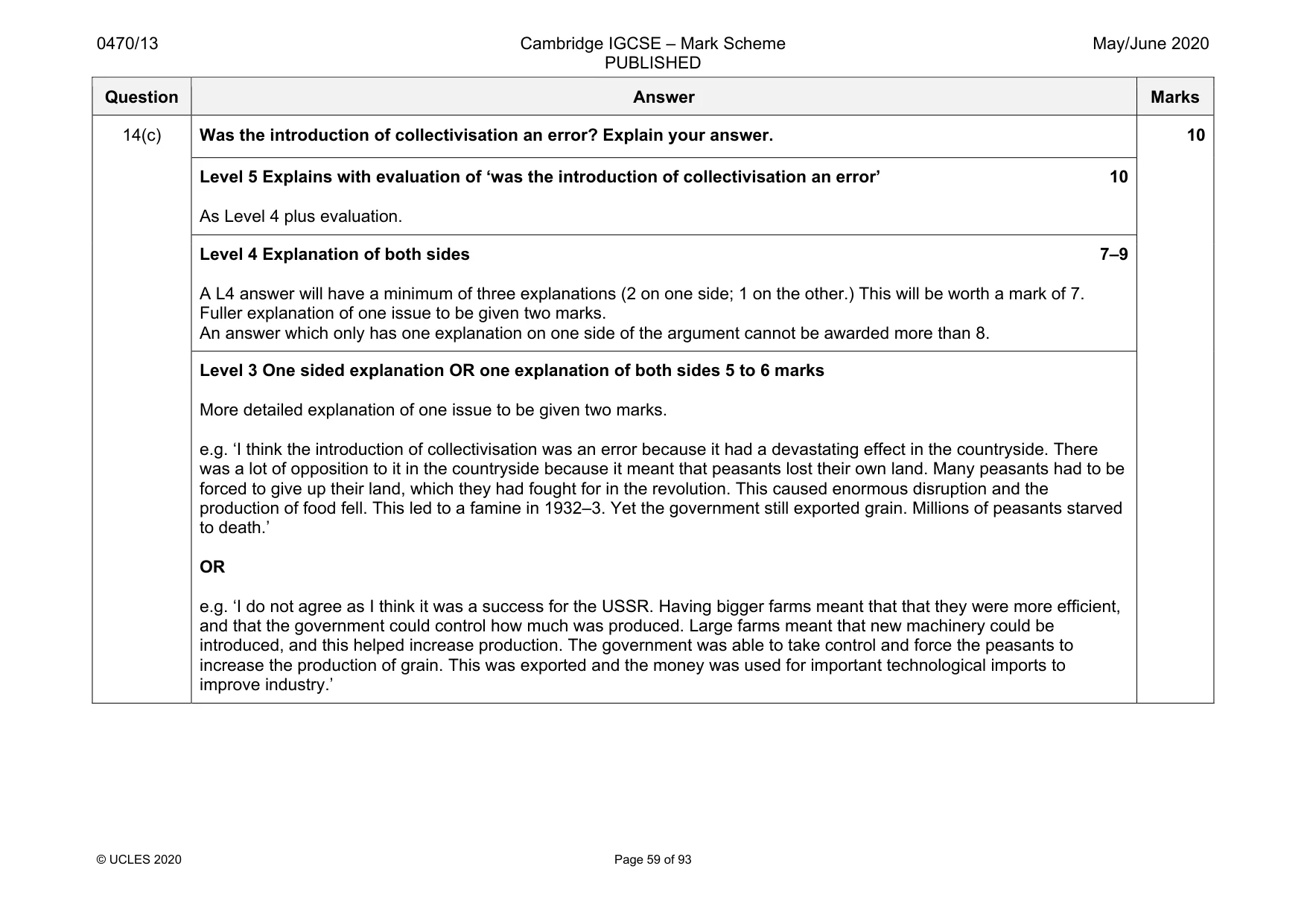
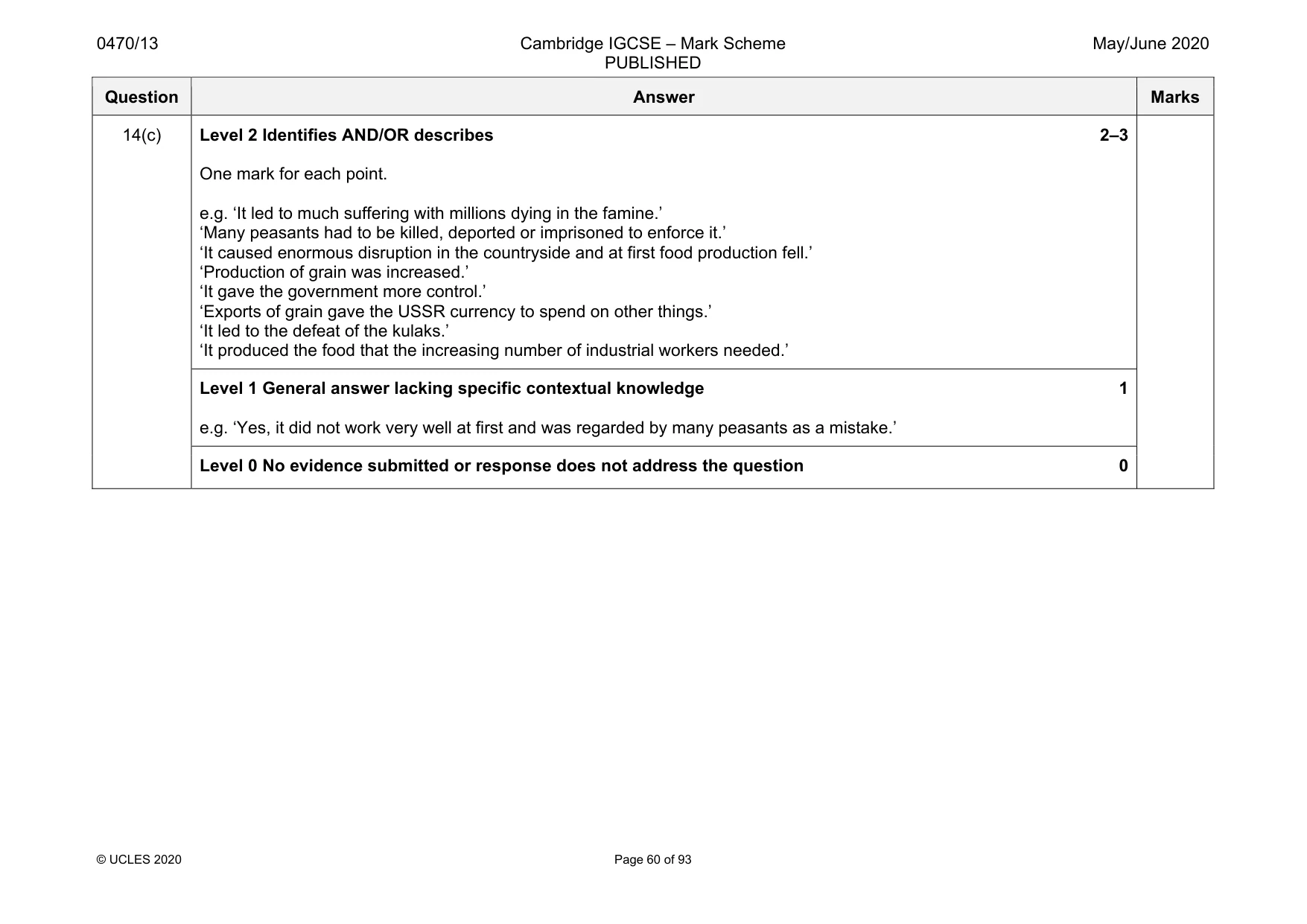
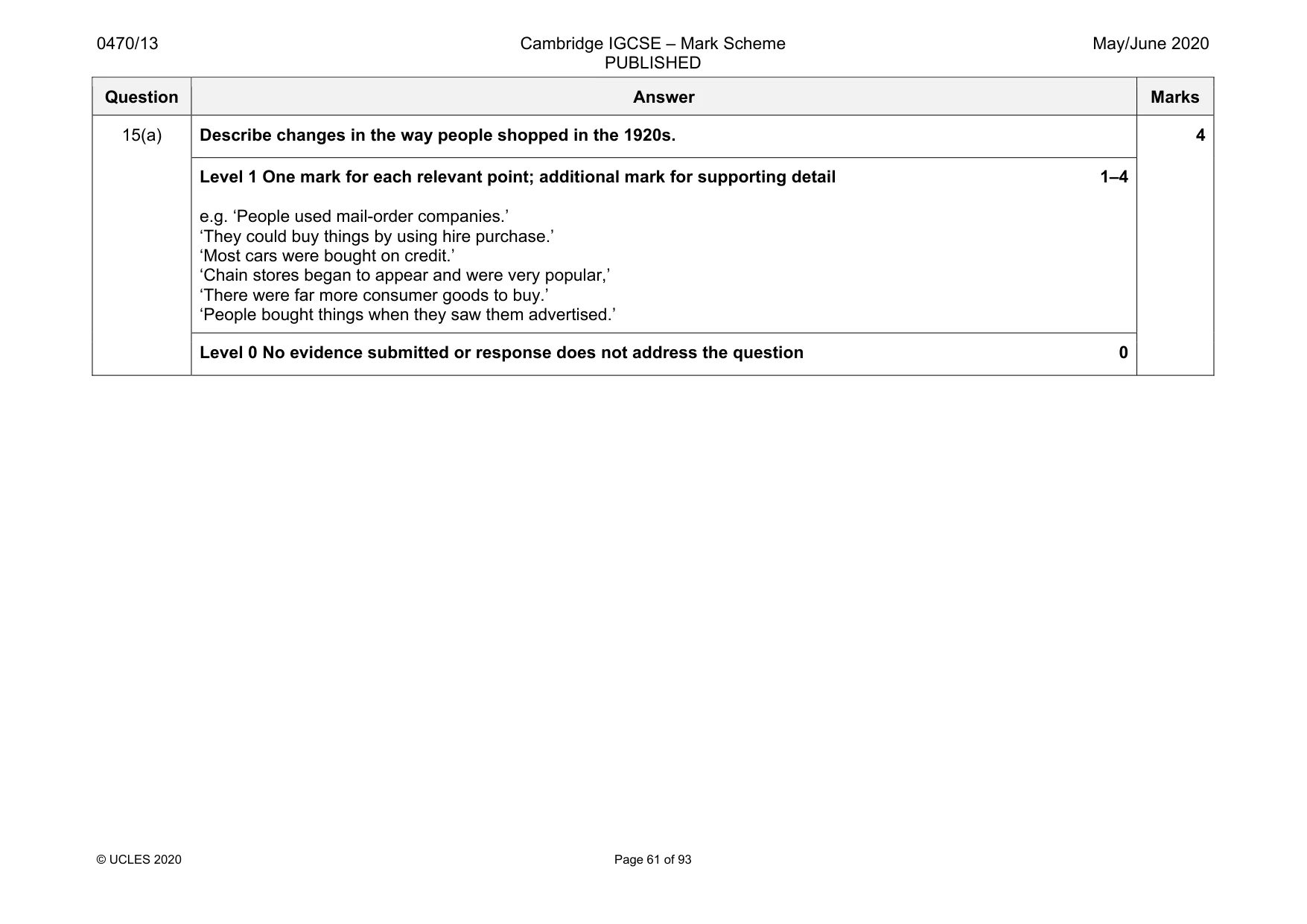
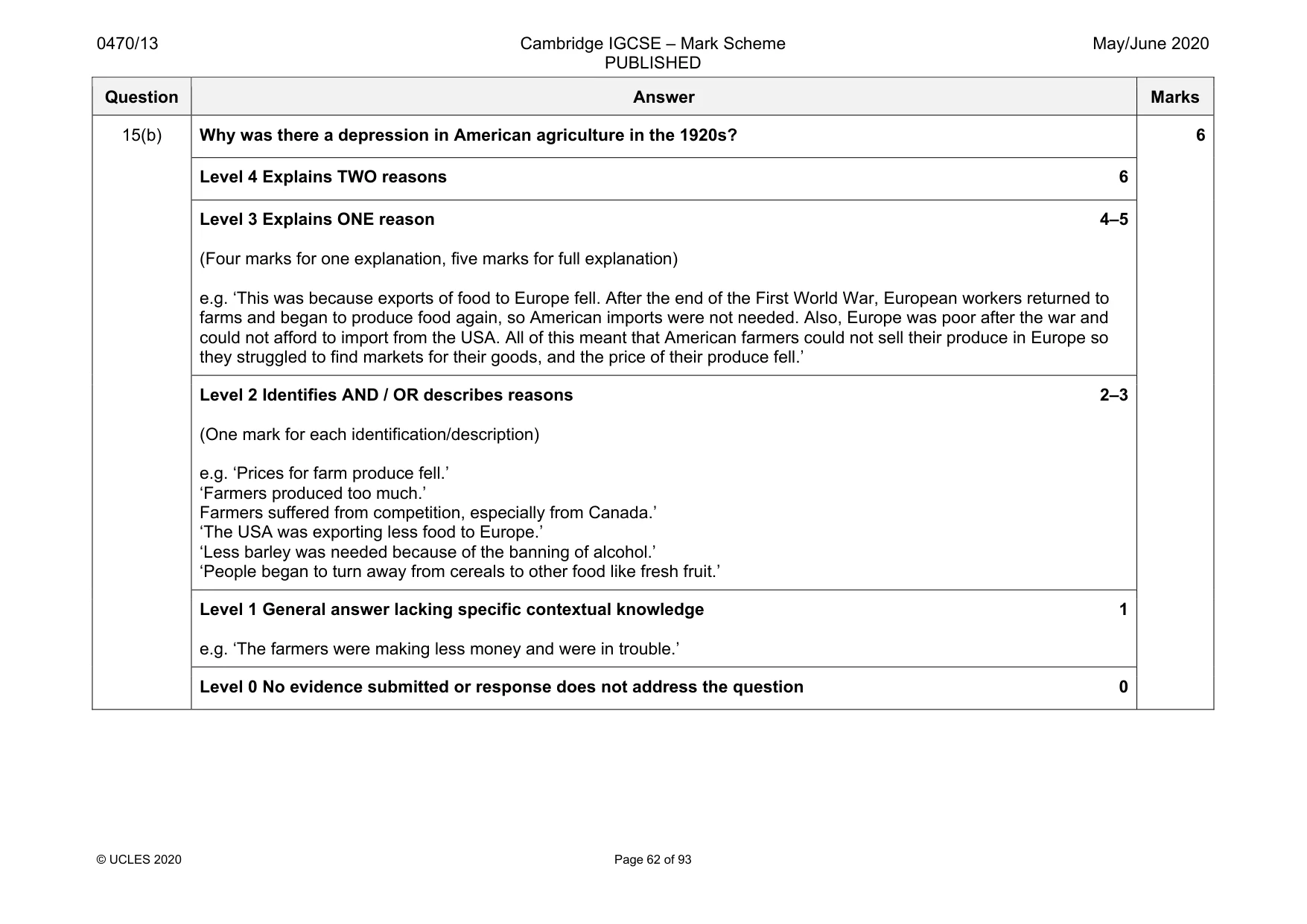
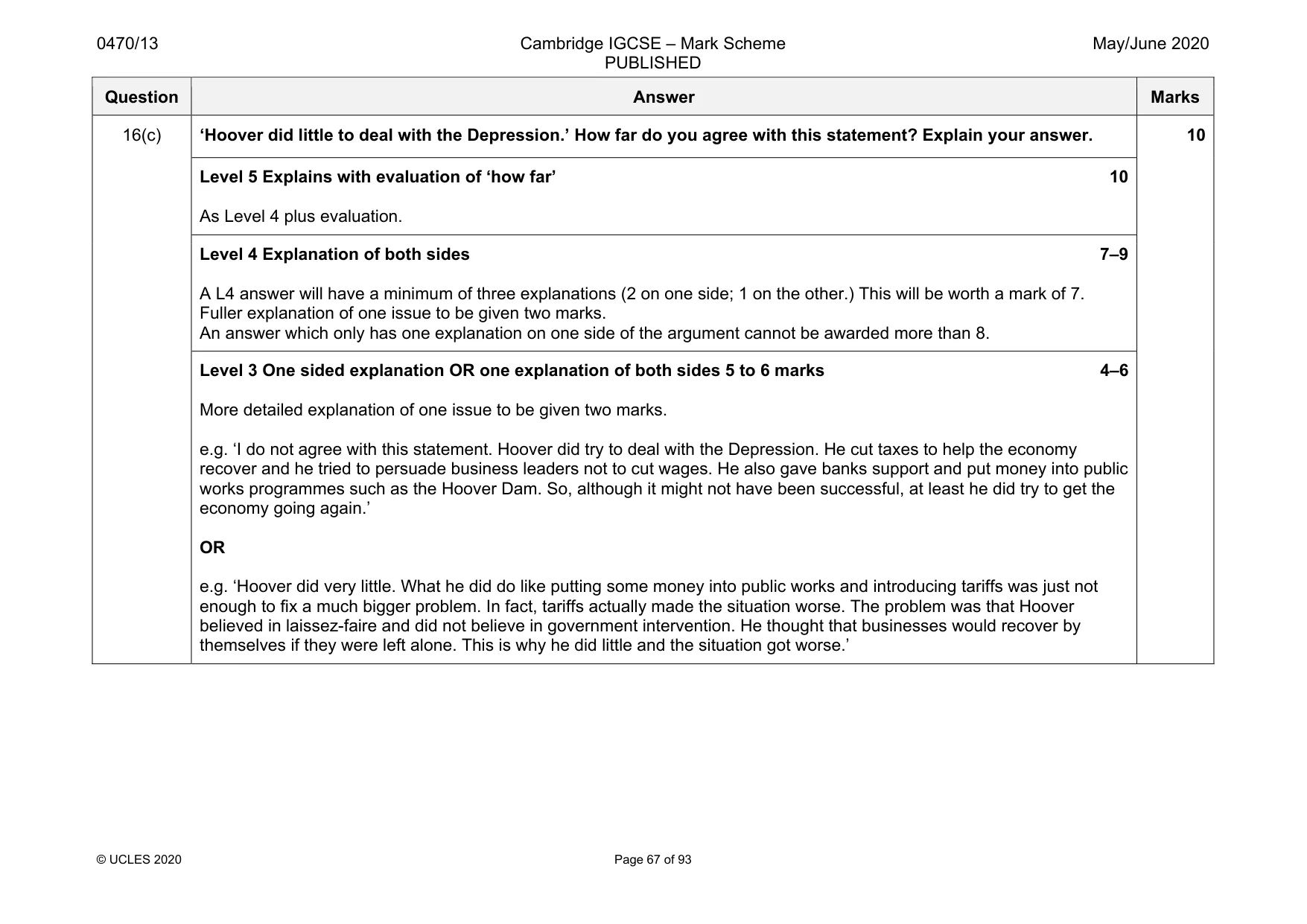
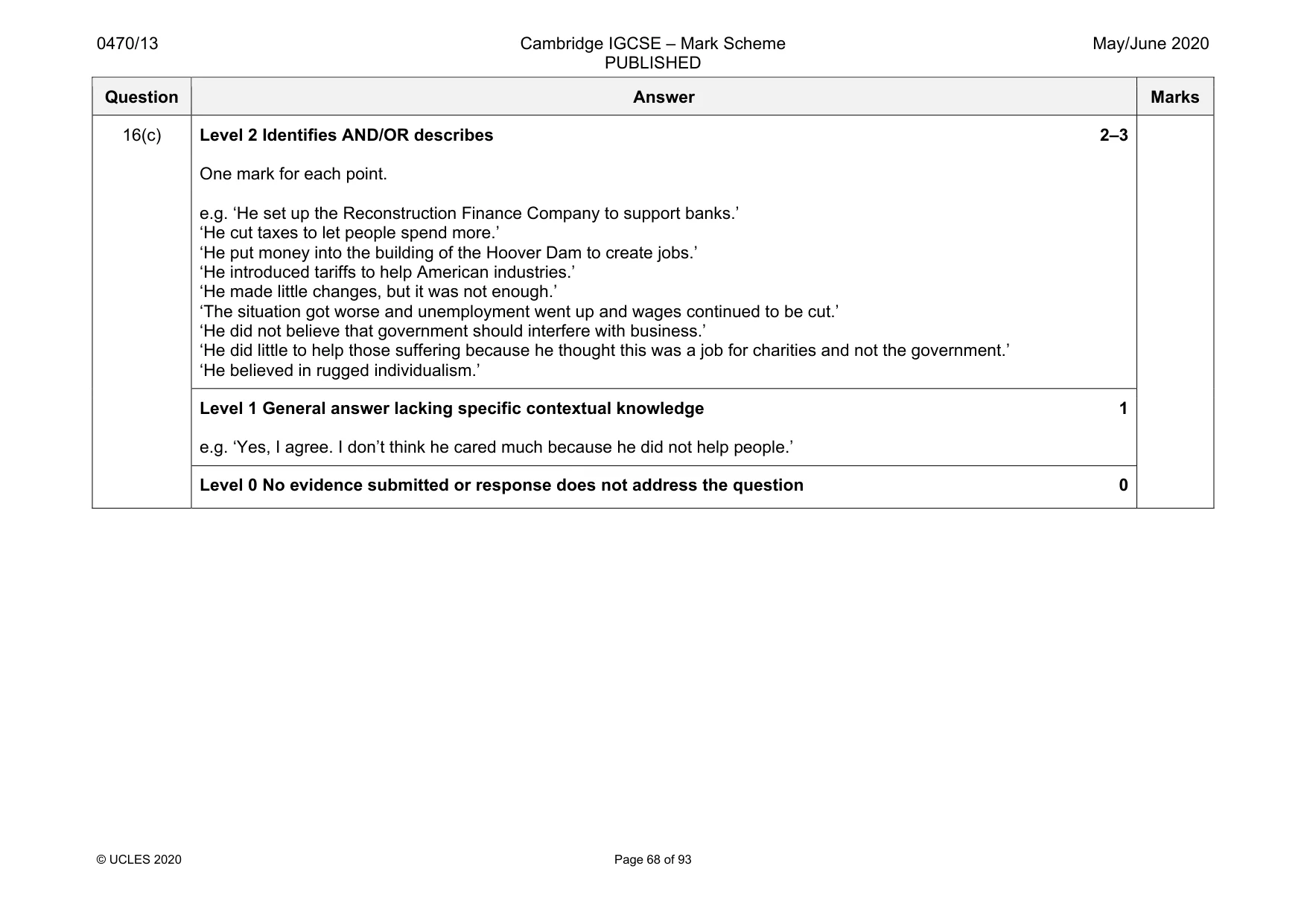
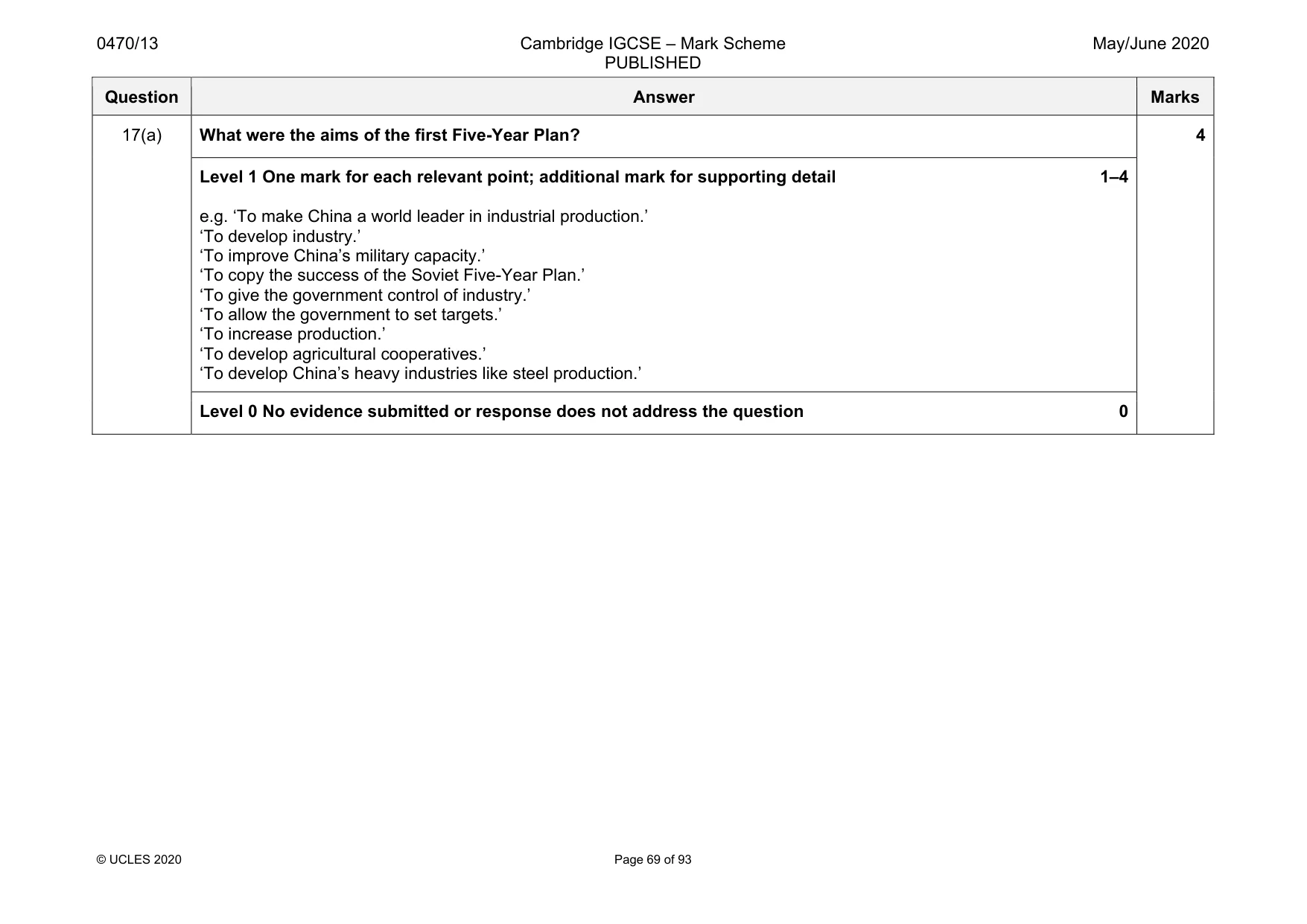
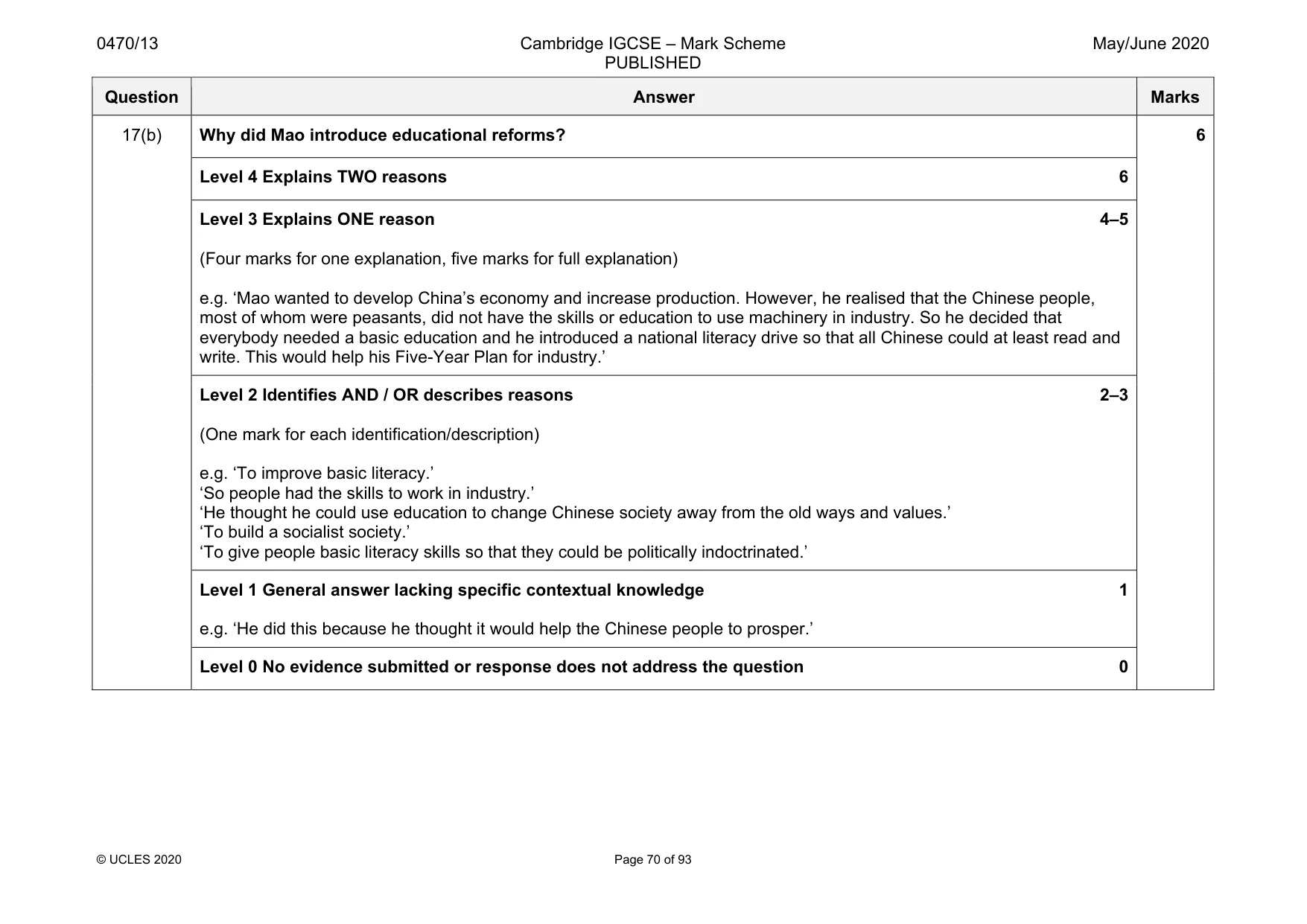
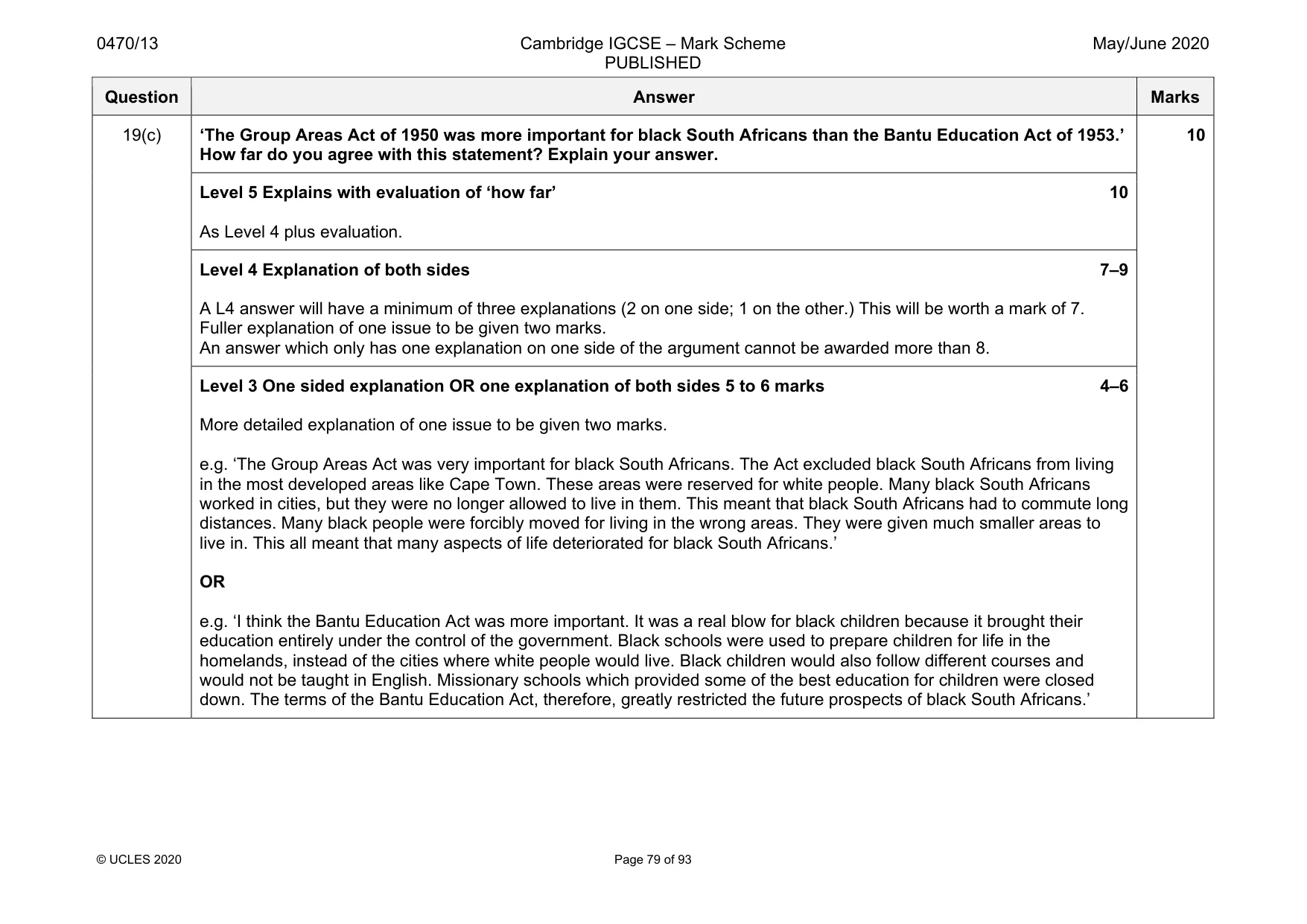
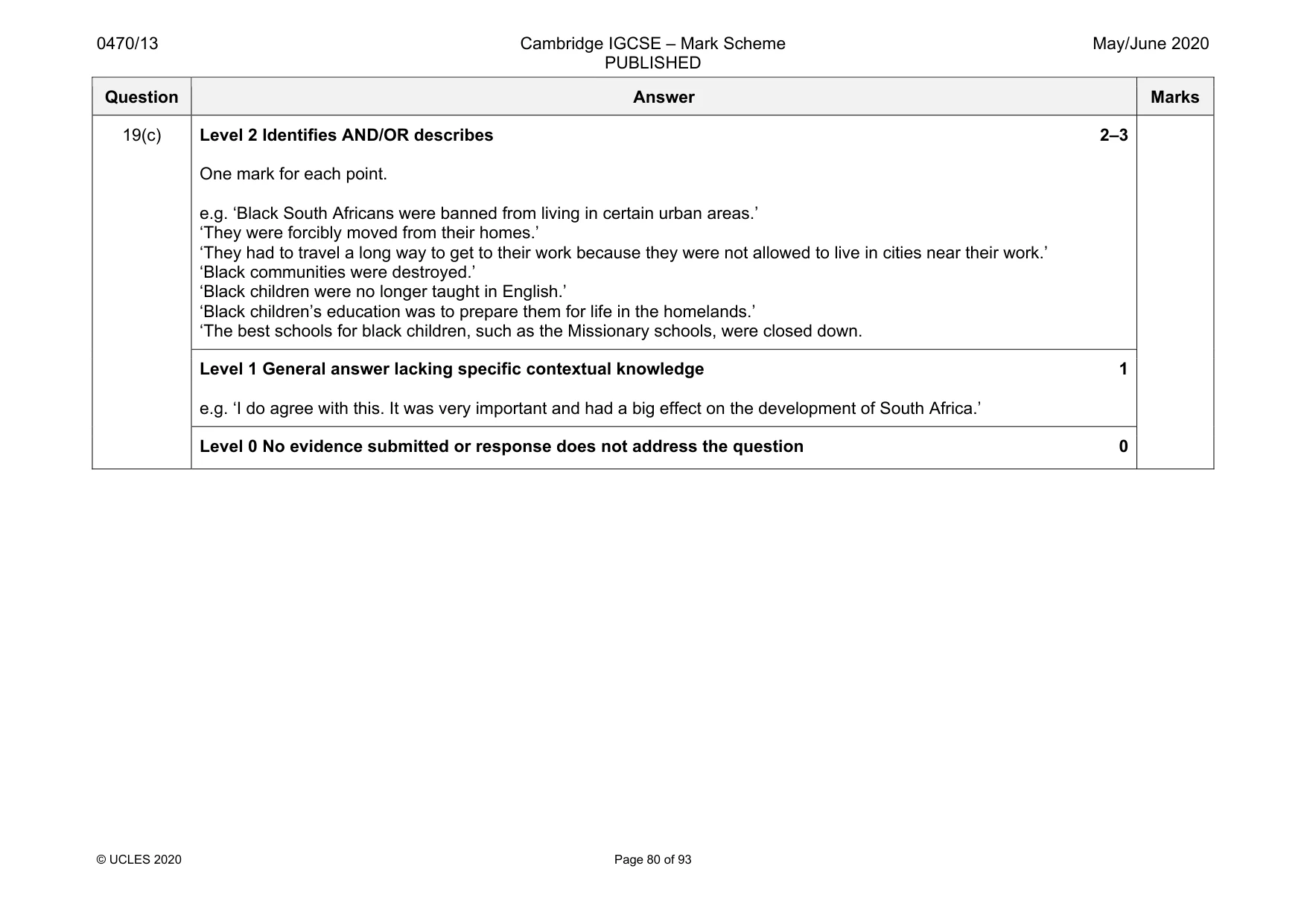
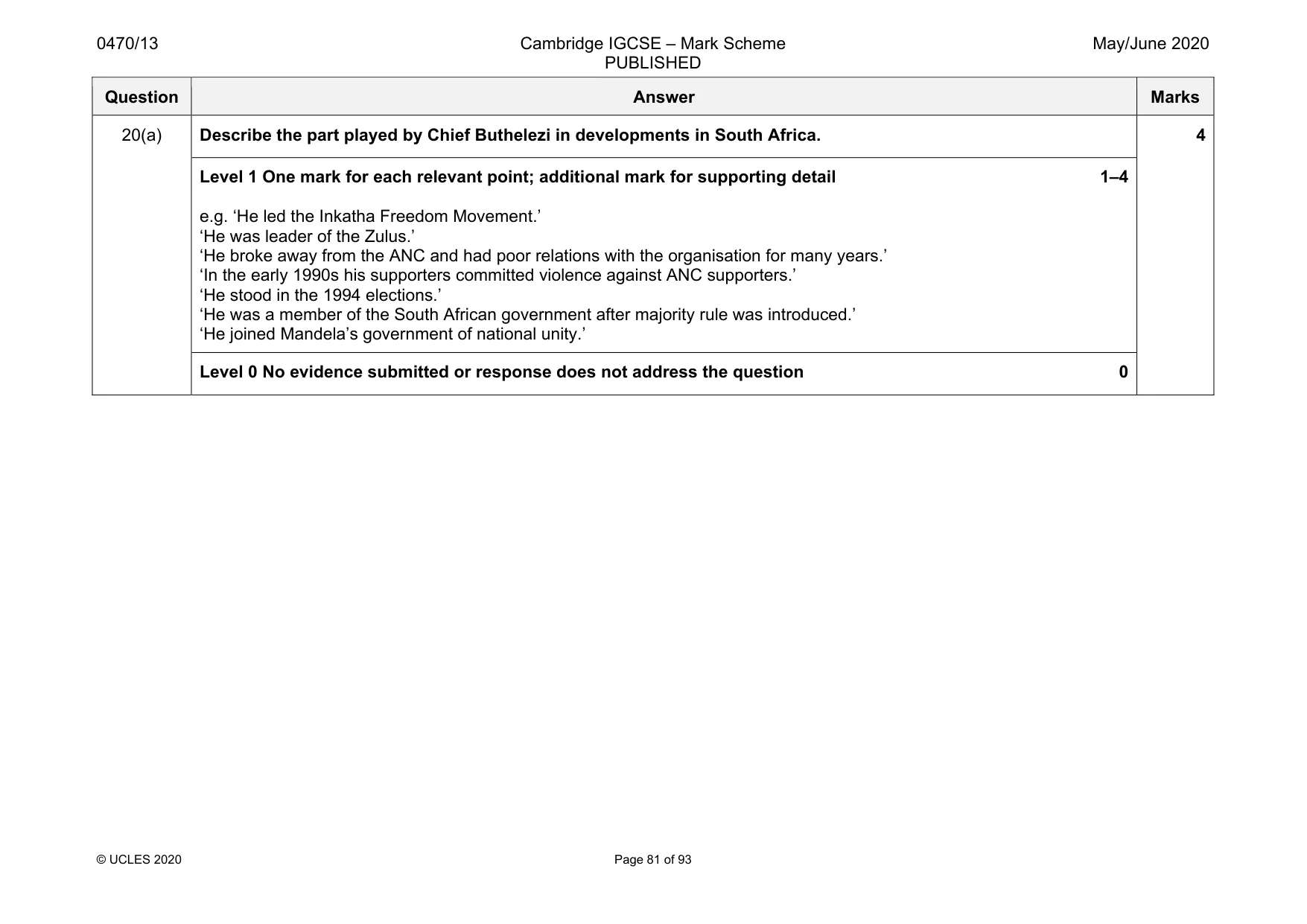
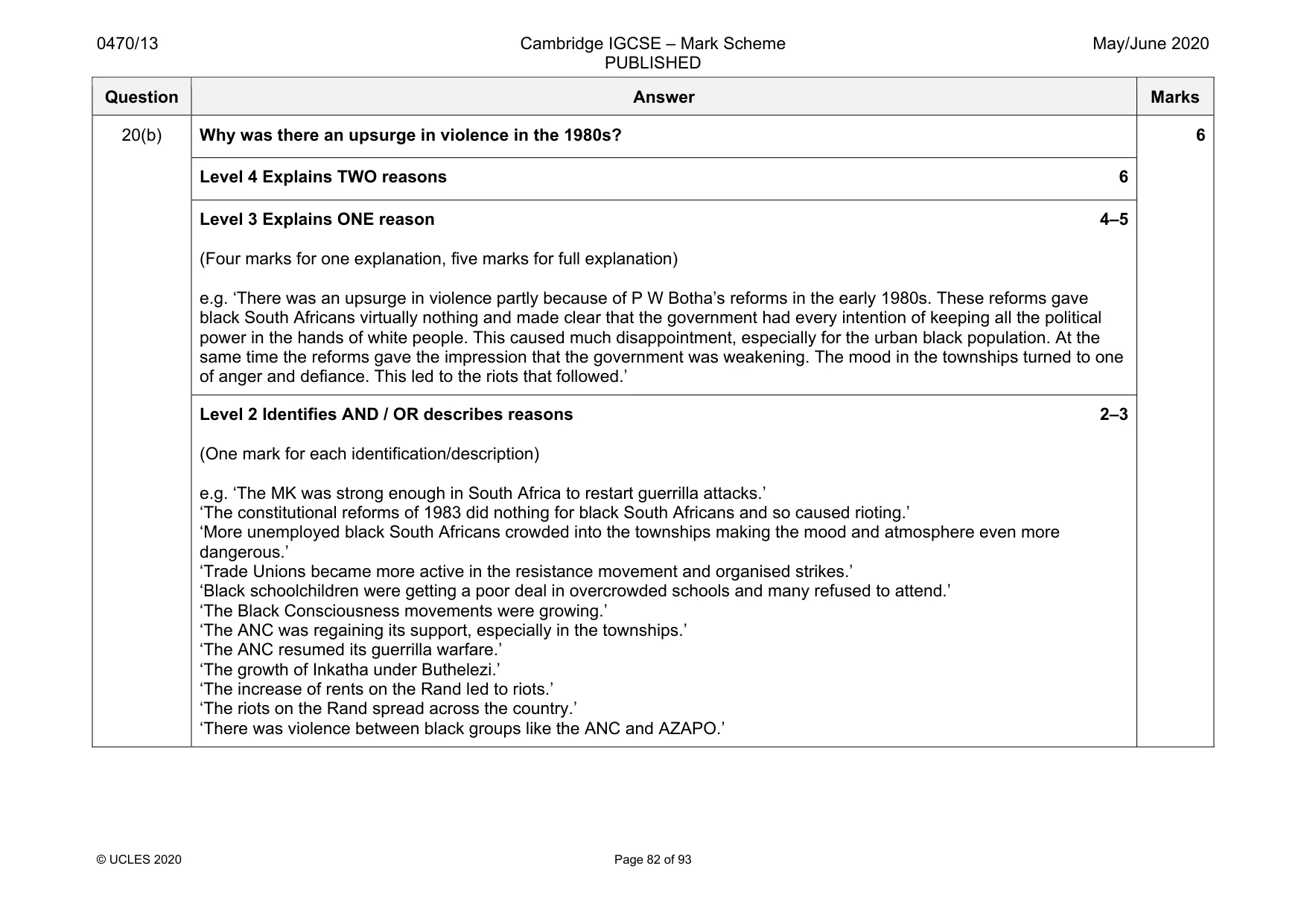
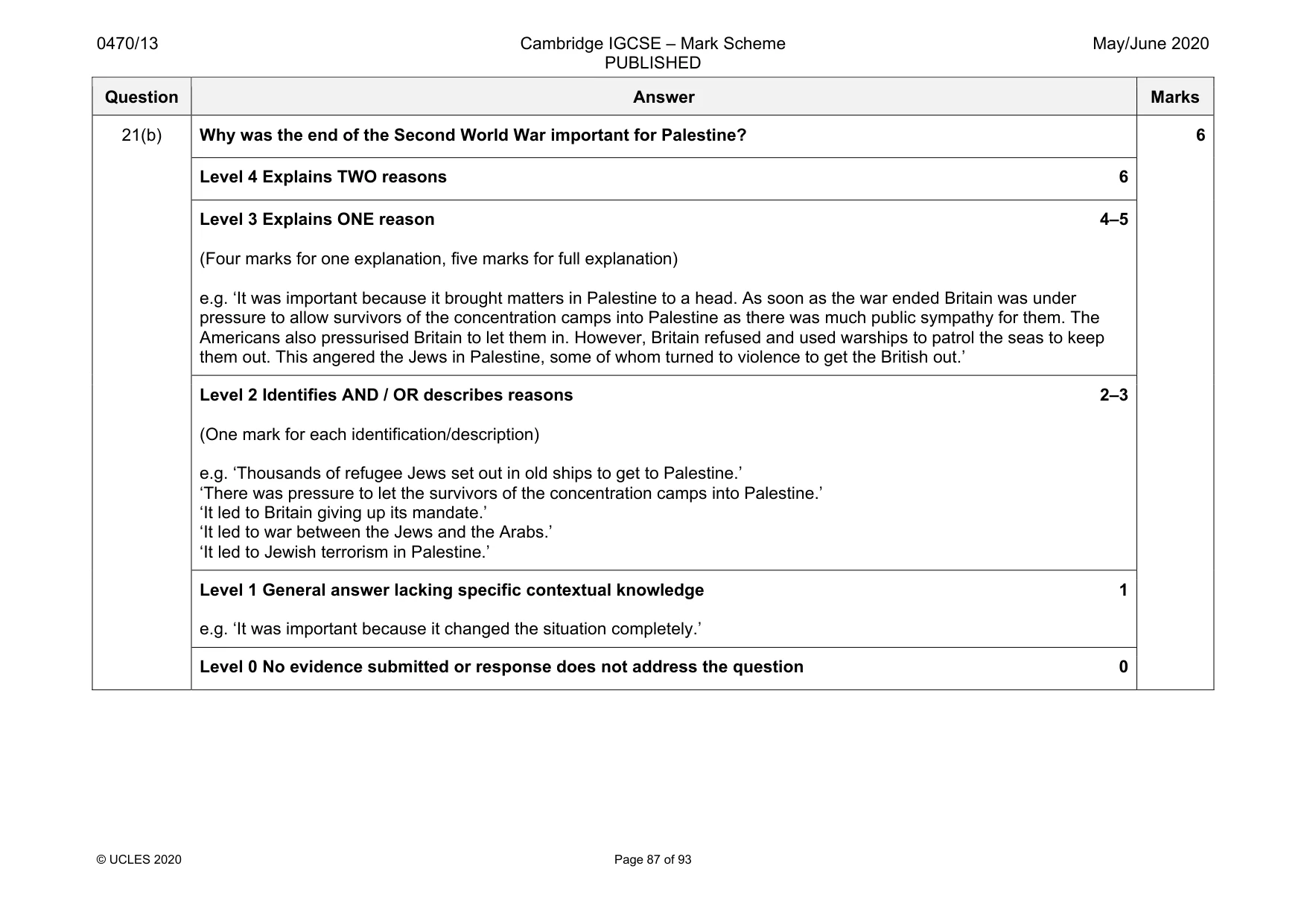
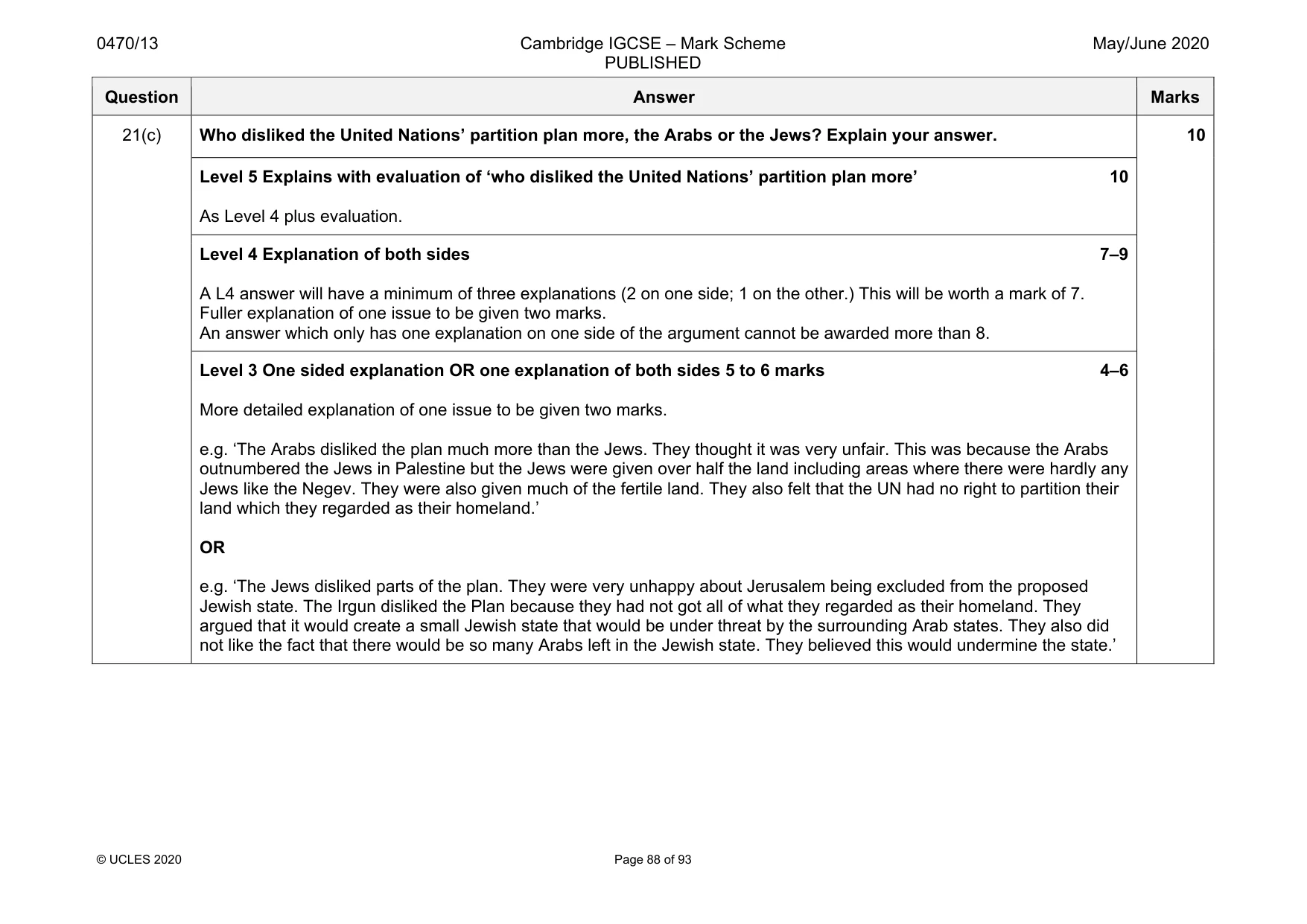
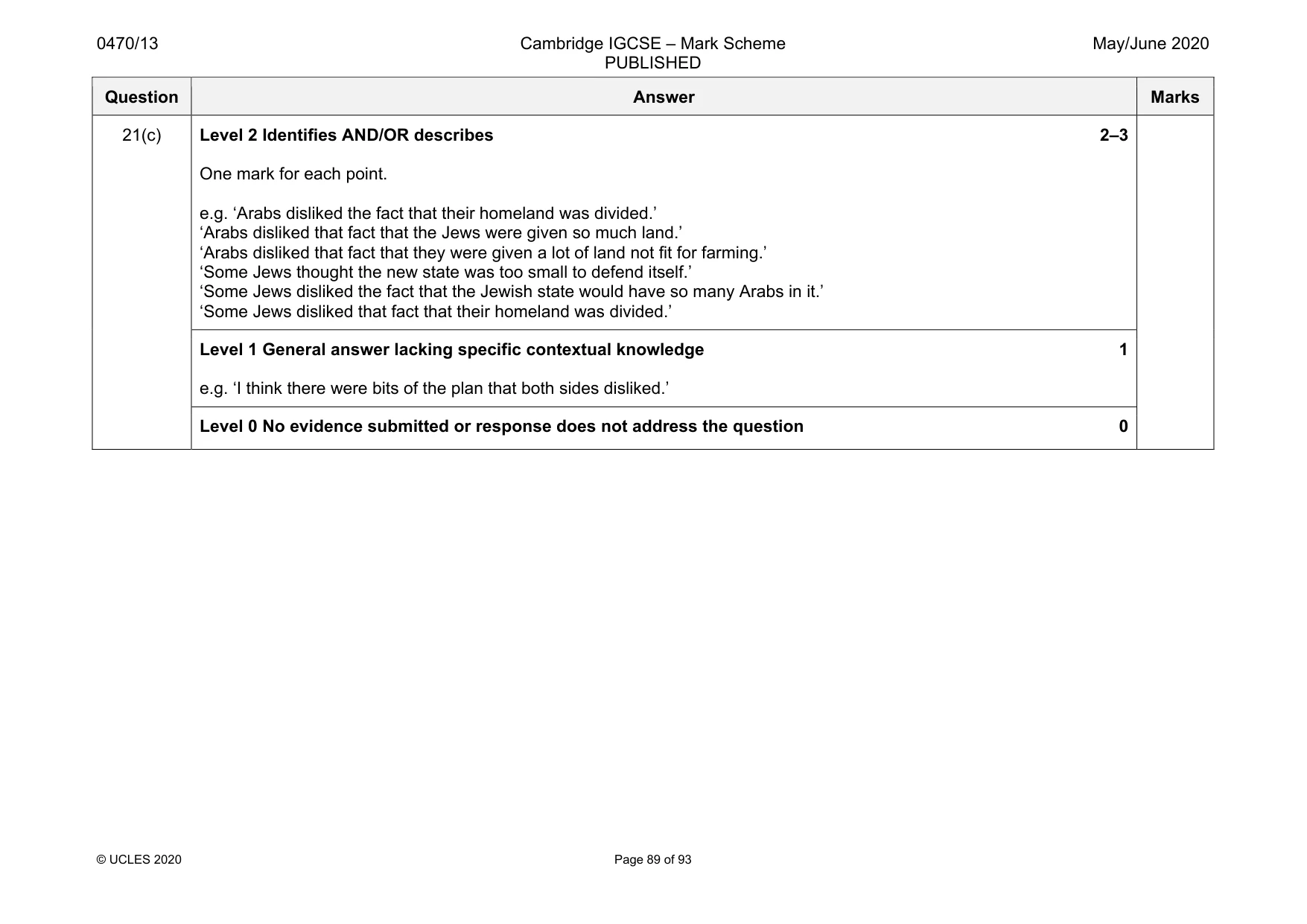
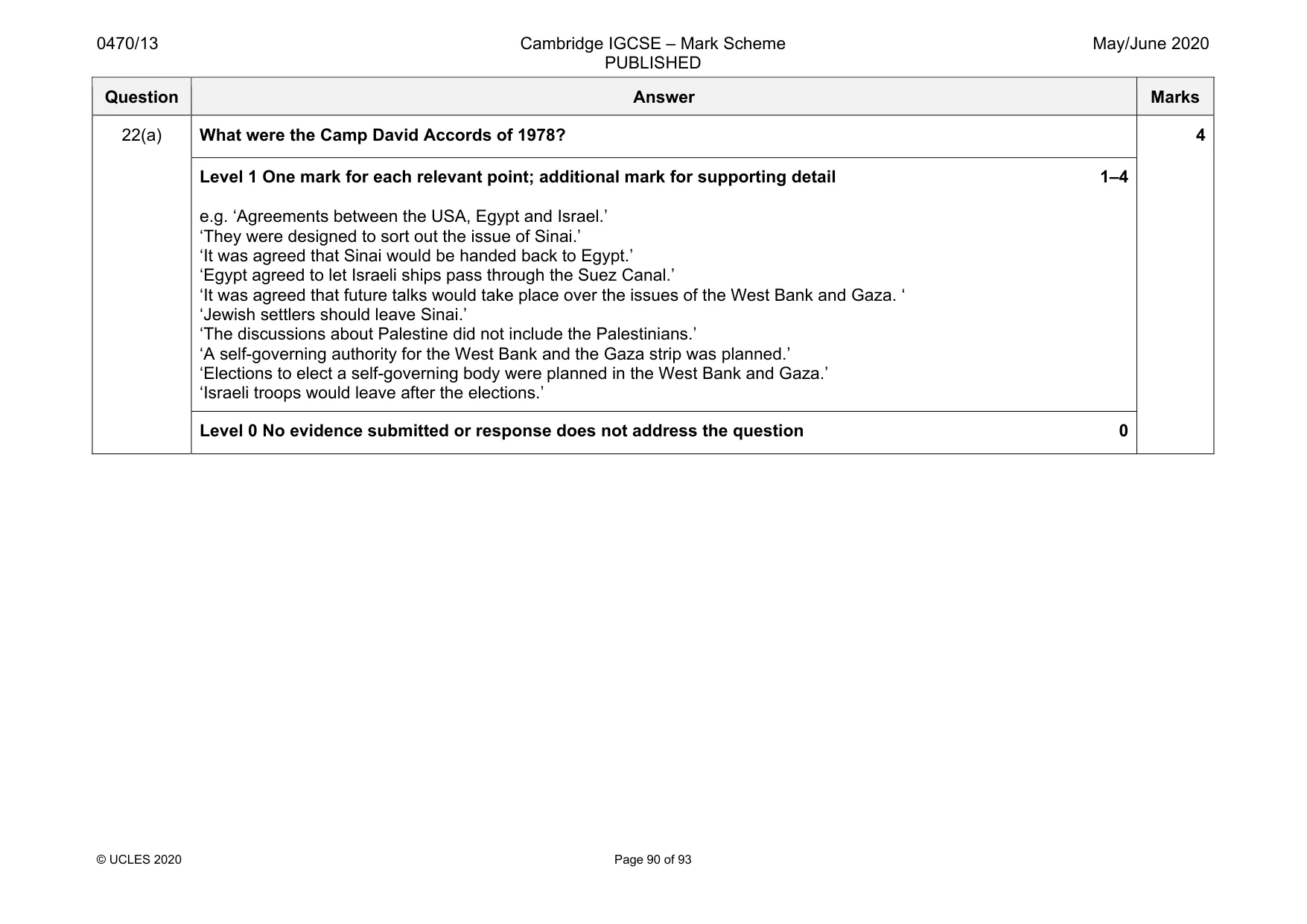
Paper as text
Question paper, page 1
Cambridge IGCSE™ DC (JC) 184562/2 © UCLES 2020 [Turn over This document has 12 pages. Blank pages are indicated. * 2 0 1 5 2 2 4 7 6 8 * HISTORY 0470/13 Paper 1 May/June 2020 2 hours You must answer on the enclosed answer booklet. You will need: Answer booklet (enclosed) INSTRUCTIONS ● Answer three questions in total: Section A (Core Content): answer two questions. Section B (Depth Studies): answer one question. ● Follow the instructions on the front cover of the answer booklet. If you need additional answer paper, ask the invigilator for a continuation booklet. INFORMATION ● The total mark for this paper is 60. ● The number of marks for each question or part question is shown in brackets [ ].
Question paper, page 2
2 0470/13/M/J/20 © UCLES 2020 SECTION A: CORE CONTENT Answer any two questions from this Section. 1 Italian unification was not completed until 1871. (a) Describe the events that led to Rome becoming the capital of Italy in 1871. [4] (b) Why did Garibaldi and ‘the Thousand’ sail to Sicily in 1860? [6] (c) ‘The power of Piedmont was the decisive factor in the achievement of Italian unification.’ How far do you agree with this statement? Explain your answer. [10] 2 Prussia was at the centre of the process of German unification. (a) Describe Frederick William IV’s actions during the 1848–49 revolutions. [4] (b) Why was the formation of the North German Confederation important to Bismarck? [6] (c) How far were Prussia’s wars in the period 1864 to 1871 deliberately brought about by Bismarck? Explain your answer. [10] 3 The second half of the nineteenth century was a tumultuous period for the USA. (a) Describe what happened at Fort Sumter in 1861. [4] (b) Why was the South unwilling to give up slavery? [6] (c) ‘The North was to blame for the failure of Reconstruction.’ How far do you agree with this statement? Explain your answer. [10] 4 European imperialism raised many important issues. (a) What changes to the government of India were introduced by Britain after the 1857 Mutiny? [4] (b) Why did Britain think it necessary to go to war with China in the Opium Wars? [6] (c) How far was European imperialism driven by economic motives? Explain your answer. [10]
Question paper, page 3
3 0470/13/M/J/20 © UCLES 2020 [Turn over 5 The League had some successes and some failures. (a) Describe how the League of Nations dealt with the Greek-Bulgarian crisis of 1925. [4] (b) Why was the League of Nations unable to resolve all the international disputes of the 1920s? [6] (c) ‘The crisis over Manchuria had a more damaging impact on the League than the crisis over Abyssinia.’ How far do you agree with this statement? Explain your answer. [10] 6 As time passed, Hitler’s intentions became clearer. (a) What was agreed at Munich in 1938? [4] (b) Why was German and Italian involvement in the Spanish Civil War important? [6] (c) ‘The only thing wrong with the policy of appeasement was that Britain and France persisted with it for too long.’ How far do you agree with this statement? Explain your answer. [10] 7 The USA eventually regretted its involvement in Vietnam. (a) Describe Kennedy’s actions in relation to Vietnam. [4] (b) Why did Johnson escalate the war in Vietnam? [6] (c) ‘When Nixon became President in 1969, he needed to seek a peace settlement with North Vietnam.’ How far do you agree with this statement? Explain your answer. [10] 8 Politics, religion and economics were all important in the Soviet control of Eastern Europe. (a) What was Solidarity? [4] (b) Why did Gorbachev change the policy of the Soviet Union towards Eastern Europe? [6] (c) ‘Events in Hungary in 1956 were a serious threat to Soviet control over Eastern Europe.’ How far do you agree with this statement? Explain your answer. [10]
Question paper, page 4
4 0470/13/M/J/20 © UCLES 2020 SECTION B: DEPTH STUDIES Answer any one question from this Section. DEPTH STUDY A: THE FIRST WORLD WAR, 1914–18 9 The Germans depended on the Schlieffen Plan for a quick victory. (a) Describe what happened when the Germans entered Belgium in 1914. [4] (b) Why did the Battle of the Marne matter? [6] (c) Which was more important in causing the failure of the Schlieffen Plan, the changes to the Plan or the actions of the British Expeditionary Force? Explain your answer. [10] 10 There were crucial developments in the war during 1917–18. (a) What were Ludendorff’s aims in his March 1918 offensive? [4] (b) Why did the Americans decide to enter the war? [6] (c) ‘Germany’s defeat was brought about by internal weaknesses.’ How far do you agree with this statement? Explain your answer. [10]
Question paper, page 5
5 0470/13/M/J/20 © UCLES 2020 [Turn over DEPTH STUDY B: GERMANY, 1918–45 11 Great efforts were made to overcome the early difficulties of the Weimar Republic. (a) Describe the cultural achievements of the Weimar period. [4] (b) Why did the Kapp Putsch take place in 1920? [6] (c) How far did Stresemann deal with the problems facing the Weimar Republic? Explain your answer. [10] 12 Nazi policies were not always popular in Germany. (a) Describe Nazi measures to reduce unemployment. [4] (b) Why did life in Germany change during the war years? [6] (c) How consistent were Nazi attitudes towards women in the period 1934–45? Explain your answer. [10]
Question paper, page 6
6 0470/13/M/J/20 © UCLES 2020 DEPTH STUDY C: RUSSIA, 1905–41 13 The Bolsheviks faced much opposition. (a) Describe Kornilov’s actions in September 1917. [4] (b) Why was Trotsky important in the November Revolution of 1917? [6] (c) ‘It was surprising that the Bolsheviks won the Civil War.’ How far do you agree with this statement? Explain your answer. [10] 14 Stalin attempted to change the Soviet Union in many ways. (a) Describe the impact of ‘Russification’ on ethnic minorities in the Soviet Union. [4] (b) Why did Stalin think it was necessary to reform Soviet industry? [6] (c) Was the introduction of collectivisation an error? Explain your answer. [10]
Question paper, page 7
7 0470/13/M/J/20 © UCLES 2020 [Turn over DEPTH STUDY D: THE UNITED STATES, 1919–41 15 Many people benefited from the economic boom of the 1920s. (a) Describe changes in the way people shopped in the 1920s. [4] (b) Why was there a depression in American agriculture in the 1920s? [6] (c) ‘Mass production was more important than the policies of Republican governments in creating the economic boom of the 1920s.’ How far do you agree with this statement? Explain your answer. [10] 16 The late 1920s and the early 1930s were difficult for the USA. (a) What was the Bonus Army? [4] (b) Why did the Wall Street Crash have an important impact on the American economy? [6] (c) ‘Hoover did little to deal with the Depression.’ How far do you agree with this statement? Explain your answer. [10]
Question paper, page 8
8 0470/13/M/J/20 © UCLES 2020 DEPTH STUDY E: CHINA, c.1930–c.1990 17 China was transformed in the 1950s. (a) What were the aims of the first Five-Year Plan? [4] (b) Why did Mao introduce educational reforms? [6] (c) ‘The introduction of communes was a success.’ How far do you agree with this statement? Explain your answer. [10] 18 China has improved its relations with the rest of the world. (a) Describe the improvement in relations between China and the USA in the early 1970s. [4] (b) Why were relations with India important to China in the period 1950 to 1970? [6] (c) ‘China’s relations with other countries improved after 1976.’ How far do you agree with this statement? Explain your answer. [10]
Question paper, page 9
9 0470/13/M/J/20 © UCLES 2020 [Turn over DEPTH STUDY F: SOUTH AFRICA, c.1940–c.1994 19 During the 1950s and 1960s the black population of South Africa was put under enormous pressure. (a) Describe the consequences of the Bantu Self-Government Act of 1959 for black South Africans. [4] (b) Why was the Rivonia Trial of 1963–64 important? [6] (c) ‘The Group Areas Act of 1950 was more important for black South Africans than the Bantu Education Act of 1953.’ How far do you agree with this statement? Explain your answer. [10] 20 Minority rule was finally ended in 1994. (a) Describe the part played by Chief Buthelezi in developments in South Africa. [4] (b) Why was there an upsurge in violence in the 1980s? [6] (c) ‘The end of minority rule was brought about by factors other than individual leaders.’ How far do you agree with this statement? Explain your answer. [10]
Question paper, page 10
10 0470/13/M/J/20 © UCLES 2020 DEPTH STUDY G: ISRAELIS AND PALESTINIANS SINCE 1945 21 Both Arabs and Jews had claims on Palestine. (a) What happened at the King David Hotel in July 1946? [4] (b) Why was the end of the Second World War important for Palestine? [6] (c) Who disliked the United Nations’ partition plan more, the Arabs or the Jews? Explain your answer. [10] 22 Many problems have stood in the way of peace in the Middle East. (a) What were the Camp David Accords of 1978? [4] (b) Why did the first Intifada break out in 1987? [6] (c) Which has been more important in the failure to achieve peace in the Middle East, the rise of Hamas or divisions within Israel? Explain your answer. [10]
Question paper, page 11
11 0470/13/M/J/20 © UCLES 2020 BLANK PAGE
Question paper, page 12
12 0470/13/M/J/20 © UCLES 2020 Permission to reproduce items where third-party owned material protected by copyright is included has been sought and cleared where possible. Every reasonable effort has been made by the publisher (UCLES) to trace copyright holders, but if any items requiring clearance have unwittingly been included, the publisher will be pleased to make amends at the earliest possible opportunity. To avoid the issue of disclosure of answer-related information to candidates, all copyright acknowledgements are reproduced online in the Cambridge Assessment International Education Copyright Acknowledgements Booklet. This is produced for each series of examinations and is freely available to download at www.cambridgeinternational.org after the live examination series. Cambridge Assessment International Education is part of the Cambridge Assessment Group. Cambridge Assessment is the brand name of the University of Cambridge Local Examinations Syndicate (UCLES), which itself is a department of the University of Cambridge. BLANK PAGE
Mark scheme, page 1
This document consists of 93 printed pages. © UCLES 2020 [Turn over Cambridge IGCSE™ HISTORY 0470/13 Paper 1 May/June 2020 MARK SCHEME Maximum Mark: 60 Published Students did not sit exam papers in the June 2020 series due to the Covid-19 global pandemic. This mark scheme is published to support teachers and students and should be read together with the question paper. It shows the requirements of the exam. The answer column of the mark scheme shows the proposed basis on which Examiners would award marks for this exam. Where appropriate, this column also provides the most likely acceptable alternative responses expected from students. Examiners usually review the mark scheme after they have seen student responses and update the mark scheme if appropriate. In the June series, Examiners were unable to consider the acceptability of alternative responses, as there were no student responses to consider. Mark schemes should usually be read together with the Principal Examiner Report for Teachers. However, because students did not sit exam papers, there is no Principal Examiner Report for Teachers for the June 2020 series. Cambridge International will not enter into discussions about these mark schemes. Cambridge International is publishing the mark schemes for the June 2020 series for most Cambridge IGCSE™ and Cambridge International A & AS Level components, and some Cambridge O Level components.
Mark scheme, page 2
0470/13 Cambridge IGCSE – Mark Scheme PUBLISHED May/June 2020 © UCLES 2020 Page 2 of 93 Generic Marking Principles These general marking principles must be applied by all examiners when marking candidate answers. They should be applied alongside the specific content of the mark scheme or generic level descriptors for a question. Each question paper and mark scheme will also comply with these marking principles. GENERIC MARKING PRINCIPLE 1: Marks must be awarded in line with: • the specific content of the mark scheme or the generic level descriptors for the question • the specific skills defined in the mark scheme or in the generic level descriptors for the question • the standard of response required by a candidate as exemplified by the standardisation scripts. GENERIC MARKING PRINCIPLE 2: Marks awarded are always whole marks (not half marks, or other fractions). GENERIC MARKING PRINCIPLE 3: Marks must be awarded positively: • marks are awarded for correct/valid answers, as defined in the mark scheme. However, credit is given for valid answers which go beyond the scope of the syllabus and mark scheme, referring to your Team Leader as appropriate • marks are awarded when candidates clearly demonstrate what they know and can do • marks are not deducted for errors • marks are not deducted for omissions • answers should only be judged on the quality of spelling, punctuation and grammar when these features are specifically assessed by the question as indicated by the mark scheme. The meaning, however, should be unambiguous. GENERIC MARKING PRINCIPLE 4: Rules must be applied consistently e.g. in situations where candidates have not followed instructions or in the application of generic level descriptors.
Mark scheme, page 3
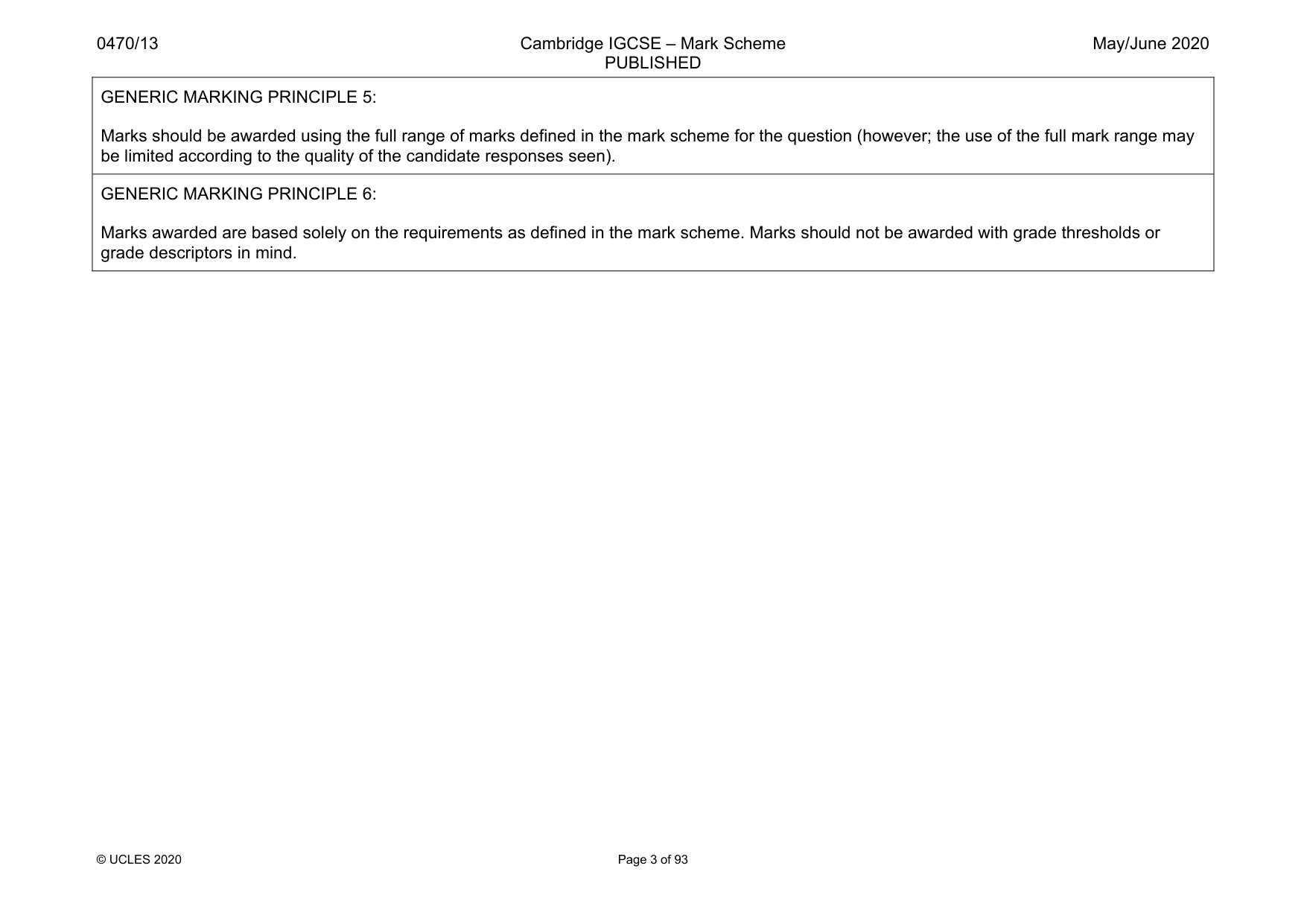
0470/13 Cambridge IGCSE – Mark Scheme PUBLISHED May/June 2020 © UCLES 2020 Page 3 of 93 GENERIC MARKING PRINCIPLE 5: Marks should be awarded using the full range of marks defined in the mark scheme for the question (however; the use of the full mark range may be limited according to the quality of the candidate responses seen). GENERIC MARKING PRINCIPLE 6: Marks awarded are based solely on the requirements as defined in the mark scheme. Marks should not be awarded with grade thresholds or grade descriptors in mind.
Mark scheme, page 4
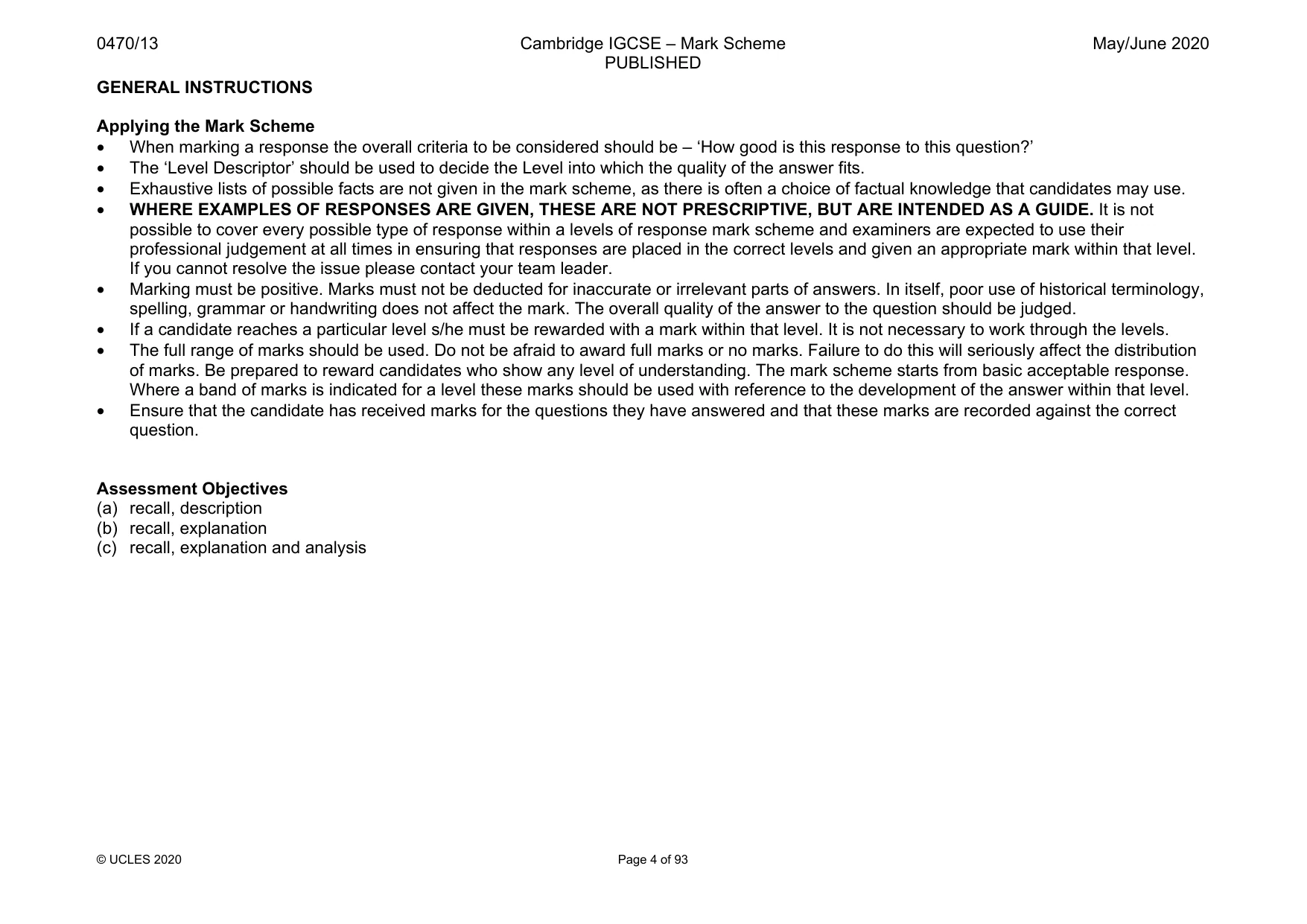
0470/13 Cambridge IGCSE – Mark Scheme PUBLISHED May/June 2020 © UCLES 2020 Page 4 of 93 GENERAL INSTRUCTIONS Applying the Mark Scheme • When marking a response the overall criteria to be considered should be – ‘How good is this response to this question?’ • The ‘Level Descriptor’ should be used to decide the Level into which the quality of the answer fits. • Exhaustive lists of possible facts are not given in the mark scheme, as there is often a choice of factual knowledge that candidates may use. • WHERE EXAMPLES OF RESPONSES ARE GIVEN, THESE ARE NOT PRESCRIPTIVE, BUT ARE INTENDED AS A GUIDE. It is not possible to cover every possible type of response within a levels of response mark scheme and examiners are expected to use their professional judgement at all times in ensuring that responses are placed in the correct levels and given an appropriate mark within that level. If you cannot resolve the issue please contact your team leader. • Marking must be positive. Marks must not be deducted for inaccurate or irrelevant parts of answers. In itself, poor use of historical terminology, spelling, grammar or handwriting does not affect the mark. The overall quality of the answer to the question should be judged. • If a candidate reaches a particular level s/he must be rewarded with a mark within that level. It is not necessary to work through the levels. • The full range of marks should be used. Do not be afraid to award full marks or no marks. Failure to do this will seriously affect the distribution of marks. Be prepared to reward candidates who show any level of understanding. The mark scheme starts from basic acceptable response. Where a band of marks is indicated for a level these marks should be used with reference to the development of the answer within that level. • Ensure that the candidate has received marks for the questions they have answered and that these marks are recorded against the correct question. Assessment Objectives (a) recall, description (b) recall, explanation (c) recall, explanation and analysis
Mark scheme, page 5
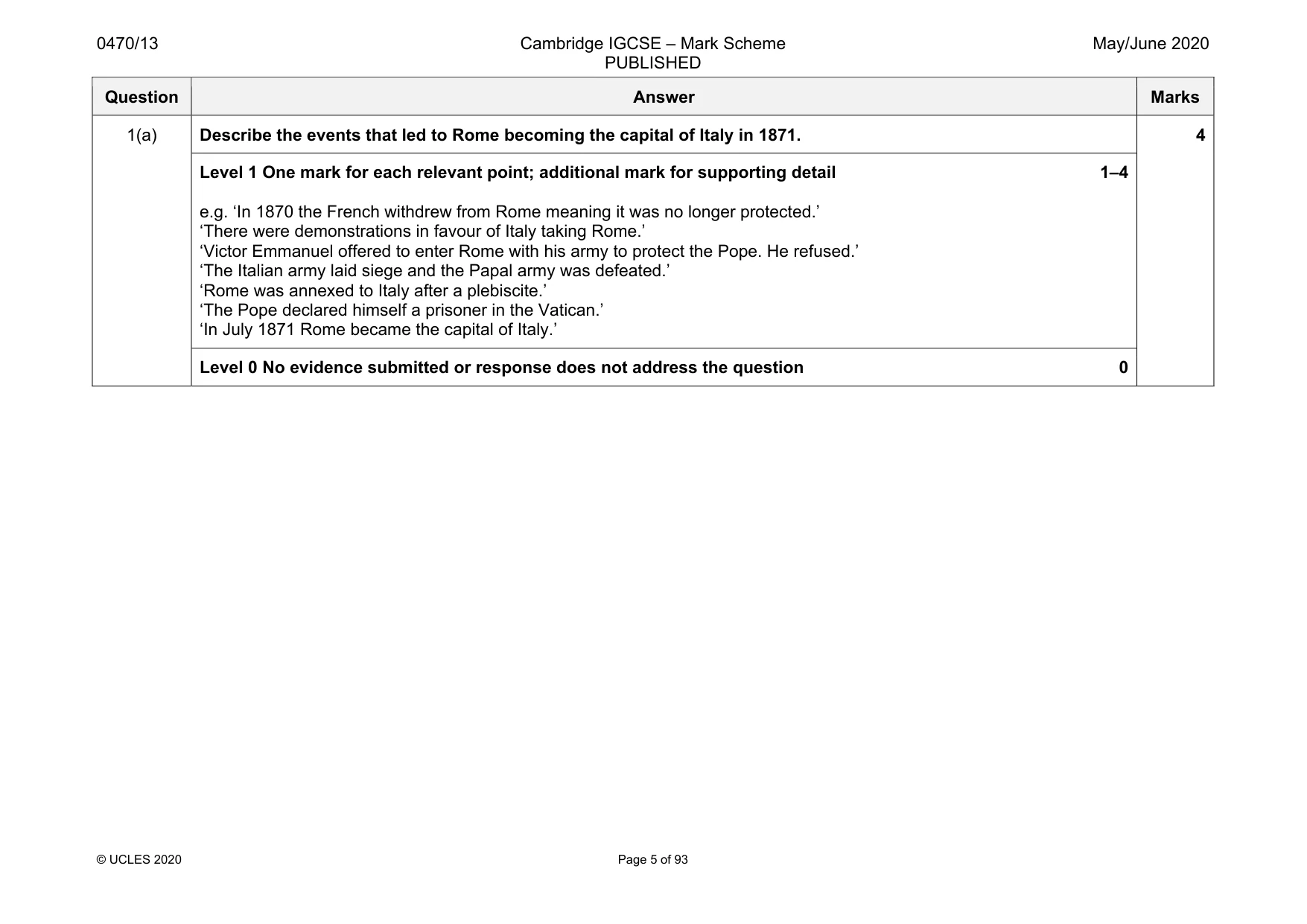
0470/13 Cambridge IGCSE – Mark Scheme PUBLISHED May/June 2020 © UCLES 2020 Page 5 of 93 Question Answer Marks 1(a) Describe the events that led to Rome becoming the capital of Italy in 1871. 4 Level 1 One mark for each relevant point; additional mark for supporting detail 1–4 e.g. ‘In 1870 the French withdrew from Rome meaning it was no longer protected.’ ‘There were demonstrations in favour of Italy taking Rome.’ ‘Victor Emmanuel offered to enter Rome with his army to protect the Pope. He refused.’ ‘The Italian army laid siege and the Papal army was defeated.’ ‘Rome was annexed to Italy after a plebiscite.’ ‘The Pope declared himself a prisoner in the Vatican.’ ‘In July 1871 Rome became the capital of Italy.’ Level 0 No evidence submitted or response does not address the question 0
Mark scheme, page 6
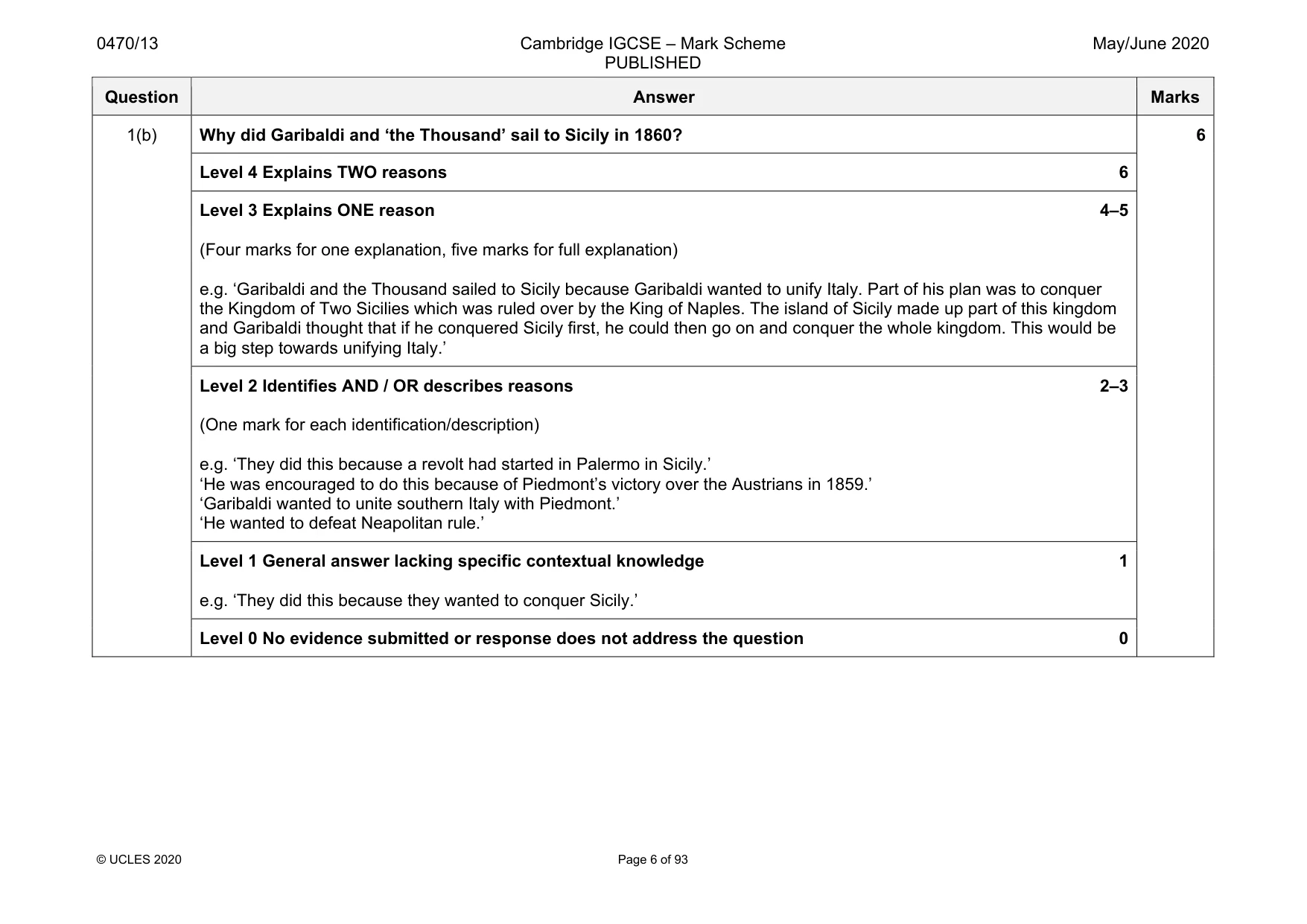
0470/13 Cambridge IGCSE – Mark Scheme PUBLISHED May/June 2020 © UCLES 2020 Page 6 of 93 Question Answer Marks 1(b) Why did Garibaldi and ‘the Thousand’ sail to Sicily in 1860? 6 Level 4 Explains TWO reasons 6 Level 3 Explains ONE reason 4–5 (Four marks for one explanation, five marks for full explanation) e.g. ‘Garibaldi and the Thousand sailed to Sicily because Garibaldi wanted to unify Italy. Part of his plan was to conquer the Kingdom of Two Sicilies which was ruled over by the King of Naples. The island of Sicily made up part of this kingdom and Garibaldi thought that if he conquered Sicily first, he could then go on and conquer the whole kingdom. This would be a big step towards unifying Italy.’ Level 2 Identifies AND / OR describes reasons 2–3 (One mark for each identification/description) e.g. ‘They did this because a revolt had started in Palermo in Sicily.’ ‘He was encouraged to do this because of Piedmont’s victory over the Austrians in 1859.’ ‘Garibaldi wanted to unite southern Italy with Piedmont.’ ‘He wanted to defeat Neapolitan rule.’ Level 1 General answer lacking specific contextual knowledge 1 e.g. ‘They did this because they wanted to conquer Sicily.’ Level 0 No evidence submitted or response does not address the question 0
Mark scheme, page 7
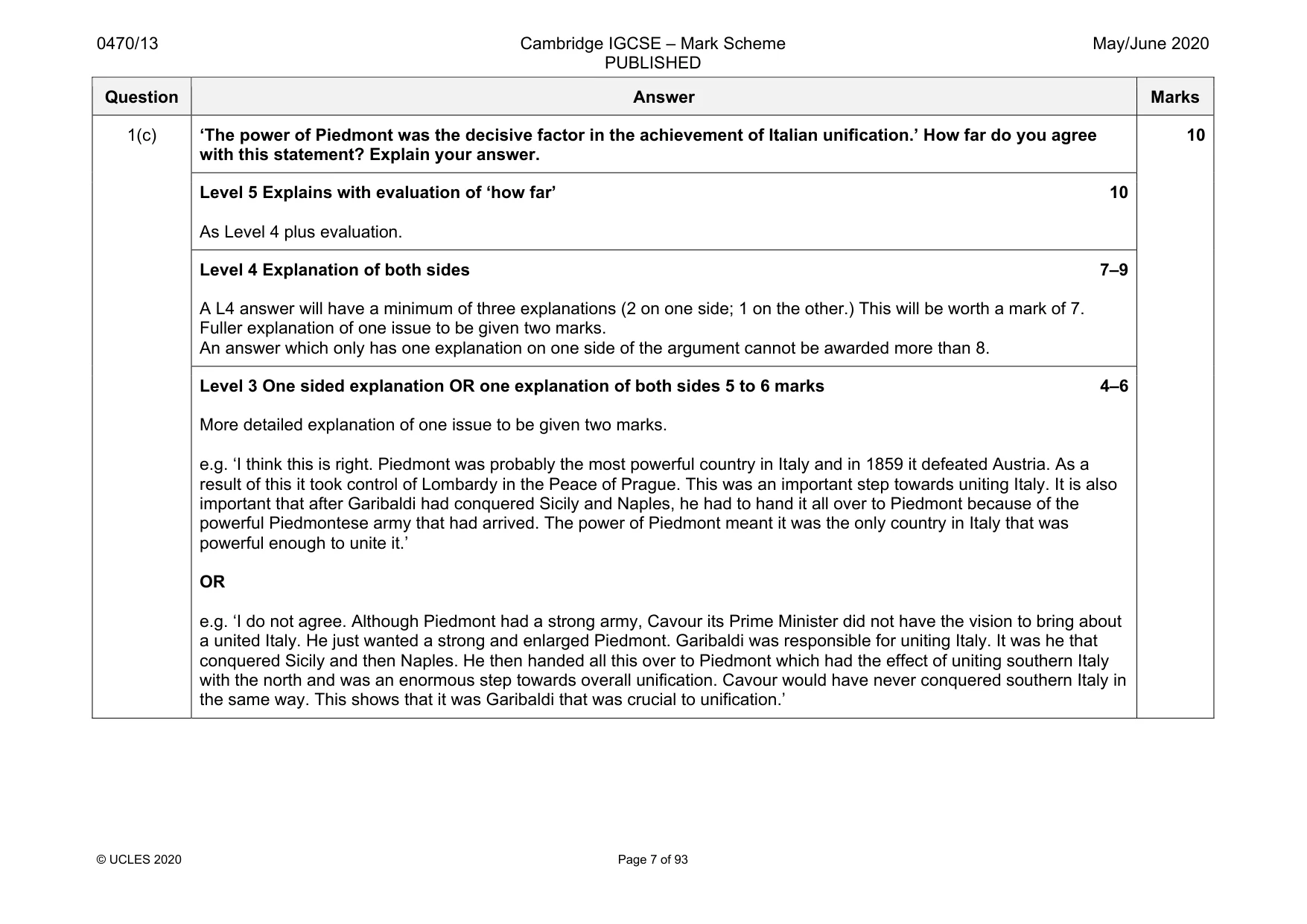
0470/13 Cambridge IGCSE – Mark Scheme PUBLISHED May/June 2020 © UCLES 2020 Page 7 of 93 Question Answer Marks 1(c) ‘The power of Piedmont was the decisive factor in the achievement of Italian unification.’ How far do you agree with this statement? Explain your answer. 10 Level 5 Explains with evaluation of ‘how far’ 10 As Level 4 plus evaluation. Level 4 Explanation of both sides 7–9 A L4 answer will have a minimum of three explanations (2 on one side; 1 on the other.) This will be worth a mark of 7. Fuller explanation of one issue to be given two marks. An answer which only has one explanation on one side of the argument cannot be awarded more than 8. Level 3 One sided explanation OR one explanation of both sides 5 to 6 marks 4–6 More detailed explanation of one issue to be given two marks. e.g. ‘I think this is right. Piedmont was probably the most powerful country in Italy and in 1859 it defeated Austria. As a result of this it took control of Lombardy in the Peace of Prague. This was an important step towards uniting Italy. It is also important that after Garibaldi had conquered Sicily and Naples, he had to hand it all over to Piedmont because of the powerful Piedmontese army that had arrived. The power of Piedmont meant it was the only country in Italy that was powerful enough to unite it.’ OR e.g. ‘I do not agree. Although Piedmont had a strong army, Cavour its Prime Minister did not have the vision to bring about a united Italy. He just wanted a strong and enlarged Piedmont. Garibaldi was responsible for uniting Italy. It was he that conquered Sicily and then Naples. He then handed all this over to Piedmont which had the effect of uniting southern Italy with the north and was an enormous step towards overall unification. Cavour would have never conquered southern Italy in the same way. This shows that it was Garibaldi that was crucial to unification.’
Mark scheme, page 8
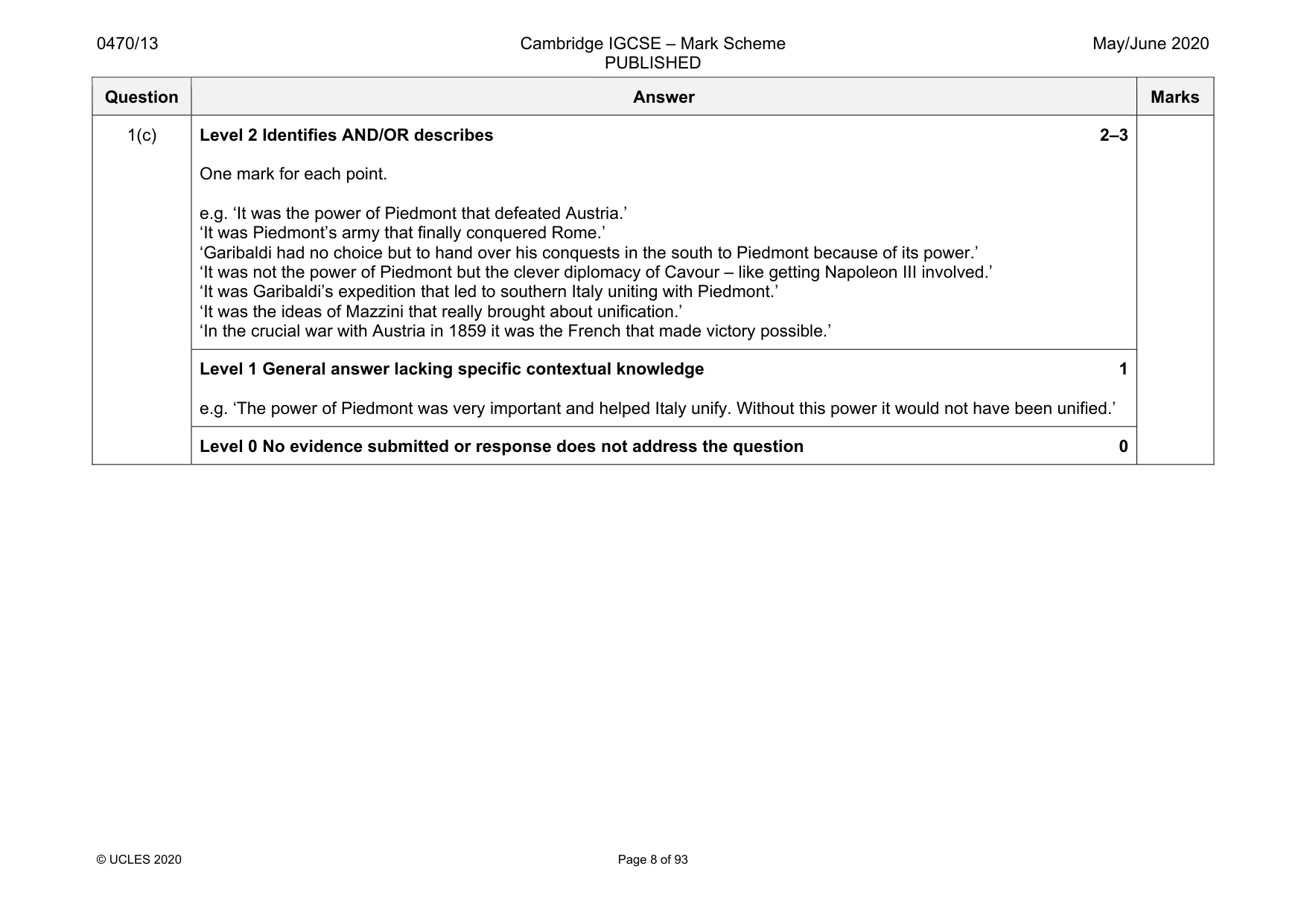
0470/13 Cambridge IGCSE – Mark Scheme PUBLISHED May/June 2020 © UCLES 2020 Page 8 of 93 Question Answer Marks 1(c) Level 2 Identifies AND/OR describes 2–3 One mark for each point. e.g. ‘It was the power of Piedmont that defeated Austria.’ ‘It was Piedmont’s army that finally conquered Rome.’ ‘Garibaldi had no choice but to hand over his conquests in the south to Piedmont because of its power.’ ‘It was not the power of Piedmont but the clever diplomacy of Cavour – like getting Napoleon III involved.’ ‘It was Garibaldi’s expedition that led to southern Italy uniting with Piedmont.’ ‘It was the ideas of Mazzini that really brought about unification.’ ‘In the crucial war with Austria in 1859 it was the French that made victory possible.’ Level 1 General answer lacking specific contextual knowledge 1 e.g. ‘The power of Piedmont was very important and helped Italy unify. Without this power it would not have been unified.’ Level 0 No evidence submitted or response does not address the question 0
Mark scheme, page 9
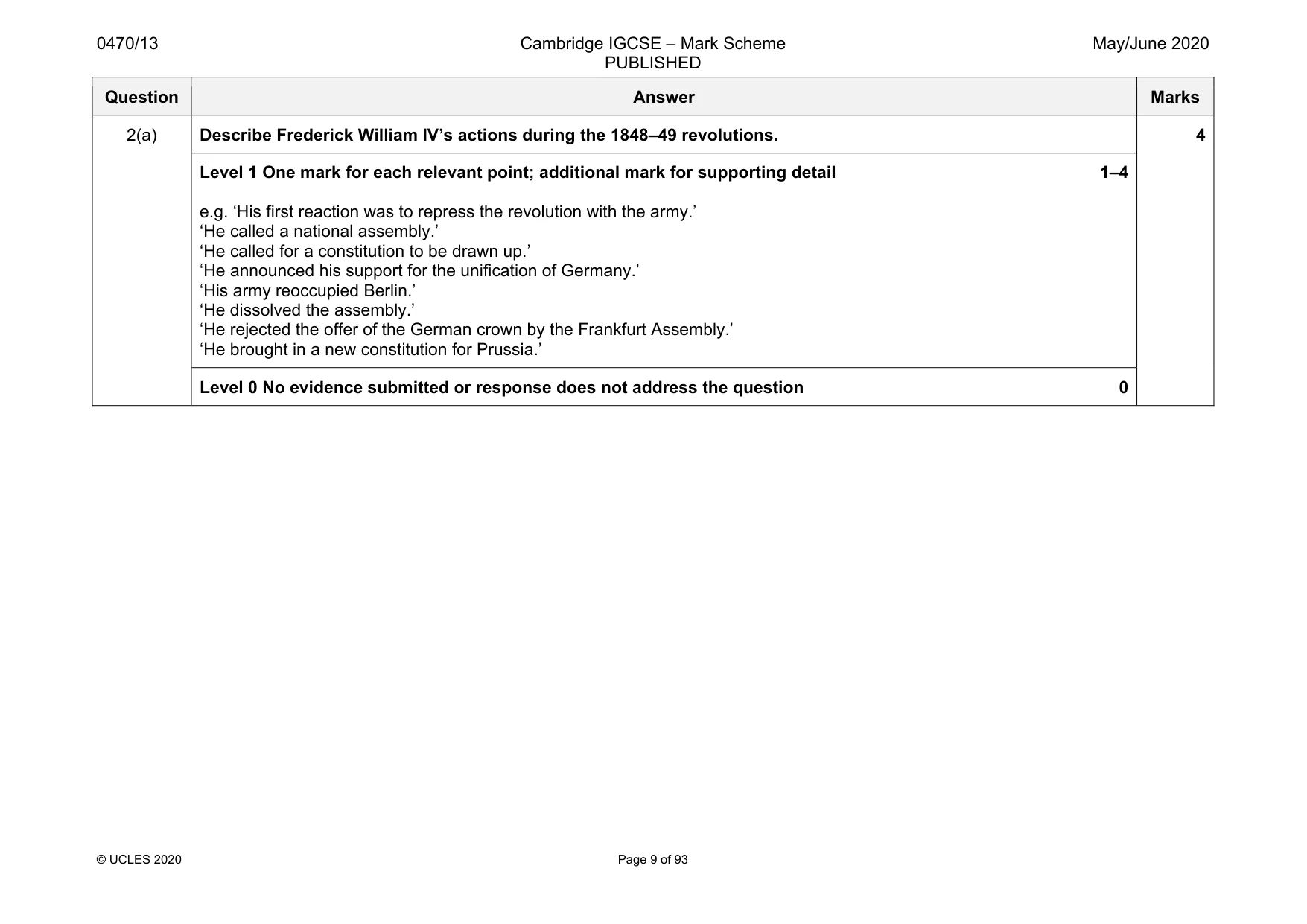
0470/13 Cambridge IGCSE – Mark Scheme PUBLISHED May/June 2020 © UCLES 2020 Page 9 of 93 Question Answer Marks 2(a) Describe Frederick William IV’s actions during the 1848–49 revolutions. 4 Level 1 One mark for each relevant point; additional mark for supporting detail 1–4 e.g. ‘His first reaction was to repress the revolution with the army.’ ‘He called a national assembly.’ ‘He called for a constitution to be drawn up.’ ‘He announced his support for the unification of Germany.’ ‘His army reoccupied Berlin.’ ‘He dissolved the assembly.’ ‘He rejected the offer of the German crown by the Frankfurt Assembly.’ ‘He brought in a new constitution for Prussia.’ Level 0 No evidence submitted or response does not address the question 0
Mark scheme, page 10
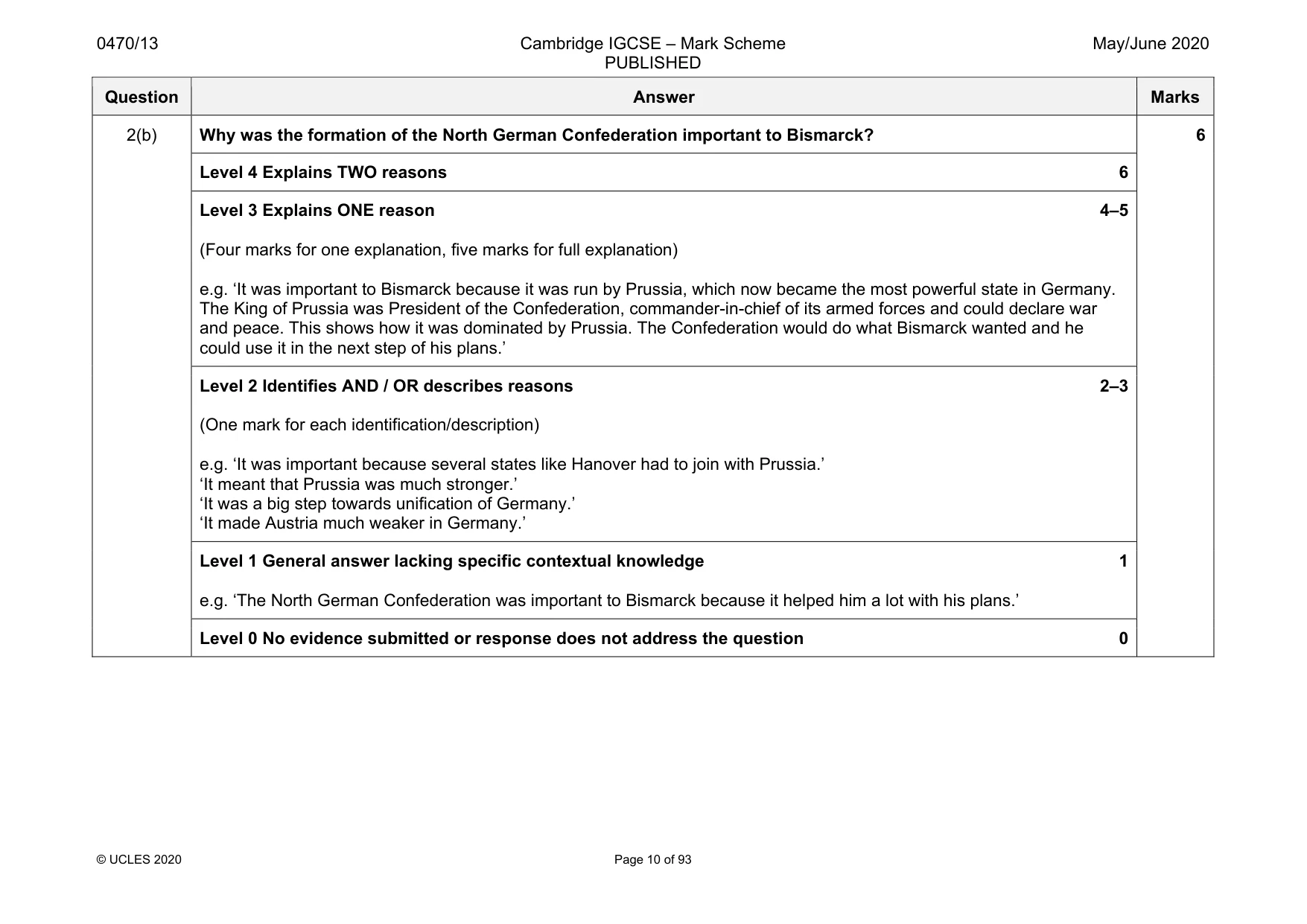
0470/13 Cambridge IGCSE – Mark Scheme PUBLISHED May/June 2020 © UCLES 2020 Page 10 of 93 Question Answer Marks 2(b) Why was the formation of the North German Confederation important to Bismarck? 6 Level 4 Explains TWO reasons 6 Level 3 Explains ONE reason 4–5 (Four marks for one explanation, five marks for full explanation) e.g. ‘It was important to Bismarck because it was run by Prussia, which now became the most powerful state in Germany. The King of Prussia was President of the Confederation, commander-in-chief of its armed forces and could declare war and peace. This shows how it was dominated by Prussia. The Confederation would do what Bismarck wanted and he could use it in the next step of his plans.’ Level 2 Identifies AND / OR describes reasons 2–3 (One mark for each identification/description) e.g. ‘It was important because several states like Hanover had to join with Prussia.’ ‘It meant that Prussia was much stronger.’ ‘It was a big step towards unification of Germany.’ ‘It made Austria much weaker in Germany.’ Level 1 General answer lacking specific contextual knowledge 1 e.g. ‘The North German Confederation was important to Bismarck because it helped him a lot with his plans.’ Level 0 No evidence submitted or response does not address the question 0
Mark scheme, page 11
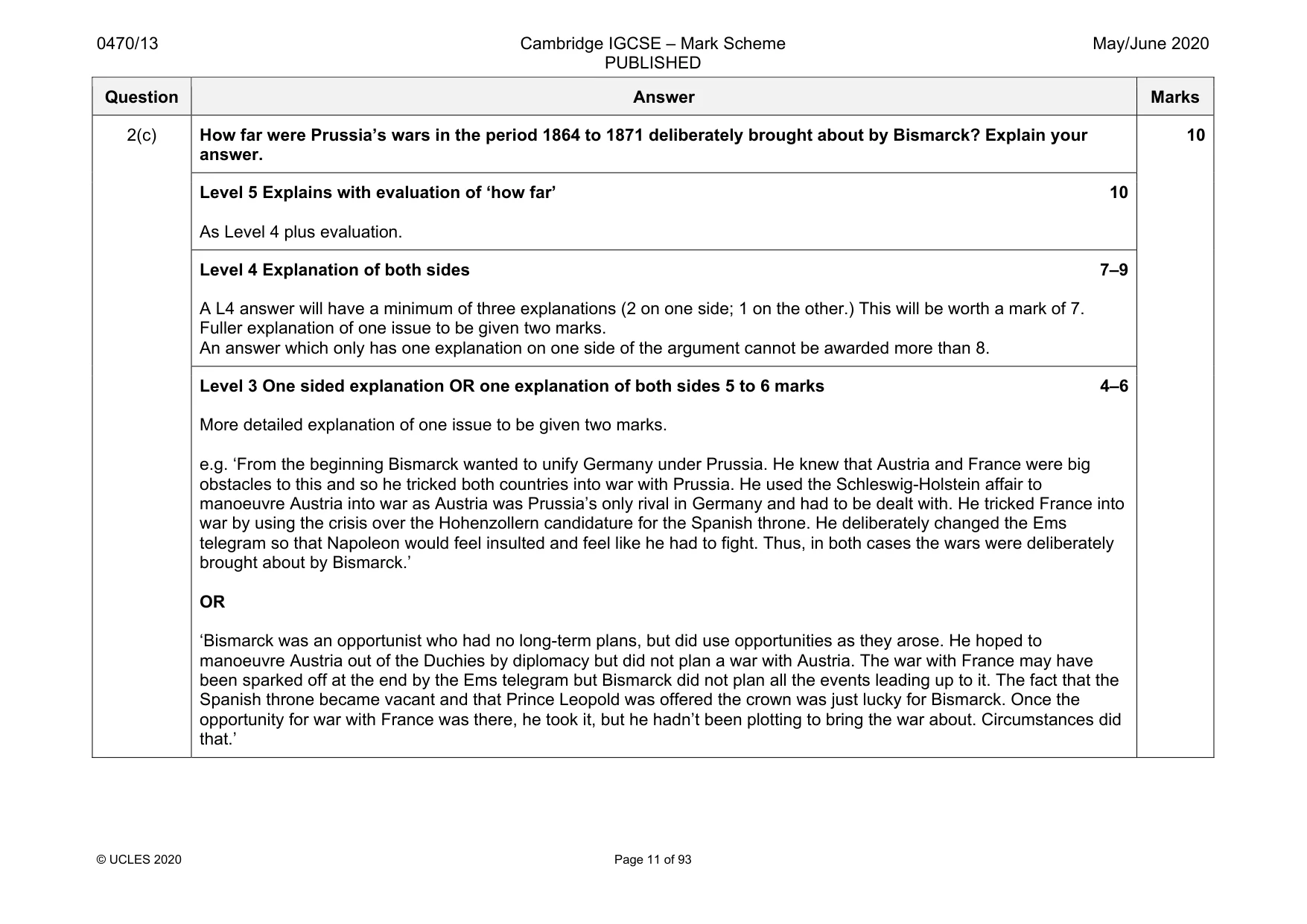
0470/13 Cambridge IGCSE – Mark Scheme PUBLISHED May/June 2020 © UCLES 2020 Page 11 of 93 Question Answer Marks 2(c) How far were Prussia’s wars in the period 1864 to 1871 deliberately brought about by Bismarck? Explain your answer. 10 Level 5 Explains with evaluation of ‘how far’ 10 As Level 4 plus evaluation. Level 4 Explanation of both sides 7–9 A L4 answer will have a minimum of three explanations (2 on one side; 1 on the other.) This will be worth a mark of 7. Fuller explanation of one issue to be given two marks. An answer which only has one explanation on one side of the argument cannot be awarded more than 8. Level 3 One sided explanation OR one explanation of both sides 5 to 6 marks 4–6 More detailed explanation of one issue to be given two marks. e.g. ‘From the beginning Bismarck wanted to unify Germany under Prussia. He knew that Austria and France were big obstacles to this and so he tricked both countries into war with Prussia. He used the Schleswig-Holstein affair to manoeuvre Austria into war as Austria was Prussia’s only rival in Germany and had to be dealt with. He tricked France into war by using the crisis over the Hohenzollern candidature for the Spanish throne. He deliberately changed the Ems telegram so that Napoleon would feel insulted and feel like he had to fight. Thus, in both cases the wars were deliberately brought about by Bismarck.’ OR ‘Bismarck was an opportunist who had no long-term plans, but did use opportunities as they arose. He hoped to manoeuvre Austria out of the Duchies by diplomacy but did not plan a war with Austria. The war with France may have been sparked off at the end by the Ems telegram but Bismarck did not plan all the events leading up to it. The fact that the Spanish throne became vacant and that Prince Leopold was offered the crown was just lucky for Bismarck. Once the opportunity for war with France was there, he took it, but he hadn’t been plotting to bring the war about. Circumstances did that.’
Mark scheme, page 12
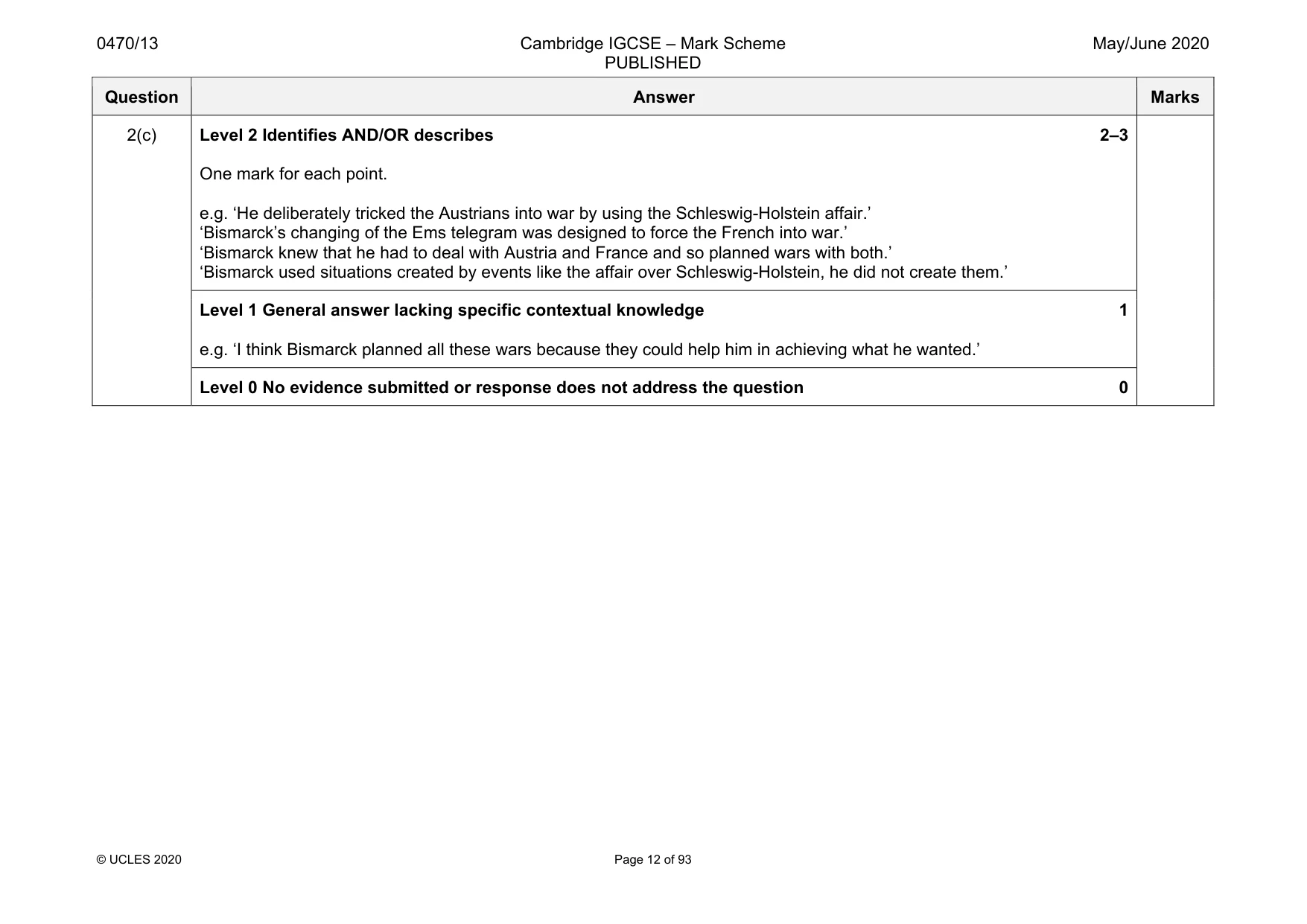
0470/13 Cambridge IGCSE – Mark Scheme PUBLISHED May/June 2020 © UCLES 2020 Page 12 of 93 Question Answer Marks 2(c) Level 2 Identifies AND/OR describes 2–3 One mark for each point. e.g. ‘He deliberately tricked the Austrians into war by using the Schleswig-Holstein affair.’ ‘Bismarck’s changing of the Ems telegram was designed to force the French into war.’ ‘Bismarck knew that he had to deal with Austria and France and so planned wars with both.’ ‘Bismarck used situations created by events like the affair over Schleswig-Holstein, he did not create them.’ Level 1 General answer lacking specific contextual knowledge 1 e.g. ‘I think Bismarck planned all these wars because they could help him in achieving what he wanted.’ Level 0 No evidence submitted or response does not address the question 0
Mark scheme, page 13
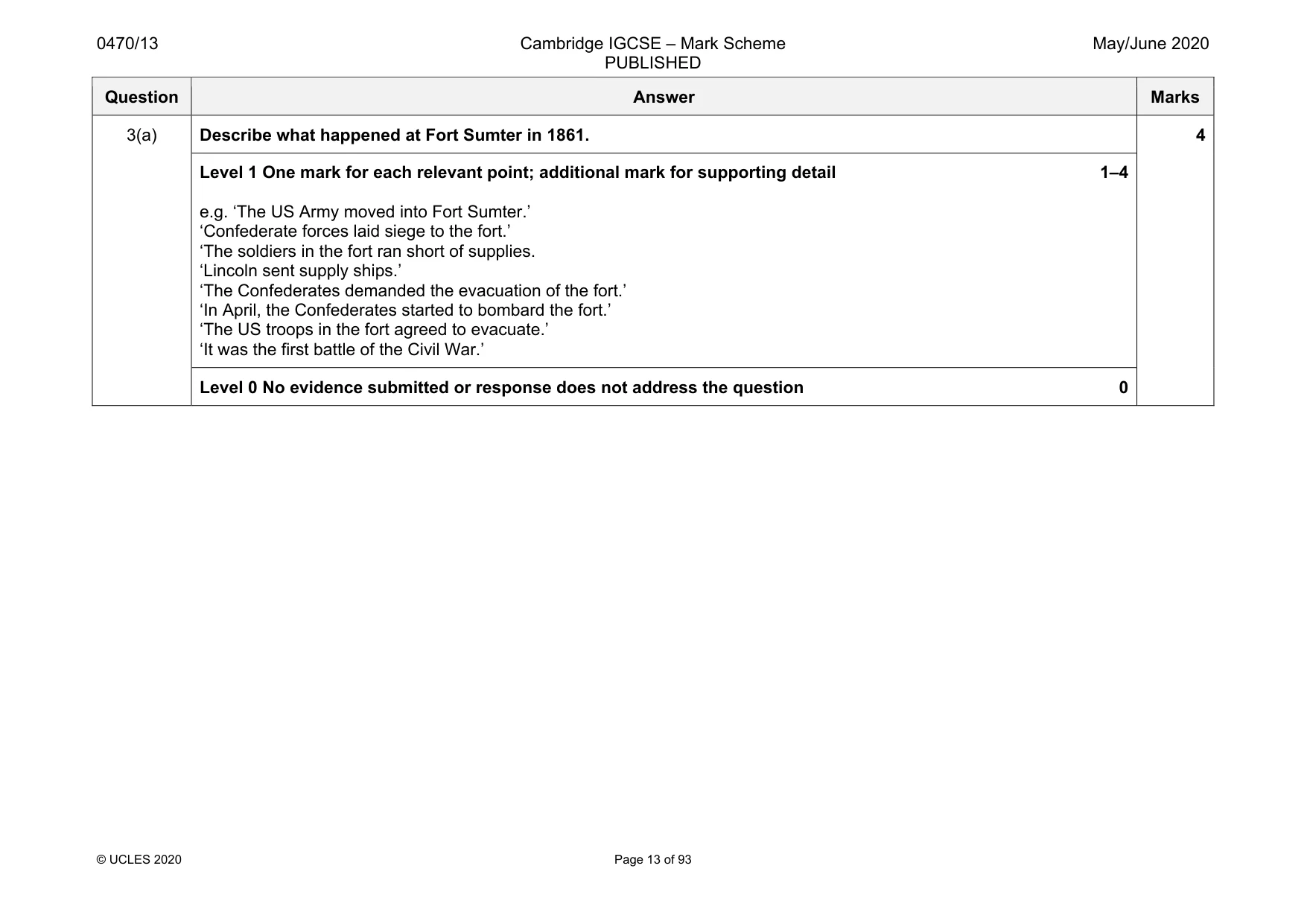
0470/13 Cambridge IGCSE – Mark Scheme PUBLISHED May/June 2020 © UCLES 2020 Page 13 of 93 Question Answer Marks 3(a) Describe what happened at Fort Sumter in 1861. 4 Level 1 One mark for each relevant point; additional mark for supporting detail 1–4 e.g. ‘The US Army moved into Fort Sumter.’ ‘Confederate forces laid siege to the fort.’ ‘The soldiers in the fort ran short of supplies. ‘Lincoln sent supply ships.’ ‘The Confederates demanded the evacuation of the fort.’ ‘In April, the Confederates started to bombard the fort.’ ‘The US troops in the fort agreed to evacuate.’ ‘It was the first battle of the Civil War.’ Level 0 No evidence submitted or response does not address the question 0
Mark scheme, page 14
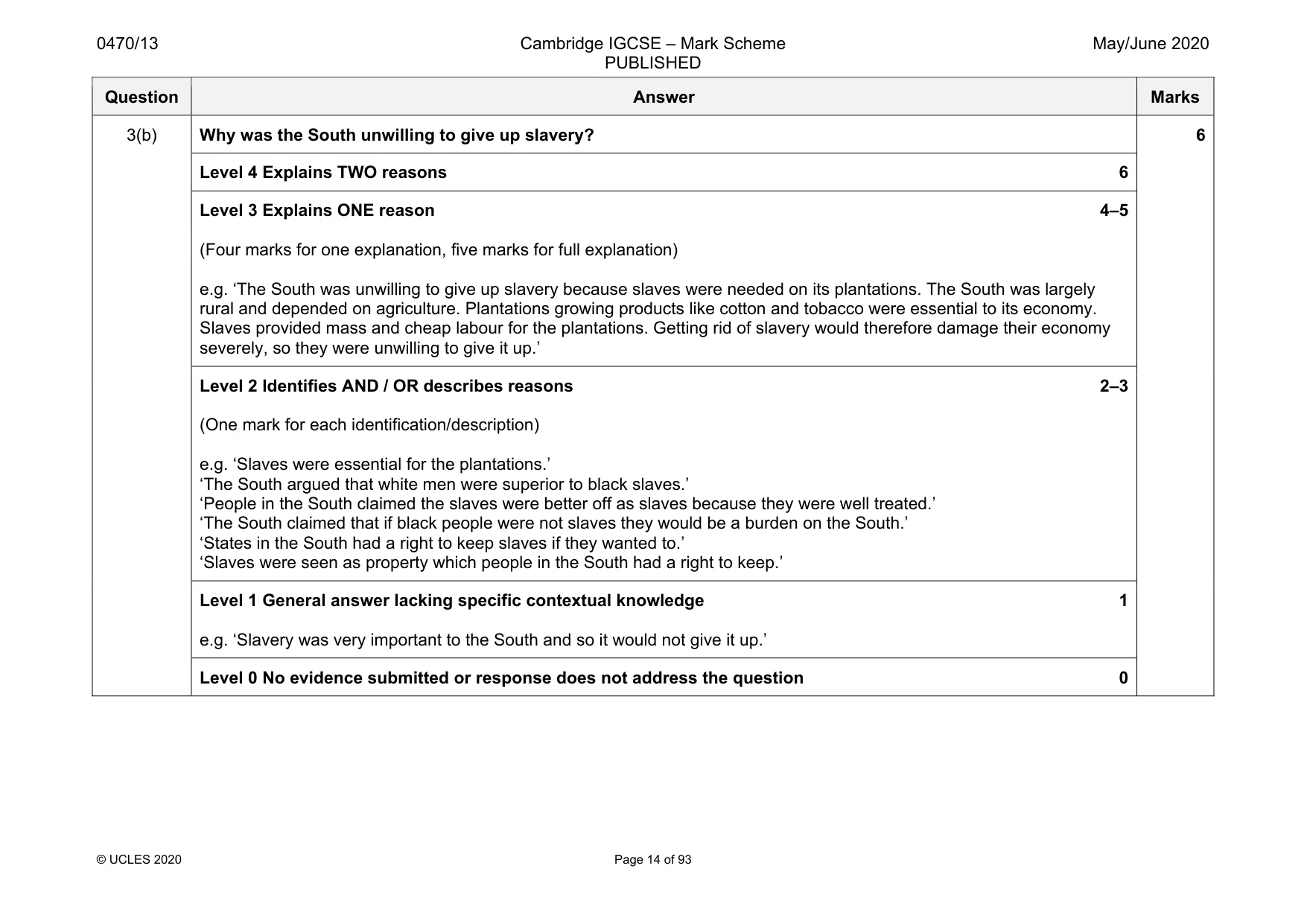
0470/13 Cambridge IGCSE – Mark Scheme PUBLISHED May/June 2020 © UCLES 2020 Page 14 of 93 Question Answer Marks 3(b) Why was the South unwilling to give up slavery? 6 Level 4 Explains TWO reasons 6 Level 3 Explains ONE reason 4–5 (Four marks for one explanation, five marks for full explanation) e.g. ‘The South was unwilling to give up slavery because slaves were needed on its plantations. The South was largely rural and depended on agriculture. Plantations growing products like cotton and tobacco were essential to its economy. Slaves provided mass and cheap labour for the plantations. Getting rid of slavery would therefore damage their economy severely, so they were unwilling to give it up.’ Level 2 Identifies AND / OR describes reasons 2–3 (One mark for each identification/description) e.g. ‘Slaves were essential for the plantations.’ ‘The South argued that white men were superior to black slaves.’ ‘People in the South claimed the slaves were better off as slaves because they were well treated.’ ‘The South claimed that if black people were not slaves they would be a burden on the South.’ ‘States in the South had a right to keep slaves if they wanted to.’ ‘Slaves were seen as property which people in the South had a right to keep.’ Level 1 General answer lacking specific contextual knowledge 1 e.g. ‘Slavery was very important to the South and so it would not give it up.’ Level 0 No evidence submitted or response does not address the question 0
Mark scheme, page 15
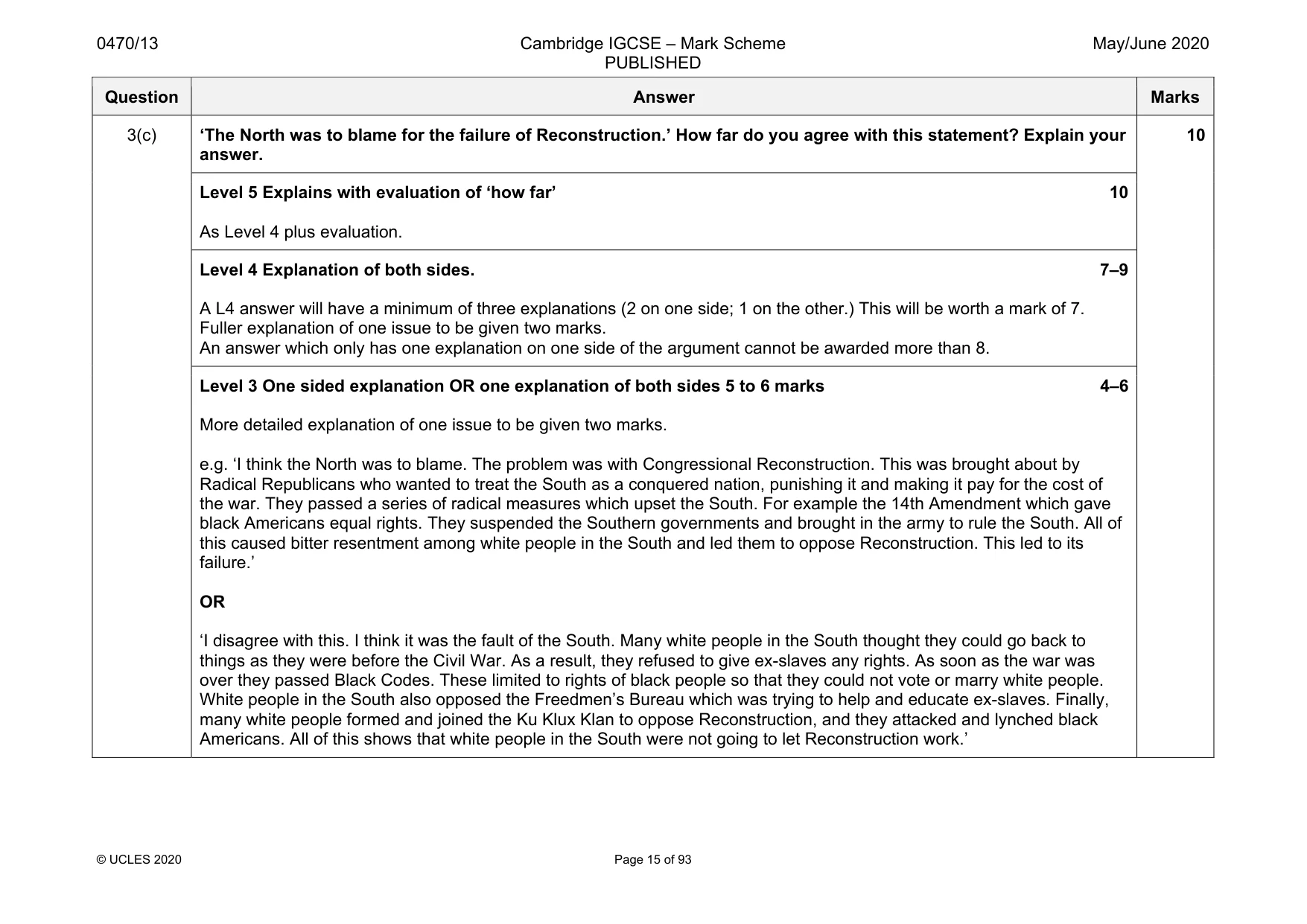
0470/13 Cambridge IGCSE – Mark Scheme PUBLISHED May/June 2020 © UCLES 2020 Page 15 of 93 Question Answer Marks 3(c) ‘The North was to blame for the failure of Reconstruction.’ How far do you agree with this statement? Explain your answer. 10 Level 5 Explains with evaluation of ‘how far’ 10 As Level 4 plus evaluation. Level 4 Explanation of both sides. 7–9 A L4 answer will have a minimum of three explanations (2 on one side; 1 on the other.) This will be worth a mark of 7. Fuller explanation of one issue to be given two marks. An answer which only has one explanation on one side of the argument cannot be awarded more than 8. Level 3 One sided explanation OR one explanation of both sides 5 to 6 marks 4–6 More detailed explanation of one issue to be given two marks. e.g. ‘I think the North was to blame. The problem was with Congressional Reconstruction. This was brought about by Radical Republicans who wanted to treat the South as a conquered nation, punishing it and making it pay for the cost of the war. They passed a series of radical measures which upset the South. For example the 14th Amendment which gave black Americans equal rights. They suspended the Southern governments and brought in the army to rule the South. All of this caused bitter resentment among white people in the South and led them to oppose Reconstruction. This led to its failure.’ OR ‘I disagree with this. I think it was the fault of the South. Many white people in the South thought they could go back to things as they were before the Civil War. As a result, they refused to give ex-slaves any rights. As soon as the war was over they passed Black Codes. These limited to rights of black people so that they could not vote or marry white people. White people in the South also opposed the Freedmen’s Bureau which was trying to help and educate ex-slaves. Finally, many white people formed and joined the Ku Klux Klan to oppose Reconstruction, and they attacked and lynched black Americans. All of this shows that white people in the South were not going to let Reconstruction work.’
Mark scheme, page 16
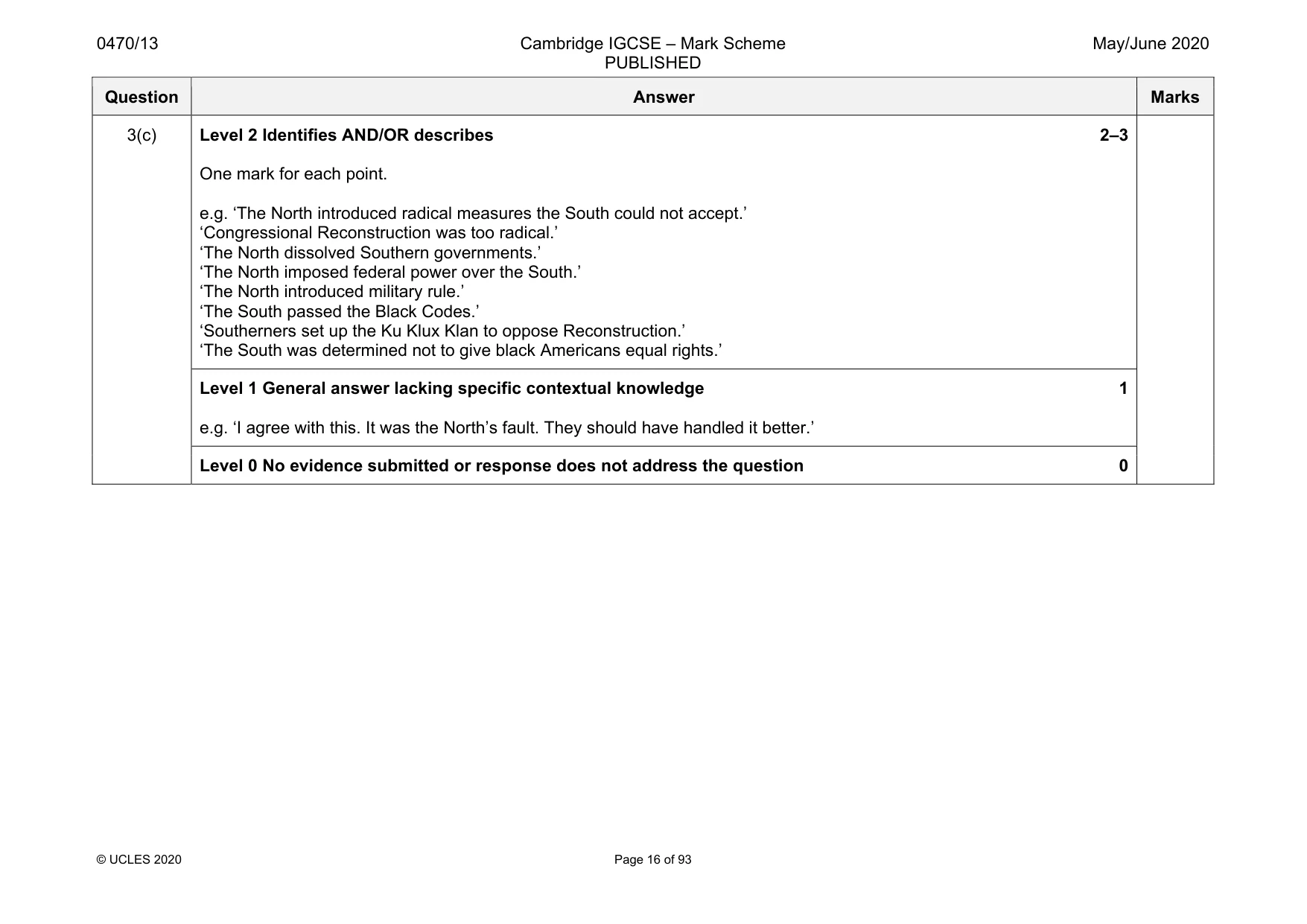
0470/13 Cambridge IGCSE – Mark Scheme PUBLISHED May/June 2020 © UCLES 2020 Page 16 of 93 Question Answer Marks 3(c) Level 2 Identifies AND/OR describes 2–3 One mark for each point. e.g. ‘The North introduced radical measures the South could not accept.’ ‘Congressional Reconstruction was too radical.’ ‘The North dissolved Southern governments.’ ‘The North imposed federal power over the South.’ ‘The North introduced military rule.’ ‘The South passed the Black Codes.’ ‘Southerners set up the Ku Klux Klan to oppose Reconstruction.’ ‘The South was determined not to give black Americans equal rights.’ Level 1 General answer lacking specific contextual knowledge 1 e.g. ‘I agree with this. It was the North’s fault. They should have handled it better.’ Level 0 No evidence submitted or response does not address the question 0
Mark scheme, page 17
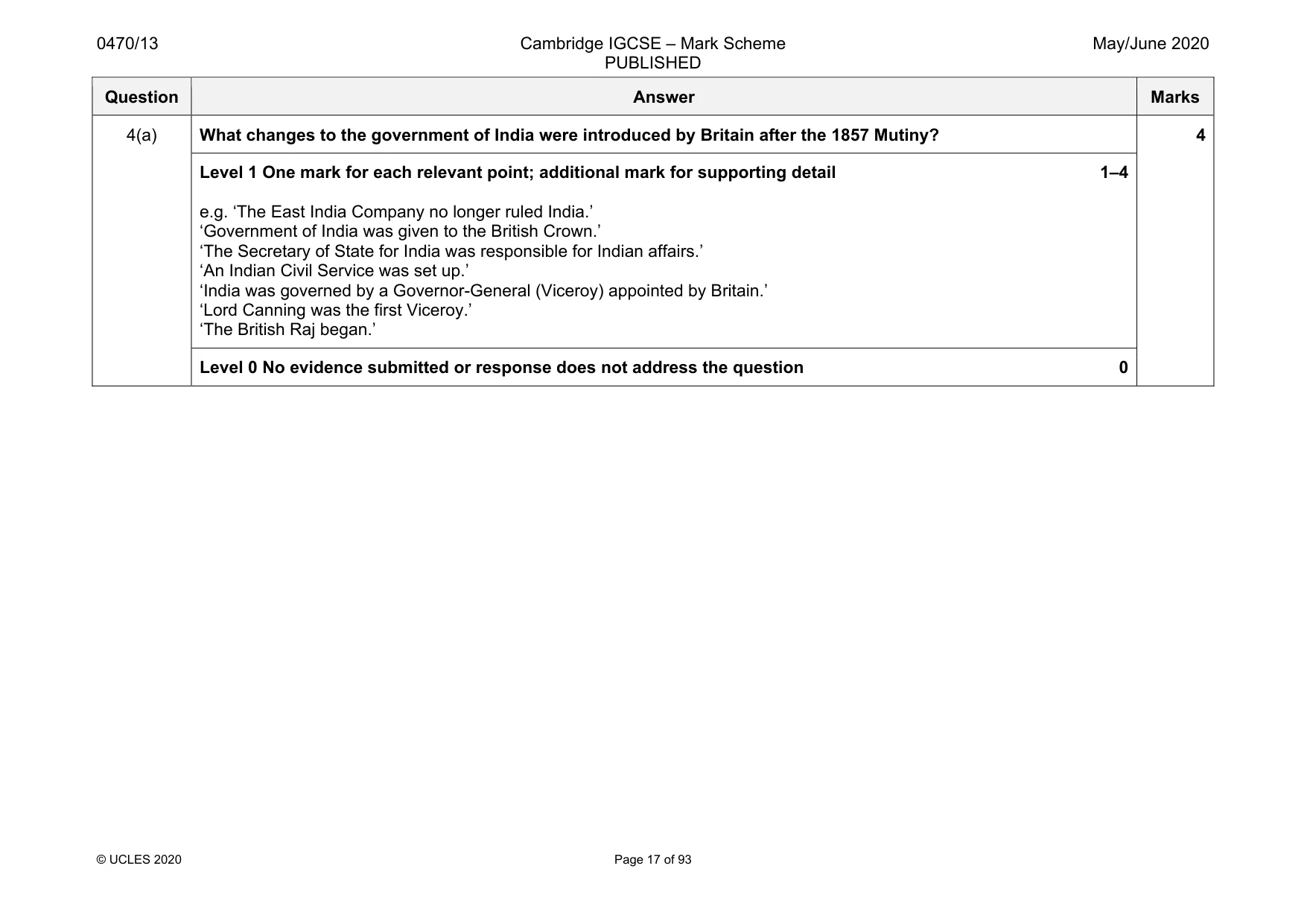
0470/13 Cambridge IGCSE – Mark Scheme PUBLISHED May/June 2020 © UCLES 2020 Page 17 of 93 Question Answer Marks 4(a) What changes to the government of India were introduced by Britain after the 1857 Mutiny? 4 Level 1 One mark for each relevant point; additional mark for supporting detail 1–4 e.g. ‘The East India Company no longer ruled India.’ ‘Government of India was given to the British Crown.’ ‘The Secretary of State for India was responsible for Indian affairs.’ ‘An Indian Civil Service was set up.’ ‘India was governed by a Governor-General (Viceroy) appointed by Britain.’ ‘Lord Canning was the first Viceroy.’ ‘The British Raj began.’ Level 0 No evidence submitted or response does not address the question 0
Mark scheme, page 18
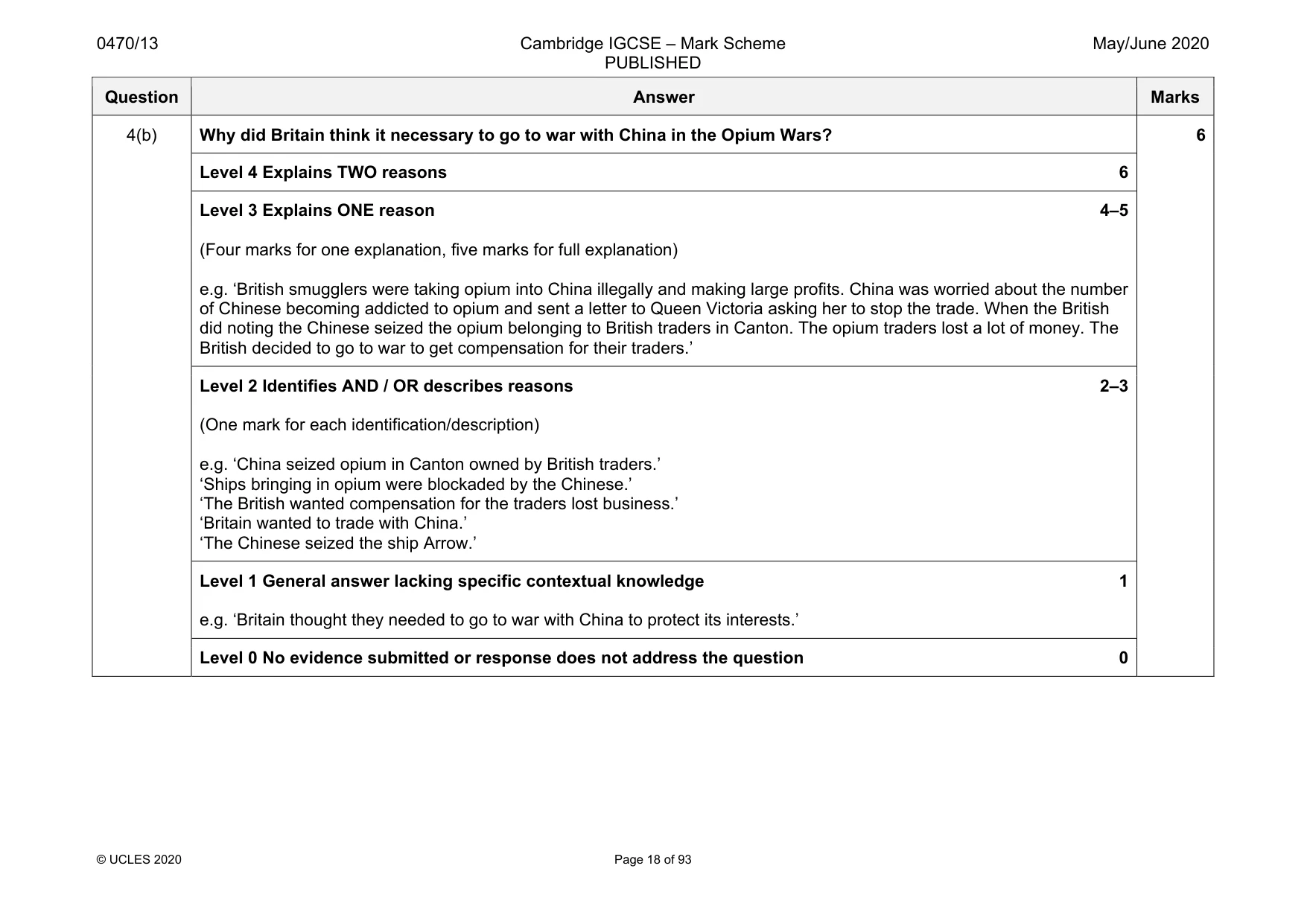
0470/13 Cambridge IGCSE – Mark Scheme PUBLISHED May/June 2020 © UCLES 2020 Page 18 of 93 Question Answer Marks 4(b) Why did Britain think it necessary to go to war with China in the Opium Wars? 6 Level 4 Explains TWO reasons 6 Level 3 Explains ONE reason 4–5 (Four marks for one explanation, five marks for full explanation) e.g. ‘British smugglers were taking opium into China illegally and making large profits. China was worried about the number of Chinese becoming addicted to opium and sent a letter to Queen Victoria asking her to stop the trade. When the British did noting the Chinese seized the opium belonging to British traders in Canton. The opium traders lost a lot of money. The British decided to go to war to get compensation for their traders.’ Level 2 Identifies AND / OR describes reasons 2–3 (One mark for each identification/description) e.g. ‘China seized opium in Canton owned by British traders.’ ‘Ships bringing in opium were blockaded by the Chinese.’ ‘The British wanted compensation for the traders lost business.’ ‘Britain wanted to trade with China.’ ‘The Chinese seized the ship Arrow.’ Level 1 General answer lacking specific contextual knowledge 1 e.g. ‘Britain thought they needed to go to war with China to protect its interests.’ Level 0 No evidence submitted or response does not address the question 0
Mark scheme, page 19
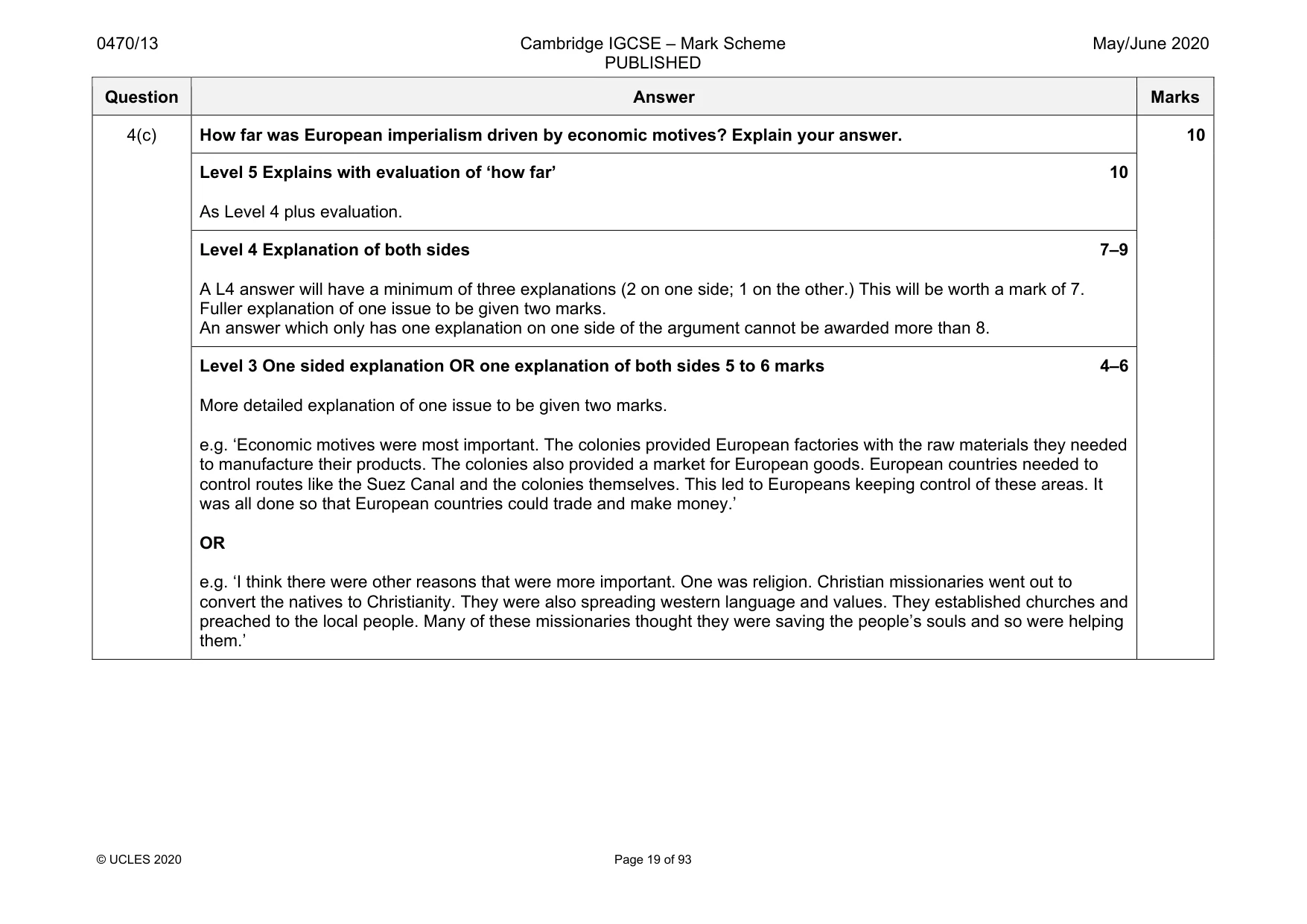
0470/13 Cambridge IGCSE – Mark Scheme PUBLISHED May/June 2020 © UCLES 2020 Page 19 of 93 Question Answer Marks 4(c) How far was European imperialism driven by economic motives? Explain your answer. 10 Level 5 Explains with evaluation of ‘how far’ 10 As Level 4 plus evaluation. Level 4 Explanation of both sides 7–9 A L4 answer will have a minimum of three explanations (2 on one side; 1 on the other.) This will be worth a mark of 7. Fuller explanation of one issue to be given two marks. An answer which only has one explanation on one side of the argument cannot be awarded more than 8. Level 3 One sided explanation OR one explanation of both sides 5 to 6 marks 4–6 More detailed explanation of one issue to be given two marks. e.g. ‘Economic motives were most important. The colonies provided European factories with the raw materials they needed to manufacture their products. The colonies also provided a market for European goods. European countries needed to control routes like the Suez Canal and the colonies themselves. This led to Europeans keeping control of these areas. It was all done so that European countries could trade and make money.’ OR e.g. ‘I think there were other reasons that were more important. One was religion. Christian missionaries went out to convert the natives to Christianity. They were also spreading western language and values. They established churches and preached to the local people. Many of these missionaries thought they were saving the people’s souls and so were helping them.’
Mark scheme, page 20
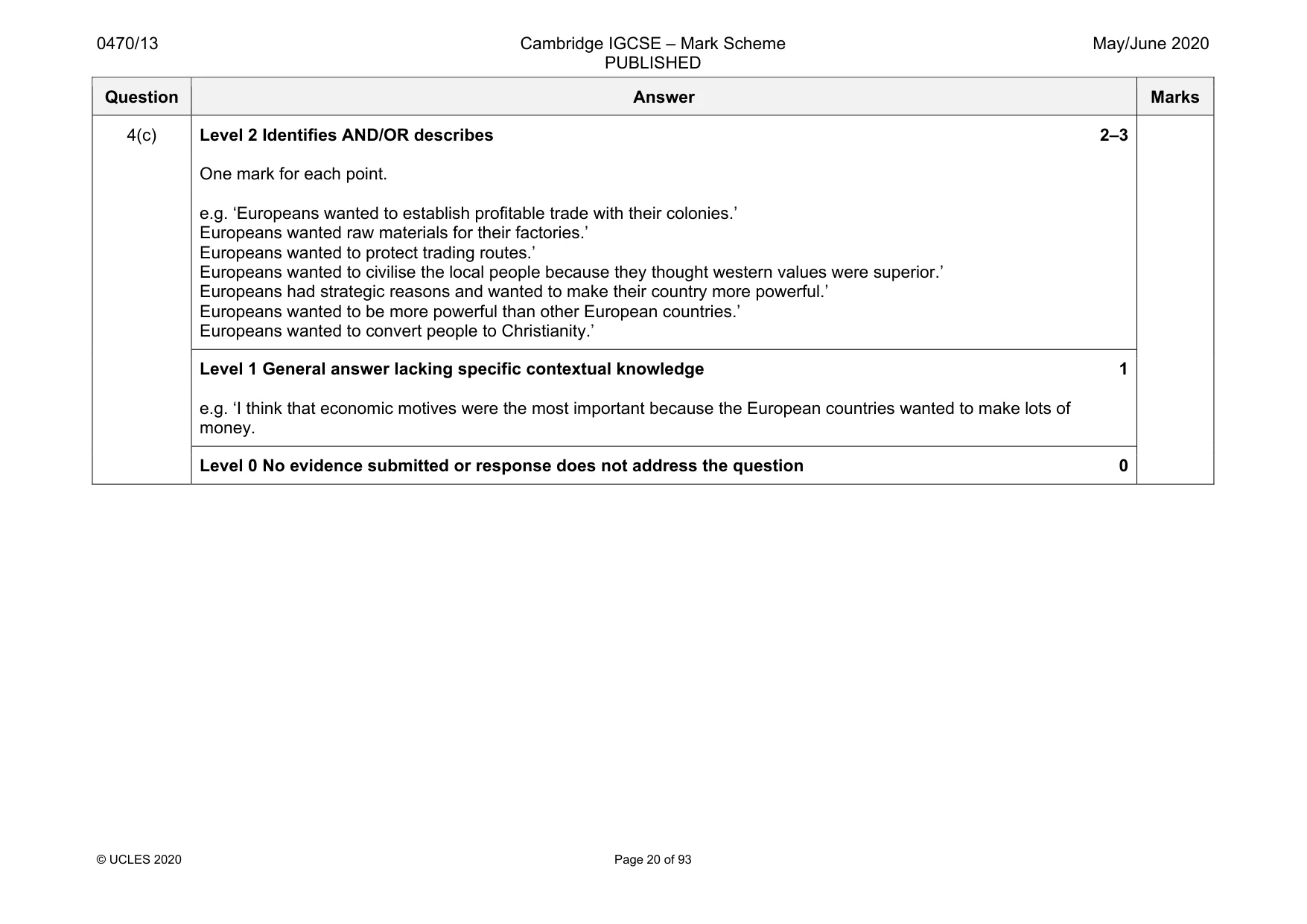
0470/13 Cambridge IGCSE – Mark Scheme PUBLISHED May/June 2020 © UCLES 2020 Page 20 of 93 Question Answer Marks 4(c) Level 2 Identifies AND/OR describes 2–3 One mark for each point. e.g. ‘Europeans wanted to establish profitable trade with their colonies.’ Europeans wanted raw materials for their factories.’ Europeans wanted to protect trading routes.’ Europeans wanted to civilise the local people because they thought western values were superior.’ Europeans had strategic reasons and wanted to make their country more powerful.’ Europeans wanted to be more powerful than other European countries.’ Europeans wanted to convert people to Christianity.’ Level 1 General answer lacking specific contextual knowledge 1 e.g. ‘I think that economic motives were the most important because the European countries wanted to make lots of money. Level 0 No evidence submitted or response does not address the question 0
Mark scheme, page 21
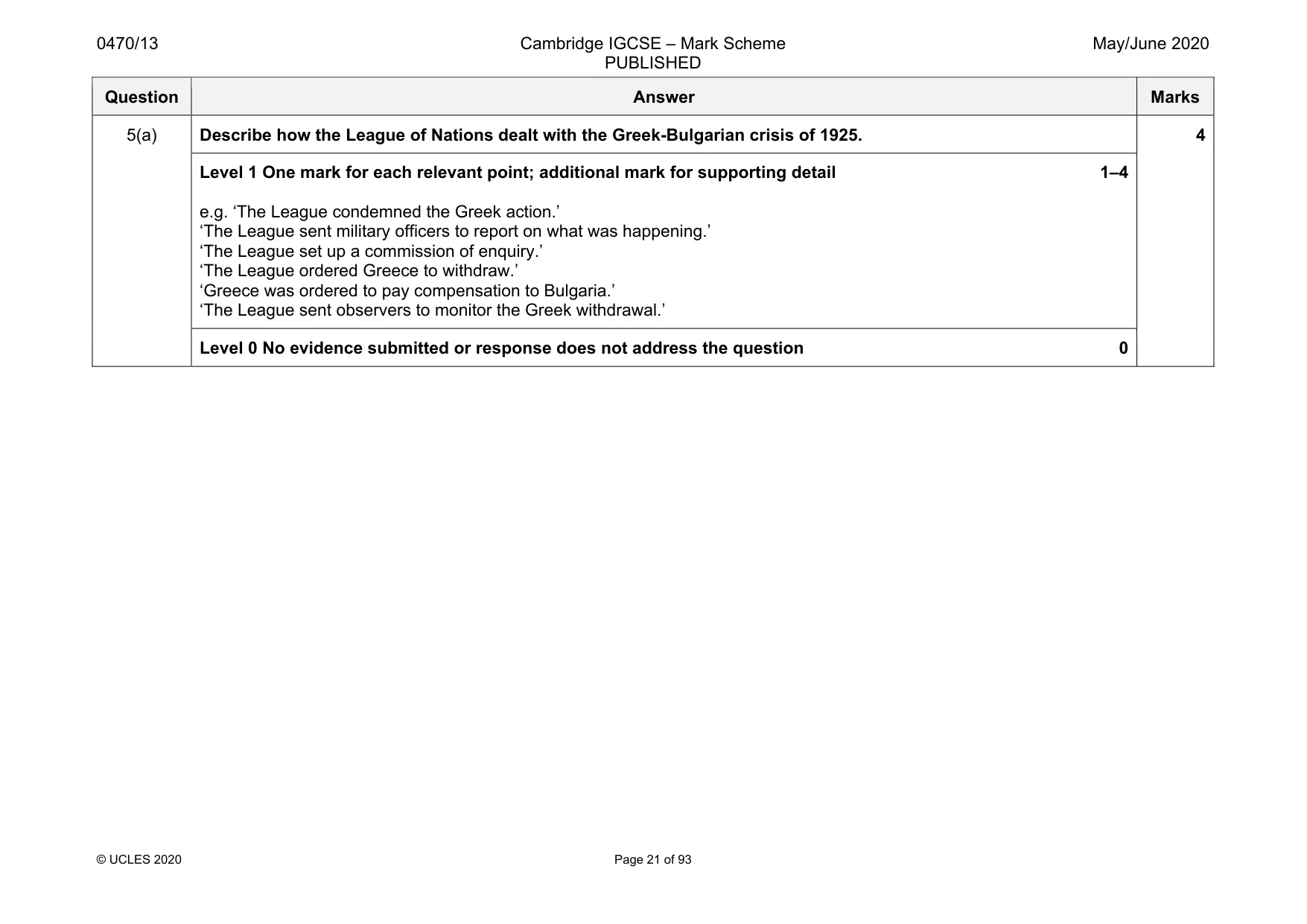
0470/13 Cambridge IGCSE – Mark Scheme PUBLISHED May/June 2020 © UCLES 2020 Page 21 of 93 Question Answer Marks 5(a) Describe how the League of Nations dealt with the Greek-Bulgarian crisis of 1925. 4 Level 1 One mark for each relevant point; additional mark for supporting detail 1–4 e.g. ‘The League condemned the Greek action.’ ‘The League sent military officers to report on what was happening.’ ‘The League set up a commission of enquiry.’ ‘The League ordered Greece to withdraw.’ ‘Greece was ordered to pay compensation to Bulgaria.’ ‘The League sent observers to monitor the Greek withdrawal.’ Level 0 No evidence submitted or response does not address the question 0
Mark scheme, page 22
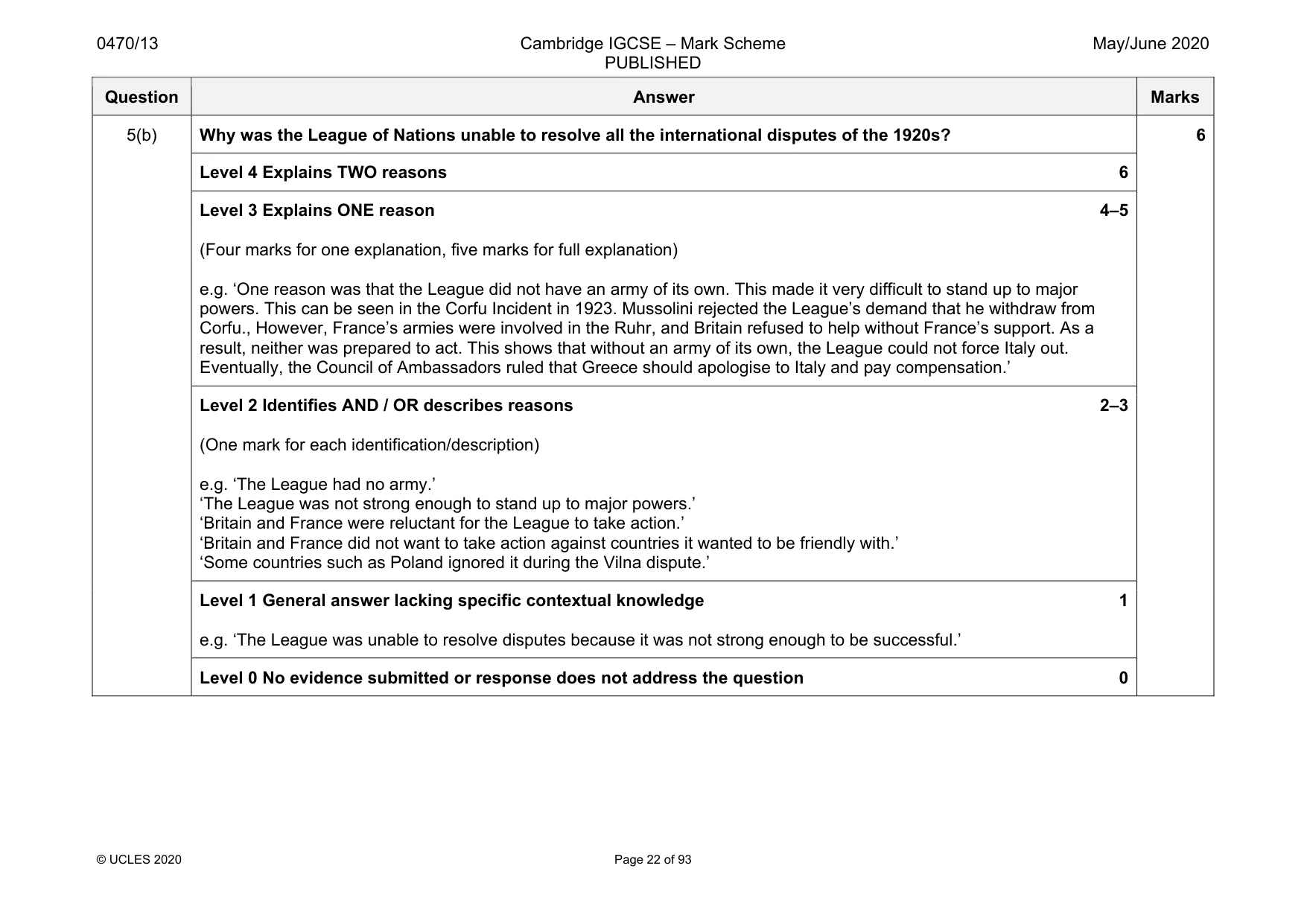
0470/13 Cambridge IGCSE – Mark Scheme PUBLISHED May/June 2020 © UCLES 2020 Page 22 of 93 Question Answer Marks 5(b) Why was the League of Nations unable to resolve all the international disputes of the 1920s? 6 Level 4 Explains TWO reasons 6 Level 3 Explains ONE reason 4–5 (Four marks for one explanation, five marks for full explanation) e.g. ‘One reason was that the League did not have an army of its own. This made it very difficult to stand up to major powers. This can be seen in the Corfu Incident in 1923. Mussolini rejected the League’s demand that he withdraw from Corfu., However, France’s armies were involved in the Ruhr, and Britain refused to help without France’s support. As a result, neither was prepared to act. This shows that without an army of its own, the League could not force Italy out. Eventually, the Council of Ambassadors ruled that Greece should apologise to Italy and pay compensation.’ Level 2 Identifies AND / OR describes reasons 2–3 (One mark for each identification/description) e.g. ‘The League had no army.’ ‘The League was not strong enough to stand up to major powers.’ ‘Britain and France were reluctant for the League to take action.’ ‘Britain and France did not want to take action against countries it wanted to be friendly with.’ ‘Some countries such as Poland ignored it during the Vilna dispute.’ Level 1 General answer lacking specific contextual knowledge 1 e.g. ‘The League was unable to resolve disputes because it was not strong enough to be successful.’ Level 0 No evidence submitted or response does not address the question 0
Mark scheme, page 23
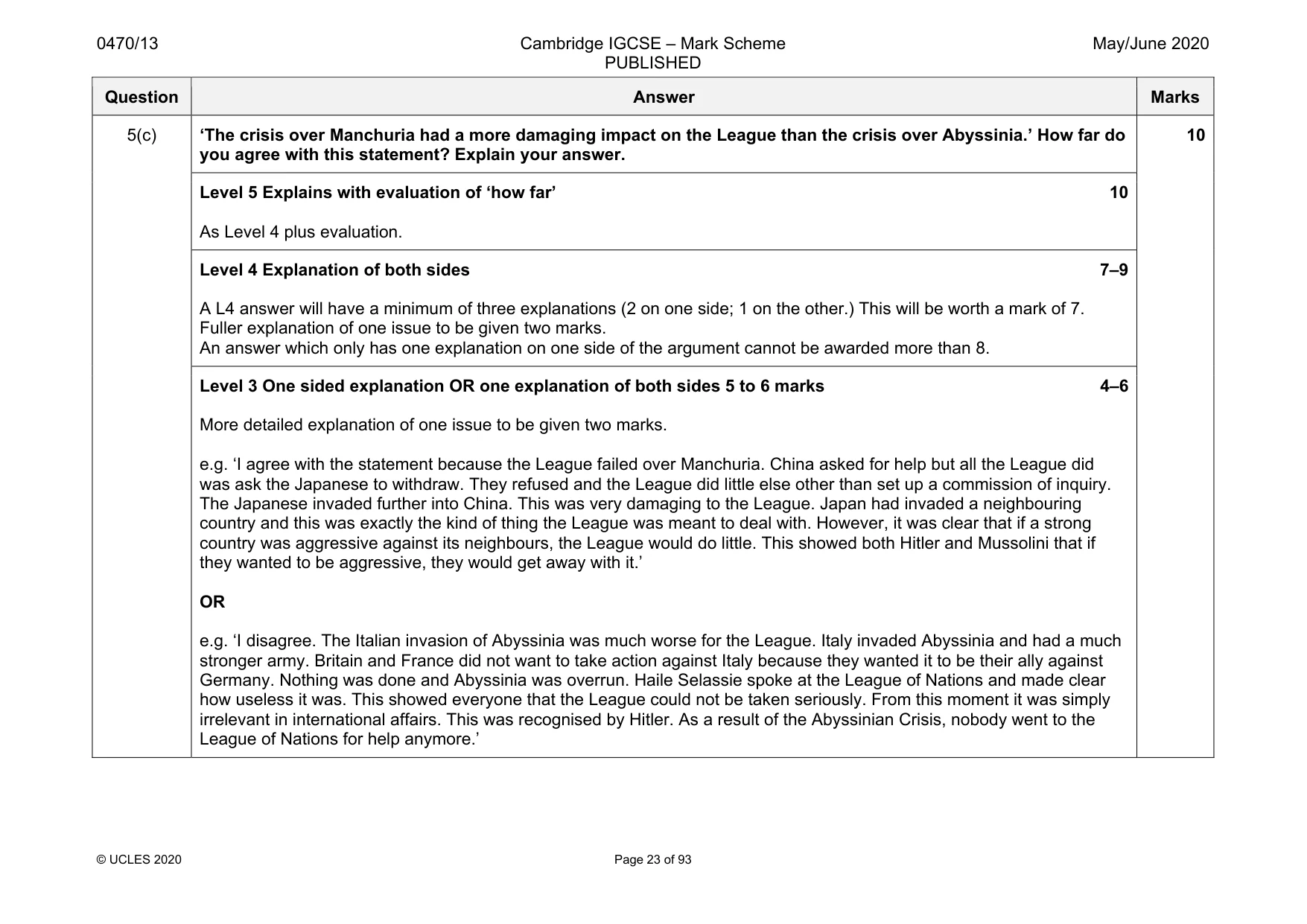
0470/13 Cambridge IGCSE – Mark Scheme PUBLISHED May/June 2020 © UCLES 2020 Page 23 of 93 Question Answer Marks 5(c) ‘The crisis over Manchuria had a more damaging impact on the League than the crisis over Abyssinia.’ How far do you agree with this statement? Explain your answer. 10 Level 5 Explains with evaluation of ‘how far’ 10 As Level 4 plus evaluation. Level 4 Explanation of both sides 7–9 A L4 answer will have a minimum of three explanations (2 on one side; 1 on the other.) This will be worth a mark of 7. Fuller explanation of one issue to be given two marks. An answer which only has one explanation on one side of the argument cannot be awarded more than 8. Level 3 One sided explanation OR one explanation of both sides 5 to 6 marks 4–6 More detailed explanation of one issue to be given two marks. e.g. ‘I agree with the statement because the League failed over Manchuria. China asked for help but all the League did was ask the Japanese to withdraw. They refused and the League did little else other than set up a commission of inquiry. The Japanese invaded further into China. This was very damaging to the League. Japan had invaded a neighbouring country and this was exactly the kind of thing the League was meant to deal with. However, it was clear that if a strong country was aggressive against its neighbours, the League would do little. This showed both Hitler and Mussolini that if they wanted to be aggressive, they would get away with it.’ OR e.g. ‘I disagree. The Italian invasion of Abyssinia was much worse for the League. Italy invaded Abyssinia and had a much stronger army. Britain and France did not want to take action against Italy because they wanted it to be their ally against Germany. Nothing was done and Abyssinia was overrun. Haile Selassie spoke at the League of Nations and made clear how useless it was. This showed everyone that the League could not be taken seriously. From this moment it was simply irrelevant in international affairs. This was recognised by Hitler. As a result of the Abyssinian Crisis, nobody went to the League of Nations for help anymore.’
Mark scheme, page 24
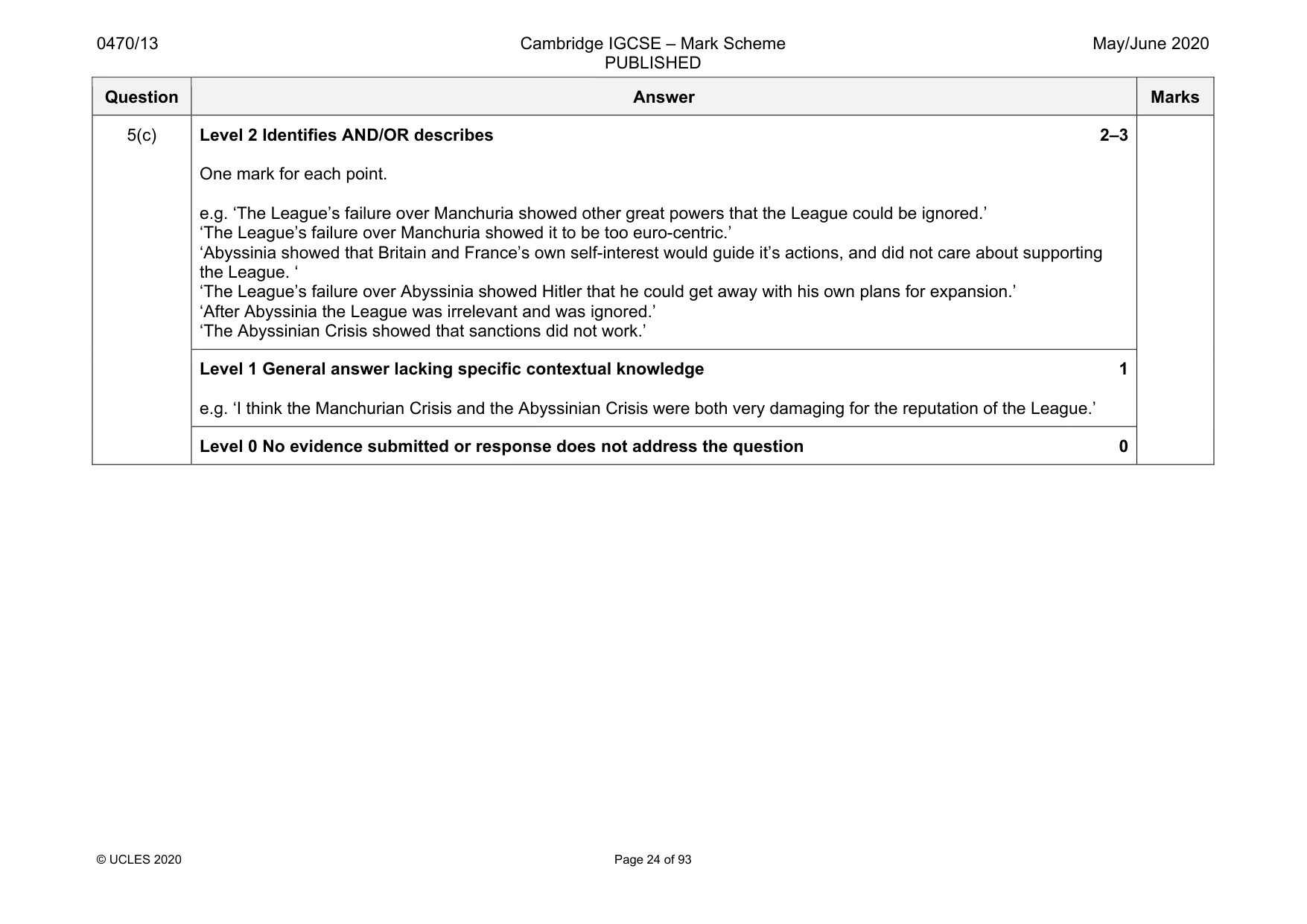
0470/13 Cambridge IGCSE – Mark Scheme PUBLISHED May/June 2020 © UCLES 2020 Page 24 of 93 Question Answer Marks 5(c) Level 2 Identifies AND/OR describes 2–3 One mark for each point. e.g. ‘The League’s failure over Manchuria showed other great powers that the League could be ignored.’ ‘The League’s failure over Manchuria showed it to be too euro-centric.’ ‘Abyssinia showed that Britain and France’s own self-interest would guide it’s actions, and did not care about supporting the League. ‘ ‘The League’s failure over Abyssinia showed Hitler that he could get away with his own plans for expansion.’ ‘After Abyssinia the League was irrelevant and was ignored.’ ‘The Abyssinian Crisis showed that sanctions did not work.’ Level 1 General answer lacking specific contextual knowledge 1 e.g. ‘I think the Manchurian Crisis and the Abyssinian Crisis were both very damaging for the reputation of the League.’ Level 0 No evidence submitted or response does not address the question 0
Mark scheme, page 25
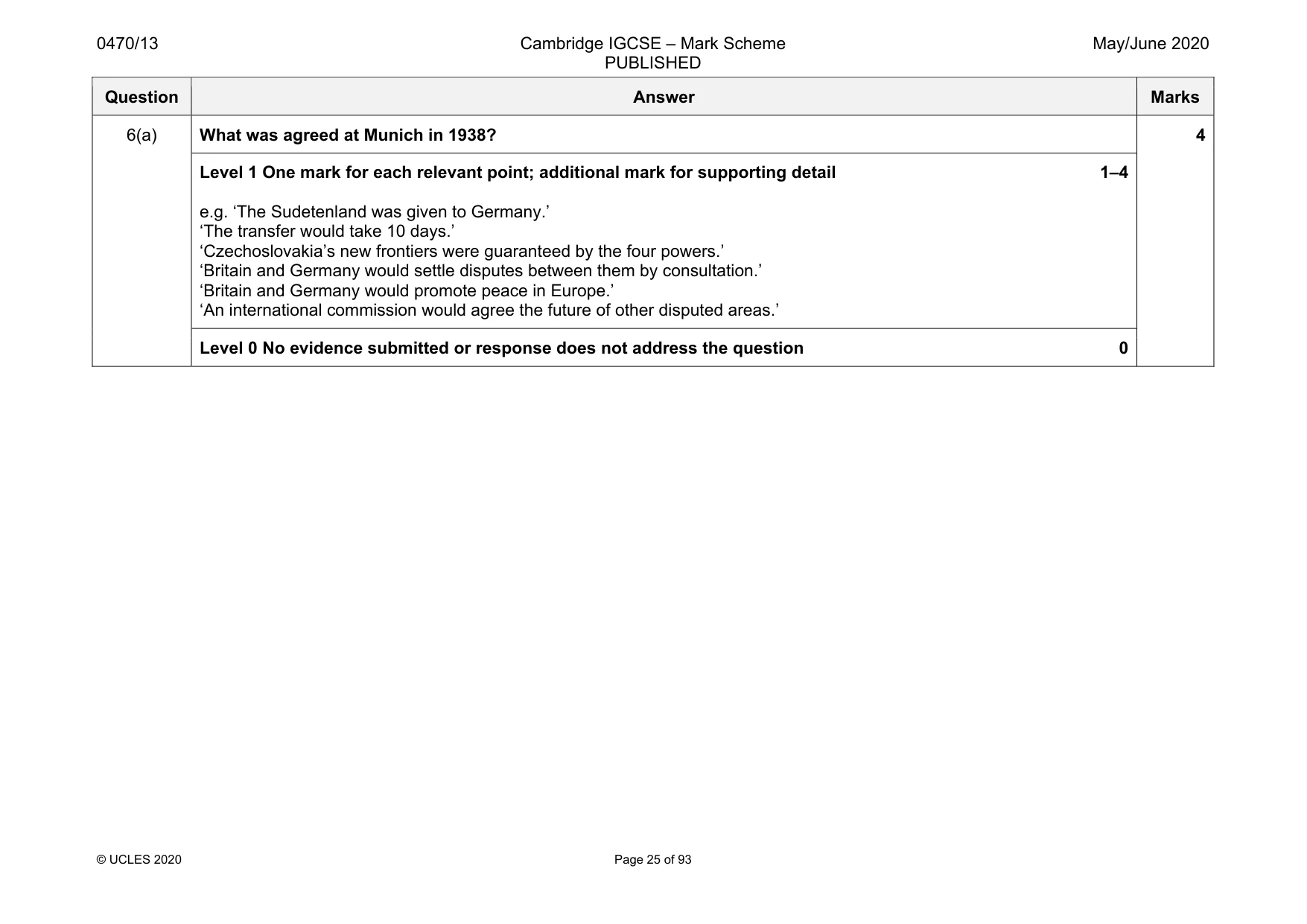
0470/13 Cambridge IGCSE – Mark Scheme PUBLISHED May/June 2020 © UCLES 2020 Page 25 of 93 Question Answer Marks 6(a) What was agreed at Munich in 1938? 4 Level 1 One mark for each relevant point; additional mark for supporting detail 1–4 e.g. ‘The Sudetenland was given to Germany.’ ‘The transfer would take 10 days.’ ‘Czechoslovakia’s new frontiers were guaranteed by the four powers.’ ‘Britain and Germany would settle disputes between them by consultation.’ ‘Britain and Germany would promote peace in Europe.’ ‘An international commission would agree the future of other disputed areas.’ Level 0 No evidence submitted or response does not address the question 0
Mark scheme, page 26
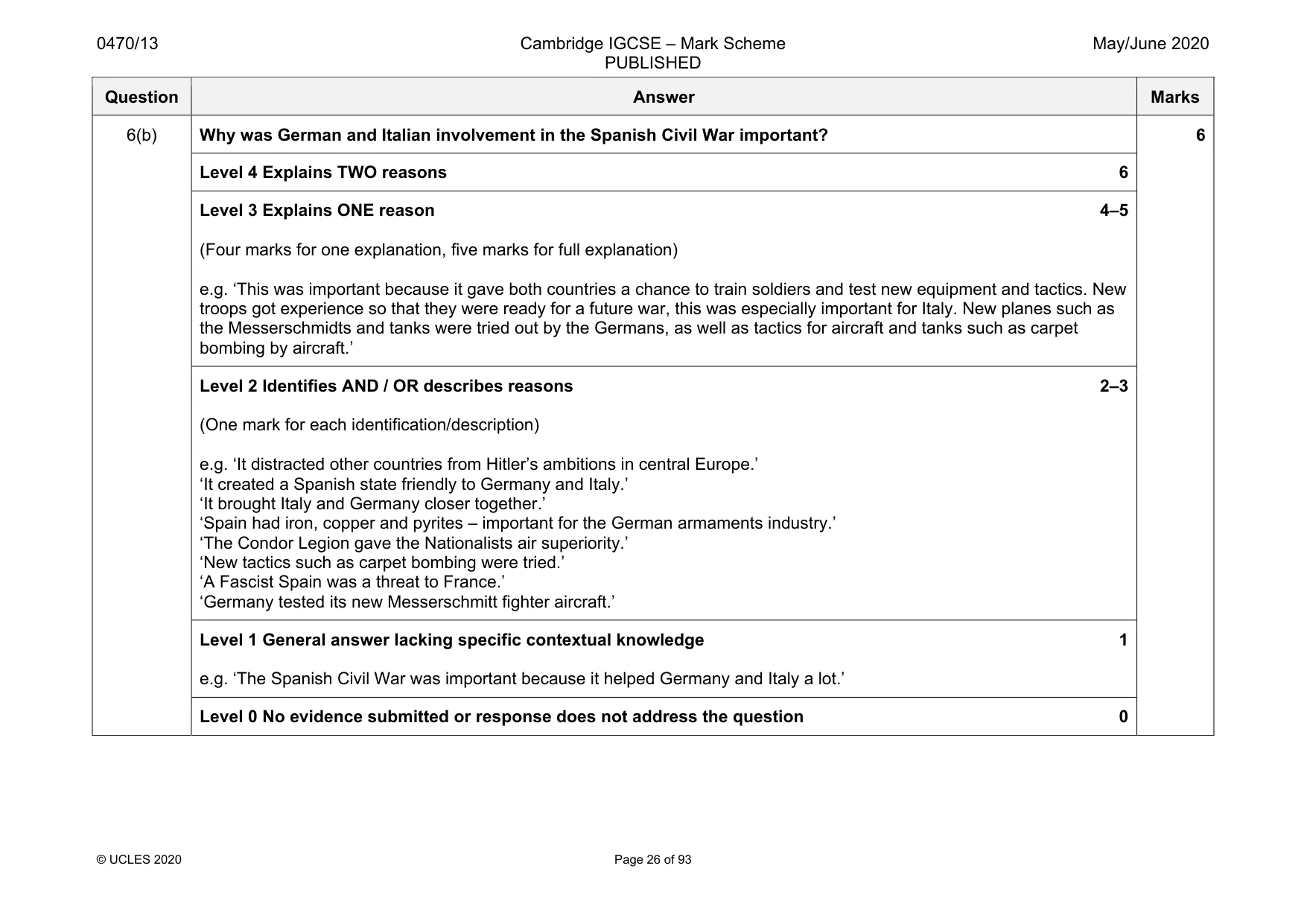
0470/13 Cambridge IGCSE – Mark Scheme PUBLISHED May/June 2020 © UCLES 2020 Page 26 of 93 Question Answer Marks 6(b) Why was German and Italian involvement in the Spanish Civil War important? 6 Level 4 Explains TWO reasons 6 Level 3 Explains ONE reason 4–5 (Four marks for one explanation, five marks for full explanation) e.g. ‘This was important because it gave both countries a chance to train soldiers and test new equipment and tactics. New troops got experience so that they were ready for a future war, this was especially important for Italy. New planes such as the Messerschmidts and tanks were tried out by the Germans, as well as tactics for aircraft and tanks such as carpet bombing by aircraft.’ Level 2 Identifies AND / OR describes reasons 2–3 (One mark for each identification/description) e.g. ‘It distracted other countries from Hitler’s ambitions in central Europe.’ ‘It created a Spanish state friendly to Germany and Italy.’ ‘It brought Italy and Germany closer together.’ ‘Spain had iron, copper and pyrites – important for the German armaments industry.’ ‘The Condor Legion gave the Nationalists air superiority.’ ‘New tactics such as carpet bombing were tried.’ ‘A Fascist Spain was a threat to France.’ ‘Germany tested its new Messerschmitt fighter aircraft.’ Level 1 General answer lacking specific contextual knowledge 1 e.g. ‘The Spanish Civil War was important because it helped Germany and Italy a lot.’ Level 0 No evidence submitted or response does not address the question 0
Mark scheme, page 27
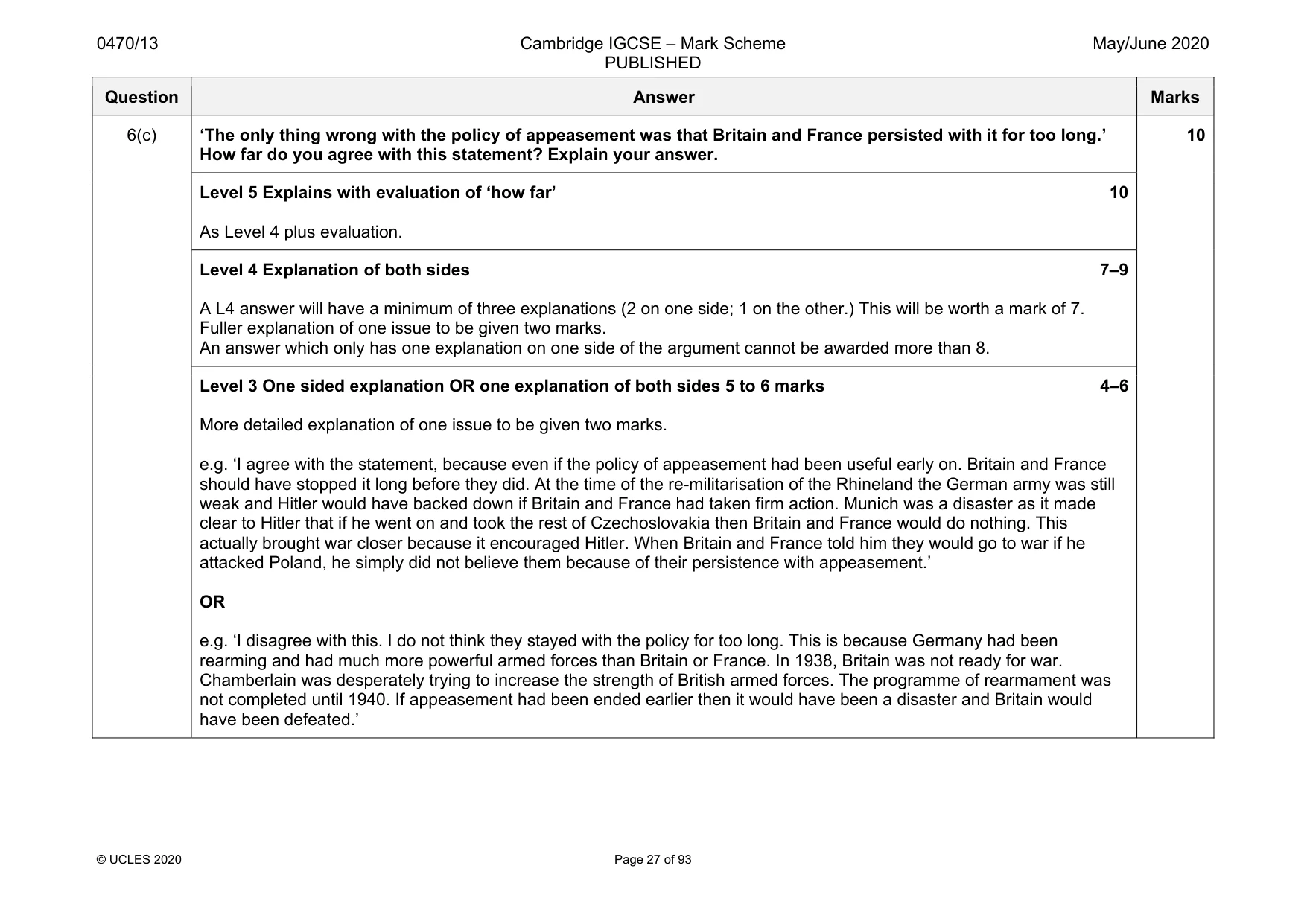
0470/13 Cambridge IGCSE – Mark Scheme PUBLISHED May/June 2020 © UCLES 2020 Page 27 of 93 Question Answer Marks 6(c) ‘The only thing wrong with the policy of appeasement was that Britain and France persisted with it for too long.’ How far do you agree with this statement? Explain your answer. 10 Level 5 Explains with evaluation of ‘how far’ 10 As Level 4 plus evaluation. Level 4 Explanation of both sides 7–9 A L4 answer will have a minimum of three explanations (2 on one side; 1 on the other.) This will be worth a mark of 7. Fuller explanation of one issue to be given two marks. An answer which only has one explanation on one side of the argument cannot be awarded more than 8. Level 3 One sided explanation OR one explanation of both sides 5 to 6 marks 4–6 More detailed explanation of one issue to be given two marks. e.g. ‘I agree with the statement, because even if the policy of appeasement had been useful early on. Britain and France should have stopped it long before they did. At the time of the re-militarisation of the Rhineland the German army was still weak and Hitler would have backed down if Britain and France had taken firm action. Munich was a disaster as it made clear to Hitler that if he went on and took the rest of Czechoslovakia then Britain and France would do nothing. This actually brought war closer because it encouraged Hitler. When Britain and France told him they would go to war if he attacked Poland, he simply did not believe them because of their persistence with appeasement.’ OR e.g. ‘I disagree with this. I do not think they stayed with the policy for too long. This is because Germany had been rearming and had much more powerful armed forces than Britain or France. In 1938, Britain was not ready for war. Chamberlain was desperately trying to increase the strength of British armed forces. The programme of rearmament was not completed until 1940. If appeasement had been ended earlier then it would have been a disaster and Britain would have been defeated.’
Mark scheme, page 28
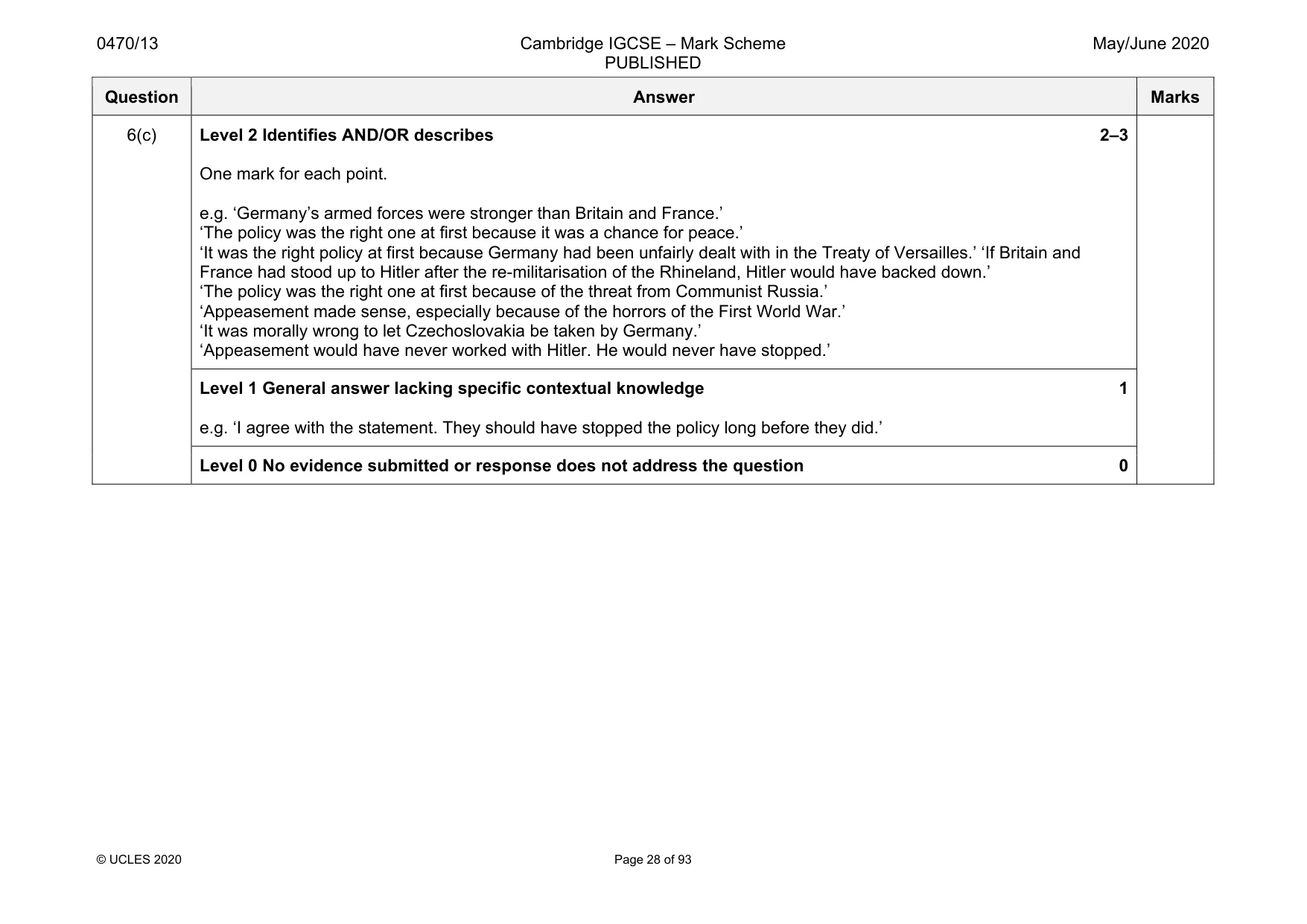
0470/13 Cambridge IGCSE – Mark Scheme PUBLISHED May/June 2020 © UCLES 2020 Page 28 of 93 Question Answer Marks 6(c) Level 2 Identifies AND/OR describes 2–3 One mark for each point. e.g. ‘Germany’s armed forces were stronger than Britain and France.’ ‘The policy was the right one at first because it was a chance for peace.’ ‘It was the right policy at first because Germany had been unfairly dealt with in the Treaty of Versailles.’ ‘If Britain and France had stood up to Hitler after the re-militarisation of the Rhineland, Hitler would have backed down.’ ‘The policy was the right one at first because of the threat from Communist Russia.’ ‘Appeasement made sense, especially because of the horrors of the First World War.’ ‘It was morally wrong to let Czechoslovakia be taken by Germany.’ ‘Appeasement would have never worked with Hitler. He would never have stopped.’ Level 1 General answer lacking specific contextual knowledge 1 e.g. ‘I agree with the statement. They should have stopped the policy long before they did.’ Level 0 No evidence submitted or response does not address the question 0
Mark scheme, page 29
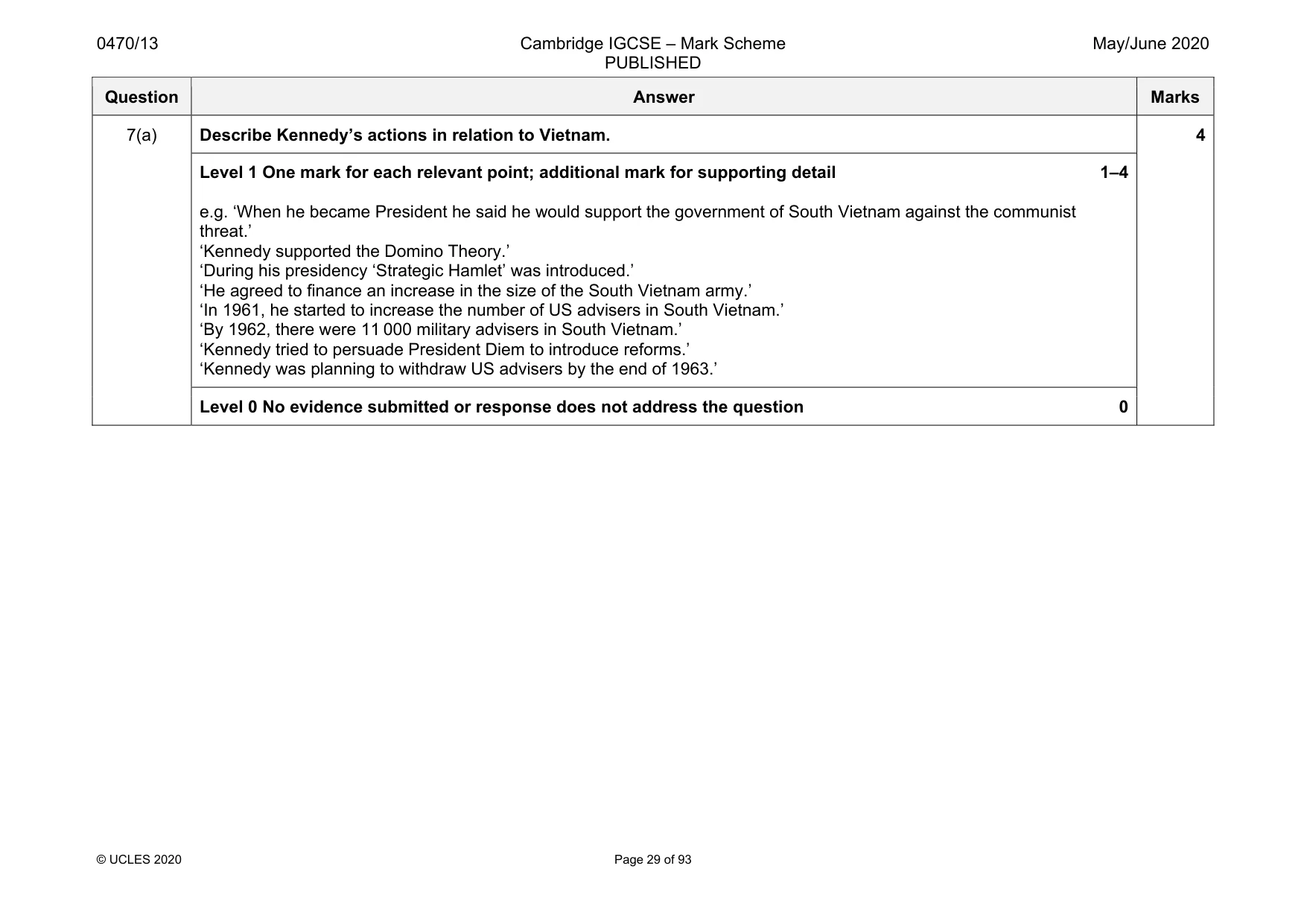
0470/13 Cambridge IGCSE – Mark Scheme PUBLISHED May/June 2020 © UCLES 2020 Page 29 of 93 Question Answer Marks 7(a) Describe Kennedy’s actions in relation to Vietnam. 4 Level 1 One mark for each relevant point; additional mark for supporting detail 1–4 e.g. ‘When he became President he said he would support the government of South Vietnam against the communist threat.’ ‘Kennedy supported the Domino Theory.’ ‘During his presidency ‘Strategic Hamlet’ was introduced.’ ‘He agreed to finance an increase in the size of the South Vietnam army.’ ‘In 1961, he started to increase the number of US advisers in South Vietnam.’ ‘By 1962, there were 11 000 military advisers in South Vietnam.’ ‘Kennedy tried to persuade President Diem to introduce reforms.’ ‘Kennedy was planning to withdraw US advisers by the end of 1963.’ Level 0 No evidence submitted or response does not address the question 0
Mark scheme, page 30
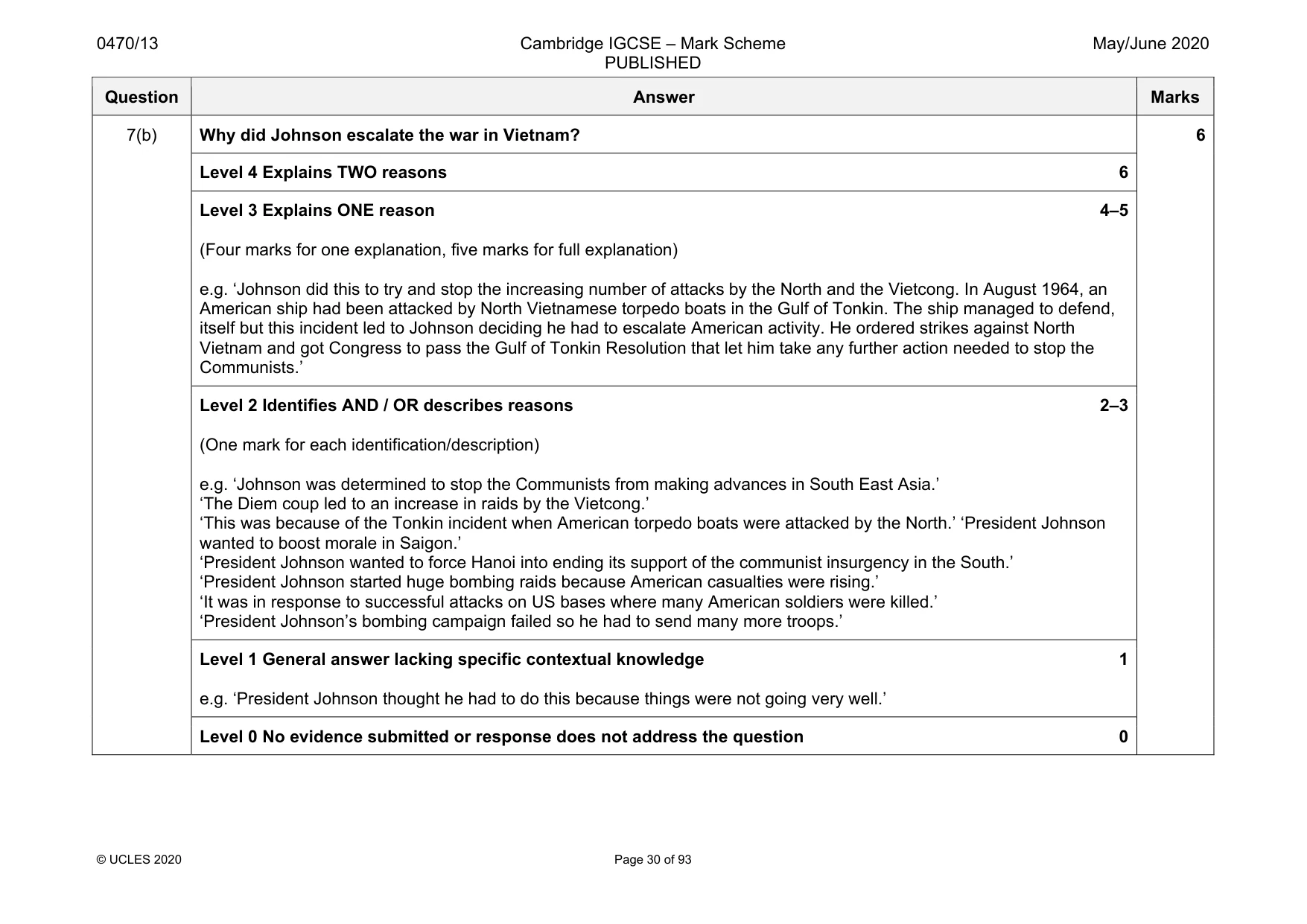
0470/13 Cambridge IGCSE – Mark Scheme PUBLISHED May/June 2020 © UCLES 2020 Page 30 of 93 Question Answer Marks 7(b) Why did Johnson escalate the war in Vietnam? 6 Level 4 Explains TWO reasons 6 Level 3 Explains ONE reason 4–5 (Four marks for one explanation, five marks for full explanation) e.g. ‘Johnson did this to try and stop the increasing number of attacks by the North and the Vietcong. In August 1964, an American ship had been attacked by North Vietnamese torpedo boats in the Gulf of Tonkin. The ship managed to defend, itself but this incident led to Johnson deciding he had to escalate American activity. He ordered strikes against North Vietnam and got Congress to pass the Gulf of Tonkin Resolution that let him take any further action needed to stop the Communists.’ Level 2 Identifies AND / OR describes reasons 2–3 (One mark for each identification/description) e.g. ‘Johnson was determined to stop the Communists from making advances in South East Asia.’ ‘The Diem coup led to an increase in raids by the Vietcong.’ ‘This was because of the Tonkin incident when American torpedo boats were attacked by the North.’ ‘President Johnson wanted to boost morale in Saigon.’ ‘President Johnson wanted to force Hanoi into ending its support of the communist insurgency in the South.’ ‘President Johnson started huge bombing raids because American casualties were rising.’ ‘It was in response to successful attacks on US bases where many American soldiers were killed.’ ‘President Johnson’s bombing campaign failed so he had to send many more troops.’ Level 1 General answer lacking specific contextual knowledge 1 e.g. ‘President Johnson thought he had to do this because things were not going very well.’ Level 0 No evidence submitted or response does not address the question 0
Mark scheme, page 31
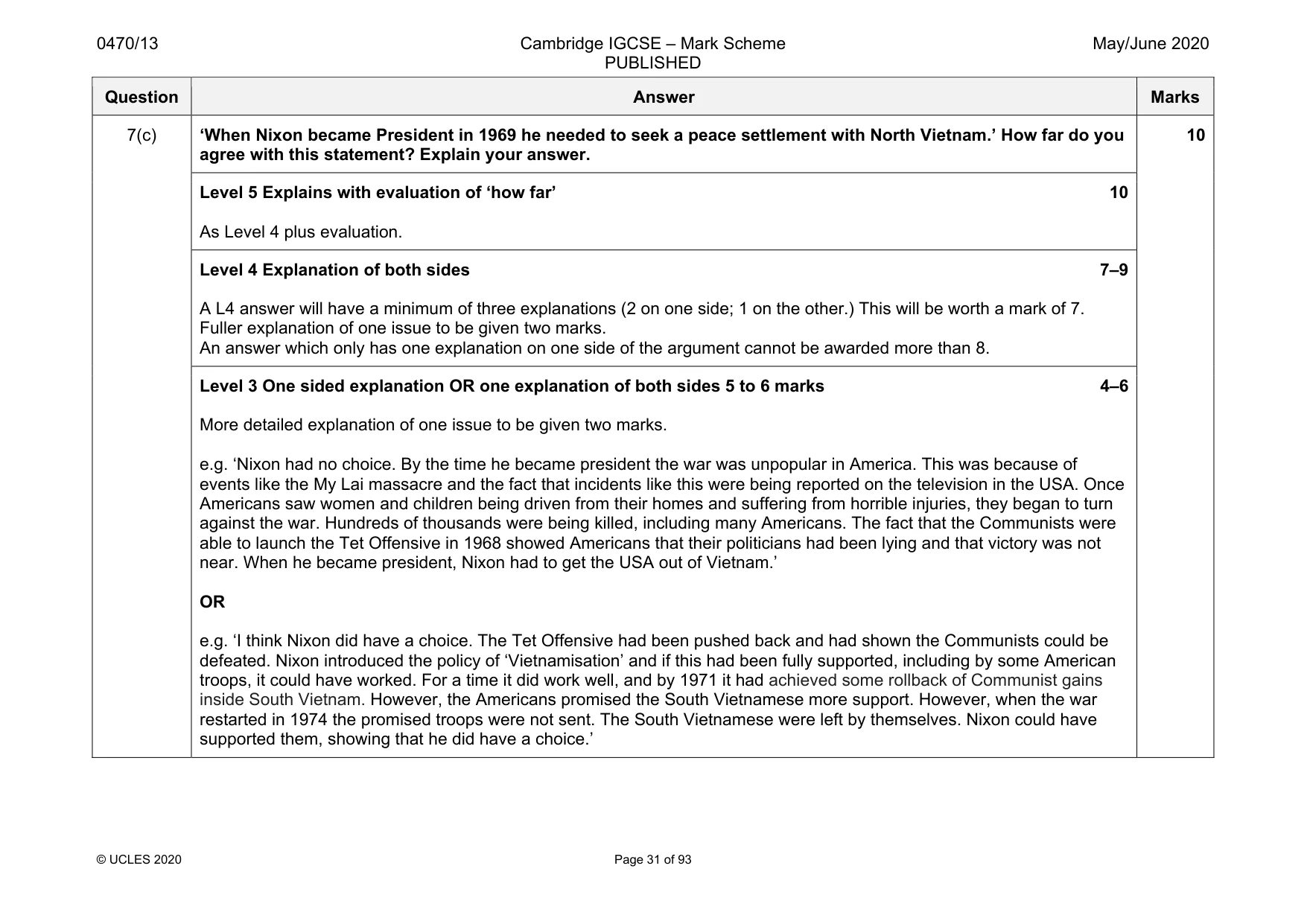
0470/13 Cambridge IGCSE – Mark Scheme PUBLISHED May/June 2020 © UCLES 2020 Page 31 of 93 Question Answer Marks 7(c) ‘When Nixon became President in 1969 he needed to seek a peace settlement with North Vietnam.’ How far do you agree with this statement? Explain your answer. 10 Level 5 Explains with evaluation of ‘how far’ 10 As Level 4 plus evaluation. Level 4 Explanation of both sides 7–9 A L4 answer will have a minimum of three explanations (2 on one side; 1 on the other.) This will be worth a mark of 7. Fuller explanation of one issue to be given two marks. An answer which only has one explanation on one side of the argument cannot be awarded more than 8. Level 3 One sided explanation OR one explanation of both sides 5 to 6 marks 4–6 More detailed explanation of one issue to be given two marks. e.g. ‘Nixon had no choice. By the time he became president the war was unpopular in America. This was because of events like the My Lai massacre and the fact that incidents like this were being reported on the television in the USA. Once Americans saw women and children being driven from their homes and suffering from horrible injuries, they began to turn against the war. Hundreds of thousands were being killed, including many Americans. The fact that the Communists were able to launch the Tet Offensive in 1968 showed Americans that their politicians had been lying and that victory was not near. When he became president, Nixon had to get the USA out of Vietnam.’ OR e.g. ‘I think Nixon did have a choice. The Tet Offensive had been pushed back and had shown the Communists could be defeated. Nixon introduced the policy of ‘Vietnamisation’ and if this had been fully supported, including by some American troops, it could have worked. For a time it did work well, and by 1971 it had achieved some rollback of Communist gains inside South Vietnam. However, the Americans promised the South Vietnamese more support. However, when the war restarted in 1974 the promised troops were not sent. The South Vietnamese were left by themselves. Nixon could have supported them, showing that he did have a choice.’
Mark scheme, page 32
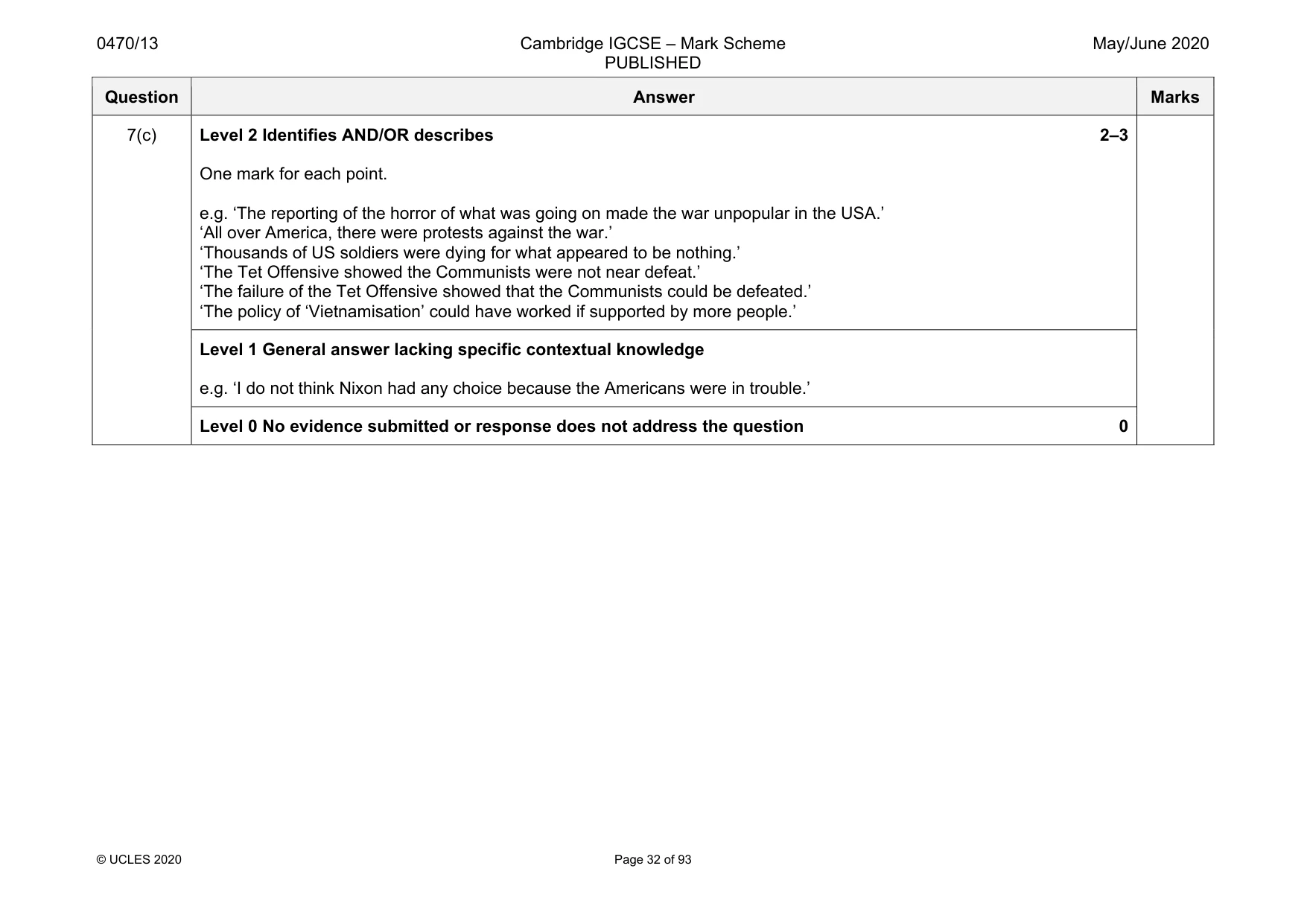
0470/13 Cambridge IGCSE – Mark Scheme PUBLISHED May/June 2020 © UCLES 2020 Page 32 of 93 Question Answer Marks 7(c) Level 2 Identifies AND/OR describes 2–3 One mark for each point. e.g. ‘The reporting of the horror of what was going on made the war unpopular in the USA.’ ‘All over America, there were protests against the war.’ ‘Thousands of US soldiers were dying for what appeared to be nothing.’ ‘The Tet Offensive showed the Communists were not near defeat.’ ‘The failure of the Tet Offensive showed that the Communists could be defeated.’ ‘The policy of ‘Vietnamisation’ could have worked if supported by more people.’ Level 1 General answer lacking specific contextual knowledge e.g. ‘I do not think Nixon had any choice because the Americans were in trouble.’ Level 0 No evidence submitted or response does not address the question 0
Mark scheme, page 33
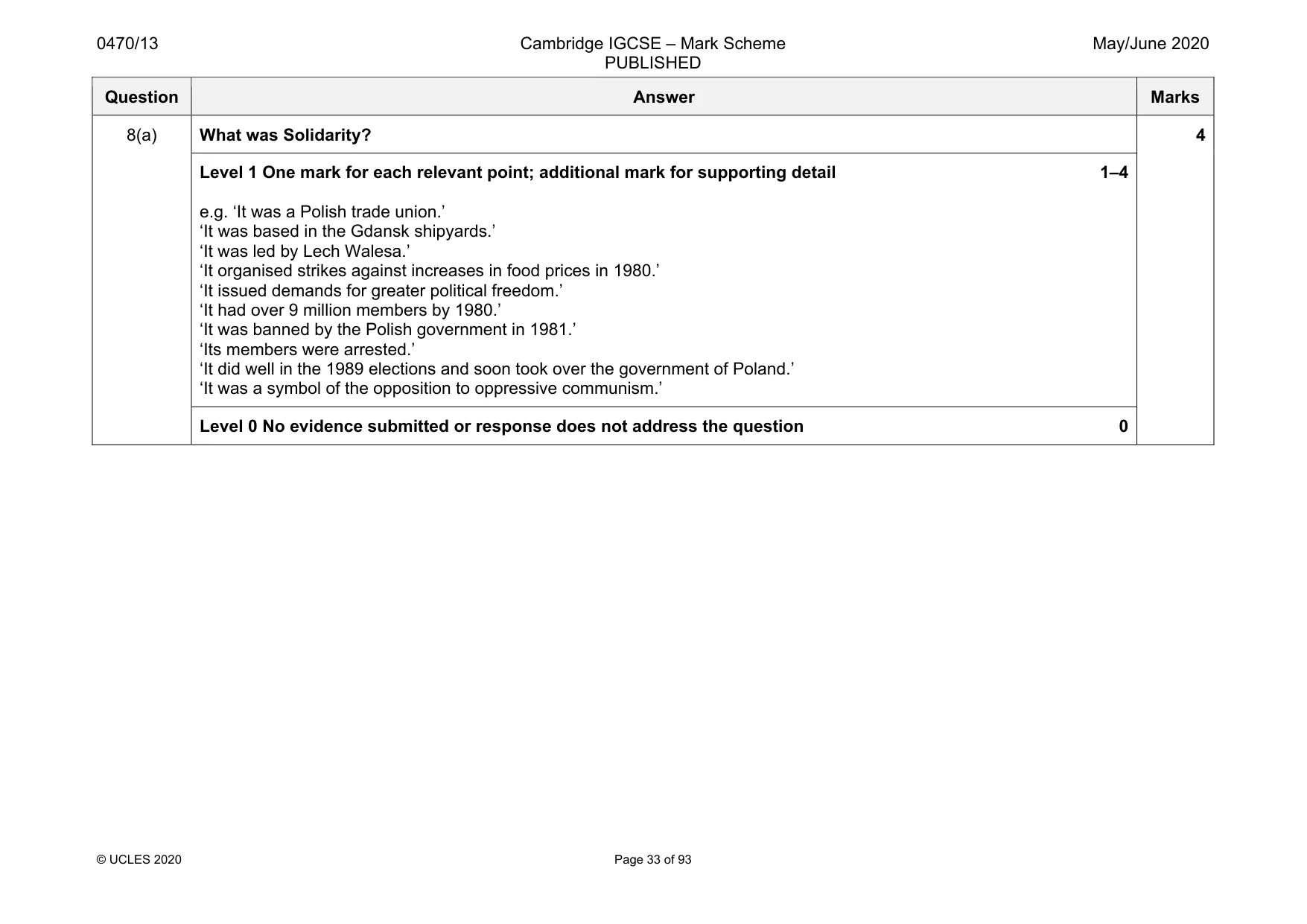
0470/13 Cambridge IGCSE – Mark Scheme PUBLISHED May/June 2020 © UCLES 2020 Page 33 of 93 Question Answer Marks 8(a) What was Solidarity? 4 Level 1 One mark for each relevant point; additional mark for supporting detail 1–4 e.g. ‘It was a Polish trade union.’ ‘It was based in the Gdansk shipyards.’ ‘It was led by Lech Walesa.’ ‘It organised strikes against increases in food prices in 1980.’ ‘It issued demands for greater political freedom.’ ‘It had over 9 million members by 1980.’ ‘It was banned by the Polish government in 1981.’ ‘Its members were arrested.’ ‘It did well in the 1989 elections and soon took over the government of Poland.’ ‘It was a symbol of the opposition to oppressive communism.’ Level 0 No evidence submitted or response does not address the question 0
Mark scheme, page 34
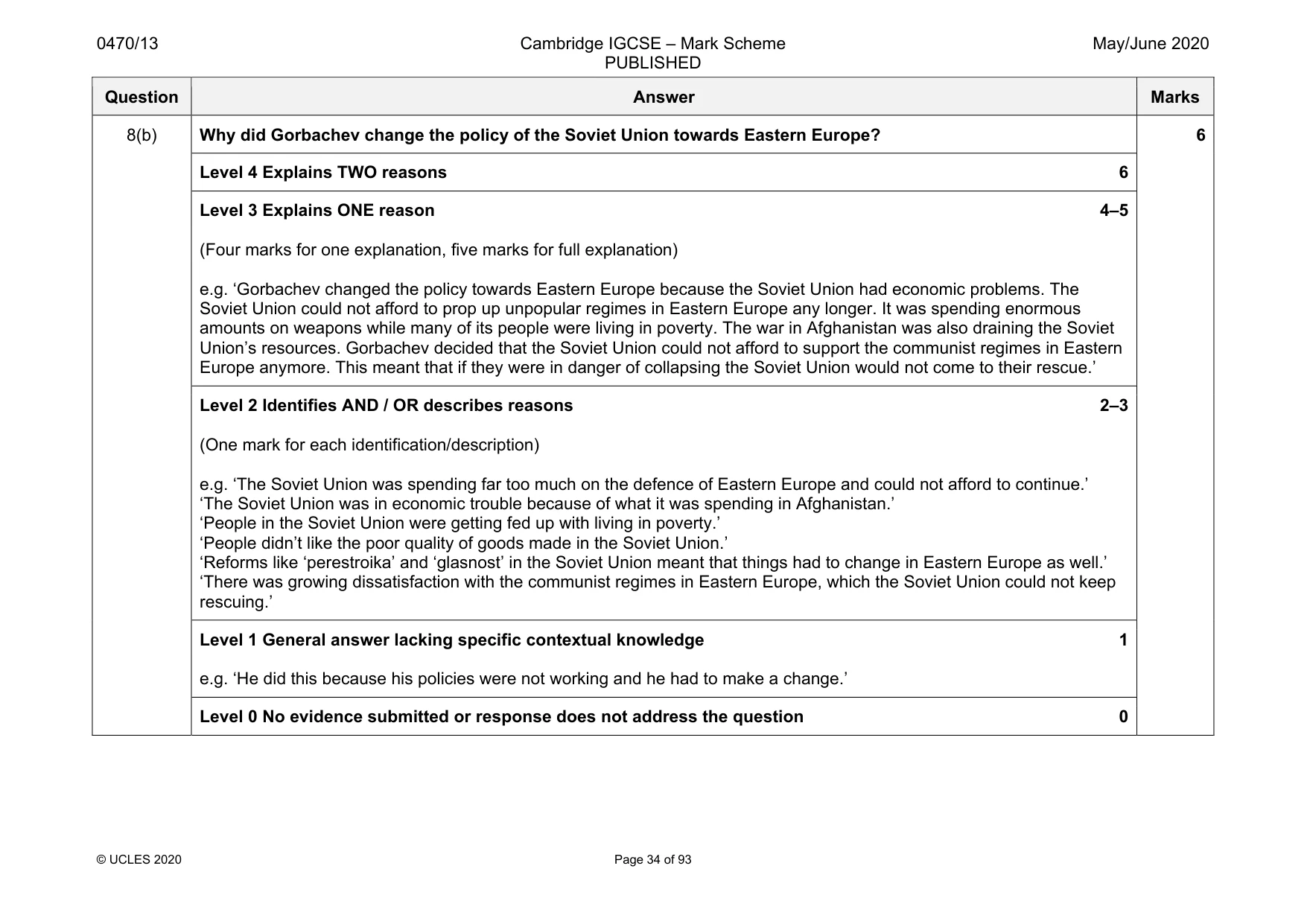
0470/13 Cambridge IGCSE – Mark Scheme PUBLISHED May/June 2020 © UCLES 2020 Page 34 of 93 Question Answer Marks 8(b) Why did Gorbachev change the policy of the Soviet Union towards Eastern Europe? 6 Level 4 Explains TWO reasons 6 Level 3 Explains ONE reason 4–5 (Four marks for one explanation, five marks for full explanation) e.g. ‘Gorbachev changed the policy towards Eastern Europe because the Soviet Union had economic problems. The Soviet Union could not afford to prop up unpopular regimes in Eastern Europe any longer. It was spending enormous amounts on weapons while many of its people were living in poverty. The war in Afghanistan was also draining the Soviet Union’s resources. Gorbachev decided that the Soviet Union could not afford to support the communist regimes in Eastern Europe anymore. This meant that if they were in danger of collapsing the Soviet Union would not come to their rescue.’ Level 2 Identifies AND / OR describes reasons 2–3 (One mark for each identification/description) e.g. ‘The Soviet Union was spending far too much on the defence of Eastern Europe and could not afford to continue.’ ‘The Soviet Union was in economic trouble because of what it was spending in Afghanistan.’ ‘People in the Soviet Union were getting fed up with living in poverty.’ ‘People didn’t like the poor quality of goods made in the Soviet Union.’ ‘Reforms like ‘perestroika’ and ‘glasnost’ in the Soviet Union meant that things had to change in Eastern Europe as well.’ ‘There was growing dissatisfaction with the communist regimes in Eastern Europe, which the Soviet Union could not keep rescuing.’ Level 1 General answer lacking specific contextual knowledge 1 e.g. ‘He did this because his policies were not working and he had to make a change.’ Level 0 No evidence submitted or response does not address the question 0
Mark scheme, page 35
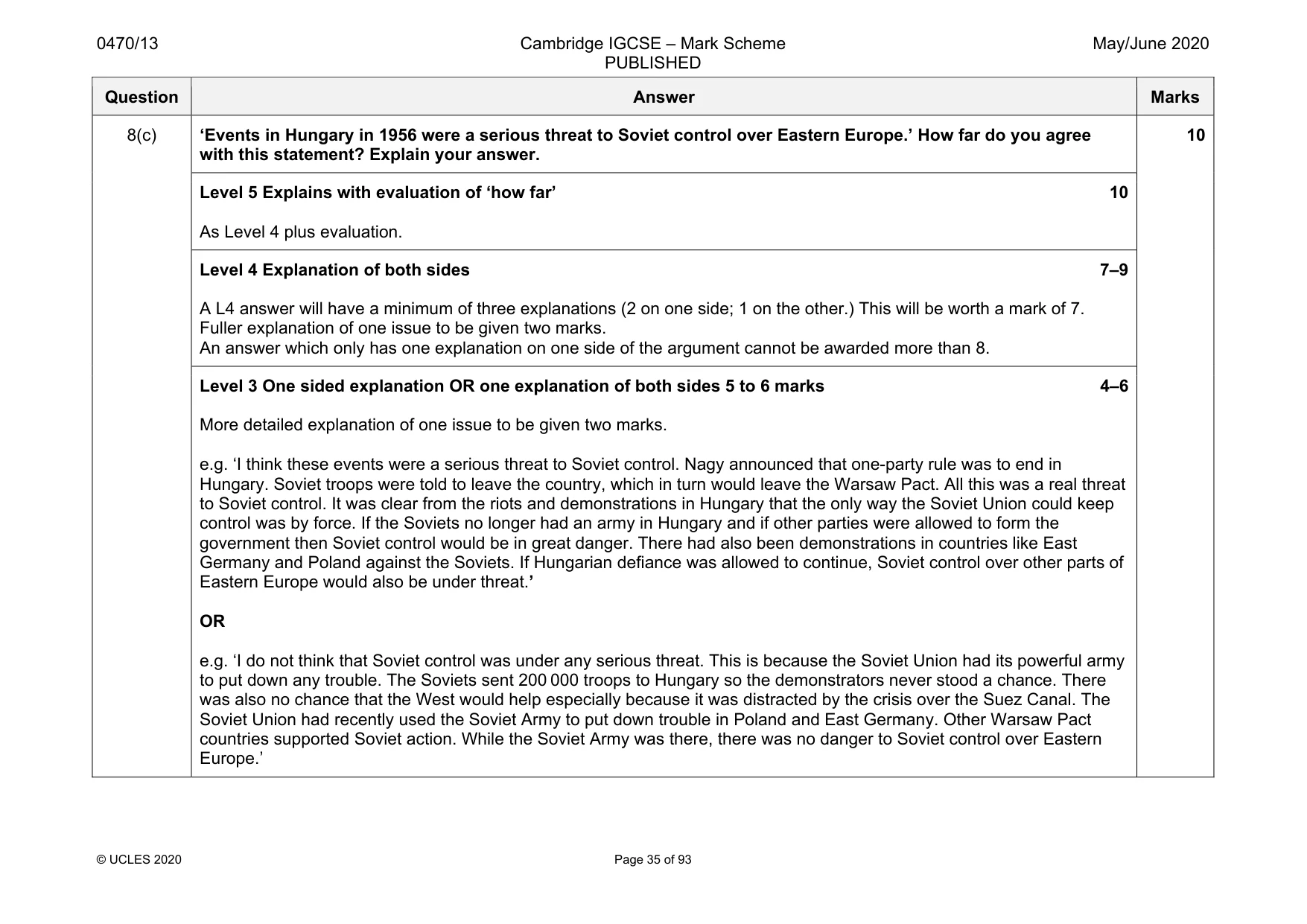
0470/13 Cambridge IGCSE – Mark Scheme PUBLISHED May/June 2020 © UCLES 2020 Page 35 of 93 Question Answer Marks 8(c) ‘Events in Hungary in 1956 were a serious threat to Soviet control over Eastern Europe.’ How far do you agree with this statement? Explain your answer. 10 Level 5 Explains with evaluation of ‘how far’ 10 As Level 4 plus evaluation. Level 4 Explanation of both sides 7–9 A L4 answer will have a minimum of three explanations (2 on one side; 1 on the other.) This will be worth a mark of 7. Fuller explanation of one issue to be given two marks. An answer which only has one explanation on one side of the argument cannot be awarded more than 8. Level 3 One sided explanation OR one explanation of both sides 5 to 6 marks 4–6 More detailed explanation of one issue to be given two marks. e.g. ‘I think these events were a serious threat to Soviet control. Nagy announced that one-party rule was to end in Hungary. Soviet troops were told to leave the country, which in turn would leave the Warsaw Pact. All this was a real threat to Soviet control. It was clear from the riots and demonstrations in Hungary that the only way the Soviet Union could keep control was by force. If the Soviets no longer had an army in Hungary and if other parties were allowed to form the government then Soviet control would be in great danger. There had also been demonstrations in countries like East Germany and Poland against the Soviets. If Hungarian defiance was allowed to continue, Soviet control over other parts of Eastern Europe would also be under threat.’ OR e.g. ‘I do not think that Soviet control was under any serious threat. This is because the Soviet Union had its powerful army to put down any trouble. The Soviets sent 200 000 troops to Hungary so the demonstrators never stood a chance. There was also no chance that the West would help especially because it was distracted by the crisis over the Suez Canal. The Soviet Union had recently used the Soviet Army to put down trouble in Poland and East Germany. Other Warsaw Pact countries supported Soviet action. While the Soviet Army was there, there was no danger to Soviet control over Eastern Europe.’
Mark scheme, page 36
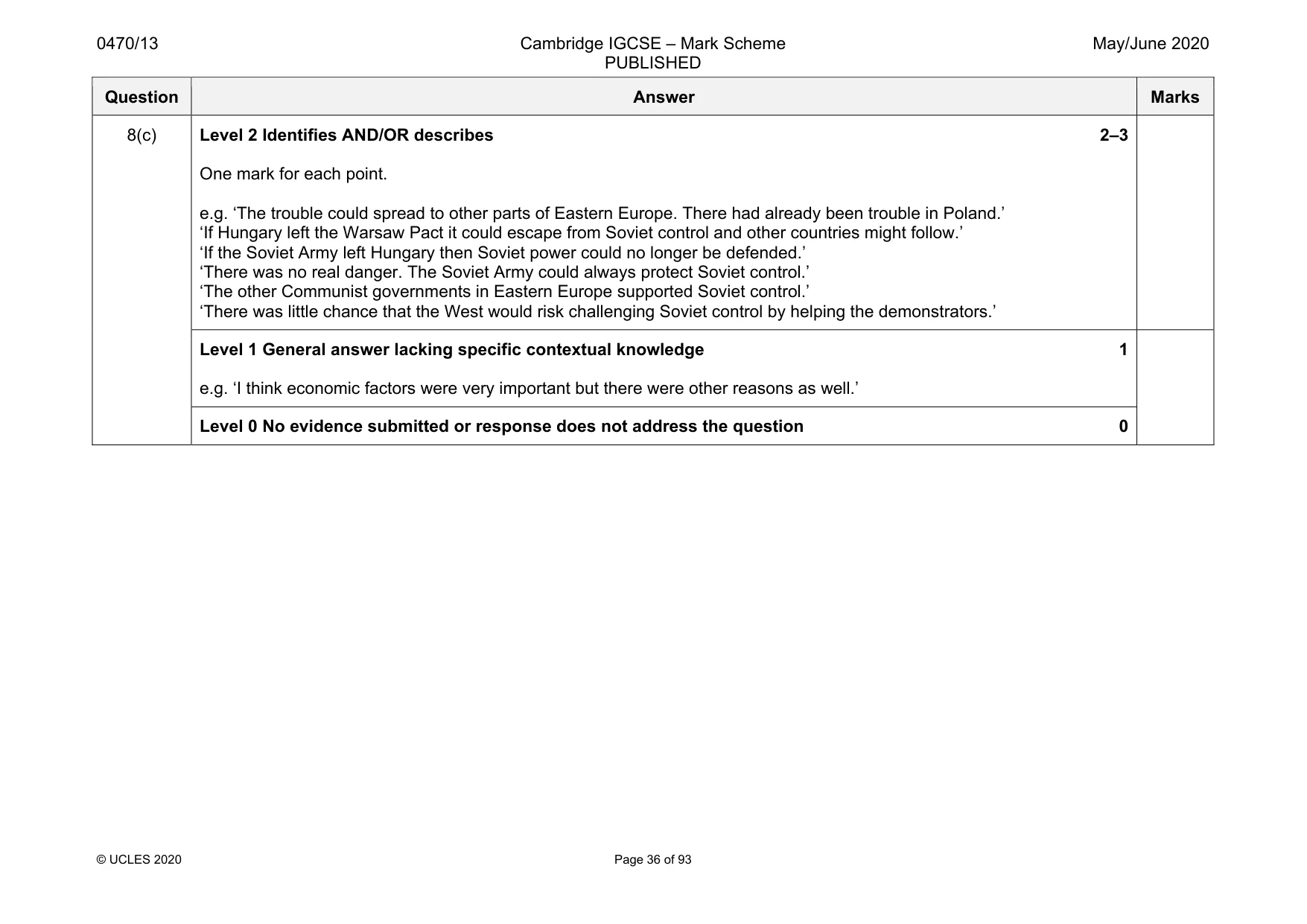
0470/13 Cambridge IGCSE – Mark Scheme PUBLISHED May/June 2020 © UCLES 2020 Page 36 of 93 Question Answer Marks 8(c) Level 2 Identifies AND/OR describes 2–3 One mark for each point. e.g. ‘The trouble could spread to other parts of Eastern Europe. There had already been trouble in Poland.’ ‘If Hungary left the Warsaw Pact it could escape from Soviet control and other countries might follow.’ ‘If the Soviet Army left Hungary then Soviet power could no longer be defended.’ ‘There was no real danger. The Soviet Army could always protect Soviet control.’ ‘The other Communist governments in Eastern Europe supported Soviet control.’ ‘There was little chance that the West would risk challenging Soviet control by helping the demonstrators.’ Level 1 General answer lacking specific contextual knowledge 1 e.g. ‘I think economic factors were very important but there were other reasons as well.’ Level 0 No evidence submitted or response does not address the question 0
Mark scheme, page 37
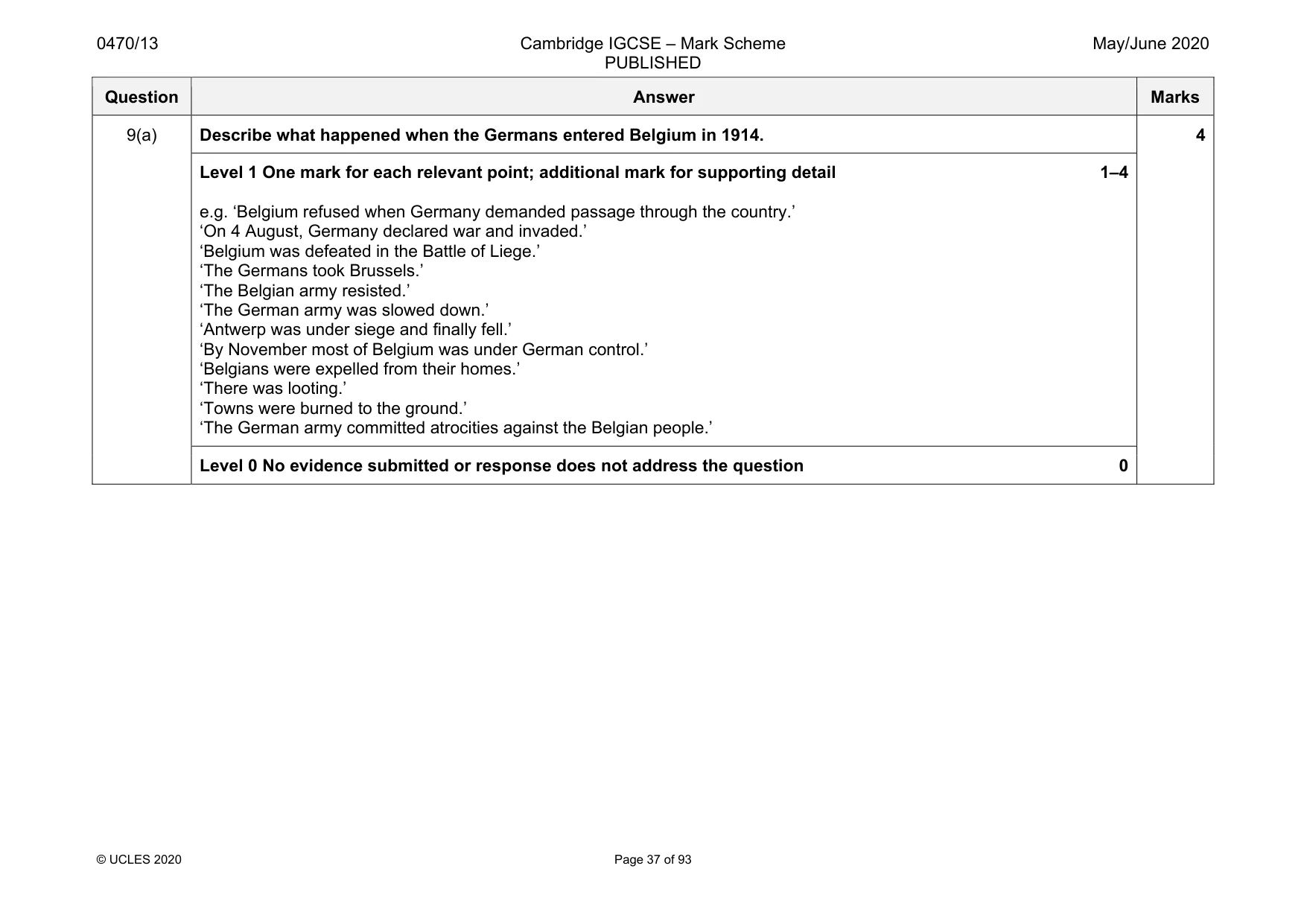
0470/13 Cambridge IGCSE – Mark Scheme PUBLISHED May/June 2020 © UCLES 2020 Page 37 of 93 Question Answer Marks 9(a) Describe what happened when the Germans entered Belgium in 1914. 4 Level 1 One mark for each relevant point; additional mark for supporting detail 1–4 e.g. ‘Belgium refused when Germany demanded passage through the country.’ ‘On 4 August, Germany declared war and invaded.’ ‘Belgium was defeated in the Battle of Liege.’ ‘The Germans took Brussels.’ ‘The Belgian army resisted.’ ‘The German army was slowed down.’ ‘Antwerp was under siege and finally fell.’ ‘By November most of Belgium was under German control.’ ‘Belgians were expelled from their homes.’ ‘There was looting.’ ‘Towns were burned to the ground.’ ‘The German army committed atrocities against the Belgian people.’ Level 0 No evidence submitted or response does not address the question 0
Mark scheme, page 38
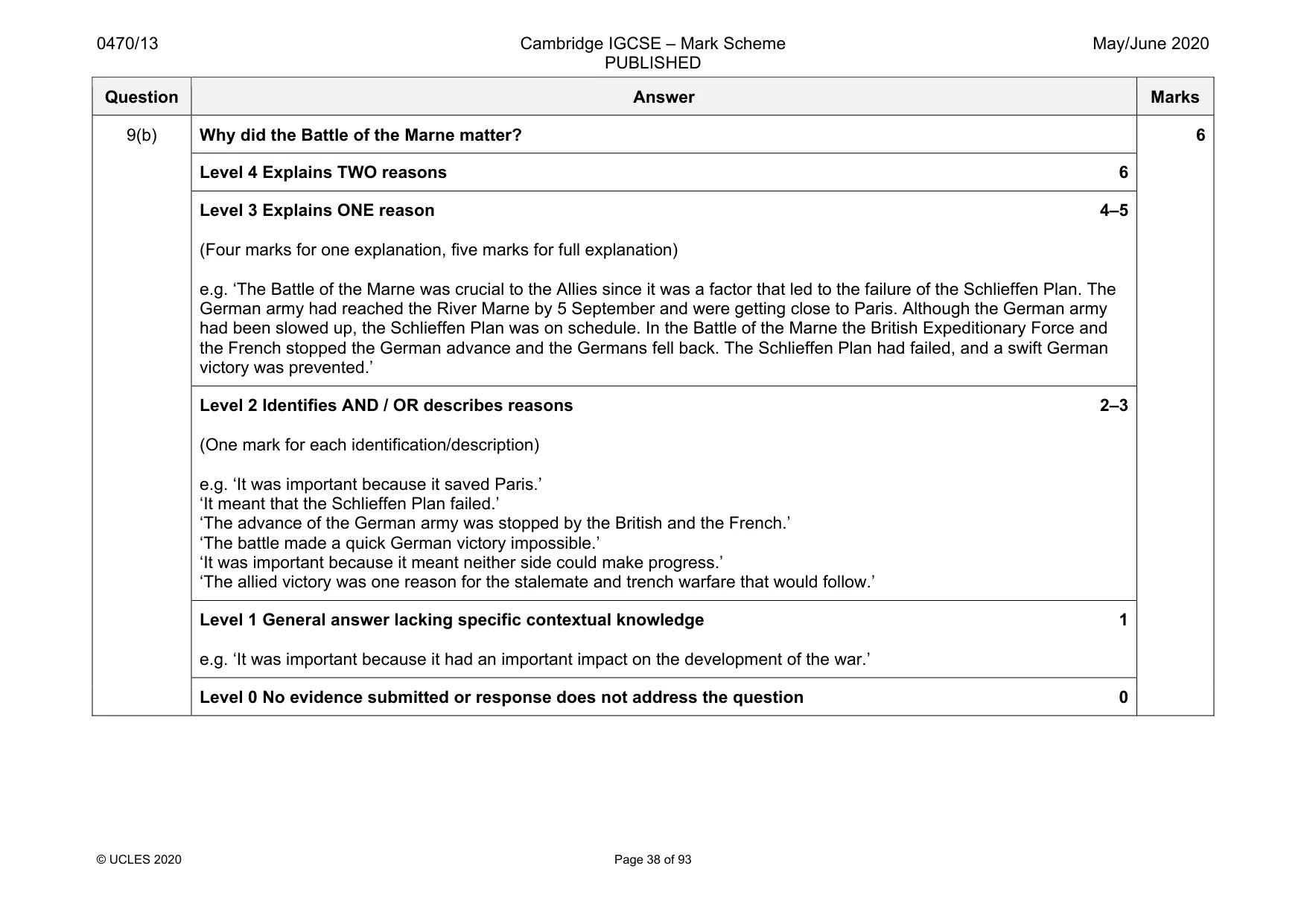
0470/13 Cambridge IGCSE – Mark Scheme PUBLISHED May/June 2020 © UCLES 2020 Page 38 of 93 Question Answer Marks 9(b) Why did the Battle of the Marne matter? 6 Level 4 Explains TWO reasons 6 Level 3 Explains ONE reason 4–5 (Four marks for one explanation, five marks for full explanation) e.g. ‘The Battle of the Marne was crucial to the Allies since it was a factor that led to the failure of the Schlieffen Plan. The German army had reached the River Marne by 5 September and were getting close to Paris. Although the German army had been slowed up, the Schlieffen Plan was on schedule. In the Battle of the Marne the British Expeditionary Force and the French stopped the German advance and the Germans fell back. The Schlieffen Plan had failed, and a swift German victory was prevented.’ Level 2 Identifies AND / OR describes reasons 2–3 (One mark for each identification/description) e.g. ‘It was important because it saved Paris.’ ‘It meant that the Schlieffen Plan failed.’ ‘The advance of the German army was stopped by the British and the French.’ ‘The battle made a quick German victory impossible.’ ‘It was important because it meant neither side could make progress.’ ‘The allied victory was one reason for the stalemate and trench warfare that would follow.’ Level 1 General answer lacking specific contextual knowledge 1 e.g. ‘It was important because it had an important impact on the development of the war.’ Level 0 No evidence submitted or response does not address the question 0
Mark scheme, page 39
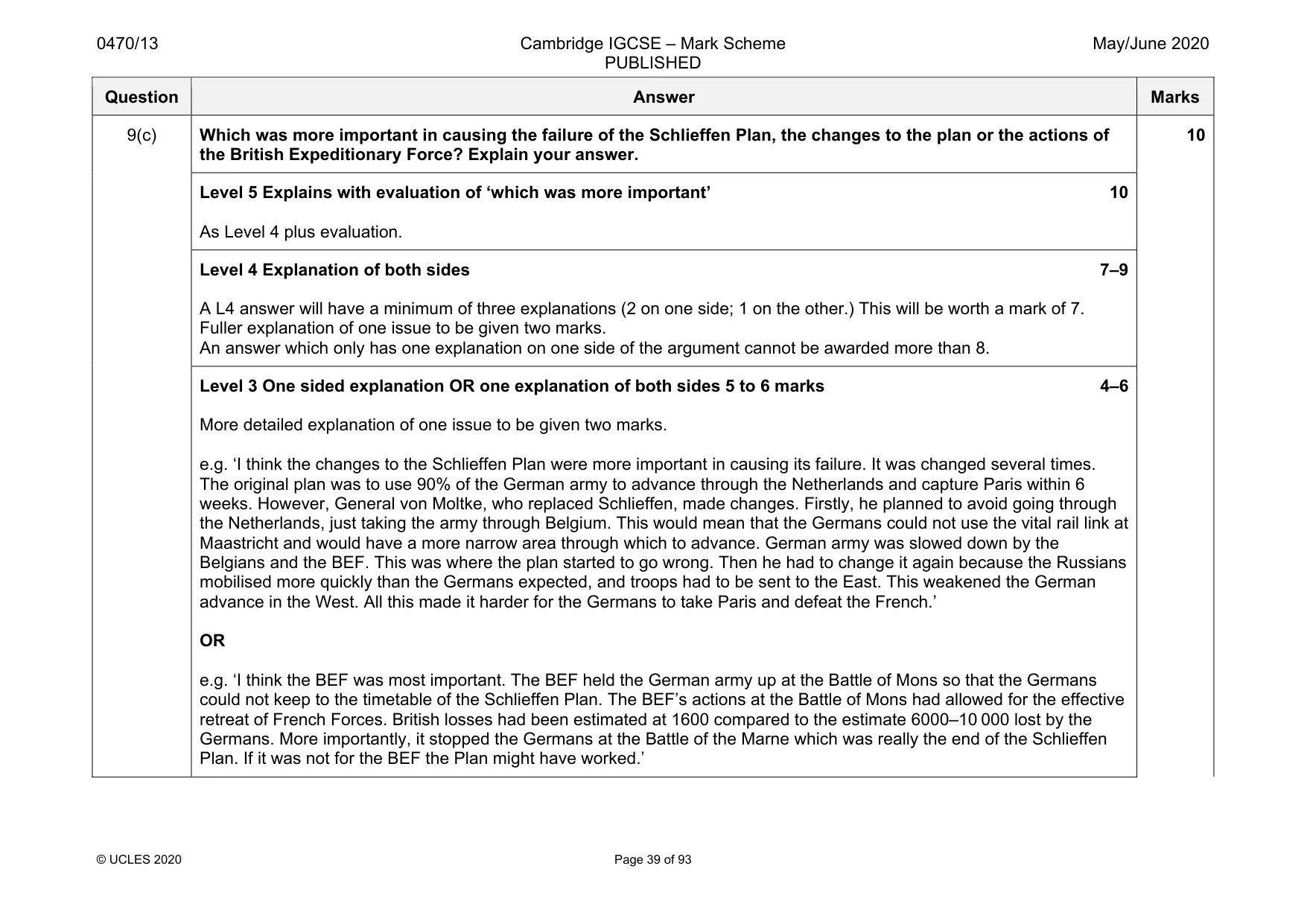
0470/13 Cambridge IGCSE – Mark Scheme PUBLISHED May/June 2020 © UCLES 2020 Page 39 of 93 Question Answer Marks 9(c) Which was more important in causing the failure of the Schlieffen Plan, the changes to the plan or the actions of the British Expeditionary Force? Explain your answer. 10 Level 5 Explains with evaluation of ‘which was more important’ 10 As Level 4 plus evaluation. Level 4 Explanation of both sides 7–9 A L4 answer will have a minimum of three explanations (2 on one side; 1 on the other.) This will be worth a mark of 7. Fuller explanation of one issue to be given two marks. An answer which only has one explanation on one side of the argument cannot be awarded more than 8. Level 3 One sided explanation OR one explanation of both sides 5 to 6 marks 4–6 More detailed explanation of one issue to be given two marks. e.g. ‘I think the changes to the Schlieffen Plan were more important in causing its failure. It was changed several times. The original plan was to use 90% of the German army to advance through the Netherlands and capture Paris within 6 weeks. However, General von Moltke, who replaced Schlieffen, made changes. Firstly, he planned to avoid going through the Netherlands, just taking the army through Belgium. This would mean that the Germans could not use the vital rail link at Maastricht and would have a more narrow area through which to advance. German army was slowed down by the Belgians and the BEF. This was where the plan started to go wrong. Then he had to change it again because the Russians mobilised more quickly than the Germans expected, and troops had to be sent to the East. This weakened the German advance in the West. All this made it harder for the Germans to take Paris and defeat the French.’ OR e.g. ‘I think the BEF was most important. The BEF held the German army up at the Battle of Mons so that the Germans could not keep to the timetable of the Schlieffen Plan. The BEF’s actions at the Battle of Mons had allowed for the effective retreat of French Forces. British losses had been estimated at 1600 compared to the estimate 6000–10 000 lost by the Germans. More importantly, it stopped the Germans at the Battle of the Marne which was really the end of the Schlieffen Plan. If it was not for the BEF the Plan might have worked.’
Mark scheme, page 40
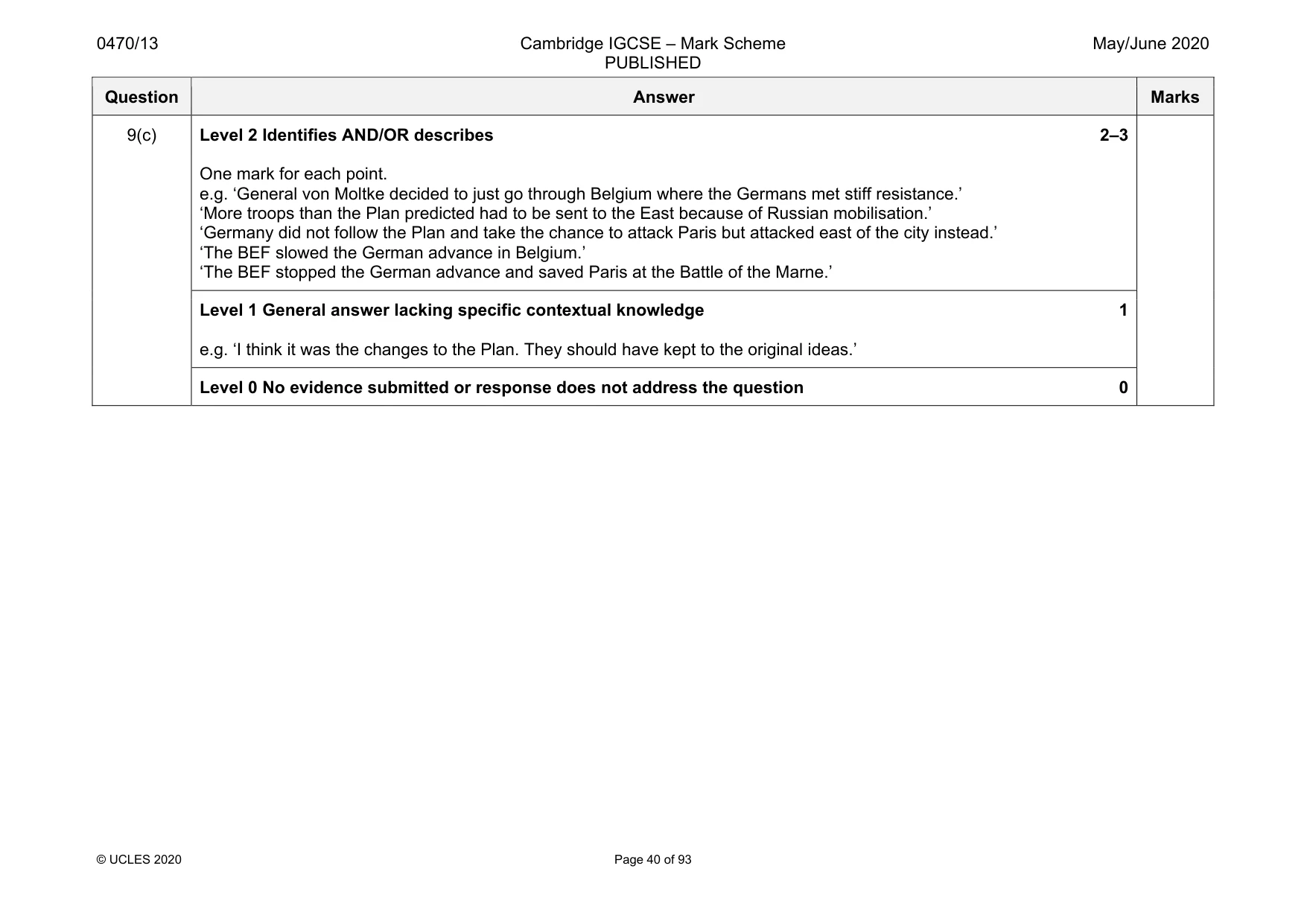
0470/13 Cambridge IGCSE – Mark Scheme PUBLISHED May/June 2020 © UCLES 2020 Page 40 of 93 Question Answer Marks 9(c) Level 2 Identifies AND/OR describes 2–3 One mark for each point. e.g. ‘General von Moltke decided to just go through Belgium where the Germans met stiff resistance.’ ‘More troops than the Plan predicted had to be sent to the East because of Russian mobilisation.’ ‘Germany did not follow the Plan and take the chance to attack Paris but attacked east of the city instead.’ ‘The BEF slowed the German advance in Belgium.’ ‘The BEF stopped the German advance and saved Paris at the Battle of the Marne.’ Level 1 General answer lacking specific contextual knowledge 1 e.g. ‘I think it was the changes to the Plan. They should have kept to the original ideas.’ Level 0 No evidence submitted or response does not address the question 0
Mark scheme, page 41
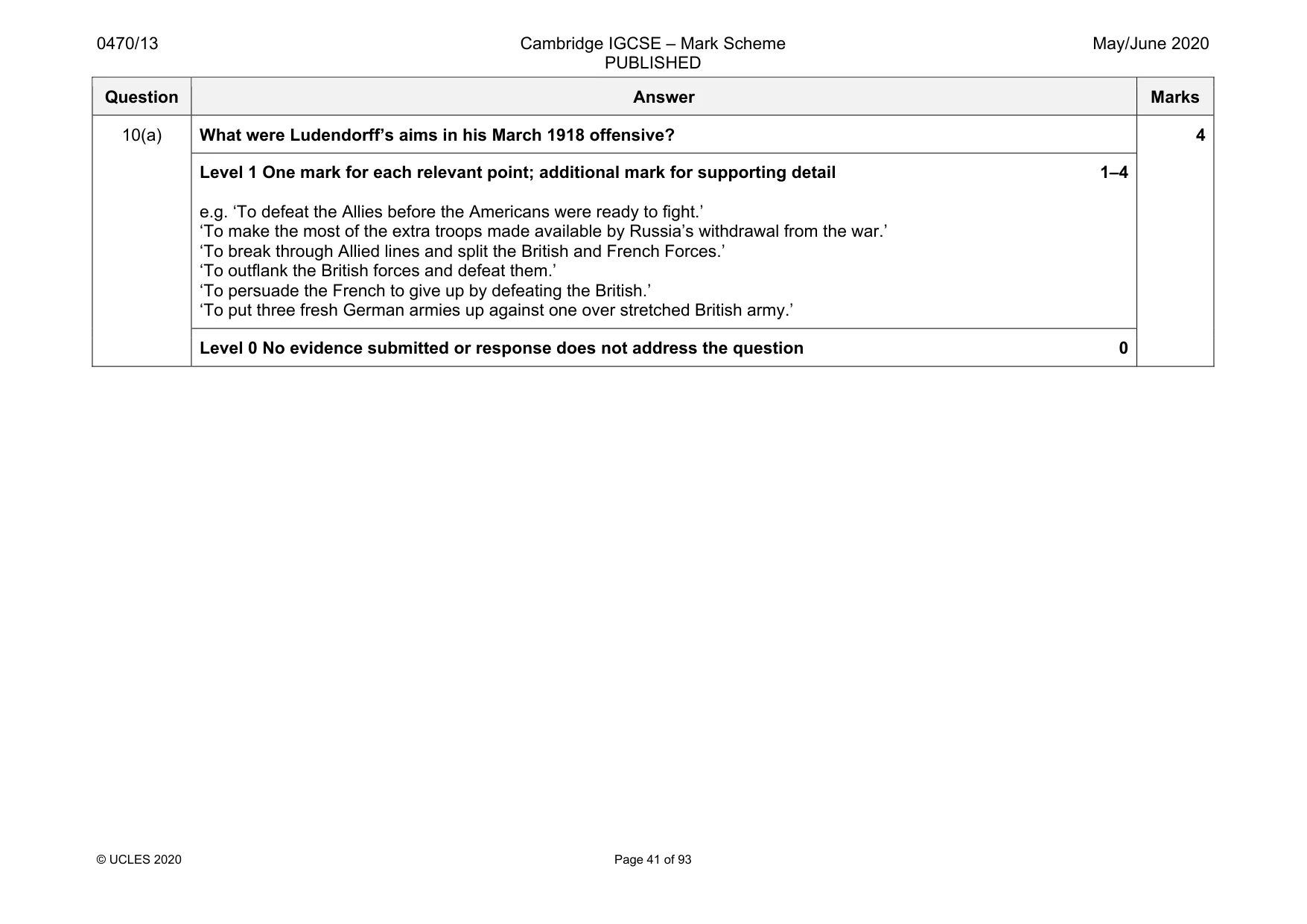
0470/13 Cambridge IGCSE – Mark Scheme PUBLISHED May/June 2020 © UCLES 2020 Page 41 of 93 Question Answer Marks 10(a) What were Ludendorff’s aims in his March 1918 offensive? 4 Level 1 One mark for each relevant point; additional mark for supporting detail 1–4 e.g. ‘To defeat the Allies before the Americans were ready to fight.’ ‘To make the most of the extra troops made available by Russia’s withdrawal from the war.’ ‘To break through Allied lines and split the British and French Forces.’ ‘To outflank the British forces and defeat them.’ ‘To persuade the French to give up by defeating the British.’ ‘To put three fresh German armies up against one over stretched British army.’ Level 0 No evidence submitted or response does not address the question 0
Mark scheme, page 42
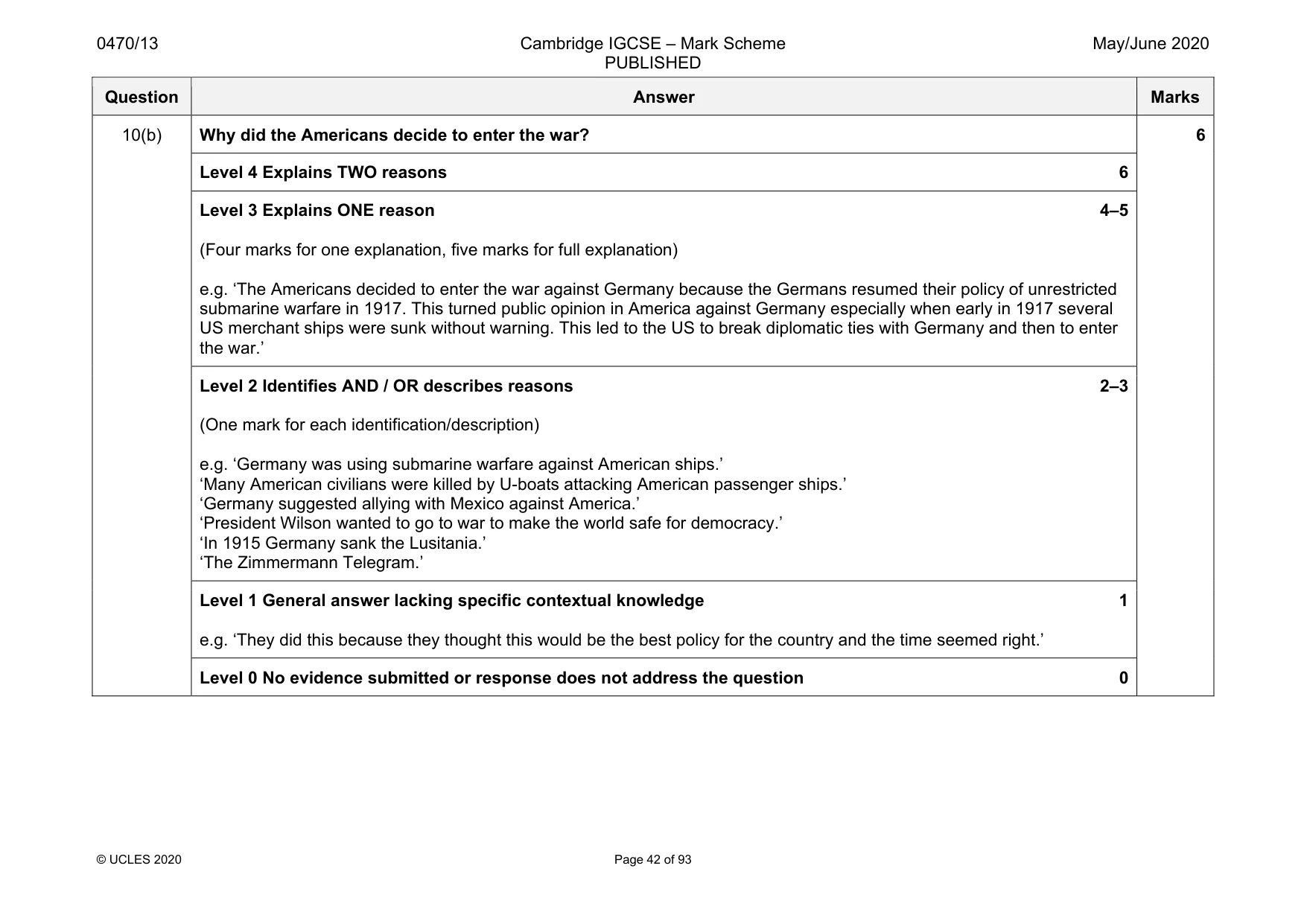
0470/13 Cambridge IGCSE – Mark Scheme PUBLISHED May/June 2020 © UCLES 2020 Page 42 of 93 Question Answer Marks 10(b) Why did the Americans decide to enter the war? 6 Level 4 Explains TWO reasons 6 Level 3 Explains ONE reason 4–5 (Four marks for one explanation, five marks for full explanation) e.g. ‘The Americans decided to enter the war against Germany because the Germans resumed their policy of unrestricted submarine warfare in 1917. This turned public opinion in America against Germany especially when early in 1917 several US merchant ships were sunk without warning. This led to the US to break diplomatic ties with Germany and then to enter the war.’ Level 2 Identifies AND / OR describes reasons 2–3 (One mark for each identification/description) e.g. ‘Germany was using submarine warfare against American ships.’ ‘Many American civilians were killed by U-boats attacking American passenger ships.’ ‘Germany suggested allying with Mexico against America.’ ‘President Wilson wanted to go to war to make the world safe for democracy.’ ‘In 1915 Germany sank the Lusitania.’ ‘The Zimmermann Telegram.’ Level 1 General answer lacking specific contextual knowledge 1 e.g. ‘They did this because they thought this would be the best policy for the country and the time seemed right.’ Level 0 No evidence submitted or response does not address the question 0
Mark scheme, page 43
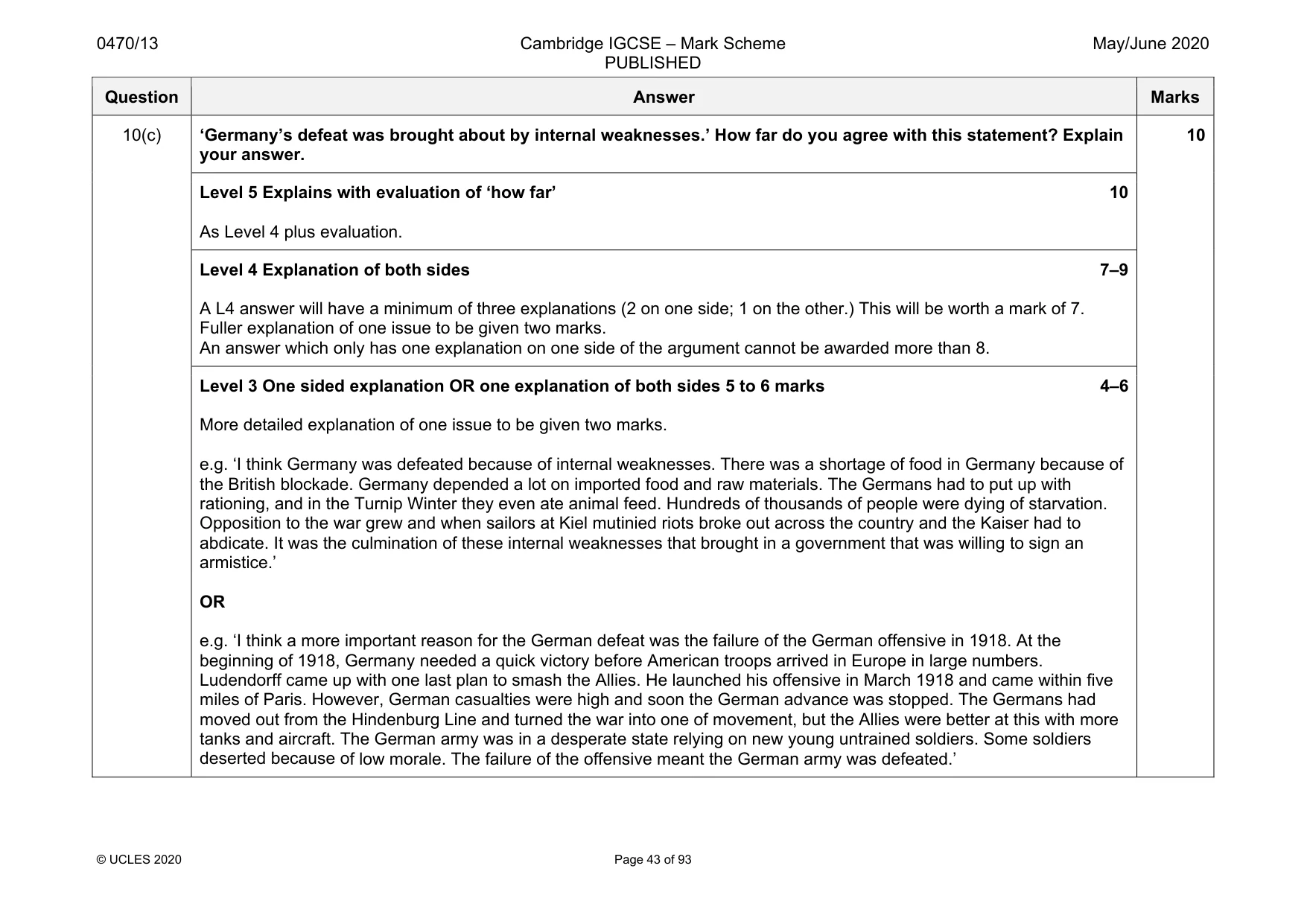
0470/13 Cambridge IGCSE – Mark Scheme PUBLISHED May/June 2020 © UCLES 2020 Page 43 of 93 Question Answer Marks 10(c) ‘Germany’s defeat was brought about by internal weaknesses.’ How far do you agree with this statement? Explain your answer. 10 Level 5 Explains with evaluation of ‘how far’ 10 As Level 4 plus evaluation. Level 4 Explanation of both sides 7–9 A L4 answer will have a minimum of three explanations (2 on one side; 1 on the other.) This will be worth a mark of 7. Fuller explanation of one issue to be given two marks. An answer which only has one explanation on one side of the argument cannot be awarded more than 8. Level 3 One sided explanation OR one explanation of both sides 5 to 6 marks 4–6 More detailed explanation of one issue to be given two marks. e.g. ‘I think Germany was defeated because of internal weaknesses. There was a shortage of food in Germany because of the British blockade. Germany depended a lot on imported food and raw materials. The Germans had to put up with rationing, and in the Turnip Winter they even ate animal feed. Hundreds of thousands of people were dying of starvation. Opposition to the war grew and when sailors at Kiel mutinied riots broke out across the country and the Kaiser had to abdicate. It was the culmination of these internal weaknesses that brought in a government that was willing to sign an armistice.’ OR e.g. ‘I think a more important reason for the German defeat was the failure of the German offensive in 1918. At the beginning of 1918, Germany needed a quick victory before American troops arrived in Europe in large numbers. Ludendorff came up with one last plan to smash the Allies. He launched his offensive in March 1918 and came within five miles of Paris. However, German casualties were high and soon the German advance was stopped. The Germans had moved out from the Hindenburg Line and turned the war into one of movement, but the Allies were better at this with more tanks and aircraft. The German army was in a desperate state relying on new young untrained soldiers. Some soldiers deserted because of low morale. The failure of the offensive meant the German army was defeated.’
Mark scheme, page 44
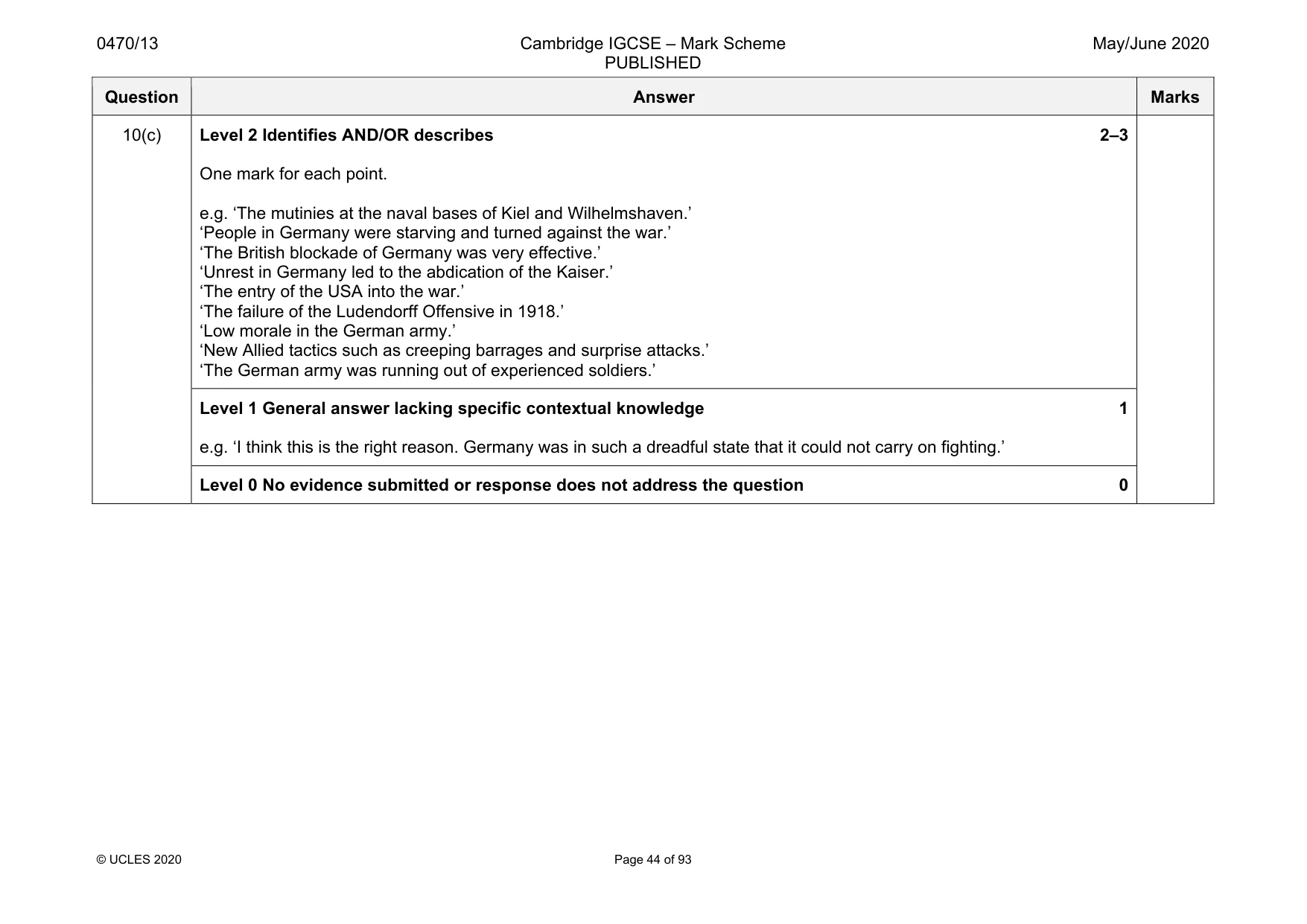
0470/13 Cambridge IGCSE – Mark Scheme PUBLISHED May/June 2020 © UCLES 2020 Page 44 of 93 Question Answer Marks 10(c) Level 2 Identifies AND/OR describes 2–3 One mark for each point. e.g. ‘The mutinies at the naval bases of Kiel and Wilhelmshaven.’ ‘People in Germany were starving and turned against the war.’ ‘The British blockade of Germany was very effective.’ ‘Unrest in Germany led to the abdication of the Kaiser.’ ‘The entry of the USA into the war.’ ‘The failure of the Ludendorff Offensive in 1918.’ ‘Low morale in the German army.’ ‘New Allied tactics such as creeping barrages and surprise attacks.’ ‘The German army was running out of experienced soldiers.’ Level 1 General answer lacking specific contextual knowledge 1 e.g. ‘I think this is the right reason. Germany was in such a dreadful state that it could not carry on fighting.’ Level 0 No evidence submitted or response does not address the question 0
Mark scheme, page 45
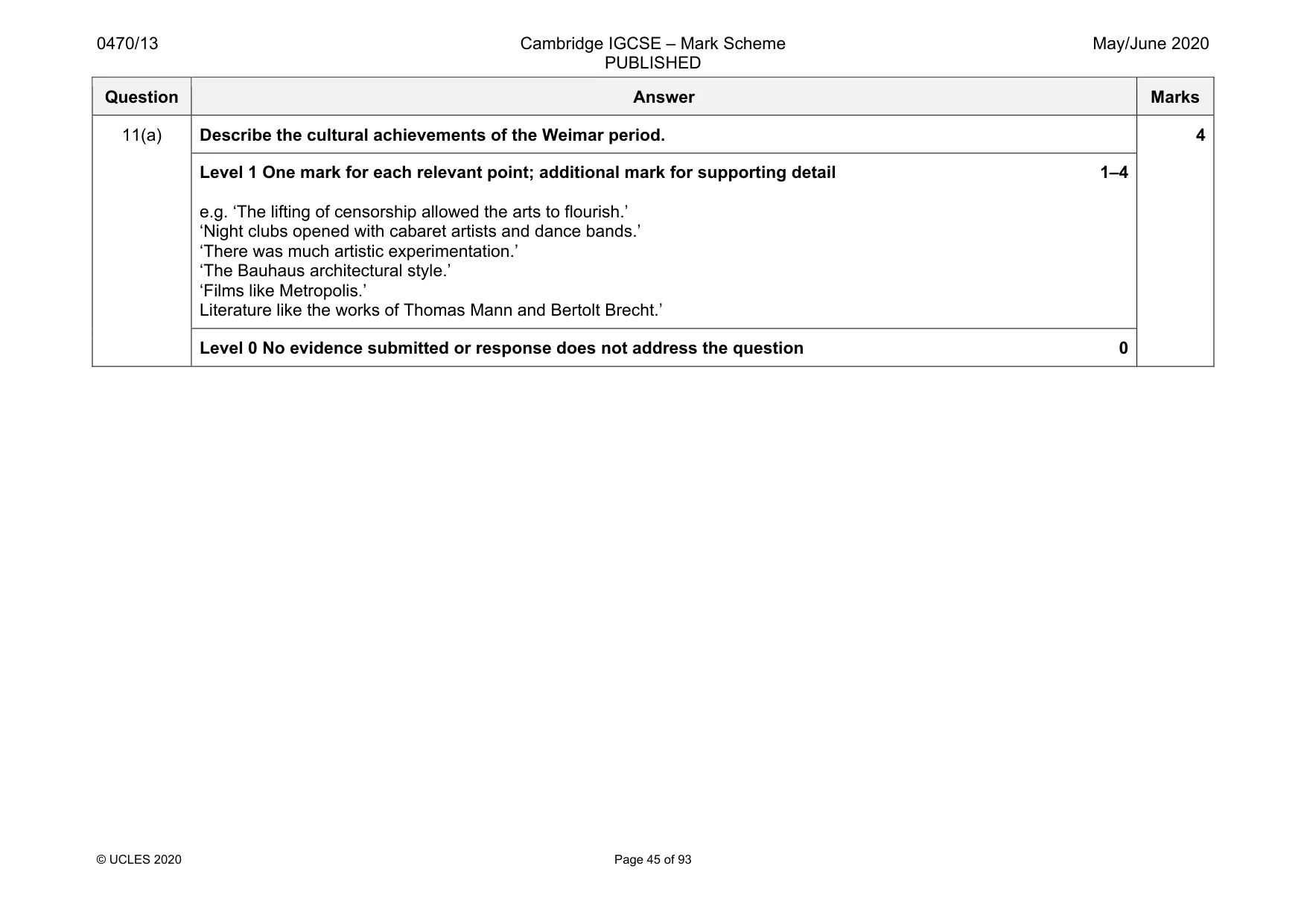
0470/13 Cambridge IGCSE – Mark Scheme PUBLISHED May/June 2020 © UCLES 2020 Page 45 of 93 Question Answer Marks 11(a) Describe the cultural achievements of the Weimar period. 4 Level 1 One mark for each relevant point; additional mark for supporting detail 1–4 e.g. ‘The lifting of censorship allowed the arts to flourish.’ ‘Night clubs opened with cabaret artists and dance bands.’ ‘There was much artistic experimentation.’ ‘The Bauhaus architectural style.’ ‘Films like Metropolis.’ Literature like the works of Thomas Mann and Bertolt Brecht.’ Level 0 No evidence submitted or response does not address the question 0
Mark scheme, page 46
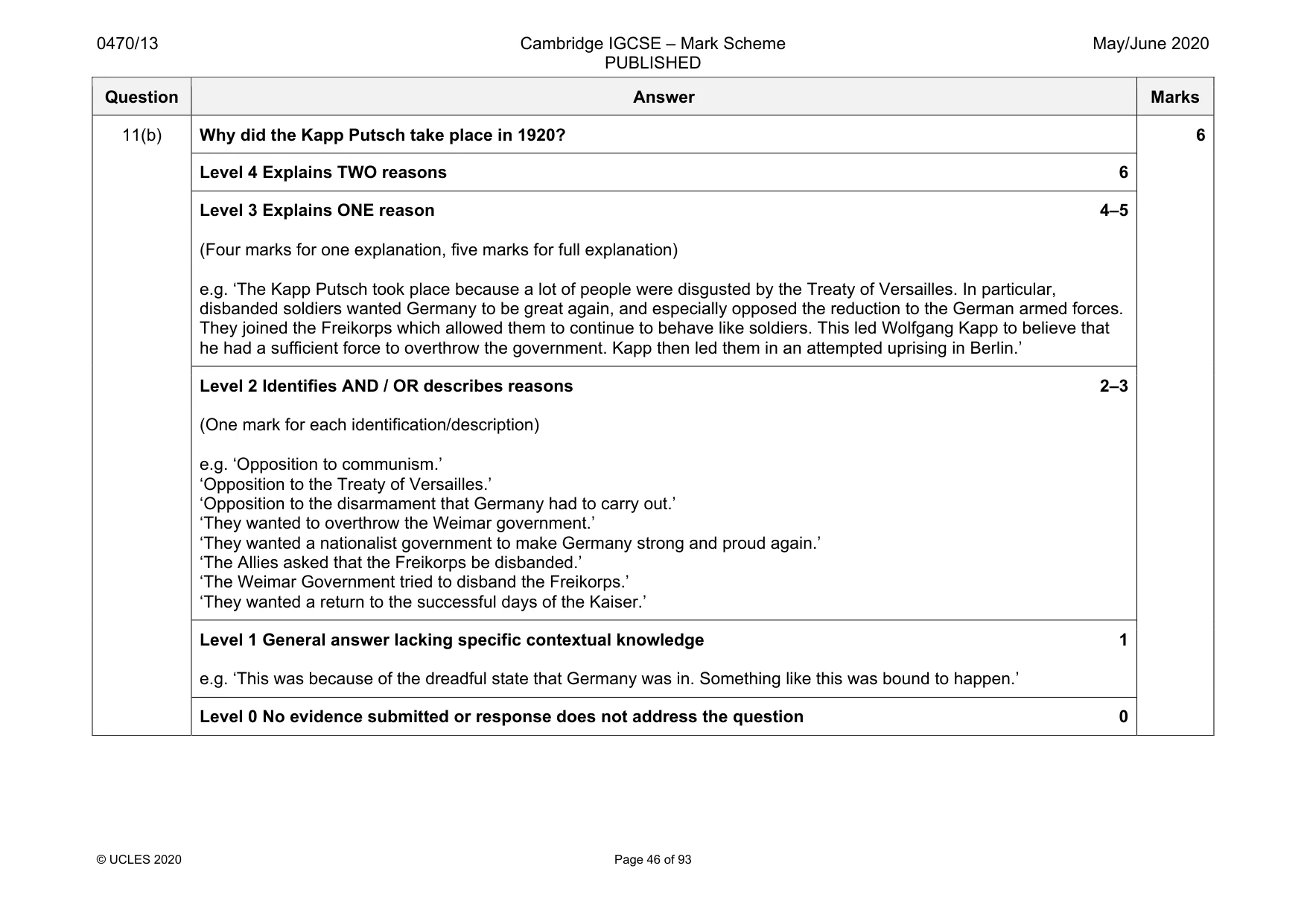
0470/13 Cambridge IGCSE – Mark Scheme PUBLISHED May/June 2020 © UCLES 2020 Page 46 of 93 Question Answer Marks 11(b) Why did the Kapp Putsch take place in 1920? 6 Level 4 Explains TWO reasons 6 Level 3 Explains ONE reason 4–5 (Four marks for one explanation, five marks for full explanation) e.g. ‘The Kapp Putsch took place because a lot of people were disgusted by the Treaty of Versailles. In particular, disbanded soldiers wanted Germany to be great again, and especially opposed the reduction to the German armed forces. They joined the Freikorps which allowed them to continue to behave like soldiers. This led Wolfgang Kapp to believe that he had a sufficient force to overthrow the government. Kapp then led them in an attempted uprising in Berlin.’ Level 2 Identifies AND / OR describes reasons 2–3 (One mark for each identification/description) e.g. ‘Opposition to communism.’ ‘Opposition to the Treaty of Versailles.’ ‘Opposition to the disarmament that Germany had to carry out.’ ‘They wanted to overthrow the Weimar government.’ ‘They wanted a nationalist government to make Germany strong and proud again.’ ‘The Allies asked that the Freikorps be disbanded.’ ‘The Weimar Government tried to disband the Freikorps.’ ‘They wanted a return to the successful days of the Kaiser.’ Level 1 General answer lacking specific contextual knowledge 1 e.g. ‘This was because of the dreadful state that Germany was in. Something like this was bound to happen.’ Level 0 No evidence submitted or response does not address the question 0
Mark scheme, page 47
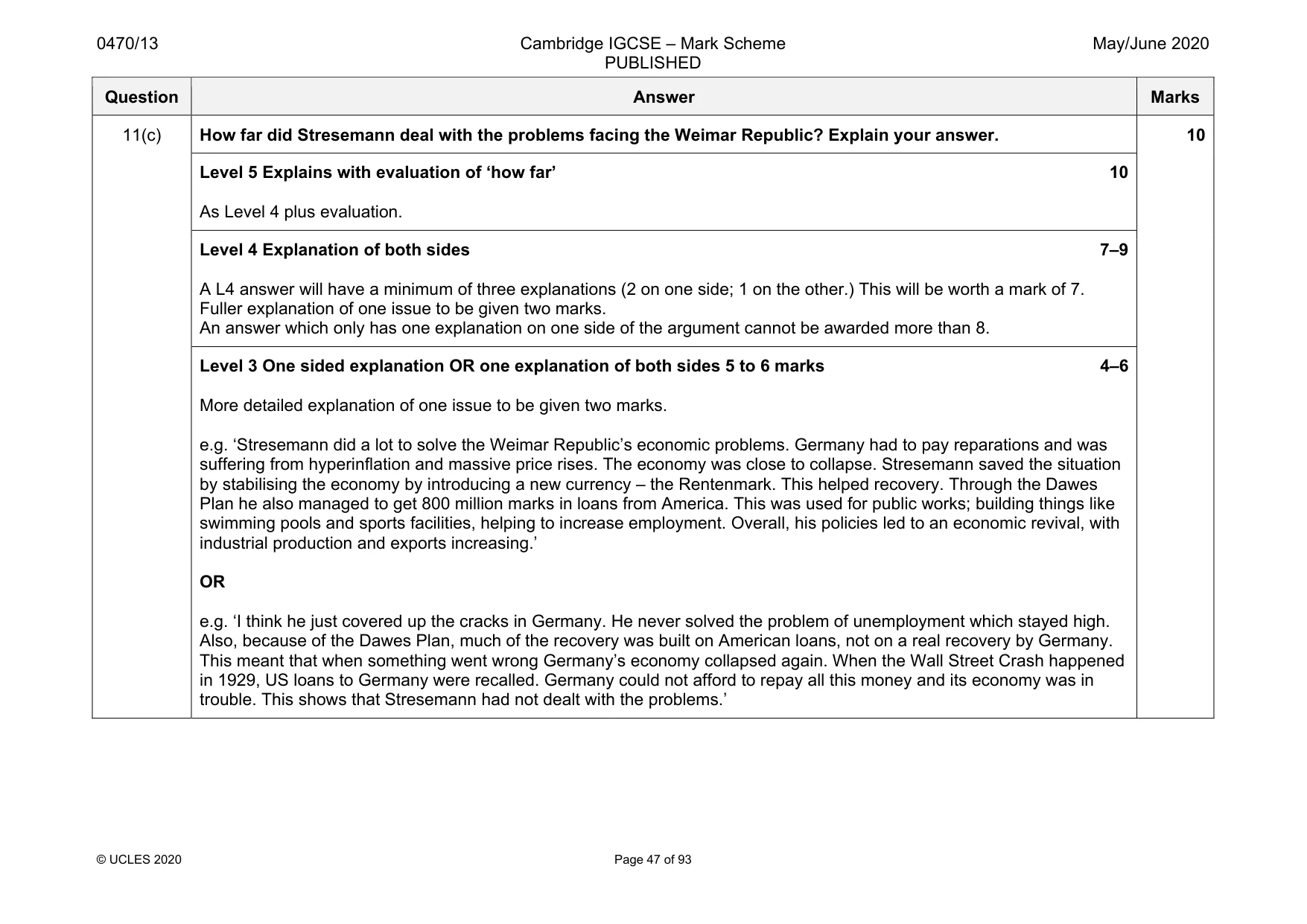
0470/13 Cambridge IGCSE – Mark Scheme PUBLISHED May/June 2020 © UCLES 2020 Page 47 of 93 Question Answer Marks 11(c) How far did Stresemann deal with the problems facing the Weimar Republic? Explain your answer. 10 Level 5 Explains with evaluation of ‘how far’ 10 As Level 4 plus evaluation. Level 4 Explanation of both sides 7–9 A L4 answer will have a minimum of three explanations (2 on one side; 1 on the other.) This will be worth a mark of 7. Fuller explanation of one issue to be given two marks. An answer which only has one explanation on one side of the argument cannot be awarded more than 8. Level 3 One sided explanation OR one explanation of both sides 5 to 6 marks 4–6 More detailed explanation of one issue to be given two marks. e.g. ‘Stresemann did a lot to solve the Weimar Republic’s economic problems. Germany had to pay reparations and was suffering from hyperinflation and massive price rises. The economy was close to collapse. Stresemann saved the situation by stabilising the economy by introducing a new currency – the Rentenmark. This helped recovery. Through the Dawes Plan he also managed to get 800 million marks in loans from America. This was used for public works; building things like swimming pools and sports facilities, helping to increase employment. Overall, his policies led to an economic revival, with industrial production and exports increasing.’ OR e.g. ‘I think he just covered up the cracks in Germany. He never solved the problem of unemployment which stayed high. Also, because of the Dawes Plan, much of the recovery was built on American loans, not on a real recovery by Germany. This meant that when something went wrong Germany’s economy collapsed again. When the Wall Street Crash happened in 1929, US loans to Germany were recalled. Germany could not afford to repay all this money and its economy was in trouble. This shows that Stresemann had not dealt with the problems.’
Mark scheme, page 48
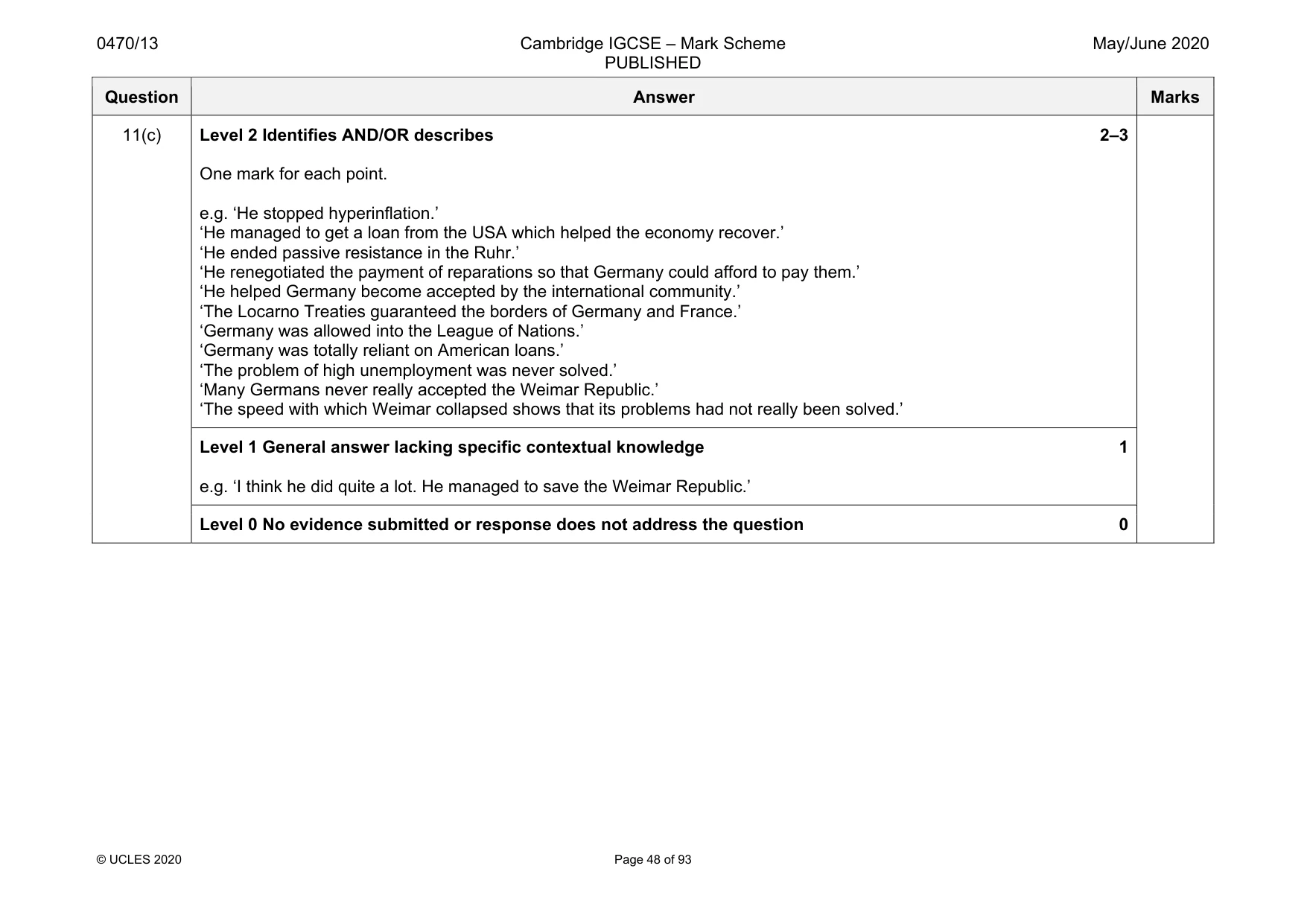
0470/13 Cambridge IGCSE – Mark Scheme PUBLISHED May/June 2020 © UCLES 2020 Page 48 of 93 Question Answer Marks 11(c) Level 2 Identifies AND/OR describes 2–3 One mark for each point. e.g. ‘He stopped hyperinflation.’ ‘He managed to get a loan from the USA which helped the economy recover.’ ‘He ended passive resistance in the Ruhr.’ ‘He renegotiated the payment of reparations so that Germany could afford to pay them.’ ‘He helped Germany become accepted by the international community.’ ‘The Locarno Treaties guaranteed the borders of Germany and France.’ ‘Germany was allowed into the League of Nations.’ ‘Germany was totally reliant on American loans.’ ‘The problem of high unemployment was never solved.’ ‘Many Germans never really accepted the Weimar Republic.’ ‘The speed with which Weimar collapsed shows that its problems had not really been solved.’ Level 1 General answer lacking specific contextual knowledge 1 e.g. ‘I think he did quite a lot. He managed to save the Weimar Republic.’ Level 0 No evidence submitted or response does not address the question 0
Mark scheme, page 49
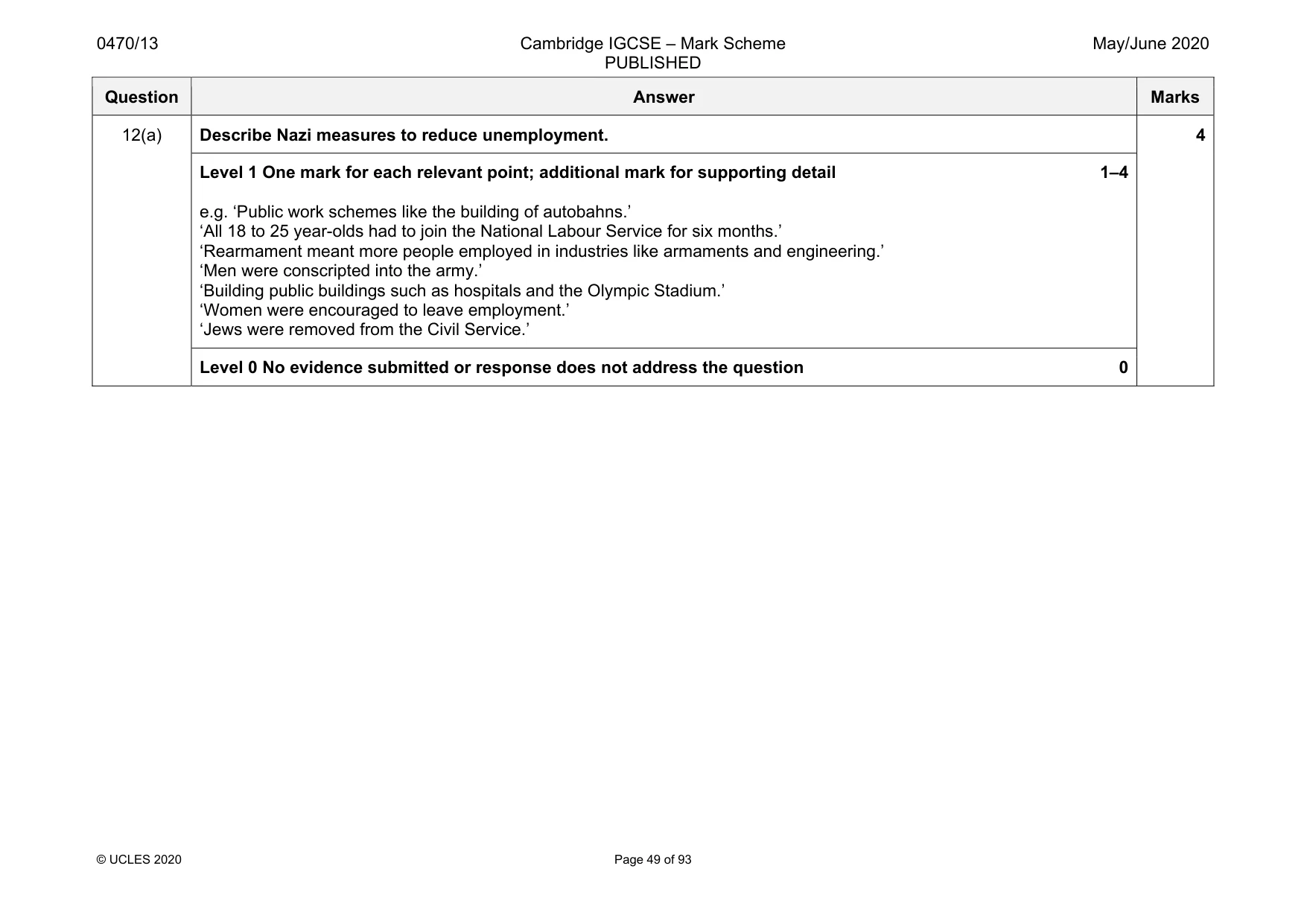
0470/13 Cambridge IGCSE – Mark Scheme PUBLISHED May/June 2020 © UCLES 2020 Page 49 of 93 Question Answer Marks 12(a) Describe Nazi measures to reduce unemployment. 4 Level 1 One mark for each relevant point; additional mark for supporting detail 1–4 e.g. ‘Public work schemes like the building of autobahns.’ ‘All 18 to 25 year-olds had to join the National Labour Service for six months.’ ‘Rearmament meant more people employed in industries like armaments and engineering.’ ‘Men were conscripted into the army.’ ‘Building public buildings such as hospitals and the Olympic Stadium.’ ‘Women were encouraged to leave employment.’ ‘Jews were removed from the Civil Service.’ Level 0 No evidence submitted or response does not address the question 0
Mark scheme, page 50
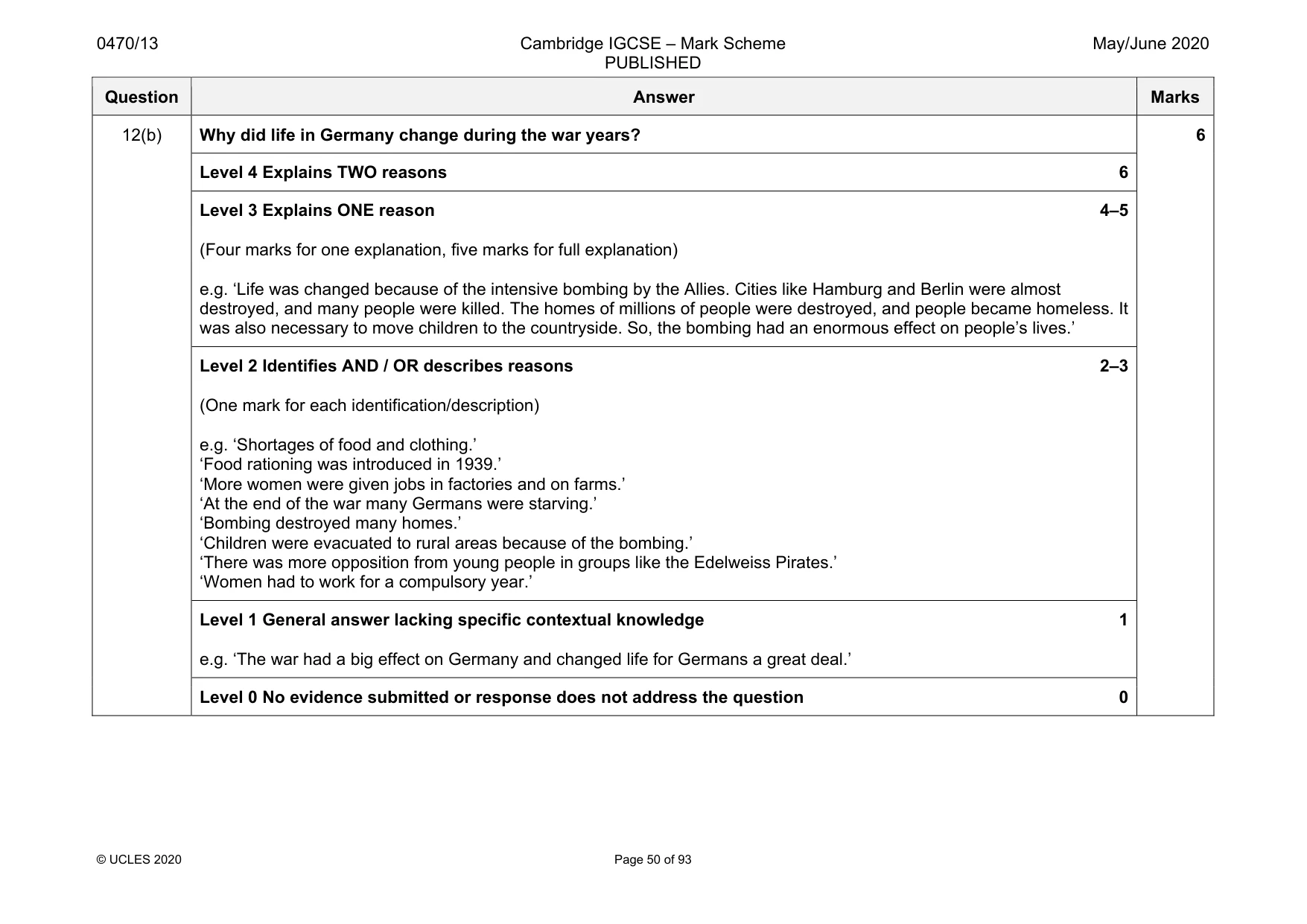
0470/13 Cambridge IGCSE – Mark Scheme PUBLISHED May/June 2020 © UCLES 2020 Page 50 of 93 Question Answer Marks 12(b) Why did life in Germany change during the war years? 6 Level 4 Explains TWO reasons 6 Level 3 Explains ONE reason 4–5 (Four marks for one explanation, five marks for full explanation) e.g. ‘Life was changed because of the intensive bombing by the Allies. Cities like Hamburg and Berlin were almost destroyed, and many people were killed. The homes of millions of people were destroyed, and people became homeless. It was also necessary to move children to the countryside. So, the bombing had an enormous effect on people’s lives.’ Level 2 Identifies AND / OR describes reasons 2–3 (One mark for each identification/description) e.g. ‘Shortages of food and clothing.’ ‘Food rationing was introduced in 1939.’ ‘More women were given jobs in factories and on farms.’ ‘At the end of the war many Germans were starving.’ ‘Bombing destroyed many homes.’ ‘Children were evacuated to rural areas because of the bombing.’ ‘There was more opposition from young people in groups like the Edelweiss Pirates.’ ‘Women had to work for a compulsory year.’ Level 1 General answer lacking specific contextual knowledge 1 e.g. ‘The war had a big effect on Germany and changed life for Germans a great deal.’ Level 0 No evidence submitted or response does not address the question 0
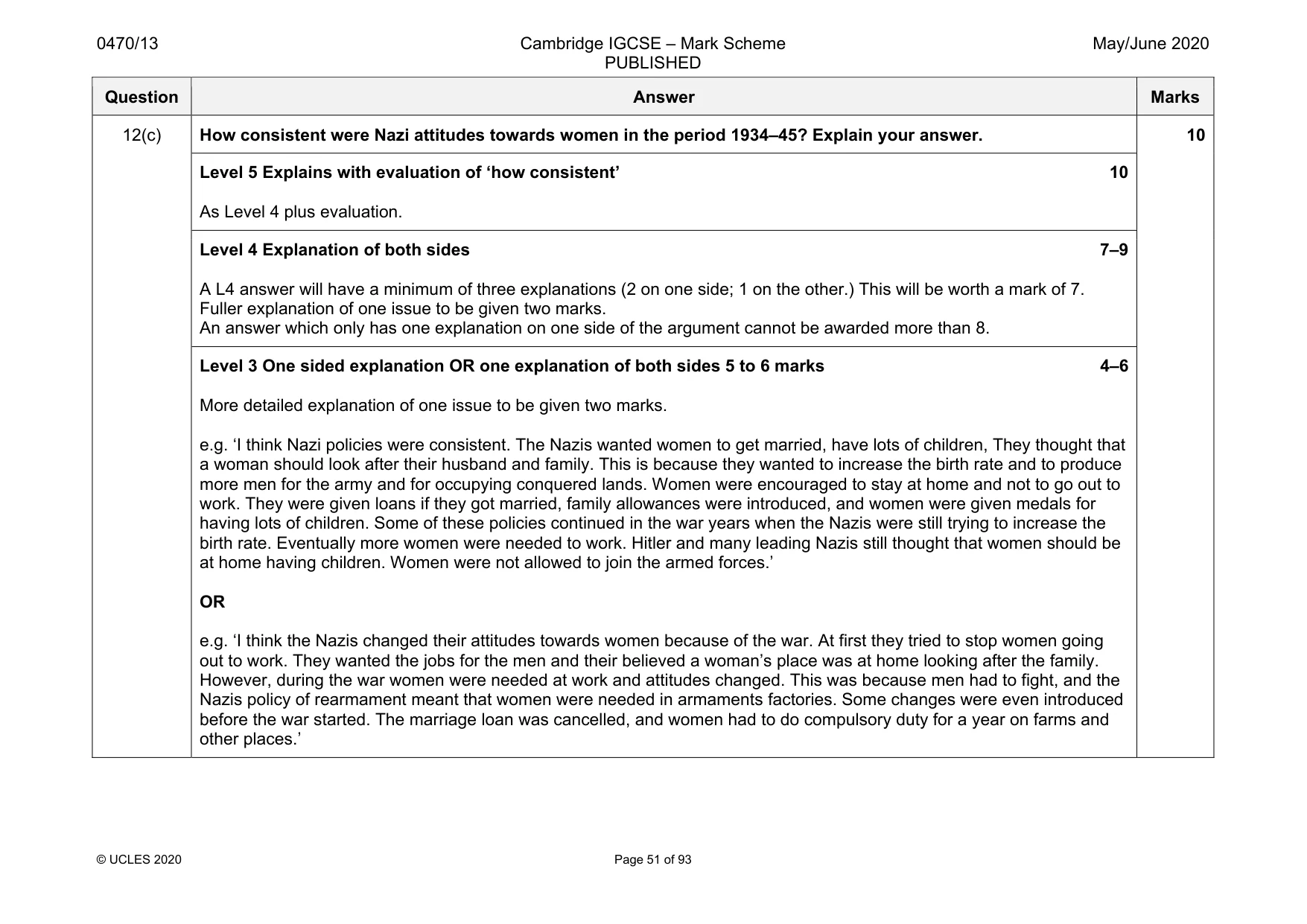
Mark scheme, page 51
0470/13 Cambridge IGCSE – Mark Scheme PUBLISHED May/June 2020 © UCLES 2020 Page 51 of 93 Question Answer Marks 12(c) How consistent were Nazi attitudes towards women in the period 1934–45? Explain your answer. 10 Level 5 Explains with evaluation of ‘how consistent’ 10 As Level 4 plus evaluation. Level 4 Explanation of both sides 7–9 A L4 answer will have a minimum of three explanations (2 on one side; 1 on the other.) This will be worth a mark of 7. Fuller explanation of one issue to be given two marks. An answer which only has one explanation on one side of the argument cannot be awarded more than 8. Level 3 One sided explanation OR one explanation of both sides 5 to 6 marks 4–6 More detailed explanation of one issue to be given two marks. e.g. ‘I think Nazi policies were consistent. The Nazis wanted women to get married, have lots of children, They thought that a woman should look after their husband and family. This is because they wanted to increase the birth rate and to produce more men for the army and for occupying conquered lands. Women were encouraged to stay at home and not to go out to work. They were given loans if they got married, family allowances were introduced, and women were given medals for having lots of children. Some of these policies continued in the war years when the Nazis were still trying to increase the birth rate. Eventually more women were needed to work. Hitler and many leading Nazis still thought that women should be at home having children. Women were not allowed to join the armed forces.’ OR e.g. ‘I think the Nazis changed their attitudes towards women because of the war. At first they tried to stop women going out to work. They wanted the jobs for the men and their believed a woman’s place was at home looking after the family. However, during the war women were needed at work and attitudes changed. This was because men had to fight, and the Nazis policy of rearmament meant that women were needed in armaments factories. Some changes were even introduced before the war started. The marriage loan was cancelled, and women had to do compulsory duty for a year on farms and other places.’
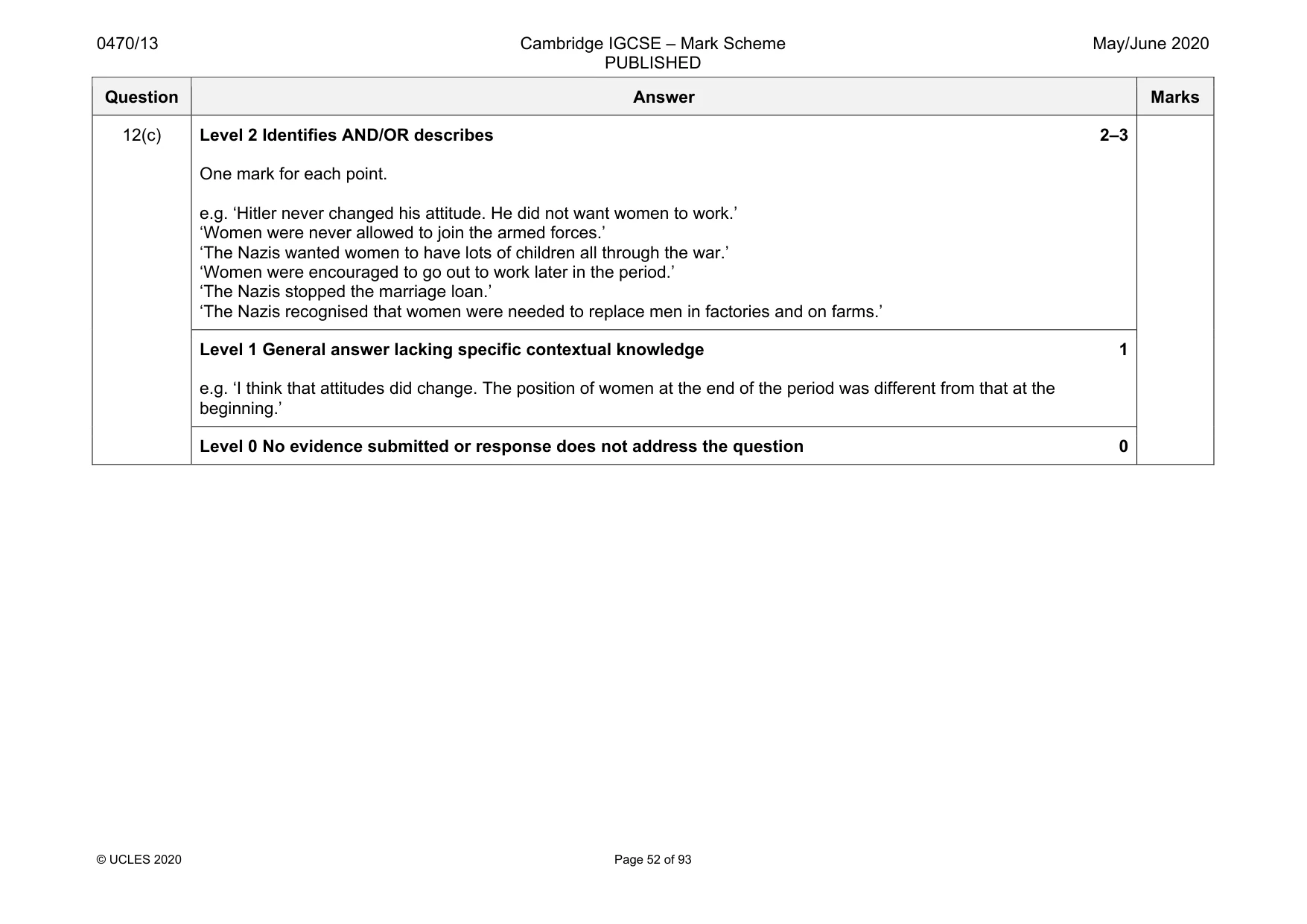
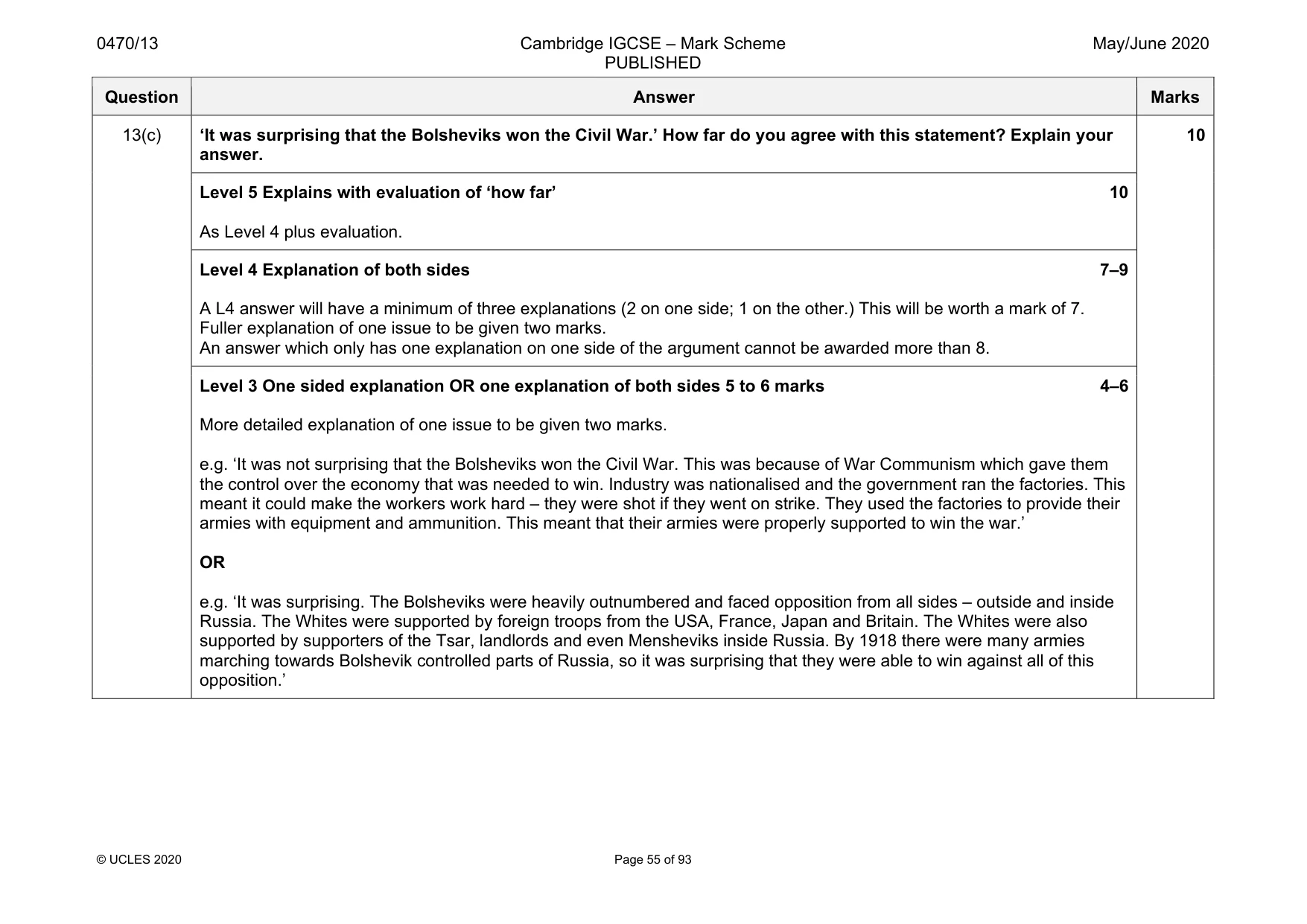
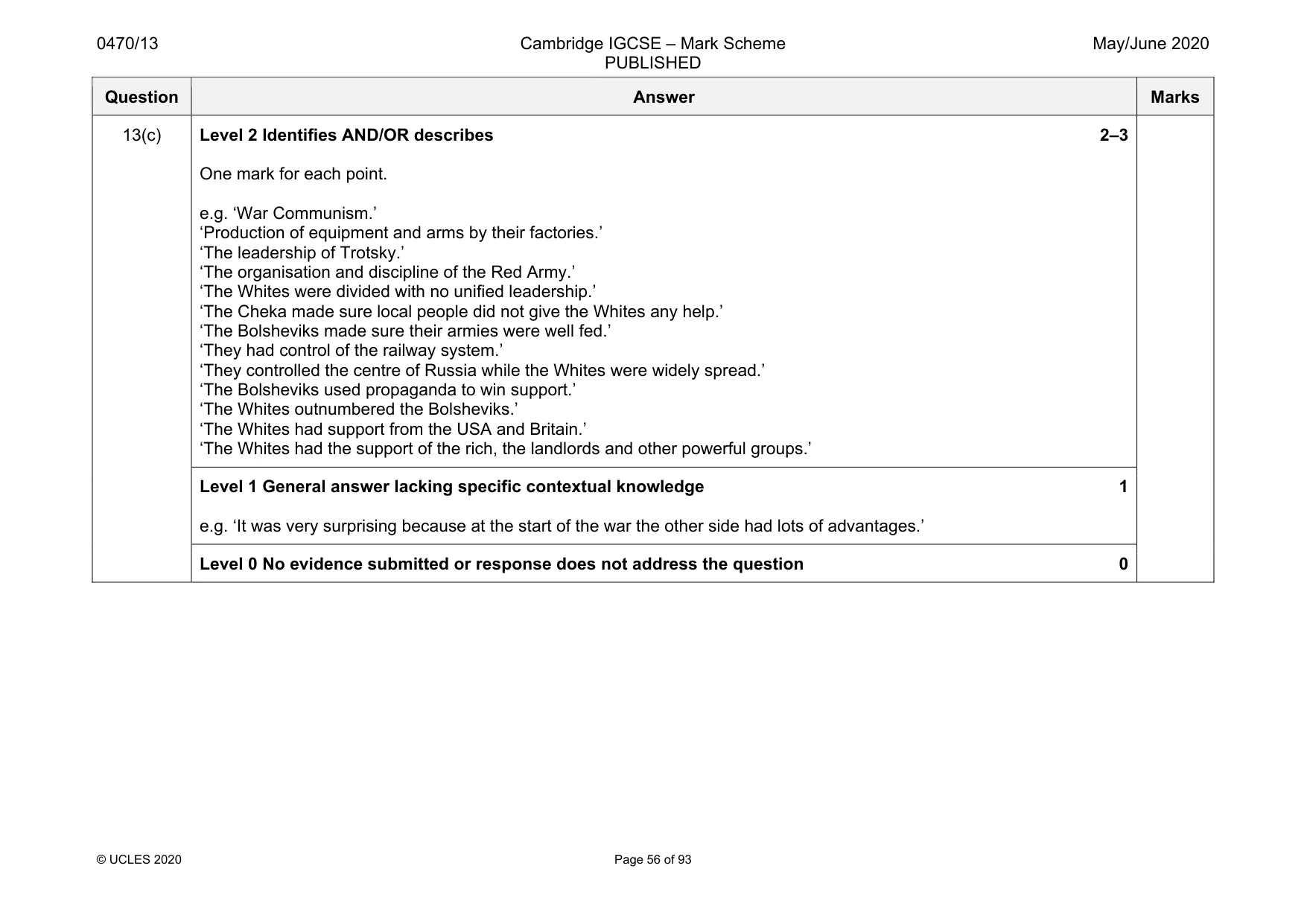
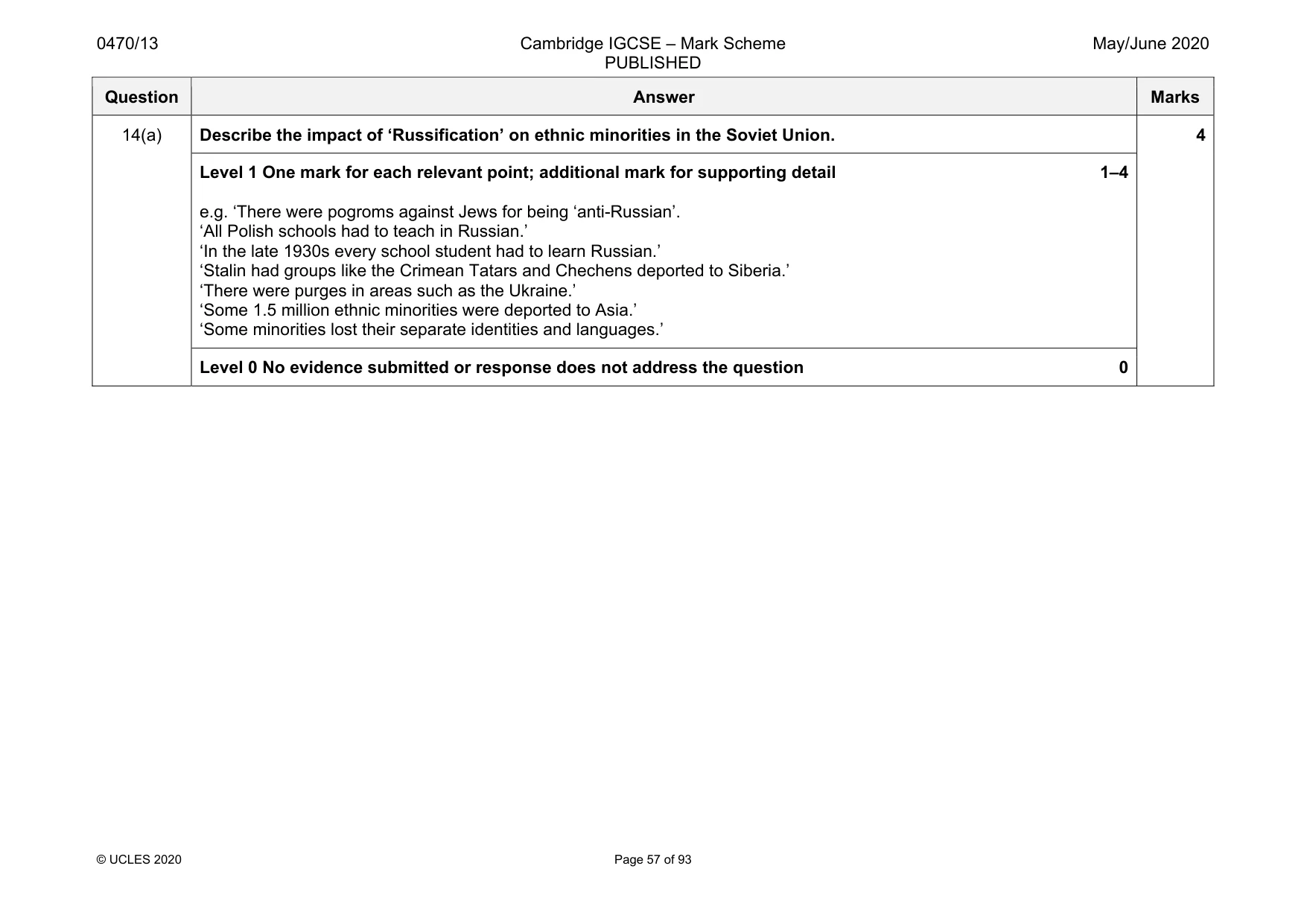
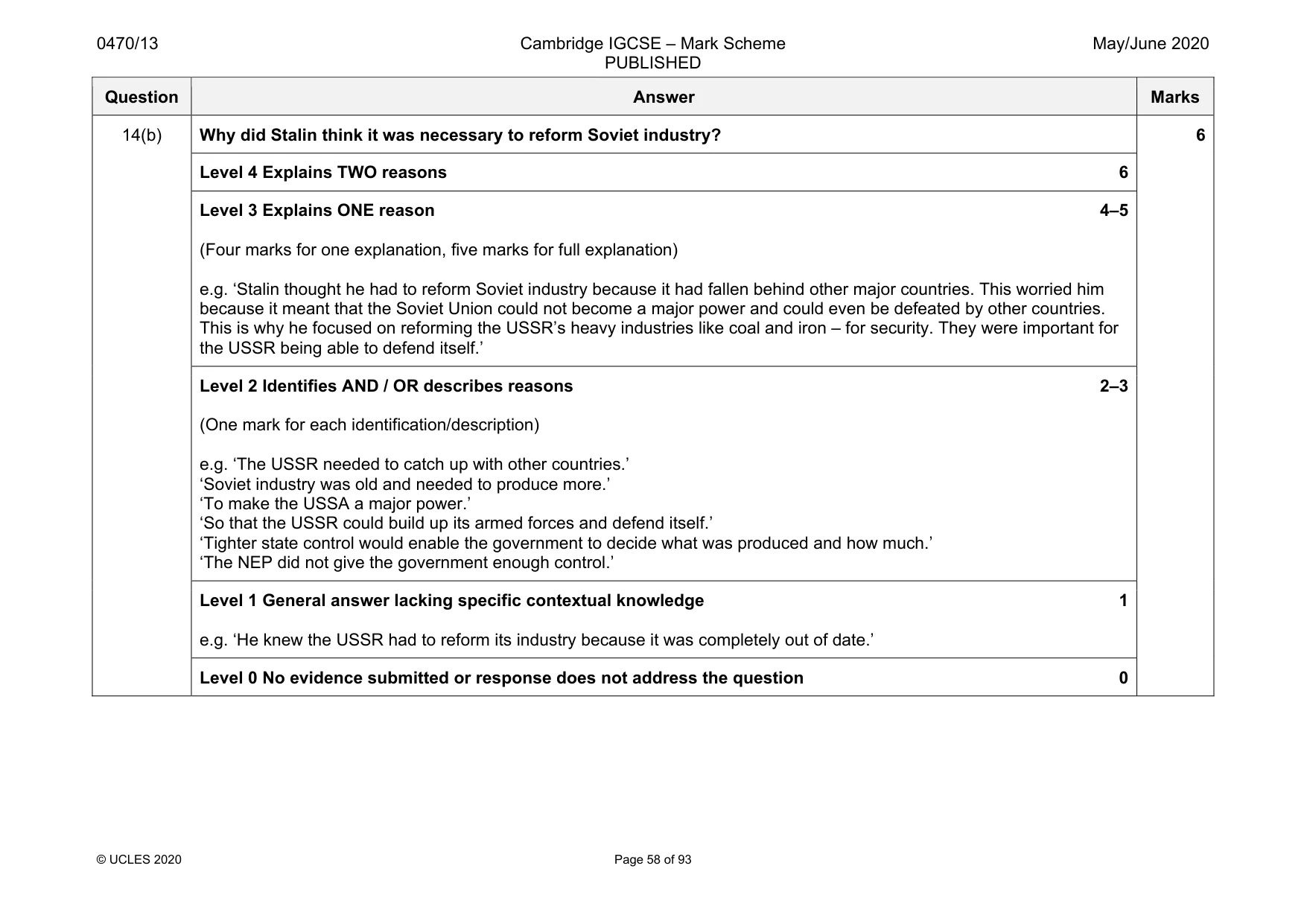
Mark scheme, page 52
0470/13 Cambridge IGCSE – Mark Scheme PUBLISHED May/June 2020 © UCLES 2020 Page 52 of 93 Question Answer Marks 12(c) Level 2 Identifies AND/OR describes 2–3 One mark for each point. e.g. ‘Hitler never changed his attitude. He did not want women to work.’ ‘Women were never allowed to join the armed forces.’ ‘The Nazis wanted women to have lots of children all through the war.’ ‘Women were encouraged to go out to work later in the period.’ ‘The Nazis stopped the marriage loan.’ ‘The Nazis recognised that women were needed to replace men in factories and on farms.’ Level 1 General answer lacking specific contextual knowledge 1 e.g. ‘I think that attitudes did change. The position of women at the end of the period was different from that at the beginning.’ Level 0 No evidence submitted or response does not address the question 0
Mark scheme, page 53
0470/13 Cambridge IGCSE – Mark Scheme PUBLISHED May/June 2020 © UCLES 2020 Page 53 of 93 Question Answer Marks 13(a) Describe Kornilov’s actions in September 1917. 4 Level 1 One mark for each relevant point; additional mark for supporting detail 1–4 e.g. ‘He used his position as commander-in-chief of the Russian army.’ ‘He was horrified by the lack of control of the Provisional Government.’ ‘Kornilov marched on Petrograd.’ ‘He was trying to restore peace in Petrograd.’ ‘He wanted to destroy the power of the Petrograd Soviet.’ ‘He ignored a telegram from Kerensky.’ Level 0 No evidence submitted or response does not address the question 0
Mark scheme, page 54
0470/13 Cambridge IGCSE – Mark Scheme PUBLISHED May/June 2020 © UCLES 2020 Page 54 of 93 Question Answer Marks 13(b) Why was Trotsky important in the November Revolution of 1917? 6 Level 4 Explains TWO reasons 6 Level 3 Explains ONE reason 4–5 (Four marks for one explanation, five marks for full explanation) e.g. ‘Trotsky was important because he was a superb organiser. He planned the November Revolution, including gaining control of the city on the night of the 25th. He created the Red Guard and led them to take control of key parts of Petrograd like bridges and post offices. He was also important in getting the support of the Petrograd Garrison and the Kronstadt sailors who surrounded the Winter Palace. This is why he is credited with being the reason for the Bolshevik’s success.’ Level 2 Identifies AND / OR describes reasons 2–3 (One mark for each identification/description) e.g. ‘He supported Lenin in the idea that the Bolsheviks should overthrow the Provisional Government.’ ‘He was important because he was the President of the Petrograd Soviet and could lead it.’ ‘He led the efforts to defeat the counter-attack by Cossacks.’ ‘He planned the takeover of Petrograd.’ Level 1 General answer lacking specific contextual knowledge 1 e.g. ‘He was important because events would have developed very differently without him.’ Level 0 No evidence submitted or response does not address the question 0
Mark scheme, page 55
0470/13 Cambridge IGCSE – Mark Scheme PUBLISHED May/June 2020 © UCLES 2020 Page 55 of 93 Question Answer Marks 13(c) ‘It was surprising that the Bolsheviks won the Civil War.’ How far do you agree with this statement? Explain your answer. 10 Level 5 Explains with evaluation of ‘how far’ 10 As Level 4 plus evaluation. Level 4 Explanation of both sides 7–9 A L4 answer will have a minimum of three explanations (2 on one side; 1 on the other.) This will be worth a mark of 7. Fuller explanation of one issue to be given two marks. An answer which only has one explanation on one side of the argument cannot be awarded more than 8. Level 3 One sided explanation OR one explanation of both sides 5 to 6 marks 4–6 More detailed explanation of one issue to be given two marks. e.g. ‘It was not surprising that the Bolsheviks won the Civil War. This was because of War Communism which gave them the control over the economy that was needed to win. Industry was nationalised and the government ran the factories. This meant it could make the workers work hard – they were shot if they went on strike. They used the factories to provide their armies with equipment and ammunition. This meant that their armies were properly supported to win the war.’ OR e.g. ‘It was surprising. The Bolsheviks were heavily outnumbered and faced opposition from all sides – outside and inside Russia. The Whites were supported by foreign troops from the USA, France, Japan and Britain. The Whites were also supported by supporters of the Tsar, landlords and even Mensheviks inside Russia. By 1918 there were many armies marching towards Bolshevik controlled parts of Russia, so it was surprising that they were able to win against all of this opposition.’
Mark scheme, page 56
0470/13 Cambridge IGCSE – Mark Scheme PUBLISHED May/June 2020 © UCLES 2020 Page 56 of 93 Question Answer Marks 13(c) Level 2 Identifies AND/OR describes 2–3 One mark for each point. e.g. ‘War Communism.’ ‘Production of equipment and arms by their factories.’ ‘The leadership of Trotsky.’ ‘The organisation and discipline of the Red Army.’ ‘The Whites were divided with no unified leadership.’ ‘The Cheka made sure local people did not give the Whites any help.’ ‘The Bolsheviks made sure their armies were well fed.’ ‘They had control of the railway system.’ ‘They controlled the centre of Russia while the Whites were widely spread.’ ‘The Bolsheviks used propaganda to win support.’ ‘The Whites outnumbered the Bolsheviks.’ ‘The Whites had support from the USA and Britain.’ ‘The Whites had the support of the rich, the landlords and other powerful groups.’ Level 1 General answer lacking specific contextual knowledge 1 e.g. ‘It was very surprising because at the start of the war the other side had lots of advantages.’ Level 0 No evidence submitted or response does not address the question 0
Mark scheme, page 57
0470/13 Cambridge IGCSE – Mark Scheme PUBLISHED May/June 2020 © UCLES 2020 Page 57 of 93 Question Answer Marks 14(a) Describe the impact of ‘Russification’ on ethnic minorities in the Soviet Union. 4 Level 1 One mark for each relevant point; additional mark for supporting detail 1–4 e.g. ‘There were pogroms against Jews for being ‘anti-Russian’. ‘All Polish schools had to teach in Russian.’ ‘In the late 1930s every school student had to learn Russian.’ ‘Stalin had groups like the Crimean Tatars and Chechens deported to Siberia.’ ‘There were purges in areas such as the Ukraine.’ ‘Some 1.5 million ethnic minorities were deported to Asia.’ ‘Some minorities lost their separate identities and languages.’ Level 0 No evidence submitted or response does not address the question 0
Mark scheme, page 58
0470/13 Cambridge IGCSE – Mark Scheme PUBLISHED May/June 2020 © UCLES 2020 Page 58 of 93 Question Answer Marks 14(b) Why did Stalin think it was necessary to reform Soviet industry? 6 Level 4 Explains TWO reasons 6 Level 3 Explains ONE reason 4–5 (Four marks for one explanation, five marks for full explanation) e.g. ‘Stalin thought he had to reform Soviet industry because it had fallen behind other major countries. This worried him because it meant that the Soviet Union could not become a major power and could even be defeated by other countries. This is why he focused on reforming the USSR’s heavy industries like coal and iron – for security. They were important for the USSR being able to defend itself.’ Level 2 Identifies AND / OR describes reasons 2–3 (One mark for each identification/description) e.g. ‘The USSR needed to catch up with other countries.’ ‘Soviet industry was old and needed to produce more.’ ‘To make the USSA a major power.’ ‘So that the USSR could build up its armed forces and defend itself.’ ‘Tighter state control would enable the government to decide what was produced and how much.’ ‘The NEP did not give the government enough control.’ Level 1 General answer lacking specific contextual knowledge 1 e.g. ‘He knew the USSR had to reform its industry because it was completely out of date.’ Level 0 No evidence submitted or response does not address the question 0
Mark scheme, page 59
0470/13 Cambridge IGCSE – Mark Scheme PUBLISHED May/June 2020 © UCLES 2020 Page 59 of 93 Question Answer Marks 14(c) Was the introduction of collectivisation an error? Explain your answer. 10 Level 5 Explains with evaluation of ‘was the introduction of collectivisation an error’ 10 As Level 4 plus evaluation. Level 4 Explanation of both sides 7–9 A L4 answer will have a minimum of three explanations (2 on one side; 1 on the other.) This will be worth a mark of 7. Fuller explanation of one issue to be given two marks. An answer which only has one explanation on one side of the argument cannot be awarded more than 8. Level 3 One sided explanation OR one explanation of both sides 5 to 6 marks More detailed explanation of one issue to be given two marks. e.g. ‘I think the introduction of collectivisation was an error because it had a devastating effect in the countryside. There was a lot of opposition to it in the countryside because it meant that peasants lost their own land. Many peasants had to be forced to give up their land, which they had fought for in the revolution. This caused enormous disruption and the production of food fell. This led to a famine in 1932–3. Yet the government still exported grain. Millions of peasants starved to death.’ OR e.g. ‘I do not agree as I think it was a success for the USSR. Having bigger farms meant that that they were more efficient, and that the government could control how much was produced. Large farms meant that new machinery could be introduced, and this helped increase production. The government was able to take control and force the peasants to increase the production of grain. This was exported and the money was used for important technological imports to improve industry.’
Mark scheme, page 60
0470/13 Cambridge IGCSE – Mark Scheme PUBLISHED May/June 2020 © UCLES 2020 Page 60 of 93 Question Answer Marks 14(c) Level 2 Identifies AND/OR describes 2–3 One mark for each point. e.g. ‘It led to much suffering with millions dying in the famine.’ ‘Many peasants had to be killed, deported or imprisoned to enforce it.’ ‘It caused enormous disruption in the countryside and at first food production fell.’ ‘Production of grain was increased.’ ‘It gave the government more control.’ ‘Exports of grain gave the USSR currency to spend on other things.’ ‘It led to the defeat of the kulaks.’ ‘It produced the food that the increasing number of industrial workers needed.’ Level 1 General answer lacking specific contextual knowledge 1 e.g. ‘Yes, it did not work very well at first and was regarded by many peasants as a mistake.’ Level 0 No evidence submitted or response does not address the question 0
Mark scheme, page 61
0470/13 Cambridge IGCSE – Mark Scheme PUBLISHED May/June 2020 © UCLES 2020 Page 61 of 93 Question Answer Marks 15(a) Describe changes in the way people shopped in the 1920s. 4 Level 1 One mark for each relevant point; additional mark for supporting detail 1–4 e.g. ‘People used mail-order companies.’ ‘They could buy things by using hire purchase.’ ‘Most cars were bought on credit.’ ‘Chain stores began to appear and were very popular,’ ‘There were far more consumer goods to buy.’ ‘People bought things when they saw them advertised.’ Level 0 No evidence submitted or response does not address the question 0
Mark scheme, page 62
0470/13 Cambridge IGCSE – Mark Scheme PUBLISHED May/June 2020 © UCLES 2020 Page 62 of 93 Question Answer Marks 15(b) Why was there a depression in American agriculture in the 1920s? 6 Level 4 Explains TWO reasons 6 Level 3 Explains ONE reason 4–5 (Four marks for one explanation, five marks for full explanation) e.g. ‘This was because exports of food to Europe fell. After the end of the First World War, European workers returned to farms and began to produce food again, so American imports were not needed. Also, Europe was poor after the war and could not afford to import from the USA. All of this meant that American farmers could not sell their produce in Europe so they struggled to find markets for their goods, and the price of their produce fell.’ Level 2 Identifies AND / OR describes reasons 2–3 (One mark for each identification/description) e.g. ‘Prices for farm produce fell.’ ‘Farmers produced too much.’ Farmers suffered from competition, especially from Canada.’ ‘The USA was exporting less food to Europe.’ ‘Less barley was needed because of the banning of alcohol.’ ‘People began to turn away from cereals to other food like fresh fruit.’ Level 1 General answer lacking specific contextual knowledge 1 e.g. ‘The farmers were making less money and were in trouble.’ Level 0 No evidence submitted or response does not address the question 0
Mark scheme, page 63
0470/13 Cambridge IGCSE – Mark Scheme PUBLISHED May/June 2020 © UCLES 2020 Page 63 of 93 Question Answer Marks 15(c) ‘Mass production was more important than the policies of Republican governments in creating the economic boom of the 1920s.’ How far do you agree with this statement? Explain your answer. 10 Level 5 Explains with evaluation of ‘how far’ 10 As Level 4 plus evaluation. Level 4 Explanation of both sides 7–9 A L4 answer will have a minimum of three explanations (2 on one side; 1 on the other.) This will be worth a mark of 7. Fuller explanation of one issue to be given two marks. An answer which only has one explanation on one side of the argument cannot be awarded more than 8. Level 3 One sided explanation OR one explanation of both sides 5 to 6 marks 4–6 More detailed explanation of one issue to be given two marks. e.g. ‘I think mass production was more important because this had a knock on effect in all kinds of ways. It meant cars were produced in enormous numbers cheaply, so that more people could afford them. This led to many more people finding jobs in the car industry and being able to buy goods with their wages. Once people had cars, new roads had to be built and this gave people jobs. Other industries benefited like glass, rubber and leather. People could also go on holiday if they had a car, and so holiday resorts and gas stations had to be built.’ OR e.g. ‘Republican policies were more important. They were designed to encourage and help businesses. Low taxes meant that people had more money to spend on American goods that were being produced. This created more jobs. Rich people also had more money to invest in industries which could expand and buy new equipment. Republican policies of having tariffs on imports also helped. These made foreign goods more expensive, so Americans were more likely to buy from American companies which allowed them to expand.’
Mark scheme, page 64
0470/13 Cambridge IGCSE – Mark Scheme PUBLISHED May/June 2020 © UCLES 2020 Page 64 of 93 Question Answer Marks 15(c) Level 2 Identifies AND/OR describes 2–3 One mark for each point. e.g. ‘Mass production of cars meant they were cheaper.’ ‘Household goods like vacuum cleaners and refrigerators were mass produced making them cheap.’ ‘People buying cheap mass produced goods, led to more people being employed.’ ‘The sale of mass produced cars stimulated other industries like road building and the development of holiday resorts.’ ‘The Republicans supported laissez-faire practices, which allowed businesses to make more profit.’ ‘The Republican governments allowed large trusts like Rockefeller to have a lot of power and control.’ ‘Low taxes meant people had money to spend on American goods.’ ‘Tariffs protected American businesses from foreign competition.’ Level 1 General answer lacking specific contextual knowledge 1 e.g. ‘I think it was due to Republican policies. These helped the boom in the USA a lot.’ Level 0 No evidence submitted or response does not address the question 0
Mark scheme, page 65
0470/13 Cambridge IGCSE – Mark Scheme PUBLISHED May/June 2020 © UCLES 2020 Page 65 of 93 Question Answer Marks 16(a) What was the Bonus Army? 4 Level 1 One mark for each relevant point; additional mark for supporting detail 1–4 e.g. ‘They were World War I veterans and their families.’ ‘They marched on Washington in 1932.’ ‘They wanted their war bonuses/pensions to be paid early.’ ‘They camped outside the White House.’ ‘Many had been out of work since the start of the Great Depression.’ ‘They set up camps called ‘Hoovervilles’ in Washington.’ ‘President Hoover refused to meet them.’ ‘General MacArthur got the army to charge the camps and destroy them.’ ‘Many were enrolled in the CCC by Roosevelt.’ Level 0 No evidence submitted or response does not address the question 0
Mark scheme, page 66
0470/13 Cambridge IGCSE – Mark Scheme PUBLISHED May/June 2020 © UCLES 2020 Page 66 of 93 Question Answer Marks 16(b) Why did the Wall Street Crash have an important impact on the American economy? 6 Level 4 Explains TWO reasons 6 Level 3 Explains ONE reason 4–5 (Four marks for one explanation, five marks for full explanation) e.g. ‘The Wall Street Crash had an important impact on the economy because it destroyed the most important thing to business – confidence. As banks began to fail people lost confidence in them and withdrew their savings. This caused a panic which encouraged others to withdraw their money causing ‘a run on the banks’, and soon the banks started to collapse. This had a knock on effect. The banks could not lend money to businesses or to people and they called in their loans. All this meant businesses collapsed or had to cut back their production which meant people becoming unemployed.’ Level 2 Identifies AND / OR describes reasons 2–3 (One mark for each identification/description) e.g. ‘It led to banks collapsing.’ ‘The rich lost large amounts of money and stopped spending and investing.’ ‘It meant banks could not invest in American business.’ ‘People could not buy as much as before.’ ‘Wages were cut and unemployment went up.’ Level 1 General answer lacking specific contextual knowledge 1 e.g. ‘It had a massive impact and did a lot of harm to the US economy. It did this because Wall Street was so important.’ Level 0 No evidence submitted or response does not address the question 0
Mark scheme, page 67
0470/13 Cambridge IGCSE – Mark Scheme PUBLISHED May/June 2020 © UCLES 2020 Page 67 of 93 Question Answer Marks 16(c) ‘Hoover did little to deal with the Depression.’ How far do you agree with this statement? Explain your answer. 10 Level 5 Explains with evaluation of ‘how far’ 10 As Level 4 plus evaluation. Level 4 Explanation of both sides 7–9 A L4 answer will have a minimum of three explanations (2 on one side; 1 on the other.) This will be worth a mark of 7. Fuller explanation of one issue to be given two marks. An answer which only has one explanation on one side of the argument cannot be awarded more than 8. Level 3 One sided explanation OR one explanation of both sides 5 to 6 marks 4–6 More detailed explanation of one issue to be given two marks. e.g. ‘I do not agree with this statement. Hoover did try to deal with the Depression. He cut taxes to help the economy recover and he tried to persuade business leaders not to cut wages. He also gave banks support and put money into public works programmes such as the Hoover Dam. So, although it might not have been successful, at least he did try to get the economy going again.’ OR e.g. ‘Hoover did very little. What he did do like putting some money into public works and introducing tariffs was just not enough to fix a much bigger problem. In fact, tariffs actually made the situation worse. The problem was that Hoover believed in laissez-faire and did not believe in government intervention. He thought that businesses would recover by themselves if they were left alone. This is why he did little and the situation got worse.’
Mark scheme, page 68
0470/13 Cambridge IGCSE – Mark Scheme PUBLISHED May/June 2020 © UCLES 2020 Page 68 of 93 Question Answer Marks 16(c) Level 2 Identifies AND/OR describes 2–3 One mark for each point. e.g. ‘He set up the Reconstruction Finance Company to support banks.’ ‘He cut taxes to let people spend more.’ ‘He put money into the building of the Hoover Dam to create jobs.’ ‘He introduced tariffs to help American industries.’ ‘He made little changes, but it was not enough.’ ‘The situation got worse and unemployment went up and wages continued to be cut.’ ‘He did not believe that government should interfere with business.’ ‘He did little to help those suffering because he thought this was a job for charities and not the government.’ ‘He believed in rugged individualism.’ Level 1 General answer lacking specific contextual knowledge 1 e.g. ‘Yes, I agree. I don’t think he cared much because he did not help people.’ Level 0 No evidence submitted or response does not address the question 0
Mark scheme, page 69
0470/13 Cambridge IGCSE – Mark Scheme PUBLISHED May/June 2020 © UCLES 2020 Page 69 of 93 Question Answer Marks 17(a) What were the aims of the first Five-Year Plan? 4 Level 1 One mark for each relevant point; additional mark for supporting detail 1–4 e.g. ‘To make China a world leader in industrial production.’ ‘To develop industry.’ ‘To improve China’s military capacity.’ ‘To copy the success of the Soviet Five-Year Plan.’ ‘To give the government control of industry.’ ‘To allow the government to set targets.’ ‘To increase production.’ ‘To develop agricultural cooperatives.’ ‘To develop China’s heavy industries like steel production.’ Level 0 No evidence submitted or response does not address the question 0
Mark scheme, page 70
0470/13 Cambridge IGCSE – Mark Scheme PUBLISHED May/June 2020 © UCLES 2020 Page 70 of 93 Question Answer Marks 17(b) Why did Mao introduce educational reforms? 6 Level 4 Explains TWO reasons 6 Level 3 Explains ONE reason 4–5 (Four marks for one explanation, five marks for full explanation) e.g. ‘Mao wanted to develop China’s economy and increase production. However, he realised that the Chinese people, most of whom were peasants, did not have the skills or education to use machinery in industry. So he decided that everybody needed a basic education and he introduced a national literacy drive so that all Chinese could at least read and write. This would help his Five-Year Plan for industry.’ Level 2 Identifies AND / OR describes reasons 2–3 (One mark for each identification/description) e.g. ‘To improve basic literacy.’ ‘So people had the skills to work in industry.’ ‘He thought he could use education to change Chinese society away from the old ways and values.’ ‘To build a socialist society.’ ‘To give people basic literacy skills so that they could be politically indoctrinated.’ Level 1 General answer lacking specific contextual knowledge 1 e.g. ‘He did this because he thought it would help the Chinese people to prosper.’ Level 0 No evidence submitted or response does not address the question 0
Mark scheme, page 71
0470/13 Cambridge IGCSE – Mark Scheme PUBLISHED May/June 2020 © UCLES 2020 Page 71 of 93 Question Answer Marks 17(c) ‘The introduction of communes was a success.’ How far do you agree with this statement? Explain your answer. 10 Level 5 Explains with evaluation of ‘how far’ 10 As Level 4 plus evaluation. Level 4 Explanation of both sides 7–9 A L4 answer will have a minimum of three explanations (2 on one side; 1 on the other.) This will be worth a mark of 7. Fuller explanation of one issue to be given two marks. An answer which only has one explanation on one side of the argument cannot be awarded more than 8. Level 3 One sided explanation OR one explanation of both sides 5 to 6 marks 4–6 More detailed explanation of one issue to be given two marks. e.g. ‘I think that communes were a success for Mao. Huge numbers of people ended up in communes. He set them up to control the peasants, to indoctrinate them and turn them into communists and he achieved this. Workers on the communes were educated the way that he wanted and could even hear speeches by Mao through large loudspeakers in the fields as they worked. The communes controlled all aspects of the workers’ lives including their work, homes, their education and their leisure time. This is what Mao had hoped for.’ OR e.g. ‘The communes were a disaster in one important way. The aim of the Great Leap Forward and the communes was to increase industrial production. This was to be done in communes through backyard furnaces where steel and machinery would be produced. At first a lot was produced, but then it became clear that the machines and tools being made were of very poor quality and were falling to bits. Even worse, workers were taken away from the fields to work on the furnaces and soon crops were not being harvested and there was a shortage of food. This ended up in a disastrous famine with millions dying between 1958 and 1962. As a result, not only did it fail to achieve the desired industrial production, they also had negative social consequences.’
Mark scheme, page 72
0470/13 Cambridge IGCSE – Mark Scheme PUBLISHED May/June 2020 © UCLES 2020 Page 72 of 93 Question Answer Marks 17(c) Level 2 Identifies AND/OR describes 2–3 One mark for each point. e.g. ‘They allowed Mao to control the peasants.’ ‘Most Chinese people ended up in communes.’ ‘Communes provided education for children and looked after the elderly.’ ‘They increased steel production.’ ‘Workers were taken from the fields leaving crops to waste.’ ‘They led to a dreadful famine.’ ‘Much of the iron produced in the furnaces was impure and could not be used.’ ‘The peasants were not rewarded for working hard and so they did less work.’ ‘Food production went down.’ ‘The communes were dismantled, and Mao had to resign.’ Level 1 General answer lacking specific contextual knowledge 1 e.g. ‘The communes were a success and completely changed how the Chinese people lived.’ Level 0 No evidence submitted or response does not address the question 0
Mark scheme, page 73
0470/13 Cambridge IGCSE – Mark Scheme PUBLISHED May/June 2020 © UCLES 2020 Page 73 of 93 Question Answer Marks 18(a) Describe the improvement in relations between China and the USA in the early 1970s. 4 Level 1 One mark for each relevant point; additional mark for supporting detail 1–4 e.g. ‘Kissinger visited China in 1971 to negotiate a trade deal.’ ‘The US agreed to China joining the UN.’ ‘The US table tennis team toured China.’ ‘A trade agreement was signed in 1972.’ ‘A Friendship Treaty was signed in 1972.’ ‘US investment in China began.’ ‘China began to buy machinery from the USA.’ Level 0 No evidence submitted or response does not address the question 0
Mark scheme, page 74
0470/13 Cambridge IGCSE – Mark Scheme PUBLISHED May/June 2020 © UCLES 2020 Page 74 of 93 Question Answer Marks 18(b) Why were relations with India important to China in the period 1950 to 1970? 6 Level 4 Explains TWO reasons 6 Level 3 Explains ONE reason 4–5 (Four marks for one explanation, five marks for full explanation) e.g. ‘Relations with India were important because China thought it had the right to govern Tibet, and Mao was also worried about the power of Buddhism and the Dalai Lama in the areas. One thing standing in the way of sorting this out was the fact parts of Tibet were under Indian control. Therefore, a deal with India was needed. An agreement with India was signed in 1951 and this let Mao take control of Tibet as he wanted.’ Level 2 Identifies AND / OR describes reasons 2–3 (One mark for each identification/description) e.g. ‘They were able to agree that China should have Tibet.’ ‘India mattered because they shared a border with China which was disputed.’ ‘There were disputes with India over the border in 1959. In 1962, this led to a war between the two countries.’ ‘Mao had support from communists in India.’ ‘In the 1960s Indian support for rebels in Tibet caused problems for China.’ Level 1 General answer lacking specific contextual knowledge 1 e.g. ‘This mattered to Mao because he thought that India was important to China in many ways.’ Level 0 No evidence submitted or response does not address the question 0
Mark scheme, page 75
0470/13 Cambridge IGCSE – Mark Scheme PUBLISHED May/June 2020 © UCLES 2020 Page 75 of 93 Question Answer Marks 18(c) ‘China’s relations with other countries improved after 1976.’ How far do you agree with this statement? Explain your answer. 10 Level 5 Explains with evaluation of ‘how far’ 10 As Level 4 plus evaluation. Level 4 Explanation of both sides 7–9 A L4 answer will have a minimum of three explanations (2 on one side; 1 on the other.) This will be worth a mark of 7. Fuller explanation of one issue to be given two marks. An answer which only has one explanation on one side of the argument cannot be awarded more than 8. Level 3 One sided explanation OR one explanation of both sides 5 to 6 marks 4–6 More detailed explanation of one issue to be given two marks. e.g. ‘I think that relations with other countries did improve. Deng’s ‘open-door’ policy towards the West allowed foreign trade and investment. This was an important turning point and there has been much foreign investment in China. By 1989 China had doubled its world trade helping it achieve a very high rate of growth.’ OR e.g. ‘Not all of China’s relations improved. China did not welcome the invasion of Cambodia by Vietnam in 1978. As a result of this, it invaded Vietnam in 1979 to force Vietnam to withdraw, but its invasion got bogged down and China soon withdrew its troops. The Chinese invasion was condemned by the international community, showing that in some areas China’s foreign relations remained poor.’
Mark scheme, page 76
0470/13 Cambridge IGCSE – Mark Scheme PUBLISHED May/June 2020 © UCLES 2020 Page 76 of 93 Question Answer Marks 18(c) Level 2 Identifies AND/OR describes 2–3 One mark for each point. e.g. ‘Deng Xiaoping announced an ‘open-door’ policy towards the West.’ ‘China negotiated the return of Hong Kong from Britain.’ ‘China negotiated the return of Macau from Portugal.’ ‘China joined the World Trade Organisation in 2001.’ ‘China hosted the Olympic Games in 2008.’ ‘China clashed with Vietnam in 1978.’ ‘China was rejected as the venue of the Olympic Games for 2000.’ ‘China signed a peace treaty with Japan in 1978.’ ‘Relations with the USSR improved when Gorbachev took over in 1985.’ ‘China made closer links with developing countries.’ Level 1 General answer lacking specific contextual knowledge 1 e.g. ‘I think that relations did improve and that this helped China a lot.’ Level 0 No evidence submitted or response does not address the question 0
Mark scheme, page 77
0470/13 Cambridge IGCSE – Mark Scheme PUBLISHED May/June 2020 © UCLES 2020 Page 77 of 93 Question Answer Marks 19(a) Describe the consequences of the Bantu Self-Government Act of 1959 for black South Africans. 4 Level 1 One mark for each relevant point; additional mark for supporting detail 1–4 e.g. ‘Parliamentary representation for black South Africans was abolished.’ ‘Black South Africans were given the right to self-determination in the Bantustans.’ ‘Black South Africans had no political rights in the rest of South Africa.’ ‘The Bantustans were meant to develop into self-governing states.’ ‘Black South Africans were meant to move from the cities to the Bantustans.’ ‘There was overcrowding in the Bantustans.’ ‘White businesses were not allowed in the Bantustans.’ Level 0 No evidence submitted or response does not address the question 0
Mark scheme, page 78
0470/13 Cambridge IGCSE – Mark Scheme PUBLISHED May/June 2020 © UCLES 2020 Page 78 of 93 Question Answer Marks 19(b) Why was the Rivonia Trial of 1963–64 important? 6 Level 4 Explains TWO reasons 6 Level 3 Explains ONE reason 4–5 (Four marks for one explanation, five marks for full explanation) e.g. ‘The trial was important because it brought Nelson Mandela and the situation in South Africa to the attention of the world. Mandela was able to tell the world why the African National Congress and other groups had acted as they did. He put the case of black South Africans for equal political rights, and explained the terrible conditions that Black South Africans had to endure. This was a very powerful statement by him and won a lot of international sympathy for him and condemnation of the South African government.’ Level 2 Identifies AND / OR describes reasons 2–3 (One mark for each identification/description) e.g. ‘Mandela and seven others were found guilty of supporting violent revolution and given life imprisonment.’ ‘The trial received international attention all round the world.’ ‘It was a serious blow to the MK and the ANC inside South Africa.’ ‘It led to Mandela’s imprisonment which gradually turned him into a hero admired around the world.’ ‘The trial allowed him to put his case and encouraged anti-apartheid movements to develop around the world.’ Level 1 General answer lacking specific contextual knowledge 1 e.g. ‘This was a very important trial that changed South Africa permanently.’ Level 0 No evidence submitted or response does not address the question 0
Mark scheme, page 79
0470/13 Cambridge IGCSE – Mark Scheme PUBLISHED May/June 2020 © UCLES 2020 Page 79 of 93 Question Answer Marks 19(c) ‘The Group Areas Act of 1950 was more important for black South Africans than the Bantu Education Act of 1953.’ How far do you agree with this statement? Explain your answer. 10 Level 5 Explains with evaluation of ‘how far’ 10 As Level 4 plus evaluation. Level 4 Explanation of both sides 7–9 A L4 answer will have a minimum of three explanations (2 on one side; 1 on the other.) This will be worth a mark of 7. Fuller explanation of one issue to be given two marks. An answer which only has one explanation on one side of the argument cannot be awarded more than 8. Level 3 One sided explanation OR one explanation of both sides 5 to 6 marks 4–6 More detailed explanation of one issue to be given two marks. e.g. ‘The Group Areas Act was very important for black South Africans. The Act excluded black South Africans from living in the most developed areas like Cape Town. These areas were reserved for white people. Many black South Africans worked in cities, but they were no longer allowed to live in them. This meant that black South Africans had to commute long distances. Many black people were forcibly moved for living in the wrong areas. They were given much smaller areas to live in. This all meant that many aspects of life deteriorated for black South Africans.’ OR e.g. ‘I think the Bantu Education Act was more important. It was a real blow for black children because it brought their education entirely under the control of the government. Black schools were used to prepare children for life in the homelands, instead of the cities where white people would live. Black children would also follow different courses and would not be taught in English. Missionary schools which provided some of the best education for children were closed down. The terms of the Bantu Education Act, therefore, greatly restricted the future prospects of black South Africans.’
Mark scheme, page 80
0470/13 Cambridge IGCSE – Mark Scheme PUBLISHED May/June 2020 © UCLES 2020 Page 80 of 93 Question Answer Marks 19(c) Level 2 Identifies AND/OR describes 2–3 One mark for each point. e.g. ‘Black South Africans were banned from living in certain urban areas.’ ‘They were forcibly moved from their homes.’ ‘They had to travel a long way to get to their work because they were not allowed to live in cities near their work.’ ‘Black communities were destroyed.’ ‘Black children were no longer taught in English.’ ‘Black children’s education was to prepare them for life in the homelands.’ ‘The best schools for black children, such as the Missionary schools, were closed down. Level 1 General answer lacking specific contextual knowledge 1 e.g. ‘I do agree with this. It was very important and had a big effect on the development of South Africa.’ Level 0 No evidence submitted or response does not address the question 0
Mark scheme, page 81
0470/13 Cambridge IGCSE – Mark Scheme PUBLISHED May/June 2020 © UCLES 2020 Page 81 of 93 Question Answer Marks 20(a) Describe the part played by Chief Buthelezi in developments in South Africa. 4 Level 1 One mark for each relevant point; additional mark for supporting detail 1–4 e.g. ‘He led the Inkatha Freedom Movement.’ ‘He was leader of the Zulus.’ ‘He broke away from the ANC and had poor relations with the organisation for many years.’ ‘In the early 1990s his supporters committed violence against ANC supporters.’ ‘He stood in the 1994 elections.’ ‘He was a member of the South African government after majority rule was introduced.’ ‘He joined Mandela’s government of national unity.’ Level 0 No evidence submitted or response does not address the question 0
Mark scheme, page 82
0470/13 Cambridge IGCSE – Mark Scheme PUBLISHED May/June 2020 © UCLES 2020 Page 82 of 93 Question Answer Marks 20(b) Why was there an upsurge in violence in the 1980s? 6 Level 4 Explains TWO reasons 6 Level 3 Explains ONE reason 4–5 (Four marks for one explanation, five marks for full explanation) e.g. ‘There was an upsurge in violence partly because of P W Botha’s reforms in the early 1980s. These reforms gave black South Africans virtually nothing and made clear that the government had every intention of keeping all the political power in the hands of white people. This caused much disappointment, especially for the urban black population. At the same time the reforms gave the impression that the government was weakening. The mood in the townships turned to one of anger and defiance. This led to the riots that followed.’ Level 2 Identifies AND / OR describes reasons 2–3 (One mark for each identification/description) e.g. ‘The MK was strong enough in South Africa to restart guerrilla attacks.’ ‘The constitutional reforms of 1983 did nothing for black South Africans and so caused rioting.’ ‘More unemployed black South Africans crowded into the townships making the mood and atmosphere even more dangerous.’ ‘Trade Unions became more active in the resistance movement and organised strikes.’ ‘Black schoolchildren were getting a poor deal in overcrowded schools and many refused to attend.’ ‘The Black Consciousness movements were growing.’ ‘The ANC was regaining its support, especially in the townships.’ ‘The ANC resumed its guerrilla warfare.’ ‘The growth of Inkatha under Buthelezi.’ ‘The increase of rents on the Rand led to riots.’ ‘The riots on the Rand spread across the country.’ ‘There was violence between black groups like the ANC and AZAPO.’
Mark scheme, page 83
0470/13 Cambridge IGCSE – Mark Scheme PUBLISHED May/June 2020 © UCLES 2020 Page 83 of 93 Question Answer Marks 20(b) Level 1 General answer lacking specific contextual knowledge 1 e.g. ‘This was because the 1980s in South Africa were a very difficult time with lots of tension and problems.’ Level 0 No evidence submitted or response does not address the question 0
Mark scheme, page 84
0470/13 Cambridge IGCSE – Mark Scheme PUBLISHED May/June 2020 © UCLES 2020 Page 84 of 93 Question Answer Marks 20(c) ‘The end of minority rule was brought about by factors other than individual leaders.’ How far do you agree with this statement? Explain your answer. 10 Level 5 Explains with evaluation of ‘how far’ 10 As Level 4 plus evaluation. Level 4 Explanation of both sides 7–9 A L4 answer will have a minimum of three explanations (2 on one side; 1 on the other.) This will be worth a mark of 7. Fuller explanation of one issue to be given two marks. An answer which only has one explanation on one side of the argument cannot be awarded more than 8. Level 3 One sided explanation OR one explanation of both sides 5 to 6 marks 4–6 More detailed explanation of one issue to be given two marks. e.g. ‘I think that general factors were more important than a few men, as de Klerk had no choice but to agree to changes because of bigger factors. South Africa’s economy was in a bad state and would get worse unless minority rule and apartheid were abolished. All the violence in the 1980s had also shown him that carrying on as normal was out of the question – the country was on the verge of a civil war, and the government could not regain full control.’ OR e.g. ‘I think the actions of leaders like de Klerk and Mandela were crucial. Soon after coming into power de Klerk made a speech saying that changes were needed. He legalised the ANC and released hundreds of political prisoners such as Mandela. He also said that he would work with all political parties to create a new constitution based on equal rights for everyone. It was de Klerk and Mandela who were responsible for the agreement that was reached in 1993 and free elections were agreed for 1994. The ANC won this election, but de Klerk became Deputy President to Mandela. It was Mandela and de Klerk’s willingness to work together that ended minority rule.’
Mark scheme, page 85
0470/13 Cambridge IGCSE – Mark Scheme PUBLISHED May/June 2020 © UCLES 2020 Page 85 of 93 Question Answer Marks 20(c) Level 2 Identifies AND/OR describes 2–3 One mark for each point. e.g. ‘de Klerk was crucial because he was willing to change direction.’ ‘de Klerk released Mandela.’ ‘Mandela was willing to negotiate with de Klerk but did not compromise on the crucial issues.’ ‘South Africa was close to a civil war.’ ‘The South African economy was in a dreadful state and getting worse.’ Level 1 General answer lacking specific contextual knowledge 1 e.g. ‘The actions of individual leaders were very important. Without leaders the movement against minority rule would not have been so effective.’ Level 0 No evidence submitted or response does not address the question 0
Mark scheme, page 86
0470/13 Cambridge IGCSE – Mark Scheme PUBLISHED May/June 2020 © UCLES 2020 Page 86 of 93 Question Answer Marks 21(a) What happened at the King David Hotel in July 1946? 4 Level 1 One mark for each relevant point; additional mark for supporting detail 1–4 e.g. ‘The Irgun blew up the hotel.’ ‘Over eighty people were killed, British, Jews and Arabs.’ ‘A warning was given shortly before the bomb went off.’ ‘The Irgun disguised themselves as workmen and waiters.’ ‘A bomb was placed in the basement of the hotel.’ ‘Despite warnings the hotel was not evacuated.’ ‘The hotel was bombed because it was the headquarters of the British army.’ ‘It was an attempt to put pressure on Britain to pull out of Palestine.’ Level 0 No evidence submitted or response does not address the question 0
Mark scheme, page 87
0470/13 Cambridge IGCSE – Mark Scheme PUBLISHED May/June 2020 © UCLES 2020 Page 87 of 93 Question Answer Marks 21(b) Why was the end of the Second World War important for Palestine? 6 Level 4 Explains TWO reasons 6 Level 3 Explains ONE reason 4–5 (Four marks for one explanation, five marks for full explanation) e.g. ‘It was important because it brought matters in Palestine to a head. As soon as the war ended Britain was under pressure to allow survivors of the concentration camps into Palestine as there was much public sympathy for them. The Americans also pressurised Britain to let them in. However, Britain refused and used warships to patrol the seas to keep them out. This angered the Jews in Palestine, some of whom turned to violence to get the British out.’ Level 2 Identifies AND / OR describes reasons 2–3 (One mark for each identification/description) e.g. ‘Thousands of refugee Jews set out in old ships to get to Palestine.’ ‘There was pressure to let the survivors of the concentration camps into Palestine.’ ‘It led to Britain giving up its mandate.’ ‘It led to war between the Jews and the Arabs.’ ‘It led to Jewish terrorism in Palestine.’ Level 1 General answer lacking specific contextual knowledge 1 e.g. ‘It was important because it changed the situation completely.’ Level 0 No evidence submitted or response does not address the question 0
Mark scheme, page 88
0470/13 Cambridge IGCSE – Mark Scheme PUBLISHED May/June 2020 © UCLES 2020 Page 88 of 93 Question Answer Marks 21(c) Who disliked the United Nations’ partition plan more, the Arabs or the Jews? Explain your answer. 10 Level 5 Explains with evaluation of ‘who disliked the United Nations’ partition plan more’ 10 As Level 4 plus evaluation. Level 4 Explanation of both sides 7–9 A L4 answer will have a minimum of three explanations (2 on one side; 1 on the other.) This will be worth a mark of 7. Fuller explanation of one issue to be given two marks. An answer which only has one explanation on one side of the argument cannot be awarded more than 8. Level 3 One sided explanation OR one explanation of both sides 5 to 6 marks 4–6 More detailed explanation of one issue to be given two marks. e.g. ‘The Arabs disliked the plan much more than the Jews. They thought it was very unfair. This was because the Arabs outnumbered the Jews in Palestine but the Jews were given over half the land including areas where there were hardly any Jews like the Negev. They were also given much of the fertile land. They also felt that the UN had no right to partition their land which they regarded as their homeland.’ OR e.g. ‘The Jews disliked parts of the plan. They were very unhappy about Jerusalem being excluded from the proposed Jewish state. The Irgun disliked the Plan because they had not got all of what they regarded as their homeland. They argued that it would create a small Jewish state that would be under threat by the surrounding Arab states. They also did not like the fact that there would be so many Arabs left in the Jewish state. They believed this would undermine the state.’
Mark scheme, page 89
0470/13 Cambridge IGCSE – Mark Scheme PUBLISHED May/June 2020 © UCLES 2020 Page 89 of 93 Question Answer Marks 21(c) Level 2 Identifies AND/OR describes 2–3 One mark for each point. e.g. ‘Arabs disliked the fact that their homeland was divided.’ ‘Arabs disliked that fact that the Jews were given so much land.’ ‘Arabs disliked that fact that they were given a lot of land not fit for farming.’ ‘Some Jews thought the new state was too small to defend itself.’ ‘Some Jews disliked the fact that the Jewish state would have so many Arabs in it.’ ‘Some Jews disliked that fact that their homeland was divided.’ Level 1 General answer lacking specific contextual knowledge 1 e.g. ‘I think there were bits of the plan that both sides disliked.’ Level 0 No evidence submitted or response does not address the question 0
Mark scheme, page 90
0470/13 Cambridge IGCSE – Mark Scheme PUBLISHED May/June 2020 © UCLES 2020 Page 90 of 93 Question Answer Marks 22(a) What were the Camp David Accords of 1978? 4 Level 1 One mark for each relevant point; additional mark for supporting detail 1–4 e.g. ‘Agreements between the USA, Egypt and Israel.’ ‘They were designed to sort out the issue of Sinai.’ ‘It was agreed that Sinai would be handed back to Egypt.’ ‘Egypt agreed to let Israeli ships pass through the Suez Canal.’ ‘It was agreed that future talks would take place over the issues of the West Bank and Gaza. ‘ ‘Jewish settlers should leave Sinai.’ ‘The discussions about Palestine did not include the Palestinians.’ ‘A self-governing authority for the West Bank and the Gaza strip was planned.’ ‘Elections to elect a self-governing body were planned in the West Bank and Gaza.’ ‘Israeli troops would leave after the elections.’ Level 0 No evidence submitted or response does not address the question 0
Mark scheme, page 91
0470/13 Cambridge IGCSE – Mark Scheme PUBLISHED May/June 2020 © UCLES 2020 Page 91 of 93 Question Answer Marks 22(b) Why did the first Intifada break out in 1987? 6 Level 4 Explains TWO reasons 6 Level 3 Explains ONE reason 4–5 (Four marks for one explanation, five marks for full explanation) e.g. ‘The first Intifada broke out because trouble had been brewing for a while. Student demonstrations started in 1986 after the killing of two Gaza students. This resulted in harsh punishment by the Israelis who started a policy of deportation for troublemakers. The unrest continued into 1987, and the Israelis responded with a curfew during the Eid festival. This background of unrest was sparked into the first Intifada after the killing of four Palestinian civilians by an Israeli Defence Forces truck .’ Level 2 Identifies AND / OR describes reasons 2–3 (One mark for each identification/description) e.g. ‘An Israeli army truck collided with, and killed, four Palestinians.’ ‘A long term cause was the Israeli occupation of the West Bank and Gaza.’ ‘It was a protest against Israeli curfews and checkpoints.’ ‘Its aim was a Palestinian state.’ ‘A curfew was introduced by the Israelis.’ ‘It was a response to the killing of Palestinians.’ Level 1 General answer lacking specific contextual knowledge 1 e.g. ‘This was because of the dreadful situation in Palestine and the fact that something had to be done.’ Level 0 No evidence submitted or response does not address the question 0
Mark scheme, page 92
0470/13 Cambridge IGCSE – Mark Scheme PUBLISHED May/June 2020 © UCLES 2020 Page 92 of 93 Question Answer Marks 22(c) Which has been more important in the failure to achieve peace in the Middle East, the rise of Hamas or divisions within Israel? Explain your answer. 10 Level 5 Explains with evaluation of ‘which has been more important’ 10 As Level 4 plus evaluation. Level 4 Explanation of both sides 7–9 A L4 answer will have a minimum of three explanations (2 on one side; 1 on the other.) This will be worth a mark of 7. Fuller explanation of one issue to be given two marks. An answer which only has one explanation on one side of the argument cannot be awarded more than 8. Level 3 One sided explanation OR one explanation of both sides 5 to 6 marks 4–6 More detailed explanation of one issue to be given two marks. e.g. ‘Hamas has made it harder to find peace because Israel and the USA regard it as a terrorist organisation and this makes it very hard for the two sides to negotiate. Hamas has launched attacks on Israeli civilians and soldiers and has used suicide bombings and rocket attacks. Its aim is the establishment of an Islamic state in Palestine, which is not something the Israelis will accept. All this has made peace much harder to achieve.’ OR e.g. ‘There have been divisions in Israel over the question of the West Bank and Gaza. Some left wing parties want territorial concessions in the West Bank while right wing parties want to populate the West Bank with Jewish settlers and oppose any evacuation of settler communities. Right wing parties think it is a waste of time to negotiate with the Palestinians while some left wing parties want a settlement. These divisions have made it harder for Israel to begin serious negotiations. What is agreed by one party in Israel might not be accepted by another.’
Mark scheme, page 93
0470/13 Cambridge IGCSE – Mark Scheme PUBLISHED May/June 2020 © UCLES 2020 Page 93 of 93 Question Answer Marks 22(c) Level 2 Identifies AND/OR describes 2–3 One mark for each point. e.g. ‘Hamas is regarded as a terrorist organisation.’ ‘Hamas has attacked Israeli civilians and soldiers.’ ‘Hamas wants to establish an Islamic state.’ ‘There are divisions in Israel over Jewish settlements.’ ‘There are divisions in Israel over the West Bank.’ Level 1 General answer lacking specific contextual knowledge 1 e.g. ‘I think it was divisions in Israel because that made it very difficult to reach a peace settlement.’ Level 0 No evidence submitted or response does not address the question 0