Cambridge IGCSE History 0470 — 2020 Feb/March Paper 1 · Variant 2
0470/12/F/M/20 · 60 marks · ≈68 min
The question paper and its mark scheme, free to read here and free to download. This is Cambridge’s own paper, exactly as it was sat.
Question paper12 pages

Mark scheme94 pages
Answers below. Sit the paper first if you are practising.
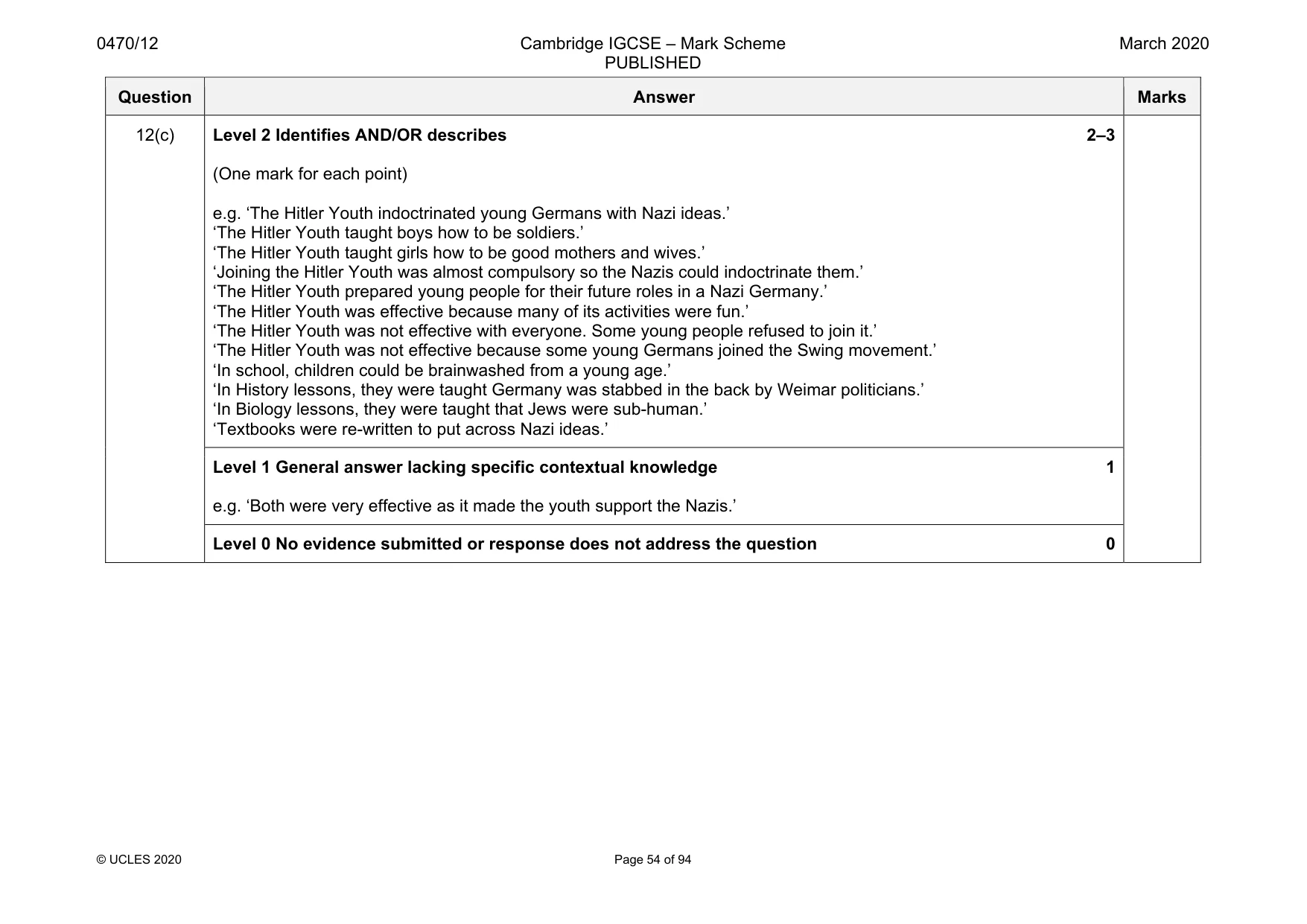
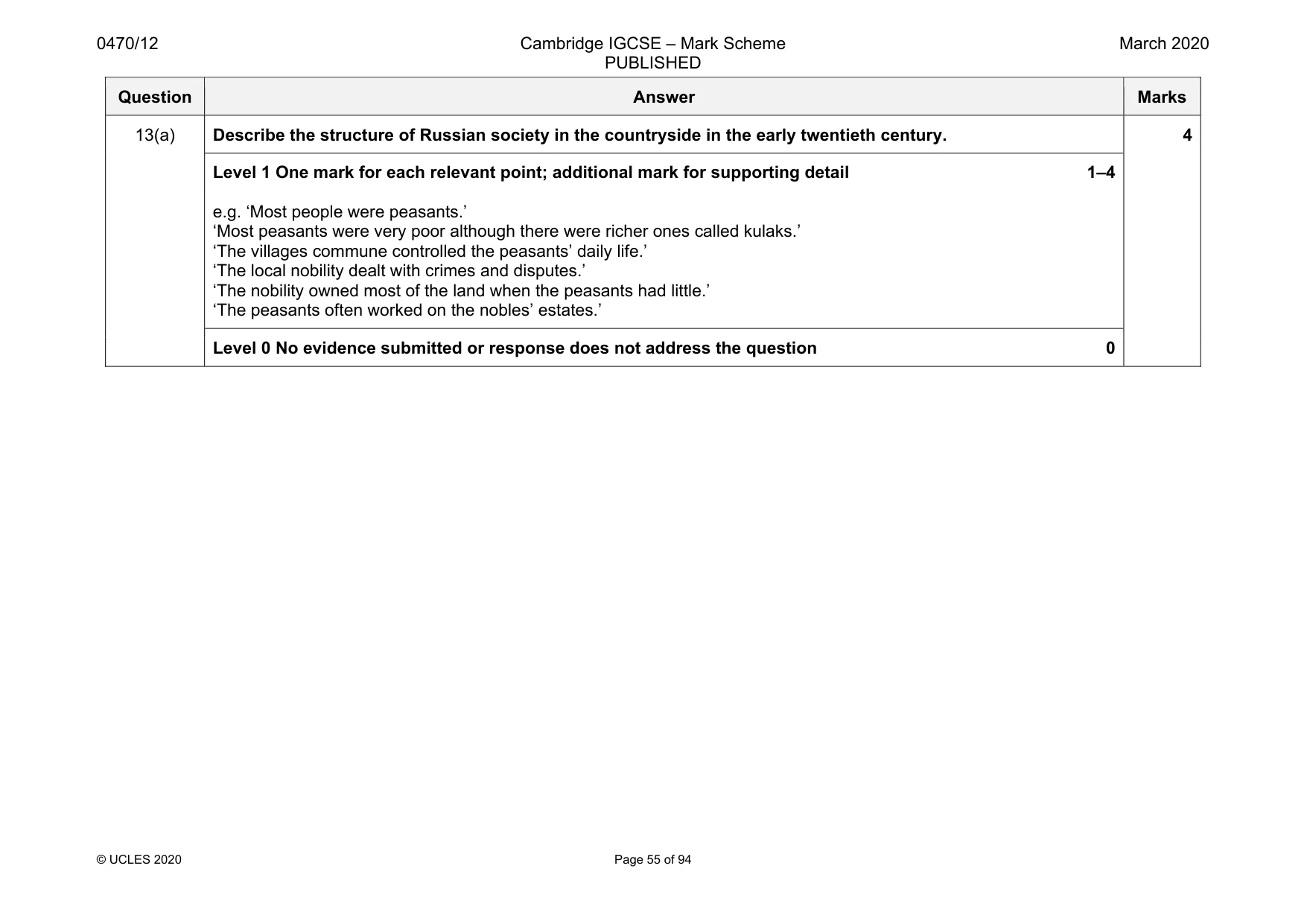
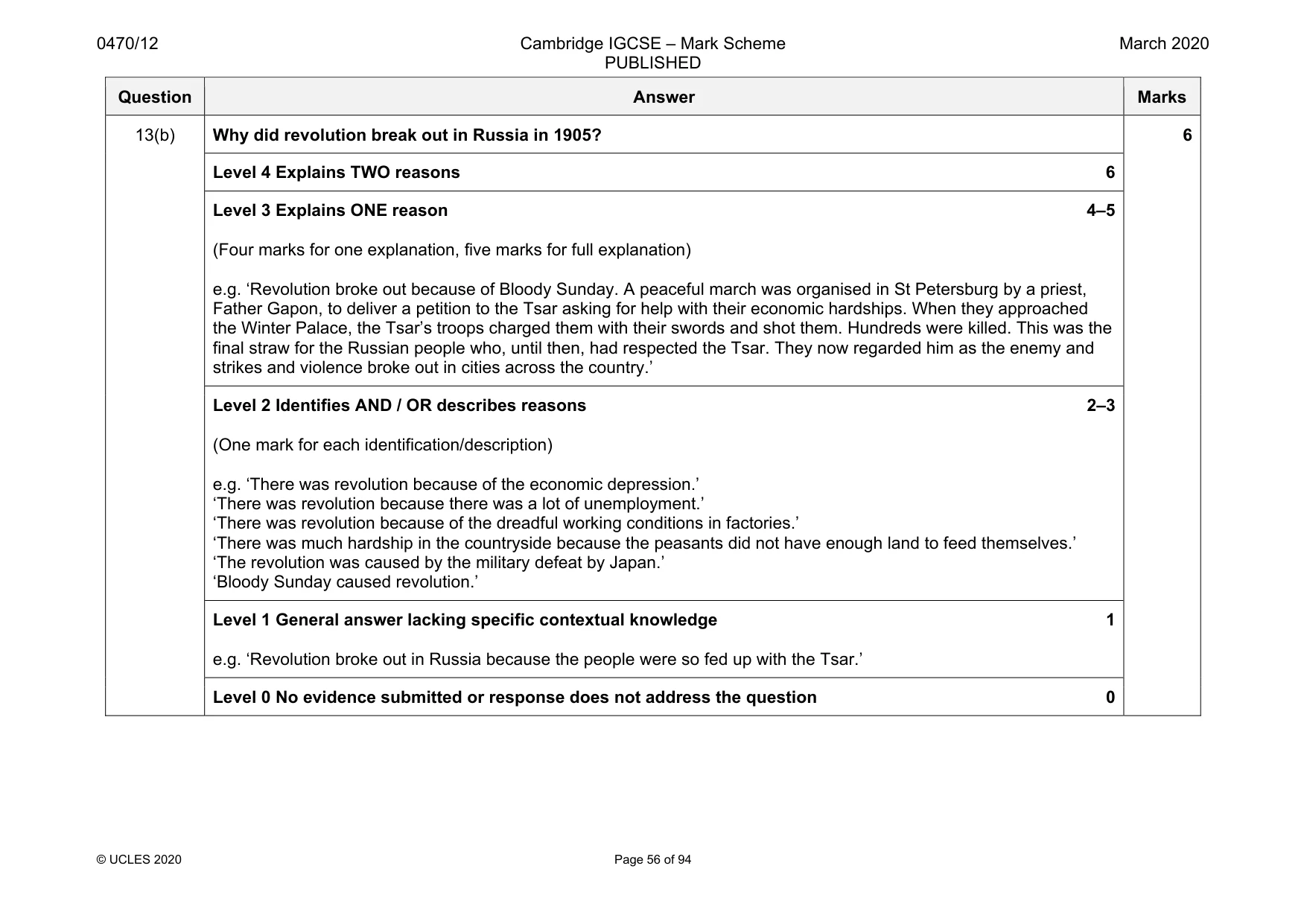
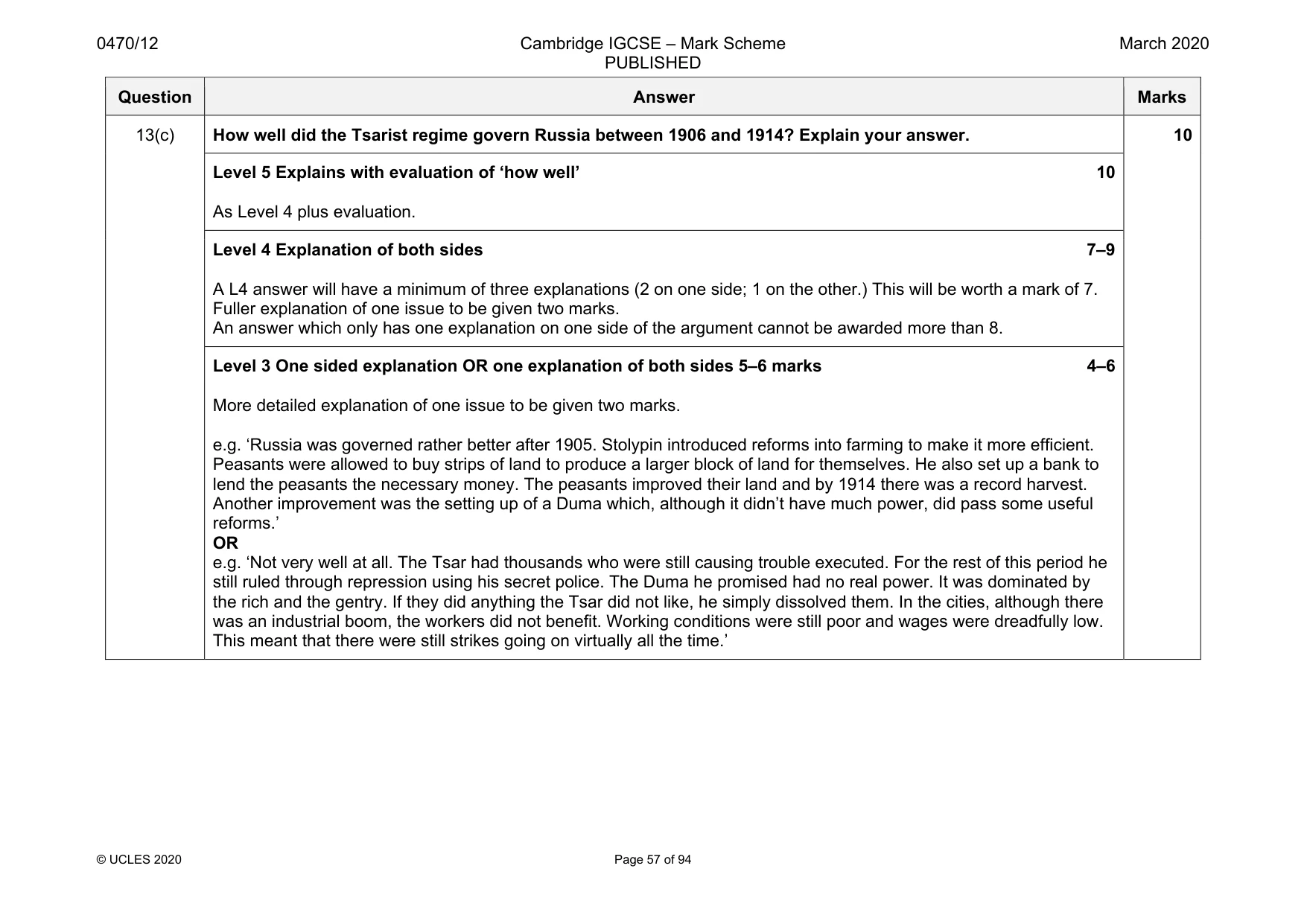
Paper as text
Question paper, page 1
Cambridge IGCSE™ * 1 0 2 8 3 8 0 8 7 4 * HISTORY 0470/12 Paper 1 February/March 2020 2 hours You must answer on the enclosed answer booklet. You will need: Answer booklet (enclosed) INSTRUCTIONS ● Answer three questions in total: Section A (Core Content): answer two questions. Section B (Depth Studies): answer one question. ● Follow the instructions on the front cover of the answer booklet. If you need additional answer paper, ask the invigilator for a continuation booklet. INFORMATION ● The total mark for this paper is 60. ● The number of marks for each question or part question is shown in brackets [ ]. DC (CJ) 184565/3 © UCLES 2020 [Turn over This document has 12 pages. Blank pages are indicated.
Question paper, page 2
2 0470/12/F/M/20 © UCLES 2020 SECTION A: CORE CONTENT Answer any two questions from this Section. 1 After early setbacks, Italian unification was eventually achieved. (a) Describe Austria’s role in crushing the 1848–49 revolutions in Italy. [4] (b) Why was Mazzini important to the cause of Italian unification? [6] (c) Which was more important in achieving Italian unification, Cavour’s diplomacy or Garibaldi’s actions? Explain your answer. [10] 2 France, Prussia and Austria all played important roles on the road to German unification. (a) Describe the crisis over Luxembourg in 1867. [4] (b) Why did William I appoint Bismarck as Minister-President in 1862? [6] (c) Which was more responsible for Prussia’s emergence as the dominant German power by 1866, Prussian strength or Austrian weakness? Explain your answer. [10] 3 Black Americans suffered in the USA during the nineteenth century. (a) What did the Supreme Court decide in the Dred Scott case of 1857? [4] (b) Why was the Fugitive Slave Act of 1850 controversial? [6] (c) Which achieved more for black Americans, the Civil War or Reconstruction? Explain your answer. [10] 4 International agreements could increase tensions between European powers. (a) What were the terms of the Triple Alliance? [4] (b) Why did Austria send Serbia an ultimatum on 23 July 1914? [6] (c) ‘Britain went to war in 1914 to honour its promise to protect Belgium.’ How far do you agree with this statement? Explain your answer. [10]
Question paper, page 3
3 0470/12/F/M/20 © UCLES 2020 [Turn over 5 Few nations were entirely happy with the final terms of the Paris Peace Settlement. (a) Describe how Turkey was treated in the Treaty of Sèvres. [4] (b) Why did the Treaty of Versailles have a damaging political impact on Germany up to 1923? [6] (c) Who was happier with the terms of the Treaty of Versailles, Clemenceau or Wilson? Explain your answer. [10] 6 The record of the League of Nations was mixed. (a) Describe how the League of Nations dealt with Upper Silesia. [4] (b) Why was Haile Selassie unhappy with the way the League dealt with the Italian invasion of Abyssinia? [6] (c) ‘The humanitarian work of the League’s agencies was more important than its failure over the Japanese invasion of Manchuria.’ How far do you agree with this statement? Explain your answer. [10] 7 After the Second World War there was friction between the USA and the USSR. (a) Describe how communists took over Czechoslovakia between 1945 and 1948. [4] (b) Why did many Western European countries welcome the Marshall Plan? [6] (c) ‘Stalin’s foreign policy towards Europe between 1945 and 1949 was defensive.’ How far do you agree with this statement? Explain your answer. [10] 8 Relations between Iran and Iraq were poor. (a) Describe the Shah’s programme to modernise Iran. [4] (b) Why did several Western Powers support Iraq in the Iran–Iraq War? [6] (c) Was Saddam Hussein right when he declared a victory for Iraq in the Iran–Iraq War? Explain your answer. [10]
Question paper, page 4
4 0470/12/F/M/20 © UCLES 2020 SECTION B: DEPTH STUDIES Answer any one question from this Section. DEPTH STUDY A: THE FIRST WORLD WAR, 1914–18 9 A stalemate quickly developed on the Western Front. (a) Describe the psychological problems experienced by soldiers in the trenches. [4] (b) Explain why Germany developed the Schlieffen Plan. [6] (c) How far does Belgium’s reaction to German aggression explain why a stalemate developed on the Western Front? Explain your answer. [10] 10 The Battles of Verdun and the Somme were key battles in the First World War. (a) Describe Haig’s tactics in the Battle of the Somme. [4] (b) Why did both sides use gas on the Western Front? [6] (c) ‘The Battle of Verdun achieved more for the Allies than the Battle of the Somme.’ How far do you agree with this statement? Explain your answer. [10]
Question paper, page 5
5 0470/12/F/M/20 © UCLES 2020 [Turn over DEPTH STUDY B: GERMANY, 1918–45 11 The Nazis used both legal and illegal methods. (a) Describe the events of the Munich Putsch. [4] (b) Why did the Nazis do well in elections in the years 1930 to 1932? [6] (c) Which was more important in Hitler consolidating his power, the Enabling Act or the Night of the Long Knives? Explain your answer. [10] 12 The Nazis treated different groups in Germany very differently. (a) Describe the activities of the Edelweiss Pirates. [4] (b) Why did the Nazis introduce the Final Solution? [6] (c) Which was more effective in winning over German youth, the Hitler Youth or changes to what was taught in schools? Explain your answer. [10]
Question paper, page 6
6 0470/12/F/M/20 © UCLES 2020 DEPTH STUDY C: RUSSIA, 1905–41 13 The Tsarist regime faced many difficulties between 1905 and 1914. (a) Describe the structure of Russian society in the countryside in the early twentieth century. [4] (b) Why did revolution break out in Russia in 1905? [6] (c) How well did the Tsarist regime govern Russia between 1906 and 1914? Explain your answer. [10] 14 Stalin’s reforms affected all parts of Soviet society. (a) Describe how the Soviet authorities enforced collectivisation. [4] (b) Why were Stalin’s reforms important for Soviet women? [6] (c) ‘By 1941 Stalin had modernised the Soviet Union.’ How far do you agree with this statement? Explain your answer. [10]
Question paper, page 7
7 0470/12/F/M/20 © UCLES 2020 [Turn over DEPTH STUDY D: THE UNITED STATES, 1919–41 15 During the 1920s America experienced a ‘boom’. (a) Describe the new methods used by the car industry to build and sell cars. [4] (b) Why did most farmers not benefit from the economic ‘boom’? [6] (c) ‘The 1920s saw American industry doing well.’ How far do you agree with this statement? Explain your answer. [10] 16 Roosevelt introduced two New Deals. (a) Describe how farmers were helped by the First New Deal. [4] (b) When he became President, why did Roosevelt first focus on the banking crisis? [6] (c) ‘The Second New Deal was more important than the First.’ How far do you agree with this statement? Explain your answer. [10]
Question paper, page 8
8 0470/12/F/M/20 © UCLES 2020 DEPTH STUDY E: CHINA, c.1930–c.1990 17 The 1950s were a time of rapid change for China. (a) Describe the work of the ‘People’s Courts’. [4] (b) Why did Mao introduce the first Five Year Plan? [6] (c) ‘By the early 1960s Mao had achieved all his aims.’ How far do you agree with this statement? Explain your answer. [10] 18 The lives of Chinese people changed under Mao’s rule. (a) Describe the experiences of minority groups under Mao. [4] (b) Why did Mao bring the Hundred Flowers campaign to an end? [6] (c) ‘It is surprising that Mao started the Cultural Revolution.’ How far do you agree with this statement? Explain your answer. [10]
Question paper, page 9
9 0470/12/F/M/20 © UCLES 2020 [Turn over DEPTH STUDY F: SOUTH AFRICA, c.1940–c.1994 19 By the 1940s, there had been many changes in South Africa. (a) Describe the consequences of the Natives Land Act of 1913 for black South Africans. [4] (b) Why did the South African economy develop rapidly by 1940? [6] (c) ‘Changes in South Africa brought about by the Second World War explain the victory of the National Party in the 1948 election.’ How far do you agree with this statement? Explain your answer. [10] 20 After a long struggle majority rule was finally achieved in South Africa. (a) What did Desmond Tutu contribute to the ending of apartheid? [4] (b) Why did P W Botha’s reforms fail to stop opposition? [6] (c) ‘The transfer of power between 1989 and 1994 went well.’ How far do you agree with this statement? Explain your answer. [10]
Question paper, page 10
10 0470/12/F/M/20 © UCLES 2020 DEPTH STUDY G: ISRAELIS AND PALESTINIANS SINCE 1945 21 At the end of the Second World War Britain had a mandate in Palestine. (a) What did the United Nations’ partition plan propose for the Palestinians? [4] (b) Why did war break out between the Arabs and the Israelis in 1948? [6] (c) How surprising was the British decision to withdraw from Palestine? Explain your answer. [10] 22 The period from 1948 to 1973 was dominated by war. (a) What were the results of the Yom Kippur War of 1973? [4] (b) Why was the involvement of the Soviet Union in Arab–Israeli affairs important in the period 1948 to 1973? [6] (c) Which was more important for Israel, the Suez War of 1956 or the Six-Day War of 1967? Explain your answer. [10]
Question paper, page 11
11 0470/12/F/M/20 © UCLES 2020 BLANK PAGE
Question paper, page 12
12 0470/12/F/M/20 © UCLES 2020 Permission to reproduce items where third-party owned material protected by copyright is included has been sought and cleared where possible. Every reasonable effort has been made by the publisher (UCLES) to trace copyright holders, but if any items requiring clearance have unwittingly been included, the publisher will be pleased to make amends at the earliest possible opportunity. To avoid the issue of disclosure of answer-related information to candidates, all copyright acknowledgements are reproduced online in the Cambridge Assessment International Education Copyright Acknowledgements Booklet. This is produced for each series of examinations and is freely available to download at www.cambridgeinternational.org after the live examination series. Cambridge Assessment International Education is part of the Cambridge Assessment Group. Cambridge Assessment is the brand name of the University of Cambridge Local Examinations Syndicate (UCLES), which itself is a department of the University of Cambridge. BLANK PAGE
Mark scheme, page 1
This document consists of 94 printed pages. © UCLES 2020 [Turn over Cambridge IGCSE™ HISTORY 0470/12 Paper 1 March 2020 MARK SCHEME Maximum Mark: 60 Published This mark scheme is published as an aid to teachers and candidates, to indicate the requirements of the examination. It shows the basis on which Examiners were instructed to award marks. It does not indicate the details of the discussions that took place at an Examiners’ meeting before marking began, which would have considered the acceptability of alternative answers. Mark schemes should be read in conjunction with the question paper and the Principal Examiner Report for Teachers. Cambridge International will not enter into discussions about these mark schemes. Cambridge International is publishing the mark schemes for the March 2020 series for most Cambridge IGCSE™, Cambridge International A and AS Level components and some Cambridge O Level components.
Mark scheme, page 2
0470/12 Cambridge IGCSE – Mark Scheme PUBLISHED March 2020 © UCLES 2020 Page 2 of 94 Generic Marking Principles These general marking principles must be applied by all examiners when marking candidate answers. They should be applied alongside the specific content of the mark scheme or generic level descriptors for a question. Each question paper and mark scheme will also comply with these marking principles. GENERIC MARKING PRINCIPLE 1: Marks must be awarded in line with: • the specific content of the mark scheme or the generic level descriptors for the question • the specific skills defined in the mark scheme or in the generic level descriptors for the question • the standard of response required by a candidate as exemplified by the standardisation scripts. GENERIC MARKING PRINCIPLE 2: Marks awarded are always whole marks (not half marks, or other fractions). GENERIC MARKING PRINCIPLE 3: Marks must be awarded positively: • marks are awarded for correct/valid answers, as defined in the mark scheme. However, credit is given for valid answers which go beyond the scope of the syllabus and mark scheme, referring to your Team Leader as appropriate • marks are awarded when candidates clearly demonstrate what they know and can do • marks are not deducted for errors • marks are not deducted for omissions • answers should only be judged on the quality of spelling, punctuation and grammar when these features are specifically assessed by the question as indicated by the mark scheme. The meaning, however, should be unambiguous. GENERIC MARKING PRINCIPLE 4: Rules must be applied consistently e.g. in situations where candidates have not followed instructions or in the application of generic level descriptors.
Mark scheme, page 3
0470/12 Cambridge IGCSE – Mark Scheme PUBLISHED March 2020 © UCLES 2020 Page 3 of 94 GENERIC MARKING PRINCIPLE 5: Marks should be awarded using the full range of marks defined in the mark scheme for the question (however; the use of the full mark range may be limited according to the quality of the candidate responses seen). GENERIC MARKING PRINCIPLE 6: Marks awarded are based solely on the requirements as defined in the mark scheme. Marks should not be awarded with grade thresholds or grade descriptors in mind.
Mark scheme, page 4
0470/12 Cambridge IGCSE – Mark Scheme PUBLISHED March 2020 © UCLES 2020 Page 4 of 94 GENERAL INSTRUCTIONS Applying the Mark Scheme • When marking a response the overall criteria to be considered should be – ‘How good is this response to this question?’ • The ‘Level Descriptor’ should be used to decide the Level into which the quality of the answer fits. • Exhaustive lists of possible facts are not given in the mark scheme, as there is often a choice of factual knowledge that candidates may use. • WHERE EXAMPLES OF RESPONSES ARE GIVEN, THESE ARE NOT PRESCRIPTIVE, BUT ARE INTENDED AS A GUIDE. It is not possible to cover every possible type of response within a levels of response mark scheme and examiners are expected to use their professional judgement at all times in ensuring that responses are placed in the correct levels and given an appropriate mark within that level. If you cannot resolve the issue, please contact your team leader. • Marking must be positive. Marks must not be deducted for inaccurate or irrelevant parts of answers. In itself, poor use of historical terminology, spelling, grammar or handwriting does not affect the mark. The overall quality of the answer to the question should be judged. • If a candidate reaches a particular level s/he must be rewarded with a mark within that level. It is not necessary to work through the levels. • The full range of marks should be used. Do not be afraid to award full marks or no marks. Failure to do this will seriously affect the distribution of marks. Be prepared to reward candidates who show any level of understanding. The mark scheme starts from basic acceptable response. Where a band of marks is indicated for a level these marks should be used with reference to the development of the answer within that level. Assessment Objectives (a) recall, description (b) recall, explanation (c) recall, explanation and analysis
Mark scheme, page 5
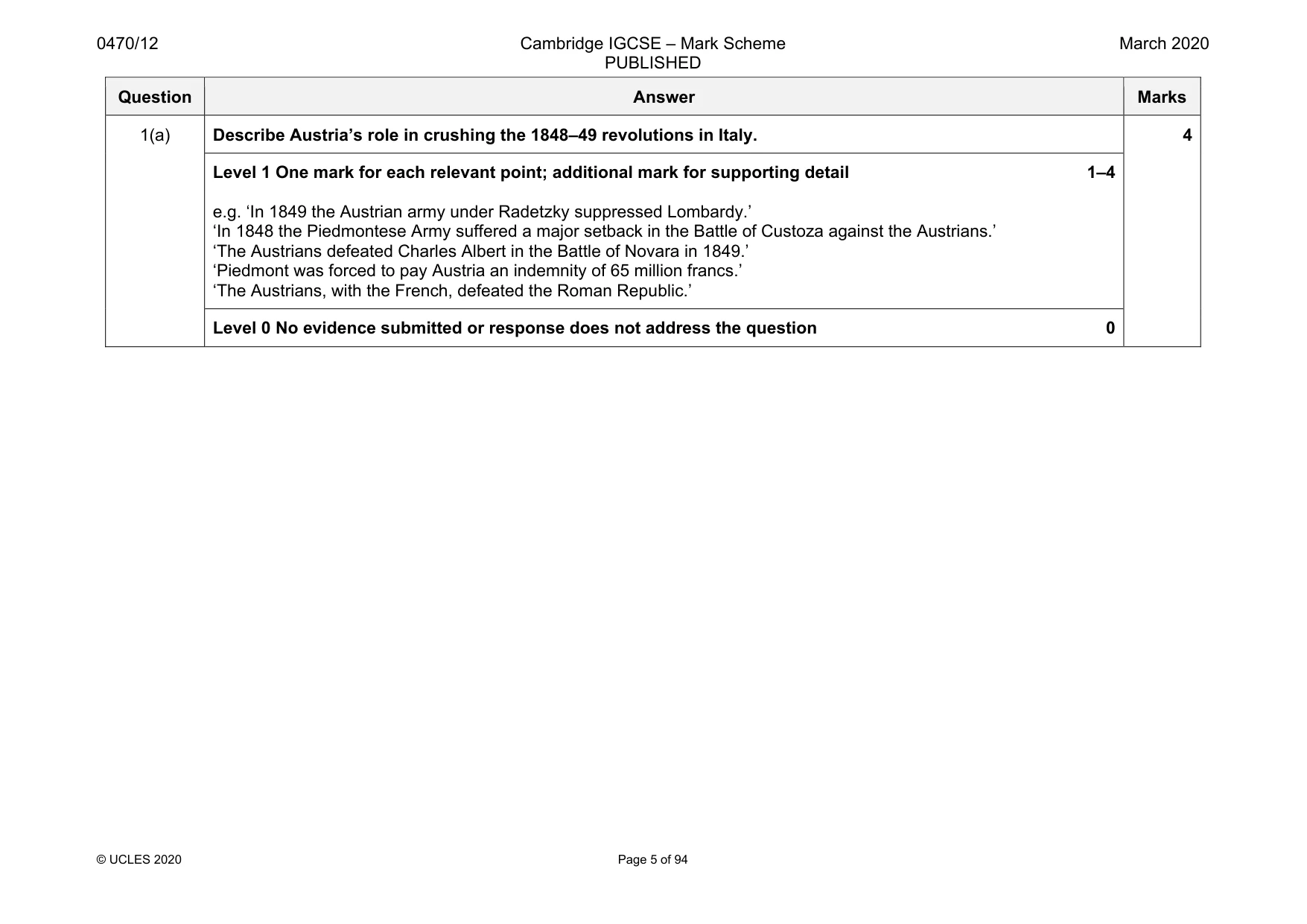
0470/12 Cambridge IGCSE – Mark Scheme PUBLISHED March 2020 © UCLES 2020 Page 5 of 94 Question Answer Marks 1(a) Describe Austria’s role in crushing the 1848–49 revolutions in Italy. 4 Level 1 One mark for each relevant point; additional mark for supporting detail 1–4 e.g. ‘In 1849 the Austrian army under Radetzky suppressed Lombardy.’ ‘In 1848 the Piedmontese Army suffered a major setback in the Battle of Custoza against the Austrians.’ ‘The Austrians defeated Charles Albert in the Battle of Novara in 1849.’ ‘Piedmont was forced to pay Austria an indemnity of 65 million francs.’ ‘The Austrians, with the French, defeated the Roman Republic.’ Level 0 No evidence submitted or response does not address the question 0
Mark scheme, page 6
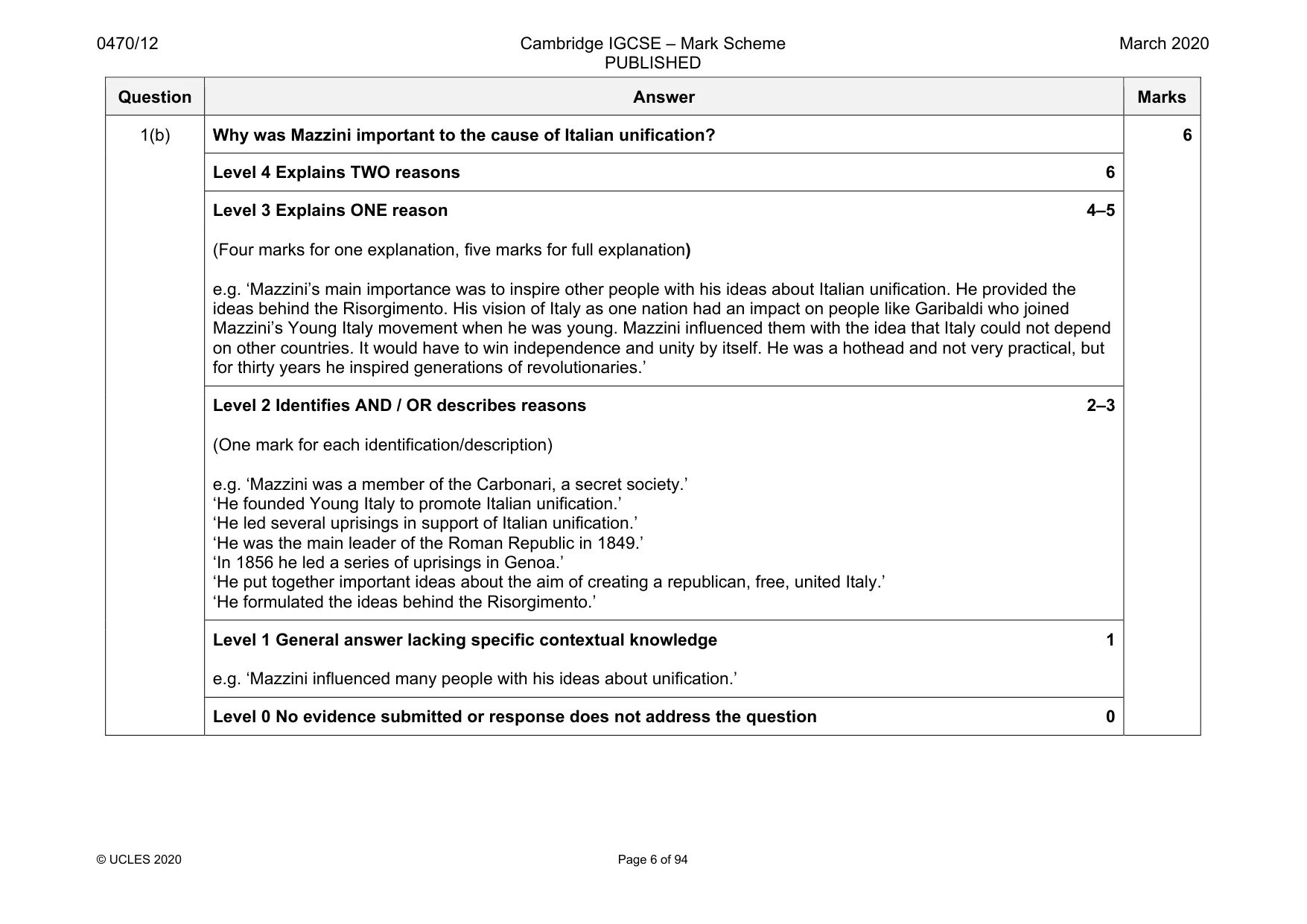
0470/12 Cambridge IGCSE – Mark Scheme PUBLISHED March 2020 © UCLES 2020 Page 6 of 94 Question Answer Marks 1(b) Why was Mazzini important to the cause of Italian unification? 6 Level 4 Explains TWO reasons 6 Level 3 Explains ONE reason 4–5 (Four marks for one explanation, five marks for full explanation) e.g. ‘Mazzini’s main importance was to inspire other people with his ideas about Italian unification. He provided the ideas behind the Risorgimento. His vision of Italy as one nation had an impact on people like Garibaldi who joined Mazzini’s Young Italy movement when he was young. Mazzini influenced them with the idea that Italy could not depend on other countries. It would have to win independence and unity by itself. He was a hothead and not very practical, but for thirty years he inspired generations of revolutionaries.’ Level 2 Identifies AND / OR describes reasons 2–3 (One mark for each identification/description) e.g. ‘Mazzini was a member of the Carbonari, a secret society.’ ‘He founded Young Italy to promote Italian unification.’ ‘He led several uprisings in support of Italian unification.’ ‘He was the main leader of the Roman Republic in 1849.’ ‘In 1856 he led a series of uprisings in Genoa.’ ‘He put together important ideas about the aim of creating a republican, free, united Italy.’ ‘He formulated the ideas behind the Risorgimento.’ Level 1 General answer lacking specific contextual knowledge 1 e.g. ‘Mazzini influenced many people with his ideas about unification.’ Level 0 No evidence submitted or response does not address the question 0
Mark scheme, page 7
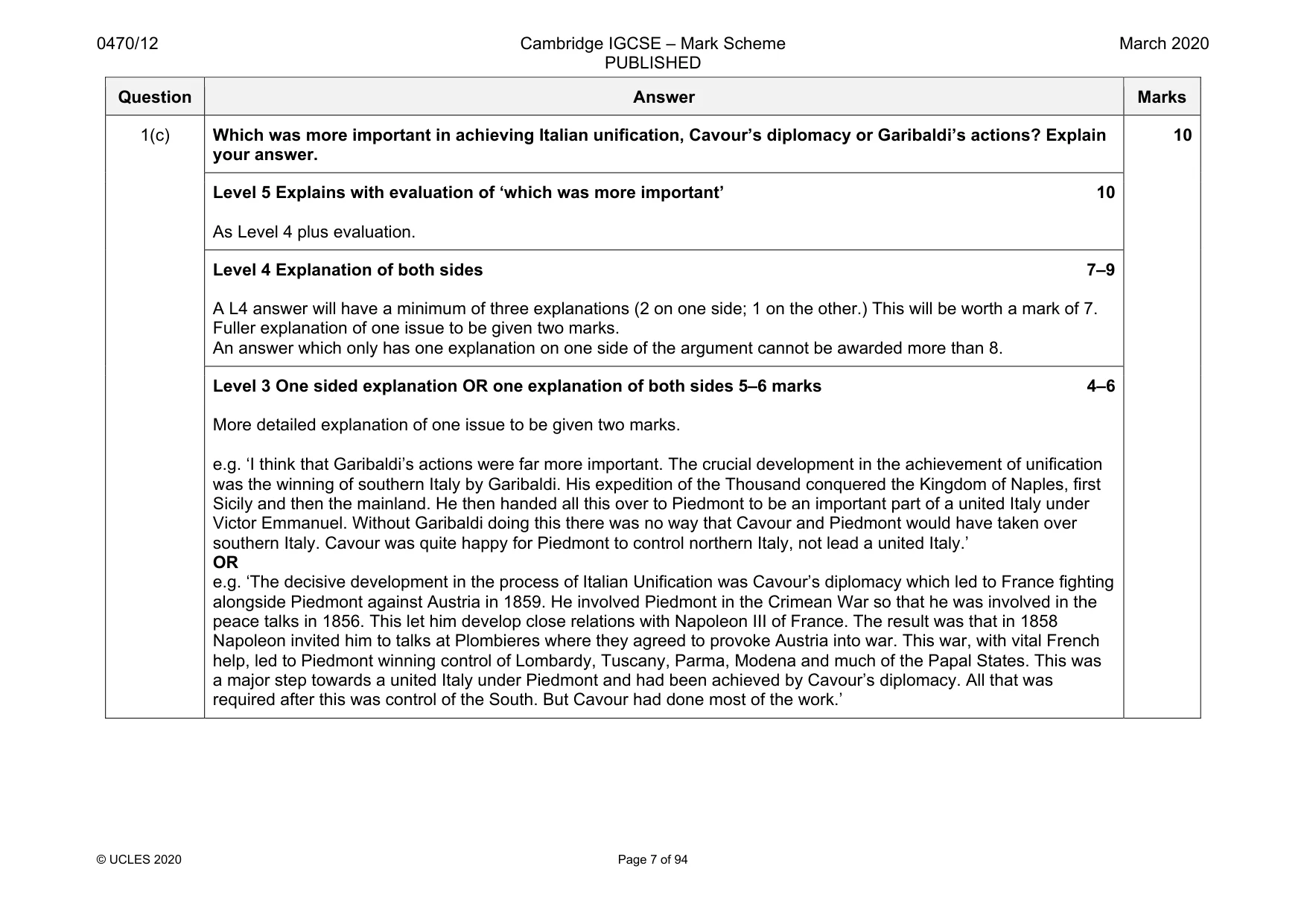
0470/12 Cambridge IGCSE – Mark Scheme PUBLISHED March 2020 © UCLES 2020 Page 7 of 94 Question Answer Marks 1(c) Which was more important in achieving Italian unification, Cavour’s diplomacy or Garibaldi’s actions? Explain your answer. 10 Level 5 Explains with evaluation of ‘which was more important’ 10 As Level 4 plus evaluation. Level 4 Explanation of both sides 7–9 A L4 answer will have a minimum of three explanations (2 on one side; 1 on the other.) This will be worth a mark of 7. Fuller explanation of one issue to be given two marks. An answer which only has one explanation on one side of the argument cannot be awarded more than 8. Level 3 One sided explanation OR one explanation of both sides 5–6 marks 4–6 More detailed explanation of one issue to be given two marks. e.g. ‘I think that Garibaldi’s actions were far more important. The crucial development in the achievement of unification was the winning of southern Italy by Garibaldi. His expedition of the Thousand conquered the Kingdom of Naples, first Sicily and then the mainland. He then handed all this over to Piedmont to be an important part of a united Italy under Victor Emmanuel. Without Garibaldi doing this there was no way that Cavour and Piedmont would have taken over southern Italy. Cavour was quite happy for Piedmont to control northern Italy, not lead a united Italy.’ OR e.g. ‘The decisive development in the process of Italian Unification was Cavour’s diplomacy which led to France fighting alongside Piedmont against Austria in 1859. He involved Piedmont in the Crimean War so that he was involved in the peace talks in 1856. This let him develop close relations with Napoleon III of France. The result was that in 1858 Napoleon invited him to talks at Plombieres where they agreed to provoke Austria into war. This war, with vital French help, led to Piedmont winning control of Lombardy, Tuscany, Parma, Modena and much of the Papal States. This was a major step towards a united Italy under Piedmont and had been achieved by Cavour’s diplomacy. All that was required after this was control of the South. But Cavour had done most of the work.’
Mark scheme, page 8
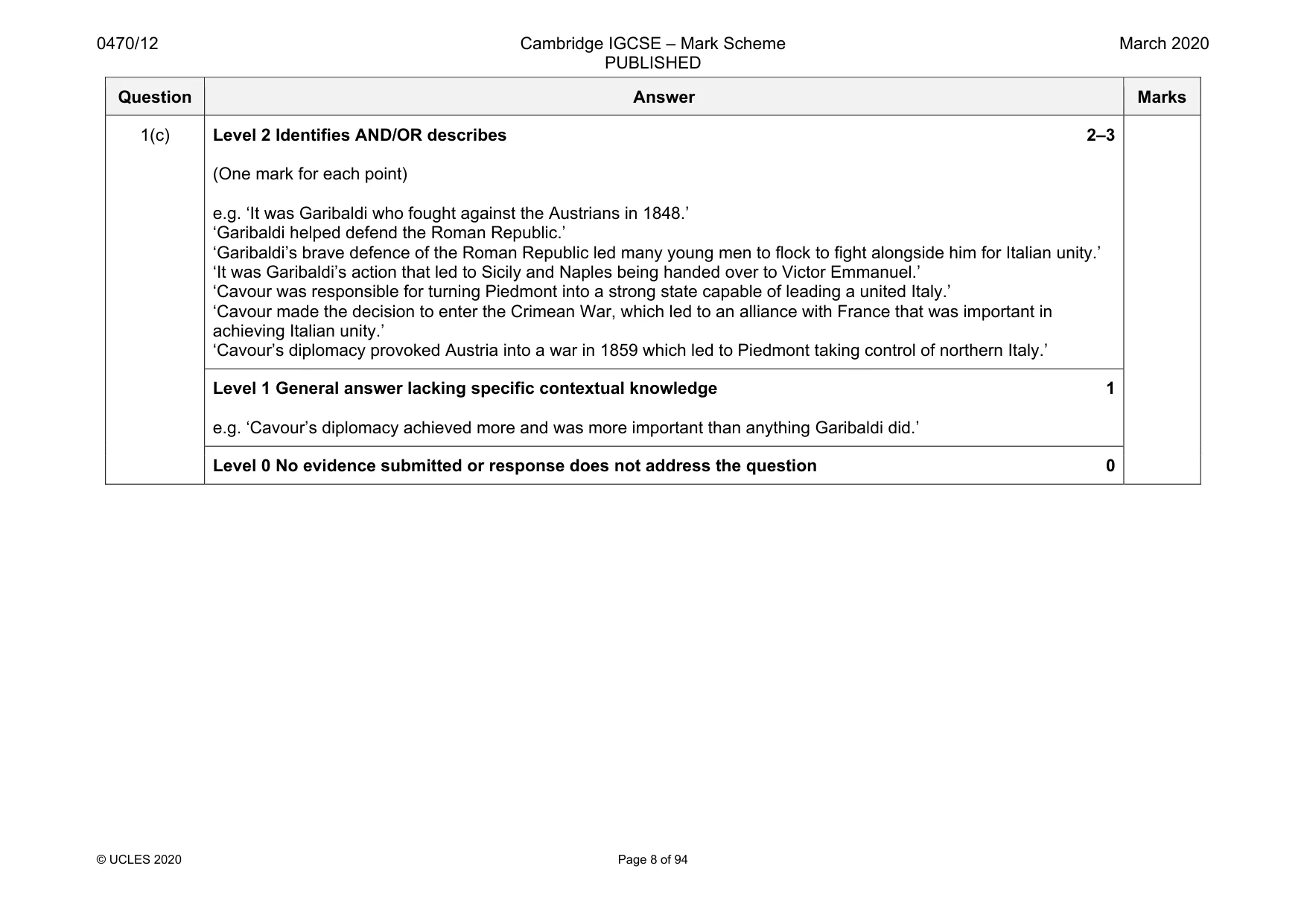
0470/12 Cambridge IGCSE – Mark Scheme PUBLISHED March 2020 © UCLES 2020 Page 8 of 94 Question Answer Marks 1(c) Level 2 Identifies AND/OR describes 2–3 (One mark for each point) e.g. ‘It was Garibaldi who fought against the Austrians in 1848.’ ‘Garibaldi helped defend the Roman Republic.’ ‘Garibaldi’s brave defence of the Roman Republic led many young men to flock to fight alongside him for Italian unity.’ ‘It was Garibaldi’s action that led to Sicily and Naples being handed over to Victor Emmanuel.’ ‘Cavour was responsible for turning Piedmont into a strong state capable of leading a united Italy.’ ‘Cavour made the decision to enter the Crimean War, which led to an alliance with France that was important in achieving Italian unity.’ ‘Cavour’s diplomacy provoked Austria into a war in 1859 which led to Piedmont taking control of northern Italy.’ Level 1 General answer lacking specific contextual knowledge 1 e.g. ‘Cavour’s diplomacy achieved more and was more important than anything Garibaldi did.’ Level 0 No evidence submitted or response does not address the question 0
Mark scheme, page 9
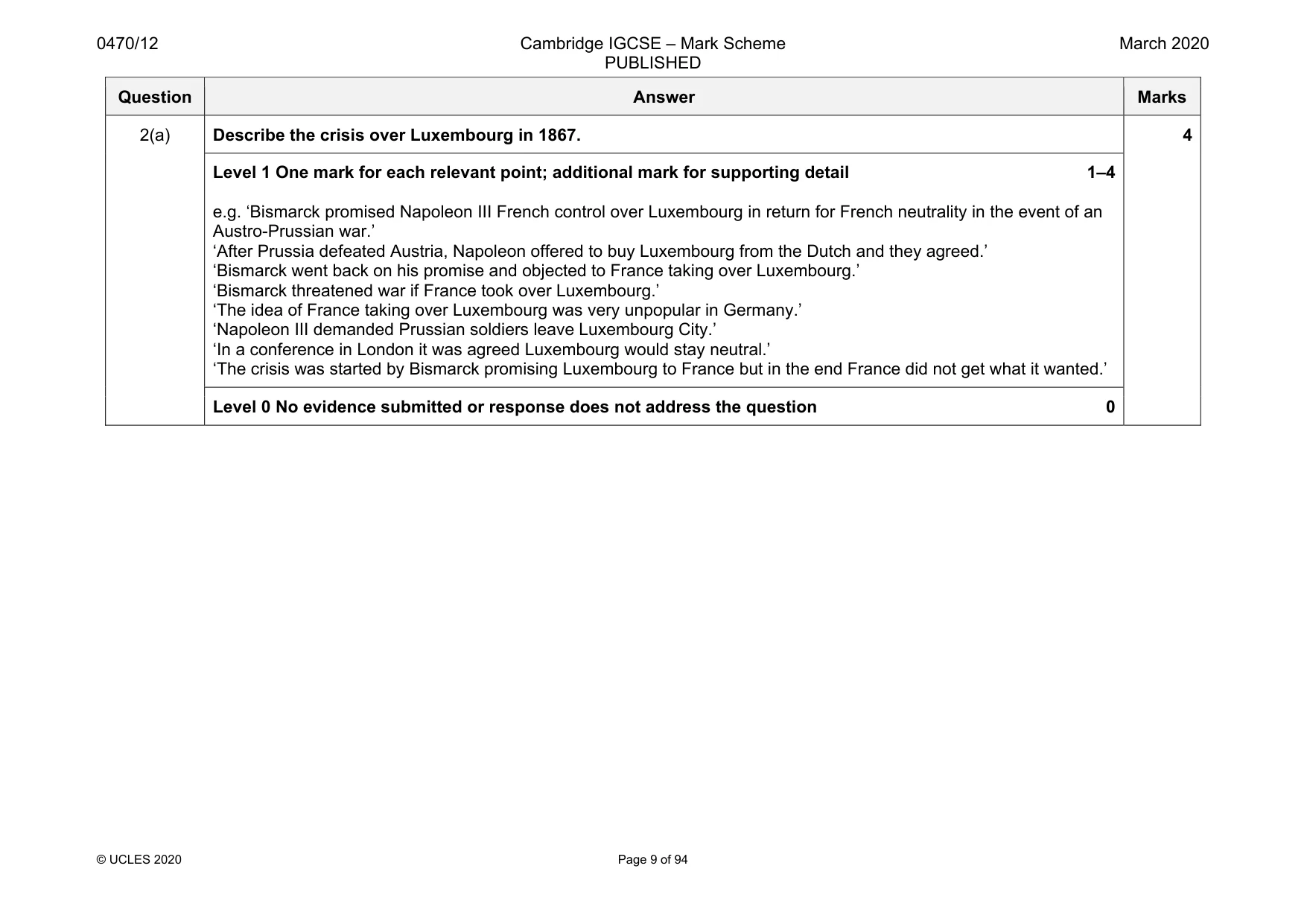
0470/12 Cambridge IGCSE – Mark Scheme PUBLISHED March 2020 © UCLES 2020 Page 9 of 94 Question Answer Marks 2(a) Describe the crisis over Luxembourg in 1867. 4 Level 1 One mark for each relevant point; additional mark for supporting detail 1–4 e.g. ‘Bismarck promised Napoleon III French control over Luxembourg in return for French neutrality in the event of an Austro-Prussian war.’ ‘After Prussia defeated Austria, Napoleon offered to buy Luxembourg from the Dutch and they agreed.’ ‘Bismarck went back on his promise and objected to France taking over Luxembourg.’ ‘Bismarck threatened war if France took over Luxembourg.’ ‘The idea of France taking over Luxembourg was very unpopular in Germany.’ ‘Napoleon III demanded Prussian soldiers leave Luxembourg City.’ ‘In a conference in London it was agreed Luxembourg would stay neutral.’ ‘The crisis was started by Bismarck promising Luxembourg to France but in the end France did not get what it wanted.’ Level 0 No evidence submitted or response does not address the question 0
Mark scheme, page 10
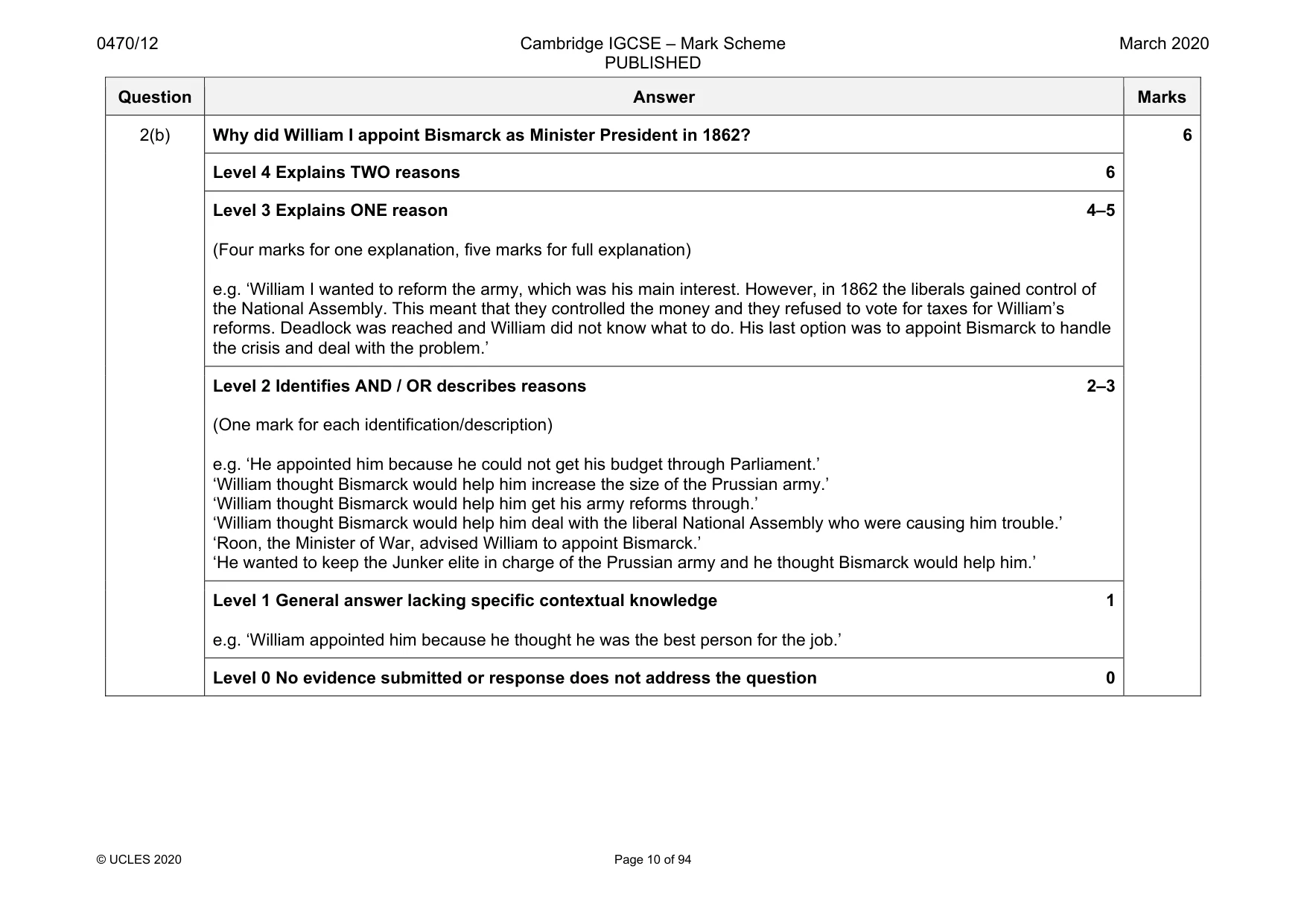
0470/12 Cambridge IGCSE – Mark Scheme PUBLISHED March 2020 © UCLES 2020 Page 10 of 94 Question Answer Marks 2(b) Why did William I appoint Bismarck as Minister President in 1862? 6 Level 4 Explains TWO reasons 6 Level 3 Explains ONE reason 4–5 (Four marks for one explanation, five marks for full explanation) e.g. ‘William I wanted to reform the army, which was his main interest. However, in 1862 the liberals gained control of the National Assembly. This meant that they controlled the money and they refused to vote for taxes for William’s reforms. Deadlock was reached and William did not know what to do. His last option was to appoint Bismarck to handle the crisis and deal with the problem.’ Level 2 Identifies AND / OR describes reasons 2–3 (One mark for each identification/description) e.g. ‘He appointed him because he could not get his budget through Parliament.’ ‘William thought Bismarck would help him increase the size of the Prussian army.’ ‘William thought Bismarck would help him get his army reforms through.’ ‘William thought Bismarck would help him deal with the liberal National Assembly who were causing him trouble.’ ‘Roon, the Minister of War, advised William to appoint Bismarck.’ ‘He wanted to keep the Junker elite in charge of the Prussian army and he thought Bismarck would help him.’ Level 1 General answer lacking specific contextual knowledge 1 e.g. ‘William appointed him because he thought he was the best person for the job.’ Level 0 No evidence submitted or response does not address the question 0
Mark scheme, page 11
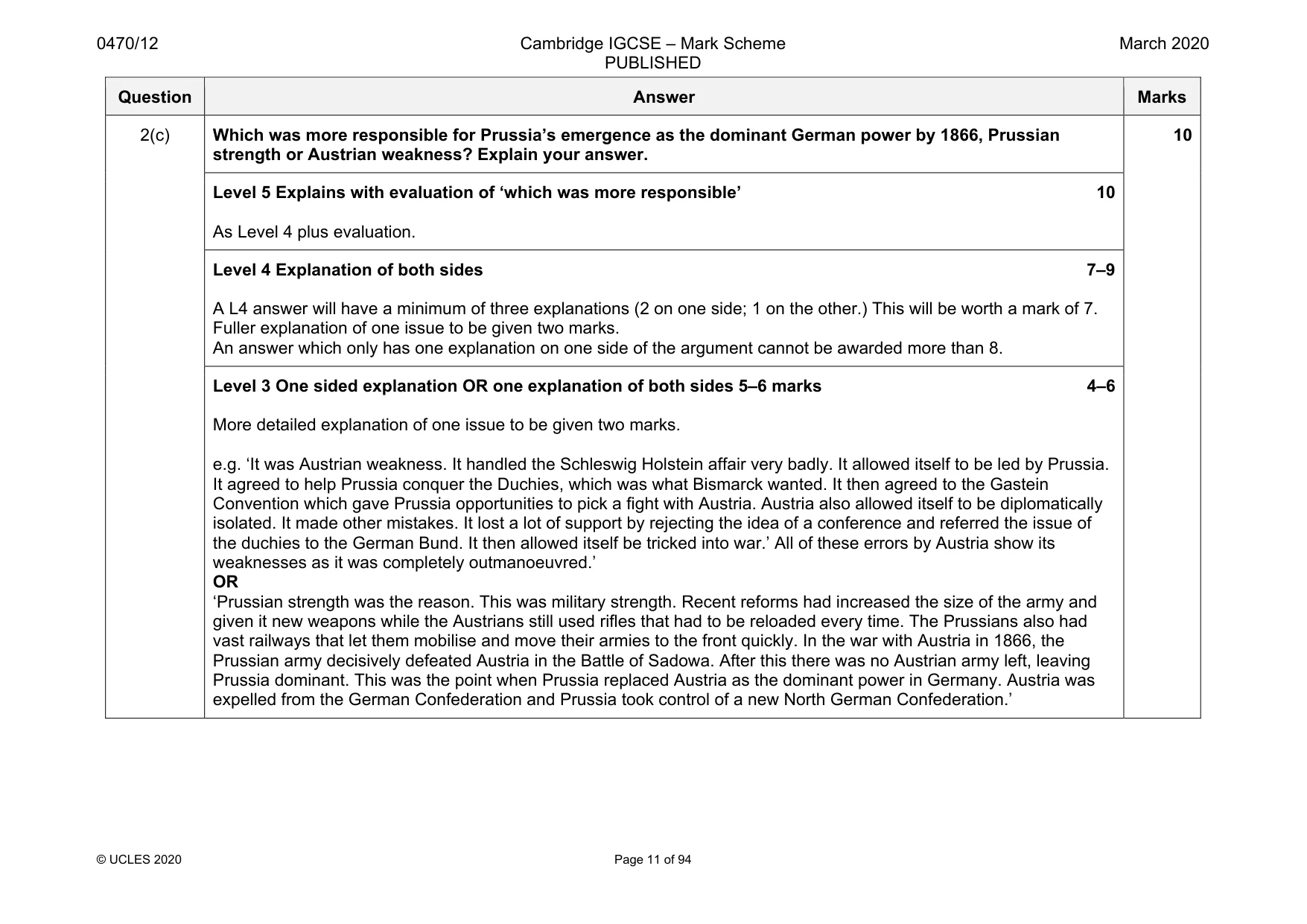
0470/12 Cambridge IGCSE – Mark Scheme PUBLISHED March 2020 © UCLES 2020 Page 11 of 94 Question Answer Marks 2(c) Which was more responsible for Prussia’s emergence as the dominant German power by 1866, Prussian strength or Austrian weakness? Explain your answer. 10 Level 5 Explains with evaluation of ‘which was more responsible’ 10 As Level 4 plus evaluation. Level 4 Explanation of both sides 7–9 A L4 answer will have a minimum of three explanations (2 on one side; 1 on the other.) This will be worth a mark of 7. Fuller explanation of one issue to be given two marks. An answer which only has one explanation on one side of the argument cannot be awarded more than 8. Level 3 One sided explanation OR one explanation of both sides 5–6 marks 4–6 More detailed explanation of one issue to be given two marks. e.g. ‘It was Austrian weakness. It handled the Schleswig Holstein affair very badly. It allowed itself to be led by Prussia. It agreed to help Prussia conquer the Duchies, which was what Bismarck wanted. It then agreed to the Gastein Convention which gave Prussia opportunities to pick a fight with Austria. Austria also allowed itself to be diplomatically isolated. It made other mistakes. It lost a lot of support by rejecting the idea of a conference and referred the issue of the duchies to the German Bund. It then allowed itself be tricked into war.’ All of these errors by Austria show its weaknesses as it was completely outmanoeuvred.’ OR ‘Prussian strength was the reason. This was military strength. Recent reforms had increased the size of the army and given it new weapons while the Austrians still used rifles that had to be reloaded every time. The Prussians also had vast railways that let them mobilise and move their armies to the front quickly. In the war with Austria in 1866, the Prussian army decisively defeated Austria in the Battle of Sadowa. After this there was no Austrian army left, leaving Prussia dominant. This was the point when Prussia replaced Austria as the dominant power in Germany. Austria was expelled from the German Confederation and Prussia took control of a new North German Confederation.’
Mark scheme, page 12
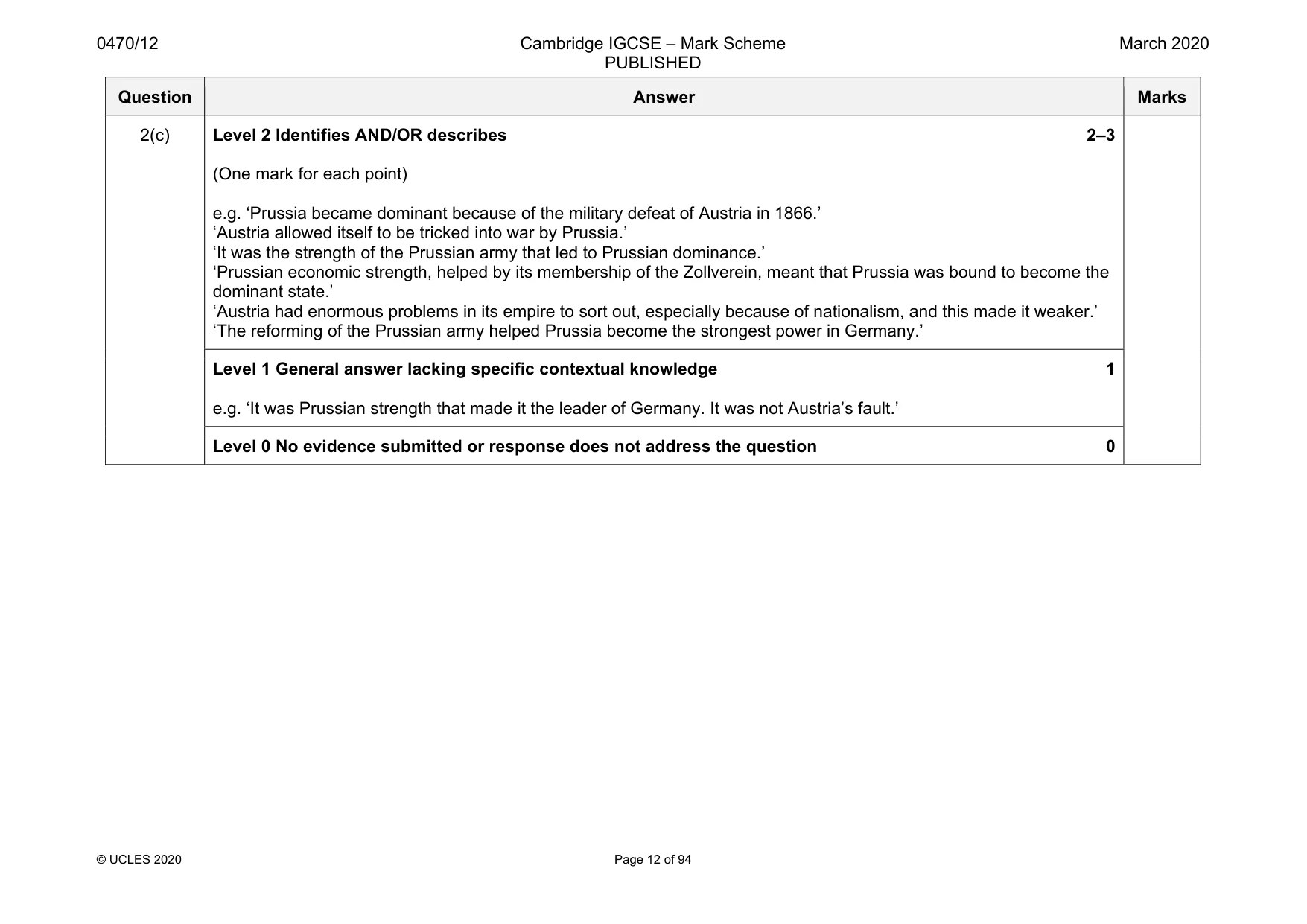
0470/12 Cambridge IGCSE – Mark Scheme PUBLISHED March 2020 © UCLES 2020 Page 12 of 94 Question Answer Marks 2(c) Level 2 Identifies AND/OR describes 2–3 (One mark for each point) e.g. ‘Prussia became dominant because of the military defeat of Austria in 1866.’ ‘Austria allowed itself to be tricked into war by Prussia.’ ‘It was the strength of the Prussian army that led to Prussian dominance.’ ‘Prussian economic strength, helped by its membership of the Zollverein, meant that Prussia was bound to become the dominant state.’ ‘Austria had enormous problems in its empire to sort out, especially because of nationalism, and this made it weaker.’ ‘The reforming of the Prussian army helped Prussia become the strongest power in Germany.’ Level 1 General answer lacking specific contextual knowledge 1 e.g. ‘It was Prussian strength that made it the leader of Germany. It was not Austria’s fault.’ Level 0 No evidence submitted or response does not address the question 0
Mark scheme, page 13
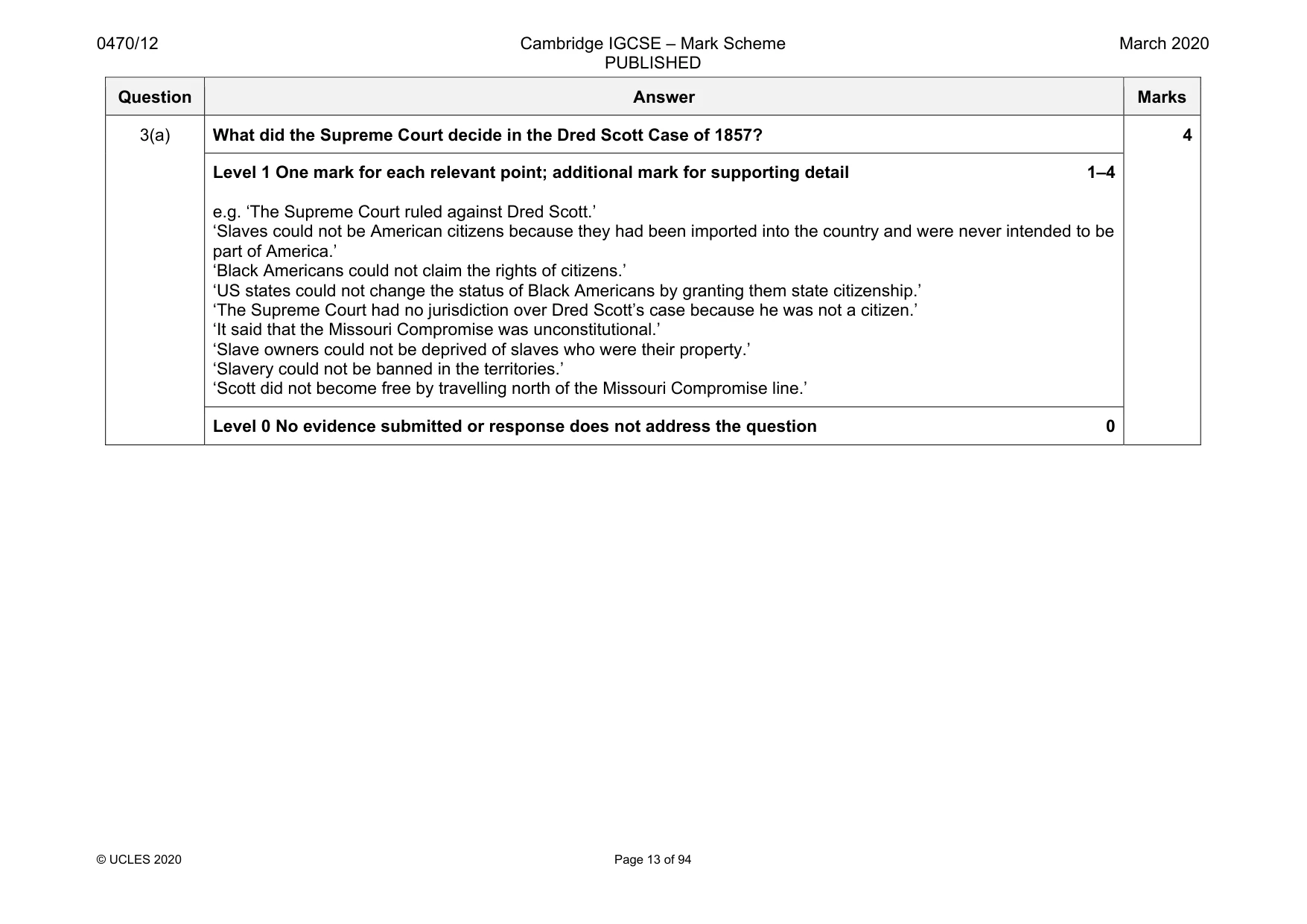
0470/12 Cambridge IGCSE – Mark Scheme PUBLISHED March 2020 © UCLES 2020 Page 13 of 94 Question Answer Marks 3(a) What did the Supreme Court decide in the Dred Scott Case of 1857? 4 Level 1 One mark for each relevant point; additional mark for supporting detail 1–4 e.g. ‘The Supreme Court ruled against Dred Scott.’ ‘Slaves could not be American citizens because they had been imported into the country and were never intended to be part of America.’ ‘Black Americans could not claim the rights of citizens.’ ‘US states could not change the status of Black Americans by granting them state citizenship.’ ‘The Supreme Court had no jurisdiction over Dred Scott’s case because he was not a citizen.’ ‘It said that the Missouri Compromise was unconstitutional.’ ‘Slave owners could not be deprived of slaves who were their property.’ ‘Slavery could not be banned in the territories.’ ‘Scott did not become free by travelling north of the Missouri Compromise line.’ Level 0 No evidence submitted or response does not address the question 0
Mark scheme, page 14
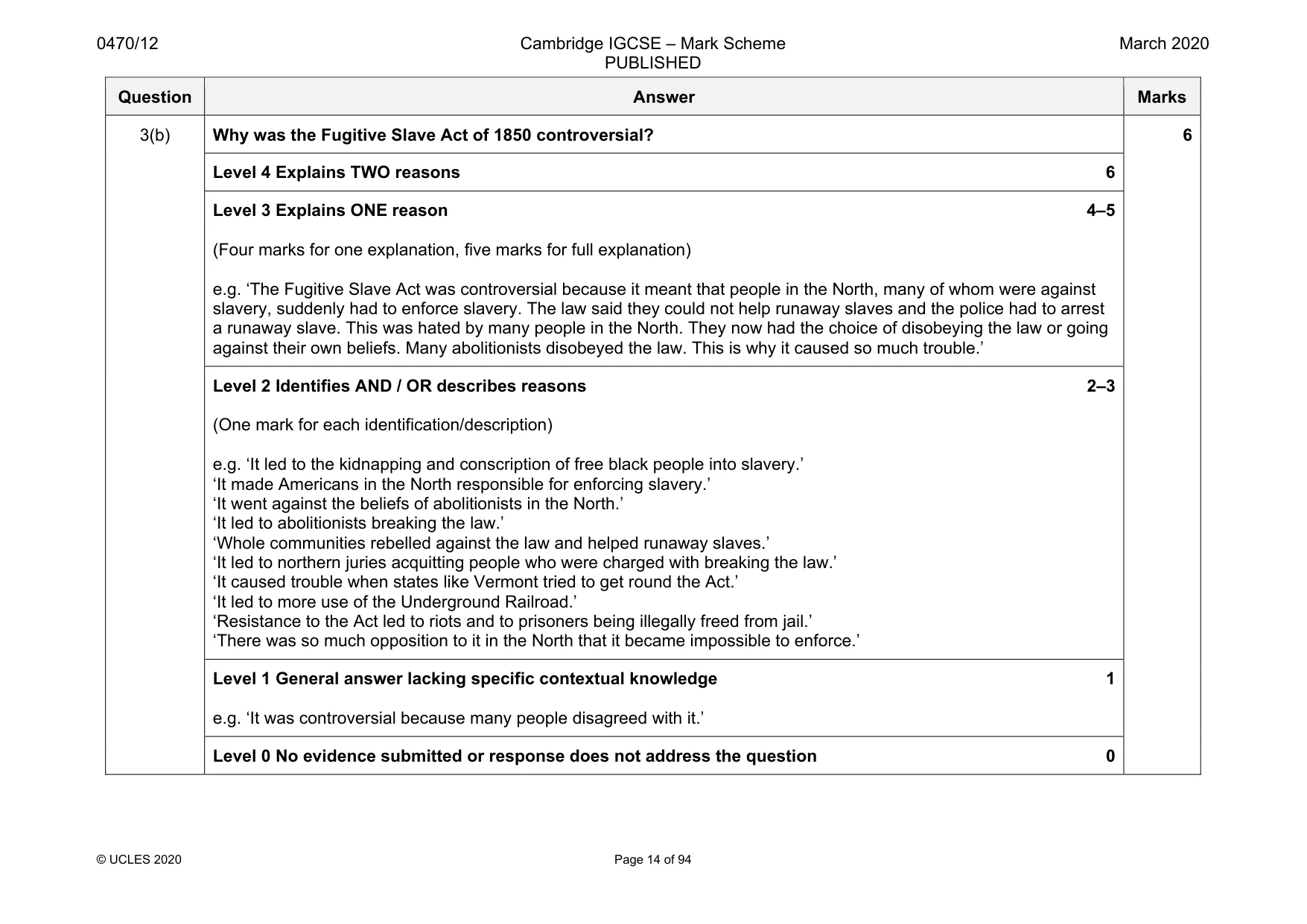
0470/12 Cambridge IGCSE – Mark Scheme PUBLISHED March 2020 © UCLES 2020 Page 14 of 94 Question Answer Marks 3(b) Why was the Fugitive Slave Act of 1850 controversial? 6 Level 4 Explains TWO reasons 6 Level 3 Explains ONE reason 4–5 (Four marks for one explanation, five marks for full explanation) e.g. ‘The Fugitive Slave Act was controversial because it meant that people in the North, many of whom were against slavery, suddenly had to enforce slavery. The law said they could not help runaway slaves and the police had to arrest a runaway slave. This was hated by many people in the North. They now had the choice of disobeying the law or going against their own beliefs. Many abolitionists disobeyed the law. This is why it caused so much trouble.’ Level 2 Identifies AND / OR describes reasons 2–3 (One mark for each identification/description) e.g. ‘It led to the kidnapping and conscription of free black people into slavery.’ ‘It made Americans in the North responsible for enforcing slavery.’ ‘It went against the beliefs of abolitionists in the North.’ ‘It led to abolitionists breaking the law.’ ‘Whole communities rebelled against the law and helped runaway slaves.’ ‘It led to northern juries acquitting people who were charged with breaking the law.’ ‘It caused trouble when states like Vermont tried to get round the Act.’ ‘It led to more use of the Underground Railroad.’ ‘Resistance to the Act led to riots and to prisoners being illegally freed from jail.’ ‘There was so much opposition to it in the North that it became impossible to enforce.’ Level 1 General answer lacking specific contextual knowledge 1 e.g. ‘It was controversial because many people disagreed with it.’ Level 0 No evidence submitted or response does not address the question 0
Mark scheme, page 15
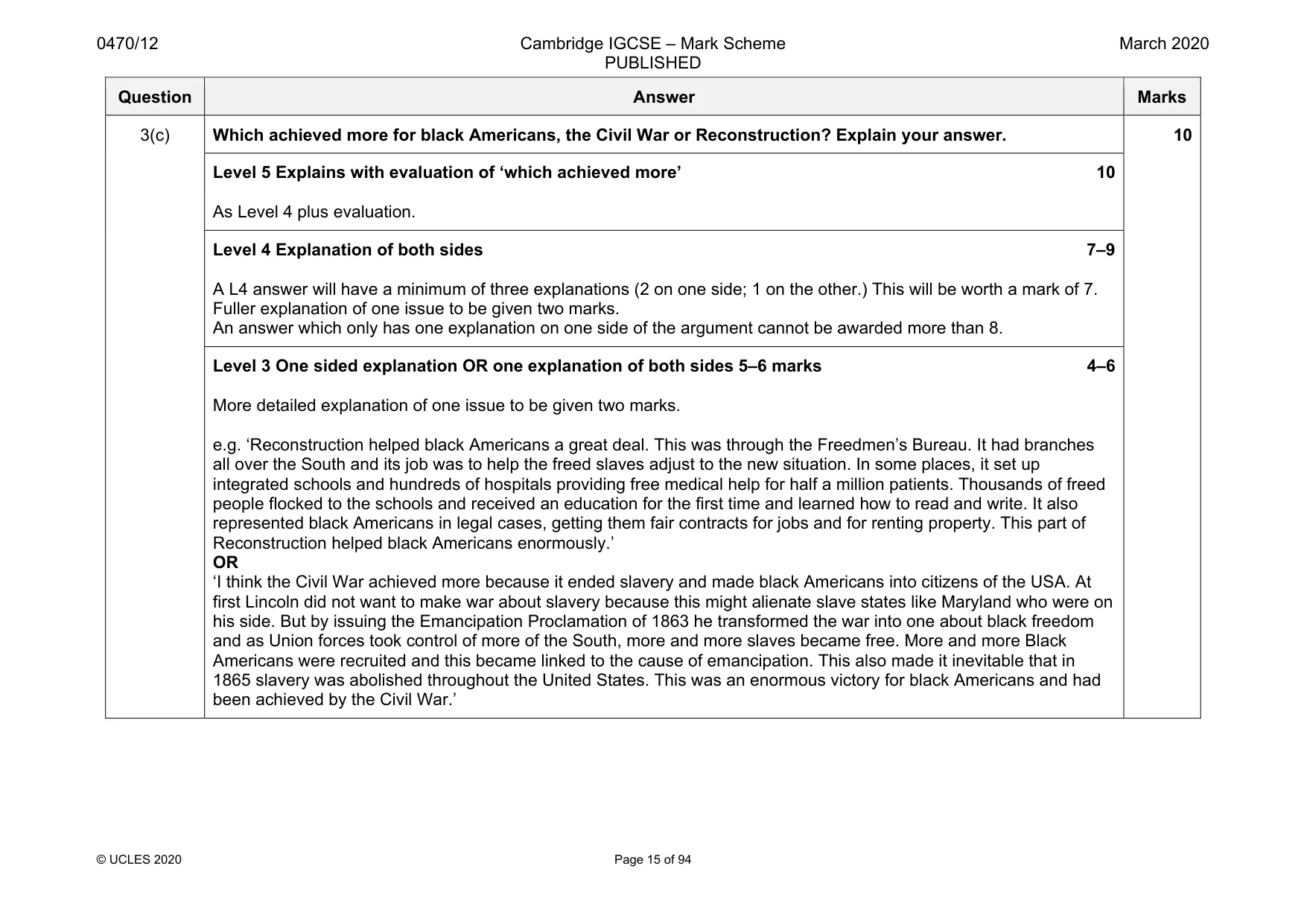
0470/12 Cambridge IGCSE – Mark Scheme PUBLISHED March 2020 © UCLES 2020 Page 15 of 94 Question Answer Marks 3(c) Which achieved more for black Americans, the Civil War or Reconstruction? Explain your answer. 10 Level 5 Explains with evaluation of ‘which achieved more’ 10 As Level 4 plus evaluation. Level 4 Explanation of both sides 7–9 A L4 answer will have a minimum of three explanations (2 on one side; 1 on the other.) This will be worth a mark of 7. Fuller explanation of one issue to be given two marks. An answer which only has one explanation on one side of the argument cannot be awarded more than 8. Level 3 One sided explanation OR one explanation of both sides 5–6 marks 4–6 More detailed explanation of one issue to be given two marks. e.g. ‘Reconstruction helped black Americans a great deal. This was through the Freedmen’s Bureau. It had branches all over the South and its job was to help the freed slaves adjust to the new situation. In some places, it set up integrated schools and hundreds of hospitals providing free medical help for half a million patients. Thousands of freed people flocked to the schools and received an education for the first time and learned how to read and write. It also represented black Americans in legal cases, getting them fair contracts for jobs and for renting property. This part of Reconstruction helped black Americans enormously.’ OR ‘I think the Civil War achieved more because it ended slavery and made black Americans into citizens of the USA. At first Lincoln did not want to make war about slavery because this might alienate slave states like Maryland who were on his side. But by issuing the Emancipation Proclamation of 1863 he transformed the war into one about black freedom and as Union forces took control of more of the South, more and more slaves became free. More and more Black Americans were recruited and this became linked to the cause of emancipation. This also made it inevitable that in 1865 slavery was abolished throughout the United States. This was an enormous victory for black Americans and had been achieved by the Civil War.’
Mark scheme, page 16
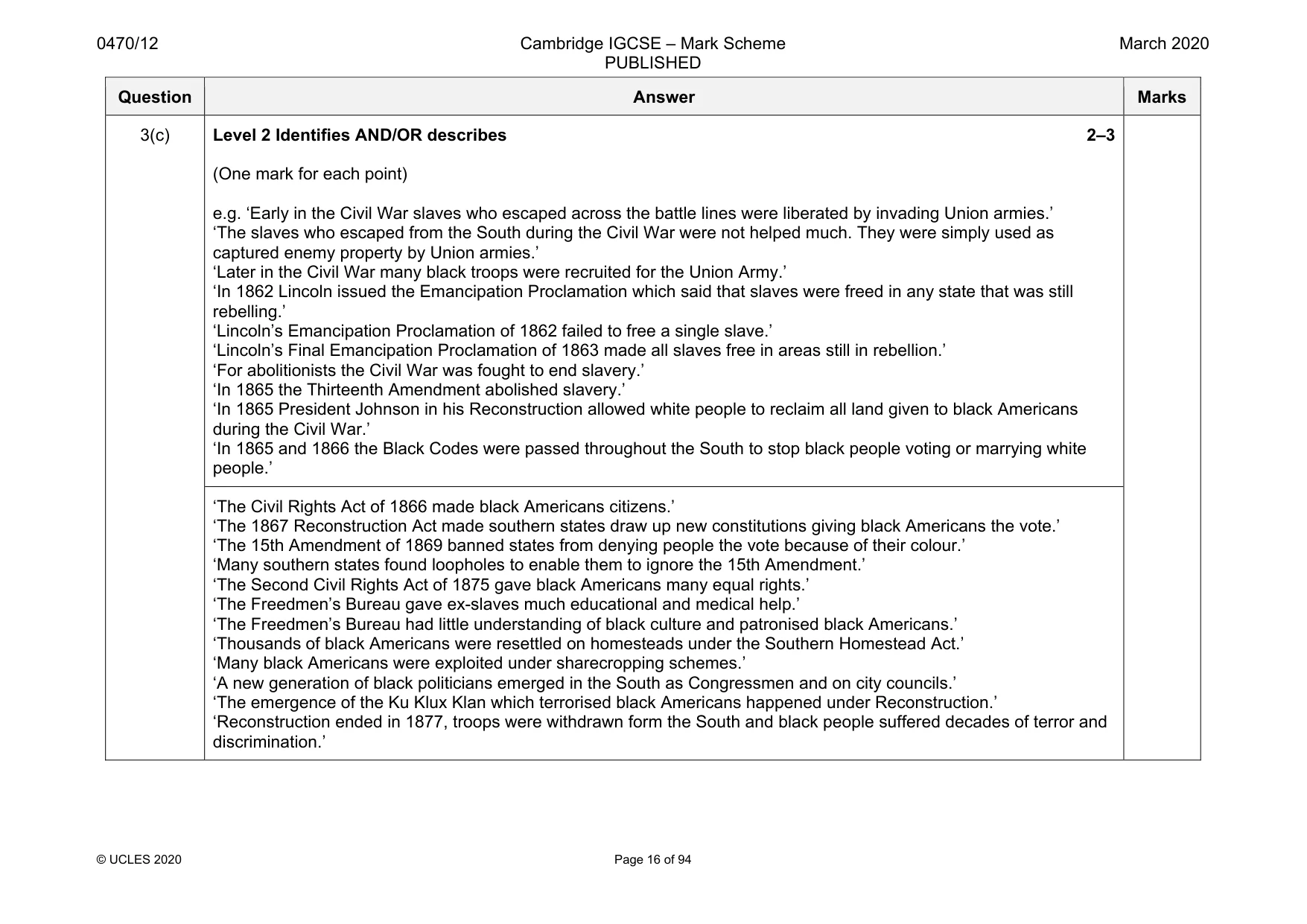
0470/12 Cambridge IGCSE – Mark Scheme PUBLISHED March 2020 © UCLES 2020 Page 16 of 94 Question Answer Marks 3(c) Level 2 Identifies AND/OR describes 2–3 (One mark for each point) e.g. ‘Early in the Civil War slaves who escaped across the battle lines were liberated by invading Union armies.’ ‘The slaves who escaped from the South during the Civil War were not helped much. They were simply used as captured enemy property by Union armies.’ ‘Later in the Civil War many black troops were recruited for the Union Army.’ ‘In 1862 Lincoln issued the Emancipation Proclamation which said that slaves were freed in any state that was still rebelling.’ ‘Lincoln’s Emancipation Proclamation of 1862 failed to free a single slave.’ ‘Lincoln’s Final Emancipation Proclamation of 1863 made all slaves free in areas still in rebellion.’ ‘For abolitionists the Civil War was fought to end slavery.’ ‘In 1865 the Thirteenth Amendment abolished slavery.’ ‘In 1865 President Johnson in his Reconstruction allowed white people to reclaim all land given to black Americans during the Civil War.’ ‘In 1865 and 1866 the Black Codes were passed throughout the South to stop black people voting or marrying white people.’ ‘The Civil Rights Act of 1866 made black Americans citizens.’ ‘The 1867 Reconstruction Act made southern states draw up new constitutions giving black Americans the vote.’ ‘The 15th Amendment of 1869 banned states from denying people the vote because of their colour.’ ‘Many southern states found loopholes to enable them to ignore the 15th Amendment.’ ‘The Second Civil Rights Act of 1875 gave black Americans many equal rights.’ ‘The Freedmen’s Bureau gave ex-slaves much educational and medical help.’ ‘The Freedmen’s Bureau had little understanding of black culture and patronised black Americans.’ ‘Thousands of black Americans were resettled on homesteads under the Southern Homestead Act.’ ‘Many black Americans were exploited under sharecropping schemes.’ ‘A new generation of black politicians emerged in the South as Congressmen and on city councils.’ ‘The emergence of the Ku Klux Klan which terrorised black Americans happened under Reconstruction.’ ‘Reconstruction ended in 1877, troops were withdrawn form the South and black people suffered decades of terror and discrimination.’
Mark scheme, page 17
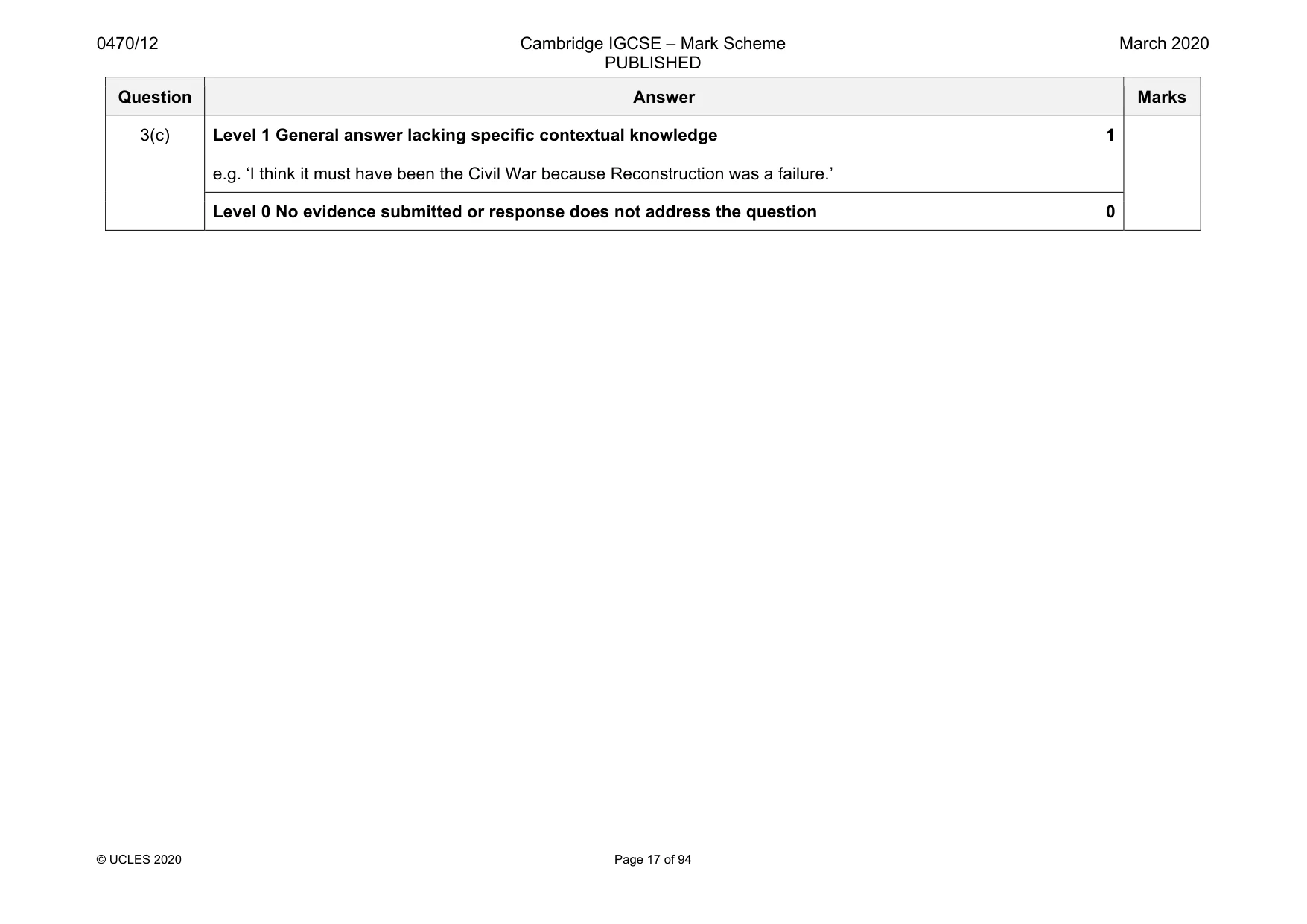
0470/12 Cambridge IGCSE – Mark Scheme PUBLISHED March 2020 © UCLES 2020 Page 17 of 94 Question Answer Marks 3(c) Level 1 General answer lacking specific contextual knowledge 1 e.g. ‘I think it must have been the Civil War because Reconstruction was a failure.’ Level 0 No evidence submitted or response does not address the question 0
Mark scheme, page 18
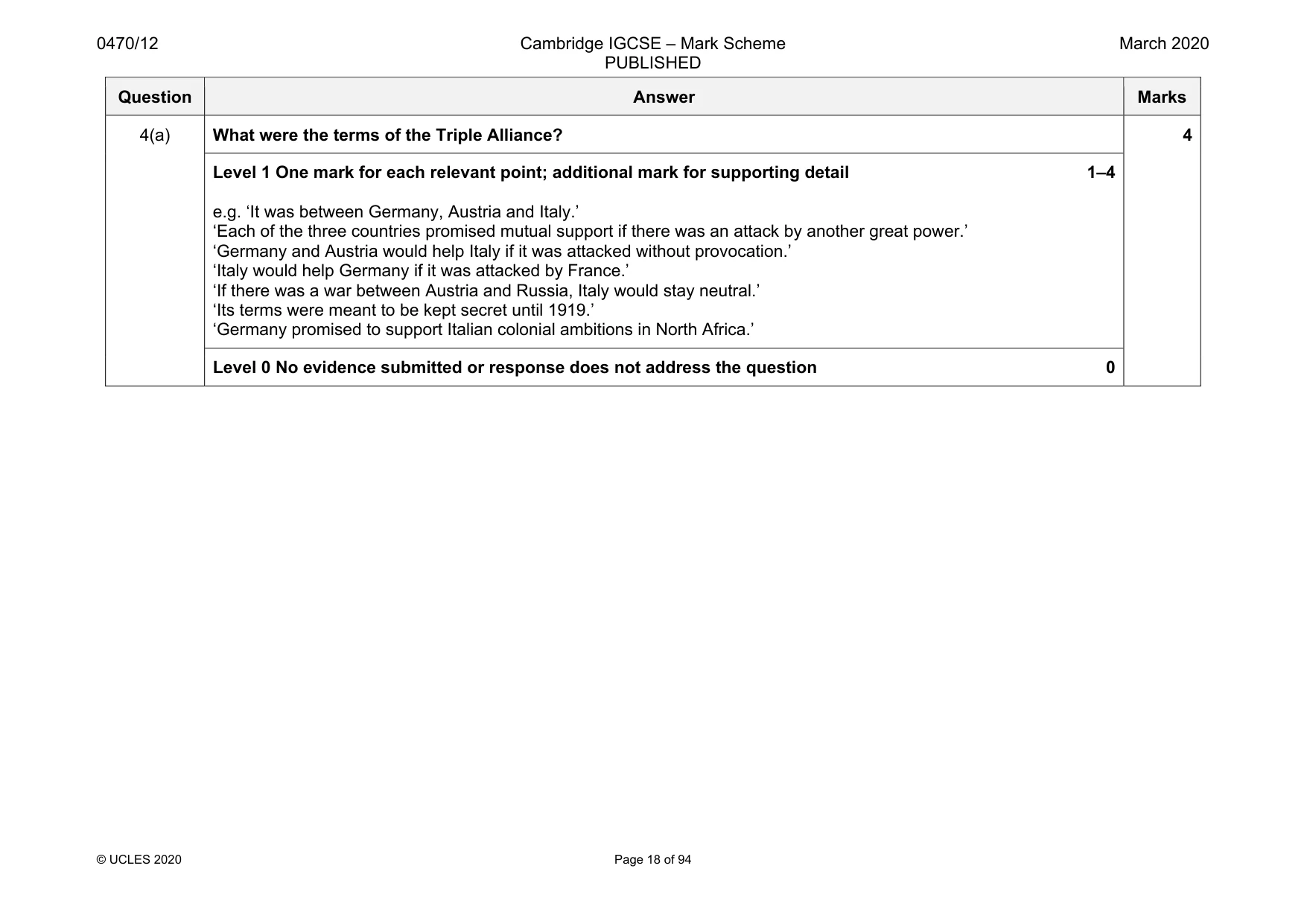
0470/12 Cambridge IGCSE – Mark Scheme PUBLISHED March 2020 © UCLES 2020 Page 18 of 94 Question Answer Marks 4(a) What were the terms of the Triple Alliance? 4 Level 1 One mark for each relevant point; additional mark for supporting detail 1–4 e.g. ‘It was between Germany, Austria and Italy.’ ‘Each of the three countries promised mutual support if there was an attack by another great power.’ ‘Germany and Austria would help Italy if it was attacked without provocation.’ ‘Italy would help Germany if it was attacked by France.’ ‘If there was a war between Austria and Russia, Italy would stay neutral.’ ‘Its terms were meant to be kept secret until 1919.’ ‘Germany promised to support Italian colonial ambitions in North Africa.’ Level 0 No evidence submitted or response does not address the question 0
Mark scheme, page 19
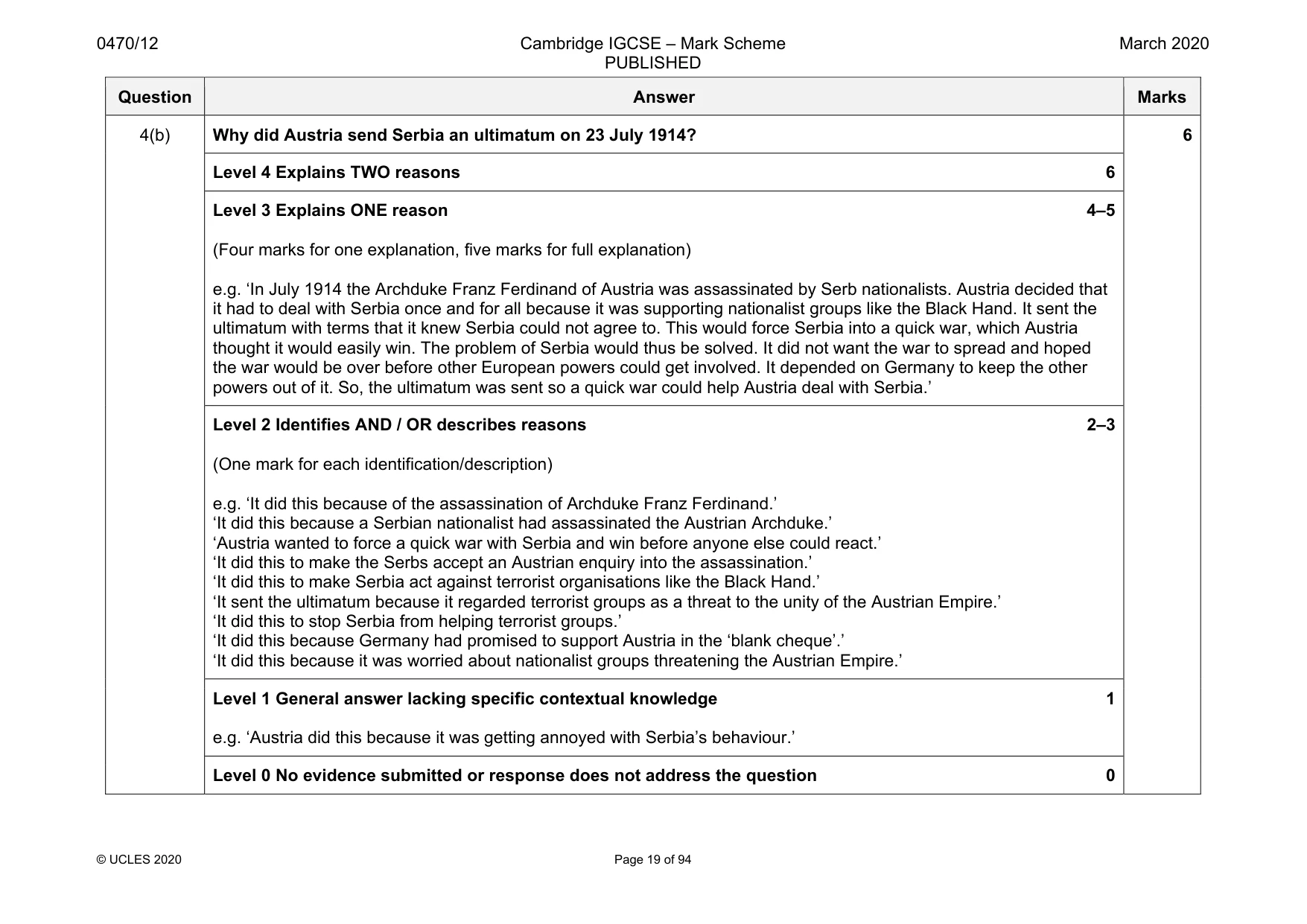
0470/12 Cambridge IGCSE – Mark Scheme PUBLISHED March 2020 © UCLES 2020 Page 19 of 94 Question Answer Marks 4(b) Why did Austria send Serbia an ultimatum on 23 July 1914? 6 Level 4 Explains TWO reasons 6 Level 3 Explains ONE reason 4–5 (Four marks for one explanation, five marks for full explanation) e.g. ‘In July 1914 the Archduke Franz Ferdinand of Austria was assassinated by Serb nationalists. Austria decided that it had to deal with Serbia once and for all because it was supporting nationalist groups like the Black Hand. It sent the ultimatum with terms that it knew Serbia could not agree to. This would force Serbia into a quick war, which Austria thought it would easily win. The problem of Serbia would thus be solved. It did not want the war to spread and hoped the war would be over before other European powers could get involved. It depended on Germany to keep the other powers out of it. So, the ultimatum was sent so a quick war could help Austria deal with Serbia.’ Level 2 Identifies AND / OR describes reasons 2–3 (One mark for each identification/description) e.g. ‘It did this because of the assassination of Archduke Franz Ferdinand.’ ‘It did this because a Serbian nationalist had assassinated the Austrian Archduke.’ ‘Austria wanted to force a quick war with Serbia and win before anyone else could react.’ ‘It did this to make the Serbs accept an Austrian enquiry into the assassination.’ ‘It did this to make Serbia act against terrorist organisations like the Black Hand.’ ‘It sent the ultimatum because it regarded terrorist groups as a threat to the unity of the Austrian Empire.’ ‘It did this to stop Serbia from helping terrorist groups.’ ‘It did this because Germany had promised to support Austria in the ‘blank cheque’.’ ‘It did this because it was worried about nationalist groups threatening the Austrian Empire.’ Level 1 General answer lacking specific contextual knowledge 1 e.g. ‘Austria did this because it was getting annoyed with Serbia’s behaviour.’ Level 0 No evidence submitted or response does not address the question 0
Mark scheme, page 20
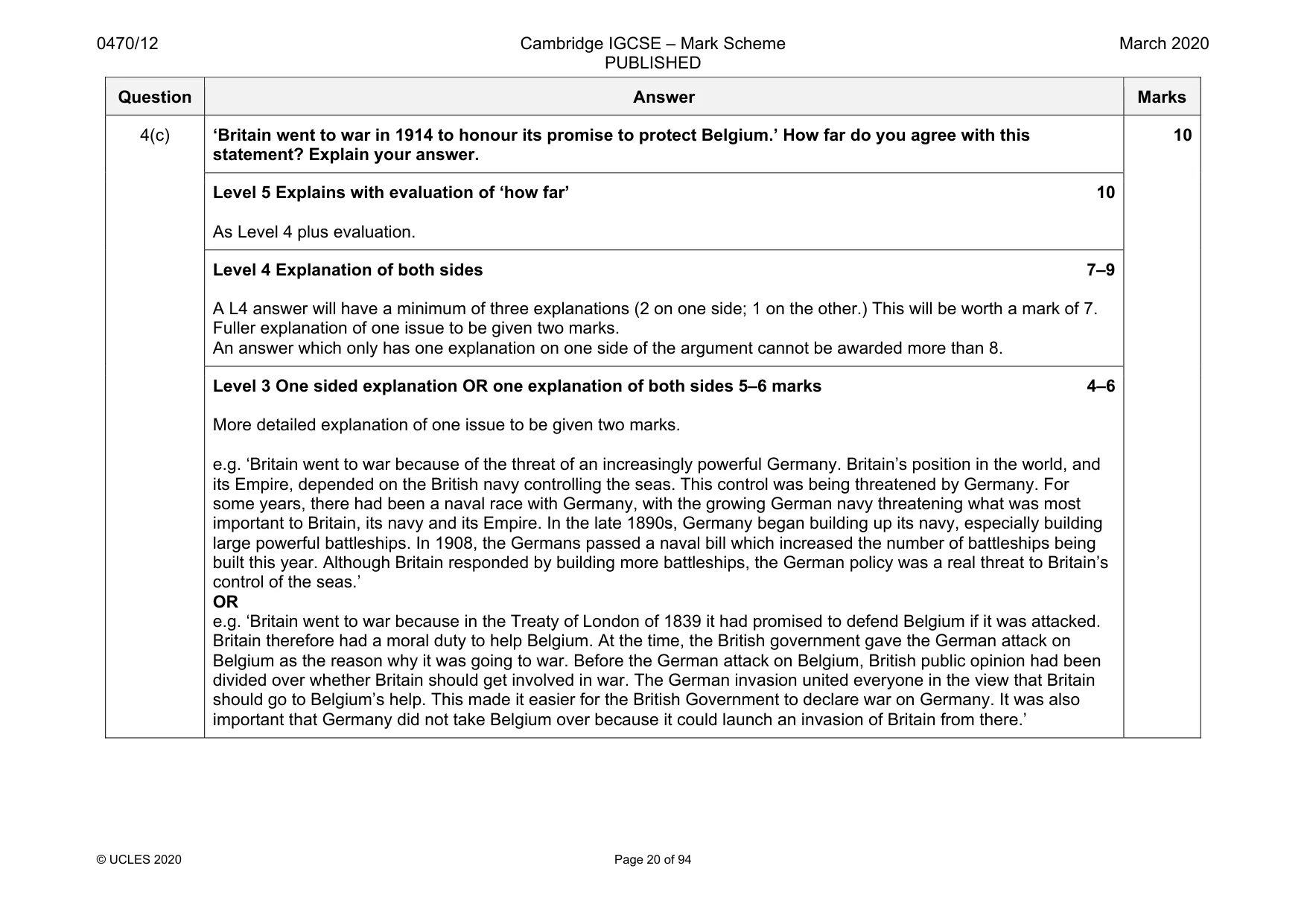
0470/12 Cambridge IGCSE – Mark Scheme PUBLISHED March 2020 © UCLES 2020 Page 20 of 94 Question Answer Marks 4(c) ‘Britain went to war in 1914 to honour its promise to protect Belgium.’ How far do you agree with this statement? Explain your answer. 10 Level 5 Explains with evaluation of ‘how far’ 10 As Level 4 plus evaluation. Level 4 Explanation of both sides 7–9 A L4 answer will have a minimum of three explanations (2 on one side; 1 on the other.) This will be worth a mark of 7. Fuller explanation of one issue to be given two marks. An answer which only has one explanation on one side of the argument cannot be awarded more than 8. Level 3 One sided explanation OR one explanation of both sides 5–6 marks 4–6 More detailed explanation of one issue to be given two marks. e.g. ‘Britain went to war because of the threat of an increasingly powerful Germany. Britain’s position in the world, and its Empire, depended on the British navy controlling the seas. This control was being threatened by Germany. For some years, there had been a naval race with Germany, with the growing German navy threatening what was most important to Britain, its navy and its Empire. In the late 1890s, Germany began building up its navy, especially building large powerful battleships. In 1908, the Germans passed a naval bill which increased the number of battleships being built this year. Although Britain responded by building more battleships, the German policy was a real threat to Britain’s control of the seas.’ OR e.g. ‘Britain went to war because in the Treaty of London of 1839 it had promised to defend Belgium if it was attacked. Britain therefore had a moral duty to help Belgium. At the time, the British government gave the German attack on Belgium as the reason why it was going to war. Before the German attack on Belgium, British public opinion had been divided over whether Britain should get involved in war. The German invasion united everyone in the view that Britain should go to Belgium’s help. This made it easier for the British Government to declare war on Germany. It was also important that Germany did not take Belgium over because it could launch an invasion of Britain from there.’
Mark scheme, page 21
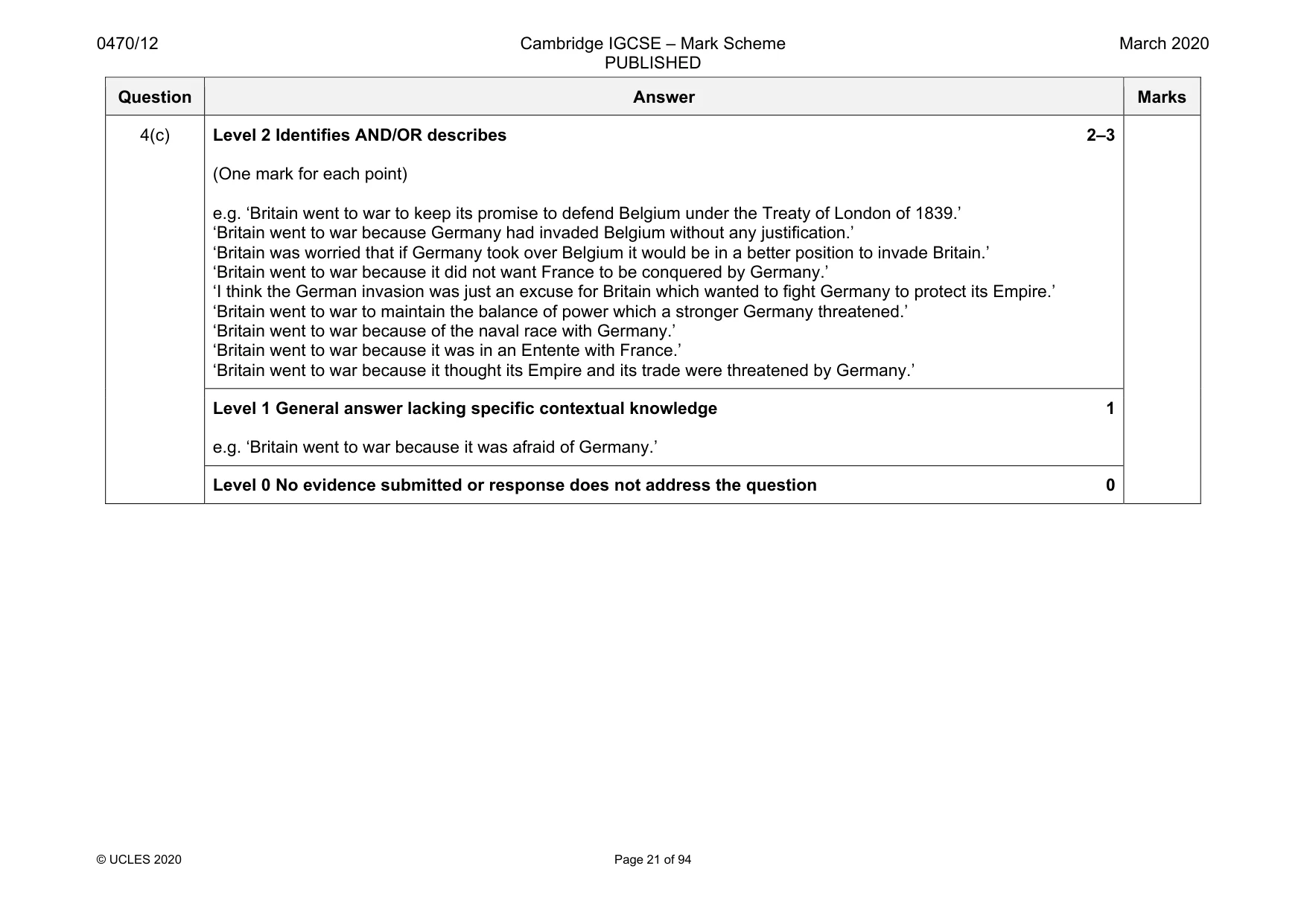
0470/12 Cambridge IGCSE – Mark Scheme PUBLISHED March 2020 © UCLES 2020 Page 21 of 94 Question Answer Marks 4(c) Level 2 Identifies AND/OR describes 2–3 (One mark for each point) e.g. ‘Britain went to war to keep its promise to defend Belgium under the Treaty of London of 1839.’ ‘Britain went to war because Germany had invaded Belgium without any justification.’ ‘Britain was worried that if Germany took over Belgium it would be in a better position to invade Britain.’ ‘Britain went to war because it did not want France to be conquered by Germany.’ ‘I think the German invasion was just an excuse for Britain which wanted to fight Germany to protect its Empire.’ ‘Britain went to war to maintain the balance of power which a stronger Germany threatened.’ ‘Britain went to war because of the naval race with Germany.’ ‘Britain went to war because it was in an Entente with France.’ ‘Britain went to war because it thought its Empire and its trade were threatened by Germany.’ Level 1 General answer lacking specific contextual knowledge 1 e.g. ‘Britain went to war because it was afraid of Germany.’ Level 0 No evidence submitted or response does not address the question 0
Mark scheme, page 22
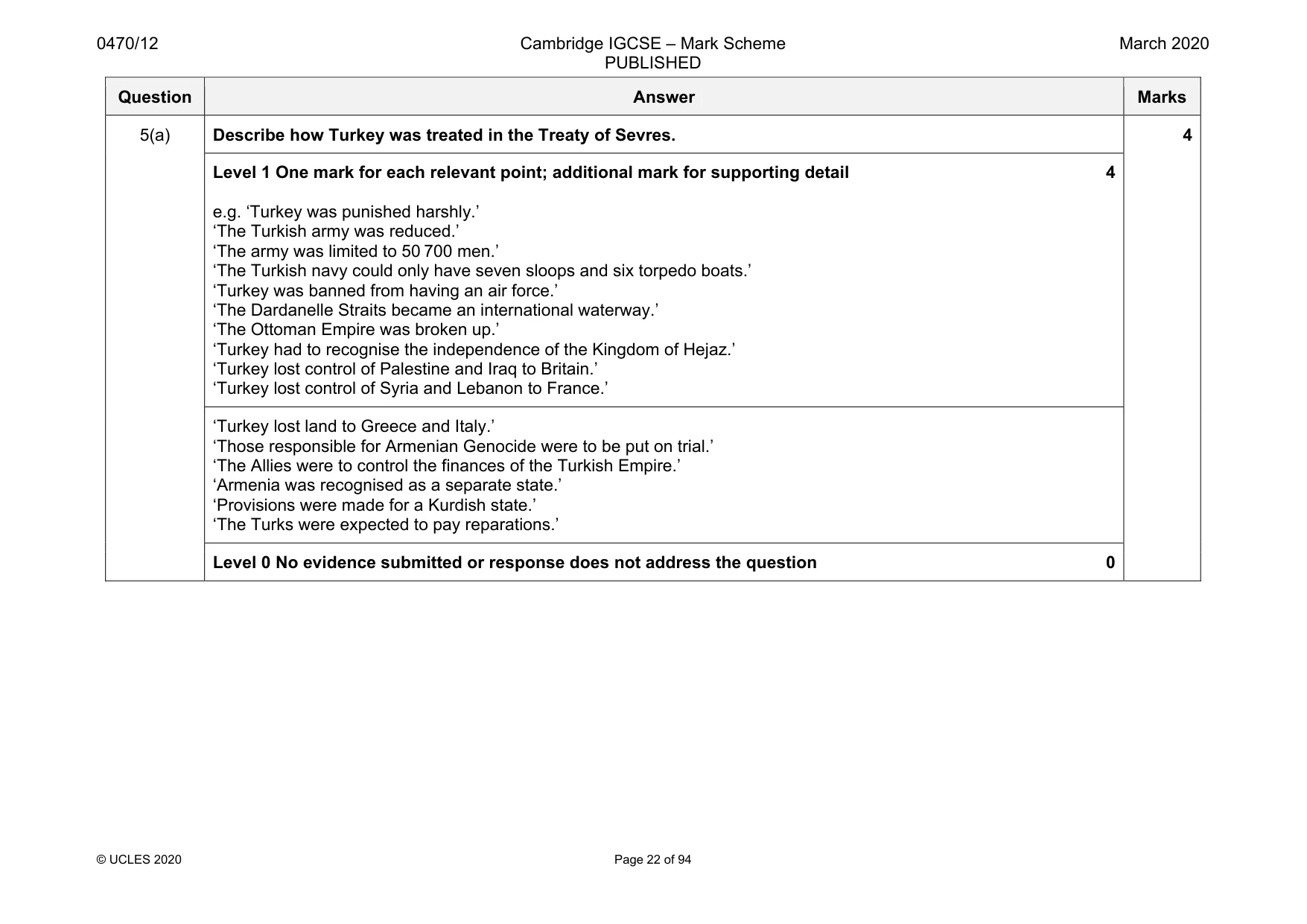
0470/12 Cambridge IGCSE – Mark Scheme PUBLISHED March 2020 © UCLES 2020 Page 22 of 94 Question Answer Marks 5(a) Describe how Turkey was treated in the Treaty of Sevres. 4 Level 1 One mark for each relevant point; additional mark for supporting detail 4 e.g. ‘Turkey was punished harshly.’ ‘The Turkish army was reduced.’ ‘The army was limited to 50 700 men.’ ‘The Turkish navy could only have seven sloops and six torpedo boats.’ ‘Turkey was banned from having an air force.’ ‘The Dardanelle Straits became an international waterway.’ ‘The Ottoman Empire was broken up.’ ‘Turkey had to recognise the independence of the Kingdom of Hejaz.’ ‘Turkey lost control of Palestine and Iraq to Britain.’ ‘Turkey lost control of Syria and Lebanon to France.’ ‘Turkey lost land to Greece and Italy.’ ‘Those responsible for Armenian Genocide were to be put on trial.’ ‘The Allies were to control the finances of the Turkish Empire.’ ‘Armenia was recognised as a separate state.’ ‘Provisions were made for a Kurdish state.’ ‘The Turks were expected to pay reparations.’ Level 0 No evidence submitted or response does not address the question 0
Mark scheme, page 23
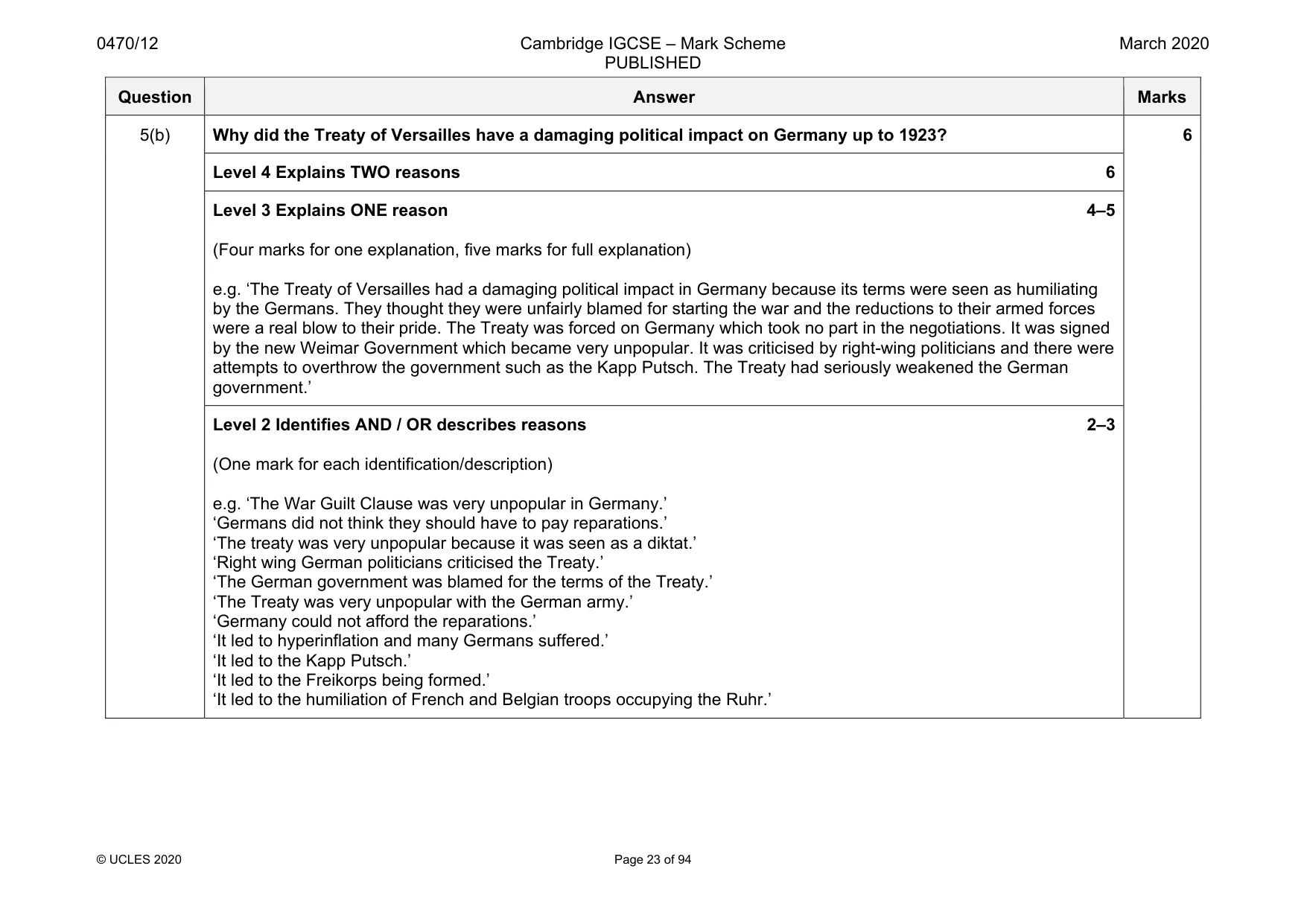
0470/12 Cambridge IGCSE – Mark Scheme PUBLISHED March 2020 © UCLES 2020 Page 23 of 94 Question Answer Marks 5(b) Why did the Treaty of Versailles have a damaging political impact on Germany up to 1923? 6 Level 4 Explains TWO reasons 6 Level 3 Explains ONE reason 4–5 (Four marks for one explanation, five marks for full explanation) e.g. ‘The Treaty of Versailles had a damaging political impact in Germany because its terms were seen as humiliating by the Germans. They thought they were unfairly blamed for starting the war and the reductions to their armed forces were a real blow to their pride. The Treaty was forced on Germany which took no part in the negotiations. It was signed by the new Weimar Government which became very unpopular. It was criticised by right-wing politicians and there were attempts to overthrow the government such as the Kapp Putsch. The Treaty had seriously weakened the German government.’ Level 2 Identifies AND / OR describes reasons 2–3 (One mark for each identification/description) e.g. ‘The War Guilt Clause was very unpopular in Germany.’ ‘Germans did not think they should have to pay reparations.’ ‘The treaty was very unpopular because it was seen as a diktat.’ ‘Right wing German politicians criticised the Treaty.’ ‘The German government was blamed for the terms of the Treaty.’ ‘The Treaty was very unpopular with the German army.’ ‘Germany could not afford the reparations.’ ‘It led to hyperinflation and many Germans suffered.’ ‘It led to the Kapp Putsch.’ ‘It led to the Freikorps being formed.’ ‘It led to the humiliation of French and Belgian troops occupying the Ruhr.’
Mark scheme, page 24
0470/12 Cambridge IGCSE – Mark Scheme PUBLISHED March 2020 © UCLES 2020 Page 24 of 94 Question Answer Marks 5(b) Level 1 General answer lacking specific contextual knowledge 1 e.g. ‘The Treaty had such a damaging impact on Germany because it was hated.’ ‘The Treaty was harsh.’ Level 0 No evidence submitted or response does not address the question 0
Mark scheme, page 25
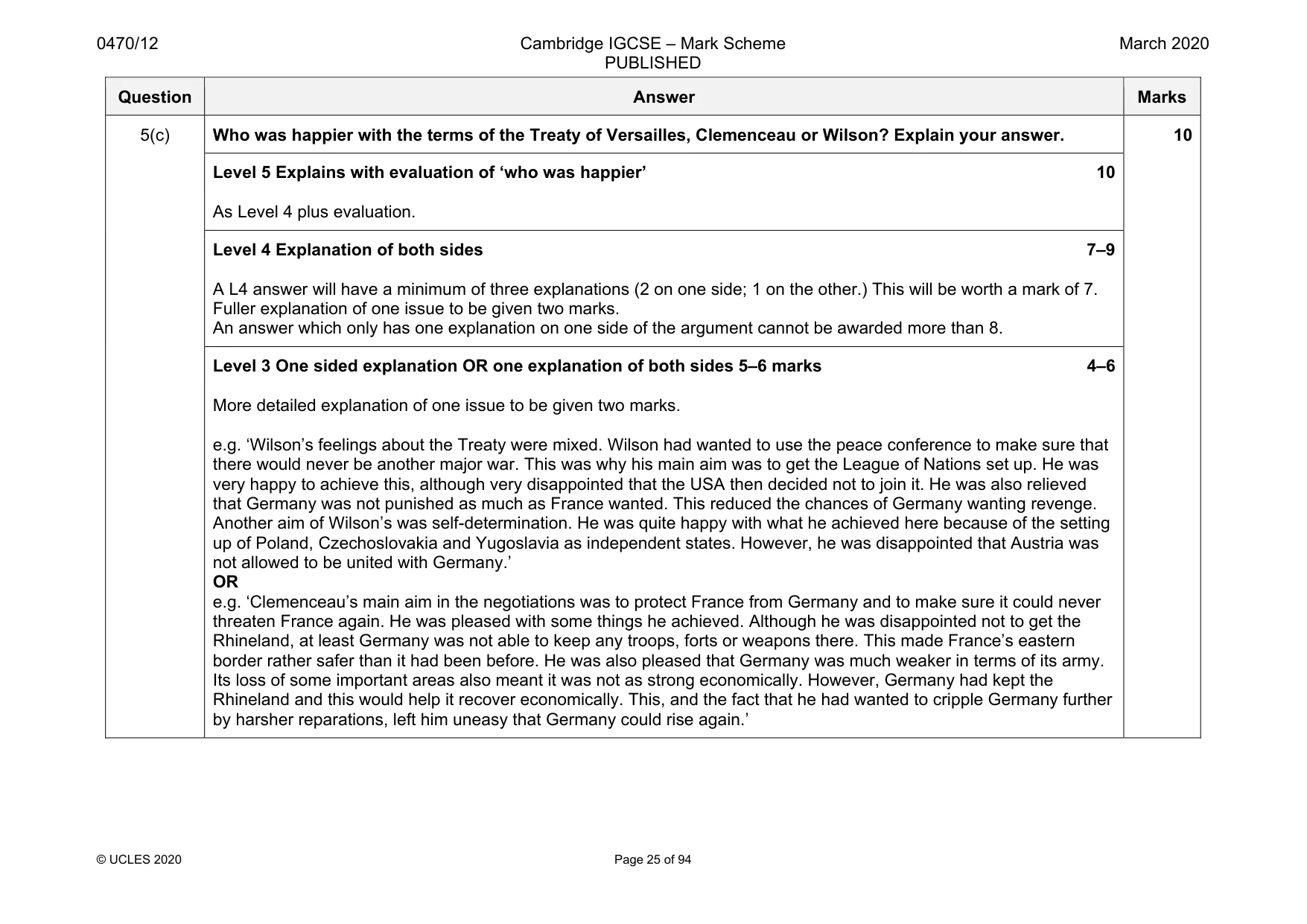
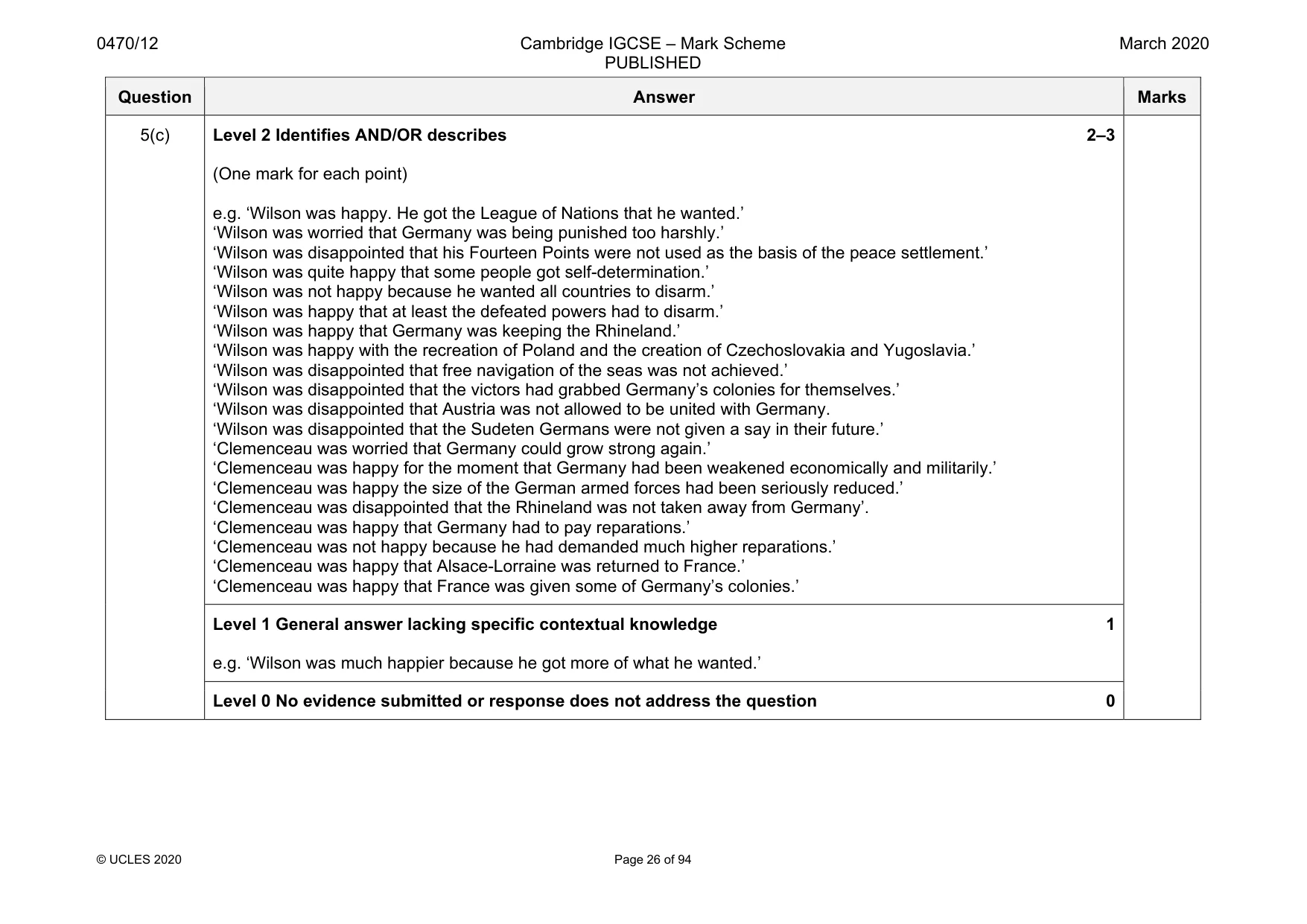
0470/12 Cambridge IGCSE – Mark Scheme PUBLISHED March 2020 © UCLES 2020 Page 25 of 94 Question Answer Marks 5(c) Who was happier with the terms of the Treaty of Versailles, Clemenceau or Wilson? Explain your answer. 10 Level 5 Explains with evaluation of ‘who was happier’ 10 As Level 4 plus evaluation. Level 4 Explanation of both sides 7–9 A L4 answer will have a minimum of three explanations (2 on one side; 1 on the other.) This will be worth a mark of 7. Fuller explanation of one issue to be given two marks. An answer which only has one explanation on one side of the argument cannot be awarded more than 8. Level 3 One sided explanation OR one explanation of both sides 5–6 marks 4–6 More detailed explanation of one issue to be given two marks. e.g. ‘Wilson’s feelings about the Treaty were mixed. Wilson had wanted to use the peace conference to make sure that there would never be another major war. This was why his main aim was to get the League of Nations set up. He was very happy to achieve this, although very disappointed that the USA then decided not to join it. He was also relieved that Germany was not punished as much as France wanted. This reduced the chances of Germany wanting revenge. Another aim of Wilson’s was self-determination. He was quite happy with what he achieved here because of the setting up of Poland, Czechoslovakia and Yugoslavia as independent states. However, he was disappointed that Austria was not allowed to be united with Germany.’ OR e.g. ‘Clemenceau’s main aim in the negotiations was to protect France from Germany and to make sure it could never threaten France again. He was pleased with some things he achieved. Although he was disappointed not to get the Rhineland, at least Germany was not able to keep any troops, forts or weapons there. This made France’s eastern border rather safer than it had been before. He was also pleased that Germany was much weaker in terms of its army. Its loss of some important areas also meant it was not as strong economically. However, Germany had kept the Rhineland and this would help it recover economically. This, and the fact that he had wanted to cripple Germany further by harsher reparations, left him uneasy that Germany could rise again.’
Mark scheme, page 26
0470/12 Cambridge IGCSE – Mark Scheme PUBLISHED March 2020 © UCLES 2020 Page 26 of 94 Question Answer Marks 5(c) Level 2 Identifies AND/OR describes 2–3 (One mark for each point) e.g. ‘Wilson was happy. He got the League of Nations that he wanted.’ ‘Wilson was worried that Germany was being punished too harshly.’ ‘Wilson was disappointed that his Fourteen Points were not used as the basis of the peace settlement.’ ‘Wilson was quite happy that some people got self-determination.’ ‘Wilson was not happy because he wanted all countries to disarm.’ ‘Wilson was happy that at least the defeated powers had to disarm.’ ‘Wilson was happy that Germany was keeping the Rhineland.’ ‘Wilson was happy with the recreation of Poland and the creation of Czechoslovakia and Yugoslavia.’ ‘Wilson was disappointed that free navigation of the seas was not achieved.’ ‘Wilson was disappointed that the victors had grabbed Germany’s colonies for themselves.’ ‘Wilson was disappointed that Austria was not allowed to be united with Germany. ‘Wilson was disappointed that the Sudeten Germans were not given a say in their future.’ ‘Clemenceau was worried that Germany could grow strong again.’ ‘Clemenceau was happy for the moment that Germany had been weakened economically and militarily.’ ‘Clemenceau was happy the size of the German armed forces had been seriously reduced.’ ‘Clemenceau was disappointed that the Rhineland was not taken away from Germany’. ‘Clemenceau was happy that Germany had to pay reparations.’ ‘Clemenceau was not happy because he had demanded much higher reparations.’ ‘Clemenceau was happy that Alsace-Lorraine was returned to France.’ ‘Clemenceau was happy that France was given some of Germany’s colonies.’ Level 1 General answer lacking specific contextual knowledge 1 e.g. ‘Wilson was much happier because he got more of what he wanted.’ Level 0 No evidence submitted or response does not address the question 0
Mark scheme, page 27
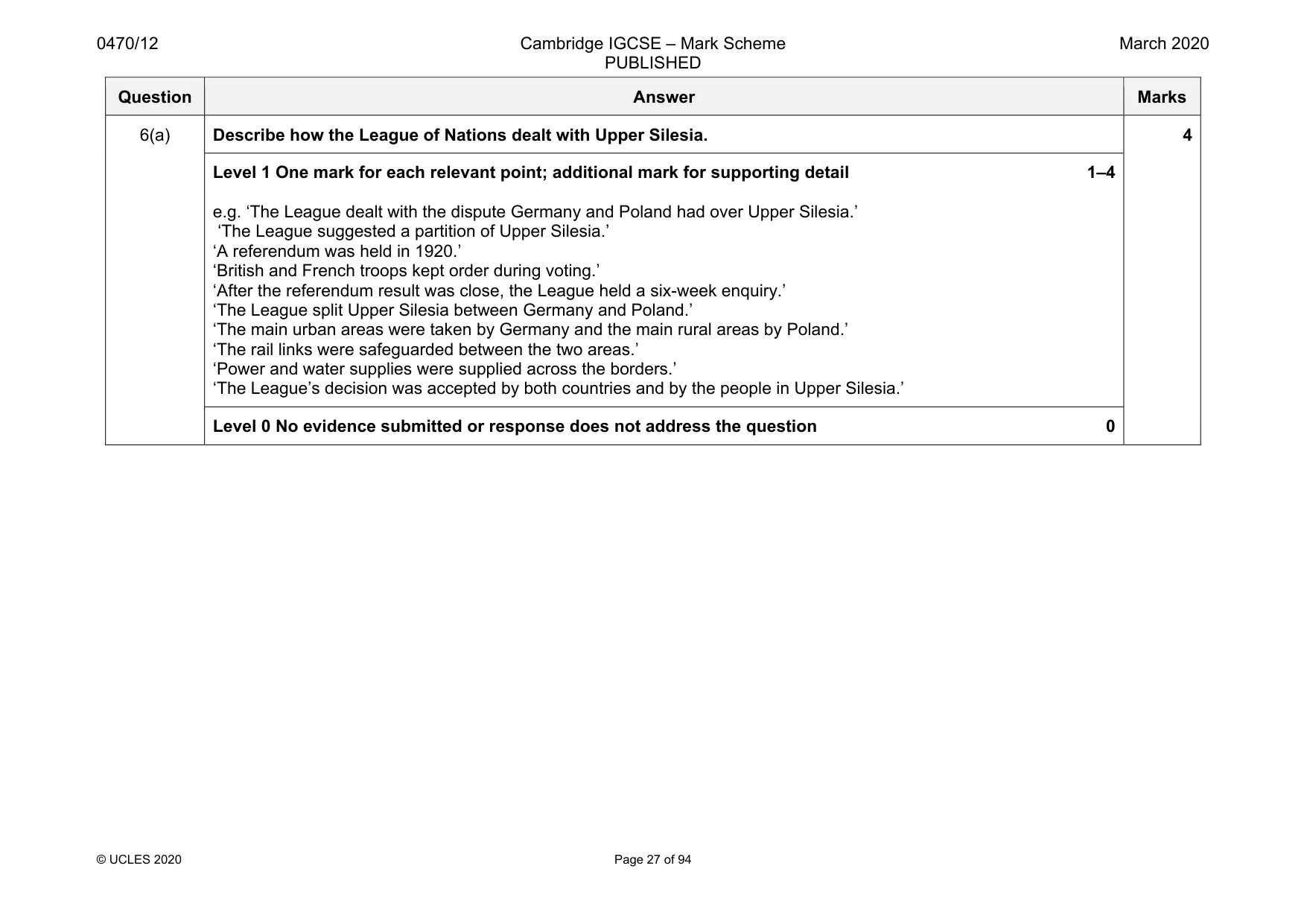
0470/12 Cambridge IGCSE – Mark Scheme PUBLISHED March 2020 © UCLES 2020 Page 27 of 94 Question Answer Marks 6(a) Describe how the League of Nations dealt with Upper Silesia. 4 Level 1 One mark for each relevant point; additional mark for supporting detail 1–4 e.g. ‘The League dealt with the dispute Germany and Poland had over Upper Silesia.’ ‘The League suggested a partition of Upper Silesia.’ ‘A referendum was held in 1920.’ ‘British and French troops kept order during voting.’ ‘After the referendum result was close, the League held a six-week enquiry.’ ‘The League split Upper Silesia between Germany and Poland.’ ‘The main urban areas were taken by Germany and the main rural areas by Poland.’ ‘The rail links were safeguarded between the two areas.’ ‘Power and water supplies were supplied across the borders.’ ‘The League’s decision was accepted by both countries and by the people in Upper Silesia.’ Level 0 No evidence submitted or response does not address the question 0
Mark scheme, page 28
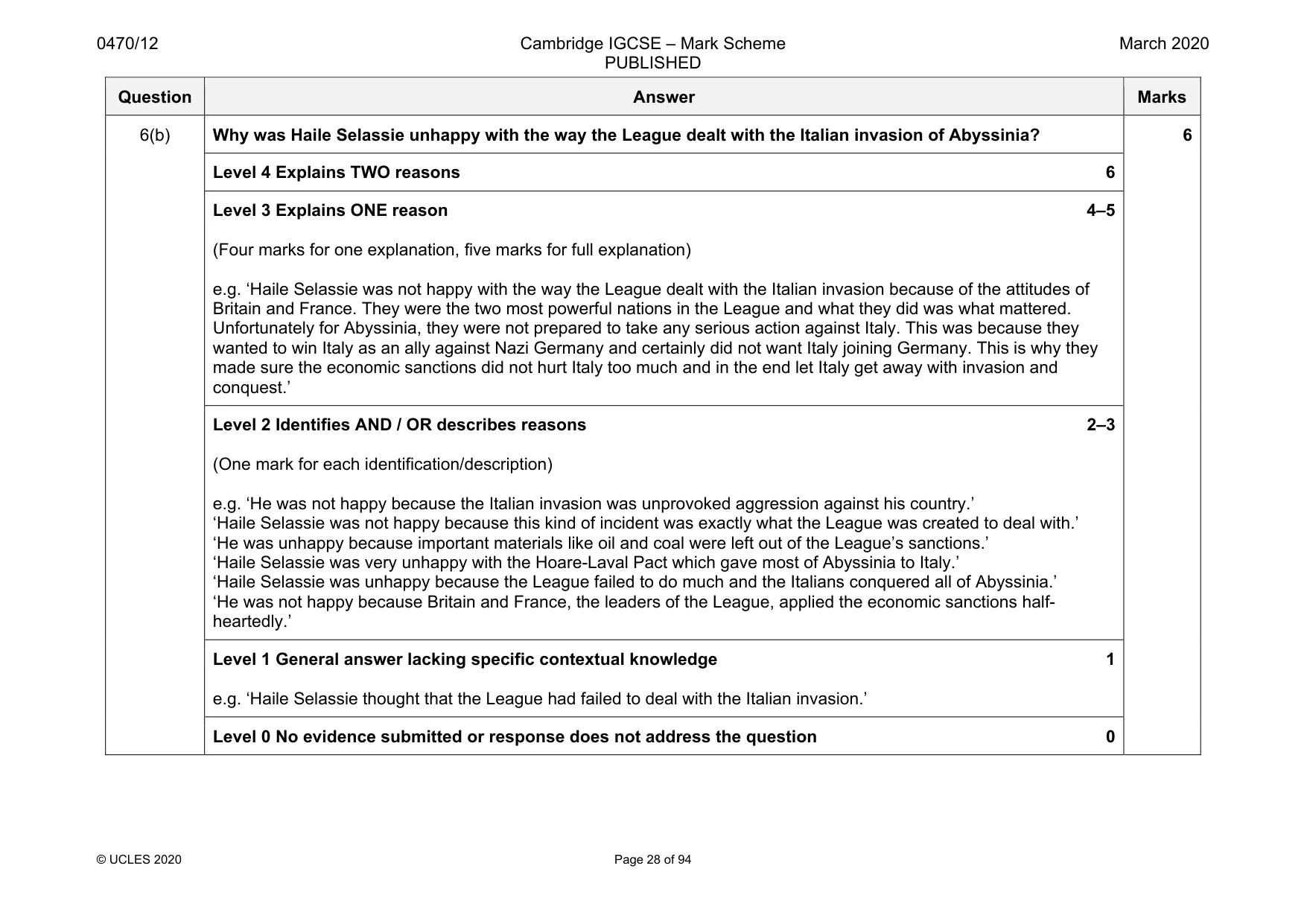
0470/12 Cambridge IGCSE – Mark Scheme PUBLISHED March 2020 © UCLES 2020 Page 28 of 94 Question Answer Marks 6(b) Why was Haile Selassie unhappy with the way the League dealt with the Italian invasion of Abyssinia? 6 Level 4 Explains TWO reasons 6 Level 3 Explains ONE reason 4–5 (Four marks for one explanation, five marks for full explanation) e.g. ‘Haile Selassie was not happy with the way the League dealt with the Italian invasion because of the attitudes of Britain and France. They were the two most powerful nations in the League and what they did was what mattered. Unfortunately for Abyssinia, they were not prepared to take any serious action against Italy. This was because they wanted to win Italy as an ally against Nazi Germany and certainly did not want Italy joining Germany. This is why they made sure the economic sanctions did not hurt Italy too much and in the end let Italy get away with invasion and conquest.’ Level 2 Identifies AND / OR describes reasons 2–3 (One mark for each identification/description) e.g. ‘He was not happy because the Italian invasion was unprovoked aggression against his country.’ ‘Haile Selassie was not happy because this kind of incident was exactly what the League was created to deal with.’ ‘He was unhappy because important materials like oil and coal were left out of the League’s sanctions.’ ‘Haile Selassie was very unhappy with the Hoare-Laval Pact which gave most of Abyssinia to Italy.’ ‘Haile Selassie was unhappy because the League failed to do much and the Italians conquered all of Abyssinia.’ ‘He was not happy because Britain and France, the leaders of the League, applied the economic sanctions half- heartedly.’ Level 1 General answer lacking specific contextual knowledge 1 e.g. ‘Haile Selassie thought that the League had failed to deal with the Italian invasion.’ Level 0 No evidence submitted or response does not address the question 0
Mark scheme, page 29
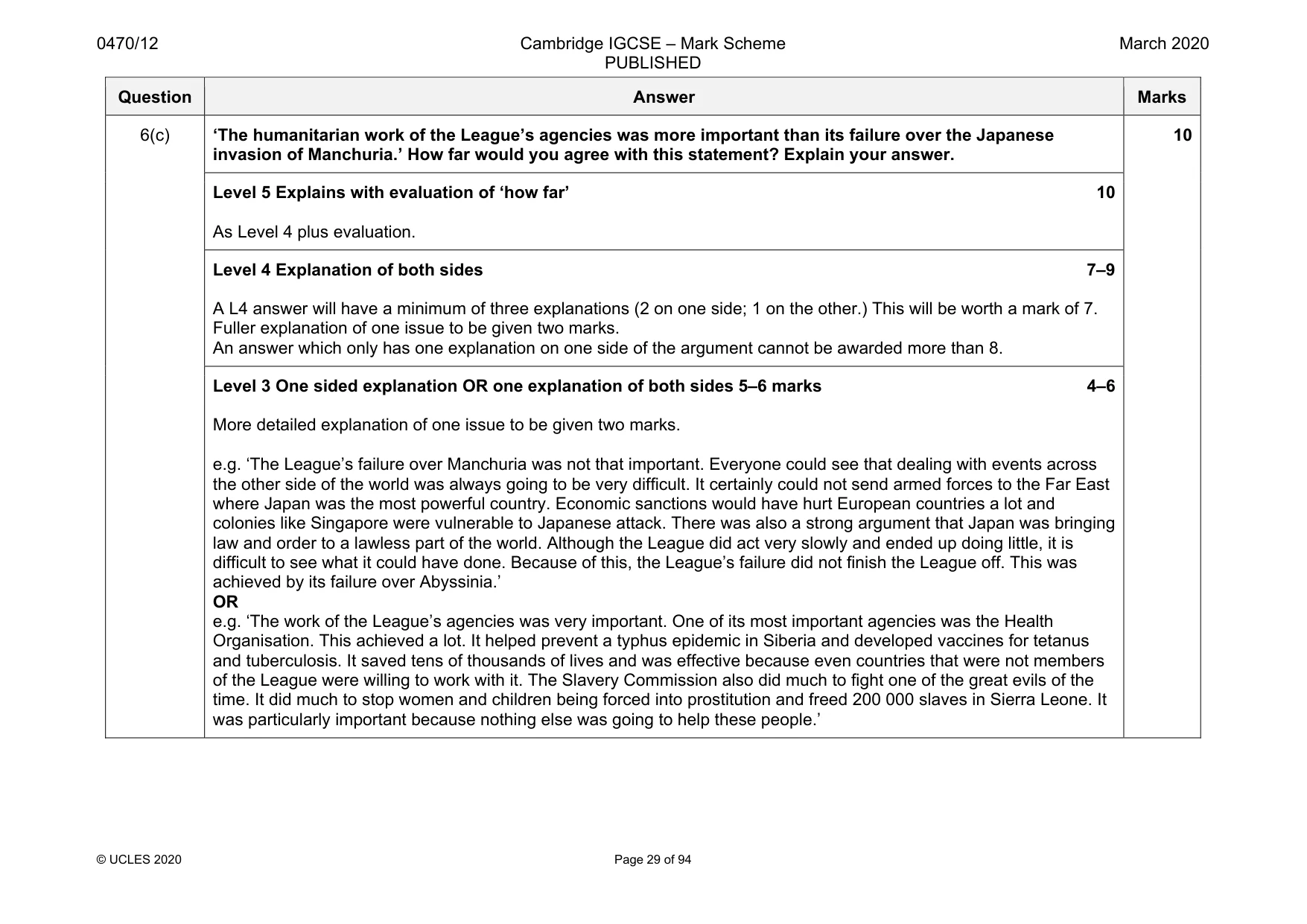
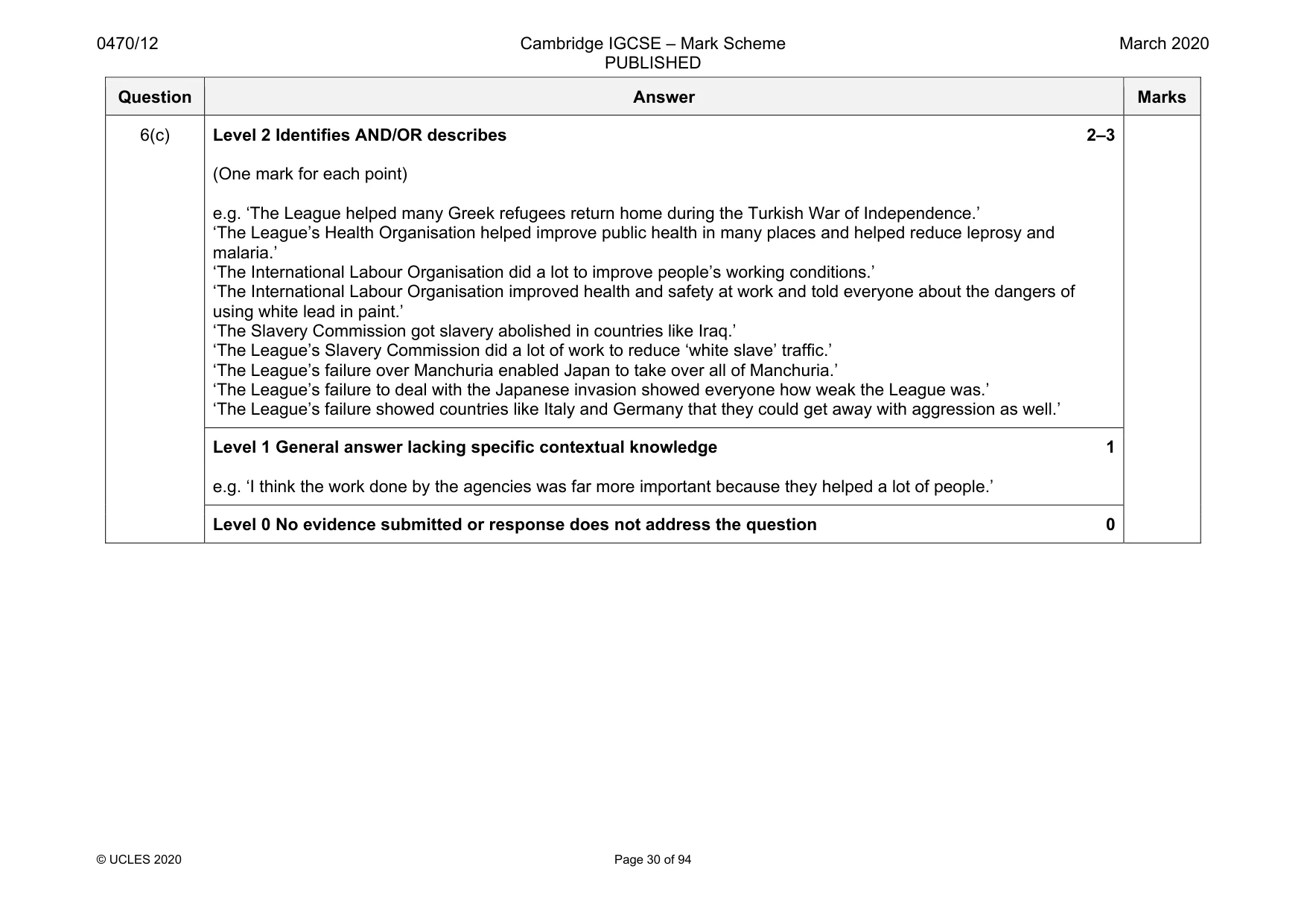
0470/12 Cambridge IGCSE – Mark Scheme PUBLISHED March 2020 © UCLES 2020 Page 29 of 94 Question Answer Marks 6(c) ‘The humanitarian work of the League’s agencies was more important than its failure over the Japanese invasion of Manchuria.’ How far would you agree with this statement? Explain your answer. 10 Level 5 Explains with evaluation of ‘how far’ 10 As Level 4 plus evaluation. Level 4 Explanation of both sides 7–9 A L4 answer will have a minimum of three explanations (2 on one side; 1 on the other.) This will be worth a mark of 7. Fuller explanation of one issue to be given two marks. An answer which only has one explanation on one side of the argument cannot be awarded more than 8. Level 3 One sided explanation OR one explanation of both sides 5–6 marks 4–6 More detailed explanation of one issue to be given two marks. e.g. ‘The League’s failure over Manchuria was not that important. Everyone could see that dealing with events across the other side of the world was always going to be very difficult. It certainly could not send armed forces to the Far East where Japan was the most powerful country. Economic sanctions would have hurt European countries a lot and colonies like Singapore were vulnerable to Japanese attack. There was also a strong argument that Japan was bringing law and order to a lawless part of the world. Although the League did act very slowly and ended up doing little, it is difficult to see what it could have done. Because of this, the League’s failure did not finish the League off. This was achieved by its failure over Abyssinia.’ OR e.g. ‘The work of the League’s agencies was very important. One of its most important agencies was the Health Organisation. This achieved a lot. It helped prevent a typhus epidemic in Siberia and developed vaccines for tetanus and tuberculosis. It saved tens of thousands of lives and was effective because even countries that were not members of the League were willing to work with it. The Slavery Commission also did much to fight one of the great evils of the time. It did much to stop women and children being forced into prostitution and freed 200 000 slaves in Sierra Leone. It was particularly important because nothing else was going to help these people.’
Mark scheme, page 30
0470/12 Cambridge IGCSE – Mark Scheme PUBLISHED March 2020 © UCLES 2020 Page 30 of 94 Question Answer Marks 6(c) Level 2 Identifies AND/OR describes 2–3 (One mark for each point) e.g. ‘The League helped many Greek refugees return home during the Turkish War of Independence.’ ‘The League’s Health Organisation helped improve public health in many places and helped reduce leprosy and malaria.’ ‘The International Labour Organisation did a lot to improve people’s working conditions.’ ‘The International Labour Organisation improved health and safety at work and told everyone about the dangers of using white lead in paint.’ ‘The Slavery Commission got slavery abolished in countries like Iraq.’ ‘The League’s Slavery Commission did a lot of work to reduce ‘white slave’ traffic.’ ‘The League’s failure over Manchuria enabled Japan to take over all of Manchuria.’ ‘The League’s failure to deal with the Japanese invasion showed everyone how weak the League was.’ ‘The League’s failure showed countries like Italy and Germany that they could get away with aggression as well.’ Level 1 General answer lacking specific contextual knowledge 1 e.g. ‘I think the work done by the agencies was far more important because they helped a lot of people.’ Level 0 No evidence submitted or response does not address the question 0
Mark scheme, page 31
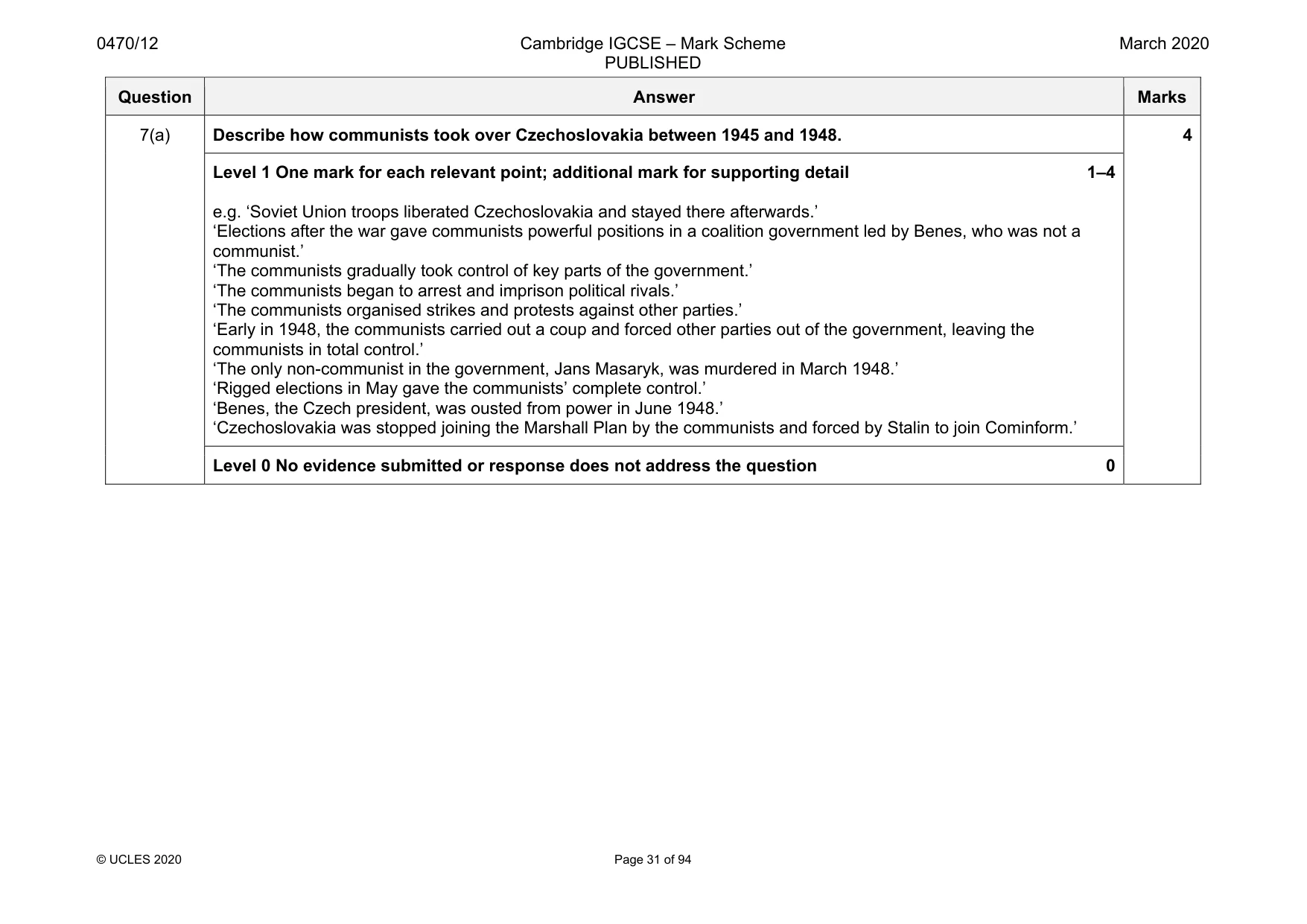
0470/12 Cambridge IGCSE – Mark Scheme PUBLISHED March 2020 © UCLES 2020 Page 31 of 94 Question Answer Marks 7(a) Describe how communists took over Czechoslovakia between 1945 and 1948. 4 Level 1 One mark for each relevant point; additional mark for supporting detail 1–4 e.g. ‘Soviet Union troops liberated Czechoslovakia and stayed there afterwards.’ ‘Elections after the war gave communists powerful positions in a coalition government led by Benes, who was not a communist.’ ‘The communists gradually took control of key parts of the government.’ ‘The communists began to arrest and imprison political rivals.’ ‘The communists organised strikes and protests against other parties.’ ‘Early in 1948, the communists carried out a coup and forced other parties out of the government, leaving the communists in total control.’ ‘The only non-communist in the government, Jans Masaryk, was murdered in March 1948.’ ‘Rigged elections in May gave the communists’ complete control.’ ‘Benes, the Czech president, was ousted from power in June 1948.’ ‘Czechoslovakia was stopped joining the Marshall Plan by the communists and forced by Stalin to join Cominform.’ Level 0 No evidence submitted or response does not address the question 0
Mark scheme, page 32
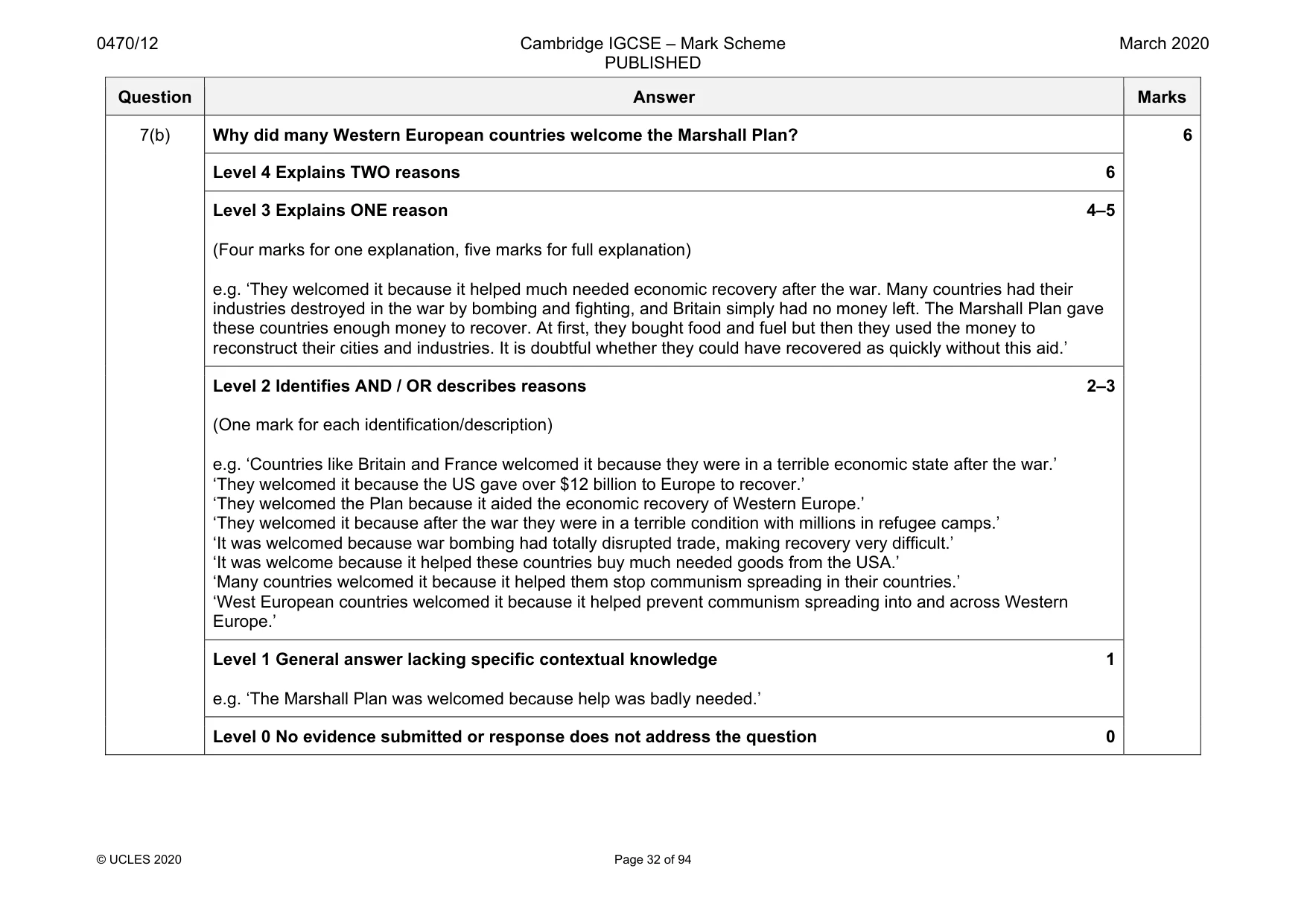
0470/12 Cambridge IGCSE – Mark Scheme PUBLISHED March 2020 © UCLES 2020 Page 32 of 94 Question Answer Marks 7(b) Why did many Western European countries welcome the Marshall Plan? 6 Level 4 Explains TWO reasons 6 Level 3 Explains ONE reason 4–5 (Four marks for one explanation, five marks for full explanation) e.g. ‘They welcomed it because it helped much needed economic recovery after the war. Many countries had their industries destroyed in the war by bombing and fighting, and Britain simply had no money left. The Marshall Plan gave these countries enough money to recover. At first, they bought food and fuel but then they used the money to reconstruct their cities and industries. It is doubtful whether they could have recovered as quickly without this aid.’ Level 2 Identifies AND / OR describes reasons 2–3 (One mark for each identification/description) e.g. ‘Countries like Britain and France welcomed it because they were in a terrible economic state after the war.’ ‘They welcomed it because the US gave over $12 billion to Europe to recover.’ ‘They welcomed the Plan because it aided the economic recovery of Western Europe.’ ‘They welcomed it because after the war they were in a terrible condition with millions in refugee camps.’ ‘It was welcomed because war bombing had totally disrupted trade, making recovery very difficult.’ ‘It was welcome because it helped these countries buy much needed goods from the USA.’ ‘Many countries welcomed it because it helped them stop communism spreading in their countries.’ ‘West European countries welcomed it because it helped prevent communism spreading into and across Western Europe.’ Level 1 General answer lacking specific contextual knowledge 1 e.g. ‘The Marshall Plan was welcomed because help was badly needed.’ Level 0 No evidence submitted or response does not address the question 0
Mark scheme, page 33
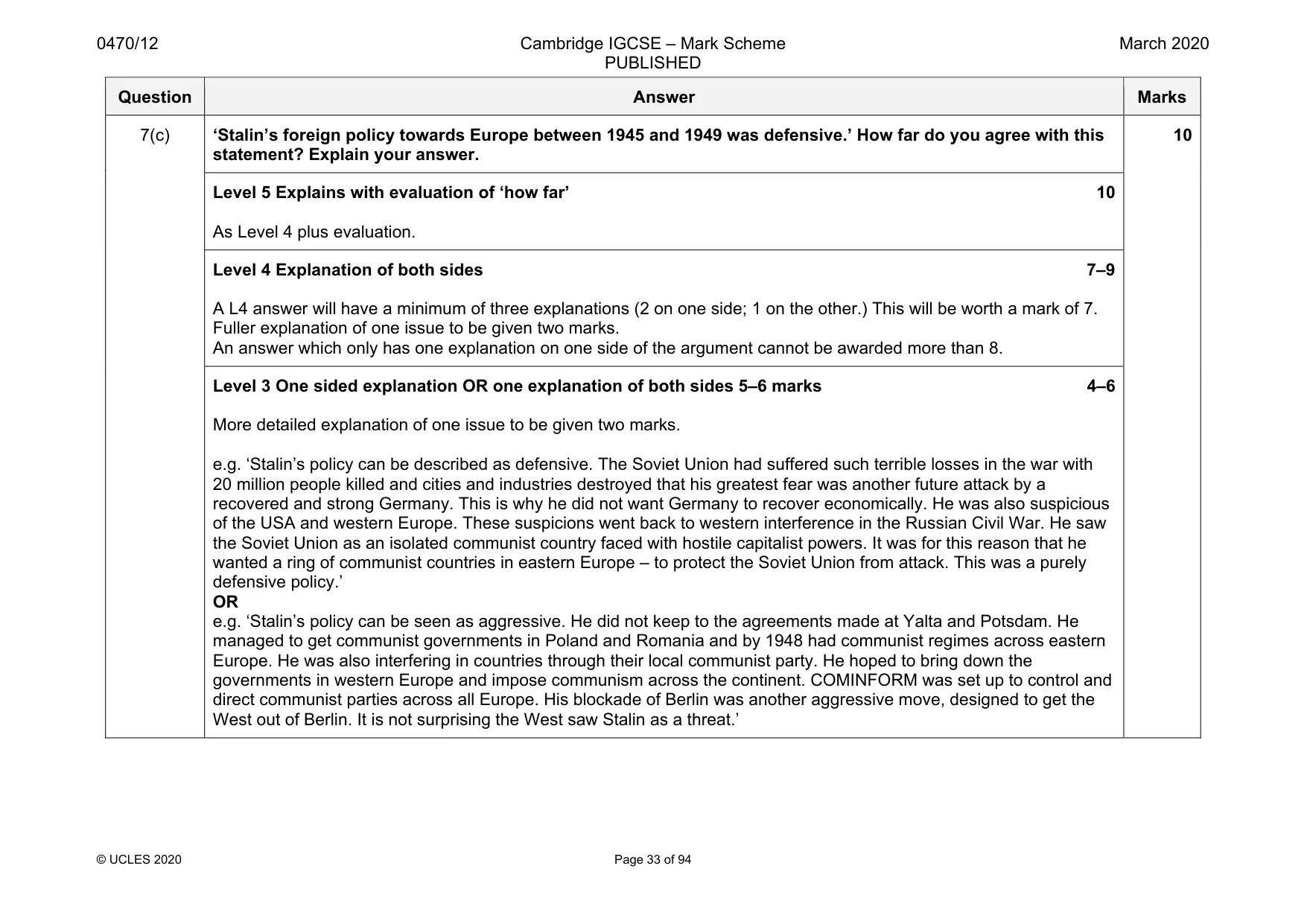
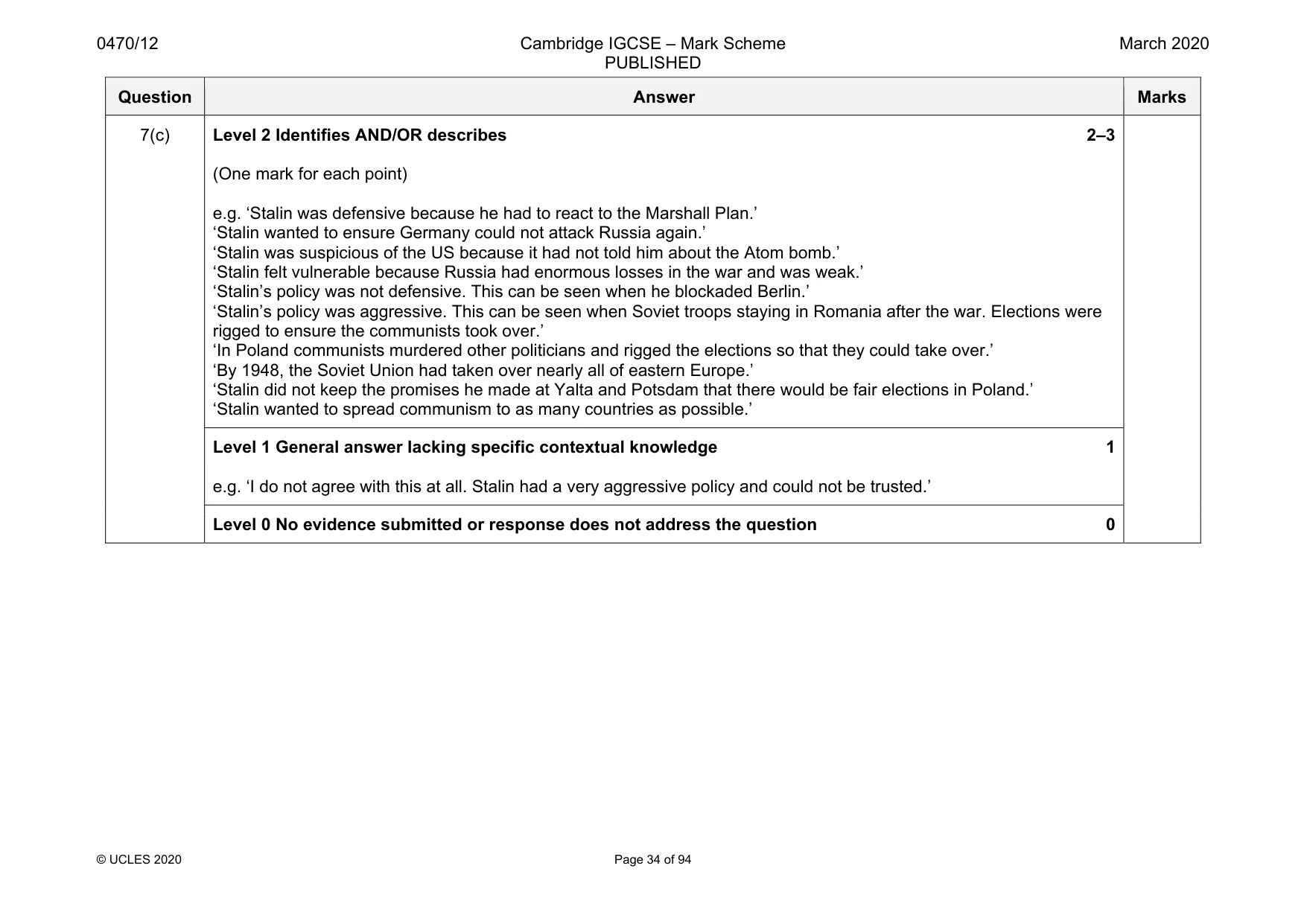
0470/12 Cambridge IGCSE – Mark Scheme PUBLISHED March 2020 © UCLES 2020 Page 33 of 94 Question Answer Marks 7(c) ‘Stalin’s foreign policy towards Europe between 1945 and 1949 was defensive.’ How far do you agree with this statement? Explain your answer. 10 Level 5 Explains with evaluation of ‘how far’ 10 As Level 4 plus evaluation. Level 4 Explanation of both sides 7–9 A L4 answer will have a minimum of three explanations (2 on one side; 1 on the other.) This will be worth a mark of 7. Fuller explanation of one issue to be given two marks. An answer which only has one explanation on one side of the argument cannot be awarded more than 8. Level 3 One sided explanation OR one explanation of both sides 5–6 marks 4–6 More detailed explanation of one issue to be given two marks. e.g. ‘Stalin’s policy can be described as defensive. The Soviet Union had suffered such terrible losses in the war with 20 million people killed and cities and industries destroyed that his greatest fear was another future attack by a recovered and strong Germany. This is why he did not want Germany to recover economically. He was also suspicious of the USA and western Europe. These suspicions went back to western interference in the Russian Civil War. He saw the Soviet Union as an isolated communist country faced with hostile capitalist powers. It was for this reason that he wanted a ring of communist countries in eastern Europe – to protect the Soviet Union from attack. This was a purely defensive policy.’ OR e.g. ‘Stalin’s policy can be seen as aggressive. He did not keep to the agreements made at Yalta and Potsdam. He managed to get communist governments in Poland and Romania and by 1948 had communist regimes across eastern Europe. He was also interfering in countries through their local communist party. He hoped to bring down the governments in western Europe and impose communism across the continent. COMINFORM was set up to control and direct communist parties across all Europe. His blockade of Berlin was another aggressive move, designed to get the West out of Berlin. It is not surprising the West saw Stalin as a threat.’
Mark scheme, page 34
0470/12 Cambridge IGCSE – Mark Scheme PUBLISHED March 2020 © UCLES 2020 Page 34 of 94 Question Answer Marks 7(c) Level 2 Identifies AND/OR describes 2–3 (One mark for each point) e.g. ‘Stalin was defensive because he had to react to the Marshall Plan.’ ‘Stalin wanted to ensure Germany could not attack Russia again.’ ‘Stalin was suspicious of the US because it had not told him about the Atom bomb.’ ‘Stalin felt vulnerable because Russia had enormous losses in the war and was weak.’ ‘Stalin’s policy was not defensive. This can be seen when he blockaded Berlin.’ ‘Stalin’s policy was aggressive. This can be seen when Soviet troops staying in Romania after the war. Elections were rigged to ensure the communists took over.’ ‘In Poland communists murdered other politicians and rigged the elections so that they could take over.’ ‘By 1948, the Soviet Union had taken over nearly all of eastern Europe.’ ‘Stalin did not keep the promises he made at Yalta and Potsdam that there would be fair elections in Poland.’ ‘Stalin wanted to spread communism to as many countries as possible.’ Level 1 General answer lacking specific contextual knowledge 1 e.g. ‘I do not agree with this at all. Stalin had a very aggressive policy and could not be trusted.’ Level 0 No evidence submitted or response does not address the question 0
Mark scheme, page 35
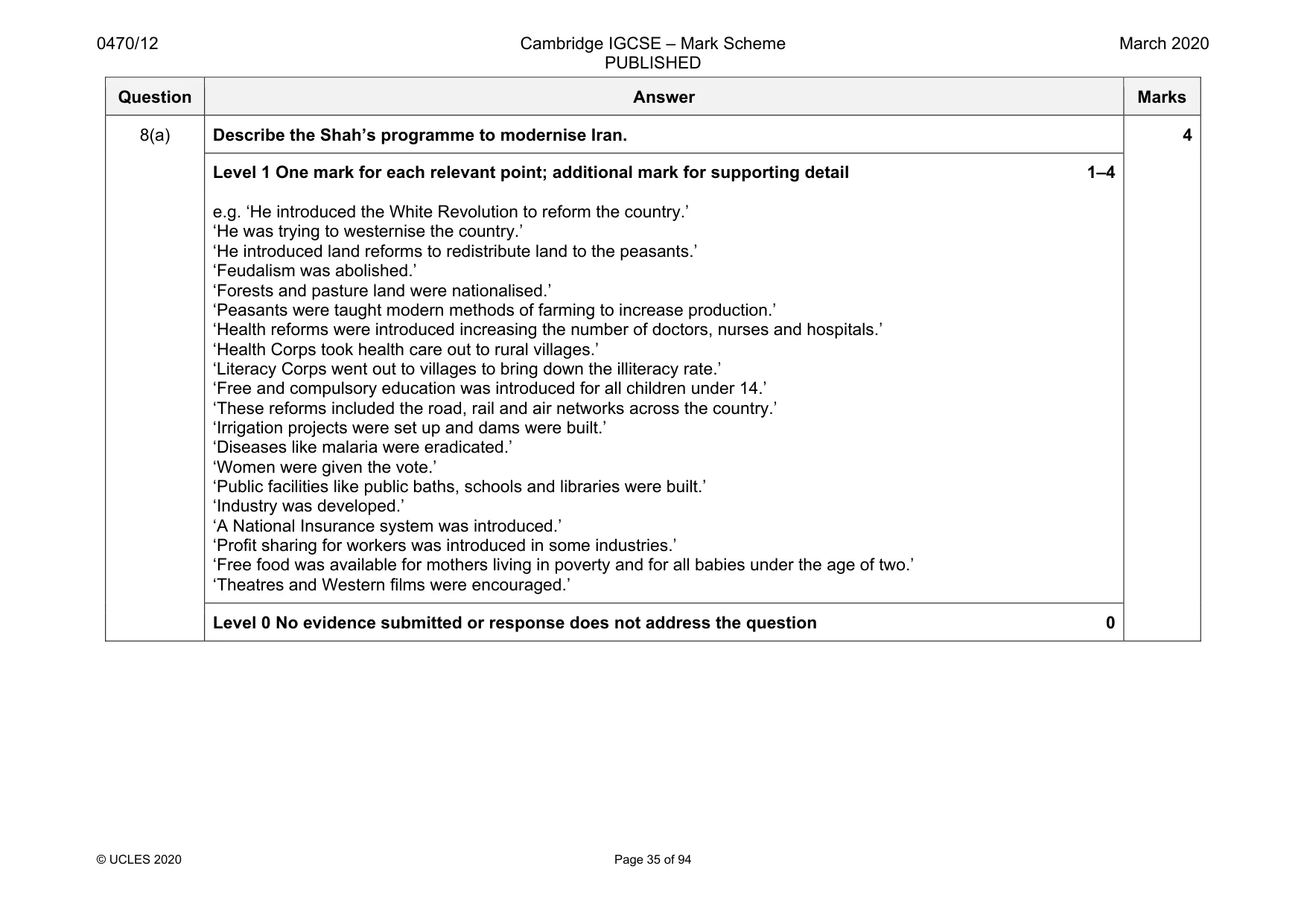
0470/12 Cambridge IGCSE – Mark Scheme PUBLISHED March 2020 © UCLES 2020 Page 35 of 94 Question Answer Marks 8(a) Describe the Shah’s programme to modernise Iran. 4 Level 1 One mark for each relevant point; additional mark for supporting detail 1–4 e.g. ‘He introduced the White Revolution to reform the country.’ ‘He was trying to westernise the country.’ ‘He introduced land reforms to redistribute land to the peasants.’ ‘Feudalism was abolished.’ ‘Forests and pasture land were nationalised.’ ‘Peasants were taught modern methods of farming to increase production.’ ‘Health reforms were introduced increasing the number of doctors, nurses and hospitals.’ ‘Health Corps took health care out to rural villages.’ ‘Literacy Corps went out to villages to bring down the illiteracy rate.’ ‘Free and compulsory education was introduced for all children under 14.’ ‘These reforms included the road, rail and air networks across the country.’ ‘Irrigation projects were set up and dams were built.’ ‘Diseases like malaria were eradicated.’ ‘Women were given the vote.’ ‘Public facilities like public baths, schools and libraries were built.’ ‘Industry was developed.’ ‘A National Insurance system was introduced.’ ‘Profit sharing for workers was introduced in some industries.’ ‘Free food was available for mothers living in poverty and for all babies under the age of two.’ ‘Theatres and Western films were encouraged.’ Level 0 No evidence submitted or response does not address the question 0
Mark scheme, page 36
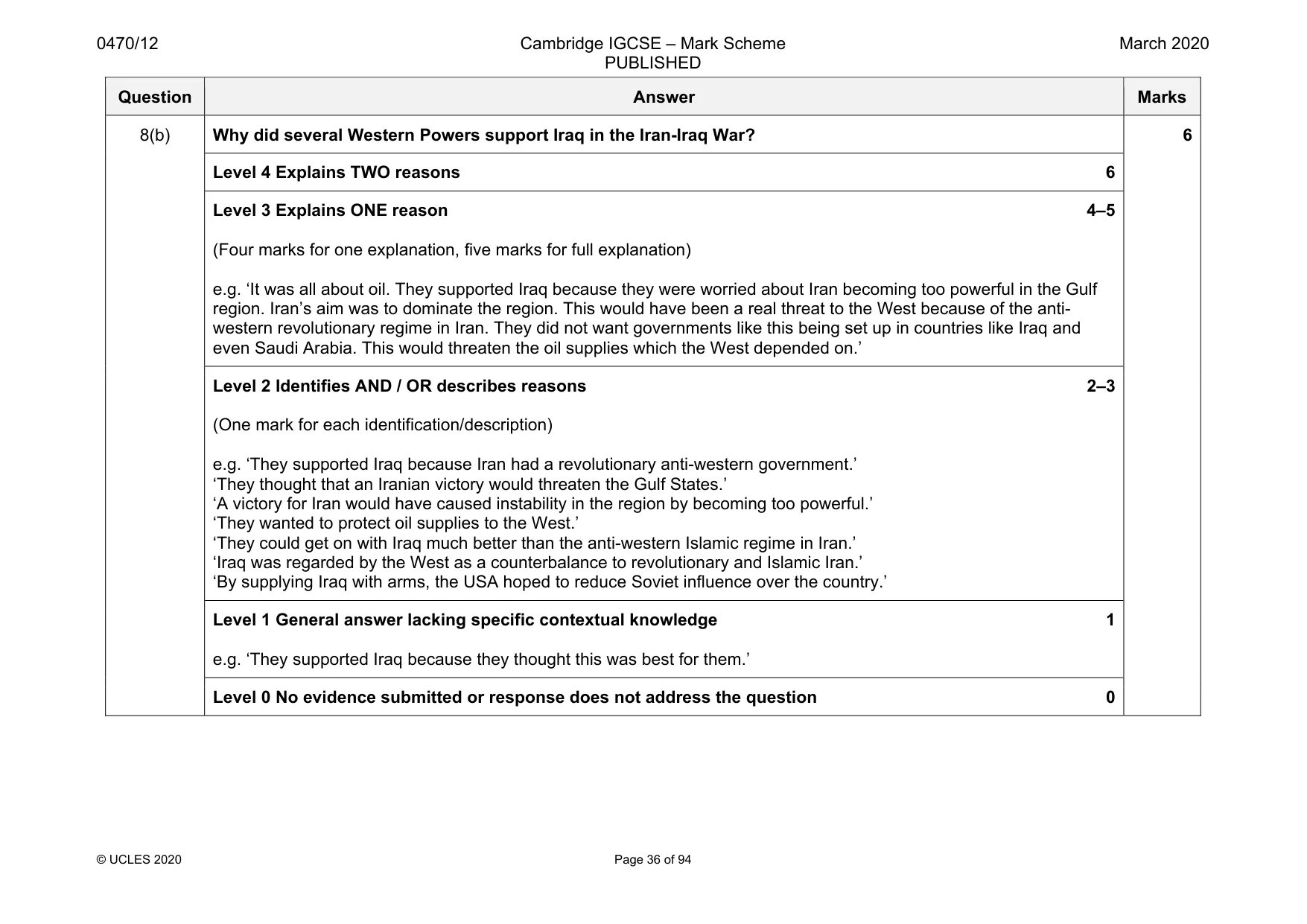
0470/12 Cambridge IGCSE – Mark Scheme PUBLISHED March 2020 © UCLES 2020 Page 36 of 94 Question Answer Marks 8(b) Why did several Western Powers support Iraq in the Iran-Iraq War? 6 Level 4 Explains TWO reasons 6 Level 3 Explains ONE reason 4–5 (Four marks for one explanation, five marks for full explanation) e.g. ‘It was all about oil. They supported Iraq because they were worried about Iran becoming too powerful in the Gulf region. Iran’s aim was to dominate the region. This would have been a real threat to the West because of the anti- western revolutionary regime in Iran. They did not want governments like this being set up in countries like Iraq and even Saudi Arabia. This would threaten the oil supplies which the West depended on.’ Level 2 Identifies AND / OR describes reasons 2–3 (One mark for each identification/description) e.g. ‘They supported Iraq because Iran had a revolutionary anti-western government.’ ‘They thought that an Iranian victory would threaten the Gulf States.’ ‘A victory for Iran would have caused instability in the region by becoming too powerful.’ ‘They wanted to protect oil supplies to the West.’ ‘They could get on with Iraq much better than the anti-western Islamic regime in Iran.’ ‘Iraq was regarded by the West as a counterbalance to revolutionary and Islamic Iran.’ ‘By supplying Iraq with arms, the USA hoped to reduce Soviet influence over the country.’ Level 1 General answer lacking specific contextual knowledge 1 e.g. ‘They supported Iraq because they thought this was best for them.’ Level 0 No evidence submitted or response does not address the question 0
Mark scheme, page 37
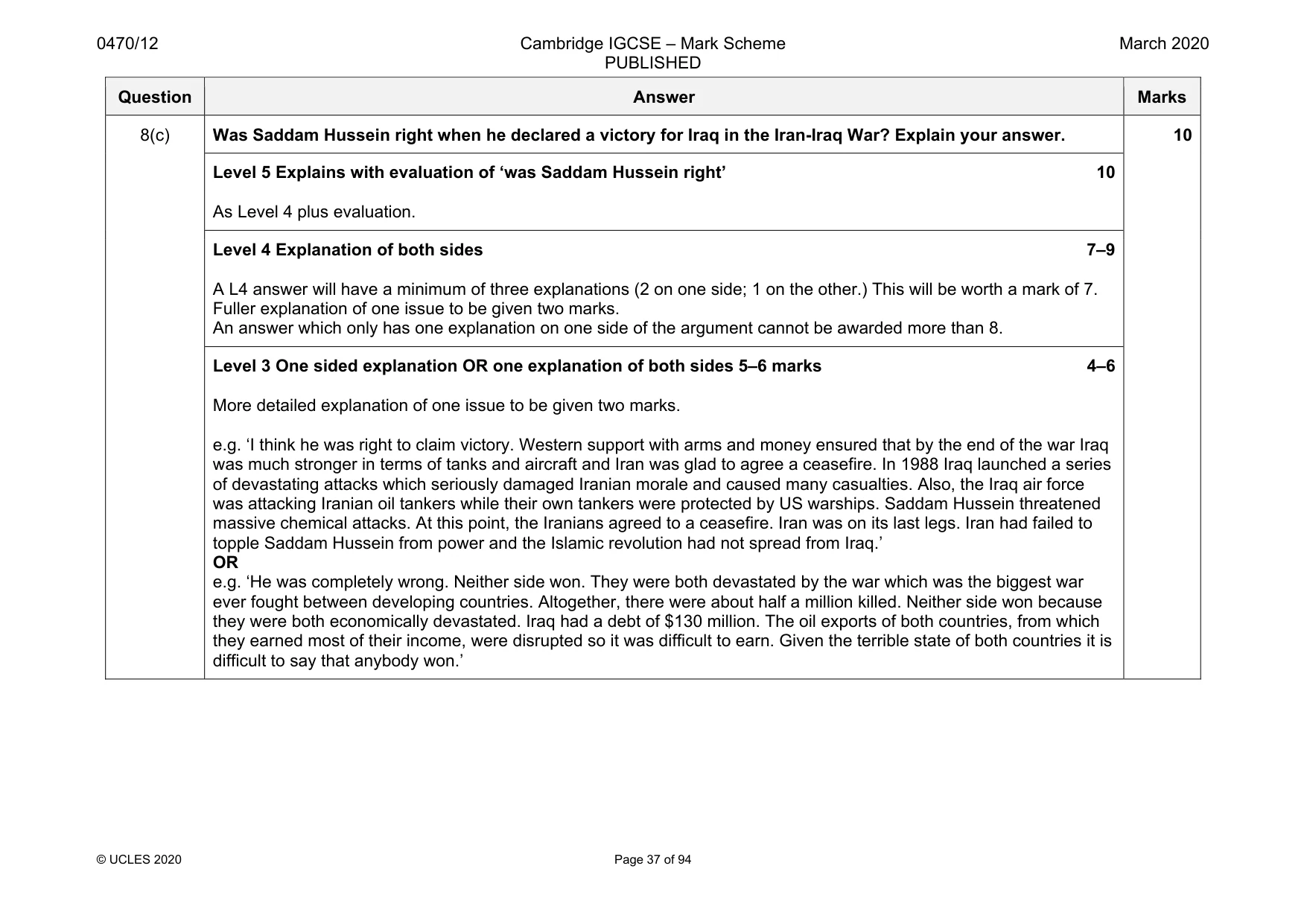
0470/12 Cambridge IGCSE – Mark Scheme PUBLISHED March 2020 © UCLES 2020 Page 37 of 94 Question Answer Marks 8(c) Was Saddam Hussein right when he declared a victory for Iraq in the Iran-Iraq War? Explain your answer. 10 Level 5 Explains with evaluation of ‘was Saddam Hussein right’ 10 As Level 4 plus evaluation. Level 4 Explanation of both sides 7–9 A L4 answer will have a minimum of three explanations (2 on one side; 1 on the other.) This will be worth a mark of 7. Fuller explanation of one issue to be given two marks. An answer which only has one explanation on one side of the argument cannot be awarded more than 8. Level 3 One sided explanation OR one explanation of both sides 5–6 marks 4–6 More detailed explanation of one issue to be given two marks. e.g. ‘I think he was right to claim victory. Western support with arms and money ensured that by the end of the war Iraq was much stronger in terms of tanks and aircraft and Iran was glad to agree a ceasefire. In 1988 Iraq launched a series of devastating attacks which seriously damaged Iranian morale and caused many casualties. Also, the Iraq air force was attacking Iranian oil tankers while their own tankers were protected by US warships. Saddam Hussein threatened massive chemical attacks. At this point, the Iranians agreed to a ceasefire. Iran was on its last legs. Iran had failed to topple Saddam Hussein from power and the Islamic revolution had not spread from Iraq.’ OR e.g. ‘He was completely wrong. Neither side won. They were both devastated by the war which was the biggest war ever fought between developing countries. Altogether, there were about half a million killed. Neither side won because they were both economically devastated. Iraq had a debt of $130 million. The oil exports of both countries, from which they earned most of their income, were disrupted so it was difficult to earn. Given the terrible state of both countries it is difficult to say that anybody won.’
Mark scheme, page 38
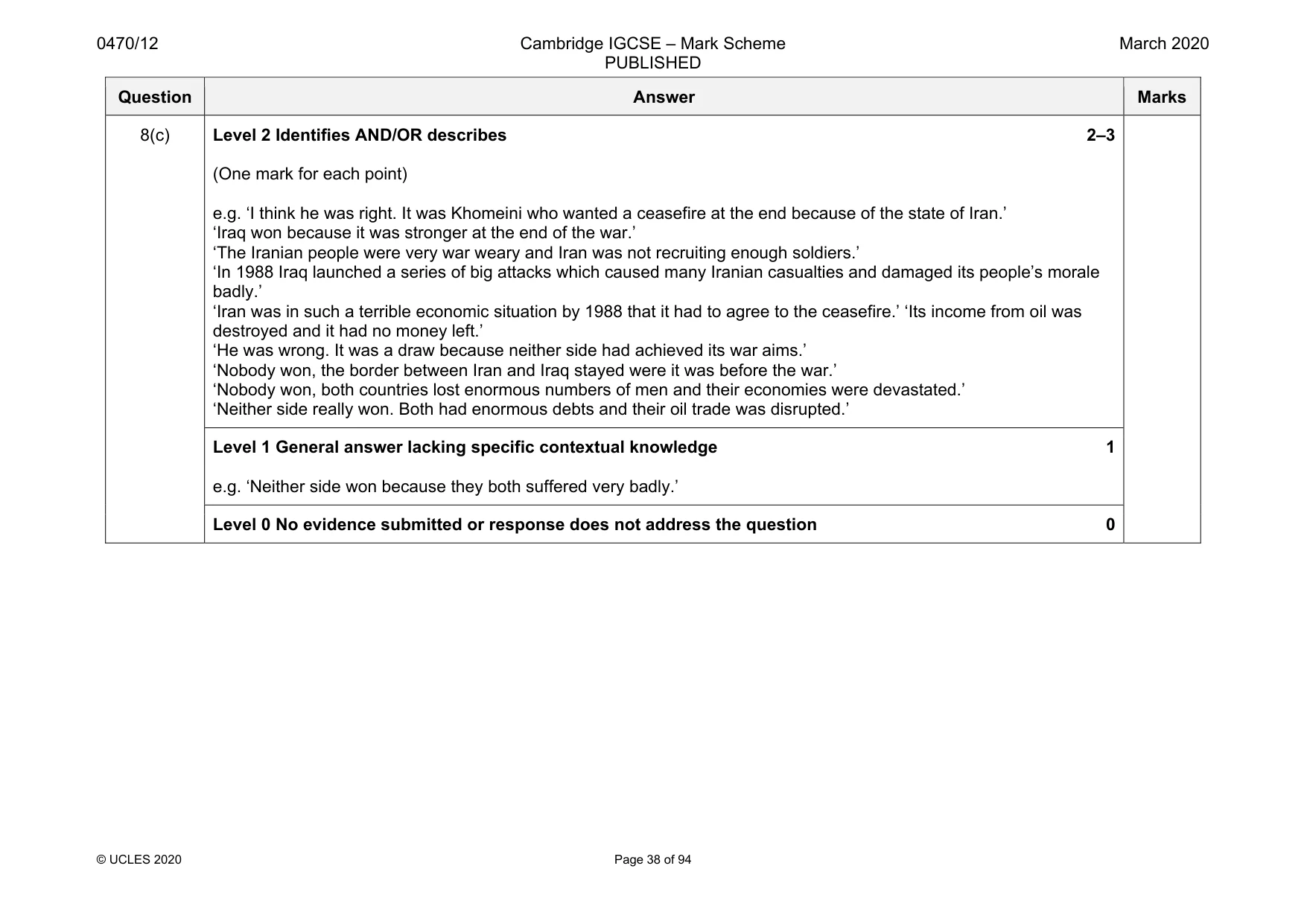
0470/12 Cambridge IGCSE – Mark Scheme PUBLISHED March 2020 © UCLES 2020 Page 38 of 94 Question Answer Marks 8(c) Level 2 Identifies AND/OR describes 2–3 (One mark for each point) e.g. ‘I think he was right. It was Khomeini who wanted a ceasefire at the end because of the state of Iran.’ ‘Iraq won because it was stronger at the end of the war.’ ‘The Iranian people were very war weary and Iran was not recruiting enough soldiers.’ ‘In 1988 Iraq launched a series of big attacks which caused many Iranian casualties and damaged its people’s morale badly.’ ‘Iran was in such a terrible economic situation by 1988 that it had to agree to the ceasefire.’ ‘Its income from oil was destroyed and it had no money left.’ ‘He was wrong. It was a draw because neither side had achieved its war aims.’ ‘Nobody won, the border between Iran and Iraq stayed were it was before the war.’ ‘Nobody won, both countries lost enormous numbers of men and their economies were devastated.’ ‘Neither side really won. Both had enormous debts and their oil trade was disrupted.’ Level 1 General answer lacking specific contextual knowledge 1 e.g. ‘Neither side won because they both suffered very badly.’ Level 0 No evidence submitted or response does not address the question 0
Mark scheme, page 39
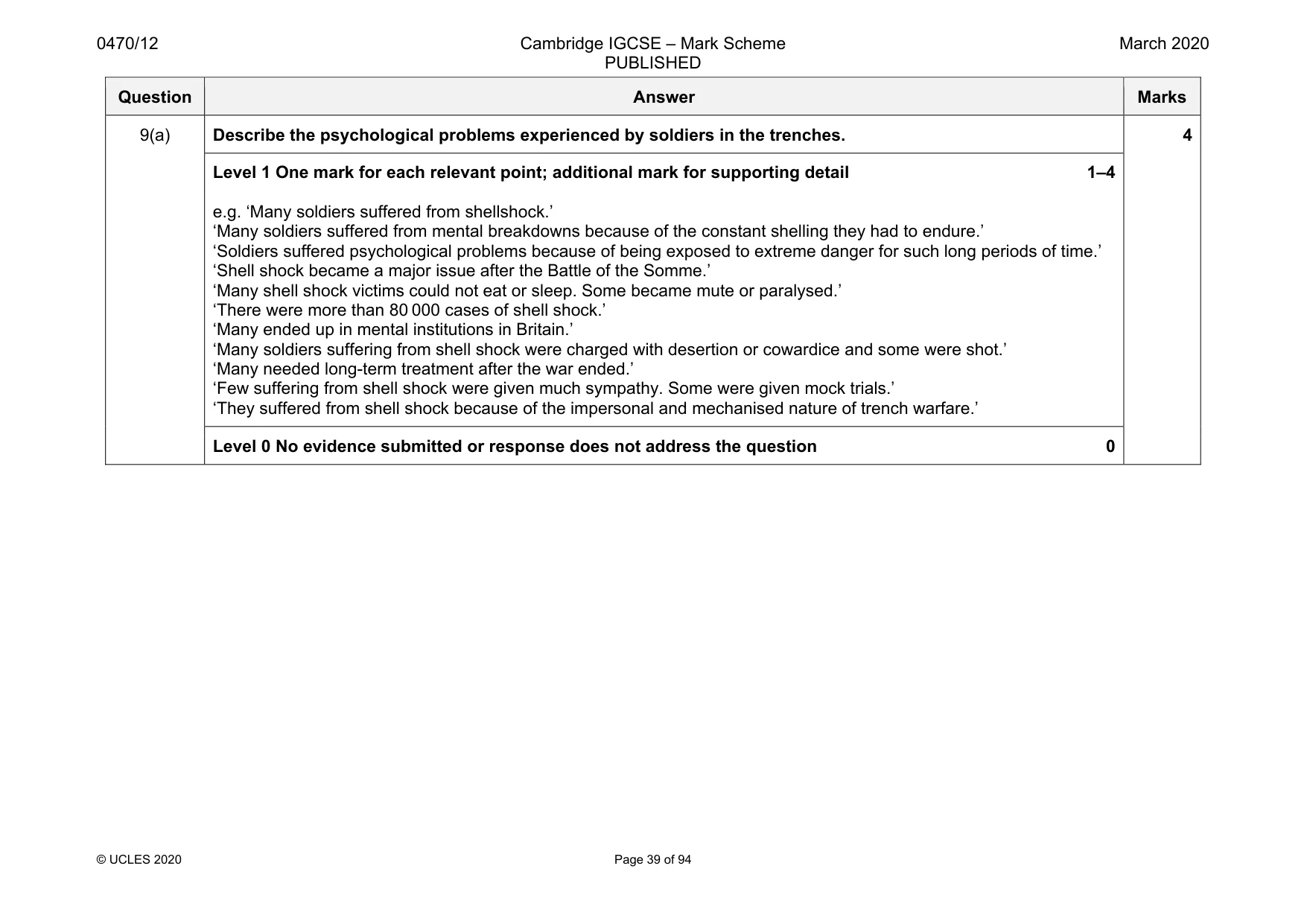
0470/12 Cambridge IGCSE – Mark Scheme PUBLISHED March 2020 © UCLES 2020 Page 39 of 94 Question Answer Marks 9(a) Describe the psychological problems experienced by soldiers in the trenches. 4 Level 1 One mark for each relevant point; additional mark for supporting detail 1–4 e.g. ‘Many soldiers suffered from shellshock.’ ‘Many soldiers suffered from mental breakdowns because of the constant shelling they had to endure.’ ‘Soldiers suffered psychological problems because of being exposed to extreme danger for such long periods of time.’ ‘Shell shock became a major issue after the Battle of the Somme.’ ‘Many shell shock victims could not eat or sleep. Some became mute or paralysed.’ ‘There were more than 80 000 cases of shell shock.’ ‘Many ended up in mental institutions in Britain.’ ‘Many soldiers suffering from shell shock were charged with desertion or cowardice and some were shot.’ ‘Many needed long-term treatment after the war ended.’ ‘Few suffering from shell shock were given much sympathy. Some were given mock trials.’ ‘They suffered from shell shock because of the impersonal and mechanised nature of trench warfare.’ Level 0 No evidence submitted or response does not address the question 0
Mark scheme, page 40
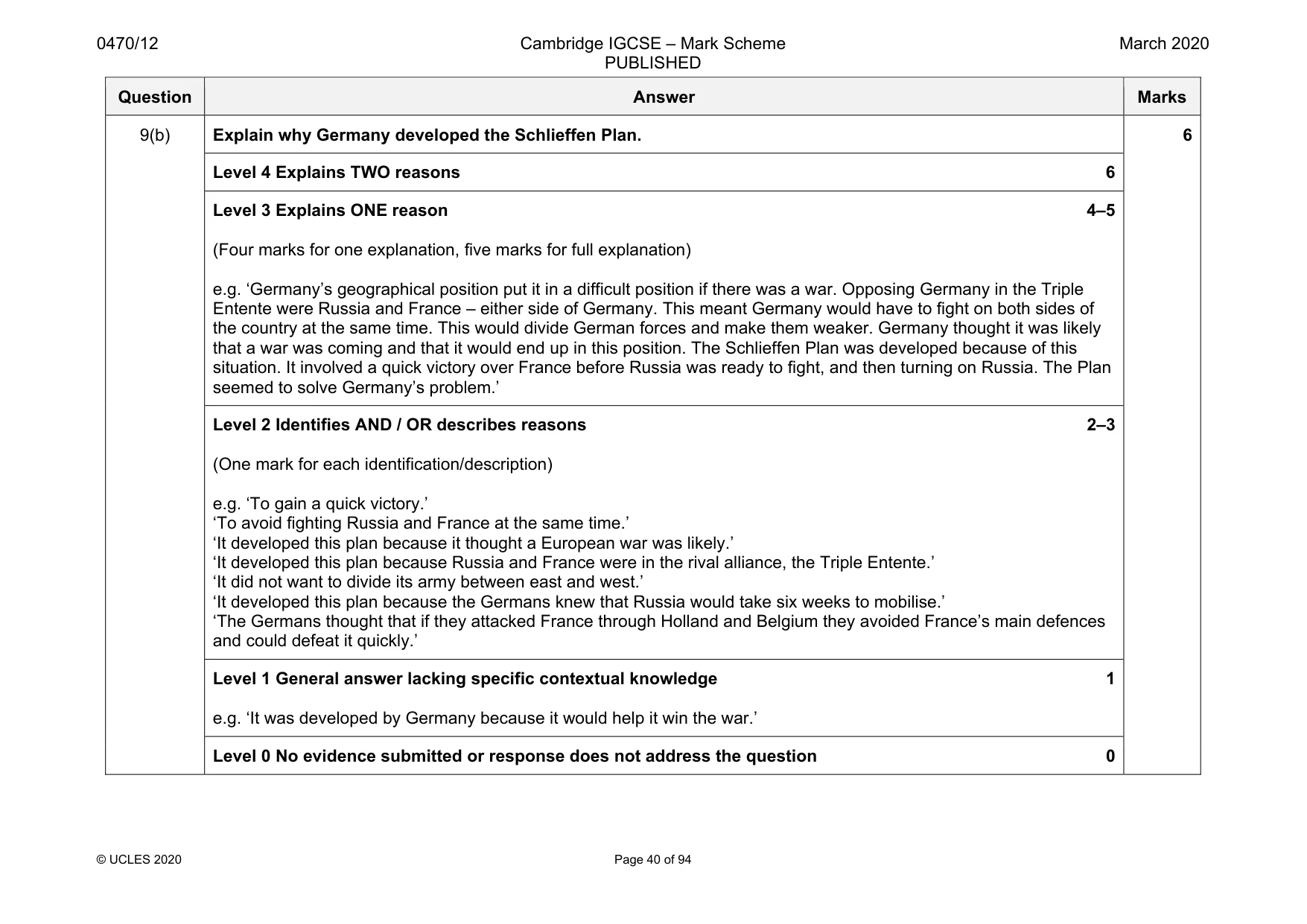
0470/12 Cambridge IGCSE – Mark Scheme PUBLISHED March 2020 © UCLES 2020 Page 40 of 94 Question Answer Marks 9(b) Explain why Germany developed the Schlieffen Plan. 6 Level 4 Explains TWO reasons 6 Level 3 Explains ONE reason 4–5 (Four marks for one explanation, five marks for full explanation) e.g. ‘Germany’s geographical position put it in a difficult position if there was a war. Opposing Germany in the Triple Entente were Russia and France – either side of Germany. This meant Germany would have to fight on both sides of the country at the same time. This would divide German forces and make them weaker. Germany thought it was likely that a war was coming and that it would end up in this position. The Schlieffen Plan was developed because of this situation. It involved a quick victory over France before Russia was ready to fight, and then turning on Russia. The Plan seemed to solve Germany’s problem.’ Level 2 Identifies AND / OR describes reasons 2–3 (One mark for each identification/description) e.g. ‘To gain a quick victory.’ ‘To avoid fighting Russia and France at the same time.’ ‘It developed this plan because it thought a European war was likely.’ ‘It developed this plan because Russia and France were in the rival alliance, the Triple Entente.’ ‘It did not want to divide its army between east and west.’ ‘It developed this plan because the Germans knew that Russia would take six weeks to mobilise.’ ‘The Germans thought that if they attacked France through Holland and Belgium they avoided France’s main defences and could defeat it quickly.’ Level 1 General answer lacking specific contextual knowledge 1 e.g. ‘It was developed by Germany because it would help it win the war.’ Level 0 No evidence submitted or response does not address the question 0
Mark scheme, page 41
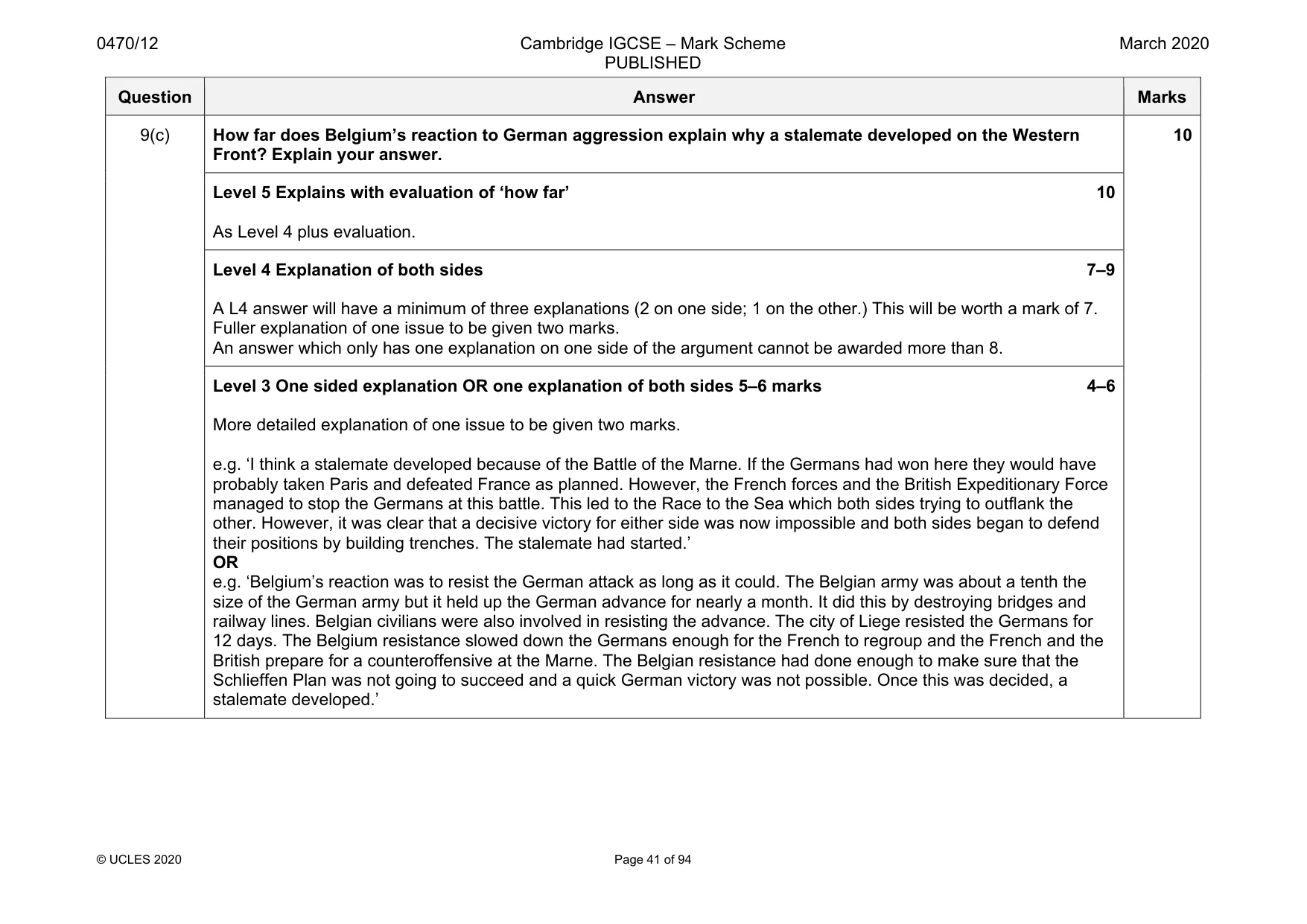
0470/12 Cambridge IGCSE – Mark Scheme PUBLISHED March 2020 © UCLES 2020 Page 41 of 94 Question Answer Marks 9(c) How far does Belgium’s reaction to German aggression explain why a stalemate developed on the Western Front? Explain your answer. 10 Level 5 Explains with evaluation of ‘how far’ 10 As Level 4 plus evaluation. Level 4 Explanation of both sides 7–9 A L4 answer will have a minimum of three explanations (2 on one side; 1 on the other.) This will be worth a mark of 7. Fuller explanation of one issue to be given two marks. An answer which only has one explanation on one side of the argument cannot be awarded more than 8. Level 3 One sided explanation OR one explanation of both sides 5–6 marks 4–6 More detailed explanation of one issue to be given two marks. e.g. ‘I think a stalemate developed because of the Battle of the Marne. If the Germans had won here they would have probably taken Paris and defeated France as planned. However, the French forces and the British Expeditionary Force managed to stop the Germans at this battle. This led to the Race to the Sea which both sides trying to outflank the other. However, it was clear that a decisive victory for either side was now impossible and both sides began to defend their positions by building trenches. The stalemate had started.’ OR e.g. ‘Belgium’s reaction was to resist the German attack as long as it could. The Belgian army was about a tenth the size of the German army but it held up the German advance for nearly a month. It did this by destroying bridges and railway lines. Belgian civilians were also involved in resisting the advance. The city of Liege resisted the Germans for 12 days. The Belgium resistance slowed down the Germans enough for the French to regroup and the French and the British prepare for a counteroffensive at the Marne. The Belgian resistance had done enough to make sure that the Schlieffen Plan was not going to succeed and a quick German victory was not possible. Once this was decided, a stalemate developed.’
Mark scheme, page 42
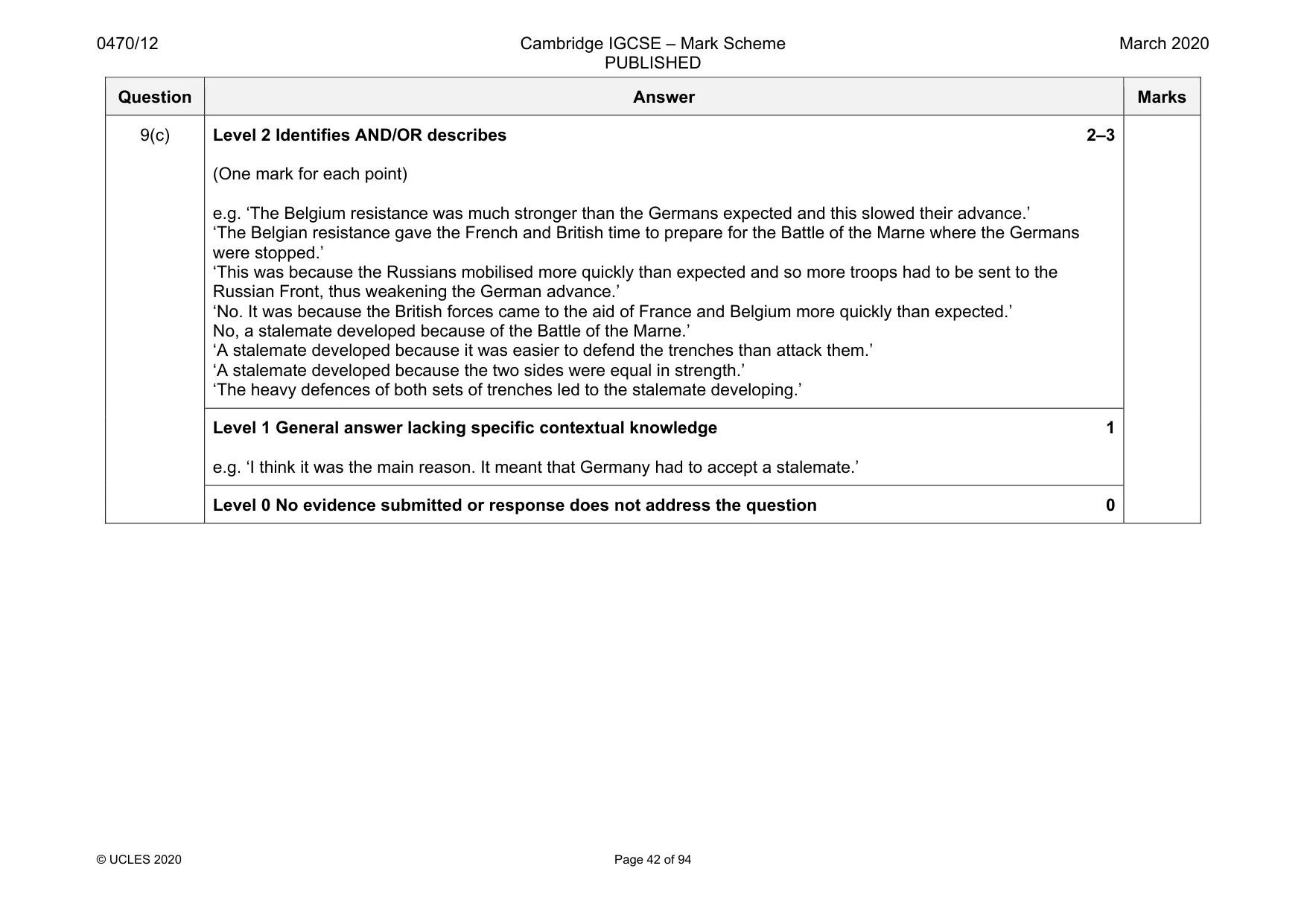
0470/12 Cambridge IGCSE – Mark Scheme PUBLISHED March 2020 © UCLES 2020 Page 42 of 94 Question Answer Marks 9(c) Level 2 Identifies AND/OR describes 2–3 (One mark for each point) e.g. ‘The Belgium resistance was much stronger than the Germans expected and this slowed their advance.’ ‘The Belgian resistance gave the French and British time to prepare for the Battle of the Marne where the Germans were stopped.’ ‘This was because the Russians mobilised more quickly than expected and so more troops had to be sent to the Russian Front, thus weakening the German advance.’ ‘No. It was because the British forces came to the aid of France and Belgium more quickly than expected.’ No, a stalemate developed because of the Battle of the Marne.’ ‘A stalemate developed because it was easier to defend the trenches than attack them.’ ‘A stalemate developed because the two sides were equal in strength.’ ‘The heavy defences of both sets of trenches led to the stalemate developing.’ Level 1 General answer lacking specific contextual knowledge 1 e.g. ‘I think it was the main reason. It meant that Germany had to accept a stalemate.’ Level 0 No evidence submitted or response does not address the question 0
Mark scheme, page 43
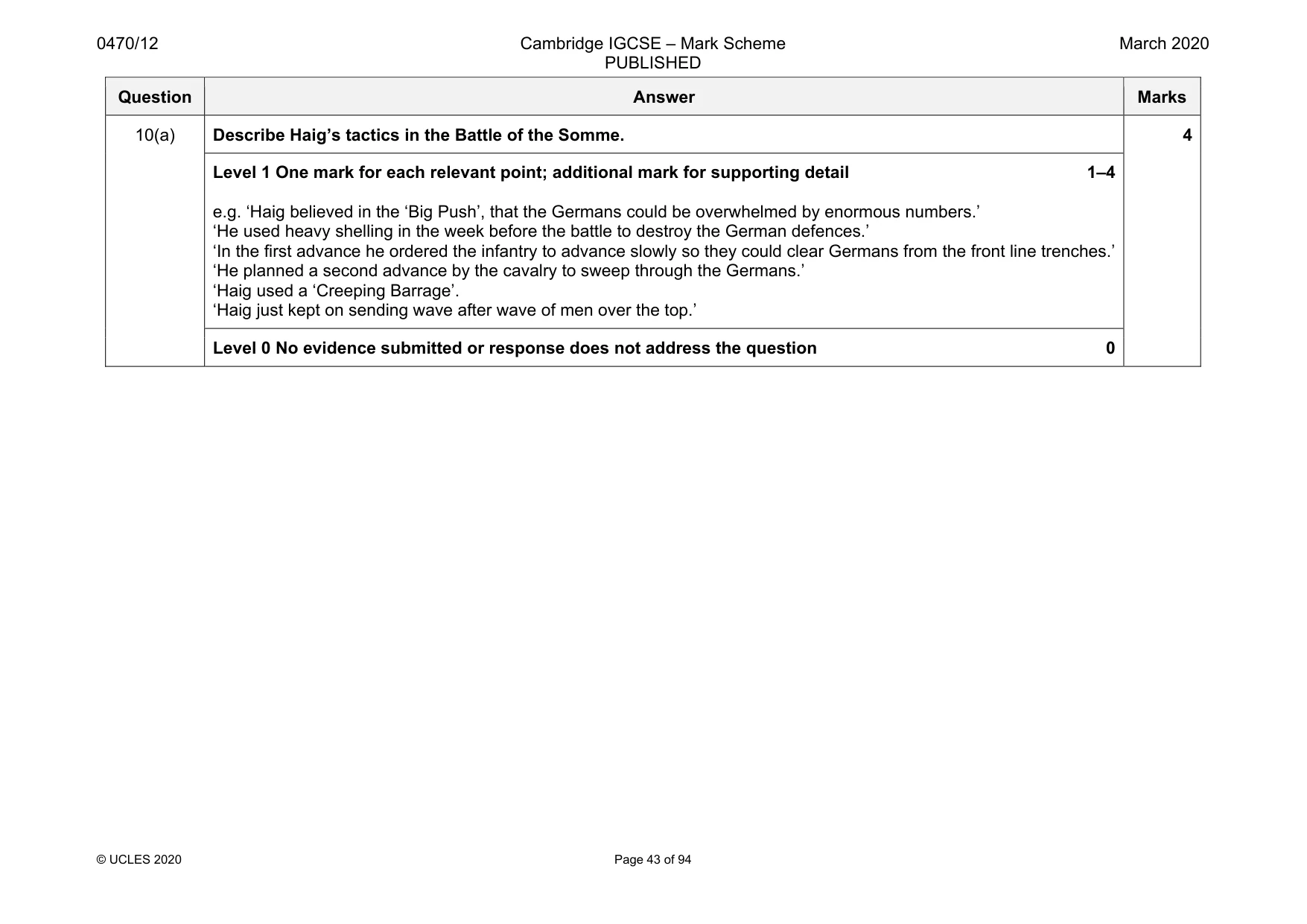
0470/12 Cambridge IGCSE – Mark Scheme PUBLISHED March 2020 © UCLES 2020 Page 43 of 94 Question Answer Marks 10(a) Describe Haig’s tactics in the Battle of the Somme. 4 Level 1 One mark for each relevant point; additional mark for supporting detail 1–4 e.g. ‘Haig believed in the ‘Big Push’, that the Germans could be overwhelmed by enormous numbers.’ ‘He used heavy shelling in the week before the battle to destroy the German defences.’ ‘In the first advance he ordered the infantry to advance slowly so they could clear Germans from the front line trenches.’ ‘He planned a second advance by the cavalry to sweep through the Germans.’ ‘Haig used a ‘Creeping Barrage’. ‘Haig just kept on sending wave after wave of men over the top.’ Level 0 No evidence submitted or response does not address the question 0
Mark scheme, page 44
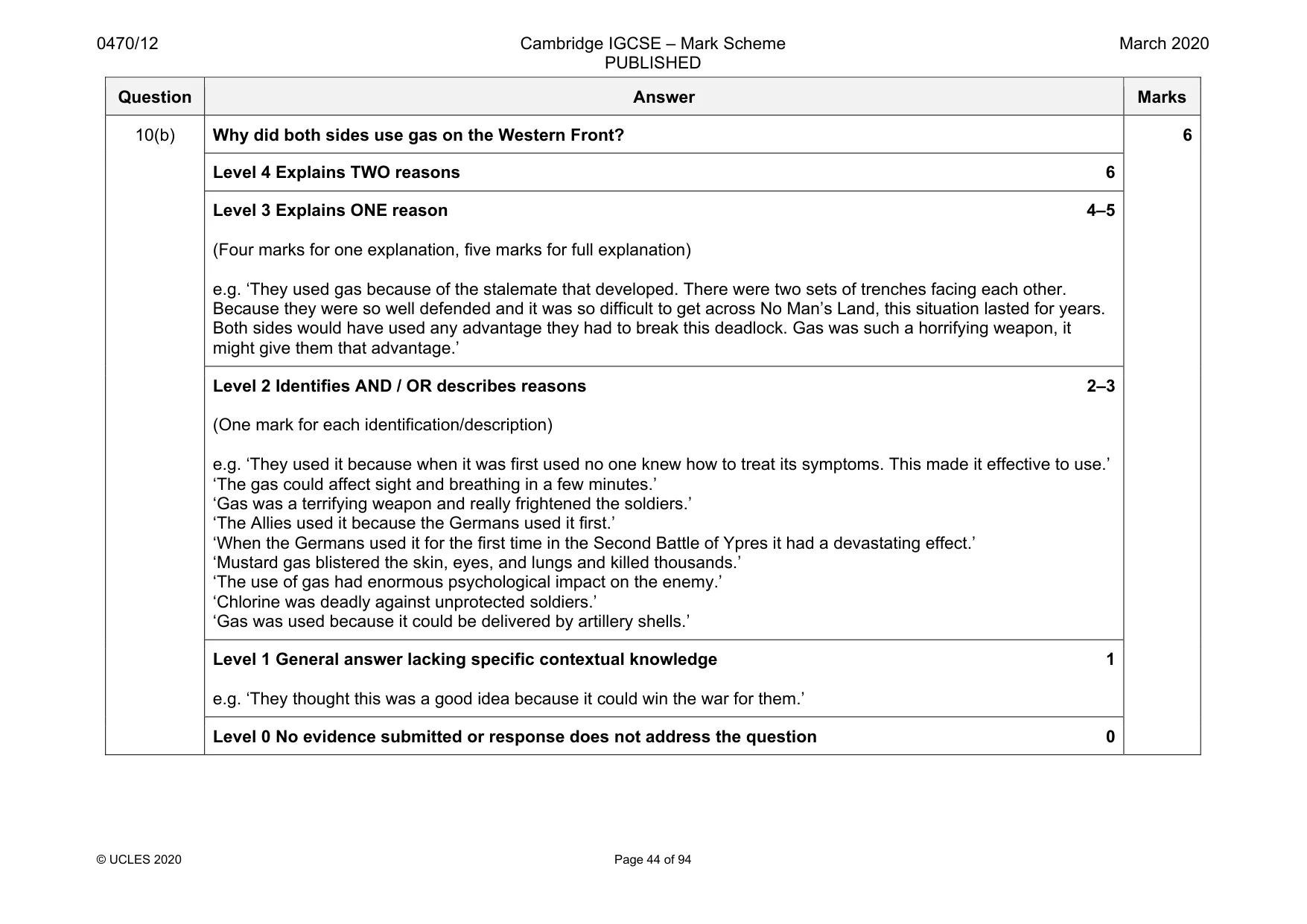
0470/12 Cambridge IGCSE – Mark Scheme PUBLISHED March 2020 © UCLES 2020 Page 44 of 94 Question Answer Marks 10(b) Why did both sides use gas on the Western Front? 6 Level 4 Explains TWO reasons 6 Level 3 Explains ONE reason 4–5 (Four marks for one explanation, five marks for full explanation) e.g. ‘They used gas because of the stalemate that developed. There were two sets of trenches facing each other. Because they were so well defended and it was so difficult to get across No Man’s Land, this situation lasted for years. Both sides would have used any advantage they had to break this deadlock. Gas was such a horrifying weapon, it might give them that advantage.’ Level 2 Identifies AND / OR describes reasons 2–3 (One mark for each identification/description) e.g. ‘They used it because when it was first used no one knew how to treat its symptoms. This made it effective to use.’ ‘The gas could affect sight and breathing in a few minutes.’ ‘Gas was a terrifying weapon and really frightened the soldiers.’ ‘The Allies used it because the Germans used it first.’ ‘When the Germans used it for the first time in the Second Battle of Ypres it had a devastating effect.’ ‘Mustard gas blistered the skin, eyes, and lungs and killed thousands.’ ‘The use of gas had enormous psychological impact on the enemy.’ ‘Chlorine was deadly against unprotected soldiers.’ ‘Gas was used because it could be delivered by artillery shells.’ Level 1 General answer lacking specific contextual knowledge 1 e.g. ‘They thought this was a good idea because it could win the war for them.’ Level 0 No evidence submitted or response does not address the question 0
Mark scheme, page 45
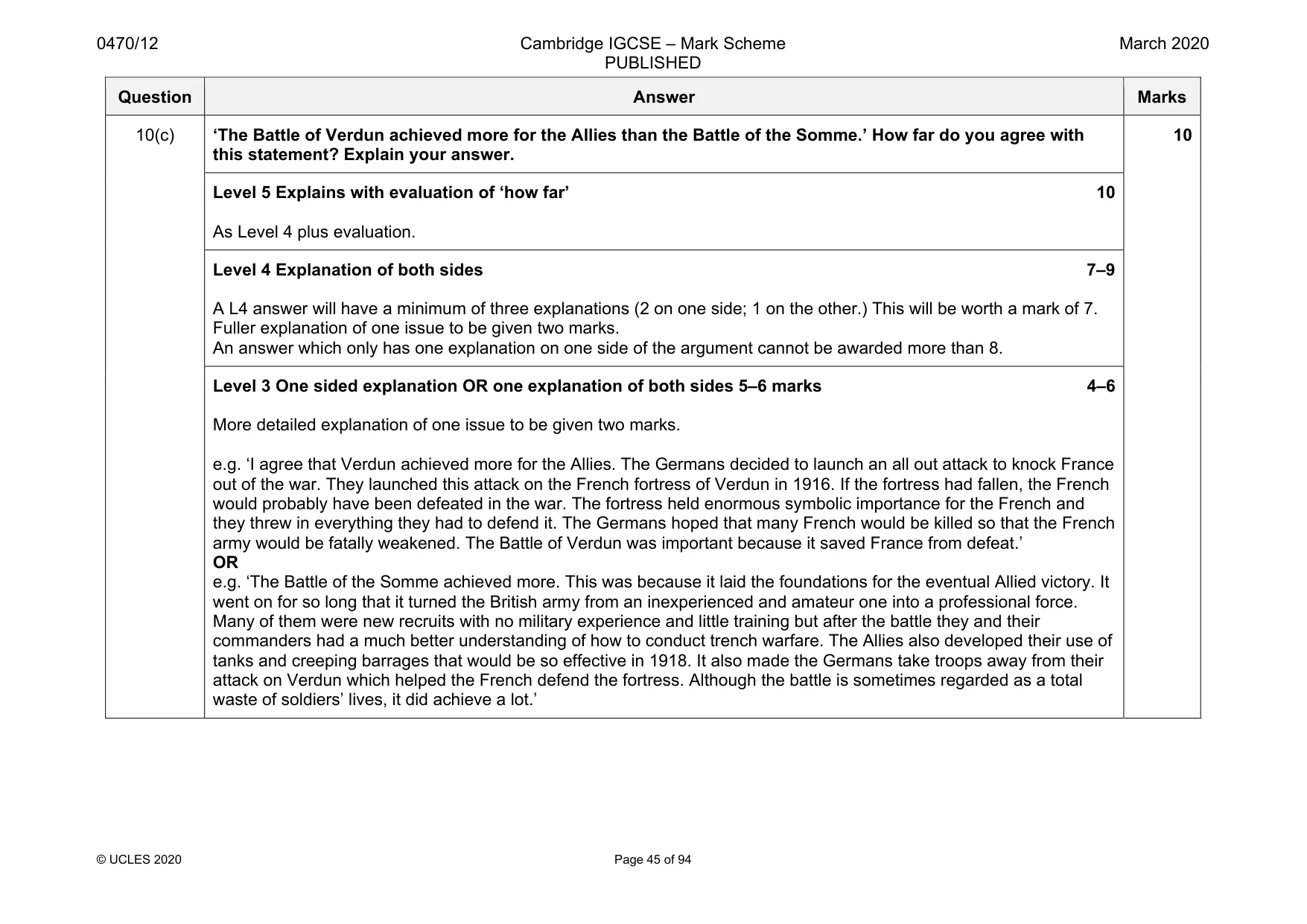
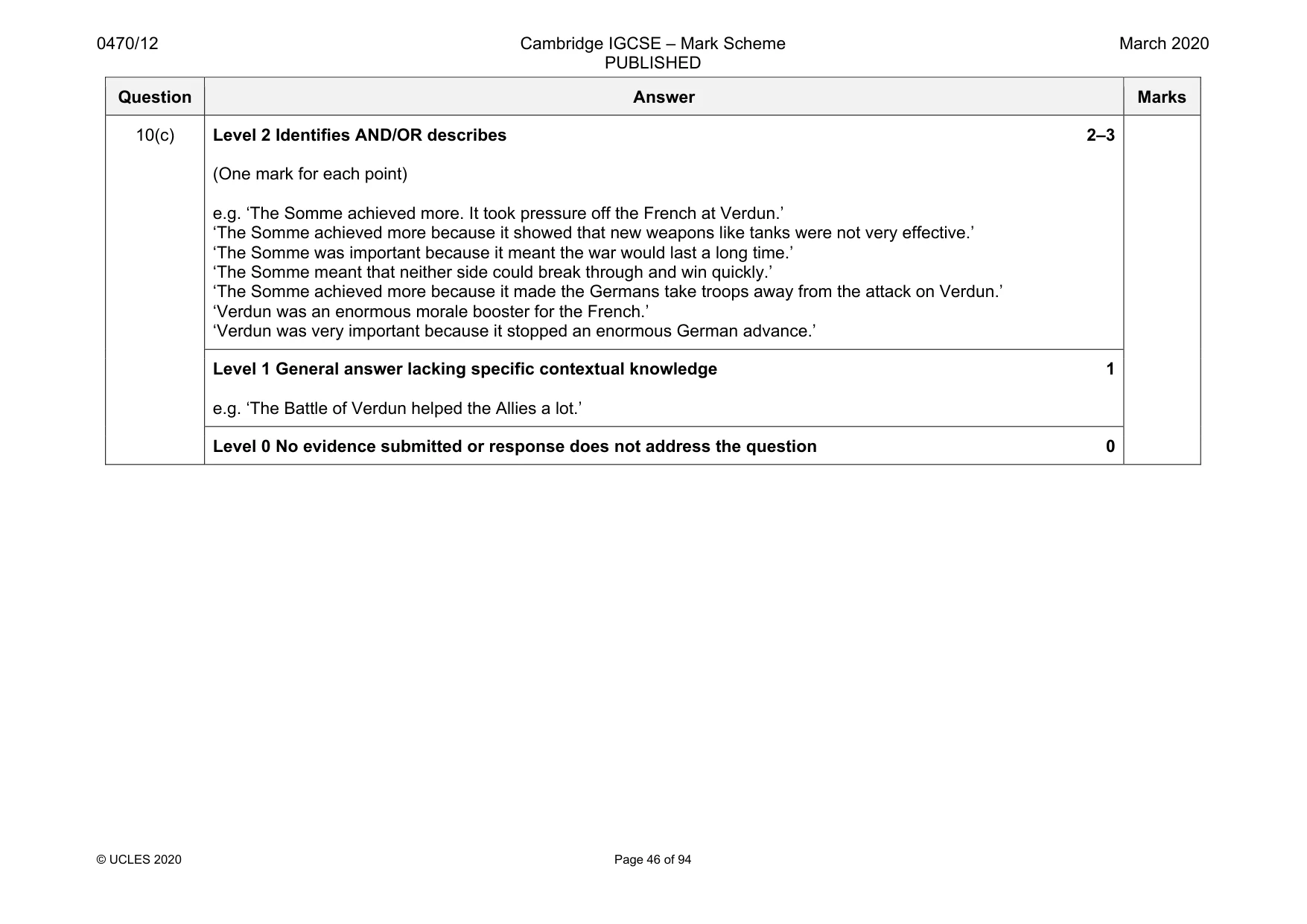
0470/12 Cambridge IGCSE – Mark Scheme PUBLISHED March 2020 © UCLES 2020 Page 45 of 94 Question Answer Marks 10(c) ‘The Battle of Verdun achieved more for the Allies than the Battle of the Somme.’ How far do you agree with this statement? Explain your answer. 10 Level 5 Explains with evaluation of ‘how far’ 10 As Level 4 plus evaluation. Level 4 Explanation of both sides 7–9 A L4 answer will have a minimum of three explanations (2 on one side; 1 on the other.) This will be worth a mark of 7. Fuller explanation of one issue to be given two marks. An answer which only has one explanation on one side of the argument cannot be awarded more than 8. Level 3 One sided explanation OR one explanation of both sides 5–6 marks 4–6 More detailed explanation of one issue to be given two marks. e.g. ‘I agree that Verdun achieved more for the Allies. The Germans decided to launch an all out attack to knock France out of the war. They launched this attack on the French fortress of Verdun in 1916. If the fortress had fallen, the French would probably have been defeated in the war. The fortress held enormous symbolic importance for the French and they threw in everything they had to defend it. The Germans hoped that many French would be killed so that the French army would be fatally weakened. The Battle of Verdun was important because it saved France from defeat.’ OR e.g. ‘The Battle of the Somme achieved more. This was because it laid the foundations for the eventual Allied victory. It went on for so long that it turned the British army from an inexperienced and amateur one into a professional force. Many of them were new recruits with no military experience and little training but after the battle they and their commanders had a much better understanding of how to conduct trench warfare. The Allies also developed their use of tanks and creeping barrages that would be so effective in 1918. It also made the Germans take troops away from their attack on Verdun which helped the French defend the fortress. Although the battle is sometimes regarded as a total waste of soldiers’ lives, it did achieve a lot.’
Mark scheme, page 46
0470/12 Cambridge IGCSE – Mark Scheme PUBLISHED March 2020 © UCLES 2020 Page 46 of 94 Question Answer Marks 10(c) Level 2 Identifies AND/OR describes 2–3 (One mark for each point) e.g. ‘The Somme achieved more. It took pressure off the French at Verdun.’ ‘The Somme achieved more because it showed that new weapons like tanks were not very effective.’ ‘The Somme was important because it meant the war would last a long time.’ ‘The Somme meant that neither side could break through and win quickly.’ ‘The Somme achieved more because it made the Germans take troops away from the attack on Verdun.’ ‘Verdun was an enormous morale booster for the French.’ ‘Verdun was very important because it stopped an enormous German advance.’ Level 1 General answer lacking specific contextual knowledge 1 e.g. ‘The Battle of Verdun helped the Allies a lot.’ Level 0 No evidence submitted or response does not address the question 0
Mark scheme, page 47
0470/12 Cambridge IGCSE – Mark Scheme PUBLISHED March 2020 © UCLES 2020 Page 47 of 94 Question Answer Marks 11(a) Describe the events of the Munich Putsch. 4 Level 1 One mark for each relevant point; additional mark for supporting detail 1–4 e.g. ‘It was an attempt by Hitler to overthrow the Weimar Republic.’ ‘It took place in 1923.’ ‘Hitler, with his Storm Troopers, forced his way into a meeting where the Bavarian Prime Minister was making a speech.’ ‘Hitler fired a shot and declared that the Bavarian government was deposed and he was setting up a new one.’ ‘Kahr was forced to agree to support the Putsch.’ ‘Hitler led a march through Berlin.’ ‘Hitler was supported by Ludendorff.’ ‘Armed police easily brought the march to an end and some of the Nazis were killed.’ ‘Hitler and Ludendorff were arrested.’ ‘Hitler was put on trial and sent to prison.’ Level 0 No evidence submitted or response does not address the question 0
Mark scheme, page 48
0470/12 Cambridge IGCSE – Mark Scheme PUBLISHED March 2020 © UCLES 2020 Page 48 of 94 Question Answer Marks 11(b) Why did the Nazis do well in elections in the years 1930 to 1932? 6 Level 4 Explains TWO reasons 6 Level 3 Explains ONE reason 4–5 (Four marks for one explanation, five marks for full explanation) e.g. ‘The main reason why they did so well was because of their propaganda machine. This was led by Goebbels who used modern methods and put across popular ideas. The use of methods such as planes to get Hitler all over the country, radio and film made the Nazis look like a modern party and brought the Nazi message to millions of people. Nazi posters were everywhere and the huge rallies the Nazis held were popular. All this made Hitler and the Nazis appear to be dynamic and energetic and ready to deal with Germany’s problems, unlike the other parties who looked worn out and running out of ideas.’ Level 2 Identifies AND / OR describes reasons 2–3 (One mark for each identification/description) e.g. ‘This was because of the Great Depression that hit Germany.’ ‘People voted for the Nazis because there was unemployment and homelessness.’ ‘This was because the voters blamed the Social Democrats for the economic problems.’ ‘The Nazi propaganda machine was very effective.’ ‘The Nazis used modern methods in their campaigning like film, radio and records.’ ‘Hitler used a plane to travel round the country and give speeches.’ ‘The Nazis were popular because they stood for traditional German values.’ ‘They promised to bring back law and order and make Germany strong again.’ ‘The Nazis held torch-lit parades and mass rallies which gathered lots of support.’ ‘The SA were effective in beating up opposition politicians.’ ‘The Nazis were successful in getting the voters to see the communists as revolutionaries.’ Level 1 General answer lacking specific contextual knowledge 1 e.g. ‘The Nazis did well because their ideas were popular.’ Level 0 No evidence submitted or response does not address the question 0
Mark scheme, page 49
0470/12 Cambridge IGCSE – Mark Scheme PUBLISHED March 2020 © UCLES 2020 Page 49 of 94 Question Answer Marks 11(c) Which was more important in Hitler consolidating his power, the Enabling Act or the Night of the Long Knives? Explain your answer. 10 Level 5 Explains with evaluation of ‘which was more important’ 10 As Level 4 plus evaluation. Level 4 Explanation of both sides 7–9 A L4 answer will have a minimum of three explanations (2 on one side; 1 on the other.) This will be worth a mark of 7. Fuller explanation of one issue to be given two marks. An answer which only has one explanation on one side of the argument cannot be awarded more than 8. Level 3 One sided explanation OR one explanation of both sides 5–6 marks 4–6 More detailed explanation of one issue to be given two marks. e.g. ‘I think the Night of the Long Knives was more important. This is because despite everything Hitler had achieved by 1934, he was still not secure. To be secure he needed to win the support of the army but the SA was in danger of setting itself up as a rival to the army. He was also suspicious of sections of his supporters, such as the SA. The Night of the Long Knives dealt with both of these problems. The SA had been very important in helping Hitler gain power but it was also a threat. It was 4 million strong and under the control of Rohm who wanted Hitler to introduce more radical socialist policies. Rohm was therefore a rival. The Night of the Long Knives saw the leaders of the SA arrested and shot. This meant Hitler had got rid of a rival, he was now in full control of the Nazi movement. He had also shown the army that he supported them and not the SA. This helped Hitler win the support of the army, which made him stronger. OR e.g. ‘The Enabling Act was important to Hitler because it allowed him to pass laws without going through the Reichstag. This basically meant that he could do what he wanted. He was now a dictator. The Enabling Act meant he could deal with his opponents. He banned all political parties except the Nazi Party. This meant that he could carry on holding elections because the only candidates were Nazis. He also banned Trade Unions. The Act allowed him to sweep all opposition away.’
Mark scheme, page 50
0470/12 Cambridge IGCSE – Mark Scheme PUBLISHED March 2020 © UCLES 2020 Page 50 of 94 Question Answer Marks 11(c) Level 2 Identifies AND/OR describes 2–3 (One mark for each point) e.g. ‘The Night of the Long Knives got rid of Rohm as a rival.’ ‘The SA was no longer a possible threat to Hitler.’ ‘The Night of the Long Knives won Hitler the support of the army.’ ‘Getting rid of Rohm meant Hitler had absolute control of the Nazis.’ ‘The Enabling Act allowed Hitler to rule without Parliament.’ ‘Under the Enabling Act Hitler could pass any laws he liked.’ ‘Hitler was now a dictator.’ ‘The Enabling Act allowed him to ban all other political parties.’ Level 1 General answer lacking specific contextual knowledge 1 e.g. ‘They were both important because they made Hitler much more powerful.’ Level 0 No evidence submitted or response does not address the question 0
Mark scheme, page 51
0470/12 Cambridge IGCSE – Mark Scheme PUBLISHED March 2020 © UCLES 2020 Page 51 of 94 Question Answer Marks 12(a) Describe the activities of the Edelweiss Pirates. 4 Level 1 One mark for each relevant point; additional mark for supporting detail 1–4 e.g. ‘They were teenagers who went camping and hiking.’ ‘They taunted, and even attacked, members of the Hitler Youth.’ ‘They sang anti-Nazi songs.’ ‘They helped deserters and escaped prisoners.’ ‘They stole arms and even attacked the Gestapo.’ ‘They gathered on street corners and made a nuisance of themselves.’ ‘They painted graffiti on walls and public buildings.’ ‘They criticised the regimented ideas of the Nazis.’ ‘The opposed the strict sexual segregation of the Hitler Youth.’ ‘They accepted Jews.’ ‘They smoked and drank alcohol.’ Level 0 No evidence submitted or response does not address the question 0
Mark scheme, page 52
0470/12 Cambridge IGCSE – Mark Scheme PUBLISHED March 2020 © UCLES 2020 Page 52 of 94 Question Answer Marks 12(b) Why did the Nazis introduce the ‘Final Solution’? 6 Level 4 Explains TWO reasons 6 Level 3 Explains ONE reason 4–5 (Four marks for one explanation, five marks for full explanation) e.g. ‘The Nazis did this because of Hitler’s views about Jews. He hated the Jews and blamed them for Germany’s defeat in the First World War and for all of Germany’s other problems. He regarded them as sub-human and since he came to power, he had passed laws against them. They were banned from the Civil Service and could not become teachers or marry ‘pure-blooded’ Germans. The treatment of the Jews got worse and worse under Hitler and the Final Solution was his final step against them. He had forecast the annihilation of the Jews in many speeches.’ Level 2 Identifies AND / OR describes reasons 2–3 (One mark for each identification/description) e.g. ‘They did this because they wanted to exterminate the Jews.’ ‘They introduced the Final Solution because Hitler thought that the Jews were enemies of Germany.’ ‘It was introduced because of the failure of other plans like the Madagascar Plan.’ ‘They introduced the Final Solution because the war against Russia was going well.’ ‘They introduced the Final Solution because the war against Russia was going badly.’ Level 1 General answer lacking specific contextual knowledge 1 e.g. ‘They did this because they did not like Jews.’ Level 0 No evidence submitted or response does not address the question 0
Mark scheme, page 53
0470/12 Cambridge IGCSE – Mark Scheme PUBLISHED March 2020 © UCLES 2020 Page 53 of 94 Question Answer Marks 12(c) Which was more effective in winning over German youth, the Hitler Youth or changes to what was taught in schools? Explain your answer. 10 Level 5 Explains with evaluation of ‘which was more effective’ 10 As Level 4 plus evaluation. Level 4 Explanation of both sides 7–9 A L4 answer will have a minimum of three explanations (2 on one side; 1 on the other.) This will be worth a mark of 7. Fuller explanation of one issue to be given two marks. An answer which only has one explanation on one side of the argument cannot be awarded more than 8. Level 3 One sided explanation OR one explanation of both sides 5–6 marks 4–6 More detailed explanation of one issue to be given two marks. e.g. ‘Nazi education in German schools was more important because everyone had to go to school and the Nazis introduced the system across the whole country. In lessons, German children were totally indoctrinated. Every subject they were taught was used for this and all the textbooks were completely rewritten to put across Nazi ideas. In History lessons, they were taught how Germany had been stabbed in the back in World War I and how Jews had caused Germany’s problems in the 1920s. Biology lessons were used to show that Aryans were superior and that Jews were sub-human. This meant that when children left school they were totally indoctrinated.’ OR ‘The Hitler Youth was more important because it turned young people into what the Nazi wanted. Boys were taught to be good soldiers. They learned military discipline, how to keep fit and how to fire a rifle. Girls were taught how to be good mothers and wives. However, the organisation was so effective because it also indoctrinated young Germans in Nazi ideas and beliefs about Jews, Hitler, and Germany’s position in the world.’
Mark scheme, page 54
0470/12 Cambridge IGCSE – Mark Scheme PUBLISHED March 2020 © UCLES 2020 Page 54 of 94 Question Answer Marks 12(c) Level 2 Identifies AND/OR describes 2–3 (One mark for each point) e.g. ‘The Hitler Youth indoctrinated young Germans with Nazi ideas.’ ‘The Hitler Youth taught boys how to be soldiers.’ ‘The Hitler Youth taught girls how to be good mothers and wives.’ ‘Joining the Hitler Youth was almost compulsory so the Nazis could indoctrinate them.’ ‘The Hitler Youth prepared young people for their future roles in a Nazi Germany.’ ‘The Hitler Youth was effective because many of its activities were fun.’ ‘The Hitler Youth was not effective with everyone. Some young people refused to join it.’ ‘The Hitler Youth was not effective because some young Germans joined the Swing movement.’ ‘In school, children could be brainwashed from a young age.’ ‘In History lessons, they were taught Germany was stabbed in the back by Weimar politicians.’ ‘In Biology lessons, they were taught that Jews were sub-human.’ ‘Textbooks were re-written to put across Nazi ideas.’ Level 1 General answer lacking specific contextual knowledge 1 e.g. ‘Both were very effective as it made the youth support the Nazis.’ Level 0 No evidence submitted or response does not address the question 0
Mark scheme, page 55
0470/12 Cambridge IGCSE – Mark Scheme PUBLISHED March 2020 © UCLES 2020 Page 55 of 94 Question Answer Marks 13(a) Describe the structure of Russian society in the countryside in the early twentieth century. 4 Level 1 One mark for each relevant point; additional mark for supporting detail 1–4 e.g. ‘Most people were peasants.’ ‘Most peasants were very poor although there were richer ones called kulaks.’ ‘The villages commune controlled the peasants’ daily life.’ ‘The local nobility dealt with crimes and disputes.’ ‘The nobility owned most of the land when the peasants had little.’ ‘The peasants often worked on the nobles’ estates.’ Level 0 No evidence submitted or response does not address the question 0
Mark scheme, page 56
0470/12 Cambridge IGCSE – Mark Scheme PUBLISHED March 2020 © UCLES 2020 Page 56 of 94 Question Answer Marks 13(b) Why did revolution break out in Russia in 1905? 6 Level 4 Explains TWO reasons 6 Level 3 Explains ONE reason 4–5 (Four marks for one explanation, five marks for full explanation) e.g. ‘Revolution broke out because of Bloody Sunday. A peaceful march was organised in St Petersburg by a priest, Father Gapon, to deliver a petition to the Tsar asking for help with their economic hardships. When they approached the Winter Palace, the Tsar’s troops charged them with their swords and shot them. Hundreds were killed. This was the final straw for the Russian people who, until then, had respected the Tsar. They now regarded him as the enemy and strikes and violence broke out in cities across the country.’ Level 2 Identifies AND / OR describes reasons 2–3 (One mark for each identification/description) e.g. ‘There was revolution because of the economic depression.’ ‘There was revolution because there was a lot of unemployment.’ ‘There was revolution because of the dreadful working conditions in factories.’ ‘There was much hardship in the countryside because the peasants did not have enough land to feed themselves.’ ‘The revolution was caused by the military defeat by Japan.’ ‘Bloody Sunday caused revolution.’ Level 1 General answer lacking specific contextual knowledge 1 e.g. ‘Revolution broke out in Russia because the people were so fed up with the Tsar.’ Level 0 No evidence submitted or response does not address the question 0
Mark scheme, page 57
0470/12 Cambridge IGCSE – Mark Scheme PUBLISHED March 2020 © UCLES 2020 Page 57 of 94 Question Answer Marks 13(c) How well did the Tsarist regime govern Russia between 1906 and 1914? Explain your answer. 10 Level 5 Explains with evaluation of ‘how well’ 10 As Level 4 plus evaluation. Level 4 Explanation of both sides 7–9 A L4 answer will have a minimum of three explanations (2 on one side; 1 on the other.) This will be worth a mark of 7. Fuller explanation of one issue to be given two marks. An answer which only has one explanation on one side of the argument cannot be awarded more than 8. Level 3 One sided explanation OR one explanation of both sides 5–6 marks 4–6 More detailed explanation of one issue to be given two marks. e.g. ‘Russia was governed rather better after 1905. Stolypin introduced reforms into farming to make it more efficient. Peasants were allowed to buy strips of land to produce a larger block of land for themselves. He also set up a bank to lend the peasants the necessary money. The peasants improved their land and by 1914 there was a record harvest. Another improvement was the setting up of a Duma which, although it didn’t have much power, did pass some useful reforms.’ OR e.g. ‘Not very well at all. The Tsar had thousands who were still causing trouble executed. For the rest of this period he still ruled through repression using his secret police. The Duma he promised had no real power. It was dominated by the rich and the gentry. If they did anything the Tsar did not like, he simply dissolved them. In the cities, although there was an industrial boom, the workers did not benefit. Working conditions were still poor and wages were dreadfully low. This meant that there were still strikes going on virtually all the time.’
Mark scheme, page 58
0470/12 Cambridge IGCSE – Mark Scheme PUBLISHED March 2020 © UCLES 2020 Page 58 of 94 Question Answer Marks 13(c) Level 2 Identifies AND/OR describes 2–3 (One mark for each point) e.g. ‘Farming was made more efficient.’ ‘Peasants were helped by a bank to buy more land.’ ‘Production of grain did increase.’ ‘Industrial production did increase.’ ‘The Tsar did rule with a Duma, which passed some useful reforms.’ ‘The Okhrana, the secret police, spied on people all the time.’ ‘Thousands were executed in 1906.’ ‘The promise of freedom for the press was not carried out.’ ‘The Dumas had no power.’ ‘Working conditions and wages in factories were dreadful.’ ‘Troops still massacred strikers and protestors as in 1912 in Siberia.’ ‘Letting Rasputin have so much influence over the government was a bad mistake.’ Level 1 General answer lacking specific contextual knowledge 1 e.g. ‘The Tsar carried on governing very badly. He had not learned any lessons.’ Level 0 No evidence submitted or response does not address the question 0
Mark scheme, page 59
0470/12 Cambridge IGCSE – Mark Scheme PUBLISHED March 2020 © UCLES 2020 Page 59 of 94 Question Answer Marks 14(a) Describe how the Soviet authorities enforced collectivisation. 4 Level 1 One mark for each relevant point; additional mark for supporting detail 1–4 e.g. ‘Party activists backed by the police organised the peasants into collective farms.’ ‘Party officials forced peasants to sign a register asking to be collectivised.’ ‘Animals, equipment and buildings were taken from richer peasants.’ ‘If peasants refused, they were shot or sent to labour camps.’ ‘Sometimes whole villages were deported.’ ‘Kulaks were found, and killed or deported.’ ‘By a propaganda campaign.’ Level 0 No evidence submitted, or response does not address the question 0
Mark scheme, page 60
0470/12 Cambridge IGCSE – Mark Scheme PUBLISHED March 2020 © UCLES 2020 Page 60 of 94 Question Answer Marks 14(b) Why were Stalin’s reforms important for Soviet women? 6 Level 4 Explains TWO reasons 6 Level 3 Explains ONE reason 4–5 (Four marks for one explanation, five marks for full explanation) e.g. ‘Stalin’s reforms were important for women because they made them equal as far as jobs were concerned. Stalin thought that the economic changes he wanted would not be possible without the work of women. Many more women were employed in jobs and by 1935 42% of all industrial workers were women. They became very important and the Second Five-Year Plan would have struggled without their work. Some women also became managers, although there was some resistance to this from men. By 1939 79% of all doctors were women. Stalin’s reforms revolutionised the lives of many women.’ Level 2 Identifies AND / OR describes reasons 2–3 (One mark for each identification/description) e.g. ‘Women were given same educational and employment opportunities as men.’ ‘More women took jobs.’ ‘Divorce was easier and abortion granted on demand up to 1935.’ ‘There was free health care and paid holidays in the workplace.’ ‘Changes to policy were made from 1936.’ ‘Abortion was made illegal except to protect the health of the mother.’ ‘Divorce was made more difficult.’ ‘Divorced fathers had to pay maintenance for children.’ ‘Mothers received cash payments for each child.’ ‘Families were encouraged to stay together.’ Level 1 General answer lacking specific contextual knowledge 1 e.g. ‘The reforms were important for women because they changed their lives completely.’ Level 0 No evidence submitted or response does not address the question 0
Mark scheme, page 61
0470/12 Cambridge IGCSE – Mark Scheme PUBLISHED March 2020 © UCLES 2020 Page 61 of 94 Question Answer Marks 14(c) ‘By 1941 Stalin had modernised the Soviet Union.’ How far do you agree with this statement? Explain your answer. 10 Level 5 Explains with evaluation of ‘how far’ 10 As Level 4 plus evaluation. Level 4 Explanation of both sides 7–9 A L4 answer will have a minimum of three explanations (2 on one side; 1 on the other.) This will be worth a mark of 7. Fuller explanation of one issue to be given two marks. An answer which only has one explanation on one side of the argument cannot be awarded more than 8. Level 3 One sided explanation OR one explanation of both sides 5–6 marks 4–6 More detailed explanation of one issue to be given two marks. e.g. ‘In many ways Stalin did modernise the Soviet Union. Heavy industry was developed and production of coal, steel and oil were increased enormously. By 1940, Russia was producing 20% of everything manufactured in the world. Russia was modernised in the sense that it was now a strong military country. Its army was well equipped and this led to its strength during the Second World War. It was also a modern country in the sense that there was some increase in the standard of living, especially for managers. It also worked in a more modern way, with new chemicals being used in farming and new machines in factories. Great dams were built and a metro in Moscow.’ OR e.g. ‘Although Soviet industry was expanded in some ways, the Soviet Union was not modernised. The emphasis was on defence and armaments and there was not much in the way of consumer goods being produced. The standard of housing remained poor and factory discipline was harsh. If one thinks that a modern state should have some degree of freedom, then the Soviet Union was not modernised, with Stalin staying in power through purges and millions of people being sent to labour camps.’
Mark scheme, page 62
0470/12 Cambridge IGCSE – Mark Scheme PUBLISHED March 2020 © UCLES 2020 Page 62 of 94 Question Answer Marks 14(c) Level 2 Identifies AND/OR describes 2–3 (One mark for each point) e.g. ‘Heavy industry expanded.’ ‘The Soviet Union became a powerful industrial nation.’ ‘Production of coal, steel and oil went up.’ ‘Tractors and other modern machines were introduced into farming.’ ‘Agricultural production went up.’ ‘The living standards of some went up, especially skilled factory workers, managers and Party officials.’ ‘Workers were entitled to an annual holiday and sports clubs and film shows increased.’ ‘There were advances in medicine and education.’ ‘Literacy levels went up.’ ‘Housing remained poor.’ ‘Few consumer goods were produced.’ ‘The quality of many of the goods produced in Russian factories was poor.’ ‘People had little freedom.’ Level 1 General answer lacking specific contextual knowledge 1 e.g. ‘In many ways Stalin did make the Soviet Union a modern state.’ Level 0 No evidence submitted or response does not address the question 0
Mark scheme, page 63
0470/12 Cambridge IGCSE – Mark Scheme PUBLISHED March 2020 © UCLES 2020 Page 63 of 94 Question Answer Marks 15(a) Describe the new methods used by the car industry to build and sell cars. 4 Level 1 One mark for each relevant point; additional mark for supporting detail 1–4 e.g. ‘Mass-production.’ ‘Using a moving production line.’ ‘Workers only fitted the part of the car they were responsible for.’ ‘Much of the production was done by machines.’ ‘Henry Ford pioneered these methods.’ ‘Cars like the Model T were completely standardised so they could be made cheaply.’ ‘Advertising that promised freedom and a new life to those that bought a car.’ ‘The cars were produced in enormous numbers.’ ‘People were able to buy cars by using hire purchase.’ ‘Ford cars were black but from 1925 they could be different colours.’ Level 0 No evidence submitted or response does not address the question 0
Mark scheme, page 64
0470/12 Cambridge IGCSE – Mark Scheme PUBLISHED March 2020 © UCLES 2020 Page 64 of 94 Question Answer Marks 15(b) Why did most farmers not benefit from the economic ‘boom’? 6 Level 4 Explains TWO reasons 6 Level 3 Explains ONE reason 4–5 (Four marks for one explanation, five marks for full explanation) e.g. ‘Farmers did not benefit from the economic boom because of over production. American farming, with its new machinery such as the combine harvester and new fertilisers, was the most efficient in the world. More land was being farmed. However, this ended up with more food produced than America needed. Huge amounts of grain were being produced that nobody wanted. Prices dropped, especially of grain, leaving the farmers with less income. Soon, many of them could not keep up with their mortgage payments.’ Level 2 Identifies AND / OR describes reasons 2–3 (One mark for each identification/description) e.g. ‘Overproduction of food in America was the problem.’ ‘The American population fell so less food was needed from farmers.’ ‘Europe could now grow the food it needed and did not need such large imports from America.’ ‘Canada produced huge amounts of grain, leading to a collapse in the grain price.’ ‘Mechanisation led to some farm workers losing their jobs.’ ‘American tariffs disadvantaged American farmers.’ ‘Prohibition meant less barley was needed for alcoholic drinks.’ Level 1 General answer lacking specific contextual knowledge 1 e.g. ‘Many farmers had a hard time during the boom. They were in great hardship.’ Level 0 No evidence submitted or response does not address the question 0
Mark scheme, page 65
0470/12 Cambridge IGCSE – Mark Scheme PUBLISHED March 2020 © UCLES 2020 Page 65 of 94 Question Answer Marks 15(c) ‘The 1920s saw American industry doing well.’ How far do you agree with this statement? Explain your answer. 10 Level 5 Explains with evaluation of ‘how far’ 10 As Level 4 plus evaluation. Level 4 Explanation of both sides 7–9 A L4 answer will have a minimum of three explanations (2 on one side; 1 on the other.) This will be worth a mark of 7. Fuller explanation of one issue to be given two marks. An answer which only has one explanation on one side of the argument cannot be awarded more than 8. Level 3 One sided explanation OR one explanation of both sides 5–6 marks 4–6 More detailed explanation of one issue to be given two marks. e.g. ‘Many older industries like coal, cotton, tin and textiles did not do well in the 1920s. Too much coal was being produced because oil, gas and electricity were being used more. Factory owners were also switching away from coal. Others who stayed with coal had new efficient machinery which used less coal. Coal mines were closed and wages were cut. The cotton and wool industries were facing competition from new artificial fibres such as rayon.’ OR e.g. ‘Important parts of American industry did very well. The boom led to new factories, skyscrapers, offices, shops and showrooms being built. This meant the building and construction industries did very well. This boom in building also helped the steel industry which provided steel girders for the new buildings. Steel also benefited from the demands of the car industry. Because of more wealth, advertising and hire purchase Americans became consumers of items such as cars, washing machines and radios. All this led to new industries making these goods doing very well.’
Mark scheme, page 66
0470/12 Cambridge IGCSE – Mark Scheme PUBLISHED March 2020 © UCLES 2020 Page 66 of 94 Question Answer Marks 15(c) Level 2 Identifies AND/OR describes 2–3 (One mark for each point) e.g. ‘Some old, traditional industries did badly.’ ‘The coal industry declined because of competition from other sources of energy.’ ‘Cotton and wool industries suffered from competition from new artificial fibres.’ ‘The demand for textile goods was not going up.’ ‘Old industries, like textiles, suffered from competition from mechanised industries using man-made materials.’ ‘Wages in old industries were very low.’ ‘There was less demand for cotton and woollen goods because less material was needed for women’s dresses.’ ‘The car industry expanded enormously, making millions of cars.’ ‘The steel industry did well because steel was needed for the new cars being built.’ ‘The building and construction industry did well because new buildings were needed.’ ‘Industries making consumer goods like telephones, radios and washing machines all did well.’ ‘High American tariffs protected industry.’ ‘Advertising led to more demand for consumer goods, helping many new industries.’ ‘Hire purchase encouraged consumer growth.’ Level 1 General answer lacking specific contextual knowledge 1 e.g. ‘On the whole, American industry did very well but there were some exceptions.’ Level 0 No evidence submitted or response does not address the question 0
Mark scheme, page 67
0470/12 Cambridge IGCSE – Mark Scheme PUBLISHED March 2020 © UCLES 2020 Page 67 of 94 Question Answer Marks 16(a) Describe how farmers were helped by the First New Deal. 4 Level 1 One mark for each relevant point; additional mark for supporting detail 1–4 e.g. ‘The Farm Credit Administration made loans to lots of farmers so they would not lose their farms.’ ‘The Agricultural Adjustment Agency paid farmers to produce less food, putting prices up.’ ‘The New Deal destroyed cotton and piglets, leading to prices going up.’ ‘The AAA helped farmers modernise.’ Level 0 No evidence submitted or response does not address the question 0
Mark scheme, page 68
0470/12 Cambridge IGCSE – Mark Scheme PUBLISHED March 2020 © UCLES 2020 Page 68 of 94 Question Answer Marks 16(b) When he became President, why did Roosevelt first focus on the banking crisis? 6 Level 4 Explains TWO reasons 6 Level 3 Explains ONE reason 4–5 (Four marks for one explanation, five marks for full explanation) e.g. ‘The banks were his most urgent problem. Thousands of banks had closed and the whole banking system was close to collapse because savers had taken their savings out and businesses were unable to repay their loans. The banking system was the basis of the whole American economy and, if it collapsed, America’s situation would get even worse. This is why Roosevelt knew he had to restore the public’s confidence in the system so that people would use banks again for their savings. Achieving this was the turning point in the Depression.’ Level 2 Identifies AND / OR describes reasons 2–3 (One mark for each identification/description) e.g. ‘The banking system was close to collapse.’ ‘Thousands of banks had closed.’ ‘Roosevelt only let banks that were well run to reopen to restore public confidence.’ ‘The banks were the basis of the whole US economy.’ ‘If he could restore confidence in the banks, then he had solved the biggest problem.’ ‘He closed all the banks and then reopened the good ones with government loans.’ Level 1 General answer lacking specific contextual knowledge 1 e.g. ‘The banking crisis was the biggest problem facing Roosevelt so he had to deal with it first.’ Level 0 No evidence submitted or response does not address the question 0
Mark scheme, page 69
0470/12 Cambridge IGCSE – Mark Scheme PUBLISHED March 2020 © UCLES 2020 Page 69 of 94 Question Answer Marks 16(c) ‘The Second New Deal was more important than the First.’ How far do you agree with this statement? Explain your answer. 10 Level 5 Explains with evaluation of ‘how far’ 10 As Level 4 plus evaluation. Level 4 Explanation of both sides 7–9 A L4 answer will have a minimum of three explanations (2 on one side; 1 on the other.) This will be worth a mark of 7. Fuller explanation of one issue to be given two marks. An answer which only has one explanation on one side of the argument cannot be awarded more than 8. Level 3 One sided explanation OR one explanation of both sides 5–6 marks 4–6 More detailed explanation of one issue to be given two marks. e.g. ‘I think the Second New Deal was more important. This is because it was more about improving conditions for ordinary people. One of Roosevelt’s aims in the New Deal was to create a fairer society but the First New Deal did not do much towards this. The Second New Deal did. For example, the Social Security Act proposed a state pension for everyone over 65 and help for mothers with dependent children. Also, the Resettlement Administration was set up to help farmers who had been evicted to move into new homes. These ideas were a major change for America which had always believed that individuals should support themselves and their families. OR e.g. ‘The First New Deal was far more important. It reduced unemployment. The PWA, for example, provided jobs by starting major construction projects like dams, bridges and hospitals, while the National Industrial Recovery Act led to an improvement in working conditions and increased wages. It helped industry get going again. Most important of all, Roosevelt managed to restore confidence in the banking system. It must be remembered that before the First New Deal, the USA was in the Depression and its economy was in a terrible state. Roosevelt’s drastic actions did not solve everything but they did stop complete disaster and allow the USA to gradually recover.’
Mark scheme, page 70
0470/12 Cambridge IGCSE – Mark Scheme PUBLISHED March 2020 © UCLES 2020 Page 70 of 94 Question Answer Marks 16(c) Level 2 Identifies AND/OR describes 2–3 (One mark for each point) e.g. ‘The Second New Deal was more important because it created a fairer society.’ ‘The Second New Deal was more important because people like Huey Long claimed that the First New Deal did not do enough.’ The Second New Deal was more important because after the First New Deal the USA was not recovering quickly enough.’ ‘The Second New Deal forced companies to allow trade unions.’ ‘The Second New Deal introduced pensions for the elderly and widows.’ ‘The Second New Deal set up unemployment insurance.’ ‘The WPA found work for over two million people a year.’ ‘The Resettlement Administration resettled farming families into new homes.’ ‘The First New Deal did not solve the problem of unemployment.’ ‘The First New Deal was more important because it saved the USA from complete disaster.’ ‘The First New Deal helped farm prices to go up.’ ‘The CCC created lots of extra jobs.’ ‘The PWA created public works of lasting value by building dams and houses.’ ‘The First New Deal established the principle of government help and intervention.’ Level 1 General answer lacking specific contextual knowledge 1 e.g. ‘I think that the First New Deal was more important because it helped a lot of people.’ Level 0 No evidence submitted or response does not address the question 0
Mark scheme, page 71
0470/12 Cambridge IGCSE – Mark Scheme PUBLISHED March 2020 © UCLES 2020 Page 71 of 94 Question Answer Marks 17(a) Describe the work of the ‘People’s Courts’. 4 Level 1 One mark for each relevant point; additional mark for supporting detail 1–4 e.g. ‘They put landlords on trial’. ‘In these courts the peasants acted as the jury and passed judgement on landlords.’ ‘These courts often led to landlords being imprisoned, or even executed.’ ‘These courts were part of the process of punishing landlords who had exploited the peasants.’ ‘At these courts landlords were accused of charging high rents and mistreating their tenants.’ ‘The peasants ran the courts and made the decisions.’ Level 0 No evidence submitted or response does not address the question 0
Mark scheme, page 72
0470/12 Cambridge IGCSE – Mark Scheme PUBLISHED March 2020 © UCLES 2020 Page 72 of 94 Question Answer Marks 17(b) Why did Mao introduce the first Five Year Plan? 6 Level 4 Explains TWO reasons 6 Level 3 Explains ONE reason 4–5 (Four marks for one explanation, five marks for full explanation) e.g. ‘The communists took over China in 1949. At that time China was in a terrible state. Much of its transport system and industry had been destroyed in the Civil War. Mao realised that steel production and coal production had to be increased. He decided that the socialist transformation of private industry under the central direction of the government was needed. Nothing else would bring the changes that were needed quickly enough.’ Level 2 Identifies AND / OR describes reasons 2–3 (One mark for each identification/description) e.g. ‘Mao wanted to modernise Chinese industry.’ ‘Mao wanted to turn China into a major power in terms of production.’ ‘Mao thought this would help make China a strong military power.’ ‘Mao got the idea from Russia where the idea had modernised Soviet industry.’ ‘Mao did this to put all Chinese industry under the control of the government.’ ‘Mao thought this would increase China’s industrial production.’ ‘When Mao took over, China was facing industrial and economic chaos.’ Level 1 General answer lacking specific contextual knowledge 1 e.g. ‘He did this because China needed to change things around quickly.’ Level 0 No evidence submitted or response does not address the question 0
Mark scheme, page 73
0470/12 Cambridge IGCSE – Mark Scheme PUBLISHED March 2020 © UCLES 2020 Page 73 of 94 Question Answer Marks 17(c) ‘By the early 1960s Mao had achieved all his aims.’ How far do you agree with this statement? Explain your answer. 10 Level 5 Explains with evaluation of ‘how far’ 10 As Level 4 plus evaluation. Level 4 Explanation of both sides 7–9 A L4 answer will have a minimum of three explanations (2 on one side; 1 on the other.) This will be worth a mark of 7. Fuller explanation of one issue to be given two marks. An answer which only has one explanation on one side of the argument cannot be awarded more than 8. Level 3 One sided explanation OR one explanation of both sides 5–6 marks 4–6 More detailed explanation of one issue to be given two marks. e.g. ‘I think that Mao had achieved his aims. The Five Year Plan had been a tremendous success. The government had taken over control of the economy and targets were surpassed in the production of steel, coal and iron. China had a good railway system which meant that the necessary raw materials for China’s heavy industries could be moved around as could the goods that were produced. Crucial to this was Mao’s success in wining over the support of the Chinese people who worked hard to be more productive. He had also got rid of the landlords, the traditional enemies of the communists, and introduced the commune system into farming. Just as successful were the social reforms. He had introduced free health care and illness rates were dropping. He had also improved education and the literacy rate had gone up to 90%. He needed a literate workforce to help the industrial development.’ OR ‘Mao had not really achieved his aims. The Great Leap Forward was a failure. He had hoped that he could help industrial development through backyard production in communes. This did not work. Targets were not met and much of the iron produced was sub-standard. It also took workers away from the fields and food was not being harvested. This led to a dreadful famine where millions died. By 1960 it was clear the Great Leap Forward was a terrible mistake and it was abandoned. Mao resigned as head of state and communes were abandoned.’
Mark scheme, page 74
0470/12 Cambridge IGCSE – Mark Scheme PUBLISHED March 2020 © UCLES 2020 Page 74 of 94 Question Answer Marks 17(c) Level 2 Identifies AND/OR describes 2–3 (One mark for each point) e.g. ‘He did not do this because the Great Leap Forward was a failure.’ ‘Between 1958 and 1962 30 million people starved to death.’ ‘There was a return to private ownership of land.’ ‘Communes were reorganised and made smaller.’ ‘The backyard furnaces were a terrible failure.’ ‘The Five Year Plan exceeded expectations and production of coal, iron and steel was increased.’ ‘Mao had introduced reforms for women. Forced marriages were banned and he made divorce easier.’ ‘There were education reforms and the literacy rate was vastly improved.’ Level 1 General answer lacking specific contextual knowledge 1 e.g. ‘Mao wanted to achieve a lot for China but it was not all possible so quickly.’ Level 0 No evidence submitted or response does not address the question 0
Mark scheme, page 75
0470/12 Cambridge IGCSE – Mark Scheme PUBLISHED March 2020 © UCLES 2020 Page 75 of 94 Question Answer Marks 18(a) Describe the experiences of minority groups under Mao. 4 Level 1 One mark for each relevant point; additional mark for supporting detail 1–4 e.g. ‘Mao had promised groups like the Tibetans and Uighurs independence if they fought for the communists in the Civil War.’ ‘After the Civil War, Mao went back on his promise of independence for minorities.’ ‘Mao introduced autonomous regions for some minority groups.’ ‘Mao’s policies towards minority groups shifted between pluralism and forced assimilation.’ ‘Mao first stated that minority rights had to be respected.’ ‘In the Constitution of 1954, minorities were given freedom of religious belief.’ ‘During the Cultural Revolution, Mao brutally suppressed minority rights in religion and language.’ ‘Minorities, like Christians, were persecuted with beatings and imprisonment.’ ‘Mao saw conflict between different racial minorities as a result of class conflict.’ Level 0 No evidence submitted or response does not address the question 0
Mark scheme, page 76
0470/12 Cambridge IGCSE – Mark Scheme PUBLISHED March 2020 © UCLES 2020 Page 76 of 94 Question Answer Marks 18(b) Why did Mao bring the Hundred Flowers campaign to an end? 6 Level 4 Explains TWO reasons 6 Level 3 Explains ONE reason 4–5 (Four marks for one explanation, five marks for full explanation) e.g. ‘Mao had hoped that the Hundred Flowers campaign would open a debate that would allow the Chinese people to reflect and have a debate about how the government could be run better. However, he was shocked when he and the government were bombarded with fierce criticisms in posters, speeches and books. This greatly disappointed him because he saw it as the people being backward-looking instead of wanting more revolution. He had many of the critics arrested and re-educated and ended the Hundred Flowers campaign.’ Level 2 Identifies AND / OR describes reasons 2–3 (One mark for each identification/description) e.g. ‘He ended it because it ended up in lots of criticism of him and the regime.’ ‘He ended it because he had now identified the government’s critics and could deal with them.’ ‘He ended it to destroy all dissent.’ ‘Low living standards and corruption were criticised.’ ‘Criticism started to shift towards Mao personally.’ ‘The whole thing was a trap to reveal opponents of the regime.’ Level 1 General answer lacking specific contextual knowledge 1 e.g. ‘Mao ended the Hundred Flowers campaign because it was a failure.’ Level 0 No evidence submitted or response does not address the question 0
Mark scheme, page 77
0470/12 Cambridge IGCSE – Mark Scheme PUBLISHED March 2020 © UCLES 2020 Page 77 of 94 Question Answer Marks 18(c) ‘It is surprising that Mao started the Cultural Revolution.’ How far do you agree with this statement? Explain your answer. 10 Level 5 Explains with evaluation of ‘how far’ 10 As Level 4 plus evaluation. Level 4 Explanation of both sides 7–9 A L4 answer will have a minimum of three explanations (2 on one side; 1 on the other.) This will be worth a mark of 7. Fuller explanation of one issue to be given two marks. An answer which only has one explanation on one side of the argument cannot be awarded more than 8. Level 3 One sided explanation OR one explanation of both sides 5–6 marks 4–6 More detailed explanation of one issue to be given two marks. e.g. ‘This was not at all surprising. The initial enthusiasm for the revolution was beginning to wear off, especially amongst those who were poor and amongst the young, who had no direct connection to the original revolution. Mao wanted to recreate this enthusiasm. He was also worried that some of his original aims such as a classless society were being lost, with some people benefiting from capitalist activities such as private trading. The Cultural Revolution was his attempt to get young people to save the revolution and force the changes he thought were necessary but were being lost.’ OR ‘I agree that it was a very surprising thing to do. It led to chaos and the Chinese education system was almost destroyed. Mao had developed education in China but now academic standards dropped badly and brainwashing was introduced as academics were sent to the fields. It also set Chinese science back by decades when Mao wanted China to catch the rest of the world up.’
Mark scheme, page 78
0470/12 Cambridge IGCSE – Mark Scheme PUBLISHED March 2020 © UCLES 2020 Page 78 of 94 Question Answer Marks 18(c) Level 2 Identifies AND/OR describes 2–3 (One mark for each point) e.g. ‘ Not at all, Mao needed to re-impose his authority after the failure of the Great Leap Forward.’ ‘I do not agree it was surprising because Mao thought the revolution was running out of steam.’ ‘This was not surprising because collective farms and factories were under threat and Mao wanted to save his reforms.’ ‘No, Mao was worried China was going down the path that the Soviet Union had gone down under Stalin.’ ‘It was not surprising because he wanted to stop the middle classes getting wealthy at the expense of the peasants.’ ‘It was not surprising because Mao was only interested in ideology rather than in practical things.’ ‘It was surprising because it was not a proper plan and just encouraged chaos.’ ‘It was surprising because Mao was not able to control it.’ ‘It was surprising because it did enormous damage to education and science in China.’ ‘It was surprising that Mao should start something that led to a massive drop in industrial production.’ Level 1 General answer lacking specific contextual knowledge 1 e.g. ‘Yes, it is surprising because the whole thing was a disaster.’ Level 0 No evidence submitted or response does not address the question 0
Mark scheme, page 79
0470/12 Cambridge IGCSE – Mark Scheme PUBLISHED March 2020 © UCLES 2020 Page 79 of 94 Question Answer Marks 19(a) Describe the consequences of the Natives Land Act of 1913 for black South Africans. 4 Level 1 One mark for each relevant point; additional mark for supporting detail 1–4 e.g. ‘It deprived most black South Africans of the right to buy or hire land in most of South Africa.’ ‘It banned black tenant farming on white-owned land.’ ‘It had the effect of forcing many black people into wage labour.’ ‘The Act strengthened many of the chiefs who were part of the state’s administration.’ ‘It had a very bad effect on sharecroppers.’ ‘Black South Africans were limited to ownership of just 7% of South Africa’s land.’ ‘The Act banned squatting.’ ‘It had the effect of replacing black tenants in white areas with black servants or labourers who would no longer be able to lease land.’ ‘It closed down for black South Africans any way of supporting themselves except working for white farmers and industrialists.’ Level 0 No evidence submitted or response does not address the question 0
Mark scheme, page 80
0470/12 Cambridge IGCSE – Mark Scheme PUBLISHED March 2020 © UCLES 2020 Page 80 of 94 Question Answer Marks 19(b) Why did the South African economy develop rapidly by 1940? 6 Level 4 Explains TWO reasons 6 Level 3 Explains ONE reason 4–5 (Four marks for one explanation, five marks for full explanation) e.g. ‘The mining companies led this rapid development. In the 1930s the mining companies benefited from the rise in the gold price. They were also helped by a lot of investment from overseas and new mines opened up. They were reorganised into bigger units. The biggest was the Anglo-American Corporation which had a lot of investment from the USA. It opened up new mines in Central Africa.’ Level 2 Identifies AND / OR describes reasons 2–3 (One mark for each identification/description) e.g. ‘ This was because of the mining companies.’ ‘This was caused by the rise in the gold price.’ ‘There was a lot of investment from overseas.’ The government created the Iron and Steel Corporation which helped other metal-working businesses develop.’ Level 1 General answer lacking specific contextual knowledge 1 e.g. ‘It developed rapidly because all the conditions for this were right.’ Level 0 No evidence submitted or response does not address the question 0
Mark scheme, page 81
0470/12 Cambridge IGCSE – Mark Scheme PUBLISHED March 2020 © UCLES 2020 Page 81 of 94 Question Answer Marks 19(c) ‘Changes in South Africa brought about by the Second World War explain the victory of the National Party in the 1948 election.’ How far do you agree with this statement? Explain your answer. 10 Level 5 Explains with evaluation of ‘how far’ 10 As Level 4 plus evaluation. Level 4 Explanation of both sides 7–9 A L4 answer will have a minimum of three explanations (2 on one side; 1 on the other.) This will be worth a mark of 7. Fuller explanation of one issue to be given two marks. An answer which only has one explanation on one side of the argument cannot be awarded more than 8. Level 3 One sided explanation OR one explanation of both sides 5–6 marks 4–6 More detailed explanation of one issue to be given two marks. e.g. ‘Changes during the war were very important in explaining the victory of the National Party. The Atlantic Charter stated that the war was being fought to save freedom and democracy. This gave black South Africans great hopes for freedom and democracy in South Africa. As a result, the ANC became more active and in 1943 published claims for equality of all races. In 1944, it held large demonstrations against the pass laws. During the war the colour bar and the enforcement of the pass laws had been relaxed because of wartime pressures and many black South Africans surged into the cities. This all worried white South Africans and explains why they voted for the Nationalists who promised greater apartheid if they won.’ OR e.g. ‘I disagree. The National Party won because of developments after the war. There were more strikes and demonstrations by black South Africans, which made white South Africans support apartheid. The government Fagan report was also very unpopular because it stated that total segregation could never work. In contrast, the National Party’s Sauer Report said that apartheid was the only way forward. This was a vote winner among white South Africans.’
Mark scheme, page 82
0470/12 Cambridge IGCSE – Mark Scheme PUBLISHED March 2020 © UCLES 2020 Page 82 of 94 Question Answer Marks 19(c) Level 2 Identifies AND/OR describes 2–3 (One mark for each point) e.g. ‘I agree. Black South Africans became more confident and this frightened white voters.’ ‘During the war many black South Africans moved to the cities. This worried white voters.’ ‘I think the Fagan Report made many white voters vote for the Nationalists.’ ‘Smuts was an old man and had lost touch with the views of many Afrikaners.’ ‘Malan did a deal with the Afrikaner Party which helped him win.’ ‘The Nationalists only won because the electoral system was rigged in favour of white areas.’ Level 1 General answer lacking specific contextual knowledge 1 e.g. ‘The National Party won the election because it was more popular.’ Level 0 No evidence submitted or response does not address the question 0
Mark scheme, page 83
0470/12 Cambridge IGCSE – Mark Scheme PUBLISHED March 2020 © UCLES 2020 Page 83 of 94 Question Answer Marks 20(a) What did Desmond Tutu contribute to the ending of apartheid? 4 Level 1 One mark for each relevant point; additional mark for supporting detail 1–4 e.g. ‘He supported the students involved in the Soweto rebellion.’ ‘As Bishop of Lesotho, he criticised the South African government.’ ‘He became General Secretary of the South African Council of Churches and used this position to criticise apartheid.’ ‘He opposed forced removals of black people and the homeland system.’ ‘He was detained by the government for marching against government policy.’ ‘He travelled abroad a lot and gave the anti-apartheid movement much international publicity.’ ‘He was awarded the Nobel Peace Prize for his peaceful opposition to apartheid.’ ‘He opposed the State of Emergency in 1985.’ ‘He called on Western Governments to support the banned ANC.’ Level 0 No evidence submitted or response does not address the question 0
Mark scheme, page 84
0470/12 Cambridge IGCSE – Mark Scheme PUBLISHED March 2020 © UCLES 2020 Page 84 of 94 Question Answer Marks 20(b) Why did PW Botha’s reforms fail to stop opposition? 6 Level 4 Explains TWO reasons 6 Level 3 Explains ONE reason 4–5 (Four marks for one explanation, five marks for full explanation) e.g. ‘Botha introduced some reforms under his total strategy policy. He abolished some of the apartheid laws, for example the Mixed Marriages Act, he relaxed the pass laws and the colour bar in employment. There were also some constitutional reforms. These did nothing to satisfy black South Africans. The constitutional reforms, for example, did nothing for the black majority and left all the political power in the hands of white South Africans. The reforms were too little too late and appeared to be the desperate actions of a weakening system, rather than genuine attempts at reform and change.’ Level 2 Identifies AND / OR describes reasons 2–3 (One mark for each identification/description) e.g. ‘They changed little. Power still stayed with white South Africans.’ ‘The problem was that Botha continued to use repressive measures.’ ‘Relaxing the pass laws meant that more angry unemployed black people crowded into townships ready to protest.’ ‘Botha’s government was very repressive, with thousands being detained.’ ‘The constitutional changes actually changed little.’ ‘By giving Trade Unions more freedom, it enabled them to be more active and increase opposition.’ ‘The Group Areas Act and the Homelands Policy remained.’ ‘Many saw the reforms as evidence the government was weakening and so they kept on protesting.’ Level 1 General answer lacking specific contextual knowledge 1 e.g. ‘His reforms failed to stop opposition because they were not good enough.’ Level 0 No evidence submitted or response does not address the question 0
Mark scheme, page 85
0470/12 Cambridge IGCSE – Mark Scheme PUBLISHED March 2020 © UCLES 2020 Page 85 of 94 Question Answer Marks 20(c) ‘The transfer of power between 1989 and 1994 went well.’ How far do you agree with this statement? Explain your answer. 10 Level 5 Explains with evaluation of ‘how far’ 10 As Level 4 plus evaluation. Level 4 Explanation of both sides 7–9 A L4 answer will have a minimum of three explanations (2 on one side; 1 on the other.) This will be worth a mark of 7. Fuller explanation of one issue to be given two marks. An answer which only has one explanation on one side of the argument cannot be awarded more than 8. Level 3 One sided explanation OR one explanation of both sides 5–6 marks 4–6 More detailed explanation of one issue to be given two marks. e.g. ‘The transfer of power did not go well. There was a lot of violence, with hundreds being killed and at times, the country was close to a civil war. Zulus in Inkatha committed violence against the ANC and in 1992 Zulu workers massacred women and children. Many thought the security forces were supporting this violence. There was also violence from the AWP led by the white supremacist Eugene Terre’Blanche. In the battle of Bop some of them were killed.’ OR e.g. ‘The transfer of power did go well. Agreement was reached at the CODESA talks in 1993 about new elections where there would be one person, one vote. The elections were held in 1994 and were completed successfully. They were a great success, with millions voting. The Nationalists accepted the result and Mandela became President, with De Klerk Deputy President. Given all the violence and anger over the previous decades this was an impressive achievement.’
Mark scheme, page 86
0470/12 Cambridge IGCSE – Mark Scheme PUBLISHED March 2020 © UCLES 2020 Page 86 of 94 Question Answer Marks 20(c) Level 2 Identifies AND/OR describes 2–3 (One mark for each point) e.g. ‘I disagree, there was much violence, with hundreds killed.’ ‘There were splits between the ANC and Inkatha.’ ‘The CODESA talks broke down several times, with the ANC walking out.’ ‘There was violence from extreme right wing groups.’ ‘The massacre at Boipatong did not help the talks.’ ‘Mandela and De Klerk did agree to have elections.’ ‘The elections were generally peaceful and the results were accepted.’ ‘In the end the transfer of power was a peaceful one,’ Level 1 General answer lacking specific contextual knowledge 1 e.g. ‘The South African economy was not booming for the whole of this period.’ Level 0 No evidence submitted or response does not address the question 0
Mark scheme, page 87
0470/12 Cambridge IGCSE – Mark Scheme PUBLISHED March 2020 © UCLES 2020 Page 87 of 94 Question Answer Marks 21(a) What did the United Nations’ partition plan propose for the Palestinians? 4 Level 1 One mark for each relevant point; additional mark for supporting detail 1–4 e.g. ‘An independent Arab state.’ ‘They would have to share Palestine with a Jewish state.’ ‘There would be economic union between the two new states.’ ‘Many Palestinians would be left living in the Jewish state.’ ‘Jerusalem would become an international area and not part of the Arab state.’ ‘The Palestinians claimed that the plan violated their rights of national self-determination.’ Level 0 No evidence submitted or response does not address the question 0
Mark scheme, page 88
0470/12 Cambridge IGCSE – Mark Scheme PUBLISHED March 2020 © UCLES 2020 Page 88 of 94 Question Answer Marks 21(b) Why did war break out between the Arabs and the Israelis in 1948? 6 Level 4 Explains TWO reasons 6 Level 3 Explains ONE reason 4–5 (Four marks for one explanation, five marks for full explanation) e.g. ‘One reason for this was the proclamation of the new state of Israel in May 1948. When this happened, the armies of five Arab countries invaded Israel. Their aim was to seize control of the whole area of Palestine and destroy Israel. The Arabs were very unhappy that Israel was being created as a Jewish state when two-thirds of the population of Palestine were Arabs and 50% of the population of the new Israel would be Arabs.’ Level 2 Identifies AND / OR describes reasons 2–3 (One mark for each identification/description) e.g. ‘The announcement of the establishment of Israel.’ ‘Some fighting started when the British government announced it was handing the Mandate of Palestine back to the UN.’ ‘It was the UN Partition Plan that caused the war.’ ‘I think the attack on the Arab village of Deir Yasin in 1948 was an important cause.’ ‘The war broke out because British troops pulled out of Palestine.’ Level 1 General answer lacking specific contextual knowledge 1 e.g. ‘The war broke out because the Arabs and Israel did not get on and relations were very bad.’ Level 0 No evidence submitted or response does not address the question 0
Mark scheme, page 89
0470/12 Cambridge IGCSE – Mark Scheme PUBLISHED March 2020 © UCLES 2020 Page 89 of 94 Question Answer Marks 21(c) How surprising was the British decision to withdraw from Palestine? Explain your answer. 10 Level 5 Explains with evaluation of ‘how surprising’ 10 As Level 4 plus evaluation. Level 4 Explanation of both sides 7–9 A L4 answer will have a minimum of three explanations (2 on one side; 1 on the other.) This will be worth a mark of 7. Fuller explanation of one issue to be given two marks. An answer which only has one explanation on one side of the argument cannot be awarded more than 8. Level 3 One sided explanation OR one explanation of both sides 5–6 marks 4–6 More detailed explanation of one issue to be given two marks. e.g. ‘This was not at all surprising because of the activities of Jewish terrorist groups like the Haganah and the more extreme Irgun and Stern gang. By 1945, there was a full-scale terrorist campaign, especially by the Irgun. There were attacks on British troops and, in 1946, the King David Hotel was blown up, killing eighty-eight people, including twenty- eight British people. Radio stations, bridges and roads were blown up. British public opinion was outraged and there were anti-Semitic riots. The British government just wanted to wash it hands of the whole thing and so it decided to withdraw from Palestine.’ OR e.g. ‘I am rather surprised. Britain had a mandate from the UN for Palestine, which meant it had a responsibility to govern the area and to find a solution to the issues. They had a lot of troops there and could have sternly dealt with Jewish terrorism.’
Mark scheme, page 90
0470/12 Cambridge IGCSE – Mark Scheme PUBLISHED March 2020 © UCLES 2020 Page 90 of 94 Question Answer Marks 21(c) Level 2 Identifies AND/OR describes 2–3 (One mark for each point). e.g. ‘It was not surprising because Britain had already said it was giving up the Mandate.’ ‘It was not surprising because of the Jewish terrorism.’ ‘British public opinion was outraged by the killing of British soldiers.’ ‘Britain was being criticised by the USA for its policy in Palestine.’ ‘Britain realised Palestine was an impossible problem. Both sides could not be kept happy.’ ‘Britain had no power to grant any of Palestine to either side and so could not solve the problem.’ ‘Britain had the Mandate and should have stayed and sorted the problem out.’ ‘Britain could have dealt with Jewish terrorism much more sternly and defeated it.’ Level 1 General answer lacking specific contextual knowledge 1 e.g. ‘I do not think this was surprising at all because they just wanted to get rid of the problem.’ Level 0 No evidence submitted or response does not address the question 0
Mark scheme, page 91
0470/12 Cambridge IGCSE – Mark Scheme PUBLISHED March 2020 © UCLES 2020 Page 91 of 94 Question Answer Marks 22(a) What were the results of the Yom Kippur War of 1973? 4 Level 1 One mark for each relevant point; additional mark for supporting detail 1–4 e.g. ‘The Arab states came out of the war in a stronger position than before it had started.’ ‘The war united the Arab states.’ ‘The Arab states regained their self confidence.’ ‘The war gave the Arabs a new weapon – oil.’ ‘The war led to Moshe Dayan and the Prime Minister Golda Meir resigning.’ ‘The war led to high oil prices.’ ‘The war and the use of oil as a weapon led to an industrial decline in the West.’ ‘The war led to talks and Israel agreeing to withdraw from the Golan Heights.’ ‘Israel agreed to give up land and to allow the Suez Canal to be cleared for shipping.’ ‘The state of Israel survived.’ ‘The war persuaded some Israelis that they needed to strengthen their defences and improve their army.’ ‘The war persuaded some Israelis that they should seek a peace agreement with the Arabs.’ ‘The war made the USA put pressure on Israel to seek a settlement.’ Level 0 No evidence submitted or response does not address the question 0
Mark scheme, page 92
0470/12 Cambridge IGCSE – Mark Scheme PUBLISHED March 2020 © UCLES 2020 Page 92 of 94 Question Answer Marks 22(b) Why was the involvement of the Soviet Union in Arab-Israeli affairs important in the period 1948 to 1973? 6 Level 4 Explains TWO reasons 6 Level 3 Explains ONE reason 4–5 (Four marks for one explanation, five marks for full explanation) e.g. ‘After the Six Day War the Soviet Union sent advisers to Egypt to help it improve its armed forces. It replaced Egyptian aircraft, tanks and guns which had been destroyed and set up a network of missile launching sites to protect Cairo from Israeli air raids. This was important because it meant that in the Yom Kippur War of 1973 Egypt did much better than in earlier wars.’ Level 2 Identifies AND / OR describes reasons 2–3 (One mark for each identification/description) e.g. ‘The Soviet Union supported the UN Partition Plan. Without this support it would not have been passed.’ ‘The Soviet Union supported the new Israeli state in 1948.’ ‘In 1955 the Soviet Union sold enormous amounts of arms to Egypt.’ ‘The Soviet Union supported Nasser during the nationalisation of the Suez Canal and denounced the British during the Suez War.’ ‘The Soviet Union helped to build up Egyptian forces after the Six Day War.’ ‘Up until 1976 Egypt was a client state of the Soviet Union.’ ‘During the Yom Kippur War of 1973 the Soviet Union cooperated with the USA to bring about a cease-fire.’ Level 1 General answer lacking specific contextual knowledge 1 e.g. ‘The Soviet Union had a lot of influence during this period and could not be ignored.’ Level 0 No evidence submitted or response does not address the question 0
Mark scheme, page 93
0470/12 Cambridge IGCSE – Mark Scheme PUBLISHED March 2020 © UCLES 2020 Page 93 of 94 Question Answer Marks 22(c) Which was more important for Israel, the Suez War of 1956 or the Six Day War of 1967? Explain your answer. 10 Level 5 Explains with evaluation of ‘which was more important’ 10 As Level 4 plus evaluation. Level 4 Explanation of both sides 7–9 A L4 answer will have a minimum of three explanations (2 on one side; 1 on the other.) This will be worth a mark of 7. Fuller explanation of one issue to be given two marks. An answer which only has one explanation on one side of the argument cannot be awarded more than 8. Level 3 One sided explanation OR one explanation of both sides 5–6 marks 4–6 More detailed explanation of one issue to be given two marks. e.g. ‘The Suez War was important for Israel because although it had to withdraw e.g. from Sinai due to pressure from the USA and the USSR, it did make some important gains. Israeli ships were allowed to pass through the Straits of Tiran to the Gulf of Aqaba, which had been one of its main aims in the war. Also, many fedayeen bases had been destroyed during the war and with UN forces in Sinai, Israel would not suffer any more invasions from there. There followed ten years of peace. This was its main importance.’ OR e.g. ‘The Six Day War was very important for Israel. This is because of all the territory it gained which gave it easily defended borders. This included Sinai, the Gaza Strip, the West Bank and the Golan Heights. This was very important to Israel because its very existence was still threatened by the surrounding Arab states.’
Mark scheme, page 94
0470/12 Cambridge IGCSE – Mark Scheme PUBLISHED March 2020 © UCLES 2020 Page 94 of 94 Question Answer Marks 22(c) Level 2 Identifies AND/OR describes 2–3 (One mark for each point) e.g. ‘The Suez War brought ten years of peace.’ ‘The Suez War made Israel safe from attacks from Sinai.’ ‘The Suez War did give Israel the right to sail its ships through the Straits of Tiran to the Gulf of Aqaba.’ ‘The Suez War was important because the Egyptian arms supremacy was destroyed.’ ‘The Six Day War was important because of all the new land Israel had.’ ‘The Six Day War gave Israel defendable borders.’ ‘The Six Day War gave Israel a much better chance of survival.’ ‘After the Six Day War, Israel controlled East Jerusalem and Jerusalem became its capital.’ Level 1 General answer lacking specific contextual knowledge 1 e.g. ‘I think that the Six Day War was more important because it was such a good victory.’ Level 0 No evidence submitted or response does not address the question 0
What you needed in this session
Cambridge’s own grade thresholds for 2020 Feb/March, Paper 1 · Variant 2. A higher threshold means an easier paper — the bar moves with how the cohort did.