Cambridge IGCSE History 0470 — 2017 May/June Paper 1 · Variant 3
0470/13/M/J/17 · 60 marks · ≈68 min
The question paper and its mark scheme, free to read here and free to download. This is Cambridge’s own paper, exactly as it was sat.
Question paper12 pages

Mark scheme90 pages
Answers below. Sit the paper first if you are practising.
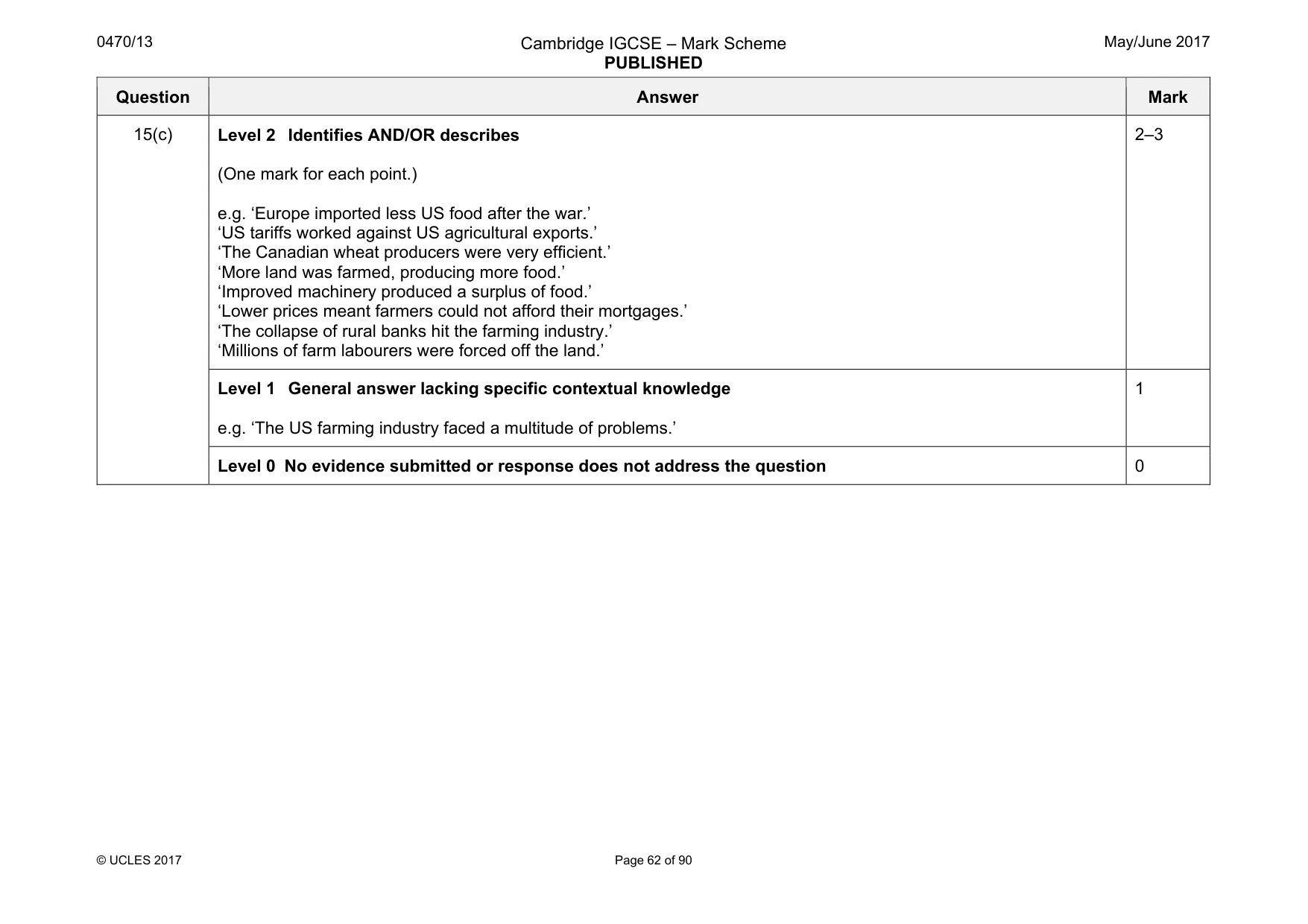
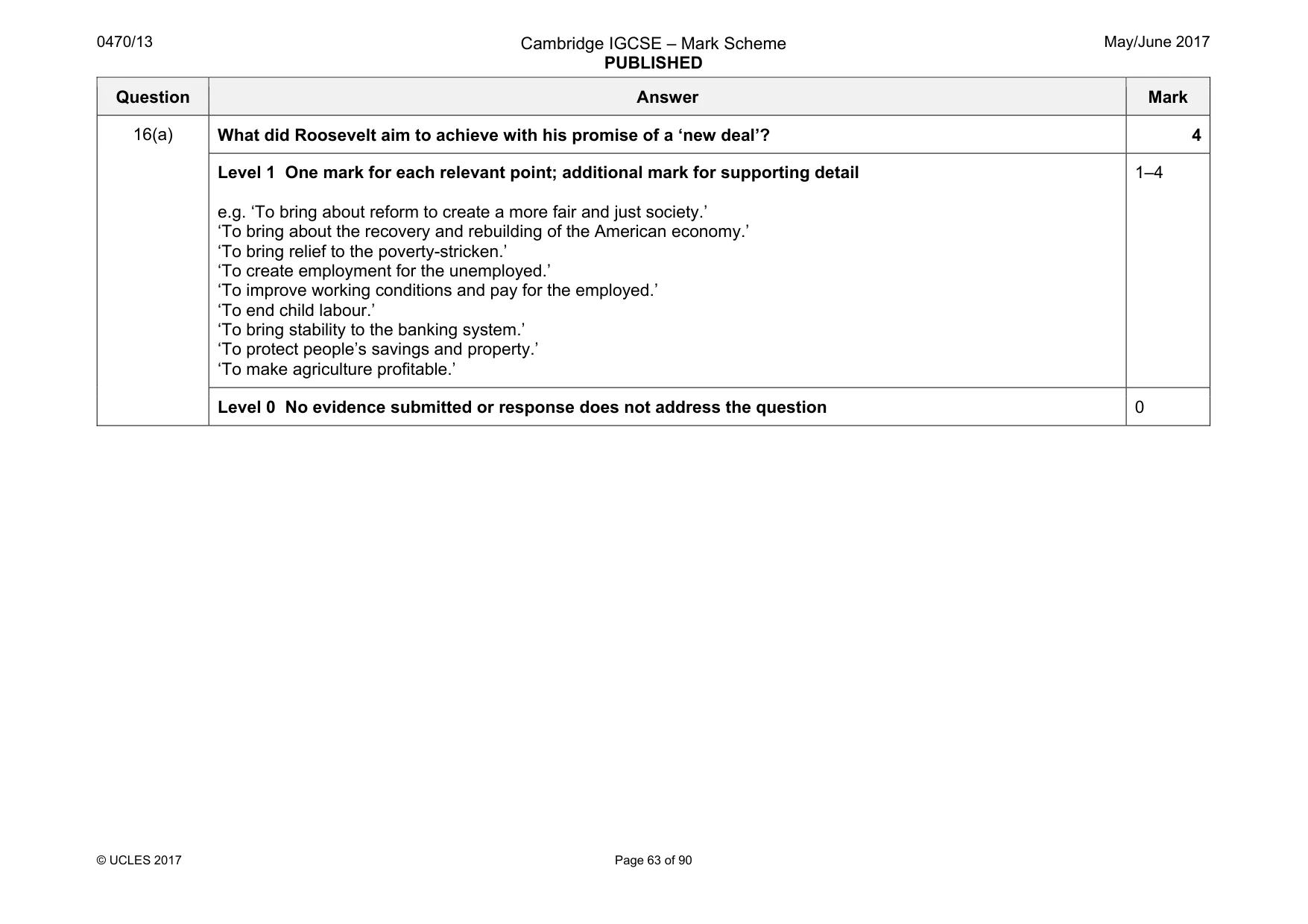
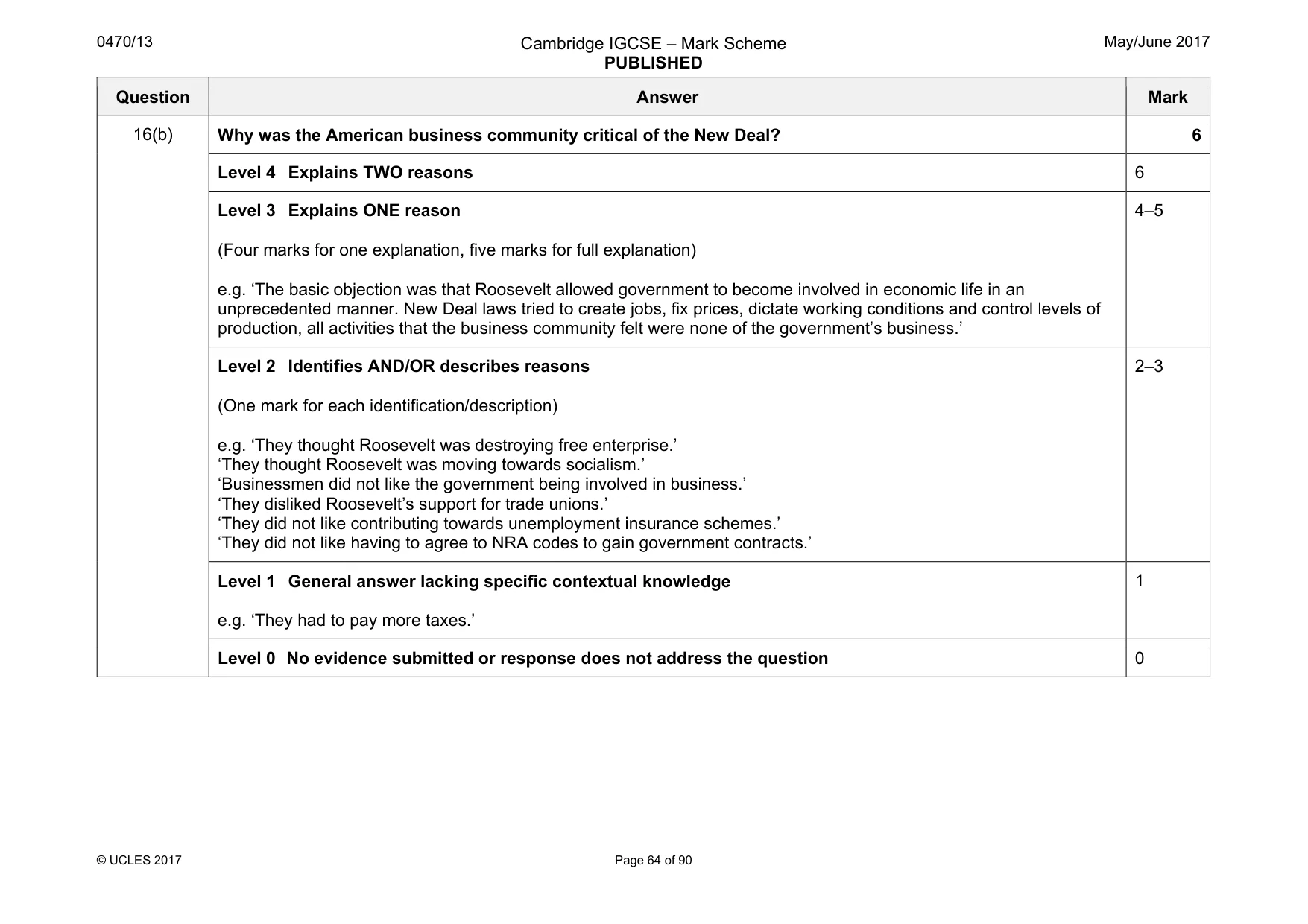
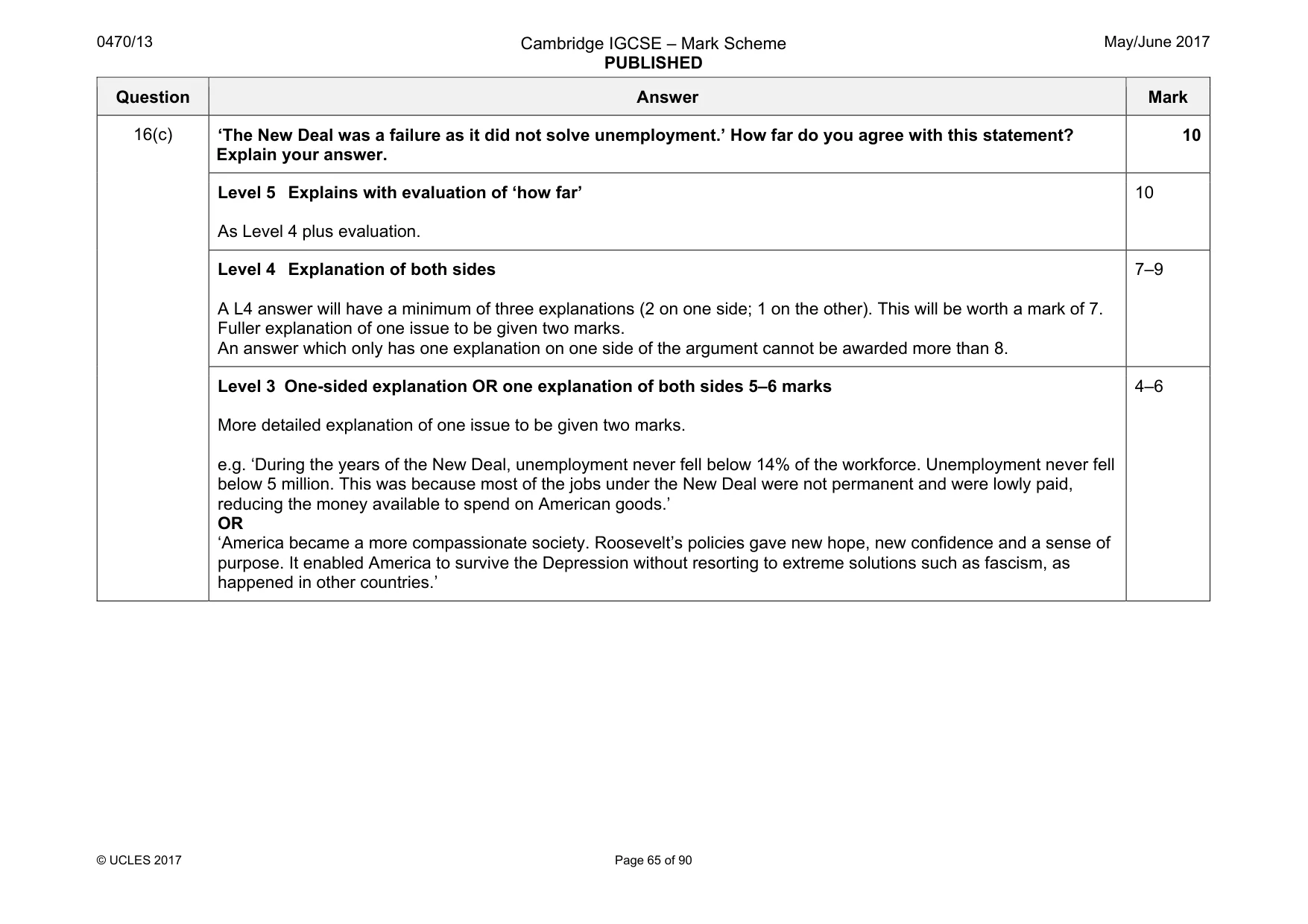
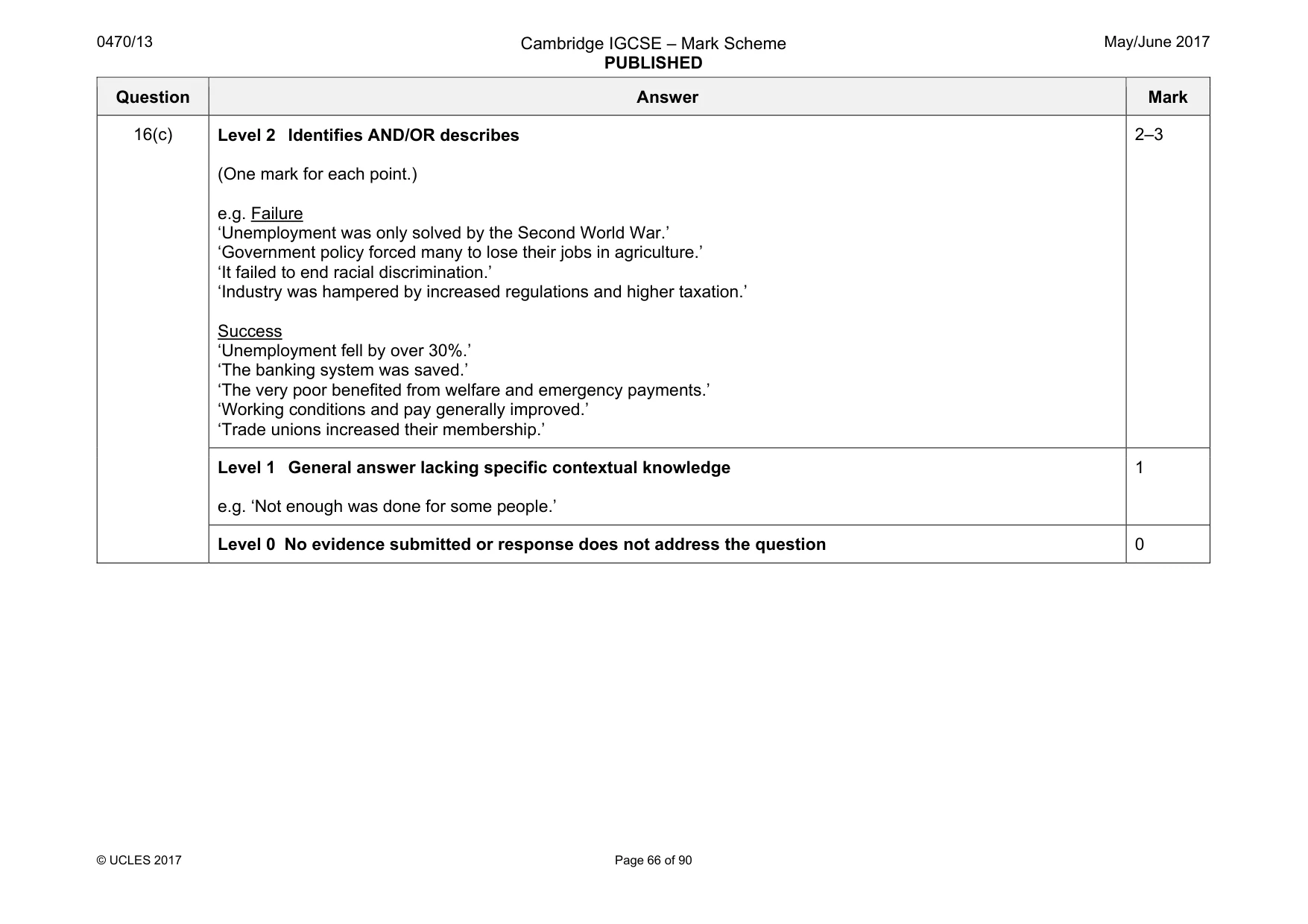
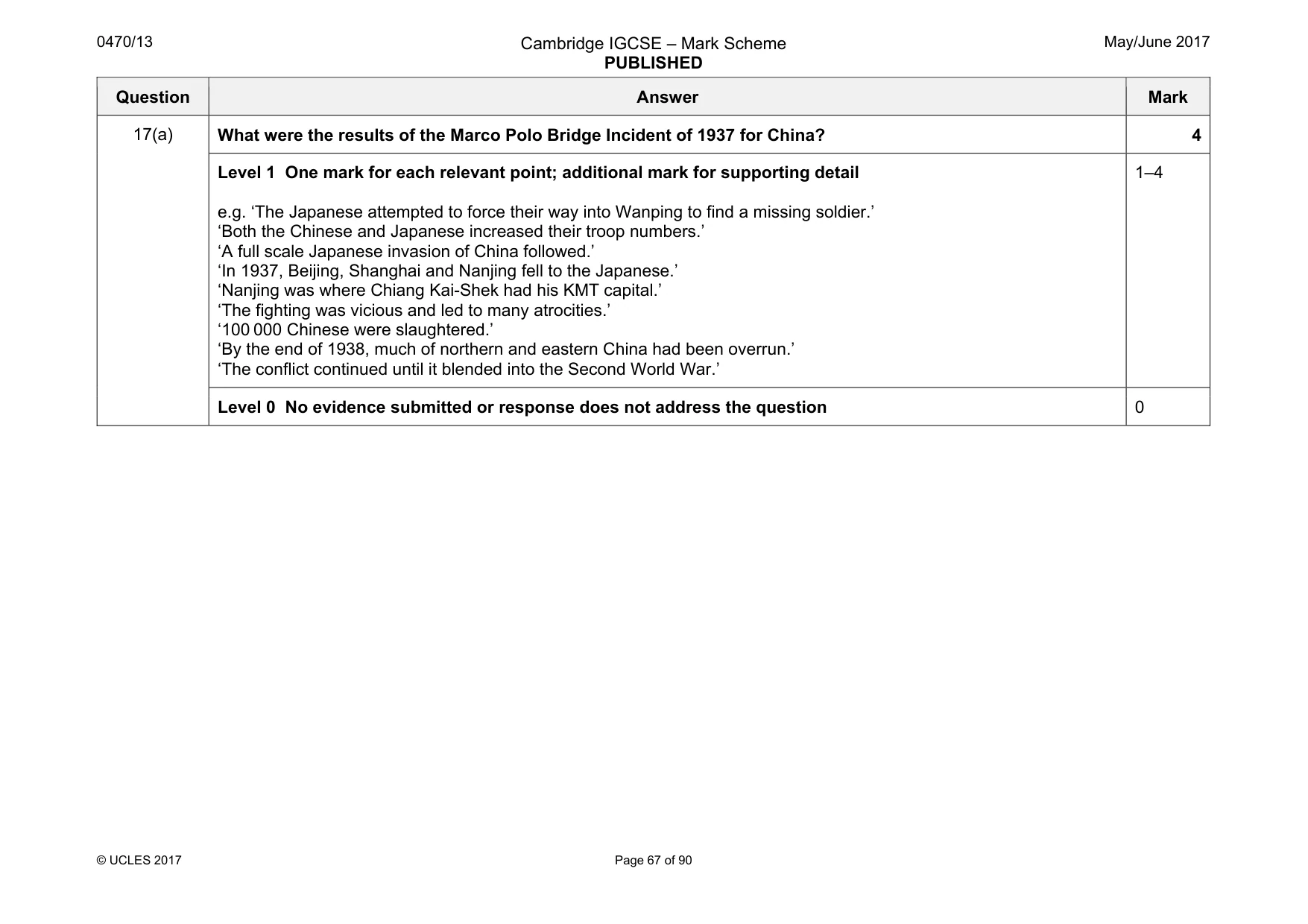
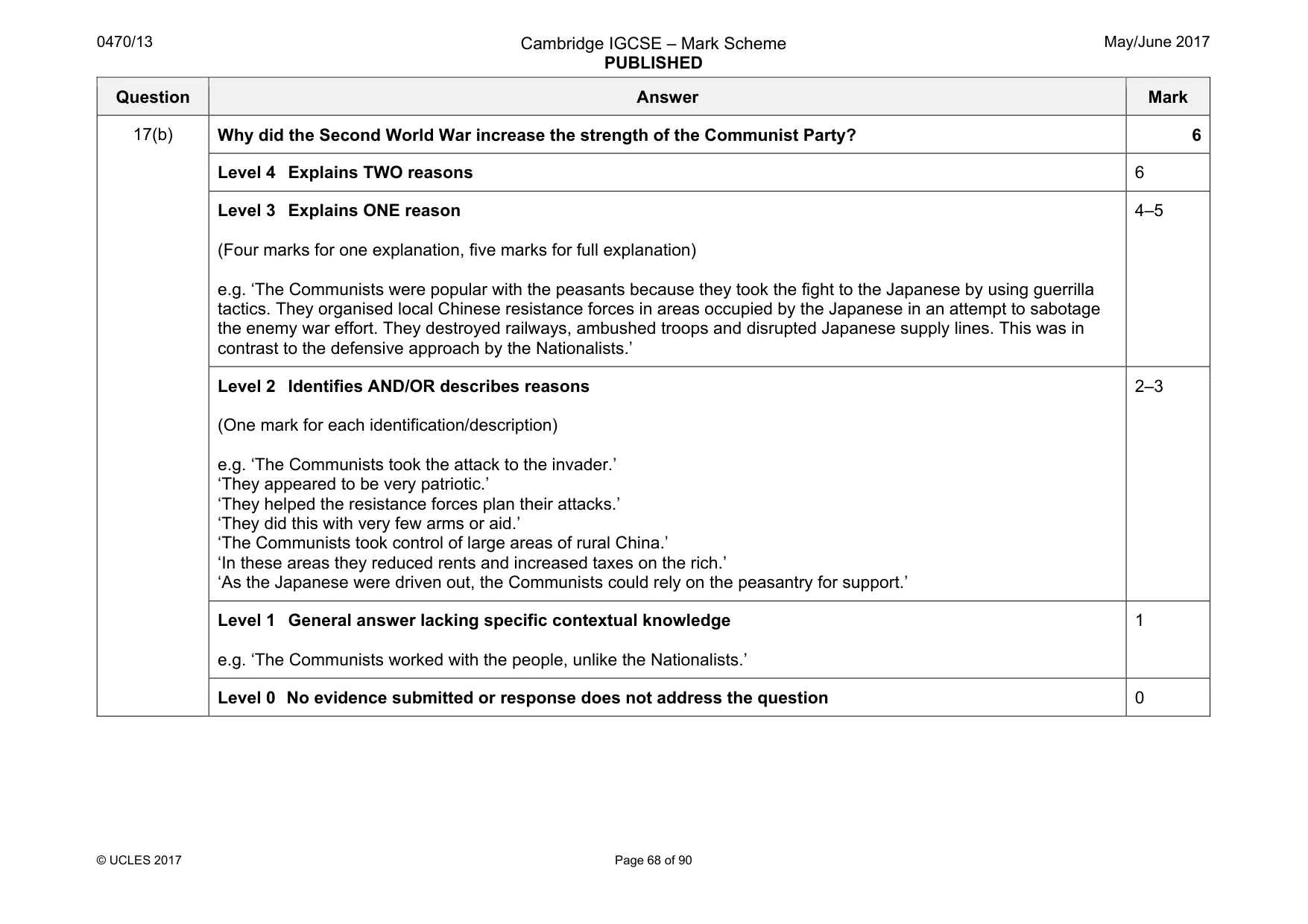
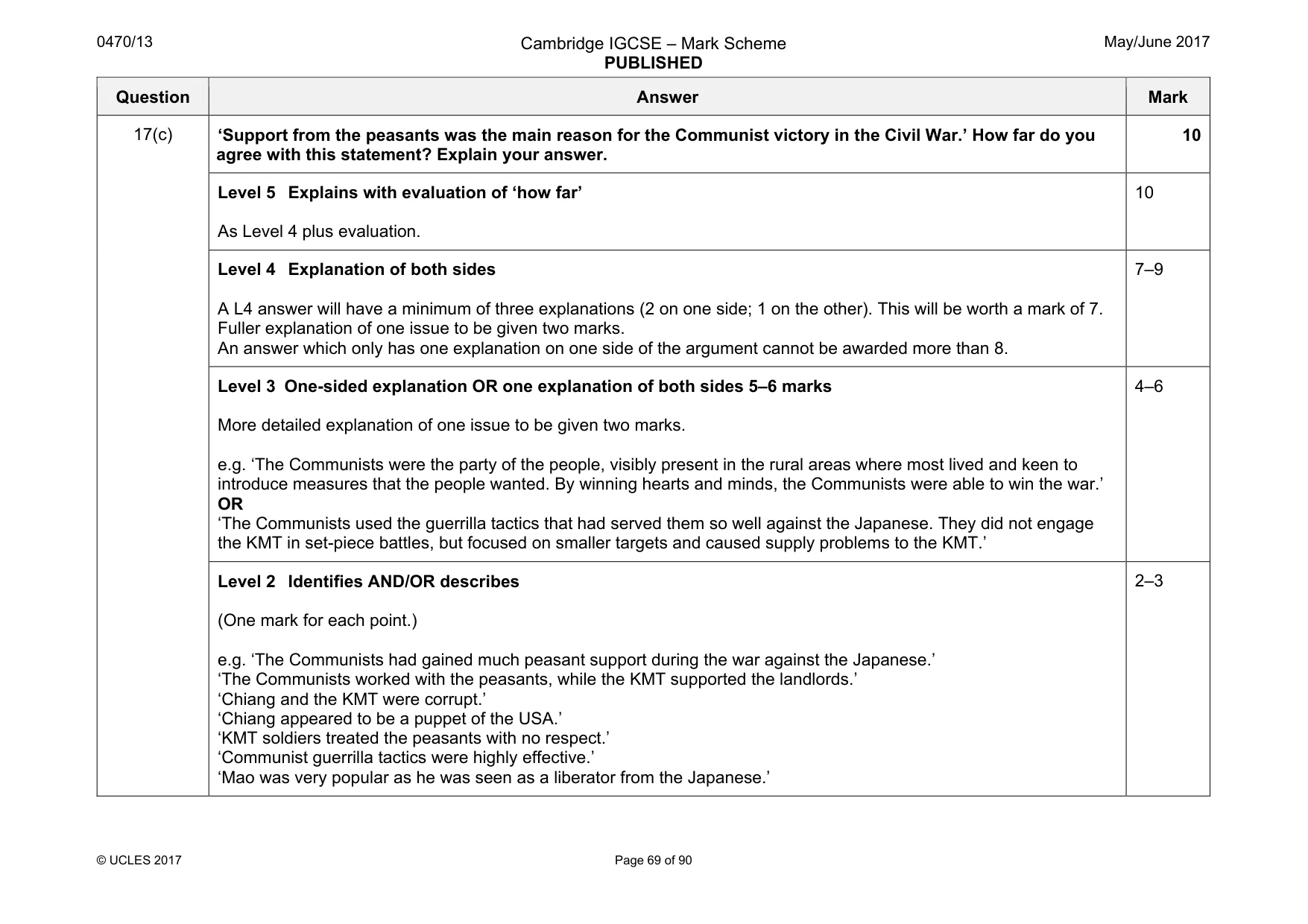
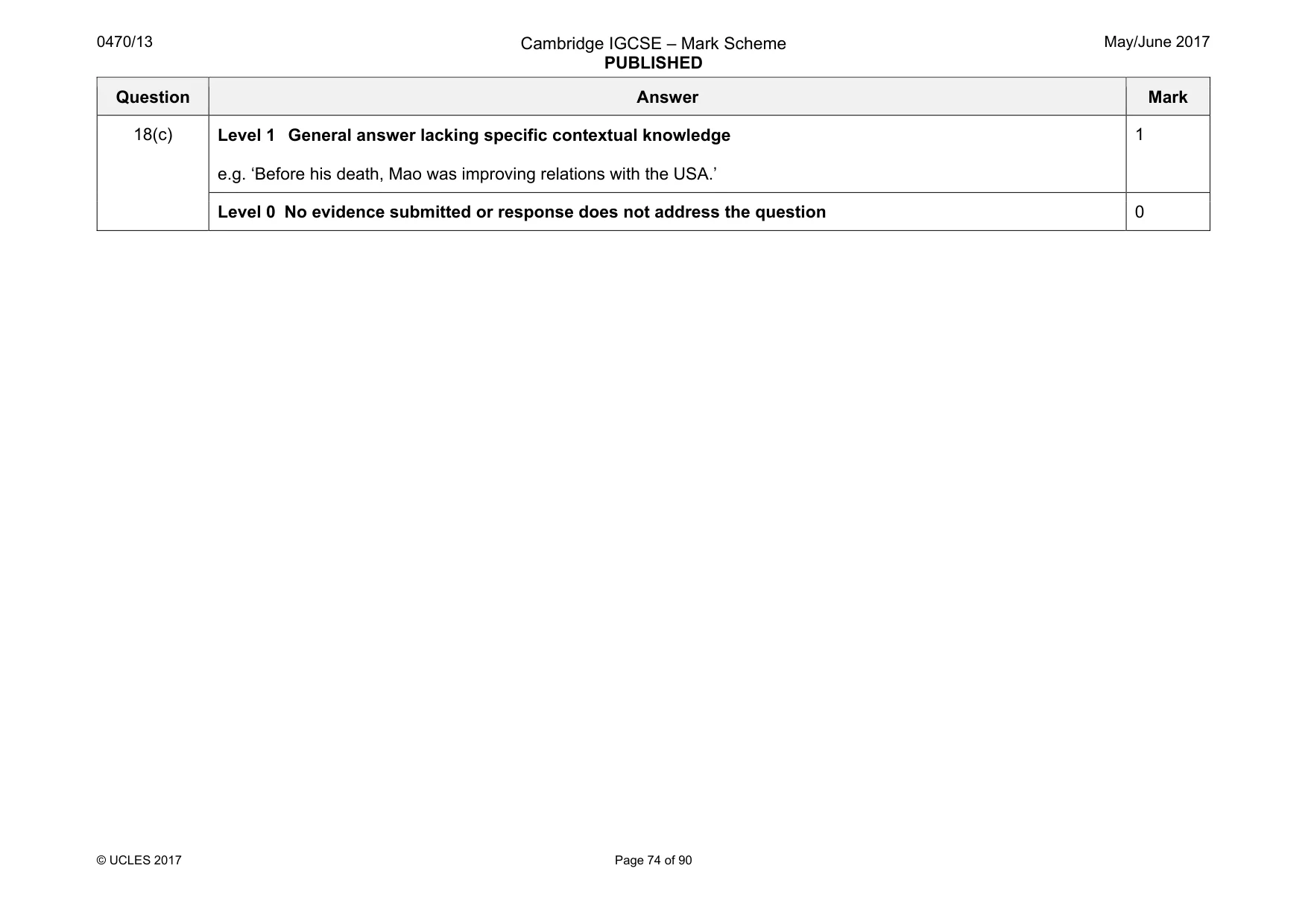
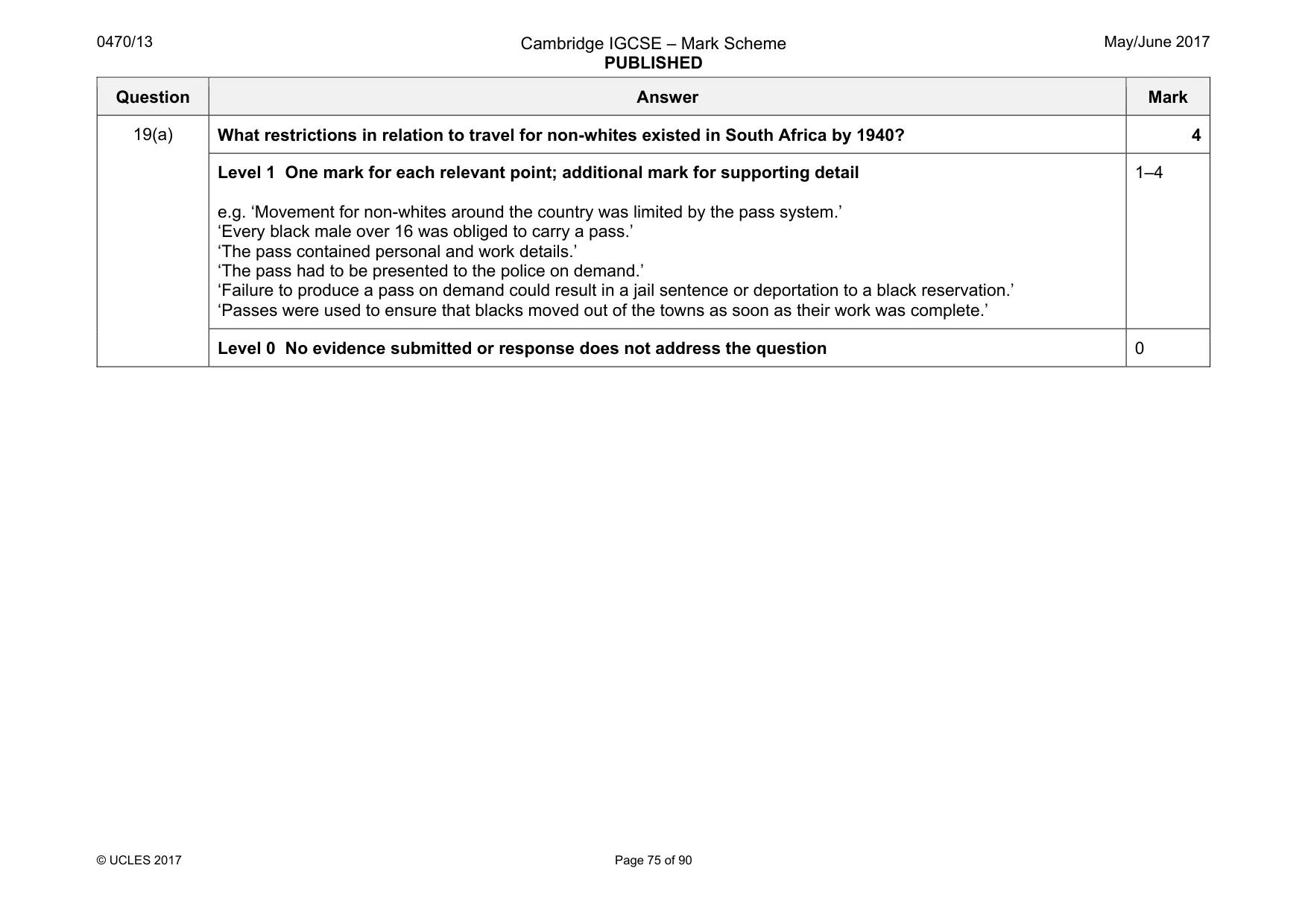
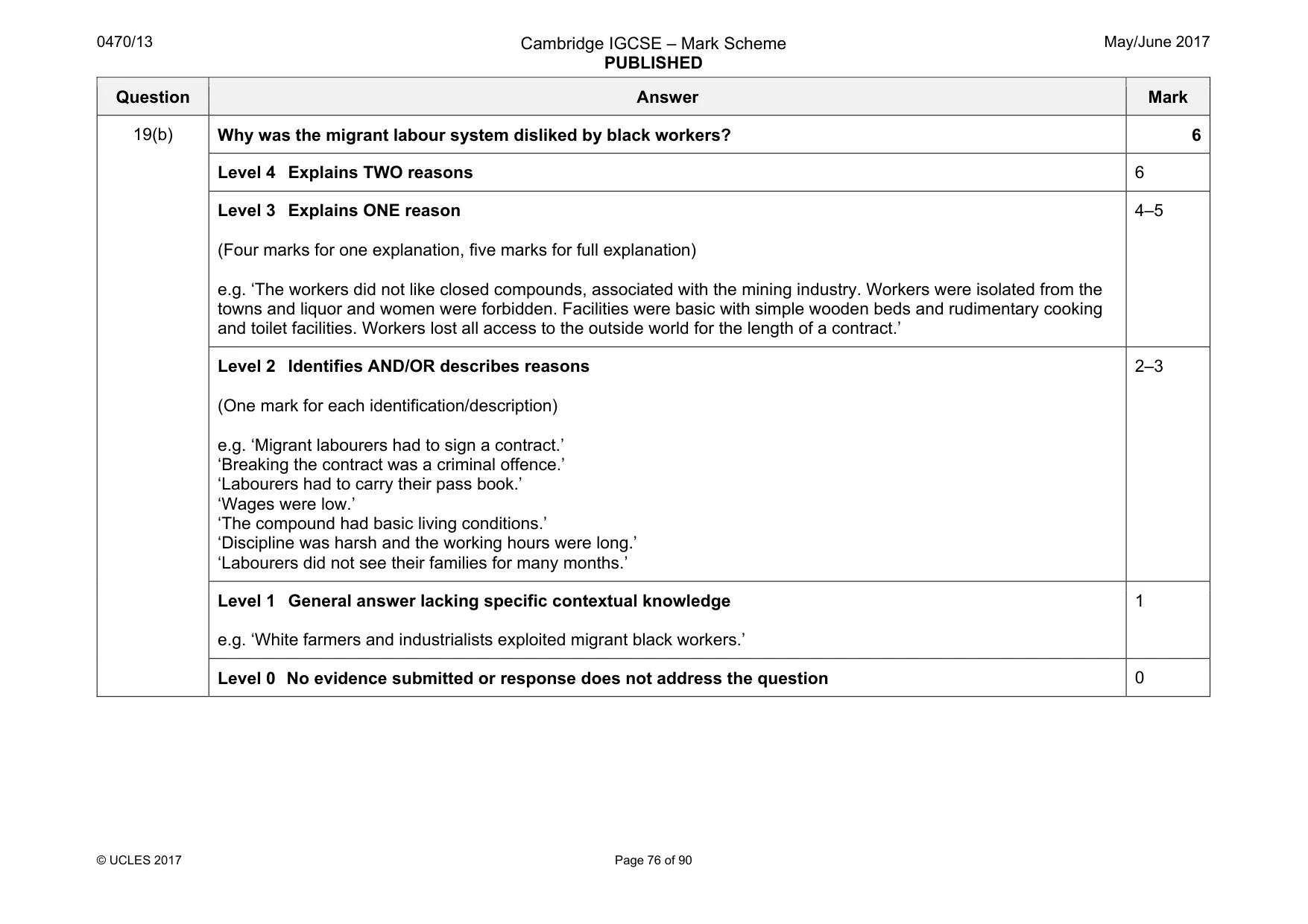
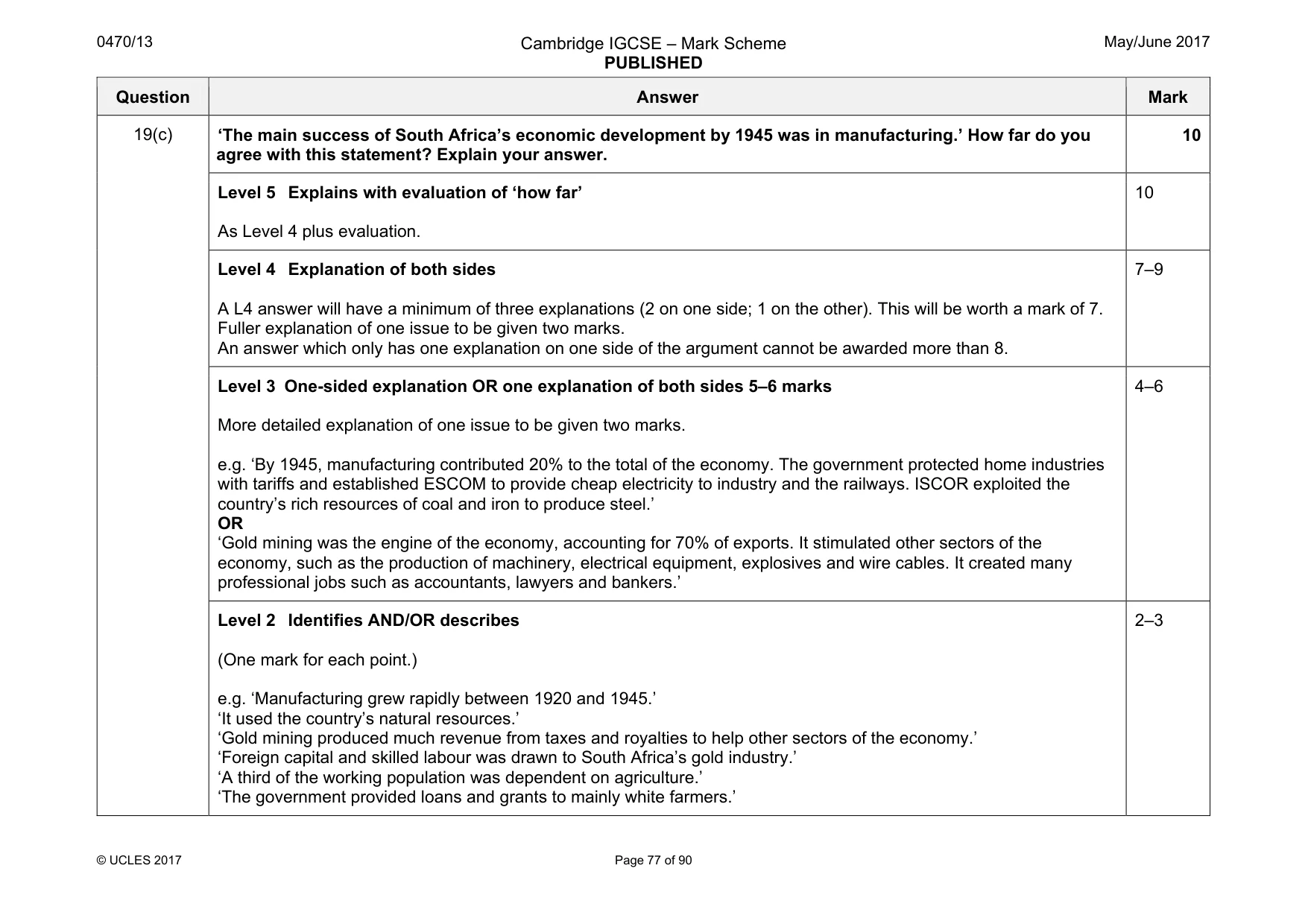
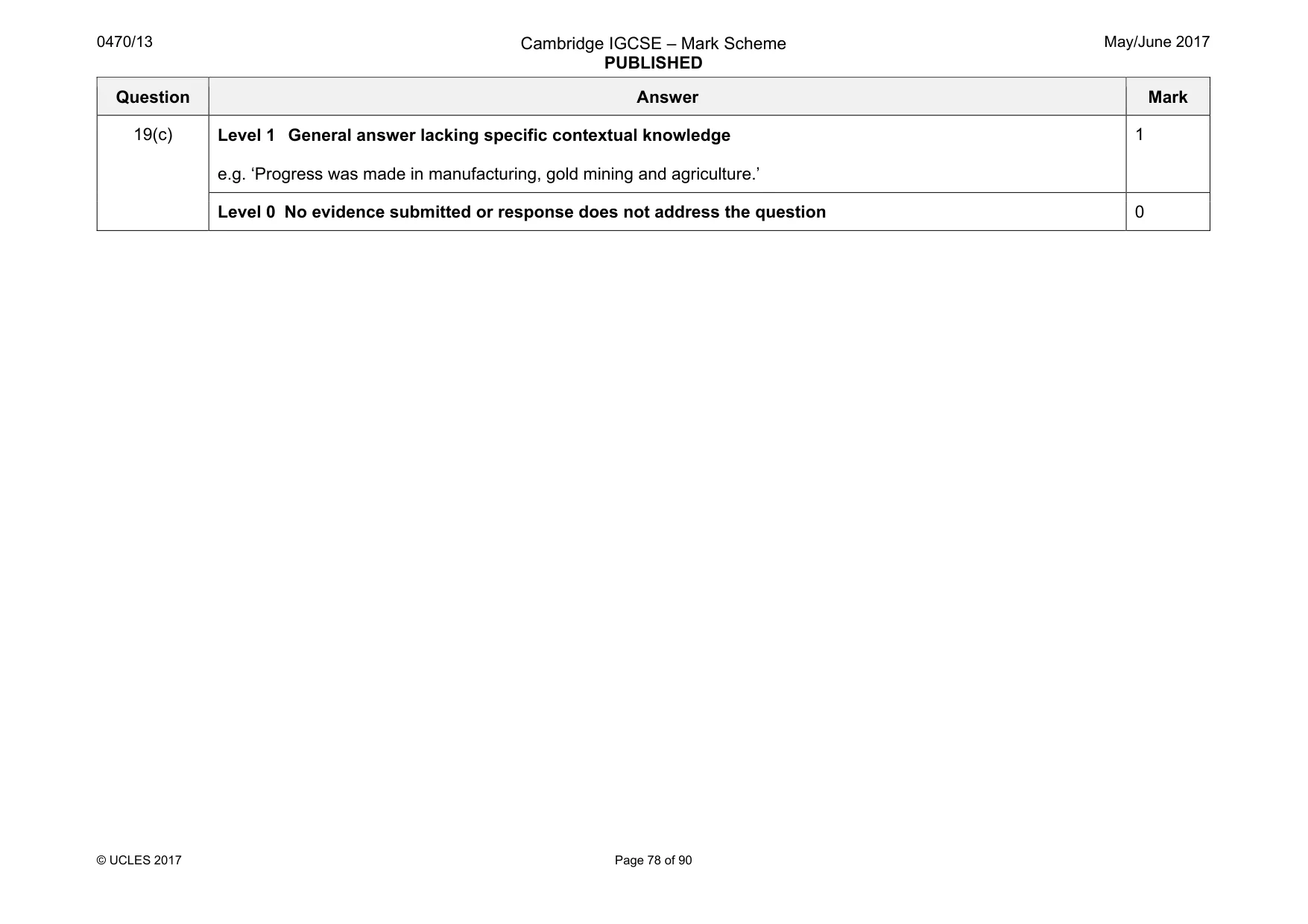
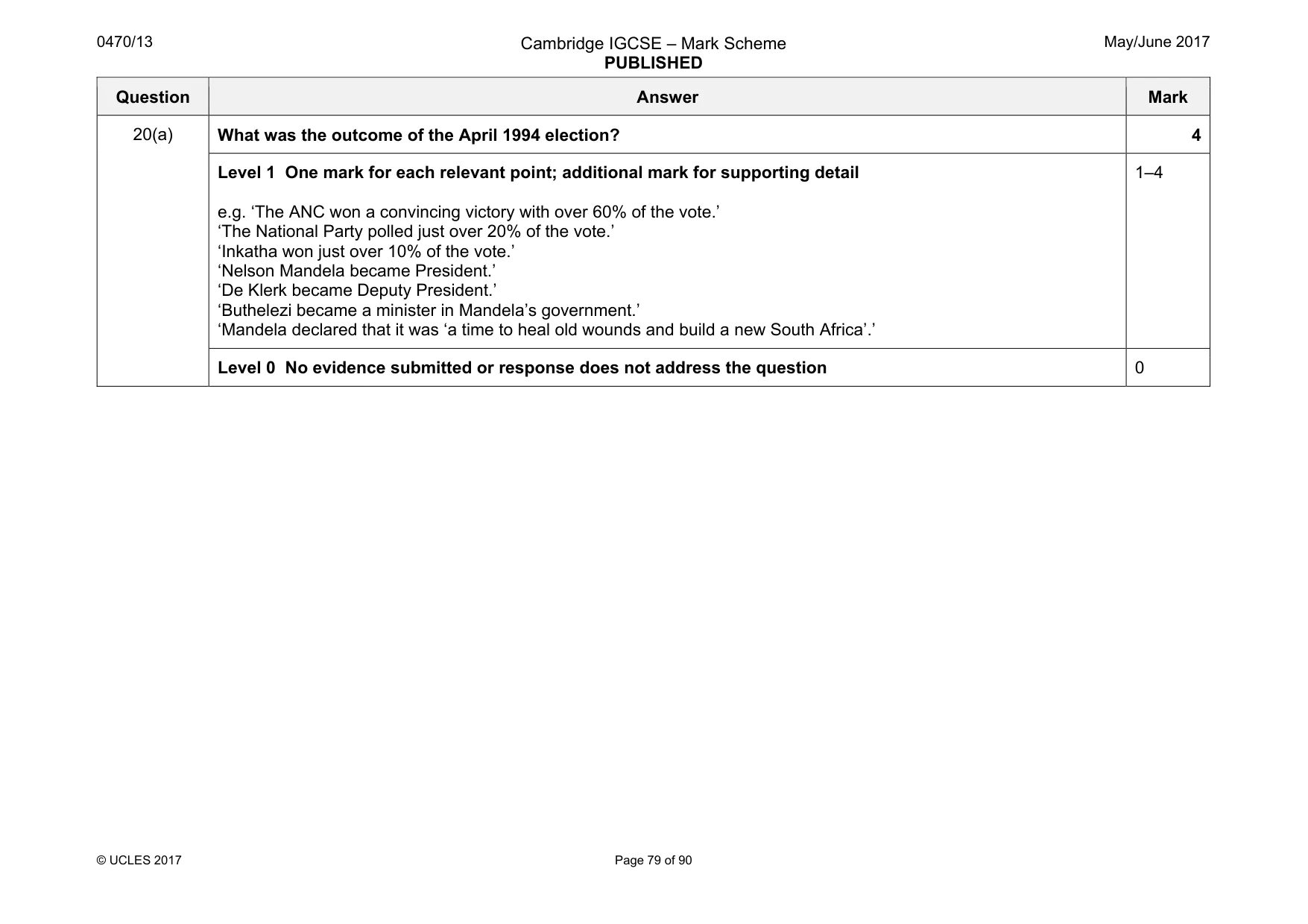
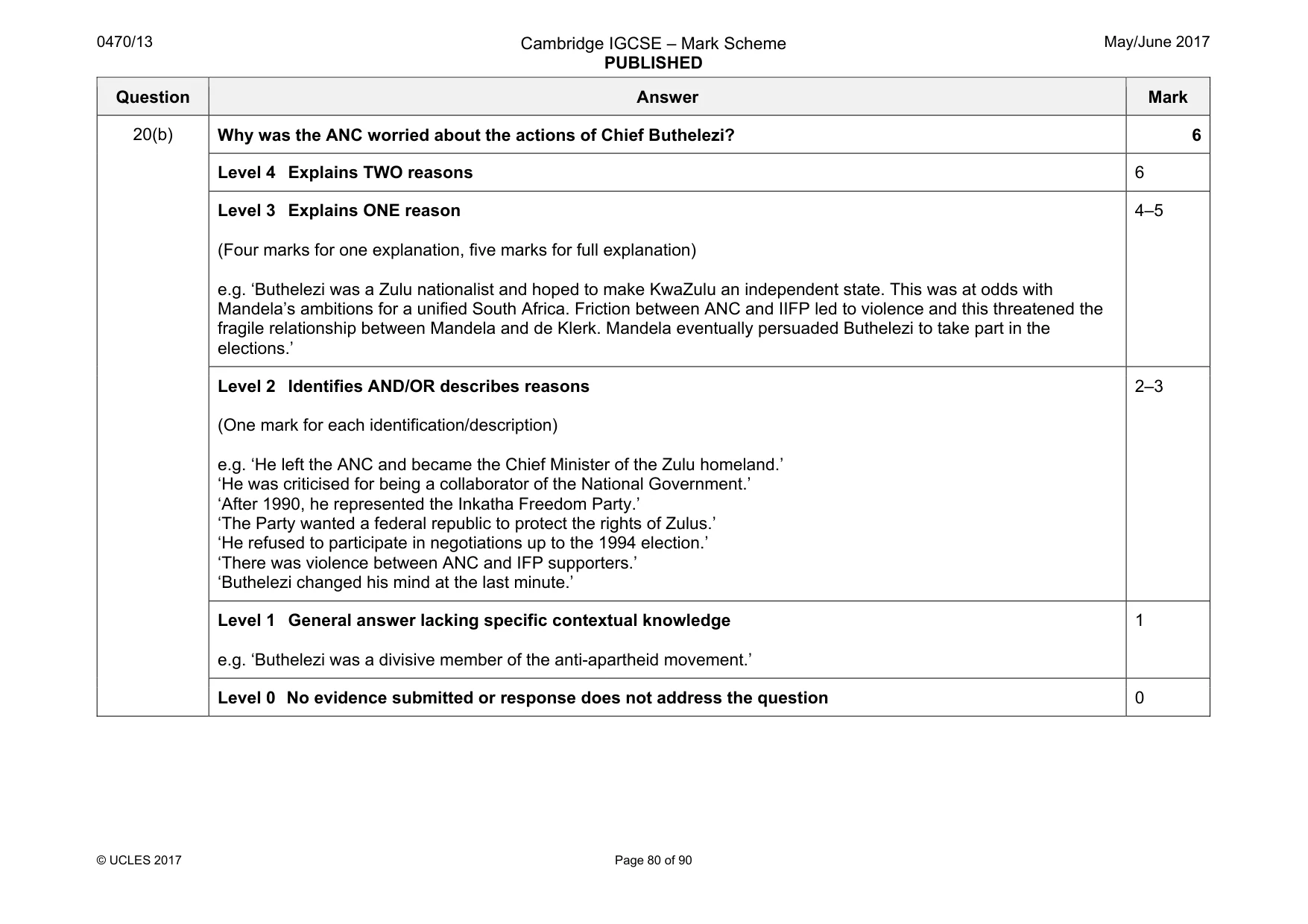
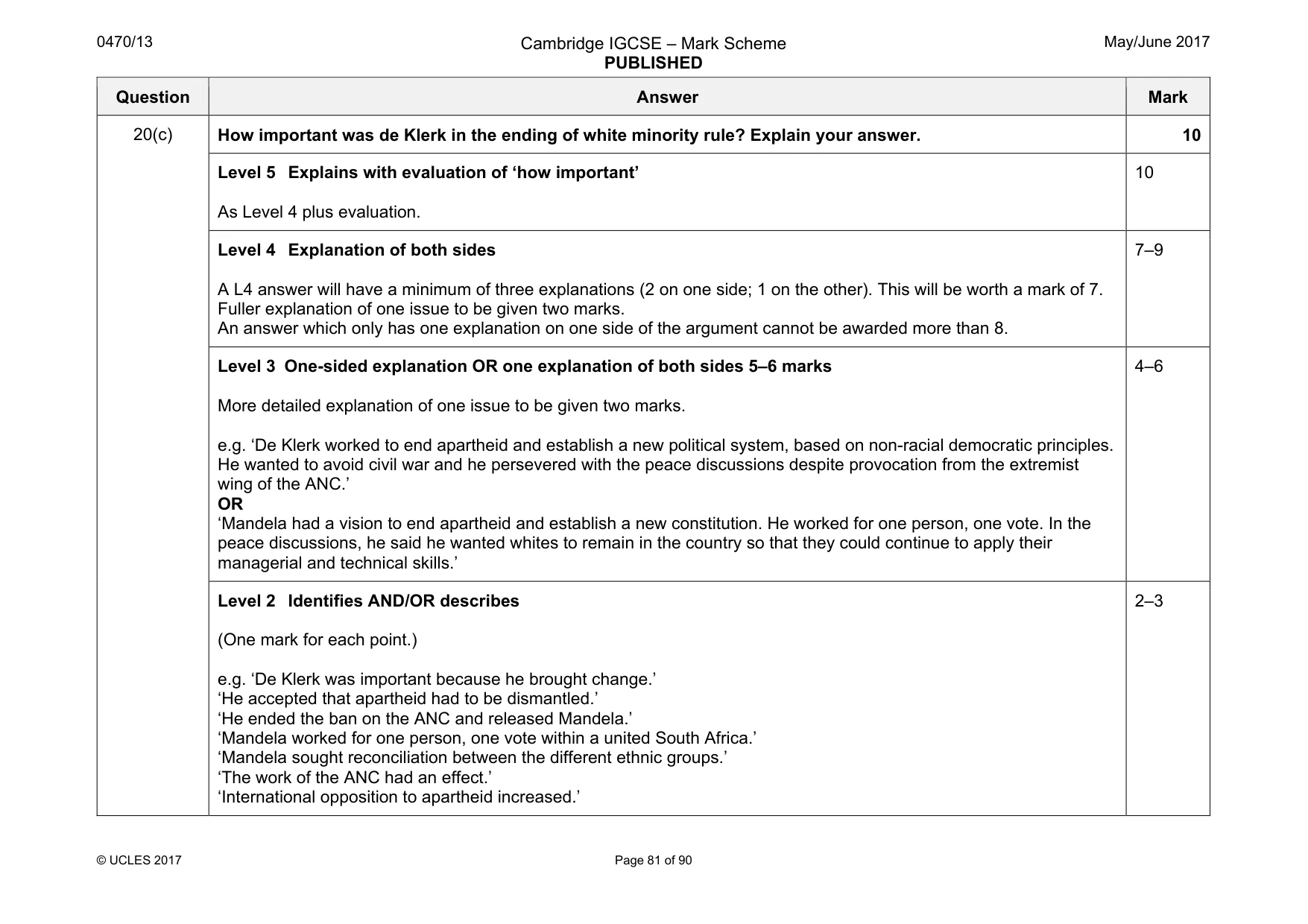
Paper as text
Question paper, page 1
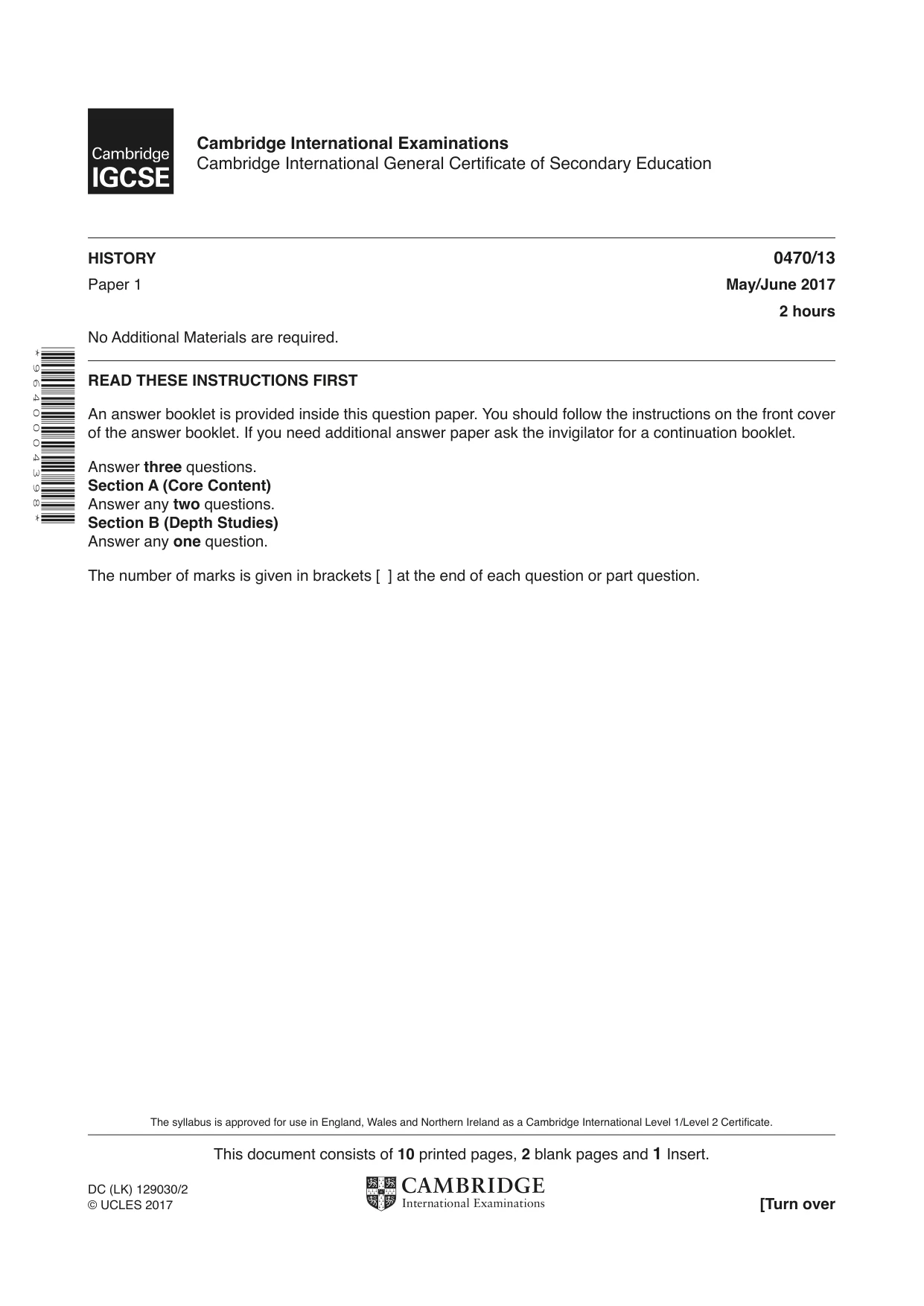
This document consists of 10 printed pages, 2 blank pages and 1 Insert. DC (LK) 129030/2 © UCLES 2017 [Turn over Cambridge International Examinations Cambridge International General Certificate of Secondary Education * 9 6 4 0 0 0 4 3 9 8 * HISTORY 0470/13 Paper 1 May/June 2017 2 hours No Additional Materials are required. READ THESE INSTRUCTIONS FIRST An answer booklet is provided inside this question paper. You should follow the instructions on the front cover of the answer booklet. If you need additional answer paper ask the invigilator for a continuation booklet. Answer three questions. Section A (Core Content) Answer any two questions. Section B (Depth Studies) Answer any one question. The number of marks is given in brackets [ ] at the end of each question or part question. The syllabus is approved for use in England, Wales and Northern Ireland as a Cambridge International Level 1/Level 2 Certificate.
Question paper, page 2
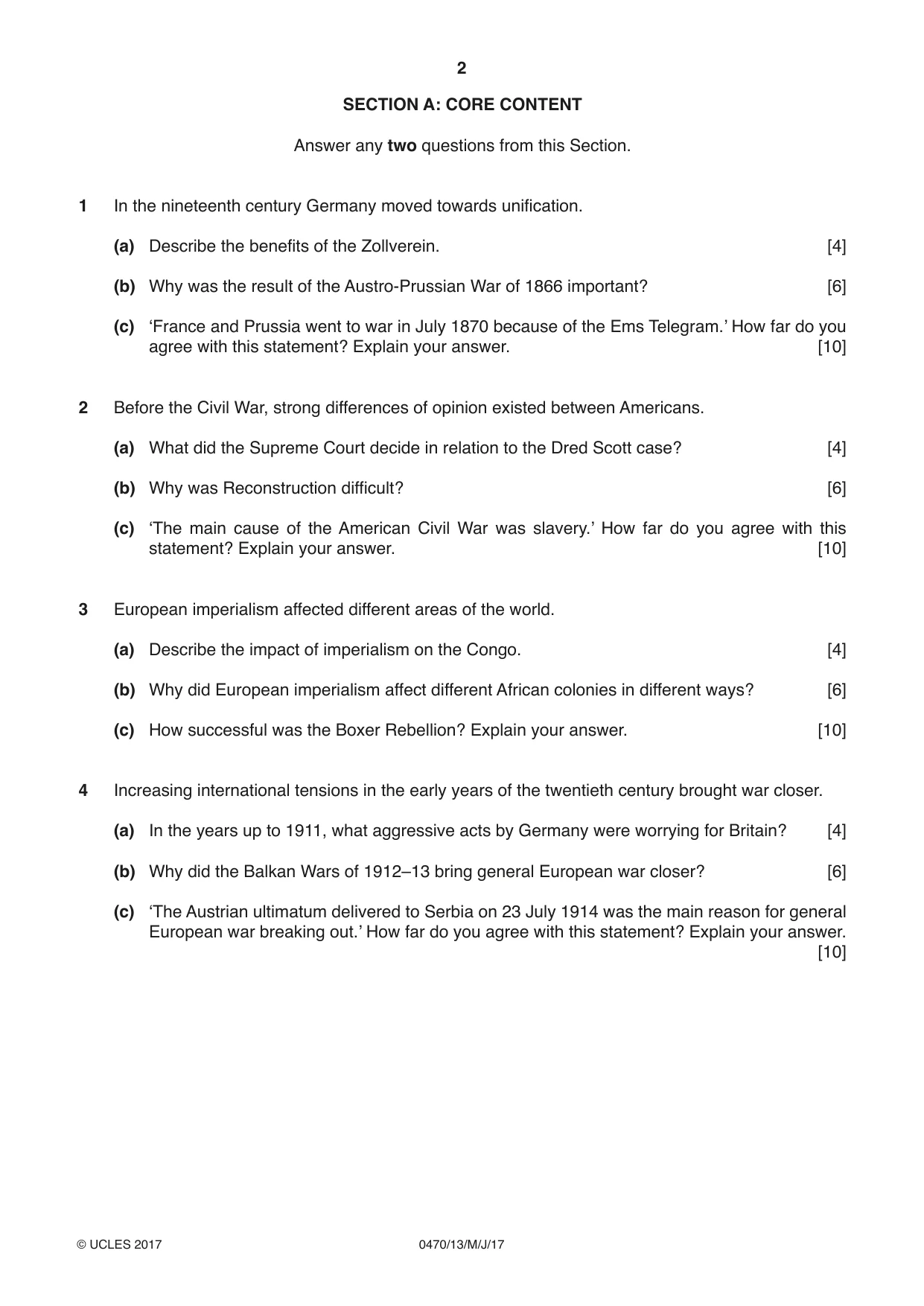
2 0470/13/M/J/17 © UCLES 2017 SECTION A: CORE CONTENT Answer any two questions from this Section. 1 In the nineteenth century Germany moved towards unification. (a) Describe the benefits of the Zollverein. [4] (b) Why was the result of the Austro-Prussian War of 1866 important? [6] (c) ‘France and Prussia went to war in July 1870 because of the Ems Telegram.’ How far do you agree with this statement? Explain your answer. [10] 2 Before the Civil War, strong differences of opinion existed between Americans. (a) What did the Supreme Court decide in relation to the Dred Scott case? [4] (b) Why was Reconstruction difficult? [6] (c) ‘The main cause of the American Civil War was slavery.’ How far do you agree with this statement? Explain your answer. [10] 3 European imperialism affected different areas of the world. (a) Describe the impact of imperialism on the Congo. [4] (b) Why did European imperialism affect different African colonies in different ways? [6] (c) How successful was the Boxer Rebellion? Explain your answer. [10] 4 Increasing international tensions in the early years of the twentieth century brought war closer. (a) In the years up to 1911, what aggressive acts by Germany were worrying for Britain? [4] (b) Why did the Balkan Wars of 1912–13 bring general European war closer? [6] (c) ‘The Austrian ultimatum delivered to Serbia on 23 July 1914 was the main reason for general European war breaking out.’ How far do you agree with this statement? Explain your answer. [10]
Question paper, page 3
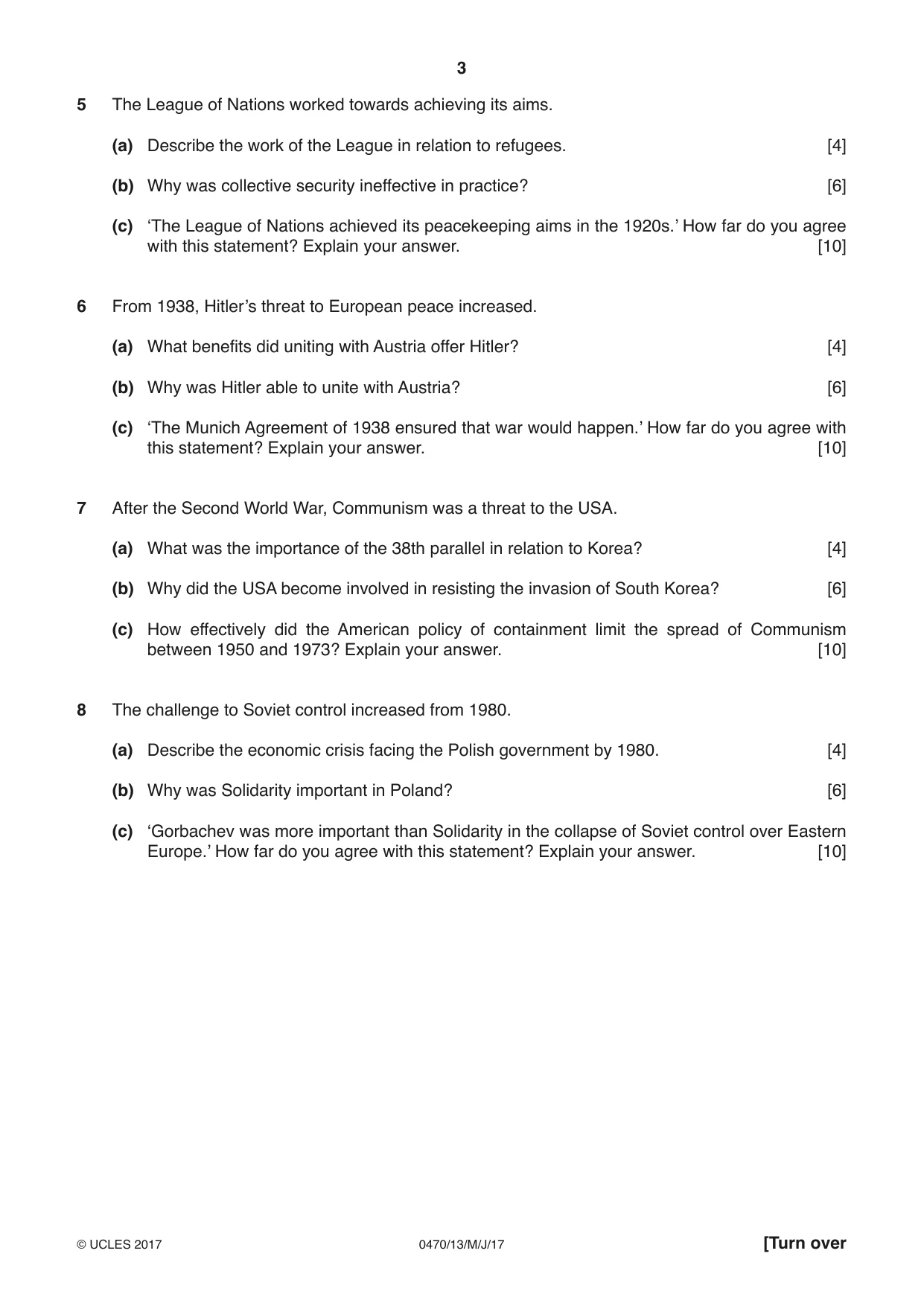
3 0470/13/M/J/17 © UCLES 2017 [Turn over 5 The League of Nations worked towards achieving its aims. (a) Describe the work of the League in relation to refugees. [4] (b) Why was collective security ineffective in practice? [6] (c) ‘The League of Nations achieved its peacekeeping aims in the 1920s.’ How far do you agree with this statement? Explain your answer. [10] 6 From 1938, Hitler’s threat to European peace increased. (a) What benefits did uniting with Austria offer Hitler? [4] (b) Why was Hitler able to unite with Austria? [6] (c) ‘The Munich Agreement of 1938 ensured that war would happen.’ How far do you agree with this statement? Explain your answer. [10] 7 After the Second World War, Communism was a threat to the USA. (a) What was the importance of the 38th parallel in relation to Korea? [4] (b) Why did the USA become involved in resisting the invasion of South Korea? [6] (c) How effectively did the American policy of containment limit the spread of Communism between 1950 and 1973? Explain your answer. [10] 8 The challenge to Soviet control increased from 1980. (a) Describe the economic crisis facing the Polish government by 1980. [4] (b) Why was Solidarity important in Poland? [6] (c) ‘Gorbachev was more important than Solidarity in the collapse of Soviet control over Eastern Europe.’ How far do you agree with this statement? Explain your answer. [10]
Question paper, page 4
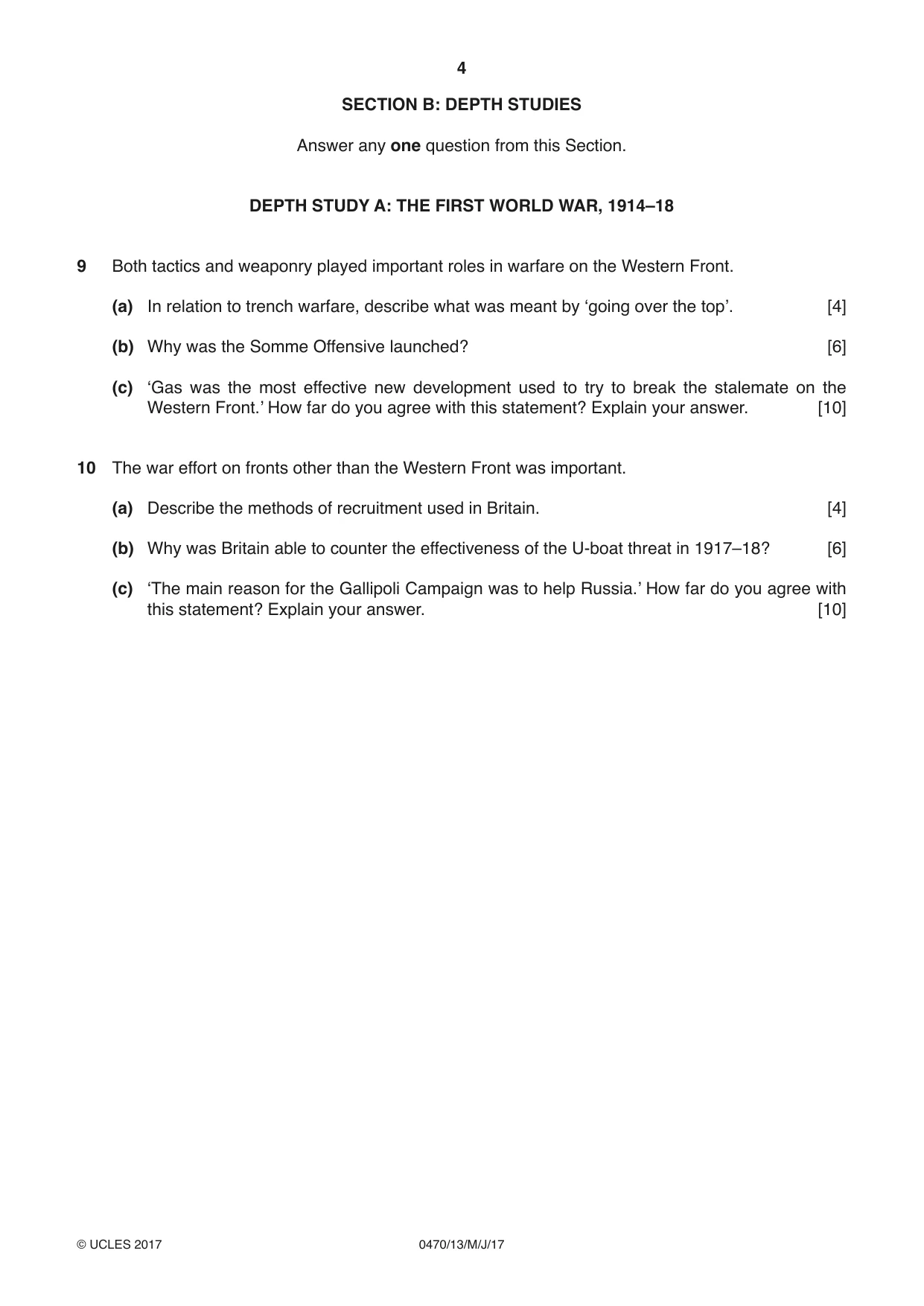
4 0470/13/M/J/17 © UCLES 2017 SECTION B: DEPTH STUDIES Answer any one question from this Section. DEPTH STUDY A: THE FIRST WORLD WAR, 1914–18 9 Both tactics and weaponry played important roles in warfare on the Western Front. (a) In relation to trench warfare, describe what was meant by ‘going over the top’. [4] (b) Why was the Somme Offensive launched? [6] (c) ‘Gas was the most effective new development used to try to break the stalemate on the Western Front.’ How far do you agree with this statement? Explain your answer. [10] 10 The war effort on fronts other than the Western Front was important. (a) Describe the methods of recruitment used in Britain. [4] (b) Why was Britain able to counter the effectiveness of the U-boat threat in 1917–18? [6] (c) ‘The main reason for the Gallipoli Campaign was to help Russia.’ How far do you agree with this statement? Explain your answer. [10]
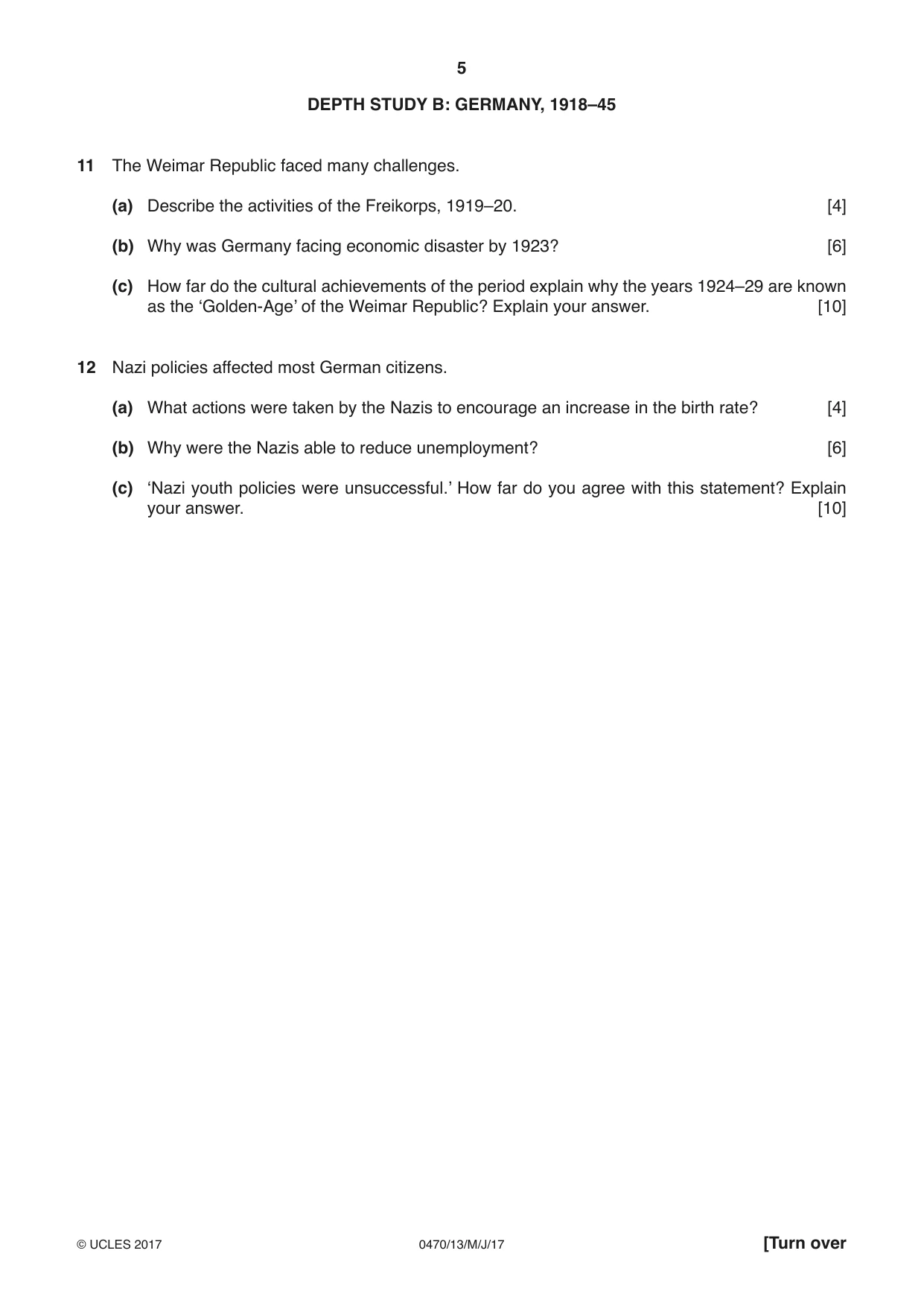
Question paper, page 5
5 0470/13/M/J/17 © UCLES 2017 [Turn over DEPTH STUDY B: GERMANY, 1918–45 11 The Weimar Republic faced many challenges. (a) Describe the activities of the Freikorps, 1919–20. [4] (b) Why was Germany facing economic disaster by 1923? [6] (c) How far do the cultural achievements of the period explain why the years 1924–29 are known as the ‘Golden-Age’ of the Weimar Republic? Explain your answer. [10] 12 Nazi policies affected most German citizens. (a) What actions were taken by the Nazis to encourage an increase in the birth rate? [4] (b) Why were the Nazis able to reduce unemployment? [6] (c) ‘Nazi youth policies were unsuccessful.’ How far do you agree with this statement? Explain your answer. [10]
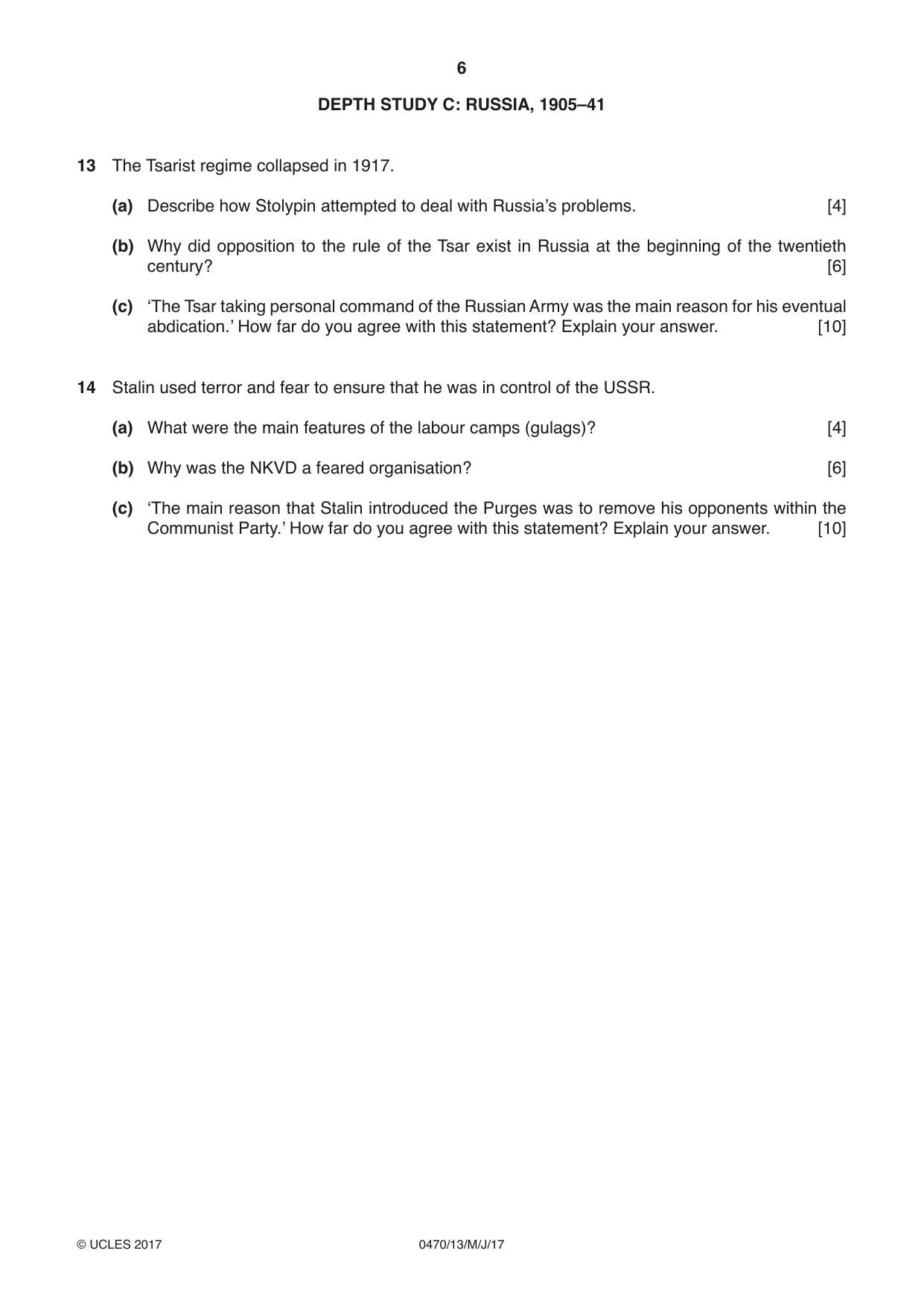
Question paper, page 6
6 0470/13/M/J/17 © UCLES 2017 DEPTH STUDY C: RUSSIA, 1905–41 13 The Tsarist regime collapsed in 1917. (a) Describe how Stolypin attempted to deal with Russia’s problems. [4] (b) Why did opposition to the rule of the Tsar exist in Russia at the beginning of the twentieth century? [6] (c) ‘The Tsar taking personal command of the Russian Army was the main reason for his eventual abdication.’ How far do you agree with this statement? Explain your answer. [10] 14 Stalin used terror and fear to ensure that he was in control of the USSR. (a) What were the main features of the labour camps (gulags)? [4] (b) Why was the NKVD a feared organisation? [6] (c) ‘The main reason that Stalin introduced the Purges was to remove his opponents within the Communist Party.’ How far do you agree with this statement? Explain your answer. [10]
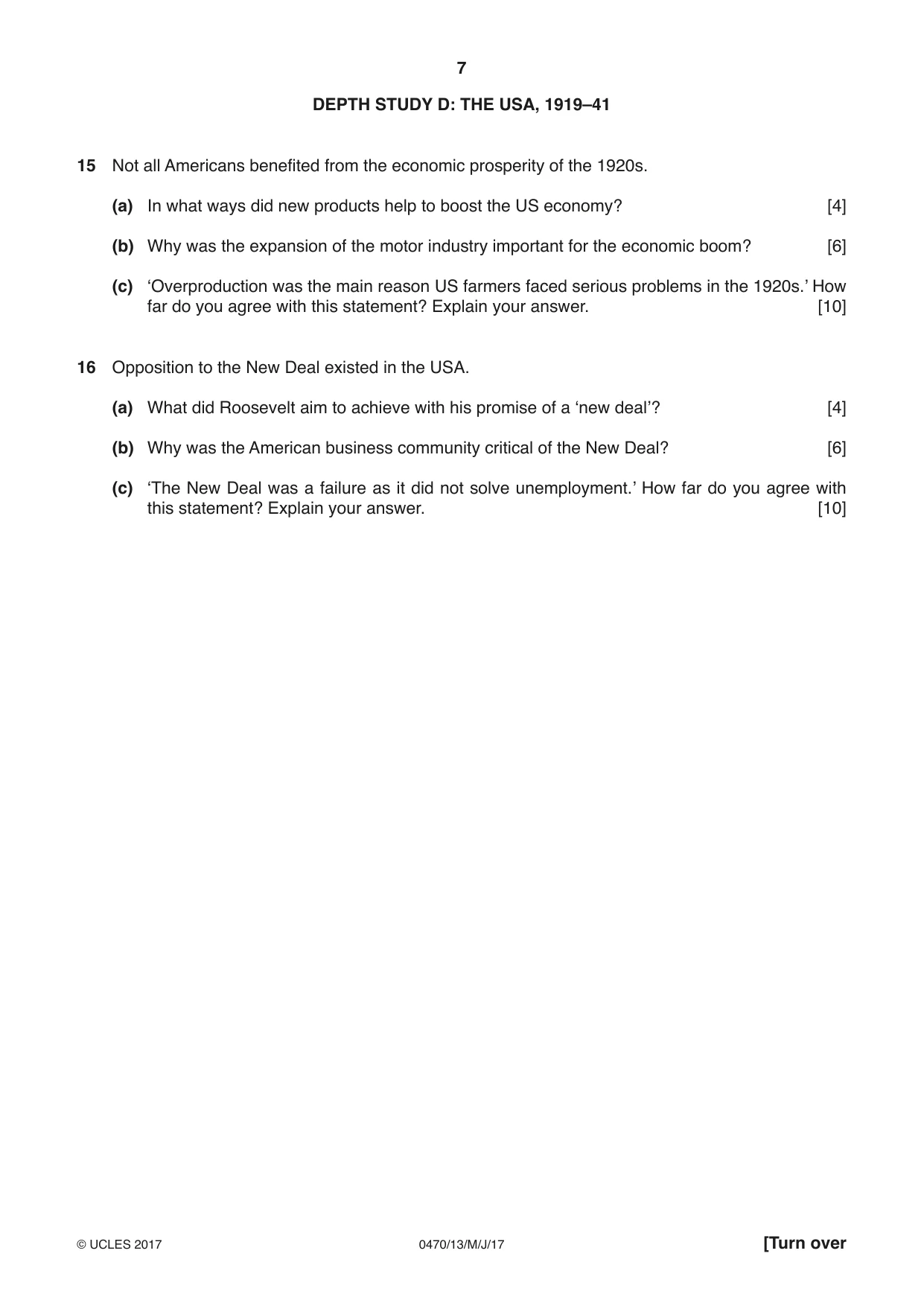
Question paper, page 7
7 0470/13/M/J/17 © UCLES 2017 [Turn over DEPTH STUDY D: THE USA, 1919–41 15 Not all Americans benefited from the economic prosperity of the 1920s. (a) In what ways did new products help to boost the US economy? [4] (b) Why was the expansion of the motor industry important for the economic boom? [6] (c) ‘Overproduction was the main reason US farmers faced serious problems in the 1920s.’ How far do you agree with this statement? Explain your answer. [10] 16 Opposition to the New Deal existed in the USA. (a) What did Roosevelt aim to achieve with his promise of a ‘new deal’? [4] (b) Why was the American business community critical of the New Deal? [6] (c) ‘The New Deal was a failure as it did not solve unemployment.’ How far do you agree with this statement? Explain your answer. [10]
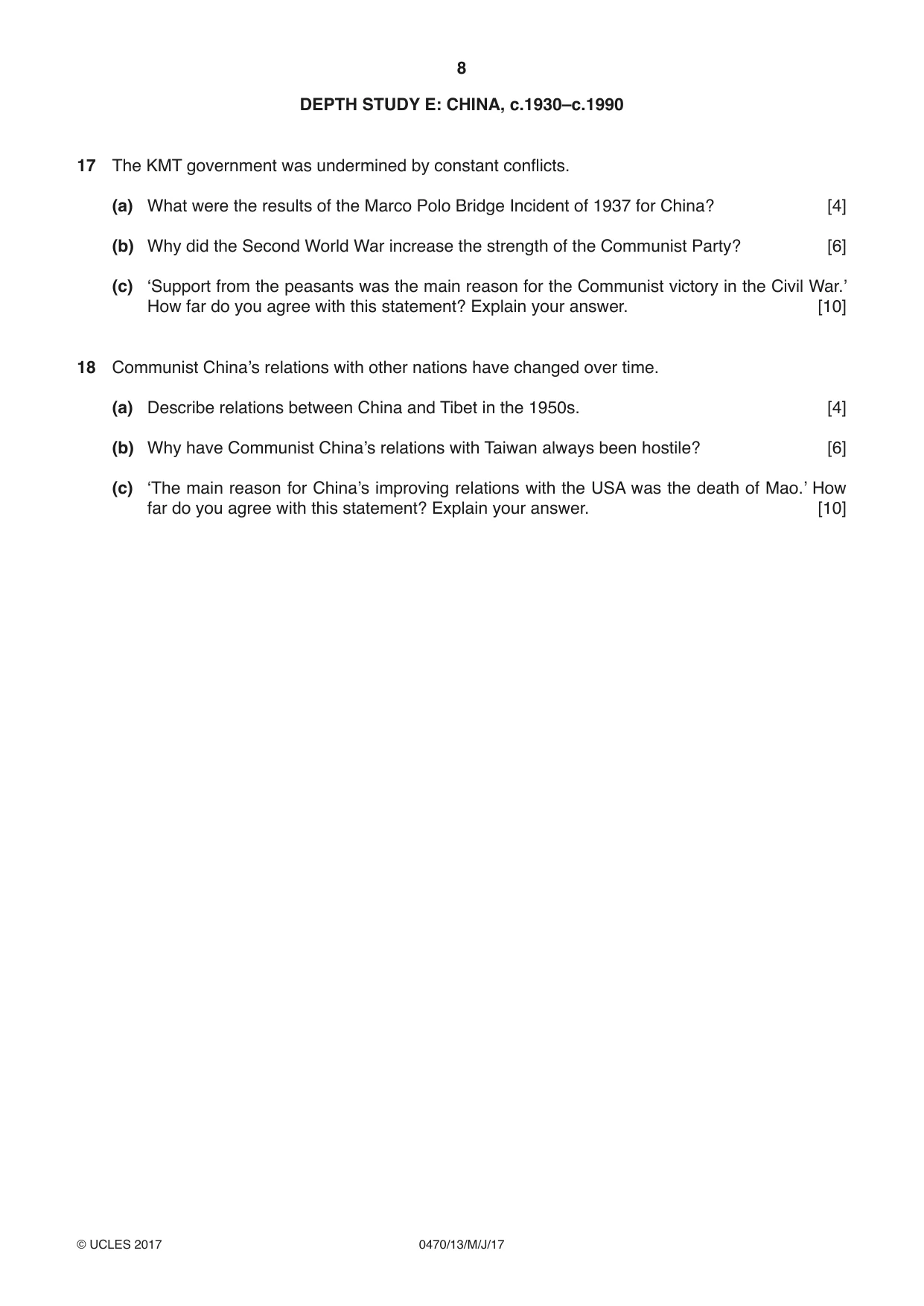
Question paper, page 8
8 0470/13/M/J/17 © UCLES 2017 DEPTH STUDY E: CHINA, c.1930–c.1990 17 The KMT government was undermined by constant conflicts. (a) What were the results of the Marco Polo Bridge Incident of 1937 for China? [4] (b) Why did the Second World War increase the strength of the Communist Party? [6] (c) ‘Support from the peasants was the main reason for the Communist victory in the Civil War.’ How far do you agree with this statement? Explain your answer. [10] 18 Communist China’s relations with other nations have changed over time. (a) Describe relations between China and Tibet in the 1950s. [4] (b) Why have Communist China’s relations with Taiwan always been hostile? [6] (c) ‘The main reason for China’s improving relations with the USA was the death of Mao.’ How far do you agree with this statement? Explain your answer. [10]
Question paper, page 9
9 0470/13/M/J/17 © UCLES 2017 [Turn over DEPTH STUDY F: SOUTH AFRICA, c.1940–c.1994 19 South Africa’s development was based on segregation. (a) What restrictions in relation to travel for non-whites existed in South Africa by 1940? [4] (b) Why was the migrant labour system disliked by black workers? [6] (c) ‘The main success of South Africa’s economic development by 1945 was in manufacturing.’ How far do you agree with this statement? Explain your answer. [10] 20 In 1994 white minority rule came to an end. (a) What was the outcome of the April 1994 election? [4] (b) Why was the ANC worried about the actions of Chief Buthelezi? [6] (c) How important was de Klerk in the ending of white minority rule? Explain your answer. [10]
Question paper, page 10
10 0470/13/M/J/17 © UCLES 2017 DEPTH STUDY G: ISRAELIS AND PALESTINIANS SINCE 1945 21 Tensions existed in the Middle East before and after 1956. (a) Describe the events of 1954–56 which resulted in the Suez conflict. [4] (b) Why were the results of the Suez conflict important for Israel? [6] (c) ‘The actions of Nasser caused the Six-Day War of 1967.’ How far do you agree with this statement? Explain your answer. [10] 22 After 1948 the Palestinians struggled against Israel. (a) What action did Palestinians take between 1970 and 1976 to attract international attention? [4] (b) Why were many Palestinians in refugee camps by the 1980s? [6] (c) ‘Arafat was a successful leader.’ How far do you agree with this statement? Explain your answer. [10]
Question paper, page 11
11 0470/13/M/J/17 © UCLES 2017 BLANK PAGE
Question paper, page 12
12 0470/13/M/J/17 © UCLES 2017 Permission to reproduce items where third-party owned material protected by copyright is included has been sought and cleared where possible. Every reasonable effort has been made by the publisher (UCLES) to trace copyright holders, but if any items requiring clearance have unwittingly been included, the publisher will be pleased to make amends at the earliest possible opportunity. To avoid the issue of disclosure of answer-related information to candidates, all copyright acknowledgements are reproduced online in the Cambridge International Examinations Copyright Acknowledgements Booklet. This is produced for each series of examinations and is freely available to download at www.cie.org.uk after the live examination series. Cambridge International Examinations is part of the Cambridge Assessment Group. Cambridge Assessment is the brand name of University of Cambridge Local Examinations Syndicate (UCLES), which is itself a department of the University of Cambridge. BLANK PAGE
Mark scheme, page 1
® IGCSE is a registered trademark. This syllabus is approved for use in England, Wales and Northern Ireland as a Cambridge International Level 1/Level 2 Certificate. This document consists of 90 printed pages. © UCLES 2017 [Turn over Cambridge International Examinations Cambridge International General Certificate of Secondary Education HISTORY 0470/13 Paper 1 May/June 2017 MARK SCHEME Maximum Mark: 60 Published This mark scheme is published as an aid to teachers and candidates, to indicate the requirements of the examination. It shows the basis on which Examiners were instructed to award marks. It does not indicate the details of the discussions that took place at an Examiners’ meeting before marking began, which would have considered the acceptability of alternative answers. Mark schemes should be read in conjunction with the question paper and the Principal Examiner Report for Teachers. Cambridge will not enter into discussions about these mark schemes. Cambridge is publishing the mark schemes for the May/June 2017 series for most Cambridge IGCSE®, Cambridge International A and AS Level and Cambridge Pre-U components, and some Cambridge O Level components.
Mark scheme, page 2
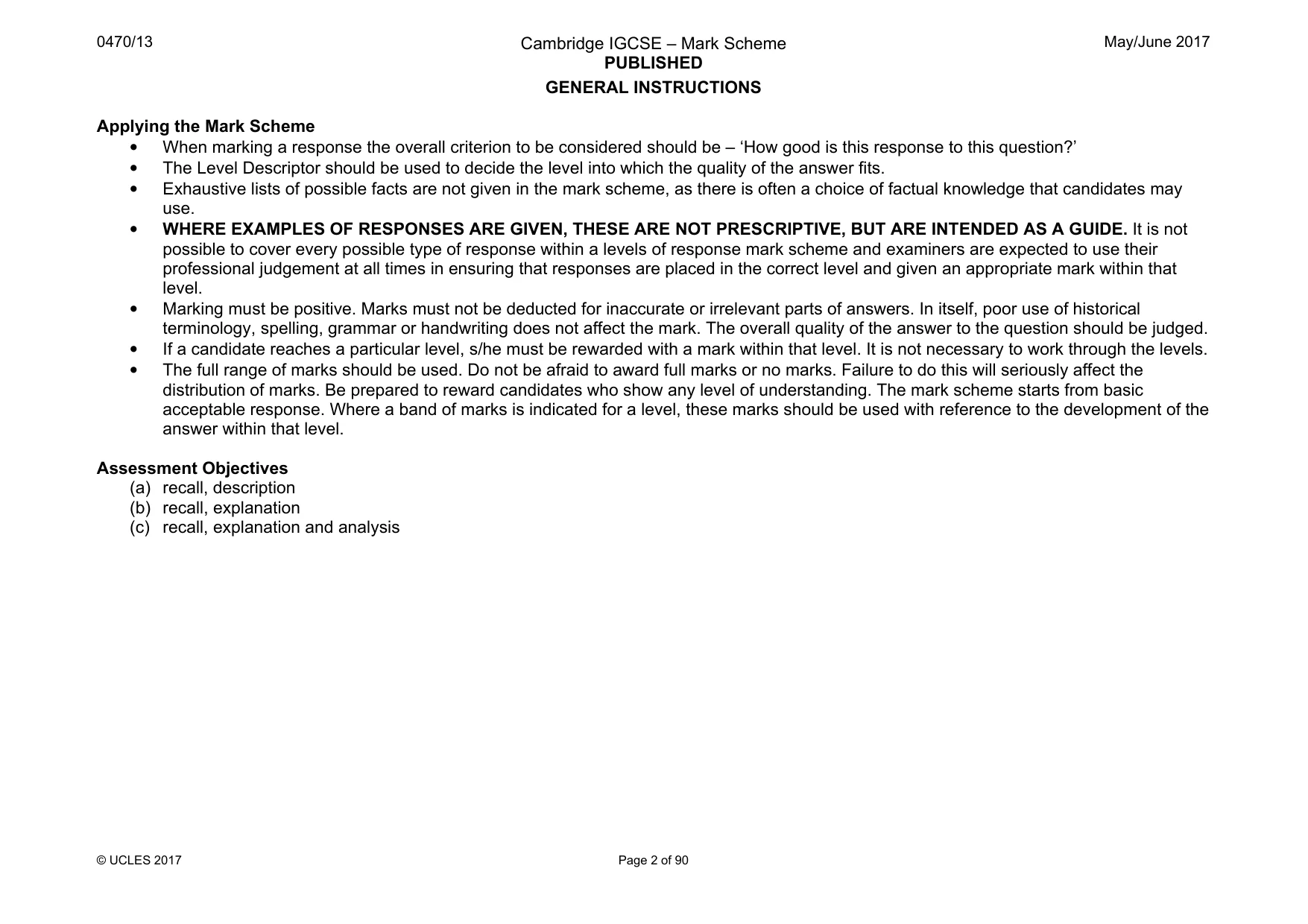
0470/13 Cambridge IGCSE – Mark Scheme PUBLISHED May/June 2017 © UCLES 2017 Page 2 of 90 GENERAL INSTRUCTIONS Applying the Mark Scheme • When marking a response the overall criterion to be considered should be – ‘How good is this response to this question?’ • The Level Descriptor should be used to decide the level into which the quality of the answer fits. • Exhaustive lists of possible facts are not given in the mark scheme, as there is often a choice of factual knowledge that candidates may use. • WHERE EXAMPLES OF RESPONSES ARE GIVEN, THESE ARE NOT PRESCRIPTIVE, BUT ARE INTENDED AS A GUIDE. It is not possible to cover every possible type of response within a levels of response mark scheme and examiners are expected to use their professional judgement at all times in ensuring that responses are placed in the correct level and given an appropriate mark within that level. • Marking must be positive. Marks must not be deducted for inaccurate or irrelevant parts of answers. In itself, poor use of historical terminology, spelling, grammar or handwriting does not affect the mark. The overall quality of the answer to the question should be judged. • If a candidate reaches a particular level, s/he must be rewarded with a mark within that level. It is not necessary to work through the levels. • The full range of marks should be used. Do not be afraid to award full marks or no marks. Failure to do this will seriously affect the distribution of marks. Be prepared to reward candidates who show any level of understanding. The mark scheme starts from basic acceptable response. Where a band of marks is indicated for a level, these marks should be used with reference to the development of the answer within that level. Assessment Objectives (a) recall, description (b) recall, explanation (c) recall, explanation and analysis
Mark scheme, page 3
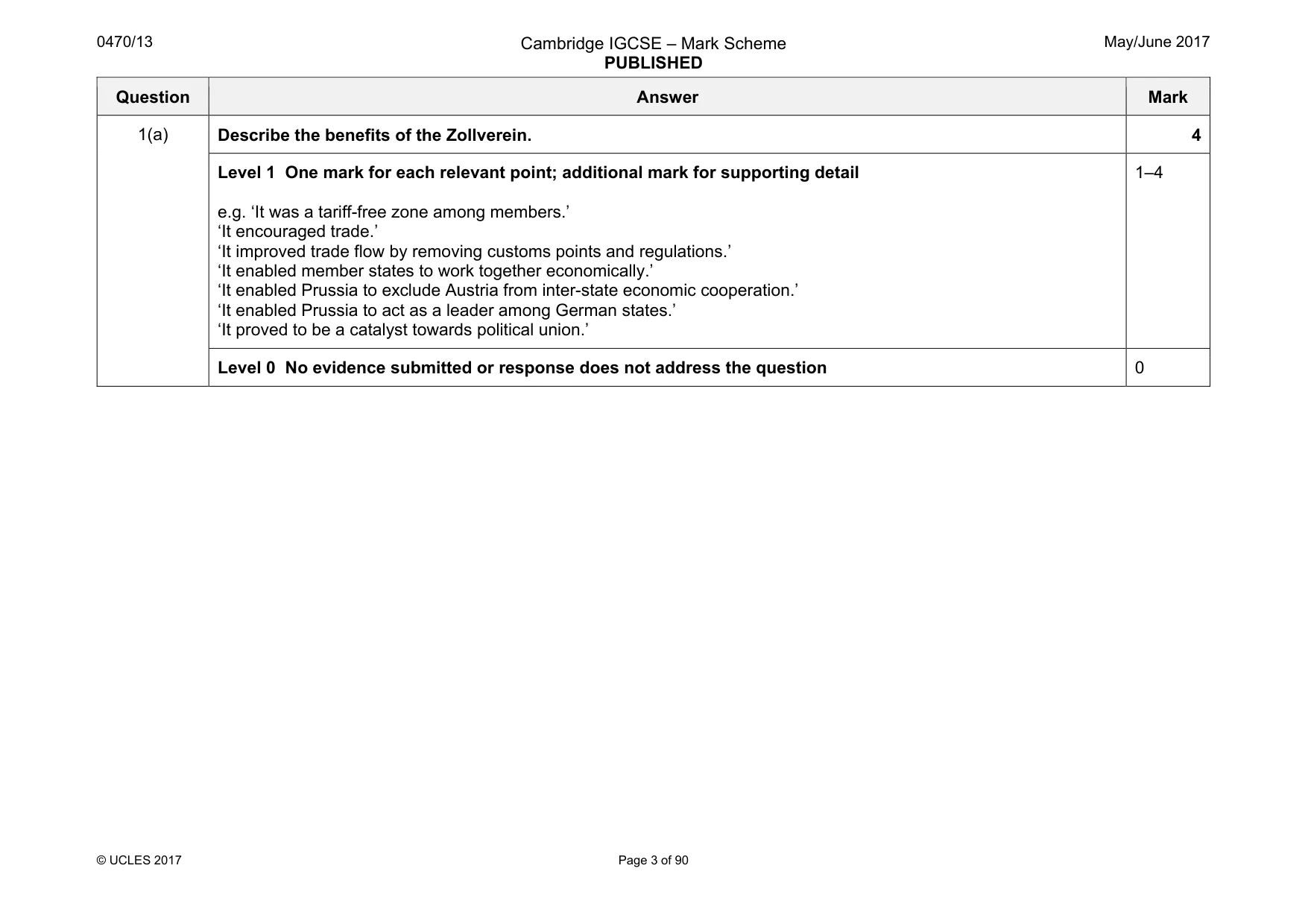
0470/13 Cambridge IGCSE – Mark Scheme PUBLISHED May/June 2017 © UCLES 2017 Page 3 of 90 Question Answer Mark 1(a) Describe the benefits of the Zollverein. 4 Level 1 One mark for each relevant point; additional mark for supporting detail e.g. ‘It was a tariff-free zone among members.’ ‘It encouraged trade.’ ‘It improved trade flow by removing customs points and regulations.’ ‘It enabled member states to work together economically.’ ‘It enabled Prussia to exclude Austria from inter-state economic cooperation.’ ‘It enabled Prussia to act as a leader among German states.’ ‘It proved to be a catalyst towards political union.’ 1–4 Level 0 No evidence submitted or response does not address the question 0
Mark scheme, page 4
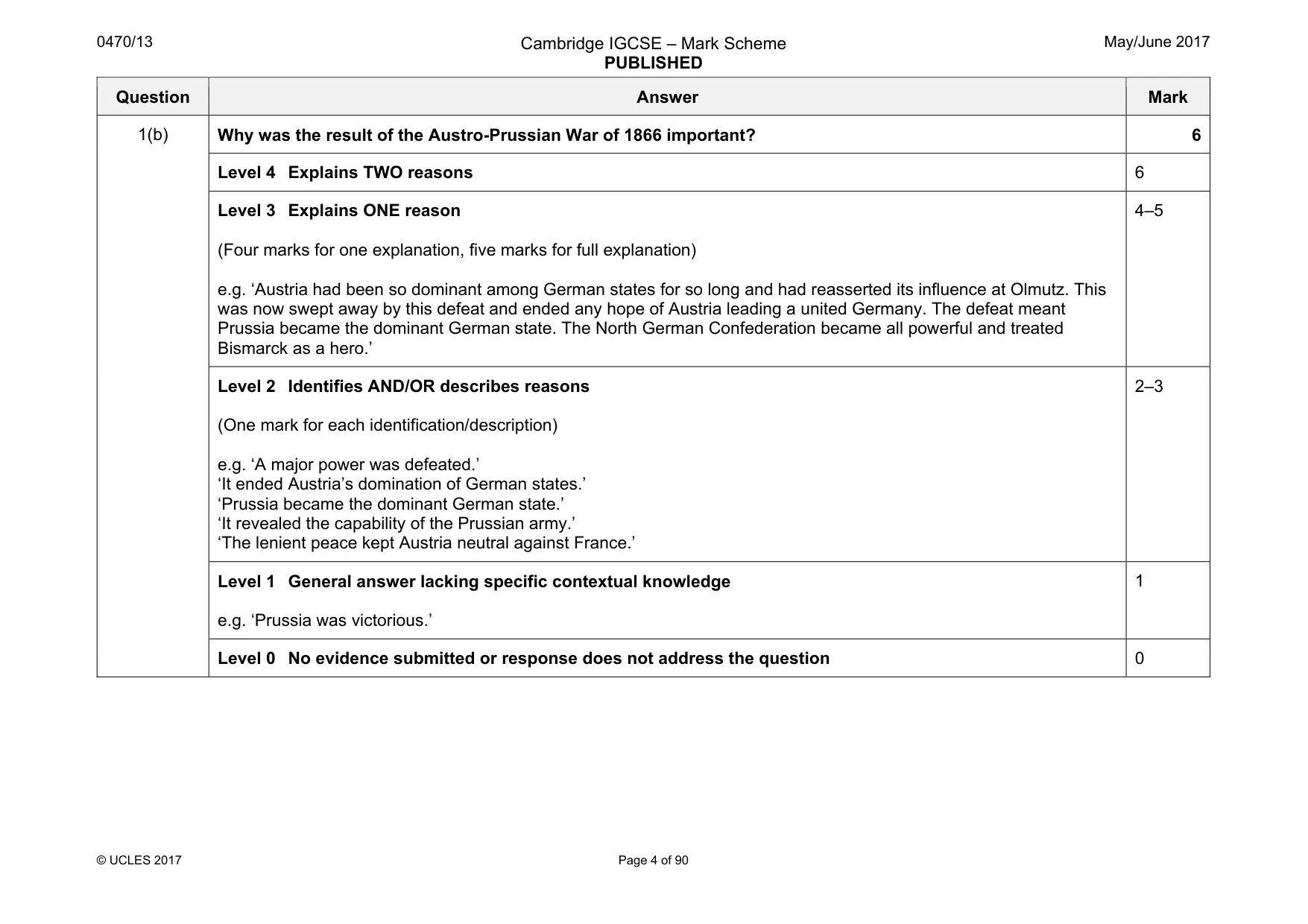
0470/13 Cambridge IGCSE – Mark Scheme PUBLISHED May/June 2017 © UCLES 2017 Page 4 of 90 Question Answer Mark 1(b) Why was the result of the Austro-Prussian War of 1866 important? 6 Level 4 Explains TWO reasons 6 Level 3 Explains ONE reason (Four marks for one explanation, five marks for full explanation) e.g. ‘Austria had been so dominant among German states for so long and had reasserted its influence at Olmutz. This was now swept away by this defeat and ended any hope of Austria leading a united Germany. The defeat meant Prussia became the dominant German state. The North German Confederation became all powerful and treated Bismarck as a hero.’ 4–5 Level 2 Identifies AND/OR describes reasons (One mark for each identification/description) e.g. ‘A major power was defeated.’ ‘It ended Austria’s domination of German states.’ ‘Prussia became the dominant German state.’ ‘It revealed the capability of the Prussian army.’ ‘The lenient peace kept Austria neutral against France.’ 2–3 Level 1 General answer lacking specific contextual knowledge e.g. ‘Prussia was victorious.’ 1 Level 0 No evidence submitted or response does not address the question 0
Mark scheme, page 5
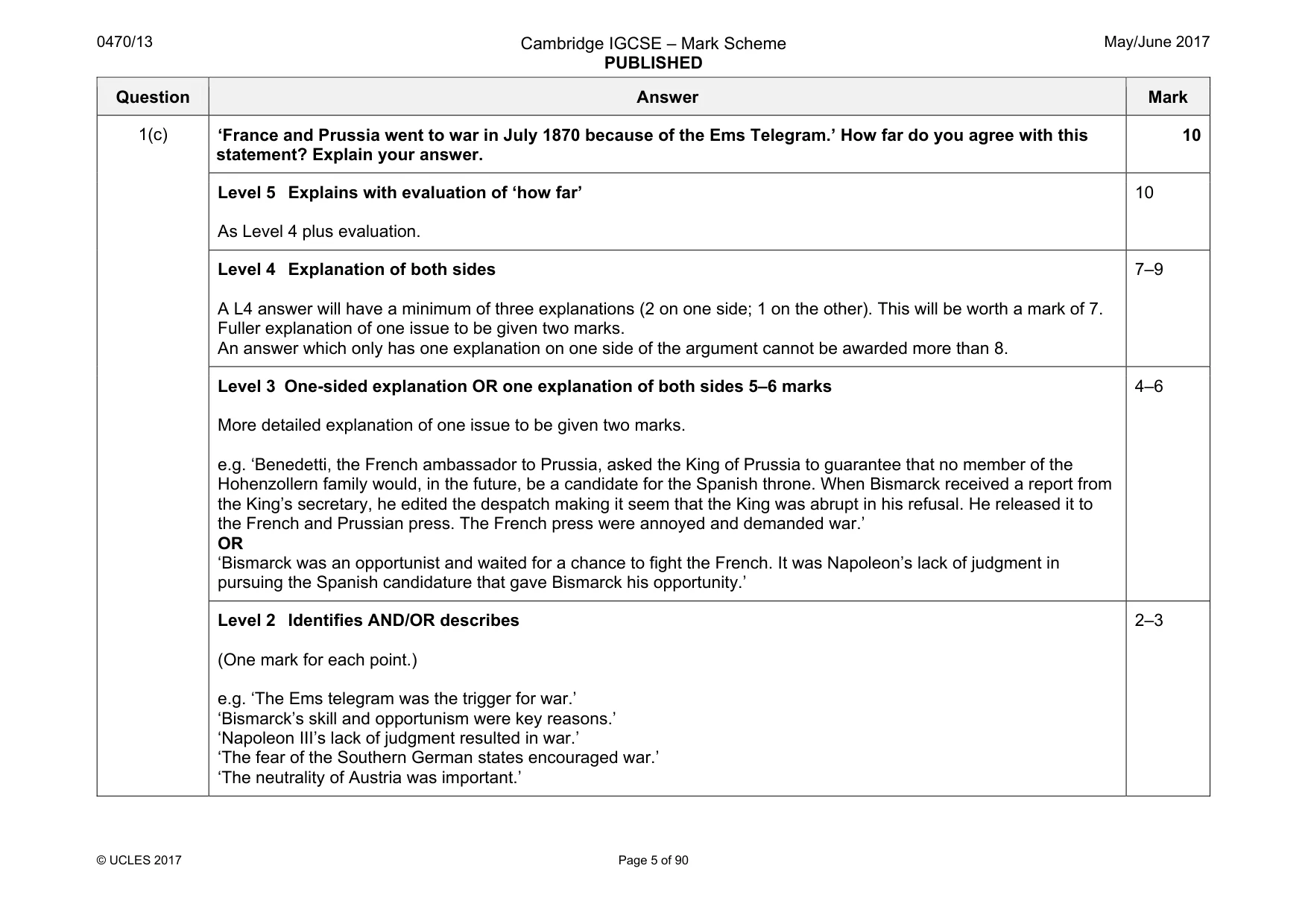
0470/13 Cambridge IGCSE – Mark Scheme PUBLISHED May/June 2017 © UCLES 2017 Page 5 of 90 Question Answer Mark 1(c) ‘France and Prussia went to war in July 1870 because of the Ems Telegram.’ How far do you agree with this statement? Explain your answer. 10 Level 5 Explains with evaluation of ‘how far’ As Level 4 plus evaluation. 10 Level 4 Explanation of both sides A L4 answer will have a minimum of three explanations (2 on one side; 1 on the other). This will be worth a mark of 7. Fuller explanation of one issue to be given two marks. An answer which only has one explanation on one side of the argument cannot be awarded more than 8. 7–9 Level 3 One-sided explanation OR one explanation of both sides 5–6 marks More detailed explanation of one issue to be given two marks. e.g. ‘Benedetti, the French ambassador to Prussia, asked the King of Prussia to guarantee that no member of the Hohenzollern family would, in the future, be a candidate for the Spanish throne. When Bismarck received a report from the King’s secretary, he edited the despatch making it seem that the King was abrupt in his refusal. He released it to the French and Prussian press. The French press were annoyed and demanded war.’ OR ‘Bismarck was an opportunist and waited for a chance to fight the French. It was Napoleon’s lack of judgment in pursuing the Spanish candidature that gave Bismarck his opportunity.’ 4–6 Level 2 Identifies AND/OR describes (One mark for each point.) e.g. ‘The Ems telegram was the trigger for war.’ ‘Bismarck’s skill and opportunism were key reasons.’ ‘Napoleon III’s lack of judgment resulted in war.’ ‘The fear of the Southern German states encouraged war.’ ‘The neutrality of Austria was important.’ 2–3
Mark scheme, page 6
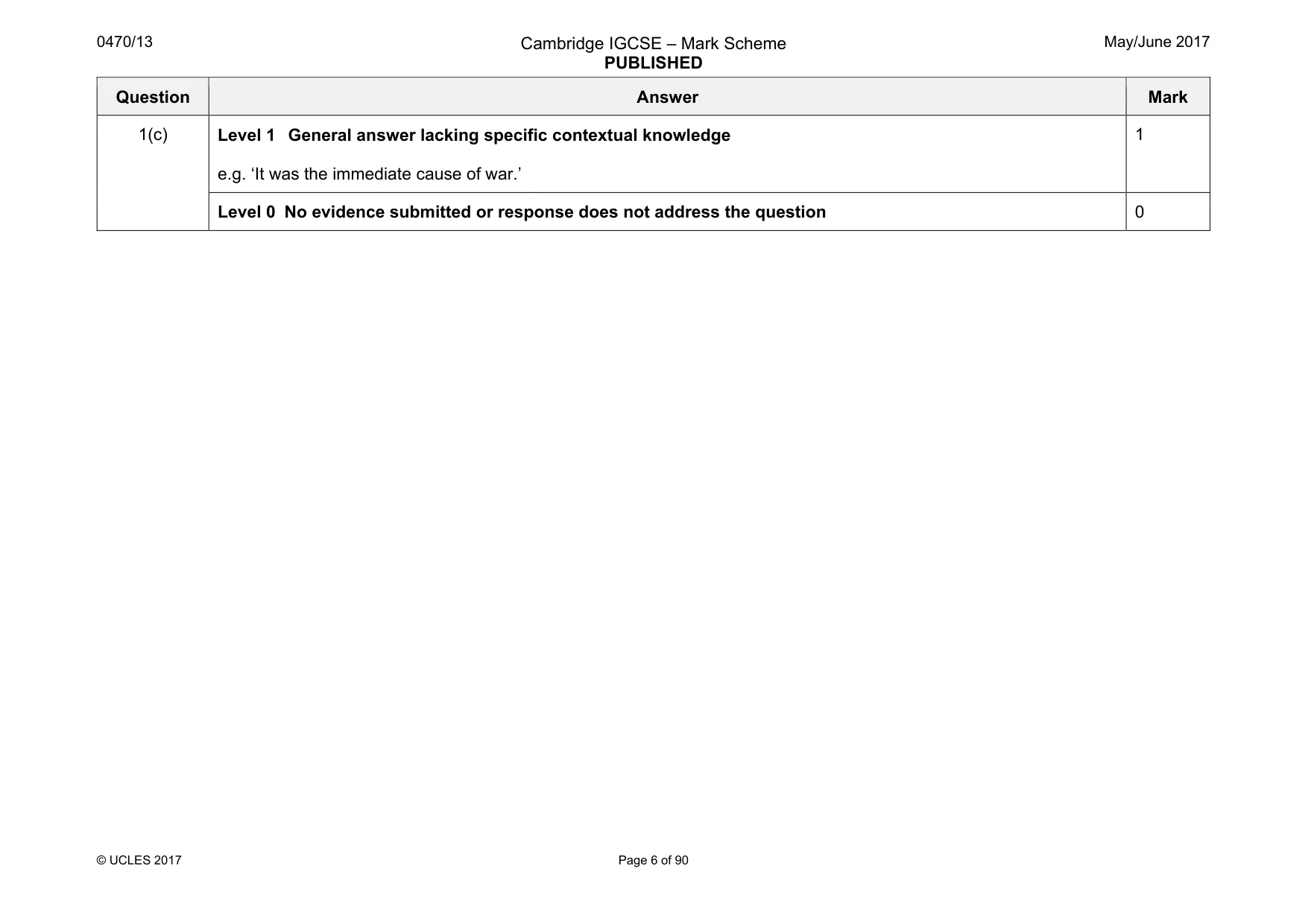
0470/13 Cambridge IGCSE – Mark Scheme PUBLISHED May/June 2017 © UCLES 2017 Page 6 of 90 Question Answer Mark 1(c) Level 1 General answer lacking specific contextual knowledge e.g. ‘It was the immediate cause of war.’ 1 Level 0 No evidence submitted or response does not address the question 0
Mark scheme, page 7
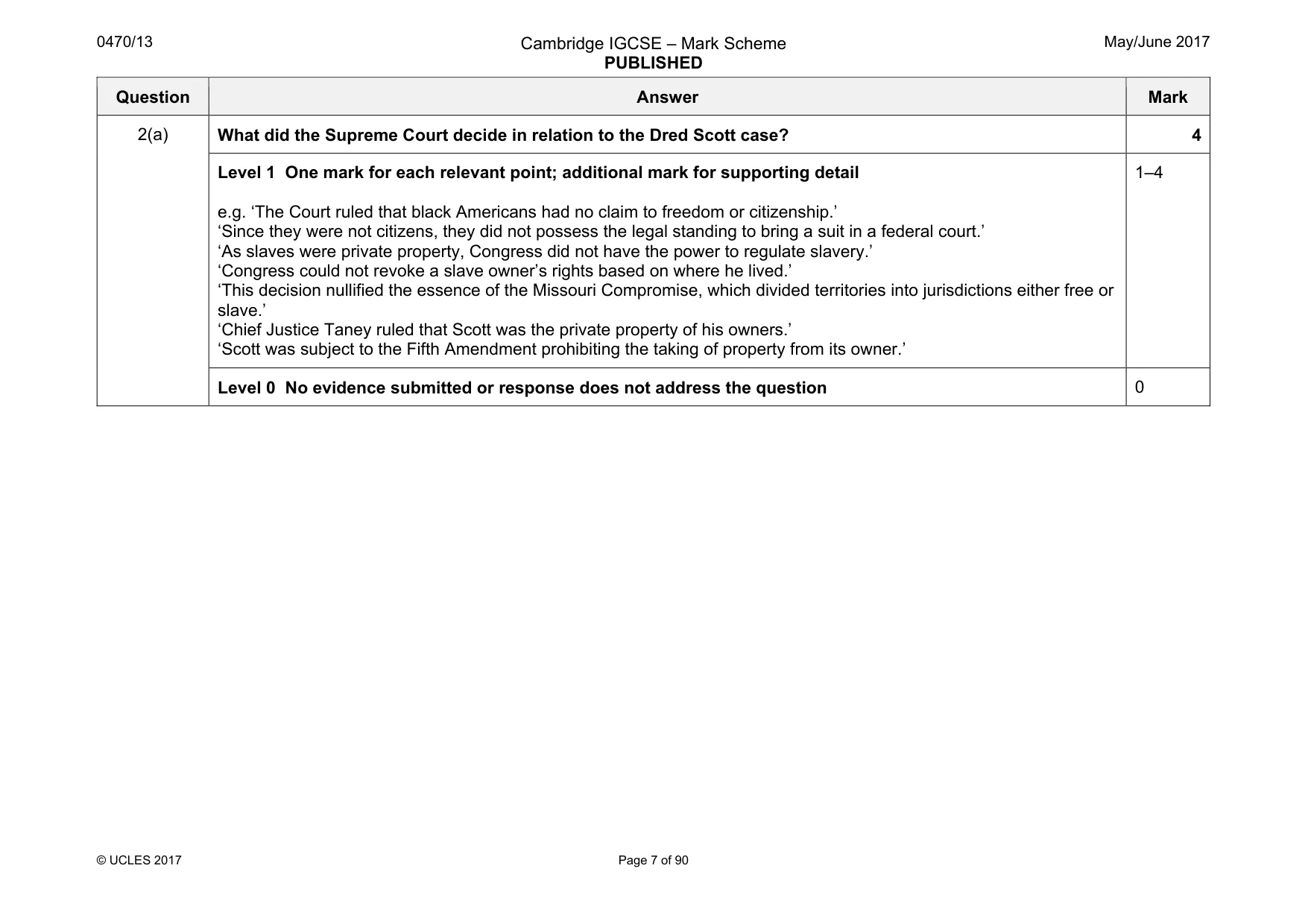
0470/13 Cambridge IGCSE – Mark Scheme PUBLISHED May/June 2017 © UCLES 2017 Page 7 of 90 Question Answer Mark 2(a) What did the Supreme Court decide in relation to the Dred Scott case? 4 Level 1 One mark for each relevant point; additional mark for supporting detail e.g. ‘The Court ruled that black Americans had no claim to freedom or citizenship.’ ‘Since they were not citizens, they did not possess the legal standing to bring a suit in a federal court.’ ‘As slaves were private property, Congress did not have the power to regulate slavery.’ ‘Congress could not revoke a slave owner’s rights based on where he lived.’ ‘This decision nullified the essence of the Missouri Compromise, which divided territories into jurisdictions either free or slave.’ ‘Chief Justice Taney ruled that Scott was the private property of his owners.’ ‘Scott was subject to the Fifth Amendment prohibiting the taking of property from its owner.’ 1–4 Level 0 No evidence submitted or response does not address the question 0
Mark scheme, page 8
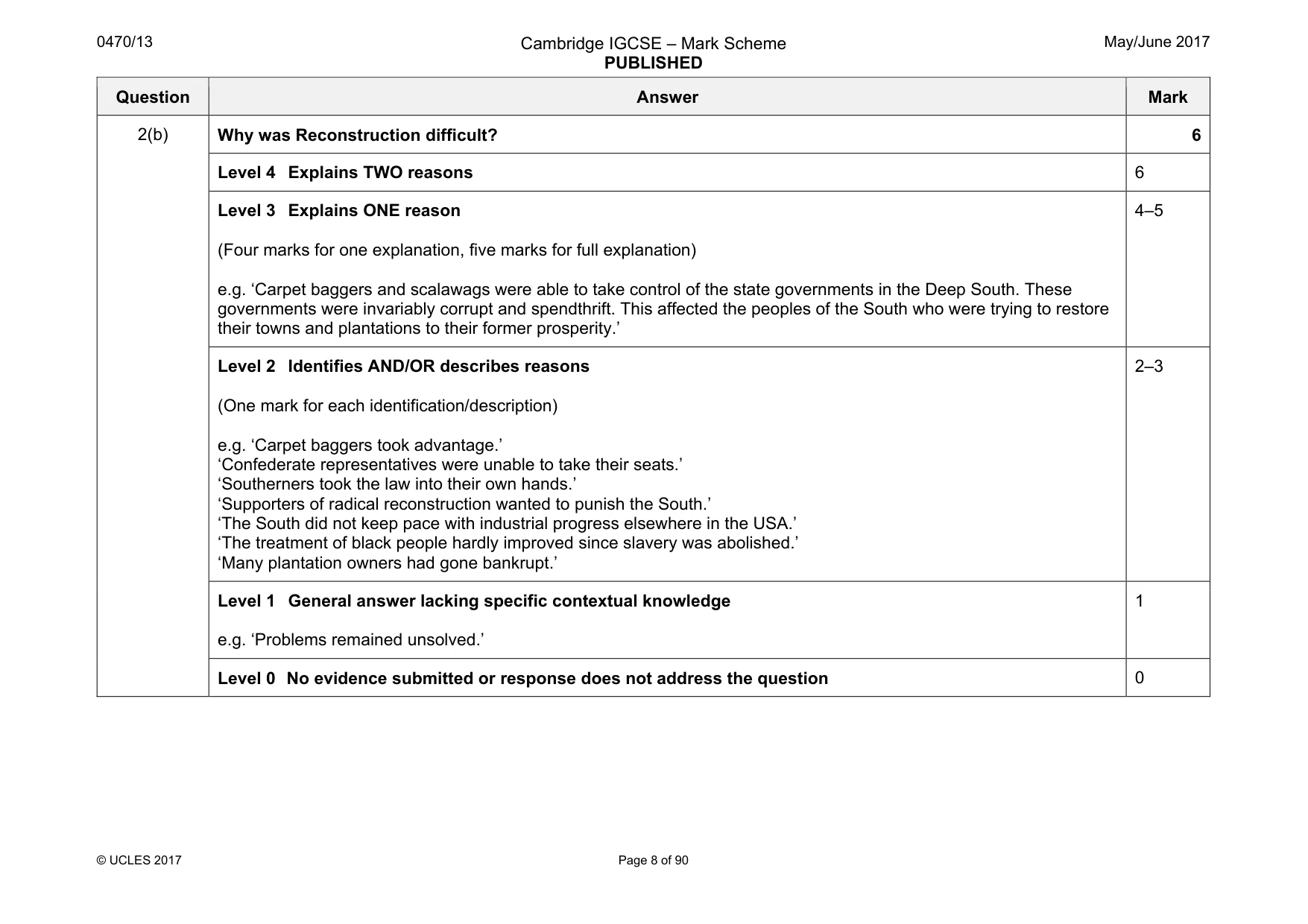
0470/13 Cambridge IGCSE – Mark Scheme PUBLISHED May/June 2017 © UCLES 2017 Page 8 of 90 Question Answer Mark 2(b) Why was Reconstruction difficult? 6 Level 4 Explains TWO reasons 6 Level 3 Explains ONE reason (Four marks for one explanation, five marks for full explanation) e.g. ‘Carpet baggers and scalawags were able to take control of the state governments in the Deep South. These governments were invariably corrupt and spendthrift. This affected the peoples of the South who were trying to restore their towns and plantations to their former prosperity.’ 4–5 Level 2 Identifies AND/OR describes reasons (One mark for each identification/description) e.g. ‘Carpet baggers took advantage.’ ‘Confederate representatives were unable to take their seats.’ ‘Southerners took the law into their own hands.’ ‘Supporters of radical reconstruction wanted to punish the South.’ ‘The South did not keep pace with industrial progress elsewhere in the USA.’ ‘The treatment of black people hardly improved since slavery was abolished.’ ‘Many plantation owners had gone bankrupt.’ 2–3 Level 1 General answer lacking specific contextual knowledge e.g. ‘Problems remained unsolved.’ 1 Level 0 No evidence submitted or response does not address the question 0
Mark scheme, page 9
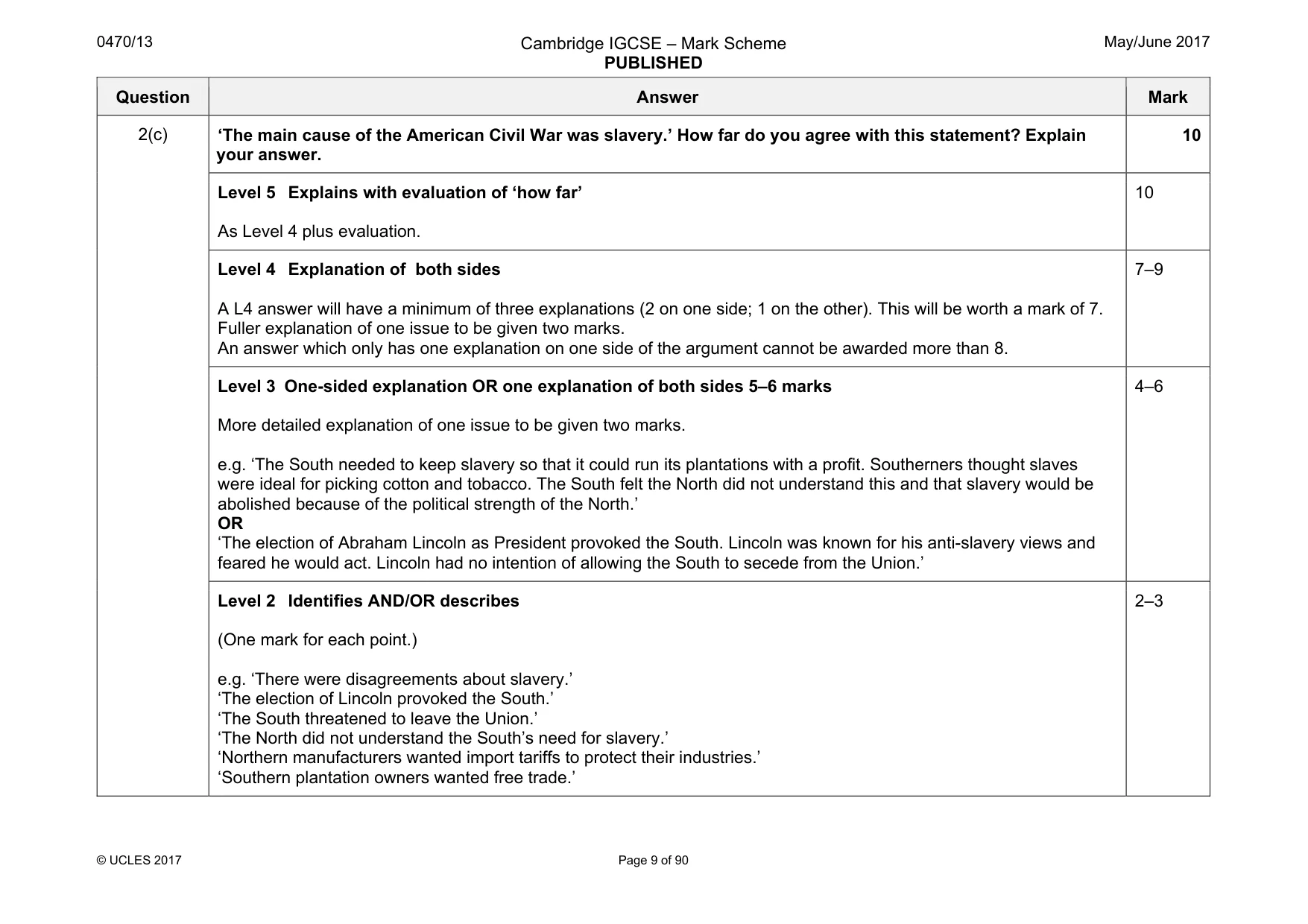
0470/13 Cambridge IGCSE – Mark Scheme PUBLISHED May/June 2017 © UCLES 2017 Page 9 of 90 Question Answer Mark 2(c) ‘The main cause of the American Civil War was slavery.’ How far do you agree with this statement? Explain your answer. 10 Level 5 Explains with evaluation of ‘how far’ As Level 4 plus evaluation. 10 Level 4 Explanation of both sides A L4 answer will have a minimum of three explanations (2 on one side; 1 on the other). This will be worth a mark of 7. Fuller explanation of one issue to be given two marks. An answer which only has one explanation on one side of the argument cannot be awarded more than 8. 7–9 Level 3 One-sided explanation OR one explanation of both sides 5–6 marks More detailed explanation of one issue to be given two marks. e.g. ‘The South needed to keep slavery so that it could run its plantations with a profit. Southerners thought slaves were ideal for picking cotton and tobacco. The South felt the North did not understand this and that slavery would be abolished because of the political strength of the North.’ OR ‘The election of Abraham Lincoln as President provoked the South. Lincoln was known for his anti-slavery views and feared he would act. Lincoln had no intention of allowing the South to secede from the Union.’ 4–6 Level 2 Identifies AND/OR describes (One mark for each point.) e.g. ‘There were disagreements about slavery.’ ‘The election of Lincoln provoked the South.’ ‘The South threatened to leave the Union.’ ‘The North did not understand the South’s need for slavery.’ ‘Northern manufacturers wanted import tariffs to protect their industries.’ ‘Southern plantation owners wanted free trade.’ 2–3
Mark scheme, page 10
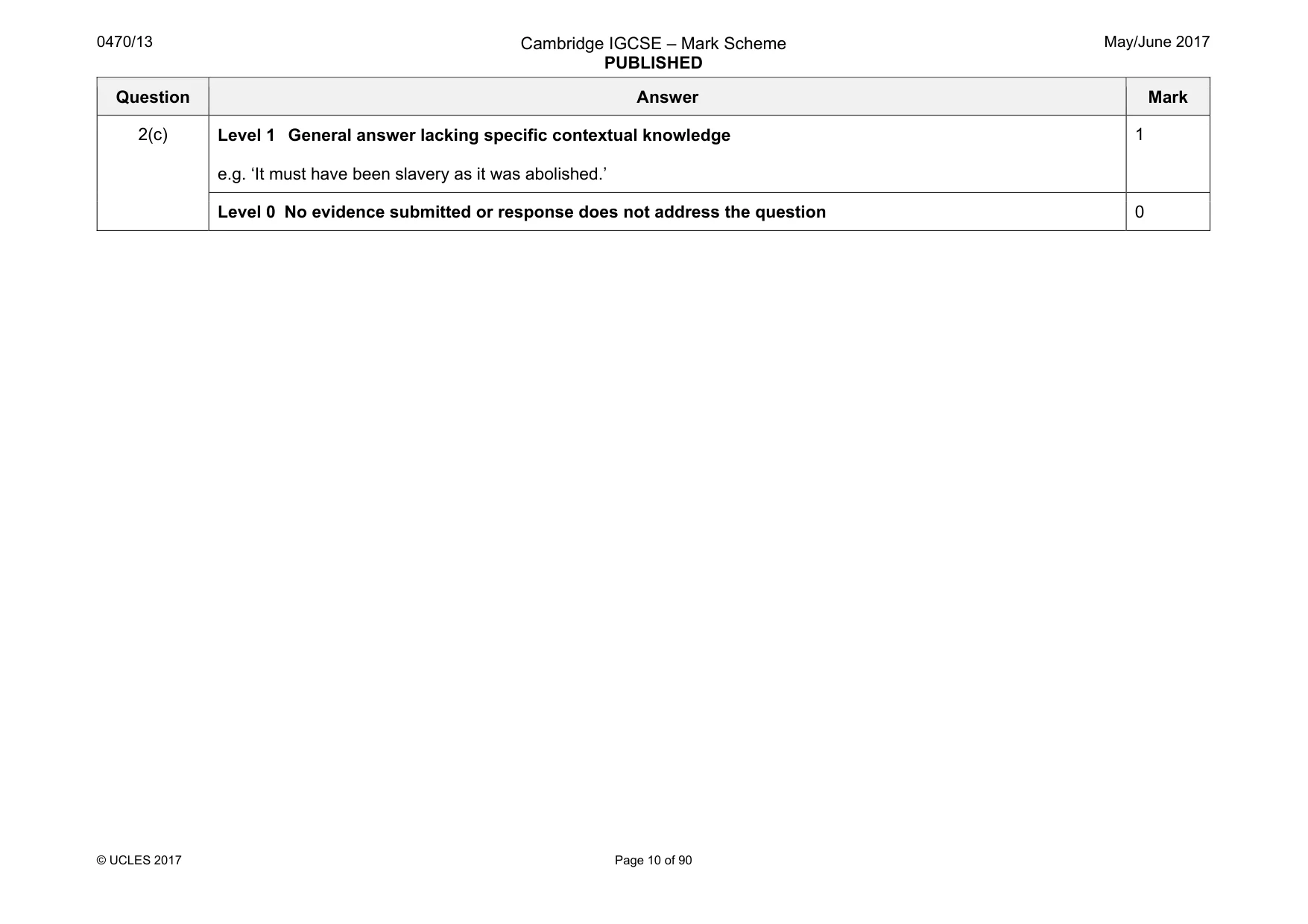
0470/13 Cambridge IGCSE – Mark Scheme PUBLISHED May/June 2017 © UCLES 2017 Page 10 of 90 Question Answer Mark 2(c) Level 1 General answer lacking specific contextual knowledge e.g. ‘It must have been slavery as it was abolished.’ 1 Level 0 No evidence submitted or response does not address the question 0
Mark scheme, page 11
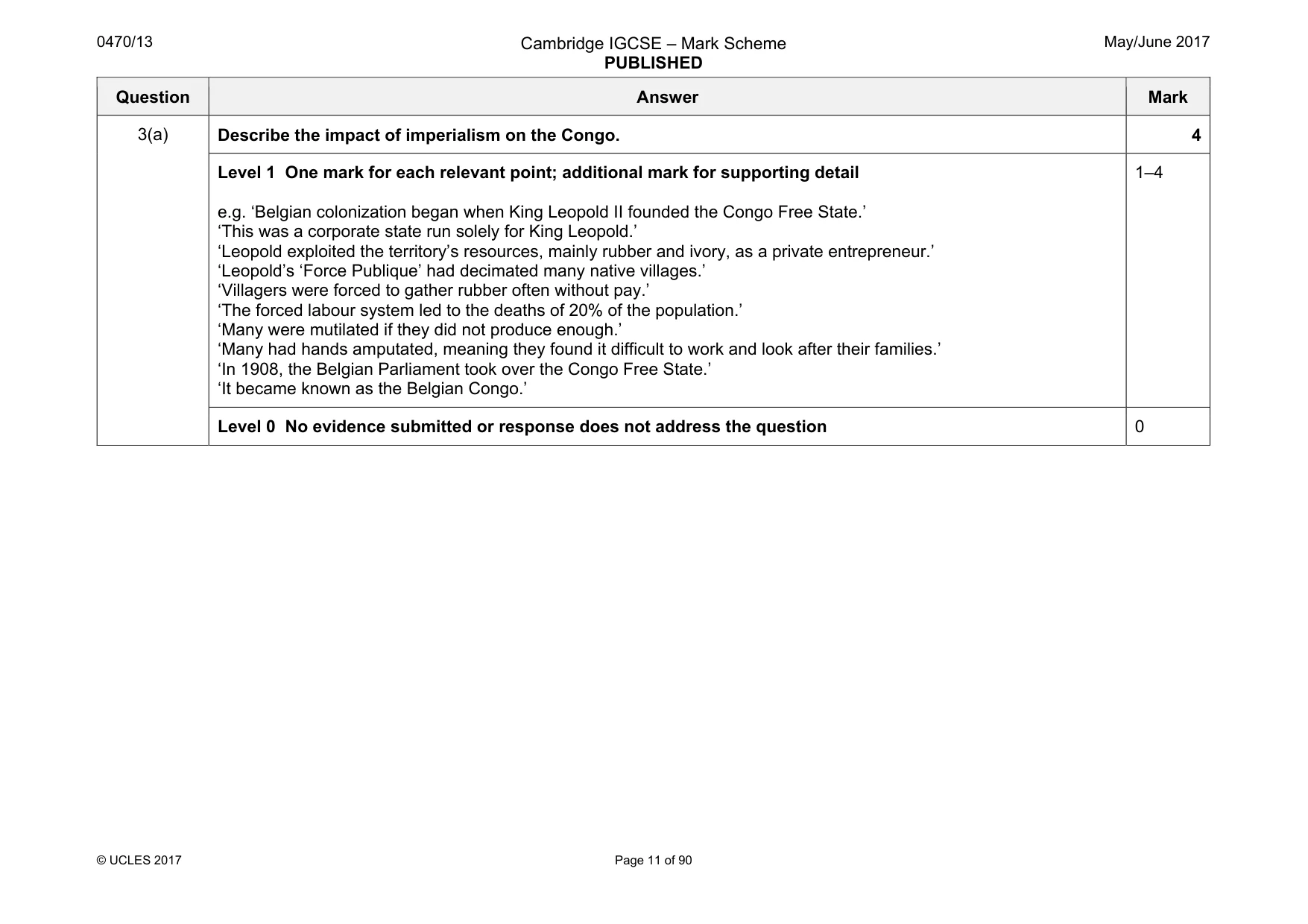
0470/13 Cambridge IGCSE – Mark Scheme PUBLISHED May/June 2017 © UCLES 2017 Page 11 of 90 Question Answer Mark 3(a) Describe the impact of imperialism on the Congo. 4 Level 1 One mark for each relevant point; additional mark for supporting detail e.g. ‘Belgian colonization began when King Leopold II founded the Congo Free State.’ ‘This was a corporate state run solely for King Leopold.’ ‘Leopold exploited the territory’s resources, mainly rubber and ivory, as a private entrepreneur.’ ‘Leopold’s ‘Force Publique’ had decimated many native villages.’ ‘Villagers were forced to gather rubber often without pay.’ ‘The forced labour system led to the deaths of 20% of the population.’ ‘Many were mutilated if they did not produce enough.’ ‘Many had hands amputated, meaning they found it difficult to work and look after their families.’ ‘In 1908, the Belgian Parliament took over the Congo Free State.’ ‘It became known as the Belgian Congo.’ 1–4 Level 0 No evidence submitted or response does not address the question 0
Mark scheme, page 12
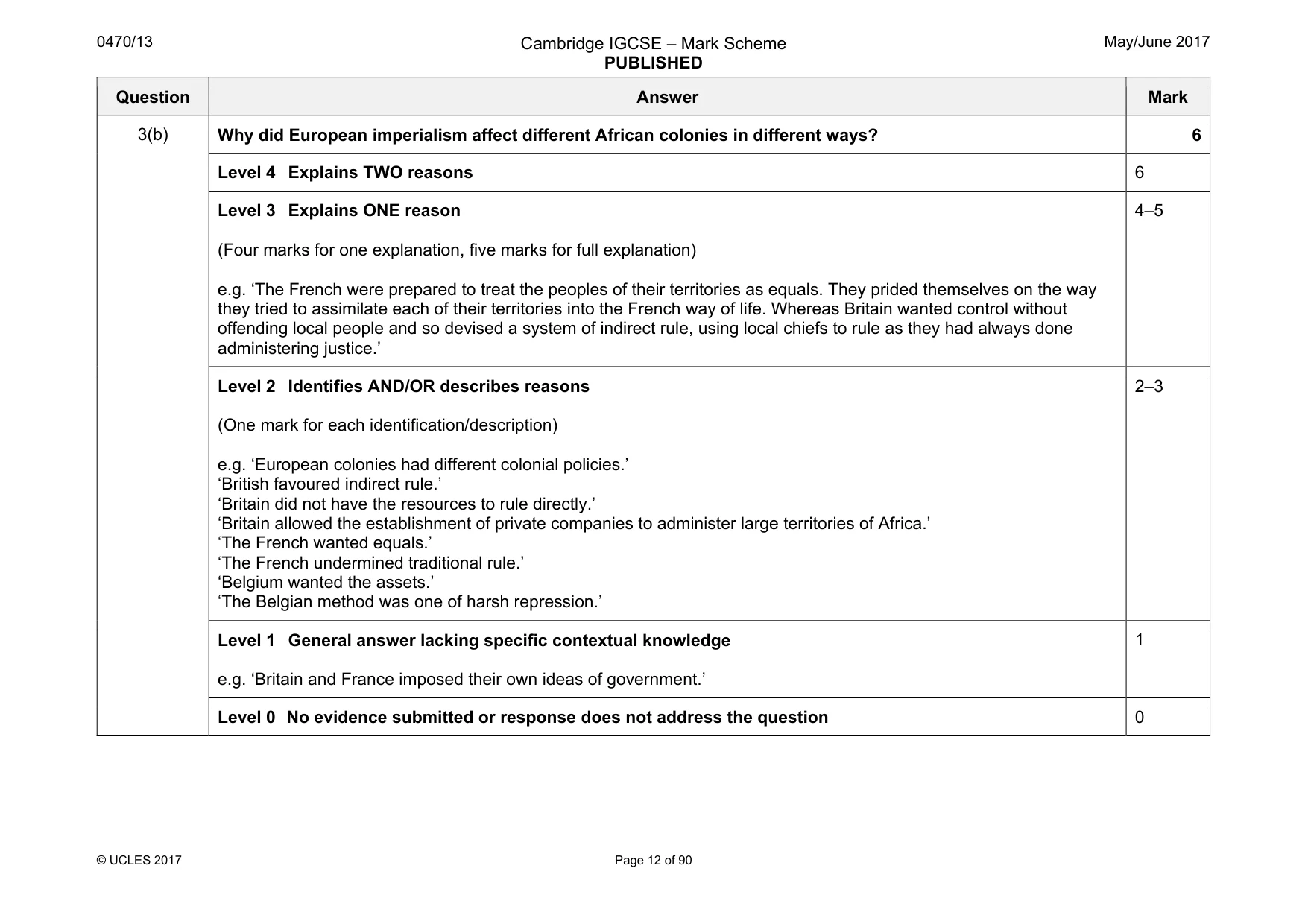
0470/13 Cambridge IGCSE – Mark Scheme PUBLISHED May/June 2017 © UCLES 2017 Page 12 of 90 Question Answer Mark 3(b) Why did European imperialism affect different African colonies in different ways? 6 Level 4 Explains TWO reasons 6 Level 3 Explains ONE reason (Four marks for one explanation, five marks for full explanation) e.g. ‘The French were prepared to treat the peoples of their territories as equals. They prided themselves on the way they tried to assimilate each of their territories into the French way of life. Whereas Britain wanted control without offending local people and so devised a system of indirect rule, using local chiefs to rule as they had always done administering justice.’ 4–5 Level 2 Identifies AND/OR describes reasons (One mark for each identification/description) e.g. ‘European colonies had different colonial policies.’ ‘British favoured indirect rule.’ ‘Britain did not have the resources to rule directly.’ ‘Britain allowed the establishment of private companies to administer large territories of Africa.’ ‘The French wanted equals.’ ‘The French undermined traditional rule.’ ‘Belgium wanted the assets.’ ‘The Belgian method was one of harsh repression.’ 2–3 Level 1 General answer lacking specific contextual knowledge e.g. ‘Britain and France imposed their own ideas of government.’ 1 Level 0 No evidence submitted or response does not address the question 0
Mark scheme, page 13
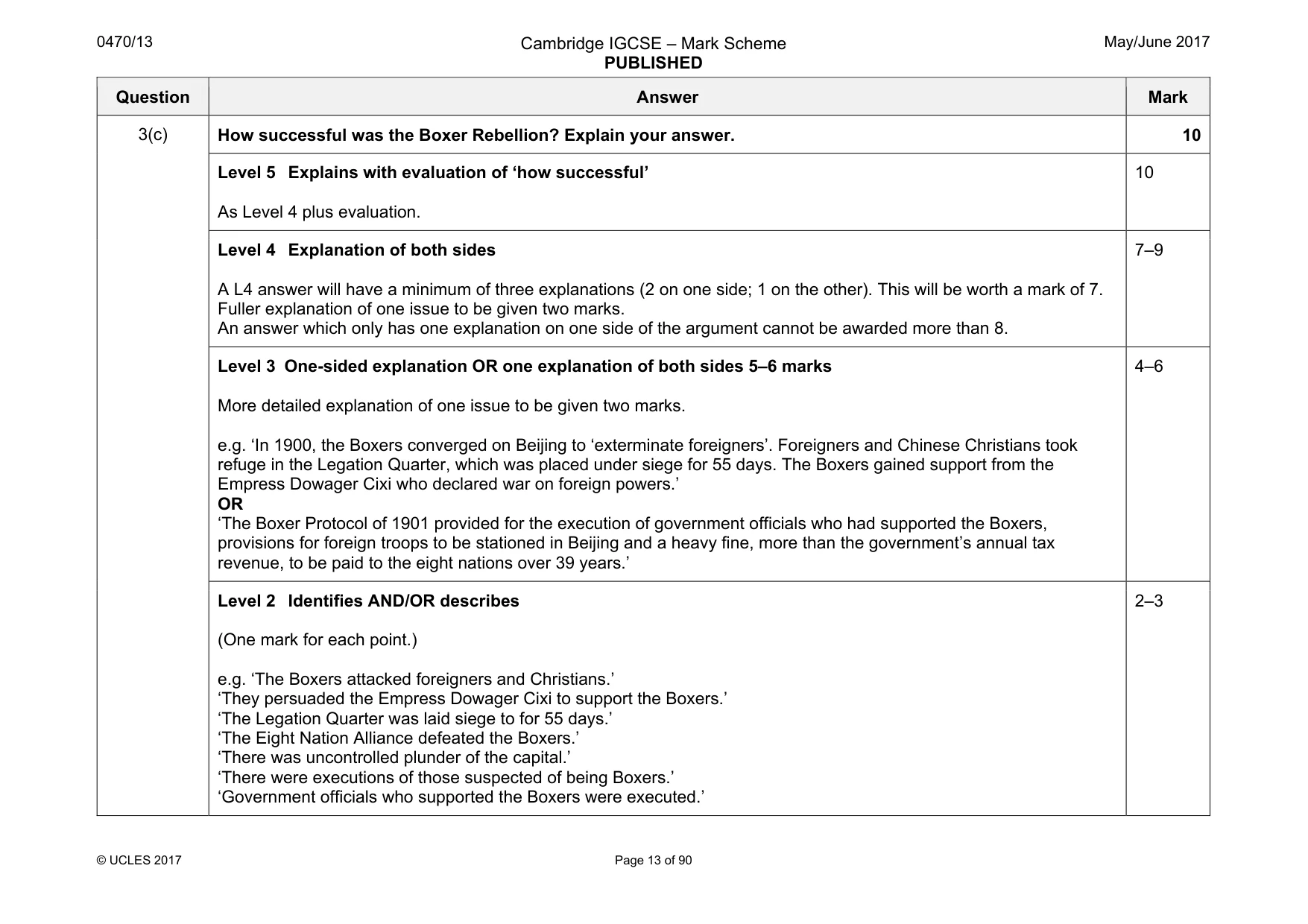
0470/13 Cambridge IGCSE – Mark Scheme PUBLISHED May/June 2017 © UCLES 2017 Page 13 of 90 Question Answer Mark 3(c) How successful was the Boxer Rebellion? Explain your answer. 10 Level 5 Explains with evaluation of ‘how successful’ As Level 4 plus evaluation. 10 Level 4 Explanation of both sides A L4 answer will have a minimum of three explanations (2 on one side; 1 on the other). This will be worth a mark of 7. Fuller explanation of one issue to be given two marks. An answer which only has one explanation on one side of the argument cannot be awarded more than 8. 7–9 Level 3 One-sided explanation OR one explanation of both sides 5–6 marks More detailed explanation of one issue to be given two marks. e.g. ‘In 1900, the Boxers converged on Beijing to ‘exterminate foreigners’. Foreigners and Chinese Christians took refuge in the Legation Quarter, which was placed under siege for 55 days. The Boxers gained support from the Empress Dowager Cixi who declared war on foreign powers.’ OR ‘The Boxer Protocol of 1901 provided for the execution of government officials who had supported the Boxers, provisions for foreign troops to be stationed in Beijing and a heavy fine, more than the government’s annual tax revenue, to be paid to the eight nations over 39 years.’ 4–6 Level 2 Identifies AND/OR describes (One mark for each point.) e.g. ‘The Boxers attacked foreigners and Christians.’ ‘They persuaded the Empress Dowager Cixi to support the Boxers.’ ‘The Legation Quarter was laid siege to for 55 days.’ ‘The Eight Nation Alliance defeated the Boxers.’ ‘There was uncontrolled plunder of the capital.’ ‘There were executions of those suspected of being Boxers.’ ‘Government officials who supported the Boxers were executed.’ 2–3
Mark scheme, page 14
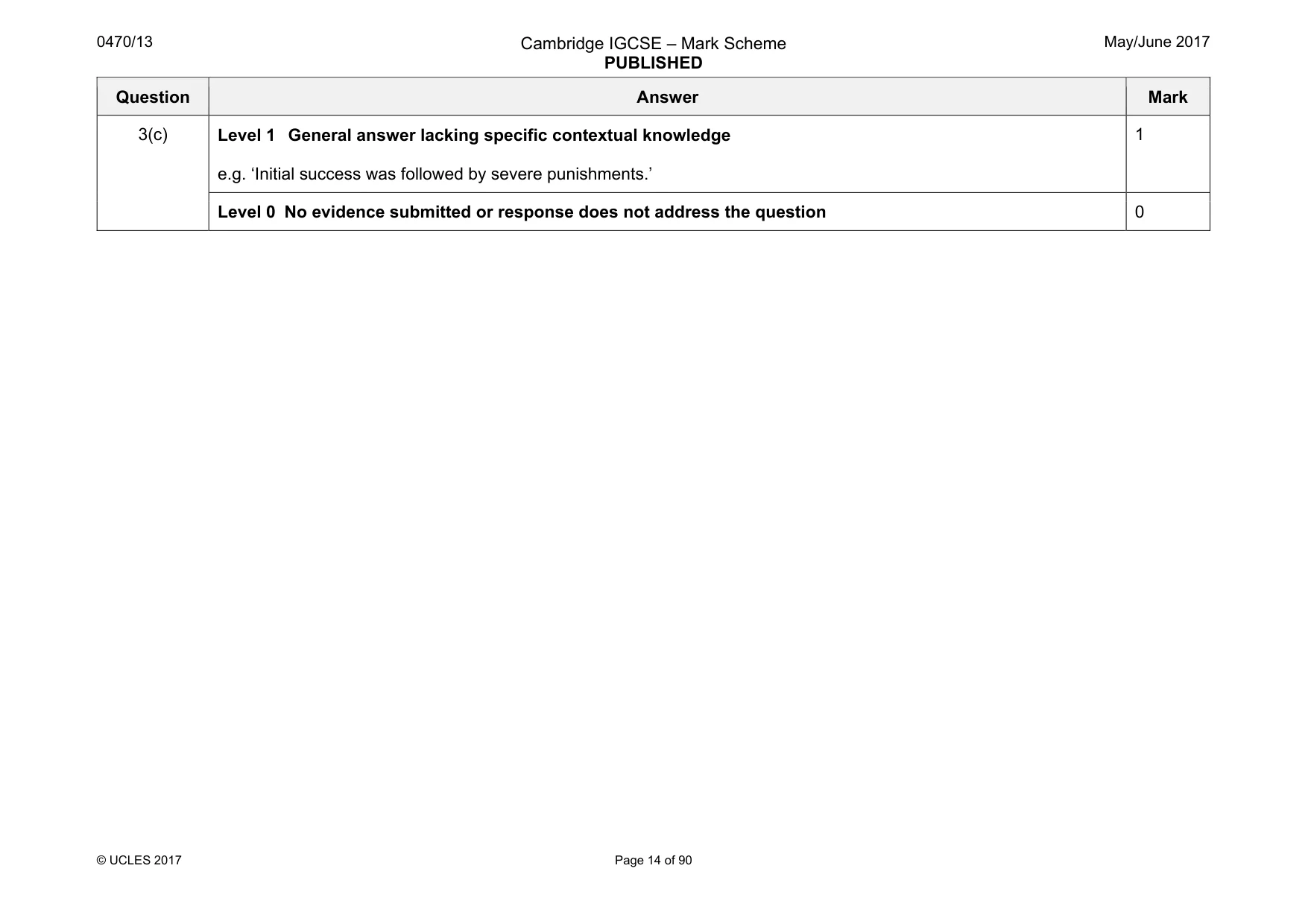
0470/13 Cambridge IGCSE – Mark Scheme PUBLISHED May/June 2017 © UCLES 2017 Page 14 of 90 Question Answer Mark 3(c) Level 1 General answer lacking specific contextual knowledge e.g. ‘Initial success was followed by severe punishments.’ 1 Level 0 No evidence submitted or response does not address the question 0
Mark scheme, page 15
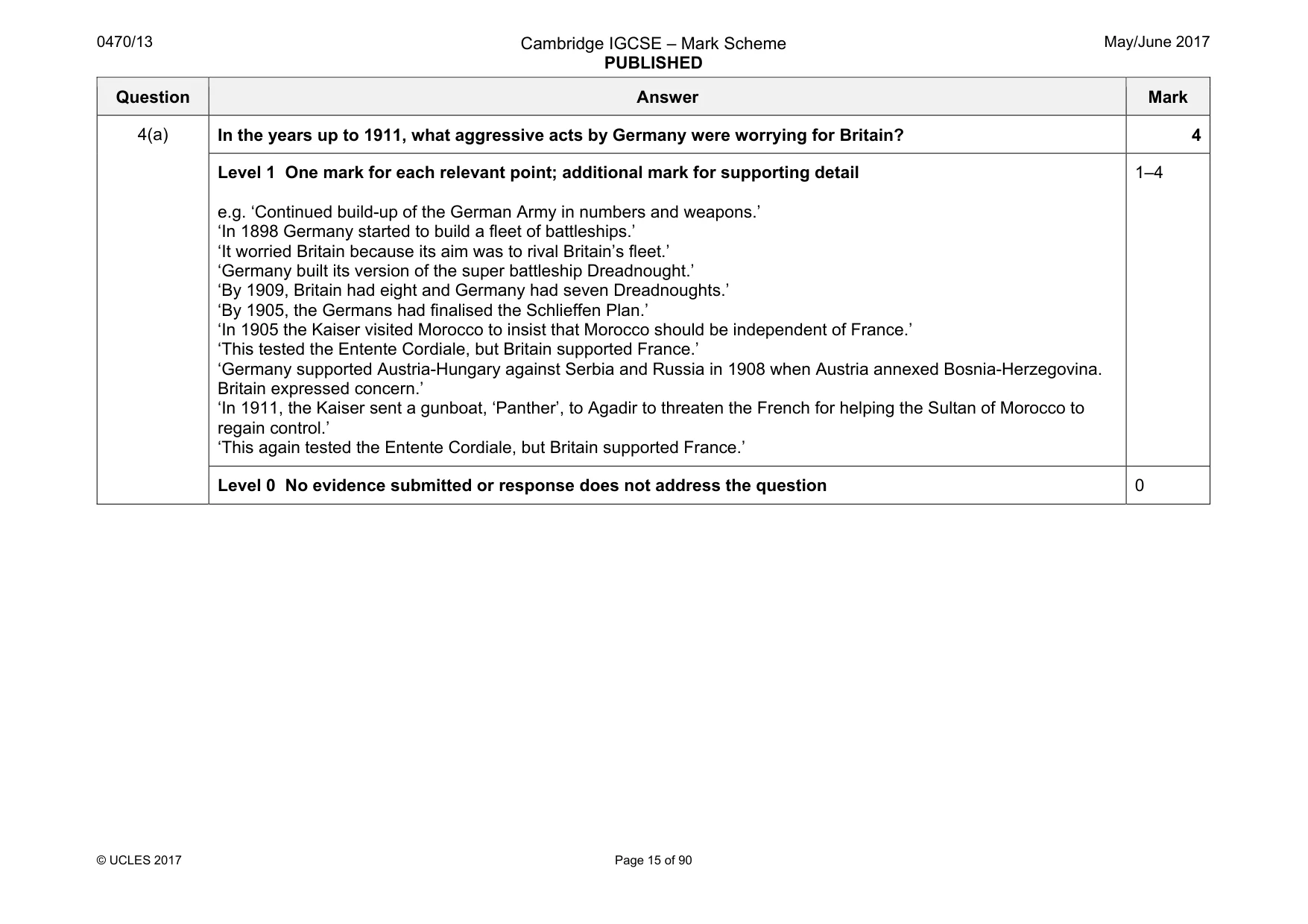
0470/13 Cambridge IGCSE – Mark Scheme PUBLISHED May/June 2017 © UCLES 2017 Page 15 of 90 Question Answer Mark 4(a) In the years up to 1911, what aggressive acts by Germany were worrying for Britain? 4 Level 1 One mark for each relevant point; additional mark for supporting detail e.g. ‘Continued build-up of the German Army in numbers and weapons.’ ‘In 1898 Germany started to build a fleet of battleships.’ ‘It worried Britain because its aim was to rival Britain’s fleet.’ ‘Germany built its version of the super battleship Dreadnought.’ ‘By 1909, Britain had eight and Germany had seven Dreadnoughts.’ ‘By 1905, the Germans had finalised the Schlieffen Plan.’ ‘In 1905 the Kaiser visited Morocco to insist that Morocco should be independent of France.’ ‘This tested the Entente Cordiale, but Britain supported France.’ ‘Germany supported Austria-Hungary against Serbia and Russia in 1908 when Austria annexed Bosnia-Herzegovina. Britain expressed concern.’ ‘In 1911, the Kaiser sent a gunboat, ‘Panther’, to Agadir to threaten the French for helping the Sultan of Morocco to regain control.’ ‘This again tested the Entente Cordiale, but Britain supported France.’ 1–4 Level 0 No evidence submitted or response does not address the question 0
Mark scheme, page 16
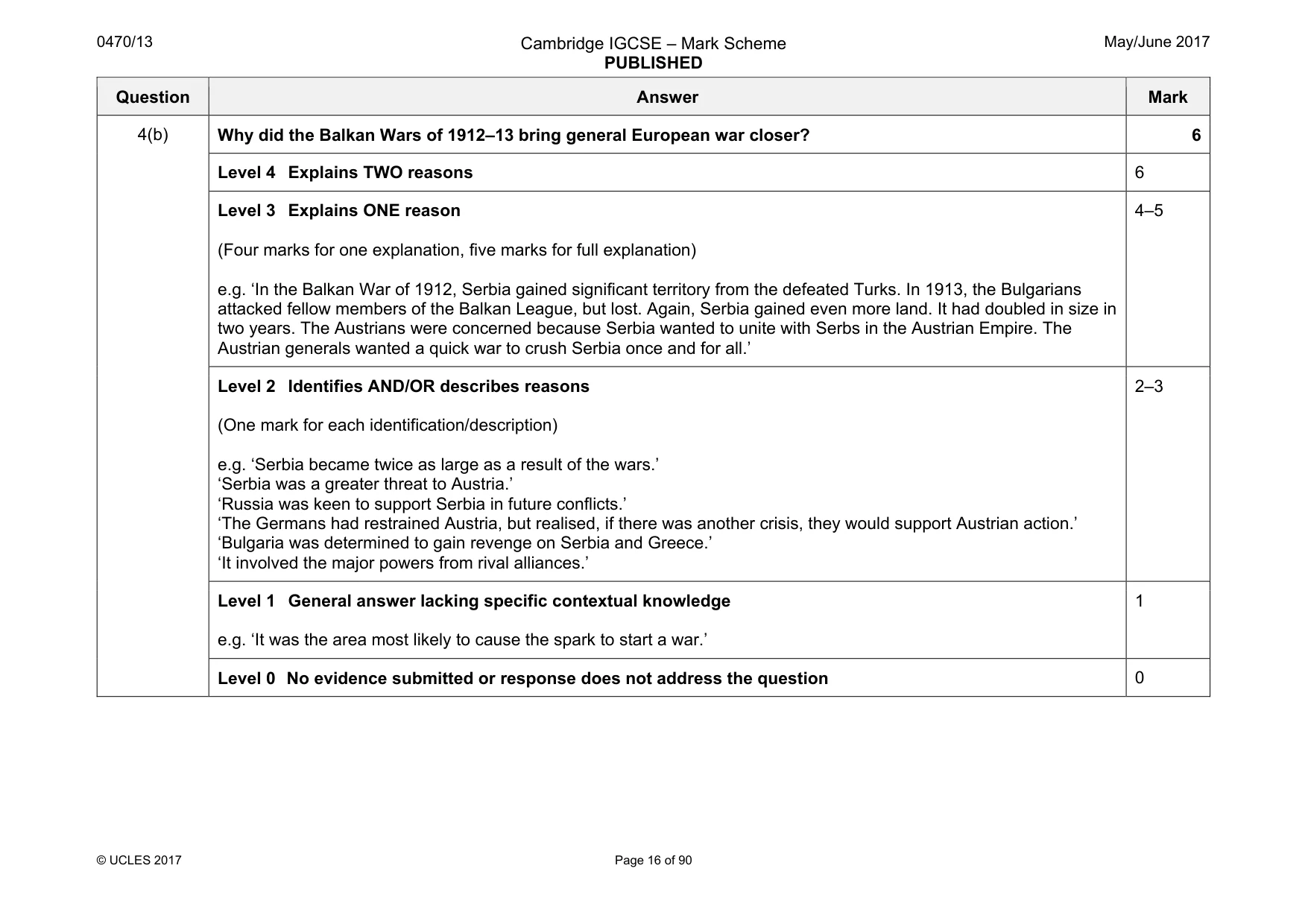
0470/13 Cambridge IGCSE – Mark Scheme PUBLISHED May/June 2017 © UCLES 2017 Page 16 of 90 Question Answer Mark 4(b) Why did the Balkan Wars of 1912–13 bring general European war closer? 6 Level 4 Explains TWO reasons 6 Level 3 Explains ONE reason (Four marks for one explanation, five marks for full explanation) e.g. ‘In the Balkan War of 1912, Serbia gained significant territory from the defeated Turks. In 1913, the Bulgarians attacked fellow members of the Balkan League, but lost. Again, Serbia gained even more land. It had doubled in size in two years. The Austrians were concerned because Serbia wanted to unite with Serbs in the Austrian Empire. The Austrian generals wanted a quick war to crush Serbia once and for all.’ 4–5 Level 2 Identifies AND/OR describes reasons (One mark for each identification/description) e.g. ‘Serbia became twice as large as a result of the wars.’ ‘Serbia was a greater threat to Austria.’ ‘Russia was keen to support Serbia in future conflicts.’ ‘The Germans had restrained Austria, but realised, if there was another crisis, they would support Austrian action.’ ‘Bulgaria was determined to gain revenge on Serbia and Greece.’ ‘It involved the major powers from rival alliances.’ 2–3 Level 1 General answer lacking specific contextual knowledge e.g. ‘It was the area most likely to cause the spark to start a war.’ 1 Level 0 No evidence submitted or response does not address the question 0
Mark scheme, page 17
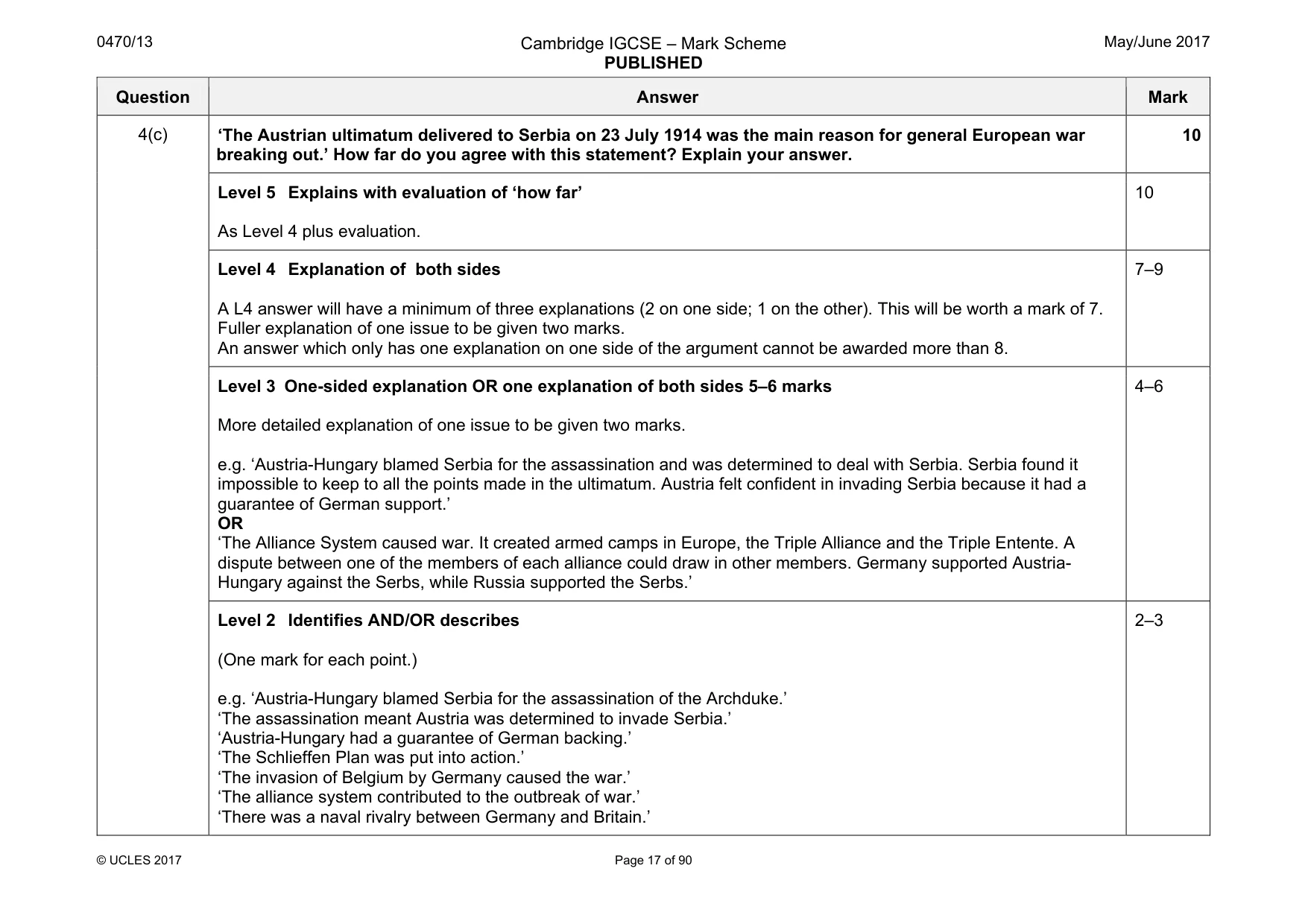
0470/13 Cambridge IGCSE – Mark Scheme PUBLISHED May/June 2017 © UCLES 2017 Page 17 of 90 Question Answer Mark 4(c) ‘The Austrian ultimatum delivered to Serbia on 23 July 1914 was the main reason for general European war breaking out.’ How far do you agree with this statement? Explain your answer. 10 Level 5 Explains with evaluation of ‘how far’ As Level 4 plus evaluation. 10 Level 4 Explanation of both sides A L4 answer will have a minimum of three explanations (2 on one side; 1 on the other). This will be worth a mark of 7. Fuller explanation of one issue to be given two marks. An answer which only has one explanation on one side of the argument cannot be awarded more than 8. 7–9 Level 3 One-sided explanation OR one explanation of both sides 5–6 marks More detailed explanation of one issue to be given two marks. e.g. ‘Austria-Hungary blamed Serbia for the assassination and was determined to deal with Serbia. Serbia found it impossible to keep to all the points made in the ultimatum. Austria felt confident in invading Serbia because it had a guarantee of German support.’ OR ‘The Alliance System caused war. It created armed camps in Europe, the Triple Alliance and the Triple Entente. A dispute between one of the members of each alliance could draw in other members. Germany supported Austria- Hungary against the Serbs, while Russia supported the Serbs.’ 4–6 Level 2 Identifies AND/OR describes (One mark for each point.) e.g. ‘Austria-Hungary blamed Serbia for the assassination of the Archduke.’ ‘The assassination meant Austria was determined to invade Serbia.’ ‘Austria-Hungary had a guarantee of German backing.’ ‘The Schlieffen Plan was put into action.’ ‘The invasion of Belgium by Germany caused the war.’ ‘The alliance system contributed to the outbreak of war.’ ‘There was a naval rivalry between Germany and Britain.’ 2–3
Mark scheme, page 18
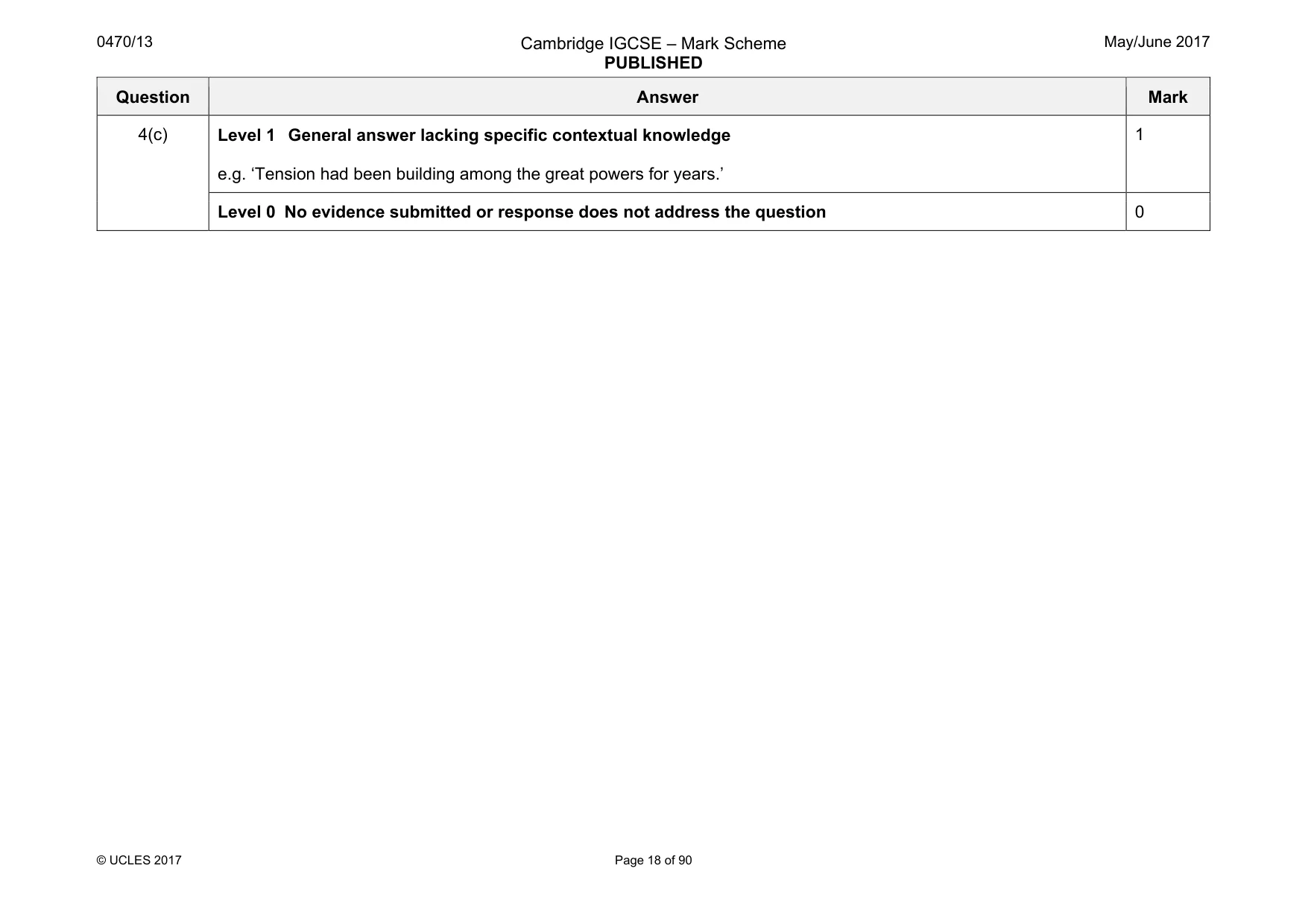
0470/13 Cambridge IGCSE – Mark Scheme PUBLISHED May/June 2017 © UCLES 2017 Page 18 of 90 Question Answer Mark 4(c) Level 1 General answer lacking specific contextual knowledge e.g. ‘Tension had been building among the great powers for years.’ 1 Level 0 No evidence submitted or response does not address the question 0
Mark scheme, page 19
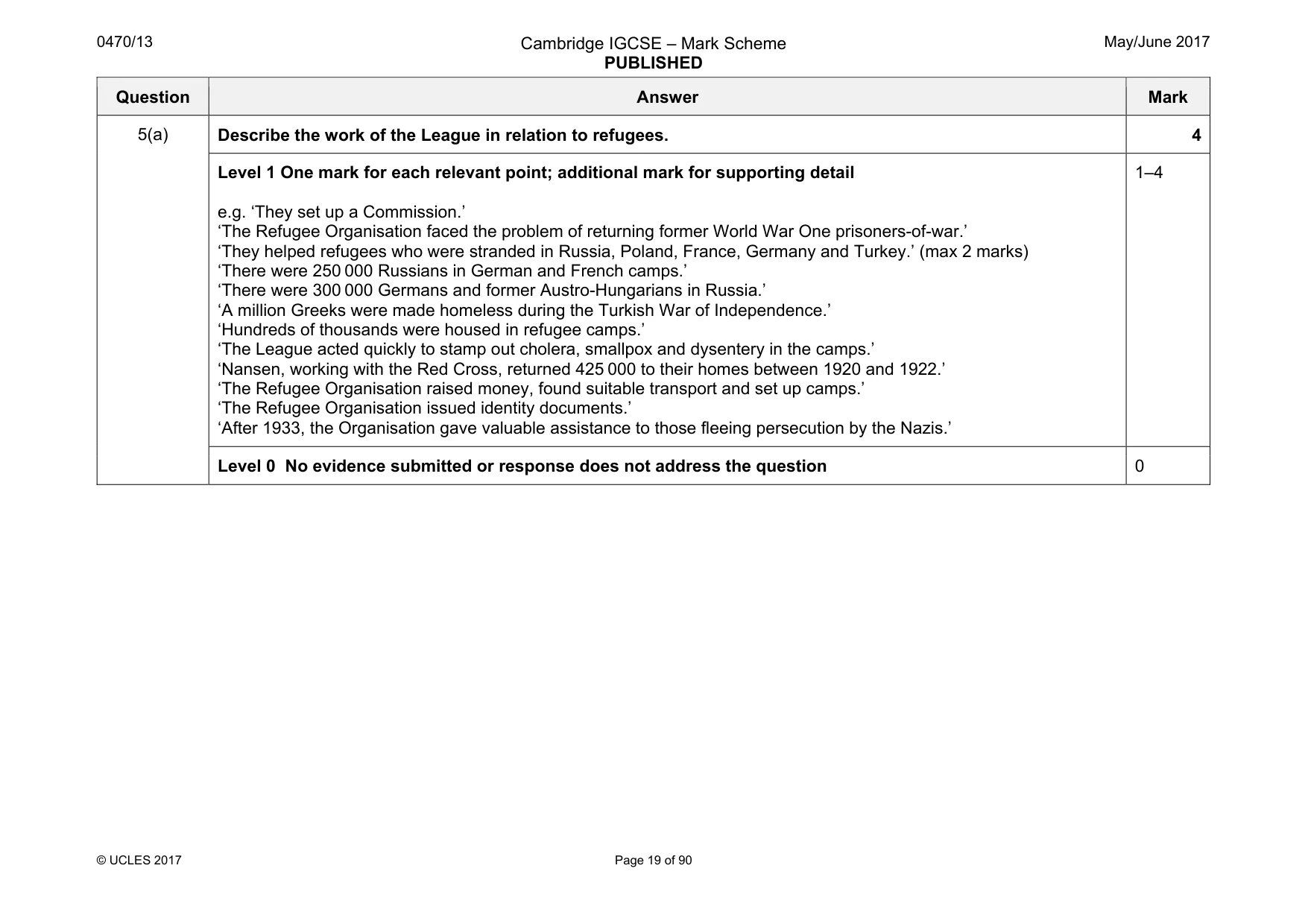
0470/13 Cambridge IGCSE – Mark Scheme PUBLISHED May/June 2017 © UCLES 2017 Page 19 of 90 Question Answer Mark 5(a) Describe the work of the League in relation to refugees. 4 Level 1 One mark for each relevant point; additional mark for supporting detail e.g. ‘They set up a Commission.’ ‘The Refugee Organisation faced the problem of returning former World War One prisoners-of-war.’ ‘They helped refugees who were stranded in Russia, Poland, France, Germany and Turkey.’ (max 2 marks) ‘There were 250 000 Russians in German and French camps.’ ‘There were 300 000 Germans and former Austro-Hungarians in Russia.’ ‘A million Greeks were made homeless during the Turkish War of Independence.’ ‘Hundreds of thousands were housed in refugee camps.’ ‘The League acted quickly to stamp out cholera, smallpox and dysentery in the camps.’ ‘Nansen, working with the Red Cross, returned 425 000 to their homes between 1920 and 1922.’ ‘The Refugee Organisation raised money, found suitable transport and set up camps.’ ‘The Refugee Organisation issued identity documents.’ ‘After 1933, the Organisation gave valuable assistance to those fleeing persecution by the Nazis.’ 1–4 Level 0 No evidence submitted or response does not address the question 0
Mark scheme, page 20
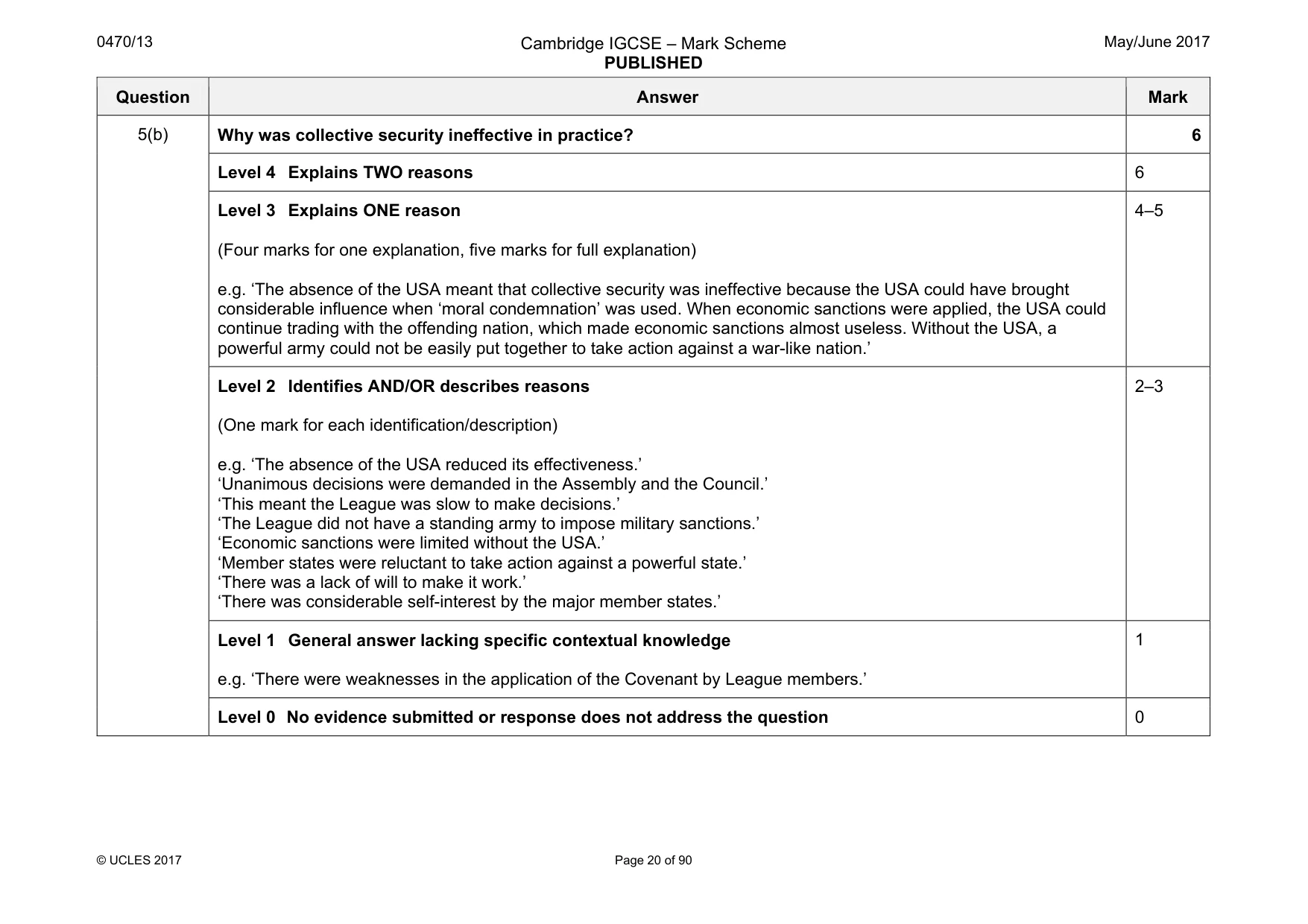
0470/13 Cambridge IGCSE – Mark Scheme PUBLISHED May/June 2017 © UCLES 2017 Page 20 of 90 Question Answer Mark 5(b) Why was collective security ineffective in practice? 6 Level 4 Explains TWO reasons 6 Level 3 Explains ONE reason (Four marks for one explanation, five marks for full explanation) e.g. ‘The absence of the USA meant that collective security was ineffective because the USA could have brought considerable influence when ‘moral condemnation’ was used. When economic sanctions were applied, the USA could continue trading with the offending nation, which made economic sanctions almost useless. Without the USA, a powerful army could not be easily put together to take action against a war-like nation.’ 4–5 Level 2 Identifies AND/OR describes reasons (One mark for each identification/description) e.g. ‘The absence of the USA reduced its effectiveness.’ ‘Unanimous decisions were demanded in the Assembly and the Council.’ ‘This meant the League was slow to make decisions.’ ‘The League did not have a standing army to impose military sanctions.’ ‘Economic sanctions were limited without the USA.’ ‘Member states were reluctant to take action against a powerful state.’ ‘There was a lack of will to make it work.’ ‘There was considerable self-interest by the major member states.’ 2–3 Level 1 General answer lacking specific contextual knowledge e.g. ‘There were weaknesses in the application of the Covenant by League members.’ 1 Level 0 No evidence submitted or response does not address the question 0
Mark scheme, page 21
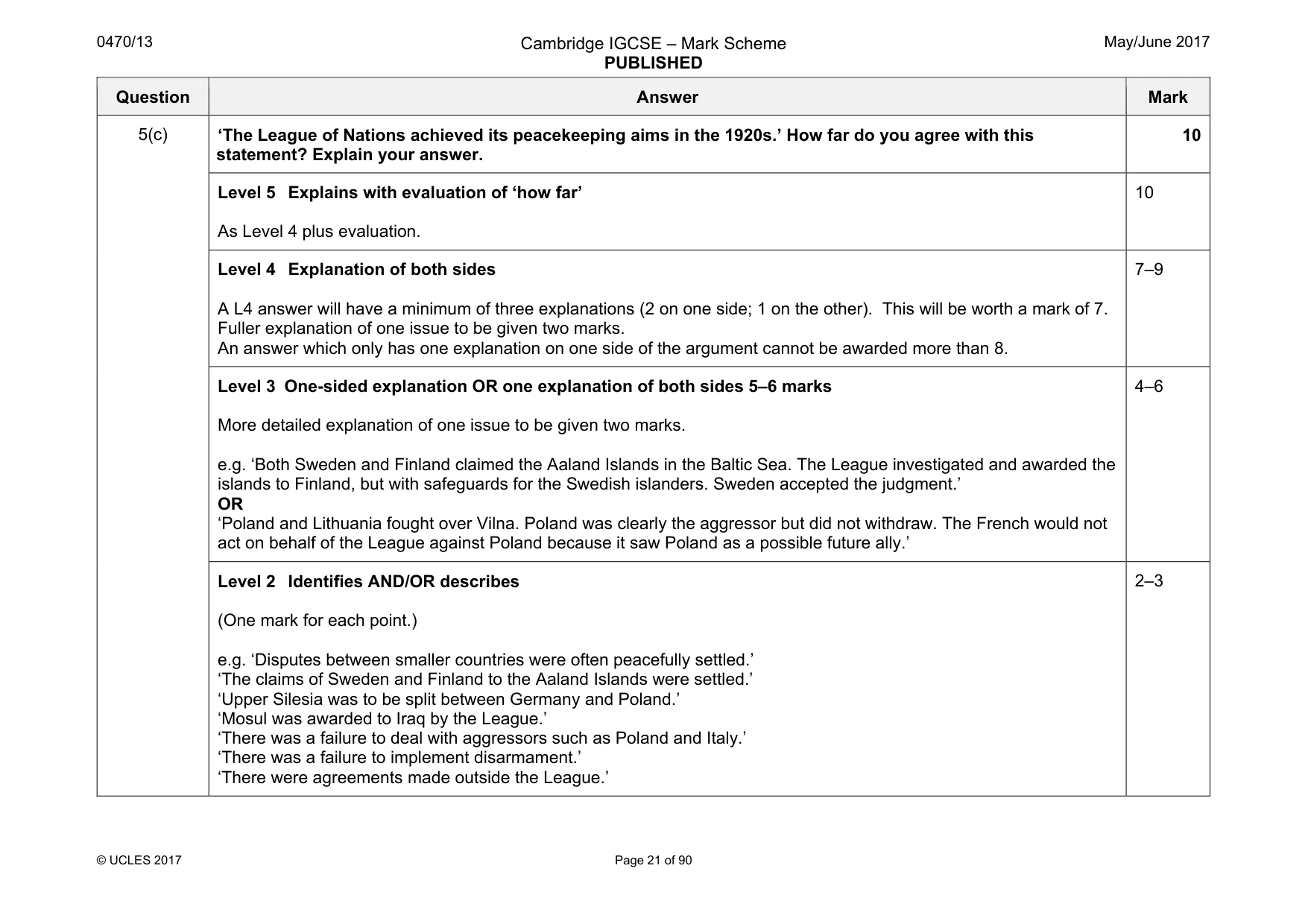
0470/13 Cambridge IGCSE – Mark Scheme PUBLISHED May/June 2017 © UCLES 2017 Page 21 of 90 Question Answer Mark 5(c) ‘The League of Nations achieved its peacekeeping aims in the 1920s.’ How far do you agree with this statement? Explain your answer. 10 Level 5 Explains with evaluation of ‘how far’ As Level 4 plus evaluation. 10 Level 4 Explanation of both sides A L4 answer will have a minimum of three explanations (2 on one side; 1 on the other). This will be worth a mark of 7. Fuller explanation of one issue to be given two marks. An answer which only has one explanation on one side of the argument cannot be awarded more than 8. 7–9 Level 3 One-sided explanation OR one explanation of both sides 5–6 marks More detailed explanation of one issue to be given two marks. e.g. ‘Both Sweden and Finland claimed the Aaland Islands in the Baltic Sea. The League investigated and awarded the islands to Finland, but with safeguards for the Swedish islanders. Sweden accepted the judgment.’ OR ‘Poland and Lithuania fought over Vilna. Poland was clearly the aggressor but did not withdraw. The French would not act on behalf of the League against Poland because it saw Poland as a possible future ally.’ 4–6 Level 2 Identifies AND/OR describes (One mark for each point.) e.g. ‘Disputes between smaller countries were often peacefully settled.’ ‘The claims of Sweden and Finland to the Aaland Islands were settled.’ ‘Upper Silesia was to be split between Germany and Poland.’ ‘Mosul was awarded to Iraq by the League.’ ‘There was a failure to deal with aggressors such as Poland and Italy.’ ‘There was a failure to implement disarmament.’ ‘There were agreements made outside the League.’ 2–3
Mark scheme, page 22
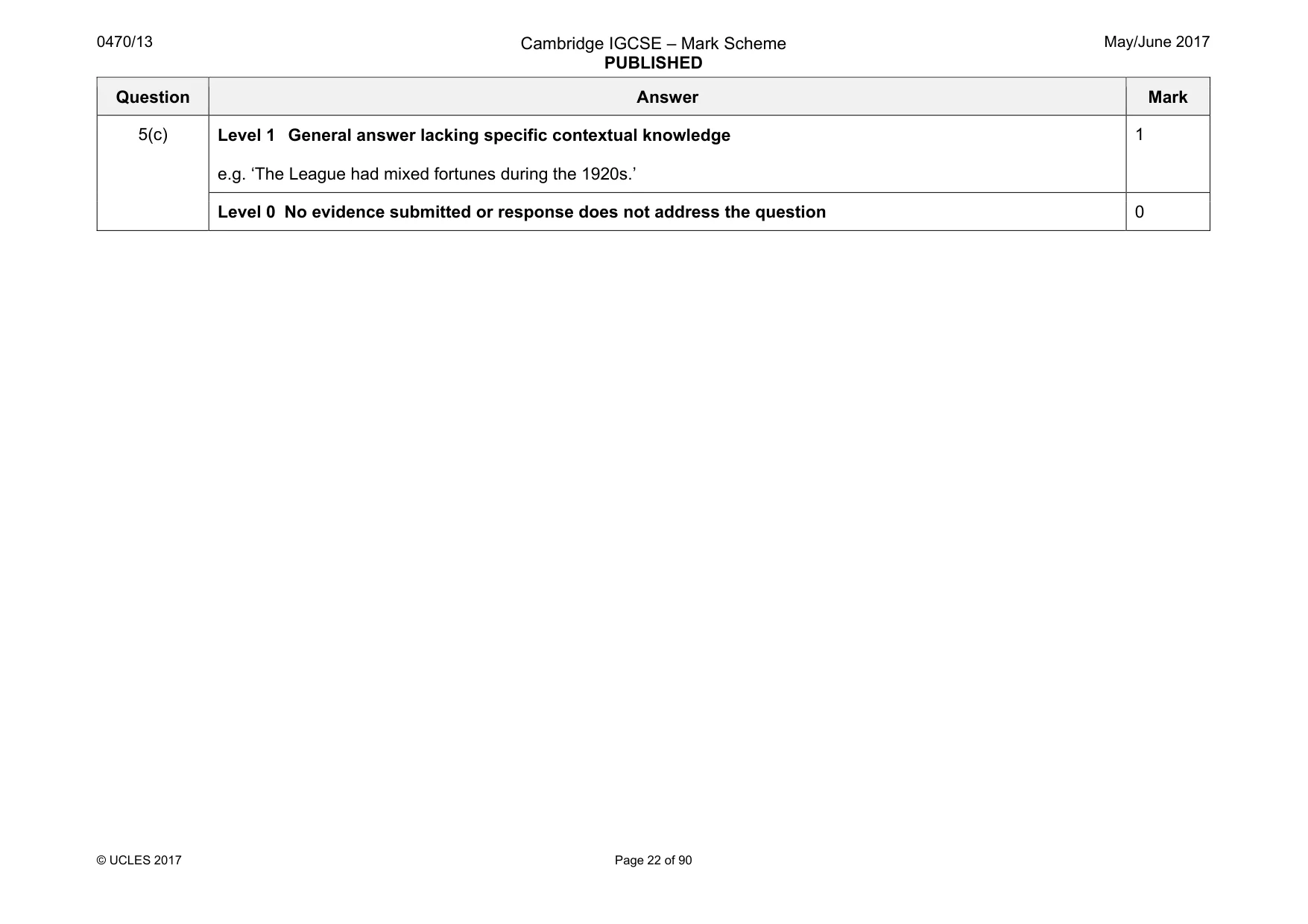
0470/13 Cambridge IGCSE – Mark Scheme PUBLISHED May/June 2017 © UCLES 2017 Page 22 of 90 Question Answer Mark 5(c) Level 1 General answer lacking specific contextual knowledge e.g. ‘The League had mixed fortunes during the 1920s.’ 1 Level 0 No evidence submitted or response does not address the question 0
Mark scheme, page 23
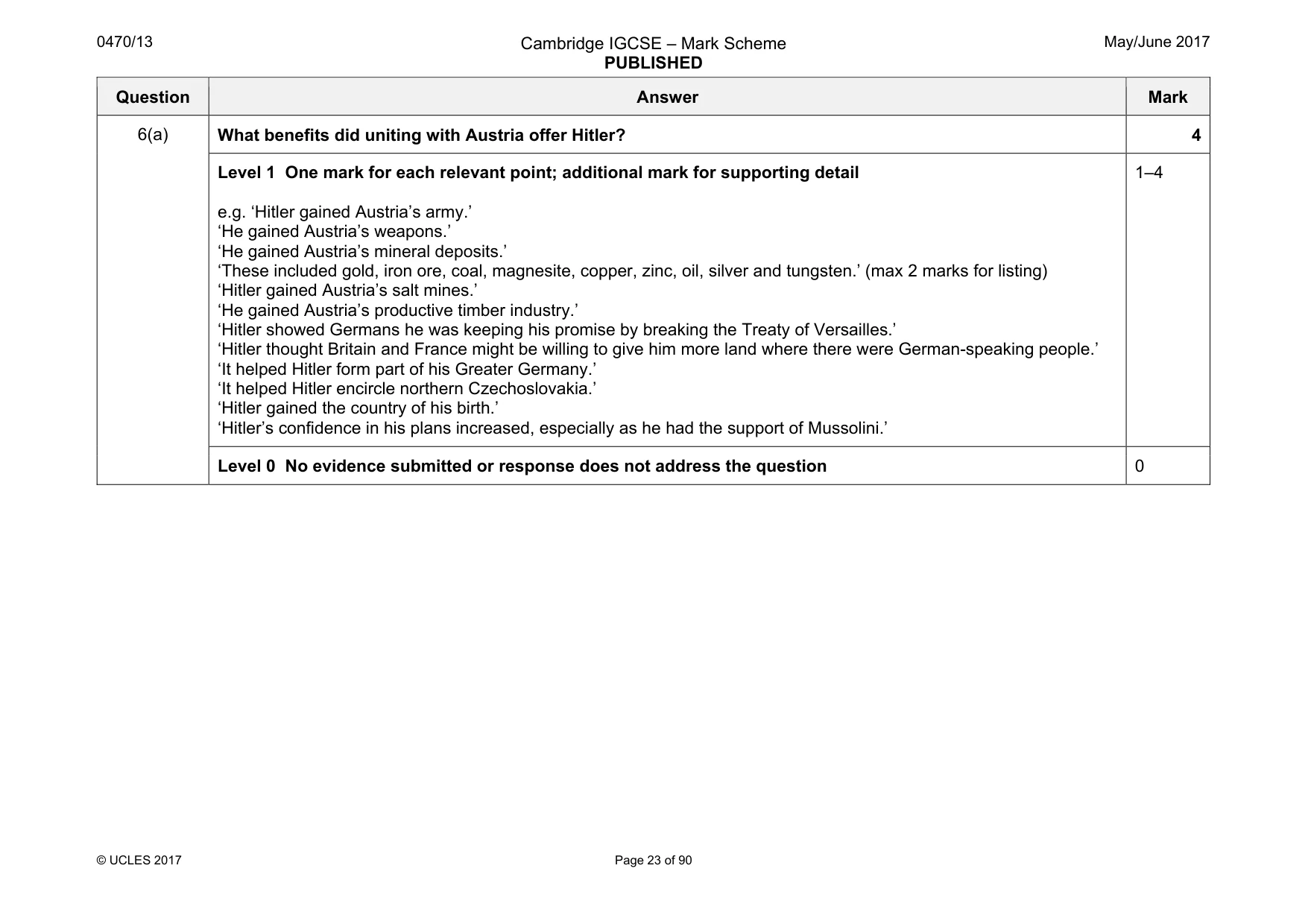
0470/13 Cambridge IGCSE – Mark Scheme PUBLISHED May/June 2017 © UCLES 2017 Page 23 of 90 Question Answer Mark 6(a) What benefits did uniting with Austria offer Hitler? 4 Level 1 One mark for each relevant point; additional mark for supporting detail e.g. ‘Hitler gained Austria’s army.’ ‘He gained Austria’s weapons.’ ‘He gained Austria’s mineral deposits.’ ‘These included gold, iron ore, coal, magnesite, copper, zinc, oil, silver and tungsten.’ (max 2 marks for listing) ‘Hitler gained Austria’s salt mines.’ ‘He gained Austria’s productive timber industry.’ ‘Hitler showed Germans he was keeping his promise by breaking the Treaty of Versailles.’ ‘Hitler thought Britain and France might be willing to give him more land where there were German-speaking people.’ ‘It helped Hitler form part of his Greater Germany.’ ‘It helped Hitler encircle northern Czechoslovakia.’ ‘Hitler gained the country of his birth.’ ‘Hitler’s confidence in his plans increased, especially as he had the support of Mussolini.’ 1–4 Level 0 No evidence submitted or response does not address the question 0
Mark scheme, page 24
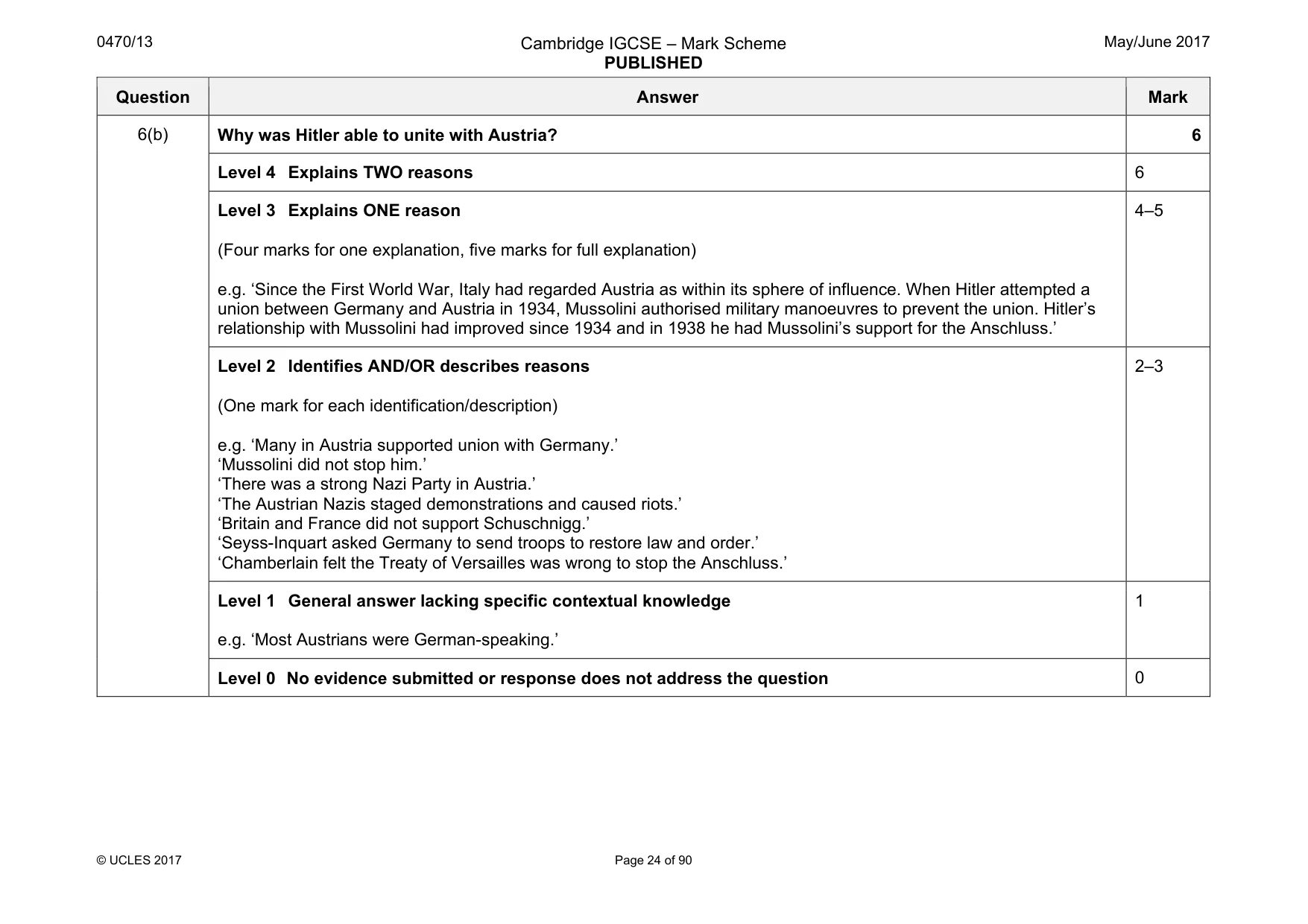
0470/13 Cambridge IGCSE – Mark Scheme PUBLISHED May/June 2017 © UCLES 2017 Page 24 of 90 Question Answer Mark 6(b) Why was Hitler able to unite with Austria? 6 Level 4 Explains TWO reasons 6 Level 3 Explains ONE reason (Four marks for one explanation, five marks for full explanation) e.g. ‘Since the First World War, Italy had regarded Austria as within its sphere of influence. When Hitler attempted a union between Germany and Austria in 1934, Mussolini authorised military manoeuvres to prevent the union. Hitler’s relationship with Mussolini had improved since 1934 and in 1938 he had Mussolini’s support for the Anschluss.’ 4–5 Level 2 Identifies AND/OR describes reasons (One mark for each identification/description) e.g. ‘Many in Austria supported union with Germany.’ ‘Mussolini did not stop him.’ ‘There was a strong Nazi Party in Austria.’ ‘The Austrian Nazis staged demonstrations and caused riots.’ ‘Britain and France did not support Schuschnigg.’ ‘Seyss-Inquart asked Germany to send troops to restore law and order.’ ‘Chamberlain felt the Treaty of Versailles was wrong to stop the Anschluss.’ 2–3 Level 1 General answer lacking specific contextual knowledge e.g. ‘Most Austrians were German-speaking.’ 1 Level 0 No evidence submitted or response does not address the question 0
Mark scheme, page 25
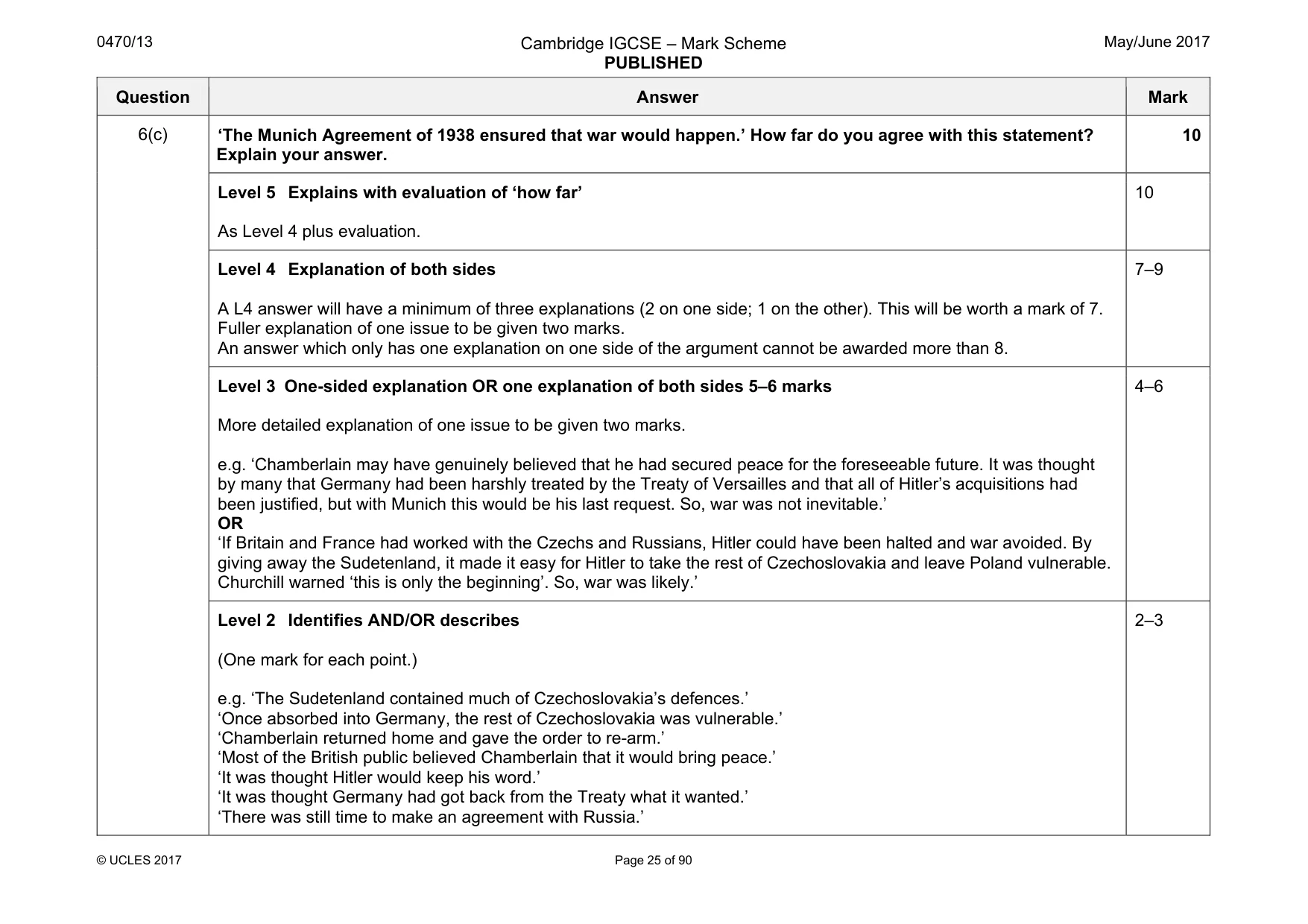
0470/13 Cambridge IGCSE – Mark Scheme PUBLISHED May/June 2017 © UCLES 2017 Page 25 of 90 Question Answer Mark 6(c) ‘The Munich Agreement of 1938 ensured that war would happen.’ How far do you agree with this statement? Explain your answer. 10 Level 5 Explains with evaluation of ‘how far’ As Level 4 plus evaluation. 10 Level 4 Explanation of both sides A L4 answer will have a minimum of three explanations (2 on one side; 1 on the other). This will be worth a mark of 7. Fuller explanation of one issue to be given two marks. An answer which only has one explanation on one side of the argument cannot be awarded more than 8. 7–9 Level 3 One-sided explanation OR one explanation of both sides 5–6 marks More detailed explanation of one issue to be given two marks. e.g. ‘Chamberlain may have genuinely believed that he had secured peace for the foreseeable future. It was thought by many that Germany had been harshly treated by the Treaty of Versailles and that all of Hitler’s acquisitions had been justified, but with Munich this would be his last request. So, war was not inevitable.’ OR ‘If Britain and France had worked with the Czechs and Russians, Hitler could have been halted and war avoided. By giving away the Sudetenland, it made it easy for Hitler to take the rest of Czechoslovakia and leave Poland vulnerable. Churchill warned ‘this is only the beginning’. So, war was likely.’ 4–6 Level 2 Identifies AND/OR describes (One mark for each point.) e.g. ‘The Sudetenland contained much of Czechoslovakia’s defences.’ ‘Once absorbed into Germany, the rest of Czechoslovakia was vulnerable.’ ‘Chamberlain returned home and gave the order to re-arm.’ ‘Most of the British public believed Chamberlain that it would bring peace.’ ‘It was thought Hitler would keep his word.’ ‘It was thought Germany had got back from the Treaty what it wanted.’ ‘There was still time to make an agreement with Russia.’ 2–3
Mark scheme, page 26
0470/13 Cambridge IGCSE – Mark Scheme PUBLISHED May/June 2017 © UCLES 2017 Page 26 of 90 Question Answer Mark 6(c) Level 1 General answer lacking specific contextual knowledge e.g. ‘War was likely, but with Russian support, it could be difficult for Hitler.’ 1 Level 0 No evidence submitted or response does not address the question 0
Mark scheme, page 27
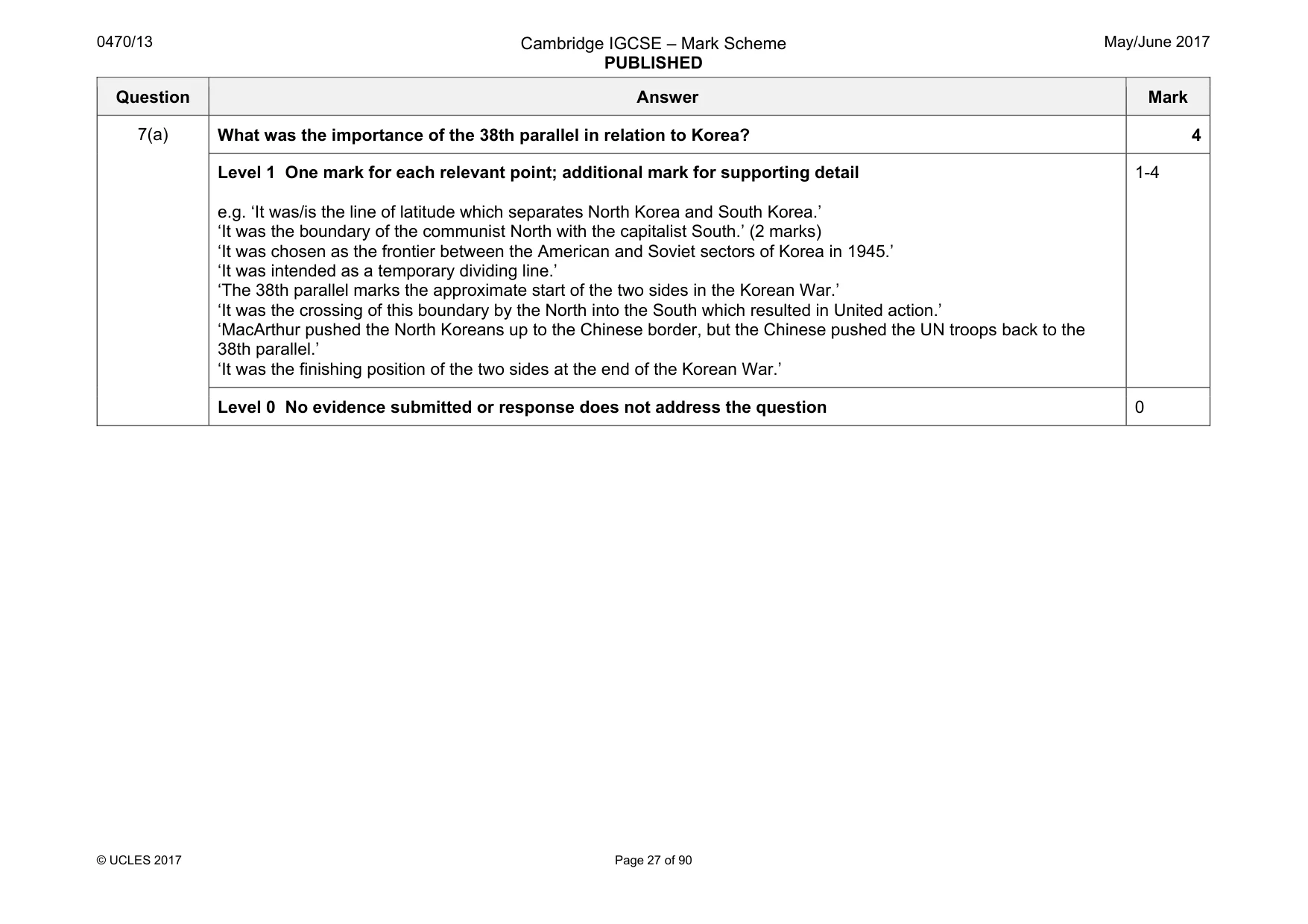
0470/13 Cambridge IGCSE – Mark Scheme PUBLISHED May/June 2017 © UCLES 2017 Page 27 of 90 Question Answer Mark 7(a) What was the importance of the 38th parallel in relation to Korea? 4 Level 1 One mark for each relevant point; additional mark for supporting detail e.g. ‘It was/is the line of latitude which separates North Korea and South Korea.’ ‘It was the boundary of the communist North with the capitalist South.’ (2 marks) ‘It was chosen as the frontier between the American and Soviet sectors of Korea in 1945.’ ‘It was intended as a temporary dividing line.’ ‘The 38th parallel marks the approximate start of the two sides in the Korean War.’ ‘It was the crossing of this boundary by the North into the South which resulted in United action.’ ‘MacArthur pushed the North Koreans up to the Chinese border, but the Chinese pushed the UN troops back to the 38th parallel.’ ‘It was the finishing position of the two sides at the end of the Korean War.’ 1-4 Level 0 No evidence submitted or response does not address the question 0
Mark scheme, page 28
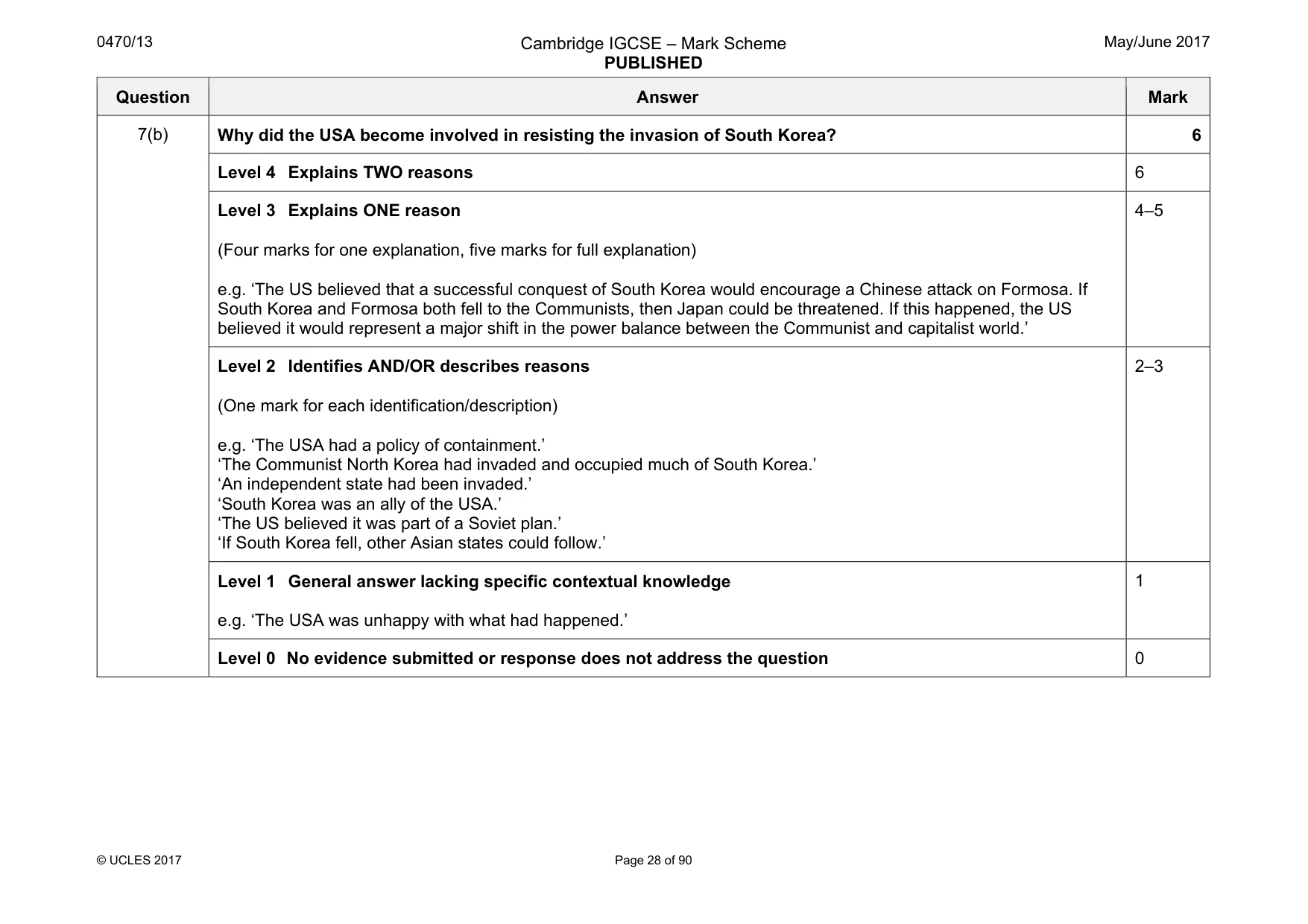
0470/13 Cambridge IGCSE – Mark Scheme PUBLISHED May/June 2017 © UCLES 2017 Page 28 of 90 Question Answer Mark 7(b) Why did the USA become involved in resisting the invasion of South Korea? 6 Level 4 Explains TWO reasons 6 Level 3 Explains ONE reason (Four marks for one explanation, five marks for full explanation) e.g. ‘The US believed that a successful conquest of South Korea would encourage a Chinese attack on Formosa. If South Korea and Formosa both fell to the Communists, then Japan could be threatened. If this happened, the US believed it would represent a major shift in the power balance between the Communist and capitalist world.’ 4–5 Level 2 Identifies AND/OR describes reasons (One mark for each identification/description) e.g. ‘The USA had a policy of containment.’ ‘The Communist North Korea had invaded and occupied much of South Korea.’ ‘An independent state had been invaded.’ ‘South Korea was an ally of the USA.’ ‘The US believed it was part of a Soviet plan.’ ‘If South Korea fell, other Asian states could follow.’ 2–3 Level 1 General answer lacking specific contextual knowledge e.g. ‘The USA was unhappy with what had happened.’ 1 Level 0 No evidence submitted or response does not address the question 0
Mark scheme, page 29
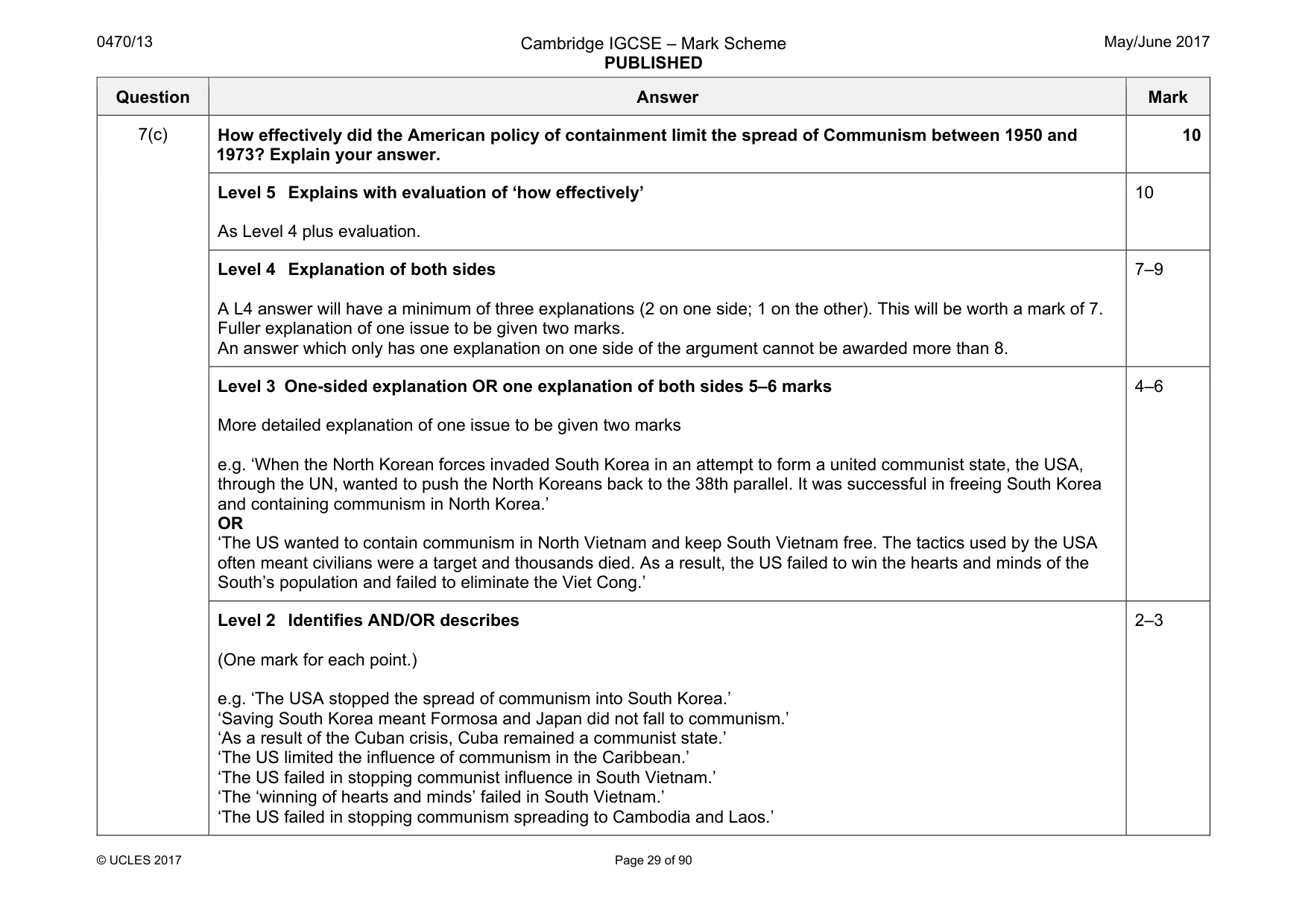
0470/13 Cambridge IGCSE – Mark Scheme PUBLISHED May/June 2017 © UCLES 2017 Page 29 of 90 Question Answer Mark 7(c) How effectively did the American policy of containment limit the spread of Communism between 1950 and 1973? Explain your answer. 10 Level 5 Explains with evaluation of ‘how effectively’ As Level 4 plus evaluation. 10 Level 4 Explanation of both sides A L4 answer will have a minimum of three explanations (2 on one side; 1 on the other). This will be worth a mark of 7. Fuller explanation of one issue to be given two marks. An answer which only has one explanation on one side of the argument cannot be awarded more than 8. 7–9 Level 3 One-sided explanation OR one explanation of both sides 5–6 marks More detailed explanation of one issue to be given two marks e.g. ‘When the North Korean forces invaded South Korea in an attempt to form a united communist state, the USA, through the UN, wanted to push the North Koreans back to the 38th parallel. It was successful in freeing South Korea and containing communism in North Korea.’ OR ‘The US wanted to contain communism in North Vietnam and keep South Vietnam free. The tactics used by the USA often meant civilians were a target and thousands died. As a result, the US failed to win the hearts and minds of the South’s population and failed to eliminate the Viet Cong.’ 4–6 Level 2 Identifies AND/OR describes (One mark for each point.) e.g. ‘The USA stopped the spread of communism into South Korea.’ ‘Saving South Korea meant Formosa and Japan did not fall to communism.’ ‘As a result of the Cuban crisis, Cuba remained a communist state.’ ‘The US limited the influence of communism in the Caribbean.’ ‘The US failed in stopping communist influence in South Vietnam.’ ‘The ‘winning of hearts and minds’ failed in South Vietnam.’ ‘The US failed in stopping communism spreading to Cambodia and Laos.’ 2–3
Mark scheme, page 30
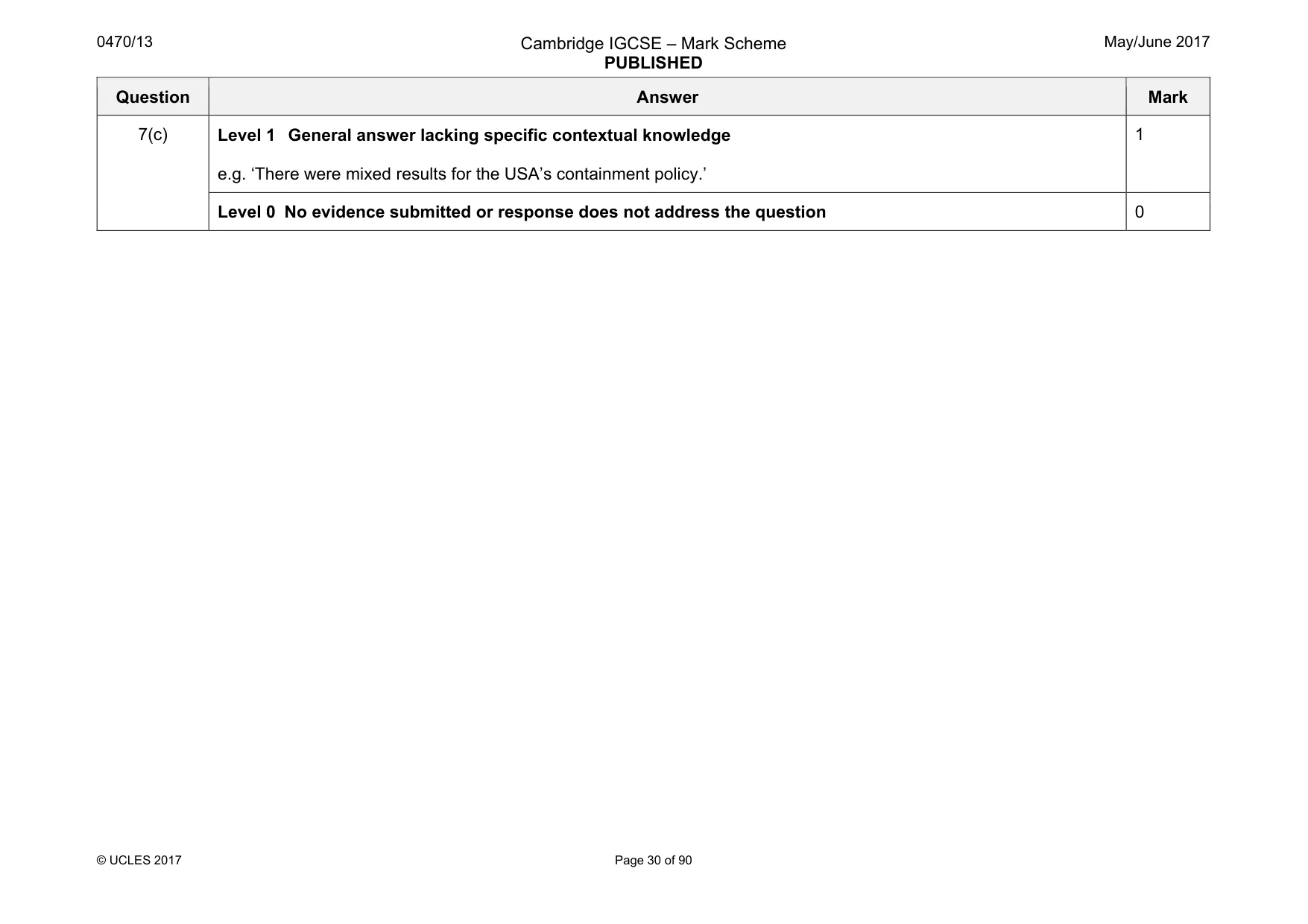
0470/13 Cambridge IGCSE – Mark Scheme PUBLISHED May/June 2017 © UCLES 2017 Page 30 of 90 Question Answer Mark 7(c) Level 1 General answer lacking specific contextual knowledge e.g. ‘There were mixed results for the USA’s containment policy.’ 1 Level 0 No evidence submitted or response does not address the question 0
Mark scheme, page 31
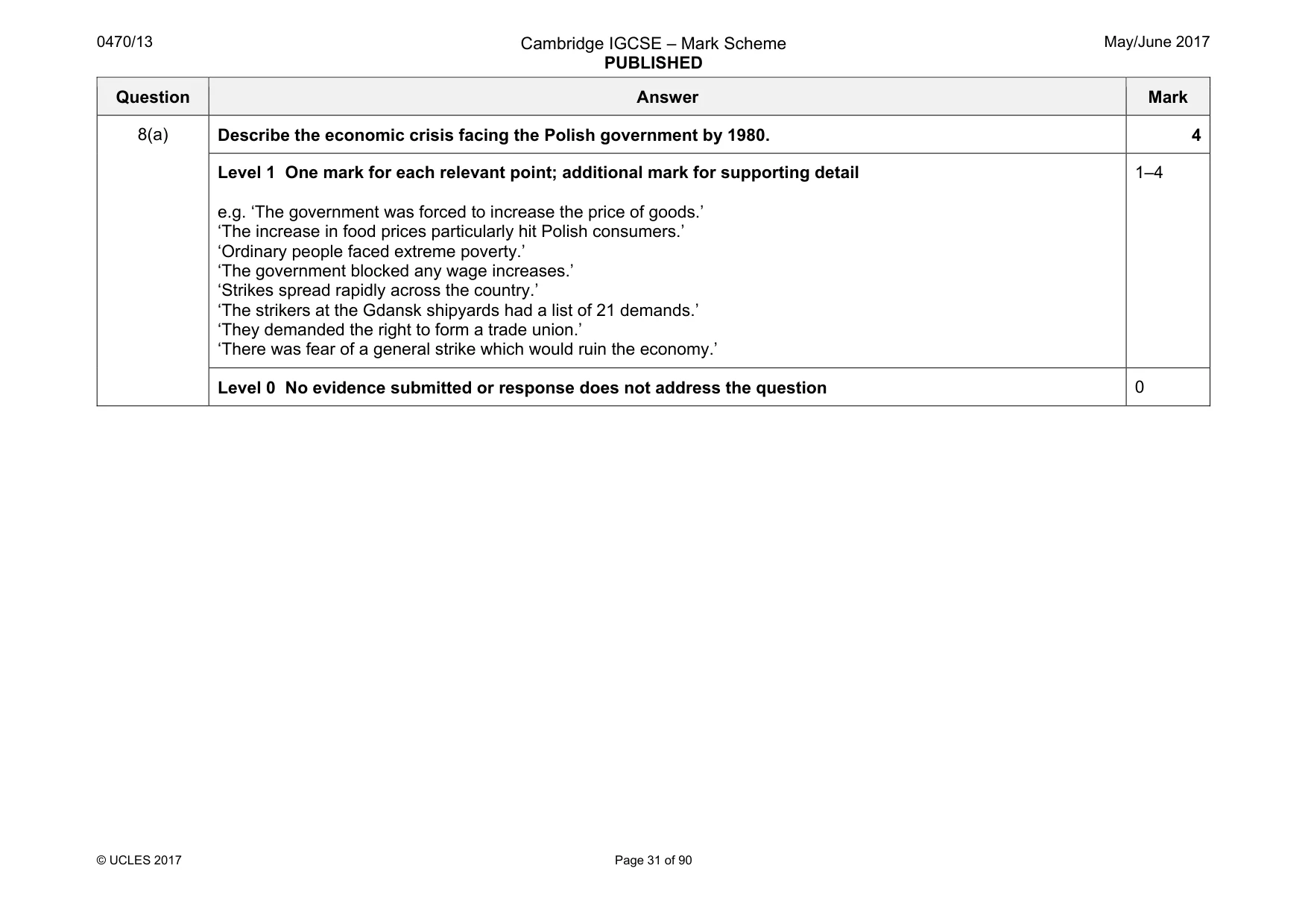
0470/13 Cambridge IGCSE – Mark Scheme PUBLISHED May/June 2017 © UCLES 2017 Page 31 of 90 Question Answer Mark 8(a) Describe the economic crisis facing the Polish government by 1980. 4 Level 1 One mark for each relevant point; additional mark for supporting detail e.g. ‘The government was forced to increase the price of goods.’ ‘The increase in food prices particularly hit Polish consumers.’ ‘Ordinary people faced extreme poverty.’ ‘The government blocked any wage increases.’ ‘Strikes spread rapidly across the country.’ ‘The strikers at the Gdansk shipyards had a list of 21 demands.’ ‘They demanded the right to form a trade union.’ ‘There was fear of a general strike which would ruin the economy.’ 1–4 Level 0 No evidence submitted or response does not address the question 0
Mark scheme, page 32
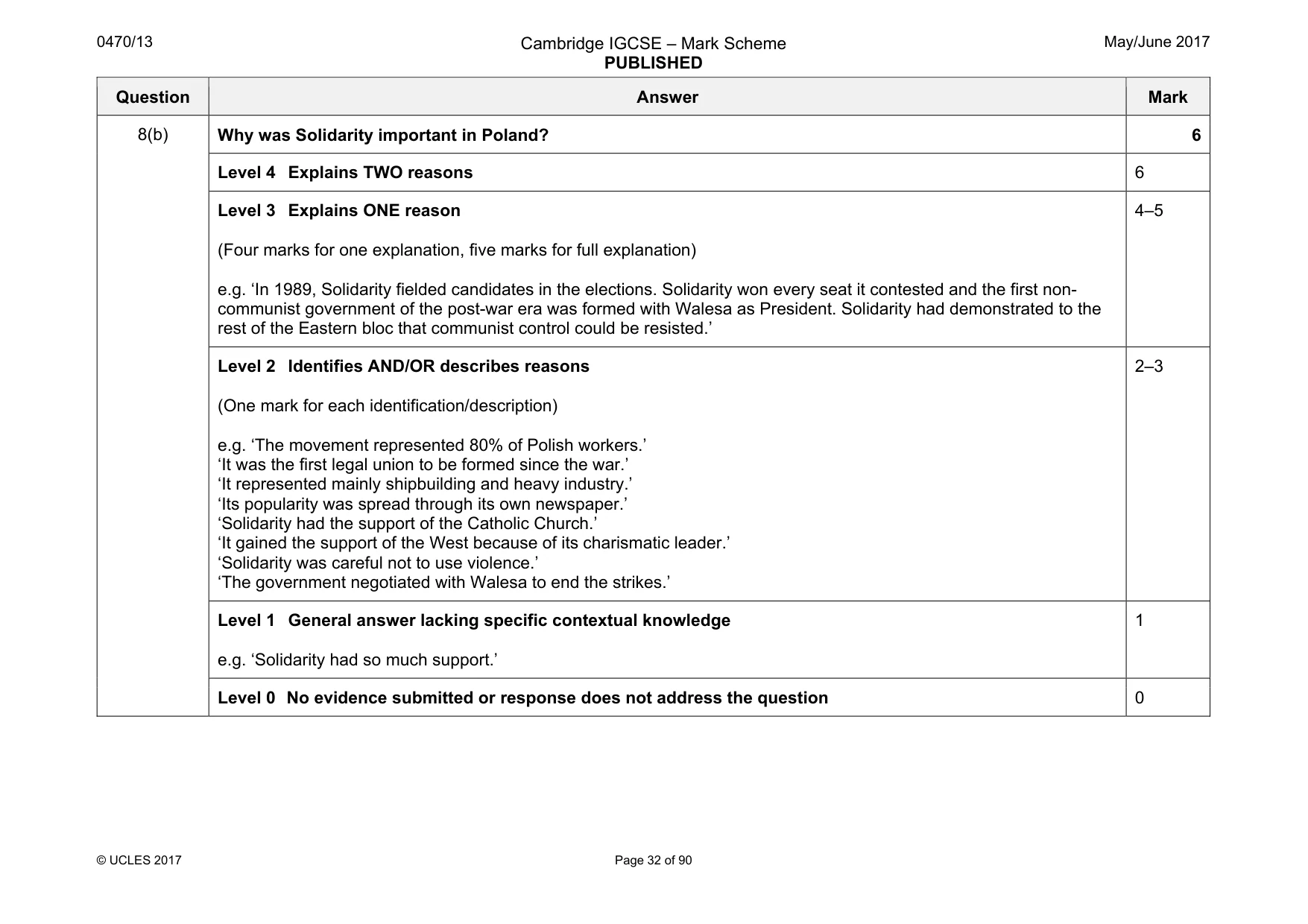
0470/13 Cambridge IGCSE – Mark Scheme PUBLISHED May/June 2017 © UCLES 2017 Page 32 of 90 Question Answer Mark 8(b) Why was Solidarity important in Poland? 6 Level 4 Explains TWO reasons 6 Level 3 Explains ONE reason (Four marks for one explanation, five marks for full explanation) e.g. ‘In 1989, Solidarity fielded candidates in the elections. Solidarity won every seat it contested and the first non- communist government of the post-war era was formed with Walesa as President. Solidarity had demonstrated to the rest of the Eastern bloc that communist control could be resisted.’ 4–5 Level 2 Identifies AND/OR describes reasons (One mark for each identification/description) e.g. ‘The movement represented 80% of Polish workers.’ ‘It was the first legal union to be formed since the war.’ ‘It represented mainly shipbuilding and heavy industry.’ ‘Its popularity was spread through its own newspaper.’ ‘Solidarity had the support of the Catholic Church.’ ‘It gained the support of the West because of its charismatic leader.’ ‘Solidarity was careful not to use violence.’ ‘The government negotiated with Walesa to end the strikes.’ 2–3 Level 1 General answer lacking specific contextual knowledge e.g. ‘Solidarity had so much support.’ 1 Level 0 No evidence submitted or response does not address the question 0
Mark scheme, page 33
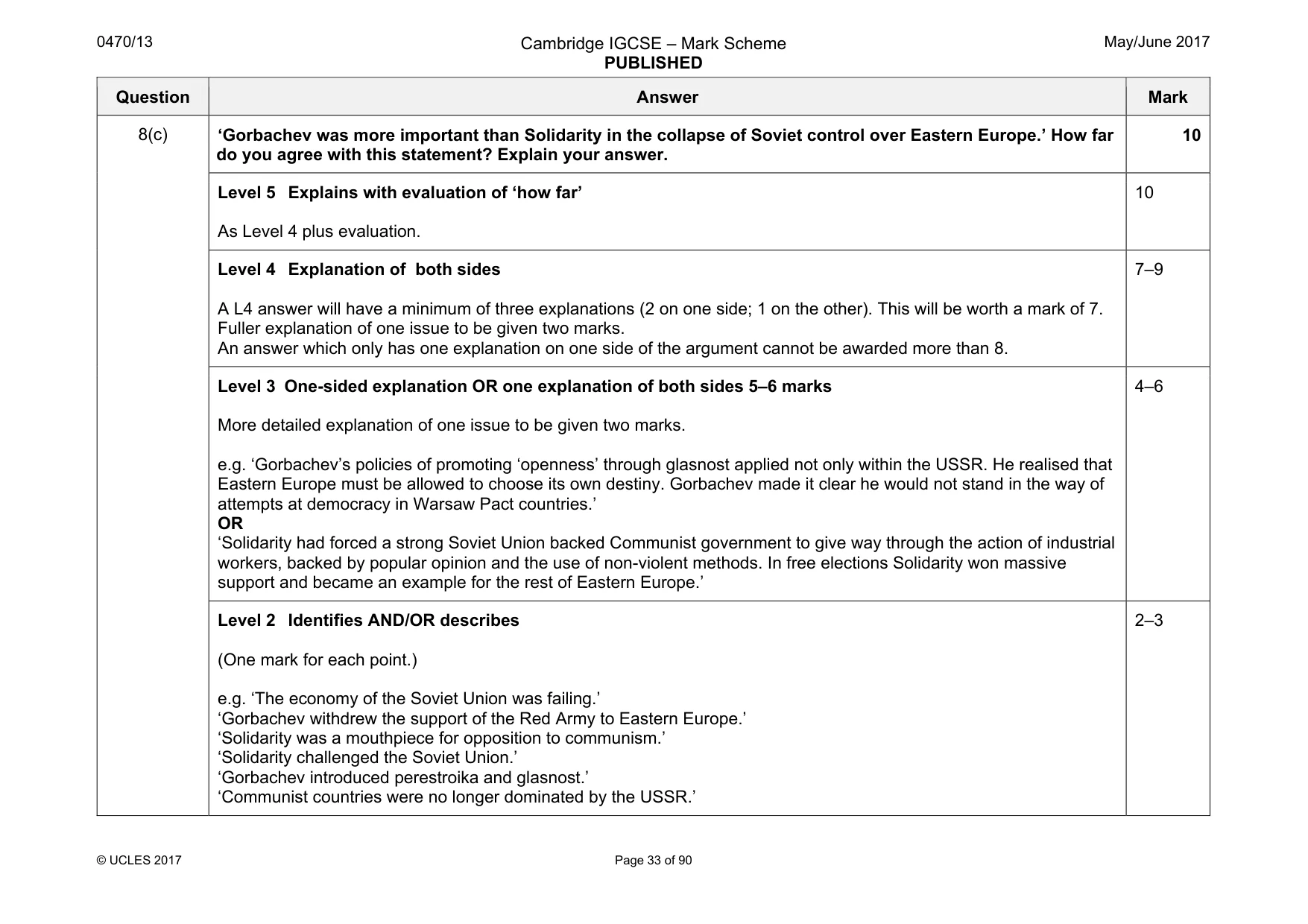
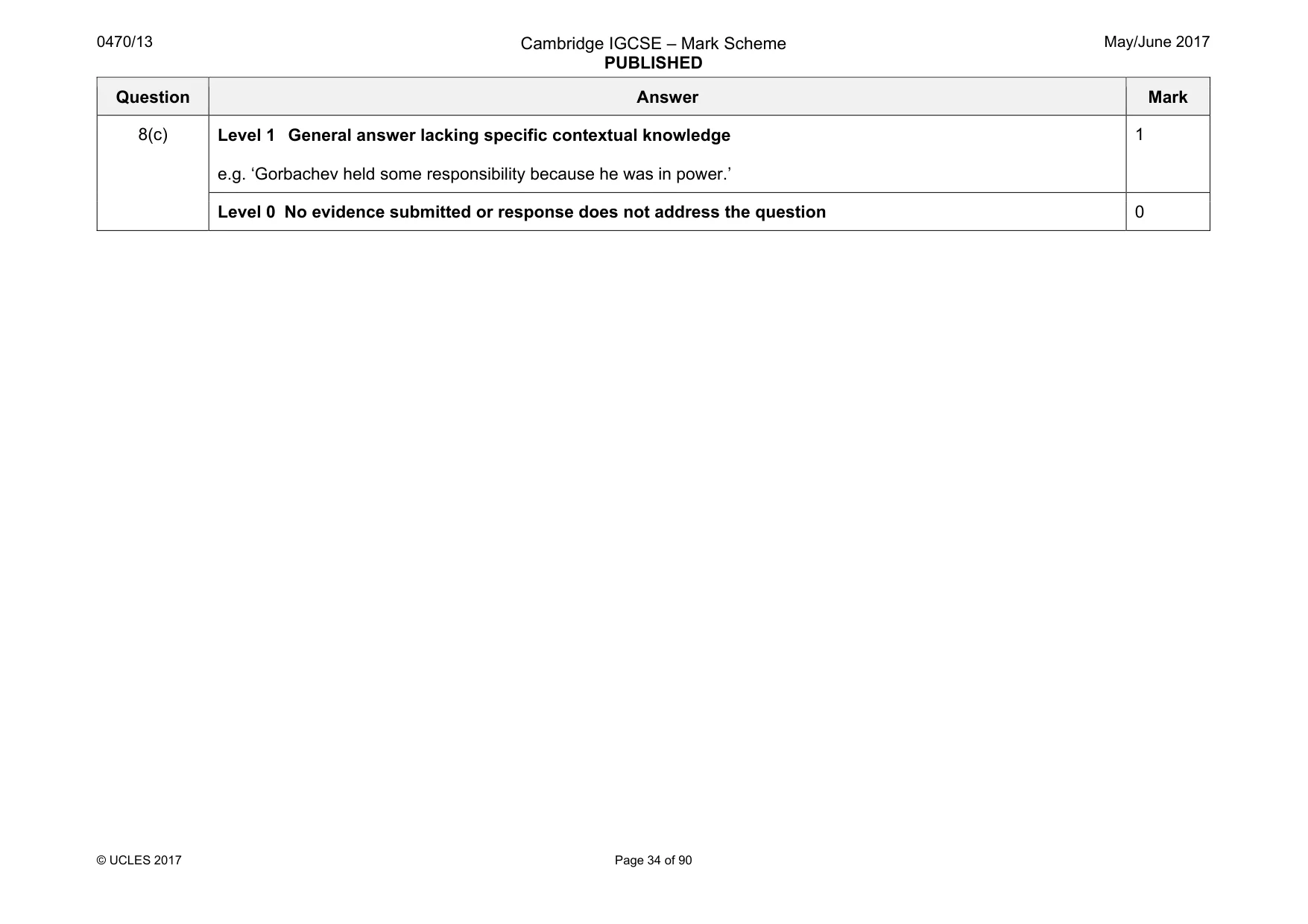
0470/13 Cambridge IGCSE – Mark Scheme PUBLISHED May/June 2017 © UCLES 2017 Page 33 of 90 Question Answer Mark 8(c) ‘Gorbachev was more important than Solidarity in the collapse of Soviet control over Eastern Europe.’ How far do you agree with this statement? Explain your answer. 10 Level 5 Explains with evaluation of ‘how far’ As Level 4 plus evaluation. 10 Level 4 Explanation of both sides A L4 answer will have a minimum of three explanations (2 on one side; 1 on the other). This will be worth a mark of 7. Fuller explanation of one issue to be given two marks. An answer which only has one explanation on one side of the argument cannot be awarded more than 8. 7–9 Level 3 One-sided explanation OR one explanation of both sides 5–6 marks More detailed explanation of one issue to be given two marks. e.g. ‘Gorbachev’s policies of promoting ‘openness’ through glasnost applied not only within the USSR. He realised that Eastern Europe must be allowed to choose its own destiny. Gorbachev made it clear he would not stand in the way of attempts at democracy in Warsaw Pact countries.’ OR ‘Solidarity had forced a strong Soviet Union backed Communist government to give way through the action of industrial workers, backed by popular opinion and the use of non-violent methods. In free elections Solidarity won massive support and became an example for the rest of Eastern Europe.’ 4–6 Level 2 Identifies AND/OR describes (One mark for each point.) e.g. ‘The economy of the Soviet Union was failing.’ ‘Gorbachev withdrew the support of the Red Army to Eastern Europe.’ ‘Solidarity was a mouthpiece for opposition to communism.’ ‘Solidarity challenged the Soviet Union.’ ‘Gorbachev introduced perestroika and glasnost.’ ‘Communist countries were no longer dominated by the USSR.’ 2–3
Mark scheme, page 34
0470/13 Cambridge IGCSE – Mark Scheme PUBLISHED May/June 2017 © UCLES 2017 Page 34 of 90 Question Answer Mark 8(c) Level 1 General answer lacking specific contextual knowledge e.g. ‘Gorbachev held some responsibility because he was in power.’ 1 Level 0 No evidence submitted or response does not address the question 0
Mark scheme, page 35
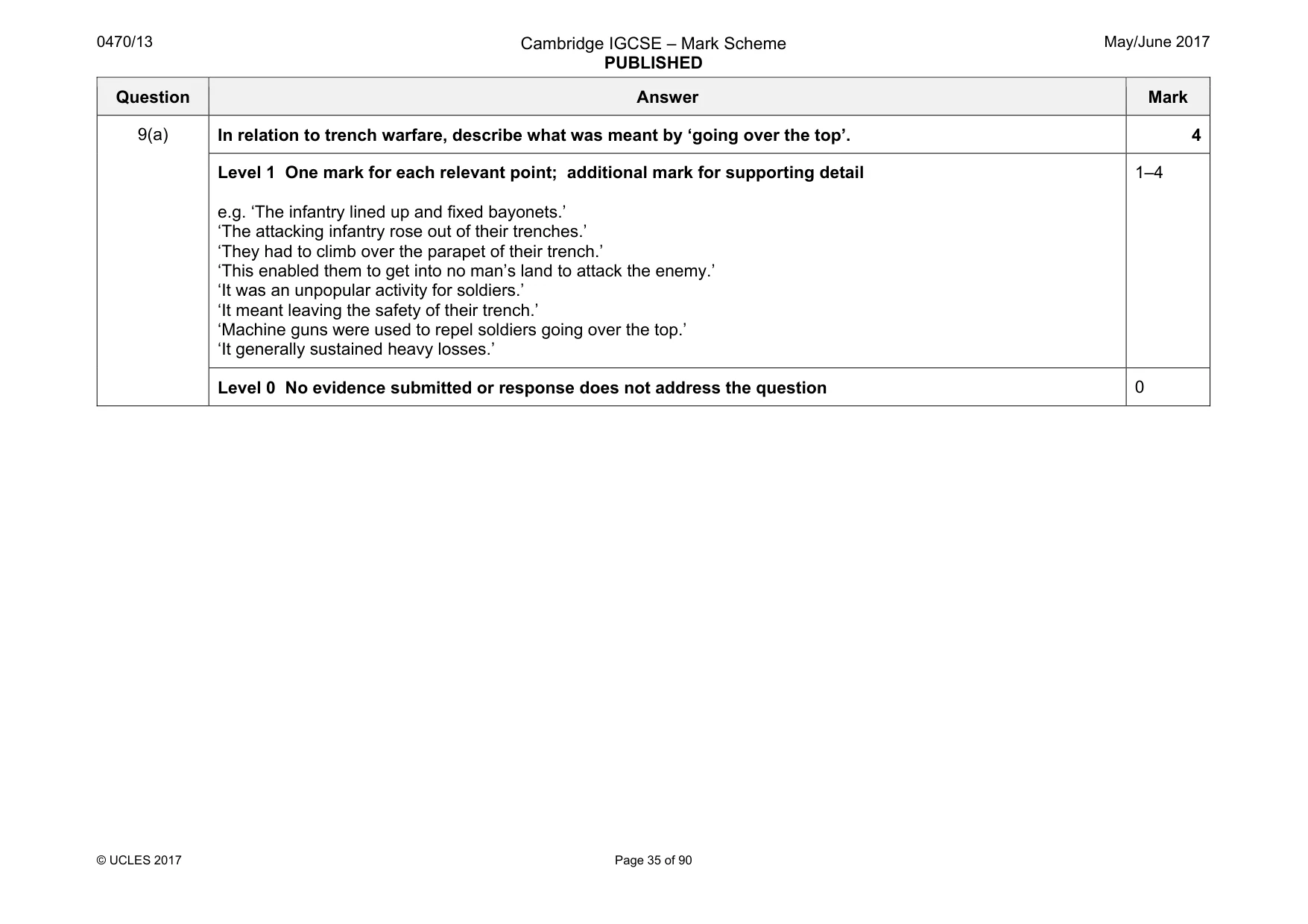
0470/13 Cambridge IGCSE – Mark Scheme PUBLISHED May/June 2017 © UCLES 2017 Page 35 of 90 Question Answer Mark 9(a) In relation to trench warfare, describe what was meant by ‘going over the top’. 4 Level 1 One mark for each relevant point; additional mark for supporting detail e.g. ‘The infantry lined up and fixed bayonets.’ ‘The attacking infantry rose out of their trenches.’ ‘They had to climb over the parapet of their trench.’ ‘This enabled them to get into no man’s land to attack the enemy.’ ‘It was an unpopular activity for soldiers.’ ‘It meant leaving the safety of their trench.’ ‘Machine guns were used to repel soldiers going over the top.’ ‘It generally sustained heavy losses.’ 1–4 Level 0 No evidence submitted or response does not address the question 0
Mark scheme, page 36
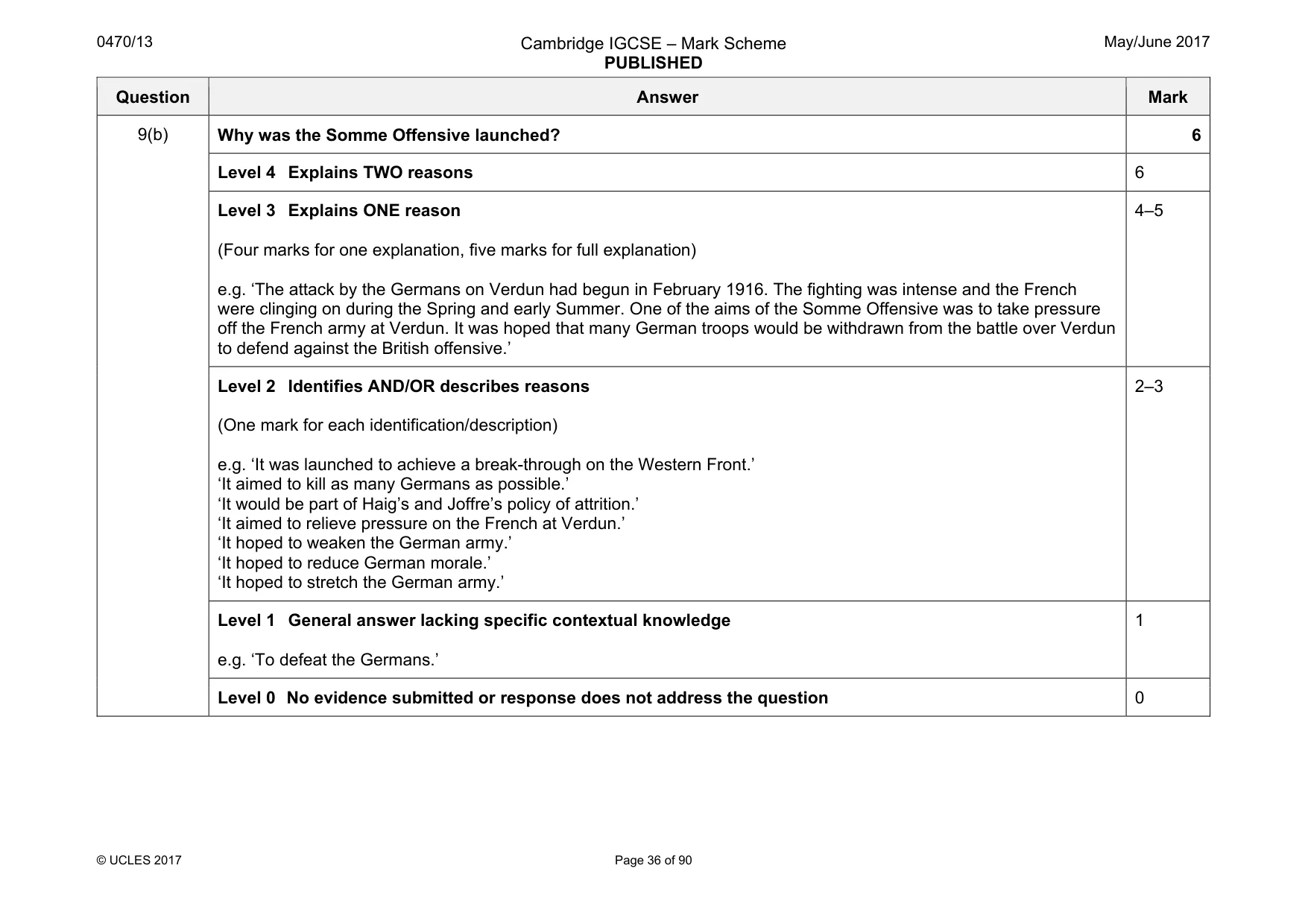
0470/13 Cambridge IGCSE – Mark Scheme PUBLISHED May/June 2017 © UCLES 2017 Page 36 of 90 Question Answer Mark 9(b) Why was the Somme Offensive launched? 6 Level 4 Explains TWO reasons 6 Level 3 Explains ONE reason (Four marks for one explanation, five marks for full explanation) e.g. ‘The attack by the Germans on Verdun had begun in February 1916. The fighting was intense and the French were clinging on during the Spring and early Summer. One of the aims of the Somme Offensive was to take pressure off the French army at Verdun. It was hoped that many German troops would be withdrawn from the battle over Verdun to defend against the British offensive.’ 4–5 Level 2 Identifies AND/OR describes reasons (One mark for each identification/description) e.g. ‘It was launched to achieve a break-through on the Western Front.’ ‘It aimed to kill as many Germans as possible.’ ‘It would be part of Haig’s and Joffre’s policy of attrition.’ ‘It aimed to relieve pressure on the French at Verdun.’ ‘It hoped to weaken the German army.’ ‘It hoped to reduce German morale.’ ‘It hoped to stretch the German army.’ 2–3 Level 1 General answer lacking specific contextual knowledge e.g. ‘To defeat the Germans.’ 1 Level 0 No evidence submitted or response does not address the question 0
Mark scheme, page 37
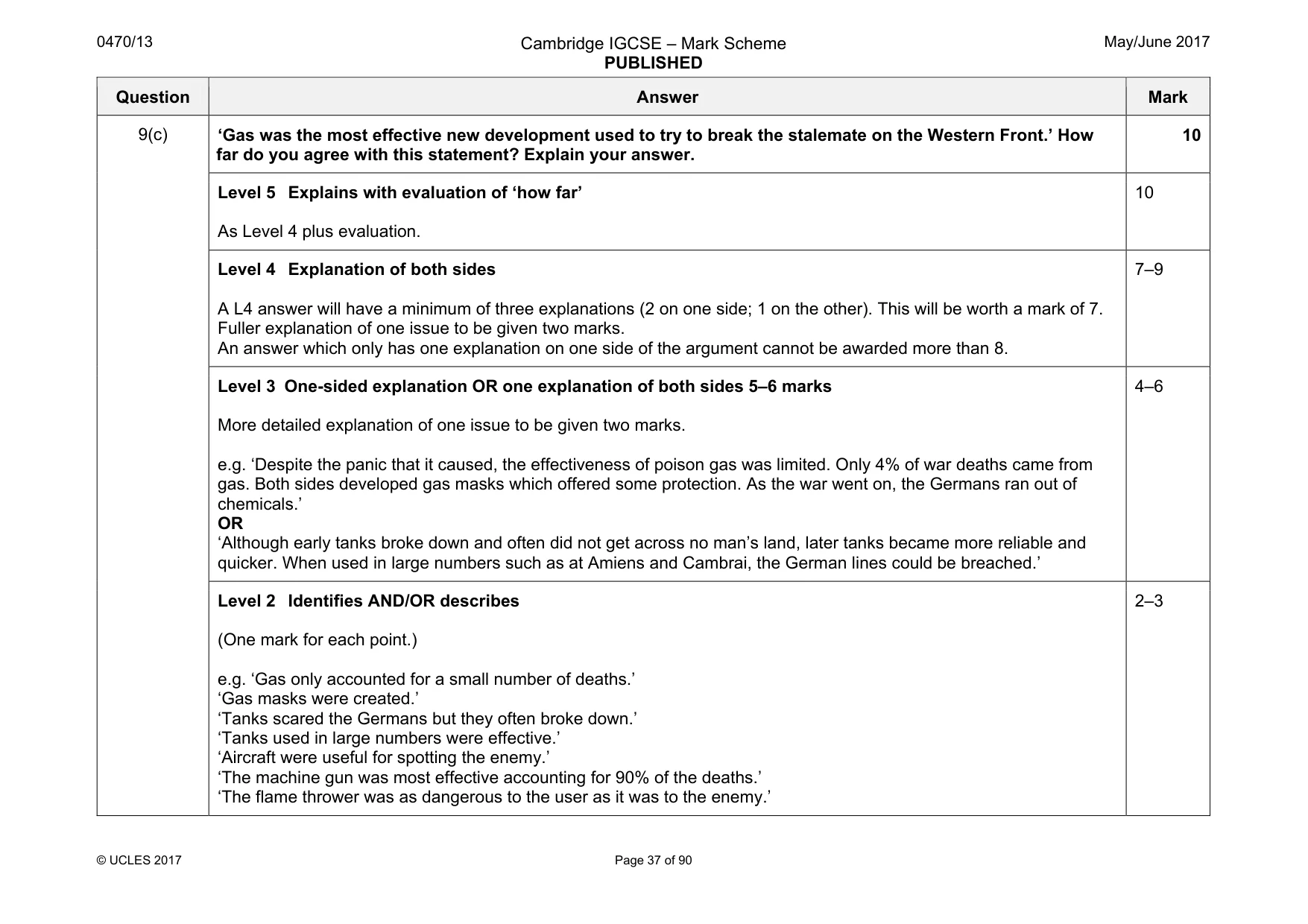
0470/13 Cambridge IGCSE – Mark Scheme PUBLISHED May/June 2017 © UCLES 2017 Page 37 of 90 Question Answer Mark 9(c) ‘Gas was the most effective new development used to try to break the stalemate on the Western Front.’ How far do you agree with this statement? Explain your answer. 10 Level 5 Explains with evaluation of ‘how far’ As Level 4 plus evaluation. 10 Level 4 Explanation of both sides A L4 answer will have a minimum of three explanations (2 on one side; 1 on the other). This will be worth a mark of 7. Fuller explanation of one issue to be given two marks. An answer which only has one explanation on one side of the argument cannot be awarded more than 8. 7–9 Level 3 One-sided explanation OR one explanation of both sides 5–6 marks More detailed explanation of one issue to be given two marks. e.g. ‘Despite the panic that it caused, the effectiveness of poison gas was limited. Only 4% of war deaths came from gas. Both sides developed gas masks which offered some protection. As the war went on, the Germans ran out of chemicals.’ OR ‘Although early tanks broke down and often did not get across no man’s land, later tanks became more reliable and quicker. When used in large numbers such as at Amiens and Cambrai, the German lines could be breached.’ 4–6 Level 2 Identifies AND/OR describes (One mark for each point.) e.g. ‘Gas only accounted for a small number of deaths.’ ‘Gas masks were created.’ ‘Tanks scared the Germans but they often broke down.’ ‘Tanks used in large numbers were effective.’ ‘Aircraft were useful for spotting the enemy.’ ‘The machine gun was most effective accounting for 90% of the deaths.’ ‘The flame thrower was as dangerous to the user as it was to the enemy.’ 2–3
Mark scheme, page 38
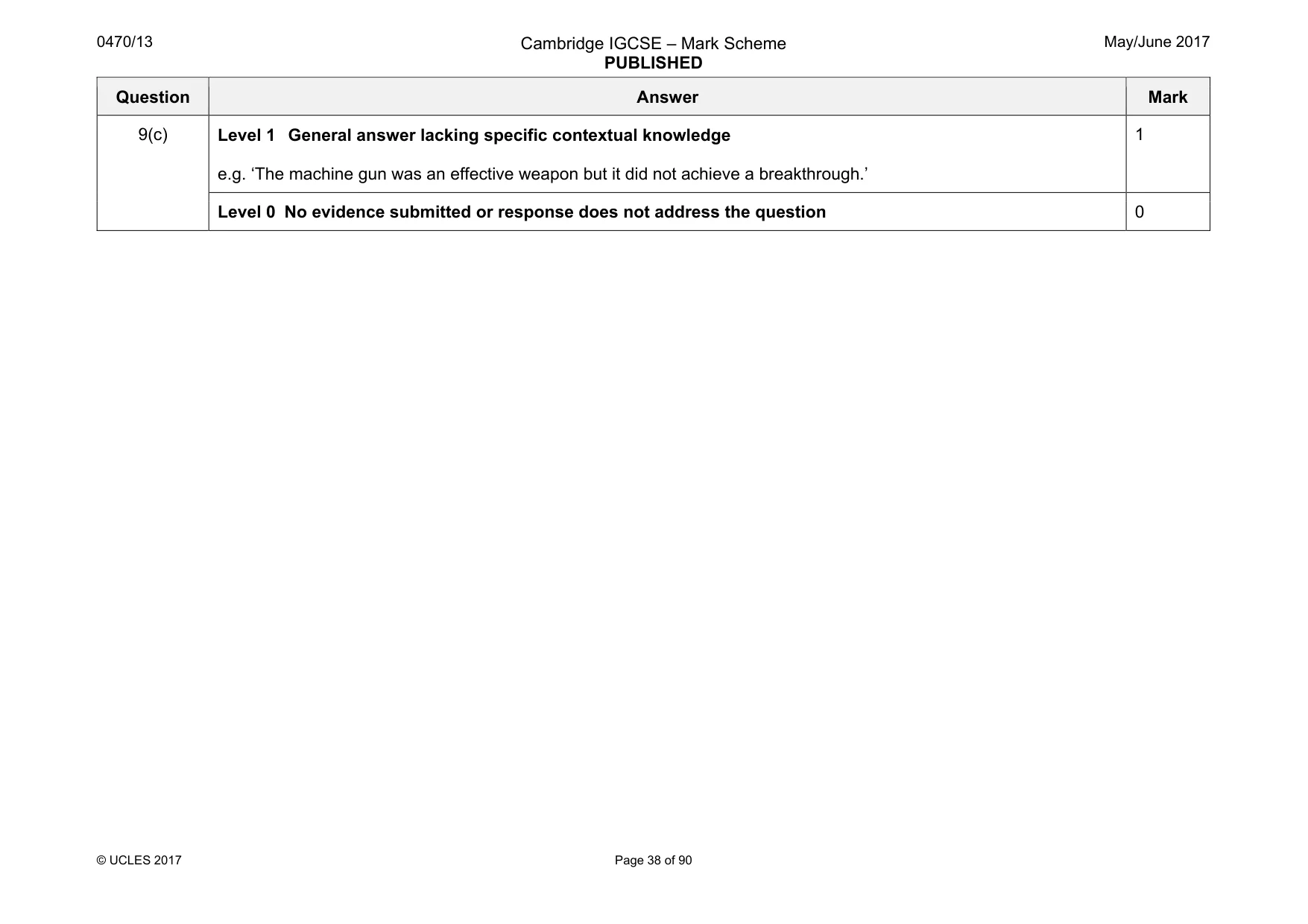
0470/13 Cambridge IGCSE – Mark Scheme PUBLISHED May/June 2017 © UCLES 2017 Page 38 of 90 Question Answer Mark 9(c) Level 1 General answer lacking specific contextual knowledge e.g. ‘The machine gun was an effective weapon but it did not achieve a breakthrough.’ 1 Level 0 No evidence submitted or response does not address the question 0
Mark scheme, page 39
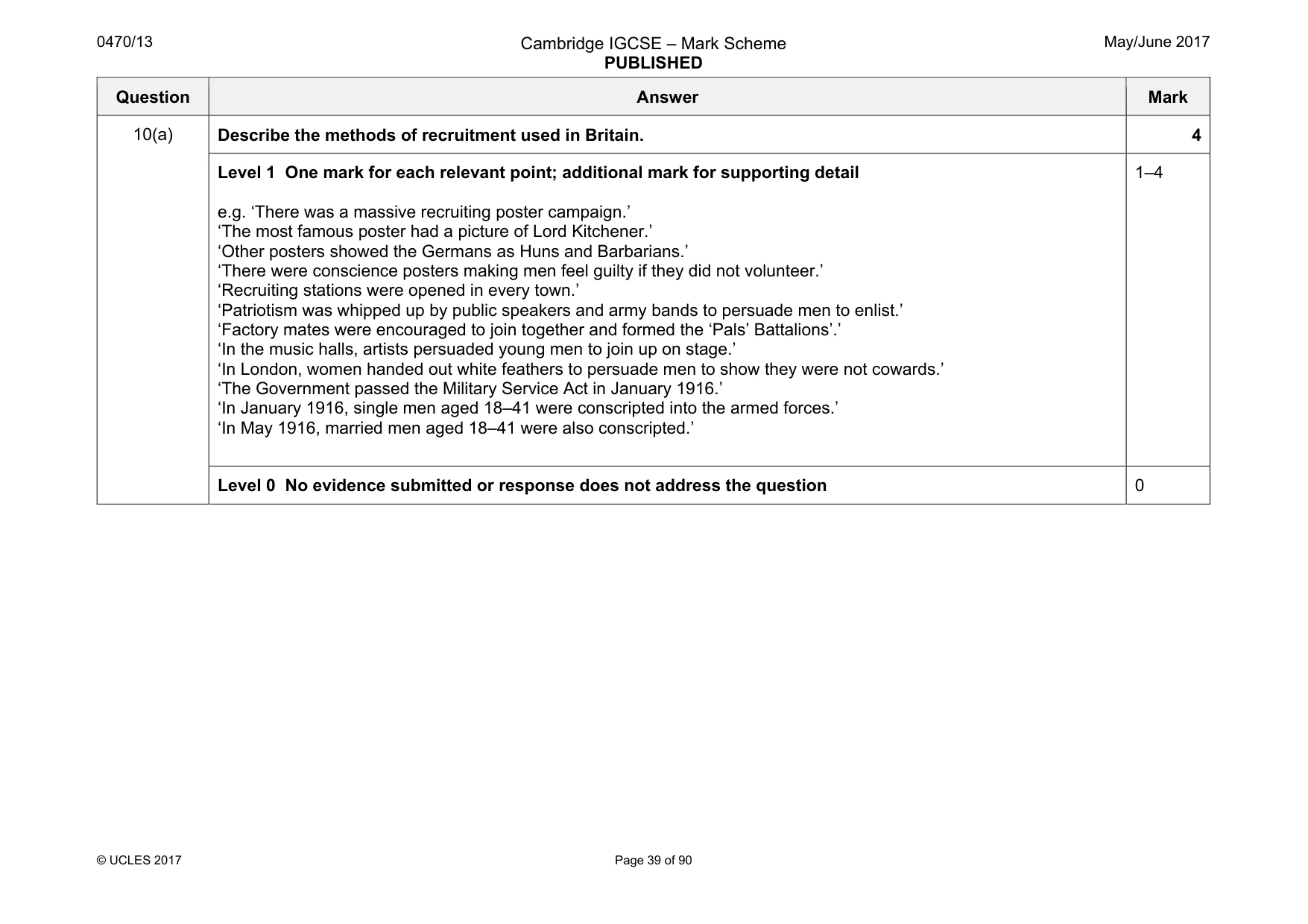
0470/13 Cambridge IGCSE – Mark Scheme PUBLISHED May/June 2017 © UCLES 2017 Page 39 of 90 Question Answer Mark 10(a) Describe the methods of recruitment used in Britain. 4 Level 1 One mark for each relevant point; additional mark for supporting detail e.g. ‘There was a massive recruiting poster campaign.’ ‘The most famous poster had a picture of Lord Kitchener.’ ‘Other posters showed the Germans as Huns and Barbarians.’ ‘There were conscience posters making men feel guilty if they did not volunteer.’ ‘Recruiting stations were opened in every town.’ ‘Patriotism was whipped up by public speakers and army bands to persuade men to enlist.’ ‘Factory mates were encouraged to join together and formed the ‘Pals’ Battalions’.’ ‘In the music halls, artists persuaded young men to join up on stage.’ ‘In London, women handed out white feathers to persuade men to show they were not cowards.’ ‘The Government passed the Military Service Act in January 1916.’ ‘In January 1916, single men aged 18–41 were conscripted into the armed forces.’ ‘In May 1916, married men aged 18–41 were also conscripted.’ 1–4 Level 0 No evidence submitted or response does not address the question 0
Mark scheme, page 40
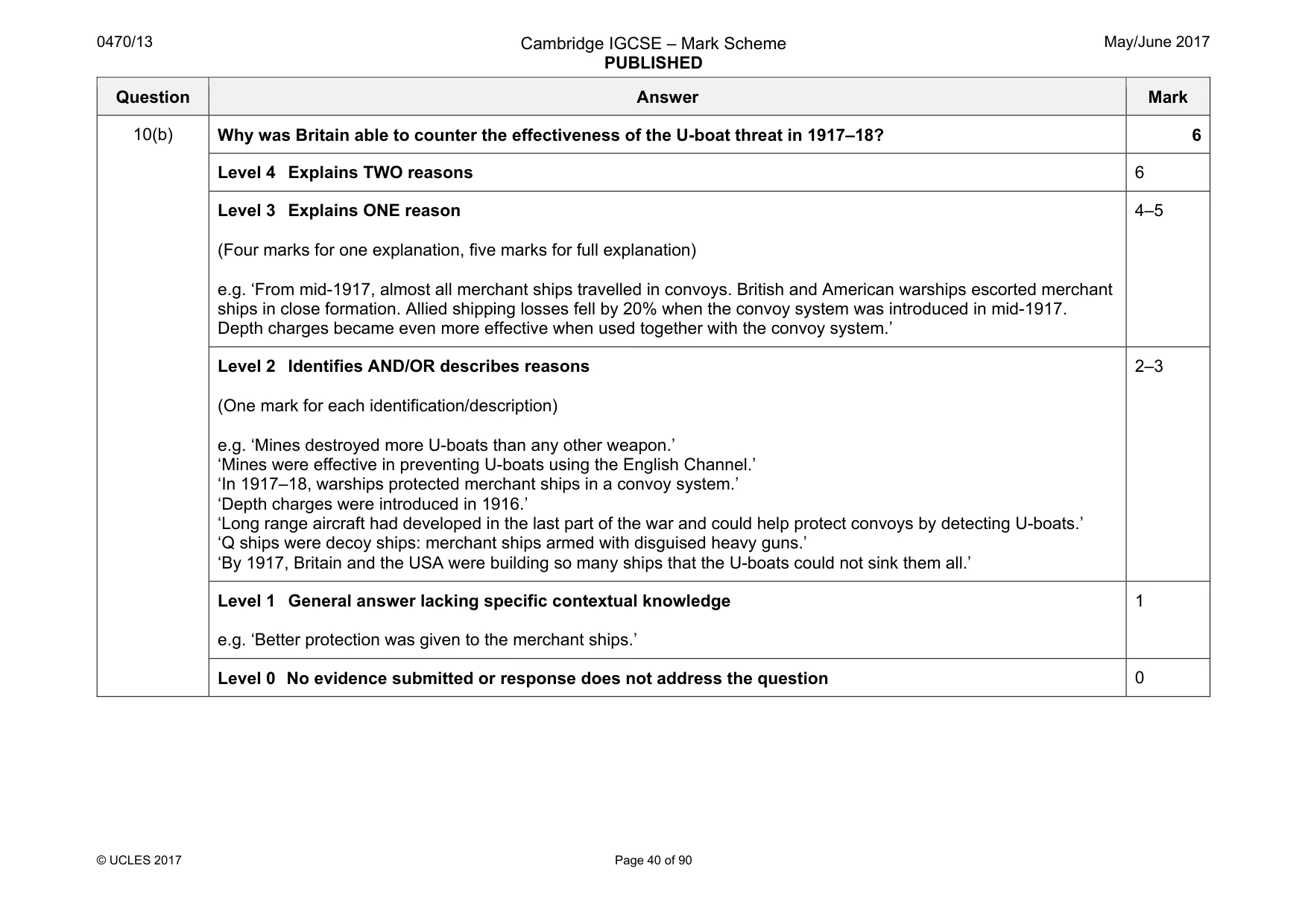
0470/13 Cambridge IGCSE – Mark Scheme PUBLISHED May/June 2017 © UCLES 2017 Page 40 of 90 Question Answer Mark 10(b) Why was Britain able to counter the effectiveness of the U-boat threat in 1917–18? 6 Level 4 Explains TWO reasons 6 Level 3 Explains ONE reason (Four marks for one explanation, five marks for full explanation) e.g. ‘From mid-1917, almost all merchant ships travelled in convoys. British and American warships escorted merchant ships in close formation. Allied shipping losses fell by 20% when the convoy system was introduced in mid-1917. Depth charges became even more effective when used together with the convoy system.’ 4–5 Level 2 Identifies AND/OR describes reasons (One mark for each identification/description) e.g. ‘Mines destroyed more U-boats than any other weapon.’ ‘Mines were effective in preventing U-boats using the English Channel.’ ‘In 1917–18, warships protected merchant ships in a convoy system.’ ‘Depth charges were introduced in 1916.’ ‘Long range aircraft had developed in the last part of the war and could help protect convoys by detecting U-boats.’ ‘Q ships were decoy ships: merchant ships armed with disguised heavy guns.’ ‘By 1917, Britain and the USA were building so many ships that the U-boats could not sink them all.’ 2–3 Level 1 General answer lacking specific contextual knowledge e.g. ‘Better protection was given to the merchant ships.’ 1 Level 0 No evidence submitted or response does not address the question 0
Mark scheme, page 41
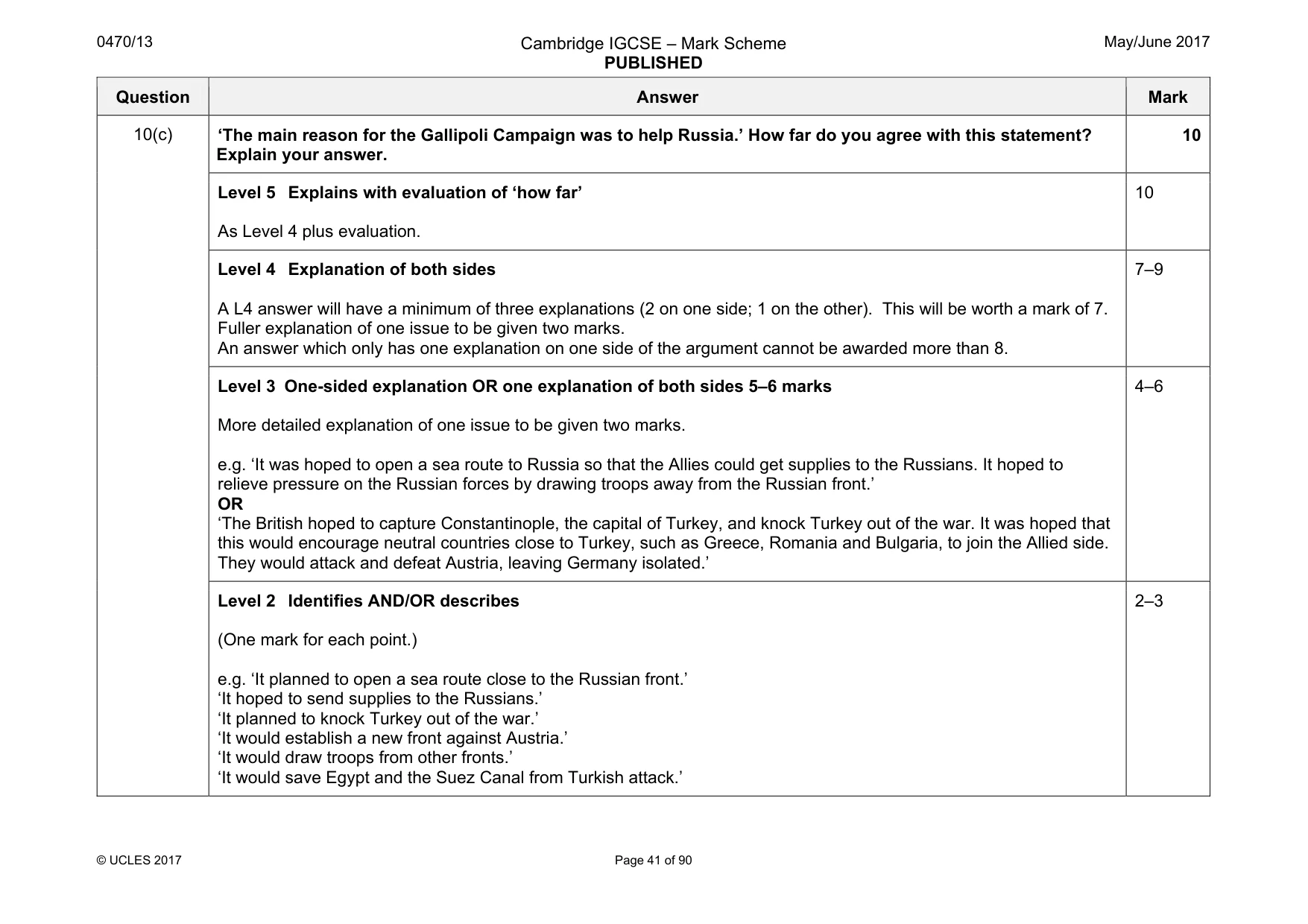
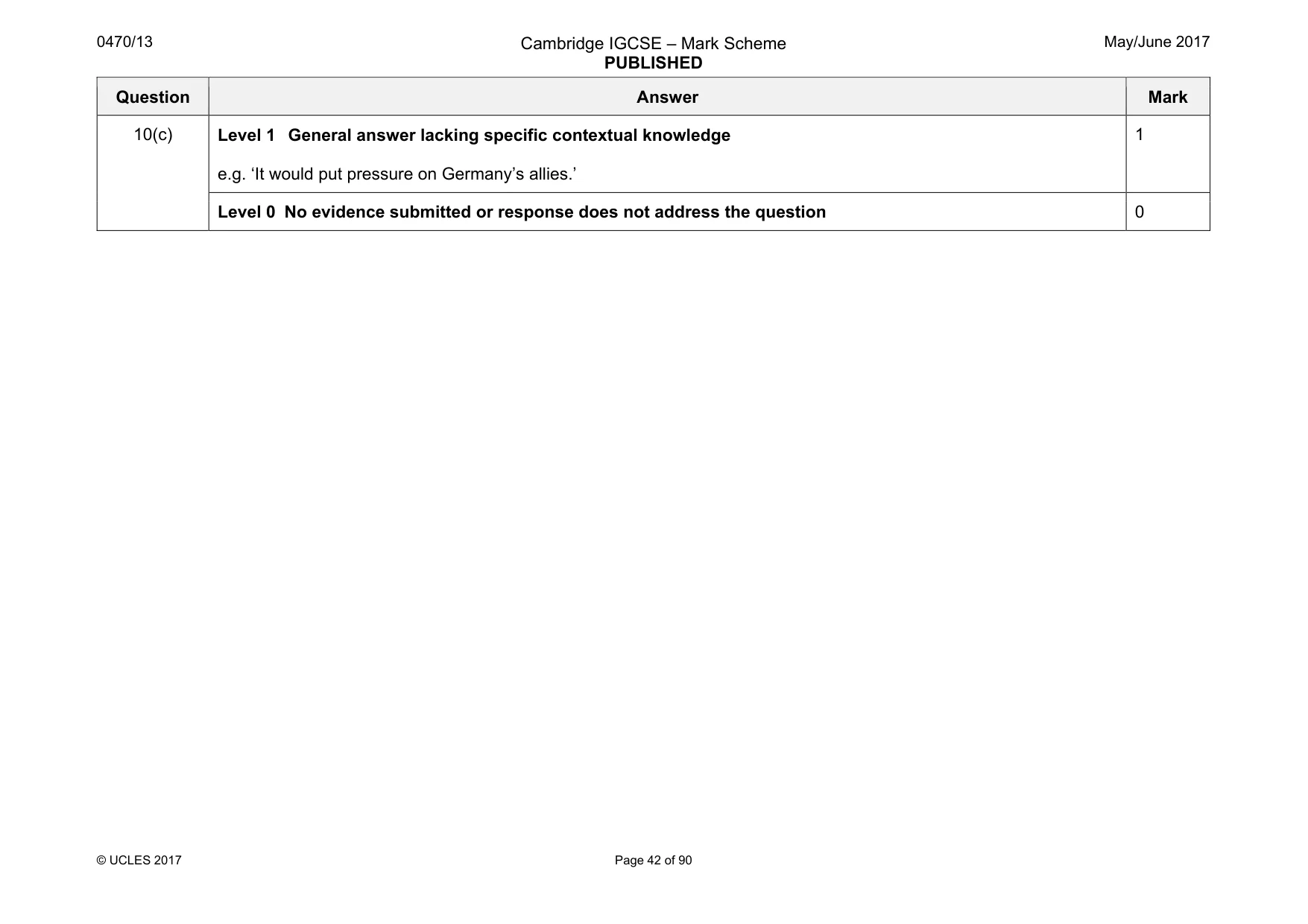
0470/13 Cambridge IGCSE – Mark Scheme PUBLISHED May/June 2017 © UCLES 2017 Page 41 of 90 Question Answer Mark 10(c) ‘The main reason for the Gallipoli Campaign was to help Russia.’ How far do you agree with this statement? Explain your answer. 10 Level 5 Explains with evaluation of ‘how far’ As Level 4 plus evaluation. 10 Level 4 Explanation of both sides A L4 answer will have a minimum of three explanations (2 on one side; 1 on the other). This will be worth a mark of 7. Fuller explanation of one issue to be given two marks. An answer which only has one explanation on one side of the argument cannot be awarded more than 8. 7–9 Level 3 One-sided explanation OR one explanation of both sides 5–6 marks More detailed explanation of one issue to be given two marks. e.g. ‘It was hoped to open a sea route to Russia so that the Allies could get supplies to the Russians. It hoped to relieve pressure on the Russian forces by drawing troops away from the Russian front.’ OR ‘The British hoped to capture Constantinople, the capital of Turkey, and knock Turkey out of the war. It was hoped that this would encourage neutral countries close to Turkey, such as Greece, Romania and Bulgaria, to join the Allied side. They would attack and defeat Austria, leaving Germany isolated.’ 4–6 Level 2 Identifies AND/OR describes (One mark for each point.) e.g. ‘It planned to open a sea route close to the Russian front.’ ‘It hoped to send supplies to the Russians.’ ‘It planned to knock Turkey out of the war.’ ‘It would establish a new front against Austria.’ ‘It would draw troops from other fronts.’ ‘It would save Egypt and the Suez Canal from Turkish attack.’ 2–3
Mark scheme, page 42
0470/13 Cambridge IGCSE – Mark Scheme PUBLISHED May/June 2017 © UCLES 2017 Page 42 of 90 Question Answer Mark 10(c) Level 1 General answer lacking specific contextual knowledge e.g. ‘It would put pressure on Germany’s allies.’ 1 Level 0 No evidence submitted or response does not address the question 0
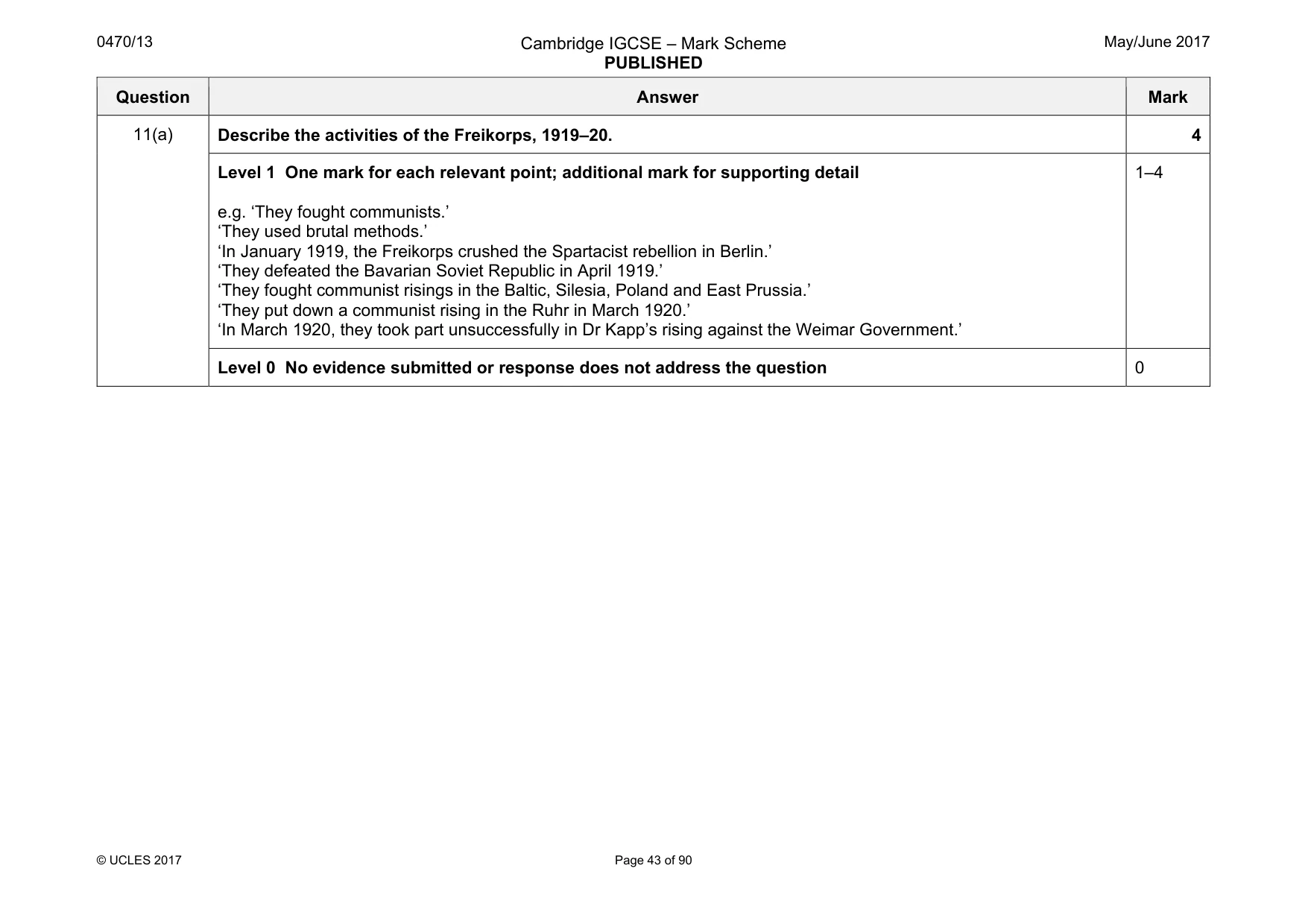
Mark scheme, page 43
0470/13 Cambridge IGCSE – Mark Scheme PUBLISHED May/June 2017 © UCLES 2017 Page 43 of 90 Question Answer Mark 11(a) Describe the activities of the Freikorps, 1919–20. 4 Level 1 One mark for each relevant point; additional mark for supporting detail e.g. ‘They fought communists.’ ‘They used brutal methods.’ ‘In January 1919, the Freikorps crushed the Spartacist rebellion in Berlin.’ ‘They defeated the Bavarian Soviet Republic in April 1919.’ ‘They fought communist risings in the Baltic, Silesia, Poland and East Prussia.’ ‘They put down a communist rising in the Ruhr in March 1920.’ ‘In March 1920, they took part unsuccessfully in Dr Kapp’s rising against the Weimar Government.’ 1–4 Level 0 No evidence submitted or response does not address the question 0
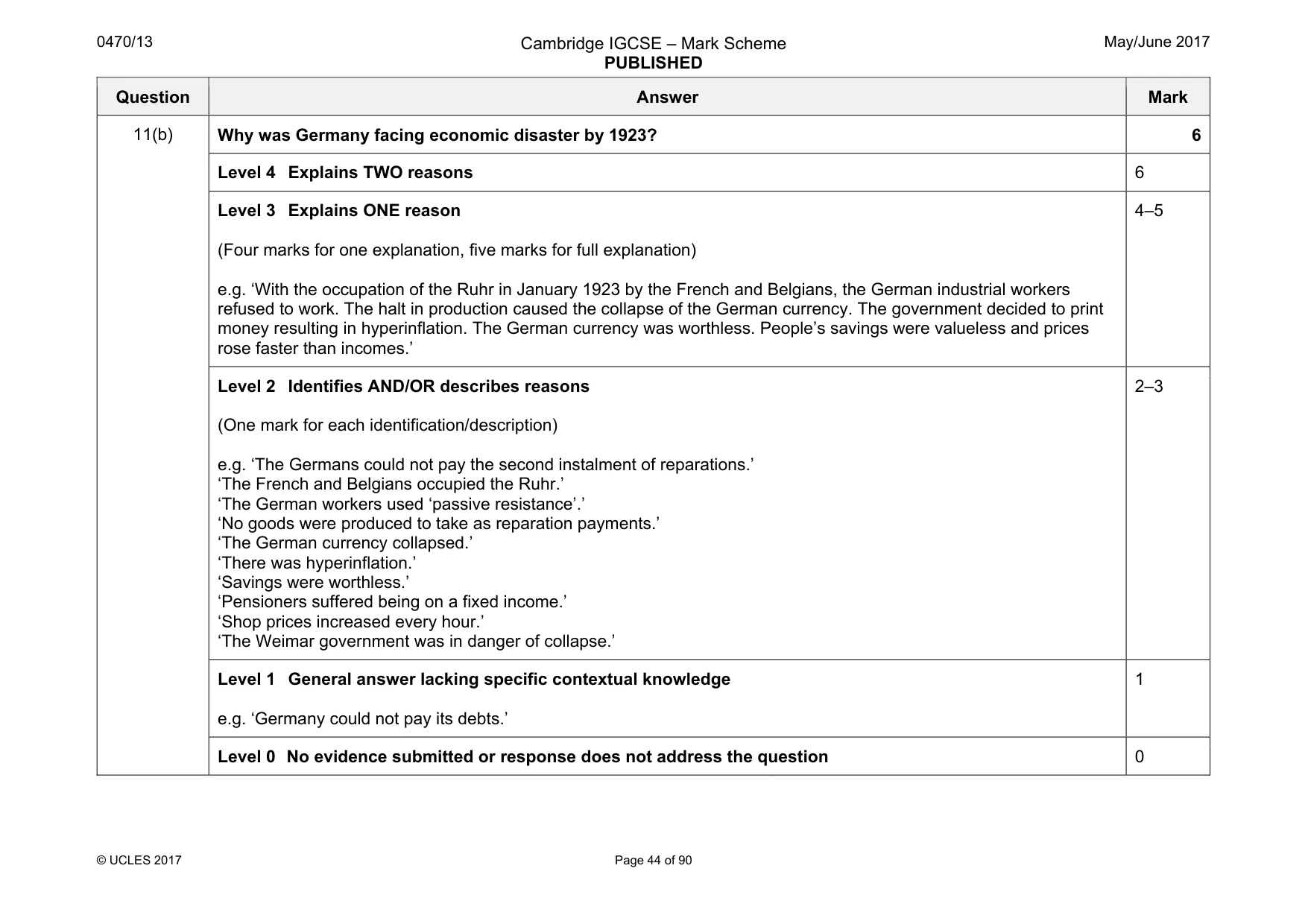
Mark scheme, page 44
0470/13 Cambridge IGCSE – Mark Scheme PUBLISHED May/June 2017 © UCLES 2017 Page 44 of 90 Question Answer Mark 11(b) Why was Germany facing economic disaster by 1923? 6 Level 4 Explains TWO reasons 6 Level 3 Explains ONE reason (Four marks for one explanation, five marks for full explanation) e.g. ‘With the occupation of the Ruhr in January 1923 by the French and Belgians, the German industrial workers refused to work. The halt in production caused the collapse of the German currency. The government decided to print money resulting in hyperinflation. The German currency was worthless. People’s savings were valueless and prices rose faster than incomes.’ 4–5 Level 2 Identifies AND/OR describes reasons (One mark for each identification/description) e.g. ‘The Germans could not pay the second instalment of reparations.’ ‘The French and Belgians occupied the Ruhr.’ ‘The German workers used ‘passive resistance’.’ ‘No goods were produced to take as reparation payments.’ ‘The German currency collapsed.’ ‘There was hyperinflation.’ ‘Savings were worthless.’ ‘Pensioners suffered being on a fixed income.’ ‘Shop prices increased every hour.’ ‘The Weimar government was in danger of collapse.’ 2–3 Level 1 General answer lacking specific contextual knowledge e.g. ‘Germany could not pay its debts.’ 1 Level 0 No evidence submitted or response does not address the question 0
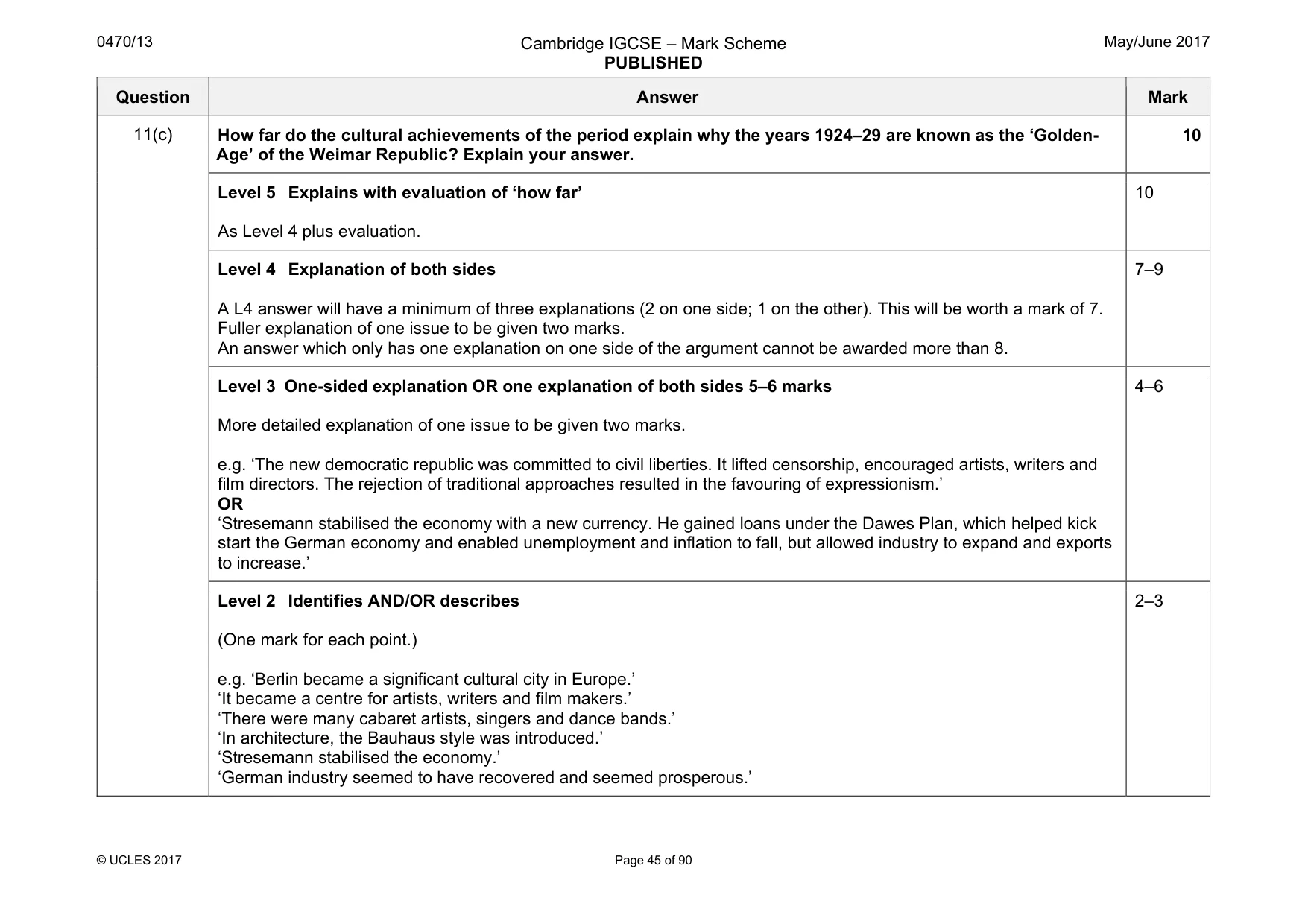
Mark scheme, page 45
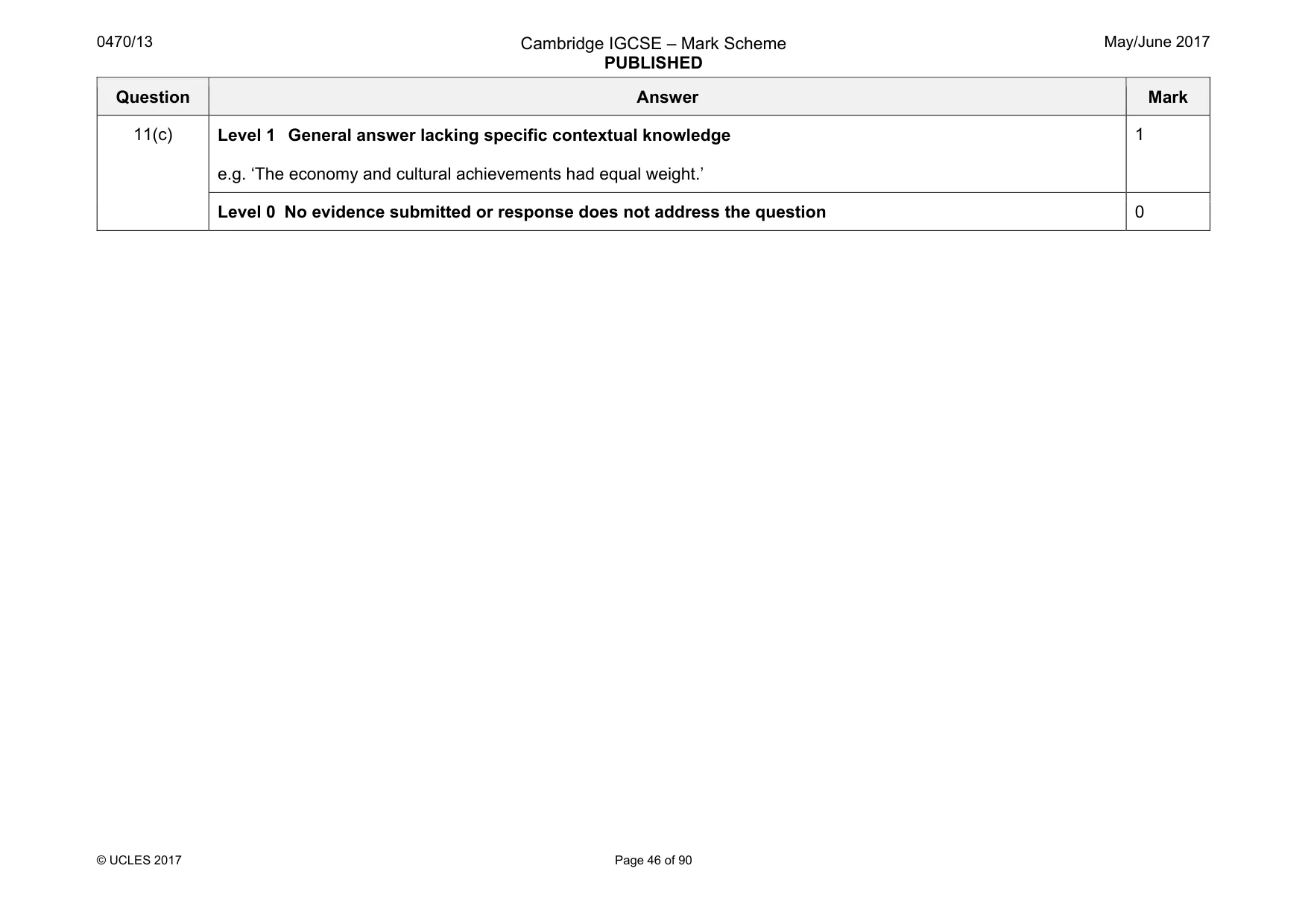
0470/13 Cambridge IGCSE – Mark Scheme PUBLISHED May/June 2017 © UCLES 2017 Page 45 of 90 Question Answer Mark 11(c) How far do the cultural achievements of the period explain why the years 1924–29 are known as the ‘Golden- Age’ of the Weimar Republic? Explain your answer. 10 Level 5 Explains with evaluation of ‘how far’ As Level 4 plus evaluation. 10 Level 4 Explanation of both sides A L4 answer will have a minimum of three explanations (2 on one side; 1 on the other). This will be worth a mark of 7. Fuller explanation of one issue to be given two marks. An answer which only has one explanation on one side of the argument cannot be awarded more than 8. 7–9 Level 3 One-sided explanation OR one explanation of both sides 5–6 marks More detailed explanation of one issue to be given two marks. e.g. ‘The new democratic republic was committed to civil liberties. It lifted censorship, encouraged artists, writers and film directors. The rejection of traditional approaches resulted in the favouring of expressionism.’ OR ‘Stresemann stabilised the economy with a new currency. He gained loans under the Dawes Plan, which helped kick start the German economy and enabled unemployment and inflation to fall, but allowed industry to expand and exports to increase.’ 4–6 Level 2 Identifies AND/OR describes (One mark for each point.) e.g. ‘Berlin became a significant cultural city in Europe.’ ‘It became a centre for artists, writers and film makers.’ ‘There were many cabaret artists, singers and dance bands.’ ‘In architecture, the Bauhaus style was introduced.’ ‘Stresemann stabilised the economy.’ ‘German industry seemed to have recovered and seemed prosperous.’ 2–3
Mark scheme, page 46
0470/13 Cambridge IGCSE – Mark Scheme PUBLISHED May/June 2017 © UCLES 2017 Page 46 of 90 Question Answer Mark 11(c) Level 1 General answer lacking specific contextual knowledge e.g. ‘The economy and cultural achievements had equal weight.’ 1 Level 0 No evidence submitted or response does not address the question 0
Mark scheme, page 47
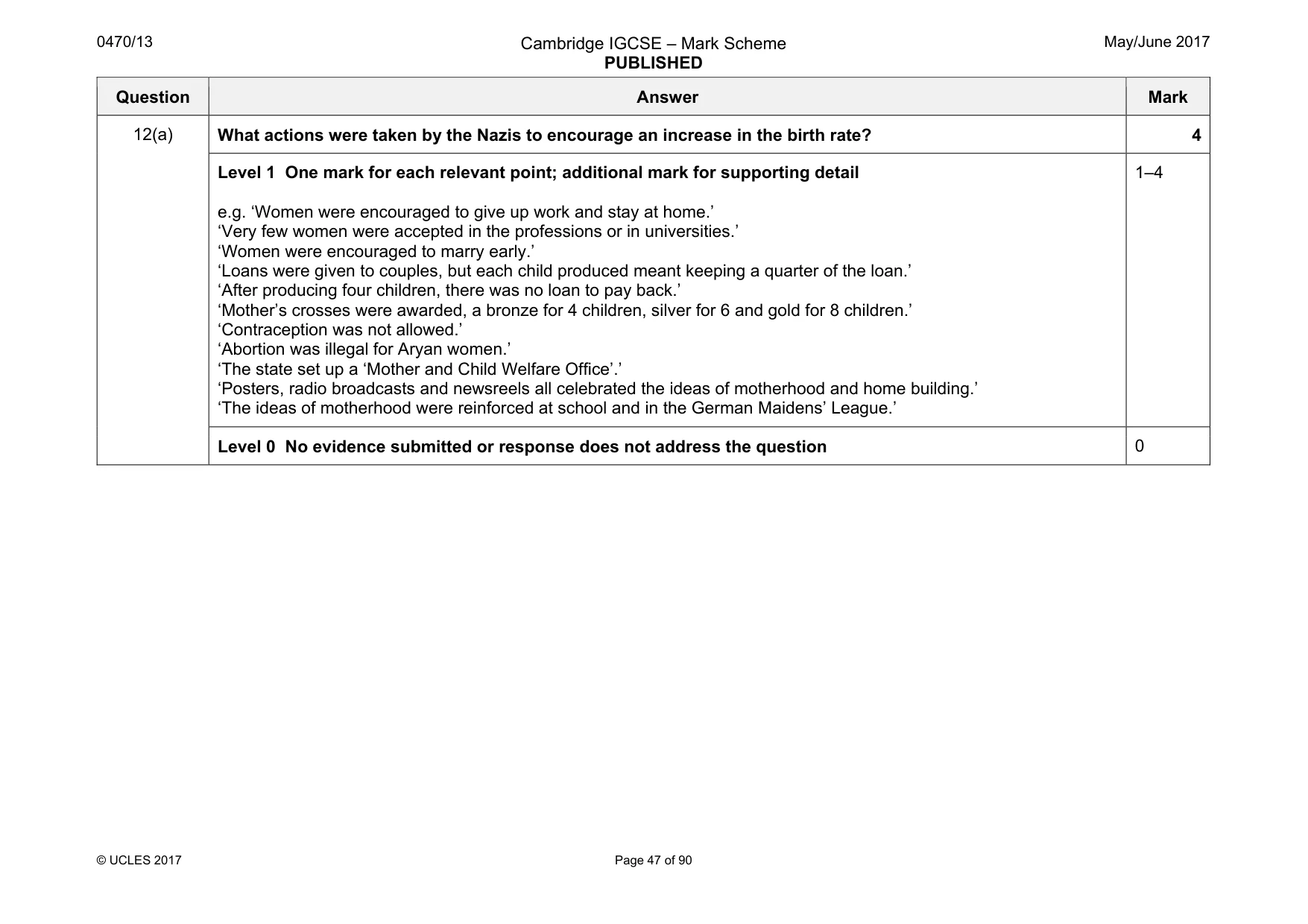
0470/13 Cambridge IGCSE – Mark Scheme PUBLISHED May/June 2017 © UCLES 2017 Page 47 of 90 Question Answer Mark 12(a) What actions were taken by the Nazis to encourage an increase in the birth rate? 4 Level 1 One mark for each relevant point; additional mark for supporting detail e.g. ‘Women were encouraged to give up work and stay at home.’ ‘Very few women were accepted in the professions or in universities.’ ‘Women were encouraged to marry early.’ ‘Loans were given to couples, but each child produced meant keeping a quarter of the loan.’ ‘After producing four children, there was no loan to pay back.’ ‘Mother’s crosses were awarded, a bronze for 4 children, silver for 6 and gold for 8 children.’ ‘Contraception was not allowed.’ ‘Abortion was illegal for Aryan women.’ ‘The state set up a ‘Mother and Child Welfare Office’.’ ‘Posters, radio broadcasts and newsreels all celebrated the ideas of motherhood and home building.’ ‘The ideas of motherhood were reinforced at school and in the German Maidens’ League.’ 1–4 Level 0 No evidence submitted or response does not address the question 0
Mark scheme, page 48
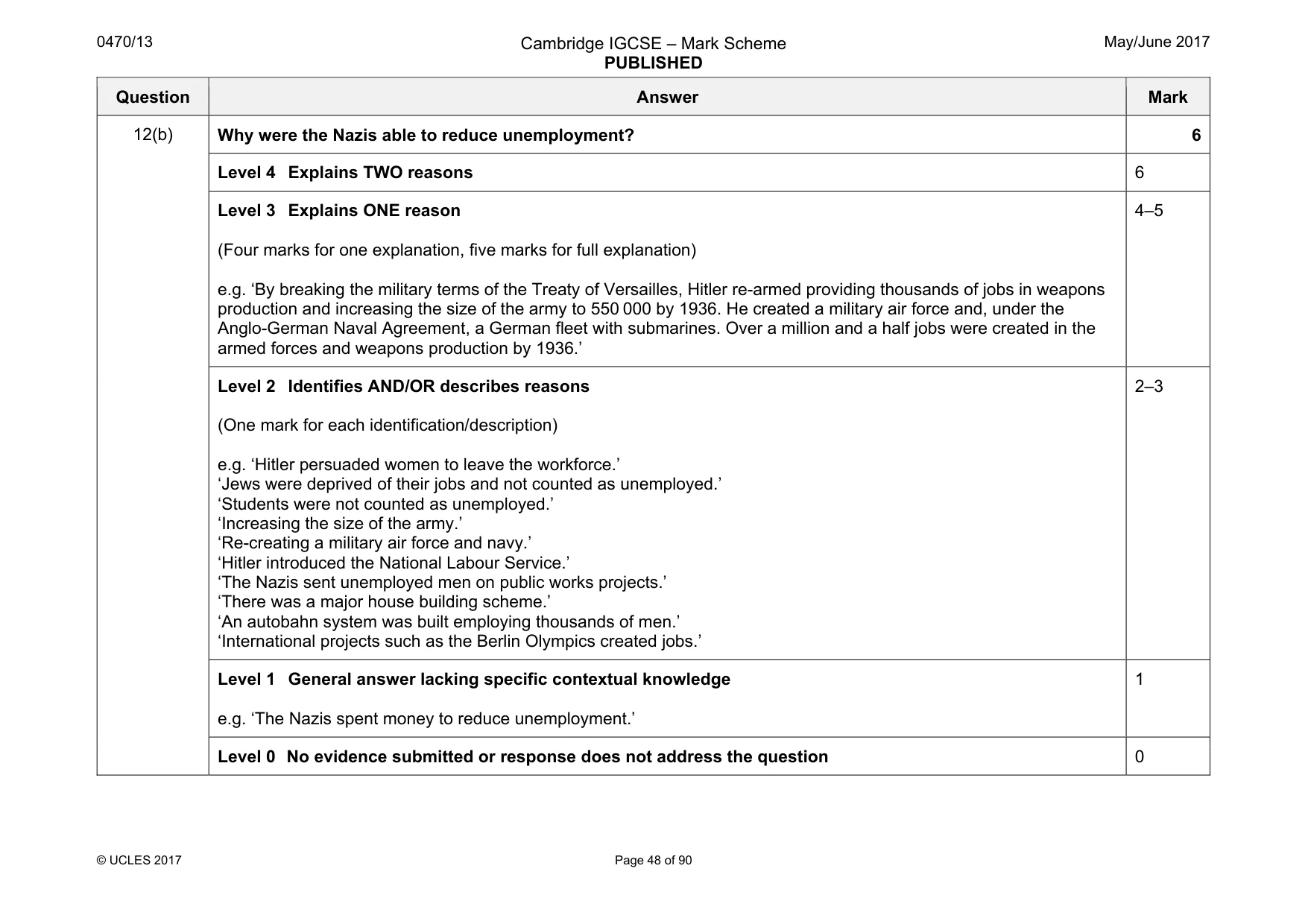
0470/13 Cambridge IGCSE – Mark Scheme PUBLISHED May/June 2017 © UCLES 2017 Page 48 of 90 Question Answer Mark 12(b) Why were the Nazis able to reduce unemployment? 6 Level 4 Explains TWO reasons 6 Level 3 Explains ONE reason (Four marks for one explanation, five marks for full explanation) e.g. ‘By breaking the military terms of the Treaty of Versailles, Hitler re-armed providing thousands of jobs in weapons production and increasing the size of the army to 550 000 by 1936. He created a military air force and, under the Anglo-German Naval Agreement, a German fleet with submarines. Over a million and a half jobs were created in the armed forces and weapons production by 1936.’ 4–5 Level 2 Identifies AND/OR describes reasons (One mark for each identification/description) e.g. ‘Hitler persuaded women to leave the workforce.’ ‘Jews were deprived of their jobs and not counted as unemployed.’ ‘Students were not counted as unemployed.’ ‘Increasing the size of the army.’ ‘Re-creating a military air force and navy.’ ‘Hitler introduced the National Labour Service.’ ‘The Nazis sent unemployed men on public works projects.’ ‘There was a major house building scheme.’ ‘An autobahn system was built employing thousands of men.’ ‘International projects such as the Berlin Olympics created jobs.’ 2–3 Level 1 General answer lacking specific contextual knowledge e.g. ‘The Nazis spent money to reduce unemployment.’ 1 Level 0 No evidence submitted or response does not address the question 0
Mark scheme, page 49
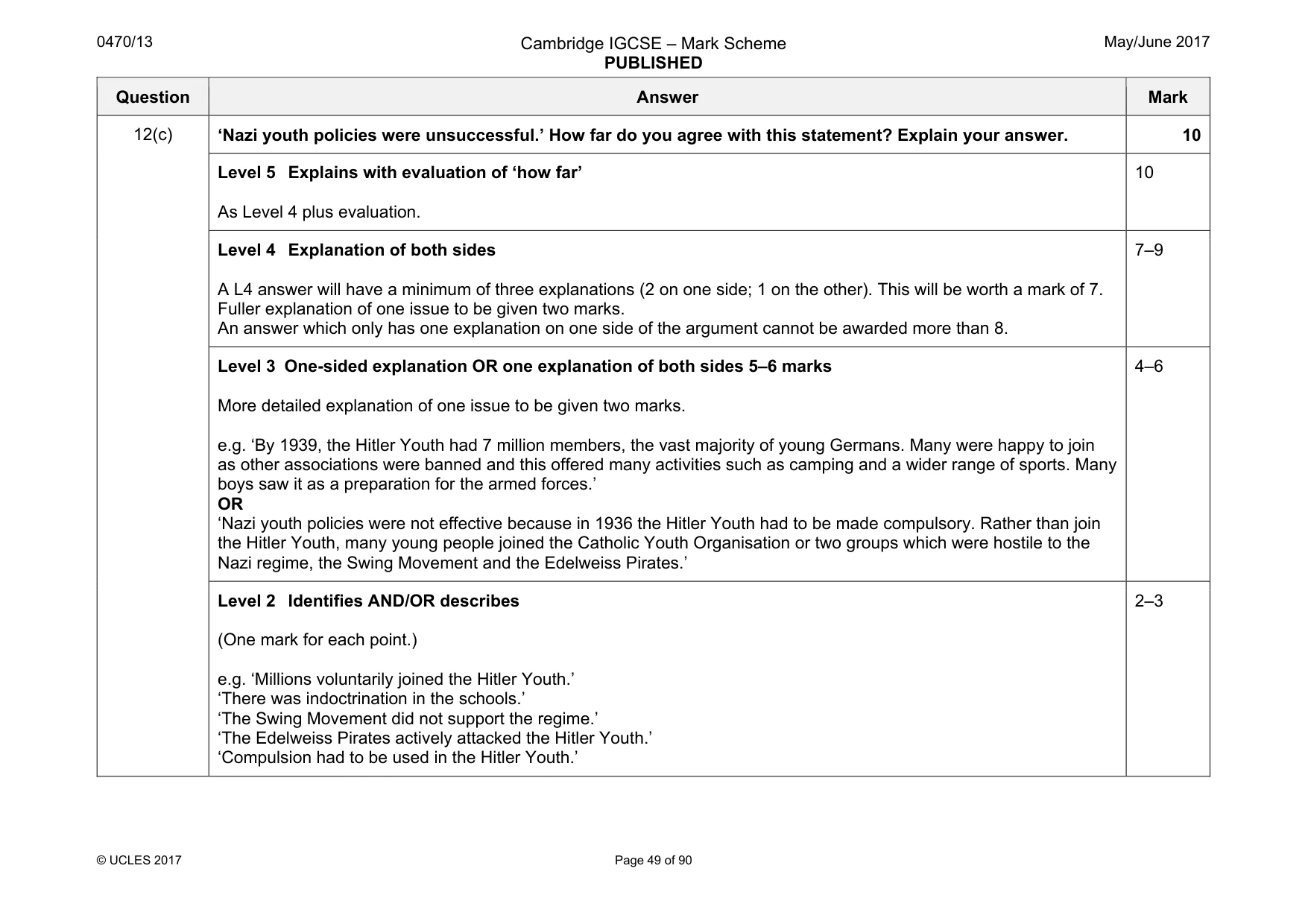
0470/13 Cambridge IGCSE – Mark Scheme PUBLISHED May/June 2017 © UCLES 2017 Page 49 of 90 Question Answer Mark 12(c) ‘Nazi youth policies were unsuccessful.’ How far do you agree with this statement? Explain your answer. 10 Level 5 Explains with evaluation of ‘how far’ As Level 4 plus evaluation. 10 Level 4 Explanation of both sides A L4 answer will have a minimum of three explanations (2 on one side; 1 on the other). This will be worth a mark of 7. Fuller explanation of one issue to be given two marks. An answer which only has one explanation on one side of the argument cannot be awarded more than 8. 7–9 Level 3 One-sided explanation OR one explanation of both sides 5–6 marks More detailed explanation of one issue to be given two marks. e.g. ‘By 1939, the Hitler Youth had 7 million members, the vast majority of young Germans. Many were happy to join as other associations were banned and this offered many activities such as camping and a wider range of sports. Many boys saw it as a preparation for the armed forces.’ OR ‘Nazi youth policies were not effective because in 1936 the Hitler Youth had to be made compulsory. Rather than join the Hitler Youth, many young people joined the Catholic Youth Organisation or two groups which were hostile to the Nazi regime, the Swing Movement and the Edelweiss Pirates.’ 4–6 Level 2 Identifies AND/OR describes (One mark for each point.) e.g. ‘Millions voluntarily joined the Hitler Youth.’ ‘There was indoctrination in the schools.’ ‘The Swing Movement did not support the regime.’ ‘The Edelweiss Pirates actively attacked the Hitler Youth.’ ‘Compulsion had to be used in the Hitler Youth.’ 2–3
Mark scheme, page 50
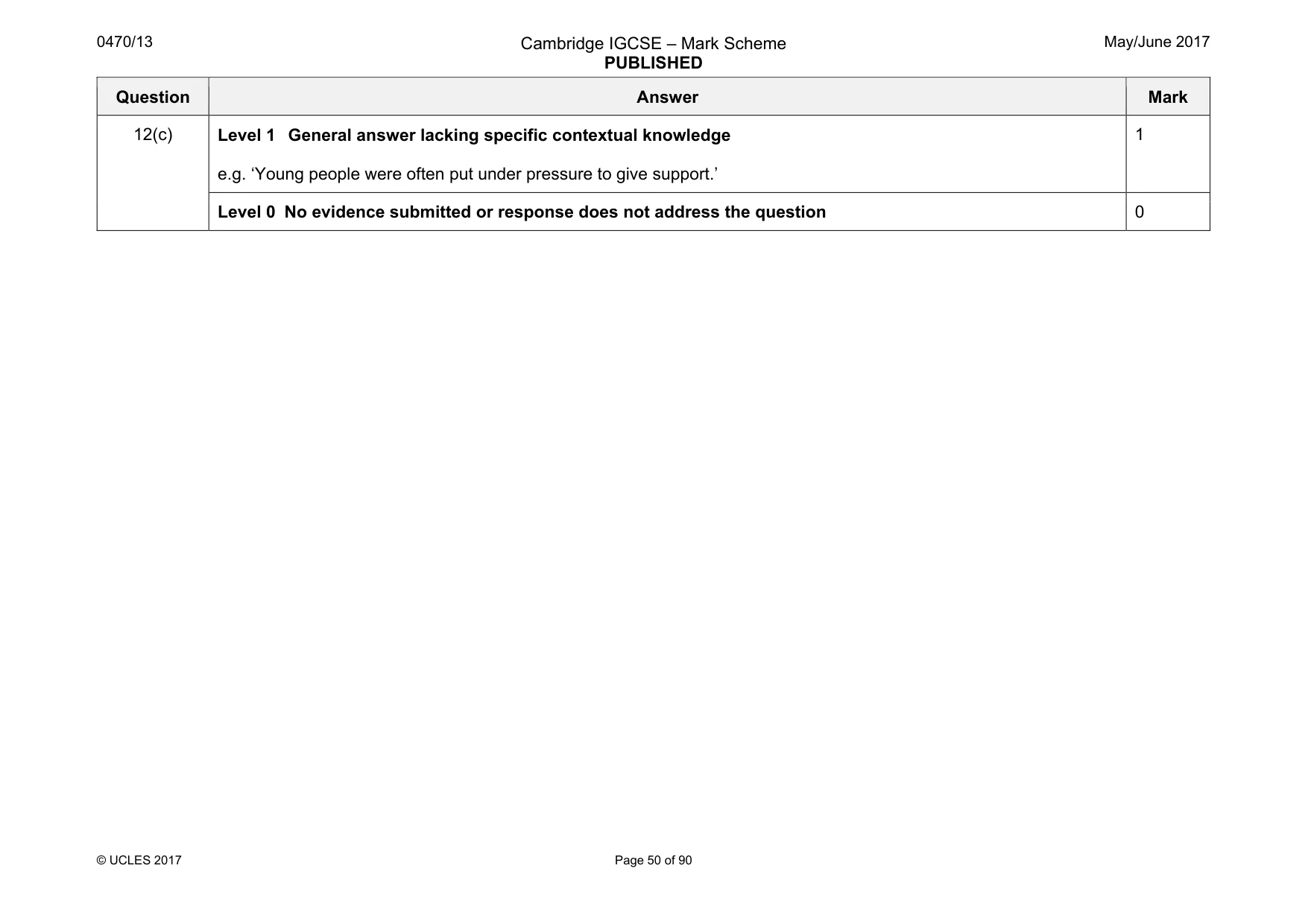
0470/13 Cambridge IGCSE – Mark Scheme PUBLISHED May/June 2017 © UCLES 2017 Page 50 of 90 Question Answer Mark 12(c) Level 1 General answer lacking specific contextual knowledge e.g. ‘Young people were often put under pressure to give support.’ 1 Level 0 No evidence submitted or response does not address the question 0
Mark scheme, page 51
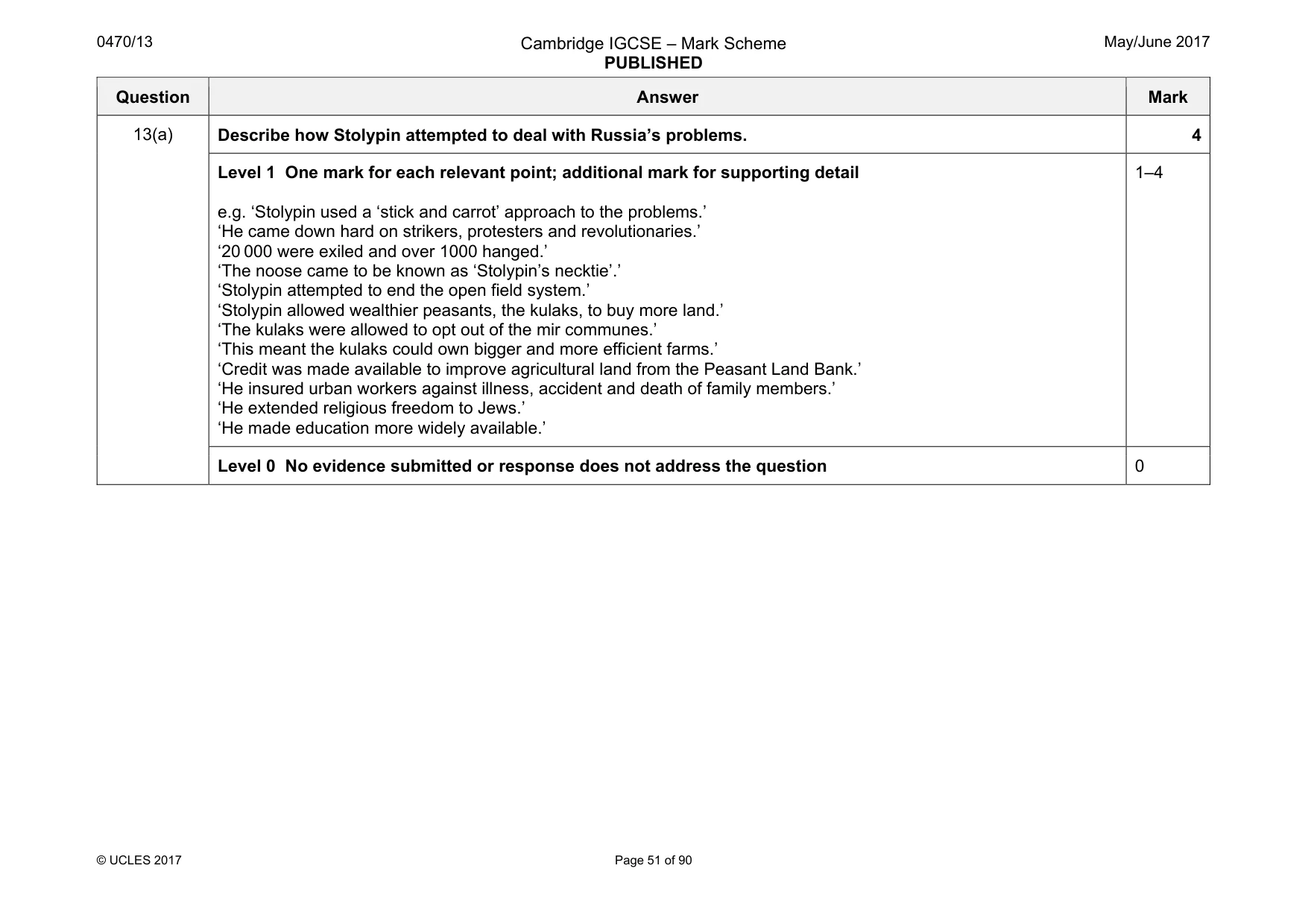
0470/13 Cambridge IGCSE – Mark Scheme PUBLISHED May/June 2017 © UCLES 2017 Page 51 of 90 Question Answer Mark 13(a) Describe how Stolypin attempted to deal with Russia’s problems. 4 Level 1 One mark for each relevant point; additional mark for supporting detail e.g. ‘Stolypin used a ‘stick and carrot’ approach to the problems.’ ‘He came down hard on strikers, protesters and revolutionaries.’ ‘20 000 were exiled and over 1000 hanged.’ ‘The noose came to be known as ‘Stolypin’s necktie’.’ ‘Stolypin attempted to end the open field system.’ ‘Stolypin allowed wealthier peasants, the kulaks, to buy more land.’ ‘The kulaks were allowed to opt out of the mir communes.’ ‘This meant the kulaks could own bigger and more efficient farms.’ ‘Credit was made available to improve agricultural land from the Peasant Land Bank.’ ‘He insured urban workers against illness, accident and death of family members.’ ‘He extended religious freedom to Jews.’ ‘He made education more widely available.’ 1–4 Level 0 No evidence submitted or response does not address the question 0
Mark scheme, page 52
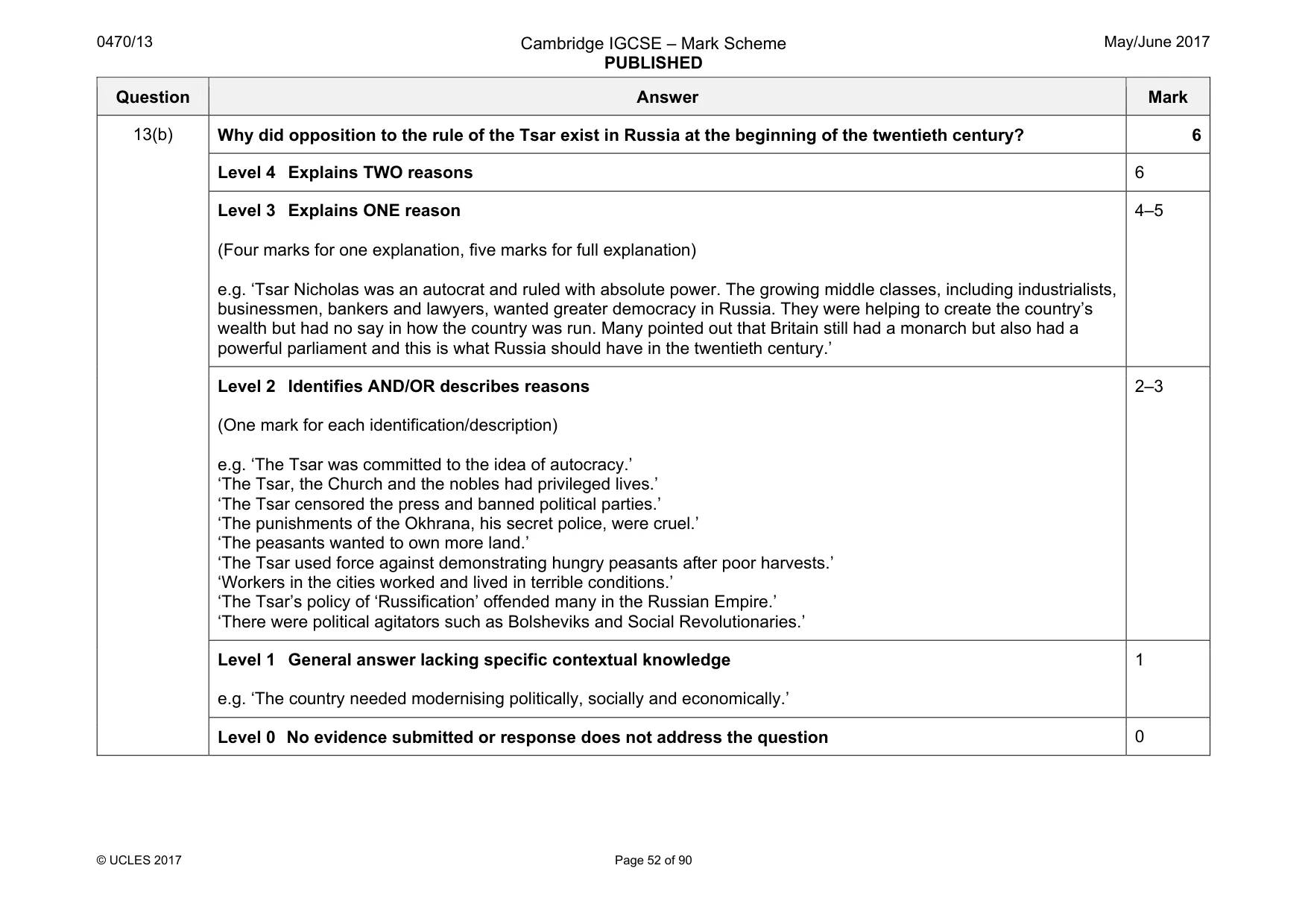
0470/13 Cambridge IGCSE – Mark Scheme PUBLISHED May/June 2017 © UCLES 2017 Page 52 of 90 Question Answer Mark 13(b) Why did opposition to the rule of the Tsar exist in Russia at the beginning of the twentieth century? 6 Level 4 Explains TWO reasons 6 Level 3 Explains ONE reason (Four marks for one explanation, five marks for full explanation) e.g. ‘Tsar Nicholas was an autocrat and ruled with absolute power. The growing middle classes, including industrialists, businessmen, bankers and lawyers, wanted greater democracy in Russia. They were helping to create the country’s wealth but had no say in how the country was run. Many pointed out that Britain still had a monarch but also had a powerful parliament and this is what Russia should have in the twentieth century.’ 4–5 Level 2 Identifies AND/OR describes reasons (One mark for each identification/description) e.g. ‘The Tsar was committed to the idea of autocracy.’ ‘The Tsar, the Church and the nobles had privileged lives.’ ‘The Tsar censored the press and banned political parties.’ ‘The punishments of the Okhrana, his secret police, were cruel.’ ‘The peasants wanted to own more land.’ ‘The Tsar used force against demonstrating hungry peasants after poor harvests.’ ‘Workers in the cities worked and lived in terrible conditions.’ ‘The Tsar’s policy of ‘Russification’ offended many in the Russian Empire.’ ‘There were political agitators such as Bolsheviks and Social Revolutionaries.’ 2–3 Level 1 General answer lacking specific contextual knowledge e.g. ‘The country needed modernising politically, socially and economically.’ 1 Level 0 No evidence submitted or response does not address the question 0
Mark scheme, page 53
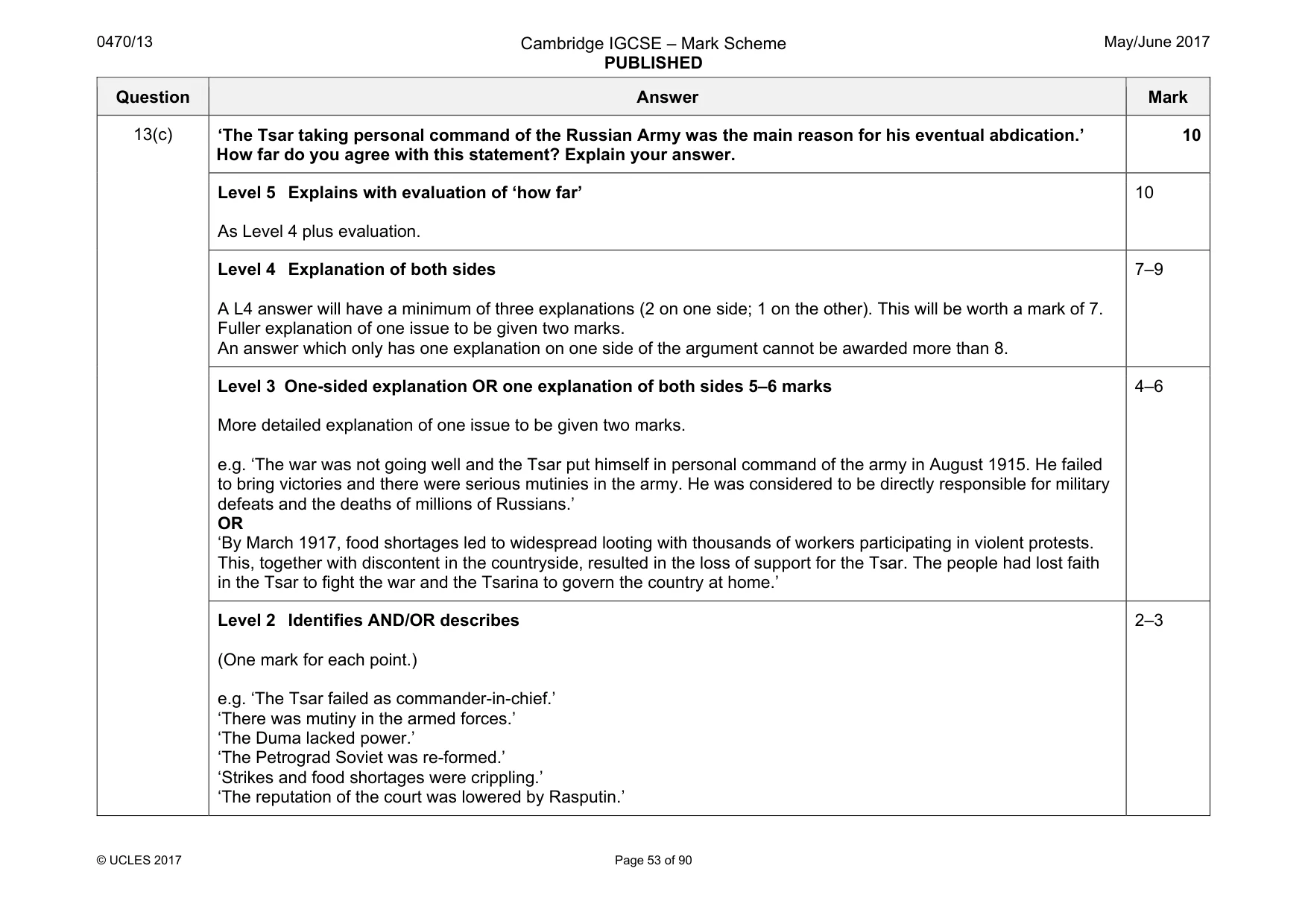
0470/13 Cambridge IGCSE – Mark Scheme PUBLISHED May/June 2017 © UCLES 2017 Page 53 of 90 Question Answer Mark 13(c) ‘The Tsar taking personal command of the Russian Army was the main reason for his eventual abdication.’ How far do you agree with this statement? Explain your answer. 10 Level 5 Explains with evaluation of ‘how far’ As Level 4 plus evaluation. 10 Level 4 Explanation of both sides A L4 answer will have a minimum of three explanations (2 on one side; 1 on the other). This will be worth a mark of 7. Fuller explanation of one issue to be given two marks. An answer which only has one explanation on one side of the argument cannot be awarded more than 8. 7–9 Level 3 One-sided explanation OR one explanation of both sides 5–6 marks More detailed explanation of one issue to be given two marks. e.g. ‘The war was not going well and the Tsar put himself in personal command of the army in August 1915. He failed to bring victories and there were serious mutinies in the army. He was considered to be directly responsible for military defeats and the deaths of millions of Russians.’ OR ‘By March 1917, food shortages led to widespread looting with thousands of workers participating in violent protests. This, together with discontent in the countryside, resulted in the loss of support for the Tsar. The people had lost faith in the Tsar to fight the war and the Tsarina to govern the country at home.’ 4–6 Level 2 Identifies AND/OR describes (One mark for each point.) e.g. ‘The Tsar failed as commander-in-chief.’ ‘There was mutiny in the armed forces.’ ‘The Duma lacked power.’ ‘The Petrograd Soviet was re-formed.’ ‘Strikes and food shortages were crippling.’ ‘The reputation of the court was lowered by Rasputin.’ 2–3
Mark scheme, page 54
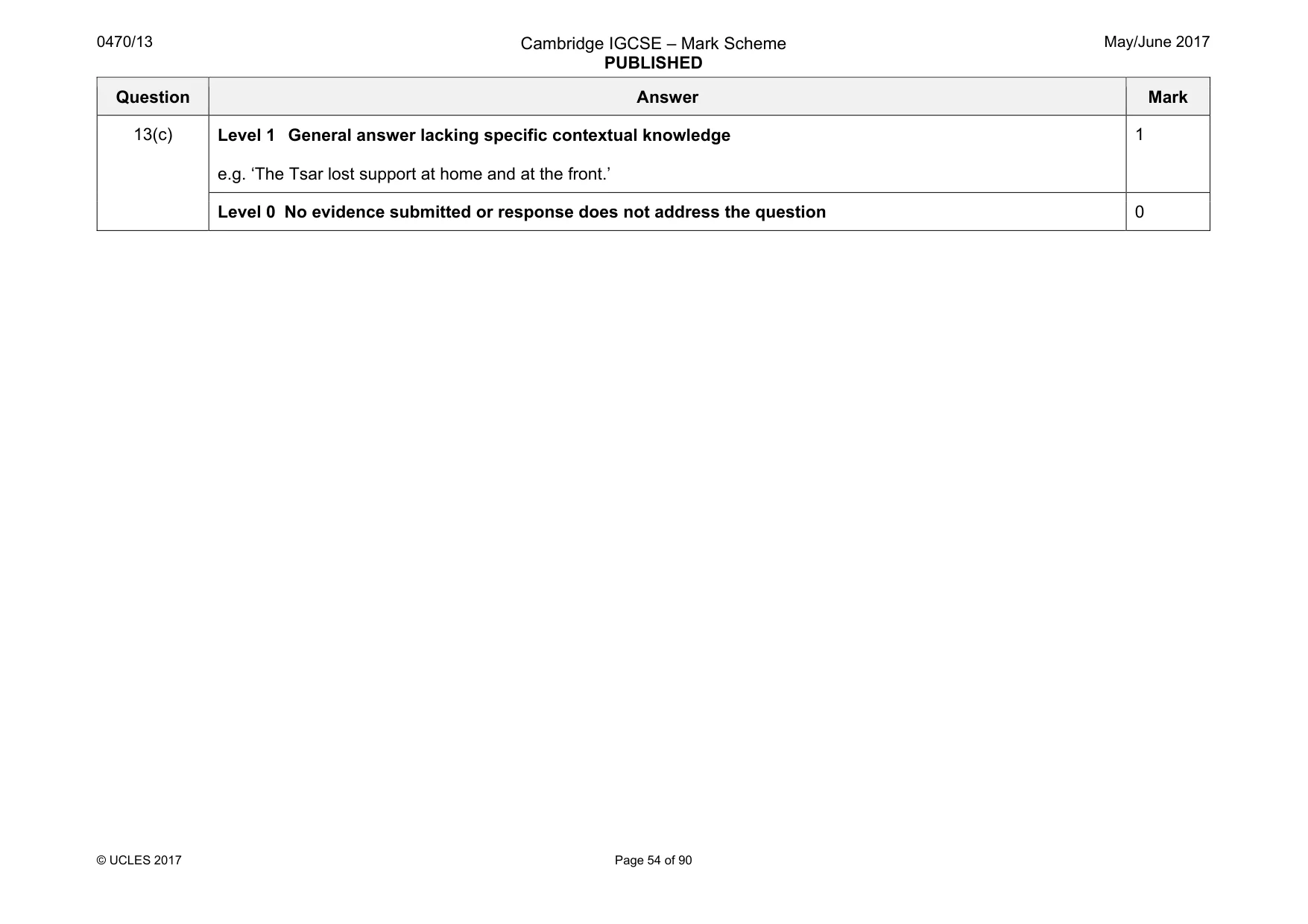
0470/13 Cambridge IGCSE – Mark Scheme PUBLISHED May/June 2017 © UCLES 2017 Page 54 of 90 Question Answer Mark 13(c) Level 1 General answer lacking specific contextual knowledge e.g. ‘The Tsar lost support at home and at the front.’ 1 Level 0 No evidence submitted or response does not address the question 0
Mark scheme, page 55
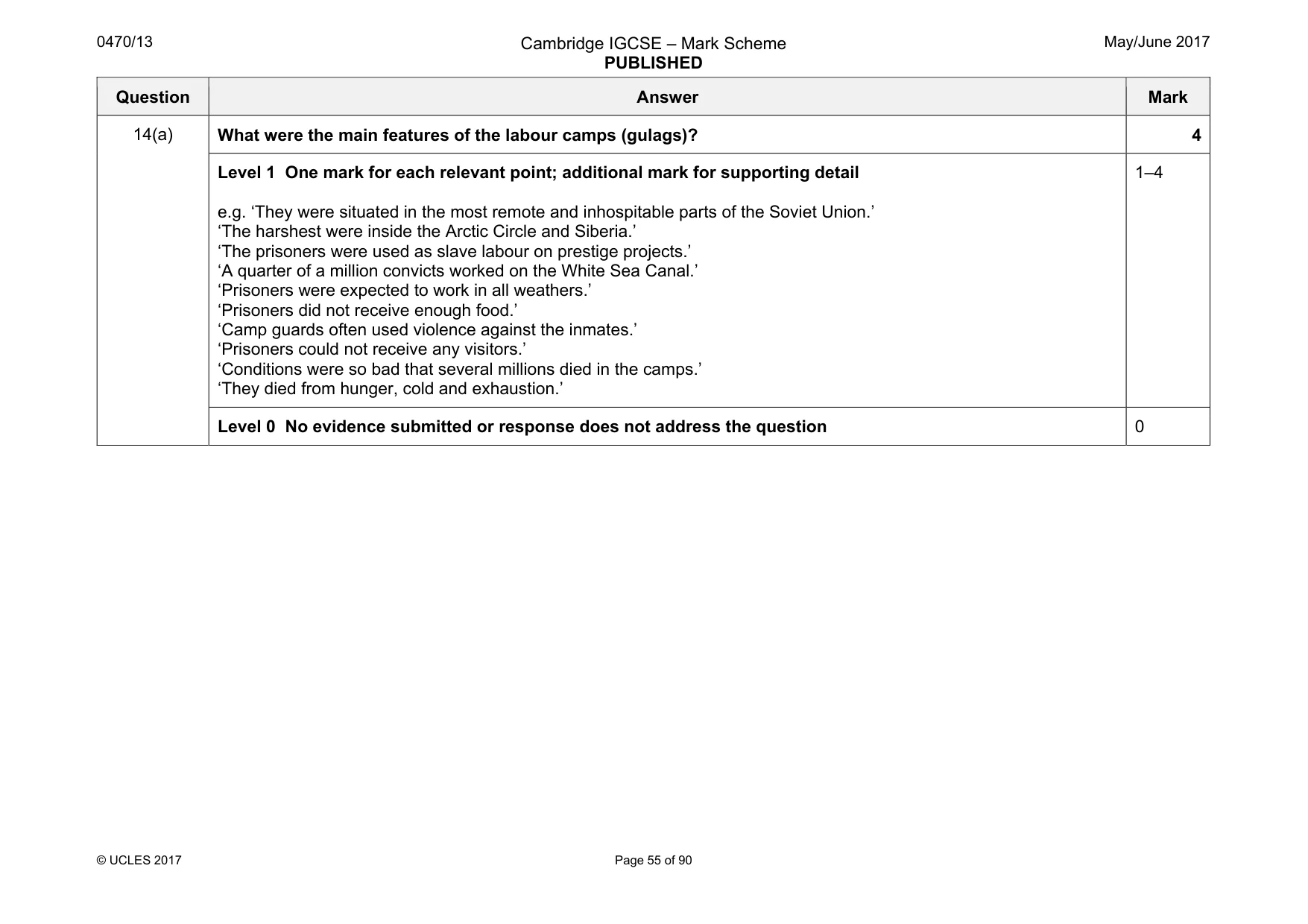
0470/13 Cambridge IGCSE – Mark Scheme PUBLISHED May/June 2017 © UCLES 2017 Page 55 of 90 Question Answer Mark 14(a) What were the main features of the labour camps (gulags)? 4 Level 1 One mark for each relevant point; additional mark for supporting detail e.g. ‘They were situated in the most remote and inhospitable parts of the Soviet Union.’ ‘The harshest were inside the Arctic Circle and Siberia.’ ‘The prisoners were used as slave labour on prestige projects.’ ‘A quarter of a million convicts worked on the White Sea Canal.’ ‘Prisoners were expected to work in all weathers.’ ‘Prisoners did not receive enough food.’ ‘Camp guards often used violence against the inmates.’ ‘Prisoners could not receive any visitors.’ ‘Conditions were so bad that several millions died in the camps.’ ‘They died from hunger, cold and exhaustion.’ 1–4 Level 0 No evidence submitted or response does not address the question 0
Mark scheme, page 56
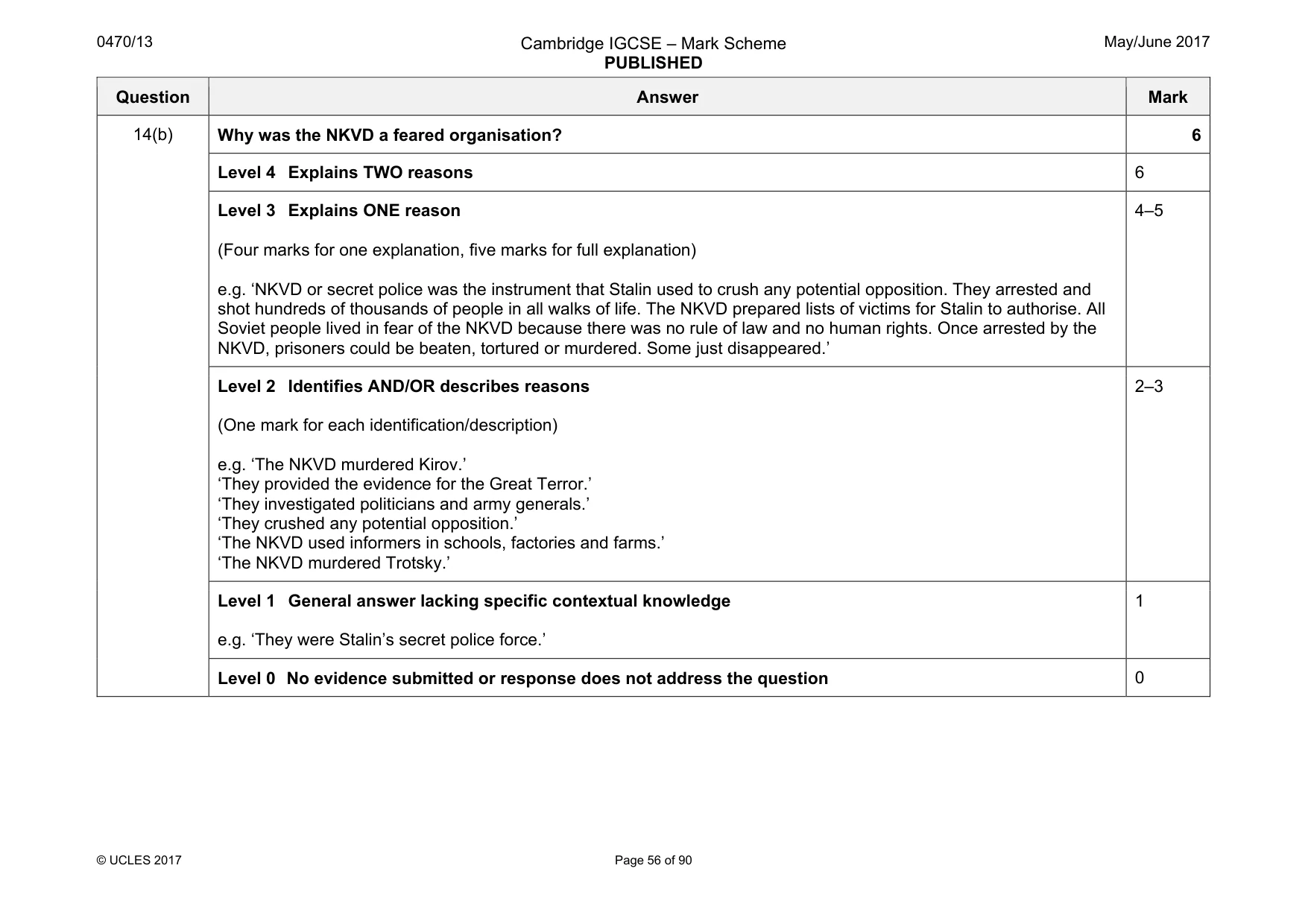
0470/13 Cambridge IGCSE – Mark Scheme PUBLISHED May/June 2017 © UCLES 2017 Page 56 of 90 Question Answer Mark 14(b) Why was the NKVD a feared organisation? 6 Level 4 Explains TWO reasons 6 Level 3 Explains ONE reason (Four marks for one explanation, five marks for full explanation) e.g. ‘NKVD or secret police was the instrument that Stalin used to crush any potential opposition. They arrested and shot hundreds of thousands of people in all walks of life. The NKVD prepared lists of victims for Stalin to authorise. All Soviet people lived in fear of the NKVD because there was no rule of law and no human rights. Once arrested by the NKVD, prisoners could be beaten, tortured or murdered. Some just disappeared.’ 4–5 Level 2 Identifies AND/OR describes reasons (One mark for each identification/description) e.g. ‘The NKVD murdered Kirov.’ ‘They provided the evidence for the Great Terror.’ ‘They investigated politicians and army generals.’ ‘They crushed any potential opposition.’ ‘The NKVD used informers in schools, factories and farms.’ ‘The NKVD murdered Trotsky.’ 2–3 Level 1 General answer lacking specific contextual knowledge e.g. ‘They were Stalin’s secret police force.’ 1 Level 0 No evidence submitted or response does not address the question 0
Mark scheme, page 57
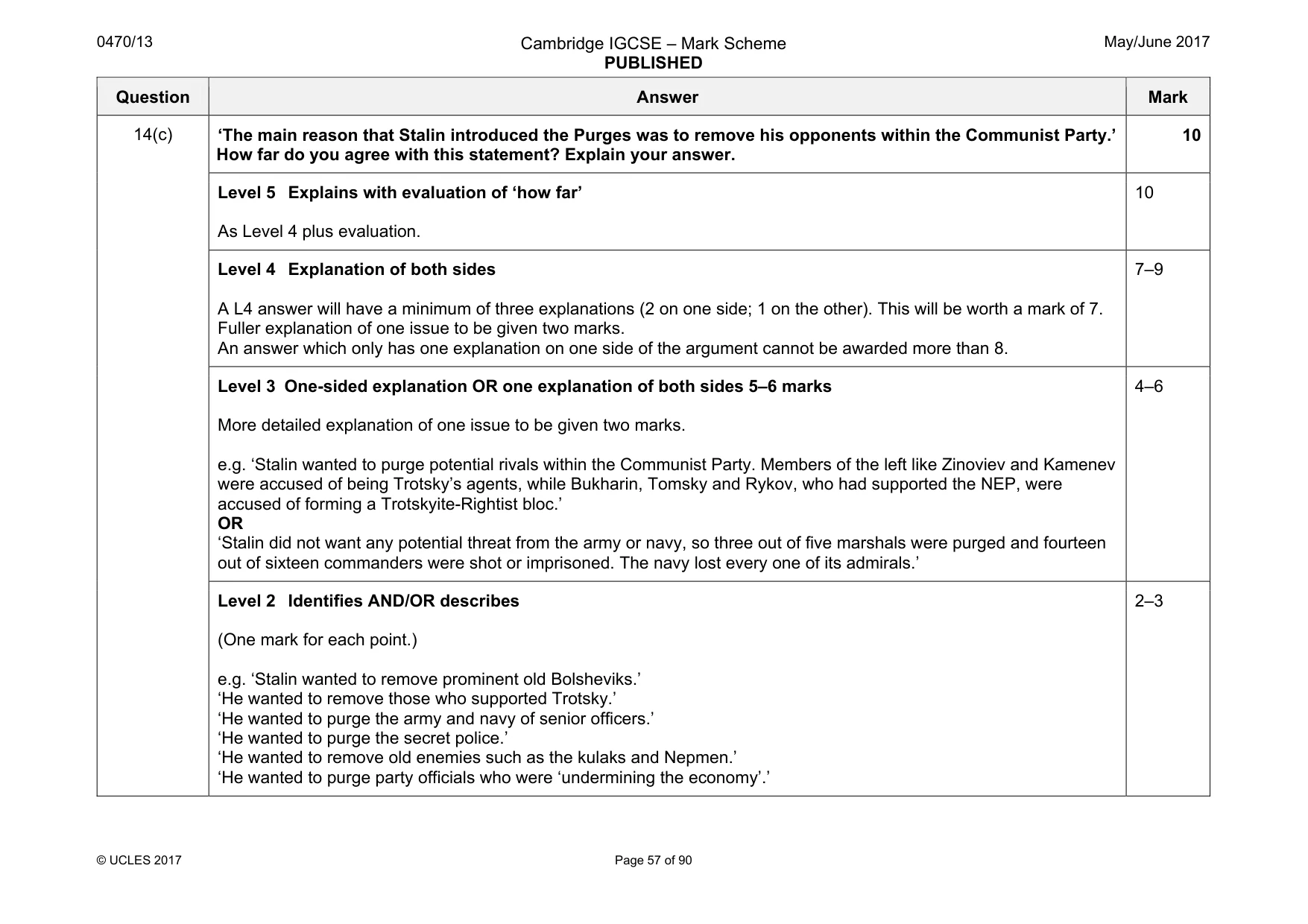
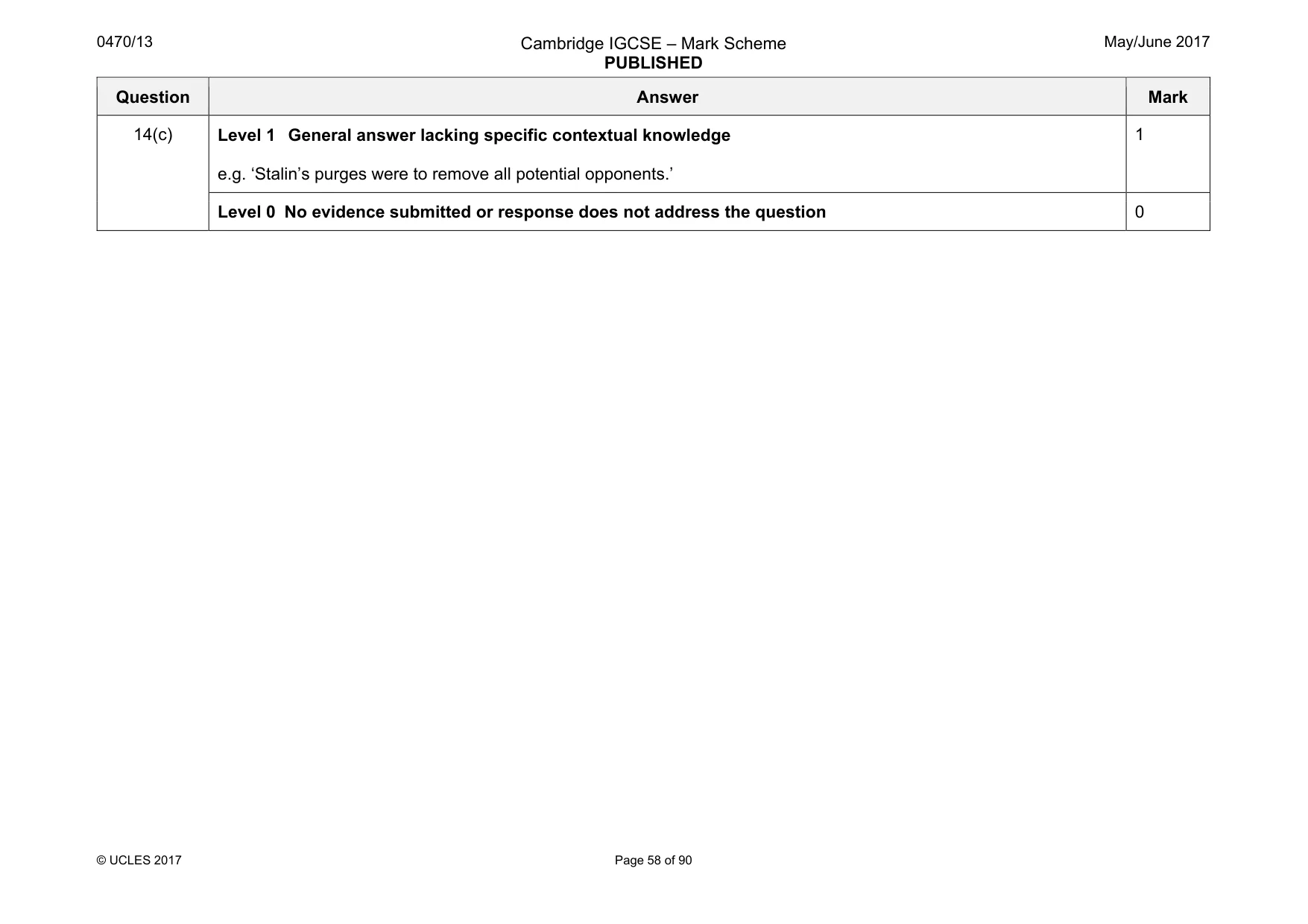
0470/13 Cambridge IGCSE – Mark Scheme PUBLISHED May/June 2017 © UCLES 2017 Page 57 of 90 Question Answer Mark 14(c) ‘The main reason that Stalin introduced the Purges was to remove his opponents within the Communist Party.’ How far do you agree with this statement? Explain your answer. 10 Level 5 Explains with evaluation of ‘how far’ As Level 4 plus evaluation. 10 Level 4 Explanation of both sides A L4 answer will have a minimum of three explanations (2 on one side; 1 on the other). This will be worth a mark of 7. Fuller explanation of one issue to be given two marks. An answer which only has one explanation on one side of the argument cannot be awarded more than 8. 7–9 Level 3 One-sided explanation OR one explanation of both sides 5–6 marks More detailed explanation of one issue to be given two marks. e.g. ‘Stalin wanted to purge potential rivals within the Communist Party. Members of the left like Zinoviev and Kamenev were accused of being Trotsky’s agents, while Bukharin, Tomsky and Rykov, who had supported the NEP, were accused of forming a Trotskyite-Rightist bloc.’ OR ‘Stalin did not want any potential threat from the army or navy, so three out of five marshals were purged and fourteen out of sixteen commanders were shot or imprisoned. The navy lost every one of its admirals.’ 4–6 Level 2 Identifies AND/OR describes (One mark for each point.) e.g. ‘Stalin wanted to remove prominent old Bolsheviks.’ ‘He wanted to remove those who supported Trotsky.’ ‘He wanted to purge the army and navy of senior officers.’ ‘He wanted to purge the secret police.’ ‘He wanted to remove old enemies such as the kulaks and Nepmen.’ ‘He wanted to purge party officials who were ‘undermining the economy’.’ 2–3
Mark scheme, page 58
0470/13 Cambridge IGCSE – Mark Scheme PUBLISHED May/June 2017 © UCLES 2017 Page 58 of 90 Question Answer Mark 14(c) Level 1 General answer lacking specific contextual knowledge e.g. ‘Stalin’s purges were to remove all potential opponents.’ 1 Level 0 No evidence submitted or response does not address the question 0
Mark scheme, page 59
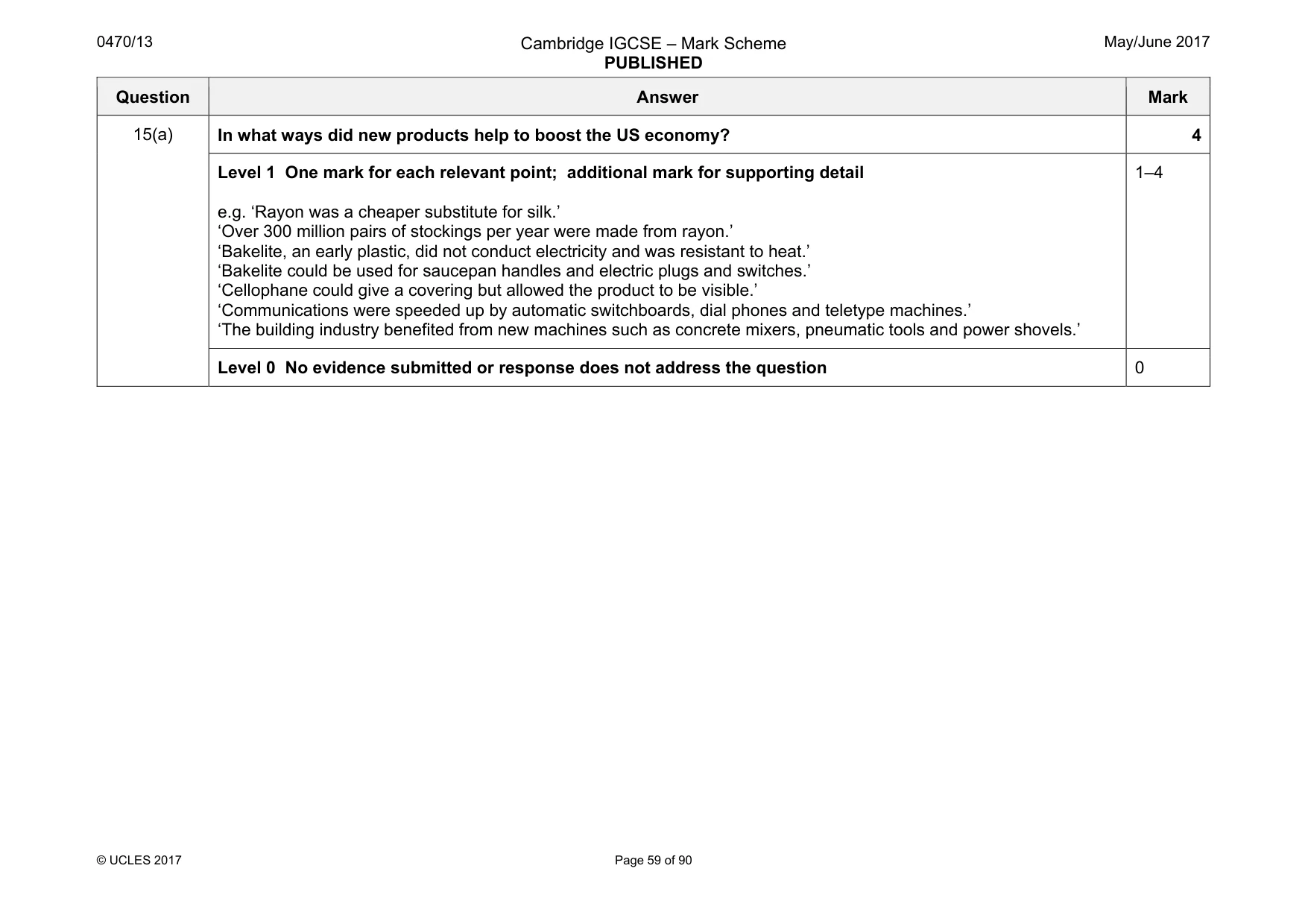
0470/13 Cambridge IGCSE – Mark Scheme PUBLISHED May/June 2017 © UCLES 2017 Page 59 of 90 Question Answer Mark 15(a) In what ways did new products help to boost the US economy? 4 Level 1 One mark for each relevant point; additional mark for supporting detail e.g. ‘Rayon was a cheaper substitute for silk.’ ‘Over 300 million pairs of stockings per year were made from rayon.’ ‘Bakelite, an early plastic, did not conduct electricity and was resistant to heat.’ ‘Bakelite could be used for saucepan handles and electric plugs and switches.’ ‘Cellophane could give a covering but allowed the product to be visible.’ ‘Communications were speeded up by automatic switchboards, dial phones and teletype machines.’ ‘The building industry benefited from new machines such as concrete mixers, pneumatic tools and power shovels.’ 1–4 Level 0 No evidence submitted or response does not address the question 0
Mark scheme, page 60
0470/13 Cambridge IGCSE – Mark Scheme PUBLISHED May/June 2017 © UCLES 2017 Page 60 of 90 Question Answer Mark 15(b) Why was the expansion of the motor industry important for the economic boom? 6 Level 4 Explains TWO reasons 6 Level 3 Explains ONE reason (Four marks for one explanation, five marks for full explanation) e.g. ‘The motor industry kept workers in other industries in employment. Glass, leather, steel and rubber were all required to build the new vehicles. Automobiles used up 75% of US glass production in the 1920s. A massive army of labourers was busily building roads throughout the country for the cars to drive on. Road construction became the biggest single employer in the 1920s.’ 4–5 Level 2 Identifies AND/OR describes reasons (One mark for each identification/description) e.g. ‘By the end of the 1920s, the motor industry was the USA’s biggest industry.’ ‘It employed hundreds of thousands of workers directly.’ ‘It benefited other industries needed to produce a car.’ ‘By 1929, one in five Americans owned a car.’ ‘Cars made it possible for people to buy a house in the suburbs, which benefited the house building industry.’ ‘The car industry stimulated hotel construction and the building of roadside filling stations.’ ‘It led to the development of holiday resorts.’ ‘The assembly line production of the car industry was copied by other industries, such as washing machines and hoovers.’ ‘The mass production of cars led to mass marketing.’ 2–3 Level 1 General answer lacking specific contextual knowledge e.g. ‘It revolutionised industrial practices.’ 1 Level 0 No evidence submitted or response does not address the question 0
Mark scheme, page 61
0470/13 Cambridge IGCSE – Mark Scheme PUBLISHED May/June 2017 © UCLES 2017 Page 61 of 90 Question Answer Mark 15(c) ‘Overproduction was the main reason US farmers faced serious problems in the 1920s.’ How far do you agree with this statement? Explain your answer. 10 Level 5 Explains with evaluation of ‘how far’ As Level 4 plus evaluation. 10 Level 4 Explanation of both sides A L4 answer will have a minimum of three explanations (2 on one side; 1 on the other). This will be worth a mark of 7. Fuller explanation of one issue to be given two marks. An answer which only has one explanation on one side of the argument cannot be awarded more than 8. 7–9 Level 3 One-sided explanation OR one explanation of both sides 5–6 marks More detailed explanation of one issue to be given two marks. e.g. ‘From 1900 to 1920, while farming was doing well, more and more land was being farmed. Improved machinery, especially the combine harvester, and improved fertilisers made US agriculture extremely efficient. The result was that by 1920 it was producing surpluses of wheat which nobody wanted.’ OR ‘After the war, Europe imported far less food from the USA. This was partly because Europe was poor and it was partly a response to US tariffs which stopped Europe from exporting to the USA. In retaliation, Europe imported far fewer US agricultural products.’ 4–6
Mark scheme, page 62
0470/13 Cambridge IGCSE – Mark Scheme PUBLISHED May/June 2017 © UCLES 2017 Page 62 of 90 Question Answer Mark 15(c) Level 2 Identifies AND/OR describes (One mark for each point.) e.g. ‘Europe imported less US food after the war.’ ‘US tariffs worked against US agricultural exports.’ ‘The Canadian wheat producers were very efficient.’ ‘More land was farmed, producing more food.’ ‘Improved machinery produced a surplus of food.’ ‘Lower prices meant farmers could not afford their mortgages.’ ‘The collapse of rural banks hit the farming industry.’ ‘Millions of farm labourers were forced off the land.’ 2–3 Level 1 General answer lacking specific contextual knowledge e.g. ‘The US farming industry faced a multitude of problems.’ 1 Level 0 No evidence submitted or response does not address the question 0
Mark scheme, page 63
0470/13 Cambridge IGCSE – Mark Scheme PUBLISHED May/June 2017 © UCLES 2017 Page 63 of 90 Question Answer Mark 16(a) What did Roosevelt aim to achieve with his promise of a ‘new deal’? 4 Level 1 One mark for each relevant point; additional mark for supporting detail e.g. ‘To bring about reform to create a more fair and just society.’ ‘To bring about the recovery and rebuilding of the American economy.’ ‘To bring relief to the poverty-stricken.’ ‘To create employment for the unemployed.’ ‘To improve working conditions and pay for the employed.’ ‘To end child labour.’ ‘To bring stability to the banking system.’ ‘To protect people’s savings and property.’ ‘To make agriculture profitable.’ 1–4 Level 0 No evidence submitted or response does not address the question 0
Mark scheme, page 64
0470/13 Cambridge IGCSE – Mark Scheme PUBLISHED May/June 2017 © UCLES 2017 Page 64 of 90 Question Answer Mark 16(b) Why was the American business community critical of the New Deal? 6 Level 4 Explains TWO reasons 6 Level 3 Explains ONE reason (Four marks for one explanation, five marks for full explanation) e.g. ‘The basic objection was that Roosevelt allowed government to become involved in economic life in an unprecedented manner. New Deal laws tried to create jobs, fix prices, dictate working conditions and control levels of production, all activities that the business community felt were none of the government’s business.’ 4–5 Level 2 Identifies AND/OR describes reasons (One mark for each identification/description) e.g. ‘They thought Roosevelt was destroying free enterprise.’ ‘They thought Roosevelt was moving towards socialism.’ ‘Businessmen did not like the government being involved in business.’ ‘They disliked Roosevelt’s support for trade unions.’ ‘They did not like contributing towards unemployment insurance schemes.’ ‘They did not like having to agree to NRA codes to gain government contracts.’ 2–3 Level 1 General answer lacking specific contextual knowledge e.g. ‘They had to pay more taxes.’ 1 Level 0 No evidence submitted or response does not address the question 0
Mark scheme, page 65
0470/13 Cambridge IGCSE – Mark Scheme PUBLISHED May/June 2017 © UCLES 2017 Page 65 of 90 Question Answer Mark 16(c) ‘The New Deal was a failure as it did not solve unemployment.’ How far do you agree with this statement? Explain your answer. 10 Level 5 Explains with evaluation of ‘how far’ As Level 4 plus evaluation. 10 Level 4 Explanation of both sides A L4 answer will have a minimum of three explanations (2 on one side; 1 on the other). This will be worth a mark of 7. Fuller explanation of one issue to be given two marks. An answer which only has one explanation on one side of the argument cannot be awarded more than 8. 7–9 Level 3 One-sided explanation OR one explanation of both sides 5–6 marks More detailed explanation of one issue to be given two marks. e.g. ‘During the years of the New Deal, unemployment never fell below 14% of the workforce. Unemployment never fell below 5 million. This was because most of the jobs under the New Deal were not permanent and were lowly paid, reducing the money available to spend on American goods.’ OR ‘America became a more compassionate society. Roosevelt’s policies gave new hope, new confidence and a sense of purpose. It enabled America to survive the Depression without resorting to extreme solutions such as fascism, as happened in other countries.’ 4–6
Mark scheme, page 66
0470/13 Cambridge IGCSE – Mark Scheme PUBLISHED May/June 2017 © UCLES 2017 Page 66 of 90 Question Answer Mark 16(c) Level 2 Identifies AND/OR describes (One mark for each point.) e.g. Failure ‘Unemployment was only solved by the Second World War.’ ‘Government policy forced many to lose their jobs in agriculture.’ ‘It failed to end racial discrimination.’ ‘Industry was hampered by increased regulations and higher taxation.’ Success ‘Unemployment fell by over 30%.’ ‘The banking system was saved.’ ‘The very poor benefited from welfare and emergency payments.’ ‘Working conditions and pay generally improved.’ ‘Trade unions increased their membership.’ 2–3 Level 1 General answer lacking specific contextual knowledge e.g. ‘Not enough was done for some people.’ 1 Level 0 No evidence submitted or response does not address the question 0
Mark scheme, page 67
0470/13 Cambridge IGCSE – Mark Scheme PUBLISHED May/June 2017 © UCLES 2017 Page 67 of 90 Question Answer Mark 17(a) What were the results of the Marco Polo Bridge Incident of 1937 for China? 4 Level 1 One mark for each relevant point; additional mark for supporting detail e.g. ‘The Japanese attempted to force their way into Wanping to find a missing soldier.’ ‘Both the Chinese and Japanese increased their troop numbers.’ ‘A full scale Japanese invasion of China followed.’ ‘In 1937, Beijing, Shanghai and Nanjing fell to the Japanese.’ ‘Nanjing was where Chiang Kai-Shek had his KMT capital.’ ‘The fighting was vicious and led to many atrocities.’ ‘100 000 Chinese were slaughtered.’ ‘By the end of 1938, much of northern and eastern China had been overrun.’ ‘The conflict continued until it blended into the Second World War.’ 1–4 Level 0 No evidence submitted or response does not address the question 0
Mark scheme, page 68
0470/13 Cambridge IGCSE – Mark Scheme PUBLISHED May/June 2017 © UCLES 2017 Page 68 of 90 Question Answer Mark 17(b) Why did the Second World War increase the strength of the Communist Party? 6 Level 4 Explains TWO reasons 6 Level 3 Explains ONE reason (Four marks for one explanation, five marks for full explanation) e.g. ‘The Communists were popular with the peasants because they took the fight to the Japanese by using guerrilla tactics. They organised local Chinese resistance forces in areas occupied by the Japanese in an attempt to sabotage the enemy war effort. They destroyed railways, ambushed troops and disrupted Japanese supply lines. This was in contrast to the defensive approach by the Nationalists.’ 4–5 Level 2 Identifies AND/OR describes reasons (One mark for each identification/description) e.g. ‘The Communists took the attack to the invader.’ ‘They appeared to be very patriotic.’ ‘They helped the resistance forces plan their attacks.’ ‘They did this with very few arms or aid.’ ‘The Communists took control of large areas of rural China.’ ‘In these areas they reduced rents and increased taxes on the rich.’ ‘As the Japanese were driven out, the Communists could rely on the peasantry for support.’ 2–3 Level 1 General answer lacking specific contextual knowledge e.g. ‘The Communists worked with the people, unlike the Nationalists.’ 1 Level 0 No evidence submitted or response does not address the question 0
Mark scheme, page 69
0470/13 Cambridge IGCSE – Mark Scheme PUBLISHED May/June 2017 © UCLES 2017 Page 69 of 90 Question Answer Mark 17(c) ‘Support from the peasants was the main reason for the Communist victory in the Civil War.’ How far do you agree with this statement? Explain your answer. 10 Level 5 Explains with evaluation of ‘how far’ As Level 4 plus evaluation. 10 Level 4 Explanation of both sides A L4 answer will have a minimum of three explanations (2 on one side; 1 on the other). This will be worth a mark of 7. Fuller explanation of one issue to be given two marks. An answer which only has one explanation on one side of the argument cannot be awarded more than 8. 7–9 Level 3 One-sided explanation OR one explanation of both sides 5–6 marks More detailed explanation of one issue to be given two marks. e.g. ‘The Communists were the party of the people, visibly present in the rural areas where most lived and keen to introduce measures that the people wanted. By winning hearts and minds, the Communists were able to win the war.’ OR ‘The Communists used the guerrilla tactics that had served them so well against the Japanese. They did not engage the KMT in set-piece battles, but focused on smaller targets and caused supply problems to the KMT.’ 4–6 Level 2 Identifies AND/OR describes (One mark for each point.) e.g. ‘The Communists had gained much peasant support during the war against the Japanese.’ ‘The Communists worked with the peasants, while the KMT supported the landlords.’ ‘Chiang and the KMT were corrupt.’ ‘Chiang appeared to be a puppet of the USA.’ ‘KMT soldiers treated the peasants with no respect.’ ‘Communist guerrilla tactics were highly effective.’ ‘Mao was very popular as he was seen as a liberator from the Japanese.’ 2–3
Mark scheme, page 70
0470/13 Cambridge IGCSE – Mark Scheme PUBLISHED May/June 2017 © UCLES 2017 Page 70 of 90 Question Answer Mark 17(c) Level 1 General answer lacking specific contextual knowledge e.g. ‘The KMT failed to gain peasant support, unlike the Communists.’ 1 Level 0 No evidence submitted or response does not address the question 0
Mark scheme, page 71
0470/13 Cambridge IGCSE – Mark Scheme PUBLISHED May/June 2017 © UCLES 2017 Page 71 of 90 Question Answer Mark 18(a) Describe relations between China and Tibet in the 1950s. 4 Level 1 One mark for each relevant point; additional mark for supporting detail e.g. ‘In May 1951, an agreement was signed by Tibet recognising Chinese rule over the country.’ ‘The agreement guaranteed the existing political and social system of Tibet would continue.’ ‘In 1954, India and China signed an eight year agreement on Tibet called Panch Shila.’ ‘It was designed to promote understanding and cultural exchanges.’ ‘In 1959, the Chinese told the Indian leader that borders were incorrect.’ ‘The Chinese wanted to build a highway into Tibet which involved these border areas.’ ‘In 1959 there was a ‘Tibetan Uprising’.’ ‘It was a protest over the increasing spread of communism in Tibet.’ ‘The protests were crushed.’ ‘The Dalai Lama and thousands of Tibetan refugees fled to India.’ 1–4 Level 0 No evidence submitted or response does not address the question 0
Mark scheme, page 72
0470/13 Cambridge IGCSE – Mark Scheme PUBLISHED May/June 2017 © UCLES 2017 Page 72 of 90 Question Answer Mark 18(b) Why have Communist China’s relations with Taiwan always been hostile? 6 Level 4 Explains TWO reasons 6 Level 3 Explains ONE reason (Four marks for one explanation, five marks for full explanation) e.g. ‘Both the KMT and Communist governments claimed to be the legitimate government of China and labelled the other illegitimate. Each side used propaganda showing the other to be suffering and living in poor conditions. Both governments wanted to gain control of each other’s territory.’ 4–5 Level 2 Identifies AND/OR describes reasons (One mark for each identification/description) e.g. ‘The Communists and the KMT have always been bitter rivals.’ ‘They fought for control of China in a civil war.’ ‘Those fleeing persecution form China sought refuge in Taiwan.’ ‘Both governments thought they were the legitimate government.’ ‘An official state of war existed until 1979.’ ‘In 1950, the Communists had attempted to seize islands belonging to Taiwan.’ ‘Taiwan had financial and military support from the USA.’ ‘Taiwan had the seat in the UN for China until 1971.’ 2–3 Level 1 General answer lacking specific contextual knowledge e.g. ‘Mao and Chiang had been bitter enemies.’ 1 Level 0 No evidence submitted or response does not address the question 0
Mark scheme, page 73
0470/13 Cambridge IGCSE – Mark Scheme PUBLISHED May/June 2017 © UCLES 2017 Page 73 of 90 Question Answer Mark 18(c) ‘The main reason for China’s improving relations with the USA was the death of Mao.’ How far do you agree with this statement? Explain your answer. 10 Level 5 Explains with evaluation of ‘how far’ As Level 4 plus evaluation. 10 Level 4 Explanation of both sides A L4 answer will have a minimum of three explanations (2 on one side; 1 on the other). This will be worth a mark of 7. Fuller explanation of one issue to be given two marks. An answer which only has one explanation on one side of the argument cannot be awarded more than 8. 7–9 Level 3 One-sided explanation OR one explanation of both sides 5–6 marks More detailed explanation of one issue to be given two marks. e.g. ‘Mao had been the enemy of the USA over Korea and Vietnam and the fact that the USA supported the regime in Taiwan. Although relations with the USA improved after his death, Mao had in his last five years met President Nixon and increased trade and cultural links.’ OR ‘Relations deteriorated between China and the USSR during the 1960s. China did not want to be isolated from both world super powers, while the USA saw it as an opportunity to divide the two further. If the USA could establish links with China, it would isolate its main Cold War enemy.’ 4–6 Level 2 Identifies AND/OR describes (One mark for each point.) e.g. ‘There was a split in Chinese and USSR relations.’ ‘The USA changed its foreign policy.’ ‘China wanted access to US trade and business expertise.’ ‘Deng promoted the market economy and trade with the USA.’ ‘China was accepted into the UN and Taiwan expelled.’ ‘Mao did not want to offend both super powers.’ 2–3
Mark scheme, page 74
0470/13 Cambridge IGCSE – Mark Scheme PUBLISHED May/June 2017 © UCLES 2017 Page 74 of 90 Question Answer Mark 18(c) Level 1 General answer lacking specific contextual knowledge e.g. ‘Before his death, Mao was improving relations with the USA.’ 1 Level 0 No evidence submitted or response does not address the question 0
Mark scheme, page 75
0470/13 Cambridge IGCSE – Mark Scheme PUBLISHED May/June 2017 © UCLES 2017 Page 75 of 90 Question Answer Mark 19(a) What restrictions in relation to travel for non-whites existed in South Africa by 1940? 4 Level 1 One mark for each relevant point; additional mark for supporting detail e.g. ‘Movement for non-whites around the country was limited by the pass system.’ ‘Every black male over 16 was obliged to carry a pass.’ ‘The pass contained personal and work details.’ ‘The pass had to be presented to the police on demand.’ ‘Failure to produce a pass on demand could result in a jail sentence or deportation to a black reservation.’ ‘Passes were used to ensure that blacks moved out of the towns as soon as their work was complete.’ 1–4 Level 0 No evidence submitted or response does not address the question 0
Mark scheme, page 76
0470/13 Cambridge IGCSE – Mark Scheme PUBLISHED May/June 2017 © UCLES 2017 Page 76 of 90 Question Answer Mark 19(b) Why was the migrant labour system disliked by black workers? 6 Level 4 Explains TWO reasons 6 Level 3 Explains ONE reason (Four marks for one explanation, five marks for full explanation) e.g. ‘The workers did not like closed compounds, associated with the mining industry. Workers were isolated from the towns and liquor and women were forbidden. Facilities were basic with simple wooden beds and rudimentary cooking and toilet facilities. Workers lost all access to the outside world for the length of a contract.’ 4–5 Level 2 Identifies AND/OR describes reasons (One mark for each identification/description) e.g. ‘Migrant labourers had to sign a contract.’ ‘Breaking the contract was a criminal offence.’ ‘Labourers had to carry their pass book.’ ‘Wages were low.’ ‘The compound had basic living conditions.’ ‘Discipline was harsh and the working hours were long.’ ‘Labourers did not see their families for many months.’ 2–3 Level 1 General answer lacking specific contextual knowledge e.g. ‘White farmers and industrialists exploited migrant black workers.’ 1 Level 0 No evidence submitted or response does not address the question 0
Mark scheme, page 77
0470/13 Cambridge IGCSE – Mark Scheme PUBLISHED May/June 2017 © UCLES 2017 Page 77 of 90 Question Answer Mark 19(c) ‘The main success of South Africa’s economic development by 1945 was in manufacturing.’ How far do you agree with this statement? Explain your answer. 10 Level 5 Explains with evaluation of ‘how far’ As Level 4 plus evaluation. 10 Level 4 Explanation of both sides A L4 answer will have a minimum of three explanations (2 on one side; 1 on the other). This will be worth a mark of 7. Fuller explanation of one issue to be given two marks. An answer which only has one explanation on one side of the argument cannot be awarded more than 8. 7–9 Level 3 One-sided explanation OR one explanation of both sides 5–6 marks More detailed explanation of one issue to be given two marks. e.g. ‘By 1945, manufacturing contributed 20% to the total of the economy. The government protected home industries with tariffs and established ESCOM to provide cheap electricity to industry and the railways. ISCOR exploited the country’s rich resources of coal and iron to produce steel.’ OR ‘Gold mining was the engine of the economy, accounting for 70% of exports. It stimulated other sectors of the economy, such as the production of machinery, electrical equipment, explosives and wire cables. It created many professional jobs such as accountants, lawyers and bankers.’ 4–6 Level 2 Identifies AND/OR describes (One mark for each point.) e.g. ‘Manufacturing grew rapidly between 1920 and 1945.’ ‘It used the country’s natural resources.’ ‘Gold mining produced much revenue from taxes and royalties to help other sectors of the economy.’ ‘Foreign capital and skilled labour was drawn to South Africa’s gold industry.’ ‘A third of the working population was dependent on agriculture.’ ‘The government provided loans and grants to mainly white farmers.’ 2–3
Mark scheme, page 78
0470/13 Cambridge IGCSE – Mark Scheme PUBLISHED May/June 2017 © UCLES 2017 Page 78 of 90 Question Answer Mark 19(c) Level 1 General answer lacking specific contextual knowledge e.g. ‘Progress was made in manufacturing, gold mining and agriculture.’ 1 Level 0 No evidence submitted or response does not address the question 0
Mark scheme, page 79
0470/13 Cambridge IGCSE – Mark Scheme PUBLISHED May/June 2017 © UCLES 2017 Page 79 of 90 Question Answer Mark 20(a) What was the outcome of the April 1994 election? 4 Level 1 One mark for each relevant point; additional mark for supporting detail e.g. ‘The ANC won a convincing victory with over 60% of the vote.’ ‘The National Party polled just over 20% of the vote.’ ‘Inkatha won just over 10% of the vote.’ ‘Nelson Mandela became President.’ ‘De Klerk became Deputy President.’ ‘Buthelezi became a minister in Mandela’s government.’ ‘Mandela declared that it was ‘a time to heal old wounds and build a new South Africa’.’ 1–4 Level 0 No evidence submitted or response does not address the question 0
Mark scheme, page 80
0470/13 Cambridge IGCSE – Mark Scheme PUBLISHED May/June 2017 © UCLES 2017 Page 80 of 90 Question Answer Mark 20(b) Why was the ANC worried about the actions of Chief Buthelezi? 6 Level 4 Explains TWO reasons 6 Level 3 Explains ONE reason (Four marks for one explanation, five marks for full explanation) e.g. ‘Buthelezi was a Zulu nationalist and hoped to make KwaZulu an independent state. This was at odds with Mandela’s ambitions for a unified South Africa. Friction between ANC and IIFP led to violence and this threatened the fragile relationship between Mandela and de Klerk. Mandela eventually persuaded Buthelezi to take part in the elections.’ 4–5 Level 2 Identifies AND/OR describes reasons (One mark for each identification/description) e.g. ‘He left the ANC and became the Chief Minister of the Zulu homeland.’ ‘He was criticised for being a collaborator of the National Government.’ ‘After 1990, he represented the Inkatha Freedom Party.’ ‘The Party wanted a federal republic to protect the rights of Zulus.’ ‘He refused to participate in negotiations up to the 1994 election.’ ‘There was violence between ANC and IFP supporters.’ ‘Buthelezi changed his mind at the last minute.’ 2–3 Level 1 General answer lacking specific contextual knowledge e.g. ‘Buthelezi was a divisive member of the anti-apartheid movement.’ 1 Level 0 No evidence submitted or response does not address the question 0
Mark scheme, page 81
0470/13 Cambridge IGCSE – Mark Scheme PUBLISHED May/June 2017 © UCLES 2017 Page 81 of 90 Question Answer Mark 20(c) How important was de Klerk in the ending of white minority rule? Explain your answer. 10 Level 5 Explains with evaluation of ‘how important’ As Level 4 plus evaluation. 10 Level 4 Explanation of both sides A L4 answer will have a minimum of three explanations (2 on one side; 1 on the other). This will be worth a mark of 7. Fuller explanation of one issue to be given two marks. An answer which only has one explanation on one side of the argument cannot be awarded more than 8. 7–9 Level 3 One-sided explanation OR one explanation of both sides 5–6 marks More detailed explanation of one issue to be given two marks. e.g. ‘De Klerk worked to end apartheid and establish a new political system, based on non-racial democratic principles. He wanted to avoid civil war and he persevered with the peace discussions despite provocation from the extremist wing of the ANC.’ OR ‘Mandela had a vision to end apartheid and establish a new constitution. He worked for one person, one vote. In the peace discussions, he said he wanted whites to remain in the country so that they could continue to apply their managerial and technical skills.’ 4–6 Level 2 Identifies AND/OR describes (One mark for each point.) e.g. ‘De Klerk was important because he brought change.’ ‘He accepted that apartheid had to be dismantled.’ ‘He ended the ban on the ANC and released Mandela.’ ‘Mandela worked for one person, one vote within a united South Africa.’ ‘Mandela sought reconciliation between the different ethnic groups.’ ‘The work of the ANC had an effect.’ ‘International opposition to apartheid increased.’ 2–3
Mark scheme, page 82
0470/13 Cambridge IGCSE – Mark Scheme PUBLISHED May/June 2017 © UCLES 2017 Page 82 of 90 Question Answer Mark 20(c) Level 1 General answer lacking specific contextual knowledge e.g. ‘Both de Klerk and Mandela played a vital role.’ 1 Level 0 No evidence submitted or response does not address the question 0
Mark scheme, page 83
0470/13 Cambridge IGCSE – Mark Scheme PUBLISHED May/June 2017 © UCLES 2017 Page 83 of 90 Question Answer Mark 21(a) Describe the events of 1954–56 which resulted in the Suez conflict. 4 Level 1 One mark for each relevant point; additional mark for supporting detail e.g. ‘In 1954, Nasser became President of Egypt.’ ‘Colonel Nasser had helped to overthrow King Farouk and make Egypt a republic.’ ‘Nasser persuaded the British to withdraw their troops from the Suez Canal zone.’ ‘Britain and the USA wanted to be on good terms with Nasser.’ ‘They wanted Arab support in the Middle East against the Soviet Union.’ ‘Nasser refused to join an anti-Soviet alliance.’ ‘He wanted Egypt to be neutral.’ ‘The Israelis attacked Egyptian headquarters in Gaza in February 1955.’ ‘The Egyptians secured Soviet arms through Czechoslovakia.’ ‘In July 1956, the USA and Britain decided to cancel their loans to Egypt for the building of the Aswan Dam.’ ‘Nasser nationalised the Suez Canal to use the profits to build the Aswan Dam.’ 1–4 Level 0 No evidence submitted or response does not address the question 0
Mark scheme, page 84
0470/13 Cambridge IGCSE – Mark Scheme PUBLISHED May/June 2017 © UCLES 2017 Page 84 of 90 Question Answer Mark 21(b) Why were the results of the Suez conflict important for Israel? 6 Level 4 Explains TWO reasons 6 Level 3 Explains ONE reason (Four marks for one explanation, five marks for full explanation) e.g. ‘The speed of their victory over Egyptian forces in Gaza and Sinai had proved that the Israeli Defence Forces were the strongest in the Middle East. The Israeli air force showed it had air superiority over the Egyptian air force, while the army showed it had speed and flexibility with its tactics. The Israelis proved they had the most able commanders, such as Moshe Dayan and Ariel Sharon.’ 4–5 Level 2 Identifies AND/OR describes reasons (One mark for each identification/description) e.g. ‘The Suez conflict proved that Israel had the best armed forces in the Middle East.’ ‘When Israeli forces were withdrawn from Sinai, the UN guarded the border between Israel and Egypt.’ ‘In particular, UN forces tried to prevent raids on Israel from Gaza.’ ‘UN forces were to guard the passage of Israeli shipping through the Straits of Tiran.’ ‘Israel cemented its relationship with the USA.’ ‘It clarified who its friends and enemies were for the future.’ ‘Israel realised it needed to keep modernising its armed forces.’ ‘The bases of the Fedayeen had been destroyed.’ 2–3 Level 1 General answer lacking specific contextual knowledge e.g. ‘It showed Israel had the upper hand over its neighbours in war.’ 1 Level 0 No evidence submitted or response does not address the question 0
Mark scheme, page 85
0470/13 Cambridge IGCSE – Mark Scheme PUBLISHED May/June 2017 © UCLES 2017 Page 85 of 90 Question Answer Mark 21(c) ‘The actions of Nasser caused the Six-Day War of 1967.’ How far do you agree with this statement? Explain your answer. 10 Level 5 Explains with evaluation of ‘how far’ As Level 4 plus evaluation. 10 Level 4 Explanation of both sides A L4 answer will have a minimum of three explanations (2 on one side; 1 on the other). This will be worth a mark of 7. Fuller explanation of one issue to be given two marks. An answer which only has one explanation on one side of the argument cannot be awarded more than 8. 7–9 Level 3 One-sided explanation OR one explanation of both sides 5–6 marks More detailed explanation of one issue to be given two marks. e.g. ‘Nasser provoked war by moving 100 000 troops into Sinai, which alarmed the Israelis because it brought Egyptian troops nearer to Israel. He then asked the UN commander to remove his troops from Egyptian soil. This was followed by closing the Straits of Tiran to Israeli shipping.’ OR ‘In Cairo in 1964, the Arab leaders set up the PLO, whose aim was to win back the land which Palestinians had lost in 1948–49. Fatah, a guerrilla group and part of the PLO, began raiding Israel from bases in Syria, Jordan and Lebanon. The Syrians, in particular, supported Fatah with men and arms. This provoked the Israelis to teach the Syrians a lesson.’ 4–6
Mark scheme, page 86
0470/13 Cambridge IGCSE – Mark Scheme PUBLISHED May/June 2017 © UCLES 2017 Page 86 of 90 Question Answer Mark Level 2 Identifies AND/OR describes (One mark for each point.) e.g. ‘The PLO was formed to take back land from Israel.’ ‘There were border skirmishes between Fatah and Israeli forces.’ ‘Syria became violently anti-Israeli and was warned by Israel.’ ‘The USSR gave information, which was inaccurate, to Syria and Egypt of Israeli troops massing on the Syrian border.’ ‘Nasser put troops into Sinai.’ ‘Nasser asked the UN to remove troops from Egypt.’ ‘Nasser closed the Gulf of Aqaba to Israeli shipping.’ 2–3 Level 1 General answer lacking specific contextual knowledge e.g. ‘Nasser was goaded by the Syrians to take action.’ 1 Level 0 No evidence submitted or response does not address the question 0
Mark scheme, page 87
0470/13 Cambridge IGCSE – Mark Scheme PUBLISHED May/June 2017 © UCLES 2017 Page 87 of 90 Question Answer Mark 22(a) What action did Palestinians take between 1970 and 1976 to attract international attention? 4 Level 1 One mark for each relevant point; additional mark for supporting detail e.g. ‘In September 1970, four planes were hijacked and blown up in Jordan.’ ‘In September 1971, the Jordanian Prime Minister was murdered.’ ‘In September 1972, Black September kidnapped and killed 11 Israeli athletes in the Munich Olympics.’ ‘In October 1972, a Lufthansa plane was hijacked.’ ‘In July 1976, an Air France flight to Entebbe was hijacked.’ 1–4 Level 0 No evidence submitted or response does not address the question 0
Mark scheme, page 88
0470/13 Cambridge IGCSE – Mark Scheme PUBLISHED May/June 2017 © UCLES 2017 Page 88 of 90 Question Answer Mark 22(b) Why were many Palestinians in refugee camps by the 1980s? 6 Level 4 Explains TWO reasons 6 Level 3 Explains ONE reason (Four marks for one explanation, five marks for full explanation) e.g. ‘The Arab states had strong motives for keeping the refugee problem alive. The continued existence of the camps served as a reminder of Israeli aggression and, if the Palestinians returned home to their villages now under Israeli control, they would cease to be Palestinians and would be absorbed into the new Israeli state.’ 4–5 Level 2 Identifies AND/OR describes reasons (One mark for each identification/description) e.g. ‘The events of 1947–48 created a huge refugee crisis.’ ‘The refugees fled to the West Bank, Gaza, Jordan, Syria and Lebanon.’ ‘The Israelis forcibly expelled Palestinians to occupy their land.’ ‘They fled in terror due to the Deir Yassin massacre.’ ‘The refugee crisis worsened as a result of the 1967 war.’ ‘Jewish settlers moved in so the refugees could not return.’ ‘Arab countries wanted the camps to highlight the Palestinian cause.’ ‘The Arabs had rejected the Partition Plan.’ 2–3 Level 1 General answer lacking specific contextual knowledge e.g. ‘Palestinians were forced into camps because of war.’ 1 Level 0 No evidence submitted or response does not address the question 0
Mark scheme, page 89
0470/13 Cambridge IGCSE – Mark Scheme PUBLISHED May/June 2017 © UCLES 2017 Page 89 of 90 Question Answer Mark 22(c) ‘Arafat was a successful leader.’ How far do you agree with this statement? Explain your answer. 10 Level 5 Explains with evaluation of ‘how far’ As Level 4 plus evaluation. 10 Level 4 Explanation of both sides A L4 answer will have a minimum of three explanations (2 on one side; 1 on the other). This will be worth a mark of 7. Fuller explanation of one issue to be given two marks. An answer which only has one explanation on one side of the argument cannot be awarded more than 8. 7–9 Level 3 One-sided explanation OR one explanation of both sides 5–6 marks More detailed explanation of one issue to be given two marks. e.g. ‘Arafat was successful in promoting the Palestinian problem through both peaceful and violent means. He founded Fatah and became Chairman of the PLO and used spectacular atrocities to attract world attention.’ OR ‘Arafat failed to gain an independent Palestinian state. He used violence before 1974, but this only lost international support. Recognising Israel and attempting peaceful means lost him the support of many Palestinians who turned to Hamas over which he had no control.’ 4–6 Level 2 Identifies AND/OR describes (One mark for each point.) e.g. ‘Arafat was successful in highlighting the Palestinian problem.’ ‘He addressed the United Nations.’ ‘He signed the Oslo peace agreement with the Israelis.’ ‘He was awarded the Nobel peace prize.’ ‘Arafat encouraged violent actions which lost international support.’ ‘He failed to control Hamas.’ ‘He failed to gain an independent Palestinian state.’ 2–3
Mark scheme, page 90
0470/13 Cambridge IGCSE – Mark Scheme PUBLISHED May/June 2017 © UCLES 2017 Page 90 of 90 Question Answer Mark 22(c) Level 1 General answer lacking specific contextual knowledge e.g. ‘Arafat had mixed fortunes in his political career.’ 1 Level 0 No evidence submitted or response does not address the question 0
What you needed in this session
Cambridge’s own grade thresholds for 2017 May/June, Paper 1 · Variant 3. A higher threshold means an easier paper — the bar moves with how the cohort did.