Cambridge IGCSE History 0470 — 2014 Oct/Nov Paper 1 · Variant 2
0470/12/O/N/14 · 60 marks · ≈68 min
The question paper and its mark scheme, free to read here and free to download. This is Cambridge’s own paper, exactly as it was sat.
Question paper20 pages
Mark scheme77 pages
Answers below. Sit the paper first if you are practising.
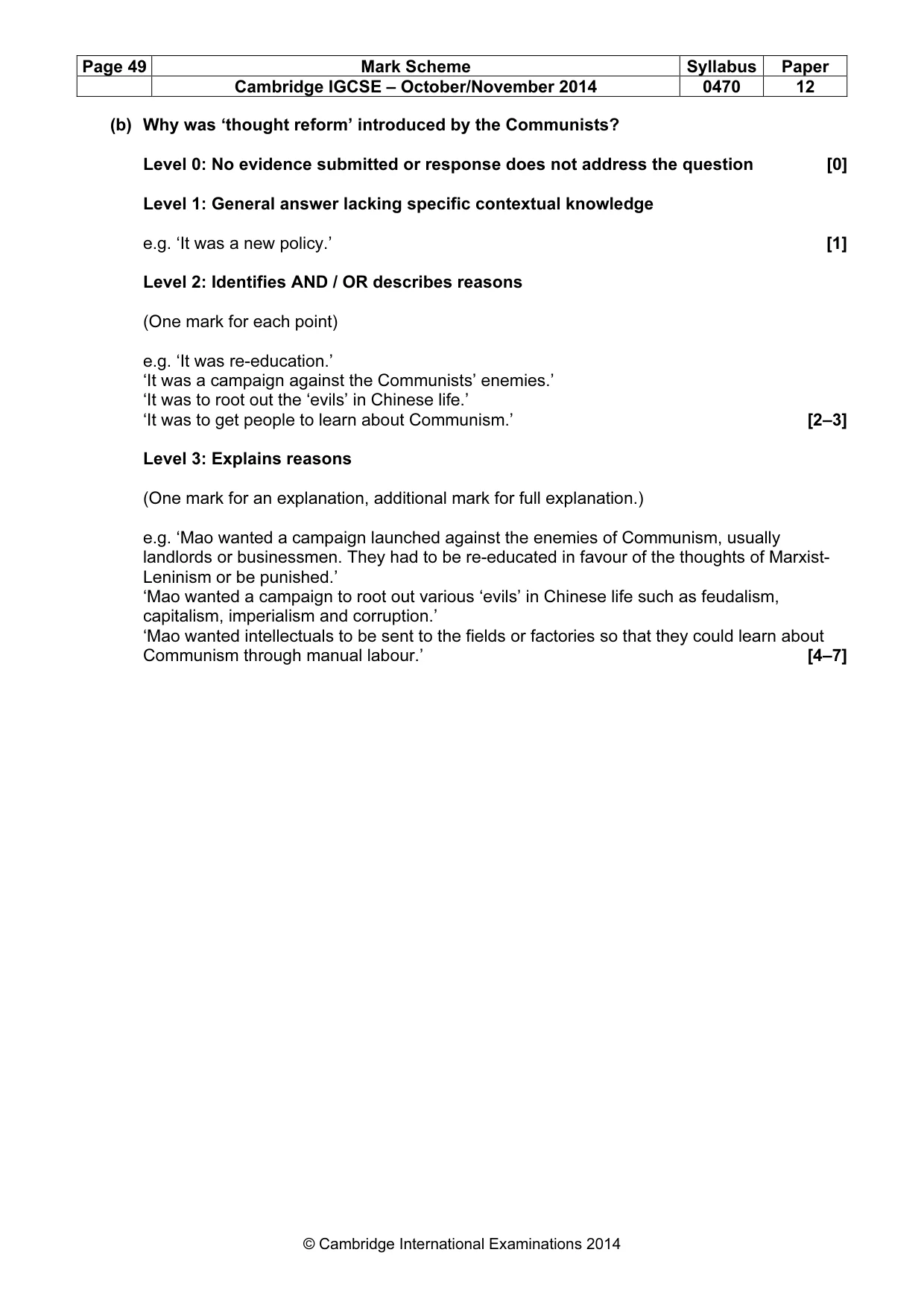
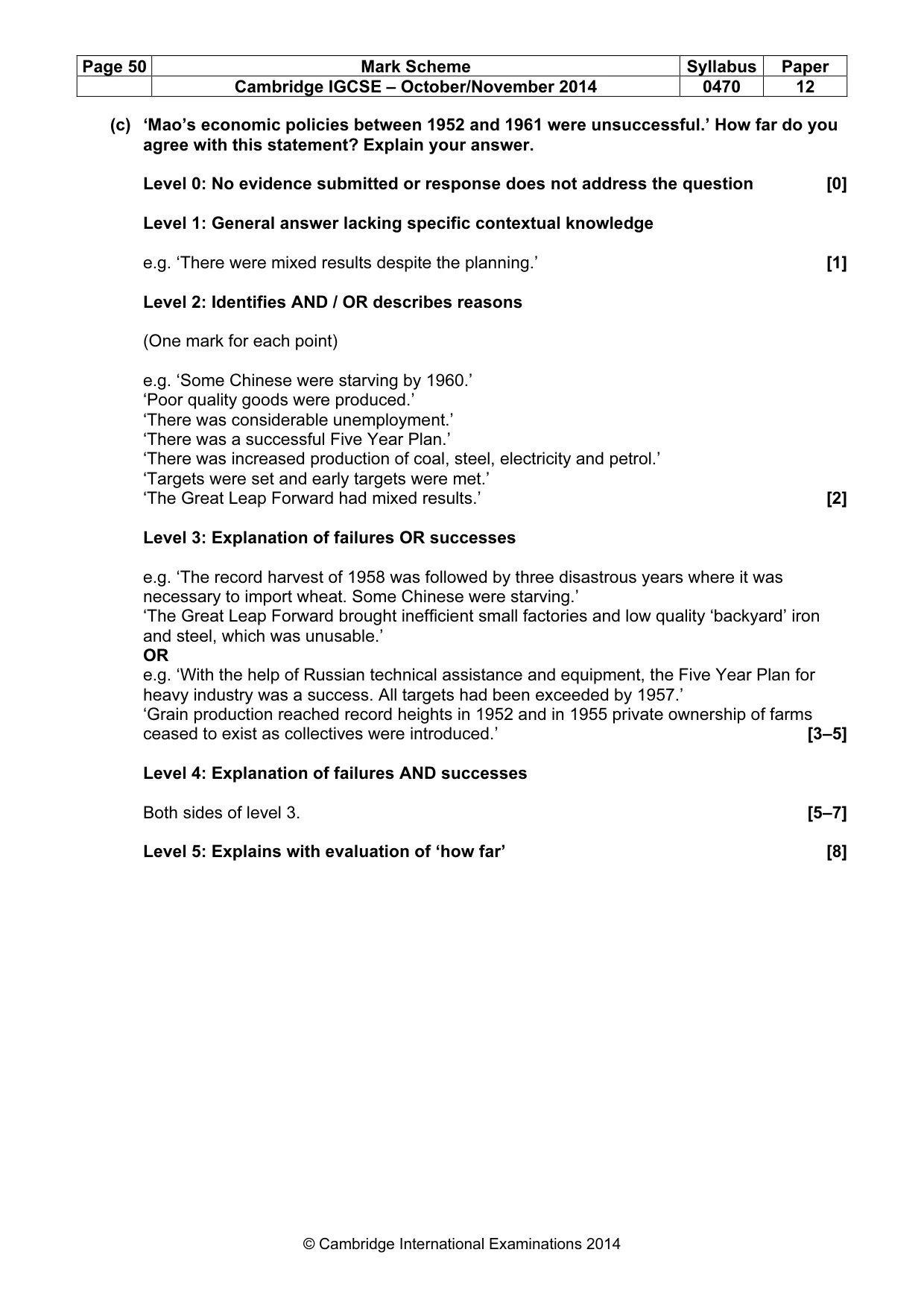
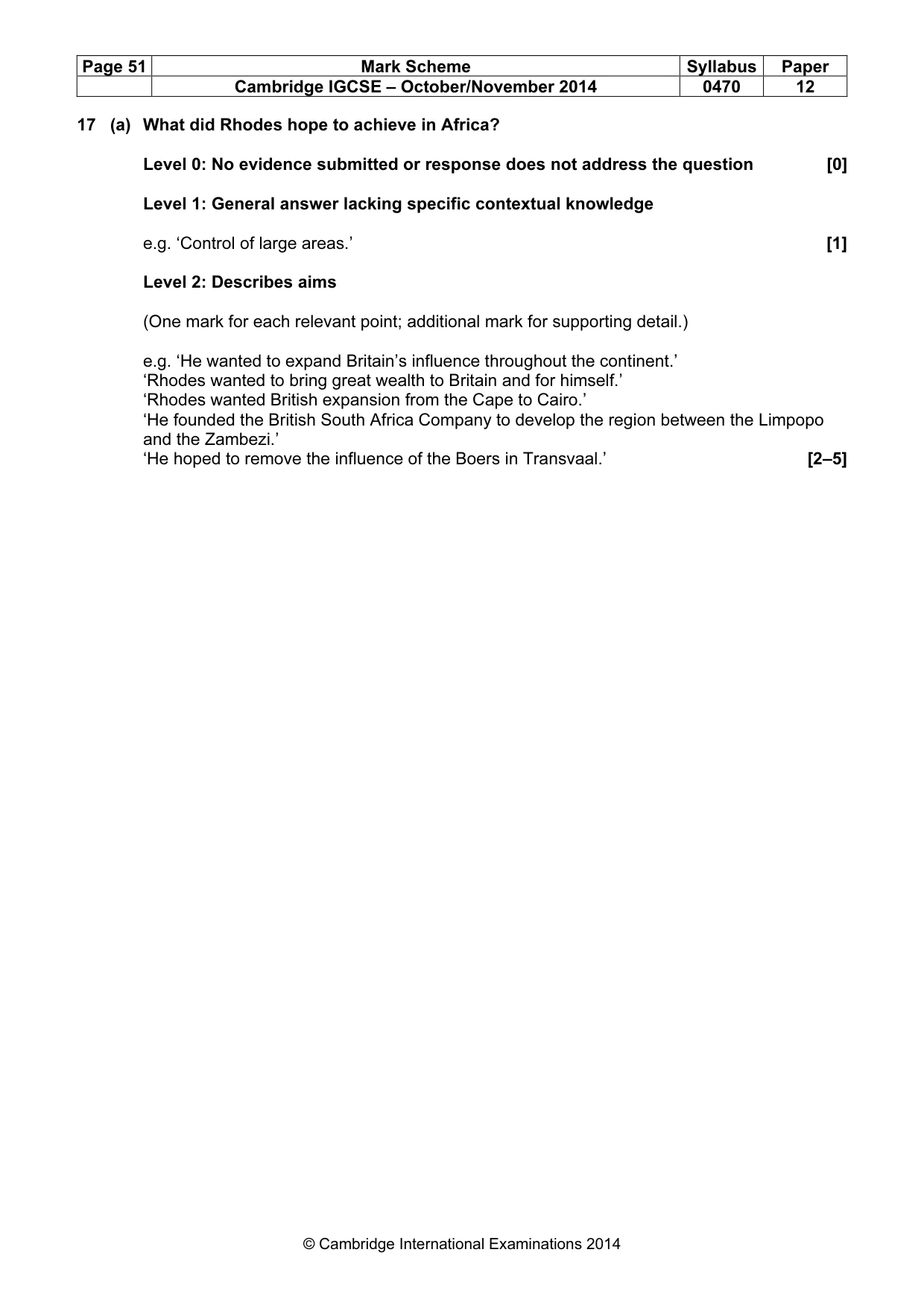
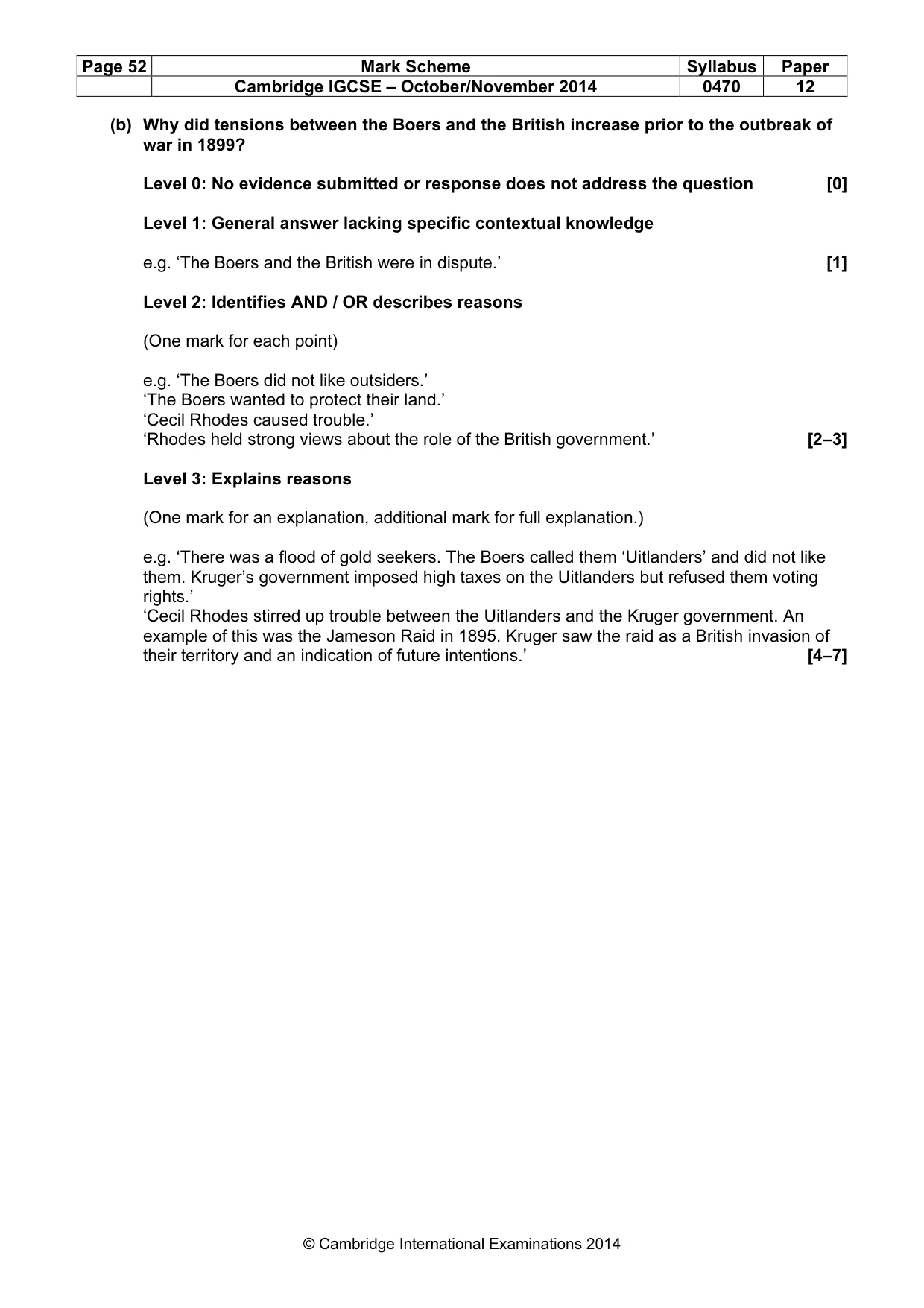
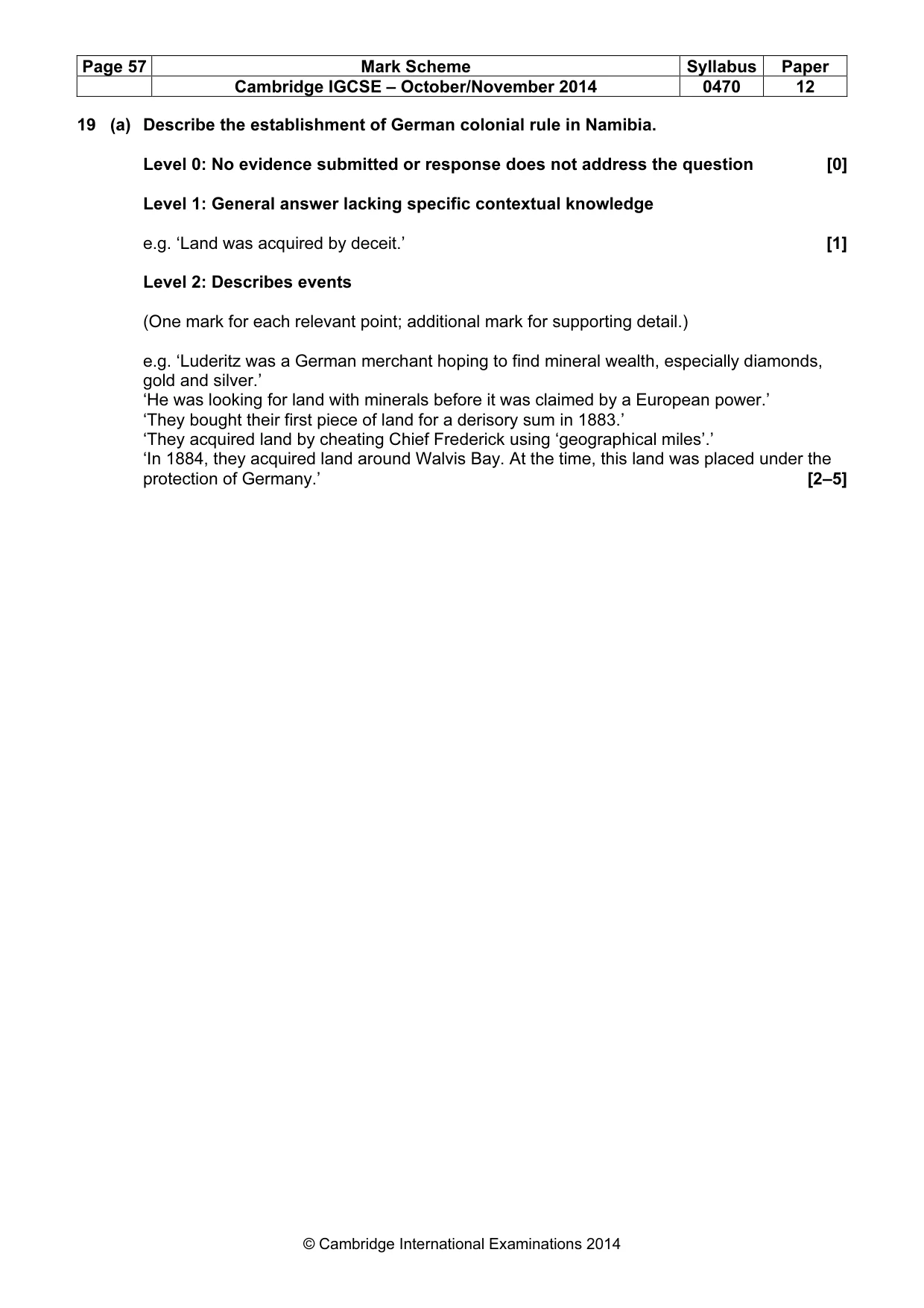
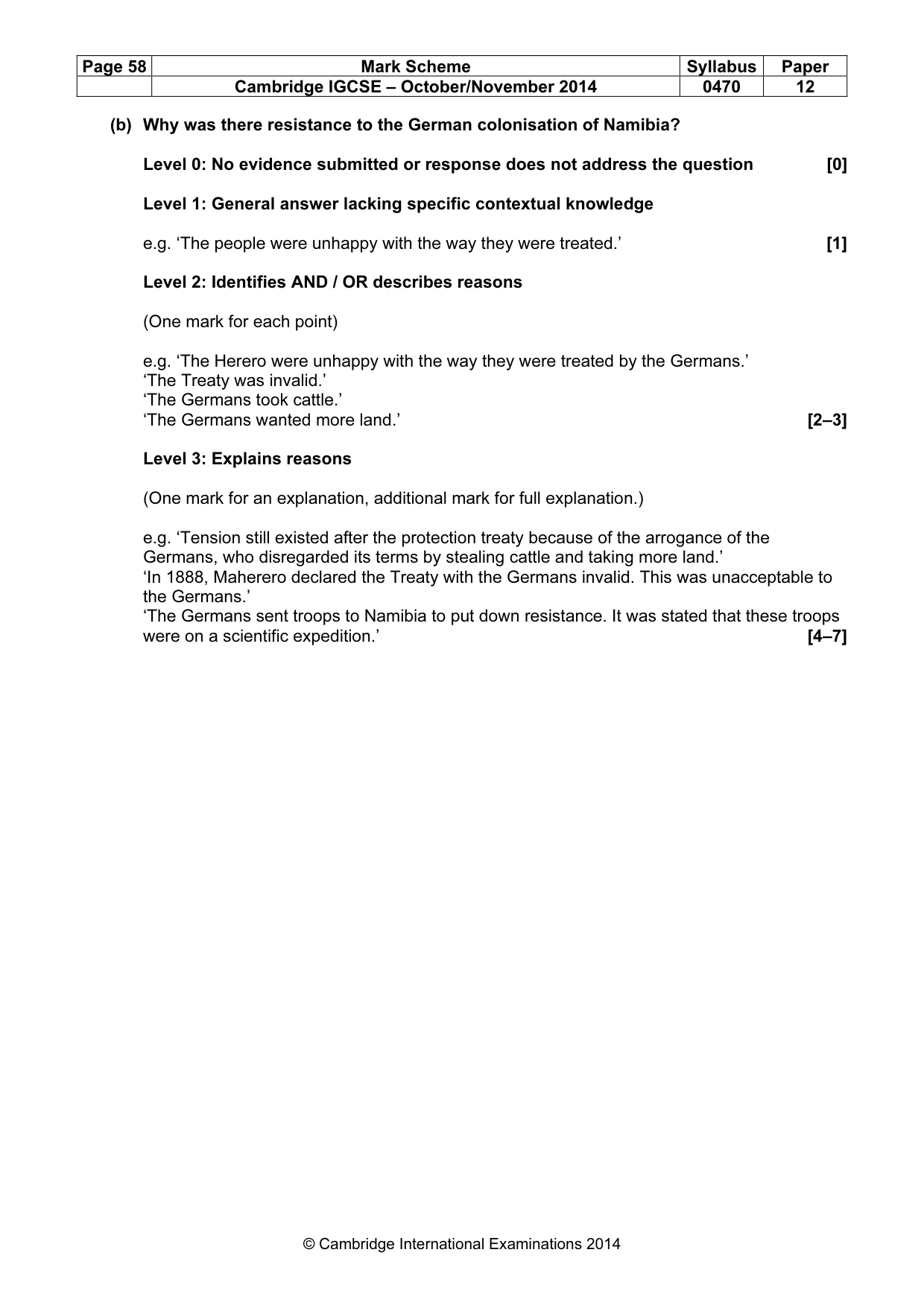
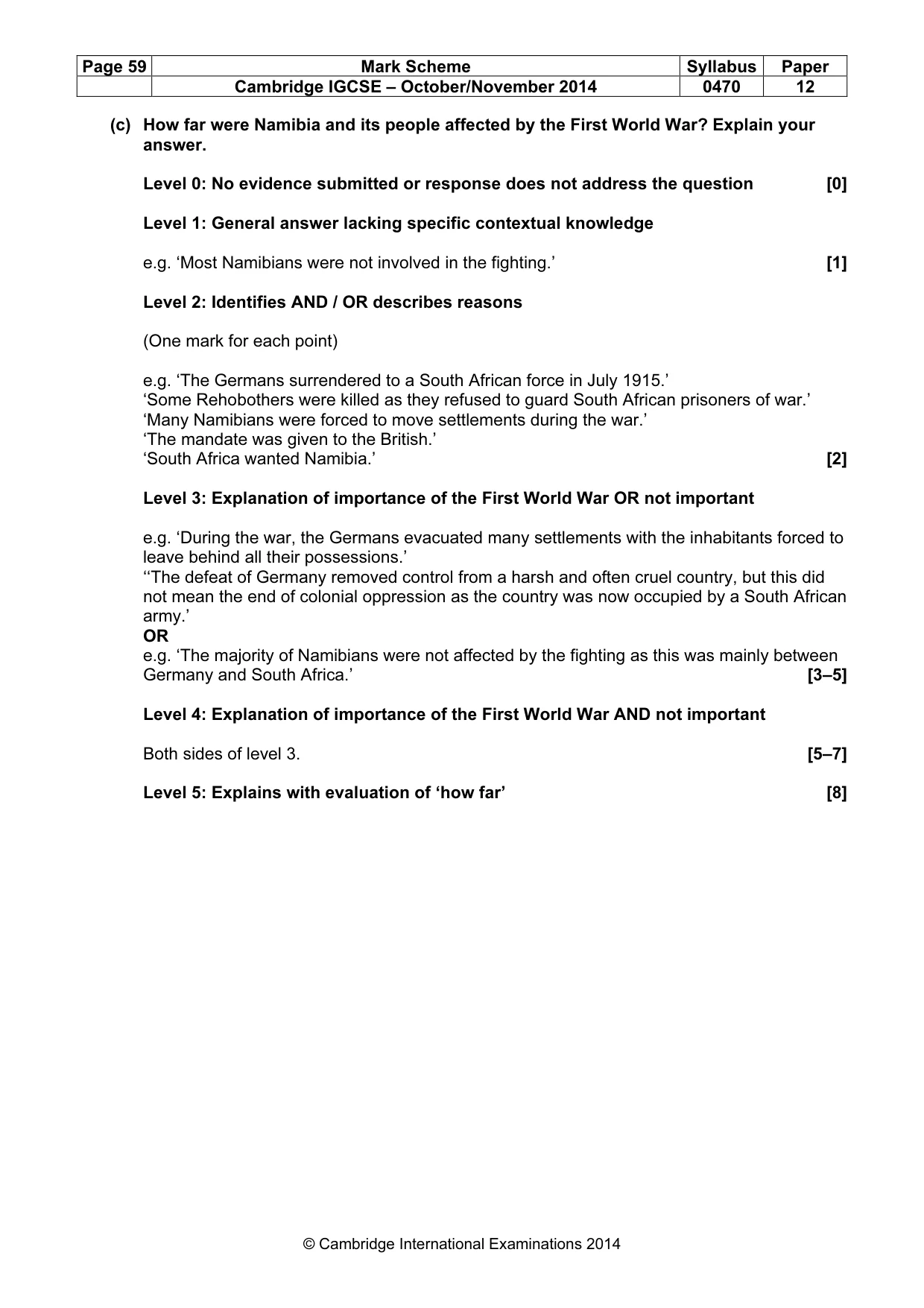
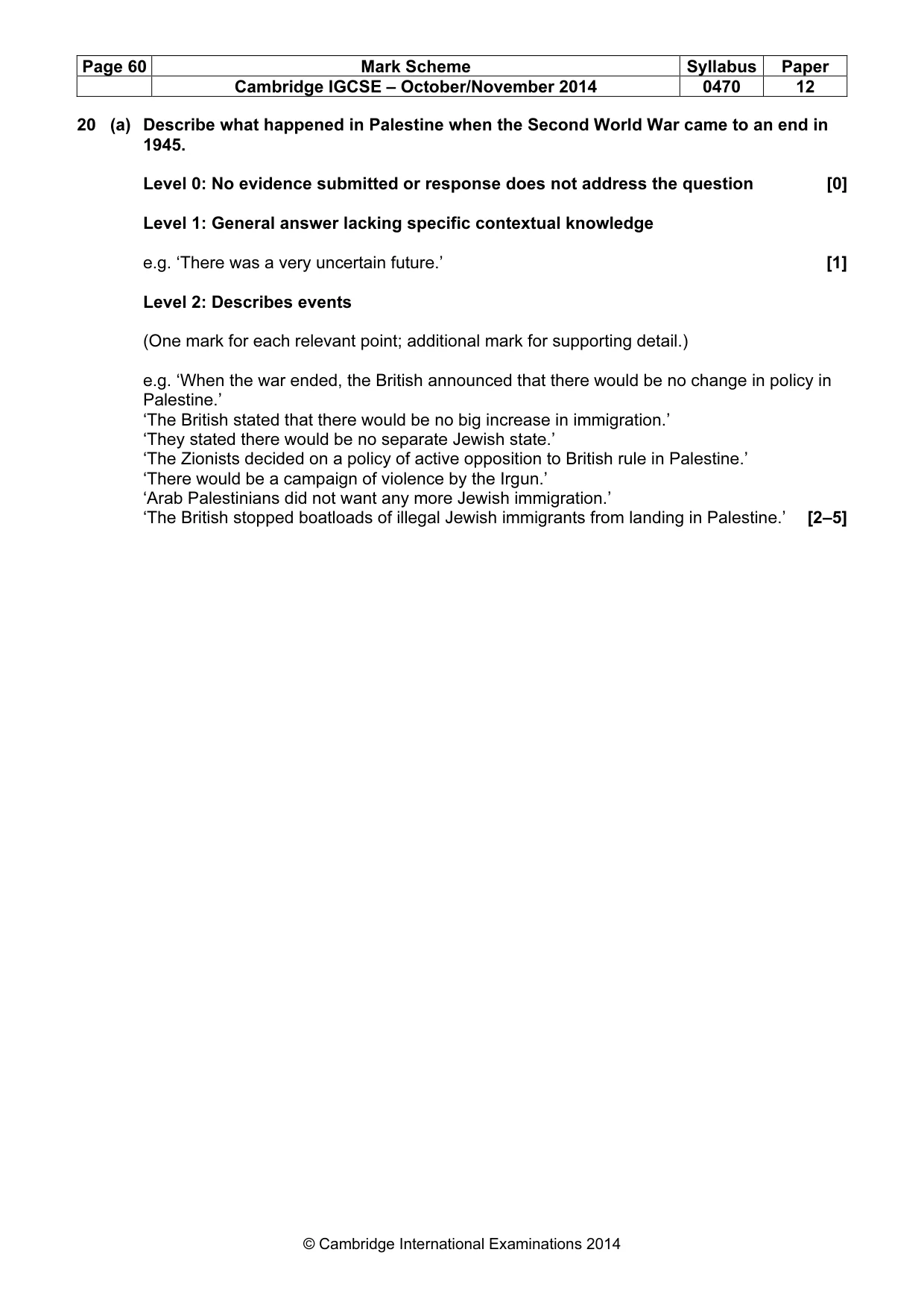
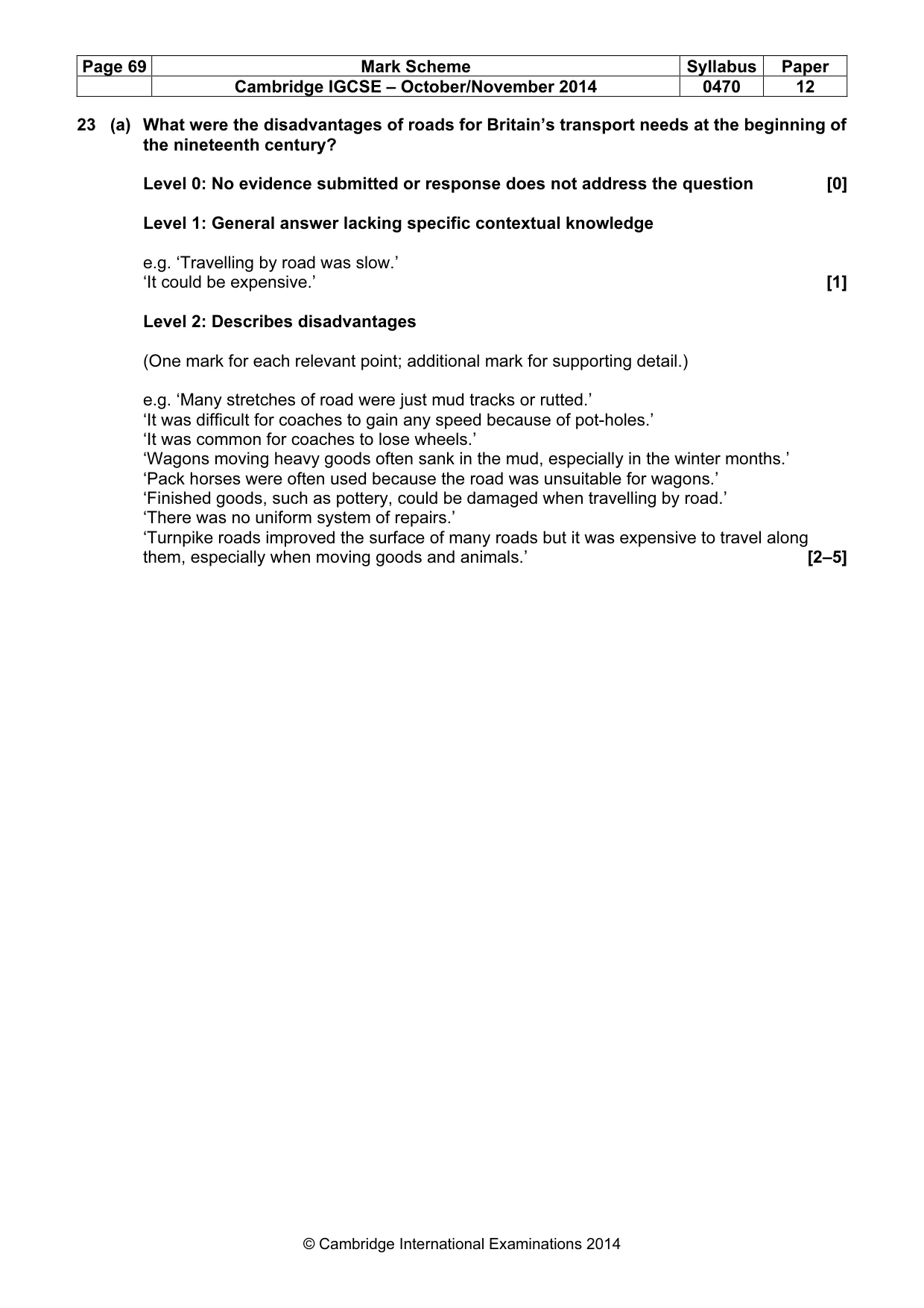
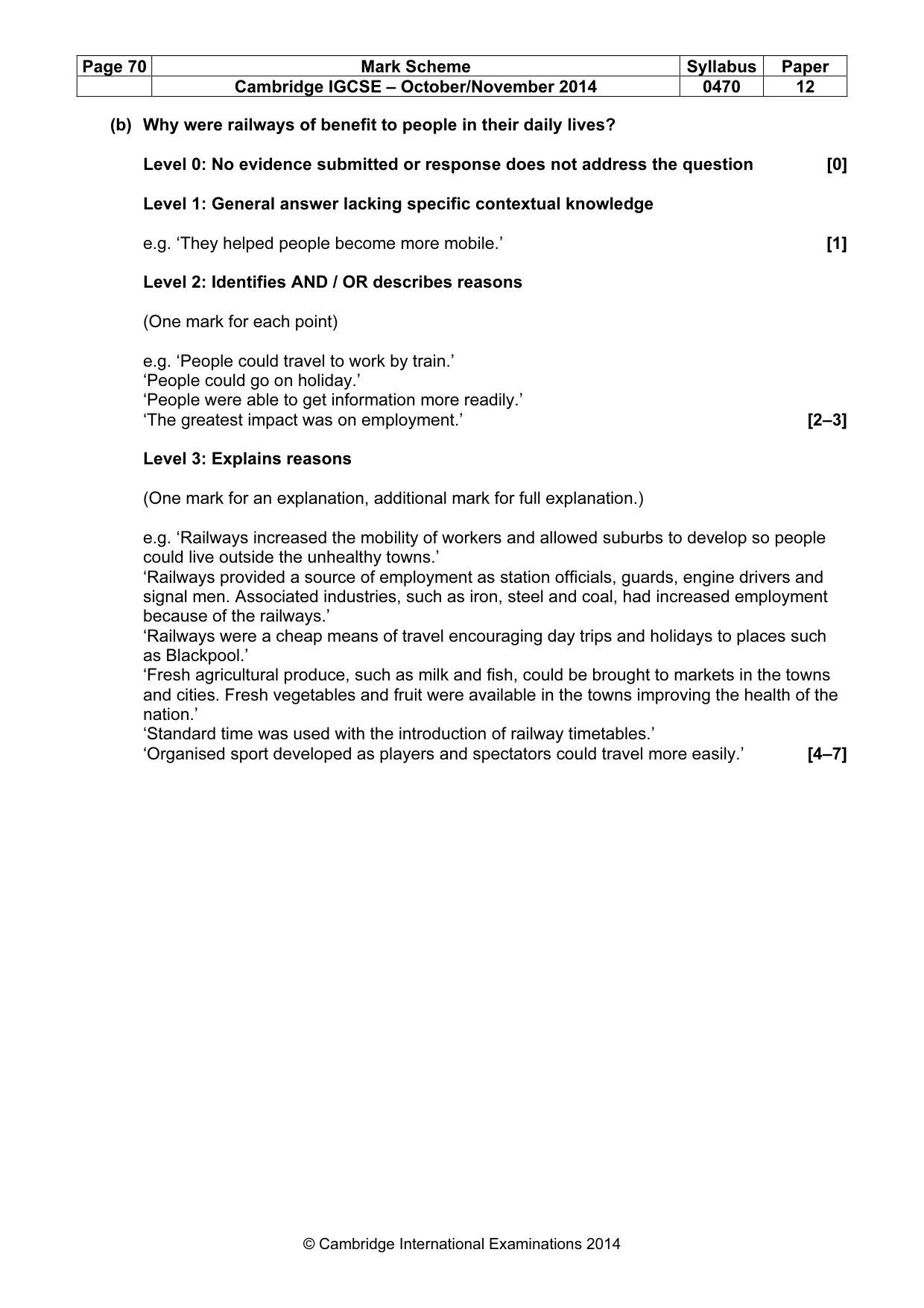
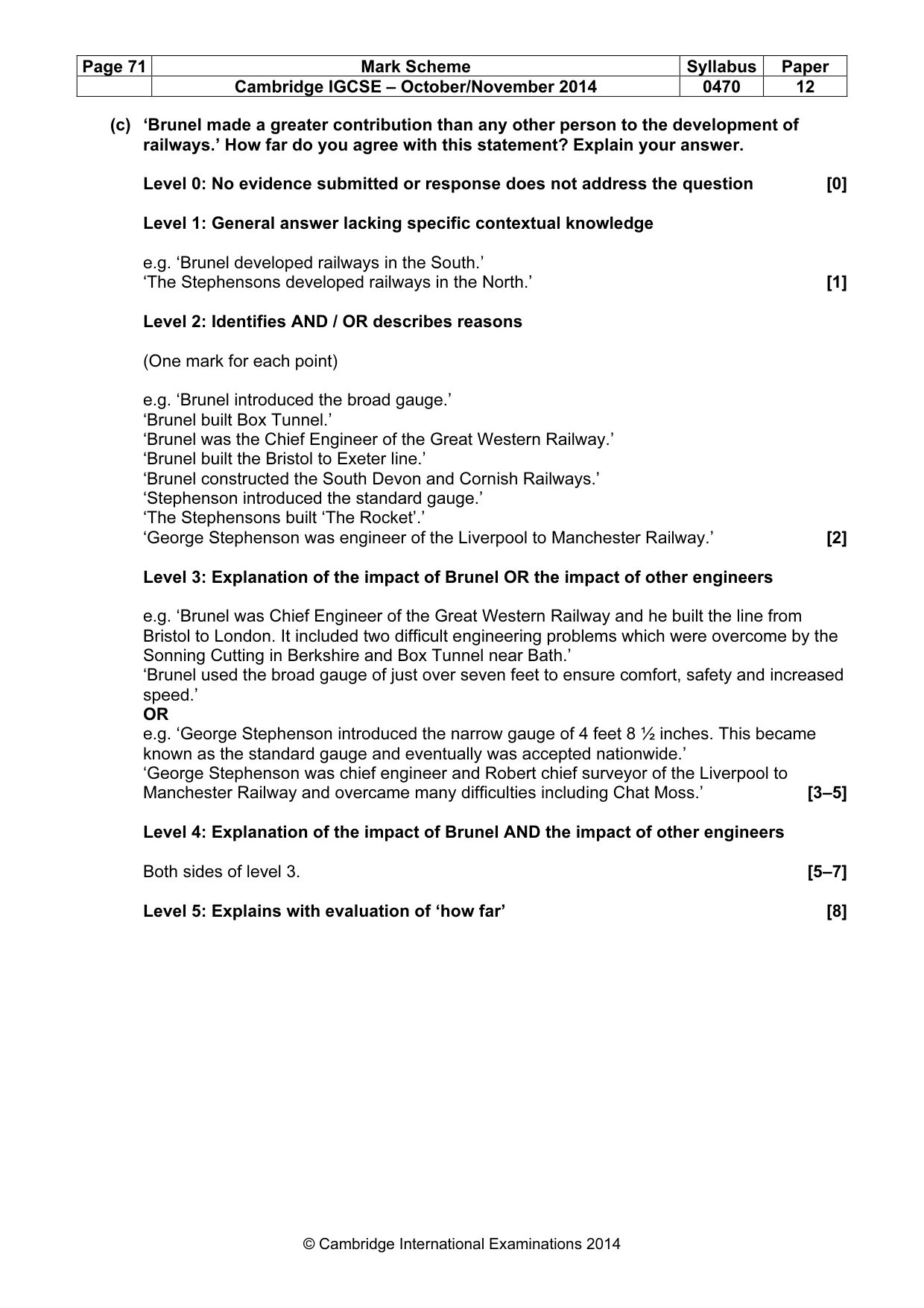
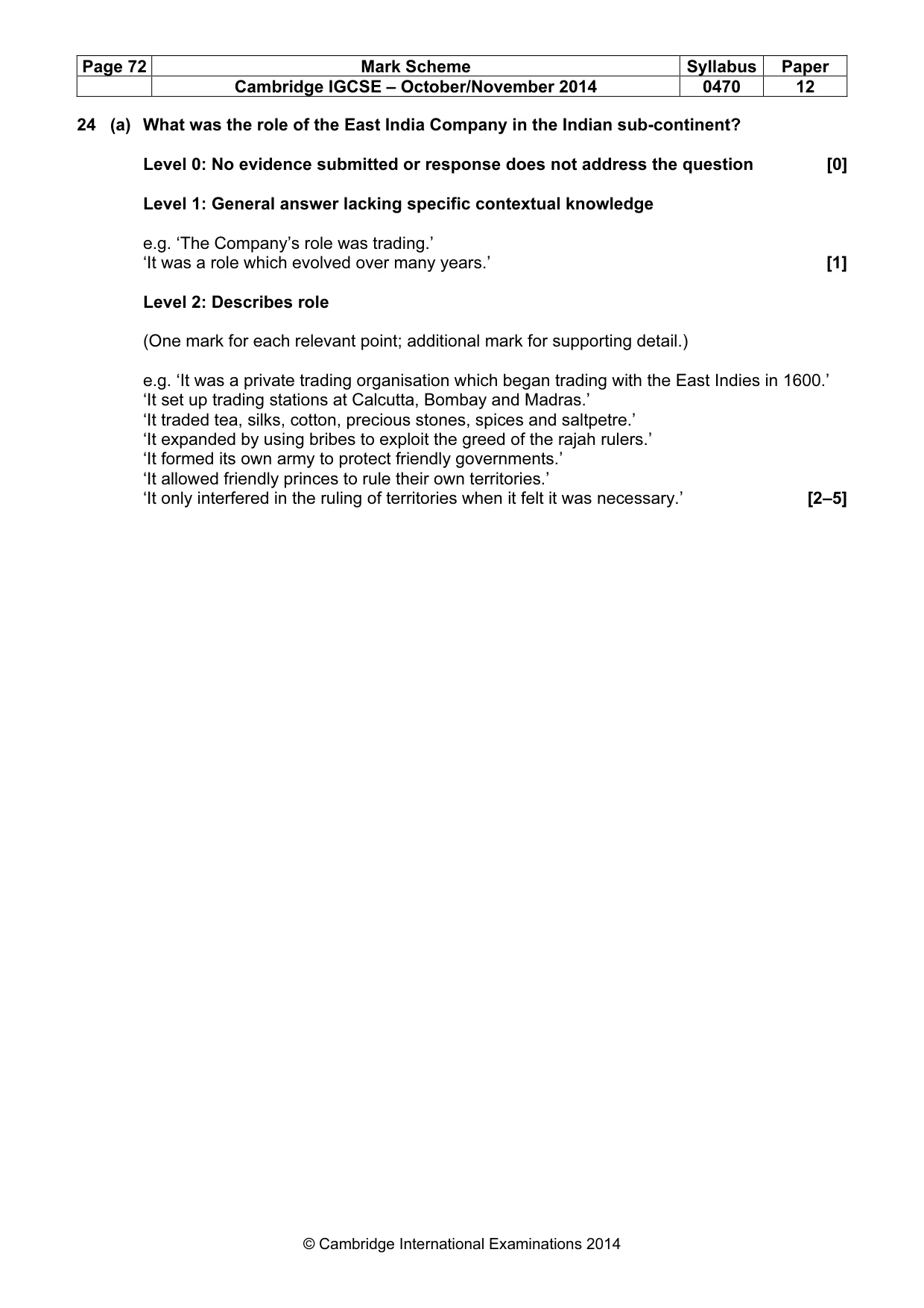
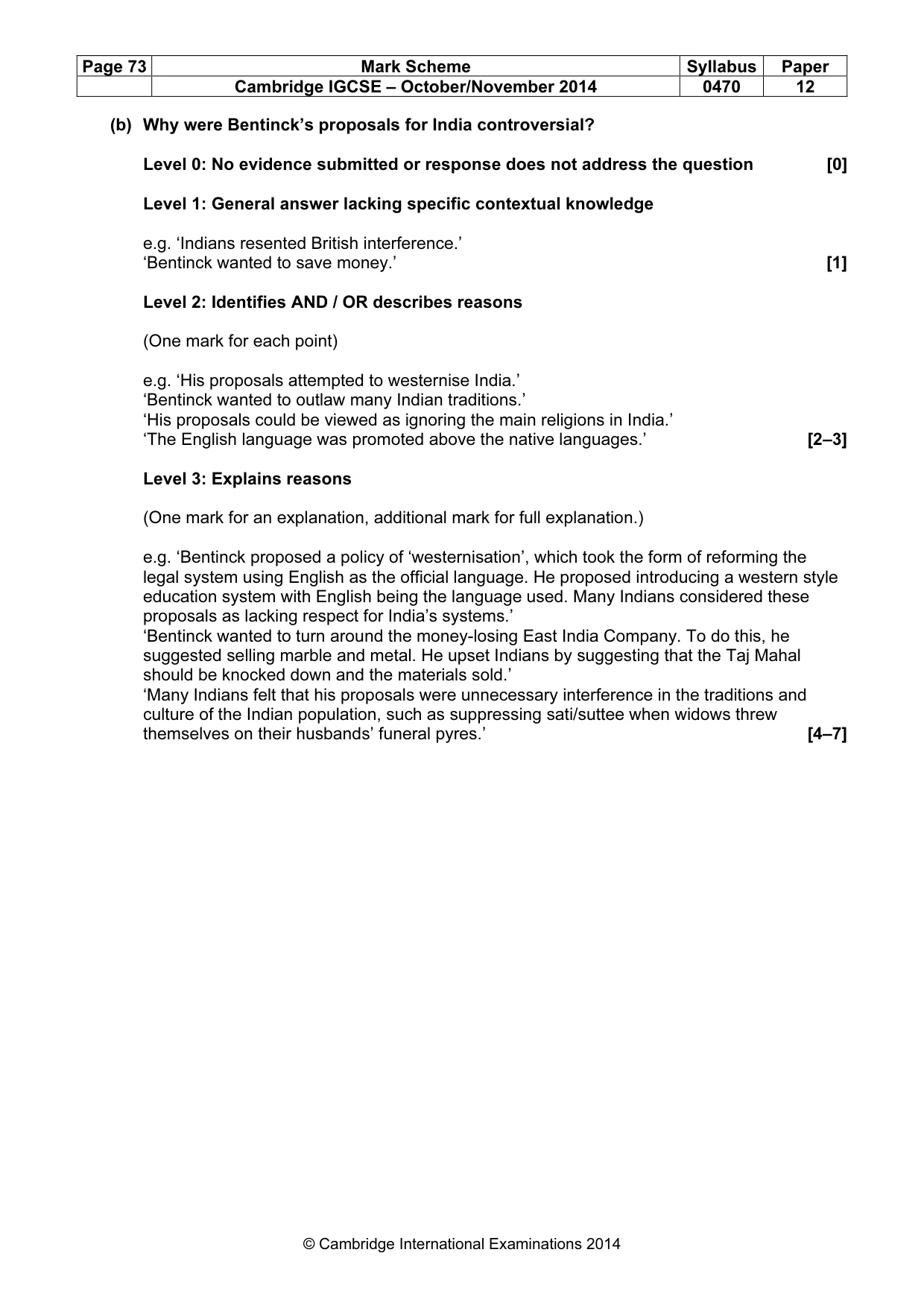
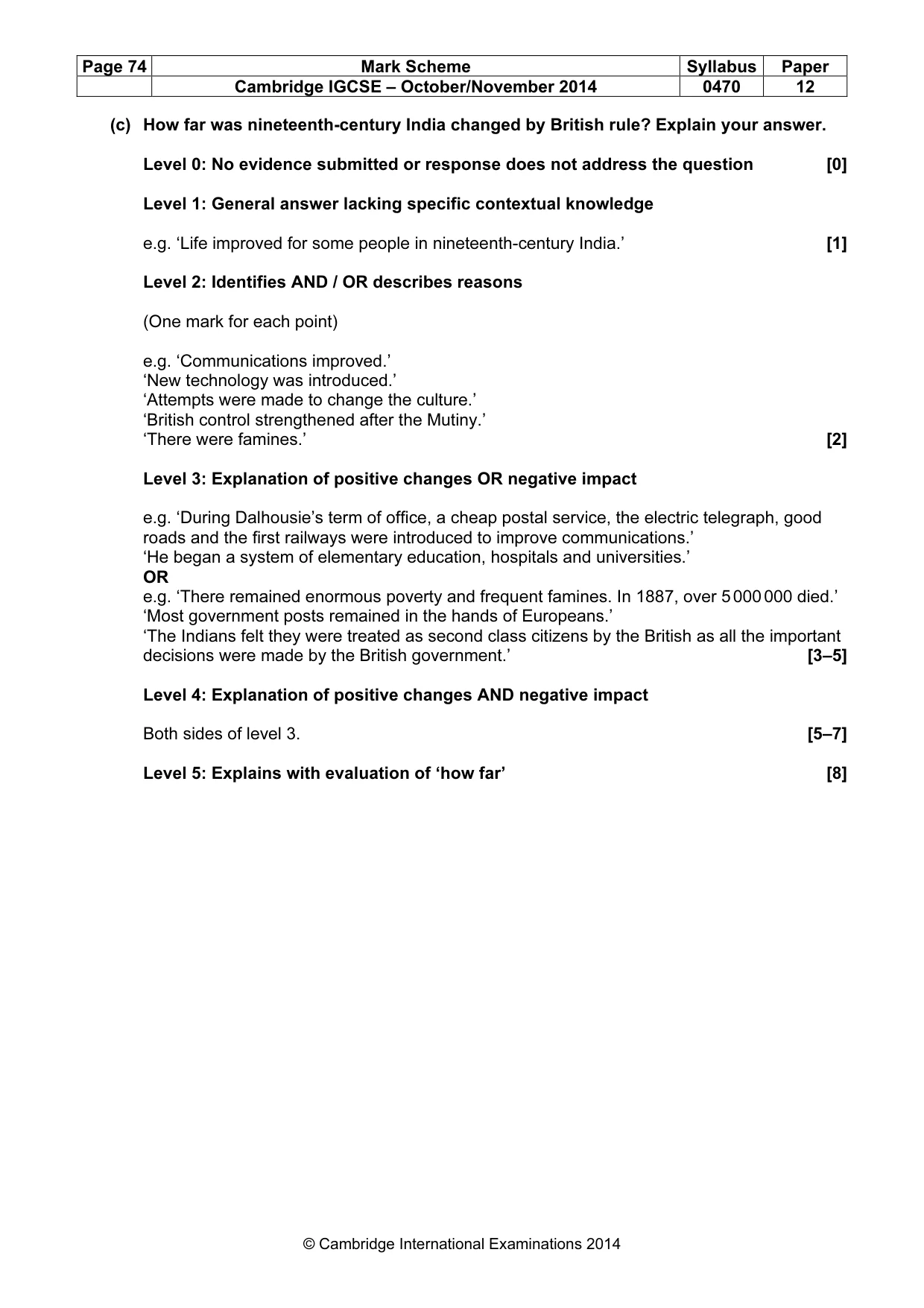
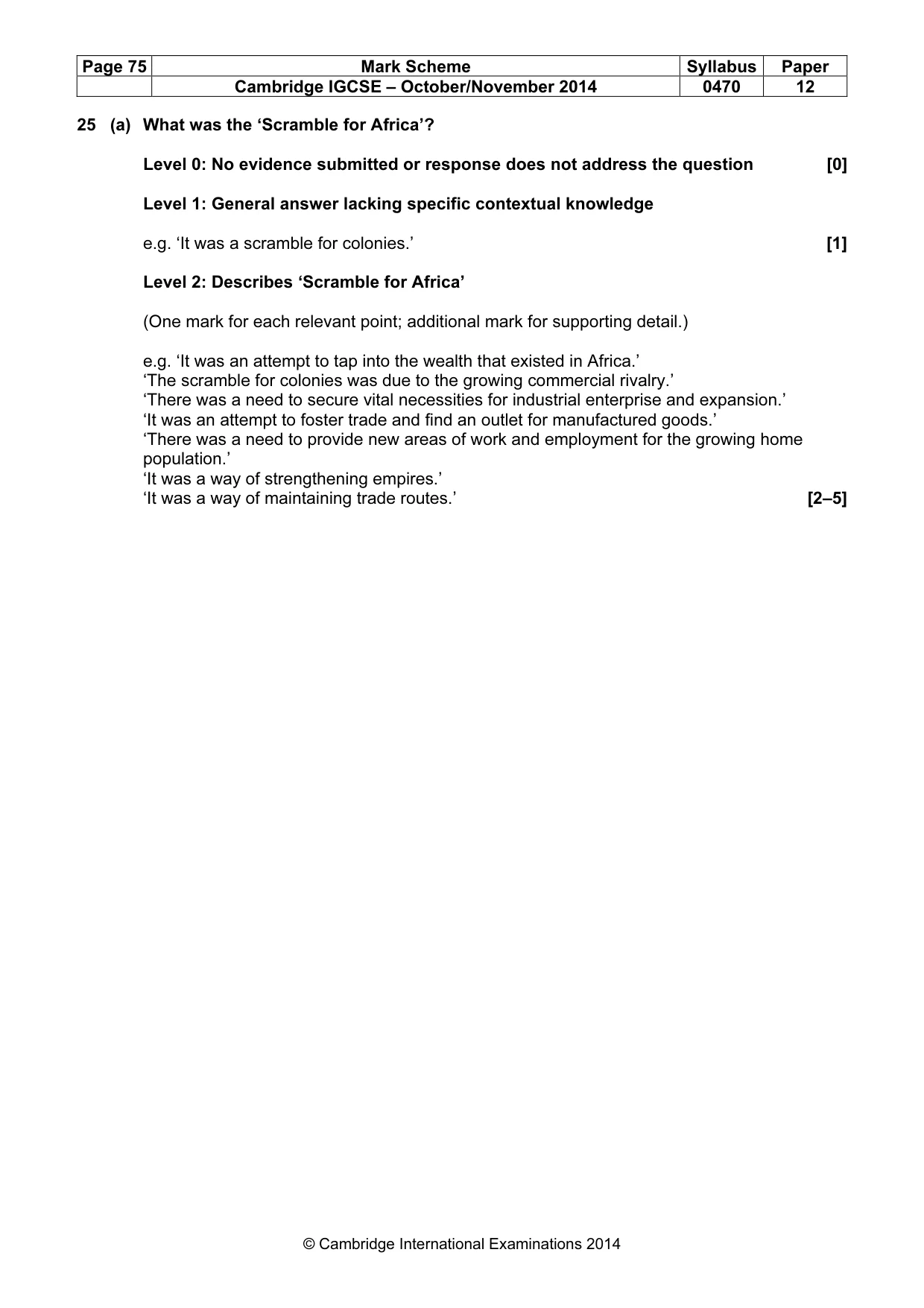
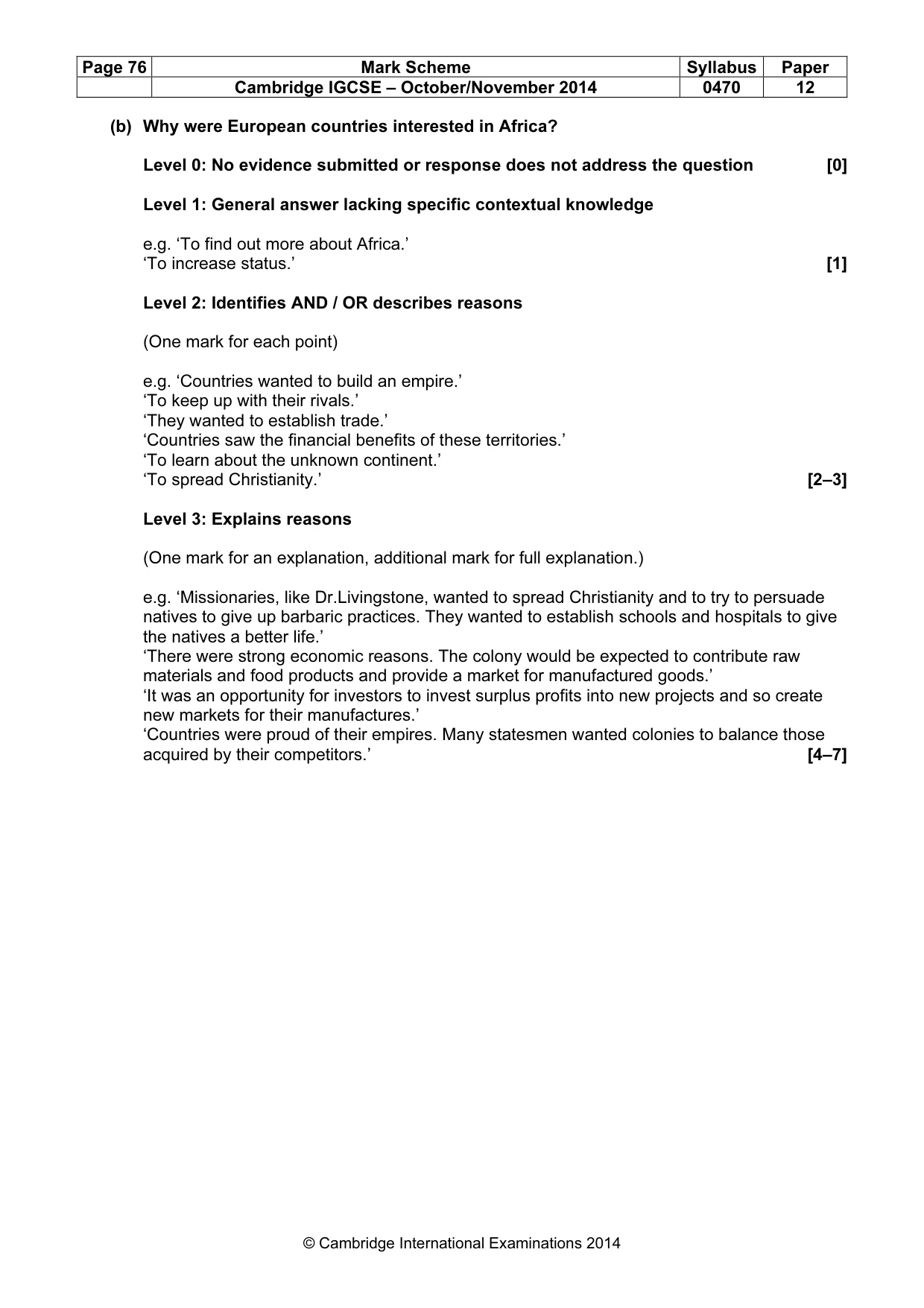
Paper as text
Question paper, page 1
This document consists of 19 printed pages, 1 blank page and 1 insert. DC (LEG/SW) 108646 © UCLES 2014 [Turn over Cambridge International Examinations Cambridge International General Certificate of Secondary Education * 1 3 0 0 2 7 0 4 8 9 * HISTORY 0470/12 Paper 1 October/November 2014 2 hours No Additional Materials are required. READ THESE INSTRUCTIONS FIRST An answer booklet is provided inside this question paper. You should follow the instructions on the front cover of the answer booklet. If you need additional answer paper ask the invigilator for a continuation booklet. Answer three questions. Section A (Core Content) Answer any two questions. Section B (Depth Studies) Answer any one question. The number of marks is given in brackets [ ] at the end of each question or part question.
Question paper, page 2
2 0470/12/O/N/14 © UCLES 2014 SECTION A: CORE CONTENT Answer any two questions from this Section. 1 Read the extract, and then answer the questions which follow. The idea of national unity was enough to bring about an uprising in 1848, but it was not enough to bring victory. The ordinary people, who wanted to drive out the Austrians, were prepared to accept the leadership of Charles Albert. When the driving force of expelling the Austrians failed, the ordinary people were left leaderless. From a book written by a soldier who fought in Lombardy in 1848–49. (a) What did the Roman Republic of 1848–49 achieve? [5] (b) Why did attempts to unify Italy by 1849 end in failure? [7] (c) ‘Garibaldi’s contribution to the unification of Italy was more important than the contribution of any other person.’ How far do you agree with this statement? Explain your answer. [8] 2 Read the extract, and then answer the questions which follow. Bismarck combined high intelligence with an unscrupulous view of politics and state affairs. He got things done and did not worry too much about the means he used to get his way. His cunning was well displayed when he first picked off Austria in 1866, having ensured French and Russian neutrality. From a history book published in 1985. (a) What were the functions of the Zollverein? [5] (b) Why was Bismarck appointed Minister-President of Prussia in 1862? [7] (c) ‘Bismarck did not plan for the unification of Germany. He just took opportunities that others gave him.’ How far do you agree with this statement? Explain your answer. [8]
Question paper, page 3
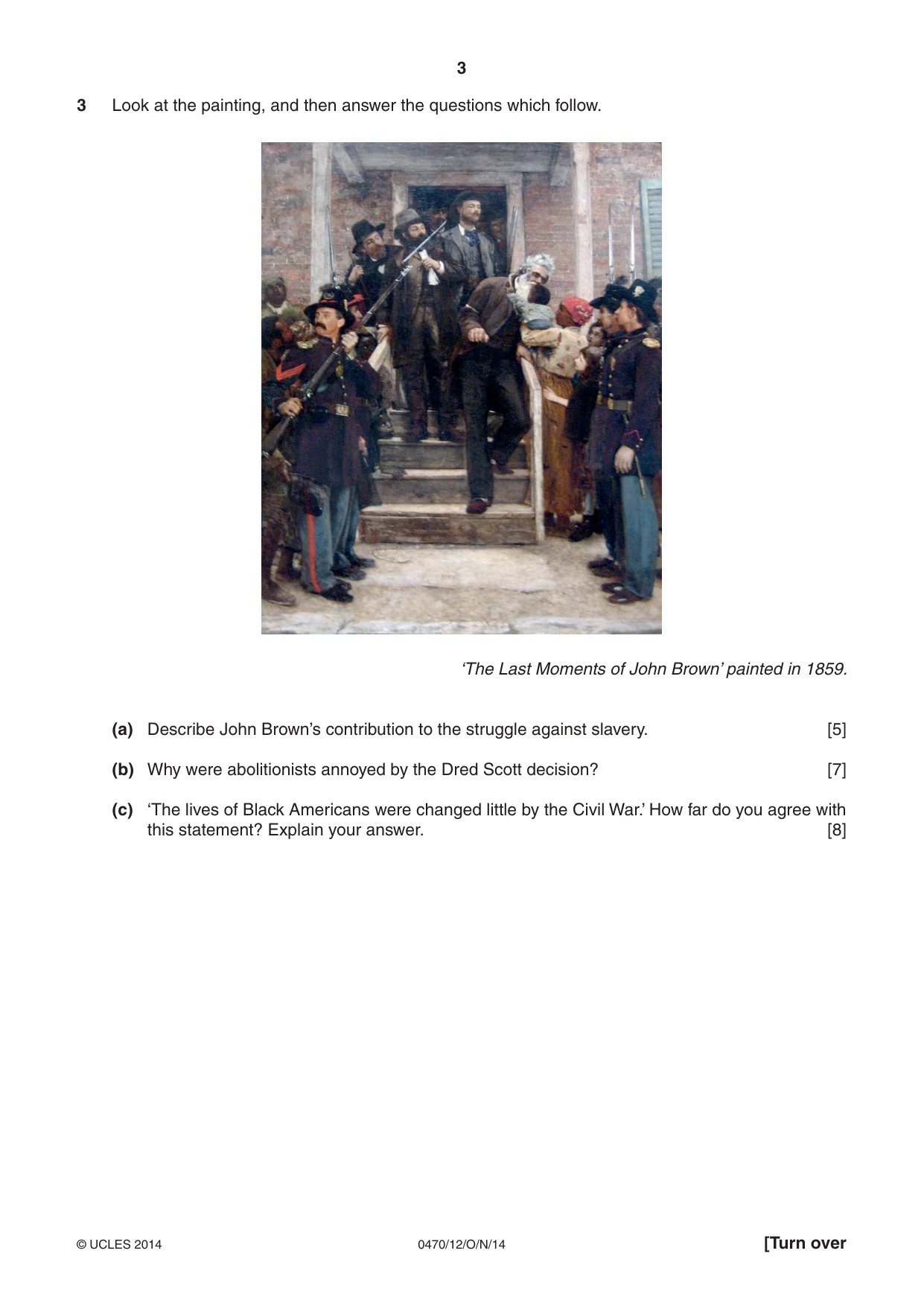
3 0470/12/O/N/14 © UCLES 2014 [Turn over 3 Look at the painting, and then answer the questions which follow. ‘The Last Moments of John Brown’ painted in 1859. (a) Describe John Brown’s contribution to the struggle against slavery. [5] (b) Why were abolitionists annoyed by the Dred Scott decision? [7] (c) ‘The lives of Black Americans were changed little by the Civil War.’ How far do you agree with this statement? Explain your answer. [8]
Question paper, page 4
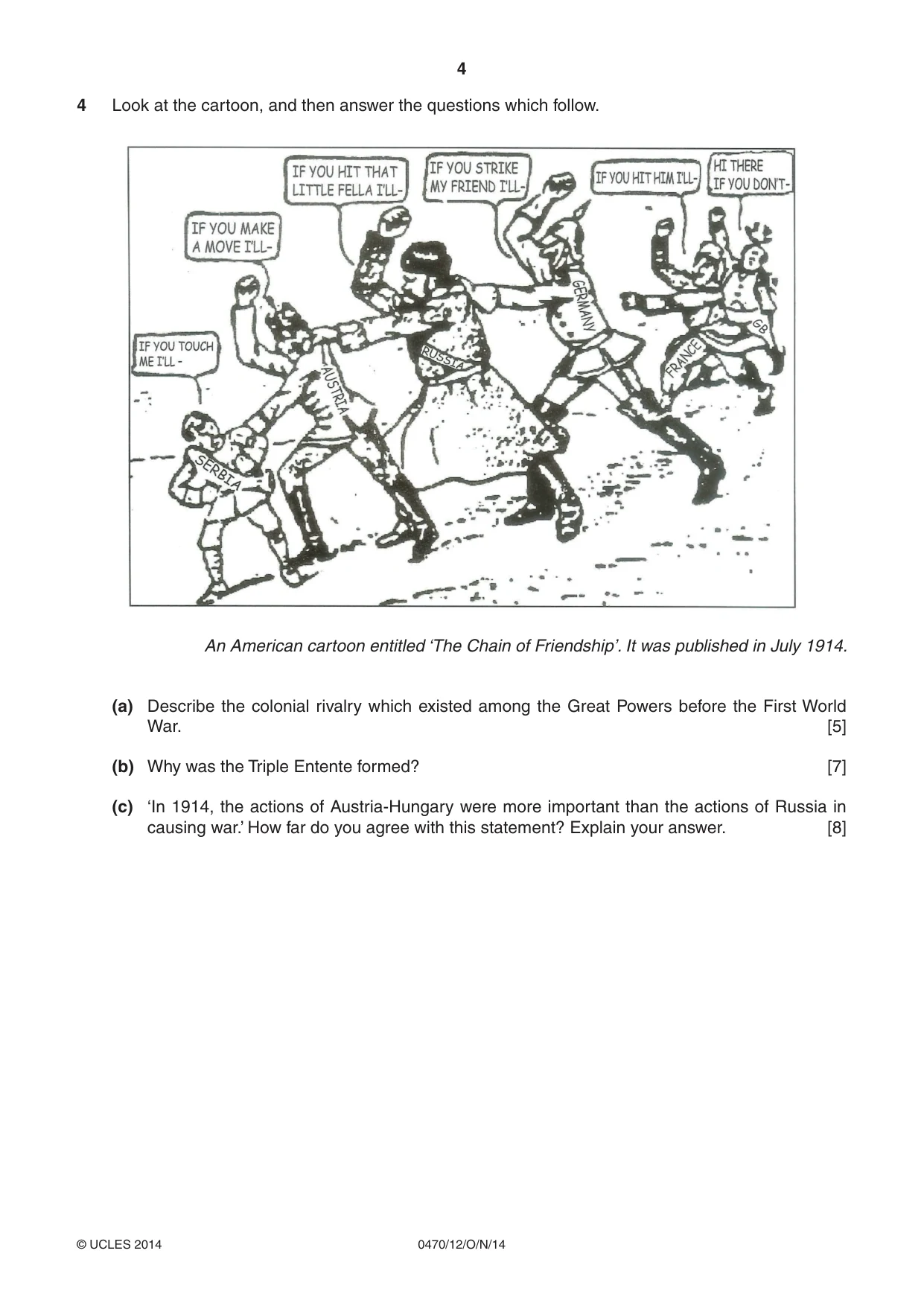
4 0470/12/O/N/14 © UCLES 2014 4 Look at the cartoon, and then answer the questions which follow. An American cartoon entitled ‘The Chain of Friendship’. It was published in July 1914. (a) Describe the colonial rivalry which existed among the Great Powers before the First World War. [5] (b) Why was the Triple Entente formed? [7] (c) ‘In 1914, the actions of Austria-Hungary were more important than the actions of Russia in causing war.’ How far do you agree with this statement? Explain your answer. [8]
Question paper, page 5
5 0470/12/O/N/14 © UCLES 2014 [Turn over 5 Read the extract, and then answer the questions which follow. We want peace which will be just, but not vindictive. We want a stern peace because the occasion demands it, but the severity must be designed, not for vengeance, but for justice. Above all, we want to protect the future against a repetition of the horrors of this war. Lloyd George speaking to the British Parliament, before the Paris Peace Conference. (a) With reference to the terms of the peace settlement of 1919, what was decided about (i) the Saar and (ii) the Rhineland? [5] (b) Why was Germany unhappy with being forced to accept responsibility for the war? [7] (c) How far did Lloyd George achieve his aims at the Paris Peace Conference? Explain your answer. [8] 6 Read the extract, and then answer the questions which follow. The defeat suffered in the United States strikes at the very existence of the League of Nations. America’s place will remain empty at Geneva. The two countries that will dominate, France and Great Britain, are divided on almost every topic to be discussed. A French politician commenting, in 1920, on the League without the USA. (a) Describe how collective security was intended to work. [5] (b) Why was the American decision not to join the League a great blow to the organisation? [7] (c) ‘The Depression had a greater impact on the League than did events in Manchuria.’ How far do you agree with this statement? Explain your answer. [8]
Question paper, page 6
6 0470/12/O/N/14 © UCLES 2014 7 Read the extract, and then answer the questions which follow. Mr Churchill has said that for Great Britain the Polish question is one of honour. But for the Russians it is a question of both honour and security. Throughout history Poland has been the corridor for attack on Russia. It is not merely a question of honour for Russia, but one of life and death. Stalin speaking to Churchill and Roosevelt at Yalta in 1945. (a) What was discussed, in relation to Poland, at the Yalta Conference? [5] (b) Why did tensions between the USSR and the Western Allies increase at the Potsdam Conference? [7] (c) ‘The USSR was to blame for starting the Cold War.’ How far do you agree with this statement? Explain your answer. [8]
Question paper, page 7
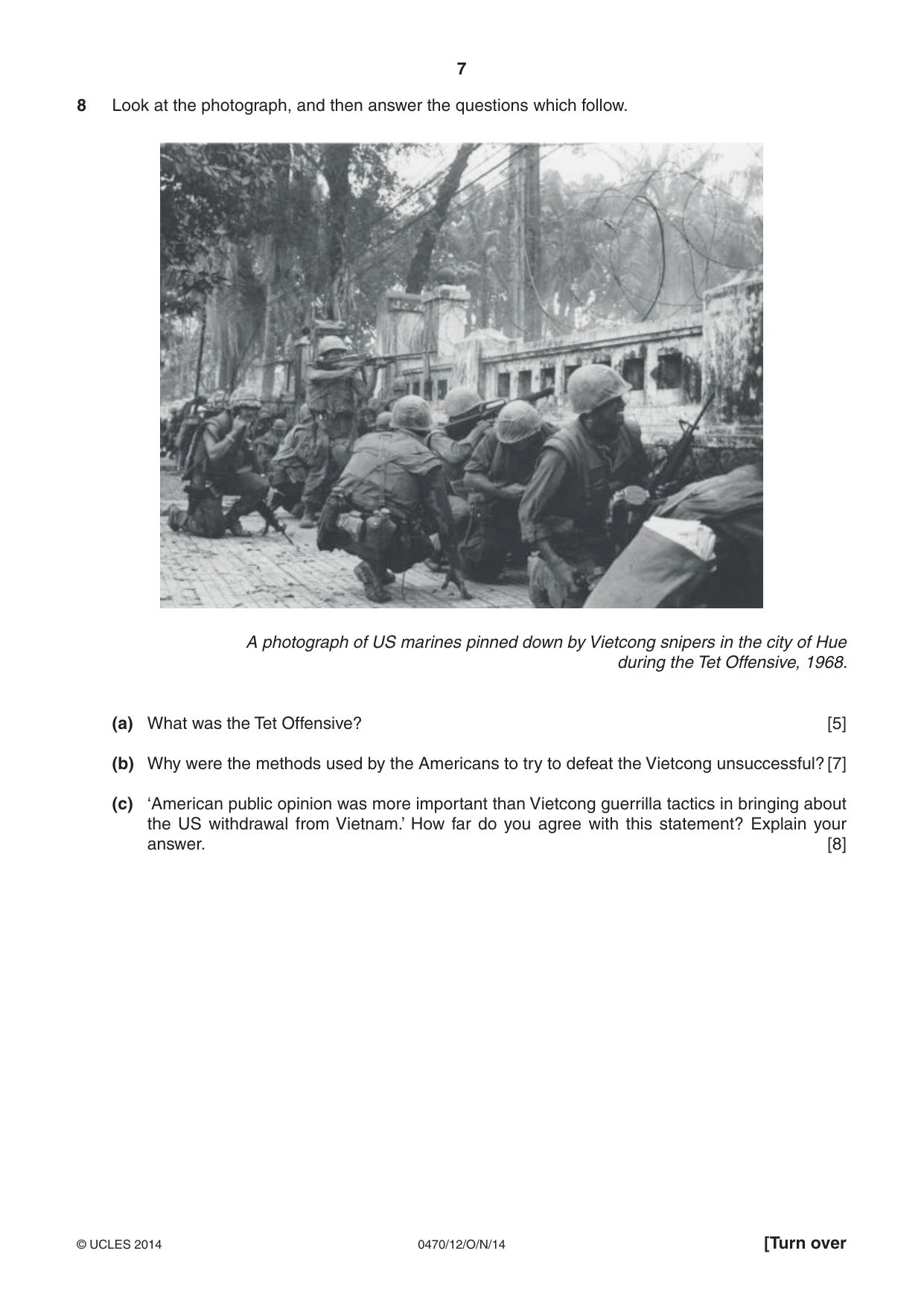
7 0470/12/O/N/14 © UCLES 2014 [Turn over 8 Look at the photograph, and then answer the questions which follow. A photograph of US marines pinned down by Vietcong snipers in the city of Hue during the Tet Offensive, 1968. (a) What was the Tet Offensive? [5] (b) Why were the methods used by the Americans to try to defeat the Vietcong unsuccessful? [7] (c) ‘American public opinion was more important than Vietcong guerrilla tactics in bringing about the US withdrawal from Vietnam.’ How far do you agree with this statement? Explain your answer. [8]
Question paper, page 8
8 0470/12/O/N/14 © UCLES 2014 SECTION B: DEPTH STUDIES Answer any one question from this Section. DEPTH STUDY A: GERMANY, 1918–45 9 Read the extract, and then answer the questions which follow. With the death of Stresemann, Germany lost its ablest statesman. From 1923 he worked hard to rebuild his shattered country, and for peace and co-operation abroad. From Stresemann’s obituary in a British newspaper, October 1929. (a) What were the main economic challenges facing the Weimar Republic when it was established? [5] (b) Why did the Weimar Republic face political opposition from the start? [7] (c) To what extent did the Weimar Republic recover after 1923? Explain your answer. [8] 10 Read the extract, and then answer the questions which follow. We believed in Hitler. We believed in the whole system, the entire leadership. We could not do anything else. That was our generation and he was our idol. A member of the Hitler Youth, speaking after the Second World War. (a) What was education like for young people in schools in Nazi Germany? [5] (b) Why was membership of the Hitler Youth encouraged? [7] (c) How far did life for workers improve in Nazi Germany up to 1939? Explain your answer. [8]
Question paper, page 9
9 0470/12/O/N/14 © UCLES 2014 [Turn over DEPTH STUDY B: RUSSIA, 1905–41 11 Read the extract, and then answer the questions which follow. The Provisional Government possesses no real power and its orders are executed only in so far as this is permitted by the Soviet of Workers’ and Soldiers’ Deputies. From a letter written by a member of the newly formed Provisional Government, March 1917. It is commenting on the ‘Dual Government’ which ruled Russia. (a) Describe the Kornilov affair. [5] (b) Why was Lenin important to the Bolshevik seizure of power? [7] (c) ‘The Provisional Government failed because it lacked popular support.’ How far do you agree with this statement? Explain your answer. [8] 12 Read the extract, and then answer the questions which follow. Before the changes you said the factory owners were unfair to us, but the factory owners did not force us to work such long hours, and there was enough of everything in the shops. Now we work long hours doing the work four men used to do. A Russian factory worker commenting in 1929. (a) What problems did Soviet agriculture face before collectivisation? [5] (b) Why did Stalin find it difficult to introduce collectivisation? [7] (c) How far did the Soviet people benefit from Stalin’s economic plans? Explain your answer. [8]
Question paper, page 10
10 0470/12/O/N/14 © UCLES 2014 DEPTH STUDY C: THE USA, 1919–41 13 Read the extract, and then answer the questions which follow. Advertising has made broadcasting an industry. The broadcasters have discovered they can boost industry and people want to buy time on air. From an American newspaper published in the 1920s. (a) How did Henry Ford organise motor car production? [5] (b) Why did the radio industry grow rapidly? [7] (c) How far did Americans benefit from the ‘boom’ of the 1920s? Explain your answer. [8] 14 Read the extract, and then answer the questions which follow. The music is sensuous, the embracing of dance partners is absolutely indecent and the movements are such that they cannot be described in a family newspaper. From a religious newspaper published in the 1920s. (a) Describe how the motion picture industry was organised in the 1920s. [5] (b) Why did some people disapprove of young people’s behaviour? [7] (c) ‘Prohibition had a greater impact on American society in the 1920s than intolerance.’ How far do you agree with this statement? Explain your answer. [8]
Question paper, page 11
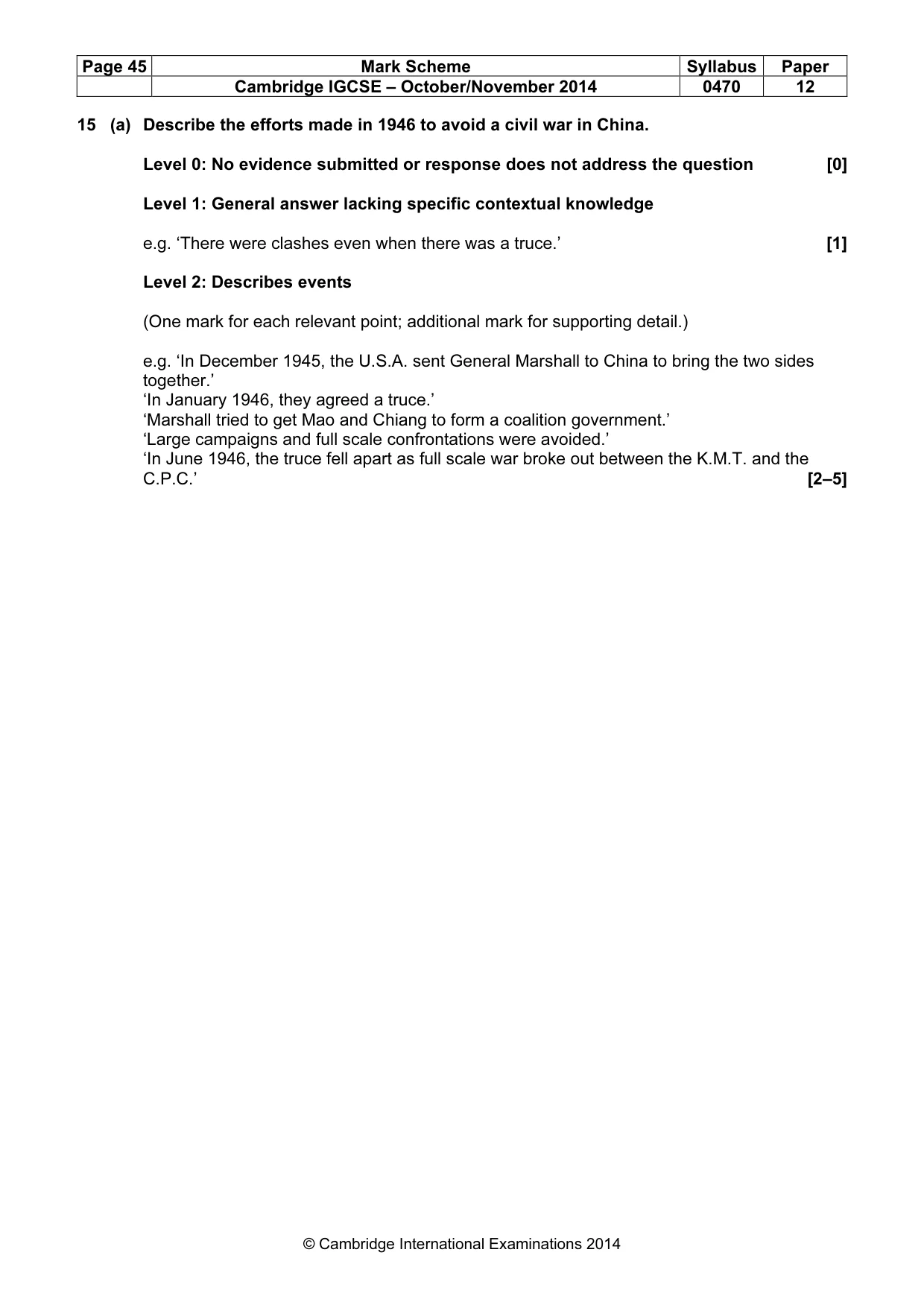
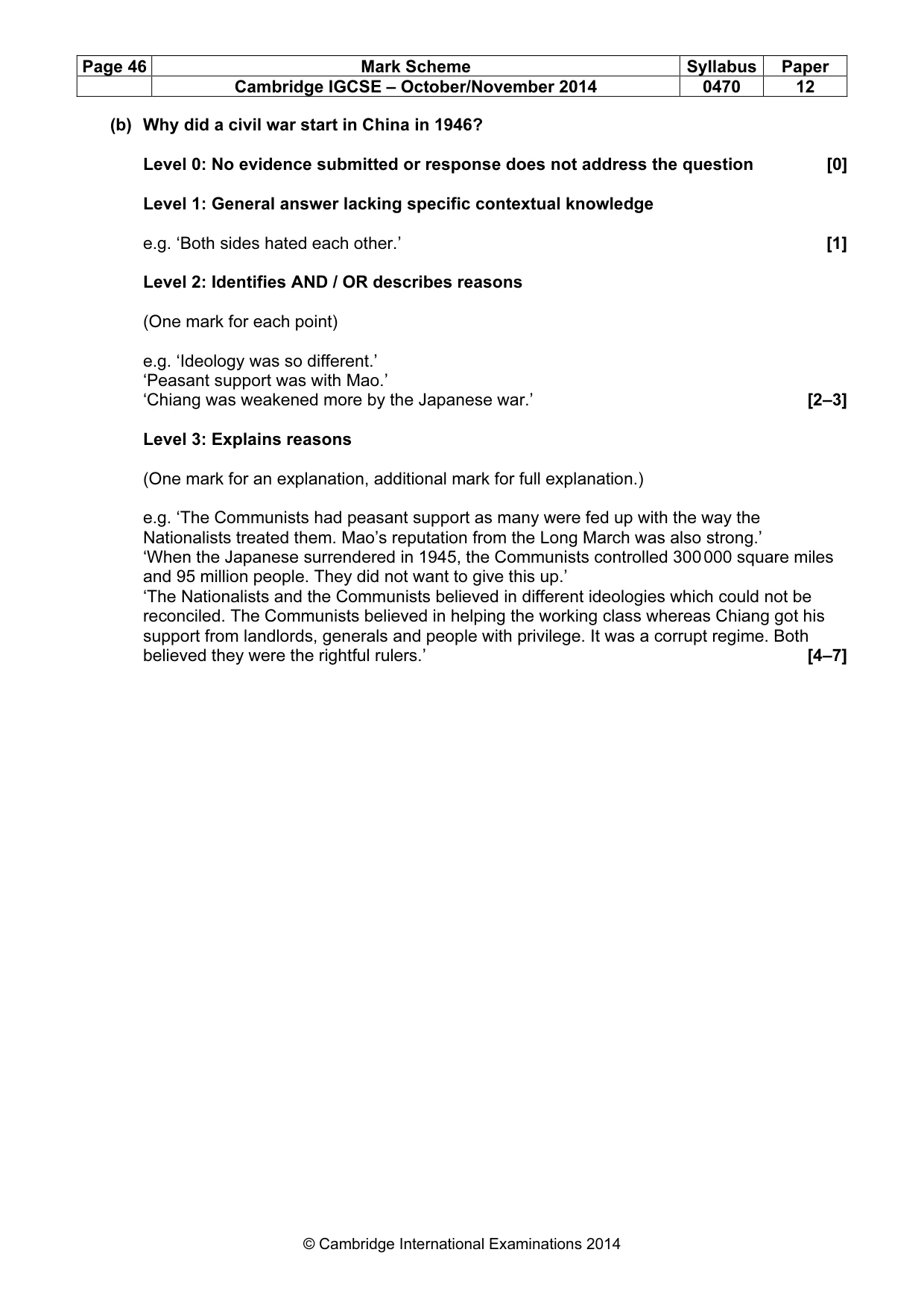
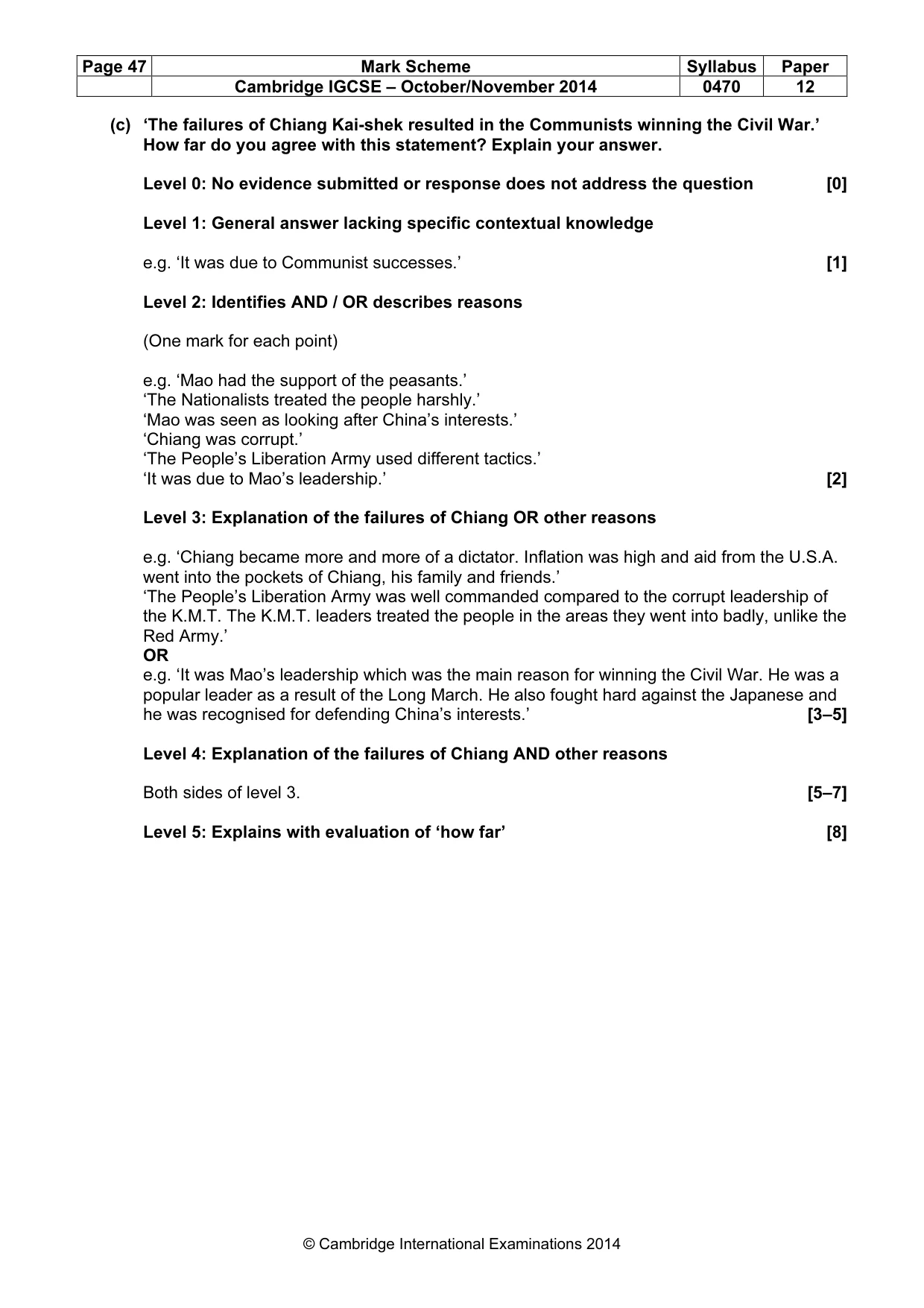
11 0470/12/O/N/14 © UCLES 2014 [Turn over DEPTH STUDY D: CHINA, 1945–c.1990 15 Read the extract, and then answer the questions which follow. The American government, which had given Chiang Kai-shek 200 million dollars’ worth of aid since 1945, could see that the Kuomintang was a spent force and so in 1947 cut off all aid to them. From a British history book published in 1998. (a) Describe the efforts made in 1946 to avoid a civil war in China. [5] (b) Why did a civil war start in China in 1946? [7] (c) ‘The failures of Chiang Kai-shek resulted in the Communists winning the Civil War.’ How far do you agree with this statement? Explain your answer. [8]
Question paper, page 12
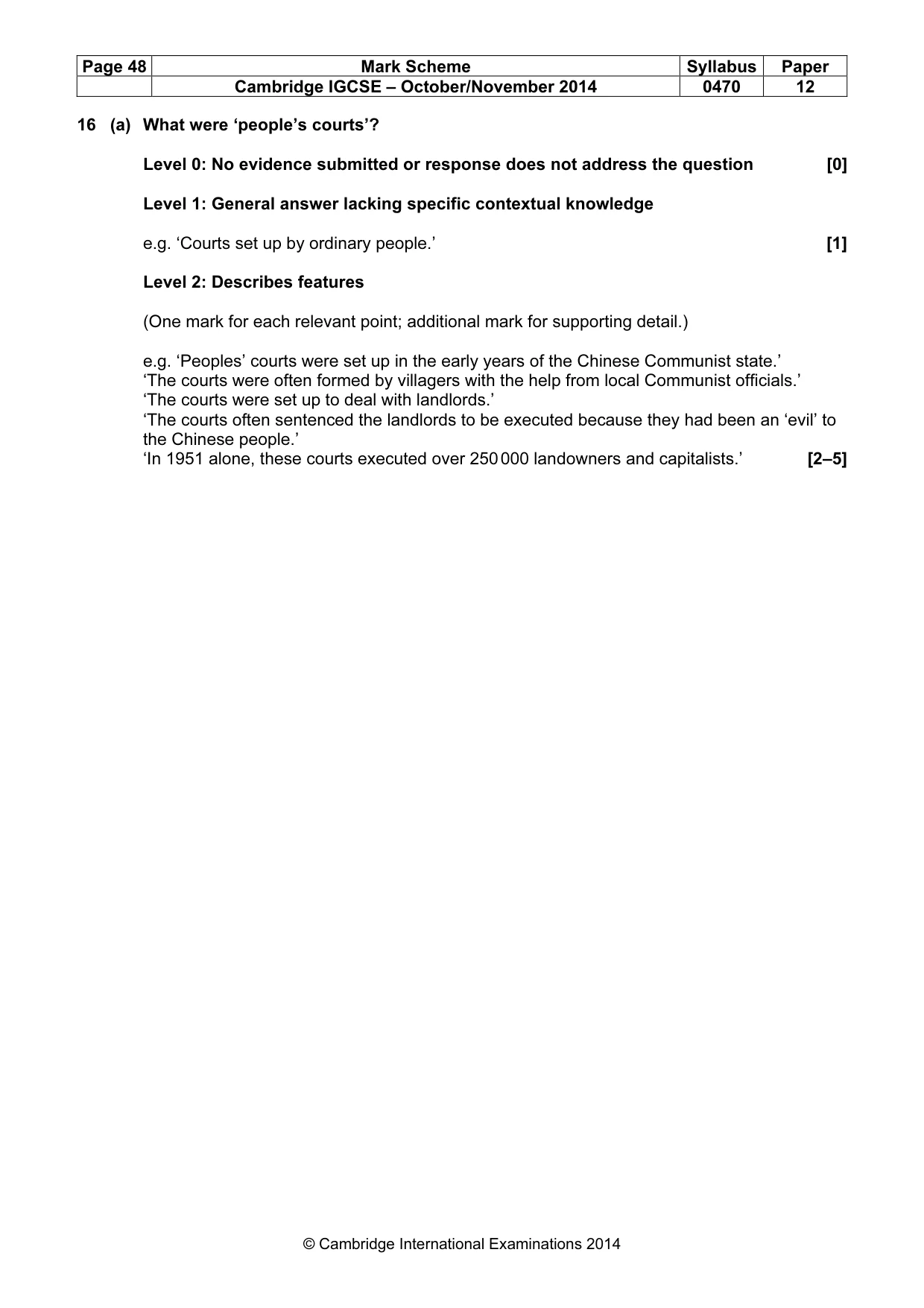
12 0470/12/O/N/14 © UCLES 2014 16 Look at the photograph, and then answer the questions which follow. Content removed due to copyright restrictions. (a) What were ‘people’s courts’? [5] (b) Why was ‘thought reform’ introduced by the Communists? [7] (c) ‘Mao’s economic policies between 1952 and 1961 were unsuccessful.’ How far do you agree with this statement? Explain your answer. [8]
Question paper, page 13
13 0470/12/O/N/14 © UCLES 2014 [Turn over DEPTH STUDY E: SOUTHERN AFRICA IN THE TWENTIETH CENTURY 17 Read the extract, and then answer the questions which follow. After the war ended in 1902, Lord Milner, the leading British official in South Africa, adopted a policy of ‘Anglicisation’. He wanted to break down the divisions between the Boers and the British. He wanted to encourage large numbers of new British settlers to come to South Africa, hoping they would swamp the Boers. From a history book published in Britain in 1997. (a) What did Rhodes hope to achieve in Africa? [5] (b) Why did tensions between the Boers and the British increase prior to the outbreak of war in 1899? [7] (c) ‘The British failed to deal successfully with South Africa between 1900 and 1910.’ How far do you agree with this statement? Explain your answer. [8]
Question paper, page 14
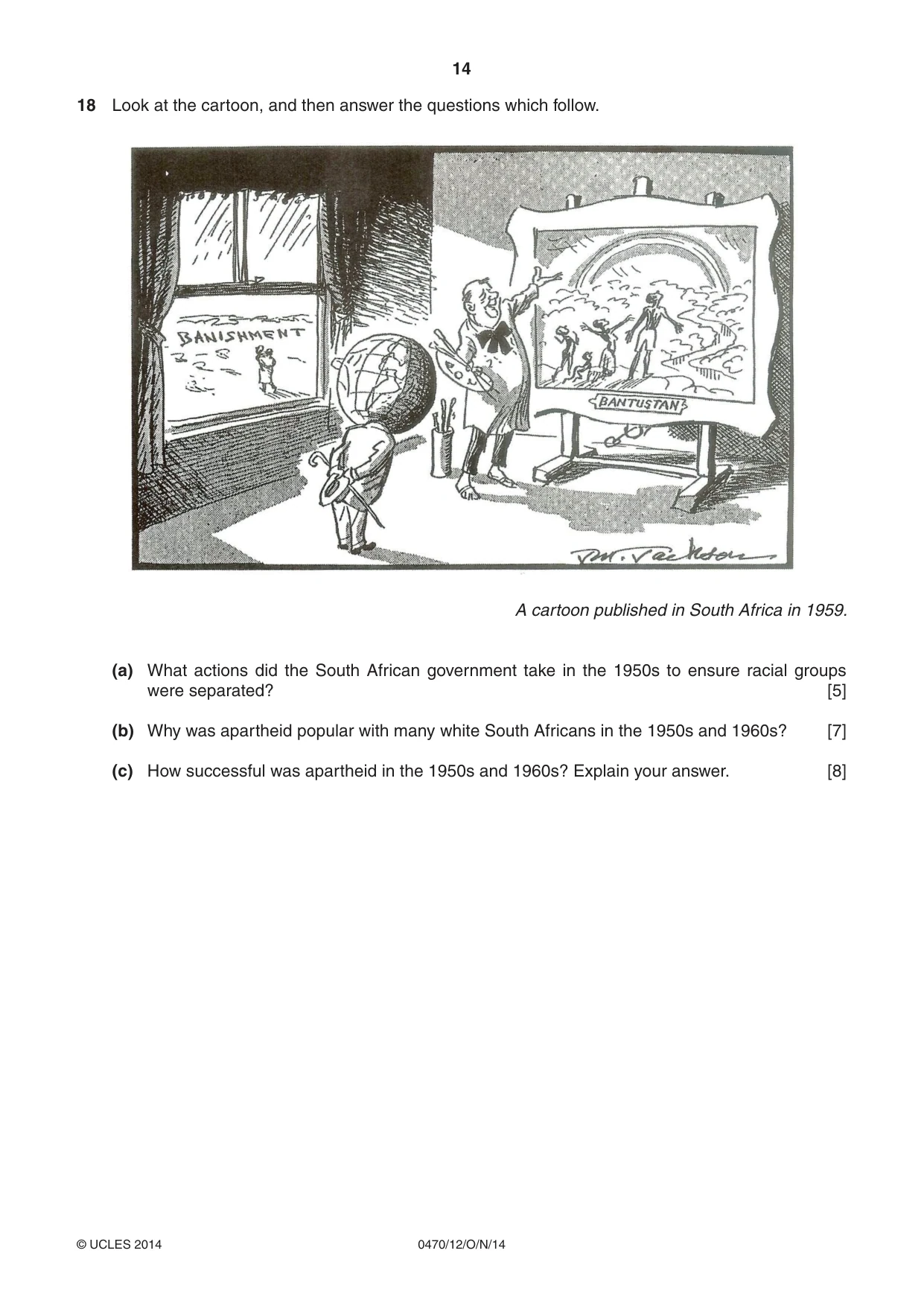
14 0470/12/O/N/14 © UCLES 2014 18 Look at the cartoon, and then answer the questions which follow. A cartoon published in South Africa in 1959. (a) What actions did the South African government take in the 1950s to ensure racial groups were separated? [5] (b) Why was apartheid popular with many white South Africans in the 1950s and 1960s? [7] (c) How successful was apartheid in the 1950s and 1960s? Explain your answer. [8]
Question paper, page 15
15 0470/12/O/N/14 © UCLES 2014 [Turn over 19 Read the extract, and then answer the questions which follow. The decision to colonise in Southern Africa means that the native tribes must leave the land where they have pastured their cattle, so that the white man can pasture his cattle there. The commissioner responsible for German colonial settlement, speaking in 1903. (a) Describe the establishment of German colonial rule in Namibia. [5] (b) Why was there resistance to the German colonisation of Namibia? [7] (c) How far were Namibia and its people affected by the First World War? Explain your answer. [8]
Question paper, page 16
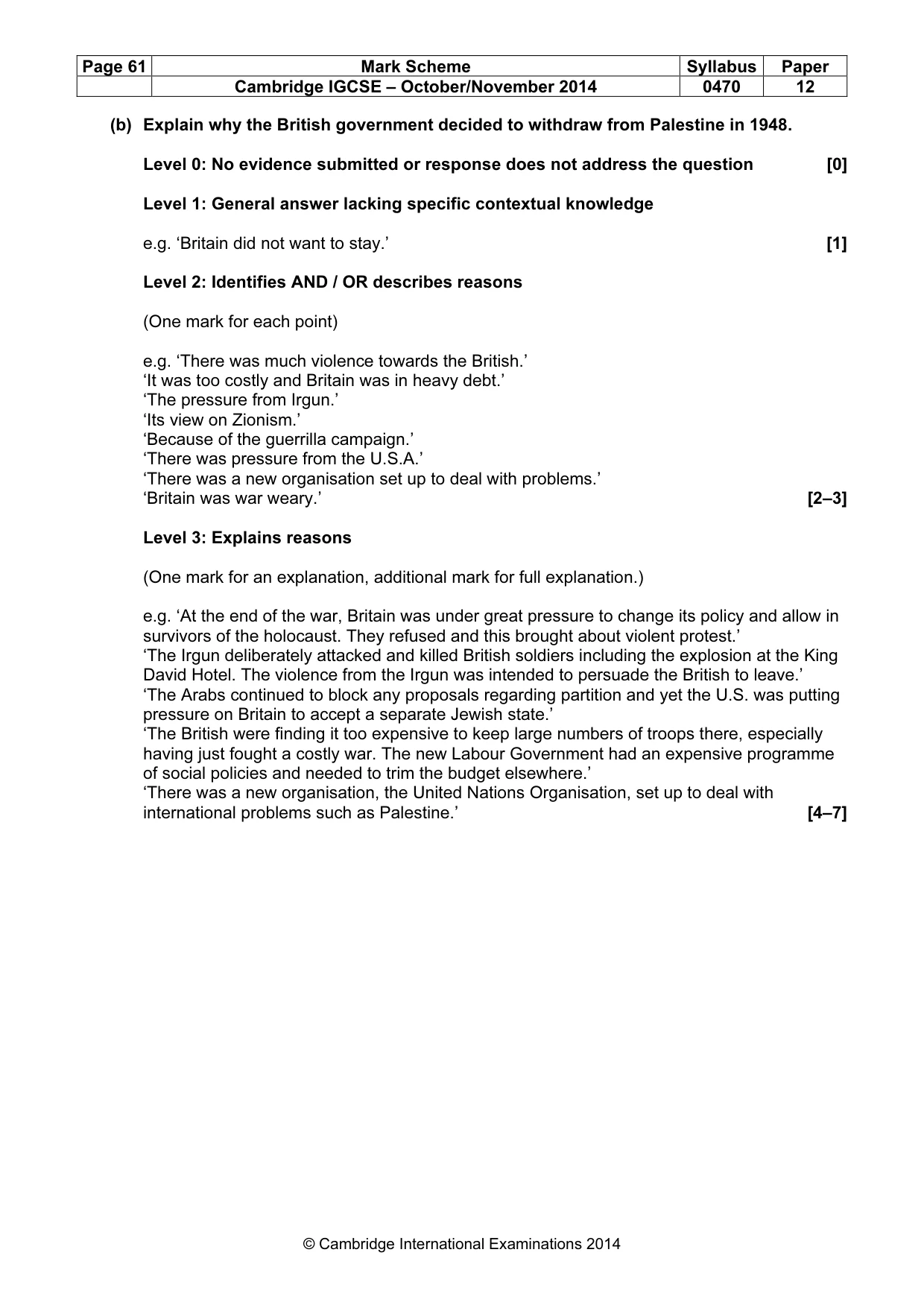
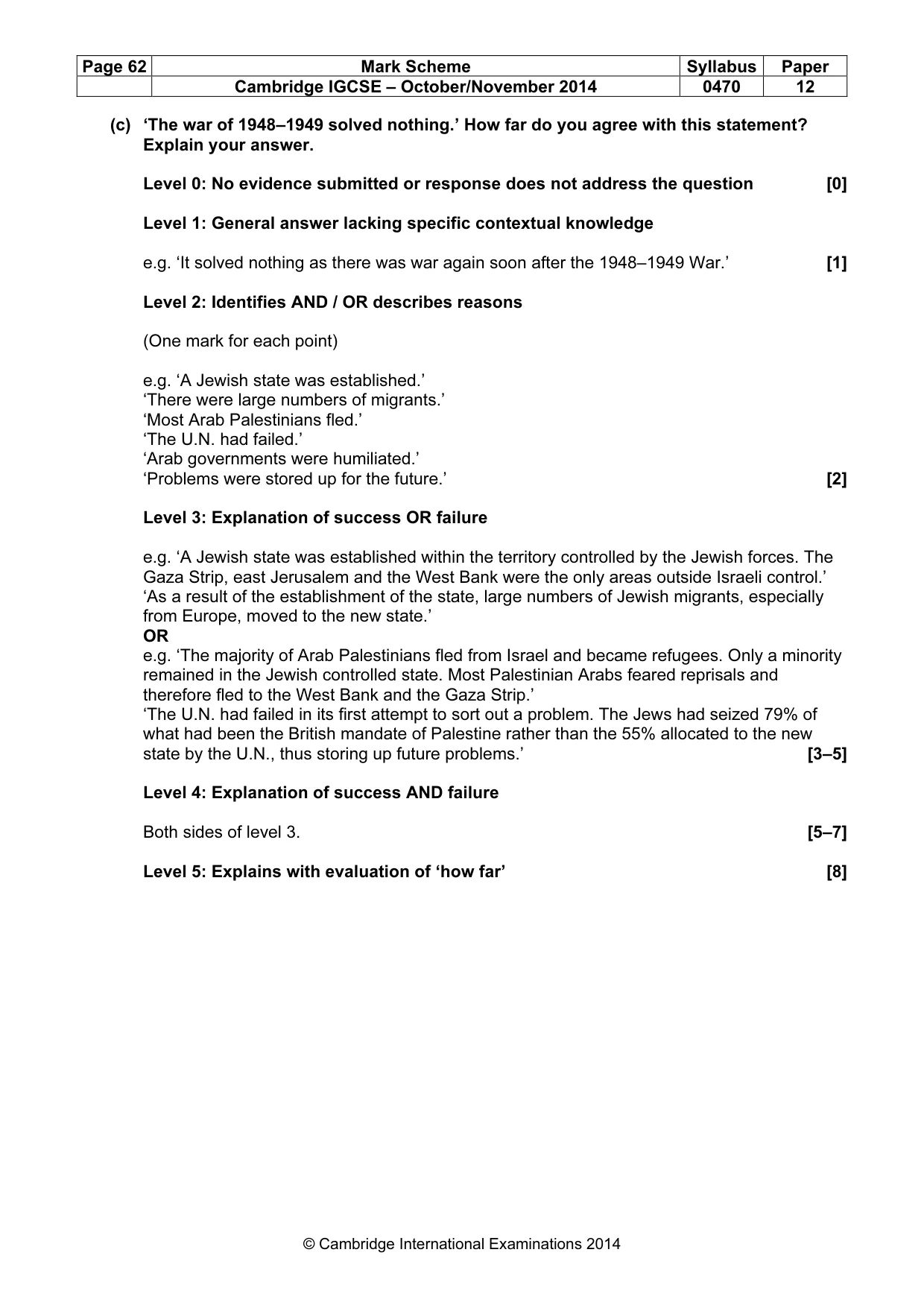
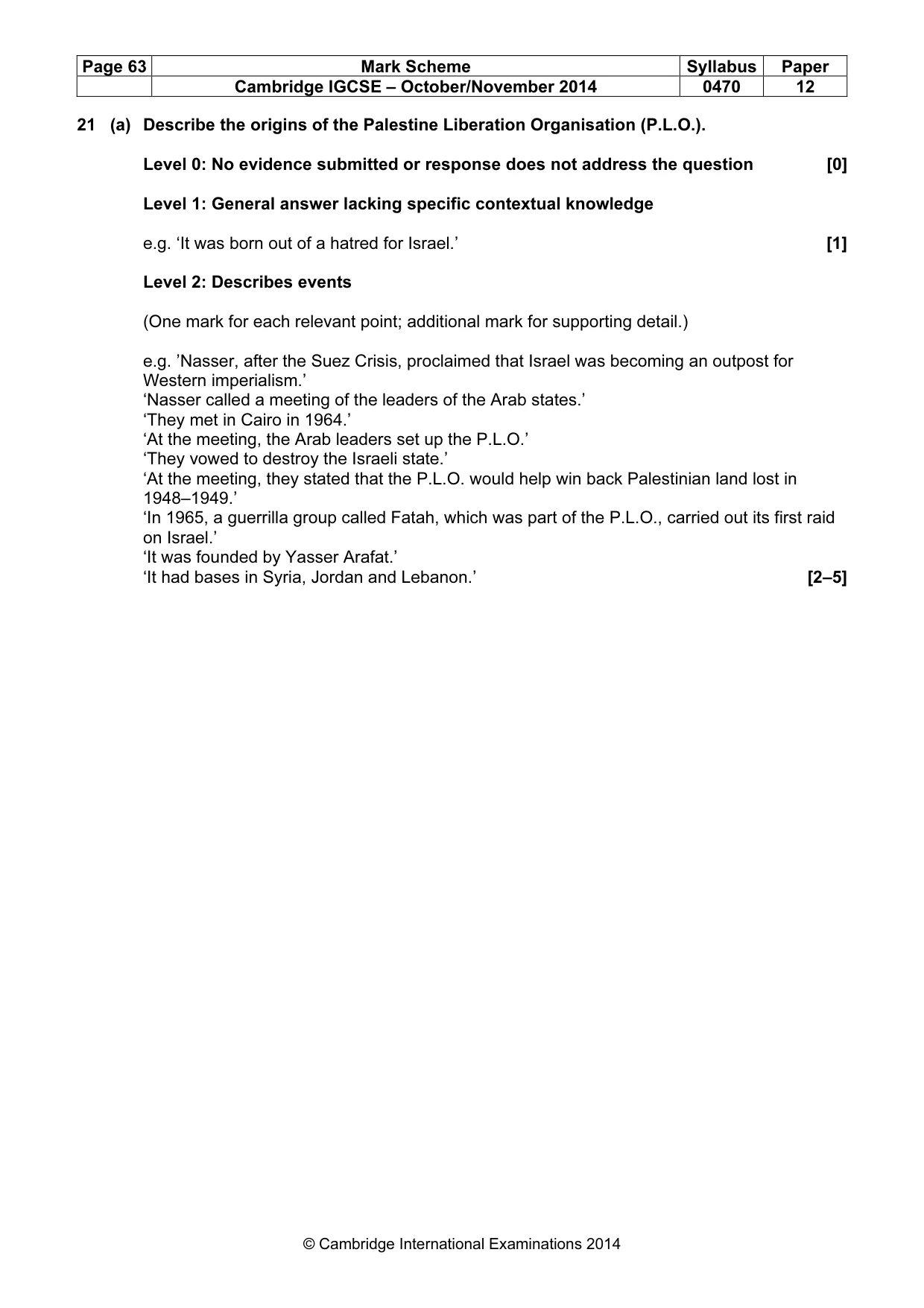
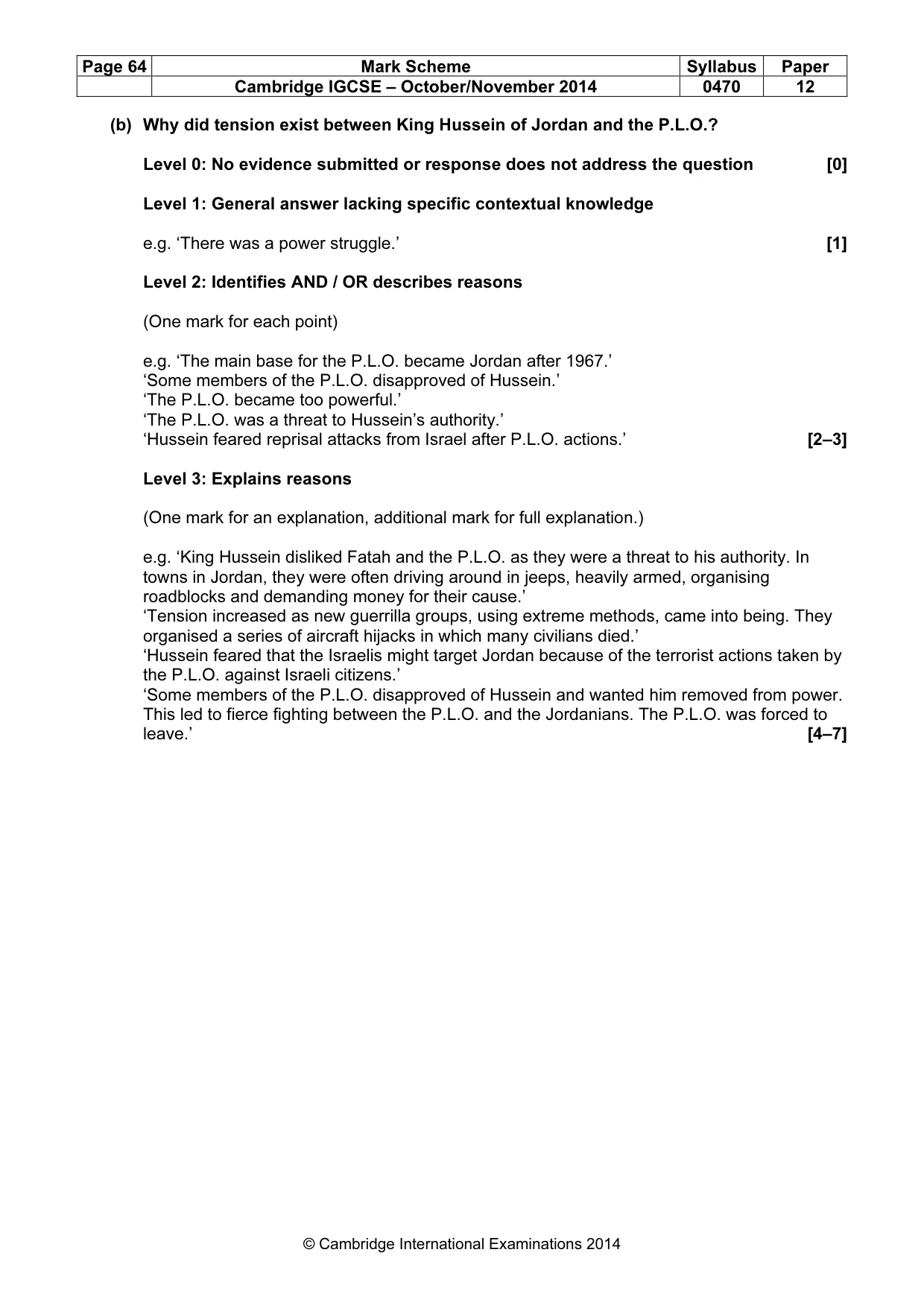
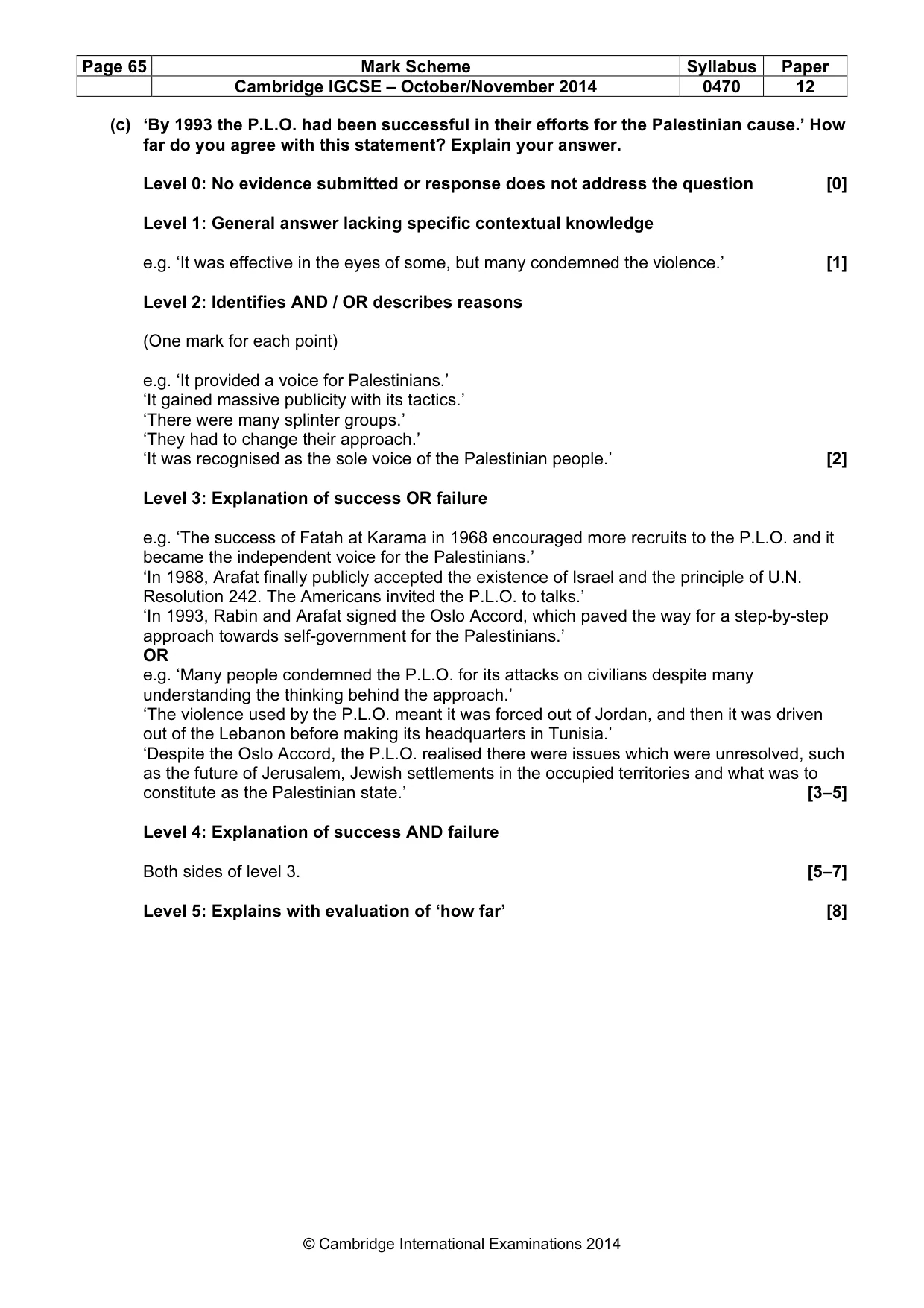
16 0470/12/O/N/14 © UCLES 2014 DEPTH STUDY F: ISRAELIS AND PALESTINIANS, 1945–c.1994 20 Read the extract, and then answer the questions which follow. Following the armistice agreements at the end of the war of 1948–49, the area controlled by the Jewish forces at the end of the fighting became the territory of the new state of Israel. From a British history book published in 1998. (a) Describe what happened in Palestine when the Second World War came to an end in 1945. [5] (b) Explain why the British government decided to withdraw from Palestine in 1948. [7] (c) ‘The war of 1948–49 solved nothing.’ How far do you agree with this statement? Explain your answer. [8] 21 Read the extract, and then answer the questions which follow. In 1988 Arafat finally publicly accepted the existence of Israel and the principle of Resolution 242. By accepting the Resolution the PLO recognised the existence of the Jewish state of Israel. From a British history book published in 1998. (a) Describe the origins of the Palestine Liberation Organisation (PLO). [5] (b) Why did tension exist between King Hussein of Jordan and the PLO? [7] (c) ‘By 1993 the PLO had been successful in their efforts for the Palestinian cause.’ How far do you agree with this statement? Explain your answer. [8]
Question paper, page 17
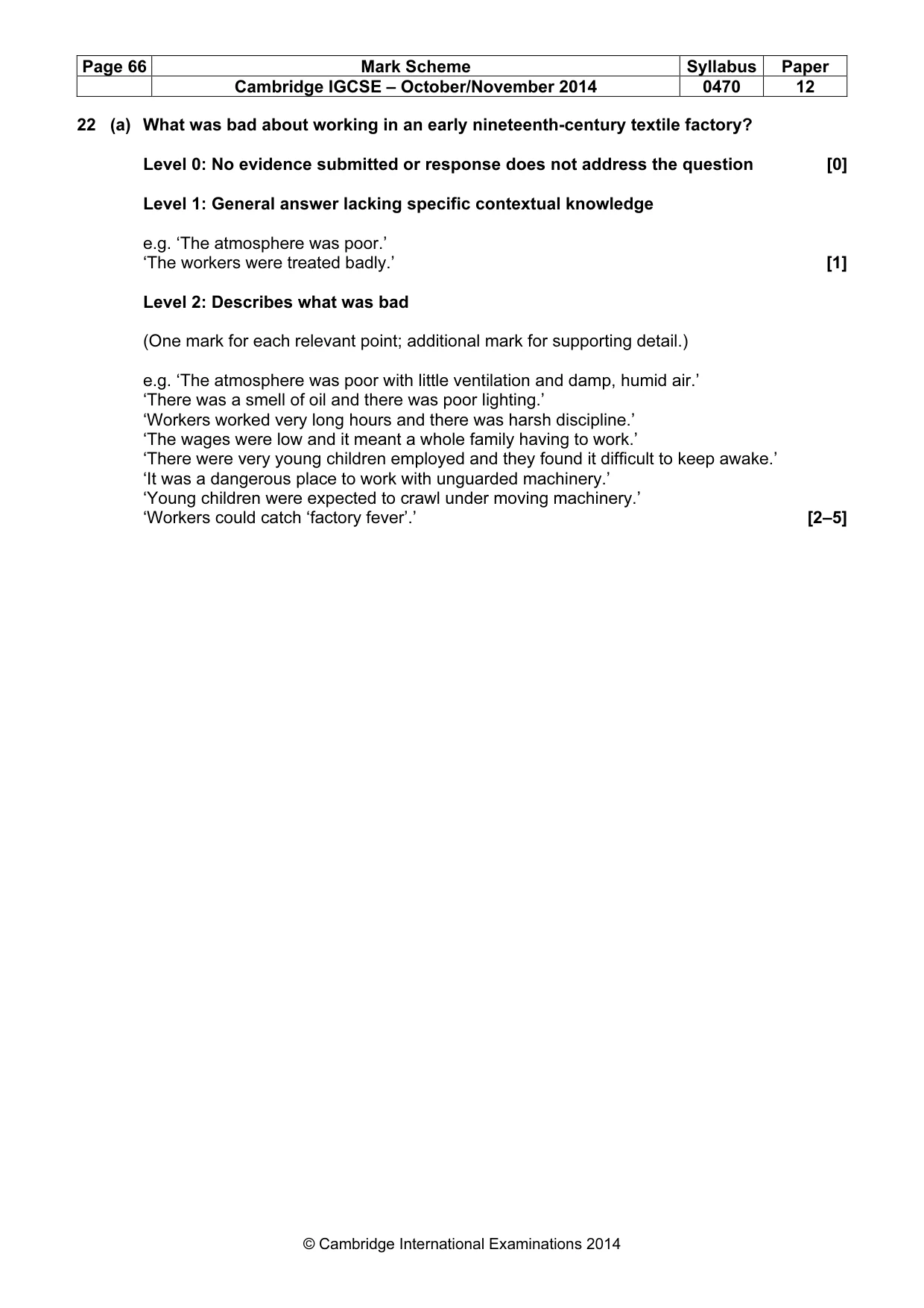
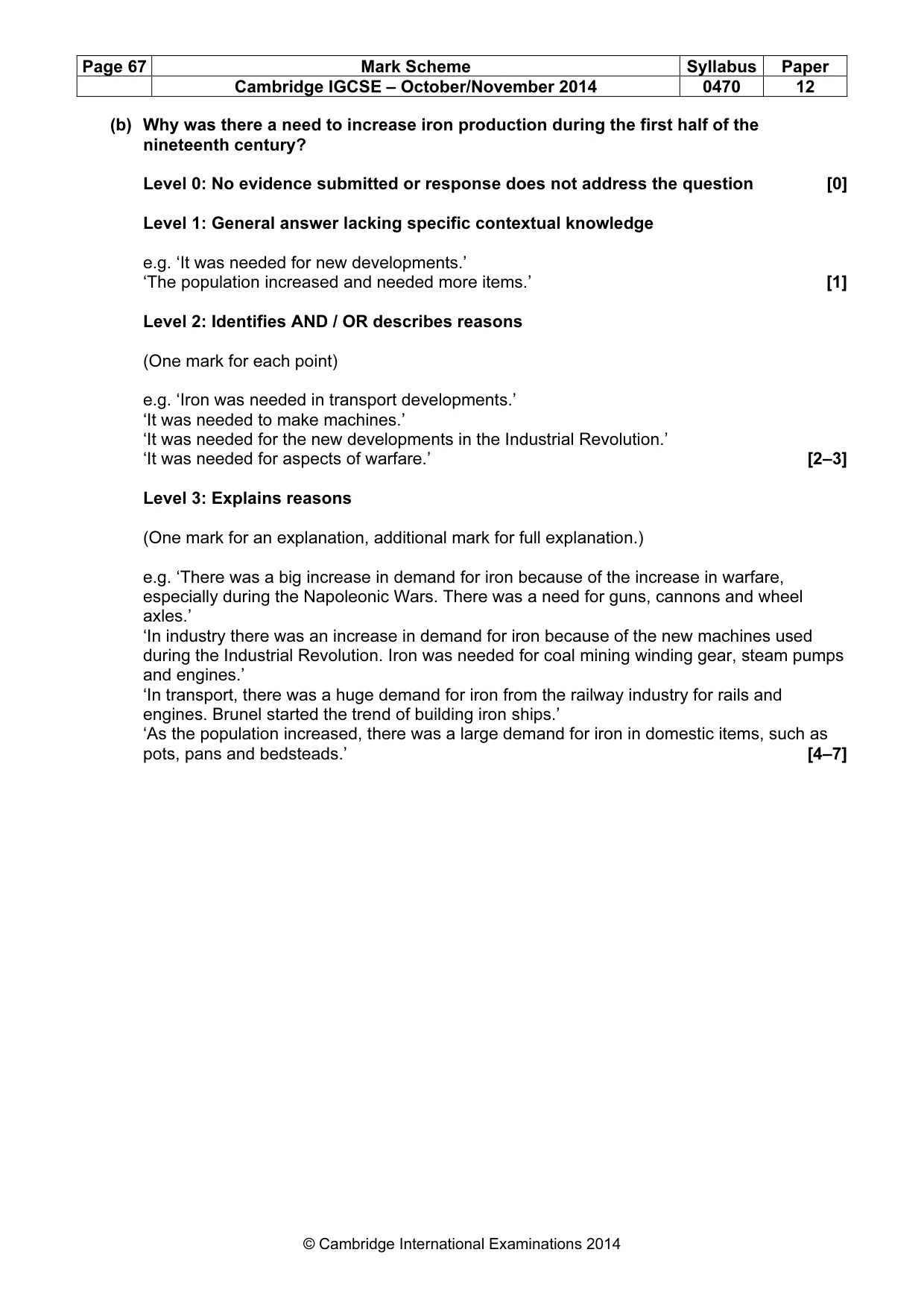
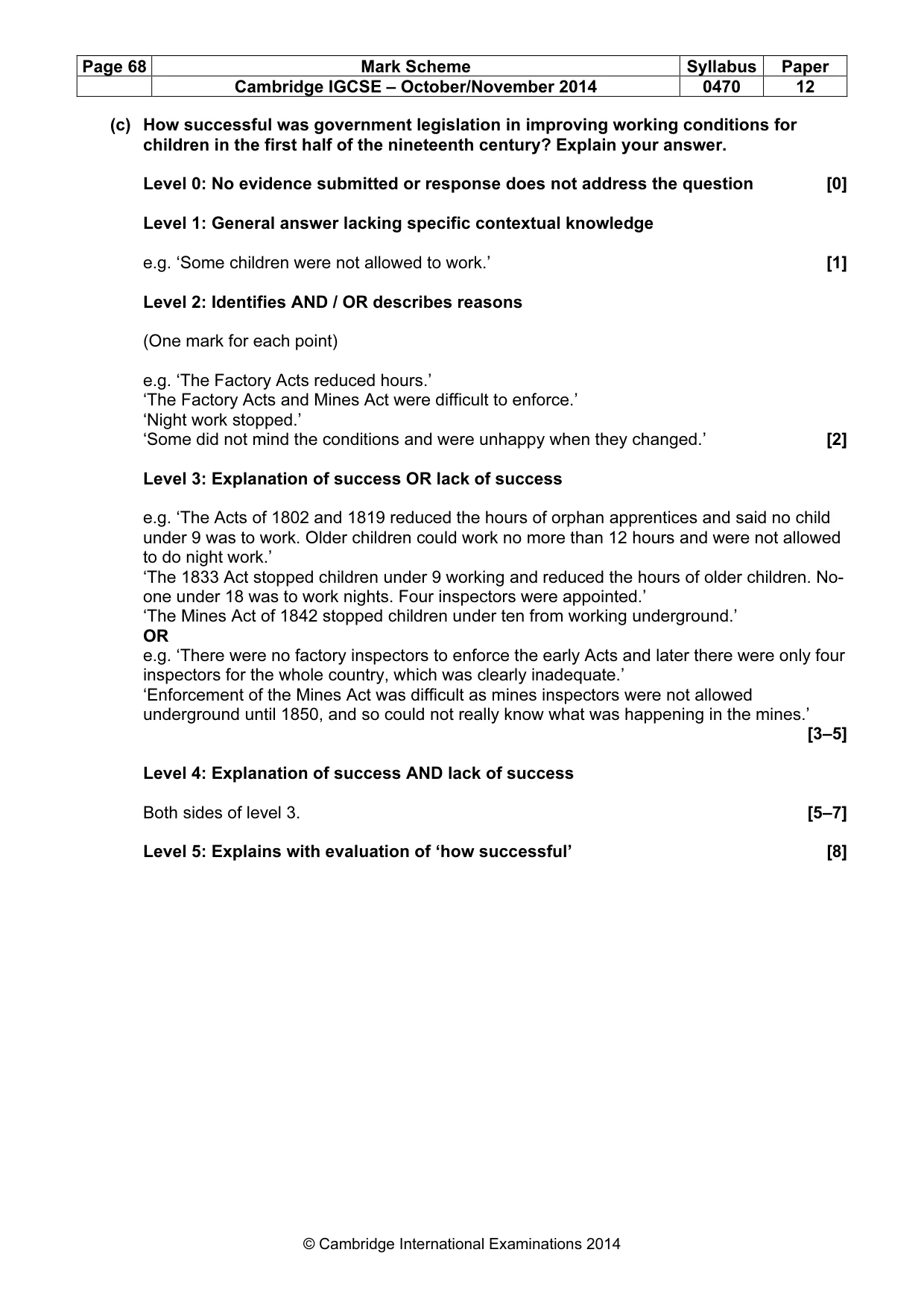
17 0470/12/O/N/14 © UCLES 2014 [Turn over DEPTH STUDY G: THE CREATION OF MODERN INDUSTRIAL SOCIETY 22 Read the extract, and then answer the questions which follow. Children under nine years old not to work in textile mills. Children aged nine to thirteen years to work no more than nine hours. No one under eighteen to do night work. Four inspectors to be appointed. Terms of the Factory Act, 1833. (a) What was bad about working in an early nineteenth-century textile factory? [5] (b) Why was there a need to increase iron production during the first half of the nineteenth century? [7] (c) How successful was government legislation in improving working conditions for children in the first half of the nineteenth century? Explain your answer. [8] 23 Read the extract, and then answer the questions which follow. At first the Liverpool and Manchester Railway made more money from passengers than freight. In 1835 the railway began carrying livestock which had been brought to England from Ireland. Soon supplies of fresh fish and vegetables were being transported. Raw cotton imported from America was carried in bulk to the manufacturers. From a history book published in 1998. (a) What were the disadvantages of roads for Britain’s transport needs at the beginning of the nineteenth century? [5] (b) Why were railways of benefit to people in their daily lives? [7] (c) ‘Brunel made a greater contribution than any other person to the development of railways.’ How far do you agree with this statement? Explain your answer. [8]
Question paper, page 18
18 0470/12/O/N/14 © UCLES 2014 DEPTH STUDY H: THE IMPACT OF WESTERN IMPERIALISM IN THE NINETEENTH CENTURY 24 Read the extract, and then answer the questions which follow. Bentinck’s modernising projects, which included a policy of westernisation, were controversial and included making English the language of the higher justice courts. He also took steps to suppress native customs which the British viewed as barbaric. A historian writing in 2012. (a) What was the role of the East India Company in the Indian sub-continent? [5] (b) Why were Bentinck’s proposals for India controversial? [7] (c) How far was nineteenth-century India changed by British rule? Explain your answer. [8]
Question paper, page 19
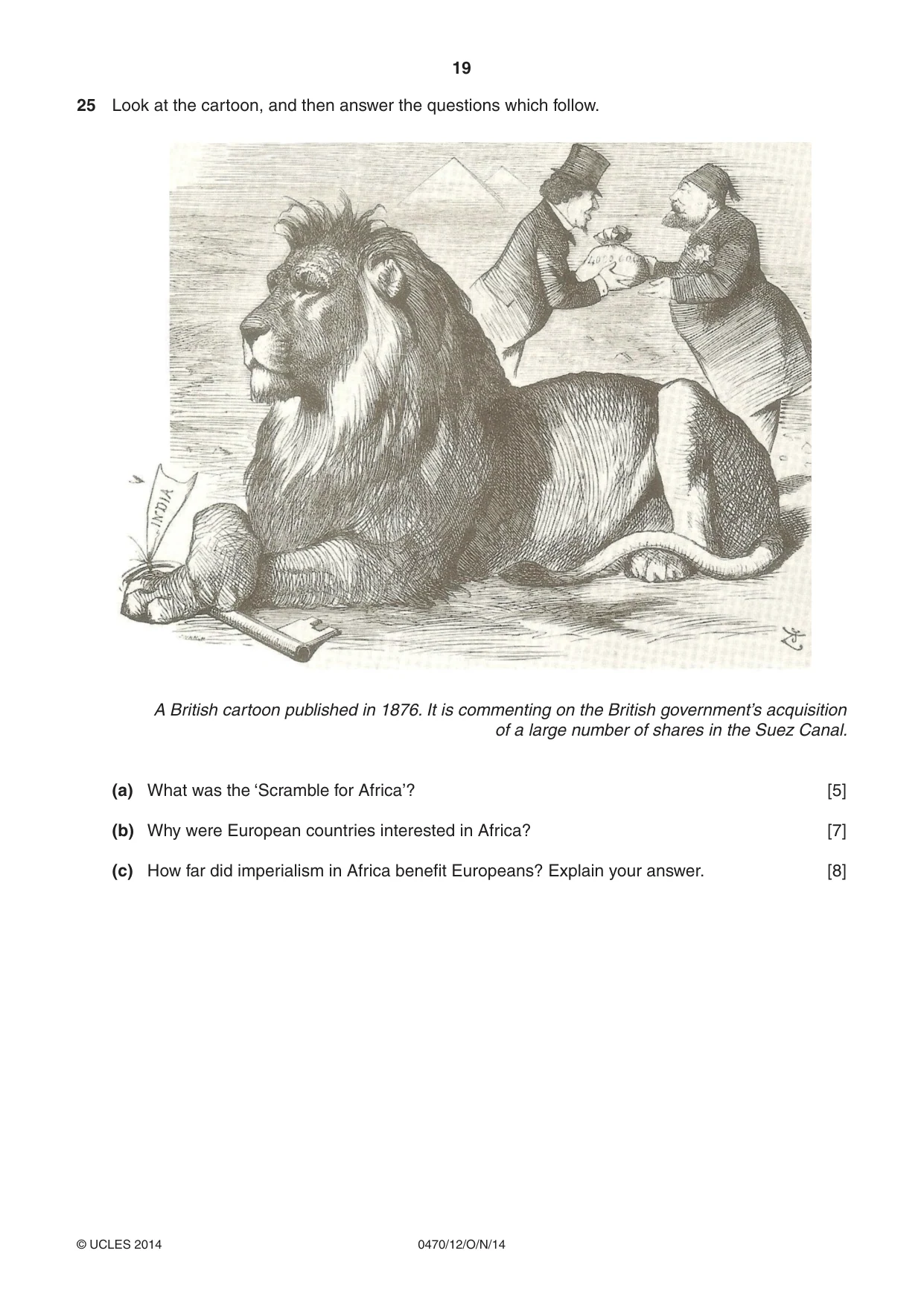
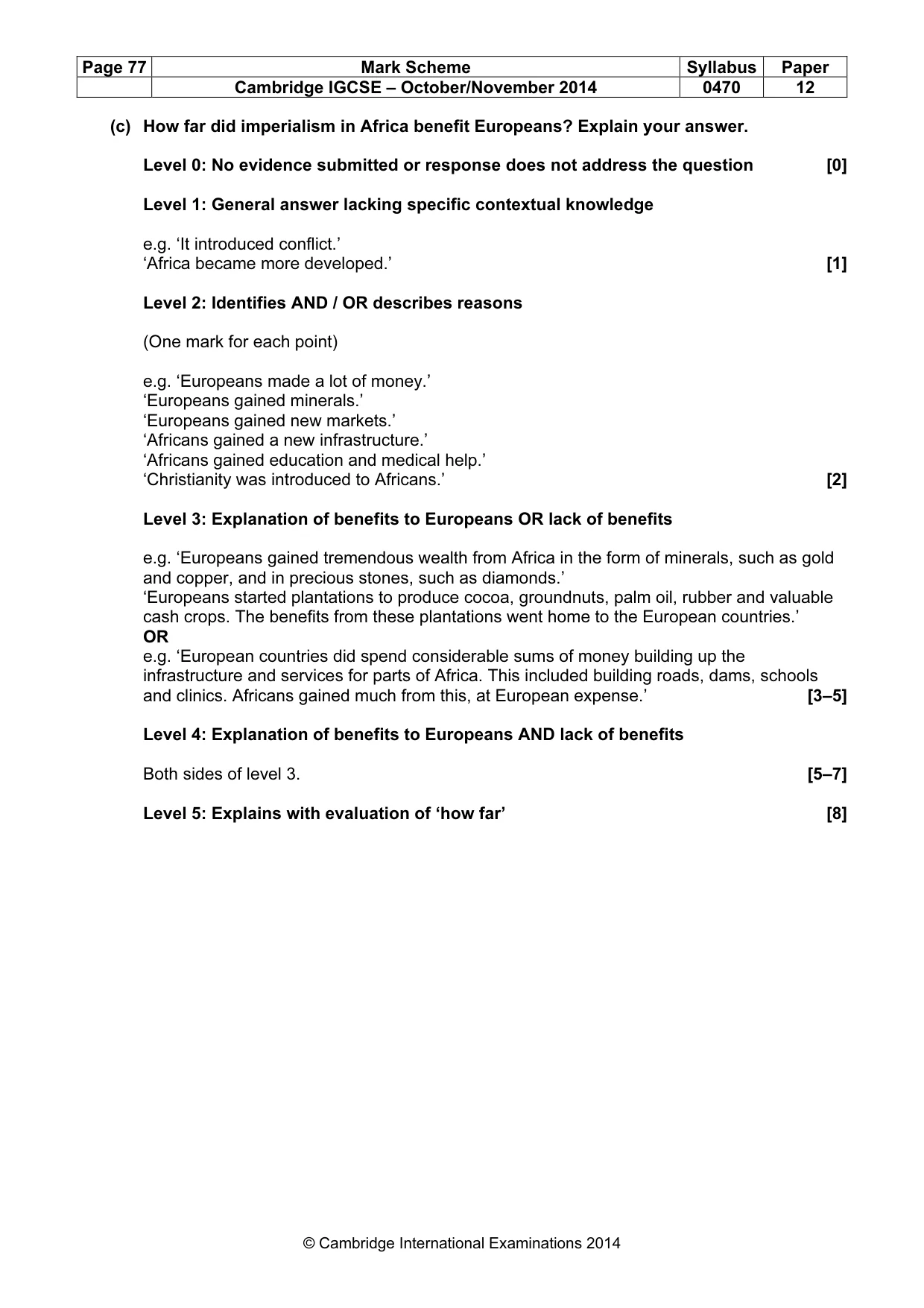
19 0470/12/O/N/14 © UCLES 2014 25 Look at the cartoon, and then answer the questions which follow. A British cartoon published in 1876. It is commenting on the British government’s acquisition of a large number of shares in the Suez Canal. (a) What was the ‘Scramble for Africa’? [5] (b) Why were European countries interested in Africa? [7] (c) How far did imperialism in Africa benefit Europeans? Explain your answer. [8]
Question paper, page 20
20 0470/12/O/N/14 © UCLES 2014 BLANK PAGE Copyright Acknowledgements: Question 1 © Martin Collier; The Unification of Italy 1815 – 70; Heinemann; 2008. Question 2 © Philip Sauvain; European and World History 1815 – 1919; Hulton; 1985. Question 3 © www.spartacus.schoolnet.co.uk; 29 October 2012. Question 4 © www.bbc.co.uk/schools/gcsebitesize/history; 29 October 2012. Question 5 © Ben Walsh; OCR GCSE Modern World History; Hodder Education; 2009. Question 6 © Tony McAleavy; Twentieth Century History: International Relations since 1919; Cambridge University Press; 2002. Question 7 © Tony McAleavy; Twentieth Century History: International Relations since 1919; Cambridge University Press; 2002. Question 8 © Ben Walsh; OCR GCSE Modern World History; Hodder Education/Corbis; 2009. Question 9 © Paul Grey & Rosemarie Little; Germany 1918 – 1945; Cambridge University Press; 1997. Question 10 © Rick Rogers; OCR GCSE History A, Germany 1919-1945; Heinemann; 2009. Question 11 © Ben Walsh; OCR GCSE Modern World History; Hodder Education; 2009. Question 12 © Philip Ingram; Russia and the USSR 1905-1991; Cambridge University Press; 1997. Question 13 © C. K. Macdonald; Modern America; Basil Blackwell; 1987. Question 14 © Ian Campbell; The USA 1917-1941; Cambridge University Press; 1998. Question 15 © Josh Brooman; China since 1900; Published by Longman. Reprinted by permission of Pearson Education Ltd; 1988. Question 16 © http://www.uselesstree.typepad.com; 30 October 2012. Question 17 © Rosemary Holland; South Africa 1948 – 1994; Cambridge University Press; 1997. Question 19 © Nangolo Mbumba & Norbert H. Noisser; Namibia in History; Zed Books Ltd; 1988. Question 20 © Tony McAleavy; The Arab-Israeli Conflict; Cambridge University Press; 1998. Question 21 © Tony McAleavy; The Arab-Israeli Conflict; Cambridge University Press; 1998. Question 22 © Ben Walsh; British Social & Economic History; Published by John Murray. Reprinted by permission of Hodder Education; 1997. Question 23 © Richard Staton et al; Three Centuries of Change; Collins Educational; 1998. Question 24 © Ray Ennion Question 25 © Philip Sauvain; European and World History 1815 – 1919; Hulton / Punch; 1985. Permission to reproduce items where third-party owned material protected by copyright is included has been sought and cleared where possible. Every reasonable effort has been made by the publisher (UCLES) to trace copyright holders, but if any items requiring clearance have unwittingly been included, the publisher will be pleased to make amends at the earliest possible opportunity. Cambridge International Examinations is part of the Cambridge Assessment Group. Cambridge Assessment is the brand name of University of Cambridge Local Examinations Syndicate (UCLES), which is itself a department of the University of Cambridge.
Mark scheme, page 1
® IGCSE is the registered trademark of Cambridge International Examinations. CAMBRIDGE INTERNATIONAL EXAMINATIONS Cambridge International General Certificate of Secondary Education MARK SCHEME for the October/November 2014 series 0470 HISTORY 0470/12 Paper 1, maximum raw mark 60 This mark scheme is published as an aid to teachers and candidates, to indicate the requirements of the examination. It shows the basis on which Examiners were instructed to award marks. It does not indicate the details of the discussions that took place at an Examiners’ meeting before marking began, which would have considered the acceptability of alternative answers. Mark schemes should be read in conjunction with the question paper and the Principal Examiner Report for Teachers. Cambridge will not enter into discussions about these mark schemes. Cambridge is publishing the mark schemes for the October/November 2014 series for most Cambridge IGCSE®, Cambridge International A and AS Level components and some Cambridge O Level components.
Mark scheme, page 2
Page 2 Mark Scheme Syllabus Paper Cambridge IGCSE – October/November 2014 0470 12 © Cambridge International Examinations 2014 GENERAL INSTRUCTIONS Applying the Mark Scheme • When marking a response the overall criterion to be considered should be – ‘How good is this response to this question?’ • The ‘Level Descriptor’ should be used to decide the Level into which the quality of the answer fits. • Exhaustive lists of possible facts are not given in the mark scheme, as there is often a choice of factual knowledge that candidates may use. • WHERE EXAMPLES OF RESPONSES ARE GIVEN, THESE ARE NOT PRESCRIPTIVE, BUT ARE INTENDED AS A GUIDE. It is not possible to cover every possible type of response within a levels of response mark scheme and examiners are expected to use their professional judgement at all times in ensuring that responses are placed in the correct levels and given an appropriate mark within that level. • Marking must be positive. Marks must not be deducted for inaccurate or irrelevant parts of answers. In itself, poor use of historical terminology, spelling, grammar or handwriting does not affect the mark. The overall quality of the answer to the question should be judged. • If a candidate reaches a particular level s/he must be rewarded with a mark within that level. It is not necessary to work through the levels. • The full range of marks should be used. Do not be afraid to award full marks or no marks. Failure to do this will seriously affect the distribution of marks. Be prepared to reward candidates who show any level of understanding. The mark scheme starts from basic acceptable response. Where a band of marks is indicated for a level these marks should be used with reference to the development of the answer within that level. Assessment Objectives The Assessment Objectives being tested in each part of a question are: (a) recall, description (b) recall, explanation (c) recall, explanation and analysis.
Mark scheme, page 3
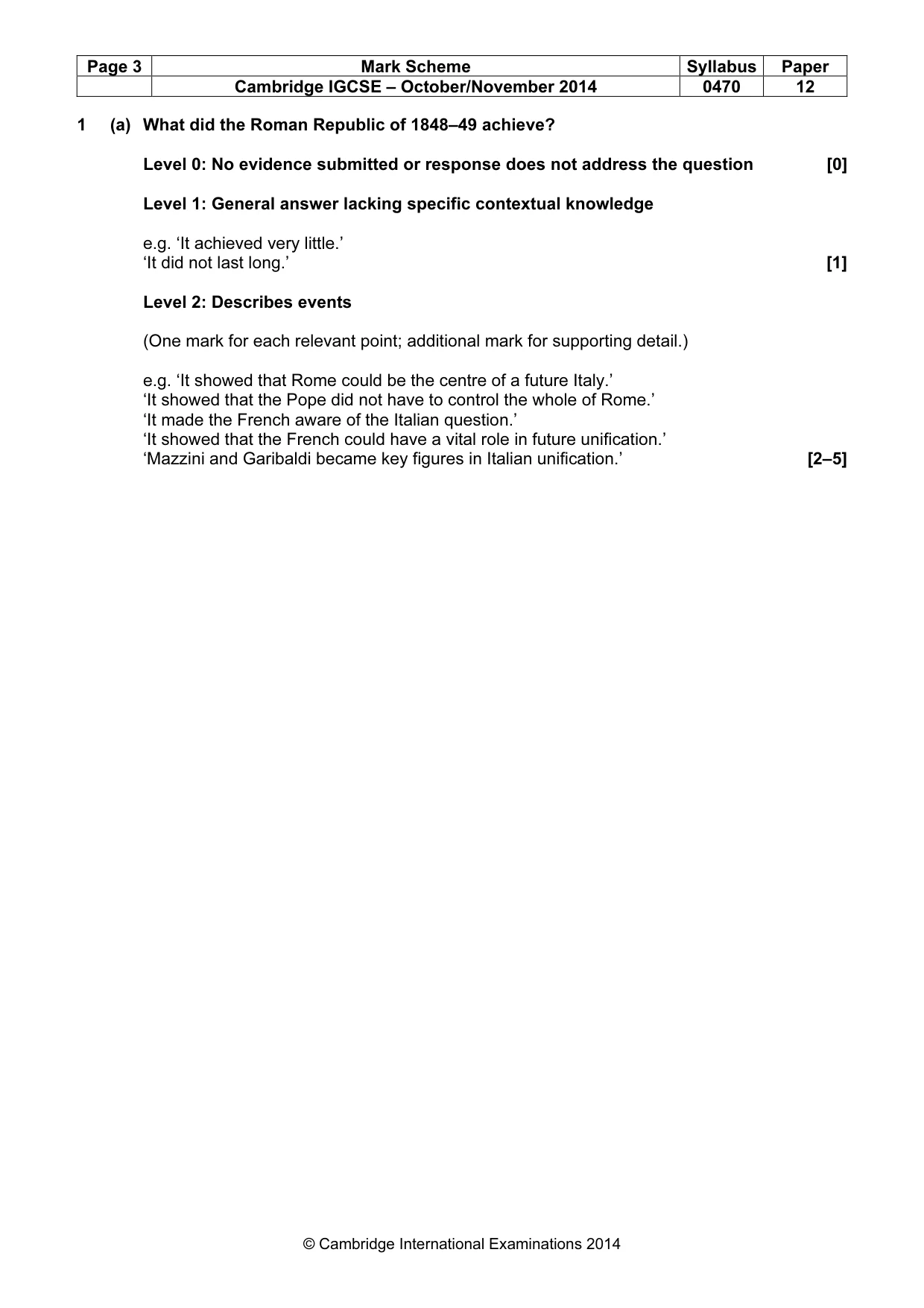
Page 3 Mark Scheme Syllabus Paper Cambridge IGCSE – October/November 2014 0470 12 © Cambridge International Examinations 2014 1 (a) What did the Roman Republic of 1848–49 achieve? Level 0: No evidence submitted or response does not address the question [0] Level 1: General answer lacking specific contextual knowledge e.g. ‘It achieved very little.’ ‘It did not last long.’ [1] Level 2: Describes events (One mark for each relevant point; additional mark for supporting detail.) e.g. ‘It showed that Rome could be the centre of a future Italy.’ ‘It showed that the Pope did not have to control the whole of Rome.’ ‘It made the French aware of the Italian question.’ ‘It showed that the French could have a vital role in future unification.’ ‘Mazzini and Garibaldi became key figures in Italian unification.’ [2–5]
Mark scheme, page 4
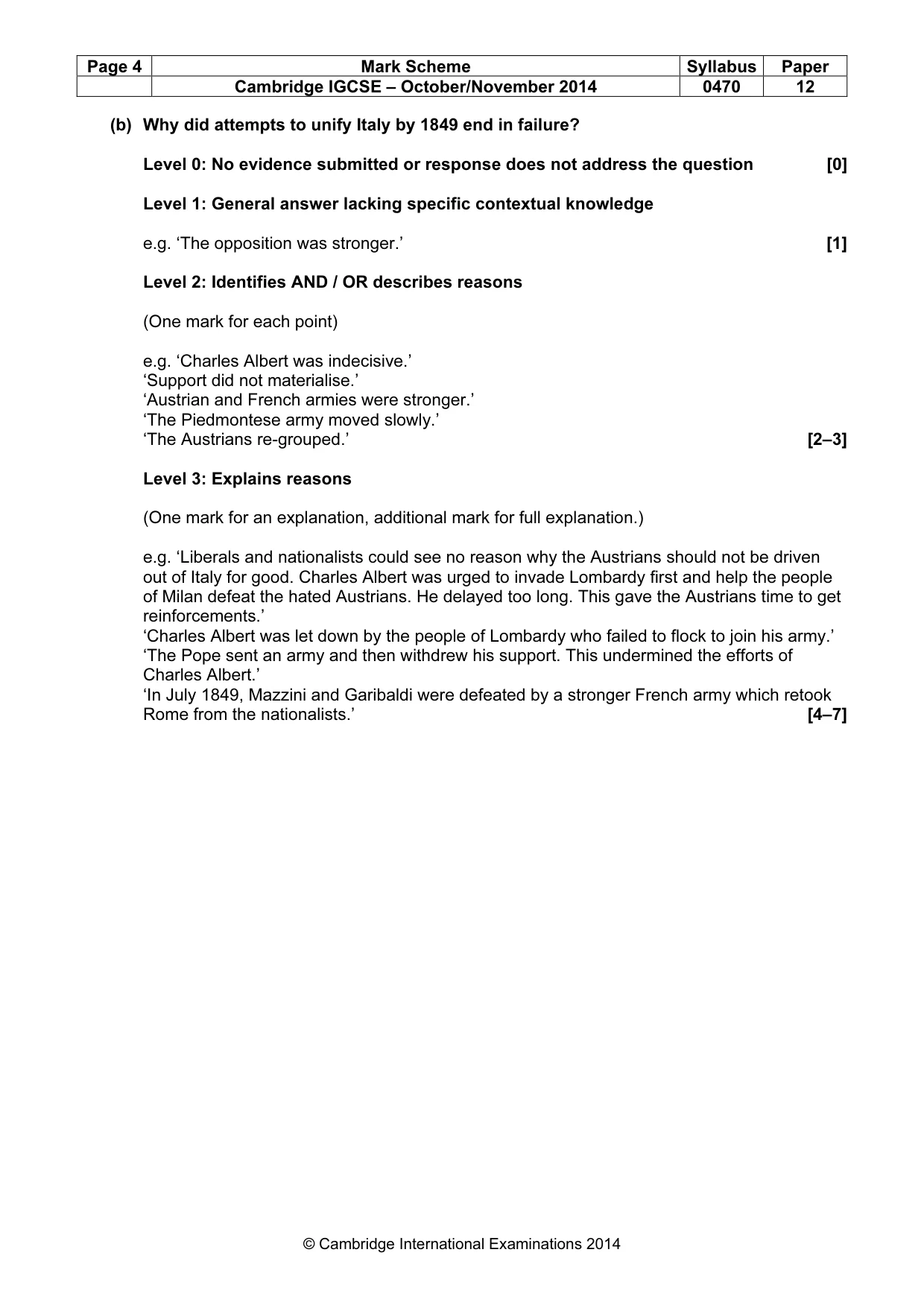
Page 4 Mark Scheme Syllabus Paper Cambridge IGCSE – October/November 2014 0470 12 © Cambridge International Examinations 2014 (b) Why did attempts to unify Italy by 1849 end in failure? Level 0: No evidence submitted or response does not address the question [0] Level 1: General answer lacking specific contextual knowledge e.g. ‘The opposition was stronger.’ [1] Level 2: Identifies AND / OR describes reasons (One mark for each point) e.g. ‘Charles Albert was indecisive.’ ‘Support did not materialise.’ ‘Austrian and French armies were stronger.’ ‘The Piedmontese army moved slowly.’ ‘The Austrians re-grouped.’ [2–3] Level 3: Explains reasons (One mark for an explanation, additional mark for full explanation.) e.g. ‘Liberals and nationalists could see no reason why the Austrians should not be driven out of Italy for good. Charles Albert was urged to invade Lombardy first and help the people of Milan defeat the hated Austrians. He delayed too long. This gave the Austrians time to get reinforcements.’ ‘Charles Albert was let down by the people of Lombardy who failed to flock to join his army.’ ‘The Pope sent an army and then withdrew his support. This undermined the efforts of Charles Albert.’ ‘In July 1849, Mazzini and Garibaldi were defeated by a stronger French army which retook Rome from the nationalists.’ [4–7]
Mark scheme, page 5
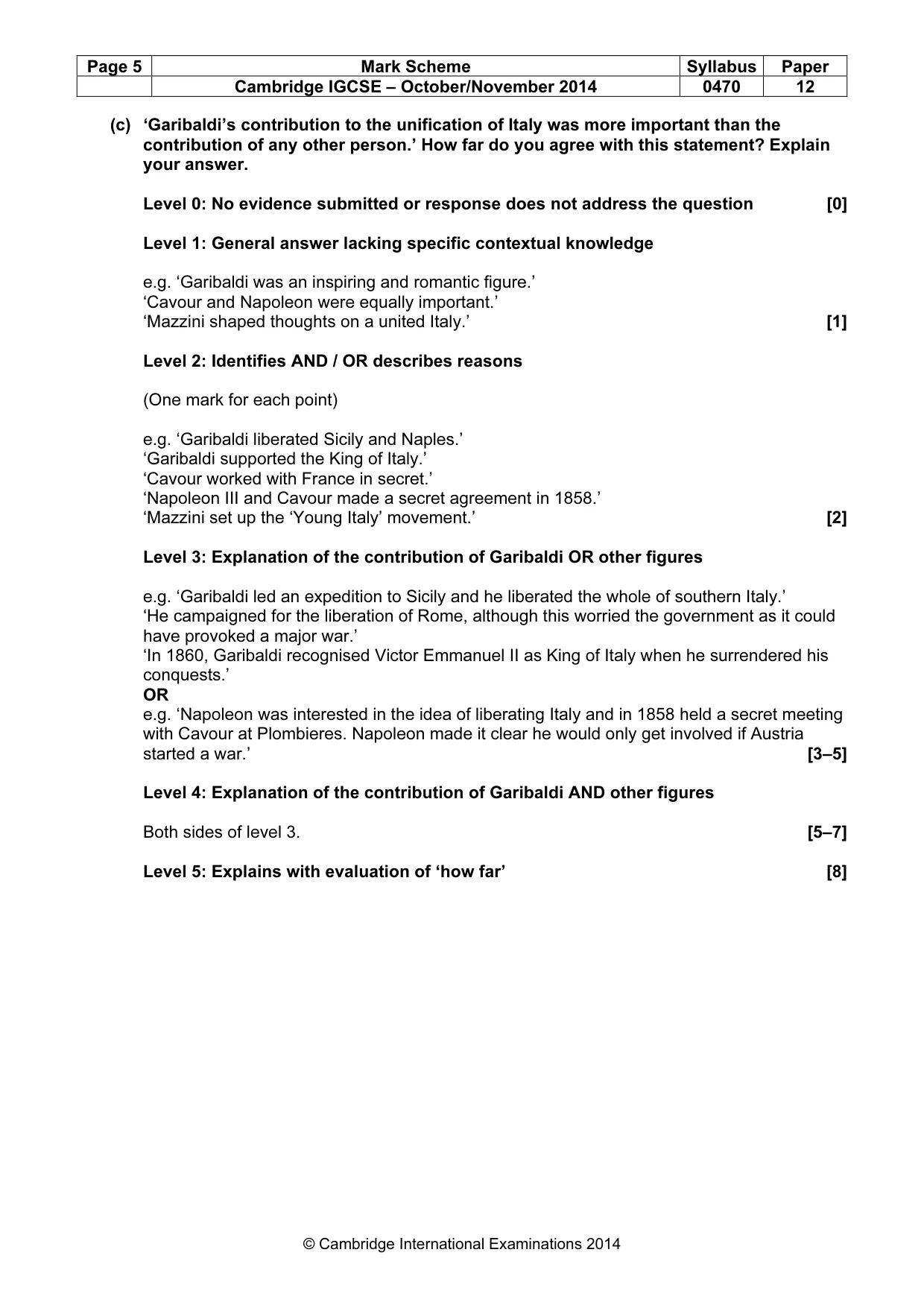
Page 5 Mark Scheme Syllabus Paper Cambridge IGCSE – October/November 2014 0470 12 © Cambridge International Examinations 2014 (c) ‘Garibaldi’s contribution to the unification of Italy was more important than the contribution of any other person.’ How far do you agree with this statement? Explain your answer. Level 0: No evidence submitted or response does not address the question [0] Level 1: General answer lacking specific contextual knowledge e.g. ‘Garibaldi was an inspiring and romantic figure.’ ‘Cavour and Napoleon were equally important.’ ‘Mazzini shaped thoughts on a united Italy.’ [1] Level 2: Identifies AND / OR describes reasons (One mark for each point) e.g. ‘Garibaldi liberated Sicily and Naples.’ ‘Garibaldi supported the King of Italy.’ ‘Cavour worked with France in secret.’ ‘Napoleon III and Cavour made a secret agreement in 1858.’ ‘Mazzini set up the ‘Young Italy’ movement.’ [2] Level 3: Explanation of the contribution of Garibaldi OR other figures e.g. ‘Garibaldi led an expedition to Sicily and he liberated the whole of southern Italy.’ ‘He campaigned for the liberation of Rome, although this worried the government as it could have provoked a major war.’ ‘In 1860, Garibaldi recognised Victor Emmanuel II as King of Italy when he surrendered his conquests.’ OR e.g. ‘Napoleon was interested in the idea of liberating Italy and in 1858 held a secret meeting with Cavour at Plombieres. Napoleon made it clear he would only get involved if Austria started a war.’ [3–5] Level 4: Explanation of the contribution of Garibaldi AND other figures Both sides of level 3. [5–7] Level 5: Explains with evaluation of ‘how far’ [8]
Mark scheme, page 6
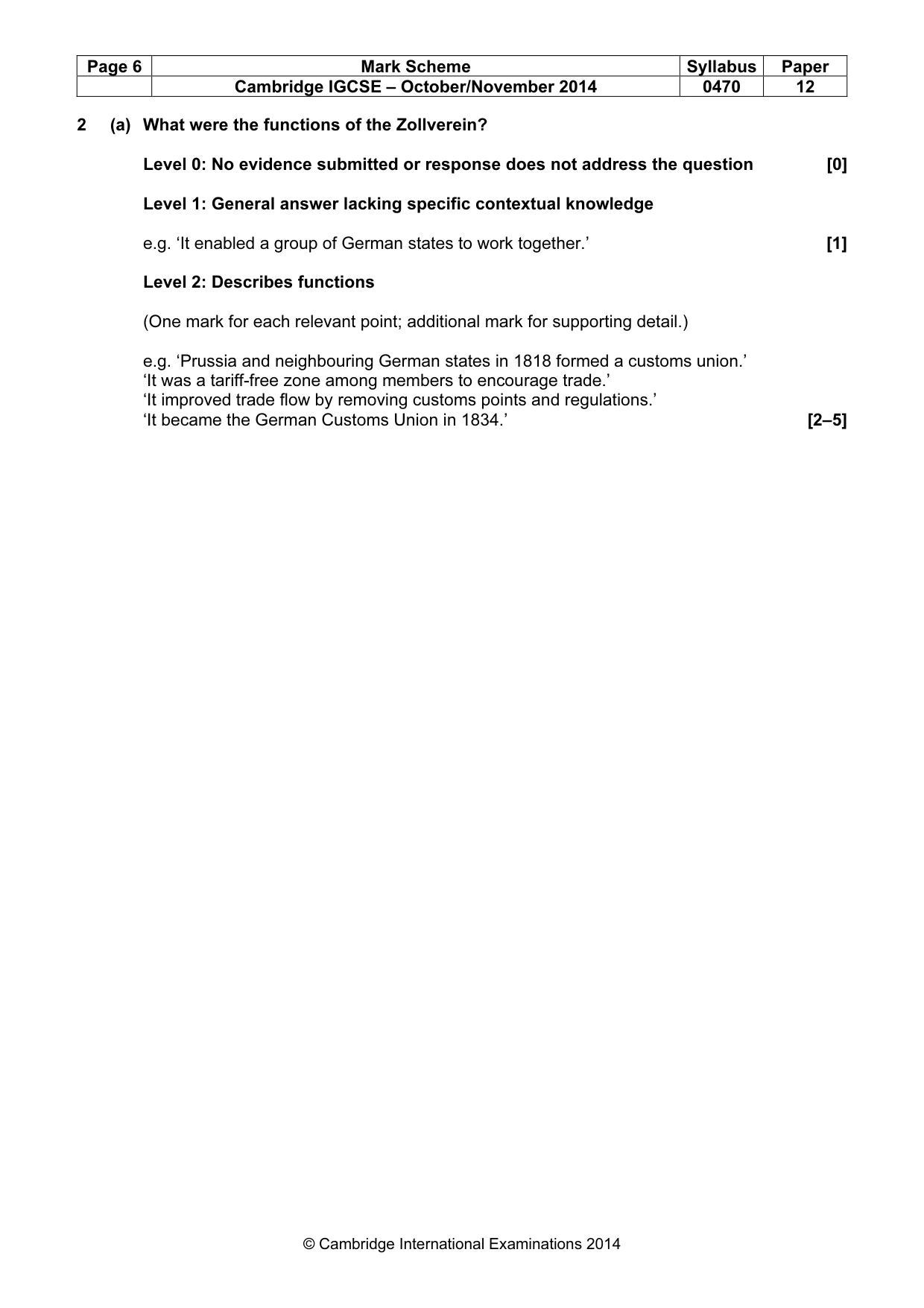
Page 6 Mark Scheme Syllabus Paper Cambridge IGCSE – October/November 2014 0470 12 © Cambridge International Examinations 2014 2 (a) What were the functions of the Zollverein? Level 0: No evidence submitted or response does not address the question [0] Level 1: General answer lacking specific contextual knowledge e.g. ‘It enabled a group of German states to work together.’ [1] Level 2: Describes functions (One mark for each relevant point; additional mark for supporting detail.) e.g. ‘Prussia and neighbouring German states in 1818 formed a customs union.’ ‘It was a tariff-free zone among members to encourage trade.’ ‘It improved trade flow by removing customs points and regulations.’ ‘It became the German Customs Union in 1834.’ [2–5]
Mark scheme, page 7
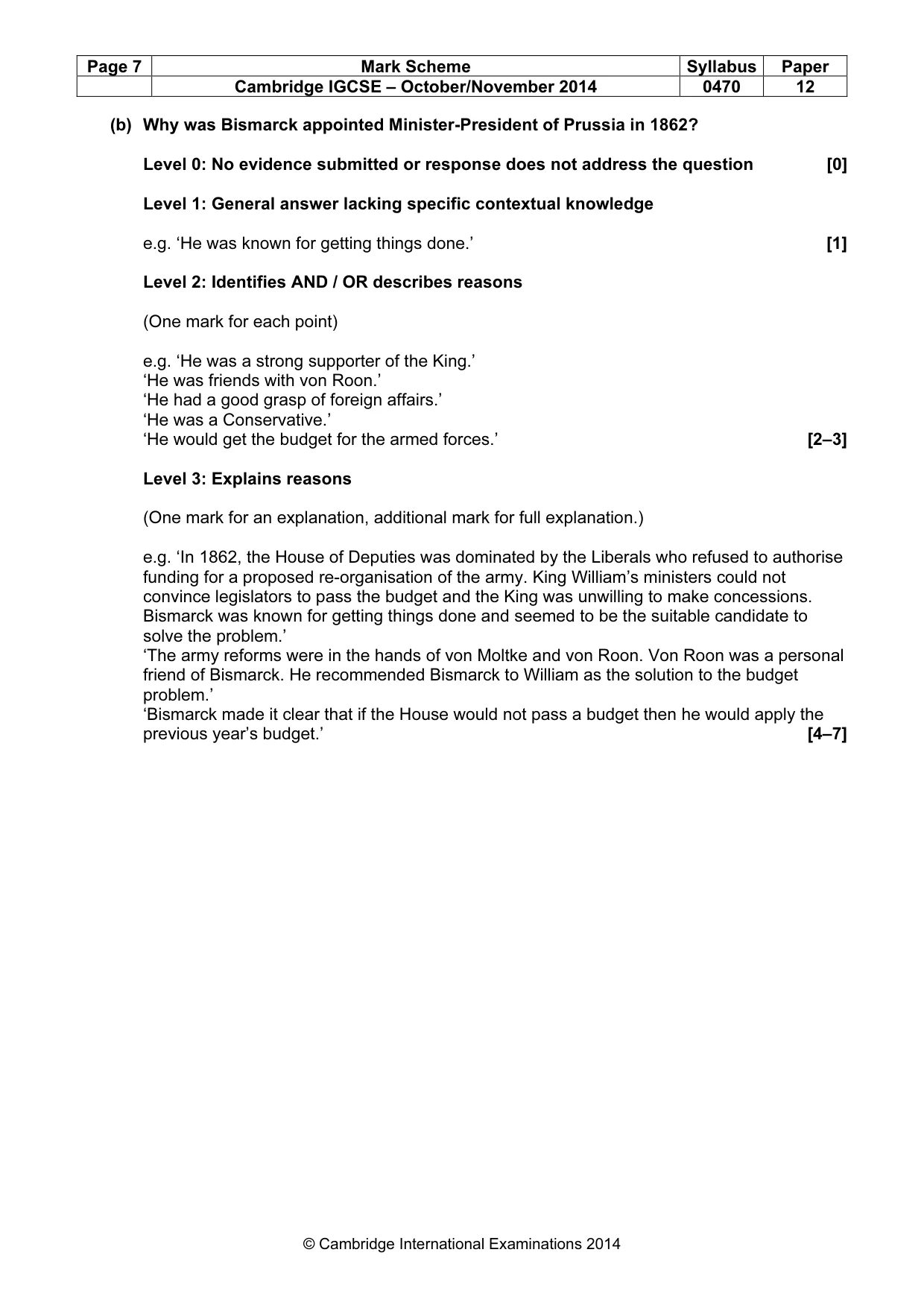
Page 7 Mark Scheme Syllabus Paper Cambridge IGCSE – October/November 2014 0470 12 © Cambridge International Examinations 2014 (b) Why was Bismarck appointed Minister-President of Prussia in 1862? Level 0: No evidence submitted or response does not address the question [0] Level 1: General answer lacking specific contextual knowledge e.g. ‘He was known for getting things done.’ [1] Level 2: Identifies AND / OR describes reasons (One mark for each point) e.g. ‘He was a strong supporter of the King.’ ‘He was friends with von Roon.’ ‘He had a good grasp of foreign affairs.’ ‘He was a Conservative.’ ‘He would get the budget for the armed forces.’ [2–3] Level 3: Explains reasons (One mark for an explanation, additional mark for full explanation.) e.g. ‘In 1862, the House of Deputies was dominated by the Liberals who refused to authorise funding for a proposed re-organisation of the army. King William’s ministers could not convince legislators to pass the budget and the King was unwilling to make concessions. Bismarck was known for getting things done and seemed to be the suitable candidate to solve the problem.’ ‘The army reforms were in the hands of von Moltke and von Roon. Von Roon was a personal friend of Bismarck. He recommended Bismarck to William as the solution to the budget problem.’ ‘Bismarck made it clear that if the House would not pass a budget then he would apply the previous year’s budget.’ [4–7]
Mark scheme, page 8
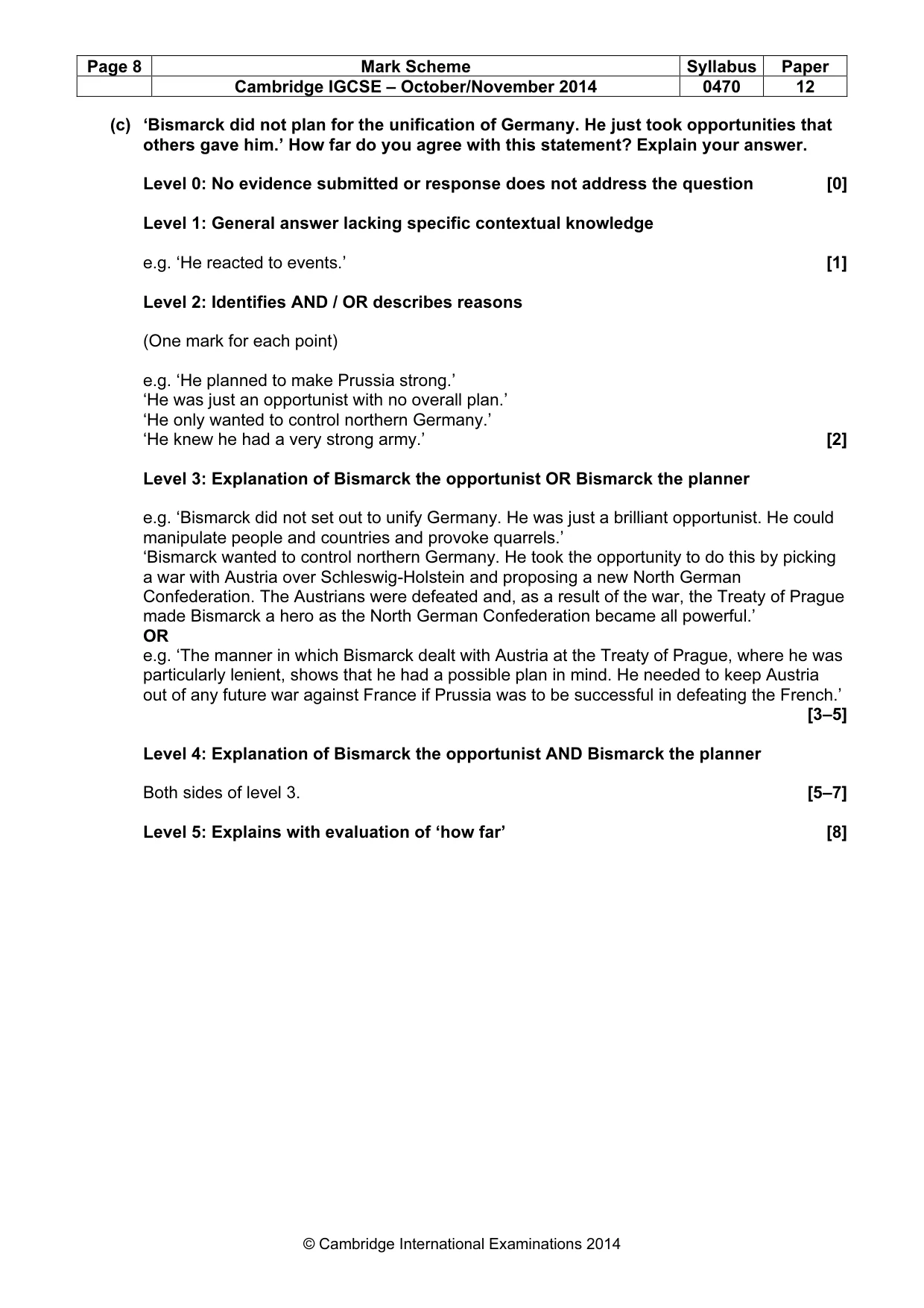
Page 8 Mark Scheme Syllabus Paper Cambridge IGCSE – October/November 2014 0470 12 © Cambridge International Examinations 2014 (c) ‘Bismarck did not plan for the unification of Germany. He just took opportunities that others gave him.’ How far do you agree with this statement? Explain your answer. Level 0: No evidence submitted or response does not address the question [0] Level 1: General answer lacking specific contextual knowledge e.g. ‘He reacted to events.’ [1] Level 2: Identifies AND / OR describes reasons (One mark for each point) e.g. ‘He planned to make Prussia strong.’ ‘He was just an opportunist with no overall plan.’ ‘He only wanted to control northern Germany.’ ‘He knew he had a very strong army.’ [2] Level 3: Explanation of Bismarck the opportunist OR Bismarck the planner e.g. ‘Bismarck did not set out to unify Germany. He was just a brilliant opportunist. He could manipulate people and countries and provoke quarrels.’ ‘Bismarck wanted to control northern Germany. He took the opportunity to do this by picking a war with Austria over Schleswig-Holstein and proposing a new North German Confederation. The Austrians were defeated and, as a result of the war, the Treaty of Prague made Bismarck a hero as the North German Confederation became all powerful.’ OR e.g. ‘The manner in which Bismarck dealt with Austria at the Treaty of Prague, where he was particularly lenient, shows that he had a possible plan in mind. He needed to keep Austria out of any future war against France if Prussia was to be successful in defeating the French.’ [3–5] Level 4: Explanation of Bismarck the opportunist AND Bismarck the planner Both sides of level 3. [5–7] Level 5: Explains with evaluation of ‘how far’ [8]
Mark scheme, page 9
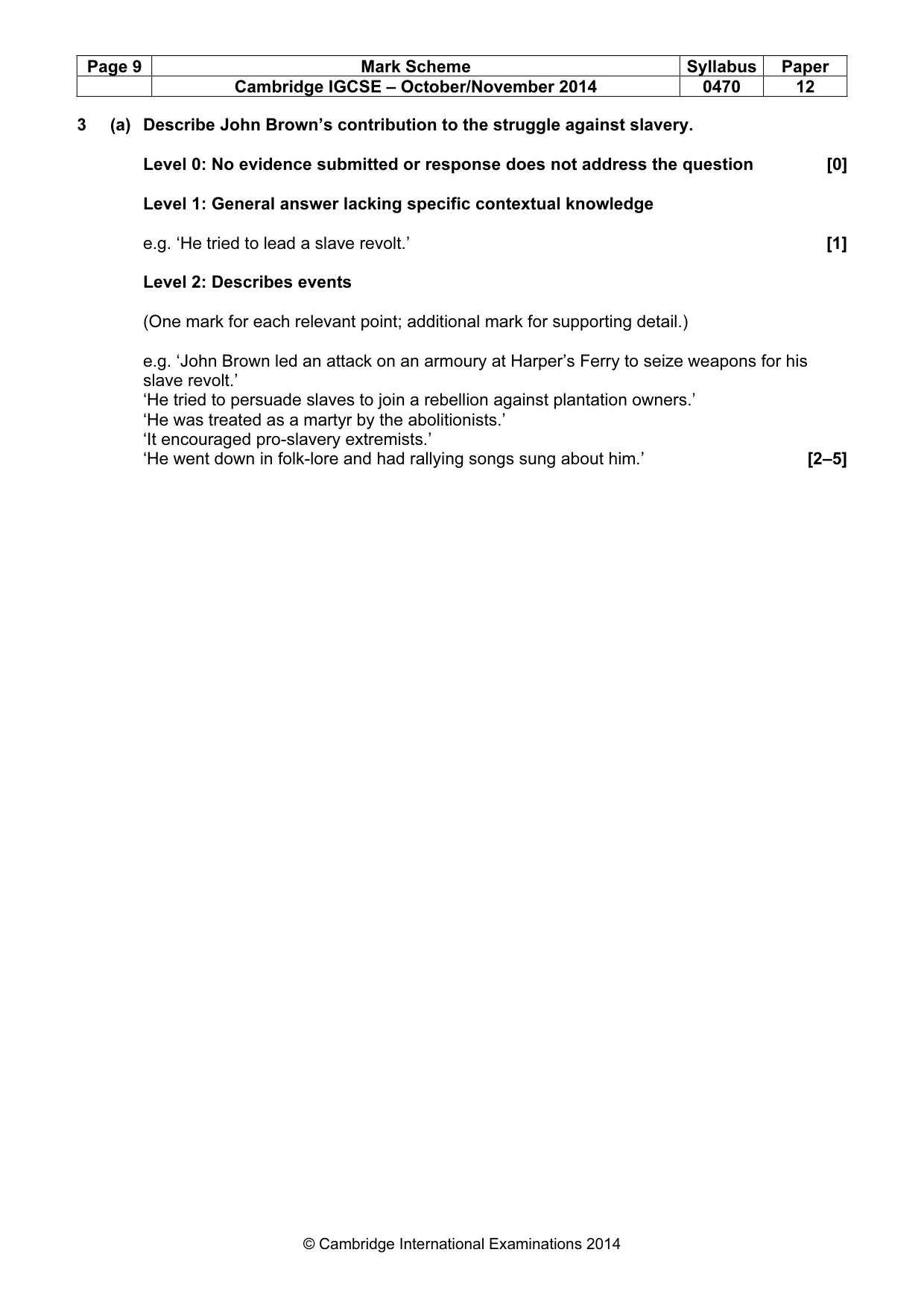
Page 9 Mark Scheme Syllabus Paper Cambridge IGCSE – October/November 2014 0470 12 © Cambridge International Examinations 2014 3 (a) Describe John Brown’s contribution to the struggle against slavery. Level 0: No evidence submitted or response does not address the question [0] Level 1: General answer lacking specific contextual knowledge e.g. ‘He tried to lead a slave revolt.’ [1] Level 2: Describes events (One mark for each relevant point; additional mark for supporting detail.) e.g. ‘John Brown led an attack on an armoury at Harper’s Ferry to seize weapons for his slave revolt.’ ‘He tried to persuade slaves to join a rebellion against plantation owners.’ ‘He was treated as a martyr by the abolitionists.’ ‘It encouraged pro-slavery extremists.’ ‘He went down in folk-lore and had rallying songs sung about him.’ [2–5]
Mark scheme, page 10
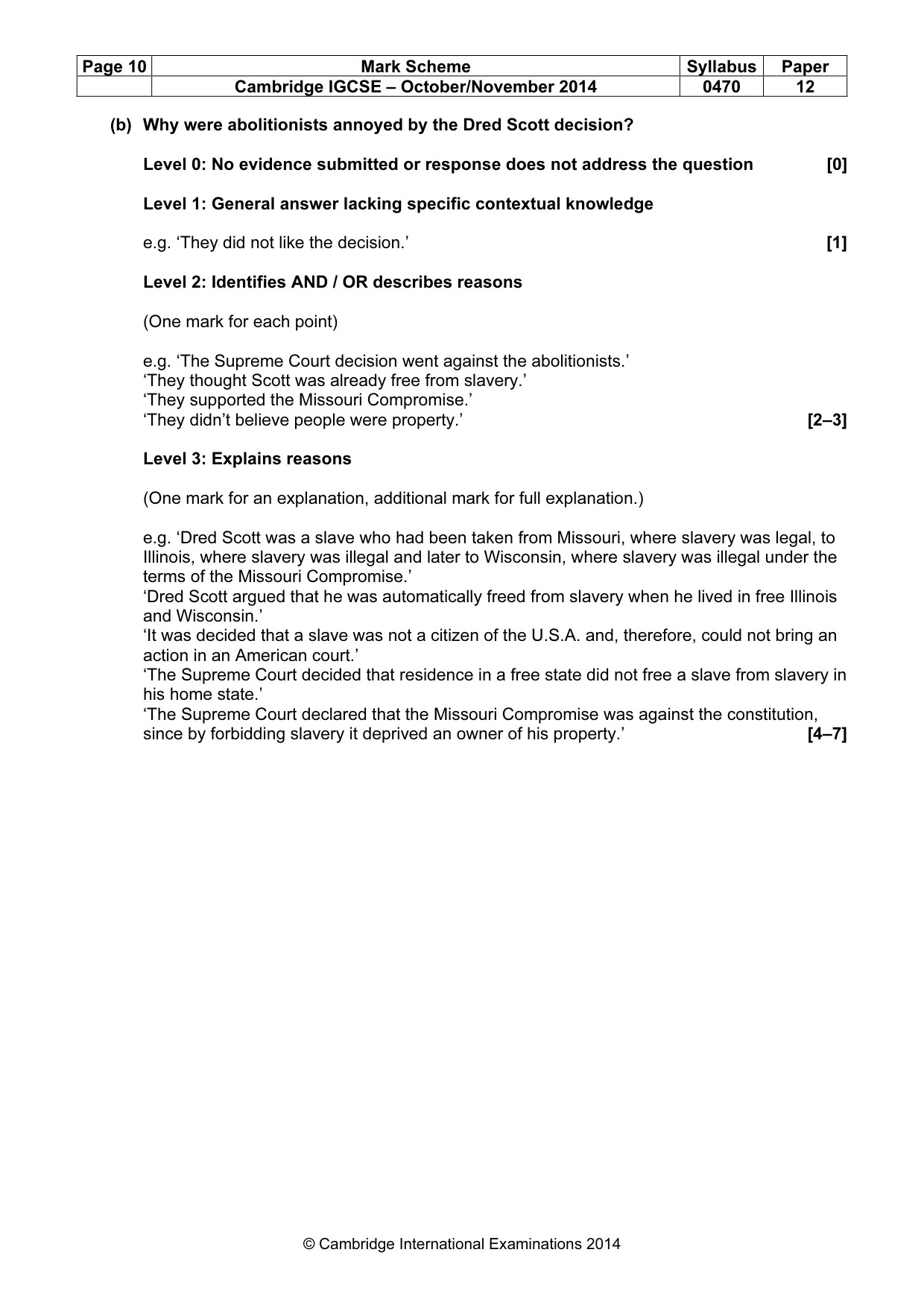
Page 10 Mark Scheme Syllabus Paper Cambridge IGCSE – October/November 2014 0470 12 © Cambridge International Examinations 2014 (b) Why were abolitionists annoyed by the Dred Scott decision? Level 0: No evidence submitted or response does not address the question [0] Level 1: General answer lacking specific contextual knowledge e.g. ‘They did not like the decision.’ [1] Level 2: Identifies AND / OR describes reasons (One mark for each point) e.g. ‘The Supreme Court decision went against the abolitionists.’ ‘They thought Scott was already free from slavery.’ ‘They supported the Missouri Compromise.’ ‘They didn’t believe people were property.’ [2–3] Level 3: Explains reasons (One mark for an explanation, additional mark for full explanation.) e.g. ‘Dred Scott was a slave who had been taken from Missouri, where slavery was legal, to Illinois, where slavery was illegal and later to Wisconsin, where slavery was illegal under the terms of the Missouri Compromise.’ ‘Dred Scott argued that he was automatically freed from slavery when he lived in free Illinois and Wisconsin.’ ‘It was decided that a slave was not a citizen of the U.S.A. and, therefore, could not bring an action in an American court.’ ‘The Supreme Court decided that residence in a free state did not free a slave from slavery in his home state.’ ‘The Supreme Court declared that the Missouri Compromise was against the constitution, since by forbidding slavery it deprived an owner of his property.’ [4–7]
Mark scheme, page 11
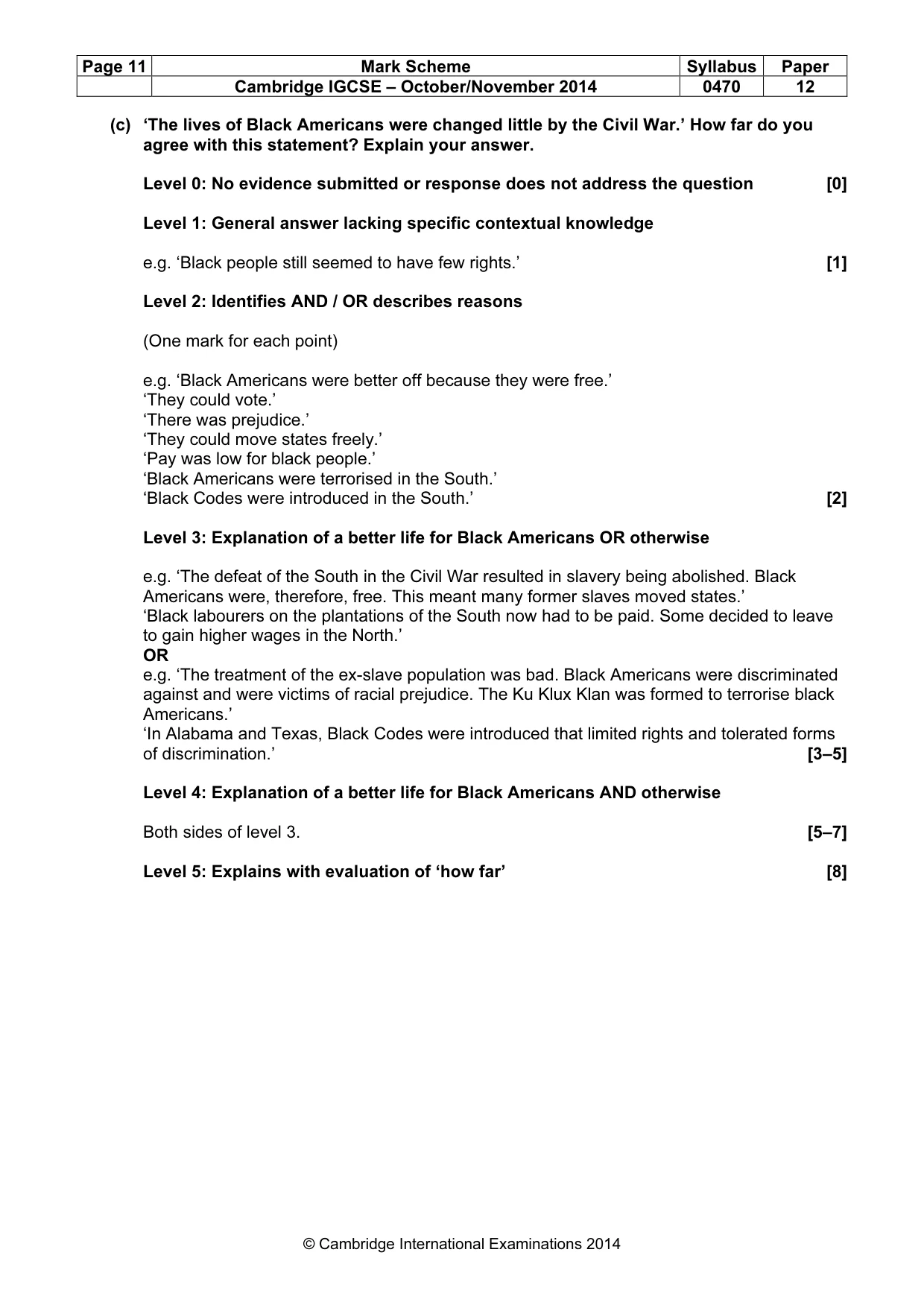
Page 11 Mark Scheme Syllabus Paper Cambridge IGCSE – October/November 2014 0470 12 © Cambridge International Examinations 2014 (c) ‘The lives of Black Americans were changed little by the Civil War.’ How far do you agree with this statement? Explain your answer. Level 0: No evidence submitted or response does not address the question [0] Level 1: General answer lacking specific contextual knowledge e.g. ‘Black people still seemed to have few rights.’ [1] Level 2: Identifies AND / OR describes reasons (One mark for each point) e.g. ‘Black Americans were better off because they were free.’ ‘They could vote.’ ‘There was prejudice.’ ‘They could move states freely.’ ‘Pay was low for black people.’ ‘Black Americans were terrorised in the South.’ ‘Black Codes were introduced in the South.’ [2] Level 3: Explanation of a better life for Black Americans OR otherwise e.g. ‘The defeat of the South in the Civil War resulted in slavery being abolished. Black Americans were, therefore, free. This meant many former slaves moved states.’ ‘Black labourers on the plantations of the South now had to be paid. Some decided to leave to gain higher wages in the North.’ OR e.g. ‘The treatment of the ex-slave population was bad. Black Americans were discriminated against and were victims of racial prejudice. The Ku Klux Klan was formed to terrorise black Americans.’ ‘In Alabama and Texas, Black Codes were introduced that limited rights and tolerated forms of discrimination.’ [3–5] Level 4: Explanation of a better life for Black Americans AND otherwise Both sides of level 3. [5–7] Level 5: Explains with evaluation of ‘how far’ [8]
Mark scheme, page 12
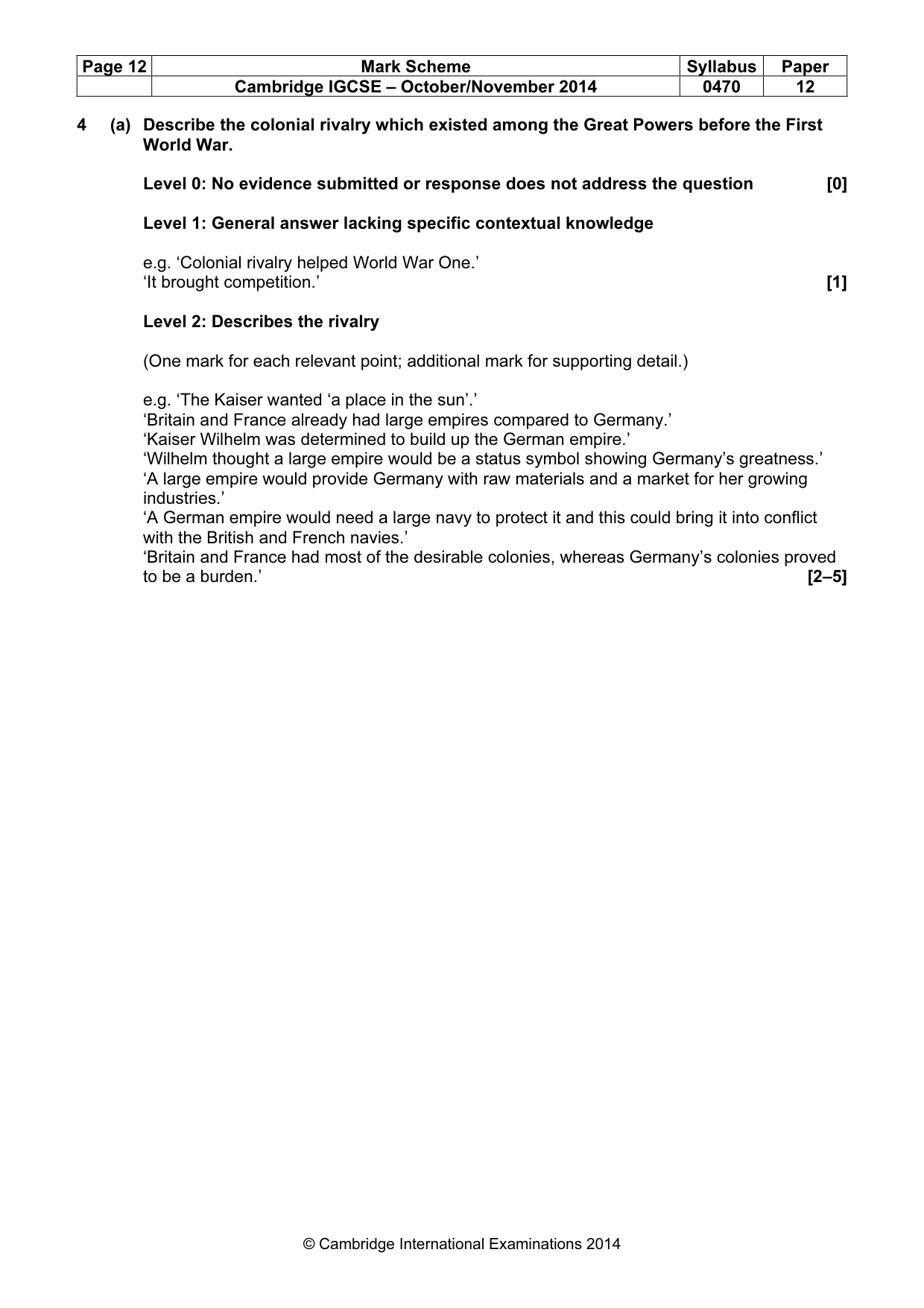
Page 12 Mark Scheme Syllabus Paper Cambridge IGCSE – October/November 2014 0470 12 © Cambridge International Examinations 2014 4 (a) Describe the colonial rivalry which existed among the Great Powers before the First World War. Level 0: No evidence submitted or response does not address the question [0] Level 1: General answer lacking specific contextual knowledge e.g. ‘Colonial rivalry helped World War One.’ ‘It brought competition.’ [1] Level 2: Describes the rivalry (One mark for each relevant point; additional mark for supporting detail.) e.g. ‘The Kaiser wanted ‘a place in the sun’.’ ‘Britain and France already had large empires compared to Germany.’ ‘Kaiser Wilhelm was determined to build up the German empire.’ ‘Wilhelm thought a large empire would be a status symbol showing Germany’s greatness.’ ‘A large empire would provide Germany with raw materials and a market for her growing industries.’ ‘A German empire would need a large navy to protect it and this could bring it into conflict with the British and French navies.’ ‘Britain and France had most of the desirable colonies, whereas Germany’s colonies proved to be a burden.’ [2–5]
Mark scheme, page 13
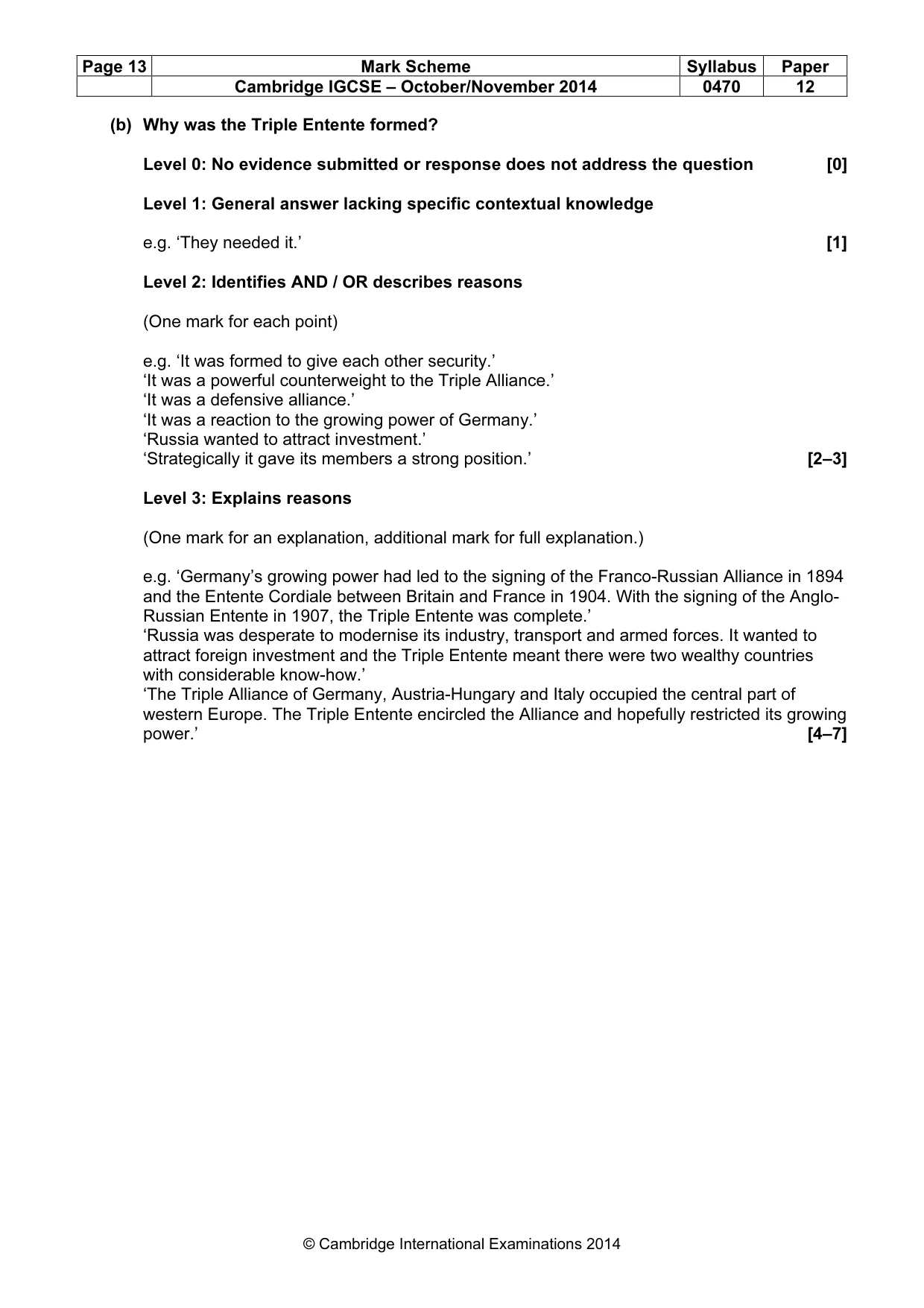
Page 13 Mark Scheme Syllabus Paper Cambridge IGCSE – October/November 2014 0470 12 © Cambridge International Examinations 2014 (b) Why was the Triple Entente formed? Level 0: No evidence submitted or response does not address the question [0] Level 1: General answer lacking specific contextual knowledge e.g. ‘They needed it.’ [1] Level 2: Identifies AND / OR describes reasons (One mark for each point) e.g. ‘It was formed to give each other security.’ ‘It was a powerful counterweight to the Triple Alliance.’ ‘It was a defensive alliance.’ ‘It was a reaction to the growing power of Germany.’ ‘Russia wanted to attract investment.’ ‘Strategically it gave its members a strong position.’ [2–3] Level 3: Explains reasons (One mark for an explanation, additional mark for full explanation.) e.g. ‘Germany’s growing power had led to the signing of the Franco-Russian Alliance in 1894 and the Entente Cordiale between Britain and France in 1904. With the signing of the Anglo- Russian Entente in 1907, the Triple Entente was complete.’ ‘Russia was desperate to modernise its industry, transport and armed forces. It wanted to attract foreign investment and the Triple Entente meant there were two wealthy countries with considerable know-how.’ ‘The Triple Alliance of Germany, Austria-Hungary and Italy occupied the central part of western Europe. The Triple Entente encircled the Alliance and hopefully restricted its growing power.’ [4–7]
Mark scheme, page 14
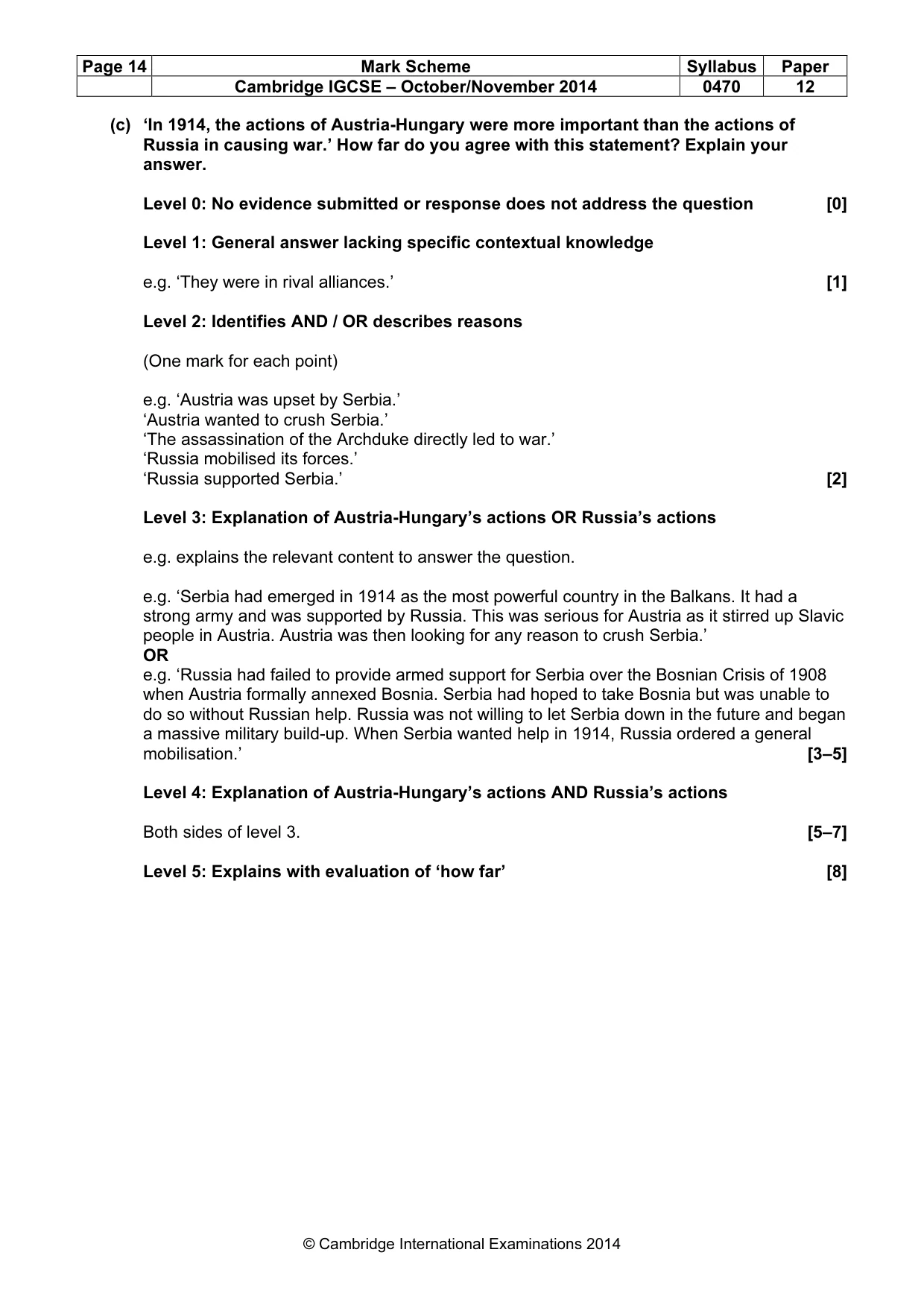
Page 14 Mark Scheme Syllabus Paper Cambridge IGCSE – October/November 2014 0470 12 © Cambridge International Examinations 2014 (c) ‘In 1914, the actions of Austria-Hungary were more important than the actions of Russia in causing war.’ How far do you agree with this statement? Explain your answer. Level 0: No evidence submitted or response does not address the question [0] Level 1: General answer lacking specific contextual knowledge e.g. ‘They were in rival alliances.’ [1] Level 2: Identifies AND / OR describes reasons (One mark for each point) e.g. ‘Austria was upset by Serbia.’ ‘Austria wanted to crush Serbia.’ ‘The assassination of the Archduke directly led to war.’ ‘Russia mobilised its forces.’ ‘Russia supported Serbia.’ [2] Level 3: Explanation of Austria-Hungary’s actions OR Russia’s actions e.g. explains the relevant content to answer the question. e.g. ‘Serbia had emerged in 1914 as the most powerful country in the Balkans. It had a strong army and was supported by Russia. This was serious for Austria as it stirred up Slavic people in Austria. Austria was then looking for any reason to crush Serbia.’ OR e.g. ‘Russia had failed to provide armed support for Serbia over the Bosnian Crisis of 1908 when Austria formally annexed Bosnia. Serbia had hoped to take Bosnia but was unable to do so without Russian help. Russia was not willing to let Serbia down in the future and began a massive military build-up. When Serbia wanted help in 1914, Russia ordered a general mobilisation.’ [3–5] Level 4: Explanation of Austria-Hungary’s actions AND Russia’s actions Both sides of level 3. [5–7] Level 5: Explains with evaluation of ‘how far’ [8]
Mark scheme, page 15
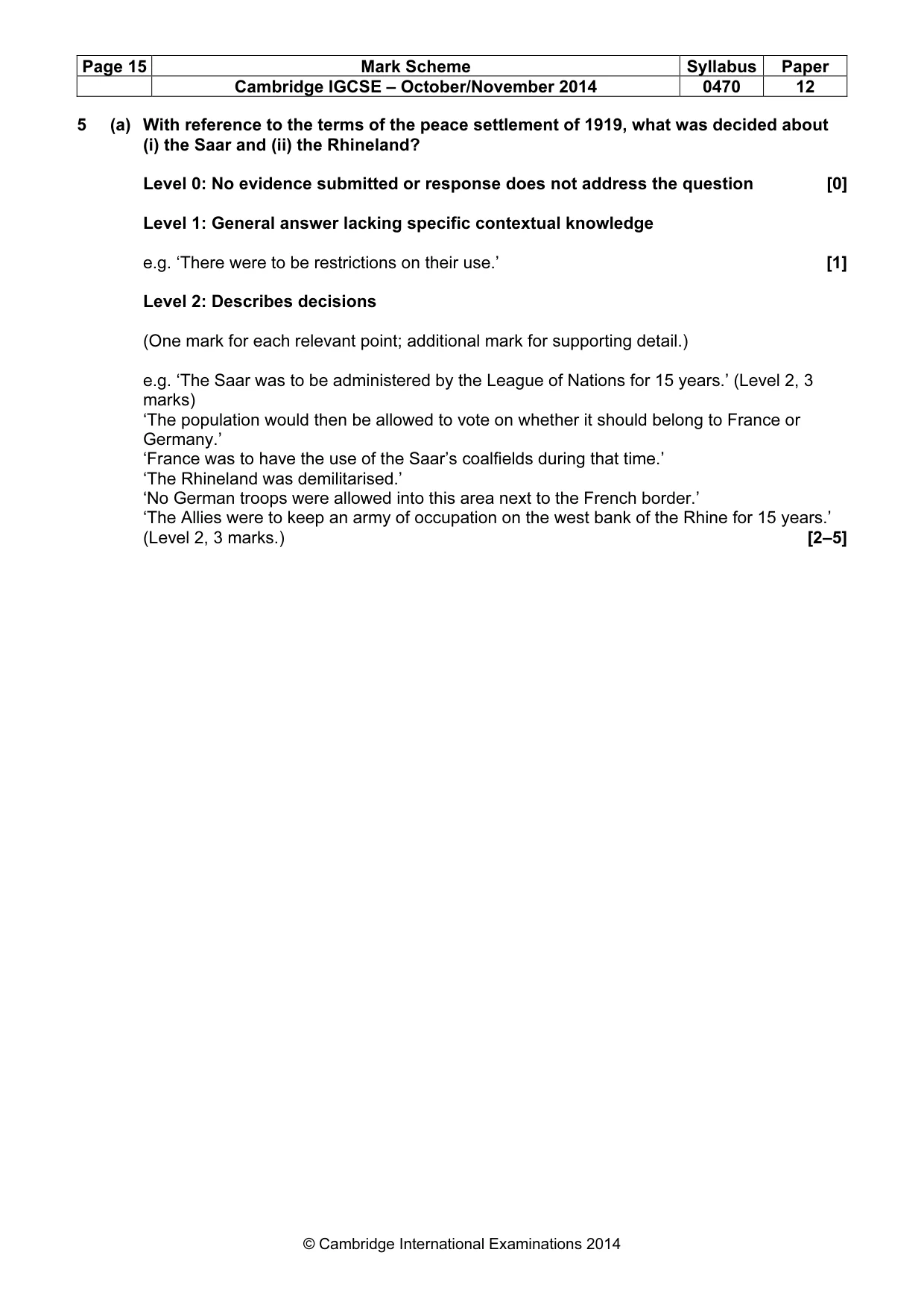
Page 15 Mark Scheme Syllabus Paper Cambridge IGCSE – October/November 2014 0470 12 © Cambridge International Examinations 2014 5 (a) With reference to the terms of the peace settlement of 1919, what was decided about (i) the Saar and (ii) the Rhineland? Level 0: No evidence submitted or response does not address the question [0] Level 1: General answer lacking specific contextual knowledge e.g. ‘There were to be restrictions on their use.’ [1] Level 2: Describes decisions (One mark for each relevant point; additional mark for supporting detail.) e.g. ‘The Saar was to be administered by the League of Nations for 15 years.’ (Level 2, 3 marks) ‘The population would then be allowed to vote on whether it should belong to France or Germany.’ ‘France was to have the use of the Saar’s coalfields during that time.’ ‘The Rhineland was demilitarised.’ ‘No German troops were allowed into this area next to the French border.’ ‘The Allies were to keep an army of occupation on the west bank of the Rhine for 15 years.’ (Level 2, 3 marks.) [2–5]
Mark scheme, page 16
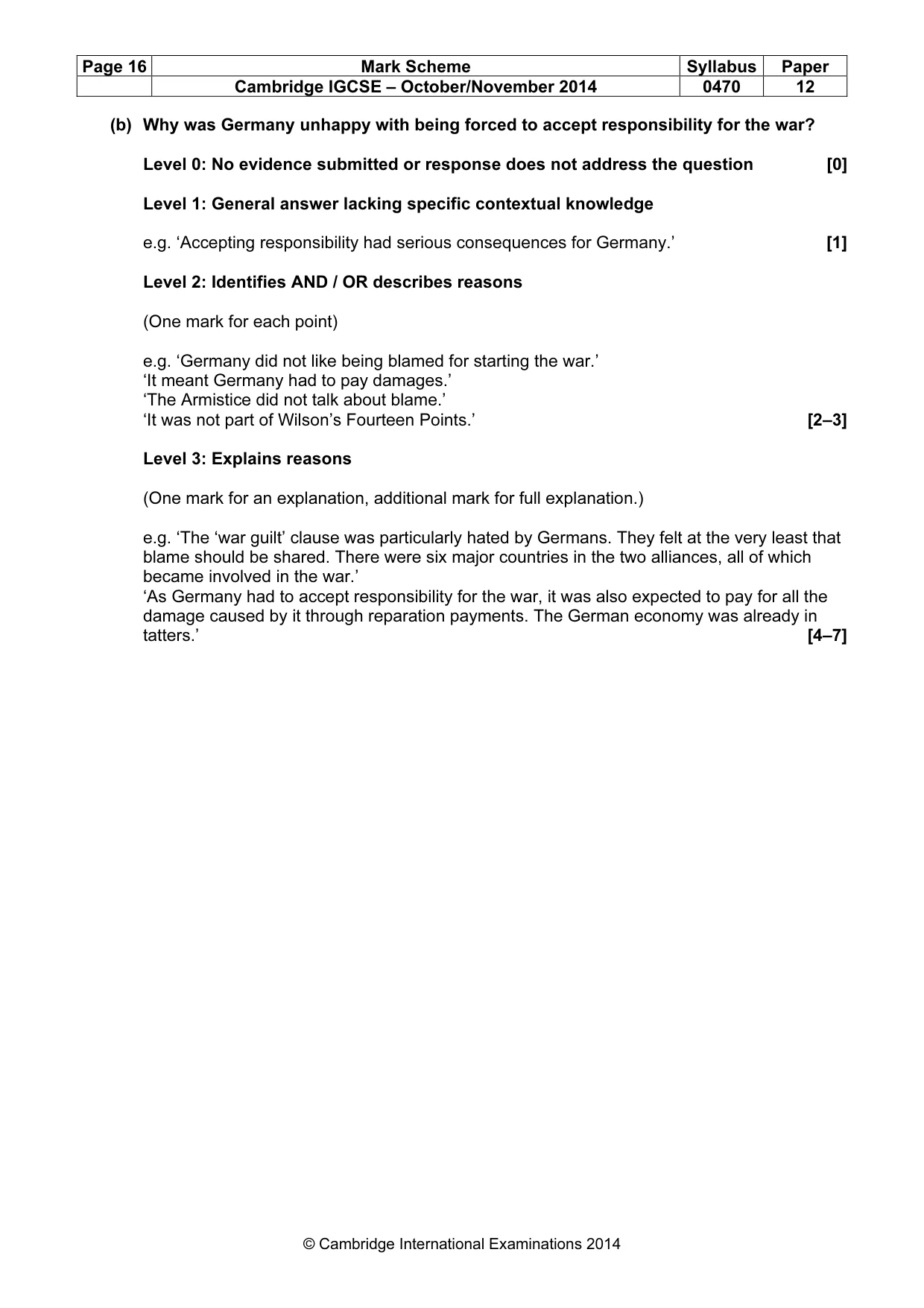
Page 16 Mark Scheme Syllabus Paper Cambridge IGCSE – October/November 2014 0470 12 © Cambridge International Examinations 2014 (b) Why was Germany unhappy with being forced to accept responsibility for the war? Level 0: No evidence submitted or response does not address the question [0] Level 1: General answer lacking specific contextual knowledge e.g. ‘Accepting responsibility had serious consequences for Germany.’ [1] Level 2: Identifies AND / OR describes reasons (One mark for each point) e.g. ‘Germany did not like being blamed for starting the war.’ ‘It meant Germany had to pay damages.’ ‘The Armistice did not talk about blame.’ ‘It was not part of Wilson’s Fourteen Points.’ [2–3] Level 3: Explains reasons (One mark for an explanation, additional mark for full explanation.) e.g. ‘The ‘war guilt’ clause was particularly hated by Germans. They felt at the very least that blame should be shared. There were six major countries in the two alliances, all of which became involved in the war.’ ‘As Germany had to accept responsibility for the war, it was also expected to pay for all the damage caused by it through reparation payments. The German economy was already in tatters.’ [4–7]
Mark scheme, page 17
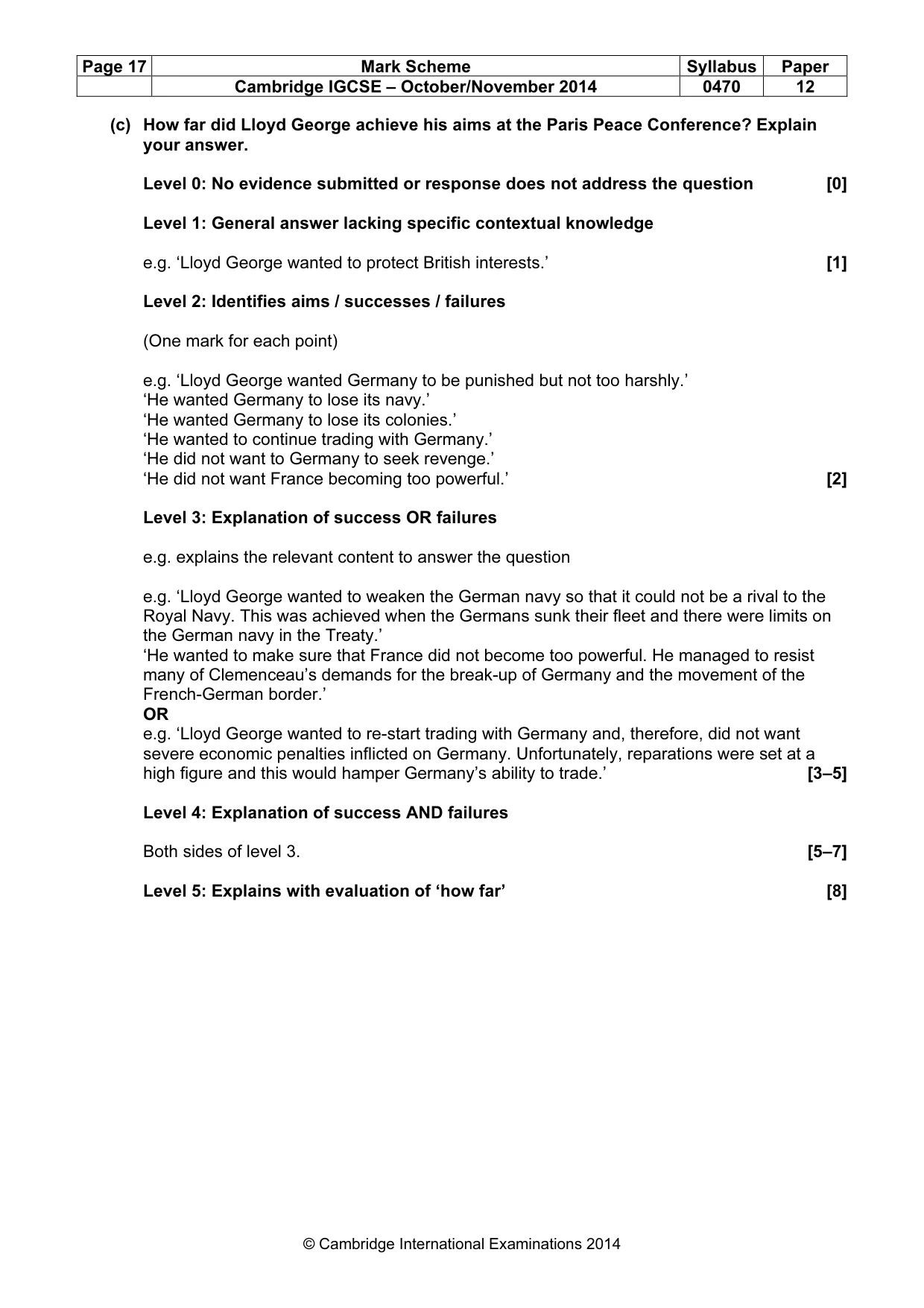
Page 17 Mark Scheme Syllabus Paper Cambridge IGCSE – October/November 2014 0470 12 © Cambridge International Examinations 2014 (c) How far did Lloyd George achieve his aims at the Paris Peace Conference? Explain your answer. Level 0: No evidence submitted or response does not address the question [0] Level 1: General answer lacking specific contextual knowledge e.g. ‘Lloyd George wanted to protect British interests.’ [1] Level 2: Identifies aims / successes / failures (One mark for each point) e.g. ‘Lloyd George wanted Germany to be punished but not too harshly.’ ‘He wanted Germany to lose its navy.’ ‘He wanted Germany to lose its colonies.’ ‘He wanted to continue trading with Germany.’ ‘He did not want to Germany to seek revenge.’ ‘He did not want France becoming too powerful.’ [2] Level 3: Explanation of success OR failures e.g. explains the relevant content to answer the question e.g. ‘Lloyd George wanted to weaken the German navy so that it could not be a rival to the Royal Navy. This was achieved when the Germans sunk their fleet and there were limits on the German navy in the Treaty.’ ‘He wanted to make sure that France did not become too powerful. He managed to resist many of Clemenceau’s demands for the break-up of Germany and the movement of the French-German border.’ OR e.g. ‘Lloyd George wanted to re-start trading with Germany and, therefore, did not want severe economic penalties inflicted on Germany. Unfortunately, reparations were set at a high figure and this would hamper Germany’s ability to trade.’ [3–5] Level 4: Explanation of success AND failures Both sides of level 3. [5–7] Level 5: Explains with evaluation of ‘how far’ [8]
Mark scheme, page 18
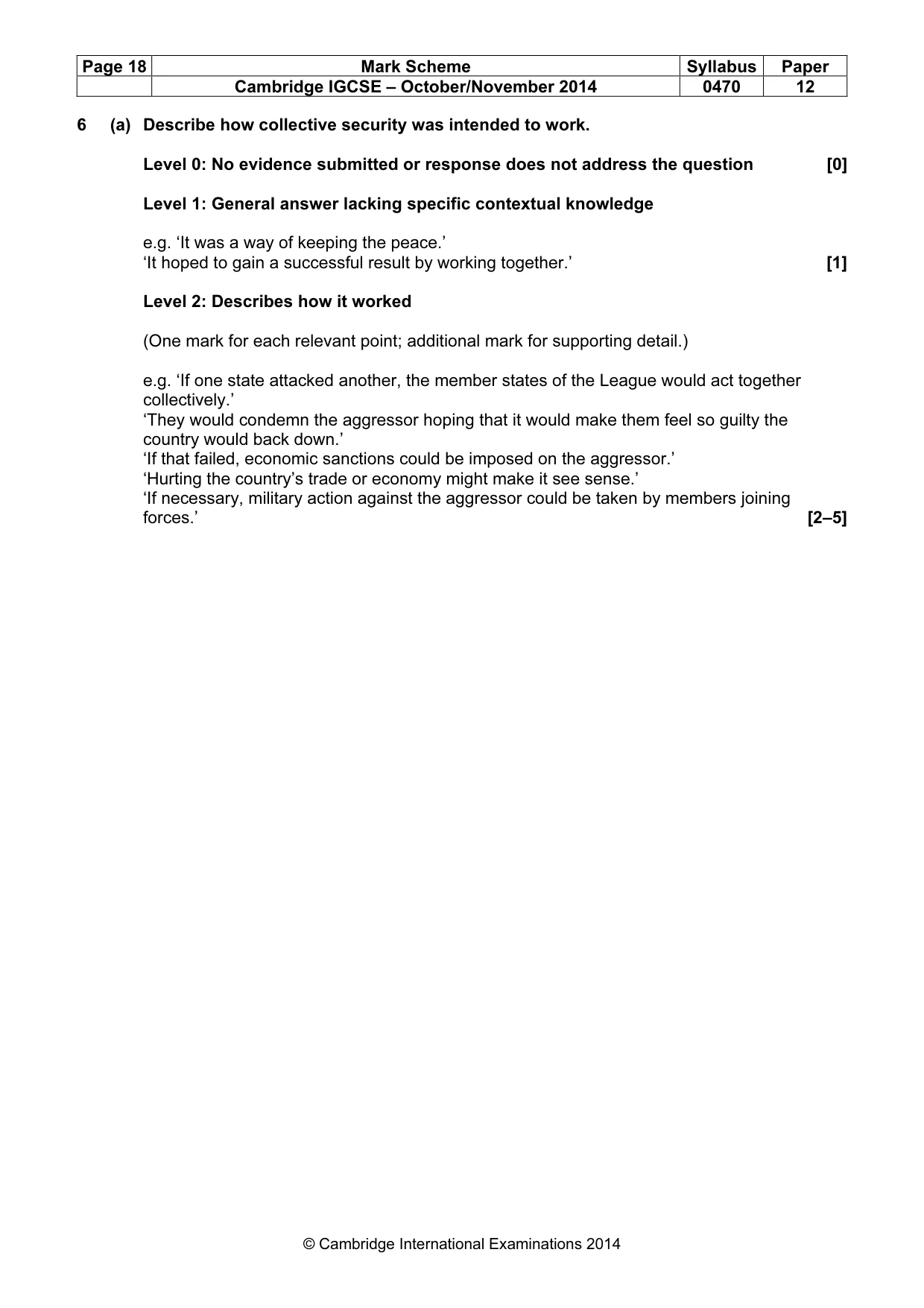
Page 18 Mark Scheme Syllabus Paper Cambridge IGCSE – October/November 2014 0470 12 © Cambridge International Examinations 2014 6 (a) Describe how collective security was intended to work. Level 0: No evidence submitted or response does not address the question [0] Level 1: General answer lacking specific contextual knowledge e.g. ‘It was a way of keeping the peace.’ ‘It hoped to gain a successful result by working together.’ [1] Level 2: Describes how it worked (One mark for each relevant point; additional mark for supporting detail.) e.g. ‘If one state attacked another, the member states of the League would act together collectively.’ ‘They would condemn the aggressor hoping that it would make them feel so guilty the country would back down.’ ‘If that failed, economic sanctions could be imposed on the aggressor.’ ‘Hurting the country’s trade or economy might make it see sense.’ ‘If necessary, military action against the aggressor could be taken by members joining forces.’ [2–5]
Mark scheme, page 19
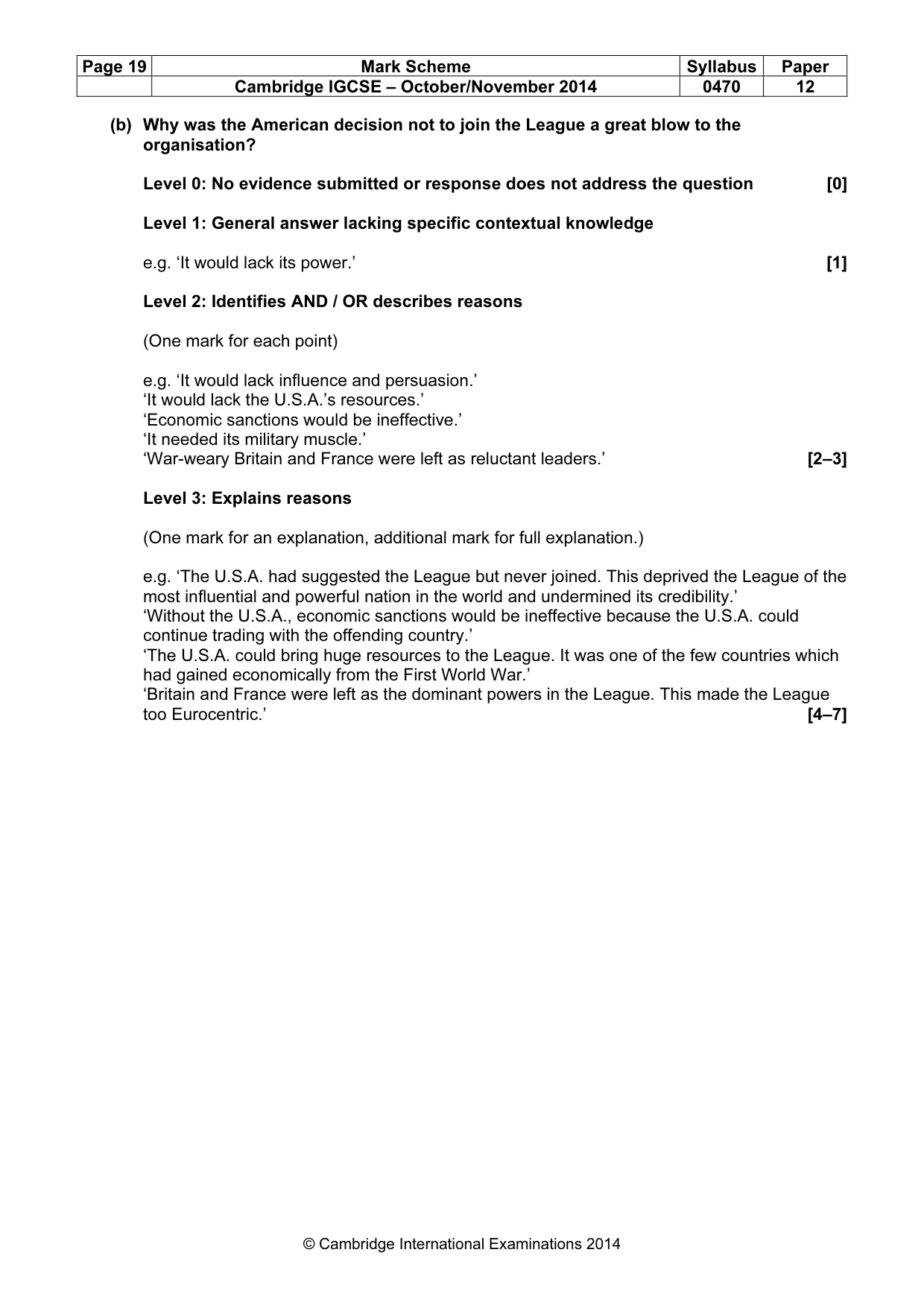
Page 19 Mark Scheme Syllabus Paper Cambridge IGCSE – October/November 2014 0470 12 © Cambridge International Examinations 2014 (b) Why was the American decision not to join the League a great blow to the organisation? Level 0: No evidence submitted or response does not address the question [0] Level 1: General answer lacking specific contextual knowledge e.g. ‘It would lack its power.’ [1] Level 2: Identifies AND / OR describes reasons (One mark for each point) e.g. ‘It would lack influence and persuasion.’ ‘It would lack the U.S.A.’s resources.’ ‘Economic sanctions would be ineffective.’ ‘It needed its military muscle.’ ‘War-weary Britain and France were left as reluctant leaders.’ [2–3] Level 3: Explains reasons (One mark for an explanation, additional mark for full explanation.) e.g. ‘The U.S.A. had suggested the League but never joined. This deprived the League of the most influential and powerful nation in the world and undermined its credibility.’ ‘Without the U.S.A., economic sanctions would be ineffective because the U.S.A. could continue trading with the offending country.’ ‘The U.S.A. could bring huge resources to the League. It was one of the few countries which had gained economically from the First World War.’ ‘Britain and France were left as the dominant powers in the League. This made the League too Eurocentric.’ [4–7]
Mark scheme, page 20
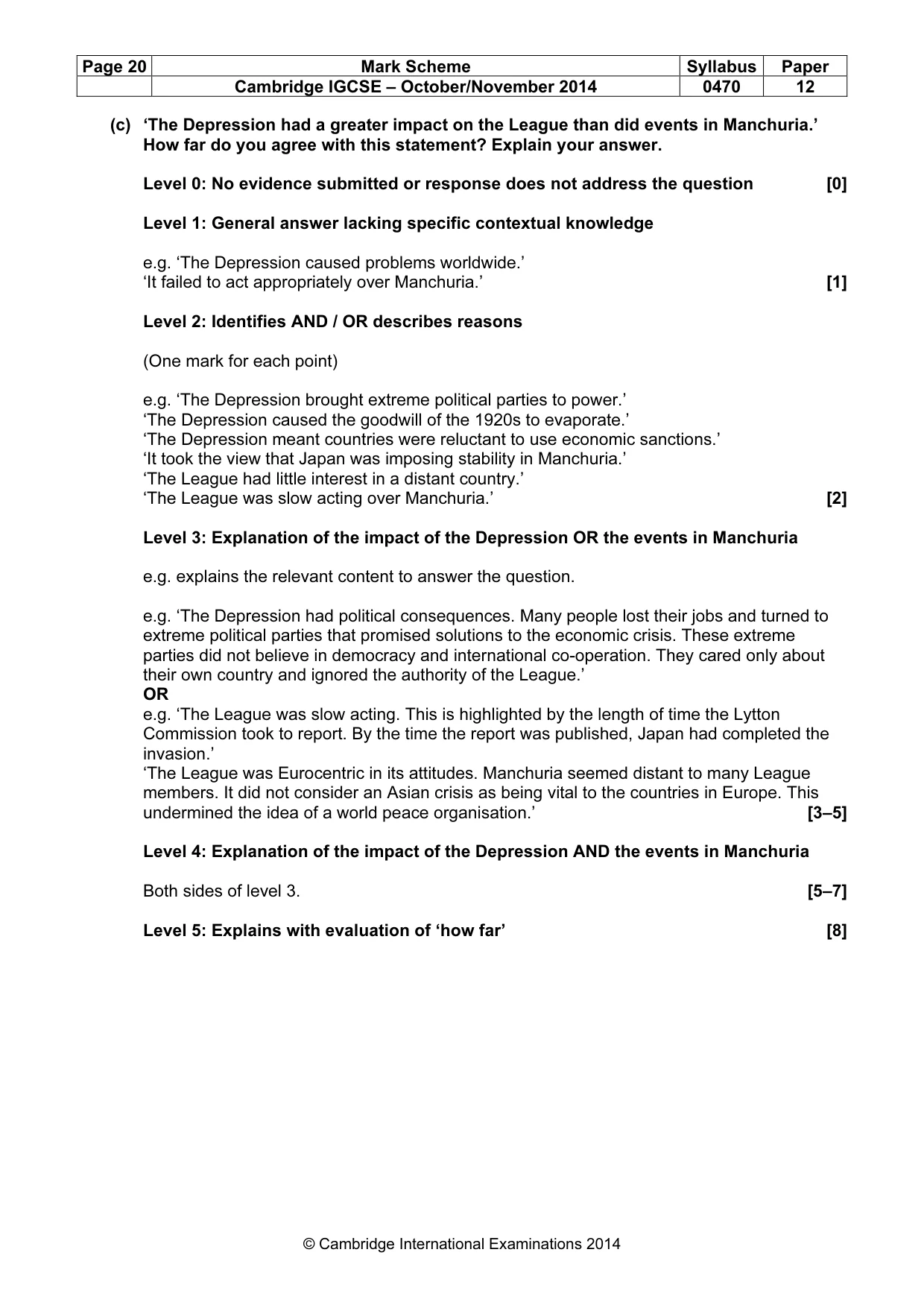
Page 20 Mark Scheme Syllabus Paper Cambridge IGCSE – October/November 2014 0470 12 © Cambridge International Examinations 2014 (c) ‘The Depression had a greater impact on the League than did events in Manchuria.’ How far do you agree with this statement? Explain your answer. Level 0: No evidence submitted or response does not address the question [0] Level 1: General answer lacking specific contextual knowledge e.g. ‘The Depression caused problems worldwide.’ ‘It failed to act appropriately over Manchuria.’ [1] Level 2: Identifies AND / OR describes reasons (One mark for each point) e.g. ‘The Depression brought extreme political parties to power.’ ‘The Depression caused the goodwill of the 1920s to evaporate.’ ‘The Depression meant countries were reluctant to use economic sanctions.’ ‘It took the view that Japan was imposing stability in Manchuria.’ ‘The League had little interest in a distant country.’ ‘The League was slow acting over Manchuria.’ [2] Level 3: Explanation of the impact of the Depression OR the events in Manchuria e.g. explains the relevant content to answer the question. e.g. ‘The Depression had political consequences. Many people lost their jobs and turned to extreme political parties that promised solutions to the economic crisis. These extreme parties did not believe in democracy and international co-operation. They cared only about their own country and ignored the authority of the League.’ OR e.g. ‘The League was slow acting. This is highlighted by the length of time the Lytton Commission took to report. By the time the report was published, Japan had completed the invasion.’ ‘The League was Eurocentric in its attitudes. Manchuria seemed distant to many League members. It did not consider an Asian crisis as being vital to the countries in Europe. This undermined the idea of a world peace organisation.’ [3–5] Level 4: Explanation of the impact of the Depression AND the events in Manchuria Both sides of level 3. [5–7] Level 5: Explains with evaluation of ‘how far’ [8]
Mark scheme, page 21
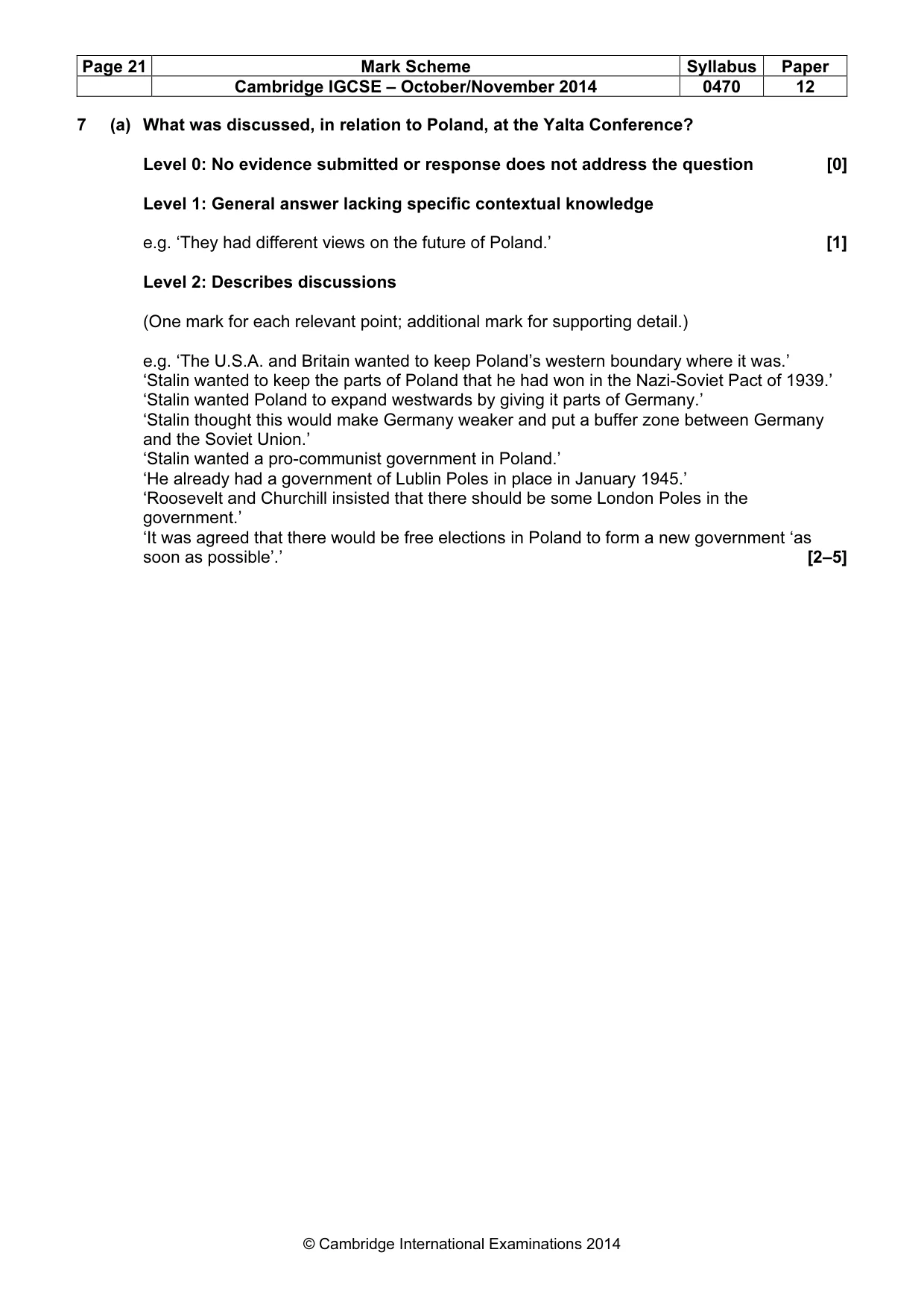
Page 21 Mark Scheme Syllabus Paper Cambridge IGCSE – October/November 2014 0470 12 © Cambridge International Examinations 2014 7 (a) What was discussed, in relation to Poland, at the Yalta Conference? Level 0: No evidence submitted or response does not address the question [0] Level 1: General answer lacking specific contextual knowledge e.g. ‘They had different views on the future of Poland.’ [1] Level 2: Describes discussions (One mark for each relevant point; additional mark for supporting detail.) e.g. ‘The U.S.A. and Britain wanted to keep Poland’s western boundary where it was.’ ‘Stalin wanted to keep the parts of Poland that he had won in the Nazi-Soviet Pact of 1939.’ ‘Stalin wanted Poland to expand westwards by giving it parts of Germany.’ ‘Stalin thought this would make Germany weaker and put a buffer zone between Germany and the Soviet Union.’ ‘Stalin wanted a pro-communist government in Poland.’ ‘He already had a government of Lublin Poles in place in January 1945.’ ‘Roosevelt and Churchill insisted that there should be some London Poles in the government.’ ‘It was agreed that there would be free elections in Poland to form a new government ‘as soon as possible’.’ [2–5]
Mark scheme, page 22
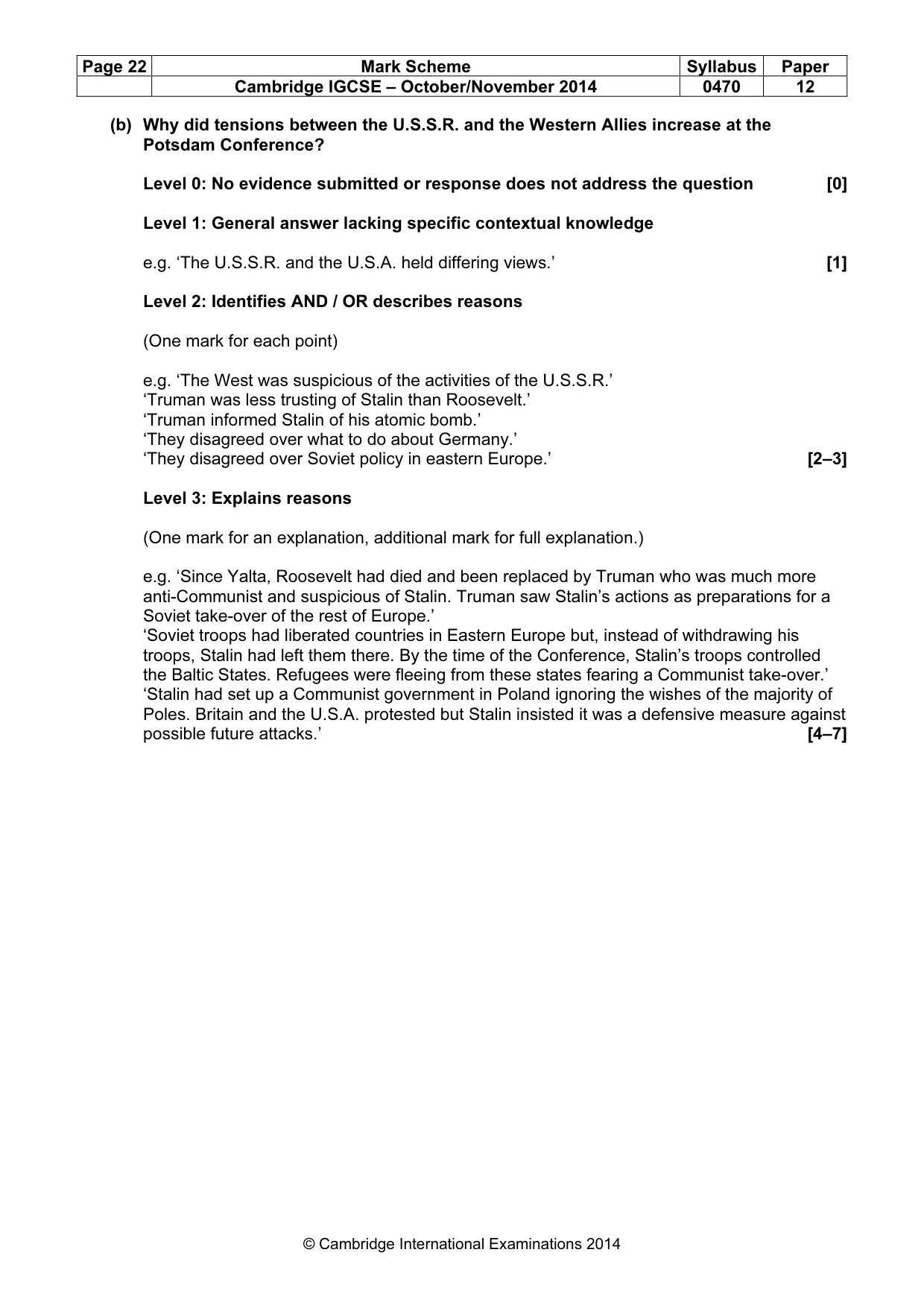
Page 22 Mark Scheme Syllabus Paper Cambridge IGCSE – October/November 2014 0470 12 © Cambridge International Examinations 2014 (b) Why did tensions between the U.S.S.R. and the Western Allies increase at the Potsdam Conference? Level 0: No evidence submitted or response does not address the question [0] Level 1: General answer lacking specific contextual knowledge e.g. ‘The U.S.S.R. and the U.S.A. held differing views.’ [1] Level 2: Identifies AND / OR describes reasons (One mark for each point) e.g. ‘The West was suspicious of the activities of the U.S.S.R.’ ‘Truman was less trusting of Stalin than Roosevelt.’ ‘Truman informed Stalin of his atomic bomb.’ ‘They disagreed over what to do about Germany.’ ‘They disagreed over Soviet policy in eastern Europe.’ [2–3] Level 3: Explains reasons (One mark for an explanation, additional mark for full explanation.) e.g. ‘Since Yalta, Roosevelt had died and been replaced by Truman who was much more anti-Communist and suspicious of Stalin. Truman saw Stalin’s actions as preparations for a Soviet take-over of the rest of Europe.’ ‘Soviet troops had liberated countries in Eastern Europe but, instead of withdrawing his troops, Stalin had left them there. By the time of the Conference, Stalin’s troops controlled the Baltic States. Refugees were fleeing from these states fearing a Communist take-over.’ ‘Stalin had set up a Communist government in Poland ignoring the wishes of the majority of Poles. Britain and the U.S.A. protested but Stalin insisted it was a defensive measure against possible future attacks.’ [4–7]
Mark scheme, page 23
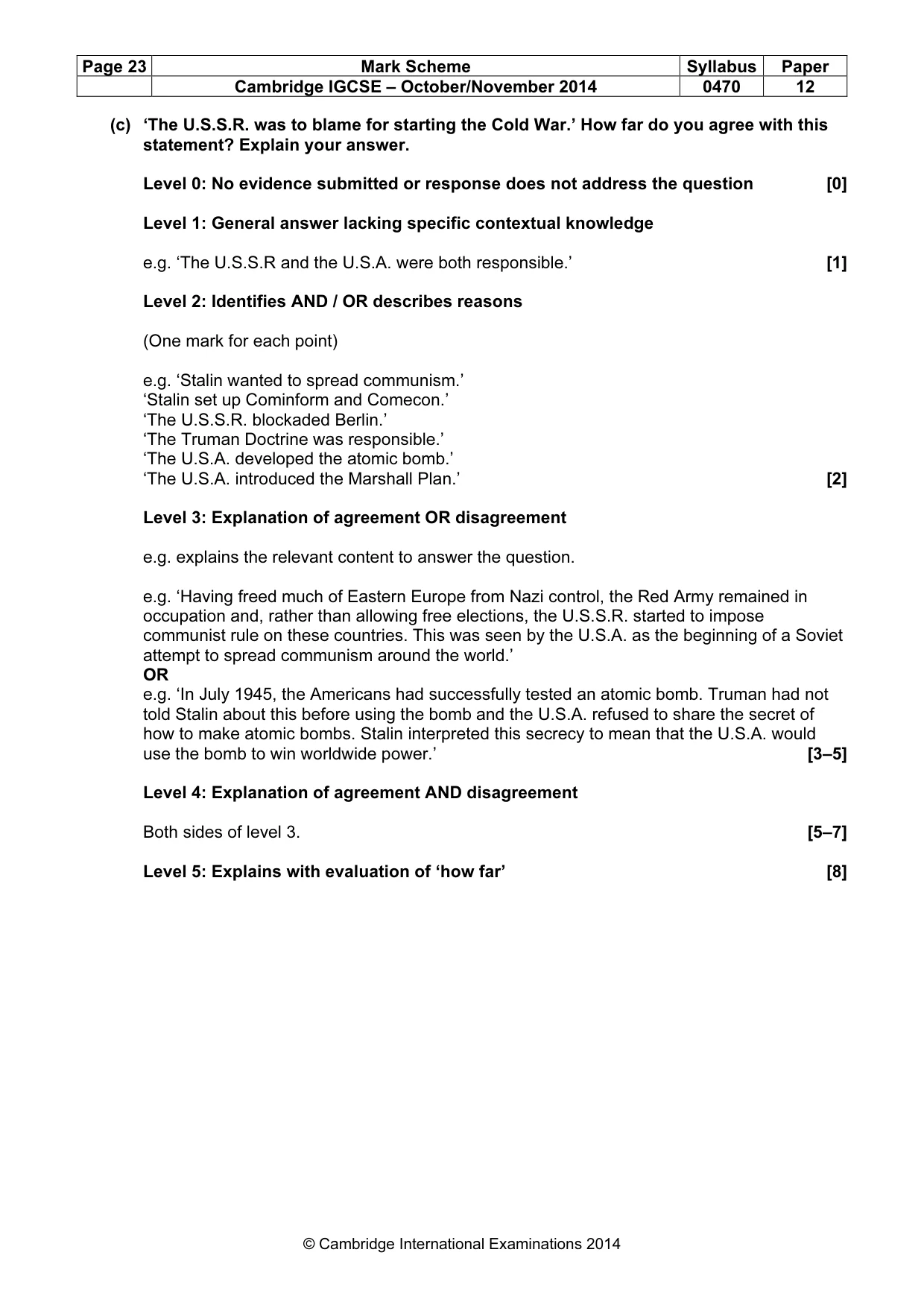
Page 23 Mark Scheme Syllabus Paper Cambridge IGCSE – October/November 2014 0470 12 © Cambridge International Examinations 2014 (c) ‘The U.S.S.R. was to blame for starting the Cold War.’ How far do you agree with this statement? Explain your answer. Level 0: No evidence submitted or response does not address the question [0] Level 1: General answer lacking specific contextual knowledge e.g. ‘The U.S.S.R and the U.S.A. were both responsible.’ [1] Level 2: Identifies AND / OR describes reasons (One mark for each point) e.g. ‘Stalin wanted to spread communism.’ ‘Stalin set up Cominform and Comecon.’ ‘The U.S.S.R. blockaded Berlin.’ ‘The Truman Doctrine was responsible.’ ‘The U.S.A. developed the atomic bomb.’ ‘The U.S.A. introduced the Marshall Plan.’ [2] Level 3: Explanation of agreement OR disagreement e.g. explains the relevant content to answer the question. e.g. ‘Having freed much of Eastern Europe from Nazi control, the Red Army remained in occupation and, rather than allowing free elections, the U.S.S.R. started to impose communist rule on these countries. This was seen by the U.S.A. as the beginning of a Soviet attempt to spread communism around the world.’ OR e.g. ‘In July 1945, the Americans had successfully tested an atomic bomb. Truman had not told Stalin about this before using the bomb and the U.S.A. refused to share the secret of how to make atomic bombs. Stalin interpreted this secrecy to mean that the U.S.A. would use the bomb to win worldwide power.’ [3–5] Level 4: Explanation of agreement AND disagreement Both sides of level 3. [5–7] Level 5: Explains with evaluation of ‘how far’ [8]
Mark scheme, page 24
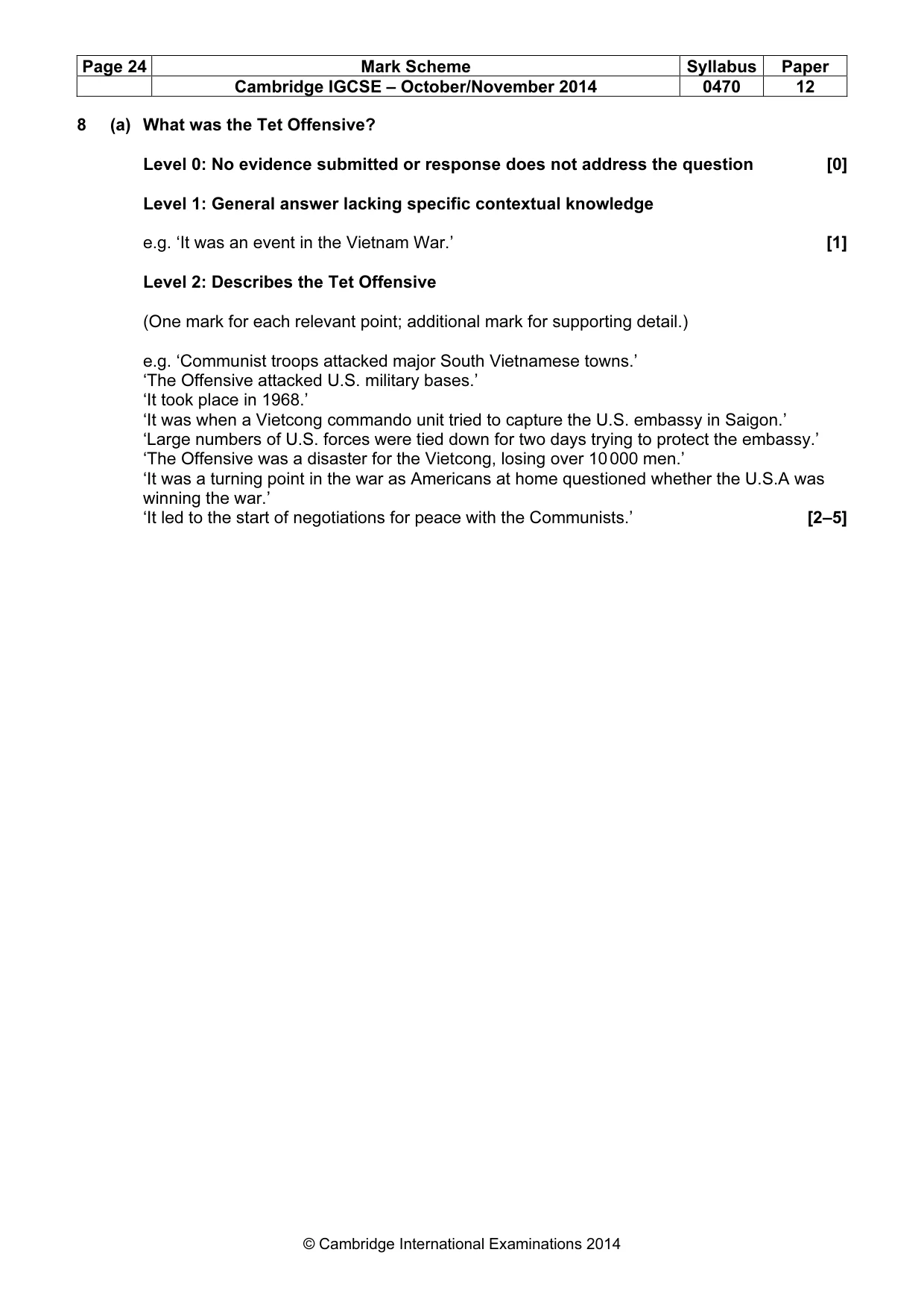
Page 24 Mark Scheme Syllabus Paper Cambridge IGCSE – October/November 2014 0470 12 © Cambridge International Examinations 2014 8 (a) What was the Tet Offensive? Level 0: No evidence submitted or response does not address the question [0] Level 1: General answer lacking specific contextual knowledge e.g. ‘It was an event in the Vietnam War.’ [1] Level 2: Describes the Tet Offensive (One mark for each relevant point; additional mark for supporting detail.) e.g. ‘Communist troops attacked major South Vietnamese towns.’ ‘The Offensive attacked U.S. military bases.’ ‘It took place in 1968.’ ‘It was when a Vietcong commando unit tried to capture the U.S. embassy in Saigon.’ ‘Large numbers of U.S. forces were tied down for two days trying to protect the embassy.’ ‘The Offensive was a disaster for the Vietcong, losing over 10 000 men.’ ‘It was a turning point in the war as Americans at home questioned whether the U.S.A was winning the war.’ ‘It led to the start of negotiations for peace with the Communists.’ [2–5]
Mark scheme, page 25
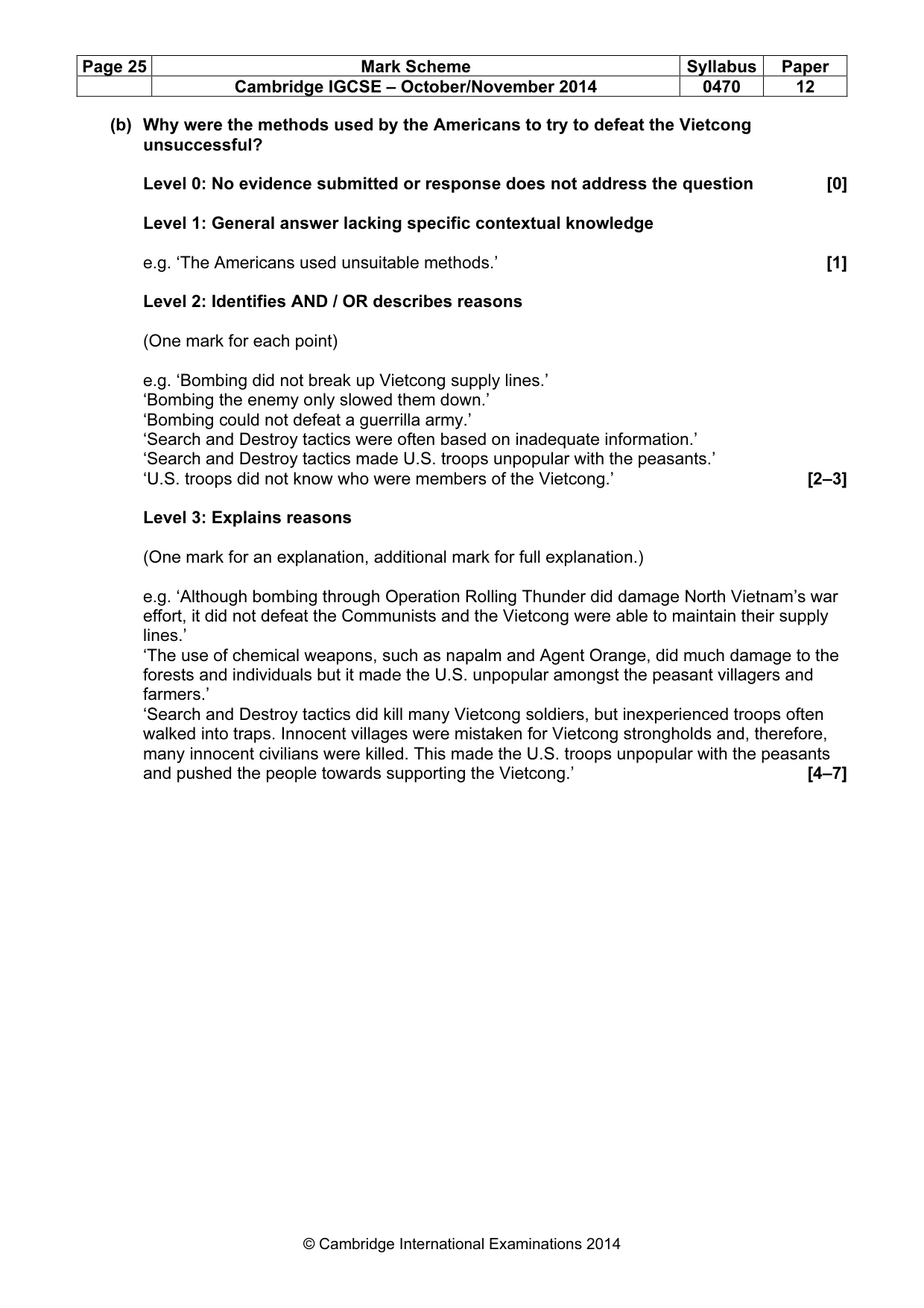
Page 25 Mark Scheme Syllabus Paper Cambridge IGCSE – October/November 2014 0470 12 © Cambridge International Examinations 2014 (b) Why were the methods used by the Americans to try to defeat the Vietcong unsuccessful? Level 0: No evidence submitted or response does not address the question [0] Level 1: General answer lacking specific contextual knowledge e.g. ‘The Americans used unsuitable methods.’ [1] Level 2: Identifies AND / OR describes reasons (One mark for each point) e.g. ‘Bombing did not break up Vietcong supply lines.’ ‘Bombing the enemy only slowed them down.’ ‘Bombing could not defeat a guerrilla army.’ ‘Search and Destroy tactics were often based on inadequate information.’ ‘Search and Destroy tactics made U.S. troops unpopular with the peasants.’ ‘U.S. troops did not know who were members of the Vietcong.’ [2–3] Level 3: Explains reasons (One mark for an explanation, additional mark for full explanation.) e.g. ‘Although bombing through Operation Rolling Thunder did damage North Vietnam’s war effort, it did not defeat the Communists and the Vietcong were able to maintain their supply lines.’ ‘The use of chemical weapons, such as napalm and Agent Orange, did much damage to the forests and individuals but it made the U.S. unpopular amongst the peasant villagers and farmers.’ ‘Search and Destroy tactics did kill many Vietcong soldiers, but inexperienced troops often walked into traps. Innocent villages were mistaken for Vietcong strongholds and, therefore, many innocent civilians were killed. This made the U.S. troops unpopular with the peasants and pushed the people towards supporting the Vietcong.’ [4–7]
Mark scheme, page 26
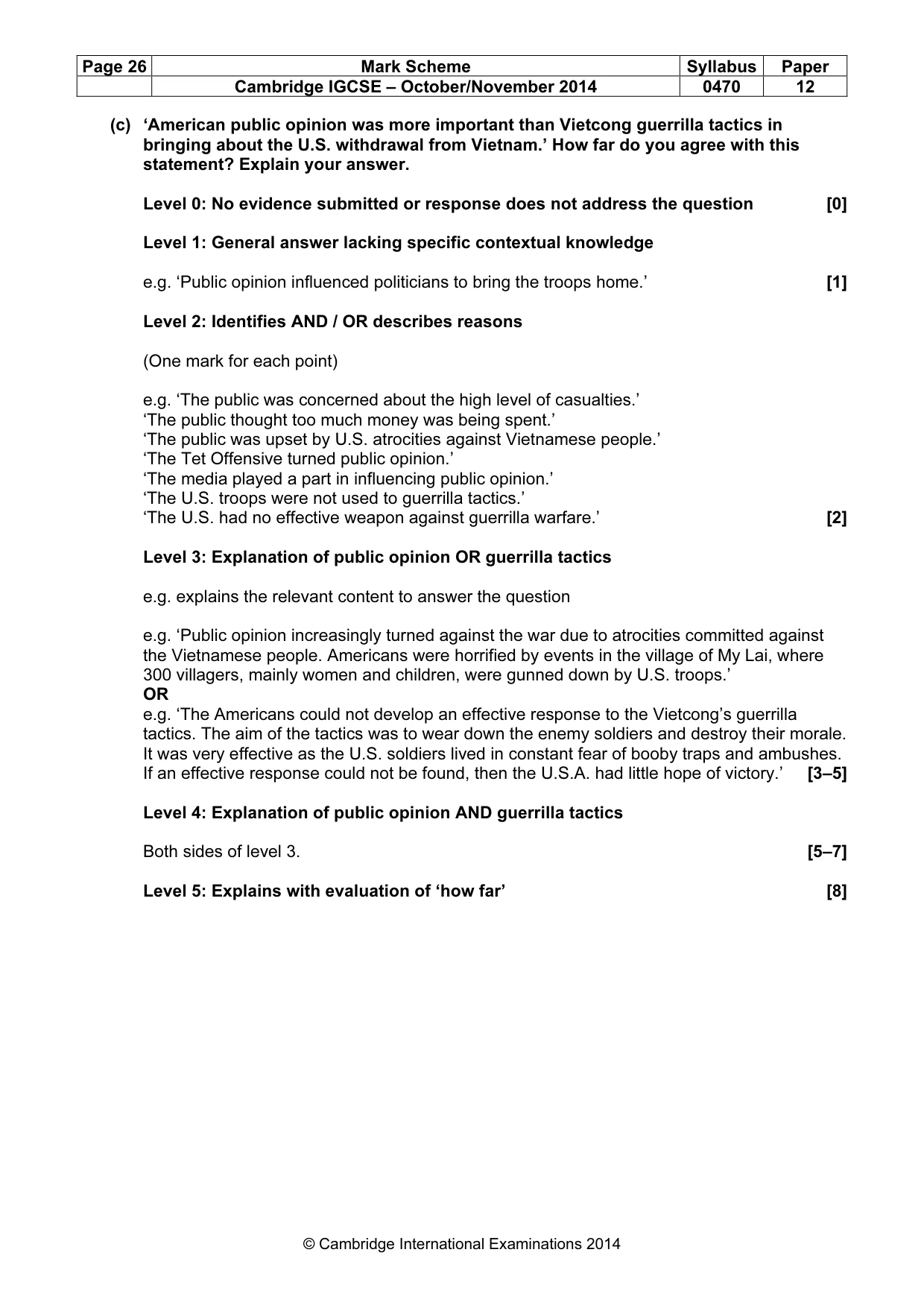
Page 26 Mark Scheme Syllabus Paper Cambridge IGCSE – October/November 2014 0470 12 © Cambridge International Examinations 2014 (c) ‘American public opinion was more important than Vietcong guerrilla tactics in bringing about the U.S. withdrawal from Vietnam.’ How far do you agree with this statement? Explain your answer. Level 0: No evidence submitted or response does not address the question [0] Level 1: General answer lacking specific contextual knowledge e.g. ‘Public opinion influenced politicians to bring the troops home.’ [1] Level 2: Identifies AND / OR describes reasons (One mark for each point) e.g. ‘The public was concerned about the high level of casualties.’ ‘The public thought too much money was being spent.’ ‘The public was upset by U.S. atrocities against Vietnamese people.’ ‘The Tet Offensive turned public opinion.’ ‘The media played a part in influencing public opinion.’ ‘The U.S. troops were not used to guerrilla tactics.’ ‘The U.S. had no effective weapon against guerrilla warfare.’ [2] Level 3: Explanation of public opinion OR guerrilla tactics e.g. explains the relevant content to answer the question e.g. ‘Public opinion increasingly turned against the war due to atrocities committed against the Vietnamese people. Americans were horrified by events in the village of My Lai, where 300 villagers, mainly women and children, were gunned down by U.S. troops.’ OR e.g. ‘The Americans could not develop an effective response to the Vietcong’s guerrilla tactics. The aim of the tactics was to wear down the enemy soldiers and destroy their morale. It was very effective as the U.S. soldiers lived in constant fear of booby traps and ambushes. If an effective response could not be found, then the U.S.A. had little hope of victory.’ [3–5] Level 4: Explanation of public opinion AND guerrilla tactics Both sides of level 3. [5–7] Level 5: Explains with evaluation of ‘how far’ [8]
Mark scheme, page 27
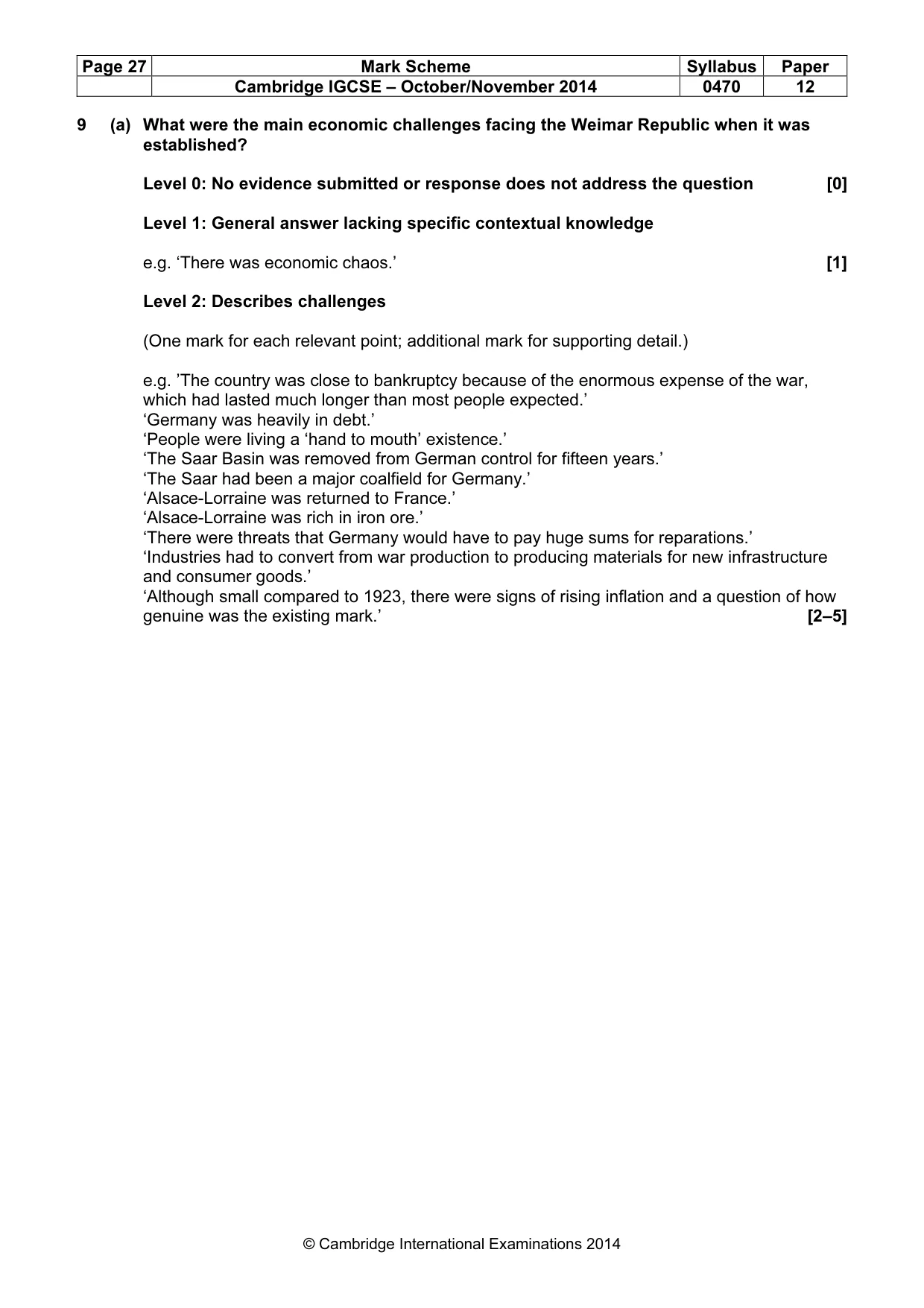
Page 27 Mark Scheme Syllabus Paper Cambridge IGCSE – October/November 2014 0470 12 © Cambridge International Examinations 2014 9 (a) What were the main economic challenges facing the Weimar Republic when it was established? Level 0: No evidence submitted or response does not address the question [0] Level 1: General answer lacking specific contextual knowledge e.g. ‘There was economic chaos.’ [1] Level 2: Describes challenges (One mark for each relevant point; additional mark for supporting detail.) e.g. ’The country was close to bankruptcy because of the enormous expense of the war, which had lasted much longer than most people expected.’ ‘Germany was heavily in debt.’ ‘People were living a ‘hand to mouth’ existence.’ ‘The Saar Basin was removed from German control for fifteen years.’ ‘The Saar had been a major coalfield for Germany.’ ‘Alsace-Lorraine was returned to France.’ ‘Alsace-Lorraine was rich in iron ore.’ ‘There were threats that Germany would have to pay huge sums for reparations.’ ‘Industries had to convert from war production to producing materials for new infrastructure and consumer goods.’ ‘Although small compared to 1923, there were signs of rising inflation and a question of how genuine was the existing mark.’ [2–5]
Mark scheme, page 28
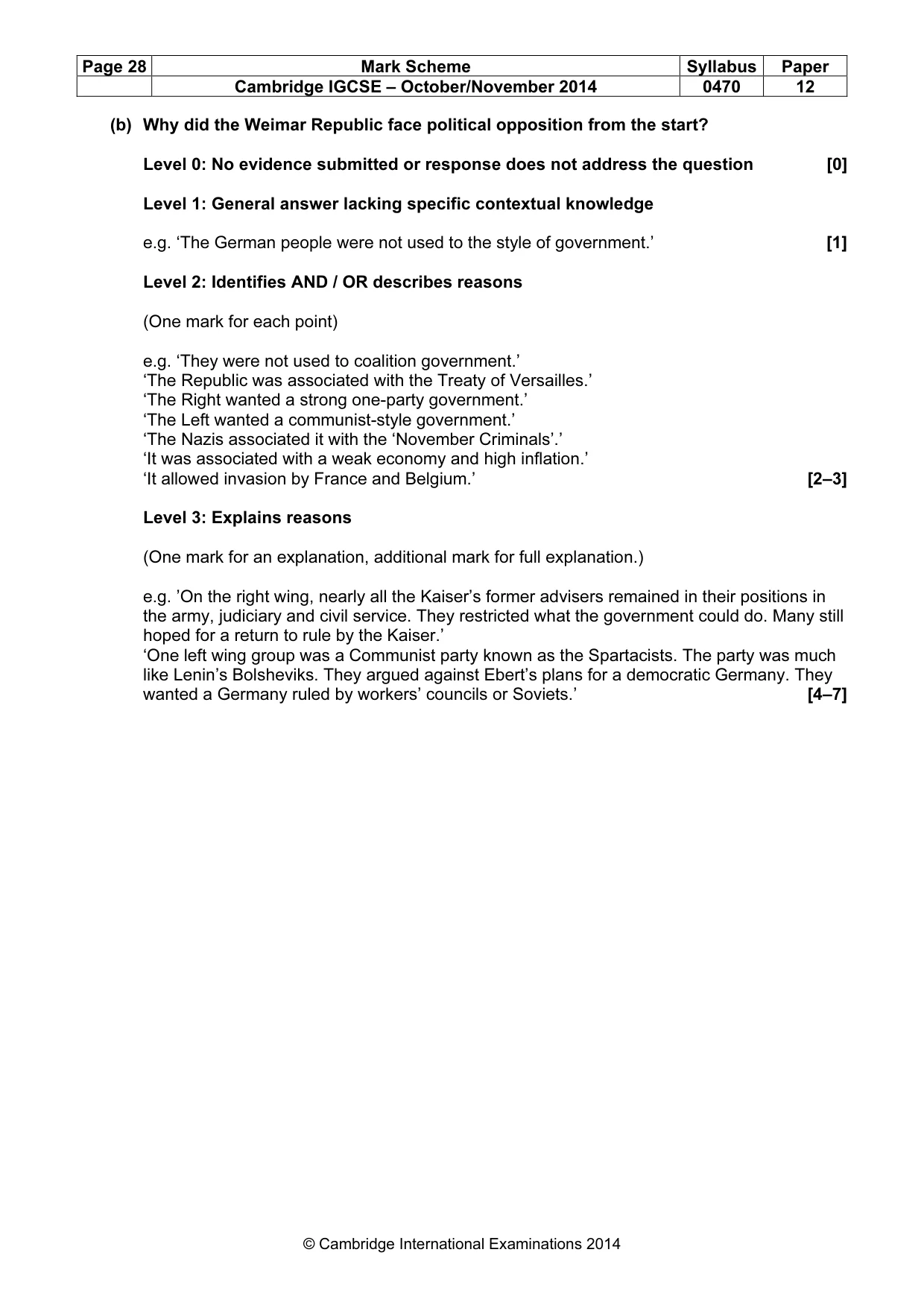
Page 28 Mark Scheme Syllabus Paper Cambridge IGCSE – October/November 2014 0470 12 © Cambridge International Examinations 2014 (b) Why did the Weimar Republic face political opposition from the start? Level 0: No evidence submitted or response does not address the question [0] Level 1: General answer lacking specific contextual knowledge e.g. ‘The German people were not used to the style of government.’ [1] Level 2: Identifies AND / OR describes reasons (One mark for each point) e.g. ‘They were not used to coalition government.’ ‘The Republic was associated with the Treaty of Versailles.’ ‘The Right wanted a strong one-party government.’ ‘The Left wanted a communist-style government.’ ‘The Nazis associated it with the ‘November Criminals’.’ ‘It was associated with a weak economy and high inflation.’ ‘It allowed invasion by France and Belgium.’ [2–3] Level 3: Explains reasons (One mark for an explanation, additional mark for full explanation.) e.g. ’On the right wing, nearly all the Kaiser’s former advisers remained in their positions in the army, judiciary and civil service. They restricted what the government could do. Many still hoped for a return to rule by the Kaiser.’ ‘One left wing group was a Communist party known as the Spartacists. The party was much like Lenin’s Bolsheviks. They argued against Ebert’s plans for a democratic Germany. They wanted a Germany ruled by workers’ councils or Soviets.’ [4–7]
Mark scheme, page 29
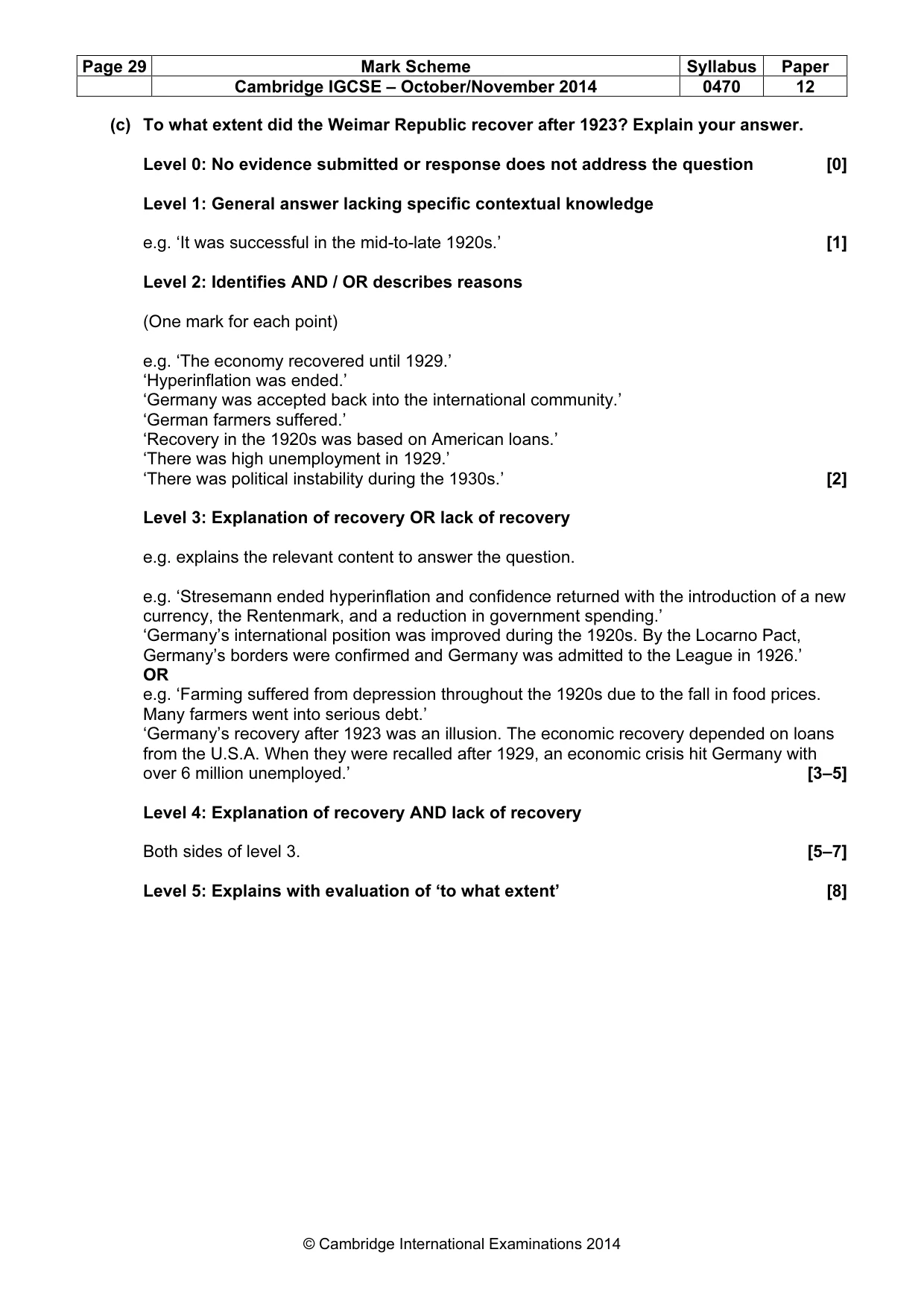
Page 29 Mark Scheme Syllabus Paper Cambridge IGCSE – October/November 2014 0470 12 © Cambridge International Examinations 2014 (c) To what extent did the Weimar Republic recover after 1923? Explain your answer. Level 0: No evidence submitted or response does not address the question [0] Level 1: General answer lacking specific contextual knowledge e.g. ‘It was successful in the mid-to-late 1920s.’ [1] Level 2: Identifies AND / OR describes reasons (One mark for each point) e.g. ‘The economy recovered until 1929.’ ‘Hyperinflation was ended.’ ‘Germany was accepted back into the international community.’ ‘German farmers suffered.’ ‘Recovery in the 1920s was based on American loans.’ ‘There was high unemployment in 1929.’ ‘There was political instability during the 1930s.’ [2] Level 3: Explanation of recovery OR lack of recovery e.g. explains the relevant content to answer the question. e.g. ‘Stresemann ended hyperinflation and confidence returned with the introduction of a new currency, the Rentenmark, and a reduction in government spending.’ ‘Germany’s international position was improved during the 1920s. By the Locarno Pact, Germany’s borders were confirmed and Germany was admitted to the League in 1926.’ OR e.g. ‘Farming suffered from depression throughout the 1920s due to the fall in food prices. Many farmers went into serious debt.’ ‘Germany’s recovery after 1923 was an illusion. The economic recovery depended on loans from the U.S.A. When they were recalled after 1929, an economic crisis hit Germany with over 6 million unemployed.’ [3–5] Level 4: Explanation of recovery AND lack of recovery Both sides of level 3. [5–7] Level 5: Explains with evaluation of ‘to what extent’ [8]
Mark scheme, page 30
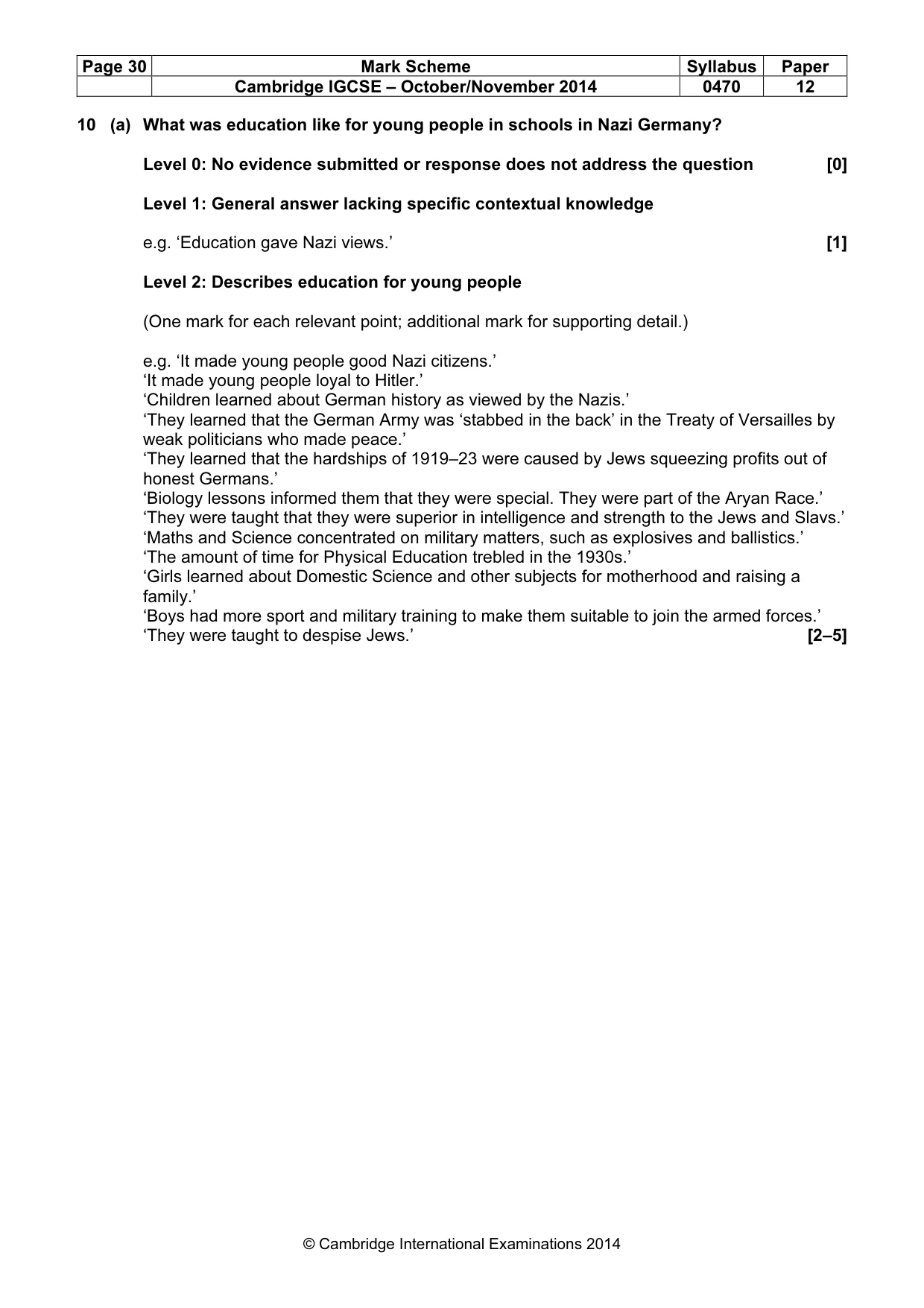
Page 30 Mark Scheme Syllabus Paper Cambridge IGCSE – October/November 2014 0470 12 © Cambridge International Examinations 2014 10 (a) What was education like for young people in schools in Nazi Germany? Level 0: No evidence submitted or response does not address the question [0] Level 1: General answer lacking specific contextual knowledge e.g. ‘Education gave Nazi views.’ [1] Level 2: Describes education for young people (One mark for each relevant point; additional mark for supporting detail.) e.g. ‘It made young people good Nazi citizens.’ ‘It made young people loyal to Hitler.’ ‘Children learned about German history as viewed by the Nazis.’ ‘They learned that the German Army was ‘stabbed in the back’ in the Treaty of Versailles by weak politicians who made peace.’ ‘They learned that the hardships of 1919–23 were caused by Jews squeezing profits out of honest Germans.’ ‘Biology lessons informed them that they were special. They were part of the Aryan Race.’ ‘They were taught that they were superior in intelligence and strength to the Jews and Slavs.’ ‘Maths and Science concentrated on military matters, such as explosives and ballistics.’ ‘The amount of time for Physical Education trebled in the 1930s.’ ‘Girls learned about Domestic Science and other subjects for motherhood and raising a family.’ ‘Boys had more sport and military training to make them suitable to join the armed forces.’ ‘They were taught to despise Jews.’ [2–5]
Mark scheme, page 31
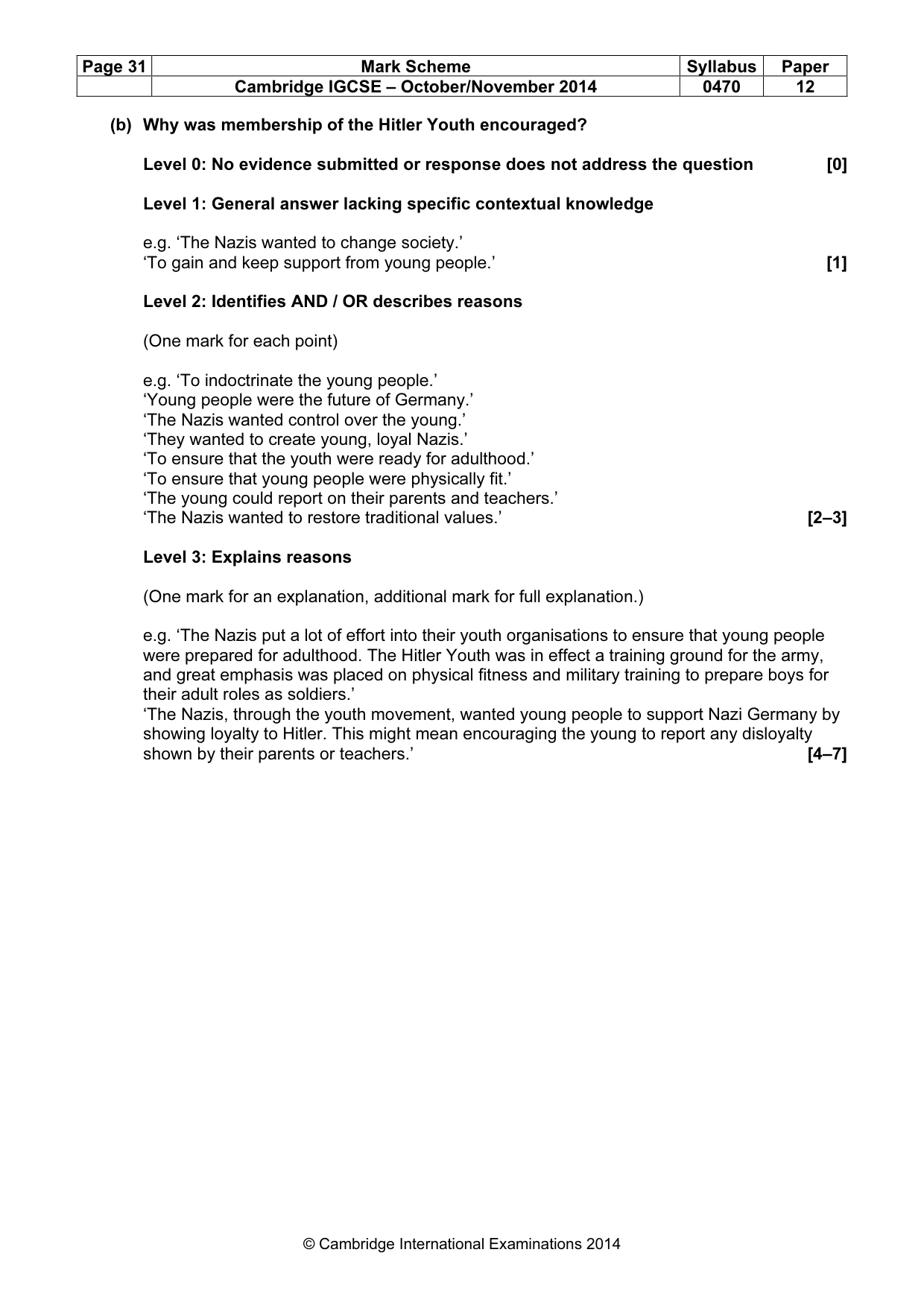
Page 31 Mark Scheme Syllabus Paper Cambridge IGCSE – October/November 2014 0470 12 © Cambridge International Examinations 2014 (b) Why was membership of the Hitler Youth encouraged? Level 0: No evidence submitted or response does not address the question [0] Level 1: General answer lacking specific contextual knowledge e.g. ‘The Nazis wanted to change society.’ ‘To gain and keep support from young people.’ [1] Level 2: Identifies AND / OR describes reasons (One mark for each point) e.g. ‘To indoctrinate the young people.’ ‘Young people were the future of Germany.’ ‘The Nazis wanted control over the young.’ ‘They wanted to create young, loyal Nazis.’ ‘To ensure that the youth were ready for adulthood.’ ‘To ensure that young people were physically fit.’ ‘The young could report on their parents and teachers.’ ‘The Nazis wanted to restore traditional values.’ [2–3] Level 3: Explains reasons (One mark for an explanation, additional mark for full explanation.) e.g. ‘The Nazis put a lot of effort into their youth organisations to ensure that young people were prepared for adulthood. The Hitler Youth was in effect a training ground for the army, and great emphasis was placed on physical fitness and military training to prepare boys for their adult roles as soldiers.’ ‘The Nazis, through the youth movement, wanted young people to support Nazi Germany by showing loyalty to Hitler. This might mean encouraging the young to report any disloyalty shown by their parents or teachers.’ [4–7]
Mark scheme, page 32
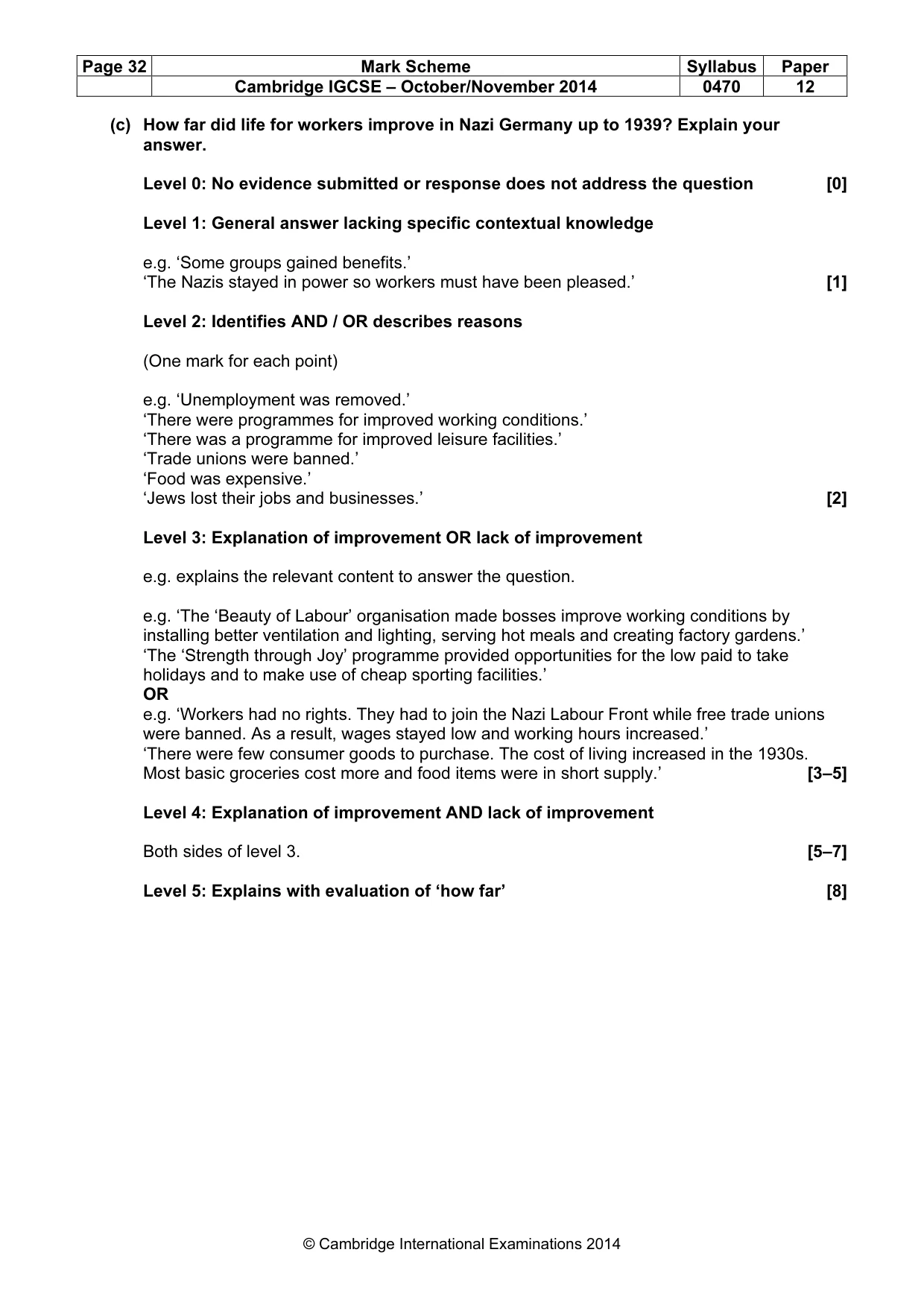
Page 32 Mark Scheme Syllabus Paper Cambridge IGCSE – October/November 2014 0470 12 © Cambridge International Examinations 2014 (c) How far did life for workers improve in Nazi Germany up to 1939? Explain your answer. Level 0: No evidence submitted or response does not address the question [0] Level 1: General answer lacking specific contextual knowledge e.g. ‘Some groups gained benefits.’ ‘The Nazis stayed in power so workers must have been pleased.’ [1] Level 2: Identifies AND / OR describes reasons (One mark for each point) e.g. ‘Unemployment was removed.’ ‘There were programmes for improved working conditions.’ ‘There was a programme for improved leisure facilities.’ ‘Trade unions were banned.’ ‘Food was expensive.’ ‘Jews lost their jobs and businesses.’ [2] Level 3: Explanation of improvement OR lack of improvement e.g. explains the relevant content to answer the question. e.g. ‘The ‘Beauty of Labour’ organisation made bosses improve working conditions by installing better ventilation and lighting, serving hot meals and creating factory gardens.’ ‘The ‘Strength through Joy’ programme provided opportunities for the low paid to take holidays and to make use of cheap sporting facilities.’ OR e.g. ‘Workers had no rights. They had to join the Nazi Labour Front while free trade unions were banned. As a result, wages stayed low and working hours increased.’ ‘There were few consumer goods to purchase. The cost of living increased in the 1930s. Most basic groceries cost more and food items were in short supply.’ [3–5] Level 4: Explanation of improvement AND lack of improvement Both sides of level 3. [5–7] Level 5: Explains with evaluation of ‘how far’ [8]
Mark scheme, page 33
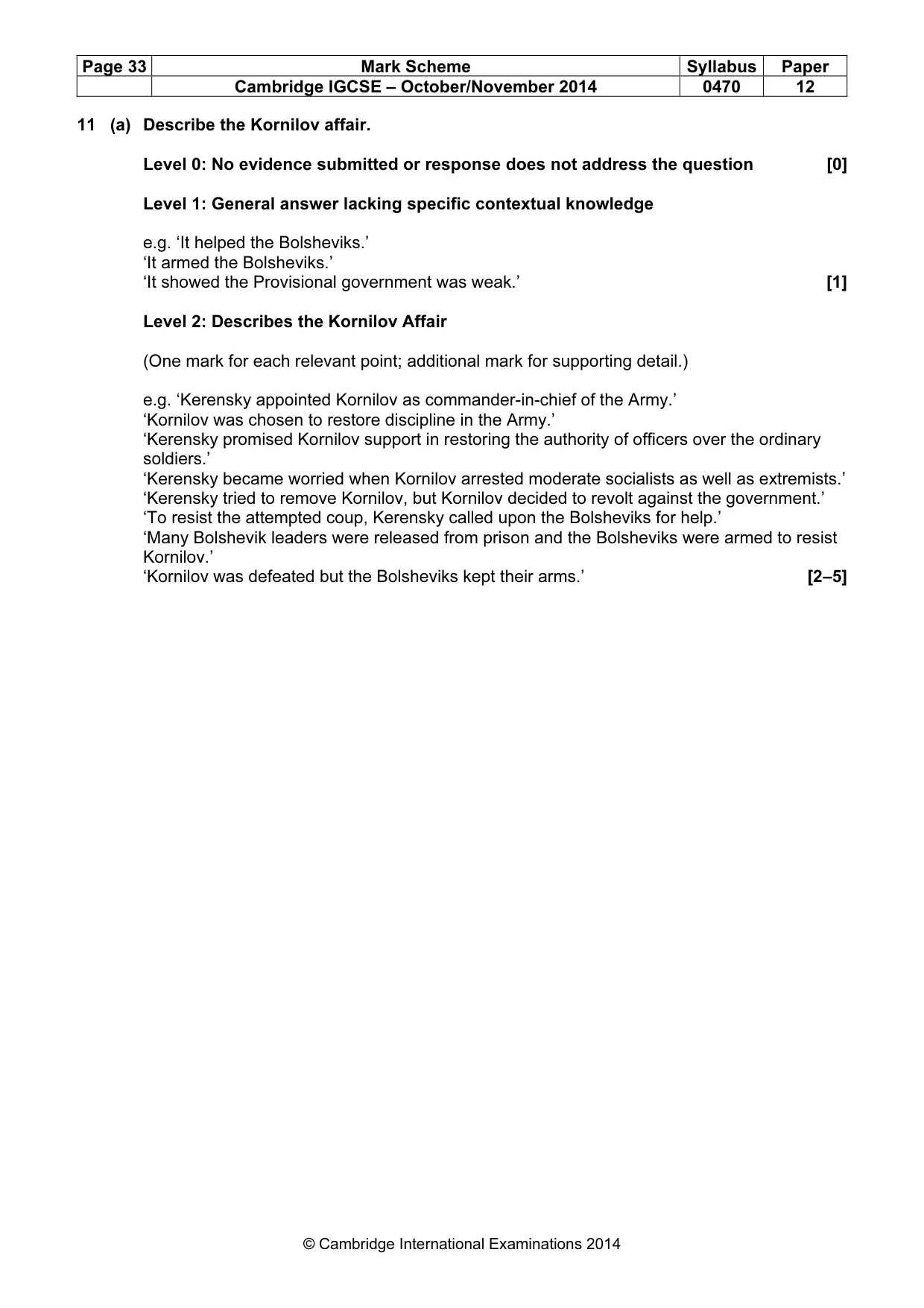
Page 33 Mark Scheme Syllabus Paper Cambridge IGCSE – October/November 2014 0470 12 © Cambridge International Examinations 2014 11 (a) Describe the Kornilov affair. Level 0: No evidence submitted or response does not address the question [0] Level 1: General answer lacking specific contextual knowledge e.g. ‘It helped the Bolsheviks.’ ‘It armed the Bolsheviks.’ ‘It showed the Provisional government was weak.’ [1] Level 2: Describes the Kornilov Affair (One mark for each relevant point; additional mark for supporting detail.) e.g. ‘Kerensky appointed Kornilov as commander-in-chief of the Army.’ ‘Kornilov was chosen to restore discipline in the Army.’ ‘Kerensky promised Kornilov support in restoring the authority of officers over the ordinary soldiers.’ ‘Kerensky became worried when Kornilov arrested moderate socialists as well as extremists.’ ‘Kerensky tried to remove Kornilov, but Kornilov decided to revolt against the government.’ ‘To resist the attempted coup, Kerensky called upon the Bolsheviks for help.’ ‘Many Bolshevik leaders were released from prison and the Bolsheviks were armed to resist Kornilov.’ ‘Kornilov was defeated but the Bolsheviks kept their arms.’ [2–5]
Mark scheme, page 34
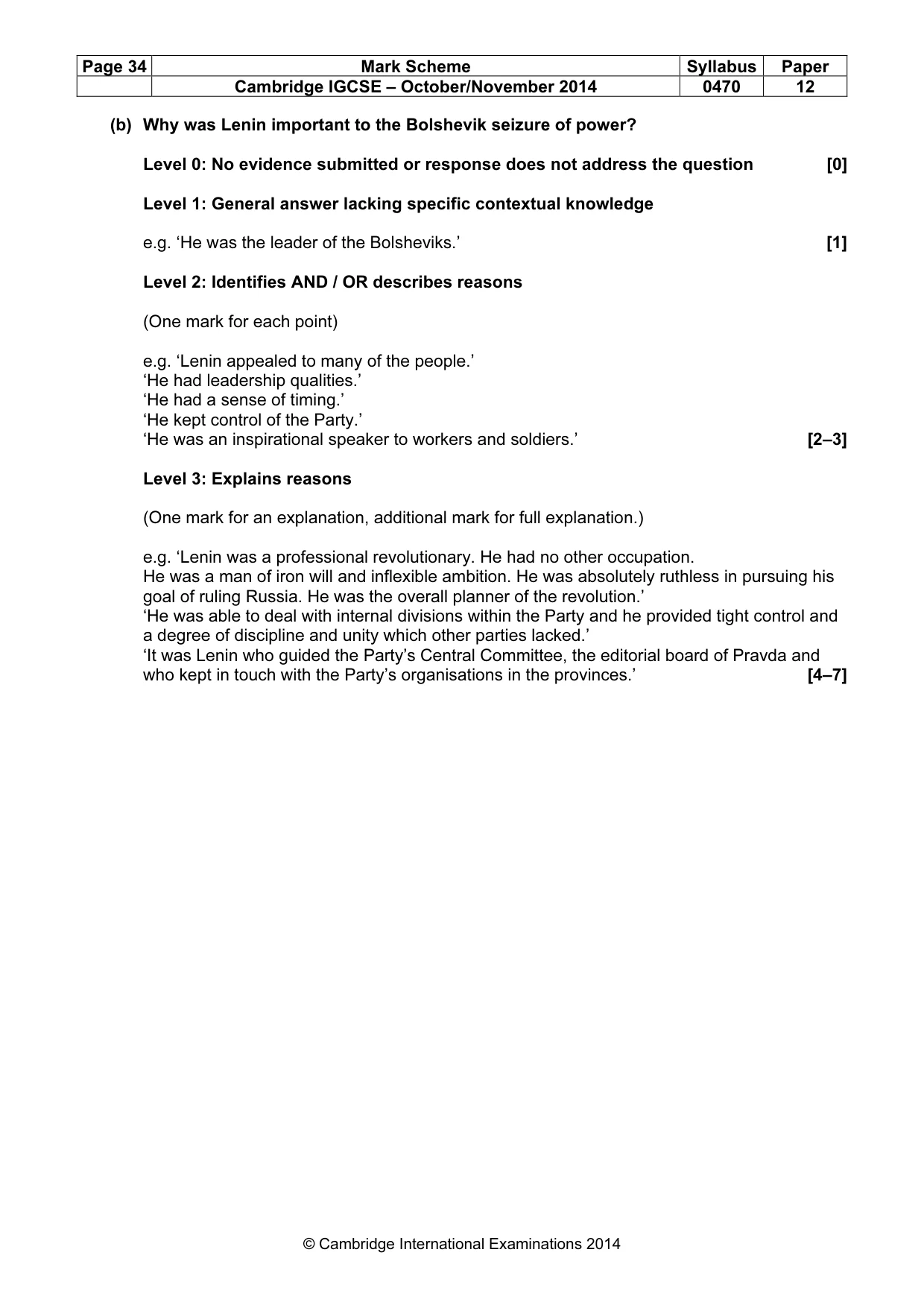
Page 34 Mark Scheme Syllabus Paper Cambridge IGCSE – October/November 2014 0470 12 © Cambridge International Examinations 2014 (b) Why was Lenin important to the Bolshevik seizure of power? Level 0: No evidence submitted or response does not address the question [0] Level 1: General answer lacking specific contextual knowledge e.g. ‘He was the leader of the Bolsheviks.’ [1] Level 2: Identifies AND / OR describes reasons (One mark for each point) e.g. ‘Lenin appealed to many of the people.’ ‘He had leadership qualities.’ ‘He had a sense of timing.’ ‘He kept control of the Party.’ ‘He was an inspirational speaker to workers and soldiers.’ [2–3] Level 3: Explains reasons (One mark for an explanation, additional mark for full explanation.) e.g. ‘Lenin was a professional revolutionary. He had no other occupation. He was a man of iron will and inflexible ambition. He was absolutely ruthless in pursuing his goal of ruling Russia. He was the overall planner of the revolution.’ ‘He was able to deal with internal divisions within the Party and he provided tight control and a degree of discipline and unity which other parties lacked.’ ‘It was Lenin who guided the Party’s Central Committee, the editorial board of Pravda and who kept in touch with the Party’s organisations in the provinces.’ [4–7]
Mark scheme, page 35
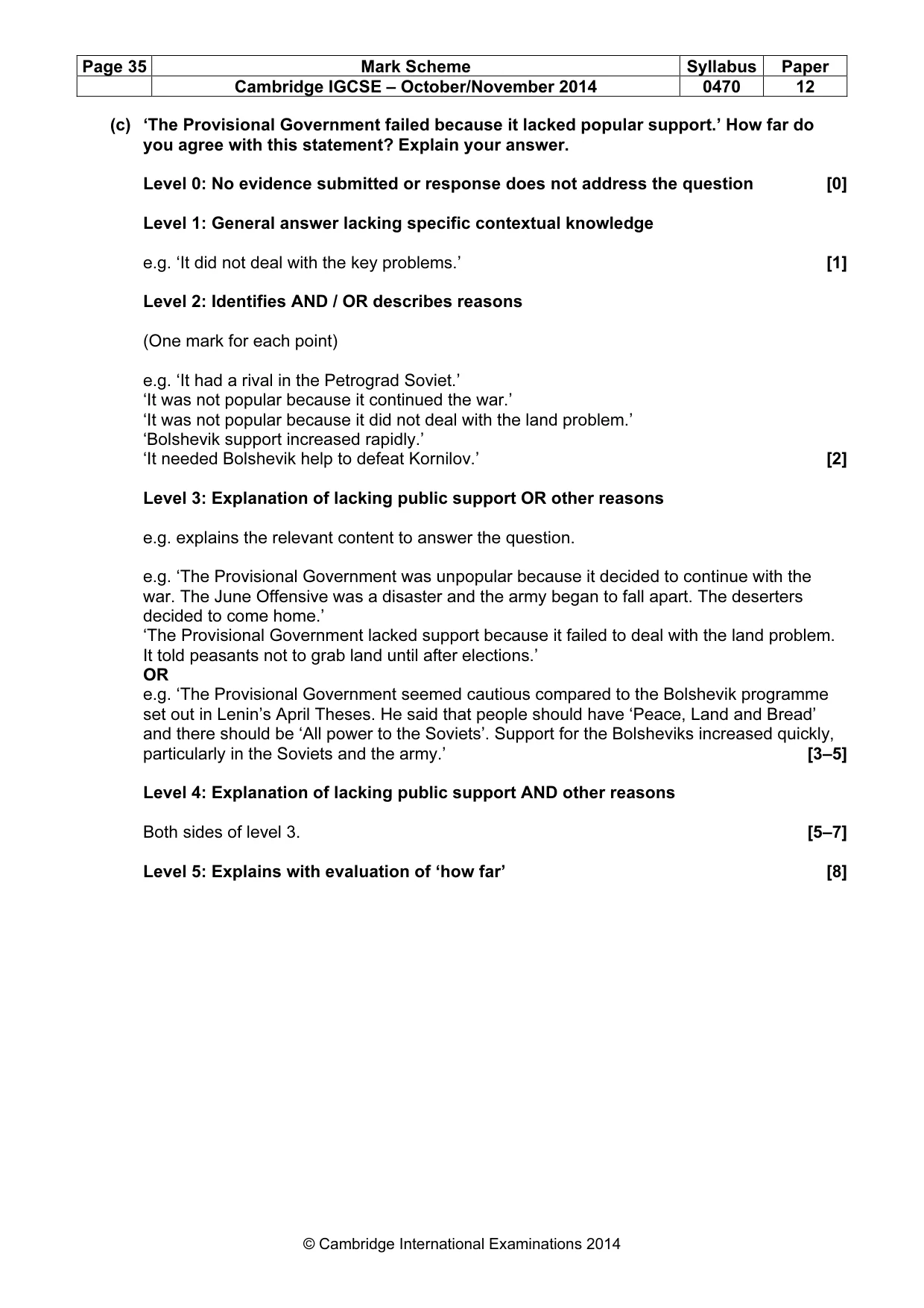
Page 35 Mark Scheme Syllabus Paper Cambridge IGCSE – October/November 2014 0470 12 © Cambridge International Examinations 2014 (c) ‘The Provisional Government failed because it lacked popular support.’ How far do you agree with this statement? Explain your answer. Level 0: No evidence submitted or response does not address the question [0] Level 1: General answer lacking specific contextual knowledge e.g. ‘It did not deal with the key problems.’ [1] Level 2: Identifies AND / OR describes reasons (One mark for each point) e.g. ‘It had a rival in the Petrograd Soviet.’ ‘It was not popular because it continued the war.’ ‘It was not popular because it did not deal with the land problem.’ ‘Bolshevik support increased rapidly.’ ‘It needed Bolshevik help to defeat Kornilov.’ [2] Level 3: Explanation of lacking public support OR other reasons e.g. explains the relevant content to answer the question. e.g. ‘The Provisional Government was unpopular because it decided to continue with the war. The June Offensive was a disaster and the army began to fall apart. The deserters decided to come home.’ ‘The Provisional Government lacked support because it failed to deal with the land problem. It told peasants not to grab land until after elections.’ OR e.g. ‘The Provisional Government seemed cautious compared to the Bolshevik programme set out in Lenin’s April Theses. He said that people should have ‘Peace, Land and Bread’ and there should be ‘All power to the Soviets’. Support for the Bolsheviks increased quickly, particularly in the Soviets and the army.’ [3–5] Level 4: Explanation of lacking public support AND other reasons Both sides of level 3. [5–7] Level 5: Explains with evaluation of ‘how far’ [8]
Mark scheme, page 36
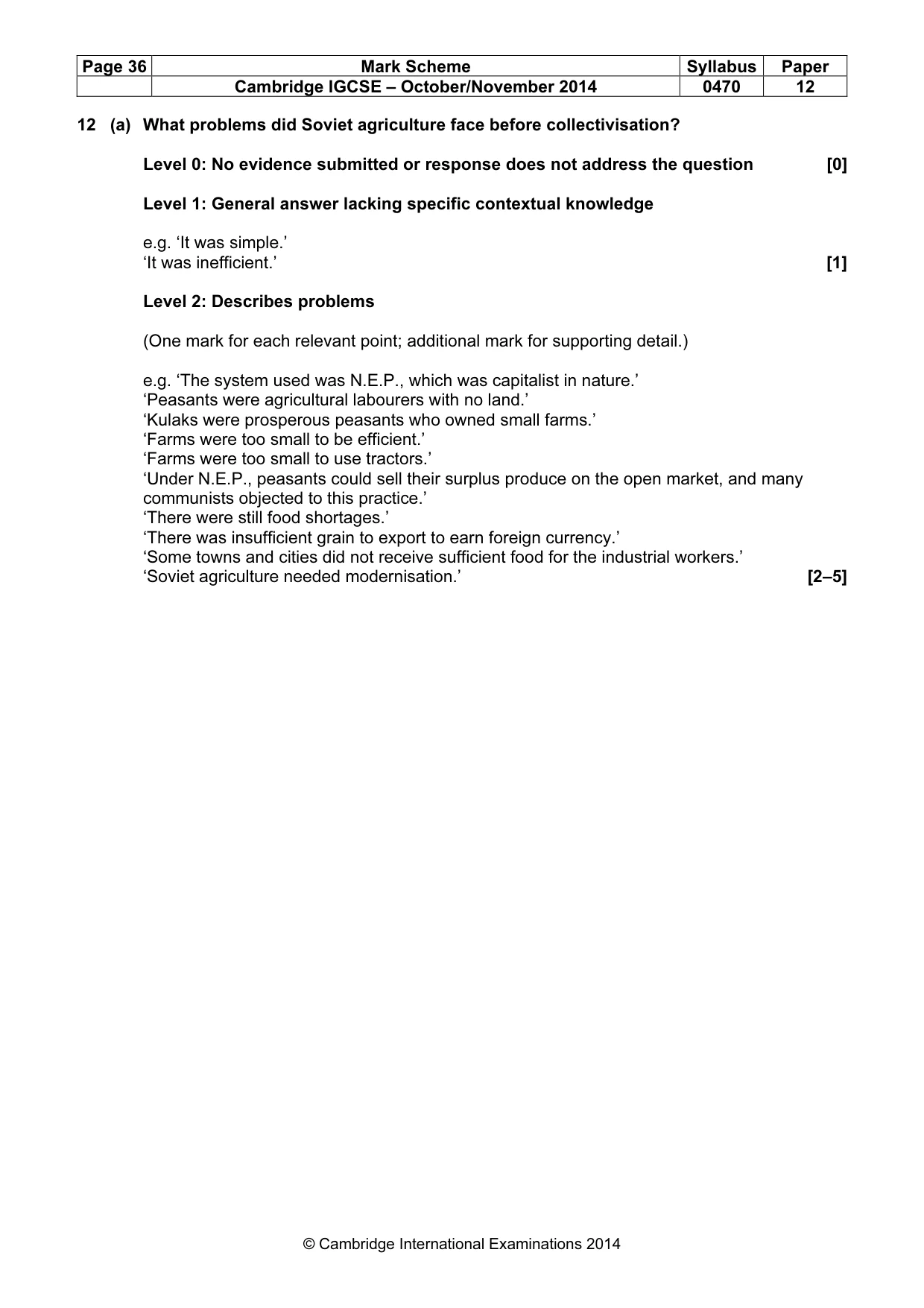
Page 36 Mark Scheme Syllabus Paper Cambridge IGCSE – October/November 2014 0470 12 © Cambridge International Examinations 2014 12 (a) What problems did Soviet agriculture face before collectivisation? Level 0: No evidence submitted or response does not address the question [0] Level 1: General answer lacking specific contextual knowledge e.g. ‘It was simple.’ ‘It was inefficient.’ [1] Level 2: Describes problems (One mark for each relevant point; additional mark for supporting detail.) e.g. ‘The system used was N.E.P., which was capitalist in nature.’ ‘Peasants were agricultural labourers with no land.’ ‘Kulaks were prosperous peasants who owned small farms.’ ‘Farms were too small to be efficient.’ ‘Farms were too small to use tractors.’ ‘Under N.E.P., peasants could sell their surplus produce on the open market, and many communists objected to this practice.’ ‘There were still food shortages.’ ‘There was insufficient grain to export to earn foreign currency.’ ‘Some towns and cities did not receive sufficient food for the industrial workers.’ ‘Soviet agriculture needed modernisation.’ [2–5]
Mark scheme, page 37
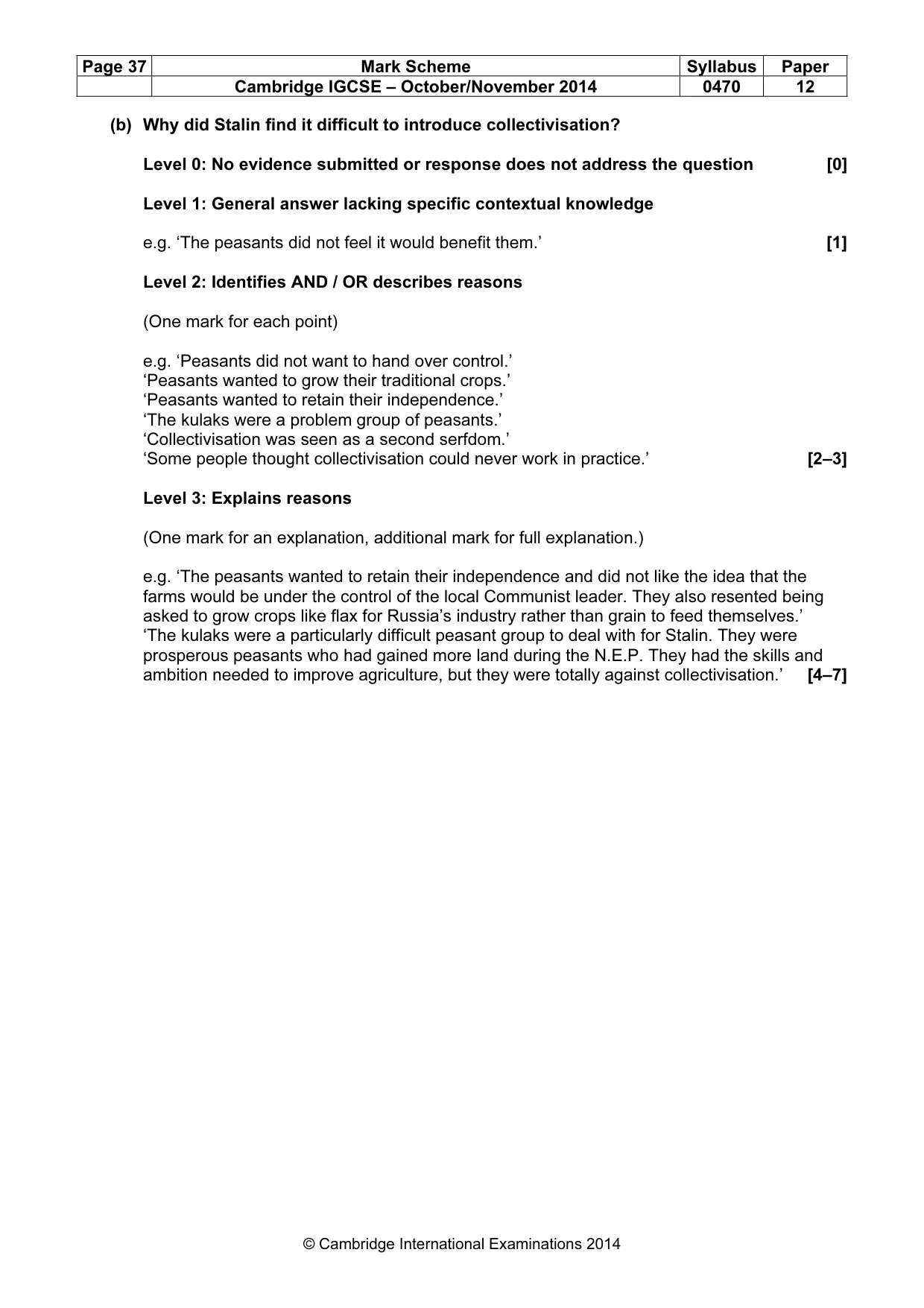
Page 37 Mark Scheme Syllabus Paper Cambridge IGCSE – October/November 2014 0470 12 © Cambridge International Examinations 2014 (b) Why did Stalin find it difficult to introduce collectivisation? Level 0: No evidence submitted or response does not address the question [0] Level 1: General answer lacking specific contextual knowledge e.g. ‘The peasants did not feel it would benefit them.’ [1] Level 2: Identifies AND / OR describes reasons (One mark for each point) e.g. ‘Peasants did not want to hand over control.’ ‘Peasants wanted to grow their traditional crops.’ ‘Peasants wanted to retain their independence.’ ‘The kulaks were a problem group of peasants.’ ‘Collectivisation was seen as a second serfdom.’ ‘Some people thought collectivisation could never work in practice.’ [2–3] Level 3: Explains reasons (One mark for an explanation, additional mark for full explanation.) e.g. ‘The peasants wanted to retain their independence and did not like the idea that the farms would be under the control of the local Communist leader. They also resented being asked to grow crops like flax for Russia’s industry rather than grain to feed themselves.’ ‘The kulaks were a particularly difficult peasant group to deal with for Stalin. They were prosperous peasants who had gained more land during the N.E.P. They had the skills and ambition needed to improve agriculture, but they were totally against collectivisation.’ [4–7]
Mark scheme, page 38
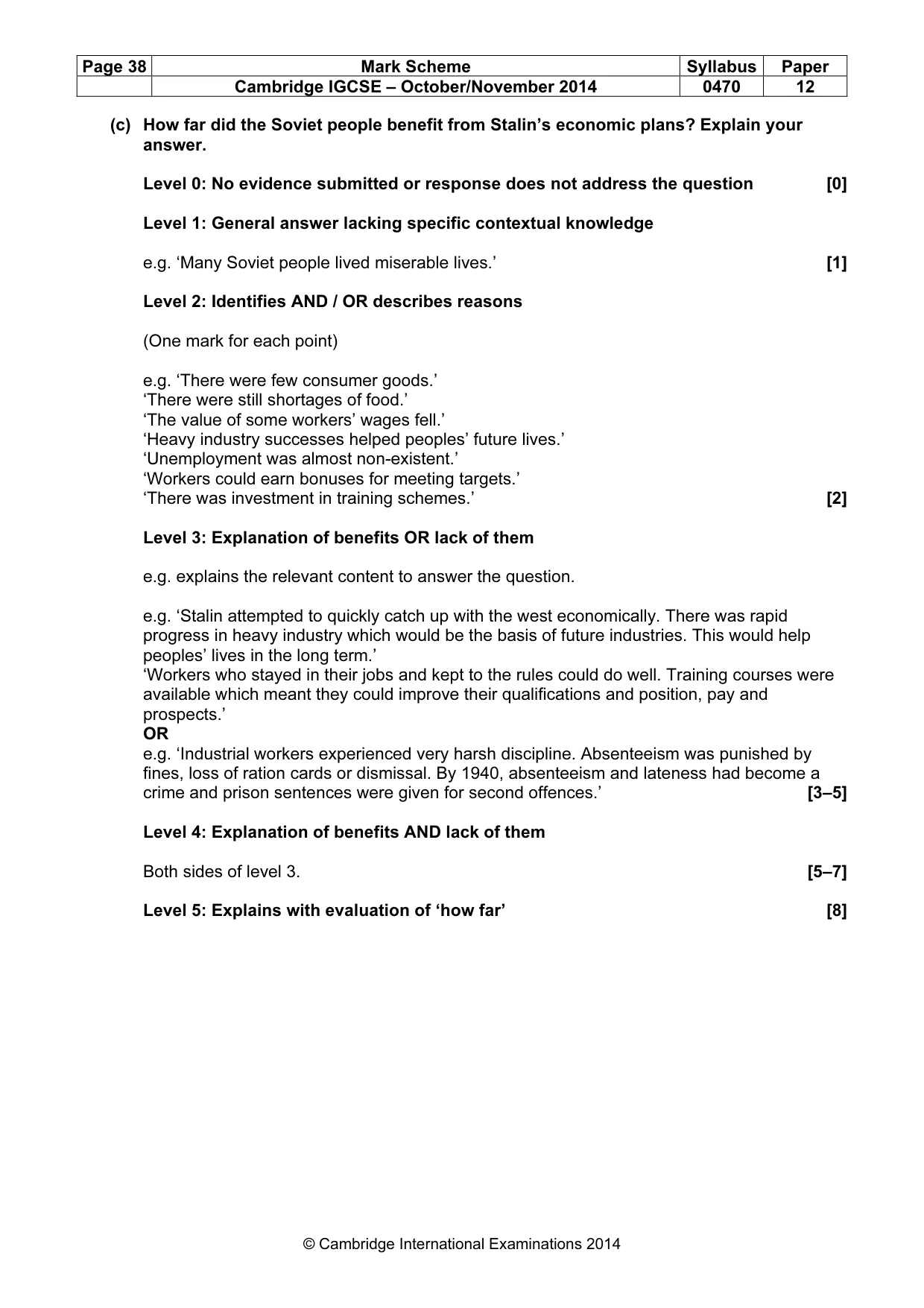
Page 38 Mark Scheme Syllabus Paper Cambridge IGCSE – October/November 2014 0470 12 © Cambridge International Examinations 2014 (c) How far did the Soviet people benefit from Stalin’s economic plans? Explain your answer. Level 0: No evidence submitted or response does not address the question [0] Level 1: General answer lacking specific contextual knowledge e.g. ‘Many Soviet people lived miserable lives.’ [1] Level 2: Identifies AND / OR describes reasons (One mark for each point) e.g. ‘There were few consumer goods.’ ‘There were still shortages of food.’ ‘The value of some workers’ wages fell.’ ‘Heavy industry successes helped peoples’ future lives.’ ‘Unemployment was almost non-existent.’ ‘Workers could earn bonuses for meeting targets.’ ‘There was investment in training schemes.’ [2] Level 3: Explanation of benefits OR lack of them e.g. explains the relevant content to answer the question. e.g. ‘Stalin attempted to quickly catch up with the west economically. There was rapid progress in heavy industry which would be the basis of future industries. This would help peoples’ lives in the long term.’ ‘Workers who stayed in their jobs and kept to the rules could do well. Training courses were available which meant they could improve their qualifications and position, pay and prospects.’ OR e.g. ‘Industrial workers experienced very harsh discipline. Absenteeism was punished by fines, loss of ration cards or dismissal. By 1940, absenteeism and lateness had become a crime and prison sentences were given for second offences.’ [3–5] Level 4: Explanation of benefits AND lack of them Both sides of level 3. [5–7] Level 5: Explains with evaluation of ‘how far’ [8]
Mark scheme, page 39
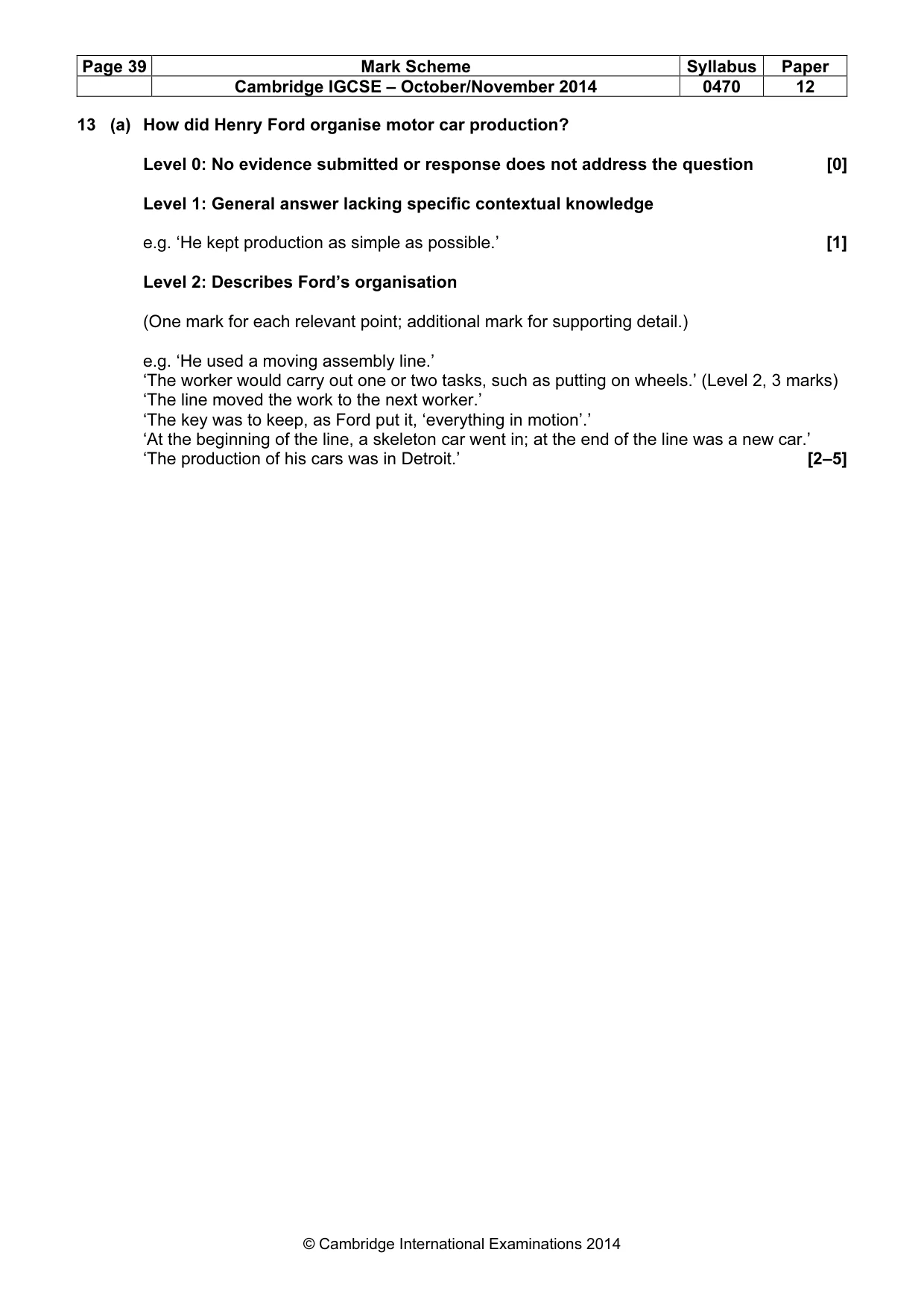
Page 39 Mark Scheme Syllabus Paper Cambridge IGCSE – October/November 2014 0470 12 © Cambridge International Examinations 2014 13 (a) How did Henry Ford organise motor car production? Level 0: No evidence submitted or response does not address the question [0] Level 1: General answer lacking specific contextual knowledge e.g. ‘He kept production as simple as possible.’ [1] Level 2: Describes Ford’s organisation (One mark for each relevant point; additional mark for supporting detail.) e.g. ‘He used a moving assembly line.’ ‘The worker would carry out one or two tasks, such as putting on wheels.’ (Level 2, 3 marks) ‘The line moved the work to the next worker.’ ‘The key was to keep, as Ford put it, ‘everything in motion’.’ ‘At the beginning of the line, a skeleton car went in; at the end of the line was a new car.’ ‘The production of his cars was in Detroit.’ [2–5]
Mark scheme, page 40
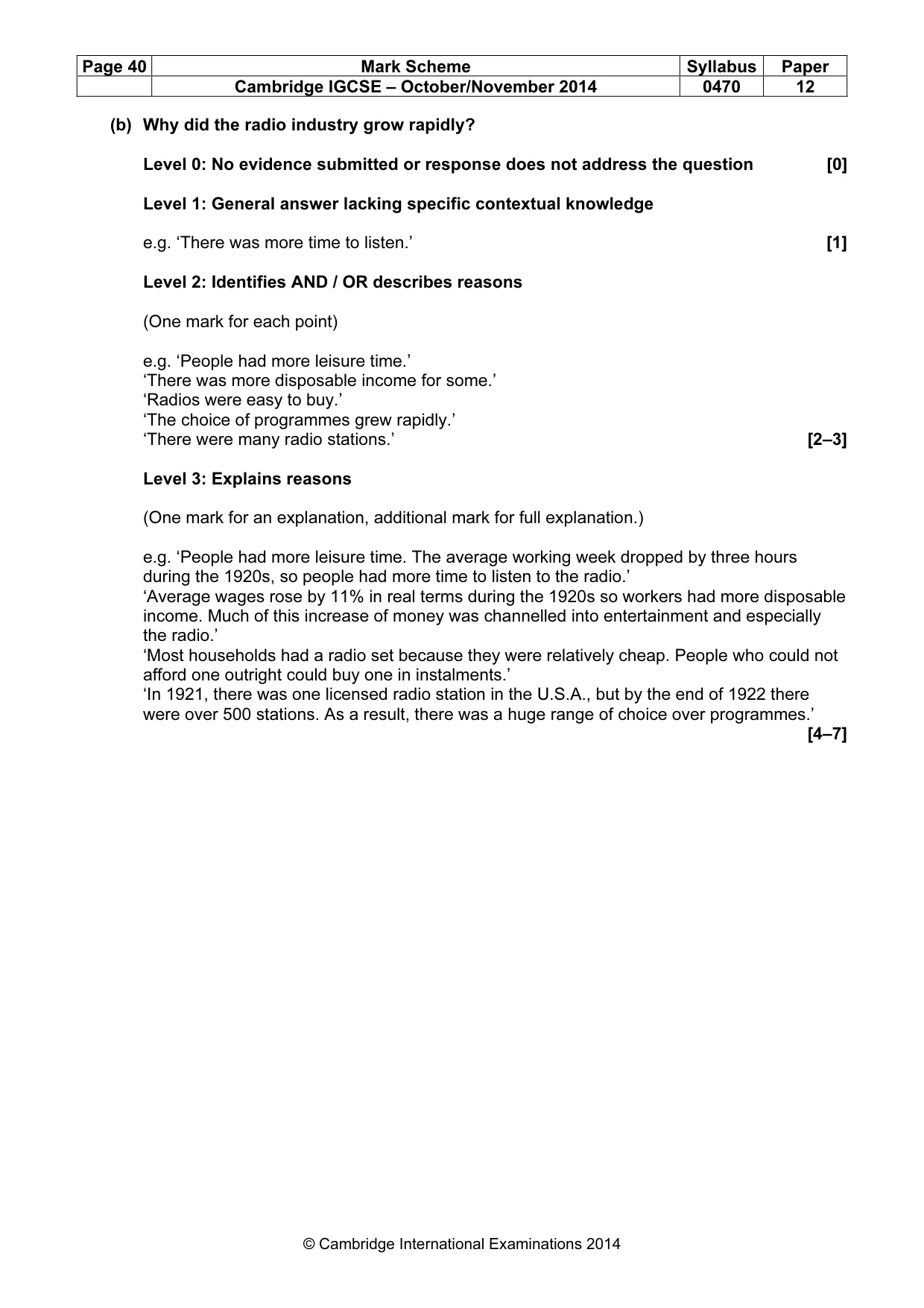
Page 40 Mark Scheme Syllabus Paper Cambridge IGCSE – October/November 2014 0470 12 © Cambridge International Examinations 2014 (b) Why did the radio industry grow rapidly? Level 0: No evidence submitted or response does not address the question [0] Level 1: General answer lacking specific contextual knowledge e.g. ‘There was more time to listen.’ [1] Level 2: Identifies AND / OR describes reasons (One mark for each point) e.g. ‘People had more leisure time.’ ‘There was more disposable income for some.’ ‘Radios were easy to buy.’ ‘The choice of programmes grew rapidly.’ ‘There were many radio stations.’ [2–3] Level 3: Explains reasons (One mark for an explanation, additional mark for full explanation.) e.g. ‘People had more leisure time. The average working week dropped by three hours during the 1920s, so people had more time to listen to the radio.’ ‘Average wages rose by 11% in real terms during the 1920s so workers had more disposable income. Much of this increase of money was channelled into entertainment and especially the radio.’ ‘Most households had a radio set because they were relatively cheap. People who could not afford one outright could buy one in instalments.’ ‘In 1921, there was one licensed radio station in the U.S.A., but by the end of 1922 there were over 500 stations. As a result, there was a huge range of choice over programmes.’ [4–7]
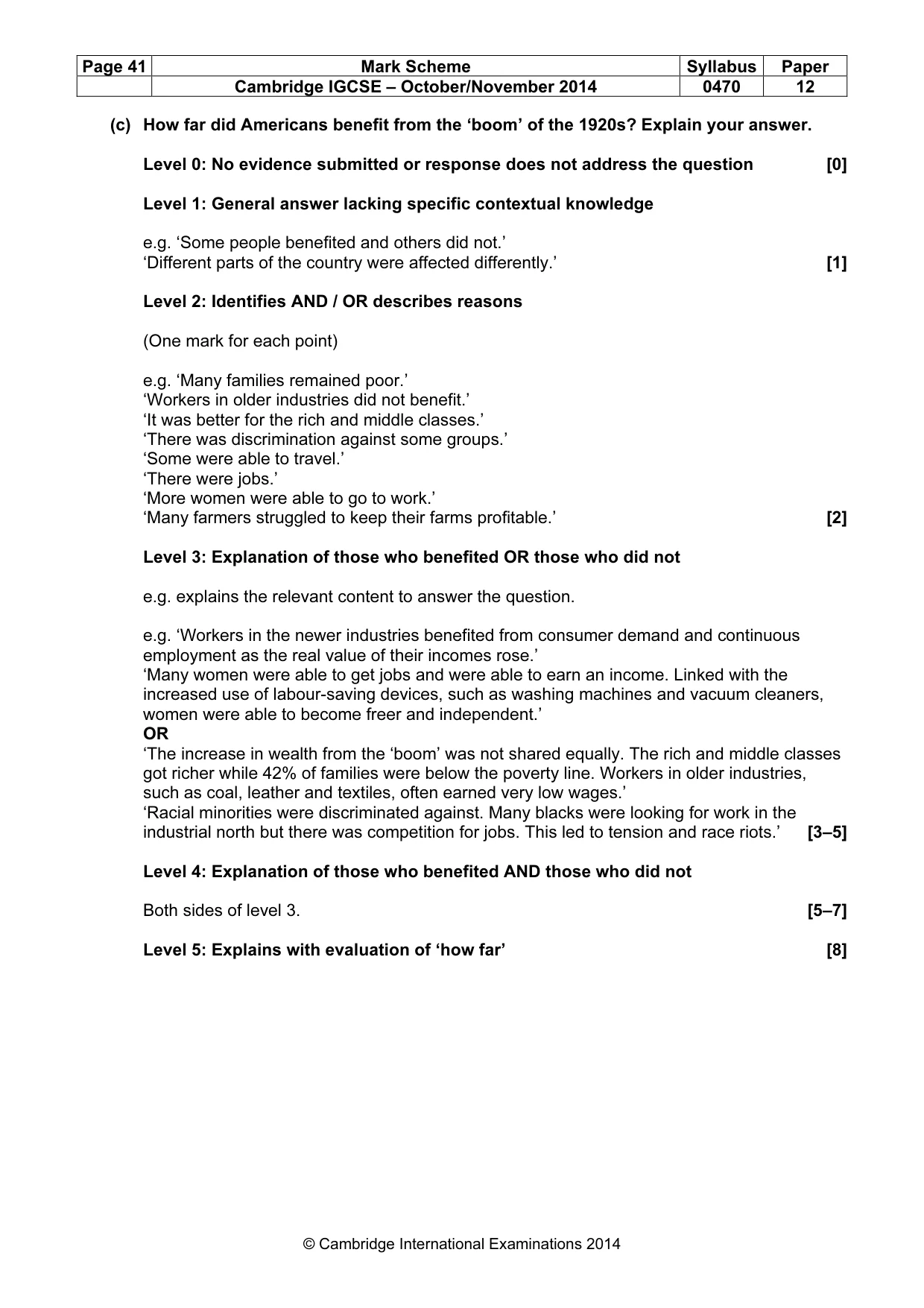
Mark scheme, page 41
Page 41 Mark Scheme Syllabus Paper Cambridge IGCSE – October/November 2014 0470 12 © Cambridge International Examinations 2014 (c) How far did Americans benefit from the ‘boom’ of the 1920s? Explain your answer. Level 0: No evidence submitted or response does not address the question [0] Level 1: General answer lacking specific contextual knowledge e.g. ‘Some people benefited and others did not.’ ‘Different parts of the country were affected differently.’ [1] Level 2: Identifies AND / OR describes reasons (One mark for each point) e.g. ‘Many families remained poor.’ ‘Workers in older industries did not benefit.’ ‘It was better for the rich and middle classes.’ ‘There was discrimination against some groups.’ ‘Some were able to travel.’ ‘There were jobs.’ ‘More women were able to go to work.’ ‘Many farmers struggled to keep their farms profitable.’ [2] Level 3: Explanation of those who benefited OR those who did not e.g. explains the relevant content to answer the question. e.g. ‘Workers in the newer industries benefited from consumer demand and continuous employment as the real value of their incomes rose.’ ‘Many women were able to get jobs and were able to earn an income. Linked with the increased use of labour-saving devices, such as washing machines and vacuum cleaners, women were able to become freer and independent.’ OR ‘The increase in wealth from the ‘boom’ was not shared equally. The rich and middle classes got richer while 42% of families were below the poverty line. Workers in older industries, such as coal, leather and textiles, often earned very low wages.’ ‘Racial minorities were discriminated against. Many blacks were looking for work in the industrial north but there was competition for jobs. This led to tension and race riots.’ [3–5] Level 4: Explanation of those who benefited AND those who did not Both sides of level 3. [5–7] Level 5: Explains with evaluation of ‘how far’ [8]
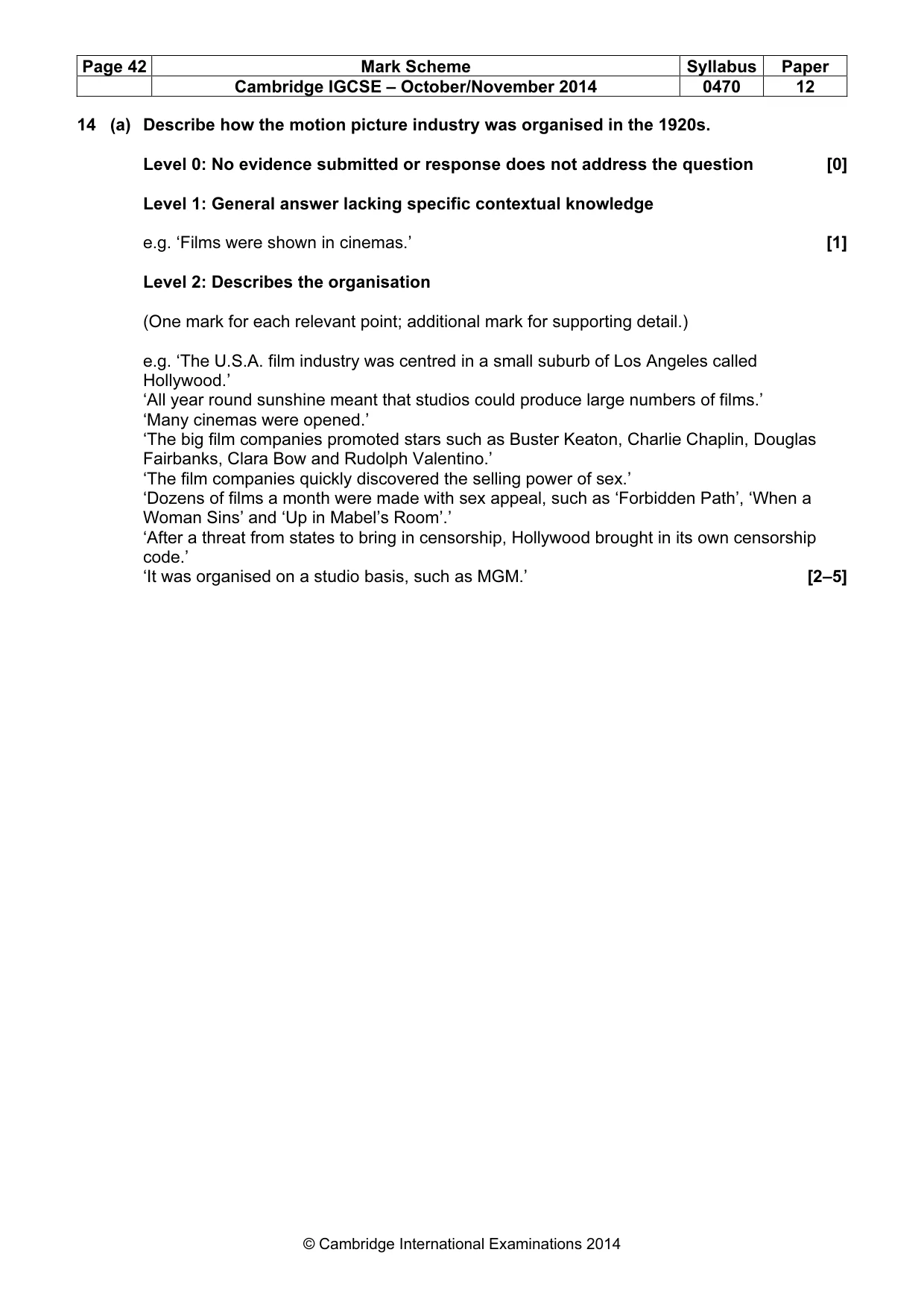
Mark scheme, page 42
Page 42 Mark Scheme Syllabus Paper Cambridge IGCSE – October/November 2014 0470 12 © Cambridge International Examinations 2014 14 (a) Describe how the motion picture industry was organised in the 1920s. Level 0: No evidence submitted or response does not address the question [0] Level 1: General answer lacking specific contextual knowledge e.g. ‘Films were shown in cinemas.’ [1] Level 2: Describes the organisation (One mark for each relevant point; additional mark for supporting detail.) e.g. ‘The U.S.A. film industry was centred in a small suburb of Los Angeles called Hollywood.’ ‘All year round sunshine meant that studios could produce large numbers of films.’ ‘Many cinemas were opened.’ ‘The big film companies promoted stars such as Buster Keaton, Charlie Chaplin, Douglas Fairbanks, Clara Bow and Rudolph Valentino.’ ‘The film companies quickly discovered the selling power of sex.’ ‘Dozens of films a month were made with sex appeal, such as ‘Forbidden Path’, ‘When a Woman Sins’ and ‘Up in Mabel’s Room’.’ ‘After a threat from states to bring in censorship, Hollywood brought in its own censorship code.’ ‘It was organised on a studio basis, such as MGM.’ [2–5]
Mark scheme, page 43
Page 43 Mark Scheme Syllabus Paper Cambridge IGCSE – October/November 2014 0470 12 © Cambridge International Examinations 2014 (b) Why did some people disapprove of young people’s behaviour? Level 0: No evidence submitted or response does not address the question [0] Level 1: General answer lacking specific contextual knowledge e.g. ‘Life was freer for some people.’ ‘It was part of the Roaring Twenties.’ [1] Level 2: Identifies AND / OR describes reasons (One mark for each point) e.g. ‘Some young people behaved outrageously.’ ‘Some did not behave like their parents.’ ‘Some thought the young were involved in one long party.’ ‘They dressed differently.’ ‘There was a difference in sexual morals.’ ‘Some people did not live the traditional life.’ ‘Young people wasted hard-earned money.’ [2–3] Level 3: Explains reasons (One mark for an explanation, additional mark for full explanation.) e.g. ‘After the war, many young people were determined to enjoy themselves. This upset many conservative-minded people who disapproved of their behaviour.’ ‘There were new attitudes among many young women. Some smoked and drank in public. They wore short skirts and bobbed their hair. They went unchaperoned to parties, dances and the cinema. Again, those with traditional beliefs disapproved of their appearance and the way they acted.’ ‘There was a new attitude amongst many young women in sexual morals. In the generation before the war, sex had been a taboo subject. After the war it became commonplace in tabloid newspapers, Hollywood films and everyday conversation. There was a strong conservative element in American society and the reaction of many women to the new morality was one of opposition and outrage.’ [4–7]
Mark scheme, page 44
Page 44 Mark Scheme Syllabus Paper Cambridge IGCSE – October/November 2014 0470 12 © Cambridge International Examinations 2014 (c) ‘Prohibition had a greater impact on American society in the 1920s than intolerance.’ How far do you agree with this statement? Explain your answer. Level 0: No evidence submitted or response does not address the question [0] Level 1: General answer lacking specific contextual knowledge e.g. ‘It was prohibition because they had to change the law to stop it.’ [1] Level 2: Identifies AND / OR describes reasons (One mark for each point) e.g. ‘There was a limit on immigrants.’ ‘The ‘Red Scare’ swept the country.’ ‘Black people were discriminated against in the South.’ ‘The Ku Klux Klan was intolerant.’ ‘Consumption of alcohol rose.’ ‘Organised crime increased.’ [2] Level 3: Explanation of agreement OR disagreement e.g. explains the relevant content to answer the question. e.g. ‘Prohibition had the undesired effect of making alcohol more attractive. Speakeasies opened up all over and the consumption of alcohol rose.’ ‘Gangsters, like Al Capone, organised the manufacture and sale of alcohol. From the huge profits they made, they could bribe policemen and city officials. This led to incidents like the St. Valentine’s Day Massacre of 1929.’ OR e.g. ‘The First World War created anti-foreigner feeling. Many Americans worried about the number of immigrants. The Johnson-Reid Act of 1924 put a limit of 150 000 per year and stopped Asian immigration entirely.’ ‘In the South, black people suffered under the ‘Jim Crow’ laws which kept them segregated from white people. Most blacks lived in poverty and in fear of lynch mobs.’ [3–5] Level 4: Explanation of agreement AND disagreement Both sides of level 3. [5–7] Level 5: Explains with evaluation of ‘how far’ [8]
Mark scheme, page 45
Page 45 Mark Scheme Syllabus Paper Cambridge IGCSE – October/November 2014 0470 12 © Cambridge International Examinations 2014 15 (a) Describe the efforts made in 1946 to avoid a civil war in China. Level 0: No evidence submitted or response does not address the question [0] Level 1: General answer lacking specific contextual knowledge e.g. ‘There were clashes even when there was a truce.’ [1] Level 2: Describes events (One mark for each relevant point; additional mark for supporting detail.) e.g. ‘In December 1945, the U.S.A. sent General Marshall to China to bring the two sides together.’ ‘In January 1946, they agreed a truce.’ ‘Marshall tried to get Mao and Chiang to form a coalition government.’ ‘Large campaigns and full scale confrontations were avoided.’ ‘In June 1946, the truce fell apart as full scale war broke out between the K.M.T. and the C.P.C.’ [2–5]
Mark scheme, page 46
Page 46 Mark Scheme Syllabus Paper Cambridge IGCSE – October/November 2014 0470 12 © Cambridge International Examinations 2014 (b) Why did a civil war start in China in 1946? Level 0: No evidence submitted or response does not address the question [0] Level 1: General answer lacking specific contextual knowledge e.g. ‘Both sides hated each other.’ [1] Level 2: Identifies AND / OR describes reasons (One mark for each point) e.g. ‘Ideology was so different.’ ‘Peasant support was with Mao.’ ‘Chiang was weakened more by the Japanese war.’ [2–3] Level 3: Explains reasons (One mark for an explanation, additional mark for full explanation.) e.g. ‘The Communists had peasant support as many were fed up with the way the Nationalists treated them. Mao’s reputation from the Long March was also strong.’ ‘When the Japanese surrendered in 1945, the Communists controlled 300 000 square miles and 95 million people. They did not want to give this up.’ ‘The Nationalists and the Communists believed in different ideologies which could not be reconciled. The Communists believed in helping the working class whereas Chiang got his support from landlords, generals and people with privilege. It was a corrupt regime. Both believed they were the rightful rulers.’ [4–7]
Mark scheme, page 47
Page 47 Mark Scheme Syllabus Paper Cambridge IGCSE – October/November 2014 0470 12 © Cambridge International Examinations 2014 (c) ‘The failures of Chiang Kai-shek resulted in the Communists winning the Civil War.’ How far do you agree with this statement? Explain your answer. Level 0: No evidence submitted or response does not address the question [0] Level 1: General answer lacking specific contextual knowledge e.g. ‘It was due to Communist successes.’ [1] Level 2: Identifies AND / OR describes reasons (One mark for each point) e.g. ‘Mao had the support of the peasants.’ ‘The Nationalists treated the people harshly.’ ‘Mao was seen as looking after China’s interests.’ ‘Chiang was corrupt.’ ‘The People’s Liberation Army used different tactics.’ ‘It was due to Mao’s leadership.’ [2] Level 3: Explanation of the failures of Chiang OR other reasons e.g. ‘Chiang became more and more of a dictator. Inflation was high and aid from the U.S.A. went into the pockets of Chiang, his family and friends.’ ‘The People’s Liberation Army was well commanded compared to the corrupt leadership of the K.M.T. The K.M.T. leaders treated the people in the areas they went into badly, unlike the Red Army.’ OR e.g. ‘It was Mao’s leadership which was the main reason for winning the Civil War. He was a popular leader as a result of the Long March. He also fought hard against the Japanese and he was recognised for defending China’s interests.’ [3–5] Level 4: Explanation of the failures of Chiang AND other reasons Both sides of level 3. [5–7] Level 5: Explains with evaluation of ‘how far’ [8]
Mark scheme, page 48
Page 48 Mark Scheme Syllabus Paper Cambridge IGCSE – October/November 2014 0470 12 © Cambridge International Examinations 2014 16 (a) What were ‘people’s courts’? Level 0: No evidence submitted or response does not address the question [0] Level 1: General answer lacking specific contextual knowledge e.g. ‘Courts set up by ordinary people.’ [1] Level 2: Describes features (One mark for each relevant point; additional mark for supporting detail.) e.g. ‘Peoples’ courts were set up in the early years of the Chinese Communist state.’ ‘The courts were often formed by villagers with the help from local Communist officials.’ ‘The courts were set up to deal with landlords.’ ‘The courts often sentenced the landlords to be executed because they had been an ‘evil’ to the Chinese people.’ ‘In 1951 alone, these courts executed over 250 000 landowners and capitalists.’ [2–5]
Mark scheme, page 49
Page 49 Mark Scheme Syllabus Paper Cambridge IGCSE – October/November 2014 0470 12 © Cambridge International Examinations 2014 (b) Why was ‘thought reform’ introduced by the Communists? Level 0: No evidence submitted or response does not address the question [0] Level 1: General answer lacking specific contextual knowledge e.g. ‘It was a new policy.’ [1] Level 2: Identifies AND / OR describes reasons (One mark for each point) e.g. ‘It was re-education.’ ‘It was a campaign against the Communists’ enemies.’ ‘It was to root out the ‘evils’ in Chinese life.’ ‘It was to get people to learn about Communism.’ [2–3] Level 3: Explains reasons (One mark for an explanation, additional mark for full explanation.) e.g. ‘Mao wanted a campaign launched against the enemies of Communism, usually landlords or businessmen. They had to be re-educated in favour of the thoughts of Marxist- Leninism or be punished.’ ‘Mao wanted a campaign to root out various ‘evils’ in Chinese life such as feudalism, capitalism, imperialism and corruption.’ ‘Mao wanted intellectuals to be sent to the fields or factories so that they could learn about Communism through manual labour.’ [4–7]
Mark scheme, page 50
Page 50 Mark Scheme Syllabus Paper Cambridge IGCSE – October/November 2014 0470 12 © Cambridge International Examinations 2014 (c) ‘Mao’s economic policies between 1952 and 1961 were unsuccessful.’ How far do you agree with this statement? Explain your answer. Level 0: No evidence submitted or response does not address the question [0] Level 1: General answer lacking specific contextual knowledge e.g. ‘There were mixed results despite the planning.’ [1] Level 2: Identifies AND / OR describes reasons (One mark for each point) e.g. ‘Some Chinese were starving by 1960.’ ‘Poor quality goods were produced.’ ‘There was considerable unemployment.’ ‘There was a successful Five Year Plan.’ ‘There was increased production of coal, steel, electricity and petrol.’ ‘Targets were set and early targets were met.’ ‘The Great Leap Forward had mixed results.’ [2] Level 3: Explanation of failures OR successes e.g. ‘The record harvest of 1958 was followed by three disastrous years where it was necessary to import wheat. Some Chinese were starving.’ ‘The Great Leap Forward brought inefficient small factories and low quality ‘backyard’ iron and steel, which was unusable.’ OR e.g. ‘With the help of Russian technical assistance and equipment, the Five Year Plan for heavy industry was a success. All targets had been exceeded by 1957.’ ‘Grain production reached record heights in 1952 and in 1955 private ownership of farms ceased to exist as collectives were introduced.’ [3–5] Level 4: Explanation of failures AND successes Both sides of level 3. [5–7] Level 5: Explains with evaluation of ‘how far’ [8]
Mark scheme, page 51
Page 51 Mark Scheme Syllabus Paper Cambridge IGCSE – October/November 2014 0470 12 © Cambridge International Examinations 2014 17 (a) What did Rhodes hope to achieve in Africa? Level 0: No evidence submitted or response does not address the question [0] Level 1: General answer lacking specific contextual knowledge e.g. ‘Control of large areas.’ [1] Level 2: Describes aims (One mark for each relevant point; additional mark for supporting detail.) e.g. ‘He wanted to expand Britain’s influence throughout the continent.’ ‘Rhodes wanted to bring great wealth to Britain and for himself.’ ‘Rhodes wanted British expansion from the Cape to Cairo.’ ‘He founded the British South Africa Company to develop the region between the Limpopo and the Zambezi.’ ‘He hoped to remove the influence of the Boers in Transvaal.’ [2–5]
Mark scheme, page 52
Page 52 Mark Scheme Syllabus Paper Cambridge IGCSE – October/November 2014 0470 12 © Cambridge International Examinations 2014 (b) Why did tensions between the Boers and the British increase prior to the outbreak of war in 1899? Level 0: No evidence submitted or response does not address the question [0] Level 1: General answer lacking specific contextual knowledge e.g. ‘The Boers and the British were in dispute.’ [1] Level 2: Identifies AND / OR describes reasons (One mark for each point) e.g. ‘The Boers did not like outsiders.’ ‘The Boers wanted to protect their land.’ ‘Cecil Rhodes caused trouble.’ ‘Rhodes held strong views about the role of the British government.’ [2–3] Level 3: Explains reasons (One mark for an explanation, additional mark for full explanation.) e.g. ‘There was a flood of gold seekers. The Boers called them ‘Uitlanders’ and did not like them. Kruger’s government imposed high taxes on the Uitlanders but refused them voting rights.’ ‘Cecil Rhodes stirred up trouble between the Uitlanders and the Kruger government. An example of this was the Jameson Raid in 1895. Kruger saw the raid as a British invasion of their territory and an indication of future intentions.’ [4–7]
Mark scheme, page 53
Page 53 Mark Scheme Syllabus Paper Cambridge IGCSE – October/November 2014 0470 12 © Cambridge International Examinations 2014 (c) ‘The British failed to deal successfully with South Africa between 1900 and 1910.’ How far do you agree with this statement? Explain your answer. Level 0: No evidence submitted or response does not address the question [0] Level 1: General answer lacking specific contextual knowledge e.g. ‘The Union did not solve the issues.’ [1] Level 2: Identifies AND / OR describes reasons (One mark for each point) e.g. ‘The British were accused of barbarism.’ ‘Only unskilled jobs were available for blacks.’ ‘Blacks seemed to have few rights.’ ‘The Union of South Africa remained under the British Crown.’ [2] Level 3: Explanation of success OR failure e.g. ‘The Union was under the British Crown as a self-governing dominion of the British Empire. The Monarch was represented by a Governor-General, but effective rule was in the hands of the Prime Minister.’ OR e.g. ‘Parliament consisted of a House of Assembly and the Senate. Parliament was elected from the white minority. Britain had failed to guarantee rights for black people.’ ‘The British had used concentration camps during the Boer War which caused many deaths and left resentment amongst the Boer population. For many Afrikaner leaders the early twentieth century was the time to right these wrongs.’ [3–5] Level 4: Explanation of success AND failure Both sides of level 3. [5–7] Level 5: Explains with evaluation of ‘how far’ [8]
Mark scheme, page 54
Page 54 Mark Scheme Syllabus Paper Cambridge IGCSE – October/November 2014 0470 12 © Cambridge International Examinations 2014 18 (a) What actions did the South African government take in the 1950s to ensure racial groups were separated? Level 0: No evidence submitted or response does not address the question [0] Level 1: General answer lacking specific contextual knowledge e.g. ‘There were different areas for them.’ [1] Level 2: Describes actions (One mark for each relevant point; additional mark for supporting detail.) e.g. ‘There were separate schools for blacks and whites.’ ‘There were separate ‘homelands’ for black people called Bantustans.’ ‘There were controls on the movement of black people in and out of towns.’ ‘Black people living in white areas had to have a pass or reference book.’ ‘No black person could leave a rural area for an urban area without a permit.’ ‘Park areas and beach areas were often reserved for white people only.’ ‘There were separate queues for white people and black people at bus stops.’ [2–5]
Mark scheme, page 55
Page 55 Mark Scheme Syllabus Paper Cambridge IGCSE – October/November 2014 0470 12 © Cambridge International Examinations 2014 (b) Why was apartheid popular with many white South Africans in the 1950s and 1960s? Level 0: No evidence submitted or response does not address the question [0] Level 1: General answer lacking specific contextual knowledge e.g. ‘It made white South Africans feel superior.’ [1] Level 2: Identifies AND / OR describes reasons (One mark for each point) e.g. ‘It restricted the position of black people in society.’ ‘It restricted the ability of black people to learn.’ ‘It gave white people the best facilities.’ ‘Black people were often servants to white home owners.’ ‘Skilled work was reserved for white people only.’ [2–3] Level 3: Explains reasons (One mark for an explanation, additional mark for full explanation.) e.g. ‘The Bantu Education Act meant there were separate schools for black children and white children. White education was well funded with high quality facilities, materials and teachers. It was free for whites. In comparison, black children had to pay for their education. They were taught only three hours per day in large classes.’ ‘The best neighbourhoods were reserved for whites and access to these areas was limited for black people by the pass system.’ ‘Many of the white population had servants to do all household chores which meant many whites lived a life of leisure and luxury. Most of the large farms were white owned and the labouring was done by the black workers.’ [4–7]
Mark scheme, page 56
Page 56 Mark Scheme Syllabus Paper Cambridge IGCSE – October/November 2014 0470 12 © Cambridge International Examinations 2014 (c) How successful was apartheid in the 1950s and 1960s? Explain your answer. Level 0: No evidence submitted or response does not address the question [0] Level 1: General answer lacking specific contextual knowledge e.g. ‘It depended on whether you were black or white.’ [1] Level 2: Identifies AND / OR describes reasons (One mark for each point) e.g. ‘Whites owned the majority of wealth and land.’ ‘Black people had sub-standard public services.’ ‘There were harsh laws for opposing apartheid.’ ‘The Treason Trials removed the leadership of the A.N.C. for 5 years.’ ‘White taxes were high.’ ‘International sport was limited.’ [2] Level 3: Explanation of success OR limitations e.g. ‘Apartheid gave the white population a good standard of living. Most of the physical labour was done by the black, coloured or Indian population.’ ‘The white population owned and lived on 87% of the land in South Africa, while most of the black population lived on Bantustans where the land was poor for farming.’ OR e.g. ‘Many of the white population complained that they could not play international sport because other countries would not play them at cricket, soccer and rugby because of apartheid.’ [3–5] Level 4: Explanation of success AND limitations Both sides of level 3. [5–7] Level 5: Explains with evaluation of ‘how successful’ [8]
Mark scheme, page 57
Page 57 Mark Scheme Syllabus Paper Cambridge IGCSE – October/November 2014 0470 12 © Cambridge International Examinations 2014 19 (a) Describe the establishment of German colonial rule in Namibia. Level 0: No evidence submitted or response does not address the question [0] Level 1: General answer lacking specific contextual knowledge e.g. ‘Land was acquired by deceit.’ [1] Level 2: Describes events (One mark for each relevant point; additional mark for supporting detail.) e.g. ‘Luderitz was a German merchant hoping to find mineral wealth, especially diamonds, gold and silver.’ ‘He was looking for land with minerals before it was claimed by a European power.’ ‘They bought their first piece of land for a derisory sum in 1883.’ ‘They acquired land by cheating Chief Frederick using ‘geographical miles’.’ ‘In 1884, they acquired land around Walvis Bay. At the time, this land was placed under the protection of Germany.’ [2–5]
Mark scheme, page 58
Page 58 Mark Scheme Syllabus Paper Cambridge IGCSE – October/November 2014 0470 12 © Cambridge International Examinations 2014 (b) Why was there resistance to the German colonisation of Namibia? Level 0: No evidence submitted or response does not address the question [0] Level 1: General answer lacking specific contextual knowledge e.g. ‘The people were unhappy with the way they were treated.’ [1] Level 2: Identifies AND / OR describes reasons (One mark for each point) e.g. ‘The Herero were unhappy with the way they were treated by the Germans.’ ‘The Treaty was invalid.’ ‘The Germans took cattle.’ ‘The Germans wanted more land.’ [2–3] Level 3: Explains reasons (One mark for an explanation, additional mark for full explanation.) e.g. ‘Tension still existed after the protection treaty because of the arrogance of the Germans, who disregarded its terms by stealing cattle and taking more land.’ ‘In 1888, Maherero declared the Treaty with the Germans invalid. This was unacceptable to the Germans.’ ‘The Germans sent troops to Namibia to put down resistance. It was stated that these troops were on a scientific expedition.’ [4–7]
Mark scheme, page 59
Page 59 Mark Scheme Syllabus Paper Cambridge IGCSE – October/November 2014 0470 12 © Cambridge International Examinations 2014 (c) How far were Namibia and its people affected by the First World War? Explain your answer. Level 0: No evidence submitted or response does not address the question [0] Level 1: General answer lacking specific contextual knowledge e.g. ‘Most Namibians were not involved in the fighting.’ [1] Level 2: Identifies AND / OR describes reasons (One mark for each point) e.g. ‘The Germans surrendered to a South African force in July 1915.’ ‘Some Rehobothers were killed as they refused to guard South African prisoners of war.’ ‘Many Namibians were forced to move settlements during the war.’ ‘The mandate was given to the British.’ ‘South Africa wanted Namibia.’ [2] Level 3: Explanation of importance of the First World War OR not important e.g. ‘During the war, the Germans evacuated many settlements with the inhabitants forced to leave behind all their possessions.’ ‘‘The defeat of Germany removed control from a harsh and often cruel country, but this did not mean the end of colonial oppression as the country was now occupied by a South African army.’ OR e.g. ‘The majority of Namibians were not affected by the fighting as this was mainly between Germany and South Africa.’ [3–5] Level 4: Explanation of importance of the First World War AND not important Both sides of level 3. [5–7] Level 5: Explains with evaluation of ‘how far’ [8]
Mark scheme, page 60
Page 60 Mark Scheme Syllabus Paper Cambridge IGCSE – October/November 2014 0470 12 © Cambridge International Examinations 2014 20 (a) Describe what happened in Palestine when the Second World War came to an end in 1945. Level 0: No evidence submitted or response does not address the question [0] Level 1: General answer lacking specific contextual knowledge e.g. ‘There was a very uncertain future.’ [1] Level 2: Describes events (One mark for each relevant point; additional mark for supporting detail.) e.g. ‘When the war ended, the British announced that there would be no change in policy in Palestine.’ ‘The British stated that there would be no big increase in immigration.’ ‘They stated there would be no separate Jewish state.’ ‘The Zionists decided on a policy of active opposition to British rule in Palestine.’ ‘There would be a campaign of violence by the Irgun.’ ‘Arab Palestinians did not want any more Jewish immigration.’ ‘The British stopped boatloads of illegal Jewish immigrants from landing in Palestine.’ [2–5]
Mark scheme, page 61
Page 61 Mark Scheme Syllabus Paper Cambridge IGCSE – October/November 2014 0470 12 © Cambridge International Examinations 2014 (b) Explain why the British government decided to withdraw from Palestine in 1948. Level 0: No evidence submitted or response does not address the question [0] Level 1: General answer lacking specific contextual knowledge e.g. ‘Britain did not want to stay.’ [1] Level 2: Identifies AND / OR describes reasons (One mark for each point) e.g. ‘There was much violence towards the British.’ ‘It was too costly and Britain was in heavy debt.’ ‘The pressure from Irgun.’ ‘Its view on Zionism.’ ‘Because of the guerrilla campaign.’ ‘There was pressure from the U.S.A.’ ‘There was a new organisation set up to deal with problems.’ ‘Britain was war weary.’ [2–3] Level 3: Explains reasons (One mark for an explanation, additional mark for full explanation.) e.g. ‘At the end of the war, Britain was under great pressure to change its policy and allow in survivors of the holocaust. They refused and this brought about violent protest.’ ‘The Irgun deliberately attacked and killed British soldiers including the explosion at the King David Hotel. The violence from the Irgun was intended to persuade the British to leave.’ ‘The Arabs continued to block any proposals regarding partition and yet the U.S. was putting pressure on Britain to accept a separate Jewish state.’ ‘The British were finding it too expensive to keep large numbers of troops there, especially having just fought a costly war. The new Labour Government had an expensive programme of social policies and needed to trim the budget elsewhere.’ ‘There was a new organisation, the United Nations Organisation, set up to deal with international problems such as Palestine.’ [4–7]
Mark scheme, page 62
Page 62 Mark Scheme Syllabus Paper Cambridge IGCSE – October/November 2014 0470 12 © Cambridge International Examinations 2014 (c) ‘The war of 1948–1949 solved nothing.’ How far do you agree with this statement? Explain your answer. Level 0: No evidence submitted or response does not address the question [0] Level 1: General answer lacking specific contextual knowledge e.g. ‘It solved nothing as there was war again soon after the 1948–1949 War.’ [1] Level 2: Identifies AND / OR describes reasons (One mark for each point) e.g. ‘A Jewish state was established.’ ‘There were large numbers of migrants.’ ‘Most Arab Palestinians fled.’ ‘The U.N. had failed.’ ‘Arab governments were humiliated.’ ‘Problems were stored up for the future.’ [2] Level 3: Explanation of success OR failure e.g. ‘A Jewish state was established within the territory controlled by the Jewish forces. The Gaza Strip, east Jerusalem and the West Bank were the only areas outside Israeli control.’ ‘As a result of the establishment of the state, large numbers of Jewish migrants, especially from Europe, moved to the new state.’ OR e.g. ‘The majority of Arab Palestinians fled from Israel and became refugees. Only a minority remained in the Jewish controlled state. Most Palestinian Arabs feared reprisals and therefore fled to the West Bank and the Gaza Strip.’ ‘The U.N. had failed in its first attempt to sort out a problem. The Jews had seized 79% of what had been the British mandate of Palestine rather than the 55% allocated to the new state by the U.N., thus storing up future problems.’ [3–5] Level 4: Explanation of success AND failure Both sides of level 3. [5–7] Level 5: Explains with evaluation of ‘how far’ [8]
Mark scheme, page 63
Page 63 Mark Scheme Syllabus Paper Cambridge IGCSE – October/November 2014 0470 12 © Cambridge International Examinations 2014 21 (a) Describe the origins of the Palestine Liberation Organisation (P.L.O.). Level 0: No evidence submitted or response does not address the question [0] Level 1: General answer lacking specific contextual knowledge e.g. ‘It was born out of a hatred for Israel.’ [1] Level 2: Describes events (One mark for each relevant point; additional mark for supporting detail.) e.g. ’Nasser, after the Suez Crisis, proclaimed that Israel was becoming an outpost for Western imperialism.’ ‘Nasser called a meeting of the leaders of the Arab states.’ ‘They met in Cairo in 1964.’ ‘At the meeting, the Arab leaders set up the P.L.O.’ ‘They vowed to destroy the Israeli state.’ ‘At the meeting, they stated that the P.L.O. would help win back Palestinian land lost in 1948–1949.’ ‘In 1965, a guerrilla group called Fatah, which was part of the P.L.O., carried out its first raid on Israel.’ ‘It was founded by Yasser Arafat.’ ‘It had bases in Syria, Jordan and Lebanon.’ [2–5]
Mark scheme, page 64
Page 64 Mark Scheme Syllabus Paper Cambridge IGCSE – October/November 2014 0470 12 © Cambridge International Examinations 2014 (b) Why did tension exist between King Hussein of Jordan and the P.L.O.? Level 0: No evidence submitted or response does not address the question [0] Level 1: General answer lacking specific contextual knowledge e.g. ‘There was a power struggle.’ [1] Level 2: Identifies AND / OR describes reasons (One mark for each point) e.g. ‘The main base for the P.L.O. became Jordan after 1967.’ ‘Some members of the P.L.O. disapproved of Hussein.’ ‘The P.L.O. became too powerful.’ ‘The P.L.O. was a threat to Hussein’s authority.’ ‘Hussein feared reprisal attacks from Israel after P.L.O. actions.’ [2–3] Level 3: Explains reasons (One mark for an explanation, additional mark for full explanation.) e.g. ‘King Hussein disliked Fatah and the P.L.O. as they were a threat to his authority. In towns in Jordan, they were often driving around in jeeps, heavily armed, organising roadblocks and demanding money for their cause.’ ‘Tension increased as new guerrilla groups, using extreme methods, came into being. They organised a series of aircraft hijacks in which many civilians died.’ ‘Hussein feared that the Israelis might target Jordan because of the terrorist actions taken by the P.L.O. against Israeli citizens.’ ‘Some members of the P.L.O. disapproved of Hussein and wanted him removed from power. This led to fierce fighting between the P.L.O. and the Jordanians. The P.L.O. was forced to leave.’ [4–7]
Mark scheme, page 65
Page 65 Mark Scheme Syllabus Paper Cambridge IGCSE – October/November 2014 0470 12 © Cambridge International Examinations 2014 (c) ‘By 1993 the P.L.O. had been successful in their efforts for the Palestinian cause.’ How far do you agree with this statement? Explain your answer. Level 0: No evidence submitted or response does not address the question [0] Level 1: General answer lacking specific contextual knowledge e.g. ‘It was effective in the eyes of some, but many condemned the violence.’ [1] Level 2: Identifies AND / OR describes reasons (One mark for each point) e.g. ‘It provided a voice for Palestinians.’ ‘It gained massive publicity with its tactics.’ ‘There were many splinter groups.’ ‘They had to change their approach.’ ‘It was recognised as the sole voice of the Palestinian people.’ [2] Level 3: Explanation of success OR failure e.g. ‘The success of Fatah at Karama in 1968 encouraged more recruits to the P.L.O. and it became the independent voice for the Palestinians.’ ‘In 1988, Arafat finally publicly accepted the existence of Israel and the principle of U.N. Resolution 242. The Americans invited the P.L.O. to talks.’ ‘In 1993, Rabin and Arafat signed the Oslo Accord, which paved the way for a step-by-step approach towards self-government for the Palestinians.’ OR e.g. ‘Many people condemned the P.L.O. for its attacks on civilians despite many understanding the thinking behind the approach.’ ‘The violence used by the P.L.O. meant it was forced out of Jordan, and then it was driven out of the Lebanon before making its headquarters in Tunisia.’ ‘Despite the Oslo Accord, the P.L.O. realised there were issues which were unresolved, such as the future of Jerusalem, Jewish settlements in the occupied territories and what was to constitute as the Palestinian state.’ [3–5] Level 4: Explanation of success AND failure Both sides of level 3. [5–7] Level 5: Explains with evaluation of ‘how far’ [8]
Mark scheme, page 66
Page 66 Mark Scheme Syllabus Paper Cambridge IGCSE – October/November 2014 0470 12 © Cambridge International Examinations 2014 22 (a) What was bad about working in an early nineteenth-century textile factory? Level 0: No evidence submitted or response does not address the question [0] Level 1: General answer lacking specific contextual knowledge e.g. ‘The atmosphere was poor.’ ‘The workers were treated badly.’ [1] Level 2: Describes what was bad (One mark for each relevant point; additional mark for supporting detail.) e.g. ‘The atmosphere was poor with little ventilation and damp, humid air.’ ‘There was a smell of oil and there was poor lighting.’ ‘Workers worked very long hours and there was harsh discipline.’ ‘The wages were low and it meant a whole family having to work.’ ‘There were very young children employed and they found it difficult to keep awake.’ ‘It was a dangerous place to work with unguarded machinery.’ ‘Young children were expected to crawl under moving machinery.’ ‘Workers could catch ‘factory fever’.’ [2–5]
Mark scheme, page 67
Page 67 Mark Scheme Syllabus Paper Cambridge IGCSE – October/November 2014 0470 12 © Cambridge International Examinations 2014 (b) Why was there a need to increase iron production during the first half of the nineteenth century? Level 0: No evidence submitted or response does not address the question [0] Level 1: General answer lacking specific contextual knowledge e.g. ‘It was needed for new developments.’ ‘The population increased and needed more items.’ [1] Level 2: Identifies AND / OR describes reasons (One mark for each point) e.g. ‘Iron was needed in transport developments.’ ‘It was needed to make machines.’ ‘It was needed for the new developments in the Industrial Revolution.’ ‘It was needed for aspects of warfare.’ [2–3] Level 3: Explains reasons (One mark for an explanation, additional mark for full explanation.) e.g. ‘There was a big increase in demand for iron because of the increase in warfare, especially during the Napoleonic Wars. There was a need for guns, cannons and wheel axles.’ ‘In industry there was an increase in demand for iron because of the new machines used during the Industrial Revolution. Iron was needed for coal mining winding gear, steam pumps and engines.’ ‘In transport, there was a huge demand for iron from the railway industry for rails and engines. Brunel started the trend of building iron ships.’ ‘As the population increased, there was a large demand for iron in domestic items, such as pots, pans and bedsteads.’ [4–7]
Mark scheme, page 68
Page 68 Mark Scheme Syllabus Paper Cambridge IGCSE – October/November 2014 0470 12 © Cambridge International Examinations 2014 (c) How successful was government legislation in improving working conditions for children in the first half of the nineteenth century? Explain your answer. Level 0: No evidence submitted or response does not address the question [0] Level 1: General answer lacking specific contextual knowledge e.g. ‘Some children were not allowed to work.’ [1] Level 2: Identifies AND / OR describes reasons (One mark for each point) e.g. ‘The Factory Acts reduced hours.’ ‘The Factory Acts and Mines Act were difficult to enforce.’ ‘Night work stopped.’ ‘Some did not mind the conditions and were unhappy when they changed.’ [2] Level 3: Explanation of success OR lack of success e.g. ‘The Acts of 1802 and 1819 reduced the hours of orphan apprentices and said no child under 9 was to work. Older children could work no more than 12 hours and were not allowed to do night work.’ ‘The 1833 Act stopped children under 9 working and reduced the hours of older children. No- one under 18 was to work nights. Four inspectors were appointed.’ ‘The Mines Act of 1842 stopped children under ten from working underground.’ OR e.g. ‘There were no factory inspectors to enforce the early Acts and later there were only four inspectors for the whole country, which was clearly inadequate.’ ‘Enforcement of the Mines Act was difficult as mines inspectors were not allowed underground until 1850, and so could not really know what was happening in the mines.’ [3–5] Level 4: Explanation of success AND lack of success Both sides of level 3. [5–7] Level 5: Explains with evaluation of ‘how successful’ [8]
Mark scheme, page 69
Page 69 Mark Scheme Syllabus Paper Cambridge IGCSE – October/November 2014 0470 12 © Cambridge International Examinations 2014 23 (a) What were the disadvantages of roads for Britain’s transport needs at the beginning of the nineteenth century? Level 0: No evidence submitted or response does not address the question [0] Level 1: General answer lacking specific contextual knowledge e.g. ‘Travelling by road was slow.’ ‘It could be expensive.’ [1] Level 2: Describes disadvantages (One mark for each relevant point; additional mark for supporting detail.) e.g. ‘Many stretches of road were just mud tracks or rutted.’ ‘It was difficult for coaches to gain any speed because of pot-holes.’ ‘It was common for coaches to lose wheels.’ ‘Wagons moving heavy goods often sank in the mud, especially in the winter months.’ ‘Pack horses were often used because the road was unsuitable for wagons.’ ‘Finished goods, such as pottery, could be damaged when travelling by road.’ ‘There was no uniform system of repairs.’ ‘Turnpike roads improved the surface of many roads but it was expensive to travel along them, especially when moving goods and animals.’ [2–5]
Mark scheme, page 70
Page 70 Mark Scheme Syllabus Paper Cambridge IGCSE – October/November 2014 0470 12 © Cambridge International Examinations 2014 (b) Why were railways of benefit to people in their daily lives? Level 0: No evidence submitted or response does not address the question [0] Level 1: General answer lacking specific contextual knowledge e.g. ‘They helped people become more mobile.’ [1] Level 2: Identifies AND / OR describes reasons (One mark for each point) e.g. ‘People could travel to work by train.’ ‘People could go on holiday.’ ‘People were able to get information more readily.’ ‘The greatest impact was on employment.’ [2–3] Level 3: Explains reasons (One mark for an explanation, additional mark for full explanation.) e.g. ‘Railways increased the mobility of workers and allowed suburbs to develop so people could live outside the unhealthy towns.’ ‘Railways provided a source of employment as station officials, guards, engine drivers and signal men. Associated industries, such as iron, steel and coal, had increased employment because of the railways.’ ‘Railways were a cheap means of travel encouraging day trips and holidays to places such as Blackpool.’ ‘Fresh agricultural produce, such as milk and fish, could be brought to markets in the towns and cities. Fresh vegetables and fruit were available in the towns improving the health of the nation.’ ‘Standard time was used with the introduction of railway timetables.’ ‘Organised sport developed as players and spectators could travel more easily.’ [4–7]
Mark scheme, page 71
Page 71 Mark Scheme Syllabus Paper Cambridge IGCSE – October/November 2014 0470 12 © Cambridge International Examinations 2014 (c) ‘Brunel made a greater contribution than any other person to the development of railways.’ How far do you agree with this statement? Explain your answer. Level 0: No evidence submitted or response does not address the question [0] Level 1: General answer lacking specific contextual knowledge e.g. ‘Brunel developed railways in the South.’ ‘The Stephensons developed railways in the North.’ [1] Level 2: Identifies AND / OR describes reasons (One mark for each point) e.g. ‘Brunel introduced the broad gauge.’ ‘Brunel built Box Tunnel.’ ‘Brunel was the Chief Engineer of the Great Western Railway.’ ‘Brunel built the Bristol to Exeter line.’ ‘Brunel constructed the South Devon and Cornish Railways.’ ‘Stephenson introduced the standard gauge.’ ‘The Stephensons built ‘The Rocket’.’ ‘George Stephenson was engineer of the Liverpool to Manchester Railway.’ [2] Level 3: Explanation of the impact of Brunel OR the impact of other engineers e.g. ‘Brunel was Chief Engineer of the Great Western Railway and he built the line from Bristol to London. It included two difficult engineering problems which were overcome by the Sonning Cutting in Berkshire and Box Tunnel near Bath.’ ‘Brunel used the broad gauge of just over seven feet to ensure comfort, safety and increased speed.’ OR e.g. ‘George Stephenson introduced the narrow gauge of 4 feet 8 ½ inches. This became known as the standard gauge and eventually was accepted nationwide.’ ‘George Stephenson was chief engineer and Robert chief surveyor of the Liverpool to Manchester Railway and overcame many difficulties including Chat Moss.’ [3–5] Level 4: Explanation of the impact of Brunel AND the impact of other engineers Both sides of level 3. [5–7] Level 5: Explains with evaluation of ‘how far’ [8]
Mark scheme, page 72
Page 72 Mark Scheme Syllabus Paper Cambridge IGCSE – October/November 2014 0470 12 © Cambridge International Examinations 2014 24 (a) What was the role of the East India Company in the Indian sub-continent? Level 0: No evidence submitted or response does not address the question [0] Level 1: General answer lacking specific contextual knowledge e.g. ‘The Company’s role was trading.’ ‘It was a role which evolved over many years.’ [1] Level 2: Describes role (One mark for each relevant point; additional mark for supporting detail.) e.g. ‘It was a private trading organisation which began trading with the East Indies in 1600.’ ‘It set up trading stations at Calcutta, Bombay and Madras.’ ‘It traded tea, silks, cotton, precious stones, spices and saltpetre.’ ‘It expanded by using bribes to exploit the greed of the rajah rulers.’ ‘It formed its own army to protect friendly governments.’ ‘It allowed friendly princes to rule their own territories.’ ‘It only interfered in the ruling of territories when it felt it was necessary.’ [2–5]
Mark scheme, page 73
Page 73 Mark Scheme Syllabus Paper Cambridge IGCSE – October/November 2014 0470 12 © Cambridge International Examinations 2014 (b) Why were Bentinck’s proposals for India controversial? Level 0: No evidence submitted or response does not address the question [0] Level 1: General answer lacking specific contextual knowledge e.g. ‘Indians resented British interference.’ ‘Bentinck wanted to save money.’ [1] Level 2: Identifies AND / OR describes reasons (One mark for each point) e.g. ‘His proposals attempted to westernise India.’ ‘Bentinck wanted to outlaw many Indian traditions.’ ‘His proposals could be viewed as ignoring the main religions in India.’ ‘The English language was promoted above the native languages.’ [2–3] Level 3: Explains reasons (One mark for an explanation, additional mark for full explanation.) e.g. ‘Bentinck proposed a policy of ‘westernisation’, which took the form of reforming the legal system using English as the official language. He proposed introducing a western style education system with English being the language used. Many Indians considered these proposals as lacking respect for India’s systems.’ ‘Bentinck wanted to turn around the money-losing East India Company. To do this, he suggested selling marble and metal. He upset Indians by suggesting that the Taj Mahal should be knocked down and the materials sold.’ ‘Many Indians felt that his proposals were unnecessary interference in the traditions and culture of the Indian population, such as suppressing sati/suttee when widows threw themselves on their husbands’ funeral pyres.’ [4–7]
Mark scheme, page 74
Page 74 Mark Scheme Syllabus Paper Cambridge IGCSE – October/November 2014 0470 12 © Cambridge International Examinations 2014 (c) How far was nineteenth-century India changed by British rule? Explain your answer. Level 0: No evidence submitted or response does not address the question [0] Level 1: General answer lacking specific contextual knowledge e.g. ‘Life improved for some people in nineteenth-century India.’ [1] Level 2: Identifies AND / OR describes reasons (One mark for each point) e.g. ‘Communications improved.’ ‘New technology was introduced.’ ‘Attempts were made to change the culture.’ ‘British control strengthened after the Mutiny.’ ‘There were famines.’ [2] Level 3: Explanation of positive changes OR negative impact e.g. ‘During Dalhousie’s term of office, a cheap postal service, the electric telegraph, good roads and the first railways were introduced to improve communications.’ ‘He began a system of elementary education, hospitals and universities.’ OR e.g. ‘There remained enormous poverty and frequent famines. In 1887, over 5 000 000 died.’ ‘Most government posts remained in the hands of Europeans.’ ‘The Indians felt they were treated as second class citizens by the British as all the important decisions were made by the British government.’ [3–5] Level 4: Explanation of positive changes AND negative impact Both sides of level 3. [5–7] Level 5: Explains with evaluation of ‘how far’ [8]
Mark scheme, page 75
Page 75 Mark Scheme Syllabus Paper Cambridge IGCSE – October/November 2014 0470 12 © Cambridge International Examinations 2014 25 (a) What was the ‘Scramble for Africa’? Level 0: No evidence submitted or response does not address the question [0] Level 1: General answer lacking specific contextual knowledge e.g. ‘It was a scramble for colonies.’ [1] Level 2: Describes ‘Scramble for Africa’ (One mark for each relevant point; additional mark for supporting detail.) e.g. ‘It was an attempt to tap into the wealth that existed in Africa.’ ‘The scramble for colonies was due to the growing commercial rivalry.’ ‘There was a need to secure vital necessities for industrial enterprise and expansion.’ ‘It was an attempt to foster trade and find an outlet for manufactured goods.’ ‘There was a need to provide new areas of work and employment for the growing home population.’ ‘It was a way of strengthening empires.’ ‘It was a way of maintaining trade routes.’ [2–5]
Mark scheme, page 76
Page 76 Mark Scheme Syllabus Paper Cambridge IGCSE – October/November 2014 0470 12 © Cambridge International Examinations 2014 (b) Why were European countries interested in Africa? Level 0: No evidence submitted or response does not address the question [0] Level 1: General answer lacking specific contextual knowledge e.g. ‘To find out more about Africa.’ ‘To increase status.’ [1] Level 2: Identifies AND / OR describes reasons (One mark for each point) e.g. ‘Countries wanted to build an empire.’ ‘To keep up with their rivals.’ ‘They wanted to establish trade.’ ‘Countries saw the financial benefits of these territories.’ ‘To learn about the unknown continent.’ ‘To spread Christianity.’ [2–3] Level 3: Explains reasons (One mark for an explanation, additional mark for full explanation.) e.g. ‘Missionaries, like Dr.Livingstone, wanted to spread Christianity and to try to persuade natives to give up barbaric practices. They wanted to establish schools and hospitals to give the natives a better life.’ ‘There were strong economic reasons. The colony would be expected to contribute raw materials and food products and provide a market for manufactured goods.’ ‘It was an opportunity for investors to invest surplus profits into new projects and so create new markets for their manufactures.’ ‘Countries were proud of their empires. Many statesmen wanted colonies to balance those acquired by their competitors.’ [4–7]
Mark scheme, page 77
Page 77 Mark Scheme Syllabus Paper Cambridge IGCSE – October/November 2014 0470 12 © Cambridge International Examinations 2014 (c) How far did imperialism in Africa benefit Europeans? Explain your answer. Level 0: No evidence submitted or response does not address the question [0] Level 1: General answer lacking specific contextual knowledge e.g. ‘It introduced conflict.’ ‘Africa became more developed.’ [1] Level 2: Identifies AND / OR describes reasons (One mark for each point) e.g. ‘Europeans made a lot of money.’ ‘Europeans gained minerals.’ ‘Europeans gained new markets.’ ‘Africans gained a new infrastructure.’ ‘Africans gained education and medical help.’ ‘Christianity was introduced to Africans.’ [2] Level 3: Explanation of benefits to Europeans OR lack of benefits e.g. ‘Europeans gained tremendous wealth from Africa in the form of minerals, such as gold and copper, and in precious stones, such as diamonds.’ ‘Europeans started plantations to produce cocoa, groundnuts, palm oil, rubber and valuable cash crops. The benefits from these plantations went home to the European countries.’ OR e.g. ‘European countries did spend considerable sums of money building up the infrastructure and services for parts of Africa. This included building roads, dams, schools and clinics. Africans gained much from this, at European expense.’ [3–5] Level 4: Explanation of benefits to Europeans AND lack of benefits Both sides of level 3. [5–7] Level 5: Explains with evaluation of ‘how far’ [8]
What you needed in this session
Cambridge’s own grade thresholds for 2014 Oct/Nov, Paper 1 · Variant 2. A higher threshold means an easier paper — the bar moves with how the cohort did.