Cambridge IGCSE History 0470 — 2009 Oct/Nov Paper 4 · Variant 1
0470/41/O/N/09 · 40 marks · ≈45 min
The question paper and its mark scheme, free to read here and free to download. This is Cambridge’s own paper, exactly as it was sat.
Question paper12 pages
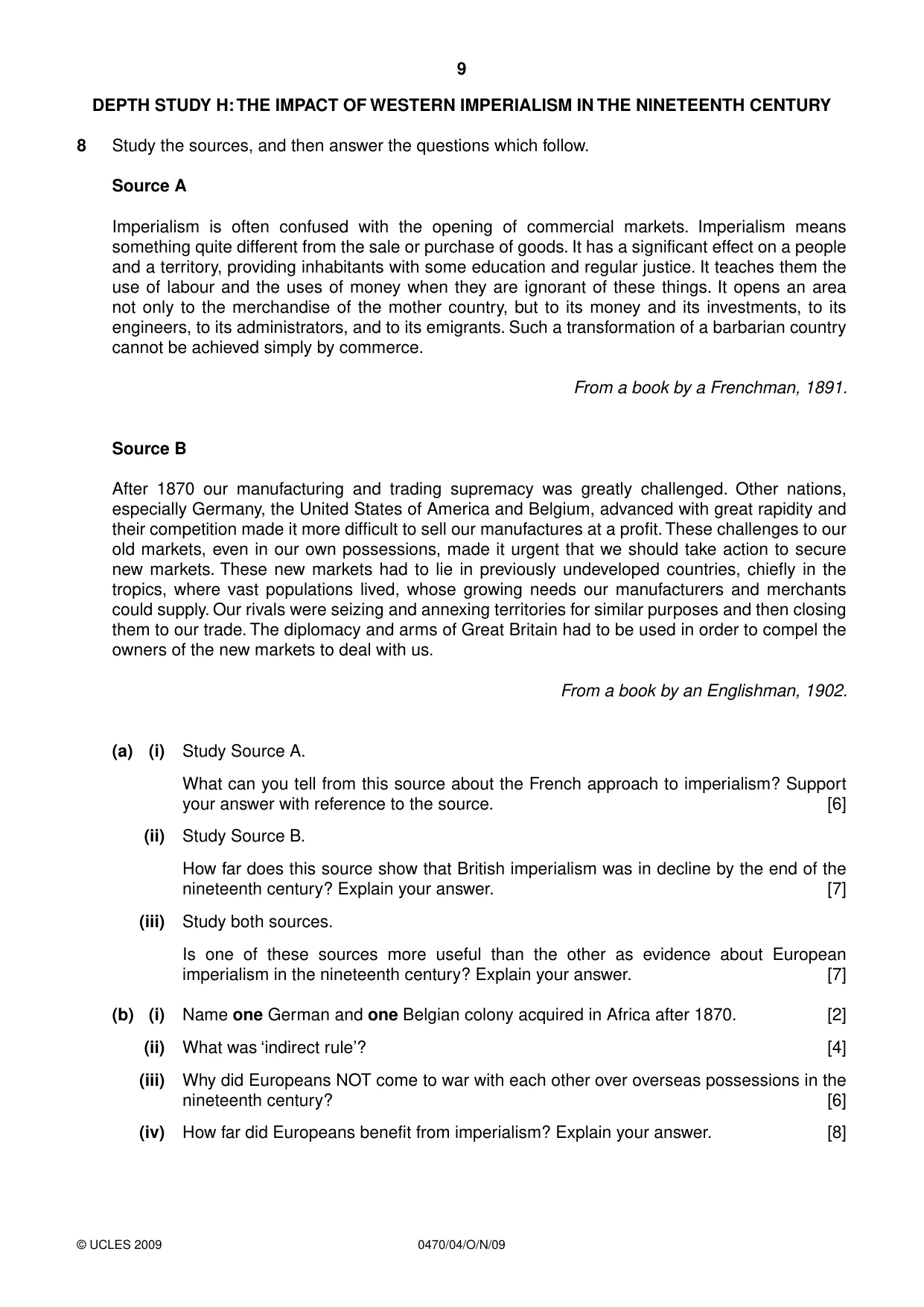


Mark scheme15 pages
Answers below. Sit the paper first if you are practising.
Paper as text
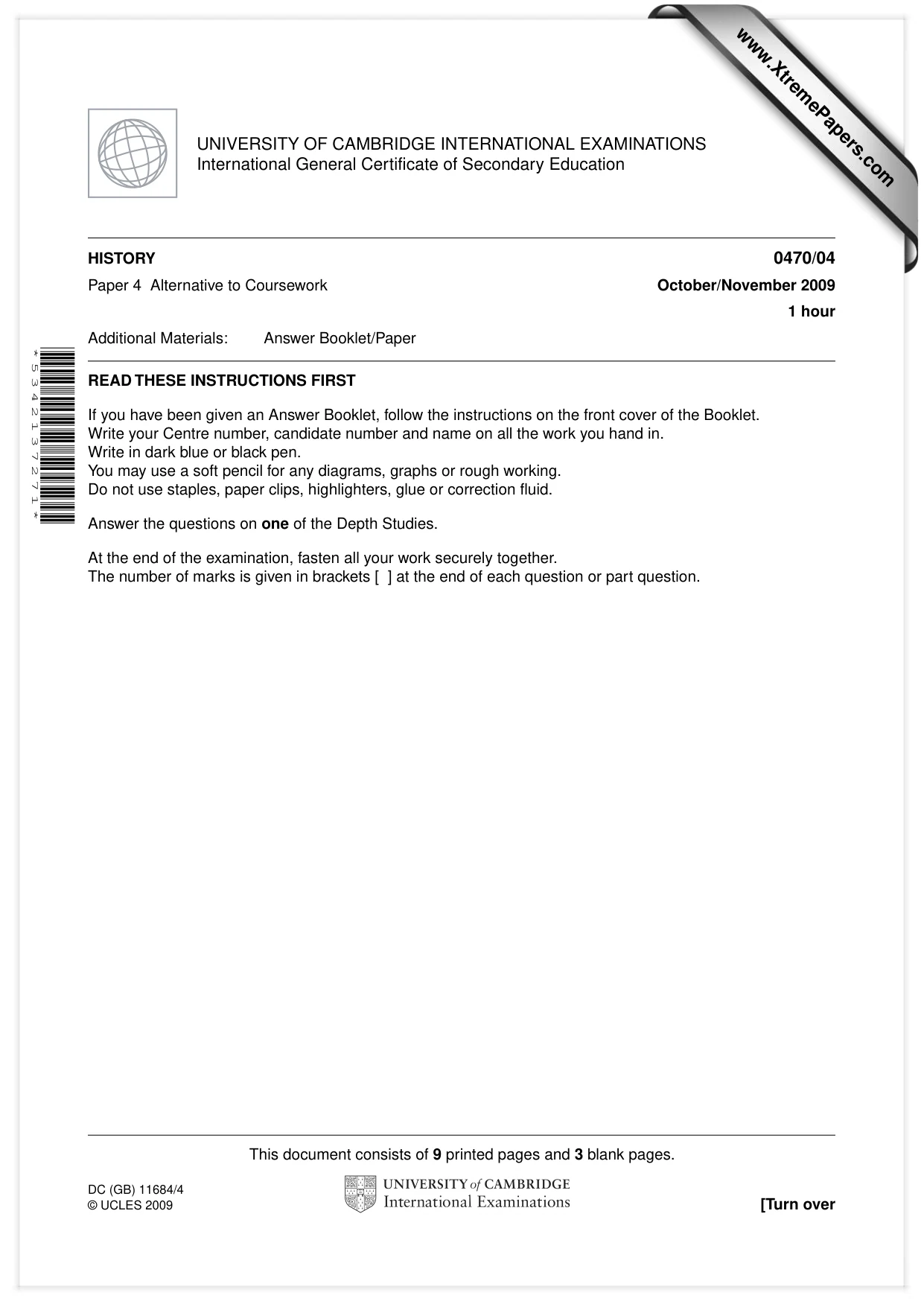
Question paper, page 1
This document consists of 9 printed pages and 3 blank pages. DC (GB) 11684/4 © UCLES 2009 [Turn over UNIVERSITY OF CAMBRIDGE INTERNATIONAL EXAMINATIONS International General Certificate of Secondary Education READ THESE INSTRUCTIONS FIRST If you have been given an Answer Booklet, follow the instructions on the front cover of the Booklet. Write your Centre number, candidate number and name on all the work you hand in. Write in dark blue or black pen. You may use a soft pencil for any diagrams, graphs or rough working. Do not use staples, paper clips, highlighters, glue or correction fluid. Answer the questions on one of the Depth Studies. At the end of the examination, fasten all your work securely together. The number of marks is given in brackets [ ] at the end of each question or part question. * 5 3 4 2 1 3 7 2 7 1 * HISTORY 0470/04 Paper 4 Alternative to Coursework October/November 2009 1 hour Additional Materials: Answer Booklet/Paper www.XtremePapers.com
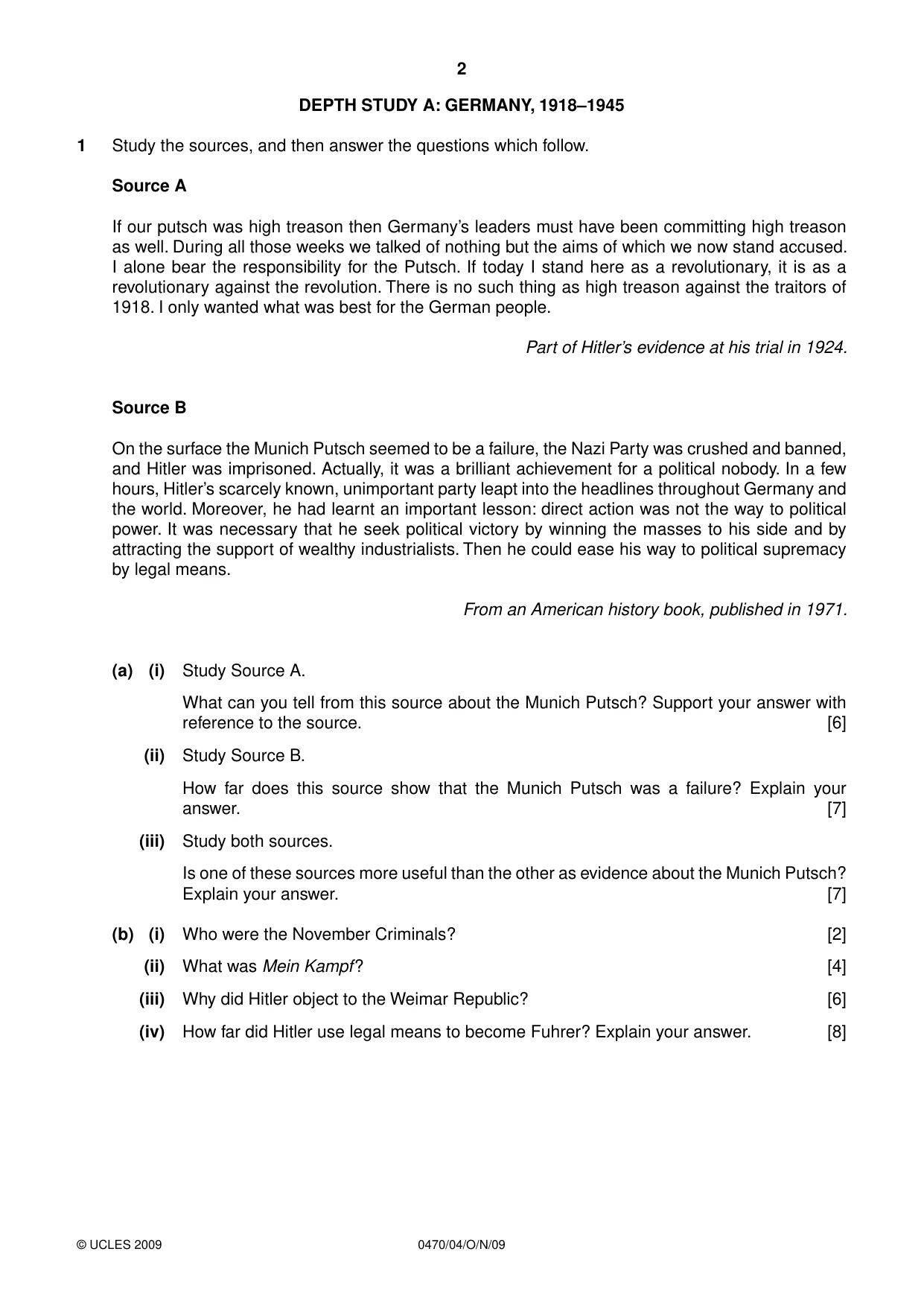
Question paper, page 2
2 0470/04/O/N/09 © UCLES 2009 DEPTH STUDY A: GERMANY, 1918–1945 1 Study the sources, and then answer the questions which follow. Source A If our putsch was high treason then Germany’s leaders must have been committing high treason as well. During all those weeks we talked of nothing but the aims of which we now stand accused. I alone bear the responsibility for the Putsch. If today I stand here as a revolutionary, it is as a revolutionary against the revolution. There is no such thing as high treason against the traitors of 1918. I only wanted what was best for the German people. Part of Hitler’s evidence at his trial in 1924. Source B On the surface the Munich Putsch seemed to be a failure, the Nazi Party was crushed and banned, and Hitler was imprisoned. Actually, it was a brilliant achievement for a political nobody. In a few hours, Hitler’s scarcely known, unimportant party leapt into the headlines throughout Germany and the world. Moreover, he had learnt an important lesson: direct action was not the way to political power. It was necessary that he seek political victory by winning the masses to his side and by attracting the support of wealthy industrialists. Then he could ease his way to political supremacy by legal means. From an American history book, published in 1971. (a) (i) Study Source A. What can you tell from this source about the Munich Putsch? Support your answer with reference to the source. [6] (ii) Study Source B. How far does this source show that the Munich Putsch was a failure? Explain your answer. [7] (iii) Study both sources. Is one of these sources more useful than the other as evidence about the Munich Putsch? Explain your answer. [7] (b) (i) Who were the November Criminals? [2] (ii) What was Mein Kampf ? [4] (iii) Why did Hitler object to the Weimar Republic? [6] (iv) How far did Hitler use legal means to become Fuhrer? Explain your answer. [8]
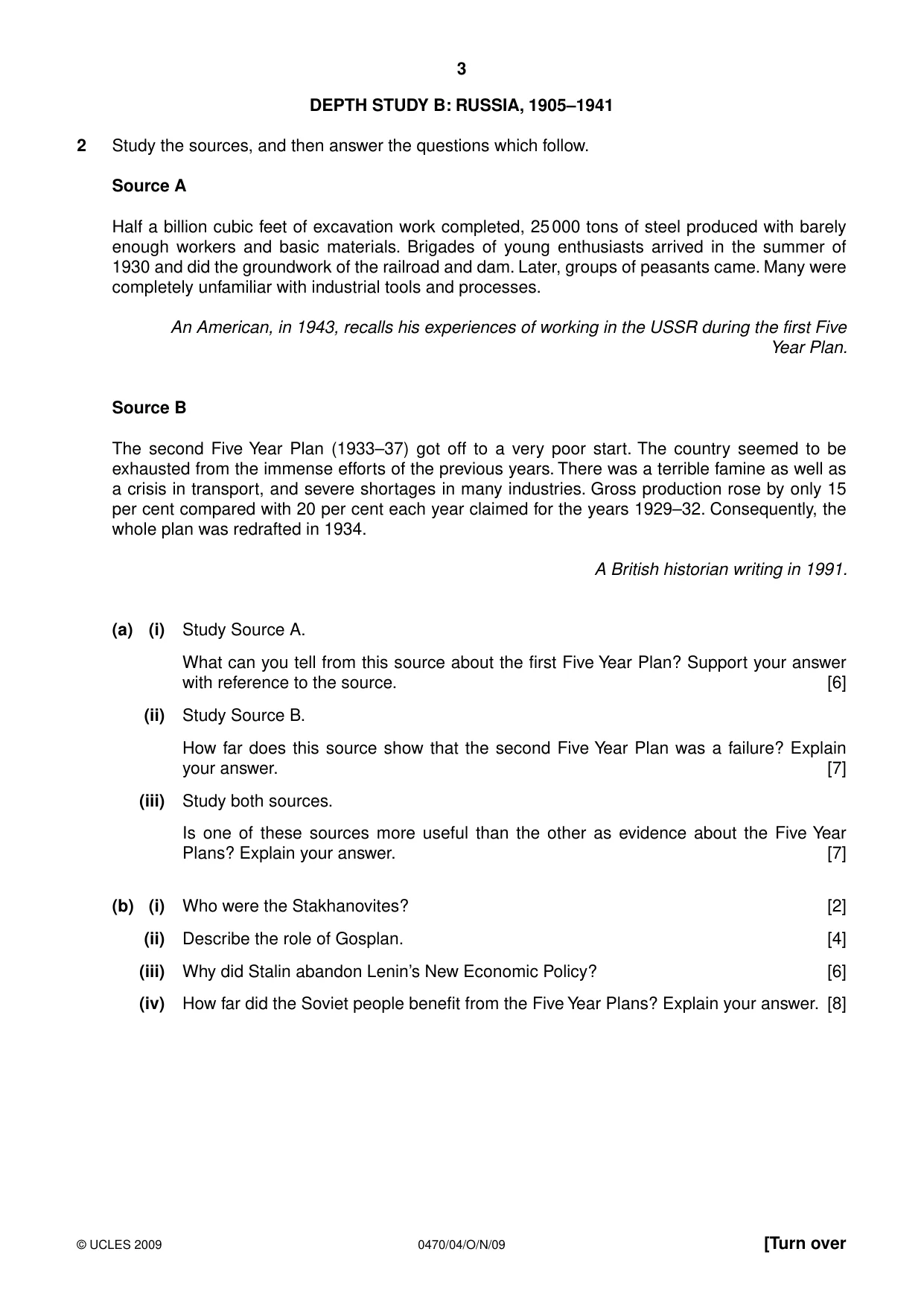
Question paper, page 3
3 0470/04/O/N/09 © UCLES 2009 [Turn over DEPTH STUDY B: RUSSIA, 1905–1941 2 Study the sources, and then answer the questions which follow. Source A Half a billion cubic feet of excavation work completed, 25 000 tons of steel produced with barely enough workers and basic materials. Brigades of young enthusiasts arrived in the summer of 1930 and did the groundwork of the railroad and dam. Later, groups of peasants came. Many were completely unfamiliar with industrial tools and processes. An American, in 1943, recalls his experiences of working in the USSR during the first Five Year Plan. Source B The second Five Year Plan (1933–37) got off to a very poor start. The country seemed to be exhausted from the immense efforts of the previous years. There was a terrible famine as well as a crisis in transport, and severe shortages in many industries. Gross production rose by only 15 per cent compared with 20 per cent each year claimed for the years 1929–32. Consequently, the whole plan was redrafted in 1934. A British historian writing in 1991. (a) (i) Study Source A. What can you tell from this source about the first Five Year Plan? Support your answer with reference to the source. [6] (ii) Study Source B. How far does this source show that the second Five Year Plan was a failure? Explain your answer. [7] (iii) Study both sources. Is one of these sources more useful than the other as evidence about the Five Year Plans? Explain your answer. [7] (b) (i) Who were the Stakhanovites? [2] (ii) Describe the role of Gosplan. [4] (iii) Why did Stalin abandon Lenin’s New Economic Policy? [6] (iv) How far did the Soviet people benefit from the Five Year Plans? Explain your answer. [8]
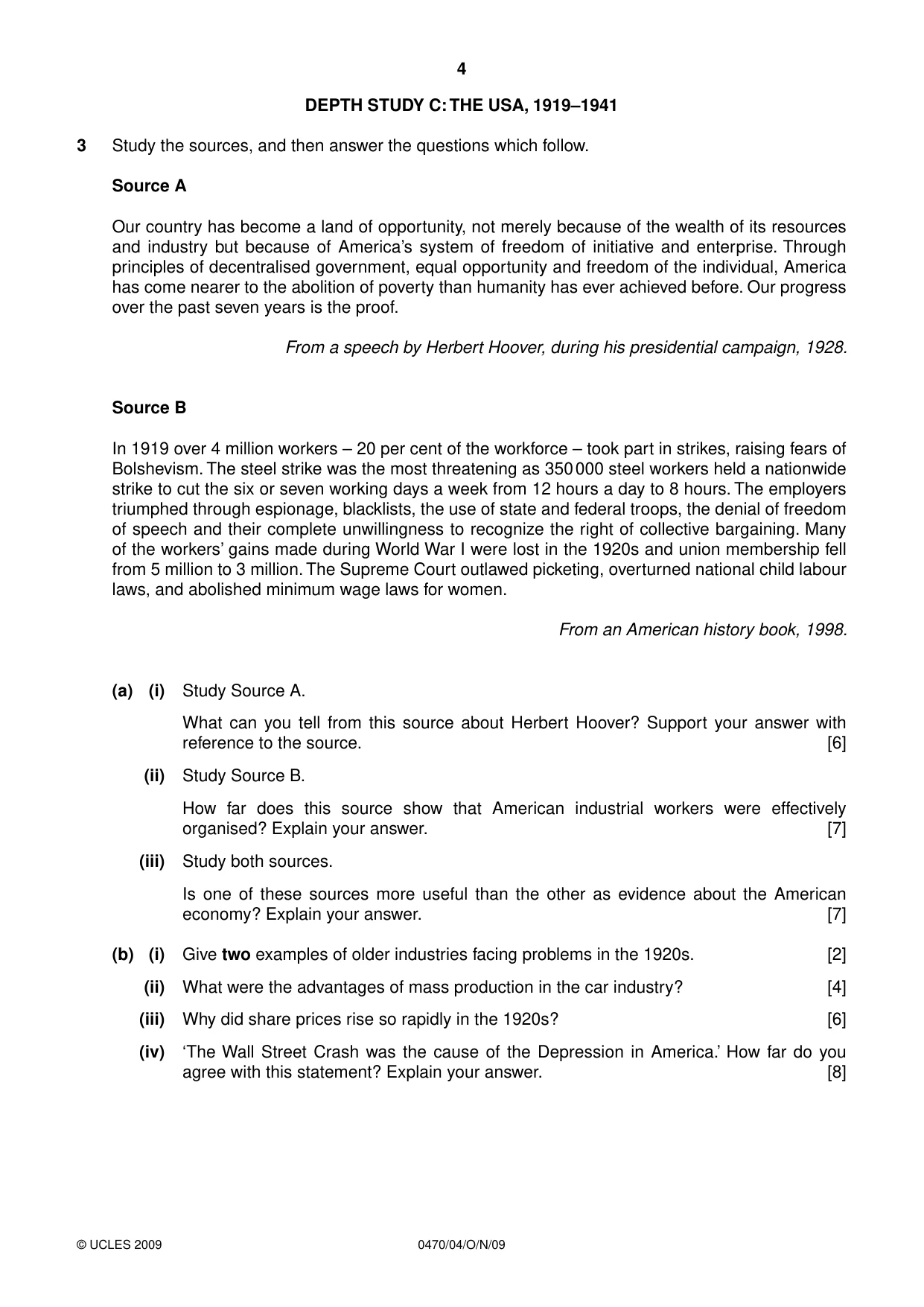
Question paper, page 4
4 0470/04/O/N/09 © UCLES 2009 DEPTH STUDY C: THE USA, 1919–1941 3 Study the sources, and then answer the questions which follow. Source A Our country has become a land of opportunity, not merely because of the wealth of its resources and industry but because of America’s system of freedom of initiative and enterprise. Through principles of decentralised government, equal opportunity and freedom of the individual, America has come nearer to the abolition of poverty than humanity has ever achieved before. Our progress over the past seven years is the proof. From a speech by Herbert Hoover, during his presidential campaign, 1928. Source B In 1919 over 4 million workers – 20 per cent of the workforce – took part in strikes, raising fears of Bolshevism. The steel strike was the most threatening as 350 000 steel workers held a nationwide strike to cut the six or seven working days a week from 12 hours a day to 8 hours. The employers triumphed through espionage, blacklists, the use of state and federal troops, the denial of freedom of speech and their complete unwillingness to recognize the right of collective bargaining. Many of the workers’ gains made during World War I were lost in the 1920s and union membership fell from 5 million to 3 million. The Supreme Court outlawed picketing, overturned national child labour laws, and abolished minimum wage laws for women. From an American history book, 1998. (a) (i) Study Source A. What can you tell from this source about Herbert Hoover? Support your answer with reference to the source. [6] (ii) Study Source B. How far does this source show that American industrial workers were effectively organised? Explain your answer. [7] (iii) Study both sources. Is one of these sources more useful than the other as evidence about the American economy? Explain your answer. [7] (b) (i) Give two examples of older industries facing problems in the 1920s. [2] (ii) What were the advantages of mass production in the car industry? [4] (iii) Why did share prices rise so rapidly in the 1920s? [6] (iv) ‘The Wall Street Crash was the cause of the Depression in America.’ How far do you agree with this statement? Explain your answer. [8]
Question paper, page 5
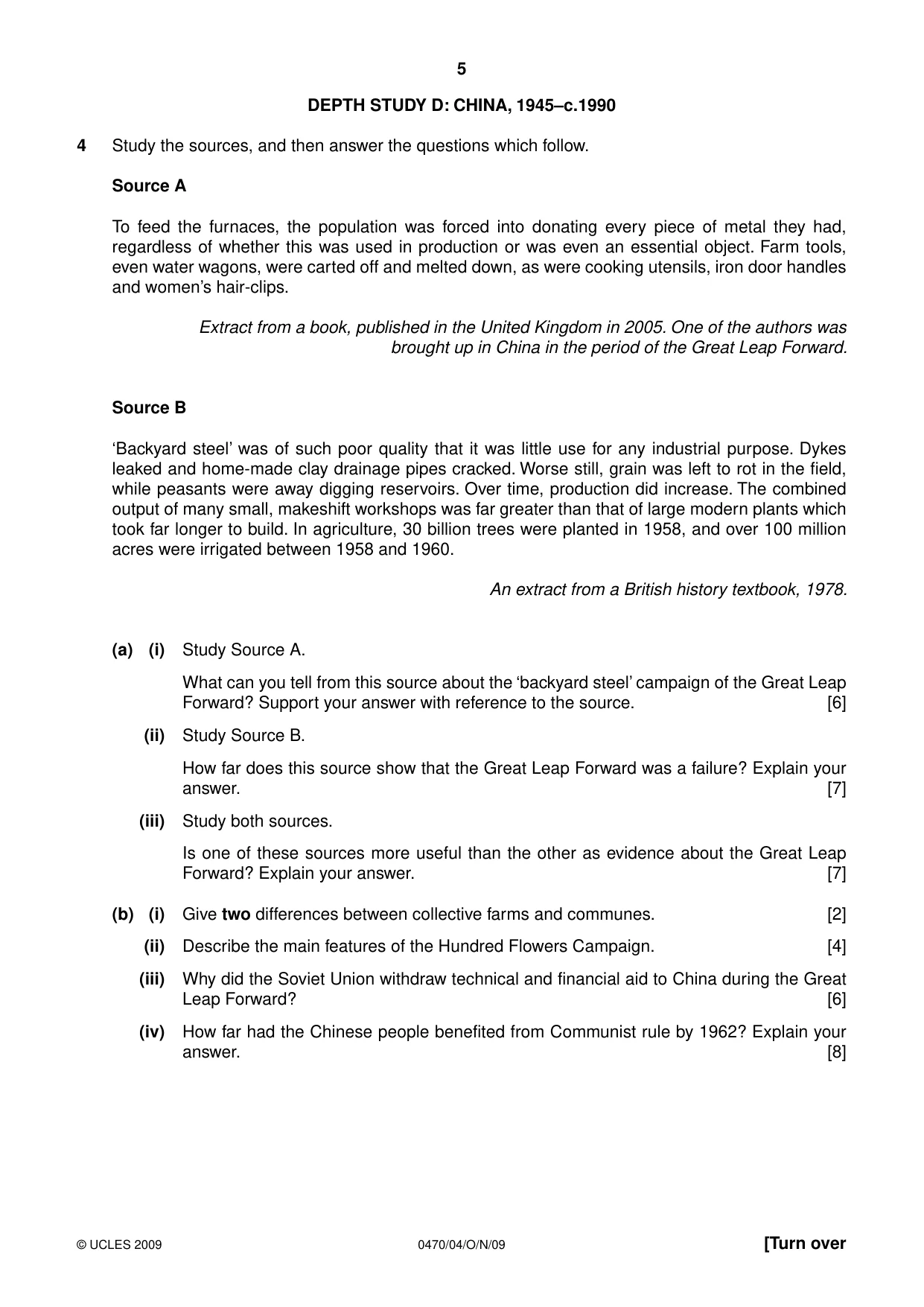
5 0470/04/O/N/09 © UCLES 2009 [Turn over DEPTH STUDY D: CHINA, 1945–c.1990 4 Study the sources, and then answer the questions which follow. Source A To feed the furnaces, the population was forced into donating every piece of metal they had, regardless of whether this was used in production or was even an essential object. Farm tools, even water wagons, were carted off and melted down, as were cooking utensils, iron door handles and women’s hair-clips. Extract from a book, published in the United Kingdom in 2005. One of the authors was brought up in China in the period of the Great Leap Forward. Source B ‘Backyard steel’ was of such poor quality that it was little use for any industrial purpose. Dykes leaked and home-made clay drainage pipes cracked. Worse still, grain was left to rot in the field, while peasants were away digging reservoirs. Over time, production did increase. The combined output of many small, makeshift workshops was far greater than that of large modern plants which took far longer to build. In agriculture, 30 billion trees were planted in 1958, and over 100 million acres were irrigated between 1958 and 1960. An extract from a British history textbook, 1978. (a) (i) Study Source A. What can you tell from this source about the ‘backyard steel’ campaign of the Great Leap Forward? Support your answer with reference to the source. [6] (ii) Study Source B. How far does this source show that the Great Leap Forward was a failure? Explain your answer. [7] (iii) Study both sources. Is one of these sources more useful than the other as evidence about the Great Leap Forward? Explain your answer. [7] (b) (i) Give two differences between collective farms and communes. [2] (ii) Describe the main features of the Hundred Flowers Campaign. [4] (iii) Why did the Soviet Union withdraw technical and financial aid to China during the Great Leap Forward? [6] (iv) How far had the Chinese people benefited from Communist rule by 1962? Explain your answer. [8]
Question paper, page 6
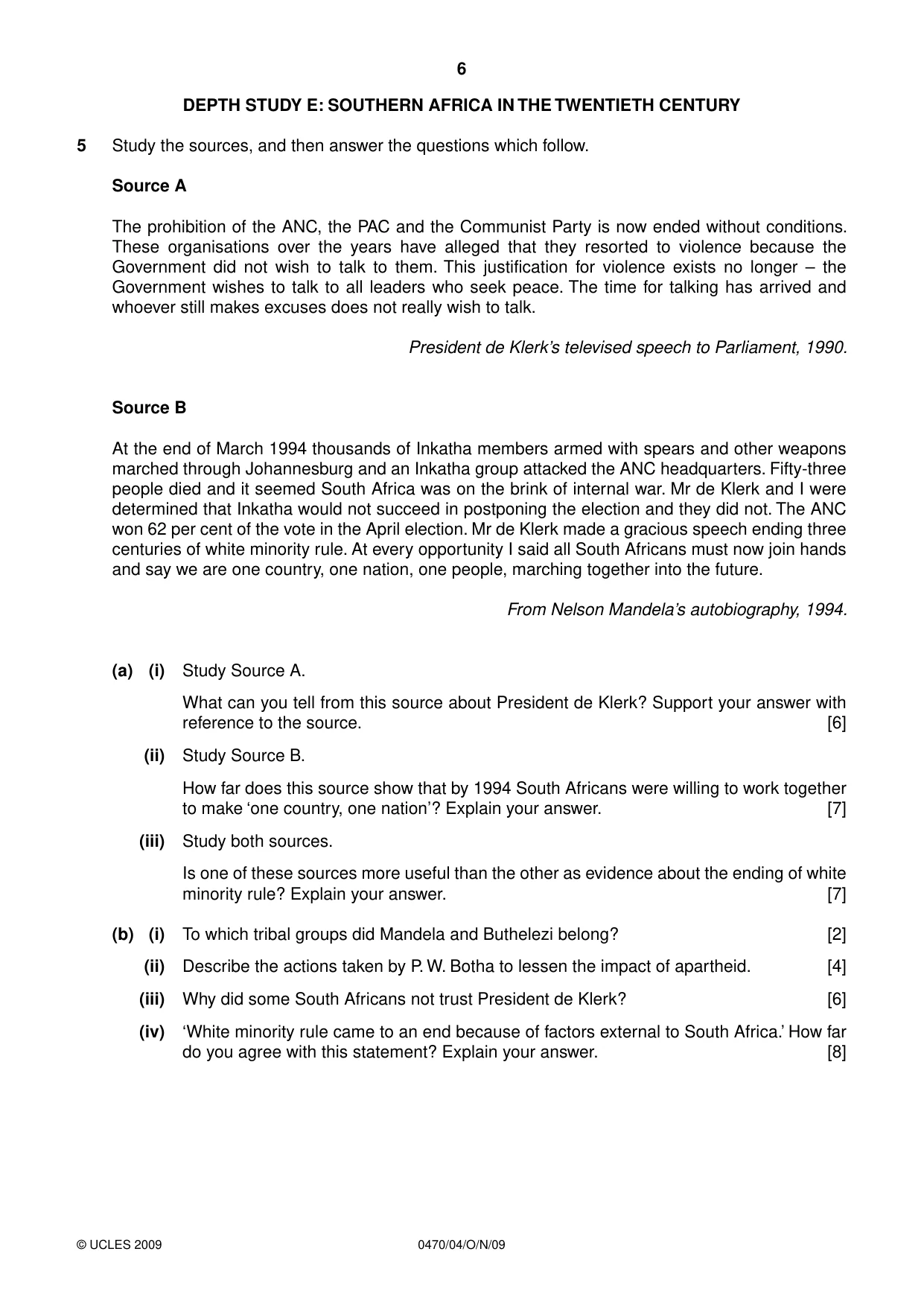
6 0470/04/O/N/09 © UCLES 2009 DEPTH STUDY E: SOUTHERN AFRICA IN THE TWENTIETH CENTURY 5 Study the sources, and then answer the questions which follow. Source A The prohibition of the ANC, the PAC and the Communist Party is now ended without conditions. These organisations over the years have alleged that they resorted to violence because the Government did not wish to talk to them. This justification for violence exists no longer – the Government wishes to talk to all leaders who seek peace. The time for talking has arrived and whoever still makes excuses does not really wish to talk. President de Klerk’s televised speech to Parliament, 1990. Source B At the end of March 1994 thousands of Inkatha members armed with spears and other weapons marched through Johannesburg and an Inkatha group attacked the ANC headquarters. Fifty-three people died and it seemed South Africa was on the brink of internal war. Mr de Klerk and I were determined that Inkatha would not succeed in postponing the election and they did not. The ANC won 62 per cent of the vote in the April election. Mr de Klerk made a gracious speech ending three centuries of white minority rule. At every opportunity I said all South Africans must now join hands and say we are one country, one nation, one people, marching together into the future. From Nelson Mandela’s autobiography, 1994. (a) (i) Study Source A. What can you tell from this source about President de Klerk? Support your answer with reference to the source. [6] (ii) Study Source B. How far does this source show that by 1994 South Africans were willing to work together to make ‘one country, one nation’? Explain your answer. [7] (iii) Study both sources. Is one of these sources more useful than the other as evidence about the ending of white minority rule? Explain your answer. [7] (b) (i) To which tribal groups did Mandela and Buthelezi belong? [2] (ii) Describe the actions taken by P. W. Botha to lessen the impact of apartheid. [4] (iii) Why did some South Africans not trust President de Klerk? [6] (iv) ‘White minority rule came to an end because of factors external to South Africa.’ How far do you agree with this statement? Explain your answer. [8]
Question paper, page 7
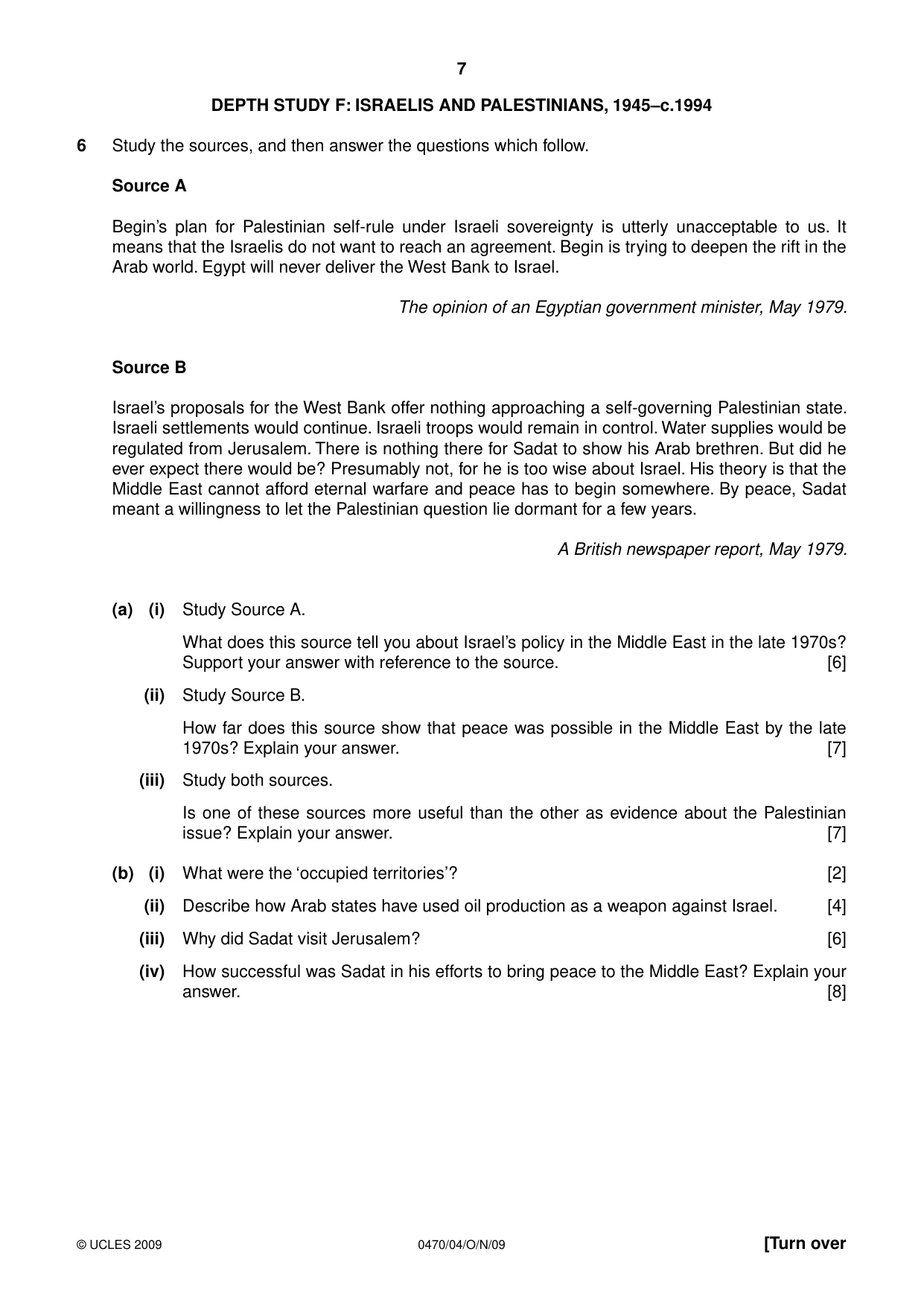
7 0470/04/O/N/09 © UCLES 2009 [Turn over DEPTH STUDY F: ISRAELIS AND PALESTINIANS, 1945–c.1994 6 Study the sources, and then answer the questions which follow. Source A Begin’s plan for Palestinian self-rule under Israeli sovereignty is utterly unacceptable to us. It means that the Israelis do not want to reach an agreement. Begin is trying to deepen the rift in the Arab world. Egypt will never deliver the West Bank to Israel. The opinion of an Egyptian government minister, May 1979. Source B Israel’s proposals for the West Bank offer nothing approaching a self-governing Palestinian state. Israeli settlements would continue. Israeli troops would remain in control. Water supplies would be regulated from Jerusalem. There is nothing there for Sadat to show his Arab brethren. But did he ever expect there would be? Presumably not, for he is too wise about Israel. His theory is that the Middle East cannot afford eternal warfare and peace has to begin somewhere. By peace, Sadat meant a willingness to let the Palestinian question lie dormant for a few years. A British newspaper report, May 1979. (a) (i) Study Source A. What does this source tell you about Israel’s policy in the Middle East in the late 1970s? Support your answer with reference to the source. [6] (ii) Study Source B. How far does this source show that peace was possible in the Middle East by the late 1970s? Explain your answer. [7] (iii) Study both sources. Is one of these sources more useful than the other as evidence about the Palestinian issue? Explain your answer. [7] (b) (i) What were the ‘occupied territories’? [2] (ii) Describe how Arab states have used oil production as a weapon against Israel. [4] (iii) Why did Sadat visit Jerusalem? [6] (iv) How successful was Sadat in his efforts to bring peace to the Middle East? Explain your answer. [8]
Question paper, page 8
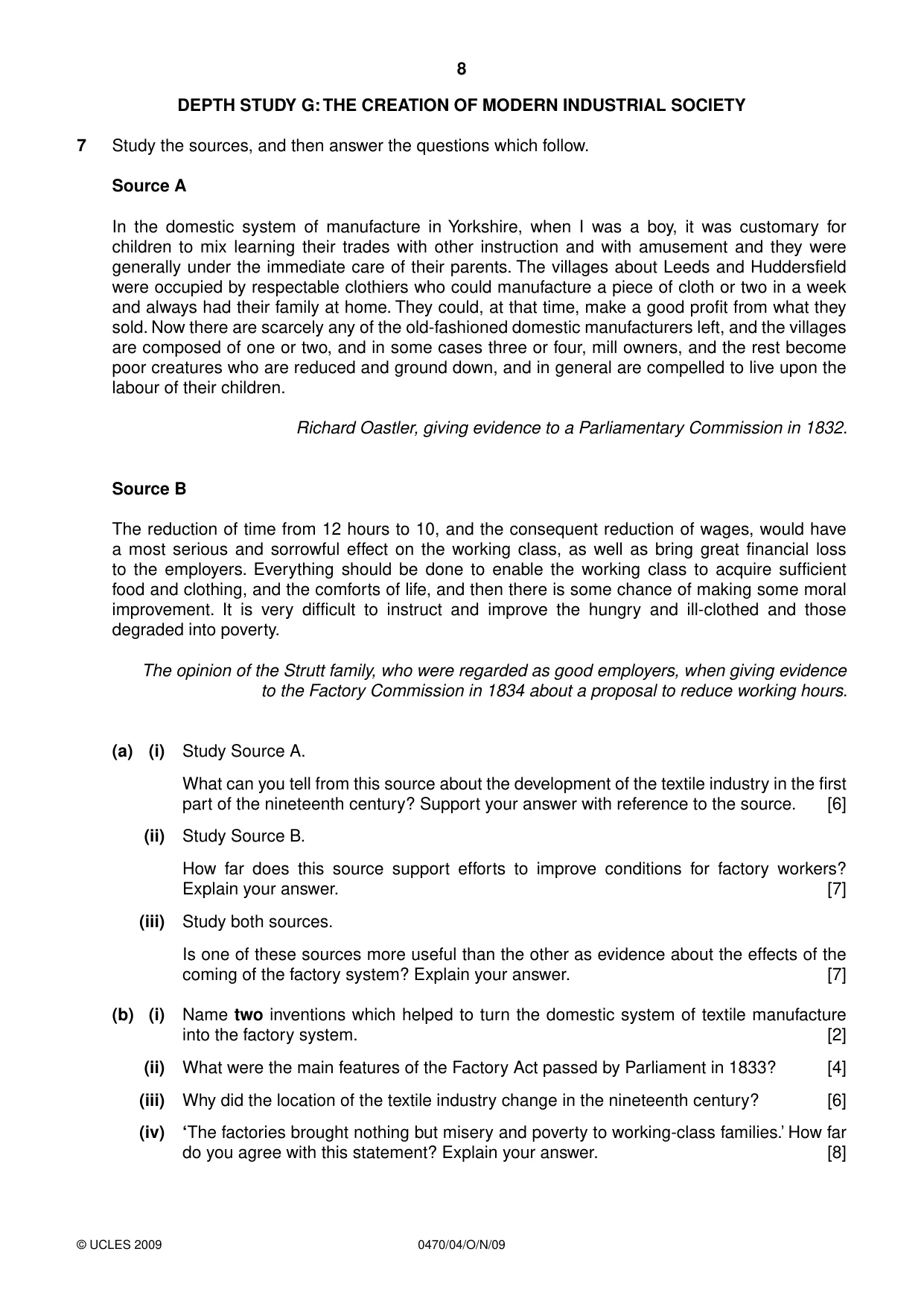
8 0470/04/O/N/09 © UCLES 2009 DEPTH STUDY G: THE CREATION OF MODERN INDUSTRIAL SOCIETY 7 Study the sources, and then answer the questions which follow. Source A In the domestic system of manufacture in Yorkshire, when I was a boy, it was customary for children to mix learning their trades with other instruction and with amusement and they were generally under the immediate care of their parents. The villages about Leeds and Huddersfield were occupied by respectable clothiers who could manufacture a piece of cloth or two in a week and always had their family at home. They could, at that time, make a good profit from what they sold. Now there are scarcely any of the old-fashioned domestic manufacturers left, and the villages are composed of one or two, and in some cases three or four, mill owners, and the rest become poor creatures who are reduced and ground down, and in general are compelled to live upon the labour of their children. Richard Oastler, giving evidence to a Parliamentary Commission in 1832. Source B The reduction of time from 12 hours to 10, and the consequent reduction of wages, would have a most serious and sorrowful effect on the working class, as well as bring great financial loss to the employers. Everything should be done to enable the working class to acquire sufficient food and clothing, and the comforts of life, and then there is some chance of making some moral improvement. It is very difficult to instruct and improve the hungry and ill-clothed and those degraded into poverty. The opinion of the Strutt family, who were regarded as good employers, when giving evidence to the Factory Commission in 1834 about a proposal to reduce working hours. (a) (i) Study Source A. What can you tell from this source about the development of the textile industry in the first part of the nineteenth century? Support your answer with reference to the source. [6] (ii) Study Source B. How far does this source support efforts to improve conditions for factory workers? Explain your answer. [7] (iii) Study both sources. Is one of these sources more useful than the other as evidence about the effects of the coming of the factory system? Explain your answer. [7] (b) (i) Name two inventions which helped to turn the domestic system of textile manufacture into the factory system. [2] (ii) What were the main features of the Factory Act passed by Parliament in 1833? [4] (iii) Why did the location of the textile industry change in the nineteenth century? [6] (iv) ‘The factories brought nothing but misery and poverty to working-class families.’ How far do you agree with this statement? Explain your answer. [8]
Question paper, page 9
9 0470/04/O/N/09 © UCLES 2009 DEPTH STUDY H: THE IMPACT OF WESTERN IMPERIALISM IN THE NINETEENTH CENTURY 8 Study the sources, and then answer the questions which follow. Source A Imperialism is often confused with the opening of commercial markets. Imperialism means something quite different from the sale or purchase of goods. It has a significant effect on a people and a territory, providing inhabitants with some education and regular justice. It teaches them the use of labour and the uses of money when they are ignorant of these things. It opens an area not only to the merchandise of the mother country, but to its money and its investments, to its engineers, to its administrators, and to its emigrants. Such a transformation of a barbarian country cannot be achieved simply by commerce. From a book by a Frenchman, 1891. Source B After 1870 our manufacturing and trading supremacy was greatly challenged. Other nations, especially Germany, the United States of America and Belgium, advanced with great rapidity and their competition made it more difficult to sell our manufactures at a profit. These challenges to our old markets, even in our own possessions, made it urgent that we should take action to secure new markets. These new markets had to lie in previously undeveloped countries, chiefly in the tropics, where vast populations lived, whose growing needs our manufacturers and merchants could supply. Our rivals were seizing and annexing territories for similar purposes and then closing them to our trade. The diplomacy and arms of Great Britain had to be used in order to compel the owners of the new markets to deal with us. From a book by an Englishman, 1902. (a) (i) Study Source A. What can you tell from this source about the French approach to imperialism? Support your answer with reference to the source. [6] (ii) Study Source B. How far does this source show that British imperialism was in decline by the end of the nineteenth century? Explain your answer. [7] (iii) Study both sources. Is one of these sources more useful than the other as evidence about European imperialism in the nineteenth century? Explain your answer. [7] (b) (i) Name one German and one Belgian colony acquired in Africa after 1870. [2] (ii) What was ‘indirect rule’? [4] (iii) Why did Europeans NOT come to war with each other over overseas possessions in the nineteenth century? [6] (iv) How far did Europeans benefit from imperialism? Explain your answer. [8]
Question paper, page 12
12 0470/04/O/N/09 BLANK PAGE Copyright Acknowledgements: Depth Study A, Source A © Grey & Little; Germany 1918–1945; Cambridge University Press; 1997. Depth Study A, Source B © Encyclopaedia of the Third Reich; McGraw Hill; 1976. Depth Study B, Source A © Ben Walsh, GCSE Modern World History ; John Murray; 2001. Depth Study B, Source B © Martin McCauley; The Soviet Union 1917–1991; Longman; 1993. Depth Study C, Source A © www.gilderlehrman.org/teachers/module17/intro_pop4.html Depth Study C, Source B © www.gilderlehrman.org/teachers/module17/intro_pop4.html Depth Study D, Source A © Jung Chang & John Halliday; Mao, the Unknown Story ; Jonathan Cape; 2005. Depth Study D, Source B © Harriet Ward; World Powers in the 20th Century ; BBC; 1978. Depth Study E, Source A © President de Klerk; Televised speech to Parliament ; 1990. Depth Study E, Source B © N. Mandela; Long Walk to Freedom; Little, Brown & Co.; 1994. Depth Study F, Source A © Arab Israeli Conflict ; Holmes McDougall Ltd; 1977. Depth Study F, Source B © Arab Israeli Conflict ; Holmes McDougall Ltd; 1977. Depth Study G, Source A © Ed. J Addy & E. Power; The Industrial Revolution Sourcebook ; Longman; 1976. Depth Study G, Source B © Ed. J Addy & E. Power; The Industrial Revolution Sourcebook ; Longman; 1976. Depth Study H, Source A © S. Pollard; Documents of European Economic History; Vol. 7; Edward Arnold. Depth Study H, Source B © Jean Hobson; www.fordham.educ/halsall/mod/1902. Permission to reproduce items where third-party owned material protected by copyright is included has been sought and cleared where possible. Every reasonable effort has been made by the publisher (UCLES) to trace copyright holders, but if any items requiring clearance have unwittingly been included, the publisher will be pleased to make amends at the earliest possible opportunity. University of Cambridge International Examinations is part of the Cambridge Assessment Group. Cambridge Assessment is the brand name of University of Cambridge Local Examinations Syndicate (UCLES), which is itself a department of the University of Cambridge.
Mark scheme, page 1
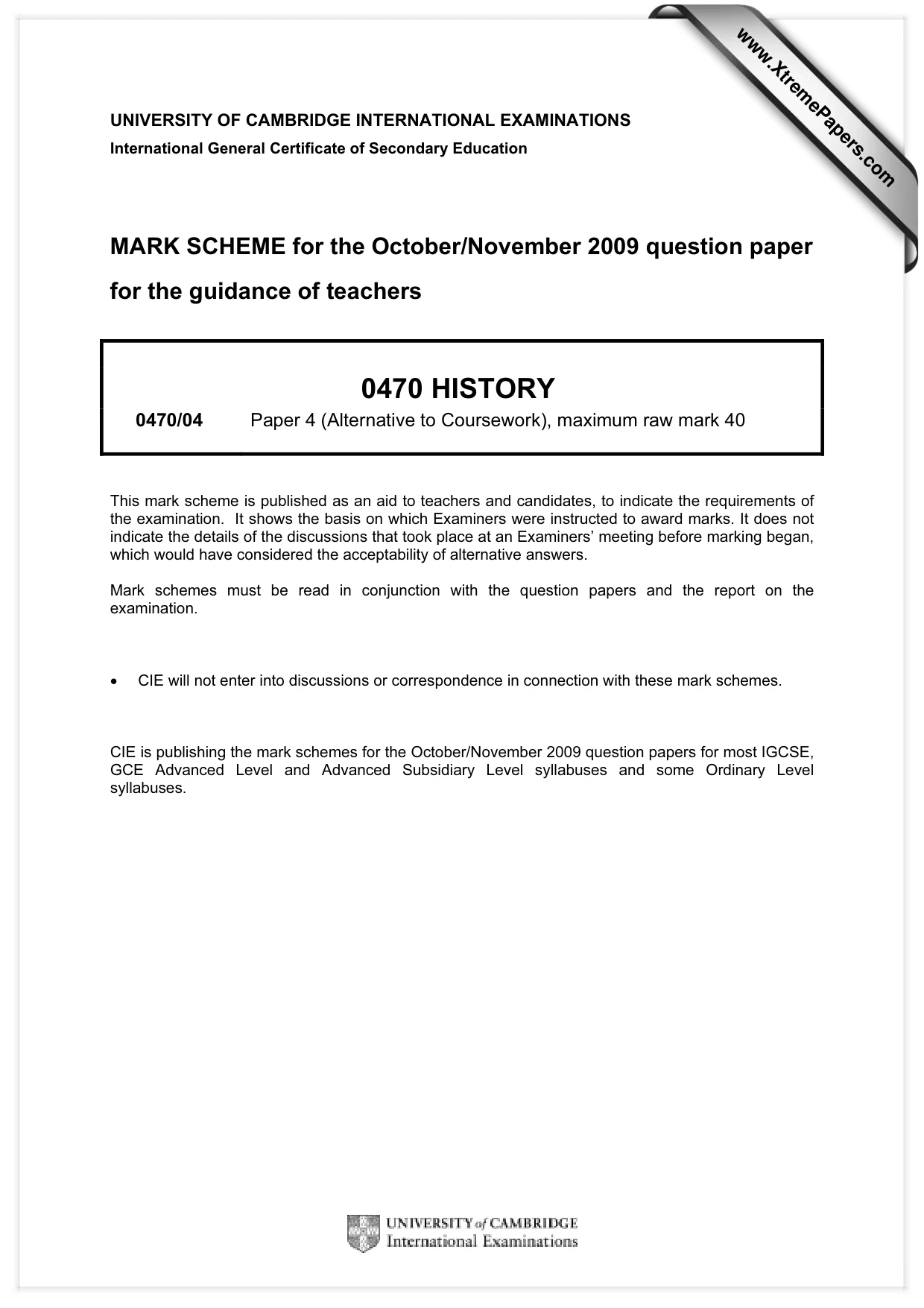
UNIVERSITY OF CAMBRIDGE INTERNATIONAL EXAMINATIONS International General Certificate of Secondary Education MARK SCHEME for the October/November 2009 question paper for the guidance of teachers 0470 HISTORY 0470/04 Paper 4 (Alternative to Coursework), maximum raw mark 40 This mark scheme is published as an aid to teachers and candidates, to indicate the requirements of the examination. It shows the basis on which Examiners were instructed to award marks. It does not indicate the details of the discussions that took place at an Examiners’ meeting before marking began, which would have considered the acceptability of alternative answers. Mark schemes must be read in conjunction with the question papers and the report on the examination. • CIE will not enter into discussions or correspondence in connection with these mark schemes. CIE is publishing the mark schemes for the October/November 2009 question papers for most IGCSE, GCE Advanced Level and Advanced Subsidiary Level syllabuses and some Ordinary Level syllabuses. www.XtremePapers.com
Mark scheme, page 2
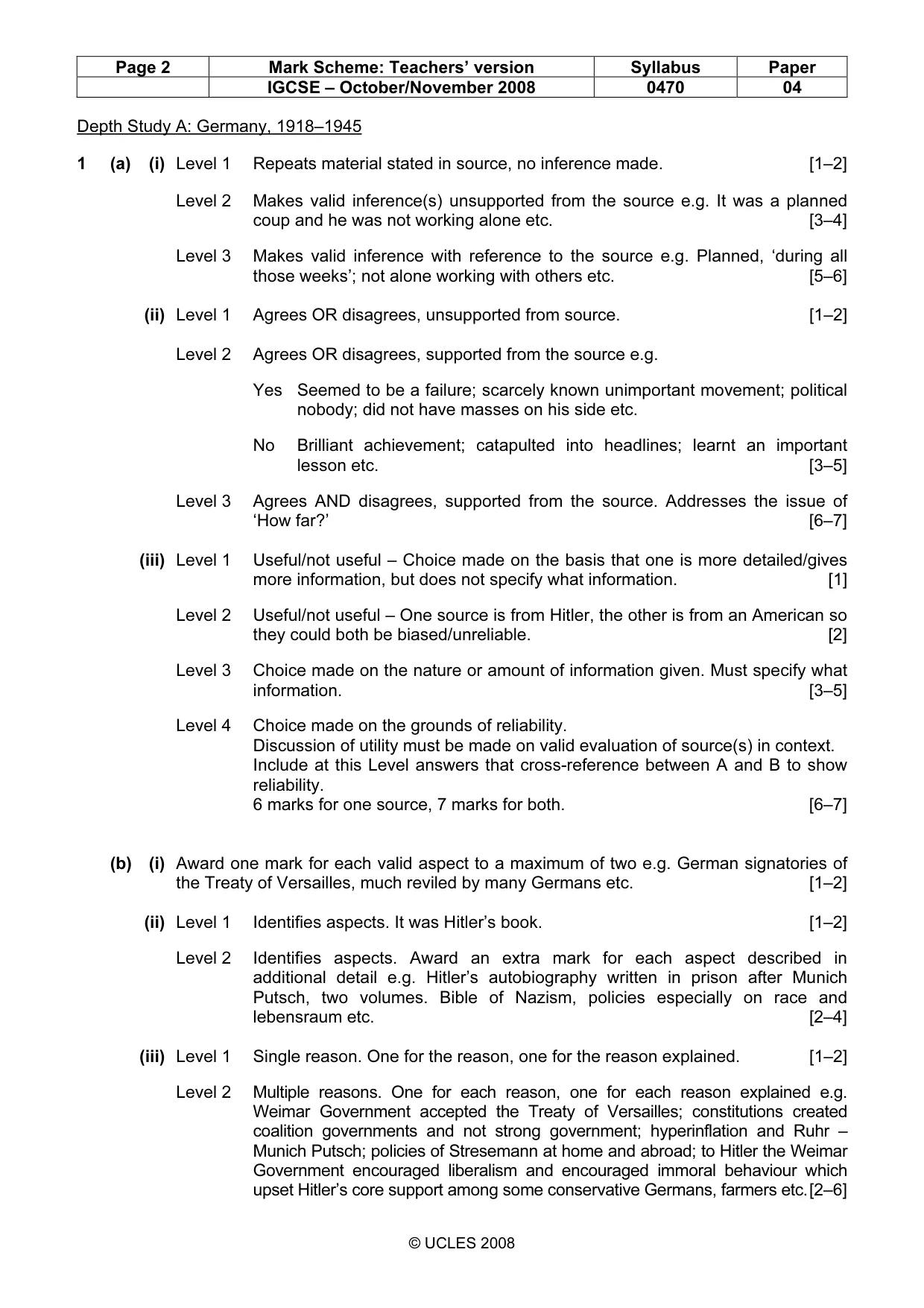
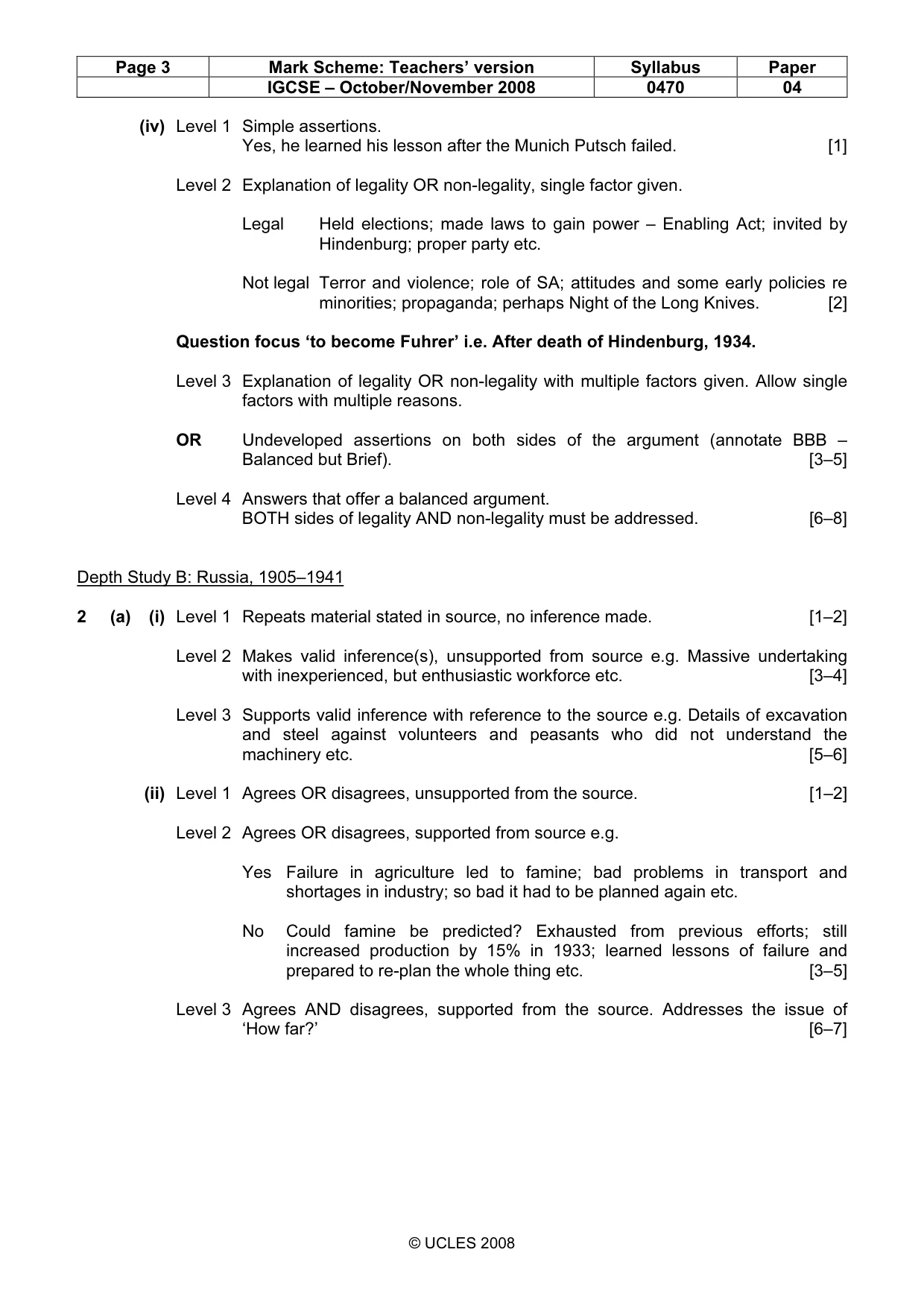
Page 2 Mark Scheme: Teachers’ version Syllabus Paper IGCSE – October/November 2008 0470 04 © UCLES 2008 Depth Study A: Germany, 1918–1945 1 (a) (i) Level 1 Repeats material stated in source, no inference made. [1–2] Level 2 Makes valid inference(s) unsupported from the source e.g. It was a planned coup and he was not working alone etc. [3–4] Level 3 Makes valid inference with reference to the source e.g. Planned, ‘during all those weeks’; not alone working with others etc. [5–6] (ii) Level 1 Agrees OR disagrees, unsupported from source. [1–2] Level 2 Agrees OR disagrees, supported from the source e.g. Yes Seemed to be a failure; scarcely known unimportant movement; political nobody; did not have masses on his side etc. No Brilliant achievement; catapulted into headlines; learnt an important lesson etc. [3–5] Level 3 Agrees AND disagrees, supported from the source. Addresses the issue of ‘How far?’ [6–7] (iii) Level 1 Useful/not useful – Choice made on the basis that one is more detailed/gives more information, but does not specify what information. [1] Level 2 Useful/not useful – One source is from Hitler, the other is from an American so they could both be biased/unreliable. [2] Level 3 Choice made on the nature or amount of information given. Must specify what information. [3–5] Level 4 Choice made on the grounds of reliability. Discussion of utility must be made on valid evaluation of source(s) in context. Include at this Level answers that cross-reference between A and B to show reliability. 6 marks for one source, 7 marks for both. [6–7] (b) (i) Award one mark for each valid aspect to a maximum of two e.g. German signatories of the Treaty of Versailles, much reviled by many Germans etc. [1–2] (ii) Level 1 Identifies aspects. It was Hitler’s book. [1–2] Level 2 Identifies aspects. Award an extra mark for each aspect described in additional detail e.g. Hitler’s autobiography written in prison after Munich Putsch, two volumes. Bible of Nazism, policies especially on race and lebensraum etc. [2–4] (iii) Level 1 Single reason. One for the reason, one for the reason explained. [1–2] Level 2 Multiple reasons. One for each reason, one for each reason explained e.g. Weimar Government accepted the Treaty of Versailles; constitutions created coalition governments and not strong government; hyperinflation and Ruhr – Munich Putsch; policies of Stresemann at home and abroad; to Hitler the Weimar Government encouraged liberalism and encouraged immoral behaviour which upset Hitler’s core support among some conservative Germans, farmers etc. [2–6]
Mark scheme, page 3
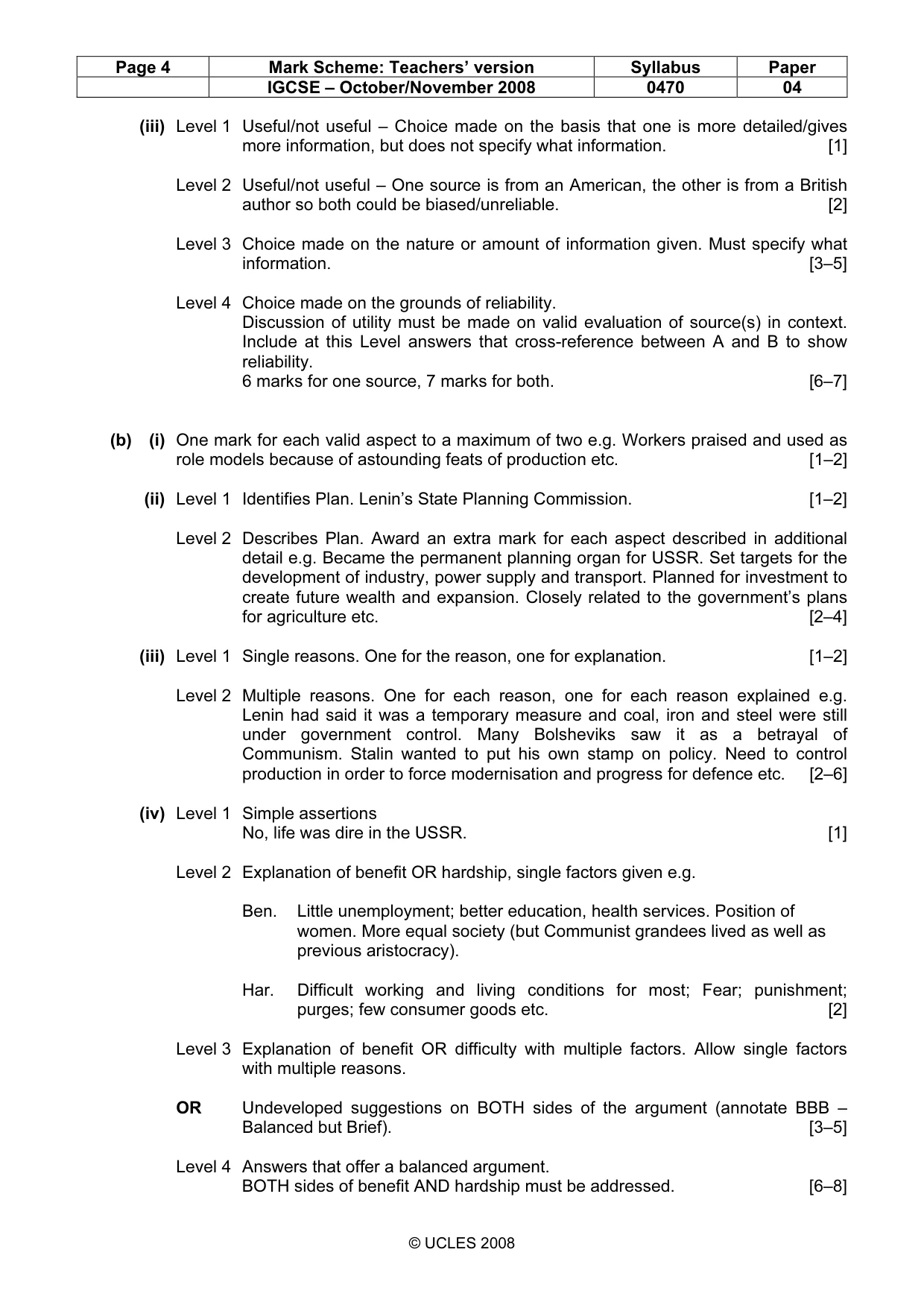
Page 3 Mark Scheme: Teachers’ version Syllabus Paper IGCSE – October/November 2008 0470 04 © UCLES 2008 (iv) Level 1 Simple assertions. Yes, he learned his lesson after the Munich Putsch failed. [1] Level 2 Explanation of legality OR non-legality, single factor given. Legal Held elections; made laws to gain power – Enabling Act; invited by Hindenburg; proper party etc. Not legal Terror and violence; role of SA; attitudes and some early policies re minorities; propaganda; perhaps Night of the Long Knives. [2] Question focus ‘to become Fuhrer’ i.e. After death of Hindenburg, 1934. Level 3 Explanation of legality OR non-legality with multiple factors given. Allow single factors with multiple reasons. OR Undeveloped assertions on both sides of the argument (annotate BBB – Balanced but Brief). [3–5] Level 4 Answers that offer a balanced argument. BOTH sides of legality AND non-legality must be addressed. [6–8] Depth Study B: Russia, 1905–1941 2 (a) (i) Level 1 Repeats material stated in source, no inference made. [1–2] Level 2 Makes valid inference(s), unsupported from source e.g. Massive undertaking with inexperienced, but enthusiastic workforce etc. [3–4] Level 3 Supports valid inference with reference to the source e.g. Details of excavation and steel against volunteers and peasants who did not understand the machinery etc. [5–6] (ii) Level 1 Agrees OR disagrees, unsupported from the source. [1–2] Level 2 Agrees OR disagrees, supported from source e.g. Yes Failure in agriculture led to famine; bad problems in transport and shortages in industry; so bad it had to be planned again etc. No Could famine be predicted? Exhausted from previous efforts; still increased production by 15% in 1933; learned lessons of failure and prepared to re-plan the whole thing etc. [3–5] Level 3 Agrees AND disagrees, supported from the source. Addresses the issue of ‘How far?’ [6–7]
Mark scheme, page 4
Page 4 Mark Scheme: Teachers’ version Syllabus Paper IGCSE – October/November 2008 0470 04 © UCLES 2008 (iii) Level 1 Useful/not useful – Choice made on the basis that one is more detailed/gives more information, but does not specify what information. [1] Level 2 Useful/not useful – One source is from an American, the other is from a British author so both could be biased/unreliable. [2] Level 3 Choice made on the nature or amount of information given. Must specify what information. [3–5] Level 4 Choice made on the grounds of reliability. Discussion of utility must be made on valid evaluation of source(s) in context. Include at this Level answers that cross-reference between A and B to show reliability. 6 marks for one source, 7 marks for both. [6–7] (b) (i) One mark for each valid aspect to a maximum of two e.g. Workers praised and used as role models because of astounding feats of production etc. [1–2] (ii) Level 1 Identifies Plan. Lenin’s State Planning Commission. [1–2] Level 2 Describes Plan. Award an extra mark for each aspect described in additional detail e.g. Became the permanent planning organ for USSR. Set targets for the development of industry, power supply and transport. Planned for investment to create future wealth and expansion. Closely related to the government’s plans for agriculture etc. [2–4] (iii) Level 1 Single reasons. One for the reason, one for explanation. [1–2] Level 2 Multiple reasons. One for each reason, one for each reason explained e.g. Lenin had said it was a temporary measure and coal, iron and steel were still under government control. Many Bolsheviks saw it as a betrayal of Communism. Stalin wanted to put his own stamp on policy. Need to control production in order to force modernisation and progress for defence etc. [2–6] (iv) Level 1 Simple assertions No, life was dire in the USSR. [1] Level 2 Explanation of benefit OR hardship, single factors given e.g. Ben. Little unemployment; better education, health services. Position of women. More equal society (but Communist grandees lived as well as previous aristocracy). Har. Difficult working and living conditions for most; Fear; punishment; purges; few consumer goods etc. [2] Level 3 Explanation of benefit OR difficulty with multiple factors. Allow single factors with multiple reasons. OR Undeveloped suggestions on BOTH sides of the argument (annotate BBB – Balanced but Brief). [3–5] Level 4 Answers that offer a balanced argument. BOTH sides of benefit AND hardship must be addressed. [6–8]
Mark scheme, page 5
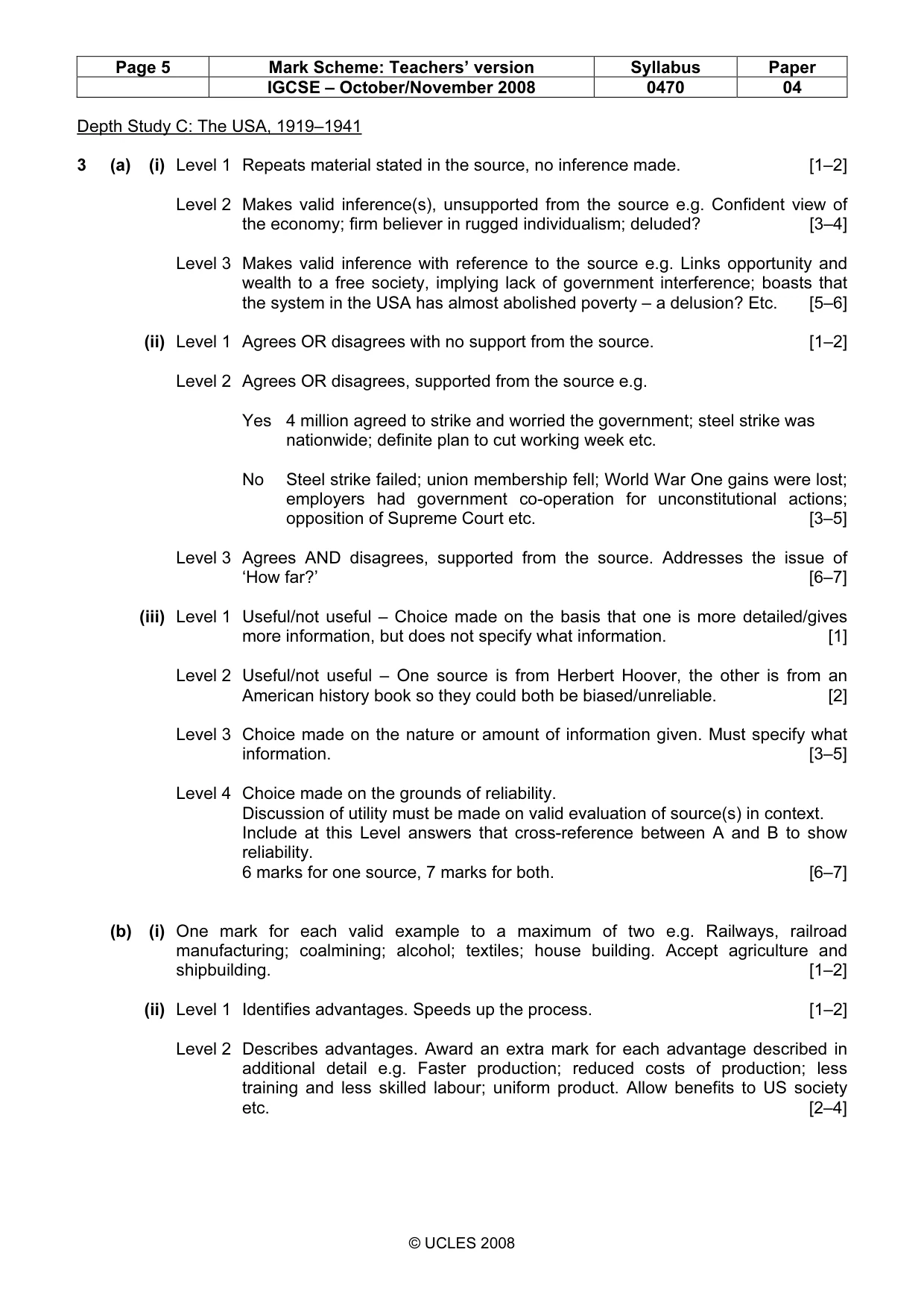
Page 5 Mark Scheme: Teachers’ version Syllabus Paper IGCSE – October/November 2008 0470 04 © UCLES 2008 Depth Study C: The USA, 1919–1941 3 (a) (i) Level 1 Repeats material stated in the source, no inference made. [1–2] Level 2 Makes valid inference(s), unsupported from the source e.g. Confident view of the economy; firm believer in rugged individualism; deluded? [3–4] Level 3 Makes valid inference with reference to the source e.g. Links opportunity and wealth to a free society, implying lack of government interference; boasts that the system in the USA has almost abolished poverty – a delusion? Etc. [5–6] (ii) Level 1 Agrees OR disagrees with no support from the source. [1–2] Level 2 Agrees OR disagrees, supported from the source e.g. Yes 4 million agreed to strike and worried the government; steel strike was nationwide; definite plan to cut working week etc. No Steel strike failed; union membership fell; World War One gains were lost; employers had government co-operation for unconstitutional actions; opposition of Supreme Court etc. [3–5] Level 3 Agrees AND disagrees, supported from the source. Addresses the issue of ‘How far?’ [6–7] (iii) Level 1 Useful/not useful – Choice made on the basis that one is more detailed/gives more information, but does not specify what information. [1] Level 2 Useful/not useful – One source is from Herbert Hoover, the other is from an American history book so they could both be biased/unreliable. [2] Level 3 Choice made on the nature or amount of information given. Must specify what information. [3–5] Level 4 Choice made on the grounds of reliability. Discussion of utility must be made on valid evaluation of source(s) in context. Include at this Level answers that cross-reference between A and B to show reliability. 6 marks for one source, 7 marks for both. [6–7] (b) (i) One mark for each valid example to a maximum of two e.g. Railways, railroad manufacturing; coalmining; alcohol; textiles; house building. Accept agriculture and shipbuilding. [1–2] (ii) Level 1 Identifies advantages. Speeds up the process. [1–2] Level 2 Describes advantages. Award an extra mark for each advantage described in additional detail e.g. Faster production; reduced costs of production; less training and less skilled labour; uniform product. Allow benefits to US society etc. [2–4]
Mark scheme, page 6
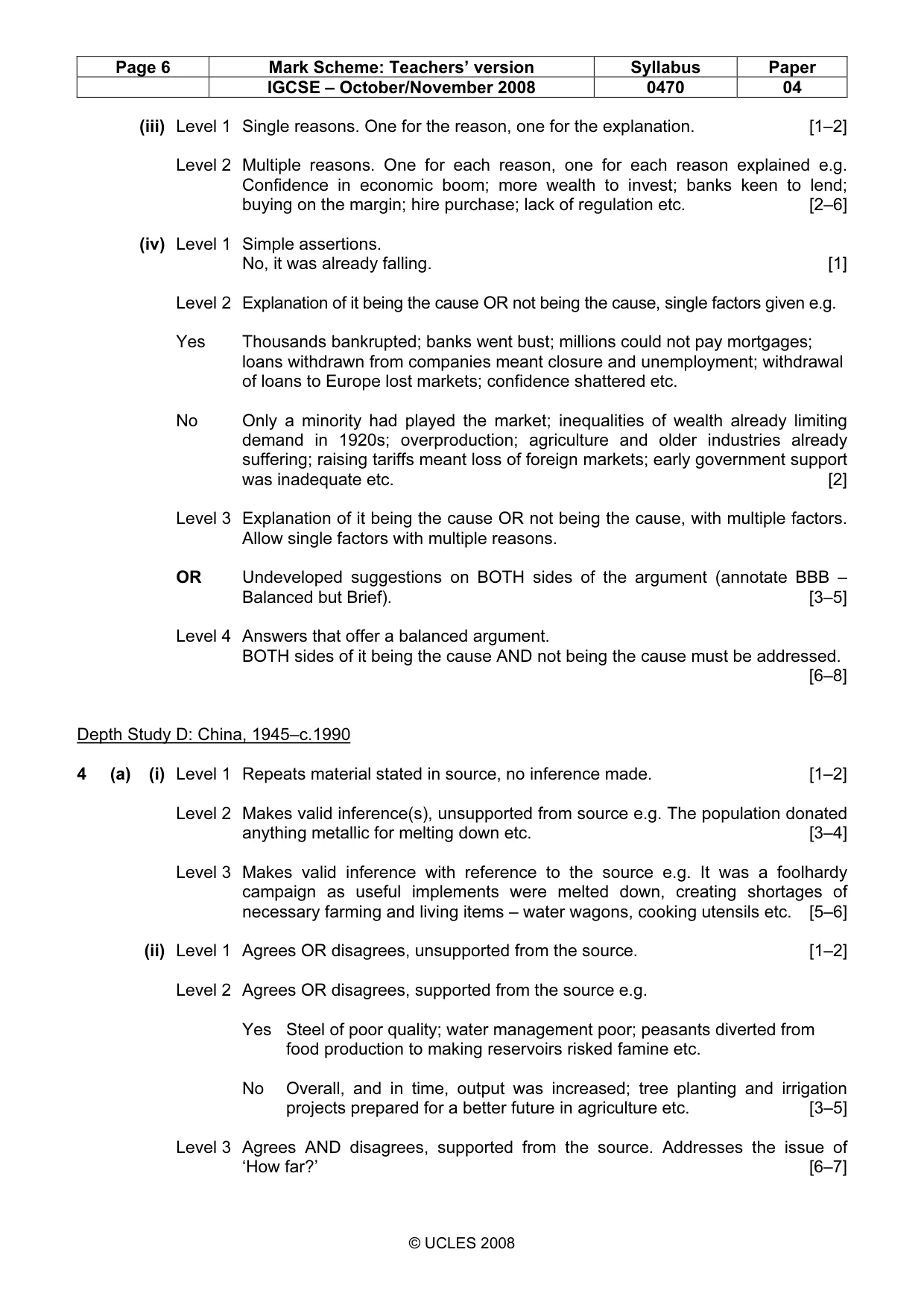
Page 6 Mark Scheme: Teachers’ version Syllabus Paper IGCSE – October/November 2008 0470 04 © UCLES 2008 (iii) Level 1 Single reasons. One for the reason, one for the explanation. [1–2] Level 2 Multiple reasons. One for each reason, one for each reason explained e.g. Confidence in economic boom; more wealth to invest; banks keen to lend; buying on the margin; hire purchase; lack of regulation etc. [2–6] (iv) Level 1 Simple assertions. No, it was already falling. [1] Level 2 Explanation of it being the cause OR not being the cause, single factors given e.g. Yes Thousands bankrupted; banks went bust; millions could not pay mortgages; loans withdrawn from companies meant closure and unemployment; withdrawal of loans to Europe lost markets; confidence shattered etc. No Only a minority had played the market; inequalities of wealth already limiting demand in 1920s; overproduction; agriculture and older industries already suffering; raising tariffs meant loss of foreign markets; early government support was inadequate etc. [2] Level 3 Explanation of it being the cause OR not being the cause, with multiple factors. Allow single factors with multiple reasons. OR Undeveloped suggestions on BOTH sides of the argument (annotate BBB – Balanced but Brief). [3–5] Level 4 Answers that offer a balanced argument. BOTH sides of it being the cause AND not being the cause must be addressed. [6–8] Depth Study D: China, 1945–c.1990 4 (a) (i) Level 1 Repeats material stated in source, no inference made. [1–2] Level 2 Makes valid inference(s), unsupported from source e.g. The population donated anything metallic for melting down etc. [3–4] Level 3 Makes valid inference with reference to the source e.g. It was a foolhardy campaign as useful implements were melted down, creating shortages of necessary farming and living items – water wagons, cooking utensils etc. [5–6] (ii) Level 1 Agrees OR disagrees, unsupported from the source. [1–2] Level 2 Agrees OR disagrees, supported from the source e.g. Yes Steel of poor quality; water management poor; peasants diverted from food production to making reservoirs risked famine etc. No Overall, and in time, output was increased; tree planting and irrigation projects prepared for a better future in agriculture etc. [3–5] Level 3 Agrees AND disagrees, supported from the source. Addresses the issue of ‘How far?’ [6–7]
Mark scheme, page 7
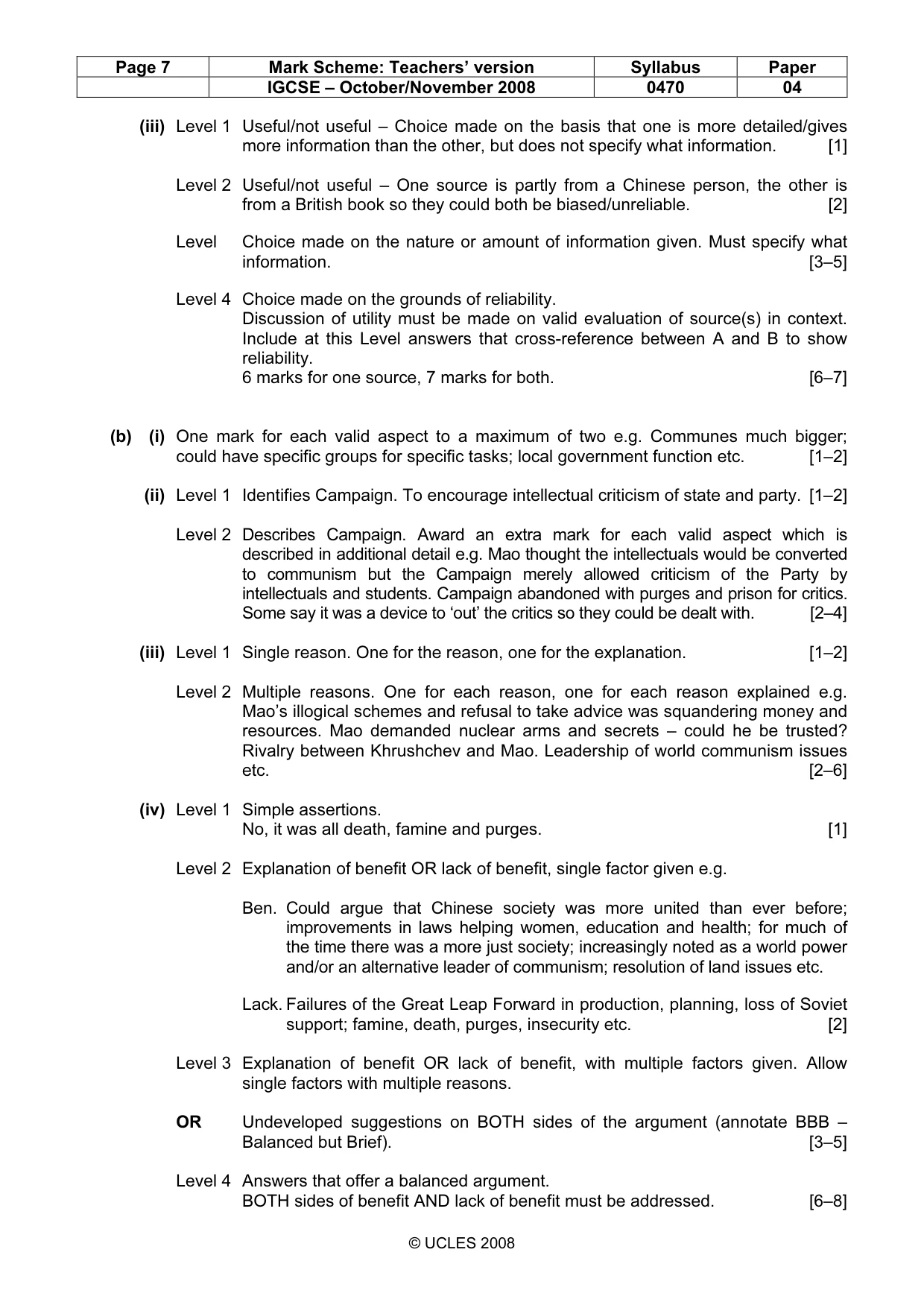
Page 7 Mark Scheme: Teachers’ version Syllabus Paper IGCSE – October/November 2008 0470 04 © UCLES 2008 (iii) Level 1 Useful/not useful – Choice made on the basis that one is more detailed/gives more information than the other, but does not specify what information. [1] Level 2 Useful/not useful – One source is partly from a Chinese person, the other is from a British book so they could both be biased/unreliable. [2] Level Choice made on the nature or amount of information given. Must specify what information. [3–5] Level 4 Choice made on the grounds of reliability. Discussion of utility must be made on valid evaluation of source(s) in context. Include at this Level answers that cross-reference between A and B to show reliability. 6 marks for one source, 7 marks for both. [6–7] (b) (i) One mark for each valid aspect to a maximum of two e.g. Communes much bigger; could have specific groups for specific tasks; local government function etc. [1–2] (ii) Level 1 Identifies Campaign. To encourage intellectual criticism of state and party. [1–2] Level 2 Describes Campaign. Award an extra mark for each valid aspect which is described in additional detail e.g. Mao thought the intellectuals would be converted to communism but the Campaign merely allowed criticism of the Party by intellectuals and students. Campaign abandoned with purges and prison for critics. Some say it was a device to ‘out’ the critics so they could be dealt with. [2–4] (iii) Level 1 Single reason. One for the reason, one for the explanation. [1–2] Level 2 Multiple reasons. One for each reason, one for each reason explained e.g. Mao’s illogical schemes and refusal to take advice was squandering money and resources. Mao demanded nuclear arms and secrets – could he be trusted? Rivalry between Khrushchev and Mao. Leadership of world communism issues etc. [2–6] (iv) Level 1 Simple assertions. No, it was all death, famine and purges. [1] Level 2 Explanation of benefit OR lack of benefit, single factor given e.g. Ben. Could argue that Chinese society was more united than ever before; improvements in laws helping women, education and health; for much of the time there was a more just society; increasingly noted as a world power and/or an alternative leader of communism; resolution of land issues etc. Lack. Failures of the Great Leap Forward in production, planning, loss of Soviet support; famine, death, purges, insecurity etc. [2] Level 3 Explanation of benefit OR lack of benefit, with multiple factors given. Allow single factors with multiple reasons. OR Undeveloped suggestions on BOTH sides of the argument (annotate BBB – Balanced but Brief). [3–5] Level 4 Answers that offer a balanced argument. BOTH sides of benefit AND lack of benefit must be addressed. [6–8]
Mark scheme, page 8
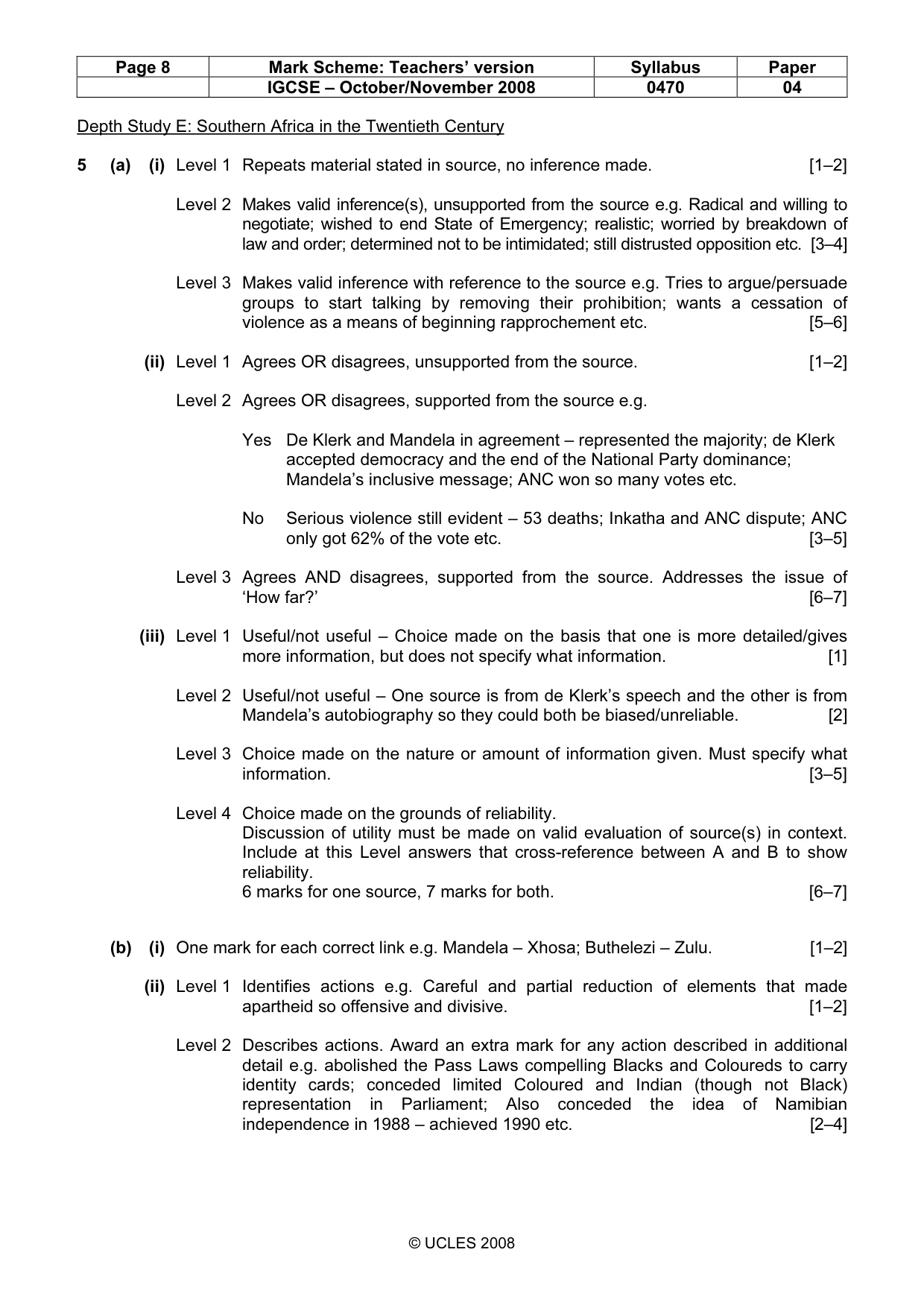
Page 8 Mark Scheme: Teachers’ version Syllabus Paper IGCSE – October/November 2008 0470 04 © UCLES 2008 Depth Study E: Southern Africa in the Twentieth Century 5 (a) (i) Level 1 Repeats material stated in source, no inference made. [1–2] Level 2 Makes valid inference(s), unsupported from the source e.g. Radical and willing to negotiate; wished to end State of Emergency; realistic; worried by breakdown of law and order; determined not to be intimidated; still distrusted opposition etc. [3–4] Level 3 Makes valid inference with reference to the source e.g. Tries to argue/persuade groups to start talking by removing their prohibition; wants a cessation of violence as a means of beginning rapprochement etc. [5–6] (ii) Level 1 Agrees OR disagrees, unsupported from the source. [1–2] Level 2 Agrees OR disagrees, supported from the source e.g. Yes De Klerk and Mandela in agreement – represented the majority; de Klerk accepted democracy and the end of the National Party dominance; Mandela’s inclusive message; ANC won so many votes etc. No Serious violence still evident – 53 deaths; Inkatha and ANC dispute; ANC only got 62% of the vote etc. [3–5] Level 3 Agrees AND disagrees, supported from the source. Addresses the issue of ‘How far?’ [6–7] (iii) Level 1 Useful/not useful – Choice made on the basis that one is more detailed/gives more information, but does not specify what information. [1] Level 2 Useful/not useful – One source is from de Klerk’s speech and the other is from Mandela’s autobiography so they could both be biased/unreliable. [2] Level 3 Choice made on the nature or amount of information given. Must specify what information. [3–5] Level 4 Choice made on the grounds of reliability. Discussion of utility must be made on valid evaluation of source(s) in context. Include at this Level answers that cross-reference between A and B to show reliability. 6 marks for one source, 7 marks for both. [6–7] (b) (i) One mark for each correct link e.g. Mandela – Xhosa; Buthelezi – Zulu. [1–2] (ii) Level 1 Identifies actions e.g. Careful and partial reduction of elements that made apartheid so offensive and divisive. [1–2] Level 2 Describes actions. Award an extra mark for any action described in additional detail e.g. abolished the Pass Laws compelling Blacks and Coloureds to carry identity cards; conceded limited Coloured and Indian (though not Black) representation in Parliament; Also conceded the idea of Namibian independence in 1988 – achieved 1990 etc. [2–4]
Mark scheme, page 9
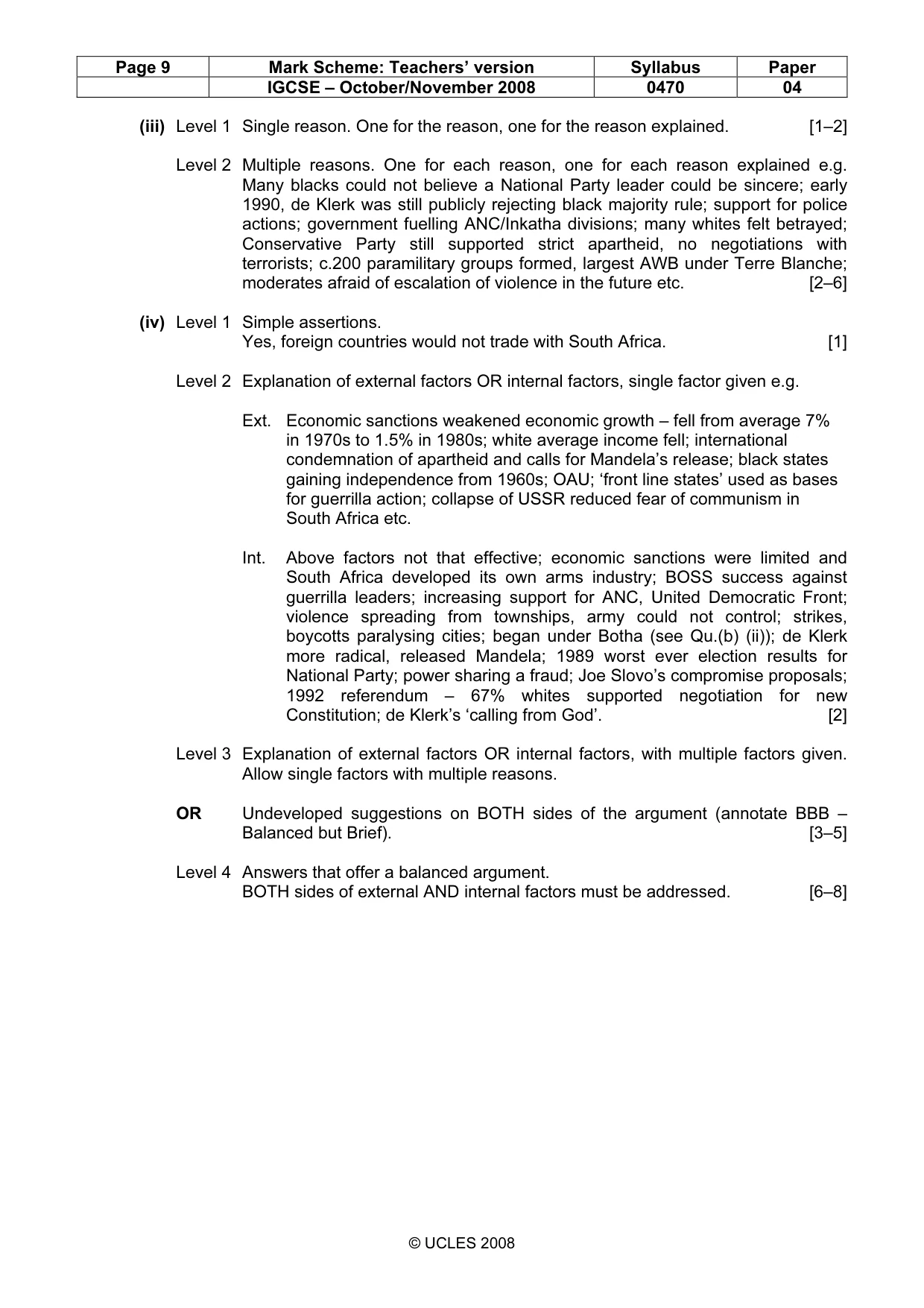
Page 9 Mark Scheme: Teachers’ version Syllabus Paper IGCSE – October/November 2008 0470 04 © UCLES 2008 (iii) Level 1 Single reason. One for the reason, one for the reason explained. [1–2] Level 2 Multiple reasons. One for each reason, one for each reason explained e.g. Many blacks could not believe a National Party leader could be sincere; early 1990, de Klerk was still publicly rejecting black majority rule; support for police actions; government fuelling ANC/Inkatha divisions; many whites felt betrayed; Conservative Party still supported strict apartheid, no negotiations with terrorists; c.200 paramilitary groups formed, largest AWB under Terre Blanche; moderates afraid of escalation of violence in the future etc. [2–6] (iv) Level 1 Simple assertions. Yes, foreign countries would not trade with South Africa. [1] Level 2 Explanation of external factors OR internal factors, single factor given e.g. Ext. Economic sanctions weakened economic growth – fell from average 7% in 1970s to 1.5% in 1980s; white average income fell; international condemnation of apartheid and calls for Mandela’s release; black states gaining independence from 1960s; OAU; ‘front line states’ used as bases for guerrilla action; collapse of USSR reduced fear of communism in South Africa etc. Int. Above factors not that effective; economic sanctions were limited and South Africa developed its own arms industry; BOSS success against guerrilla leaders; increasing support for ANC, United Democratic Front; violence spreading from townships, army could not control; strikes, boycotts paralysing cities; began under Botha (see Qu.(b) (ii)); de Klerk more radical, released Mandela; 1989 worst ever election results for National Party; power sharing a fraud; Joe Slovo’s compromise proposals; 1992 referendum – 67% whites supported negotiation for new Constitution; de Klerk’s ‘calling from God’. [2] Level 3 Explanation of external factors OR internal factors, with multiple factors given. Allow single factors with multiple reasons. OR Undeveloped suggestions on BOTH sides of the argument (annotate BBB – Balanced but Brief). [3–5] Level 4 Answers that offer a balanced argument. BOTH sides of external AND internal factors must be addressed. [6–8]
Mark scheme, page 10
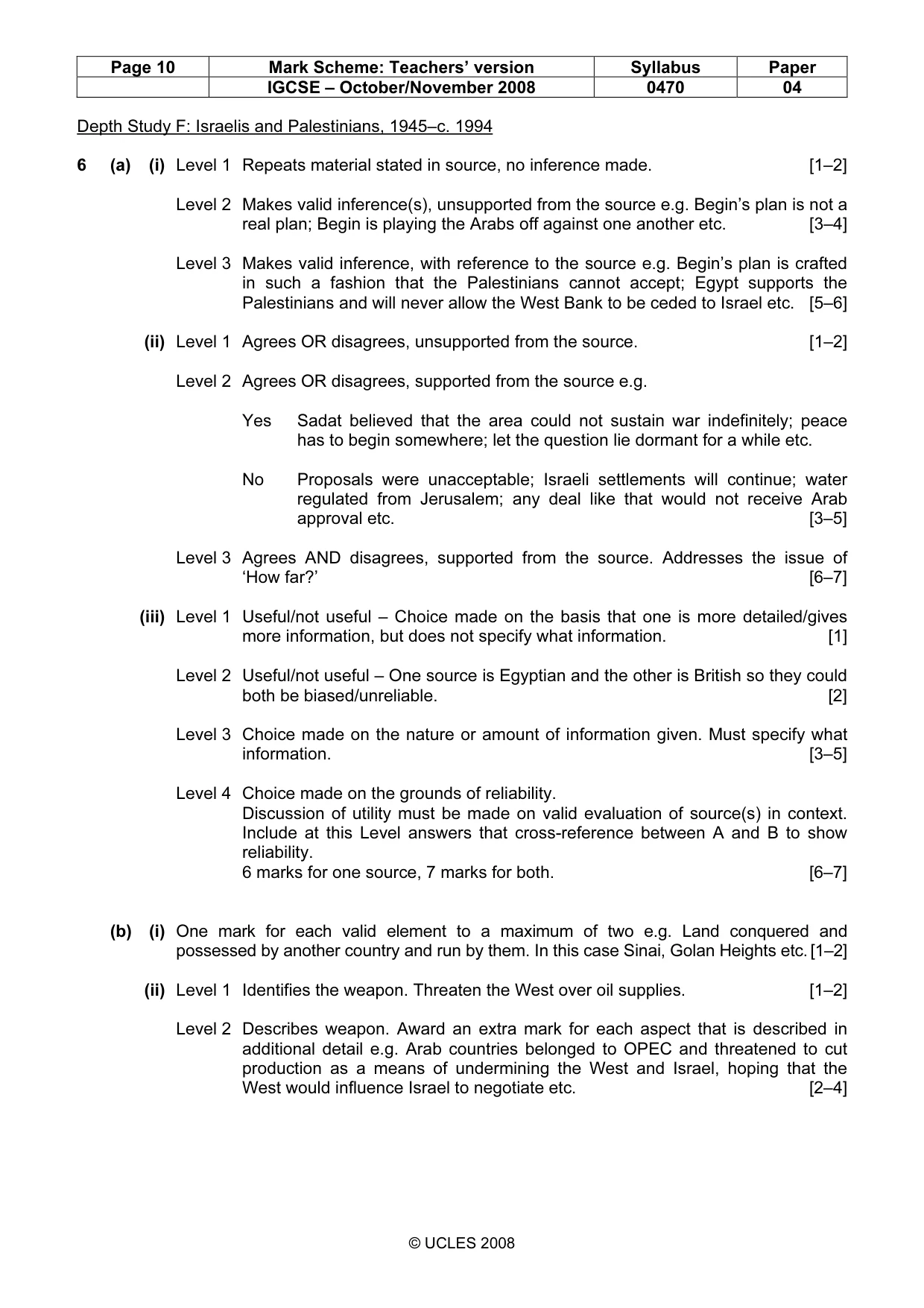
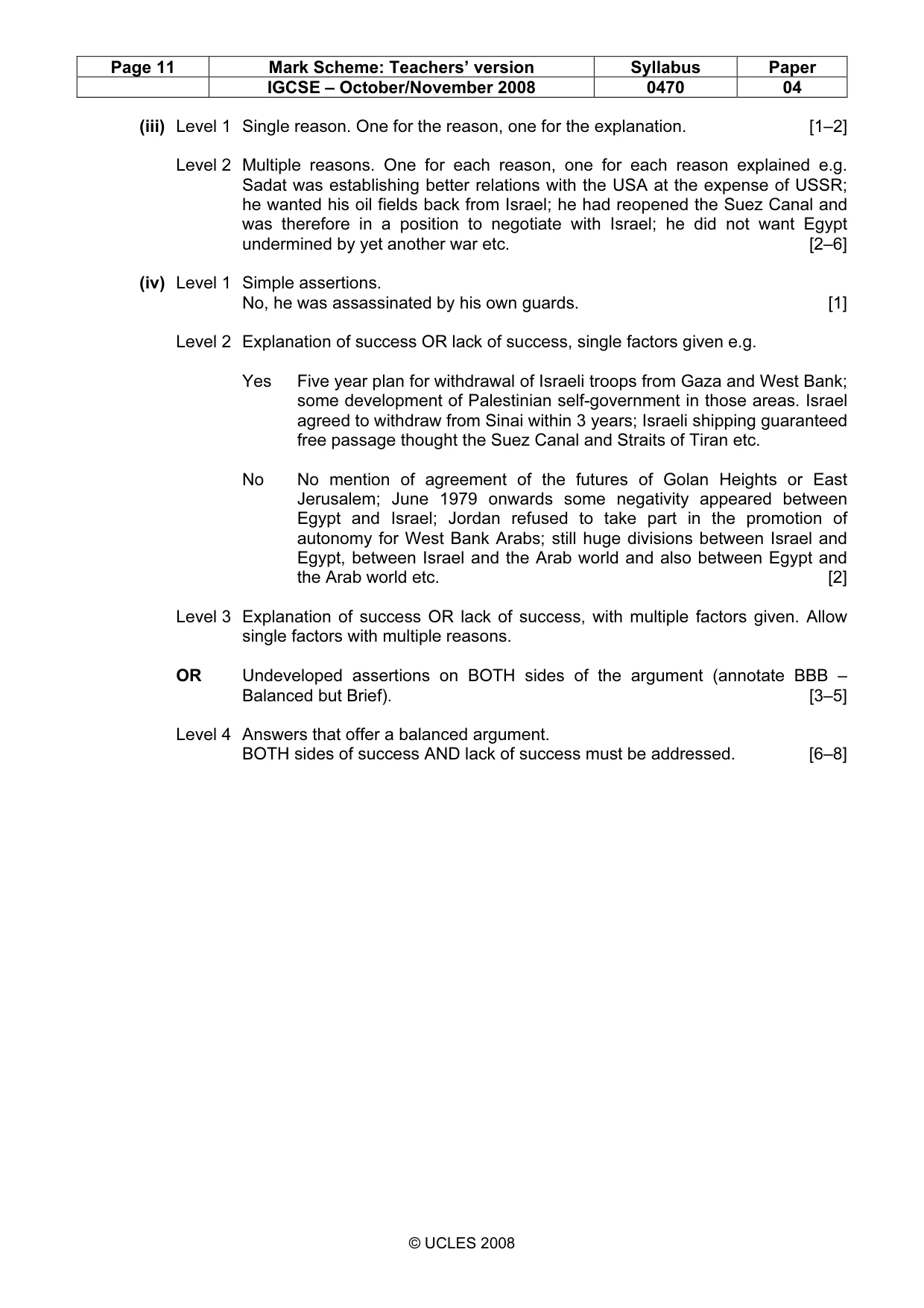
Page 10 Mark Scheme: Teachers’ version Syllabus Paper IGCSE – October/November 2008 0470 04 © UCLES 2008 Depth Study F: Israelis and Palestinians, 1945–c. 1994 6 (a) (i) Level 1 Repeats material stated in source, no inference made. [1–2] Level 2 Makes valid inference(s), unsupported from the source e.g. Begin’s plan is not a real plan; Begin is playing the Arabs off against one another etc. [3–4] Level 3 Makes valid inference, with reference to the source e.g. Begin’s plan is crafted in such a fashion that the Palestinians cannot accept; Egypt supports the Palestinians and will never allow the West Bank to be ceded to Israel etc. [5–6] (ii) Level 1 Agrees OR disagrees, unsupported from the source. [1–2] Level 2 Agrees OR disagrees, supported from the source e.g. Yes Sadat believed that the area could not sustain war indefinitely; peace has to begin somewhere; let the question lie dormant for a while etc. No Proposals were unacceptable; Israeli settlements will continue; water regulated from Jerusalem; any deal like that would not receive Arab approval etc. [3–5] Level 3 Agrees AND disagrees, supported from the source. Addresses the issue of ‘How far?’ [6–7] (iii) Level 1 Useful/not useful – Choice made on the basis that one is more detailed/gives more information, but does not specify what information. [1] Level 2 Useful/not useful – One source is Egyptian and the other is British so they could both be biased/unreliable. [2] Level 3 Choice made on the nature or amount of information given. Must specify what information. [3–5] Level 4 Choice made on the grounds of reliability. Discussion of utility must be made on valid evaluation of source(s) in context. Include at this Level answers that cross-reference between A and B to show reliability. 6 marks for one source, 7 marks for both. [6–7] (b) (i) One mark for each valid element to a maximum of two e.g. Land conquered and possessed by another country and run by them. In this case Sinai, Golan Heights etc. [1–2] (ii) Level 1 Identifies the weapon. Threaten the West over oil supplies. [1–2] Level 2 Describes weapon. Award an extra mark for each aspect that is described in additional detail e.g. Arab countries belonged to OPEC and threatened to cut production as a means of undermining the West and Israel, hoping that the West would influence Israel to negotiate etc. [2–4]
Mark scheme, page 11
Page 11 Mark Scheme: Teachers’ version Syllabus Paper IGCSE – October/November 2008 0470 04 © UCLES 2008 (iii) Level 1 Single reason. One for the reason, one for the explanation. [1–2] Level 2 Multiple reasons. One for each reason, one for each reason explained e.g. Sadat was establishing better relations with the USA at the expense of USSR; he wanted his oil fields back from Israel; he had reopened the Suez Canal and was therefore in a position to negotiate with Israel; he did not want Egypt undermined by yet another war etc. [2–6] (iv) Level 1 Simple assertions. No, he was assassinated by his own guards. [1] Level 2 Explanation of success OR lack of success, single factors given e.g. Yes Five year plan for withdrawal of Israeli troops from Gaza and West Bank; some development of Palestinian self-government in those areas. Israel agreed to withdraw from Sinai within 3 years; Israeli shipping guaranteed free passage thought the Suez Canal and Straits of Tiran etc. No No mention of agreement of the futures of Golan Heights or East Jerusalem; June 1979 onwards some negativity appeared between Egypt and Israel; Jordan refused to take part in the promotion of autonomy for West Bank Arabs; still huge divisions between Israel and Egypt, between Israel and the Arab world and also between Egypt and the Arab world etc. [2] Level 3 Explanation of success OR lack of success, with multiple factors given. Allow single factors with multiple reasons. OR Undeveloped assertions on BOTH sides of the argument (annotate BBB – Balanced but Brief). [3–5] Level 4 Answers that offer a balanced argument. BOTH sides of success AND lack of success must be addressed. [6–8]
Mark scheme, page 12
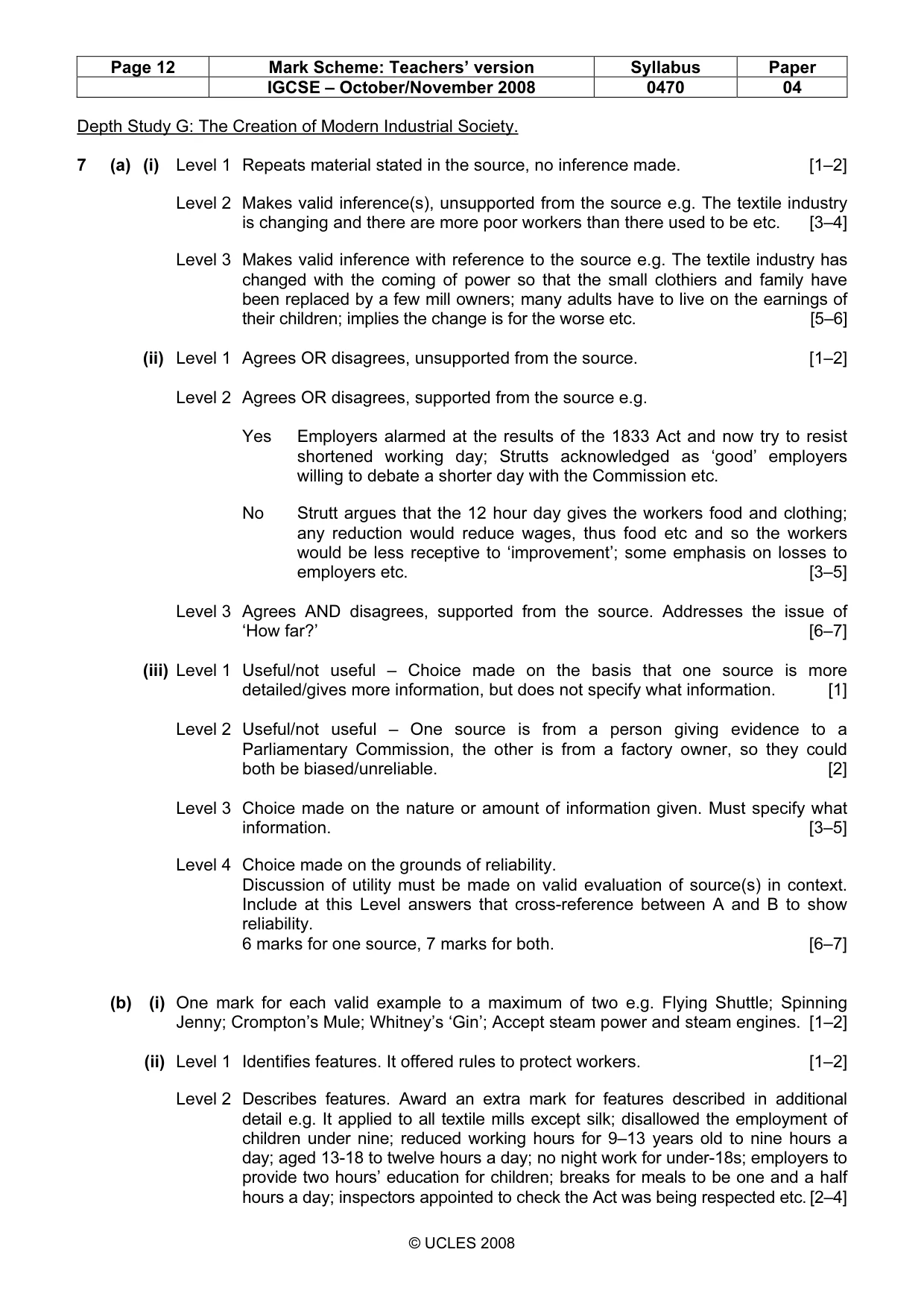
Page 12 Mark Scheme: Teachers’ version Syllabus Paper IGCSE – October/November 2008 0470 04 © UCLES 2008 Depth Study G: The Creation of Modern Industrial Society. 7 (a) (i) Level 1 Repeats material stated in the source, no inference made. [1–2] Level 2 Makes valid inference(s), unsupported from the source e.g. The textile industry is changing and there are more poor workers than there used to be etc. [3–4] Level 3 Makes valid inference with reference to the source e.g. The textile industry has changed with the coming of power so that the small clothiers and family have been replaced by a few mill owners; many adults have to live on the earnings of their children; implies the change is for the worse etc. [5–6] (ii) Level 1 Agrees OR disagrees, unsupported from the source. [1–2] Level 2 Agrees OR disagrees, supported from the source e.g. Yes Employers alarmed at the results of the 1833 Act and now try to resist shortened working day; Strutts acknowledged as ‘good’ employers willing to debate a shorter day with the Commission etc. No Strutt argues that the 12 hour day gives the workers food and clothing; any reduction would reduce wages, thus food etc and so the workers would be less receptive to ‘improvement’; some emphasis on losses to employers etc. [3–5] Level 3 Agrees AND disagrees, supported from the source. Addresses the issue of ‘How far?’ [6–7] (iii) Level 1 Useful/not useful – Choice made on the basis that one source is more detailed/gives more information, but does not specify what information. [1] Level 2 Useful/not useful – One source is from a person giving evidence to a Parliamentary Commission, the other is from a factory owner, so they could both be biased/unreliable. [2] Level 3 Choice made on the nature or amount of information given. Must specify what information. [3–5] Level 4 Choice made on the grounds of reliability. Discussion of utility must be made on valid evaluation of source(s) in context. Include at this Level answers that cross-reference between A and B to show reliability. 6 marks for one source, 7 marks for both. [6–7] (b) (i) One mark for each valid example to a maximum of two e.g. Flying Shuttle; Spinning Jenny; Crompton’s Mule; Whitney’s ‘Gin’; Accept steam power and steam engines. [1–2] (ii) Level 1 Identifies features. It offered rules to protect workers. [1–2] Level 2 Describes features. Award an extra mark for features described in additional detail e.g. It applied to all textile mills except silk; disallowed the employment of children under nine; reduced working hours for 9–13 years old to nine hours a day; aged 13-18 to twelve hours a day; no night work for under-18s; employers to provide two hours’ education for children; breaks for meals to be one and a half hours a day; inspectors appointed to check the Act was being respected etc. [2–4]
Mark scheme, page 13
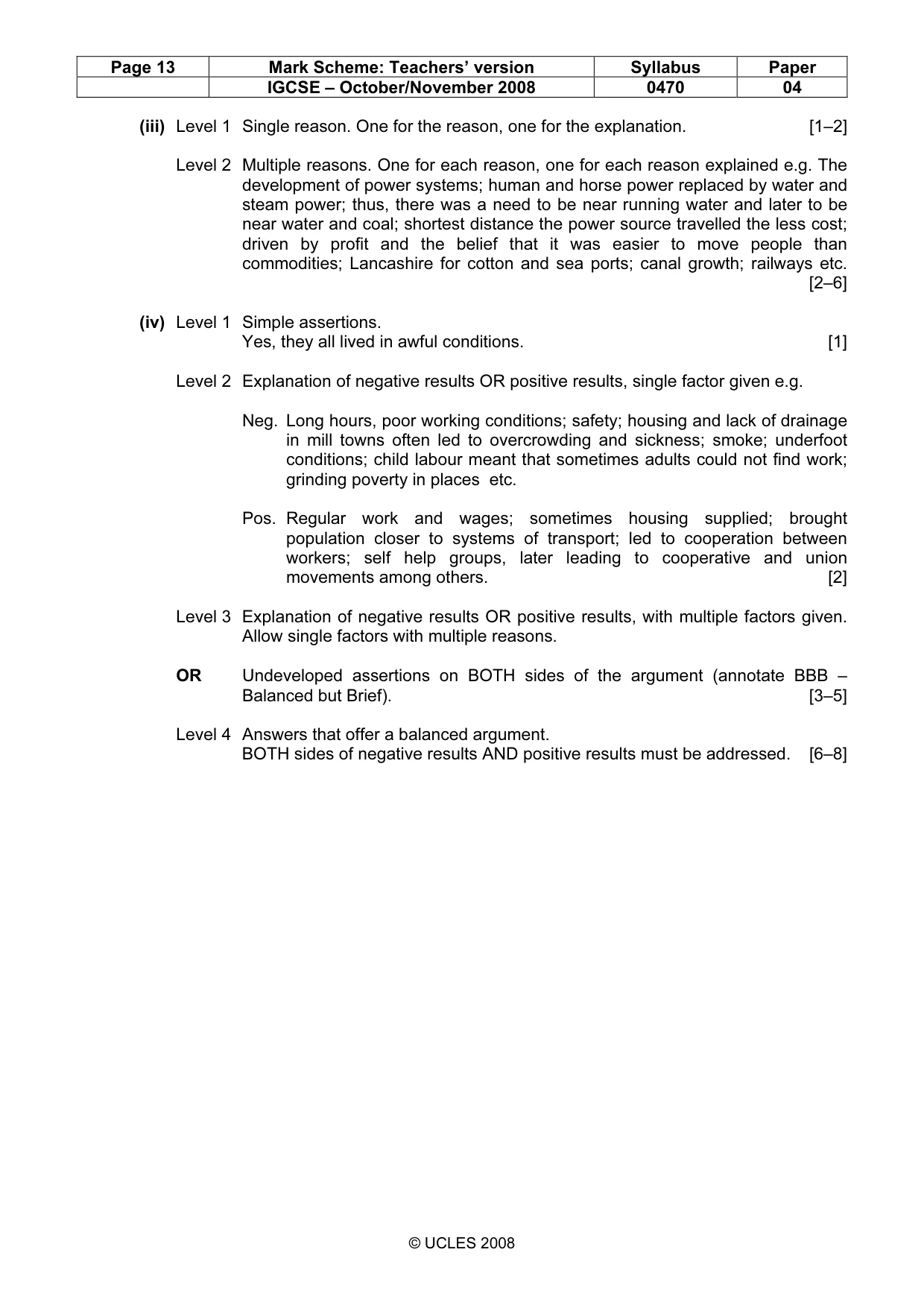
Page 13 Mark Scheme: Teachers’ version Syllabus Paper IGCSE – October/November 2008 0470 04 © UCLES 2008 (iii) Level 1 Single reason. One for the reason, one for the explanation. [1–2] Level 2 Multiple reasons. One for each reason, one for each reason explained e.g. The development of power systems; human and horse power replaced by water and steam power; thus, there was a need to be near running water and later to be near water and coal; shortest distance the power source travelled the less cost; driven by profit and the belief that it was easier to move people than commodities; Lancashire for cotton and sea ports; canal growth; railways etc. [2–6] (iv) Level 1 Simple assertions. Yes, they all lived in awful conditions. [1] Level 2 Explanation of negative results OR positive results, single factor given e.g. Neg. Long hours, poor working conditions; safety; housing and lack of drainage in mill towns often led to overcrowding and sickness; smoke; underfoot conditions; child labour meant that sometimes adults could not find work; grinding poverty in places etc. Pos. Regular work and wages; sometimes housing supplied; brought population closer to systems of transport; led to cooperation between workers; self help groups, later leading to cooperative and union movements among others. [2] Level 3 Explanation of negative results OR positive results, with multiple factors given. Allow single factors with multiple reasons. OR Undeveloped assertions on BOTH sides of the argument (annotate BBB – Balanced but Brief). [3–5] Level 4 Answers that offer a balanced argument. BOTH sides of negative results AND positive results must be addressed. [6–8]
Mark scheme, page 14
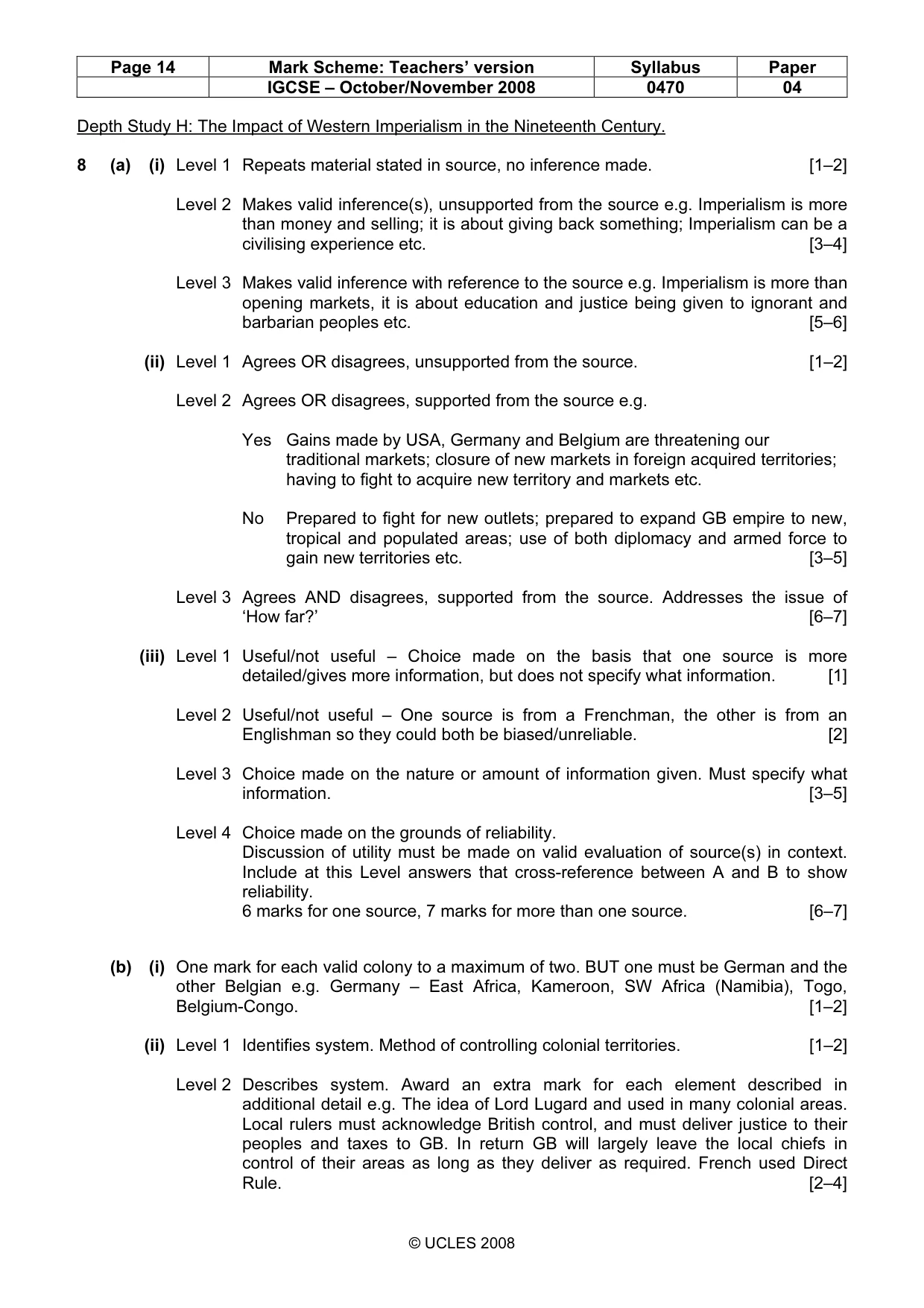
Page 14 Mark Scheme: Teachers’ version Syllabus Paper IGCSE – October/November 2008 0470 04 © UCLES 2008 Depth Study H: The Impact of Western Imperialism in the Nineteenth Century. 8 (a) (i) Level 1 Repeats material stated in source, no inference made. [1–2] Level 2 Makes valid inference(s), unsupported from the source e.g. Imperialism is more than money and selling; it is about giving back something; Imperialism can be a civilising experience etc. [3–4] Level 3 Makes valid inference with reference to the source e.g. Imperialism is more than opening markets, it is about education and justice being given to ignorant and barbarian peoples etc. [5–6] (ii) Level 1 Agrees OR disagrees, unsupported from the source. [1–2] Level 2 Agrees OR disagrees, supported from the source e.g. Yes Gains made by USA, Germany and Belgium are threatening our traditional markets; closure of new markets in foreign acquired territories; having to fight to acquire new territory and markets etc. No Prepared to fight for new outlets; prepared to expand GB empire to new, tropical and populated areas; use of both diplomacy and armed force to gain new territories etc. [3–5] Level 3 Agrees AND disagrees, supported from the source. Addresses the issue of ‘How far?’ [6–7] (iii) Level 1 Useful/not useful – Choice made on the basis that one source is more detailed/gives more information, but does not specify what information. [1] Level 2 Useful/not useful – One source is from a Frenchman, the other is from an Englishman so they could both be biased/unreliable. [2] Level 3 Choice made on the nature or amount of information given. Must specify what information. [3–5] Level 4 Choice made on the grounds of reliability. Discussion of utility must be made on valid evaluation of source(s) in context. Include at this Level answers that cross-reference between A and B to show reliability. 6 marks for one source, 7 marks for more than one source. [6–7] (b) (i) One mark for each valid colony to a maximum of two. BUT one must be German and the other Belgian e.g. Germany – East Africa, Kameroon, SW Africa (Namibia), Togo, Belgium-Congo. [1–2] (ii) Level 1 Identifies system. Method of controlling colonial territories. [1–2] Level 2 Describes system. Award an extra mark for each element described in additional detail e.g. The idea of Lord Lugard and used in many colonial areas. Local rulers must acknowledge British control, and must deliver justice to their peoples and taxes to GB. In return GB will largely leave the local chiefs in control of their areas as long as they deliver as required. French used Direct Rule. [2–4]
Mark scheme, page 15
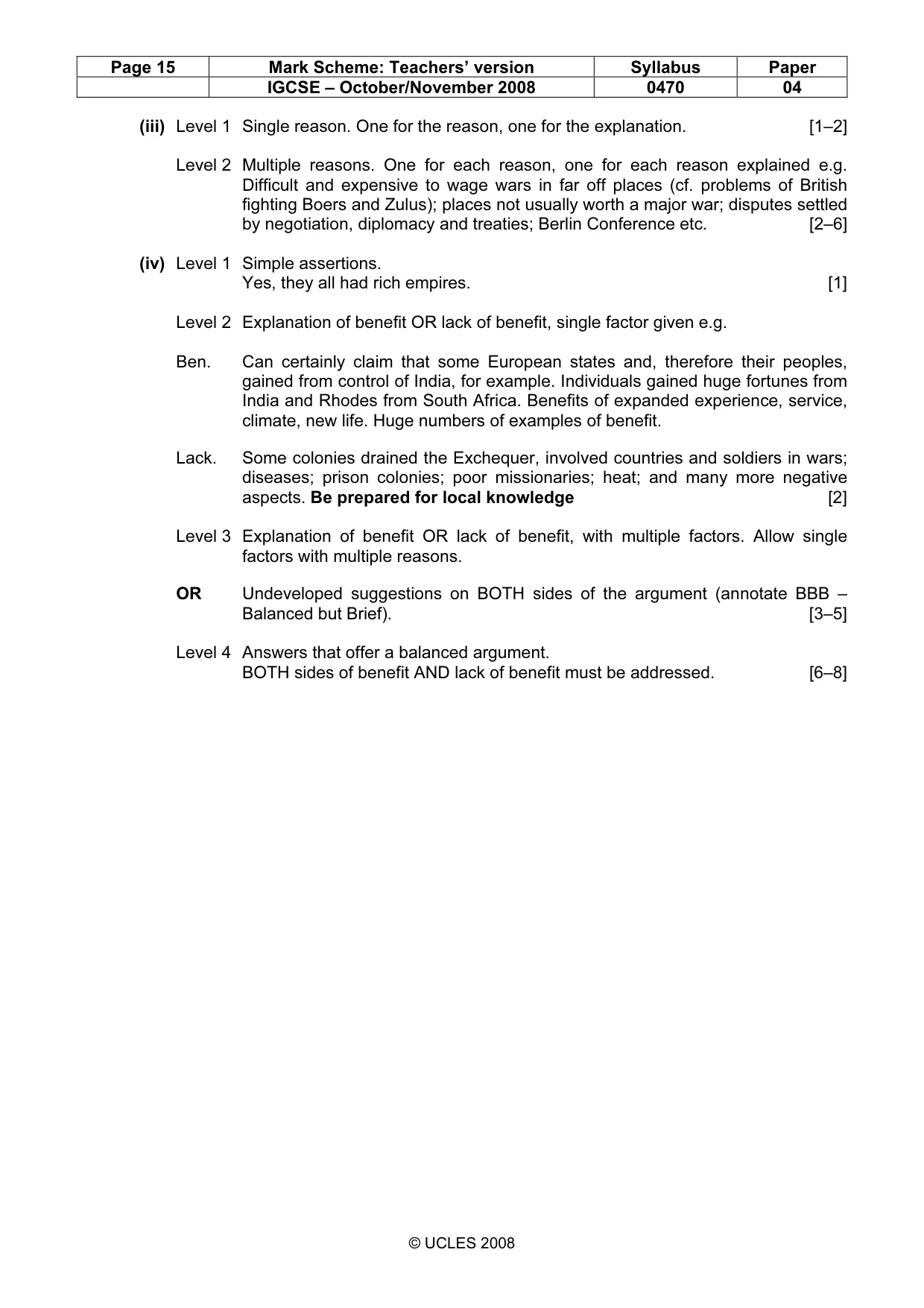
Page 15 Mark Scheme: Teachers’ version Syllabus Paper IGCSE – October/November 2008 0470 04 © UCLES 2008 (iii) Level 1 Single reason. One for the reason, one for the explanation. [1–2] Level 2 Multiple reasons. One for each reason, one for each reason explained e.g. Difficult and expensive to wage wars in far off places (cf. problems of British fighting Boers and Zulus); places not usually worth a major war; disputes settled by negotiation, diplomacy and treaties; Berlin Conference etc. [2–6] (iv) Level 1 Simple assertions. Yes, they all had rich empires. [1] Level 2 Explanation of benefit OR lack of benefit, single factor given e.g. Ben. Can certainly claim that some European states and, therefore their peoples, gained from control of India, for example. Individuals gained huge fortunes from India and Rhodes from South Africa. Benefits of expanded experience, service, climate, new life. Huge numbers of examples of benefit. Lack. Some colonies drained the Exchequer, involved countries and soldiers in wars; diseases; prison colonies; poor missionaries; heat; and many more negative aspects. Be prepared for local knowledge [2] Level 3 Explanation of benefit OR lack of benefit, with multiple factors. Allow single factors with multiple reasons. OR Undeveloped suggestions on BOTH sides of the argument (annotate BBB – Balanced but Brief). [3–5] Level 4 Answers that offer a balanced argument. BOTH sides of benefit AND lack of benefit must be addressed. [6–8]
What you needed in this session
Cambridge’s own grade thresholds for 2009 Oct/Nov, Paper 4 · Variant 1. A higher threshold means an easier paper — the bar moves with how the cohort did.