Cambridge IGCSE History 0470 — 2009 May/June Paper 4 · Variant 1
0470/41/M/J/09 · 40 marks · ≈45 min
The question paper and its mark scheme, free to read here and free to download. This is Cambridge’s own paper, exactly as it was sat.
Question paper12 pages


Mark scheme17 pages
Answers below. Sit the paper first if you are practising.
Paper as text
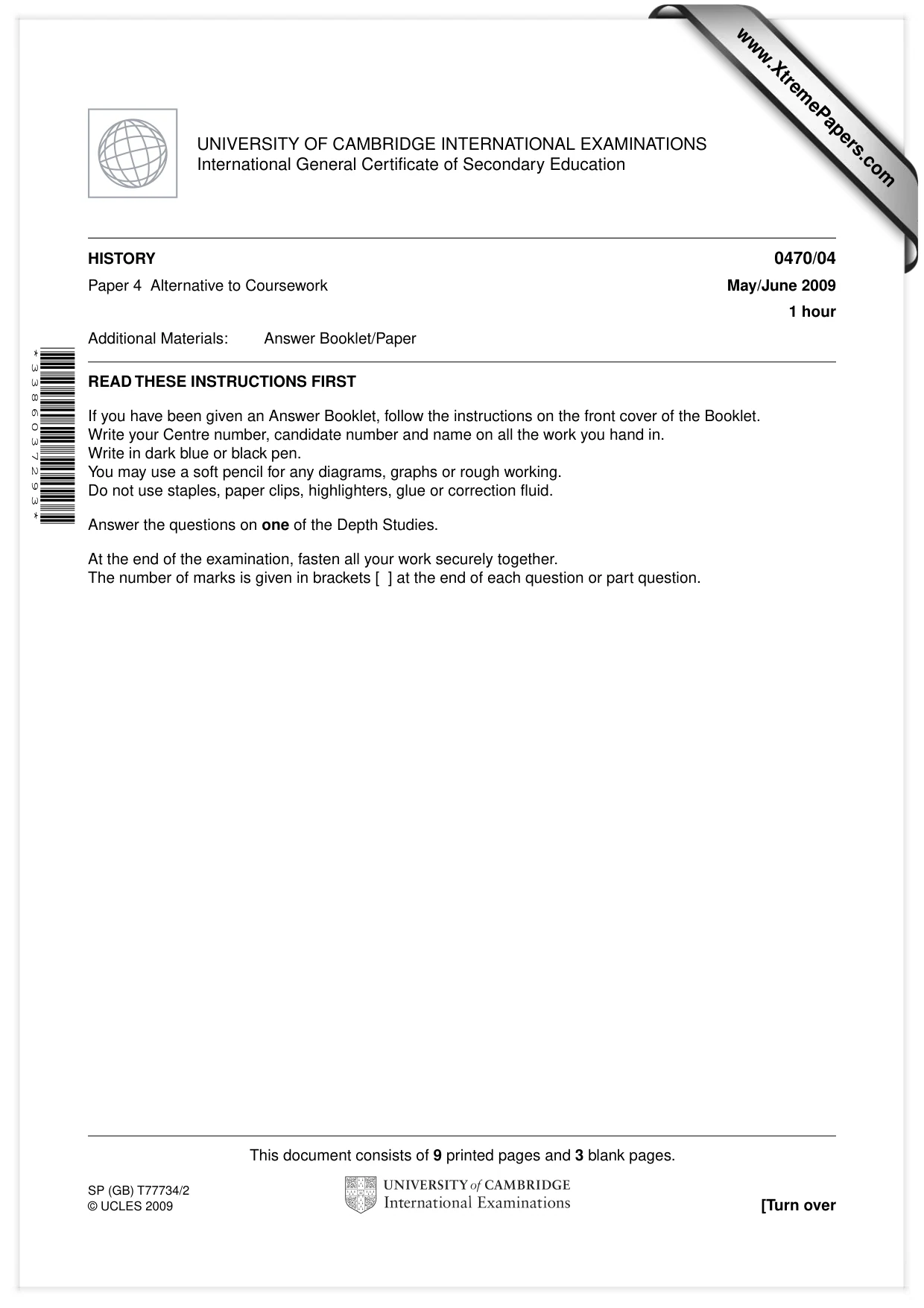
Question paper, page 1
This document consists of 9 printed pages and 3 blank pages. SP (GB) T77734/2 © UCLES 2009 [Turn over UNIVERSITY OF CAMBRIDGE INTERNATIONAL EXAMINATIONS International General Certificate of Secondary Education READ THESE INSTRUCTIONS FIRST If you have been given an Answer Booklet, follow the instructions on the front cover of the Booklet. Write your Centre number, candidate number and name on all the work you hand in. Write in dark blue or black pen. You may use a soft pencil for any diagrams, graphs or rough working. Do not use staples, paper clips, highlighters, glue or correction fluid. Answer the questions on one of the Depth Studies. At the end of the examination, fasten all your work securely together. The number of marks is given in brackets [ ] at the end of each question or part question. * 3 3 8 6 0 3 7 2 9 3 * HISTORY 0470/04 Paper 4 Alternative to Coursework May/June 2009 1 hour Additional Materials: Answer Booklet/Paper www.XtremePapers.com
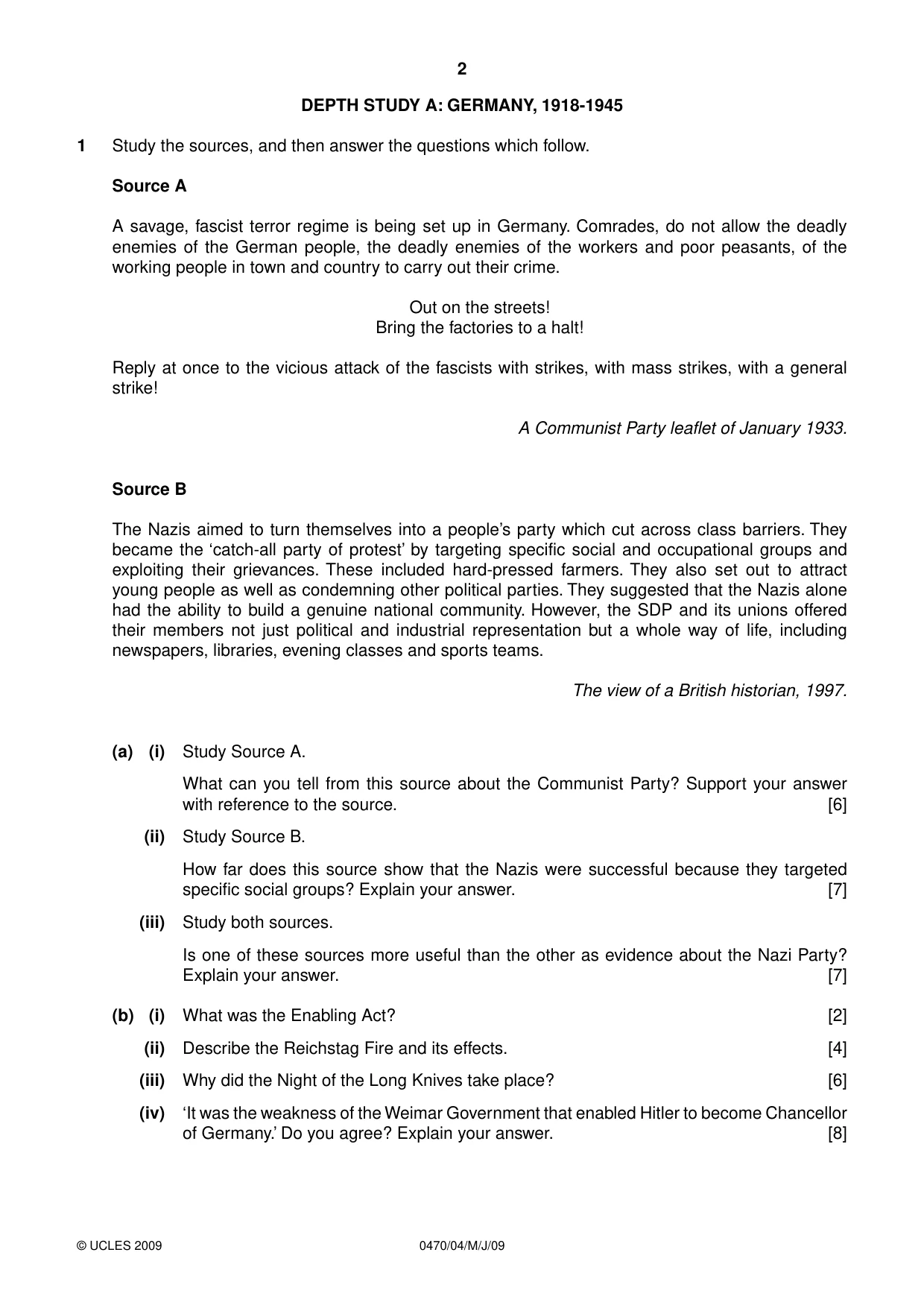
Question paper, page 2
2 0470/04/M/J/09 © UCLES 2009 DEPTH STUDY A: GERMANY, 1918-1945 1 Study the sources, and then answer the questions which follow. Source A A savage, fascist terror regime is being set up in Germany. Comrades, do not allow the deadly enemies of the German people, the deadly enemies of the workers and poor peasants, of the working people in town and country to carry out their crime. Out on the streets! Bring the factories to a halt! Reply at once to the vicious attack of the fascists with strikes, with mass strikes, with a general strike! A Communist Party leaflet of January 1933. Source B The Nazis aimed to turn themselves into a people’s party which cut across class barriers. They became the ‘catch-all party of protest’ by targeting specific social and occupational groups and exploiting their grievances. These included hard-pressed farmers. They also set out to attract young people as well as condemning other political parties. They suggested that the Nazis alone had the ability to build a genuine national community. However, the SDP and its unions offered their members not just political and industrial representation but a whole way of life, including newspapers, libraries, evening classes and sports teams. The view of a British historian, 1997. (a) (i) Study Source A. What can you tell from this source about the Communist Party? Support your answer with reference to the source. [6] (ii) Study Source B. How far does this source show that the Nazis were successful because they targeted specific social groups? Explain your answer. [7] (iii) Study both sources. Is one of these sources more useful than the other as evidence about the Nazi Party? Explain your answer. [7] (b) (i) What was the Enabling Act? [2] (ii) Describe the Reichstag Fire and its effects. [4] (iii) Why did the Night of the Long Knives take place? [6] (iv) ‘It was the weakness of the Weimar Government that enabled Hitler to become Chancellor of Germany.’ Do you agree? Explain your answer. [8]
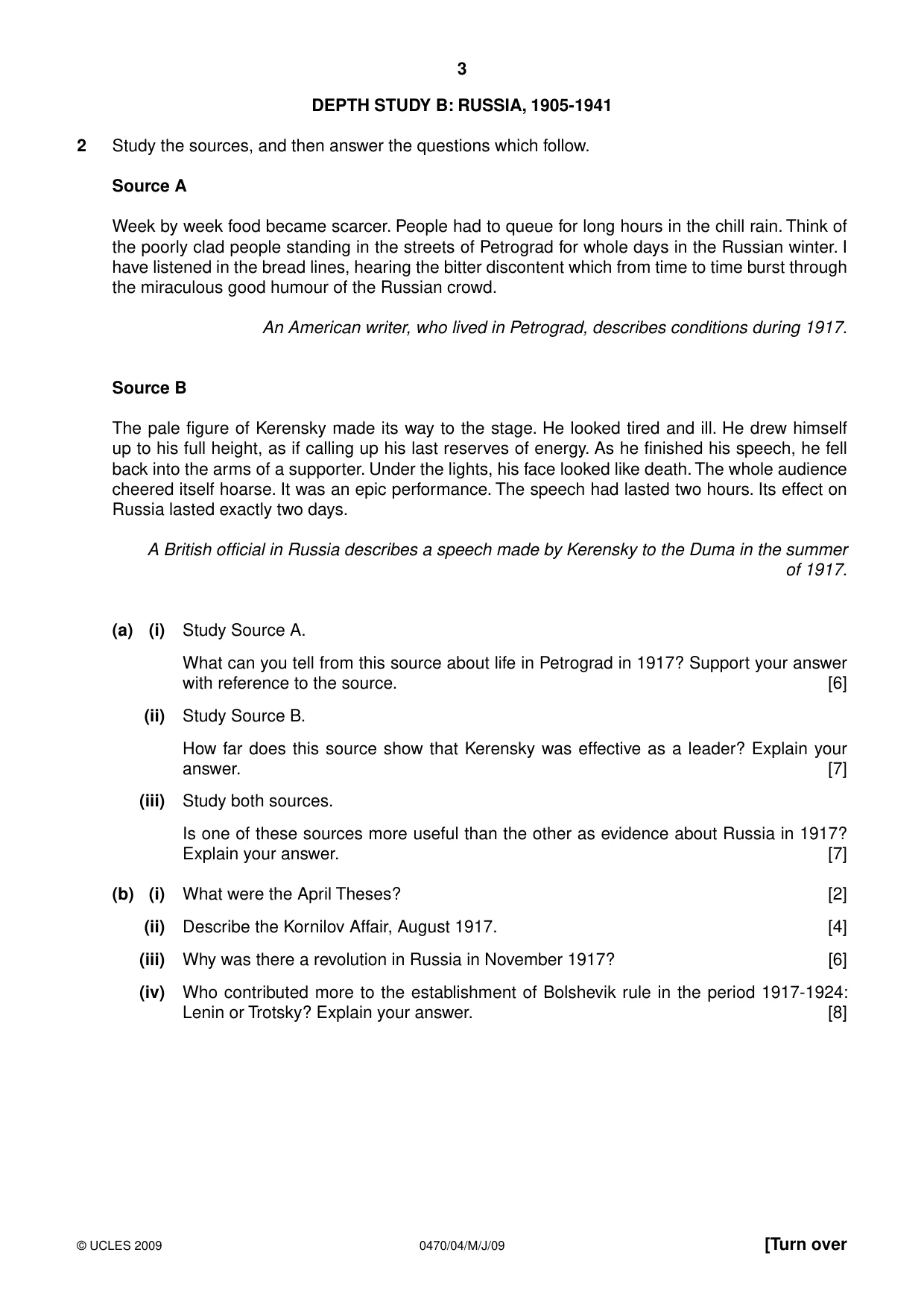
Question paper, page 3
3 0470/04/M/J/09 © UCLES 2009 [Turn over DEPTH STUDY B: RUSSIA, 1905-1941 2 Study the sources, and then answer the questions which follow. Source A Week by week food became scarcer. People had to queue for long hours in the chill rain. Think of the poorly clad people standing in the streets of Petrograd for whole days in the Russian winter. I have listened in the bread lines, hearing the bitter discontent which from time to time burst through the miraculous good humour of the Russian crowd. An American writer, who lived in Petrograd, describes conditions during 1917. Source B The pale figure of Kerensky made its way to the stage. He looked tired and ill. He drew himself up to his full height, as if calling up his last reserves of energy. As he finished his speech, he fell back into the arms of a supporter. Under the lights, his face looked like death. The whole audience cheered itself hoarse. It was an epic performance. The speech had lasted two hours. Its effect on Russia lasted exactly two days. A British official in Russia describes a speech made by Kerensky to the Duma in the summer of 1917. (a) (i) Study Source A. What can you tell from this source about life in Petrograd in 1917? Support your answer with reference to the source. [6] (ii) Study Source B. How far does this source show that Kerensky was effective as a leader? Explain your answer. [7] (iii) Study both sources. Is one of these sources more useful than the other as evidence about Russia in 1917? Explain your answer. [7] (b) (i) What were the April Theses? [2] (ii) Describe the Kornilov Affair, August 1917. [4] (iii) Why was there a revolution in Russia in November 1917? [6] (iv) Who contributed more to the establishment of Bolshevik rule in the period 1917-1924: Lenin or Trotsky? Explain your answer. [8]
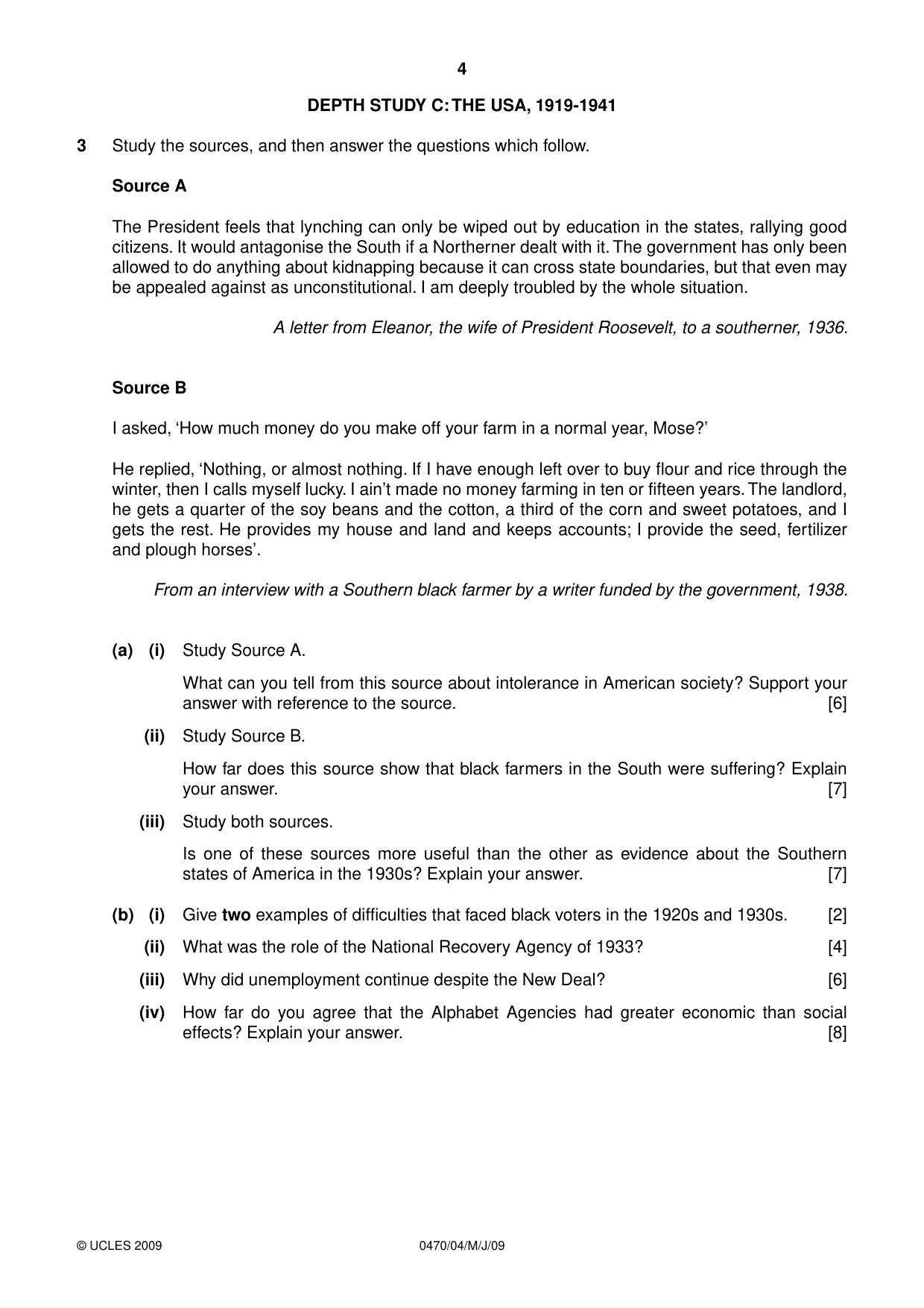
Question paper, page 4
4 0470/04/M/J/09 © UCLES 2009 DEPTH STUDY C: THE USA, 1919-1941 3 Study the sources, and then answer the questions which follow. Source A The President feels that lynching can only be wiped out by education in the states, rallying good citizens. It would antagonise the South if a Northerner dealt with it. The government has only been allowed to do anything about kidnapping because it can cross state boundaries, but that even may be appealed against as unconstitutional. I am deeply troubled by the whole situation. A letter from Eleanor, the wife of President Roosevelt, to a southerner, 1936. Source B I asked, ‘How much money do you make off your farm in a normal year, Mose?’ He replied, ‘Nothing, or almost nothing. If I have enough left over to buy flour and rice through the winter, then I calls myself lucky. I ain’t made no money farming in ten or fifteen years. The landlord, he gets a quarter of the soy beans and the cotton, a third of the corn and sweet potatoes, and I gets the rest. He provides my house and land and keeps accounts; I provide the seed, fertilizer and plough horses’. From an interview with a Southern black farmer by a writer funded by the government, 1938. (a) (i) Study Source A. What can you tell from this source about intolerance in American society? Support your answer with reference to the source. [6] (ii) Study Source B. How far does this source show that black farmers in the South were suffering? Explain your answer. [7] (iii) Study both sources. Is one of these sources more useful than the other as evidence about the Southern states of America in the 1930s? Explain your answer. [7] (b) (i) Give two examples of difficulties that faced black voters in the 1920s and 1930s. [2] (ii) What was the role of the National Recovery Agency of 1933? [4] (iii) Why did unemployment continue despite the New Deal? [6] (iv) How far do you agree that the Alphabet Agencies had greater economic than social effects? Explain your answer. [8]
Question paper, page 5
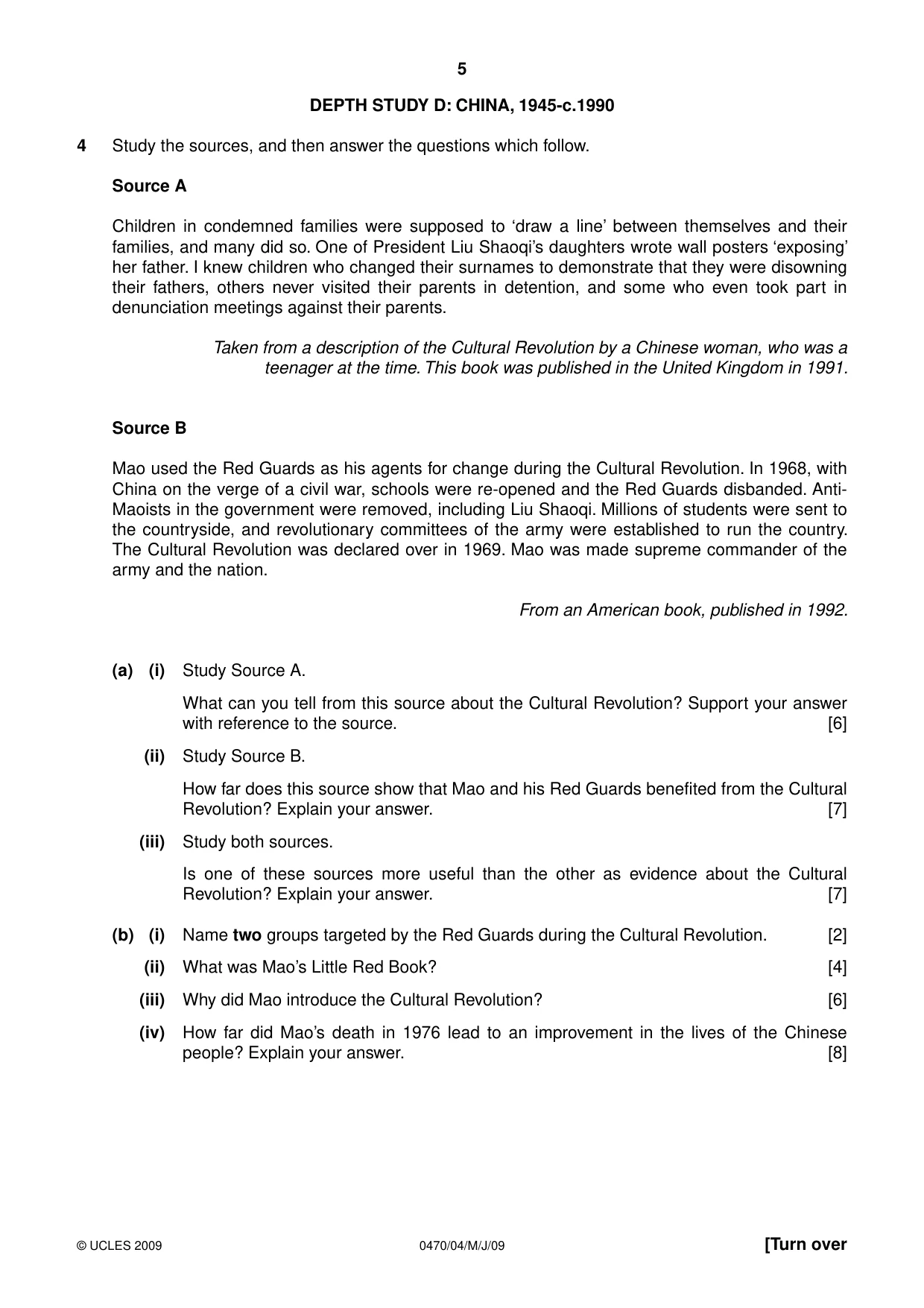
5 0470/04/M/J/09 © UCLES 2009 [Turn over DEPTH STUDY D: CHINA, 1945-c.1990 4 Study the sources, and then answer the questions which follow. Source A Children in condemned families were supposed to ‘draw a line’ between themselves and their families, and many did so. One of President Liu Shaoqi’s daughters wrote wall posters ‘exposing’ her father. I knew children who changed their surnames to demonstrate that they were disowning their fathers, others never visited their parents in detention, and some who even took part in denunciation meetings against their parents. Taken from a description of the Cultural Revolution by a Chinese woman, who was a teenager at the time. This book was published in the United Kingdom in 1991. Source B Mao used the Red Guards as his agents for change during the Cultural Revolution. In 1968, with China on the verge of a civil war, schools were re-opened and the Red Guards disbanded. Anti- Maoists in the government were removed, including Liu Shaoqi. Millions of students were sent to the countryside, and revolutionary committees of the army were established to run the country. The Cultural Revolution was declared over in 1969. Mao was made supreme commander of the army and the nation. From an American book, published in 1992. (a) (i) Study Source A. What can you tell from this source about the Cultural Revolution? Support your answer with reference to the source. [6] (ii) Study Source B. How far does this source show that Mao and his Red Guards benefited from the Cultural Revolution? Explain your answer. [7] (iii) Study both sources. Is one of these sources more useful than the other as evidence about the Cultural Revolution? Explain your answer. [7] (b) (i) Name two groups targeted by the Red Guards during the Cultural Revolution. [2] (ii) What was Mao’s Little Red Book? [4] (iii) Why did Mao introduce the Cultural Revolution? [6] (iv) How far did Mao’s death in 1976 lead to an improvement in the lives of the Chinese people? Explain your answer. [8]
Question paper, page 6
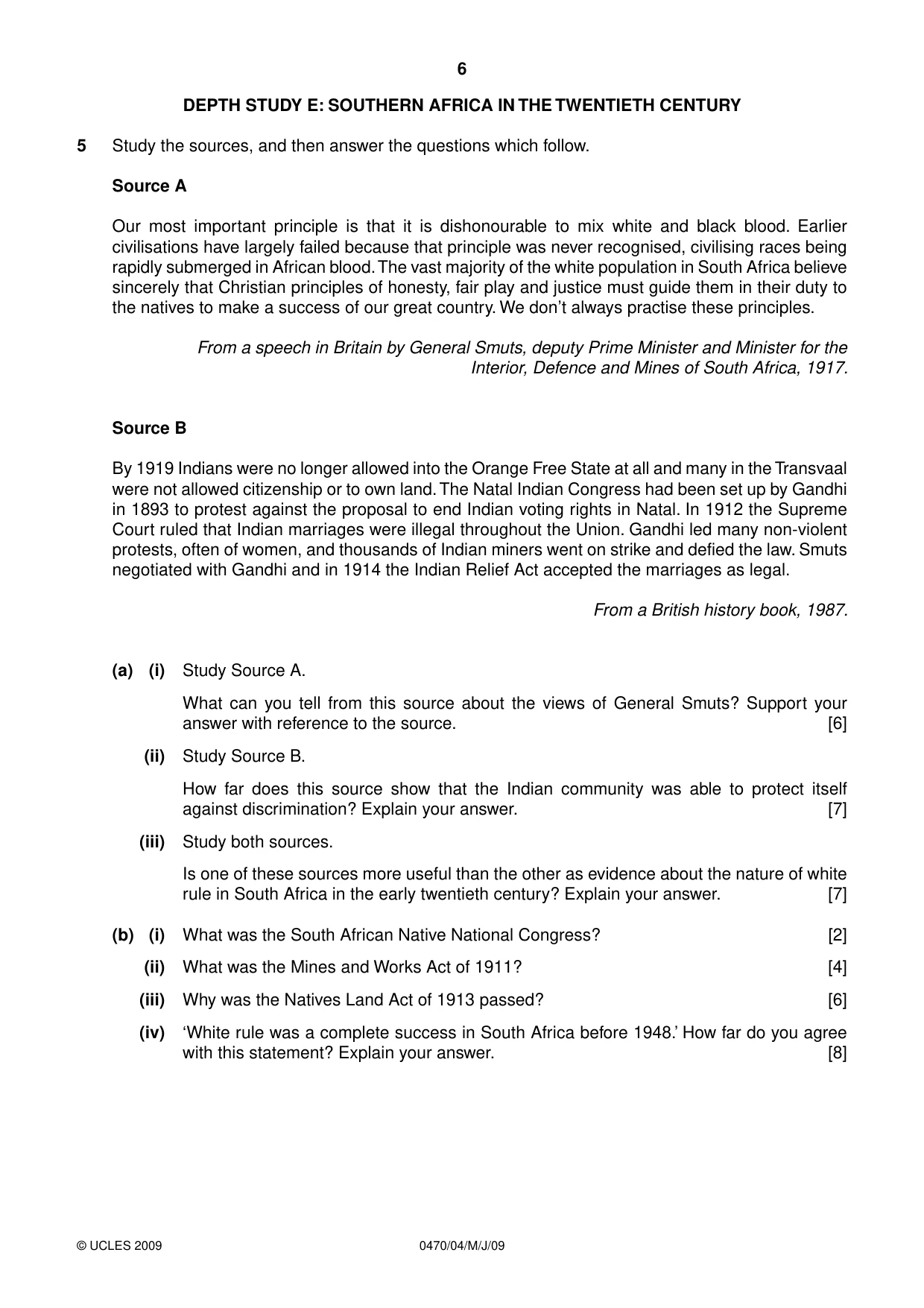
6 0470/04/M/J/09 © UCLES 2009 DEPTH STUDY E: SOUTHERN AFRICA IN THE TWENTIETH CENTURY 5 Study the sources, and then answer the questions which follow. Source A Our most important principle is that it is dishonourable to mix white and black blood. Earlier civilisations have largely failed because that principle was never recognised, civilising races being rapidly submerged in African blood. The vast majority of the white population in South Africa believe sincerely that Christian principles of honesty, fair play and justice must guide them in their duty to the natives to make a success of our great country. We don’t always practise these principles. From a speech in Britain by General Smuts, deputy Prime Minister and Minister for the Interior, Defence and Mines of South Africa, 1917. Source B By 1919 Indians were no longer allowed into the Orange Free State at all and many in the Transvaal were not allowed citizenship or to own land. The Natal Indian Congress had been set up by Gandhi in 1893 to protest against the proposal to end Indian voting rights in Natal. In 1912 the Supreme Court ruled that Indian marriages were illegal throughout the Union. Gandhi led many non-violent protests, often of women, and thousands of Indian miners went on strike and defied the law. Smuts negotiated with Gandhi and in 1914 the Indian Relief Act accepted the marriages as legal. From a British history book, 1987. (a) (i) Study Source A. What can you tell from this source about the views of General Smuts? Support your answer with reference to the source. [6] (ii) Study Source B. How far does this source show that the Indian community was able to protect itself against discrimination? Explain your answer. [7] (iii) Study both sources. Is one of these sources more useful than the other as evidence about the nature of white rule in South Africa in the early twentieth century? Explain your answer. [7] (b) (i) What was the South African Native National Congress? [2] (ii) What was the Mines and Works Act of 1911? [4] (iii) Why was the Natives Land Act of 1913 passed? [6] (iv) ‘White rule was a complete success in South Africa before 1948.’ How far do you agree with this statement? Explain your answer. [8]
Question paper, page 7
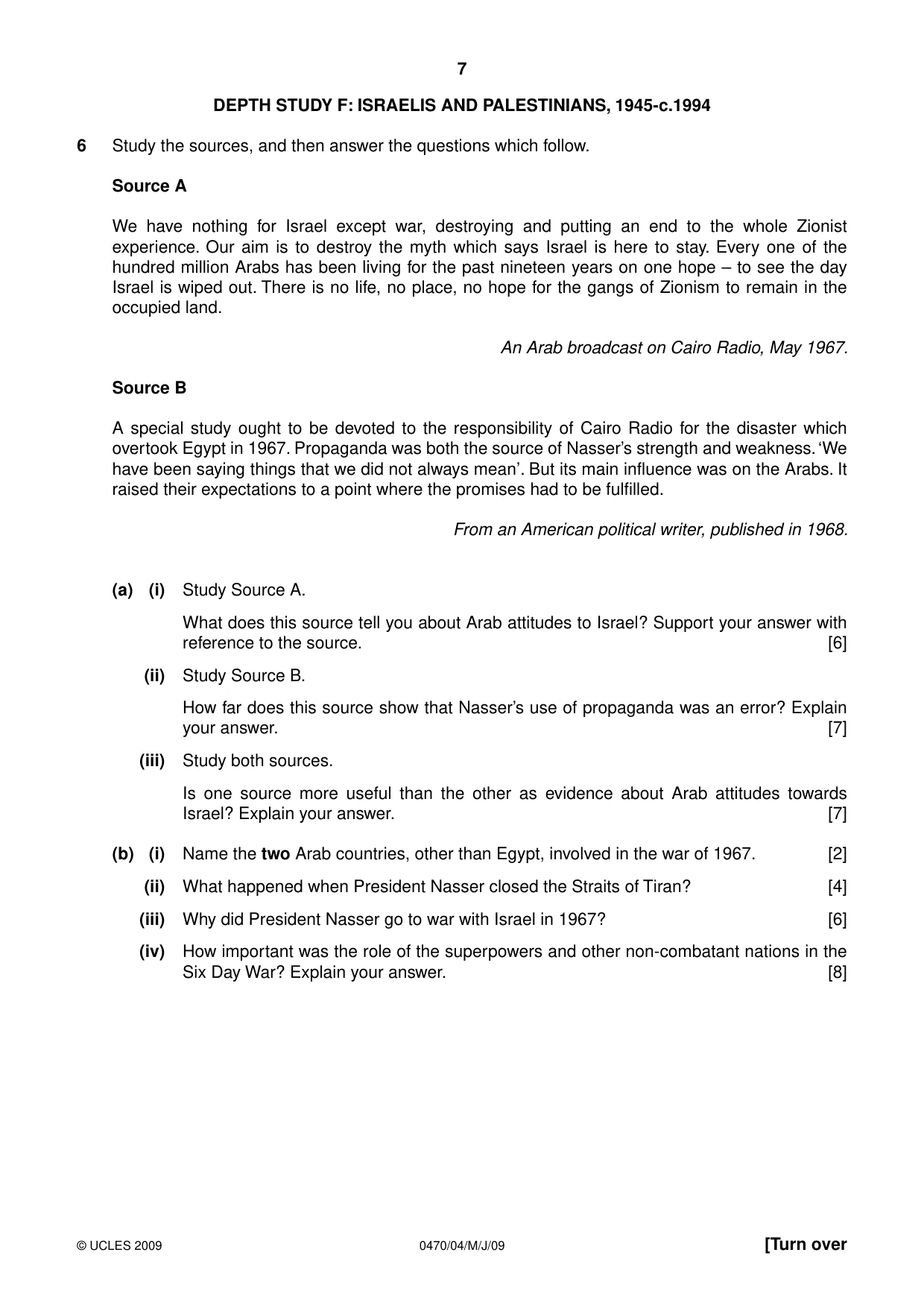
7 0470/04/M/J/09 © UCLES 2009 [Turn over DEPTH STUDY F: ISRAELIS AND PALESTINIANS, 1945-c.1994 6 Study the sources, and then answer the questions which follow. Source A We have nothing for Israel except war, destroying and putting an end to the whole Zionist experience. Our aim is to destroy the myth which says Israel is here to stay. Every one of the hundred million Arabs has been living for the past nineteen years on one hope – to see the day Israel is wiped out. There is no life, no place, no hope for the gangs of Zionism to remain in the occupied land. An Arab broadcast on Cairo Radio, May 1967. Source B A special study ought to be devoted to the responsibility of Cairo Radio for the disaster which overtook Egypt in 1967. Propaganda was both the source of Nasser’s strength and weakness. ‘We have been saying things that we did not always mean’. But its main influence was on the Arabs. It raised their expectations to a point where the promises had to be fulfilled. From an American political writer, published in 1968. (a) (i) Study Source A. What does this source tell you about Arab attitudes to Israel? Support your answer with reference to the source. [6] (ii) Study Source B. How far does this source show that Nasser’s use of propaganda was an error? Explain your answer. [7] (iii) Study both sources. Is one source more useful than the other as evidence about Arab attitudes towards Israel? Explain your answer. [7] (b) (i) Name the two Arab countries, other than Egypt, involved in the war of 1967. [2] (ii) What happened when President Nasser closed the Straits of Tiran? [4] (iii) Why did President Nasser go to war with Israel in 1967? [6] (iv) How important was the role of the superpowers and other non-combatant nations in the Six Day War? Explain your answer. [8]
Question paper, page 8
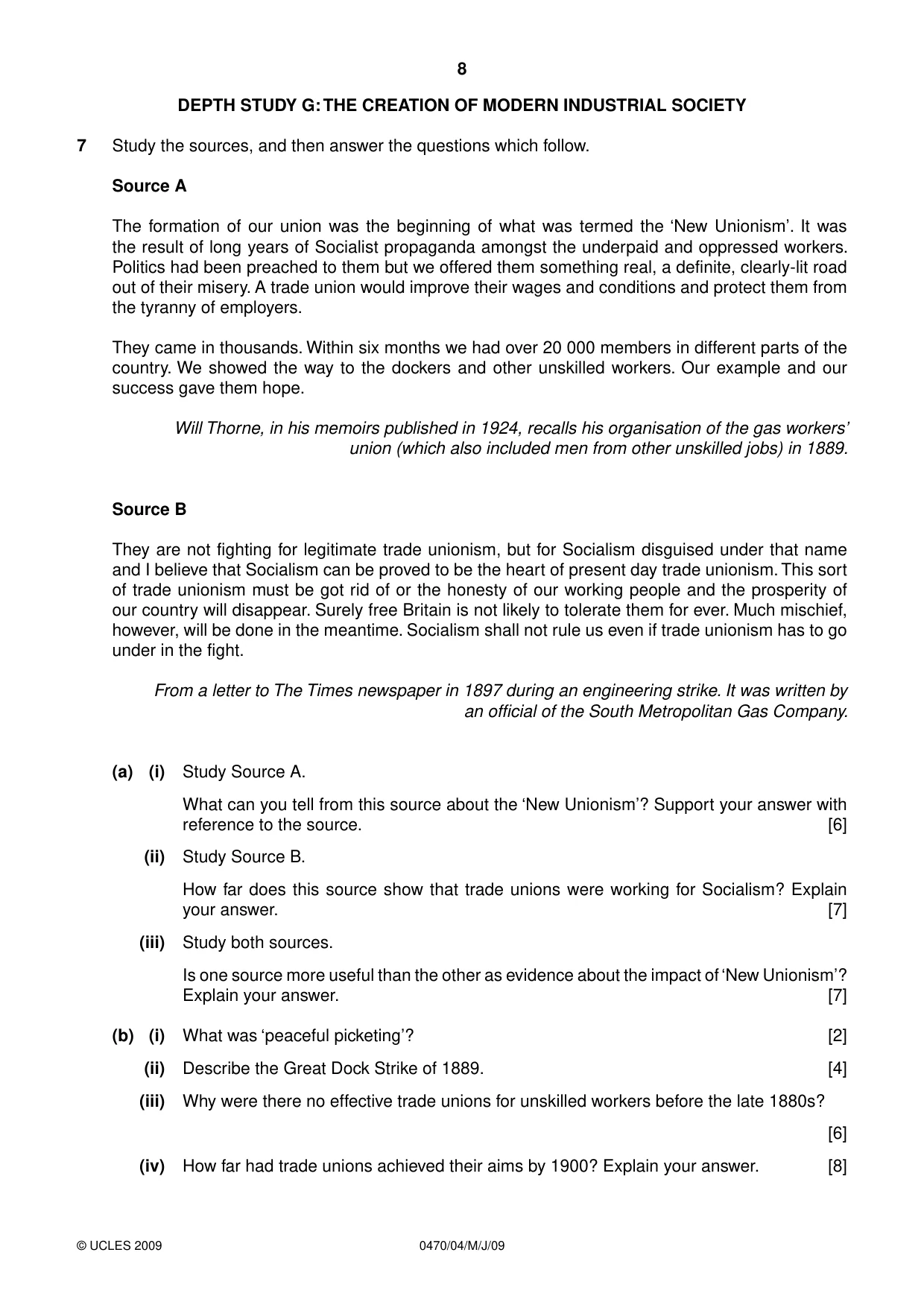
8 0470/04/M/J/09 © UCLES 2009 DEPTH STUDY G: THE CREATION OF MODERN INDUSTRIAL SOCIETY 7 Study the sources, and then answer the questions which follow. Source A The formation of our union was the beginning of what was termed the ‘New Unionism’. It was the result of long years of Socialist propaganda amongst the underpaid and oppressed workers. Politics had been preached to them but we offered them something real, a definite, clearly-lit road out of their misery. A trade union would improve their wages and conditions and protect them from the tyranny of employers. They came in thousands. Within six months we had over 20 000 members in different parts of the country. We showed the way to the dockers and other unskilled workers. Our example and our success gave them hope. Will Thorne, in his memoirs published in 1924, recalls his organisation of the gas workers’ union (which also included men from other unskilled jobs) in 1889. Source B They are not fighting for legitimate trade unionism, but for Socialism disguised under that name and I believe that Socialism can be proved to be the heart of present day trade unionism. This sort of trade unionism must be got rid of or the honesty of our working people and the prosperity of our country will disappear. Surely free Britain is not likely to tolerate them for ever. Much mischief, however, will be done in the meantime. Socialism shall not rule us even if trade unionism has to go under in the fight. From a letter to The Times newspaper in 1897 during an engineering strike. It was written by an official of the South Metropolitan Gas Company. (a) (i) Study Source A. What can you tell from this source about the ‘New Unionism’? Support your answer with reference to the source. [6] (ii) Study Source B. How far does this source show that trade unions were working for Socialism? Explain your answer. [7] (iii) Study both sources. Is one source more useful than the other as evidence about the impact of ‘New Unionism’? Explain your answer. [7] (b) (i) What was ‘peaceful picketing’? [2] (ii) Describe the Great Dock Strike of 1889. [4] (iii) Why were there no effective trade unions for unskilled workers before the late 1880s? [6] (iv) How far had trade unions achieved their aims by 1900? Explain your answer. [8]
Question paper, page 9
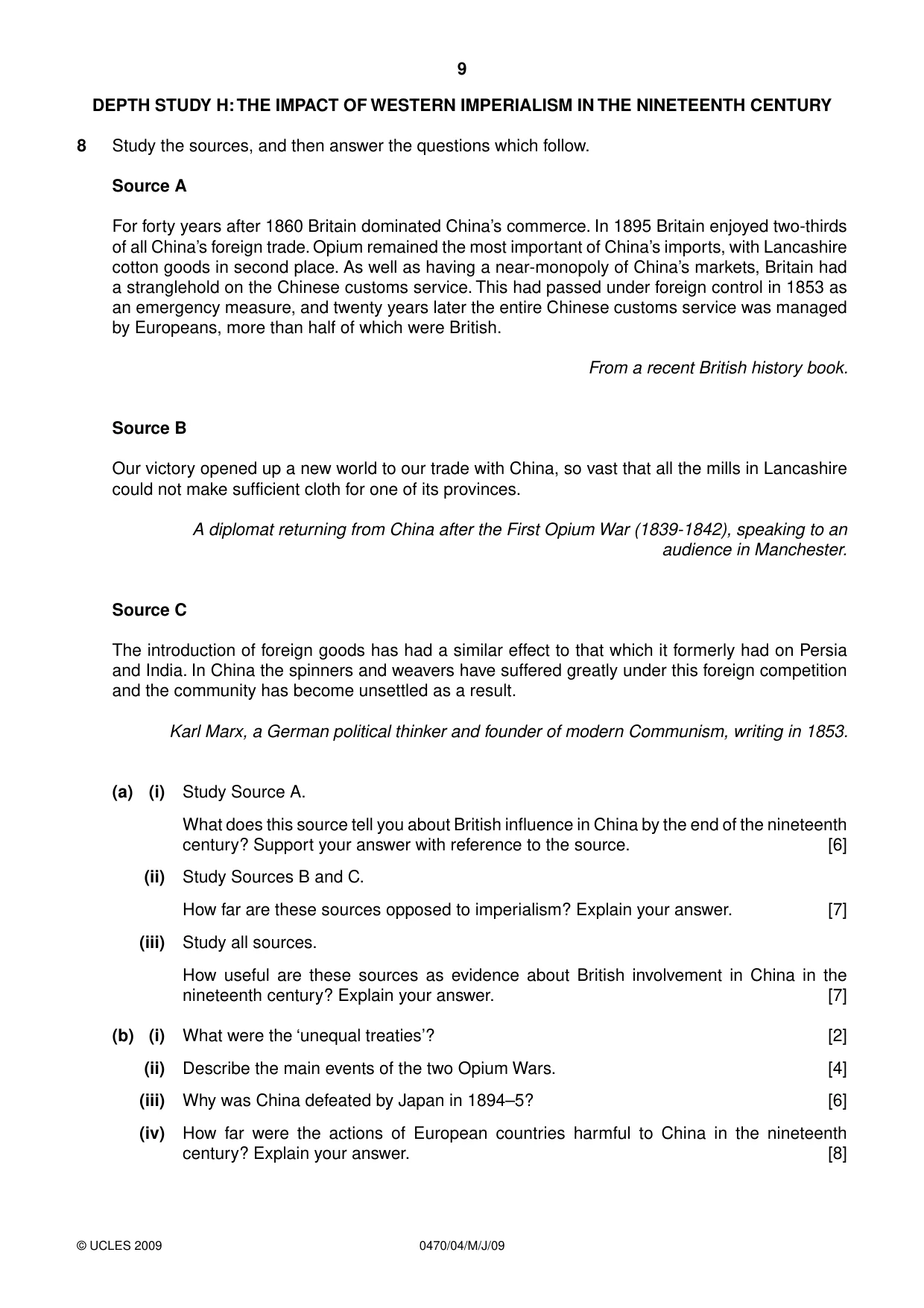
9 0470/04/M/J/09 © UCLES 2009 DEPTH STUDY H: THE IMPACT OF WESTERN IMPERIALISM IN THE NINETEENTH CENTURY 8 Study the sources, and then answer the questions which follow. Source A For forty years after 1860 Britain dominated China’s commerce. In 1895 Britain enjoyed two-thirds of all China’s foreign trade. Opium remained the most important of China’s imports, with Lancashire cotton goods in second place. As well as having a near-monopoly of China’s markets, Britain had a stranglehold on the Chinese customs service. This had passed under foreign control in 1853 as an emergency measure, and twenty years later the entire Chinese customs service was managed by Europeans, more than half of which were British. From a recent British history book. Source B Our victory opened up a new world to our trade with China, so vast that all the mills in Lancashire could not make sufficient cloth for one of its provinces. A diplomat returning from China after the First Opium War (1839-1842), speaking to an audience in Manchester. Source C The introduction of foreign goods has had a similar effect to that which it formerly had on Persia and India. In China the spinners and weavers have suffered greatly under this foreign competition and the community has become unsettled as a result. Karl Marx, a German political thinker and founder of modern Communism, writing in 1853. (a) (i) Study Source A. What does this source tell you about British influence in China by the end of the nineteenth century? Support your answer with reference to the source. [6] (ii) Study Sources B and C. How far are these sources opposed to imperialism? Explain your answer. [7] (iii) Study all sources. How useful are these sources as evidence about British involvement in China in the nineteenth century? Explain your answer. [7] (b) (i) What were the ‘unequal treaties’? [2] (ii) Describe the main events of the two Opium Wars. [4] (iii) Why was China defeated by Japan in 1894–5? [6] (iv) How far were the actions of European countries harmful to China in the nineteenth century? Explain your answer. [8]
Question paper, page 12
12 0470/04/M/J/09 BLANK PAGE Copyright Acknowledgements: Depth Study A Source A © History at Source, Nazi Germany 1933–45; p.8; Hodder & Stoughton; 1991. Depth Study A Source B © Alan White; The Weimar Republic; Harper Collins; 1997. Depth Study B Source A © Ben Walsh; GCSE Modern World History; p.113; John Murray Publishers; 2001. Depth Study B Source B © Clare Baker; Russia 1917–1945; p.14; Heinemann Educational; 1990. Depth Study C Source A © A letter from Eleanor, the wife of President Roosevelt, to a southerner; 1936. Depth Study C Source B © An interview with a Southern black farmer by a writer funded by the government; 1938. Depth Study D Source A © Jung Chang; Wild Swans; p.483; Harper Collins; 1991. Depth Study D Source B © Robert Stewart; The Illustrated Almanac of Historical Facts; p266; Prentice Hall; 1992. Depth Study E Source A © A speech in Britain by General Smuts, Deputy Prime Minister and Minister for the Interior, Defence and Mines of South Africa; 1917. Depth Study E Source B © J D Omer-Cooper; History of Southern Africa; pp.163–4; James Currey; 1994. Depth Study F Source A © J. Bowen; Six Days; p.70; Simon & Schuster; 2003. Depth Study F Source B © W. Lacquer & S J Perkins; The Road to War 1967; Weidenfield & Nicholson; 1968. Depth Study G Source A © L. Evans British Trade Unionism 1850–1914; p.40; Edward Arnold London; 1970. Depth Study G Source B © L. Evans British Trade Unionism 1850–1914; p.48; Edward Arnold London; 1970. Depth Study H Source A © J Roberts; Modern China; p.36; Sutton Publishing Ltd; 1998. Depth Study H Source B © J Roberts; Modern China; p.92; Sutton Publishing Ltd; 1998. Depth Study H Source C © L James; Rise and Fall of the British Empire; p.140; Little Brown & Co; 1995. Permission to reproduce items where third-party owned material protected by copyright is included has been sought and cleared where possible. Every reasonable effort has been made by the publisher (UCLES) to trace copyright holders, but if any items requiring clearance have unwittingly been included, the publisher will be pleased to make amends at the earliest possible opportunity. University of Cambridge International Examinations is part of the Cambridge Assessment Group. Cambridge Assessment is the brand name of University of Cambridge Local Examinations Syndicate (UCLES), which is itself a department of the University of Cambridge.
Mark scheme, page 1
UNIVERSITY OF CAMBRIDGE INTERNATIONAL EXAMINATIONS International General Certificate of Secondary Education MARK SCHEME for the May/June 2009 question paper for the guidance of teachers 0470 HISTORY 0470/04 Paper 4 (Alternative to Coursework), maximum raw mark 40 This mark scheme is published as an aid to teachers and candidates, to indicate the requirements of the examination. It shows the basis on which Examiners were instructed to award marks. It does not indicate the details of the discussions that took place at an Examiners’ meeting before marking began, which would have considered the acceptability of alternative answers. Mark schemes must be read in conjunction with the question papers and the report on the examination. • CIE will not enter into discussions or correspondence in connection with these mark schemes. CIE is publishing the mark schemes for the May/June 2009 question papers for most IGCSE, GCE Advanced Level and Advanced Subsidiary Level syllabuses and some Ordinary Level syllabuses. www.XtremePapers.com
Mark scheme, page 2
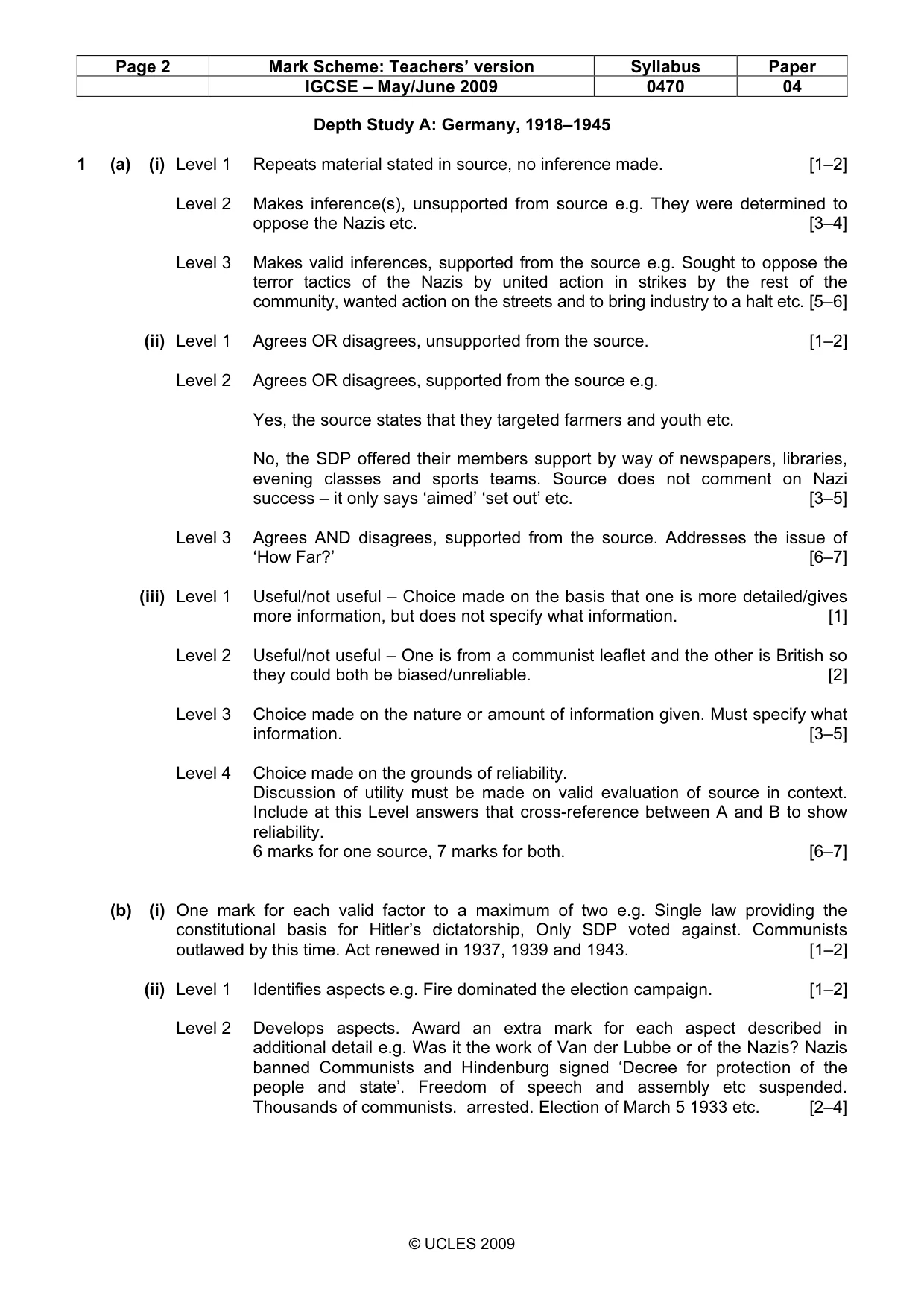
Page 2 Mark Scheme: Teachers’ version Syllabus Paper IGCSE – May/June 2009 0470 04 © UCLES 2009 Depth Study A: Germany, 1918–1945 1 (a) (i) Level 1 Repeats material stated in source, no inference made. [1–2] Level 2 Makes inference(s), unsupported from source e.g. They were determined to oppose the Nazis etc. [3–4] Level 3 Makes valid inferences, supported from the source e.g. Sought to oppose the terror tactics of the Nazis by united action in strikes by the rest of the community, wanted action on the streets and to bring industry to a halt etc. [5–6] (ii) Level 1 Agrees OR disagrees, unsupported from the source. [1–2] Level 2 Agrees OR disagrees, supported from the source e.g. Yes, the source states that they targeted farmers and youth etc. No, the SDP offered their members support by way of newspapers, libraries, evening classes and sports teams. Source does not comment on Nazi success – it only says ‘aimed’ ‘set out’ etc. [3–5] Level 3 Agrees AND disagrees, supported from the source. Addresses the issue of ‘How Far?’ [6–7] (iii) Level 1 Useful/not useful – Choice made on the basis that one is more detailed/gives more information, but does not specify what information. [1] Level 2 Useful/not useful – One is from a communist leaflet and the other is British so they could both be biased/unreliable. [2] Level 3 Choice made on the nature or amount of information given. Must specify what information. [3–5] Level 4 Choice made on the grounds of reliability. Discussion of utility must be made on valid evaluation of source in context. Include at this Level answers that cross-reference between A and B to show reliability. 6 marks for one source, 7 marks for both. [6–7] (b) (i) One mark for each valid factor to a maximum of two e.g. Single law providing the constitutional basis for Hitler’s dictatorship, Only SDP voted against. Communists outlawed by this time. Act renewed in 1937, 1939 and 1943. [1–2] (ii) Level 1 Identifies aspects e.g. Fire dominated the election campaign. [1–2] Level 2 Develops aspects. Award an extra mark for each aspect described in additional detail e.g. Was it the work of Van der Lubbe or of the Nazis? Nazis banned Communists and Hindenburg signed ‘Decree for protection of the people and state’. Freedom of speech and assembly etc suspended. Thousands of communists. arrested. Election of March 5 1933 etc. [2–4]
Mark scheme, page 3
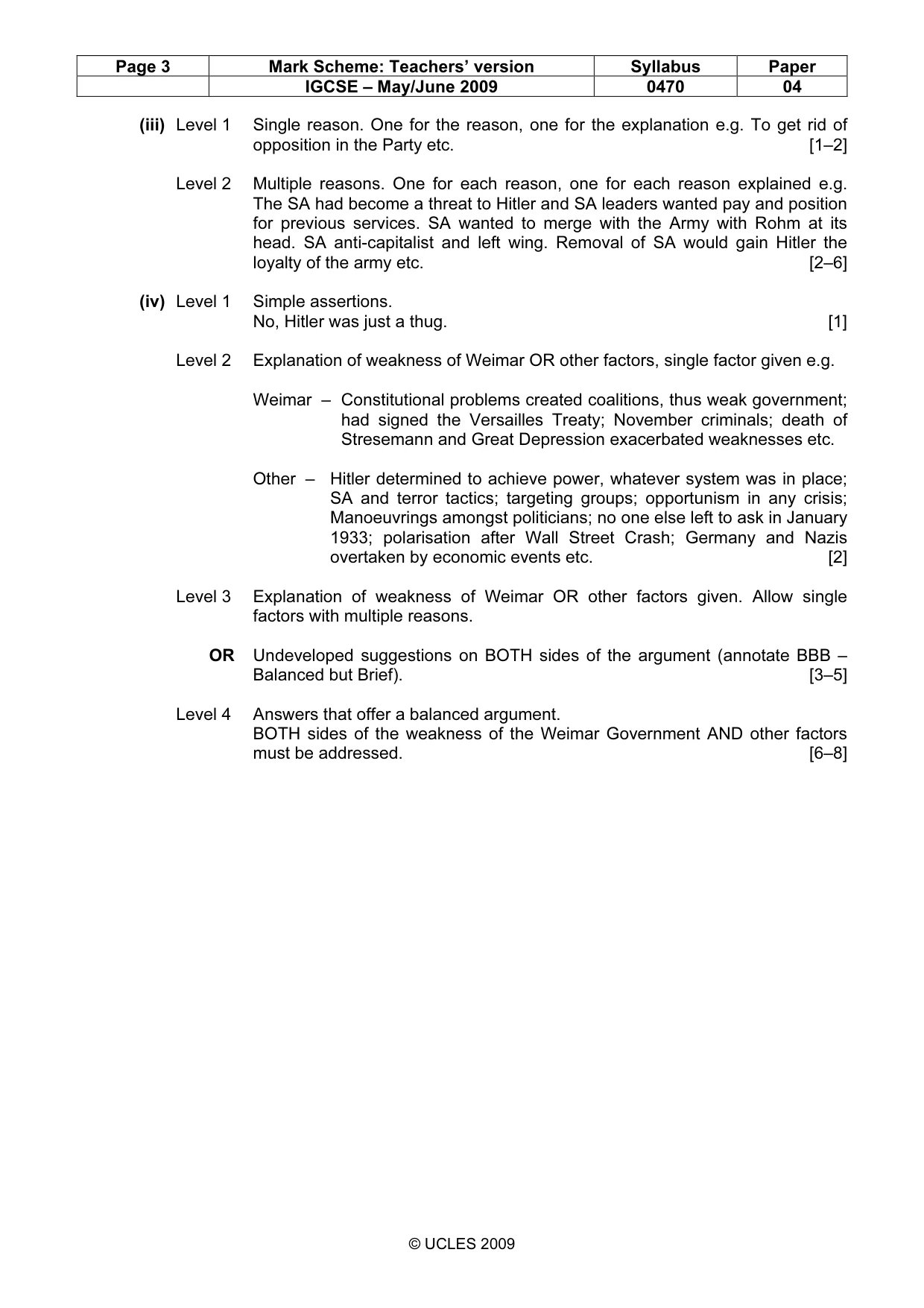
Page 3 Mark Scheme: Teachers’ version Syllabus Paper IGCSE – May/June 2009 0470 04 © UCLES 2009 (iii) Level 1 Single reason. One for the reason, one for the explanation e.g. To get rid of opposition in the Party etc. [1–2] Level 2 Multiple reasons. One for each reason, one for each reason explained e.g. The SA had become a threat to Hitler and SA leaders wanted pay and position for previous services. SA wanted to merge with the Army with Rohm at its head. SA anti-capitalist and left wing. Removal of SA would gain Hitler the loyalty of the army etc. [2–6] (iv) Level 1 Simple assertions. No, Hitler was just a thug. [1] Level 2 Explanation of weakness of Weimar OR other factors, single factor given e.g. Weimar – Constitutional problems created coalitions, thus weak government; had signed the Versailles Treaty; November criminals; death of Stresemann and Great Depression exacerbated weaknesses etc. Other – Hitler determined to achieve power, whatever system was in place; SA and terror tactics; targeting groups; opportunism in any crisis; Manoeuvrings amongst politicians; no one else left to ask in January 1933; polarisation after Wall Street Crash; Germany and Nazis overtaken by economic events etc. [2] Level 3 Explanation of weakness of Weimar OR other factors given. Allow single factors with multiple reasons. OR Undeveloped suggestions on BOTH sides of the argument (annotate BBB – Balanced but Brief). [3–5] Level 4 Answers that offer a balanced argument. BOTH sides of the weakness of the Weimar Government AND other factors must be addressed. [6–8]
Mark scheme, page 4
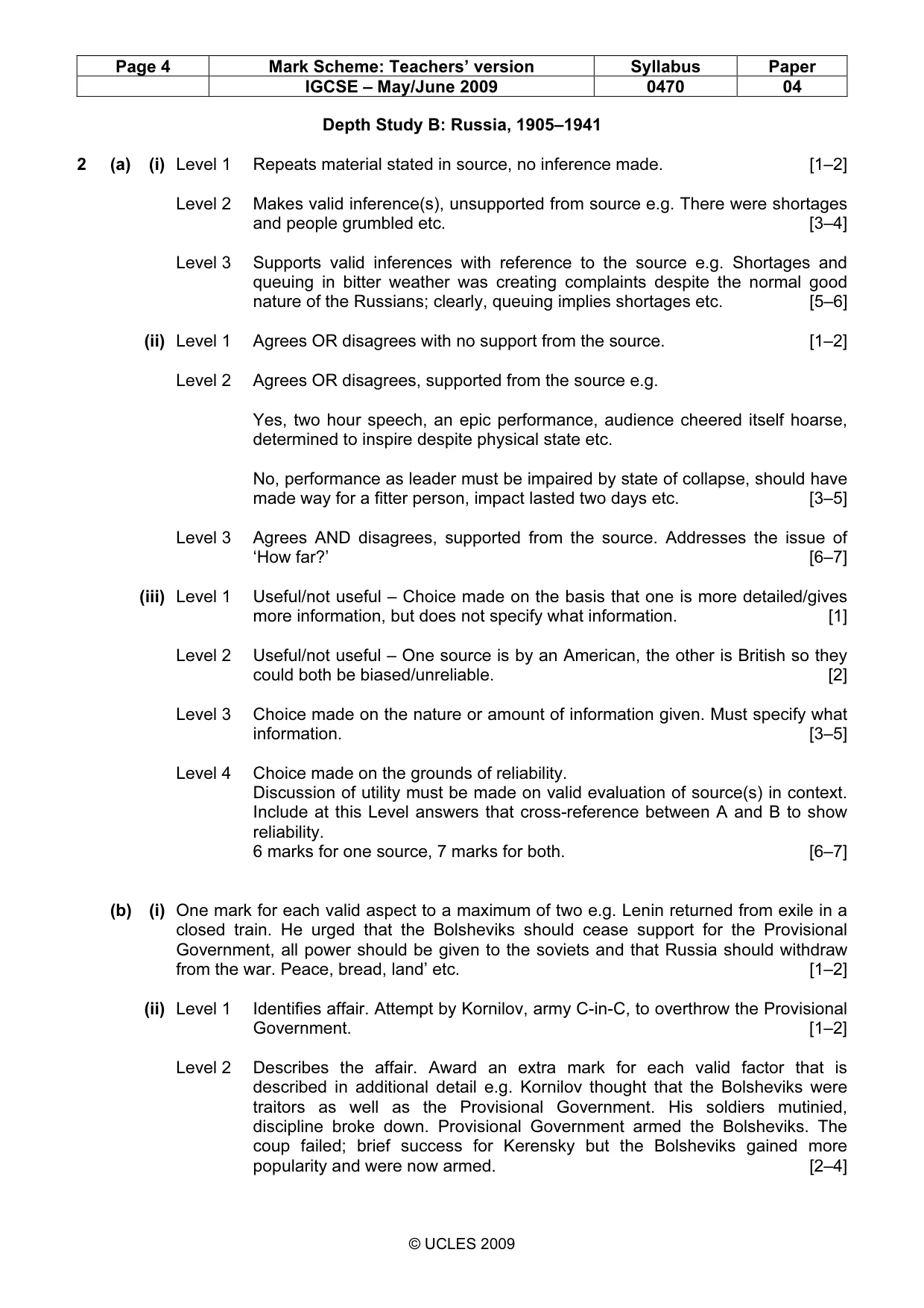
Page 4 Mark Scheme: Teachers’ version Syllabus Paper IGCSE – May/June 2009 0470 04 © UCLES 2009 Depth Study B: Russia, 1905–1941 2 (a) (i) Level 1 Repeats material stated in source, no inference made. [1–2] Level 2 Makes valid inference(s), unsupported from source e.g. There were shortages and people grumbled etc. [3–4] Level 3 Supports valid inferences with reference to the source e.g. Shortages and queuing in bitter weather was creating complaints despite the normal good nature of the Russians; clearly, queuing implies shortages etc. [5–6] (ii) Level 1 Agrees OR disagrees with no support from the source. [1–2] Level 2 Agrees OR disagrees, supported from the source e.g. Yes, two hour speech, an epic performance, audience cheered itself hoarse, determined to inspire despite physical state etc. No, performance as leader must be impaired by state of collapse, should have made way for a fitter person, impact lasted two days etc. [3–5] Level 3 Agrees AND disagrees, supported from the source. Addresses the issue of ‘How far?’ [6–7] (iii) Level 1 Useful/not useful – Choice made on the basis that one is more detailed/gives more information, but does not specify what information. [1] Level 2 Useful/not useful – One source is by an American, the other is British so they could both be biased/unreliable. [2] Level 3 Choice made on the nature or amount of information given. Must specify what information. [3–5] Level 4 Choice made on the grounds of reliability. Discussion of utility must be made on valid evaluation of source(s) in context. Include at this Level answers that cross-reference between A and B to show reliability. 6 marks for one source, 7 marks for both. [6–7] (b) (i) One mark for each valid aspect to a maximum of two e.g. Lenin returned from exile in a closed train. He urged that the Bolsheviks should cease support for the Provisional Government, all power should be given to the soviets and that Russia should withdraw from the war. Peace, bread, land’ etc. [1–2] (ii) Level 1 Identifies affair. Attempt by Kornilov, army C-in-C, to overthrow the Provisional Government. [1–2] Level 2 Describes the affair. Award an extra mark for each valid factor that is described in additional detail e.g. Kornilov thought that the Bolsheviks were traitors as well as the Provisional Government. His soldiers mutinied, discipline broke down. Provisional Government armed the Bolsheviks. The coup failed; brief success for Kerensky but the Bolsheviks gained more popularity and were now armed. [2–4]
Mark scheme, page 5
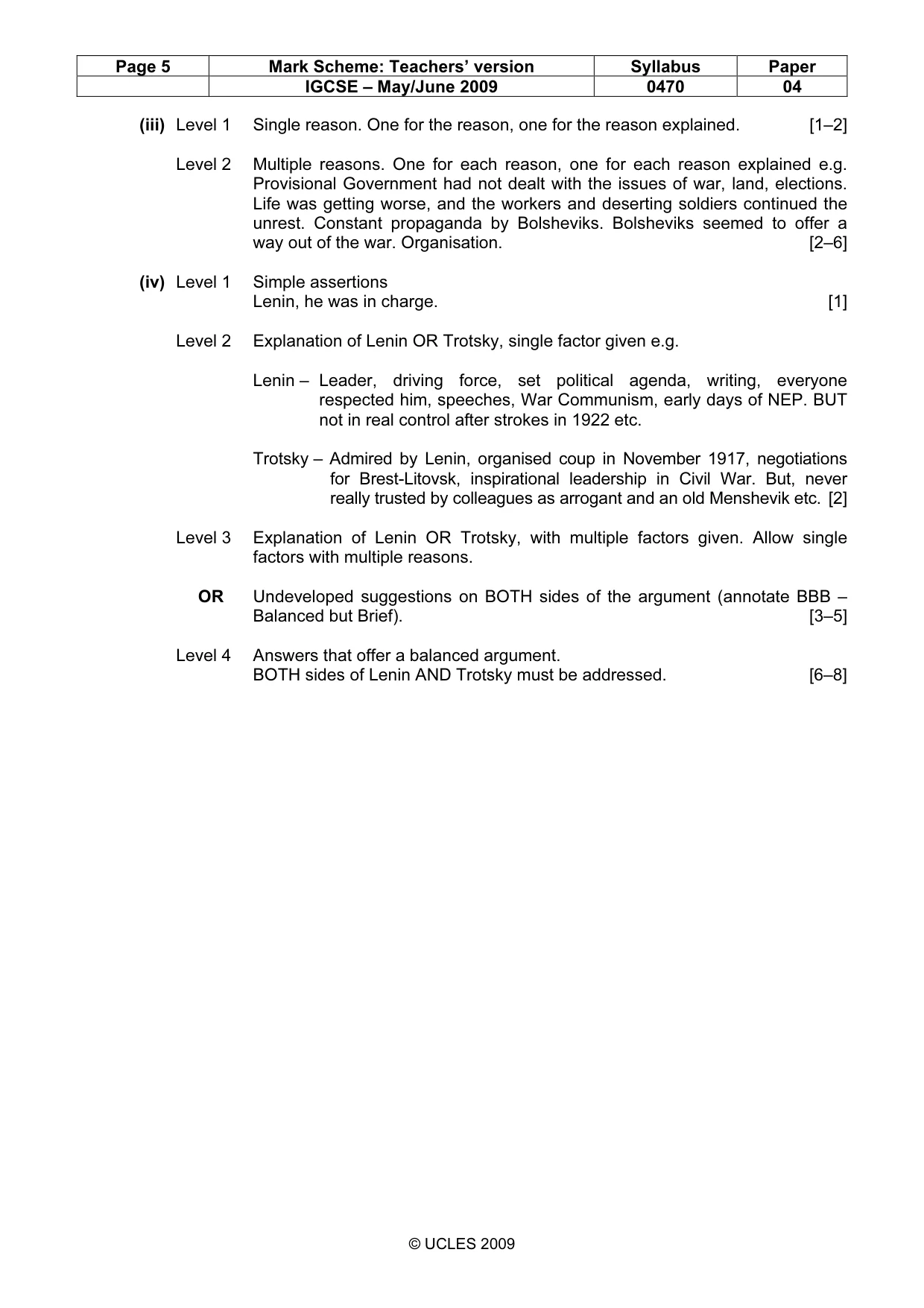
Page 5 Mark Scheme: Teachers’ version Syllabus Paper IGCSE – May/June 2009 0470 04 © UCLES 2009 (iii) Level 1 Single reason. One for the reason, one for the reason explained. [1–2] Level 2 Multiple reasons. One for each reason, one for each reason explained e.g. Provisional Government had not dealt with the issues of war, land, elections. Life was getting worse, and the workers and deserting soldiers continued the unrest. Constant propaganda by Bolsheviks. Bolsheviks seemed to offer a way out of the war. Organisation. [2–6] (iv) Level 1 Simple assertions Lenin, he was in charge. [1] Level 2 Explanation of Lenin OR Trotsky, single factor given e.g. Lenin – Leader, driving force, set political agenda, writing, everyone respected him, speeches, War Communism, early days of NEP. BUT not in real control after strokes in 1922 etc. Trotsky – Admired by Lenin, organised coup in November 1917, negotiations for Brest-Litovsk, inspirational leadership in Civil War. But, never really trusted by colleagues as arrogant and an old Menshevik etc. [2] Level 3 Explanation of Lenin OR Trotsky, with multiple factors given. Allow single factors with multiple reasons. OR Undeveloped suggestions on BOTH sides of the argument (annotate BBB – Balanced but Brief). [3–5] Level 4 Answers that offer a balanced argument. BOTH sides of Lenin AND Trotsky must be addressed. [6–8]
Mark scheme, page 6
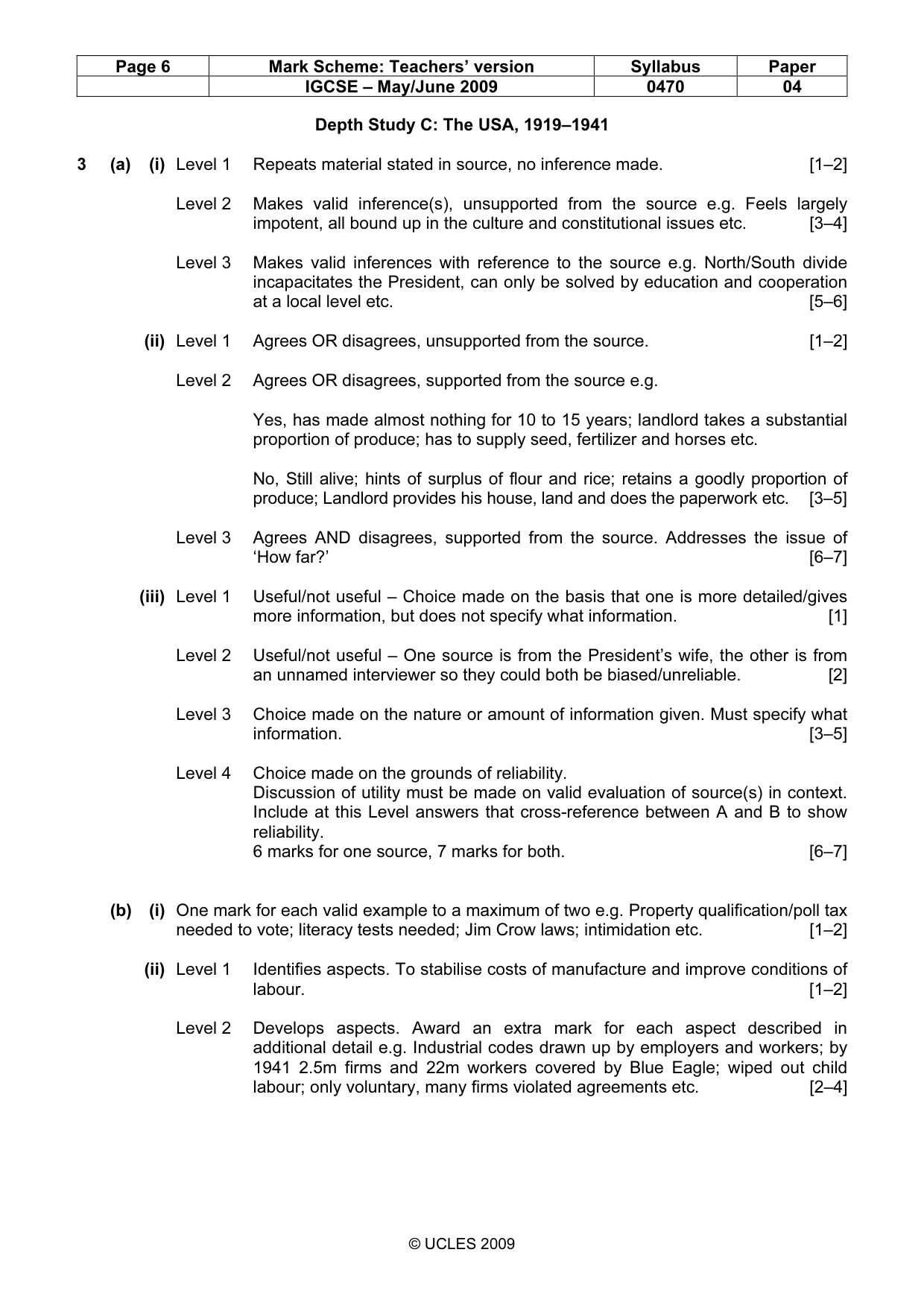
Page 6 Mark Scheme: Teachers’ version Syllabus Paper IGCSE – May/June 2009 0470 04 © UCLES 2009 Depth Study C: The USA, 1919–1941 3 (a) (i) Level 1 Repeats material stated in source, no inference made. [1–2] Level 2 Makes valid inference(s), unsupported from the source e.g. Feels largely impotent, all bound up in the culture and constitutional issues etc. [3–4] Level 3 Makes valid inferences with reference to the source e.g. North/South divide incapacitates the President, can only be solved by education and cooperation at a local level etc. [5–6] (ii) Level 1 Agrees OR disagrees, unsupported from the source. [1–2] Level 2 Agrees OR disagrees, supported from the source e.g. Yes, has made almost nothing for 10 to 15 years; landlord takes a substantial proportion of produce; has to supply seed, fertilizer and horses etc. No, Still alive; hints of surplus of flour and rice; retains a goodly proportion of produce; Landlord provides his house, land and does the paperwork etc. [3–5] Level 3 Agrees AND disagrees, supported from the source. Addresses the issue of ‘How far?’ [6–7] (iii) Level 1 Useful/not useful – Choice made on the basis that one is more detailed/gives more information, but does not specify what information. [1] Level 2 Useful/not useful – One source is from the President’s wife, the other is from an unnamed interviewer so they could both be biased/unreliable. [2] Level 3 Choice made on the nature or amount of information given. Must specify what information. [3–5] Level 4 Choice made on the grounds of reliability. Discussion of utility must be made on valid evaluation of source(s) in context. Include at this Level answers that cross-reference between A and B to show reliability. 6 marks for one source, 7 marks for both. [6–7] (b) (i) One mark for each valid example to a maximum of two e.g. Property qualification/poll tax needed to vote; literacy tests needed; Jim Crow laws; intimidation etc. [1–2] (ii) Level 1 Identifies aspects. To stabilise costs of manufacture and improve conditions of labour. [1–2] Level 2 Develops aspects. Award an extra mark for each aspect described in additional detail e.g. Industrial codes drawn up by employers and workers; by 1941 2.5m firms and 22m workers covered by Blue Eagle; wiped out child labour; only voluntary, many firms violated agreements etc. [2–4]
Mark scheme, page 7
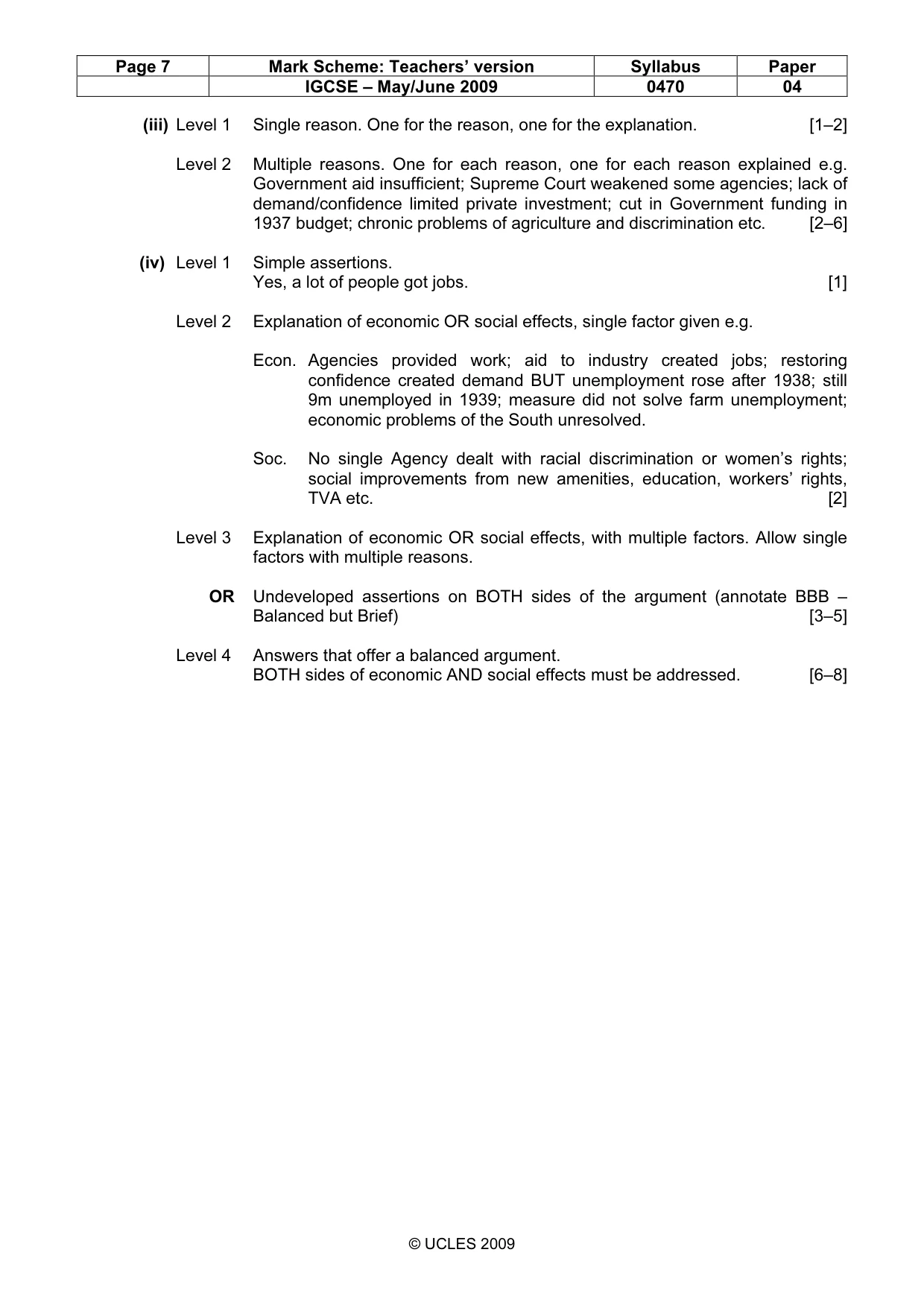
Page 7 Mark Scheme: Teachers’ version Syllabus Paper IGCSE – May/June 2009 0470 04 © UCLES 2009 (iii) Level 1 Single reason. One for the reason, one for the explanation. [1–2] Level 2 Multiple reasons. One for each reason, one for each reason explained e.g. Government aid insufficient; Supreme Court weakened some agencies; lack of demand/confidence limited private investment; cut in Government funding in 1937 budget; chronic problems of agriculture and discrimination etc. [2–6] (iv) Level 1 Simple assertions. Yes, a lot of people got jobs. [1] Level 2 Explanation of economic OR social effects, single factor given e.g. Econ. Agencies provided work; aid to industry created jobs; restoring confidence created demand BUT unemployment rose after 1938; still 9m unemployed in 1939; measure did not solve farm unemployment; economic problems of the South unresolved. Soc. No single Agency dealt with racial discrimination or women’s rights; social improvements from new amenities, education, workers’ rights, TVA etc. [2] Level 3 Explanation of economic OR social effects, with multiple factors. Allow single factors with multiple reasons. OR Undeveloped assertions on BOTH sides of the argument (annotate BBB – Balanced but Brief) [3–5] Level 4 Answers that offer a balanced argument. BOTH sides of economic AND social effects must be addressed. [6–8]
Mark scheme, page 8
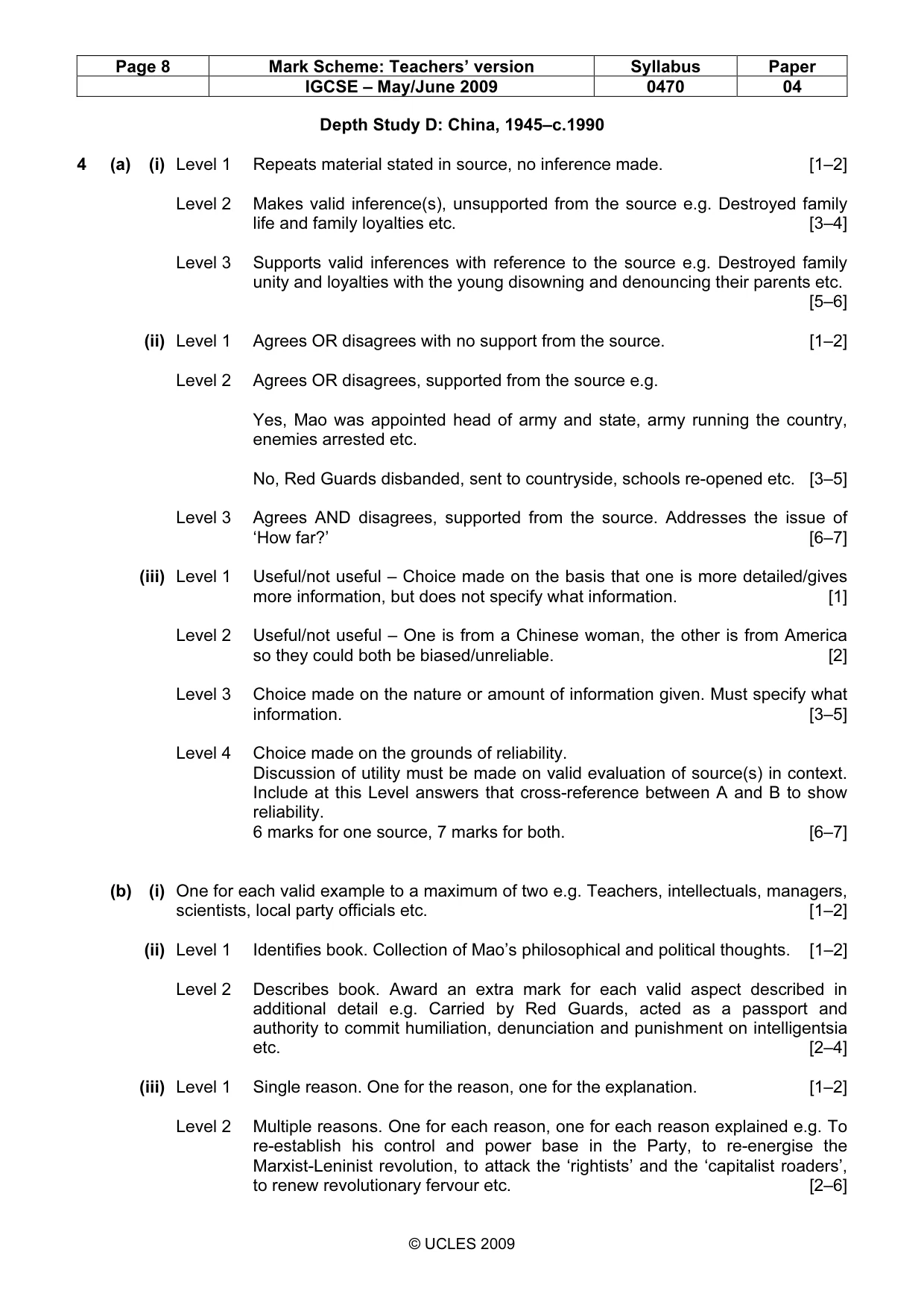
Page 8 Mark Scheme: Teachers’ version Syllabus Paper IGCSE – May/June 2009 0470 04 © UCLES 2009 Depth Study D: China, 1945–c.1990 4 (a) (i) Level 1 Repeats material stated in source, no inference made. [1–2] Level 2 Makes valid inference(s), unsupported from the source e.g. Destroyed family life and family loyalties etc. [3–4] Level 3 Supports valid inferences with reference to the source e.g. Destroyed family unity and loyalties with the young disowning and denouncing their parents etc. [5–6] (ii) Level 1 Agrees OR disagrees with no support from the source. [1–2] Level 2 Agrees OR disagrees, supported from the source e.g. Yes, Mao was appointed head of army and state, army running the country, enemies arrested etc. No, Red Guards disbanded, sent to countryside, schools re-opened etc. [3–5] Level 3 Agrees AND disagrees, supported from the source. Addresses the issue of ‘How far?’ [6–7] (iii) Level 1 Useful/not useful – Choice made on the basis that one is more detailed/gives more information, but does not specify what information. [1] Level 2 Useful/not useful – One is from a Chinese woman, the other is from America so they could both be biased/unreliable. [2] Level 3 Choice made on the nature or amount of information given. Must specify what information. [3–5] Level 4 Choice made on the grounds of reliability. Discussion of utility must be made on valid evaluation of source(s) in context. Include at this Level answers that cross-reference between A and B to show reliability. 6 marks for one source, 7 marks for both. [6–7] (b) (i) One for each valid example to a maximum of two e.g. Teachers, intellectuals, managers, scientists, local party officials etc. [1–2] (ii) Level 1 Identifies book. Collection of Mao’s philosophical and political thoughts. [1–2] Level 2 Describes book. Award an extra mark for each valid aspect described in additional detail e.g. Carried by Red Guards, acted as a passport and authority to commit humiliation, denunciation and punishment on intelligentsia etc. [2–4] (iii) Level 1 Single reason. One for the reason, one for the explanation. [1–2] Level 2 Multiple reasons. One for each reason, one for each reason explained e.g. To re-establish his control and power base in the Party, to re-energise the Marxist-Leninist revolution, to attack the ‘rightists’ and the ‘capitalist roaders’, to renew revolutionary fervour etc. [2–6]
Mark scheme, page 9
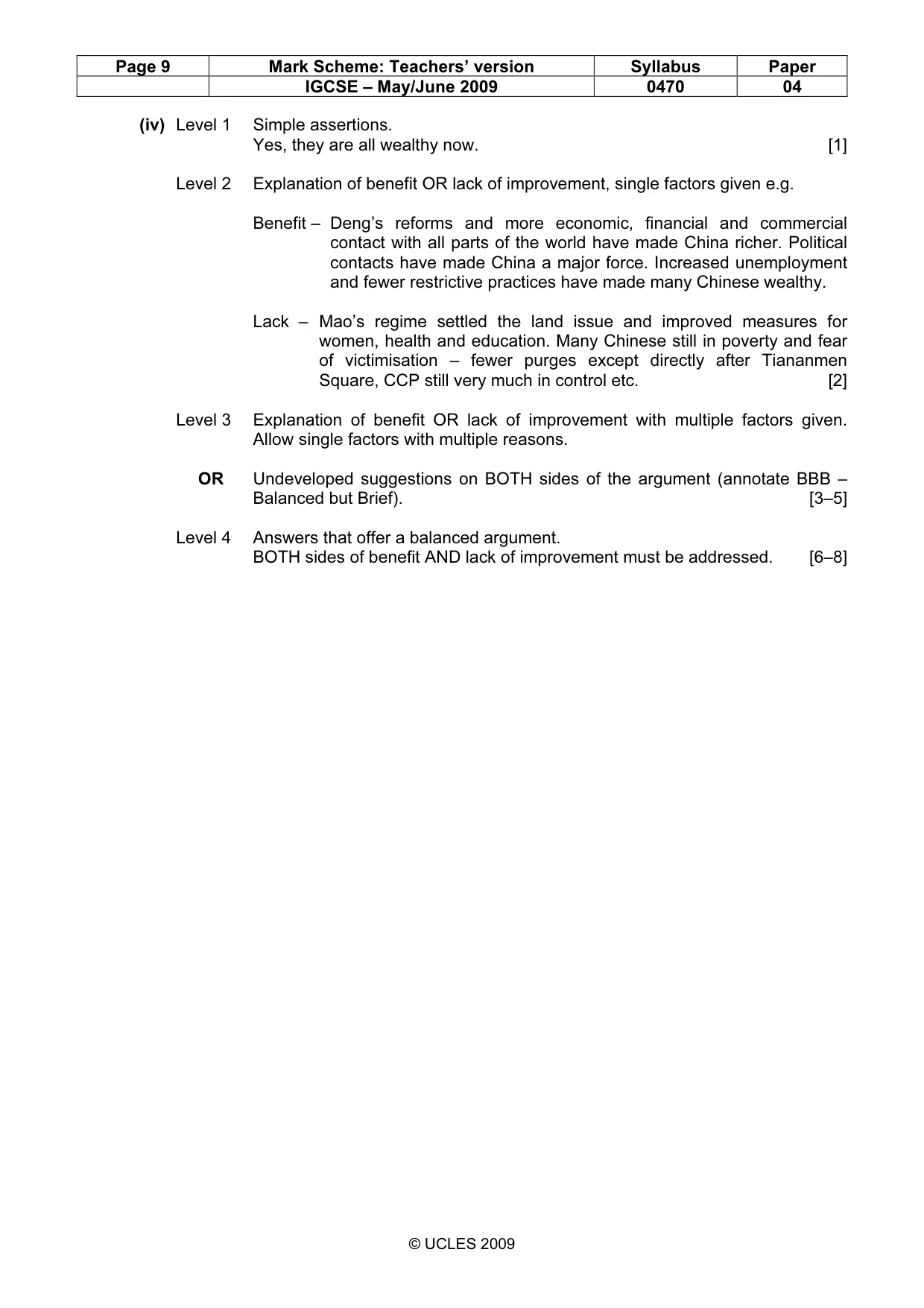
Page 9 Mark Scheme: Teachers’ version Syllabus Paper IGCSE – May/June 2009 0470 04 © UCLES 2009 (iv) Level 1 Simple assertions. Yes, they are all wealthy now. [1] Level 2 Explanation of benefit OR lack of improvement, single factors given e.g. Benefit – Deng’s reforms and more economic, financial and commercial contact with all parts of the world have made China richer. Political contacts have made China a major force. Increased unemployment and fewer restrictive practices have made many Chinese wealthy. Lack – Mao’s regime settled the land issue and improved measures for women, health and education. Many Chinese still in poverty and fear of victimisation – fewer purges except directly after Tiananmen Square, CCP still very much in control etc. [2] Level 3 Explanation of benefit OR lack of improvement with multiple factors given. Allow single factors with multiple reasons. OR Undeveloped suggestions on BOTH sides of the argument (annotate BBB – Balanced but Brief). [3–5] Level 4 Answers that offer a balanced argument. BOTH sides of benefit AND lack of improvement must be addressed. [6–8]
Mark scheme, page 10
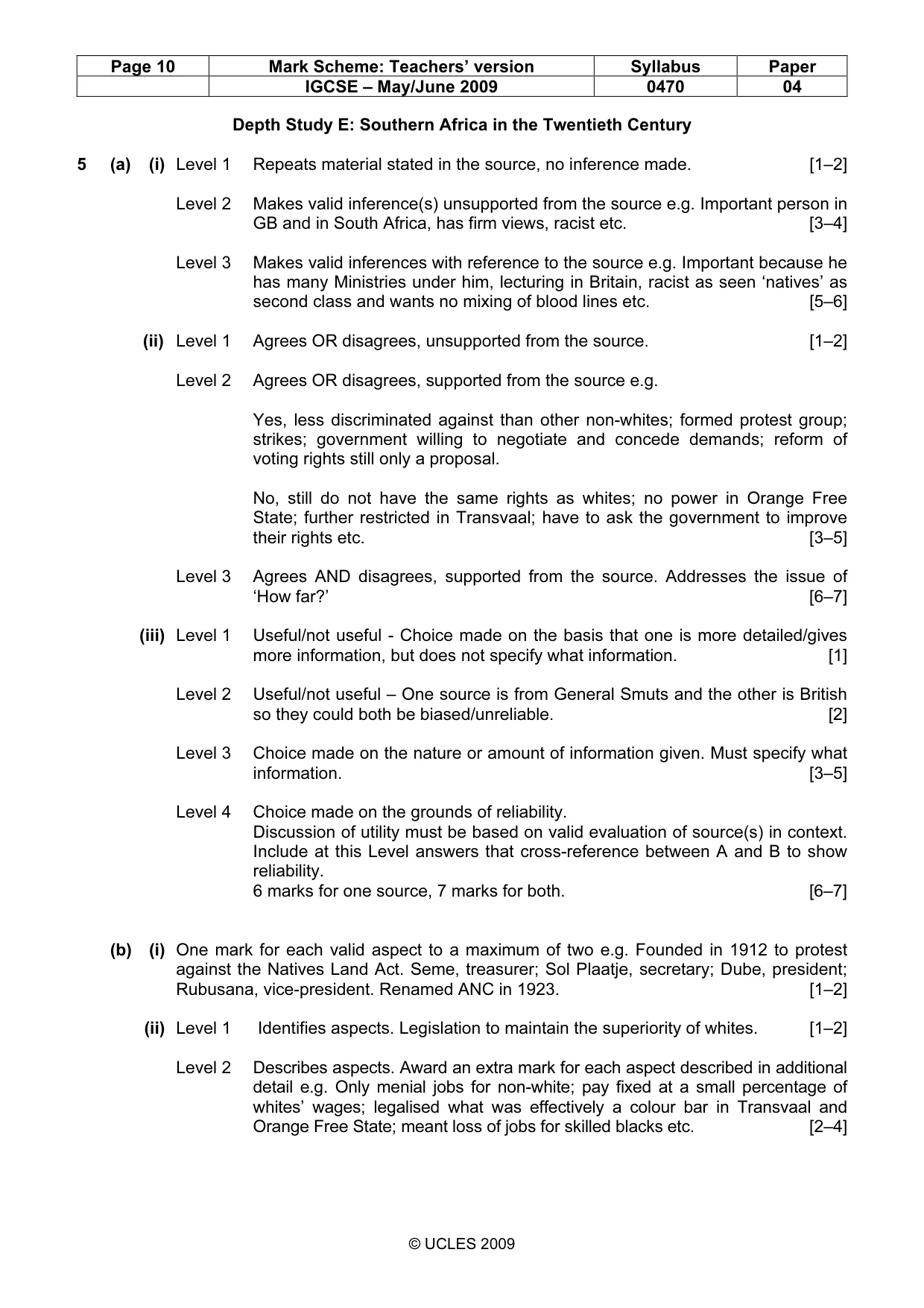
Page 10 Mark Scheme: Teachers’ version Syllabus Paper IGCSE – May/June 2009 0470 04 © UCLES 2009 Depth Study E: Southern Africa in the Twentieth Century 5 (a) (i) Level 1 Repeats material stated in the source, no inference made. [1–2] Level 2 Makes valid inference(s) unsupported from the source e.g. Important person in GB and in South Africa, has firm views, racist etc. [3–4] Level 3 Makes valid inferences with reference to the source e.g. Important because he has many Ministries under him, lecturing in Britain, racist as seen ‘natives’ as second class and wants no mixing of blood lines etc. [5–6] (ii) Level 1 Agrees OR disagrees, unsupported from the source. [1–2] Level 2 Agrees OR disagrees, supported from the source e.g. Yes, less discriminated against than other non-whites; formed protest group; strikes; government willing to negotiate and concede demands; reform of voting rights still only a proposal. No, still do not have the same rights as whites; no power in Orange Free State; further restricted in Transvaal; have to ask the government to improve their rights etc. [3–5] Level 3 Agrees AND disagrees, supported from the source. Addresses the issue of ‘How far?’ [6–7] (iii) Level 1 Useful/not useful - Choice made on the basis that one is more detailed/gives more information, but does not specify what information. [1] Level 2 Useful/not useful – One source is from General Smuts and the other is British so they could both be biased/unreliable. [2] Level 3 Choice made on the nature or amount of information given. Must specify what information. [3–5] Level 4 Choice made on the grounds of reliability. Discussion of utility must be based on valid evaluation of source(s) in context. Include at this Level answers that cross-reference between A and B to show reliability. 6 marks for one source, 7 marks for both. [6–7] (b) (i) One mark for each valid aspect to a maximum of two e.g. Founded in 1912 to protest against the Natives Land Act. Seme, treasurer; Sol Plaatje, secretary; Dube, president; Rubusana, vice-president. Renamed ANC in 1923. [1–2] (ii) Level 1 Identifies aspects. Legislation to maintain the superiority of whites. [1–2] Level 2 Describes aspects. Award an extra mark for each aspect described in additional detail e.g. Only menial jobs for non-white; pay fixed at a small percentage of whites’ wages; legalised what was effectively a colour bar in Transvaal and Orange Free State; meant loss of jobs for skilled blacks etc. [2–4]
Mark scheme, page 11
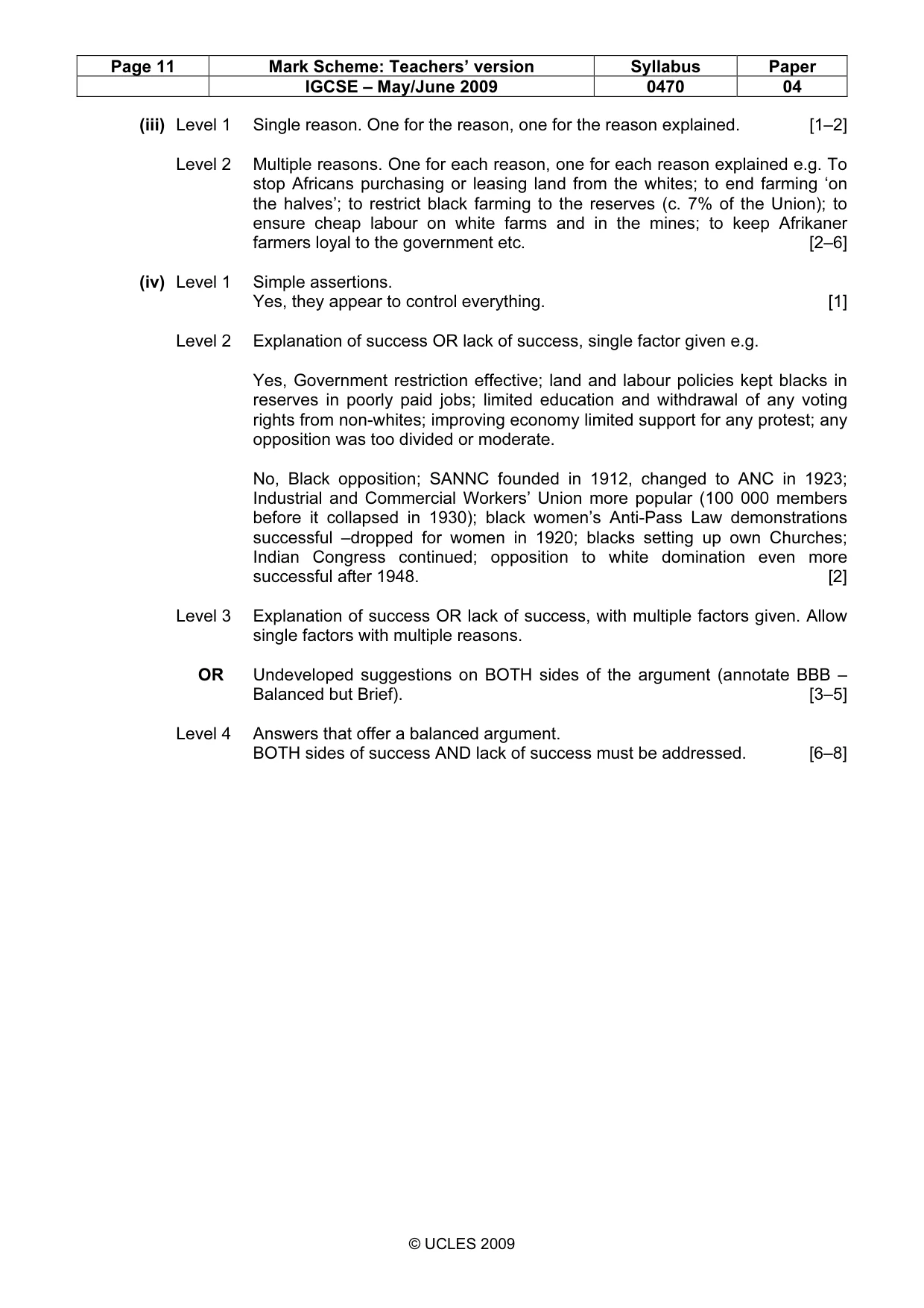
Page 11 Mark Scheme: Teachers’ version Syllabus Paper IGCSE – May/June 2009 0470 04 © UCLES 2009 (iii) Level 1 Single reason. One for the reason, one for the reason explained. [1–2] Level 2 Multiple reasons. One for each reason, one for each reason explained e.g. To stop Africans purchasing or leasing land from the whites; to end farming ‘on the halves’; to restrict black farming to the reserves (c. 7% of the Union); to ensure cheap labour on white farms and in the mines; to keep Afrikaner farmers loyal to the government etc. [2–6] (iv) Level 1 Simple assertions. Yes, they appear to control everything. [1] Level 2 Explanation of success OR lack of success, single factor given e.g. Yes, Government restriction effective; land and labour policies kept blacks in reserves in poorly paid jobs; limited education and withdrawal of any voting rights from non-whites; improving economy limited support for any protest; any opposition was too divided or moderate. No, Black opposition; SANNC founded in 1912, changed to ANC in 1923; Industrial and Commercial Workers’ Union more popular (100 000 members before it collapsed in 1930); black women’s Anti-Pass Law demonstrations successful –dropped for women in 1920; blacks setting up own Churches; Indian Congress continued; opposition to white domination even more successful after 1948. [2] Level 3 Explanation of success OR lack of success, with multiple factors given. Allow single factors with multiple reasons. OR Undeveloped suggestions on BOTH sides of the argument (annotate BBB – Balanced but Brief). [3–5] Level 4 Answers that offer a balanced argument. BOTH sides of success AND lack of success must be addressed. [6–8]
Mark scheme, page 12
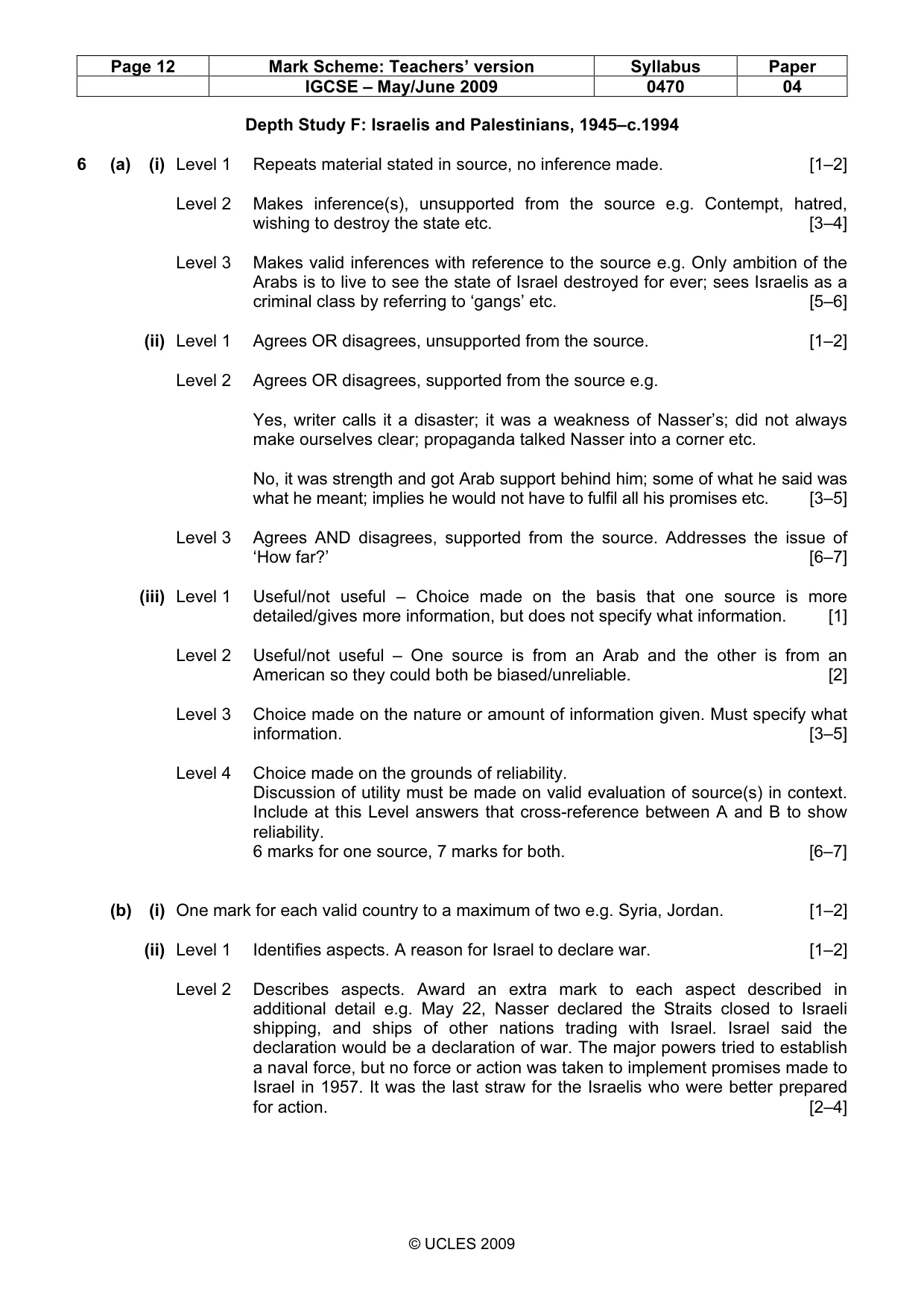
Page 12 Mark Scheme: Teachers’ version Syllabus Paper IGCSE – May/June 2009 0470 04 © UCLES 2009 Depth Study F: Israelis and Palestinians, 1945–c.1994 6 (a) (i) Level 1 Repeats material stated in source, no inference made. [1–2] Level 2 Makes inference(s), unsupported from the source e.g. Contempt, hatred, wishing to destroy the state etc. [3–4] Level 3 Makes valid inferences with reference to the source e.g. Only ambition of the Arabs is to live to see the state of Israel destroyed for ever; sees Israelis as a criminal class by referring to ‘gangs’ etc. [5–6] (ii) Level 1 Agrees OR disagrees, unsupported from the source. [1–2] Level 2 Agrees OR disagrees, supported from the source e.g. Yes, writer calls it a disaster; it was a weakness of Nasser’s; did not always make ourselves clear; propaganda talked Nasser into a corner etc. No, it was strength and got Arab support behind him; some of what he said was what he meant; implies he would not have to fulfil all his promises etc. [3–5] Level 3 Agrees AND disagrees, supported from the source. Addresses the issue of ‘How far?’ [6–7] (iii) Level 1 Useful/not useful – Choice made on the basis that one source is more detailed/gives more information, but does not specify what information. [1] Level 2 Useful/not useful – One source is from an Arab and the other is from an American so they could both be biased/unreliable. [2] Level 3 Choice made on the nature or amount of information given. Must specify what information. [3–5] Level 4 Choice made on the grounds of reliability. Discussion of utility must be made on valid evaluation of source(s) in context. Include at this Level answers that cross-reference between A and B to show reliability. 6 marks for one source, 7 marks for both. [6–7] (b) (i) One mark for each valid country to a maximum of two e.g. Syria, Jordan. [1–2] (ii) Level 1 Identifies aspects. A reason for Israel to declare war. [1–2] Level 2 Describes aspects. Award an extra mark to each aspect described in additional detail e.g. May 22, Nasser declared the Straits closed to Israeli shipping, and ships of other nations trading with Israel. Israel said the declaration would be a declaration of war. The major powers tried to establish a naval force, but no force or action was taken to implement promises made to Israel in 1957. It was the last straw for the Israelis who were better prepared for action. [2–4]
Mark scheme, page 13
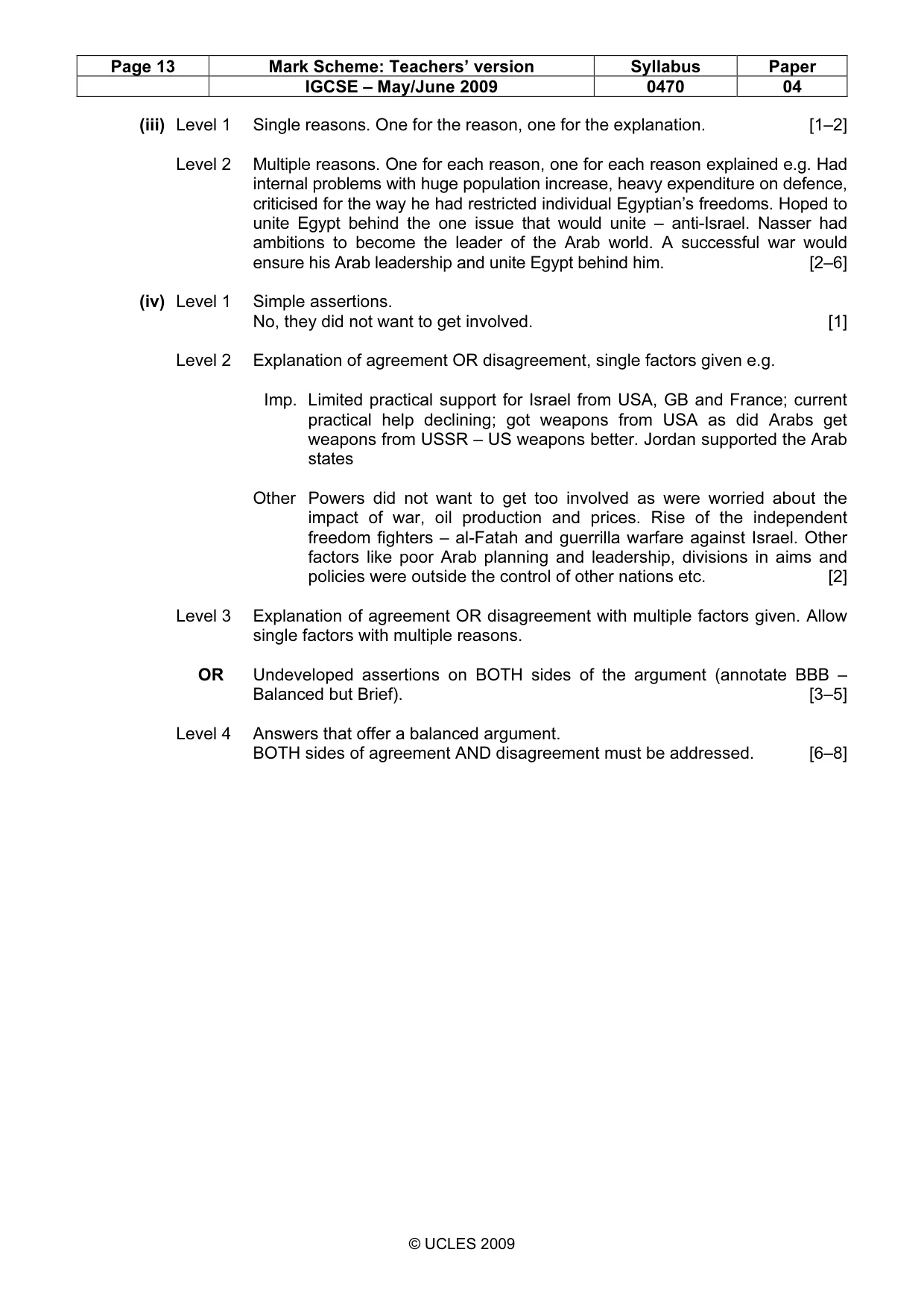
Page 13 Mark Scheme: Teachers’ version Syllabus Paper IGCSE – May/June 2009 0470 04 © UCLES 2009 (iii) Level 1 Single reasons. One for the reason, one for the explanation. [1–2] Level 2 Multiple reasons. One for each reason, one for each reason explained e.g. Had internal problems with huge population increase, heavy expenditure on defence, criticised for the way he had restricted individual Egyptian’s freedoms. Hoped to unite Egypt behind the one issue that would unite – anti-Israel. Nasser had ambitions to become the leader of the Arab world. A successful war would ensure his Arab leadership and unite Egypt behind him. [2–6] (iv) Level 1 Simple assertions. No, they did not want to get involved. [1] Level 2 Explanation of agreement OR disagreement, single factors given e.g. Imp. Limited practical support for Israel from USA, GB and France; current practical help declining; got weapons from USA as did Arabs get weapons from USSR – US weapons better. Jordan supported the Arab states Other Powers did not want to get too involved as were worried about the impact of war, oil production and prices. Rise of the independent freedom fighters – al-Fatah and guerrilla warfare against Israel. Other factors like poor Arab planning and leadership, divisions in aims and policies were outside the control of other nations etc. [2] Level 3 Explanation of agreement OR disagreement with multiple factors given. Allow single factors with multiple reasons. OR Undeveloped assertions on BOTH sides of the argument (annotate BBB – Balanced but Brief). [3–5] Level 4 Answers that offer a balanced argument. BOTH sides of agreement AND disagreement must be addressed. [6–8]
Mark scheme, page 14
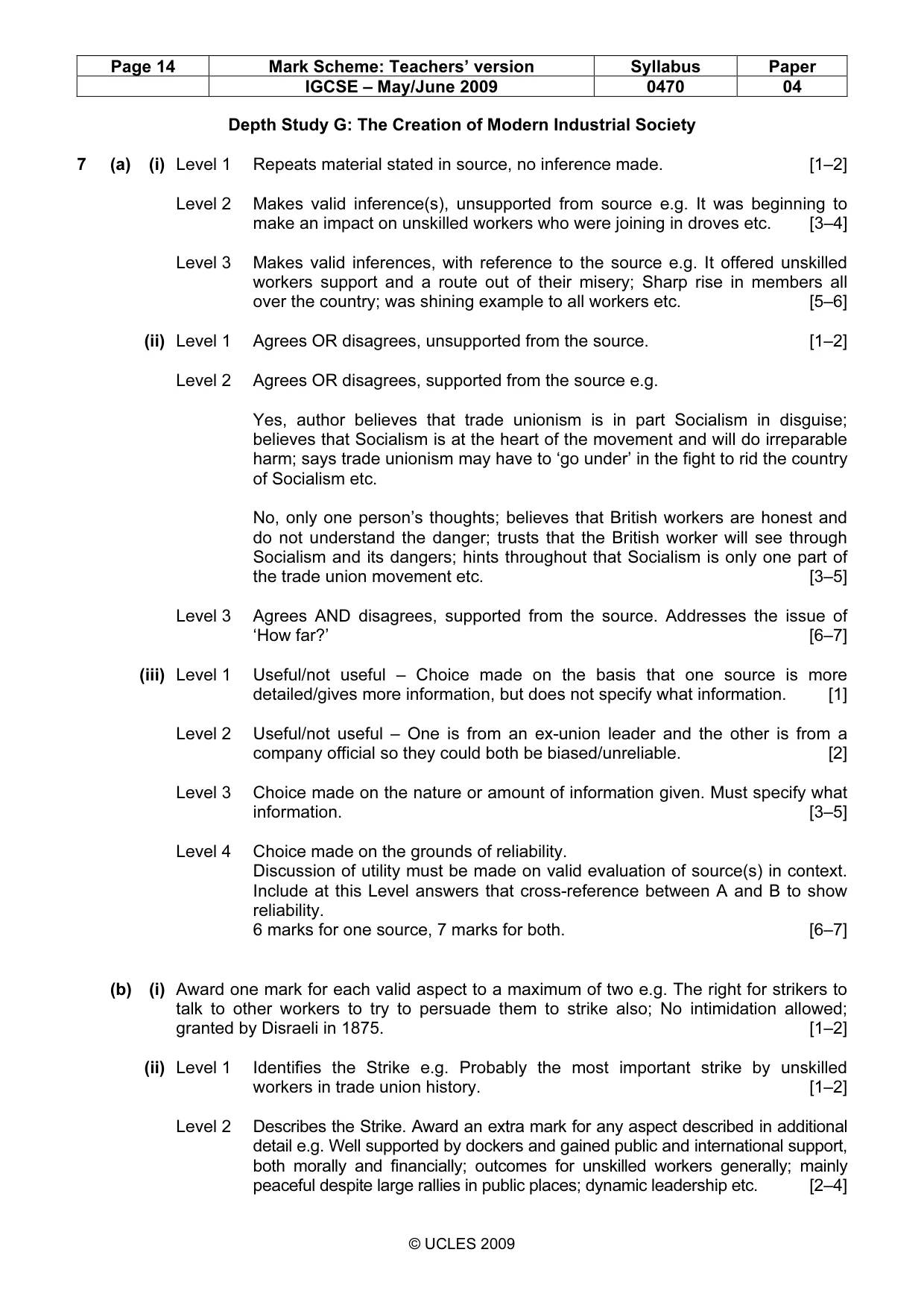
Page 14 Mark Scheme: Teachers’ version Syllabus Paper IGCSE – May/June 2009 0470 04 © UCLES 2009 Depth Study G: The Creation of Modern Industrial Society 7 (a) (i) Level 1 Repeats material stated in source, no inference made. [1–2] Level 2 Makes valid inference(s), unsupported from source e.g. It was beginning to make an impact on unskilled workers who were joining in droves etc. [3–4] Level 3 Makes valid inferences, with reference to the source e.g. It offered unskilled workers support and a route out of their misery; Sharp rise in members all over the country; was shining example to all workers etc. [5–6] (ii) Level 1 Agrees OR disagrees, unsupported from the source. [1–2] Level 2 Agrees OR disagrees, supported from the source e.g. Yes, author believes that trade unionism is in part Socialism in disguise; believes that Socialism is at the heart of the movement and will do irreparable harm; says trade unionism may have to ‘go under’ in the fight to rid the country of Socialism etc. No, only one person’s thoughts; believes that British workers are honest and do not understand the danger; trusts that the British worker will see through Socialism and its dangers; hints throughout that Socialism is only one part of the trade union movement etc. [3–5] Level 3 Agrees AND disagrees, supported from the source. Addresses the issue of ‘How far?’ [6–7] (iii) Level 1 Useful/not useful – Choice made on the basis that one source is more detailed/gives more information, but does not specify what information. [1] Level 2 Useful/not useful – One is from an ex-union leader and the other is from a company official so they could both be biased/unreliable. [2] Level 3 Choice made on the nature or amount of information given. Must specify what information. [3–5] Level 4 Choice made on the grounds of reliability. Discussion of utility must be made on valid evaluation of source(s) in context. Include at this Level answers that cross-reference between A and B to show reliability. 6 marks for one source, 7 marks for both. [6–7] (b) (i) Award one mark for each valid aspect to a maximum of two e.g. The right for strikers to talk to other workers to try to persuade them to strike also; No intimidation allowed; granted by Disraeli in 1875. [1–2] (ii) Level 1 Identifies the Strike e.g. Probably the most important strike by unskilled workers in trade union history. [1–2] Level 2 Describes the Strike. Award an extra mark for any aspect described in additional detail e.g. Well supported by dockers and gained public and international support, both morally and financially; outcomes for unskilled workers generally; mainly peaceful despite large rallies in public places; dynamic leadership etc. [2–4]
Mark scheme, page 15
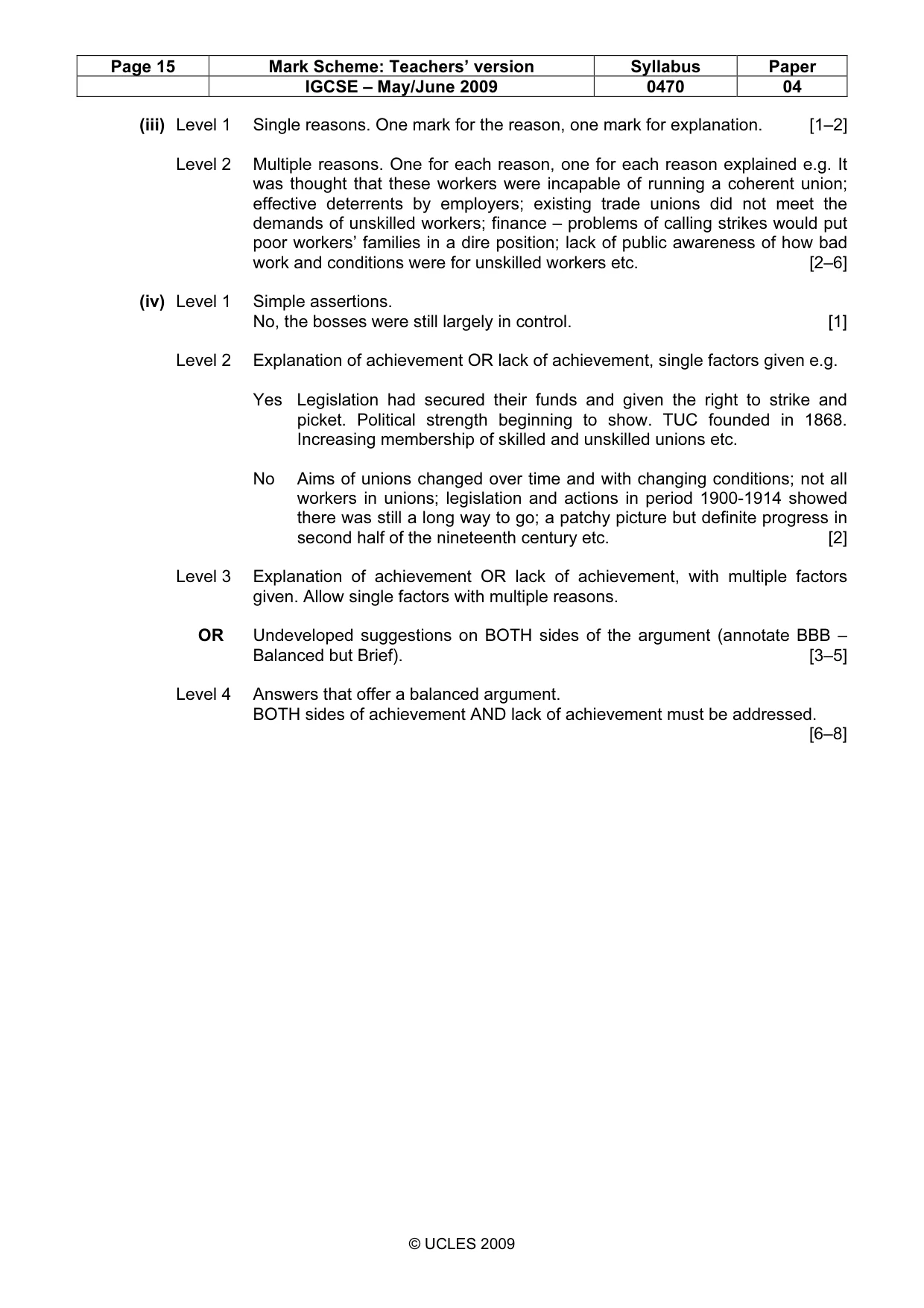
Page 15 Mark Scheme: Teachers’ version Syllabus Paper IGCSE – May/June 2009 0470 04 © UCLES 2009 (iii) Level 1 Single reasons. One mark for the reason, one mark for explanation. [1–2] Level 2 Multiple reasons. One for each reason, one for each reason explained e.g. It was thought that these workers were incapable of running a coherent union; effective deterrents by employers; existing trade unions did not meet the demands of unskilled workers; finance – problems of calling strikes would put poor workers’ families in a dire position; lack of public awareness of how bad work and conditions were for unskilled workers etc. [2–6] (iv) Level 1 Simple assertions. No, the bosses were still largely in control. [1] Level 2 Explanation of achievement OR lack of achievement, single factors given e.g. Yes Legislation had secured their funds and given the right to strike and picket. Political strength beginning to show. TUC founded in 1868. Increasing membership of skilled and unskilled unions etc. No Aims of unions changed over time and with changing conditions; not all workers in unions; legislation and actions in period 1900-1914 showed there was still a long way to go; a patchy picture but definite progress in second half of the nineteenth century etc. [2] Level 3 Explanation of achievement OR lack of achievement, with multiple factors given. Allow single factors with multiple reasons. OR Undeveloped suggestions on BOTH sides of the argument (annotate BBB – Balanced but Brief). [3–5] Level 4 Answers that offer a balanced argument. BOTH sides of achievement AND lack of achievement must be addressed. [6–8]
Mark scheme, page 16
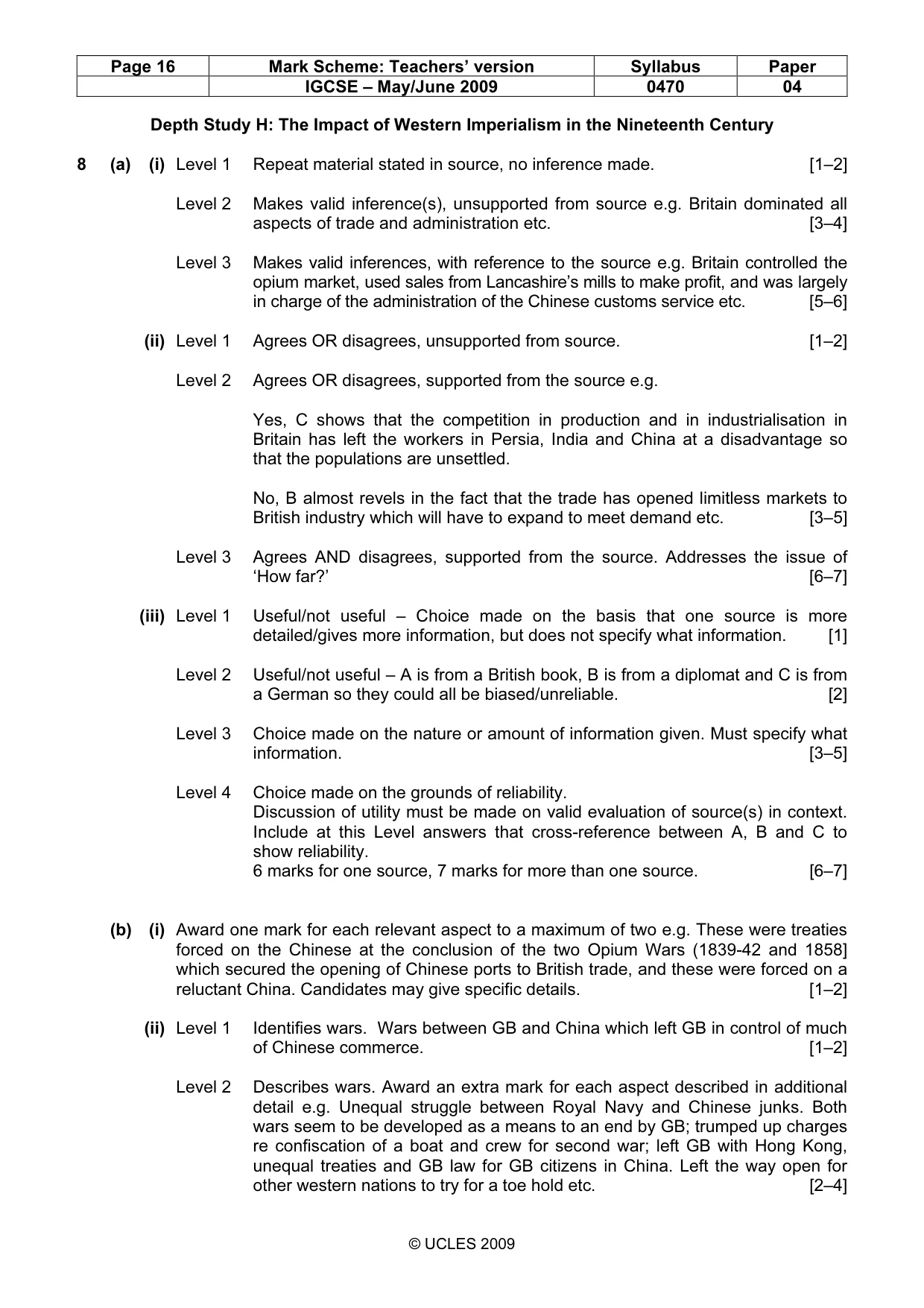
Page 16 Mark Scheme: Teachers’ version Syllabus Paper IGCSE – May/June 2009 0470 04 © UCLES 2009 Depth Study H: The Impact of Western Imperialism in the Nineteenth Century 8 (a) (i) Level 1 Repeat material stated in source, no inference made. [1–2] Level 2 Makes valid inference(s), unsupported from source e.g. Britain dominated all aspects of trade and administration etc. [3–4] Level 3 Makes valid inferences, with reference to the source e.g. Britain controlled the opium market, used sales from Lancashire’s mills to make profit, and was largely in charge of the administration of the Chinese customs service etc. [5–6] (ii) Level 1 Agrees OR disagrees, unsupported from source. [1–2] Level 2 Agrees OR disagrees, supported from the source e.g. Yes, C shows that the competition in production and in industrialisation in Britain has left the workers in Persia, India and China at a disadvantage so that the populations are unsettled. No, B almost revels in the fact that the trade has opened limitless markets to British industry which will have to expand to meet demand etc. [3–5] Level 3 Agrees AND disagrees, supported from the source. Addresses the issue of ‘How far?’ [6–7] (iii) Level 1 Useful/not useful – Choice made on the basis that one source is more detailed/gives more information, but does not specify what information. [1] Level 2 Useful/not useful – A is from a British book, B is from a diplomat and C is from a German so they could all be biased/unreliable. [2] Level 3 Choice made on the nature or amount of information given. Must specify what information. [3–5] Level 4 Choice made on the grounds of reliability. Discussion of utility must be made on valid evaluation of source(s) in context. Include at this Level answers that cross-reference between A, B and C to show reliability. 6 marks for one source, 7 marks for more than one source. [6–7] (b) (i) Award one mark for each relevant aspect to a maximum of two e.g. These were treaties forced on the Chinese at the conclusion of the two Opium Wars (1839-42 and 1858] which secured the opening of Chinese ports to British trade, and these were forced on a reluctant China. Candidates may give specific details. [1–2] (ii) Level 1 Identifies wars. Wars between GB and China which left GB in control of much of Chinese commerce. [1–2] Level 2 Describes wars. Award an extra mark for each aspect described in additional detail e.g. Unequal struggle between Royal Navy and Chinese junks. Both wars seem to be developed as a means to an end by GB; trumped up charges re confiscation of a boat and crew for second war; left GB with Hong Kong, unequal treaties and GB law for GB citizens in China. Left the way open for other western nations to try for a toe hold etc. [2–4]
Mark scheme, page 17
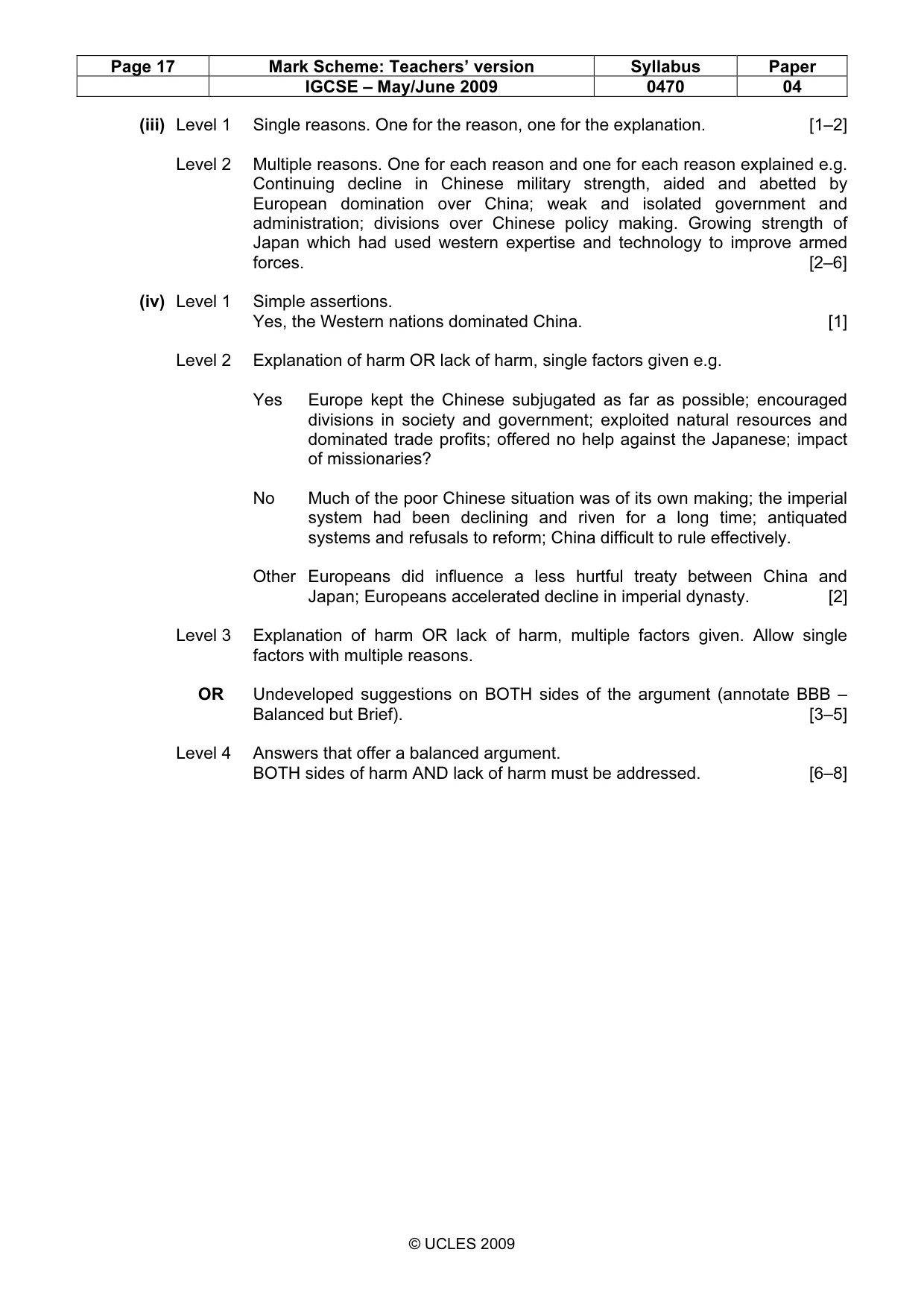
Page 17 Mark Scheme: Teachers’ version Syllabus Paper IGCSE – May/June 2009 0470 04 © UCLES 2009 (iii) Level 1 Single reasons. One for the reason, one for the explanation. [1–2] Level 2 Multiple reasons. One for each reason and one for each reason explained e.g. Continuing decline in Chinese military strength, aided and abetted by European domination over China; weak and isolated government and administration; divisions over Chinese policy making. Growing strength of Japan which had used western expertise and technology to improve armed forces. [2–6] (iv) Level 1 Simple assertions. Yes, the Western nations dominated China. [1] Level 2 Explanation of harm OR lack of harm, single factors given e.g. Yes Europe kept the Chinese subjugated as far as possible; encouraged divisions in society and government; exploited natural resources and dominated trade profits; offered no help against the Japanese; impact of missionaries? No Much of the poor Chinese situation was of its own making; the imperial system had been declining and riven for a long time; antiquated systems and refusals to reform; China difficult to rule effectively. Other Europeans did influence a less hurtful treaty between China and Japan; Europeans accelerated decline in imperial dynasty. [2] Level 3 Explanation of harm OR lack of harm, multiple factors given. Allow single factors with multiple reasons. OR Undeveloped suggestions on BOTH sides of the argument (annotate BBB – Balanced but Brief). [3–5] Level 4 Answers that offer a balanced argument. BOTH sides of harm AND lack of harm must be addressed. [6–8]
What you needed in this session
Cambridge’s own grade thresholds for 2009 May/June, Paper 4 · Variant 1. A higher threshold means an easier paper — the bar moves with how the cohort did.