Cambridge IGCSE History 0470 — 2008 Oct/Nov Paper 4 · Variant 1
0470/41/O/N/08 · 40 marks · ≈45 min
The question paper and its mark scheme, free to read here and free to download. This is Cambridge’s own paper, exactly as it was sat.
Question paper12 pages

Mark scheme13 pages
Answers below. Sit the paper first if you are practising.
Paper as text
Question paper, page 1
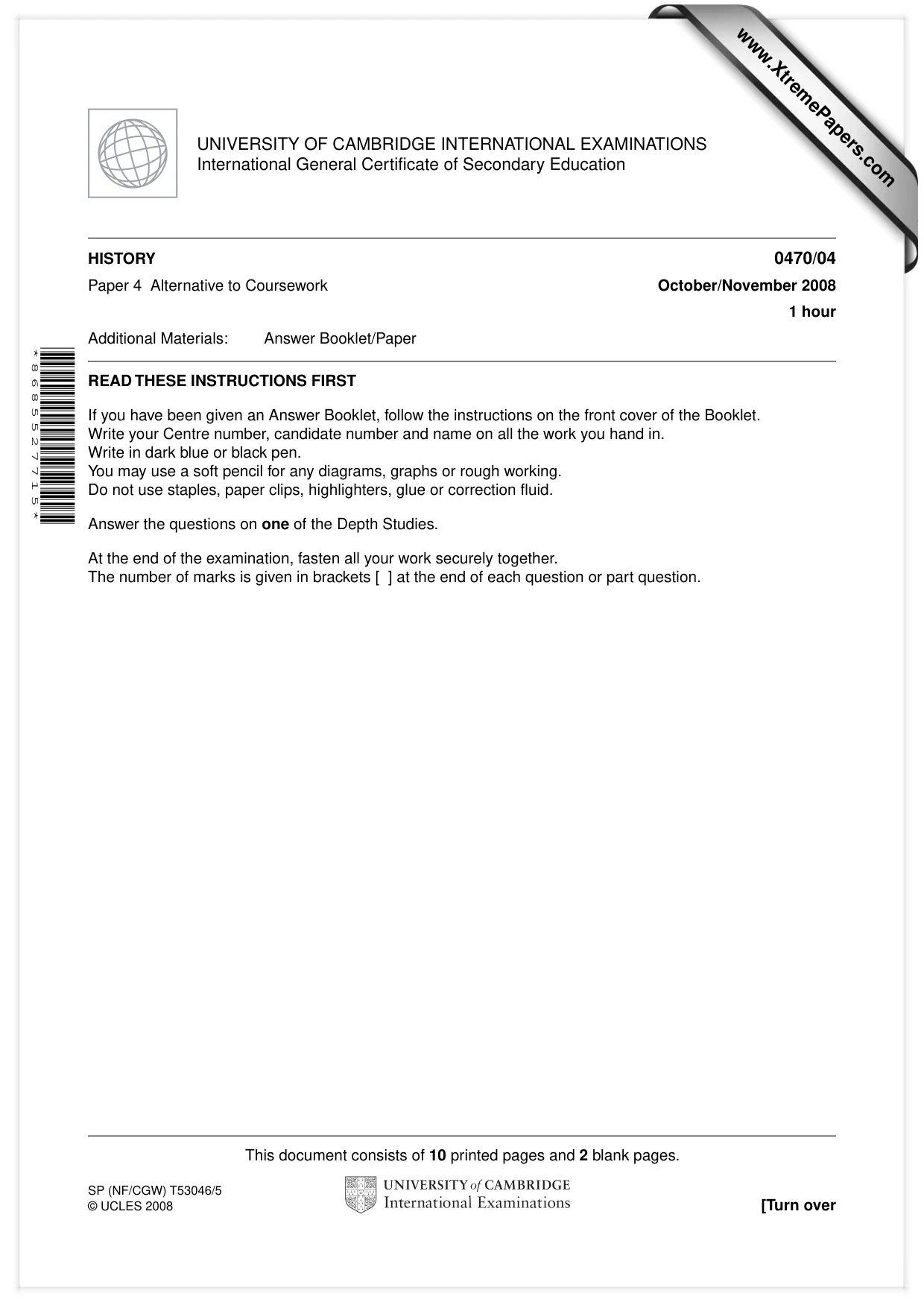
This document consists of 10 printed pages and 2 blank pages. SP (NF/CGW) T53046/5 © UCLES 2008 [Turn over UNIVERSITY OF CAMBRIDGE INTERNATIONAL EXAMINATIONS International General Certificate of Secondary Education READ THESE INSTRUCTIONS FIRST If you have been given an Answer Booklet, follow the instructions on the front cover of the Booklet. Write your Centre number, candidate number and name on all the work you hand in. Write in dark blue or black pen. You may use a soft pencil for any diagrams, graphs or rough working. Do not use staples, paper clips, highlighters, glue or correction fluid. Answer the questions on one of the Depth Studies. At the end of the examination, fasten all your work securely together. The number of marks is given in brackets [ ] at the end of each question or part question. * 8 6 8 5 5 2 7 7 1 5 * HISTORY 0470/04 Paper 4 Alternative to Coursework October/November 2008 1 hour Additional Materials: Answer Booklet/Paper www.XtremePapers.com
Question paper, page 2
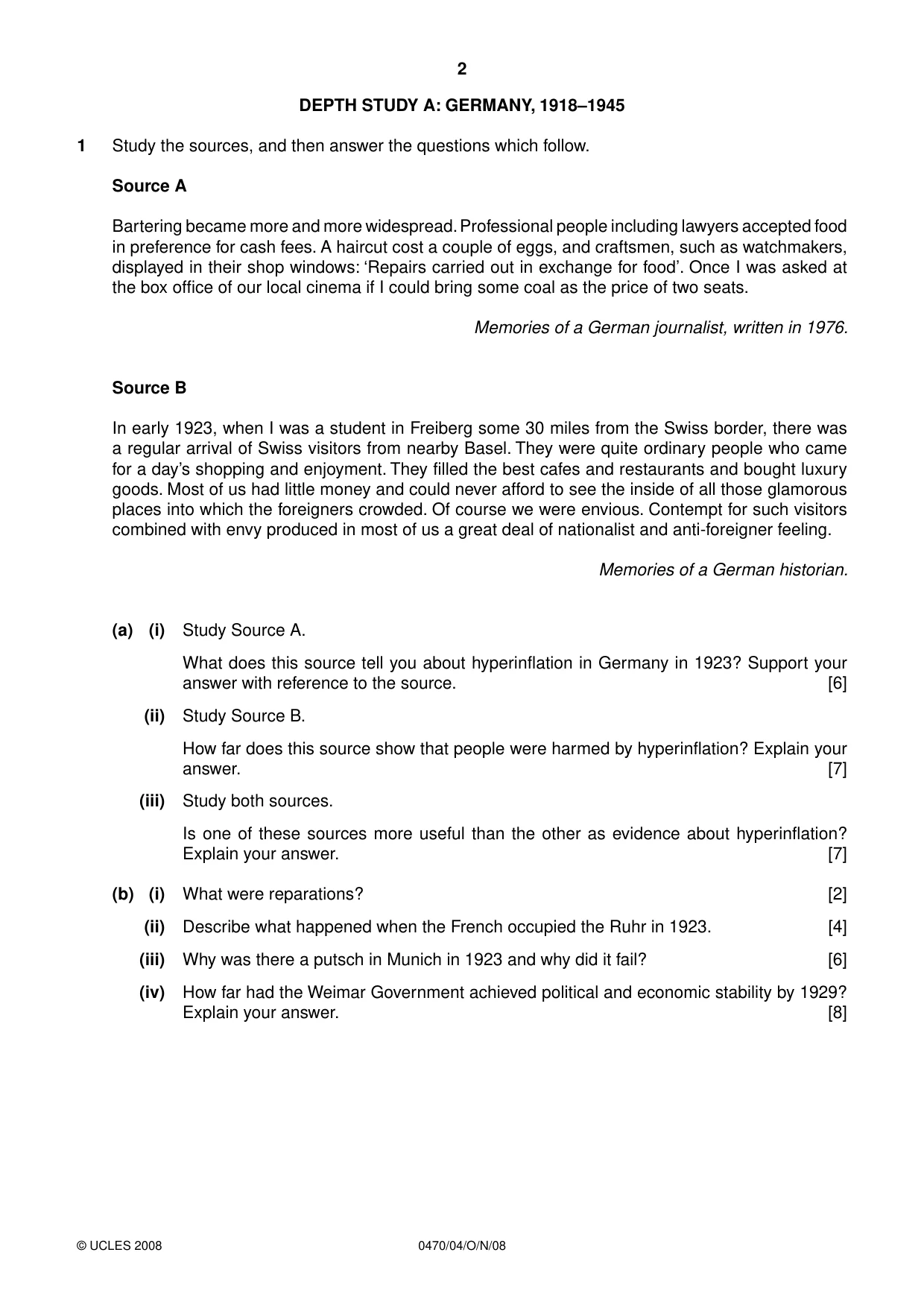
2 0470/04/O/N/08 © UCLES 2008 DEPTH STUDY A: GERMANY, 1918–1945 1 Study the sources, and then answer the questions which follow. Source A Bartering became more and more widespread. Professional people including lawyers accepted food in preference for cash fees. A haircut cost a couple of eggs, and craftsmen, such as watchmakers, displayed in their shop windows: ‘Repairs carried out in exchange for food’. Once I was asked at the box office of our local cinema if I could bring some coal as the price of two seats. Memories of a German journalist, written in 1976. Source B In early 1923, when I was a student in Freiberg some 30 miles from the Swiss border, there was a regular arrival of Swiss visitors from nearby Basel. They were quite ordinary people who came for a day’s shopping and enjoyment. They filled the best cafes and restaurants and bought luxury goods. Most of us had little money and could never afford to see the inside of all those glamorous places into which the foreigners crowded. Of course we were envious. Contempt for such visitors combined with envy produced in most of us a great deal of nationalist and anti-foreigner feeling. Memories of a German historian. (a) (i) Study Source A. What does this source tell you about hyperinflation in Germany in 1923? Support your answer with reference to the source. [6] (ii) Study Source B. How far does this source show that people were harmed by hyperinflation? Explain your answer. [7] (iii) Study both sources. Is one of these sources more useful than the other as evidence about hyperinflation? Explain your answer. [7] (b) (i) What were reparations? [2] (ii) Describe what happened when the French occupied the Ruhr in 1923. [4] (iii) Why was there a putsch in Munich in 1923 and why did it fail? [6] (iv) How far had the Weimar Government achieved political and economic stability by 1929? Explain your answer. [8]
Question paper, page 3
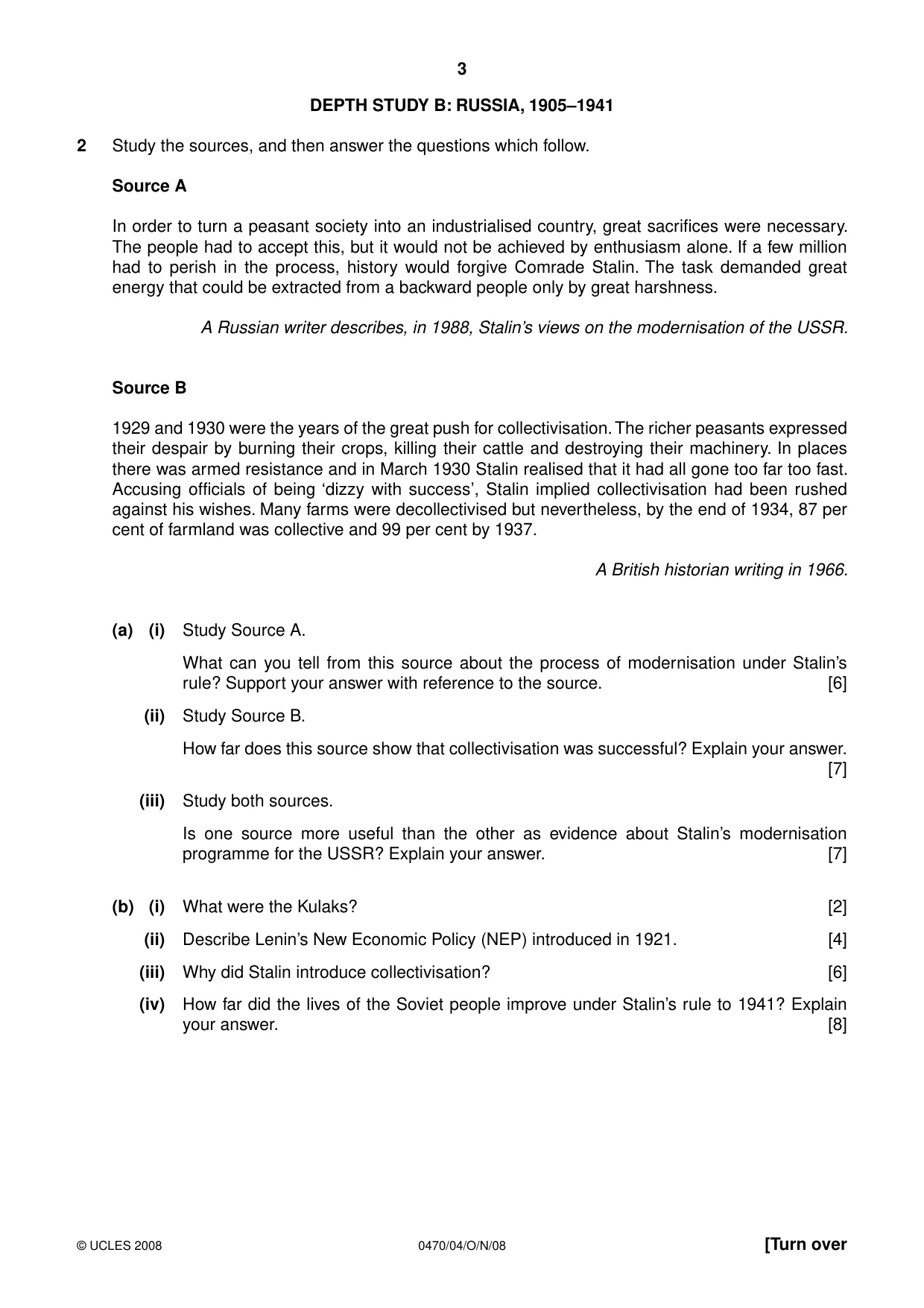
3 0470/04/O/N/08 © UCLES 2008 [Turn over DEPTH STUDY B: RUSSIA, 1905–1941 2 Study the sources, and then answer the questions which follow. Source A In order to turn a peasant society into an industrialised country, great sacrifices were necessary. The people had to accept this, but it would not be achieved by enthusiasm alone. If a few million had to perish in the process, history would forgive Comrade Stalin. The task demanded great energy that could be extracted from a backward people only by great harshness. A Russian writer describes, in 1988, Stalin’s views on the modernisation of the USSR. Source B 1929 and 1930 were the years of the great push for collectivisation. The richer peasants expressed their despair by burning their crops, killing their cattle and destroying their machinery. In places there was armed resistance and in March 1930 Stalin realised that it had all gone too far too fast. Accusing officials of being ‘dizzy with success’, Stalin implied collectivisation had been rushed against his wishes. Many farms were decollectivised but nevertheless, by the end of 1934, 87 per cent of farmland was collective and 99 per cent by 1937. A British historian writing in 1966. (a) (i) Study Source A. What can you tell from this source about the process of modernisation under Stalin’s rule? Support your answer with reference to the source. [6] (ii) Study Source B. How far does this source show that collectivisation was successful? Explain your answer. [7] (iii) Study both sources. Is one source more useful than the other as evidence about Stalin’s modernisation programme for the USSR? Explain your answer. [7] (b) (i) What were the Kulaks? [2] (ii) Describe Lenin’s New Economic Policy (NEP) introduced in 1921. [4] (iii) Why did Stalin introduce collectivisation? [6] (iv) How far did the lives of the Soviet people improve under Stalin’s rule to 1941? Explain your answer. [8]
Question paper, page 4
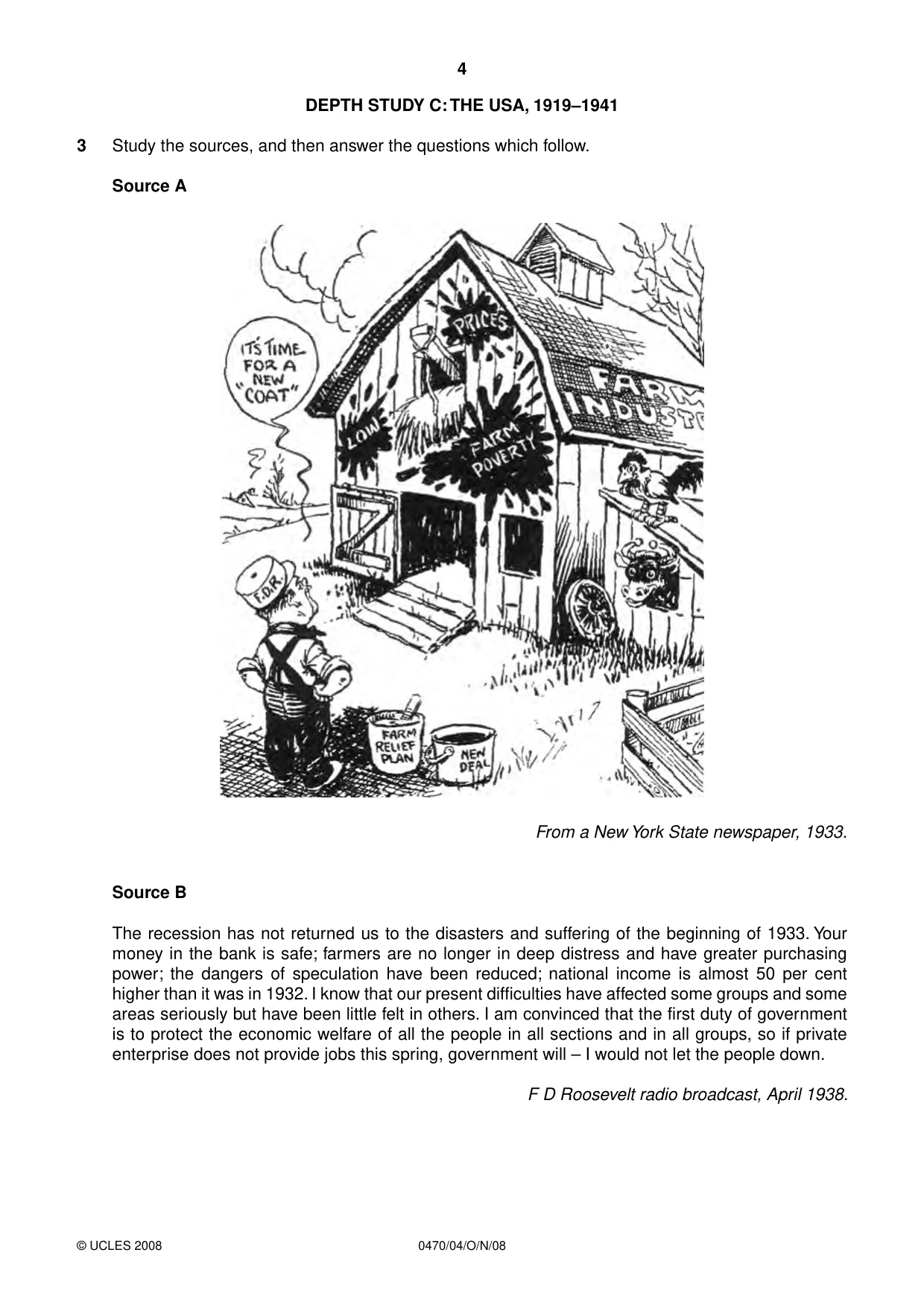
4 0470/04/O/N/08 © UCLES 2008 DEPTH STUDY C: THE USA, 1919–1941 3 Study the sources, and then answer the questions which follow. Source A From a New York State newspaper, 1933. Source B The recession has not returned us to the disasters and suffering of the beginning of 1933. Your money in the bank is safe; farmers are no longer in deep distress and have greater purchasing power; the dangers of speculation have been reduced; national income is almost 50 per cent higher than it was in 1932. I know that our present difficulties have affected some groups and some areas seriously but have been little felt in others. I am convinced that the first duty of government is to protect the economic welfare of all the people in all sections and in all groups, so if private enterprise does not provide jobs this spring, government will – I would not let the people down. F D Roosevelt radio broadcast, April 1938.
Question paper, page 5
5 0470/04/O/N/08 © UCLES 2008 [Turn over (a) (i) Study Source A. What can you tell from this source about agriculture in 1933? Support your answer with reference to the source. [6] (ii) Study Source B. How far does this source show that the New Deal had been successful by 1938? Explain your answer. [7] (iii) Study both sources. Is one of these sources more useful than the other as evidence about the New Deal programme? Explain your answer. [7] (b) (i) What was sharecropping? [2] (ii) What were the effects on agriculture of the drought in the mid-1930s? [4] (iii) Why was the Tennessee Valley Authority set up? [6] (iv) ‘The greatest success of the New Deal was its effect on farming.’ Do you agree? Explain your answer. [8]
Question paper, page 6
6 0470/04/O/N/08 © UCLES 2008 DEPTH STUDY D: CHINA, 1945–c.1990 4 Study the sources, and then answer the questions which follow. Source A Hundreds of thousands of people had decided to join in on the side which seemed certain to win. The major avenues of Beijing were blocked with bicycles, cars, lorries, buses, and trucks all heading for Tiananmen Square, which was filled with people cheering, singing, playing musical instruments, waving flags, enjoying themselves. The noise could be heard streets away. Victory seemed the only conclusion. A British reporter describing what he saw in Beijing, 1989. Source B Deng’s China began to sign agreements with the USA, Britain, Japan and other industrial countries. By the 1980s foreign firms were building new factories in China to make everything from computers to face cream. In the countryside much land was handed back to the peasants who could decide what to grow. After they had paid rent to the government they could keep the rest of the money. Factory workers were rewarded too. If they produced more, they were given extra money. The more the peasants and factory workers earned the more they had to spend. The economy began to grow. A British history textbook, 1987. (a) (i) Study Source A. What can you tell from this source about the protesters in Tiananmen Square? Support your answer with reference to the source. [6] (ii) Study Source B. How far does this source show that the reason for the improvement in China’s economy was foreign investment? Explain your answer. [7] (iii) Study both sources. Is one of these sources more useful than the other as evidence about China’s development after the death of Mao Zedong? Explain your answer. [7] (b) (i) What was the ‘Gang of Four’? [2] (ii) Describe how Deng Xiaoping re-emerged to become leader of China. [4] (iii) Why were there demonstrations in Tiananmen Square in 1989? [6] (iv) ‘From 1976 to 1990, the Communist government relaxed control over the Chinese people.’ How far do you agree with this statement? Explain your answer. [8]
Question paper, page 7
7 0470/04/O/N/08 © UCLES 2008 [Turn over DEPTH STUDY E: SOUTHERN AFRICA IN THE TWENTIETH CENTURY 5 Study the sources, and then answer the questions which follow. Source A Mrs Mpemba, a mother of eight children, has been told that as her husband is no longer living in Langa she has no right to live there and must leave. Because she has lived in Langa for 25 years she also does not have the right to return to her place of birth. Legally, she may not now live anywhere. A South African newspaper report of a case under the Pass Laws, 1967. Source B Before they went to the police station on 21 March 1960, PAC member Philip Kgosana told the crowd of 6000 in Langa township, ‘Every African must make up his mind that he will never again carry a pass. In this campaign NOW and CONTINUOUSLY we are going to observe ABSOLUTE NON-VIOLENCE.’ Nine days later, he repeated these points to a crowd of 30 000 that he had led in a march to Parliament in Cape Town. A report in the New York Times from an American writer who was expelled from South Africa in 1966. (a) (i) Study Source A. What can you tell from this source about the effects of the Pass Laws? Support your answer with reference to the source. [6] (ii) Study Source B. How far does this source show that Africans opposed the Pass Laws? Explain your answer. [7] (iii) Study both sources. Is one of these sources more useful than the other as evidence about government control over Africans in the 1960s? Explain your answer. [7] (b) (i) Name the two Prime Ministers of South Africa in the 1960s. [2] (ii) Describe the events at Sharpeville on 21 March 1960. [4] (iii) Why did South Africa become a republic in 1961? [6] (iv) How successful was government action towards opposition to apartheid in the 1960s and 1970s? Explain your answer. [8]
Question paper, page 8
8 0470/04/O/N/08 © UCLES 2008 DEPTH STUDY F: ISRAELIS AND PALESTINIANS, 1945–c.1994 6 Study the sources, and then answer the questions which follow. Source A Palestine is our country. Our aim is to return. Death does not frighten us. Palestine is ours. We shall never forget her. Another homeland we shall never accept. Our Palestine, O God and History, We promise to shed our blood for you! An oath chanted daily in the 1970s by Palestinian refugee children. Source B Those who call us terrorists wish to prevent world public opinion from discovering the truth about us. The difference between the revolutionary and the terrorist lies in the reason for which he fights. For whoever fights for freedom and liberation of his land from the invaders, the settlers and the colonists, cannot possibly be called terrorist, otherwise the American people in their struggle for liberation from the British would have been terrorists; the European resistance against the Nazis would have been terrorism; the struggle of the Asian, African and Latin American peoples would also have been terrorism. Part of Arafat’s speech to the UNO, November 1974. (a) (i) Study Source A. What does this source tell you about Palestinian refugees? Support your answer with reference to the source. [6] (ii) Study Source B. How far does this source show that Palestinians were not terrorists? Explain your answer. [7] (iii) Study both sources. Is one of these sources more useful than the other as evidence about the Palestinian liberation struggle? Explain your answer. [7] (b) (i) Name two Palestinian organisations other than the PLO that have fought for Palestinian independence. [2] (ii) Describe the tactics the PLO used to achieve their aims in the 1970s. [4] (iii) Why did Arafat accept an invitation to speak at the UNO in 1974? [6] (iv) How far was the PLO successful in promoting the Palestinian cause? Explain your answer. [8]
Question paper, page 9
9 0470/04/O/N/08 © UCLES 2008 [Turn over DEPTH STUDY G: THE CREATION OF MODERN INDUSTRIAL SOCIETY 7 Study the sources, and then answer the questions which follow. Source A The question of universal suffrage is a knife and fork question, a bread and cheese question. It seems to me that every working man has a right to have a good coat on his back, a comfortable home, a good dinner upon his table, no more work than is necessary for keeping him in good health and as much wages for that work as would keep him in plenty. From a speech made in 1839 by John Stephens who spoke in support of Chartism, although he never joined the movement. Source B The Chartists were called ugly names like a herd of pigs and the unwashed. I never knew equality demanded by the Chartists, neither in public or private, nor a case of violence or robbery in the town, though thousands have marched through its streets to meetings. They believed that taxation without representation was tyranny, and ought to be resisted. They took a leading part in agitating in favour of the ten hour working day, the repeal of taxes on knowledge and education. They supported civil and religious liberty. They were true pioneers in all the great movements of their time. From a book published in 1887 entitled ‘The Struggles of an Old Chartist’. (a) (i) Study Source A. What does this source tell you about the Chartists? Support your answer with reference to the source. [6] (ii) Study Source B. How far does this source show that the Chartists were a threat to society? Explain your answer. [7] (iii) Study both sources. Is one of these sources more useful than the other as evidence about the aims of the Chartists? Explain your answer. [7] (b) (i) Who was the leader of (a) the moral force Chartists and (b) the physical force Chartists? [2] (ii) Describe the presentation of the 1848 petition. [4] (iii) Why did the Chartists fail to achieve the six points of the Charter? [6] (iv) ‘Chartism was the most important nineteenth-century working-class movement.’ Do you agree? Explain your answer. [8]
Question paper, page 10
10 0470/04/O/N/08 © UCLES 2008 DEPTH STUDY H: THE IMPACT OF WESTERN IMPERIALISM IN THE NINETEENTH CENTURY 8 Study the sources, and then answer the questions which follow. Source A We have never before heard such news as the first full story of the outbreak of the mutiny in India. It came with terrible exaggeration. England was horrified by the stories of large-scale massacres of English women and children; of the most dreadful tortures and the most degrading outrages inflicted on English women. From a book, ‘The History of Our Time’, published in 1881. Source B The British authorities have met the emergency with both strength and wisdom. They reacted quickly and vigorously to bring all their resources to deal with the crisis, with as little fuss and trouble as if they had been arranging the details of a festival. From a magazine published in England, July 1857. Source C The mutiny began at Meerut. Its immediate cause was a display of unwise severity by incompetent officers who did not know how to calm the storm they had caused. Delhi fell and then Cawnpore after three weeks gallant defence. It was in the Upper Ganges region that the issue was fought out and won during the summer of 1857 by the small British force then actually in India and by Indian troops faithful to them. Their boast that ‘alone we did it’ is largely true, although there were still months of bitter fighting. From a British history book, published in 1922. (a) (i) Study Source A. What does this source tell you about British reaction to the Indian Mutiny? Support your answer with reference to the source. [6] (ii) Study Sources B and C. How far do these sources agree about the way the British dealt with the Mutiny? Explain your answer. [7] (iii) Study all the sources. Is one of these sources more useful than the others as evidence about the Mutiny? Explain your answer. [7] (b) (i) Name two British Governor-Generals in the years prior to the Mutiny. [2] (ii) Describe what happened at Meerut on 10 May 1857. [4] (iii) Why was the Mutiny defeated? [6] (iv) How far did the Mutiny change India? Explain your answer. [8]
Question paper, page 12
12 0470/04/O/N/08 BLANK PAGE Copyright Acknowledgements: Depth Study A Source A © Alan White, Eric Hadley; Germany, 1918–49; Collins Educational; 1990. Depth Study A Source B © Alan White, Eric Hadley; Germany, 1918–49; Collins Educational; 1990. Depth Study B Source A © Anatoly Rybakov; Children of Arbat; 1988. Depth Study B Source B © J N Westwood; Russia 1917–1964. Depth Study C Source A © www.nisk.k2.ny.us/fdr/fdr_farm/33032002.GIF Depth Study D Source A © John Simpson; Despatches from the Barricades; Hutchinson; 1990. Depth Study D Source B © Bryn O’Callaghan; A History of the Twentieth Century; Longman; 1987. Depth Study E Source A © www.disa.ukzn.ac.za Depth Study E Source B © Joseph Lelyveld; Move Your Shadow: South Africa Black and White; Times Books; 1985. Permission to reproduce items where third-party owned material protected by copyright is included has been sought and cleared where possible. Every reasonable effort has been made by the publisher (UCLES) to trace copyright holders, but if any items requiring clearance have unwittingly been included, the publisher will be pleased to make amends at the earliest possible opportunity. University of Cambridge International Examinations is part of the Cambridge Assessment Group. Cambridge Assessment is the brand name of University of Cambridge Local Examinations Syndicate (UCLES), which is itself a department of the University of Cambridge.
Mark scheme, page 1
UNIVERSITY OF CAMBRIDGE INTERNATIONAL EXAMINATIONS International General Certificate of Secondary Education MARK SCHEME for the October/November 2008 question paper 0470 HISTORY 0470/04 Paper 4 (Alternative to Coursework), maximum raw mark 40 This mark scheme is published as an aid to teachers and candidates, to indicate the requirements of the examination. It shows the basis on which Examiners were instructed to award marks. It does not indicate the details of the discussions that took place at an Examiners’ meeting before marking began. All Examiners are instructed that alternative correct answers and unexpected approaches in candidates’ scripts must be given marks that fairly reflect the relevant knowledge and skills demonstrated. Mark schemes must be read in conjunction with the question papers and the report on the examination. • CIE will not enter into discussions or correspondence in connection with these mark schemes. CIE is publishing the mark schemes for the October/November 2008 question papers for most IGCSE, GCE Advanced Level and Advanced Subsidiary Level syllabuses and some Ordinary Level syllabuses. www.XtremePapers.com
Mark scheme, page 2
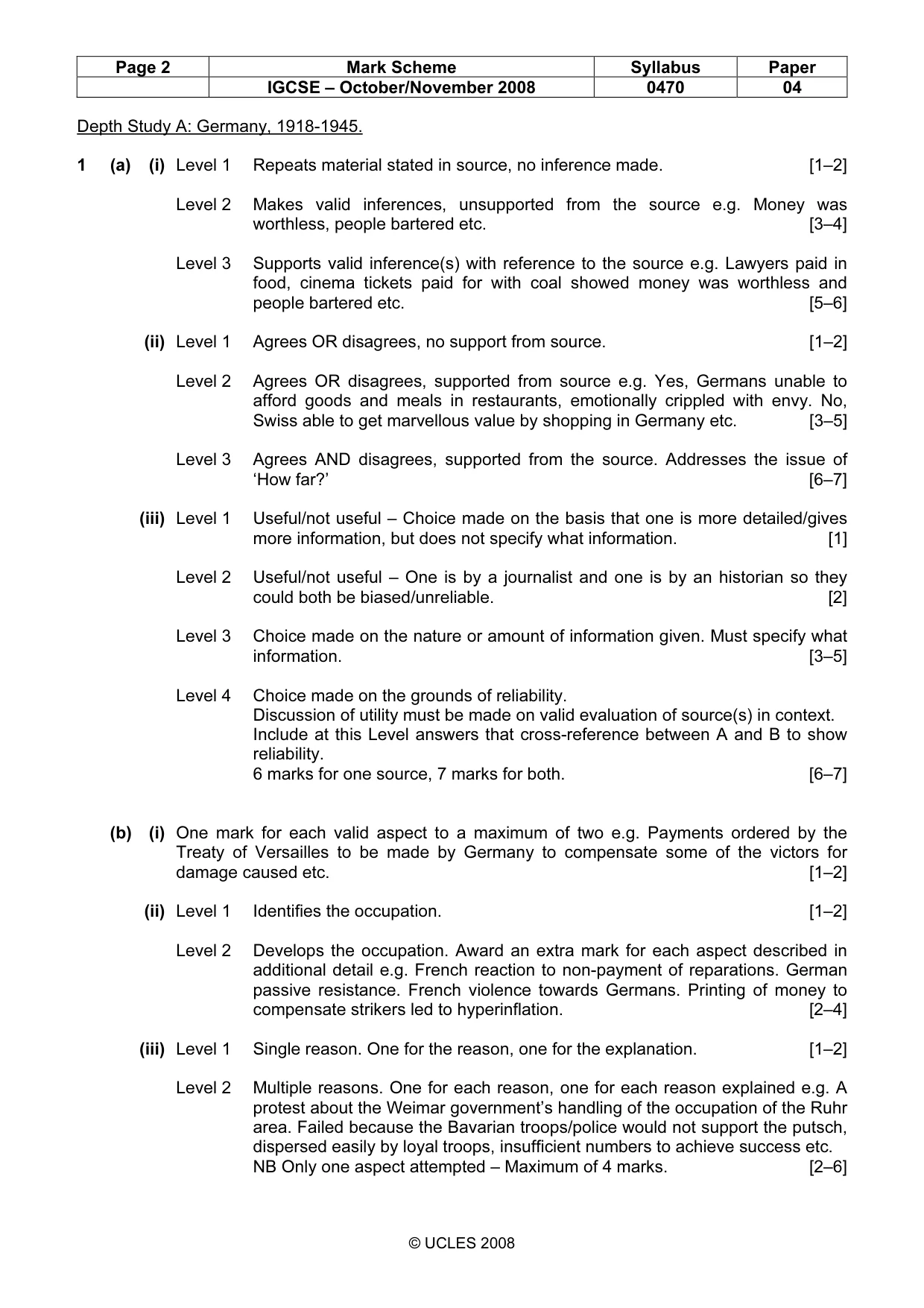
Page 2 Mark Scheme Syllabus Paper IGCSE – October/November 2008 0470 04 © UCLES 2008 Depth Study A: Germany, 1918-1945. 1 (a) (i) Level 1 Repeats material stated in source, no inference made. [1–2] Level 2 Makes valid inferences, unsupported from the source e.g. Money was worthless, people bartered etc. [3–4] Level 3 Supports valid inference(s) with reference to the source e.g. Lawyers paid in food, cinema tickets paid for with coal showed money was worthless and people bartered etc. [5–6] (ii) Level 1 Agrees OR disagrees, no support from source. [1–2] Level 2 Agrees OR disagrees, supported from source e.g. Yes, Germans unable to afford goods and meals in restaurants, emotionally crippled with envy. No, Swiss able to get marvellous value by shopping in Germany etc. [3–5] Level 3 Agrees AND disagrees, supported from the source. Addresses the issue of ‘How far?’ [6–7] (iii) Level 1 Useful/not useful – Choice made on the basis that one is more detailed/gives more information, but does not specify what information. [1] Level 2 Useful/not useful – One is by a journalist and one is by an historian so they could both be biased/unreliable. [2] Level 3 Choice made on the nature or amount of information given. Must specify what information. [3–5] Level 4 Choice made on the grounds of reliability. Discussion of utility must be made on valid evaluation of source(s) in context. Include at this Level answers that cross-reference between A and B to show reliability. 6 marks for one source, 7 marks for both. [6–7] (b) (i) One mark for each valid aspect to a maximum of two e.g. Payments ordered by the Treaty of Versailles to be made by Germany to compensate some of the victors for damage caused etc. [1–2] (ii) Level 1 Identifies the occupation. [1–2] Level 2 Develops the occupation. Award an extra mark for each aspect described in additional detail e.g. French reaction to non-payment of reparations. German passive resistance. French violence towards Germans. Printing of money to compensate strikers led to hyperinflation. [2–4] (iii) Level 1 Single reason. One for the reason, one for the explanation. [1–2] Level 2 Multiple reasons. One for each reason, one for each reason explained e.g. A protest about the Weimar government’s handling of the occupation of the Ruhr area. Failed because the Bavarian troops/police would not support the putsch, dispersed easily by loyal troops, insufficient numbers to achieve success etc. NB Only one aspect attempted – Maximum of 4 marks. [2–6]
Mark scheme, page 3
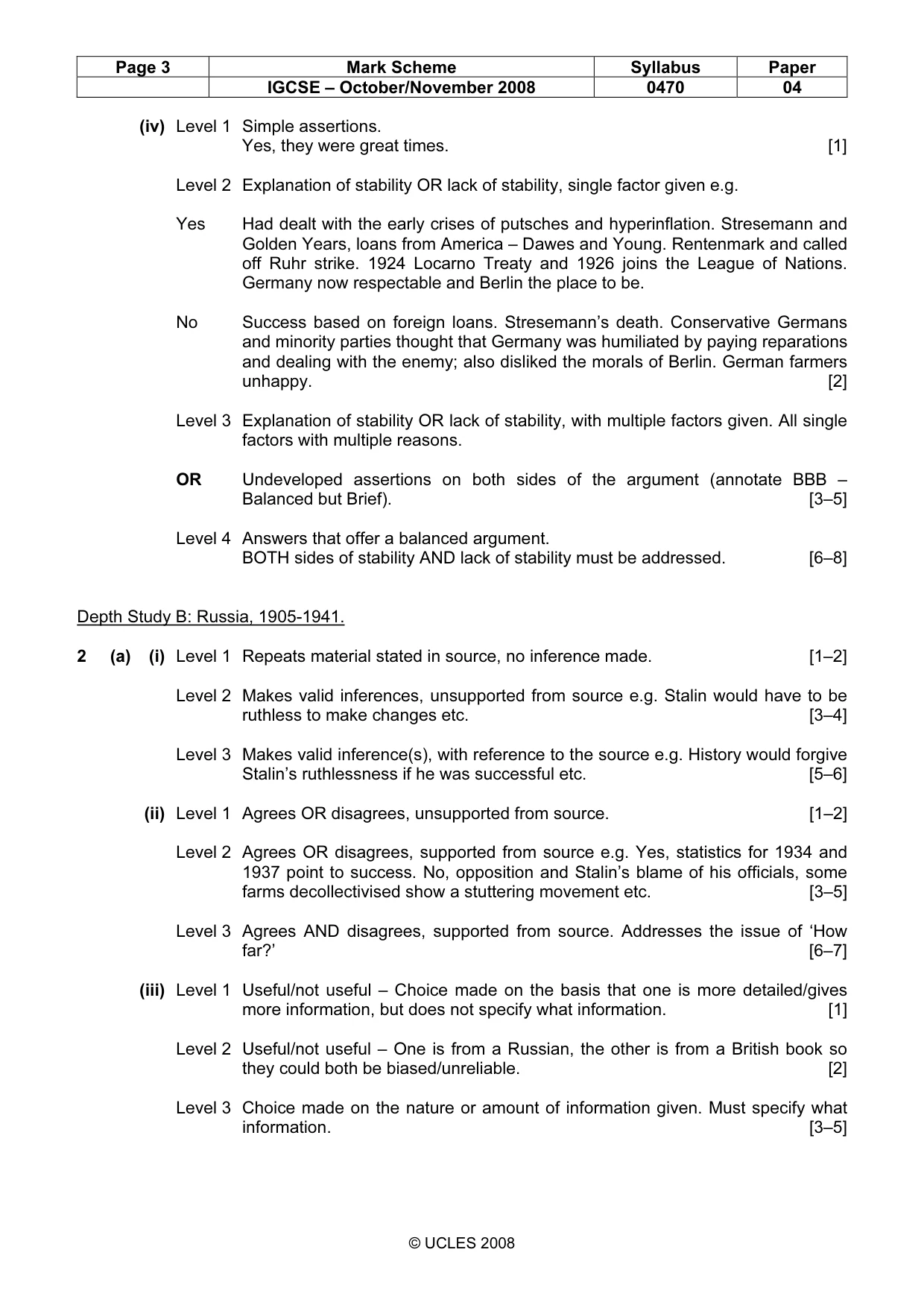
Page 3 Mark Scheme Syllabus Paper IGCSE – October/November 2008 0470 04 © UCLES 2008 (iv) Level 1 Simple assertions. Yes, they were great times. [1] Level 2 Explanation of stability OR lack of stability, single factor given e.g. Yes Had dealt with the early crises of putsches and hyperinflation. Stresemann and Golden Years, loans from America – Dawes and Young. Rentenmark and called off Ruhr strike. 1924 Locarno Treaty and 1926 joins the League of Nations. Germany now respectable and Berlin the place to be. No Success based on foreign loans. Stresemann’s death. Conservative Germans and minority parties thought that Germany was humiliated by paying reparations and dealing with the enemy; also disliked the morals of Berlin. German farmers unhappy. [2] Level 3 Explanation of stability OR lack of stability, with multiple factors given. All single factors with multiple reasons. OR Undeveloped assertions on both sides of the argument (annotate BBB – Balanced but Brief). [3–5] Level 4 Answers that offer a balanced argument. BOTH sides of stability AND lack of stability must be addressed. [6–8] Depth Study B: Russia, 1905-1941. 2 (a) (i) Level 1 Repeats material stated in source, no inference made. [1–2] Level 2 Makes valid inferences, unsupported from source e.g. Stalin would have to be ruthless to make changes etc. [3–4] Level 3 Makes valid inference(s), with reference to the source e.g. History would forgive Stalin’s ruthlessness if he was successful etc. [5–6] (ii) Level 1 Agrees OR disagrees, unsupported from source. [1–2] Level 2 Agrees OR disagrees, supported from source e.g. Yes, statistics for 1934 and 1937 point to success. No, opposition and Stalin’s blame of his officials, some farms decollectivised show a stuttering movement etc. [3–5] Level 3 Agrees AND disagrees, supported from source. Addresses the issue of ‘How far?’ [6–7] (iii) Level 1 Useful/not useful – Choice made on the basis that one is more detailed/gives more information, but does not specify what information. [1] Level 2 Useful/not useful – One is from a Russian, the other is from a British book so they could both be biased/unreliable. [2] Level 3 Choice made on the nature or amount of information given. Must specify what information. [3–5]
Mark scheme, page 4
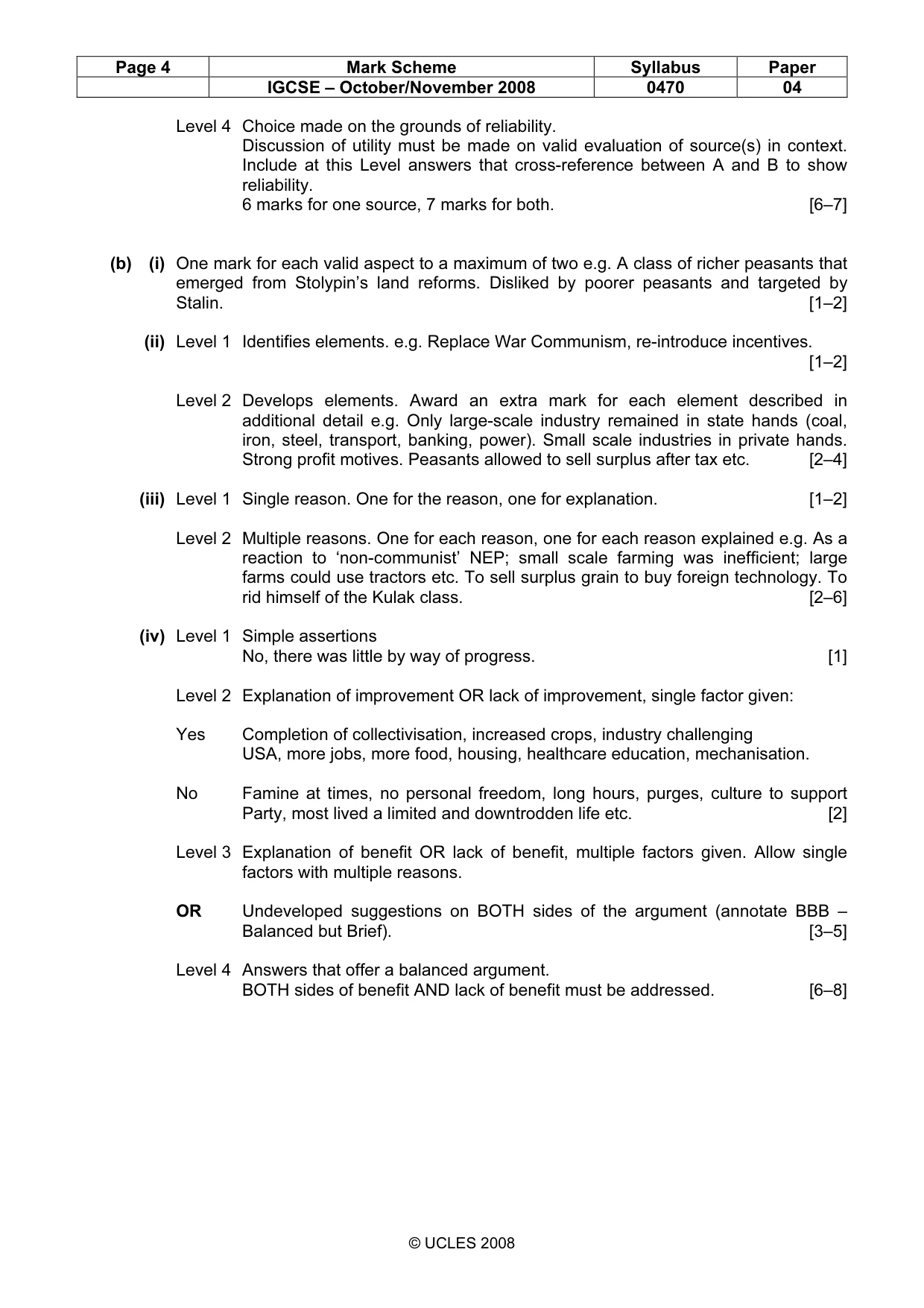
Page 4 Mark Scheme Syllabus Paper IGCSE – October/November 2008 0470 04 © UCLES 2008 Level 4 Choice made on the grounds of reliability. Discussion of utility must be made on valid evaluation of source(s) in context. Include at this Level answers that cross-reference between A and B to show reliability. 6 marks for one source, 7 marks for both. [6–7] (b) (i) One mark for each valid aspect to a maximum of two e.g. A class of richer peasants that emerged from Stolypin’s land reforms. Disliked by poorer peasants and targeted by Stalin. [1–2] (ii) Level 1 Identifies elements. e.g. Replace War Communism, re-introduce incentives. [1–2] Level 2 Develops elements. Award an extra mark for each element described in additional detail e.g. Only large-scale industry remained in state hands (coal, iron, steel, transport, banking, power). Small scale industries in private hands. Strong profit motives. Peasants allowed to sell surplus after tax etc. [2–4] (iii) Level 1 Single reason. One for the reason, one for explanation. [1–2] Level 2 Multiple reasons. One for each reason, one for each reason explained e.g. As a reaction to ‘non-communist’ NEP; small scale farming was inefficient; large farms could use tractors etc. To sell surplus grain to buy foreign technology. To rid himself of the Kulak class. [2–6] (iv) Level 1 Simple assertions No, there was little by way of progress. [1] Level 2 Explanation of improvement OR lack of improvement, single factor given: Yes Completion of collectivisation, increased crops, industry challenging USA, more jobs, more food, housing, healthcare education, mechanisation. No Famine at times, no personal freedom, long hours, purges, culture to support Party, most lived a limited and downtrodden life etc. [2] Level 3 Explanation of benefit OR lack of benefit, multiple factors given. Allow single factors with multiple reasons. OR Undeveloped suggestions on BOTH sides of the argument (annotate BBB – Balanced but Brief). [3–5] Level 4 Answers that offer a balanced argument. BOTH sides of benefit AND lack of benefit must be addressed. [6–8]
Mark scheme, page 5
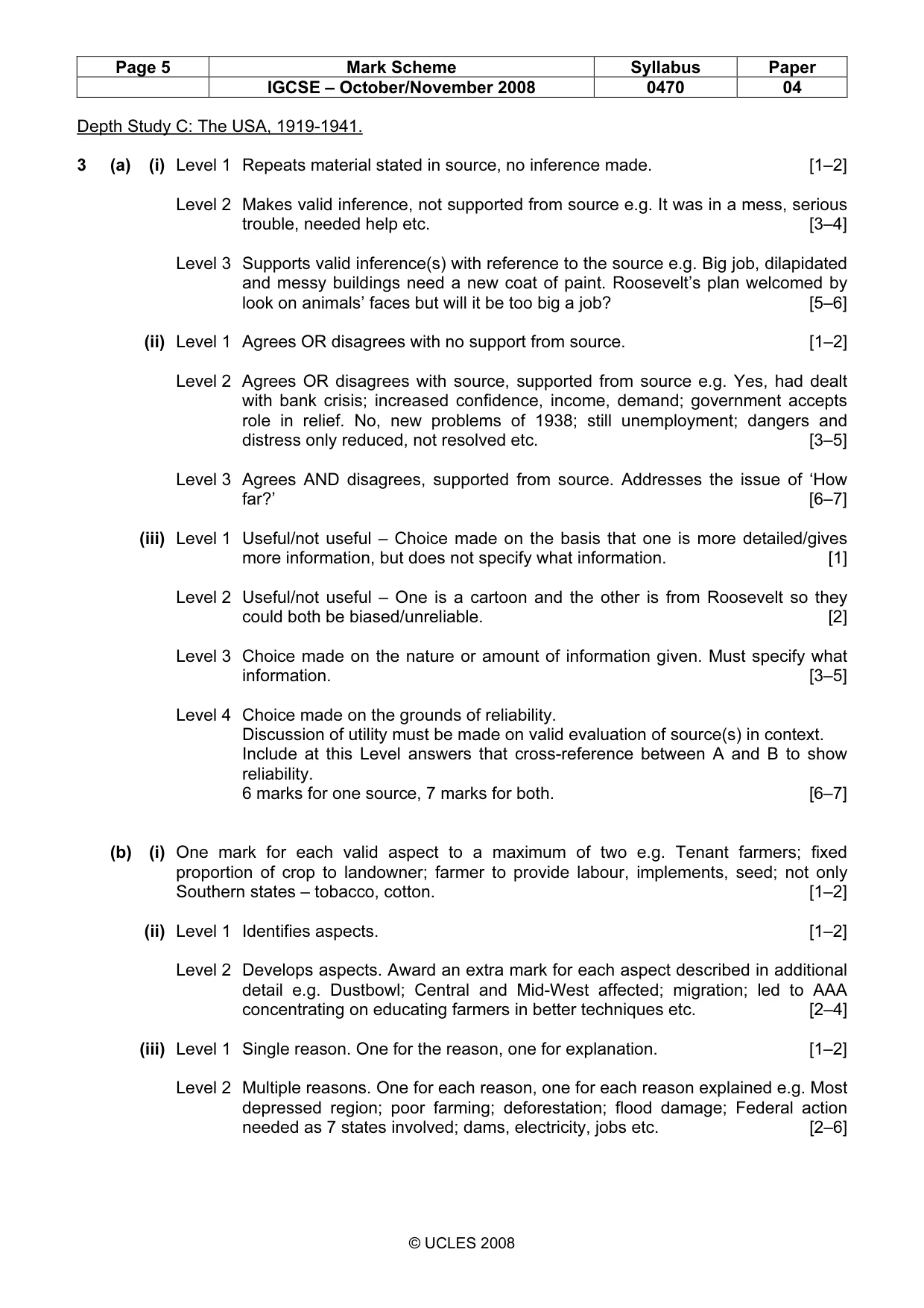
Page 5 Mark Scheme Syllabus Paper IGCSE – October/November 2008 0470 04 © UCLES 2008 Depth Study C: The USA, 1919-1941. 3 (a) (i) Level 1 Repeats material stated in source, no inference made. [1–2] Level 2 Makes valid inference, not supported from source e.g. It was in a mess, serious trouble, needed help etc. [3–4] Level 3 Supports valid inference(s) with reference to the source e.g. Big job, dilapidated and messy buildings need a new coat of paint. Roosevelt’s plan welcomed by look on animals’ faces but will it be too big a job? [5–6] (ii) Level 1 Agrees OR disagrees with no support from source. [1–2] Level 2 Agrees OR disagrees with source, supported from source e.g. Yes, had dealt with bank crisis; increased confidence, income, demand; government accepts role in relief. No, new problems of 1938; still unemployment; dangers and distress only reduced, not resolved etc. [3–5] Level 3 Agrees AND disagrees, supported from source. Addresses the issue of ‘How far?’ [6–7] (iii) Level 1 Useful/not useful – Choice made on the basis that one is more detailed/gives more information, but does not specify what information. [1] Level 2 Useful/not useful – One is a cartoon and the other is from Roosevelt so they could both be biased/unreliable. [2] Level 3 Choice made on the nature or amount of information given. Must specify what information. [3–5] Level 4 Choice made on the grounds of reliability. Discussion of utility must be made on valid evaluation of source(s) in context. Include at this Level answers that cross-reference between A and B to show reliability. 6 marks for one source, 7 marks for both. [6–7] (b) (i) One mark for each valid aspect to a maximum of two e.g. Tenant farmers; fixed proportion of crop to landowner; farmer to provide labour, implements, seed; not only Southern states – tobacco, cotton. [1–2] (ii) Level 1 Identifies aspects. [1–2] Level 2 Develops aspects. Award an extra mark for each aspect described in additional detail e.g. Dustbowl; Central and Mid-West affected; migration; led to AAA concentrating on educating farmers in better techniques etc. [2–4] (iii) Level 1 Single reason. One for the reason, one for explanation. [1–2] Level 2 Multiple reasons. One for each reason, one for each reason explained e.g. Most depressed region; poor farming; deforestation; flood damage; Federal action needed as 7 states involved; dams, electricity, jobs etc. [2–6]
Mark scheme, page 6
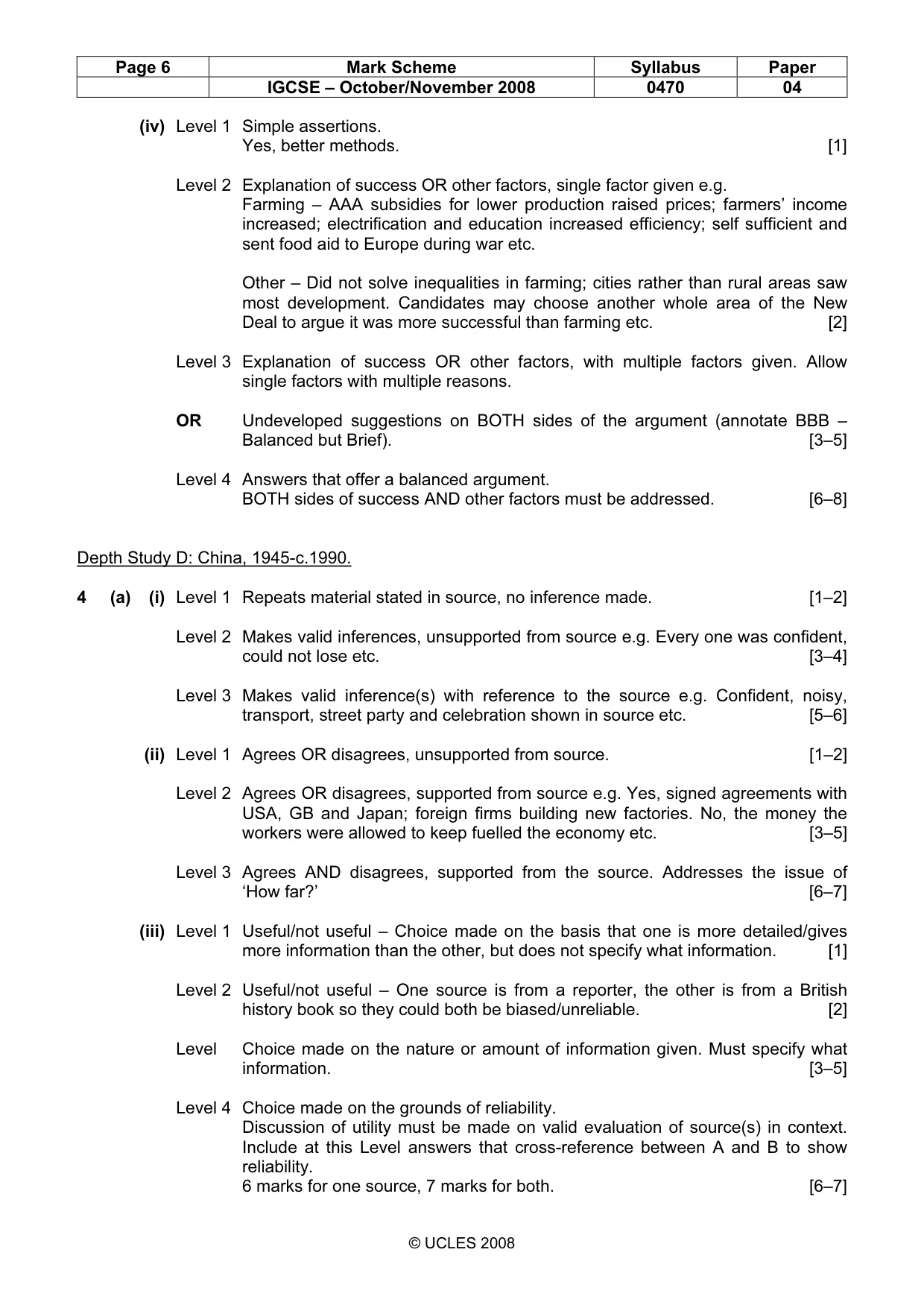
Page 6 Mark Scheme Syllabus Paper IGCSE – October/November 2008 0470 04 © UCLES 2008 (iv) Level 1 Simple assertions. Yes, better methods. [1] Level 2 Explanation of success OR other factors, single factor given e.g. Farming – AAA subsidies for lower production raised prices; farmers’ income increased; electrification and education increased efficiency; self sufficient and sent food aid to Europe during war etc. Other – Did not solve inequalities in farming; cities rather than rural areas saw most development. Candidates may choose another whole area of the New Deal to argue it was more successful than farming etc. [2] Level 3 Explanation of success OR other factors, with multiple factors given. Allow single factors with multiple reasons. OR Undeveloped suggestions on BOTH sides of the argument (annotate BBB – Balanced but Brief). [3–5] Level 4 Answers that offer a balanced argument. BOTH sides of success AND other factors must be addressed. [6–8] Depth Study D: China, 1945-c.1990. 4 (a) (i) Level 1 Repeats material stated in source, no inference made. [1–2] Level 2 Makes valid inferences, unsupported from source e.g. Every one was confident, could not lose etc. [3–4] Level 3 Makes valid inference(s) with reference to the source e.g. Confident, noisy, transport, street party and celebration shown in source etc. [5–6] (ii) Level 1 Agrees OR disagrees, unsupported from source. [1–2] Level 2 Agrees OR disagrees, supported from source e.g. Yes, signed agreements with USA, GB and Japan; foreign firms building new factories. No, the money the workers were allowed to keep fuelled the economy etc. [3–5] Level 3 Agrees AND disagrees, supported from the source. Addresses the issue of ‘How far?’ [6–7] (iii) Level 1 Useful/not useful – Choice made on the basis that one is more detailed/gives more information than the other, but does not specify what information. [1] Level 2 Useful/not useful – One source is from a reporter, the other is from a British history book so they could both be biased/unreliable. [2] Level Choice made on the nature or amount of information given. Must specify what information. [3–5] Level 4 Choice made on the grounds of reliability. Discussion of utility must be made on valid evaluation of source(s) in context. Include at this Level answers that cross-reference between A and B to show reliability. 6 marks for one source, 7 marks for both. [6–7]
Mark scheme, page 7
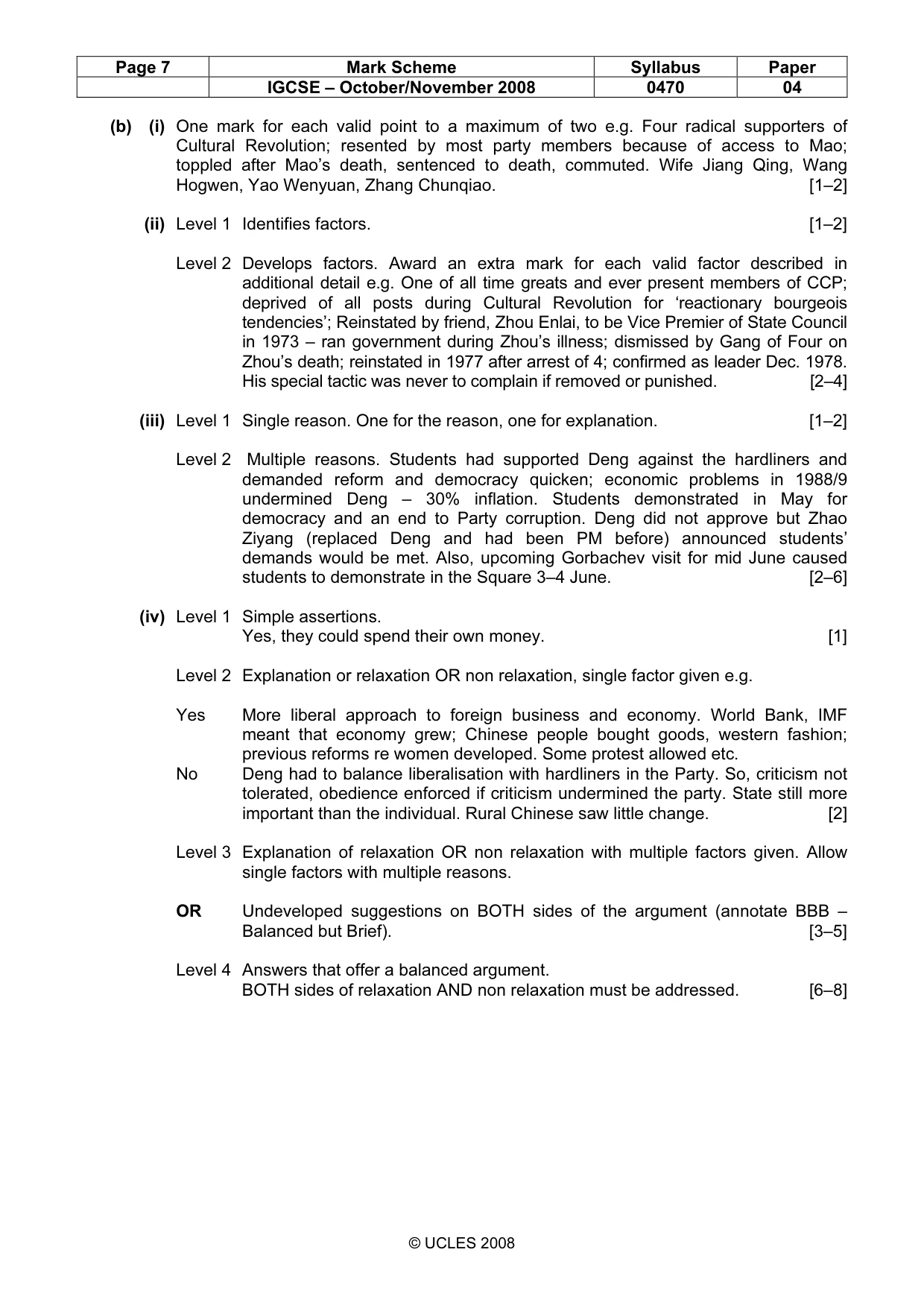
Page 7 Mark Scheme Syllabus Paper IGCSE – October/November 2008 0470 04 © UCLES 2008 (b) (i) One mark for each valid point to a maximum of two e.g. Four radical supporters of Cultural Revolution; resented by most party members because of access to Mao; toppled after Mao’s death, sentenced to death, commuted. Wife Jiang Qing, Wang Hogwen, Yao Wenyuan, Zhang Chunqiao. [1–2] (ii) Level 1 Identifies factors. [1–2] Level 2 Develops factors. Award an extra mark for each valid factor described in additional detail e.g. One of all time greats and ever present members of CCP; deprived of all posts during Cultural Revolution for ‘reactionary bourgeois tendencies’; Reinstated by friend, Zhou Enlai, to be Vice Premier of State Council in 1973 – ran government during Zhou’s illness; dismissed by Gang of Four on Zhou’s death; reinstated in 1977 after arrest of 4; confirmed as leader Dec. 1978. His special tactic was never to complain if removed or punished. [2–4] (iii) Level 1 Single reason. One for the reason, one for explanation. [1–2] Level 2 Multiple reasons. Students had supported Deng against the hardliners and demanded reform and democracy quicken; economic problems in 1988/9 undermined Deng – 30% inflation. Students demonstrated in May for democracy and an end to Party corruption. Deng did not approve but Zhao Ziyang (replaced Deng and had been PM before) announced students’ demands would be met. Also, upcoming Gorbachev visit for mid June caused students to demonstrate in the Square 3–4 June. [2–6] (iv) Level 1 Simple assertions. Yes, they could spend their own money. [1] Level 2 Explanation or relaxation OR non relaxation, single factor given e.g. Yes More liberal approach to foreign business and economy. World Bank, IMF meant that economy grew; Chinese people bought goods, western fashion; previous reforms re women developed. Some protest allowed etc. No Deng had to balance liberalisation with hardliners in the Party. So, criticism not tolerated, obedience enforced if criticism undermined the party. State still more important than the individual. Rural Chinese saw little change. [2] Level 3 Explanation of relaxation OR non relaxation with multiple factors given. Allow single factors with multiple reasons. OR Undeveloped suggestions on BOTH sides of the argument (annotate BBB – Balanced but Brief). [3–5] Level 4 Answers that offer a balanced argument. BOTH sides of relaxation AND non relaxation must be addressed. [6–8]
Mark scheme, page 8
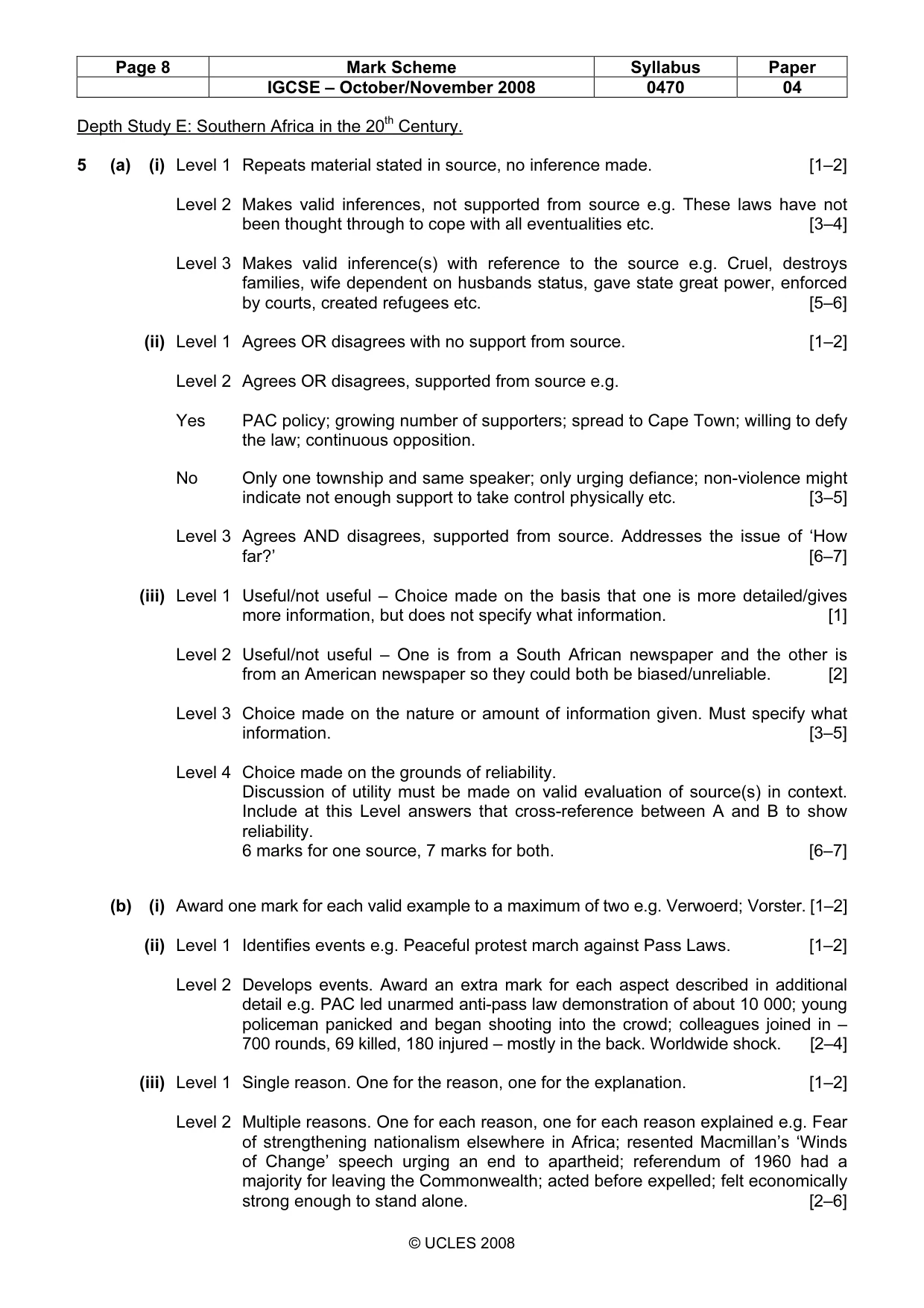
Page 8 Mark Scheme Syllabus Paper IGCSE – October/November 2008 0470 04 © UCLES 2008 Depth Study E: Southern Africa in the 20th Century. 5 (a) (i) Level 1 Repeats material stated in source, no inference made. [1–2] Level 2 Makes valid inferences, not supported from source e.g. These laws have not been thought through to cope with all eventualities etc. [3–4] Level 3 Makes valid inference(s) with reference to the source e.g. Cruel, destroys families, wife dependent on husbands status, gave state great power, enforced by courts, created refugees etc. [5–6] (ii) Level 1 Agrees OR disagrees with no support from source. [1–2] Level 2 Agrees OR disagrees, supported from source e.g. Yes PAC policy; growing number of supporters; spread to Cape Town; willing to defy the law; continuous opposition. No Only one township and same speaker; only urging defiance; non-violence might indicate not enough support to take control physically etc. [3–5] Level 3 Agrees AND disagrees, supported from source. Addresses the issue of ‘How far?’ [6–7] (iii) Level 1 Useful/not useful – Choice made on the basis that one is more detailed/gives more information, but does not specify what information. [1] Level 2 Useful/not useful – One is from a South African newspaper and the other is from an American newspaper so they could both be biased/unreliable. [2] Level 3 Choice made on the nature or amount of information given. Must specify what information. [3–5] Level 4 Choice made on the grounds of reliability. Discussion of utility must be made on valid evaluation of source(s) in context. Include at this Level answers that cross-reference between A and B to show reliability. 6 marks for one source, 7 marks for both. [6–7] (b) (i) Award one mark for each valid example to a maximum of two e.g. Verwoerd; Vorster. [1–2] (ii) Level 1 Identifies events e.g. Peaceful protest march against Pass Laws. [1–2] Level 2 Develops events. Award an extra mark for each aspect described in additional detail e.g. PAC led unarmed anti-pass law demonstration of about 10 000; young policeman panicked and began shooting into the crowd; colleagues joined in – 700 rounds, 69 killed, 180 injured – mostly in the back. Worldwide shock. [2–4] (iii) Level 1 Single reason. One for the reason, one for the explanation. [1–2] Level 2 Multiple reasons. One for each reason, one for each reason explained e.g. Fear of strengthening nationalism elsewhere in Africa; resented Macmillan’s ‘Winds of Change’ speech urging an end to apartheid; referendum of 1960 had a majority for leaving the Commonwealth; acted before expelled; felt economically strong enough to stand alone. [2–6]
Mark scheme, page 9
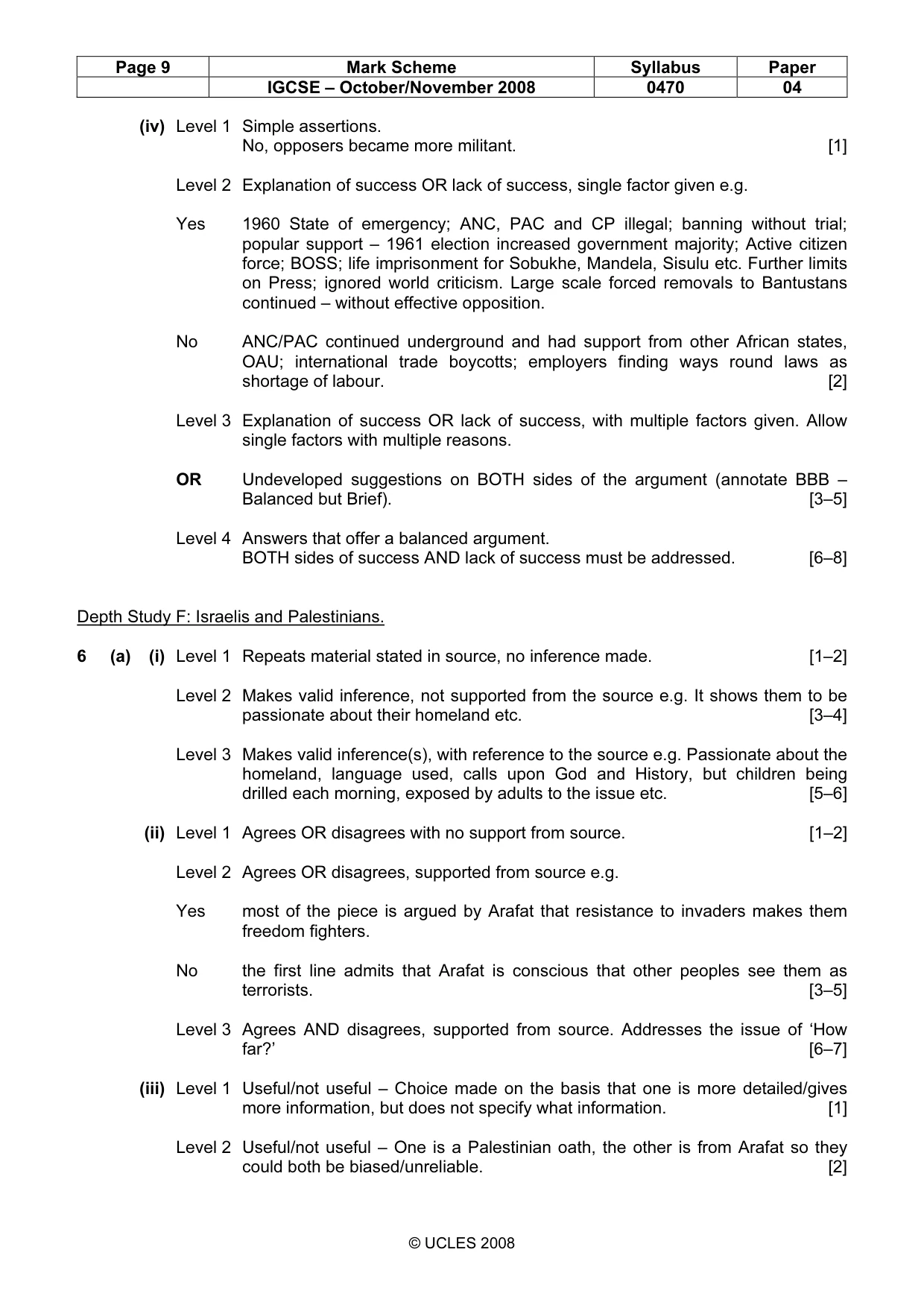
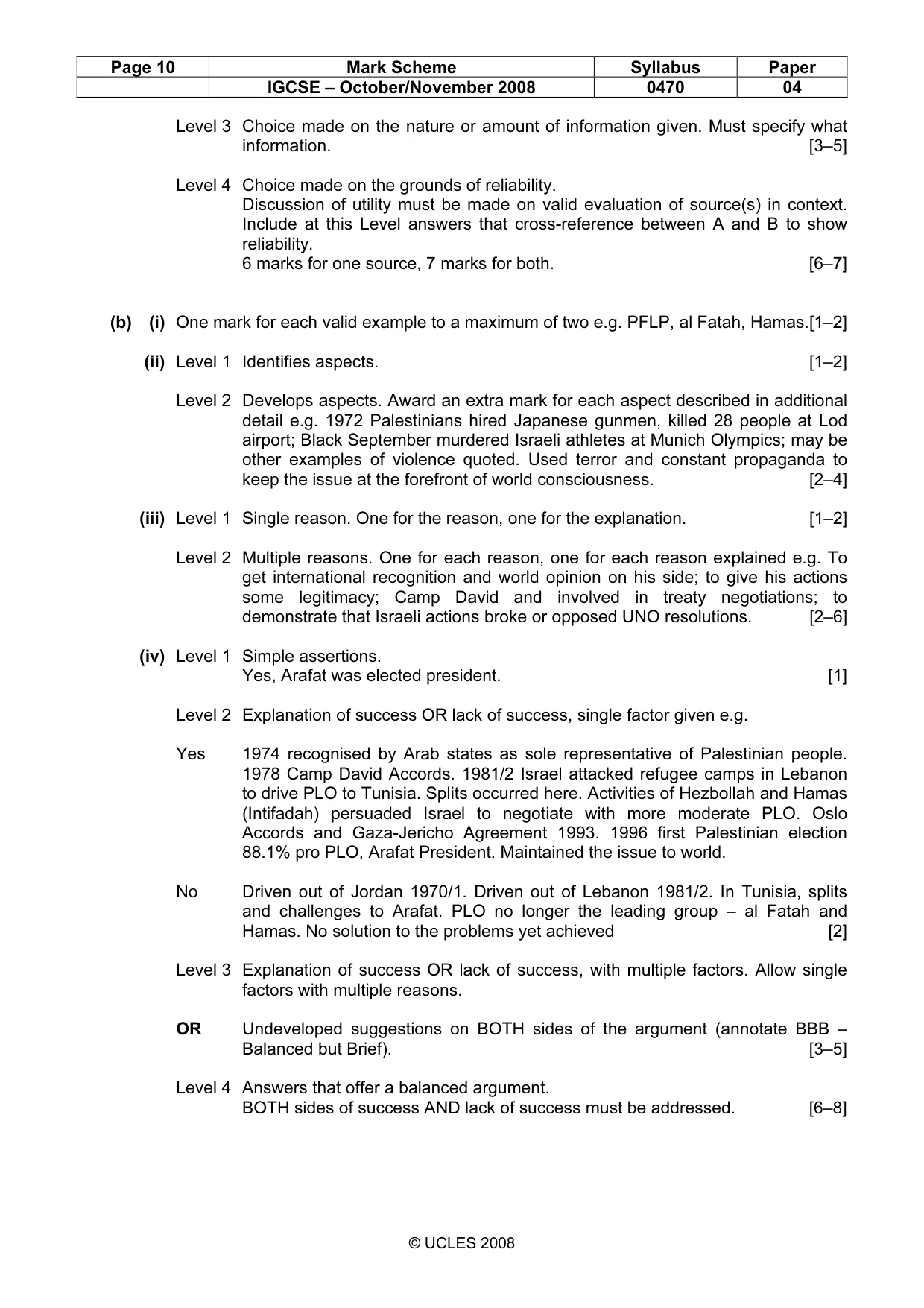
Page 9 Mark Scheme Syllabus Paper IGCSE – October/November 2008 0470 04 © UCLES 2008 (iv) Level 1 Simple assertions. No, opposers became more militant. [1] Level 2 Explanation of success OR lack of success, single factor given e.g. Yes 1960 State of emergency; ANC, PAC and CP illegal; banning without trial; popular support – 1961 election increased government majority; Active citizen force; BOSS; life imprisonment for Sobukhe, Mandela, Sisulu etc. Further limits on Press; ignored world criticism. Large scale forced removals to Bantustans continued – without effective opposition. No ANC/PAC continued underground and had support from other African states, OAU; international trade boycotts; employers finding ways round laws as shortage of labour. [2] Level 3 Explanation of success OR lack of success, with multiple factors given. Allow single factors with multiple reasons. OR Undeveloped suggestions on BOTH sides of the argument (annotate BBB – Balanced but Brief). [3–5] Level 4 Answers that offer a balanced argument. BOTH sides of success AND lack of success must be addressed. [6–8] Depth Study F: Israelis and Palestinians. 6 (a) (i) Level 1 Repeats material stated in source, no inference made. [1–2] Level 2 Makes valid inference, not supported from the source e.g. It shows them to be passionate about their homeland etc. [3–4] Level 3 Makes valid inference(s), with reference to the source e.g. Passionate about the homeland, language used, calls upon God and History, but children being drilled each morning, exposed by adults to the issue etc. [5–6] (ii) Level 1 Agrees OR disagrees with no support from source. [1–2] Level 2 Agrees OR disagrees, supported from source e.g. Yes most of the piece is argued by Arafat that resistance to invaders makes them freedom fighters. No the first line admits that Arafat is conscious that other peoples see them as terrorists. [3–5] Level 3 Agrees AND disagrees, supported from source. Addresses the issue of ‘How far?’ [6–7] (iii) Level 1 Useful/not useful – Choice made on the basis that one is more detailed/gives more information, but does not specify what information. [1] Level 2 Useful/not useful – One is a Palestinian oath, the other is from Arafat so they could both be biased/unreliable. [2]
Mark scheme, page 10
Page 10 Mark Scheme Syllabus Paper IGCSE – October/November 2008 0470 04 © UCLES 2008 Level 3 Choice made on the nature or amount of information given. Must specify what information. [3–5] Level 4 Choice made on the grounds of reliability. Discussion of utility must be made on valid evaluation of source(s) in context. Include at this Level answers that cross-reference between A and B to show reliability. 6 marks for one source, 7 marks for both. [6–7] (b) (i) One mark for each valid example to a maximum of two e.g. PFLP, al Fatah, Hamas.[1–2] (ii) Level 1 Identifies aspects. [1–2] Level 2 Develops aspects. Award an extra mark for each aspect described in additional detail e.g. 1972 Palestinians hired Japanese gunmen, killed 28 people at Lod airport; Black September murdered Israeli athletes at Munich Olympics; may be other examples of violence quoted. Used terror and constant propaganda to keep the issue at the forefront of world consciousness. [2–4] (iii) Level 1 Single reason. One for the reason, one for the explanation. [1–2] Level 2 Multiple reasons. One for each reason, one for each reason explained e.g. To get international recognition and world opinion on his side; to give his actions some legitimacy; Camp David and involved in treaty negotiations; to demonstrate that Israeli actions broke or opposed UNO resolutions. [2–6] (iv) Level 1 Simple assertions. Yes, Arafat was elected president. [1] Level 2 Explanation of success OR lack of success, single factor given e.g. Yes 1974 recognised by Arab states as sole representative of Palestinian people. 1978 Camp David Accords. 1981/2 Israel attacked refugee camps in Lebanon to drive PLO to Tunisia. Splits occurred here. Activities of Hezbollah and Hamas (Intifadah) persuaded Israel to negotiate with more moderate PLO. Oslo Accords and Gaza-Jericho Agreement 1993. 1996 first Palestinian election 88.1% pro PLO, Arafat President. Maintained the issue to world. No Driven out of Jordan 1970/1. Driven out of Lebanon 1981/2. In Tunisia, splits and challenges to Arafat. PLO no longer the leading group – al Fatah and Hamas. No solution to the problems yet achieved [2] Level 3 Explanation of success OR lack of success, with multiple factors. Allow single factors with multiple reasons. OR Undeveloped suggestions on BOTH sides of the argument (annotate BBB – Balanced but Brief). [3–5] Level 4 Answers that offer a balanced argument. BOTH sides of success AND lack of success must be addressed. [6–8]
Mark scheme, page 11
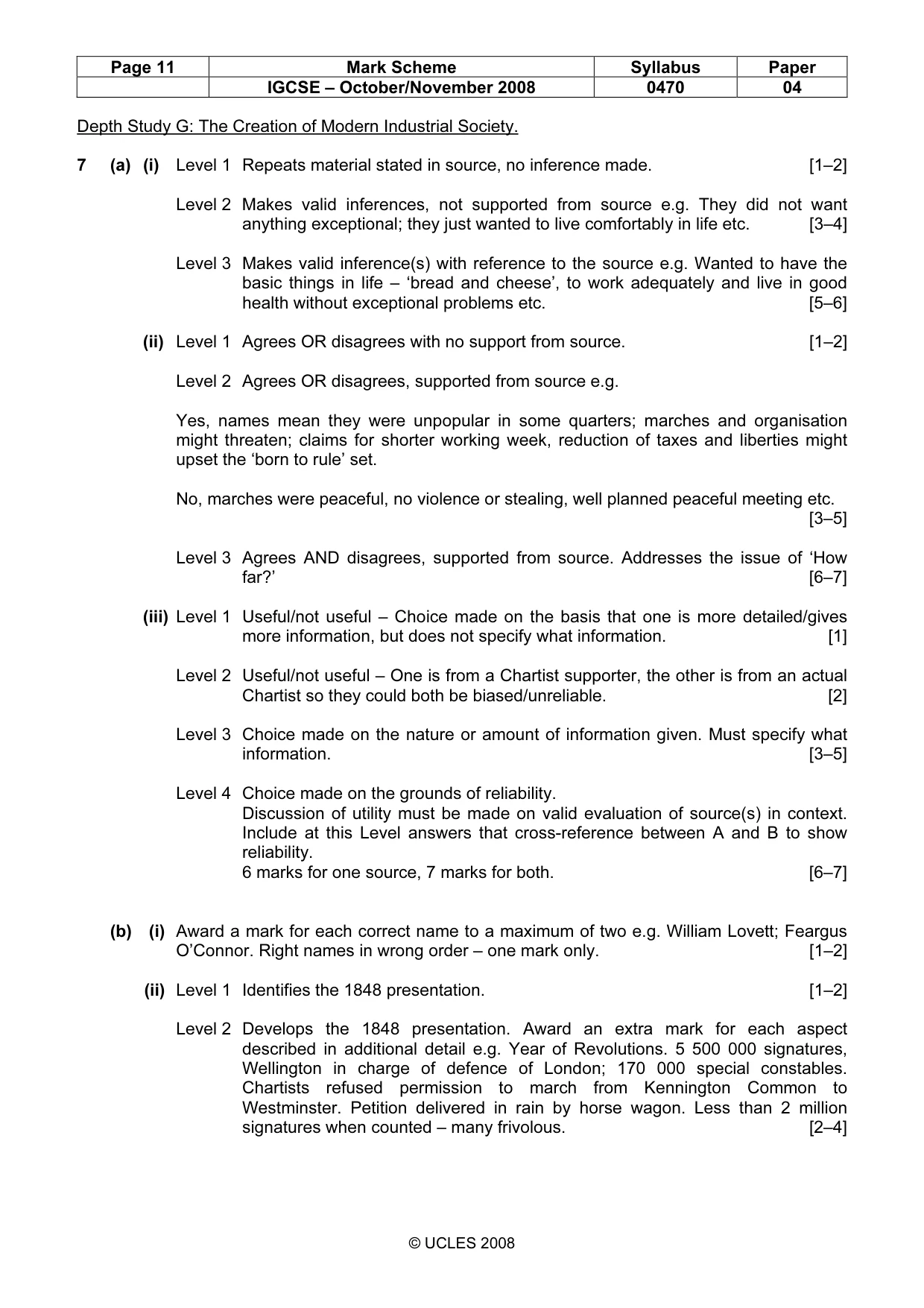
Page 11 Mark Scheme Syllabus Paper IGCSE – October/November 2008 0470 04 © UCLES 2008 Depth Study G: The Creation of Modern Industrial Society. 7 (a) (i) Level 1 Repeats material stated in source, no inference made. [1–2] Level 2 Makes valid inferences, not supported from source e.g. They did not want anything exceptional; they just wanted to live comfortably in life etc. [3–4] Level 3 Makes valid inference(s) with reference to the source e.g. Wanted to have the basic things in life – ‘bread and cheese’, to work adequately and live in good health without exceptional problems etc. [5–6] (ii) Level 1 Agrees OR disagrees with no support from source. [1–2] Level 2 Agrees OR disagrees, supported from source e.g. Yes, names mean they were unpopular in some quarters; marches and organisation might threaten; claims for shorter working week, reduction of taxes and liberties might upset the ‘born to rule’ set. No, marches were peaceful, no violence or stealing, well planned peaceful meeting etc. [3–5] Level 3 Agrees AND disagrees, supported from source. Addresses the issue of ‘How far?’ [6–7] (iii) Level 1 Useful/not useful – Choice made on the basis that one is more detailed/gives more information, but does not specify what information. [1] Level 2 Useful/not useful – One is from a Chartist supporter, the other is from an actual Chartist so they could both be biased/unreliable. [2] Level 3 Choice made on the nature or amount of information given. Must specify what information. [3–5] Level 4 Choice made on the grounds of reliability. Discussion of utility must be made on valid evaluation of source(s) in context. Include at this Level answers that cross-reference between A and B to show reliability. 6 marks for one source, 7 marks for both. [6–7] (b) (i) Award a mark for each correct name to a maximum of two e.g. William Lovett; Feargus O’Connor. Right names in wrong order – one mark only. [1–2] (ii) Level 1 Identifies the 1848 presentation. [1–2] Level 2 Develops the 1848 presentation. Award an extra mark for each aspect described in additional detail e.g. Year of Revolutions. 5 500 000 signatures, Wellington in charge of defence of London; 170 000 special constables. Chartists refused permission to march from Kennington Common to Westminster. Petition delivered in rain by horse wagon. Less than 2 million signatures when counted – many frivolous. [2–4]
Mark scheme, page 12
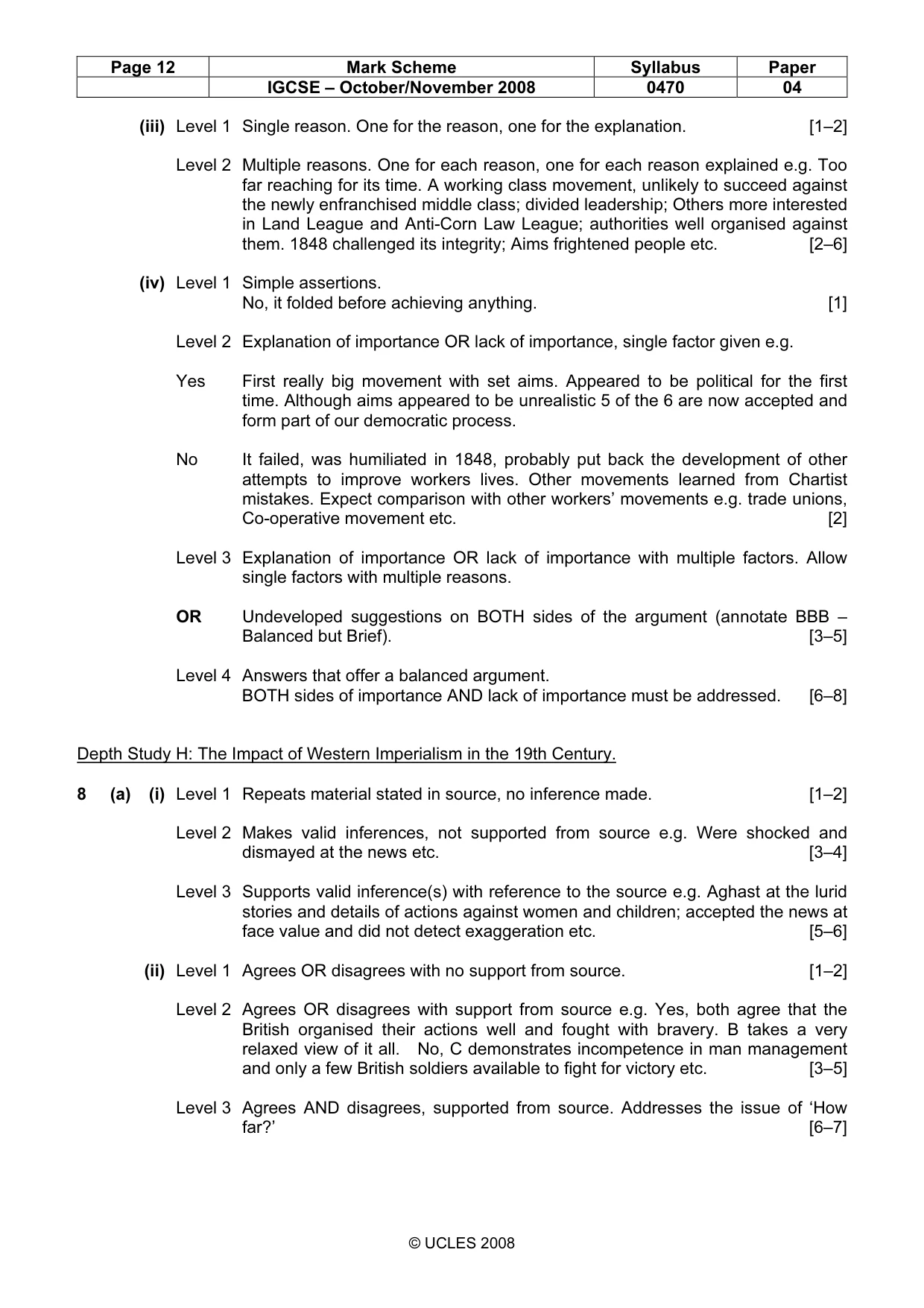
Page 12 Mark Scheme Syllabus Paper IGCSE – October/November 2008 0470 04 © UCLES 2008 (iii) Level 1 Single reason. One for the reason, one for the explanation. [1–2] Level 2 Multiple reasons. One for each reason, one for each reason explained e.g. Too far reaching for its time. A working class movement, unlikely to succeed against the newly enfranchised middle class; divided leadership; Others more interested in Land League and Anti-Corn Law League; authorities well organised against them. 1848 challenged its integrity; Aims frightened people etc. [2–6] (iv) Level 1 Simple assertions. No, it folded before achieving anything. [1] Level 2 Explanation of importance OR lack of importance, single factor given e.g. Yes First really big movement with set aims. Appeared to be political for the first time. Although aims appeared to be unrealistic 5 of the 6 are now accepted and form part of our democratic process. No It failed, was humiliated in 1848, probably put back the development of other attempts to improve workers lives. Other movements learned from Chartist mistakes. Expect comparison with other workers’ movements e.g. trade unions, Co-operative movement etc. [2] Level 3 Explanation of importance OR lack of importance with multiple factors. Allow single factors with multiple reasons. OR Undeveloped suggestions on BOTH sides of the argument (annotate BBB – Balanced but Brief). [3–5] Level 4 Answers that offer a balanced argument. BOTH sides of importance AND lack of importance must be addressed. [6–8] Depth Study H: The Impact of Western Imperialism in the 19th Century. 8 (a) (i) Level 1 Repeats material stated in source, no inference made. [1–2] Level 2 Makes valid inferences, not supported from source e.g. Were shocked and dismayed at the news etc. [3–4] Level 3 Supports valid inference(s) with reference to the source e.g. Aghast at the lurid stories and details of actions against women and children; accepted the news at face value and did not detect exaggeration etc. [5–6] (ii) Level 1 Agrees OR disagrees with no support from source. [1–2] Level 2 Agrees OR disagrees with support from source e.g. Yes, both agree that the British organised their actions well and fought with bravery. B takes a very relaxed view of it all. No, C demonstrates incompetence in man management and only a few British soldiers available to fight for victory etc. [3–5] Level 3 Agrees AND disagrees, supported from source. Addresses the issue of ‘How far?’ [6–7]
Mark scheme, page 13
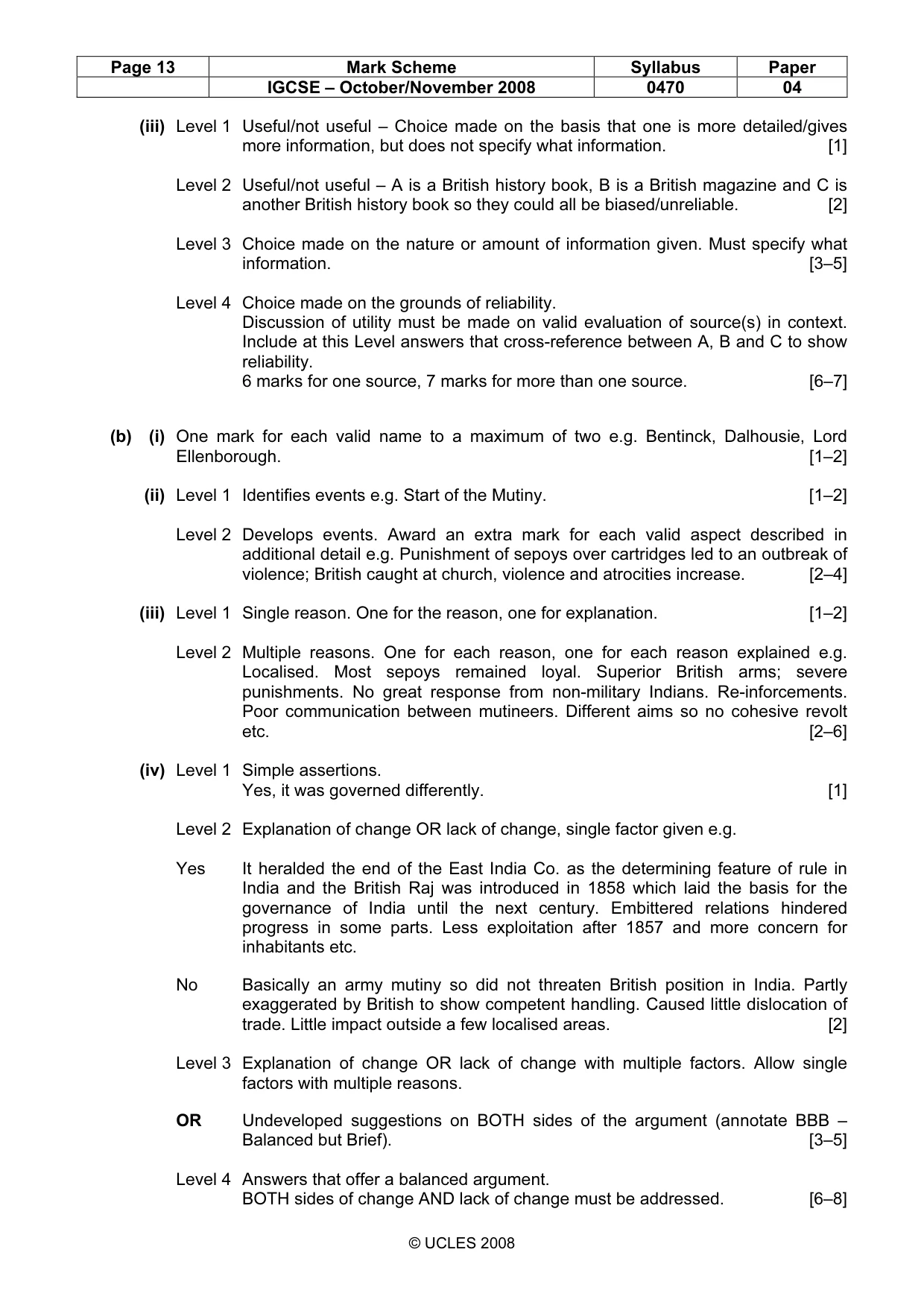
Page 13 Mark Scheme Syllabus Paper IGCSE – October/November 2008 0470 04 © UCLES 2008 (iii) Level 1 Useful/not useful – Choice made on the basis that one is more detailed/gives more information, but does not specify what information. [1] Level 2 Useful/not useful – A is a British history book, B is a British magazine and C is another British history book so they could all be biased/unreliable. [2] Level 3 Choice made on the nature or amount of information given. Must specify what information. [3–5] Level 4 Choice made on the grounds of reliability. Discussion of utility must be made on valid evaluation of source(s) in context. Include at this Level answers that cross-reference between A, B and C to show reliability. 6 marks for one source, 7 marks for more than one source. [6–7] (b) (i) One mark for each valid name to a maximum of two e.g. Bentinck, Dalhousie, Lord Ellenborough. [1–2] (ii) Level 1 Identifies events e.g. Start of the Mutiny. [1–2] Level 2 Develops events. Award an extra mark for each valid aspect described in additional detail e.g. Punishment of sepoys over cartridges led to an outbreak of violence; British caught at church, violence and atrocities increase. [2–4] (iii) Level 1 Single reason. One for the reason, one for explanation. [1–2] Level 2 Multiple reasons. One for each reason, one for each reason explained e.g. Localised. Most sepoys remained loyal. Superior British arms; severe punishments. No great response from non-military Indians. Re-inforcements. Poor communication between mutineers. Different aims so no cohesive revolt etc. [2–6] (iv) Level 1 Simple assertions. Yes, it was governed differently. [1] Level 2 Explanation of change OR lack of change, single factor given e.g. Yes It heralded the end of the East India Co. as the determining feature of rule in India and the British Raj was introduced in 1858 which laid the basis for the governance of India until the next century. Embittered relations hindered progress in some parts. Less exploitation after 1857 and more concern for inhabitants etc. No Basically an army mutiny so did not threaten British position in India. Partly exaggerated by British to show competent handling. Caused little dislocation of trade. Little impact outside a few localised areas. [2] Level 3 Explanation of change OR lack of change with multiple factors. Allow single factors with multiple reasons. OR Undeveloped suggestions on BOTH sides of the argument (annotate BBB – Balanced but Brief). [3–5] Level 4 Answers that offer a balanced argument. BOTH sides of change AND lack of change must be addressed. [6–8]
What you needed in this session
Cambridge’s own grade thresholds for 2008 Oct/Nov, Paper 4 · Variant 1. A higher threshold means an easier paper — the bar moves with how the cohort did.