Cambridge IGCSE History 0470 — 2008 May/June Paper 4 · Variant 1
0470/41/M/J/08 · 40 marks · ≈45 min
The question paper and its mark scheme, free to read here and free to download. This is Cambridge’s own paper, exactly as it was sat.
Question paper16 pages
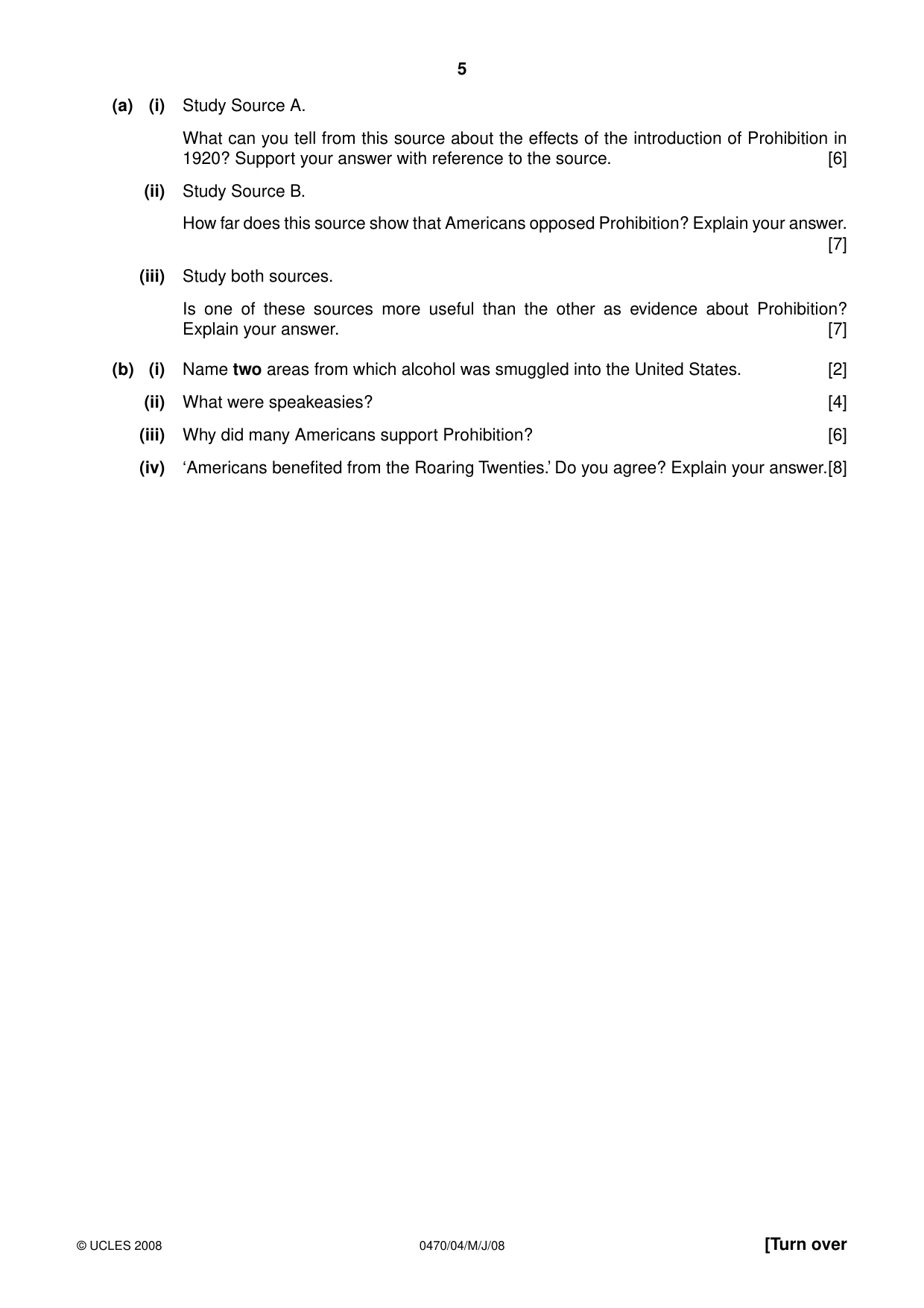
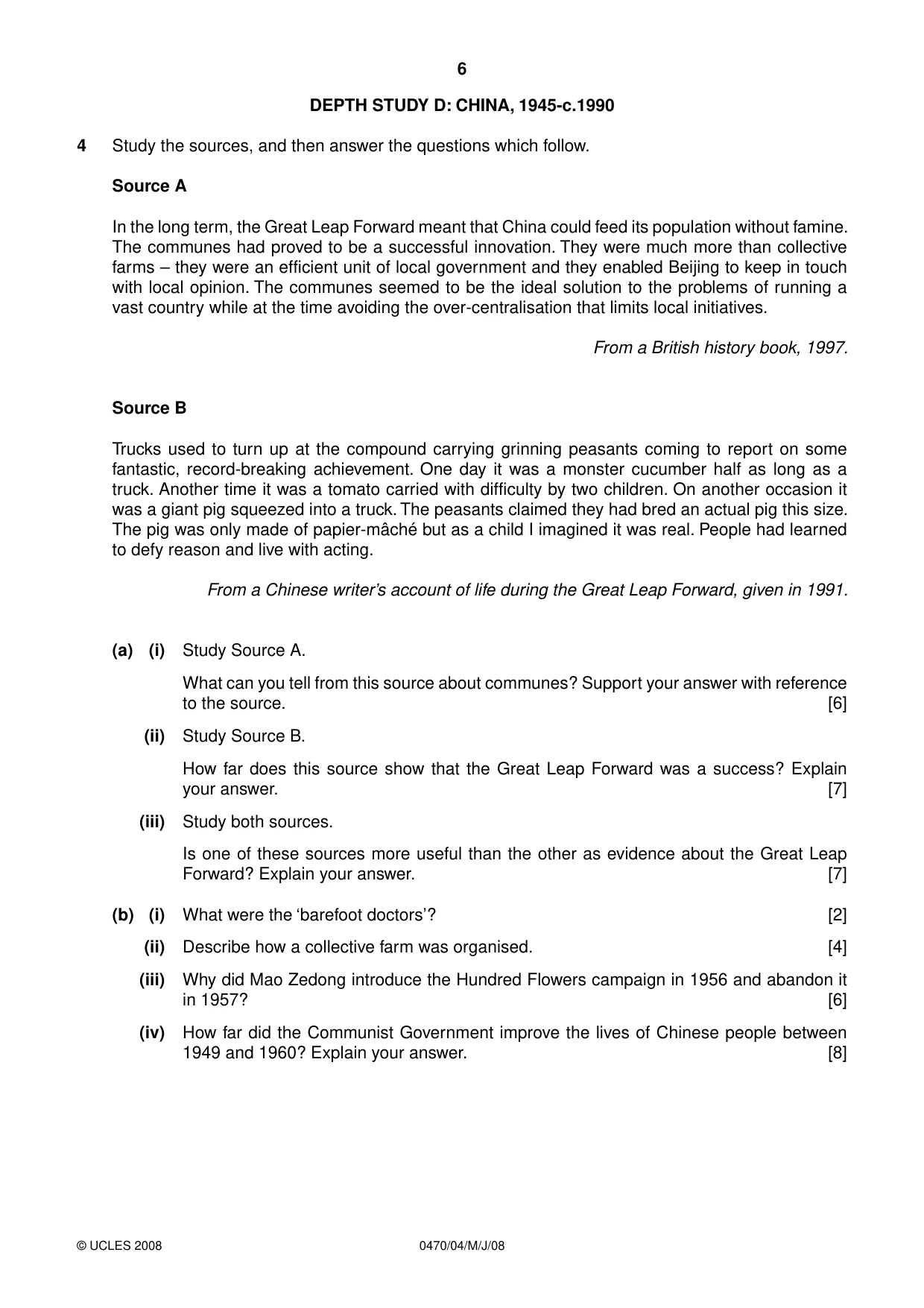
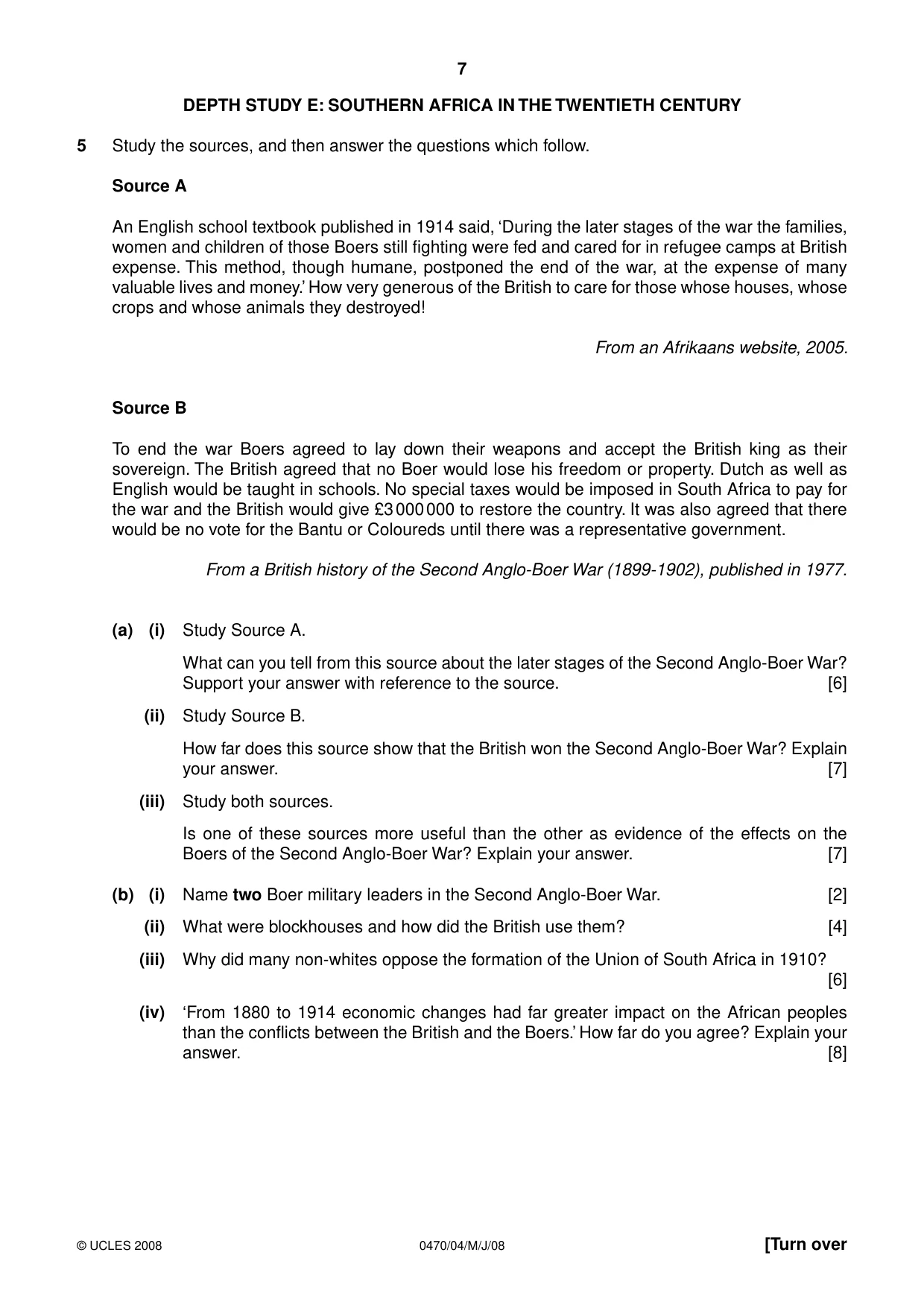
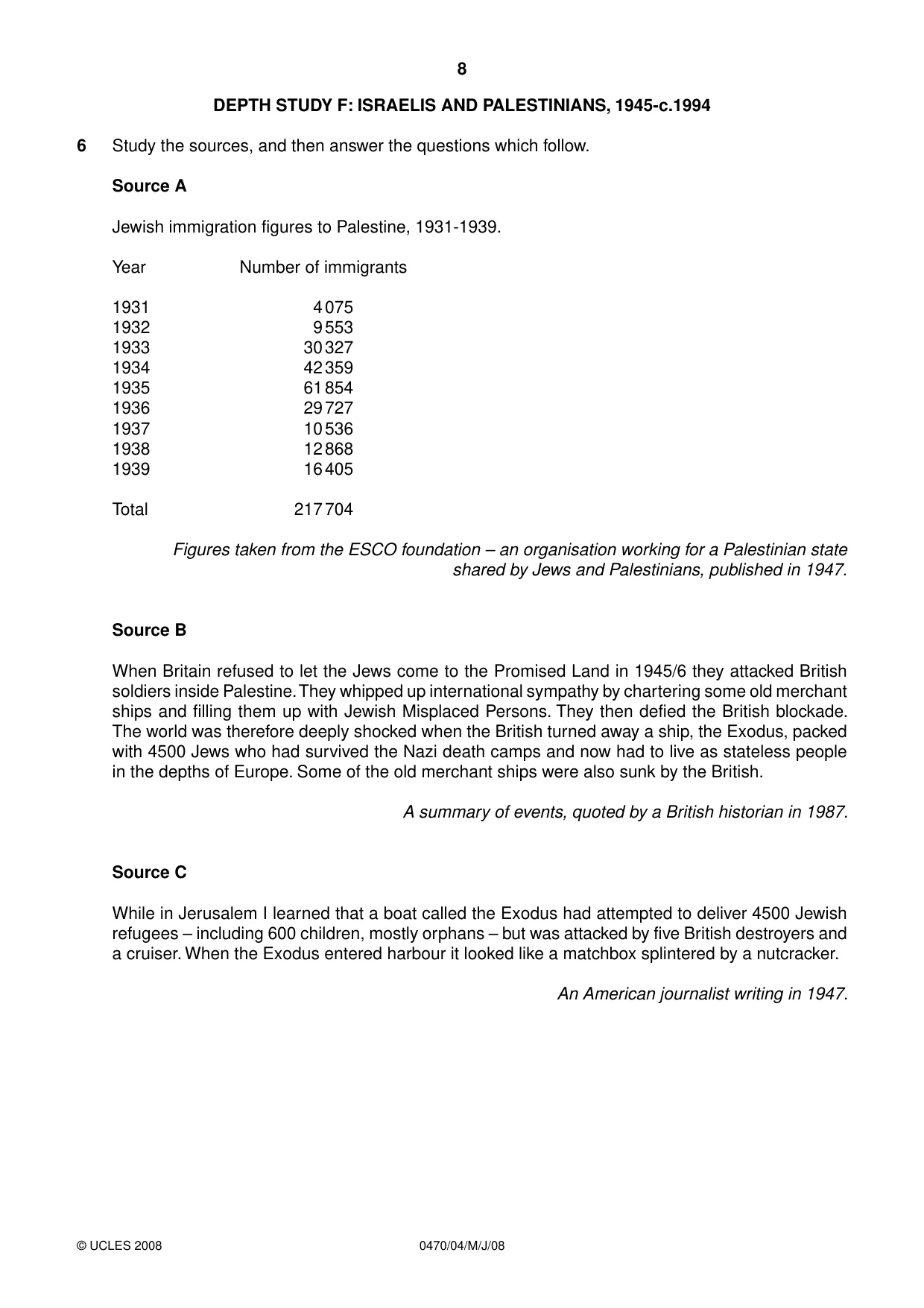


Mark scheme17 pages
Answers below. Sit the paper first if you are practising.
Paper as text
Question paper, page 1
This document consists of 13 printed pages and 3 blank pages. SP (SLM/KS) T52298/3 © UCLES 2008 [Turn over UNIVERSITY OF CAMBRIDGE INTERNATIONAL EXAMINATIONS International General Certificate of Secondary Education READ THESE INSTRUCTIONS FIRST If you have been given an Answer Booklet, follow the instructions on the front cover of the Booklet. Write your Centre number, candidate number and name on all the work you hand in. Write in dark blue or black pen. You may use a soft pencil for any diagrams, graphs or rough working. Do not use staples, paper clips, highlighters, glue or correction fluid. Answer the questions on one of the Depth Studies. At the end of the examination, fasten all your work securely together. The number of marks is given in brackets [ ] at the end of each question or part question. * 3 0 6 3 7 5 6 7 9 3 * HISTORY 0470/04 Paper 4 Alternative to Coursework May/June 2008 1 hour Additional Materials: Answer Booklet/Paper www.XtremePapers.com
Question paper, page 2
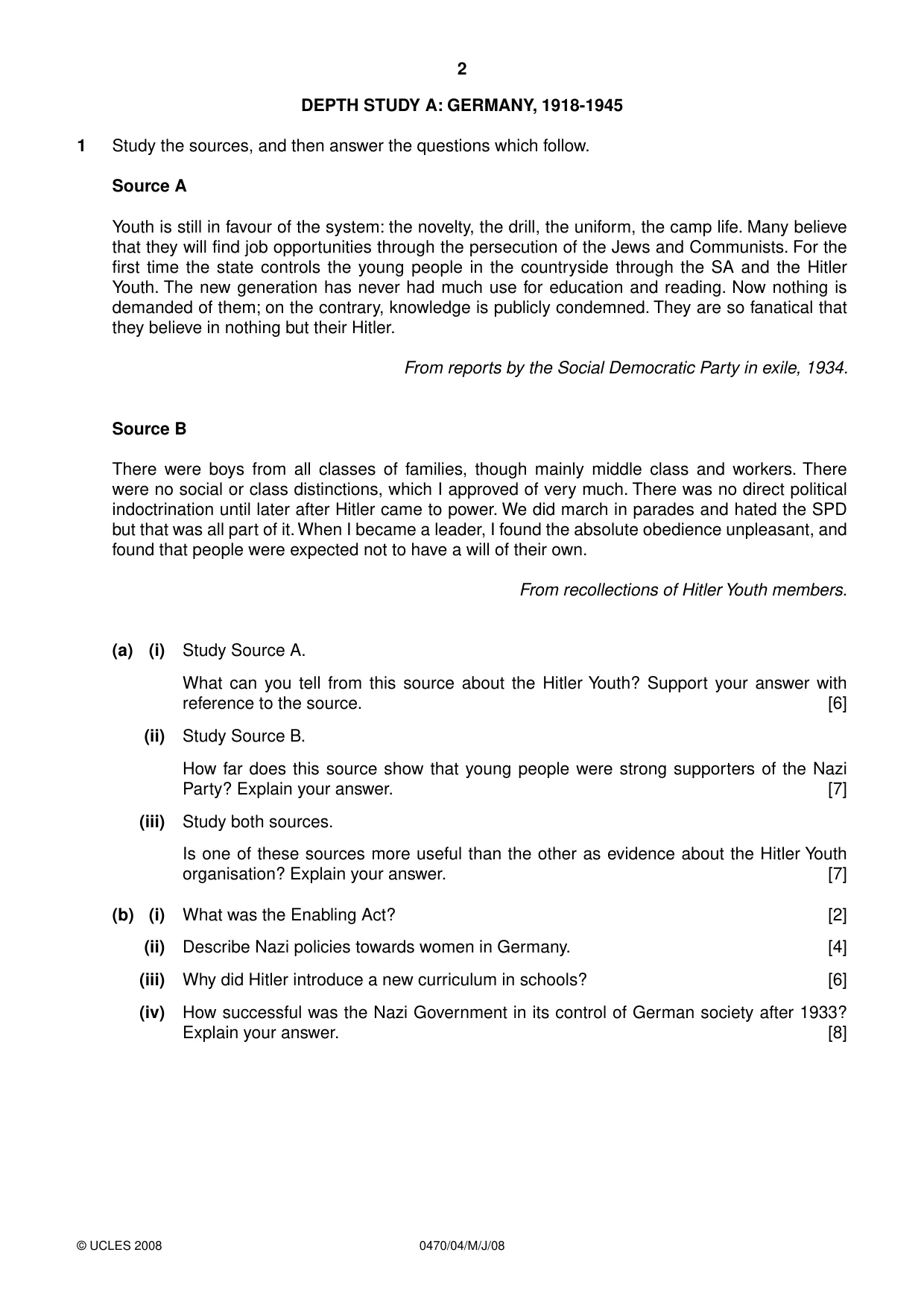
2 0470/04/M/J/08 © UCLES 2008 DEPTH STUDY A: GERMANY, 1918-1945 1 Study the sources, and then answer the questions which follow. Source A Youth is still in favour of the system: the novelty, the drill, the uniform, the camp life. Many believe that they will find job opportunities through the persecution of the Jews and Communists. For the first time the state controls the young people in the countryside through the SA and the Hitler Youth. The new generation has never had much use for education and reading. Now nothing is demanded of them; on the contrary, knowledge is publicly condemned. They are so fanatical that they believe in nothing but their Hitler. From reports by the Social Democratic Party in exile, 1934. Source B There were boys from all classes of families, though mainly middle class and workers. There were no social or class distinctions, which I approved of very much. There was no direct political indoctrination until later after Hitler came to power. We did march in parades and hated the SPD but that was all part of it. When I became a leader, I found the absolute obedience unpleasant, and found that people were expected not to have a will of their own. From recollections of Hitler Youth members. (a) (i) Study Source A. What can you tell from this source about the Hitler Youth? Support your answer with reference to the source. [6] (ii) Study Source B. How far does this source show that young people were strong supporters of the Nazi Party? Explain your answer. [7] (iii) Study both sources. Is one of these sources more useful than the other as evidence about the Hitler Youth organisation? Explain your answer. [7] (b) (i) What was the Enabling Act? [2] (ii) Describe Nazi policies towards women in Germany. [4] (iii) Why did Hitler introduce a new curriculum in schools? [6] (iv) How successful was the Nazi Government in its control of German society after 1933? Explain your answer. [8]
Question paper, page 3
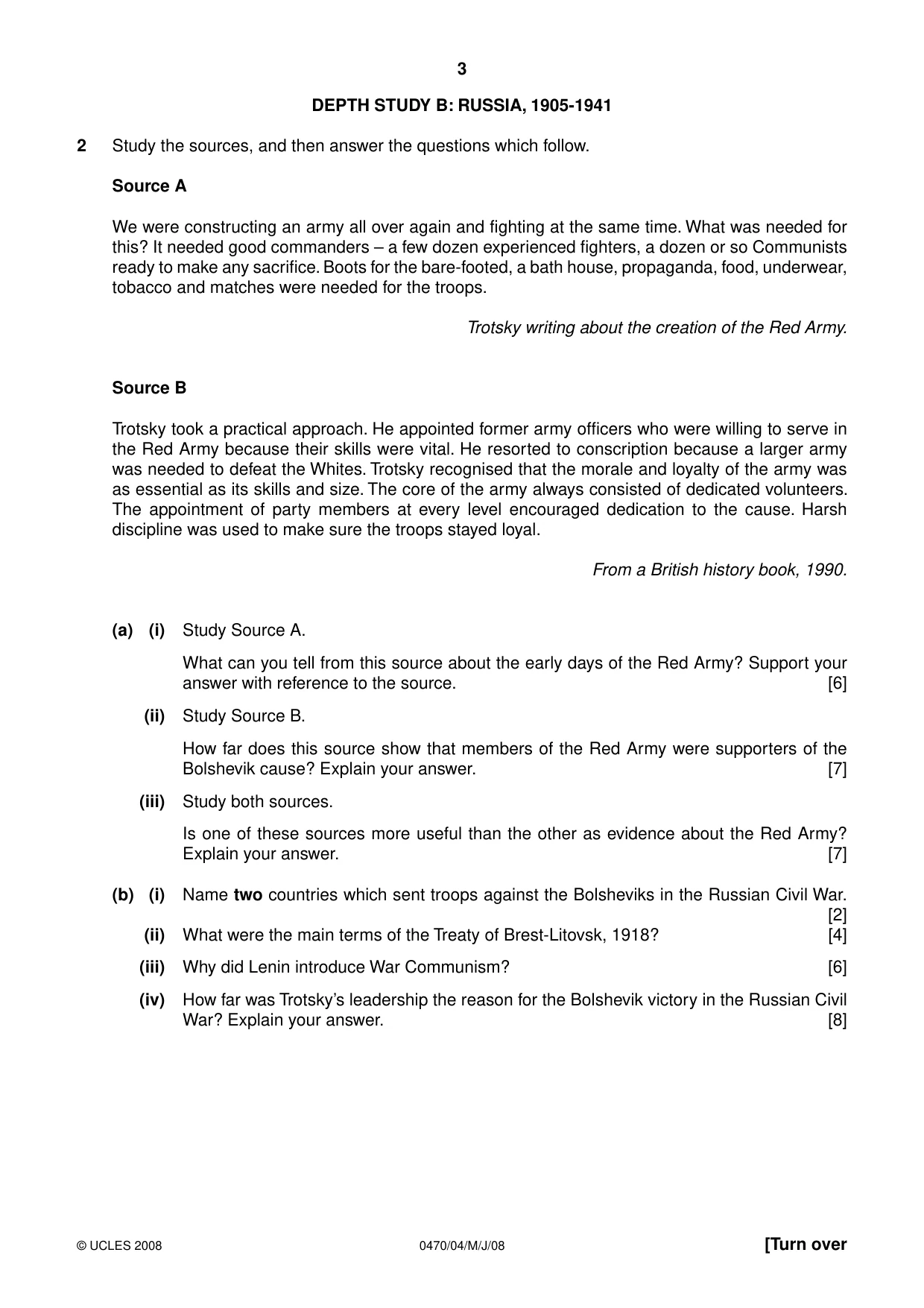
3 0470/04/M/J/08 © UCLES 2008 [Turn over DEPTH STUDY B: RUSSIA, 1905-1941 2 Study the sources, and then answer the questions which follow. Source A We were constructing an army all over again and fighting at the same time. What was needed for this? It needed good commanders – a few dozen experienced fighters, a dozen or so Communists ready to make any sacrifice. Boots for the bare-footed, a bath house, propaganda, food, underwear, tobacco and matches were needed for the troops. Trotsky writing about the creation of the Red Army. Source B Trotsky took a practical approach. He appointed former army officers who were willing to serve in the Red Army because their skills were vital. He resorted to conscription because a larger army was needed to defeat the Whites. Trotsky recognised that the morale and loyalty of the army was as essential as its skills and size. The core of the army always consisted of dedicated volunteers. The appointment of party members at every level encouraged dedication to the cause. Harsh discipline was used to make sure the troops stayed loyal. From a British history book, 1990. (a) (i) Study Source A. What can you tell from this source about the early days of the Red Army? Support your answer with reference to the source. [6] (ii) Study Source B. How far does this source show that members of the Red Army were supporters of the Bolshevik cause? Explain your answer. [7] (iii) Study both sources. Is one of these sources more useful than the other as evidence about the Red Army? Explain your answer. [7] (b) (i) Name two countries which sent troops against the Bolsheviks in the Russian Civil War. [2] (ii) What were the main terms of the Treaty of Brest-Litovsk, 1918? [4] (iii) Why did Lenin introduce War Communism? [6] (iv) How far was Trotsky’s leadership the reason for the Bolshevik victory in the Russian Civil War? Explain your answer. [8]
Question paper, page 4
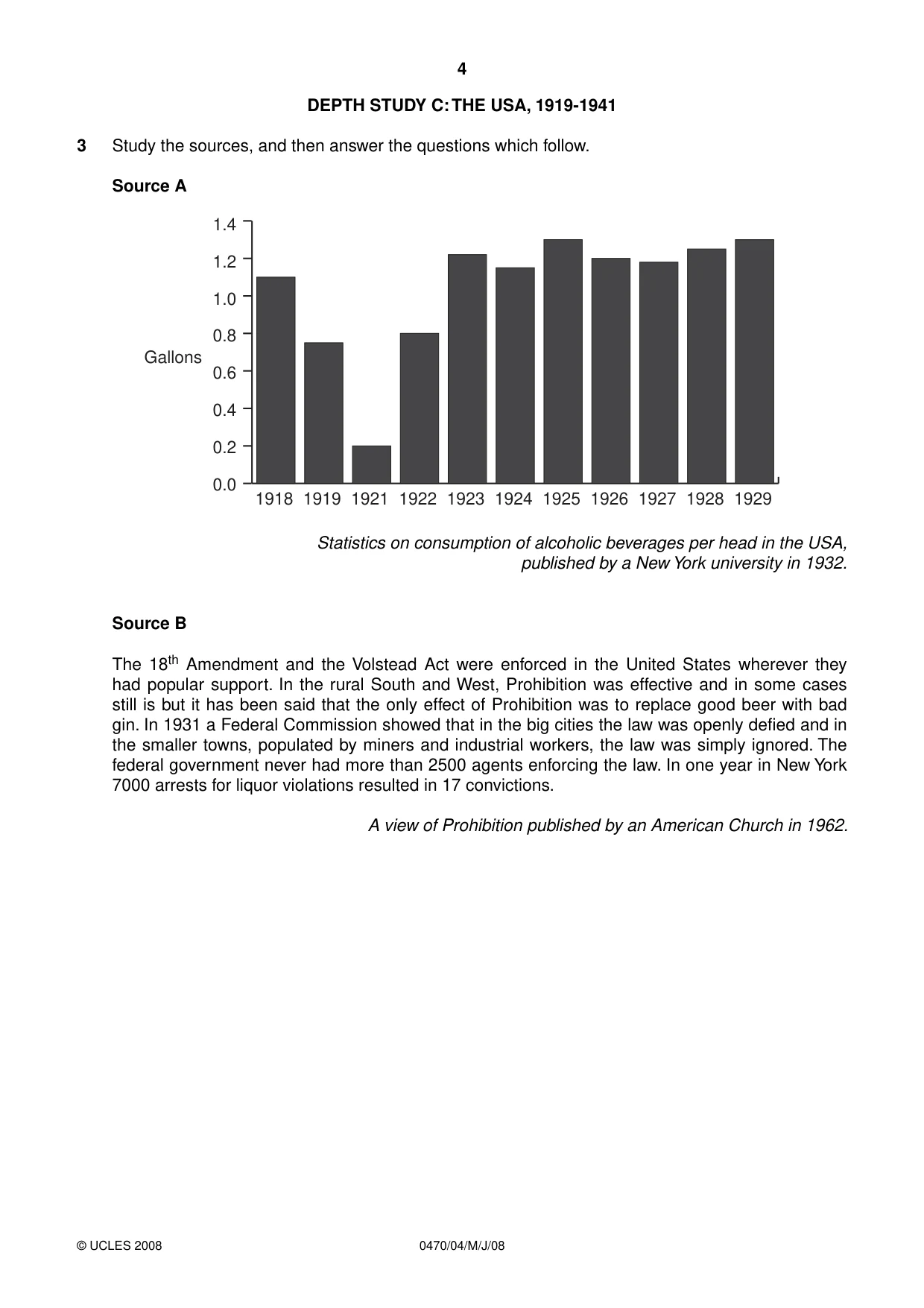
4 0470/04/M/J/08 © UCLES 2008 DEPTH STUDY C: THE USA, 1919-1941 3 Study the sources, and then answer the questions which follow. Source A 0.0 0.2 0.4 0.6 0.8 1.0 1.2 1.4 1929 1928 1927 1926 1925 1924 1923 1922 1921 1919 1918 Gallons Statistics on consumption of alcoholic beverages per head in the USA, published by a New York university in 1932. Source B The 18th Amendment and the Volstead Act were enforced in the United States wherever they had popular support. In the rural South and West, Prohibition was effective and in some cases still is but it has been said that the only effect of Prohibition was to replace good beer with bad gin. In 1931 a Federal Commission showed that in the big cities the law was openly defied and in the smaller towns, populated by miners and industrial workers, the law was simply ignored. The federal government never had more than 2500 agents enforcing the law. In one year in New York 7000 arrests for liquor violations resulted in 17 convictions. A view of Prohibition published by an American Church in 1962.
Question paper, page 5
5 0470/04/M/J/08 © UCLES 2008 [Turn over (a) (i) Study Source A. What can you tell from this source about the effects of the introduction of Prohibition in 1920? Support your answer with reference to the source. [6] (ii) Study Source B. How far does this source show that Americans opposed Prohibition? Explain your answer. [7] (iii) Study both sources. Is one of these sources more useful than the other as evidence about Prohibition? Explain your answer. [7] (b) (i) Name two areas from which alcohol was smuggled into the United States. [2] (ii) What were speakeasies? [4] (iii) Why did many Americans support Prohibition? [6] (iv) ‘Americans benefited from the Roaring Twenties.’ Do you agree? Explain your answer. [8]
Question paper, page 6
6 0470/04/M/J/08 © UCLES 2008 DEPTH STUDY D: CHINA, 1945-c.1990 4 Study the sources, and then answer the questions which follow. Source A In the long term, the Great Leap Forward meant that China could feed its population without famine. The communes had proved to be a successful innovation. They were much more than collective farms – they were an efficient unit of local government and they enabled Beijing to keep in touch with local opinion. The communes seemed to be the ideal solution to the problems of running a vast country while at the time avoiding the over-centralisation that limits local initiatives. From a British history book, 1997. Source B Trucks used to turn up at the compound carrying grinning peasants coming to report on some fantastic, record-breaking achievement. One day it was a monster cucumber half as long as a truck. Another time it was a tomato carried with difficulty by two children. On another occasion it was a giant pig squeezed into a truck. The peasants claimed they had bred an actual pig this size. The pig was only made of papier-mâché but as a child I imagined it was real. People had learned to defy reason and live with acting. From a Chinese writer’s account of life during the Great Leap Forward, given in 1991. (a) (i) Study Source A. What can you tell from this source about communes? Support your answer with reference to the source. [6] (ii) Study Source B. How far does this source show that the Great Leap Forward was a success? Explain your answer. [7] (iii) Study both sources. Is one of these sources more useful than the other as evidence about the Great Leap Forward? Explain your answer. [7] (b) (i) What were the ‘barefoot doctors’? [2] (ii) Describe how a collective farm was organised. [4] (iii) Why did Mao Zedong introduce the Hundred Flowers campaign in 1956 and abandon it in 1957? [6] (iv) How far did the Communist Government improve the lives of Chinese people between 1949 and 1960? Explain your answer. [8]
Question paper, page 7
7 0470/04/M/J/08 © UCLES 2008 [Turn over DEPTH STUDY E: SOUTHERN AFRICA IN THE TWENTIETH CENTURY 5 Study the sources, and then answer the questions which follow. Source A An English school textbook published in 1914 said, ‘During the later stages of the war the families, women and children of those Boers still fighting were fed and cared for in refugee camps at British expense. This method, though humane, postponed the end of the war, at the expense of many valuable lives and money.’ How very generous of the British to care for those whose houses, whose crops and whose animals they destroyed! From an Afrikaans website, 2005. Source B To end the war Boers agreed to lay down their weapons and accept the British king as their sovereign. The British agreed that no Boer would lose his freedom or property. Dutch as well as English would be taught in schools. No special taxes would be imposed in South Africa to pay for the war and the British would give £3 000 000 to restore the country. It was also agreed that there would be no vote for the Bantu or Coloureds until there was a representative government. From a British history of the Second Anglo-Boer War (1899-1902), published in 1977. (a) (i) Study Source A. What can you tell from this source about the later stages of the Second Anglo-Boer War? Support your answer with reference to the source. [6] (ii) Study Source B. How far does this source show that the British won the Second Anglo-Boer War? Explain your answer. [7] (iii) Study both sources. Is one of these sources more useful than the other as evidence of the effects on the Boers of the Second Anglo-Boer War? Explain your answer. [7] (b) (i) Name two Boer military leaders in the Second Anglo-Boer War. [2] (ii) What were blockhouses and how did the British use them? [4] (iii) Why did many non-whites oppose the formation of the Union of South Africa in 1910? [6] (iv) ‘From 1880 to 1914 economic changes had far greater impact on the African peoples than the conflicts between the British and the Boers.’ How far do you agree? Explain your answer. [8]
Question paper, page 8
8 0470/04/M/J/08 © UCLES 2008 DEPTH STUDY F: ISRAELIS AND PALESTINIANS, 1945-c.1994 6 Study the sources, and then answer the questions which follow. Source A Jewish immigration figures to Palestine, 1931-1939. Year Number of immigrants 1931 4 075 1932 9 553 1933 30 327 1934 42 359 1935 61 854 1936 29 727 1937 10 536 1938 12 868 1939 16 405 Total 217 704 Figures taken from the ESCO foundation – an organisation working for a Palestinian state shared by Jews and Palestinians, published in 1947. Source B When Britain refused to let the Jews come to the Promised Land in 1945/6 they attacked British soldiers inside Palestine. They whipped up international sympathy by chartering some old merchant ships and filling them up with Jewish Misplaced Persons. They then defied the British blockade. The world was therefore deeply shocked when the British turned away a ship, the Exodus, packed with 4500 Jews who had survived the Nazi death camps and now had to live as stateless people in the depths of Europe. Some of the old merchant ships were also sunk by the British. A summary of events, quoted by a British historian in 1987. Source C While in Jerusalem I learned that a boat called the Exodus had attempted to deliver 4500 Jewish refugees – including 600 children, mostly orphans – but was attacked by five British destroyers and a cruiser. When the Exodus entered harbour it looked like a matchbox splintered by a nutcracker. An American journalist writing in 1947.
Question paper, page 9
9 0470/04/M/J/08 © UCLES 2008 [Turn over (a) (i) Study Source A. What can you tell from this source about Jewish immigration to Palestine? Support your answer with reference to the source. [6] (ii) Study Sources B and C. How far do these sources show that Britain had little chance of preventing Jewish immigration into Palestine? Explain your answer. [7] (iii) Study all the sources. Is one of these sources more useful than the others as evidence about Jewish immigration into Palestine? Explain your answer. [7] (b) (i) What was the League of Nations mandate over Palestine? [2] (ii) What problems did the British government face in Palestine in the 1940s? [4] (iii) Why did the United Nations Organisation draw up a partition plan for Palestine in 1947? [6] (iv) ‘The main reason for the birth of the state of Israel was British weakness.’ Do you agree? Explain your answer. [8]
Question paper, page 10
10 0470/04/M/J/08 © UCLES 2008 DEPTH STUDY G: THE CREATION OF MODERN INDUSTRIAL SOCIETY 7 Study the sources, and then answer the questions which follow. Source A A painting of 1850 called ‘Past and Present Through Victorian Eyes’. Source B The census of 1851 listed 34 306 railway labourers and 14 559 railway officers, clerks and stationmasters. There were also 29 408 horse-keepers, 56 981 carriers and carters, and 16 836 non-domestic coachmen, guards and postboys – not to mention those who maintained and drove the tens of thousands of private carriages and the large numbers of coach-builders, wheelwrights, blacksmiths and saddlers. From a British history book of 1987.
Question paper, page 11
11 0470/04/M/J/08 © UCLES 2008 [Turn over (a) (i) Study Source A. What impressions does this source give you about transport in 1850? Support your answer with reference to the source. [6] (ii) Study Source B. How far does this source show that railways were less important than roads as a means of transport in the mid-nineteenth century? Explain your answer. [7] (iii) Study both sources. Is one of these sources more useful than the other as evidence about the impact of railways? Explain your answer. [7] (b) (i) Where and when was the first public commercial railway opened? [2] (ii) Describe the benefits to agriculture of the coming of the railways. [4] (iii) Why did railways overtake canals in the nineteenth century as the main form of freight transport? [6] (iv) How far was the development of railways in the nineteenth century welcomed? Explain your answer. [8]
Question paper, page 12
12 0470/04/M/J/08 © UCLES 2008 DEPTH STUDY H: THE IMPACT OF WESTERN IMPERIALISM IN THE NINETEENTH CENTURY 8 Study the sources, and then answer the questions which follow. Source A All the powers promise to watch over the preservation of native tribes, and to care for the improvement of conditions of their moral and material well-being and to help in the suppressing of slavery and the slave trade. They shall protect all religious, scientific, or charitable institutions which aim at instructing the natives and clearly showing them the advantages of civilisation. Christian missionaries, scientists and explorers shall be given special protection. From the terms agreed at the Berlin Conference of 1884-5. Source B I go back to Africa to try to open a path for commerce and Christianity. Will you carry on the work which I have begun? Dr. Livingstone in a speech at Cambridge University in 1857. Source C Of the Europeans that scrambled for control of Africa at the end of the nineteenth century, Belgium’s King Leopold left possibly the most horrid legacy of all. While Great Powers competed for territory elsewhere, Leopold carved his own private colony out of the Central African rainforest. He claimed he was doing it to protect the natives from Arab slavers and to open the heart of Africa to Christian missionaries. Instead he turned his ‘Congo Free State’ into a massive labour camp, made a fortune from wild rubber and contributed in a large way to the deaths of perhaps 10 million innocent people. Former BBC correspondent to Central Africa, 2005.
Question paper, page 13
13 0470/04/M/J/08 © UCLES 2008 (a) (i) Study Source A. What can you tell from this source about the aims of the European Powers at Berlin in 1884-5? Support your answer with reference to the source. [6] (ii) Study Sources B and C. How far do these sources show that Europeans wanted to exploit Africans? Explain your answer. [7] (iii) Study all the sources. Is one of these sources more useful than the others about the aims and achievements of European Powers in Africa in the late-nineteenth century? Explain your answer. [7] (b) (i) Name two areas of Africa colonised by Germany in the late-nineteenth century. [2] (ii) Describe one incident of colonial rivalry in Africa between European nations before 1914. [4] (iii) Why was there a conference in Berlin in 1884-5? [6] (iv) ‘The main reason for European imperialism in Africa was to bring the benefits of Christianity to Africans.’ Do you agree? Explain your answer. [8]
Question paper, page 16
16 0470/04/M/J/08 BLANK PAGE Copyright Acknowledgements: Question 2 Source B © From Russia, 1917-41 by Clare Baker. Reprinted by permission of Harcourt Education. Question 4 Source A © Norman Lowe; Mastering Modern World History; Palgrave Macmillan; 1997. Question 4 Source B Reprinted by permission of HarperCollins Publishers Ltd © Jung Chang, 1993. Question 5 Source A © www.boer.co.za Question 5 Source B © Byron Farwell; The Great Boer War; Wordsworth Editions Ltd; 1999. Question 6 Source A © www.unu.edu/unupress/unupbooks/80859e/80859E05.htm Question 6 Source B © Brian Catchpole; History: World History Since 1914 Syllabus 1; Pan Books; 1987. Question 7 Source B © Trevor May; An Economic and Social History of Britain, 1760-1990; Longman; 1996. Question 8 Source C © www.bbc.co.uk Permission to reproduce items where third-party owned material protected by copyright is included has been sought and cleared where possible. Every reasonable effort has been made by the publisher (UCLES) to trace copyright holders, but if any items requiring clearance have unwittingly been included, the publisher will be pleased to make amends at the earliest possible opportunity. University of Cambridge International Examinations is part of the Cambridge Assessment Group. Cambridge Assessment is the brand name of University of Cambridge Local Examinations Syndicate (UCLES), which is itself a department of the University of Cambridge.
Mark scheme, page 1
UNIVERSITY OF CAMBRIDGE INTERNATIONAL EXAMINATIONS International General Certificate of Secondary Education MARK SCHEME for the May/June 2008 question paper 0470 HISTORY 0470/04 Paper 4 (Alternative to Coursework), maximum raw mark 40 This mark scheme is published as an aid to teachers and candidates, to indicate the requirements of the examination. It shows the basis on which Examiners were instructed to award marks. It does not indicate the details of the discussions that took place at an Examiners’ meeting before marking began. All Examiners are instructed that alternative correct answers and unexpected approaches in candidates’ scripts must be given marks that fairly reflect the relevant knowledge and skills demonstrated. Mark schemes must be read in conjunction with the question papers and the report on the examination. • CIE will not enter into discussions or correspondence in connection with these mark schemes. CIE is publishing the mark schemes for the May/June 2008 question papers for most IGCSE, GCE Advanced Level and Advanced Subsidiary Level syllabuses and some Ordinary Level syllabuses. www.XtremePapers.com
Mark scheme, page 2
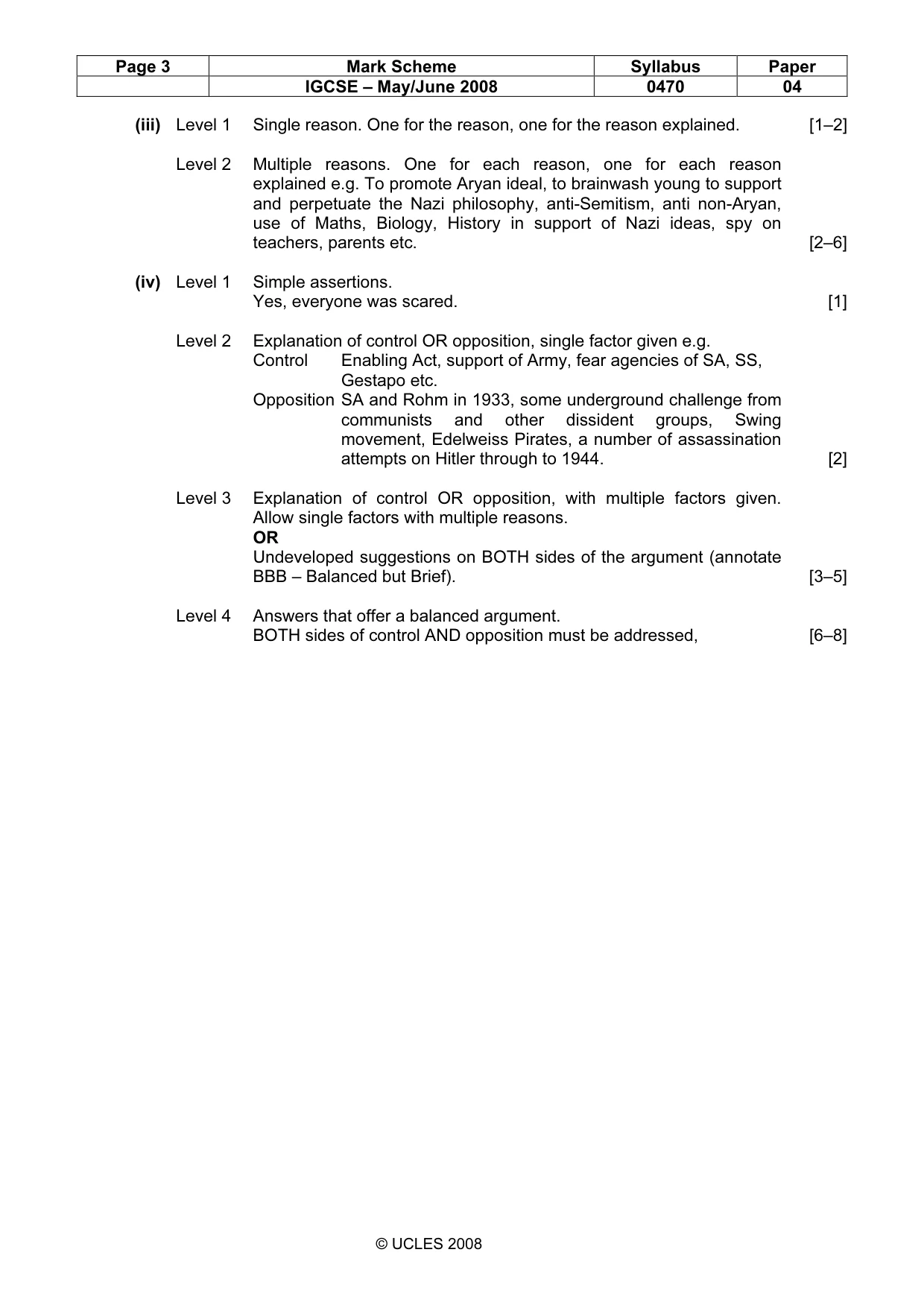
Page 2 Mark Scheme Syllabus Paper IGCSE – May/June 2008 0470 04 © UCLES 2008 Depth Study A: Germany, 1918–1945 (a) (i) Level 1 Repeats material stated in source, no inference made. [1–2] Level 2 Makes valid inferences, not supported from source e.g. Many young people see benefits for themselves in the Hitler youth etc. [3–4] Level 3 Supports valid inference(s) with reference to the source e.g. See membership as bringing jobs; Not taxed with educational tasks; benefits accrue from loyalty to Hitler etc. [5–6] (ii) Level 1 Agrees OR disagrees with no support from source. [1–2] Level 2 Agrees OR disagrees, supported from source e.g. Yes, boys from all classes, no social distinctions, enjoyed the marches and felt safe hating the SPD. No, mainly middle class and workers, young SPD not supportive; as a leader he found absolute obedience and lack of individual will unpleasant. [3–5] Level 3 Agrees AND disagrees, supported from the source. Addresses the issue of ‘How far?’ [6–7] (iii) Level 1 Useful/not useful – Choice made on the basis that one is more detailed/gives more information, but does not specify what information. [1] Level 2 Useful/not useful – One is from the SPD and the other is from ex- Hitler Youth members so they could both be biased/unreliable. [2] Level 3 Choice made on the nature or amount of information given. Must specify what information. [3–5] Level 4 Choice made on the grounds of reliability. Discussion of utility must be made on valid evaluation of source(s) in context. Include at this Level answers that cross-reference between A and B to show reliability. 6 marks for one source, 7 marks for both. [6–7] (b) (i) One mark for each valid aspect to a maximum of two e.g. A law that allowed Hitler to govern Germany without consulting Reichstag, able to rule as a dictator etc. [1–2] (ii) Level 1 Identifies policies. [1–2] Level 2 Describes policies. Award an extra mark for each policy described in additional detail e.g. Role as homemaker in support of husband, KKK, have children for the Aryan race and military, not take male jobs. League of German Maidens, women’s steering committee to oversee all women’s organisations. [2–4]
Mark scheme, page 3
Page 3 Mark Scheme Syllabus Paper IGCSE – May/June 2008 0470 04 © UCLES 2008 (iii) Level 1 Single reason. One for the reason, one for the reason explained. [1–2] Level 2 Multiple reasons. One for each reason, one for each reason explained e.g. To promote Aryan ideal, to brainwash young to support and perpetuate the Nazi philosophy, anti-Semitism, anti non-Aryan, use of Maths, Biology, History in support of Nazi ideas, spy on teachers, parents etc. [2–6] (iv) Level 1 Simple assertions. Yes, everyone was scared. [1] Level 2 Explanation of control OR opposition, single factor given e.g. Control Enabling Act, support of Army, fear agencies of SA, SS, Gestapo etc. Opposition SA and Rohm in 1933, some underground challenge from communists and other dissident groups, Swing movement, Edelweiss Pirates, a number of assassination attempts on Hitler through to 1944. [2] Level 3 Explanation of control OR opposition, with multiple factors given. Allow single factors with multiple reasons. OR Undeveloped suggestions on BOTH sides of the argument (annotate BBB – Balanced but Brief). [3–5] Level 4 Answers that offer a balanced argument. BOTH sides of control AND opposition must be addressed, [6–8]
Mark scheme, page 4
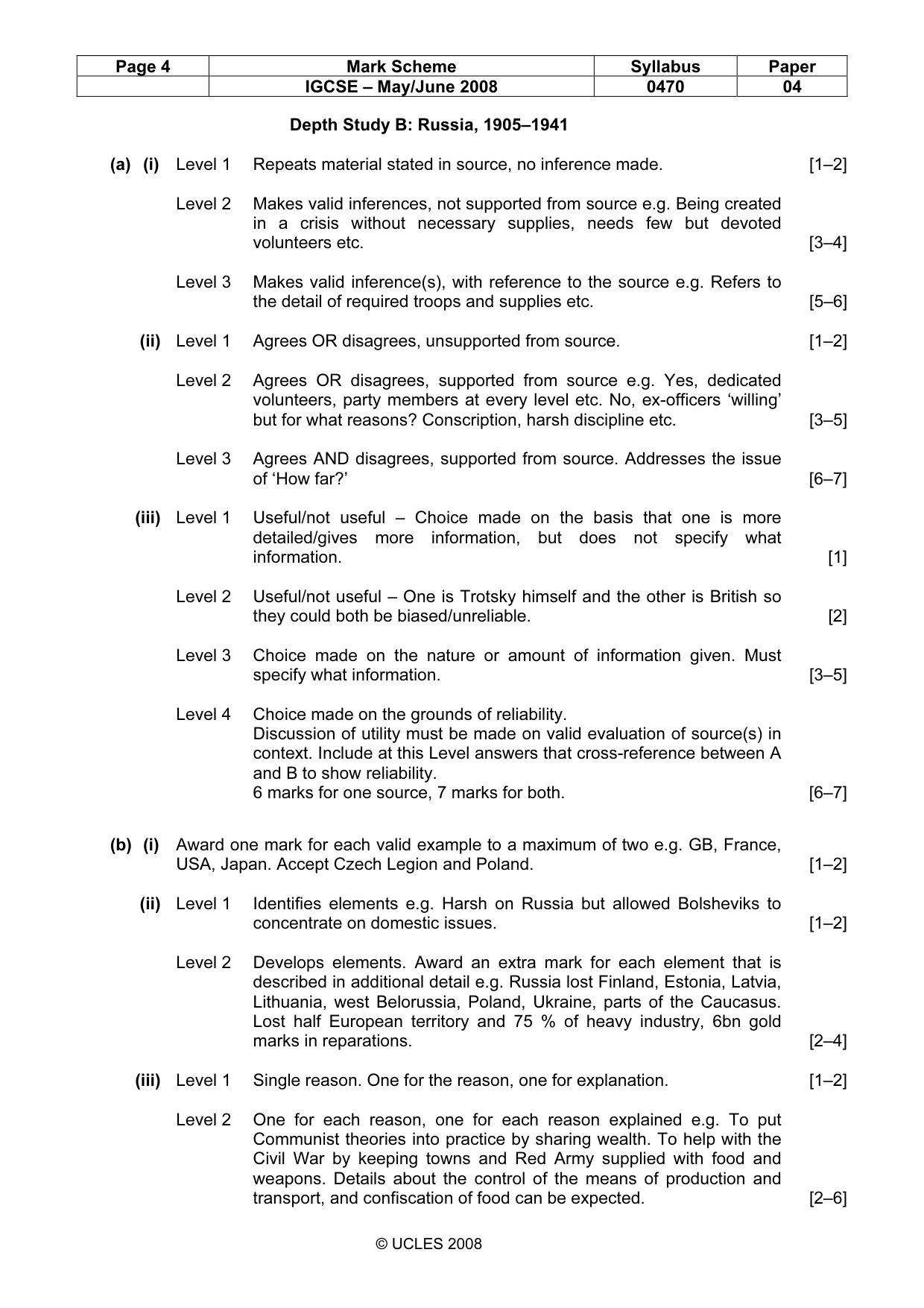
Page 4 Mark Scheme Syllabus Paper IGCSE – May/June 2008 0470 04 © UCLES 2008 Depth Study B: Russia, 1905–1941 (a) (i) Level 1 Repeats material stated in source, no inference made. [1–2] Level 2 Makes valid inferences, not supported from source e.g. Being created in a crisis without necessary supplies, needs few but devoted volunteers etc. [3–4] Level 3 Makes valid inference(s), with reference to the source e.g. Refers to the detail of required troops and supplies etc. [5–6] (ii) Level 1 Agrees OR disagrees, unsupported from source. [1–2] Level 2 Agrees OR disagrees, supported from source e.g. Yes, dedicated volunteers, party members at every level etc. No, ex-officers ‘willing’ but for what reasons? Conscription, harsh discipline etc. [3–5] Level 3 Agrees AND disagrees, supported from source. Addresses the issue of ‘How far?’ [6–7] (iii) Level 1 Useful/not useful – Choice made on the basis that one is more detailed/gives more information, but does not specify what information. [1] Level 2 Useful/not useful – One is Trotsky himself and the other is British so they could both be biased/unreliable. [2] Level 3 Choice made on the nature or amount of information given. Must specify what information. [3–5] Level 4 Choice made on the grounds of reliability. Discussion of utility must be made on valid evaluation of source(s) in context. Include at this Level answers that cross-reference between A and B to show reliability. 6 marks for one source, 7 marks for both. [6–7] (b) (i) Award one mark for each valid example to a maximum of two e.g. GB, France, USA, Japan. Accept Czech Legion and Poland. [1–2] (ii) Level 1 Identifies elements e.g. Harsh on Russia but allowed Bolsheviks to concentrate on domestic issues. [1–2] Level 2 Develops elements. Award an extra mark for each element that is described in additional detail e.g. Russia lost Finland, Estonia, Latvia, Lithuania, west Belorussia, Poland, Ukraine, parts of the Caucasus. Lost half European territory and 75 % of heavy industry, 6bn gold marks in reparations. [2–4] (iii) Level 1 Single reason. One for the reason, one for explanation. [1–2] Level 2 One for each reason, one for each reason explained e.g. To put Communist theories into practice by sharing wealth. To help with the Civil War by keeping towns and Red Army supplied with food and weapons. Details about the control of the means of production and transport, and confiscation of food can be expected. [2–6]
Mark scheme, page 5
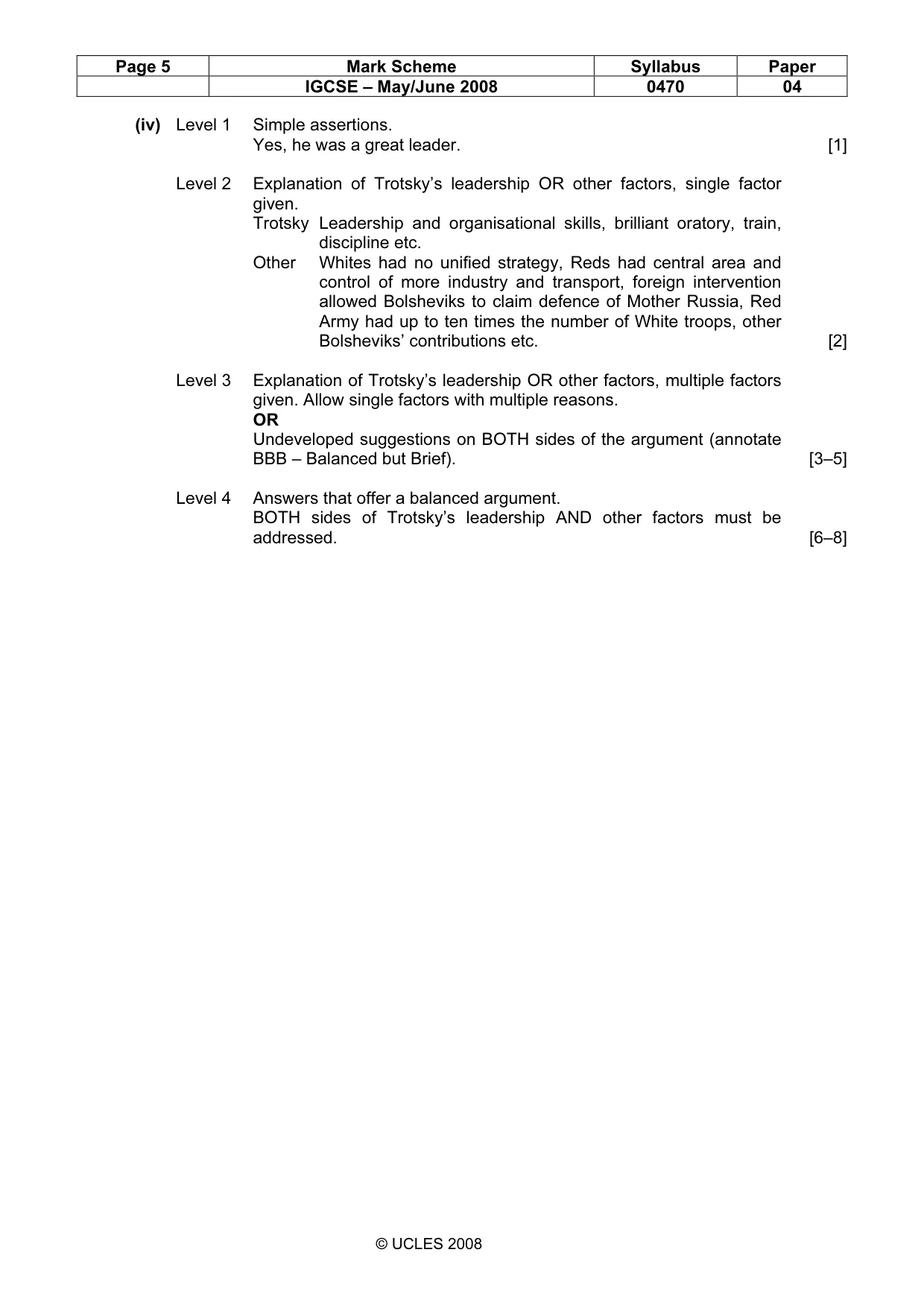
Page 5 Mark Scheme Syllabus Paper IGCSE – May/June 2008 0470 04 © UCLES 2008 (iv) Level 1 Simple assertions. Yes, he was a great leader. [1] Level 2 Explanation of Trotsky’s leadership OR other factors, single factor given. Trotsky Leadership and organisational skills, brilliant oratory, train, discipline etc. Other Whites had no unified strategy, Reds had central area and control of more industry and transport, foreign intervention allowed Bolsheviks to claim defence of Mother Russia, Red Army had up to ten times the number of White troops, other Bolsheviks’ contributions etc. [2] Level 3 Explanation of Trotsky’s leadership OR other factors, multiple factors given. Allow single factors with multiple reasons. OR Undeveloped suggestions on BOTH sides of the argument (annotate BBB – Balanced but Brief). [3–5] Level 4 Answers that offer a balanced argument. BOTH sides of Trotsky’s leadership AND other factors must be addressed. [6–8]
Mark scheme, page 6
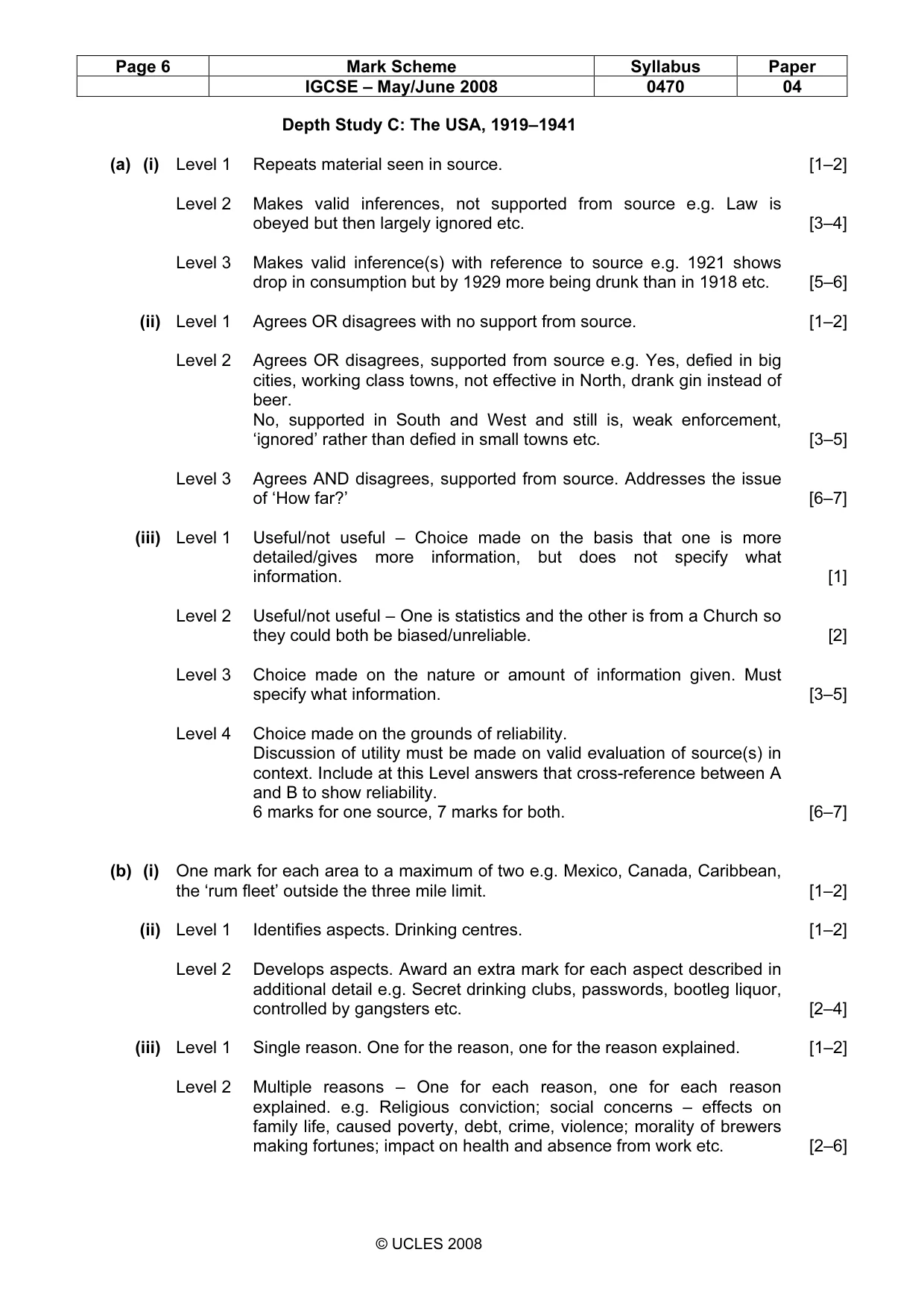
Page 6 Mark Scheme Syllabus Paper IGCSE – May/June 2008 0470 04 © UCLES 2008 Depth Study C: The USA, 1919–1941 (a) (i) Level 1 Repeats material seen in source. [1–2] Level 2 Makes valid inferences, not supported from source e.g. Law is obeyed but then largely ignored etc. [3–4] Level 3 Makes valid inference(s) with reference to source e.g. 1921 shows drop in consumption but by 1929 more being drunk than in 1918 etc. [5–6] (ii) Level 1 Agrees OR disagrees with no support from source. [1–2] Level 2 Agrees OR disagrees, supported from source e.g. Yes, defied in big cities, working class towns, not effective in North, drank gin instead of beer. No, supported in South and West and still is, weak enforcement, ‘ignored’ rather than defied in small towns etc. [3–5] Level 3 Agrees AND disagrees, supported from source. Addresses the issue of ‘How far?’ [6–7] (iii) Level 1 Useful/not useful – Choice made on the basis that one is more detailed/gives more information, but does not specify what information. [1] Level 2 Useful/not useful – One is statistics and the other is from a Church so they could both be biased/unreliable. [2] Level 3 Choice made on the nature or amount of information given. Must specify what information. [3–5] Level 4 Choice made on the grounds of reliability. Discussion of utility must be made on valid evaluation of source(s) in context. Include at this Level answers that cross-reference between A and B to show reliability. 6 marks for one source, 7 marks for both. [6–7] (b) (i) One mark for each area to a maximum of two e.g. Mexico, Canada, Caribbean, the ‘rum fleet’ outside the three mile limit. [1–2] (ii) Level 1 Identifies aspects. Drinking centres. [1–2] Level 2 Develops aspects. Award an extra mark for each aspect described in additional detail e.g. Secret drinking clubs, passwords, bootleg liquor, controlled by gangsters etc. [2–4] (iii) Level 1 Single reason. One for the reason, one for the reason explained. [1–2] Level 2 Multiple reasons – One for each reason, one for each reason explained. e.g. Religious conviction; social concerns – effects on family life, caused poverty, debt, crime, violence; morality of brewers making fortunes; impact on health and absence from work etc. [2–6]
Mark scheme, page 7
Page 7 Mark Scheme Syllabus Paper IGCSE – May/June 2008 0470 04 © UCLES 2008 (iv) Level 1 Simple assertions. Yes, everyone got richer and richer. [1] Level 2 Explanation of benefit OR lack of benefit, single factor given e.g. Yes Consumer boom, multiple cars, fridges, radios etc; production up, mechanised production, cars and allied industries; stock market etc. No Minorities, esp. southern European immigrants, black Americans, farmers, some women, native Americans; wages; Wall Street Crash etc [2] Level 3 Explanation of benefit OR lack of benefit, with multiple factors. Allow single factors with multiple reasons. OR Undeveloped suggestions on both sides of the argument. (Annotate BBB – Balanced but Brief). [3–5] Level 4 Answers that offer a balanced argument. BOTH sides of benefit AND lack of benefit must be addressed. [6–8]
Mark scheme, page 8
Page 8 Mark Scheme Syllabus Paper IGCSE – May/June 2008 0470 04 © UCLES 2008 Depth Study D: China, 1945–c.1990 (a) (i) Level 1 Repeats material stated in source, no inference made. [1–2] Level 2 Makes valid inferences, unsupported from source e.g. Useful tool for the government in Beijing etc. [3–4] Level 3 Makes valid inference(s), supported from source e.g. Raised food production, more useful than collectives, used as local government vehicle, kept Beijing informed etc. [5–6] (ii) Level 1 Agrees OR disagrees, unsupported from source. [1–2] Level 2 Agrees OR disagrees, supported from source e.g. Yes, all appeared to be enthusiastically involved and proud of successes etc. No, production was not real, all had been duped into acting and making surreal claims etc. [3–5] Level 3 Agrees AND disagrees, supported from source. Addresses the issue of ‘How far?’ [6–7] (iii) Level 1 Useful/not useful – Choice made on the basis that one is more detailed/gives more information, but does not specify what information. [1] Level 2 Useful/not useful – One is British and the other is from a Chinese writer so they could both be biased/unreliable. [2] Level 3 Choice made on the nature or amount of information given. Must specify what information. [3–5] Level 4 Choice made on the grounds of reliability. Discussions of utility must be made on valid evaluation of source(s) in context. Include at this Level answers that cross-reference between A and B to show reliability. 6 marks for one source, 7 marks for both. [6–7] (b) (i) Award one mark for each relevant aspect to a maximum of two e.g. Farmer/peasant doctors who had been given minimal medical training. Worked in rural areas. ‘Barefoot’ as they did not wish to get shoes dirty/wet in paddies and fields. 1965 speech by Mao on healthcare institutionalised the doctors and they became part of the Cultural Revolution. [1–2] (ii) Level 1 Identifies functions e.g. Families joining together to increase food production. [1–2] Level 2 Develops functions. Award an extra mark for functions described in additional detail e.g. Joint ownership of land, sharing of tools and equipment. By 1965 about 95% of all peasants were in collectives. [2–4]
Mark scheme, page 9
Page 9 Mark Scheme Syllabus Paper IGCSE – May/June 2008 0470 04 © UCLES 2008 (iii) Level 1 Single reason. One for the reason, one for the explanation. [1–2] Level 2 Multiple reasons. One for each reason, one for each reason explained e.g. Feeling confident at recent progress the Chinese government tried to open discussions with new class of technicians, scientists and engineers to try to improve relations between them and the party cadres. However, the party was criticised as having incompetent and over-enthusiastic cadres, over-centralisation and no democracy. Mao abandoned the campaign to stifle further criticism, but some say he started it to ‘out’ critics. [2–6] (iv) Level 1 Simple assertions. No, a lot of people starved. [1] Level 2 Explanation of improvement OR lack of improvement, single reason given. Yes Early land redistribution and Speak Bitterness courts had engaged the peasants. Later collectives and communes boosted food production. Measures on women, health and education etc. No Pettiness and incompetence of officials, Great Leap Forward resulted in famine and deaths, most saw little difference to the daily grind etc. [2] Level 3 Explanation of benefit OR lack of benefit, with multiple factors given. Allow single factors with multiple reasons. OR Undeveloped suggestions on BOTH sides of the argument (annotate BBB – Balanced but Brief). [3–5] Level 4 Answers that offer a balanced argument. BOTH sides of benefit AND lack of benefit must be addressed. [6–8]
Mark scheme, page 10
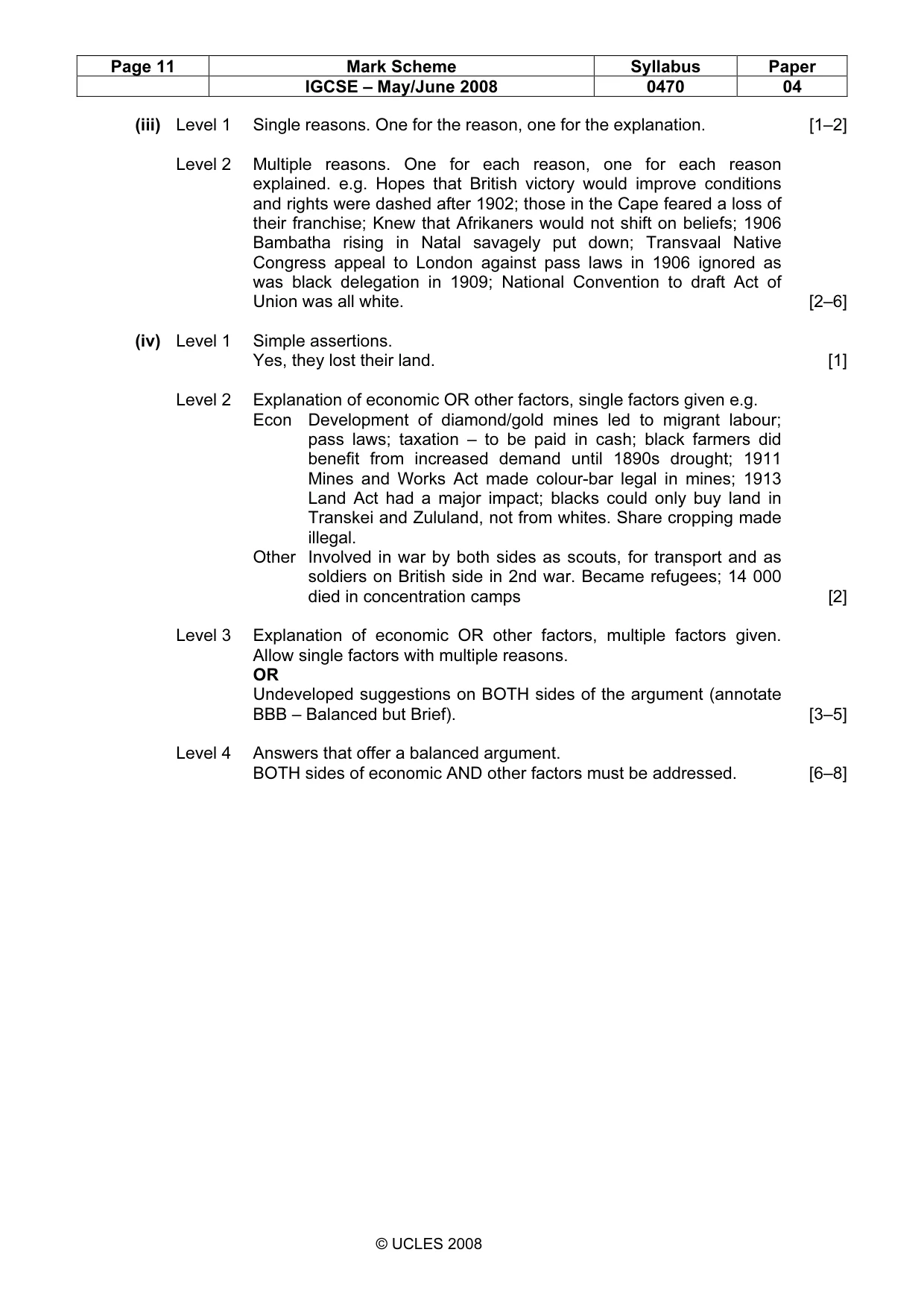
Page 10 Mark Scheme Syllabus Paper IGCSE – May/June 2008 0470 04 © UCLES 2008 Depth Study E: Southern Africa in the 20th Century (a) (i) Level 1 Repeats material stated in source, no inference made. [1–2] Level 2 Makes valid inferences, not supported from source e.g. It was a costly way of prolonging the war etc. [3–4] Level 3 Makes valid inference(s), supported from source e.g. British ‘caring for’ women and children; destroying property; British and Boers prolonging the war; Still resentment today etc. [5–6] (ii) Level 1 Agrees OR disagrees with no support from source. [1–2] Level 2 Agrees OR disagrees, supported from source e.g. Yes, Boers stopped fighting and became loyal citizens, No, Boers retained all rights at no additional cost, were compensated; little chance of non- white franchise having British support. [3–5] Level 3 Agrees AND disagrees, supported from source. Addresses the issue of ‘How far?’ [6–7] (iii) Level 1 Useful/not useful – Choice made on the basis that one is more detailed/gives more information, but does not specify what information. [1] Level 2 Useful/not useful – One is from an Afrikaans website and the other is British so they could both be biased/unreliable. [2] Level 3 Choice made on the nature or amount of information given. Must specify what information. [3–5] Level 4 Choice made on the grounds of reliability. Discussion of utility must be made on valid evaluation of source(s) in context. Include at this Level answers that cross-reference between A and B to show reliability. 6 marks for one source, 7 marks for both. [6–7] (b) (i) One mark for each valid name to a maximum of two e.g. Botha, Smuts, de Wet, Steyn, de la Rey, Joubert, Hertzog, Cronje. [1–2] (ii) Level 1 Identifies buildings and use. [1–2] Level 2 Describes buildings and use. Award an extra mark for each valid aspect described in additional detail e.g. Small forts; early of stone then corrugated iron reinforced by earth; 8000 constructed, no more than a mile apart. Used to protect railways, restrict mobility of Boer commandos; barbed wire; to aid sweeps of country etc. [2–4]
Mark scheme, page 11
Page 11 Mark Scheme Syllabus Paper IGCSE – May/June 2008 0470 04 © UCLES 2008 (iii) Level 1 Single reasons. One for the reason, one for the explanation. [1–2] Level 2 Multiple reasons. One for each reason, one for each reason explained. e.g. Hopes that British victory would improve conditions and rights were dashed after 1902; those in the Cape feared a loss of their franchise; Knew that Afrikaners would not shift on beliefs; 1906 Bambatha rising in Natal savagely put down; Transvaal Native Congress appeal to London against pass laws in 1906 ignored as was black delegation in 1909; National Convention to draft Act of Union was all white. [2–6] (iv) Level 1 Simple assertions. Yes, they lost their land. [1] Level 2 Explanation of economic OR other factors, single factors given e.g. Econ Development of diamond/gold mines led to migrant labour; pass laws; taxation – to be paid in cash; black farmers did benefit from increased demand until 1890s drought; 1911 Mines and Works Act made colour-bar legal in mines; 1913 Land Act had a major impact; blacks could only buy land in Transkei and Zululand, not from whites. Share cropping made illegal. Other Involved in war by both sides as scouts, for transport and as soldiers on British side in 2nd war. Became refugees; 14 000 died in concentration camps [2] Level 3 Explanation of economic OR other factors, multiple factors given. Allow single factors with multiple reasons. OR Undeveloped suggestions on BOTH sides of the argument (annotate BBB – Balanced but Brief). [3–5] Level 4 Answers that offer a balanced argument. BOTH sides of economic AND other factors must be addressed. [6–8]
Mark scheme, page 12
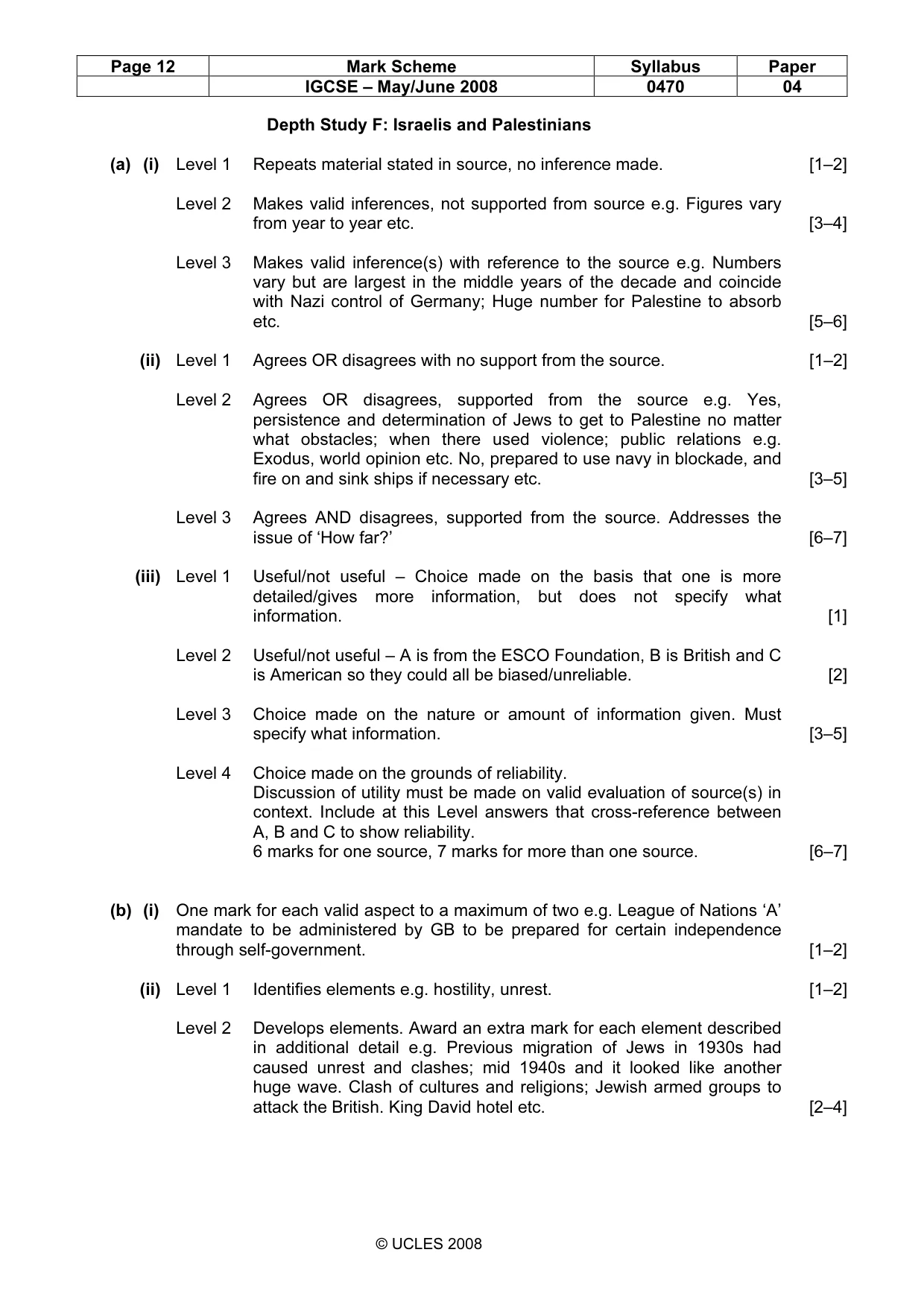
Page 12 Mark Scheme Syllabus Paper IGCSE – May/June 2008 0470 04 © UCLES 2008 Depth Study F: Israelis and Palestinians (a) (i) Level 1 Repeats material stated in source, no inference made. [1–2] Level 2 Makes valid inferences, not supported from source e.g. Figures vary from year to year etc. [3–4] Level 3 Makes valid inference(s) with reference to the source e.g. Numbers vary but are largest in the middle years of the decade and coincide with Nazi control of Germany; Huge number for Palestine to absorb etc. [5–6] (ii) Level 1 Agrees OR disagrees with no support from the source. [1–2] Level 2 Agrees OR disagrees, supported from the source e.g. Yes, persistence and determination of Jews to get to Palestine no matter what obstacles; when there used violence; public relations e.g. Exodus, world opinion etc. No, prepared to use navy in blockade, and fire on and sink ships if necessary etc. [3–5] Level 3 Agrees AND disagrees, supported from the source. Addresses the issue of ‘How far?’ [6–7] (iii) Level 1 Useful/not useful – Choice made on the basis that one is more detailed/gives more information, but does not specify what information. [1] Level 2 Useful/not useful – A is from the ESCO Foundation, B is British and C is American so they could all be biased/unreliable. [2] Level 3 Choice made on the nature or amount of information given. Must specify what information. [3–5] Level 4 Choice made on the grounds of reliability. Discussion of utility must be made on valid evaluation of source(s) in context. Include at this Level answers that cross-reference between A, B and C to show reliability. 6 marks for one source, 7 marks for more than one source. [6–7] (b) (i) One mark for each valid aspect to a maximum of two e.g. League of Nations ‘A’ mandate to be administered by GB to be prepared for certain independence through self-government. [1–2] (ii) Level 1 Identifies elements e.g. hostility, unrest. [1–2] Level 2 Develops elements. Award an extra mark for each element described in additional detail e.g. Previous migration of Jews in 1930s had caused unrest and clashes; mid 1940s and it looked like another huge wave. Clash of cultures and religions; Jewish armed groups to attack the British. King David hotel etc. [2–4]
Mark scheme, page 13
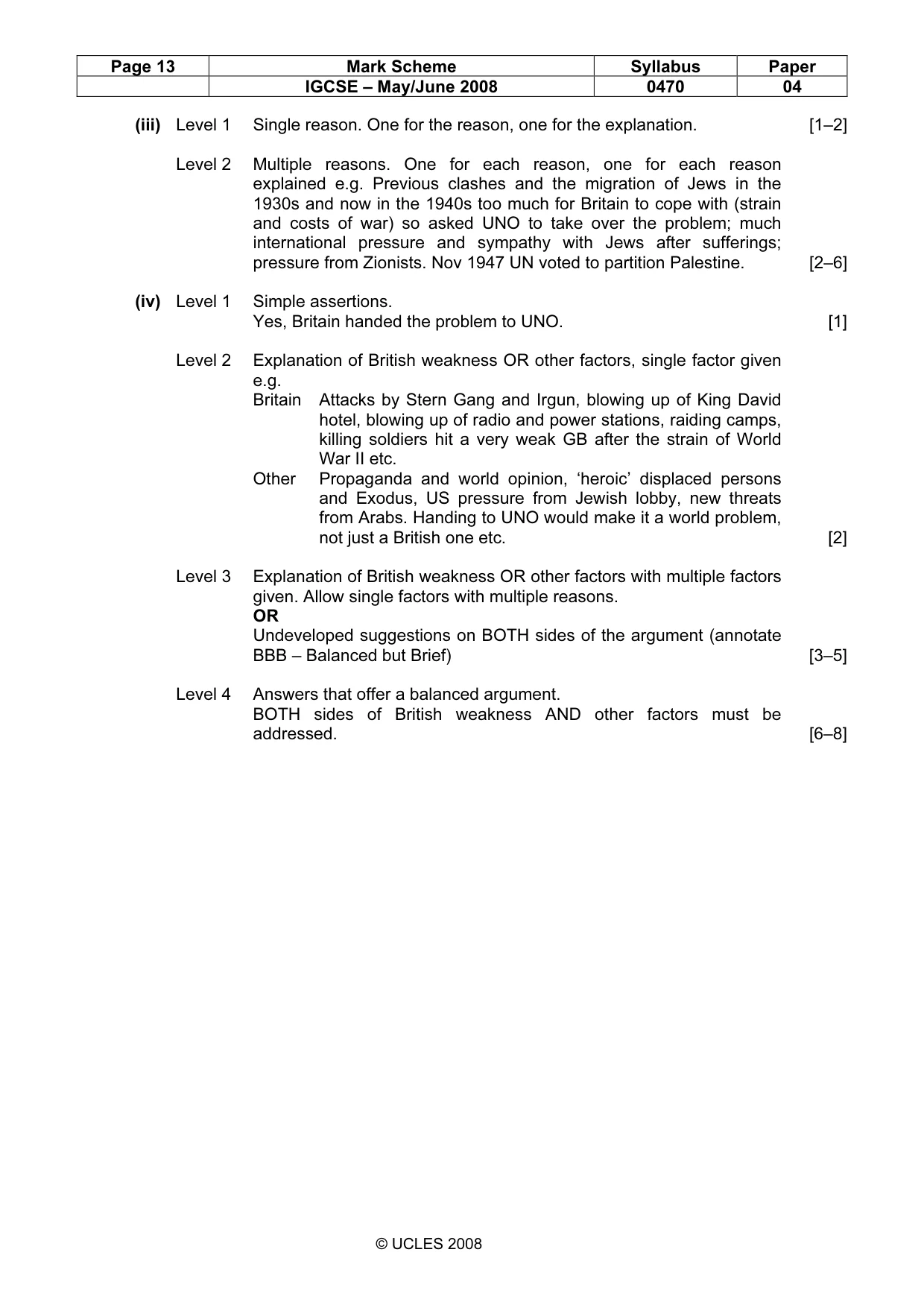
Page 13 Mark Scheme Syllabus Paper IGCSE – May/June 2008 0470 04 © UCLES 2008 (iii) Level 1 Single reason. One for the reason, one for the explanation. [1–2] Level 2 Multiple reasons. One for each reason, one for each reason explained e.g. Previous clashes and the migration of Jews in the 1930s and now in the 1940s too much for Britain to cope with (strain and costs of war) so asked UNO to take over the problem; much international pressure and sympathy with Jews after sufferings; pressure from Zionists. Nov 1947 UN voted to partition Palestine. [2–6] (iv) Level 1 Simple assertions. Yes, Britain handed the problem to UNO. [1] Level 2 Explanation of British weakness OR other factors, single factor given e.g. Britain Attacks by Stern Gang and Irgun, blowing up of King David hotel, blowing up of radio and power stations, raiding camps, killing soldiers hit a very weak GB after the strain of World War II etc. Other Propaganda and world opinion, ‘heroic’ displaced persons and Exodus, US pressure from Jewish lobby, new threats from Arabs. Handing to UNO would make it a world problem, not just a British one etc. [2] Level 3 Explanation of British weakness OR other factors with multiple factors given. Allow single factors with multiple reasons. OR Undeveloped suggestions on BOTH sides of the argument (annotate BBB – Balanced but Brief) [3–5] Level 4 Answers that offer a balanced argument. BOTH sides of British weakness AND other factors must be addressed. [6–8]
Mark scheme, page 14
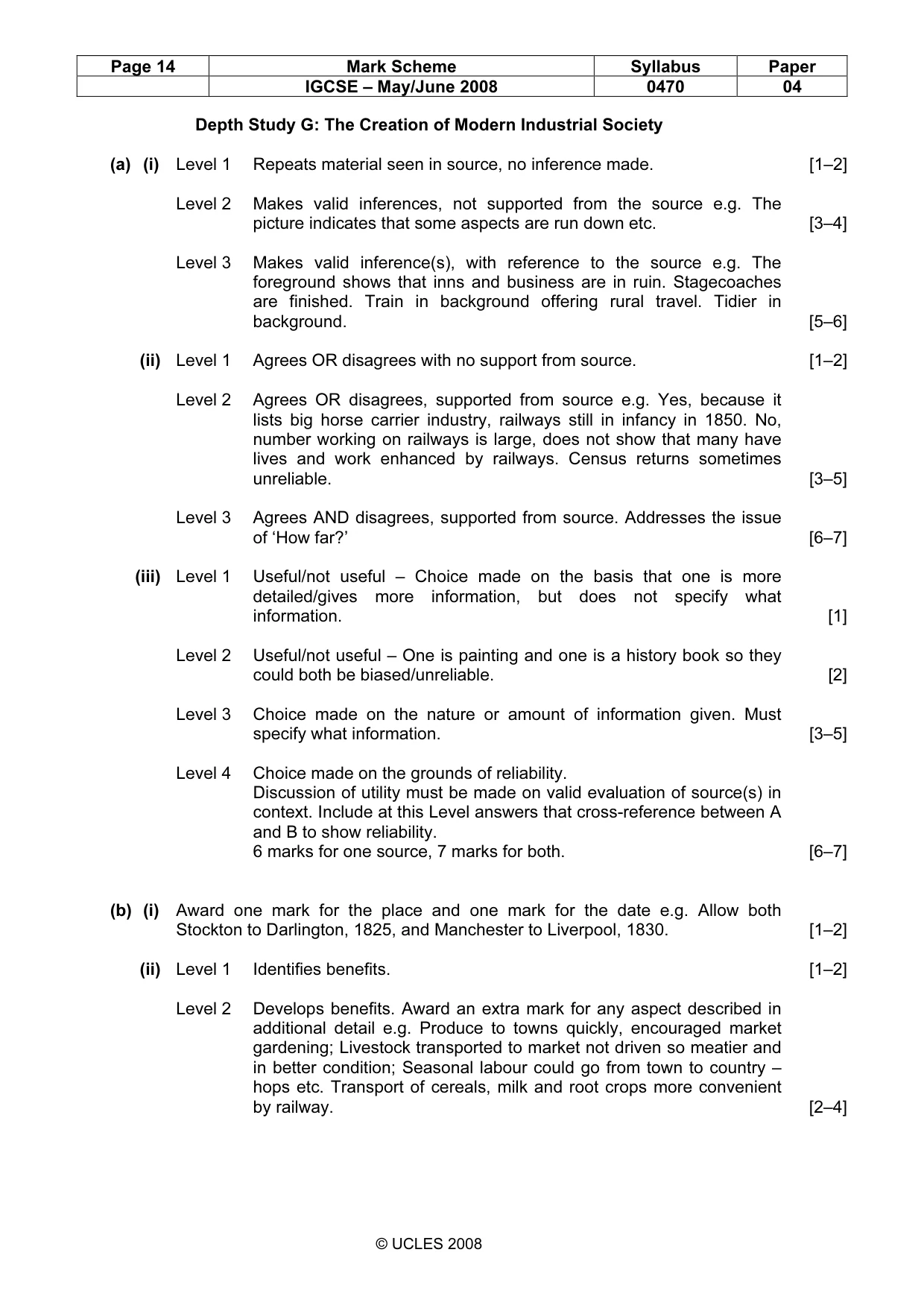
Page 14 Mark Scheme Syllabus Paper IGCSE – May/June 2008 0470 04 © UCLES 2008 Depth Study G: The Creation of Modern Industrial Society (a) (i) Level 1 Repeats material seen in source, no inference made. [1–2] Level 2 Makes valid inferences, not supported from the source e.g. The picture indicates that some aspects are run down etc. [3–4] Level 3 Makes valid inference(s), with reference to the source e.g. The foreground shows that inns and business are in ruin. Stagecoaches are finished. Train in background offering rural travel. Tidier in background. [5–6] (ii) Level 1 Agrees OR disagrees with no support from source. [1–2] Level 2 Agrees OR disagrees, supported from source e.g. Yes, because it lists big horse carrier industry, railways still in infancy in 1850. No, number working on railways is large, does not show that many have lives and work enhanced by railways. Census returns sometimes unreliable. [3–5] Level 3 Agrees AND disagrees, supported from source. Addresses the issue of ‘How far?’ [6–7] (iii) Level 1 Useful/not useful – Choice made on the basis that one is more detailed/gives more information, but does not specify what information. [1] Level 2 Useful/not useful – One is painting and one is a history book so they could both be biased/unreliable. [2] Level 3 Choice made on the nature or amount of information given. Must specify what information. [3–5] Level 4 Choice made on the grounds of reliability. Discussion of utility must be made on valid evaluation of source(s) in context. Include at this Level answers that cross-reference between A and B to show reliability. 6 marks for one source, 7 marks for both. [6–7] (b) (i) Award one mark for the place and one mark for the date e.g. Allow both Stockton to Darlington, 1825, and Manchester to Liverpool, 1830. [1–2] (ii) Level 1 Identifies benefits. [1–2] Level 2 Develops benefits. Award an extra mark for any aspect described in additional detail e.g. Produce to towns quickly, encouraged market gardening; Livestock transported to market not driven so meatier and in better condition; Seasonal labour could go from town to country – hops etc. Transport of cereals, milk and root crops more convenient by railway. [2–4]
Mark scheme, page 15
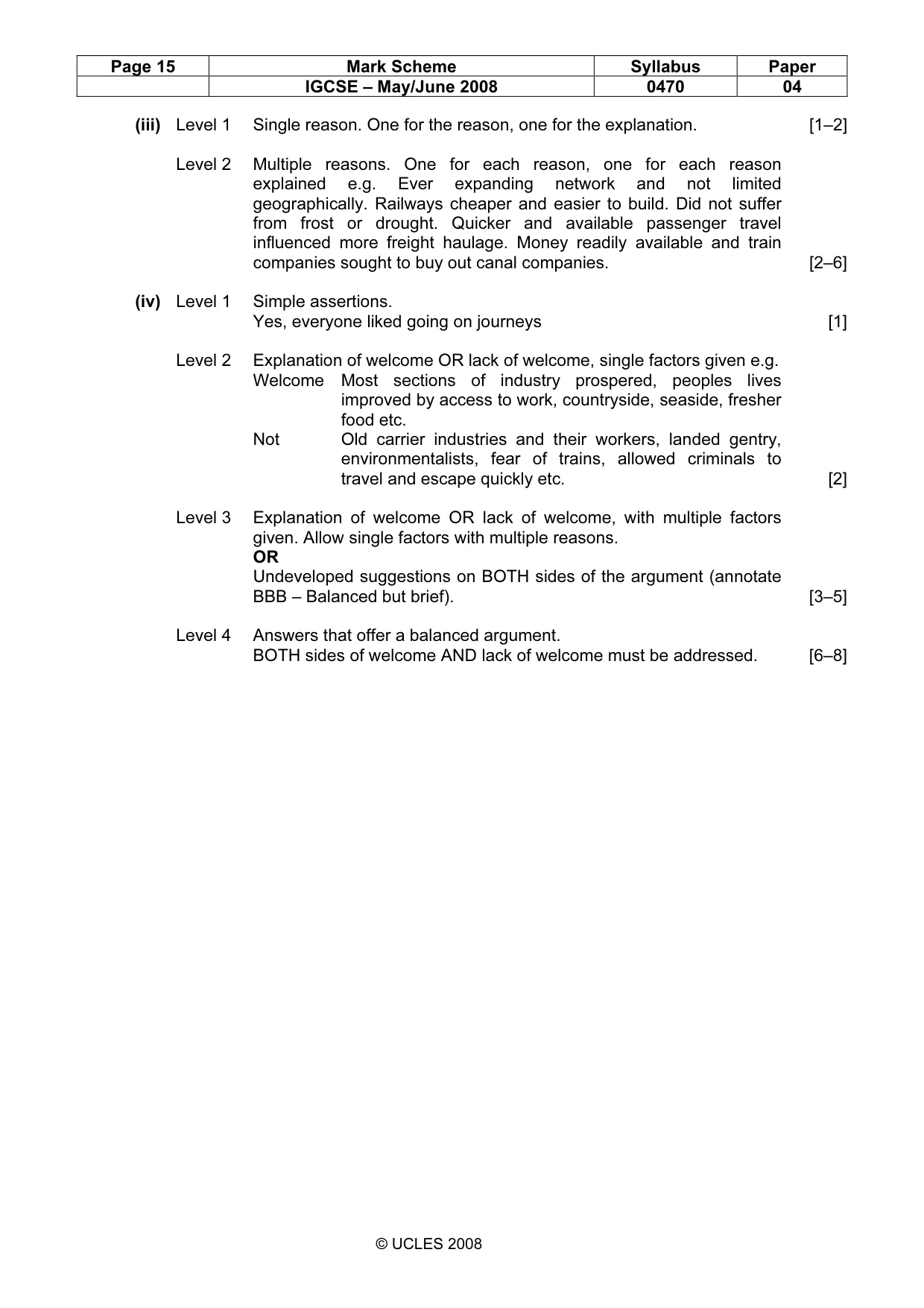
Page 15 Mark Scheme Syllabus Paper IGCSE – May/June 2008 0470 04 © UCLES 2008 (iii) Level 1 Single reason. One for the reason, one for the explanation. [1–2] Level 2 Multiple reasons. One for each reason, one for each reason explained e.g. Ever expanding network and not limited geographically. Railways cheaper and easier to build. Did not suffer from frost or drought. Quicker and available passenger travel influenced more freight haulage. Money readily available and train companies sought to buy out canal companies. [2–6] (iv) Level 1 Simple assertions. Yes, everyone liked going on journeys [1] Level 2 Explanation of welcome OR lack of welcome, single factors given e.g. Welcome Most sections of industry prospered, peoples lives improved by access to work, countryside, seaside, fresher food etc. Not Old carrier industries and their workers, landed gentry, environmentalists, fear of trains, allowed criminals to travel and escape quickly etc. [2] Level 3 Explanation of welcome OR lack of welcome, with multiple factors given. Allow single factors with multiple reasons. OR Undeveloped suggestions on BOTH sides of the argument (annotate BBB – Balanced but brief). [3–5] Level 4 Answers that offer a balanced argument. BOTH sides of welcome AND lack of welcome must be addressed. [6–8]
Mark scheme, page 16
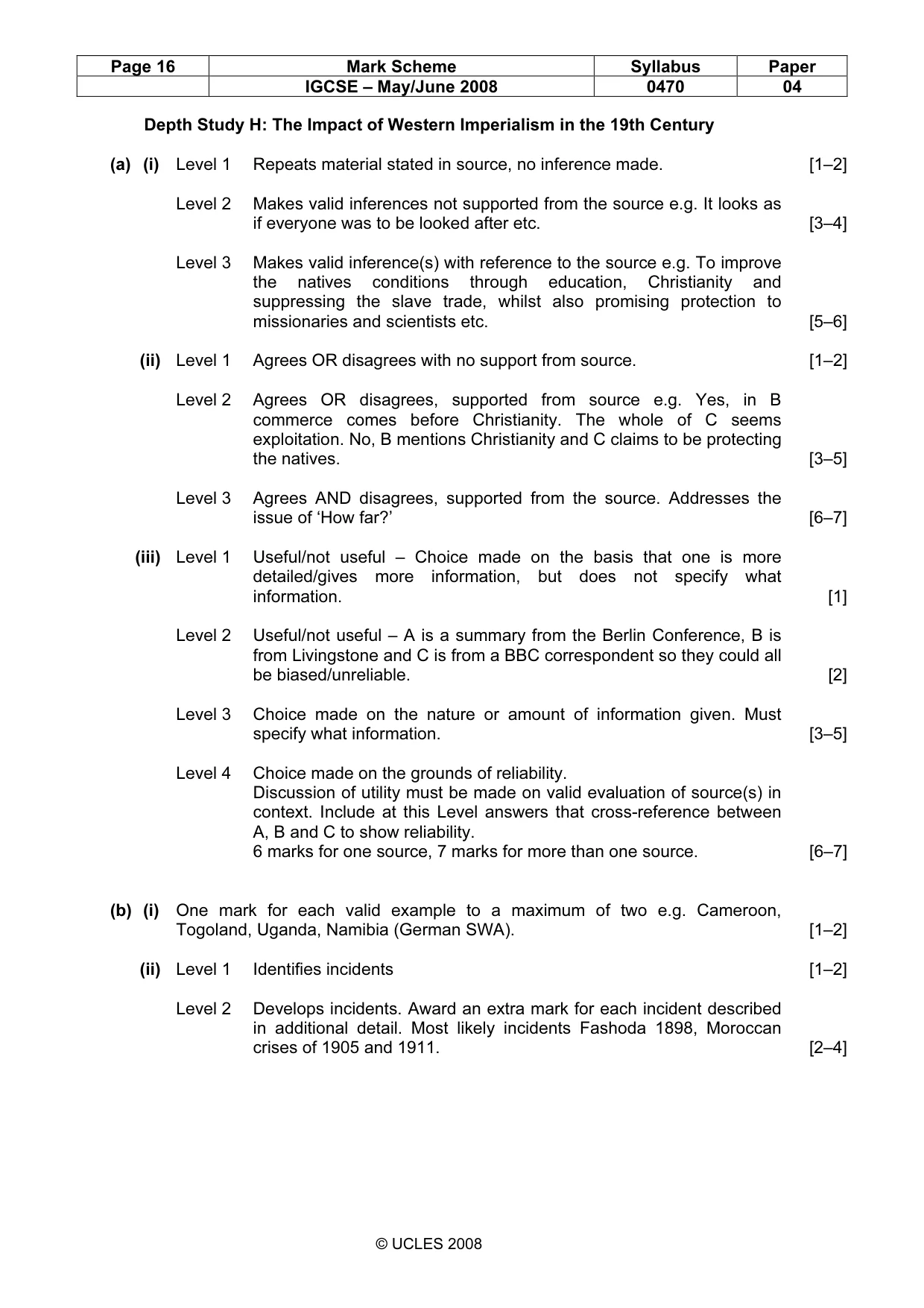
Page 16 Mark Scheme Syllabus Paper IGCSE – May/June 2008 0470 04 © UCLES 2008 Depth Study H: The Impact of Western Imperialism in the 19th Century (a) (i) Level 1 Repeats material stated in source, no inference made. [1–2] Level 2 Makes valid inferences not supported from the source e.g. It looks as if everyone was to be looked after etc. [3–4] Level 3 Makes valid inference(s) with reference to the source e.g. To improve the natives conditions through education, Christianity and suppressing the slave trade, whilst also promising protection to missionaries and scientists etc. [5–6] (ii) Level 1 Agrees OR disagrees with no support from source. [1–2] Level 2 Agrees OR disagrees, supported from source e.g. Yes, in B commerce comes before Christianity. The whole of C seems exploitation. No, B mentions Christianity and C claims to be protecting the natives. [3–5] Level 3 Agrees AND disagrees, supported from the source. Addresses the issue of ‘How far?’ [6–7] (iii) Level 1 Useful/not useful – Choice made on the basis that one is more detailed/gives more information, but does not specify what information. [1] Level 2 Useful/not useful – A is a summary from the Berlin Conference, B is from Livingstone and C is from a BBC correspondent so they could all be biased/unreliable. [2] Level 3 Choice made on the nature or amount of information given. Must specify what information. [3–5] Level 4 Choice made on the grounds of reliability. Discussion of utility must be made on valid evaluation of source(s) in context. Include at this Level answers that cross-reference between A, B and C to show reliability. 6 marks for one source, 7 marks for more than one source. [6–7] (b) (i) One mark for each valid example to a maximum of two e.g. Cameroon, Togoland, Uganda, Namibia (German SWA). [1–2] (ii) Level 1 Identifies incidents [1–2] Level 2 Develops incidents. Award an extra mark for each incident described in additional detail. Most likely incidents Fashoda 1898, Moroccan crises of 1905 and 1911. [2–4]
Mark scheme, page 17
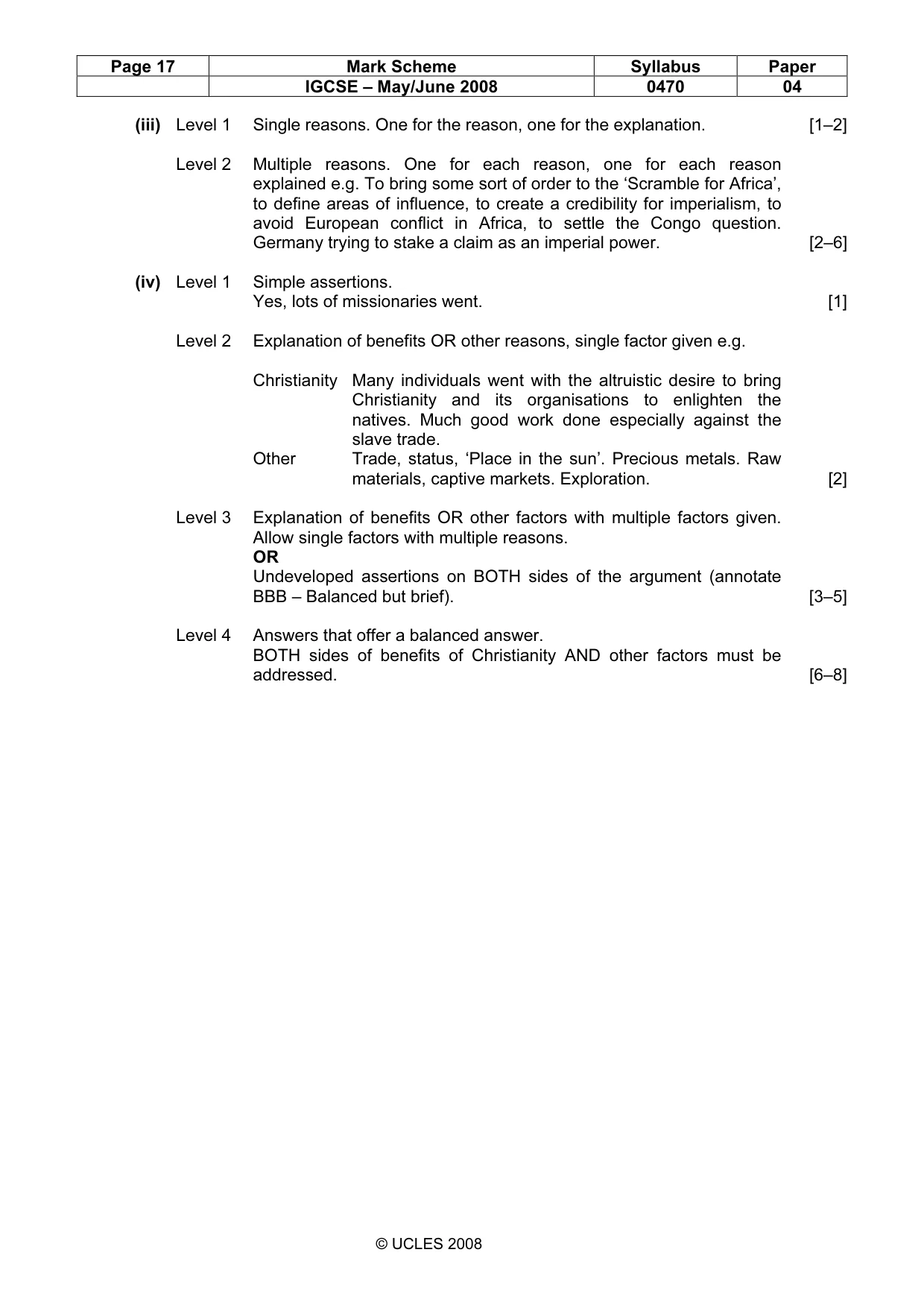
Page 17 Mark Scheme Syllabus Paper IGCSE – May/June 2008 0470 04 © UCLES 2008 (iii) Level 1 Single reasons. One for the reason, one for the explanation. [1–2] Level 2 Multiple reasons. One for each reason, one for each reason explained e.g. To bring some sort of order to the ‘Scramble for Africa’, to define areas of influence, to create a credibility for imperialism, to avoid European conflict in Africa, to settle the Congo question. Germany trying to stake a claim as an imperial power. [2–6] (iv) Level 1 Simple assertions. Yes, lots of missionaries went. [1] Level 2 Explanation of benefits OR other reasons, single factor given e.g. Christianity Many individuals went with the altruistic desire to bring Christianity and its organisations to enlighten the natives. Much good work done especially against the slave trade. Other Trade, status, ‘Place in the sun’. Precious metals. Raw materials, captive markets. Exploration. [2] Level 3 Explanation of benefits OR other factors with multiple factors given. Allow single factors with multiple reasons. OR Undeveloped assertions on BOTH sides of the argument (annotate BBB – Balanced but brief). [3–5] Level 4 Answers that offer a balanced answer. BOTH sides of benefits of Christianity AND other factors must be addressed. [6–8]
What you needed in this session
Cambridge’s own grade thresholds for 2008 May/June, Paper 4 · Variant 1. A higher threshold means an easier paper — the bar moves with how the cohort did.