Cambridge IGCSE History 0470 — 2007 Oct/Nov Paper 4 · Variant 1
0470/41/O/N/07 · 40 marks · ≈45 min
The question paper and its mark scheme, free to read here and free to download. This is Cambridge’s own paper, exactly as it was sat.
Question paper11 pages
Mark scheme17 pages
Answers below. Sit the paper first if you are practising.
Paper as text
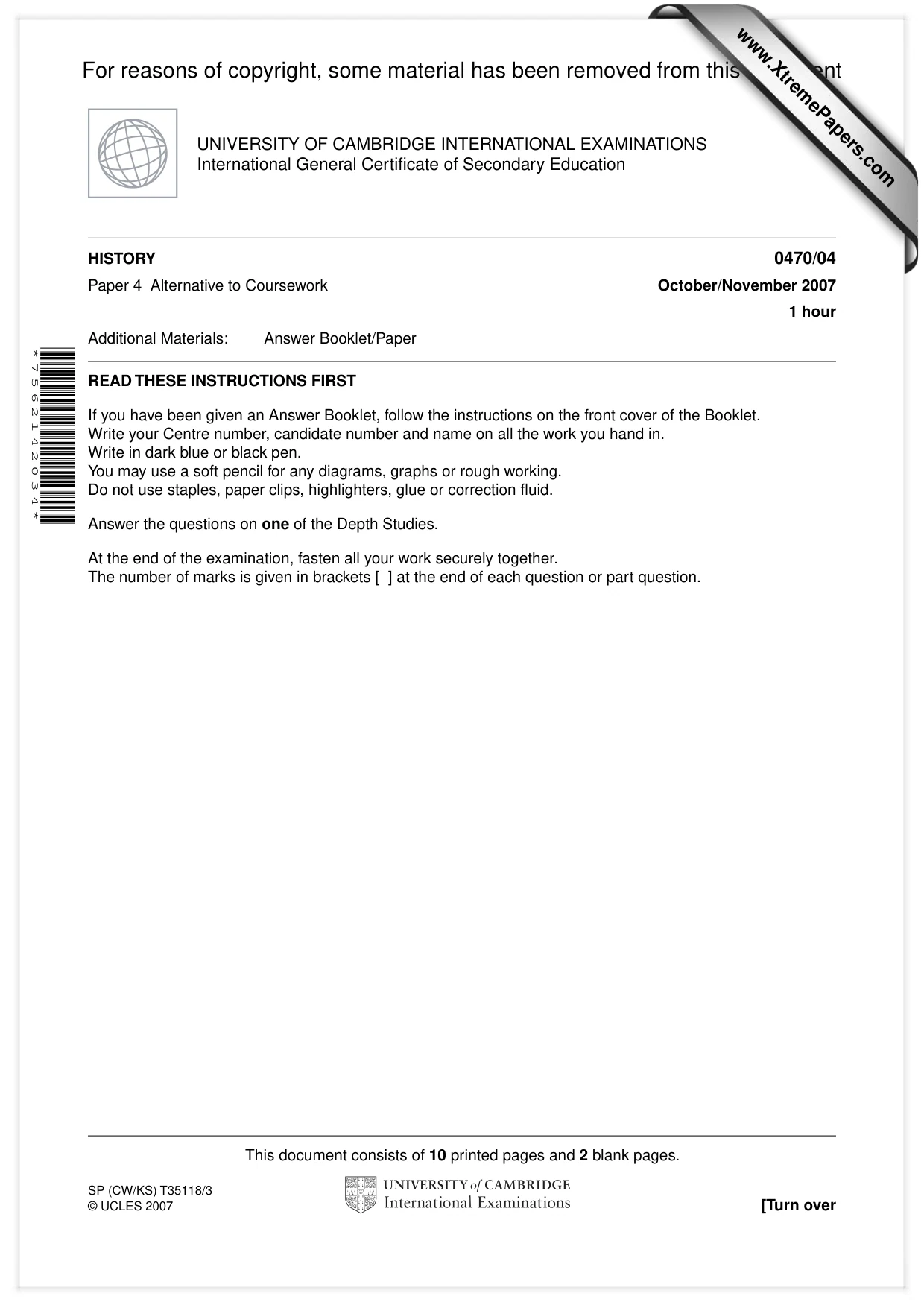
Question paper, page 1
This document consists of 10 printed pages and 2 blank pages. SP (CW/KS) T35118/3 © UCLES 2007 [Turn over UNIVERSITY OF CAMBRIDGE INTERNATIONAL EXAMINATIONS International General Certificate of Secondary Education READ THESE INSTRUCTIONS FIRST If you have been given an Answer Booklet, follow the instructions on the front cover of the Booklet. Write your Centre number, candidate number and name on all the work you hand in. Write in dark blue or black pen. You may use a soft pencil for any diagrams, graphs or rough working. Do not use staples, paper clips, highlighters, glue or correction fluid. Answer the questions on one of the Depth Studies. At the end of the examination, fasten all your work securely together. The number of marks is given in brackets [ ] at the end of each question or part question. * 7 5 6 2 1 4 2 0 3 4 * HISTORY 0470/04 Paper 4 Alternative to Coursework October/November 2007 1 hour Additional Materials: Answer Booklet/Paper For reasons of copyright, some material has been removed from this document www.XtremePapers.com
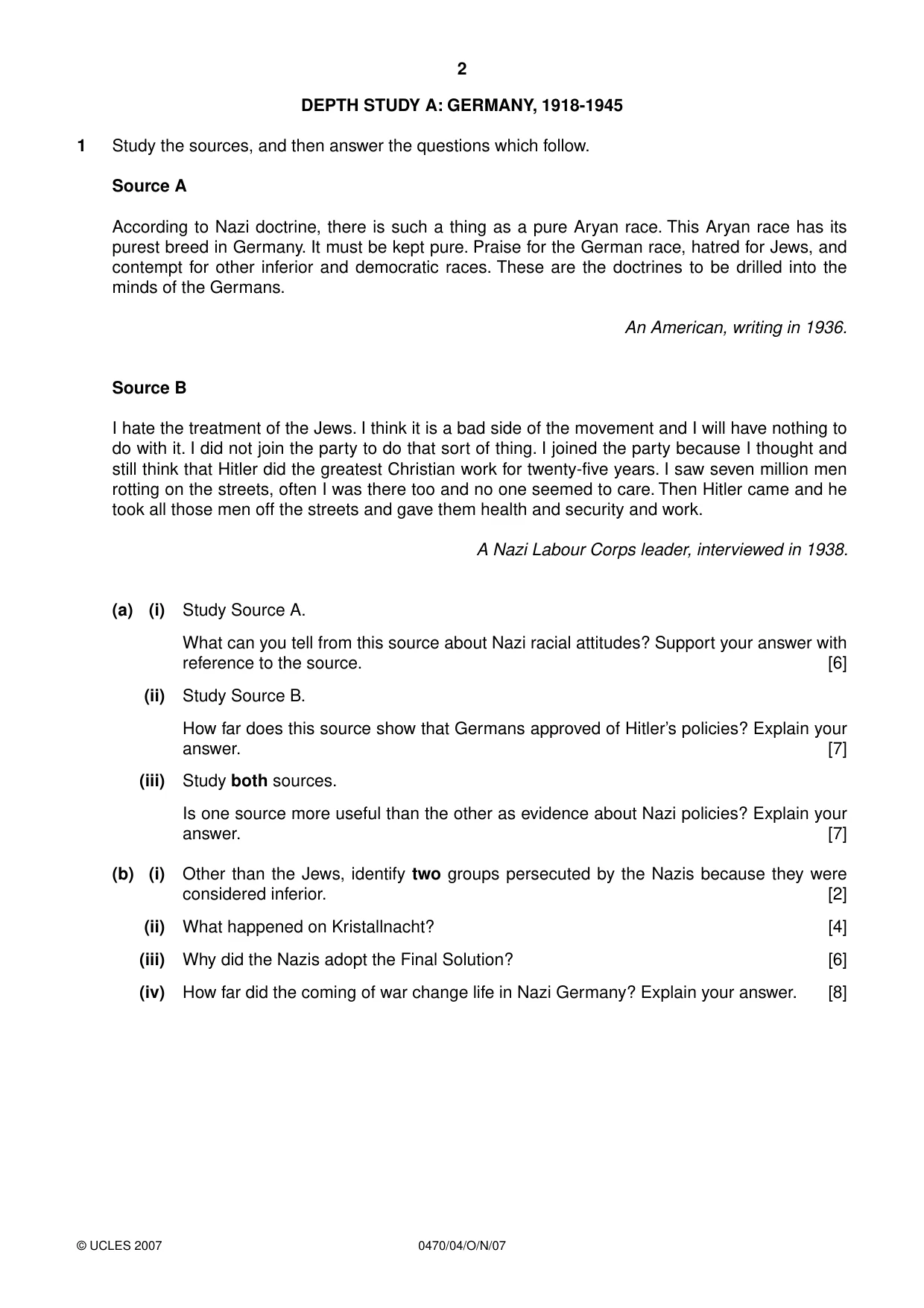
Question paper, page 2
2 0470/04/O/N/07 © UCLES 2007 DEPTH STUDY A: GERMANY, 1918-1945 1 Study the sources, and then answer the questions which follow. Source A According to Nazi doctrine, there is such a thing as a pure Aryan race. This Aryan race has its purest breed in Germany. It must be kept pure. Praise for the German race, hatred for Jews, and contempt for other inferior and democratic races. These are the doctrines to be drilled into the minds of the Germans. An American, writing in 1936. Source B I hate the treatment of the Jews. I think it is a bad side of the movement and I will have nothing to do with it. I did not join the party to do that sort of thing. I joined the party because I thought and still think that Hitler did the greatest Christian work for twenty-five years. I saw seven million men rotting on the streets, often I was there too and no one seemed to care. Then Hitler came and he took all those men off the streets and gave them health and security and work. A Nazi Labour Corps leader, interviewed in 1938. (a) (i) Study Source A. What can you tell from this source about Nazi racial attitudes? Support your answer with reference to the source. [6] (ii) Study Source B. How far does this source show that Germans approved of Hitler’s policies? Explain your answer. [7] (iii) Study both sources. Is one source more useful than the other as evidence about Nazi policies? Explain your answer. [7] (b) (i) Other than the Jews, identify two groups persecuted by the Nazis because they were considered inferior. [2] (ii) What happened on Kristallnacht? [4] (iii) Why did the Nazis adopt the Final Solution? [6] (iv) How far did the coming of war change life in Nazi Germany? Explain your answer. [8]
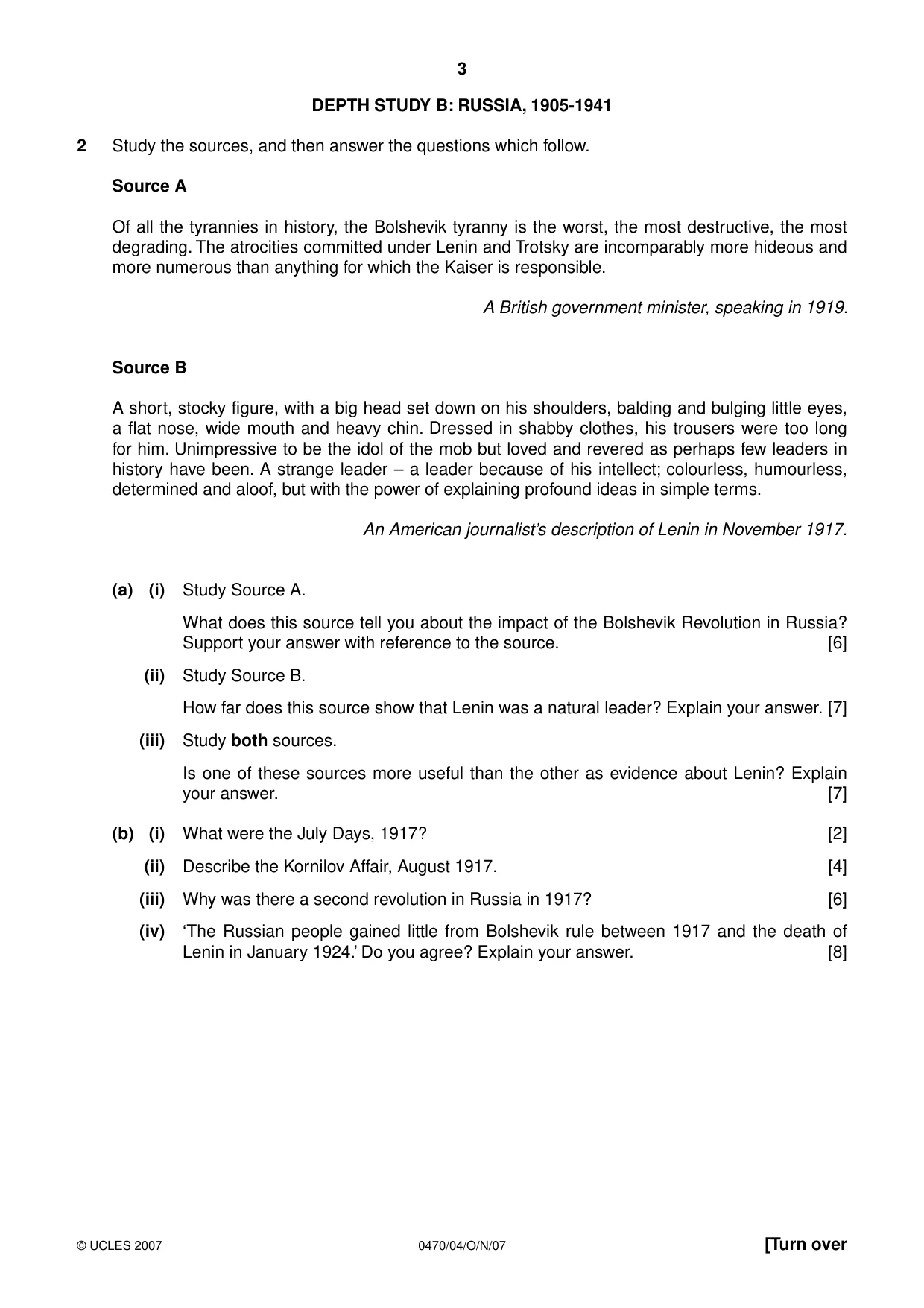
Question paper, page 3
3 0470/04/O/N/07 © UCLES 2007 [Turn over DEPTH STUDY B: RUSSIA, 1905-1941 2 Study the sources, and then answer the questions which follow. Source A Of all the tyrannies in history, the Bolshevik tyranny is the worst, the most destructive, the most degrading. The atrocities committed under Lenin and Trotsky are incomparably more hideous and more numerous than anything for which the Kaiser is responsible. A British government minister, speaking in 1919. Source B A short, stocky figure, with a big head set down on his shoulders, balding and bulging little eyes, a flat nose, wide mouth and heavy chin. Dressed in shabby clothes, his trousers were too long for him. Unimpressive to be the idol of the mob but loved and revered as perhaps few leaders in history have been. A strange leader – a leader because of his intellect; colourless, humourless, determined and aloof, but with the power of explaining profound ideas in simple terms. An American journalist’s description of Lenin in November 1917. (a) (i) Study Source A. What does this source tell you about the impact of the Bolshevik Revolution in Russia? Support your answer with reference to the source. [6] (ii) Study Source B. How far does this source show that Lenin was a natural leader? Explain your answer. [7] (iii) Study both sources. Is one of these sources more useful than the other as evidence about Lenin? Explain your answer. [7] (b) (i) What were the July Days, 1917? [2] (ii) Describe the Kornilov Affair, August 1917. [4] (iii) Why was there a second revolution in Russia in 1917? [6] (iv) ‘The Russian people gained little from Bolshevik rule between 1917 and the death of Lenin in January 1924.’ Do you agree? Explain your answer. [8]
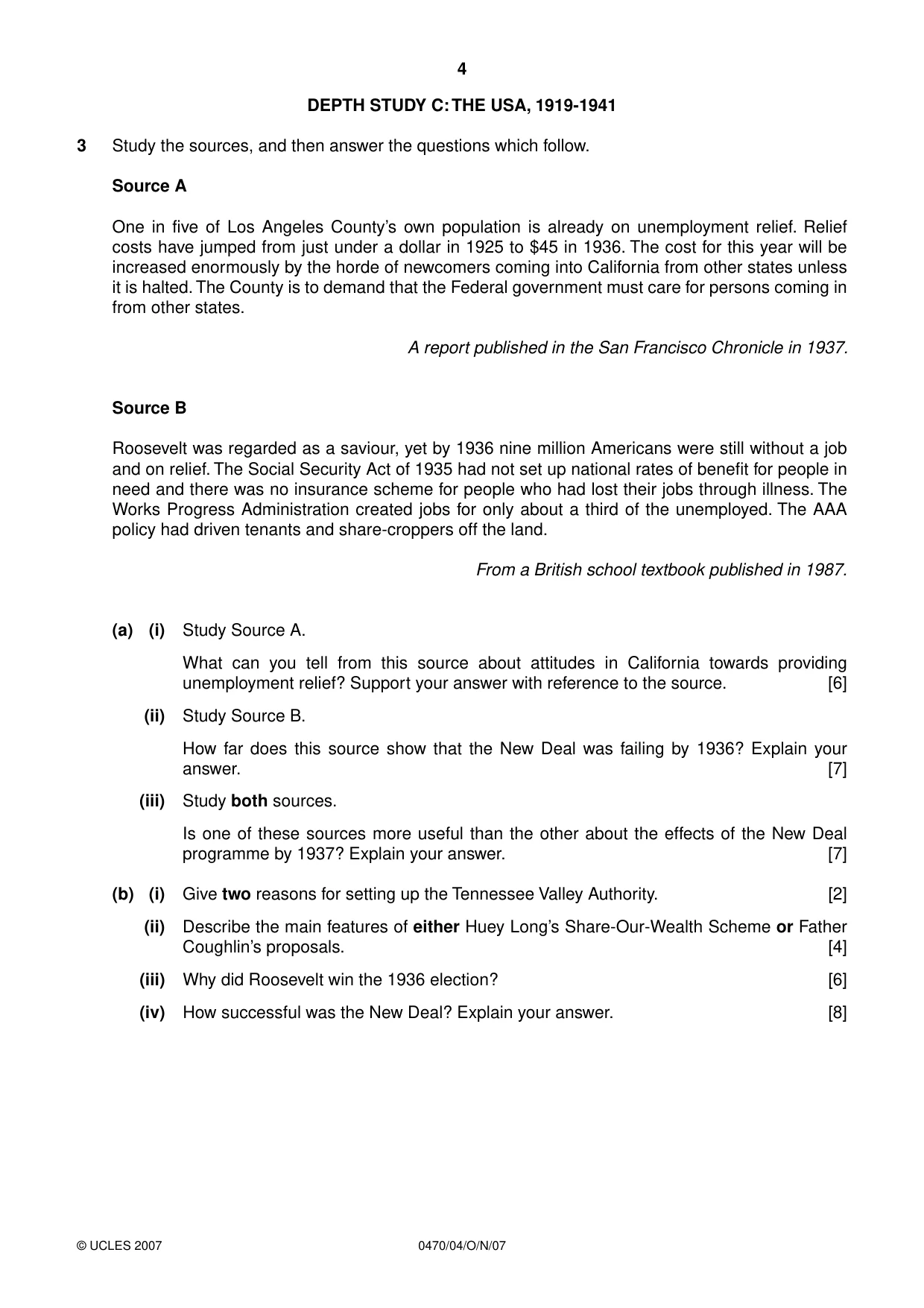
Question paper, page 4
4 0470/04/O/N/07 © UCLES 2007 DEPTH STUDY C: THE USA, 1919-1941 3 Study the sources, and then answer the questions which follow. Source A One in five of Los Angeles County’s own population is already on unemployment relief. Relief costs have jumped from just under a dollar in 1925 to $45 in 1936. The cost for this year will be increased enormously by the horde of newcomers coming into California from other states unless it is halted. The County is to demand that the Federal government must care for persons coming in from other states. A report published in the San Francisco Chronicle in 1937. Source B Roosevelt was regarded as a saviour, yet by 1936 nine million Americans were still without a job and on relief. The Social Security Act of 1935 had not set up national rates of benefit for people in need and there was no insurance scheme for people who had lost their jobs through illness. The Works Progress Administration created jobs for only about a third of the unemployed. The AAA policy had driven tenants and share-croppers off the land. From a British school textbook published in 1987. (a) (i) Study Source A. What can you tell from this source about attitudes in California towards providing unemployment relief? Support your answer with reference to the source. [6] (ii) Study Source B. How far does this source show that the New Deal was failing by 1936? Explain your answer. [7] (iii) Study both sources. Is one of these sources more useful than the other about the effects of the New Deal programme by 1937? Explain your answer. [7] (b) (i) Give two reasons for setting up the Tennessee Valley Authority. [2] (ii) Describe the main features of either Huey Long’s Share-Our-Wealth Scheme or Father Coughlin’s proposals. [4] (iii) Why did Roosevelt win the 1936 election? [6] (iv) How successful was the New Deal? Explain your answer. [8]
Question paper, page 5
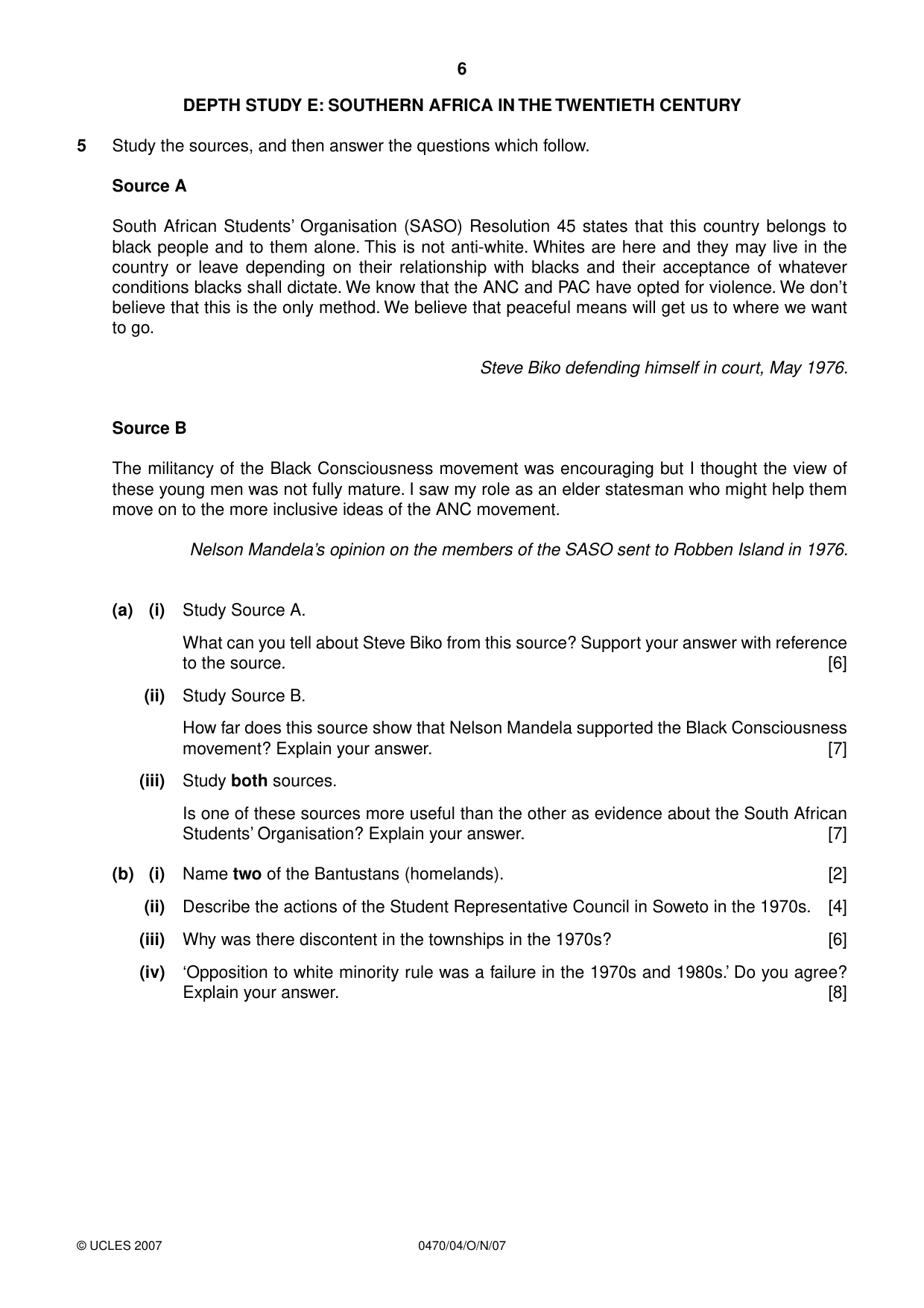
6 0470/04/O/N/07 © UCLES 2007 DEPTH STUDY E: SOUTHERN AFRICA IN THE TWENTIETH CENTURY 5 Study the sources, and then answer the questions which follow. Source A South African Students’ Organisation (SASO) Resolution 45 states that this country belongs to black people and to them alone. This is not anti-white. Whites are here and they may live in the country or leave depending on their relationship with blacks and their acceptance of whatever conditions blacks shall dictate. We know that the ANC and PAC have opted for violence. We don’t believe that this is the only method. We believe that peaceful means will get us to where we want to go. Steve Biko defending himself in court, May 1976. Source B The militancy of the Black Consciousness movement was encouraging but I thought the view of these young men was not fully mature. I saw my role as an elder statesman who might help them move on to the more inclusive ideas of the ANC movement. Nelson Mandela’s opinion on the members of the SASO sent to Robben Island in 1976. (a) (i) Study Source A. What can you tell about Steve Biko from this source? Support your answer with reference to the source. [6] (ii) Study Source B. How far does this source show that Nelson Mandela supported the Black Consciousness movement? Explain your answer. [7] (iii) Study both sources. Is one of these sources more useful than the other as evidence about the South African Students’ Organisation? Explain your answer. [7] (b) (i) Name two of the Bantustans (homelands). [2] (ii) Describe the actions of the Student Representative Council in Soweto in the 1970s. [4] (iii) Why was there discontent in the townships in the 1970s? [6] (iv) ‘Opposition to white minority rule was a failure in the 1970s and 1980s.’ Do you agree? Explain your answer. [8]
Question paper, page 6
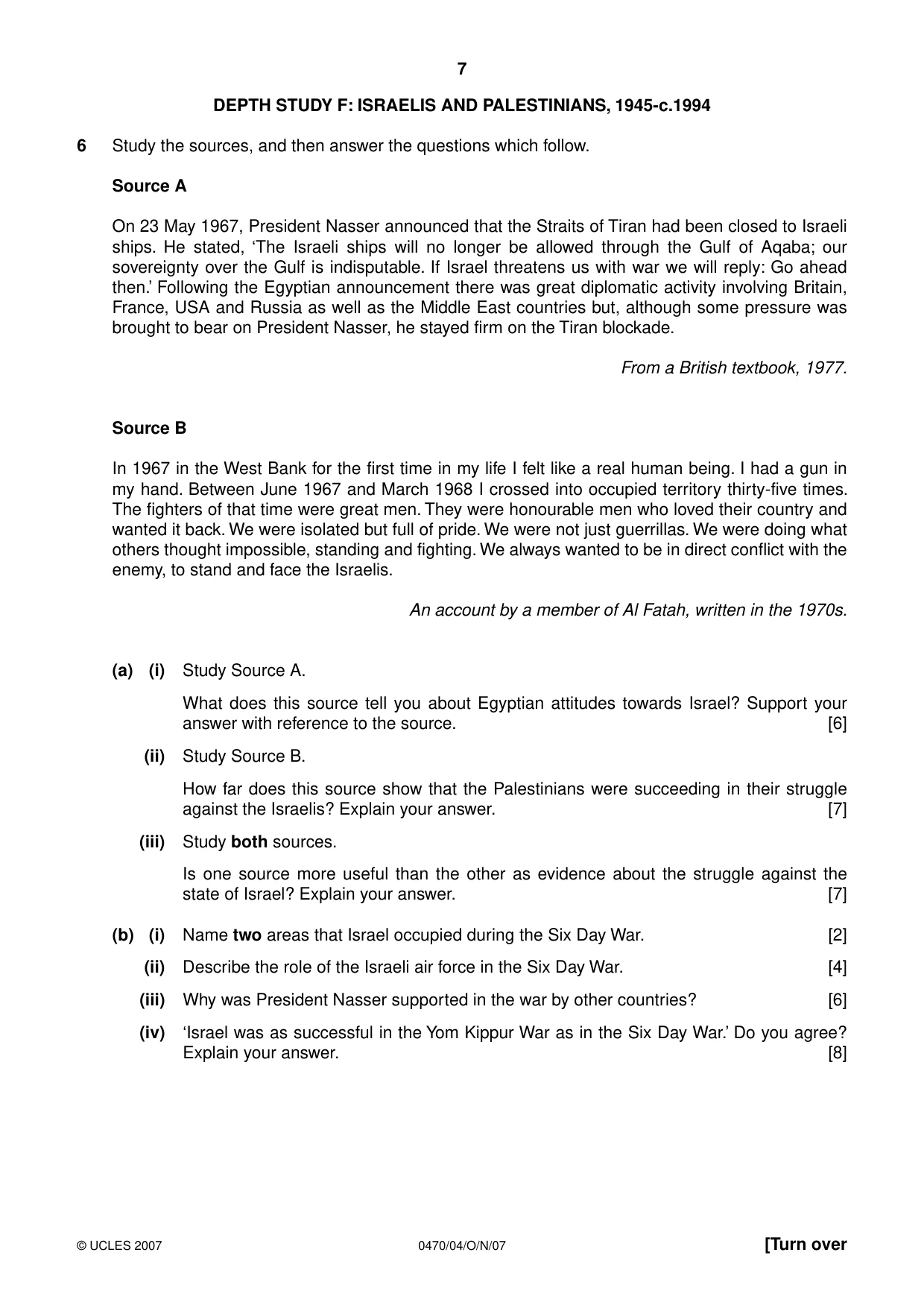
7 0470/04/O/N/07 © UCLES 2007 [Turn over DEPTH STUDY F: ISRAELIS AND PALESTINIANS, 1945-c.1994 6 Study the sources, and then answer the questions which follow. Source A On 23 May 1967, President Nasser announced that the Straits of Tiran had been closed to Israeli ships. He stated, ‘The Israeli ships will no longer be allowed through the Gulf of Aqaba; our sovereignty over the Gulf is indisputable. If Israel threatens us with war we will reply: Go ahead then.’ Following the Egyptian announcement there was great diplomatic activity involving Britain, France, USA and Russia as well as the Middle East countries but, although some pressure was brought to bear on President Nasser, he stayed firm on the Tiran blockade. From a British textbook, 1977. Source B In 1967 in the West Bank for the first time in my life I felt like a real human being. I had a gun in my hand. Between June 1967 and March 1968 I crossed into occupied territory thirty-five times. The fighters of that time were great men. They were honourable men who loved their country and wanted it back. We were isolated but full of pride. We were not just guerrillas. We were doing what others thought impossible, standing and fighting. We always wanted to be in direct conflict with the enemy, to stand and face the Israelis. An account by a member of Al Fatah, written in the 1970s. (a) (i) Study Source A. What does this source tell you about Egyptian attitudes towards Israel? Support your answer with reference to the source. [6] (ii) Study Source B. How far does this source show that the Palestinians were succeeding in their struggle against the Israelis? Explain your answer. [7] (iii) Study both sources. Is one source more useful than the other as evidence about the struggle against the state of Israel? Explain your answer. [7] (b) (i) Name two areas that Israel occupied during the Six Day War. [2] (ii) Describe the role of the Israeli air force in the Six Day War. [4] (iii) Why was President Nasser supported in the war by other countries? [6] (iv) ‘Israel was as successful in the Yom Kippur War as in the Six Day War.’ Do you agree? Explain your answer. [8]
Question paper, page 7
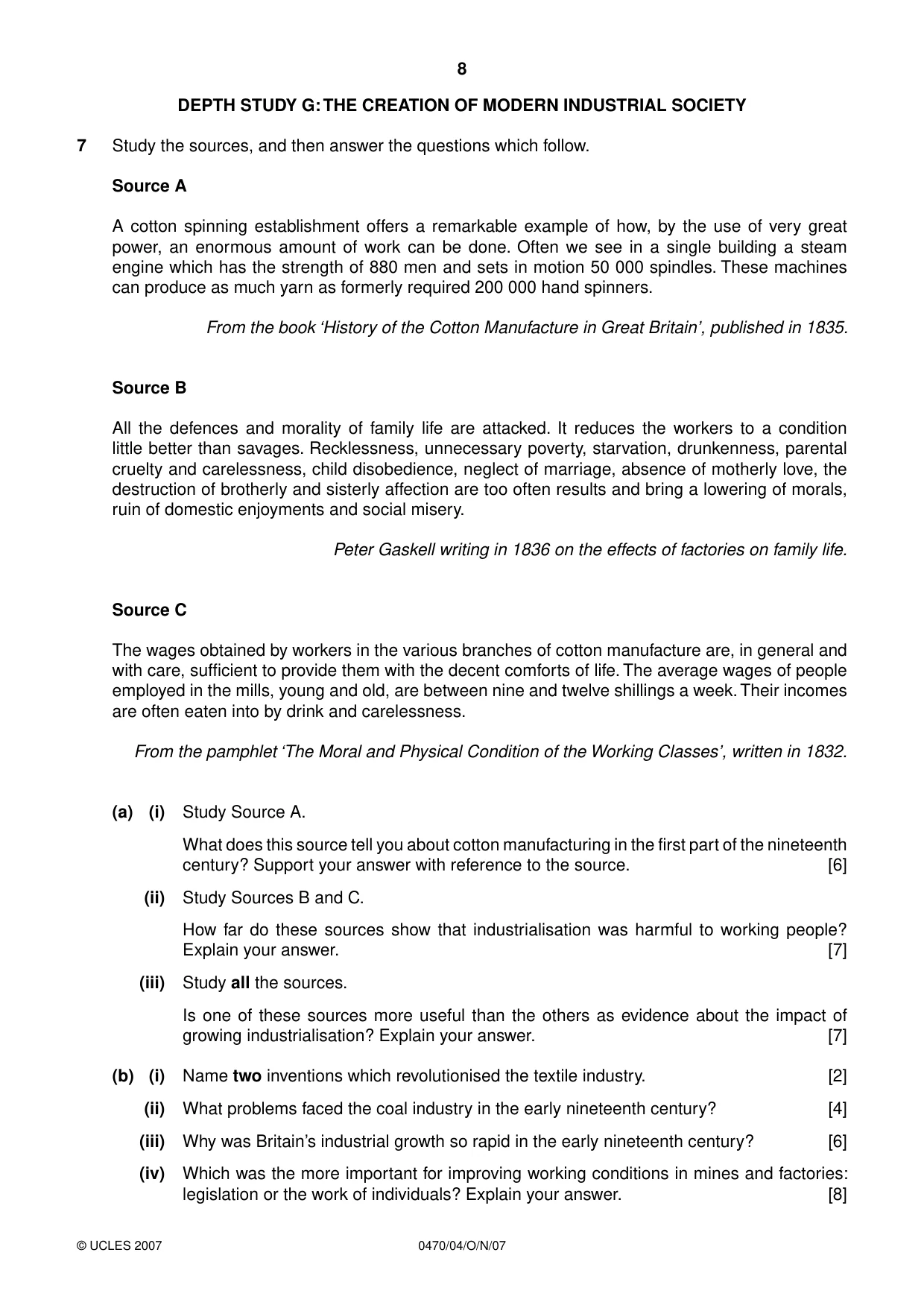
8 0470/04/O/N/07 © UCLES 2007 DEPTH STUDY G: THE CREATION OF MODERN INDUSTRIAL SOCIETY 7 Study the sources, and then answer the questions which follow. Source A A cotton spinning establishment offers a remarkable example of how, by the use of very great power, an enormous amount of work can be done. Often we see in a single building a steam engine which has the strength of 880 men and sets in motion 50 000 spindles. These machines can produce as much yarn as formerly required 200 000 hand spinners. From the book ‘History of the Cotton Manufacture in Great Britain’, published in 1835. Source B All the defences and morality of family life are attacked. It reduces the workers to a condition little better than savages. Recklessness, unnecessary poverty, starvation, drunkenness, parental cruelty and carelessness, child disobedience, neglect of marriage, absence of motherly love, the destruction of brotherly and sisterly affection are too often results and bring a lowering of morals, ruin of domestic enjoyments and social misery. Peter Gaskell writing in 1836 on the effects of factories on family life. Source C The wages obtained by workers in the various branches of cotton manufacture are, in general and with care, sufficient to provide them with the decent comforts of life. The average wages of people employed in the mills, young and old, are between nine and twelve shillings a week. Their incomes are often eaten into by drink and carelessness. From the pamphlet ‘The Moral and Physical Condition of the Working Classes’, written in 1832. (a) (i) Study Source A. What does this source tell you about cotton manufacturing in the first part of the nineteenth century? Support your answer with reference to the source. [6] (ii) Study Sources B and C. How far do these sources show that industrialisation was harmful to working people? Explain your answer. [7] (iii) Study all the sources. Is one of these sources more useful than the others as evidence about the impact of growing industrialisation? Explain your answer. [7] (b) (i) Name two inventions which revolutionised the textile industry. [2] (ii) What problems faced the coal industry in the early nineteenth century? [4] (iii) Why was Britain’s industrial growth so rapid in the early nineteenth century? [6] (iv) Which was the more important for improving working conditions in mines and factories: legislation or the work of individuals? Explain your answer. [8]
Question paper, page 8
9 0470/04/O/N/07 © UCLES 2007 [Turn over BLANK PAGE DEPTH STUDY H STARTS ON PAGE 10
Question paper, page 9
10 0470/04/O/N/07 © UCLES 2007 DEPTH STUDY H: THE IMPACT OF WESTERN IMPERIALISM IN THE NINETEENTH CENTURY 8 Study the sources, and then answer the questions which follow. Source A A nineteenth-century missionary postcard. Source B A great part of the world is inhabited by barbarian tribes or savages. Some fight endless wars and have brutal customs. Others know so little of the arts and are so little accustomed to work that they do not know how to exploit the land and its natural riches. It is neither natural nor just for the civilised people of the West to be limited indefinitely and restricted to spaces which were their first home. Nor is it natural or just that the West enjoys the marvels of science, the arts and civilisation while they leave half the world to groups of ignorant savages. Written by a Frenchman in 1891. Source C The vilest scramble for loot that ever disfigured the history of human conscience and geographical exploration. The nineteenth-century novelist Joseph Conrad commenting on imperialism.
Question paper, page 10
11 0470/04/O/N/07 © UCLES 2007 (a) (i) Study Source A. What impressions does this source give of Western attitudes towards non-European races? Support your answer with reference to the source. [6] (ii) Study Source B. How far does this source show that the West’s motives for imperialism were selfish? Explain your answer. [7] (iii) Study all the sources. Is one of these sources more useful than the others as evidence about imperialism in the nineteenth century? Explain your answer. [7] (b) (i) Name two British politicians of the nineteenth century who pursued imperialist policies. [2] (ii) Describe the aims of missionaries in the nineteenth century. [4] (iii) Why did Britain have such a large empire by the end of the nineteenth century? [6] (iv) Did Europeans bring ‘civilisation’ to other parts of the world in the nineteenth century? Explain your answer. [8]
Question paper, page 11
12 0470/04/O/N/07 BLANK PAGE Copyright Acknowledgements: Depth Study C Source A © San Francisco Chronicle. Depth Study C Source B © A. Howarth; 20th Century History: The World Since 1900 ; Longman; 1987. Depth Study D Source A Reprinted by permission of the publisher from, MAO’S PEOPLE: SIXTEEN PORTRAITS OF LIFE IN REVOLUNTIONARY CHINA by Bernard Frolic, Cambridge, Mass.: Harvard University Press, Copyright © 1980 by the President and Fellows of Harvard College. Depth Study D Source B Reprinted by permission of HarperCollins Publishers Ltd © Jung Chang, 2003. Depth Study E Source A © Steve Biko; I Write What I Like: A Selection of Writings; Penguin Books Ltd; 1988. Depth Study E Source B From LONG WALK TO FREEDOM by NELSON MANDELA. Copyright © 1994, 1995 by Nelson Rolihlahla Mandela. By permission of Little, Brown and Company, Inc. All rights reserved. Permission to reproduce items where third-party owned material protected by copyright is included has been sought and cleared where possible. Every reasonable effort has been made by the publisher (UCLES) to trace copyright holders, but if any items requiring clearance have unwittingly been included, the publisher will be pleased to make amends at the earliest possible opportunity. University of Cambridge International Examinations is part of the Cambridge Assessment Group. Cambridge Assessment is the brand name of University of Cambridge Local Examinations Syndicate (UCLES), which is itself a department of the University of Cambridge.
Mark scheme, page 1
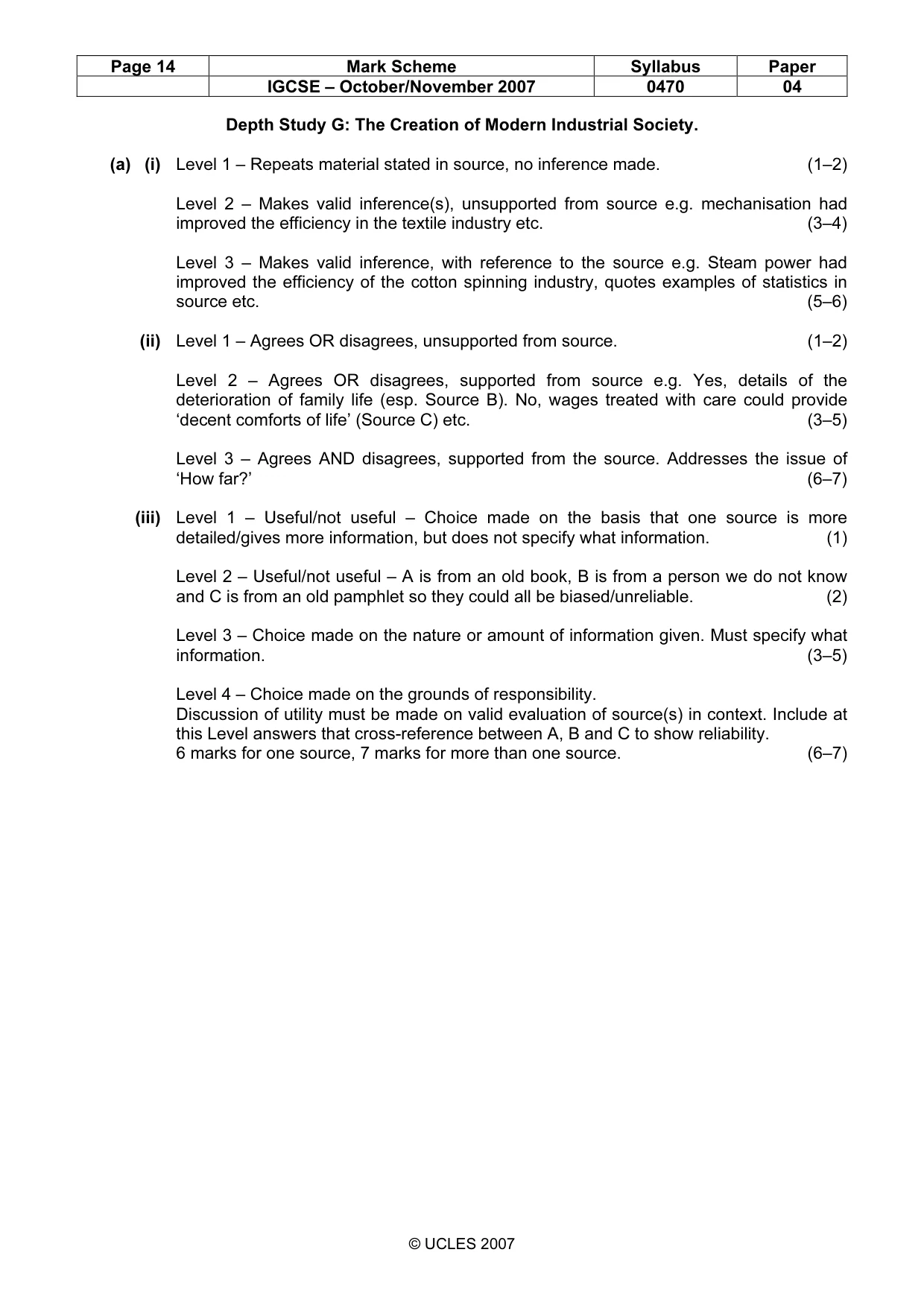
UNIVERSITY OF CAMBRIDGE INTERNATIONAL EXAMINATIONS International General Certificate of Secondary Education MARK SCHEME for the October/November 2007 question paper 0470 HISTORY 0470/04 Paper 4 (Alternative to Coursework), maximum raw mark 40 This mark scheme is published as an aid to teachers and candidates, to indicate the requirements of the examination. It shows the basis on which Examiners were instructed to award marks. It does not indicate the details of the discussions that took place at an Examiners’ meeting before marking began. All Examiners are instructed that alternative correct answers and unexpected approaches in candidates’ scripts must be given marks that fairly reflect the relevant knowledge and skills demonstrated. Mark schemes must be read in conjunction with the question papers and the report on the examination. • CIE will not enter into discussions or correspondence in connection with these mark schemes. CIE is publishing the mark schemes for the October/November 2007 question papers for most IGCSE, GCE Advanced Level and Advanced Subsidiary Level syllabuses and some Ordinary Level syllabuses. www.XtremePapers.com
Mark scheme, page 2
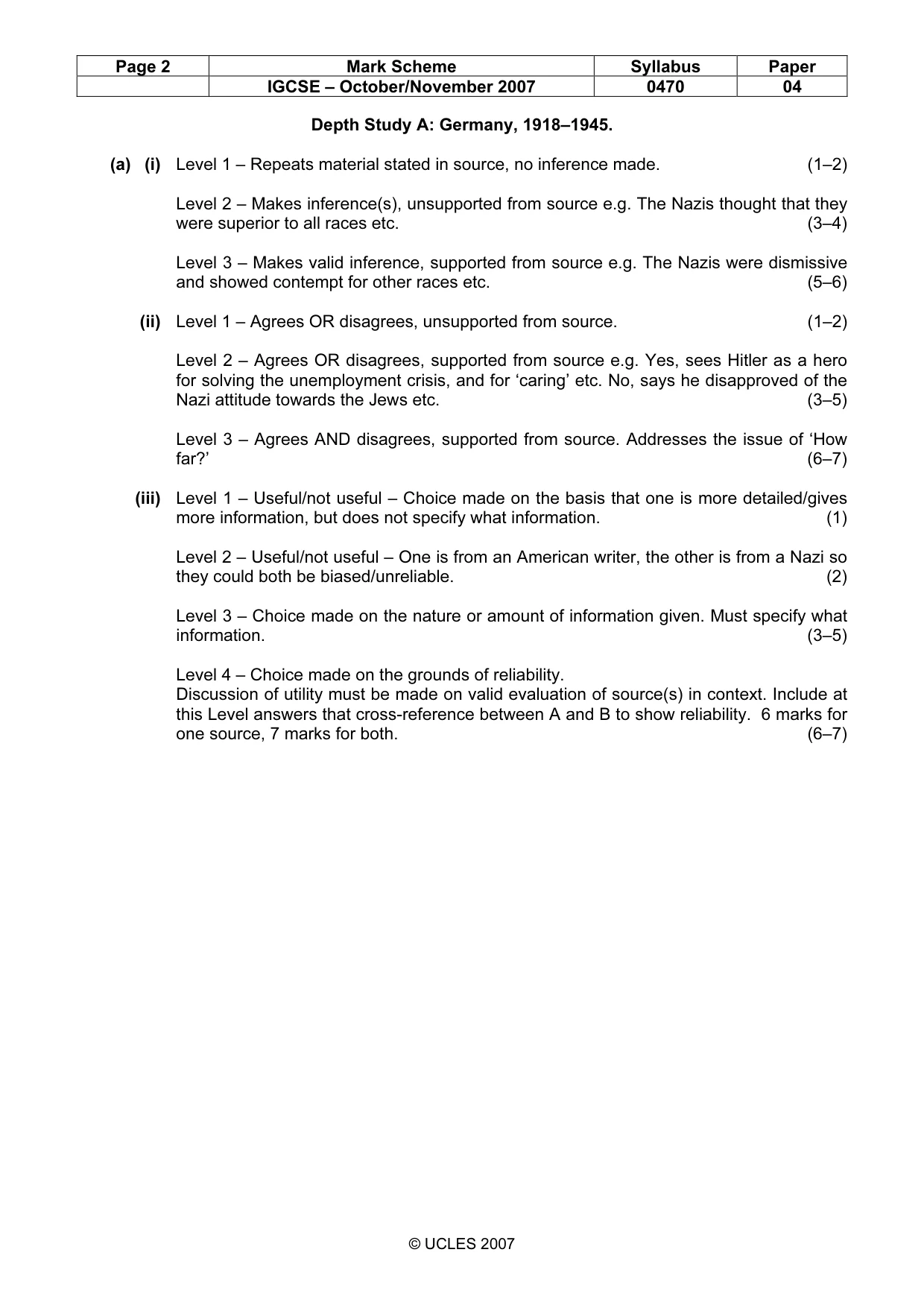
Page 2 Mark Scheme Syllabus Paper IGCSE – October/November 2007 0470 04 © UCLES 2007 Depth Study A: Germany, 1918–1945. (a) (i) Level 1 – Repeats material stated in source, no inference made. (1–2) Level 2 – Makes inference(s), unsupported from source e.g. The Nazis thought that they were superior to all races etc. (3–4) Level 3 – Makes valid inference, supported from source e.g. The Nazis were dismissive and showed contempt for other races etc. (5–6) (ii) Level 1 – Agrees OR disagrees, unsupported from source. (1–2) Level 2 – Agrees OR disagrees, supported from source e.g. Yes, sees Hitler as a hero for solving the unemployment crisis, and for ‘caring’ etc. No, says he disapproved of the Nazi attitude towards the Jews etc. (3–5) Level 3 – Agrees AND disagrees, supported from source. Addresses the issue of ‘How far?’ (6–7) (iii) Level 1 – Useful/not useful – Choice made on the basis that one is more detailed/gives more information, but does not specify what information. (1) Level 2 – Useful/not useful – One is from an American writer, the other is from a Nazi so they could both be biased/unreliable. (2) Level 3 – Choice made on the nature or amount of information given. Must specify what information. (3–5) Level 4 – Choice made on the grounds of reliability. Discussion of utility must be made on valid evaluation of source(s) in context. Include at this Level answers that cross-reference between A and B to show reliability. 6 marks for one source, 7 marks for both. (6–7)
Mark scheme, page 3
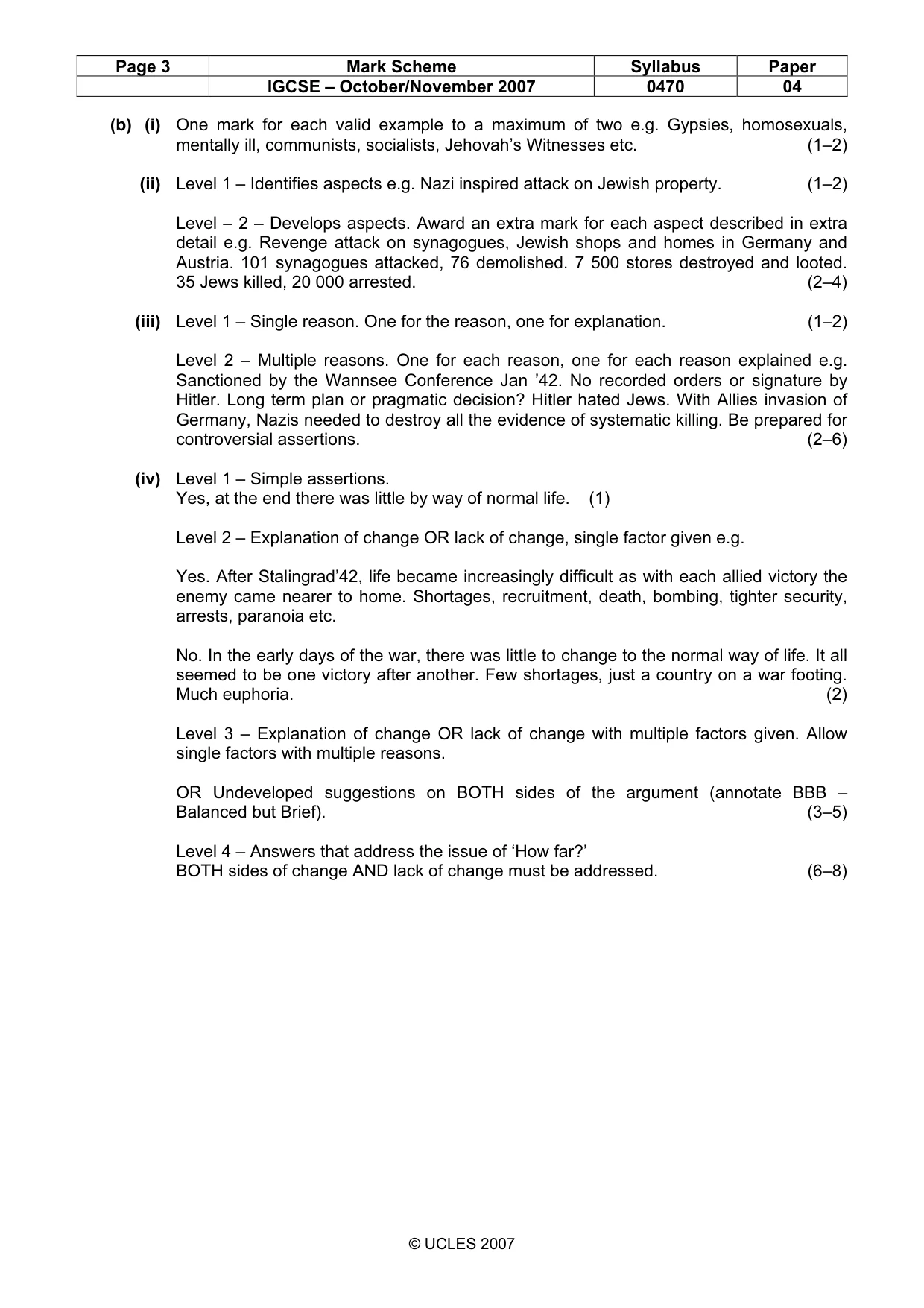
Page 3 Mark Scheme Syllabus Paper IGCSE – October/November 2007 0470 04 © UCLES 2007 (b) (i) One mark for each valid example to a maximum of two e.g. Gypsies, homosexuals, mentally ill, communists, socialists, Jehovah’s Witnesses etc. (1–2) (ii) Level 1 – Identifies aspects e.g. Nazi inspired attack on Jewish property. (1–2) Level – 2 – Develops aspects. Award an extra mark for each aspect described in extra detail e.g. Revenge attack on synagogues, Jewish shops and homes in Germany and Austria. 101 synagogues attacked, 76 demolished. 7 500 stores destroyed and looted. 35 Jews killed, 20 000 arrested. (2–4) (iii) Level 1 – Single reason. One for the reason, one for explanation. (1–2) Level 2 – Multiple reasons. One for each reason, one for each reason explained e.g. Sanctioned by the Wannsee Conference Jan ’42. No recorded orders or signature by Hitler. Long term plan or pragmatic decision? Hitler hated Jews. With Allies invasion of Germany, Nazis needed to destroy all the evidence of systematic killing. Be prepared for controversial assertions. (2–6) (iv) Level 1 – Simple assertions. Yes, at the end there was little by way of normal life. (1) Level 2 – Explanation of change OR lack of change, single factor given e.g. Yes. After Stalingrad’42, life became increasingly difficult as with each allied victory the enemy came nearer to home. Shortages, recruitment, death, bombing, tighter security, arrests, paranoia etc. No. In the early days of the war, there was little to change to the normal way of life. It all seemed to be one victory after another. Few shortages, just a country on a war footing. Much euphoria. (2) Level 3 – Explanation of change OR lack of change with multiple factors given. Allow single factors with multiple reasons. OR Undeveloped suggestions on BOTH sides of the argument (annotate BBB – Balanced but Brief). (3–5) Level 4 – Answers that address the issue of ‘How far?’ BOTH sides of change AND lack of change must be addressed. (6–8)
Mark scheme, page 4
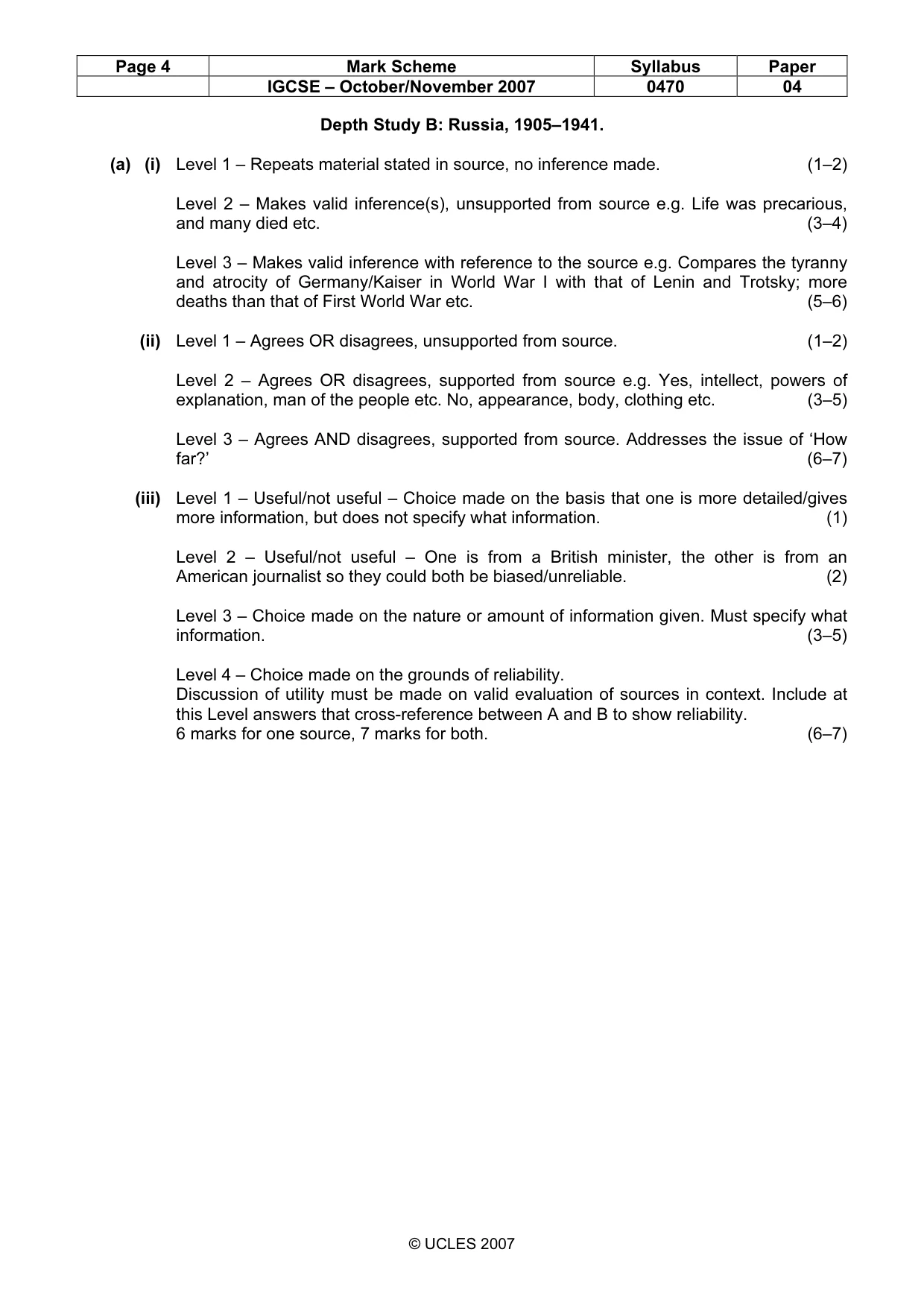
Page 4 Mark Scheme Syllabus Paper IGCSE – October/November 2007 0470 04 © UCLES 2007 Depth Study B: Russia, 1905–1941. (a) (i) Level 1 – Repeats material stated in source, no inference made. (1–2) Level 2 – Makes valid inference(s), unsupported from source e.g. Life was precarious, and many died etc. (3–4) Level 3 – Makes valid inference with reference to the source e.g. Compares the tyranny and atrocity of Germany/Kaiser in World War I with that of Lenin and Trotsky; more deaths than that of First World War etc. (5–6) (ii) Level 1 – Agrees OR disagrees, unsupported from source. (1–2) Level 2 – Agrees OR disagrees, supported from source e.g. Yes, intellect, powers of explanation, man of the people etc. No, appearance, body, clothing etc. (3–5) Level 3 – Agrees AND disagrees, supported from source. Addresses the issue of ‘How far?’ (6–7) (iii) Level 1 – Useful/not useful – Choice made on the basis that one is more detailed/gives more information, but does not specify what information. (1) Level 2 – Useful/not useful – One is from a British minister, the other is from an American journalist so they could both be biased/unreliable. (2) Level 3 – Choice made on the nature or amount of information given. Must specify what information. (3–5) Level 4 – Choice made on the grounds of reliability. Discussion of utility must be made on valid evaluation of sources in context. Include at this Level answers that cross-reference between A and B to show reliability. 6 marks for one source, 7 marks for both. (6–7)
Mark scheme, page 5
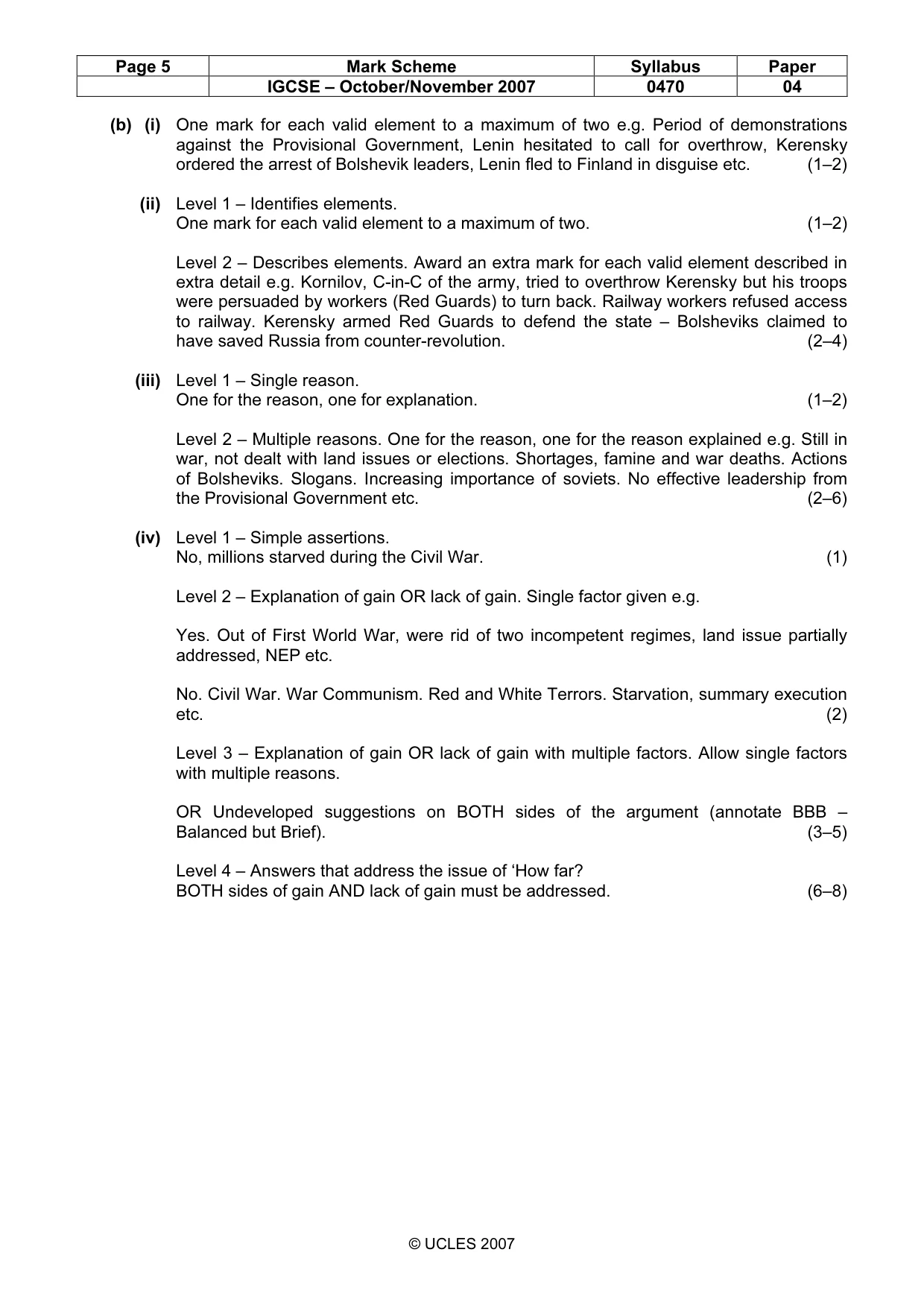
Page 5 Mark Scheme Syllabus Paper IGCSE – October/November 2007 0470 04 © UCLES 2007 (b) (i) One mark for each valid element to a maximum of two e.g. Period of demonstrations against the Provisional Government, Lenin hesitated to call for overthrow, Kerensky ordered the arrest of Bolshevik leaders, Lenin fled to Finland in disguise etc. (1–2) (ii) Level 1 – Identifies elements. One mark for each valid element to a maximum of two. (1–2) Level 2 – Describes elements. Award an extra mark for each valid element described in extra detail e.g. Kornilov, C-in-C of the army, tried to overthrow Kerensky but his troops were persuaded by workers (Red Guards) to turn back. Railway workers refused access to railway. Kerensky armed Red Guards to defend the state – Bolsheviks claimed to have saved Russia from counter-revolution. (2–4) (iii) Level 1 – Single reason. One for the reason, one for explanation. (1–2) Level 2 – Multiple reasons. One for the reason, one for the reason explained e.g. Still in war, not dealt with land issues or elections. Shortages, famine and war deaths. Actions of Bolsheviks. Slogans. Increasing importance of soviets. No effective leadership from the Provisional Government etc. (2–6) (iv) Level 1 – Simple assertions. No, millions starved during the Civil War. (1) Level 2 – Explanation of gain OR lack of gain. Single factor given e.g. Yes. Out of First World War, were rid of two incompetent regimes, land issue partially addressed, NEP etc. No. Civil War. War Communism. Red and White Terrors. Starvation, summary execution etc. (2) Level 3 – Explanation of gain OR lack of gain with multiple factors. Allow single factors with multiple reasons. OR Undeveloped suggestions on BOTH sides of the argument (annotate BBB – Balanced but Brief). (3–5) Level 4 – Answers that address the issue of ‘How far? BOTH sides of gain AND lack of gain must be addressed. (6–8)
Mark scheme, page 6
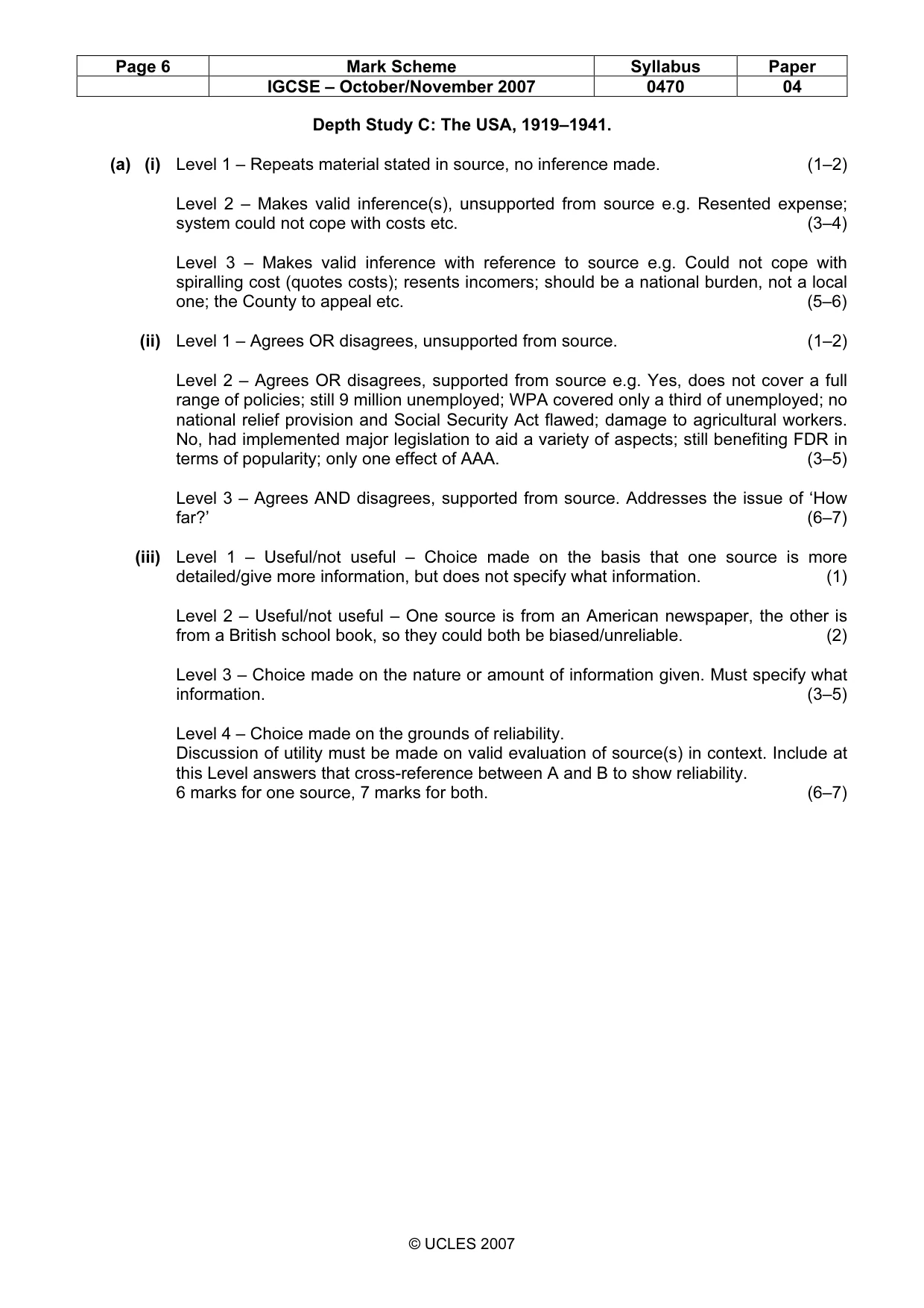
Page 6 Mark Scheme Syllabus Paper IGCSE – October/November 2007 0470 04 © UCLES 2007 Depth Study C: The USA, 1919–1941. (a) (i) Level 1 – Repeats material stated in source, no inference made. (1–2) Level 2 – Makes valid inference(s), unsupported from source e.g. Resented expense; system could not cope with costs etc. (3–4) Level 3 – Makes valid inference with reference to source e.g. Could not cope with spiralling cost (quotes costs); resents incomers; should be a national burden, not a local one; the County to appeal etc. (5–6) (ii) Level 1 – Agrees OR disagrees, unsupported from source. (1–2) Level 2 – Agrees OR disagrees, supported from source e.g. Yes, does not cover a full range of policies; still 9 million unemployed; WPA covered only a third of unemployed; no national relief provision and Social Security Act flawed; damage to agricultural workers. No, had implemented major legislation to aid a variety of aspects; still benefiting FDR in terms of popularity; only one effect of AAA. (3–5) Level 3 – Agrees AND disagrees, supported from source. Addresses the issue of ‘How far?’ (6–7) (iii) Level 1 – Useful/not useful – Choice made on the basis that one source is more detailed/give more information, but does not specify what information. (1) Level 2 – Useful/not useful – One source is from an American newspaper, the other is from a British school book, so they could both be biased/unreliable. (2) Level 3 – Choice made on the nature or amount of information given. Must specify what information. (3–5) Level 4 – Choice made on the grounds of reliability. Discussion of utility must be made on valid evaluation of source(s) in context. Include at this Level answers that cross-reference between A and B to show reliability. 6 marks for one source, 7 marks for both. (6–7)
Mark scheme, page 7
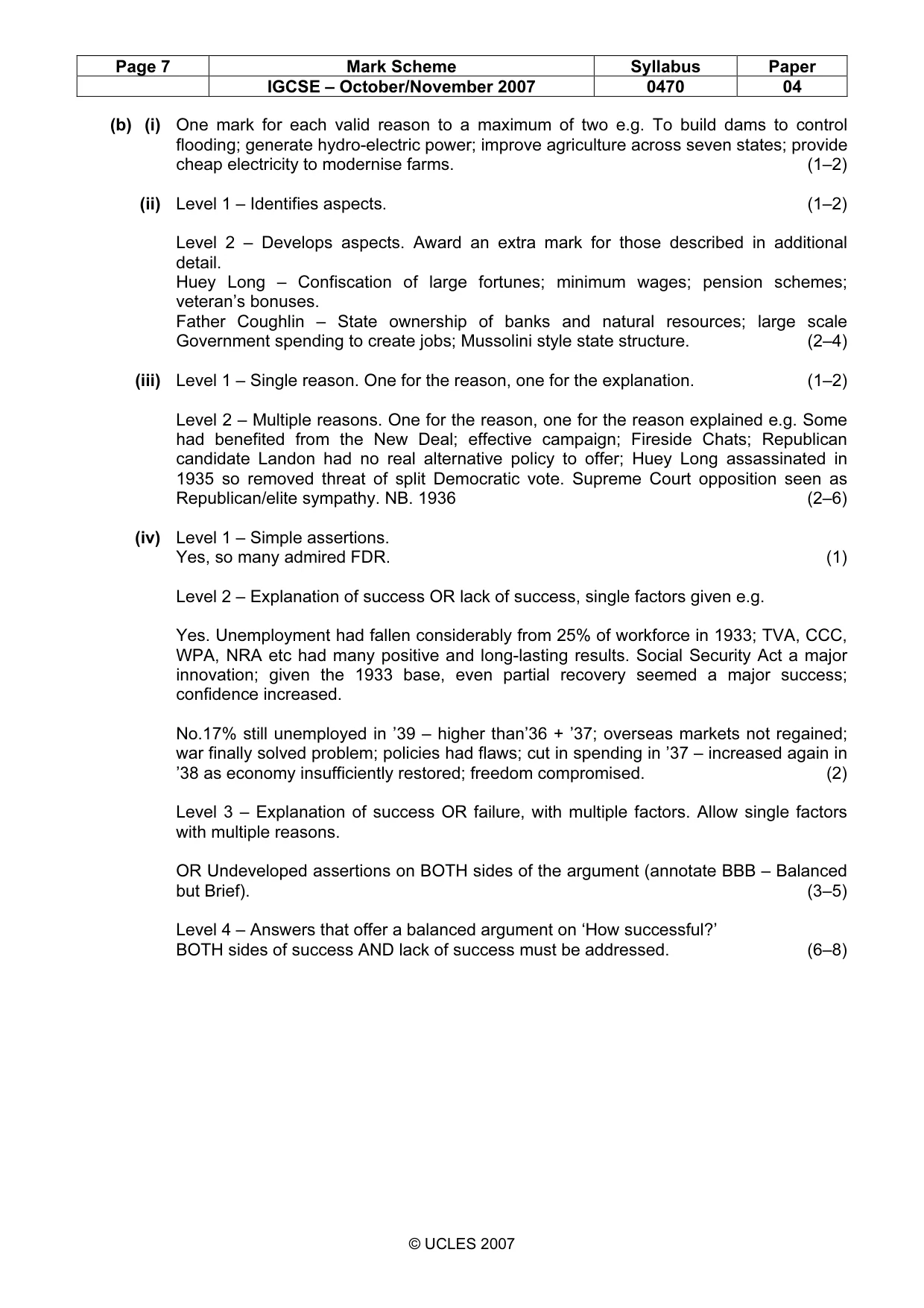
Page 7 Mark Scheme Syllabus Paper IGCSE – October/November 2007 0470 04 © UCLES 2007 (b) (i) One mark for each valid reason to a maximum of two e.g. To build dams to control flooding; generate hydro-electric power; improve agriculture across seven states; provide cheap electricity to modernise farms. (1–2) (ii) Level 1 – Identifies aspects. (1–2) Level 2 – Develops aspects. Award an extra mark for those described in additional detail. Huey Long – Confiscation of large fortunes; minimum wages; pension schemes; veteran’s bonuses. Father Coughlin – State ownership of banks and natural resources; large scale Government spending to create jobs; Mussolini style state structure. (2–4) (iii) Level 1 – Single reason. One for the reason, one for the explanation. (1–2) Level 2 – Multiple reasons. One for the reason, one for the reason explained e.g. Some had benefited from the New Deal; effective campaign; Fireside Chats; Republican candidate Landon had no real alternative policy to offer; Huey Long assassinated in 1935 so removed threat of split Democratic vote. Supreme Court opposition seen as Republican/elite sympathy. NB. 1936 (2–6) (iv) Level 1 – Simple assertions. Yes, so many admired FDR. (1) Level 2 – Explanation of success OR lack of success, single factors given e.g. Yes. Unemployment had fallen considerably from 25% of workforce in 1933; TVA, CCC, WPA, NRA etc had many positive and long-lasting results. Social Security Act a major innovation; given the 1933 base, even partial recovery seemed a major success; confidence increased. No.17% still unemployed in ’39 – higher than’36 + ’37; overseas markets not regained; war finally solved problem; policies had flaws; cut in spending in ’37 – increased again in ’38 as economy insufficiently restored; freedom compromised. (2) Level 3 – Explanation of success OR failure, with multiple factors. Allow single factors with multiple reasons. OR Undeveloped assertions on BOTH sides of the argument (annotate BBB – Balanced but Brief). (3–5) Level 4 – Answers that offer a balanced argument on ‘How successful?’ BOTH sides of success AND lack of success must be addressed. (6–8)
Mark scheme, page 8
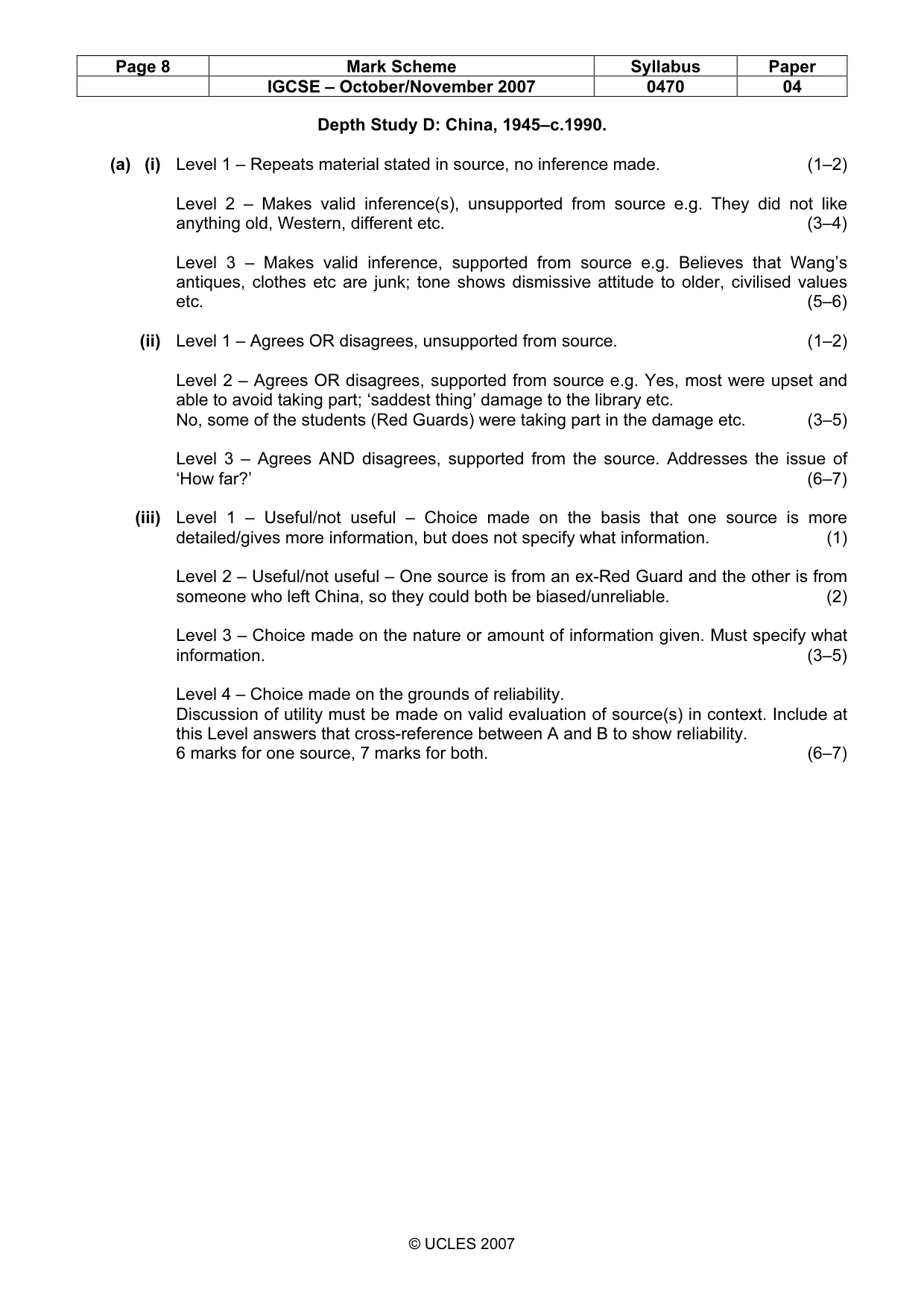
Page 8 Mark Scheme Syllabus Paper IGCSE – October/November 2007 0470 04 © UCLES 2007 Depth Study D: China, 1945–c.1990. (a) (i) Level 1 – Repeats material stated in source, no inference made. (1–2) Level 2 – Makes valid inference(s), unsupported from source e.g. They did not like anything old, Western, different etc. (3–4) Level 3 – Makes valid inference, supported from source e.g. Believes that Wang’s antiques, clothes etc are junk; tone shows dismissive attitude to older, civilised values etc. (5–6) (ii) Level 1 – Agrees OR disagrees, unsupported from source. (1–2) Level 2 – Agrees OR disagrees, supported from source e.g. Yes, most were upset and able to avoid taking part; ‘saddest thing’ damage to the library etc. No, some of the students (Red Guards) were taking part in the damage etc. (3–5) Level 3 – Agrees AND disagrees, supported from the source. Addresses the issue of ‘How far?’ (6–7) (iii) Level 1 – Useful/not useful – Choice made on the basis that one source is more detailed/gives more information, but does not specify what information. (1) Level 2 – Useful/not useful – One source is from an ex-Red Guard and the other is from someone who left China, so they could both be biased/unreliable. (2) Level 3 – Choice made on the nature or amount of information given. Must specify what information. (3–5) Level 4 – Choice made on the grounds of reliability. Discussion of utility must be made on valid evaluation of source(s) in context. Include at this Level answers that cross-reference between A and B to show reliability. 6 marks for one source, 7 marks for both. (6–7)
Mark scheme, page 9
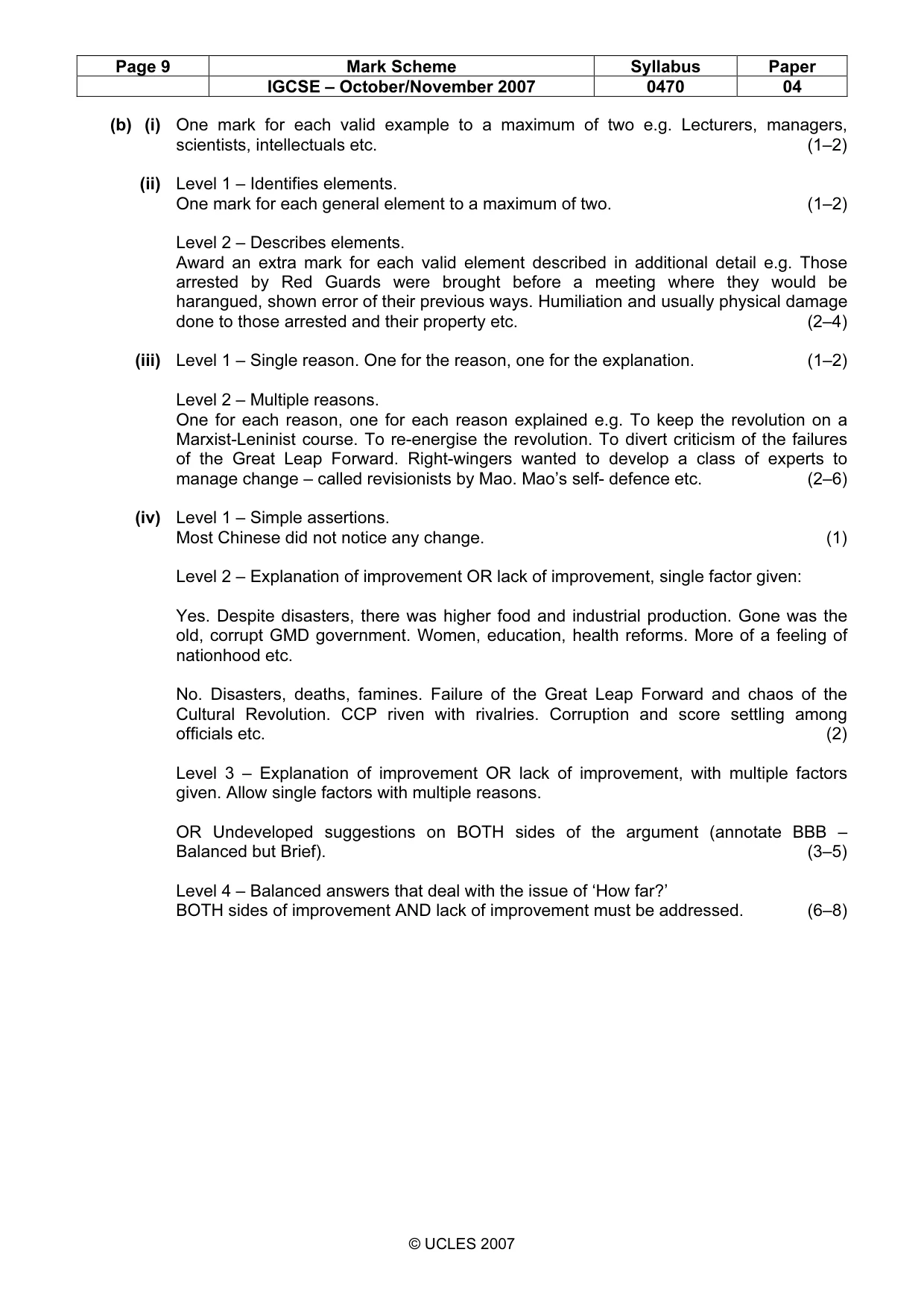
Page 9 Mark Scheme Syllabus Paper IGCSE – October/November 2007 0470 04 © UCLES 2007 (b) (i) One mark for each valid example to a maximum of two e.g. Lecturers, managers, scientists, intellectuals etc. (1–2) (ii) Level 1 – Identifies elements. One mark for each general element to a maximum of two. (1–2) Level 2 – Describes elements. Award an extra mark for each valid element described in additional detail e.g. Those arrested by Red Guards were brought before a meeting where they would be harangued, shown error of their previous ways. Humiliation and usually physical damage done to those arrested and their property etc. (2–4) (iii) Level 1 – Single reason. One for the reason, one for the explanation. (1–2) Level 2 – Multiple reasons. One for each reason, one for each reason explained e.g. To keep the revolution on a Marxist-Leninist course. To re-energise the revolution. To divert criticism of the failures of the Great Leap Forward. Right-wingers wanted to develop a class of experts to manage change – called revisionists by Mao. Mao’s self- defence etc. (2–6) (iv) Level 1 – Simple assertions. Most Chinese did not notice any change. (1) Level 2 – Explanation of improvement OR lack of improvement, single factor given: Yes. Despite disasters, there was higher food and industrial production. Gone was the old, corrupt GMD government. Women, education, health reforms. More of a feeling of nationhood etc. No. Disasters, deaths, famines. Failure of the Great Leap Forward and chaos of the Cultural Revolution. CCP riven with rivalries. Corruption and score settling among officials etc. (2) Level 3 – Explanation of improvement OR lack of improvement, with multiple factors given. Allow single factors with multiple reasons. OR Undeveloped suggestions on BOTH sides of the argument (annotate BBB – Balanced but Brief). (3–5) Level 4 – Balanced answers that deal with the issue of ‘How far?’ BOTH sides of improvement AND lack of improvement must be addressed. (6–8)
Mark scheme, page 10
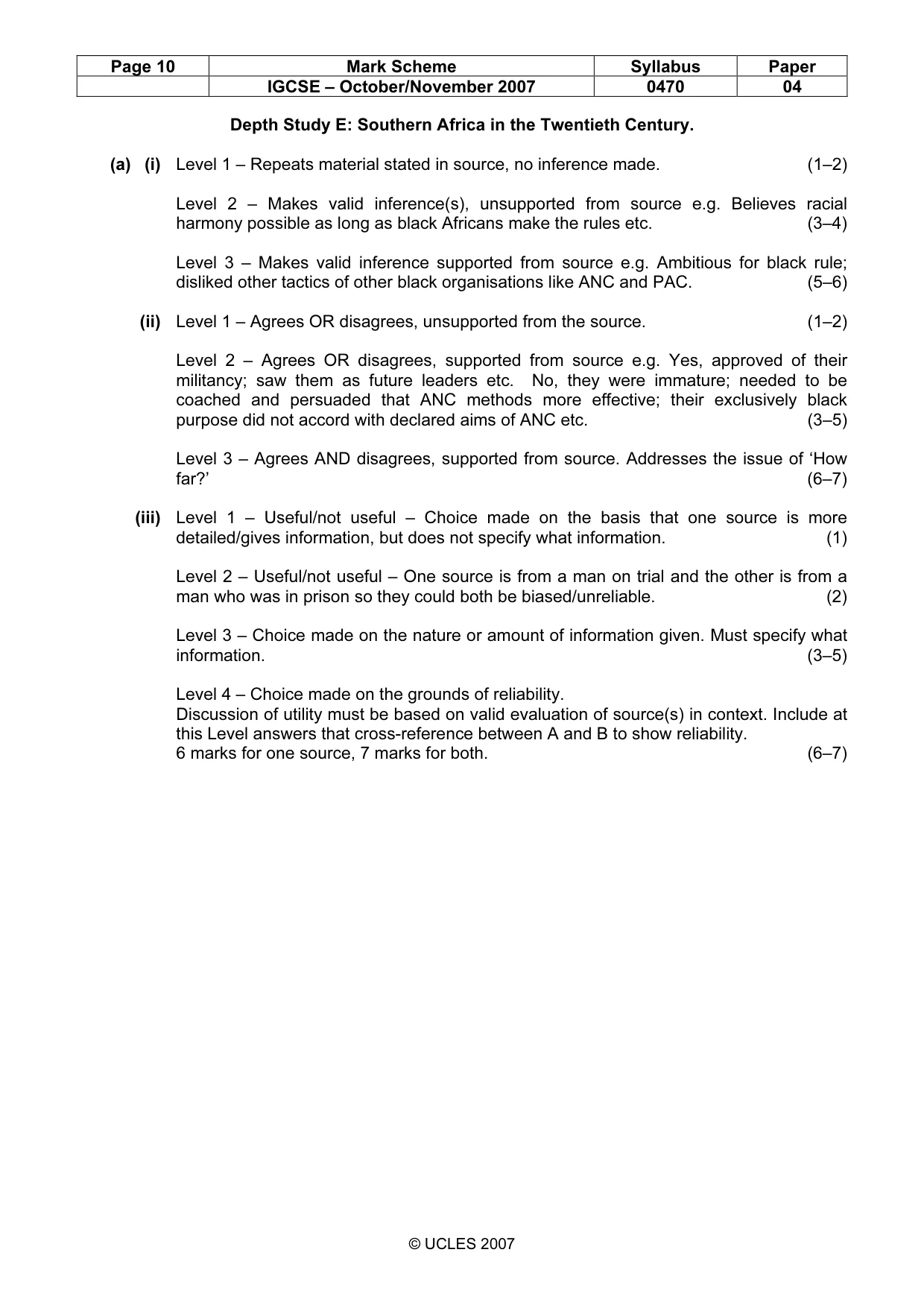
Page 10 Mark Scheme Syllabus Paper IGCSE – October/November 2007 0470 04 © UCLES 2007 Depth Study E: Southern Africa in the Twentieth Century. (a) (i) Level 1 – Repeats material stated in source, no inference made. (1–2) Level 2 – Makes valid inference(s), unsupported from source e.g. Believes racial harmony possible as long as black Africans make the rules etc. (3–4) Level 3 – Makes valid inference supported from source e.g. Ambitious for black rule; disliked other tactics of other black organisations like ANC and PAC. (5–6) (ii) Level 1 – Agrees OR disagrees, unsupported from the source. (1–2) Level 2 – Agrees OR disagrees, supported from source e.g. Yes, approved of their militancy; saw them as future leaders etc. No, they were immature; needed to be coached and persuaded that ANC methods more effective; their exclusively black purpose did not accord with declared aims of ANC etc. (3–5) Level 3 – Agrees AND disagrees, supported from source. Addresses the issue of ‘How far?’ (6–7) (iii) Level 1 – Useful/not useful – Choice made on the basis that one source is more detailed/gives information, but does not specify what information. (1) Level 2 – Useful/not useful – One source is from a man on trial and the other is from a man who was in prison so they could both be biased/unreliable. (2) Level 3 – Choice made on the nature or amount of information given. Must specify what information. (3–5) Level 4 – Choice made on the grounds of reliability. Discussion of utility must be based on valid evaluation of source(s) in context. Include at this Level answers that cross-reference between A and B to show reliability. 6 marks for one source, 7 marks for both. (6–7)
Mark scheme, page 11
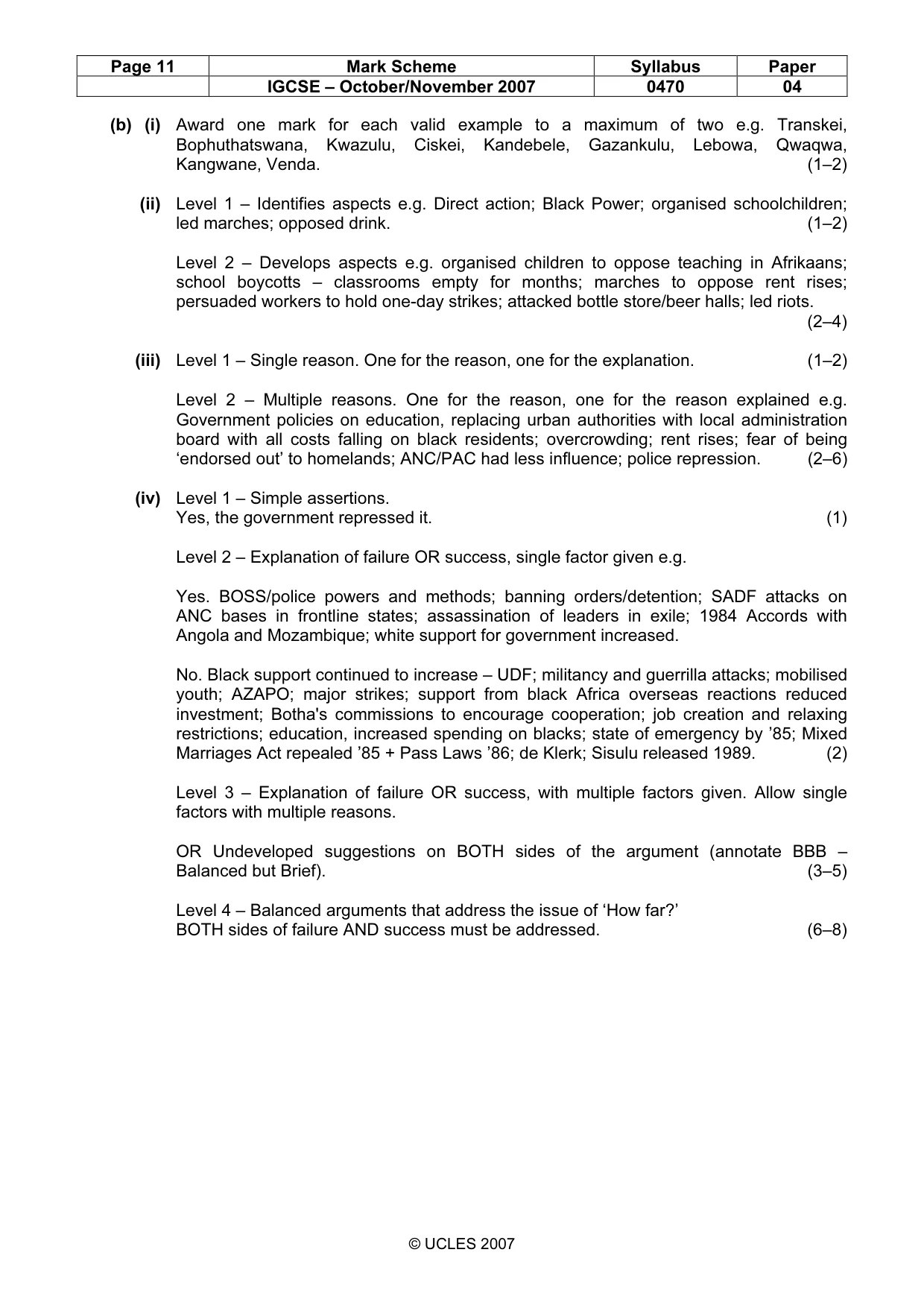
Page 11 Mark Scheme Syllabus Paper IGCSE – October/November 2007 0470 04 © UCLES 2007 (b) (i) Award one mark for each valid example to a maximum of two e.g. Transkei, Bophuthatswana, Kwazulu, Ciskei, Kandebele, Gazankulu, Lebowa, Qwaqwa, Kangwane, Venda. (1–2) (ii) Level 1 – Identifies aspects e.g. Direct action; Black Power; organised schoolchildren; led marches; opposed drink. (1–2) Level 2 – Develops aspects e.g. organised children to oppose teaching in Afrikaans; school boycotts – classrooms empty for months; marches to oppose rent rises; persuaded workers to hold one-day strikes; attacked bottle store/beer halls; led riots. (2–4) (iii) Level 1 – Single reason. One for the reason, one for the explanation. (1–2) Level 2 – Multiple reasons. One for the reason, one for the reason explained e.g. Government policies on education, replacing urban authorities with local administration board with all costs falling on black residents; overcrowding; rent rises; fear of being ‘endorsed out’ to homelands; ANC/PAC had less influence; police repression. (2–6) (iv) Level 1 – Simple assertions. Yes, the government repressed it. (1) Level 2 – Explanation of failure OR success, single factor given e.g. Yes. BOSS/police powers and methods; banning orders/detention; SADF attacks on ANC bases in frontline states; assassination of leaders in exile; 1984 Accords with Angola and Mozambique; white support for government increased. No. Black support continued to increase – UDF; militancy and guerrilla attacks; mobilised youth; AZAPO; major strikes; support from black Africa overseas reactions reduced investment; Botha's commissions to encourage cooperation; job creation and relaxing restrictions; education, increased spending on blacks; state of emergency by ’85; Mixed Marriages Act repealed ’85 + Pass Laws ’86; de Klerk; Sisulu released 1989. (2) Level 3 – Explanation of failure OR success, with multiple factors given. Allow single factors with multiple reasons. OR Undeveloped suggestions on BOTH sides of the argument (annotate BBB – Balanced but Brief). (3–5) Level 4 – Balanced arguments that address the issue of ‘How far?’ BOTH sides of failure AND success must be addressed. (6–8)
Mark scheme, page 12
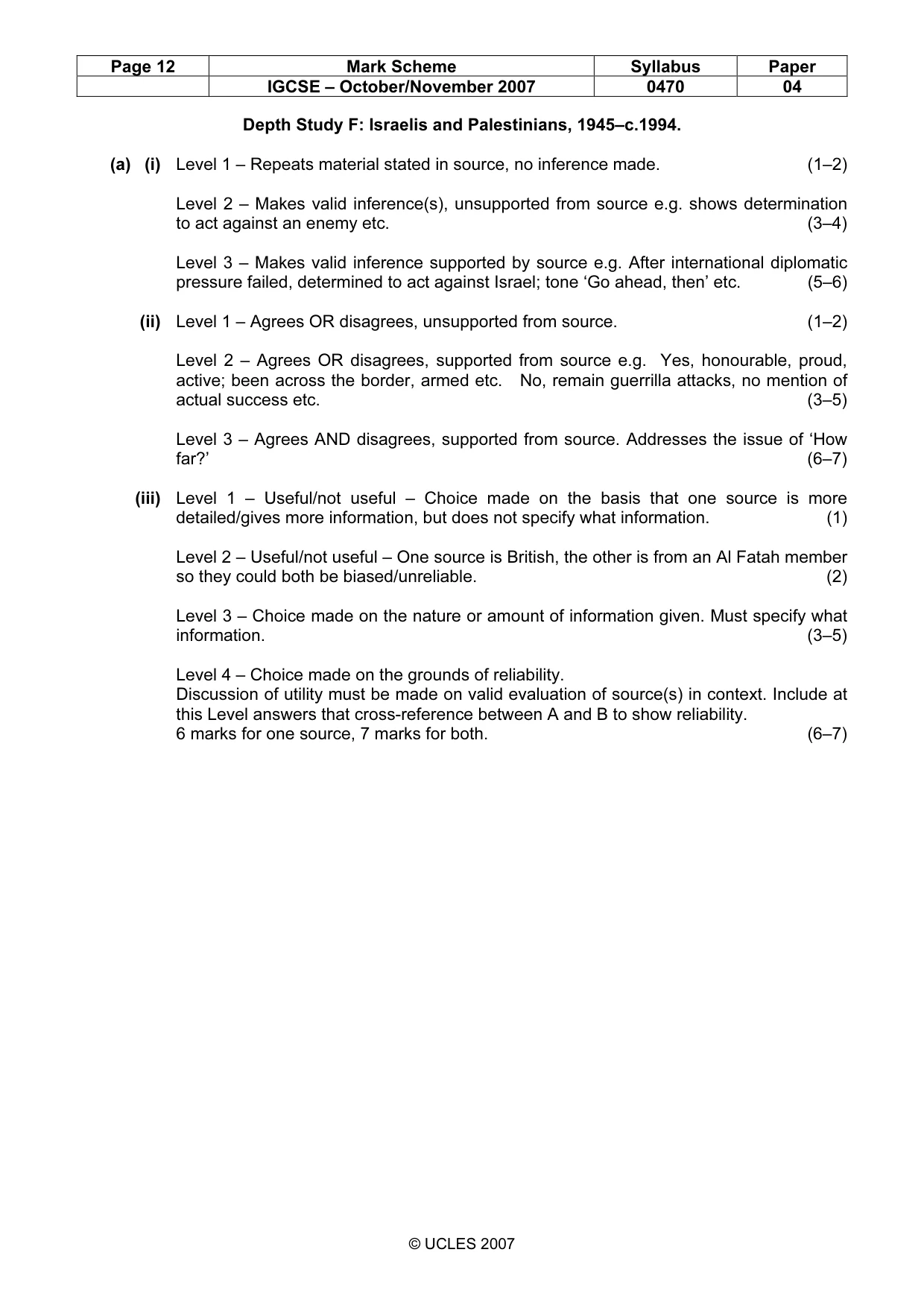
Page 12 Mark Scheme Syllabus Paper IGCSE – October/November 2007 0470 04 © UCLES 2007 Depth Study F: Israelis and Palestinians, 1945–c.1994. (a) (i) Level 1 – Repeats material stated in source, no inference made. (1–2) Level 2 – Makes valid inference(s), unsupported from source e.g. shows determination to act against an enemy etc. (3–4) Level 3 – Makes valid inference supported by source e.g. After international diplomatic pressure failed, determined to act against Israel; tone ‘Go ahead, then’ etc. (5–6) (ii) Level 1 – Agrees OR disagrees, unsupported from source. (1–2) Level 2 – Agrees OR disagrees, supported from source e.g. Yes, honourable, proud, active; been across the border, armed etc. No, remain guerrilla attacks, no mention of actual success etc. (3–5) Level 3 – Agrees AND disagrees, supported from source. Addresses the issue of ‘How far?’ (6–7) (iii) Level 1 – Useful/not useful – Choice made on the basis that one source is more detailed/gives more information, but does not specify what information. (1) Level 2 – Useful/not useful – One source is British, the other is from an Al Fatah member so they could both be biased/unreliable. (2) Level 3 – Choice made on the nature or amount of information given. Must specify what information. (3–5) Level 4 – Choice made on the grounds of reliability. Discussion of utility must be made on valid evaluation of source(s) in context. Include at this Level answers that cross-reference between A and B to show reliability. 6 marks for one source, 7 marks for both. (6–7)
Mark scheme, page 13
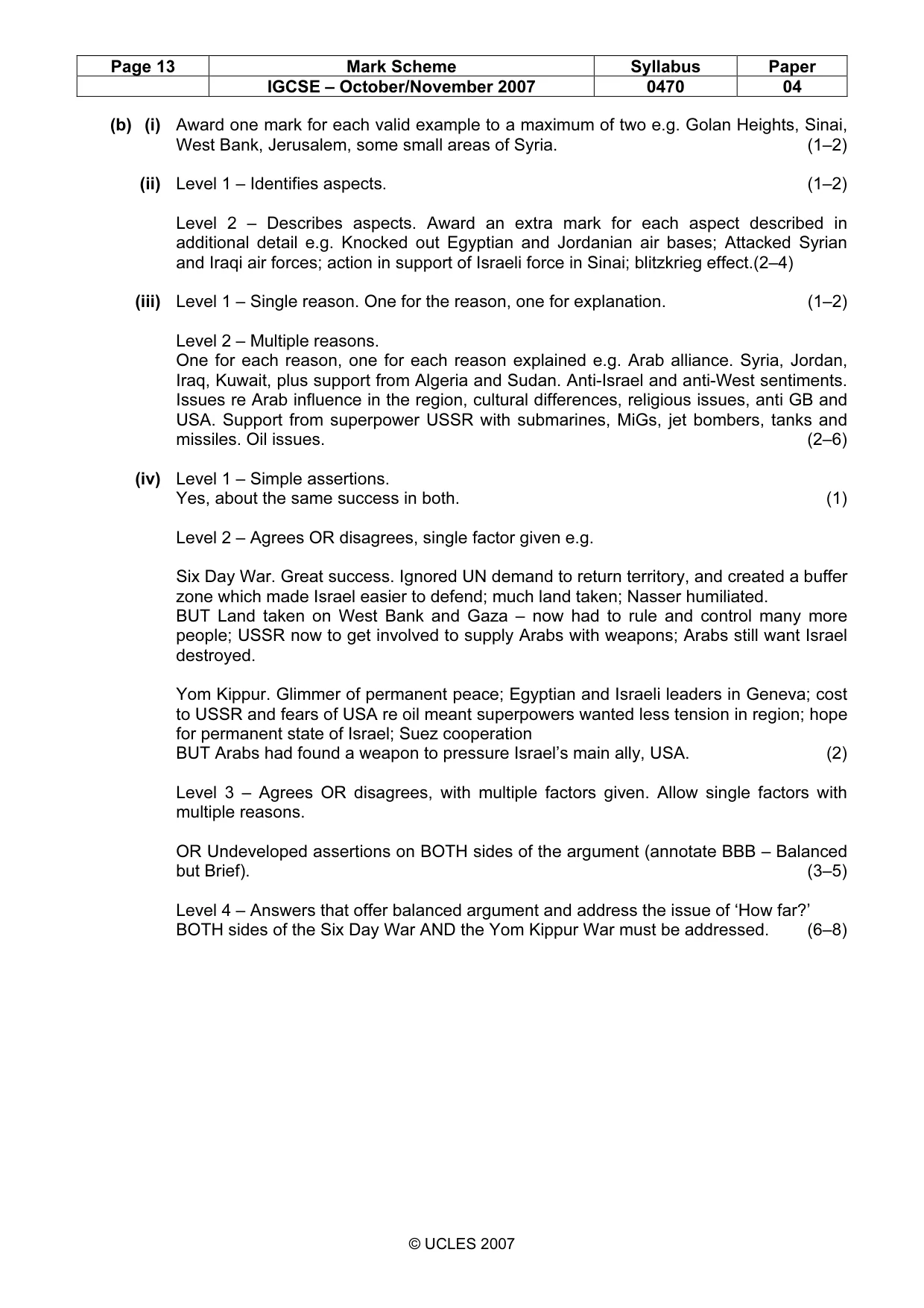
Page 13 Mark Scheme Syllabus Paper IGCSE – October/November 2007 0470 04 © UCLES 2007 (b) (i) Award one mark for each valid example to a maximum of two e.g. Golan Heights, Sinai, West Bank, Jerusalem, some small areas of Syria. (1–2) (ii) Level 1 – Identifies aspects. (1–2) Level 2 – Describes aspects. Award an extra mark for each aspect described in additional detail e.g. Knocked out Egyptian and Jordanian air bases; Attacked Syrian and Iraqi air forces; action in support of Israeli force in Sinai; blitzkrieg effect.(2–4) (iii) Level 1 – Single reason. One for the reason, one for explanation. (1–2) Level 2 – Multiple reasons. One for each reason, one for each reason explained e.g. Arab alliance. Syria, Jordan, Iraq, Kuwait, plus support from Algeria and Sudan. Anti-Israel and anti-West sentiments. Issues re Arab influence in the region, cultural differences, religious issues, anti GB and USA. Support from superpower USSR with submarines, MiGs, jet bombers, tanks and missiles. Oil issues. (2–6) (iv) Level 1 – Simple assertions. Yes, about the same success in both. (1) Level 2 – Agrees OR disagrees, single factor given e.g. Six Day War. Great success. Ignored UN demand to return territory, and created a buffer zone which made Israel easier to defend; much land taken; Nasser humiliated. BUT Land taken on West Bank and Gaza – now had to rule and control many more people; USSR now to get involved to supply Arabs with weapons; Arabs still want Israel destroyed. Yom Kippur. Glimmer of permanent peace; Egyptian and Israeli leaders in Geneva; cost to USSR and fears of USA re oil meant superpowers wanted less tension in region; hope for permanent state of Israel; Suez cooperation BUT Arabs had found a weapon to pressure Israel’s main ally, USA. (2) Level 3 – Agrees OR disagrees, with multiple factors given. Allow single factors with multiple reasons. OR Undeveloped assertions on BOTH sides of the argument (annotate BBB – Balanced but Brief). (3–5) Level 4 – Answers that offer balanced argument and address the issue of ‘How far?’ BOTH sides of the Six Day War AND the Yom Kippur War must be addressed. (6–8)
Mark scheme, page 14
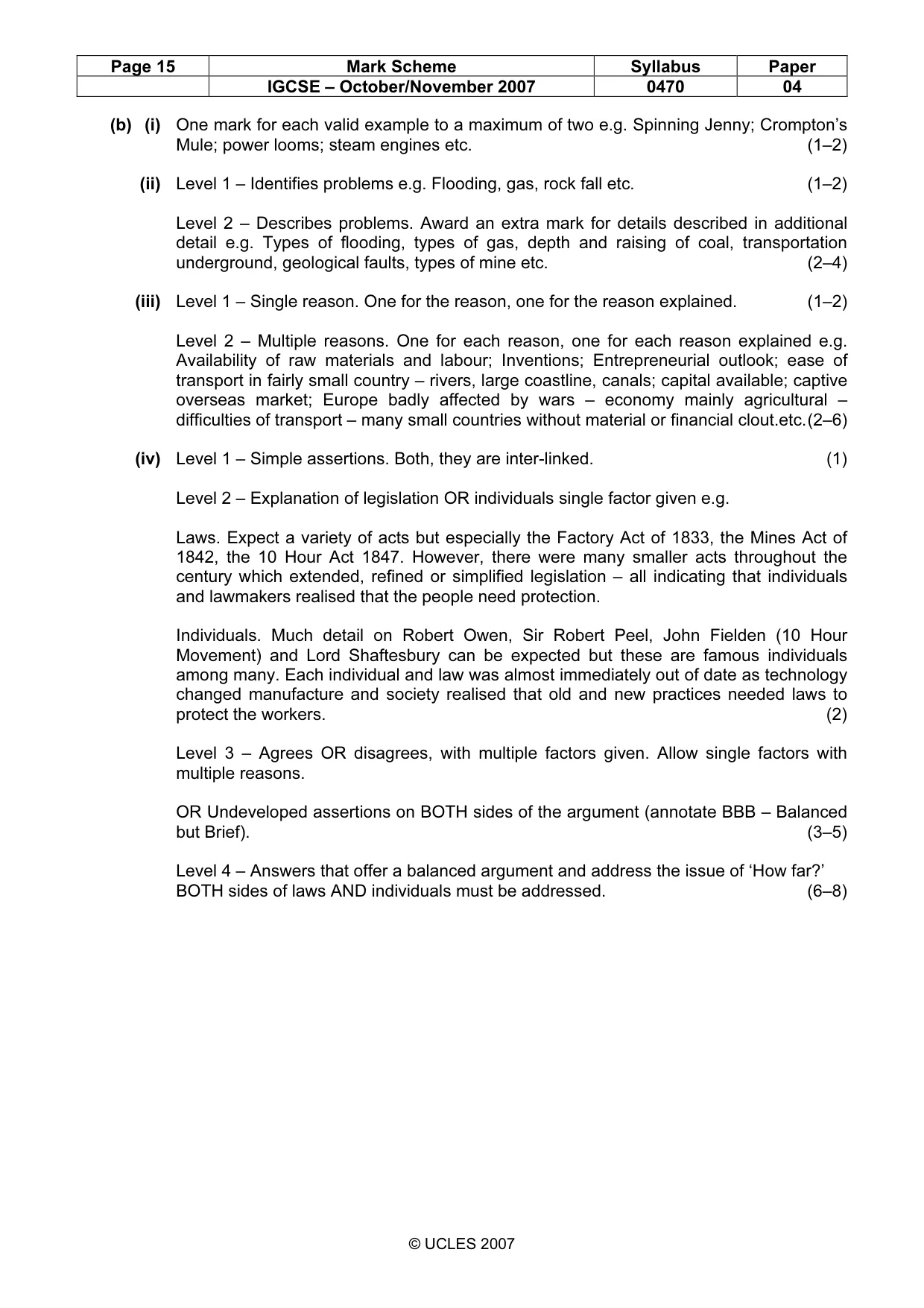
Page 14 Mark Scheme Syllabus Paper IGCSE – October/November 2007 0470 04 © UCLES 2007 Depth Study G: The Creation of Modern Industrial Society. (a) (i) Level 1 – Repeats material stated in source, no inference made. (1–2) Level 2 – Makes valid inference(s), unsupported from source e.g. mechanisation had improved the efficiency in the textile industry etc. (3–4) Level 3 – Makes valid inference, with reference to the source e.g. Steam power had improved the efficiency of the cotton spinning industry, quotes examples of statistics in source etc. (5–6) (ii) Level 1 – Agrees OR disagrees, unsupported from source. (1–2) Level 2 – Agrees OR disagrees, supported from source e.g. Yes, details of the deterioration of family life (esp. Source B). No, wages treated with care could provide ‘decent comforts of life’ (Source C) etc. (3–5) Level 3 – Agrees AND disagrees, supported from the source. Addresses the issue of ‘How far?’ (6–7) (iii) Level 1 – Useful/not useful – Choice made on the basis that one source is more detailed/gives more information, but does not specify what information. (1) Level 2 – Useful/not useful – A is from an old book, B is from a person we do not know and C is from an old pamphlet so they could all be biased/unreliable. (2) Level 3 – Choice made on the nature or amount of information given. Must specify what information. (3–5) Level 4 – Choice made on the grounds of responsibility. Discussion of utility must be made on valid evaluation of source(s) in context. Include at this Level answers that cross-reference between A, B and C to show reliability. 6 marks for one source, 7 marks for more than one source. (6–7)
Mark scheme, page 15
Page 15 Mark Scheme Syllabus Paper IGCSE – October/November 2007 0470 04 © UCLES 2007 (b) (i) One mark for each valid example to a maximum of two e.g. Spinning Jenny; Crompton’s Mule; power looms; steam engines etc. (1–2) (ii) Level 1 – Identifies problems e.g. Flooding, gas, rock fall etc. (1–2) Level 2 – Describes problems. Award an extra mark for details described in additional detail e.g. Types of flooding, types of gas, depth and raising of coal, transportation underground, geological faults, types of mine etc. (2–4) (iii) Level 1 – Single reason. One for the reason, one for the reason explained. (1–2) Level 2 – Multiple reasons. One for each reason, one for each reason explained e.g. Availability of raw materials and labour; Inventions; Entrepreneurial outlook; ease of transport in fairly small country – rivers, large coastline, canals; capital available; captive overseas market; Europe badly affected by wars – economy mainly agricultural – difficulties of transport – many small countries without material or financial clout.etc. (2–6) (iv) Level 1 – Simple assertions. Both, they are inter-linked. (1) Level 2 – Explanation of legislation OR individuals single factor given e.g. Laws. Expect a variety of acts but especially the Factory Act of 1833, the Mines Act of 1842, the 10 Hour Act 1847. However, there were many smaller acts throughout the century which extended, refined or simplified legislation – all indicating that individuals and lawmakers realised that the people need protection. Individuals. Much detail on Robert Owen, Sir Robert Peel, John Fielden (10 Hour Movement) and Lord Shaftesbury can be expected but these are famous individuals among many. Each individual and law was almost immediately out of date as technology changed manufacture and society realised that old and new practices needed laws to protect the workers. (2) Level 3 – Agrees OR disagrees, with multiple factors given. Allow single factors with multiple reasons. OR Undeveloped assertions on BOTH sides of the argument (annotate BBB – Balanced but Brief). (3–5) Level 4 – Answers that offer a balanced argument and address the issue of ‘How far?’ BOTH sides of laws AND individuals must be addressed. (6–8)
Mark scheme, page 16
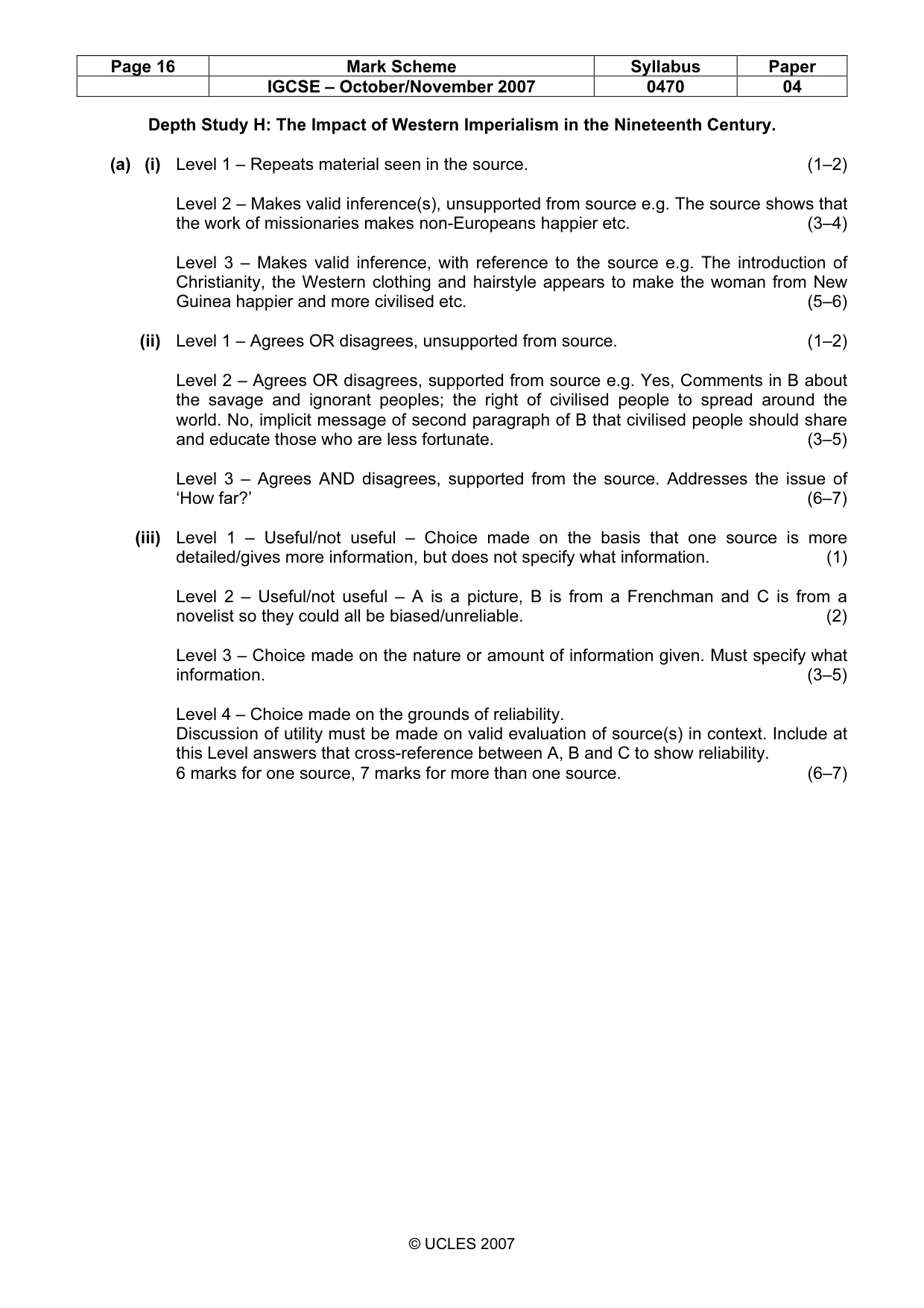
Page 16 Mark Scheme Syllabus Paper IGCSE – October/November 2007 0470 04 © UCLES 2007 Depth Study H: The Impact of Western Imperialism in the Nineteenth Century. (a) (i) Level 1 – Repeats material seen in the source. (1–2) Level 2 – Makes valid inference(s), unsupported from source e.g. The source shows that the work of missionaries makes non-Europeans happier etc. (3–4) Level 3 – Makes valid inference, with reference to the source e.g. The introduction of Christianity, the Western clothing and hairstyle appears to make the woman from New Guinea happier and more civilised etc. (5–6) (ii) Level 1 – Agrees OR disagrees, unsupported from source. (1–2) Level 2 – Agrees OR disagrees, supported from source e.g. Yes, Comments in B about the savage and ignorant peoples; the right of civilised people to spread around the world. No, implicit message of second paragraph of B that civilised people should share and educate those who are less fortunate. (3–5) Level 3 – Agrees AND disagrees, supported from the source. Addresses the issue of ‘How far?’ (6–7) (iii) Level 1 – Useful/not useful – Choice made on the basis that one source is more detailed/gives more information, but does not specify what information. (1) Level 2 – Useful/not useful – A is a picture, B is from a Frenchman and C is from a novelist so they could all be biased/unreliable. (2) Level 3 – Choice made on the nature or amount of information given. Must specify what information. (3–5) Level 4 – Choice made on the grounds of reliability. Discussion of utility must be made on valid evaluation of source(s) in context. Include at this Level answers that cross-reference between A, B and C to show reliability. 6 marks for one source, 7 marks for more than one source. (6–7)
Mark scheme, page 17
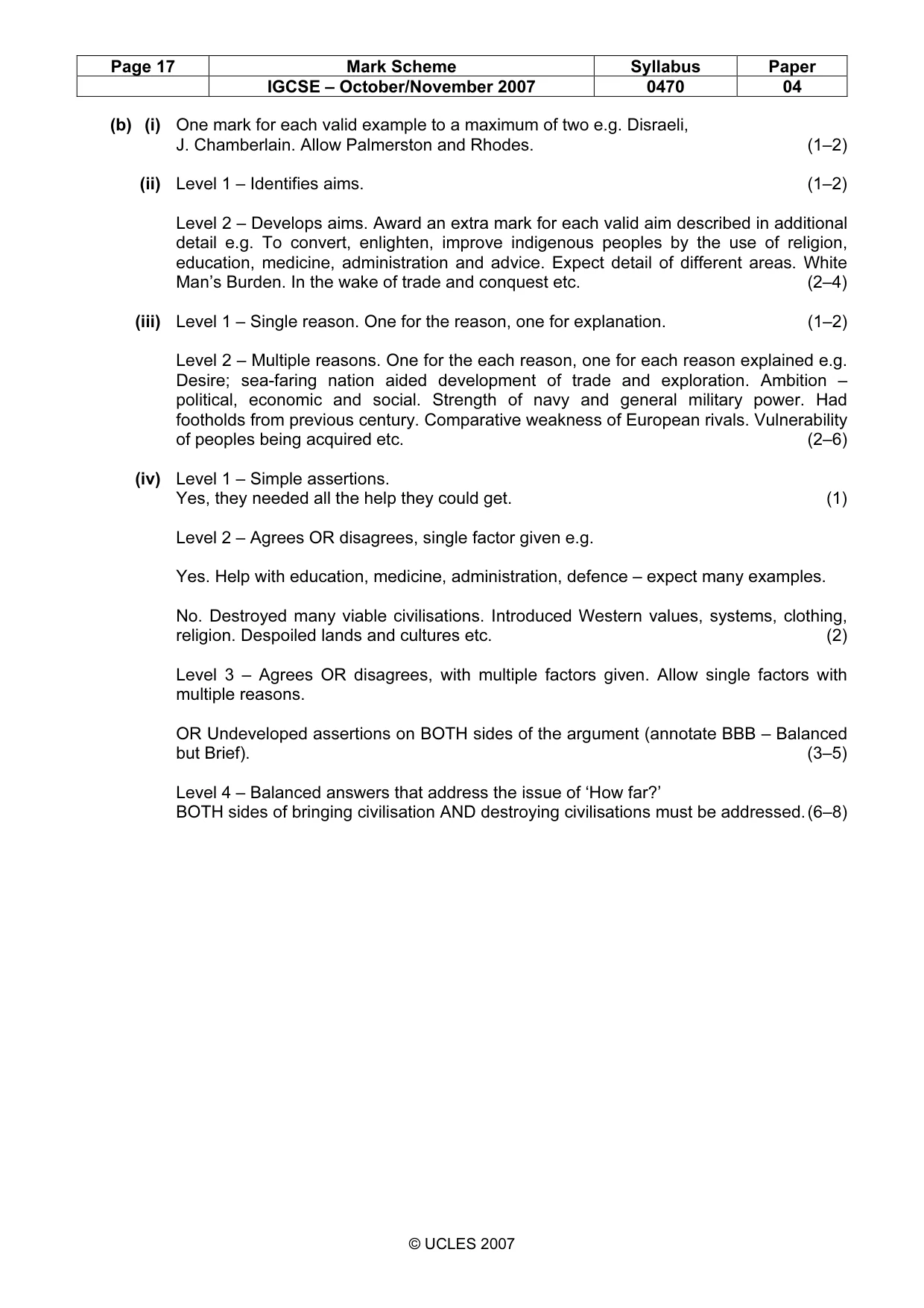
Page 17 Mark Scheme Syllabus Paper IGCSE – October/November 2007 0470 04 © UCLES 2007 (b) (i) One mark for each valid example to a maximum of two e.g. Disraeli, J. Chamberlain. Allow Palmerston and Rhodes. (1–2) (ii) Level 1 – Identifies aims. (1–2) Level 2 – Develops aims. Award an extra mark for each valid aim described in additional detail e.g. To convert, enlighten, improve indigenous peoples by the use of religion, education, medicine, administration and advice. Expect detail of different areas. White Man’s Burden. In the wake of trade and conquest etc. (2–4) (iii) Level 1 – Single reason. One for the reason, one for explanation. (1–2) Level 2 – Multiple reasons. One for the each reason, one for each reason explained e.g. Desire; sea-faring nation aided development of trade and exploration. Ambition – political, economic and social. Strength of navy and general military power. Had footholds from previous century. Comparative weakness of European rivals. Vulnerability of peoples being acquired etc. (2–6) (iv) Level 1 – Simple assertions. Yes, they needed all the help they could get. (1) Level 2 – Agrees OR disagrees, single factor given e.g. Yes. Help with education, medicine, administration, defence – expect many examples. No. Destroyed many viable civilisations. Introduced Western values, systems, clothing, religion. Despoiled lands and cultures etc. (2) Level 3 – Agrees OR disagrees, with multiple factors given. Allow single factors with multiple reasons. OR Undeveloped assertions on BOTH sides of the argument (annotate BBB – Balanced but Brief). (3–5) Level 4 – Balanced answers that address the issue of ‘How far?’ BOTH sides of bringing civilisation AND destroying civilisations must be addressed. (6–8)
What you needed in this session
Cambridge’s own grade thresholds for 2007 Oct/Nov, Paper 4 · Variant 1. A higher threshold means an easier paper — the bar moves with how the cohort did.