Cambridge IGCSE History 0470 — 2007 May/June Paper 4 · Variant 1
0470/41/M/J/07 · 40 marks · ≈45 min
The question paper and its mark scheme, free to read here and free to download. This is Cambridge’s own paper, exactly as it was sat.
Question paper16 pages



Mark scheme17 pages
Answers below. Sit the paper first if you are practising.
Paper as text
Question paper, page 1
This document consists of 12 printed pages and 4 blank pages. SP (CW/KS) T30990/2 © UCLES 2007 [Turn over UNIVERSITY OF CAMBRIDGE INTERNATIONAL EXAMINATIONS International General Certificate of Secondary Education READ THESE INSTRUCTIONS FIRST If you have been given an Answer Booklet, follow the instructions on the front cover of the Booklet. Write your Centre number, candidate number and name on all the work you hand in. Write in dark blue or black pen. You may use a soft pencil for any diagrams, graphs or rough working. Do not use staples, paper clips, highlighters, glue or correction fluid. Answer the questions on one of the Depth Studies. At the end of the examination, fasten all your work securely together. The number of marks is given in brackets [ ] at the end of each question or part question. * 1 9 6 9 2 0 6 5 6 0 * HISTORY 0470/04 Paper 4 Alternative to Coursework May/June 2007 1 hour Additional Materials: Answer Booklet/Paper www.XtremePapers.com For reasons of copyright, some material has been removed from this Question Paper.
Question paper, page 2
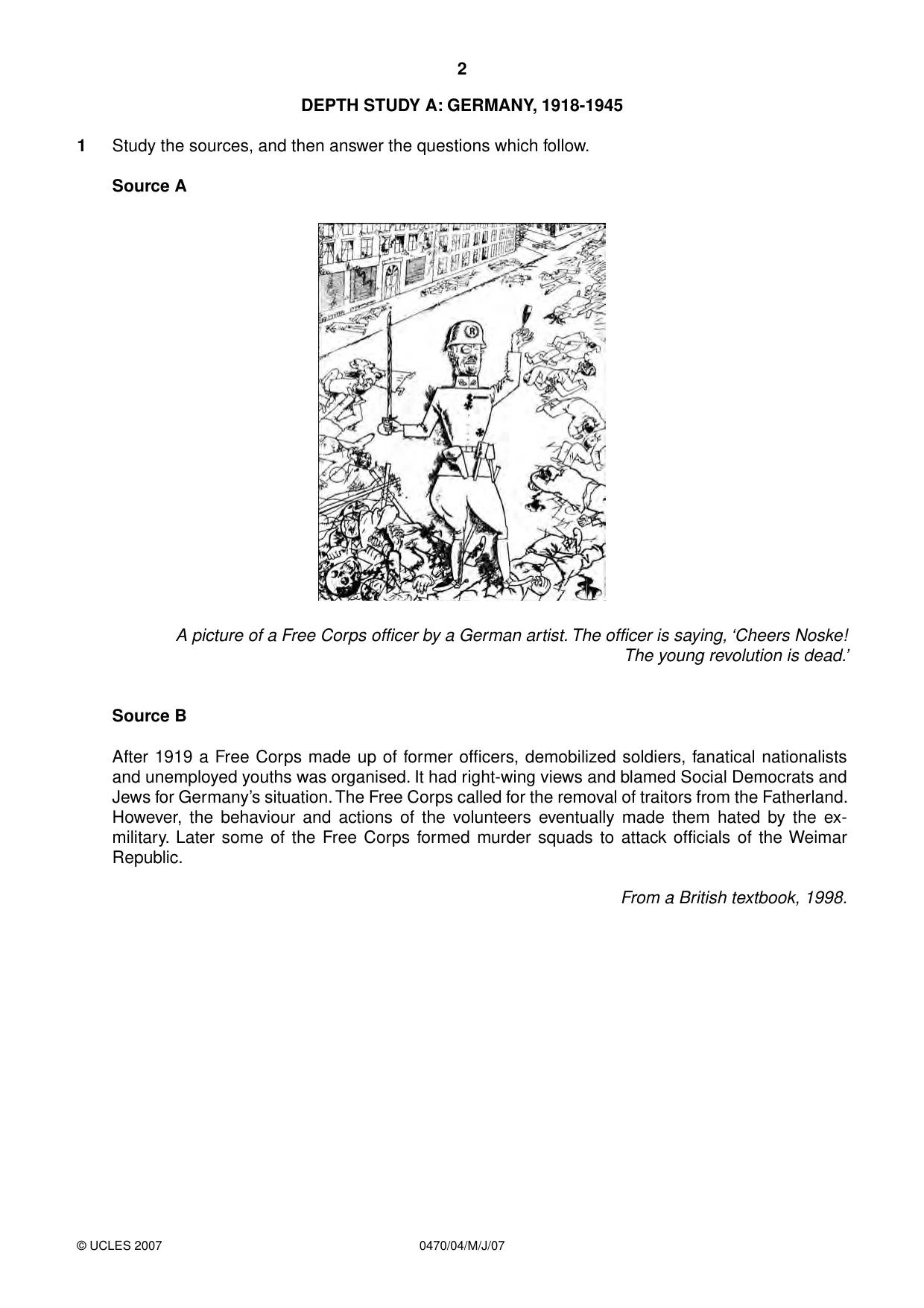
2 0470/04/M/J/07 © UCLES 2007 DEPTH STUDY A: GERMANY, 1918-1945 1 Study the sources, and then answer the questions which follow. Source A A picture of a Free Corps officer by a German artist. The officer is saying, ‘Cheers Noske! The young revolution is dead.’ Source B After 1919 a Free Corps made up of former officers, demobilized soldiers, fanatical nationalists and unemployed youths was organised. It had right-wing views and blamed Social Democrats and Jews for Germany’s situation. The Free Corps called for the removal of traitors from the Fatherland. However, the behaviour and actions of the volunteers eventually made them hated by the ex- military. Later some of the Free Corps formed murder squads to attack officials of the Weimar Republic. From a British textbook, 1998.
Question paper, page 3
3 0470/04/M/J/07 © UCLES 2007 [Turn over (a) (i) Study Source A. What can you tell from this source about post-war Germany? Support your answer with reference to the source. [6] (ii) Study Source B. How far does this source show that the Free Corps was a military organisation? Explain your answer. [7] (iii) Study both sources. Is one source more useful than the other as evidence about the Free Corps? Explain your answer. [7] (b) (i) What powers did Article 48 of the Weimar Constitution give to the President of the Weimar Republic? [2] (ii) Describe the Kapp Putsch of 1920. [4] (iii) Why did monarchists and army officers oppose the Weimar Government? [6] (iv) ‘The hyperinflation of 1923 did more damage to the Weimar Republic than the signing of the Treaty of Versailles.’ Do you agree? Explain your answer. [8]
Question paper, page 4
4 0470/04/M/J/07 © UCLES 2007 DEPTH STUDY B: RUSSIA, 1905-1941 2 Study the sources, and then answer the questions which follow. Source A We come to seek truth, justice and protection from you. We are poor and oppressed, unbearable work is imposed on us, we are despised and not recognised as human beings. We ask little: to reduce our working day to eight hours and to provide a minimum wage of a rouble a day. Do not refuse to help your people. Destroy the barrier between yourself and your people. From the Petition to the Tsar presented by Father Gapon, 1905. Source B In his October Manifesto the Tsar offered the people a Duma (an elected parliament), the right to free speech and the right to form political parties. In November, he announced further concessions and financial help for the peasants. This divided his opponents. Having made peace with Japan, then the Tsar brought back his best troops to western Russia to crush the revolt. Rebellion in the countryside was ruthlessly put down. From a British textbook, 2001. (a) (i) Study Source A. What can you tell from this source about Russia’s industrial workers? Support your answer with reference to the source. [6] (ii) Study Source B. How far does this source show that the Tsar wanted to help his people? Explain your answer. [7] (iii) Study both sources. Is one of these sources more useful than the other as evidence about the 1905 Revolution? Explain your answer. [7] (b) (i) What was the Okhrana? [2] (ii) Describe what happened on Bloody Sunday, 22 January 1905. [4] (iii) Why were Stolypin’s attempts at agricultural reform not a success? [6] (iv) How loyal were the Russian people to Tsar Nicholas II up to the outbreak of war in 1914? Explain your answer. [8]
Question paper, page 5
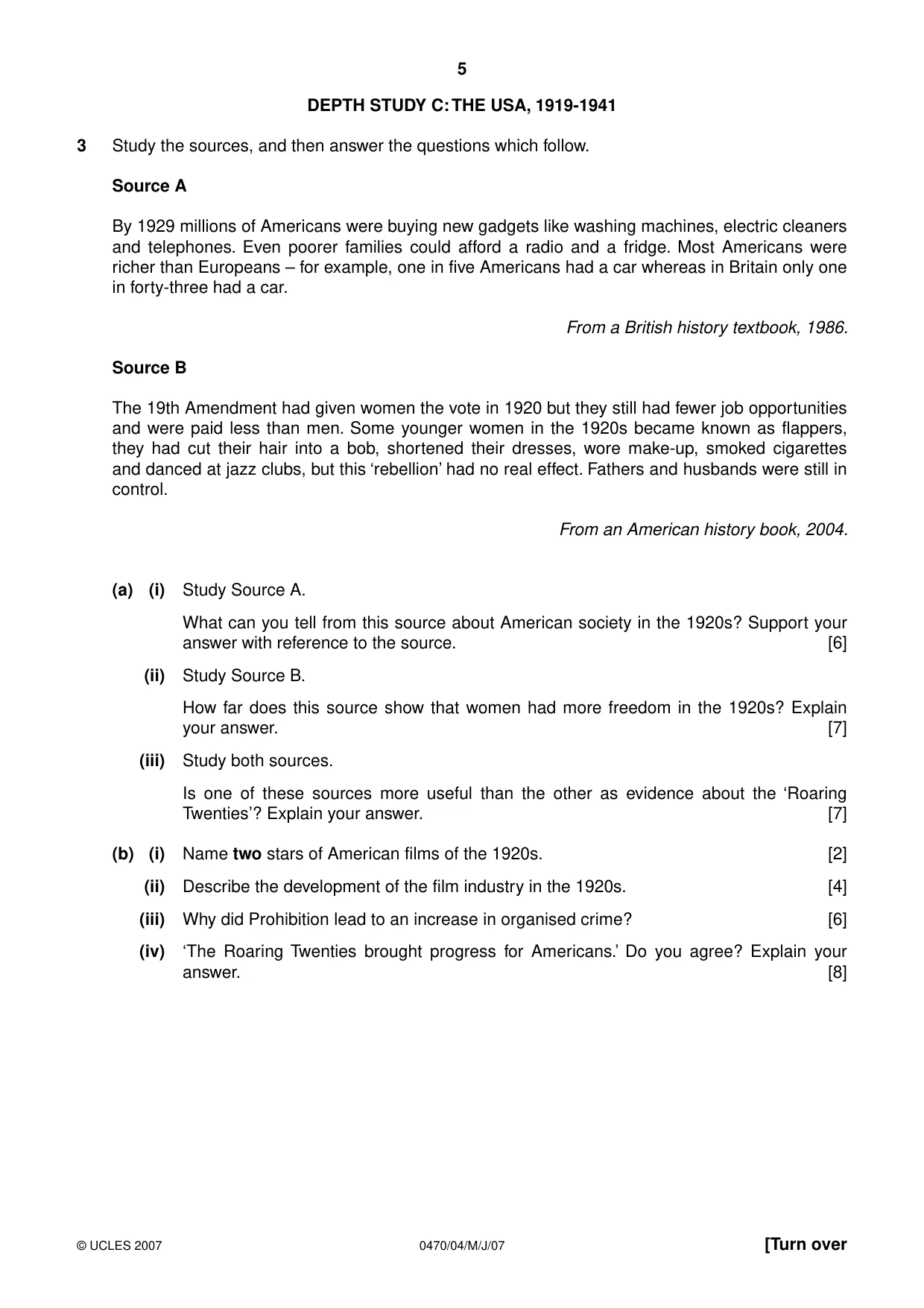
5 0470/04/M/J/07 © UCLES 2007 [Turn over DEPTH STUDY C: THE USA, 1919-1941 3 Study the sources, and then answer the questions which follow. Source A By 1929 millions of Americans were buying new gadgets like washing machines, electric cleaners and telephones. Even poorer families could afford a radio and a fridge. Most Americans were richer than Europeans – for example, one in five Americans had a car whereas in Britain only one in forty-three had a car. From a British history textbook, 1986. Source B The 19th Amendment had given women the vote in 1920 but they still had fewer job opportunities and were paid less than men. Some younger women in the 1920s became known as flappers, they had cut their hair into a bob, shortened their dresses, wore make-up, smoked cigarettes and danced at jazz clubs, but this ‘rebellion’ had no real effect. Fathers and husbands were still in control. From an American history book, 2004. (a) (i) Study Source A. What can you tell from this source about American society in the 1920s? Support your answer with reference to the source. [6] (ii) Study Source B. How far does this source show that women had more freedom in the 1920s? Explain your answer. [7] (iii) Study both sources. Is one of these sources more useful than the other as evidence about the ‘Roaring Twenties’? Explain your answer. [7] (b) (i) Name two stars of American films of the 1920s. [2] (ii) Describe the development of the film industry in the 1920s. [4] (iii) Why did Prohibition lead to an increase in organised crime? [6] (iv) ‘The Roaring Twenties brought progress for Americans.’ Do you agree? Explain your answer. [8]
Question paper, page 6
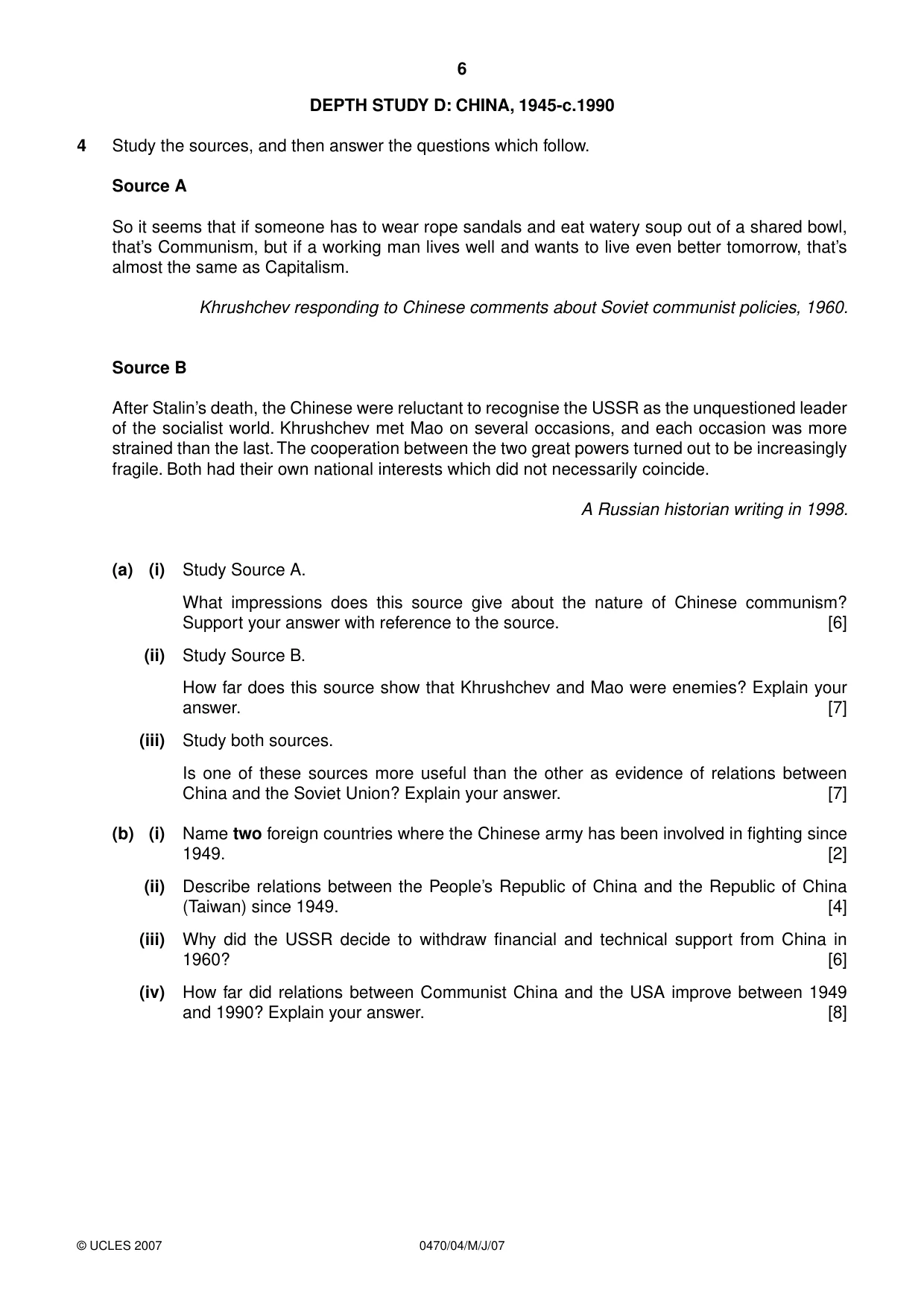
6 0470/04/M/J/07 © UCLES 2007 DEPTH STUDY D: CHINA, 1945-c.1990 4 Study the sources, and then answer the questions which follow. Source A So it seems that if someone has to wear rope sandals and eat watery soup out of a shared bowl, that’s Communism, but if a working man lives well and wants to live even better tomorrow, that’s almost the same as Capitalism. Khrushchev responding to Chinese comments about Soviet communist policies, 1960. Source B After Stalin’s death, the Chinese were reluctant to recognise the USSR as the unquestioned leader of the socialist world. Khrushchev met Mao on several occasions, and each occasion was more strained than the last. The cooperation between the two great powers turned out to be increasingly fragile. Both had their own national interests which did not necessarily coincide. A Russian historian writing in 1998. (a) (i) Study Source A. What impressions does this source give about the nature of Chinese communism? Support your answer with reference to the source. [6] (ii) Study Source B. How far does this source show that Khrushchev and Mao were enemies? Explain your answer. [7] (iii) Study both sources. Is one of these sources more useful than the other as evidence of relations between China and the Soviet Union? Explain your answer. [7] (b) (i) Name two foreign countries where the Chinese army has been involved in fighting since 1949. [2] (ii) Describe relations between the People’s Republic of China and the Republic of China (Taiwan) since 1949. [4] (iii) Why did the USSR decide to withdraw financial and technical support from China in 1960? [6] (iv) How far did relations between Communist China and the USA improve between 1949 and 1990? Explain your answer. [8]
Question paper, page 7
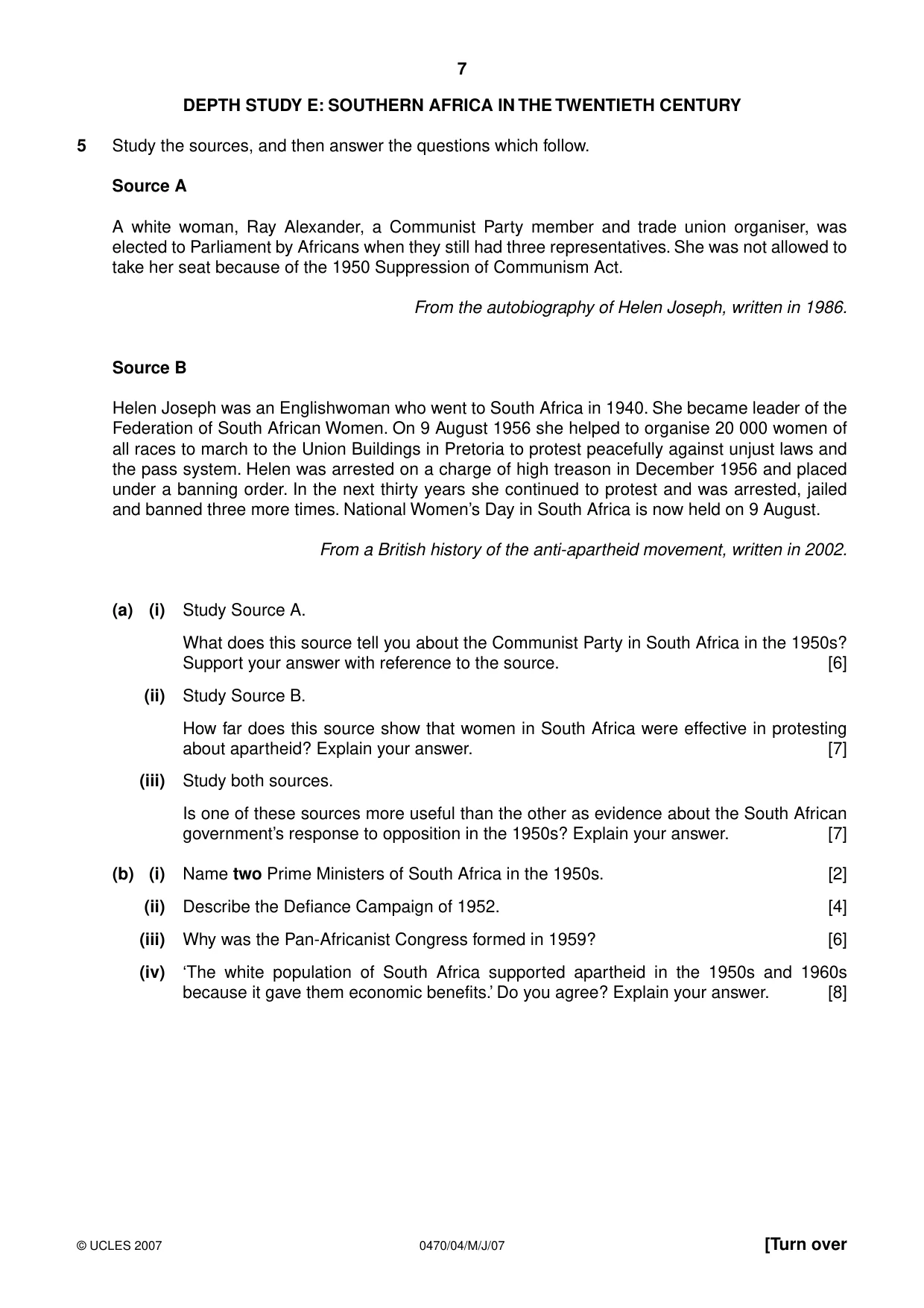
7 0470/04/M/J/07 © UCLES 2007 [Turn over DEPTH STUDY E: SOUTHERN AFRICA IN THE TWENTIETH CENTURY 5 Study the sources, and then answer the questions which follow. Source A A white woman, Ray Alexander, a Communist Party member and trade union organiser, was elected to Parliament by Africans when they still had three representatives. She was not allowed to take her seat because of the 1950 Suppression of Communism Act. From the autobiography of Helen Joseph, written in 1986. Source B Helen Joseph was an Englishwoman who went to South Africa in 1940. She became leader of the Federation of South African Women. On 9 August 1956 she helped to organise 20 000 women of all races to march to the Union Buildings in Pretoria to protest peacefully against unjust laws and the pass system. Helen was arrested on a charge of high treason in December 1956 and placed under a banning order. In the next thirty years she continued to protest and was arrested, jailed and banned three more times. National Women’s Day in South Africa is now held on 9 August. From a British history of the anti-apartheid movement, written in 2002. (a) (i) Study Source A. What does this source tell you about the Communist Party in South Africa in the 1950s? Support your answer with reference to the source. [6] (ii) Study Source B. How far does this source show that women in South Africa were effective in protesting about apartheid? Explain your answer. [7] (iii) Study both sources. Is one of these sources more useful than the other as evidence about the South African government’s response to opposition in the 1950s? Explain your answer. [7] (b) (i) Name two Prime Ministers of South Africa in the 1950s. [2] (ii) Describe the Defiance Campaign of 1952. [4] (iii) Why was the Pan-Africanist Congress formed in 1959? [6] (iv) ‘The white population of South Africa supported apartheid in the 1950s and 1960s because it gave them economic benefits.’ Do you agree? Explain your answer. [8]
Question paper, page 8
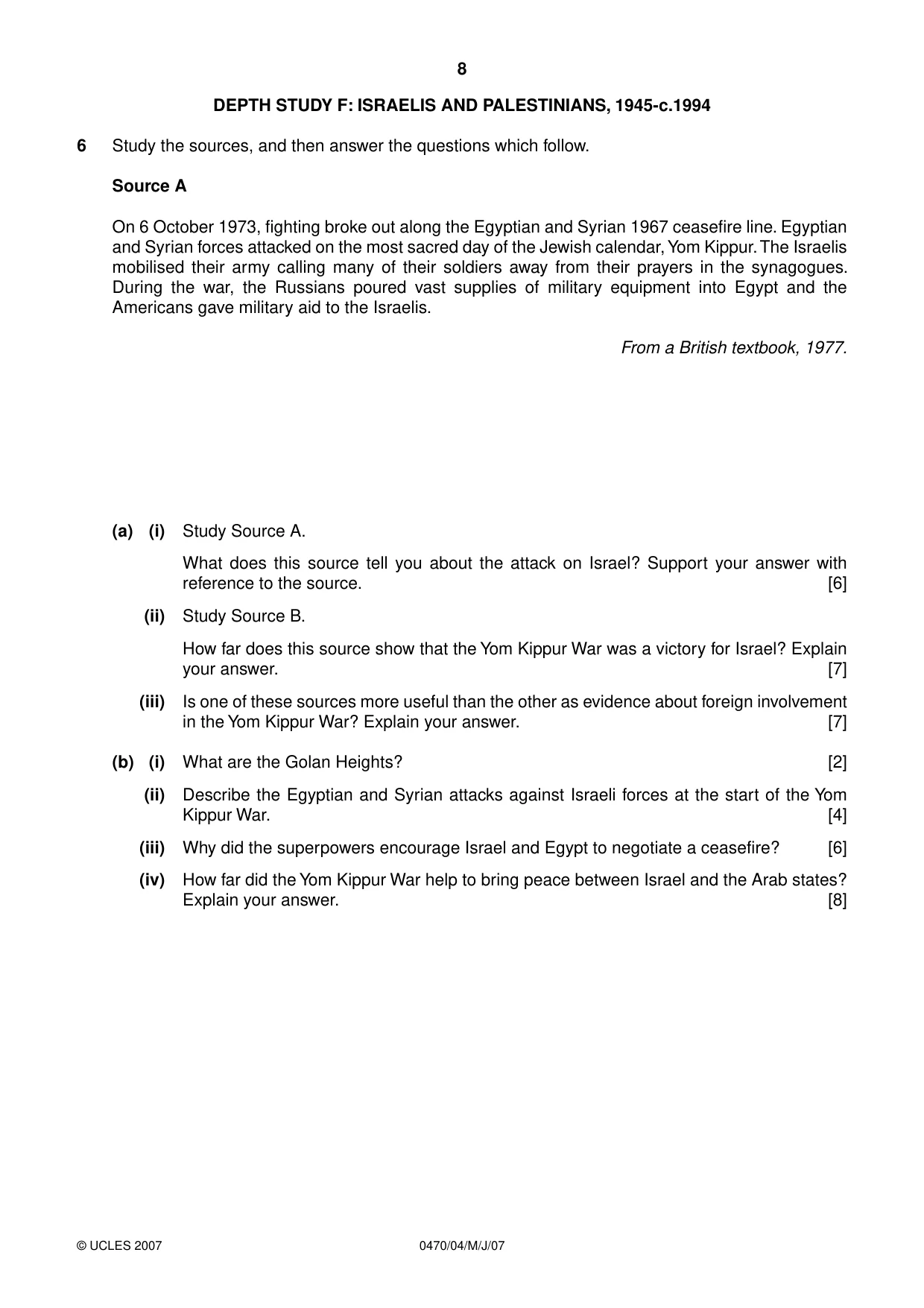
8 0470/04/M/J/07 © UCLES 2007 DEPTH STUDY F: ISRAELIS AND PALESTINIANS, 1945-c.1994 6 Study the sources, and then answer the questions which follow. Source A On 6 October 1973, fighting broke out along the Egyptian and Syrian 1967 ceasefire line. Egyptian and Syrian forces attacked on the most sacred day of the Jewish calendar, Yom Kippur. The Israelis mobilised their army calling many of their soldiers away from their prayers in the synagogues. During the war, the Russians poured vast supplies of military equipment into Egypt and the Americans gave military aid to the Israelis. From a British textbook, 1977. (a) (i) Study Source A. What does this source tell you about the attack on Israel? Support your answer with reference to the source. [6] (ii) Study Source B. How far does this source show that the Yom Kippur War was a victory for Israel? Explain your answer. [7] (iii) Is one of these sources more useful than the other as evidence about foreign involvement in the Yom Kippur War? Explain your answer. [7] (b) (i) What are the Golan Heights? [2] (ii) Describe the Egyptian and Syrian attacks against Israeli forces at the start of the Yom Kippur War. [4] (iii) Why did the superpowers encourage Israel and Egypt to negotiate a ceasefire? [6] (iv) How far did the Yom Kippur War help to bring peace between Israel and the Arab states? Explain your answer. [8]
Question paper, page 9
9 0470/04/M/J/07 [Turn over BLANK PAGE DEPTH STUDY G STARTS ON PAGE 10
Question paper, page 10
10 0470/04/M/J/07 © UCLES 2007 DEPTH STUDY G: THE CREATION OF MODERN INDUSTRIAL SOCIETY 7 Study the sources, and then answer the questions which follow. Source A Between 1801 and 1831 the population of England and Wales has increased by 47 per cent. In five of our most important towns – Manchester, Glasgow, Birmingham, Leeds and Liverpool – the increase has averaged 98 per cent. In the midst of what appears to be a wealthy, spirited and flourishing community, most of our poorer people, who created the riches, live in conditions where good health and morality are almost impossible. There is no Building Act to make sure that the dwellings of these workpeople are being properly constructed and no Drainage Act to ensure them being properly drained. From a Report of the Parliamentary Select Committee on Health in Towns in 1840. Source B A picture of Birmingham in 1886.
Question paper, page 11
11 0470/04/M/J/07 © UCLES 2007 [Turn over (a) (i) Study Source A. What does this source tell you about the expansion of towns in England and Wales in the nineteenth century? Support your answer with reference to the source. [6] (ii) Study Source B. How far does this source show that towns had become much better places to live in by the last quarter of the nineteenth century? Explain your answer. [7] (iii) Study both sources. Is one of these sources more useful than the other as evidence about urbanisation in Britain in the nineteenth century? Explain your answer. [7] (b) (i) Name two industries which caused the rapid expansion of some towns in the nineteenth century. [2] (ii) What public health problems faced the new industrial towns? [4] (iii) Why did it take so long to improve living and working conditions in industrial towns? [6] (iv) ‘The growth of towns brought more advantages than disadvantages to working people.’ Do you agree? Explain your answer. [8]
Question paper, page 12
12 0470/04/M/J/07 © UCLES 2007 DEPTH STUDY H: THE IMPACT OF WESTERN IMPERIALISM IN THE NINETEENTH CENTURY 8 Study the sources, and then answer the questions which follow. Source A A judge’s wife in early nineteenth-century India surrounded by her servants. Source B We must not allow the cruelty of these practices to blind us to the dangers of trying to suppress them. Are the government prepared permanently to occupy an immense territory and involve us in a war in an unhealthy climate and at great expense? From a report sent to London by a member of the Madras Civil Service with regard to religious practices like suttee, infanticide and human sacrifice. Source C It was a life which to English eyes was a strange mixture of inconvenience with luxury. Luxury no doubt for a man to have socks rolled on his feet by a servant and for a woman to have her hair brushed for half an hour every evening. But much had already been done to improve life for Indians: suttee was forbidden, thuggee finished and gang robbery reduced. But was it worth the dust, the cholera, the heat and its effects? From a book about life in India in the early 1850s.
Question paper, page 13
13 0470/04/M/J/07 © UCLES 2007 (a) (i) Study Source A. What impressions does this source give you of early nineteenth-century India? Support your answer with reference to the source. [6] (ii) Study Sources B and C. How far do these sources show that there were great problems facing the British rulers of India in the first half of the nineteenth century? Explain your answer. [7] (iii) Study Sources A and C. Is one of these sources more useful than the other as evidence that the British only looked after their own interests in India? Explain your answer. [7] (b) (i) What was suttee? [2] (ii) What were the main reforms introduced into India by Lord William Bentinck? [4] (iii) Why did many British people go to India in the nineteenth century? [6] (iv) ‘The history of the British in India to 1857 was one of conquest and exploitation.’ Do you agree? Explain your answer. [8]
Question paper, page 16
16 0470/04/M/J/07 BLANK PAGE Copyright Acknowledgements: Question 1 Source B © Louis L. Snyder; Encyclopaedia of the Third Reich; Robert Hale; 1998. Question 2 Source B © Ben Walsh; GCSE Modern World History; Hodder Murray; 2001. Text amended. Question 3 Source A © Harriet Ward; World Powers in the Twentieth Century; BBC; 1978. Question 3 Source B Reprinted by permission of HarperCollins Publishers Ltd © Dmitri Volkogonov, 1998. Question 6 Source A © Arab-Israeli Conflict; Collins Educational; 1977. Question 6 Source B © J. Palmowski; A Dictionary of Twentieth-Century World History; Oxford Paperbacks; 1997. By permission of Oxford University Press. Permission to reproduce items where third-party owned material protected by copyright is included has been sought and cleared where possible. Every reasonable effort has been made by the publisher (UCLES) to trace copyright holders, but if any items requiring clearance have unwittingly been included, the publisher will be pleased to make amends at the earliest possible opportunity. University of Cambridge International Examinations is part of the Cambridge Assessment Group. Cambridge Assessment is the brand name of University of Cambridge Local Examinations Syndicate (UCLES), which is itself a department of the University of Cambridge.
Mark scheme, page 1
UNIVERSITY OF CAMBRIDGE INTERNATIONAL EXAMINATIONS International General Certificate of Secondary Education MARK SCHEME for the May/June 2007 question paper 0470 HISTORY 0470/04 Paper 4 (Alternative to Coursework), maximum raw mark 40 This mark scheme is published as an aid to teachers and candidates, to indicate the requirements of the examination. It shows the basis on which Examiners were instructed to award marks. It does not indicate the details of the discussions that took place at an Examiners’ meeting before marking began. All Examiners are instructed that alternative correct answers and unexpected approaches in candidates’ scripts must be given marks that fairly reflect the relevant knowledge and skills demonstrated. Mark schemes must be read in conjunction with the question papers and the report on the examination. • CIE will not enter into discussions or correspondence in connection with these mark schemes. CIE is publishing the mark schemes for the May/June 2007 question papers for most IGCSE, GCE Advanced Level and Advanced Subsidiary Level syllabuses and some Ordinary Level syllabuses. www.XtremePapers.com
Mark scheme, page 2
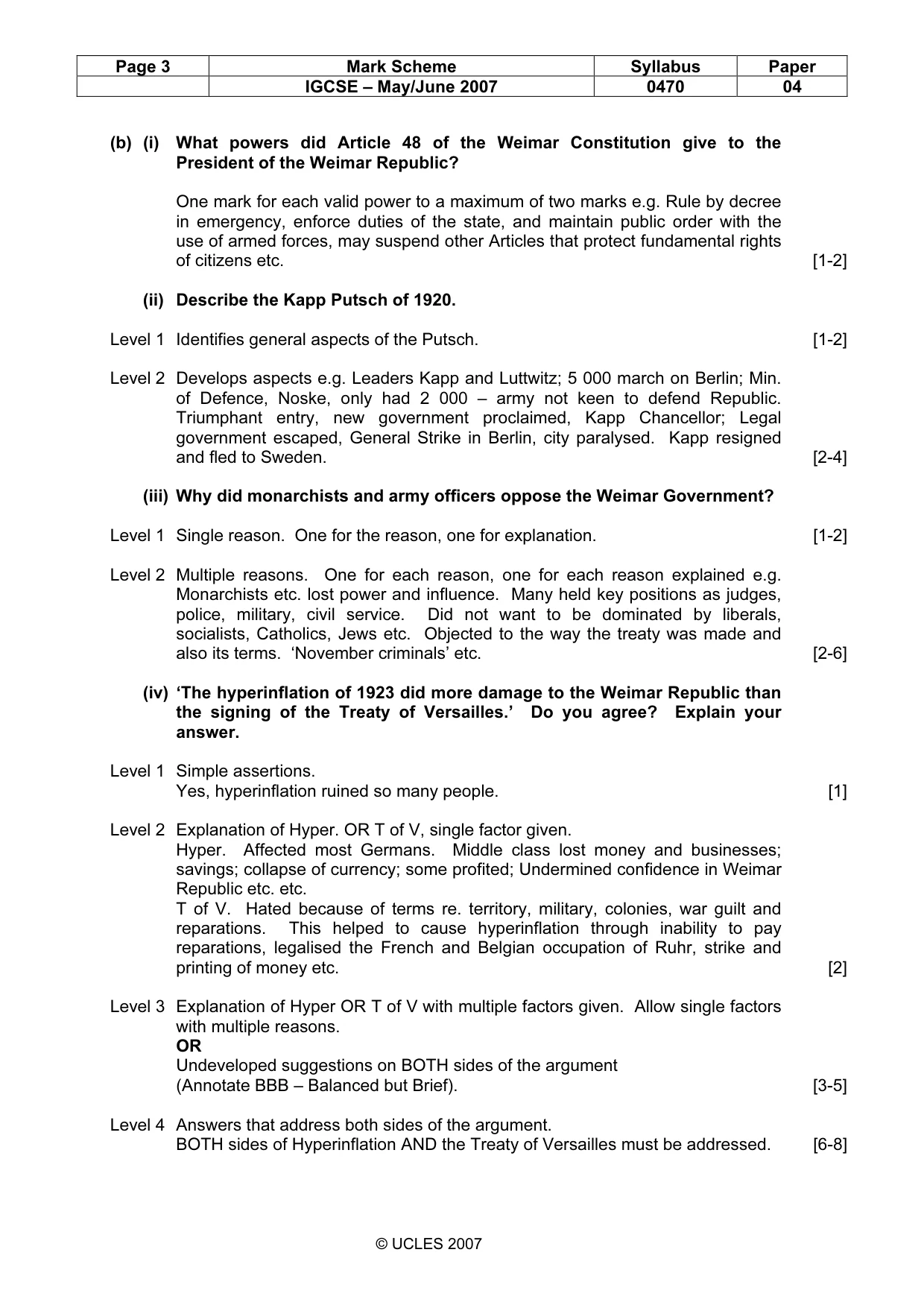
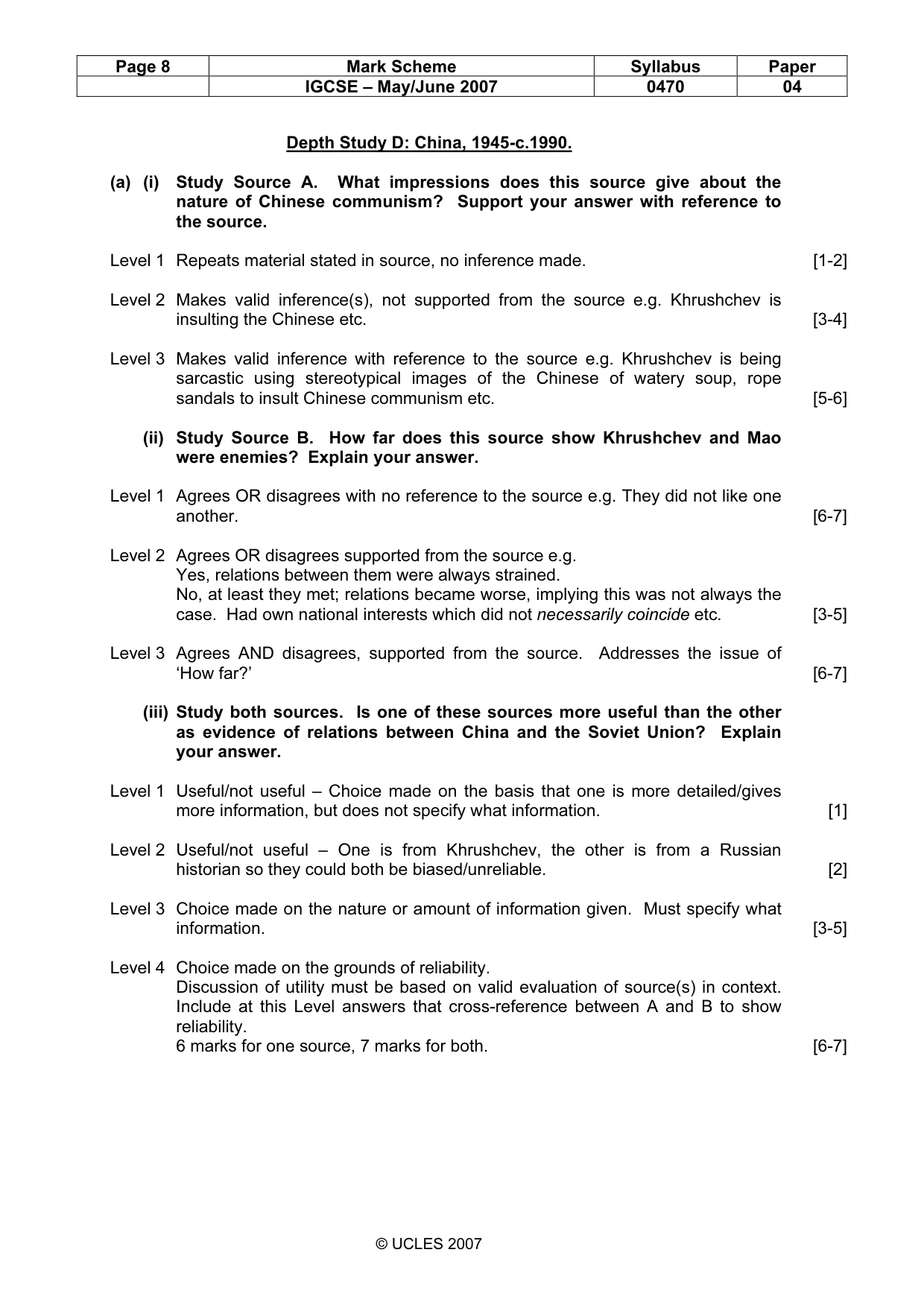
Page 2 Mark Scheme Syllabus Paper IGCSE – May/June 2007 0470 04 © UCLES 2007 Depth Study A: Germany, 1918-1945. (a) (i) Study Source A. What can you tell from this source about post-war Germany? Support your answer with reference to the source. Level 1 Repeats material stated in source, no inference made. [1-2] Level 2 Makes valid inference(s) unsupported from source e.g. It all looks very hazardous etc. [3-4] Level 3 Makes valid inferences, supported from source e.g. Many have been killed and injured by the violence judging by the number of bodies; The drawing of the officer gives extra evidence of the madness of the time etc. [5-6] (ii) Study Source B. How far does this source show that the Free Corps was a military organisation? Explain your answer. Level 1 Agrees OR disagrees, unsupported from the source. [1-2] Level 2 Agrees OR disagrees, supported from the source e.g. Yes, it contained former officers and ex-soldiers etc. No, it contained unemployed youths and there is no evidence of a chain of command etc. [3-5] Level 3 Agrees AND disagrees, supported from the source. Addresses the issue of ‘How far?’ [6-7] (iii) Study both sources. Is one source more useful than the other as evidence about the Free Corps? Explain your answer. Level 1 Useful/not useful – Choice made on the basis that one is more detailed/gives more information, but does not specify what information. [1] Level 2 Useful/not useful – One source is a drawing and the other is British, so they could both be biased/unreliable. [2] Level 3 Choice made on the nature or amount of information given. Must specify what information. [3-5] Level 4 Choice made on the grounds of reliability. Discussion of utility must be made on valid evaluation of source(s) in context. Include at this Level answers that cross-reference between A and B to show reliability. 6 marks for one source, 7 marks for both. [6-7]
Mark scheme, page 3
Page 3 Mark Scheme Syllabus Paper IGCSE – May/June 2007 0470 04 © UCLES 2007 (b) (i) What powers did Article 48 of the Weimar Constitution give to the President of the Weimar Republic? One mark for each valid power to a maximum of two marks e.g. Rule by decree in emergency, enforce duties of the state, and maintain public order with the use of armed forces, may suspend other Articles that protect fundamental rights of citizens etc. [1-2] (ii) Describe the Kapp Putsch of 1920. Level 1 Identifies general aspects of the Putsch. [1-2] Level 2 Develops aspects e.g. Leaders Kapp and Luttwitz; 5 000 march on Berlin; Min. of Defence, Noske, only had 2 000 – army not keen to defend Republic. Triumphant entry, new government proclaimed, Kapp Chancellor; Legal government escaped, General Strike in Berlin, city paralysed. Kapp resigned and fled to Sweden. [2-4] (iii) Why did monarchists and army officers oppose the Weimar Government? Level 1 Single reason. One for the reason, one for explanation. [1-2] Level 2 Multiple reasons. One for each reason, one for each reason explained e.g. Monarchists etc. lost power and influence. Many held key positions as judges, police, military, civil service. Did not want to be dominated by liberals, socialists, Catholics, Jews etc. Objected to the way the treaty was made and also its terms. ‘November criminals’ etc. [2-6] (iv) ‘The hyperinflation of 1923 did more damage to the Weimar Republic than the signing of the Treaty of Versailles.’ Do you agree? Explain your answer. Level 1 Simple assertions. Yes, hyperinflation ruined so many people. [1] Level 2 Explanation of Hyper. OR T of V, single factor given. Hyper. Affected most Germans. Middle class lost money and businesses; savings; collapse of currency; some profited; Undermined confidence in Weimar Republic etc. etc. T of V. Hated because of terms re. territory, military, colonies, war guilt and reparations. This helped to cause hyperinflation through inability to pay reparations, legalised the French and Belgian occupation of Ruhr, strike and printing of money etc. [2] Level 3 Explanation of Hyper OR T of V with multiple factors given. Allow single factors with multiple reasons. OR Undeveloped suggestions on BOTH sides of the argument (Annotate BBB – Balanced but Brief). [3-5] Level 4 Answers that address both sides of the argument. BOTH sides of Hyperinflation AND the Treaty of Versailles must be addressed. [6-8]
Mark scheme, page 4
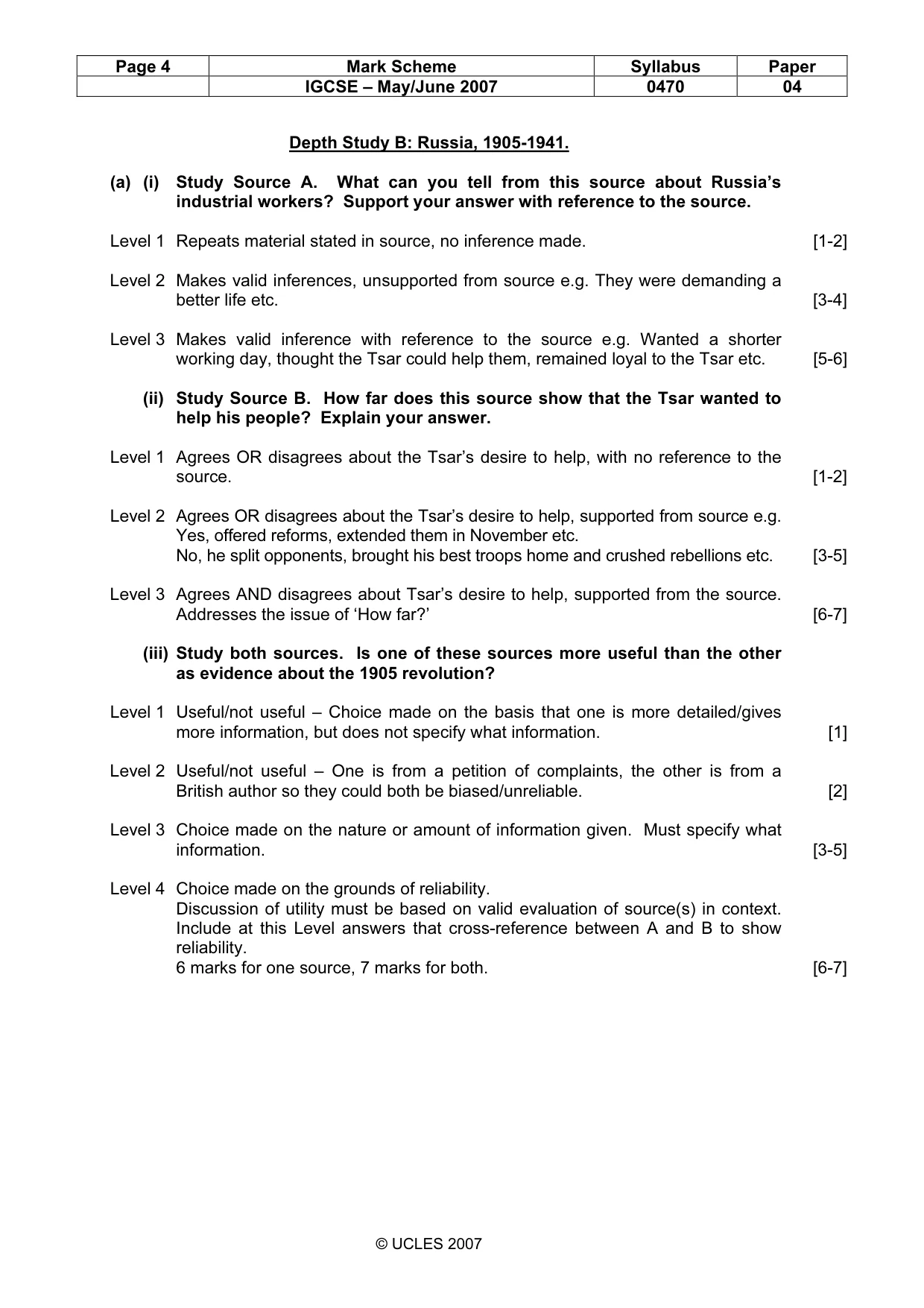
Page 4 Mark Scheme Syllabus Paper IGCSE – May/June 2007 0470 04 © UCLES 2007 Depth Study B: Russia, 1905-1941. (a) (i) Study Source A. What can you tell from this source about Russia’s industrial workers? Support your answer with reference to the source. Level 1 Repeats material stated in source, no inference made. [1-2] Level 2 Makes valid inferences, unsupported from source e.g. They were demanding a better life etc. [3-4] Level 3 Makes valid inference with reference to the source e.g. Wanted a shorter working day, thought the Tsar could help them, remained loyal to the Tsar etc. [5-6] (ii) Study Source B. How far does this source show that the Tsar wanted to help his people? Explain your answer. Level 1 Agrees OR disagrees about the Tsar’s desire to help, with no reference to the source. [1-2] Level 2 Agrees OR disagrees about the Tsar’s desire to help, supported from source e.g. Yes, offered reforms, extended them in November etc. No, he split opponents, brought his best troops home and crushed rebellions etc. [3-5] Level 3 Agrees AND disagrees about Tsar’s desire to help, supported from the source. Addresses the issue of ‘How far?’ [6-7] (iii) Study both sources. Is one of these sources more useful than the other as evidence about the 1905 revolution? Level 1 Useful/not useful – Choice made on the basis that one is more detailed/gives more information, but does not specify what information. [1] Level 2 Useful/not useful – One is from a petition of complaints, the other is from a British author so they could both be biased/unreliable. [2] Level 3 Choice made on the nature or amount of information given. Must specify what information. [3-5] Level 4 Choice made on the grounds of reliability. Discussion of utility must be based on valid evaluation of source(s) in context. Include at this Level answers that cross-reference between A and B to show reliability. 6 marks for one source, 7 marks for both. [6-7]
Mark scheme, page 5
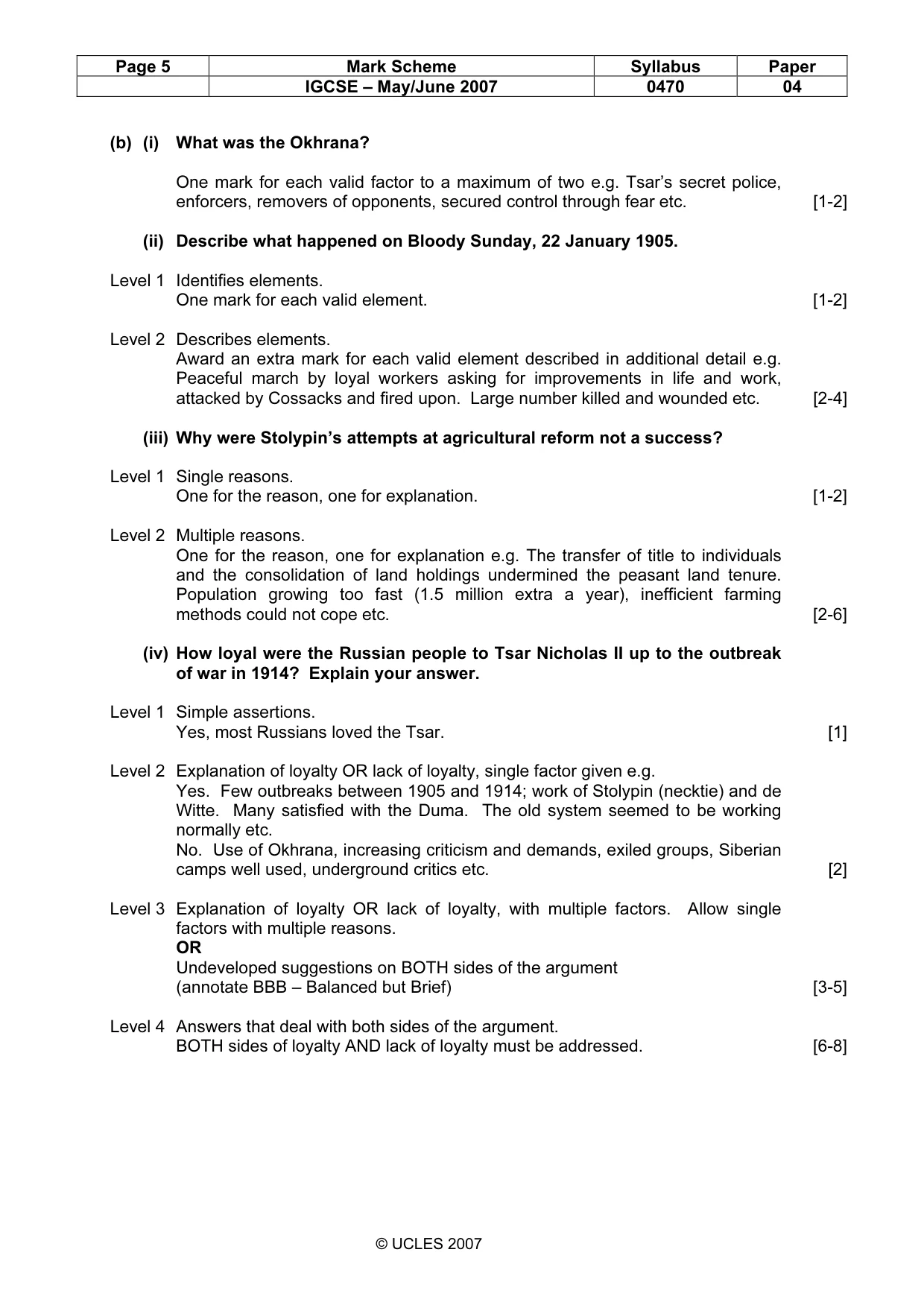
Page 5 Mark Scheme Syllabus Paper IGCSE – May/June 2007 0470 04 © UCLES 2007 (b) (i) What was the Okhrana? One mark for each valid factor to a maximum of two e.g. Tsar’s secret police, enforcers, removers of opponents, secured control through fear etc. [1-2] (ii) Describe what happened on Bloody Sunday, 22 January 1905. Level 1 Identifies elements. One mark for each valid element. [1-2] Level 2 Describes elements. Award an extra mark for each valid element described in additional detail e.g. Peaceful march by loyal workers asking for improvements in life and work, attacked by Cossacks and fired upon. Large number killed and wounded etc. [2-4] (iii) Why were Stolypin’s attempts at agricultural reform not a success? Level 1 Single reasons. One for the reason, one for explanation. [1-2] Level 2 Multiple reasons. One for the reason, one for explanation e.g. The transfer of title to individuals and the consolidation of land holdings undermined the peasant land tenure. Population growing too fast (1.5 million extra a year), inefficient farming methods could not cope etc. [2-6] (iv) How loyal were the Russian people to Tsar Nicholas II up to the outbreak of war in 1914? Explain your answer. Level 1 Simple assertions. Yes, most Russians loved the Tsar. [1] Level 2 Explanation of loyalty OR lack of loyalty, single factor given e.g. Yes. Few outbreaks between 1905 and 1914; work of Stolypin (necktie) and de Witte. Many satisfied with the Duma. The old system seemed to be working normally etc. No. Use of Okhrana, increasing criticism and demands, exiled groups, Siberian camps well used, underground critics etc. [2] Level 3 Explanation of loyalty OR lack of loyalty, with multiple factors. Allow single factors with multiple reasons. OR Undeveloped suggestions on BOTH sides of the argument (annotate BBB – Balanced but Brief) [3-5] Level 4 Answers that deal with both sides of the argument. BOTH sides of loyalty AND lack of loyalty must be addressed. [6-8]
Mark scheme, page 6
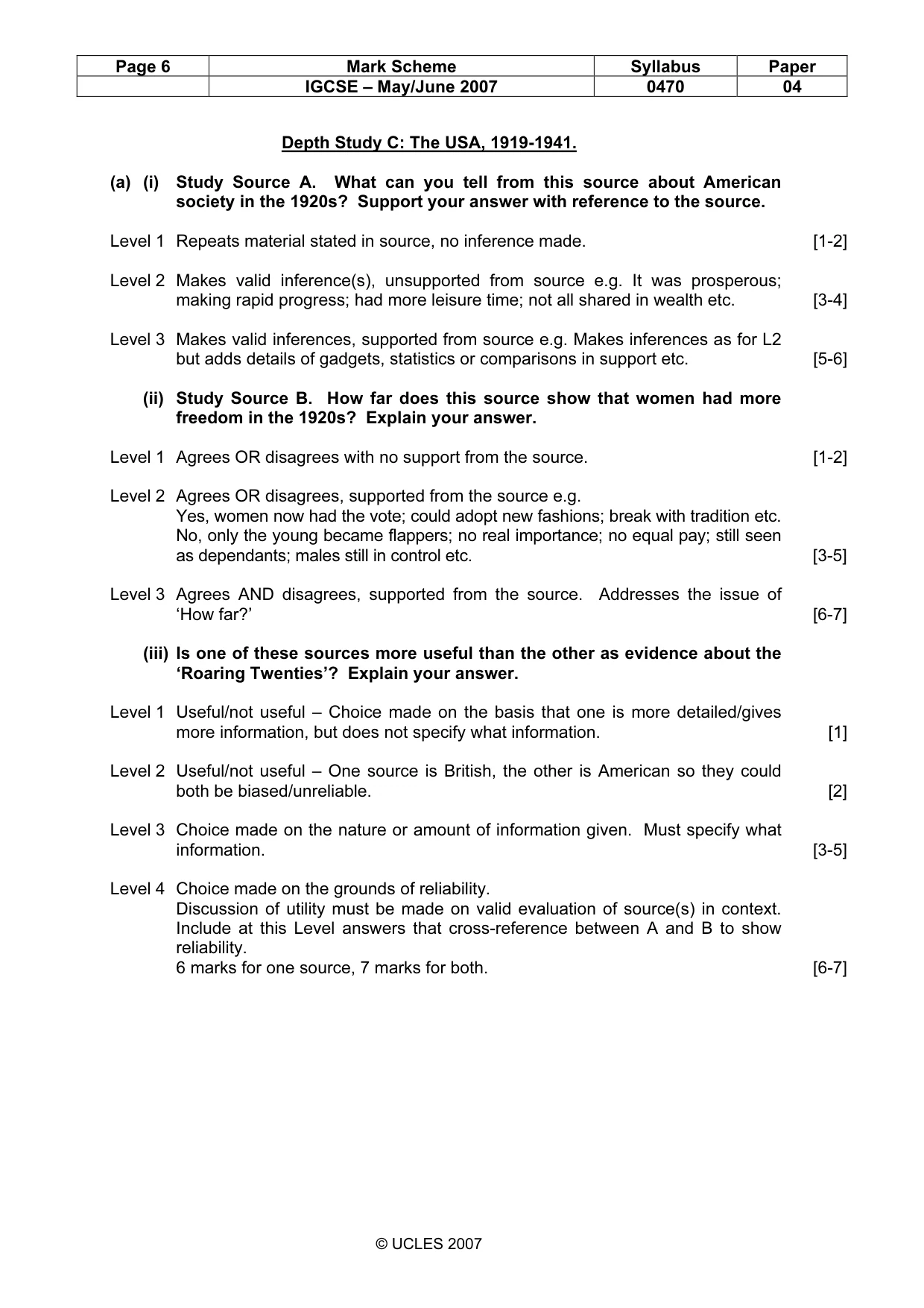
Page 6 Mark Scheme Syllabus Paper IGCSE – May/June 2007 0470 04 © UCLES 2007 Depth Study C: The USA, 1919-1941. (a) (i) Study Source A. What can you tell from this source about American society in the 1920s? Support your answer with reference to the source. Level 1 Repeats material stated in source, no inference made. [1-2] Level 2 Makes valid inference(s), unsupported from source e.g. It was prosperous; making rapid progress; had more leisure time; not all shared in wealth etc. [3-4] Level 3 Makes valid inferences, supported from source e.g. Makes inferences as for L2 but adds details of gadgets, statistics or comparisons in support etc. [5-6] (ii) Study Source B. How far does this source show that women had more freedom in the 1920s? Explain your answer. Level 1 Agrees OR disagrees with no support from the source. [1-2] Level 2 Agrees OR disagrees, supported from the source e.g. Yes, women now had the vote; could adopt new fashions; break with tradition etc. No, only the young became flappers; no real importance; no equal pay; still seen as dependants; males still in control etc. [3-5] Level 3 Agrees AND disagrees, supported from the source. Addresses the issue of ‘How far?’ [6-7] (iii) Is one of these sources more useful than the other as evidence about the ‘Roaring Twenties’? Explain your answer. Level 1 Useful/not useful – Choice made on the basis that one is more detailed/gives more information, but does not specify what information. [1] Level 2 Useful/not useful – One source is British, the other is American so they could both be biased/unreliable. [2] Level 3 Choice made on the nature or amount of information given. Must specify what information. [3-5] Level 4 Choice made on the grounds of reliability. Discussion of utility must be made on valid evaluation of source(s) in context. Include at this Level answers that cross-reference between A and B to show reliability. 6 marks for one source, 7 marks for both. [6-7]
Mark scheme, page 7
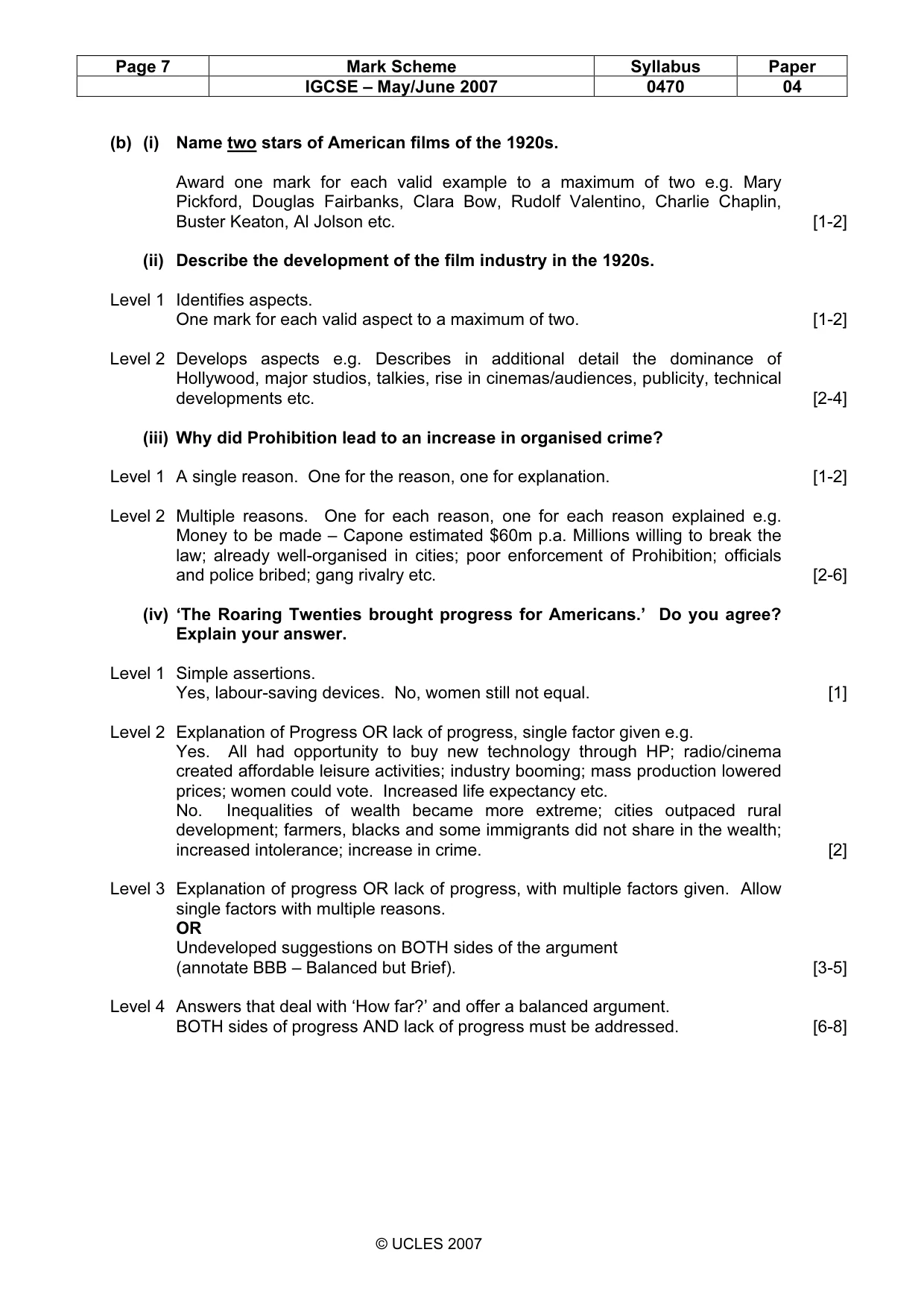
Page 7 Mark Scheme Syllabus Paper IGCSE – May/June 2007 0470 04 © UCLES 2007 (b) (i) Name two stars of American films of the 1920s. Award one mark for each valid example to a maximum of two e.g. Mary Pickford, Douglas Fairbanks, Clara Bow, Rudolf Valentino, Charlie Chaplin, Buster Keaton, Al Jolson etc. [1-2] (ii) Describe the development of the film industry in the 1920s. Level 1 Identifies aspects. One mark for each valid aspect to a maximum of two. [1-2] Level 2 Develops aspects e.g. Describes in additional detail the dominance of Hollywood, major studios, talkies, rise in cinemas/audiences, publicity, technical developments etc. [2-4] (iii) Why did Prohibition lead to an increase in organised crime? Level 1 A single reason. One for the reason, one for explanation. [1-2] Level 2 Multiple reasons. One for each reason, one for each reason explained e.g. Money to be made – Capone estimated $60m p.a. Millions willing to break the law; already well-organised in cities; poor enforcement of Prohibition; officials and police bribed; gang rivalry etc. [2-6] (iv) ‘The Roaring Twenties brought progress for Americans.’ Do you agree? Explain your answer. Level 1 Simple assertions. Yes, labour-saving devices. No, women still not equal. [1] Level 2 Explanation of Progress OR lack of progress, single factor given e.g. Yes. All had opportunity to buy new technology through HP; radio/cinema created affordable leisure activities; industry booming; mass production lowered prices; women could vote. Increased life expectancy etc. No. Inequalities of wealth became more extreme; cities outpaced rural development; farmers, blacks and some immigrants did not share in the wealth; increased intolerance; increase in crime. [2] Level 3 Explanation of progress OR lack of progress, with multiple factors given. Allow single factors with multiple reasons. OR Undeveloped suggestions on BOTH sides of the argument (annotate BBB – Balanced but Brief). [3-5] Level 4 Answers that deal with ‘How far?’ and offer a balanced argument. BOTH sides of progress AND lack of progress must be addressed. [6-8]
Mark scheme, page 8
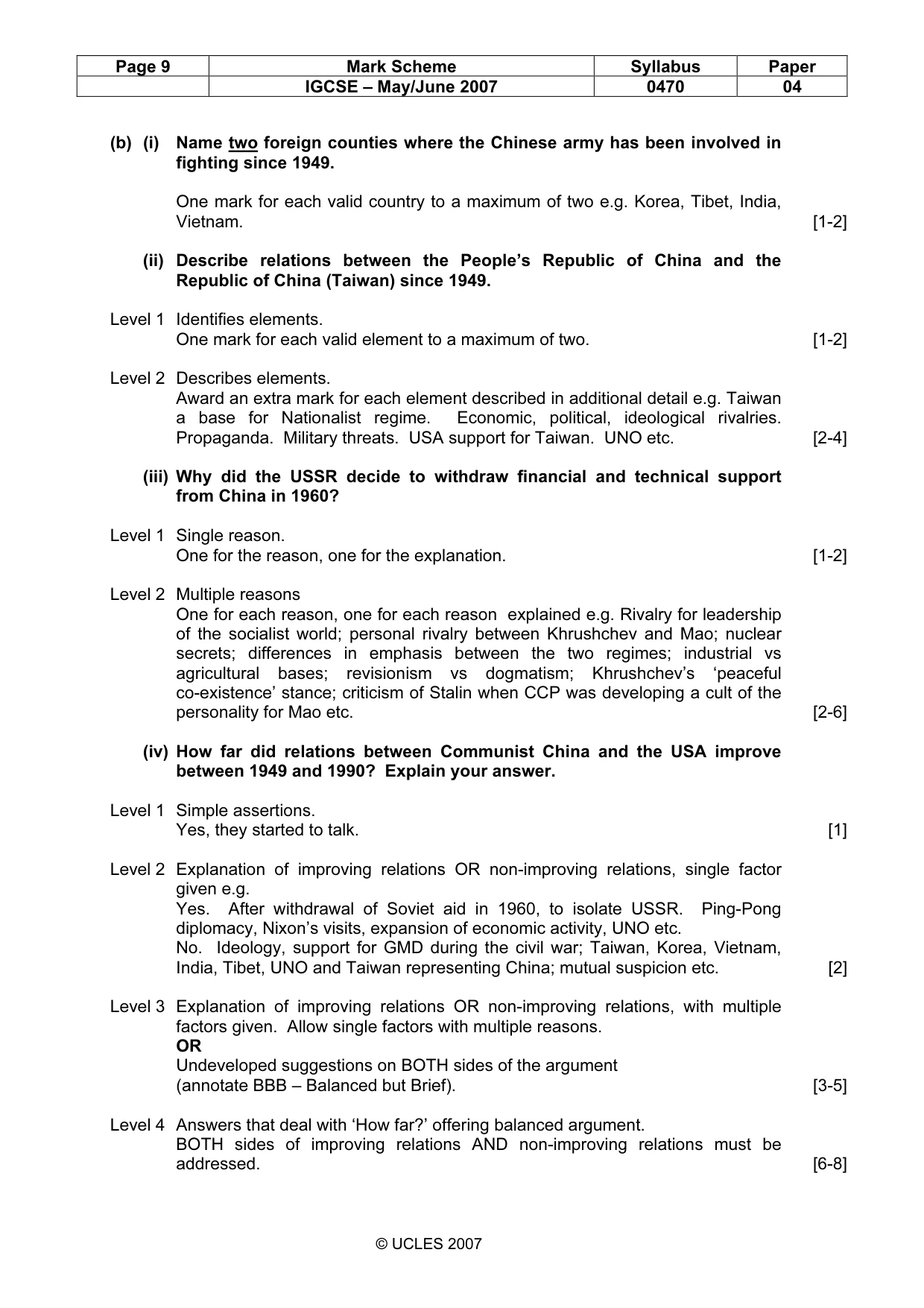
Page 8 Mark Scheme Syllabus Paper IGCSE – May/June 2007 0470 04 © UCLES 2007 Depth Study D: China, 1945-c.1990. (a) (i) Study Source A. What impressions does this source give about the nature of Chinese communism? Support your answer with reference to the source. Level 1 Repeats material stated in source, no inference made. [1-2] Level 2 Makes valid inference(s), not supported from the source e.g. Khrushchev is insulting the Chinese etc. [3-4] Level 3 Makes valid inference with reference to the source e.g. Khrushchev is being sarcastic using stereotypical images of the Chinese of watery soup, rope sandals to insult Chinese communism etc. [5-6] (ii) Study Source B. How far does this source show Khrushchev and Mao were enemies? Explain your answer. Level 1 Agrees OR disagrees with no reference to the source e.g. They did not like one another. [6-7] Level 2 Agrees OR disagrees supported from the source e.g. Yes, relations between them were always strained. No, at least they met; relations became worse, implying this was not always the case. Had own national interests which did not necessarily coincide etc. [3-5] Level 3 Agrees AND disagrees, supported from the source. Addresses the issue of ‘How far?’ [6-7] (iii) Study both sources. Is one of these sources more useful than the other as evidence of relations between China and the Soviet Union? Explain your answer. Level 1 Useful/not useful – Choice made on the basis that one is more detailed/gives more information, but does not specify what information. [1] Level 2 Useful/not useful – One is from Khrushchev, the other is from a Russian historian so they could both be biased/unreliable. [2] Level 3 Choice made on the nature or amount of information given. Must specify what information. [3-5] Level 4 Choice made on the grounds of reliability. Discussion of utility must be based on valid evaluation of source(s) in context. Include at this Level answers that cross-reference between A and B to show reliability. 6 marks for one source, 7 marks for both. [6-7]
Mark scheme, page 9
Page 9 Mark Scheme Syllabus Paper IGCSE – May/June 2007 0470 04 © UCLES 2007 (b) (i) Name two foreign counties where the Chinese army has been involved in fighting since 1949. One mark for each valid country to a maximum of two e.g. Korea, Tibet, India, Vietnam. [1-2] (ii) Describe relations between the People’s Republic of China and the Republic of China (Taiwan) since 1949. Level 1 Identifies elements. One mark for each valid element to a maximum of two. [1-2] Level 2 Describes elements. Award an extra mark for each element described in additional detail e.g. Taiwan a base for Nationalist regime. Economic, political, ideological rivalries. Propaganda. Military threats. USA support for Taiwan. UNO etc. [2-4] (iii) Why did the USSR decide to withdraw financial and technical support from China in 1960? Level 1 Single reason. One for the reason, one for the explanation. [1-2] Level 2 Multiple reasons One for each reason, one for each reason explained e.g. Rivalry for leadership of the socialist world; personal rivalry between Khrushchev and Mao; nuclear secrets; differences in emphasis between the two regimes; industrial vs agricultural bases; revisionism vs dogmatism; Khrushchev’s ‘peaceful co-existence’ stance; criticism of Stalin when CCP was developing a cult of the personality for Mao etc. [2-6] (iv) How far did relations between Communist China and the USA improve between 1949 and 1990? Explain your answer. Level 1 Simple assertions. Yes, they started to talk. [1] Level 2 Explanation of improving relations OR non-improving relations, single factor given e.g. Yes. After withdrawal of Soviet aid in 1960, to isolate USSR. Ping-Pong diplomacy, Nixon’s visits, expansion of economic activity, UNO etc. No. Ideology, support for GMD during the civil war; Taiwan, Korea, Vietnam, India, Tibet, UNO and Taiwan representing China; mutual suspicion etc. [2] Level 3 Explanation of improving relations OR non-improving relations, with multiple factors given. Allow single factors with multiple reasons. OR Undeveloped suggestions on BOTH sides of the argument (annotate BBB – Balanced but Brief). [3-5] Level 4 Answers that deal with ‘How far?’ offering balanced argument. BOTH sides of improving relations AND non-improving relations must be addressed. [6-8]
Mark scheme, page 10
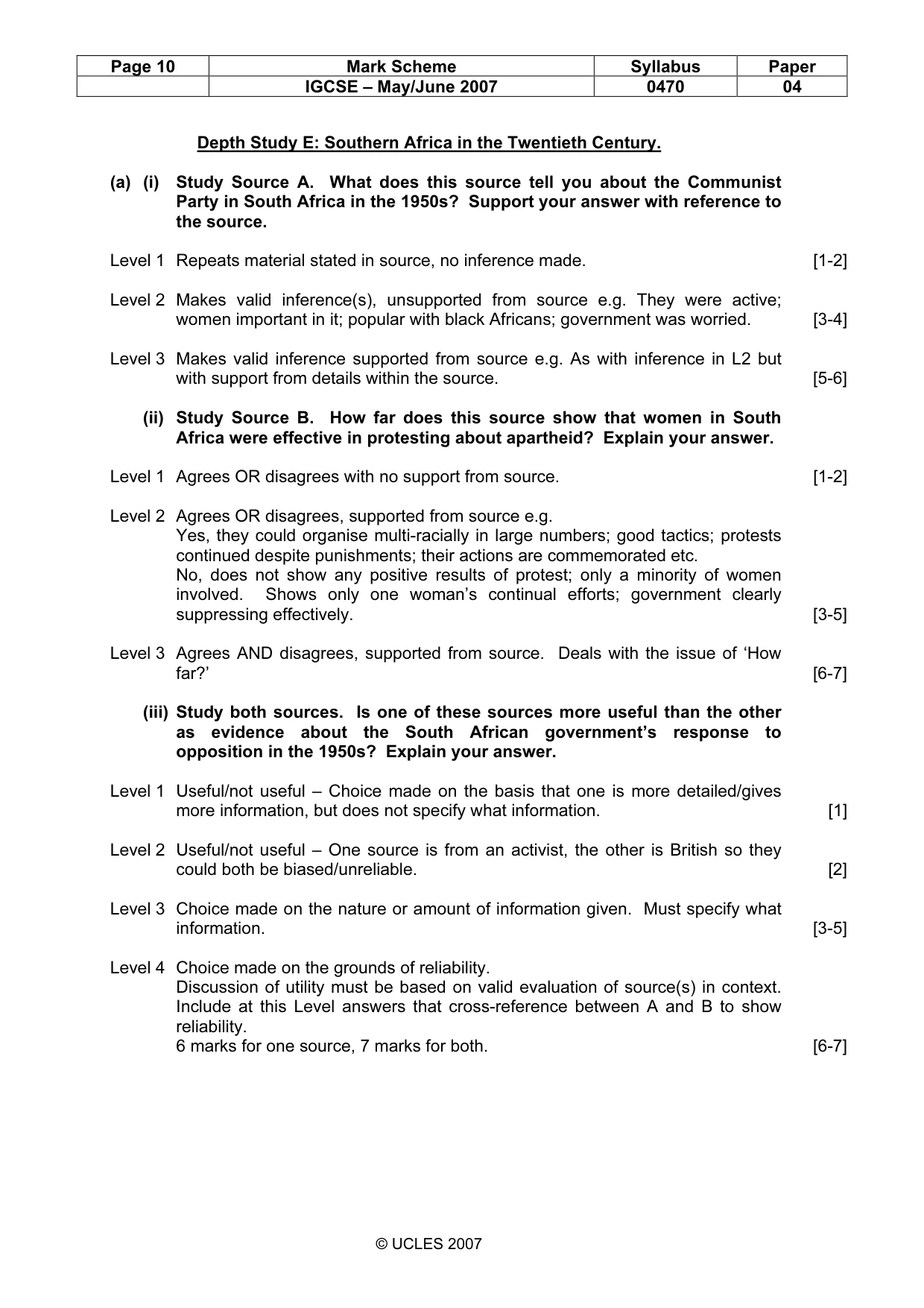
Page 10 Mark Scheme Syllabus Paper IGCSE – May/June 2007 0470 04 © UCLES 2007 Depth Study E: Southern Africa in the Twentieth Century. (a) (i) Study Source A. What does this source tell you about the Communist Party in South Africa in the 1950s? Support your answer with reference to the source. Level 1 Repeats material stated in source, no inference made. [1-2] Level 2 Makes valid inference(s), unsupported from source e.g. They were active; women important in it; popular with black Africans; government was worried. [3-4] Level 3 Makes valid inference supported from source e.g. As with inference in L2 but with support from details within the source. [5-6] (ii) Study Source B. How far does this source show that women in South Africa were effective in protesting about apartheid? Explain your answer. Level 1 Agrees OR disagrees with no support from source. [1-2] Level 2 Agrees OR disagrees, supported from source e.g. Yes, they could organise multi-racially in large numbers; good tactics; protests continued despite punishments; their actions are commemorated etc. No, does not show any positive results of protest; only a minority of women involved. Shows only one woman’s continual efforts; government clearly suppressing effectively. [3-5] Level 3 Agrees AND disagrees, supported from source. Deals with the issue of ‘How far?’ [6-7] (iii) Study both sources. Is one of these sources more useful than the other as evidence about the South African government’s response to opposition in the 1950s? Explain your answer. Level 1 Useful/not useful – Choice made on the basis that one is more detailed/gives more information, but does not specify what information. [1] Level 2 Useful/not useful – One source is from an activist, the other is British so they could both be biased/unreliable. [2] Level 3 Choice made on the nature or amount of information given. Must specify what information. [3-5] Level 4 Choice made on the grounds of reliability. Discussion of utility must be based on valid evaluation of source(s) in context. Include at this Level answers that cross-reference between A and B to show reliability. 6 marks for one source, 7 marks for both. [6-7]
Mark scheme, page 11
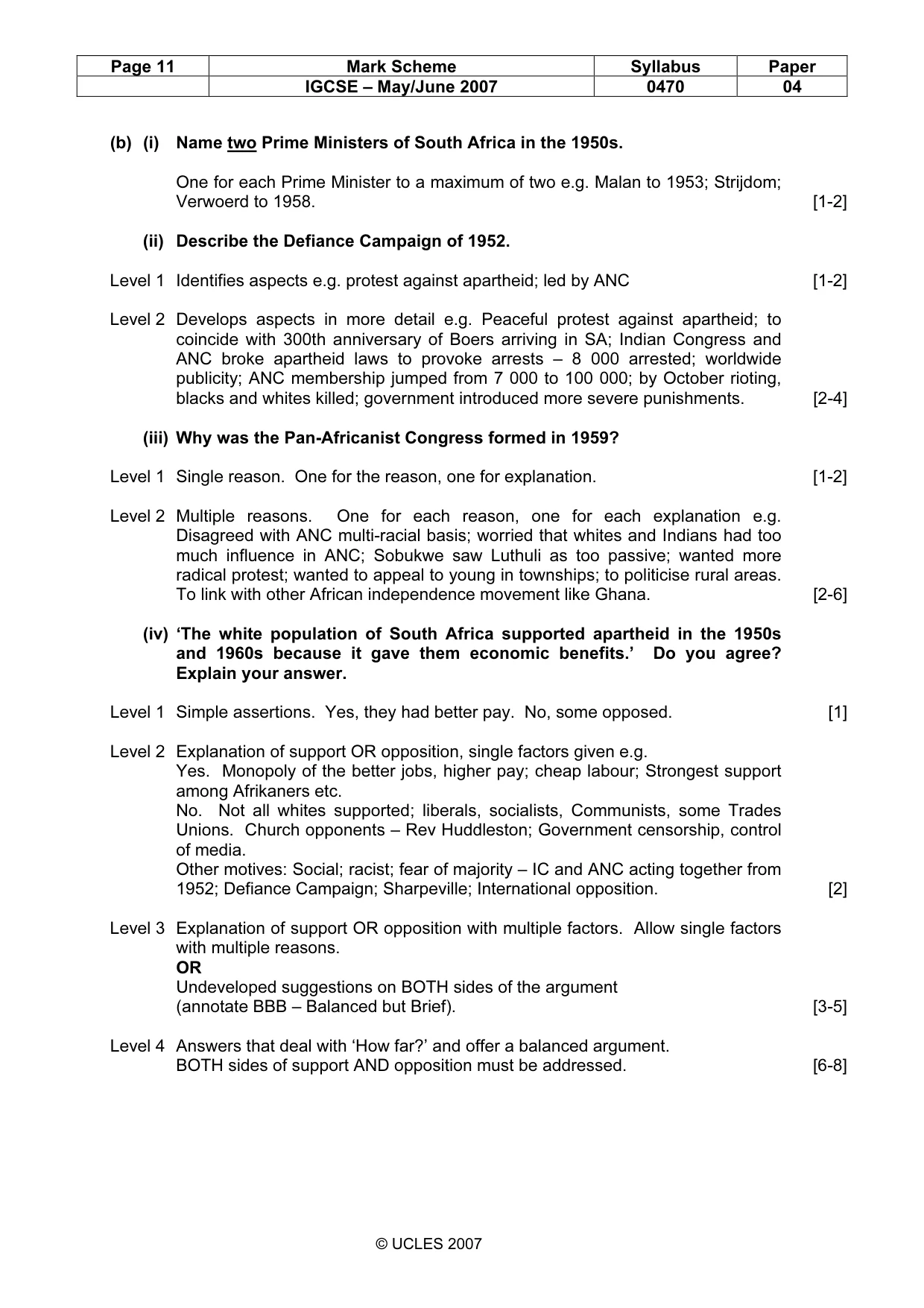
Page 11 Mark Scheme Syllabus Paper IGCSE – May/June 2007 0470 04 © UCLES 2007 (b) (i) Name two Prime Ministers of South Africa in the 1950s. One for each Prime Minister to a maximum of two e.g. Malan to 1953; Strijdom; Verwoerd to 1958. [1-2] (ii) Describe the Defiance Campaign of 1952. Level 1 Identifies aspects e.g. protest against apartheid; led by ANC [1-2] Level 2 Develops aspects in more detail e.g. Peaceful protest against apartheid; to coincide with 300th anniversary of Boers arriving in SA; Indian Congress and ANC broke apartheid laws to provoke arrests – 8 000 arrested; worldwide publicity; ANC membership jumped from 7 000 to 100 000; by October rioting, blacks and whites killed; government introduced more severe punishments. [2-4] (iii) Why was the Pan-Africanist Congress formed in 1959? Level 1 Single reason. One for the reason, one for explanation. [1-2] Level 2 Multiple reasons. One for each reason, one for each explanation e.g. Disagreed with ANC multi-racial basis; worried that whites and Indians had too much influence in ANC; Sobukwe saw Luthuli as too passive; wanted more radical protest; wanted to appeal to young in townships; to politicise rural areas. To link with other African independence movement like Ghana. [2-6] (iv) ‘The white population of South Africa supported apartheid in the 1950s and 1960s because it gave them economic benefits.’ Do you agree? Explain your answer. Level 1 Simple assertions. Yes, they had better pay. No, some opposed. [1] Level 2 Explanation of support OR opposition, single factors given e.g. Yes. Monopoly of the better jobs, higher pay; cheap labour; Strongest support among Afrikaners etc. No. Not all whites supported; liberals, socialists, Communists, some Trades Unions. Church opponents – Rev Huddleston; Government censorship, control of media. Other motives: Social; racist; fear of majority – IC and ANC acting together from 1952; Defiance Campaign; Sharpeville; International opposition. [2] Level 3 Explanation of support OR opposition with multiple factors. Allow single factors with multiple reasons. OR Undeveloped suggestions on BOTH sides of the argument (annotate BBB – Balanced but Brief). [3-5] Level 4 Answers that deal with ‘How far?’ and offer a balanced argument. BOTH sides of support AND opposition must be addressed. [6-8]
Mark scheme, page 12
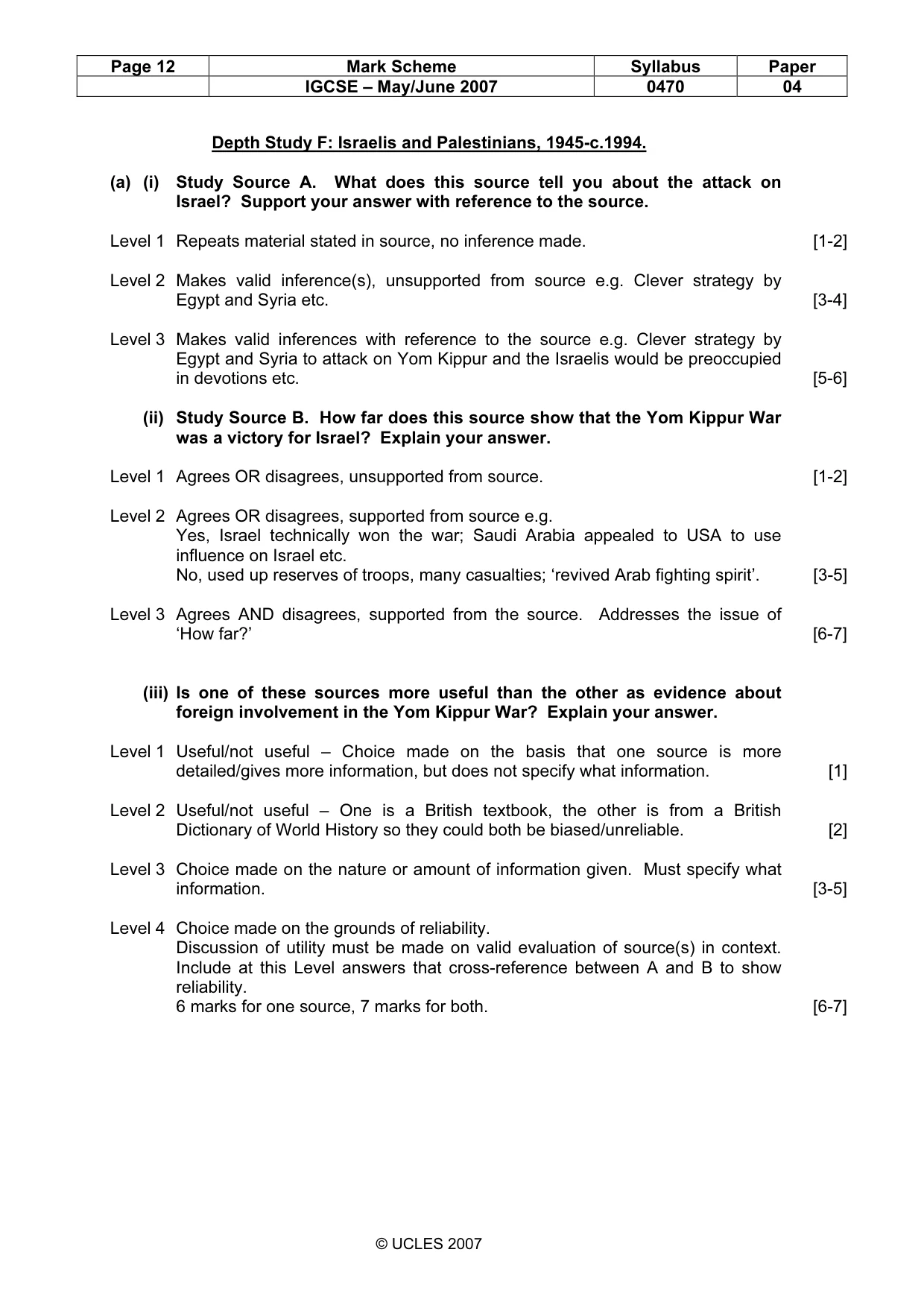
Page 12 Mark Scheme Syllabus Paper IGCSE – May/June 2007 0470 04 © UCLES 2007 Depth Study F: Israelis and Palestinians, 1945-c.1994. (a) (i) Study Source A. What does this source tell you about the attack on Israel? Support your answer with reference to the source. Level 1 Repeats material stated in source, no inference made. [1-2] Level 2 Makes valid inference(s), unsupported from source e.g. Clever strategy by Egypt and Syria etc. [3-4] Level 3 Makes valid inferences with reference to the source e.g. Clever strategy by Egypt and Syria to attack on Yom Kippur and the Israelis would be preoccupied in devotions etc. [5-6] (ii) Study Source B. How far does this source show that the Yom Kippur War was a victory for Israel? Explain your answer. Level 1 Agrees OR disagrees, unsupported from source. [1-2] Level 2 Agrees OR disagrees, supported from source e.g. Yes, Israel technically won the war; Saudi Arabia appealed to USA to use influence on Israel etc. No, used up reserves of troops, many casualties; ‘revived Arab fighting spirit’. [3-5] Level 3 Agrees AND disagrees, supported from the source. Addresses the issue of ‘How far?’ [6-7] (iii) Is one of these sources more useful than the other as evidence about foreign involvement in the Yom Kippur War? Explain your answer. Level 1 Useful/not useful – Choice made on the basis that one source is more detailed/gives more information, but does not specify what information. [1] Level 2 Useful/not useful – One is a British textbook, the other is from a British Dictionary of World History so they could both be biased/unreliable. [2] Level 3 Choice made on the nature or amount of information given. Must specify what information. [3-5] Level 4 Choice made on the grounds of reliability. Discussion of utility must be made on valid evaluation of source(s) in context. Include at this Level answers that cross-reference between A and B to show reliability. 6 marks for one source, 7 marks for both. [6-7]
Mark scheme, page 13
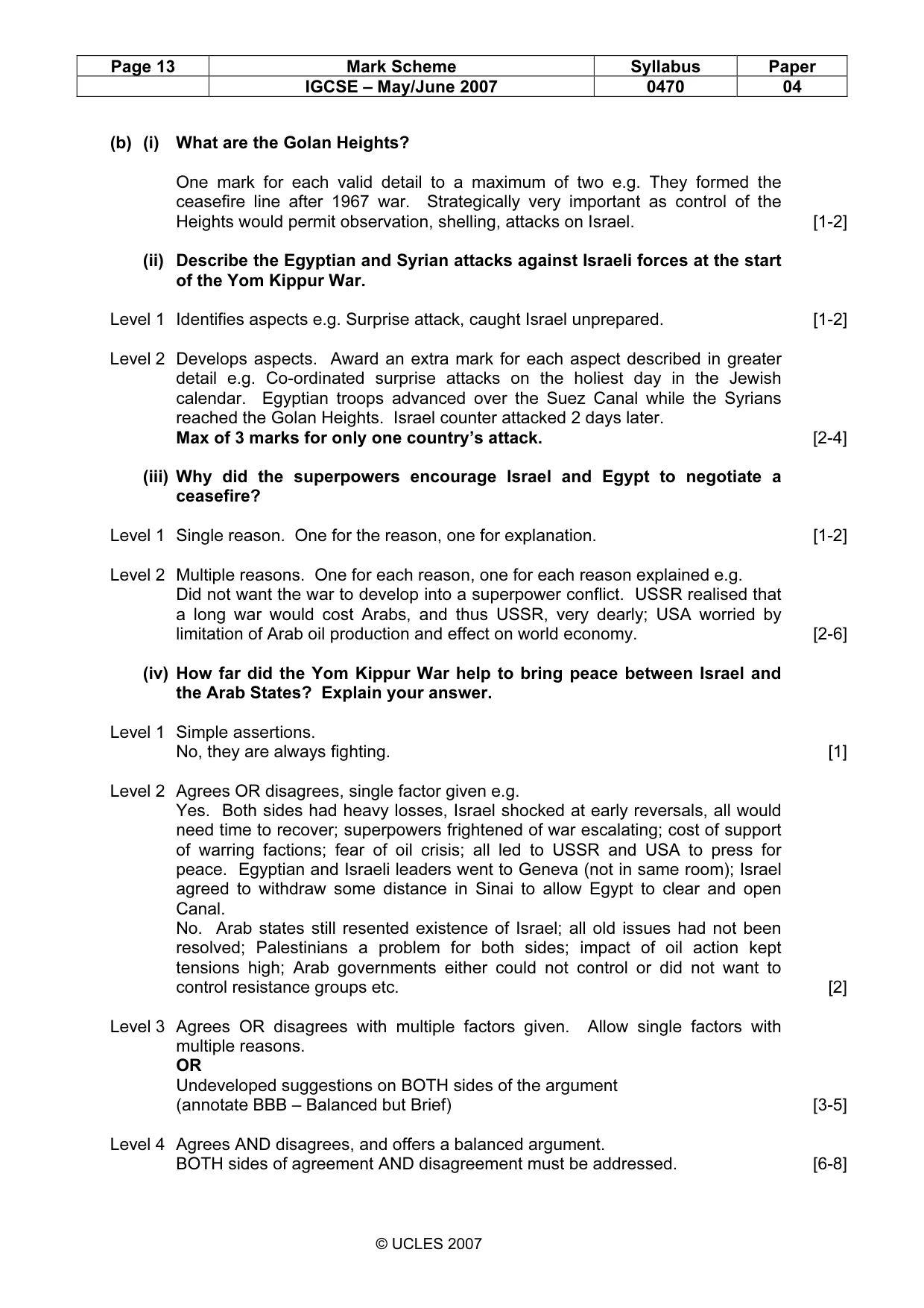
Page 13 Mark Scheme Syllabus Paper IGCSE – May/June 2007 0470 04 © UCLES 2007 (b) (i) What are the Golan Heights? One mark for each valid detail to a maximum of two e.g. They formed the ceasefire line after 1967 war. Strategically very important as control of the Heights would permit observation, shelling, attacks on Israel. [1-2] (ii) Describe the Egyptian and Syrian attacks against Israeli forces at the start of the Yom Kippur War. Level 1 Identifies aspects e.g. Surprise attack, caught Israel unprepared. [1-2] Level 2 Develops aspects. Award an extra mark for each aspect described in greater detail e.g. Co-ordinated surprise attacks on the holiest day in the Jewish calendar. Egyptian troops advanced over the Suez Canal while the Syrians reached the Golan Heights. Israel counter attacked 2 days later. Max of 3 marks for only one country’s attack. [2-4] (iii) Why did the superpowers encourage Israel and Egypt to negotiate a ceasefire? Level 1 Single reason. One for the reason, one for explanation. [1-2] Level 2 Multiple reasons. One for each reason, one for each reason explained e.g. Did not want the war to develop into a superpower conflict. USSR realised that a long war would cost Arabs, and thus USSR, very dearly; USA worried by limitation of Arab oil production and effect on world economy. [2-6] (iv) How far did the Yom Kippur War help to bring peace between Israel and the Arab States? Explain your answer. Level 1 Simple assertions. No, they are always fighting. [1] Level 2 Agrees OR disagrees, single factor given e.g. Yes. Both sides had heavy losses, Israel shocked at early reversals, all would need time to recover; superpowers frightened of war escalating; cost of support of warring factions; fear of oil crisis; all led to USSR and USA to press for peace. Egyptian and Israeli leaders went to Geneva (not in same room); Israel agreed to withdraw some distance in Sinai to allow Egypt to clear and open Canal. No. Arab states still resented existence of Israel; all old issues had not been resolved; Palestinians a problem for both sides; impact of oil action kept tensions high; Arab governments either could not control or did not want to control resistance groups etc. [2] Level 3 Agrees OR disagrees with multiple factors given. Allow single factors with multiple reasons. OR Undeveloped suggestions on BOTH sides of the argument (annotate BBB – Balanced but Brief) [3-5] Level 4 Agrees AND disagrees, and offers a balanced argument. BOTH sides of agreement AND disagreement must be addressed. [6-8]
Mark scheme, page 14
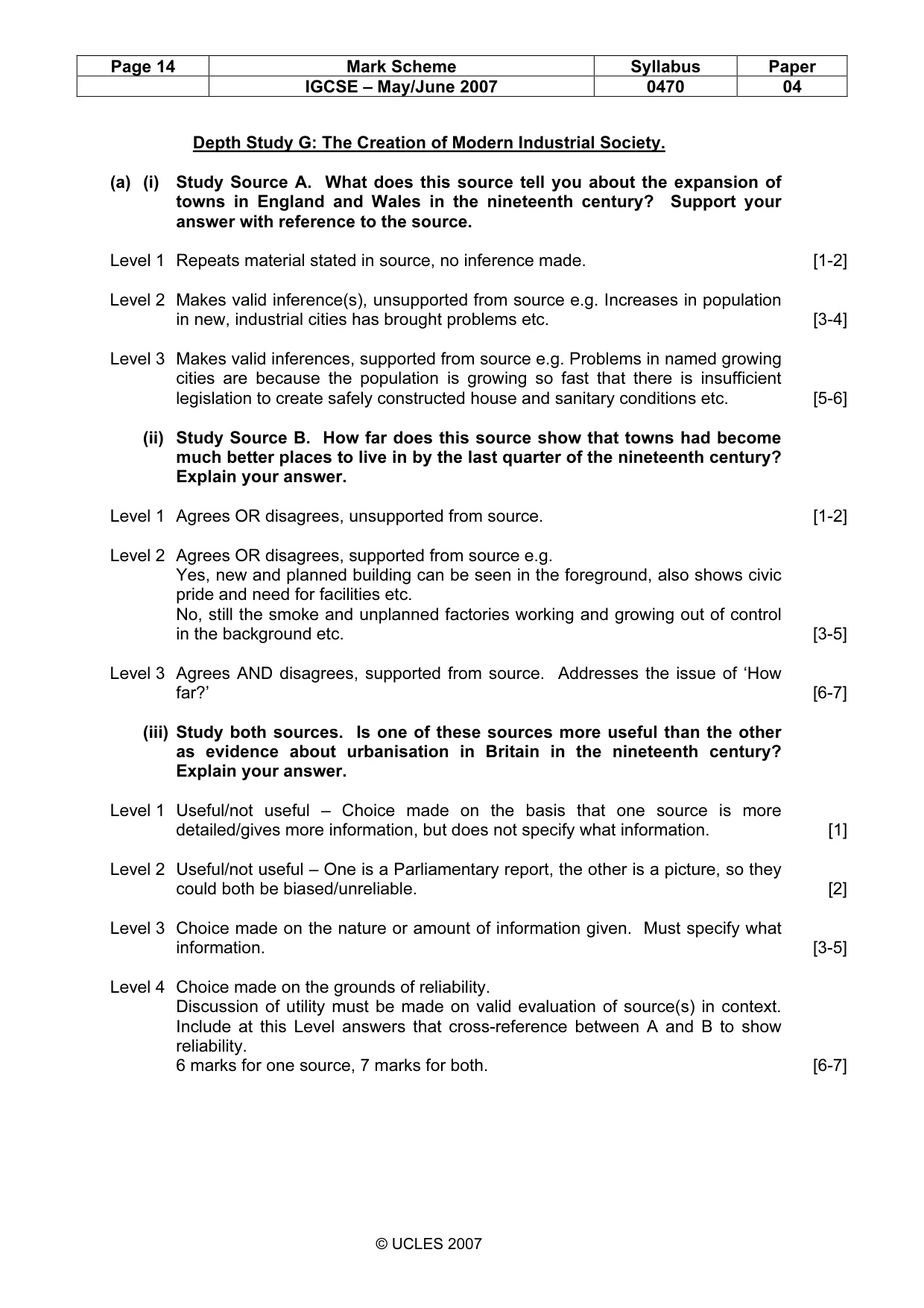
Page 14 Mark Scheme Syllabus Paper IGCSE – May/June 2007 0470 04 © UCLES 2007 Depth Study G: The Creation of Modern Industrial Society. (a) (i) Study Source A. What does this source tell you about the expansion of towns in England and Wales in the nineteenth century? Support your answer with reference to the source. Level 1 Repeats material stated in source, no inference made. [1-2] Level 2 Makes valid inference(s), unsupported from source e.g. Increases in population in new, industrial cities has brought problems etc. [3-4] Level 3 Makes valid inferences, supported from source e.g. Problems in named growing cities are because the population is growing so fast that there is insufficient legislation to create safely constructed house and sanitary conditions etc. [5-6] (ii) Study Source B. How far does this source show that towns had become much better places to live in by the last quarter of the nineteenth century? Explain your answer. Level 1 Agrees OR disagrees, unsupported from source. [1-2] Level 2 Agrees OR disagrees, supported from source e.g. Yes, new and planned building can be seen in the foreground, also shows civic pride and need for facilities etc. No, still the smoke and unplanned factories working and growing out of control in the background etc. [3-5] Level 3 Agrees AND disagrees, supported from source. Addresses the issue of ‘How far?’ [6-7] (iii) Study both sources. Is one of these sources more useful than the other as evidence about urbanisation in Britain in the nineteenth century? Explain your answer. Level 1 Useful/not useful – Choice made on the basis that one source is more detailed/gives more information, but does not specify what information. [1] Level 2 Useful/not useful – One is a Parliamentary report, the other is a picture, so they could both be biased/unreliable. [2] Level 3 Choice made on the nature or amount of information given. Must specify what information. [3-5] Level 4 Choice made on the grounds of reliability. Discussion of utility must be made on valid evaluation of source(s) in context. Include at this Level answers that cross-reference between A and B to show reliability. 6 marks for one source, 7 marks for both. [6-7]
Mark scheme, page 15
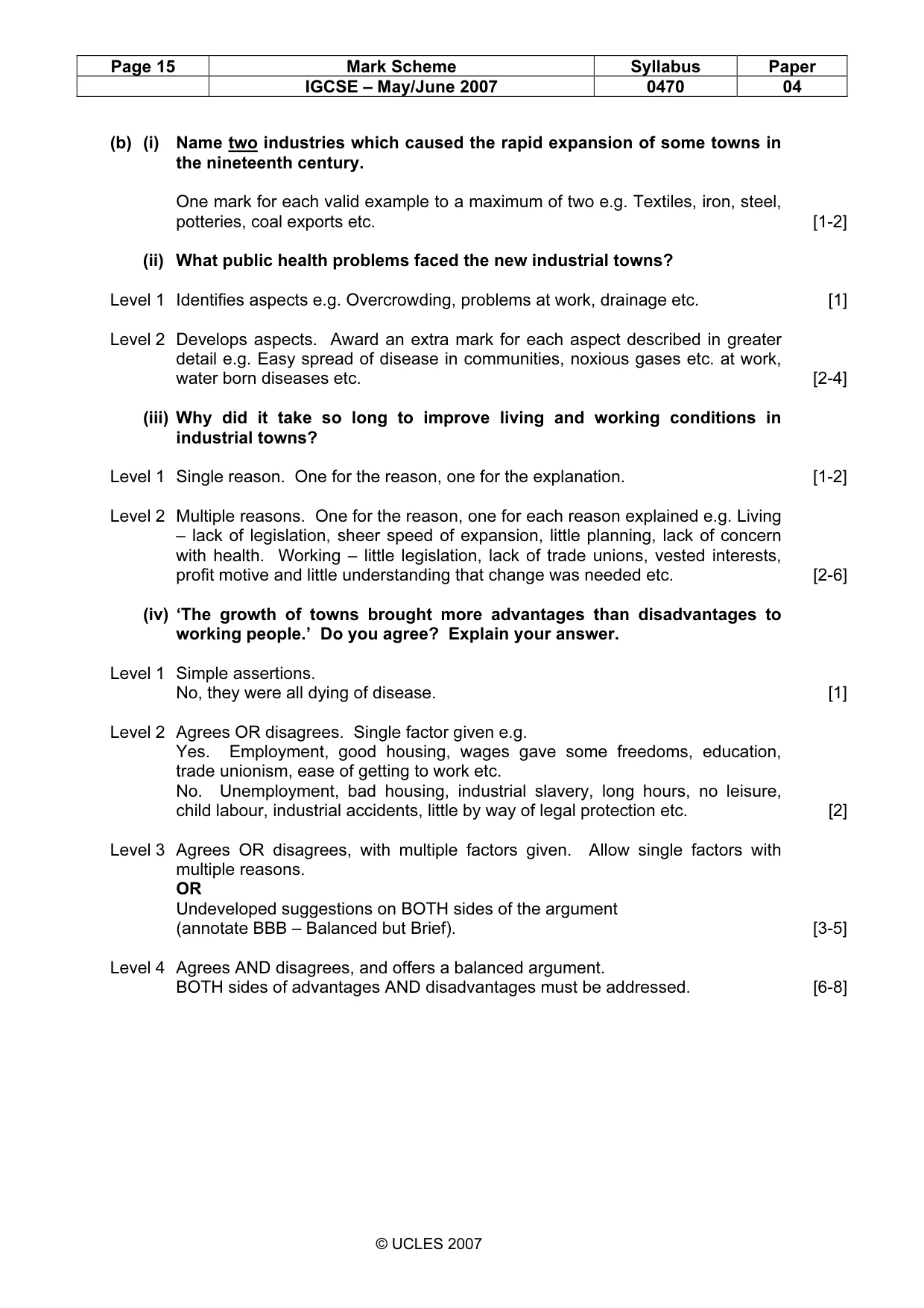
Page 15 Mark Scheme Syllabus Paper IGCSE – May/June 2007 0470 04 © UCLES 2007 (b) (i) Name two industries which caused the rapid expansion of some towns in the nineteenth century. One mark for each valid example to a maximum of two e.g. Textiles, iron, steel, potteries, coal exports etc. [1-2] (ii) What public health problems faced the new industrial towns? Level 1 Identifies aspects e.g. Overcrowding, problems at work, drainage etc. [1] Level 2 Develops aspects. Award an extra mark for each aspect described in greater detail e.g. Easy spread of disease in communities, noxious gases etc. at work, water born diseases etc. [2-4] (iii) Why did it take so long to improve living and working conditions in industrial towns? Level 1 Single reason. One for the reason, one for the explanation. [1-2] Level 2 Multiple reasons. One for the reason, one for each reason explained e.g. Living – lack of legislation, sheer speed of expansion, little planning, lack of concern with health. Working – little legislation, lack of trade unions, vested interests, profit motive and little understanding that change was needed etc. [2-6] (iv) ‘The growth of towns brought more advantages than disadvantages to working people.’ Do you agree? Explain your answer. Level 1 Simple assertions. No, they were all dying of disease. [1] Level 2 Agrees OR disagrees. Single factor given e.g. Yes. Employment, good housing, wages gave some freedoms, education, trade unionism, ease of getting to work etc. No. Unemployment, bad housing, industrial slavery, long hours, no leisure, child labour, industrial accidents, little by way of legal protection etc. [2] Level 3 Agrees OR disagrees, with multiple factors given. Allow single factors with multiple reasons. OR Undeveloped suggestions on BOTH sides of the argument (annotate BBB – Balanced but Brief). [3-5] Level 4 Agrees AND disagrees, and offers a balanced argument. BOTH sides of advantages AND disadvantages must be addressed. [6-8]
Mark scheme, page 16
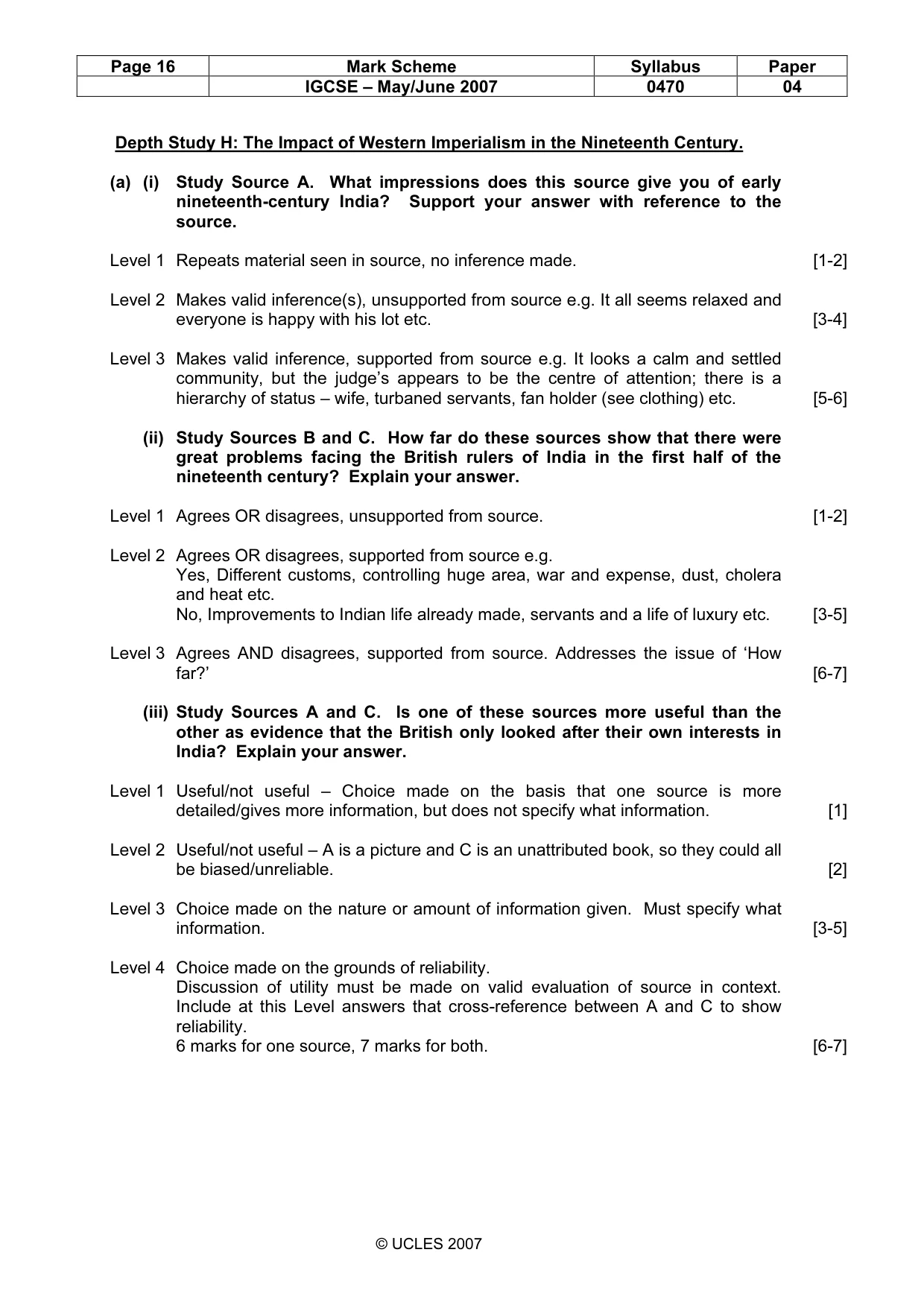
Page 16 Mark Scheme Syllabus Paper IGCSE – May/June 2007 0470 04 © UCLES 2007 Depth Study H: The Impact of Western Imperialism in the Nineteenth Century. (a) (i) Study Source A. What impressions does this source give you of early nineteenth-century India? Support your answer with reference to the source. Level 1 Repeats material seen in source, no inference made. [1-2] Level 2 Makes valid inference(s), unsupported from source e.g. It all seems relaxed and everyone is happy with his lot etc. [3-4] Level 3 Makes valid inference, supported from source e.g. It looks a calm and settled community, but the judge’s appears to be the centre of attention; there is a hierarchy of status – wife, turbaned servants, fan holder (see clothing) etc. [5-6] (ii) Study Sources B and C. How far do these sources show that there were great problems facing the British rulers of India in the first half of the nineteenth century? Explain your answer. Level 1 Agrees OR disagrees, unsupported from source. [1-2] Level 2 Agrees OR disagrees, supported from source e.g. Yes, Different customs, controlling huge area, war and expense, dust, cholera and heat etc. No, Improvements to Indian life already made, servants and a life of luxury etc. [3-5] Level 3 Agrees AND disagrees, supported from source. Addresses the issue of ‘How far?’ [6-7] (iii) Study Sources A and C. Is one of these sources more useful than the other as evidence that the British only looked after their own interests in India? Explain your answer. Level 1 Useful/not useful – Choice made on the basis that one source is more detailed/gives more information, but does not specify what information. [1] Level 2 Useful/not useful – A is a picture and C is an unattributed book, so they could all be biased/unreliable. [2] Level 3 Choice made on the nature or amount of information given. Must specify what information. [3-5] Level 4 Choice made on the grounds of reliability. Discussion of utility must be made on valid evaluation of source in context. Include at this Level answers that cross-reference between A and C to show reliability. 6 marks for one source, 7 marks for both. [6-7]
Mark scheme, page 17
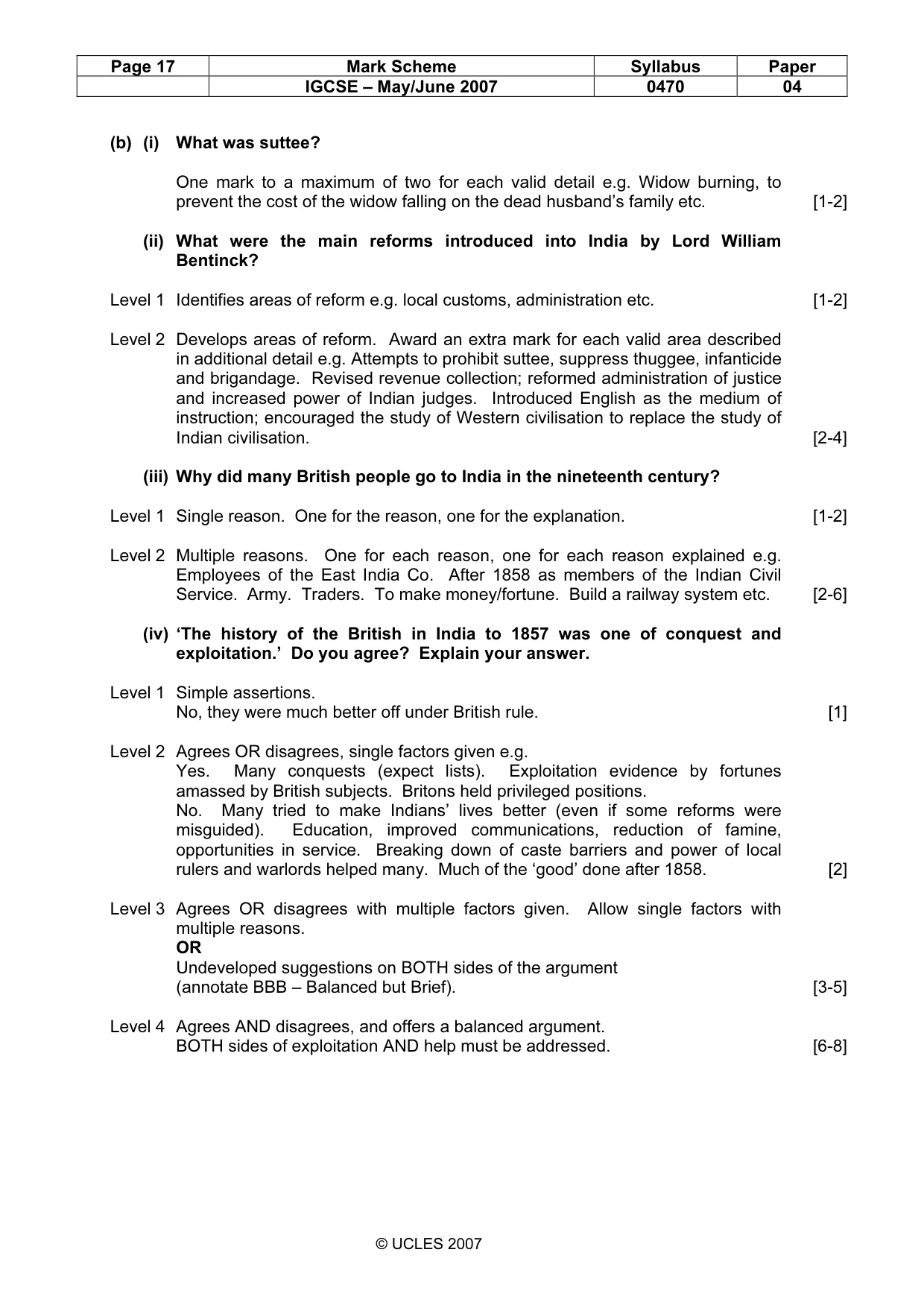
Page 17 Mark Scheme Syllabus Paper IGCSE – May/June 2007 0470 04 © UCLES 2007 (b) (i) What was suttee? One mark to a maximum of two for each valid detail e.g. Widow burning, to prevent the cost of the widow falling on the dead husband’s family etc. [1-2] (ii) What were the main reforms introduced into India by Lord William Bentinck? Level 1 Identifies areas of reform e.g. local customs, administration etc. [1-2] Level 2 Develops areas of reform. Award an extra mark for each valid area described in additional detail e.g. Attempts to prohibit suttee, suppress thuggee, infanticide and brigandage. Revised revenue collection; reformed administration of justice and increased power of Indian judges. Introduced English as the medium of instruction; encouraged the study of Western civilisation to replace the study of Indian civilisation. [2-4] (iii) Why did many British people go to India in the nineteenth century? Level 1 Single reason. One for the reason, one for the explanation. [1-2] Level 2 Multiple reasons. One for each reason, one for each reason explained e.g. Employees of the East India Co. After 1858 as members of the Indian Civil Service. Army. Traders. To make money/fortune. Build a railway system etc. [2-6] (iv) ‘The history of the British in India to 1857 was one of conquest and exploitation.’ Do you agree? Explain your answer. Level 1 Simple assertions. No, they were much better off under British rule. [1] Level 2 Agrees OR disagrees, single factors given e.g. Yes. Many conquests (expect lists). Exploitation evidence by fortunes amassed by British subjects. Britons held privileged positions. No. Many tried to make Indians’ lives better (even if some reforms were misguided). Education, improved communications, reduction of famine, opportunities in service. Breaking down of caste barriers and power of local rulers and warlords helped many. Much of the ‘good’ done after 1858. [2] Level 3 Agrees OR disagrees with multiple factors given. Allow single factors with multiple reasons. OR Undeveloped suggestions on BOTH sides of the argument (annotate BBB – Balanced but Brief). [3-5] Level 4 Agrees AND disagrees, and offers a balanced argument. BOTH sides of exploitation AND help must be addressed. [6-8]
What you needed in this session
Cambridge’s own grade thresholds for 2007 May/June, Paper 4 · Variant 1. A higher threshold means an easier paper — the bar moves with how the cohort did.