Cambridge IGCSE History 0470 — 2006 Oct/Nov Paper 4 · Variant 1
0470/41/O/N/06 · 40 marks · ≈45 min
The question paper and its mark scheme, free to read here and free to download. This is Cambridge’s own paper, exactly as it was sat.
Question paper12 pages
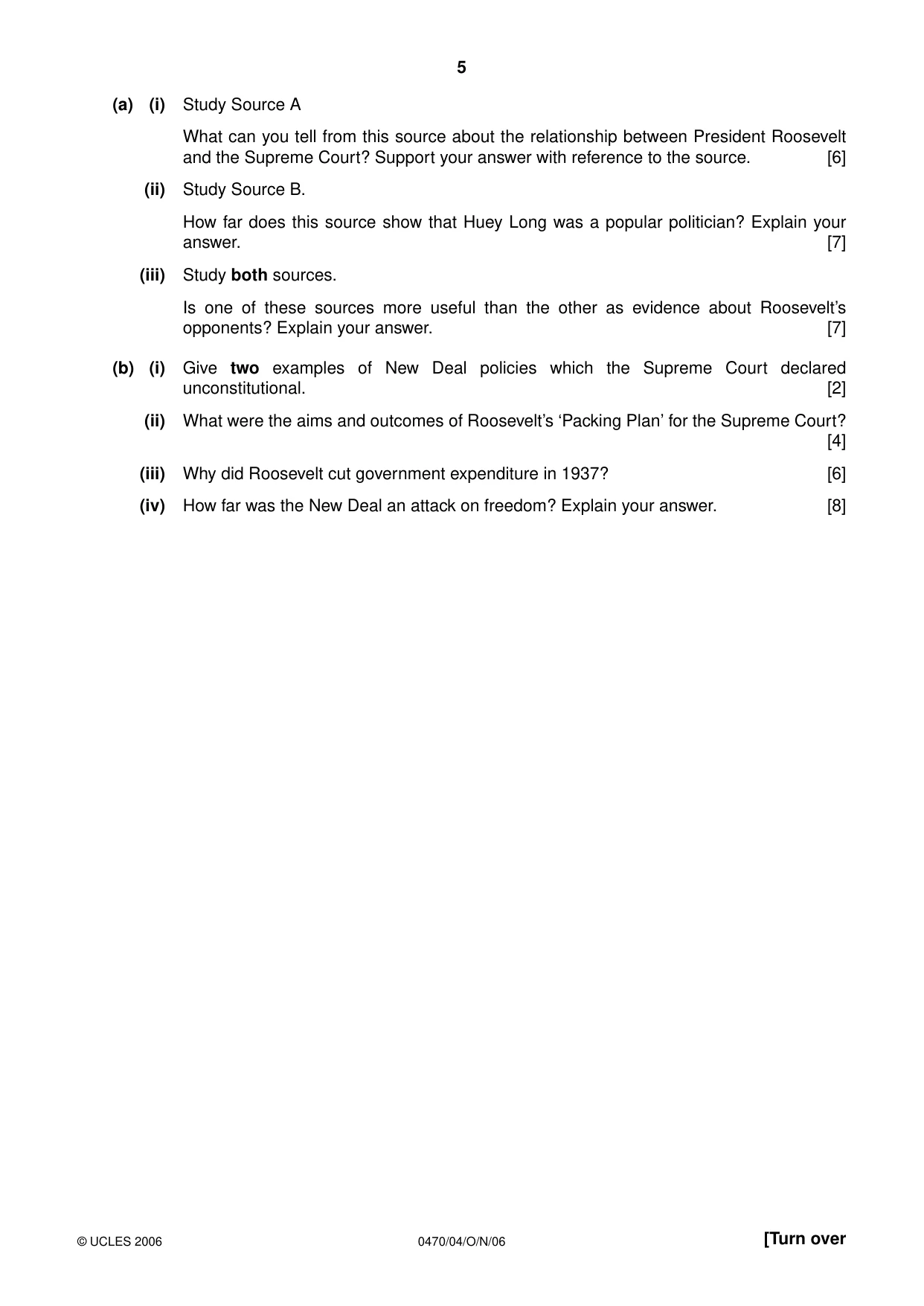
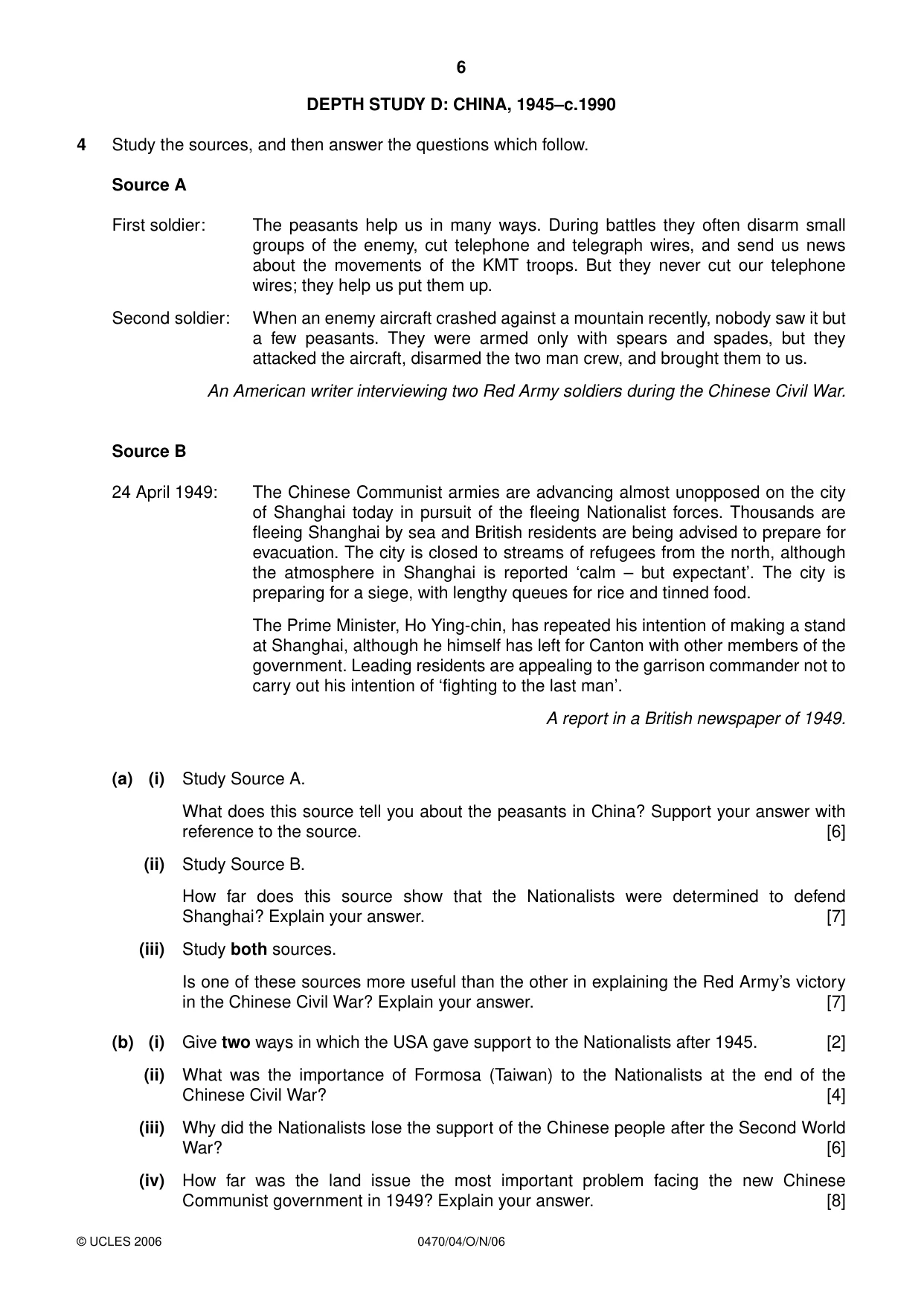
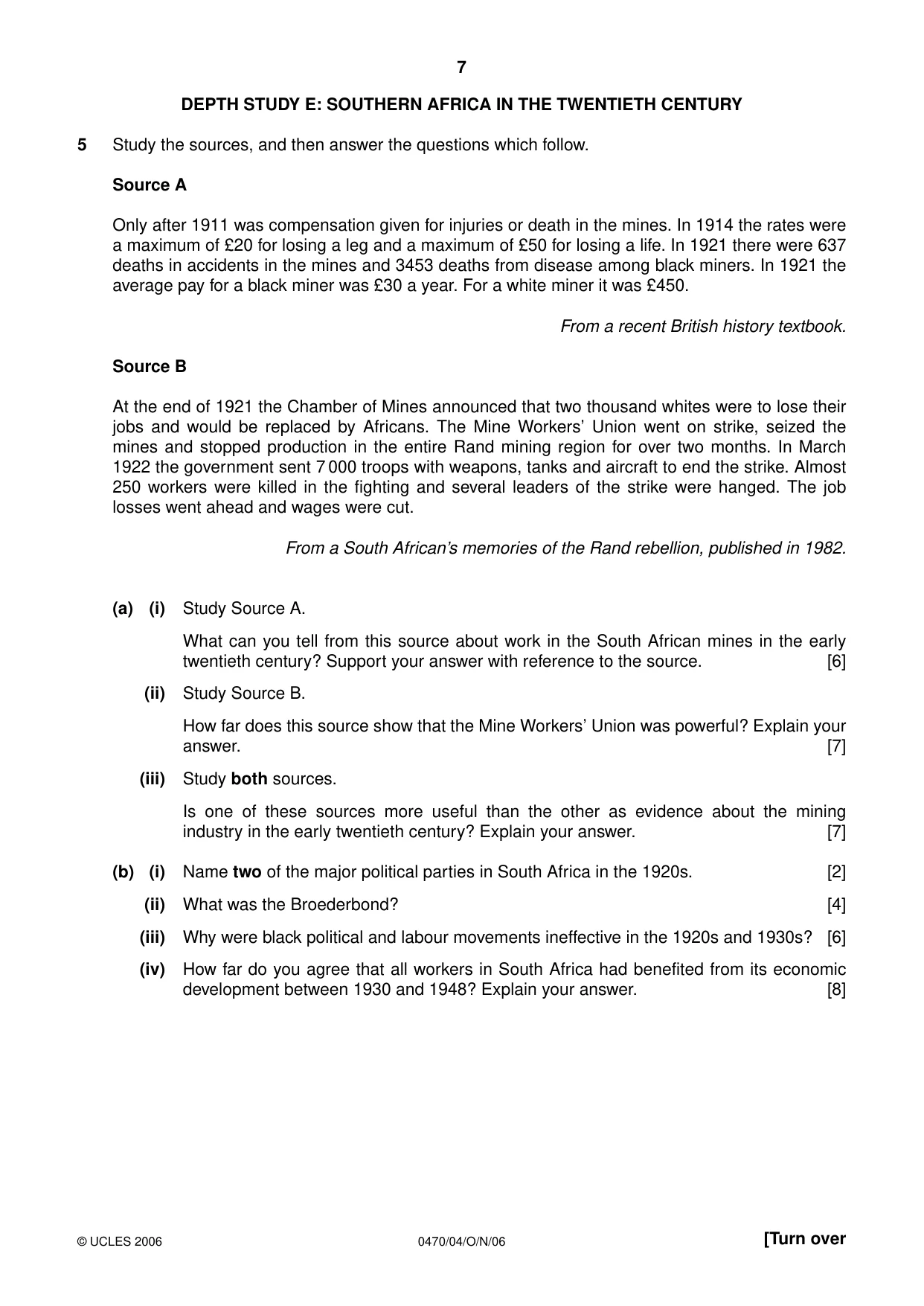
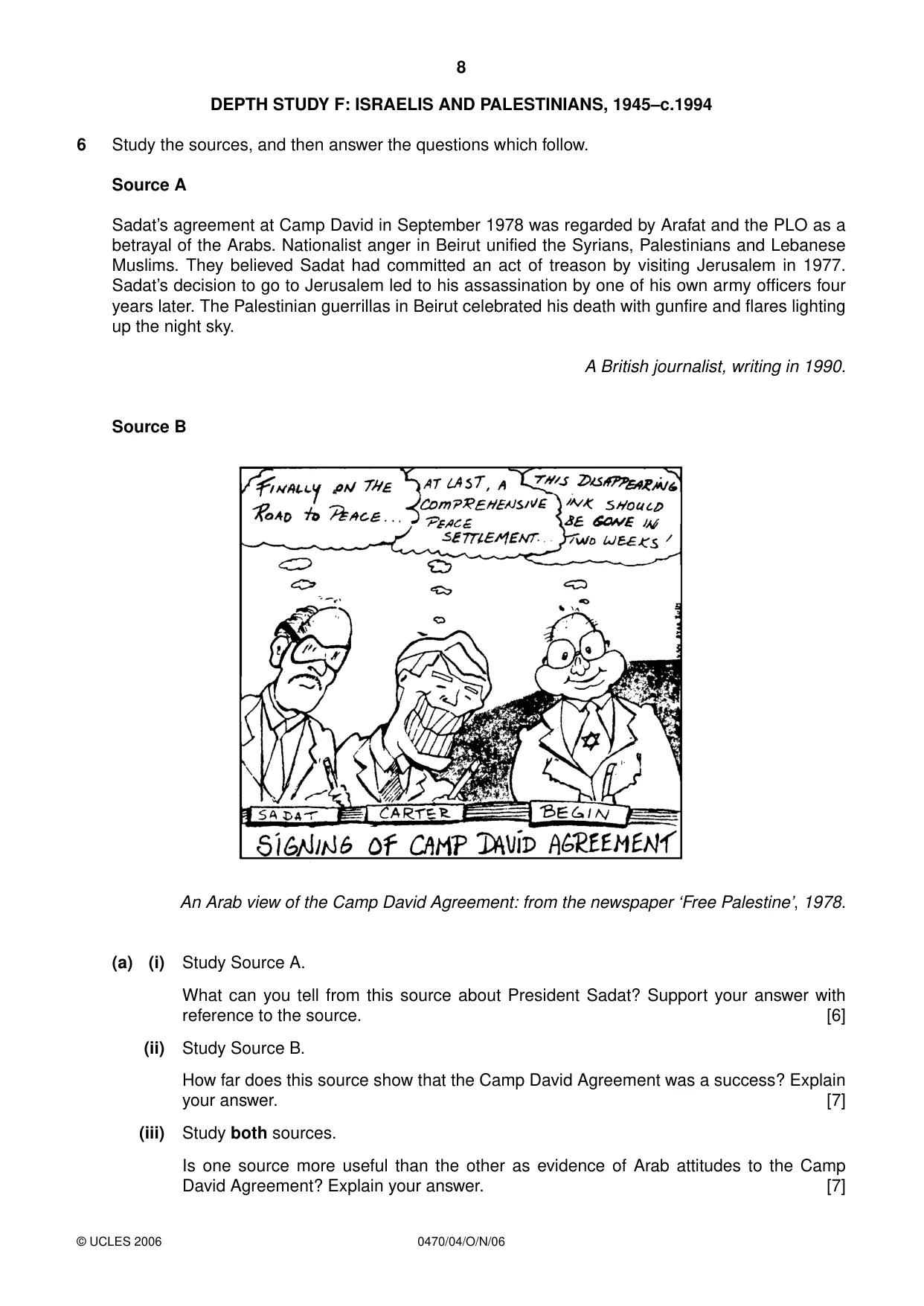
Mark scheme18 pages
Answers below. Sit the paper first if you are practising.
Paper as text
Question paper, page 1
This document consists of 12 printed pages. SPA (SJF3963) T03717/5 © UCLES 2006 [Turn over UNIVERSITY OF CAMBRIDGE INTERNATIONAL EXAMINATIONS International General Certificate of Secondary Education HISTORY 0470/04 Paper 4 Alternative to Coursework October/November 2006 1 hour Additional Materials: Answer Booklet/Paper READ THESE INSTRUCTIONS FIRST If you have been given an Answer Booklet, follow the instructions on the front cover of the Booklet. Write your Centre number, candidate number and name on all the work you hand in. Write in dark blue or black pen. You may use a soft pencil for any diagrams, graphs or rough working. Do not use staples, paper clips, highlighters, glue or correction fluid. Answer the questions on one Depth Study. At the end of the examination, fasten all your work securely together. The number of marks is given in brackets [ ] at the end of each question or part question. www.XtremePapers.com
Question paper, page 2
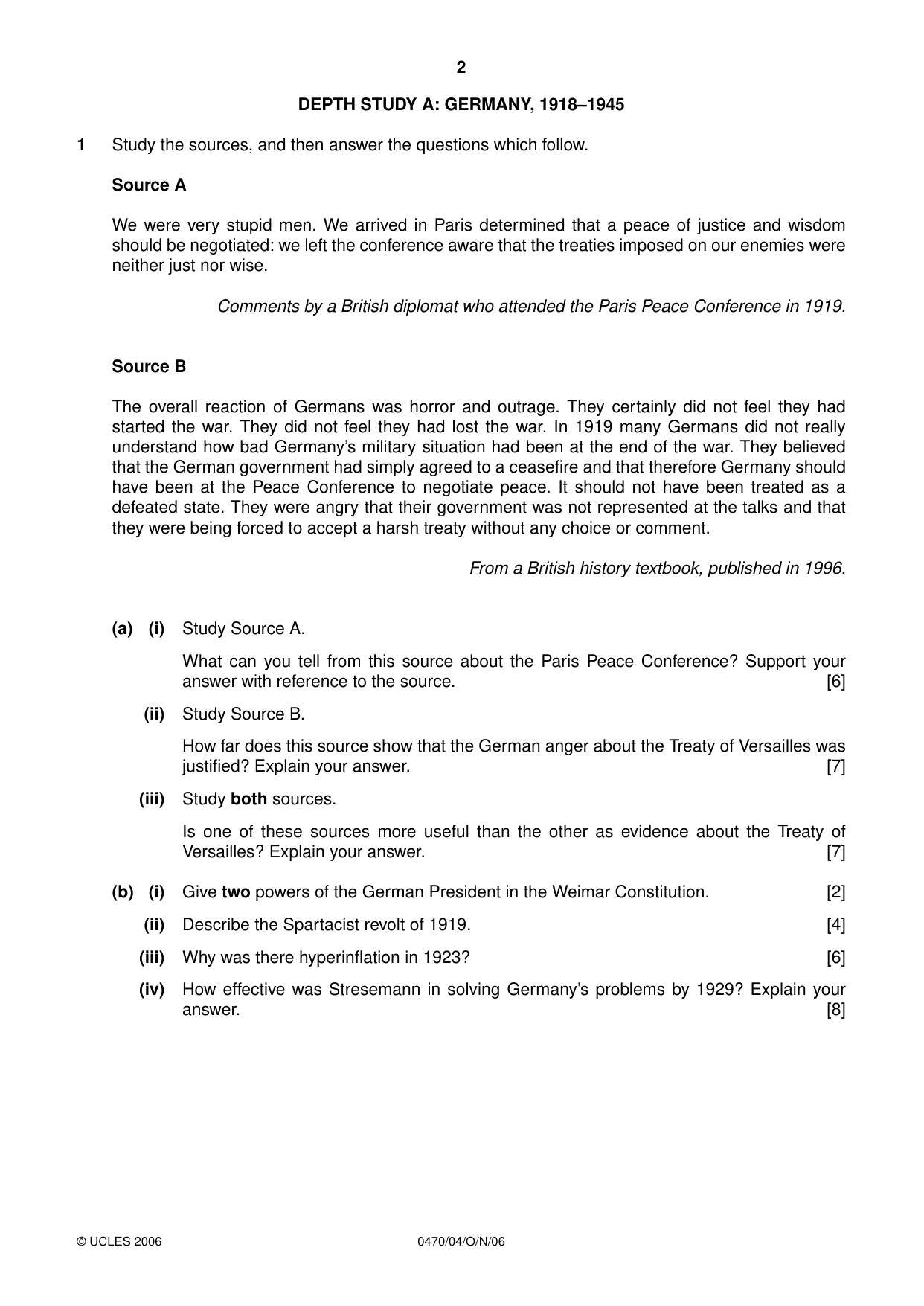
2 0470/04/O/N/06 DEPTH STUDY A: GERMANY, 1918–1945 1 Study the sources, and then answer the questions which follow. Source A We were very stupid men. We arrived in Paris determined that a peace of justice and wisdom should be negotiated: we left the conference aware that the treaties imposed on our enemies were neither just nor wise. Comments by a British diplomat who attended the Paris Peace Conference in 1919. Source B The overall reaction of Germans was horror and outrage. They certainly did not feel they had started the war. They did not feel they had lost the war. In 1919 many Germans did not really understand how bad Germany’s military situation had been at the end of the war. They believed that the German government had simply agreed to a ceasefire and that therefore Germany should have been at the Peace Conference to negotiate peace. It should not have been treated as a defeated state. They were angry that their government was not represented at the talks and that they were being forced to accept a harsh treaty without any choice or comment. From a British history textbook, published in 1996. (a) (i) Study Source A. What can you tell from this source about the Paris Peace Conference? Support your answer with reference to the source. [6] (ii) Study Source B. How far does this source show that the German anger about the Treaty of Versailles was justified? Explain your answer. [7] (iii) Study both sources. Is one of these sources more useful than the other as evidence about the Treaty of Versailles? Explain your answer. [7] (b) (i) Give two powers of the German President in the Weimar Constitution. [2] (ii) Describe the Spartacist revolt of 1919. [4] (iii) Why was there hyperinflation in 1923? [6] (iv) How effective was Stresemann in solving Germany’s problems by 1929? Explain your answer. [8] © UCLES 2006
Question paper, page 3
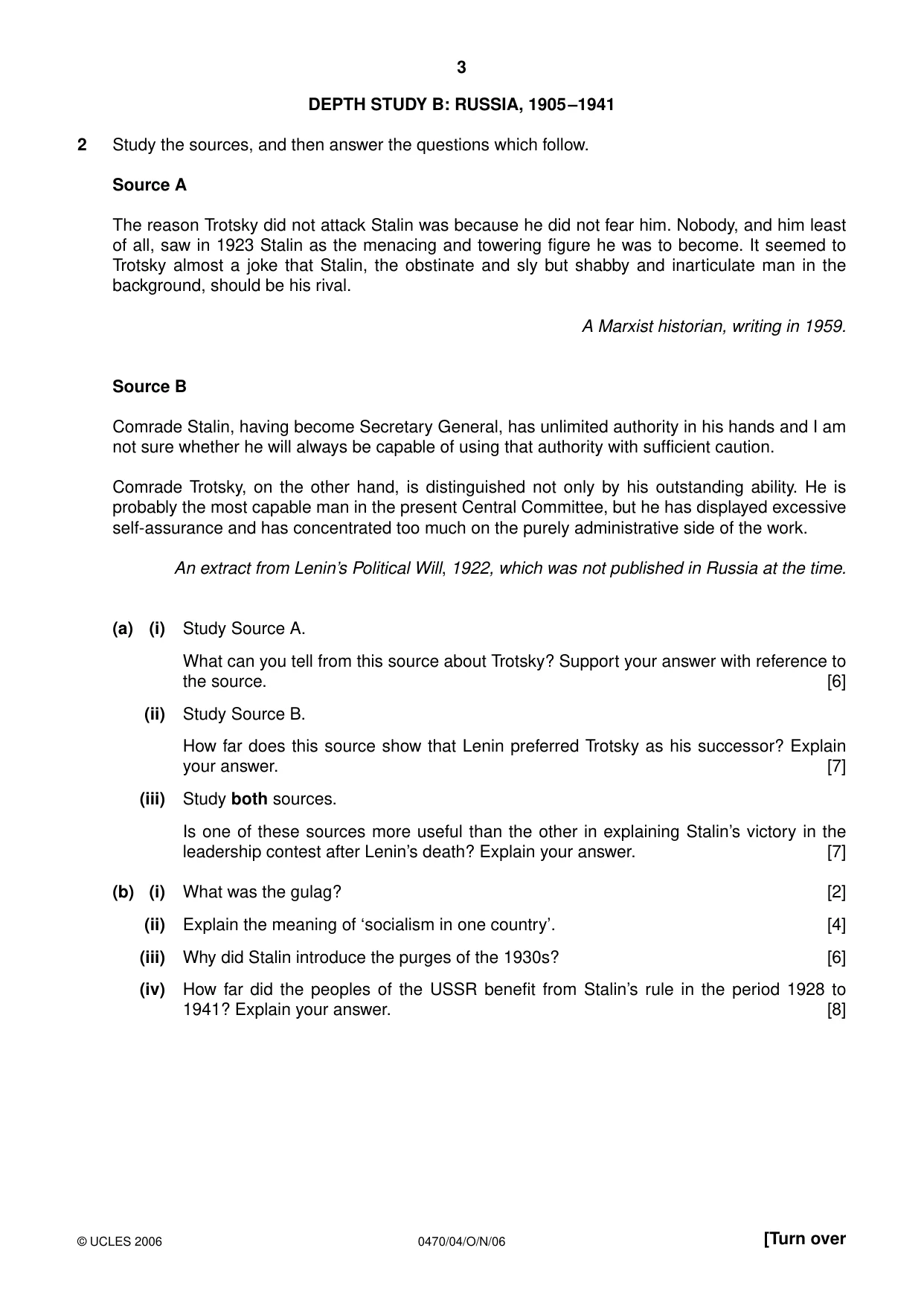
3 0470/04/O/N/06 [Turn over DEPTH STUDY B: RUSSIA, 1905–1941 2 Study the sources, and then answer the questions which follow. Source A The reason Trotsky did not attack Stalin was because he did not fear him. Nobody, and him least of all, saw in 1923 Stalin as the menacing and towering figure he was to become. It seemed to Trotsky almost a joke that Stalin, the obstinate and sly but shabby and inarticulate man in the background, should be his rival. A Marxist historian, writing in 1959. Source B Comrade Stalin, having become Secretary General, has unlimited authority in his hands and I am not sure whether he will always be capable of using that authority with sufficient caution. Comrade Trotsky, on the other hand, is distinguished not only by his outstanding ability. He is probably the most capable man in the present Central Committee, but he has displayed excessive self-assurance and has concentrated too much on the purely administrative side of the work. An extract from Lenin’s Political Will, 1922, which was not published in Russia at the time. (a) (i) Study Source A. What can you tell from this source about Trotsky? Support your answer with reference to the source. [6] (ii) Study Source B. How far does this source show that Lenin preferred Trotsky as his successor? Explain your answer. [7] (iii) Study both sources. Is one of these sources more useful than the other in explaining Stalin’s victory in the leadership contest after Lenin’s death? Explain your answer. [7] (b) (i) What was the gulag? [2] (ii) Explain the meaning of ‘socialism in one country’. [4] (iii) Why did Stalin introduce the purges of the 1930s? [6] (iv) How far did the peoples of the USSR benefit from Stalin’s rule in the period 1928 to 1941? Explain your answer. [8] © UCLES 2006
Question paper, page 4
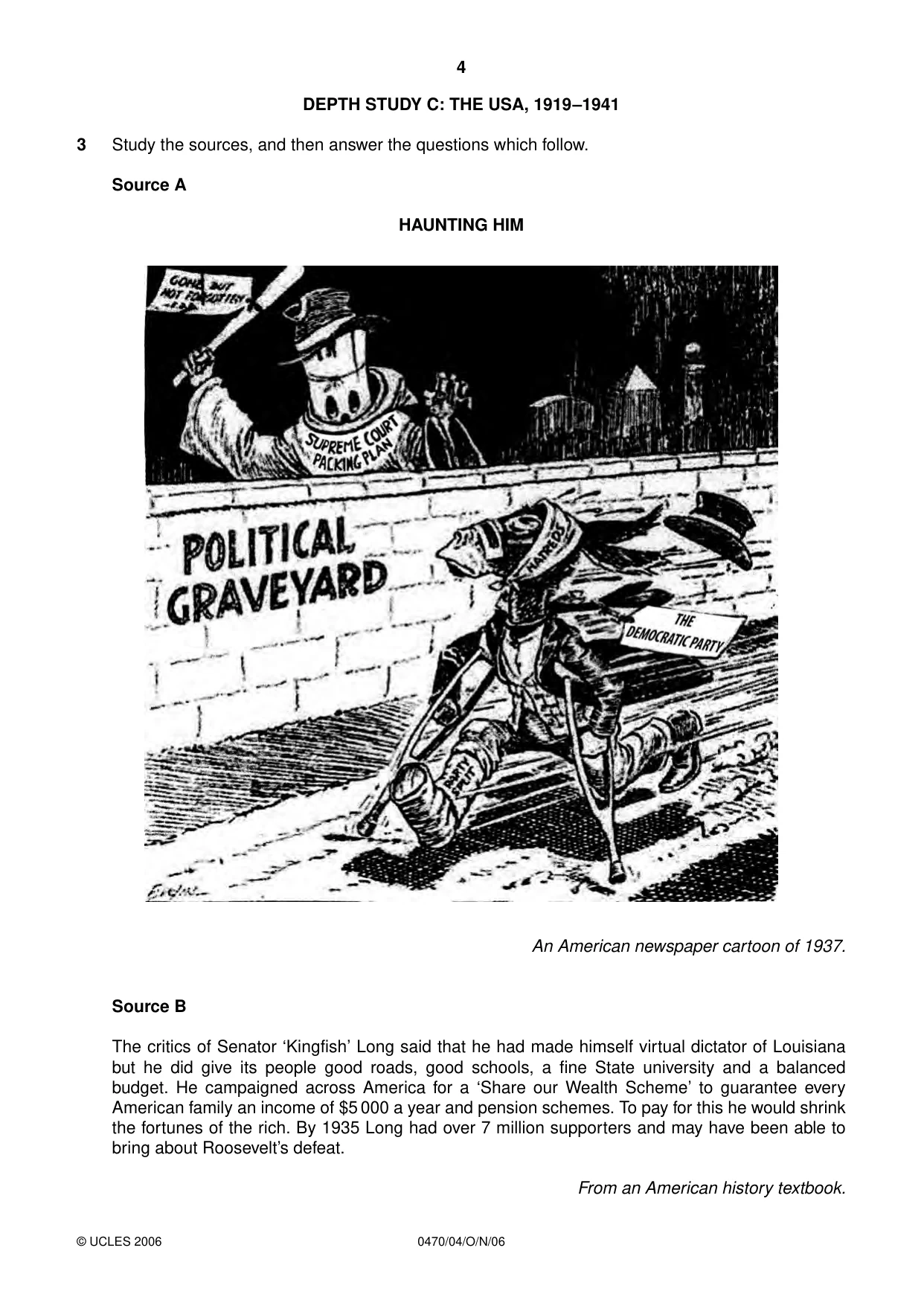
4 0470/04/O/N/06 DEPTH STUDY C: THE USA, 1919–1941 3 Study the sources, and then answer the questions which follow. Source A HAUNTING HIM An American newspaper cartoon of 1937. Source B The critics of Senator ‘Kingfish’ Long said that he had made himself virtual dictator of Louisiana but he did give its people good roads, good schools, a fine State university and a balanced budget. He campaigned across America for a ‘Share our Wealth Scheme’ to guarantee every American family an income of $5 000 a year and pension schemes. To pay for this he would shrink the fortunes of the rich. By 1935 Long had over 7 million supporters and may have been able to bring about Roosevelt’s defeat. From an American history textbook. © UCLES 2006
Question paper, page 5
5 0470/04/O/N/06 [Turn over (a) (i) Study Source A What can you tell from this source about the relationship between President Roosevelt and the Supreme Court? Support your answer with reference to the source. [6] (ii) Study Source B. How far does this source show that Huey Long was a popular politician? Explain your answer. [7] (iii) Study both sources. Is one of these sources more useful than the other as evidence about Roosevelt’s opponents? Explain your answer. [7] (b) (i) Give two examples of New Deal policies which the Supreme Court declared unconstitutional. [2] (ii) What were the aims and outcomes of Roosevelt’s ‘Packing Plan’ for the Supreme Court? [4] (iii) Why did Roosevelt cut government expenditure in 1937? [6] (iv) How far was the New Deal an attack on freedom? Explain your answer. [8] © UCLES 2006
Question paper, page 6
6 0470/04/O/N/06 DEPTH STUDY D: CHINA, 1945–c.1990 4 Study the sources, and then answer the questions which follow. Source A First soldier: The peasants help us in many ways. During battles they often disarm small groups of the enemy, cut telephone and telegraph wires, and send us news about the movements of the KMT troops. But they never cut our telephone wires; they help us put them up. Second soldier: When an enemy aircraft crashed against a mountain recently, nobody saw it but a few peasants. They were armed only with spears and spades, but they attacked the aircraft, disarmed the two man crew, and brought them to us. An American writer interviewing two Red Army soldiers during the Chinese Civil War. Source B 24 April 1949: The Chinese Communist armies are advancing almost unopposed on the city of Shanghai today in pursuit of the fleeing Nationalist forces. Thousands are fleeing Shanghai by sea and British residents are being advised to prepare for evacuation. The city is closed to streams of refugees from the north, although the atmosphere in Shanghai is reported ‘calm – but expectant’. The city is preparing for a siege, with lengthy queues for rice and tinned food. The Prime Minister, Ho Ying-chin, has repeated his intention of making a stand at Shanghai, although he himself has left for Canton with other members of the government. Leading residents are appealing to the garrison commander not to carry out his intention of ‘fighting to the last man’. A report in a British newspaper of 1949. (a) (i) Study Source A. What does this source tell you about the peasants in China? Support your answer with reference to the source. [6] (ii) Study Source B. How far does this source show that the Nationalists were determined to defend Shanghai? Explain your answer. [7] (iii) Study both sources. Is one of these sources more useful than the other in explaining the Red Army’s victory in the Chinese Civil War? Explain your answer. [7] (b) (i) Give two ways in which the USA gave support to the Nationalists after 1945. [2] (ii) What was the importance of Formosa (Taiwan) to the Nationalists at the end of the Chinese Civil War? [4] (iii) Why did the Nationalists lose the support of the Chinese people after the Second World War? [6] (iv) How far was the land issue the most important problem facing the new Chinese Communist government in 1949? Explain your answer. [8] © UCLES 2006
Question paper, page 7
7 0470/04/O/N/06 [Turn over DEPTH STUDY E: SOUTHERN AFRICA IN THE TWENTIETH CENTURY 5 Study the sources, and then answer the questions which follow. Source A Only after 1911 was compensation given for injuries or death in the mines. In 1914 the rates were a maximum of £20 for losing a leg and a maximum of £50 for losing a life. In 1921 there were 637 deaths in accidents in the mines and 3453 deaths from disease among black miners. In 1921 the average pay for a black miner was £30 a year. For a white miner it was £450. From a recent British history textbook. Source B At the end of 1921 the Chamber of Mines announced that two thousand whites were to lose their jobs and would be replaced by Africans. The Mine Workers’ Union went on strike, seized the mines and stopped production in the entire Rand mining region for over two months. In March 1922 the government sent 7 000 troops with weapons, tanks and aircraft to end the strike. Almost 250 workers were killed in the fighting and several leaders of the strike were hanged. The job losses went ahead and wages were cut. From a South African’s memories of the Rand rebellion, published in 1982. (a) (i) Study Source A. What can you tell from this source about work in the South African mines in the early twentieth century? Support your answer with reference to the source. [6] (ii) Study Source B. How far does this source show that the Mine Workers’ Union was powerful? Explain your answer. [7] (iii) Study both sources. Is one of these sources more useful than the other as evidence about the mining industry in the early twentieth century? Explain your answer. [7] (b) (i) Name two of the major political parties in South Africa in the 1920s. [2] (ii) What was the Broederbond? [4] (iii) Why were black political and labour movements ineffective in the 1920s and 1930s? [6] (iv) How far do you agree that all workers in South Africa had benefited from its economic development between 1930 and 1948? Explain your answer. [8] © UCLES 2006
Question paper, page 8
8 0470/04/O/N/06 DEPTH STUDY F: ISRAELIS AND PALESTINIANS, 1945–c.1994 6 Study the sources, and then answer the questions which follow. Source A Sadat’s agreement at Camp David in September 1978 was regarded by Arafat and the PLO as a betrayal of the Arabs. Nationalist anger in Beirut unified the Syrians, Palestinians and Lebanese Muslims. They believed Sadat had committed an act of treason by visiting Jerusalem in 1977. Sadat’s decision to go to Jerusalem led to his assassination by one of his own army officers four years later. The Palestinian guerrillas in Beirut celebrated his death with gunfire and flares lighting up the night sky. A British journalist, writing in 1990. Source B An Arab view of the Camp David Agreement: from the newspaper ‘Free Palestine’, 1978. (a) (i) Study Source A. What can you tell from this source about President Sadat? Support your answer with reference to the source. [6] (ii) Study Source B. How far does this source show that the Camp David Agreement was a success? Explain your answer. [7] (iii) Study both sources. Is one source more useful than the other as evidence of Arab attitudes to the Camp David Agreement? Explain your answer. [7] © UCLES 2006
Question paper, page 9
9 0470/04/O/N/06 [Turn over (b) (i) What is Camp David? [2] (ii) What were the terms of the Camp David Agreement? [4] (iii) Why did Sadat make peace with Israel? [6] (iv) How far did the USA’s involvement in the Middle East during the 1970s and 1980s reduce the prospects of peace? Explain your answer. [8] © UCLES 2006
Question paper, page 10
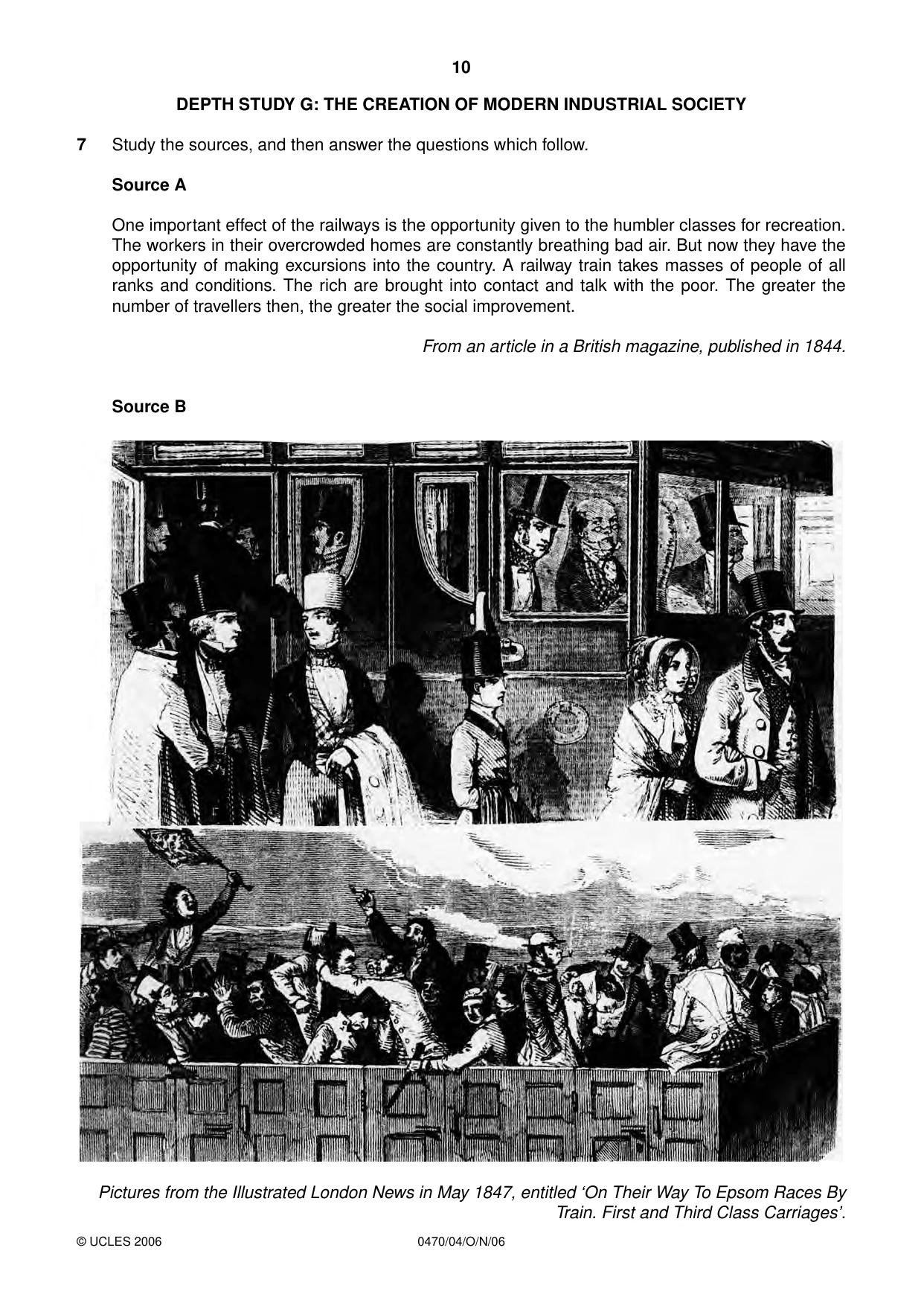
10 0470/04/O/N/06 DEPTH STUDY G: THE CREATION OF MODERN INDUSTRIAL SOCIETY 7 Study the sources, and then answer the questions which follow. Source A One important effect of the railways is the opportunity given to the humbler classes for recreation. The workers in their overcrowded homes are constantly breathing bad air. But now they have the opportunity of making excursions into the country. A railway train takes masses of people of all ranks and conditions. The rich are brought into contact and talk with the poor. The greater the number of travellers then, the greater the social improvement. From an article in a British magazine, published in 1844. Source B Pictures from the Illustrated London News in May 1847, entitled ‘On Their Way To Epsom Races By Train. First and Third Class Carriages’. © UCLES 2006
Question paper, page 11
11 0470/04/O/N/06 [Turn over (a) (i) Study Source A. What can you tell from this source about early railway travel? Support your answer with reference to the source. [6] (ii) Study Source B. How far does this source support Source A? Explain your answer. [7] (iii) Study both sources. Is one source more useful than the other as evidence about early rail travel? Explain your answer. [7] (b) (i) Name the engineers who built (a) the Stockton-Darlington Railway and (b) the Great Western Railway. [2] (ii) What was the purpose of the Parliamentary Trains Act of 1844? [4] (iii) Why did companies issue a ‘Prospectus’ before building a railway? [6] (iv) How far was the rapid growth of railways caused by the failure of roads and canals to meet the needs of industry? Explain your answer. [8] © UCLES 2006 Copyright Acknowledgements: Question 1 Source B © Ben Walsh, GCSE Modern World History; John Murray; 2001. Question 2 Source A © Isaac Deutscher; The Prophet Unarmed: Trotsky 1921–1929; Verso Books; 2003. Question 3 Source A © Reprinted, with permission, from the Columbus Dispatch. Question 4 Source A © Edgar Snow; Red Star Over China; Victor Gollancz, an imprint of the Orion Publishing Group Ltd.; 1972. Question 5 Source A © Neil Parsons; A New History of Southern Africa; Macmillan Education Ltd; 1993. Question 6 Source A © Robert Fisk; Pity the Nation: Lebanon at War; Andre Deutsch; 1991. Question 6 Source B © Arab-Israeli Conflict; Collins Educational; 1977. Question 7 Source B © Illustrated London News Picture Library. Permission to reproduce items where third-party owned material protected by copyright is included has been sought and cleared where possible. Every reasonable effort has been made by the publisher (UCLES) to trace copyright holders, but if any items requiring clearance have unwittingly been included, the publisher will be pleased to make amends at the earliest possible opportunity. University of Cambridge International Examinations is part of the University of Cambridge Local Examinations Syndicate (UCLES), which is itself a department of the University of Cambridge.
Question paper, page 12
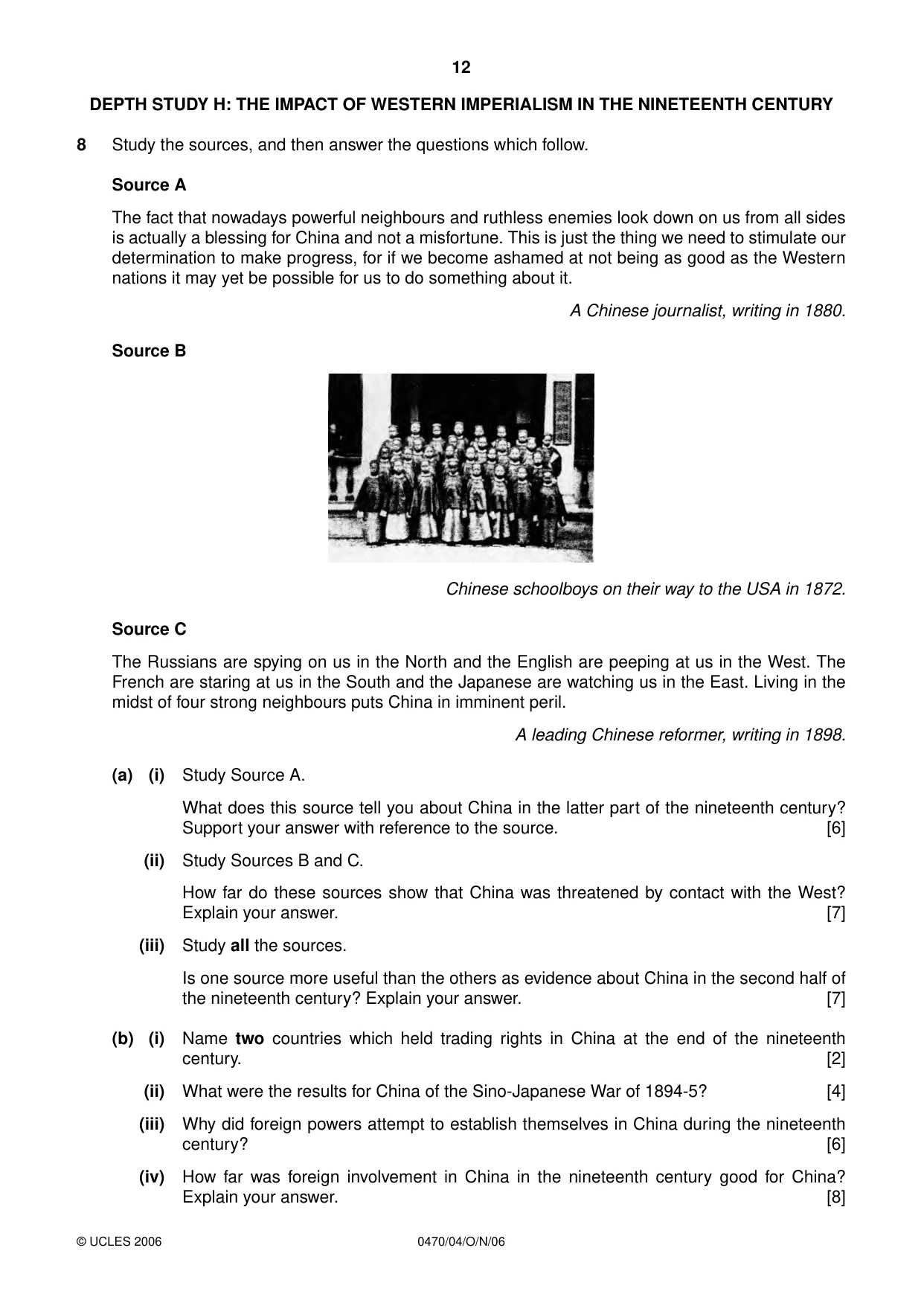
12 0470/04/O/N/06 DEPTH STUDY H: THE IMPACT OF WESTERN IMPERIALISM IN THE NINETEENTH CENTURY 8 Study the sources, and then answer the questions which follow. Source A The fact that nowadays powerful neighbours and ruthless enemies look down on us from all sides is actually a blessing for China and not a misfortune. This is just the thing we need to stimulate our determination to make progress, for if we become ashamed at not being as good as the Western nations it may yet be possible for us to do something about it. A Chinese journalist, writing in 1880. Source B Chinese schoolboys on their way to the USA in 1872. Source C The Russians are spying on us in the North and the English are peeping at us in the West. The French are staring at us in the South and the Japanese are watching us in the East. Living in the midst of four strong neighbours puts China in imminent peril. A leading Chinese reformer, writing in 1898. (a) (i) Study Source A. What does this source tell you about China in the latter part of the nineteenth century? Support your answer with reference to the source. [6] (ii) Study Sources B and C. How far do these sources show that China was threatened by contact with the West? Explain your answer. [7] (iii) Study all the sources. Is one source more useful than the others as evidence about China in the second half of the nineteenth century? Explain your answer. [7] (b) (i) Name two countries which held trading rights in China at the end of the nineteenth century. [2] (ii) What were the results for China of the Sino-Japanese War of 1894-5? [4] (iii) Why did foreign powers attempt to establish themselves in China during the nineteenth century? [6] (iv) How far was foreign involvement in China in the nineteenth century good for China? Explain your answer. [8] © UCLES 2006
Mark scheme, page 1
UNIVERSITY OF CAMBRIDGE INTERNATIONAL EXAMINATIONS International General Certificate of Secondary Education MARK SCHEME for the October/November 2006 question paper 0470 HISTORY 0470/04 Paper 4 (Alternative to Coursework), maximum raw mark 40 This mark scheme is published as an aid to teachers and students, to indicate the requirements of the examination. It shows the basis on which Examiners were instructed to award marks. It does not indicate the details of the discussions that took place at an Examiners’ meeting before marking began. All Examiners are instructed that alternative correct answers and unexpected approaches in candidates’ scripts must be given marks that fairly reflect the relevant knowledge and skills demonstrated. Mark schemes must be read in conjunction with the question papers and the report on the examination. The grade thresholds for various grades are published in the report on the examination for most IGCSE, GCE Advanced Level and Advanced Subsidiary Level syllabuses. • CIE will not enter into discussions or correspondence in connection with these mark schemes. CIE is publishing the mark schemes for the October/November 2006 question papers for most IGCSE, GCE Advanced Level and Advanced Subsidiary Level syllabuses and some Ordinary Level syllabuses. www.XtremePapers.com
Mark scheme, page 2
Page 2 Mark Scheme Syllabus Paper IGCSE - OCT/NOV 2006 0470 4 © UCLES 2006 This Paper is marked out of a maximum of 40 marks. Candidates must choose ONE Depth Study to attempt. Questions and Marking Schemes for each Depth Study have been developed to follow a pattern. In every case, part (a) questions concentrate on source material provided in the Paper and are worth a total of 20 marks. Part (b) questions deal with subject matter closely related to the source material and also have a total value of 20 marks. Whilst marking schemes are based on the same model, they have been printed separately to allow exemplars of skill and information levels which candidates may use. These exemplars are not intended to be exclusive or exhaustive. All marking should be undertaken in red ink and when a candidate reaches his/her highest Level, that Level should be recorded in the right hand margin of the script (e.g. L2). After this you must decide the mark to be awarded from those available for that Level and record it next to the Level given (e.g. L2/4). Always mark positively and never deduct marks. Ignore errors but indicate you have spotted them by circling. Be prepared to underline key phrases or ideas to help with your evaluation of answers. When in doubt always opt for the higher mark. If candidates attempt more than one question please mark them all but only record the best mark on the front of the script. Write "Rubric Offence" on the front of the script next to the mark given. If you have any doubts or queries whatsoever please contact your team leader.
Mark scheme, page 3
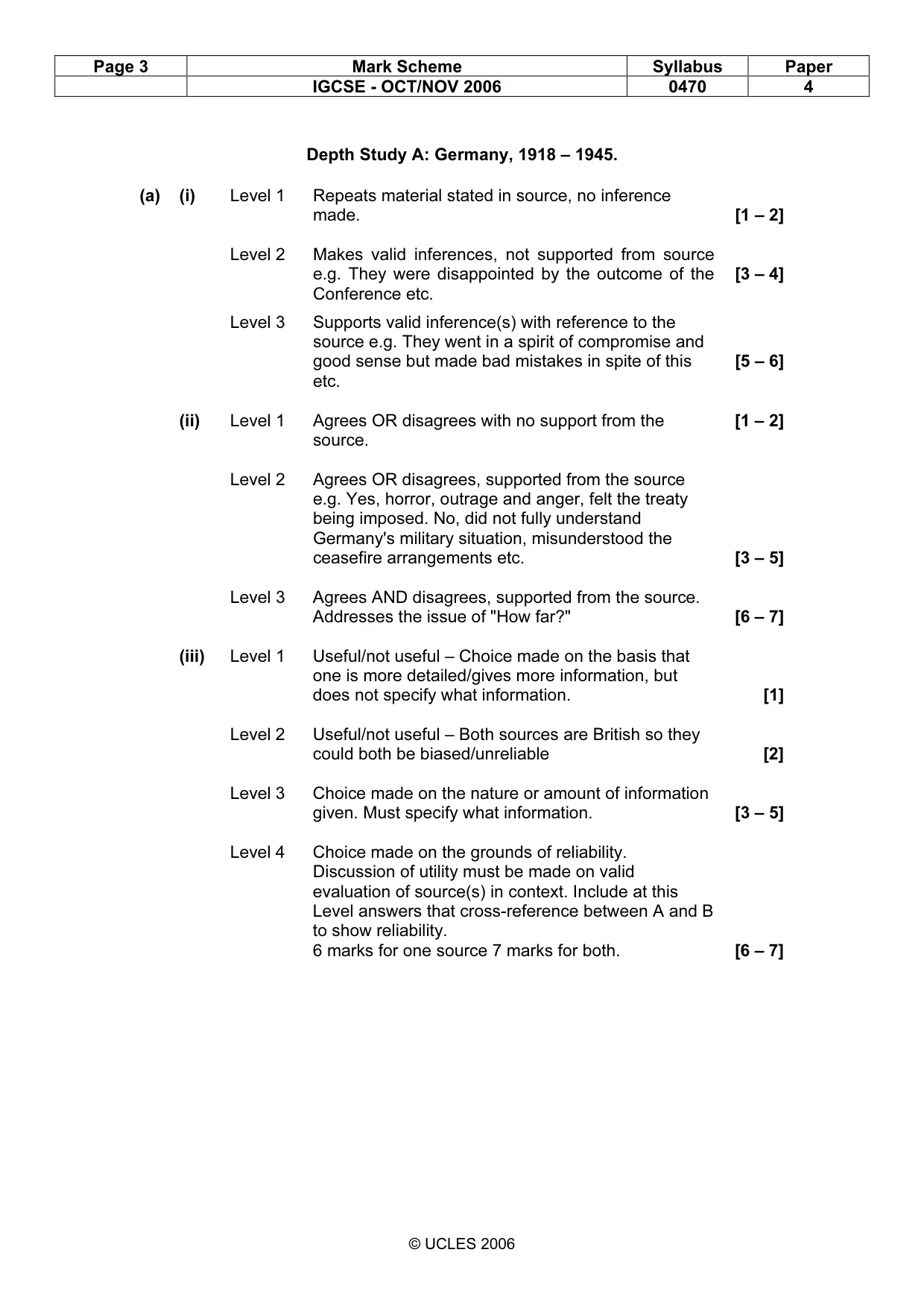
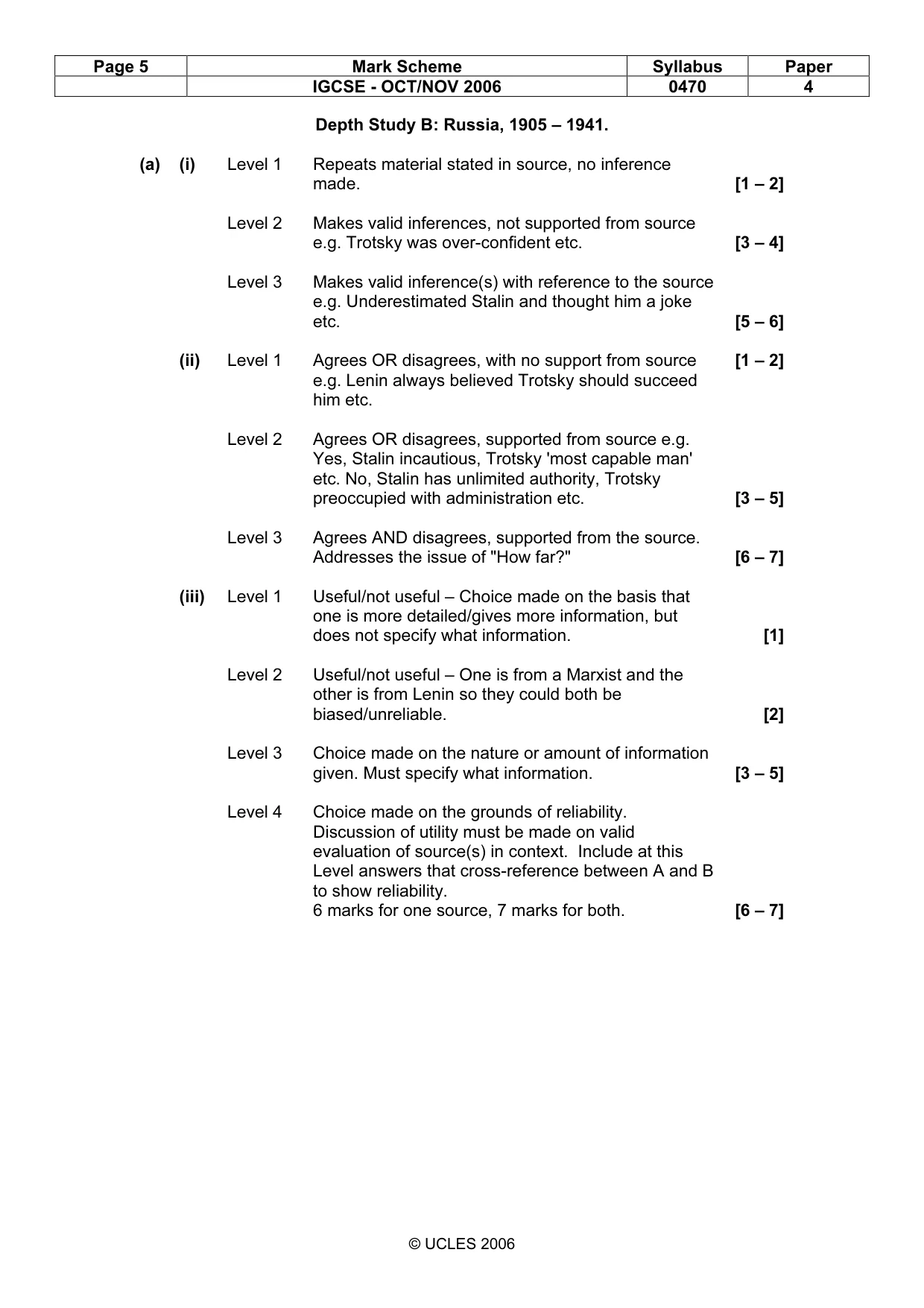
Page 3 Mark Scheme Syllabus Paper IGCSE - OCT/NOV 2006 0470 4 © UCLES 2006 Depth Study A: Germany, 1918 – 1945. (a) (i) Level 1 Repeats material stated in source, no inference made. [1 – 2] Level 2 Makes valid inferences, not supported from source e.g. They were disappointed by the outcome of the Conference etc. [3 – 4] Level 3 Supports valid inference(s) with reference to the source e.g. They went in a spirit of compromise and good sense but made bad mistakes in spite of this etc. [5 – 6] (ii) Level 1 Agrees OR disagrees with no support from the source. [1 – 2] Level 2 Agrees OR disagrees, supported from the source e.g. Yes, horror, outrage and anger, felt the treaty being imposed. No, did not fully understand Germany's military situation, misunderstood the ceasefire arrangements etc. [3 – 5] Level 3 Agrees AND disagrees, supported from the source. Addresses the issue of "How far?" [6 – 7] (iii) Level 1 Useful/not useful – Choice made on the basis that one is more detailed/gives more information, but does not specify what information. [1] Level 2 Useful/not useful – Both sources are British so they could both be biased/unreliable [2] Level 3 Choice made on the nature or amount of information given. Must specify what information. [3 – 5] Level 4 Choice made on the grounds of reliability. Discussion of utility must be made on valid evaluation of source(s) in context. Include at this Level answers that cross-reference between A and B to show reliability. 6 marks for one source 7 marks for both. [6 – 7]
Mark scheme, page 4
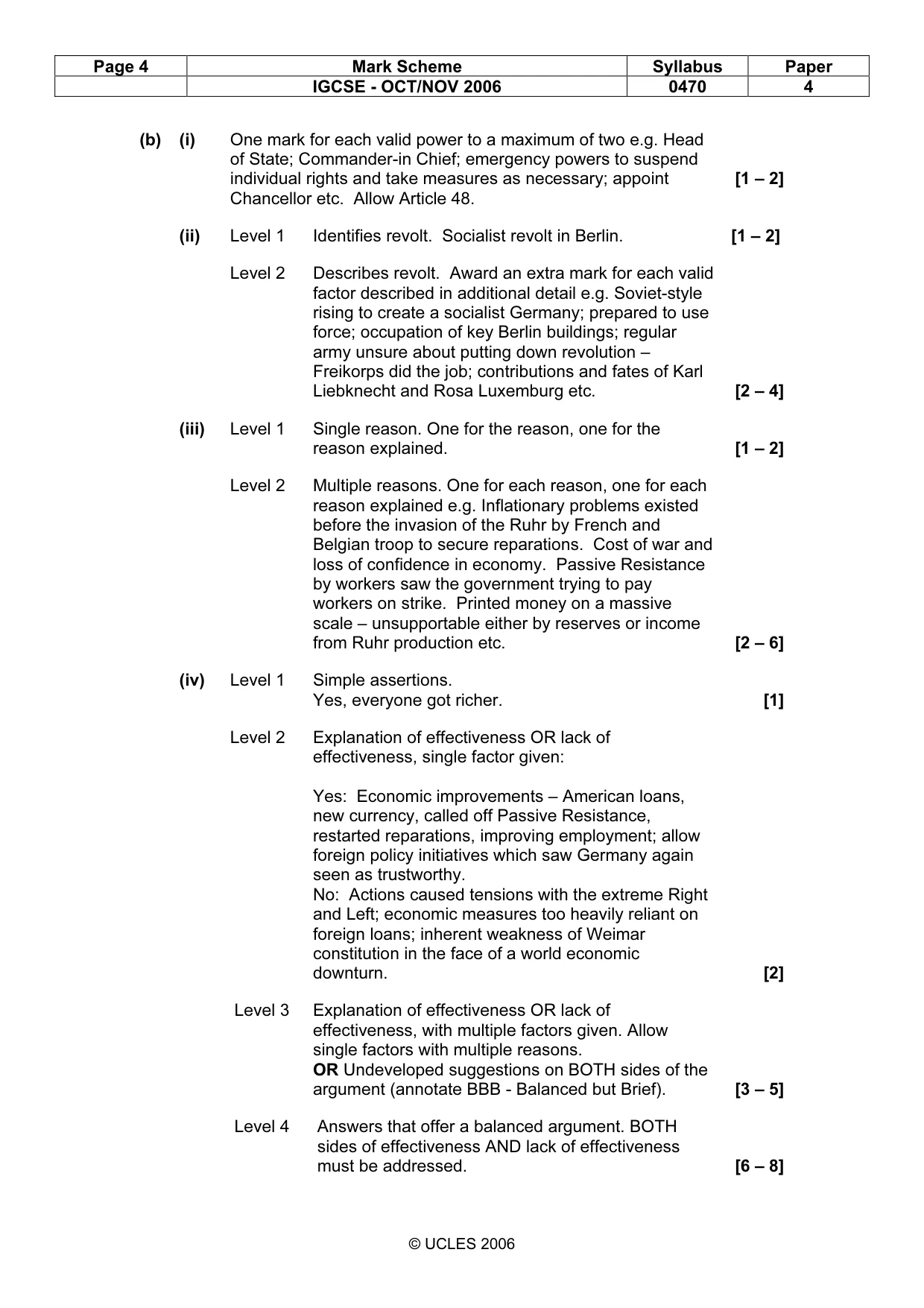
Page 4 Mark Scheme Syllabus Paper IGCSE - OCT/NOV 2006 0470 4 © UCLES 2006 (b) (i) One mark for each valid power to a maximum of two e.g. Head of State; Commander-in Chief; emergency powers to suspend individual rights and take measures as necessary; appoint Chancellor etc. Allow Article 48. [1 – 2] (ii) Level 1 Identifies revolt. Socialist revolt in Berlin. [1 – 2] Level 2 Describes revolt. Award an extra mark for each valid factor described in additional detail e.g. Soviet-style rising to create a socialist Germany; prepared to use force; occupation of key Berlin buildings; regular army unsure about putting down revolution – Freikorps did the job; contributions and fates of Karl Liebknecht and Rosa Luxemburg etc. [2 – 4] (iii) Level 1 Single reason. One for the reason, one for the reason explained. [1 – 2] Level 2 Multiple reasons. One for each reason, one for each reason explained e.g. Inflationary problems existed before the invasion of the Ruhr by French and Belgian troop to secure reparations. Cost of war and loss of confidence in economy. Passive Resistance by workers saw the government trying to pay workers on strike. Printed money on a massive scale – unsupportable either by reserves or income from Ruhr production etc. [2 – 6] (iv) Level 1 Simple assertions. Yes, everyone got richer. [1] Level 2 Explanation of effectiveness OR lack of effectiveness, single factor given: Yes: Economic improvements – American loans, new currency, called off Passive Resistance, restarted reparations, improving employment; allow foreign policy initiatives which saw Germany again seen as trustworthy. No: Actions caused tensions with the extreme Right and Left; economic measures too heavily reliant on foreign loans; inherent weakness of Weimar constitution in the face of a world economic downturn. [2] Level 3 Explanation of effectiveness OR lack of effectiveness, with multiple factors given. Allow single factors with multiple reasons. OR Undeveloped suggestions on BOTH sides of the argument (annotate BBB - Balanced but Brief). [3 – 5] Level 4 Answers that offer a balanced argument. BOTH sides of effectiveness AND lack of effectiveness must be addressed. [6 – 8]
Mark scheme, page 5
Page 5 Mark Scheme Syllabus Paper IGCSE - OCT/NOV 2006 0470 4 © UCLES 2006 Depth Study B: Russia, 1905 – 1941. (a) (i) Level 1 Repeats material stated in source, no inference made. [1 – 2] Level 2 Makes valid inferences, not supported from source e.g. Trotsky was over-confident etc. [3 – 4] Level 3 Makes valid inference(s) with reference to the source e.g. Underestimated Stalin and thought him a joke etc. [5 – 6] (ii) Level 1 Agrees OR disagrees, with no support from source e.g. Lenin always believed Trotsky should succeed him etc. [1 – 2] Level 2 Agrees OR disagrees, supported from source e.g. Yes, Stalin incautious, Trotsky 'most capable man' etc. No, Stalin has unlimited authority, Trotsky preoccupied with administration etc. [3 – 5] Level 3 Agrees AND disagrees, supported from the source. Addresses the issue of "How far?" [6 – 7] (iii) Level 1 Useful/not useful – Choice made on the basis that one is more detailed/gives more information, but does not specify what information. [1] Level 2 Useful/not useful – One is from a Marxist and the other is from Lenin so they could both be biased/unreliable. [2] Level 3 Choice made on the nature or amount of information given. Must specify what information. [3 – 5] Level 4 Choice made on the grounds of reliability. Discussion of utility must be made on valid evaluation of source(s) in context. Include at this Level answers that cross-reference between A and B to show reliability. 6 marks for one source, 7 marks for both. [6 – 7]
Mark scheme, page 6
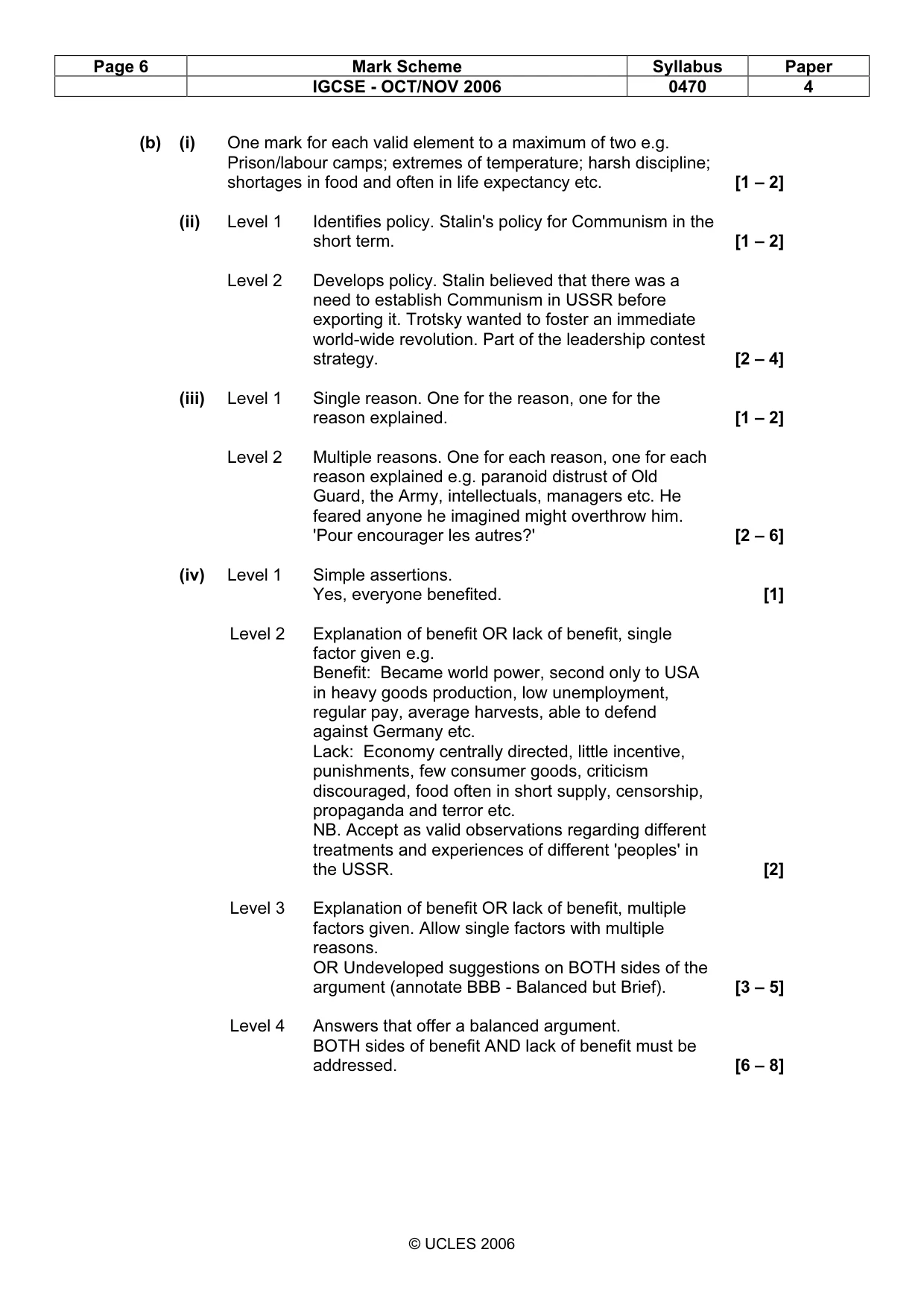
Page 6 Mark Scheme Syllabus Paper IGCSE - OCT/NOV 2006 0470 4 © UCLES 2006 (b) (i) One mark for each valid element to a maximum of two e.g. Prison/labour camps; extremes of temperature; harsh discipline; shortages in food and often in life expectancy etc. [1 – 2] (ii) Level 1 Identifies policy. Stalin's policy for Communism in the short term. [1 – 2] Level 2 Develops policy. Stalin believed that there was a need to establish Communism in USSR before exporting it. Trotsky wanted to foster an immediate world-wide revolution. Part of the leadership contest strategy. [2 – 4] (iii) Level 1 Single reason. One for the reason, one for the reason explained. [1 – 2] Level 2 Multiple reasons. One for each reason, one for each reason explained e.g. paranoid distrust of Old Guard, the Army, intellectuals, managers etc. He feared anyone he imagined might overthrow him. 'Pour encourager les autres?' [2 – 6] (iv) Level 1 Simple assertions. Yes, everyone benefited. [1] Level 2 Explanation of benefit OR lack of benefit, single factor given e.g. Benefit: Became world power, second only to USA in heavy goods production, low unemployment, regular pay, average harvests, able to defend against Germany etc. Lack: Economy centrally directed, little incentive, punishments, few consumer goods, criticism discouraged, food often in short supply, censorship, propaganda and terror etc. NB. Accept as valid observations regarding different treatments and experiences of different 'peoples' in the USSR. [2] Level 3 Explanation of benefit OR lack of benefit, multiple factors given. Allow single factors with multiple reasons. OR Undeveloped suggestions on BOTH sides of the argument (annotate BBB - Balanced but Brief). [3 – 5] Level 4 Answers that offer a balanced argument. BOTH sides of benefit AND lack of benefit must be addressed. [6 – 8]
Mark scheme, page 7
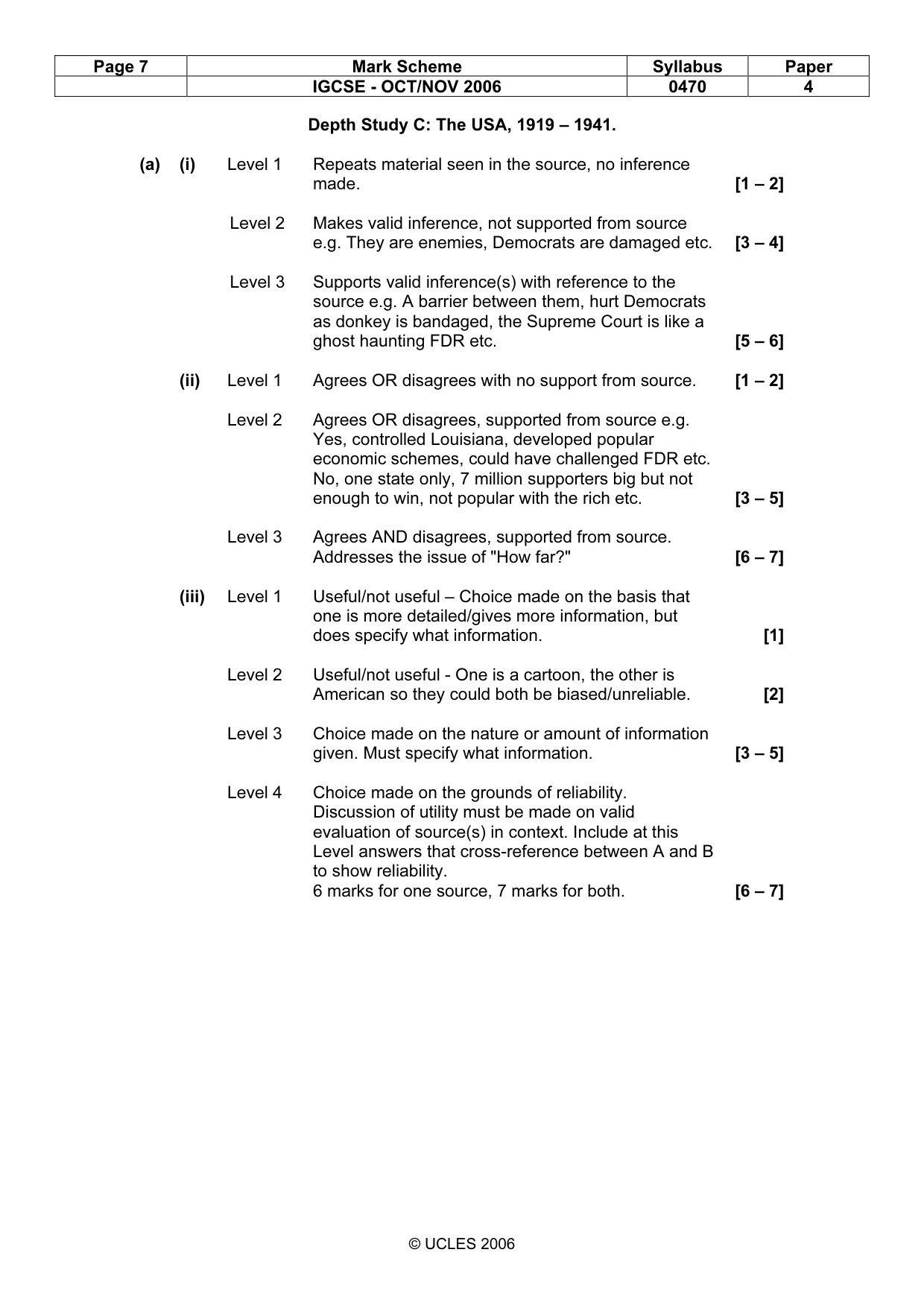
Page 7 Mark Scheme Syllabus Paper IGCSE - OCT/NOV 2006 0470 4 © UCLES 2006 Depth Study C: The USA, 1919 – 1941. (a) (i) Level 1 Repeats material seen in the source, no inference made. [1 – 2] Level 2 Makes valid inference, not supported from source e.g. They are enemies, Democrats are damaged etc. [3 – 4] Level 3 Supports valid inference(s) with reference to the source e.g. A barrier between them, hurt Democrats as donkey is bandaged, the Supreme Court is like a ghost haunting FDR etc. [5 – 6] (ii) Level 1 Agrees OR disagrees with no support from source. [1 – 2] Level 2 Agrees OR disagrees, supported from source e.g. Yes, controlled Louisiana, developed popular economic schemes, could have challenged FDR etc. No, one state only, 7 million supporters big but not enough to win, not popular with the rich etc. [3 – 5] Level 3 Agrees AND disagrees, supported from source. Addresses the issue of "How far?" [6 – 7] (iii) Level 1 Useful/not useful – Choice made on the basis that one is more detailed/gives more information, but does specify what information. [1] Level 2 Useful/not useful - One is a cartoon, the other is American so they could both be biased/unreliable. [2] Level 3 Choice made on the nature or amount of information given. Must specify what information. [3 – 5] Level 4 Choice made on the grounds of reliability. Discussion of utility must be made on valid evaluation of source(s) in context. Include at this Level answers that cross-reference between A and B to show reliability. 6 marks for one source, 7 marks for both. [6 – 7]
Mark scheme, page 8
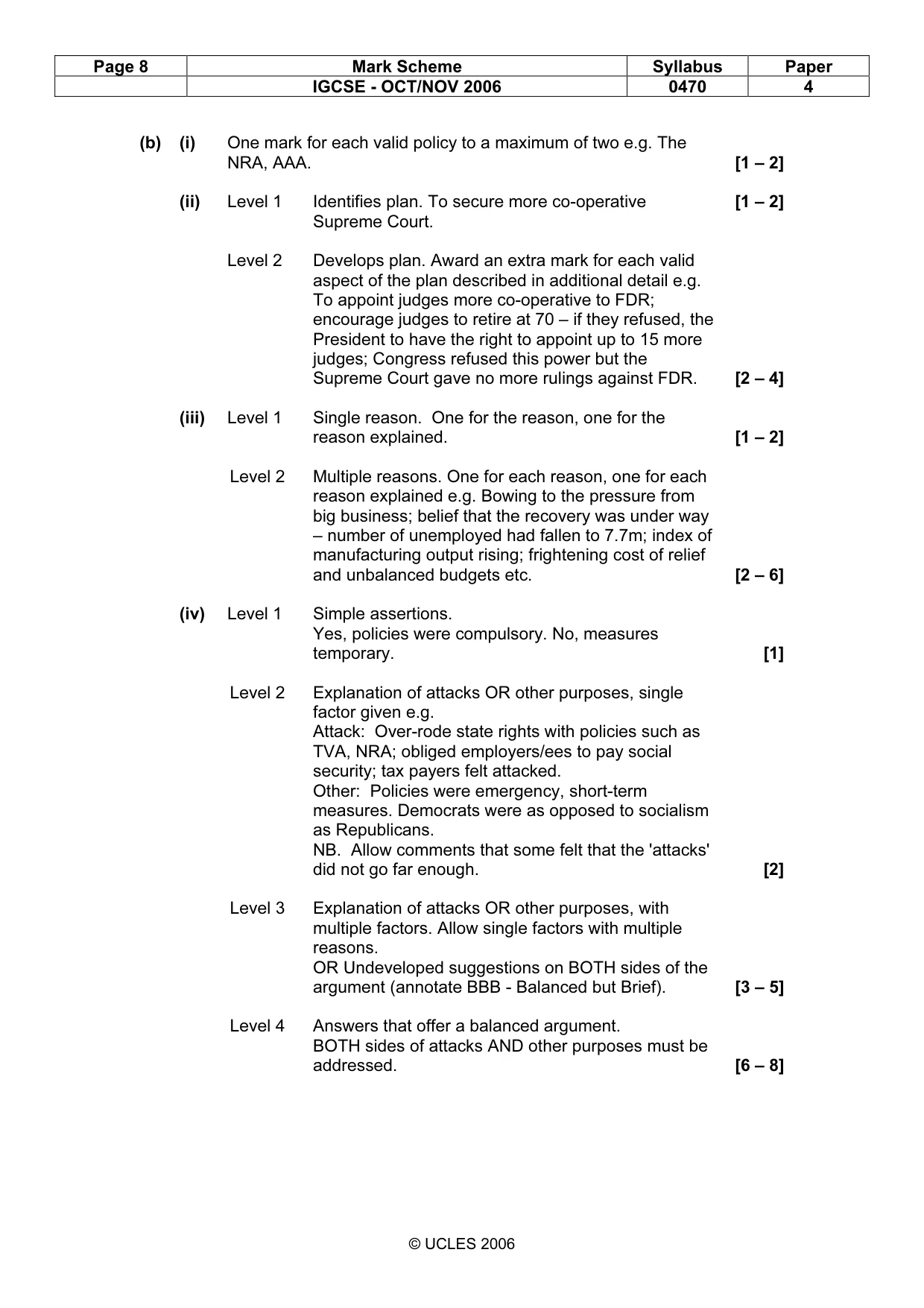
Page 8 Mark Scheme Syllabus Paper IGCSE - OCT/NOV 2006 0470 4 © UCLES 2006 (b) (i) One mark for each valid policy to a maximum of two e.g. The NRA, AAA. [1 – 2] (ii) Level 1 Identifies plan. To secure more co-operative Supreme Court. [1 – 2] Level 2 Develops plan. Award an extra mark for each valid aspect of the plan described in additional detail e.g. To appoint judges more co-operative to FDR; encourage judges to retire at 70 – if they refused, the President to have the right to appoint up to 15 more judges; Congress refused this power but the Supreme Court gave no more rulings against FDR. [2 – 4] (iii) Level 1 Single reason. One for the reason, one for the reason explained. [1 – 2] Level 2 Multiple reasons. One for each reason, one for each reason explained e.g. Bowing to the pressure from big business; belief that the recovery was under way – number of unemployed had fallen to 7.7m; index of manufacturing output rising; frightening cost of relief and unbalanced budgets etc. [2 – 6] (iv) Level 1 Simple assertions. Yes, policies were compulsory. No, measures temporary. [1] Level 2 Explanation of attacks OR other purposes, single factor given e.g. Attack: Over-rode state rights with policies such as TVA, NRA; obliged employers/ees to pay social security; tax payers felt attacked. Other: Policies were emergency, short-term measures. Democrats were as opposed to socialism as Republicans. NB. Allow comments that some felt that the 'attacks' did not go far enough. [2] Level 3 Explanation of attacks OR other purposes, with multiple factors. Allow single factors with multiple reasons. OR Undeveloped suggestions on BOTH sides of the argument (annotate BBB - Balanced but Brief). [3 – 5] Level 4 Answers that offer a balanced argument. BOTH sides of attacks AND other purposes must be addressed. [6 – 8]
Mark scheme, page 9
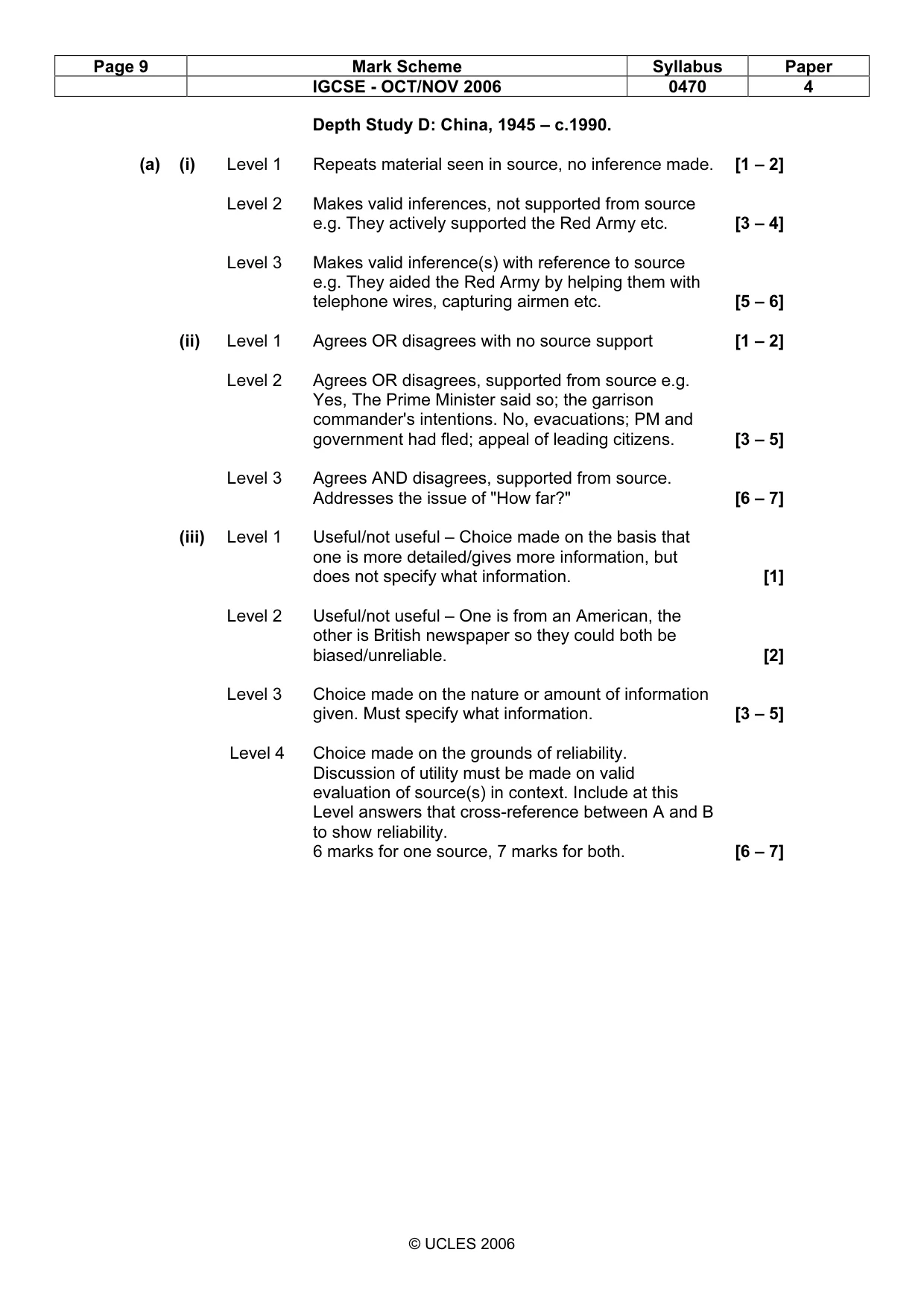
Page 9 Mark Scheme Syllabus Paper IGCSE - OCT/NOV 2006 0470 4 © UCLES 2006 Depth Study D: China, 1945 – c.1990. (a) (i) Level 1 Repeats material seen in source, no inference made. [1 – 2] Level 2 Makes valid inferences, not supported from source e.g. They actively supported the Red Army etc. [3 – 4] Level 3 Makes valid inference(s) with reference to source e.g. They aided the Red Army by helping them with telephone wires, capturing airmen etc. [5 – 6] (ii) Level 1 Agrees OR disagrees with no source support [1 – 2] Level 2 Agrees OR disagrees, supported from source e.g. Yes, The Prime Minister said so; the garrison commander's intentions. No, evacuations; PM and government had fled; appeal of leading citizens. [3 – 5] Level 3 Agrees AND disagrees, supported from source. Addresses the issue of "How far?" [6 – 7] (iii) Level 1 Useful/not useful – Choice made on the basis that one is more detailed/gives more information, but does not specify what information. [1] Level 2 Useful/not useful – One is from an American, the other is British newspaper so they could both be biased/unreliable. [2] Level 3 Choice made on the nature or amount of information given. Must specify what information. [3 – 5] Level 4 Choice made on the grounds of reliability. Discussion of utility must be made on valid evaluation of source(s) in context. Include at this Level answers that cross-reference between A and B to show reliability. 6 marks for one source, 7 marks for both. [6 – 7]
Mark scheme, page 10
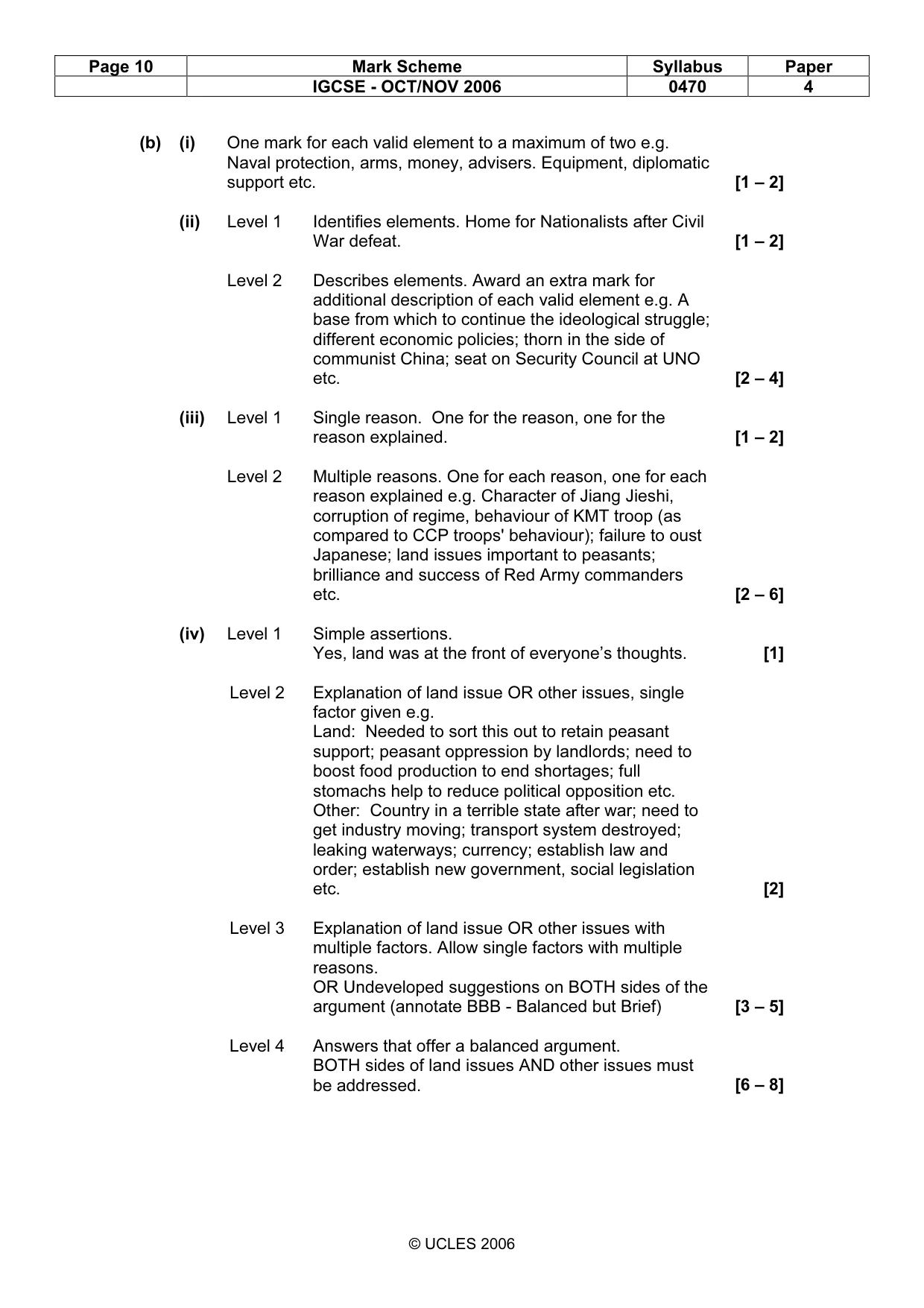
Page 10 Mark Scheme Syllabus Paper IGCSE - OCT/NOV 2006 0470 4 © UCLES 2006 (b) (i) One mark for each valid element to a maximum of two e.g. Naval protection, arms, money, advisers. Equipment, diplomatic support etc. [1 – 2] (ii) Level 1 Identifies elements. Home for Nationalists after Civil War defeat. [1 – 2] Level 2 Describes elements. Award an extra mark for additional description of each valid element e.g. A base from which to continue the ideological struggle; different economic policies; thorn in the side of communist China; seat on Security Council at UNO etc. [2 – 4] (iii) Level 1 Single reason. One for the reason, one for the reason explained. [1 – 2] Level 2 Multiple reasons. One for each reason, one for each reason explained e.g. Character of Jiang Jieshi, corruption of regime, behaviour of KMT troop (as compared to CCP troops' behaviour); failure to oust Japanese; land issues important to peasants; brilliance and success of Red Army commanders etc. [2 – 6] (iv) Level 1 Simple assertions. Yes, land was at the front of everyone’s thoughts. [1] Level 2 Explanation of land issue OR other issues, single factor given e.g. Land: Needed to sort this out to retain peasant support; peasant oppression by landlords; need to boost food production to end shortages; full stomachs help to reduce political opposition etc. Other: Country in a terrible state after war; need to get industry moving; transport system destroyed; leaking waterways; currency; establish law and order; establish new government, social legislation etc. [2] Level 3 Explanation of land issue OR other issues with multiple factors. Allow single factors with multiple reasons. OR Undeveloped suggestions on BOTH sides of the argument (annotate BBB - Balanced but Brief) [3 – 5] Level 4 Answers that offer a balanced argument. BOTH sides of land issues AND other issues must be addressed. [6 – 8]
Mark scheme, page 11
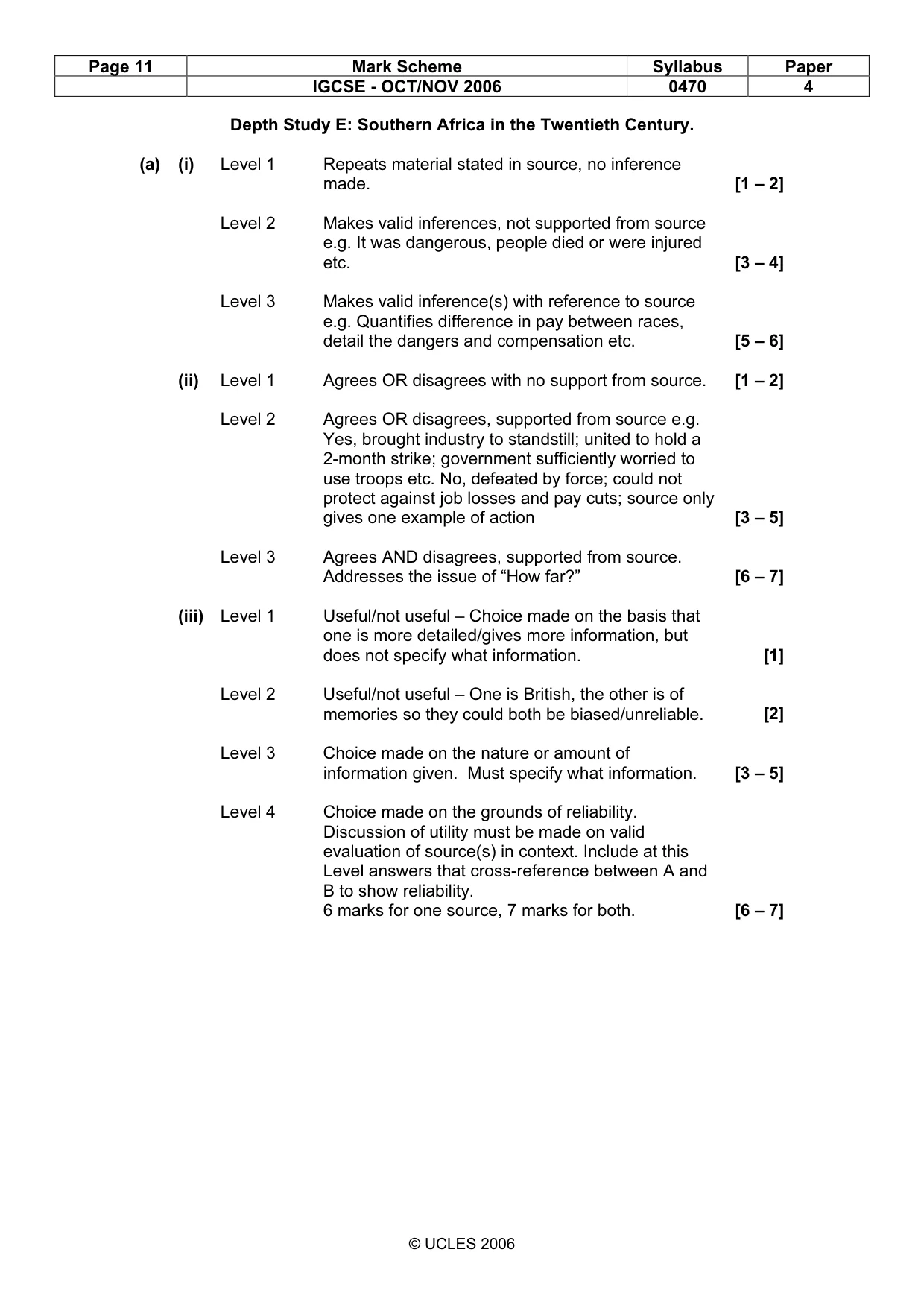
Page 11 Mark Scheme Syllabus Paper IGCSE - OCT/NOV 2006 0470 4 © UCLES 2006 Depth Study E: Southern Africa in the Twentieth Century. (a) (i) Level 1 Repeats material stated in source, no inference made. [1 – 2] Level 2 Makes valid inferences, not supported from source e.g. It was dangerous, people died or were injured etc. [3 – 4] Level 3 Makes valid inference(s) with reference to source e.g. Quantifies difference in pay between races, detail the dangers and compensation etc. [5 – 6] (ii) Level 1 Agrees OR disagrees with no support from source. [1 – 2] Level 2 Agrees OR disagrees, supported from source e.g. Yes, brought industry to standstill; united to hold a 2-month strike; government sufficiently worried to use troops etc. No, defeated by force; could not protect against job losses and pay cuts; source only gives one example of action [3 – 5] Level 3 Agrees AND disagrees, supported from source. Addresses the issue of “How far?” [6 – 7] (iii) Level 1 Useful/not useful – Choice made on the basis that one is more detailed/gives more information, but does not specify what information. [1] Level 2 Useful/not useful – One is British, the other is of memories so they could both be biased/unreliable. [2] Level 3 Choice made on the nature or amount of information given. Must specify what information. [3 – 5] Level 4 Choice made on the grounds of reliability. Discussion of utility must be made on valid evaluation of source(s) in context. Include at this Level answers that cross-reference between A and B to show reliability. 6 marks for one source, 7 marks for both. [6 – 7]
Mark scheme, page 12
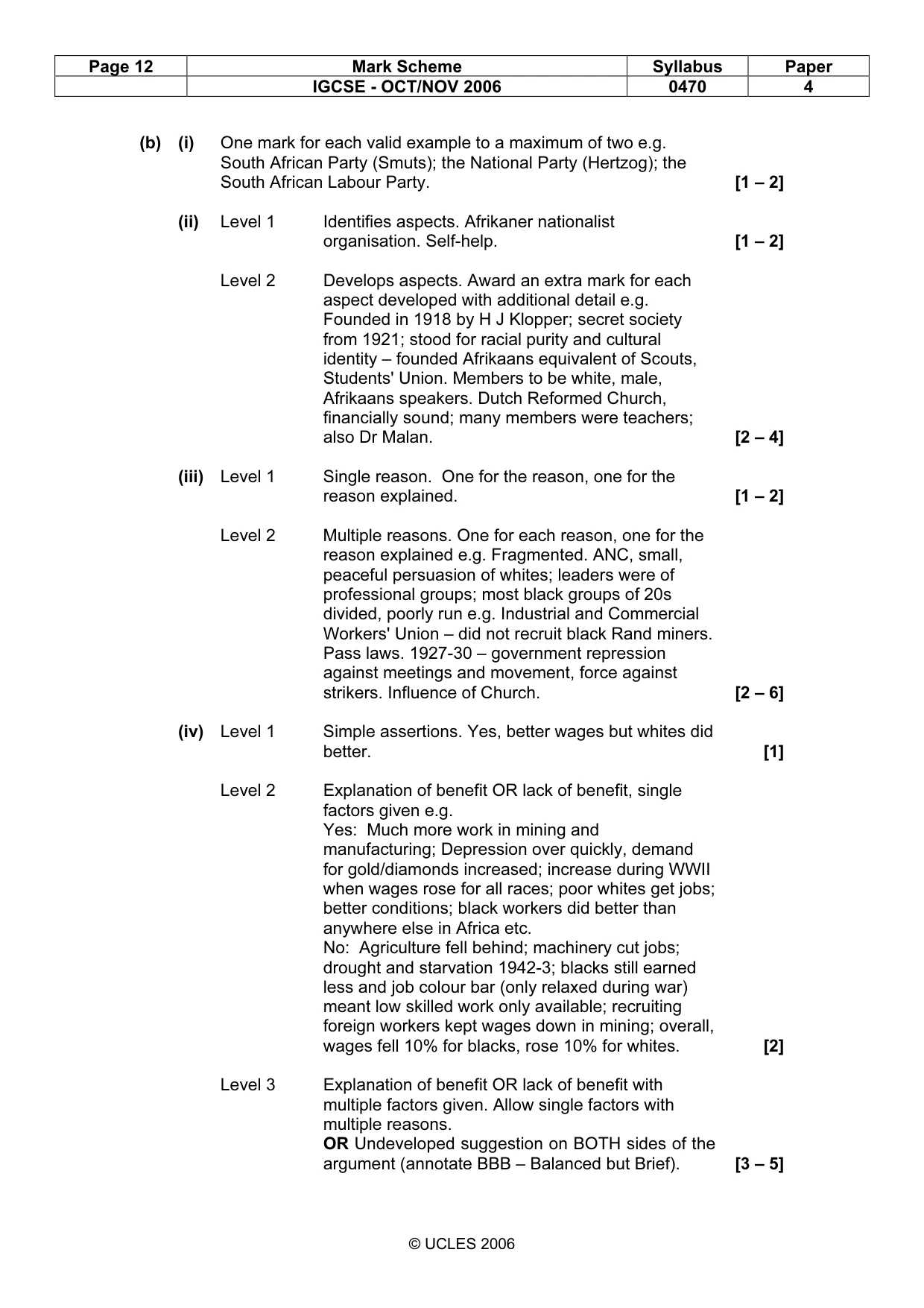
Page 12 Mark Scheme Syllabus Paper IGCSE - OCT/NOV 2006 0470 4 © UCLES 2006 (b) (i) One mark for each valid example to a maximum of two e.g. South African Party (Smuts); the National Party (Hertzog); the South African Labour Party. [1 – 2] (ii) Level 1 Identifies aspects. Afrikaner nationalist organisation. Self-help. [1 – 2] Level 2 Develops aspects. Award an extra mark for each aspect developed with additional detail e.g. Founded in 1918 by H J Klopper; secret society from 1921; stood for racial purity and cultural identity – founded Afrikaans equivalent of Scouts, Students' Union. Members to be white, male, Afrikaans speakers. Dutch Reformed Church, financially sound; many members were teachers; also Dr Malan. [2 – 4] (iii) Level 1 Single reason. One for the reason, one for the reason explained. [1 – 2] Level 2 Multiple reasons. One for each reason, one for the reason explained e.g. Fragmented. ANC, small, peaceful persuasion of whites; leaders were of professional groups; most black groups of 20s divided, poorly run e.g. Industrial and Commercial Workers' Union – did not recruit black Rand miners. Pass laws. 1927-30 – government repression against meetings and movement, force against strikers. Influence of Church. [2 – 6] (iv) Level 1 Simple assertions. Yes, better wages but whites did better. [1] Level 2 Explanation of benefit OR lack of benefit, single factors given e.g. Yes: Much more work in mining and manufacturing; Depression over quickly, demand for gold/diamonds increased; increase during WWII when wages rose for all races; poor whites get jobs; better conditions; black workers did better than anywhere else in Africa etc. No: Agriculture fell behind; machinery cut jobs; drought and starvation 1942-3; blacks still earned less and job colour bar (only relaxed during war) meant low skilled work only available; recruiting foreign workers kept wages down in mining; overall, wages fell 10% for blacks, rose 10% for whites. [2] Level 3 Explanation of benefit OR lack of benefit with multiple factors given. Allow single factors with multiple reasons. OR Undeveloped suggestion on BOTH sides of the argument (annotate BBB – Balanced but Brief). [3 – 5]
Mark scheme, page 13
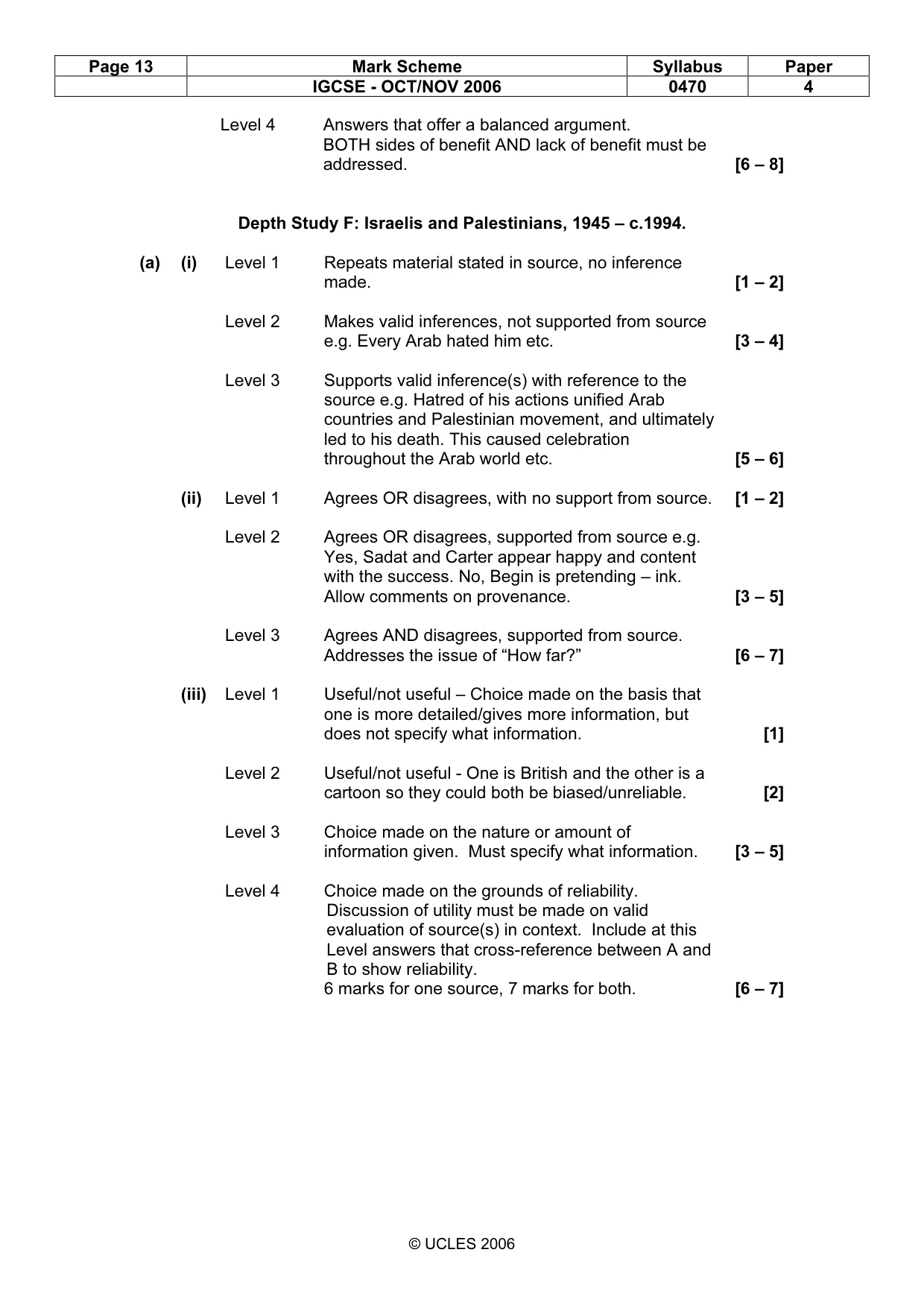
Page 13 Mark Scheme Syllabus Paper IGCSE - OCT/NOV 2006 0470 4 © UCLES 2006 Level 4 Answers that offer a balanced argument. BOTH sides of benefit AND lack of benefit must be addressed. [6 – 8] Depth Study F: Israelis and Palestinians, 1945 – c.1994. (a) (i) Level 1 Repeats material stated in source, no inference made. [1 – 2] Level 2 Makes valid inferences, not supported from source e.g. Every Arab hated him etc. [3 – 4] Level 3 Supports valid inference(s) with reference to the source e.g. Hatred of his actions unified Arab countries and Palestinian movement, and ultimately led to his death. This caused celebration throughout the Arab world etc. [5 – 6] (ii) Level 1 Agrees OR disagrees, with no support from source. [1 – 2] Level 2 Agrees OR disagrees, supported from source e.g. Yes, Sadat and Carter appear happy and content with the success. No, Begin is pretending – ink. Allow comments on provenance. [3 – 5] Level 3 Agrees AND disagrees, supported from source. Addresses the issue of “How far?” [6 – 7] (iii) Level 1 Useful/not useful – Choice made on the basis that one is more detailed/gives more information, but does not specify what information. [1] Level 2 Useful/not useful - One is British and the other is a cartoon so they could both be biased/unreliable. [2] Level 3 Choice made on the nature or amount of information given. Must specify what information. [3 – 5] Level 4 Choice made on the grounds of reliability. Discussion of utility must be made on valid evaluation of source(s) in context. Include at this Level answers that cross-reference between A and B to show reliability. 6 marks for one source, 7 marks for both. [6 – 7]
Mark scheme, page 14
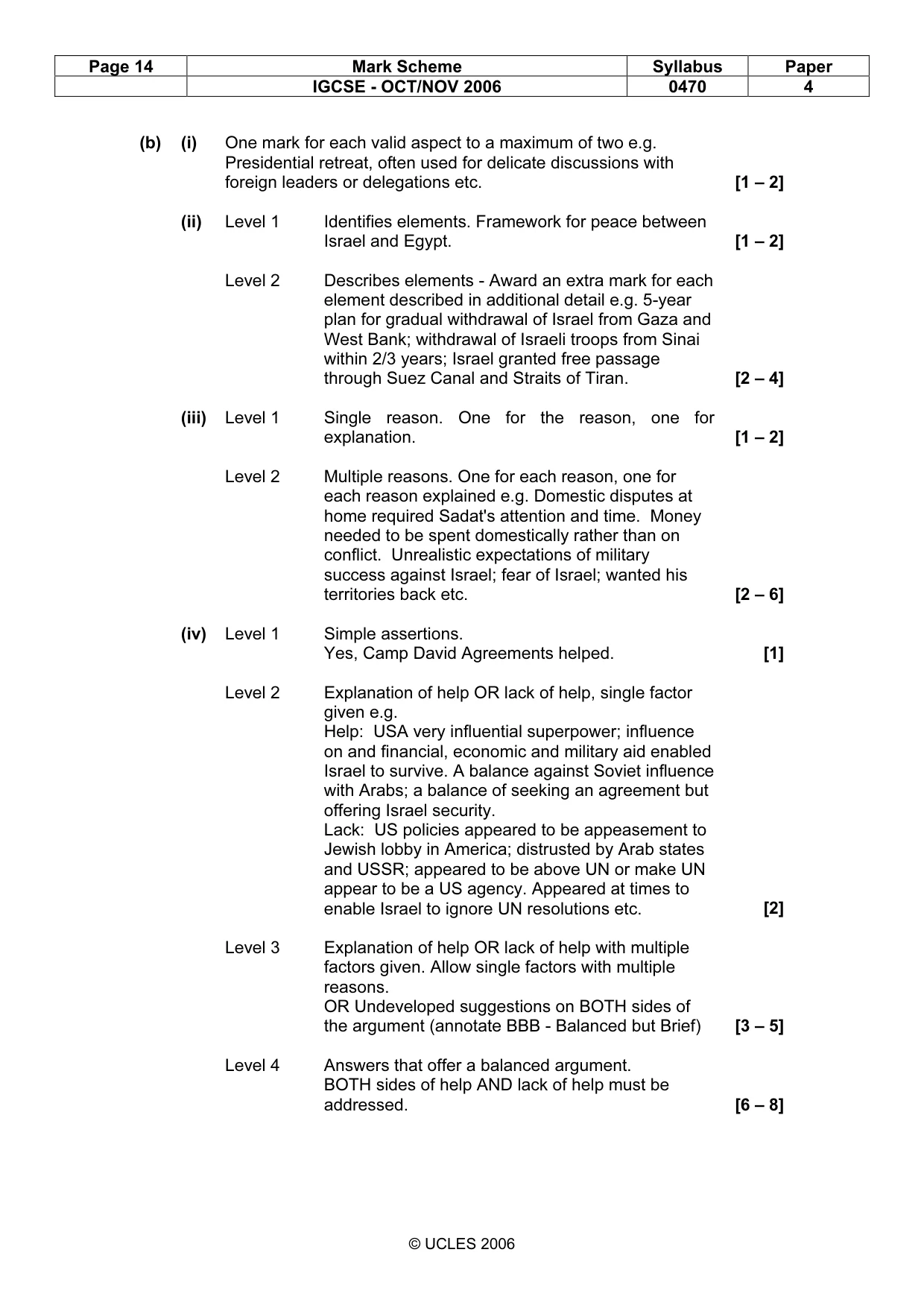
Page 14 Mark Scheme Syllabus Paper IGCSE - OCT/NOV 2006 0470 4 © UCLES 2006 (b) (i) One mark for each valid aspect to a maximum of two e.g. Presidential retreat, often used for delicate discussions with foreign leaders or delegations etc. [1 – 2] (ii) Level 1 Identifies elements. Framework for peace between Israel and Egypt. [1 – 2] Level 2 Describes elements - Award an extra mark for each element described in additional detail e.g. 5-year plan for gradual withdrawal of Israel from Gaza and West Bank; withdrawal of Israeli troops from Sinai within 2/3 years; Israel granted free passage through Suez Canal and Straits of Tiran. [2 – 4] (iii) Level 1 Single reason. One for the reason, one for explanation. [1 – 2] Level 2 Multiple reasons. One for each reason, one for each reason explained e.g. Domestic disputes at home required Sadat's attention and time. Money needed to be spent domestically rather than on conflict. Unrealistic expectations of military success against Israel; fear of Israel; wanted his territories back etc. [2 – 6] (iv) Level 1 Simple assertions. Yes, Camp David Agreements helped. [1] Level 2 Explanation of help OR lack of help, single factor given e.g. Help: USA very influential superpower; influence on and financial, economic and military aid enabled Israel to survive. A balance against Soviet influence with Arabs; a balance of seeking an agreement but offering Israel security. Lack: US policies appeared to be appeasement to Jewish lobby in America; distrusted by Arab states and USSR; appeared to be above UN or make UN appear to be a US agency. Appeared at times to enable Israel to ignore UN resolutions etc. [2] Level 3 Explanation of help OR lack of help with multiple factors given. Allow single factors with multiple reasons. OR Undeveloped suggestions on BOTH sides of the argument (annotate BBB - Balanced but Brief) [3 – 5] Level 4 Answers that offer a balanced argument. BOTH sides of help AND lack of help must be addressed. [6 – 8]
Mark scheme, page 15
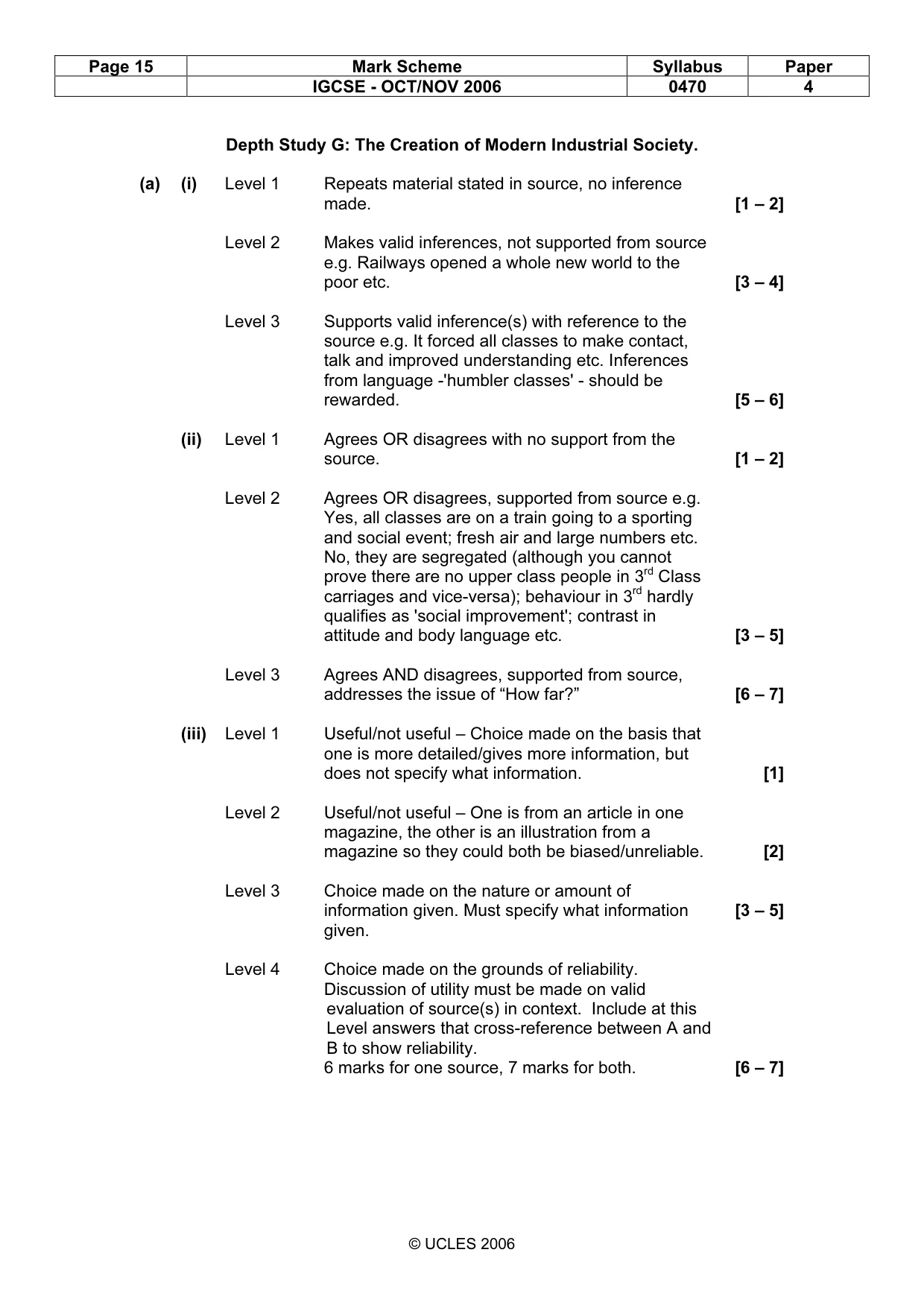
Page 15 Mark Scheme Syllabus Paper IGCSE - OCT/NOV 2006 0470 4 © UCLES 2006 Depth Study G: The Creation of Modern Industrial Society. (a) (i) Level 1 Repeats material stated in source, no inference made. [1 – 2] Level 2 Makes valid inferences, not supported from source e.g. Railways opened a whole new world to the poor etc. [3 – 4] Level 3 Supports valid inference(s) with reference to the source e.g. It forced all classes to make contact, talk and improved understanding etc. Inferences from language -'humbler classes' - should be rewarded. [5 – 6] (ii) Level 1 Agrees OR disagrees with no support from the source. [1 – 2] Level 2 Agrees OR disagrees, supported from source e.g. Yes, all classes are on a train going to a sporting and social event; fresh air and large numbers etc. No, they are segregated (although you cannot prove there are no upper class people in 3rd Class carriages and vice-versa); behaviour in 3rd hardly qualifies as 'social improvement'; contrast in attitude and body language etc. [3 – 5] Level 3 Agrees AND disagrees, supported from source, addresses the issue of “How far?” [6 – 7] (iii) Level 1 Useful/not useful – Choice made on the basis that one is more detailed/gives more information, but does not specify what information. [1] Level 2 Useful/not useful – One is from an article in one magazine, the other is an illustration from a magazine so they could both be biased/unreliable. [2] Level 3 Choice made on the nature or amount of information given. Must specify what information given. [3 – 5] Level 4 Choice made on the grounds of reliability. Discussion of utility must be made on valid evaluation of source(s) in context. Include at this Level answers that cross-reference between A and B to show reliability. 6 marks for one source, 7 marks for both. [6 – 7]
Mark scheme, page 16
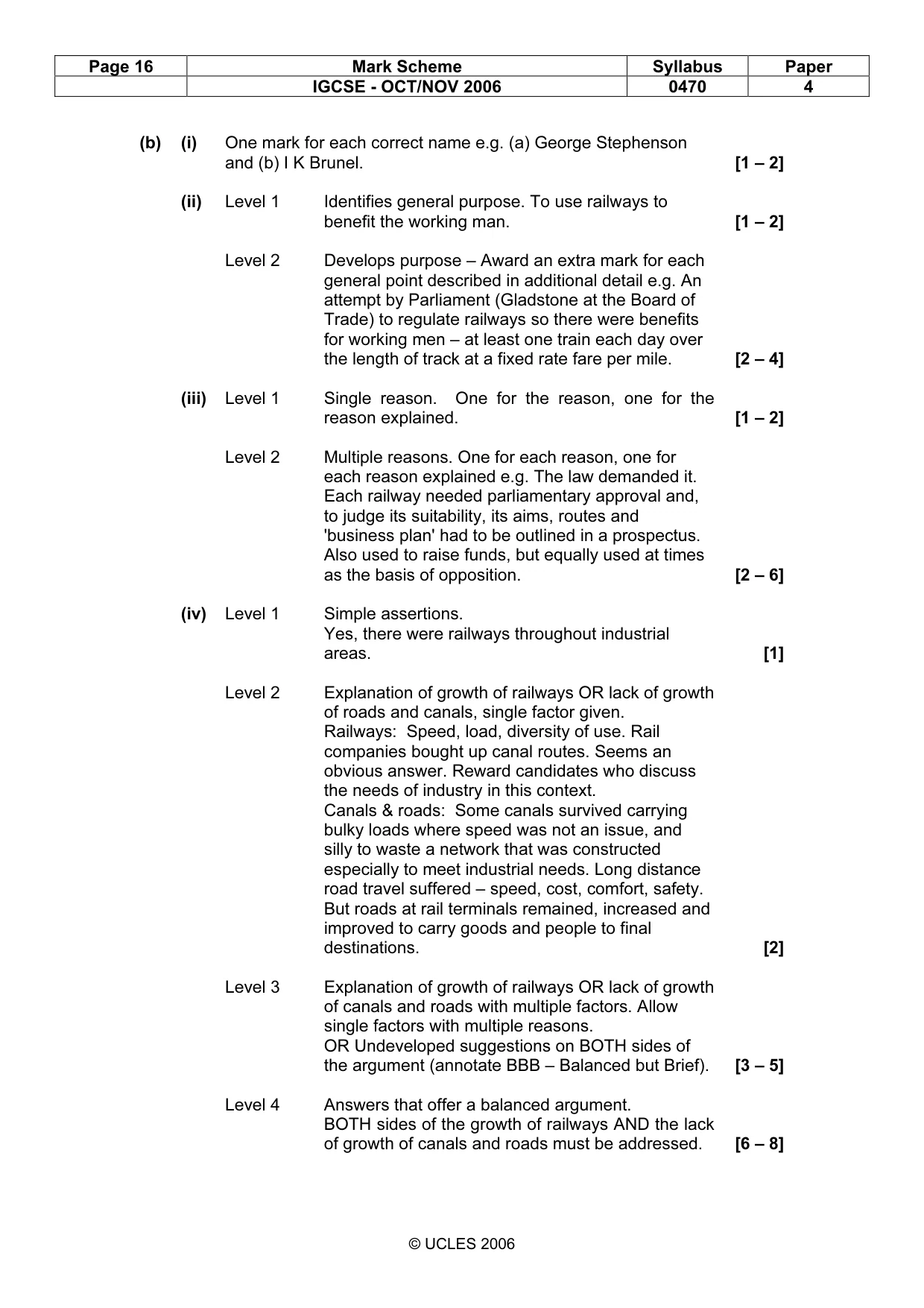
Page 16 Mark Scheme Syllabus Paper IGCSE - OCT/NOV 2006 0470 4 © UCLES 2006 (b) (i) One mark for each correct name e.g. (a) George Stephenson and (b) I K Brunel. [1 – 2] (ii) Level 1 Identifies general purpose. To use railways to benefit the working man. [1 – 2] Level 2 Develops purpose – Award an extra mark for each general point described in additional detail e.g. An attempt by Parliament (Gladstone at the Board of Trade) to regulate railways so there were benefits for working men – at least one train each day over the length of track at a fixed rate fare per mile. [2 – 4] (iii) Level 1 Single reason. One for the reason, one for the reason explained. [1 – 2] Level 2 Multiple reasons. One for each reason, one for each reason explained e.g. The law demanded it. Each railway needed parliamentary approval and, to judge its suitability, its aims, routes and 'business plan' had to be outlined in a prospectus. Also used to raise funds, but equally used at times as the basis of opposition. [2 – 6] (iv) Level 1 Simple assertions. Yes, there were railways throughout industrial areas. [1] Level 2 Explanation of growth of railways OR lack of growth of roads and canals, single factor given. Railways: Speed, load, diversity of use. Rail companies bought up canal routes. Seems an obvious answer. Reward candidates who discuss the needs of industry in this context. Canals & roads: Some canals survived carrying bulky loads where speed was not an issue, and silly to waste a network that was constructed especially to meet industrial needs. Long distance road travel suffered – speed, cost, comfort, safety. But roads at rail terminals remained, increased and improved to carry goods and people to final destinations. [2] Level 3 Explanation of growth of railways OR lack of growth of canals and roads with multiple factors. Allow single factors with multiple reasons. OR Undeveloped suggestions on BOTH sides of the argument (annotate BBB – Balanced but Brief). [3 – 5] Level 4 Answers that offer a balanced argument. BOTH sides of the growth of railways AND the lack of growth of canals and roads must be addressed. [6 – 8]
Mark scheme, page 17
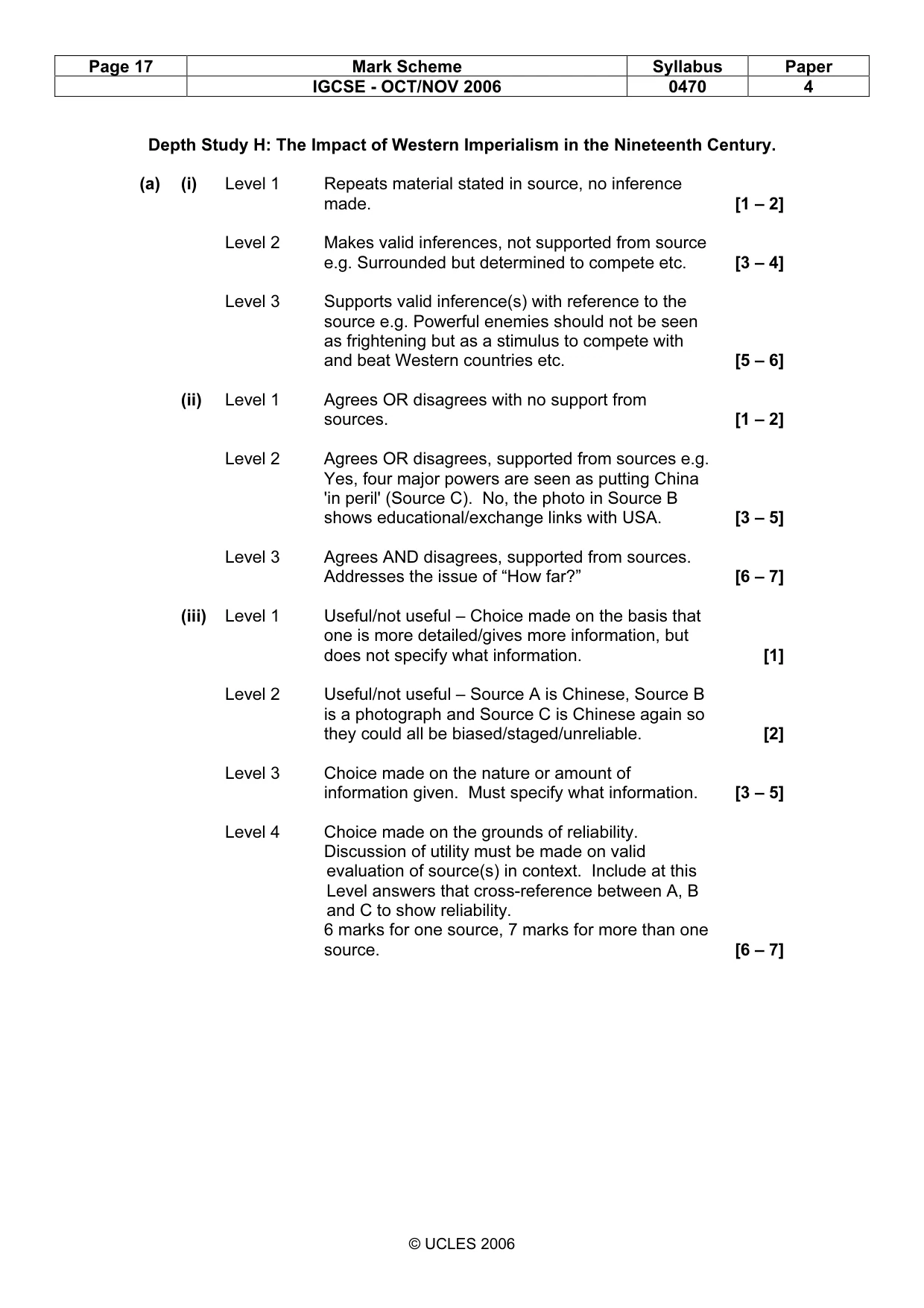
Page 17 Mark Scheme Syllabus Paper IGCSE - OCT/NOV 2006 0470 4 © UCLES 2006 Depth Study H: The Impact of Western Imperialism in the Nineteenth Century. (a) (i) Level 1 Repeats material stated in source, no inference made. [1 – 2] Level 2 Makes valid inferences, not supported from source e.g. Surrounded but determined to compete etc. [3 – 4] Level 3 Supports valid inference(s) with reference to the source e.g. Powerful enemies should not be seen as frightening but as a stimulus to compete with and beat Western countries etc. [5 – 6] (ii) Level 1 Agrees OR disagrees with no support from sources. [1 – 2] Level 2 Agrees OR disagrees, supported from sources e.g. Yes, four major powers are seen as putting China 'in peril' (Source C). No, the photo in Source B shows educational/exchange links with USA. [3 – 5] Level 3 Agrees AND disagrees, supported from sources. Addresses the issue of “How far?” [6 – 7] (iii) Level 1 Useful/not useful – Choice made on the basis that one is more detailed/gives more information, but does not specify what information. [1] Level 2 Useful/not useful – Source A is Chinese, Source B is a photograph and Source C is Chinese again so they could all be biased/staged/unreliable. [2] Level 3 Choice made on the nature or amount of information given. Must specify what information. [3 – 5] Level 4 Choice made on the grounds of reliability. Discussion of utility must be made on valid evaluation of source(s) in context. Include at this Level answers that cross-reference between A, B and C to show reliability. 6 marks for one source, 7 marks for more than one source. [6 – 7]
Mark scheme, page 18
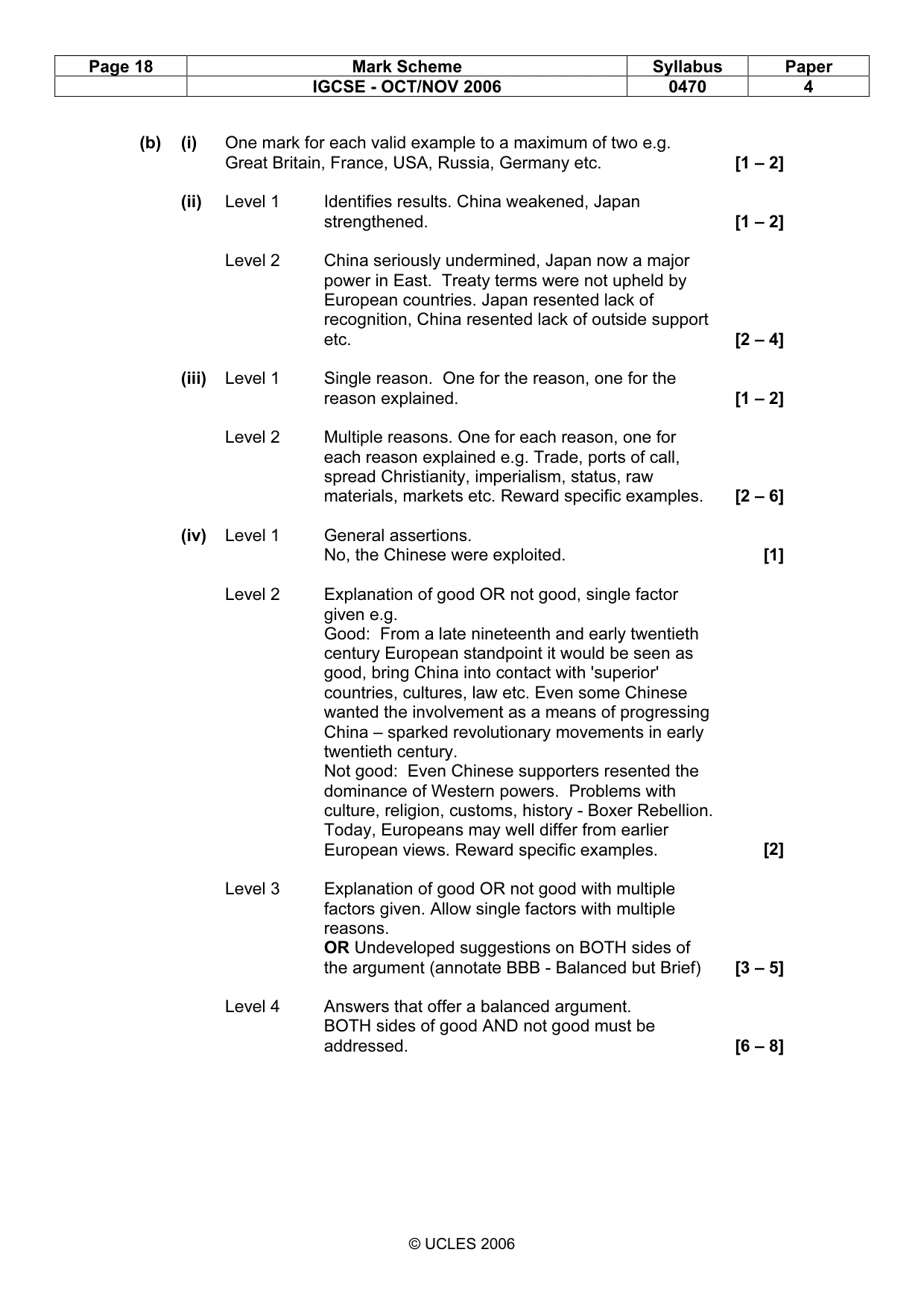
Page 18 Mark Scheme Syllabus Paper IGCSE - OCT/NOV 2006 0470 4 © UCLES 2006 (b) (i) One mark for each valid example to a maximum of two e.g. Great Britain, France, USA, Russia, Germany etc. [1 – 2] (ii) Level 1 Identifies results. China weakened, Japan strengthened. [1 – 2] Level 2 China seriously undermined, Japan now a major power in East. Treaty terms were not upheld by European countries. Japan resented lack of recognition, China resented lack of outside support etc. [2 – 4] (iii) Level 1 Single reason. One for the reason, one for the reason explained. [1 – 2] Level 2 Multiple reasons. One for each reason, one for each reason explained e.g. Trade, ports of call, spread Christianity, imperialism, status, raw materials, markets etc. Reward specific examples. [2 – 6] (iv) Level 1 General assertions. No, the Chinese were exploited. [1] Level 2 Explanation of good OR not good, single factor given e.g. Good: From a late nineteenth and early twentieth century European standpoint it would be seen as good, bring China into contact with 'superior' countries, cultures, law etc. Even some Chinese wanted the involvement as a means of progressing China – sparked revolutionary movements in early twentieth century. Not good: Even Chinese supporters resented the dominance of Western powers. Problems with culture, religion, customs, history - Boxer Rebellion. Today, Europeans may well differ from earlier European views. Reward specific examples. [2] Level 3 Explanation of good OR not good with multiple factors given. Allow single factors with multiple reasons. OR Undeveloped suggestions on BOTH sides of the argument (annotate BBB - Balanced but Brief) [3 – 5] Level 4 Answers that offer a balanced argument. BOTH sides of good AND not good must be addressed. [6 – 8]
What you needed in this session
Cambridge’s own grade thresholds for 2006 Oct/Nov, Paper 4 · Variant 1. A higher threshold means an easier paper — the bar moves with how the cohort did.