Cambridge IGCSE History 0470 — 2006 May/June Paper 4 · Variant 1
0470/41/M/J/06 · 40 marks · ≈45 min
The question paper and its mark scheme, free to read here and free to download. This is Cambridge’s own paper, exactly as it was sat.
Question paper12 pages
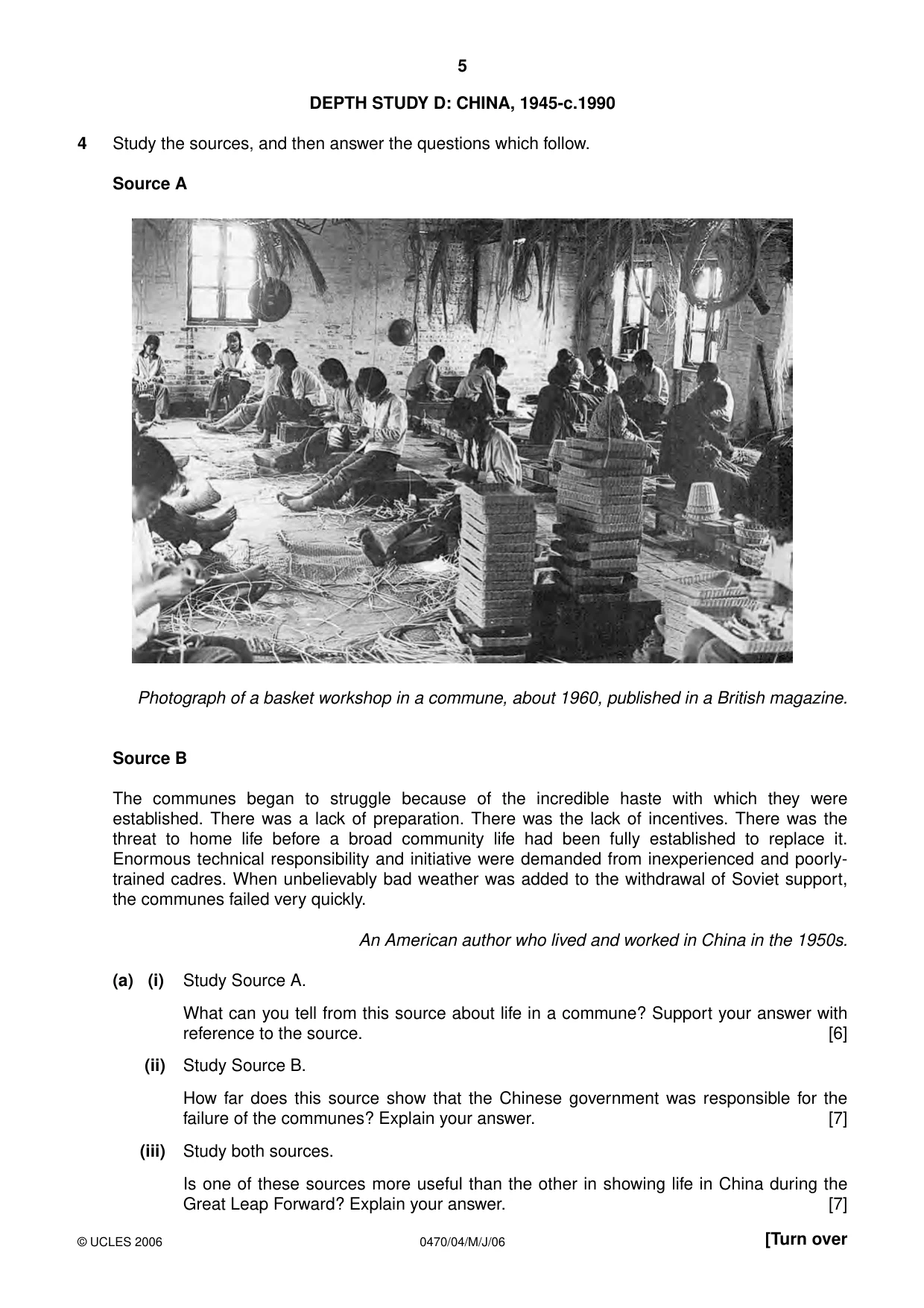
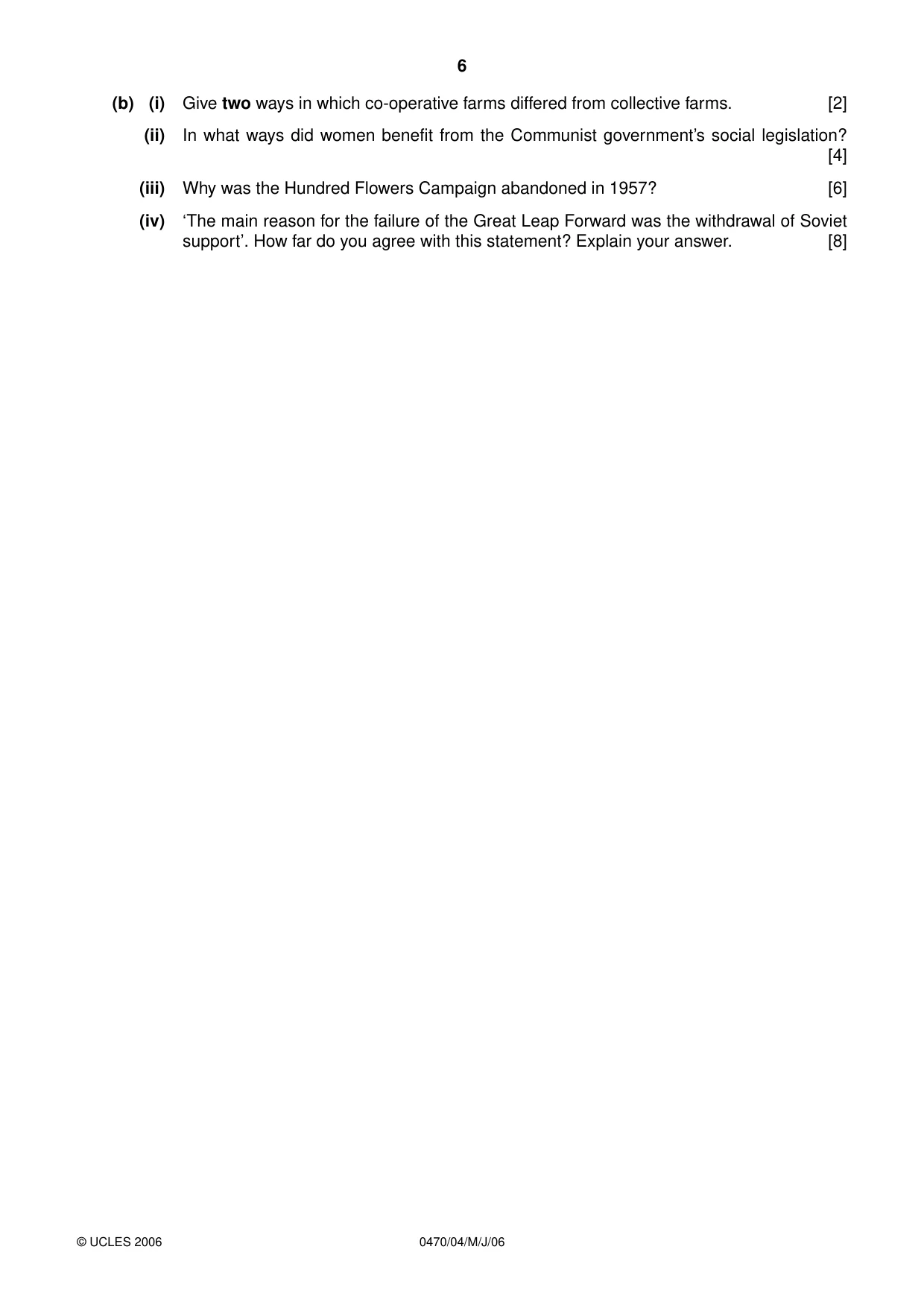
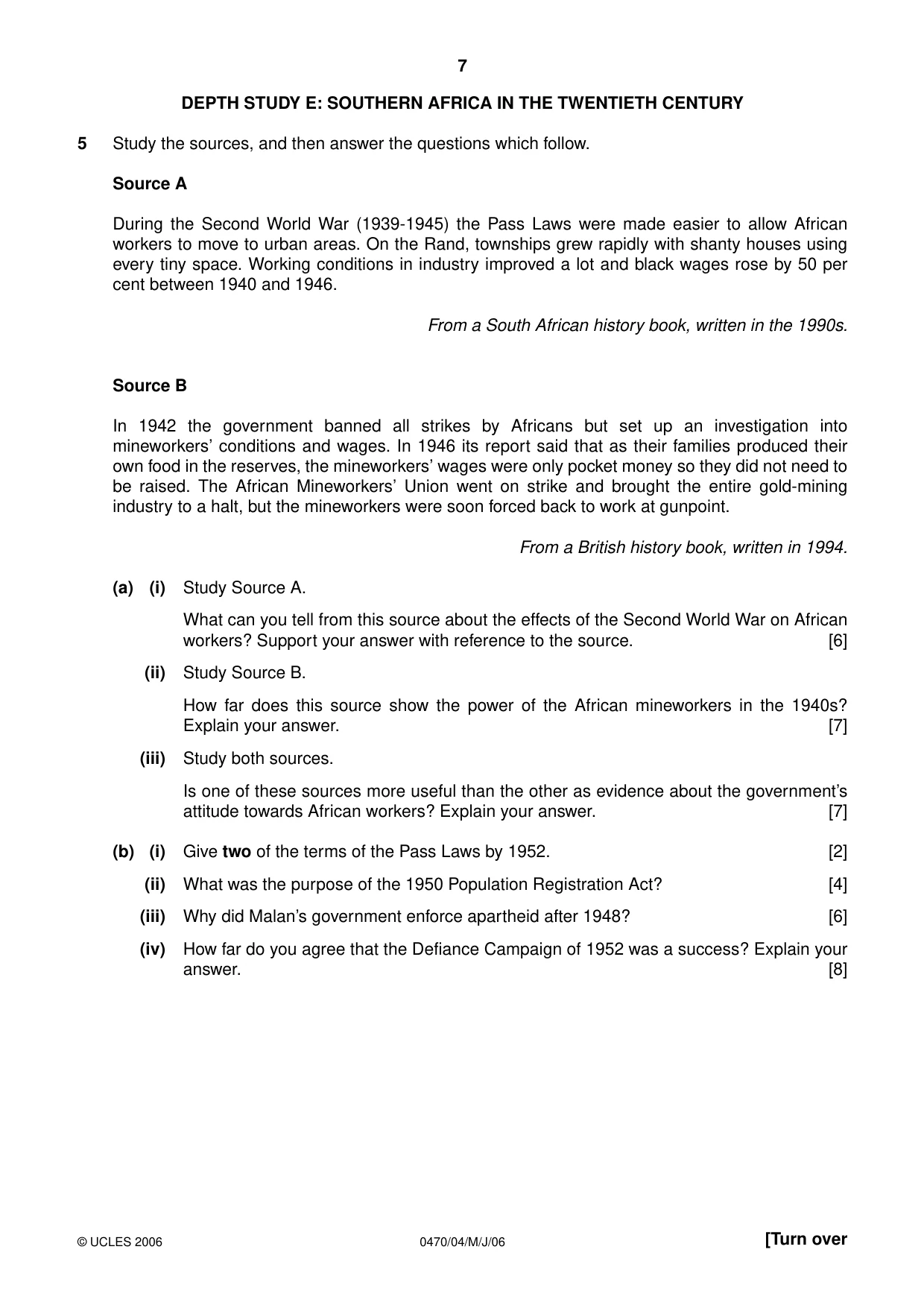
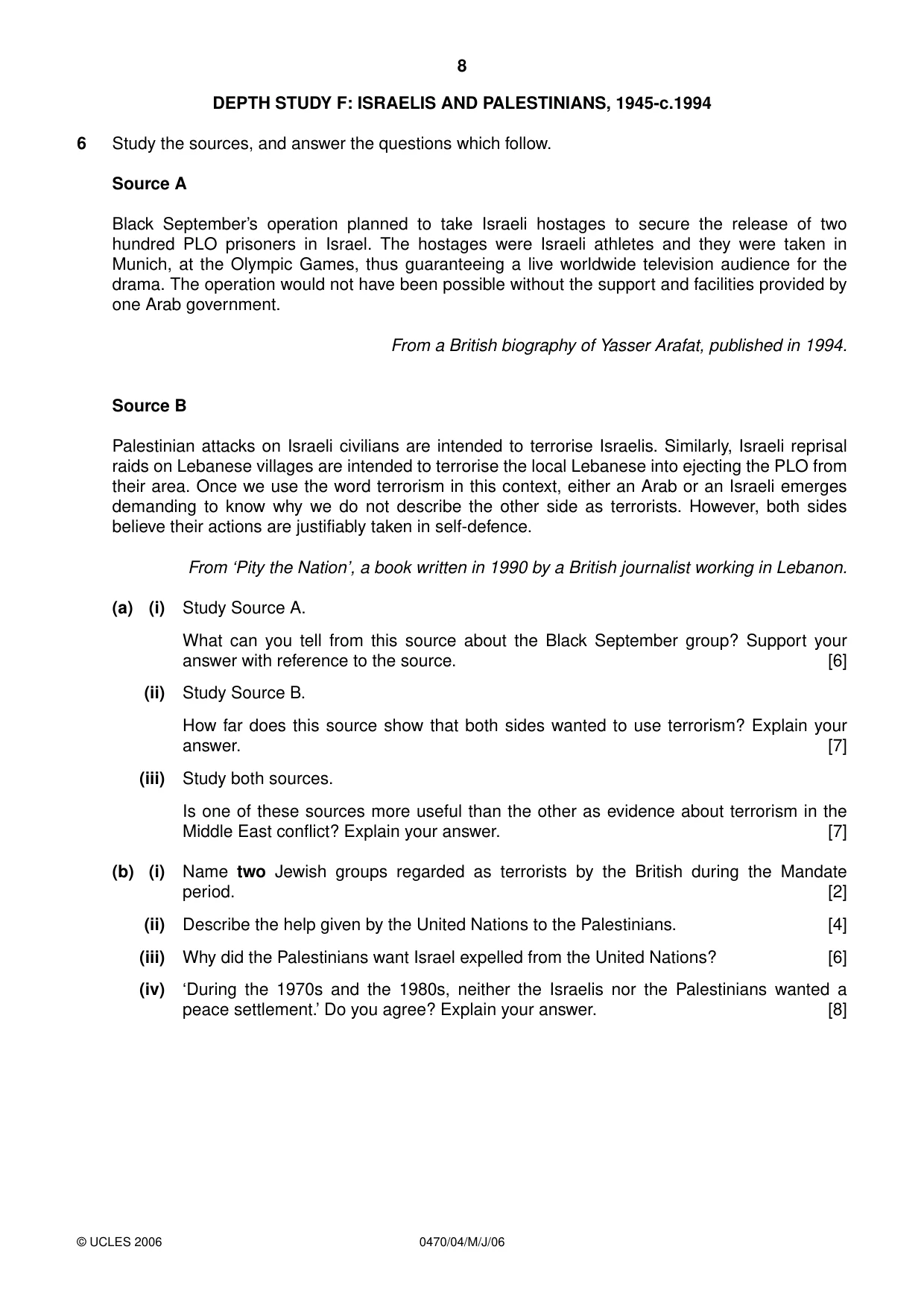

Mark scheme13 pages
Answers below. Sit the paper first if you are practising.
Paper as text
Question paper, page 1
This document consists of 10 printed pages and 2 blank pages. SP (SJF3967) T03544/6 © UCLES 2006 [Turn over UNIVERSITY OF CAMBRIDGE INTERNATIONAL EXAMINATIONS International General Certificate of Secondary Education HISTORY 0470/04 Paper 4 Alternative to Coursework May/June 2006 1 hour Additional Materials: Answer Booklet/Paper READ THESE INSTRUCTIONS FIRST If you have been given an Answer Booklet, follow the instructions on the front cover of the Booklet. Write your Centre number, candidate number and name on all the work you hand in. Write in dark blue or black pen. You may use a soft pencil for any diagrams, graphs or rough working. Do not use staples, paper clips, highlighters, glue or correction fluid. Answer the questions on one Depth Study. At the end of the examination, fasten all your work securely together. The number of marks is given in brackets [ ] at the end of each question or part question. www.XtremePapers.com
Question paper, page 2
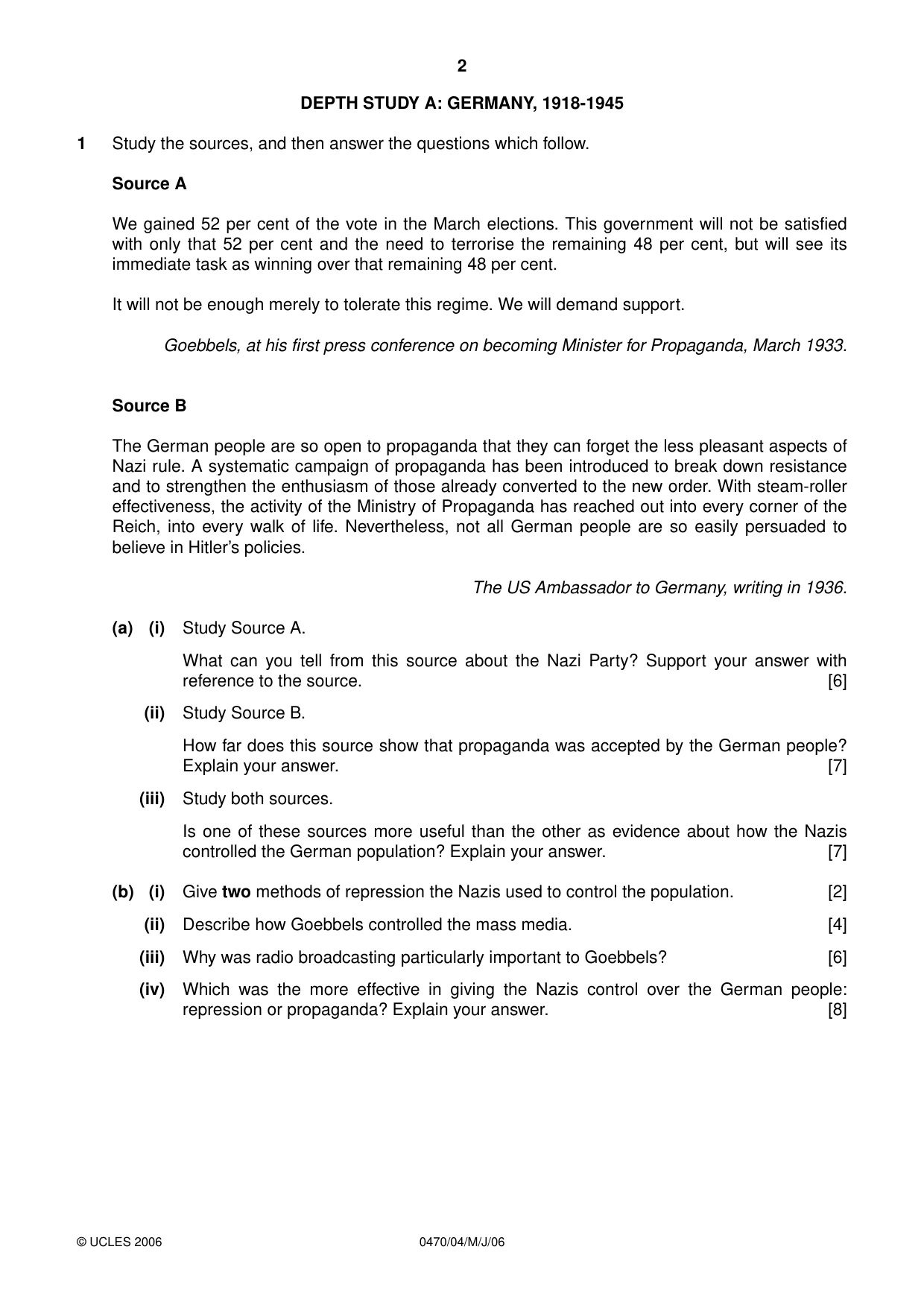
2 0470/04/M/J/06 DEPTH STUDY A: GERMANY, 1918-1945 1 Study the sources, and then answer the questions which follow. Source A We gained 52 per cent of the vote in the March elections. This government will not be satisfied with only that 52 per cent and the need to terrorise the remaining 48 per cent, but will see its immediate task as winning over that remaining 48 per cent. It will not be enough merely to tolerate this regime. We will demand support. Goebbels, at his first press conference on becoming Minister for Propaganda, March 1933. Source B The German people are so open to propaganda that they can forget the less pleasant aspects of Nazi rule. A systematic campaign of propaganda has been introduced to break down resistance and to strengthen the enthusiasm of those already converted to the new order. With steam-roller effectiveness, the activity of the Ministry of Propaganda has reached out into every corner of the Reich, into every walk of life. Nevertheless, not all German people are so easily persuaded to believe in Hitler’s policies. The US Ambassador to Germany, writing in 1936. (a) (i) Study Source A. What can you tell from this source about the Nazi Party? Support your answer with reference to the source. [6] (ii) Study Source B. How far does this source show that propaganda was accepted by the German people? Explain your answer. [7] (iii) Study both sources. Is one of these sources more useful than the other as evidence about how the Nazis controlled the German population? Explain your answer. [7] (b) (i) Give two methods of repression the Nazis used to control the population. [2] (ii) Describe how Goebbels controlled the mass media. [4] (iii) Why was radio broadcasting particularly important to Goebbels? [6] (iv) Which was the more effective in giving the Nazis control over the German people: repression or propaganda? Explain your answer. [8] © UCLES 2006
Question paper, page 3
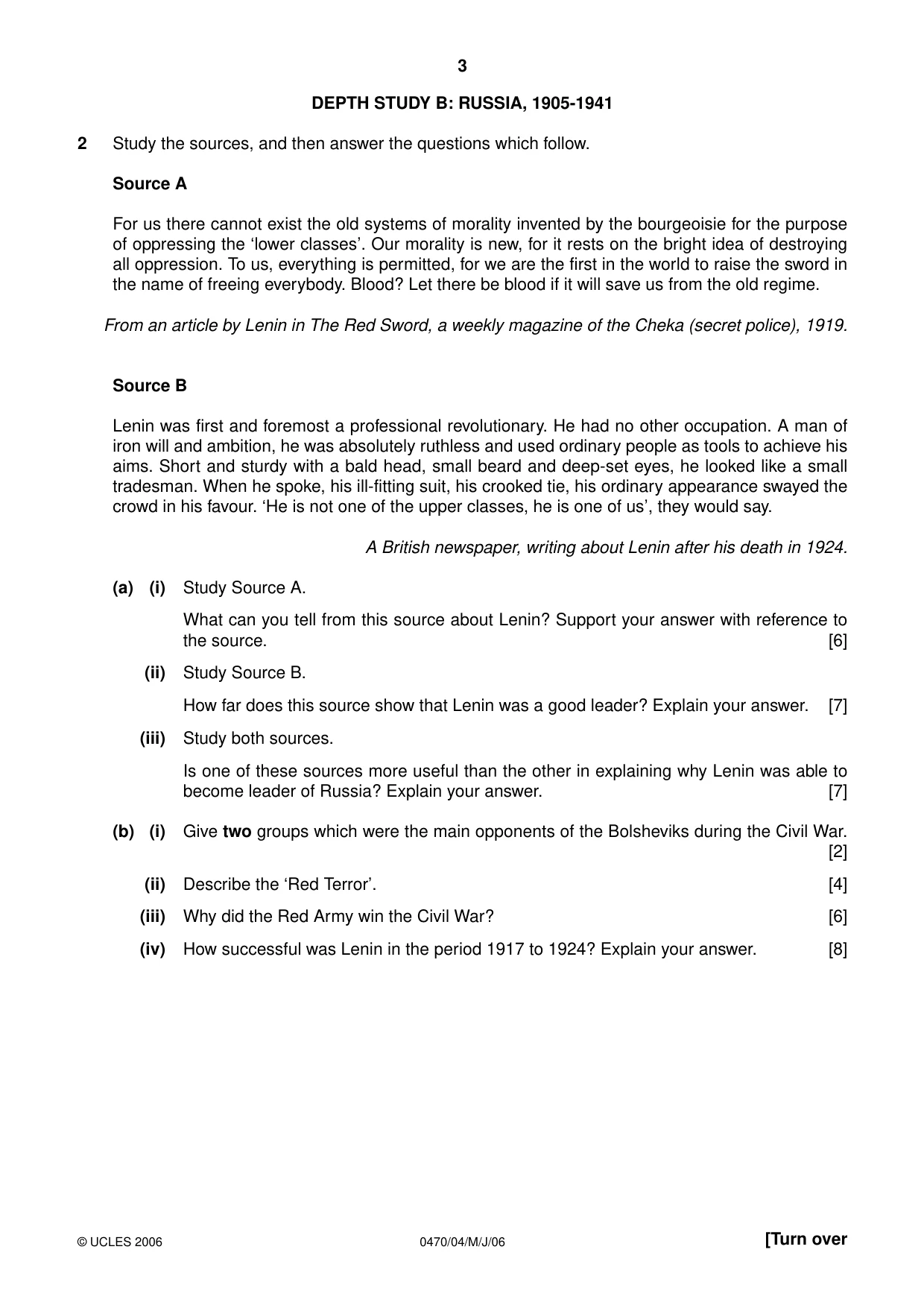
3 0470/04/M/J/06 [Turn over DEPTH STUDY B: RUSSIA, 1905-1941 2 Study the sources, and then answer the questions which follow. Source A For us there cannot exist the old systems of morality invented by the bourgeoisie for the purpose of oppressing the ‘lower classes’. Our morality is new, for it rests on the bright idea of destroying all oppression. To us, everything is permitted, for we are the first in the world to raise the sword in the name of freeing everybody. Blood? Let there be blood if it will save us from the old regime. From an article by Lenin in The Red Sword, a weekly magazine of the Cheka (secret police), 1919. Source B Lenin was first and foremost a professional revolutionary. He had no other occupation. A man of iron will and ambition, he was absolutely ruthless and used ordinary people as tools to achieve his aims. Short and sturdy with a bald head, small beard and deep-set eyes, he looked like a small tradesman. When he spoke, his ill-fitting suit, his crooked tie, his ordinary appearance swayed the crowd in his favour. ‘He is not one of the upper classes, he is one of us’, they would say. A British newspaper, writing about Lenin after his death in 1924. (a) (i) Study Source A. What can you tell from this source about Lenin? Support your answer with reference to the source. [6] (ii) Study Source B. How far does this source show that Lenin was a good leader? Explain your answer. [7] (iii) Study both sources. Is one of these sources more useful than the other in explaining why Lenin was able to become leader of Russia? Explain your answer. [7] (b) (i) Give two groups which were the main opponents of the Bolsheviks during the Civil War. [2] (ii) Describe the ‘Red Terror’. [4] (iii) Why did the Red Army win the Civil War? [6] (iv) How successful was Lenin in the period 1917 to 1924? Explain your answer. [8] © UCLES 2006
Question paper, page 4
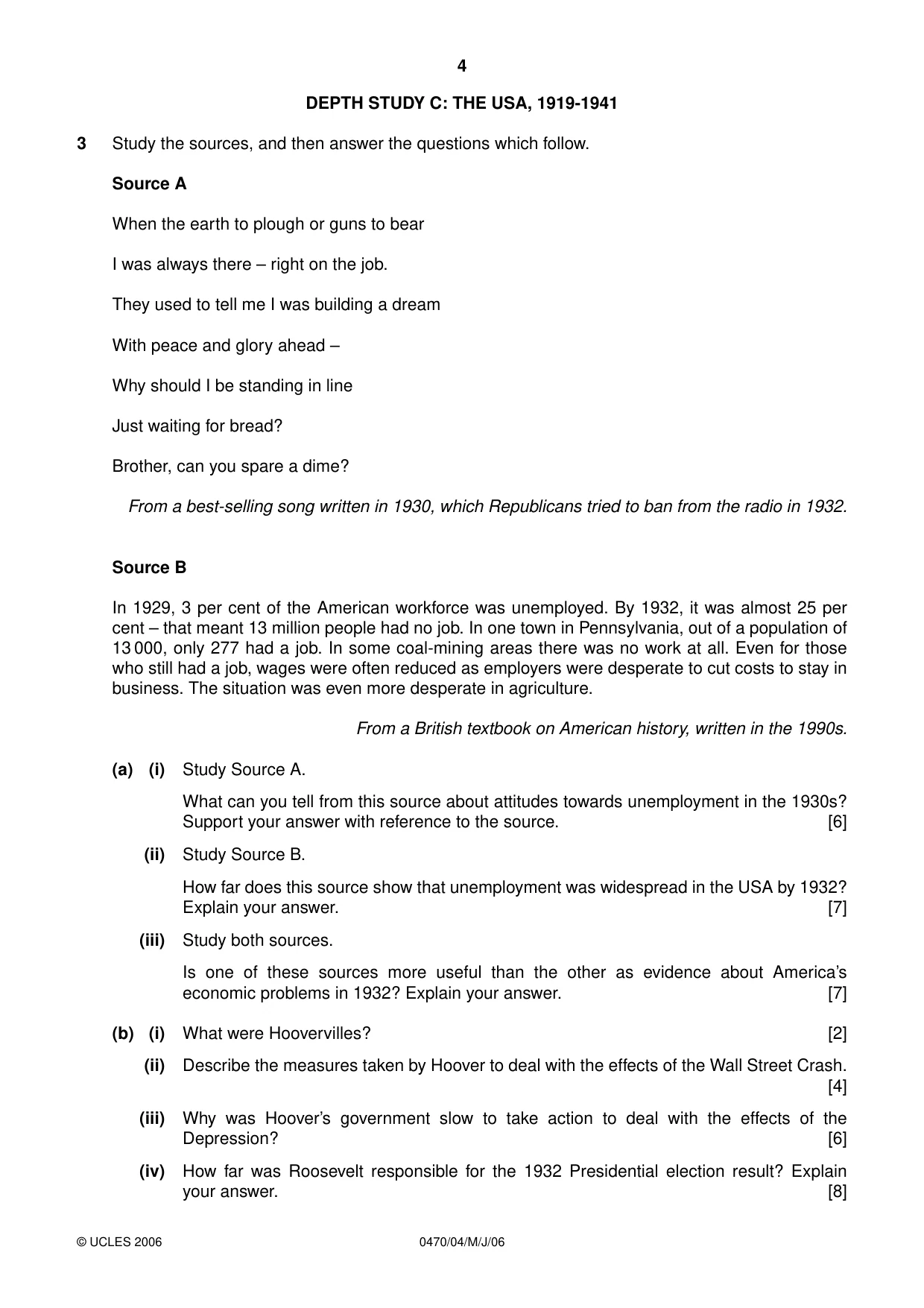
4 0470/04/M/J/06 DEPTH STUDY C: THE USA, 1919-1941 3 Study the sources, and then answer the questions which follow. Source A When the earth to plough or guns to bear I was always there – right on the job. They used to tell me I was building a dream With peace and glory ahead – Why should I be standing in line Just waiting for bread? Brother, can you spare a dime? From a best-selling song written in 1930, which Republicans tried to ban from the radio in 1932. Source B In 1929, 3 per cent of the American workforce was unemployed. By 1932, it was almost 25 per cent – that meant 13 million people had no job. In one town in Pennsylvania, out of a population of 13 000, only 277 had a job. In some coal-mining areas there was no work at all. Even for those who still had a job, wages were often reduced as employers were desperate to cut costs to stay in business. The situation was even more desperate in agriculture. From a British textbook on American history, written in the 1990s. (a) (i) Study Source A. What can you tell from this source about attitudes towards unemployment in the 1930s? Support your answer with reference to the source. [6] (ii) Study Source B. How far does this source show that unemployment was widespread in the USA by 1932? Explain your answer. [7] (iii) Study both sources. Is one of these sources more useful than the other as evidence about America’s economic problems in 1932? Explain your answer. [7] (b) (i) What were Hoovervilles? [2] (ii) Describe the measures taken by Hoover to deal with the effects of the Wall Street Crash. [4] (iii) Why was Hoover’s government slow to take action to deal with the effects of the Depression? [6] (iv) How far was Roosevelt responsible for the 1932 Presidential election result? Explain your answer. [8] © UCLES 2006
Question paper, page 5
5 0470/04/M/J/06 [Turn over DEPTH STUDY D: CHINA, 1945-c.1990 4 Study the sources, and then answer the questions which follow. Source A Photograph of a basket workshop in a commune, about 1960, published in a British magazine. Source B The communes began to struggle because of the incredible haste with which they were established. There was a lack of preparation. There was the lack of incentives. There was the threat to home life before a broad community life had been fully established to replace it. Enormous technical responsibility and initiative were demanded from inexperienced and poorly- trained cadres. When unbelievably bad weather was added to the withdrawal of Soviet support, the communes failed very quickly. An American author who lived and worked in China in the 1950s. (a) (i) Study Source A. What can you tell from this source about life in a commune? Support your answer with reference to the source. [6] (ii) Study Source B. How far does this source show that the Chinese government was responsible for the failure of the communes? Explain your answer. [7] (iii) Study both sources. Is one of these sources more useful than the other in showing life in China during the Great Leap Forward? Explain your answer. [7] © UCLES 2006
Question paper, page 6
6 0470/04/M/J/06 (b) (i) Give two ways in which co-operative farms differed from collective farms. [2] (ii) In what ways did women benefit from the Communist government’s social legislation? [4] (iii) Why was the Hundred Flowers Campaign abandoned in 1957? [6] (iv) ‘The main reason for the failure of the Great Leap Forward was the withdrawal of Soviet support’. How far do you agree with this statement? Explain your answer. [8] © UCLES 2006
Question paper, page 7
7 0470/04/M/J/06 [Turn over DEPTH STUDY E: SOUTHERN AFRICA IN THE TWENTIETH CENTURY 5 Study the sources, and then answer the questions which follow. Source A During the Second World War (1939-1945) the Pass Laws were made easier to allow African workers to move to urban areas. On the Rand, townships grew rapidly with shanty houses using every tiny space. Working conditions in industry improved a lot and black wages rose by 50 per cent between 1940 and 1946. From a South African history book, written in the 1990s. Source B In 1942 the government banned all strikes by Africans but set up an investigation into mineworkers’ conditions and wages. In 1946 its report said that as their families produced their own food in the reserves, the mineworkers’ wages were only pocket money so they did not need to be raised. The African Mineworkers’ Union went on strike and brought the entire gold-mining industry to a halt, but the mineworkers were soon forced back to work at gunpoint. From a British history book, written in 1994. (a) (i) Study Source A. What can you tell from this source about the effects of the Second World War on African workers? Support your answer with reference to the source. [6] (ii) Study Source B. How far does this source show the power of the African mineworkers in the 1940s? Explain your answer. [7] (iii) Study both sources. Is one of these sources more useful than the other as evidence about the government’s attitude towards African workers? Explain your answer. [7] (b) (i) Give two of the terms of the Pass Laws by 1952. [2] (ii) What was the purpose of the 1950 Population Registration Act? [4] (iii) Why did Malan’s government enforce apartheid after 1948? [6] (iv) How far do you agree that the Defiance Campaign of 1952 was a success? Explain your answer. [8] © UCLES 2006
Question paper, page 8
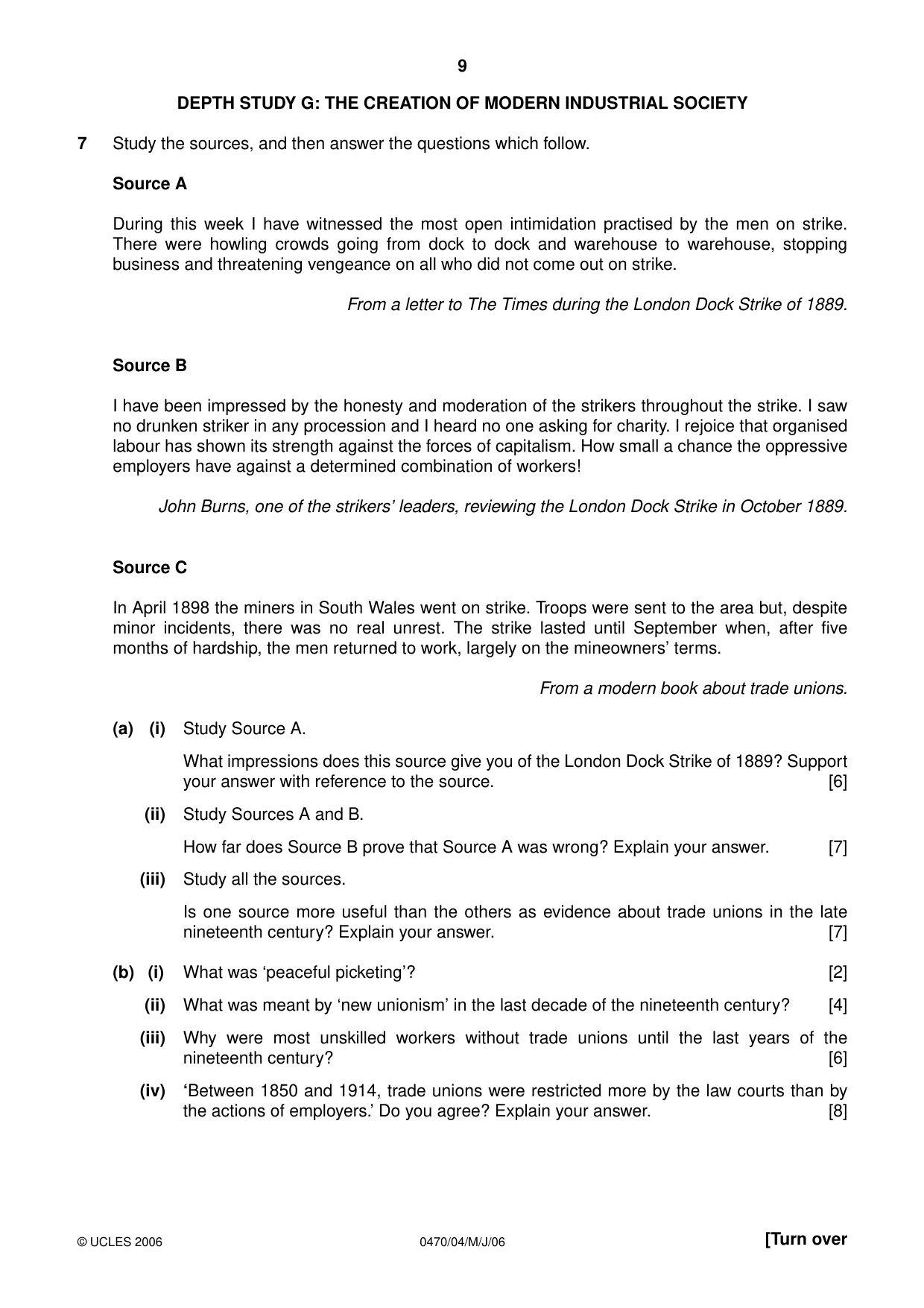
8 0470/04/M/J/06 DEPTH STUDY F: ISRAELIS AND PALESTINIANS, 1945-c.1994 6 Study the sources, and answer the questions which follow. Source A Black September’s operation planned to take Israeli hostages to secure the release of two hundred PLO prisoners in Israel. The hostages were Israeli athletes and they were taken in Munich, at the Olympic Games, thus guaranteeing a live worldwide television audience for the drama. The operation would not have been possible without the support and facilities provided by one Arab government. From a British biography of Yasser Arafat, published in 1994. Source B Palestinian attacks on Israeli civilians are intended to terrorise Israelis. Similarly, Israeli reprisal raids on Lebanese villages are intended to terrorise the local Lebanese into ejecting the PLO from their area. Once we use the word terrorism in this context, either an Arab or an Israeli emerges demanding to know why we do not describe the other side as terrorists. However, both sides believe their actions are justifiably taken in self-defence. From ‘Pity the Nation’, a book written in 1990 by a British journalist working in Lebanon. (a) (i) Study Source A. What can you tell from this source about the Black September group? Support your answer with reference to the source. [6] (ii) Study Source B. How far does this source show that both sides wanted to use terrorism? Explain your answer. [7] (iii) Study both sources. Is one of these sources more useful than the other as evidence about terrorism in the Middle East conflict? Explain your answer. [7] (b) (i) Name two Jewish groups regarded as terrorists by the British during the Mandate period. [2] (ii) Describe the help given by the United Nations to the Palestinians. [4] (iii) Why did the Palestinians want Israel expelled from the United Nations? [6] (iv) ‘During the 1970s and the 1980s, neither the Israelis nor the Palestinians wanted a peace settlement.’ Do you agree? Explain your answer. [8] © UCLES 2006
Question paper, page 9
9 0470/04/M/J/06 [Turn over DEPTH STUDY G: THE CREATION OF MODERN INDUSTRIAL SOCIETY 7 Study the sources, and then answer the questions which follow. Source A During this week I have witnessed the most open intimidation practised by the men on strike. There were howling crowds going from dock to dock and warehouse to warehouse, stopping business and threatening vengeance on all who did not come out on strike. From a letter to The Times during the London Dock Strike of 1889. Source B I have been impressed by the honesty and moderation of the strikers throughout the strike. I saw no drunken striker in any procession and I heard no one asking for charity. I rejoice that organised labour has shown its strength against the forces of capitalism. How small a chance the oppressive employers have against a determined combination of workers! John Burns, one of the strikers’ leaders, reviewing the London Dock Strike in October 1889. Source C In April 1898 the miners in South Wales went on strike. Troops were sent to the area but, despite minor incidents, there was no real unrest. The strike lasted until September when, after five months of hardship, the men returned to work, largely on the mineowners’ terms. From a modern book about trade unions. (a) (i) Study Source A. What impressions does this source give you of the London Dock Strike of 1889? Support your answer with reference to the source. [6] (ii) Study Sources A and B. How far does Source B prove that Source A was wrong? Explain your answer. [7] (iii) Study all the sources. Is one source more useful than the others as evidence about trade unions in the late nineteenth century? Explain your answer. [7] (b) (i) What was ‘peaceful picketing’? [2] (ii) What was meant by ‘new unionism’ in the last decade of the nineteenth century? [4] (iii) Why were most unskilled workers without trade unions until the last years of the nineteenth century? [6] (iv) ‘Between 1850 and 1914, trade unions were restricted more by the law courts than by the actions of employers.’ Do you agree? Explain your answer. [8] © UCLES 2006
Question paper, page 10
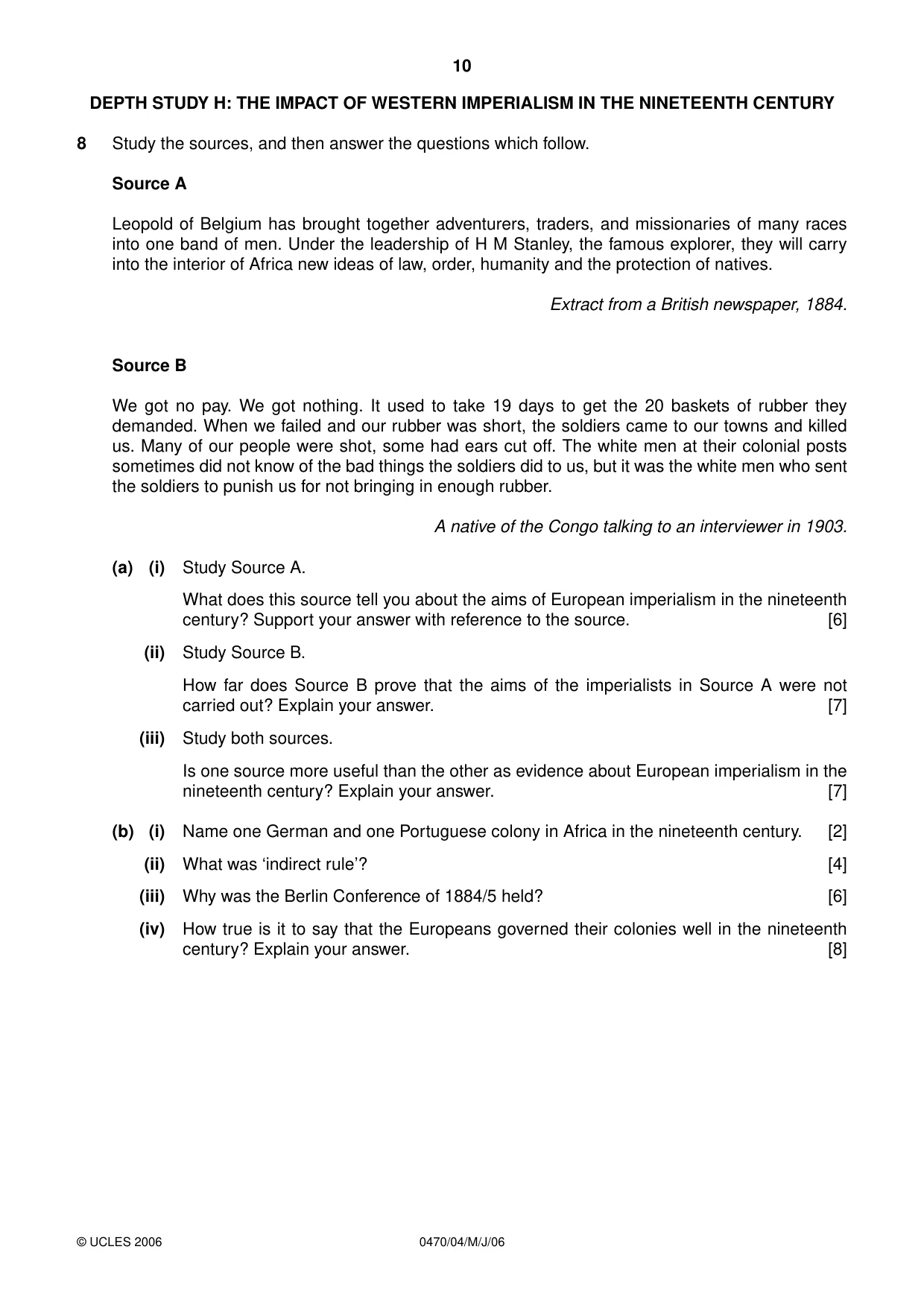
10 0470/04/M/J/06 DEPTH STUDY H: THE IMPACT OF WESTERN IMPERIALISM IN THE NINETEENTH CENTURY 8 Study the sources, and then answer the questions which follow. Source A Leopold of Belgium has brought together adventurers, traders, and missionaries of many races into one band of men. Under the leadership of H M Stanley, the famous explorer, they will carry into the interior of Africa new ideas of law, order, humanity and the protection of natives. Extract from a British newspaper, 1884. Source B We got no pay. We got nothing. It used to take 19 days to get the 20 baskets of rubber they demanded. When we failed and our rubber was short, the soldiers came to our towns and killed us. Many of our people were shot, some had ears cut off. The white men at their colonial posts sometimes did not know of the bad things the soldiers did to us, but it was the white men who sent the soldiers to punish us for not bringing in enough rubber. A native of the Congo talking to an interviewer in 1903. (a) (i) Study Source A. What does this source tell you about the aims of European imperialism in the nineteenth century? Support your answer with reference to the source. [6] (ii) Study Source B. How far does Source B prove that the aims of the imperialists in Source A were not carried out? Explain your answer. [7] (iii) Study both sources. Is one source more useful than the other as evidence about European imperialism in the nineteenth century? Explain your answer. [7] (b) (i) Name one German and one Portuguese colony in Africa in the nineteenth century. [2] (ii) What was ‘indirect rule’? [4] (iii) Why was the Berlin Conference of 1884/5 held? [6] (iv) How true is it to say that the Europeans governed their colonies well in the nineteenth century? Explain your answer. [8] © UCLES 2006
Question paper, page 12
12 0470/04/M/J/06 BLANK PAGE Copyright Acknowledgements: Question 3 Source A © Jay Gorney and E.Y. Harburg; Brother Can You Spare a Dime?; Warner/Chappell Music Publishing. Question 3 Source B © John Vick; Modern America (Knowing World History); Collins Educational; 1991. Question 4 Source A © Hulton Picture Library. Question 4 Source B © Edgar Snow; Red China Today: The Other Side of the River, Victor Gollancz, a division of the Orion Publishing Group. Question 5 Source B © J.D. Omer-Cooper; History of Southern Africa; James Currey, Oxford & Heinemann, U.S + Canada. Question 6 Source A © Alan Hart; Arafat; Sidgwick & Jackson; 1994. Question 6 Source B © Robert Fisk; Pity the Nation: Lebanon at War; Andre Deutsch; 1991. Question 7 Source C © John Gorman; To Build Jerusalem: Photographic Remembrance of British Working Class Life, 1875–1950; Scorpion Publications; 1980. Permission to reproduce items where third-party owned material protected by copyright is included has been sought and cleared where possible. Every reasonable effort has been made by the publisher (UCLES) to trace copyright holders, but if any items requiring clearance have unwittingly been included, the publisher will be pleased to make amends at the earliest possible opportunity. University of Cambridge International Examinations is part of the University of Cambridge Local Examinations Syndicate (UCLES), which is itself a department of the University of Cambridge.
Mark scheme, page 1
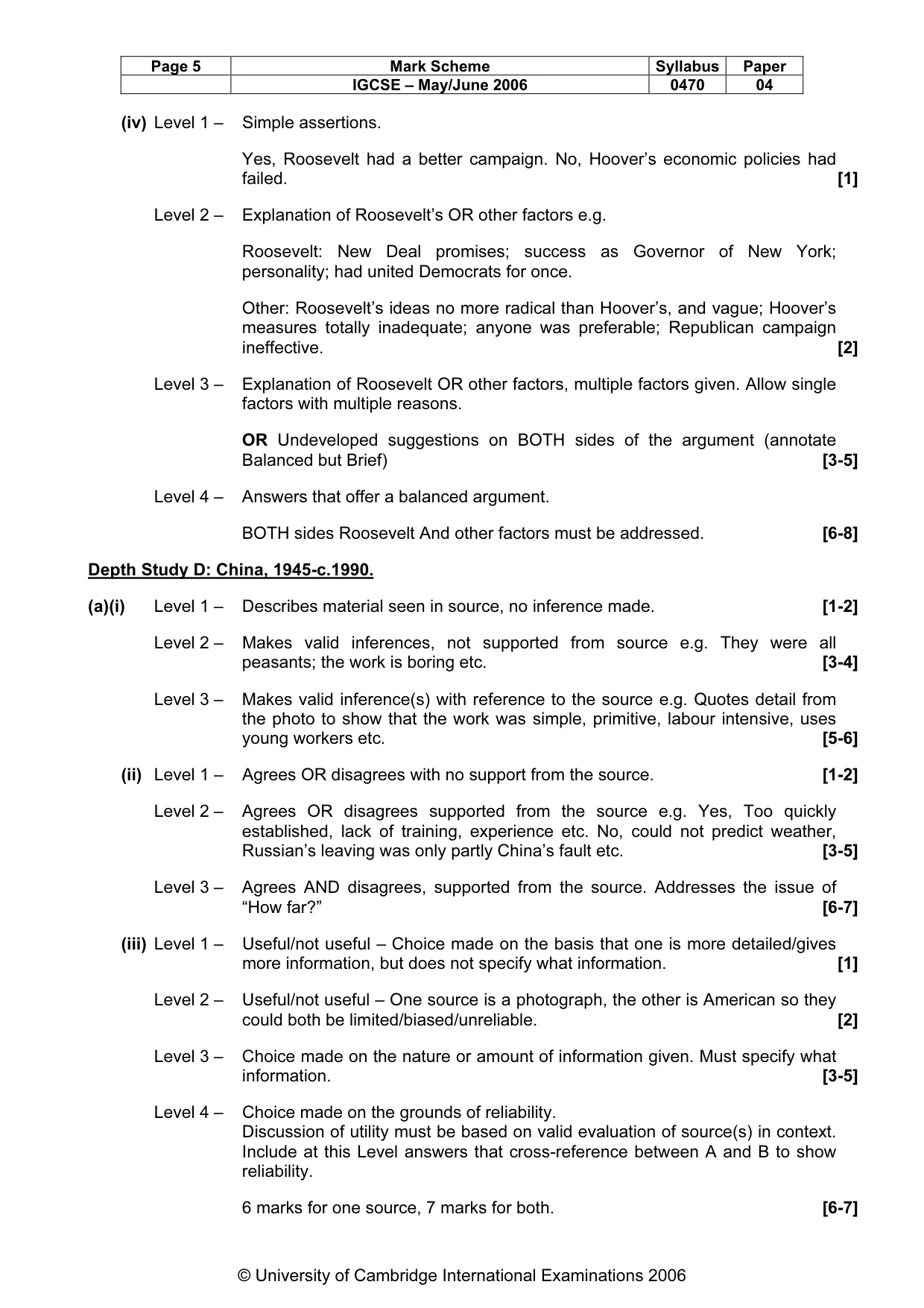
UNIVERSITY OF CAMBRIDGE INTERNATIONAL EXAMINATIONS International General Certificate of Secondary Education MARK SCHEME for the May/June 2006 question paper 0470 HISTORY 0470/04 Paper 4, maximum raw mark 40 These mark schemes are published as an aid to teachers and students, to indicate the requirements of the examination. They show the basis on which Examiners were initially instructed to award marks. They do not indicate the details of the discussions that took place at an Examiners’ meeting before marking began. Any substantial changes to the mark scheme that arose from these discussions will be recorded in the published Report on the Examination. All Examiners are instructed that alternative correct answers and unexpected approaches in candidates’ scripts must be given marks that fairly reflect the relevant knowledge and skills demonstrated. Mark schemes must be read in conjunction with the question papers and the Report on the Examination. The minimum marks in these components needed for various grades were previously published with these mark schemes, but are now instead included in the Report on the Examination for this session. • CIE will not enter into discussion or correspondence in connection with these mark schemes. CIE is publishing the mark schemes for the May/June 2006 question papers for most IGCSE and GCE Advanced Level and Advanced Subsidiary Level syllabuses and some Ordinary Level syllabuses. www.XtremePapers.com
Mark scheme, page 2
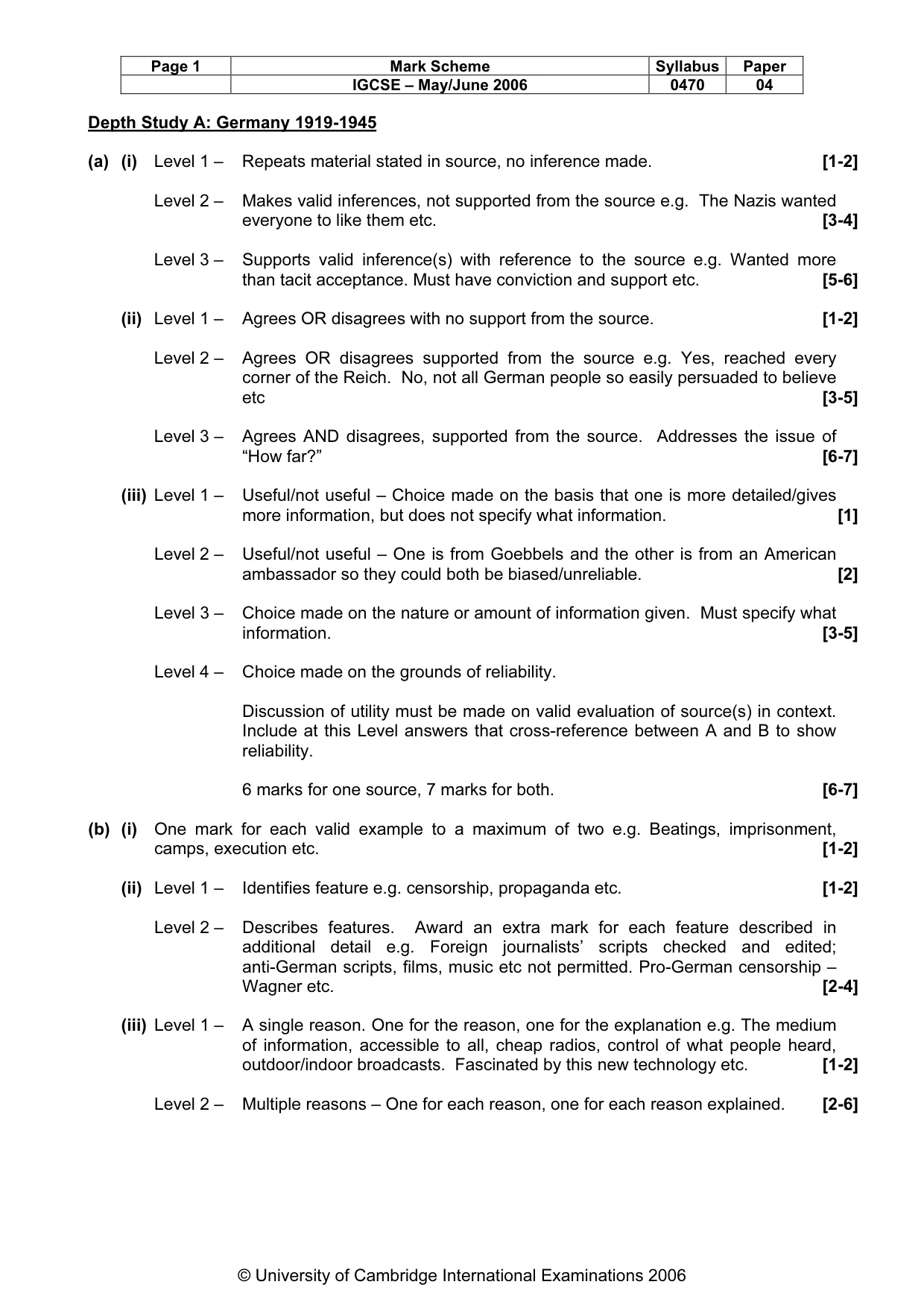
Page 1 Mark Scheme Syllabus Paper IGCSE – May/June 2006 0470 04 © University of Cambridge International Examinations 2006 Depth Study A: Germany 1919-1945 (a) (i) Level 1 – Repeats material stated in source, no inference made. [1-2] Level 2 – Makes valid inferences, not supported from the source e.g. The Nazis wanted everyone to like them etc. [3-4] Level 3 – Supports valid inference(s) with reference to the source e.g. Wanted more than tacit acceptance. Must have conviction and support etc. [5-6] (ii) Level 1 – Agrees OR disagrees with no support from the source. [1-2] Level 2 – Agrees OR disagrees supported from the source e.g. Yes, reached every corner of the Reich. No, not all German people so easily persuaded to believe etc [3-5] Level 3 – Agrees AND disagrees, supported from the source. Addresses the issue of “How far?” [6-7] (iii) Level 1 – Useful/not useful – Choice made on the basis that one is more detailed/gives more information, but does not specify what information. [1] Level 2 – Useful/not useful – One is from Goebbels and the other is from an American ambassador so they could both be biased/unreliable. [2] Level 3 – Choice made on the nature or amount of information given. Must specify what information. [3-5] Level 4 – Choice made on the grounds of reliability. Discussion of utility must be made on valid evaluation of source(s) in context. Include at this Level answers that cross-reference between A and B to show reliability. 6 marks for one source, 7 marks for both. [6-7] (b) (i) One mark for each valid example to a maximum of two e.g. Beatings, imprisonment, camps, execution etc. [1-2] (ii) Level 1 – Identifies feature e.g. censorship, propaganda etc. [1-2] Level 2 – Describes features. Award an extra mark for each feature described in additional detail e.g. Foreign journalists’ scripts checked and edited; anti-German scripts, films, music etc not permitted. Pro-German censorship – Wagner etc. [2-4] (iii) Level 1 – A single reason. One for the reason, one for the explanation e.g. The medium of information, accessible to all, cheap radios, control of what people heard, outdoor/indoor broadcasts. Fascinated by this new technology etc. [1-2] Level 2 – Multiple reasons – One for each reason, one for each reason explained. [2-6]
Mark scheme, page 3
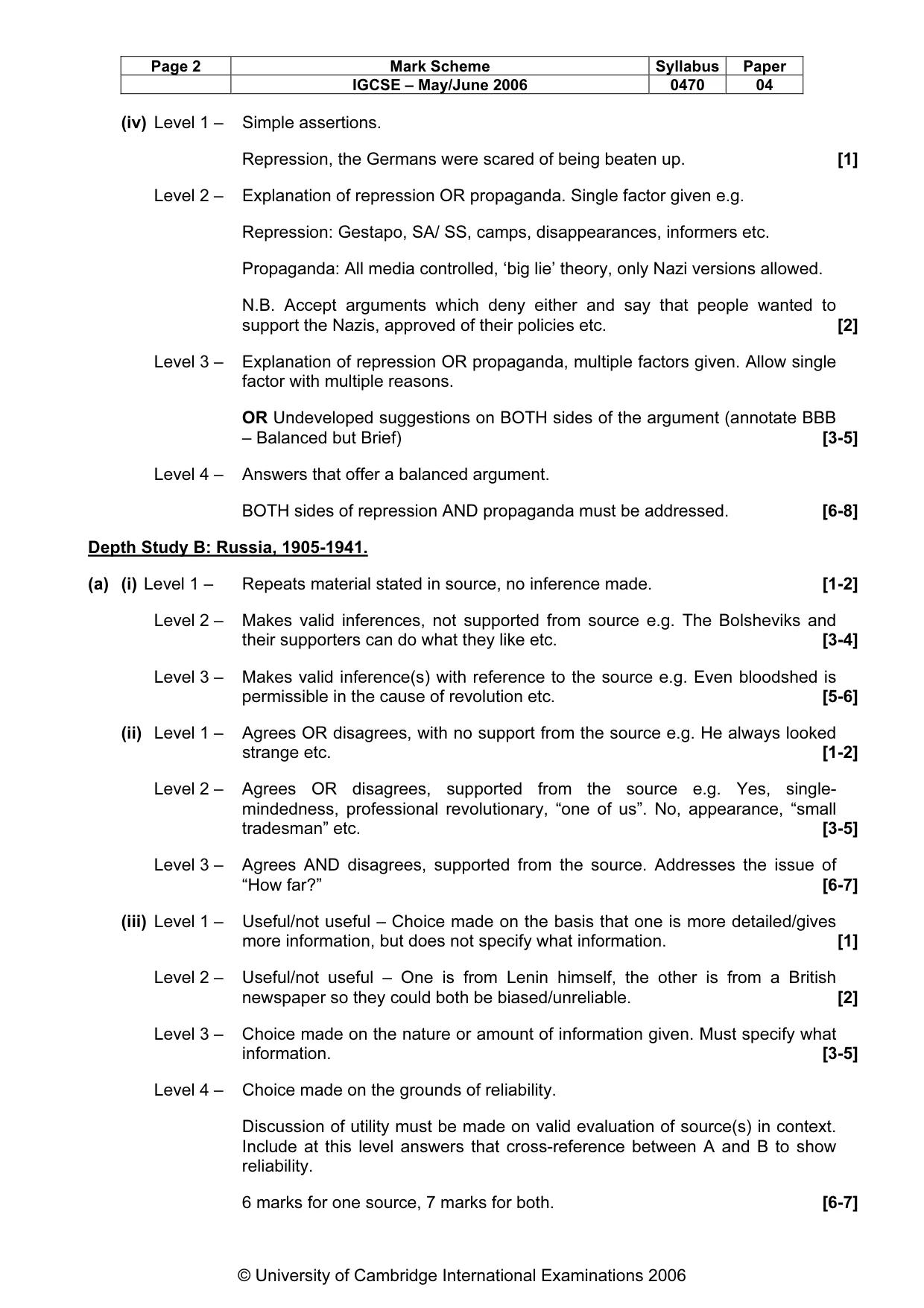
Page 2 Mark Scheme Syllabus Paper IGCSE – May/June 2006 0470 04 © University of Cambridge International Examinations 2006 (iv) Level 1 – Simple assertions. Repression, the Germans were scared of being beaten up. [1] Level 2 – Explanation of repression OR propaganda. Single factor given e.g. Repression: Gestapo, SA/ SS, camps, disappearances, informers etc. Propaganda: All media controlled, ‘big lie’ theory, only Nazi versions allowed. N.B. Accept arguments which deny either and say that people wanted to support the Nazis, approved of their policies etc. [2] Level 3 – Explanation of repression OR propaganda, multiple factors given. Allow single factor with multiple reasons. OR Undeveloped suggestions on BOTH sides of the argument (annotate BBB – Balanced but Brief) [3-5] Level 4 – Answers that offer a balanced argument. BOTH sides of repression AND propaganda must be addressed. [6-8] Depth Study B: Russia, 1905-1941. (a) (i) Level 1 – Repeats material stated in source, no inference made. [1-2] Level 2 – Makes valid inferences, not supported from source e.g. The Bolsheviks and their supporters can do what they like etc. [3-4] Level 3 – Makes valid inference(s) with reference to the source e.g. Even bloodshed is permissible in the cause of revolution etc. [5-6] (ii) Level 1 – Agrees OR disagrees, with no support from the source e.g. He always looked strange etc. [1-2] Level 2 – Agrees OR disagrees, supported from the source e.g. Yes, single- mindedness, professional revolutionary, “one of us”. No, appearance, “small tradesman” etc. [3-5] Level 3 – Agrees AND disagrees, supported from the source. Addresses the issue of “How far?” [6-7] (iii) Level 1 – Useful/not useful – Choice made on the basis that one is more detailed/gives more information, but does not specify what information. [1] Level 2 – Useful/not useful – One is from Lenin himself, the other is from a British newspaper so they could both be biased/unreliable. [2] Level 3 – Choice made on the nature or amount of information given. Must specify what information. [3-5] Level 4 – Choice made on the grounds of reliability. Discussion of utility must be made on valid evaluation of source(s) in context. Include at this level answers that cross-reference between A and B to show reliability. 6 marks for one source, 7 marks for both. [6-7]
Mark scheme, page 4
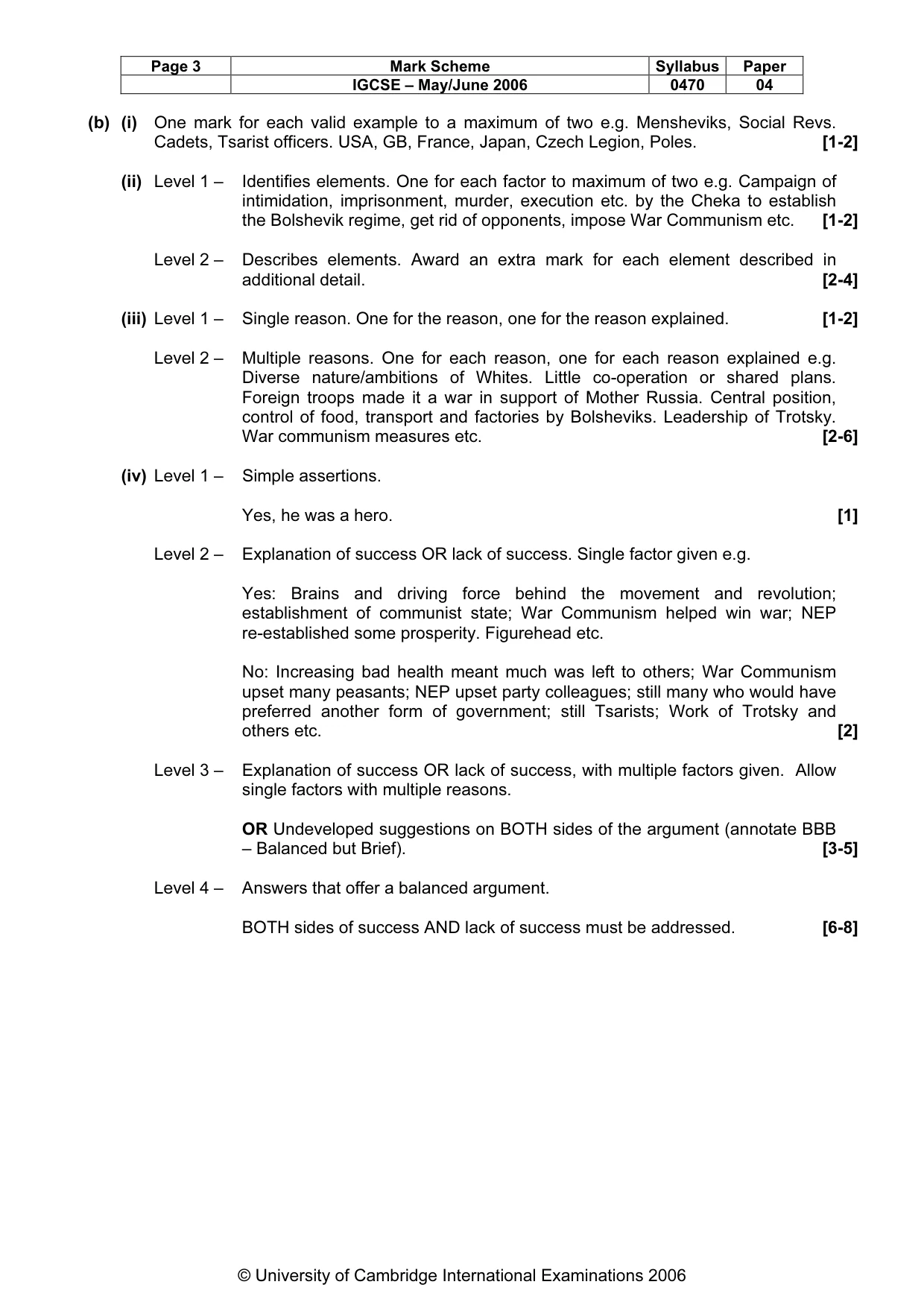
Page 3 Mark Scheme Syllabus Paper IGCSE – May/June 2006 0470 04 © University of Cambridge International Examinations 2006 (b) (i) One mark for each valid example to a maximum of two e.g. Mensheviks, Social Revs. Cadets, Tsarist officers. USA, GB, France, Japan, Czech Legion, Poles. [1-2] (ii) Level 1 – Identifies elements. One for each factor to maximum of two e.g. Campaign of intimidation, imprisonment, murder, execution etc. by the Cheka to establish the Bolshevik regime, get rid of opponents, impose War Communism etc. [1-2] Level 2 – Describes elements. Award an extra mark for each element described in additional detail. [2-4] (iii) Level 1 – Single reason. One for the reason, one for the reason explained. [1-2] Level 2 – Multiple reasons. One for each reason, one for each reason explained e.g. Diverse nature/ambitions of Whites. Little co-operation or shared plans. Foreign troops made it a war in support of Mother Russia. Central position, control of food, transport and factories by Bolsheviks. Leadership of Trotsky. War communism measures etc. [2-6] (iv) Level 1 – Simple assertions. Yes, he was a hero. [1] Level 2 – Explanation of success OR lack of success. Single factor given e.g. Yes: Brains and driving force behind the movement and revolution; establishment of communist state; War Communism helped win war; NEP re-established some prosperity. Figurehead etc. No: Increasing bad health meant much was left to others; War Communism upset many peasants; NEP upset party colleagues; still many who would have preferred another form of government; still Tsarists; Work of Trotsky and others etc. [2] Level 3 – Explanation of success OR lack of success, with multiple factors given. Allow single factors with multiple reasons. OR Undeveloped suggestions on BOTH sides of the argument (annotate BBB – Balanced but Brief). [3-5] Level 4 – Answers that offer a balanced argument. BOTH sides of success AND lack of success must be addressed. [6-8]
Mark scheme, page 5
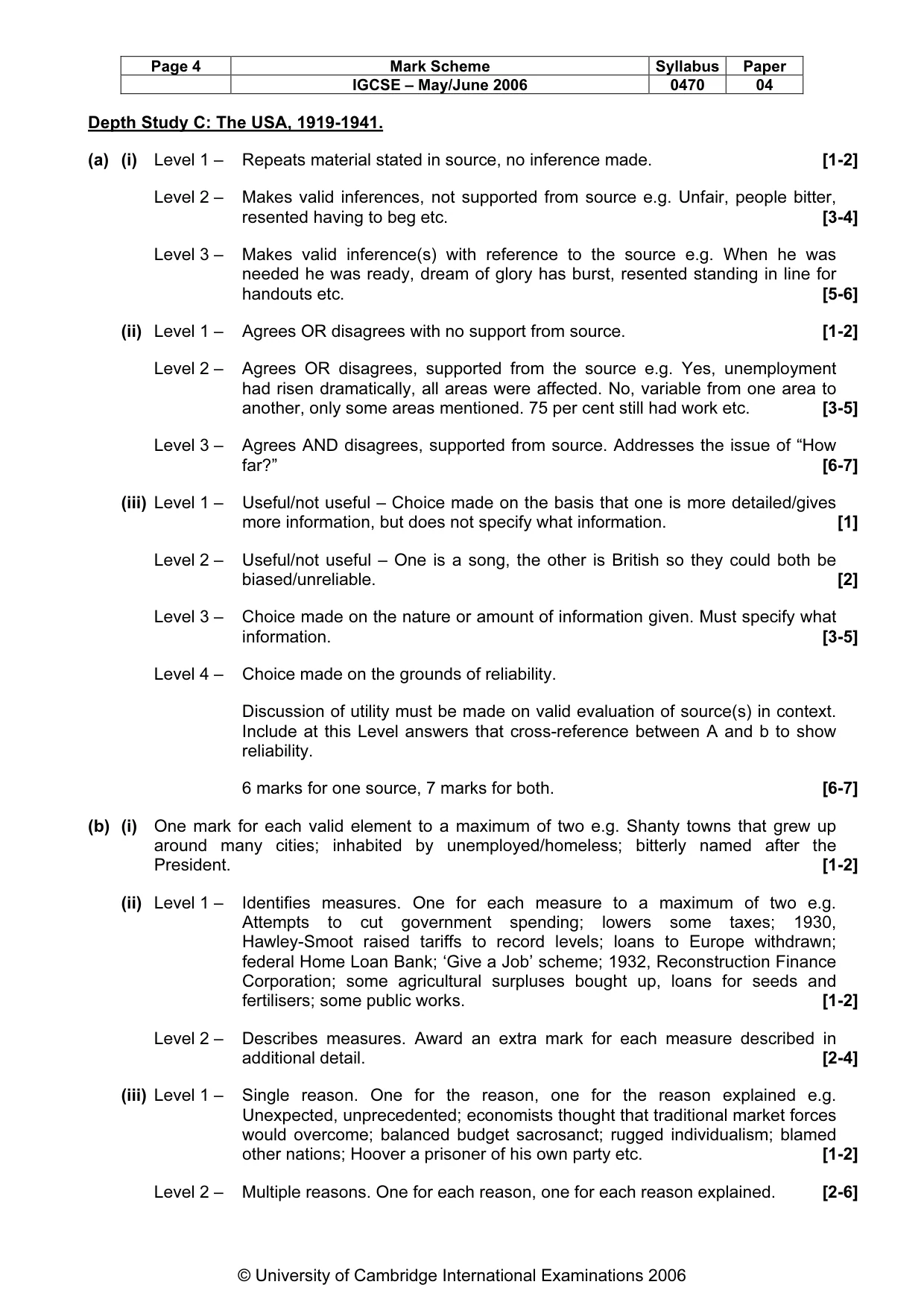
Page 4 Mark Scheme Syllabus Paper IGCSE – May/June 2006 0470 04 © University of Cambridge International Examinations 2006 Depth Study C: The USA, 1919-1941. (a) (i) Level 1 – Repeats material stated in source, no inference made. [1-2] Level 2 – Makes valid inferences, not supported from source e.g. Unfair, people bitter, resented having to beg etc. [3-4] Level 3 – Makes valid inference(s) with reference to the source e.g. When he was needed he was ready, dream of glory has burst, resented standing in line for handouts etc. [5-6] (ii) Level 1 – Agrees OR disagrees with no support from source. [1-2] Level 2 – Agrees OR disagrees, supported from the source e.g. Yes, unemployment had risen dramatically, all areas were affected. No, variable from one area to another, only some areas mentioned. 75 per cent still had work etc. [3-5] Level 3 – Agrees AND disagrees, supported from source. Addresses the issue of “How far?” [6-7] (iii) Level 1 – Useful/not useful – Choice made on the basis that one is more detailed/gives more information, but does not specify what information. [1] Level 2 – Useful/not useful – One is a song, the other is British so they could both be biased/unreliable. [2] Level 3 – Choice made on the nature or amount of information given. Must specify what information. [3-5] Level 4 – Choice made on the grounds of reliability. Discussion of utility must be made on valid evaluation of source(s) in context. Include at this Level answers that cross-reference between A and b to show reliability. 6 marks for one source, 7 marks for both. [6-7] (b) (i) One mark for each valid element to a maximum of two e.g. Shanty towns that grew up around many cities; inhabited by unemployed/homeless; bitterly named after the President. [1-2] (ii) Level 1 – Identifies measures. One for each measure to a maximum of two e.g. Attempts to cut government spending; lowers some taxes; 1930, Hawley-Smoot raised tariffs to record levels; loans to Europe withdrawn; federal Home Loan Bank; ‘Give a Job’ scheme; 1932, Reconstruction Finance Corporation; some agricultural surpluses bought up, loans for seeds and fertilisers; some public works. [1-2] Level 2 – Describes measures. Award an extra mark for each measure described in additional detail. [2-4] (iii) Level 1 – Single reason. One for the reason, one for the reason explained e.g. Unexpected, unprecedented; economists thought that traditional market forces would overcome; balanced budget sacrosanct; rugged individualism; blamed other nations; Hoover a prisoner of his own party etc. [1-2] Level 2 – Multiple reasons. One for each reason, one for each reason explained. [2-6]
Mark scheme, page 6
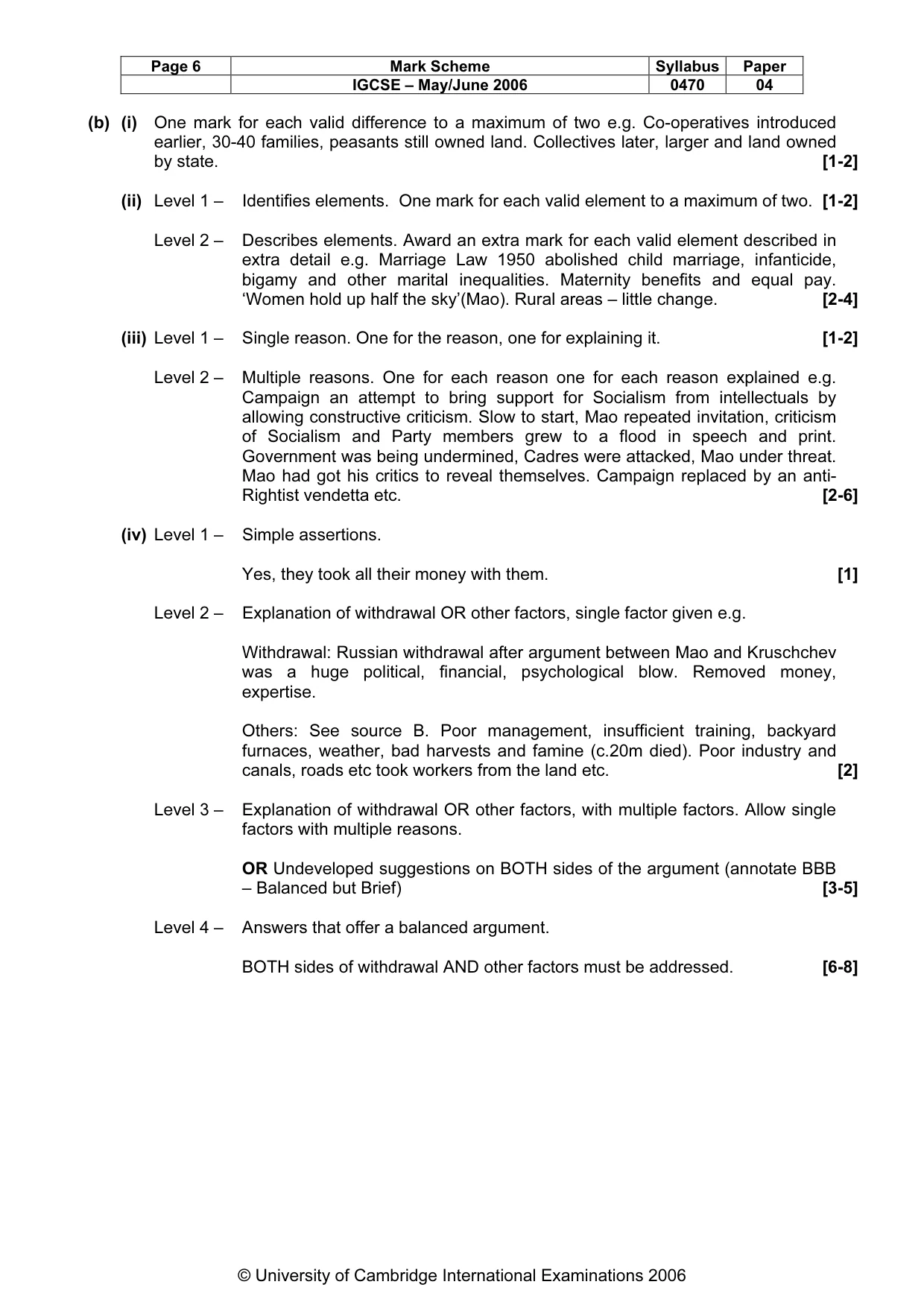
Page 5 Mark Scheme Syllabus Paper IGCSE – May/June 2006 0470 04 © University of Cambridge International Examinations 2006 (iv) Level 1 – Simple assertions. Yes, Roosevelt had a better campaign. No, Hoover’s economic policies had failed. [1] Level 2 – Explanation of Roosevelt’s OR other factors e.g. Roosevelt: New Deal promises; success as Governor of New York; personality; had united Democrats for once. Other: Roosevelt’s ideas no more radical than Hoover’s, and vague; Hoover’s measures totally inadequate; anyone was preferable; Republican campaign ineffective. [2] Level 3 – Explanation of Roosevelt OR other factors, multiple factors given. Allow single factors with multiple reasons. OR Undeveloped suggestions on BOTH sides of the argument (annotate Balanced but Brief) [3-5] Level 4 – Answers that offer a balanced argument. BOTH sides Roosevelt And other factors must be addressed. [6-8] Depth Study D: China, 1945-c.1990. (a)(i) Level 1 – Describes material seen in source, no inference made. [1-2] Level 2 – Makes valid inferences, not supported from source e.g. They were all peasants; the work is boring etc. [3-4] Level 3 – Makes valid inference(s) with reference to the source e.g. Quotes detail from the photo to show that the work was simple, primitive, labour intensive, uses young workers etc. [5-6] (ii) Level 1 – Agrees OR disagrees with no support from the source. [1-2] Level 2 – Agrees OR disagrees supported from the source e.g. Yes, Too quickly established, lack of training, experience etc. No, could not predict weather, Russian’s leaving was only partly China’s fault etc. [3-5] Level 3 – Agrees AND disagrees, supported from the source. Addresses the issue of “How far?” [6-7] (iii) Level 1 – Useful/not useful – Choice made on the basis that one is more detailed/gives more information, but does not specify what information. [1] Level 2 – Useful/not useful – One source is a photograph, the other is American so they could both be limited/biased/unreliable. [2] Level 3 – Choice made on the nature or amount of information given. Must specify what information. [3-5] Level 4 – Choice made on the grounds of reliability. Discussion of utility must be based on valid evaluation of source(s) in context. Include at this Level answers that cross-reference between A and B to show reliability. 6 marks for one source, 7 marks for both. [6-7]
Mark scheme, page 7
Page 6 Mark Scheme Syllabus Paper IGCSE – May/June 2006 0470 04 © University of Cambridge International Examinations 2006 (b) (i) One mark for each valid difference to a maximum of two e.g. Co-operatives introduced earlier, 30-40 families, peasants still owned land. Collectives later, larger and land owned by state. [1-2] (ii) Level 1 – Identifies elements. One mark for each valid element to a maximum of two. [1-2] Level 2 – Describes elements. Award an extra mark for each valid element described in extra detail e.g. Marriage Law 1950 abolished child marriage, infanticide, bigamy and other marital inequalities. Maternity benefits and equal pay. ‘Women hold up half the sky’(Mao). Rural areas – little change. [2-4] (iii) Level 1 – Single reason. One for the reason, one for explaining it. [1-2] Level 2 – Multiple reasons. One for each reason one for each reason explained e.g. Campaign an attempt to bring support for Socialism from intellectuals by allowing constructive criticism. Slow to start, Mao repeated invitation, criticism of Socialism and Party members grew to a flood in speech and print. Government was being undermined, Cadres were attacked, Mao under threat. Mao had got his critics to reveal themselves. Campaign replaced by an anti- Rightist vendetta etc. [2-6] (iv) Level 1 – Simple assertions. Yes, they took all their money with them. [1] Level 2 – Explanation of withdrawal OR other factors, single factor given e.g. Withdrawal: Russian withdrawal after argument between Mao and Kruschchev was a huge political, financial, psychological blow. Removed money, expertise. Others: See source B. Poor management, insufficient training, backyard furnaces, weather, bad harvests and famine (c.20m died). Poor industry and canals, roads etc took workers from the land etc. [2] Level 3 – Explanation of withdrawal OR other factors, with multiple factors. Allow single factors with multiple reasons. OR Undeveloped suggestions on BOTH sides of the argument (annotate BBB – Balanced but Brief) [3-5] Level 4 – Answers that offer a balanced argument. BOTH sides of withdrawal AND other factors must be addressed. [6-8]
Mark scheme, page 8
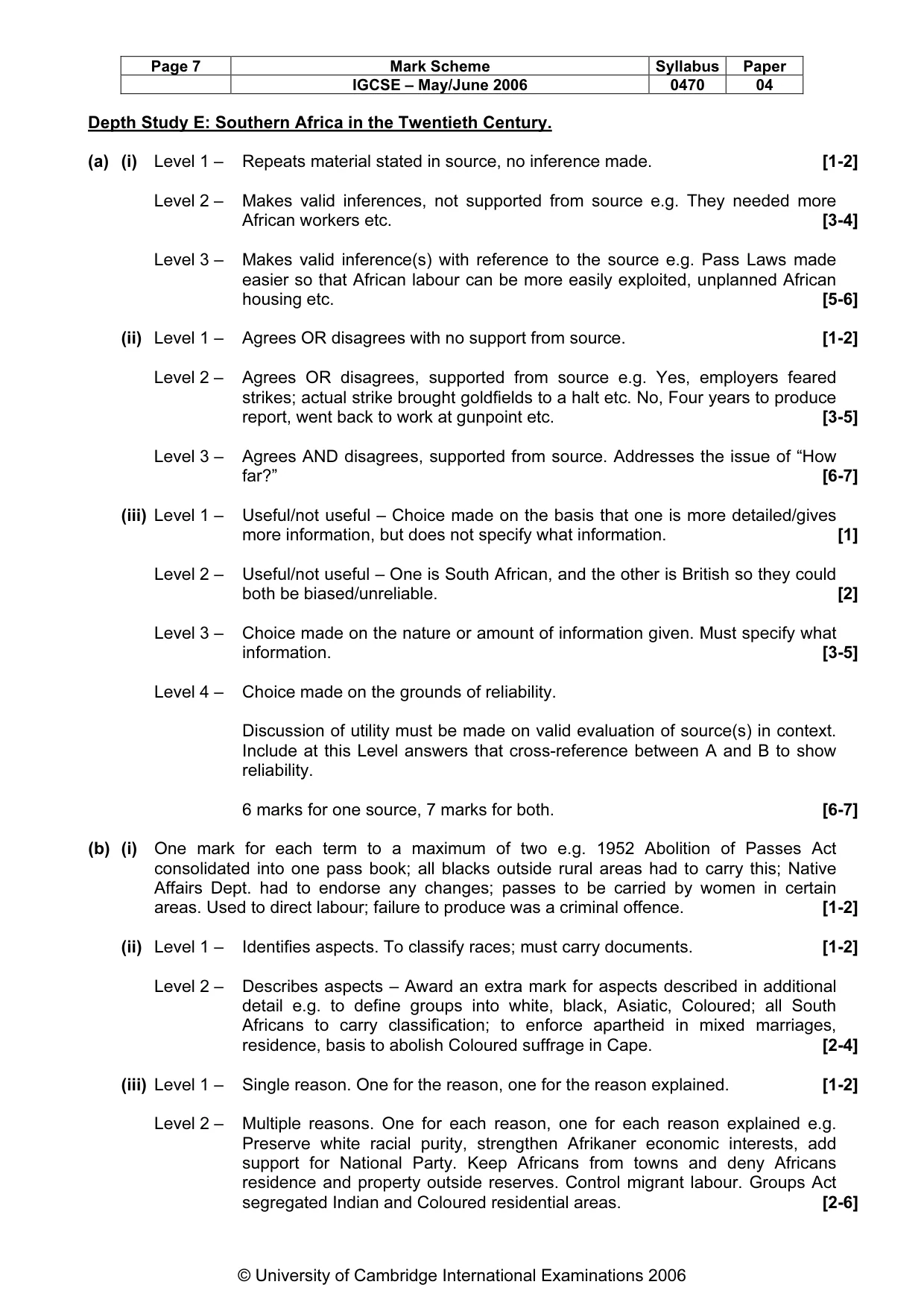
Page 7 Mark Scheme Syllabus Paper IGCSE – May/June 2006 0470 04 © University of Cambridge International Examinations 2006 Depth Study E: Southern Africa in the Twentieth Century. (a) (i) Level 1 – Repeats material stated in source, no inference made. [1-2] Level 2 – Makes valid inferences, not supported from source e.g. They needed more African workers etc. [3-4] Level 3 – Makes valid inference(s) with reference to the source e.g. Pass Laws made easier so that African labour can be more easily exploited, unplanned African housing etc. [5-6] (ii) Level 1 – Agrees OR disagrees with no support from source. [1-2] Level 2 – Agrees OR disagrees, supported from source e.g. Yes, employers feared strikes; actual strike brought goldfields to a halt etc. No, Four years to produce report, went back to work at gunpoint etc. [3-5] Level 3 – Agrees AND disagrees, supported from source. Addresses the issue of “How far?” [6-7] (iii) Level 1 – Useful/not useful – Choice made on the basis that one is more detailed/gives more information, but does not specify what information. [1] Level 2 – Useful/not useful – One is South African, and the other is British so they could both be biased/unreliable. [2] Level 3 – Choice made on the nature or amount of information given. Must specify what information. [3-5] Level 4 – Choice made on the grounds of reliability. Discussion of utility must be made on valid evaluation of source(s) in context. Include at this Level answers that cross-reference between A and B to show reliability. 6 marks for one source, 7 marks for both. [6-7] (b) (i) One mark for each term to a maximum of two e.g. 1952 Abolition of Passes Act consolidated into one pass book; all blacks outside rural areas had to carry this; Native Affairs Dept. had to endorse any changes; passes to be carried by women in certain areas. Used to direct labour; failure to produce was a criminal offence. [1-2] (ii) Level 1 – Identifies aspects. To classify races; must carry documents. [1-2] Level 2 – Describes aspects – Award an extra mark for aspects described in additional detail e.g. to define groups into white, black, Asiatic, Coloured; all South Africans to carry classification; to enforce apartheid in mixed marriages, residence, basis to abolish Coloured suffrage in Cape. [2-4] (iii) Level 1 – Single reason. One for the reason, one for the reason explained. [1-2] Level 2 – Multiple reasons. One for each reason, one for each reason explained e.g. Preserve white racial purity, strengthen Afrikaner economic interests, add support for National Party. Keep Africans from towns and deny Africans residence and property outside reserves. Control migrant labour. Groups Act segregated Indian and Coloured residential areas. [2-6]
Mark scheme, page 9
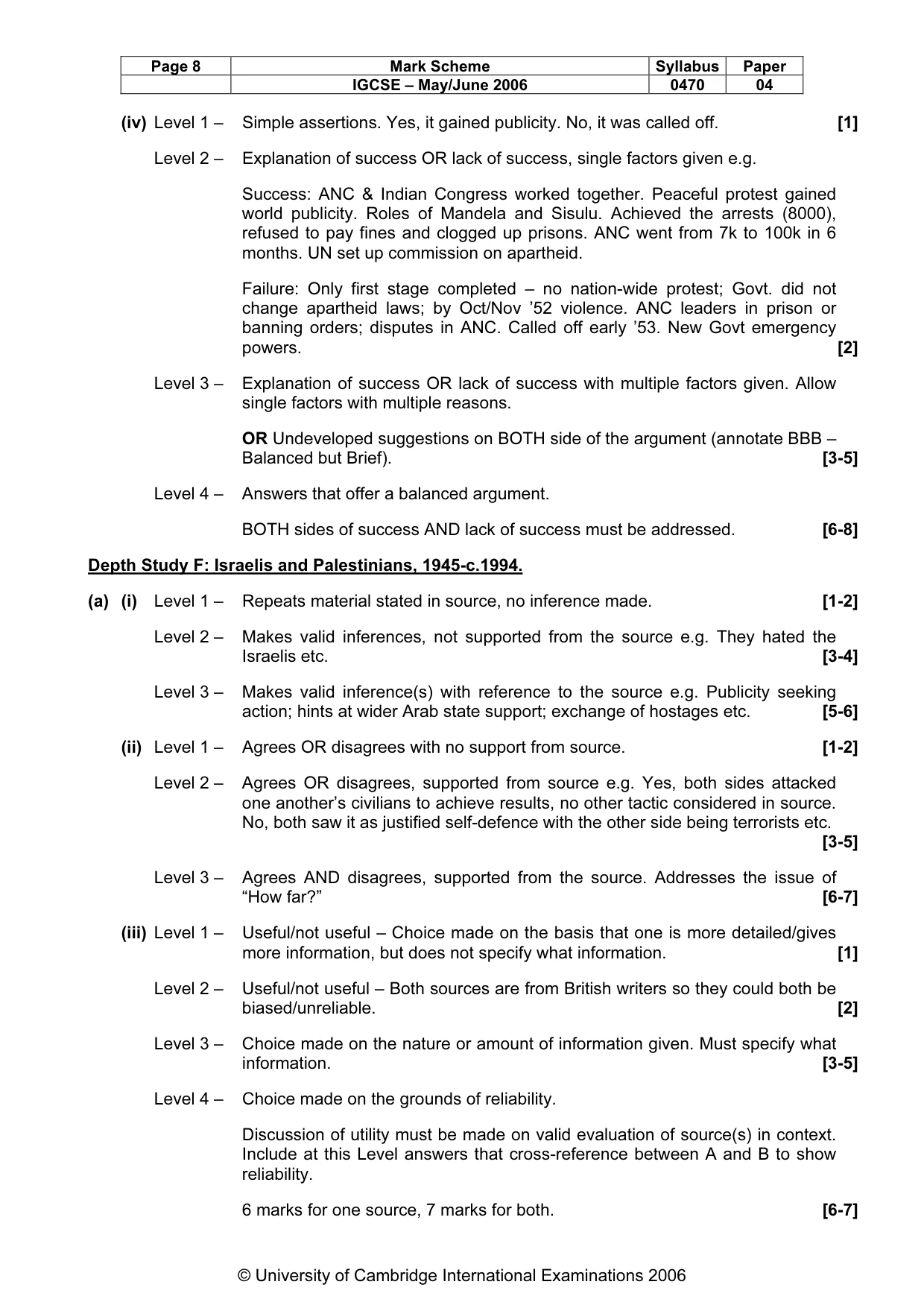
Page 8 Mark Scheme Syllabus Paper IGCSE – May/June 2006 0470 04 © University of Cambridge International Examinations 2006 (iv) Level 1 – Simple assertions. Yes, it gained publicity. No, it was called off. [1] Level 2 – Explanation of success OR lack of success, single factors given e.g. Success: ANC & Indian Congress worked together. Peaceful protest gained world publicity. Roles of Mandela and Sisulu. Achieved the arrests (8000), refused to pay fines and clogged up prisons. ANC went from 7k to 100k in 6 months. UN set up commission on apartheid. Failure: Only first stage completed – no nation-wide protest; Govt. did not change apartheid laws; by Oct/Nov ’52 violence. ANC leaders in prison or banning orders; disputes in ANC. Called off early ’53. New Govt emergency powers. [2] Level 3 – Explanation of success OR lack of success with multiple factors given. Allow single factors with multiple reasons. OR Undeveloped suggestions on BOTH side of the argument (annotate BBB – Balanced but Brief). [3-5] Level 4 – Answers that offer a balanced argument. BOTH sides of success AND lack of success must be addressed. [6-8] Depth Study F: Israelis and Palestinians, 1945-c.1994. (a) (i) Level 1 – Repeats material stated in source, no inference made. [1-2] Level 2 – Makes valid inferences, not supported from the source e.g. They hated the Israelis etc. [3-4] Level 3 – Makes valid inference(s) with reference to the source e.g. Publicity seeking action; hints at wider Arab state support; exchange of hostages etc. [5-6] (ii) Level 1 – Agrees OR disagrees with no support from source. [1-2] Level 2 – Agrees OR disagrees, supported from source e.g. Yes, both sides attacked one another’s civilians to achieve results, no other tactic considered in source. No, both saw it as justified self-defence with the other side being terrorists etc. [3-5] Level 3 – Agrees AND disagrees, supported from the source. Addresses the issue of “How far?” [6-7] (iii) Level 1 – Useful/not useful – Choice made on the basis that one is more detailed/gives more information, but does not specify what information. [1] Level 2 – Useful/not useful – Both sources are from British writers so they could both be biased/unreliable. [2] Level 3 – Choice made on the nature or amount of information given. Must specify what information. [3-5] Level 4 – Choice made on the grounds of reliability. Discussion of utility must be made on valid evaluation of source(s) in context. Include at this Level answers that cross-reference between A and B to show reliability. 6 marks for one source, 7 marks for both. [6-7]
Mark scheme, page 10
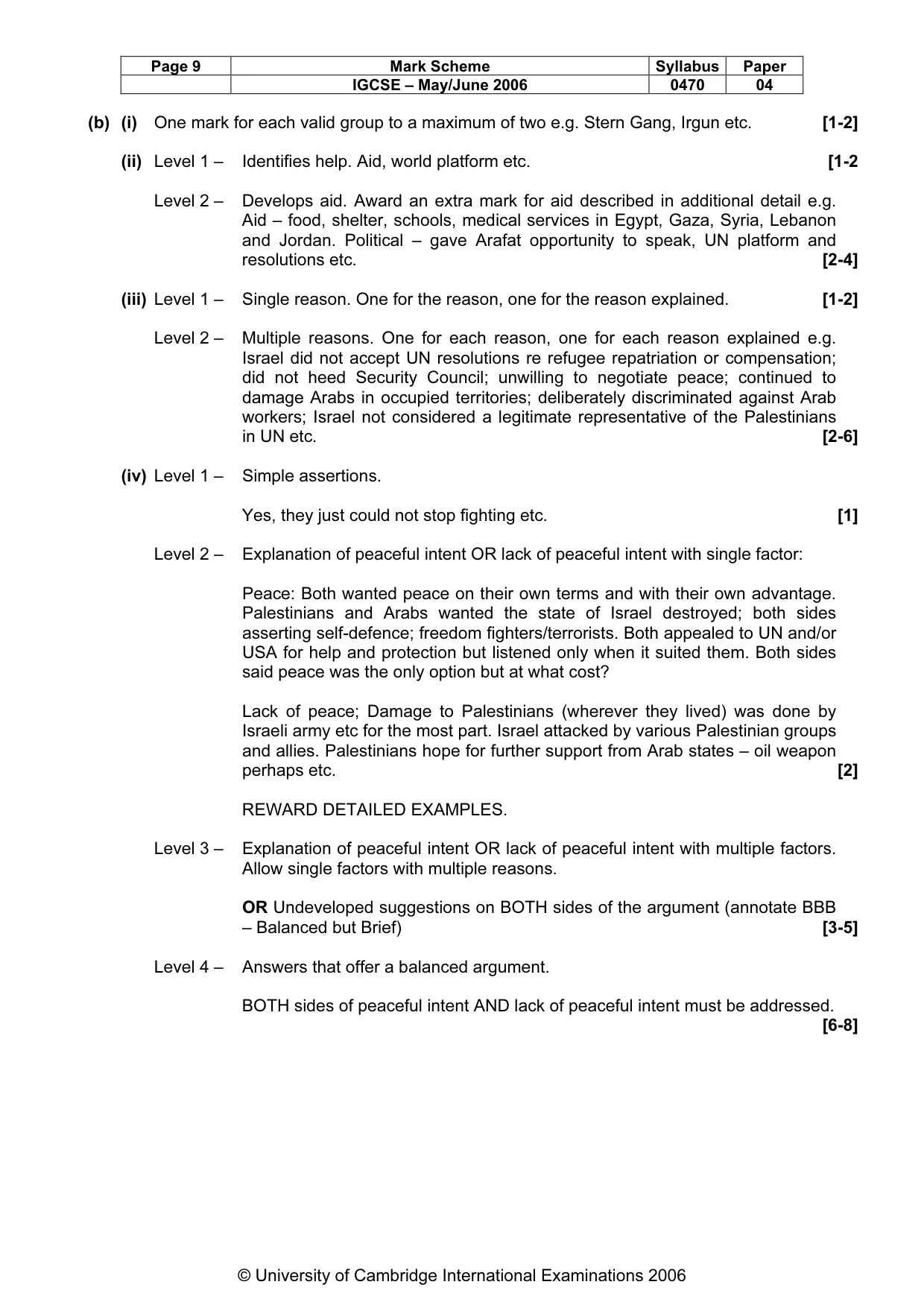
Page 9 Mark Scheme Syllabus Paper IGCSE – May/June 2006 0470 04 © University of Cambridge International Examinations 2006 (b) (i) One mark for each valid group to a maximum of two e.g. Stern Gang, Irgun etc. [1-2] (ii) Level 1 – Identifies help. Aid, world platform etc. [1-2 Level 2 – Develops aid. Award an extra mark for aid described in additional detail e.g. Aid – food, shelter, schools, medical services in Egypt, Gaza, Syria, Lebanon and Jordan. Political – gave Arafat opportunity to speak, UN platform and resolutions etc. [2-4] (iii) Level 1 – Single reason. One for the reason, one for the reason explained. [1-2] Level 2 – Multiple reasons. One for each reason, one for each reason explained e.g. Israel did not accept UN resolutions re refugee repatriation or compensation; did not heed Security Council; unwilling to negotiate peace; continued to damage Arabs in occupied territories; deliberately discriminated against Arab workers; Israel not considered a legitimate representative of the Palestinians in UN etc. [2-6] (iv) Level 1 – Simple assertions. Yes, they just could not stop fighting etc. [1] Level 2 – Explanation of peaceful intent OR lack of peaceful intent with single factor: Peace: Both wanted peace on their own terms and with their own advantage. Palestinians and Arabs wanted the state of Israel destroyed; both sides asserting self-defence; freedom fighters/terrorists. Both appealed to UN and/or USA for help and protection but listened only when it suited them. Both sides said peace was the only option but at what cost? Lack of peace; Damage to Palestinians (wherever they lived) was done by Israeli army etc for the most part. Israel attacked by various Palestinian groups and allies. Palestinians hope for further support from Arab states – oil weapon perhaps etc. [2] REWARD DETAILED EXAMPLES. Level 3 – Explanation of peaceful intent OR lack of peaceful intent with multiple factors. Allow single factors with multiple reasons. OR Undeveloped suggestions on BOTH sides of the argument (annotate BBB – Balanced but Brief) [3-5] Level 4 – Answers that offer a balanced argument. BOTH sides of peaceful intent AND lack of peaceful intent must be addressed. [6-8]
Mark scheme, page 11
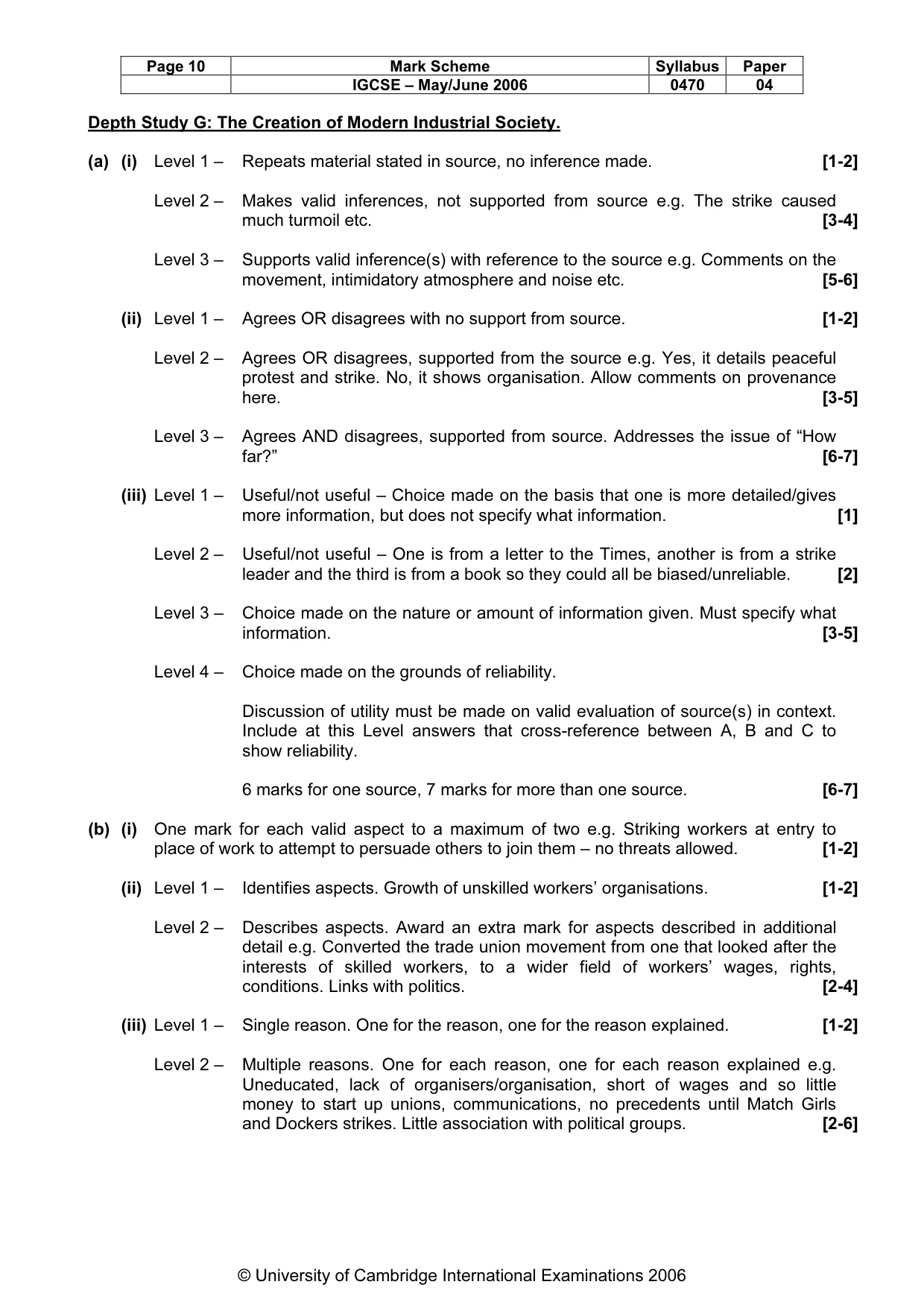
Page 10 Mark Scheme Syllabus Paper IGCSE – May/June 2006 0470 04 © University of Cambridge International Examinations 2006 Depth Study G: The Creation of Modern Industrial Society. (a) (i) Level 1 – Repeats material stated in source, no inference made. [1-2] Level 2 – Makes valid inferences, not supported from source e.g. The strike caused much turmoil etc. [3-4] Level 3 – Supports valid inference(s) with reference to the source e.g. Comments on the movement, intimidatory atmosphere and noise etc. [5-6] (ii) Level 1 – Agrees OR disagrees with no support from source. [1-2] Level 2 – Agrees OR disagrees, supported from the source e.g. Yes, it details peaceful protest and strike. No, it shows organisation. Allow comments on provenance here. [3-5] Level 3 – Agrees AND disagrees, supported from source. Addresses the issue of “How far?” [6-7] (iii) Level 1 – Useful/not useful – Choice made on the basis that one is more detailed/gives more information, but does not specify what information. [1] Level 2 – Useful/not useful – One is from a letter to the Times, another is from a strike leader and the third is from a book so they could all be biased/unreliable. [2] Level 3 – Choice made on the nature or amount of information given. Must specify what information. [3-5] Level 4 – Choice made on the grounds of reliability. Discussion of utility must be made on valid evaluation of source(s) in context. Include at this Level answers that cross-reference between A, B and C to show reliability. 6 marks for one source, 7 marks for more than one source. [6-7] (b) (i) One mark for each valid aspect to a maximum of two e.g. Striking workers at entry to place of work to attempt to persuade others to join them – no threats allowed. [1-2] (ii) Level 1 – Identifies aspects. Growth of unskilled workers’ organisations. [1-2] Level 2 – Describes aspects. Award an extra mark for aspects described in additional detail e.g. Converted the trade union movement from one that looked after the interests of skilled workers, to a wider field of workers’ wages, rights, conditions. Links with politics. [2-4] (iii) Level 1 – Single reason. One for the reason, one for the reason explained. [1-2] Level 2 – Multiple reasons. One for each reason, one for each reason explained e.g. Uneducated, lack of organisers/organisation, short of wages and so little money to start up unions, communications, no precedents until Match Girls and Dockers strikes. Little association with political groups. [2-6]
Mark scheme, page 12
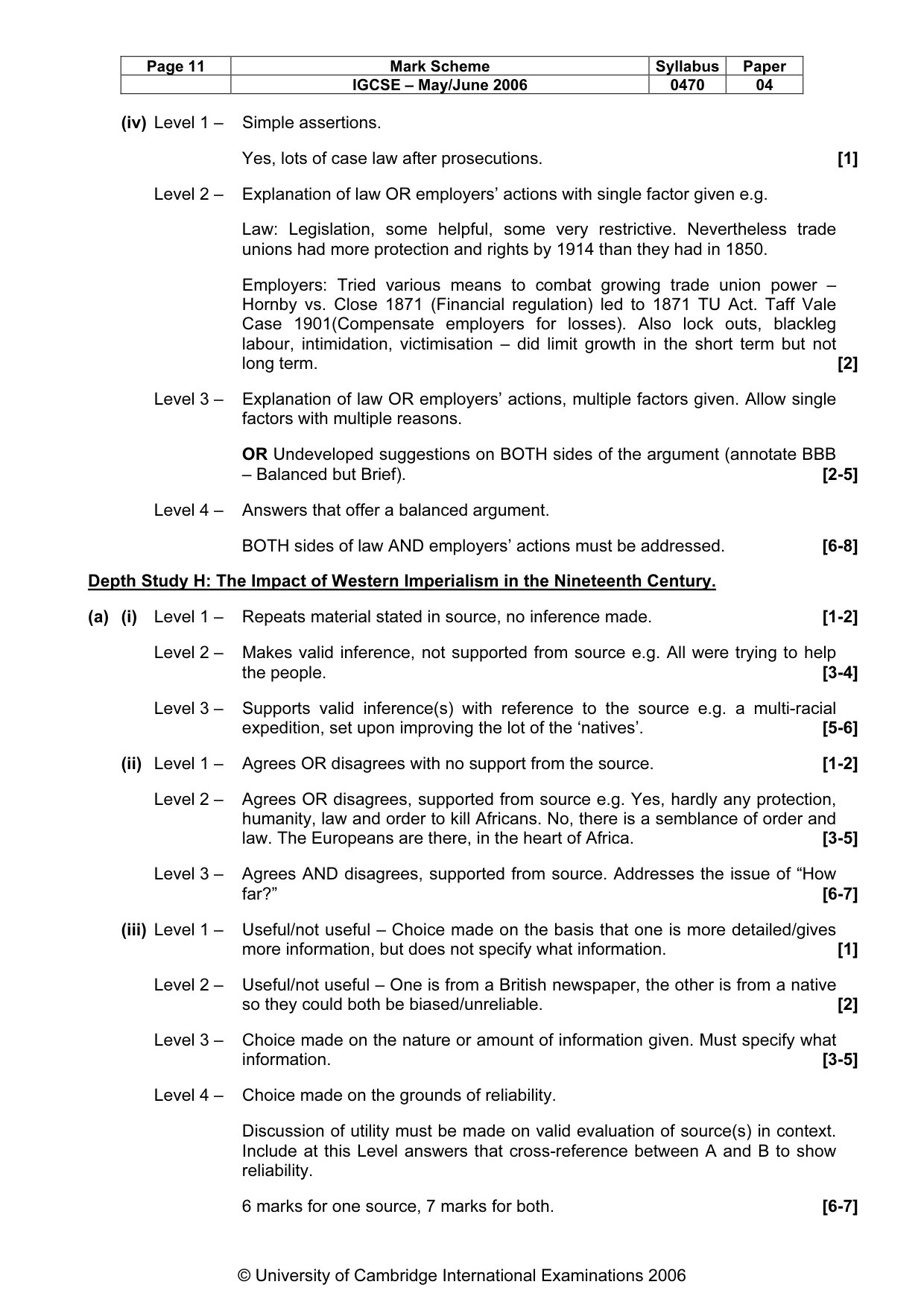
Page 11 Mark Scheme Syllabus Paper IGCSE – May/June 2006 0470 04 © University of Cambridge International Examinations 2006 (iv) Level 1 – Simple assertions. Yes, lots of case law after prosecutions. [1] Level 2 – Explanation of law OR employers’ actions with single factor given e.g. Law: Legislation, some helpful, some very restrictive. Nevertheless trade unions had more protection and rights by 1914 than they had in 1850. Employers: Tried various means to combat growing trade union power – Hornby vs. Close 1871 (Financial regulation) led to 1871 TU Act. Taff Vale Case 1901(Compensate employers for losses). Also lock outs, blackleg labour, intimidation, victimisation – did limit growth in the short term but not long term. [2] Level 3 – Explanation of law OR employers’ actions, multiple factors given. Allow single factors with multiple reasons. OR Undeveloped suggestions on BOTH sides of the argument (annotate BBB – Balanced but Brief). [2-5] Level 4 – Answers that offer a balanced argument. BOTH sides of law AND employers’ actions must be addressed. [6-8] Depth Study H: The Impact of Western Imperialism in the Nineteenth Century. (a) (i) Level 1 – Repeats material stated in source, no inference made. [1-2] Level 2 – Makes valid inference, not supported from source e.g. All were trying to help the people. [3-4] Level 3 – Supports valid inference(s) with reference to the source e.g. a multi-racial expedition, set upon improving the lot of the ‘natives’. [5-6] (ii) Level 1 – Agrees OR disagrees with no support from the source. [1-2] Level 2 – Agrees OR disagrees, supported from source e.g. Yes, hardly any protection, humanity, law and order to kill Africans. No, there is a semblance of order and law. The Europeans are there, in the heart of Africa. [3-5] Level 3 – Agrees AND disagrees, supported from source. Addresses the issue of “How far?” [6-7] (iii) Level 1 – Useful/not useful – Choice made on the basis that one is more detailed/gives more information, but does not specify what information. [1] Level 2 – Useful/not useful – One is from a British newspaper, the other is from a native so they could both be biased/unreliable. [2] Level 3 – Choice made on the nature or amount of information given. Must specify what information. [3-5] Level 4 – Choice made on the grounds of reliability. Discussion of utility must be made on valid evaluation of source(s) in context. Include at this Level answers that cross-reference between A and B to show reliability. 6 marks for one source, 7 marks for both. [6-7]
Mark scheme, page 13
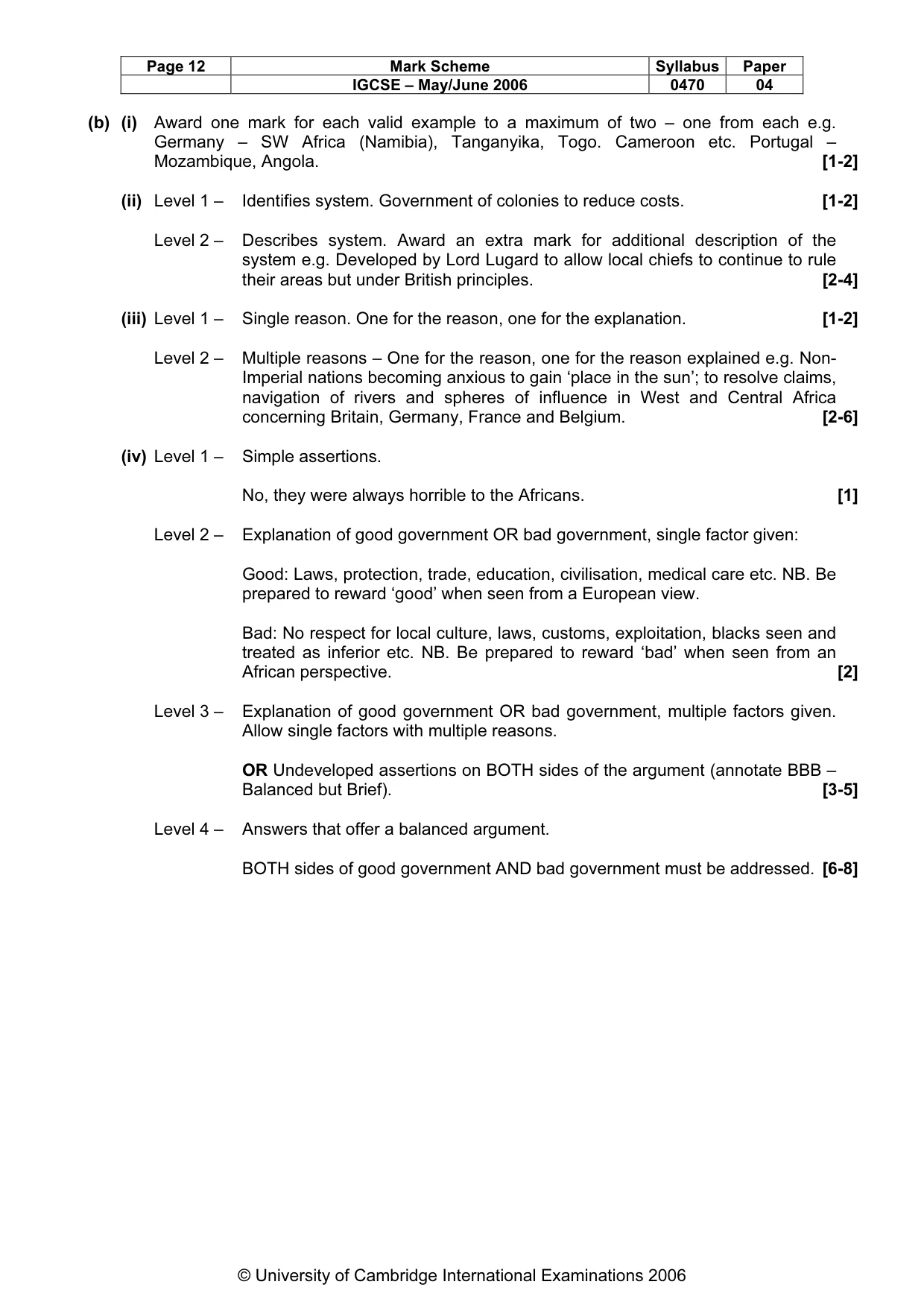
Page 12 Mark Scheme Syllabus Paper IGCSE – May/June 2006 0470 04 © University of Cambridge International Examinations 2006 (b) (i) Award one mark for each valid example to a maximum of two – one from each e.g. Germany – SW Africa (Namibia), Tanganyika, Togo. Cameroon etc. Portugal – Mozambique, Angola. [1-2] (ii) Level 1 – Identifies system. Government of colonies to reduce costs. [1-2] Level 2 – Describes system. Award an extra mark for additional description of the system e.g. Developed by Lord Lugard to allow local chiefs to continue to rule their areas but under British principles. [2-4] (iii) Level 1 – Single reason. One for the reason, one for the explanation. [1-2] Level 2 – Multiple reasons – One for the reason, one for the reason explained e.g. Non- Imperial nations becoming anxious to gain ‘place in the sun’; to resolve claims, navigation of rivers and spheres of influence in West and Central Africa concerning Britain, Germany, France and Belgium. [2-6] (iv) Level 1 – Simple assertions. No, they were always horrible to the Africans. [1] Level 2 – Explanation of good government OR bad government, single factor given: Good: Laws, protection, trade, education, civilisation, medical care etc. NB. Be prepared to reward ‘good’ when seen from a European view. Bad: No respect for local culture, laws, customs, exploitation, blacks seen and treated as inferior etc. NB. Be prepared to reward ‘bad’ when seen from an African perspective. [2] Level 3 – Explanation of good government OR bad government, multiple factors given. Allow single factors with multiple reasons. OR Undeveloped assertions on BOTH sides of the argument (annotate BBB – Balanced but Brief). [3-5] Level 4 – Answers that offer a balanced argument. BOTH sides of good government AND bad government must be addressed. [6-8]
What you needed in this session
Cambridge’s own grade thresholds for 2006 May/June, Paper 4 · Variant 1. A higher threshold means an easier paper — the bar moves with how the cohort did.