Cambridge IGCSE History 0470 — 2005 Oct/Nov Paper 4 · Variant 1
0470/41/O/N/05
The question paper and its mark scheme, free to read here and free to download. This is Cambridge’s own paper, exactly as it was sat.
Question paper12 pages

Mark scheme17 pages
Answers below. Sit the paper first if you are practising.
Paper as text
Question paper, page 1
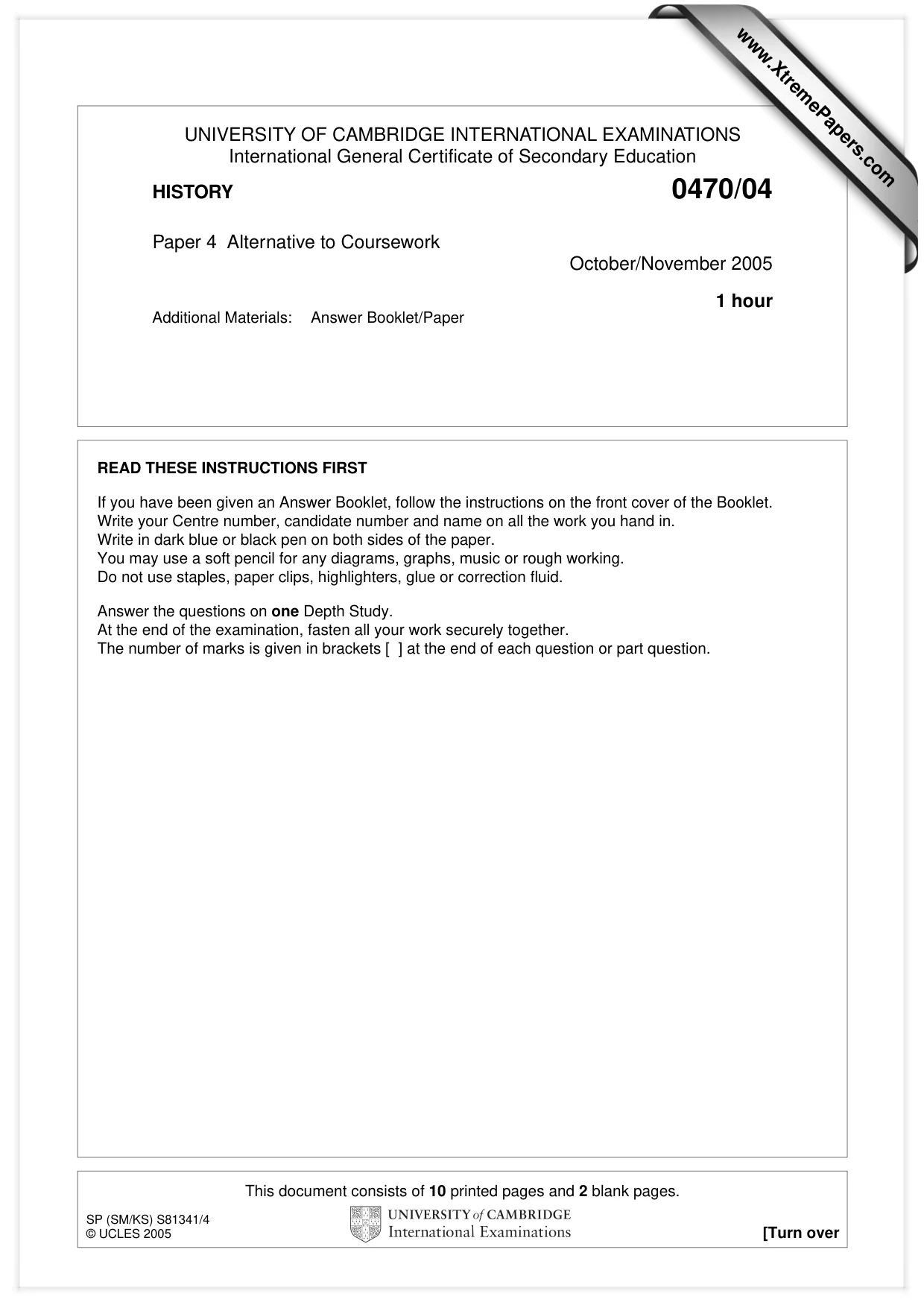
This document consists of 10 printed pages and 2 blank pages. SP (SM/KS) S81341/4 © UCLES 2005 [Turn over UNIVERSITY OF CAMBRIDGE INTERNATIONAL EXAMINATIONS International General Certificate of Secondary Education HISTORY 0470/04 Paper 4 Alternative to Coursework October/November 2005 1 hour Additional Materials: Answer Booklet/Paper READ THESE INSTRUCTIONS FIRST If you have been given an Answer Booklet, follow the instructions on the front cover of the Booklet. Write your Centre number, candidate number and name on all the work you hand in. Write in dark blue or black pen on both sides of the paper. You may use a soft pencil for any diagrams, graphs, music or rough working. Do not use staples, paper clips, highlighters, glue or correction fluid. Answer the questions on one Depth Study. At the end of the examination, fasten all your work securely together. The number of marks is given in brackets [ ] at the end of each question or part question. www.XtremePapers.com
Question paper, page 2
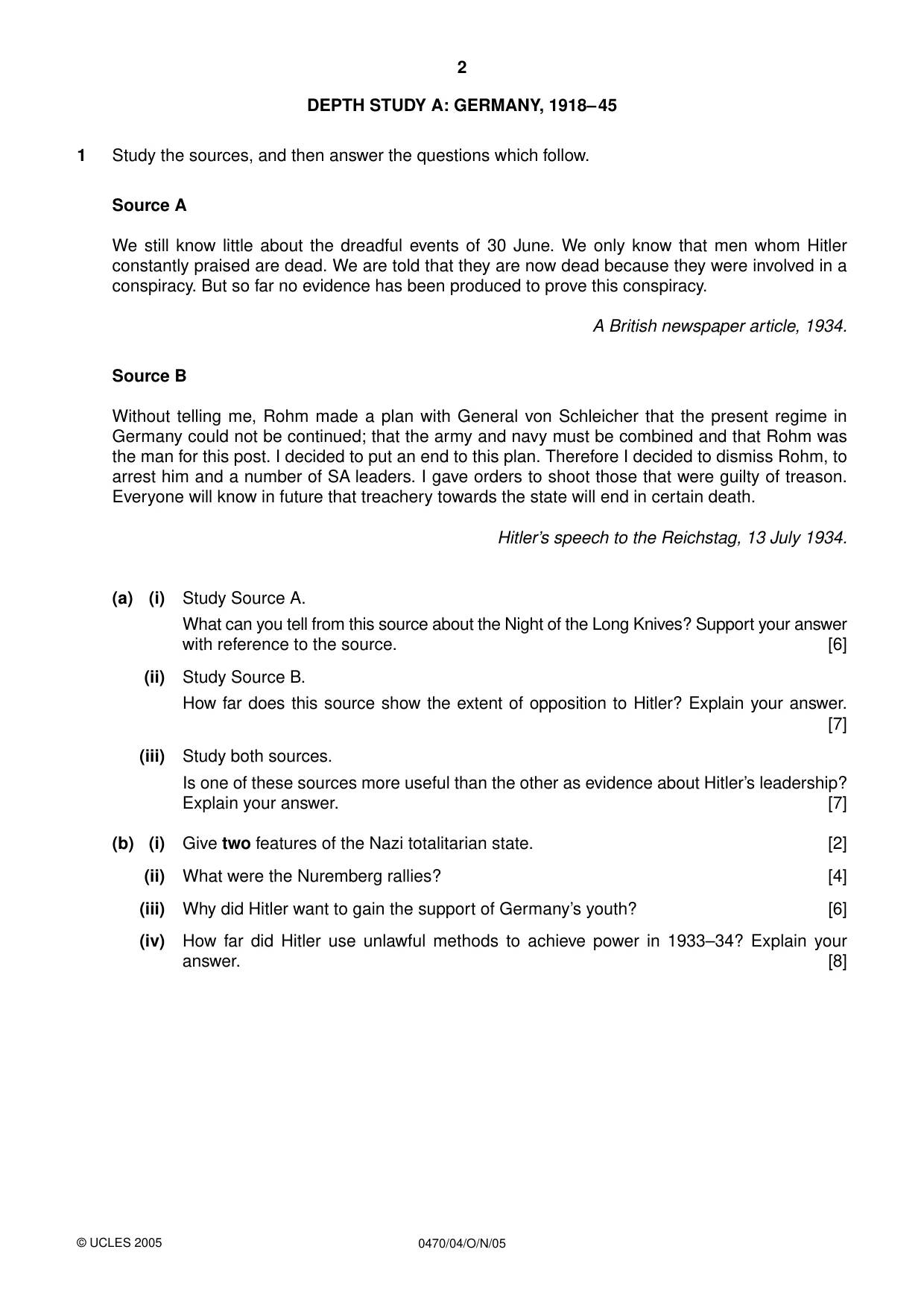
2 0470/04/O/N/05 DEPTH STUDY A: GERMANY, 1918–45 1 Study the sources, and then answer the questions which follow. Source A We still know little about the dreadful events of 30 June. We only know that men whom Hitler constantly praised are dead. We are told that they are now dead because they were involved in a conspiracy. But so far no evidence has been produced to prove this conspiracy. A British newspaper article, 1934. Source B Without telling me, Rohm made a plan with General von Schleicher that the present regime in Germany could not be continued; that the army and navy must be combined and that Rohm was the man for this post. I decided to put an end to this plan. Therefore I decided to dismiss Rohm, to arrest him and a number of SA leaders. I gave orders to shoot those that were guilty of treason. Everyone will know in future that treachery towards the state will end in certain death. Hitler’s speech to the Reichstag, 13 July 1934. (a) (i) Study Source A. What can you tell from this source about the Night of the Long Knives? Support your answer with reference to the source. [6] (ii) Study Source B. How far does this source show the extent of opposition to Hitler? Explain your answer. [7] (iii) Study both sources. Is one of these sources more useful than the other as evidence about Hitler’s leadership? Explain your answer. [7] (b) (i) Give two features of the Nazi totalitarian state. [2] (ii) What were the Nuremberg rallies? [4] (iii) Why did Hitler want to gain the support of Germany’s youth? [6] (iv) How far did Hitler use unlawful methods to achieve power in 1933–34? Explain your answer. [8] © UCLES 2005
Question paper, page 3
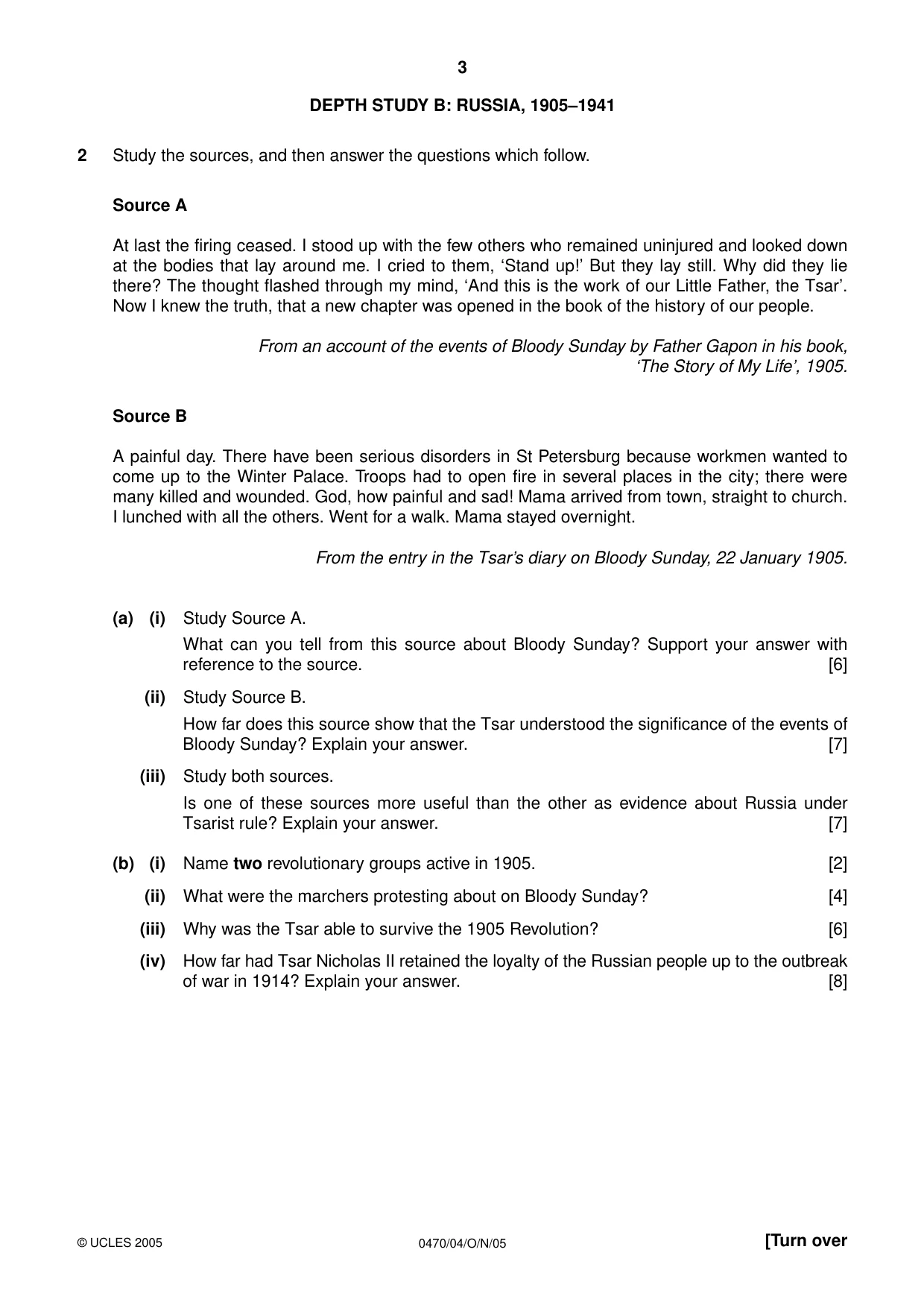
3 0470/04/O/N/05 [Turn over DEPTH STUDY B: RUSSIA, 1905–1941 2 Study the sources, and then answer the questions which follow. Source A At last the firing ceased. I stood up with the few others who remained uninjured and looked down at the bodies that lay around me. I cried to them, ‘Stand up!’ But they lay still. Why did they lie there? The thought flashed through my mind, ‘And this is the work of our Little Father, the Tsar’. Now I knew the truth, that a new chapter was opened in the book of the history of our people. From an account of the events of Bloody Sunday by Father Gapon in his book, ‘The Story of My Life’, 1905. Source B A painful day. There have been serious disorders in St Petersburg because workmen wanted to come up to the Winter Palace. Troops had to open fire in several places in the city; there were many killed and wounded. God, how painful and sad! Mama arrived from town, straight to church. I lunched with all the others. Went for a walk. Mama stayed overnight. From the entry in the Tsar’s diary on Bloody Sunday, 22 January 1905. (a) (i) Study Source A. What can you tell from this source about Bloody Sunday? Support your answer with reference to the source. [6] (ii) Study Source B. How far does this source show that the Tsar understood the significance of the events of Bloody Sunday? Explain your answer. [7] (iii) Study both sources. Is one of these sources more useful than the other as evidence about Russia under Tsarist rule? Explain your answer. [7] (b) (i) Name two revolutionary groups active in 1905. [2] (ii) What were the marchers protesting about on Bloody Sunday? [4] (iii) Why was the Tsar able to survive the 1905 Revolution? [6] (iv) How far had Tsar Nicholas II retained the loyalty of the Russian people up to the outbreak of war in 1914? Explain your answer. [8] © UCLES 2005
Question paper, page 4
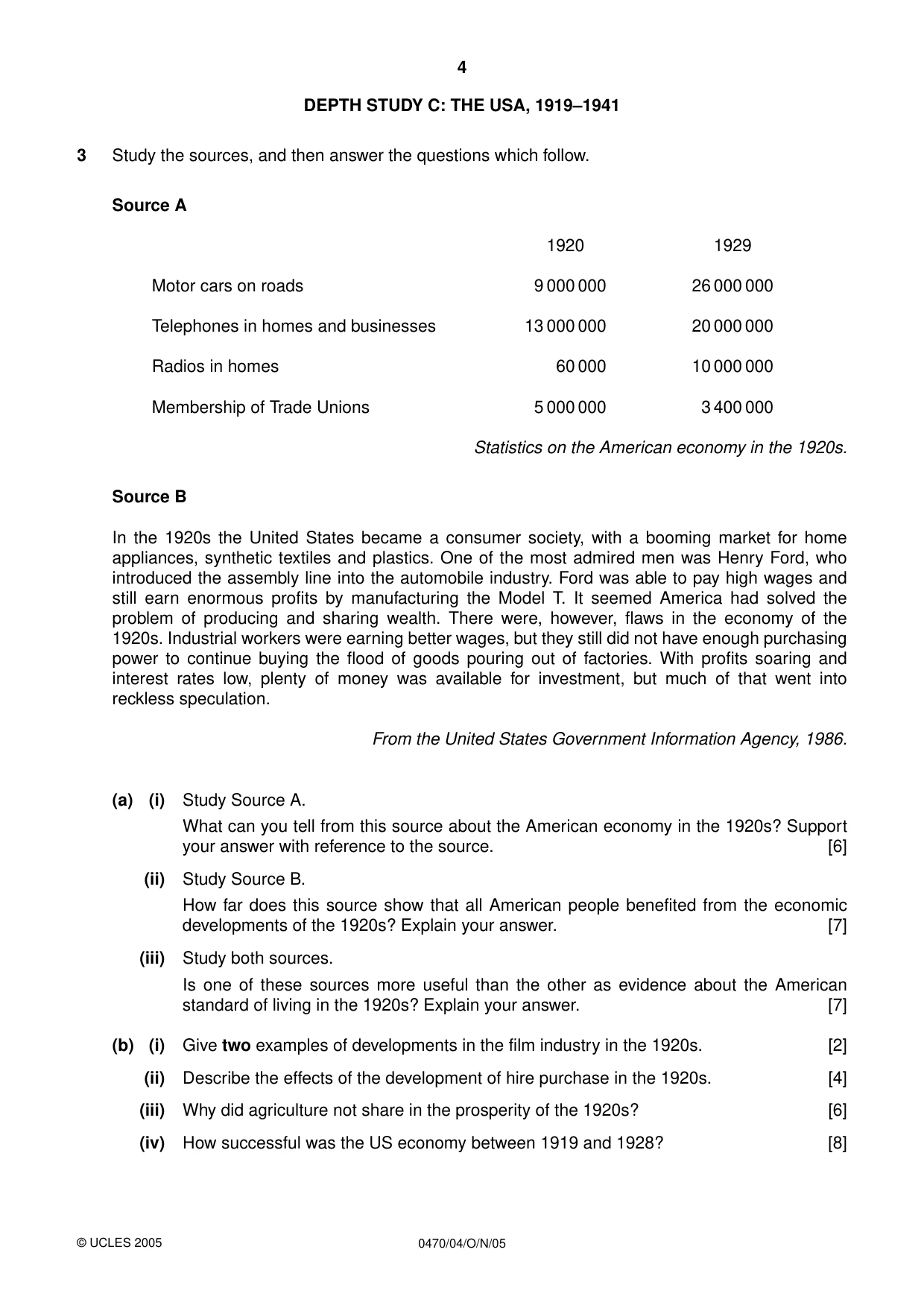
4 0470/04/O/N/05 DEPTH STUDY C: THE USA, 1919–1941 3 Study the sources, and then answer the questions which follow. Source A 1920 1929 Motor cars on roads 9 000 000 26 000 000 Telephones in homes and businesses 13 000 000 20 000 000 Radios in homes 60 000 10 000 000 Membership of Trade Unions 5 000 000 3 400 000 Statistics on the American economy in the 1920s. Source B In the 1920s the United States became a consumer society, with a booming market for home appliances, synthetic textiles and plastics. One of the most admired men was Henry Ford, who introduced the assembly line into the automobile industry. Ford was able to pay high wages and still earn enormous profits by manufacturing the Model T. It seemed America had solved the problem of producing and sharing wealth. There were, however, flaws in the economy of the 1920s. Industrial workers were earning better wages, but they still did not have enough purchasing power to continue buying the flood of goods pouring out of factories. With profits soaring and interest rates low, plenty of money was available for investment, but much of that went into reckless speculation. From the United States Government Information Agency, 1986. (a) (i) Study Source A. What can you tell from this source about the American economy in the 1920s? Support your answer with reference to the source. [6] (ii) Study Source B. How far does this source show that all American people benefited from the economic developments of the 1920s? Explain your answer. [7] (iii) Study both sources. Is one of these sources more useful than the other as evidence about the American standard of living in the 1920s? Explain your answer. [7] (b) (i) Give two examples of developments in the film industry in the 1920s. [2] (ii) Describe the effects of the development of hire purchase in the 1920s. [4] (iii) Why did agriculture not share in the prosperity of the 1920s? [6] (iv) How successful was the US economy between 1919 and 1928? [8] © UCLES 2005
Question paper, page 5
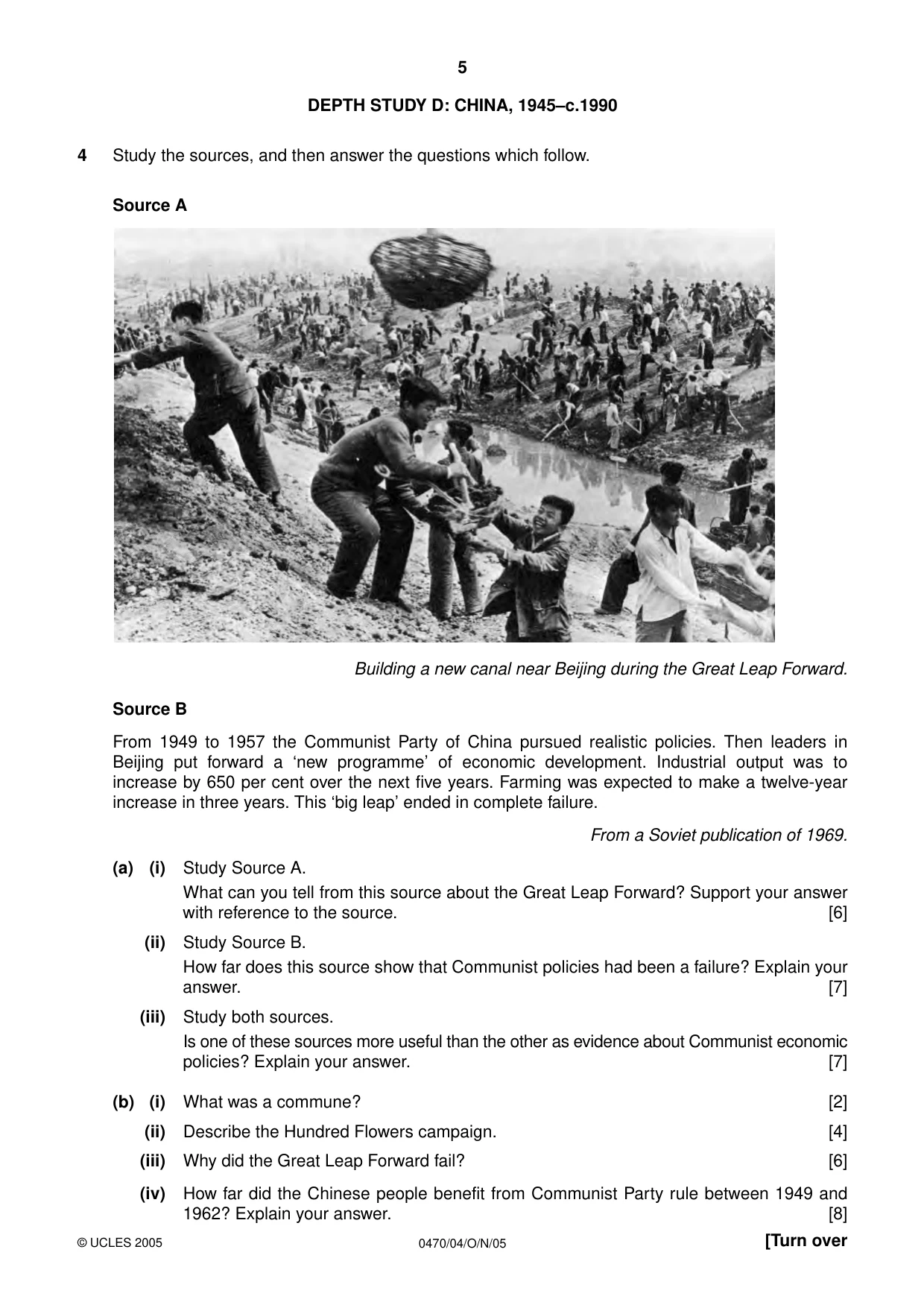
5 0470/04/O/N/05 [Turn over DEPTH STUDY D: CHINA, 1945–c.1990 4 Study the sources, and then answer the questions which follow. Source A Building a new canal near Beijing during the Great Leap Forward. Source B From 1949 to 1957 the Communist Party of China pursued realistic policies. Then leaders in Beijing put forward a ‘new programme’ of economic development. Industrial output was to increase by 650 per cent over the next five years. Farming was expected to make a twelve-year increase in three years. This ‘big leap’ ended in complete failure. From a Soviet publication of 1969. (a) (i) Study Source A. What can you tell from this source about the Great Leap Forward? Support your answer with reference to the source. [6] (ii) Study Source B. How far does this source show that Communist policies had been a failure? Explain your answer. [7] (iii) Study both sources. Is one of these sources more useful than the other as evidence about Communist economic policies? Explain your answer. [7] (b) (i) What was a commune? [2] (ii) Describe the Hundred Flowers campaign. [4] (iii) Why did the Great Leap Forward fail? [6] (iv) How far did the Chinese people benefit from Communist Party rule between 1949 and 1962? Explain your answer. [8] © UCLES 2005
Question paper, page 6
6 0470/04/O/N/05 DEPTH STUDY E: SOUTHERN AFRICA IN THE TWENTIETH CENTURY 5 Study the sources, and then answer the questions which follow. Source A We want our rights here in a united, undivided South Africa. We do not want them in poor homelands. We want all our rights, we want them here and we want them NOW. We have been jailed, exiled, killed for too long. NOW is the time. From a speech by Reverend Allan Boesak at the beginning of the United Democratic Front in 1983. Source B Pieter Botha was certainly more reasonable than any of the earlier National Party leaders. He recognised blacks as permanent residents of white cities and granted them the right to own houses and land in the townships. He permitted the rise of a real black opposition and allowed trade unions to organise openly. He got rid of some of the worst apartheid laws and offered a vote of sorts to the Coloureds and Indians. To pay for this and other reforms he taxed the whites heavily. As a result his party split. The view of an Afrikaner journalist in 1990. (a) (i) Study Source A. What can you tell from this source about the United Democratic Front? Support your answer with reference to the source. [6] (ii) Study Source B. How far does this source show that President Botha was willing to end the dominance of the white minority? Explain your answer. [7] (iii) Study both sources. Is one of these sources more useful than the other as evidence about the strength of opposition to apartheid in the 1980s? Explain your answer. [7] (b) (i) Name two of the groups represented on the Electoral College set up by the 1984 constitution. [2] (ii) Describe how Angola and Mozambique helped the ANC in the 1980s. [4] (iii) Why did President de Klerk release Nelson Mandela from prison in 1990? [6] (iv) How far do you agree that international pressure was the most important factor that brought apartheid to an end? Explain your answer. [8] © UCLES 2005
Question paper, page 7
7 0470/04/O/N/05 [Turn over DEPTH STUDY F: ISRAELIS AND PALESTINIANS, 1945–c.1994 6 Study the sources, and then answer the questions which follow. Source A We have had enough of words. We know our goal and we are determined to reach it. The liberation of our territory is the fundamental task before us. From a speech by President Sadat in Cairo, 28 September 1973. Source B During the Yom Kippur War there had been some dangerous moments. Both superpowers had supplied arms. At the height of the conflict it appeared that both Russia and the United States might become more directly involved. In the course of the war, the Arabs used a new weapon: oil. From a British history textbook, 1987. (a) (i) Study Source A. What can you tell from this source about Egypt’s intentions? Support your answer with reference to the source. [6] (ii) Study Source B. How far does this source show that the superpowers controlled events in the Yom Kippur War? Explain your answer. [7] (iii) Study both sources. Is one of these sources more useful than the other as evidence about the Arab-Israeli conflict? Explain your answer. [7] (b) (i) What is Yom Kippur? [2] (ii) What actions did Arab oil producers take as a result of the Yom Kippur War? [4] (iii) Why did Arabs have early successes in the Yom Kippur War? [6] (iv) ‘The most important reason for Israel’s success in the Yom Kippur War was support from the USA.’ Do you agree? Explain your answer. [8] © UCLES 2005
Question paper, page 8
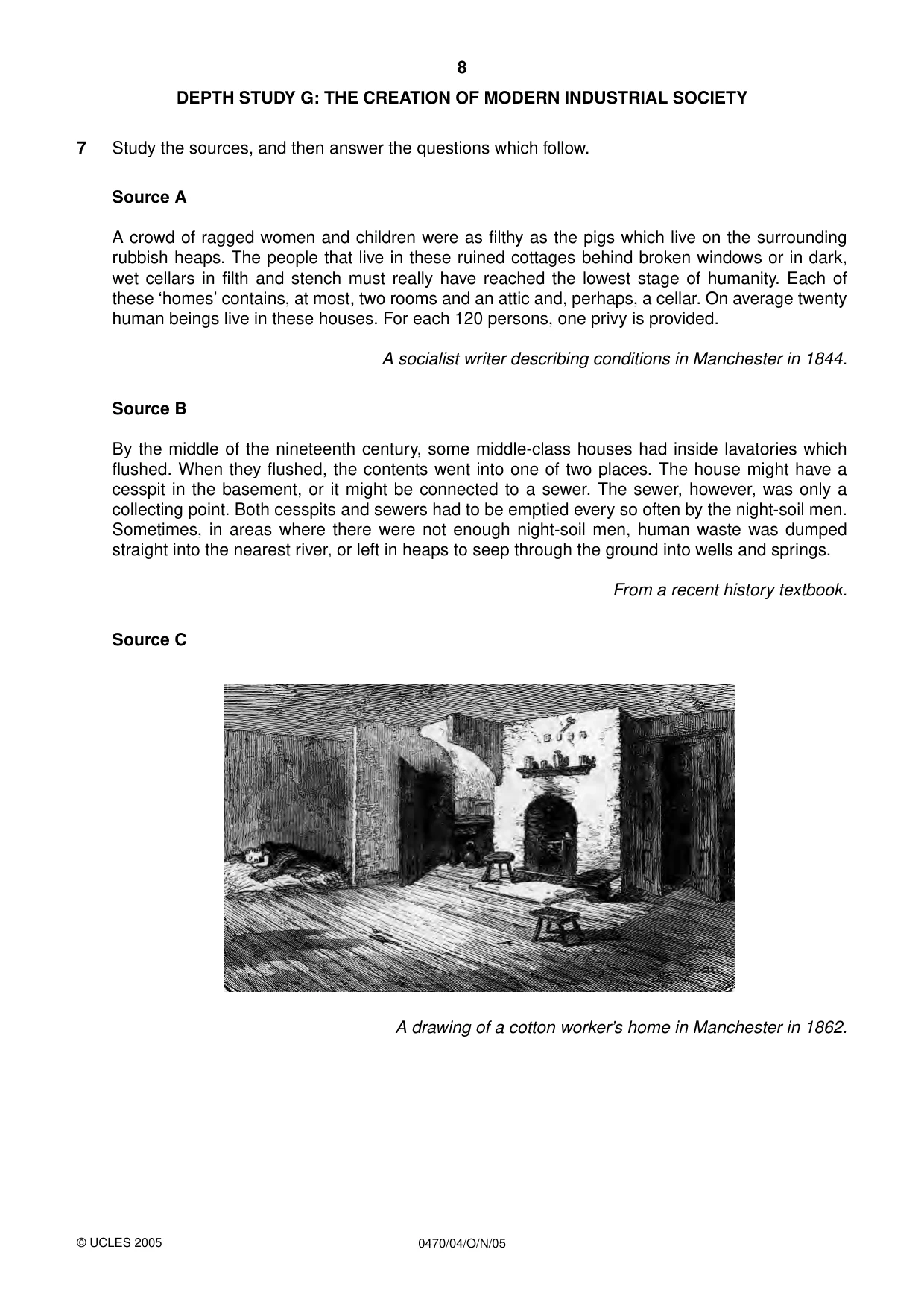
8 0470/04/O/N/05 DEPTH STUDY G: THE CREATION OF MODERN INDUSTRIAL SOCIETY 7 Study the sources, and then answer the questions which follow. Source A A crowd of ragged women and children were as filthy as the pigs which live on the surrounding rubbish heaps. The people that live in these ruined cottages behind broken windows or in dark, wet cellars in filth and stench must really have reached the lowest stage of humanity. Each of these ‘homes’ contains, at most, two rooms and an attic and, perhaps, a cellar. On average twenty human beings live in these houses. For each 120 persons, one privy is provided. A socialist writer describing conditions in Manchester in 1844. Source B By the middle of the nineteenth century, some middle-class houses had inside lavatories which flushed. When they flushed, the contents went into one of two places. The house might have a cesspit in the basement, or it might be connected to a sewer. The sewer, however, was only a collecting point. Both cesspits and sewers had to be emptied every so often by the night-soil men. Sometimes, in areas where there were not enough night-soil men, human waste was dumped straight into the nearest river, or left in heaps to seep through the ground into wells and springs. From a recent history textbook. Source C A drawing of a cotton worker’s home in Manchester in 1862. © UCLES 2005
Question paper, page 9
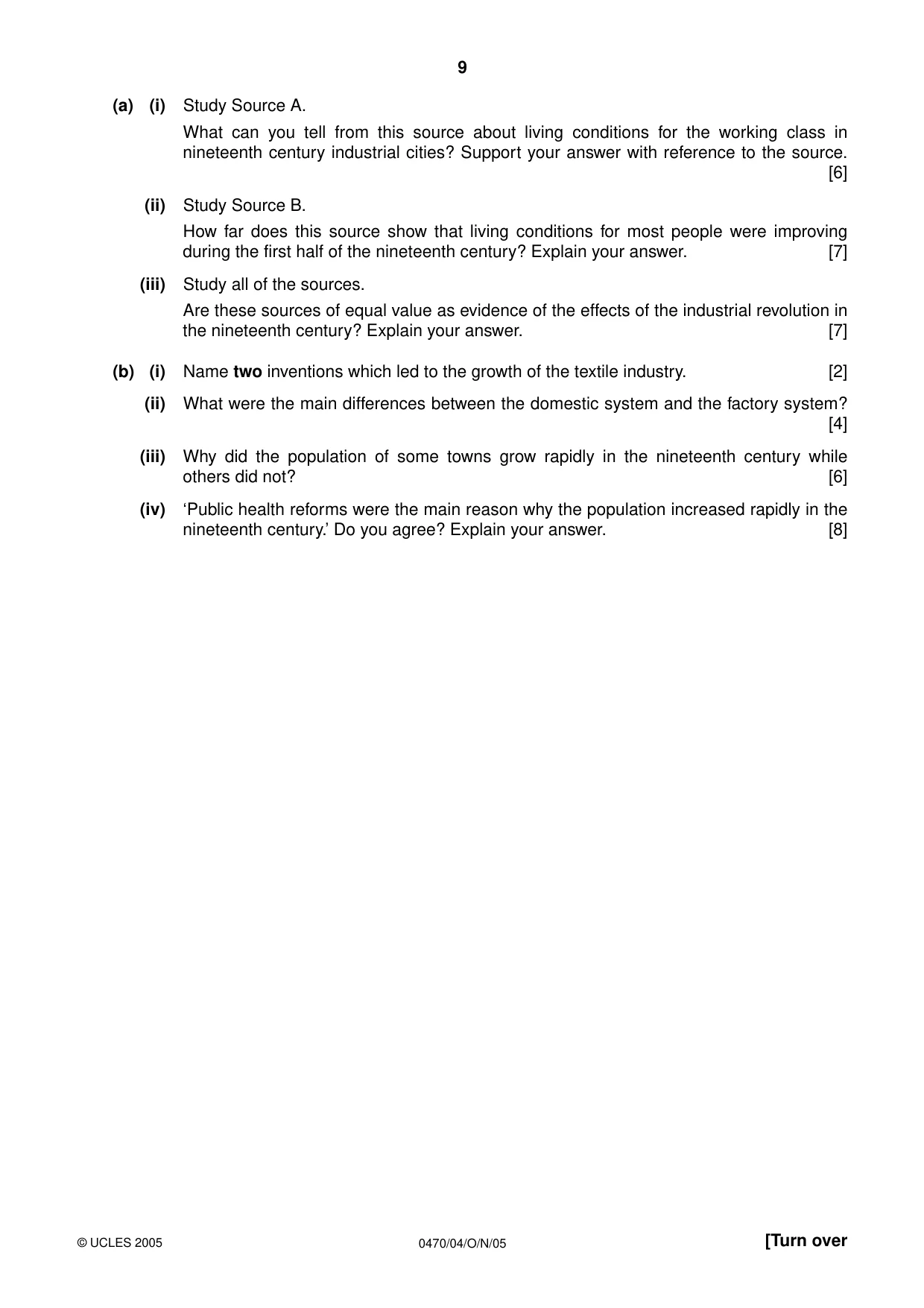
9 0470/04/O/N/05 [Turn over (a) (i) Study Source A. What can you tell from this source about living conditions for the working class in nineteenth century industrial cities? Support your answer with reference to the source. [6] (ii) Study Source B. How far does this source show that living conditions for most people were improving during the first half of the nineteenth century? Explain your answer. [7] (iii) Study all of the sources. Are these sources of equal value as evidence of the effects of the industrial revolution in the nineteenth century? Explain your answer. [7] (b) (i) Name two inventions which led to the growth of the textile industry. [2] (ii) What were the main differences between the domestic system and the factory system? [4] (iii) Why did the population of some towns grow rapidly in the nineteenth century while others did not? [6] (iv) ‘Public health reforms were the main reason why the population increased rapidly in the nineteenth century.’ Do you agree? Explain your answer. [8] © UCLES 2005
Question paper, page 10
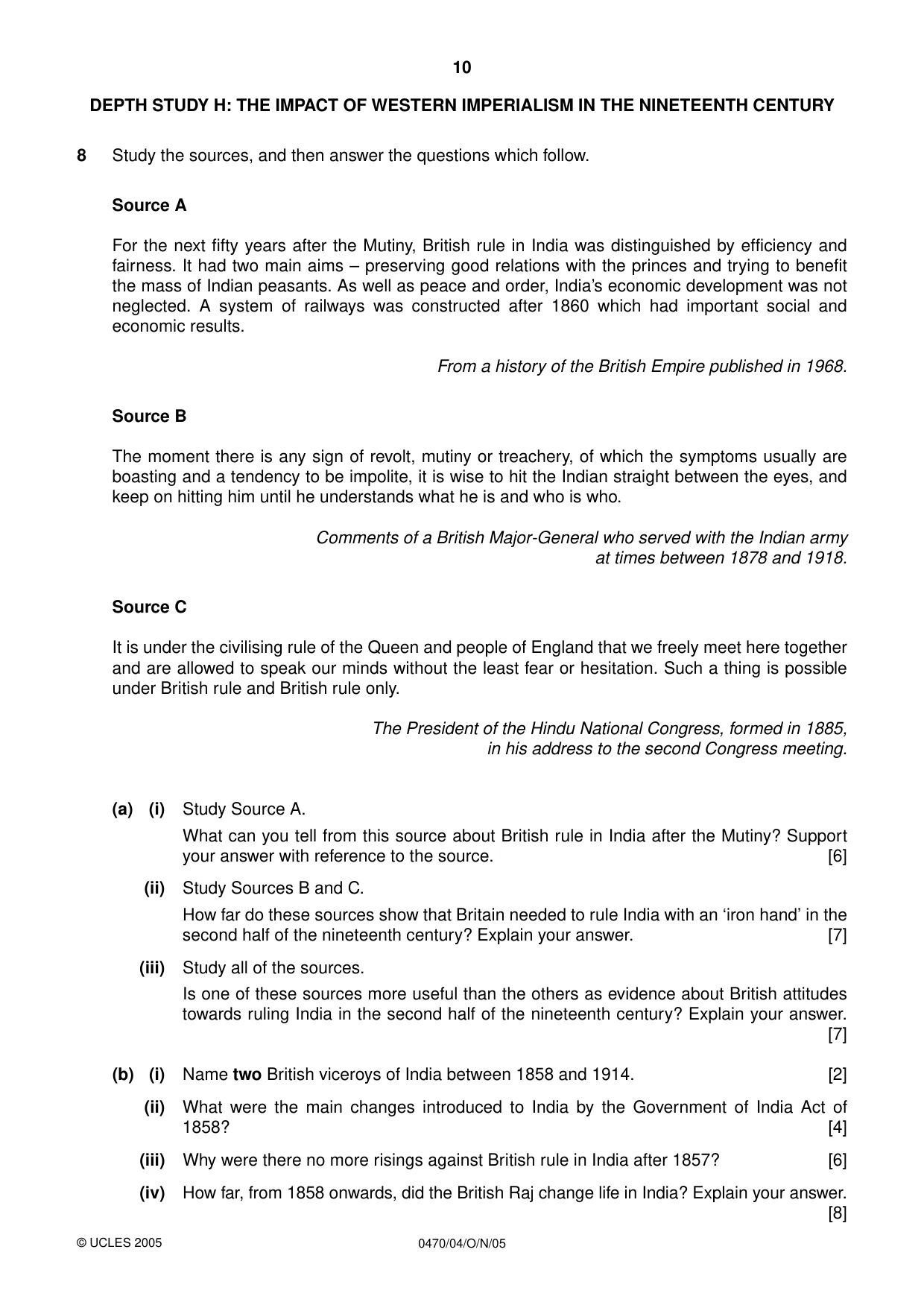
10 0470/04/O/N/05 DEPTH STUDY H: THE IMPACT OF WESTERN IMPERIALISM IN THE NINETEENTH CENTURY 8 Study the sources, and then answer the questions which follow. Source A For the next fifty years after the Mutiny, British rule in India was distinguished by efficiency and fairness. It had two main aims – preserving good relations with the princes and trying to benefit the mass of Indian peasants. As well as peace and order, India’s economic development was not neglected. A system of railways was constructed after 1860 which had important social and economic results. From a history of the British Empire published in 1968. Source B The moment there is any sign of revolt, mutiny or treachery, of which the symptoms usually are boasting and a tendency to be impolite, it is wise to hit the Indian straight between the eyes, and keep on hitting him until he understands what he is and who is who. Comments of a British Major-General who served with the Indian army at times between 1878 and 1918. Source C It is under the civilising rule of the Queen and people of England that we freely meet here together and are allowed to speak our minds without the least fear or hesitation. Such a thing is possible under British rule and British rule only. The President of the Hindu National Congress, formed in 1885, in his address to the second Congress meeting. (a) (i) Study Source A. What can you tell from this source about British rule in India after the Mutiny? Support your answer with reference to the source. [6] (ii) Study Sources B and C. How far do these sources show that Britain needed to rule India with an ‘iron hand’ in the second half of the nineteenth century? Explain your answer. [7] (iii) Study all of the sources. Is one of these sources more useful than the others as evidence about British attitudes towards ruling India in the second half of the nineteenth century? Explain your answer. [7] (b) (i) Name two British viceroys of India between 1858 and 1914. [2] (ii) What were the main changes introduced to India by the Government of India Act of 1858? [4] (iii) Why were there no more risings against British rule in India after 1857? [6] (iv) How far, from 1858 onwards, did the British Raj change life in India? Explain your answer. [8] © UCLES 2005
Question paper, page 12
12 0470/04/O/N/05 BLANK PAGE Copyright Acknowledgements: Section A Sources A and B © White and Hadley; Germany 1918–1949 ; Collins Educational, 1990. Section B Source A Father Gapon; ‘The Story of my Life’; 1905. Taken from Bryn Callahan; History of the Twentieth Century; Longman 1987. Source B © Ben Walsh; Modern World History; John Murray, 1996. Section D Source A Copyright © Camera Press Ltd. Source B © Neil de Marco; The World This Century; Collins Educational, 1987. Section F Sources A and B S J Perkins; The Arab-Israeli Conflict ; Nelson, 1987. Section G Source A Engels’ The Condition of the Working Class in England in 1844. Source B © N Tonge and M Quincey; British Social and Economic History (Documents and Debates); Palgrave Macmillan, 1981. Source C P Sauvain; British Economic and Social History 1700–1870; Stanley Thorne, 1987. Section H Source A © L James; Rise and Fall of the British Empire; Little, Brown & Co., 1994. Source B © W D Hussey; British Empire and Commonwealth 1500–1961; 1963, Cambridge University Press. Source C Lord Elton; Imperial Commonwealth; Collins, 1945. Permission to reproduce items where third-party owned material protected by copyright is included has been sought and cleared where possible. Every reasonable effort has been made by the publisher (UCLES) to trace copyright holders, but if any items requiring clearance have unwittingly been included, the publisher will be pleased to make amends at the earliest possible opportunity. University of Cambridge International Examinations is part of the University of Cambridge Local Examinations Syndicate (UCLES), which is itself a department of the University of Cambridge.
Mark scheme, page 1
UNIVERSITY OF CAMBRIDGE INTERNATIONAL EXAMINATIONS International General Certificate of Secondary Education MARK SCHEME for the November 2005 question paper HISTORY 0470/04 (Alternative to Coursework) Paper 4 maximum raw mark 40 This mark scheme is published as an aid to teachers and students, to indicate the requirements of the examination. It shows the basis on which Examiners were initially instructed to award marks. It does not indicate the details of the discussions that took place at an Examiners’ meeting before marking began. Any substantial changes to the mark scheme that arose from these discussions will be recorded in the published Report on the Examination. All Examiners are instructed that alternative correct answers and unexpected approaches in candidates’ scripts must be given marks that fairly reflect the relevant knowledge and skills demonstrated. Mark schemes must be read in conjunction with the question papers and the Report on the Examination. The minimum marks in these components needed for various grades were previously published with these mark schemes, but are now instead included in the Report on the Examination for this session. • CIE will not enter into discussion or correspondence in connection with these mark schemes. CIE is publishing the mark schemes for the November 2005 question papers for most IGCSE and GCE Advanced Level and Advanced Subsidiary Level syllabuses and some Ordinary Level syllabuses. www.XtremePapers.com
Mark scheme, page 2
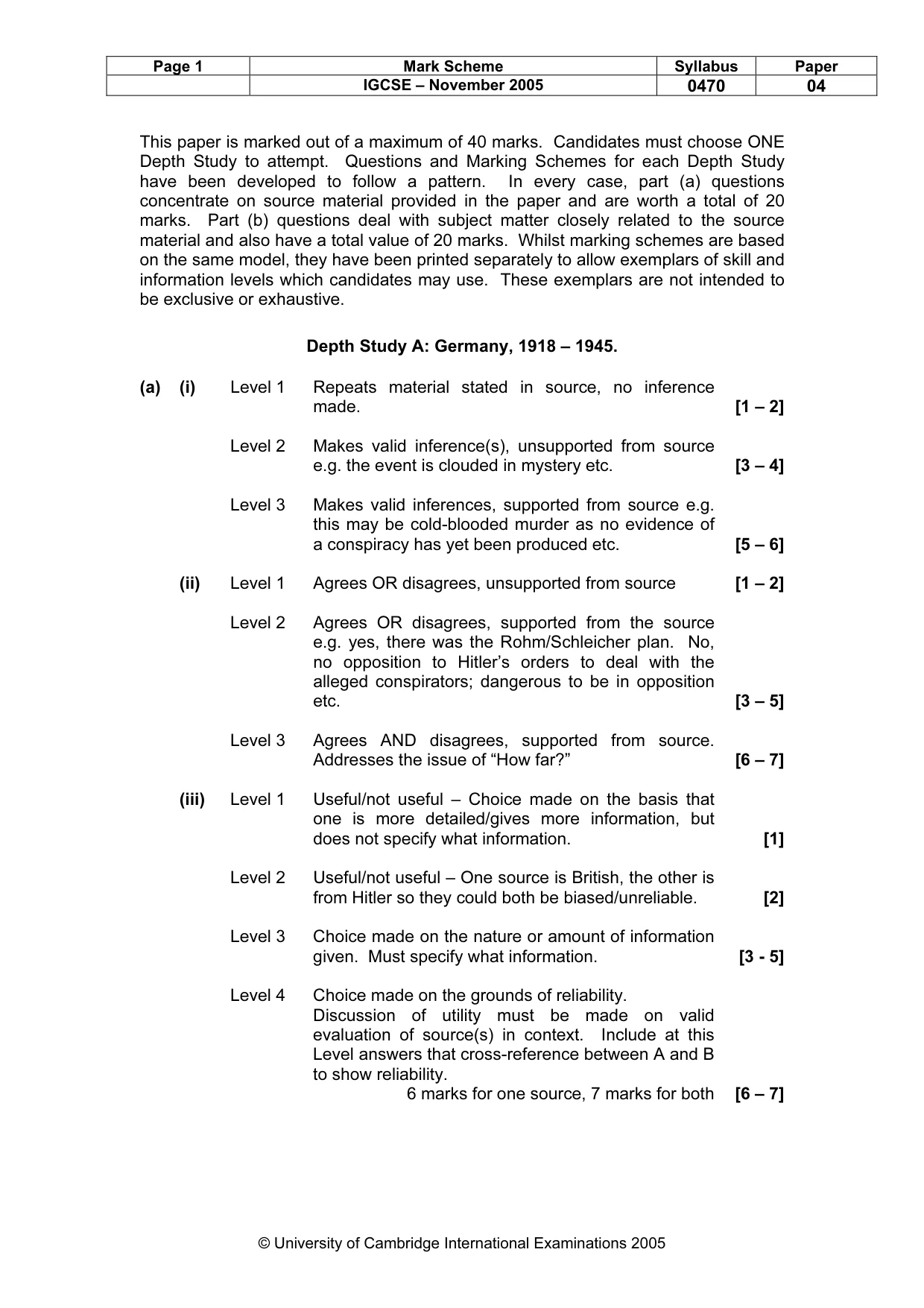
Page 1 Mark Scheme Syllabus Paper IGCSE – November 2005 0470 04 © University of Cambridge International Examinations 2005 This paper is marked out of a maximum of 40 marks. Candidates must choose ONE Depth Study to attempt. Questions and Marking Schemes for each Depth Study have been developed to follow a pattern. In every case, part (a) questions concentrate on source material provided in the paper and are worth a total of 20 marks. Part (b) questions deal with subject matter closely related to the source material and also have a total value of 20 marks. Whilst marking schemes are based on the same model, they have been printed separately to allow exemplars of skill and information levels which candidates may use. These exemplars are not intended to be exclusive or exhaustive. Depth Study A: Germany, 1918 – 1945. (a) (i) Level 1 Repeats material stated in source, no inference made. [1 – 2] Level 2 Makes valid inference(s), unsupported from source e.g. the event is clouded in mystery etc. [3 – 4] Level 3 Makes valid inferences, supported from source e.g. this may be cold-blooded murder as no evidence of a conspiracy has yet been produced etc. [5 – 6] (ii) Level 1 Agrees OR disagrees, unsupported from source [1 – 2] Level 2 Agrees OR disagrees, supported from the source e.g. yes, there was the Rohm/Schleicher plan. No, no opposition to Hitler’s orders to deal with the alleged conspirators; dangerous to be in opposition etc. [3 – 5] Level 3 Agrees AND disagrees, supported from source. Addresses the issue of “How far?” [6 – 7] (iii) Level 1 Useful/not useful – Choice made on the basis that one is more detailed/gives more information, but does not specify what information. [1] Level 2 Useful/not useful – One source is British, the other is from Hitler so they could both be biased/unreliable. [2] Level 3 Choice made on the nature or amount of information given. Must specify what information. [3 - 5] Level 4 Choice made on the grounds of reliability. Discussion of utility must be made on valid evaluation of source(s) in context. Include at this Level answers that cross-reference between A and B to show reliability. 6 marks for one source, 7 marks for both [6 – 7]
Mark scheme, page 3
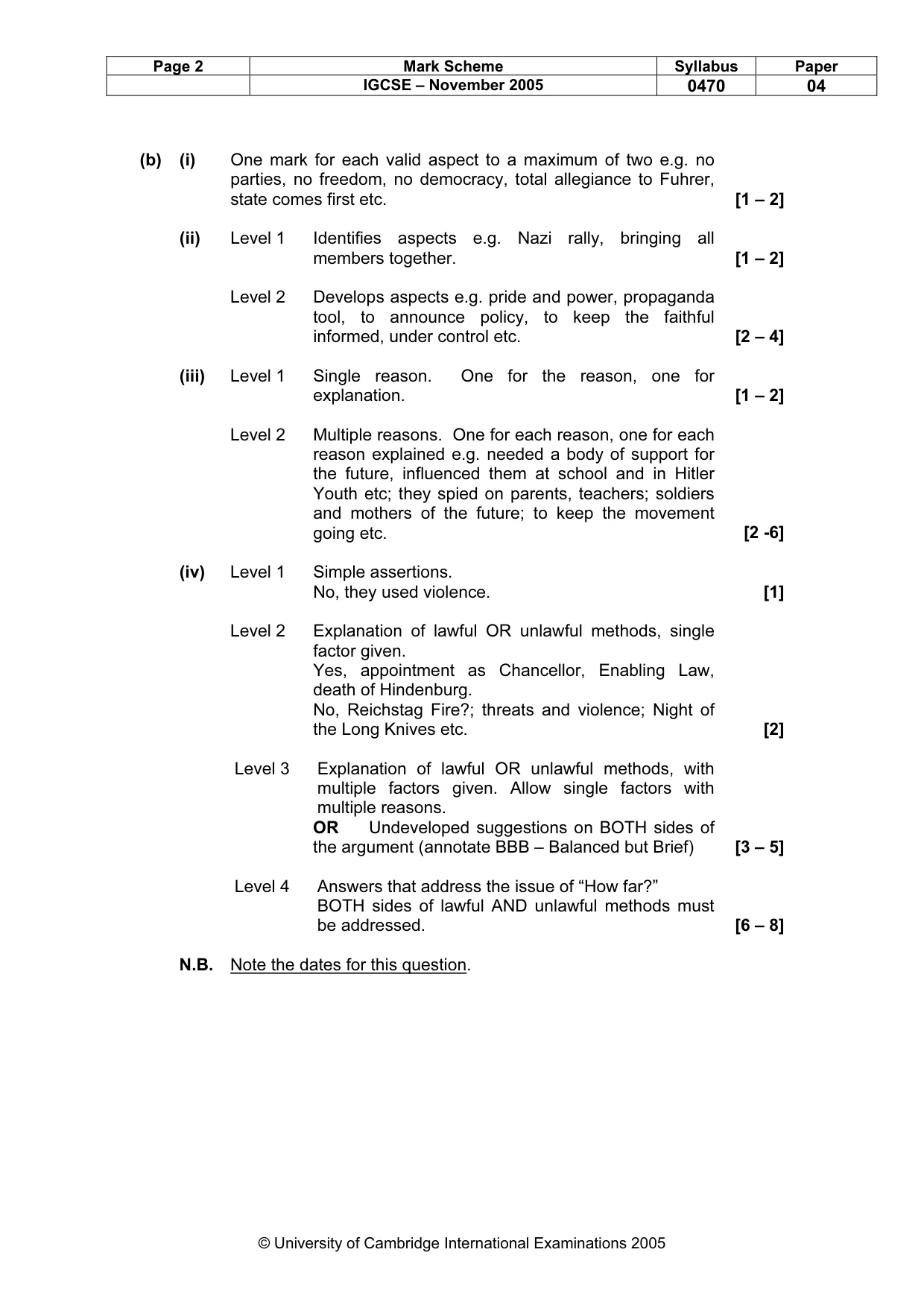
Page 2 Mark Scheme Syllabus Paper IGCSE – November 2005 0470 04 © University of Cambridge International Examinations 2005 (b) (i) One mark for each valid aspect to a maximum of two e.g. no parties, no freedom, no democracy, total allegiance to Fuhrer, state comes first etc. [1 – 2] (ii) Level 1 Identifies aspects e.g. Nazi rally, bringing all members together. [1 – 2] Level 2 Develops aspects e.g. pride and power, propaganda tool, to announce policy, to keep the faithful informed, under control etc. [2 – 4] (iii) Level 1 Single reason. One for the reason, one for explanation. [1 – 2] Level 2 Multiple reasons. One for each reason, one for each reason explained e.g. needed a body of support for the future, influenced them at school and in Hitler Youth etc; they spied on parents, teachers; soldiers and mothers of the future; to keep the movement going etc. [2 -6] (iv) Level 1 Simple assertions. No, they used violence. [1] Level 2 Explanation of lawful OR unlawful methods, single factor given. Yes, appointment as Chancellor, Enabling Law, death of Hindenburg. No, Reichstag Fire?; threats and violence; Night of the Long Knives etc. [2] Level 3 Explanation of lawful OR unlawful methods, with multiple factors given. Allow single factors with multiple reasons. OR Undeveloped suggestions on BOTH sides of the argument (annotate BBB – Balanced but Brief) [3 – 5] Level 4 Answers that address the issue of “How far?” BOTH sides of lawful AND unlawful methods must be addressed. [6 – 8] N.B. Note the dates for this question.
Mark scheme, page 4
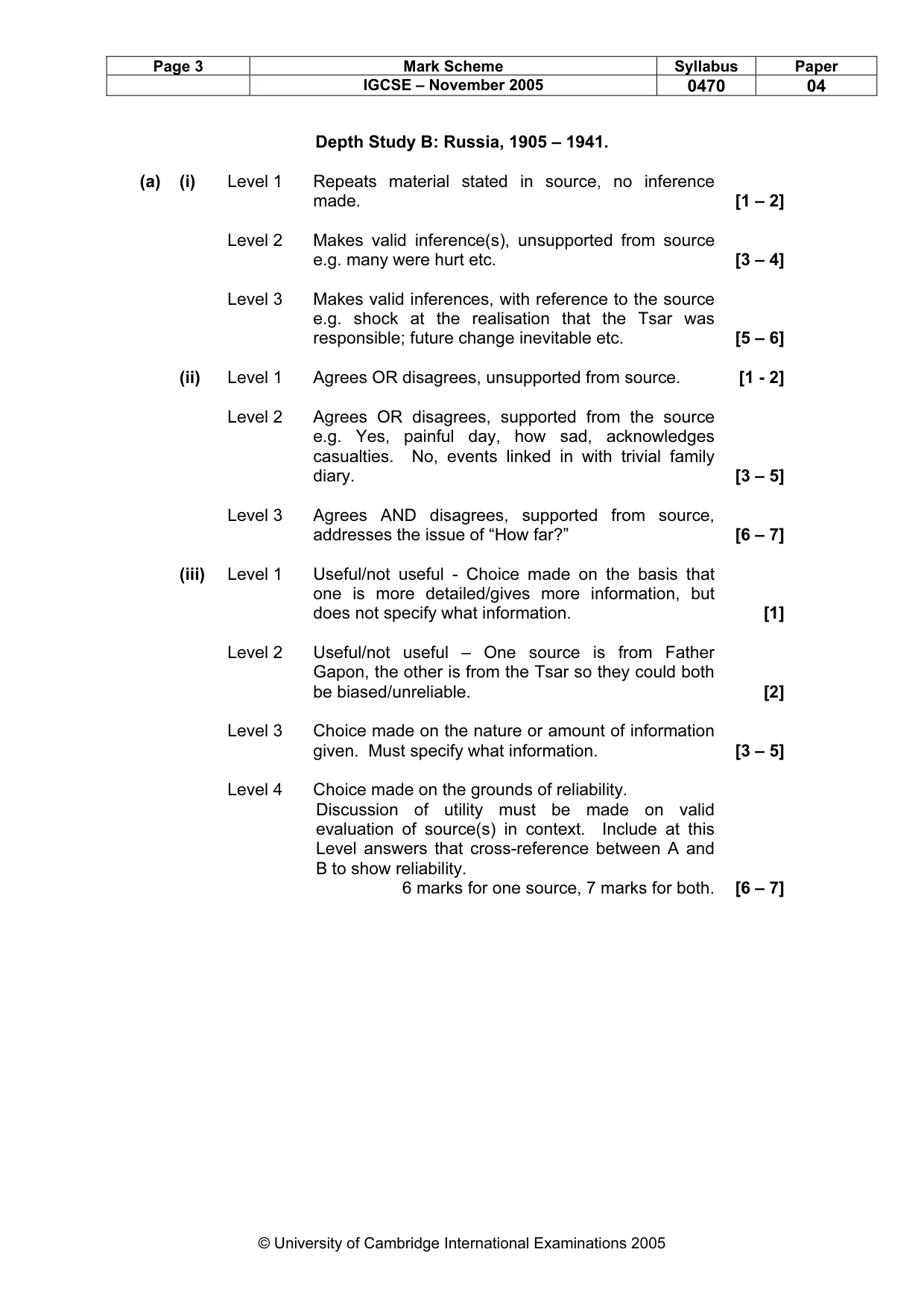
Page 3 Mark Scheme Syllabus Paper IGCSE – November 2005 0470 04 © University of Cambridge International Examinations 2005 Depth Study B: Russia, 1905 – 1941. (a) (i) Level 1 Repeats material stated in source, no inference made. [1 – 2] Level 2 Makes valid inference(s), unsupported from source e.g. many were hurt etc. [3 – 4] Level 3 Makes valid inferences, with reference to the source e.g. shock at the realisation that the Tsar was responsible; future change inevitable etc. [5 – 6] (ii) Level 1 Agrees OR disagrees, unsupported from source. [1 - 2] Level 2 Agrees OR disagrees, supported from the source e.g. Yes, painful day, how sad, acknowledges casualties. No, events linked in with trivial family diary. [3 – 5] Level 3 Agrees AND disagrees, supported from source, addresses the issue of “How far?” [6 – 7] (iii) Level 1 Useful/not useful - Choice made on the basis that one is more detailed/gives more information, but does not specify what information. [1] Level 2 Useful/not useful – One source is from Father Gapon, the other is from the Tsar so they could both be biased/unreliable. [2] Level 3 Choice made on the nature or amount of information given. Must specify what information. [3 – 5] Level 4 Choice made on the grounds of reliability. Discussion of utility must be made on valid evaluation of source(s) in context. Include at this Level answers that cross-reference between A and B to show reliability. 6 marks for one source, 7 marks for both. [6 – 7]
Mark scheme, page 5
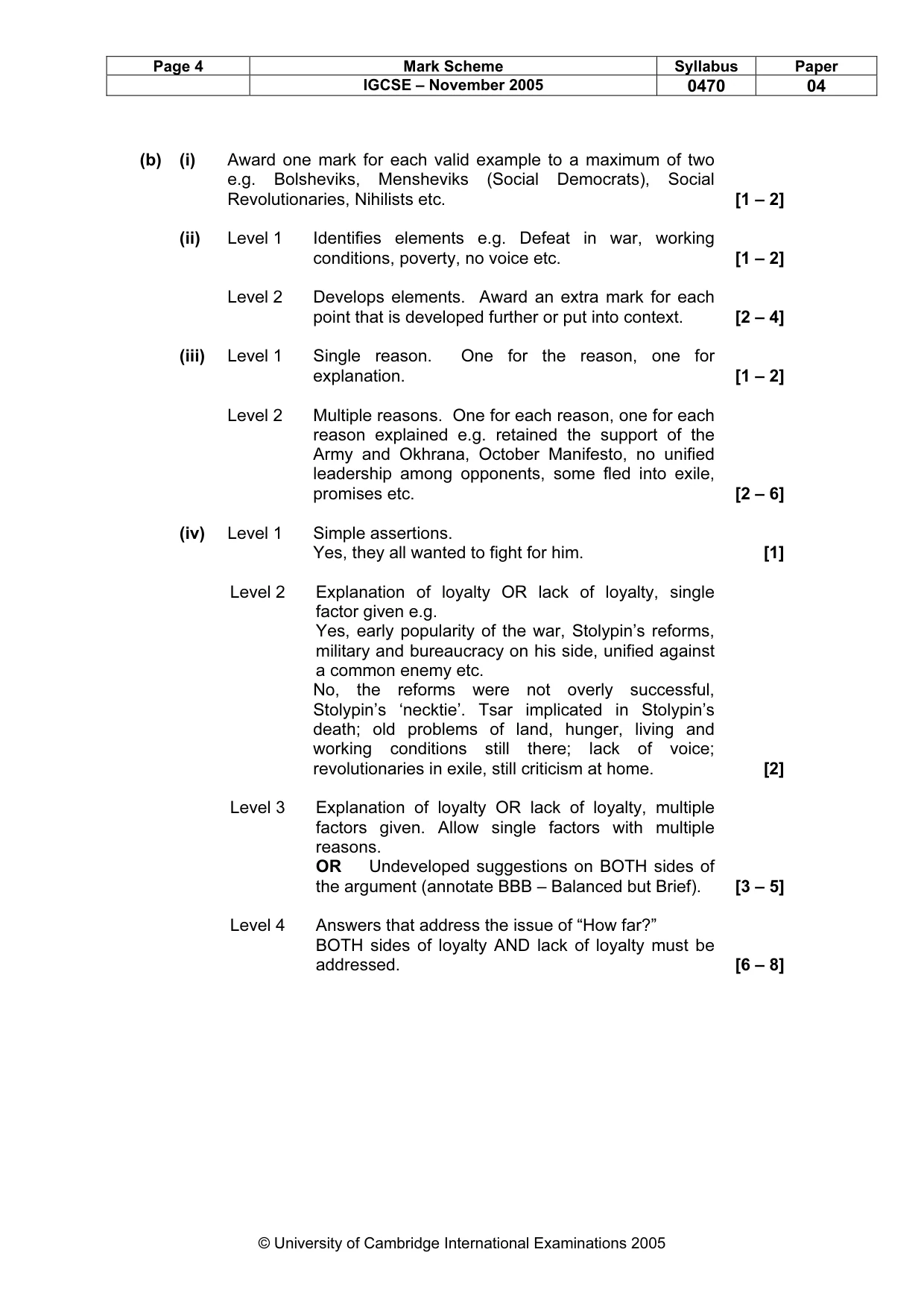
Page 4 Mark Scheme Syllabus Paper IGCSE – November 2005 0470 04 © University of Cambridge International Examinations 2005 (b) (i) Award one mark for each valid example to a maximum of two e.g. Bolsheviks, Mensheviks (Social Democrats), Social Revolutionaries, Nihilists etc. [1 – 2] (ii) Level 1 Identifies elements e.g. Defeat in war, working conditions, poverty, no voice etc. [1 – 2] Level 2 Develops elements. Award an extra mark for each point that is developed further or put into context. [2 – 4] (iii) Level 1 Single reason. One for the reason, one for explanation. [1 – 2] Level 2 Multiple reasons. One for each reason, one for each reason explained e.g. retained the support of the Army and Okhrana, October Manifesto, no unified leadership among opponents, some fled into exile, promises etc. [2 – 6] (iv) Level 1 Simple assertions. Yes, they all wanted to fight for him. [1] Level 2 Explanation of loyalty OR lack of loyalty, single factor given e.g. Yes, early popularity of the war, Stolypin’s reforms, military and bureaucracy on his side, unified against a common enemy etc. No, the reforms were not overly successful, Stolypin’s ‘necktie’. Tsar implicated in Stolypin’s death; old problems of land, hunger, living and working conditions still there; lack of voice; revolutionaries in exile, still criticism at home. [2] Level 3 Explanation of loyalty OR lack of loyalty, multiple factors given. Allow single factors with multiple reasons. OR Undeveloped suggestions on BOTH sides of the argument (annotate BBB – Balanced but Brief). [3 – 5] Level 4 Answers that address the issue of “How far?” BOTH sides of loyalty AND lack of loyalty must be addressed. [6 – 8]
Mark scheme, page 6
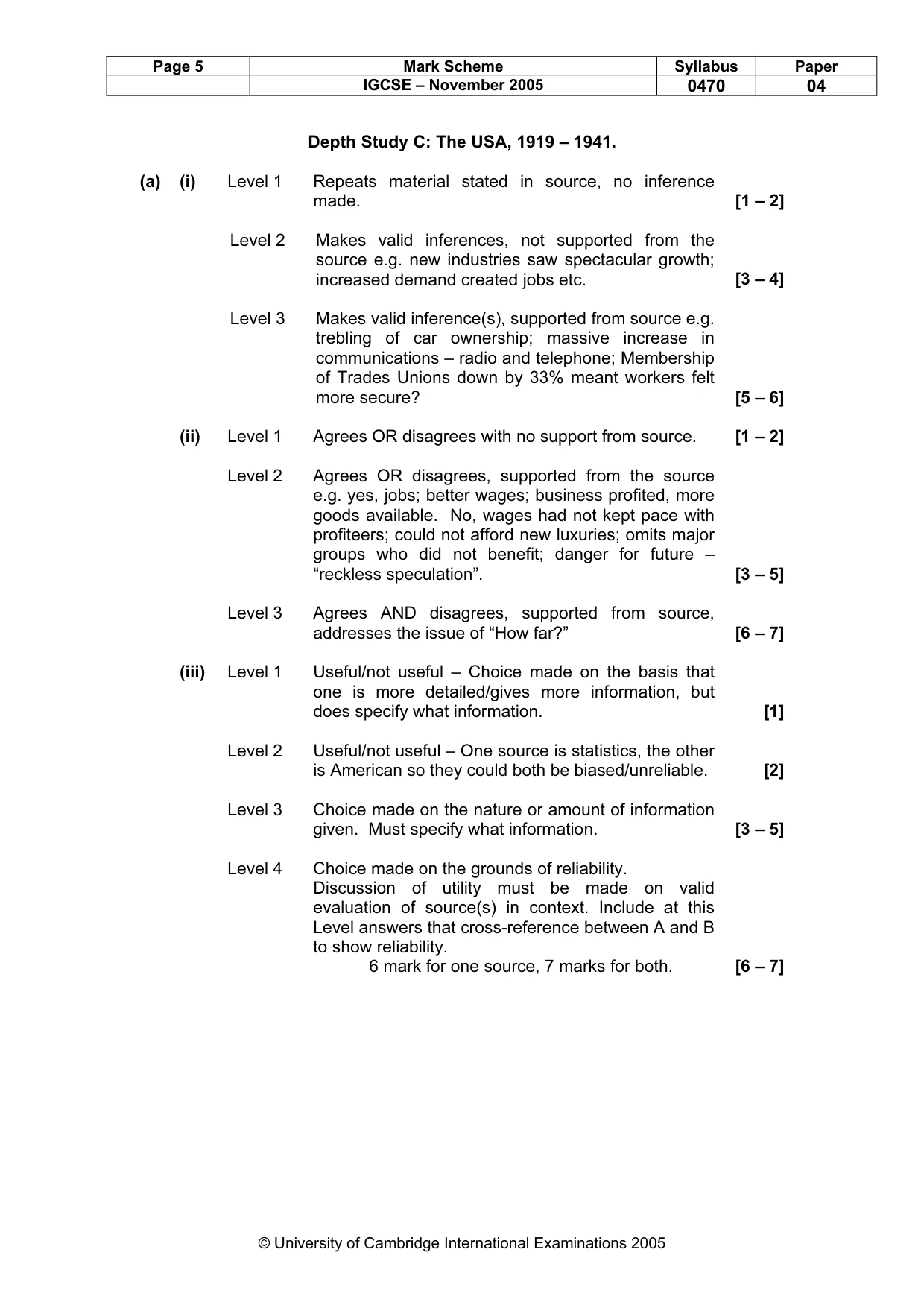
Page 5 Mark Scheme Syllabus Paper IGCSE – November 2005 0470 04 © University of Cambridge International Examinations 2005 Depth Study C: The USA, 1919 – 1941. (a) (i) Level 1 Repeats material stated in source, no inference made. [1 – 2] Level 2 Makes valid inferences, not supported from the source e.g. new industries saw spectacular growth; increased demand created jobs etc. [3 – 4] Level 3 Makes valid inference(s), supported from source e.g. trebling of car ownership; massive increase in communications – radio and telephone; Membership of Trades Unions down by 33% meant workers felt more secure? [5 – 6] (ii) Level 1 Agrees OR disagrees with no support from source. [1 – 2] Level 2 Agrees OR disagrees, supported from the source e.g. yes, jobs; better wages; business profited, more goods available. No, wages had not kept pace with profiteers; could not afford new luxuries; omits major groups who did not benefit; danger for future – “reckless speculation”. [3 – 5] Level 3 Agrees AND disagrees, supported from source, addresses the issue of “How far?” [6 – 7] (iii) Level 1 Useful/not useful – Choice made on the basis that one is more detailed/gives more information, but does specify what information. [1] Level 2 Useful/not useful – One source is statistics, the other is American so they could both be biased/unreliable. [2] Level 3 Choice made on the nature or amount of information given. Must specify what information. [3 – 5] Level 4 Choice made on the grounds of reliability. Discussion of utility must be made on valid evaluation of source(s) in context. Include at this Level answers that cross-reference between A and B to show reliability. 6 mark for one source, 7 marks for both. [6 – 7]
Mark scheme, page 7
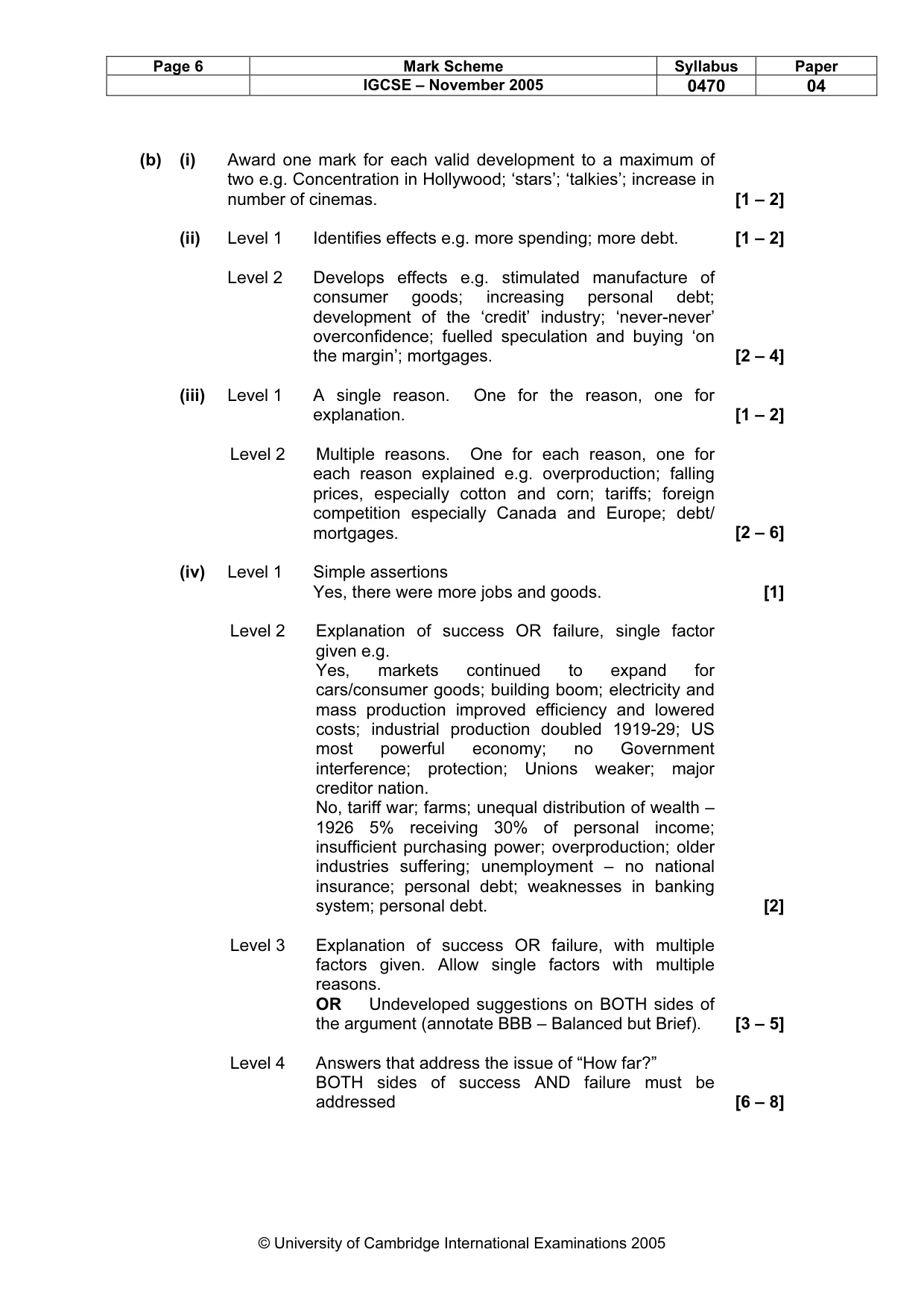
Page 6 Mark Scheme Syllabus Paper IGCSE – November 2005 0470 04 © University of Cambridge International Examinations 2005 (b) (i) Award one mark for each valid development to a maximum of two e.g. Concentration in Hollywood; ‘stars’; ‘talkies’; increase in number of cinemas. [1 – 2] (ii) Level 1 Identifies effects e.g. more spending; more debt. [1 – 2] Level 2 Develops effects e.g. stimulated manufacture of consumer goods; increasing personal debt; development of the ‘credit’ industry; ‘never-never’ overconfidence; fuelled speculation and buying ‘on the margin’; mortgages. [2 – 4] (iii) Level 1 A single reason. One for the reason, one for explanation. [1 – 2] Level 2 Multiple reasons. One for each reason, one for each reason explained e.g. overproduction; falling prices, especially cotton and corn; tariffs; foreign competition especially Canada and Europe; debt/ mortgages. [2 – 6] (iv) Level 1 Simple assertions Yes, there were more jobs and goods. [1] Level 2 Explanation of success OR failure, single factor given e.g. Yes, markets continued to expand for cars/consumer goods; building boom; electricity and mass production improved efficiency and lowered costs; industrial production doubled 1919-29; US most powerful economy; no Government interference; protection; Unions weaker; major creditor nation. No, tariff war; farms; unequal distribution of wealth – 1926 5% receiving 30% of personal income; insufficient purchasing power; overproduction; older industries suffering; unemployment – no national insurance; personal debt; weaknesses in banking system; personal debt. [2] Level 3 Explanation of success OR failure, with multiple factors given. Allow single factors with multiple reasons. OR Undeveloped suggestions on BOTH sides of the argument (annotate BBB – Balanced but Brief). [3 – 5] Level 4 Answers that address the issue of “How far?” BOTH sides of success AND failure must be addressed [6 – 8]
Mark scheme, page 8
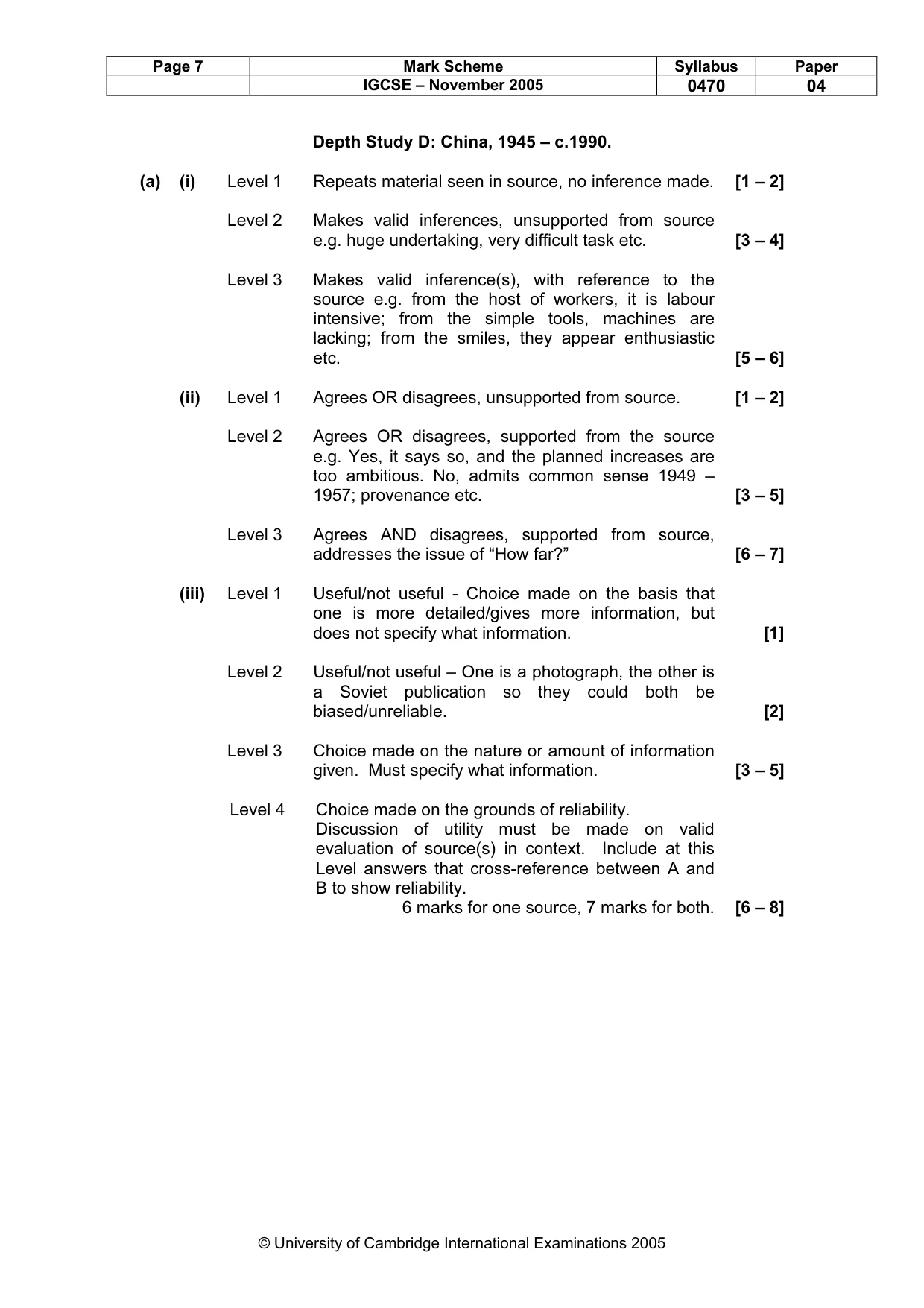
Page 7 Mark Scheme Syllabus Paper IGCSE – November 2005 0470 04 © University of Cambridge International Examinations 2005 Depth Study D: China, 1945 – c.1990. (a) (i) Level 1 Repeats material seen in source, no inference made. [1 – 2] Level 2 Makes valid inferences, unsupported from source e.g. huge undertaking, very difficult task etc. [3 – 4] Level 3 Makes valid inference(s), with reference to the source e.g. from the host of workers, it is labour intensive; from the simple tools, machines are lacking; from the smiles, they appear enthusiastic etc. [5 – 6] (ii) Level 1 Agrees OR disagrees, unsupported from source. [1 – 2] Level 2 Agrees OR disagrees, supported from the source e.g. Yes, it says so, and the planned increases are too ambitious. No, admits common sense 1949 – 1957; provenance etc. [3 – 5] Level 3 Agrees AND disagrees, supported from source, addresses the issue of “How far?” [6 – 7] (iii) Level 1 Useful/not useful - Choice made on the basis that one is more detailed/gives more information, but does not specify what information. [1] Level 2 Useful/not useful – One is a photograph, the other is a Soviet publication so they could both be biased/unreliable. [2] Level 3 Choice made on the nature or amount of information given. Must specify what information. [3 – 5] Level 4 Choice made on the grounds of reliability. Discussion of utility must be made on valid evaluation of source(s) in context. Include at this Level answers that cross-reference between A and B to show reliability. 6 marks for one source, 7 marks for both. [6 – 8]
Mark scheme, page 9
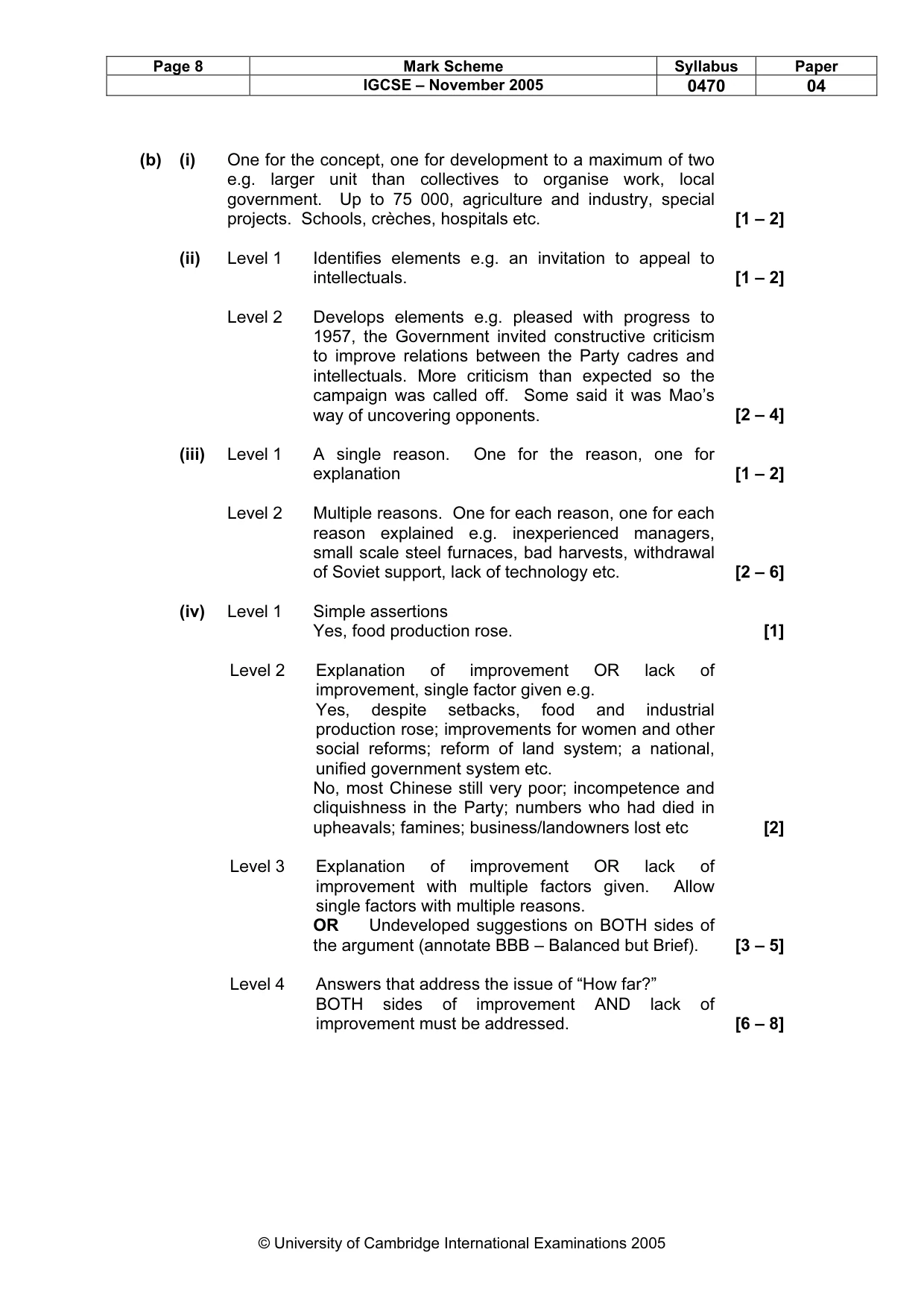
Page 8 Mark Scheme Syllabus Paper IGCSE – November 2005 0470 04 © University of Cambridge International Examinations 2005 (b) (i) One for the concept, one for development to a maximum of two e.g. larger unit than collectives to organise work, local government. Up to 75 000, agriculture and industry, special projects. Schools, crèches, hospitals etc. [1 – 2] (ii) Level 1 Identifies elements e.g. an invitation to appeal to intellectuals. [1 – 2] Level 2 Develops elements e.g. pleased with progress to 1957, the Government invited constructive criticism to improve relations between the Party cadres and intellectuals. More criticism than expected so the campaign was called off. Some said it was Mao’s way of uncovering opponents. [2 – 4] (iii) Level 1 A single reason. One for the reason, one for explanation [1 – 2] Level 2 Multiple reasons. One for each reason, one for each reason explained e.g. inexperienced managers, small scale steel furnaces, bad harvests, withdrawal of Soviet support, lack of technology etc. [2 – 6] (iv) Level 1 Simple assertions Yes, food production rose. [1] Level 2 Explanation of improvement OR lack of improvement, single factor given e.g. Yes, despite setbacks, food and industrial production rose; improvements for women and other social reforms; reform of land system; a national, unified government system etc. No, most Chinese still very poor; incompetence and cliquishness in the Party; numbers who had died in upheavals; famines; business/landowners lost etc [2] Level 3 Explanation of improvement OR lack of improvement with multiple factors given. Allow single factors with multiple reasons. OR Undeveloped suggestions on BOTH sides of the argument (annotate BBB – Balanced but Brief). [3 – 5] Level 4 Answers that address the issue of “How far?” BOTH sides of improvement AND lack of improvement must be addressed. [6 – 8]
Mark scheme, page 10
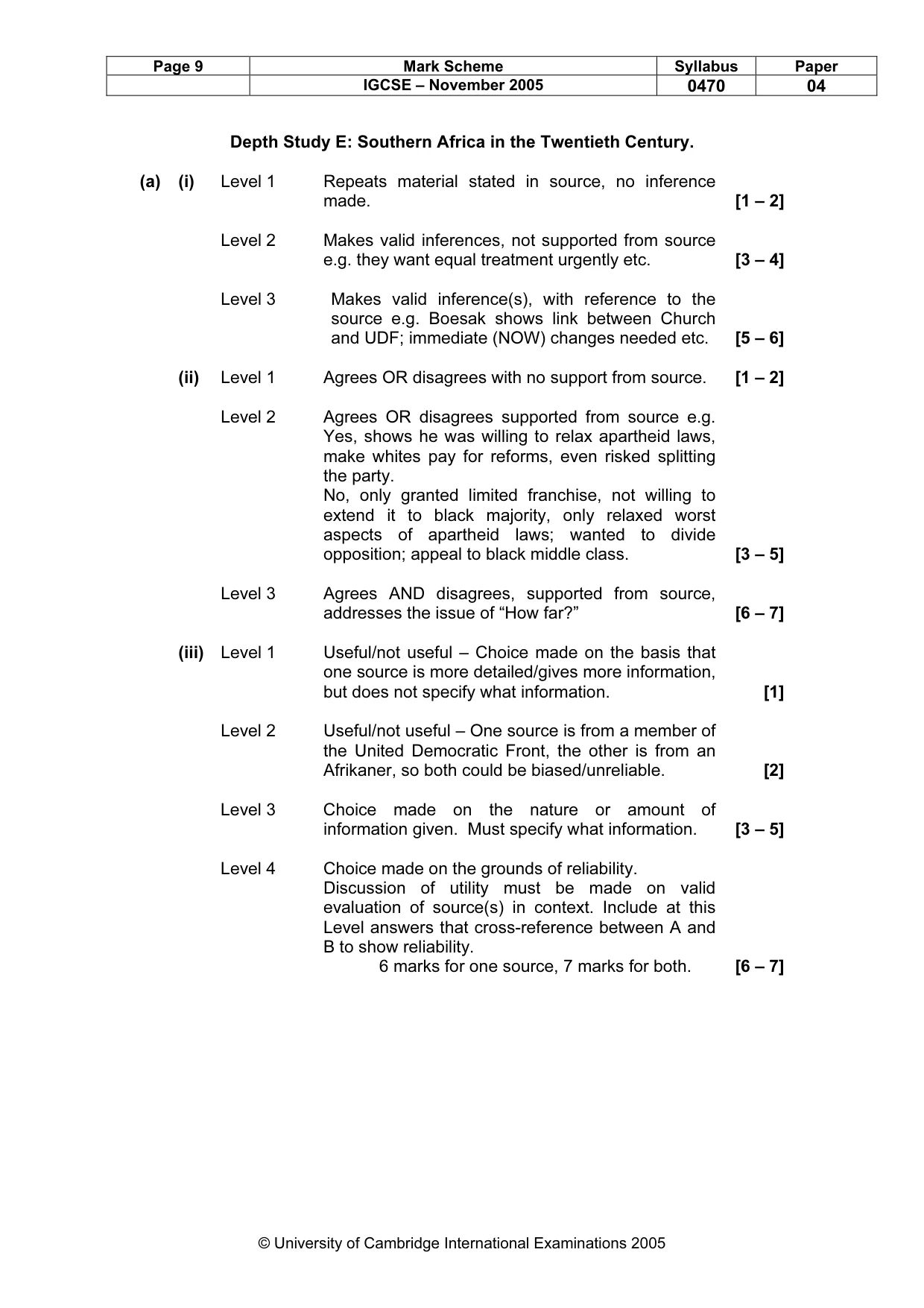
Page 9 Mark Scheme Syllabus Paper IGCSE – November 2005 0470 04 © University of Cambridge International Examinations 2005 Depth Study E: Southern Africa in the Twentieth Century. (a) (i) Level 1 Repeats material stated in source, no inference made. [1 – 2] Level 2 Makes valid inferences, not supported from source e.g. they want equal treatment urgently etc. [3 – 4] Level 3 Makes valid inference(s), with reference to the source e.g. Boesak shows link between Church and UDF; immediate (NOW) changes needed etc. [5 – 6] (ii) Level 1 Agrees OR disagrees with no support from source. [1 – 2] Level 2 Agrees OR disagrees supported from source e.g. Yes, shows he was willing to relax apartheid laws, make whites pay for reforms, even risked splitting the party. No, only granted limited franchise, not willing to extend it to black majority, only relaxed worst aspects of apartheid laws; wanted to divide opposition; appeal to black middle class. [3 – 5] Level 3 Agrees AND disagrees, supported from source, addresses the issue of “How far?” [6 – 7] (iii) Level 1 Useful/not useful – Choice made on the basis that one source is more detailed/gives more information, but does not specify what information. [1] Level 2 Useful/not useful – One source is from a member of the United Democratic Front, the other is from an Afrikaner, so both could be biased/unreliable. [2] Level 3 Choice made on the nature or amount of information given. Must specify what information. [3 – 5] Level 4 Choice made on the grounds of reliability. Discussion of utility must be made on valid evaluation of source(s) in context. Include at this Level answers that cross-reference between A and B to show reliability. 6 marks for one source, 7 marks for both. [6 – 7]
Mark scheme, page 11
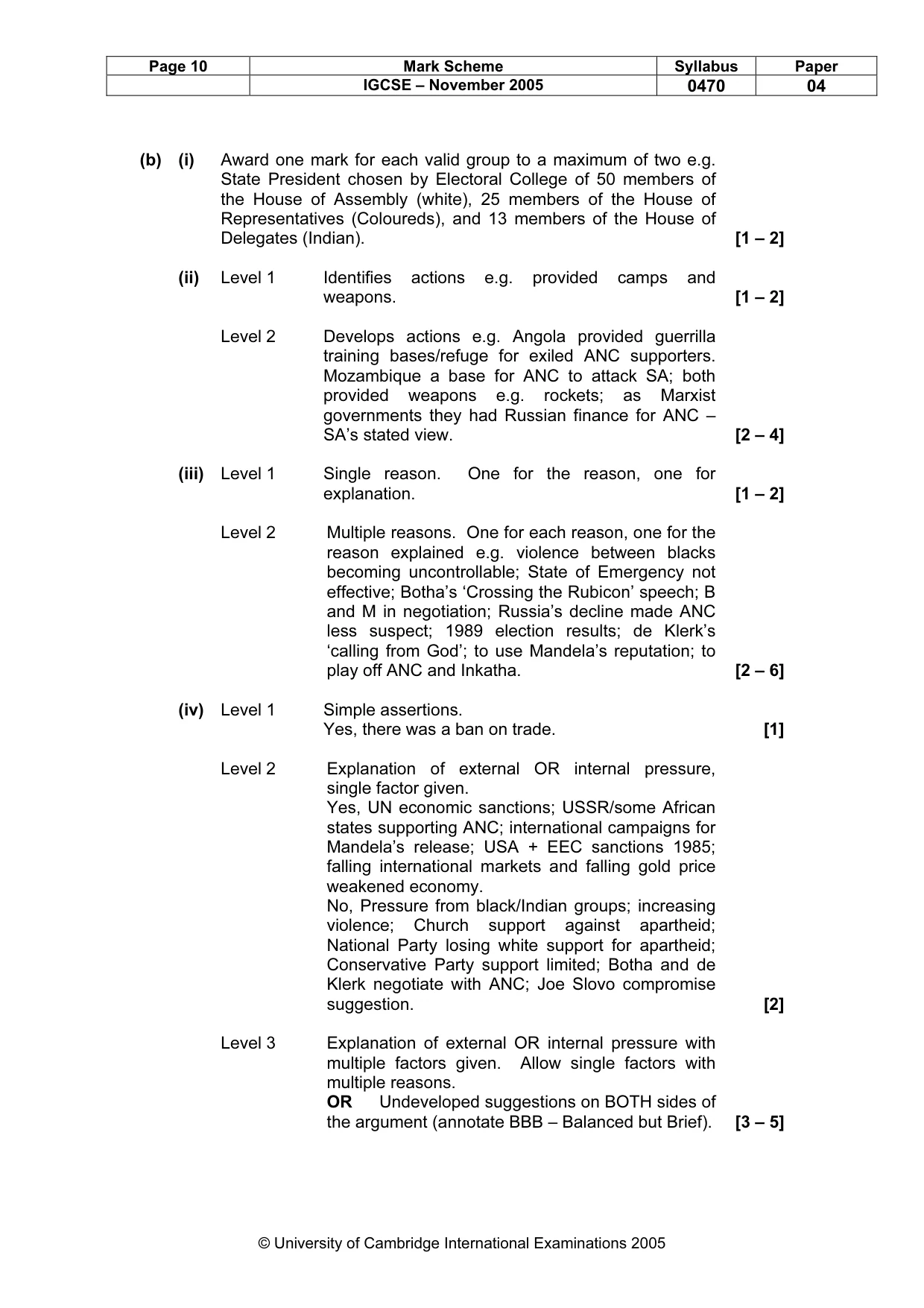
Page 10 Mark Scheme Syllabus Paper IGCSE – November 2005 0470 04 © University of Cambridge International Examinations 2005 (b) (i) Award one mark for each valid group to a maximum of two e.g. State President chosen by Electoral College of 50 members of the House of Assembly (white), 25 members of the House of Representatives (Coloureds), and 13 members of the House of Delegates (Indian). [1 – 2] (ii) Level 1 Identifies actions e.g. provided camps and weapons. [1 – 2] Level 2 Develops actions e.g. Angola provided guerrilla training bases/refuge for exiled ANC supporters. Mozambique a base for ANC to attack SA; both provided weapons e.g. rockets; as Marxist governments they had Russian finance for ANC – SA’s stated view. [2 – 4] (iii) Level 1 Single reason. One for the reason, one for explanation. [1 – 2] Level 2 Multiple reasons. One for each reason, one for the reason explained e.g. violence between blacks becoming uncontrollable; State of Emergency not effective; Botha’s ‘Crossing the Rubicon’ speech; B and M in negotiation; Russia’s decline made ANC less suspect; 1989 election results; de Klerk’s ‘calling from God’; to use Mandela’s reputation; to play off ANC and Inkatha. [2 – 6] (iv) Level 1 Simple assertions. Yes, there was a ban on trade. [1] Level 2 Explanation of external OR internal pressure, single factor given. Yes, UN economic sanctions; USSR/some African states supporting ANC; international campaigns for Mandela’s release; USA + EEC sanctions 1985; falling international markets and falling gold price weakened economy. No, Pressure from black/Indian groups; increasing violence; Church support against apartheid; National Party losing white support for apartheid; Conservative Party support limited; Botha and de Klerk negotiate with ANC; Joe Slovo compromise suggestion. [2] Level 3 Explanation of external OR internal pressure with multiple factors given. Allow single factors with multiple reasons. OR Undeveloped suggestions on BOTH sides of the argument (annotate BBB – Balanced but Brief). [3 – 5]
Mark scheme, page 12
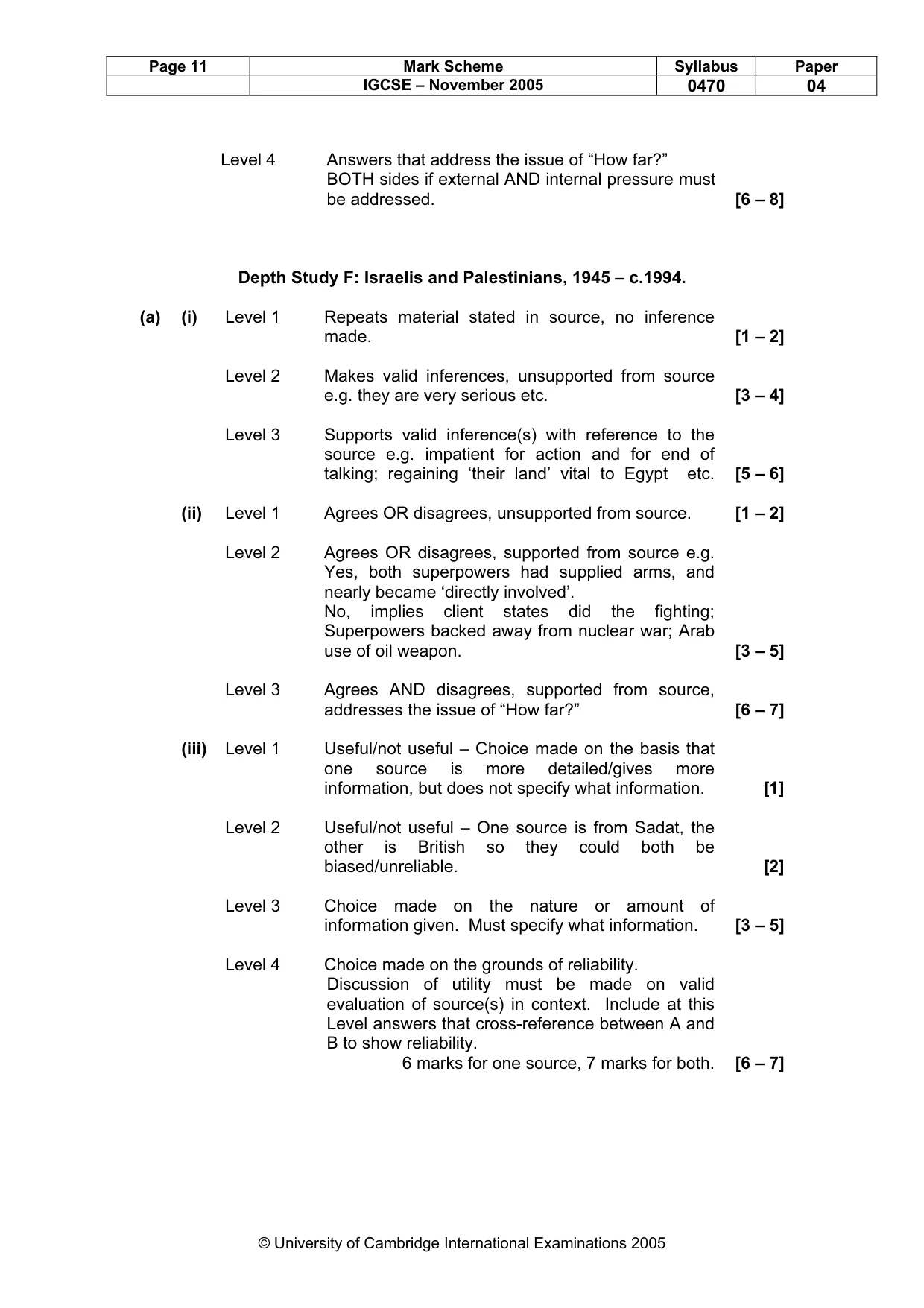
Page 11 Mark Scheme Syllabus Paper IGCSE – November 2005 0470 04 © University of Cambridge International Examinations 2005 Level 4 Answers that address the issue of “How far?” BOTH sides if external AND internal pressure must be addressed. [6 – 8] Depth Study F: Israelis and Palestinians, 1945 – c.1994. (a) (i) Level 1 Repeats material stated in source, no inference made. [1 – 2] Level 2 Makes valid inferences, unsupported from source e.g. they are very serious etc. [3 – 4] Level 3 Supports valid inference(s) with reference to the source e.g. impatient for action and for end of talking; regaining ‘their land’ vital to Egypt etc. [5 – 6] (ii) Level 1 Agrees OR disagrees, unsupported from source. [1 – 2] Level 2 Agrees OR disagrees, supported from source e.g. Yes, both superpowers had supplied arms, and nearly became ‘directly involved’. No, implies client states did the fighting; Superpowers backed away from nuclear war; Arab use of oil weapon. [3 – 5] Level 3 Agrees AND disagrees, supported from source, addresses the issue of “How far?” [6 – 7] (iii) Level 1 Useful/not useful – Choice made on the basis that one source is more detailed/gives more information, but does not specify what information. [1] Level 2 Useful/not useful – One source is from Sadat, the other is British so they could both be biased/unreliable. [2] Level 3 Choice made on the nature or amount of information given. Must specify what information. [3 – 5] Level 4 Choice made on the grounds of reliability. Discussion of utility must be made on valid evaluation of source(s) in context. Include at this Level answers that cross-reference between A and B to show reliability. 6 marks for one source, 7 marks for both. [6 – 7]
Mark scheme, page 13
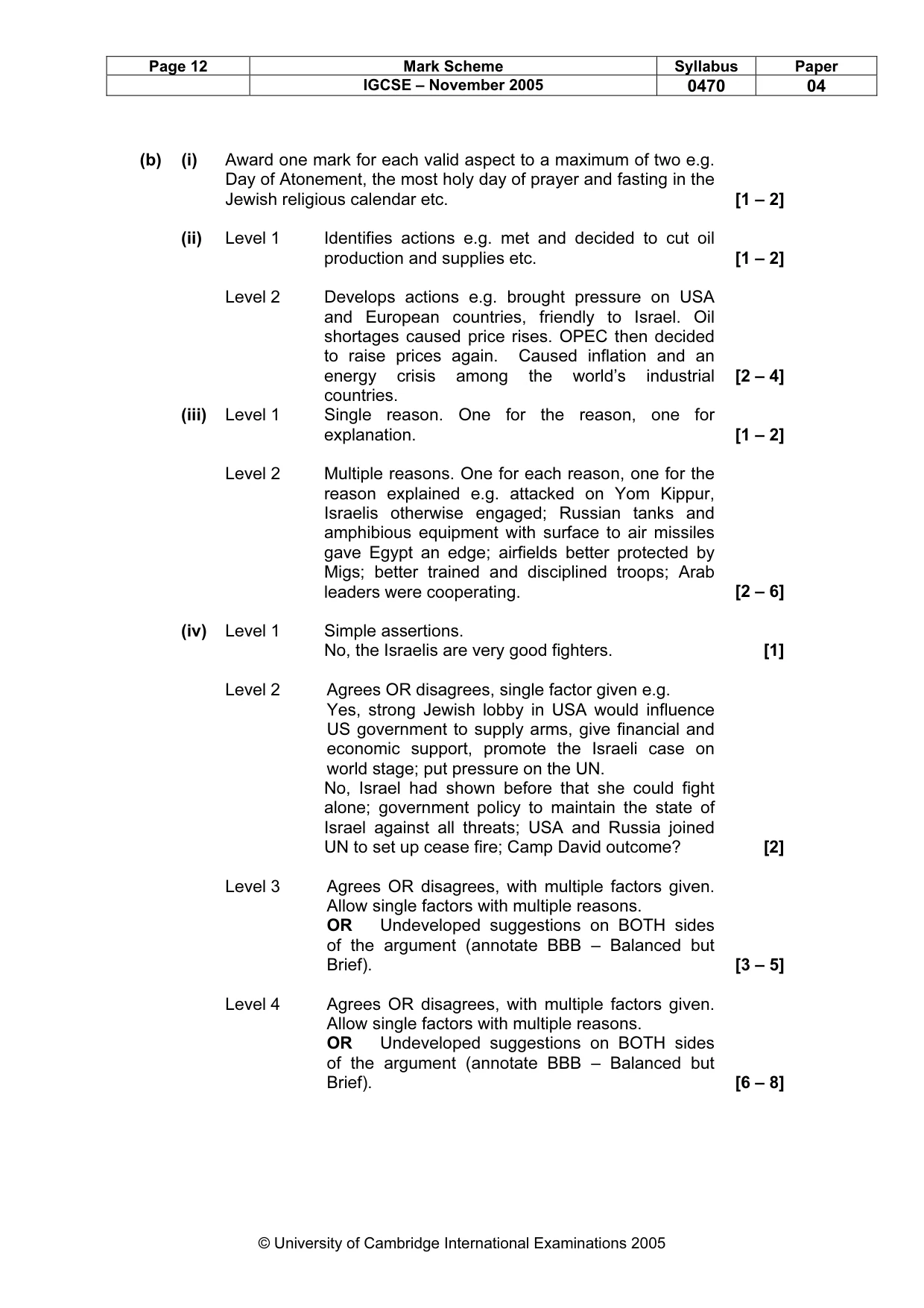
Page 12 Mark Scheme Syllabus Paper IGCSE – November 2005 0470 04 © University of Cambridge International Examinations 2005 (b) (i) Award one mark for each valid aspect to a maximum of two e.g. Day of Atonement, the most holy day of prayer and fasting in the Jewish religious calendar etc. [1 – 2] (ii) Level 1 Identifies actions e.g. met and decided to cut oil production and supplies etc. [1 – 2] Level 2 Develops actions e.g. brought pressure on USA and European countries, friendly to Israel. Oil shortages caused price rises. OPEC then decided to raise prices again. Caused inflation and an energy crisis among the world’s industrial countries. [2 – 4] (iii) Level 1 Single reason. One for the reason, one for explanation. [1 – 2] Level 2 Multiple reasons. One for each reason, one for the reason explained e.g. attacked on Yom Kippur, Israelis otherwise engaged; Russian tanks and amphibious equipment with surface to air missiles gave Egypt an edge; airfields better protected by Migs; better trained and disciplined troops; Arab leaders were cooperating. [2 – 6] (iv) Level 1 Simple assertions. No, the Israelis are very good fighters. [1] Level 2 Agrees OR disagrees, single factor given e.g. Yes, strong Jewish lobby in USA would influence US government to supply arms, give financial and economic support, promote the Israeli case on world stage; put pressure on the UN. No, Israel had shown before that she could fight alone; government policy to maintain the state of Israel against all threats; USA and Russia joined UN to set up cease fire; Camp David outcome? [2] Level 3 Agrees OR disagrees, with multiple factors given. Allow single factors with multiple reasons. OR Undeveloped suggestions on BOTH sides of the argument (annotate BBB – Balanced but Brief). [3 – 5] Level 4 Agrees OR disagrees, with multiple factors given. Allow single factors with multiple reasons. OR Undeveloped suggestions on BOTH sides of the argument (annotate BBB – Balanced but Brief). [6 – 8]
Mark scheme, page 14
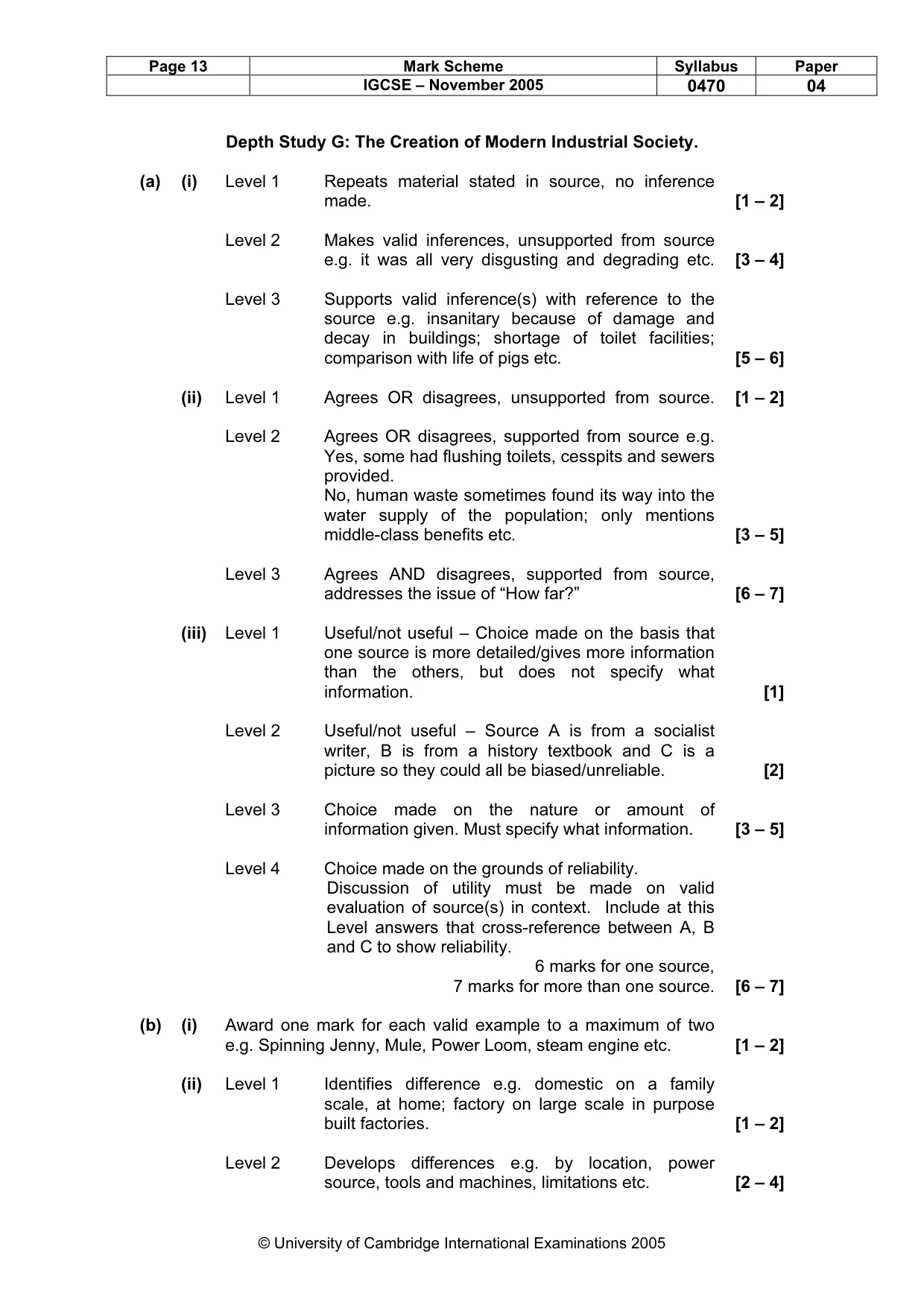
Page 13 Mark Scheme Syllabus Paper IGCSE – November 2005 0470 04 © University of Cambridge International Examinations 2005 Depth Study G: The Creation of Modern Industrial Society. (a) (i) Level 1 Repeats material stated in source, no inference made. [1 – 2] Level 2 Makes valid inferences, unsupported from source e.g. it was all very disgusting and degrading etc. [3 – 4] Level 3 Supports valid inference(s) with reference to the source e.g. insanitary because of damage and decay in buildings; shortage of toilet facilities; comparison with life of pigs etc. [5 – 6] (ii) Level 1 Agrees OR disagrees, unsupported from source. [1 – 2] Level 2 Agrees OR disagrees, supported from source e.g. Yes, some had flushing toilets, cesspits and sewers provided. No, human waste sometimes found its way into the water supply of the population; only mentions middle-class benefits etc. [3 – 5] Level 3 Agrees AND disagrees, supported from source, addresses the issue of “How far?” [6 – 7] (iii) Level 1 Useful/not useful – Choice made on the basis that one source is more detailed/gives more information than the others, but does not specify what information. [1] Level 2 Useful/not useful – Source A is from a socialist writer, B is from a history textbook and C is a picture so they could all be biased/unreliable. [2] Level 3 Choice made on the nature or amount of information given. Must specify what information. [3 – 5] Level 4 Choice made on the grounds of reliability. Discussion of utility must be made on valid evaluation of source(s) in context. Include at this Level answers that cross-reference between A, B and C to show reliability. 6 marks for one source, 7 marks for more than one source. [6 – 7] (b) (i) Award one mark for each valid example to a maximum of two e.g. Spinning Jenny, Mule, Power Loom, steam engine etc. [1 – 2] (ii) Level 1 Identifies difference e.g. domestic on a family scale, at home; factory on large scale in purpose built factories. [1 – 2] Level 2 Develops differences e.g. by location, power source, tools and machines, limitations etc. [2 – 4]
Mark scheme, page 15
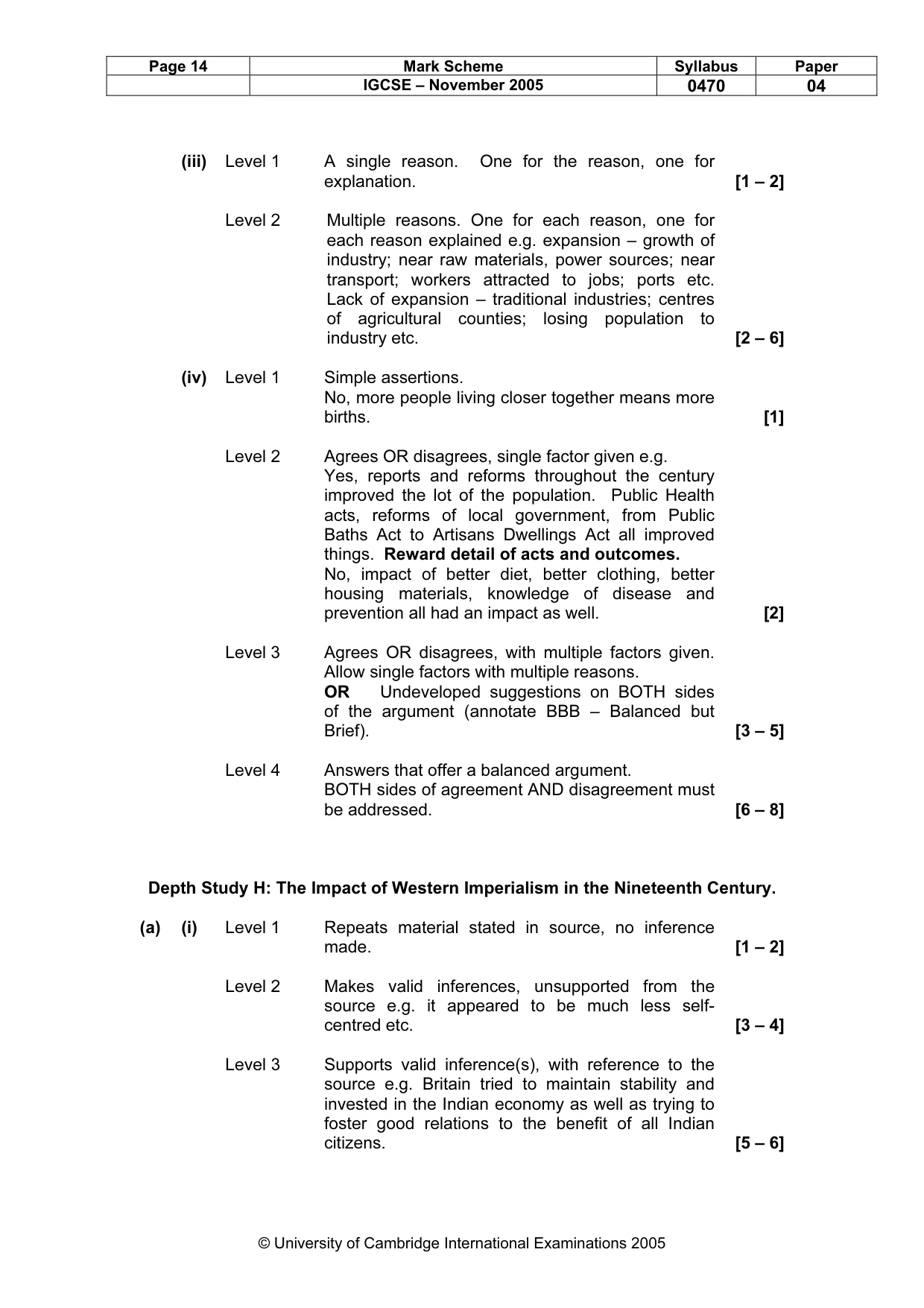
Page 14 Mark Scheme Syllabus Paper IGCSE – November 2005 0470 04 © University of Cambridge International Examinations 2005 (iii) Level 1 A single reason. One for the reason, one for explanation. [1 – 2] Level 2 Multiple reasons. One for each reason, one for each reason explained e.g. expansion – growth of industry; near raw materials, power sources; near transport; workers attracted to jobs; ports etc. Lack of expansion – traditional industries; centres of agricultural counties; losing population to industry etc. [2 – 6] (iv) Level 1 Simple assertions. No, more people living closer together means more births. [1] Level 2 Agrees OR disagrees, single factor given e.g. Yes, reports and reforms throughout the century improved the lot of the population. Public Health acts, reforms of local government, from Public Baths Act to Artisans Dwellings Act all improved things. Reward detail of acts and outcomes. No, impact of better diet, better clothing, better housing materials, knowledge of disease and prevention all had an impact as well. [2] Level 3 Agrees OR disagrees, with multiple factors given. Allow single factors with multiple reasons. OR Undeveloped suggestions on BOTH sides of the argument (annotate BBB – Balanced but Brief). [3 – 5] Level 4 Answers that offer a balanced argument. BOTH sides of agreement AND disagreement must be addressed. [6 – 8] Depth Study H: The Impact of Western Imperialism in the Nineteenth Century. (a) (i) Level 1 Repeats material stated in source, no inference made. [1 – 2] Level 2 Makes valid inferences, unsupported from the source e.g. it appeared to be much less self- centred etc. [3 – 4] Level 3 Supports valid inference(s), with reference to the source e.g. Britain tried to maintain stability and invested in the Indian economy as well as trying to foster good relations to the benefit of all Indian citizens. [5 – 6]
Mark scheme, page 16
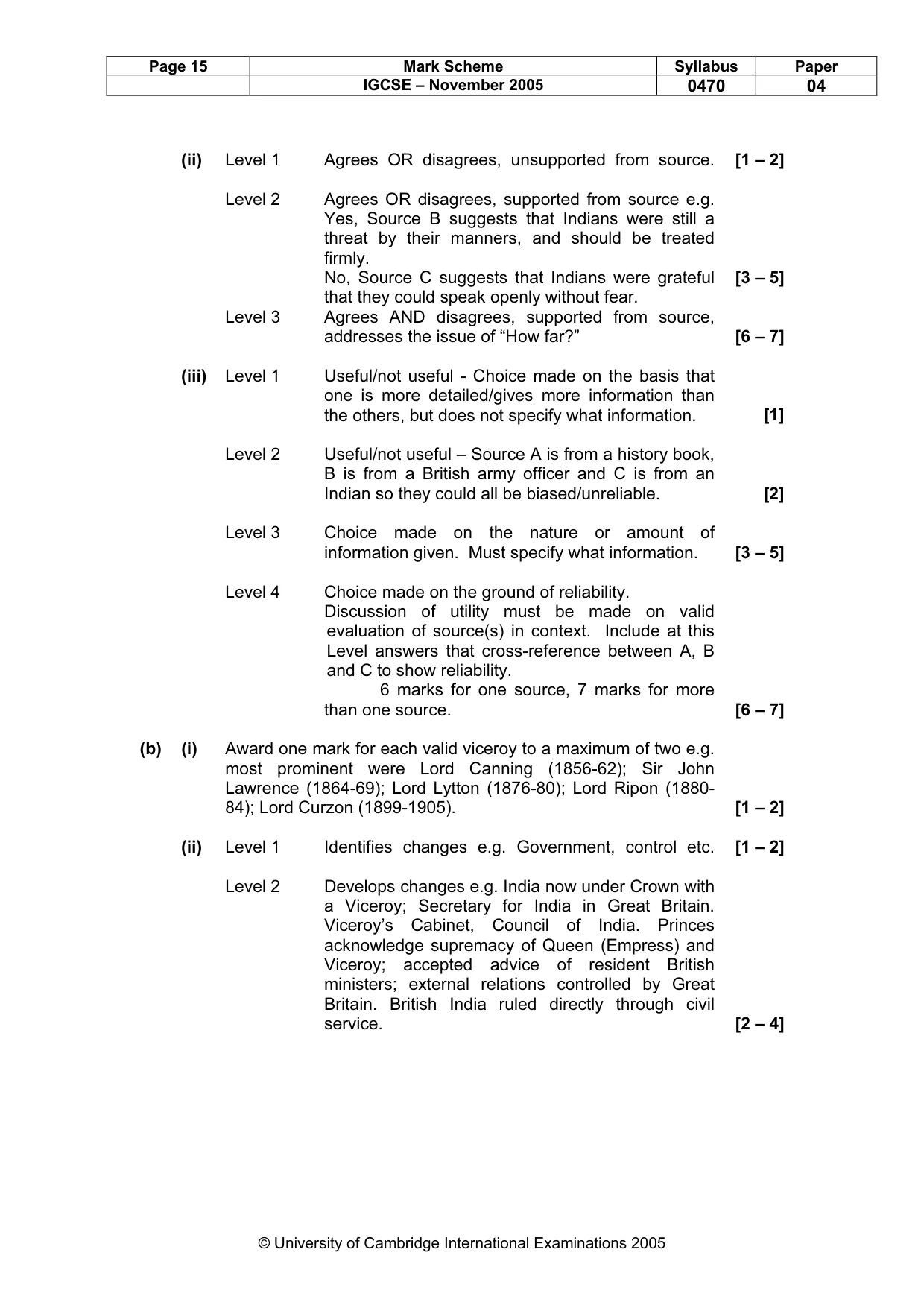
Page 15 Mark Scheme Syllabus Paper IGCSE – November 2005 0470 04 © University of Cambridge International Examinations 2005 (ii) Level 1 Agrees OR disagrees, unsupported from source. [1 – 2] Level 2 Agrees OR disagrees, supported from source e.g. Yes, Source B suggests that Indians were still a threat by their manners, and should be treated firmly. No, Source C suggests that Indians were grateful that they could speak openly without fear. [3 – 5] Level 3 Agrees AND disagrees, supported from source, addresses the issue of “How far?” [6 – 7] (iii) Level 1 Useful/not useful - Choice made on the basis that one is more detailed/gives more information than the others, but does not specify what information. [1] Level 2 Useful/not useful – Source A is from a history book, B is from a British army officer and C is from an Indian so they could all be biased/unreliable. [2] Level 3 Choice made on the nature or amount of information given. Must specify what information. [3 – 5] Level 4 Choice made on the ground of reliability. Discussion of utility must be made on valid evaluation of source(s) in context. Include at this Level answers that cross-reference between A, B and C to show reliability. 6 marks for one source, 7 marks for more than one source. [6 – 7] (b) (i) Award one mark for each valid viceroy to a maximum of two e.g. most prominent were Lord Canning (1856-62); Sir John Lawrence (1864-69); Lord Lytton (1876-80); Lord Ripon (1880- 84); Lord Curzon (1899-1905). [1 – 2] (ii) Level 1 Identifies changes e.g. Government, control etc. [1 – 2] Level 2 Develops changes e.g. India now under Crown with a Viceroy; Secretary for India in Great Britain. Viceroy’s Cabinet, Council of India. Princes acknowledge supremacy of Queen (Empress) and Viceroy; accepted advice of resident British ministers; external relations controlled by Great Britain. British India ruled directly through civil service. [2 – 4]
Mark scheme, page 17
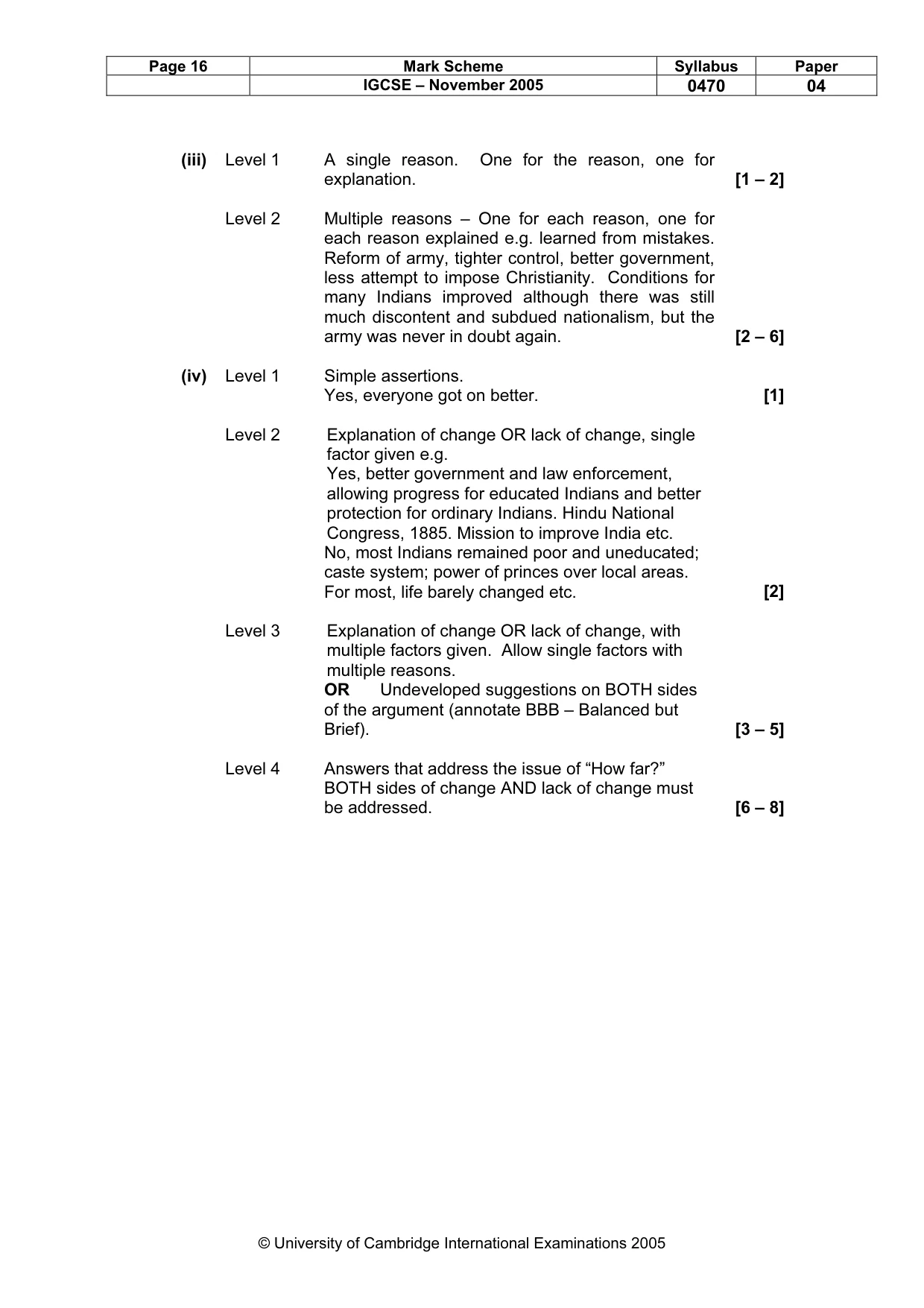
Page 16 Mark Scheme Syllabus Paper IGCSE – November 2005 0470 04 © University of Cambridge International Examinations 2005 (iii) Level 1 A single reason. One for the reason, one for explanation. [1 – 2] Level 2 Multiple reasons – One for each reason, one for each reason explained e.g. learned from mistakes. Reform of army, tighter control, better government, less attempt to impose Christianity. Conditions for many Indians improved although there was still much discontent and subdued nationalism, but the army was never in doubt again. [2 – 6] (iv) Level 1 Simple assertions. Yes, everyone got on better. [1] Level 2 Explanation of change OR lack of change, single factor given e.g. Yes, better government and law enforcement, allowing progress for educated Indians and better protection for ordinary Indians. Hindu National Congress, 1885. Mission to improve India etc. No, most Indians remained poor and uneducated; caste system; power of princes over local areas. For most, life barely changed etc. [2] Level 3 Explanation of change OR lack of change, with multiple factors given. Allow single factors with multiple reasons. OR Undeveloped suggestions on BOTH sides of the argument (annotate BBB – Balanced but Brief). [3 – 5] Level 4 Answers that address the issue of “How far?” BOTH sides of change AND lack of change must be addressed. [6 – 8]