Cambridge IGCSE History 0470 — 2005 May/June Paper 4 · Variant 1
0470/41/M/J/05
The question paper and its mark scheme, free to read here and free to download. This is Cambridge’s own paper, exactly as it was sat.
Question paper12 pages
Mark scheme16 pages
Answers below. Sit the paper first if you are practising.
Paper as text
Question paper, page 1
This document consists of 11 printed pages and 1 blank page. SP (SM/AR) S81340/2 © UCLES 2005 [Turn over UNIVERSITY OF CAMBRIDGE INTERNATIONAL EXAMINATIONS International General Certificate of Secondary Education HISTORY 0470/04 Paper 4 Alternative to Coursework May/June 2005 1 hour Additional Materials: Answer Booklet/Paper READ THESE INSTRUCTIONS FIRST If you have been given an Answer Booklet, follow the instructions on the front cover of the Booklet. Write your Centre number, candidate number and name on all the work you hand in. Write in dark blue or black pen on both sides of the paper. You may use a soft pencil for any diagrams, graphs, music or rough working. Do not use staples, paper clips, highlighters, glue or correction fluid. Answer the questions on one Depth Study. At the end of the examination, fasten all your work securely together. The number of marks is given in brackets [ ] at the end of each question or part question. www.XtremePapers.com
Question paper, page 2
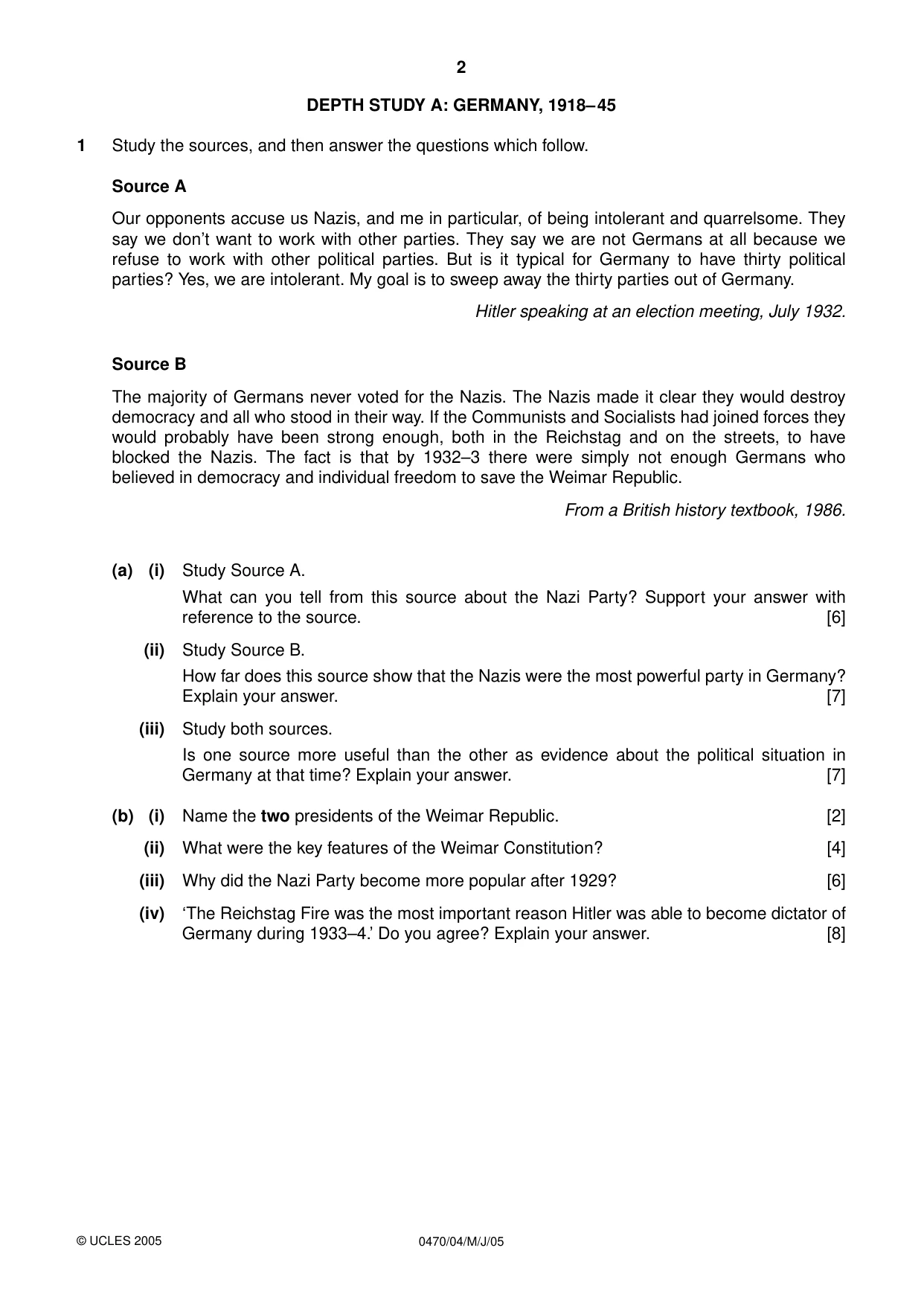
2 0470/04/M/J/05 DEPTH STUDY A: GERMANY, 1918–45 1 Study the sources, and then answer the questions which follow. Source A Our opponents accuse us Nazis, and me in particular, of being intolerant and quarrelsome. They say we don’t want to work with other parties. They say we are not Germans at all because we refuse to work with other political parties. But is it typical for Germany to have thirty political parties? Yes, we are intolerant. My goal is to sweep away the thirty parties out of Germany. Hitler speaking at an election meeting, July 1932. Source B The majority of Germans never voted for the Nazis. The Nazis made it clear they would destroy democracy and all who stood in their way. If the Communists and Socialists had joined forces they would probably have been strong enough, both in the Reichstag and on the streets, to have blocked the Nazis. The fact is that by 1932–3 there were simply not enough Germans who believed in democracy and individual freedom to save the Weimar Republic. From a British history textbook, 1986. (a) (i) Study Source A. What can you tell from this source about the Nazi Party? Support your answer with reference to the source. [6] (ii) Study Source B. How far does this source show that the Nazis were the most powerful party in Germany? Explain your answer. [7] (iii) Study both sources. Is one source more useful than the other as evidence about the political situation in Germany at that time? Explain your answer. [7] (b) (i) Name the two presidents of the Weimar Republic. [2] (ii) What were the key features of the Weimar Constitution? [4] (iii) Why did the Nazi Party become more popular after 1929? [6] (iv) ‘The Reichstag Fire was the most important reason Hitler was able to become dictator of Germany during 1933–4.’ Do you agree? Explain your answer. [8] © UCLES 2005
Question paper, page 3
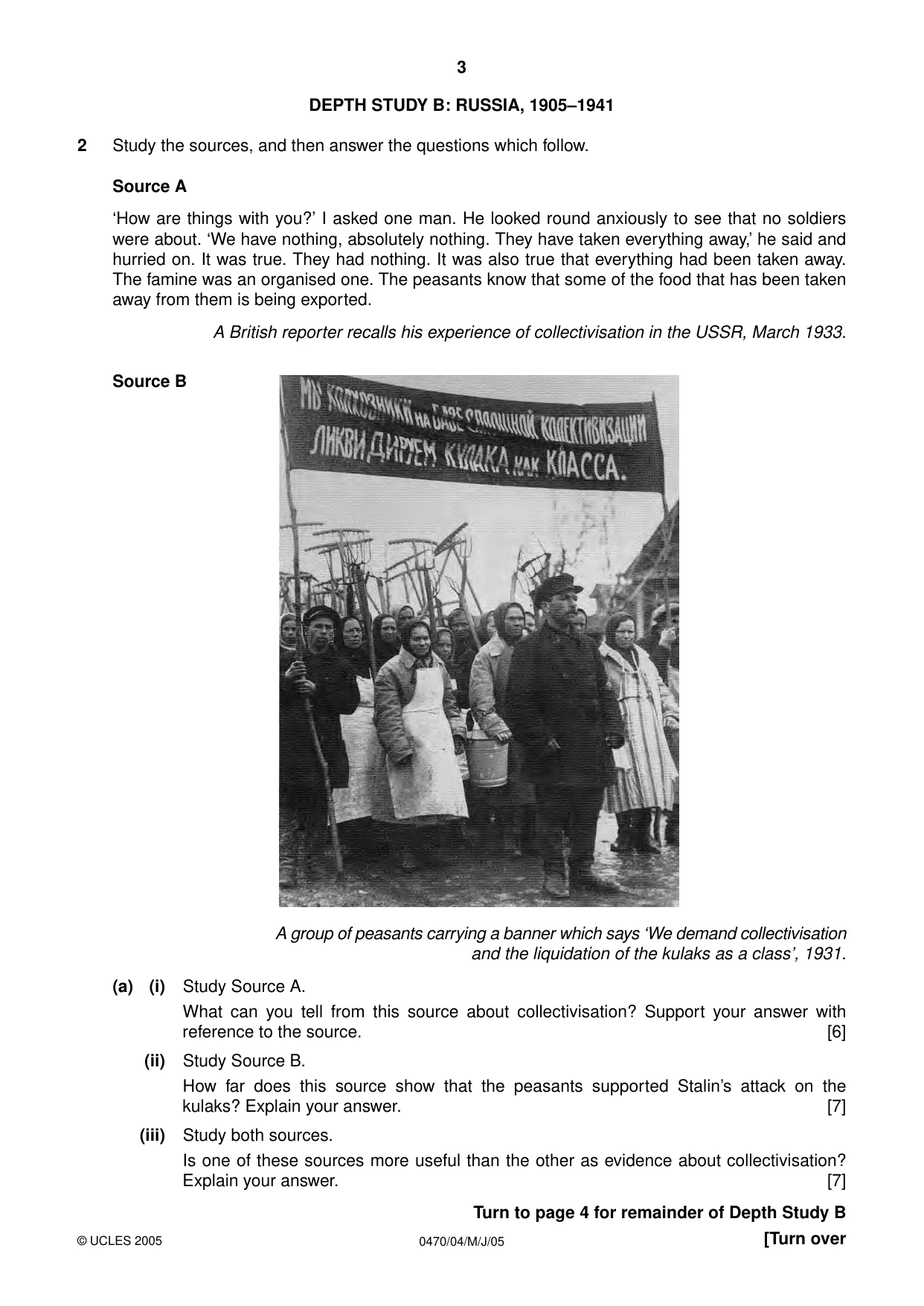
3 0470/04/M/J/05 DEPTH STUDY B: RUSSIA, 1905–1941 2 Study the sources, and then answer the questions which follow. Source A ‘How are things with you?’ I asked one man. He looked round anxiously to see that no soldiers were about. ‘We have nothing, absolutely nothing. They have taken everything away,’ he said and hurried on. It was true. They had nothing. It was also true that everything had been taken away. The famine was an organised one. The peasants know that some of the food that has been taken away from them is being exported. A British reporter recalls his experience of collectivisation in the USSR, March 1933. Source B A group of peasants carrying a banner which says ‘We demand collectivisation and the liquidation of the kulaks as a class’, 1931. (a) (i) Study Source A. What can you tell from this source about collectivisation? Support your answer with reference to the source. [6] (ii) Study Source B. How far does this source show that the peasants supported Stalin’s attack on the kulaks? Explain your answer. [7] (iii) Study both sources. Is one of these sources more useful than the other as evidence about collectivisation? Explain your answer. [7] Turn to page 4 for remainder of Depth Study B © UCLES 2005 [Turn over
Question paper, page 4
4 0470/04/M/J/05 (b) (i) Give two reasons why Stalin disliked the NEP. [2] (ii) What was collectivisation? [4] (iii) Why did Stalin introduce collectivisation? [6] (iv) To what extent had Stalin’s agricultural reforms proved successful by 1941? Explain your answer. [8] © UCLES 2005
Question paper, page 5
5 0470/04/M/J/05 [Turn over DEPTH STUDY C: THE USA, 1919–1941 3 Study the sources, and then answer the questions which follow. Source A The only thing we have to fear is fear itself. Our first and greatest task is to put people to work. This is a problem we can solve, if we face it wisely and with courage. It can be done partly by the Government itself. We must deal with unemployment as we would deal with the emergency of war. From Franklin Delano Roosevelt’s first speech as President, 4 March 1933. Source B The Alphabet Agencies, from 1933, hired the unemployed to construct or repair schools, hospitals, airfields and roads. The CCC, also introduced in 1933, put people to work maintaining natural treasures such as beaches, forests and parks. These were successful as they helped to reduce unemployment, gave dignity back to the unemployed and gave families the chance to survive and stay together. However, the Agencies were only relief measures, and not meant to be continued long-term. From an American history book, 1996. (a) (i) Study Source A. What can you tell from this source about unemployment by 1933? Support your answer with reference to the source. [6] (ii) Study Source B. How far does this source show that Americans benefited from the Alphabet Agencies? Explain your answer. [7] (iii) Study both sources. Is one of these sources more useful than the other as evidence of Roosevelt’s determination to solve the problem of unemployment? Explain your answer. [7] (b) (i) Give the full names of two of the Alphabet Agencies. [2] (ii) Describe ways that the Social Security Act of 1935 helped some American people. [4] (iii) Why did the Supreme Court rule against some of Roosevelt’s measures? [6] (iv) To what extent had Roosevelt’s government been successful in dealing with unemployment in America by 1941? Explain your answer. [8] © UCLES 2005
Question paper, page 6
6 0470/04/M/J/05 DEPTH STUDY D: CHINA, 1945–c.1990 4 Study the sources, and then answer the questions which follow. Source A There was a new spirit of courage and daring. Everyone, it seemed, listened to the BBC’s Chinese language service. People smiled and shook my hand. The gentleness, the smiles and headbands reminded me of the big rock concerts and the anti-Vietnam demonstrations in the West during the 1960s. There was the same belief that because the protesters were young and peaceful the Government must give in. A British reporter for the BBC writes about the demonstrations in Tiananmen Square, May 1989. Source B A recent article in the English-language newspaper China Daily said that, as bicycles and television ‘have become increasingly commonplace, trendy Chinese want new status symbols’. The post-Mao consumerism is evident in the streets of Beijing. Higher heels are common. Cosmetics are being used, discreetly. Chinese private enterprise is still mainly private, largely confined to tiny businesses. However, Beijing now has 780 tailors, who sell all the clothes they can make. A report by the New China News Agency said that sales of mass-produced garments by department stores fell by thirty percent this summer. From an article printed in a British magazine, 1982. (a) (i) Study Source A. What can you tell from this source about the demonstrators in Tiananmen Square? Support your answer with reference to the source. [6] (ii) Study Source B. How far does this source show that life was changing for the people of China in the 1980s? Explain your answer. [7] (iii) Study both sources. Is one of these sources more useful than the other as evidence about China after the death of Mao Zedong? Explain your answer. [7] (b) (i) Name two leaders who came to power in the decade after Mao’s death. [2] (ii) What was the ‘Gang of Four’? [4] (iii) Why were there demonstrations in Tiananmen Square in 1989? [6] (iv) How far did the economic development of the 1980s produce social and political change? Explain your answer. [8] © UCLES 2005
Question paper, page 7
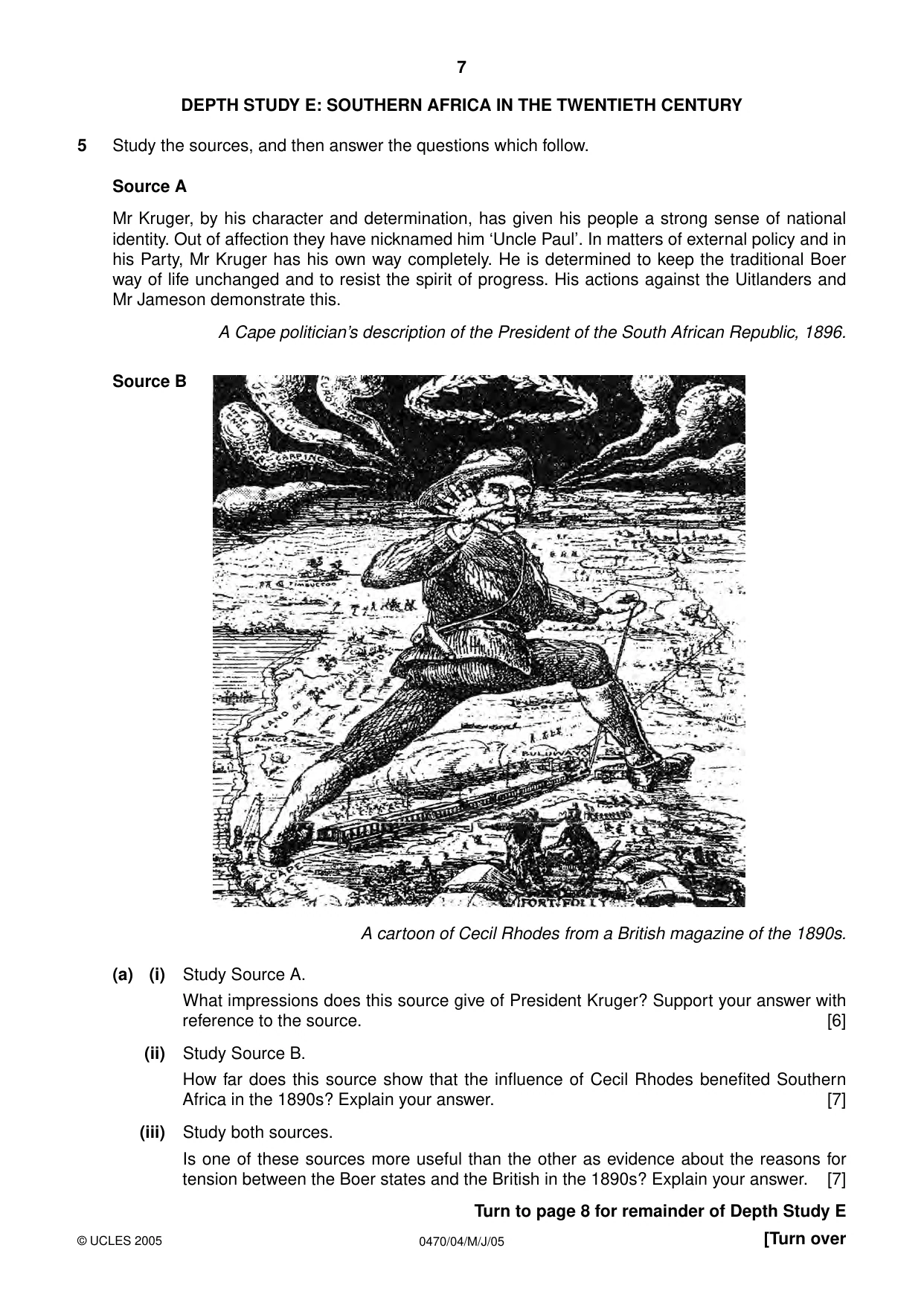
7 0470/04/M/J/05 [Turn over DEPTH STUDY E: SOUTHERN AFRICA IN THE TWENTIETH CENTURY 5 Study the sources, and then answer the questions which follow. Source A Mr Kruger, by his character and determination, has given his people a strong sense of national identity. Out of affection they have nicknamed him ‘Uncle Paul’. In matters of external policy and in his Party, Mr Kruger has his own way completely. He is determined to keep the traditional Boer way of life unchanged and to resist the spirit of progress. His actions against the Uitlanders and Mr Jameson demonstrate this. A Cape politician’s description of the President of the South African Republic, 1896. Source B A cartoon of Cecil Rhodes from a British magazine of the 1890s. (a) (i) Study Source A. What impressions does this source give of President Kruger? Support your answer with reference to the source. [6] (ii) Study Source B. How far does this source show that the influence of Cecil Rhodes benefited Southern Africa in the 1890s? Explain your answer. [7] (iii) Study both sources. Is one of these sources more useful than the other as evidence about the reasons for tension between the Boer states and the British in the 1890s? Explain your answer. [7] Turn to page 8 for remainder of Depth Study E © UCLES 2005
Question paper, page 8
8 0470/04/M/J/05 (b) (i) Give two reasons why the British annexed the Transvaal in 1877. [2] (ii) Describe the outcome for the Boers of the war of 1880–81. [4] (iii) Why did Johannesburg develop so rapidly after 1886? [6] (iv) How far do you agree that the Jameson Raid was the main cause of the Anglo-Boer War of 1899–1902? Explain your answer. [8] © UCLES 2005
Question paper, page 9
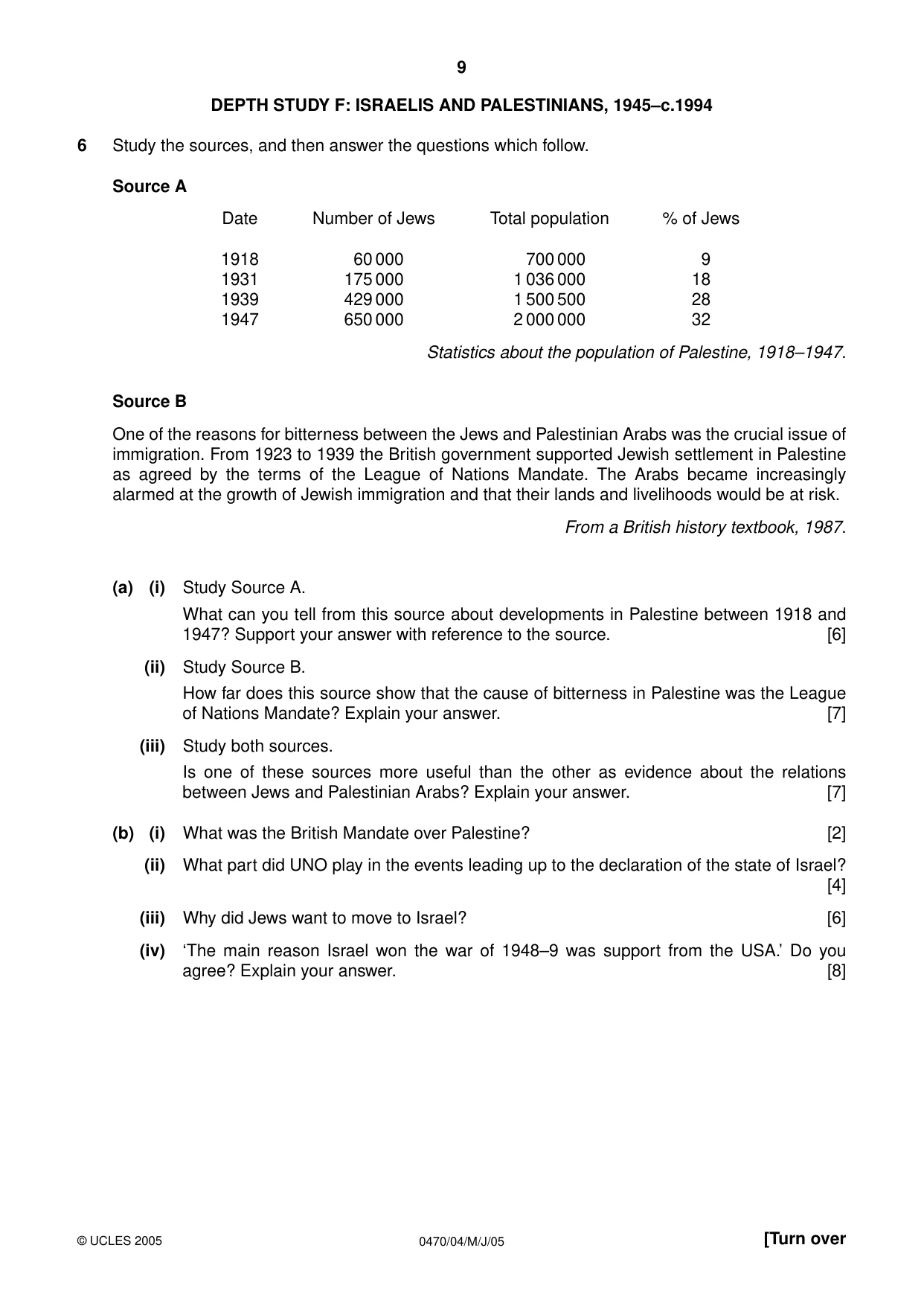
9 0470/04/M/J/05 [Turn over DEPTH STUDY F: ISRAELIS AND PALESTINIANS, 1945–c.1994 6 Study the sources, and then answer the questions which follow. Source A Date Number of Jews Total population % of Jews 1918 60 000 700 000 9 1931 175 000 1 036 000 18 1939 429 000 1 500 500 28 1947 650 000 2 000 000 32 Statistics about the population of Palestine, 1918–1947. Source B One of the reasons for bitterness between the Jews and Palestinian Arabs was the crucial issue of immigration. From 1923 to 1939 the British government supported Jewish settlement in Palestine as agreed by the terms of the League of Nations Mandate. The Arabs became increasingly alarmed at the growth of Jewish immigration and that their lands and livelihoods would be at risk. From a British history textbook, 1987. (a) (i) Study Source A. What can you tell from this source about developments in Palestine between 1918 and 1947? Support your answer with reference to the source. [6] (ii) Study Source B. How far does this source show that the cause of bitterness in Palestine was the League of Nations Mandate? Explain your answer. [7] (iii) Study both sources. Is one of these sources more useful than the other as evidence about the relations between Jews and Palestinian Arabs? Explain your answer. [7] (b) (i) What was the British Mandate over Palestine? [2] (ii) What part did UNO play in the events leading up to the declaration of the state of Israel? [4] (iii) Why did Jews want to move to Israel? [6] (iv) ‘The main reason Israel won the war of 1948–9 was support from the USA.’ Do you agree? Explain your answer. [8] © UCLES 2005
Question paper, page 10
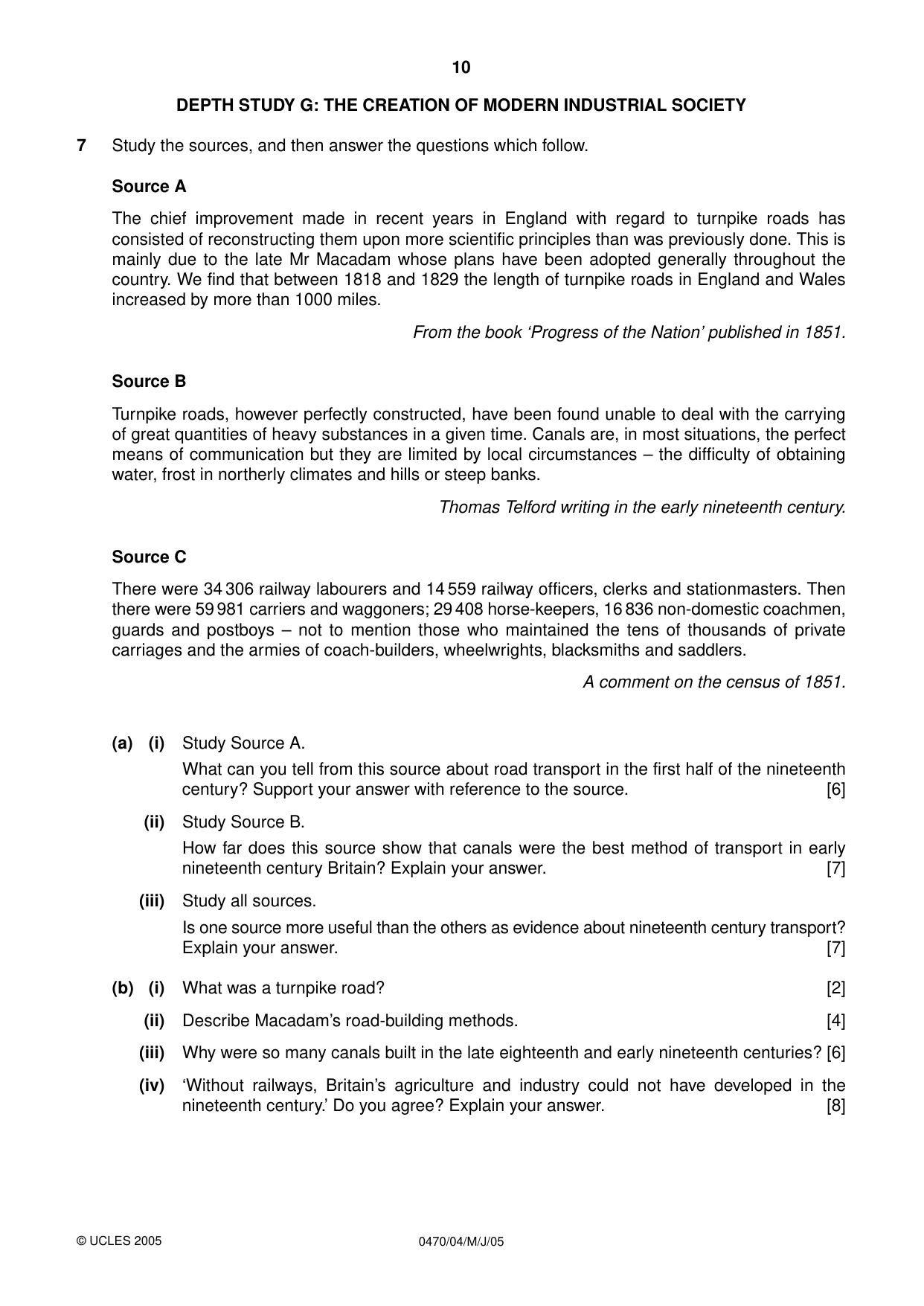
10 0470/04/M/J/05 DEPTH STUDY G: THE CREATION OF MODERN INDUSTRIAL SOCIETY 7 Study the sources, and then answer the questions which follow. Source A The chief improvement made in recent years in England with regard to turnpike roads has consisted of reconstructing them upon more scientific principles than was previously done. This is mainly due to the late Mr Macadam whose plans have been adopted generally throughout the country. We find that between 1818 and 1829 the length of turnpike roads in England and Wales increased by more than 1000 miles. From the book ‘Progress of the Nation’ published in 1851. Source B Turnpike roads, however perfectly constructed, have been found unable to deal with the carrying of great quantities of heavy substances in a given time. Canals are, in most situations, the perfect means of communication but they are limited by local circumstances – the difficulty of obtaining water, frost in northerly climates and hills or steep banks. Thomas Telford writing in the early nineteenth century. Source C There were 34 306 railway labourers and 14 559 railway officers, clerks and stationmasters. Then there were 59 981 carriers and waggoners; 29 408 horse-keepers, 16 836 non-domestic coachmen, guards and postboys – not to mention those who maintained the tens of thousands of private carriages and the armies of coach-builders, wheelwrights, blacksmiths and saddlers. A comment on the census of 1851. (a) (i) Study Source A. What can you tell from this source about road transport in the first half of the nineteenth century? Support your answer with reference to the source. [6] (ii) Study Source B. How far does this source show that canals were the best method of transport in early nineteenth century Britain? Explain your answer. [7] (iii) Study all sources. Is one source more useful than the others as evidence about nineteenth century transport? Explain your answer. [7] (b) (i) What was a turnpike road? [2] (ii) Describe Macadam’s road-building methods. [4] (iii) Why were so many canals built in the late eighteenth and early nineteenth centuries? [6] (iv) ‘Without railways, Britain’s agriculture and industry could not have developed in the nineteenth century.’ Do you agree? Explain your answer. [8] © UCLES 2005
Question paper, page 11
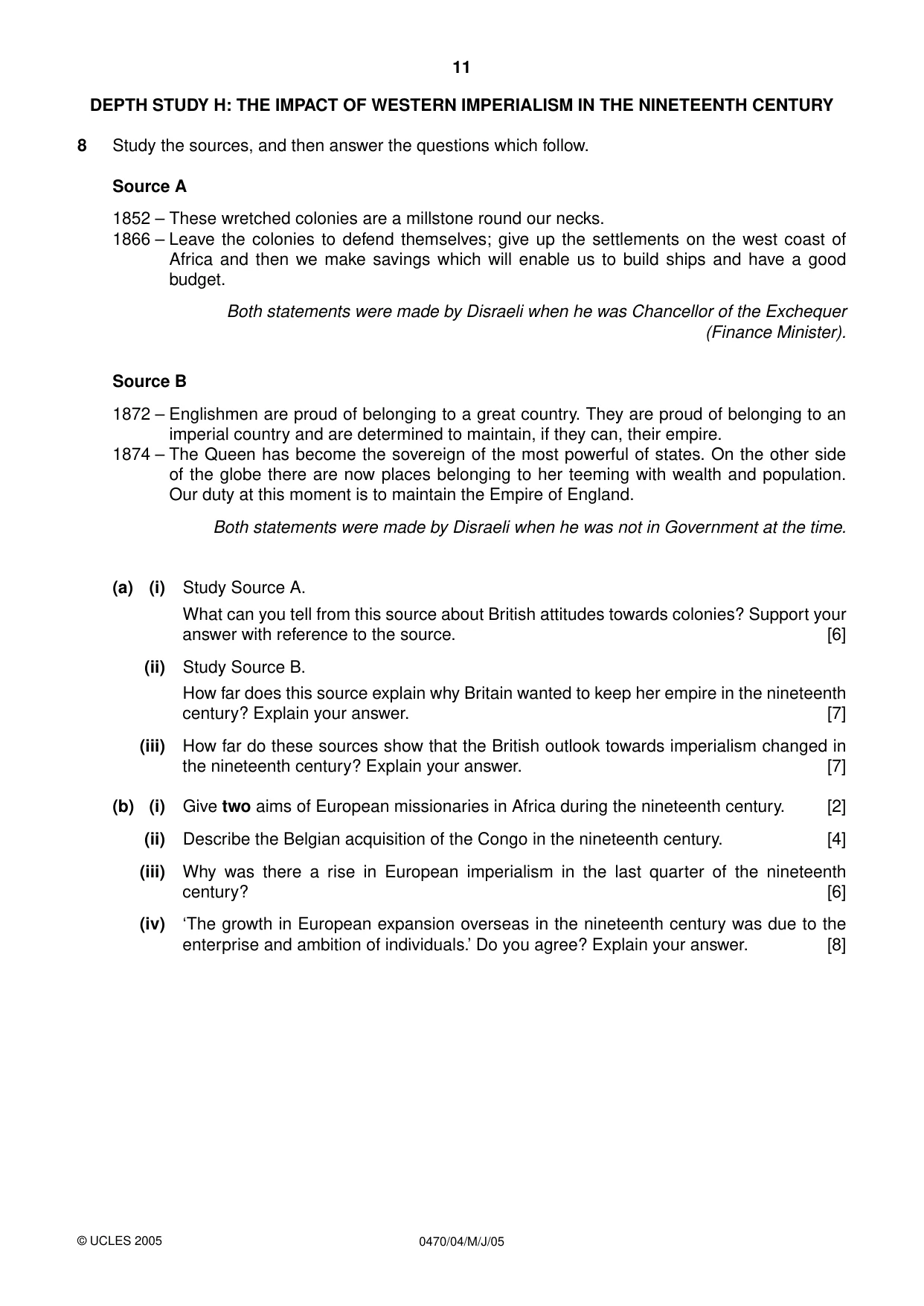
11 0470/04/M/J/05 DEPTH STUDY H: THE IMPACT OF WESTERN IMPERIALISM IN THE NINETEENTH CENTURY 8 Study the sources, and then answer the questions which follow. Source A 1852 – These wretched colonies are a millstone round our necks. 1866 – Leave the colonies to defend themselves; give up the settlements on the west coast of Africa and then we make savings which will enable us to build ships and have a good budget. Both statements were made by Disraeli when he was Chancellor of the Exchequer (Finance Minister). Source B 1872 – Englishmen are proud of belonging to a great country. They are proud of belonging to an imperial country and are determined to maintain, if they can, their empire. 1874 – The Queen has become the sovereign of the most powerful of states. On the other side of the globe there are now places belonging to her teeming with wealth and population. Our duty at this moment is to maintain the Empire of England. Both statements were made by Disraeli when he was not in Government at the time. (a) (i) Study Source A. What can you tell from this source about British attitudes towards colonies? Support your answer with reference to the source. [6] (ii) Study Source B. How far does this source explain why Britain wanted to keep her empire in the nineteenth century? Explain your answer. [7] (iii) How far do these sources show that the British outlook towards imperialism changed in the nineteenth century? Explain your answer. [7] (b) (i) Give two aims of European missionaries in Africa during the nineteenth century. [2] (ii) Describe the Belgian acquisition of the Congo in the nineteenth century. [4] (iii) Why was there a rise in European imperialism in the last quarter of the nineteenth century? [6] (iv) ‘The growth in European expansion overseas in the nineteenth century was due to the enterprise and ambition of individuals.’ Do you agree? Explain your answer. [8] © UCLES 2005
Question paper, page 12
12 0470/04/M/J/05 BLANK PAGE Copyright Acknowledgements: Section A Sources A and B; © Ben Walsh; History in Focus: GCSE Modern World History; John Murray. Section B Source A; © Bryn O’Callahan; History of the Twentieth Century; Pearson Education. Source B; Photograph; Clare Barker; Russia 1917–1945; Heinemann, 1990. Section D Source A; © John Simpson; Despatches from the Barricades; Hutchinson, 1990. Section F Source A; © Schools Council History Project; Anti-Israeli Conflict; Harper Collins. Source B; © S J Perkins; The Arab Israeli Conflict; Nelson, 1987. Section G Sources A and B; © R Tames; Roads and Canals; by permission of Oxford University Press. Source C; © T Hay; Economic and Social History of Britain 1760–1970; Longman, 1987. Permission to reproduce items where third-party owned material protected by copyright is included has been sought and cleared where possible. Every reasonable effort has been made by the publisher (UCLES) to trace copyright holders, but if any items requiring clearance have unwittingly been included, the publisher will be pleased to make amends at the earliest possible opportunity. University of Cambridge International Examinations is part of the University of Cambridge Local Examinations Syndicate (UCLES), which is itself a department of the University of Cambridge.
Mark scheme, page 1
UNIVERSITY OF CAMBRIDGE INTERNATIONAL EXAMINATIONS International General Certificate of Secondary Education MARK SCHEME for the June 2005 question paper 0470 HISTORY 0470/04 Paper 4 (Alternative to Coursework), maximum raw mark 40 These mark schemes are published as an aid to teachers and students, to indicate the requirements of the examination. They show the basis on which Examiners were initially instructed to award marks. They do not indicate the details of the discussions that took place at an Examiners’ meeting before marking began. Any substantial changes to the mark scheme that arose from these discussions will be recorded in the published Report on the Examination. All Examiners are instructed that alternative correct answers and unexpected approaches in candidates’ scripts must be given marks that fairly reflect the relevant knowledge and skills demonstrated. Mark schemes must be read in conjunction with the question papers and the Report on the Examination. • CIE will not enter into discussion or correspondence in connection with these mark schemes. CIE is publishing the mark schemes for the June 2005 question papers for most IGCSE and GCE Advanced Level and Advanced Subsidiary Level syllabuses and some Ordinary Level syllabuses. www.XtremePapers.com
Mark scheme, page 2
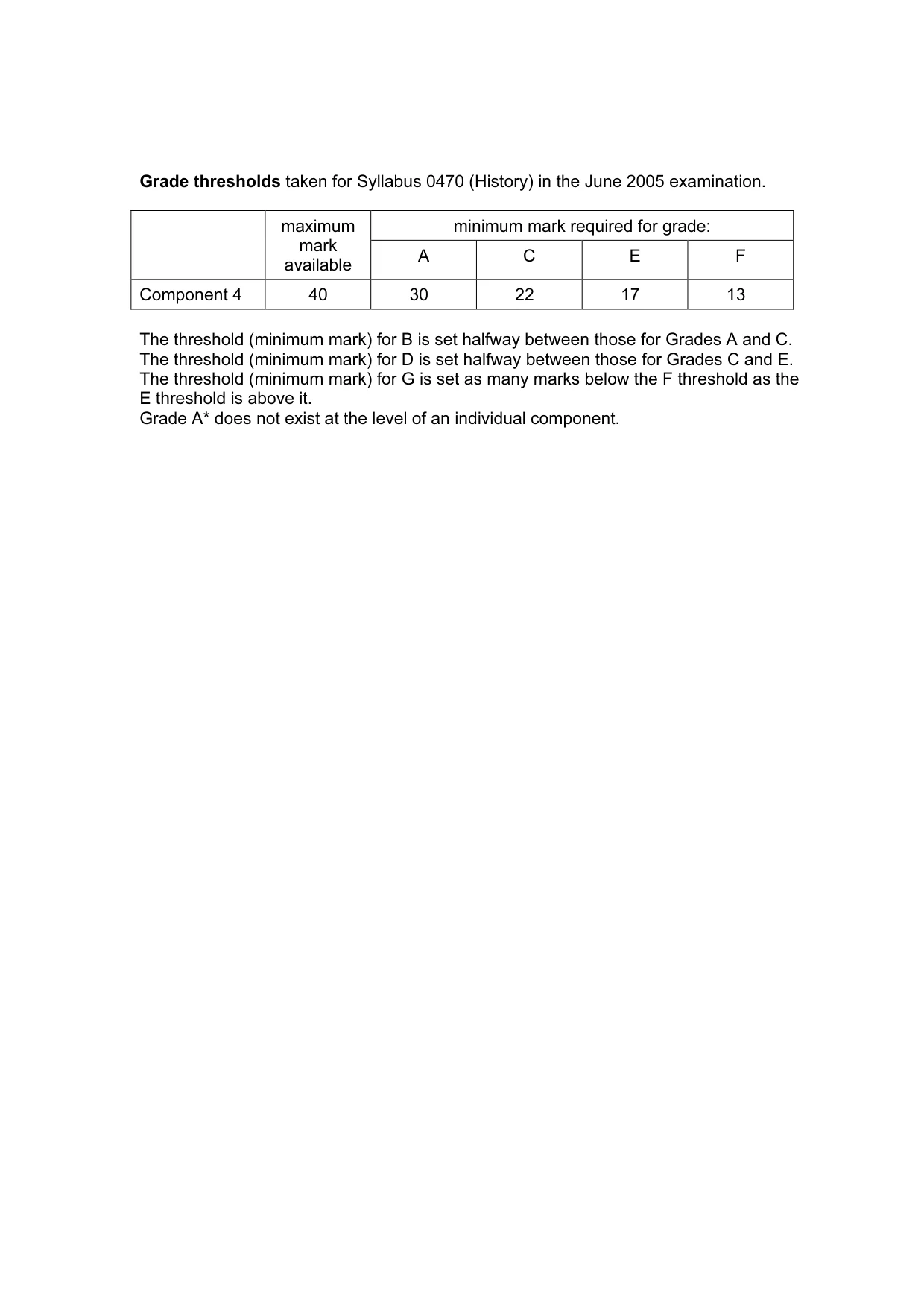
Grade thresholds taken for Syllabus 0470 (History) in the June 2005 examination. minimum mark required for grade: maximum mark available A C E F Component 4 40 30 22 17 13 The threshold (minimum mark) for B is set halfway between those for Grades A and C. The threshold (minimum mark) for D is set halfway between those for Grades C and E. The threshold (minimum mark) for G is set as many marks below the F threshold as the E threshold is above it. Grade A* does not exist at the level of an individual component.
Mark scheme, page 3
June 2005 INTERNATIONAL GCSE MARK SCHEME MAXIMUM MARK: 40 SYLLABUS/COMPONENT: 0470/04 HISTORY Paper 4 (Alternative to Coursework)
Mark scheme, page 4
Page 1 Mark Scheme Syllabus Paper IGCSE EXAMINATIONS – JUNE 2005 0470 4 © University of Cambridge International Examinations 2005 This paper is marked out of a maximum of 40 marks. Candidates must choose ONE Depth Study to attempt. Questions and Marking Schemes for each Depth Study have been developed to follow a pattern. In every case, part (a) questions concentrate on source material provided in the paper and are worth a total of 20 marks. Part (b) questions deal with subject matter closely related to the source material and also have a total value of 20 marks. Whilst marking schemes are based on the same model, they have been printed separately to allow exemplars of skill and information levels which candidates may use. These exemplars are not intended to be exclusive or exhaustive.
Mark scheme, page 5
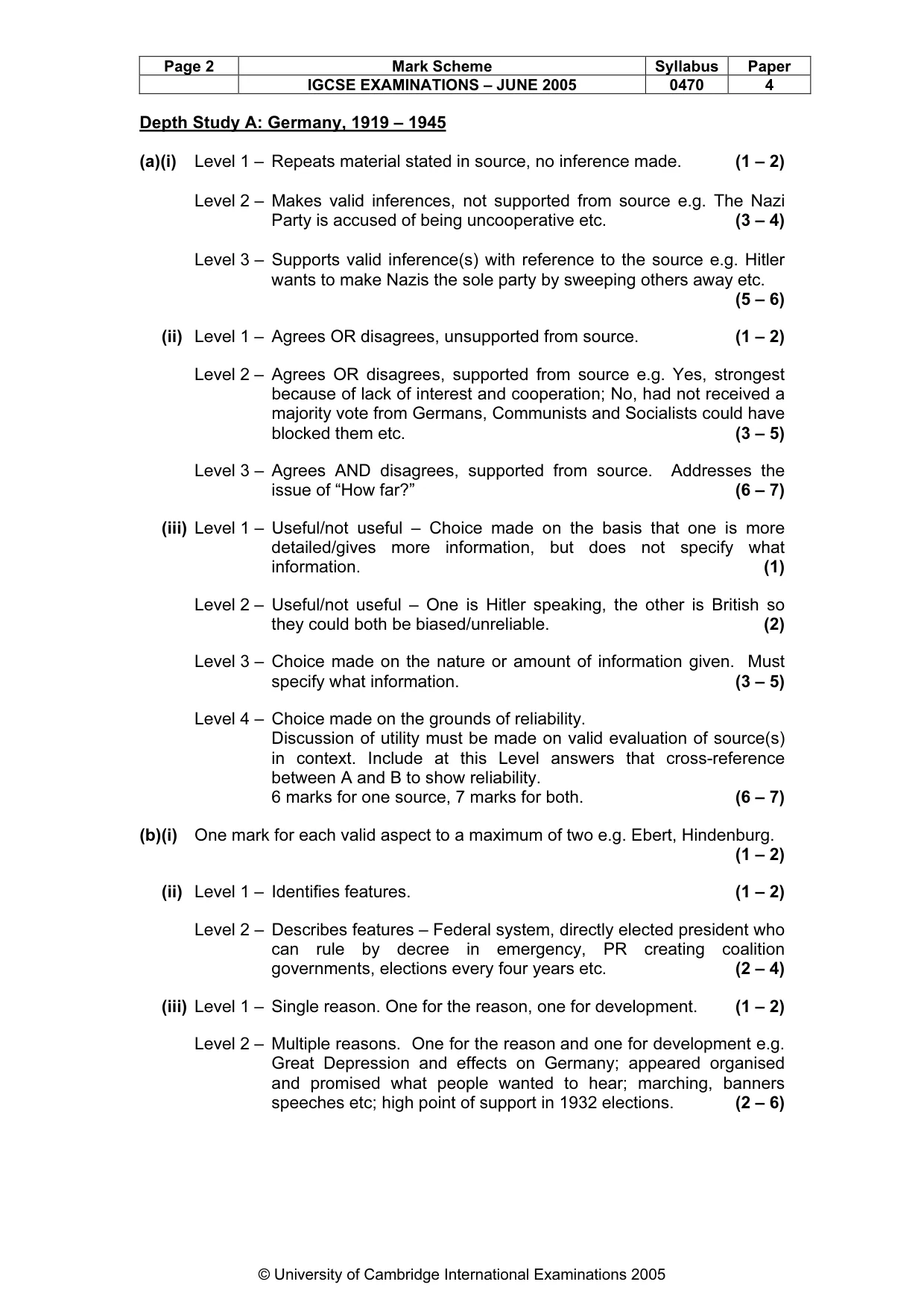
Page 2 Mark Scheme Syllabus Paper IGCSE EXAMINATIONS – JUNE 2005 0470 4 © University of Cambridge International Examinations 2005 Depth Study A: Germany, 1919 – 1945 (a)(i) Level 1 – Repeats material stated in source, no inference made. (1 – 2) Level 2 – Makes valid inferences, not supported from source e.g. The Nazi Party is accused of being uncooperative etc. (3 – 4) Level 3 – Supports valid inference(s) with reference to the source e.g. Hitler wants to make Nazis the sole party by sweeping others away etc. (5 – 6) (ii) Level 1 – Agrees OR disagrees, unsupported from source. (1 – 2) Level 2 – Agrees OR disagrees, supported from source e.g. Yes, strongest because of lack of interest and cooperation; No, had not received a majority vote from Germans, Communists and Socialists could have blocked them etc. (3 – 5) Level 3 – Agrees AND disagrees, supported from source. Addresses the issue of “How far?” (6 – 7) (iii) Level 1 – Useful/not useful – Choice made on the basis that one is more detailed/gives more information, but does not specify what information. (1) Level 2 – Useful/not useful – One is Hitler speaking, the other is British so they could both be biased/unreliable. (2) Level 3 – Choice made on the nature or amount of information given. Must specify what information. (3 – 5) Level 4 – Choice made on the grounds of reliability. Discussion of utility must be made on valid evaluation of source(s) in context. Include at this Level answers that cross-reference between A and B to show reliability. 6 marks for one source, 7 marks for both. (6 – 7) (b)(i) One mark for each valid aspect to a maximum of two e.g. Ebert, Hindenburg. (1 – 2) (ii) Level 1 – Identifies features. (1 – 2) Level 2 – Describes features – Federal system, directly elected president who can rule by decree in emergency, PR creating coalition governments, elections every four years etc. (2 – 4) (iii) Level 1 – Single reason. One for the reason, one for development. (1 – 2) Level 2 – Multiple reasons. One for the reason and one for development e.g. Great Depression and effects on Germany; appeared organised and promised what people wanted to hear; marching, banners speeches etc; high point of support in 1932 elections. (2 – 6)
Mark scheme, page 6
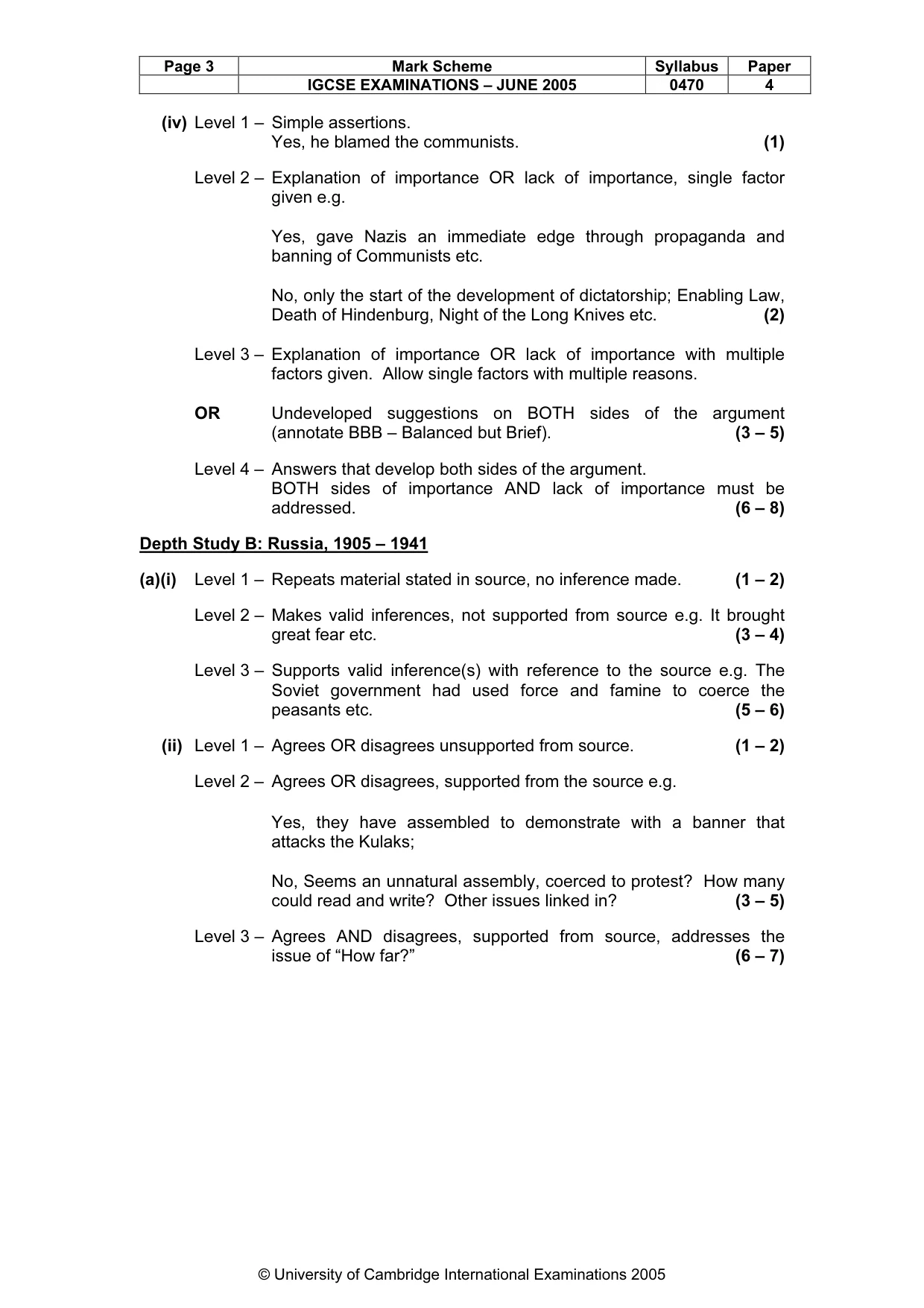
Page 3 Mark Scheme Syllabus Paper IGCSE EXAMINATIONS – JUNE 2005 0470 4 © University of Cambridge International Examinations 2005 (iv) Level 1 – Simple assertions. Yes, he blamed the communists. (1) Level 2 – Explanation of importance OR lack of importance, single factor given e.g. Yes, gave Nazis an immediate edge through propaganda and banning of Communists etc. No, only the start of the development of dictatorship; Enabling Law, Death of Hindenburg, Night of the Long Knives etc. (2) Level 3 – Explanation of importance OR lack of importance with multiple factors given. Allow single factors with multiple reasons. OR Undeveloped suggestions on BOTH sides of the argument (annotate BBB – Balanced but Brief). (3 – 5) Level 4 – Answers that develop both sides of the argument. BOTH sides of importance AND lack of importance must be addressed. (6 – 8) Depth Study B: Russia, 1905 – 1941 (a)(i) Level 1 – Repeats material stated in source, no inference made. (1 – 2) Level 2 – Makes valid inferences, not supported from source e.g. It brought great fear etc. (3 – 4) Level 3 – Supports valid inference(s) with reference to the source e.g. The Soviet government had used force and famine to coerce the peasants etc. (5 – 6) (ii) Level 1 – Agrees OR disagrees unsupported from source. (1 – 2) Level 2 – Agrees OR disagrees, supported from the source e.g. Yes, they have assembled to demonstrate with a banner that attacks the Kulaks; No, Seems an unnatural assembly, coerced to protest? How many could read and write? Other issues linked in? (3 – 5) Level 3 – Agrees AND disagrees, supported from source, addresses the issue of “How far?” (6 – 7)
Mark scheme, page 7
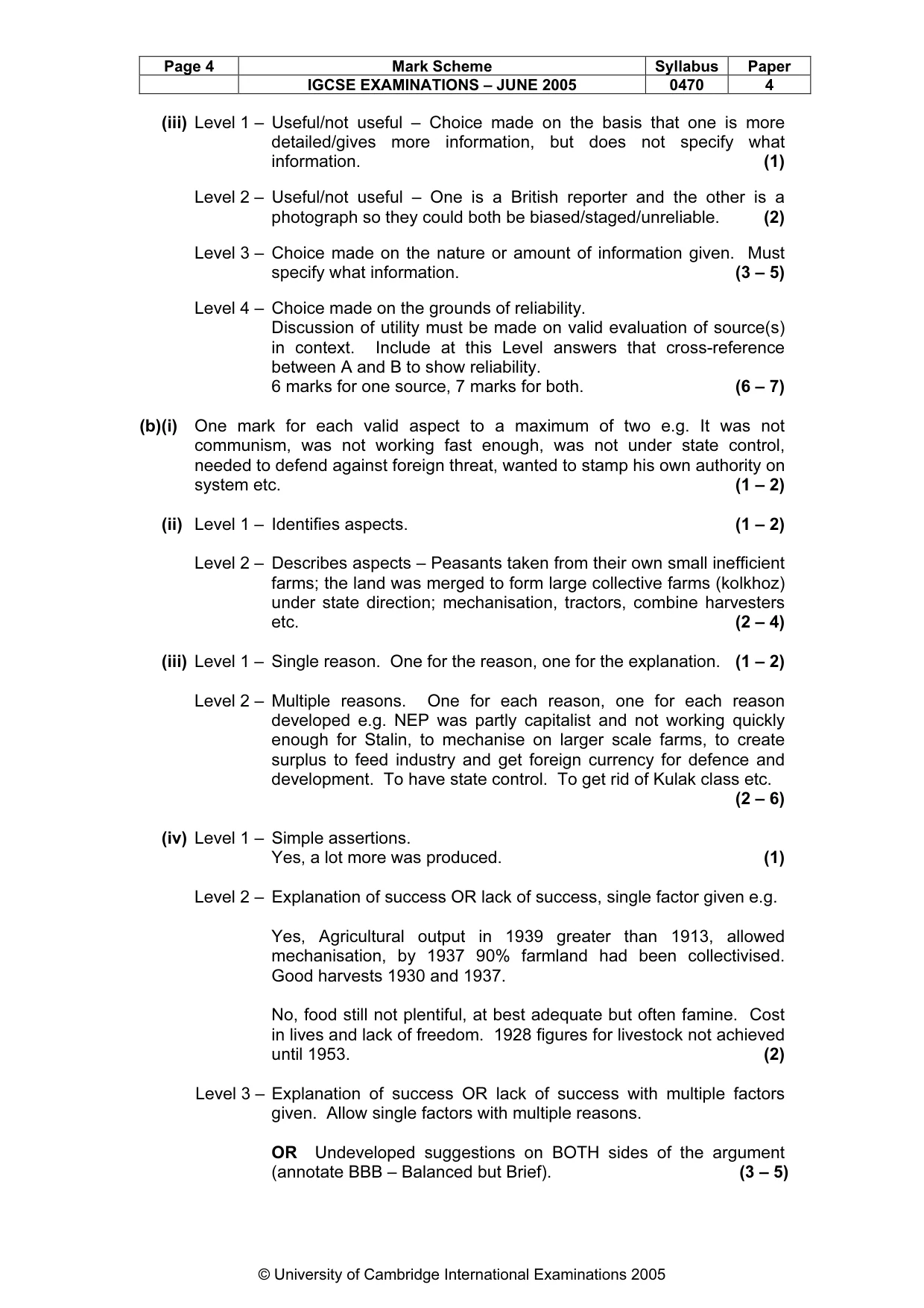
Page 4 Mark Scheme Syllabus Paper IGCSE EXAMINATIONS – JUNE 2005 0470 4 © University of Cambridge International Examinations 2005 (iii) Level 1 – Useful/not useful – Choice made on the basis that one is more detailed/gives more information, but does not specify what information. (1) Level 2 – Useful/not useful – One is a British reporter and the other is a photograph so they could both be biased/staged/unreliable. (2) Level 3 – Choice made on the nature or amount of information given. Must specify what information. (3 – 5) Level 4 – Choice made on the grounds of reliability. Discussion of utility must be made on valid evaluation of source(s) in context. Include at this Level answers that cross-reference between A and B to show reliability. 6 marks for one source, 7 marks for both. (6 – 7) (b)(i) One mark for each valid aspect to a maximum of two e.g. It was not communism, was not working fast enough, was not under state control, needed to defend against foreign threat, wanted to stamp his own authority on system etc. (1 – 2) (ii) Level 1 – Identifies aspects. (1 – 2) Level 2 – Describes aspects – Peasants taken from their own small inefficient farms; the land was merged to form large collective farms (kolkhoz) under state direction; mechanisation, tractors, combine harvesters etc. (2 – 4) (iii) Level 1 – Single reason. One for the reason, one for the explanation. (1 – 2) Level 2 – Multiple reasons. One for each reason, one for each reason developed e.g. NEP was partly capitalist and not working quickly enough for Stalin, to mechanise on larger scale farms, to create surplus to feed industry and get foreign currency for defence and development. To have state control. To get rid of Kulak class etc. (2 – 6) (iv) Level 1 – Simple assertions. Yes, a lot more was produced. (1) Level 2 – Explanation of success OR lack of success, single factor given e.g. Yes, Agricultural output in 1939 greater than 1913, allowed mechanisation, by 1937 90% farmland had been collectivised. Good harvests 1930 and 1937. No, food still not plentiful, at best adequate but often famine. Cost in lives and lack of freedom. 1928 figures for livestock not achieved until 1953. (2) Level 3 – Explanation of success OR lack of success with multiple factors given. Allow single factors with multiple reasons. OR Undeveloped suggestions on BOTH sides of the argument (annotate BBB – Balanced but Brief). (3 – 5)
Mark scheme, page 8
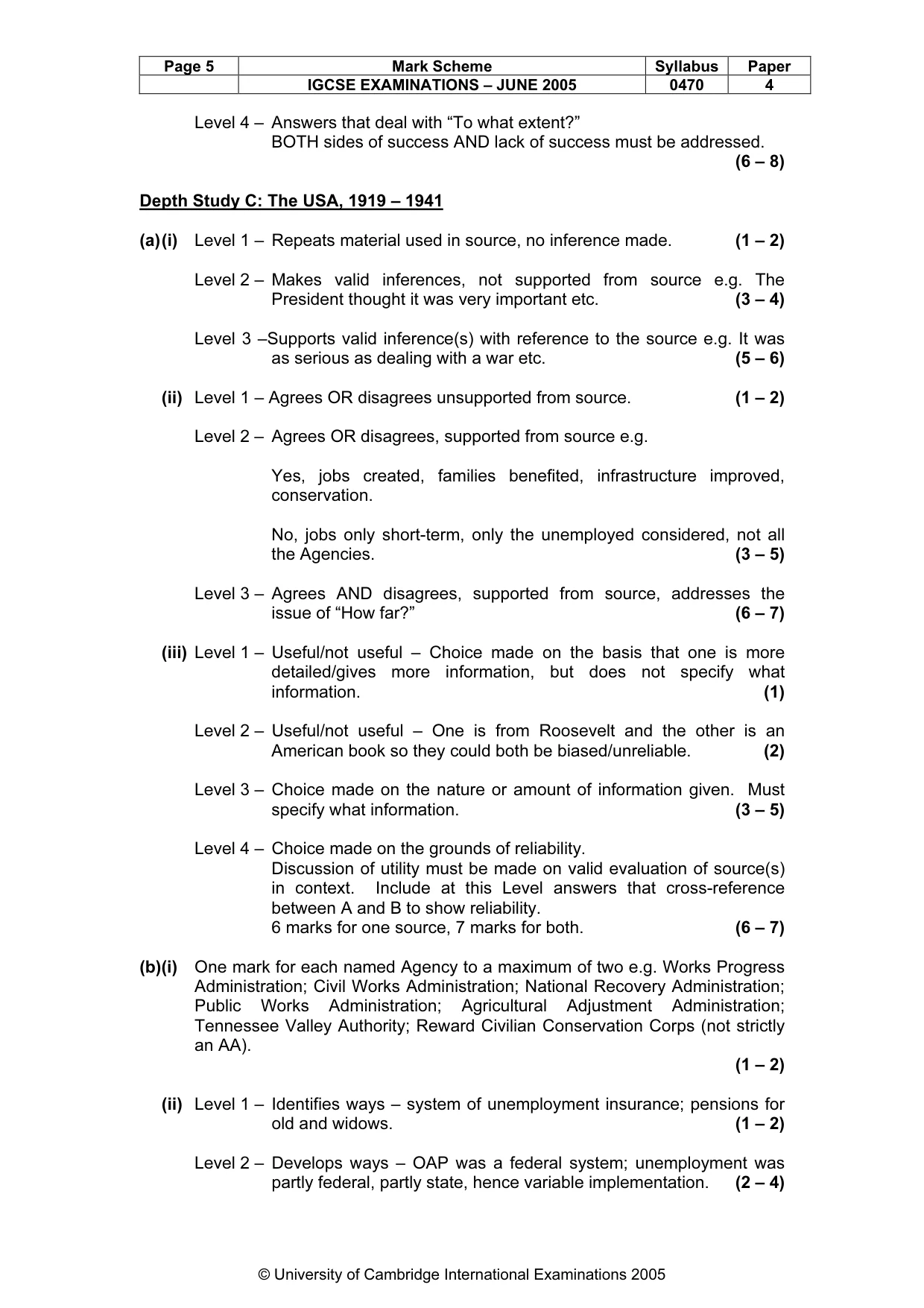
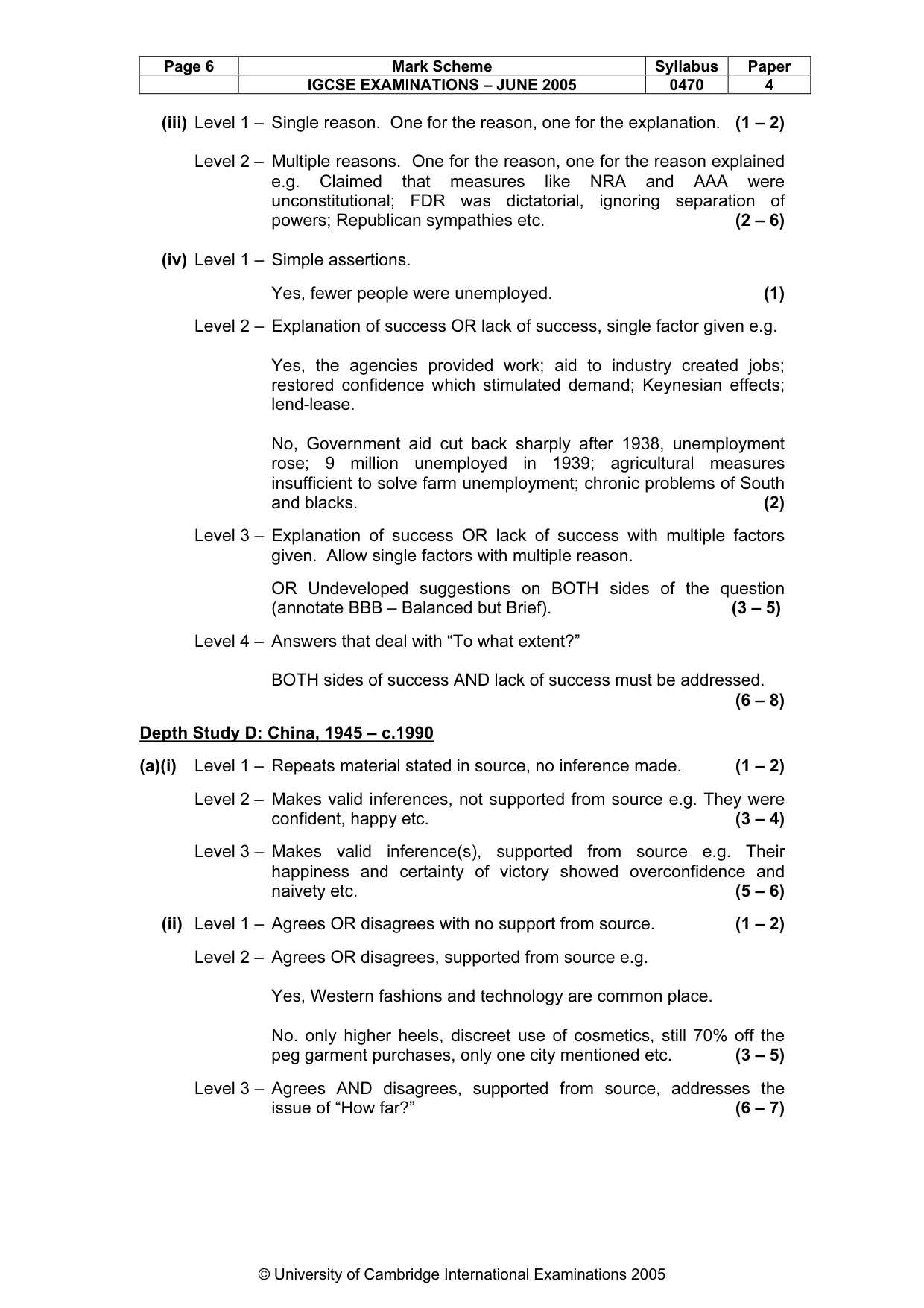
Page 5 Mark Scheme Syllabus Paper IGCSE EXAMINATIONS – JUNE 2005 0470 4 © University of Cambridge International Examinations 2005 Level 4 – Answers that deal with “To what extent?” BOTH sides of success AND lack of success must be addressed. (6 – 8) Depth Study C: The USA, 1919 – 1941 (a) (i) Level 1 – Repeats material used in source, no inference made. (1 – 2) Level 2 – Makes valid inferences, not supported from source e.g. The President thought it was very important etc. (3 – 4) Level 3 –Supports valid inference(s) with reference to the source e.g. It was as serious as dealing with a war etc. (5 – 6) (ii) Level 1 – Agrees OR disagrees unsupported from source. (1 – 2) Level 2 – Agrees OR disagrees, supported from source e.g. Yes, jobs created, families benefited, infrastructure improved, conservation. No, jobs only short-term, only the unemployed considered, not all the Agencies. (3 – 5) Level 3 – Agrees AND disagrees, supported from source, addresses the issue of “How far?” (6 – 7) (iii) Level 1 – Useful/not useful – Choice made on the basis that one is more detailed/gives more information, but does not specify what information. (1) Level 2 – Useful/not useful – One is from Roosevelt and the other is an American book so they could both be biased/unreliable. (2) Level 3 – Choice made on the nature or amount of information given. Must specify what information. (3 – 5) Level 4 – Choice made on the grounds of reliability. Discussion of utility must be made on valid evaluation of source(s) in context. Include at this Level answers that cross-reference between A and B to show reliability. 6 marks for one source, 7 marks for both. (6 – 7) (b)(i) One mark for each named Agency to a maximum of two e.g. Works Progress Administration; Civil Works Administration; National Recovery Administration; Public Works Administration; Agricultural Adjustment Administration; Tennessee Valley Authority; Reward Civilian Conservation Corps (not strictly an AA). (1 – 2) (ii) Level 1 – Identifies ways – system of unemployment insurance; pensions for old and widows. (1 – 2) Level 2 – Develops ways – OAP was a federal system; unemployment was partly federal, partly state, hence variable implementation. (2 – 4)
Mark scheme, page 9
Page 6 Mark Scheme Syllabus Paper IGCSE EXAMINATIONS – JUNE 2005 0470 4 © University of Cambridge International Examinations 2005 (iii) Level 1 – Single reason. One for the reason, one for the explanation. (1 – 2) Level 2 – Multiple reasons. One for the reason, one for the reason explained e.g. Claimed that measures like NRA and AAA were unconstitutional; FDR was dictatorial, ignoring separation of powers; Republican sympathies etc. (2 – 6) (iv) Level 1 – Simple assertions. Yes, fewer people were unemployed. (1) Level 2 – Explanation of success OR lack of success, single factor given e.g. Yes, the agencies provided work; aid to industry created jobs; restored confidence which stimulated demand; Keynesian effects; lend-lease. No, Government aid cut back sharply after 1938, unemployment rose; 9 million unemployed in 1939; agricultural measures insufficient to solve farm unemployment; chronic problems of South and blacks. (2) Level 3 – Explanation of success OR lack of success with multiple factors given. Allow single factors with multiple reason. OR Undeveloped suggestions on BOTH sides of the question (annotate BBB – Balanced but Brief). (3 – 5) Level 4 – Answers that deal with “To what extent?” BOTH sides of success AND lack of success must be addressed. (6 – 8) Depth Study D: China, 1945 – c.1990 (a)(i) Level 1 – Repeats material stated in source, no inference made. (1 – 2) Level 2 – Makes valid inferences, not supported from source e.g. They were confident, happy etc. (3 – 4) Level 3 – Makes valid inference(s), supported from source e.g. Their happiness and certainty of victory showed overconfidence and naivety etc. (5 – 6) (ii) Level 1 – Agrees OR disagrees with no support from source. (1 – 2) Level 2 – Agrees OR disagrees, supported from source e.g. Yes, Western fashions and technology are common place. No. only higher heels, discreet use of cosmetics, still 70% off the peg garment purchases, only one city mentioned etc. (3 – 5) Level 3 – Agrees AND disagrees, supported from source, addresses the issue of “How far?” (6 – 7)
Mark scheme, page 10
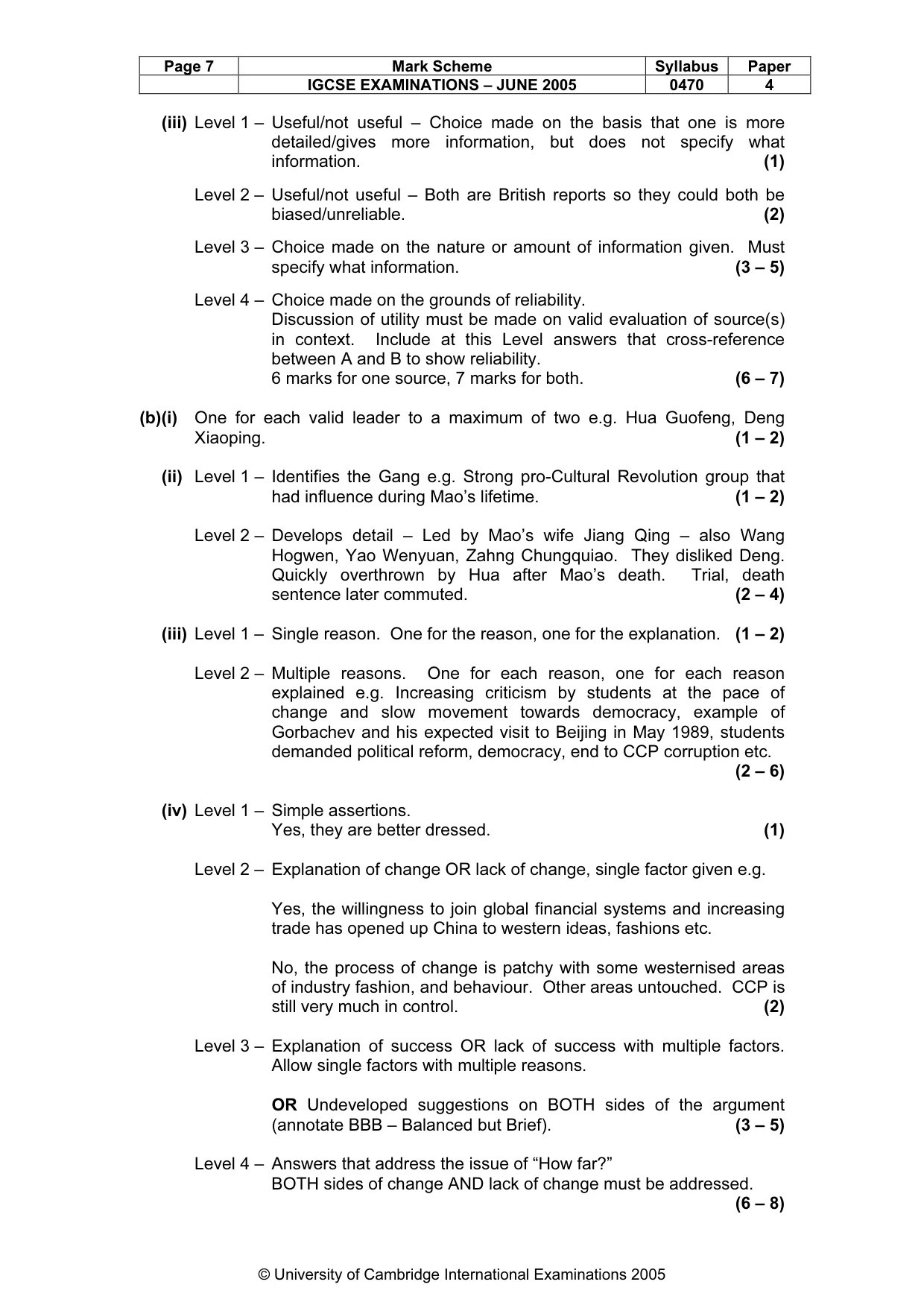
Page 7 Mark Scheme Syllabus Paper IGCSE EXAMINATIONS – JUNE 2005 0470 4 © University of Cambridge International Examinations 2005 (iii) Level 1 – Useful/not useful – Choice made on the basis that one is more detailed/gives more information, but does not specify what information. (1) Level 2 – Useful/not useful – Both are British reports so they could both be biased/unreliable. (2) Level 3 – Choice made on the nature or amount of information given. Must specify what information. (3 – 5) Level 4 – Choice made on the grounds of reliability. Discussion of utility must be made on valid evaluation of source(s) in context. Include at this Level answers that cross-reference between A and B to show reliability. 6 marks for one source, 7 marks for both. (6 – 7) (b)(i) One for each valid leader to a maximum of two e.g. Hua Guofeng, Deng Xiaoping. (1 – 2) (ii) Level 1 – Identifies the Gang e.g. Strong pro-Cultural Revolution group that had influence during Mao’s lifetime. (1 – 2) Level 2 – Develops detail – Led by Mao’s wife Jiang Qing – also Wang Hogwen, Yao Wenyuan, Zahng Chungquiao. They disliked Deng. Quickly overthrown by Hua after Mao’s death. Trial, death sentence later commuted. (2 – 4) (iii) Level 1 – Single reason. One for the reason, one for the explanation. (1 – 2) Level 2 – Multiple reasons. One for each reason, one for each reason explained e.g. Increasing criticism by students at the pace of change and slow movement towards democracy, example of Gorbachev and his expected visit to Beijing in May 1989, students demanded political reform, democracy, end to CCP corruption etc. (2 – 6) (iv) Level 1 – Simple assertions. Yes, they are better dressed. (1) Level 2 – Explanation of change OR lack of change, single factor given e.g. Yes, the willingness to join global financial systems and increasing trade has opened up China to western ideas, fashions etc. No, the process of change is patchy with some westernised areas of industry fashion, and behaviour. Other areas untouched. CCP is still very much in control. (2) Level 3 – Explanation of success OR lack of success with multiple factors. Allow single factors with multiple reasons. OR Undeveloped suggestions on BOTH sides of the argument (annotate BBB – Balanced but Brief). (3 – 5) Level 4 – Answers that address the issue of “How far?” BOTH sides of change AND lack of change must be addressed. (6 – 8)
Mark scheme, page 11
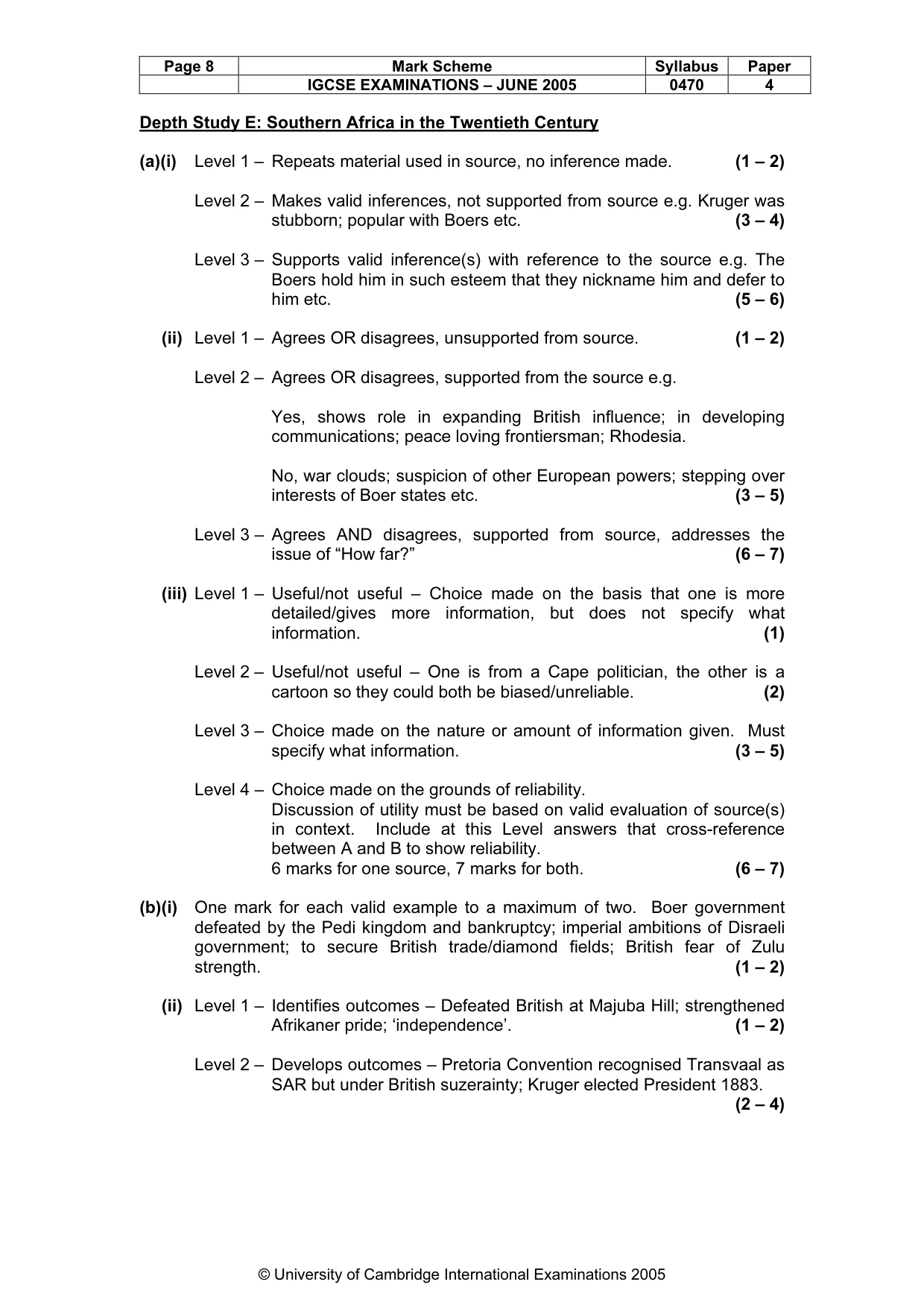
Page 8 Mark Scheme Syllabus Paper IGCSE EXAMINATIONS – JUNE 2005 0470 4 © University of Cambridge International Examinations 2005 Depth Study E: Southern Africa in the Twentieth Century (a)(i) Level 1 – Repeats material used in source, no inference made. (1 – 2) Level 2 – Makes valid inferences, not supported from source e.g. Kruger was stubborn; popular with Boers etc. (3 – 4) Level 3 – Supports valid inference(s) with reference to the source e.g. The Boers hold him in such esteem that they nickname him and defer to him etc. (5 – 6) (ii) Level 1 – Agrees OR disagrees, unsupported from source. (1 – 2) Level 2 – Agrees OR disagrees, supported from the source e.g. Yes, shows role in expanding British influence; in developing communications; peace loving frontiersman; Rhodesia. No, war clouds; suspicion of other European powers; stepping over interests of Boer states etc. (3 – 5) Level 3 – Agrees AND disagrees, supported from source, addresses the issue of “How far?” (6 – 7) (iii) Level 1 – Useful/not useful – Choice made on the basis that one is more detailed/gives more information, but does not specify what information. (1) Level 2 – Useful/not useful – One is from a Cape politician, the other is a cartoon so they could both be biased/unreliable. (2) Level 3 – Choice made on the nature or amount of information given. Must specify what information. (3 – 5) Level 4 – Choice made on the grounds of reliability. Discussion of utility must be based on valid evaluation of source(s) in context. Include at this Level answers that cross-reference between A and B to show reliability. 6 marks for one source, 7 marks for both. (6 – 7) (b)(i) One mark for each valid example to a maximum of two. Boer government defeated by the Pedi kingdom and bankruptcy; imperial ambitions of Disraeli government; to secure British trade/diamond fields; British fear of Zulu strength. (1 – 2) (ii) Level 1 – Identifies outcomes – Defeated British at Majuba Hill; strengthened Afrikaner pride; ‘independence’. (1 – 2) Level 2 – Develops outcomes – Pretoria Convention recognised Transvaal as SAR but under British suzerainty; Kruger elected President 1883. (2 – 4)
Mark scheme, page 12
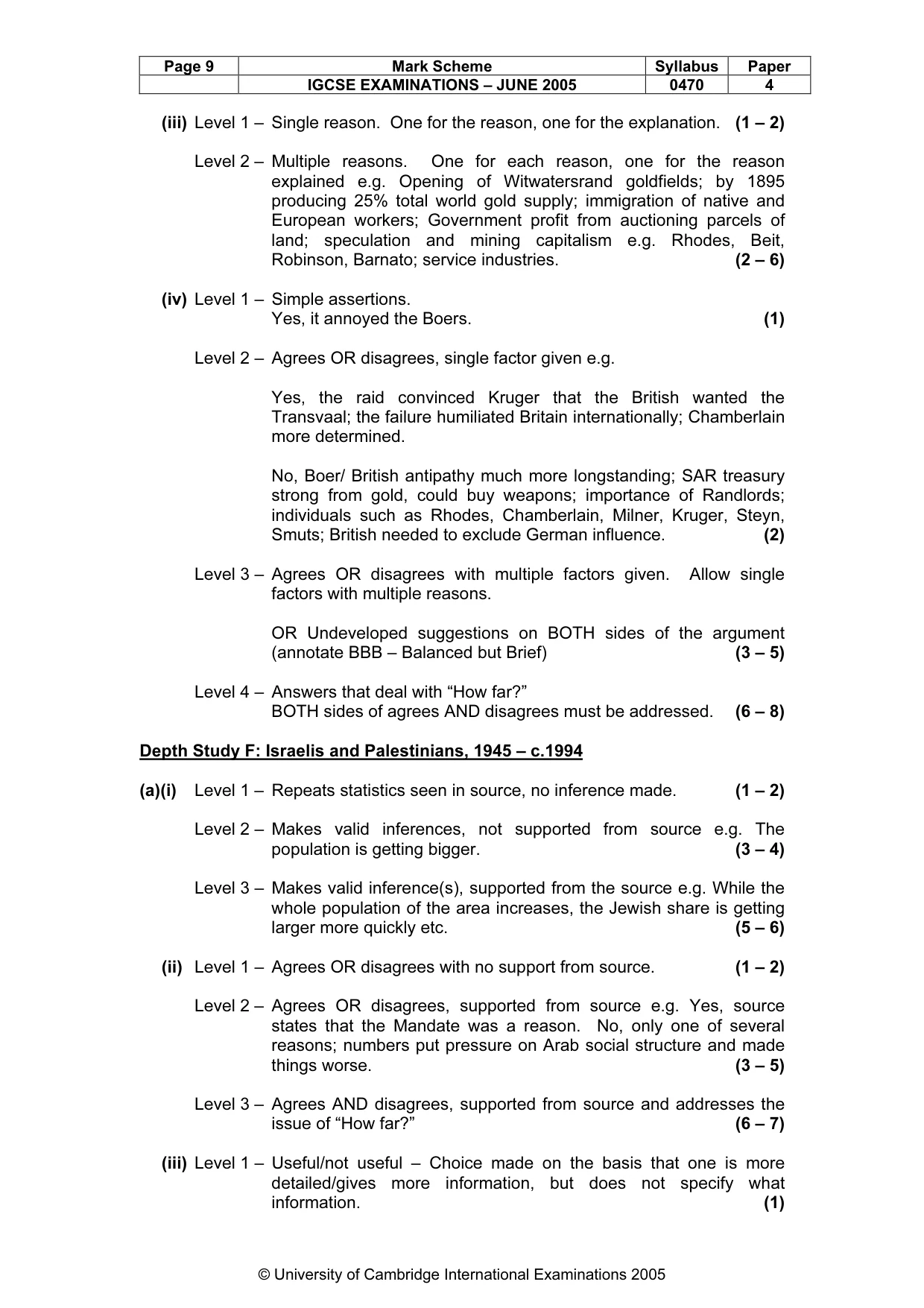
Page 9 Mark Scheme Syllabus Paper IGCSE EXAMINATIONS – JUNE 2005 0470 4 © University of Cambridge International Examinations 2005 (iii) Level 1 – Single reason. One for the reason, one for the explanation. (1 – 2) Level 2 – Multiple reasons. One for each reason, one for the reason explained e.g. Opening of Witwatersrand goldfields; by 1895 producing 25% total world gold supply; immigration of native and European workers; Government profit from auctioning parcels of land; speculation and mining capitalism e.g. Rhodes, Beit, Robinson, Barnato; service industries. (2 – 6) (iv) Level 1 – Simple assertions. Yes, it annoyed the Boers. (1) Level 2 – Agrees OR disagrees, single factor given e.g. Yes, the raid convinced Kruger that the British wanted the Transvaal; the failure humiliated Britain internationally; Chamberlain more determined. No, Boer/ British antipathy much more longstanding; SAR treasury strong from gold, could buy weapons; importance of Randlords; individuals such as Rhodes, Chamberlain, Milner, Kruger, Steyn, Smuts; British needed to exclude German influence. (2) Level 3 – Agrees OR disagrees with multiple factors given. Allow single factors with multiple reasons. OR Undeveloped suggestions on BOTH sides of the argument (annotate BBB – Balanced but Brief) (3 – 5) Level 4 – Answers that deal with “How far?” BOTH sides of agrees AND disagrees must be addressed. (6 – 8) Depth Study F: Israelis and Palestinians, 1945 – c.1994 (a)(i) Level 1 – Repeats statistics seen in source, no inference made. (1 – 2) Level 2 – Makes valid inferences, not supported from source e.g. The population is getting bigger. (3 – 4) Level 3 – Makes valid inference(s), supported from the source e.g. While the whole population of the area increases, the Jewish share is getting larger more quickly etc. (5 – 6) (ii) Level 1 – Agrees OR disagrees with no support from source. (1 – 2) Level 2 – Agrees OR disagrees, supported from source e.g. Yes, source states that the Mandate was a reason. No, only one of several reasons; numbers put pressure on Arab social structure and made things worse. (3 – 5) Level 3 – Agrees AND disagrees, supported from source and addresses the issue of “How far?” (6 – 7) (iii) Level 1 – Useful/not useful – Choice made on the basis that one is more detailed/gives more information, but does not specify what information. (1)
Mark scheme, page 13
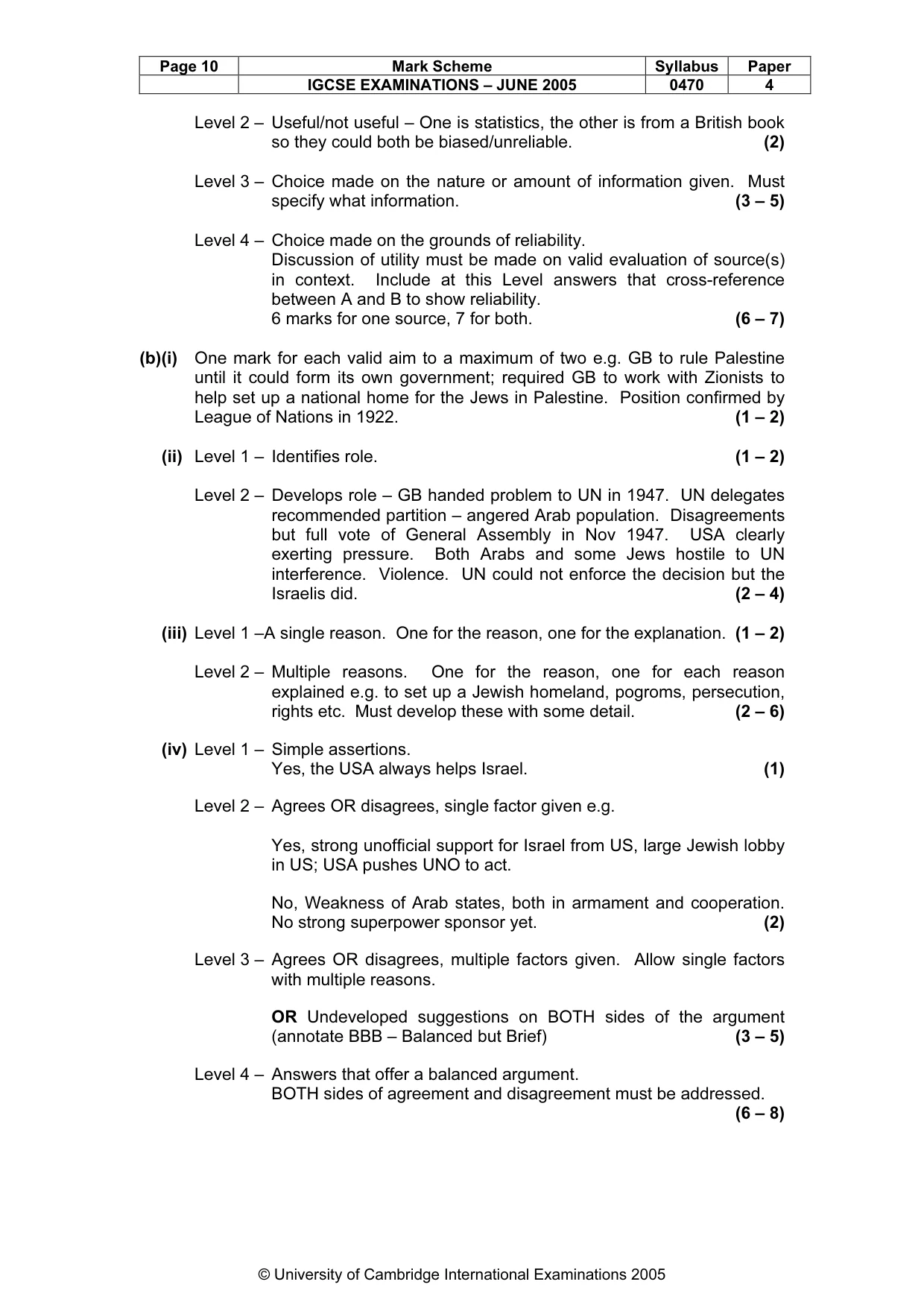
Page 10 Mark Scheme Syllabus Paper IGCSE EXAMINATIONS – JUNE 2005 0470 4 © University of Cambridge International Examinations 2005 Level 2 – Useful/not useful – One is statistics, the other is from a British book so they could both be biased/unreliable. (2) Level 3 – Choice made on the nature or amount of information given. Must specify what information. (3 – 5) Level 4 – Choice made on the grounds of reliability. Discussion of utility must be made on valid evaluation of source(s) in context. Include at this Level answers that cross-reference between A and B to show reliability. 6 marks for one source, 7 for both. (6 – 7) (b)(i) One mark for each valid aim to a maximum of two e.g. GB to rule Palestine until it could form its own government; required GB to work with Zionists to help set up a national home for the Jews in Palestine. Position confirmed by League of Nations in 1922. (1 – 2) (ii) Level 1 – Identifies role. (1 – 2) Level 2 – Develops role – GB handed problem to UN in 1947. UN delegates recommended partition – angered Arab population. Disagreements but full vote of General Assembly in Nov 1947. USA clearly exerting pressure. Both Arabs and some Jews hostile to UN interference. Violence. UN could not enforce the decision but the Israelis did. (2 – 4) (iii) Level 1 –A single reason. One for the reason, one for the explanation. (1 – 2) Level 2 – Multiple reasons. One for the reason, one for each reason explained e.g. to set up a Jewish homeland, pogroms, persecution, rights etc. Must develop these with some detail. (2 – 6) (iv) Level 1 – Simple assertions. Yes, the USA always helps Israel. (1) Level 2 – Agrees OR disagrees, single factor given e.g. Yes, strong unofficial support for Israel from US, large Jewish lobby in US; USA pushes UNO to act. No, Weakness of Arab states, both in armament and cooperation. No strong superpower sponsor yet. (2) Level 3 – Agrees OR disagrees, multiple factors given. Allow single factors with multiple reasons. OR Undeveloped suggestions on BOTH sides of the argument (annotate BBB – Balanced but Brief) (3 – 5) Level 4 – Answers that offer a balanced argument. BOTH sides of agreement and disagreement must be addressed. (6 – 8)
Mark scheme, page 14
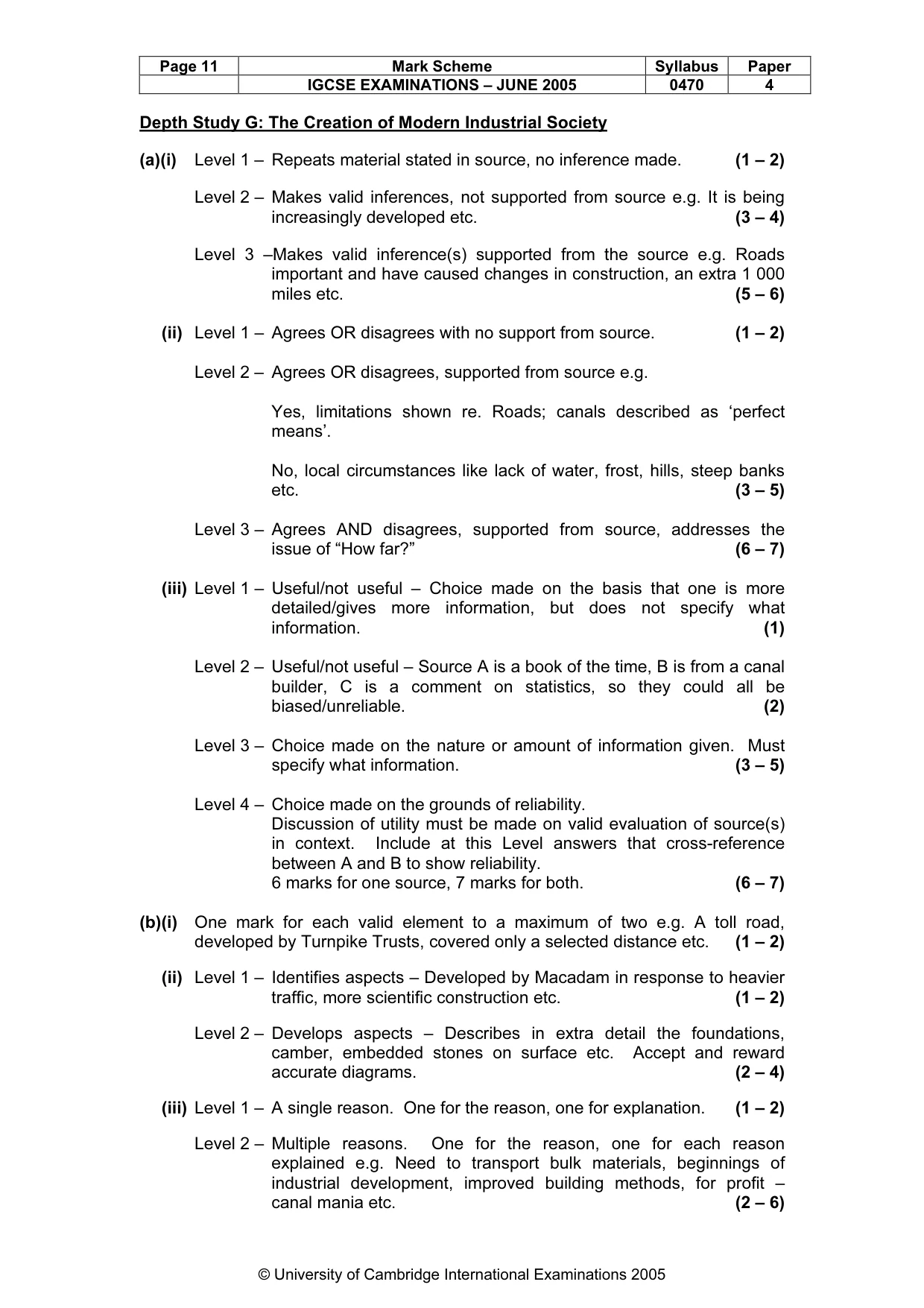
Page 11 Mark Scheme Syllabus Paper IGCSE EXAMINATIONS – JUNE 2005 0470 4 © University of Cambridge International Examinations 2005 Depth Study G: The Creation of Modern Industrial Society (a)(i) Level 1 – Repeats material stated in source, no inference made. (1 – 2) Level 2 – Makes valid inferences, not supported from source e.g. It is being increasingly developed etc. (3 – 4) Level 3 –Makes valid inference(s) supported from the source e.g. Roads important and have caused changes in construction, an extra 1 000 miles etc. (5 – 6) (ii) Level 1 – Agrees OR disagrees with no support from source. (1 – 2) Level 2 – Agrees OR disagrees, supported from source e.g. Yes, limitations shown re. Roads; canals described as ‘perfect means’. No, local circumstances like lack of water, frost, hills, steep banks etc. (3 – 5) Level 3 – Agrees AND disagrees, supported from source, addresses the issue of “How far?” (6 – 7) (iii) Level 1 – Useful/not useful – Choice made on the basis that one is more detailed/gives more information, but does not specify what information. (1) Level 2 – Useful/not useful – Source A is a book of the time, B is from a canal builder, C is a comment on statistics, so they could all be biased/unreliable. (2) Level 3 – Choice made on the nature or amount of information given. Must specify what information. (3 – 5) Level 4 – Choice made on the grounds of reliability. Discussion of utility must be made on valid evaluation of source(s) in context. Include at this Level answers that cross-reference between A and B to show reliability. 6 marks for one source, 7 marks for both. (6 – 7) (b)(i) One mark for each valid element to a maximum of two e.g. A toll road, developed by Turnpike Trusts, covered only a selected distance etc. (1 – 2) (ii) Level 1 – Identifies aspects – Developed by Macadam in response to heavier traffic, more scientific construction etc. (1 – 2) Level 2 – Develops aspects – Describes in extra detail the foundations, camber, embedded stones on surface etc. Accept and reward accurate diagrams. (2 – 4) (iii) Level 1 – A single reason. One for the reason, one for explanation. (1 – 2) Level 2 – Multiple reasons. One for the reason, one for each reason explained e.g. Need to transport bulk materials, beginnings of industrial development, improved building methods, for profit – canal mania etc. (2 – 6)
Mark scheme, page 15
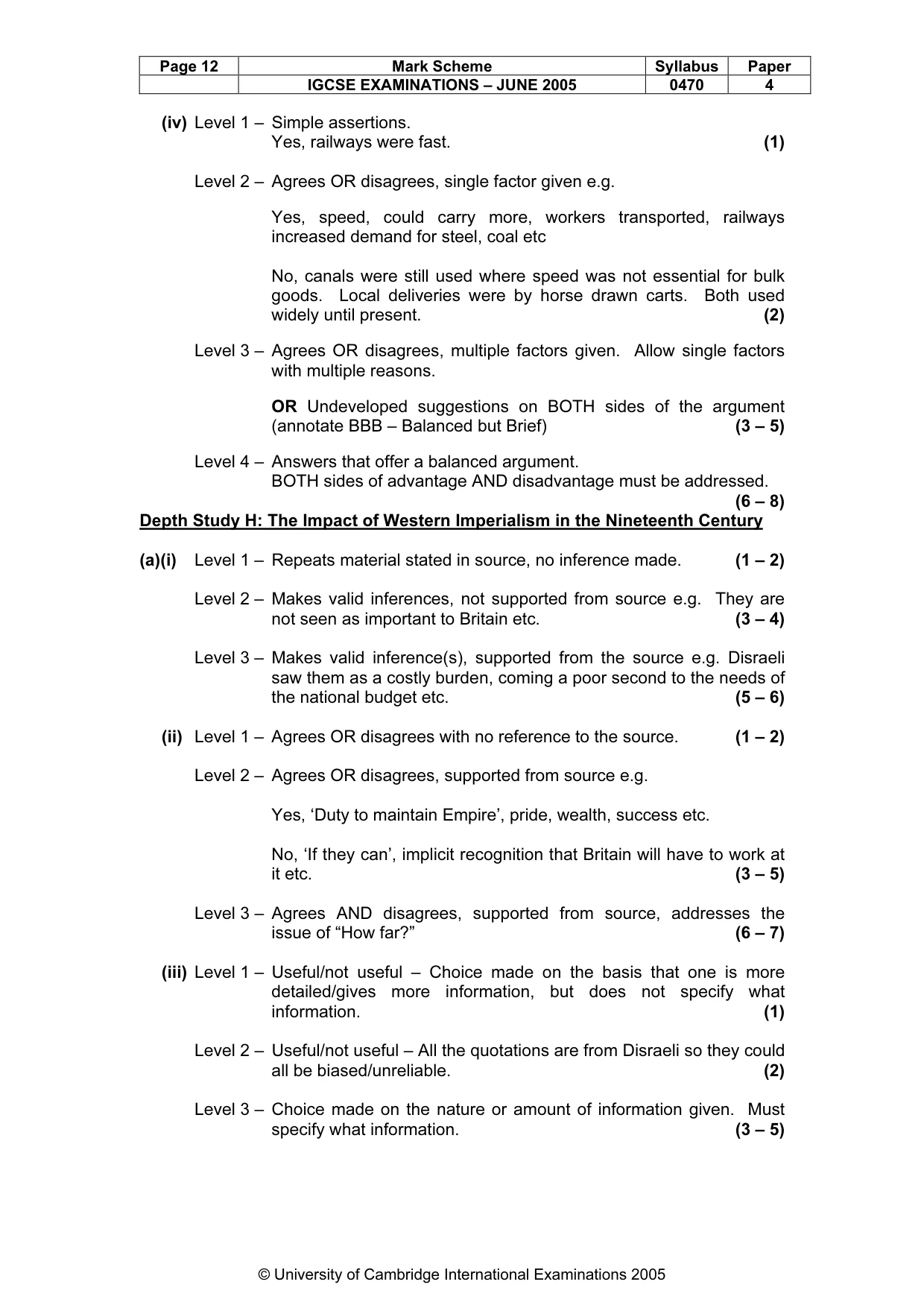
Page 12 Mark Scheme Syllabus Paper IGCSE EXAMINATIONS – JUNE 2005 0470 4 © University of Cambridge International Examinations 2005 (iv) Level 1 – Simple assertions. Yes, railways were fast. (1) Level 2 – Agrees OR disagrees, single factor given e.g. Yes, speed, could carry more, workers transported, railways increased demand for steel, coal etc No, canals were still used where speed was not essential for bulk goods. Local deliveries were by horse drawn carts. Both used widely until present. (2) Level 3 – Agrees OR disagrees, multiple factors given. Allow single factors with multiple reasons. OR Undeveloped suggestions on BOTH sides of the argument (annotate BBB – Balanced but Brief) (3 – 5) Level 4 – Answers that offer a balanced argument. BOTH sides of advantage AND disadvantage must be addressed. (6 – 8) Depth Study H: The Impact of Western Imperialism in the Nineteenth Century (a)(i) Level 1 – Repeats material stated in source, no inference made. (1 – 2) Level 2 – Makes valid inferences, not supported from source e.g. They are not seen as important to Britain etc. (3 – 4) Level 3 – Makes valid inference(s), supported from the source e.g. Disraeli saw them as a costly burden, coming a poor second to the needs of the national budget etc. (5 – 6) (ii) Level 1 – Agrees OR disagrees with no reference to the source. (1 – 2) Level 2 – Agrees OR disagrees, supported from source e.g. Yes, ‘Duty to maintain Empire’, pride, wealth, success etc. No, ‘If they can’, implicit recognition that Britain will have to work at it etc. (3 – 5) Level 3 – Agrees AND disagrees, supported from source, addresses the issue of “How far?” (6 – 7) (iii) Level 1 – Useful/not useful – Choice made on the basis that one is more detailed/gives more information, but does not specify what information. (1) Level 2 – Useful/not useful – All the quotations are from Disraeli so they could all be biased/unreliable. (2) Level 3 – Choice made on the nature or amount of information given. Must specify what information. (3 – 5)
Mark scheme, page 16
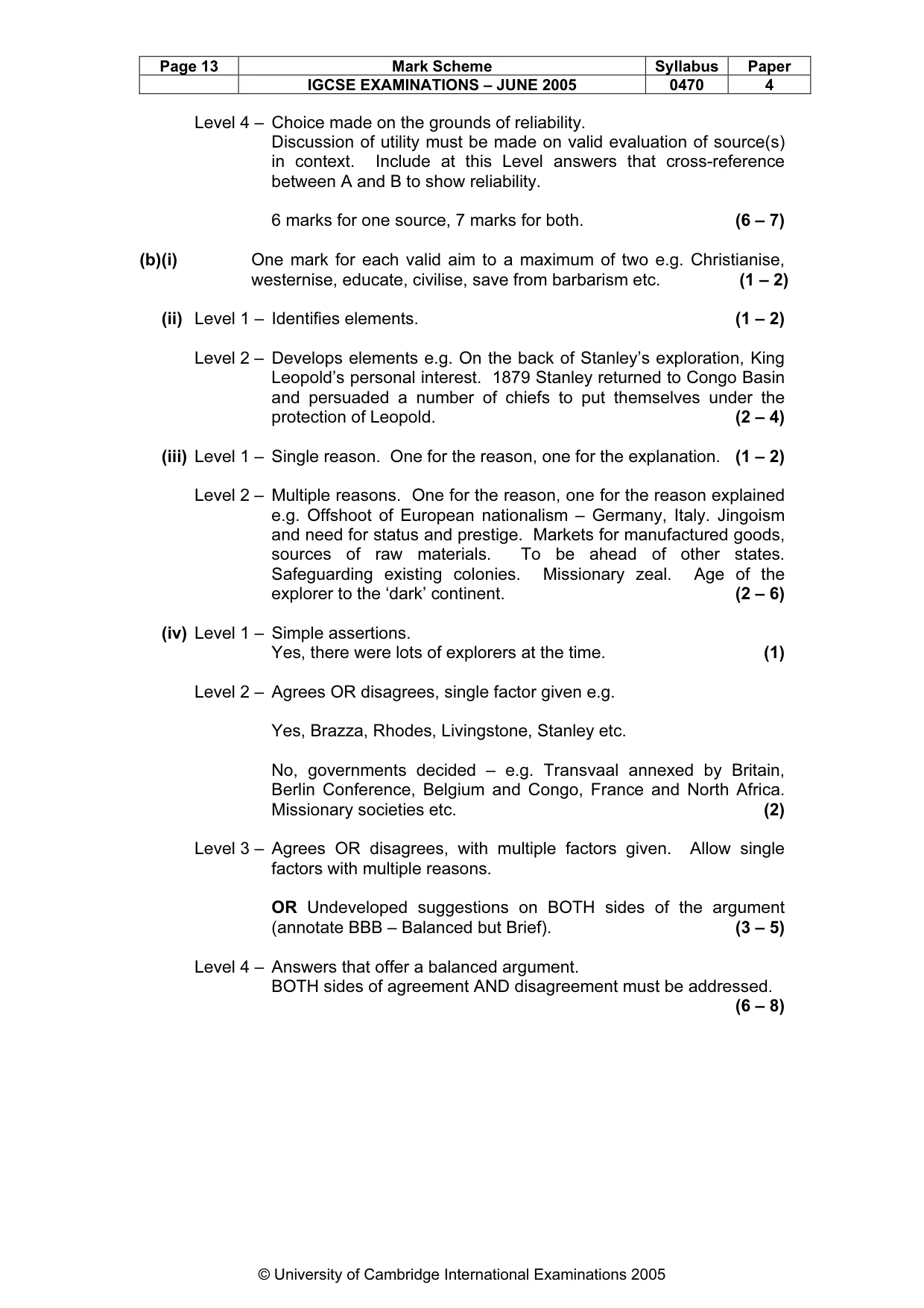
Page 13 Mark Scheme Syllabus Paper IGCSE EXAMINATIONS – JUNE 2005 0470 4 © University of Cambridge International Examinations 2005 Level 4 – Choice made on the grounds of reliability. Discussion of utility must be made on valid evaluation of source(s) in context. Include at this Level answers that cross-reference between A and B to show reliability. 6 marks for one source, 7 marks for both. (6 – 7) (b)(i) One mark for each valid aim to a maximum of two e.g. Christianise, westernise, educate, civilise, save from barbarism etc. (1 – 2) (ii) Level 1 – Identifies elements. (1 – 2) Level 2 – Develops elements e.g. On the back of Stanley’s exploration, King Leopold’s personal interest. 1879 Stanley returned to Congo Basin and persuaded a number of chiefs to put themselves under the protection of Leopold. (2 – 4) (iii) Level 1 – Single reason. One for the reason, one for the explanation. (1 – 2) Level 2 – Multiple reasons. One for the reason, one for the reason explained e.g. Offshoot of European nationalism – Germany, Italy. Jingoism and need for status and prestige. Markets for manufactured goods, sources of raw materials. To be ahead of other states. Safeguarding existing colonies. Missionary zeal. Age of the explorer to the ‘dark’ continent. (2 – 6) (iv) Level 1 – Simple assertions. Yes, there were lots of explorers at the time. (1) Level 2 – Agrees OR disagrees, single factor given e.g. Yes, Brazza, Rhodes, Livingstone, Stanley etc. No, governments decided – e.g. Transvaal annexed by Britain, Berlin Conference, Belgium and Congo, France and North Africa. Missionary societies etc. (2) Level 3 – Agrees OR disagrees, with multiple factors given. Allow single factors with multiple reasons. OR Undeveloped suggestions on BOTH sides of the argument (annotate BBB – Balanced but Brief). (3 – 5) Level 4 – Answers that offer a balanced argument. BOTH sides of agreement AND disagreement must be addressed. (6 – 8)