Cambridge IGCSE History 0470 — 2004 Oct/Nov Paper 4 · Variant 1
0470/41/O/N/04
The question paper and its mark scheme, free to read here and free to download. This is Cambridge’s own paper, exactly as it was sat.
Question paper12 pages
Mark scheme16 pages
Answers below. Sit the paper first if you are practising.
Paper as text
Question paper, page 1
This document consists of 11 printed pages and 1 blank page. SP (NF/GR) S64371/4 © UCLES 2004 [Turn over UNIVERSITY OF CAMBRIDGE INTERNATIONAL EXAMINATIONS International General Certificate of Secondary Education HISTORY 0470/04 Paper 4 Alternative to Coursework October/November 2004 1 hour Additional Materials: Answer Booklet/Paper READ THESE INSTRUCTIONS FIRST If you have been given an Answer Booklet, follow the instructions on the front cover of the Booklet. Write your Centre number, candidate number and name on all the work you hand in. Write in dark blue or black pen on both sides of the paper. You may use a soft pencil for any diagrams, graphs or rough working. Do not use staples, paper clips, highlighters, glue or correction fluid. Answer the questions on one Depth Study. At the end of the examination, fasten all your work securely together. The number of marks is given in brackets [ ] at the end of each question or part question. www.XtremePapers.com
Question paper, page 2
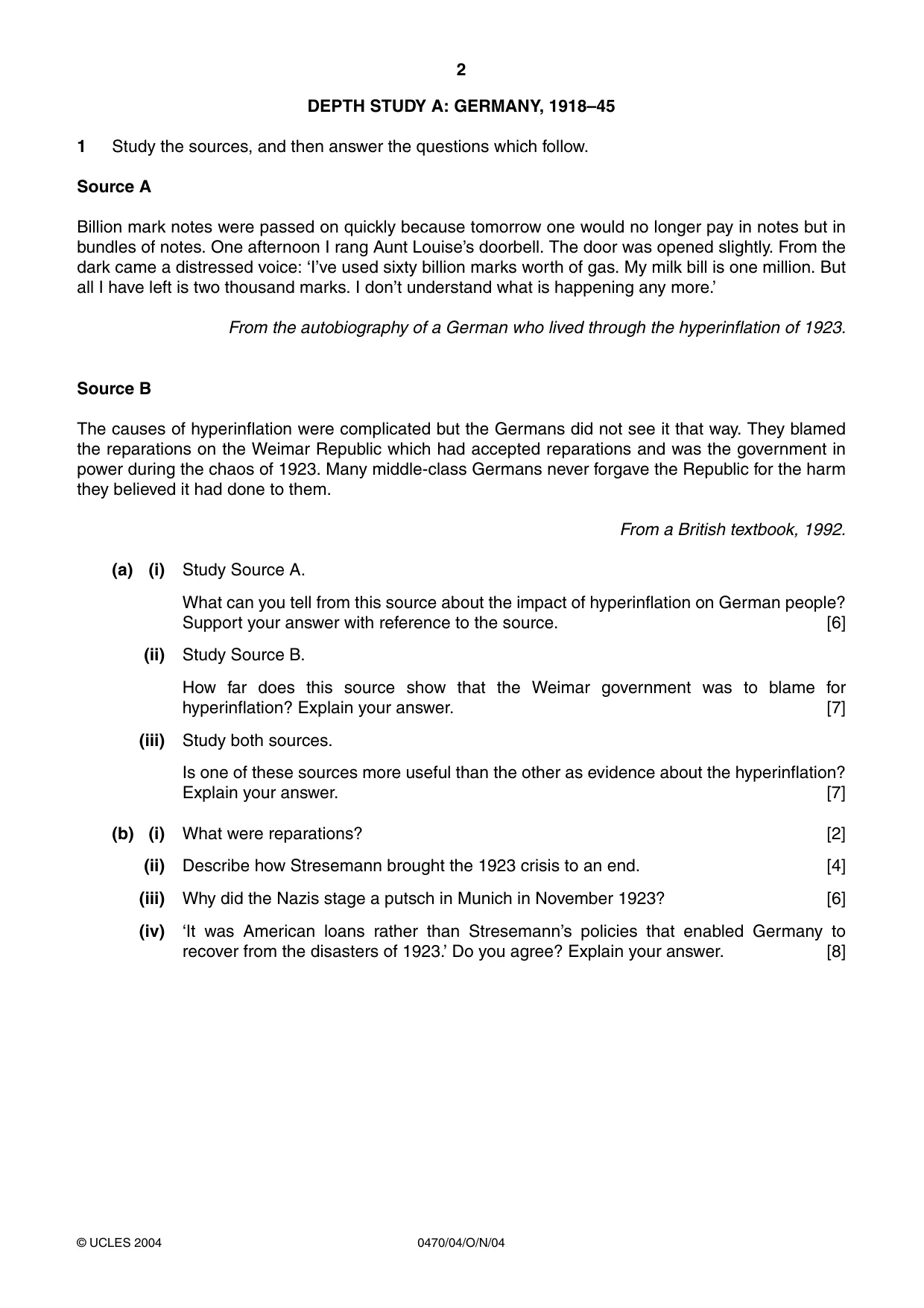
2 0470/04/O/N/04 DEPTH STUDY A: GERMANY, 1918–45 1 Study the sources, and then answer the questions which follow. Source A Billion mark notes were passed on quickly because tomorrow one would no longer pay in notes but in bundles of notes. One afternoon I rang Aunt Louise’s doorbell. The door was opened slightly. From the dark came a distressed voice: ‘I’ve used sixty billion marks worth of gas. My milk bill is one million. But all I have left is two thousand marks. I don’t understand what is happening any more.’ From the autobiography of a German who lived through the hyperinflation of 1923. Source B The causes of hyperinflation were complicated but the Germans did not see it that way. They blamed the reparations on the Weimar Republic which had accepted reparations and was the government in power during the chaos of 1923. Many middle-class Germans never forgave the Republic for the harm they believed it had done to them. From a British textbook, 1992. (a) (i) Study Source A. What can you tell from this source about the impact of hyperinflation on German people? Support your answer with reference to the source. [6] (ii) Study Source B. How far does this source show that the Weimar government was to blame for hyperinflation? Explain your answer. [7] (iii) Study both sources. Is one of these sources more useful than the other as evidence about the hyperinflation? Explain your answer. [7] (b) (i) What were reparations? [2] (ii) Describe how Stresemann brought the 1923 crisis to an end. [4] (iii) Why did the Nazis stage a putsch in Munich in November 1923? [6] (iv) ‘It was American loans rather than Stresemann’s policies that enabled Germany to recover from the disasters of 1923.’ Do you agree? Explain your answer. [8] © UCLES 2004
Question paper, page 3
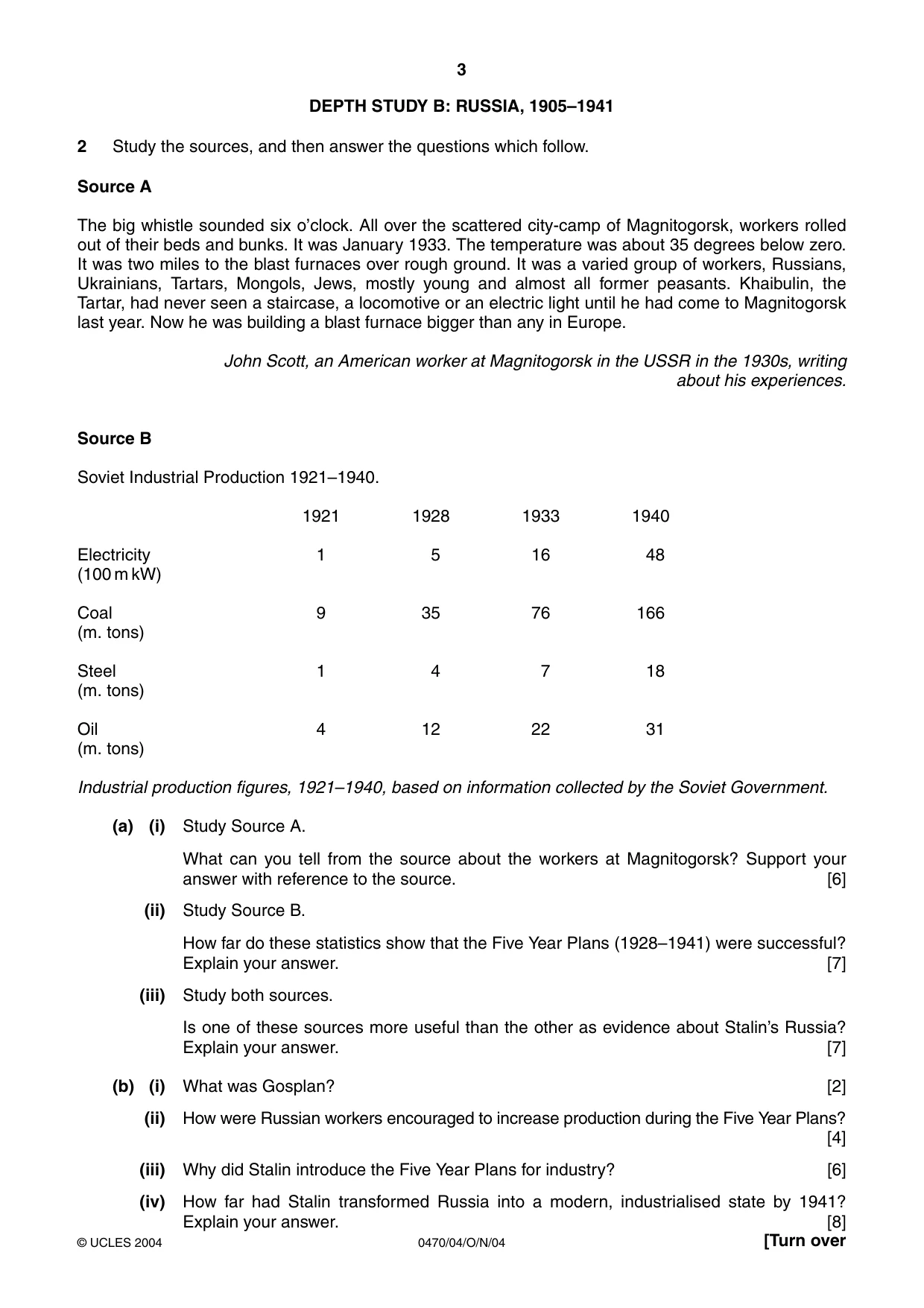
3 0470/04/O/N/04 [Turn over DEPTH STUDY B: RUSSIA, 1905–1941 2 Study the sources, and then answer the questions which follow. Source A The big whistle sounded six o’clock. All over the scattered city-camp of Magnitogorsk, workers rolled out of their beds and bunks. It was January 1933. The temperature was about 35 degrees below zero. It was two miles to the blast furnaces over rough ground. It was a varied group of workers, Russians, Ukrainians, Tartars, Mongols, Jews, mostly young and almost all former peasants. Khaibulin, the Tartar, had never seen a staircase, a locomotive or an electric light until he had come to Magnitogorsk last year. Now he was building a blast furnace bigger than any in Europe. John Scott, an American worker at Magnitogorsk in the USSR in the 1930s, writing about his experiences. Source B Soviet Industrial Production 1921–1940. 1921 1928 1933 1940 Electricity 1 5 16 48 (100 m kW) Coal 9 35 76 166 (m. tons) Steel 1 4 7 18 (m. tons) Oil 4 12 22 31 (m. tons) Industrial production figures, 1921–1940, based on information collected by the Soviet Government. (a) (i) Study Source A. What can you tell from the source about the workers at Magnitogorsk? Support your answer with reference to the source. [6] (ii) Study Source B. How far do these statistics show that the Five Year Plans (1928–1941) were successful? Explain your answer. [7] (iii) Study both sources. Is one of these sources more useful than the other as evidence about Stalin’s Russia? Explain your answer. [7] (b) (i) What was Gosplan? [2] (ii) How were Russian workers encouraged to increase production during the Five Year Plans? [4] (iii) Why did Stalin introduce the Five Year Plans for industry? [6] (iv) How far had Stalin transformed Russia into a modern, industrialised state by 1941? Explain your answer. [8] © UCLES 2004
Question paper, page 4
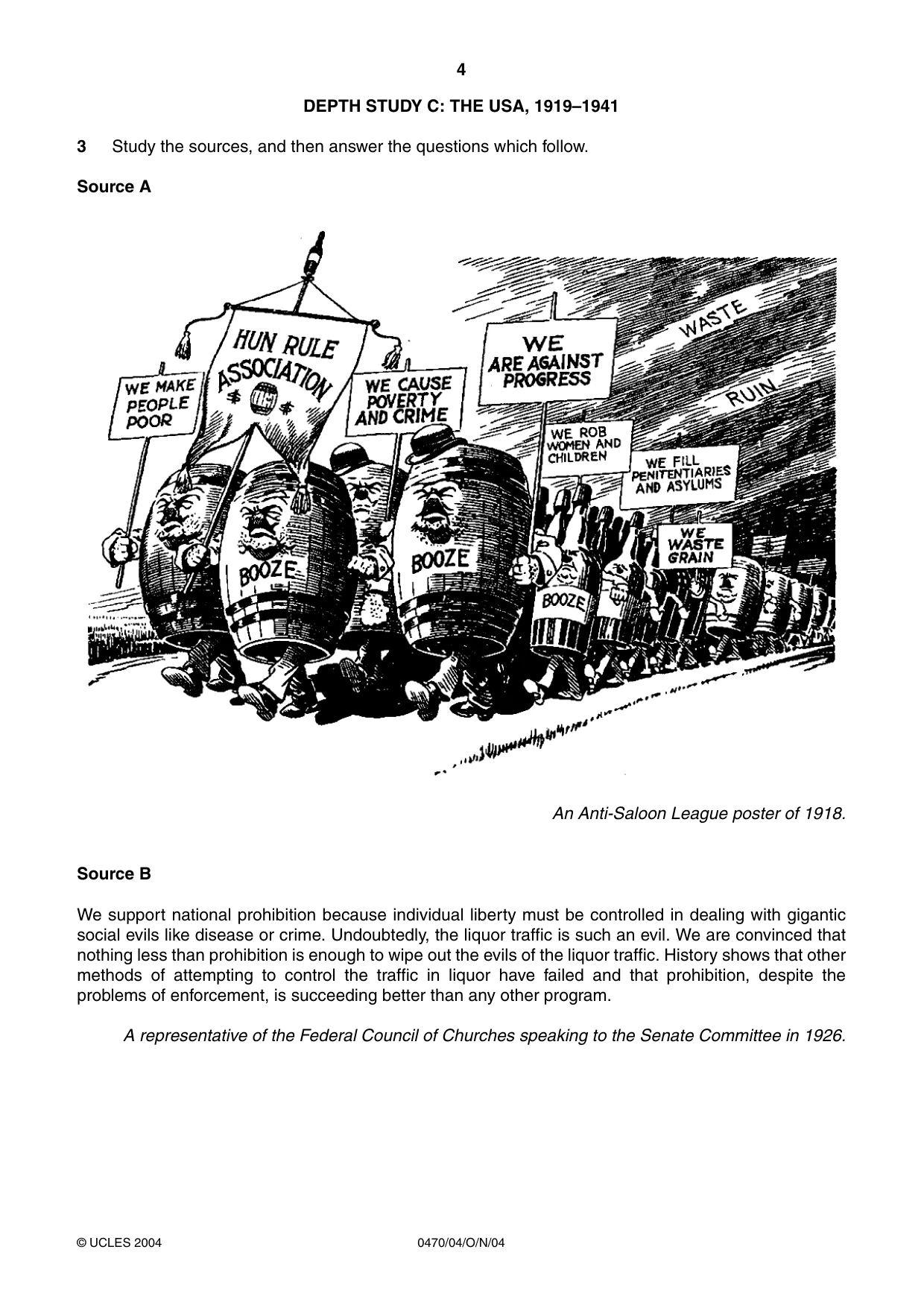
4 0470/04/O/N/04 DEPTH STUDY C: THE USA, 1919–1941 3 Study the sources, and then answer the questions which follow. Source A An Anti-Saloon League poster of 1918. Source B We support national prohibition because individual liberty must be controlled in dealing with gigantic social evils like disease or crime. Undoubtedly, the liquor traffic is such an evil. We are convinced that nothing less than prohibition is enough to wipe out the evils of the liquor traffic. History shows that other methods of attempting to control the traffic in liquor have failed and that prohibition, despite the problems of enforcement, is succeeding better than any other program. A representative of the Federal Council of Churches speaking to the Senate Committee in 1926. © UCLES 2004
Question paper, page 5
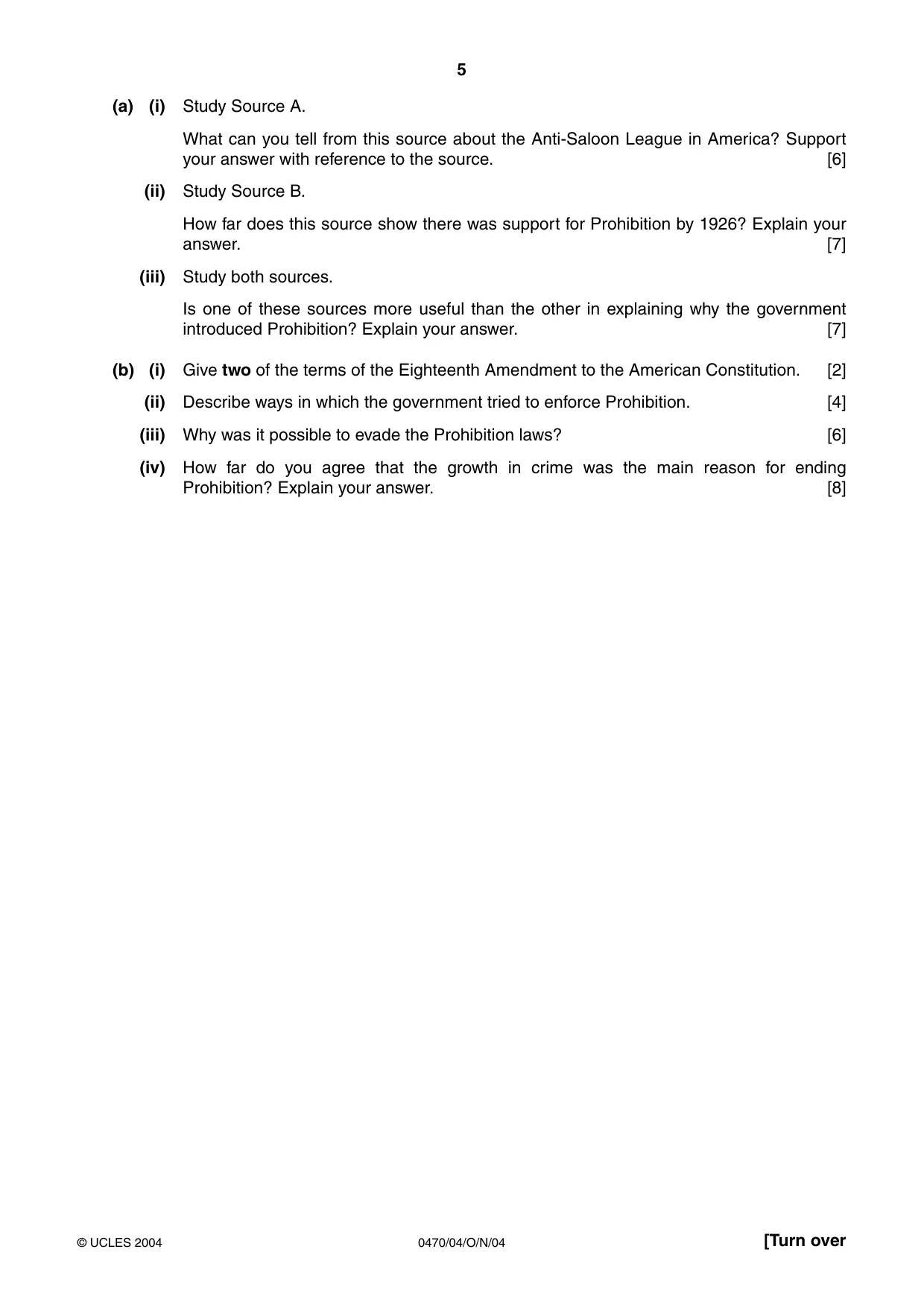
5 0470/04/O/N/04 [Turn over (a) (i) Study Source A. What can you tell from this source about the Anti-Saloon League in America? Support your answer with reference to the source. [6] (ii) Study Source B. How far does this source show there was support for Prohibition by 1926? Explain your answer. [7] (iii) Study both sources. Is one of these sources more useful than the other in explaining why the government introduced Prohibition? Explain your answer. [7] (b) (i) Give two of the terms of the Eighteenth Amendment to the American Constitution. [2] (ii) Describe ways in which the government tried to enforce Prohibition. [4] (iii) Why was it possible to evade the Prohibition laws? [6] (iv) How far do you agree that the growth in crime was the main reason for ending Prohibition? Explain your answer. [8] © UCLES 2004
Question paper, page 6
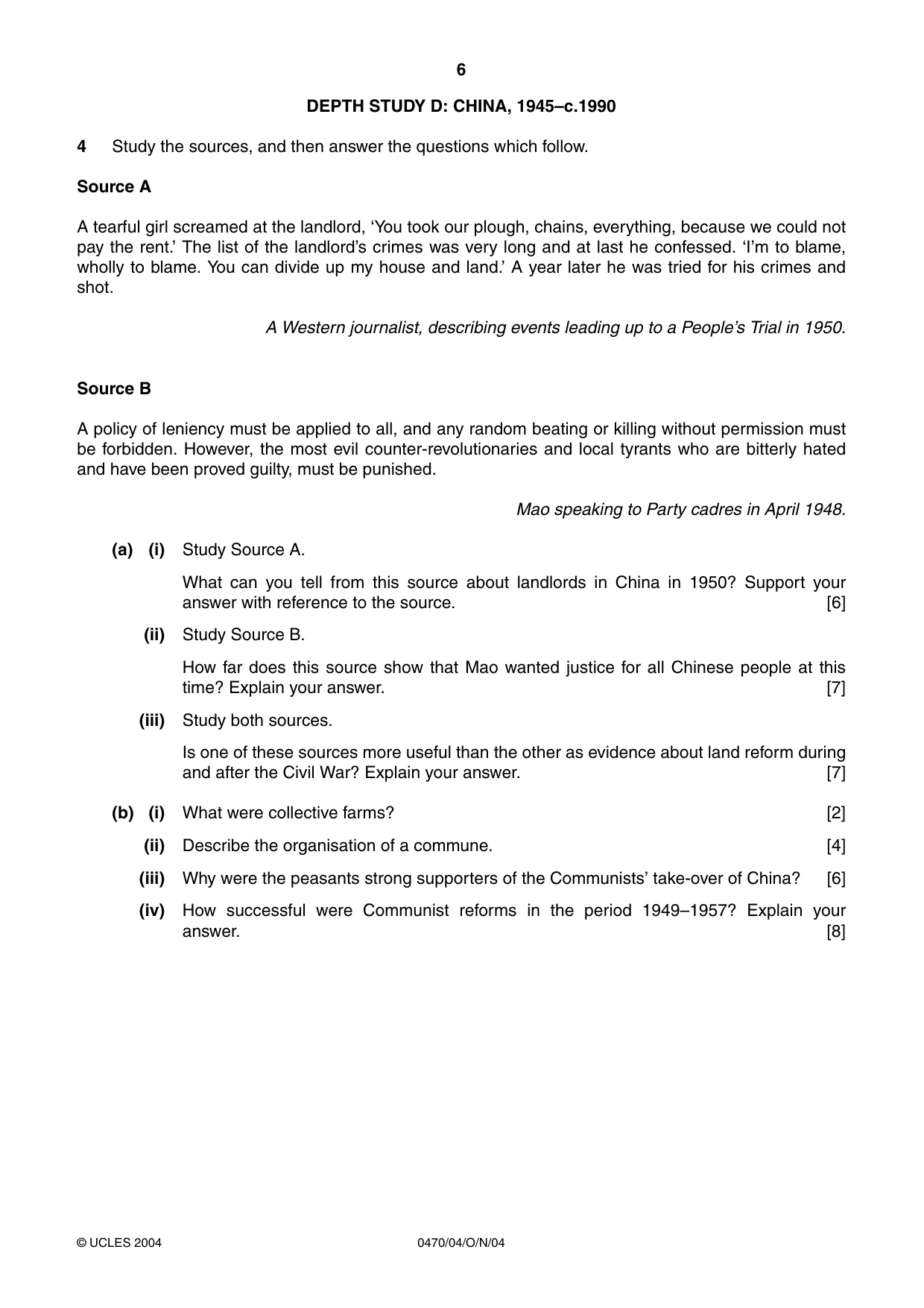
6 0470/04/O/N/04 DEPTH STUDY D: CHINA, 1945–c.1990 4 Study the sources, and then answer the questions which follow. Source A A tearful girl screamed at the landlord, ‘You took our plough, chains, everything, because we could not pay the rent.’ The list of the landlord’s crimes was very long and at last he confessed. ‘I’m to blame, wholly to blame. You can divide up my house and land.’ A year later he was tried for his crimes and shot. A Western journalist, describing events leading up to a People’s Trial in 1950. Source B A policy of leniency must be applied to all, and any random beating or killing without permission must be forbidden. However, the most evil counter-revolutionaries and local tyrants who are bitterly hated and have been proved guilty, must be punished. Mao speaking to Party cadres in April 1948. (a) (i) Study Source A. What can you tell from this source about landlords in China in 1950? Support your answer with reference to the source. [6] (ii) Study Source B. How far does this source show that Mao wanted justice for all Chinese people at this time? Explain your answer. [7] (iii) Study both sources. Is one of these sources more useful than the other as evidence about land reform during and after the Civil War? Explain your answer. [7] (b) (i) What were collective farms? [2] (ii) Describe the organisation of a commune. [4] (iii) Why were the peasants strong supporters of the Communists’ take-over of China? [6] (iv) How successful were Communist reforms in the period 1949–1957? Explain your answer. [8] © UCLES 2004
Question paper, page 7
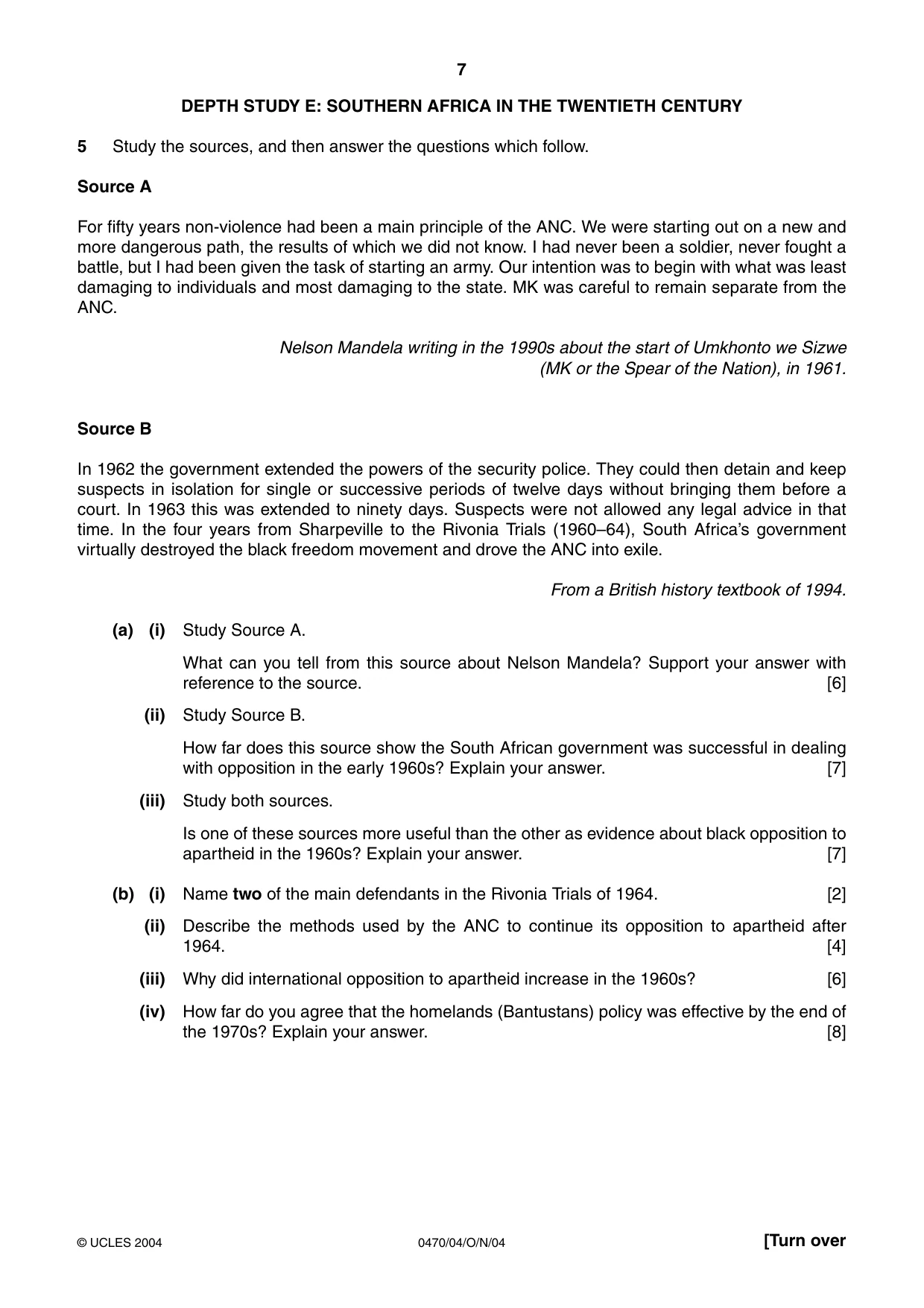
7 0470/04/O/N/04 [Turn over DEPTH STUDY E: SOUTHERN AFRICA IN THE TWENTIETH CENTURY 5 Study the sources, and then answer the questions which follow. Source A For fifty years non-violence had been a main principle of the ANC. We were starting out on a new and more dangerous path, the results of which we did not know. I had never been a soldier, never fought a battle, but I had been given the task of starting an army. Our intention was to begin with what was least damaging to individuals and most damaging to the state. MK was careful to remain separate from the ANC. Nelson Mandela writing in the 1990s about the start of Umkhonto we Sizwe (MK or the Spear of the Nation), in 1961. Source B In 1962 the government extended the powers of the security police. They could then detain and keep suspects in isolation for single or successive periods of twelve days without bringing them before a court. In 1963 this was extended to ninety days. Suspects were not allowed any legal advice in that time. In the four years from Sharpeville to the Rivonia Trials (1960–64), South Africa’s government virtually destroyed the black freedom movement and drove the ANC into exile. From a British history textbook of 1994. (a) (i) Study Source A. What can you tell from this source about Nelson Mandela? Support your answer with reference to the source. [6] (ii) Study Source B. How far does this source show the South African government was successful in dealing with opposition in the early 1960s? Explain your answer. [7] (iii) Study both sources. Is one of these sources more useful than the other as evidence about black opposition to apartheid in the 1960s? Explain your answer. [7] (b) (i) Name two of the main defendants in the Rivonia Trials of 1964. [2] (ii) Describe the methods used by the ANC to continue its opposition to apartheid after 1964. [4] (iii) Why did international opposition to apartheid increase in the 1960s? [6] (iv) How far do you agree that the homelands (Bantustans) policy was effective by the end of the 1970s? Explain your answer. [8] © UCLES 2004
Question paper, page 8
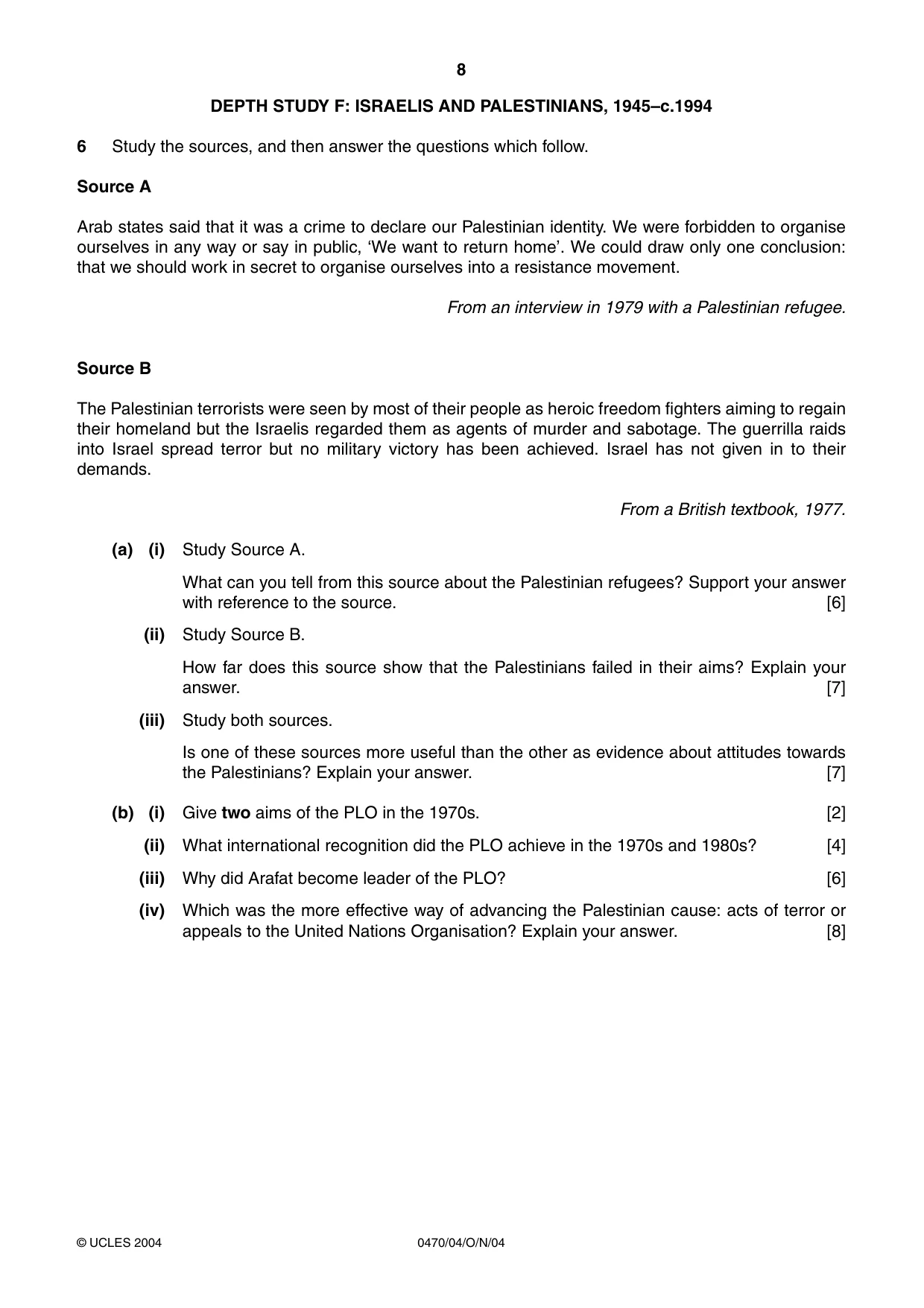
8 0470/04/O/N/04 DEPTH STUDY F: ISRAELIS AND PALESTINIANS, 1945–c.1994 6 Study the sources, and then answer the questions which follow. Source A Arab states said that it was a crime to declare our Palestinian identity. We were forbidden to organise ourselves in any way or say in public, ‘We want to return home’. We could draw only one conclusion: that we should work in secret to organise ourselves into a resistance movement. From an interview in 1979 with a Palestinian refugee. Source B The Palestinian terrorists were seen by most of their people as heroic freedom fighters aiming to regain their homeland but the Israelis regarded them as agents of murder and sabotage. The guerrilla raids into Israel spread terror but no military victory has been achieved. Israel has not given in to their demands. From a British textbook, 1977. (a) (i) Study Source A. What can you tell from this source about the Palestinian refugees? Support your answer with reference to the source. [6] (ii) Study Source B. How far does this source show that the Palestinians failed in their aims? Explain your answer. [7] (iii) Study both sources. Is one of these sources more useful than the other as evidence about attitudes towards the Palestinians? Explain your answer. [7] (b) (i) Give two aims of the PLO in the 1970s. [2] (ii) What international recognition did the PLO achieve in the 1970s and 1980s? [4] (iii) Why did Arafat become leader of the PLO? [6] (iv) Which was the more effective way of advancing the Palestinian cause: acts of terror or appeals to the United Nations Organisation? Explain your answer. [8] © UCLES 2004
Question paper, page 9
9 0470/04/O/N/04 [Turn over DEPTH STUDY G: THE CREATION OF MODERN INDUSTRIAL SOCIETY 7 Study the sources, and then answer the questions which follow. Source A Although the law has been broken many times, I see a definite change for the better within the last three months. From what I have seen and heard there is a growing belief that effective legislation for the protection of children in factories is necessary. Workers have frequently said to me that they are satisfied that the limitation of hours and the obligation to attend school will produce lasting benefits to the children. From the Report on the Working of the Factory Act of 1833. Source B Saturday August 22nd 1801. In the evening I walked to Cromford and saw the children coming from their work out of one of Mr. Arkwright’s factories. I was glad to see them look in general very healthy and many with rosy complexions. These children had been at work from 6 or 7 o’clock this morning and it was now about 7 o’clock in the evening. Sunday August 23rd 1801. We went to church at Cromford. On each side of the organ was a gallery in which about fifty boys were seated. These children are employed in Mr. Arkwright’s factory in the weekdays, and on Sundays attend a school where they receive education and then go on to church. They looked healthy, and were decently clothed and clean. Extracts from the diary of Joseph Farrington who visited Cromford with three friends on their travels in 1801. (a) (i) Study Source A. What can you tell from this source about the Factory Act of 1833? Support your answer by reference to the source. [6] (ii) Study Source B. How far does this source show that legislation to protect children working in factories was unnecessary? Explain your answer. [7] (iii) Study both sources. Is one source more useful than the other as evidence about child labour in factories? Explain your answer. [7] (b) (i) Give two of the terms of the Factory Act of 1833. [2] (ii) Describe the types of work done by children in textile factories. [4] (iii) Why was factory legislation often opposed? [6] (iv) Did the growth of the factory system result in more advantages than disadvantages for working people? Explain your answer. [8] © UCLES 2004
Question paper, page 10
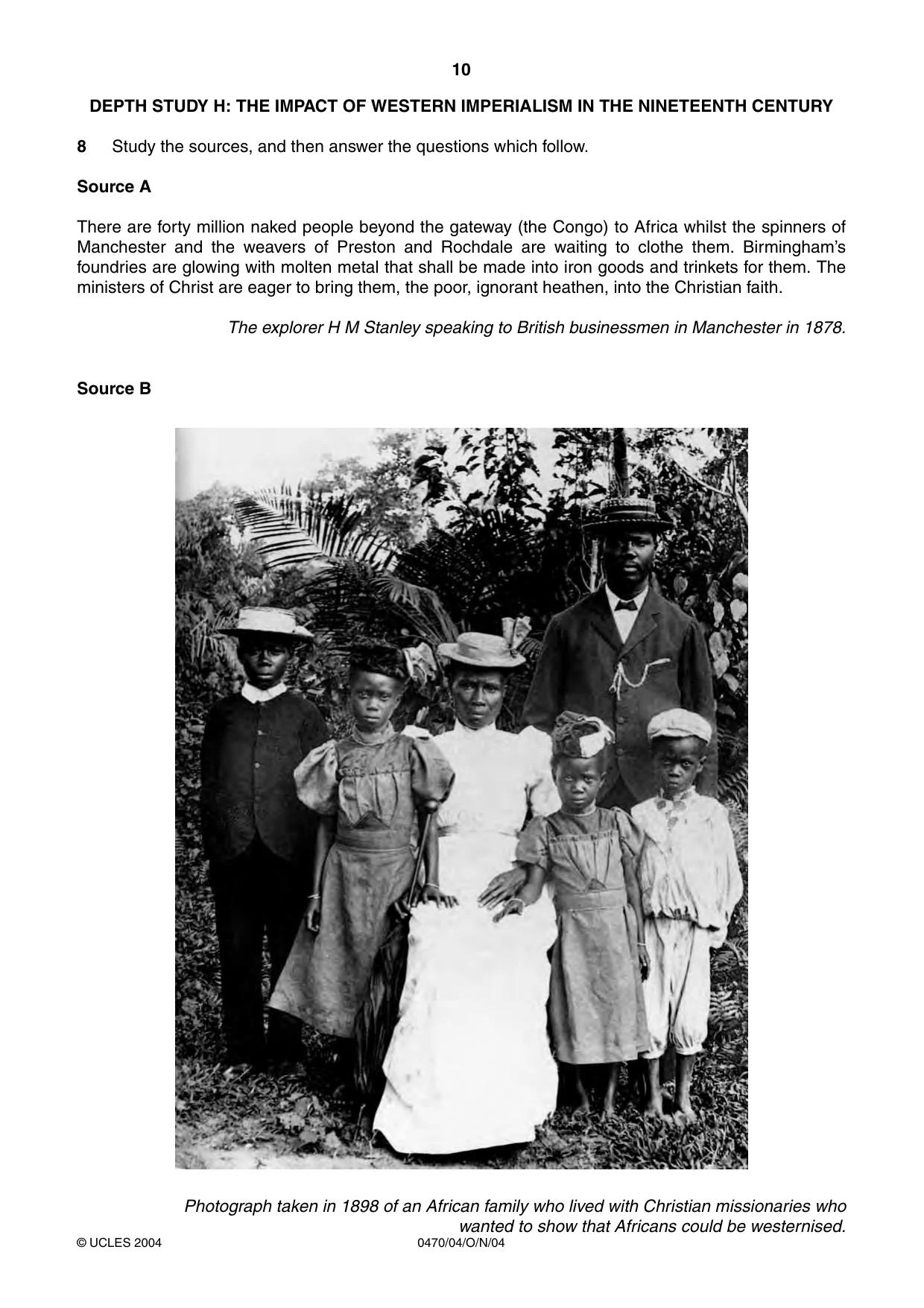
10 0470/04/O/N/04 DEPTH STUDY H: THE IMPACT OF WESTERN IMPERIALISM IN THE NINETEENTH CENTURY 8 Study the sources, and then answer the questions which follow. Source A There are forty million naked people beyond the gateway (the Congo) to Africa whilst the spinners of Manchester and the weavers of Preston and Rochdale are waiting to clothe them. Birmingham’s foundries are glowing with molten metal that shall be made into iron goods and trinkets for them. The ministers of Christ are eager to bring them, the poor, ignorant heathen, into the Christian faith. The explorer H M Stanley speaking to British businessmen in Manchester in 1878. Source B Photograph taken in 1898 of an African family who lived with Christian missionaries who wanted to show that Africans could be westernised. © UCLES 2004
Question paper, page 11
11 0470/04/O/N/04 (a) (i) Study Source A. What can you tell from this source about motives for imperialism? Support your answer by reference to the source. [6] (ii) Study Source B. How far does this source show that imperialism was being successful in Africa? Explain your answer. [7] (iii) Study both sources. Is one source more useful than the other as evidence of the impact of western imperialism in the nineteenth century? Explain your answer. [7] (b) (i) Name two African territories in the possession of Germany at the end of the nineteenth century. [2] (ii) What was meant by the ‘scramble for Africa’? [4] (iii) Why were European countries able to control so much of Africa by the end of the nineteenth century? [6] (iv) How far were Europeans satisfied with the results of imperialism in Africa by the end of the nineteenth century? Explain your answer. [8] © UCLES 2004
Question paper, page 12
12 0470/04/O/N/04 BLANK PAGE Copyright Acknowledgements: Depth Study A: Source A: Ben Walsh. History in Focus: Modern World History. John Murray. Depth Study A: Source B: Ben Walsh. History in Focus: Modern World History. John Murray. Depth Study B: Source A: © John Scott. Behind the Urals. Houghton Mifflin 1942. Depth Study B: Source B: from Russia 1917–1945 by Clare Baker. Reprinted by permission of Elsevier Limited. Depth Study C: Source A: Courtesy of The Ohio State University Department of History. Depth Study C: Source B: Courtesy of The Ohio State University Department of History. Depth Study D: Source A: Neil De Marco. The World This Century. Collins Educational. Depth Study D: Source B: Harriet Ward. World Powers in 20th Century. Heinemann Publishers Ltd. Depth Study E: Source A: Nelson Mandela. Long Walk to Freedom. Time Warner Books UK. © Nelson Mandela. Depth Study E: Source B: J. D. Omer-Cooper. History of South Africa. James Currey Publishers. Depth Study F: Source A: S. J. Perkins. The Arab Israeli Conflict. Published by Holmes McDougall. Reproduced by permission of QCA. © S. J. Perkins. Depth Study F: Source B: S. J. Perkins. The Arab Israeli Conflict. Published by Holmes McDougall. Reproduced by permission of QCA. © S. J. Perkins. Every reasonable effort has been made to trace all copyright holders where the publishers (i.e. UCLES) are aware that third-party material has been reproduced. The publishers would be pleased to hear from anyone whose rights they have unwittingly infringed. University of Cambridge International Examinations is part of the University of Cambridge Local Examinations Syndicate (UCLES), which is itself a department of the University of Cambridge.
Mark scheme, page 1
UNIVERSITY OF CAMBRIDGE INTERNATIONAL EXAMINATIONS International General Certificate of Secondary Education MARK SCHEME for the November 2004 question papers 0470 HISTORY 0470/04 Paper 4 (Alternative to Coursework), maximum raw mark 40 These mark schemes are published as an aid to teachers and students, to indicate the requirements of the examination. They show the basis on which Examiners were initially instructed to award marks. They do not indicate the details of the discussions that took place at an Examiners’ meeting before marking began. Any substantial changes to the mark scheme that arose from these discussions will be recorded in the published Report on the Examination. All Examiners are instructed that alternative correct answers and unexpected approaches in candidates’ scripts must be given marks that fairly reflect the relevant knowledge and skills demonstrated. Mark schemes must be read in conjunction with the question papers and the Report on the Examination. • CIE will not enter into discussion or correspondence in connection with these mark schemes. CIE is publishing the mark schemes for the November 2004 question papers for most IGCSE and GCE Advanced Level syllabuses. www.XtremePapers.com
Mark scheme, page 2
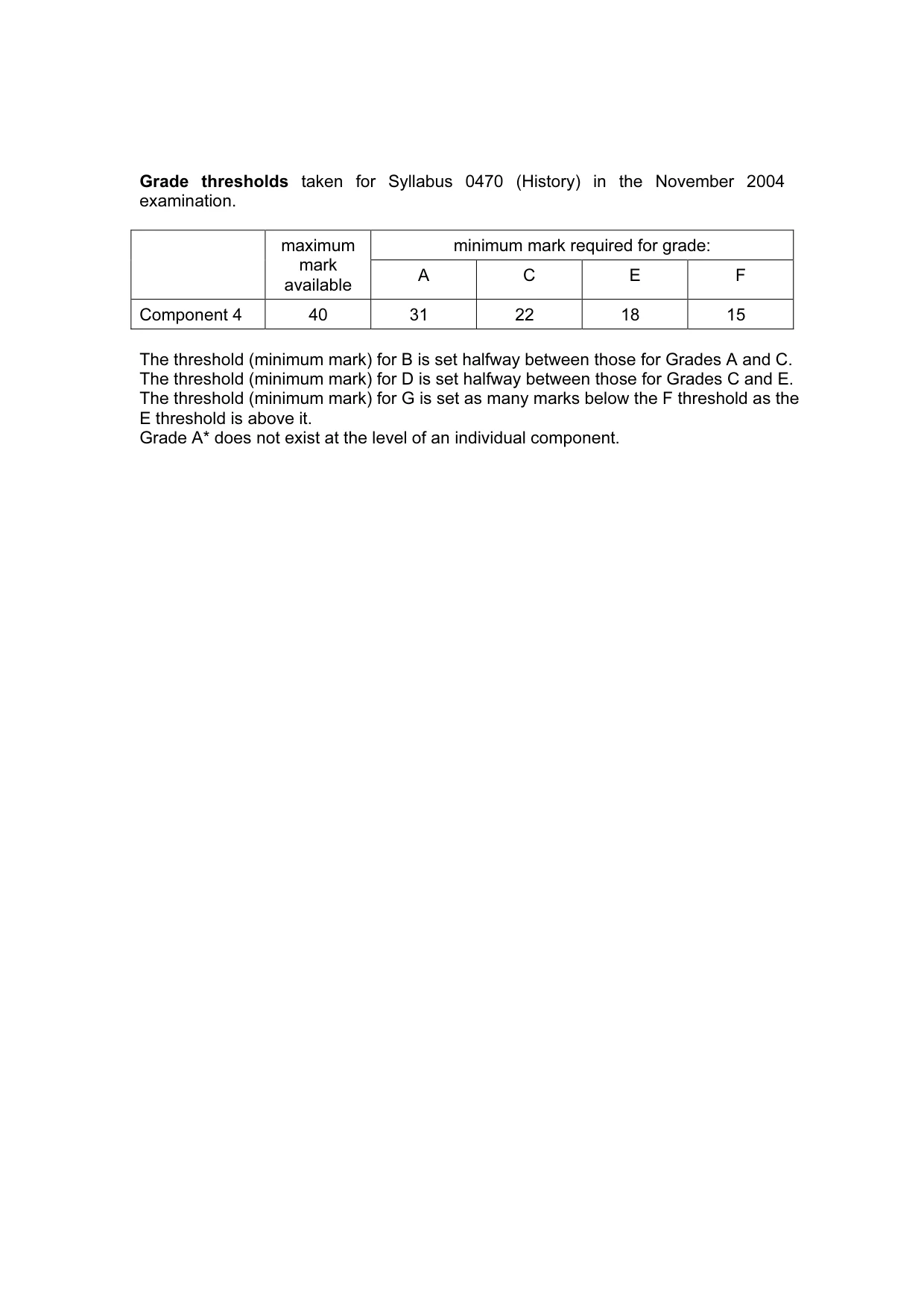
Grade thresholds taken for Syllabus 0470 (History) in the November 2004 examination. minimum mark required for grade: maximum mark available A C E F Component 4 40 31 22 18 15 The threshold (minimum mark) for B is set halfway between those for Grades A and C. The threshold (minimum mark) for D is set halfway between those for Grades C and E. The threshold (minimum mark) for G is set as many marks below the F threshold as the E threshold is above it. Grade A* does not exist at the level of an individual component.
Mark scheme, page 3
November 2004 INTERNATIONAL GCSE MARK SCHEME MAXIMUM MARK: 40 SYLLABUS/COMPONENT: 0470/04 HISTORY Paper 4 (Alternative to Coursework)
Mark scheme, page 4
Page 1 Mark Scheme Syllabus Paper IGCSE EXAMINATIONS – NOVEMBER 2004 0470 4 © University of Cambridge International Examinations 2005 This paper is marked out of a maximum of 40 marks. Candidates must choose ONE Depth Study to attempt. Questions and Marking Schemes for each Depth Study have been developed to follow a pattern. In every case, part (a) questions concentrate on source material provided in the Paper and are worth a total of 20 marks. Part (b) questions deal with subject matter closely related to the source material and also have a total value of 20 marks. Whilst marking schemes are based on the same model, they have been printed separately to allow exemplars of skill and information levels which candidates may use. These exemplars are not intended to be exclusive or exhaustive.
Mark scheme, page 5
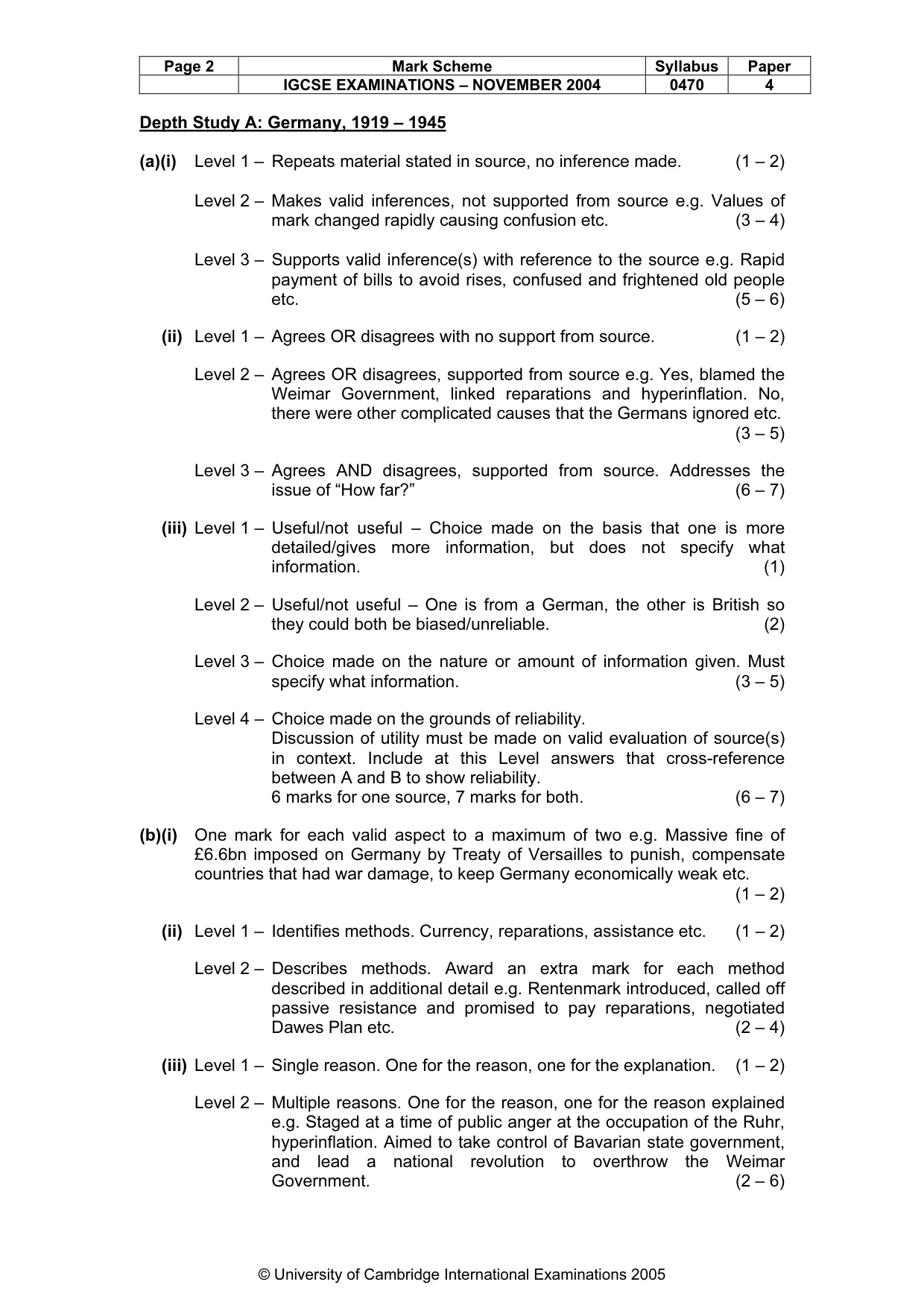
Page 2 Mark Scheme Syllabus Paper IGCSE EXAMINATIONS – NOVEMBER 2004 0470 4 © University of Cambridge International Examinations 2005 Depth Study A: Germany, 1919 – 1945 (a)(i) Level 1 – Repeats material stated in source, no inference made. (1 – 2) Level 2 – Makes valid inferences, not supported from source e.g. Values of mark changed rapidly causing confusion etc. (3 – 4) Level 3 – Supports valid inference(s) with reference to the source e.g. Rapid payment of bills to avoid rises, confused and frightened old people etc. (5 – 6) (ii) Level 1 – Agrees OR disagrees with no support from source. (1 – 2) Level 2 – Agrees OR disagrees, supported from source e.g. Yes, blamed the Weimar Government, linked reparations and hyperinflation. No, there were other complicated causes that the Germans ignored etc. (3 – 5) Level 3 – Agrees AND disagrees, supported from source. Addresses the issue of “How far?” (6 – 7) (iii) Level 1 – Useful/not useful – Choice made on the basis that one is more detailed/gives more information, but does not specify what information. (1) Level 2 – Useful/not useful – One is from a German, the other is British so they could both be biased/unreliable. (2) Level 3 – Choice made on the nature or amount of information given. Must specify what information. (3 – 5) Level 4 – Choice made on the grounds of reliability. Discussion of utility must be made on valid evaluation of source(s) in context. Include at this Level answers that cross-reference between A and B to show reliability. 6 marks for one source, 7 marks for both. (6 – 7) (b)(i) One mark for each valid aspect to a maximum of two e.g. Massive fine of £6.6bn imposed on Germany by Treaty of Versailles to punish, compensate countries that had war damage, to keep Germany economically weak etc. (1 – 2) (ii) Level 1 – Identifies methods. Currency, reparations, assistance etc. (1 – 2) Level 2 – Describes methods. Award an extra mark for each method described in additional detail e.g. Rentenmark introduced, called off passive resistance and promised to pay reparations, negotiated Dawes Plan etc. (2 – 4) (iii) Level 1 – Single reason. One for the reason, one for the explanation. (1 – 2) Level 2 – Multiple reasons. One for the reason, one for the reason explained e.g. Staged at a time of public anger at the occupation of the Ruhr, hyperinflation. Aimed to take control of Bavarian state government, and lead a national revolution to overthrow the Weimar Government. (2 – 6)
Mark scheme, page 6
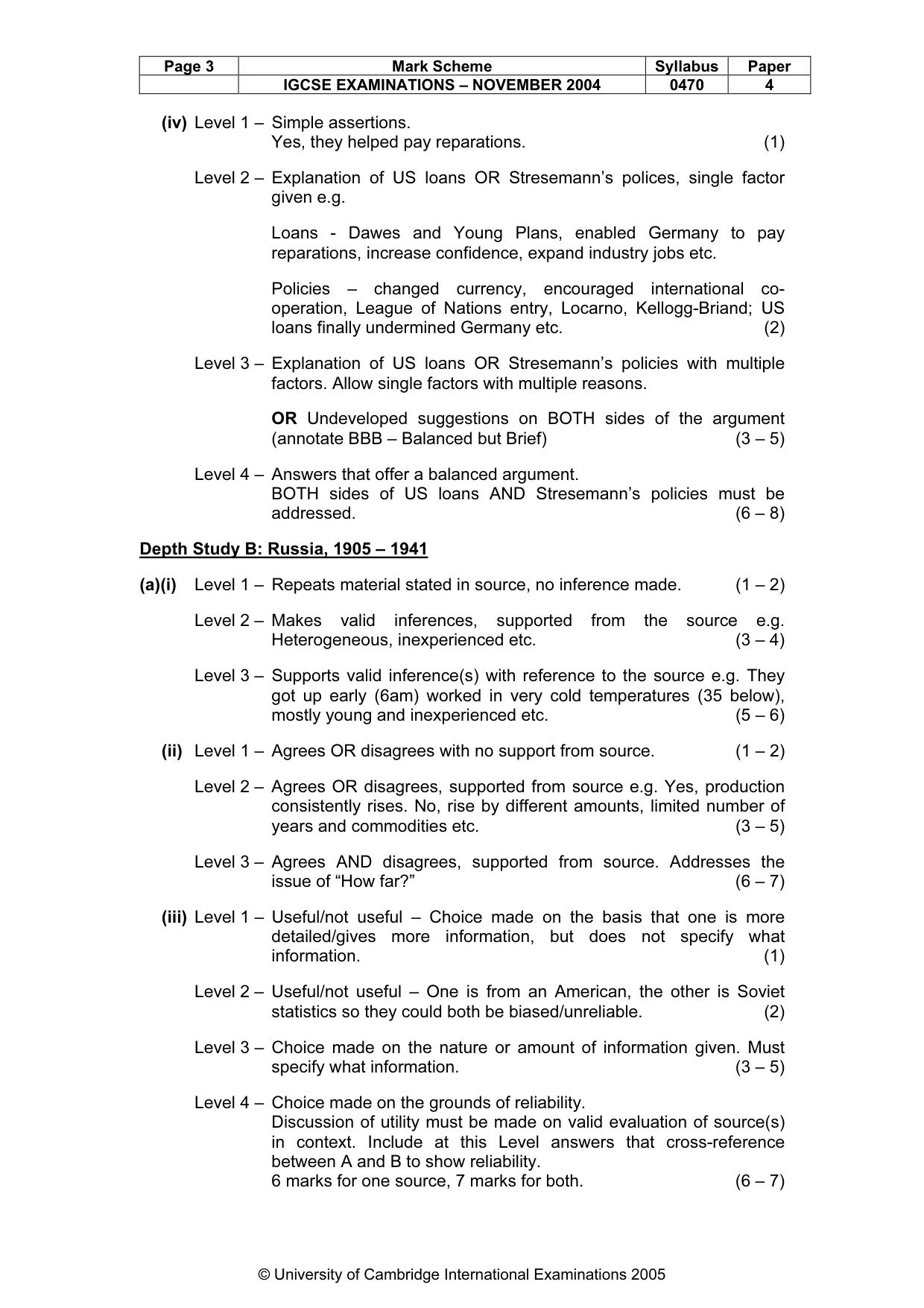
Page 3 Mark Scheme Syllabus Paper IGCSE EXAMINATIONS – NOVEMBER 2004 0470 4 © University of Cambridge International Examinations 2005 (iv) Level 1 – Simple assertions. Yes, they helped pay reparations. (1) Level 2 – Explanation of US loans OR Stresemann’s polices, single factor given e.g. Loans - Dawes and Young Plans, enabled Germany to pay reparations, increase confidence, expand industry jobs etc. Policies – changed currency, encouraged international co- operation, League of Nations entry, Locarno, Kellogg-Briand; US loans finally undermined Germany etc. (2) Level 3 – Explanation of US loans OR Stresemann’s policies with multiple factors. Allow single factors with multiple reasons. OR Undeveloped suggestions on BOTH sides of the argument (annotate BBB – Balanced but Brief) (3 – 5) Level 4 – Answers that offer a balanced argument. BOTH sides of US loans AND Stresemann’s policies must be addressed. (6 – 8) Depth Study B: Russia, 1905 – 1941 (a)(i) Level 1 – Repeats material stated in source, no inference made. (1 – 2) Level 2 – Makes valid inferences, supported from the source e.g. Heterogeneous, inexperienced etc. (3 – 4) Level 3 – Supports valid inference(s) with reference to the source e.g. They got up early (6am) worked in very cold temperatures (35 below), mostly young and inexperienced etc. (5 – 6) (ii) Level 1 – Agrees OR disagrees with no support from source. (1 – 2) Level 2 – Agrees OR disagrees, supported from source e.g. Yes, production consistently rises. No, rise by different amounts, limited number of years and commodities etc. (3 – 5) Level 3 – Agrees AND disagrees, supported from source. Addresses the issue of “How far?” (6 – 7) (iii) Level 1 – Useful/not useful – Choice made on the basis that one is more detailed/gives more information, but does not specify what information. (1) Level 2 – Useful/not useful – One is from an American, the other is Soviet statistics so they could both be biased/unreliable. (2) Level 3 – Choice made on the nature or amount of information given. Must specify what information. (3 – 5) Level 4 – Choice made on the grounds of reliability. Discussion of utility must be made on valid evaluation of source(s) in context. Include at this Level answers that cross-reference between A and B to show reliability. 6 marks for one source, 7 marks for both. (6 – 7)
Mark scheme, page 7
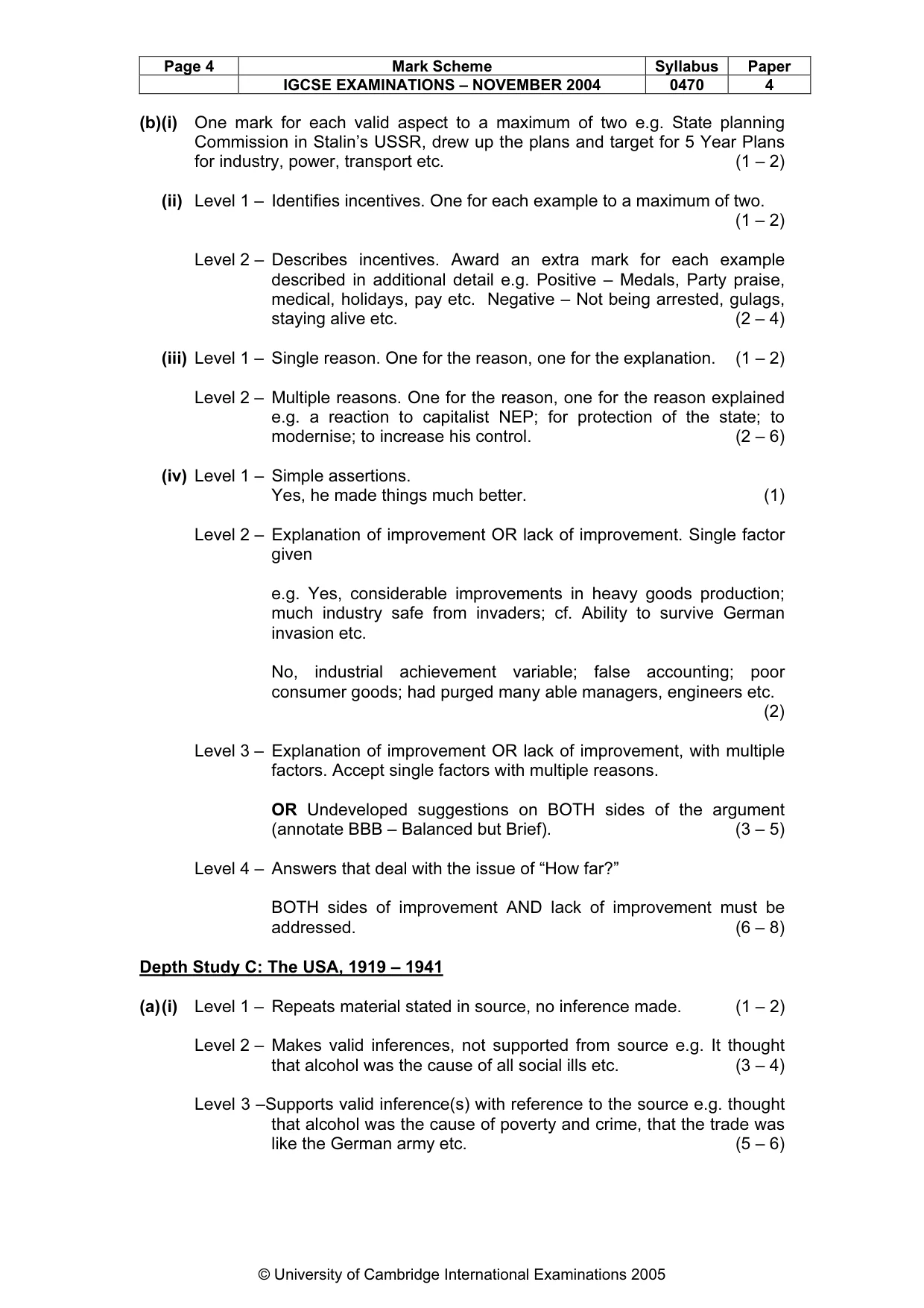
Page 4 Mark Scheme Syllabus Paper IGCSE EXAMINATIONS – NOVEMBER 2004 0470 4 © University of Cambridge International Examinations 2005 (b)(i) One mark for each valid aspect to a maximum of two e.g. State planning Commission in Stalin’s USSR, drew up the plans and target for 5 Year Plans for industry, power, transport etc. (1 – 2) (ii) Level 1 – Identifies incentives. One for each example to a maximum of two. (1 – 2) Level 2 – Describes incentives. Award an extra mark for each example described in additional detail e.g. Positive – Medals, Party praise, medical, holidays, pay etc. Negative – Not being arrested, gulags, staying alive etc. (2 – 4) (iii) Level 1 – Single reason. One for the reason, one for the explanation. (1 – 2) Level 2 – Multiple reasons. One for the reason, one for the reason explained e.g. a reaction to capitalist NEP; for protection of the state; to modernise; to increase his control. (2 – 6) (iv) Level 1 – Simple assertions. Yes, he made things much better. (1) Level 2 – Explanation of improvement OR lack of improvement. Single factor given e.g. Yes, considerable improvements in heavy goods production; much industry safe from invaders; cf. Ability to survive German invasion etc. No, industrial achievement variable; false accounting; poor consumer goods; had purged many able managers, engineers etc. (2) Level 3 – Explanation of improvement OR lack of improvement, with multiple factors. Accept single factors with multiple reasons. OR Undeveloped suggestions on BOTH sides of the argument (annotate BBB – Balanced but Brief). (3 – 5) Level 4 – Answers that deal with the issue of “How far?” BOTH sides of improvement AND lack of improvement must be addressed. (6 – 8) Depth Study C: The USA, 1919 – 1941 (a) (i) Level 1 – Repeats material stated in source, no inference made. (1 – 2) Level 2 – Makes valid inferences, not supported from source e.g. It thought that alcohol was the cause of all social ills etc. (3 – 4) Level 3 –Supports valid inference(s) with reference to the source e.g. thought that alcohol was the cause of poverty and crime, that the trade was like the German army etc. (5 – 6)
Mark scheme, page 8
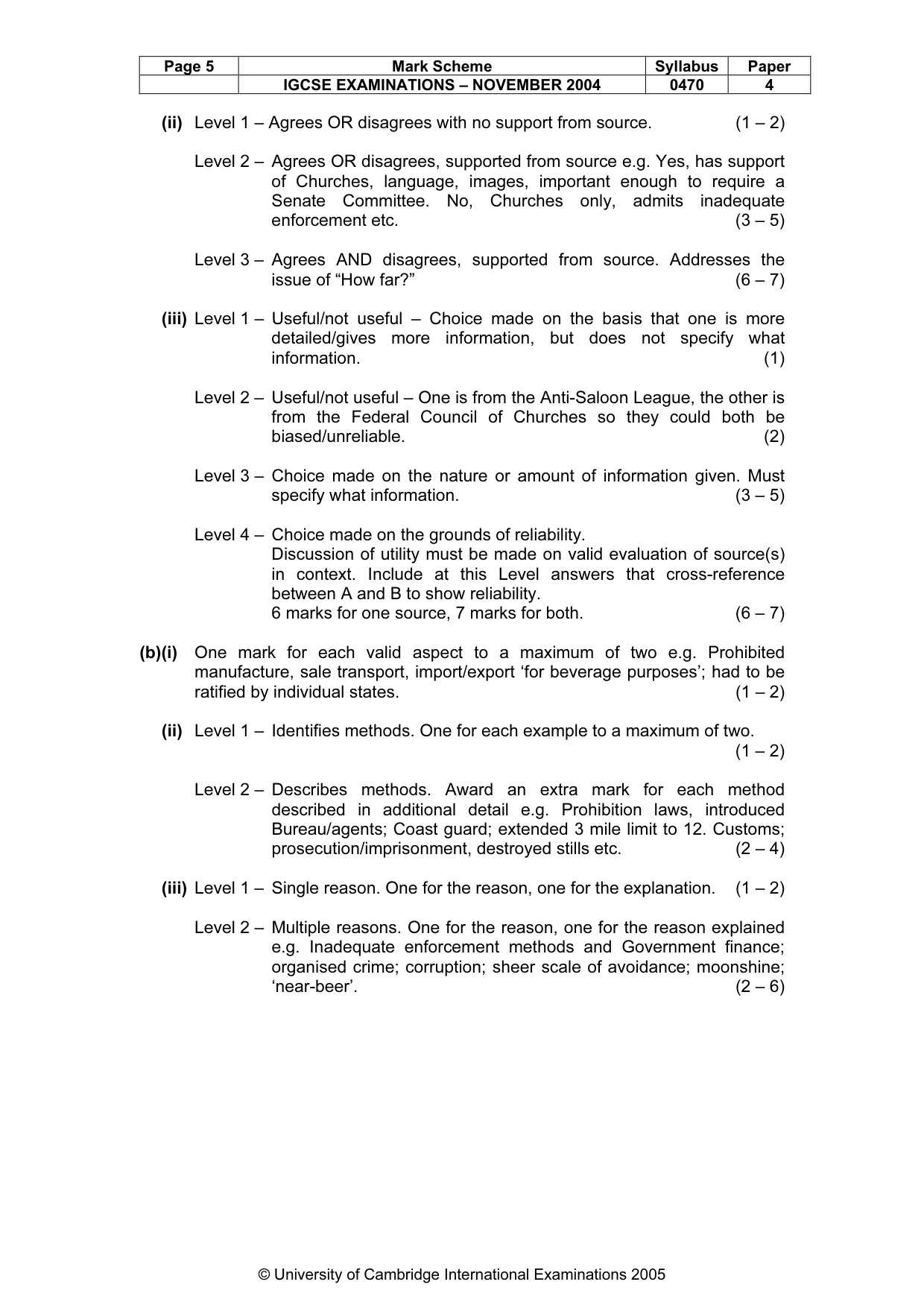
Page 5 Mark Scheme Syllabus Paper IGCSE EXAMINATIONS – NOVEMBER 2004 0470 4 © University of Cambridge International Examinations 2005 (ii) Level 1 – Agrees OR disagrees with no support from source. (1 – 2) Level 2 – Agrees OR disagrees, supported from source e.g. Yes, has support of Churches, language, images, important enough to require a Senate Committee. No, Churches only, admits inadequate enforcement etc. (3 – 5) Level 3 – Agrees AND disagrees, supported from source. Addresses the issue of “How far?” (6 – 7) (iii) Level 1 – Useful/not useful – Choice made on the basis that one is more detailed/gives more information, but does not specify what information. (1) Level 2 – Useful/not useful – One is from the Anti-Saloon League, the other is from the Federal Council of Churches so they could both be biased/unreliable. (2) Level 3 – Choice made on the nature or amount of information given. Must specify what information. (3 – 5) Level 4 – Choice made on the grounds of reliability. Discussion of utility must be made on valid evaluation of source(s) in context. Include at this Level answers that cross-reference between A and B to show reliability. 6 marks for one source, 7 marks for both. (6 – 7) (b)(i) One mark for each valid aspect to a maximum of two e.g. Prohibited manufacture, sale transport, import/export ‘for beverage purposes’; had to be ratified by individual states. (1 – 2) (ii) Level 1 – Identifies methods. One for each example to a maximum of two. (1 – 2) Level 2 – Describes methods. Award an extra mark for each method described in additional detail e.g. Prohibition laws, introduced Bureau/agents; Coast guard; extended 3 mile limit to 12. Customs; prosecution/imprisonment, destroyed stills etc. (2 – 4) (iii) Level 1 – Single reason. One for the reason, one for the explanation. (1 – 2) Level 2 – Multiple reasons. One for the reason, one for the reason explained e.g. Inadequate enforcement methods and Government finance; organised crime; corruption; sheer scale of avoidance; moonshine; ‘near-beer’. (2 – 6)
Mark scheme, page 9
Page 6 Mark Scheme Syllabus Paper IGCSE EXAMINATIONS – NOVEMBER 2004 0470 4 © University of Cambridge International Examinations 2005 (iv) Level 1 – Simple assertions. Yes, because the 21st Amendment was passed. (1) Level 2 – Explanation of growth of crime as cause OR other causes, single factor given e.g. Yes, gangs/bootleggers; mass evasion of law; more alcohol being produced than before Prohibition etc. No, Government wanted tax revenue/stimulate economy/popularity. No proof that it had failed; Dry vote still strong etc. (2) Level 3 – Explanation of growth of crime as cause OR other causes with multiple factors. Allow single factors with multiple reasons. OR Undeveloped suggestions on BOTH sides of the question (annotate BBB – Balanced but Brief). (3 – 5) Level 4 – Answers that address the issue of “How far?” BOTH sides of the growth of crime as cause AND other causes must be addressed. (6 – 8) Depth Study D: China, 1945 – c.1990 (a)(i) Level 1 – Repeats material stated in source, no inference made. (1 – 2) Level 2 – Makes valid inferences, not supported from source e.g. The peasants wanted revenge on them etc. (3 – 4) Level 3 – Makes valid inference(s) with reference to the source e.g. Some confessed in the hope of leniency etc. (5 – 6) (ii) Level 1 – Agrees OR disagrees with no support from source. (1 – 2) Level 2 – Agrees OR disagrees, supported from source e.g. Yes, he wanted to stop revenge punishments, policy of leniency, wanted proof of guilt etc. No, counter revolutionaries and tyrants specified. Was he trying to stop social disintegration? Date of speech – War not won yet. (3 – 5) Level 3 – Agrees AND disagrees, supported from source. Addresses the issue of “How far?” (6 – 7) (iii) Level 1 – Useful/not useful – Choice made on the basis that one is more detailed/gives more information, but does not specify what information. (1) Level 2 – Useful/not useful – One is from a Western journalist, the other is from Mao so they could both be biased/unreliable. (2) Level 3 – Choice made on the nature or amount of information given. Must specify what information. (3 – 5) Level 4 – Choice made on the grounds of reliability. Discussion of utility must be made on valid evaluation of source(s) in context. Include at this Level answers that cross-reference between A and B to show reliability. 6 marks for one source, 7 marks for both. (6 – 7)
Mark scheme, page 10
Page 7 Mark Scheme Syllabus Paper IGCSE EXAMINATIONS – NOVEMBER 2004 0470 4 © University of Cambridge International Examinations 2005 (b)(i) One for each valid aspect to a maximum of two e.g. Early 1950s, peasants persuaded to join collectives to increase food production. Shared equipment and land. By 1956 95% of peasants had joined. Each consisted of between 100 – 300 families. (1 – 2) (ii) Level 1 – Identifies elements. Size, industry and/or agriculture, government. (1 – 2) Level 2 – Describes elements. Award an extra mark for elements described in extra detail e.g. Much larger units (up to 75 000), divided into brigades, work teams with elected council; special projects; crèches, hospitals etc. (2 – 4) (iii) Level 1 – Single reason. One for the reason, one for the explanation. (1 – 2) Level 2 – Multiple reasons. One for the reason, one for the reason explained e.g. different treatment, landlords, promises, GMD (KMT) corruption, comparisons between CCP and GMD; hope etc. (2 – 6) (iv) Level 1 – Simple assertions. Yes, they all improved life. (1) Level 2 – Explanation of success OR lack of success. Single factor given e.g. Yes, increased production in agriculture, industry; social reforms in health, work, education and position of women etc. No, production could have been better – Why introduce Great Leap Forward (58-60) to increase production? Criticism of Hundred Flowers Campaign etc. (2) Level 3 – Explanation of success OR lack of success with multiple factors. Allow single factors with multiple reasons. OR Undeveloped suggestions on BOTH sides of the argument (annotate BBB – Balanced but Brief). (3 – 5) Level 4 – Answers that address the issue of “How successful?” BOTH sides of success AND lack of success must be addressed. (6 – 8) Depth Study E: Southern Africa in the Twentieth Century (a)(i) Level 1 – Repeats material stated in source, no inference made. (1 – 2) Level 2 – Makes valid inferences, not supported from source e.g. He was nervous and did not wish any person harm etc. (3 – 4) Level 3 – Supports valid inference(s) with reference to the source e.g. He wanted to keep MK separate, charged with the task of setting up a military force etc. (5 – 6)
Mark scheme, page 11
Page 8 Mark Scheme Syllabus Paper IGCSE EXAMINATIONS – NOVEMBER 2004 0470 4 © University of Cambridge International Examinations 2005 (ii) Level 1 – Agrees OR disagrees with no support from source. (1 – 2) Level 2 – Agrees OR disagrees, supported from source e.g. Yes, powers of detention, used force at Sharpeville and the law at Rivonia, destroyed movement etc. No, Had to keep extending powers, ANC not destroyed but in exile etc. (3 – 5) Level 3 – Agrees AND disagrees, supported from source. Addresses the issue of “How far?” (6 – 7) (iii) Level 1 – Useful/not useful – Choice made on the basis that one is more detailed/gives more information, but does not specify what information. (1) Level 2 – Useful/not useful – One is from Mandela, and the other is British so they could both be biased/unreliable. (2) Level 3 – Choice made on the nature or amount of information given. Must specify what information. (3 – 5) Level 4 – Choice made on the grounds of reliability. Discussion of utility must be based on valid evaluation of source(s) in context. Include at this Level answers that cross-reference between A and B to show reliability. 6 marks for one source, 7 marks for both. (6 – 7) (b)(i) One mark for each valid example to a maximum of two e.g. Mandela, Sisulu, Mbeke, Kathrada, Bernstein, Mhlaba, Mlangeni, Cantor, Goldberg. (1 – 2) (ii) Level 1 – Identifies methods. Publicity, International support, diplomacy. (1 – 2) Level 2 – Describes methods. Award an extra mark for each method described in additional detail e.g. encouraged international boycotts; publicity; co-operated with other guerrilla fighters in Zimbabwe, Angola, Zambia; Tambo and Slovo used diplomacy in UNO with USSR; some co-operation with PAC (when not arguing). (2 – 4) (iii) Level 1 – Single reason. One for the reason, one for the explanation. (1 – 2) Level 2 – Multiple reasons. One for the reason, one for the reason explained e.g. 1961 SA left Commonwealth; SA refused to co-operate with UNO over Rhodesia and SW Africa; OAU 1963; USSR using SA in Cold War; international shock at Sharpeville; Rivonia trials/sentences. Policies of Verwoerd and Vorster. (2 – 6) (iv) Level 1 – Simple assertions. Yes, because it kept the blacks away. (1) Level 2 – Explanation of effective OR not effective, single factor given e.g. Yes, ‘independent rulers’ co-operated; divided tribes; separate development; blacks in white areas only visitors with no rights; popular with majority of white voters.
Mark scheme, page 12
Page 9 Mark Scheme Syllabus Paper IGCSE EXAMINATIONS – NOVEMBER 2004 0470 4 © University of Cambridge International Examinations 2005 No, caused shortage of permanent labour; employers fund ways round apartheid laws to keep employees, led to illegal TUs and strikes; recruiting ground for PAC/ANC; forced removals internationally condemned. (2) Level 3 – Explanation of effective OR not effective, with multiple factors. Allow single factors with multiple reasons. OR Undeveloped suggestions on BOTH sides of the argument (annotate BBB – Balanced but Brief) (3 – 5) Level 4 – Answers that deal with “How far?” BOTH sides of effective AND not effective must be addressed. (6 – 8) Depth Study F: Israelis and Palestinians, 1945 – c.1994 (a)(i) Level 1 – Repeats material stated in source, no inference made. (1 – 2) Level 2 – Makes valid inferences, not supported from source e.g. The Palestinians felt oppressed etc. (3 – 4) Level 3 – Supports valid inference(s) with reference to the source e.g. They would have to break laws and act secretly to get justice etc. (5 – 6) (ii) Level 1 – Agrees OR disagrees with no support from source. (1 – 2) Level 2 – Agrees OR disagrees, supported from source e.g. Yes, Israel regarded them as terrorists; no victory gained; Israel had ignored their demands. No, seen by Arabs as freedom fighters, spread terror, gained publicity. (3 – 5) Level 3 – Agrees AND disagrees, supported from source. Addresses the issue of “How far?” (6 – 7) (iii) Level 1 – Useful/not useful – Choice made on the basis that one is more detailed/gives more information, but does not specify what information. (1) Level 2 – Useful/not useful – One is from a Palestinian, the other is British so they could both be biased/unreliable. (2) Level 3 – Choice made on the nature or amount of information given. Must specify what information. (3 – 5) Level 4 – Choice made on the grounds of reliability. Discussion of utility must be made on valid evaluation of source(s) in context. Include at this Level answers that cross-reference between A and B to show reliability. 6 marks for one source, 7 for both. (6 – 7)
Mark scheme, page 13
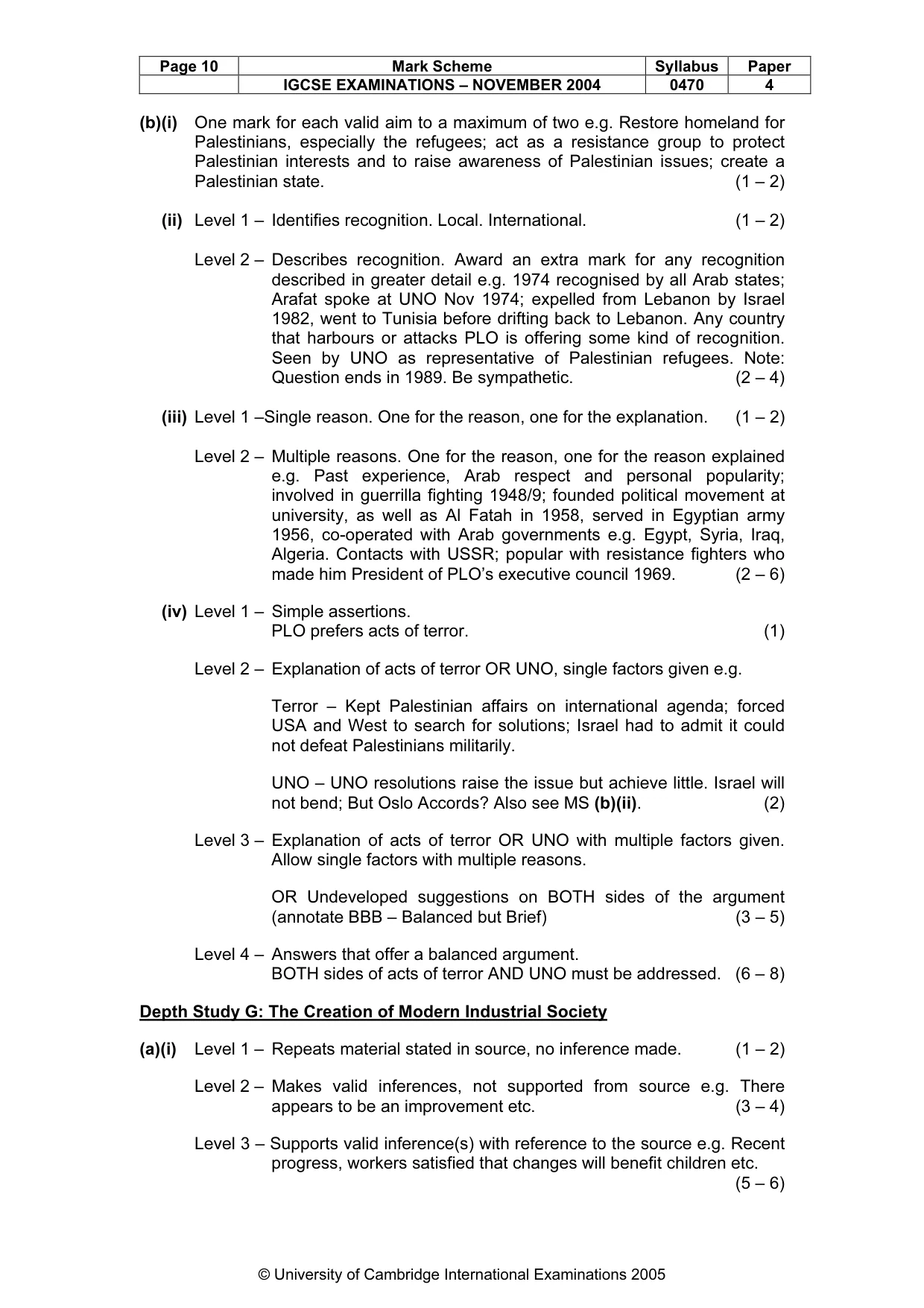
Page 10 Mark Scheme Syllabus Paper IGCSE EXAMINATIONS – NOVEMBER 2004 0470 4 © University of Cambridge International Examinations 2005 (b)(i) One mark for each valid aim to a maximum of two e.g. Restore homeland for Palestinians, especially the refugees; act as a resistance group to protect Palestinian interests and to raise awareness of Palestinian issues; create a Palestinian state. (1 – 2) (ii) Level 1 – Identifies recognition. Local. International. (1 – 2) Level 2 – Describes recognition. Award an extra mark for any recognition described in greater detail e.g. 1974 recognised by all Arab states; Arafat spoke at UNO Nov 1974; expelled from Lebanon by Israel 1982, went to Tunisia before drifting back to Lebanon. Any country that harbours or attacks PLO is offering some kind of recognition. Seen by UNO as representative of Palestinian refugees. Note: Question ends in 1989. Be sympathetic. (2 – 4) (iii) Level 1 –Single reason. One for the reason, one for the explanation. (1 – 2) Level 2 – Multiple reasons. One for the reason, one for the reason explained e.g. Past experience, Arab respect and personal popularity; involved in guerrilla fighting 1948/9; founded political movement at university, as well as Al Fatah in 1958, served in Egyptian army 1956, co-operated with Arab governments e.g. Egypt, Syria, Iraq, Algeria. Contacts with USSR; popular with resistance fighters who made him President of PLO’s executive council 1969. (2 – 6) (iv) Level 1 – Simple assertions. PLO prefers acts of terror. (1) Level 2 – Explanation of acts of terror OR UNO, single factors given e.g. Terror – Kept Palestinian affairs on international agenda; forced USA and West to search for solutions; Israel had to admit it could not defeat Palestinians militarily. UNO – UNO resolutions raise the issue but achieve little. Israel will not bend; But Oslo Accords? Also see MS (b)(ii). (2) Level 3 – Explanation of acts of terror OR UNO with multiple factors given. Allow single factors with multiple reasons. OR Undeveloped suggestions on BOTH sides of the argument (annotate BBB – Balanced but Brief) (3 – 5) Level 4 – Answers that offer a balanced argument. BOTH sides of acts of terror AND UNO must be addressed. (6 – 8) Depth Study G: The Creation of Modern Industrial Society (a)(i) Level 1 – Repeats material stated in source, no inference made. (1 – 2) Level 2 – Makes valid inferences, not supported from source e.g. There appears to be an improvement etc. (3 – 4) Level 3 – Supports valid inference(s) with reference to the source e.g. Recent progress, workers satisfied that changes will benefit children etc. (5 – 6)
Mark scheme, page 14
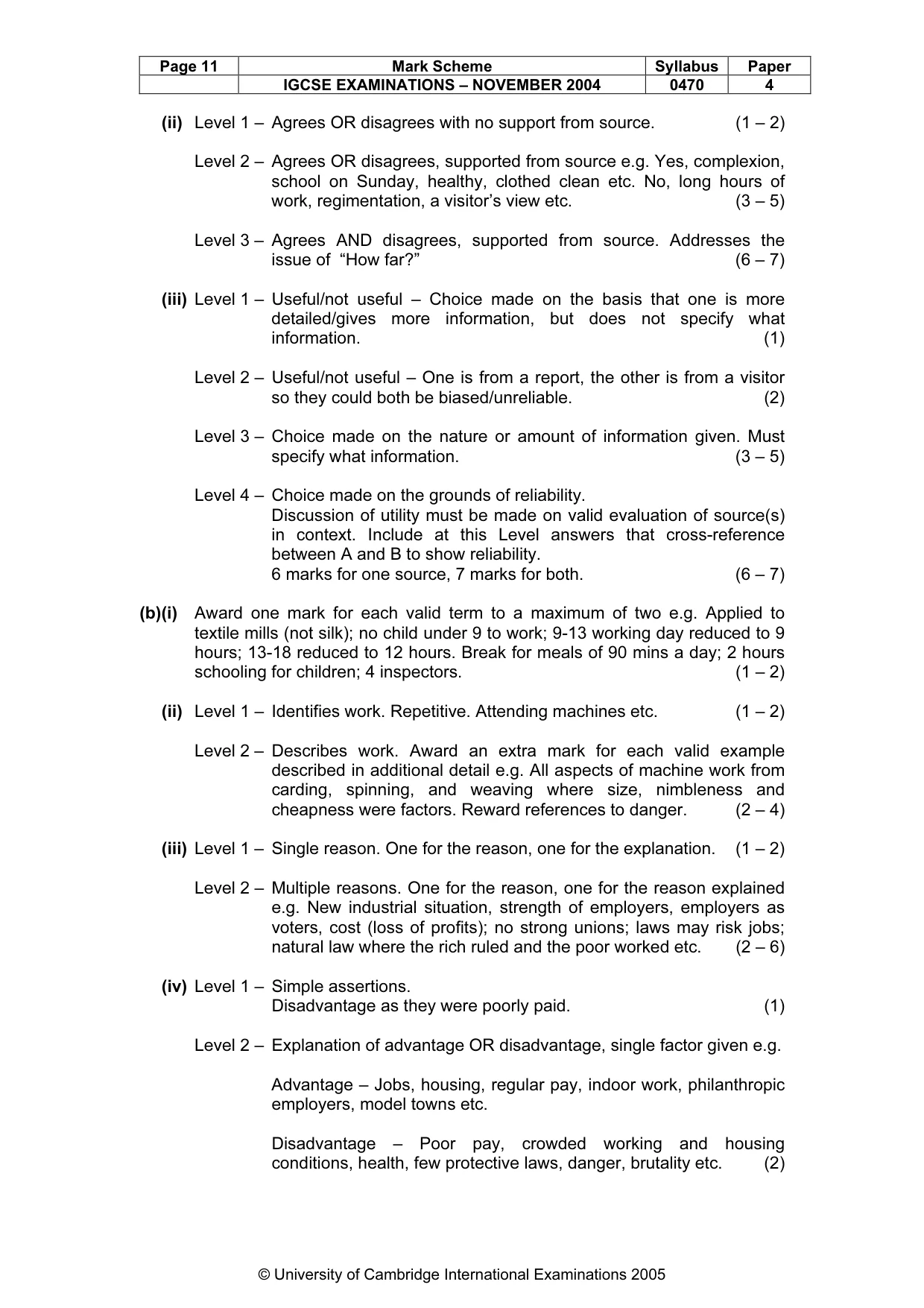
Page 11 Mark Scheme Syllabus Paper IGCSE EXAMINATIONS – NOVEMBER 2004 0470 4 © University of Cambridge International Examinations 2005 (ii) Level 1 – Agrees OR disagrees with no support from source. (1 – 2) Level 2 – Agrees OR disagrees, supported from source e.g. Yes, complexion, school on Sunday, healthy, clothed clean etc. No, long hours of work, regimentation, a visitor’s view etc. (3 – 5) Level 3 – Agrees AND disagrees, supported from source. Addresses the issue of “How far?” (6 – 7) (iii) Level 1 – Useful/not useful – Choice made on the basis that one is more detailed/gives more information, but does not specify what information. (1) Level 2 – Useful/not useful – One is from a report, the other is from a visitor so they could both be biased/unreliable. (2) Level 3 – Choice made on the nature or amount of information given. Must specify what information. (3 – 5) Level 4 – Choice made on the grounds of reliability. Discussion of utility must be made on valid evaluation of source(s) in context. Include at this Level answers that cross-reference between A and B to show reliability. 6 marks for one source, 7 marks for both. (6 – 7) (b)(i) Award one mark for each valid term to a maximum of two e.g. Applied to textile mills (not silk); no child under 9 to work; 9-13 working day reduced to 9 hours; 13-18 reduced to 12 hours. Break for meals of 90 mins a day; 2 hours schooling for children; 4 inspectors. (1 – 2) (ii) Level 1 – Identifies work. Repetitive. Attending machines etc. (1 – 2) Level 2 – Describes work. Award an extra mark for each valid example described in additional detail e.g. All aspects of machine work from carding, spinning, and weaving where size, nimbleness and cheapness were factors. Reward references to danger. (2 – 4) (iii) Level 1 – Single reason. One for the reason, one for the explanation. (1 – 2) Level 2 – Multiple reasons. One for the reason, one for the reason explained e.g. New industrial situation, strength of employers, employers as voters, cost (loss of profits); no strong unions; laws may risk jobs; natural law where the rich ruled and the poor worked etc. (2 – 6) (iv) Level 1 – Simple assertions. Disadvantage as they were poorly paid. (1) Level 2 – Explanation of advantage OR disadvantage, single factor given e.g. Advantage – Jobs, housing, regular pay, indoor work, philanthropic employers, model towns etc. Disadvantage – Poor pay, crowded working and housing conditions, health, few protective laws, danger, brutality etc. (2)
Mark scheme, page 15
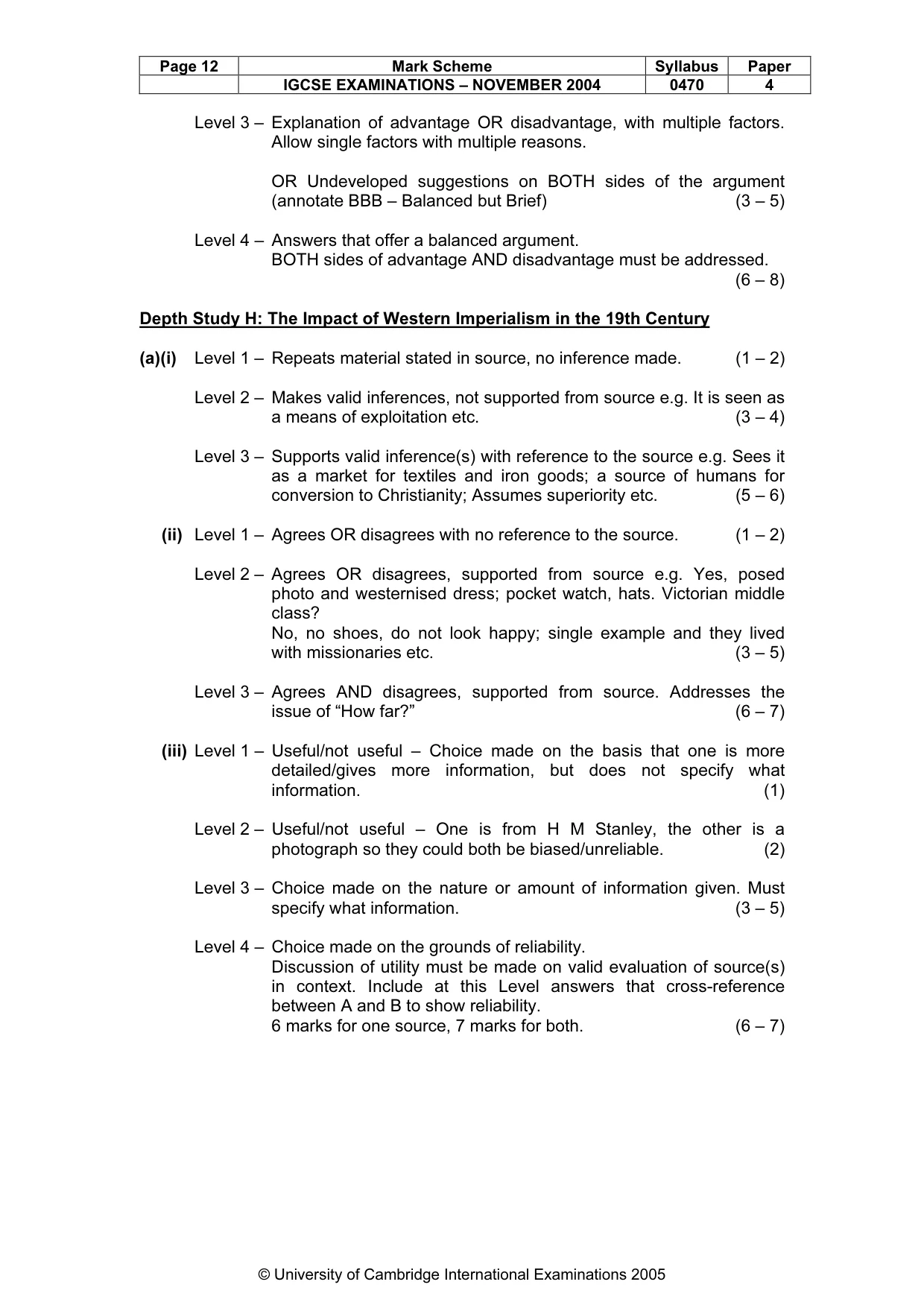
Page 12 Mark Scheme Syllabus Paper IGCSE EXAMINATIONS – NOVEMBER 2004 0470 4 © University of Cambridge International Examinations 2005 Level 3 – Explanation of advantage OR disadvantage, with multiple factors. Allow single factors with multiple reasons. OR Undeveloped suggestions on BOTH sides of the argument (annotate BBB – Balanced but Brief) (3 – 5) Level 4 – Answers that offer a balanced argument. BOTH sides of advantage AND disadvantage must be addressed. (6 – 8) Depth Study H: The Impact of Western Imperialism in the 19th Century (a)(i) Level 1 – Repeats material stated in source, no inference made. (1 – 2) Level 2 – Makes valid inferences, not supported from source e.g. It is seen as a means of exploitation etc. (3 – 4) Level 3 – Supports valid inference(s) with reference to the source e.g. Sees it as a market for textiles and iron goods; a source of humans for conversion to Christianity; Assumes superiority etc. (5 – 6) (ii) Level 1 – Agrees OR disagrees with no reference to the source. (1 – 2) Level 2 – Agrees OR disagrees, supported from source e.g. Yes, posed photo and westernised dress; pocket watch, hats. Victorian middle class? No, no shoes, do not look happy; single example and they lived with missionaries etc. (3 – 5) Level 3 – Agrees AND disagrees, supported from source. Addresses the issue of “How far?” (6 – 7) (iii) Level 1 – Useful/not useful – Choice made on the basis that one is more detailed/gives more information, but does not specify what information. (1) Level 2 – Useful/not useful – One is from H M Stanley, the other is a photograph so they could both be biased/unreliable. (2) Level 3 – Choice made on the nature or amount of information given. Must specify what information. (3 – 5) Level 4 – Choice made on the grounds of reliability. Discussion of utility must be made on valid evaluation of source(s) in context. Include at this Level answers that cross-reference between A and B to show reliability. 6 marks for one source, 7 marks for both. (6 – 7)
Mark scheme, page 16
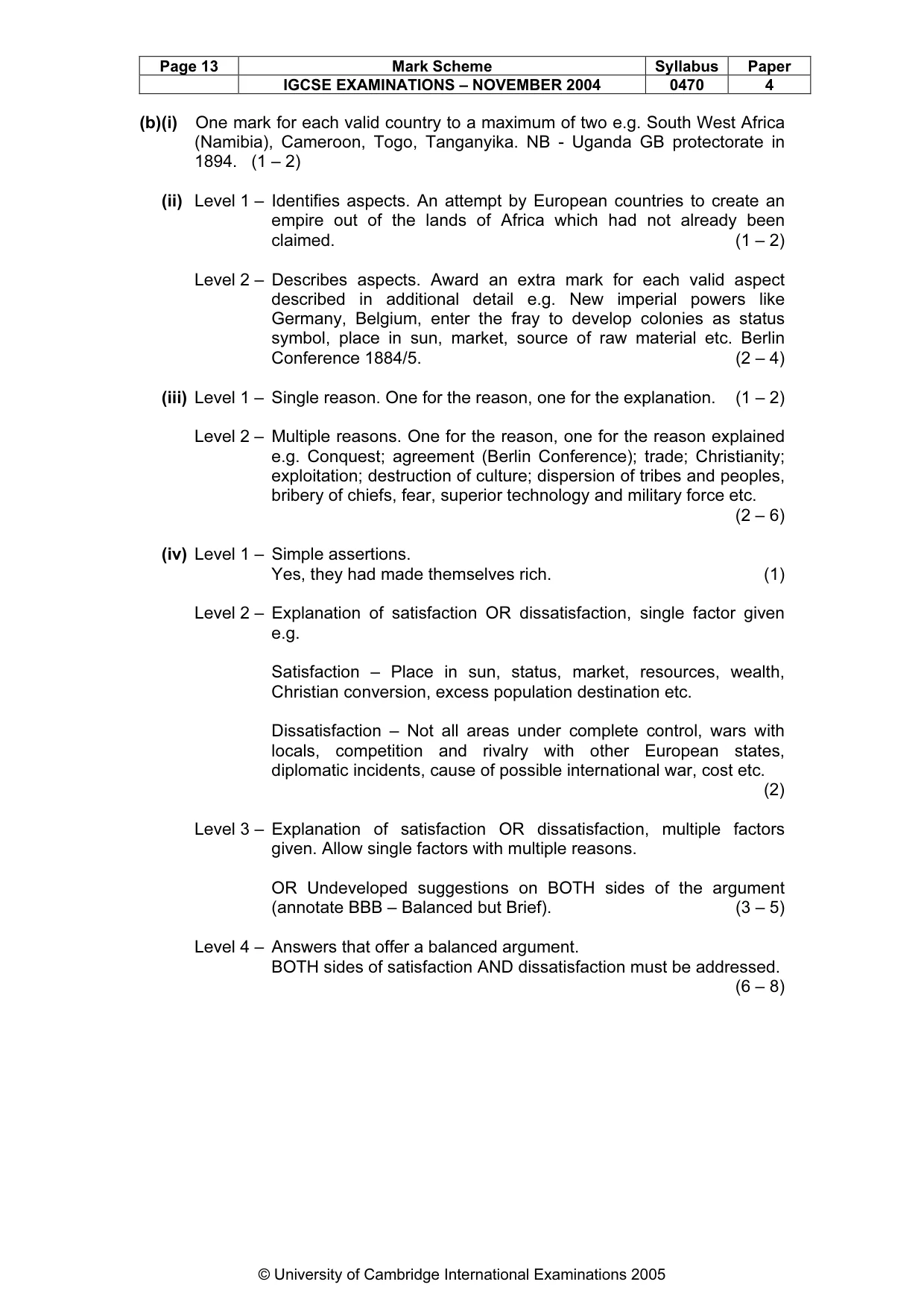
Page 13 Mark Scheme Syllabus Paper IGCSE EXAMINATIONS – NOVEMBER 2004 0470 4 © University of Cambridge International Examinations 2005 (b)(i) One mark for each valid country to a maximum of two e.g. South West Africa (Namibia), Cameroon, Togo, Tanganyika. NB - Uganda GB protectorate in 1894. (1 – 2) (ii) Level 1 – Identifies aspects. An attempt by European countries to create an empire out of the lands of Africa which had not already been claimed. (1 – 2) Level 2 – Describes aspects. Award an extra mark for each valid aspect described in additional detail e.g. New imperial powers like Germany, Belgium, enter the fray to develop colonies as status symbol, place in sun, market, source of raw material etc. Berlin Conference 1884/5. (2 – 4) (iii) Level 1 – Single reason. One for the reason, one for the explanation. (1 – 2) Level 2 – Multiple reasons. One for the reason, one for the reason explained e.g. Conquest; agreement (Berlin Conference); trade; Christianity; exploitation; destruction of culture; dispersion of tribes and peoples, bribery of chiefs, fear, superior technology and military force etc. (2 – 6) (iv) Level 1 – Simple assertions. Yes, they had made themselves rich. (1) Level 2 – Explanation of satisfaction OR dissatisfaction, single factor given e.g. Satisfaction – Place in sun, status, market, resources, wealth, Christian conversion, excess population destination etc. Dissatisfaction – Not all areas under complete control, wars with locals, competition and rivalry with other European states, diplomatic incidents, cause of possible international war, cost etc. (2) Level 3 – Explanation of satisfaction OR dissatisfaction, multiple factors given. Allow single factors with multiple reasons. OR Undeveloped suggestions on BOTH sides of the argument (annotate BBB – Balanced but Brief). (3 – 5) Level 4 – Answers that offer a balanced argument. BOTH sides of satisfaction AND dissatisfaction must be addressed. (6 – 8)