Cambridge IGCSE History 0470 — 2003 Oct/Nov Paper 4 · Variant 1
0470/41/O/N/03
The question paper and its mark scheme, free to read here and free to download. This is Cambridge’s own paper, exactly as it was sat.
Question paper12 pages

Mark scheme
No mark scheme is in the library for this paper.
Paper as text
Question paper, page 1
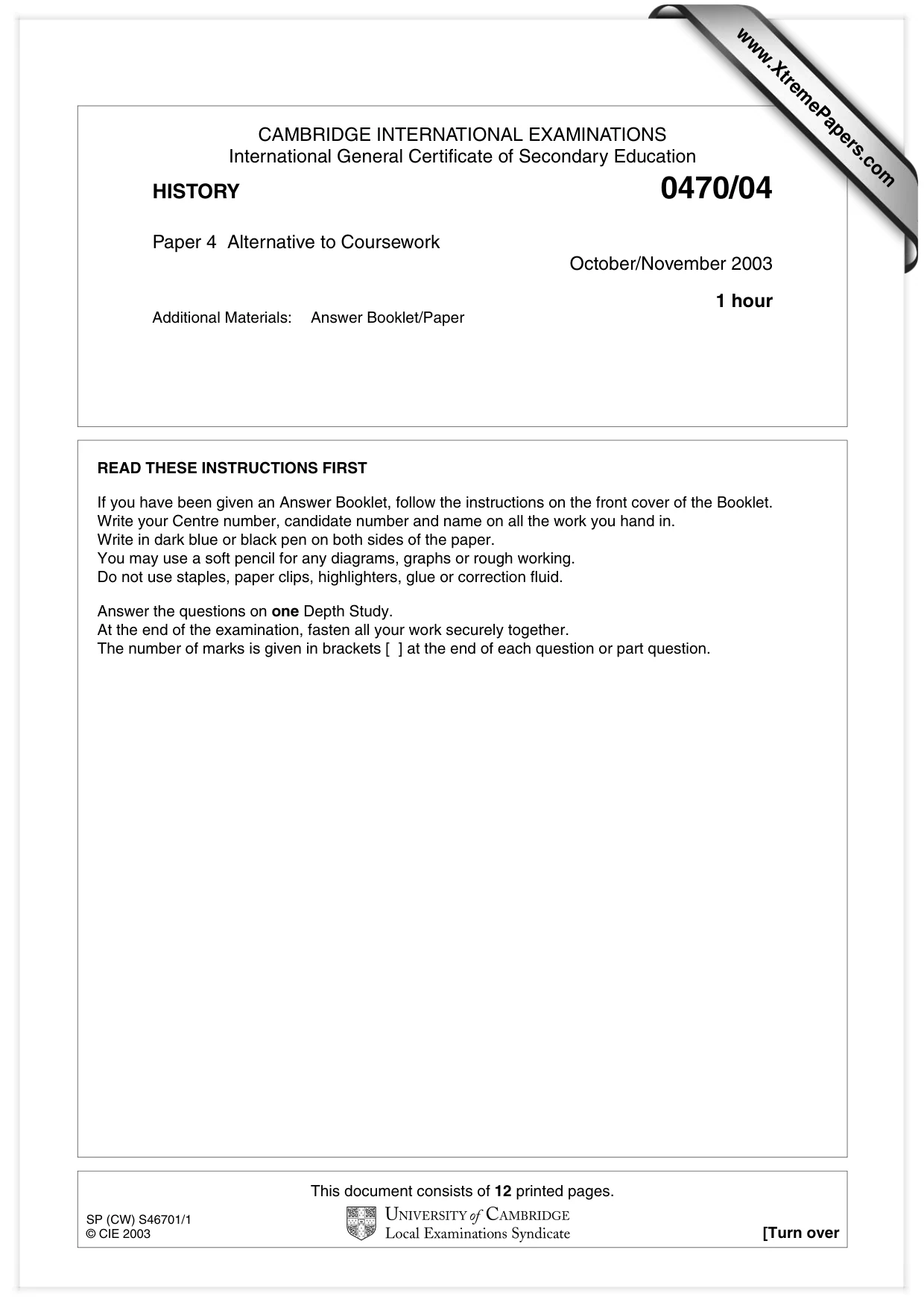
This document consists of 12 printed pages. SP (CW) S46701/1 © CIE 2003 [Turn over CAMBRIDGE INTERNATIONAL EXAMINATIONS International General Certificate of Secondary Education HISTORY 0470/04 Paper 4 Alternative to Coursework October/November 2003 1 hour Additional Materials: Answer Booklet/Paper READ THESE INSTRUCTIONS FIRST If you have been given an Answer Booklet, follow the instructions on the front cover of the Booklet. Write your Centre number, candidate number and name on all the work you hand in. Write in dark blue or black pen on both sides of the paper. You may use a soft pencil for any diagrams, graphs or rough working. Do not use staples, paper clips, highlighters, glue or correction fluid. Answer the questions on one Depth Study. At the end of the examination, fasten all your work securely together. The number of marks is given in brackets [ ] at the end of each question or part question. www.XtremePapers.com
Question paper, page 2
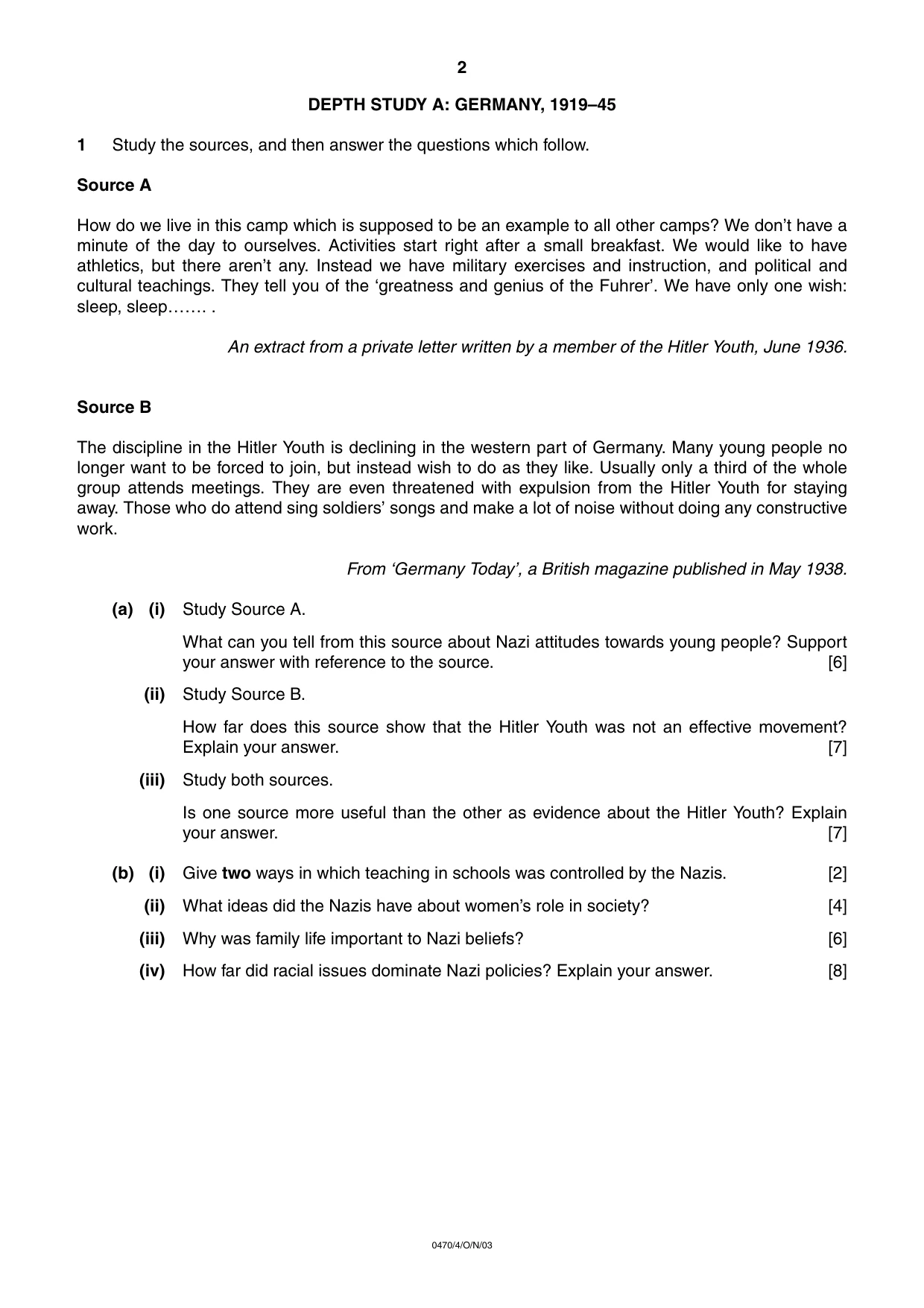
2 0470/4/O/N/03 DEPTH STUDY A: GERMANY, 1919–45 1 Study the sources, and then answer the questions which follow. Source A How do we live in this camp which is supposed to be an example to all other camps? We don’t have a minute of the day to ourselves. Activities start right after a small breakfast. We would like to have athletics, but there aren’t any. Instead we have military exercises and instruction, and political and cultural teachings. They tell you of the ‘greatness and genius of the Fuhrer’. We have only one wish: sleep, sleep……. . An extract from a private letter written by a member of the Hitler Youth, June 1936. Source B The discipline in the Hitler Youth is declining in the western part of Germany. Many young people no longer want to be forced to join, but instead wish to do as they like. Usually only a third of the whole group attends meetings. They are even threatened with expulsion from the Hitler Youth for staying away. Those who do attend sing soldiers’ songs and make a lot of noise without doing any constructive work. From ‘Germany Today’, a British magazine published in May 1938. (a) (i) Study Source A. What can you tell from this source about Nazi attitudes towards young people? Support your answer with reference to the source. [6] (ii) Study Source B. How far does this source show that the Hitler Youth was not an effective movement? Explain your answer. [7] (iii) Study both sources. Is one source more useful than the other as evidence about the Hitler Youth? Explain your answer. [7] (b) (i) Give two ways in which teaching in schools was controlled by the Nazis. [2] (ii) What ideas did the Nazis have about women’s role in society? [4] (iii) Why was family life important to Nazi beliefs? [6] (iv) How far did racial issues dominate Nazi policies? Explain your answer. [8]
Question paper, page 3
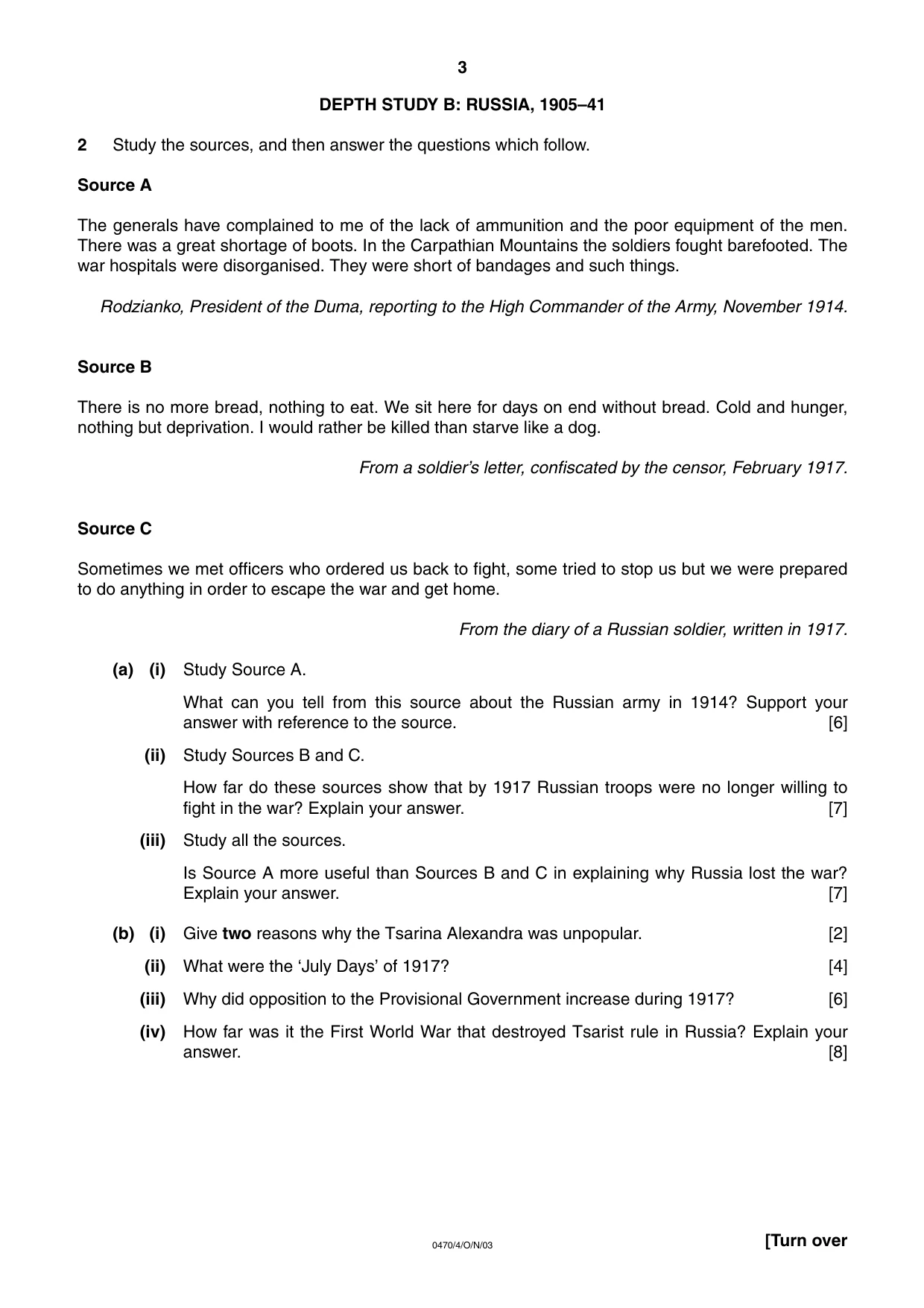
3 0470/4/O/N/03 [Turn over DEPTH STUDY B: RUSSIA, 1905–41 2 Study the sources, and then answer the questions which follow. Source A The generals have complained to me of the lack of ammunition and the poor equipment of the men. There was a great shortage of boots. In the Carpathian Mountains the soldiers fought barefooted. The war hospitals were disorganised. They were short of bandages and such things. Rodzianko, President of the Duma, reporting to the High Commander of the Army, November 1914. Source B There is no more bread, nothing to eat. We sit here for days on end without bread. Cold and hunger, nothing but deprivation. I would rather be killed than starve like a dog. From a soldier’s letter, confiscated by the censor, February 1917. Source C Sometimes we met officers who ordered us back to fight, some tried to stop us but we were prepared to do anything in order to escape the war and get home. From the diary of a Russian soldier, written in 1917. (a) (i) Study Source A. What can you tell from this source about the Russian army in 1914? Support your answer with reference to the source. [6] (ii) Study Sources B and C. How far do these sources show that by 1917 Russian troops were no longer willing to fight in the war? Explain your answer. [7] (iii) Study all the sources. Is Source A more useful than Sources B and C in explaining why Russia lost the war? Explain your answer. [7] (b) (i) Give two reasons why the Tsarina Alexandra was unpopular. [2] (ii) What were the ‘July Days’ of 1917? [4] (iii) Why did opposition to the Provisional Government increase during 1917? [6] (iv) How far was it the First World War that destroyed Tsarist rule in Russia? Explain your answer. [8]
Question paper, page 4
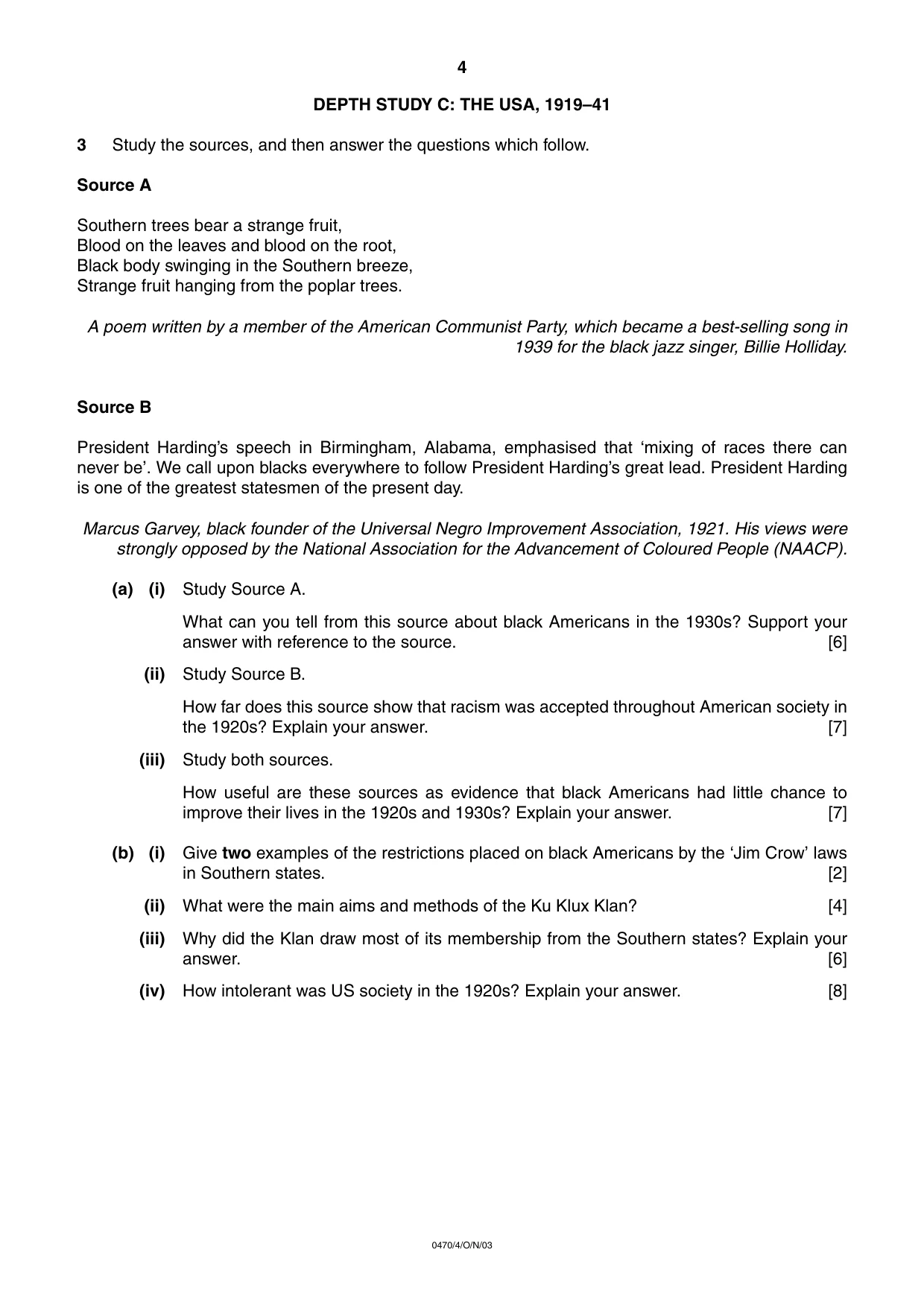
4 0470/4/O/N/03 DEPTH STUDY C: THE USA, 1919–41 3 Study the sources, and then answer the questions which follow. Source A Southern trees bear a strange fruit, Blood on the leaves and blood on the root, Black body swinging in the Southern breeze, Strange fruit hanging from the poplar trees. A poem written by a member of the American Communist Party, which became a best-selling song in 1939 for the black jazz singer, Billie Holliday. Source B President Harding’s speech in Birmingham, Alabama, emphasised that ‘mixing of races there can never be’. We call upon blacks everywhere to follow President Harding’s great lead. President Harding is one of the greatest statesmen of the present day. Marcus Garvey, black founder of the Universal Negro Improvement Association, 1921. His views were strongly opposed by the National Association for the Advancement of Coloured People (NAACP). (a) (i) Study Source A. What can you tell from this source about black Americans in the 1930s? Support your answer with reference to the source. [6] (ii) Study Source B. How far does this source show that racism was accepted throughout American society in the 1920s? Explain your answer. [7] (iii) Study both sources. How useful are these sources as evidence that black Americans had little chance to improve their lives in the 1920s and 1930s? Explain your answer. [7] (b) (i) Give two examples of the restrictions placed on black Americans by the ‘Jim Crow’ laws in Southern states. [2] (ii) What were the main aims and methods of the Ku Klux Klan? [4] (iii) Why did the Klan draw most of its membership from the Southern states? Explain your answer. [6] (iv) How intolerant was US society in the 1920s? Explain your answer. [8]
Question paper, page 5
5 0470/4/O/N/03 [Turn over DEPTH STUDY D: CHINA, 1945–c.1990 4 Study the sources, and then answer the questions which follow. Source A These days, in the luckier parts of China, it is possible to acquire a television, a tape recorder, a washing machine or a fridge by paying a quarter of the price immediately, and the rest over a year. From a British newspaper, 1982. Source B The late Chairman Mao’s ‘Little Red Book’, once the bible of Chinese Communism, was denounced in the ‘People’s Daily’ today. The official Party newspaper, which used to give uncritical and lavish praise to Chairman Mao, said the book had given him a ‘god-like’ status. After it was published, the ‘Little Red Book’ became a world bestseller and all Chinese citizens were expected to have a copy. From a British newspaper, 1978. (a) (i) Study Source A. What impressions does this source give of Chinese life in 1982? Support your answer with reference to the source. [6] (ii) Study Source B. How far does this source show the decline of Communism in China by 1978? Explain your answer. [7] (iii) Study both sources. Is Source A more useful than Source B as evidence about changes in China after the death of Mao Zedong? Explain your answer. [7] (b) (i) Name two areas of China still held by colonial powers at the time of Mao’s death. [2] (ii) What was the ‘Gang of Four’? [4] (iii) Why did the events that took place in Tiananmen Square in June 1989 occur? [6] (iv) How far did Deng Xiaoping change Mao’s policies? Explain your answer. [8]
Question paper, page 6
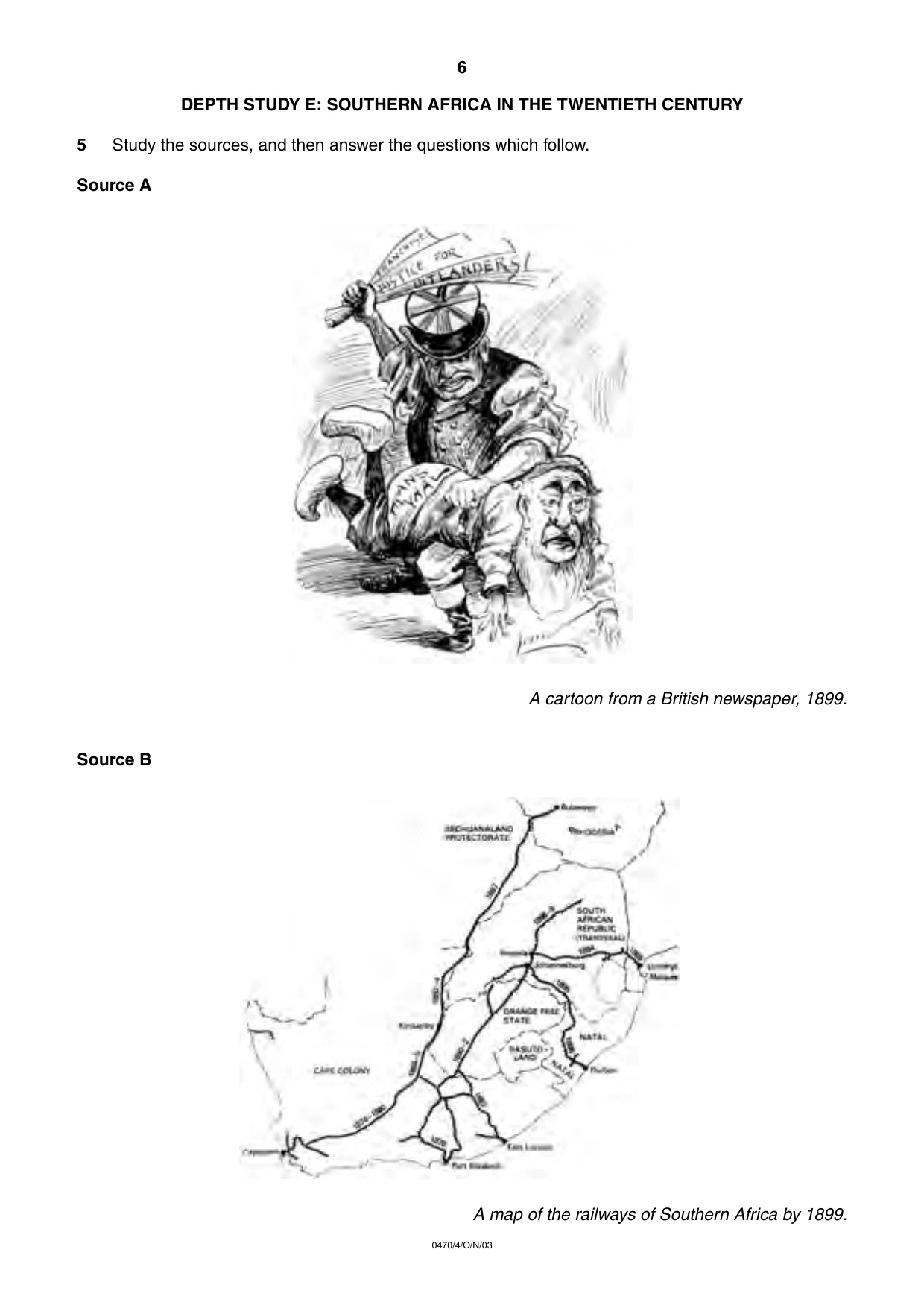
6 0470/4/O/N/03 DEPTH STUDY E: SOUTHERN AFRICA IN THE TWENTIETH CENTURY 5 Study the sources, and then answer the questions which follow. Source A A cartoon from a British newspaper, 1899. Source B A map of the railways of Southern Africa by 1899.
Question paper, page 7
7 0470/4/O/N/03 [Turn over (a) (i) Study Source A. What can you tell from this source about British attitudes towards the Boers in 1899? Support your answer with reference to the source. [6] (ii) Study Source B. How far does this map help to explain why the South African Republic (Transvaal) felt threatened by the British in 1899? Explain your answer. [7] (iii) Study both sources. Is one of these sources more useful than the other as evidence about the growing ambitions of the British in Southern Africa by 1899? Explain your answer. [7] (b) (i) Name two of the large goldmining companies on the Rand in the 1890s. [2] (ii) Describe the Jameson Raid, 1895-6. [4] (iii) Why was the issue of votes for Uitlanders so important? [6] (iv) ‘Kruger was the most important cause of war in 1899.’ Do you agree? Explain your answer. [8]
Question paper, page 8
8 0470/4/O/N/03 DEPTH STUDY F: ISRAELIS AND PALESTINIANS, 1945–c.1994 6 Study the sources, and then answer the questions which follow. Source A The land of Israel was the birthplace of the Jewish people. Here their spiritual, religious and national identity was formed. Here they established themselves in ancient times, and created a culture of national and universal significance. Here they wrote and gave the Bible to the world. A Jewish historian writing in the 1970s. Source B I don’t just believe in the Jews’ historical right to come back and take land from other people because we were here two thousand years ago. Really, we have the right because of the Holocaust. We have a right to a part of this country and the Palestinians have a right to their part. An Israeli writing in 1975. (a) (i) Study Source A. What can you tell from this source about Jewish attitudes to the state of Israel? Support your answer with reference to the source. [6] (ii) Study Source B. How far does this source explain why Jews believe they have a right to the land of Palestine? Explain your answer. [7] (iii) Study both sources. Is one source more useful than the other to explain the Arab-Israeli conflict over Palestine? Explain your answer. [7] (b) (i) Name two Zionist organisations that fought against the British mandate over Palestine. [2] (ii) What opposition was there to the creation of the state of Israel in 1948? [4] (iii) Why did the new state of Israel encourage immigration after 1948? [6] (iv) How far was the UN partition plan to blame for the failure to find a settlement between Jews and Palestinians in 1947? Explain your answer. [8]
Question paper, page 9
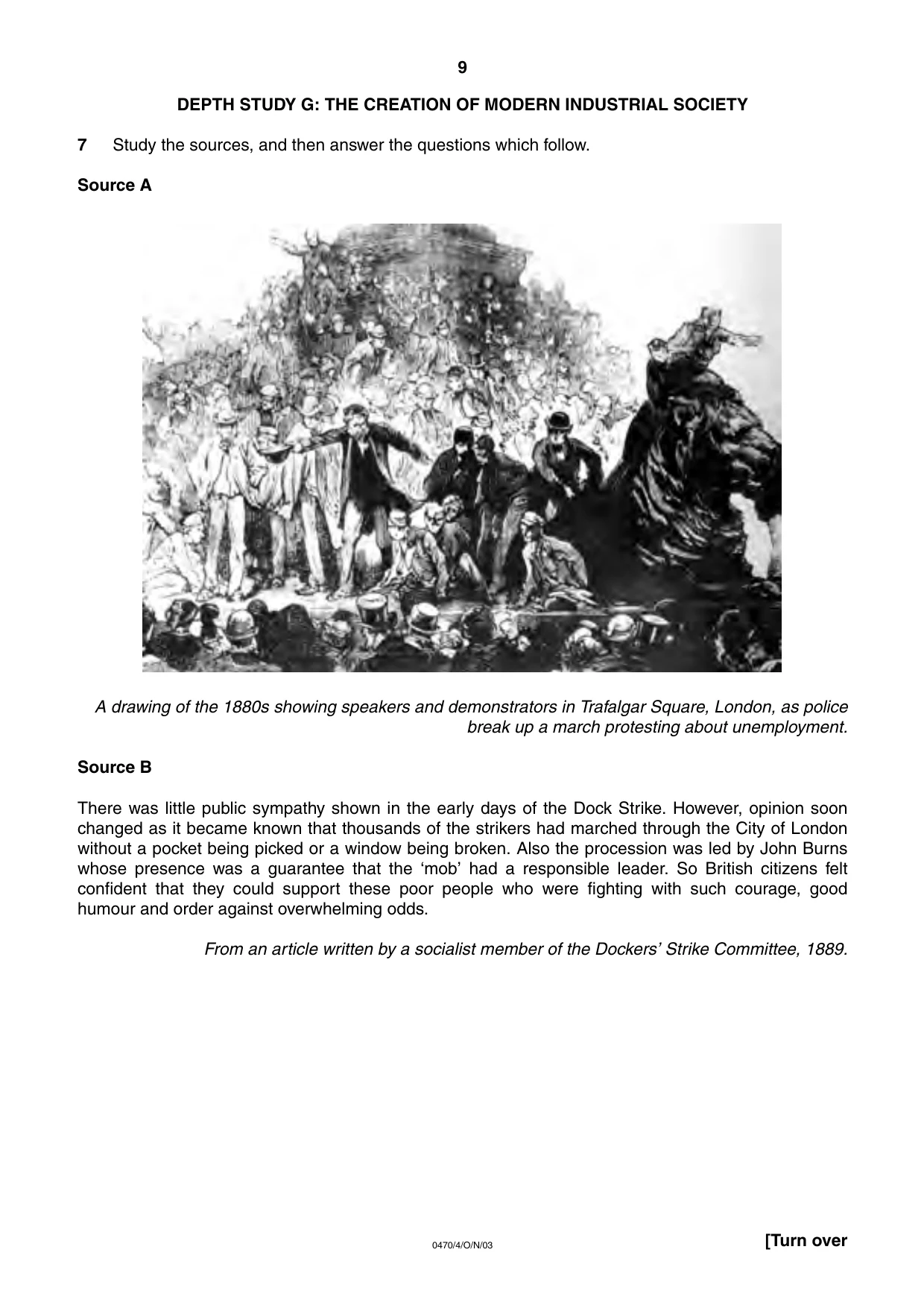
9 0470/4/O/N/03 [Turn over DEPTH STUDY G: THE CREATION OF MODERN INDUSTRIAL SOCIETY 7 Study the sources, and then answer the questions which follow. Source A A drawing of the 1880s showing speakers and demonstrators in Trafalgar Square, London, as police break up a march protesting about unemployment. Source B There was little public sympathy shown in the early days of the Dock Strike. However, opinion soon changed as it became known that thousands of the strikers had marched through the City of London without a pocket being picked or a window being broken. Also the procession was led by John Burns whose presence was a guarantee that the ‘mob’ had a responsible leader. So British citizens felt confident that they could support these poor people who were fighting with such courage, good humour and order against overwhelming odds. From an article written by a socialist member of the Dockers’ Strike Committee, 1889.
Question paper, page 10
10 0470/4/O/N/03 (a) (i) Study Source A. What does this source tell you about working people in the late nineteenth century? Support your answer with reference to the source. [6] (ii) Study Source B. How far does this source explain why the Dockers’ Strike was a success? Explain your answer. [7] (iii) Study both sources. Is one source more useful than the other as evidence about the problems faced by working people? Explain your answer. [7] (b) (i) Give two ways by which the growth of trade unions was restricted in the nineteenth century. [2] (ii) What was meant by ‘New Unionism’? [4] (iii) Why were trade unions mainly for skilled workers before the 1890s? [6] (iv) How successful had trade unions been by the end of the nineteenth century? Explain your answer. [8]
Question paper, page 11
11 0470/4/O/N/03 [Turn over DEPTH STUDY H: THE IMPACT OF WESTERN IMPERIALISM IN THE NINETEENTH CENTURY 8 Study the sources, and then answer the questions which follow. Source A Our position in India has been obtained by conquest. It is naturally disgusting to the inhabitants and can only be maintained by military force. It is our duty to give them justice, to respect and to protect their rights, and to promote their happiness. A British official in India in the 1840s. Source B My nation also has a custom. When men burn women alive, we hang those men and confiscate all their property. My carpenters shall, therefore, erect gallows on which to hang all concerned when a widow is burned. Let us all act according to our national customs. The opinion of a British military commander in the 1840s about the Hindu custom of suttee. Suttee had been banned by the British. Source C In true Christian spirit, we give up the right and desire to impose our beliefs on others. It is our earnest wish to stimulate the peaceful industry of India and to administer the government for the benefit of all our residents there. From the proclamation by Queen Victoria transferring power to the Crown from the East India Company, November 1858. (a) (i) Study Sources A and B. What do these sources tell you about British attitudes towards the Indians? Support your answer with reference to the sources. [6] (ii) Study Source C. How far does this source show that Britain accepted responsibility for causing the Mutiny? Explain your answer. [7] (iii) Study all the sources. Which source provides the best evidence for showing the nature of British imperialism? Explain your answer. [7] (b) (i) Name two British Governors-General of India in the twenty-five years before the Mutiny. [2] (ii) Describe two examples of Indian customs which were forbidden by the British authorities. [4] (iii) Why did the sepoys mutiny at Meerut? [6] (iv) ‘The Indians gained more from the Mutiny than the British.’ Do you agree? Explain your answer. [8]
Question paper, page 12
12 0470/4/O/N/03 Copyright Acknowledgements: Section A. Source A WHITT and HADLEY. Germany: 1918 – 1949. Published by HarperCollins Publishers Ltd. Section A. Source B WHITT and HADLEY. Germany: 1918 – 1949. Published by HarperCollins Publishers Ltd. Section B. Source A CLARE BAKER. Russia 1917 – 1945. Published by Heinemann Publishers Ltd. Section B. Source B CLARE BAKER. Russia 1917 – 1945. Published by Heinemann Publishers Ltd. Section B. Source C © G.W.H. Hunt. Section C. Source A LEWIS ALLAN. Strange Fruit. Published by a Marxist Journal. Section D. Source A Chronicles of 20th Century. (Dorling Kindersly 1995), copyright © 1995 Dorling Kindersley. Section D. Source B BRYN O’CALLAHAN. History of 20th Century. © Reproduced by permission of Pearson Education. Section E. Source B N PARSONS. A New History of Southern Africa. © Reproduced by permission of Palgrave. Section F. Source A © SHP 1977. Arab-Israeli Conflict. Reproduced by permission of QCA (Enterprises) Ltd. Section F. Source B © SHP 1977. Arab-Israeli Conflict. Reproduced by permission of QCA (Enterprises) Ltd. Section G. Source A T MCCARTHY. The Great Dock Strike. Published by Weidenfield and Nicholson. Section G. Source B A DAVIES. To Build a New Jerusalem. Published by Michael Joseph Ltd. Section F. Source A G MOORHOUSE. Pax Britannica. Published by W Collins. Cambridge International Examinations has made every effort to trace copyright holders, but if we have inadvertently overlooked any we will be pleased to make the necessary arrangements at the first opportunity.