Cambridge IGCSE History 0470 — 2003 May/June Paper 4 · Variant 1
0470/41/M/J/03
The question paper and its mark scheme, free to read here and free to download. This is Cambridge’s own paper, exactly as it was sat.
Question paper12 pages


Mark scheme
No mark scheme is in the library for this paper.
Paper as text
Question paper, page 1
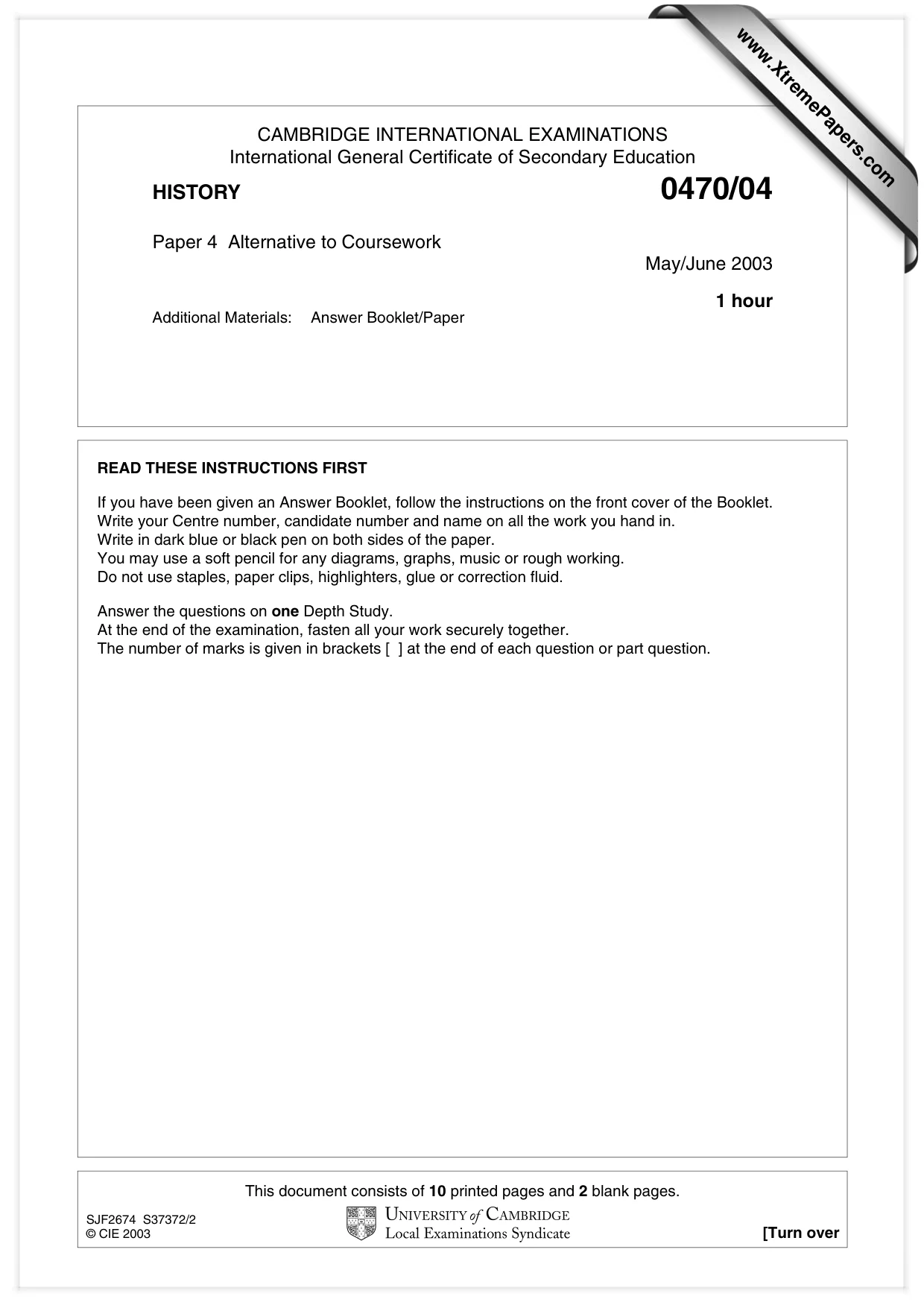
This document consists of 10 printed pages and 2 blank pages. SJF2674 S37372/2 © CIE 2003 [Turn over CAMBRIDGE INTERNATIONAL EXAMINATIONS International General Certificate of Secondary Education HISTORY 0470/04 Paper 4 Alternative to Coursework May/June 2003 1 hour Additional Materials: Answer Booklet/Paper READ THESE INSTRUCTIONS FIRST If you have been given an Answer Booklet, follow the instructions on the front cover of the Booklet. Write your Centre number, candidate number and name on all the work you hand in. Write in dark blue or black pen on both sides of the paper. You may use a soft pencil for any diagrams, graphs, music or rough working. Do not use staples, paper clips, highlighters, glue or correction fluid. Answer the questions on one Depth Study. At the end of the examination, fasten all your work securely together. The number of marks is given in brackets [ ] at the end of each question or part question. www.XtremePapers.com
Question paper, page 2
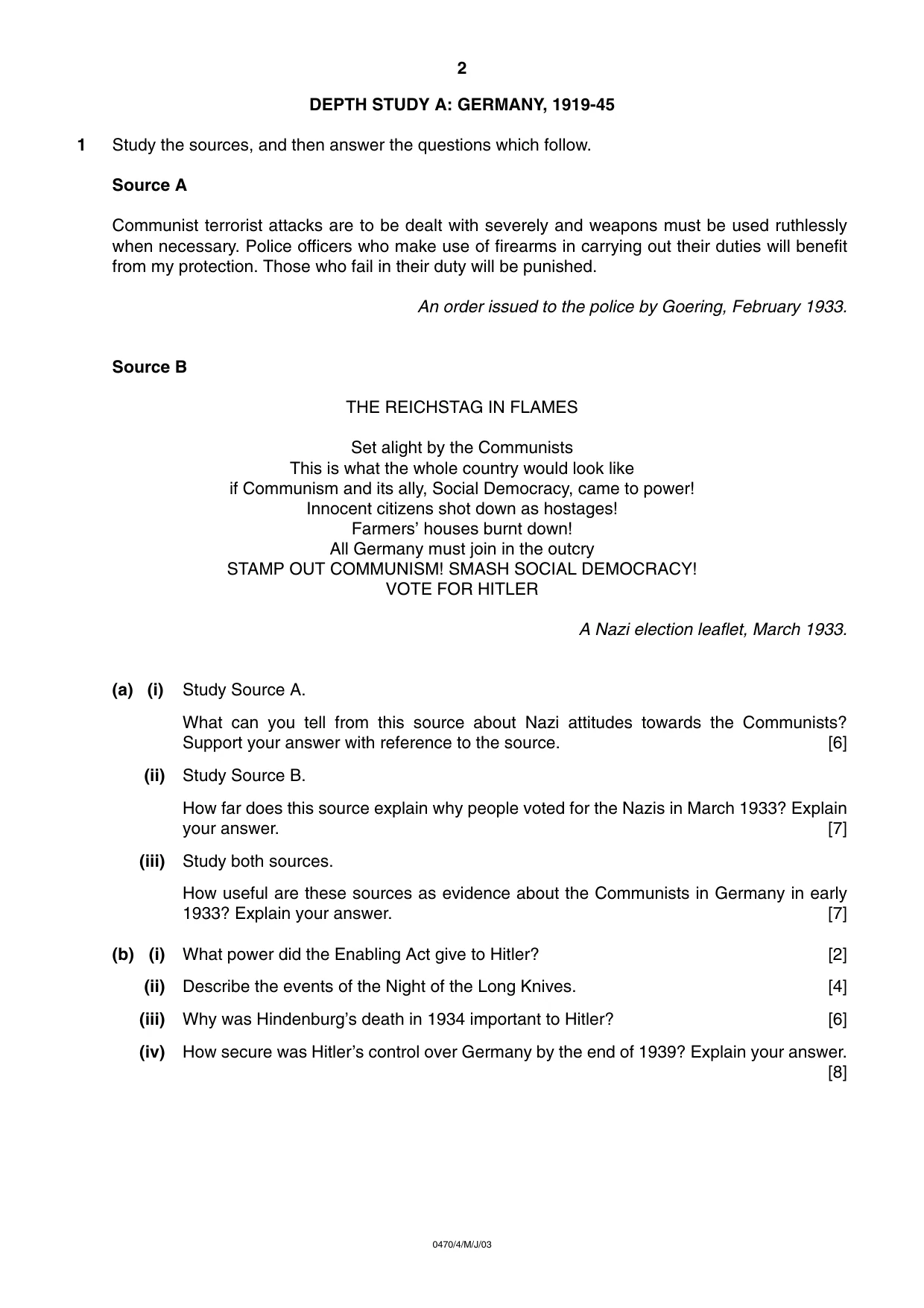
2 0470/4/M/J/03 DEPTH STUDY A: GERMANY, 1919-45 1 Study the sources, and then answer the questions which follow. Source A Communist terrorist attacks are to be dealt with severely and weapons must be used ruthlessly when necessary. Police officers who make use of firearms in carrying out their duties will benefit from my protection. Those who fail in their duty will be punished. An order issued to the police by Goering, February 1933. Source B THE REICHSTAG IN FLAMES Set alight by the Communists This is what the whole country would look like if Communism and its ally, Social Democracy, came to power! Innocent citizens shot down as hostages! Farmers’ houses burnt down! All Germany must join in the outcry STAMP OUT COMMUNISM! SMASH SOCIAL DEMOCRACY! VOTE FOR HITLER A Nazi election leaflet, March 1933. (a) (i) Study Source A. What can you tell from this source about Nazi attitudes towards the Communists? Support your answer with reference to the source. [6] (ii) Study Source B. How far does this source explain why people voted for the Nazis in March 1933? Explain your answer. [7] (iii) Study both sources. How useful are these sources as evidence about the Communists in Germany in early 1933? Explain your answer. [7] (b) (i) What power did the Enabling Act give to Hitler? [2] (ii) Describe the events of the Night of the Long Knives. [4] (iii) Why was Hindenburg’s death in 1934 important to Hitler? [6] (iv) How secure was Hitler’s control over Germany by the end of 1939? Explain your answer. [8]
Question paper, page 3
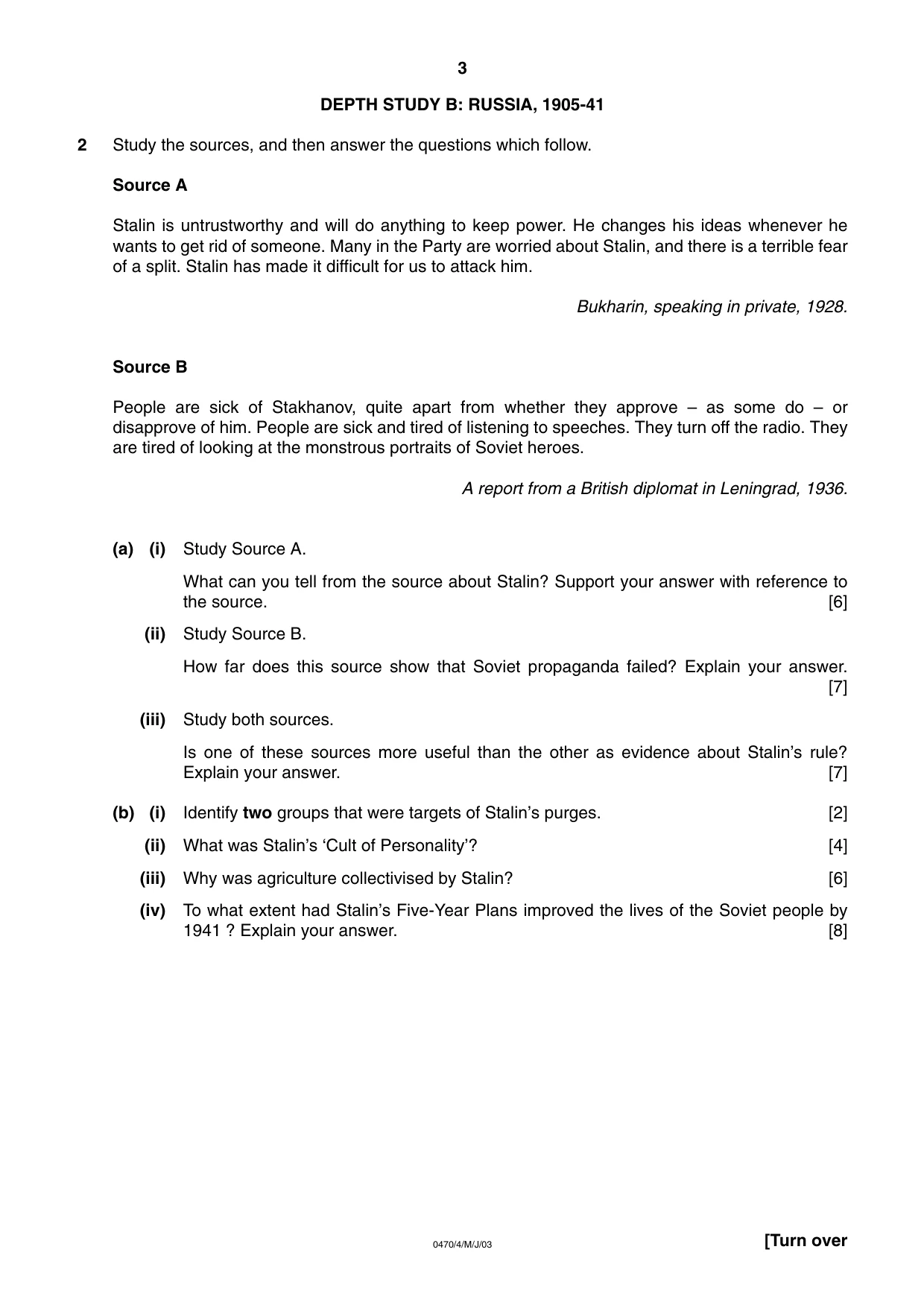
3 0470/4/M/J/03 [Turn over DEPTH STUDY B: RUSSIA, 1905-41 2 Study the sources, and then answer the questions which follow. Source A Stalin is untrustworthy and will do anything to keep power. He changes his ideas whenever he wants to get rid of someone. Many in the Party are worried about Stalin, and there is a terrible fear of a split. Stalin has made it difficult for us to attack him. Bukharin, speaking in private, 1928. Source B People are sick of Stakhanov, quite apart from whether they approve – as some do – or disapprove of him. People are sick and tired of listening to speeches. They turn off the radio. They are tired of looking at the monstrous portraits of Soviet heroes. A report from a British diplomat in Leningrad, 1936. (a) (i) Study Source A. What can you tell from the source about Stalin? Support your answer with reference to the source. [6] (ii) Study Source B. How far does this source show that Soviet propaganda failed? Explain your answer. [7] (iii) Study both sources. Is one of these sources more useful than the other as evidence about Stalin’s rule? Explain your answer. [7] (b) (i) Identify two groups that were targets of Stalin’s purges. [2] (ii) What was Stalin’s ‘Cult of Personality’? [4] (iii) Why was agriculture collectivised by Stalin? [6] (iv) To what extent had Stalin’s Five-Year Plans improved the lives of the Soviet people by 1941 ? Explain your answer. [8]
Question paper, page 4
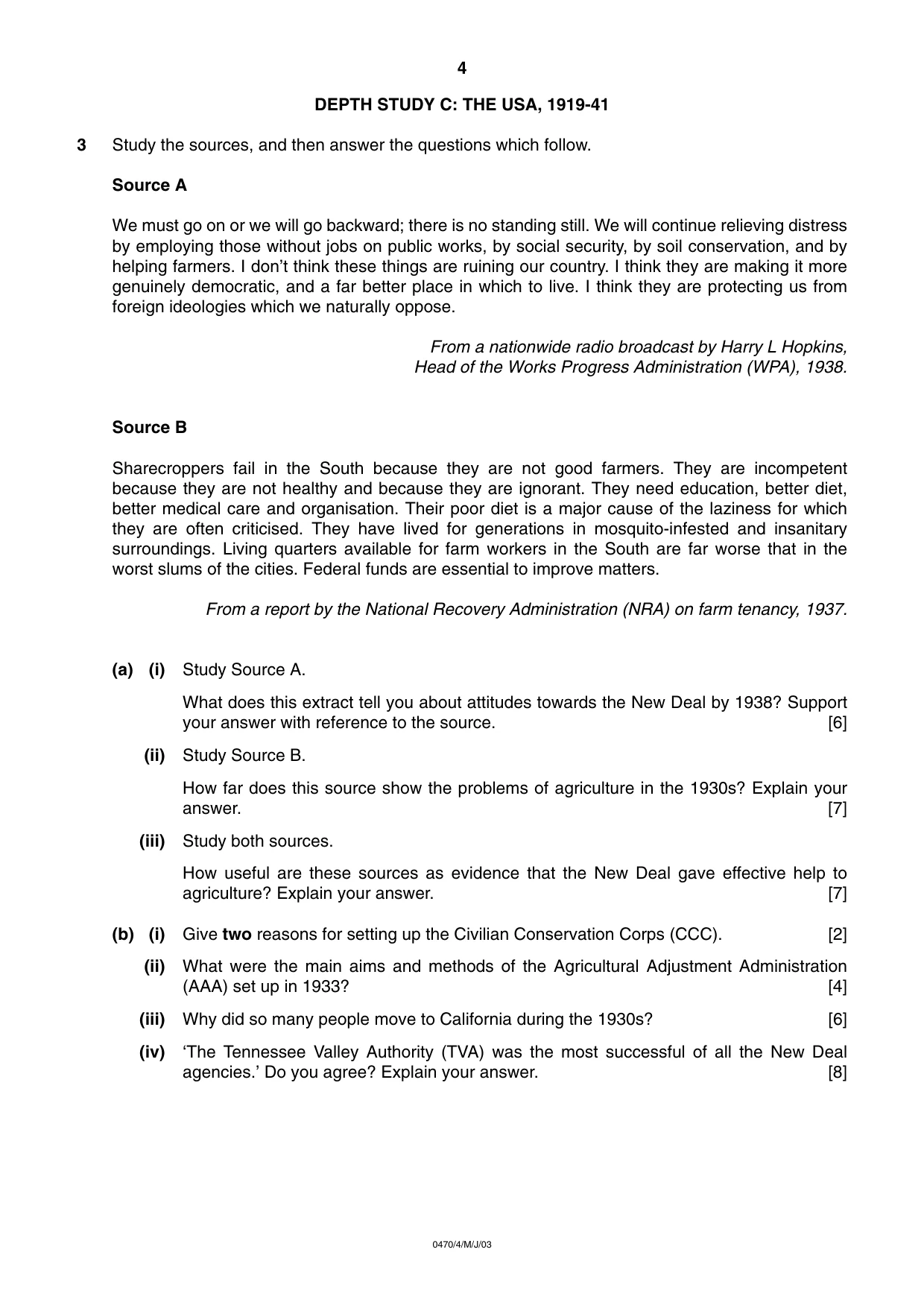
4 0470/4/M/J/03 DEPTH STUDY C: THE USA, 1919-41 3 Study the sources, and then answer the questions which follow. Source A We must go on or we will go backward; there is no standing still. We will continue relieving distress by employing those without jobs on public works, by social security, by soil conservation, and by helping farmers. I don’t think these things are ruining our country. I think they are making it more genuinely democratic, and a far better place in which to live. I think they are protecting us from foreign ideologies which we naturally oppose. From a nationwide radio broadcast by Harry L Hopkins, Head of the Works Progress Administration (WPA), 1938. Source B Sharecroppers fail in the South because they are not good farmers. They are incompetent because they are not healthy and because they are ignorant. They need education, better diet, better medical care and organisation. Their poor diet is a major cause of the laziness for which they are often criticised. They have lived for generations in mosquito-infested and insanitary surroundings. Living quarters available for farm workers in the South are far worse that in the worst slums of the cities. Federal funds are essential to improve matters. From a report by the National Recovery Administration (NRA) on farm tenancy, 1937. (a) (i) Study Source A. What does this extract tell you about attitudes towards the New Deal by 1938? Support your answer with reference to the source. [6] (ii) Study Source B. How far does this source show the problems of agriculture in the 1930s? Explain your answer. [7] (iii) Study both sources. How useful are these sources as evidence that the New Deal gave effective help to agriculture? Explain your answer. [7] (b) (i) Give two reasons for setting up the Civilian Conservation Corps (CCC). [2] (ii) What were the main aims and methods of the Agricultural Adjustment Administration (AAA) set up in 1933? [4] (iii) Why did so many people move to California during the 1930s? [6] (iv) ‘The Tennessee Valley Authority (TVA) was the most successful of all the New Deal agencies.’ Do you agree? Explain your answer. [8]
Question paper, page 5
5 0470/4/M/J/03 [Turn over DEPTH STUDY D: CHINA, 1945 – c.1990 4 Study the sources, and then answer the questions which follow. Source A Within a few weeks, 13 000 officers and men – over one-tenth of Jiang Jieshi’s (Chiang Kai- shek’s) forces in the area – deserted to the Communist side. Among them were sixteen colonels and nearly three hundred other junior officers. All brought rifles with them. From an article by an American reporter, based in Shanghai, 1948. Source B Jiang Jieshi has refused to undertake land reform, has been unable to establish a stable currency, and is the leader of a corrupt and incompetent administration and army. From a book by an American writer, 1948. (a) (i) Study Source A. What does this source tell you about the Nationalist army in the Civil War? Support your answer with reference to the source. [6] (ii) Study Source B. How reliable is this source as evidence about Jiang Jieshi’s leadership? Explain your answer. [7] (iii) Study both sources. Is one of these sources more useful than the other as evidence of why the Communists won the Civil War? Explain your answer. [7] (b) (i) Identify two groups in Chinese society that continued to support the Nationalist government after the Second World War. [2] (ii) Describe the ‘speak bitterness’ meetings (People’s Courts) which were introduced after the Communist victory in the Civil War. [4] (iii) Why did Formosa (Taiwan) become important in Chinese affairs after 1949? [6] (iv) Was the land issue the most important problem facing the new People’s Republic of China in 1949? Explain your answer. [8]
Question paper, page 6
6 0470/4/M/J/03 DEPTH STUDY E: SOUTHERN AFRICA IN THE TWENTIETH CENTURY 5 Study the sources, and then answer the questions which follow. Source A By 1990 over four thousand people had been killed on the streets since 1985 and fifty thousand people were in prison without trial. Troops were stationed in the townships. The economy was in deep trouble and the National Party had the worst election results since 1948. The government held several secret meetings with Mandela and the ANC leaders. The two sides got on well. From a British school textbook written in 1997. Source B The ANC wants the assassination of policemen, members of the defence forces, black town councillors, and anyone else who disagrees with them. It intends to wipe out Inkatha and other black groups who oppose its tactics. They have hacked people to death, people have been necklaced and their houses burnt to the ground. A letter published in a British newspaper in 1986, from Chief Buthelezi, President of the Zulu organisation, Inkatha. (a) (i) Study Source A. What can you tell from this source about the National Party government by 1990? Support your answer with reference to the source. [6] (ii) Study Source B. How far does this letter show that Inkatha was intimidated by the ANC? Explain your answer. [7] (iii) Study both sources. Is one of these sources more useful than the other as evidence about the ANC? Explain your answer. [7] (b) (i) Give two of the proposals made by Joe Slovo to end the deadlock in the 1992 negotiations about power-sharing. [2] (ii) Describe the part played by Chief Buthelezi and Inkatha in the negotiations in the early 1990s to end minority rule. [4] (iii) Why did the majority of white voters choose to support reform in the 1992 referendum? [6] (iv) Do you agree that Nelson Mandela was the most important factor in bringing about majority rule? Explain your answer. [8]
Question paper, page 7
7 0470/4/M/J/03 [Turn over DEPTH STUDY F: ISRAELIS AND PALESTINIANS, 1945 – c.1994 6 Study the sources, and then answer the questions which follow. Source A A special study ought to be made of the responsibility of Cairo Radio for the disaster which overtook Egypt in 1967. Propaganda was both Nasser’s strength and weakness. This was understood after the military defeat. The main effect of Cairo Radio broadcasts on the Arabs was that expectations were raised so much that promises to destroy Israel had to be kept. From a British history textbook of the 1980s. Source B The problem for the Arab countries is not whether the port of Eilat should be blockaded or how to blockade it – but how to exterminate the state of Israel for all time. From a speech by Nasser to the Egyptian parliament, 25 May 1967. (a) (i) Study Source A. What can you tell from this source about the effects of propaganda in the 1967 crisis? Support your answer with reference to the source. [6] (ii) Study Source B. How far does this source show that Nasser was responsible for the outbreak of war in 1967? Explain your answer. [7] (iii) Study both sources. Is one source more useful than the other about the 1967 crisis? Explain your answer. [7] (b) (i) Give two reasons why Israel attacked Egypt in 1967. [2] (ii) Describe the military tactics used by the Israeli armed forces to defeat Egypt and its allies in June 1967. [4] (iii) Why, after the 1967 war, did the Israelis need to prepare for further hostilities with the Arabs? [6] (iv) How far did Sadat change Egypt’s policies towards Israel? Explain your answer. [8]
Question paper, page 8
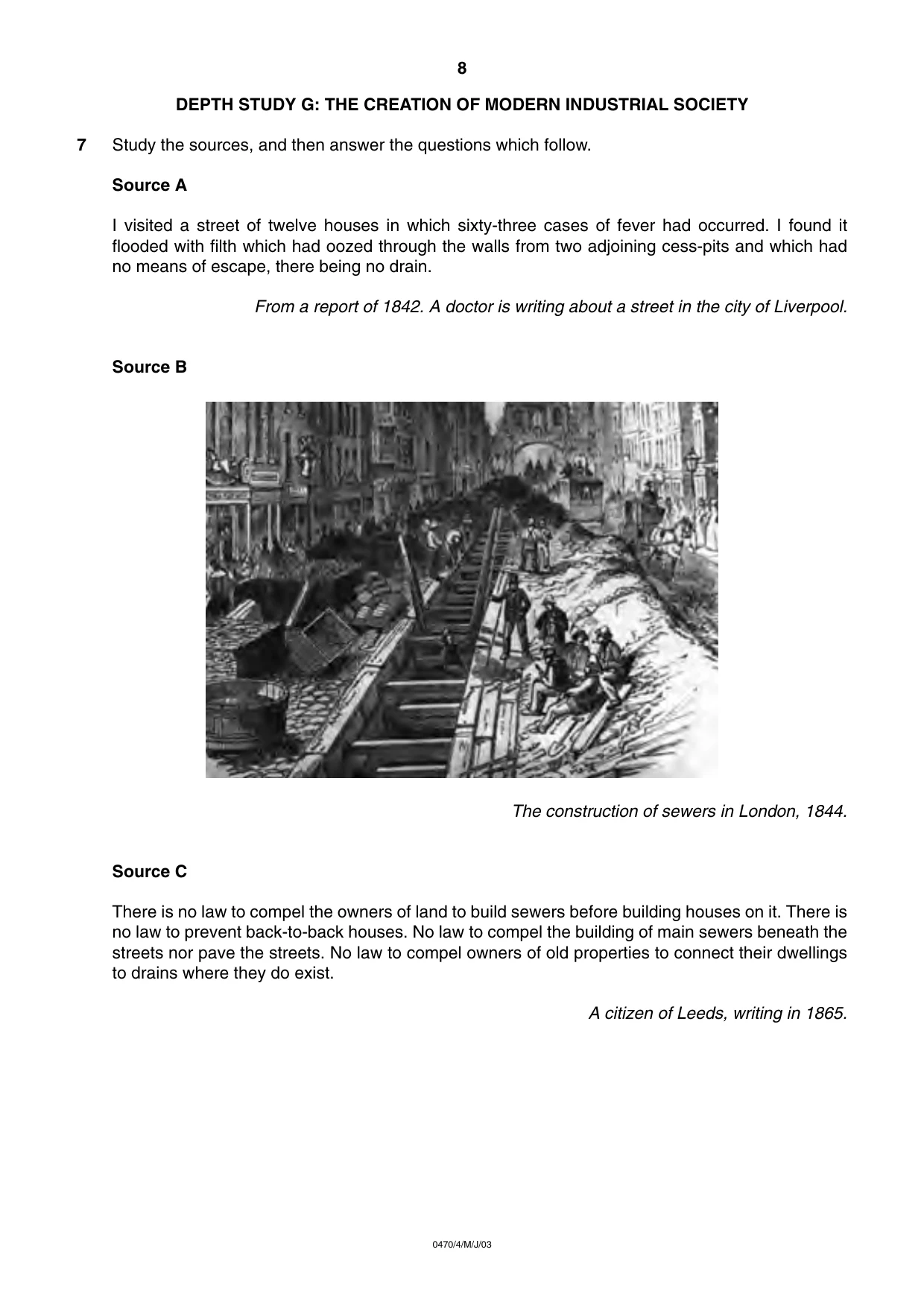
8 0470/4/M/J/03 DEPTH STUDY G: THE CREATION OF MODERN INDUSTRIAL SOCIETY 7 Study the sources, and then answer the questions which follow. Source A I visited a street of twelve houses in which sixty-three cases of fever had occurred. I found it flooded with filth which had oozed through the walls from two adjoining cess-pits and which had no means of escape, there being no drain. From a report of 1842. A doctor is writing about a street in the city of Liverpool. Source B The construction of sewers in London, 1844. Source C There is no law to compel the owners of land to build sewers before building houses on it. There is no law to prevent back-to-back houses. No law to compel the building of main sewers beneath the streets nor pave the streets. No law to compel owners of old properties to connect their dwellings to drains where they do exist. A citizen of Leeds, writing in 1865.
Question paper, page 9
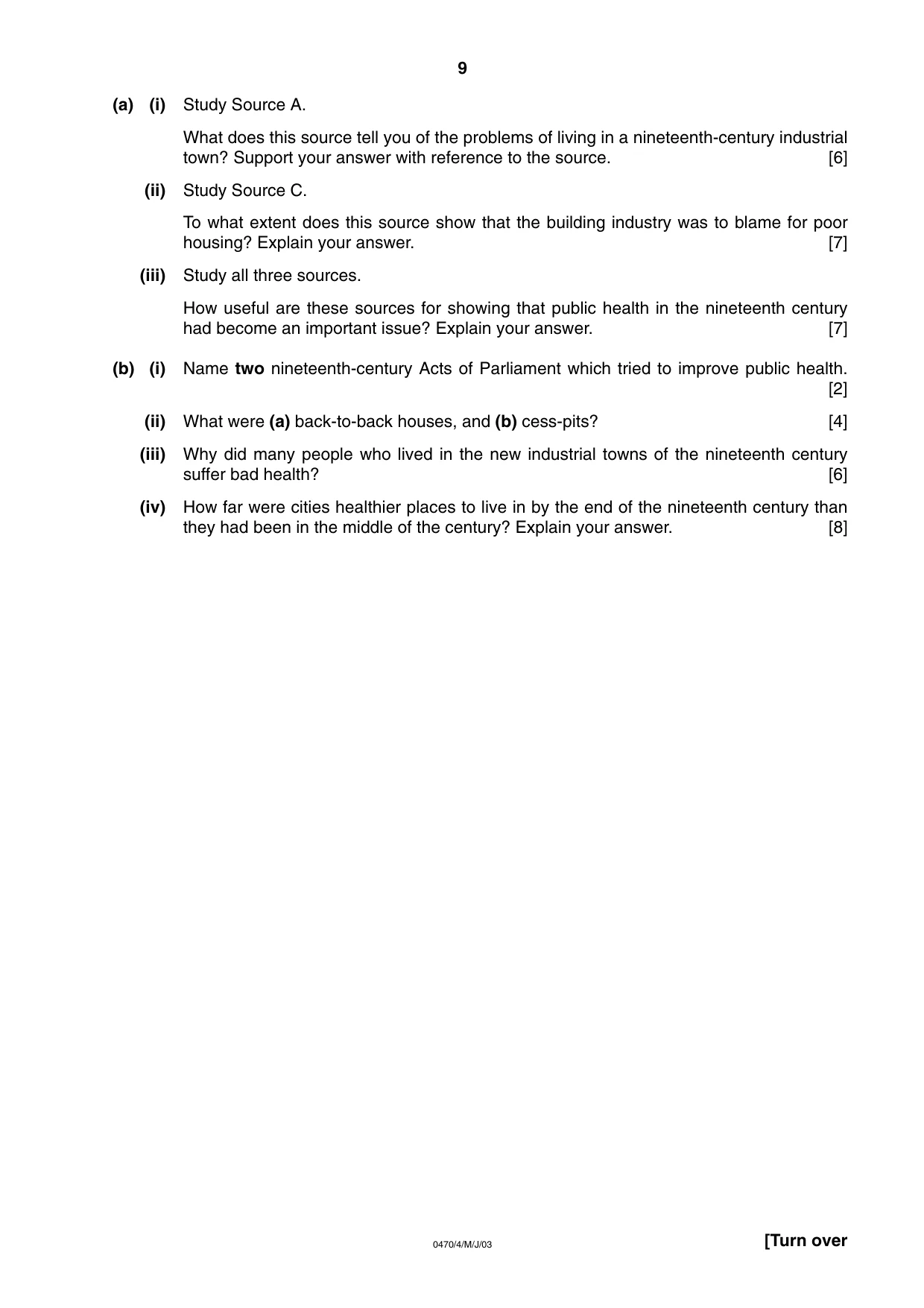
9 0470/4/M/J/03 [Turn over (a) (i) Study Source A. What does this source tell you of the problems of living in a nineteenth-century industrial town? Support your answer with reference to the source. [6] (ii) Study Source C. To what extent does this source show that the building industry was to blame for poor housing? Explain your answer. [7] (iii) Study all three sources. How useful are these sources for showing that public health in the nineteenth century had become an important issue? Explain your answer. [7] (b) (i) Name two nineteenth-century Acts of Parliament which tried to improve public health. [2] (ii) What were (a) back-to-back houses, and (b) cess-pits? [4] (iii) Why did many people who lived in the new industrial towns of the nineteenth century suffer bad health? [6] (iv) How far were cities healthier places to live in by the end of the nineteenth century than they had been in the middle of the century? Explain your answer. [8]
Question paper, page 10
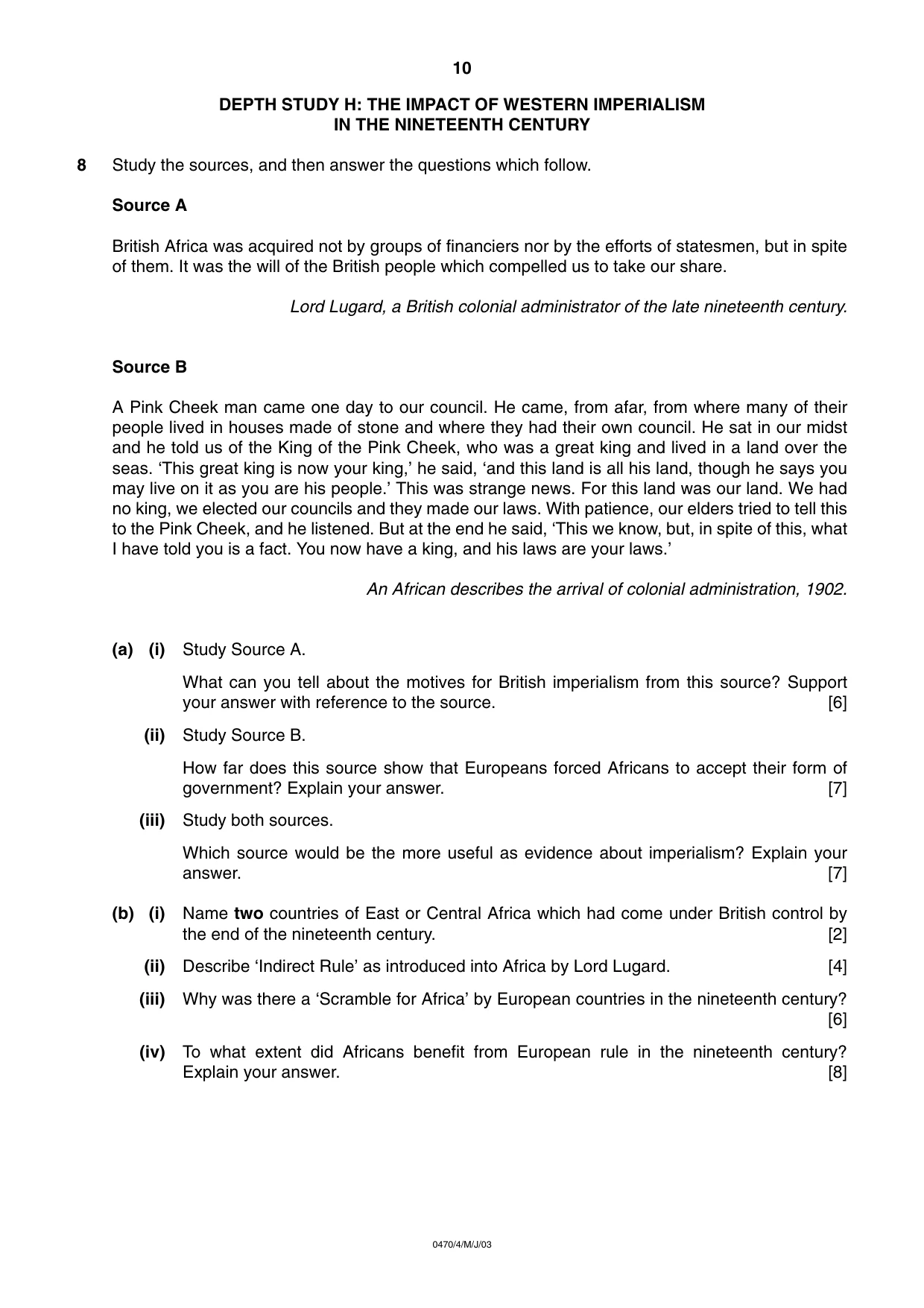
10 0470/4/M/J/03 DEPTH STUDY H: THE IMPACT OF WESTERN IMPERIALISM IN THE NINETEENTH CENTURY 8 Study the sources, and then answer the questions which follow. Source A British Africa was acquired not by groups of financiers nor by the efforts of statesmen, but in spite of them. It was the will of the British people which compelled us to take our share. Lord Lugard, a British colonial administrator of the late nineteenth century. Source B A Pink Cheek man came one day to our council. He came, from afar, from where many of their people lived in houses made of stone and where they had their own council. He sat in our midst and he told us of the King of the Pink Cheek, who was a great king and lived in a land over the seas. ‘This great king is now your king,’ he said, ‘and this land is all his land, though he says you may live on it as you are his people.’ This was strange news. For this land was our land. We had no king, we elected our councils and they made our laws. With patience, our elders tried to tell this to the Pink Cheek, and he listened. But at the end he said, ‘This we know, but, in spite of this, what I have told you is a fact. You now have a king, and his laws are your laws.’ An African describes the arrival of colonial administration, 1902. (a) (i) Study Source A. What can you tell about the motives for British imperialism from this source? Support your answer with reference to the source. [6] (ii) Study Source B. How far does this source show that Europeans forced Africans to accept their form of government? Explain your answer. [7] (iii) Study both sources. Which source would be the more useful as evidence about imperialism? Explain your answer. [7] (b) (i) Name two countries of East or Central Africa which had come under British control by the end of the nineteenth century. [2] (ii) Describe ‘Indirect Rule’ as introduced into Africa by Lord Lugard. [4] (iii) Why was there a ‘Scramble for Africa’ by European countries in the nineteenth century? [6] (iv) To what extent did Africans benefit from European rule in the nineteenth century? Explain your answer. [8]
Question paper, page 12
12 0470/4/M/J/03 BLANK PAGE Copyright Acknowledgments: Question 1. Source A WHITE and HADLEY. Germany: 1918-49. Published by Collins Educational. Question 1. Source B WHITE and HADLEY. Germany: 1918-49. Published by Collins Educational. Question 2. Source A ALAN WHITE. RUSSIA and USSR: 1905-1991. Published by Collins Educational. Question 2. Source B ALAN WHITE. RUSSIA and USSR: 1905-1991. Published by Collins Educational. Question 3. Source A US National Archive Question 3. Source B US National Archive Question 4. Source A J. BELDON. China Shakes the World. Published by Collins. Question 4. Source B BRYN O’CALLAGHAN. History of the Twentieth Century. © Reproduced by permission of Pearson Education. Question 5. Source A H MACDONALD AND B WILLIAMSON. South Africa. © Reproduced by permission of Stanley Thornes (Publishers) Ltd. Question 5. Source B H MACDONALD AND B WILLIAMSON. South Africa. © Reproduced by permission of Stanley Thornes (Publishers) Ltd. Question 6. Source A S J PERKINS. The Arab-Israeli Conflict. © Reproduced by permission of Thomas, Nelson and Sons. Question 6. Source B S J PERKINS. The Arab-Israeli Conflict. © Reproduced by permission of Thomas, Nelson and Sons. Cambridge International Examinations has made every effort to trace copyright holders, but if we have inadvertently overlooked any we will be pleased to make the necessary arrangements at the first opportunity.