Cambridge IGCSE History 0470 — 2002 Oct/Nov Paper 4 · Variant 1
0470/41/O/N/02
The question paper and its mark scheme, free to read here and free to download. This is Cambridge’s own paper, exactly as it was sat.
Question paper12 pages

Mark scheme16 pages
Answers below. Sit the paper first if you are practising.
Paper as text
Question paper, page 1
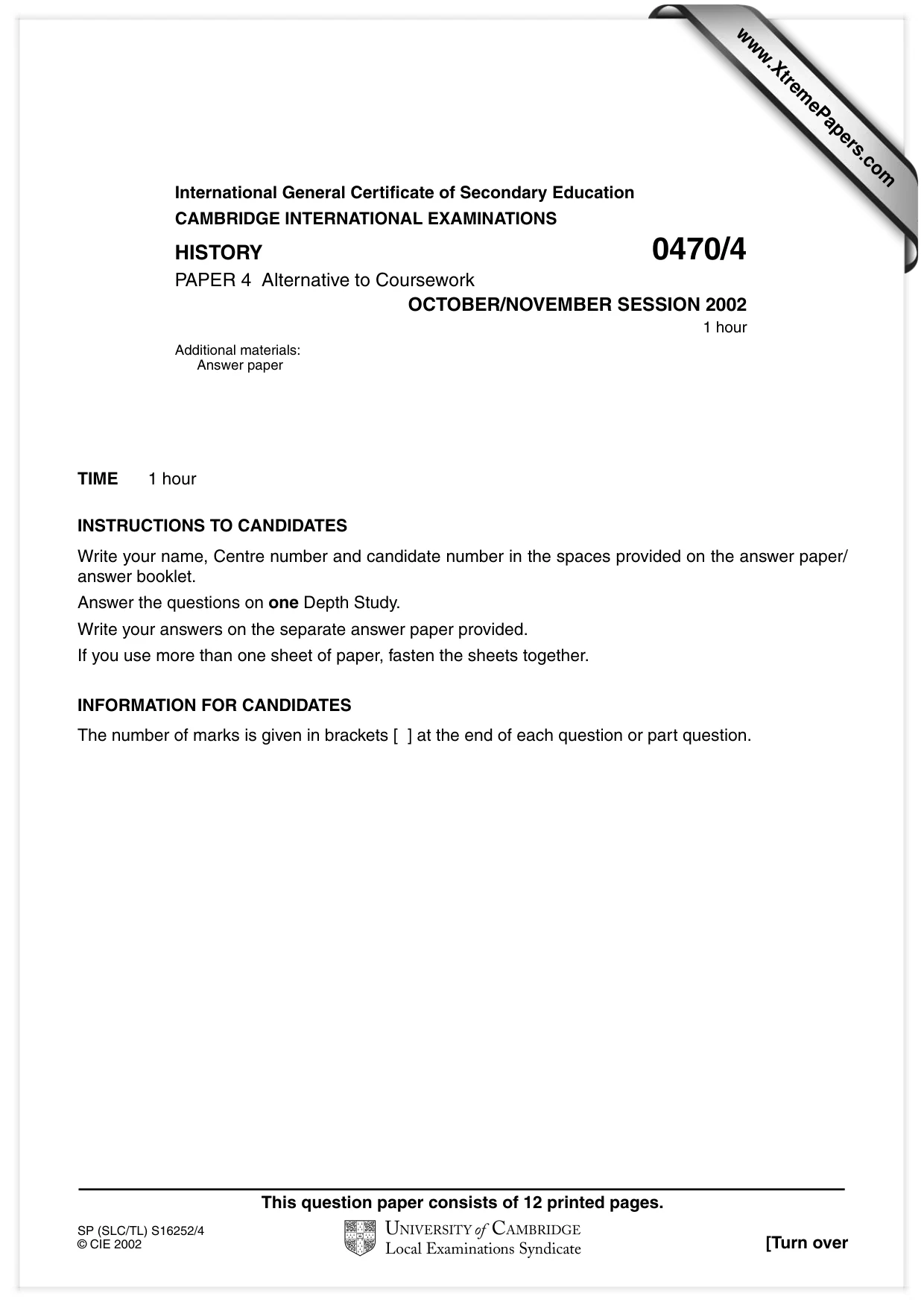
This question paper consists of 12 printed pages. SP (SLC/TL) S16252/4 © CIE 2002 [Turn over International General Certificate of Secondary Education CAMBRIDGE INTERNATIONAL EXAMINATIONS HISTORY 0470/4 PAPER 4 Alternative to Coursework OCTOBER/NOVEMBER SESSION 2002 1 hour Additional materials: Answer paper TIME 1 hour INSTRUCTIONS TO CANDIDATES Write your name, Centre number and candidate number in the spaces provided on the answer paper/ answer booklet. Answer the questions on one Depth Study. Write your answers on the separate answer paper provided. If you use more than one sheet of paper, fasten the sheets together. INFORMATION FOR CANDIDATES The number of marks is given in brackets [ ] at the end of each question or part question. www.XtremePapers.com
Question paper, page 2
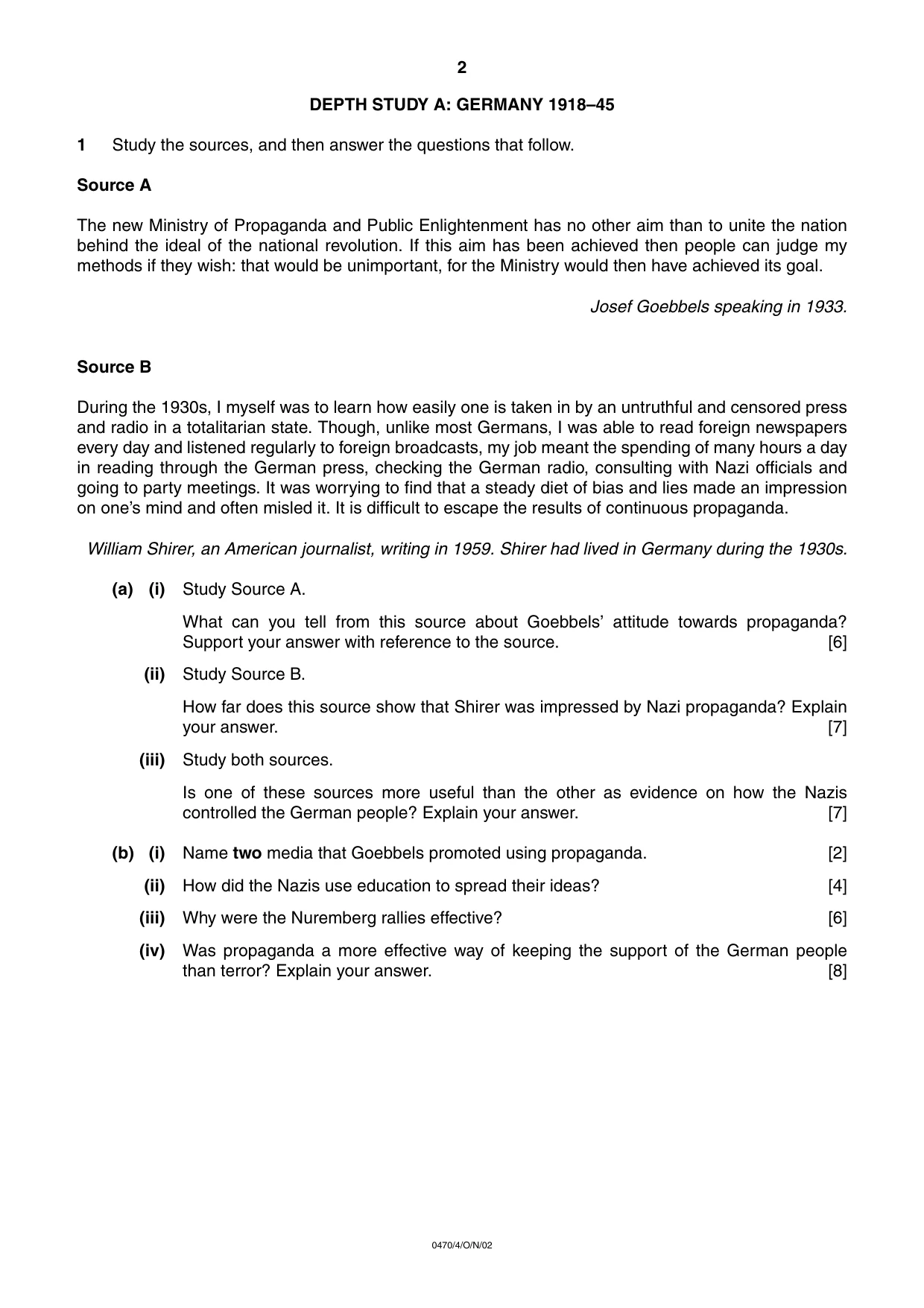
2 0470/4/O/N/02 DEPTH STUDY A: GERMANY 1918–45 1 Study the sources, and then answer the questions that follow. Source A The new Ministry of Propaganda and Public Enlightenment has no other aim than to unite the nation behind the ideal of the national revolution. If this aim has been achieved then people can judge my methods if they wish: that would be unimportant, for the Ministry would then have achieved its goal. Josef Goebbels speaking in 1933. Source B During the 1930s, I myself was to learn how easily one is taken in by an untruthful and censored press and radio in a totalitarian state. Though, unlike most Germans, I was able to read foreign newspapers every day and listened regularly to foreign broadcasts, my job meant the spending of many hours a day in reading through the German press, checking the German radio, consulting with Nazi officials and going to party meetings. It was worrying to find that a steady diet of bias and lies made an impression on one’s mind and often misled it. It is difficult to escape the results of continuous propaganda. William Shirer, an American journalist, writing in 1959. Shirer had lived in Germany during the 1930s. (a) (i) Study Source A. What can you tell from this source about Goebbels’ attitude towards propaganda? Support your answer with reference to the source. [6] (ii) Study Source B. How far does this source show that Shirer was impressed by Nazi propaganda? Explain your answer. [7] (iii) Study both sources. Is one of these sources more useful than the other as evidence on how the Nazis controlled the German people? Explain your answer. [7] (b) (i) Name two media that Goebbels promoted using propaganda. [2] (ii) How did the Nazis use education to spread their ideas? [4] (iii) Why were the Nuremberg rallies effective? [6] (iv) Was propaganda a more effective way of keeping the support of the German people than terror? Explain your answer. [8]
Question paper, page 3
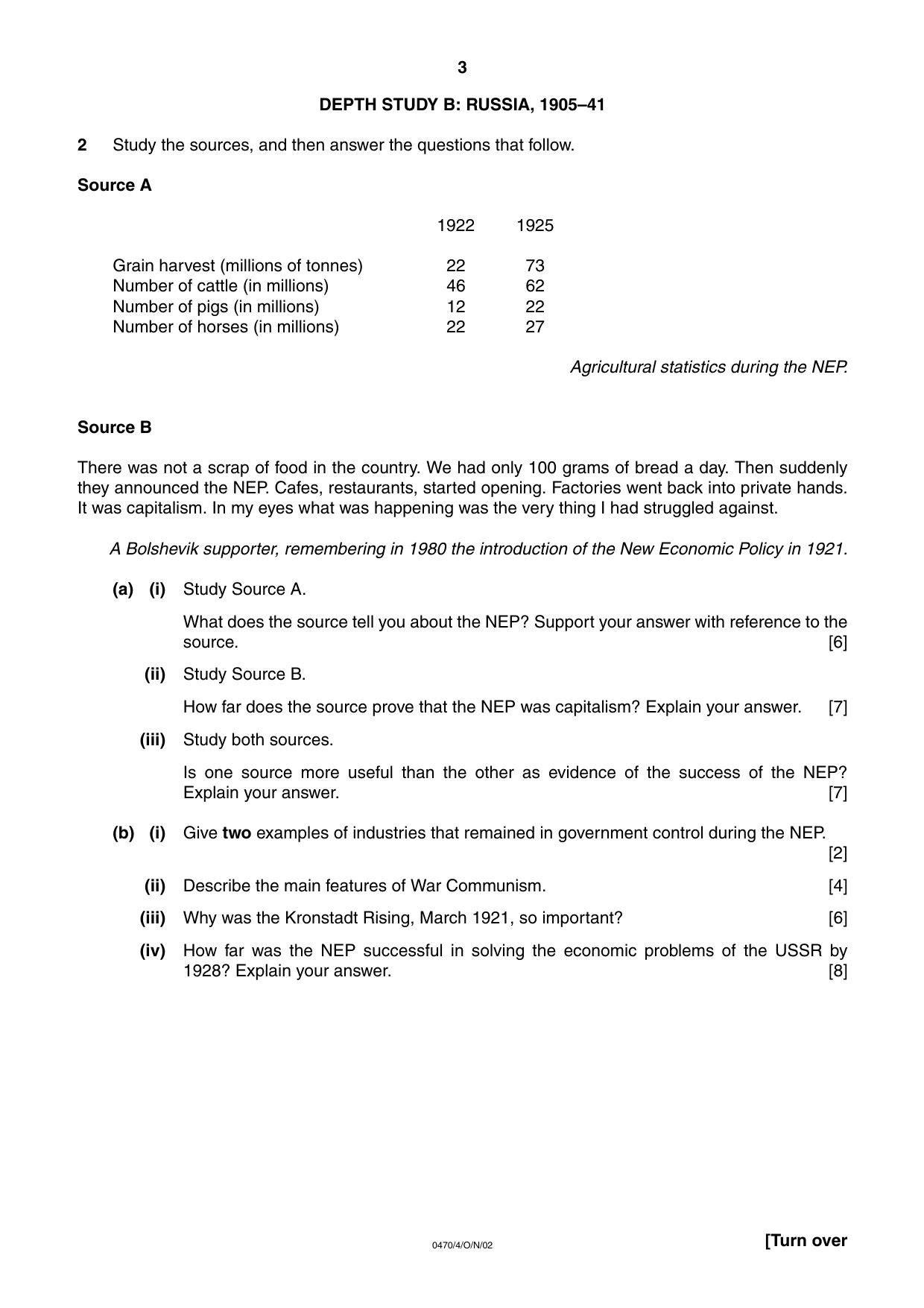
3 0470/4/O/N/02 [Turn over DEPTH STUDY B: RUSSIA, 1905–41 2 Study the sources, and then answer the questions that follow. Source A 1922 1925 Grain harvest (millions of tonnes) 22 73 Number of cattle (in millions) 46 62 Number of pigs (in millions) 12 22 Number of horses (in millions) 22 27 Agricultural statistics during the NEP. Source B There was not a scrap of food in the country. We had only 100 grams of bread a day. Then suddenly they announced the NEP. Cafes, restaurants, started opening. Factories went back into private hands. It was capitalism. In my eyes what was happening was the very thing I had struggled against. A Bolshevik supporter, remembering in 1980 the introduction of the New Economic Policy in 1921. (a) (i) Study Source A. What does the source tell you about the NEP? Support your answer with reference to the source. [6] (ii) Study Source B. How far does the source prove that the NEP was capitalism? Explain your answer. [7] (iii) Study both sources. Is one source more useful than the other as evidence of the success of the NEP? Explain your answer. [7] (b) (i) Give two examples of industries that remained in government control during the NEP. [2] (ii) Describe the main features of War Communism. [4] (iii) Why was the Kronstadt Rising, March 1921, so important? [6] (iv) How far was the NEP successful in solving the economic problems of the USSR by 1928? Explain your answer. [8]
Question paper, page 4
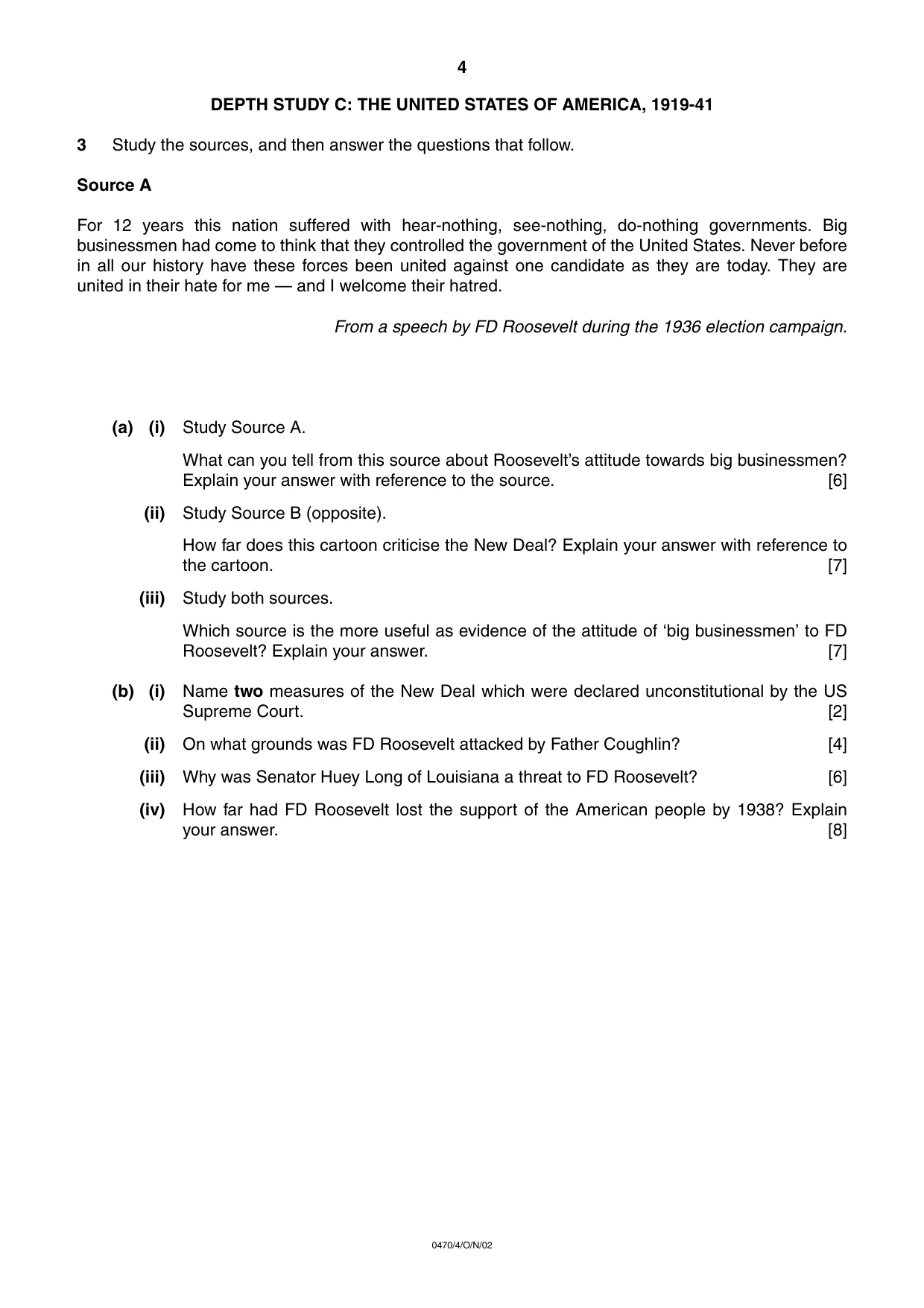
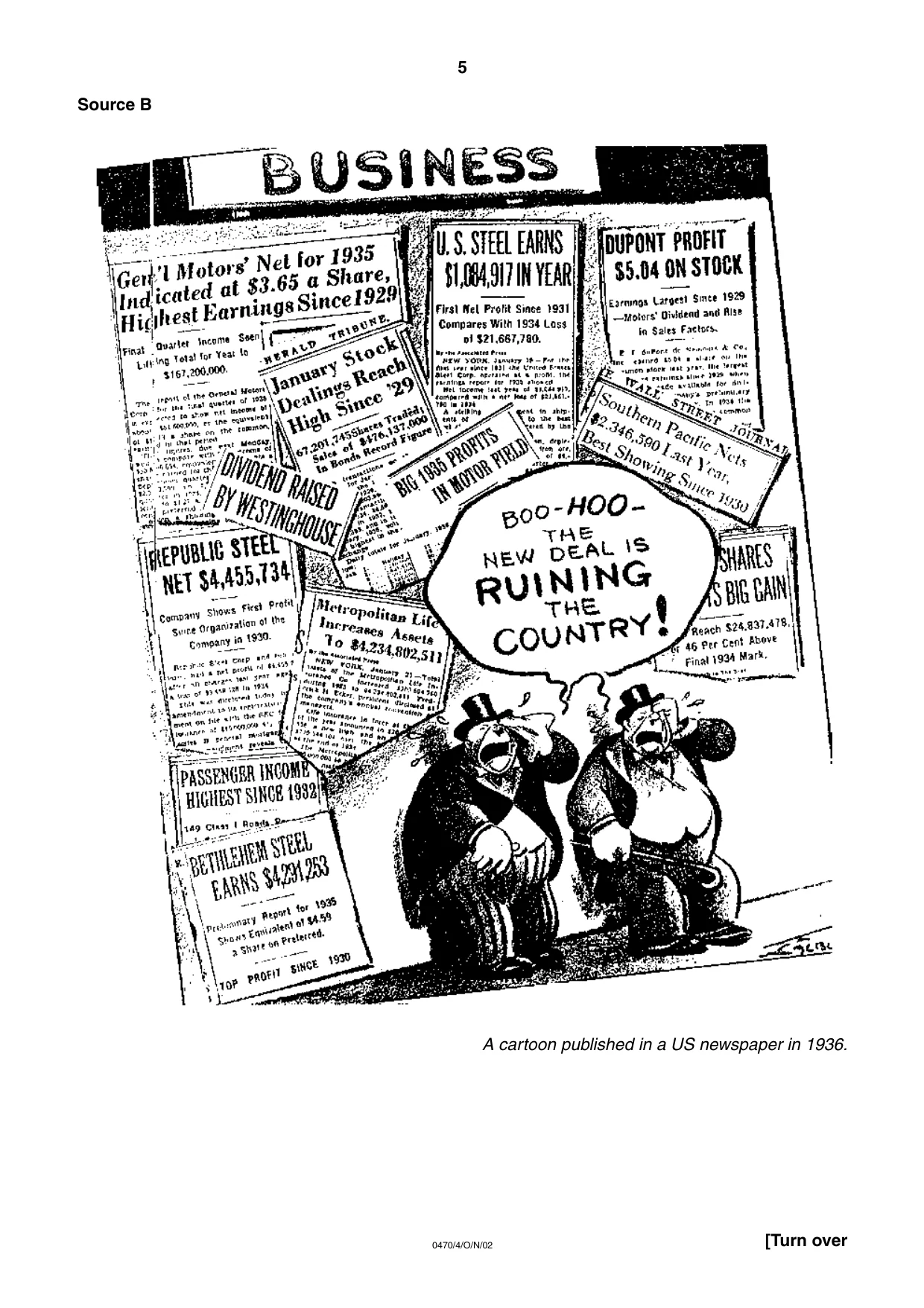
4 0470/4/O/N/02 DEPTH STUDY C: THE UNITED STATES OF AMERICA, 1919-41 3 Study the sources, and then answer the questions that follow. Source A For 12 years this nation suffered with hear-nothing, see-nothing, do-nothing governments. Big businessmen had come to think that they controlled the government of the United States. Never before in all our history have these forces been united against one candidate as they are today. They are united in their hate for me — and I welcome their hatred. From a speech by FD Roosevelt during the 1936 election campaign. (a) (i) Study Source A. What can you tell from this source about Roosevelt’s attitude towards big businessmen? Explain your answer with reference to the source. [6] (ii) Study Source B (opposite). How far does this cartoon criticise the New Deal? Explain your answer with reference to the cartoon. [7] (iii) Study both sources. Which source is the more useful as evidence of the attitude of ‘big businessmen’ to FD Roosevelt? Explain your answer. [7] (b) (i) Name two measures of the New Deal which were declared unconstitutional by the US Supreme Court. [2] (ii) On what grounds was FD Roosevelt attacked by Father Coughlin? [4] (iii) Why was Senator Huey Long of Louisiana a threat to FD Roosevelt? [6] (iv) How far had FD Roosevelt lost the support of the American people by 1938? Explain your answer. [8]
Question paper, page 5
5 0470/4/O/N/02 [Turn over Source B A cartoon published in a US newspaper in 1936.
Question paper, page 6
6 0470/4/O/N/02 DEPTH STUDY D: CHINA, 1945-c.1990 4 Study the sources, and then answer the questions that follow. Source A With a smile and a bow, armed communist soldiers asked directions to where they were to sleep. The people were amazed but pleased. This must have been the first time in Tientsin’s history that uniformed soldiers used all the forms of Chinese courtesy. This behaviour continued and there was no looting or stealing. A German, living in Tientsin in 1948, comments on Mao’s army. Source B We have become so convinced of the hopelessness of the existing government that we feel the sooner it is removed the better. Since the communists are the only people capable of making changes, we are willing to support them as the lesser of two evils. A Chinese university teacher speaking in 1948. (a) (i) Study Source A. What can you tell from this source about the communist army? Support your answer with reference to the source. [6] (ii) Study Source B. How far does this source show that the Chinese Communist Party would be welcomed as the new rulers of China? Explain your answer. [7] (iii) Study both sources. Is one of these sources more useful than the other as evidence about the fall of the Nationalist government (GMD) in 1949? Explain your answer. [7] (b) (i) Name two groups in China who supported Jiang Jieshi and the GMD in 1946. [2] (ii) Describe two ways in which Jiang Jieshi showed himself to be a poor leader. [4] (iii) Why did the peasants give the Chinese Communist Party their support during the Civil War? [6] (iv) How far was the defeat of Jiang Jieshi in the Civil War a consequence of the Second World War? Explain your answer. [8]
Question paper, page 7
7 0470/4/O/N/02 [Turn over DEPTH STUDY E: SOUTHERN AFRICA IN THE TWENTIETH CENTURY 5 Study the sources, and then answer the questions that follow. Source A Profits from gold production rose from £12 million in 1932 to £30 million in 1940. By 1937 over a quarter of government income came from gold taxes. The value of all goods manufactured in South Africa doubled between 1932 and 1939. New mines producing copper, manganese and chrome for export and iron ore, coal and cement limestone for the home market were started with foreign investment. From a British school textbook, 1993. Source B In the 1930s the South African government invested heavily in industry. The great new iron and steel corporation (ISCOR) was protected by high customs duties (tariffs). The state railway agreed to use only ISCOR iron and steel. The state electricity supply (ESCOM) expanded rapidly. By 1940 the government had set up the Industrial Development Corporation to use state investment to build up basic industries. From South African government information, 1990. (a) (i) Study Source A. What impression does this source give of the South African economy in the 1930s? Support your answer with reference to the source. [6] (ii) Study Source B. How far does this source show the extent of government involvement in the South African economy of the 1930s? Explain your answer. [7] (iii) Study both sources. Is one of these sources more useful than the other as evidence about the development of the South African economy in the 1930s? Explain your answer. [7] (b) (i) Name two major South African exports which suffered as a result of the worldwide depression in the 1930s. [2] (ii) In what ways were workers recruited for the expansion of the Rand mines in the 1930s? [4] (iii) Why did the Hertzog-Smuts government pass the 1937 Marketing Act? [6] (iv) To what extent did all South Africans benefit from the economic growth of the 1930s? Explain your answer. [8]
Question paper, page 8
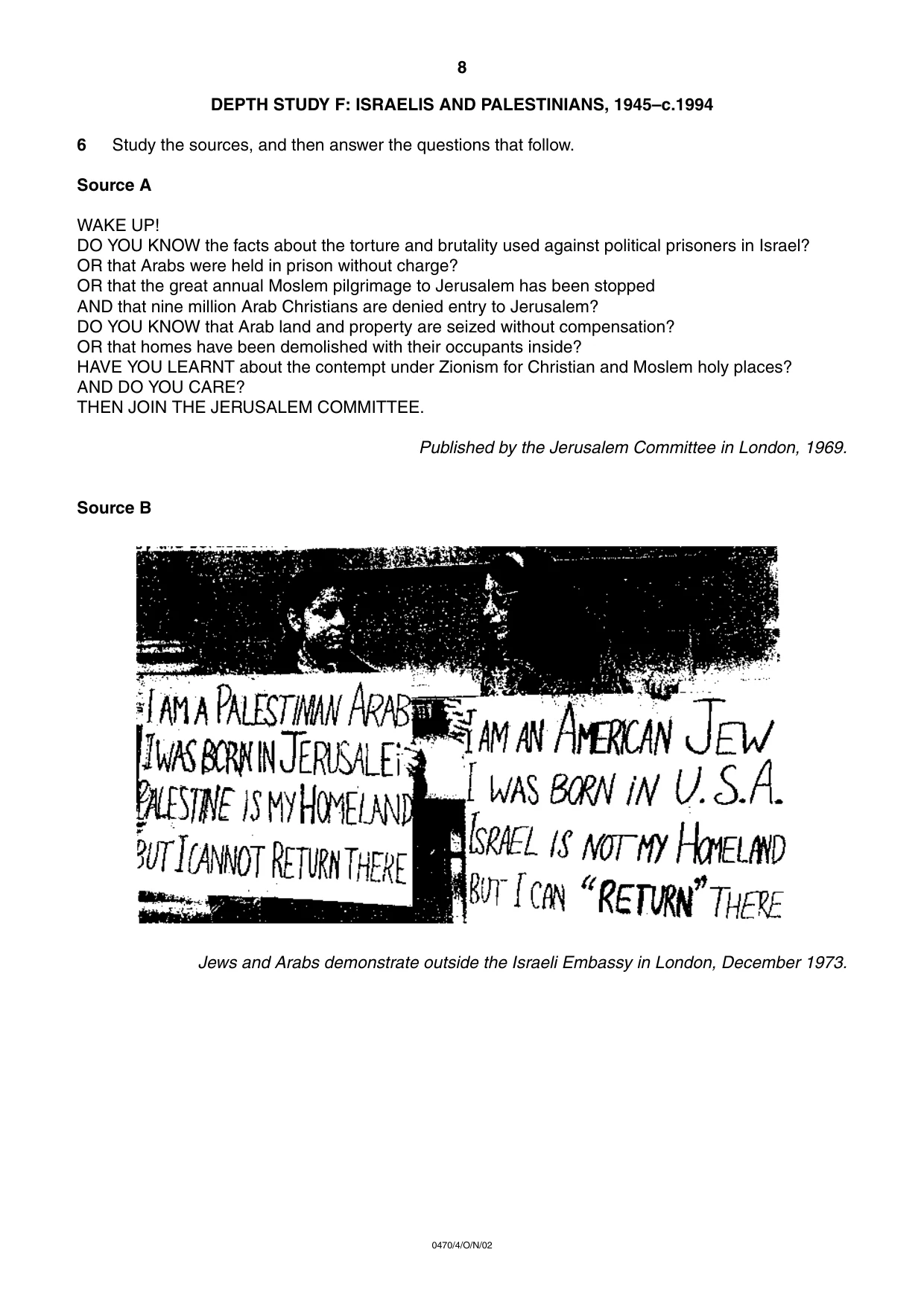
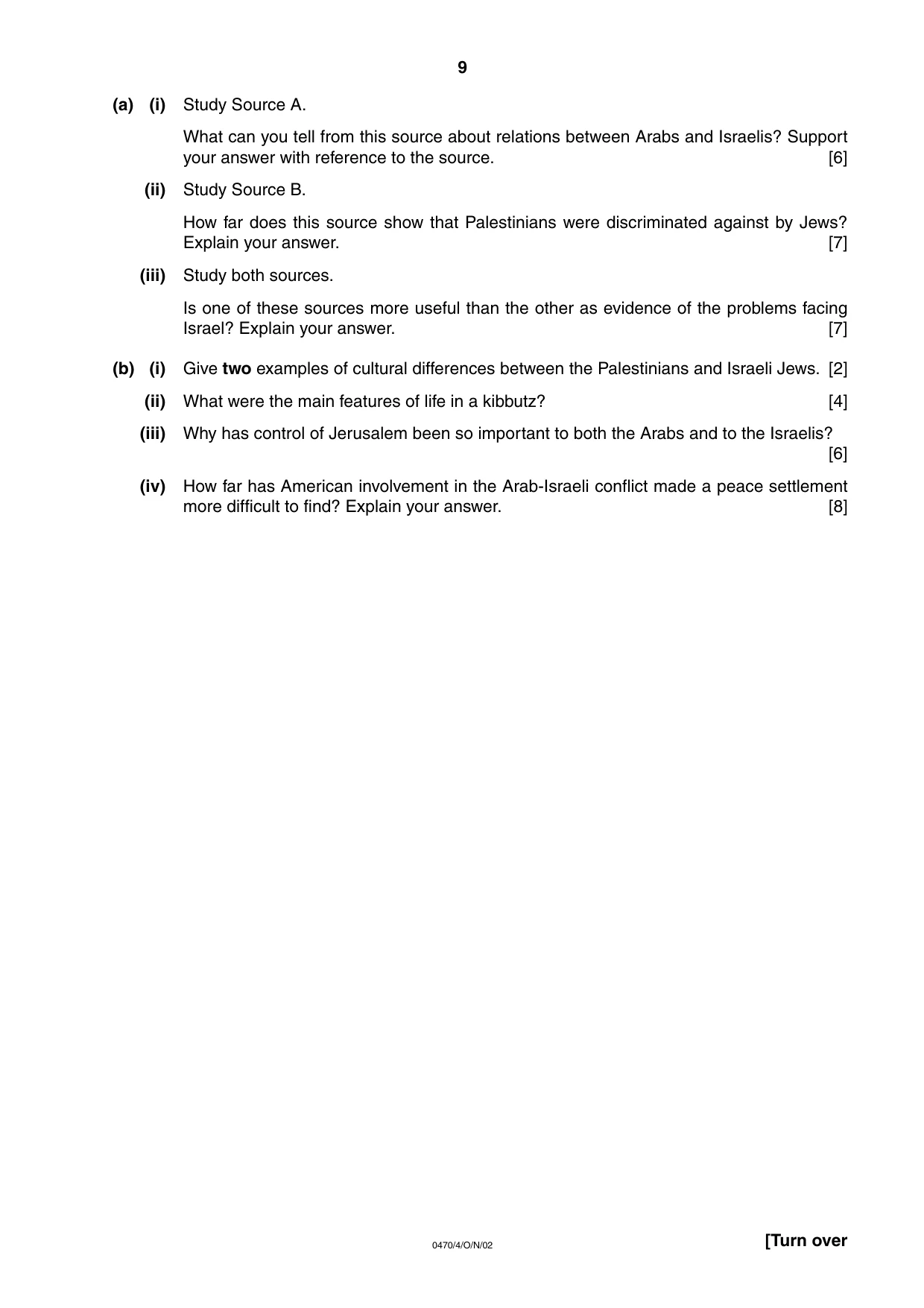
8 0470/4/O/N/02 DEPTH STUDY F: ISRAELIS AND PALESTINIANS, 1945–c.1994 6 Study the sources, and then answer the questions that follow. Source A WAKE UP! DO YOU KNOW the facts about the torture and brutality used against political prisoners in Israel? OR that Arabs were held in prison without charge? OR that the great annual Moslem pilgrimage to Jerusalem has been stopped AND that nine million Arab Christians are denied entry to Jerusalem? DO YOU KNOW that Arab land and property are seized without compensation? OR that homes have been demolished with their occupants inside? HAVE YOU LEARNT about the contempt under Zionism for Christian and Moslem holy places? AND DO YOU CARE? THEN JOIN THE JERUSALEM COMMITTEE. Published by the Jerusalem Committee in London, 1969. Source B Jews and Arabs demonstrate outside the Israeli Embassy in London, December 1973.
Question paper, page 9
9 0470/4/O/N/02 [Turn over (a) (i) Study Source A. What can you tell from this source about relations between Arabs and Israelis? Support your answer with reference to the source. [6] (ii) Study Source B. How far does this source show that Palestinians were discriminated against by Jews? Explain your answer. [7] (iii) Study both sources. Is one of these sources more useful than the other as evidence of the problems facing Israel? Explain your answer. [7] (b) (i) Give two examples of cultural differences between the Palestinians and Israeli Jews. [2] (ii) What were the main features of life in a kibbutz? [4] (iii) Why has control of Jerusalem been so important to both the Arabs and to the Israelis? [6] (iv) How far has American involvement in the Arab-Israeli conflict made a peace settlement more difficult to find? Explain your answer. [8]
Question paper, page 10
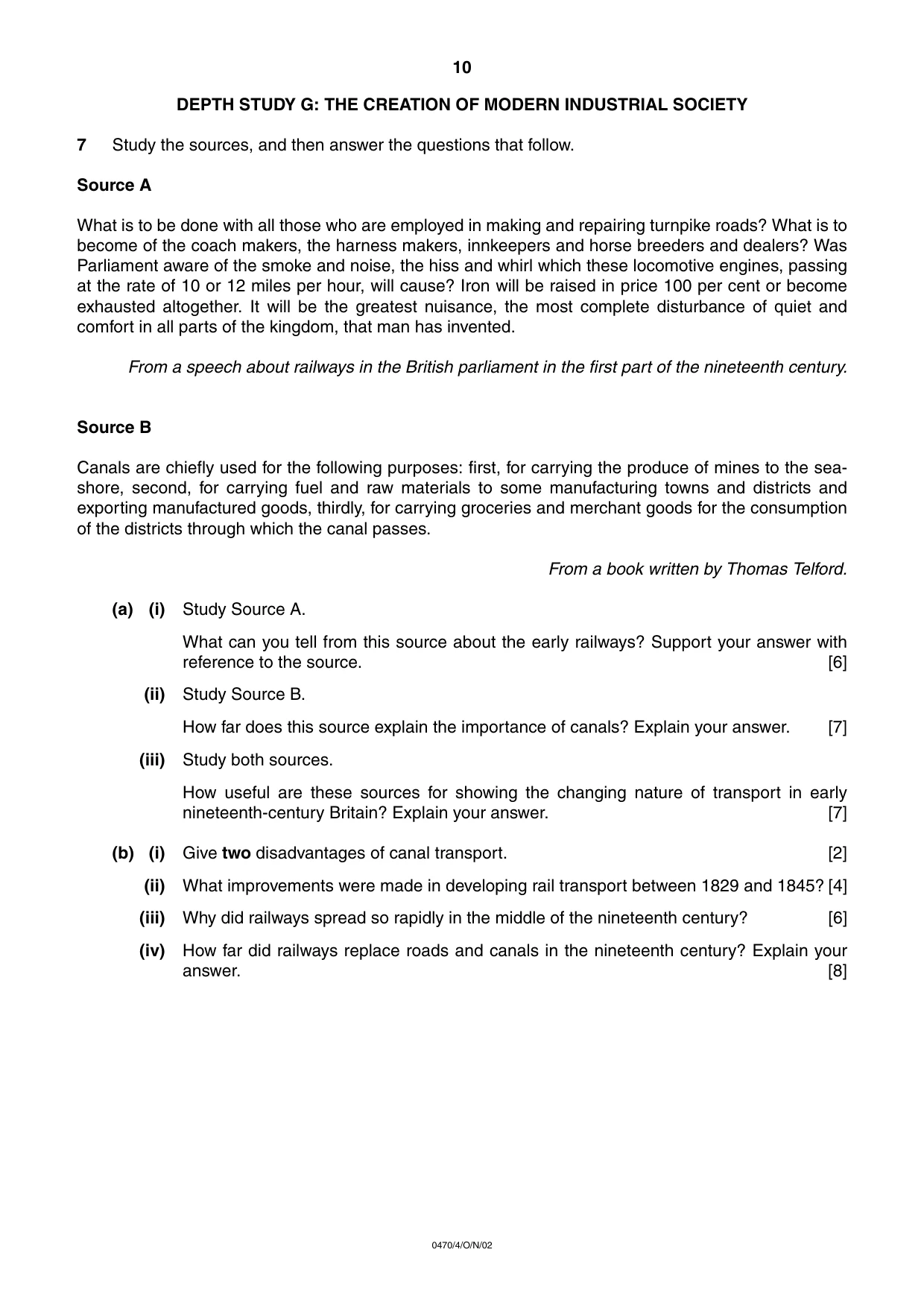
10 0470/4/O/N/02 DEPTH STUDY G: THE CREATION OF MODERN INDUSTRIAL SOCIETY 7 Study the sources, and then answer the questions that follow. Source A What is to be done with all those who are employed in making and repairing turnpike roads? What is to become of the coach makers, the harness makers, innkeepers and horse breeders and dealers? Was Parliament aware of the smoke and noise, the hiss and whirl which these locomotive engines, passing at the rate of 10 or 12 miles per hour, will cause? Iron will be raised in price 100 per cent or become exhausted altogether. It will be the greatest nuisance, the most complete disturbance of quiet and comfort in all parts of the kingdom, that man has invented. From a speech about railways in the British parliament in the first part of the nineteenth century. Source B Canals are chiefly used for the following purposes: first, for carrying the produce of mines to the sea- shore, second, for carrying fuel and raw materials to some manufacturing towns and districts and exporting manufactured goods, thirdly, for carrying groceries and merchant goods for the consumption of the districts through which the canal passes. From a book written by Thomas Telford. (a) (i) Study Source A. What can you tell from this source about the early railways? Support your answer with reference to the source. [6] (ii) Study Source B. How far does this source explain the importance of canals? Explain your answer. [7] (iii) Study both sources. How useful are these sources for showing the changing nature of transport in early nineteenth-century Britain? Explain your answer. [7] (b) (i) Give two disadvantages of canal transport. [2] (ii) What improvements were made in developing rail transport between 1829 and 1845? [4] (iii) Why did railways spread so rapidly in the middle of the nineteenth century? [6] (iv) How far did railways replace roads and canals in the nineteenth century? Explain your answer. [8]
Question paper, page 11
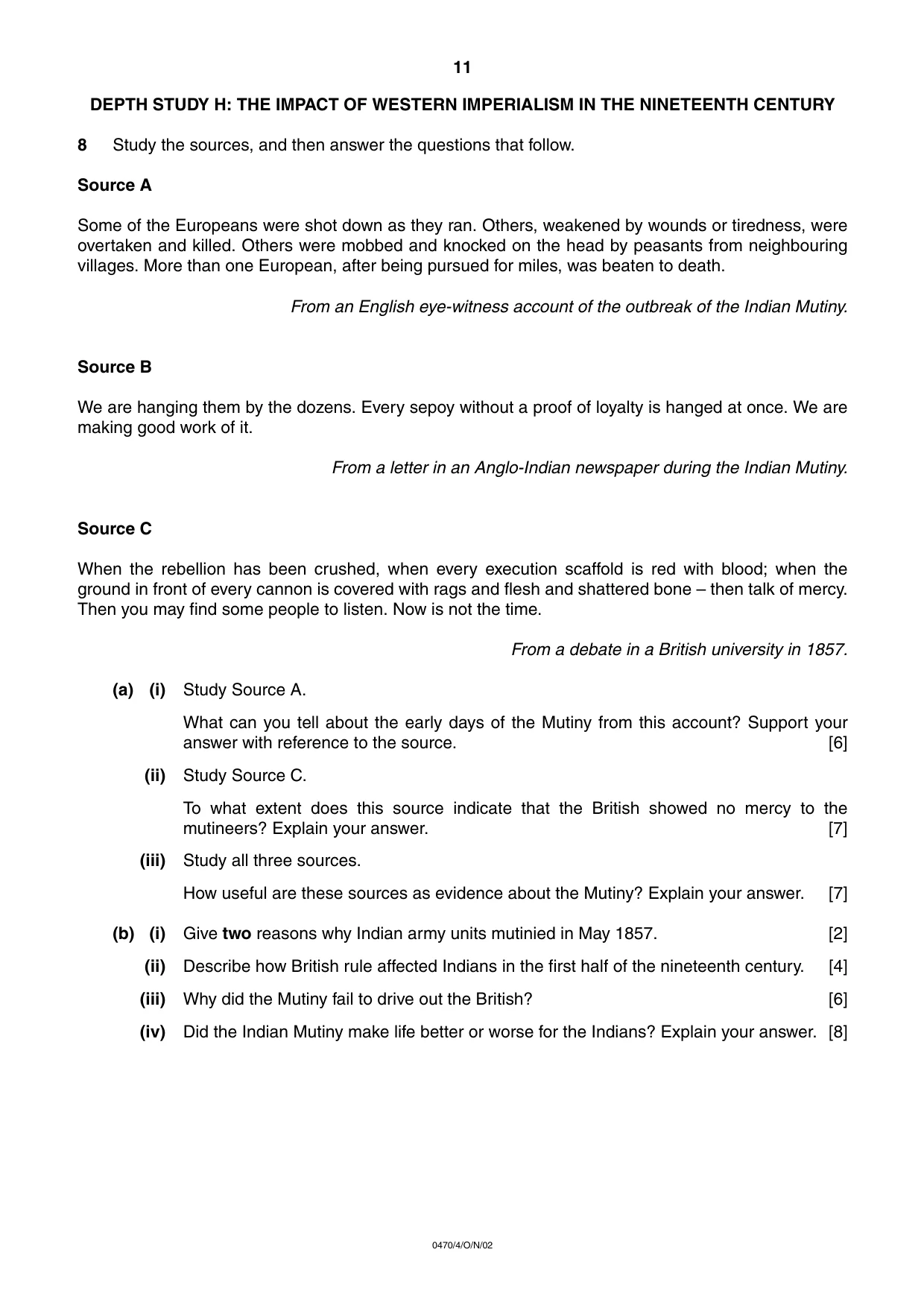
11 0470/4/O/N/02 DEPTH STUDY H: THE IMPACT OF WESTERN IMPERIALISM IN THE NINETEENTH CENTURY 8 Study the sources, and then answer the questions that follow. Source A Some of the Europeans were shot down as they ran. Others, weakened by wounds or tiredness, were overtaken and killed. Others were mobbed and knocked on the head by peasants from neighbouring villages. More than one European, after being pursued for miles, was beaten to death. From an English eye-witness account of the outbreak of the Indian Mutiny. Source B We are hanging them by the dozens. Every sepoy without a proof of loyalty is hanged at once. We are making good work of it. From a letter in an Anglo-Indian newspaper during the Indian Mutiny. Source C When the rebellion has been crushed, when every execution scaffold is red with blood; when the ground in front of every cannon is covered with rags and flesh and shattered bone – then talk of mercy. Then you may find some people to listen. Now is not the time. From a debate in a British university in 1857. (a) (i) Study Source A. What can you tell about the early days of the Mutiny from this account? Support your answer with reference to the source. [6] (ii) Study Source C. To what extent does this source indicate that the British showed no mercy to the mutineers? Explain your answer. [7] (iii) Study all three sources. How useful are these sources as evidence about the Mutiny? Explain your answer. [7] (b) (i) Give two reasons why Indian army units mutinied in May 1857. [2] (ii) Describe how British rule affected Indians in the first half of the nineteenth century. [4] (iii) Why did the Mutiny fail to drive out the British? [6] (iv) Did the Indian Mutiny make life better or worse for the Indians? Explain your answer. [8]
Question paper, page 12
12 0470/4/O/N/02 Copyright Acknowledgements: Depth Study A: Source A White and Hadley. Germany 1918–1949. Published by Collins Educational. Depth Study A: Source B White and Hadley. Germany 1918–1949. Published by Collins Educational. Depth Study B: Source A Bryn O’Callaghan. A History of the 20th Century. Longmans. Depth Study B: Source B Russia and the USSR. Published by HarperCollins Publishers Ltd. Depth Study D: Source A Neil de Marco. The World this Century. Published by Collins Educational. Depth Study D: Source B Bryn O’Callaghan. A History of the 20th Century. Longmans. Depth Study E: Source A A New History of Southern Africa. © Reproduced by permission of MacMillan Education. 1993. Depth Study E: Source B A New History of Southern Africa. © Reproduced by permission of MacMillan Education. 1993. Cambridge International Examinations has made every effort to trace copyright holders, but if we have inadvertently overlooked any we will be pleased to make the necessary arrangements at the first opportunity.
Mark scheme, page 1
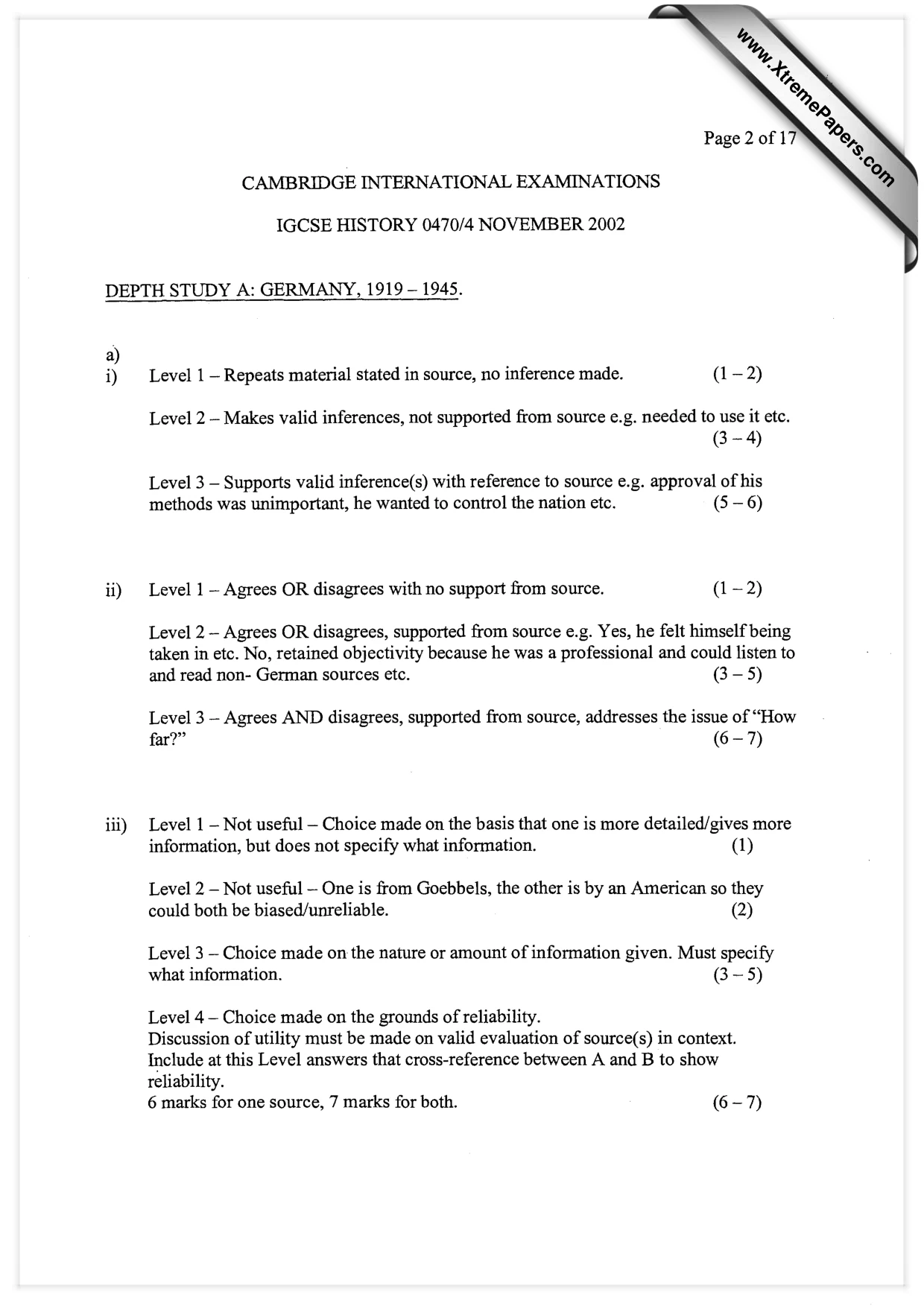
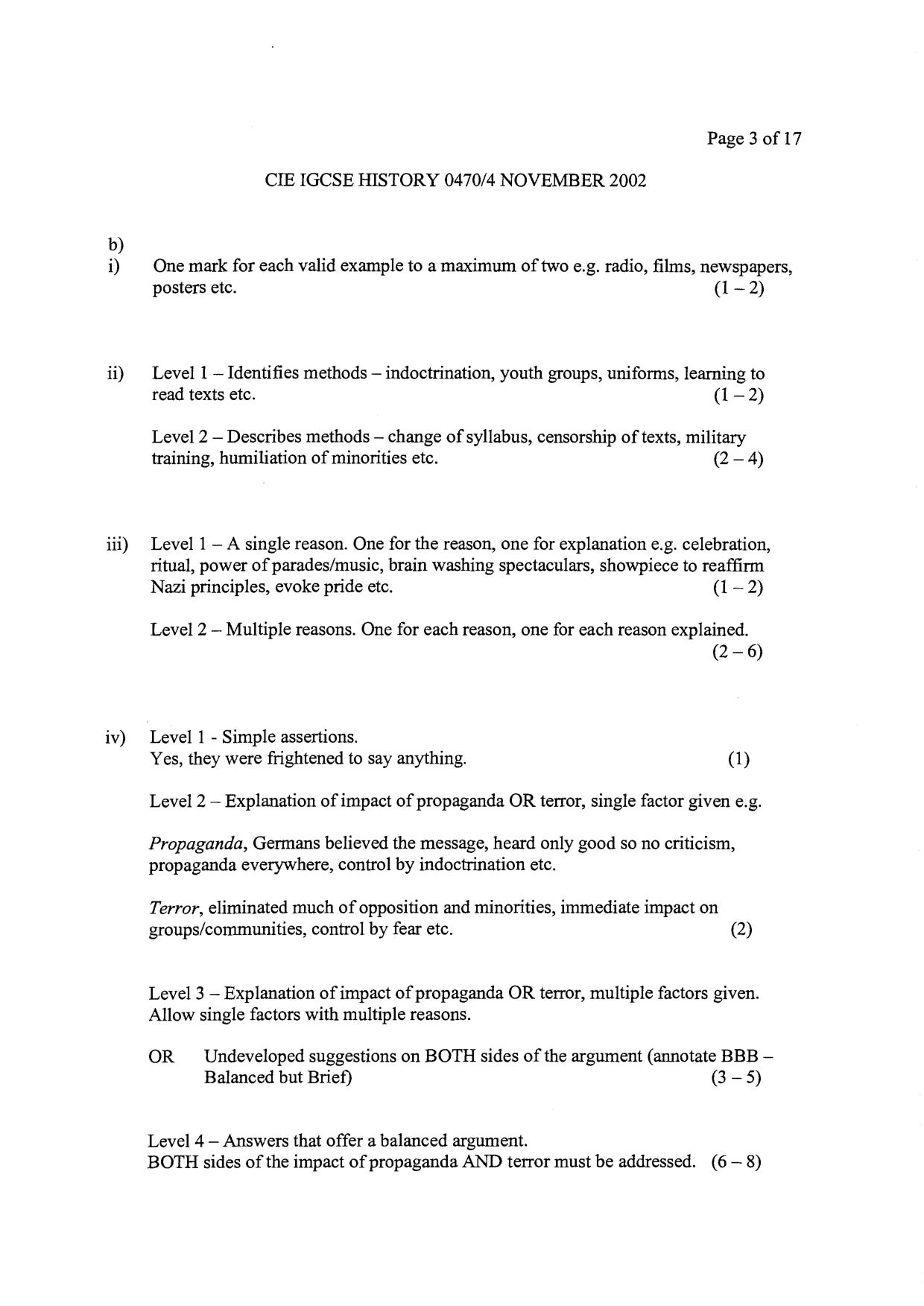
CAMBRIDGE INTERNATIONAL EXAMINATIONS IGCSE HISTORY 0470/4 NOVEMBER 2002 DEPTH STUDY A: GERMANY, 1919 - 1945. a) i) ii) iii) Level 1 — Repeats material stated in source, no inference made. (1-2) Level 2 — Makes valid inferences, not supported from source e.g. needed to use it etc. @G-4) Level 3 — Supports valid inference(s) with reference to source e.g. approval of his methods was unimportant, he wanted to control the nation etc. (5-6) Level 1 — Agrees OR disagrees with no support from source. (1-2) Level 2 — Agrees OR disagrees, supported from source e.g. Yes, he felt himself being taken in etc. No, retained objectivity because he was a professional and could listen to and read non- German sources etc. (3-5) Level 3 — Agrees AND disagrees, supported from source, addresses the issue of “How far?” (6-7) Level 1 — Not useful — Choice made on the basis that one is more detailed/gives more information, but does not specify what information. (1) Level 2 — Not useful — One is from Goebbels, the other is by an American so they could both be biased/unreliable. (2) Level 3 — Choice made on the nature or amount of information given. Must specify what information. (3-5) Level 4 — Choice made on the grounds of reliability. Discussion of utility must be made on valid evaluation of source(s) in context. Include at this Level answers that cross-reference between A and B to show reliability. 6 marks for one source, 7 marks for both. (6-7)
Mark scheme, page 2
b) i) ii) iii) iv) Page 3 of 17 CIE IGCSE HISTORY 0470/4 NOVEMBER 2002 One mark for each valid example to a maximum of two e.g. radio, films, newspapers, posters etc. (1-2) Level 1 — Identifies methods — indoctrination, youth groups, uniforms, learning to read texts etc. (1-2) Level 2 — Describes methods — change of syllabus, censorship of texts, military training, humiliation of minorities etc. (2-4) Level 1 — A single reason. One for the reason, one for explanation e.g. celebration, ritual, power of parades/music, brain washing spectaculars, showpiece to reaffirm Nazi principles, evoke pride etc. (1-2) Level 2 — Multiple reasons. One for each reason, one for each reason explained. (2-6) Level 1 - Simple assertions. Yes, they were frightened to say anything. qd) Level 2 — Explanation of impact of propaganda OR terror, single factor given e.g. Propaganda, Germans believed the message, heard only good so no criticism, propaganda everywhere, control by indoctrination etc. Terror, eliminated much of opposition and minorities, immediate impact on groups/communities, control by fear etc. (2) Level 3 — Explanation of impact of propaganda OR terror, multiple factors given. Allow single factors with multiple reasons. OR Undeveloped suggestions on BOTH sides of the argument (annotate BBB — Balanced but Brief) (3-5) Level 4 — Answers that offer a balanced argument. BOTH sides of the impact of propaganda AND terror must be addressed. (6 — 8)
Mark scheme, page 3
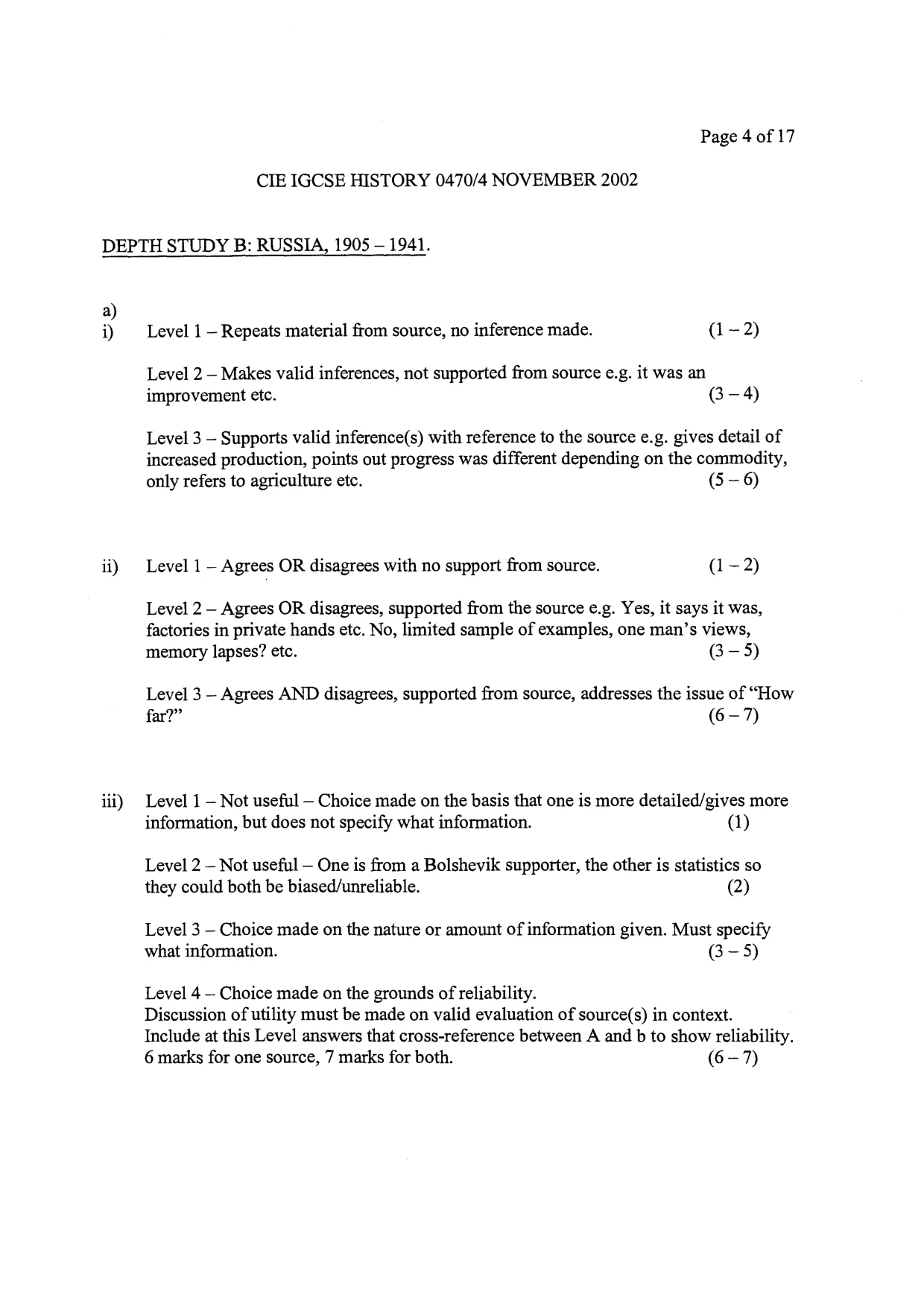
Page 4 of 17 CIE IGCSE HISTORY 0470/4 NOVEMBER 2002 DEPTH STUDY B: RUSSIA, 1905 — 1941. a) i) ii) iii) Level 1 — Repeats material from source, no inference made. (1-2) Level 2 — Makes valid inferences, not supported from source e.g. it was an improvement etc. (3-4) Level 3 — Supports valid inference(s) with reference to the source e.g. gives detail of increased production, points out progress was different depending on the commodity, only refers to agriculture etc. (5-6) Level 1 — Agrees OR disagrees with no support from source. (1-2) Level 2 — Agrees OR disagrees, supported from the source e.g. Yes, it says it was, factories in private hands etc. No, limited sample of examples, one man’s views, memory lapses? etc. (3-5) Level 3 — Agrees AND disagrees, supported from source, addresses the issue of “How far?” (6-7) Level 1 — Not useful — Choice made on the basis that one is more detailed/gives more information, but does not specify what information. (i) Level 2 — Not useful — One is from a Bolshevik supporter, the other is statistics so they could both be biased/unreliable. (2) Level 3 — Choice made on the nature or amount of information given. Must specify what information. (3-5) Level 4 — Choice made on the grounds of reliability. Discussion of utility must be made on valid evaluation of source(s) in context. Include at this Level answers that cross-reference between A and b to show reliability. 6 marks for one source, 7 marks for both. (6-7)
Mark scheme, page 4
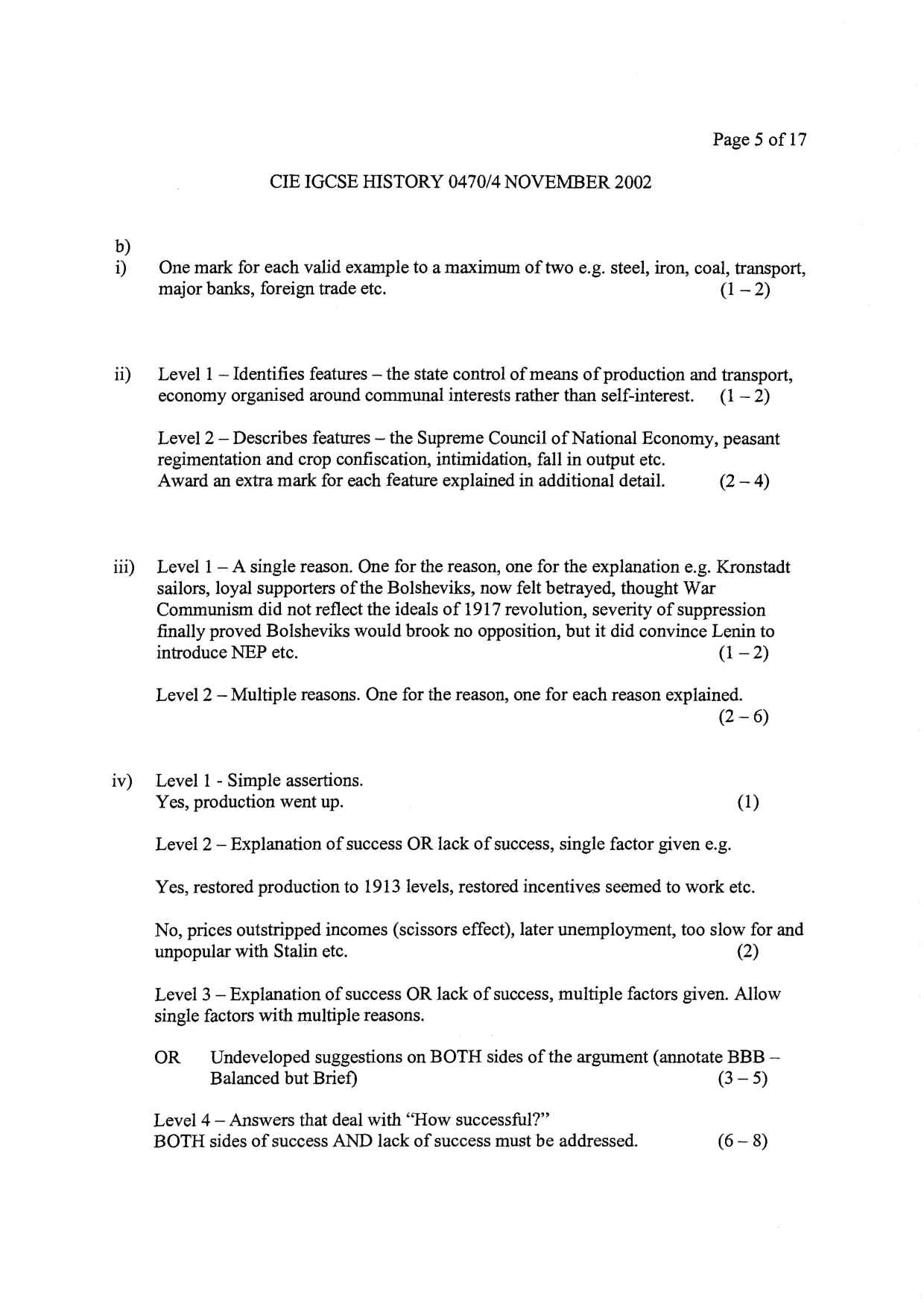
b) i) ii) iii) iv) Page 5 of 17 CIE IGCSE HISTORY 0470/4 NOVEMBER 2002 One mark for each valid example to a maximum of two e.g. steel, iron, coal, transport, major banks, foreign trade etc. (1-2) Level 1 — Identifies features — the state control of means of production and transport, economy organised around communal interests rather than self-interest. (1 —2) Level 2 — Describes features ~ the Supreme Council of National Economy, peasant regimentation and crop confiscation, intimidation, fall in output etc. Award an extra mark for each feature explained in additional detail. (2-4) Level 1 — A single reason. One for the reason, one for the explanation e.g. Kronstadt sailors, loyal supporters of the Bolsheviks, now felt betrayed, thought War Communism did not reflect the ideals of 1917 revolution, severity of suppression finally proved Bolsheviks would brook no opposition, but it did convince Lenin to introduce NEP etc. (1-2) Level 2 — Multiple reasons. One for the reason, one for each reason explained. (2-6) Level 1 - Simple assertions. Yes, production went up. (1) Level 2 — Explanation of success OR lack of success, single factor given e.g. Yes, restored production to 1913 levels, restored incentives seemed to work etc. No, prices outstripped incomes (scissors effect), later unemployment, too slow for and unpopular with Stalin ete. (2) Level 3 — Explanation of success OR lack of success, multiple factors given. Allow single factors with multiple reasons. OR Undeveloped suggestions on BOTH sides of the argument (annotate BBB — Balanced but Brief) (3-5) Level 4 — Answers that deal with “How successful?” BOTH sides of success AND lack of success must be addressed. (6-8)
Mark scheme, page 5
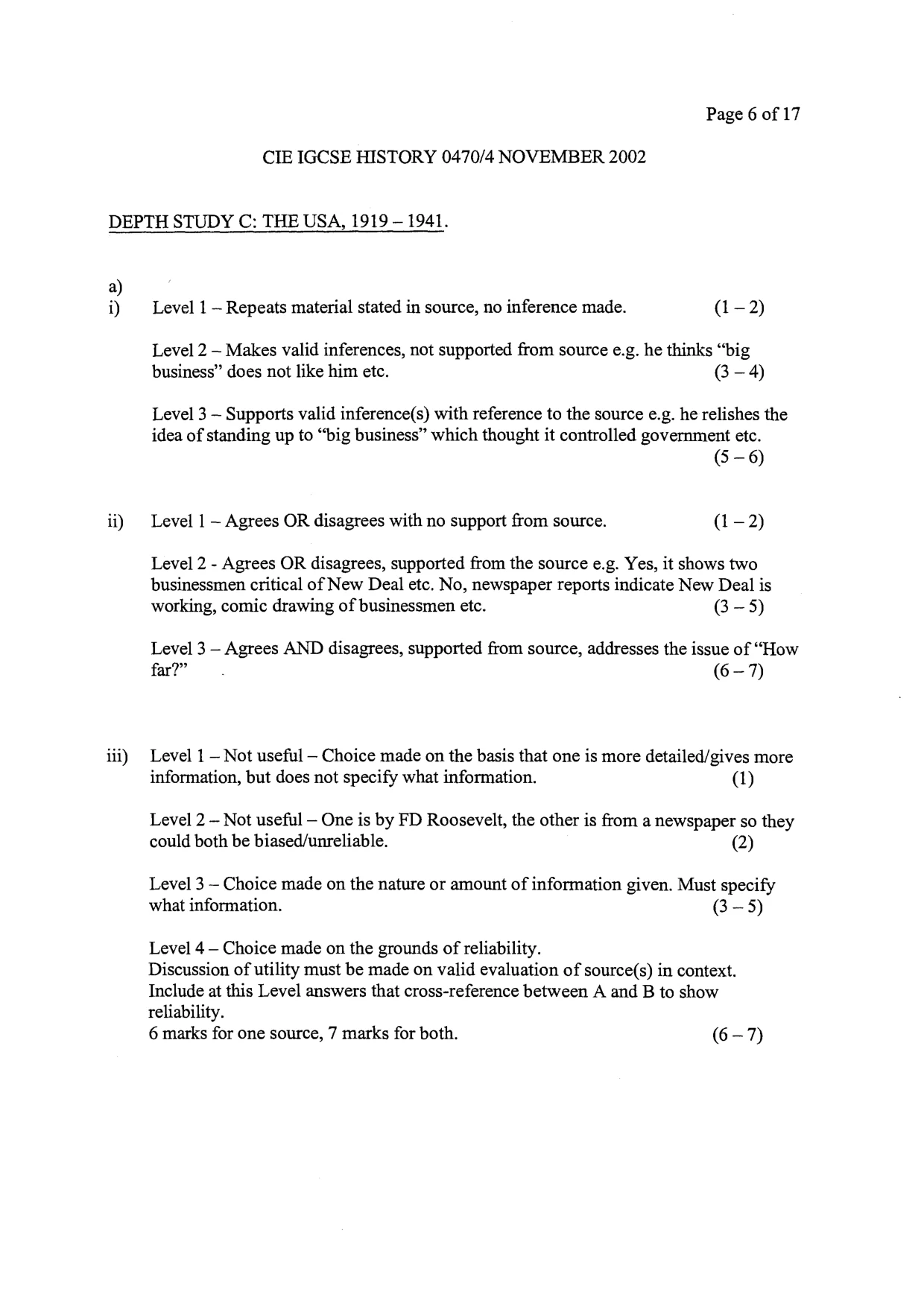
Page 6 of 17 CIE IGCSE HISTORY 0470/4 NOVEMBER 2002 DEPTH STUDY C: THE USA, 1919 - 1941. a) i) iii) Level 1 — Repeats material stated in source, no inference made. (1-2) Level 2 — Makes valid inferences, not supported from source e.g. he thinks “big business” does not like him etc. G-4) Level 3 — Supports valid inference(s) with reference to the source e.g. he relishes the idea of standing up to “big business” which thought it controlled government etc. G-6) Level 1 — Agrees OR disagrees with no support from source. (1-2) Level 2 - Agrees OR disagrees, supported from the source e.g. Yes, it shows two businessmen critical of New Deal etc. No, newspaper reports indicate New Deal is working, comic drawing of businessmen etc. (3-5) Level 3 — Agrees AND disagrees, supported from source, addresses the issue of “How far?” (6-7) Level 1 — Not useful — Choice made on the basis that one is more detailed/gives more information, but does not specify what information. (1) Level 2 — Not useful — One is by FD Roosevelt, the other is from a newspaper so they could both be biased/unreliable. (2) Level 3 — Choice made on the nature or amount of information given. Must specify what information. (3-5) Level 4 — Choice made on the grounds of reliability. Discussion of utility must be made on valid evaluation of source(s) in context. Include at this Level answers that cross-reference between A and B to show reliability. 6 marks for one source, 7 marks for both. (6-7)
Mark scheme, page 6
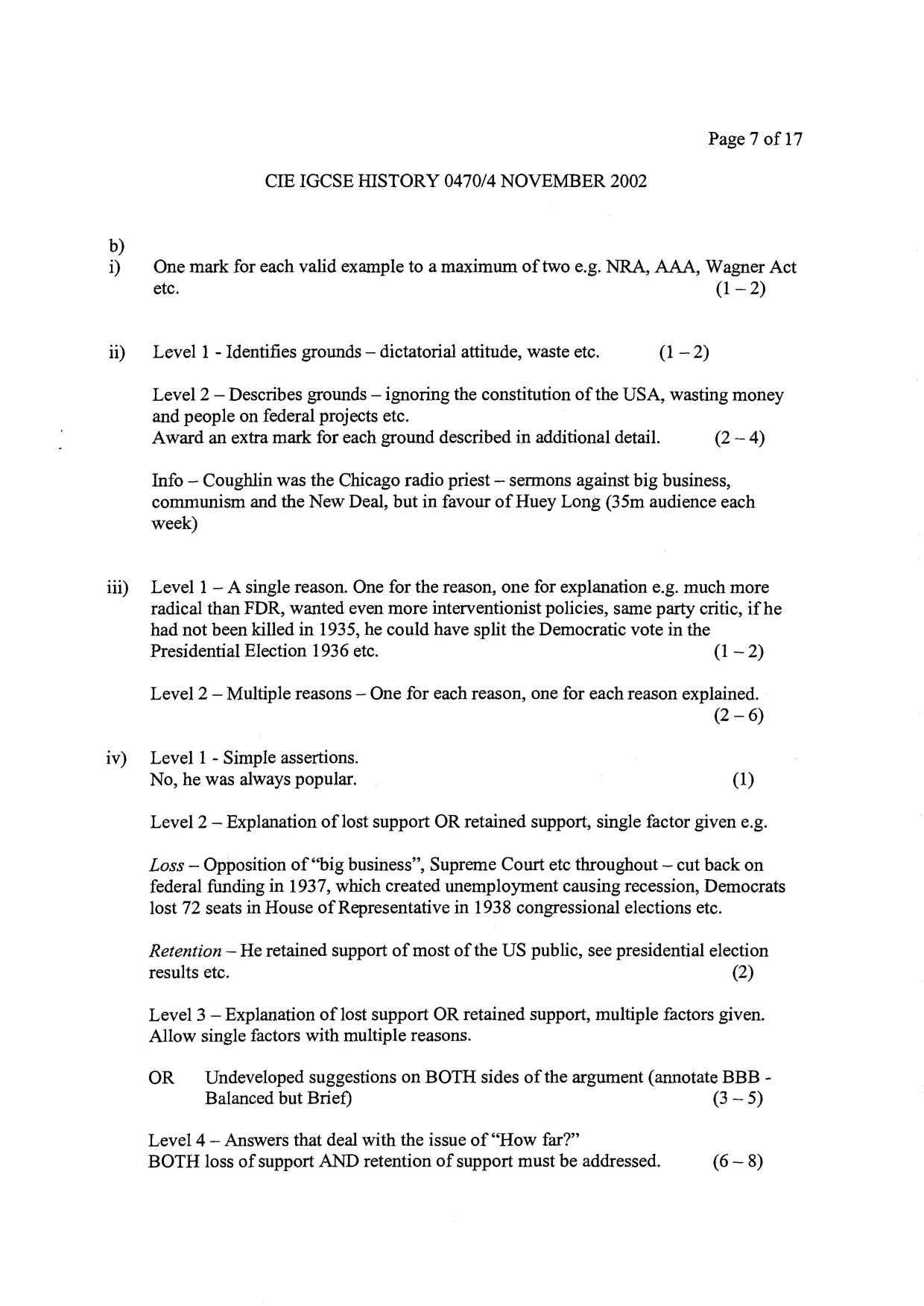
b) i) iii) iv) Page 7 of 17 CIE IGCSE HISTORY 0470/4 NOVEMBER 2002 One mark for each valid example to a maximum of two e.g. NRA, AAA, Wagner Act etc. (1-2) Level 1 - Identifies grounds — dictatorial attitude, waste etc. (1-2) Level 2 — Describes grounds — ignoring the constitution of the USA, wasting money and people on federal projects etc. Award an extra mark for each ground described in additional detail. (2-4) Info — Coughlin was the Chicago radio priest — sermons against big business, communism and the New Deal, but in favour of Huey Long (35m audience each week) Level 1 — A single reason. One for the reason, one for explanation e.g. much more radical than FDR, wanted even more interventionist policies, same party critic, if he had not been killed in 1935, he could have split the Democratic vote in the Presidential Election 1936 etc. (1-2) Level 2 — Multiple reasons — One for each reason, one for each reason explained. (2-6) Level 1 - Simple assertions. No, he was always popular. qd) Level 2 — Explanation of lost support OR retained support, single factor given e.g. Loss — Opposition of “big business”, Supreme Court etc throughout — cut back on federal funding in 1937, which created unemployment causing recession, Democrats lost 72 seats in House of Representative in 1938 congressional elections etc. Retention — He retained support of most of the US public, see presidential election results etc. (2) Level 3 — Explanation of lost support OR retained support, multiple factors given. Allow single factors with multiple reasons. OR Undeveloped suggestions on BOTH sides of the argument (annotate BBB - Balanced but Brief) (3-5) Level 4 — Answers that deal with the issue of “How far?” BOTH loss of support AND retention of support must be addressed. (6~8)
Mark scheme, page 7
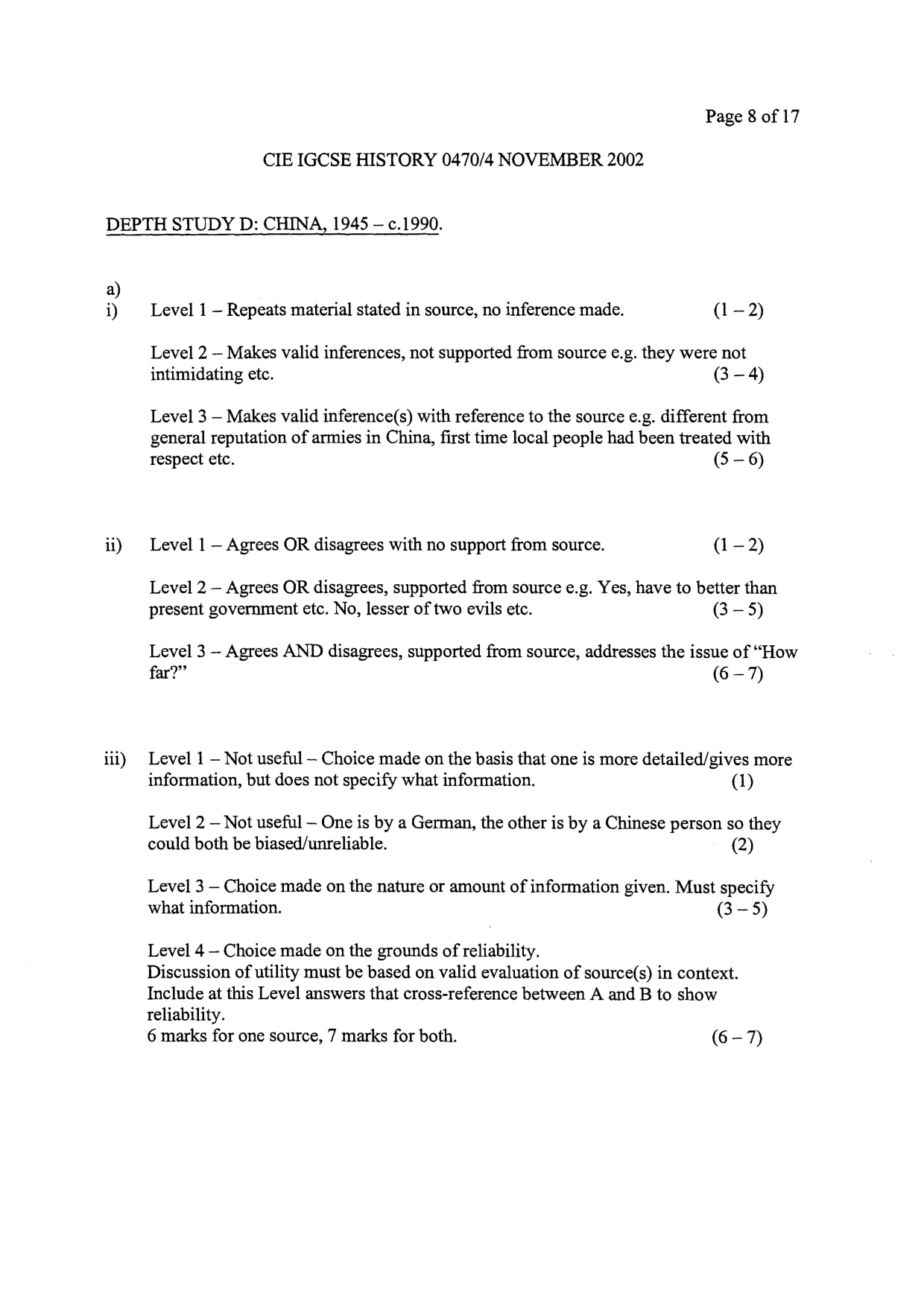
Page 8 of 17 CIE IGCSE HISTORY 0470/4 NOVEMBER 2002 DEPTH STUDY D: CHINA, 1945 — c.1990. a) i) ii) iii) Level 1 — Repeats material stated in source, no inference made. (1-2) Level 2 — Makes valid inferences, not supported from source e.g. they were not intimidating etc. (3-4) Level 3 — Makes valid inference(s) with reference to the source e.g. different from general reputation of armies in China, first time local people had been treated with respect etc. (5-6) Level 1 — Agrees OR disagrees with no support from source. (1-2) Level 2 — Agrees OR disagrees, supported from source e.g. Yes, have to better than present government etc. No, lesser of two evils etc. (3-5) Level 3 —- Agrees AND disagrees, supported from source, addresses the issue of “How far?” (6-7) Level 1 — Not useful - Choice made on the basis that one is more detailed/gives more information, but does not specify what information. (i) Level 2 — Not useful — One is by a German, the other is by a Chinese person so they could both be biased/unreliable. (2) Level 3 — Choice made on the nature or amount of information given. Must specify what information. (3-5) Level 4 — Choice made on the grounds of reliability. Discussion of utility must be based on valid evaluation of source(s) in context. Include at this Level answers that cross-reference between A and B to show reliability. 6 marks for one source, 7 marks for both. (6-7)
Mark scheme, page 8
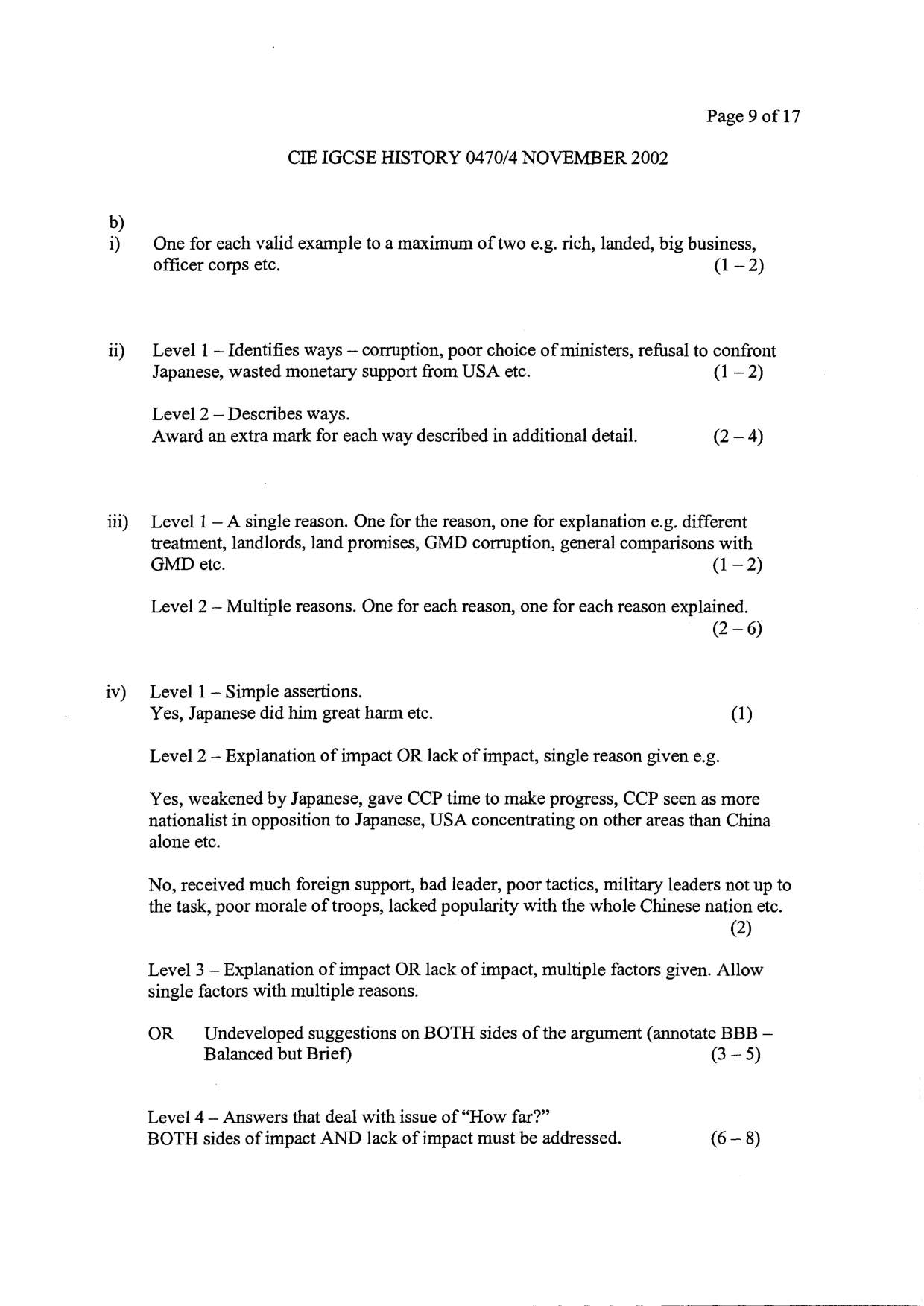
b) i) ii) iii) Page 9 of 17 CIE IGCSE HISTORY 0470/4 NOVEMBER 2002 One for each valid example to a maximum of two e.g. rich, landed, big business, officer corps etc. (1-2) Level 1 — Identifies ways — corruption, poor choice of ministers, refusal to confront Japanese, wasted monetary support from USA etc. (1-2) Level 2 — Describes ways. Award an extra mark for each way described in additional detail. (2-4) Level 1 — A single reason. One for the reason, one for explanation e.g. different treatment, landlords, land promises, GMD corruption, general comparisons with GMD ete. (-2) Level 2 — Multiple reasons. One for each reason, one for each reason explained. (2-6) Level 1 — Simple assertions. Yes, Japanese did him great harm etc. (1) Level 2 — Explanation of impact OR lack of impact, single reason given e.g. Yes, weakened by Japanese, gave CCP time to make progress, CCP seen as more nationalist in opposition to Japanese, USA concentrating on other areas than China alone etc. No, received much foreign support, bad leader, poor tactics, military leaders not up to the task, poor morale of troops, lacked popularity with the whole Chinese nation etc. (2) Level 3 — Explanation of impact OR lack of impact, multiple factors given. Allow single factors with multiple reasons. OR Undeveloped suggestions on BOTH sides of the argument (annotate BBB — Balanced but Brief) (3-5) Level 4 — Answers that deal with issue of “How far?” BOTH sides of impact AND lack of impact must be addressed. (6-8)
Mark scheme, page 9
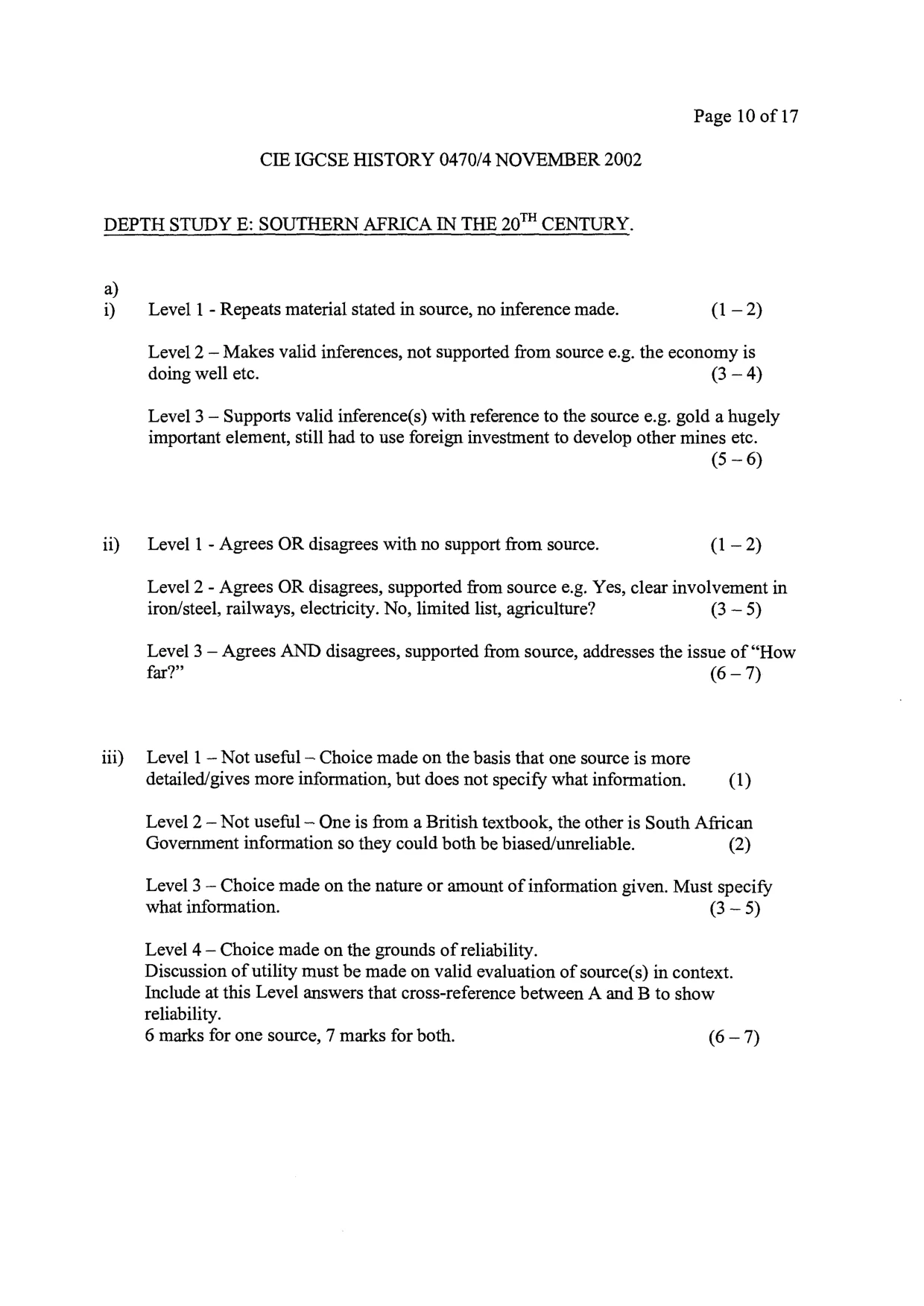
Page 10 of 17 CIE IGCSE HISTORY 0470/4 NOVEMBER 2002 DEPTH STUDY E: SOUTHERN AFRICA IN THE 20™ CENTURY. a) i) ii) iii) Level 1 - Repeats material stated in source, no inference made. (1-2) Level 2 — Makes valid inferences, not supported from source e.g. the economy is doing well etc. GB-4) Level 3 — Supports valid inference(s) with reference to the source e.g. gold a hugely important element, still had to use foreign investment to develop other mines etc. (5-6) Level 1 - Agrees OR disagrees with no support from source. (1-2) Level 2 - Agrees OR disagrees, supported from source e.g. Yes, clear involvement in iron/steel, railways, electricity. No, limited list, agriculture? (3-5) Level 3 — Agrees AND disagrees, supported from source, addresses the issue of “How far?” (6-7) Level 1 — Not useful — Choice made on the basis that one source is more detailed/gives more information, but does not specify what information. (1) Level 2 — Not useful — One is from a British textbook, the other is South African Government information so they could both be biased/unreliable. (2) Level 3 — Choice made on the nature or amount of information given. Must specify what information. (3-5) Level 4 — Choice made on the grounds of reliability. Discussion of utility must be made on valid evaluation of source(s) in context. Include at this Level answers that cross-reference between A and B to show teliability. 6 marks for one source, 7 marks for both. (6-7)
Mark scheme, page 10
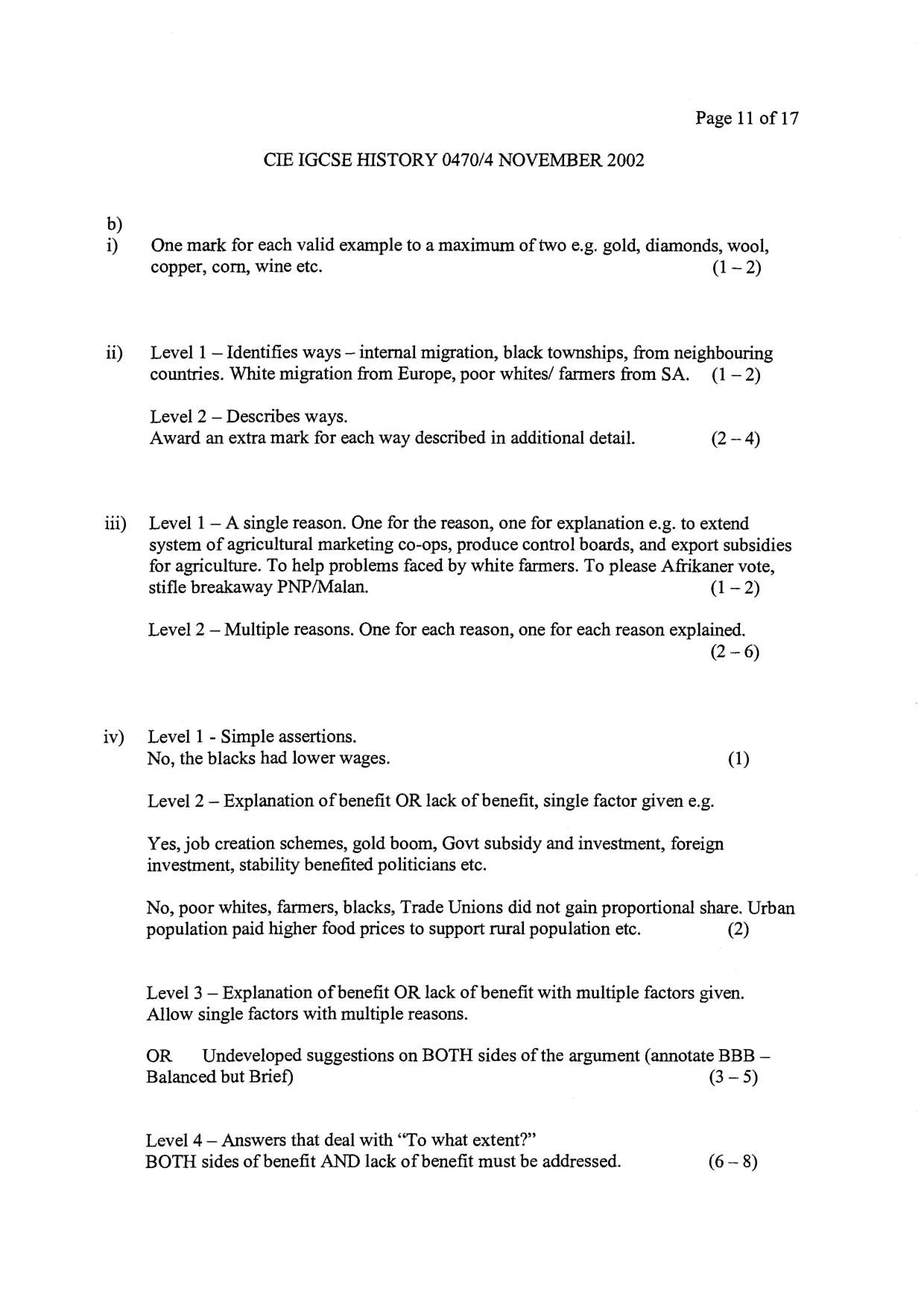
b) i) iii) Page 11 of 17 CIE IGCSE HISTORY 0470/4 NOVEMBER 2002 One mark for each valid example to a maximum of two e.g. gold, diamonds, wool, copper, corn, wine etc. (1-2) Level 1 — Identifies ways — internal migration, black townships, from neighbouring countries. White migration from Europe, poor whites/ farmers from SA. (1-2) Level 2 — Describes ways. Award an extra mark for each way described in additional detail. (2-4) Level 1 — A single reason. One for the reason, one for explanation e.g. to extend system of agricultural marketing co-ops, produce control boards, and export subsidies for agriculture. To help problems faced by white farmers. To please Afrikaner vote, stifle breakaway PNP/Malan. (1-2) Level 2 — Multiple reasons. One for each reason, one for each reason explained. 2-6) Level 1 - Simple assertions. No, the blacks had lower wages. (1) Level 2 — Explanation of benefit OR lack of benefit, single factor given e.g. Yes, job creation schemes, gold boom, Govt subsidy and investment, foreign investment, stability benefited politicians etc. No, poor whites, farmers, blacks, Trade Unions did not gain proportional share. Urban population paid higher food prices to support rural population etc. (2) Level 3 — Explanation of benefit OR lack of benefit with multiple factors given. Allow single factors with multiple reasons. OR Undeveloped suggestions on BOTH sides of the argument (annotate BBB — Balanced but Brief) (3-5) Level 4 — Answers that deal with “To what extent?” BOTH sides of benefit AND lack of benefit must be addressed. (6-8)
Mark scheme, page 11
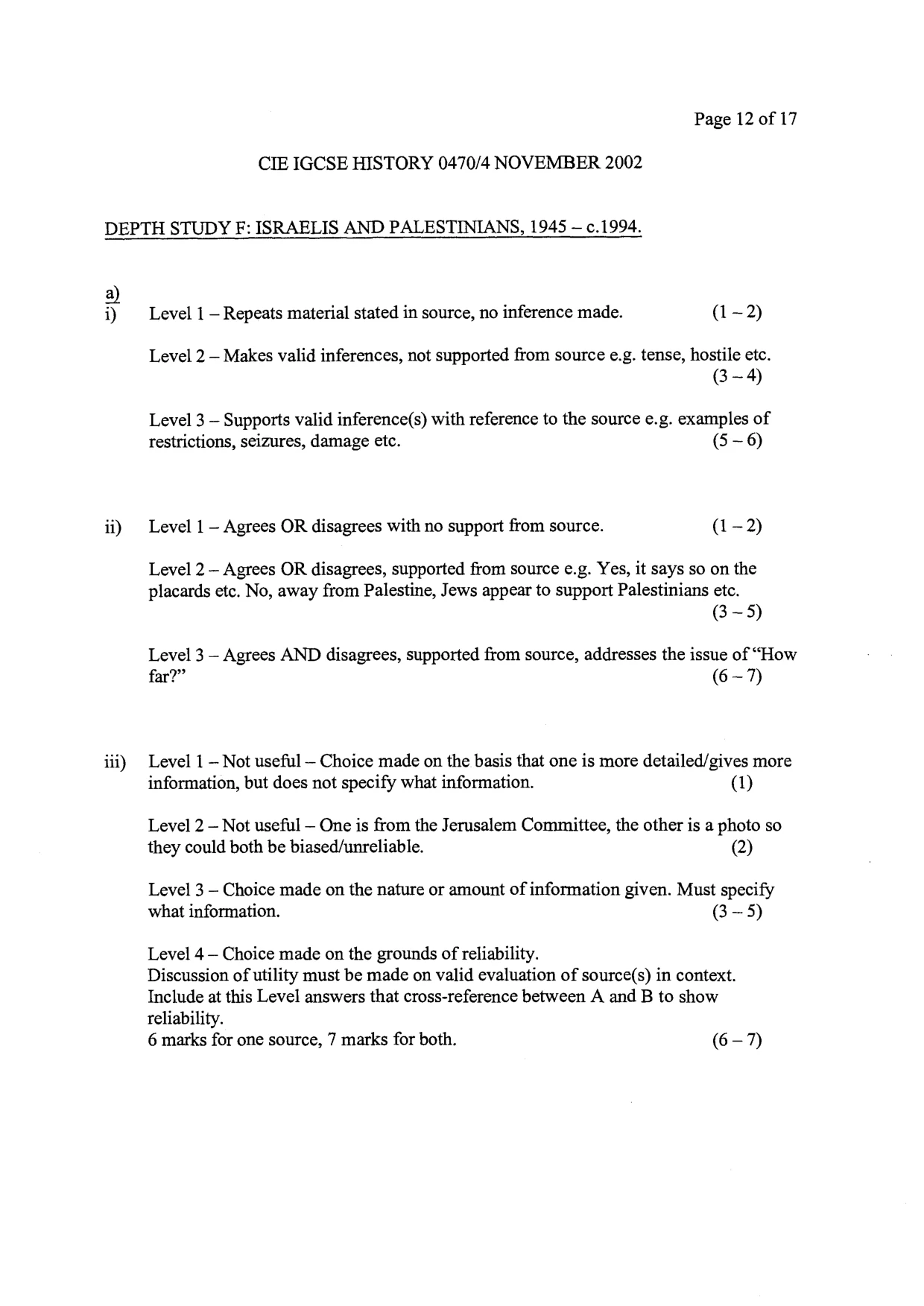
Page 12 of 17 CIE IGCSE HISTORY 0470/4 NOVEMBER 2002 DEPTH STUDY F: ISRAELIS AND PALESTINIANS, 1945 — c.1994. ii) iii) Level 1 — Repeats material stated in source, no inference made. (1-2) Level 2 — Makes valid inferences, not supported from source e.g. tense, hostile etc. G-4) Level 3 — Supports valid inference(s) with reference to the source e.g. examples of testrictions, seizures, damage etc. (5-6) Level 1 —- Agrees OR disagrees with no support from source. (1-2) Level 2 — Agrees OR disagrees, supported from source e.g. Yes, it says so on the placards etc. No, away from Palestine, Jews appear to support Palestinians etc. (3-5) Level 3 — Agrees AND disagrees, supported from source, addresses the issue of “How far?” (6-7) Level 1 — Not useful — Choice made on the basis that one is more detailed/gives more information, but does not specify what information. qd) Level 2 — Not useful — One is from the Jerusalem Committee, the other is a photo so they could both be biased/unreliable. (2) Level 3 — Choice made on the nature or amount of information given. Must specify what information. (3-5) Level 4 — Choice made on the grounds of reliability. Discussion of utility must be made on valid evaluation of source(s) in context. Include at this Level answers that cross-reference between A and B to show reliability. 6 marks for one source, 7 marks for both. (6-7)
Mark scheme, page 12
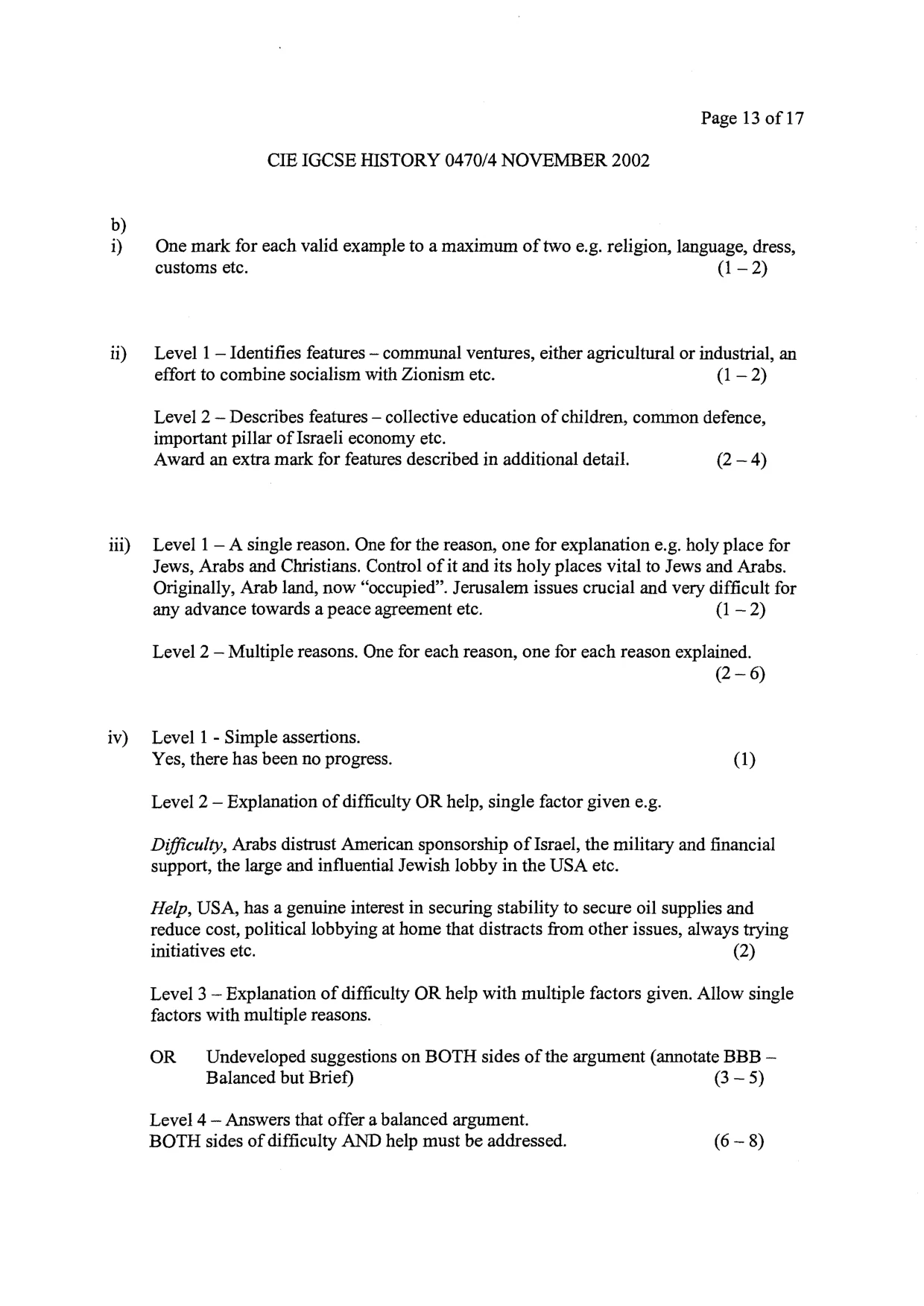
b) i) ii) iii) iv) Page 13 of 17 CIE IGCSE HISTORY 0470/4 NOVEMBER 2002 One mark for each valid example to a maximum of two e.g. religion, language, dress, customs etc. (1-2) Level 1 — Identifies features - communal ventures, either agricultural or industrial, an effort to combine socialism with Zionism etc. (1-2) Level 2 — Describes features — collective education of children, common defence, important pillar of Israeli economy etc. Award an extra mark for features described in additional detail. (2-4) Level 1 — A single reason. One for the reason, one for explanation e.g. holy place for Jews, Arabs and Christians. Control of it and its holy places vital to Jews and Arabs. Originally, Arab land, now “occupied”. Jerusalem issues crucial and very difficult for any advance towards a peace agreement etc. (1-2) Level 2 — Multiple reasons. One for each reason, one for each reason explained. (2-6) Level 1 - Simple assertions. Yes, there has been no progress. (1) Level 2 — Explanation of difficulty OR help, single factor given e.g. Difficulty, Arabs distrust American sponsorship of Israel, the military and financial support, the large and influential Jewish lobby in the USA etc. Help, USA, has a genuine interest in securing stability to secure oil supplies and reduce cost, political lobbying at home that distracts from other issues, always trying initiatives etc. (2) Level 3 — Explanation of difficulty OR help with multiple factors given. Allow single factors with multiple reasons. OR Undeveloped suggestions on BOTH sides of the argument (annotate BBB — Balanced but Brief) (3-5) Level 4 — Answers that offer a balanced argument. BOTH sides of difficulty AND help must be addressed. (6-8)
Mark scheme, page 13
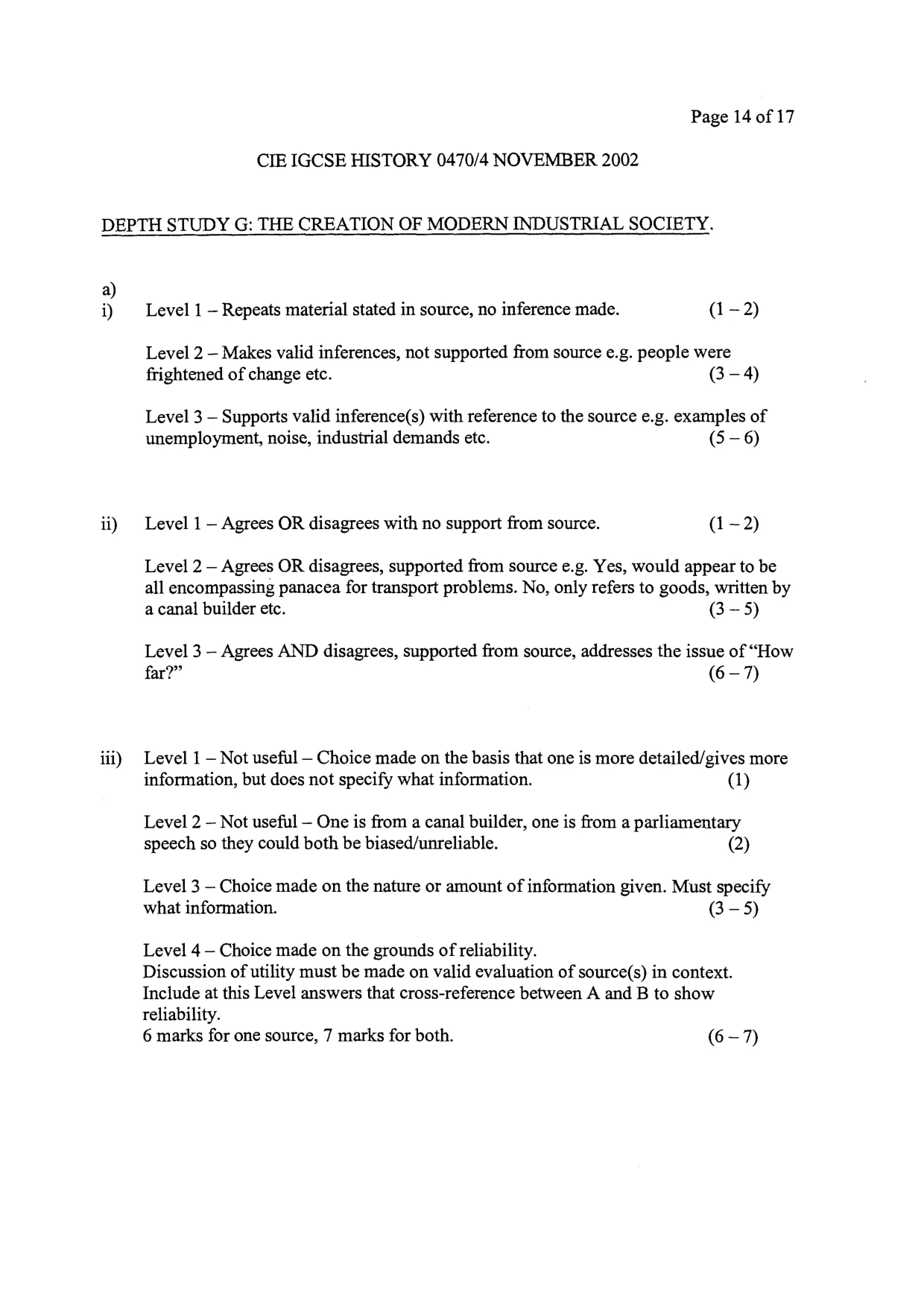
Page 14 of 17 CIE IGCSE HISTORY 0470/4 NOVEMBER 2002 DEPTH STUDY G: THE CREATION OF MODERN INDUSTRIAL SOCIETY. a) i) iii) Level 1 — Repeats material stated in source, no inference made. (i -2) Level 2 — Makes valid inferences, not supported from source e.g. people were frightened of change etc. 3-4) Level 3 — Supports valid inference(s) with reference to the source e.g. examples of unemployment, noise, industrial demands etc. (5-6) Level 1 — Agrees OR disagrees with no support from source. (1-2) Level 2 — Agrees OR disagrees, supported from source e.g. Yes, would appear to be all encompassing panacea for transport problems. No, only refers to goods, written by a canal builder etc. (3-5) Level 3 — Agrees AND disagrees, supported from source, addresses the issue of “How far?” (6-7) Level 1 — Not useful — Choice made on the basis that one is more detailed/gives more information, but does not specify what information. (dy) Level 2 — Not useful — One is from a canal builder, one is from a parliamentary speech so they could both be biased/unreliable. (2) Level 3 — Choice made on the nature or amount of information given. Must specify what information. (3-5) Level 4 — Choice made on the grounds of reliability. Discussion of utility must be made on valid evaluation of source(s) in context. Include at this Level answers that cross-reference between A and B to show reliability. 6 marks for one source, 7 marks for both. (6-7)
Mark scheme, page 14
b) i) ii) iii) iv) Page 15 of 17 CIE IGCSE HISTORY 0470/4 NOVEMBER 2002 One mark for each valid advantage to a maximum of two e.g. speed, vulnerable to iced canals, limited to canal routes, vulnerable to theft, horsepower etc. (1-2) Level 1 — Identifies improvements — engine improvements, legal framework, larger network, safety etc. (1-2) Level 2 ~ Describes improvements — tubular boiler, Stephenson’s piston, Railway Act 1844, carriage construction etc. Award an extra mark for improvements described in additional detail. (2-4) Level 1 — A single reason. One for the reason, one for explanation e.g. cheap and convenient method of transporting goods and people, demands of expansion created further demands to transport materials (iron), increasing prosperity created further demands for fresh food, clothing. Means of investment and profit making. Railway mania etc. (1-2) Level 2 — Multiple reasons. One for each reason, one for each reason explained. (2-6) Level 1 - Simple assertions. No, canals and roads still existed. Q) Level 2 — Explanation of replacement OR non-replacement, single factor given e.g. Yes, took over most of the long haul traffic of goods and people because of speed, cost and comfort etc. No, short haul road traffic not affected, and even flourished around railway stations; canal continued to be used where non-perishable goods/bulk/time issues meant canals more cost-effective etc. (2) Level 3 — Explanation of replacement OR non-replacement, multiple factors given. Allow single factors with multiple reasons. OR Undeveloped suggestions on BOTH sides of the argument (annotate BBB - Balance but Brief) (3-5) Level 4 — Answers that deal with “How far?” BOTH sides of replacement AND non-replacement must be addressed. (6 — 8)
Mark scheme, page 15
Page 16 of 17 CIE IGCSE HISTORY 0470/4 NOVEMBER 2002 DEPTH STUDY H: THE IMPACT OF WESTERN IMPERIALISM IN THE 19™ CENTURY. a) i) iii) Level 1 - Repeats material stated in source, no inference made. (1-2) Level 2 - Makes valid inferences, not supported from source e.g. things were out of control etc. GB-4) Level 3 — Supports valid inference(s) with reference to source e.g. states it was a very violent affair and gives examples of Indian fury, European suffering etc. (5 — 6) Level 1 — Agrees OR disagrees with no support from the source. (1-2) Level 2 — Agrees OR disagrees, supported from source e.g. Yes, Language, tone, executions, blood and gore etc. No, Implies a less aggressive reaction at some time in the future etc. (3-5) Level 3 — Agrees AND disagrees, supported from source, addresses the issue of “To what extent?” (6-7) Level 1 — Not useful — Choice made on the basis that one is more detailed/gives more information, but does not specify what information. qd) Level 2 — Not useful — Source A is from English person, B is from an Anglo-Indian newspaper and C is from a debate in Britain so they could all be biased/unreliable. (2) Level 3 — Choice made on the nature or amount of information given. Must specify what information. (3-5) Level 4 — Choice made on the grounds of reliability. Discussion of utility must be made on valid evaluation of source(s) in context. Include at this Level answers that cross-reference between A and B to show reliability. 6 marks for one source, 7 marks for more than one. (6-7)
Mark scheme, page 16
b) i) ii) iii) iv) Page 17 of 17 CIE IGCSE HISTORY 0470/4 NOVEMBER 2002 One mark for each valid reason to a maximum of two e.g. long standing grievances over treatment by British officers, service overseas, cartridge question etc. (1-2) Level 1 ~ Identifies effects — property confiscation, interference with customs (suttee and thuggee), attempts at religious conversion etc. (1-2) Level 2 — Describes effects — taking of land, jewels, imposition of British values, inventions, justice etc. Award an extra mark for each effect described in additional detail. (2-4) Level 1 — A single reason. One for the reason, one for the reason explained e.g. uncoordinated rebellion, lacked effective leadership, determination of British defenders, many Indians stayed loyal etc. (1-2) Level 2 — Multiple reasons. One for each reason, one for each reason explained. (2-6) Level 1 - Simple assertions. No, nothing really changed. (i) Level 2 — Explanation of better life OR worse life, single factor given e.g. Better, Company rule ceased, ruled from London through Viceroy, more Indians in civil service, greater consultation, better education for some, nationalism allowed to develop through Congress Party etc. Worse, for the majority nothing changed at all so in comparison to more favoured Indians they were worse off, still interference with customs, increased control and direction of areas, now British clearly better organised to stay etc. (2) Level 3 — Explanation of better life OR worse life, multiple factors given. Allow single factors with multiple reasons. OR Undeveloped suggestions on BOTH sides of the argument (annotate BBB — Balanced but Brief) (3-5) Level 4 — Answers that offer a balanced argument. BOTH sides of better AND worse life must be addressed. (6-8)