Cambridge IGCSE Geography 0460 — 2022 May/June Paper 1 · Variant 1
0460/11/M/J/22 · 75 marks · ≈84 min
The question paper and its mark scheme, free to read here and free to download. This is Cambridge’s own paper, exactly as it was sat.
Question paper28 pages

Mark scheme19 pages
Answers below. Sit the paper first if you are practising.
Paper as text
Question paper, page 1
This document has 28 pages. [Turn over Cambridge IGCSE™ DC (CE/SG) 304208/4 © UCLES 2022 GEOGRAPHY 0460/11 Paper 1 Geographical Themes May/June 2022 1 hour 45 minutes You must answer on the question paper. You will need: Insert (enclosed) Ruler Calculator Protractor INSTRUCTIONS ● Answer three questions in total, one from each section. ● Use a black or dark blue pen. You may use an HB pencil for any diagrams or graphs. ● Write your name, centre number and candidate number in the boxes at the top of the page. ● Write your answer to each question in the space provided. ● Do not use an erasable pen or correction fluid. ● Do not write on any bar codes. ● If additional space is needed, you should use the lined pages at the end of this booklet; the question number or numbers must be clearly shown. INFORMATION ● The total mark for this paper is 75. ● The number of marks for each question or part question is shown in brackets [ ]. ● The insert contains additional resources referred to in the questions. Definitions MEDCs – More Economically Developed Countries LEDCs – Less Economically Developed Countries * 8 8 8 5 9 4 1 2 2 6 *
Question paper, page 2
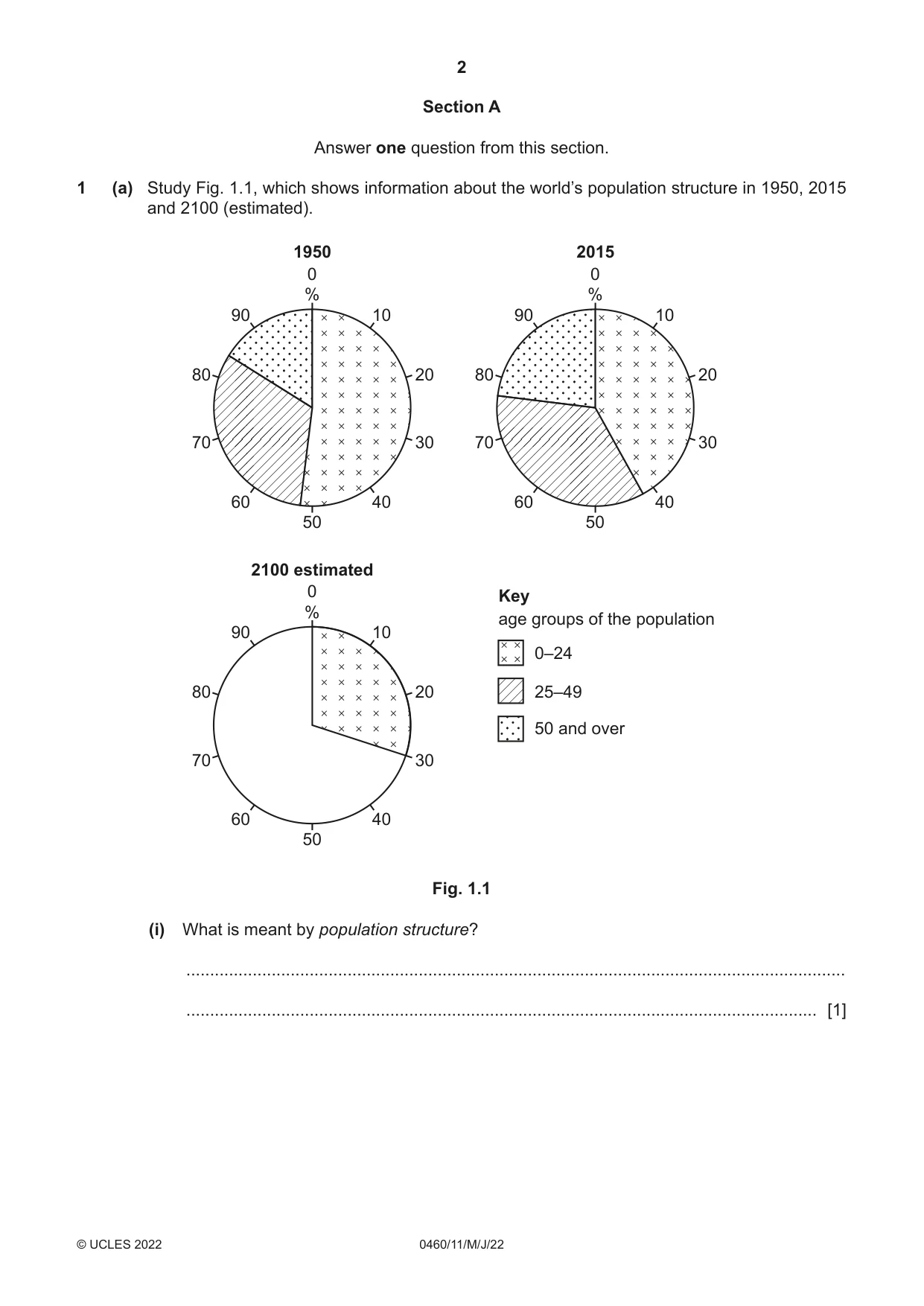
2 0460/11/M/J/22 © UCLES 2022 Section A Answer one question from this section. 1 (a) Study Fig. 1.1, which shows information about the world’s population structure in 1950, 2015 and 2100 (estimated). 0 % 50 40 10 60 90 1950 0 % 50 40 10 60 90 30 20 70 80 30 20 70 80 30 20 70 80 2100 estimated Key age groups of the population 0–24 25–49 50 and over 0 % 50 40 10 60 90 2015 Fig. 1.1 (i) What is meant by population structure? … … [1]
Question paper, page 3
3 0460/11/M/J/22 © UCLES 2022 [Turn over (ii) Complete Fig. 1.1 using the following information about the estimated population in 2100. [2] age group percentage of total population 25–49 years 30 50 and over 40 (iii) Using information from Fig. 1.1 only, describe the changes in the world’s population structure between 1950 and 2015. … … … … … … [3] (iv) Suggest reasons for the changes in the percentage of the population aged between 0 and 24 years from 1950 to 2015. … … … … … … … … [4]
Question paper, page 4
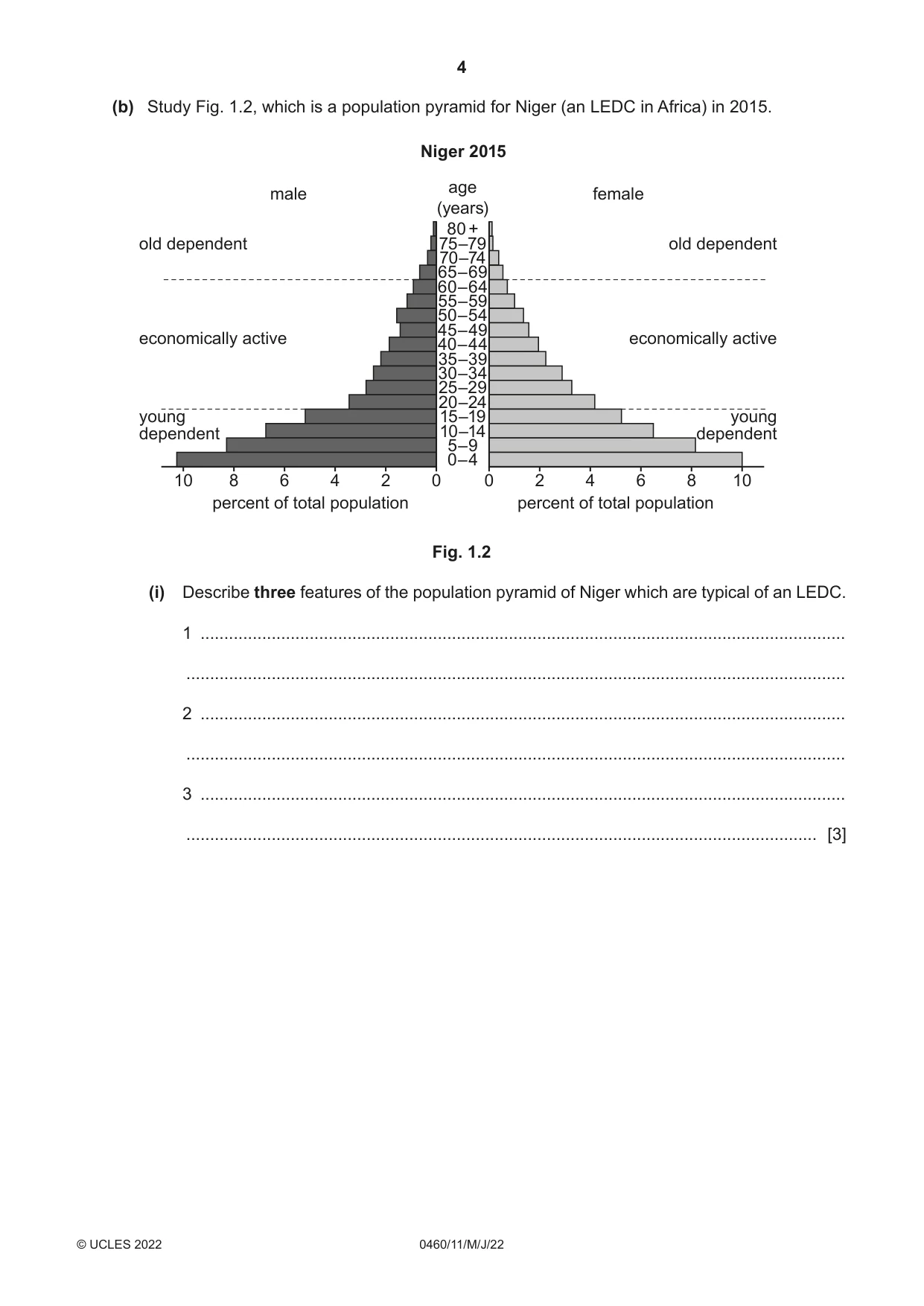
4 0460/11/M/J/22 © UCLES 2022 (b) Study Fig. 1.2, which is a population pyramid for Niger (an LEDC in Africa) in 2015. 0 percent of total population percent of total population 0 2 2 4 4 6 6 8 8 10 10 0–4 5–9 10–14 15–19 20–24 25–29 30–34 35–39 40–44 45–49 50–54 55–59 60–64 65–69 70–74 75–79 80 + age (years) Niger 2015 female male young dependent economically active old dependent young dependent economically active old dependent Fig. 1.2 (i) Describe three features of the population pyramid of Niger which are typical of an LEDC. 1 … … 2 … … 3 … … [3]
Question paper, page 5
5 0460/11/M/J/22 © UCLES 2022 [Turn over (ii) Explain why the proportion of old dependents in an MEDC is likely to differ from that of Niger. … … … … … … … … … … [5]
Question paper, page 6
6 0460/11/M/J/22 © UCLES 2022 (c) For a named country you have studied, describe the problems caused by a large dependent population. Name of country … … … … … … … … … … … … … … … … … … … … … … … … … [7] [Total: 25]
Question paper, page 7
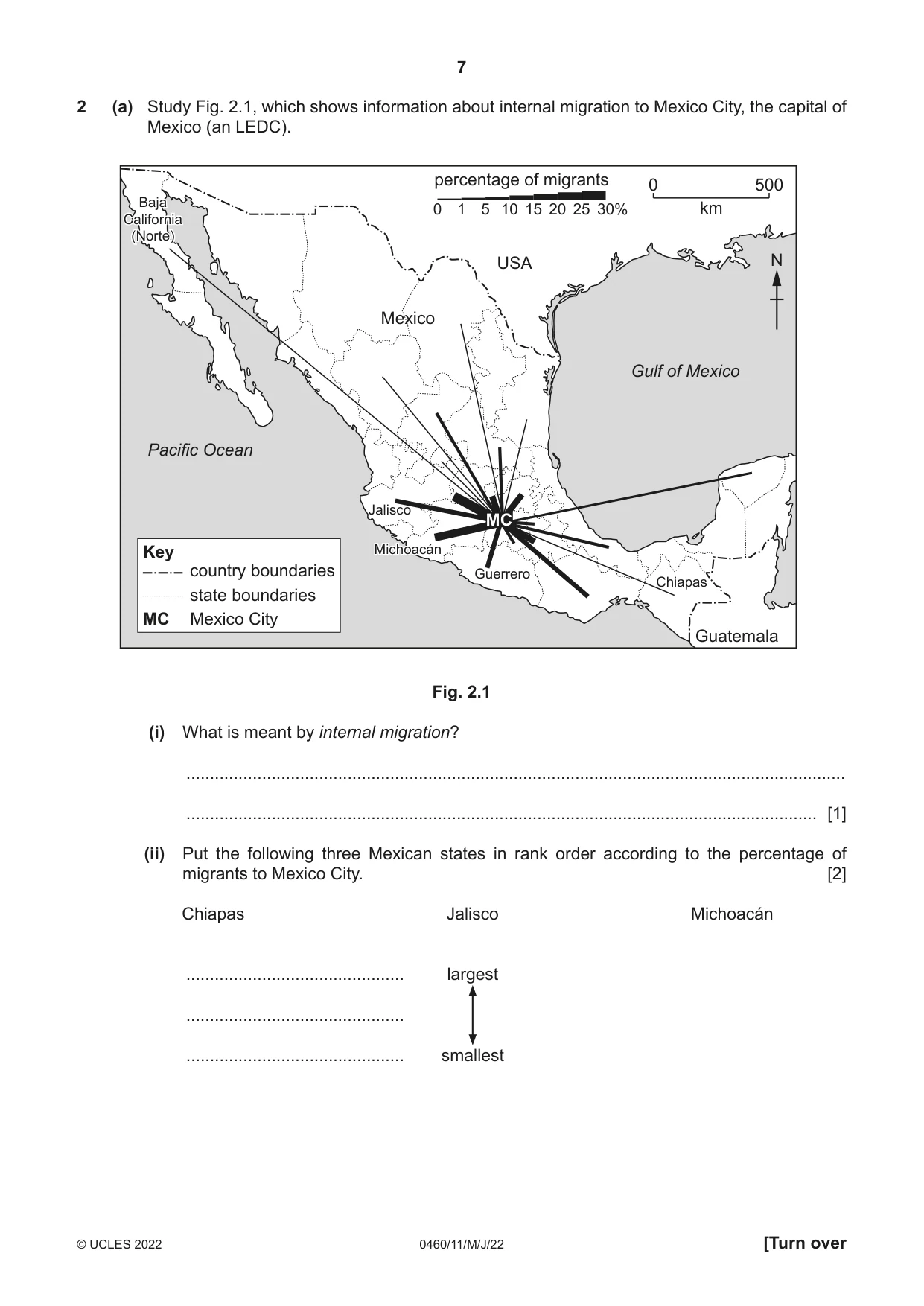
7 0460/11/M/J/22 © UCLES 2022 [Turn over 2 (a) Study Fig. 2.1, which shows information about internal migration to Mexico City, the capital of Mexico (an LEDC). 0 500 km 0 1 5 10 15 20 25 30% percentage of migrants Key MC Mexico City MC country boundaries state boundaries Pacific Ocean Gulf of Mexico USA Guatemala Mexico N Baja California (Norte) Baja California (Norte) Chiapas Jalisco Michoacán Michoacán Guerrero Fig. 2.1 (i) What is meant by internal migration? … … [1] (ii) Put the following three Mexican states in rank order according to the percentage of migrants to Mexico City. [2] Chiapas Jalisco Michoacán … largest … … smallest
Question paper, page 8
8 0460/11/M/J/22 © UCLES 2022 (iii) Using evidence from Fig. 2.1 only, suggest why there is more migration to Mexico City from Guerrero than Baja California (Norte). … … … … … … [3] (iv) Describe the problems caused in rural areas in LEDCs as a result of large amounts of people migrating away from them. … … … … … … … … [4]
Question paper, page 9
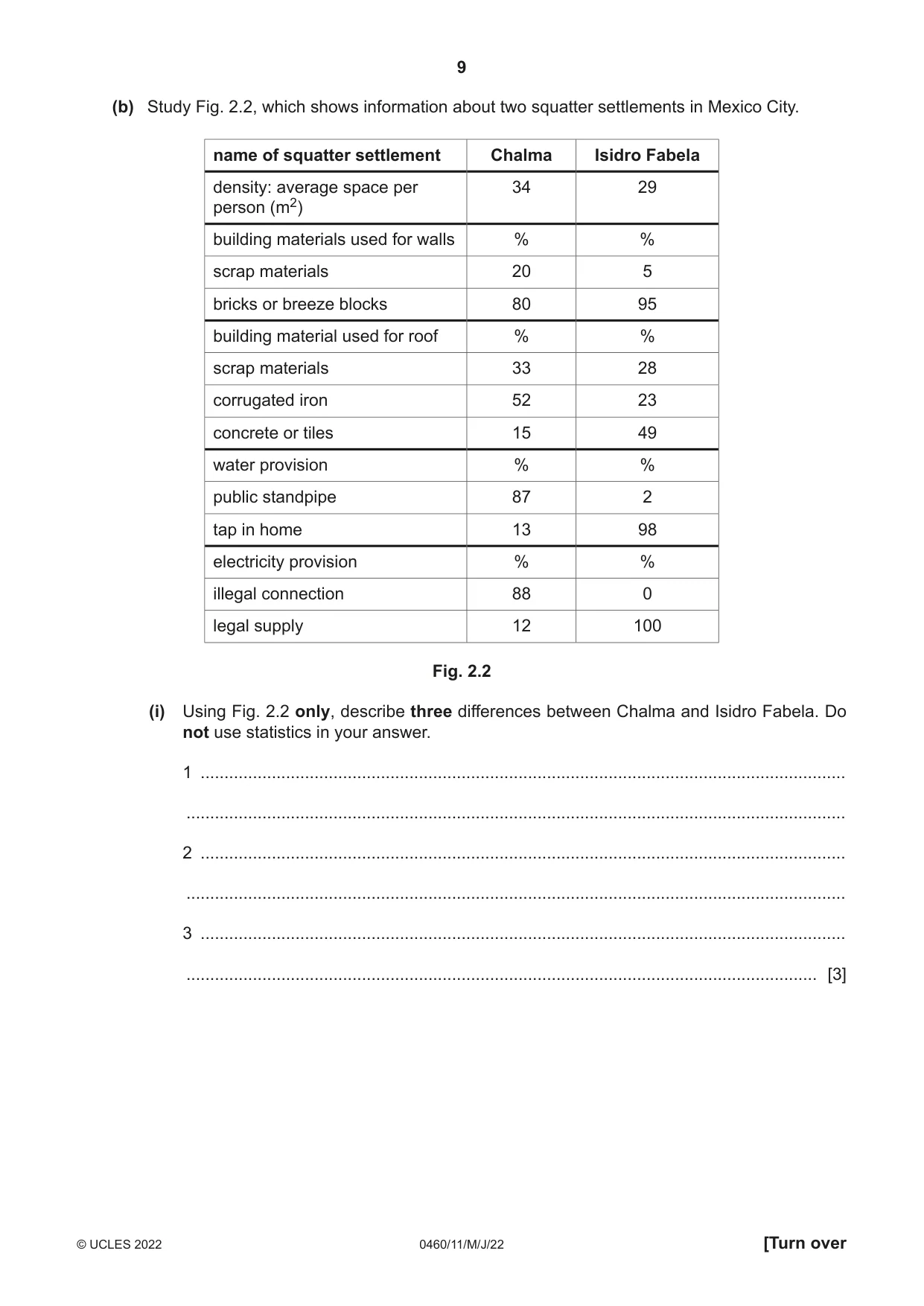
9 0460/11/M/J/22 © UCLES 2022 [Turn over (b) Study Fig. 2.2, which shows information about two squatter settlements in Mexico City. name of squatter settlement Chalma Isidro Fabela density: average space per person (m2) 34 29 building materials used for walls % % scrap materials 20 5 bricks or breeze blocks 80 95 building material used for roof % % scrap materials 33 28 corrugated iron 52 23 concrete or tiles 15 49 water provision % % public standpipe 87 2 tap in home 13 98 electricity provision % % illegal connection 88 0 legal supply 12 100 Fig. 2.2 (i) Using Fig. 2.2 only, describe three differences between Chalma and Isidro Fabela. Do not use statistics in your answer. 1 … … 2 … … 3 … … [3]
Question paper, page 10
10 0460/11/M/J/22 © UCLES 2022 (ii) Explain the difficulties faced by people living in squatter settlements. … … … … … … … … … … [5]
Question paper, page 11
11 0460/11/M/J/22 © UCLES 2022 [Turn over (c) For a named urban area you have studied in an LEDC, explain why people have moved to it from surrounding rural areas. Name of urban area in LEDC … … … … … … … … … … … … … … … … … … … … … … … … … … [7] [Total: 25]
Question paper, page 12
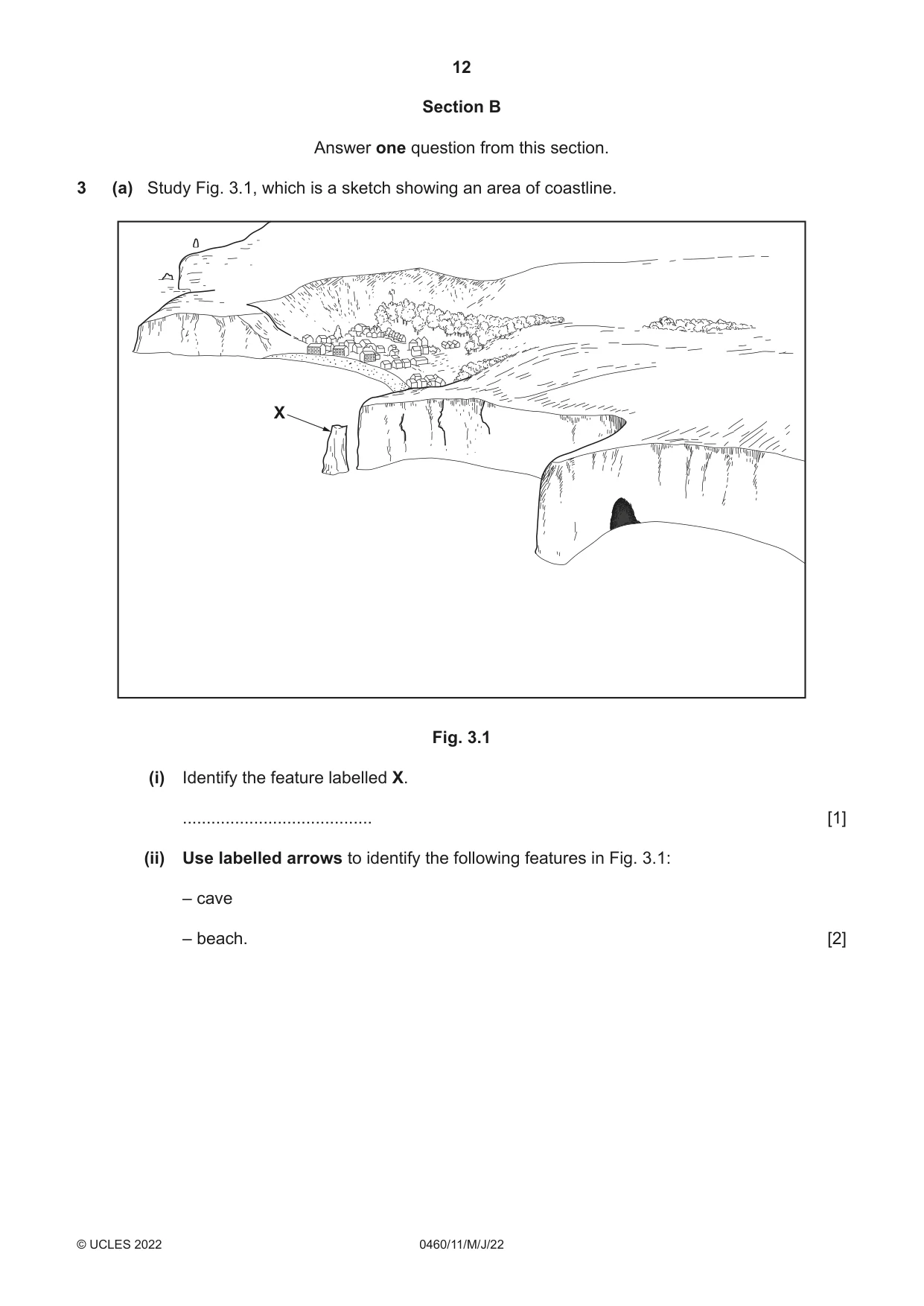
12 0460/11/M/J/22 © UCLES 2022 Section B Answer one question from this section. 3 (a) Study Fig. 3.1, which is a sketch showing an area of coastline. X Fig. 3.1 (i) Identify the feature labelled X. … [1] (ii) Use labelled arrows to identify the following features in Fig. 3.1: – cave – beach. [2]
Question paper, page 13
13 0460/11/M/J/22 © UCLES 2022 [Turn over (iii) Explain how the process of abrasion (corrasion) may have formed the cave you have labelled in Fig. 3.1. … … … … … … [3] (iv) Suggest why bays and headlands have developed along the coast shown in Fig. 3.1. … … … … … … … … [4] (b) Study Fig. 3.2 (Insert), which is a photograph of an area of coastline. (i) Describe the benefits of living in a coastal area such as that shown in Fig. 3.2. … … … … … … [3]
Question paper, page 14
14 0460/11/M/J/22 © UCLES 2022 (ii) Explain why the natural environment may be hazardous for people living in coastal settlements. … … … … … … … … … … [5]
Question paper, page 15
15 0460/11/M/J/22 © UCLES 2022 [Turn over (c) Describe and explain the conditions which lead to the development of a coral reef. … … … … … … … … … … … … … … … … … … … … … … … … … … [7] [Total: 25]
Question paper, page 16
16 0460/11/M/J/22 © UCLES 2022 4 (a) Study Fig. 4.1 (Insert), which is a photograph of a river near its source. (i) What is meant by the source of a river? … … [1] (ii) Describe two features shown in Fig. 4.1 which are typical of a river near its source. 1 … … 2 … … [2] (iii) Explain how the river shown in Fig. 4.1 may have eroded its valley by hydraulic action. … … … … … … [3] (iv) Explain how potholes may form along rivers such as the one shown in Fig. 4.1. … … … … … … … … [4]
Question paper, page 17
17 0460/11/M/J/22 © UCLES 2022 [Turn over (b) Study Fig. 4.2 (Insert), which is a photograph of Cairo and the River Nile, in Egypt (an LEDC). (i) Suggest reasons why many large urban settlements, such as Cairo, have grown up close to rivers. … … … … … … [3] (ii) Explain why living close to a river, such as the Nile, may be hazardous. … … … … … … … … … … [5]
Question paper, page 18
18 0460/11/M/J/22 © UCLES 2022 (c) Explain how an oxbow lake is formed. You should include a labelled diagram or diagrams in the box below. … … … … … … … … … … … … [7] [Total: 25]
Question paper, page 19
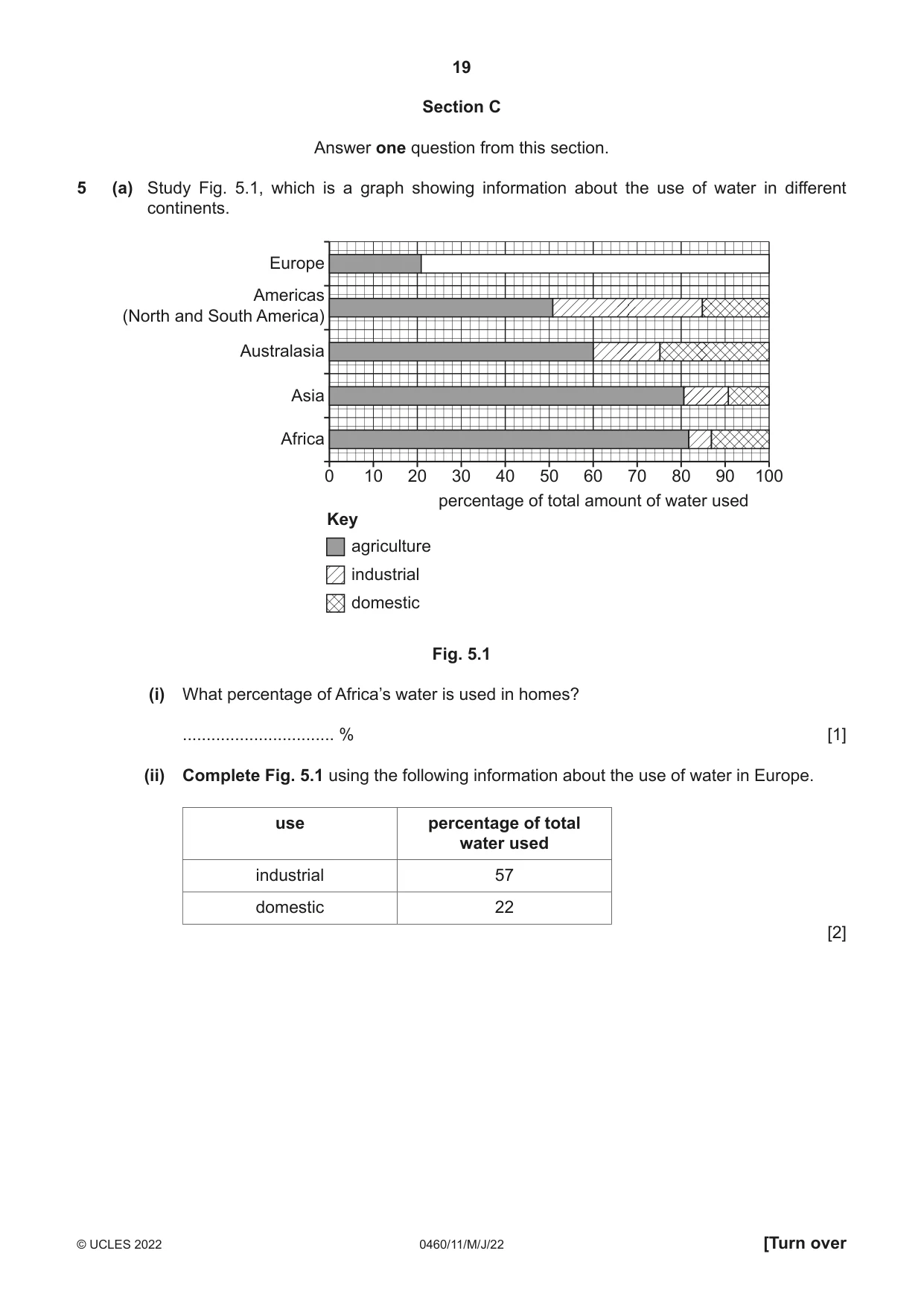
19 0460/11/M/J/22 © UCLES 2022 [Turn over Section C Answer one question from this section. 5 (a) Study Fig. 5.1, which is a graph showing information about the use of water in different continents. 0 10 20 30 40 50 60 70 80 90 100 Africa Asia Australasia Americas (North and South America) Europe percentage of total amount of water used agriculture industrial domestic Key Fig. 5.1 (i) What percentage of Africa’s water is used in homes? … % [1] (ii) Complete Fig. 5.1 using the following information about the use of water in Europe. use percentage of total water used industrial 57 domestic 22 [2]
Question paper, page 20
20 0460/11/M/J/22 © UCLES 2022 (iii) Compare the use of water in Asia and the Americas. … … … … … … [3] (iv) Suggest reasons why most water in Africa is used for agriculture. … … … … … … … … [4] (b) Study Fig. 5.2 (Insert), which is a map showing the planned Ilisu dam in Turkey. (i) Describe three features of the reservoir which will be created by the Ilisu dam scheme. 1 … … 2 … … 3 … … [3]
Question paper, page 21
21 0460/11/M/J/22 © UCLES 2022 [Turn over (ii) Suggest the advantages and disadvantages of the Ilisu dam scheme. Advantages … … … … … Disadvantages … … … … … [5]
Question paper, page 22
22 0460/11/M/J/22 © UCLES 2022 (c) For a named country or area you have studied, describe the methods used to supply energy. Name of country or area … … … … … … … … … … … … … … … … … … … … … … … … … … [7] [Total: 25]
Question paper, page 23
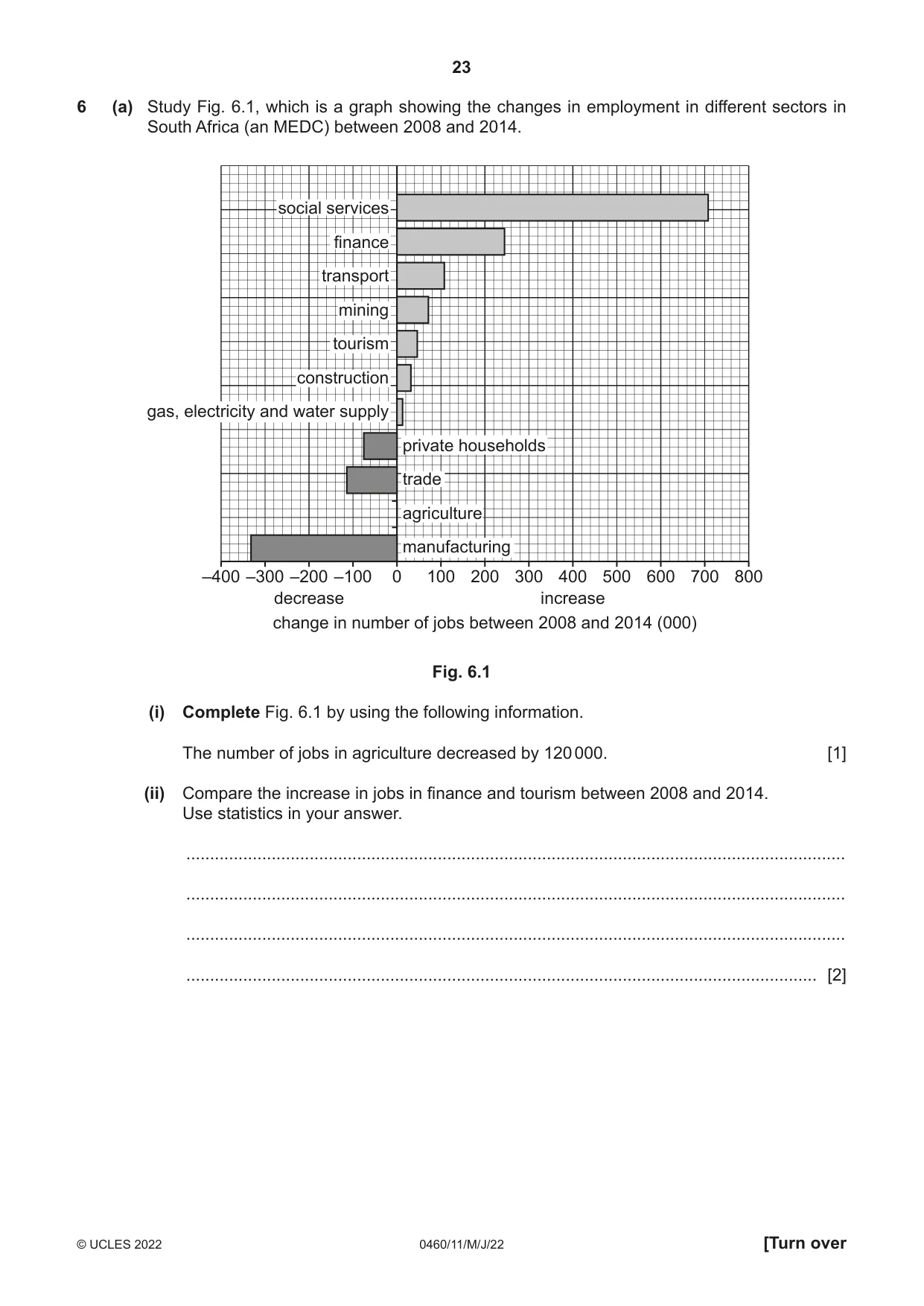
23 0460/11/M/J/22 © UCLES 2022 [Turn over 6 (a) Study Fig. 6.1, which is a graph showing the changes in employment in different sectors in South Africa (an MEDC) between 2008 and 2014. 0 100 –100 –200 –300 –400 200 300 400 500 600 700 800 change in number of jobs between 2008 and 2014 (000) decrease increase private households gas, electricity and water supply construction tourism mining transport finance social services trade agriculture manufacturing Fig. 6.1 (i) Complete Fig. 6.1 by using the following information. The number of jobs in agriculture decreased by 120 000. [1] (ii) Compare the increase in jobs in finance and tourism between 2008 and 2014. Use statistics in your answer. … … … … [2]
Question paper, page 24
24 0460/11/M/J/22 © UCLES 2022 (iii) Suggest three reasons for the decline in employment in manufacturing in South Africa. 1 … … 2 … … 3 … … [3] (iv) Explain why the tourist industry is important in many countries. … … … … … … … … … [4] (b) Study Fig. 6.2 (Insert), which is a photograph of part of Lanzarote, a Spanish island where tourism is important. (i) Using Fig. 6.2 only, identify three natural attractions of Lanzarote for tourism. 1 … … 2 … … 3 … … [3]
Question paper, page 25
25 0460/11/M/J/22 © UCLES 2022 [Turn over (ii) Suggest the problems which the tourist industry may cause for people who live in Lanzarote. … … … … … … … … … … [5]
Question paper, page 26
26 0460/11/M/J/22 © UCLES 2022 (c) For a named area you have studied, explain how an economic activity may damage the local natural environment. Name of area … Economic activity … … … … … … … … … … … … … … … … … … … … … … … … … [7] [Total: 25]
Question paper, page 27
27 0460/11/M/J/22 © UCLES 2022 Additional pages If you use the following pages to complete the answer to any question, the question number must be clearly shown. … … … … … … … … … … … … … … … … … … … … … … … … … …
Question paper, page 28
28 0460/11/M/J/22 © UCLES 2022 The boundaries and names shown, the designations used and the presentation of material on any maps contained in this question paper/insert do not imply official endorsement or acceptance by Cambridge Assessment International Education concerning the legal status of any country, territory, or area or any of its authorities, or of the delimitation of its frontiers or boundaries. Permission to reproduce items where third-party owned material protected by copyright is included has been sought and cleared where possible. Every reasonable effort has been made by the publisher (UCLES) to trace copyright holders, but if any items requiring clearance have unwittingly been included, the publisher will be pleased to make amends at the earliest possible opportunity. To avoid the issue of disclosure of answer-related information to candidates, all copyright acknowledgements are reproduced online in the Cambridge Assessment International Education Copyright Acknowledgements Booklet. This is produced for each series of examinations and is freely available to download at www.cambridgeinternational.org after the live examination series. Cambridge Assessment International Education is part of Cambridge Assessment. Cambridge Assessment is the brand name of the University of Cambridge Local Examinations Syndicate (UCLES), which is a department of the University of Cambridge. … … … … … … … … … … … … … … … … … … … … … …
Mark scheme, page 1
This document consists of 19 printed pages. © UCLES 2022 [Turn over Cambridge IGCSE™ GEOGRAPHY 0460/11 Paper 1 Geographical Themes May/June 2022 MARK SCHEME Maximum Mark: 75 Published This mark scheme is published as an aid to teachers and candidates, to indicate the requirements of the examination. It shows the basis on which Examiners were instructed to award marks. It does not indicate the details of the discussions that took place at an Examiners’ meeting before marking began, which would have considered the acceptability of alternative answers. Mark schemes should be read in conjunction with the question paper and the Principal Examiner Report for Teachers. Cambridge International will not enter into discussions about these mark schemes. Cambridge International is publishing the mark schemes for the May/June 2022 series for most Cambridge IGCSE, Cambridge International A and AS Level and Cambridge Pre-U components, and some Cambridge O Level components.
Mark scheme, page 2
0460/11 Cambridge IGCSE – Mark Scheme PUBLISHED May/June 2022 © UCLES 2022 Page 2 of 19 Generic Marking Principles These general marking principles must be applied by all examiners when marking candidate answers. They should be applied alongside the specific content of the mark scheme or generic level descriptors for a question. Each question paper and mark scheme will also comply with these marking principles. GENERIC MARKING PRINCIPLE 1: Marks must be awarded in line with: the specific content of the mark scheme or the generic level descriptors for the question the specific skills defined in the mark scheme or in the generic level descriptors for the question the standard of response required by a candidate as exemplified by the standardisation scripts. GENERIC MARKING PRINCIPLE 2: Marks awarded are always whole marks (not half marks, or other fractions). GENERIC MARKING PRINCIPLE 3: Marks must be awarded positively: marks are awarded for correct/valid answers, as defined in the mark scheme. However, credit is given for valid answers which go beyond the scope of the syllabus and mark scheme, referring to your Team Leader as appropriate marks are awarded when candidates clearly demonstrate what they know and can do marks are not deducted for errors marks are not deducted for omissions answers should only be judged on the quality of spelling, punctuation and grammar when these features are specifically assessed by the question as indicated by the mark scheme. The meaning, however, should be unambiguous. GENERIC MARKING PRINCIPLE 4: Rules must be applied consistently, e.g. in situations where candidates have not followed instructions or in the application of generic level descriptors. GENERIC MARKING PRINCIPLE 5: Marks should be awarded using the full range of marks defined in the mark scheme for the question (however; the use of the full mark range may be limited according to the quality of the candidate responses seen). GENERIC MARKING PRINCIPLE 6: Marks awarded are based solely on the requirements as defined in the mark scheme. Marks should not be awarded with grade thresholds or grade descriptors in mind.
Mark scheme, page 3
0460/11 Cambridge IGCSE – Mark Scheme PUBLISHED May/June 2022 © UCLES 2022 Page 3 of 19 Each question carries 25 marks. Candidates cannot earn above the maximum marks available within each sub section. The marking scheme attempts to give guidance about the requirements of each answer and lists a number of responses, which will earn marks along with the general principles to be applied when marking each question. It should be noted that candidates can earn marks if their answers are phrased differently provided they convey the same meaning as those in the mark scheme. THE CANDIDATES DO NOT NEED TO USE THE SAME WORDING TO EARN MARKS. The notation ‘etc.’ at the end of an answer in the mark scheme signifies that there may well be other correct responses or examples that can be given credit. Providing the statement is true, relevant to the question asked and not repetition of a previous point made credit should be given. A point made within one sub-section which is an answer to the question set in a different sub-section should not be given credit as each sub-section asks different questions which require independent answers. The mark scheme uses semi colons (;) to separate marks and diagonals to separate alternative answers. During coordination the mark scheme is modified to add points agreed after discussion or to delete any points not allowed. All examiners should ensure that their modified scheme is fully up-to-date before marking begins. Marking Mechanics. Point marking is used for sections (a) and (b) of each question, although marks are available in specified questions for development of appropriate points. Ticks should be used to clearly indicate where a mark has been allowed. Where a development point has been allowed the symbol ‘DEV’ should be placed adjacent to the tick. The number of ticks should always be equal to the total number of marks awarded. Only one development mark for each mark scheme point please. Where a candidate makes a point which is not quite sufficient for credit an upturned ‘V’ insert symbol should be used. If after careful consideration a mark is awarded which gives ‘benefit of doubt’ to the candidate the letter ‘J’ should be placed adjacent to the tick (i.e. the candidate has ‘just’ achieved the mark). Crosses are acceptable to signify wrong answers and the letters ‘I/R’ should be used to indicate those which are irrelevant. Levels of response marking is used for section (c) of each question. Thus it is the quality of the response that determines which level an answer is achieved rather than the quantity of statements contained within it. However, once assigned to a level the mark achieved within that level is determined by the number of points made. Levels 1 and 2 are distinguished by whether statements are simple (level 1) or developed/elaborated (level 2). A candidate can immediately enter L2 by making developed points without making any L1 statements. In order to achieve L3 a candidate must have already reached the top end of L2 – in addition his/her answer should have a clear example and if the answer is place specific as well (7 marks). Highlight place specific detail.
Mark scheme, page 4
0460/11 Cambridge IGCSE – Mark Scheme PUBLISHED May/June 2022 © UCLES 2022 Page 4 of 19 Where statements are assigned levels by the examiner this should be indicated by the use of L1 and L2 next to the statements. Ticks should not be used on answers that are marked using levels of response marking. L1 annotation should be removed once a L2 is awarded for an answer. L3 annotation is not used. There is no need for a summary level at the end of a response. Summary: Level 1 (1 to 3 marks): 1 simple statement (1 mark) 2 simple statements (2 marks) 3 simple statements (3 marks) Level 2 (4 to 6 marks): 1 developed statement (4 marks) 2 developed statements (5 marks) 3 or more developed statements with e.g. (6 marks) Level 3 (7 marks) 3 or more developed statements + named example with at least one piece of place specific detail.
Mark scheme, page 5
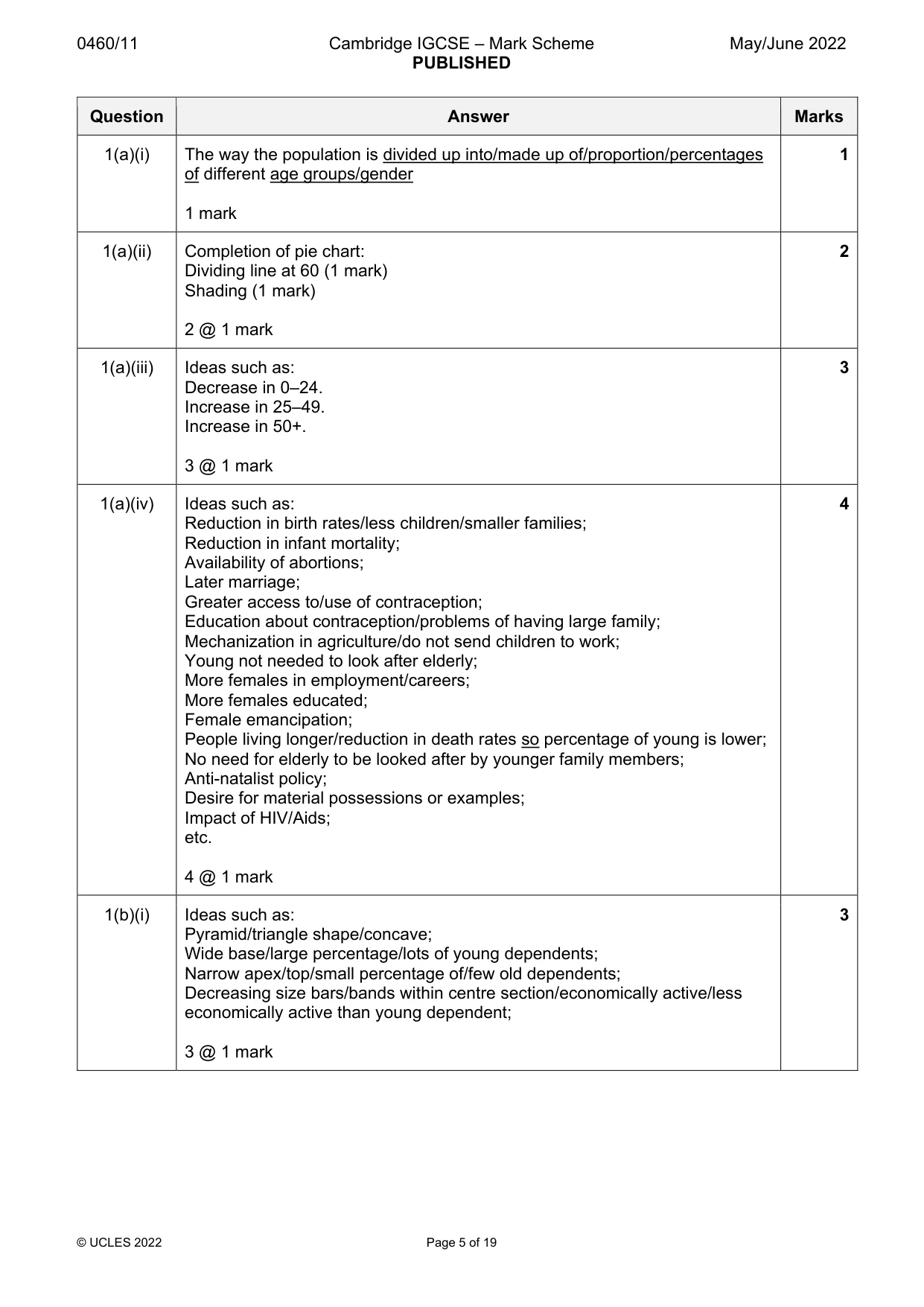
0460/11 Cambridge IGCSE – Mark Scheme PUBLISHED May/June 2022 © UCLES 2022 Page 5 of 19 Question Answer Marks 1(a)(i) The way the population is divided up into/made up of/proportion/percentages of different age groups/gender 1 mark 1 1(a)(ii) Completion of pie chart: Dividing line at 60 (1 mark) Shading (1 mark) 2 @ 1 mark 2 1(a)(iii) Ideas such as: Decrease in 0–24. Increase in 25–49. Increase in 50+. 3 @ 1 mark 3 1(a)(iv) Ideas such as: Reduction in birth rates/less children/smaller families; Reduction in infant mortality; Availability of abortions; Later marriage; Greater access to/use of contraception; Education about contraception/problems of having large family; Mechanization in agriculture/do not send children to work; Young not needed to look after elderly; More females in employment/careers; More females educated; Female emancipation; People living longer/reduction in death rates so percentage of young is lower; No need for elderly to be looked after by younger family members; Anti-natalist policy; Desire for material possessions or examples; Impact of HIV/Aids; etc. 4 @ 1 mark 4 1(b)(i) Ideas such as: Pyramid/triangle shape/concave; Wide base/large percentage/lots of young dependents; Narrow apex/top/small percentage of/few old dependents; Decreasing size bars/bands within centre section/economically active/less economically active than young dependent; 3 @ 1 mark 3
Mark scheme, page 6
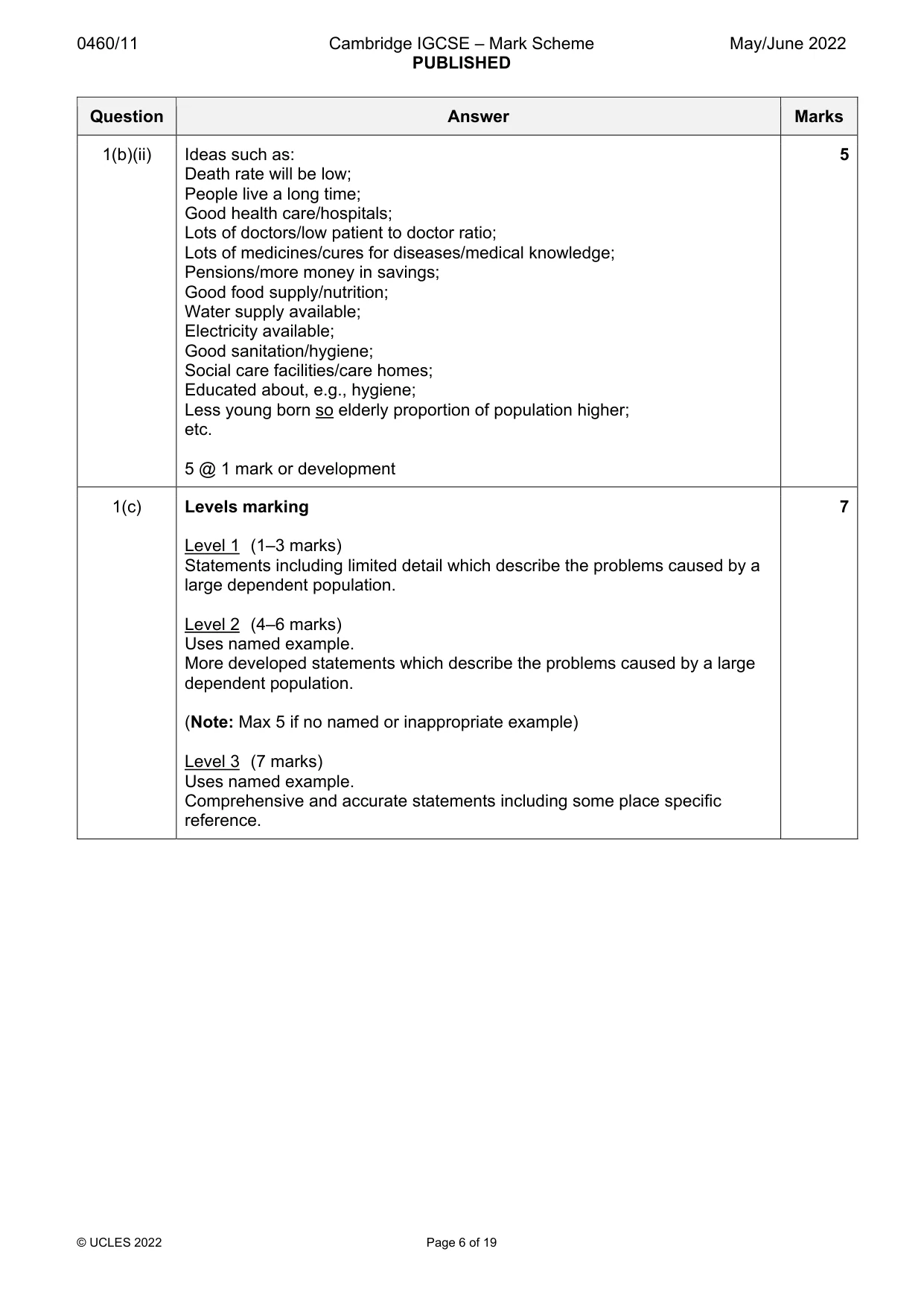
0460/11 Cambridge IGCSE – Mark Scheme PUBLISHED May/June 2022 © UCLES 2022 Page 6 of 19 Question Answer Marks 1(b)(ii) Ideas such as: Death rate will be low; People live a long time; Good health care/hospitals; Lots of doctors/low patient to doctor ratio; Lots of medicines/cures for diseases/medical knowledge; Pensions/more money in savings; Good food supply/nutrition; Water supply available; Electricity available; Good sanitation/hygiene; Social care facilities/care homes; Educated about, e.g., hygiene; Less young born so elderly proportion of population higher; etc. 5 @ 1 mark or development 5 1(c) Levels marking Level 1 (1–3 marks) Statements including limited detail which describe the problems caused by a large dependent population. Level 2 (4–6 marks) Uses named example. More developed statements which describe the problems caused by a large dependent population. (Note: Max 5 if no named or inappropriate example) Level 3 (7 marks) Uses named example. Comprehensive and accurate statements including some place specific reference. 7
Mark scheme, page 7
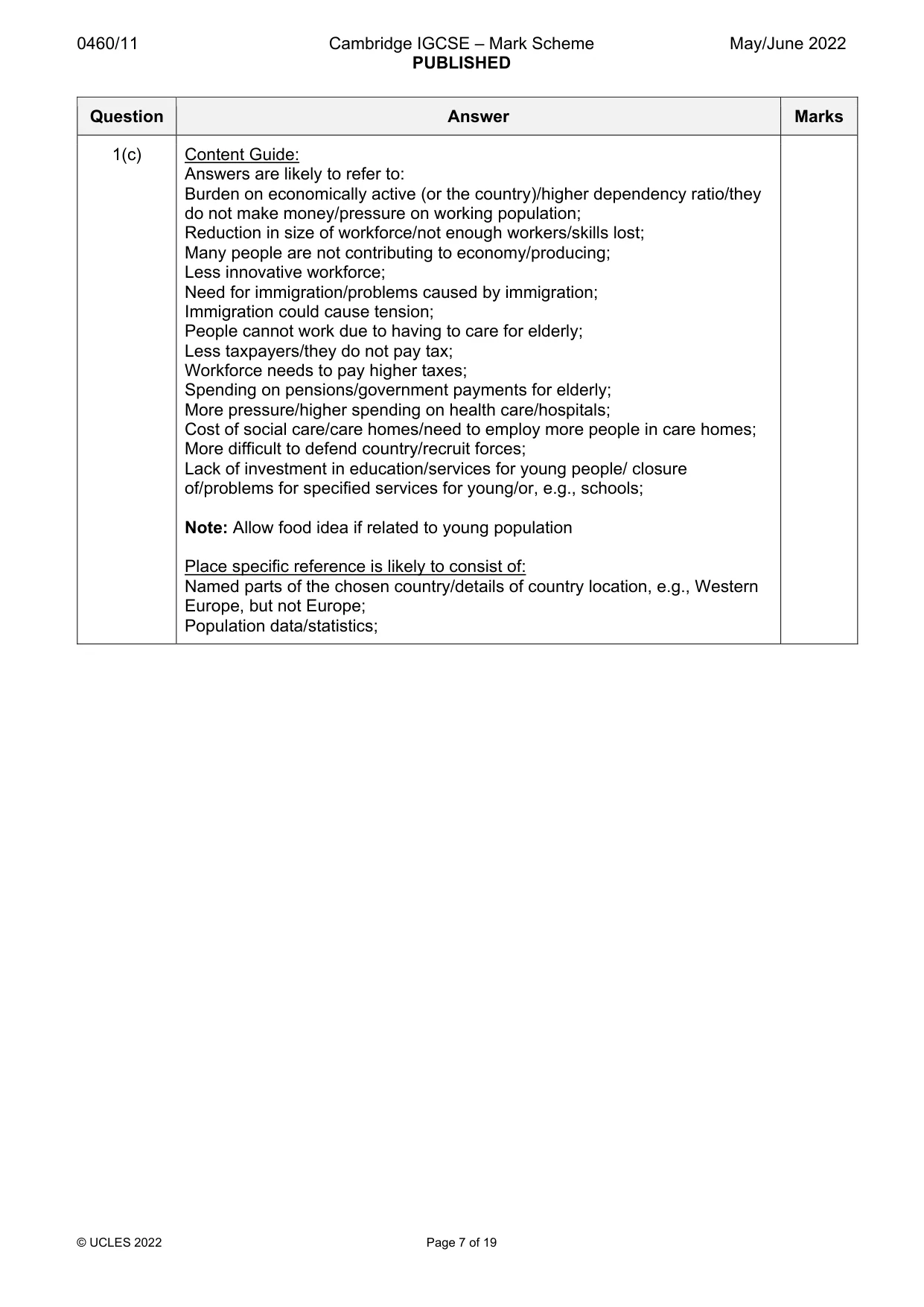
0460/11 Cambridge IGCSE – Mark Scheme PUBLISHED May/June 2022 © UCLES 2022 Page 7 of 19 Question Answer Marks 1(c) Content Guide: Answers are likely to refer to: Burden on economically active (or the country)/higher dependency ratio/they do not make money/pressure on working population; Reduction in size of workforce/not enough workers/skills lost; Many people are not contributing to economy/producing; Less innovative workforce; Need for immigration/problems caused by immigration; Immigration could cause tension; People cannot work due to having to care for elderly; Less taxpayers/they do not pay tax; Workforce needs to pay higher taxes; Spending on pensions/government payments for elderly; More pressure/higher spending on health care/hospitals; Cost of social care/care homes/need to employ more people in care homes; More difficult to defend country/recruit forces; Lack of investment in education/services for young people/ closure of/problems for specified services for young/or, e.g., schools; Note: Allow food idea if related to young population Place specific reference is likely to consist of: Named parts of the chosen country/details of country location, e.g., Western Europe, but not Europe; Population data/statistics;
Mark scheme, page 8
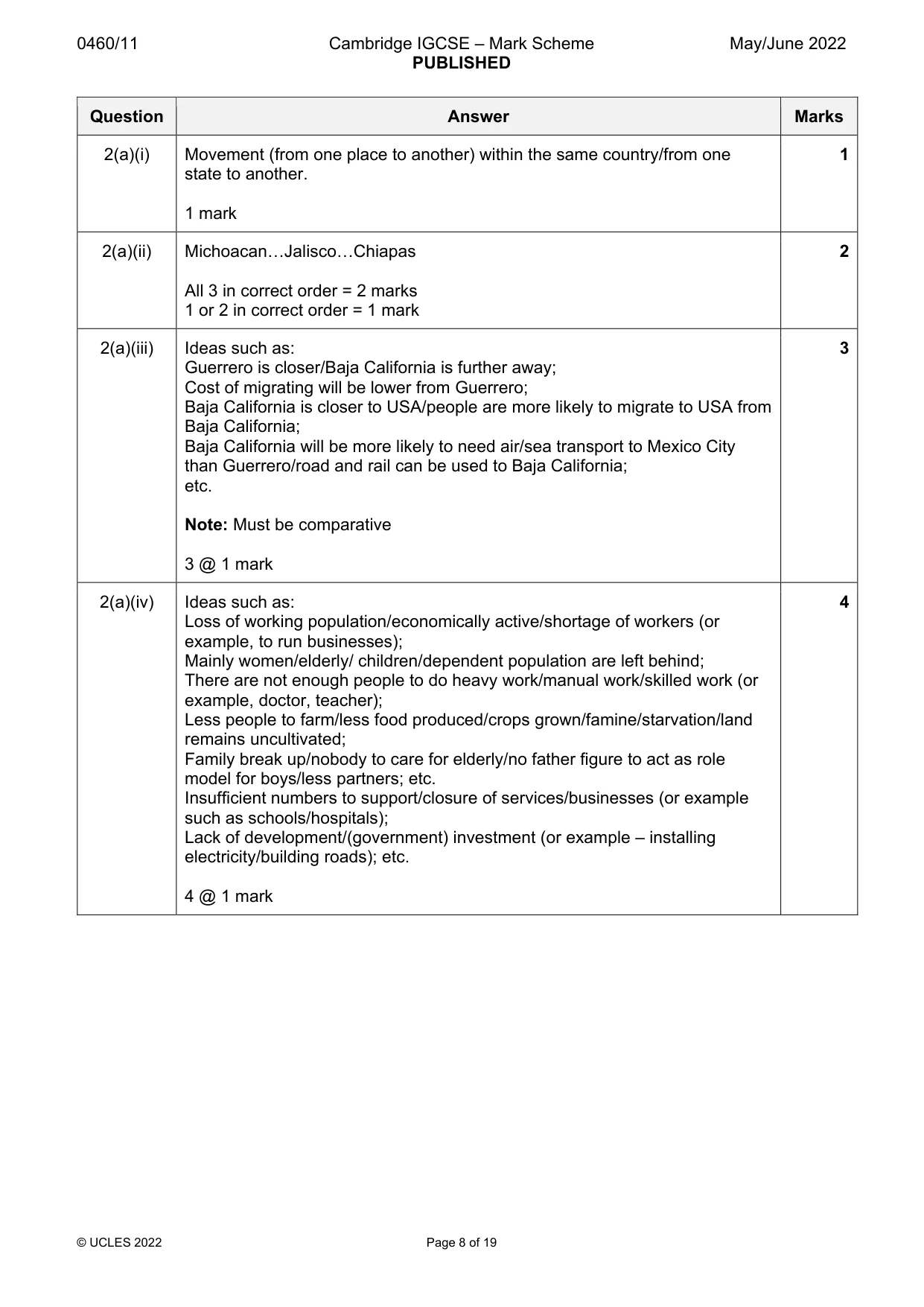
0460/11 Cambridge IGCSE – Mark Scheme PUBLISHED May/June 2022 © UCLES 2022 Page 8 of 19 Question Answer Marks 2(a)(i) Movement (from one place to another) within the same country/from one state to another. 1 mark 1 2(a)(ii) Michoacan…Jalisco…Chiapas All 3 in correct order = 2 marks 1 or 2 in correct order = 1 mark 2 2(a)(iii) Ideas such as: Guerrero is closer/Baja California is further away; Cost of migrating will be lower from Guerrero; Baja California is closer to USA/people are more likely to migrate to USA from Baja California; Baja California will be more likely to need air/sea transport to Mexico City than Guerrero/road and rail can be used to Baja California; etc. Note: Must be comparative 3 @ 1 mark 3 2(a)(iv) Ideas such as: Loss of working population/economically active/shortage of workers (or example, to run businesses); Mainly women/elderly/ children/dependent population are left behind; There are not enough people to do heavy work/manual work/skilled work (or example, doctor, teacher); Less people to farm/less food produced/crops grown/famine/starvation/land remains uncultivated; Family break up/nobody to care for elderly/no father figure to act as role model for boys/less partners; etc. Insufficient numbers to support/closure of services/businesses (or example such as schools/hospitals); Lack of development/(government) investment (or example – installing electricity/building roads); etc. 4 @ 1 mark 4
Mark scheme, page 9
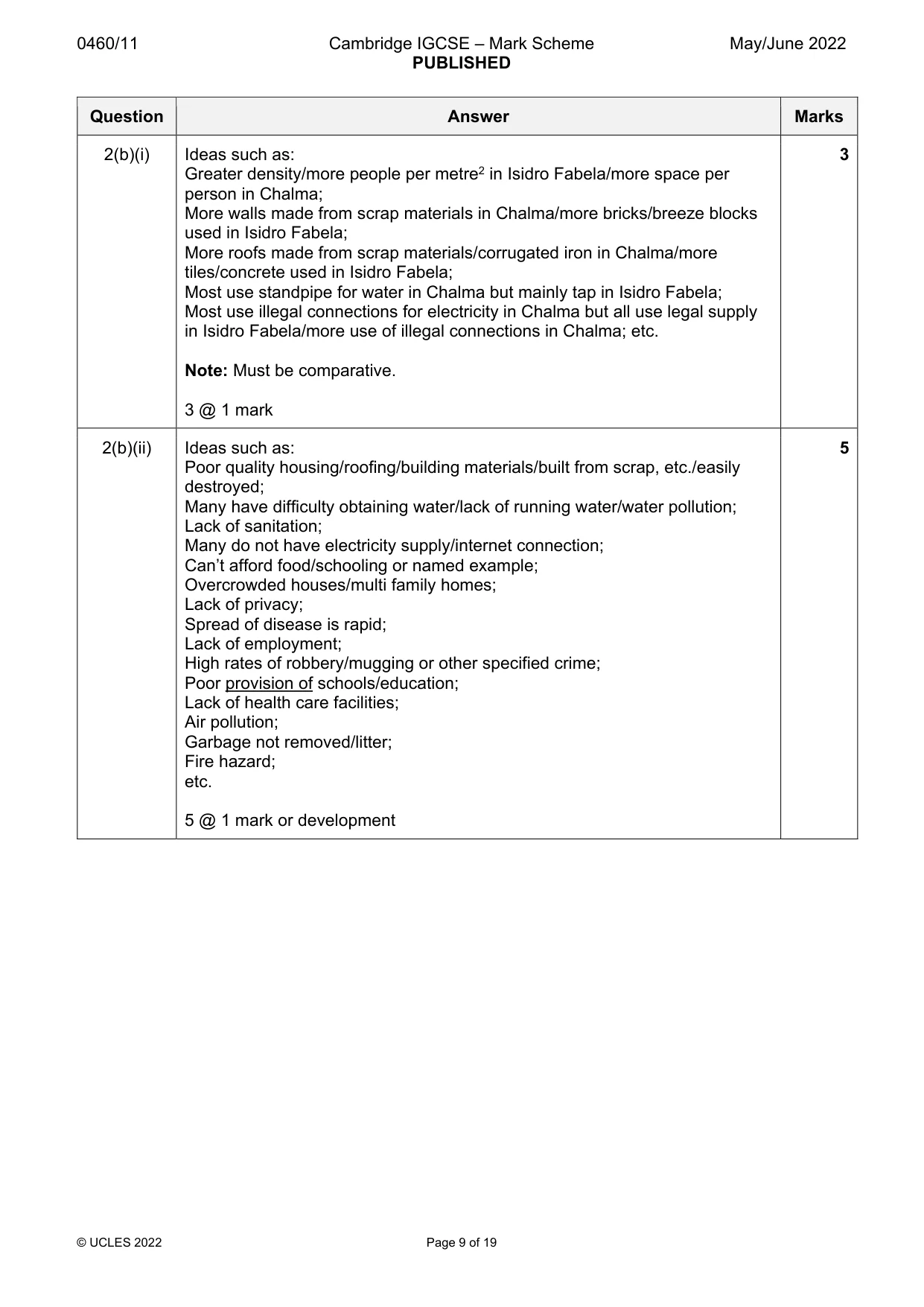
0460/11 Cambridge IGCSE – Mark Scheme PUBLISHED May/June 2022 © UCLES 2022 Page 9 of 19 Question Answer Marks 2(b)(i) Ideas such as: Greater density/more people per metre2 in Isidro Fabela/more space per person in Chalma; More walls made from scrap materials in Chalma/more bricks/breeze blocks used in Isidro Fabela; More roofs made from scrap materials/corrugated iron in Chalma/more tiles/concrete used in Isidro Fabela; Most use standpipe for water in Chalma but mainly tap in Isidro Fabela; Most use illegal connections for electricity in Chalma but all use legal supply in Isidro Fabela/more use of illegal connections in Chalma; etc. Note: Must be comparative. 3 @ 1 mark 3 2(b)(ii) Ideas such as: Poor quality housing/roofing/building materials/built from scrap, etc./easily destroyed; Many have difficulty obtaining water/lack of running water/water pollution; Lack of sanitation; Many do not have electricity supply/internet connection; Can’t afford food/schooling or named example; Overcrowded houses/multi family homes; Lack of privacy; Spread of disease is rapid; Lack of employment; High rates of robbery/mugging or other specified crime; Poor provision of schools/education; Lack of health care facilities; Air pollution; Garbage not removed/litter; Fire hazard; etc. 5 @ 1 mark or development 5
Mark scheme, page 10
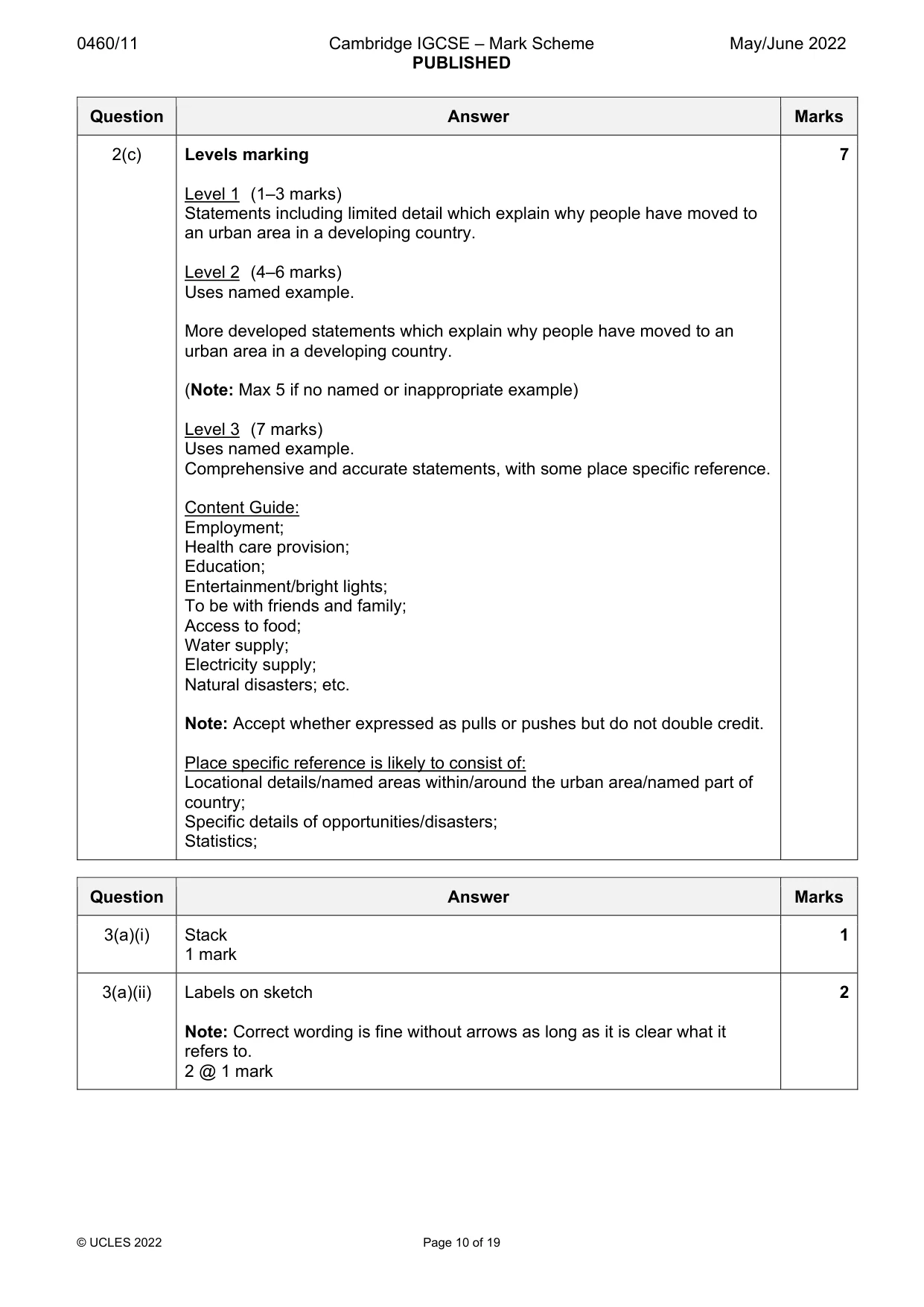
0460/11 Cambridge IGCSE – Mark Scheme PUBLISHED May/June 2022 © UCLES 2022 Page 10 of 19 Question Answer Marks 2(c) Levels marking Level 1 (1–3 marks) Statements including limited detail which explain why people have moved to an urban area in a developing country. Level 2 (4–6 marks) Uses named example. More developed statements which explain why people have moved to an urban area in a developing country. (Note: Max 5 if no named or inappropriate example) Level 3 (7 marks) Uses named example. Comprehensive and accurate statements, with some place specific reference. Content Guide: Employment; Health care provision; Education; Entertainment/bright lights; To be with friends and family; Access to food; Water supply; Electricity supply; Natural disasters; etc. Note: Accept whether expressed as pulls or pushes but do not double credit. Place specific reference is likely to consist of: Locational details/named areas within/around the urban area/named part of country; Specific details of opportunities/disasters; Statistics; 7 Question Answer Marks 3(a)(i) Stack 1 mark 1 3(a)(ii) Labels on sketch Note: Correct wording is fine without arrows as long as it is clear what it refers to. 2 @ 1 mark 2
Mark scheme, page 11
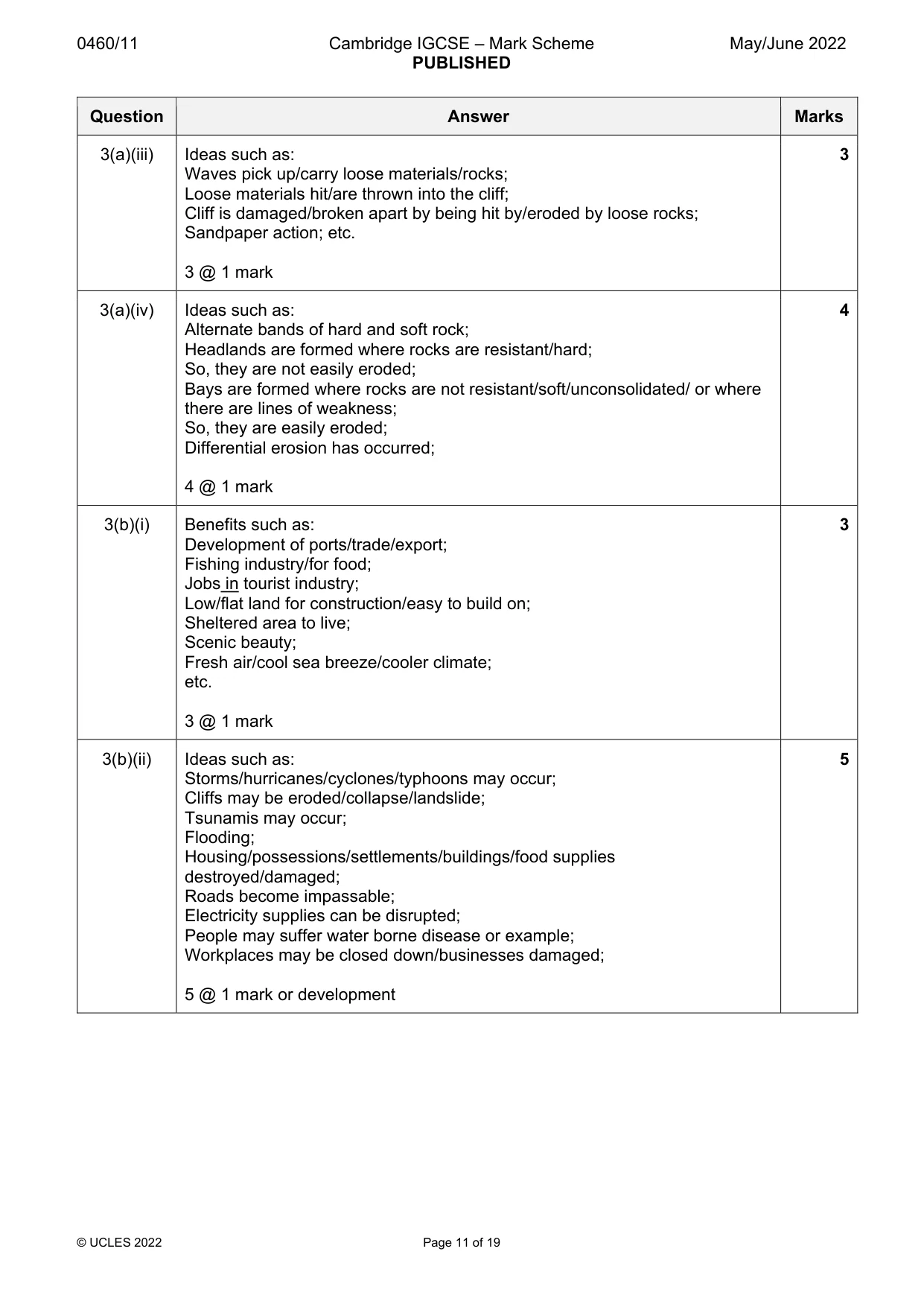
0460/11 Cambridge IGCSE – Mark Scheme PUBLISHED May/June 2022 © UCLES 2022 Page 11 of 19 Question Answer Marks 3(a)(iii) Ideas such as: Waves pick up/carry loose materials/rocks; Loose materials hit/are thrown into the cliff; Cliff is damaged/broken apart by being hit by/eroded by loose rocks; Sandpaper action; etc. 3 @ 1 mark 3 3(a)(iv) Ideas such as: Alternate bands of hard and soft rock; Headlands are formed where rocks are resistant/hard; So, they are not easily eroded; Bays are formed where rocks are not resistant/soft/unconsolidated/ or where there are lines of weakness; So, they are easily eroded; Differential erosion has occurred; 4 @ 1 mark 4 3(b)(i) Benefits such as: Development of ports/trade/export; Fishing industry/for food; Jobs in tourist industry; Low/flat land for construction/easy to build on; Sheltered area to live; Scenic beauty; Fresh air/cool sea breeze/cooler climate; etc. 3 @ 1 mark 3 3(b)(ii) Ideas such as: Storms/hurricanes/cyclones/typhoons may occur; Cliffs may be eroded/collapse/landslide; Tsunamis may occur; Flooding; Housing/possessions/settlements/buildings/food supplies destroyed/damaged; Roads become impassable; Electricity supplies can be disrupted; People may suffer water borne disease or example; Workplaces may be closed down/businesses damaged; 5 @ 1 mark or development 5
Mark scheme, page 12
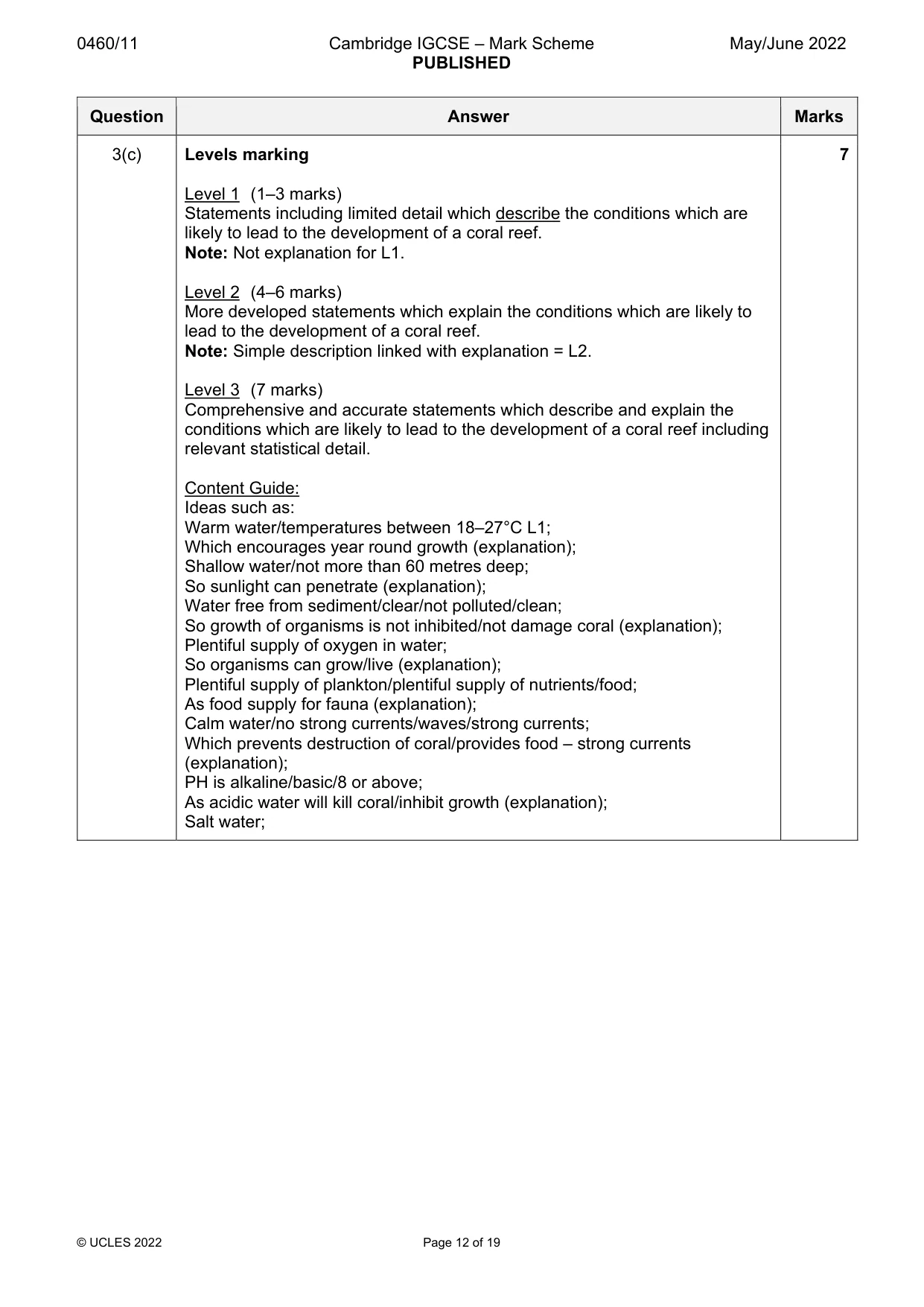
0460/11 Cambridge IGCSE – Mark Scheme PUBLISHED May/June 2022 © UCLES 2022 Page 12 of 19 Question Answer Marks 3(c) Levels marking Level 1 (1–3 marks) Statements including limited detail which describe the conditions which are likely to lead to the development of a coral reef. Note: Not explanation for L1. Level 2 (4–6 marks) More developed statements which explain the conditions which are likely to lead to the development of a coral reef. Note: Simple description linked with explanation = L2. Level 3 (7 marks) Comprehensive and accurate statements which describe and explain the conditions which are likely to lead to the development of a coral reef including relevant statistical detail. Content Guide: Ideas such as: Warm water/temperatures between 18–27°C L1; Which encourages year round growth (explanation); Shallow water/not more than 60 metres deep; So sunlight can penetrate (explanation); Water free from sediment/clear/not polluted/clean; So growth of organisms is not inhibited/not damage coral (explanation); Plentiful supply of oxygen in water; So organisms can grow/live (explanation); Plentiful supply of plankton/plentiful supply of nutrients/food; As food supply for fauna (explanation); Calm water/no strong currents/waves/strong currents; Which prevents destruction of coral/provides food – strong currents (explanation); PH is alkaline/basic/8 or above; As acidic water will kill coral/inhibit growth (explanation); Salt water; 7
Mark scheme, page 13
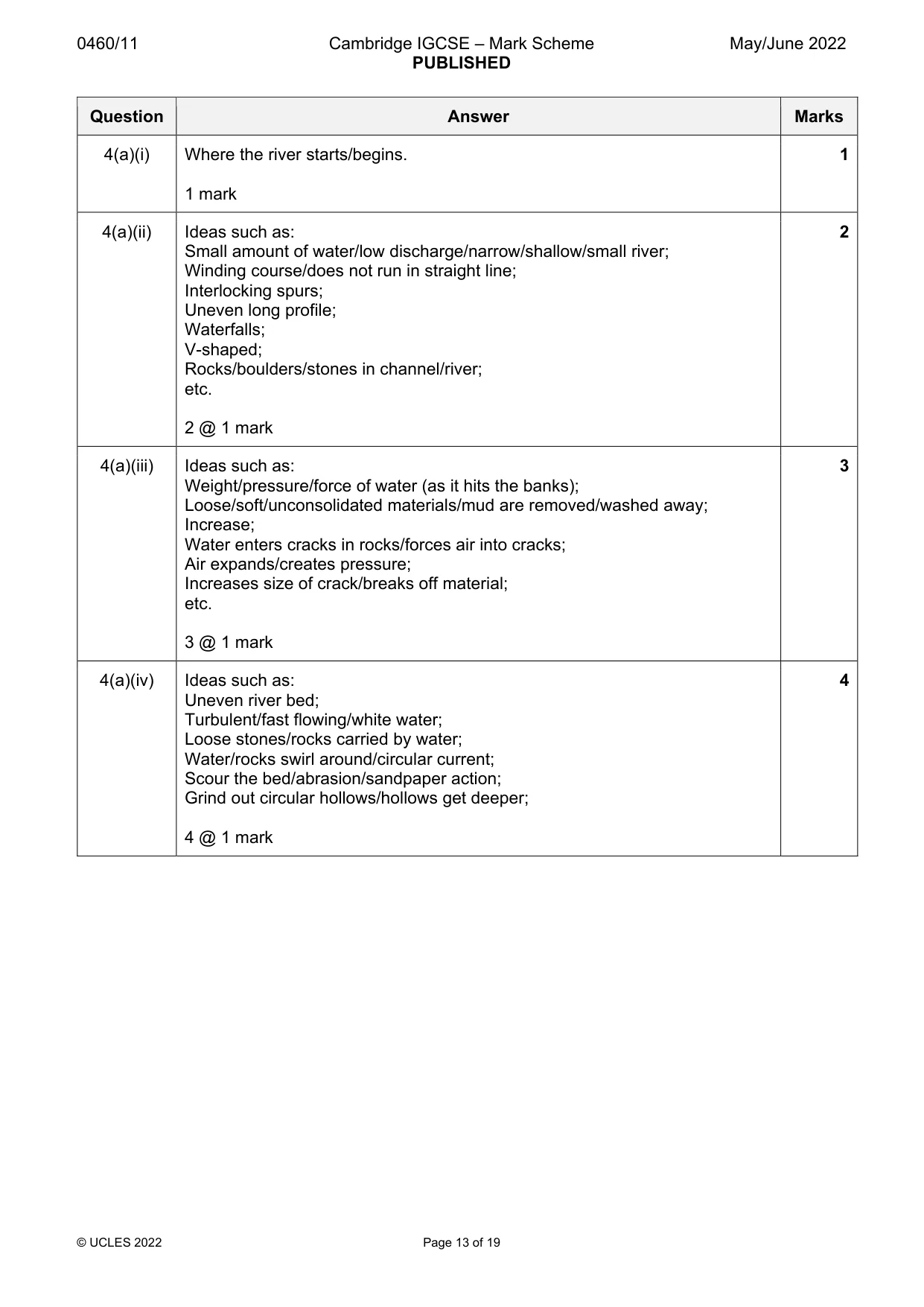
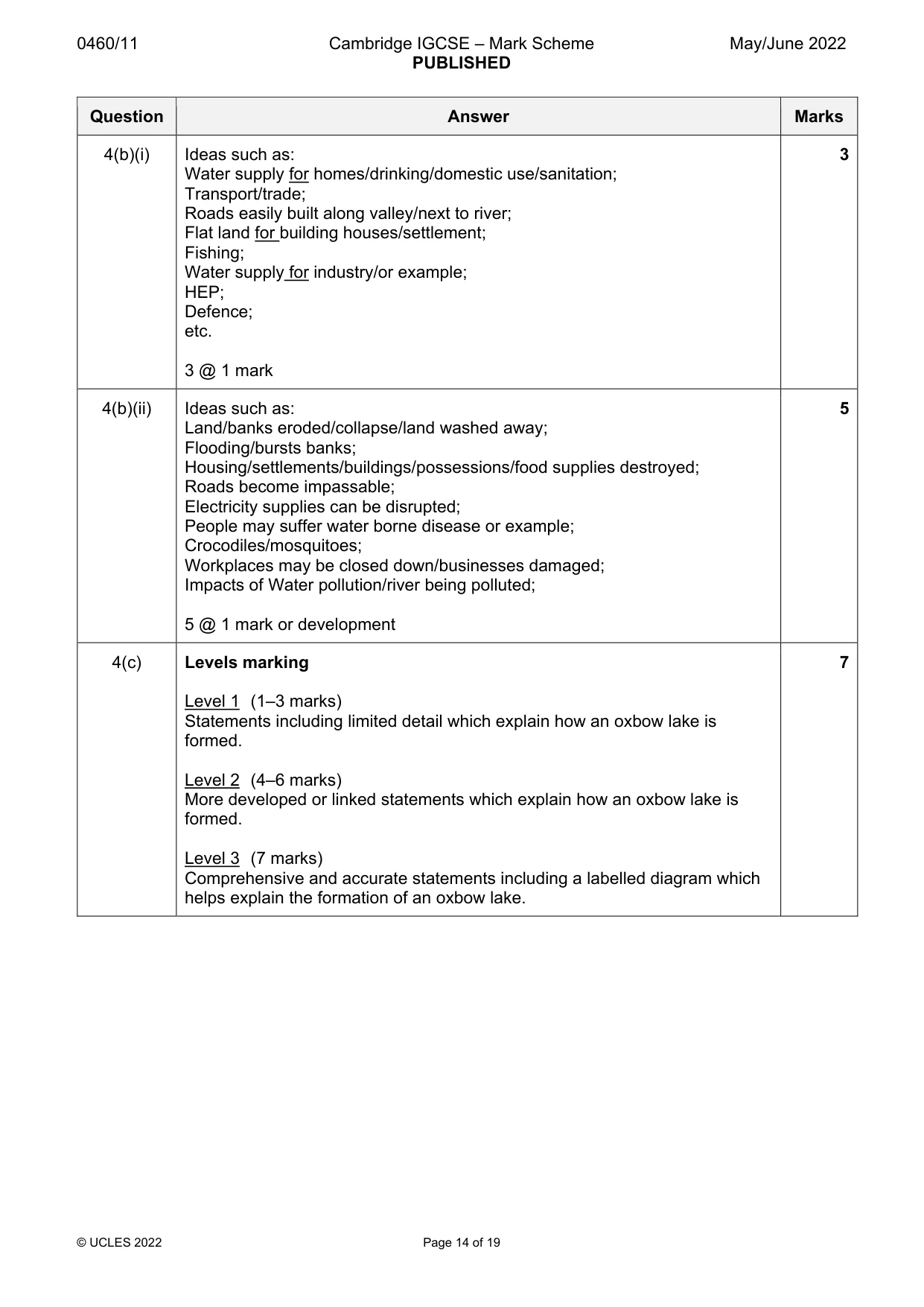
0460/11 Cambridge IGCSE – Mark Scheme PUBLISHED May/June 2022 © UCLES 2022 Page 13 of 19 Question Answer Marks 4(a)(i) Where the river starts/begins. 1 mark 1 4(a)(ii) Ideas such as: Small amount of water/low discharge/narrow/shallow/small river; Winding course/does not run in straight line; Interlocking spurs; Uneven long profile; Waterfalls; V-shaped; Rocks/boulders/stones in channel/river; etc. 2 @ 1 mark 2 4(a)(iii) Ideas such as: Weight/pressure/force of water (as it hits the banks); Loose/soft/unconsolidated materials/mud are removed/washed away; Increase; Water enters cracks in rocks/forces air into cracks; Air expands/creates pressure; Increases size of crack/breaks off material; etc. 3 @ 1 mark 3 4(a)(iv) Ideas such as: Uneven river bed; Turbulent/fast flowing/white water; Loose stones/rocks carried by water; Water/rocks swirl around/circular current; Scour the bed/abrasion/sandpaper action; Grind out circular hollows/hollows get deeper; 4 @ 1 mark 4
Mark scheme, page 14
0460/11 Cambridge IGCSE – Mark Scheme PUBLISHED May/June 2022 © UCLES 2022 Page 14 of 19 Question Answer Marks 4(b)(i) Ideas such as: Water supply for homes/drinking/domestic use/sanitation; Transport/trade; Roads easily built along valley/next to river; Flat land for building houses/settlement; Fishing; Water supply for industry/or example; HEP; Defence; etc. 3 @ 1 mark 3 4(b)(ii) Ideas such as: Land/banks eroded/collapse/land washed away; Flooding/bursts banks; Housing/settlements/buildings/possessions/food supplies destroyed; Roads become impassable; Electricity supplies can be disrupted; People may suffer water borne disease or example; Crocodiles/mosquitoes; Workplaces may be closed down/businesses damaged; Impacts of Water pollution/river being polluted; 5 @ 1 mark or development 5 4(c) Levels marking Level 1 (1–3 marks) Statements including limited detail which explain how an oxbow lake is formed. Level 2 (4–6 marks) More developed or linked statements which explain how an oxbow lake is formed. Level 3 (7 marks) Comprehensive and accurate statements including a labelled diagram which helps explain the formation of an oxbow lake. 7
Mark scheme, page 15
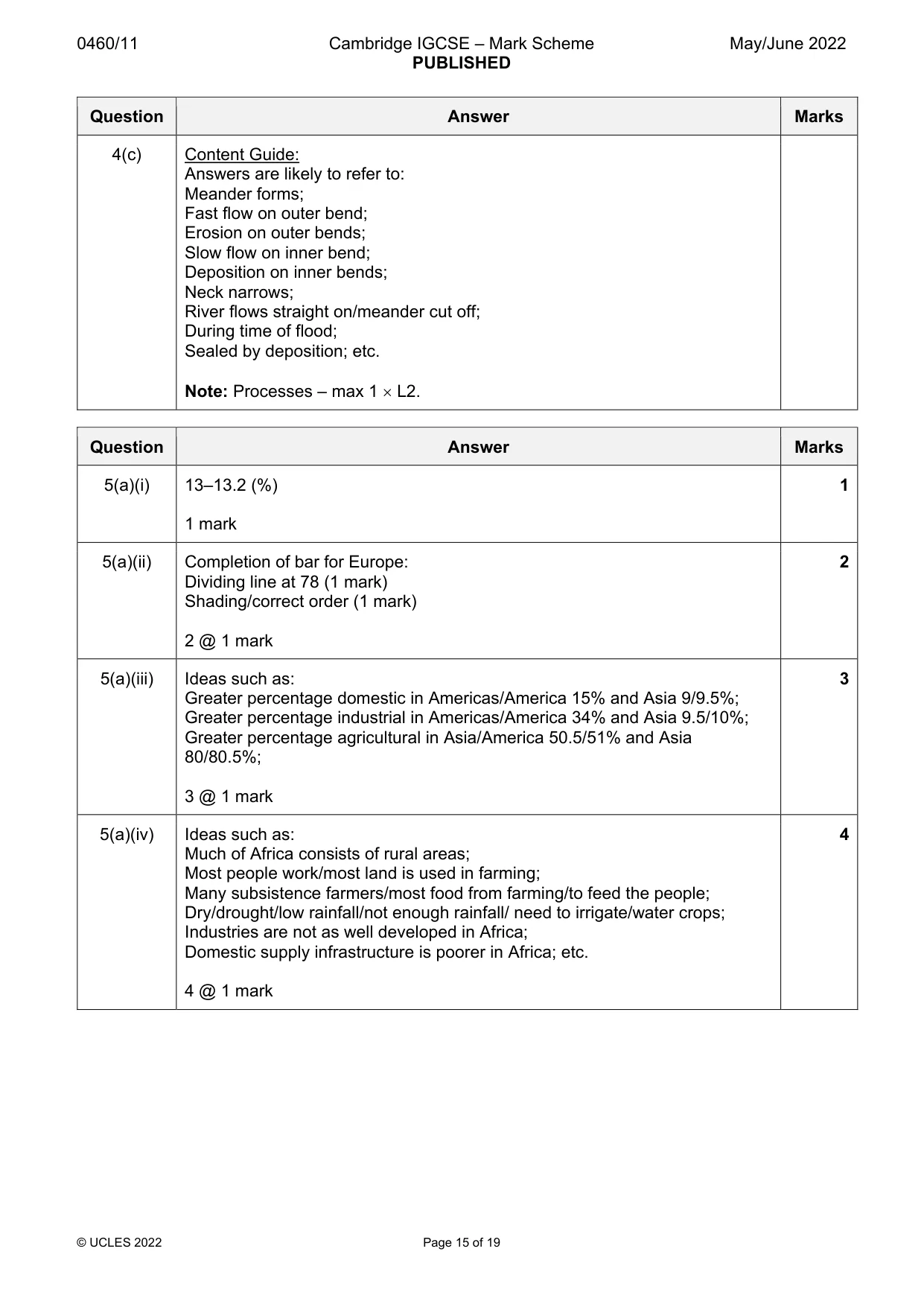
0460/11 Cambridge IGCSE – Mark Scheme PUBLISHED May/June 2022 © UCLES 2022 Page 15 of 19 Question Answer Marks 4(c) Content Guide: Answers are likely to refer to: Meander forms; Fast flow on outer bend; Erosion on outer bends; Slow flow on inner bend; Deposition on inner bends; Neck narrows; River flows straight on/meander cut off; During time of flood; Sealed by deposition; etc. Note: Processes – max 1 L2. Question Answer Marks 5(a)(i) 13–13.2 (%) 1 mark 1 5(a)(ii) Completion of bar for Europe: Dividing line at 78 (1 mark) Shading/correct order (1 mark) 2 @ 1 mark 2 5(a)(iii) Ideas such as: Greater percentage domestic in Americas/America 15% and Asia 9/9.5%; Greater percentage industrial in Americas/America 34% and Asia 9.5/10%; Greater percentage agricultural in Asia/America 50.5/51% and Asia 80/80.5%; 3 @ 1 mark 3 5(a)(iv) Ideas such as: Much of Africa consists of rural areas; Most people work/most land is used in farming; Many subsistence farmers/most food from farming/to feed the people; Dry/drought/low rainfall/not enough rainfall/ need to irrigate/water crops; Industries are not as well developed in Africa; Domestic supply infrastructure is poorer in Africa; etc. 4 @ 1 mark 4
Mark scheme, page 16
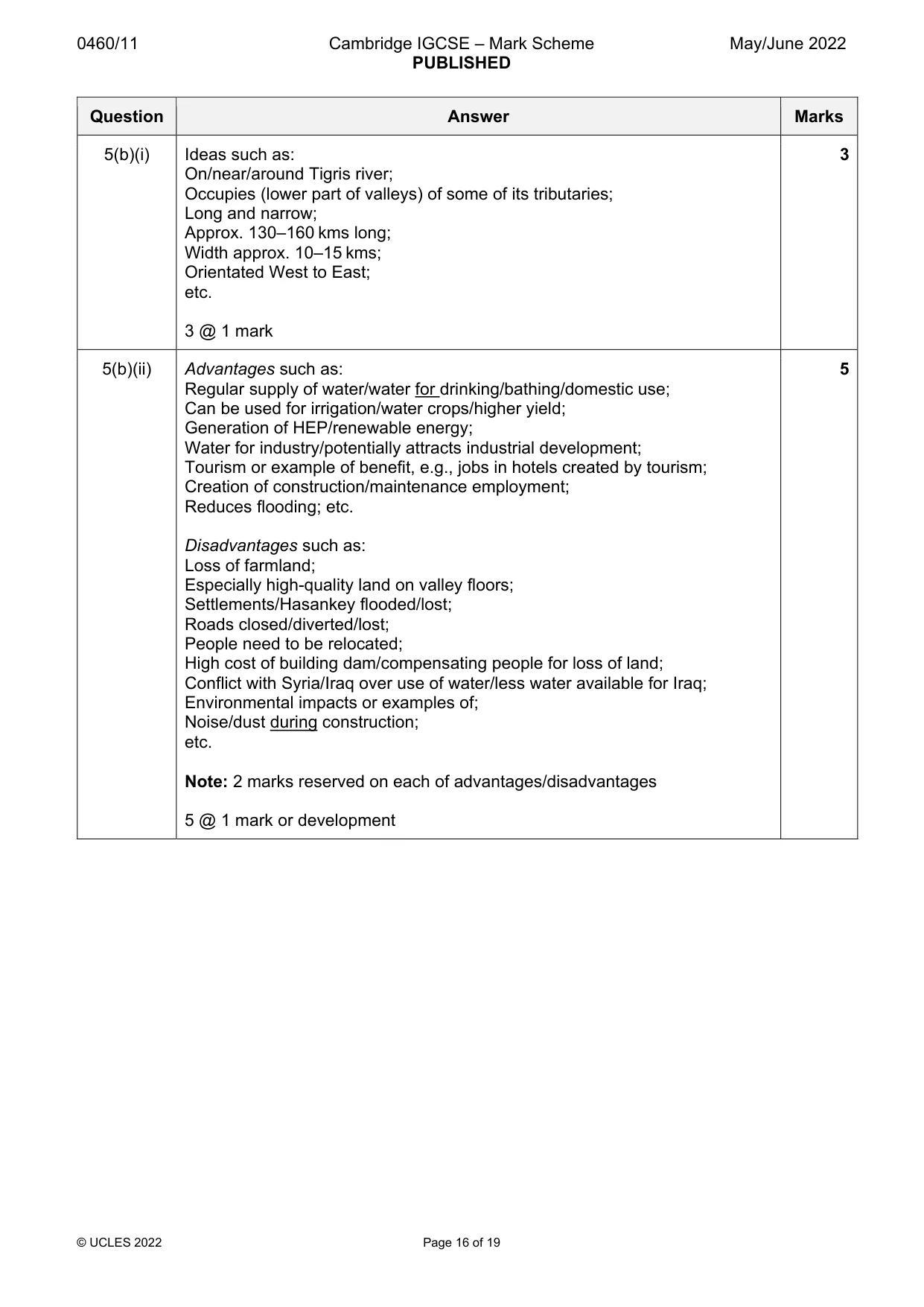
0460/11 Cambridge IGCSE – Mark Scheme PUBLISHED May/June 2022 © UCLES 2022 Page 16 of 19 Question Answer Marks 5(b)(i) Ideas such as: On/near/around Tigris river; Occupies (lower part of valleys) of some of its tributaries; Long and narrow; Approx. 130–160 kms long; Width approx. 10–15 kms; Orientated West to East; etc. 3 @ 1 mark 3 5(b)(ii) Advantages such as: Regular supply of water/water for drinking/bathing/domestic use; Can be used for irrigation/water crops/higher yield; Generation of HEP/renewable energy; Water for industry/potentially attracts industrial development; Tourism or example of benefit, e.g., jobs in hotels created by tourism; Creation of construction/maintenance employment; Reduces flooding; etc. Disadvantages such as: Loss of farmland; Especially high-quality land on valley floors; Settlements/Hasankey flooded/lost; Roads closed/diverted/lost; People need to be relocated; High cost of building dam/compensating people for loss of land; Conflict with Syria/Iraq over use of water/less water available for Iraq; Environmental impacts or examples of; Noise/dust during construction; etc. Note: 2 marks reserved on each of advantages/disadvantages 5 @ 1 mark or development 5
Mark scheme, page 17
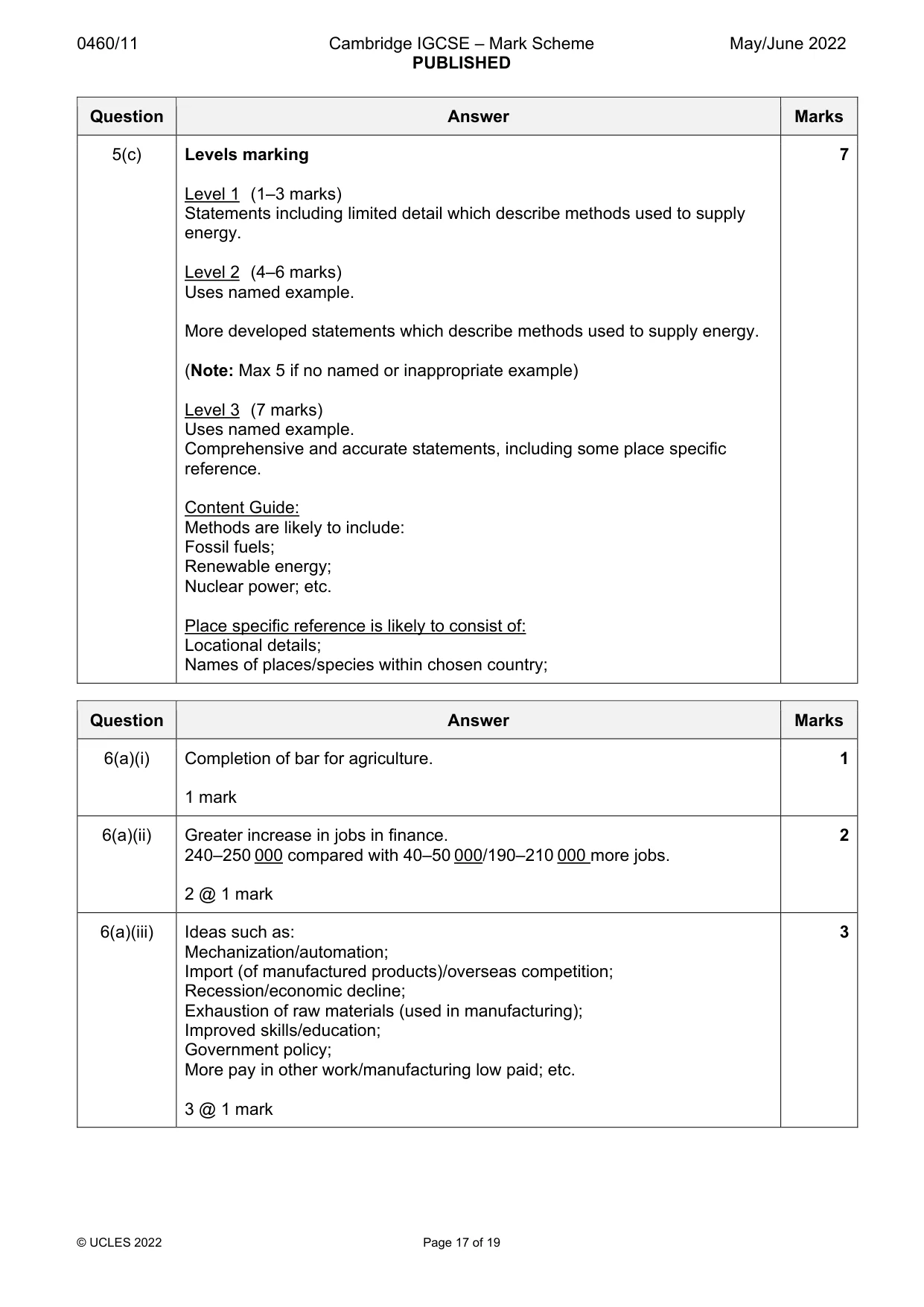
0460/11 Cambridge IGCSE – Mark Scheme PUBLISHED May/June 2022 © UCLES 2022 Page 17 of 19 Question Answer Marks 5(c) Levels marking Level 1 (1–3 marks) Statements including limited detail which describe methods used to supply energy. Level 2 (4–6 marks) Uses named example. More developed statements which describe methods used to supply energy. (Note: Max 5 if no named or inappropriate example) Level 3 (7 marks) Uses named example. Comprehensive and accurate statements, including some place specific reference. Content Guide: Methods are likely to include: Fossil fuels; Renewable energy; Nuclear power; etc. Place specific reference is likely to consist of: Locational details; Names of places/species within chosen country; 7 Question Answer Marks 6(a)(i) Completion of bar for agriculture. 1 mark 1 6(a)(ii) Greater increase in jobs in finance. 240–250 000 compared with 40–50 000/190–210 000 more jobs. 2 @ 1 mark 2 6(a)(iii) Ideas such as: Mechanization/automation; Import (of manufactured products)/overseas competition; Recession/economic decline; Exhaustion of raw materials (used in manufacturing); Improved skills/education; Government policy; More pay in other work/manufacturing low paid; etc. 3 @ 1 mark 3
Mark scheme, page 18
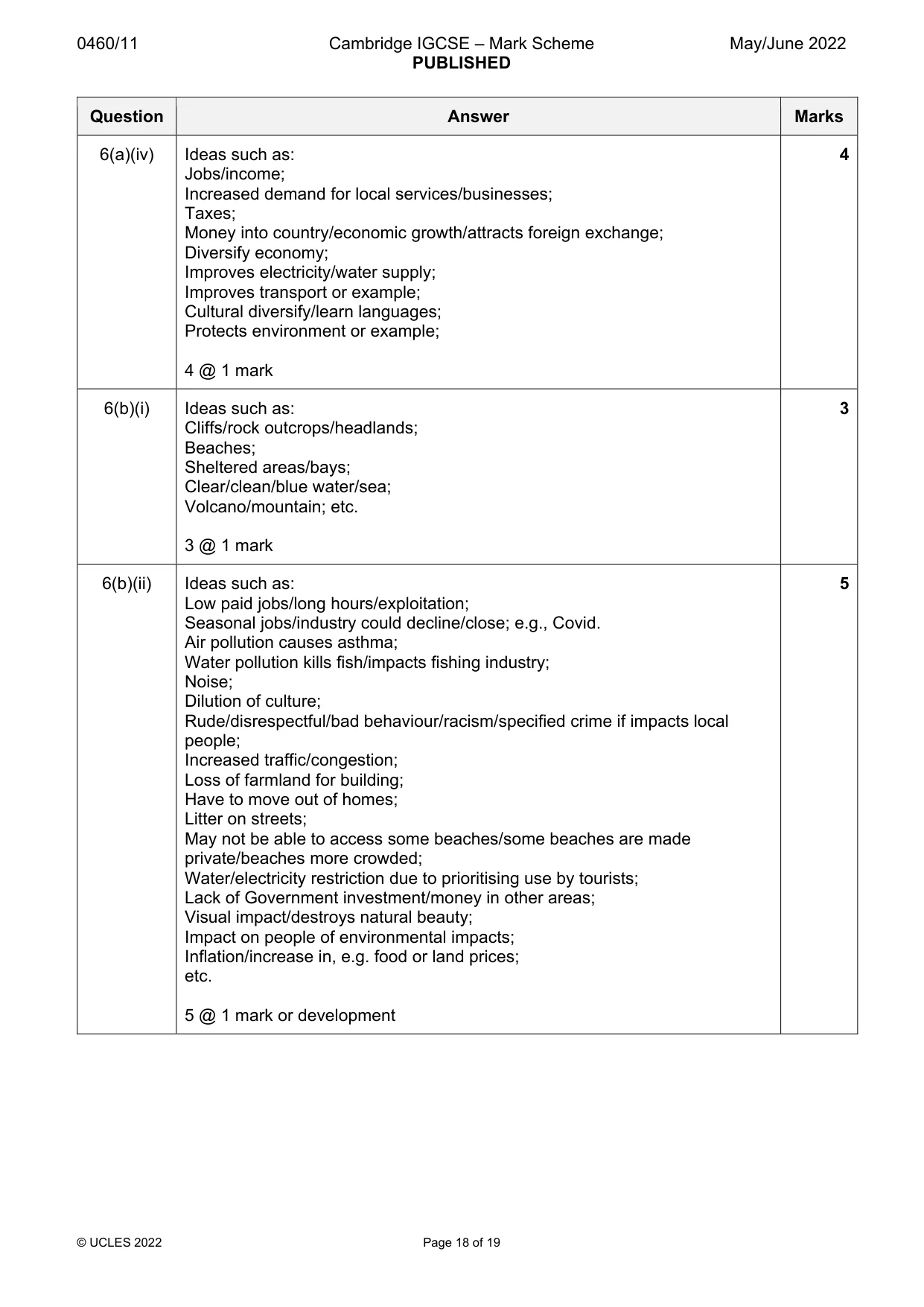
0460/11 Cambridge IGCSE – Mark Scheme PUBLISHED May/June 2022 © UCLES 2022 Page 18 of 19 Question Answer Marks 6(a)(iv) Ideas such as: Jobs/income; Increased demand for local services/businesses; Taxes; Money into country/economic growth/attracts foreign exchange; Diversify economy; Improves electricity/water supply; Improves transport or example; Cultural diversify/learn languages; Protects environment or example; 4 @ 1 mark 4 6(b)(i) Ideas such as: Cliffs/rock outcrops/headlands; Beaches; Sheltered areas/bays; Clear/clean/blue water/sea; Volcano/mountain; etc. 3 @ 1 mark 3 6(b)(ii) Ideas such as: Low paid jobs/long hours/exploitation; Seasonal jobs/industry could decline/close; e.g., Covid. Air pollution causes asthma; Water pollution kills fish/impacts fishing industry; Noise; Dilution of culture; Rude/disrespectful/bad behaviour/racism/specified crime if impacts local people; Increased traffic/congestion; Loss of farmland for building; Have to move out of homes; Litter on streets; May not be able to access some beaches/some beaches are made private/beaches more crowded; Water/electricity restriction due to prioritising use by tourists; Lack of Government investment/money in other areas; Visual impact/destroys natural beauty; Impact on people of environmental impacts; Inflation/increase in, e.g. food or land prices; etc. 5 @ 1 mark or development 5
Mark scheme, page 19
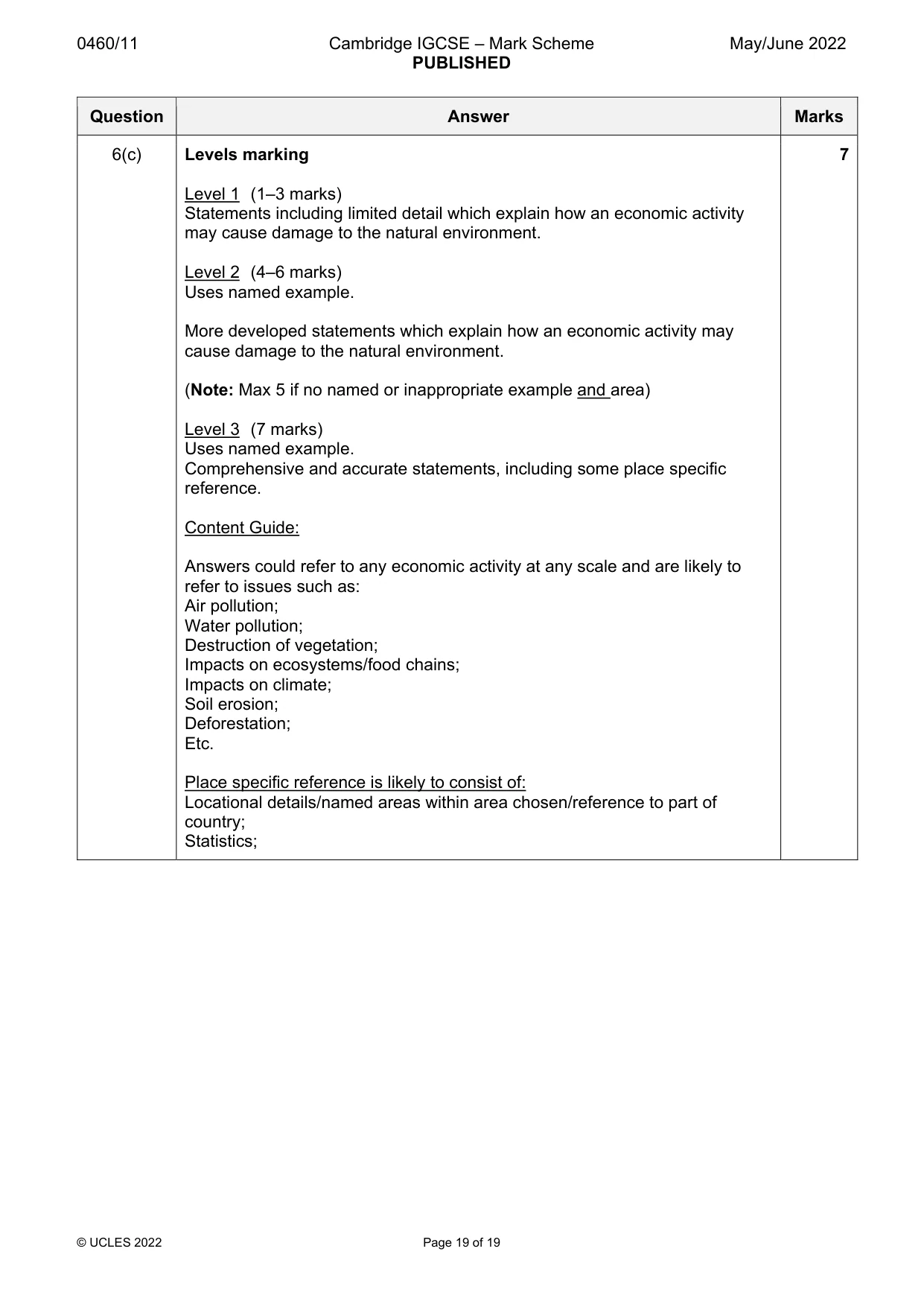
0460/11 Cambridge IGCSE – Mark Scheme PUBLISHED May/June 2022 © UCLES 2022 Page 19 of 19 Question Answer Marks 6(c) Levels marking Level 1 (1–3 marks) Statements including limited detail which explain how an economic activity may cause damage to the natural environment. Level 2 (4–6 marks) Uses named example. More developed statements which explain how an economic activity may cause damage to the natural environment. (Note: Max 5 if no named or inappropriate example and area) Level 3 (7 marks) Uses named example. Comprehensive and accurate statements, including some place specific reference. Content Guide: Answers could refer to any economic activity at any scale and are likely to refer to issues such as: Air pollution; Water pollution; Destruction of vegetation; Impacts on ecosystems/food chains; Impacts on climate; Soil erosion; Deforestation; Etc. Place specific reference is likely to consist of: Locational details/named areas within area chosen/reference to part of country; Statistics; 7
What you needed in this session
Cambridge’s own grade thresholds for 2022 May/June, Paper 1 · Variant 1. A higher threshold means an easier paper — the bar moves with how the cohort did.