Cambridge IGCSE Geography 0460 — 2023 Oct/Nov Paper 1 · Variant 3
0460/13/O/N/23 · 75 marks · ≈84 min
The question paper and its mark scheme, free to read here and free to download. This is Cambridge’s own paper, exactly as it was sat.
Question paper32 pages








Mark scheme22 pages
Answers below. Sit the paper first if you are practising.
Paper as text
Question paper, page 1
This document has 32 pages. Any blank pages are indicated. [Turn over Cambridge IGCSE™ GEOGRAPHY 0460/13 Paper 1 Geographical Themes October/November 2023 1 hour 45 minutes You must answer on the question paper. You will need: Insert (enclosed) Ruler Calculator Protractor INSTRUCTIONS ● Answer three questions in total, one from each section. ● Use a black or dark blue pen. You may use an HB pencil for any diagrams or graphs. ● Write your name, centre number and candidate number in the boxes at the top of the page. ● Write your answer to each question in the space provided. ● Do not use an erasable pen or correction fluid. ● Do not write on any bar codes. ● If additional space is needed, you should use the lined pages at the end of this booklet; the question number or numbers must be clearly shown. INFORMATION ● The total mark for this paper is 75. ● The number of marks for each question or part question is shown in brackets [ ]. ● The insert contains additional resources referred to in the questions. Definitions MEDCs – More Economically Developed Countries LEDCs – Less Economically Developed Countries * 6 0 5 8 0 3 9 8 7 9 * DC (LK/CT) 312738/5 © UCLES 2023
Question paper, page 2
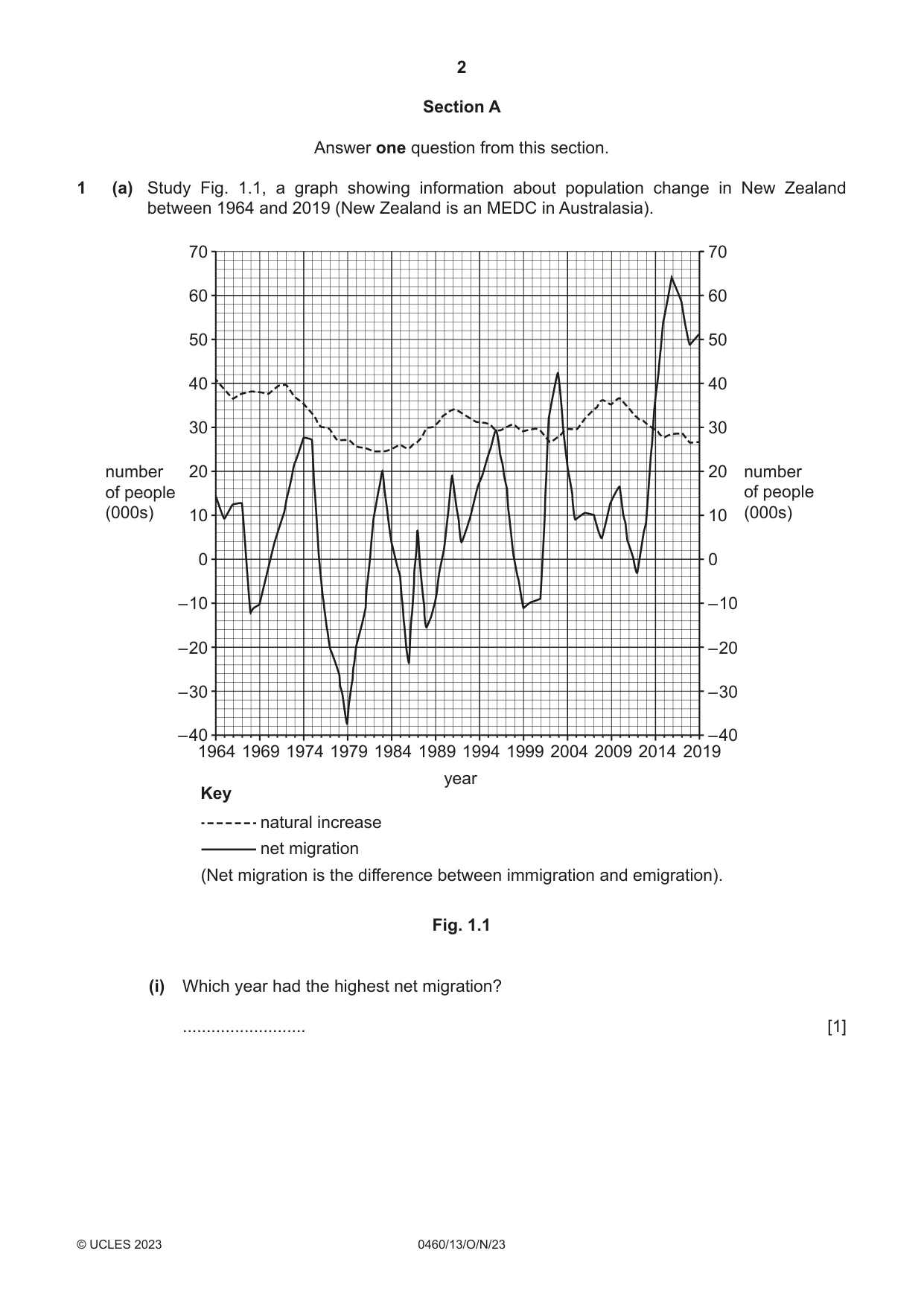
2 0460/13/O/N/23 © UCLES 2023 Section A Answer one question from this section. 1 (a) Study Fig. 1.1, a graph showing information about population change in New Zealand between 1964 and 2019 (New Zealand is an MEDC in Australasia). 2014 2009 2004 1999 1994 1989 1984 1979 1974 1969 1964 2019 Key – 40 – 20 – 10 – 30 0 0 20 30 10 40 60 50 70 – 40 – 20 – 10 – 30 20 30 10 40 60 50 70 number of people (000s) number of people (000s) year natural increase net migration (Net migration is the difference between immigration and emigration). Fig. 1.1 (i) Which year had the highest net migration? … [1]
Question paper, page 3
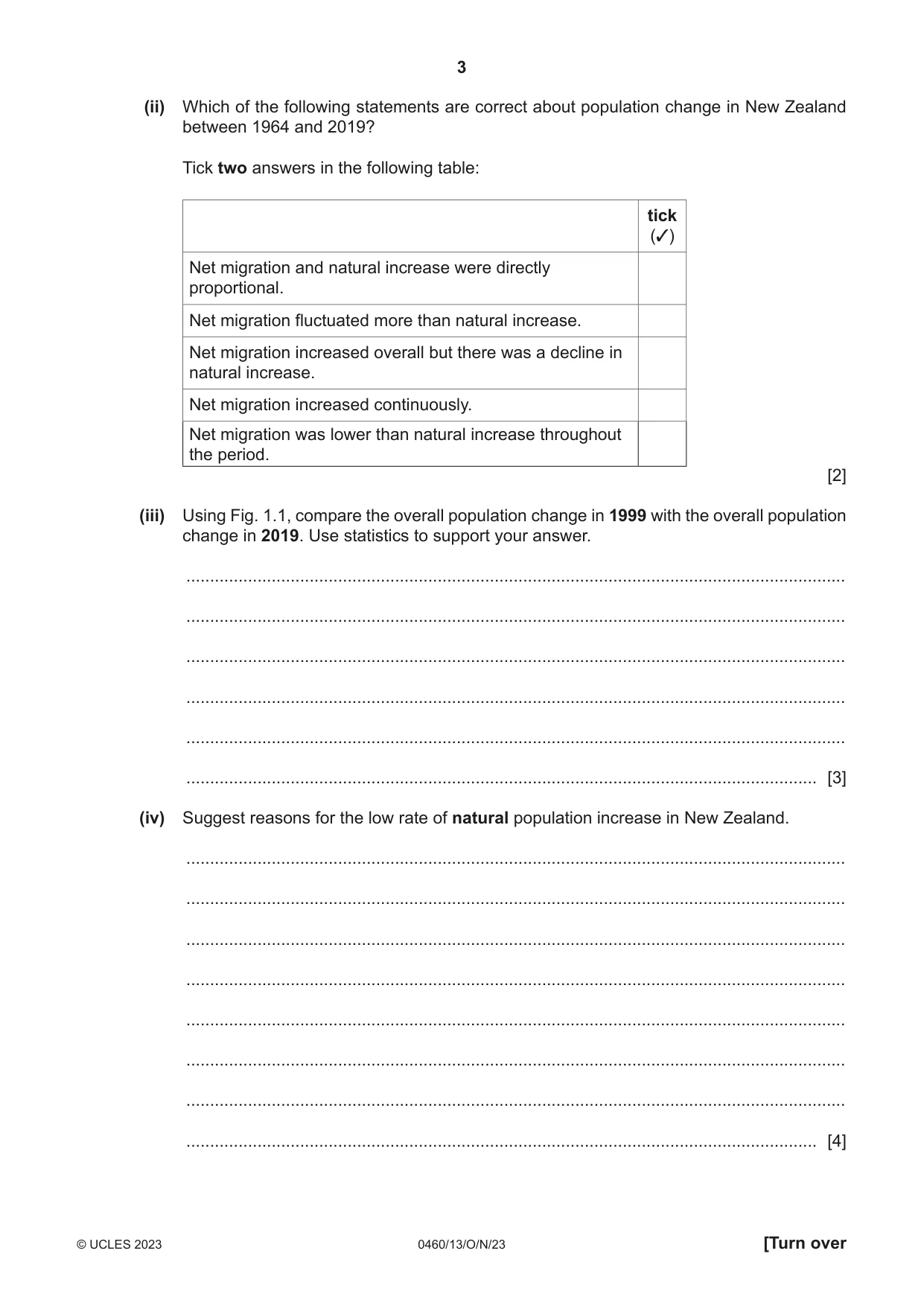
3 0460/13/O/N/23 © UCLES 2023 [Turn over (ii) Which of the following statements are correct about population change in New Zealand between 1964 and 2019? Tick two answers in the following table: tick (3) Net migration and natural increase were directly proportional. Net migration fluctuated more than natural increase. Net migration increased overall but there was a decline in natural increase. Net migration increased continuously. Net migration was lower than natural increase throughout the period. [2] (iii) Using Fig. 1.1, compare the overall population change in 1999 with the overall population change in 2019. Use statistics to support your answer. … … … … … … [3] (iv) Suggest reasons for the low rate of natural population increase in New Zealand. … … … … … … … … [4]
Question paper, page 4
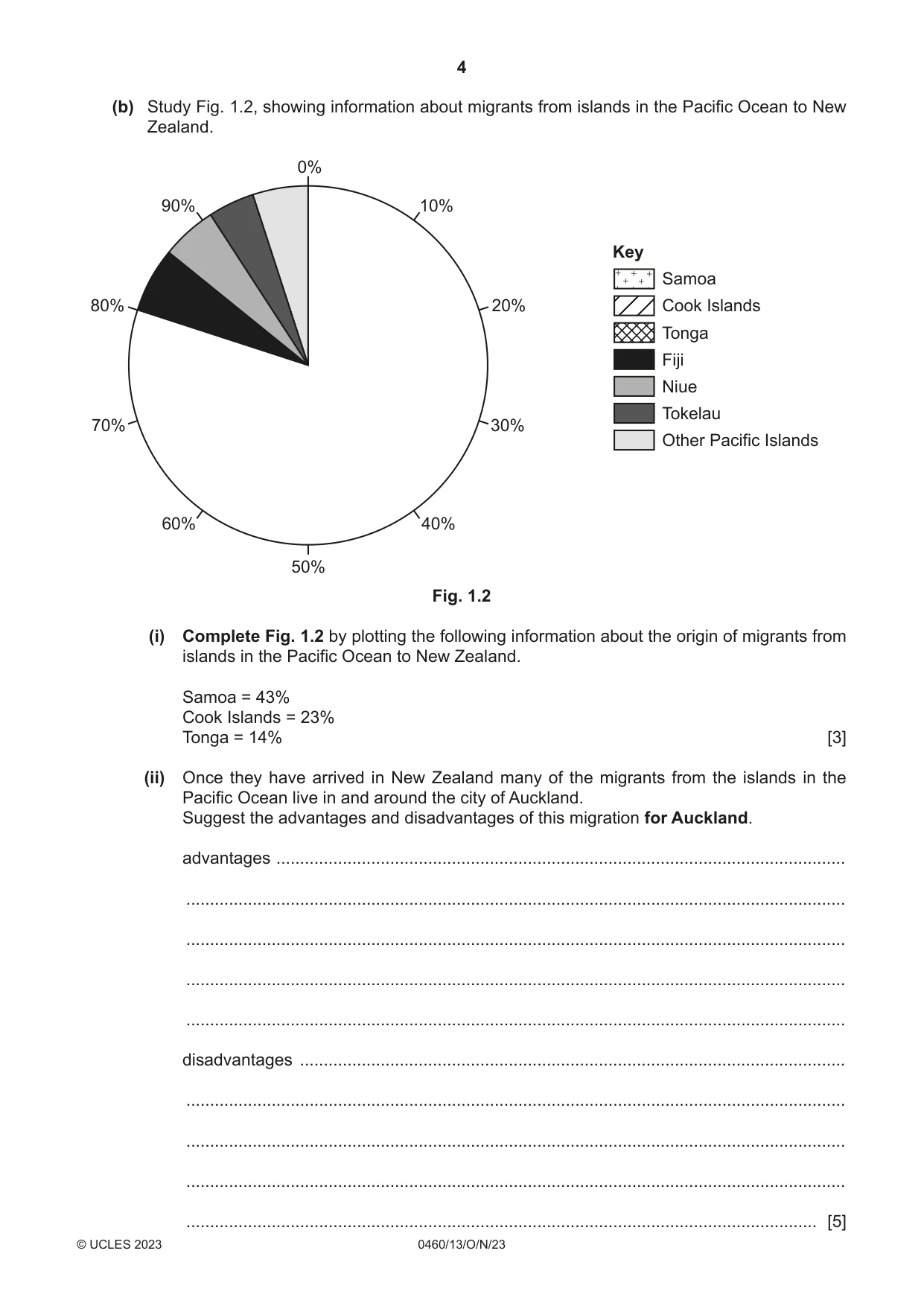
4 0460/13/O/N/23 © UCLES 2023 (b) Study Fig. 1.2, showing information about migrants from islands in the Pacific Ocean to New Zealand. Key Samoa Cook Islands Tonga Fiji Niue Tokelau Other Pacific Islands 0% 10% 20% 30% 40% 90% 80% 70% 60% 50% Fig. 1.2 (i) Complete Fig. 1.2 by plotting the following information about the origin of migrants from islands in the Pacific Ocean to New Zealand. Samoa = 43% Cook Islands = 23% Tonga = 14% [3] (ii) Once they have arrived in New Zealand many of the migrants from the islands in the Pacific Ocean live in and around the city of Auckland. Suggest the advantages and disadvantages of this migration for Auckland. advantages … … … … … disadvantages … … … … … [5]
Question paper, page 5
5 0460/13/O/N/23 © UCLES 2023 [Turn over (c) For an example of international migration you have studied, explain why there has been movement of large numbers of people. You should refer to push and pull factors. Migration from … to … … … … … … … … … … … … … … … … … … … … … … … … … … [7] [Total: 25]
Question paper, page 6
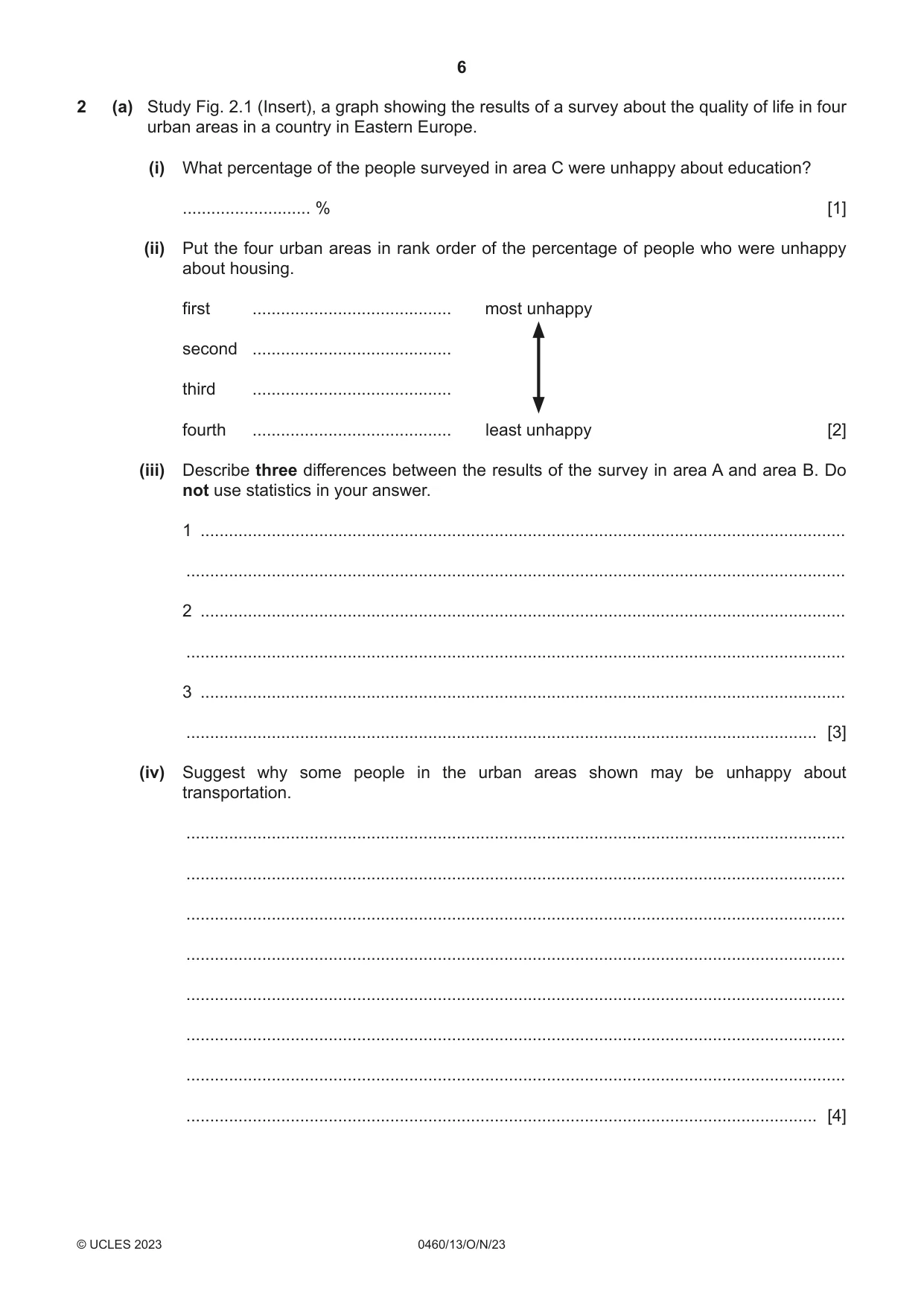
6 0460/13/O/N/23 © UCLES 2023 2 (a) Study Fig. 2.1 (Insert), a graph showing the results of a survey about the quality of life in four urban areas in a country in Eastern Europe. (i) What percentage of the people surveyed in area C were unhappy about education? … % [1] (ii) Put the four urban areas in rank order of the percentage of people who were unhappy about housing. first … most unhappy second … third … fourth … least unhappy [2] (iii) Describe three differences between the results of the survey in area A and area B. Do not use statistics in your answer. 1 … … 2 … … 3 … … [3] (iv) Suggest why some people in the urban areas shown may be unhappy about transportation. … … … … … … … … [4]
Question paper, page 7
7 0460/13/O/N/23 © UCLES 2023 [Turn over (b) Study Fig. 2.2 (Insert), a photograph showing housing in a city in Eastern Europe. (i) Describe three likely problems of living in the housing shown in Fig. 2.2. 1 … … 2 … … 3 … … [3] (ii) In many urban areas there are inequalities. Suggest reasons for the inequalities which exist between the people living in urban areas. … … … … … … … … … … [5]
Question paper, page 8
8 0460/13/O/N/23 © UCLES 2023 (c) For a named urban area you have studied, describe the strategies used to improve the housing. Name of urban area … … … … … … … … … … … … … … … … … … … … … … … … … … [7] [Total: 25]
Question paper, page 9
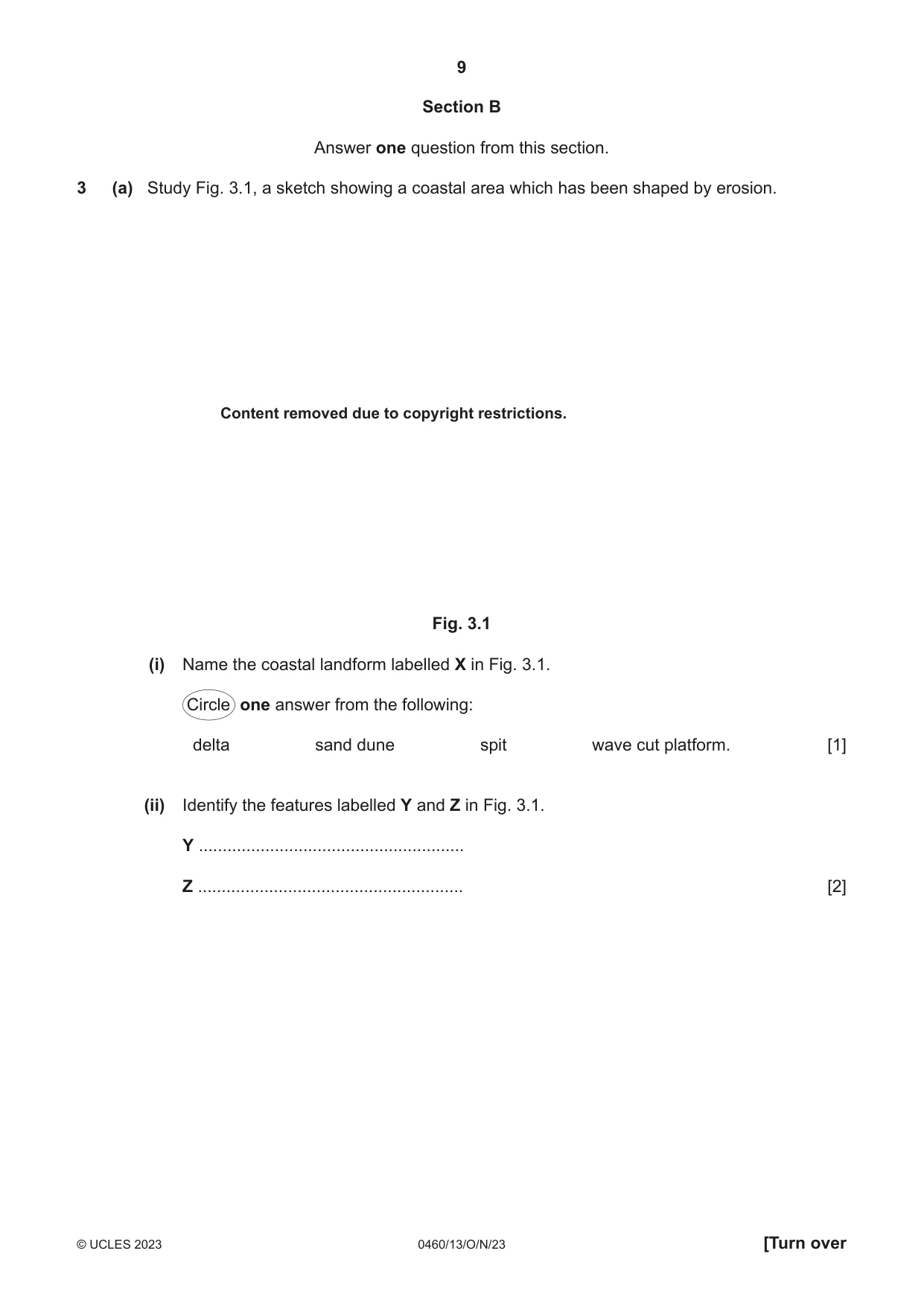
9 0460/13/O/N/23 © UCLES 2023 [Turn over Section B Answer one question from this section. 3 (a) Study Fig. 3.1, a sketch showing a coastal area which has been shaped by erosion. Fig. 3.1 (i) Name the coastal landform labelled X in Fig. 3.1. Circle one answer from the following: delta sand dune spit wave cut platform. [1] (ii) Identify the features labelled Y and Z in Fig. 3.1. Y … Z … [2] Content removed due to copyright restrictions.
Question paper, page 10
10 0460/13/O/N/23 © UCLES 2023 (iii) The area shown in Fig. 3.1 is affected by destructive waves. Describe three differences between destructive and constructive waves. 1 … … 2 … … 3 … … [3] (iv) Describe the problems which may be caused by coastal erosion for people living on or near the coast. … … … … … … … … [4]
Question paper, page 11
11 0460/13/O/N/23 © UCLES 2023 [Turn over (b) Study Fig. 3.2 (Insert), a photograph showing part of a headland. (i) Describe the features of the headland shown in Fig. 3.2. … … … … … … [3] (ii) Suggest how natural processes have formed the cave labelled C in Fig. 3.2. … … … … … … … … … … [5]
Question paper, page 12
12 0460/13/O/N/23 © UCLES 2023 (c) For a named area of coast you have studied, describe the benefits for people of living on or near the coast. Name of area of coast … … … … … … … … … … … … … … … … … … … … … … … … … … [7] [Total: 25]
Question paper, page 13
13 0460/13/O/N/23 © UCLES 2023 [Turn over BLANK PAGE
Question paper, page 14
14 0460/13/O/N/23 © UCLES 2023 4 (a) Study Fig. 4.1, showing volcanoes at two different types of plate boundary. constructive (divergent) boundary destructive (convergent) boundary Fig. 4.1 (i) Compare the direction of plate movement at the constructive (divergent) and destructive (convergent) plate boundaries. … … [1] Content removed due to copyright restrictions. Content removed due to copyright restrictions.
Question paper, page 15
15 0460/13/O/N/23 © UCLES 2023 [Turn over (ii) Choose the correct label to be placed at each of X and Y in Fig. 4.1. Choose your answers from the following list: – convection currents – earth’s core – epicentre – lava escaping from the volcano – subduction. X … Y … [2] (iii) Describe the main characteristics of shield volcanoes which form at constructive (divergent) plate boundaries. … … … … … … [3] (iv) Explain why volcanoes are formed at destructive (convergent) plate boundaries. … … … … … … … … [4]
Question paper, page 16
16 0460/13/O/N/23 © UCLES 2023 (b) Study Fig. 4.2, a scatter graph showing the relationship between the length of volcanic eruptions and the time between them. Fig. 4.2 (i) To what extent does Fig. 4.2 show that there is a relationship between the length of volcanic eruptions and the time between them? … … … … … … [3] Content removed due to copyright restrictions.
Question paper, page 17
17 0460/13/O/N/23 © UCLES 2023 [Turn over (ii) Describe the strategies which can be used to reduce the impacts of volcanic eruptions. … … … … … … … … … … [5]
Question paper, page 18
18 0460/13/O/N/23 © UCLES 2023 (c) For a named volcano you have studied, explain how volcanoes provide opportunities for people who live in the area. Name of volcano … … … … … … … … … … … … … … … … … … … … … … … … … … [7] [Total: 25]
Question paper, page 19
19 0460/13/O/N/23 © UCLES 2023 [Turn over BLANK PAGE
Question paper, page 20
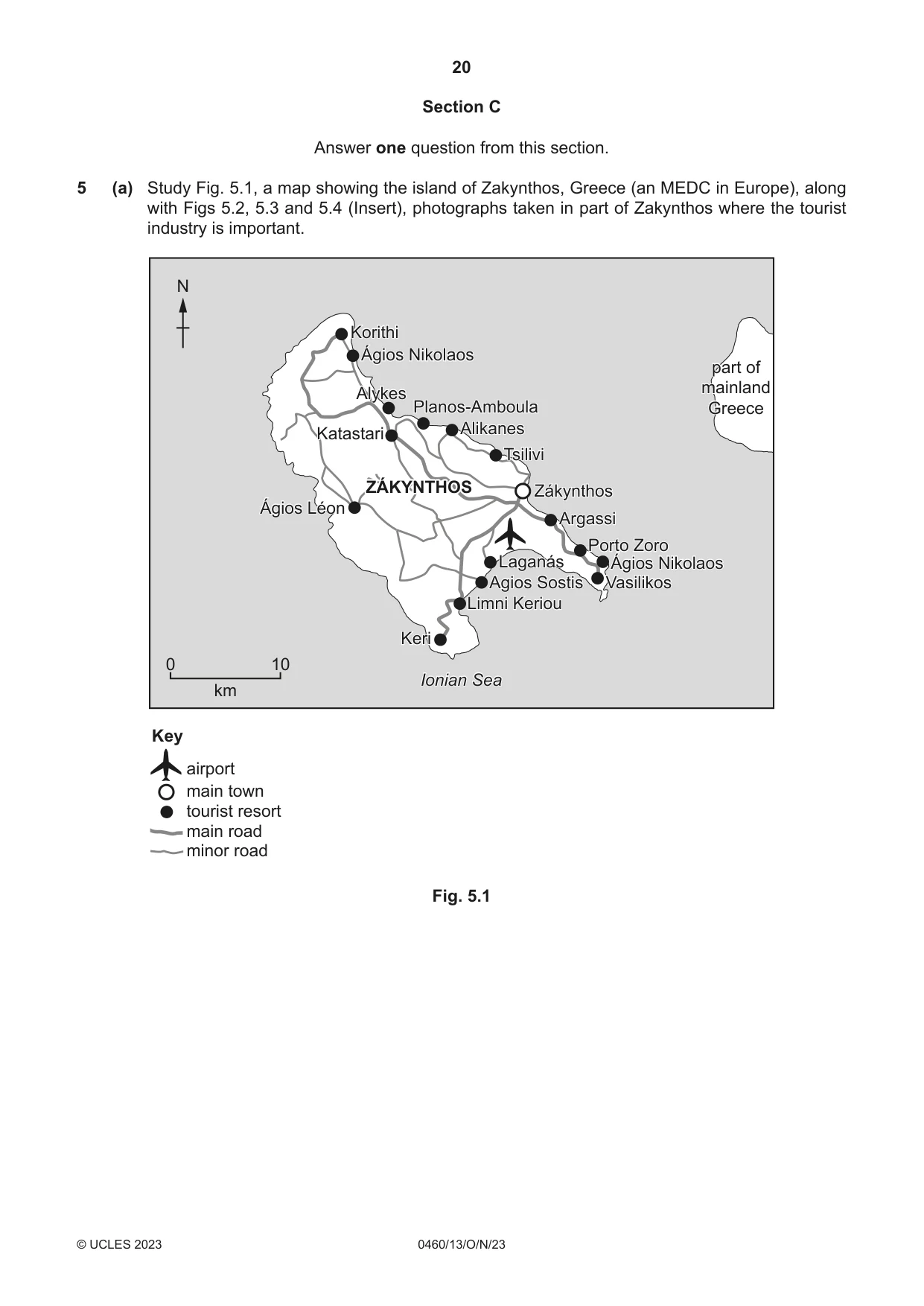
20 0460/13/O/N/23 © UCLES 2023 Section C Answer one question from this section. 5 (a) Study Fig. 5.1, a map showing the island of Zakynthos, Greece (an MEDC in Europe), along with Figs 5.2, 5.3 and 5.4 (Insert), photographs taken in part of Zakynthos where the tourist industry is important. Zákynthos Zákynthos N km 0 10 Ionian Sea Ionian Sea Korithi Korithi Ágios Nikolaos Ágios Nikolaos Ágios Nikolaos Ágios Nikolaos Ágios Léon Ágios Léon ZÁKYNTHOS ZÁKYNTHOS Katastari Katastari Keri Keri Alykes Alykes Argassi Argassi Porto Zoro Porto Zoro Vasilikos Vasilikos Limni Keriou Limni Keriou Agios Sostis Agios Sostis Laganás Laganás Tsilivi Tsilivi Planos-Amboula Planos-Amboula Alikanes Alikanes part of mainland Greece part of mainland Greece Key airport main town main road minor road tourist resort Fig. 5.1
Question paper, page 21
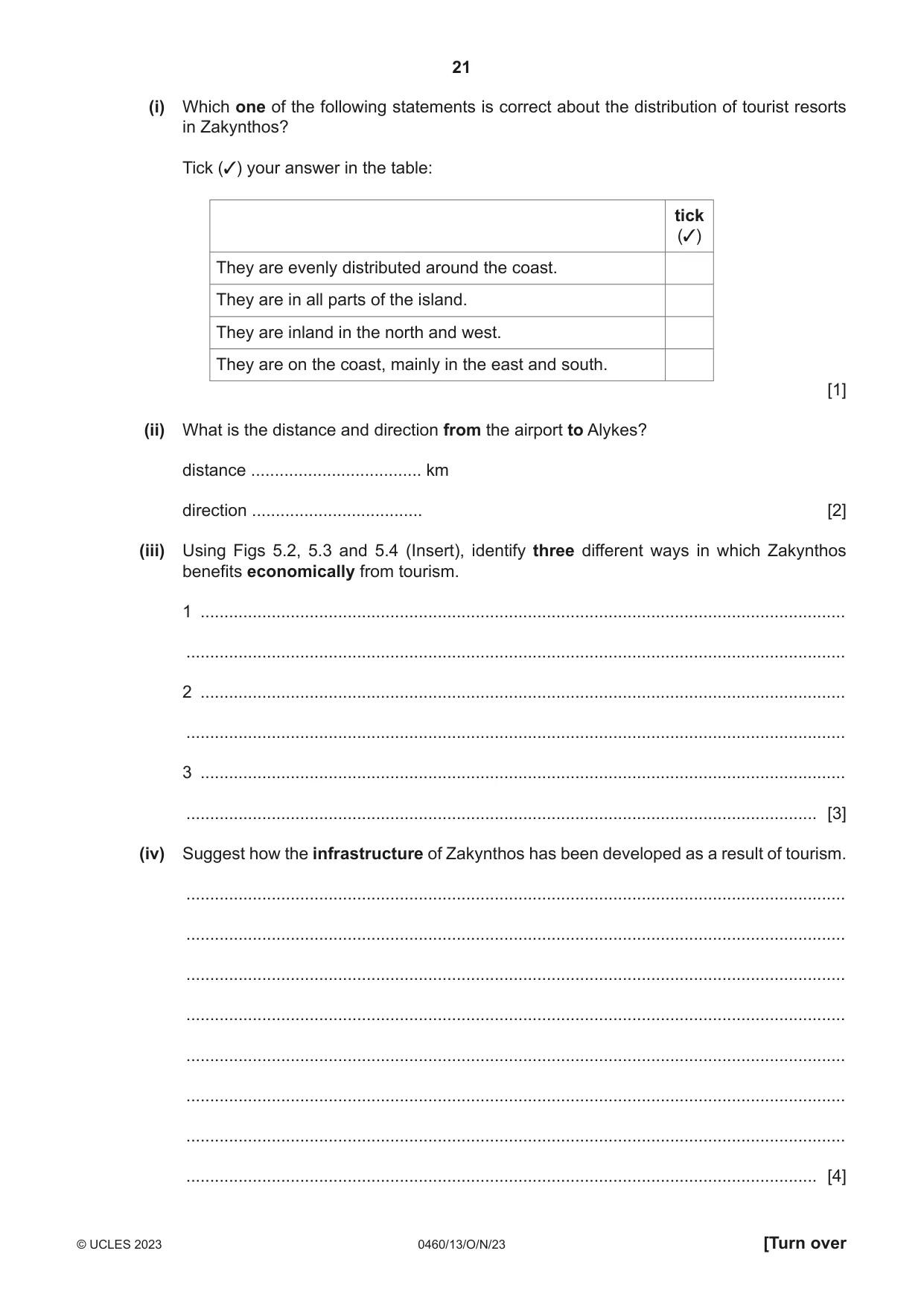
21 0460/13/O/N/23 © UCLES 2023 [Turn over (i) Which one of the following statements is correct about the distribution of tourist resorts in Zakynthos? Tick (3) your answer in the table: tick (3) They are evenly distributed around the coast. They are in all parts of the island. They are inland in the north and west. They are on the coast, mainly in the east and south. [1] (ii) What is the distance and direction from the airport to Alykes? distance … km direction … [2] (iii) Using Figs 5.2, 5.3 and 5.4 (Insert), identify three different ways in which Zakynthos benefits economically from tourism. 1 … … 2 … … 3 … … [3] (iv) Suggest how the infrastructure of Zakynthos has been developed as a result of tourism. … … … … … … … … [4]
Question paper, page 22
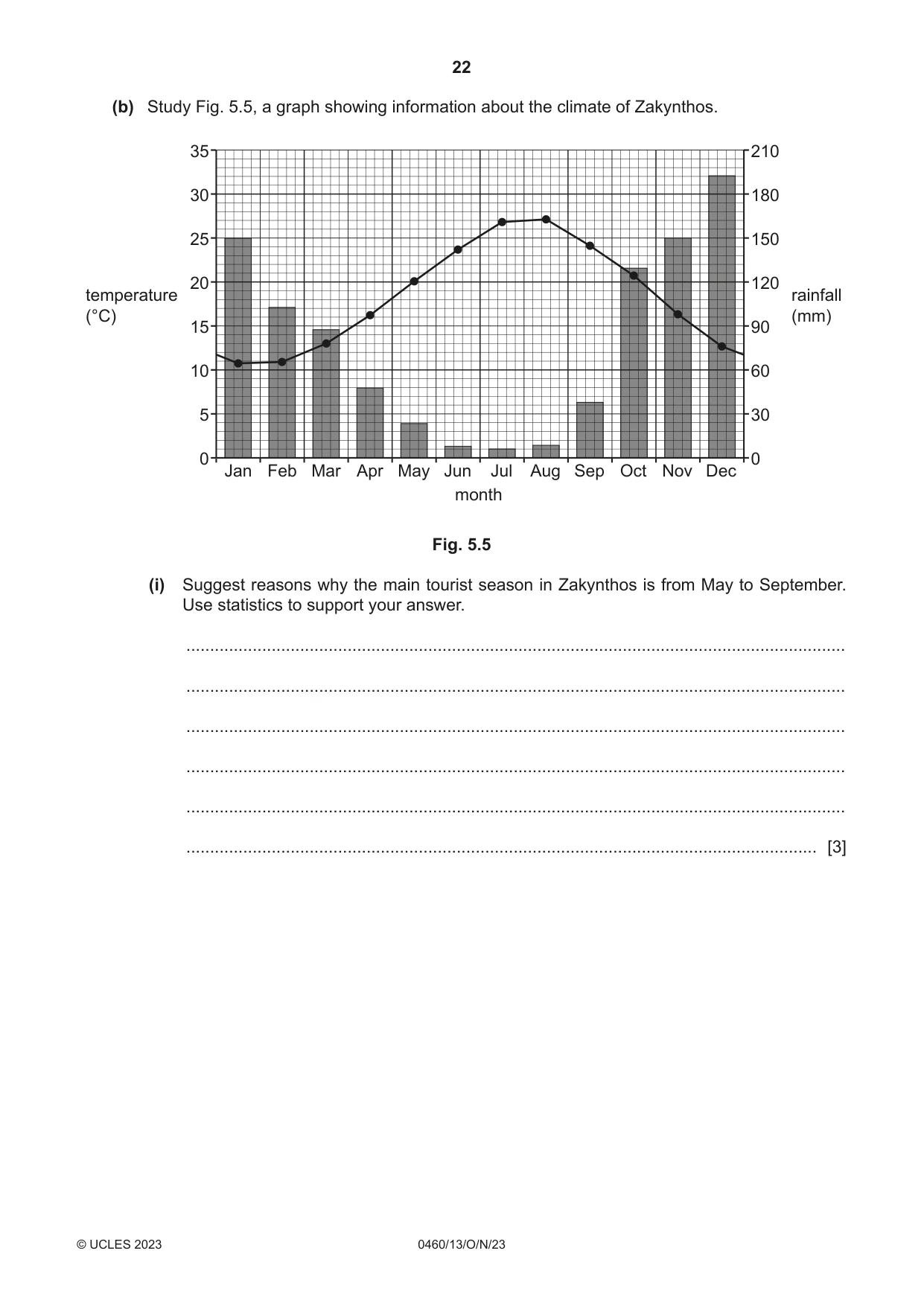
22 0460/13/O/N/23 © UCLES 2023 (b) Study Fig. 5.5, a graph showing information about the climate of Zakynthos. 0 5 10 15 20 25 30 35 temperature (°C) 0 30 60 90 120 150 180 210 rainfall (mm) Jan Feb Mar Apr May Jun month Jul Aug Sep Oct Nov Dec Fig. 5.5 (i) Suggest reasons why the main tourist season in Zakynthos is from May to September. Use statistics to support your answer. … … … … … … [3]
Question paper, page 23
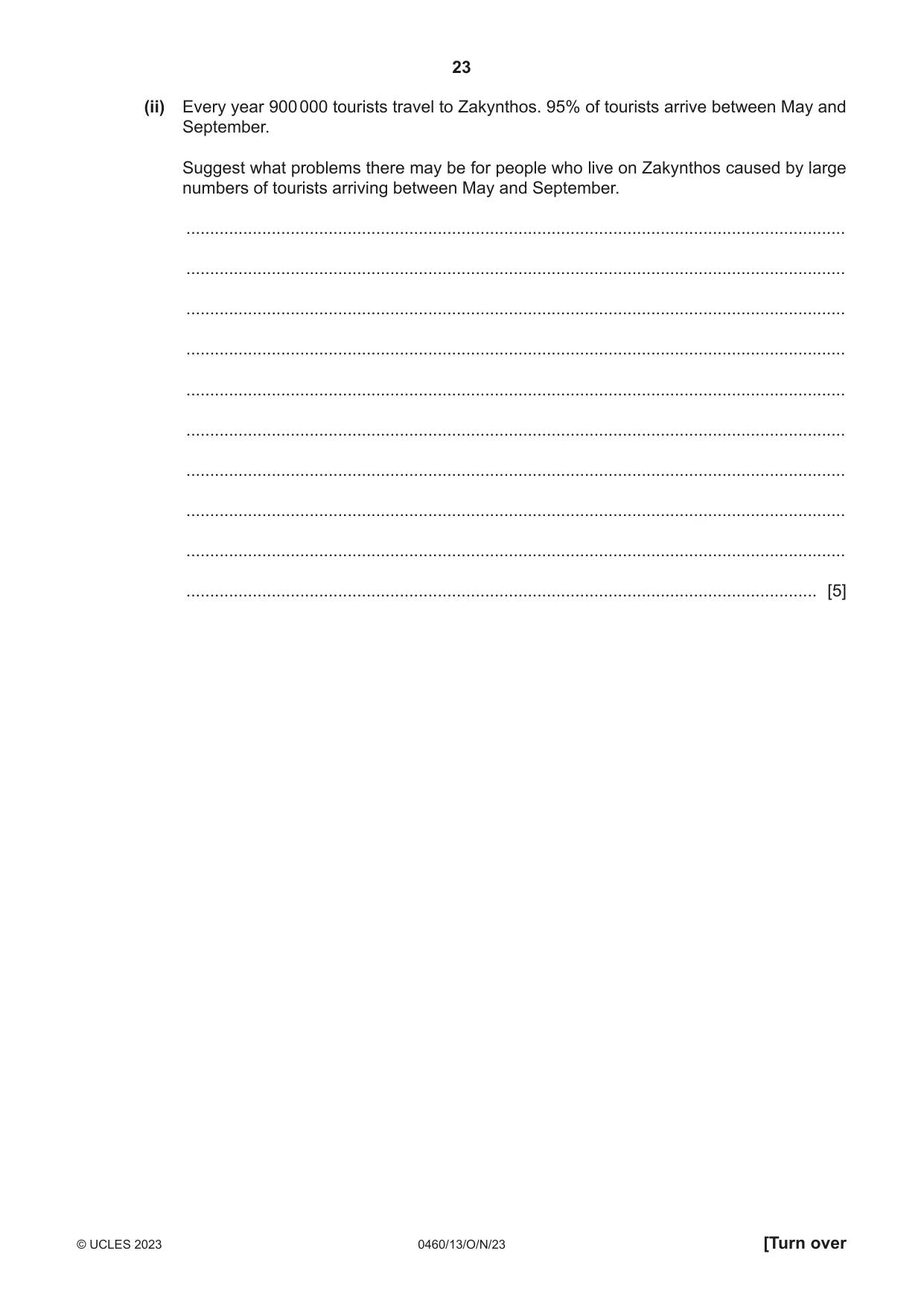
23 0460/13/O/N/23 © UCLES 2023 [Turn over (ii) Every year 900 000 tourists travel to Zakynthos. 95% of tourists arrive between May and September. Suggest what problems there may be for people who live on Zakynthos caused by large numbers of tourists arriving between May and September. … … … … … … … … … … [5]
Question paper, page 24
24 0460/13/O/N/23 © UCLES 2023 (c) For a named area you have studied where tourism is important, describe the attractions of the physical and human landscape. Name of area … … … … … … … … … … … … … … … … … … … … … … … … … … [7] [Total: 25]
Question paper, page 25
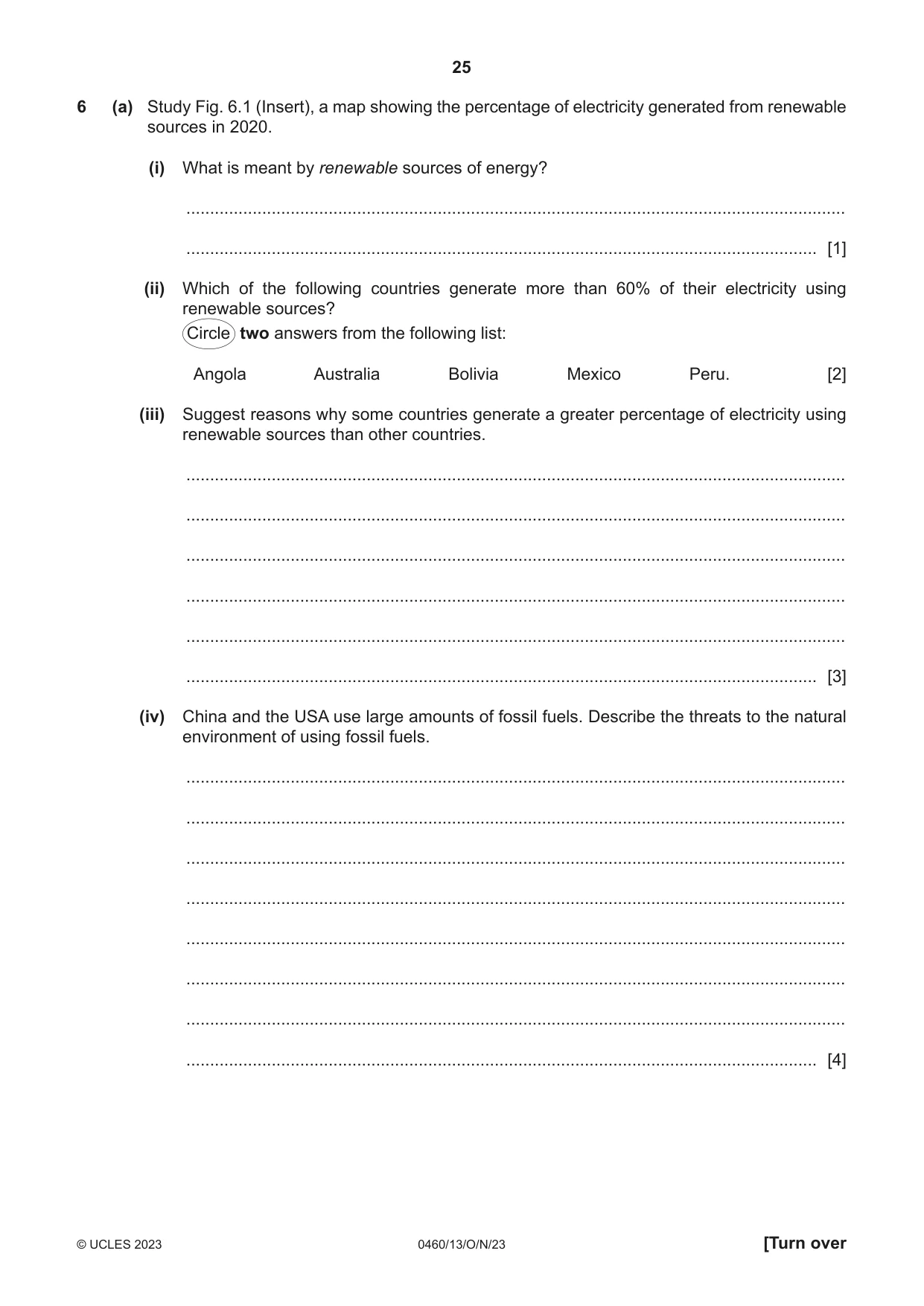
25 0460/13/O/N/23 © UCLES 2023 [Turn over 6 (a) Study Fig. 6.1 (Insert), a map showing the percentage of electricity generated from renewable sources in 2020. (i) What is meant by renewable sources of energy? … … [1] (ii) Which of the following countries generate more than 60% of their electricity using renewable sources? Circle two answers from the following list: Angola Australia Bolivia Mexico Peru. [2] (iii) Suggest reasons why some countries generate a greater percentage of electricity using renewable sources than other countries. … … … … … … [3] (iv) China and the USA use large amounts of fossil fuels. Describe the threats to the natural environment of using fossil fuels. … … … … … … … … [4]
Question paper, page 26
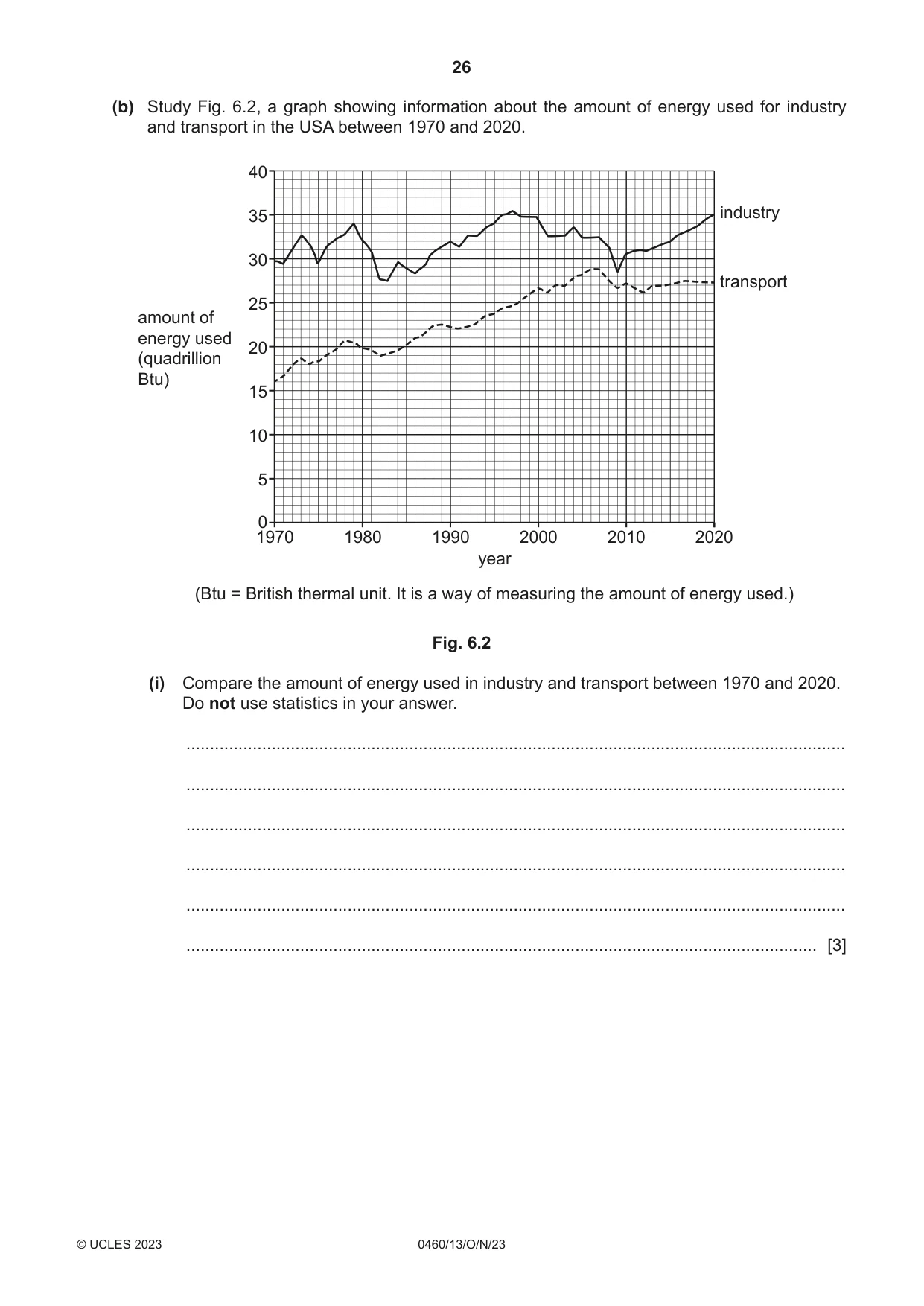
26 0460/13/O/N/23 © UCLES 2023 (b) Study Fig. 6.2, a graph showing information about the amount of energy used for industry and transport in the USA between 1970 and 2020. 0 5 10 15 20 25 30 35 40 1970 1980 1990 2000 2010 year 2020 amount of energy used (quadrillion Btu) industry transport (Btu = British thermal unit. It is a way of measuring the amount of energy used.) Fig. 6.2 (i) Compare the amount of energy used in industry and transport between 1970 and 2020. Do not use statistics in your answer. … … … … … … [3]
Question paper, page 27
27 0460/13/O/N/23 © UCLES 2023 [Turn over (ii) Energy is one of the inputs of an industrial system. Explain what is meant by an industrial system. … … … … … … … … … … [5]
Question paper, page 28
28 0460/13/O/N/23 © UCLES 2023 (c) Explain the factors influencing the location of a named factory or industrial zone you have studied. Name of factory or industrial zone … … … … … … … … … … … … … … … … … … … … … … … … … … [7] [Total: 25]
Question paper, page 29
29 0460/13/O/N/23 © UCLES 2023 Additional page If you use the following page to complete the answer to any question, the question number must be clearly shown. … … … … … … … … … … … … … … … … … … … … … … … … … …
Question paper, page 30
30 0460/13/O/N/23 © UCLES 2023 Additional page If you use the following page to complete the answer to any question, the question number must be clearly shown. … … … … … … … … … … … … … … … … … … … … … … … … … …
Question paper, page 31
31 0460/13/O/N/23 © UCLES 2023 BLANK PAGE
Question paper, page 32
32 0460/13/O/N/23 © UCLES 2023 BLANK PAGE The boundaries and names shown, the designations used and the presentation of material on any maps contained in this question paper/insert do not imply official endorsement or acceptance by Cambridge Assessment International Education concerning the legal status of any country, territory, or area or any of its authorities, or of the delimitation of its frontiers or boundaries. Permission to reproduce items where third-party owned material protected by copyright is included has been sought and cleared where possible. Every reasonable effort has been made by the publisher (UCLES) to trace copyright holders, but if any items requiring clearance have unwittingly been included, the publisher will be pleased to make amends at the earliest possible opportunity. To avoid the issue of disclosure of answer-related information to candidates, all copyright acknowledgements are reproduced online in the Cambridge Assessment International Education Copyright Acknowledgements Booklet. This is produced for each series of examinations and is freely available to download at www.cambridgeinternational.org after the live examination series. Cambridge Assessment International Education is part of Cambridge Assessment. Cambridge Assessment is the brand name of the University of Cambridge Local Examinations Syndicate (UCLES), which is a department of the University of Cambridge.
Mark scheme, page 1
This document consists of 22 printed pages. © UCLES 2023 [Turn over Cambridge IGCSE™ GEOGRAPHY 0460/13 Paper 1 Geographical Themes October/November 2023 MARK SCHEME Maximum Mark: 75 Published This mark scheme is published as an aid to teachers and candidates, to indicate the requirements of the examination. It shows the basis on which Examiners were instructed to award marks. It does not indicate the details of the discussions that took place at an Examiners’ meeting before marking began, which would have considered the acceptability of alternative answers. Mark schemes should be read in conjunction with the question paper and the Principal Examiner Report for Teachers. Cambridge International will not enter into discussions about these mark schemes. Cambridge International is publishing the mark schemes for the October/November 2023 series for most Cambridge IGCSE, Cambridge International A and AS Level components, and some Cambridge O Level components.
Mark scheme, page 2
0460/13 Cambridge IGCSE – Mark Scheme PUBLISHED October/November 2023 © UCLES 2023 Page 2 of 22 Generic Marking Principles These general marking principles must be applied by all examiners when marking candidate answers. They should be applied alongside the specific content of the mark scheme or generic level descriptors for a question. Each question paper and mark scheme will also comply with these marking principles. GENERIC MARKING PRINCIPLE 1: Marks must be awarded in line with: • the specific content of the mark scheme or the generic level descriptors for the question • the specific skills defined in the mark scheme or in the generic level descriptors for the question • the standard of response required by a candidate as exemplified by the standardisation scripts. GENERIC MARKING PRINCIPLE 2: Marks awarded are always whole marks (not half marks, or other fractions). GENERIC MARKING PRINCIPLE 3: Marks must be awarded positively: • marks are awarded for correct/valid answers, as defined in the mark scheme. However, credit is given for valid answers which go beyond the scope of the syllabus and mark scheme, referring to your Team Leader as appropriate • marks are awarded when candidates clearly demonstrate what they know and can do • marks are not deducted for errors • marks are not deducted for omissions • answers should only be judged on the quality of spelling, punctuation and grammar when these features are specifically assessed by the question as indicated by the mark scheme. The meaning, however, should be unambiguous. GENERIC MARKING PRINCIPLE 4: Rules must be applied consistently, e.g. in situations where candidates have not followed instructions or in the application of generic level descriptors. GENERIC MARKING PRINCIPLE 5: Marks should be awarded using the full range of marks defined in the mark scheme for the question (however; the use of the full mark range may be limited according to the quality of the candidate responses seen). GENERIC MARKING PRINCIPLE 6: Marks awarded are based solely on the requirements as defined in the mark scheme. Marks should not be awarded with grade thresholds or grade descriptors in mind.
Mark scheme, page 3
0460/13 Cambridge IGCSE – Mark Scheme PUBLISHED October/November 2023 © UCLES 2023 Page 3 of 22 Each question carries 25 marks. Candidates cannot earn above the maximum marks available within each sub section. The marking scheme attempts to give guidance about the requirements of each answer and lists a number of responses, which will earn marks along with the general principles to be applied when marking each question. It should be noted that candidates can earn marks if their answers are phrased differently provided they convey the same meaning as those in the mark scheme. THE CANDIDATES DO NOT NEED TO USE THE SAME WORDING TO EARN MARKS. The notation ‘etc.’ at the end of an answer in the mark scheme signifies that there may well be other correct responses or examples that can be given credit. Providing the statement is true, relevant to the question asked and not repetition of a previous point made credit should be given. A point made within one sub-section which is an answer to the question set in a different sub-section should not be given credit as each sub-section asks different questions which require independent answers. The mark scheme uses semi colons (;) to separate marks and diagonals to separate alternative answers. During coordination the mark scheme is modified to add points agreed after discussion or to delete any points not allowed. All examiners should ensure that their modified scheme is fully up-to-date before marking begins. Marking Mechanics. Point marking is used for sections (a) and (b) of each question, although marks are available in specified questions for development of appropriate points. Ticks should be used to clearly indicate where a mark has been allowed. Where a development point has been allowed the symbol “DEV” should be placed adjacent to the tick. The number of ticks should always be equal to the total number of marks awarded. Only one development mark for each mark scheme point please. Where a candidate makes a point which is not quite sufficient for credit an upturned ‘V’ insert symbol should be used. If after careful consideration a mark is awarded which gives ‘benefit of doubt’ to the candidate, the letter ‘J’ should be placed adjacent to the tick (i.e. the candidate has ‘just’ achieved the mark). Crosses are acceptable to signify wrong answers and the letters ‘IR/IRRL’ should be used to indicate those which are irrelevant. Levels of response marking is used for section (c) of each question. Thus, it is the quality of the response that determines which level an answer has achieved rather than the quantity of statements contained within it. However, once assigned to a level the mark achieved within that level is determined by the number of points made. Levels 1 and 2 are distinguished by whether statements are simple (level 1) or developed/elaborated (level 2). A candidate can immediately enter L2 by making developed points without making any L1 statements. In order to achieve L3 a candidate must have already reached the top end of L2 – in addition their answer should have a clear example and if the answer is place specific as well (7 marks). Highlight place specific detail. Where statements are assigned levels by the examiner this should be indicated by the use of L1 and L2 next to the statements. Ticks should not be used on answers that are marked using levels of response marking. L1 annotation should be removed once a L2 is awarded for an answer. L3 annotation is not used. There is no need for a summary level at the end of a response.
Mark scheme, page 4
0460/13 Cambridge IGCSE – Mark Scheme PUBLISHED October/November 2023 © UCLES 2023 Page 4 of 22 Summary: Level 1 (1 to 3 marks): 1 simple statement (1 mark) 2 simple statements (2 marks) 3 simple statements (3 marks) Level 2 (4 to 6 marks): 1 developed statement (4 marks) 2 developed statements (5 marks) 3 or more developed statements with e.g. (6 marks) Level 3 (7 marks) 3 or more developed statements + named example with at least one piece of place specific detail. Note. The following guidelines apply when case studies are required in part (c) questions: 1 Level 2 statements must be developed/elaborated or related relevant ideas need to be linked. 2 The use of statistics is not an acceptable form of development, thus a simple statement with statistics is a Level 1 statement. The use of statistics alone cannot be credited as an alternative to a L1 written statement. 3 Place specific information is required as part of the criteria to achieve a Level 3 answer. This could relate to the location of the case study chosen or aspects of the study which make it authentic rather than simply generic (e.g. named places within the area, other specific factual detail, relevant statistics etc.). Requirements of each study will vary and your Team Leader will provide guidance. Please note that: – if the case study requires a country name the name of the continent in which it is located is not sufficient for the place specific requirement, however with more precision it would be acceptable (e.g. ‘Nigeria, located in Africa…’ is not sufficient but ‘Nigeria, located in West Africa’ is sufficient.) – if the case study requires the name of an area/town or city the name of the country in which it is located is not sufficient for the place specific requirement, however with more precision it would be acceptable (e.g. ‘Mumbai, located in India…’ is not sufficient but ‘Mumbai, located in Western India’ is sufficient.)
Mark scheme, page 5
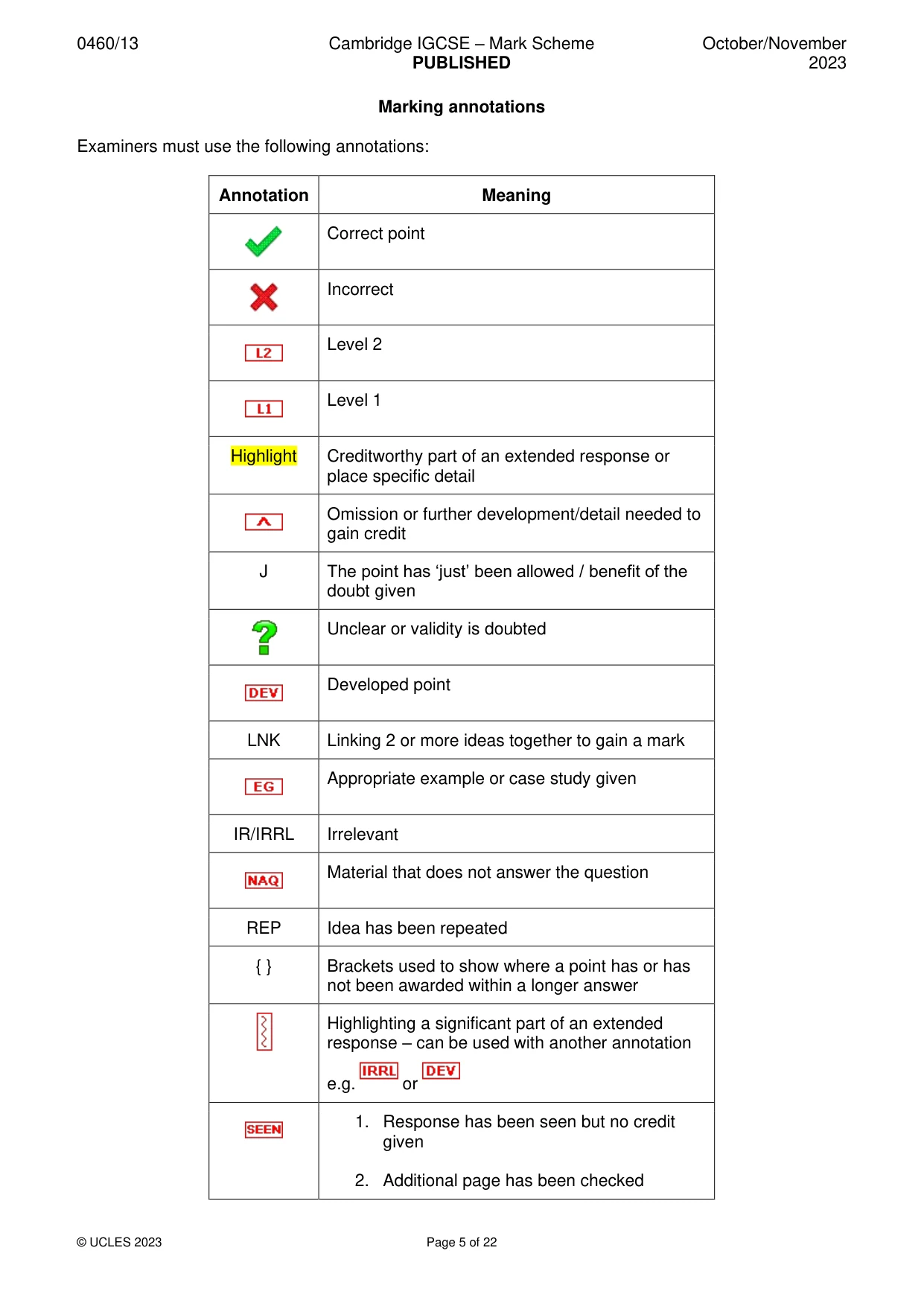
0460/13 Cambridge IGCSE – Mark Scheme PUBLISHED October/November 2023 © UCLES 2023 Page 5 of 22 Marking annotations Examiners must use the following annotations: Annotation Meaning Correct point Incorrect Level 2 Level 1 Highlight Creditworthy part of an extended response or place specific detail Omission or further development/detail needed to gain credit J The point has ‘just’ been allowed / benefit of the doubt given Unclear or validity is doubted Developed point LNK Linking 2 or more ideas together to gain a mark Appropriate example or case study given IR/IRRL Irrelevant Material that does not answer the question REP Idea has been repeated { } Brackets used to show where a point has or has not been awarded within a longer answer Highlighting a significant part of an extended response – can be used with another annotation e.g. or 1. Response has been seen but no credit given 2. Additional page has been checked
Mark scheme, page 6
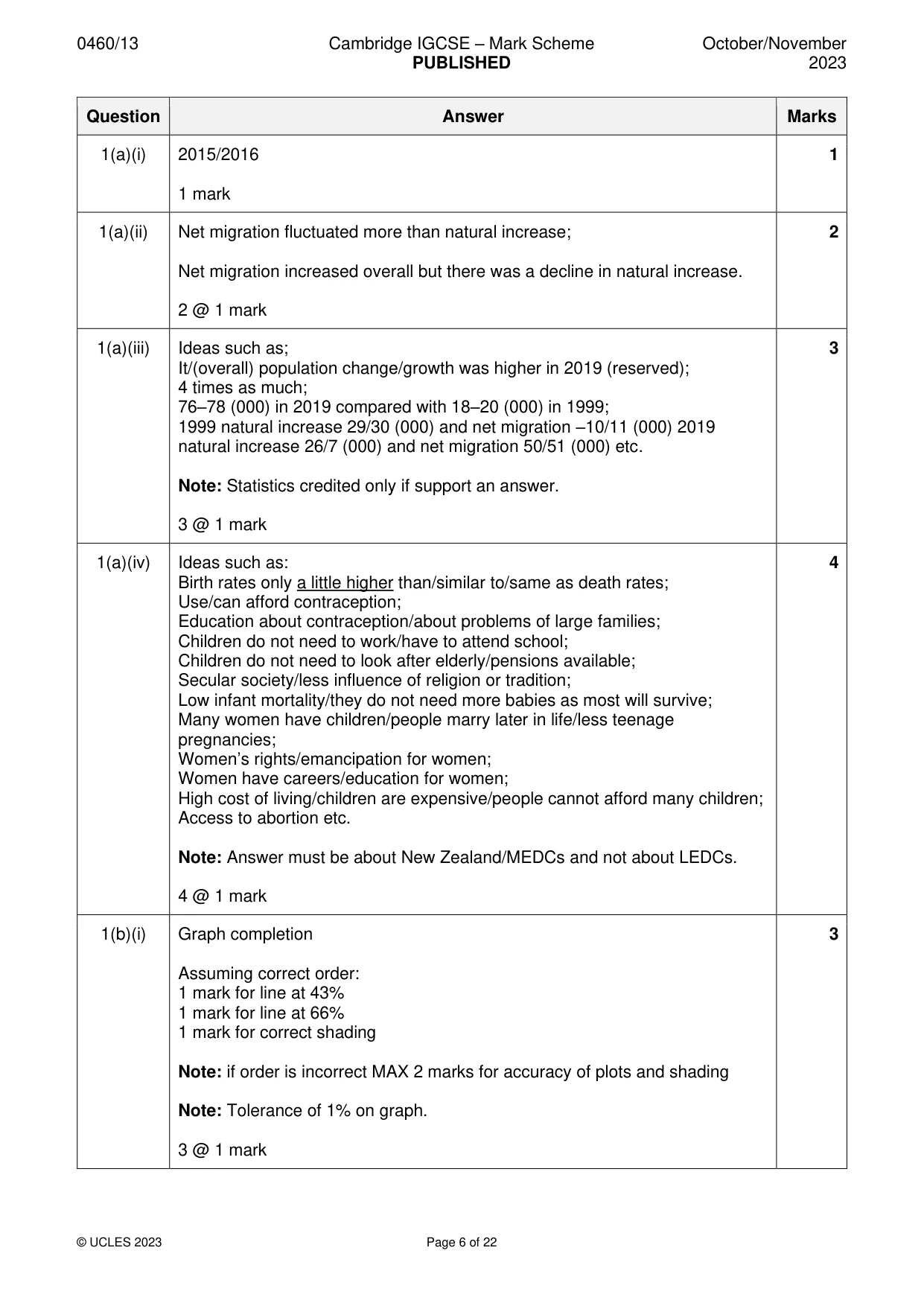
0460/13 Cambridge IGCSE – Mark Scheme PUBLISHED October/November 2023 © UCLES 2023 Page 6 of 22 Question Answer Marks 1(a)(i) 2015/2016 1 mark 1 1(a)(ii) Net migration fluctuated more than natural increase; Net migration increased overall but there was a decline in natural increase. 2 @ 1 mark 2 1(a)(iii) Ideas such as; It/(overall) population change/growth was higher in 2019 (reserved); 4 times as much; 76–78 (000) in 2019 compared with 18–20 (000) in 1999; 1999 natural increase 29/30 (000) and net migration –10/11 (000) 2019 natural increase 26/7 (000) and net migration 50/51 (000) etc. Note: Statistics credited only if support an answer. 3 @ 1 mark 3 1(a)(iv) Ideas such as: Birth rates only a little higher than/similar to/same as death rates; Use/can afford contraception; Education about contraception/about problems of large families; Children do not need to work/have to attend school; Children do not need to look after elderly/pensions available; Secular society/less influence of religion or tradition; Low infant mortality/they do not need more babies as most will survive; Many women have children/people marry later in life/less teenage pregnancies; Women’s rights/emancipation for women; Women have careers/education for women; High cost of living/children are expensive/people cannot afford many children; Access to abortion etc. Note: Answer must be about New Zealand/MEDCs and not about LEDCs. 4 @ 1 mark 4 1(b)(i) Graph completion Assuming correct order: 1 mark for line at 43% 1 mark for line at 66% 1 mark for correct shading Note: if order is incorrect MAX 2 marks for accuracy of plots and shading Note: Tolerance of 1% on graph. 3 @ 1 mark 3
Mark scheme, page 7
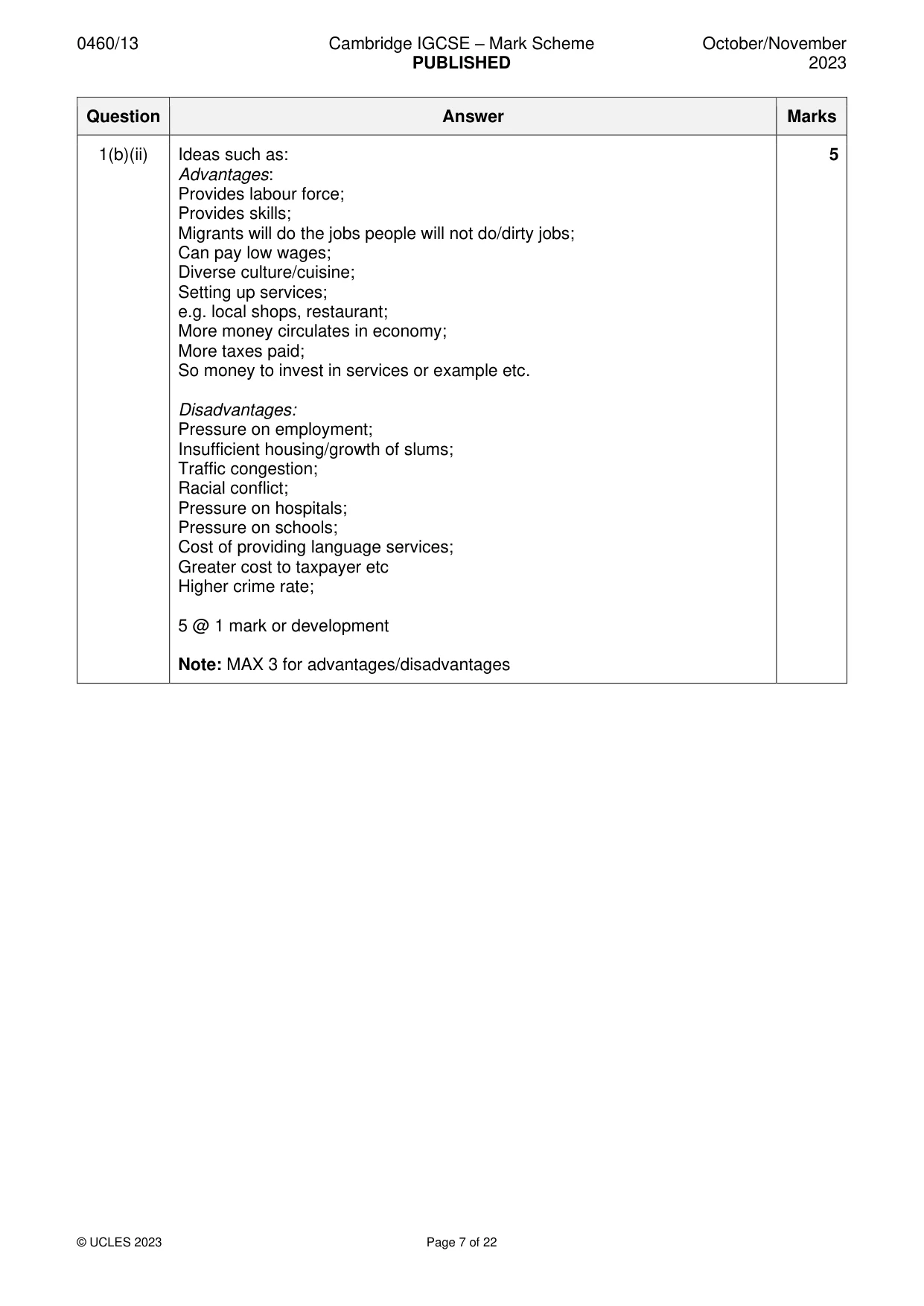
0460/13 Cambridge IGCSE – Mark Scheme PUBLISHED October/November 2023 © UCLES 2023 Page 7 of 22 Question Answer Marks 1(b)(ii) Ideas such as: Advantages: Provides labour force; Provides skills; Migrants will do the jobs people will not do/dirty jobs; Can pay low wages; Diverse culture/cuisine; Setting up services; e.g. local shops, restaurant; More money circulates in economy; More taxes paid; So money to invest in services or example etc. Disadvantages: Pressure on employment; Insufficient housing/growth of slums; Traffic congestion; Racial conflict; Pressure on hospitals; Pressure on schools; Cost of providing language services; Greater cost to taxpayer etc Higher crime rate; 5 @ 1 mark or development Note: MAX 3 for advantages/disadvantages 5
Mark scheme, page 8
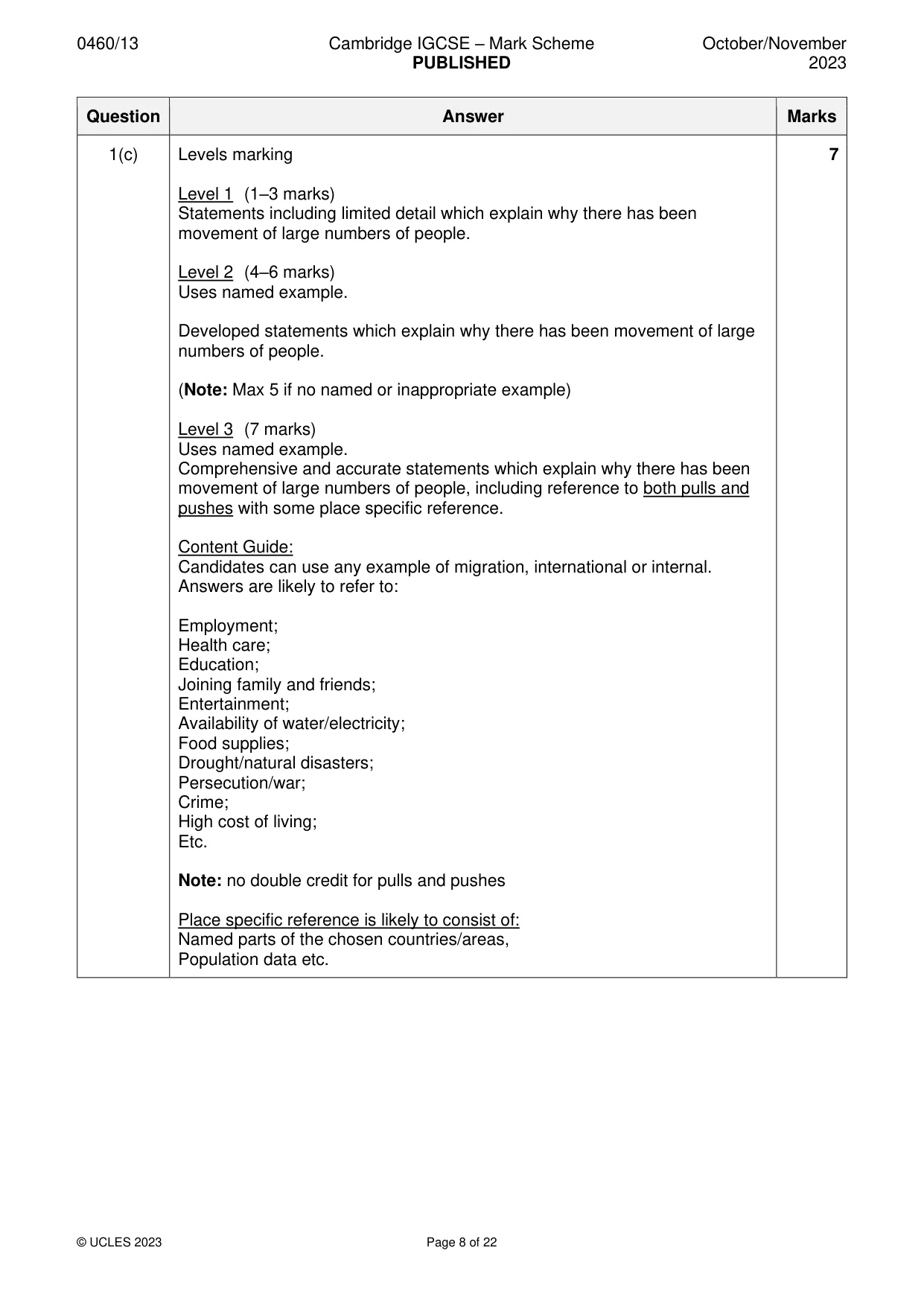
0460/13 Cambridge IGCSE – Mark Scheme PUBLISHED October/November 2023 © UCLES 2023 Page 8 of 22 Question Answer Marks 1(c) Levels marking Level 1 (1–3 marks) Statements including limited detail which explain why there has been movement of large numbers of people. Level 2 (4–6 marks) Uses named example. Developed statements which explain why there has been movement of large numbers of people. (Note: Max 5 if no named or inappropriate example) Level 3 (7 marks) Uses named example. Comprehensive and accurate statements which explain why there has been movement of large numbers of people, including reference to both pulls and pushes with some place specific reference. Content Guide: Candidates can use any example of migration, international or internal. Answers are likely to refer to: Employment; Health care; Education; Joining family and friends; Entertainment; Availability of water/electricity; Food supplies; Drought/natural disasters; Persecution/war; Crime; High cost of living; Etc. Note: no double credit for pulls and pushes Place specific reference is likely to consist of: Named parts of the chosen countries/areas, Population data etc. 7
Mark scheme, page 9
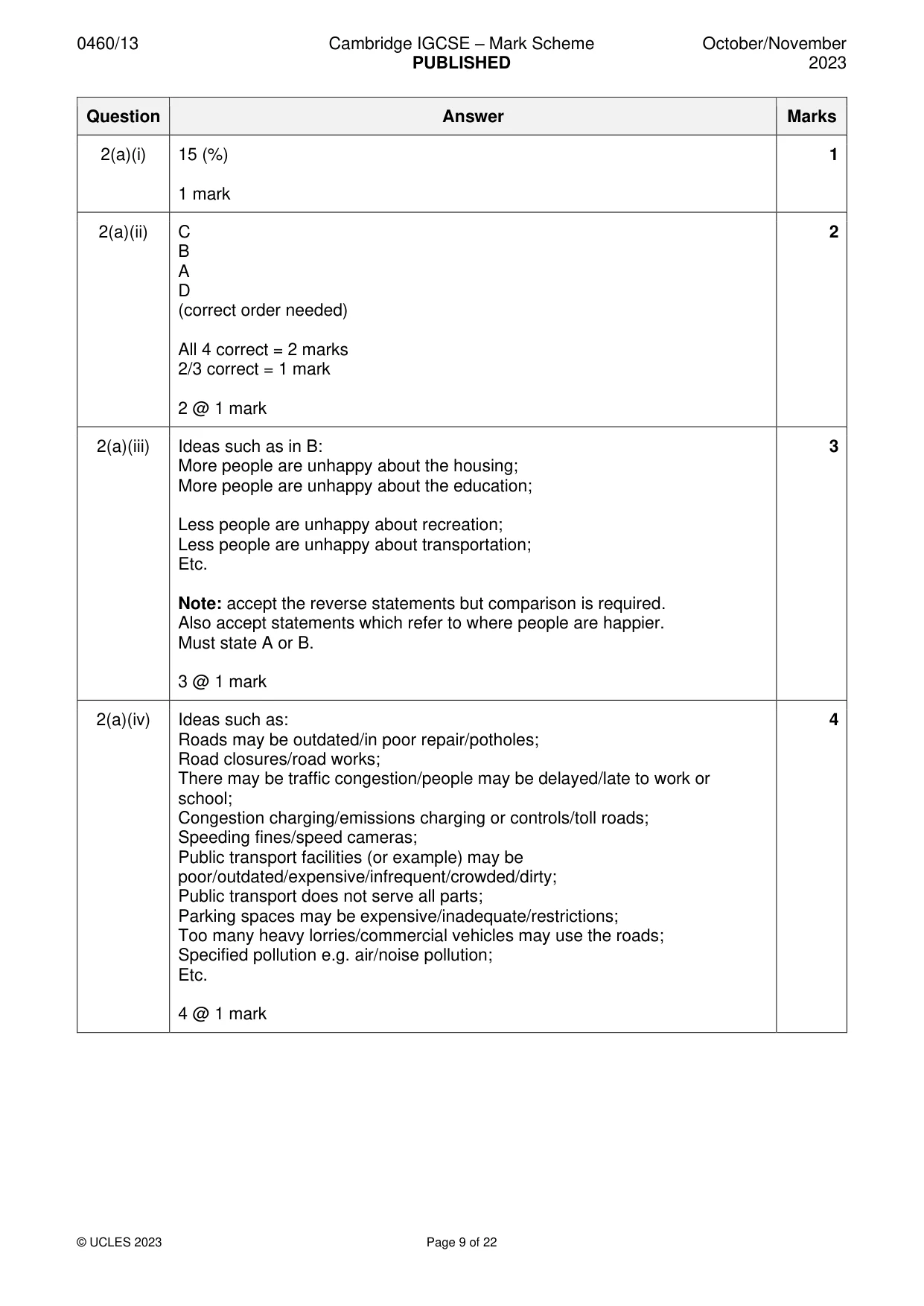
0460/13 Cambridge IGCSE – Mark Scheme PUBLISHED October/November 2023 © UCLES 2023 Page 9 of 22 Question Answer Marks 2(a)(i) 15 (%) 1 mark 1 2(a)(ii) C B A D (correct order needed) All 4 correct = 2 marks 2/3 correct = 1 mark 2 @ 1 mark 2 2(a)(iii) Ideas such as in B: More people are unhappy about the housing; More people are unhappy about the education; Less people are unhappy about recreation; Less people are unhappy about transportation; Etc. Note: accept the reverse statements but comparison is required. Also accept statements which refer to where people are happier. Must state A or B. 3 @ 1 mark 3 2(a)(iv) Ideas such as: Roads may be outdated/in poor repair/potholes; Road closures/road works; There may be traffic congestion/people may be delayed/late to work or school; Congestion charging/emissions charging or controls/toll roads; Speeding fines/speed cameras; Public transport facilities (or example) may be poor/outdated/expensive/infrequent/crowded/dirty; Public transport does not serve all parts; Parking spaces may be expensive/inadequate/restrictions; Too many heavy lorries/commercial vehicles may use the roads; Specified pollution e.g. air/noise pollution; Etc. 4 @ 1 mark 4
Mark scheme, page 10
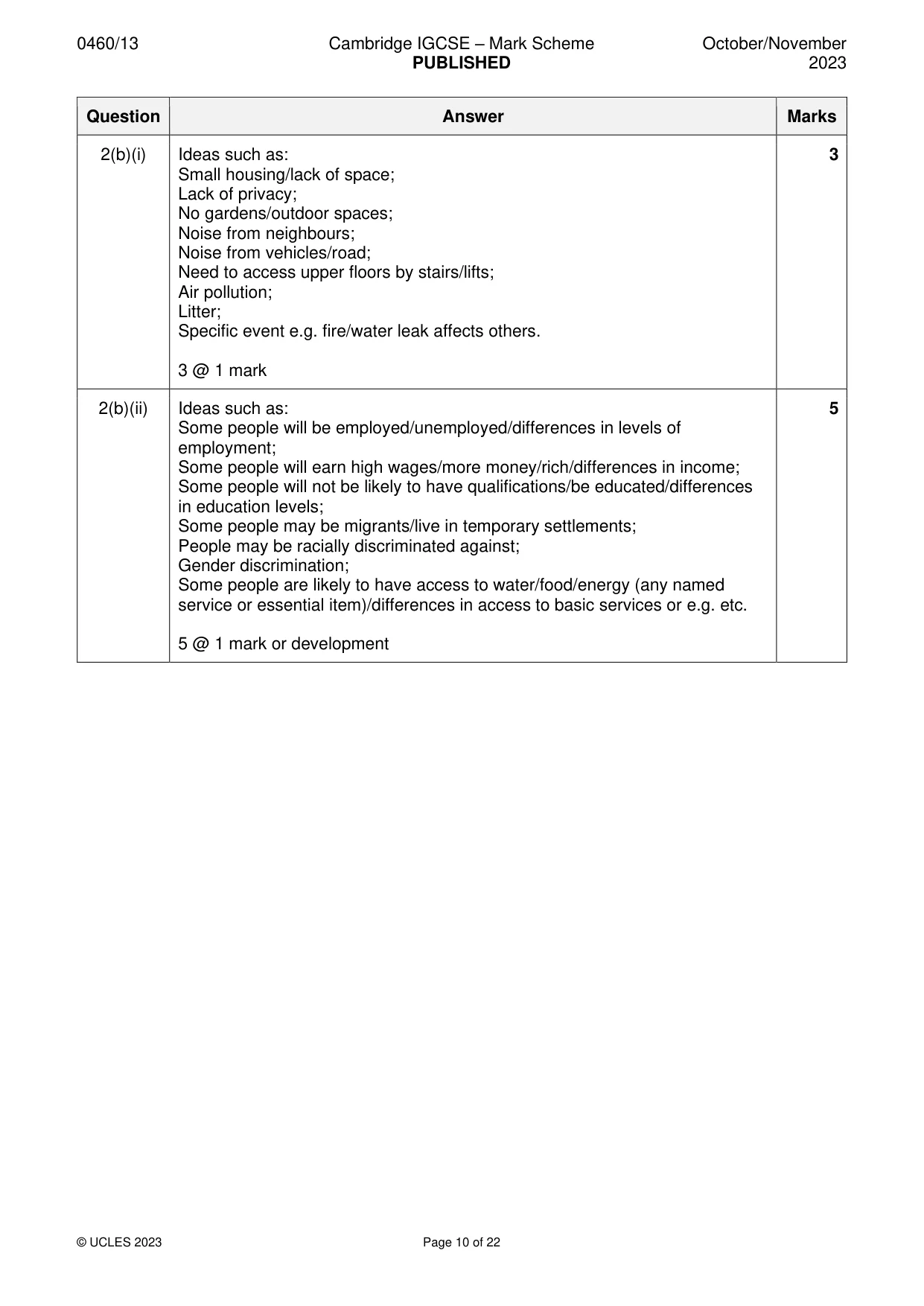
0460/13 Cambridge IGCSE – Mark Scheme PUBLISHED October/November 2023 © UCLES 2023 Page 10 of 22 Question Answer Marks 2(b)(i) Ideas such as: Small housing/lack of space; Lack of privacy; No gardens/outdoor spaces; Noise from neighbours; Noise from vehicles/road; Need to access upper floors by stairs/lifts; Air pollution; Litter; Specific event e.g. fire/water leak affects others. 3 @ 1 mark 3 2(b)(ii) Ideas such as: Some people will be employed/unemployed/differences in levels of employment; Some people will earn high wages/more money/rich/differences in income; Some people will not be likely to have qualifications/be educated/differences in education levels; Some people may be migrants/live in temporary settlements; People may be racially discriminated against; Gender discrimination; Some people are likely to have access to water/food/energy (any named service or essential item)/differences in access to basic services or e.g. etc. 5 @ 1 mark or development 5
Mark scheme, page 11
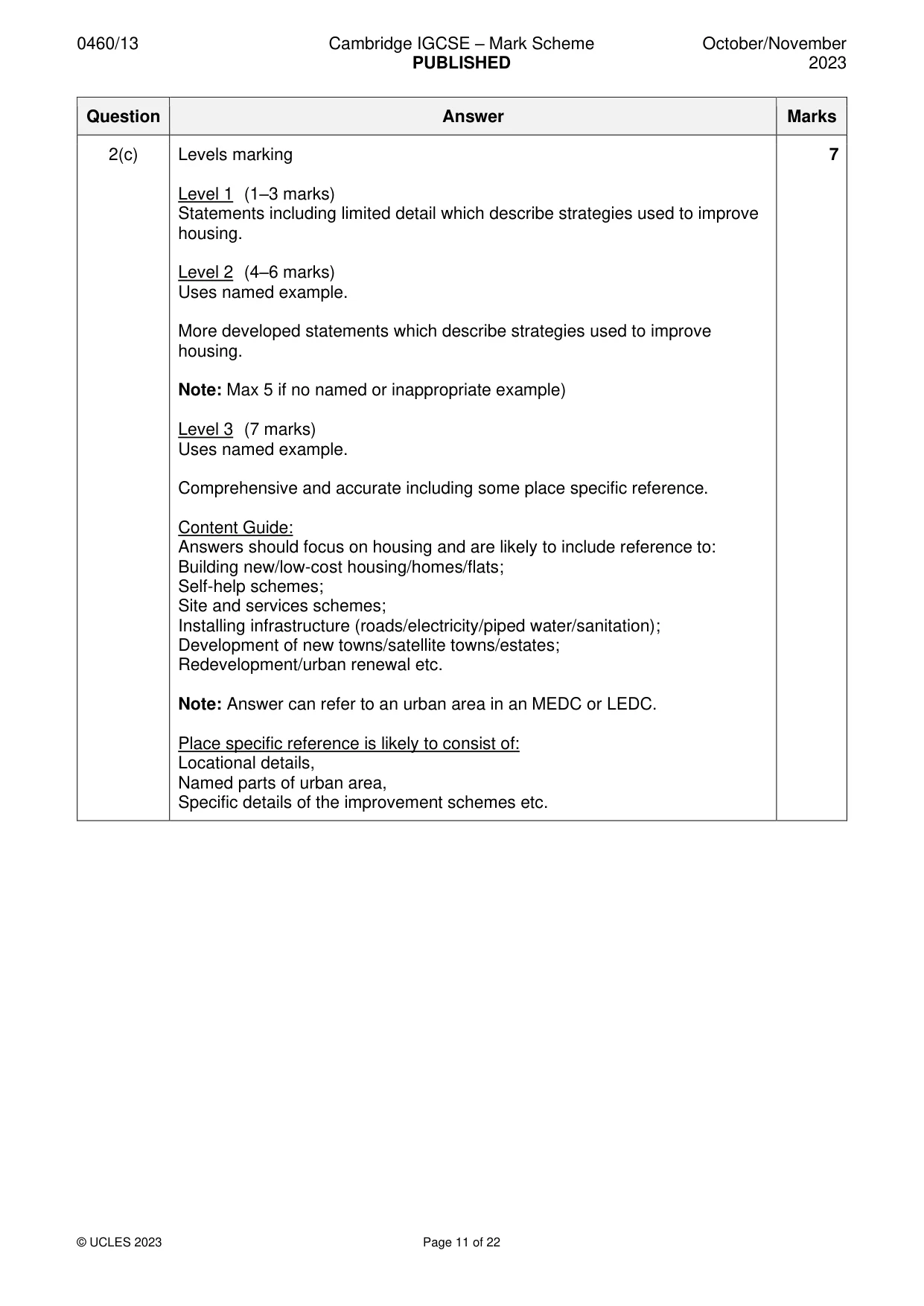
0460/13 Cambridge IGCSE – Mark Scheme PUBLISHED October/November 2023 © UCLES 2023 Page 11 of 22 Question Answer Marks 2(c) Levels marking Level 1 (1–3 marks) Statements including limited detail which describe strategies used to improve housing. Level 2 (4–6 marks) Uses named example. More developed statements which describe strategies used to improve housing. Note: Max 5 if no named or inappropriate example) Level 3 (7 marks) Uses named example. Comprehensive and accurate including some place specific reference. Content Guide: Answers should focus on housing and are likely to include reference to: Building new/low-cost housing/homes/flats; Self-help schemes; Site and services schemes; Installing infrastructure (roads/electricity/piped water/sanitation); Development of new towns/satellite towns/estates; Redevelopment/urban renewal etc. Note: Answer can refer to an urban area in an MEDC or LEDC. Place specific reference is likely to consist of: Locational details, Named parts of urban area, Specific details of the improvement schemes etc. 7
Mark scheme, page 12
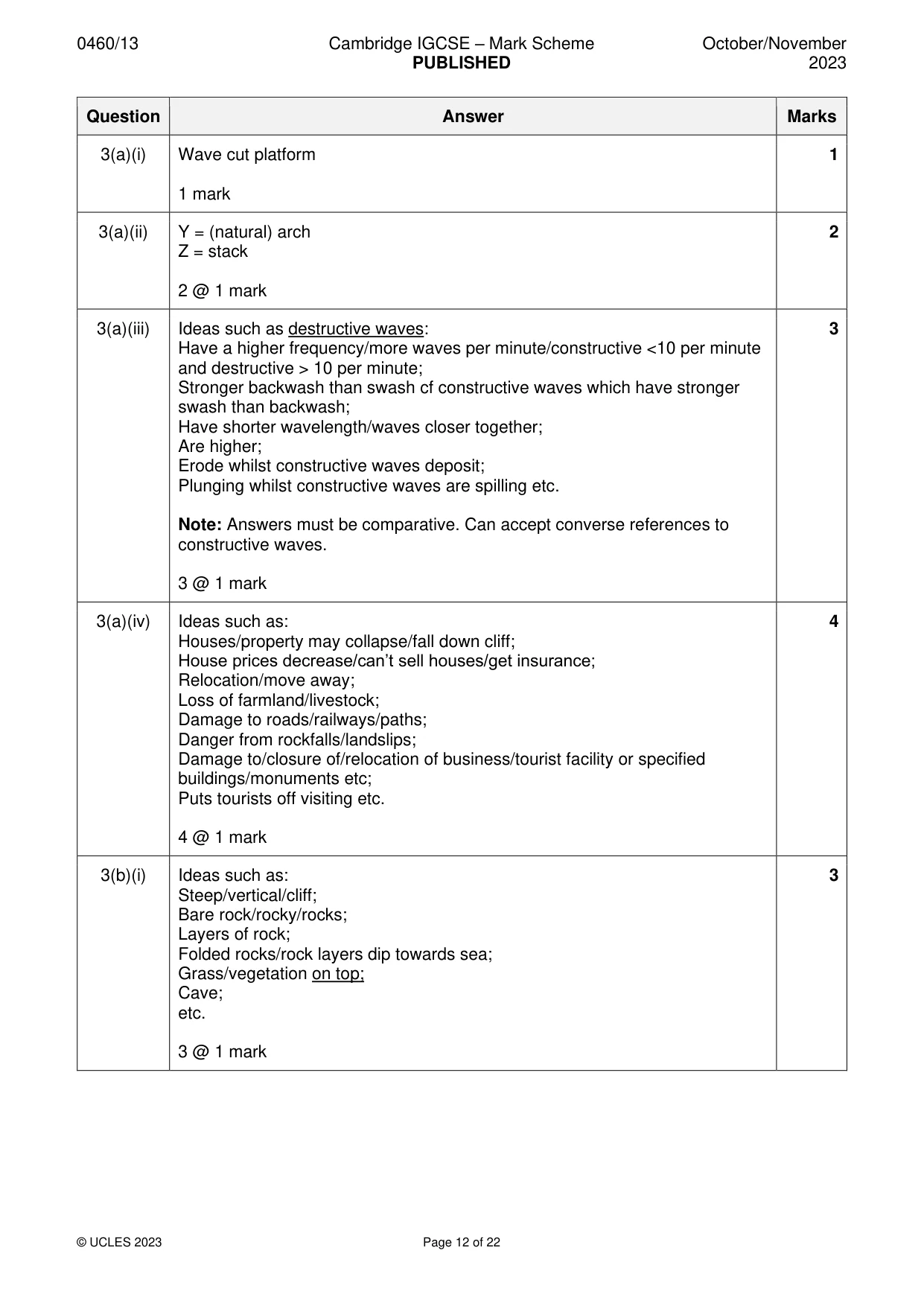
0460/13 Cambridge IGCSE – Mark Scheme PUBLISHED October/November 2023 © UCLES 2023 Page 12 of 22 Question Answer Marks 3(a)(i) Wave cut platform 1 mark 1 3(a)(ii) Y = (natural) arch Z = stack 2 @ 1 mark 2 3(a)(iii) Ideas such as destructive waves: Have a higher frequency/more waves per minute/constructive <10 per minute and destructive > 10 per minute; Stronger backwash than swash cf constructive waves which have stronger swash than backwash; Have shorter wavelength/waves closer together; Are higher; Erode whilst constructive waves deposit; Plunging whilst constructive waves are spilling etc. Note: Answers must be comparative. Can accept converse references to constructive waves. 3 @ 1 mark 3 3(a)(iv) Ideas such as: Houses/property may collapse/fall down cliff; House prices decrease/can’t sell houses/get insurance; Relocation/move away; Loss of farmland/livestock; Damage to roads/railways/paths; Danger from rockfalls/landslips; Damage to/closure of/relocation of business/tourist facility or specified buildings/monuments etc; Puts tourists off visiting etc. 4 @ 1 mark 4 3(b)(i) Ideas such as: Steep/vertical/cliff; Bare rock/rocky/rocks; Layers of rock; Folded rocks/rock layers dip towards sea; Grass/vegetation on top; Cave; etc. 3 @ 1 mark 3
Mark scheme, page 13
0460/13 Cambridge IGCSE – Mark Scheme PUBLISHED October/November 2023 © UCLES 2023 Page 13 of 22 Question Answer Marks 3(b)(ii) Ideas such as: Hydraulic action/force of water/power of waves; Abrasion/corrasion or definition; Corrosion/solution or definition; Formation of wave cut notch/notch deepened; Erosion along line of weakness/crack or crack widens; Expansion/wearing back/erosion of cave; Etc. Note: Allow valid development of processes for dev mark. 5 @ 1 mark or development 5
Mark scheme, page 14
0460/13 Cambridge IGCSE – Mark Scheme PUBLISHED October/November 2023 © UCLES 2023 Page 14 of 22 Question Answer Marks 3(c) Levels marking Level 1 (1–3 marks) Statements including limited detail which describe the benefits for people of living on the coast. Level 2 (4–6 marks) Uses named example. More developed statements which describe the benefits for people of living on the coast. (Note: Max 5 if no named or inappropriate example. Example to be smaller in size than a country.) Level 3 (7 marks) Comprehensive and accurate statements including some place specific reference. Content Guide: Answers are likely to refer to: Industry; Ports; Fishing; Leisure activities/for surfers etc; Fresh air/sea breeze/specified climate points; Peaceful; Retirement; Tourism if linked with employment; Scenic beauty; Farming; Use of revenues for government spending or example; Etc. Note: Example must be smaller scale than a country, unless a small island e.g. accept Lanzarote or island country e.g. Malta, Jamaica. Island groups such as Seychelles or Maldives, Canaries, Balearics etc. are not acceptable. Place specific reference is likely to consist of: Locational details, Named places along coast, Specific details of employment opportunities, Statistics etc. 7
Mark scheme, page 15
0460/13 Cambridge IGCSE – Mark Scheme PUBLISHED October/November 2023 © UCLES 2023 Page 15 of 22 Question Answer Marks 4(a)(i) Constructive/divergent the plate movement is away from each other Destructive/convergent the movement is towards each other/subduct/collide/one goes under; Opposite directions One goes apart and one goes together. 1 mark 1 4(a)(ii) X = Convection currents Y = Subduction 2 @ 1 mark 2 4(a)(iii) Ideas such as: Low; Wide; Gentle/flat sides/slopes; Basic/low viscosity/fluid/runny lava/flows faster/low silica content/basalt; There is no layers/just consist of (solidified) lava; Low pressure Eruptions/ Eruptions are gentle/slow/weak; 3 @ 1 mark 3 4(a)(iv) Ideas such as: Convection currents; Plates/they move towards each other; Subduction/one plate goes under the other; Heavier/denser plate subducts; Heating on edge of subducting plate; Destruction/melting of crust/turns rock to magma; Build-up of magma; Pressure caused by build-up; Magma pushed up/escapes through fissure; Etc. 4 @ 1 mark 4 4(b)(i) Ideas such as: Positive relationship/correlation; Longer time between eruptions longer the duration; Relationship is not linear/not exact/there are anomalies; Supporting statistics (allow phrases such as ‘over’, ‘under’ etc. or exact figures for individual volcanoes. Must give 4 figures (max 1); 3 @ 1 mark Note: Accept use of statistics as alternatives to statements. 3
Mark scheme, page 16
0460/13 Cambridge IGCSE – Mark Scheme PUBLISHED October/November 2023 © UCLES 2023 Page 16 of 22 Question Answer Marks 4(b)(ii) Ideas such as: Monitor/study; Using Faultline movements/volcanic emissions/seismometer/tiltmeter/watch animal behaviour; Remote sensing of ash clouds; Predict/warn about eruption/text alerts; Evacuation/evacuation plans; Education/awareness about volcano survival/drills showing them what to do; Improve quality of buildings/make buildings more solid; E.g. stronger roof; Shelters; Ensure emergency services/rescue teams on standby/well equipped; Invest in healthcare/hospitals/better healthcare; Exclusion zones; Land use planning; Ensure availability of international aid; Bomb lava flows; Spray lava flows; Lava diversion channels; Mudflow/lava barrier; Food/water/first aid supplies; Wear masks/hats; Etc. 5 @ 1 mark or development 5
Mark scheme, page 17
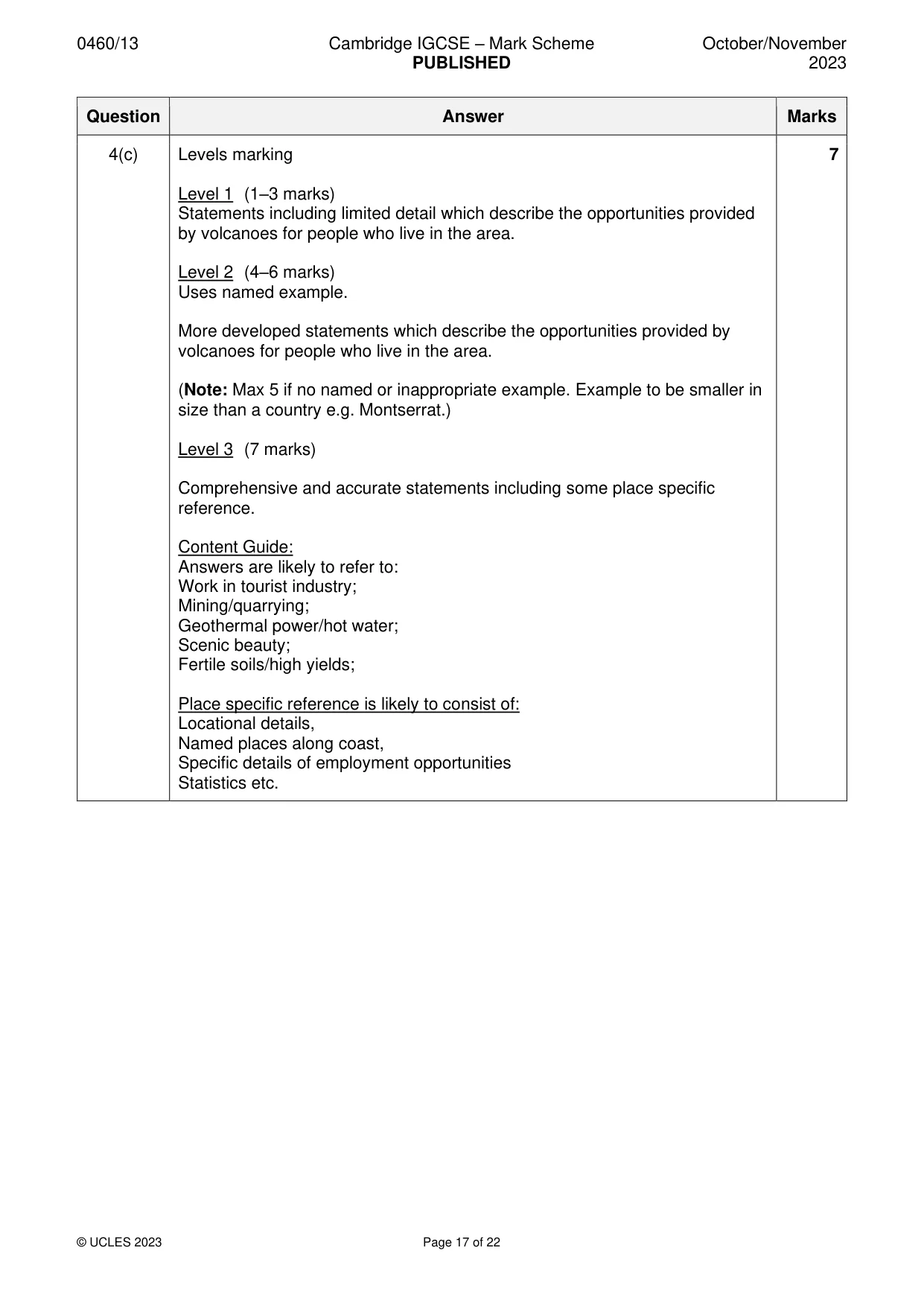
0460/13 Cambridge IGCSE – Mark Scheme PUBLISHED October/November 2023 © UCLES 2023 Page 17 of 22 Question Answer Marks 4(c) Levels marking Level 1 (1–3 marks) Statements including limited detail which describe the opportunities provided by volcanoes for people who live in the area. Level 2 (4–6 marks) Uses named example. More developed statements which describe the opportunities provided by volcanoes for people who live in the area. (Note: Max 5 if no named or inappropriate example. Example to be smaller in size than a country e.g. Montserrat.) Level 3 (7 marks) Comprehensive and accurate statements including some place specific reference. Content Guide: Answers are likely to refer to: Work in tourist industry; Mining/quarrying; Geothermal power/hot water; Scenic beauty; Fertile soils/high yields; Place specific reference is likely to consist of: Locational details, Named places along coast, Specific details of employment opportunities Statistics etc. 7
Mark scheme, page 18
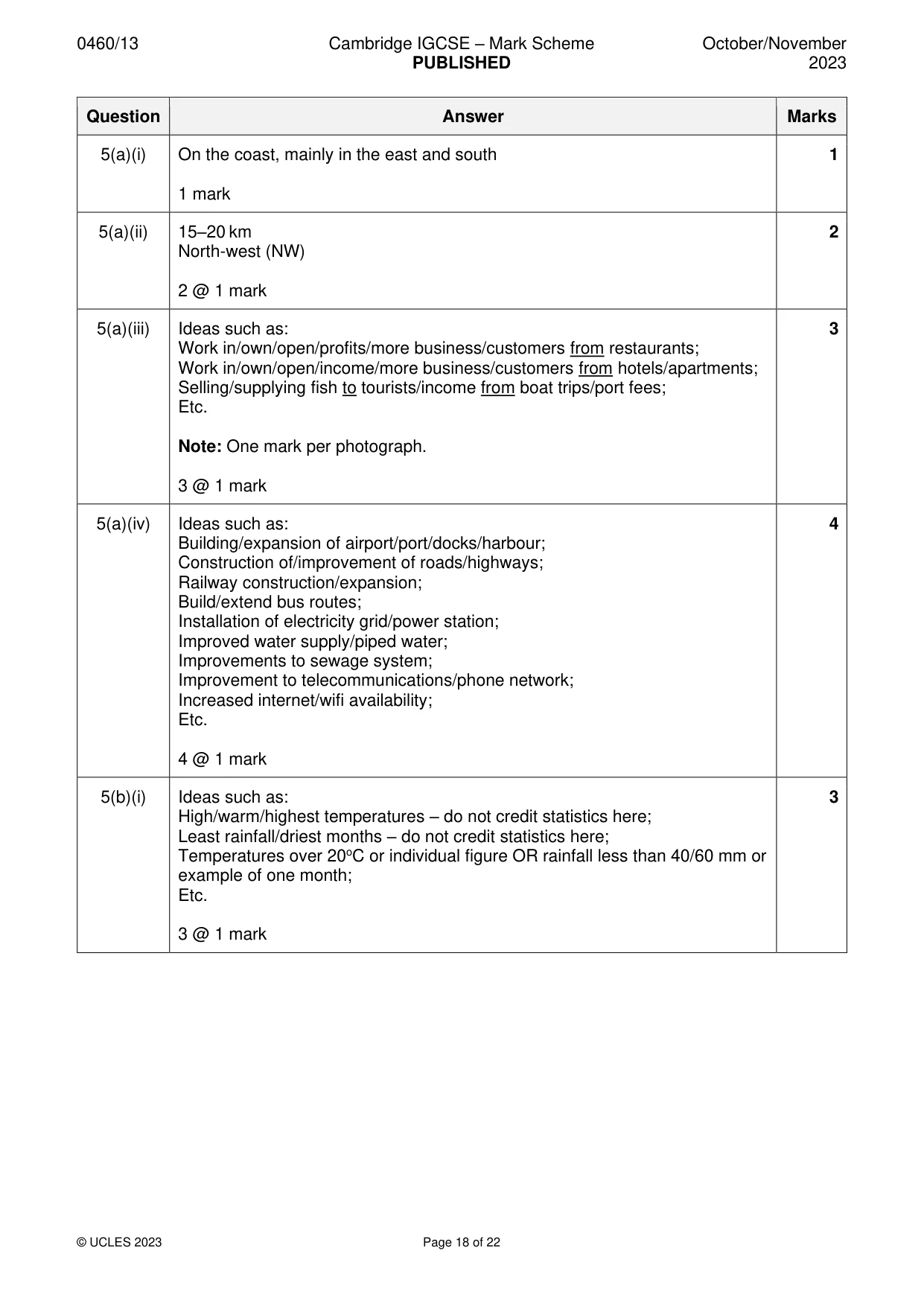
0460/13 Cambridge IGCSE – Mark Scheme PUBLISHED October/November 2023 © UCLES 2023 Page 18 of 22 Question Answer Marks 5(a)(i) On the coast, mainly in the east and south 1 mark 1 5(a)(ii) 15–20 km North-west (NW) 2 @ 1 mark 2 5(a)(iii) Ideas such as: Work in/own/open/profits/more business/customers from restaurants; Work in/own/open/income/more business/customers from hotels/apartments; Selling/supplying fish to tourists/income from boat trips/port fees; Etc. Note: One mark per photograph. 3 @ 1 mark 3 5(a)(iv) Ideas such as: Building/expansion of airport/port/docks/harbour; Construction of/improvement of roads/highways; Railway construction/expansion; Build/extend bus routes; Installation of electricity grid/power station; Improved water supply/piped water; Improvements to sewage system; Improvement to telecommunications/phone network; Increased internet/wifi availability; Etc. 4 @ 1 mark 4 5(b)(i) Ideas such as: High/warm/highest temperatures – do not credit statistics here; Least rainfall/driest months – do not credit statistics here; Temperatures over 20oC or individual figure OR rainfall less than 40/60 mm or example of one month; Etc. 3 @ 1 mark 3
Mark scheme, page 19
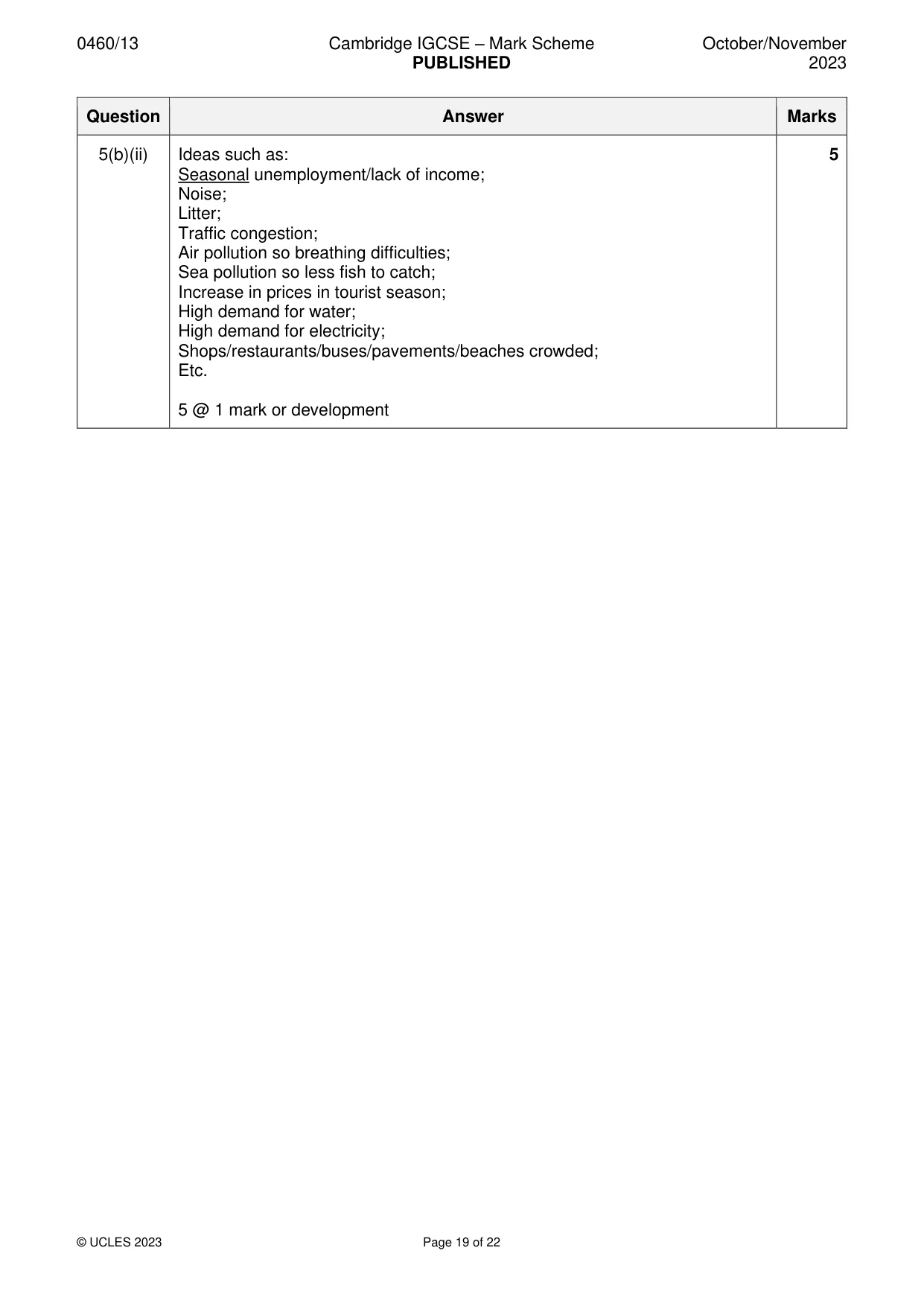
0460/13 Cambridge IGCSE – Mark Scheme PUBLISHED October/November 2023 © UCLES 2023 Page 19 of 22 Question Answer Marks 5(b)(ii) Ideas such as: Seasonal unemployment/lack of income; Noise; Litter; Traffic congestion; Air pollution so breathing difficulties; Sea pollution so less fish to catch; Increase in prices in tourist season; High demand for water; High demand for electricity; Shops/restaurants/buses/pavements/beaches crowded; Etc. 5 @ 1 mark or development 5
Mark scheme, page 20
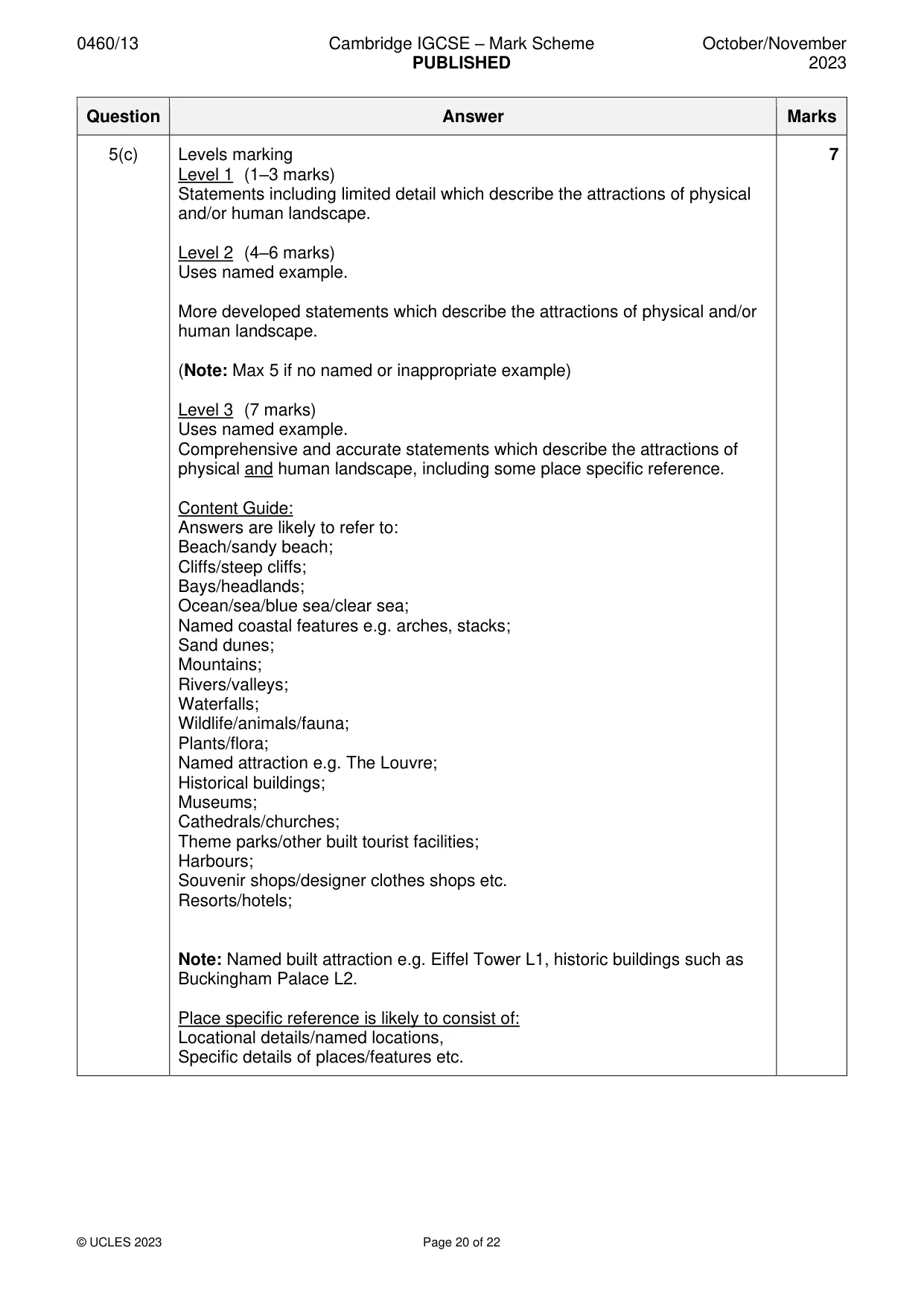
0460/13 Cambridge IGCSE – Mark Scheme PUBLISHED October/November 2023 © UCLES 2023 Page 20 of 22 Question Answer Marks 5(c) Levels marking Level 1 (1–3 marks) Statements including limited detail which describe the attractions of physical and/or human landscape. Level 2 (4–6 marks) Uses named example. More developed statements which describe the attractions of physical and/or human landscape. (Note: Max 5 if no named or inappropriate example) Level 3 (7 marks) Uses named example. Comprehensive and accurate statements which describe the attractions of physical and human landscape, including some place specific reference. Content Guide: Answers are likely to refer to: Beach/sandy beach; Cliffs/steep cliffs; Bays/headlands; Ocean/sea/blue sea/clear sea; Named coastal features e.g. arches, stacks; Sand dunes; Mountains; Rivers/valleys; Waterfalls; Wildlife/animals/fauna; Plants/flora; Named attraction e.g. The Louvre; Historical buildings; Museums; Cathedrals/churches; Theme parks/other built tourist facilities; Harbours; Souvenir shops/designer clothes shops etc. Resorts/hotels; Note: Named built attraction e.g. Eiffel Tower L1, historic buildings such as Buckingham Palace L2. Place specific reference is likely to consist of: Locational details/named locations, Specific details of places/features etc. 7
Mark scheme, page 21
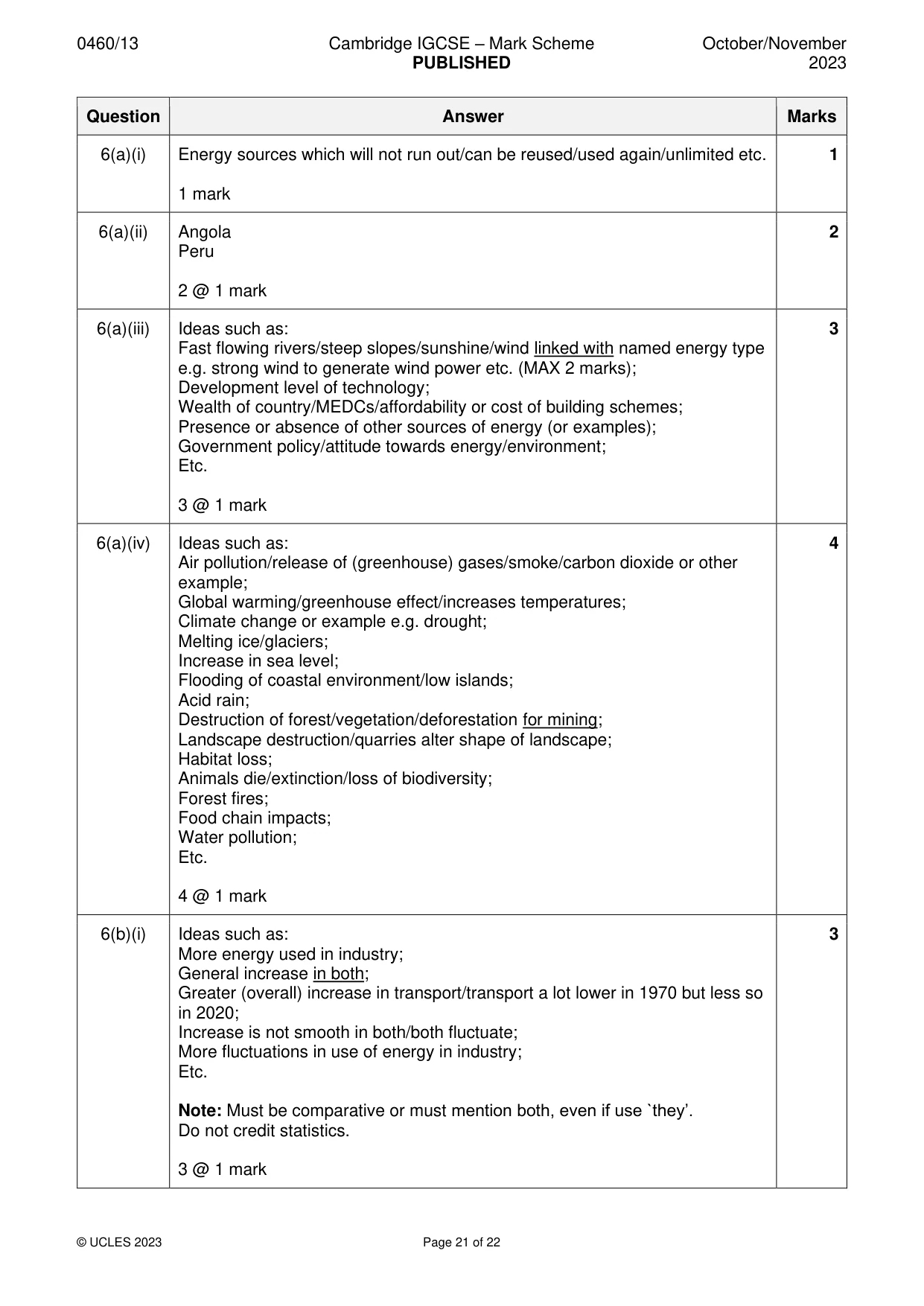
0460/13 Cambridge IGCSE – Mark Scheme PUBLISHED October/November 2023 © UCLES 2023 Page 21 of 22 Question Answer Marks 6(a)(i) Energy sources which will not run out/can be reused/used again/unlimited etc. 1 mark 1 6(a)(ii) Angola Peru 2 @ 1 mark 2 6(a)(iii) Ideas such as: Fast flowing rivers/steep slopes/sunshine/wind linked with named energy type e.g. strong wind to generate wind power etc. (MAX 2 marks); Development level of technology; Wealth of country/MEDCs/affordability or cost of building schemes; Presence or absence of other sources of energy (or examples); Government policy/attitude towards energy/environment; Etc. 3 @ 1 mark 3 6(a)(iv) Ideas such as: Air pollution/release of (greenhouse) gases/smoke/carbon dioxide or other example; Global warming/greenhouse effect/increases temperatures; Climate change or example e.g. drought; Melting ice/glaciers; Increase in sea level; Flooding of coastal environment/low islands; Acid rain; Destruction of forest/vegetation/deforestation for mining; Landscape destruction/quarries alter shape of landscape; Habitat loss; Animals die/extinction/loss of biodiversity; Forest fires; Food chain impacts; Water pollution; Etc. 4 @ 1 mark 4 6(b)(i) Ideas such as: More energy used in industry; General increase in both; Greater (overall) increase in transport/transport a lot lower in 1970 but less so in 2020; Increase is not smooth in both/both fluctuate; More fluctuations in use of energy in industry; Etc. Note: Must be comparative or must mention both, even if use `they’. Do not credit statistics. 3 @ 1 mark 3
Mark scheme, page 22
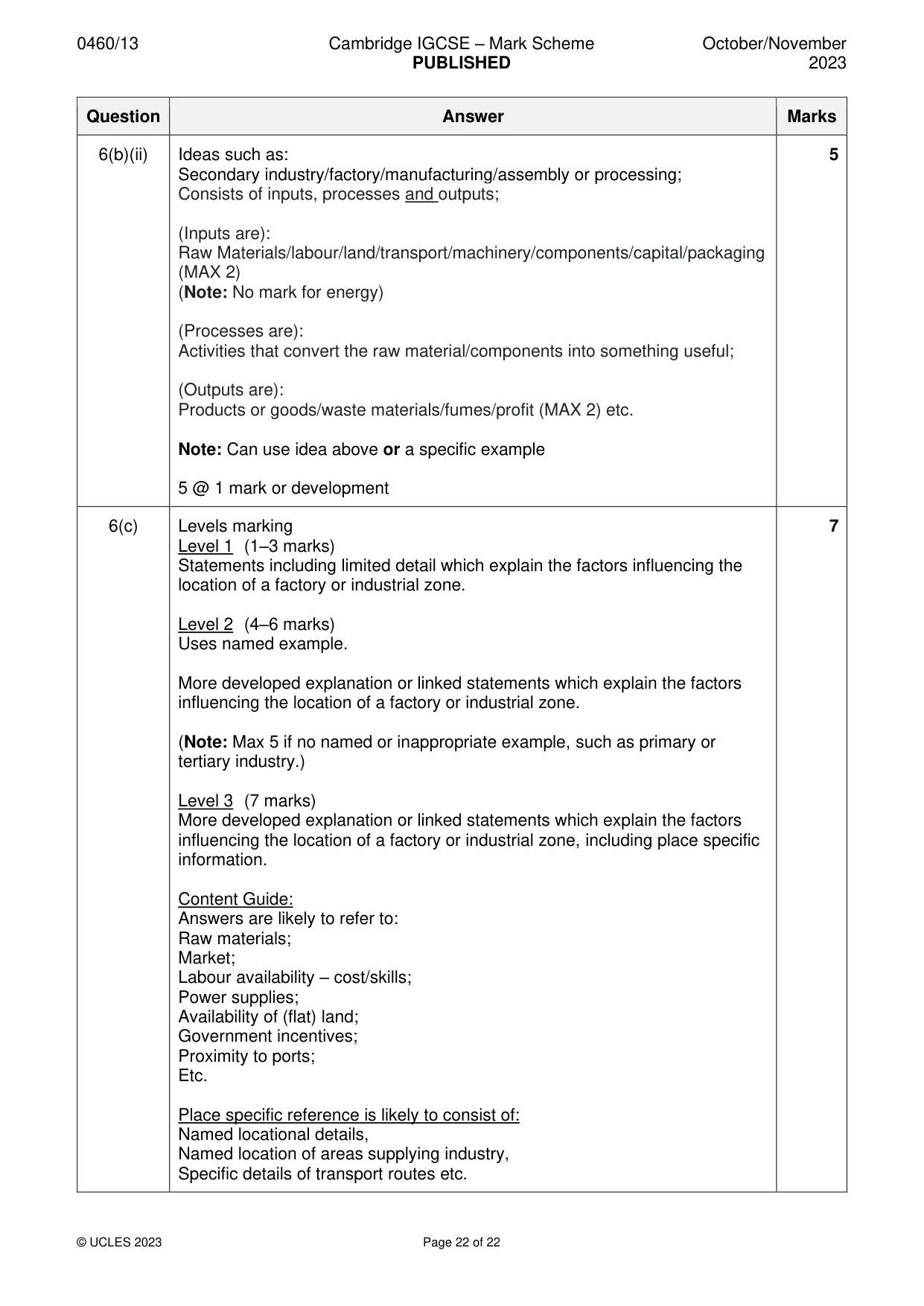
0460/13 Cambridge IGCSE – Mark Scheme PUBLISHED October/November 2023 © UCLES 2023 Page 22 of 22 Question Answer Marks 6(b)(ii) Ideas such as: Secondary industry/factory/manufacturing/assembly or processing; Consists of inputs, processes and outputs; (Inputs are): Raw Materials/labour/land/transport/machinery/components/capital/packaging (MAX 2) (Note: No mark for energy) (Processes are): Activities that convert the raw material/components into something useful; (Outputs are): Products or goods/waste materials/fumes/profit (MAX 2) etc. Note: Can use idea above or a specific example 5 @ 1 mark or development 5 6(c) Levels marking Level 1 (1–3 marks) Statements including limited detail which explain the factors influencing the location of a factory or industrial zone. Level 2 (4–6 marks) Uses named example. More developed explanation or linked statements which explain the factors influencing the location of a factory or industrial zone. (Note: Max 5 if no named or inappropriate example, such as primary or tertiary industry.) Level 3 (7 marks) More developed explanation or linked statements which explain the factors influencing the location of a factory or industrial zone, including place specific information. Content Guide: Answers are likely to refer to: Raw materials; Market; Labour availability – cost/skills; Power supplies; Availability of (flat) land; Government incentives; Proximity to ports; Etc. Place specific reference is likely to consist of: Named locational details, Named location of areas supplying industry, Specific details of transport routes etc. 7
What you needed in this session
Cambridge’s own grade thresholds for 2023 Oct/Nov, Paper 1 · Variant 3. A higher threshold means an easier paper — the bar moves with how the cohort did.