Cambridge IGCSE Geography 0460 — 2023 May/June Paper 1 · Variant 3
0460/13/M/J/23 · 75 marks · ≈84 min
The question paper and its mark scheme, free to read here and free to download. This is Cambridge’s own paper, exactly as it was sat.
Question paper32 pages





Mark scheme18 pages
Answers below. Sit the paper first if you are practising.
Paper as text
Question paper, page 1
This document has 32 pages. Any blank pages are indicated. [Turn over Cambridge IGCSE™ * 0 1 5 1 5 1 7 9 9 9 * DC (EF/SG) 312275/3 © UCLES 2023 GEOGRAPHY 0460/13 Paper 1 Geographical Themes May/June 2023 1 hour 45 minutes You must answer on the question paper. You will need: Insert (enclosed) Ruler Calculator Protractor INSTRUCTIONS ● Answer three questions in total, one from each section. ● Use a black or dark blue pen. You may use an HB pencil for any diagrams or graphs. ● Write your name, centre number and candidate number in the boxes at the top of the page. ● Write your answer to each question in the space provided. ● Do not use an erasable pen or correction fluid. ● Do not write on any bar codes. ● If additional space is needed, you should use the lined pages at the end of this booklet; the question number or numbers must be clearly shown. INFORMATION ● The total mark for this paper is 75. ● The number of marks for each question or part question is shown in brackets [ ]. ● The insert contains additional resources referred to in the questions. Definitions MEDCs – More Economically Developed Countries LEDCs – Less Economically Developed Countries
Question paper, page 2
2 0460/13/M/J/23 © UCLES 2023 Section A Answer one question from this section. 1 (a) Study Fig. 1.1 (Insert), which shows information about the average annual rate of population change between 2015 and 2020. (i) Insert the following words in the equation below to show how overall population change is calculated. death rate migration birth rate … – … +/– … = overall population change [1] (ii) Using Fig. 1.1 only, put the following countries in rank order according to their average annual rate of population growth between 2015 and 2020. Angola India Ukraine USA 1st … 2nd … 3rd … 4th … [2] (iii) Describe the distribution of countries with an increase in population of between 4.1 to 5%. … … … … … … [3] highest growth lowest growth
Question paper, page 3
3 0460/13/M/J/23 © UCLES 2023 [Turn over (iv) Describe four problems that many people face in countries where population growth is rapid. 1 … … 2 … … 3 … … 4 … … [4]
Question paper, page 4
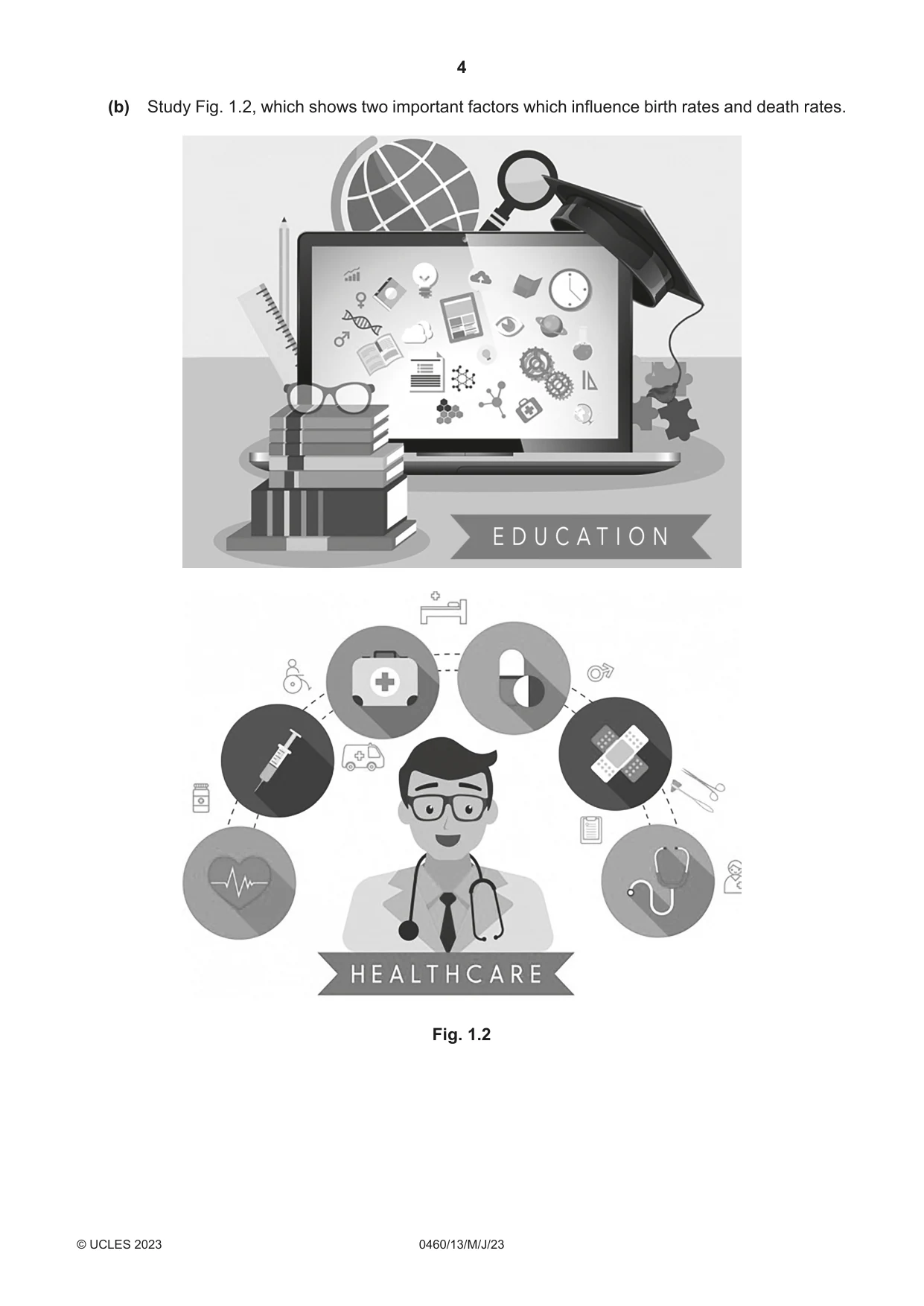
4 0460/13/M/J/23 © UCLES 2023 (b) Study Fig. 1.2, which shows two important factors which influence birth rates and death rates. Fig. 1.2
Question paper, page 5
5 0460/13/M/J/23 © UCLES 2023 [Turn over (i) Explain how the availability of education can reduce birth rates in a country. … … … … … … [3] (ii) Explain how improving access to good healthcare can reduce death rates in a country. … … … … … … … … … … [5]
Question paper, page 6
6 0460/13/M/J/23 © UCLES 2023 (c) For an example you have studied, describe the positive impacts of international migration on the destination and origin countries of migrants. Migration from … to … … … … … … … … … … … … … … … … … … … … … … … … … [7] [Total: 25]
Question paper, page 7
7 0460/13/M/J/23 © UCLES 2023 [Turn over 2 (a) Study Fig. 2.1 (Insert), which is a map showing part of the Central Business District (CBD) of Harare, the capital city of Zimbabwe (an LEDC in Africa). (i) Name an area of open space in the CBD of Harare. … [1] (ii) Identify from Fig. 2.1: the street which is pedestrianised … a form of public transport which serves the CBD of Harare. … [2] (iii) Describe the street layout in the area shown on Fig. 2.1. … … … … … … [3] (iv) Describe and suggest reasons for the location of the hospital which is shown on Fig. 2.1. … … … … … … … … [4]
Question paper, page 8
8 0460/13/M/J/23 © UCLES 2023 (b) Study Figs. 2.2 and 2.3 (Insert), which are photographs taken in different parts of the CBD of Harare. (i) Describe three differences between the parts of the CBD shown in Figs. 2.2 and 2.3. 1 … … 2 … … 3 … … [3] (ii) Suggest reasons why the shops and services in the CBD of Harare have a large sphere of influence. … … … … … … … … … … [5]
Question paper, page 9
9 0460/13/M/J/23 © UCLES 2023 [Turn over (c) For a named urban area you have studied, explain the causes of traffic congestion. Name of urban area … … … … … … … … … … … … … … … … … … … … … … … … … [7] [Total: 25]
Question paper, page 10
10 0460/13/M/J/23 © UCLES 2023 BLANK PAGE
Question paper, page 11
11 0460/13/M/J/23 © UCLES 2023 [Turn over Section B Answer one question from this section. 3 (a) Study Fig. 3.1 (Insert), which shows information about earthquakes between January and June 2019. (i) What was the magnitude of the earthquake in Costa Rica on 12 May 2019? … [1] (ii) Identify the name of the country from Fig. 3.1 where the earthquake: caused the most deaths … had the deepest focus. … [2] (iii) Describe the distribution of earthquakes shown on Fig. 3.1. … … … … … … [3] (iv) Describe the natural processes which cause earthquakes to occur at conservative plate boundaries. … … … … … … … … [4]
Question paper, page 12
12 0460/13/ M / J /23 © UCLES 2023 (b) Study Fig. 3.2, a cross-section which shows information about a volcanic eruption on Whakaari (White Island), New Zealand in December 2019. Fig. 3.2 (i) Using Fig. 3.2 only, identify three different hazards caused by the eruption of the volcano on Whakaari. 1 … 2 … 3 … [3] Content removed due to copyright restrictions.
Question paper, page 13
13 0460/13/M/J/23 © UCLES 2023 [Turn over (ii) Explain the causes of the eruption of the volcano on Whakaari. … … … … … … … … … … [5]
Question paper, page 14
14 0460/13/M/J/23 © UCLES 2023 (c) For a named example you have studied, explain why people live close to a volcano. Name of volcano … … … … … … … … … … … … … … … … … … … … … … … … … [7] [Total: 25]
Question paper, page 15
15 0460/13/M/J/23 © UCLES 2023 [Turn over BLANK PAGE
Question paper, page 16
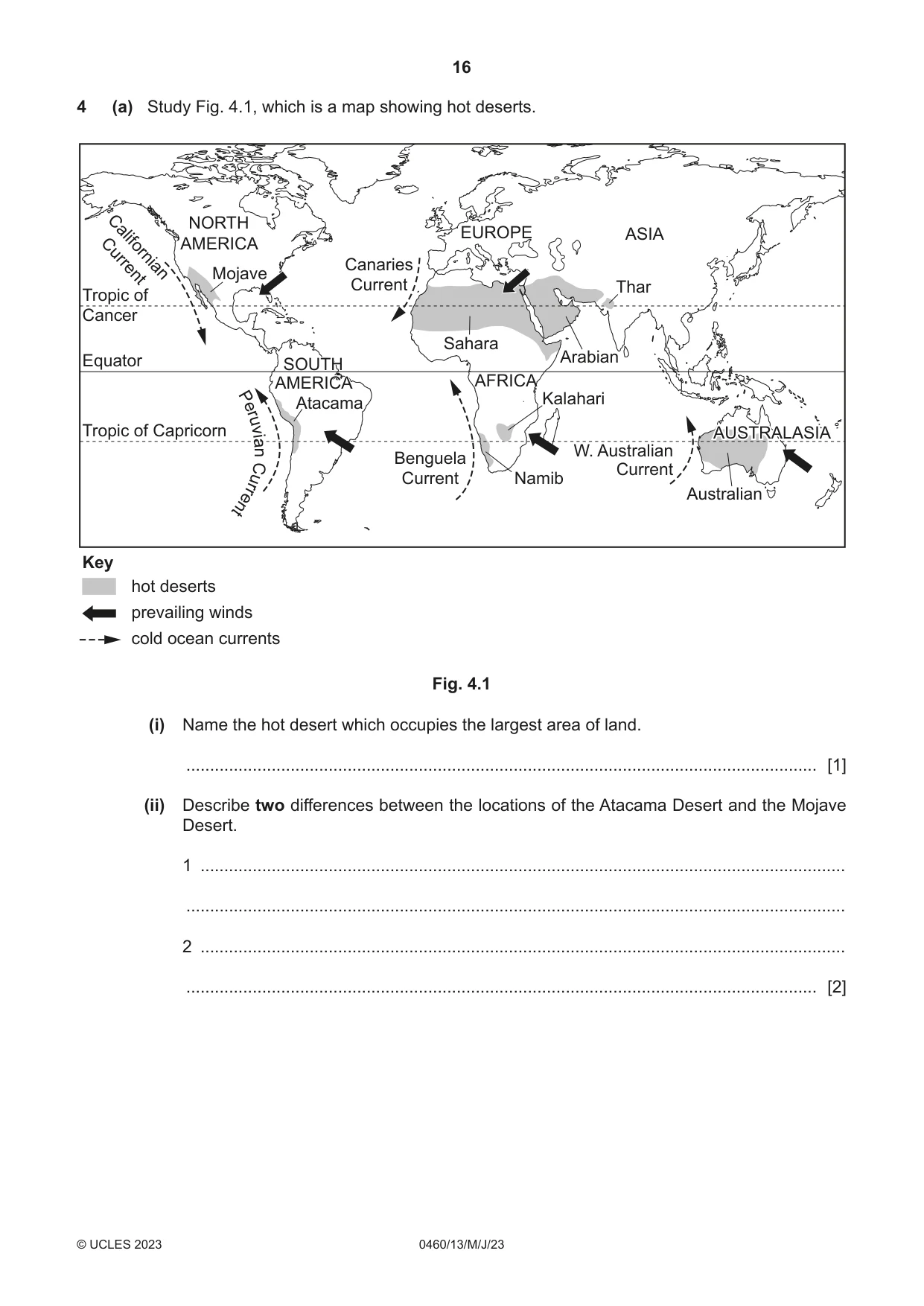
16 0460/13/M/J/23 © UCLES 2023 4 (a) Study Fig. 4.1, which is a map showing hot deserts. Key hot deserts prevailing winds cold ocean currents Equator Tropic of Capricorn Tropic of Cancer NORTH AMERICA SOUTH AMERICA SOUTH AMERICA ASIA EUROPE AFRICA AUSTRALASIA AUSTRALASIA Australian Mojave Atacama Sahara Kalahari Arabian Thar Namib P e r u v i a n C u r r e n t Californian Current Benguela Current Canaries Current W. Australian Current Fig. 4.1 (i) Name the hot desert which occupies the largest area of land. … [1] (ii) Describe two differences between the locations of the Atacama Desert and the Mojave Desert. 1 … … 2 … … [2]
Question paper, page 17
17 0460/13/M/J/23 © UCLES 2023 [Turn over (iii) Describe the global distribution of hot deserts. … … … … … … [3] (iv) Suggest why the cold ocean current and prevailing winds cause rainfall totals to be low in the Atacama Desert. cold ocean currents … … … … prevailing winds … … … … [4]
Question paper, page 18
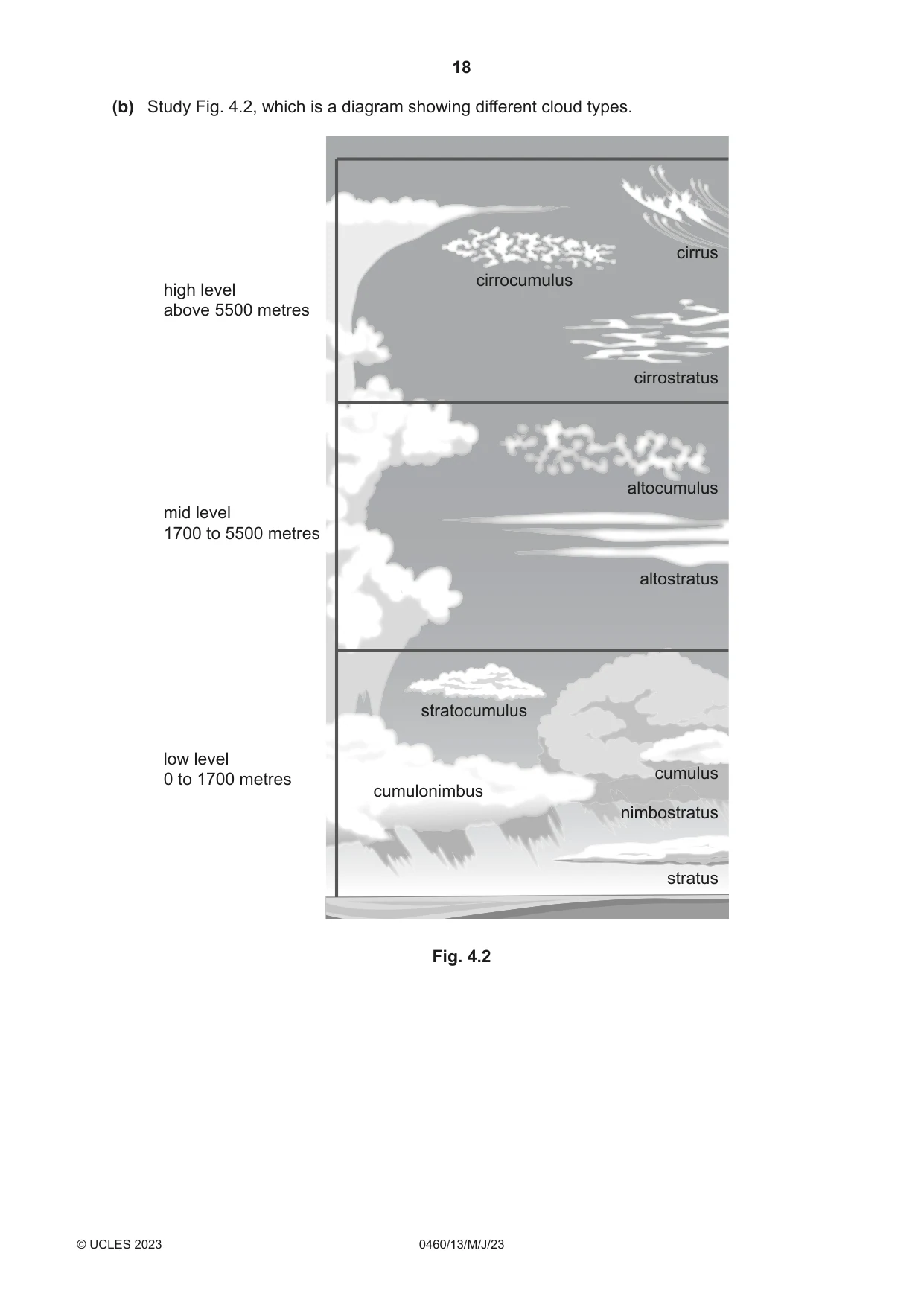
18 0460/13/ M / J /23 © UCLES 2023 (b) Study Fig. 4.2, which is a diagram showing different cloud types. high level above 5500 metres mid level 1700 to 5500 metres low level 0 to 1700 metres cirrus cirrocumulus stratocumulus cumulonimbus altocumulus cirrostratus altostratus nimbostratus stratus cumulus Fig. 4.2
Question paper, page 19
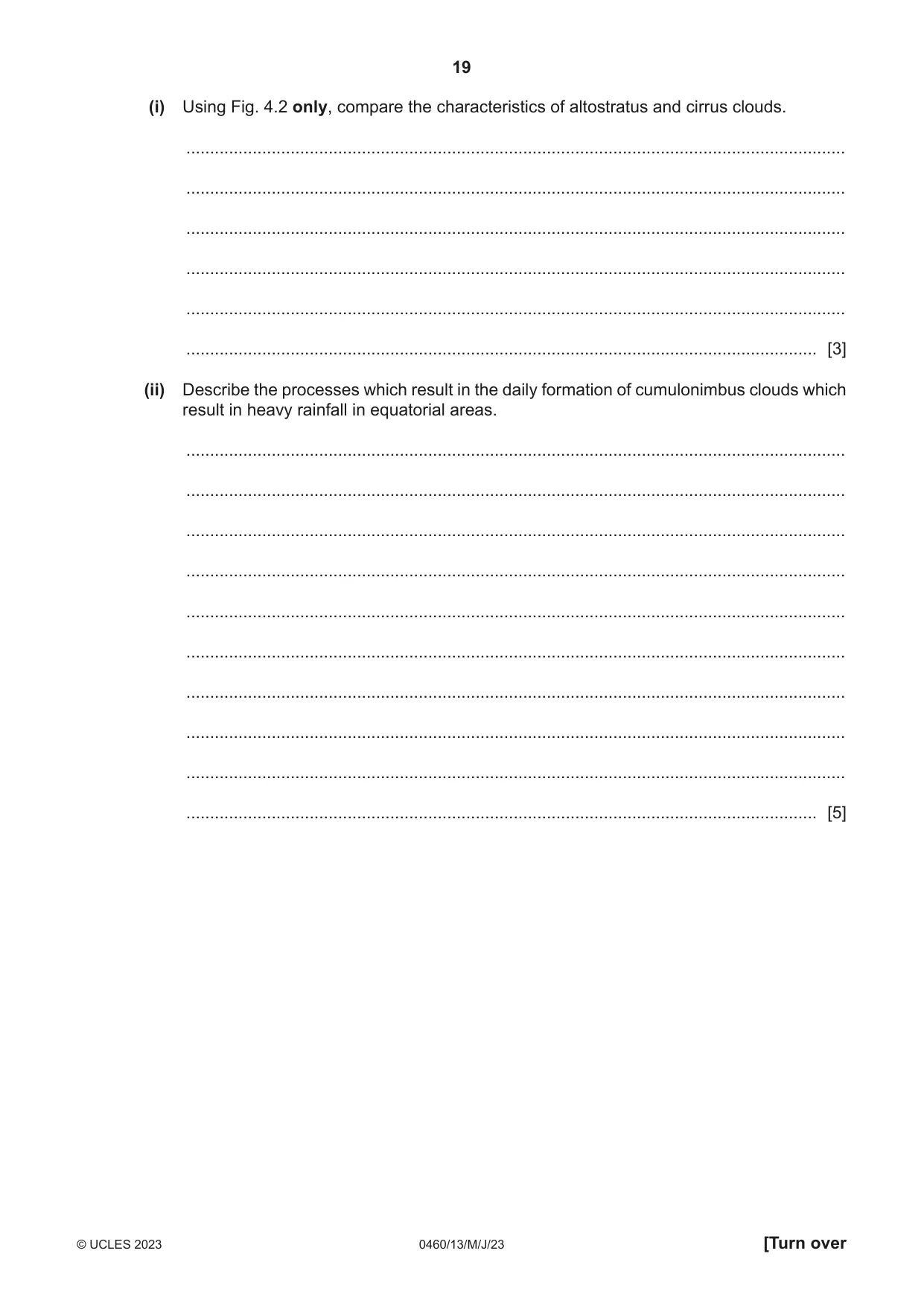
19 0460/13/M/J/23 © UCLES 2023 [Turn over (i) Using Fig. 4.2 only, compare the characteristics of altostratus and cirrus clouds. … … … … … … [3] (ii) Describe the processes which result in the daily formation of cumulonimbus clouds which result in heavy rainfall in equatorial areas. … … … … … … … … … … [5]
Question paper, page 20
20 0460/13/M/J/23 © UCLES 2023 (c) For a named area of hot desert which you have studied, describe and explain the characteristics of its vegetation. Name of desert … … … … … … … … … … … … … … … … … … … … … … … … … [7] [Total: 25]
Question paper, page 21
21 0460/13/M/J/23 © UCLES 2023 [Turn over BLANK PAGE
Question paper, page 22
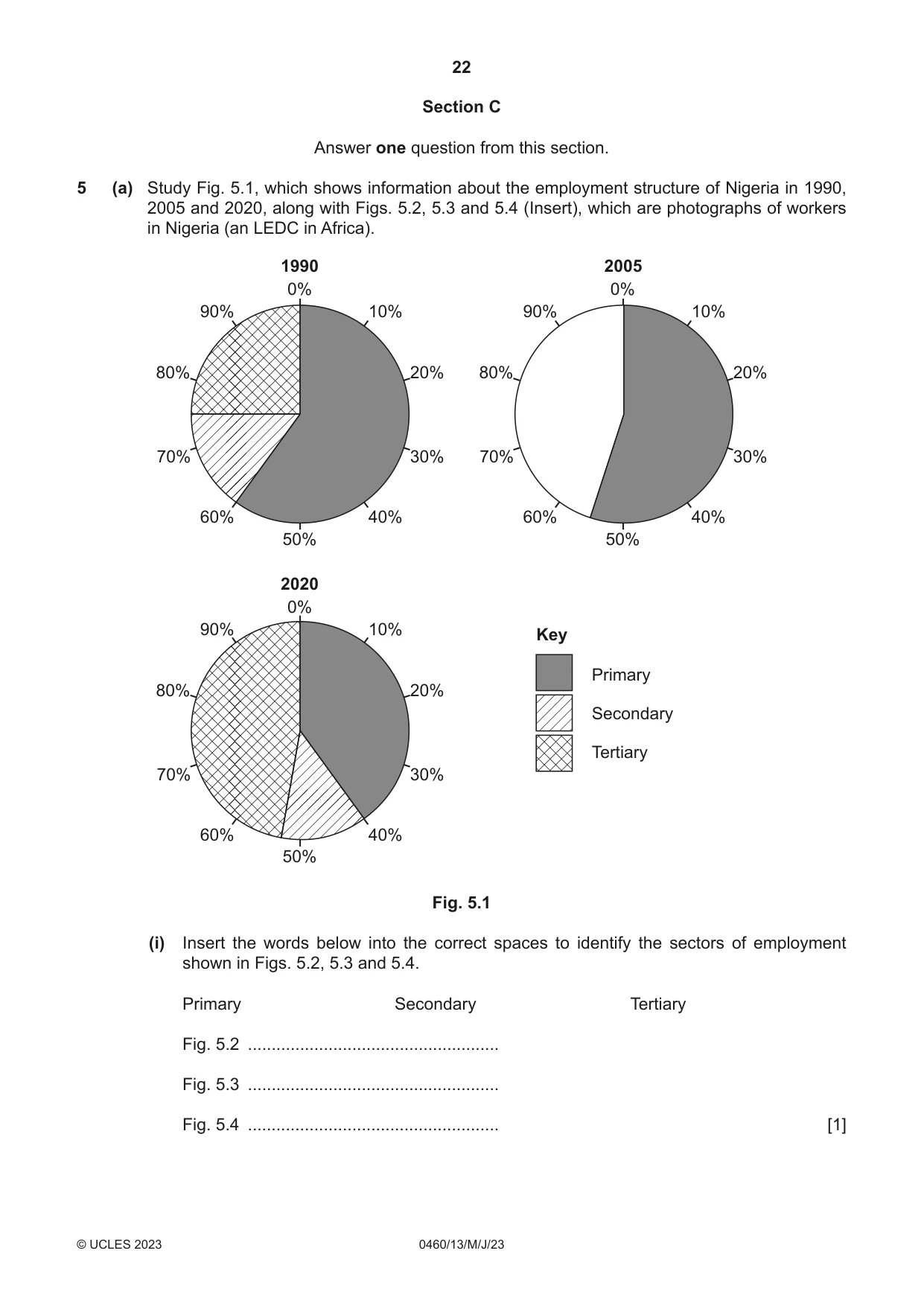
22 0460/13/M/J/23 © UCLES 2023 Section C Answer one question from this section. 5 (a) Study Fig. 5.1, which shows information about the employment structure of Nigeria in 1990, 2005 and 2020, along with Figs. 5.2, 5.3 and 5.4 (Insert), which are photographs of workers in Nigeria (an LEDC in Africa). 0% 1990 2020 2005 50% 10% 20% 40% 90% 80% 70% 60% 30% 0% 50% 10% 20% 40% 90% 80% 70% 60% 30% 0% 50% 10% 20% 40% 90% 80% 70% 60% 30% Key Primary Secondary Tertiary Fig. 5.1 (i) Insert the words below into the correct spaces to identify the sectors of employment shown in Figs. 5.2, 5.3 and 5.4. Primary Secondary Tertiary Fig. 5.2 … Fig. 5.3 … Fig. 5.4 … [1]
Question paper, page 23
23 0460/13/M/J/23 © UCLES 2023 [Turn over (ii) Complete Fig. 5.1 by plotting the following information for 2005: Secondary 10% Tertiary 35% [2] (iii) Describe three changes in the employment structure of Nigeria between 1990 and 2020. Do not use statistics in your answer. 1 … … 2 … … 3 … … [3] (iv) Explain the importance of jobs, such as that shown in Fig. 5.2 (Insert), to an LEDC such as Nigeria. … … … … … … … … [4]
Question paper, page 24
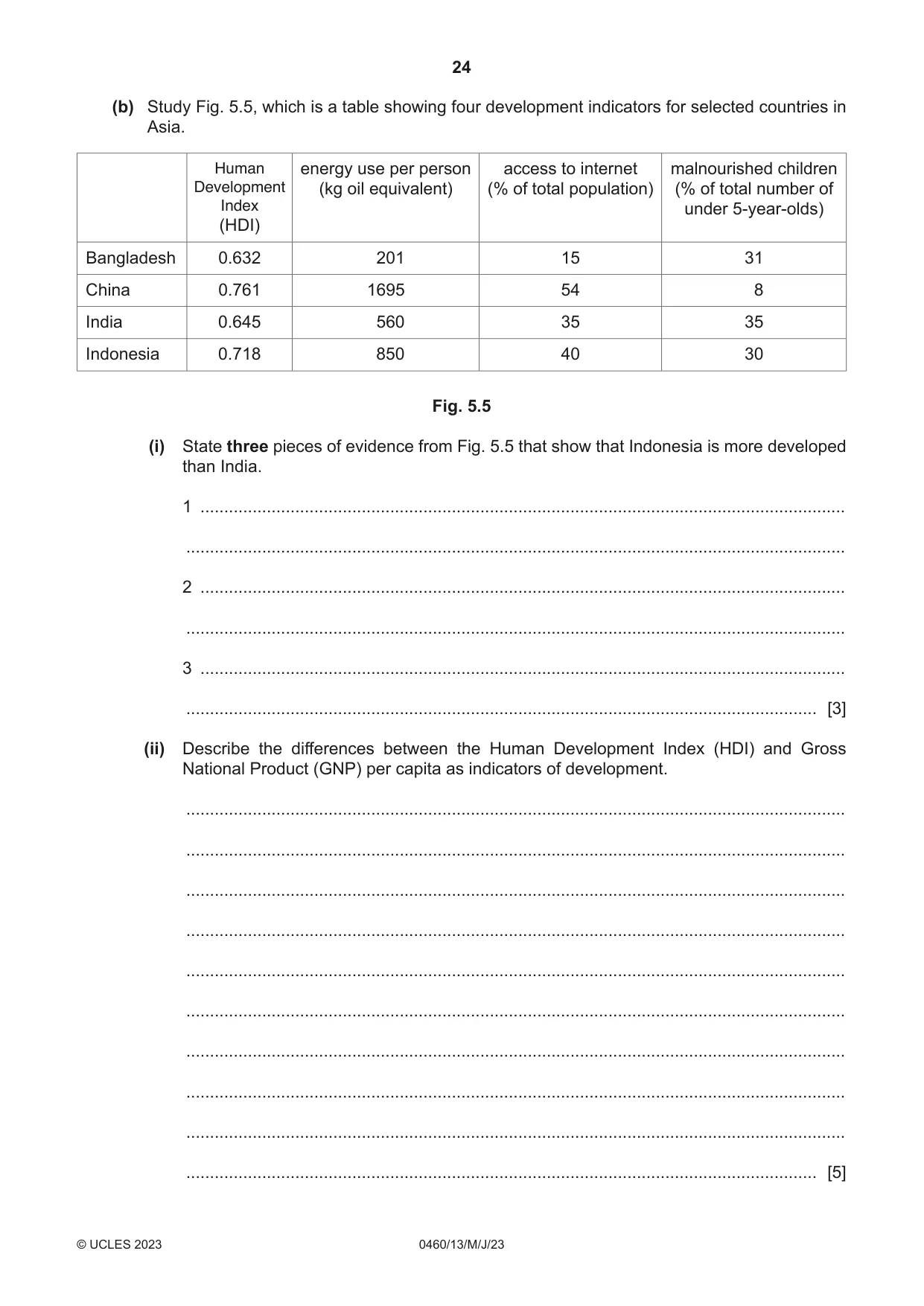
24 0460/13/M/J/23 © UCLES 2023 (b) Study Fig. 5.5, which is a table showing four development indicators for selected countries in Asia. Human Development Index (HDI) energy use per person (kg oil equivalent) access to internet (% of total population) malnourished children (% of total number of under 5-year-olds) Bangladesh 0.632 201 15 31 China 0.761 1695 54 8 India 0.645 560 35 35 Indonesia 0.718 850 40 30 Fig. 5.5 (i) State three pieces of evidence from Fig. 5.5 that show that Indonesia is more developed than India. 1 … … 2 … … 3 … … [3] (ii) Describe the differences between the Human Development Index (HDI) and Gross National Product (GNP) per capita as indicators of development. … … … … … … … … … … [5]
Question paper, page 25
25 0460/13/M/J/23 © UCLES 2023 [Turn over (c) Explain why the process of globalisation has occurred. You should refer to different places and examples. … … … … … … … … … … … … … … … … … … … … … … … … [7] [Total: 25]
Question paper, page 26
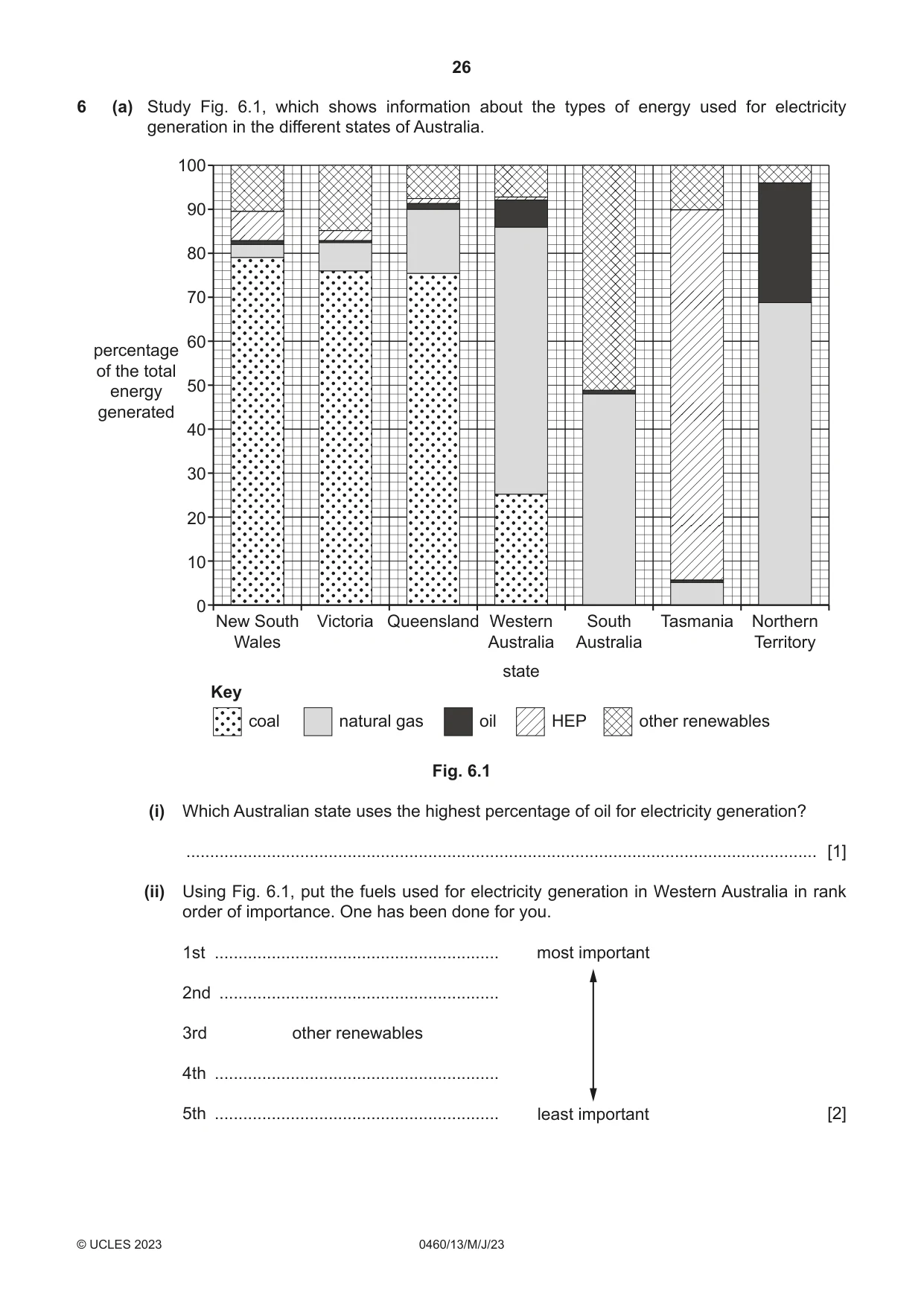
26 0460/13/M/J/23 © UCLES 2023 6 (a) Study Fig. 6.1, which shows information about the types of energy used for electricity generation in the different states of Australia. New South Wales Victoria Queensland Western Australia state South Australia Tasmania Northern Territory 0 10 20 30 40 50 60 70 80 90 100 percentage of the total energy generated Key coal natural gas oil other renewables HEP Fig. 6.1 (i) Which Australian state uses the highest percentage of oil for electricity generation? … [1] (ii) Using Fig. 6.1, put the fuels used for electricity generation in Western Australia in rank order of importance. One has been done for you. 1st … 2nd … 3rd other renewables 4th … 5th … [2] most important least important
Question paper, page 27
27 0460/13/M/J/23 © UCLES 2023 [Turn over (iii) Compare the percentage of three different types of energy used for electricity generation in Queensland and Tasmania. Do not use statistics in your answer. 1 … … 2 … … 3 … … [3] (iv) Suggest reasons for the variation in importance of HEP and other renewable forms of energy in the different states of Australia. … … … … … … … … [4]
Question paper, page 28
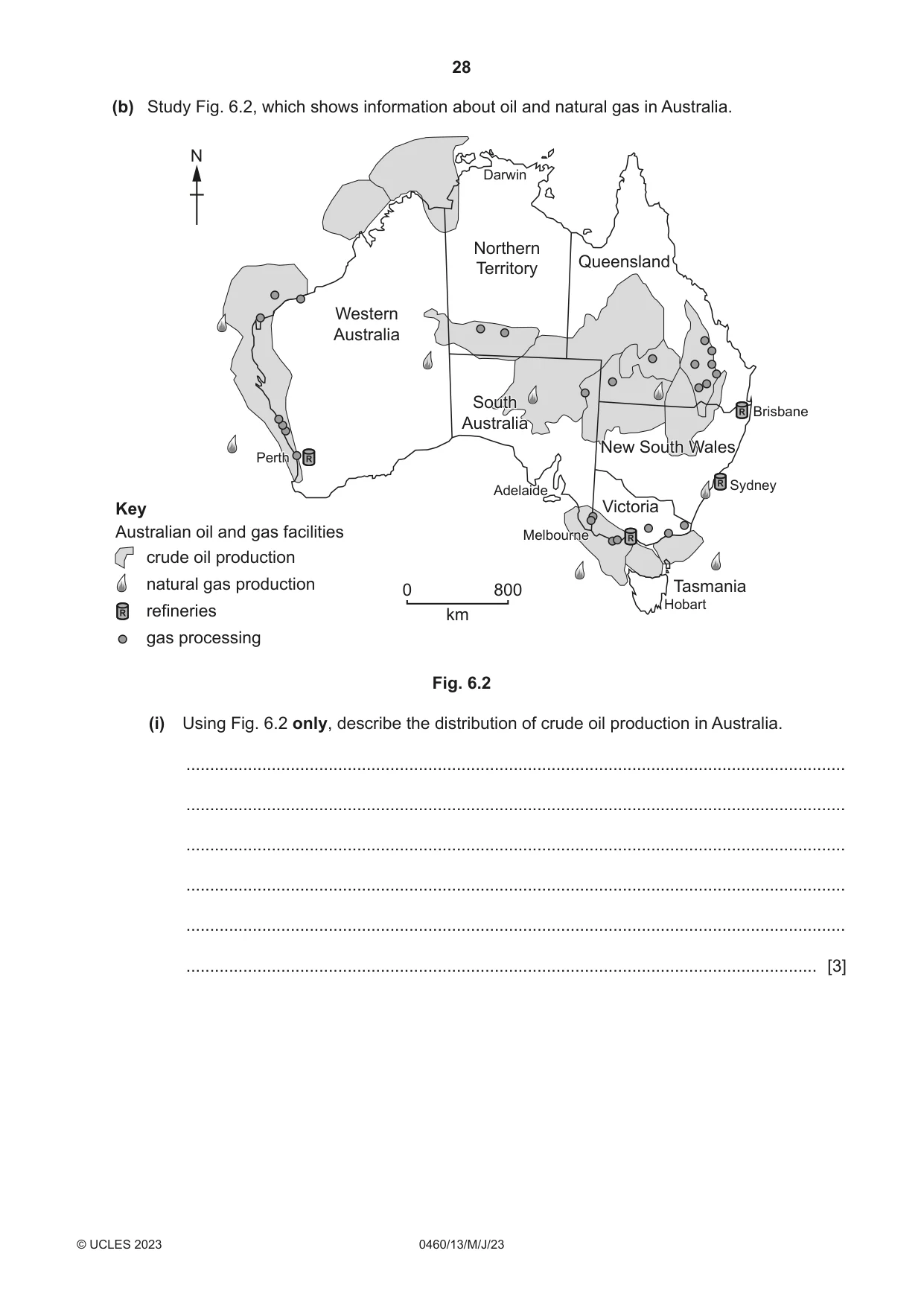
28 0460/13/M/J/23 © UCLES 2023 (b) Study Fig. 6.2, which shows information about oil and natural gas in Australia. Queensland Northern Territory Western Australia South Australia South Australia New South Wales New South Wales Victoria Tasmania Hobart Melbourne Melbourne Adelaide Perth Perth Sydney Brisbane Darwin crude oil production Australian oil and gas facilities natural gas production refineries gas processing Key N 0 800 km Fig. 6.2 (i) Using Fig. 6.2 only, describe the distribution of crude oil production in Australia. … … … … … … [3]
Question paper, page 29
29 0460/13/M/J/23 © UCLES 2023 [Turn over (ii) Explain why many countries are reducing their dependence on fossil fuels such as oil and natural gas. … … … … … … … … … … [5]
Question paper, page 30
30 0460/13/M/J/23 © UCLES 2023 (c) For an example you have studied, describe and explain the location of a factory or zone of manufacturing industry. Location … … … … … … … … … … … … … … … … … … … … … … … … … [7] [Total: 25]
Question paper, page 31
31 0460/13/M/J/23 © UCLES 2023 Additional pages If you use the following pages to complete the answer to any question, the question number must be clearly shown. … … … … … … … … … … … … … … … … … … … … … … … … … …
Question paper, page 32
32 0460/13/M/J/23 © UCLES 2023 The boundaries and names shown, the designations used and the presentation of material on any maps contained in this question paper/insert do not imply official endorsement or acceptance by Cambridge Assessment International Education concerning the legal status of any country, territory, or area or any of its authorities, or of the delimitation of its frontiers or boundaries. Permission to reproduce items where third-party owned material protected by copyright is included has been sought and cleared where possible. Every reasonable effort has been made by the publisher (UCLES) to trace copyright holders, but if any items requiring clearance have unwittingly been included, the publisher will be pleased to make amends at the earliest possible opportunity. To avoid the issue of disclosure of answer-related information to candidates, all copyright acknowledgements are reproduced online in the Cambridge Assessment International Education Copyright Acknowledgements Booklet. This is produced for each series of examinations and is freely available to download at www.cambridgeinternational.org after the live examination series. Cambridge Assessment International Education is part of Cambridge Assessment. Cambridge Assessment is the brand name of the University of Cambridge Local Examinations Syndicate (UCLES), which is a department of the University of Cambridge. … … … … … … … … … … … … … … … … … … … … … …
Mark scheme, page 1
This document consists of 18 printed pages. © UCLES 2023 [Turn over Cambridge IGCSE™ GEOGRAPHY 0460/13 Paper 1 Geographical Themes May/June 2023 MARK SCHEME Maximum Mark: 75 Published This mark scheme is published as an aid to teachers and candidates, to indicate the requirements of the examination. It shows the basis on which Examiners were instructed to award marks. It does not indicate the details of the discussions that took place at an Examiners’ meeting before marking began, which would have considered the acceptability of alternative answers. Mark schemes should be read in conjunction with the question paper and the Principal Examiner Report for Teachers. Cambridge International will not enter into discussions about these mark schemes. Cambridge International is publishing the mark schemes for the May/June 2023 series for most Cambridge IGCSE, Cambridge International A and AS Level and Cambridge Pre-U components, and some Cambridge O Level components.
Mark scheme, page 2
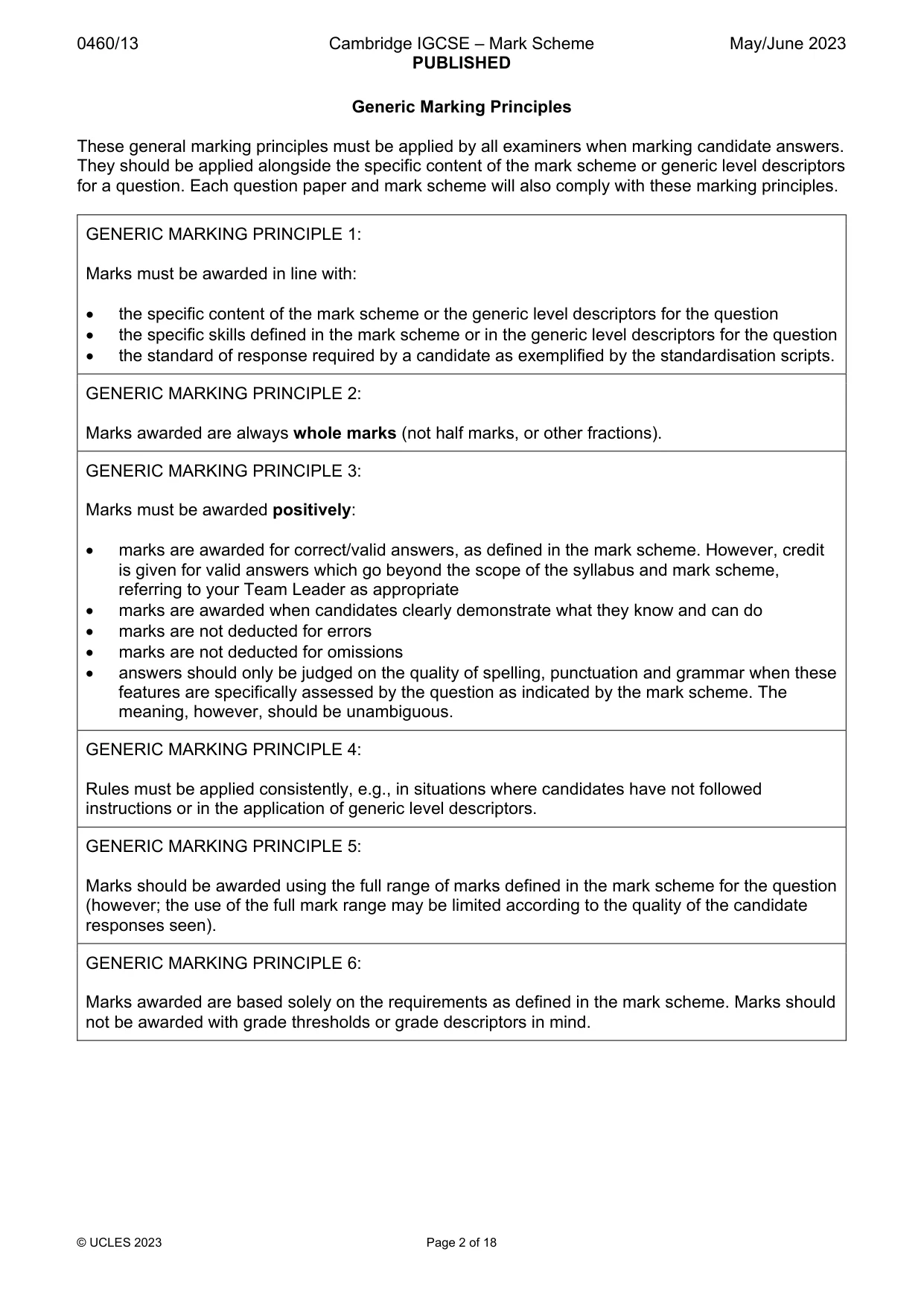
0460/13 Cambridge IGCSE – Mark Scheme PUBLISHED May/June 2023 © UCLES 2023 Page 2 of 18 Generic Marking Principles These general marking principles must be applied by all examiners when marking candidate answers. They should be applied alongside the specific content of the mark scheme or generic level descriptors for a question. Each question paper and mark scheme will also comply with these marking principles. GENERIC MARKING PRINCIPLE 1: Marks must be awarded in line with: the specific content of the mark scheme or the generic level descriptors for the question the specific skills defined in the mark scheme or in the generic level descriptors for the question the standard of response required by a candidate as exemplified by the standardisation scripts. GENERIC MARKING PRINCIPLE 2: Marks awarded are always whole marks (not half marks, or other fractions). GENERIC MARKING PRINCIPLE 3: Marks must be awarded positively: marks are awarded for correct/valid answers, as defined in the mark scheme. However, credit is given for valid answers which go beyond the scope of the syllabus and mark scheme, referring to your Team Leader as appropriate marks are awarded when candidates clearly demonstrate what they know and can do marks are not deducted for errors marks are not deducted for omissions answers should only be judged on the quality of spelling, punctuation and grammar when these features are specifically assessed by the question as indicated by the mark scheme. The meaning, however, should be unambiguous. GENERIC MARKING PRINCIPLE 4: Rules must be applied consistently, e.g., in situations where candidates have not followed instructions or in the application of generic level descriptors. GENERIC MARKING PRINCIPLE 5: Marks should be awarded using the full range of marks defined in the mark scheme for the question (however; the use of the full mark range may be limited according to the quality of the candidate responses seen). GENERIC MARKING PRINCIPLE 6: Marks awarded are based solely on the requirements as defined in the mark scheme. Marks should not be awarded with grade thresholds or grade descriptors in mind.
Mark scheme, page 3
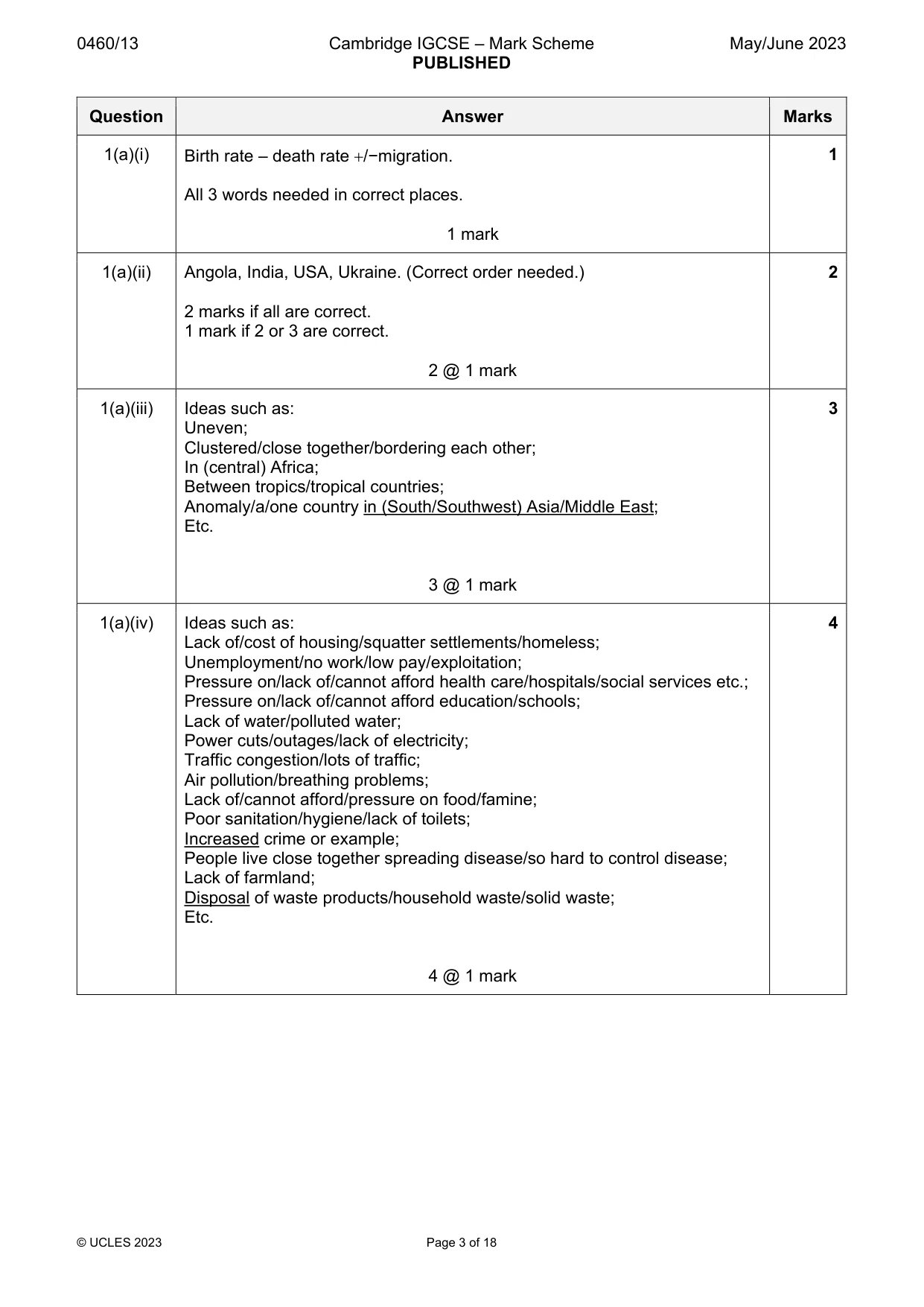
0460/13 Cambridge IGCSE – Mark Scheme PUBLISHED May/June 2023 © UCLES 2023 Page 3 of 18 Question Answer Marks 1(a)(i) Birth rate – death rate /−migration. All 3 words needed in correct places. 1 mark 1 1(a)(ii) Angola, India, USA, Ukraine. (Correct order needed.) 2 marks if all are correct. 1 mark if 2 or 3 are correct. 2 @ 1 mark 2 1(a)(iii) Ideas such as: Uneven; Clustered/close together/bordering each other; In (central) Africa; Between tropics/tropical countries; Anomaly/a/one country in (South/Southwest) Asia/Middle East; Etc. 3 @ 1 mark 3 1(a)(iv) Ideas such as: Lack of/cost of housing/squatter settlements/homeless; Unemployment/no work/low pay/exploitation; Pressure on/lack of/cannot afford health care/hospitals/social services etc.; Pressure on/lack of/cannot afford education/schools; Lack of water/polluted water; Power cuts/outages/lack of electricity; Traffic congestion/lots of traffic; Air pollution/breathing problems; Lack of/cannot afford/pressure on food/famine; Poor sanitation/hygiene/lack of toilets; Increased crime or example; People live close together spreading disease/so hard to control disease; Lack of farmland; Disposal of waste products/household waste/solid waste; Etc. 4 @ 1 mark 4
Mark scheme, page 4
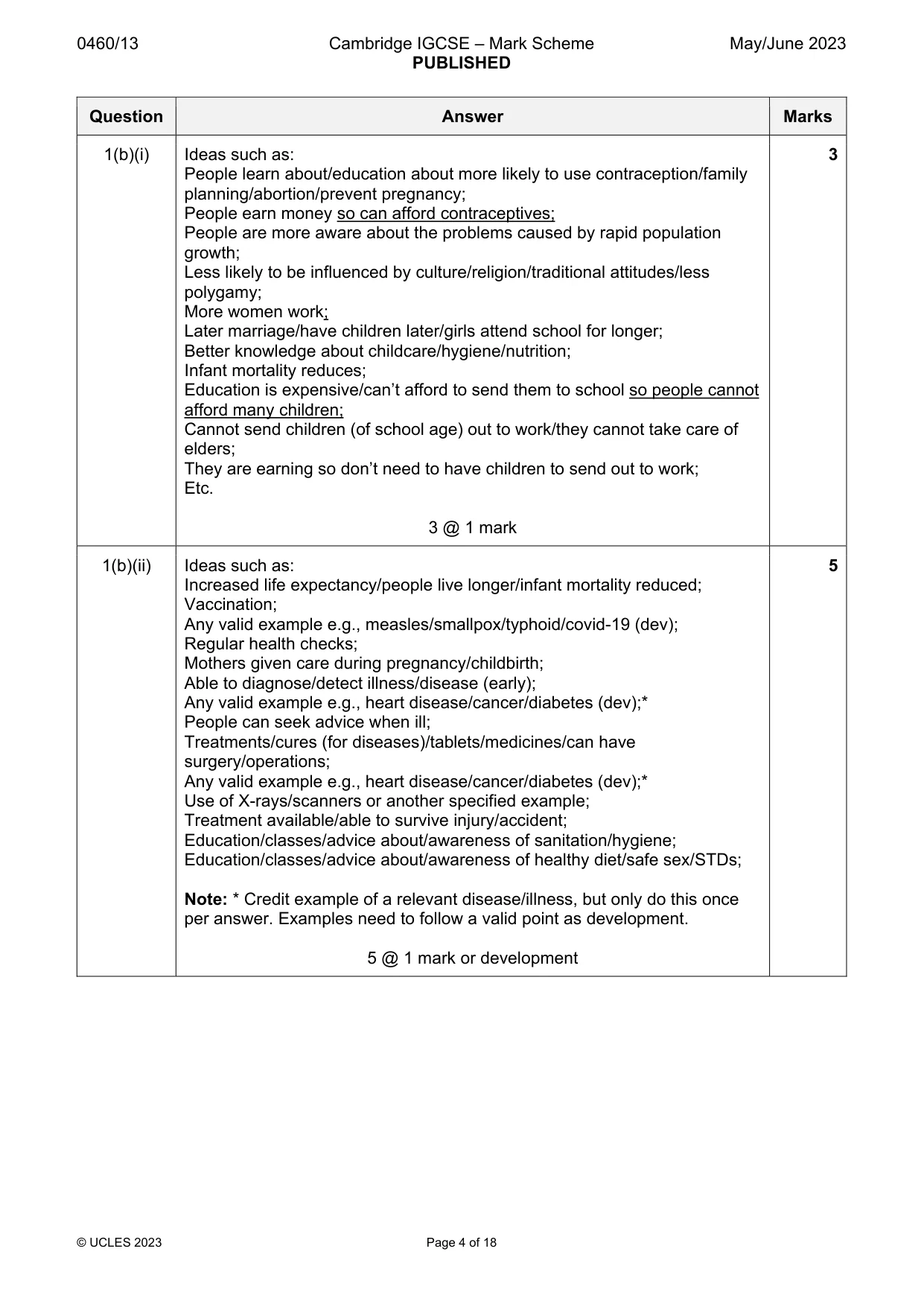
0460/13 Cambridge IGCSE – Mark Scheme PUBLISHED May/June 2023 © UCLES 2023 Page 4 of 18 Question Answer Marks 1(b)(i) Ideas such as: People learn about/education about more likely to use contraception/family planning/abortion/prevent pregnancy; People earn money so can afford contraceptives; People are more aware about the problems caused by rapid population growth; Less likely to be influenced by culture/religion/traditional attitudes/less polygamy; More women work; Later marriage/have children later/girls attend school for longer; Better knowledge about childcare/hygiene/nutrition; Infant mortality reduces; Education is expensive/can’t afford to send them to school so people cannot afford many children; Cannot send children (of school age) out to work/they cannot take care of elders; They are earning so don’t need to have children to send out to work; Etc. 3 @ 1 mark 3 1(b)(ii) Ideas such as: Increased life expectancy/people live longer/infant mortality reduced; Vaccination; Any valid example e.g., measles/smallpox/typhoid/covid-19 (dev); Regular health checks; Mothers given care during pregnancy/childbirth; Able to diagnose/detect illness/disease (early); Any valid example e.g., heart disease/cancer/diabetes (dev);* People can seek advice when ill; Treatments/cures (for diseases)/tablets/medicines/can have surgery/operations; Any valid example e.g., heart disease/cancer/diabetes (dev);* Use of X-rays/scanners or another specified example; Treatment available/able to survive injury/accident; Education/classes/advice about/awareness of sanitation/hygiene; Education/classes/advice about/awareness of healthy diet/safe sex/STDs; Note: * Credit example of a relevant disease/illness, but only do this once per answer. Examples need to follow a valid point as development. 5 @ 1 mark or development 5
Mark scheme, page 5
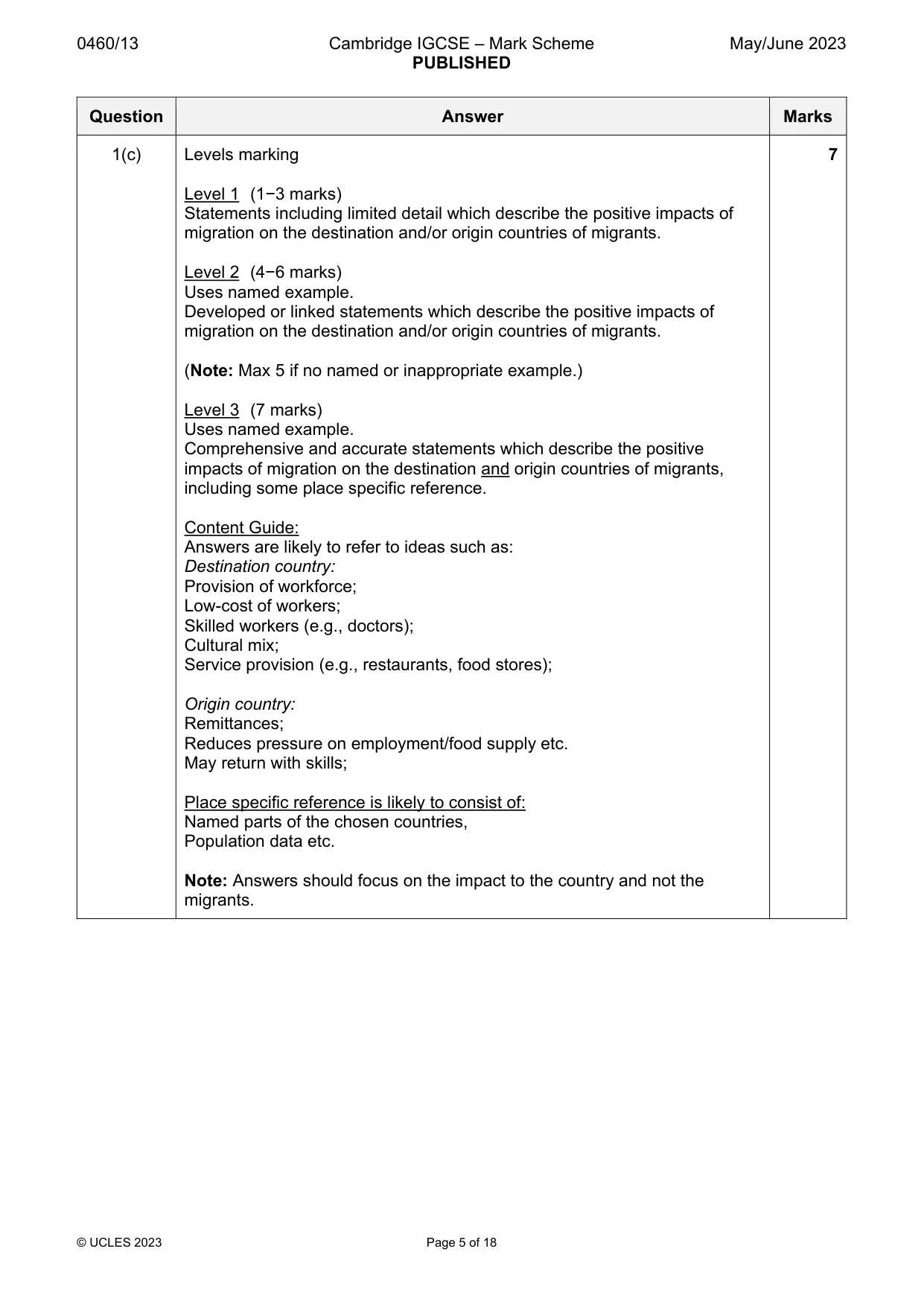
0460/13 Cambridge IGCSE – Mark Scheme PUBLISHED May/June 2023 © UCLES 2023 Page 5 of 18 Question Answer Marks 1(c) Levels marking Level 1 (1−3 marks) Statements including limited detail which describe the positive impacts of migration on the destination and/or origin countries of migrants. Level 2 (4−6 marks) Uses named example. Developed or linked statements which describe the positive impacts of migration on the destination and/or origin countries of migrants. (Note: Max 5 if no named or inappropriate example.) Level 3 (7 marks) Uses named example. Comprehensive and accurate statements which describe the positive impacts of migration on the destination and origin countries of migrants, including some place specific reference. Content Guide: Answers are likely to refer to ideas such as: Destination country: Provision of workforce; Low-cost of workers; Skilled workers (e.g., doctors); Cultural mix; Service provision (e.g., restaurants, food stores); Origin country: Remittances; Reduces pressure on employment/food supply etc. May return with skills; Place specific reference is likely to consist of: Named parts of the chosen countries, Population data etc. Note: Answers should focus on the impact to the country and not the migrants. 7
Mark scheme, page 6
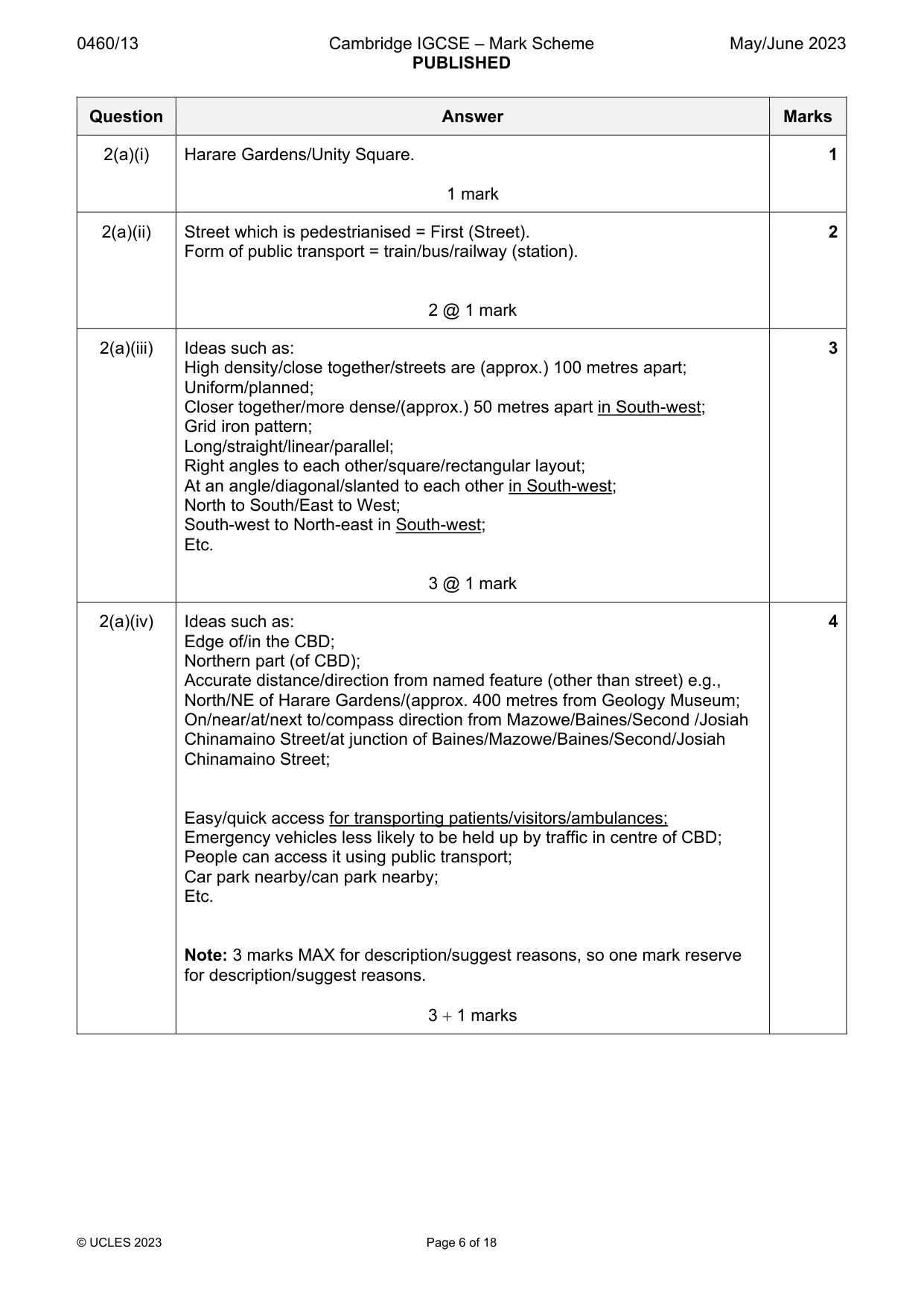
0460/13 Cambridge IGCSE – Mark Scheme PUBLISHED May/June 2023 © UCLES 2023 Page 6 of 18 Question Answer Marks 2(a)(i) Harare Gardens/Unity Square. 1 mark 1 2(a)(ii) Street which is pedestrianised = First (Street). Form of public transport = train/bus/railway (station). 2 @ 1 mark 2 2(a)(iii) Ideas such as: High density/close together/streets are (approx.) 100 metres apart; Uniform/planned; Closer together/more dense/(approx.) 50 metres apart in South-west; Grid iron pattern; Long/straight/linear/parallel; Right angles to each other/square/rectangular layout; At an angle/diagonal/slanted to each other in South-west; North to South/East to West; South-west to North-east in South-west; Etc. 3 @ 1 mark 3 2(a)(iv) Ideas such as: Edge of/in the CBD; Northern part (of CBD); Accurate distance/direction from named feature (other than street) e.g., North/NE of Harare Gardens/(approx. 400 metres from Geology Museum; On/near/at/next to/compass direction from Mazowe/Baines/Second /Josiah Chinamaino Street/at junction of Baines/Mazowe/Baines/Second/Josiah Chinamaino Street; Easy/quick access for transporting patients/visitors/ambulances; Emergency vehicles less likely to be held up by traffic in centre of CBD; People can access it using public transport; Car park nearby/can park nearby; Etc. Note: 3 marks MAX for description/suggest reasons, so one mark reserve for description/suggest reasons. 3 1 marks 4
Mark scheme, page 7
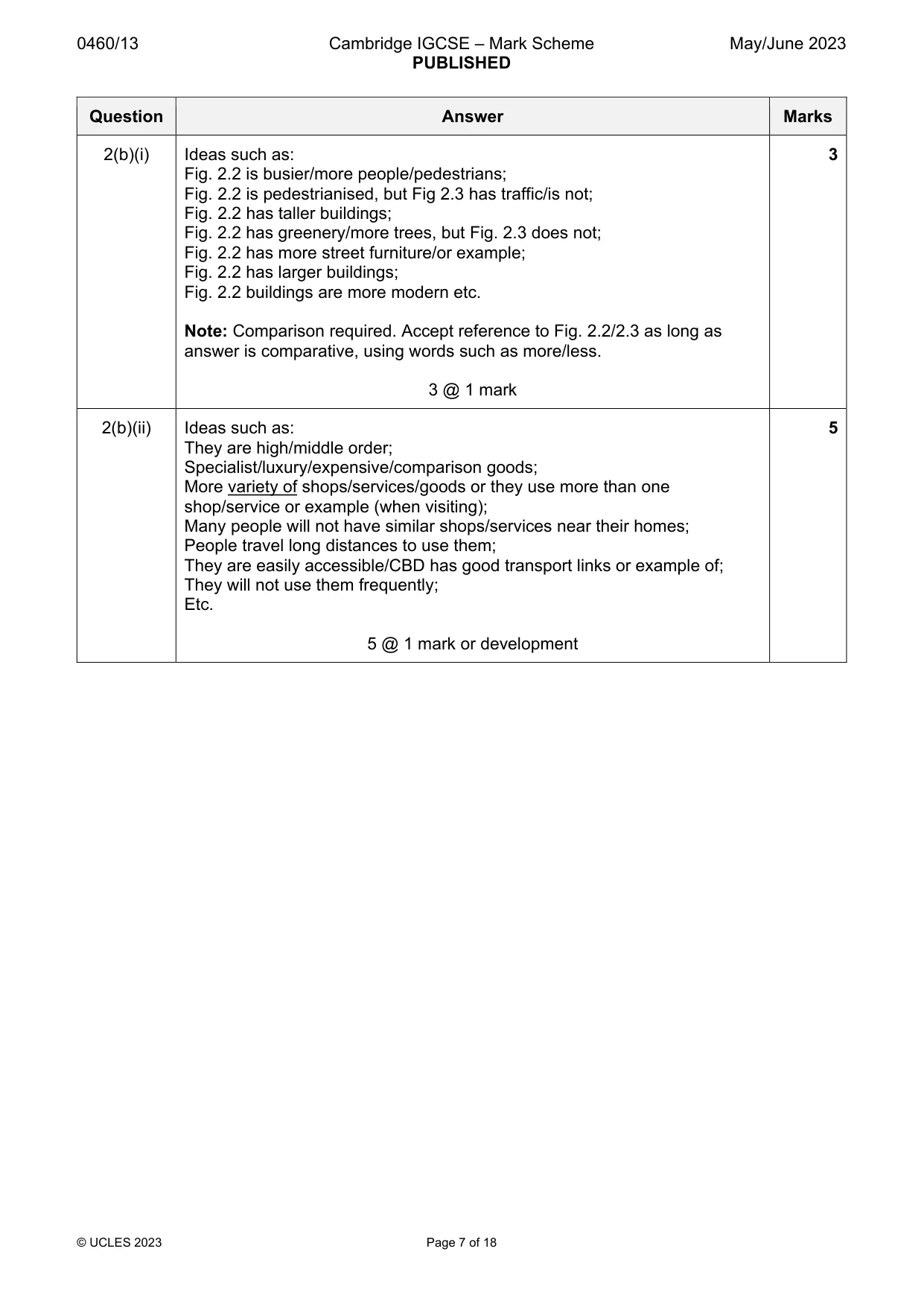
0460/13 Cambridge IGCSE – Mark Scheme PUBLISHED May/June 2023 © UCLES 2023 Page 7 of 18 Question Answer Marks 2(b)(i) Ideas such as: Fig. 2.2 is busier/more people/pedestrians; Fig. 2.2 is pedestrianised, but Fig 2.3 has traffic/is not; Fig. 2.2 has taller buildings; Fig. 2.2 has greenery/more trees, but Fig. 2.3 does not; Fig. 2.2 has more street furniture/or example; Fig. 2.2 has larger buildings; Fig. 2.2 buildings are more modern etc. Note: Comparison required. Accept reference to Fig. 2.2/2.3 as long as answer is comparative, using words such as more/less. 3 @ 1 mark 3 2(b)(ii) Ideas such as: They are high/middle order; Specialist/luxury/expensive/comparison goods; More variety of shops/services/goods or they use more than one shop/service or example (when visiting); Many people will not have similar shops/services near their homes; People travel long distances to use them; They are easily accessible/CBD has good transport links or example of; They will not use them frequently; Etc. 5 @ 1 mark or development 5
Mark scheme, page 8
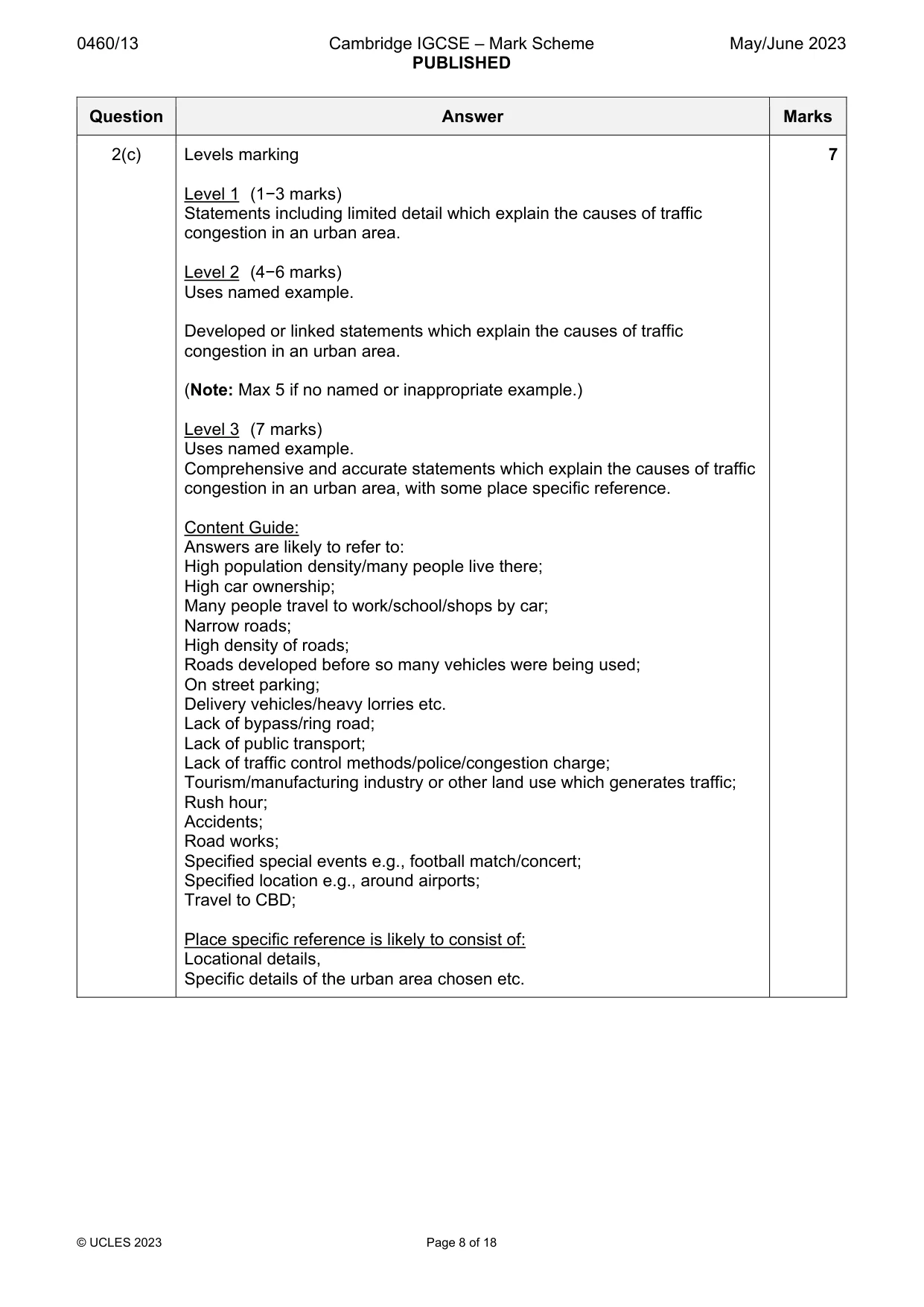
0460/13 Cambridge IGCSE – Mark Scheme PUBLISHED May/June 2023 © UCLES 2023 Page 8 of 18 Question Answer Marks 2(c) Levels marking Level 1 (1−3 marks) Statements including limited detail which explain the causes of traffic congestion in an urban area. Level 2 (4−6 marks) Uses named example. Developed or linked statements which explain the causes of traffic congestion in an urban area. (Note: Max 5 if no named or inappropriate example.) Level 3 (7 marks) Uses named example. Comprehensive and accurate statements which explain the causes of traffic congestion in an urban area, with some place specific reference. Content Guide: Answers are likely to refer to: High population density/many people live there; High car ownership; Many people travel to work/school/shops by car; Narrow roads; High density of roads; Roads developed before so many vehicles were being used; On street parking; Delivery vehicles/heavy lorries etc. Lack of bypass/ring road; Lack of public transport; Lack of traffic control methods/police/congestion charge; Tourism/manufacturing industry or other land use which generates traffic; Rush hour; Accidents; Road works; Specified special events e.g., football match/concert; Specified location e.g., around airports; Travel to CBD; Place specific reference is likely to consist of: Locational details, Specific details of the urban area chosen etc. 7
Mark scheme, page 9
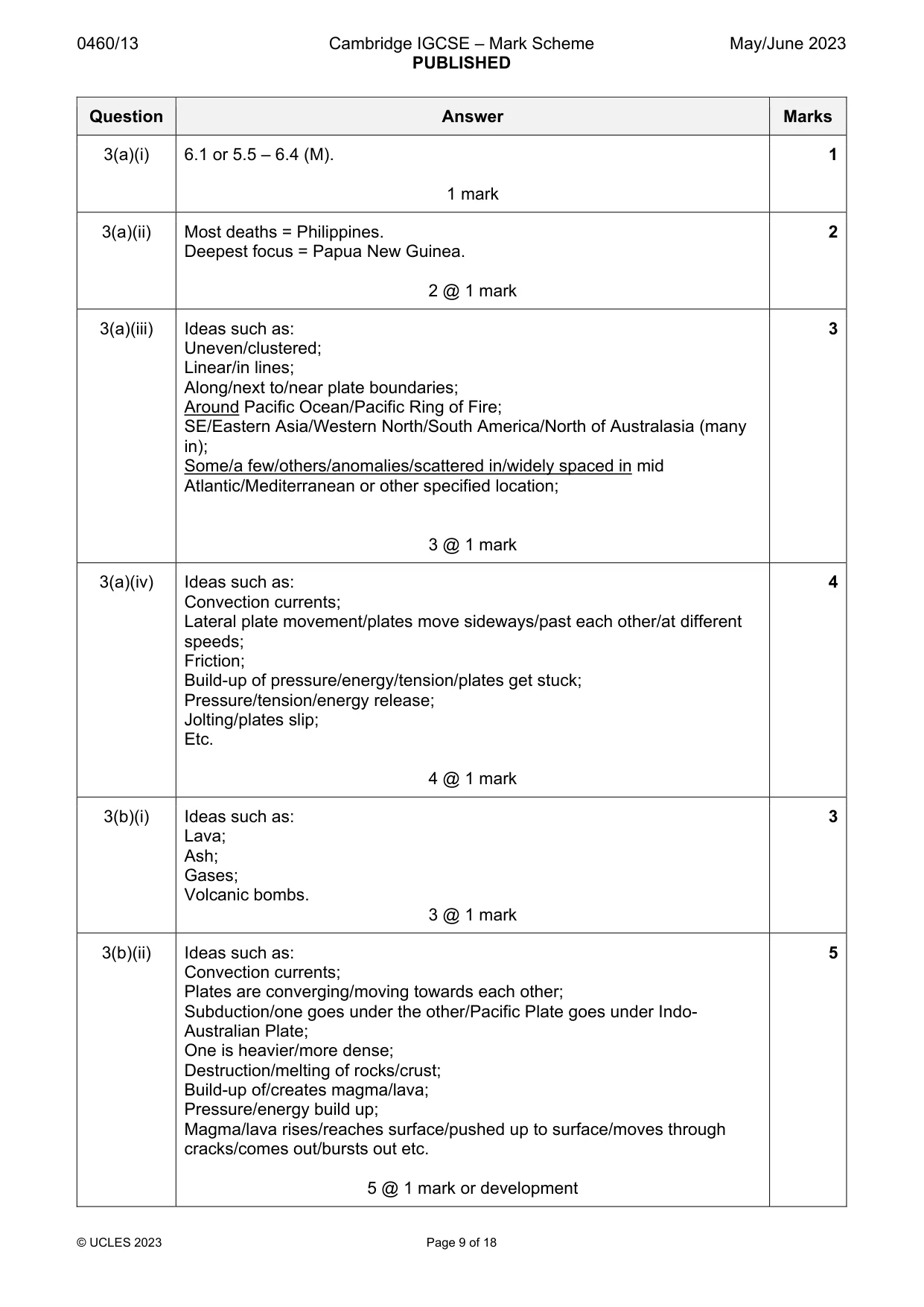
0460/13 Cambridge IGCSE – Mark Scheme PUBLISHED May/June 2023 © UCLES 2023 Page 9 of 18 Question Answer Marks 3(a)(i) 6.1 or 5.5 – 6.4 (M). 1 mark 1 3(a)(ii) Most deaths = Philippines. Deepest focus = Papua New Guinea. 2 @ 1 mark 2 3(a)(iii) Ideas such as: Uneven/clustered; Linear/in lines; Along/next to/near plate boundaries; Around Pacific Ocean/Pacific Ring of Fire; SE/Eastern Asia/Western North/South America/North of Australasia (many in); Some/a few/others/anomalies/scattered in/widely spaced in mid Atlantic/Mediterranean or other specified location; 3 @ 1 mark 3 3(a)(iv) Ideas such as: Convection currents; Lateral plate movement/plates move sideways/past each other/at different speeds; Friction; Build-up of pressure/energy/tension/plates get stuck; Pressure/tension/energy release; Jolting/plates slip; Etc. 4 @ 1 mark 4 3(b)(i) Ideas such as: Lava; Ash; Gases; Volcanic bombs. 3 @ 1 mark 3 3(b)(ii) Ideas such as: Convection currents; Plates are converging/moving towards each other; Subduction/one goes under the other/Pacific Plate goes under Indo- Australian Plate; One is heavier/more dense; Destruction/melting of rocks/crust; Build-up of/creates magma/lava; Pressure/energy build up; Magma/lava rises/reaches surface/pushed up to surface/moves through cracks/comes out/bursts out etc. 5 @ 1 mark or development 5
Mark scheme, page 10
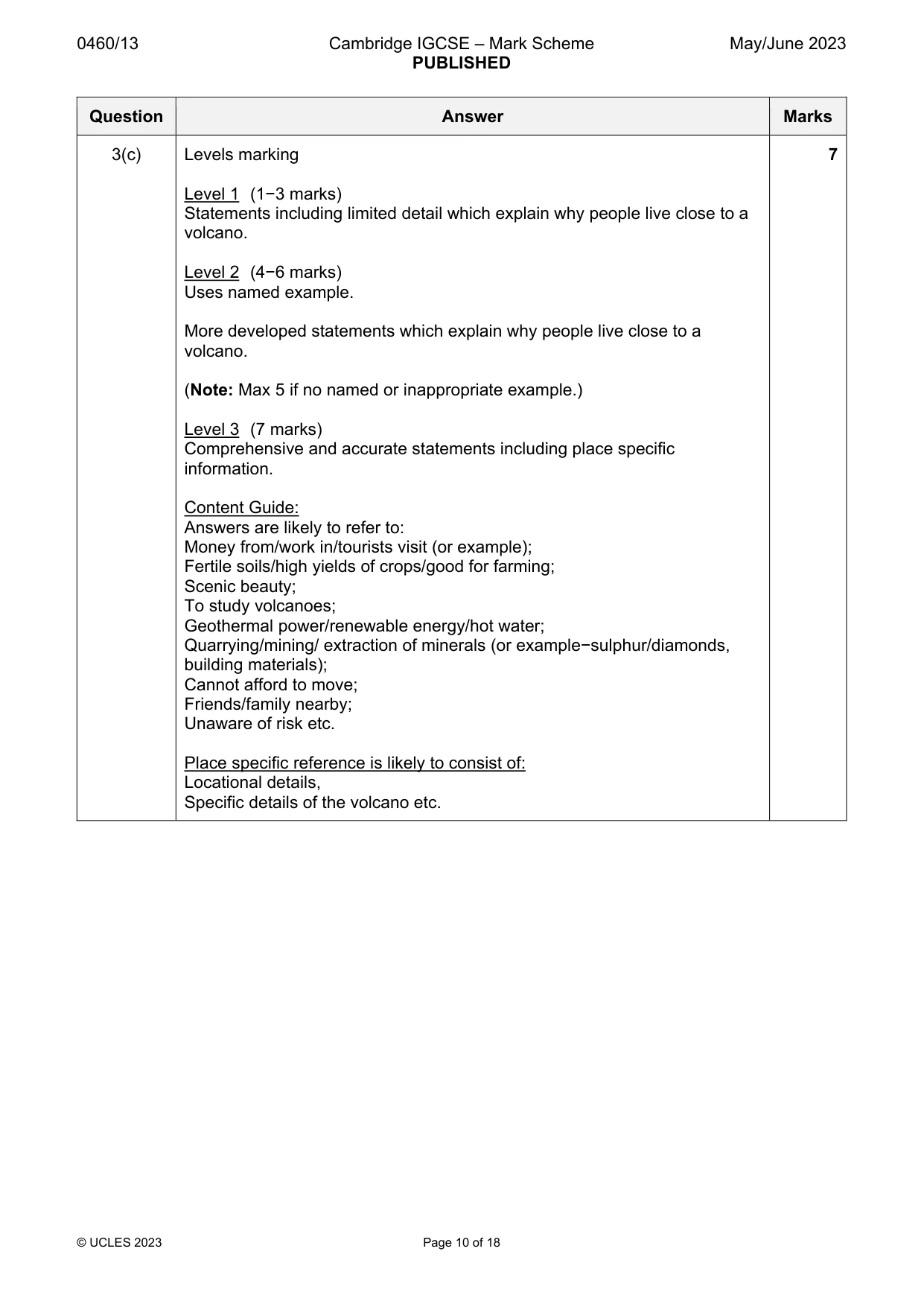
0460/13 Cambridge IGCSE – Mark Scheme PUBLISHED May/June 2023 © UCLES 2023 Page 10 of 18 Question Answer Marks 3(c) Levels marking Level 1 (1−3 marks) Statements including limited detail which explain why people live close to a volcano. Level 2 (4−6 marks) Uses named example. More developed statements which explain why people live close to a volcano. (Note: Max 5 if no named or inappropriate example.) Level 3 (7 marks) Comprehensive and accurate statements including place specific information. Content Guide: Answers are likely to refer to: Money from/work in/tourists visit (or example); Fertile soils/high yields of crops/good for farming; Scenic beauty; To study volcanoes; Geothermal power/renewable energy/hot water; Quarrying/mining/ extraction of minerals (or example−sulphur/diamonds, building materials); Cannot afford to move; Friends/family nearby; Unaware of risk etc. Place specific reference is likely to consist of: Locational details, Specific details of the volcano etc. 7
Mark scheme, page 11
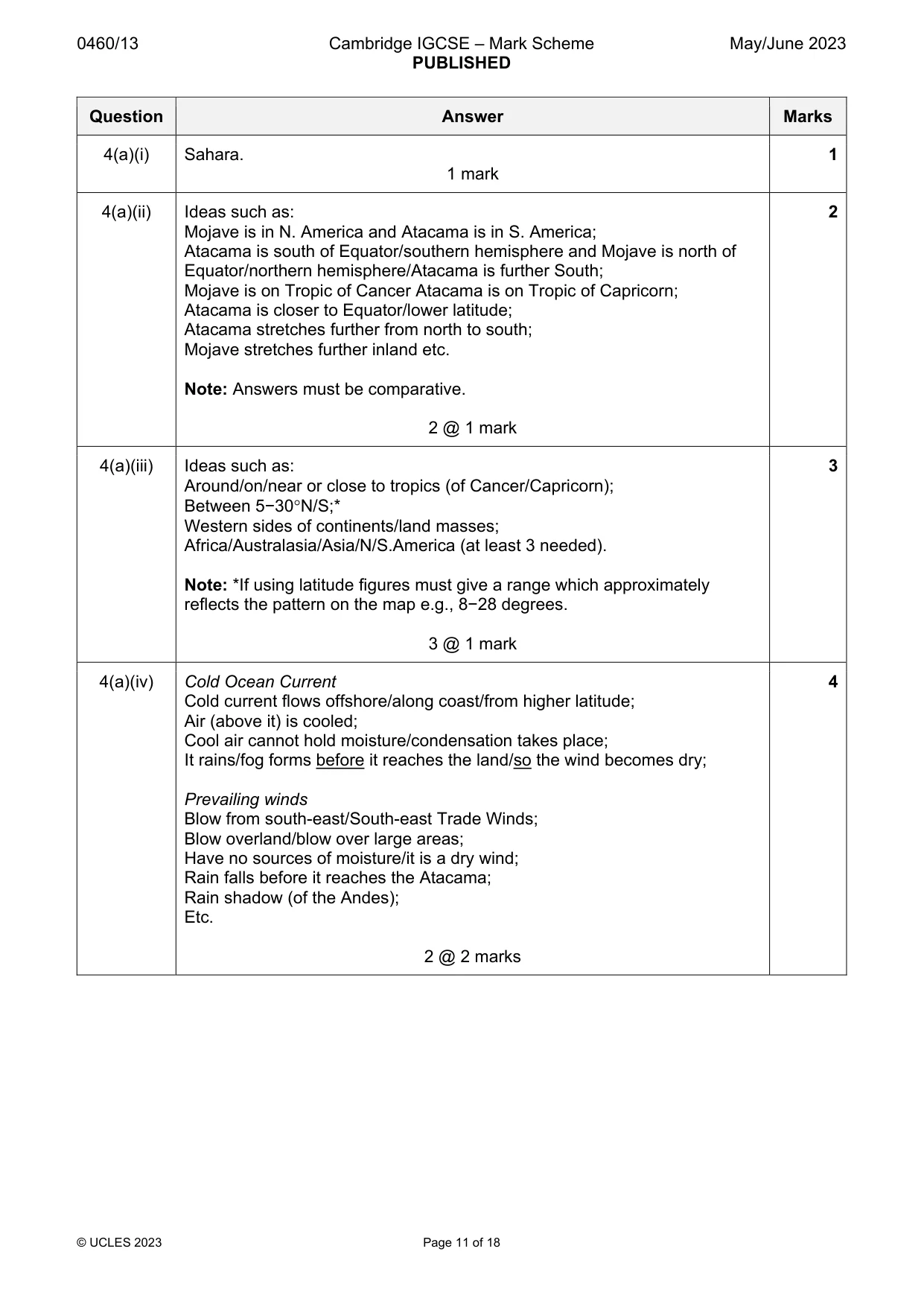
0460/13 Cambridge IGCSE – Mark Scheme PUBLISHED May/June 2023 © UCLES 2023 Page 11 of 18 Question Answer Marks 4(a)(i) Sahara. 1 mark 1 4(a)(ii) Ideas such as: Mojave is in N. America and Atacama is in S. America; Atacama is south of Equator/southern hemisphere and Mojave is north of Equator/northern hemisphere/Atacama is further South; Mojave is on Tropic of Cancer Atacama is on Tropic of Capricorn; Atacama is closer to Equator/lower latitude; Atacama stretches further from north to south; Mojave stretches further inland etc. Note: Answers must be comparative. 2 @ 1 mark 2 4(a)(iii) Ideas such as: Around/on/near or close to tropics (of Cancer/Capricorn); Between 5−30N/S;* Western sides of continents/land masses; Africa/Australasia/Asia/N/S.America (at least 3 needed). Note: *If using latitude figures must give a range which approximately reflects the pattern on the map e.g., 8−28 degrees. 3 @ 1 mark 3 4(a)(iv) Cold Ocean Current Cold current flows offshore/along coast/from higher latitude; Air (above it) is cooled; Cool air cannot hold moisture/condensation takes place; It rains/fog forms before it reaches the land/so the wind becomes dry; Prevailing winds Blow from south-east/South-east Trade Winds; Blow overland/blow over large areas; Have no sources of moisture/it is a dry wind; Rain falls before it reaches the Atacama; Rain shadow (of the Andes); Etc. 2 @ 2 marks 4
Mark scheme, page 12
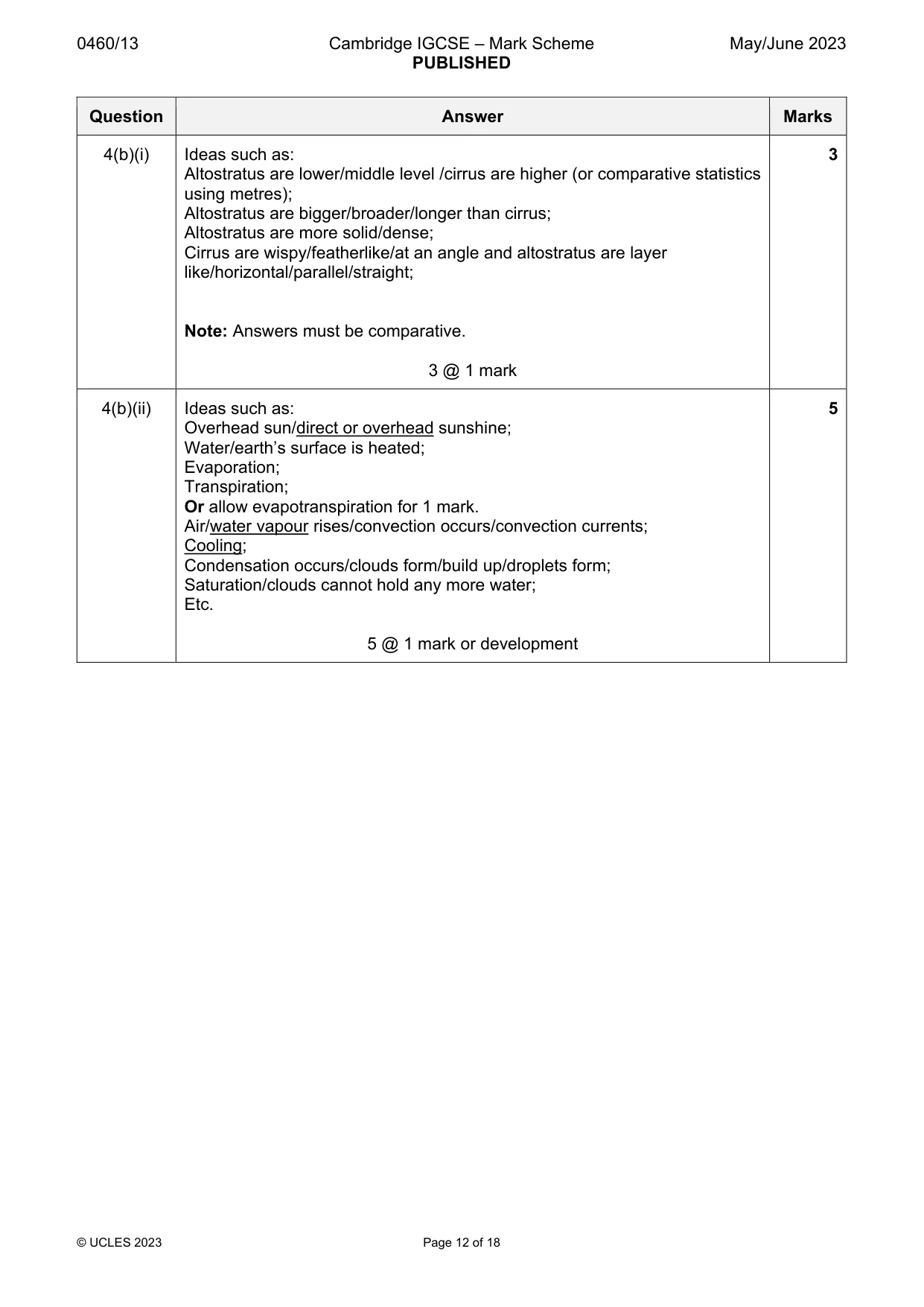
0460/13 Cambridge IGCSE – Mark Scheme PUBLISHED May/June 2023 © UCLES 2023 Page 12 of 18 Question Answer Marks 4(b)(i) Ideas such as: Altostratus are lower/middle level /cirrus are higher (or comparative statistics using metres); Altostratus are bigger/broader/longer than cirrus; Altostratus are more solid/dense; Cirrus are wispy/featherlike/at an angle and altostratus are layer like/horizontal/parallel/straight; Note: Answers must be comparative. 3 @ 1 mark 3 4(b)(ii) Ideas such as: Overhead sun/direct or overhead sunshine; Water/earth’s surface is heated; Evaporation; Transpiration; Or allow evapotranspiration for 1 mark. Air/water vapour rises/convection occurs/convection currents; Cooling; Condensation occurs/clouds form/build up/droplets form; Saturation/clouds cannot hold any more water; Etc. 5 @ 1 mark or development 5
Mark scheme, page 13
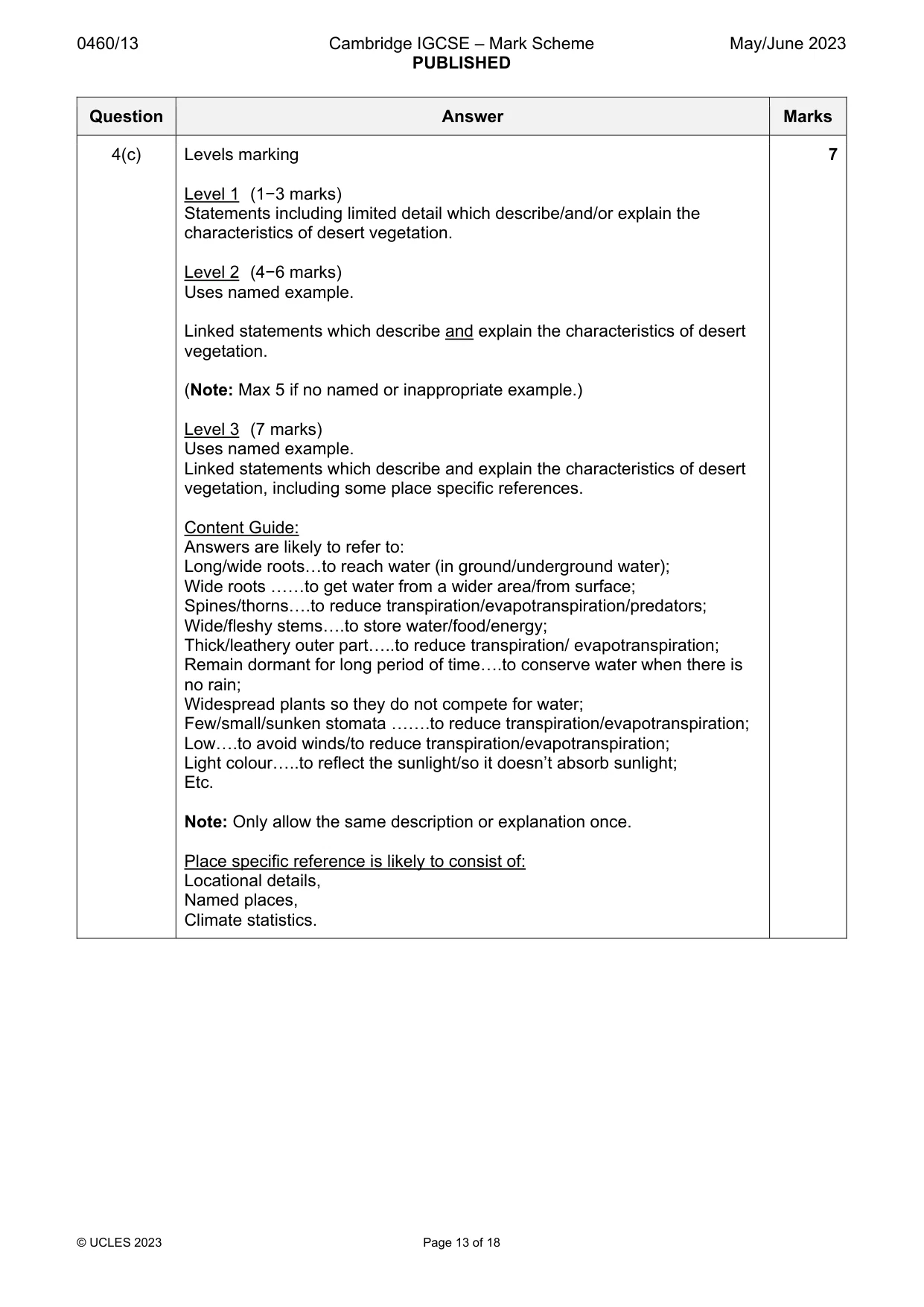
0460/13 Cambridge IGCSE – Mark Scheme PUBLISHED May/June 2023 © UCLES 2023 Page 13 of 18 Question Answer Marks 4(c) Levels marking Level 1 (1−3 marks) Statements including limited detail which describe/and/or explain the characteristics of desert vegetation. Level 2 (4−6 marks) Uses named example. Linked statements which describe and explain the characteristics of desert vegetation. (Note: Max 5 if no named or inappropriate example.) Level 3 (7 marks) Uses named example. Linked statements which describe and explain the characteristics of desert vegetation, including some place specific references. Content Guide: Answers are likely to refer to: Long/wide roots…to reach water (in ground/underground water); Wide roots ……to get water from a wider area/from surface; Spines/thorns….to reduce transpiration/evapotranspiration/predators; Wide/fleshy stems….to store water/food/energy; Thick/leathery outer part…..to reduce transpiration/ evapotranspiration; Remain dormant for long period of time….to conserve water when there is no rain; Widespread plants so they do not compete for water; Few/small/sunken stomata …….to reduce transpiration/evapotranspiration; Low….to avoid winds/to reduce transpiration/evapotranspiration; Light colour…..to reflect the sunlight/so it doesn’t absorb sunlight; Etc. Note: Only allow the same description or explanation once. Place specific reference is likely to consist of: Locational details, Named places, Climate statistics. 7
Mark scheme, page 14
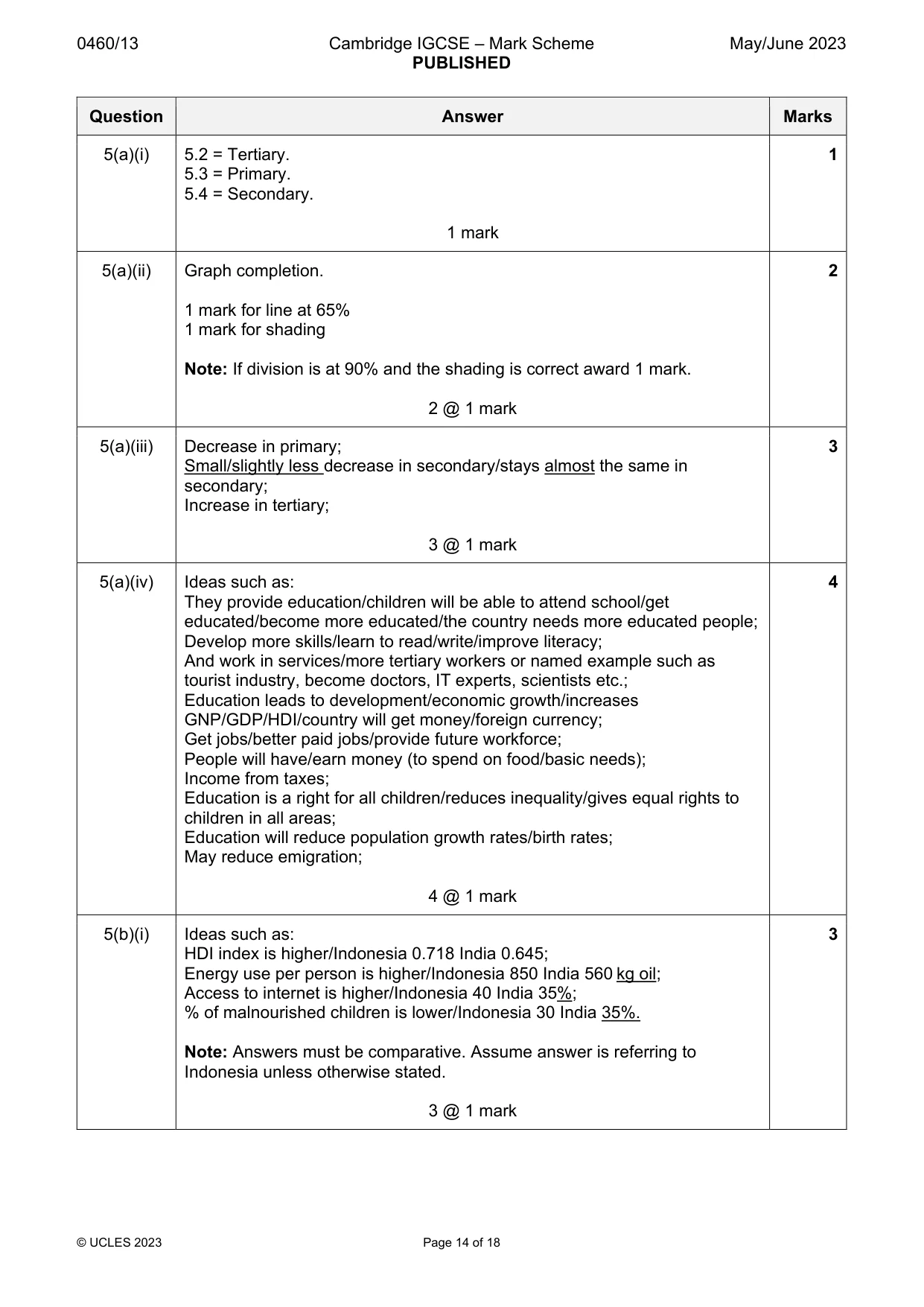
0460/13 Cambridge IGCSE – Mark Scheme PUBLISHED May/June 2023 © UCLES 2023 Page 14 of 18 Question Answer Marks 5(a)(i) 5.2 = Tertiary. 5.3 = Primary. 5.4 = Secondary. 1 mark 1 5(a)(ii) Graph completion. 1 mark for line at 65% 1 mark for shading Note: If division is at 90% and the shading is correct award 1 mark. 2 @ 1 mark 2 5(a)(iii) Decrease in primary; Small/slightly less decrease in secondary/stays almost the same in secondary; Increase in tertiary; 3 @ 1 mark 3 5(a)(iv) Ideas such as: They provide education/children will be able to attend school/get educated/become more educated/the country needs more educated people; Develop more skills/learn to read/write/improve literacy; And work in services/more tertiary workers or named example such as tourist industry, become doctors, IT experts, scientists etc.; Education leads to development/economic growth/increases GNP/GDP/HDI/country will get money/foreign currency; Get jobs/better paid jobs/provide future workforce; People will have/earn money (to spend on food/basic needs); Income from taxes; Education is a right for all children/reduces inequality/gives equal rights to children in all areas; Education will reduce population growth rates/birth rates; May reduce emigration; 4 @ 1 mark 4 5(b)(i) Ideas such as: HDI index is higher/Indonesia 0.718 India 0.645; Energy use per person is higher/Indonesia 850 India 560 kg oil; Access to internet is higher/Indonesia 40 India 35%; % of malnourished children is lower/Indonesia 30 India 35%. Note: Answers must be comparative. Assume answer is referring to Indonesia unless otherwise stated. 3 @ 1 mark 3
Mark scheme, page 15
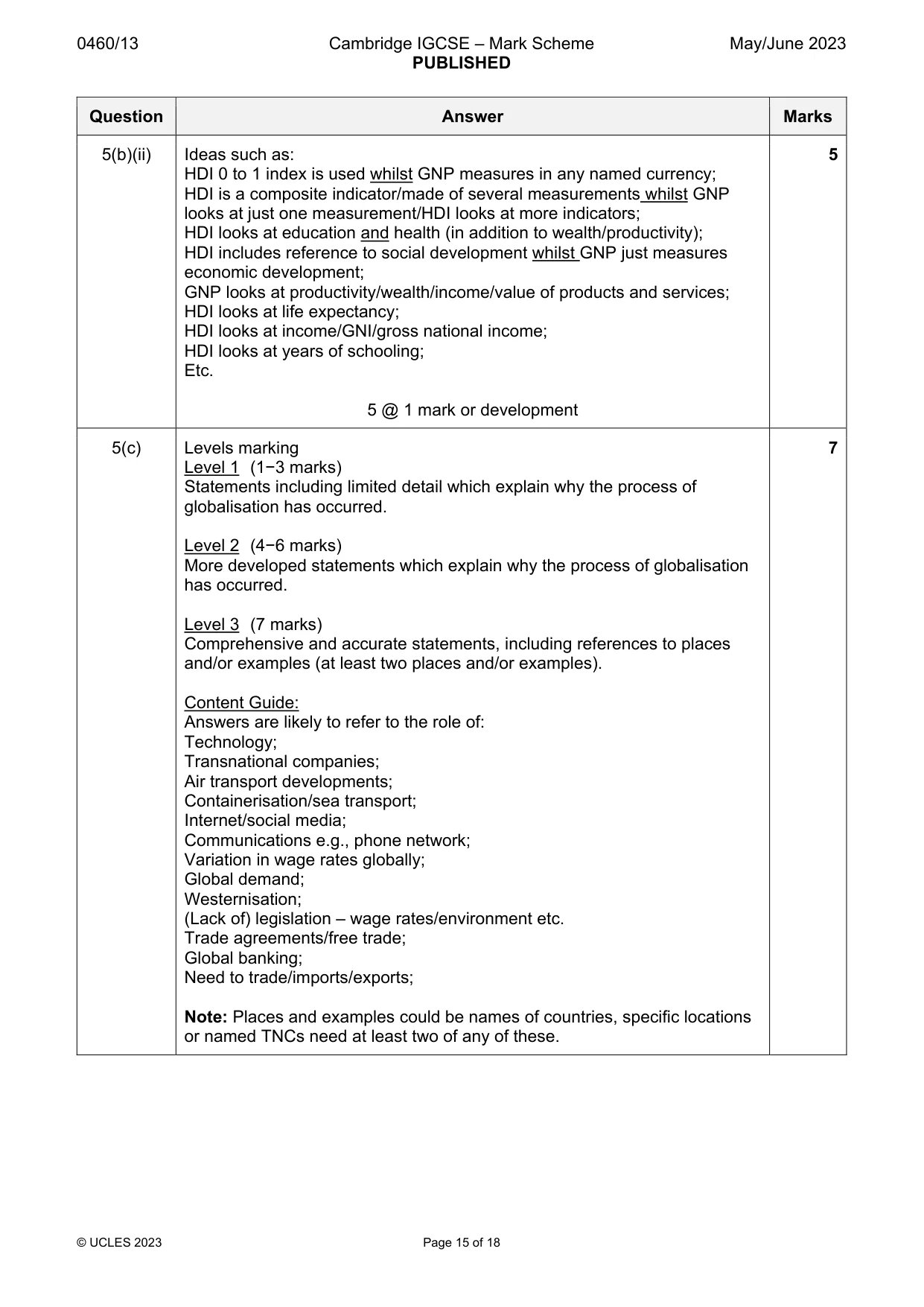
0460/13 Cambridge IGCSE – Mark Scheme PUBLISHED May/June 2023 © UCLES 2023 Page 15 of 18 Question Answer Marks 5(b)(ii) Ideas such as: HDI 0 to 1 index is used whilst GNP measures in any named currency; HDI is a composite indicator/made of several measurements whilst GNP looks at just one measurement/HDI looks at more indicators; HDI looks at education and health (in addition to wealth/productivity); HDI includes reference to social development whilst GNP just measures economic development; GNP looks at productivity/wealth/income/value of products and services; HDI looks at life expectancy; HDI looks at income/GNI/gross national income; HDI looks at years of schooling; Etc. 5 @ 1 mark or development 5 5(c) Levels marking Level 1 (1−3 marks) Statements including limited detail which explain why the process of globalisation has occurred. Level 2 (4−6 marks) More developed statements which explain why the process of globalisation has occurred. Level 3 (7 marks) Comprehensive and accurate statements, including references to places and/or examples (at least two places and/or examples). Content Guide: Answers are likely to refer to the role of: Technology; Transnational companies; Air transport developments; Containerisation/sea transport; Internet/social media; Communications e.g., phone network; Variation in wage rates globally; Global demand; Westernisation; (Lack of) legislation – wage rates/environment etc. Trade agreements/free trade; Global banking; Need to trade/imports/exports; Note: Places and examples could be names of countries, specific locations or named TNCs need at least two of any of these. 7
Mark scheme, page 16
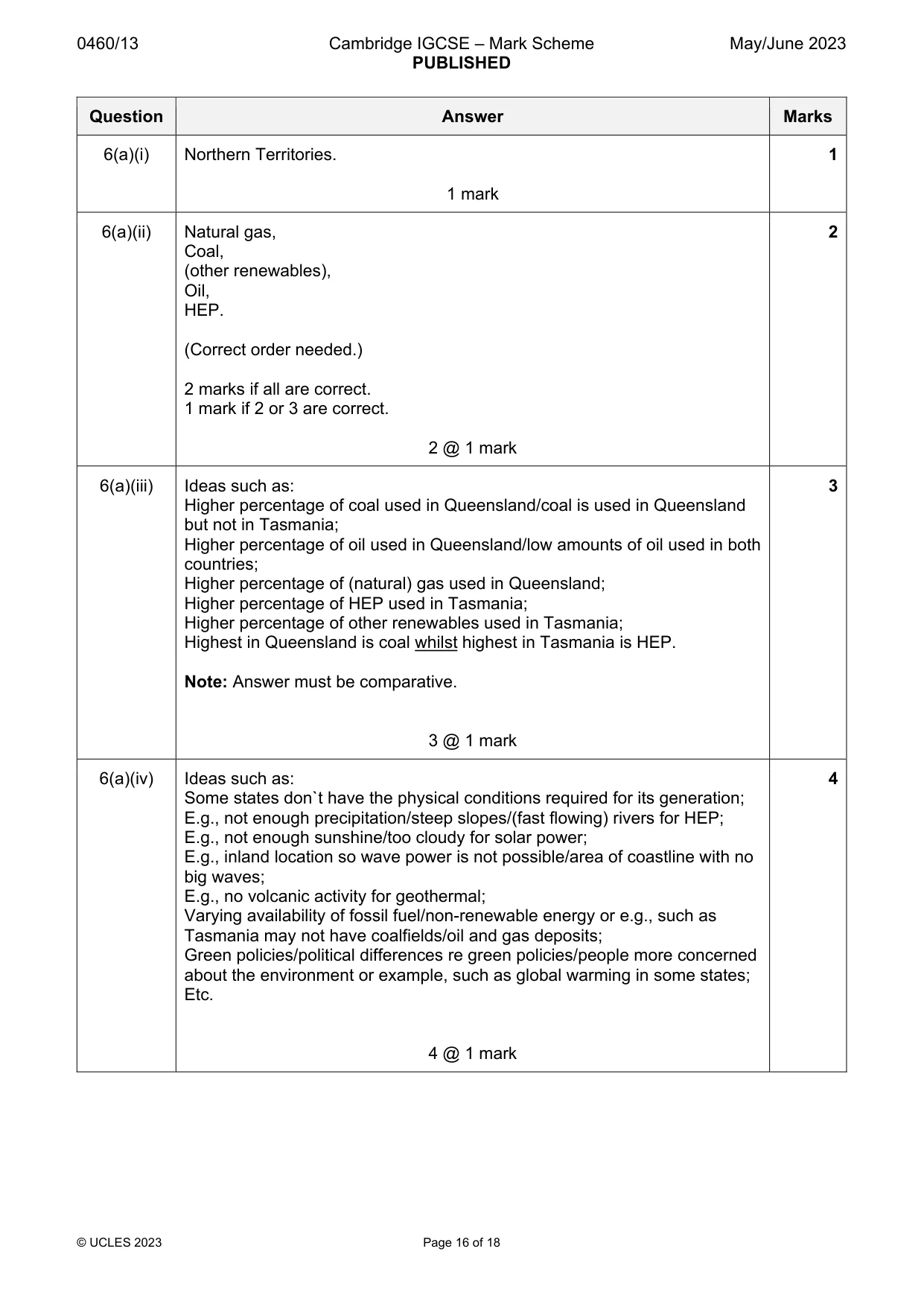
0460/13 Cambridge IGCSE – Mark Scheme PUBLISHED May/June 2023 © UCLES 2023 Page 16 of 18 Question Answer Marks 6(a)(i) Northern Territories. 1 mark 1 6(a)(ii) Natural gas, Coal, (other renewables), Oil, HEP. (Correct order needed.) 2 marks if all are correct. 1 mark if 2 or 3 are correct. 2 @ 1 mark 2 6(a)(iii) Ideas such as: Higher percentage of coal used in Queensland/coal is used in Queensland but not in Tasmania; Higher percentage of oil used in Queensland/low amounts of oil used in both countries; Higher percentage of (natural) gas used in Queensland; Higher percentage of HEP used in Tasmania; Higher percentage of other renewables used in Tasmania; Highest in Queensland is coal whilst highest in Tasmania is HEP. Note: Answer must be comparative. 3 @ 1 mark 3 6(a)(iv) Ideas such as: Some states don`t have the physical conditions required for its generation; E.g., not enough precipitation/steep slopes/(fast flowing) rivers for HEP; E.g., not enough sunshine/too cloudy for solar power; E.g., inland location so wave power is not possible/area of coastline with no big waves; E.g., no volcanic activity for geothermal; Varying availability of fossil fuel/non-renewable energy or e.g., such as Tasmania may not have coalfields/oil and gas deposits; Green policies/political differences re green policies/people more concerned about the environment or example, such as global warming in some states; Etc. 4 @ 1 mark 4
Mark scheme, page 17
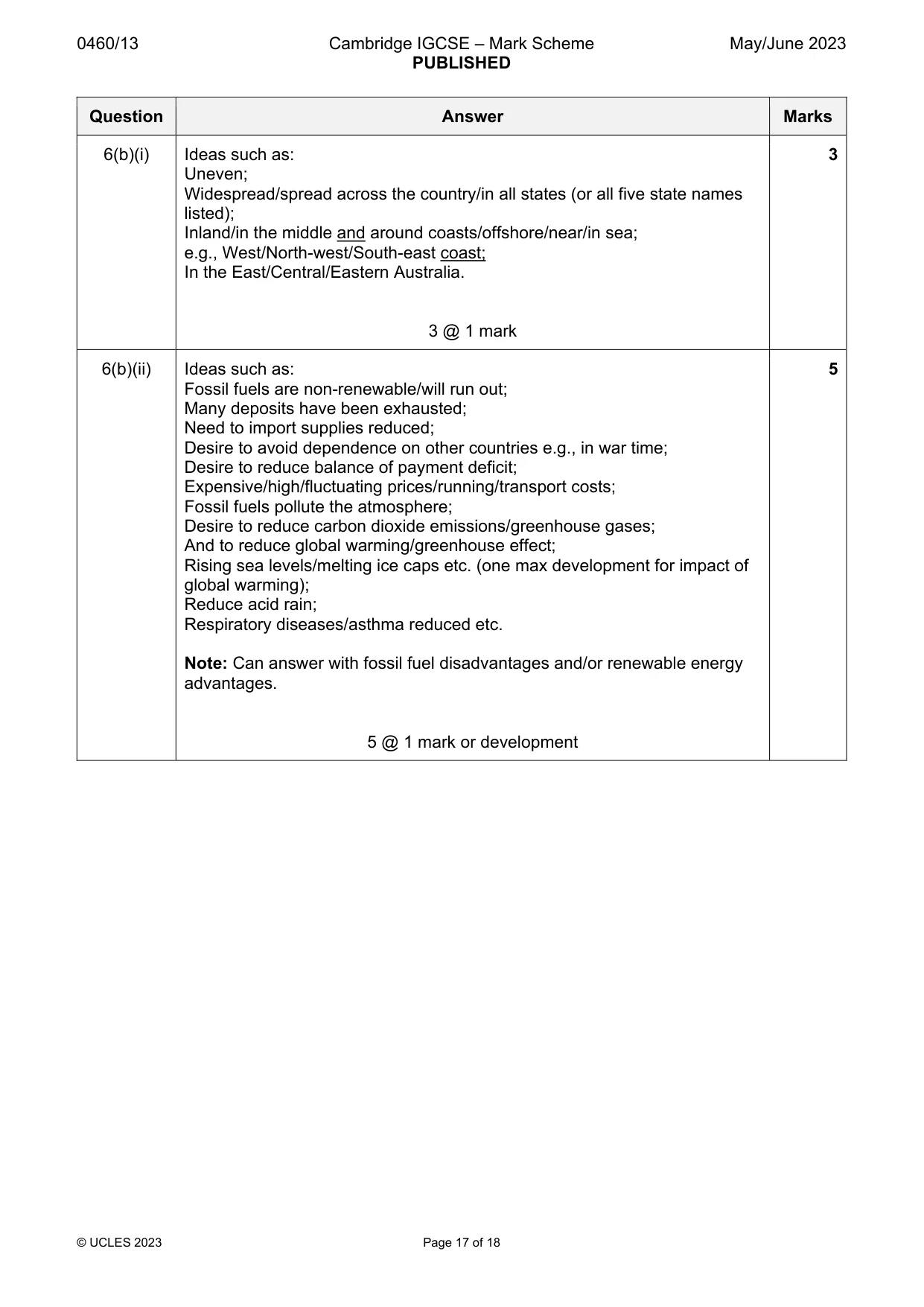
0460/13 Cambridge IGCSE – Mark Scheme PUBLISHED May/June 2023 © UCLES 2023 Page 17 of 18 Question Answer Marks 6(b)(i) Ideas such as: Uneven; Widespread/spread across the country/in all states (or all five state names listed); Inland/in the middle and around coasts/offshore/near/in sea; e.g., West/North-west/South-east coast; In the East/Central/Eastern Australia. 3 @ 1 mark 3 6(b)(ii) Ideas such as: Fossil fuels are non-renewable/will run out; Many deposits have been exhausted; Need to import supplies reduced; Desire to avoid dependence on other countries e.g., in war time; Desire to reduce balance of payment deficit; Expensive/high/fluctuating prices/running/transport costs; Fossil fuels pollute the atmosphere; Desire to reduce carbon dioxide emissions/greenhouse gases; And to reduce global warming/greenhouse effect; Rising sea levels/melting ice caps etc. (one max development for impact of global warming); Reduce acid rain; Respiratory diseases/asthma reduced etc. Note: Can answer with fossil fuel disadvantages and/or renewable energy advantages. 5 @ 1 mark or development 5
Mark scheme, page 18
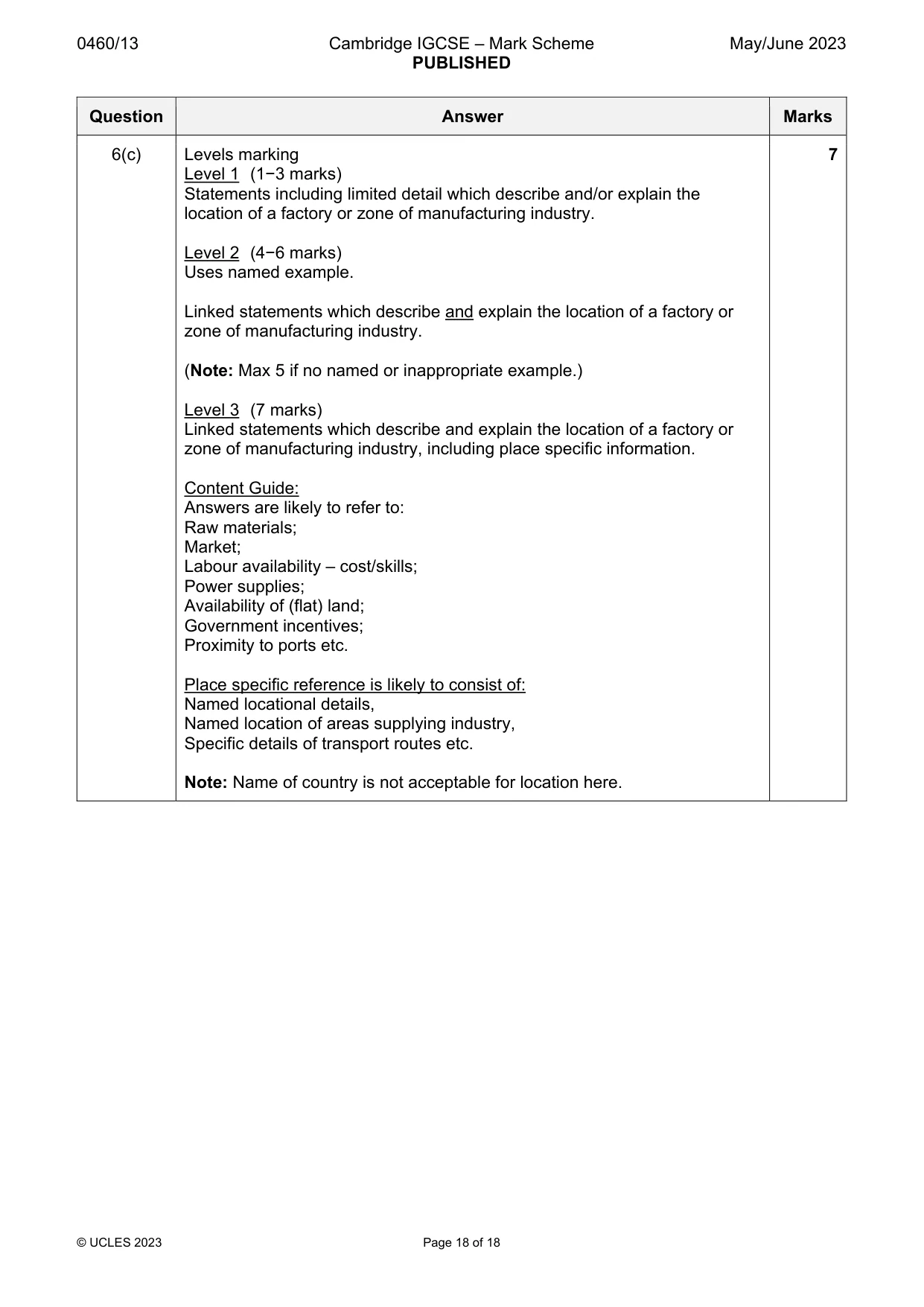
0460/13 Cambridge IGCSE – Mark Scheme PUBLISHED May/June 2023 © UCLES 2023 Page 18 of 18 Question Answer Marks 6(c) Levels marking Level 1 (1−3 marks) Statements including limited detail which describe and/or explain the location of a factory or zone of manufacturing industry. Level 2 (4−6 marks) Uses named example. Linked statements which describe and explain the location of a factory or zone of manufacturing industry. (Note: Max 5 if no named or inappropriate example.) Level 3 (7 marks) Linked statements which describe and explain the location of a factory or zone of manufacturing industry, including place specific information. Content Guide: Answers are likely to refer to: Raw materials; Market; Labour availability – cost/skills; Power supplies; Availability of (flat) land; Government incentives; Proximity to ports etc. Place specific reference is likely to consist of: Named locational details, Named location of areas supplying industry, Specific details of transport routes etc. Note: Name of country is not acceptable for location here. 7
What you needed in this session
Cambridge’s own grade thresholds for 2023 May/June, Paper 1 · Variant 3. A higher threshold means an easier paper — the bar moves with how the cohort did.