Cambridge IGCSE Geography 0460 — 2022 Oct/Nov Paper 1 · Variant 1
0460/11/O/N/22 · 75 marks · ≈84 min
The question paper and its mark scheme, free to read here and free to download. This is Cambridge’s own paper, exactly as it was sat.
Question paper28 pages




Mark scheme19 pages
Answers below. Sit the paper first if you are practising.
Paper as text
Question paper, page 1
This document has 28 pages. [Turn over Cambridge IGCSE™ GEOGRAPHY 0460/11 Paper 1 Geographical Themes October/November 2022 1 hour 45 minutes You must answer on the question paper. You will need: Insert (enclosed) Calculator Ruler INSTRUCTIONS ● Answer three questions in total, one from each section. ● Use a black or dark blue pen. You may use an HB pencil for any diagrams or graphs. ● Write your name, centre number and candidate number in the boxes at the top of the page. ● Write your answer to each question in the space provided. ● Do not use an erasable pen or correction fluid. ● Do not write on any bar codes. ● If additional space is needed, you should use the lined pages at the end of this booklet; the question number or numbers must be clearly shown. INFORMATION ● The total mark for this paper is 75. ● The number of marks for each question or part question is shown in brackets [ ]. ● The insert contains additional resources referred to in the questions. Definitions MEDCs – More Economically Developed Countries LEDCs – Less Economically Developed Countries * 2 9 0 5 5 4 1 8 7 5 * DC (CJ/CT) 304132/3 © UCLES 2022
Question paper, page 2
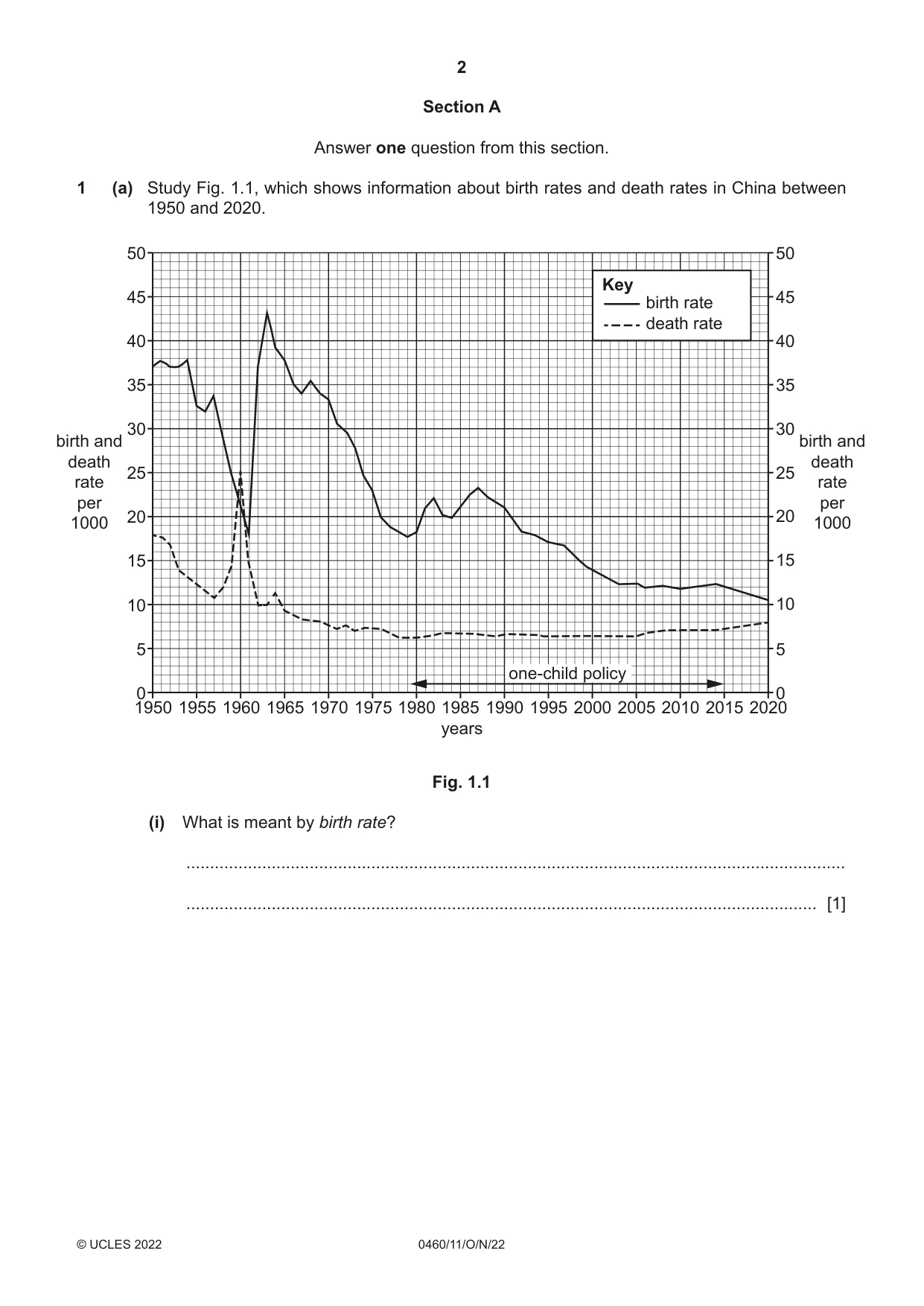
2 0460/11/O/N/22 © UCLES 2022 Section A Answer one question from this section. 1 (a) Study Fig. 1.1, which shows information about birth rates and death rates in China between 1950 and 2020. 0 1950 1955 1960 1965 1970 1975 1980 1985 years 1990 1995 2000 2005 2010 2015 2020 5 10 15 20 25 30 35 40 45 50 0 5 10 15 20 25 30 35 40 45 50 birth and death rate per 1000 birth and death rate per 1000 one-child policy Key birth rate death rate Fig. 1.1 (i) What is meant by birth rate? … … [1]
Question paper, page 3
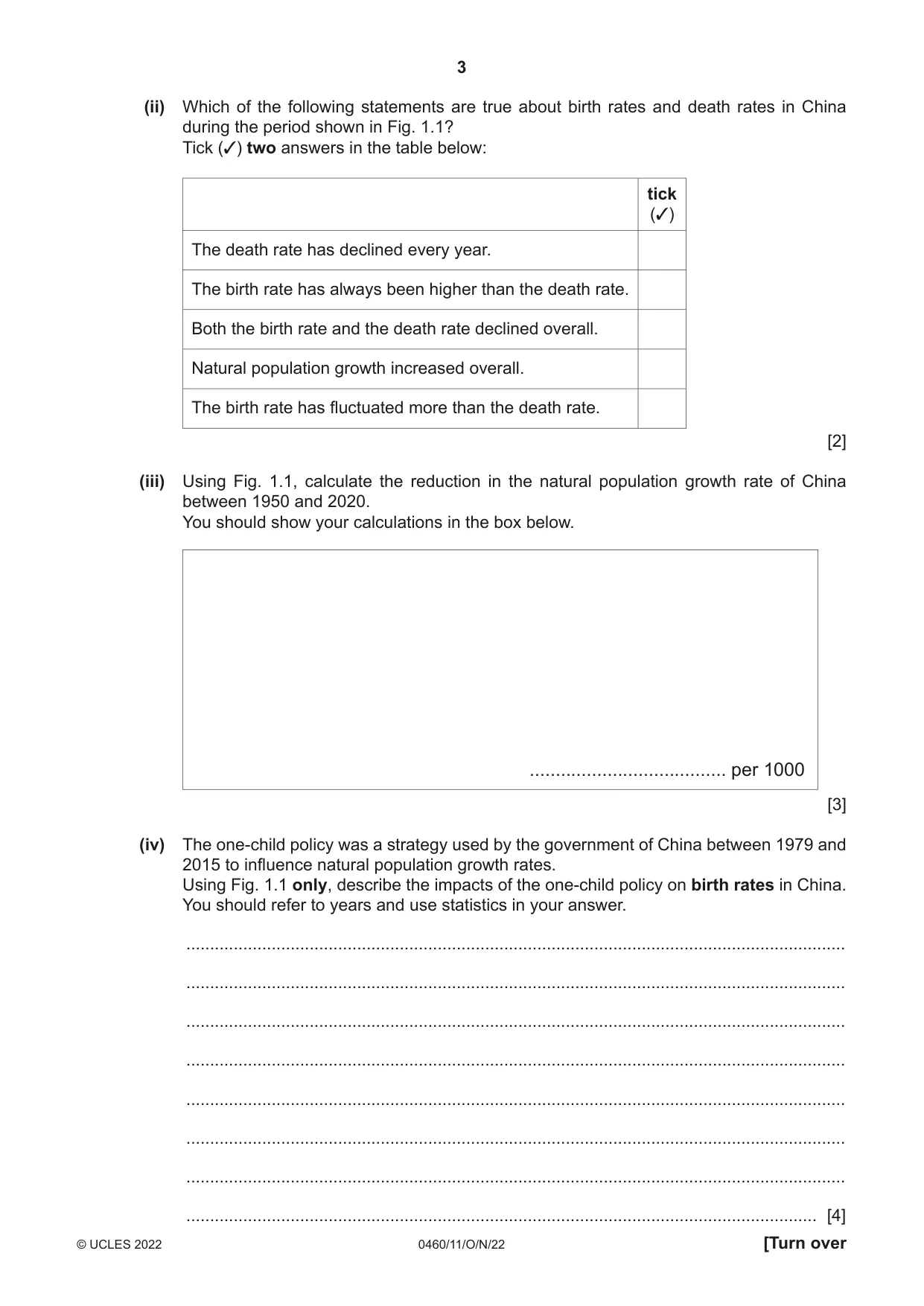
3 0460/11/O/N/22 © UCLES 2022 [Turn over (ii) Which of the following statements are true about birth rates and death rates in China during the period shown in Fig. 1.1? Tick (3) two answers in the table below: tick (3) The death rate has declined every year. The birth rate has always been higher than the death rate. Both the birth rate and the death rate declined overall. Natural population growth increased overall. The birth rate has fluctuated more than the death rate. [2] (iii) Using Fig. 1.1, calculate the reduction in the natural population growth rate of China between 1950 and 2020. You should show your calculations in the box below. … per 1000 [3] (iv) The one-child policy was a strategy used by the government of China between 1979 and 2015 to influence natural population growth rates. Using Fig. 1.1 only, describe the impacts of the one-child policy on birth rates in China. You should refer to years and use statistics in your answer. … … … … … … … … [4]
Question paper, page 4
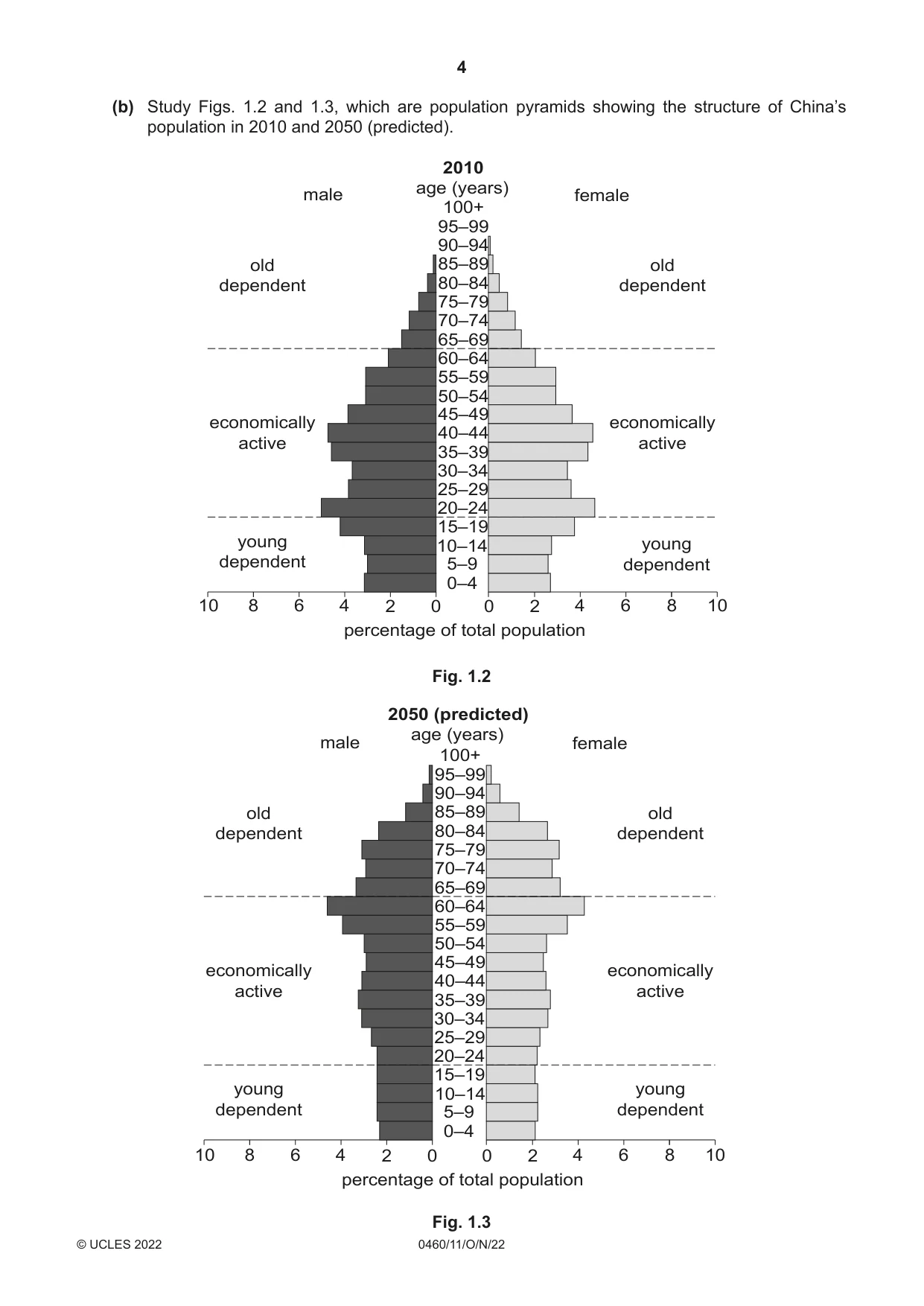
4 0460/11/O/N/22 © UCLES 2022 (b) Study Figs. 1.2 and 1.3, which are population pyramids showing the structure of China’s population in 2010 and 2050 (predicted). male age (years) female 8 10 8 10 6 6 4 4 2 2 0 0 40–44 45–49 50–54 55–59 60–64 65–69 70–74 75–79 80–84 85–89 90–94 95–99 100+ 35–39 30–34 25–29 20–24 15–19 10–14 5–9 0–4 percentage of total population old dependent economically active young dependent old dependent economically active young dependent 2010 Fig. 1.2 male female 8 10 8 10 6 6 4 4 2 2 0 0 40–44 45–49 50–54 55–59 60–64 65–69 70–74 75–79 80–84 85–89 90–94 95–99 100+ 35–39 30–34 25–29 20–24 15–19 10–14 5–9 0–4 percentage of total population old dependent economically active young dependent old dependent economically active young dependent age (years) 2050 (predicted) Fig. 1.3
Question paper, page 5
5 0460/11/O/N/22 © UCLES 2022 [Turn over (i) Describe the changes which are predicted in China’s economically active population between 2010 and 2050. … … … … … … [3] (ii) Suggest ways in which a large old dependent population is likely to cause problems for countries such as China in the future. … … … … … … … … … … [5]
Question paper, page 6
6 0460/11/O/N/22 © UCLES 2022 (c) For a named country you have studied, describe the problems caused by overpopulation. Name of country … … … … … … … … … … … … … … … … … … … … … … … … … … [7] [Total: 25]
Question paper, page 7
7 0460/11/O/N/22 © UCLES 2022 [Turn over 2 (a) Study Fig. 2.1 (Insert), which is a map showing information about the population in selected countries in Asia. (i) What is meant by urbanisation? … … [1] (ii) Put the following three countries in rank order according to their total population and the percentage of their population living in urban areas. China India Indonesia total population 1st … largest 2nd … 3rd … smallest percentage of population living in urban areas 1st … largest 2nd … 3rd … smallest [2] (iii) Suggest three different reasons why many people migrate from rural to urban areas in the countries shown on Fig. 2.1. 1 … … 2 … … 3 … … [3]
Question paper, page 8
8 0460/11/O/N/22 © UCLES 2022 (iv) Explain how rural areas may both benefit and be disadvantaged by migration away from them. … … … … … … … … [4] (b) Study Fig. 2.2 (Insert), which is a photograph of homes in a squatter settlement in the urban area of Dhaka, Bangladesh (an LEDC). (i) Describe three features of the homes shown in Fig. 2.2. 1 … … 2 … … 3 … … [3] (ii) Using Fig. 2.2, suggest problems faced by people as a result of living in the squatter settlement. … … … … … … … … … … [5]
Question paper, page 9
9 0460/11/O/N/22 © UCLES 2022 [Turn over (c) For a named urban area you have studied, describe what has been done to reduce housing problems. Name of urban area … … … … … … … … … … … … … … … … … … … … … … … … … … [7] [Total: 25]
Question paper, page 10
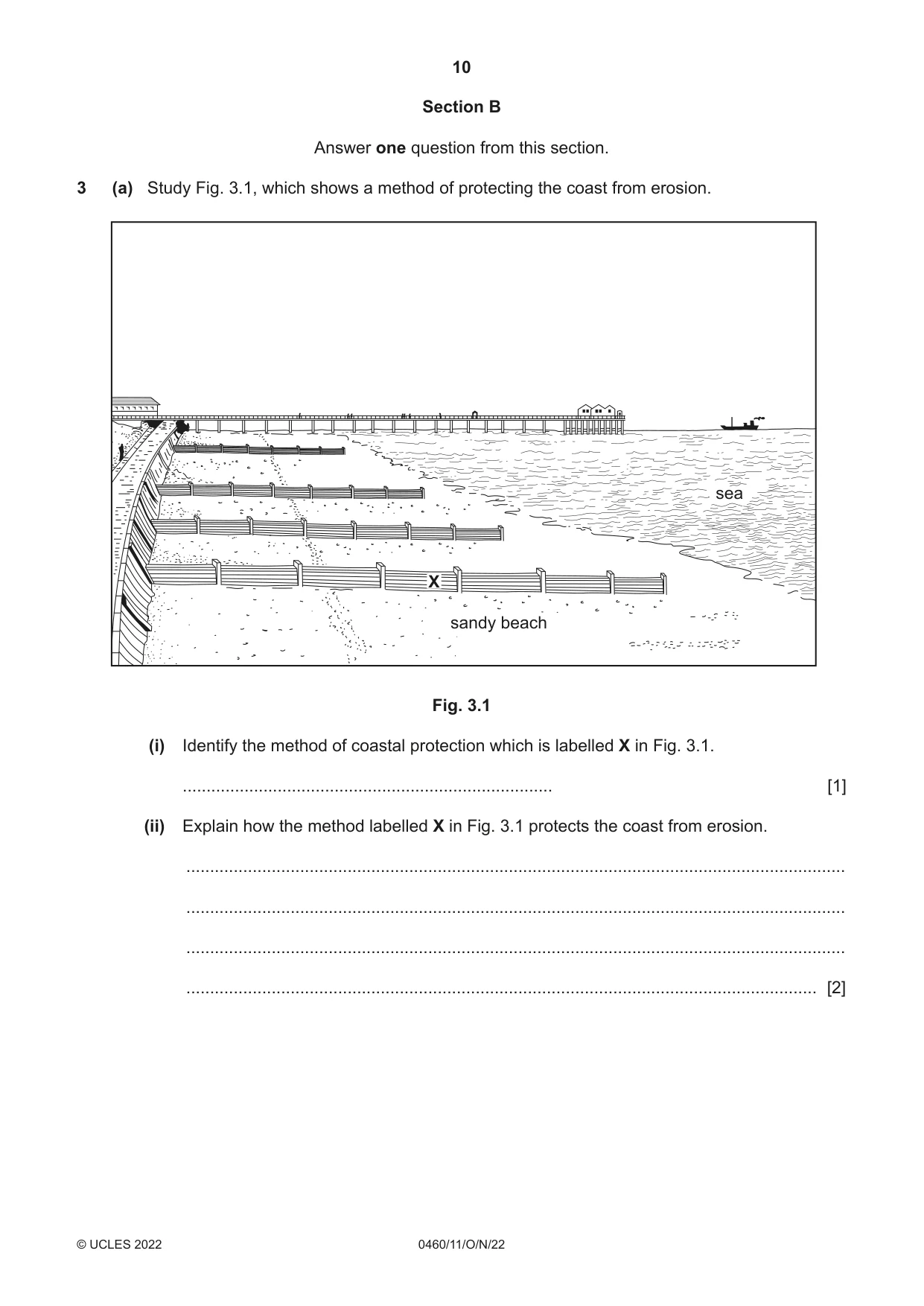
10 0460/11/O/N/22 © UCLES 2022 Section B Answer one question from this section. 3 (a) Study Fig. 3.1, which shows a method of protecting the coast from erosion. sea sandy beach X Fig. 3.1 (i) Identify the method of coastal protection which is labelled X in Fig. 3.1. … [1] (ii) Explain how the method labelled X in Fig. 3.1 protects the coast from erosion. … … … … [2]
Question paper, page 11
11 0460/11/O/N/22 © UCLES 2022 [Turn over (iii) Suggest three reasons why some coastlines are protected from erosion. 1 … … 2 … … 3 … … [3] (iv) State two other methods which can be used to protect a coastline from erosion. For each method explain how it works. Method 1 … … … … Method 2 … … … … [4] (b) Study Fig. 3.2 (Insert), which is a photograph of an area of coastline. (i) Identify three landforms shown in Fig. 3.2 which have been formed by coastal erosion. 1 … 2 … 3 … [3]
Question paper, page 12
12 0460/11/O/N/22 © UCLES 2022 (ii) Explain how waves erode coastlines such as the one shown in Fig. 3.2. … … … … … … … … … … [5]
Question paper, page 13
13 0460/11/O/N/22 © UCLES 2022 [Turn over (c) Explain how a named coastal area you have studied offers opportunities for people who live there. Name of area … … … … … … … … … … … … … … … … … … … … … … … … … … [7] [Total: 25]
Question paper, page 14
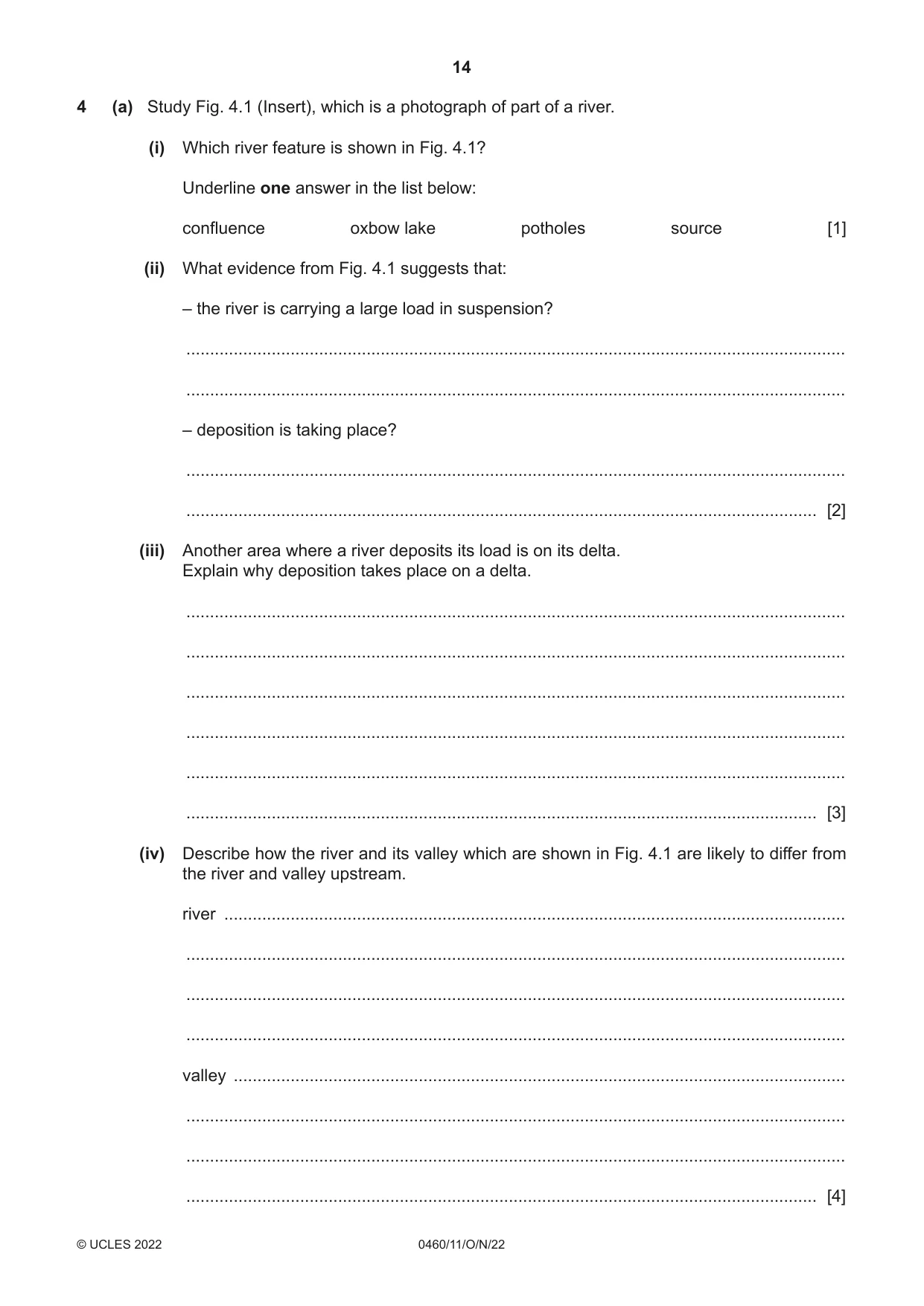
14 0460/11/O/N/22 © UCLES 2022 4 (a) Study Fig. 4.1 (Insert), which is a photograph of part of a river. (i) Which river feature is shown in Fig. 4.1? Underline one answer in the list below: confluence oxbow lake potholes source [1] (ii) What evidence from Fig. 4.1 suggests that: – the river is carrying a large load in suspension? … … – deposition is taking place? … … [2] (iii) Another area where a river deposits its load is on its delta. Explain why deposition takes place on a delta. … … … … … … [3] (iv) Describe how the river and its valley which are shown in Fig. 4.1 are likely to differ from the river and valley upstream. river … … … … valley … … … … [4]
Question paper, page 15
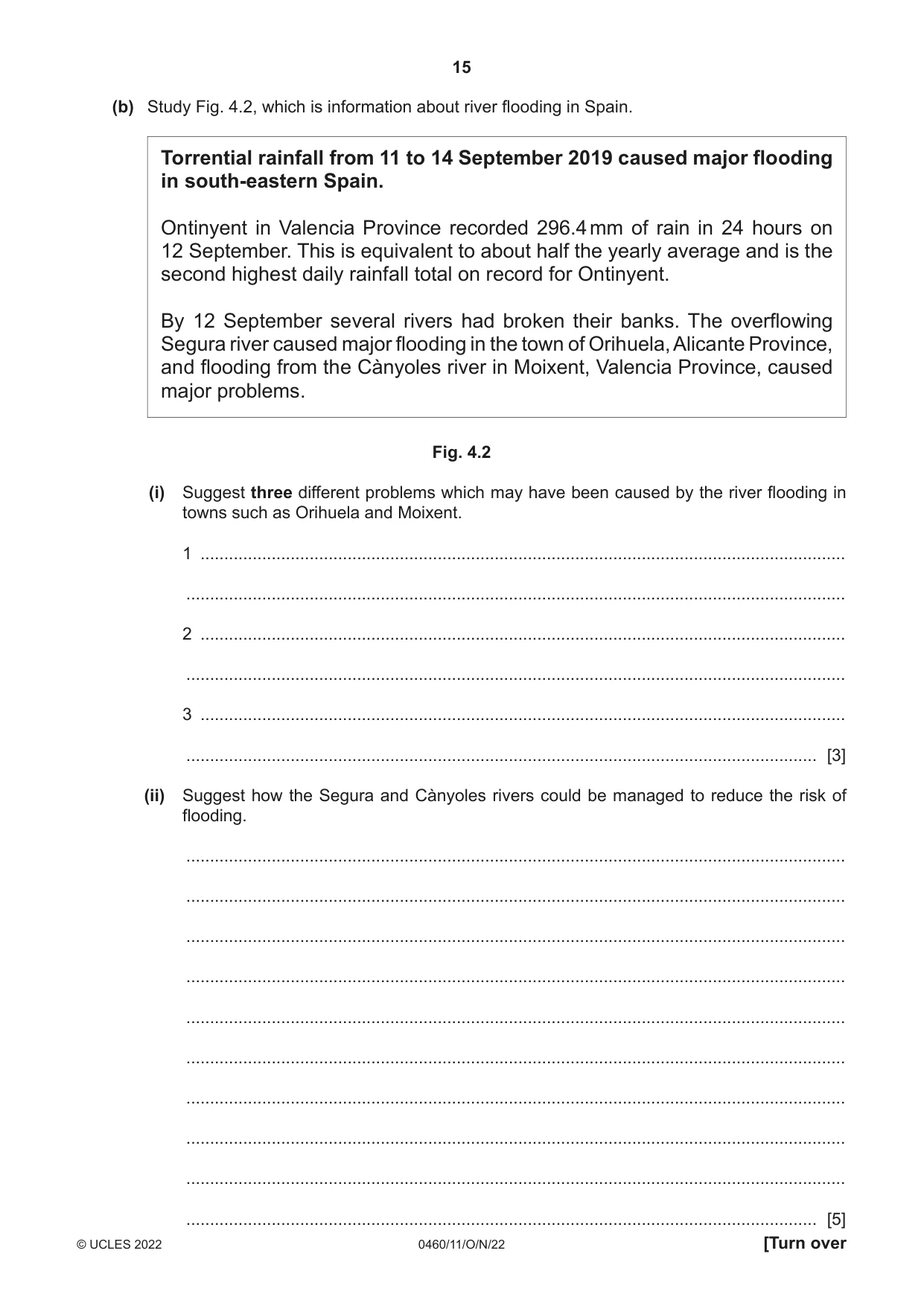
15 0460/11/O/N/22 © UCLES 2022 [Turn over (b) Study Fig. 4.2, which is information about river flooding in Spain. Torrential rainfall from 11 to 14 September 2019 caused major flooding in south-eastern Spain. Ontinyent in Valencia Province recorded 296.4 mm of rain in 24 hours on 12 September. This is equivalent to about half the yearly average and is the second highest daily rainfall total on record for Ontinyent. By 12 September several rivers had broken their banks. The overflowing Segura river caused major flooding in the town of Orihuela, Alicante Province, and flooding from the Cànyoles river in Moixent, Valencia Province, caused major problems. Fig. 4.2 (i) Suggest three different problems which may have been caused by the river flooding in towns such as Orihuela and Moixent. 1 … … 2 … … 3 … … [3] (ii) Suggest how the Segura and Cànyoles rivers could be managed to reduce the risk of flooding. … … … … … … … … … … [5]
Question paper, page 16
16 0460/11/O/N/22 © UCLES 2022 (c) Explain why many people live close to a named river you have studied. Name of river … … … … … … … … … … … … … … … … … … … … … … … … … … [7] [Total: 25]
Question paper, page 17
17 0460/11/O/N/22 © UCLES 2022 [Turn over TURN PAGE FOR QUESTION 5
Question paper, page 18
18 0460/11/O/N/22 © UCLES 2022 Section C Answer one question from this section. 5 (a) Study Fig. 5.1, which is a graph showing information about the employment structure of selected countries. Fig. 5.1 (i) What is meant by the term employment structure? … … [1] (ii) Give one example of jobs in each of the following: – primary sector … – tertiary sector … [2] Content removed due to copyright restrictions.
Question paper, page 19
19 0460/11/O/N/22 © UCLES 2022 [Turn over (iii) Using Fig. 5.1, describe three differences between the employment structure of Bangladesh and Brazil. Do not use statistics in your answer. 1 … … 2 … … 3 … … [3] (iv) Explain why a large percentage of the population in MEDCs, such as UK and USA, work in the tertiary sector. … … … … … … … … [4]
Question paper, page 20
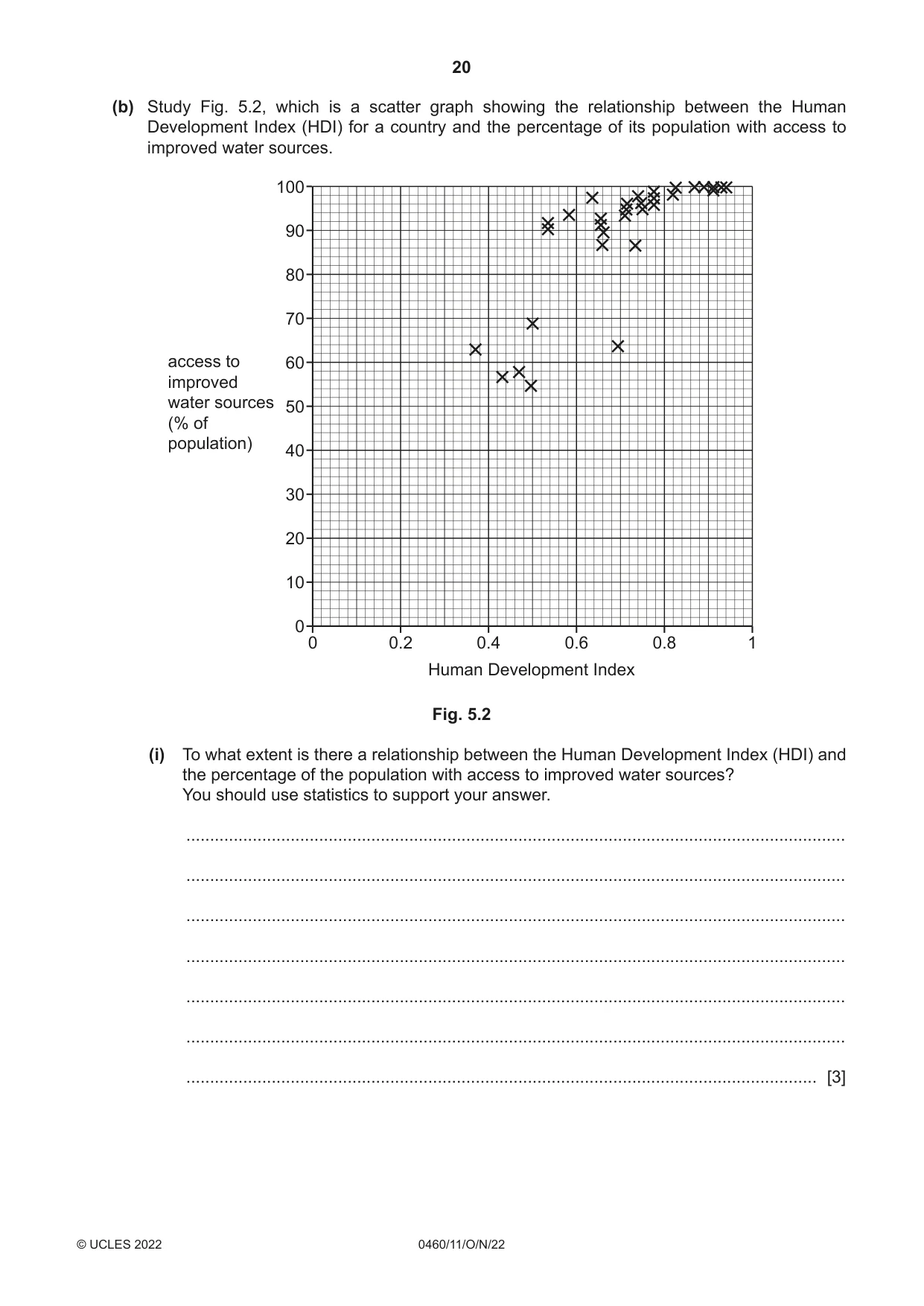
20 0460/11/O/N/22 © UCLES 2022 (b) Study Fig. 5.2, which is a scatter graph showing the relationship between the Human Development Index (HDI) for a country and the percentage of its population with access to improved water sources. 0 0 0.2 0.4 0.6 0.8 1 10 20 30 40 50 60 70 80 90 100 Human Development Index access to improved water sources (% of population) Fig. 5.2 (i) To what extent is there a relationship between the Human Development Index (HDI) and the percentage of the population with access to improved water sources? You should use statistics to support your answer. … … … … … … … [3]
Question paper, page 21
21 0460/11/O/N/22 © UCLES 2022 [Turn over (ii) Describe the methods which can be used to improve water supply in LEDCs. … … … … … … … … … … [5]
Question paper, page 22
22 0460/11/O/N/22 © UCLES 2022 (c) Describe a named transnational corporation (TNC) you have studied and explain why it has impacts at a local scale. Name of transnational corporation (TNC) … … … … … … … … … … … … … … … … … … … … … … … … … … [7] [Total: 25]
Question paper, page 23
23 0460/11/O/N/22 © UCLES 2022 [Turn over TURN PAGE FOR QUESTION 6
Question paper, page 24
24 0460/11/O/N/22 © UCLES 2022 6 (a) Study Fig. 6.1, which is taken from an online advert for holidays in Thailand (an LEDC in Asia). You will travel from the city of Bangkok to the resort of Krabi and back again. Thailand will thrill you with exciting experiences and marked contrasts. On this journey you start and end in the cultural capital of Bangkok, with its busy markets, historic temples and unique nightlife. From Bangkok, travel to see beaches and limestone rocks in Krabi to enjoy relaxation, adventure and an unspoilt coastline. Prepare for a wonderful mix of city and nature in beautiful Thailand. Fig. 6.1 (i) Using information from Fig. 6.1 only, identify one natural attraction and one human attraction for tourists in Thailand. natural attraction … human attraction … [1] (ii) Suggest two reasons why numbers of international tourists are increasing in LEDCs such as Thailand. 1 … … 2 … … [2] (iii) Explain why unspoilt, natural coastlines are attractive to many tourists. … … … … … … [3]
Question paper, page 25
25 0460/11/O/N/22 © UCLES 2022 [Turn over (iv) Explain two different ways in which the climate of an area may lead to the development of tourism. 1 … … … … 2 … … … … [4] (b) Study Figs. 6.2, 6.3 and 6.4 (Insert), which are photographs of Ao Nang, a tourist resort in Thailand. (i) Using evidence from Figs. 6.2, 6.3 and 6.4, suggest three different ways that tourism may damage the natural environment in the local area. 1 … … 2 … … 3 … … [3] (ii) Suggest ways in which tourism in Ao Nang could be managed so that it is sustainable. … … … … … … … … … … [5]
Question paper, page 26
26 0460/11/O/N/22 © UCLES 2022 (c) For a named example of an area you have studied where tourism is important, describe the problems it causes for local people. Name of area studied … … … … … … … … … … … … … … … … … … … … … … … … … … [7] [Total : 25]
Question paper, page 27
27 0460/11/O/N/22 © UCLES 2022 Additional pages If you use the following pages to complete the answer to any question, the question number must be clearly shown. … … … … … … … … … … … … … … … … … … … … … … … … … …
Question paper, page 28
28 0460/11/O/N/22 © UCLES 2022 The boundaries and names shown, the designations used and the presentation of material on any maps contained in this question paper/insert do not imply official endorsement or acceptance by Cambridge Assessment International Education concerning the legal status of any country, territory, or area or any of its authorities, or of the delimitation of its frontiers or boundaries. Permission to reproduce items where third-party owned material protected by copyright is included has been sought and cleared where possible. Every reasonable effort has been made by the publisher (UCLES) to trace copyright holders, but if any items requiring clearance have unwittingly been included, the publisher will be pleased to make amends at the earliest possible opportunity. To avoid the issue of disclosure of answer-related information to candidates, all copyright acknowledgements are reproduced online in the Cambridge Assessment International Education Copyright Acknowledgements Booklet. This is produced for each series of examinations and is freely available to download at www.cambridgeinternational.org after the live examination series. Cambridge Assessment International Education is part of Cambridge Assessment. Cambridge Assessment is the brand name of the University of Cambridge Local Examinations Syndicate (UCLES), which is a department of the University of Cambridge. … … … … … … … … … … … … … … … … … … … … … …
Mark scheme, page 1
This document consists of 19 printed pages. © UCLES 2022 [Turn over Cambridge IGCSE™ GEOGRAPHY 0460/11 Paper 1 Geographical Themes October/November 2022 MARK SCHEME Maximum Mark: 75 Published This mark scheme is published as an aid to teachers and candidates, to indicate the requirements of the examination. It shows the basis on which Examiners were instructed to award marks. It does not indicate the details of the discussions that took place at an Examiners’ meeting before marking began, which would have considered the acceptability of alternative answers. Mark schemes should be read in conjunction with the question paper and the Principal Examiner Report for Teachers. Cambridge International will not enter into discussions about these mark schemes. Cambridge International is publishing the mark schemes for the October/November 2022 series for most Cambridge IGCSE™, Cambridge International A and AS Level components and some Cambridge O Level components.
Mark scheme, page 2
0460/11 Cambridge IGCSE – Mark Scheme PUBLISHED October/November 2022 © UCLES 2022 Page 2 of 19 Generic Marking Principles These general marking principles must be applied by all examiners when marking candidate answers. They should be applied alongside the specific content of the mark scheme or generic level descriptors for a question. Each question paper and mark scheme will also comply with these marking principles. GENERIC MARKING PRINCIPLE 1: Marks must be awarded in line with: • the specific content of the mark scheme or the generic level descriptors for the question • the specific skills defined in the mark scheme or in the generic level descriptors for the question • the standard of response required by a candidate as exemplified by the standardisation scripts. GENERIC MARKING PRINCIPLE 2: Marks awarded are always whole marks (not half marks, or other fractions). GENERIC MARKING PRINCIPLE 3: Marks must be awarded positively: • marks are awarded for correct/valid answers, as defined in the mark scheme. However, credit is given for valid answers which go beyond the scope of the syllabus and mark scheme, referring to your Team Leader as appropriate • marks are awarded when candidates clearly demonstrate what they know and can do • marks are not deducted for errors • marks are not deducted for omissions • answers should only be judged on the quality of spelling, punctuation and grammar when these features are specifically assessed by the question as indicated by the mark scheme. The meaning, however, should be unambiguous. GENERIC MARKING PRINCIPLE 4: Rules must be applied consistently, e.g., in situations where candidates have not followed instructions or in the application of generic level descriptors. GENERIC MARKING PRINCIPLE 5: Marks should be awarded using the full range of marks defined in the mark scheme for the question (however; the use of the full mark range may be limited according to the quality of the candidate responses seen). GENERIC MARKING PRINCIPLE 6: Marks awarded are based solely on the requirements as defined in the mark scheme. Marks should not be awarded with grade thresholds or grade descriptors in mind.
Mark scheme, page 3
0460/11 Cambridge IGCSE – Mark Scheme PUBLISHED October/November 2022 © UCLES 2022 Page 3 of 19 Each question carries 25 marks. Candidates cannot earn above the maximum marks available within each sub section. The marking scheme attempts to give guidance about the requirements of each answer and lists a number of responses, which will earn marks along with the general principles to be applied when marking each question. It should be noted that candidates can earn marks if their answers are phrased differently provided, they convey the same meaning as those in the mark scheme. THE CANDIDATES DO NOT NEED TO USE THE SAME WORDING TO EARN MARKS. The notation ‘etc.’ at the end of an answer in the mark scheme signifies that there may well be other correct responses or examples that can be given credit. Providing the statement is true, relevant to the question asked and not repetition of a previous point made credit should be given. A point made within one sub-section which is an answer to the question set in a different sub-section should not be given credit as each sub-section asks different questions which require independent answers. The mark scheme uses semi colons (;) to separate marks and diagonals to separate alternative answers. During coordination, the mark scheme is modified to add points agreed after discussion or to delete any points not allowed. All examiners should ensure that their modified scheme is fully up to date before marking begins. Marking Mechanics Point marking is used for sections (a) and (b) of each question, although marks are available in specified questions for development of appropriate points. Ticks should be used to clearly indicate where a mark has been allowed. Where a development point has been allowed the symbol “DEV” should be placed adjacent to the tick. The number of ticks should always be equal to the total number of marks awarded. Only one development mark for each mark scheme point please. Where a candidate makes a point which is not quite sufficient for credit an upturned ‘V’ insert symbol should be used. If after careful consideration a mark is awarded which gives ‘benefit of doubt’ to the candidate, the letter ‘J’ should be placed adjacent to the tick (i.e., the candidate has ‘just’ achieved the mark). Crosses are acceptable to signify wrong answers and the letters ‘I/R’ should be used to indicate those which are irrelevant. Levels of response marking is used for section (c) of each question. Thus, it is the quality of the response that determines which level an answer is achieved rather than the quantity of statements contained within it. However, once assigned to a level the mark achieved within that level is determined by the number of points made. Levels 1 and 2 are distinguished by whether statements are simple (level 1) or developed/elaborated (level 2). A candidate can immediately enter L2 by making developed points without making any L1 statements. In order to achieve L3 a candidate must have already reached the top end of L2 – in addition his/her answer should have a clear example and if the answer is place specific as well (7 marks). Highlight place specific detail.
Mark scheme, page 4
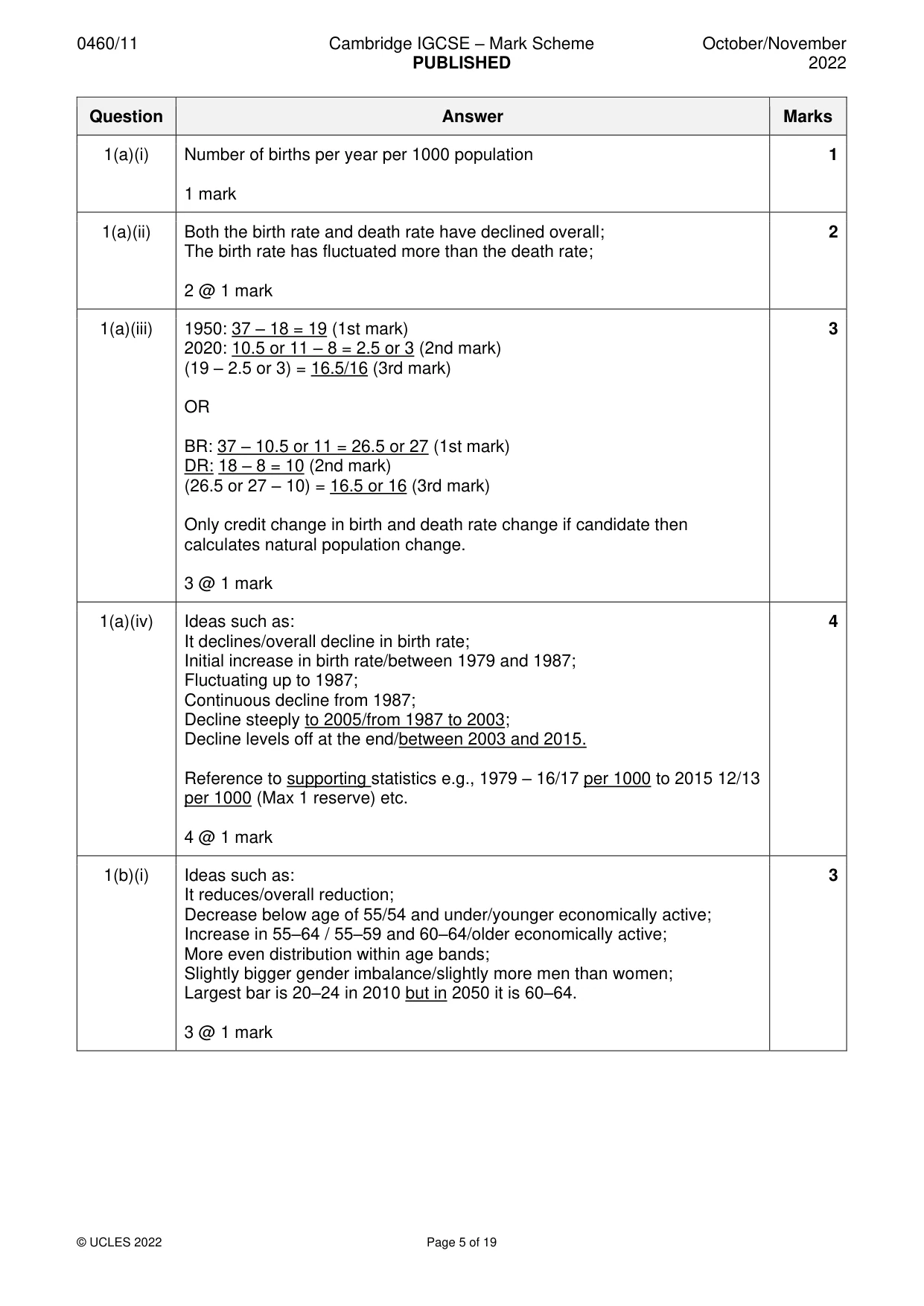
0460/11 Cambridge IGCSE – Mark Scheme PUBLISHED October/November 2022 © UCLES 2022 Page 4 of 19 Where statements are assigned levels by the examiner this should be indicated by the use of L1 and L2 next to the statements. Ticks should not be used on answers that are marked using levels of response marking. L1 annotation should be removed once a L2 is awarded for an answer. L3 annotation is not used. There is no need for a summary level at the end of a response. Summary: Level 1 (1 to 3 marks): 1 simple statement (1 mark) 2 simple statements (2 marks) 3 simple statements (3 marks) Level 2 (4 to 6 marks): 1 developed statement (4 marks) 2 developed statements (5 marks) 3 or more developed statements with e.g. (6 marks) Level 3 (7 marks) 3 or more developed statements + named example with at least one piece of place specific detail.
Mark scheme, page 5
0460/11 Cambridge IGCSE – Mark Scheme PUBLISHED October/November 2022 © UCLES 2022 Page 5 of 19 Question Answer Marks 1(a)(i) Number of births per year per 1000 population 1 mark 1 1(a)(ii) Both the birth rate and death rate have declined overall; The birth rate has fluctuated more than the death rate; 2 @ 1 mark 2 1(a)(iii) 1950: 37 – 18 = 19 (1st mark) 2020: 10.5 or 11 – 8 = 2.5 or 3 (2nd mark) (19 – 2.5 or 3) = 16.5/16 (3rd mark) OR BR: 37 – 10.5 or 11 = 26.5 or 27 (1st mark) DR: 18 – 8 = 10 (2nd mark) (26.5 or 27 – 10) = 16.5 or 16 (3rd mark) Only credit change in birth and death rate change if candidate then calculates natural population change. 3 @ 1 mark 3 1(a)(iv) Ideas such as: It declines/overall decline in birth rate; Initial increase in birth rate/between 1979 and 1987; Fluctuating up to 1987; Continuous decline from 1987; Decline steeply to 2005/from 1987 to 2003; Decline levels off at the end/between 2003 and 2015. Reference to supporting statistics e.g., 1979 – 16/17 per 1000 to 2015 12/13 per 1000 (Max 1 reserve) etc. 4 @ 1 mark 4 1(b)(i) Ideas such as: It reduces/overall reduction; Decrease below age of 55/54 and under/younger economically active; Increase in 55–64 / 55–59 and 60–64/older economically active; More even distribution within age bands; Slightly bigger gender imbalance/slightly more men than women; Largest bar is 20–24 in 2010 but in 2050 it is 60–64. 3 @ 1 mark 3
Mark scheme, page 6
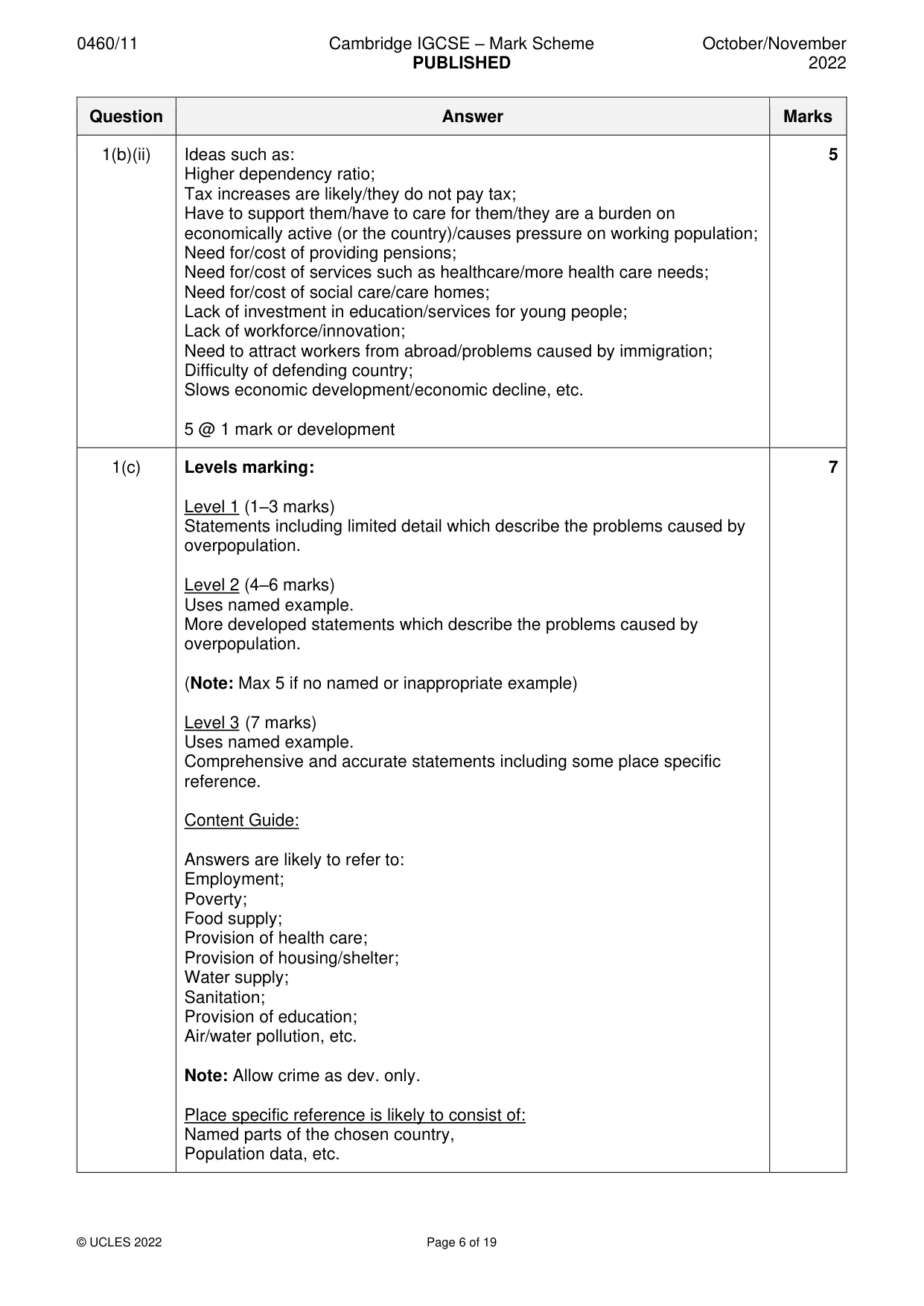
0460/11 Cambridge IGCSE – Mark Scheme PUBLISHED October/November 2022 © UCLES 2022 Page 6 of 19 Question Answer Marks 1(b)(ii) Ideas such as: Higher dependency ratio; Tax increases are likely/they do not pay tax; Have to support them/have to care for them/they are a burden on economically active (or the country)/causes pressure on working population; Need for/cost of providing pensions; Need for/cost of services such as healthcare/more health care needs; Need for/cost of social care/care homes; Lack of investment in education/services for young people; Lack of workforce/innovation; Need to attract workers from abroad/problems caused by immigration; Difficulty of defending country; Slows economic development/economic decline, etc. 5 @ 1 mark or development 5 1(c) Levels marking: Level 1 (1–3 marks) Statements including limited detail which describe the problems caused by overpopulation. Level 2 (4–6 marks) Uses named example. More developed statements which describe the problems caused by overpopulation. (Note: Max 5 if no named or inappropriate example) Level 3 (7 marks) Uses named example. Comprehensive and accurate statements including some place specific reference. Content Guide: Answers are likely to refer to: Employment; Poverty; Food supply; Provision of health care; Provision of housing/shelter; Water supply; Sanitation; Provision of education; Air/water pollution, etc. Note: Allow crime as dev. only. Place specific reference is likely to consist of: Named parts of the chosen country, Population data, etc. 7
Mark scheme, page 7
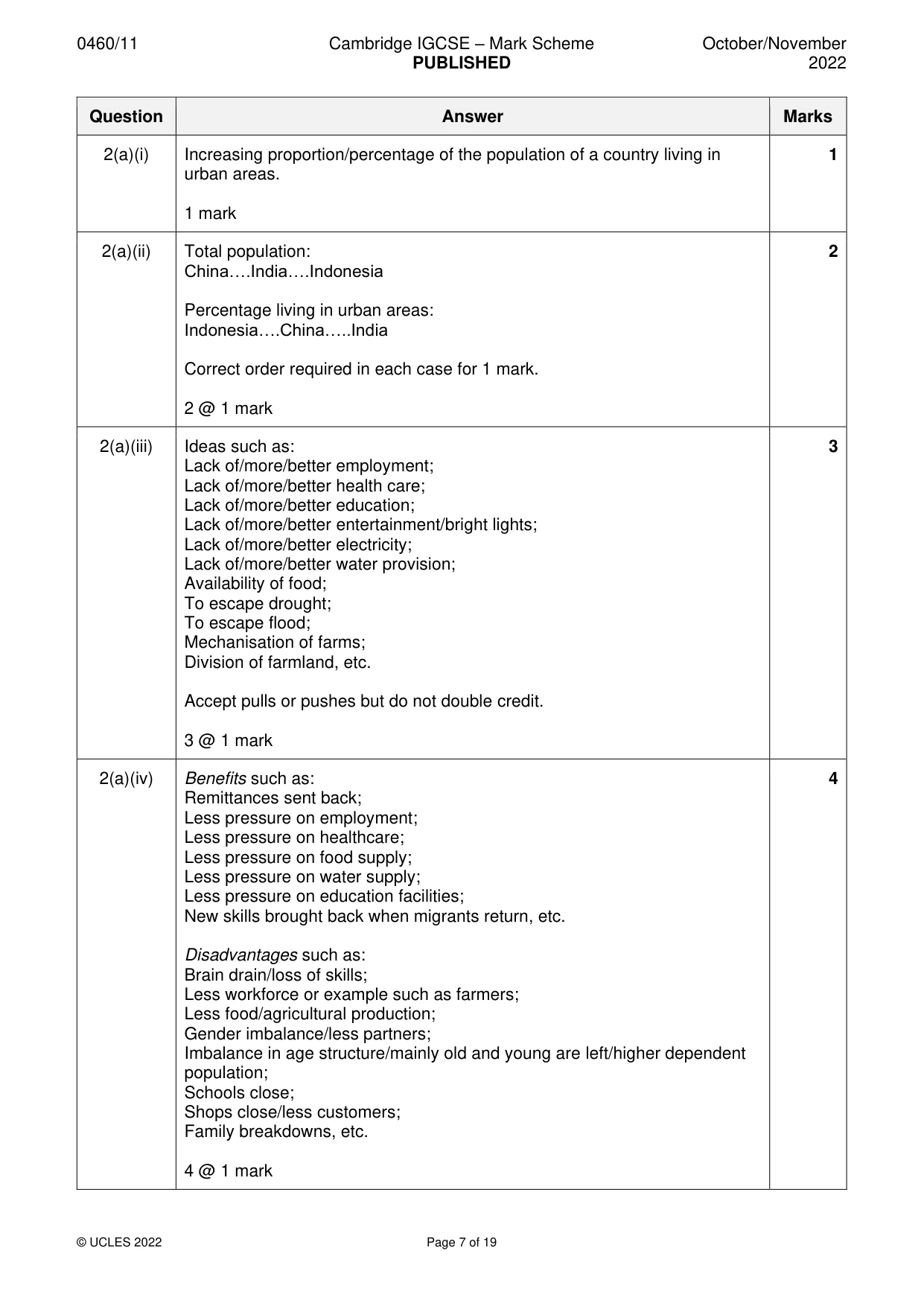
0460/11 Cambridge IGCSE – Mark Scheme PUBLISHED October/November 2022 © UCLES 2022 Page 7 of 19 Question Answer Marks 2(a)(i) Increasing proportion/percentage of the population of a country living in urban areas. 1 mark 1 2(a)(ii) Total population: China….India….Indonesia Percentage living in urban areas: Indonesia….China…..India Correct order required in each case for 1 mark. 2 @ 1 mark 2 2(a)(iii) Ideas such as: Lack of/more/better employment; Lack of/more/better health care; Lack of/more/better education; Lack of/more/better entertainment/bright lights; Lack of/more/better electricity; Lack of/more/better water provision; Availability of food; To escape drought; To escape flood; Mechanisation of farms; Division of farmland, etc. Accept pulls or pushes but do not double credit. 3 @ 1 mark 3 2(a)(iv) Benefits such as: Remittances sent back; Less pressure on employment; Less pressure on healthcare; Less pressure on food supply; Less pressure on water supply; Less pressure on education facilities; New skills brought back when migrants return, etc. Disadvantages such as: Brain drain/loss of skills; Less workforce or example such as farmers; Less food/agricultural production; Gender imbalance/less partners; Imbalance in age structure/mainly old and young are left/higher dependent population; Schools close; Shops close/less customers; Family breakdowns, etc. 4 @ 1 mark 4
Mark scheme, page 8
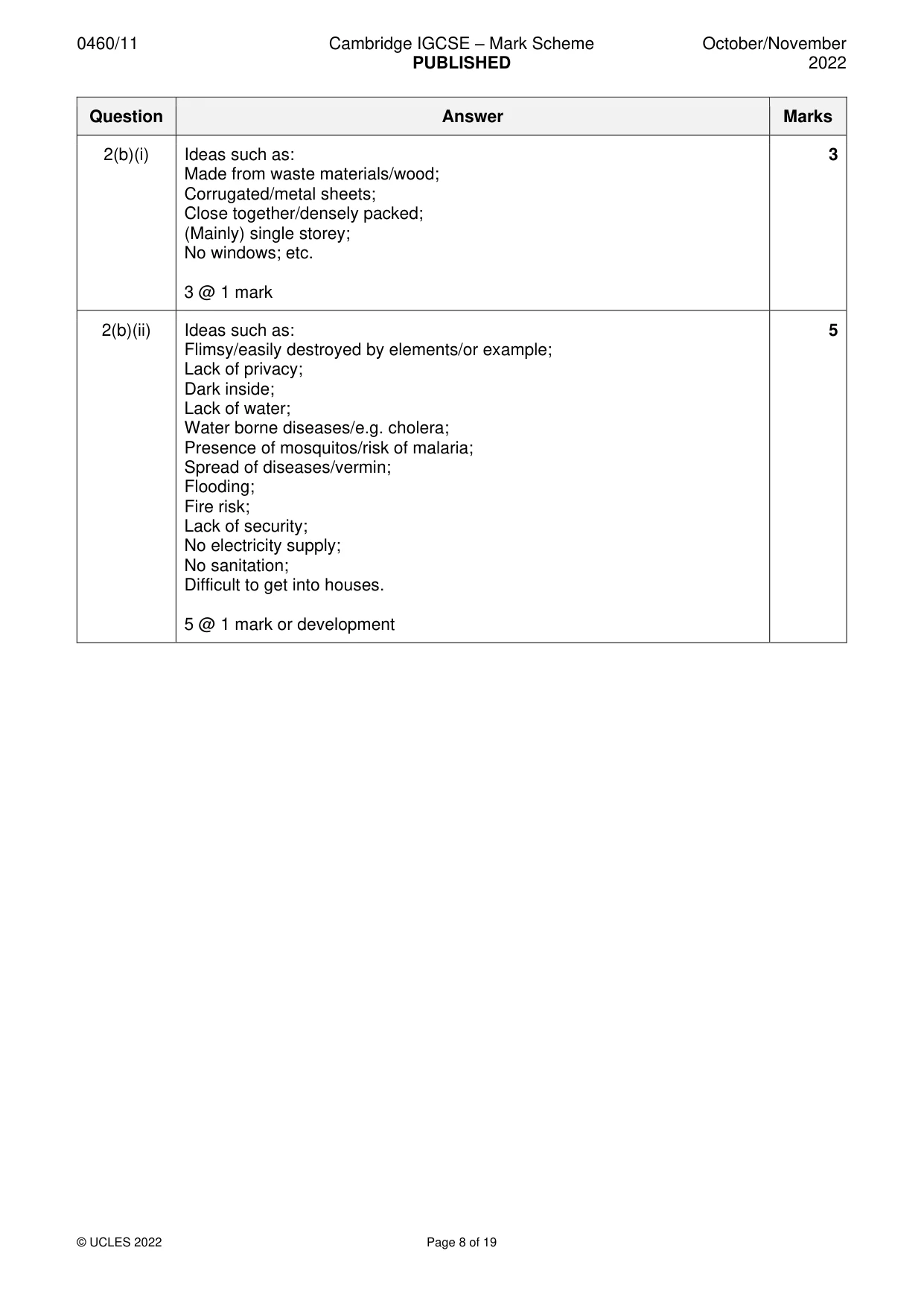
0460/11 Cambridge IGCSE – Mark Scheme PUBLISHED October/November 2022 © UCLES 2022 Page 8 of 19 Question Answer Marks 2(b)(i) Ideas such as: Made from waste materials/wood; Corrugated/metal sheets; Close together/densely packed; (Mainly) single storey; No windows; etc. 3 @ 1 mark 3 2(b)(ii) Ideas such as: Flimsy/easily destroyed by elements/or example; Lack of privacy; Dark inside; Lack of water; Water borne diseases/e.g. cholera; Presence of mosquitos/risk of malaria; Spread of diseases/vermin; Flooding; Fire risk; Lack of security; No electricity supply; No sanitation; Difficult to get into houses. 5 @ 1 mark or development 5
Mark scheme, page 9
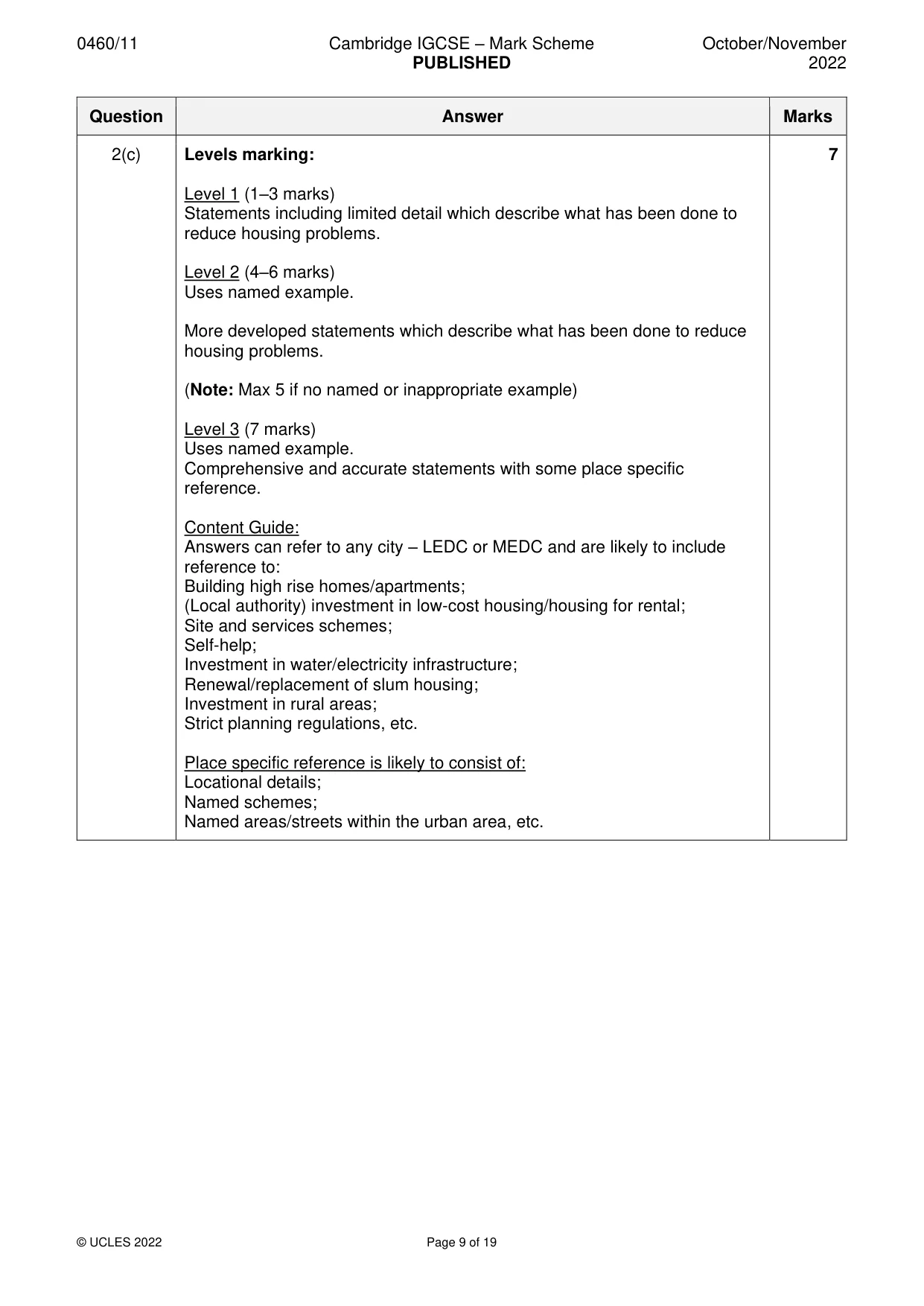
0460/11 Cambridge IGCSE – Mark Scheme PUBLISHED October/November 2022 © UCLES 2022 Page 9 of 19 Question Answer Marks 2(c) Levels marking: Level 1 (1–3 marks) Statements including limited detail which describe what has been done to reduce housing problems. Level 2 (4–6 marks) Uses named example. More developed statements which describe what has been done to reduce housing problems. (Note: Max 5 if no named or inappropriate example) Level 3 (7 marks) Uses named example. Comprehensive and accurate statements with some place specific reference. Content Guide: Answers can refer to any city – LEDC or MEDC and are likely to include reference to: Building high rise homes/apartments; (Local authority) investment in low-cost housing/housing for rental; Site and services schemes; Self-help; Investment in water/electricity infrastructure; Renewal/replacement of slum housing; Investment in rural areas; Strict planning regulations, etc. Place specific reference is likely to consist of: Locational details; Named schemes; Named areas/streets within the urban area, etc. 7
Mark scheme, page 10
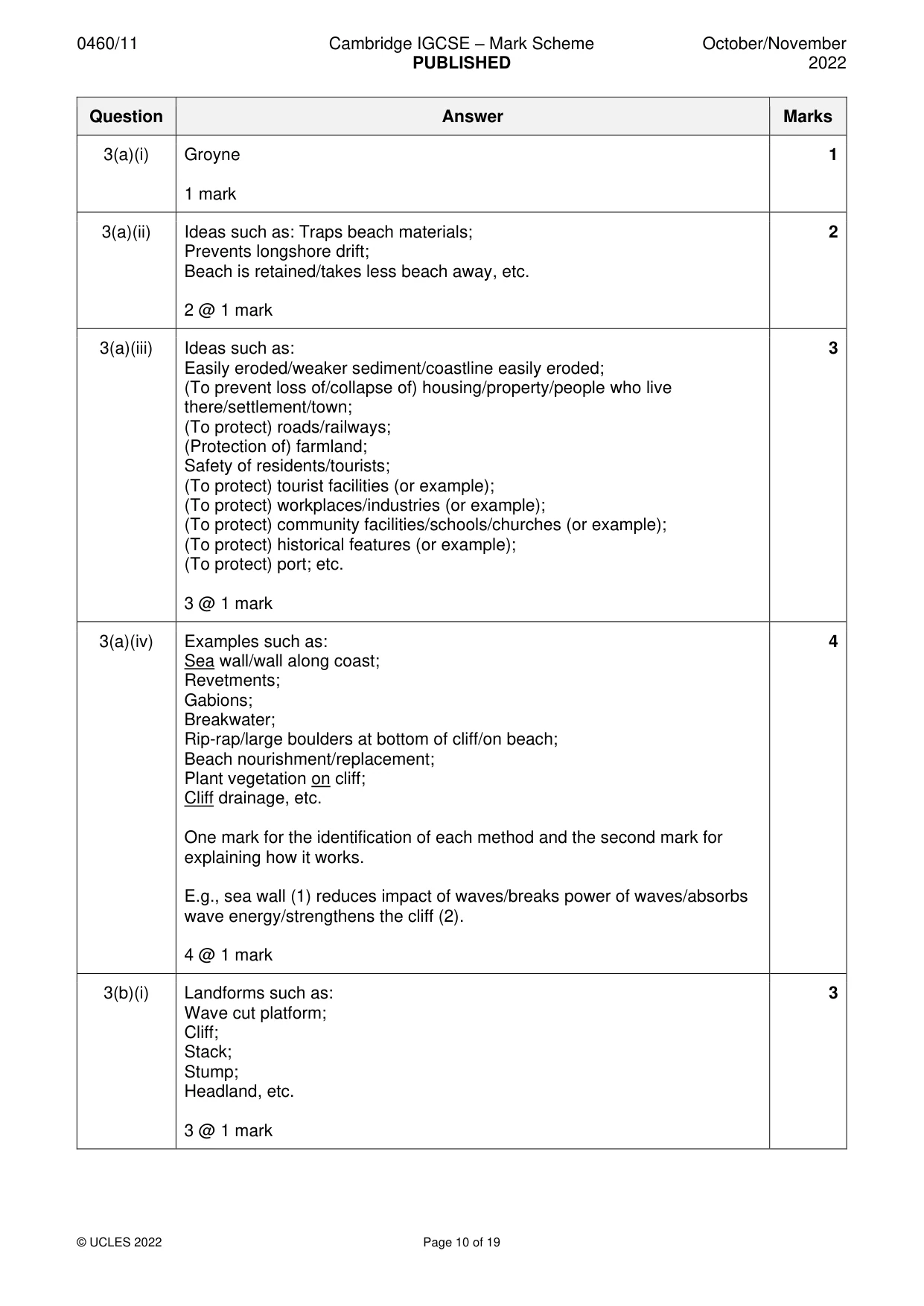
0460/11 Cambridge IGCSE – Mark Scheme PUBLISHED October/November 2022 © UCLES 2022 Page 10 of 19 Question Answer Marks 3(a)(i) Groyne 1 mark 1 3(a)(ii) Ideas such as: Traps beach materials; Prevents longshore drift; Beach is retained/takes less beach away, etc. 2 @ 1 mark 2 3(a)(iii) Ideas such as: Easily eroded/weaker sediment/coastline easily eroded; (To prevent loss of/collapse of) housing/property/people who live there/settlement/town; (To protect) roads/railways; (Protection of) farmland; Safety of residents/tourists; (To protect) tourist facilities (or example); (To protect) workplaces/industries (or example); (To protect) community facilities/schools/churches (or example); (To protect) historical features (or example); (To protect) port; etc. 3 @ 1 mark 3 3(a)(iv) Examples such as: Sea wall/wall along coast; Revetments; Gabions; Breakwater; Rip-rap/large boulders at bottom of cliff/on beach; Beach nourishment/replacement; Plant vegetation on cliff; Cliff drainage, etc. One mark for the identification of each method and the second mark for explaining how it works. E.g., sea wall (1) reduces impact of waves/breaks power of waves/absorbs wave energy/strengthens the cliff (2). 4 @ 1 mark 4 3(b)(i) Landforms such as: Wave cut platform; Cliff; Stack; Stump; Headland, etc. 3 @ 1 mark 3
Mark scheme, page 11
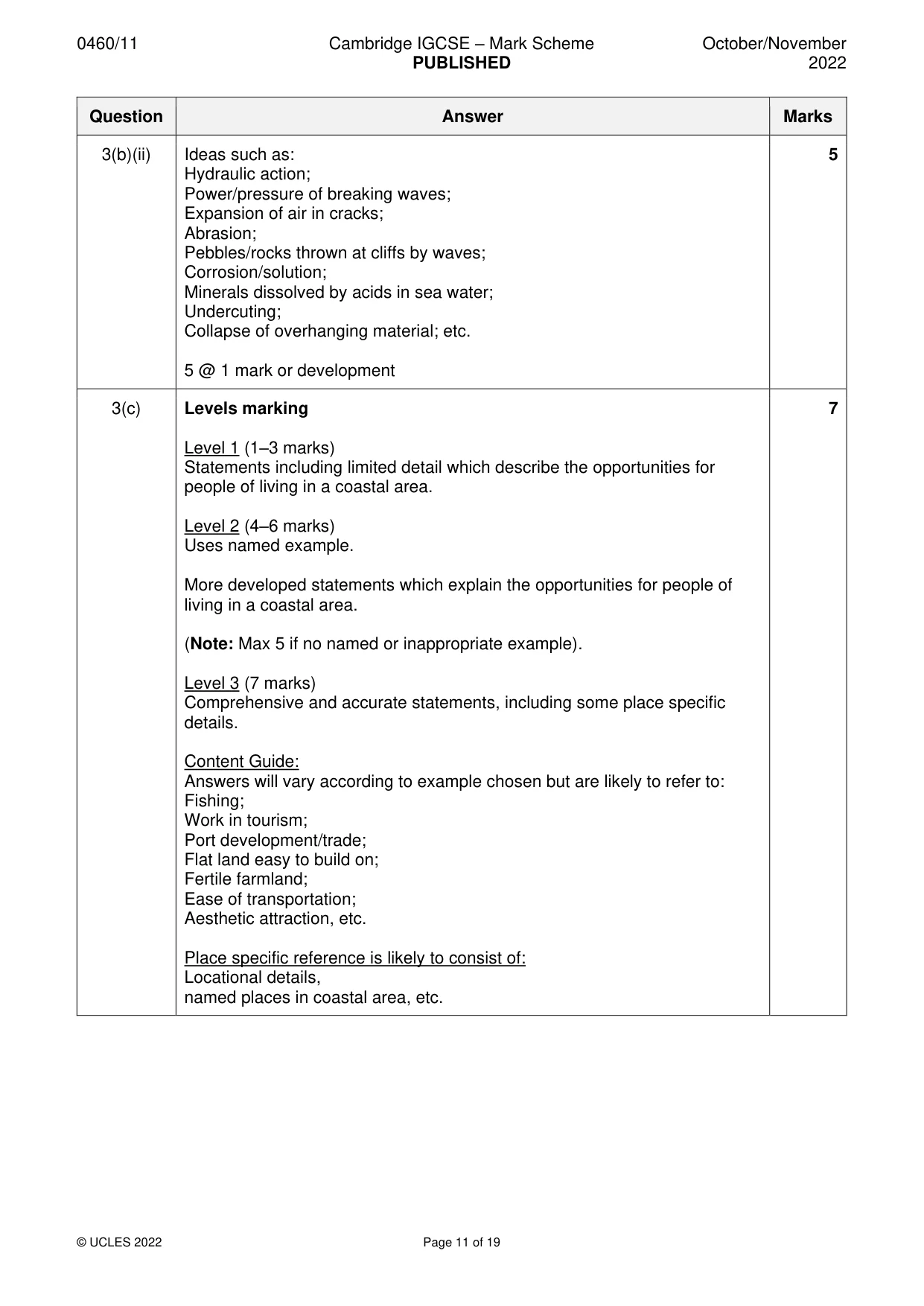
0460/11 Cambridge IGCSE – Mark Scheme PUBLISHED October/November 2022 © UCLES 2022 Page 11 of 19 Question Answer Marks 3(b)(ii) Ideas such as: Hydraulic action; Power/pressure of breaking waves; Expansion of air in cracks; Abrasion; Pebbles/rocks thrown at cliffs by waves; Corrosion/solution; Minerals dissolved by acids in sea water; Undercuting; Collapse of overhanging material; etc. 5 @ 1 mark or development 5 3(c) Levels marking Level 1 (1–3 marks) Statements including limited detail which describe the opportunities for people of living in a coastal area. Level 2 (4–6 marks) Uses named example. More developed statements which explain the opportunities for people of living in a coastal area. (Note: Max 5 if no named or inappropriate example). Level 3 (7 marks) Comprehensive and accurate statements, including some place specific details. Content Guide: Answers will vary according to example chosen but are likely to refer to: Fishing; Work in tourism; Port development/trade; Flat land easy to build on; Fertile farmland; Ease of transportation; Aesthetic attraction, etc. Place specific reference is likely to consist of: Locational details, named places in coastal area, etc. 7
Mark scheme, page 12
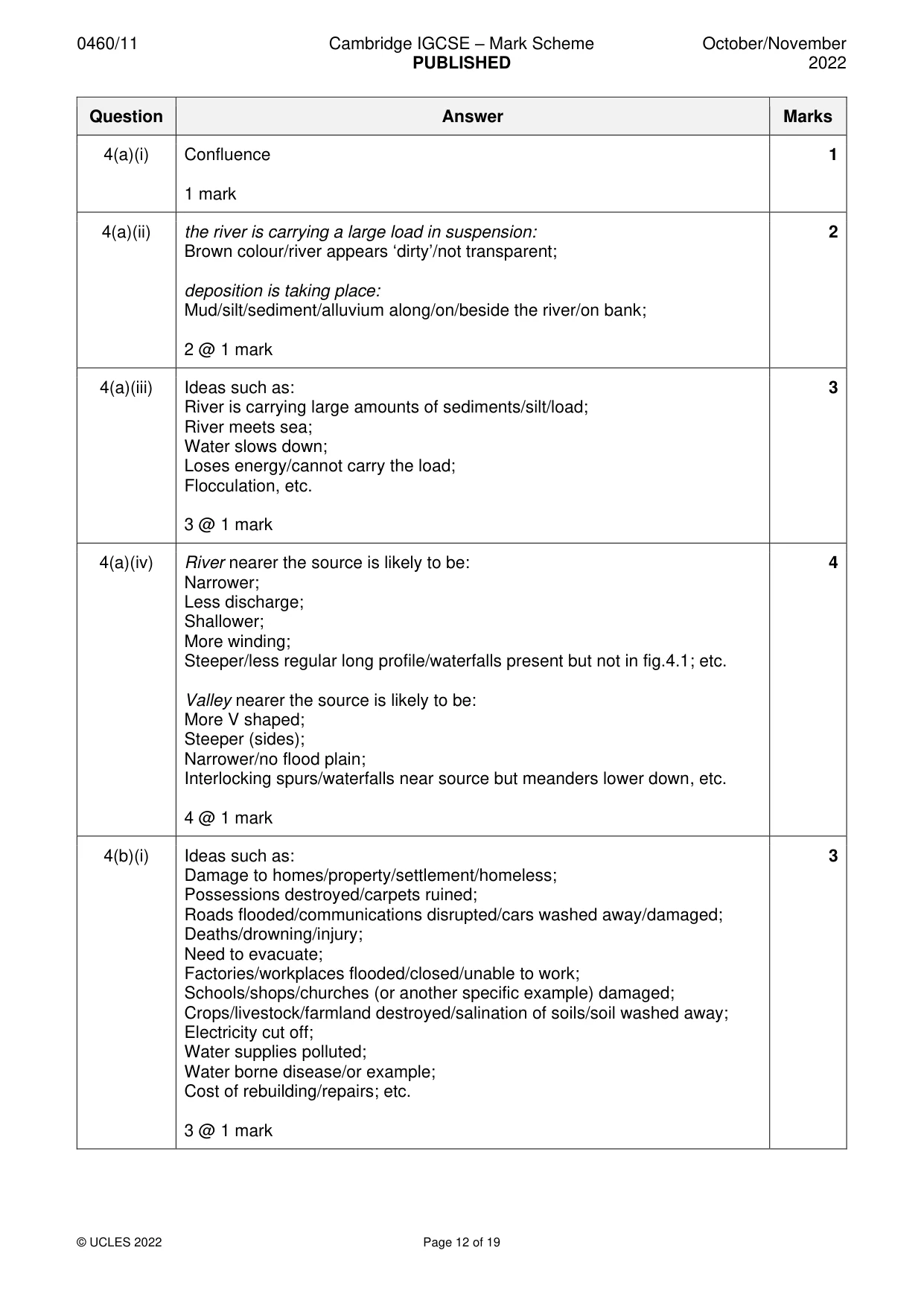
0460/11 Cambridge IGCSE – Mark Scheme PUBLISHED October/November 2022 © UCLES 2022 Page 12 of 19 Question Answer Marks 4(a)(i) Confluence 1 mark 1 4(a)(ii) the river is carrying a large load in suspension: Brown colour/river appears ‘dirty’/not transparent; deposition is taking place: Mud/silt/sediment/alluvium along/on/beside the river/on bank; 2 @ 1 mark 2 4(a)(iii) Ideas such as: River is carrying large amounts of sediments/silt/load; River meets sea; Water slows down; Loses energy/cannot carry the load; Flocculation, etc. 3 @ 1 mark 3 4(a)(iv) River nearer the source is likely to be: Narrower; Less discharge; Shallower; More winding; Steeper/less regular long profile/waterfalls present but not in fig.4.1; etc. Valley nearer the source is likely to be: More V shaped; Steeper (sides); Narrower/no flood plain; Interlocking spurs/waterfalls near source but meanders lower down, etc. 4 @ 1 mark 4 4(b)(i) Ideas such as: Damage to homes/property/settlement/homeless; Possessions destroyed/carpets ruined; Roads flooded/communications disrupted/cars washed away/damaged; Deaths/drowning/injury; Need to evacuate; Factories/workplaces flooded/closed/unable to work; Schools/shops/churches (or another specific example) damaged; Crops/livestock/farmland destroyed/salination of soils/soil washed away; Electricity cut off; Water supplies polluted; Water borne disease/or example; Cost of rebuilding/repairs; etc. 3 @ 1 mark 3
Mark scheme, page 13
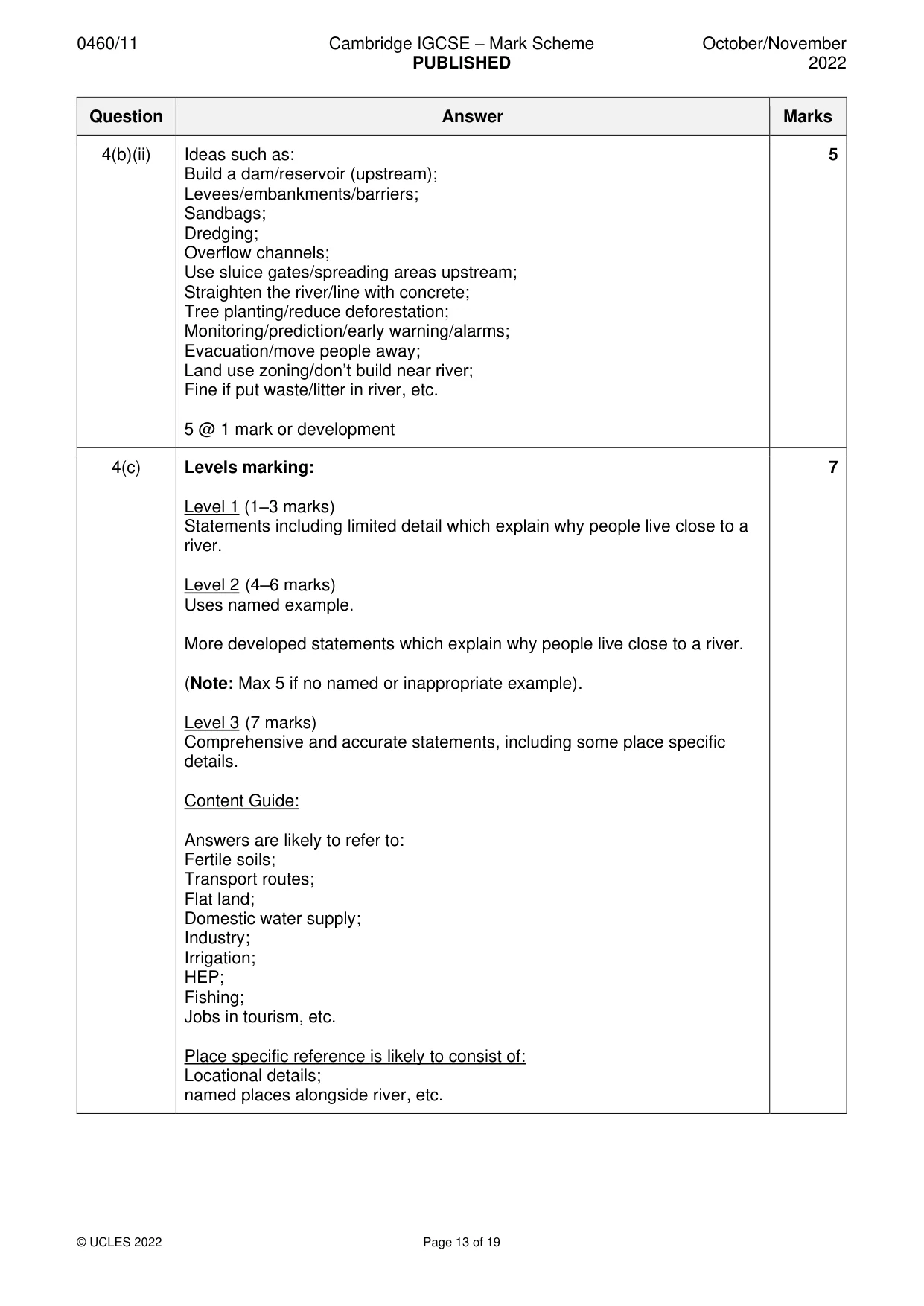
0460/11 Cambridge IGCSE – Mark Scheme PUBLISHED October/November 2022 © UCLES 2022 Page 13 of 19 Question Answer Marks 4(b)(ii) Ideas such as: Build a dam/reservoir (upstream); Levees/embankments/barriers; Sandbags; Dredging; Overflow channels; Use sluice gates/spreading areas upstream; Straighten the river/line with concrete; Tree planting/reduce deforestation; Monitoring/prediction/early warning/alarms; Evacuation/move people away; Land use zoning/don’t build near river; Fine if put waste/litter in river, etc. 5 @ 1 mark or development 5 4(c) Levels marking: Level 1 (1–3 marks) Statements including limited detail which explain why people live close to a river. Level 2 (4–6 marks) Uses named example. More developed statements which explain why people live close to a river. (Note: Max 5 if no named or inappropriate example). Level 3 (7 marks) Comprehensive and accurate statements, including some place specific details. Content Guide: Answers are likely to refer to: Fertile soils; Transport routes; Flat land; Domestic water supply; Industry; Irrigation; HEP; Fishing; Jobs in tourism, etc. Place specific reference is likely to consist of: Locational details; named places alongside river, etc. 7
Mark scheme, page 14
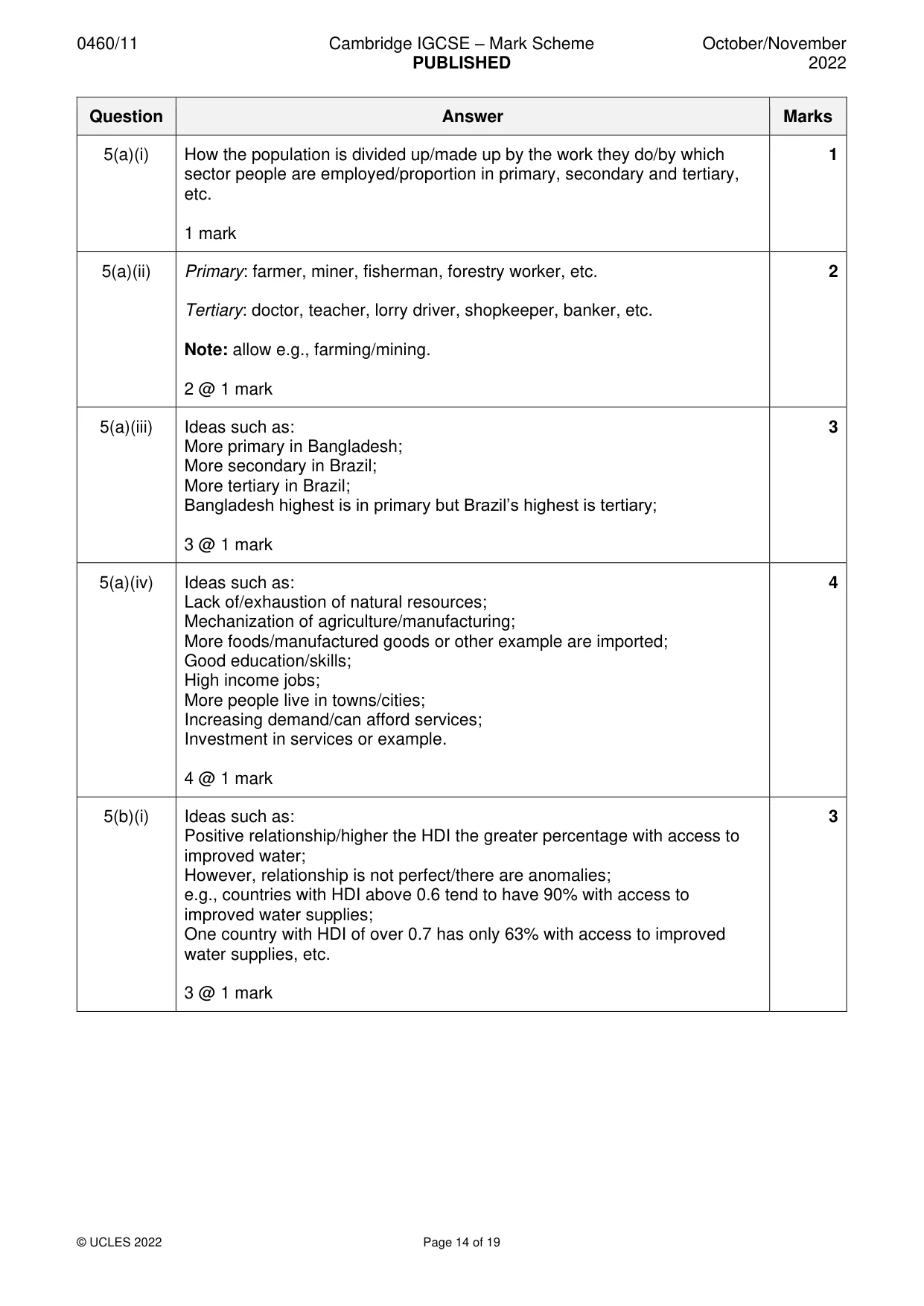
0460/11 Cambridge IGCSE – Mark Scheme PUBLISHED October/November 2022 © UCLES 2022 Page 14 of 19 Question Answer Marks 5(a)(i) How the population is divided up/made up by the work they do/by which sector people are employed/proportion in primary, secondary and tertiary, etc. 1 mark 1 5(a)(ii) Primary: farmer, miner, fisherman, forestry worker, etc. Tertiary: doctor, teacher, lorry driver, shopkeeper, banker, etc. Note: allow e.g., farming/mining. 2 @ 1 mark 2 5(a)(iii) Ideas such as: More primary in Bangladesh; More secondary in Brazil; More tertiary in Brazil; Bangladesh highest is in primary but Brazil’s highest is tertiary; 3 @ 1 mark 3 5(a)(iv) Ideas such as: Lack of/exhaustion of natural resources; Mechanization of agriculture/manufacturing; More foods/manufactured goods or other example are imported; Good education/skills; High income jobs; More people live in towns/cities; Increasing demand/can afford services; Investment in services or example. 4 @ 1 mark 4 5(b)(i) Ideas such as: Positive relationship/higher the HDI the greater percentage with access to improved water; However, relationship is not perfect/there are anomalies; e.g., countries with HDI above 0.6 tend to have 90% with access to improved water supplies; One country with HDI of over 0.7 has only 63% with access to improved water supplies, etc. 3 @ 1 mark 3
Mark scheme, page 15
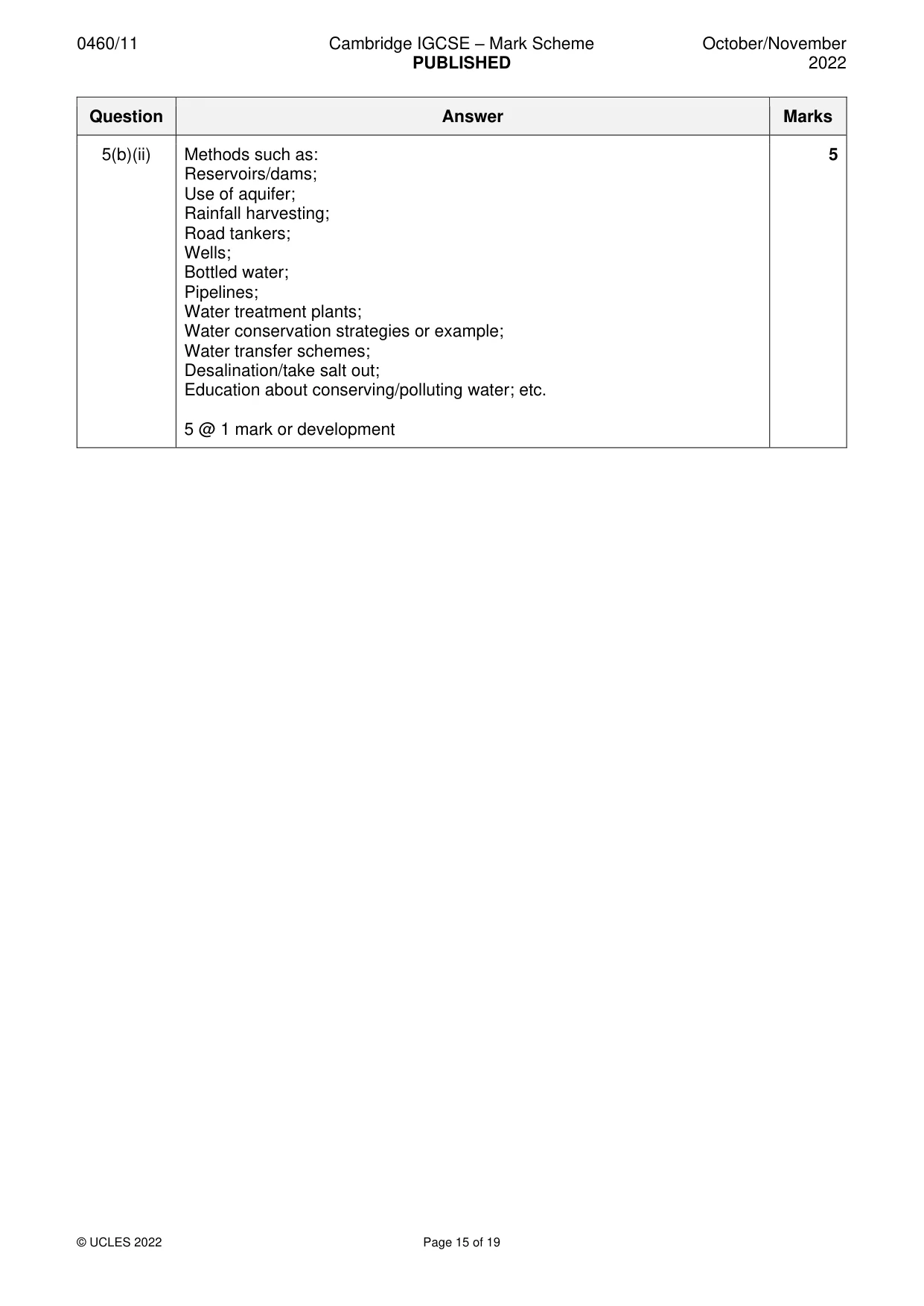
0460/11 Cambridge IGCSE – Mark Scheme PUBLISHED October/November 2022 © UCLES 2022 Page 15 of 19 Question Answer Marks 5(b)(ii) Methods such as: Reservoirs/dams; Use of aquifer; Rainfall harvesting; Road tankers; Wells; Bottled water; Pipelines; Water treatment plants; Water conservation strategies or example; Water transfer schemes; Desalination/take salt out; Education about conserving/polluting water; etc. 5 @ 1 mark or development 5
Mark scheme, page 16
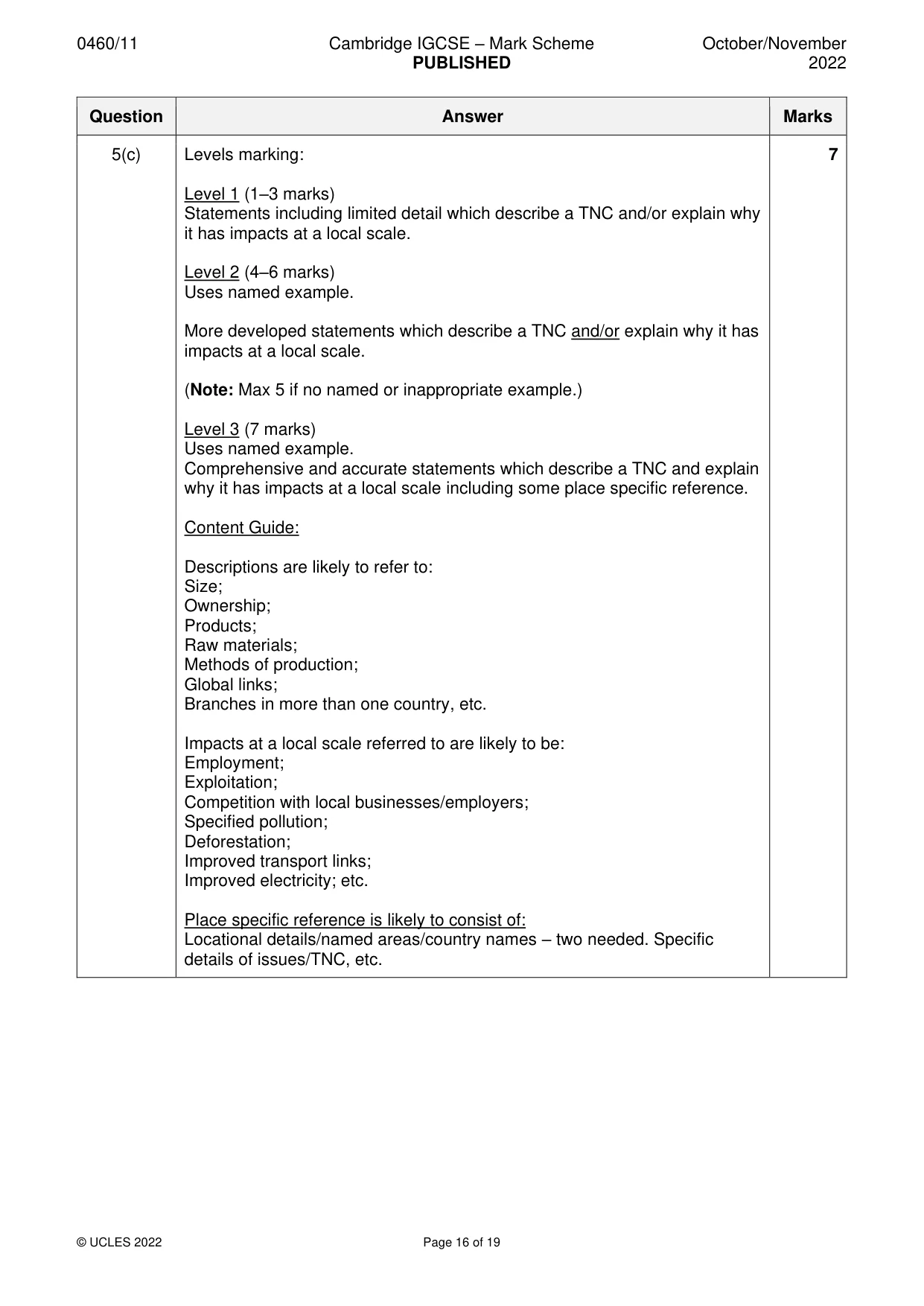
0460/11 Cambridge IGCSE – Mark Scheme PUBLISHED October/November 2022 © UCLES 2022 Page 16 of 19 Question Answer Marks 5(c) Levels marking: Level 1 (1–3 marks) Statements including limited detail which describe a TNC and/or explain why it has impacts at a local scale. Level 2 (4–6 marks) Uses named example. More developed statements which describe a TNC and/or explain why it has impacts at a local scale. (Note: Max 5 if no named or inappropriate example.) Level 3 (7 marks) Uses named example. Comprehensive and accurate statements which describe a TNC and explain why it has impacts at a local scale including some place specific reference. Content Guide: Descriptions are likely to refer to: Size; Ownership; Products; Raw materials; Methods of production; Global links; Branches in more than one country, etc. Impacts at a local scale referred to are likely to be: Employment; Exploitation; Competition with local businesses/employers; Specified pollution; Deforestation; Improved transport links; Improved electricity; etc. Place specific reference is likely to consist of: Locational details/named areas/country names – two needed. Specific details of issues/TNC, etc. 7
Mark scheme, page 17
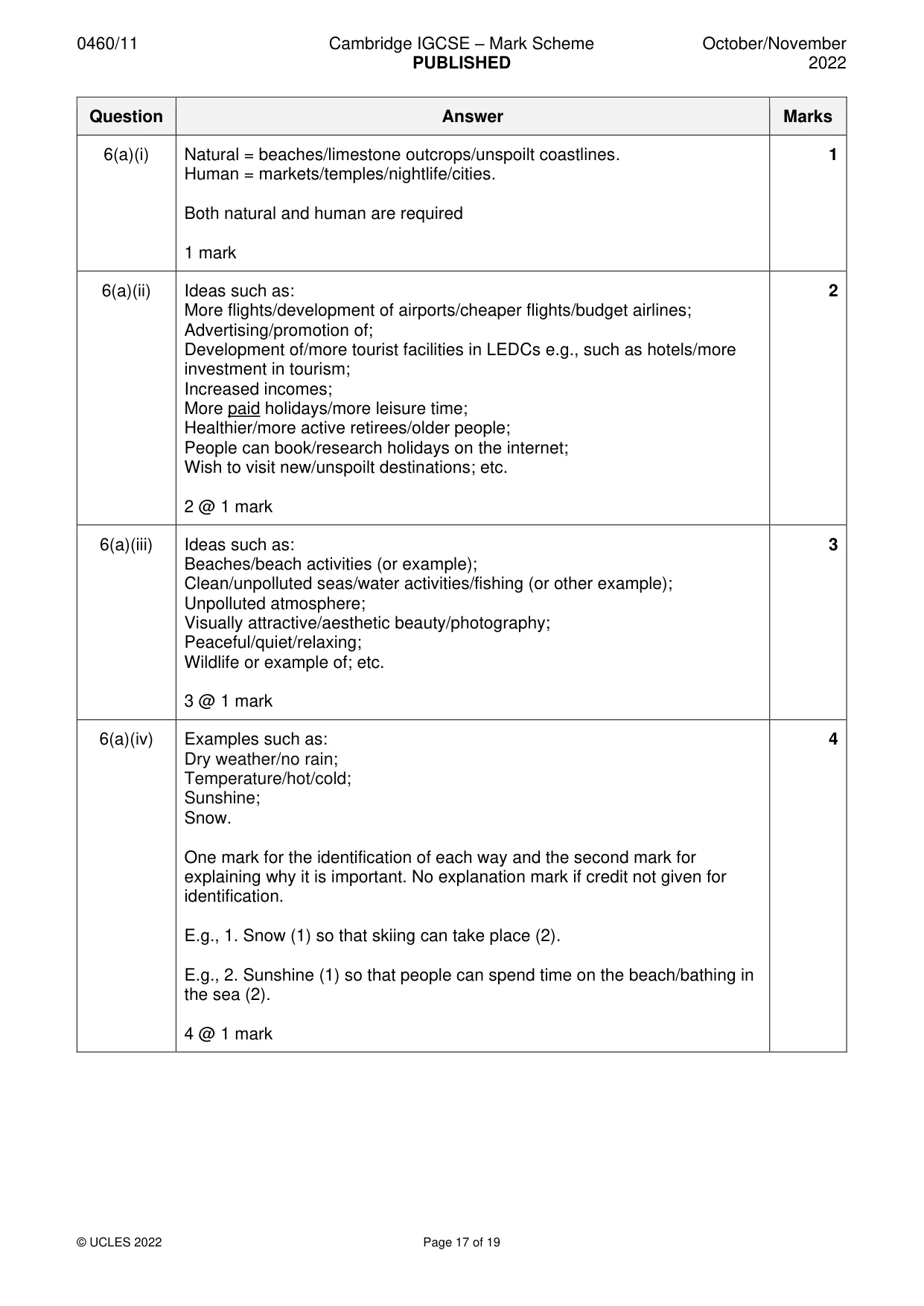
0460/11 Cambridge IGCSE – Mark Scheme PUBLISHED October/November 2022 © UCLES 2022 Page 17 of 19 Question Answer Marks 6(a)(i) Natural = beaches/limestone outcrops/unspoilt coastlines. Human = markets/temples/nightlife/cities. Both natural and human are required 1 mark 1 6(a)(ii) Ideas such as: More flights/development of airports/cheaper flights/budget airlines; Advertising/promotion of; Development of/more tourist facilities in LEDCs e.g., such as hotels/more investment in tourism; Increased incomes; More paid holidays/more leisure time; Healthier/more active retirees/older people; People can book/research holidays on the internet; Wish to visit new/unspoilt destinations; etc. 2 @ 1 mark 2 6(a)(iii) Ideas such as: Beaches/beach activities (or example); Clean/unpolluted seas/water activities/fishing (or other example); Unpolluted atmosphere; Visually attractive/aesthetic beauty/photography; Peaceful/quiet/relaxing; Wildlife or example of; etc. 3 @ 1 mark 3 6(a)(iv) Examples such as: Dry weather/no rain; Temperature/hot/cold; Sunshine; Snow. One mark for the identification of each way and the second mark for explaining why it is important. No explanation mark if credit not given for identification. E.g., 1. Snow (1) so that skiing can take place (2). E.g., 2. Sunshine (1) so that people can spend time on the beach/bathing in the sea (2). 4 @ 1 mark 4
Mark scheme, page 18
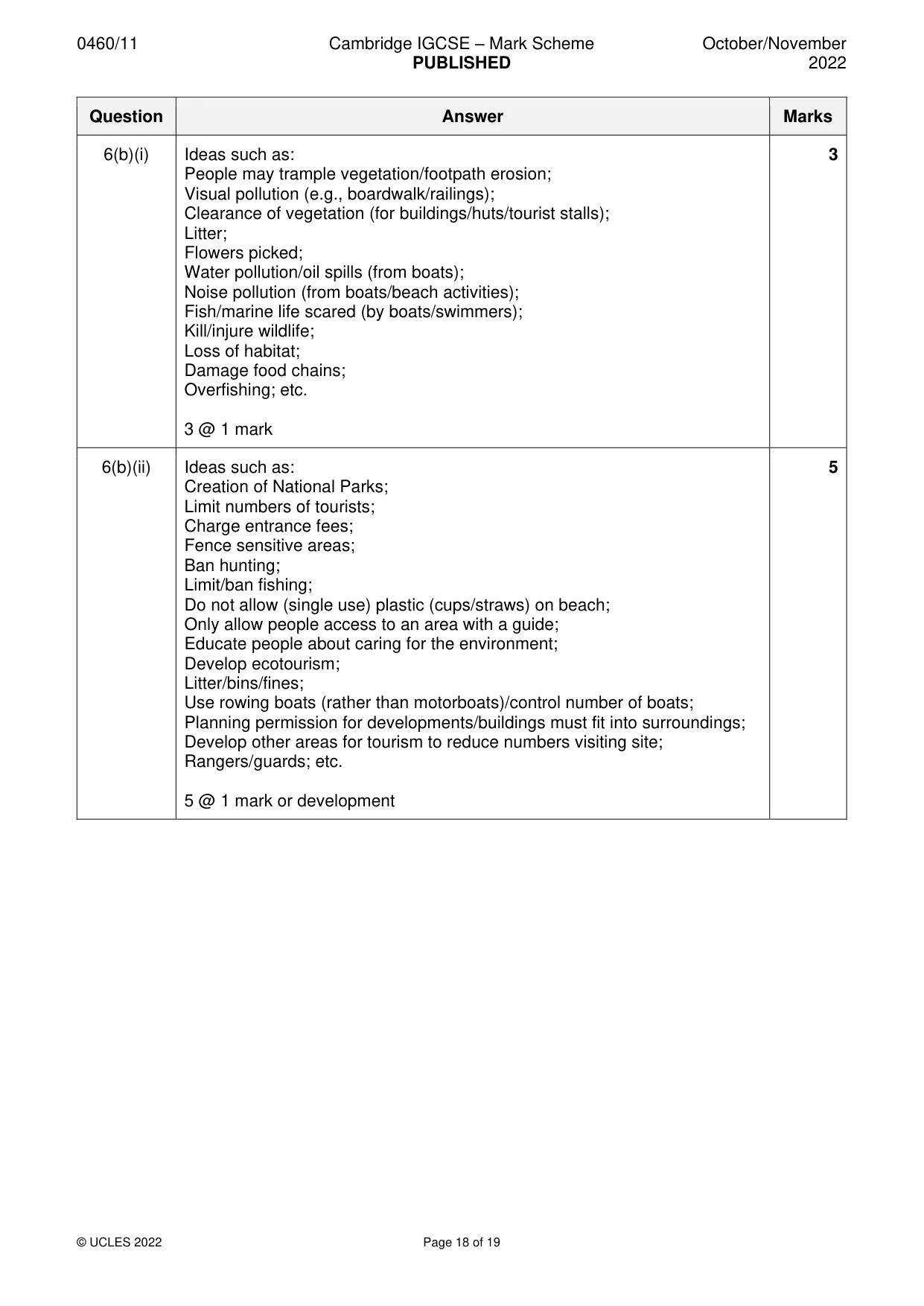
0460/11 Cambridge IGCSE – Mark Scheme PUBLISHED October/November 2022 © UCLES 2022 Page 18 of 19 Question Answer Marks 6(b)(i) Ideas such as: People may trample vegetation/footpath erosion; Visual pollution (e.g., boardwalk/railings); Clearance of vegetation (for buildings/huts/tourist stalls); Litter; Flowers picked; Water pollution/oil spills (from boats); Noise pollution (from boats/beach activities); Fish/marine life scared (by boats/swimmers); Kill/injure wildlife; Loss of habitat; Damage food chains; Overfishing; etc. 3 @ 1 mark 3 6(b)(ii) Ideas such as: Creation of National Parks; Limit numbers of tourists; Charge entrance fees; Fence sensitive areas; Ban hunting; Limit/ban fishing; Do not allow (single use) plastic (cups/straws) on beach; Only allow people access to an area with a guide; Educate people about caring for the environment; Develop ecotourism; Litter/bins/fines; Use rowing boats (rather than motorboats)/control number of boats; Planning permission for developments/buildings must fit into surroundings; Develop other areas for tourism to reduce numbers visiting site; Rangers/guards; etc. 5 @ 1 mark or development 5
Mark scheme, page 19
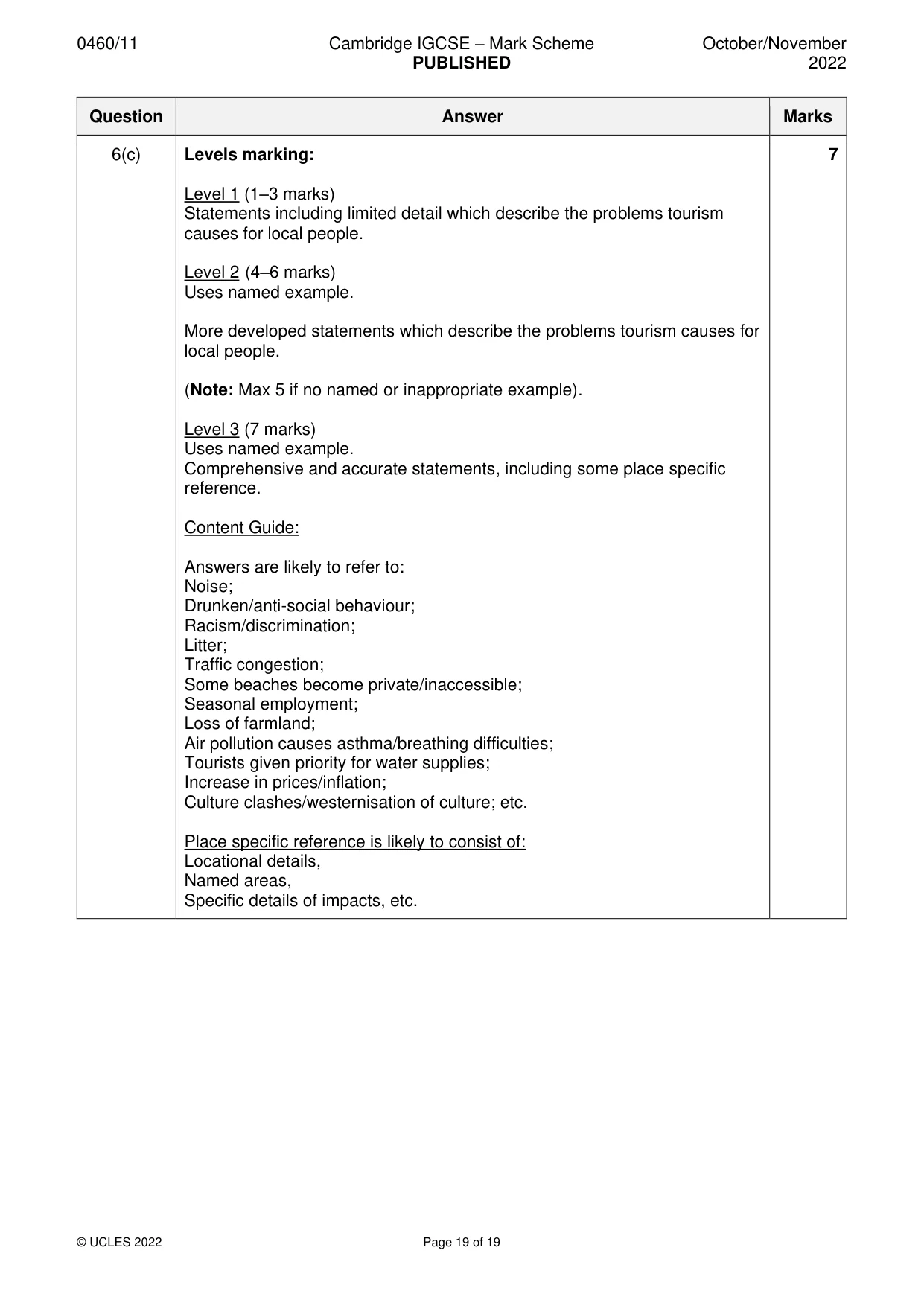
0460/11 Cambridge IGCSE – Mark Scheme PUBLISHED October/November 2022 © UCLES 2022 Page 19 of 19 Question Answer Marks 6(c) Levels marking: Level 1 (1–3 marks) Statements including limited detail which describe the problems tourism causes for local people. Level 2 (4–6 marks) Uses named example. More developed statements which describe the problems tourism causes for local people. (Note: Max 5 if no named or inappropriate example). Level 3 (7 marks) Uses named example. Comprehensive and accurate statements, including some place specific reference. Content Guide: Answers are likely to refer to: Noise; Drunken/anti-social behaviour; Racism/discrimination; Litter; Traffic congestion; Some beaches become private/inaccessible; Seasonal employment; Loss of farmland; Air pollution causes asthma/breathing difficulties; Tourists given priority for water supplies; Increase in prices/inflation; Culture clashes/westernisation of culture; etc. Place specific reference is likely to consist of: Locational details, Named areas, Specific details of impacts, etc. 7
What you needed in this session
Cambridge’s own grade thresholds for 2022 Oct/Nov, Paper 1 · Variant 1. A higher threshold means an easier paper — the bar moves with how the cohort did.