Cambridge IGCSE Geography 0460 — 2022 Oct/Nov Paper 1 · Variant 3
0460/13/O/N/22 · 75 marks · ≈84 min
The question paper and its mark scheme, free to read here and free to download. This is Cambridge’s own paper, exactly as it was sat.
Question paper32 pages






Mark scheme19 pages
Answers below. Sit the paper first if you are practising.
Paper as text
Question paper, page 1
This document has 32 pages. Any blank pages are indicated. [Turn over DC (RW/CB) 304176/5 © UCLES 2022 * 6 6 1 7 2 0 7 5 9 6 * GEOGRAPHY 0460/13 Paper 1 Geographical Themes October/November 2022 1 hour 45 minutes You must answer on the question paper. You will need: Insert (enclosed) Calculator Ruler INSTRUCTIONS ● Answer three questions in total, one from each section. ● Use a black or dark blue pen. You may use an HB pencil for any diagrams or graphs. ● Write your name, centre number and candidate number in the boxes at the top of the page. ● Write your answer to each question in the space provided. ● Do not use an erasable pen or correction fluid. ● Do not write on any bar codes. ● If additional space is needed, you should use the lined pages at the end of this booklet; the question number or numbers must be clearly shown. INFORMATION ● The total mark for this paper is 75. ● The number of marks for each question or part question is shown in brackets [ ]. ● The insert contains additional resources referred to in the questions. Definitions MEDCs – More Economically Developed Countries LEDCs – Less Economically Developed Countries Cambridge IGCSE™
Question paper, page 2
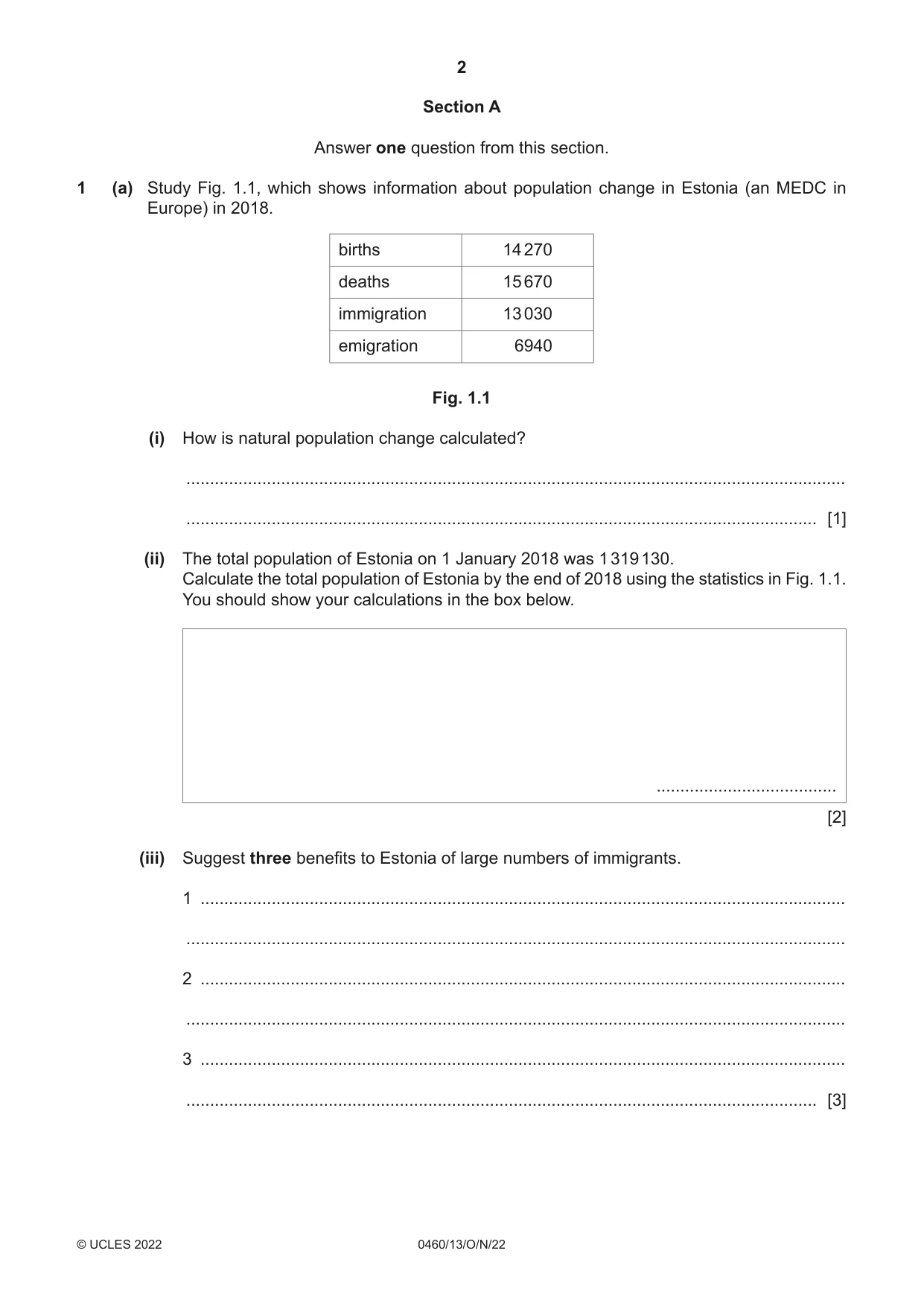
2 0460/13/O/N/22 © UCLES 2022 Section A Answer one question from this section. 1 (a) Study Fig. 1.1, which shows information about population change in Estonia (an MEDC in Europe) in 2018. births 14 270 deaths 15 670 immigration 13 030 emigration 6940 Fig. 1.1 (i) How is natural population change calculated? … … [1] (ii) The total population of Estonia on 1 January 2018 was 1 319 130. Calculate the total population of Estonia by the end of 2018 using the statistics in Fig. 1.1. You should show your calculations in the box below. … [2] (iii) Suggest three benefits to Estonia of large numbers of immigrants. 1 … … 2 … … 3 … … [3]
Question paper, page 3
3 0460/13/O/N/22 © UCLES 2022 [Turn over (iv) Many of the immigrants to Estonia in 2018 were from Russia and Ukraine. Suggest difficulties which these immigrants faced when they moved to Estonia. … … … … … … … … [4]
Question paper, page 4
4 0460/13/O/N/22 © UCLES 2022 (b) Study Fig. 1.2, which shows information about population change in Estonia between 2014 and 2018. Fig. 1.2 (i) Compare the natural population increase of Estonia between 2014 and 2018 with its net international migration. Use statistics in your answer. … … … … … … [3] Content removed due to copyright restrictions.
Question paper, page 5
5 0460/13/O/N/22 © UCLES 2022 [Turn over (ii) Estonia is an under‑populated country. Describe the problems faced by countries which are under‑populated. … … … … … … … … … … [5]
Question paper, page 6
6 0460/13/O/N/22 © UCLES 2022 (c) For a named country you have studied, explain why birth rates are high. Name of country … … … … … … … … … … … … … … … … … … … … … … … … … [7] [Total: 25]
Question paper, page 7
7 0460/13/O/N/22 © UCLES 2022 [Turn over TURN PAGE FOR QUESTION 2
Question paper, page 8
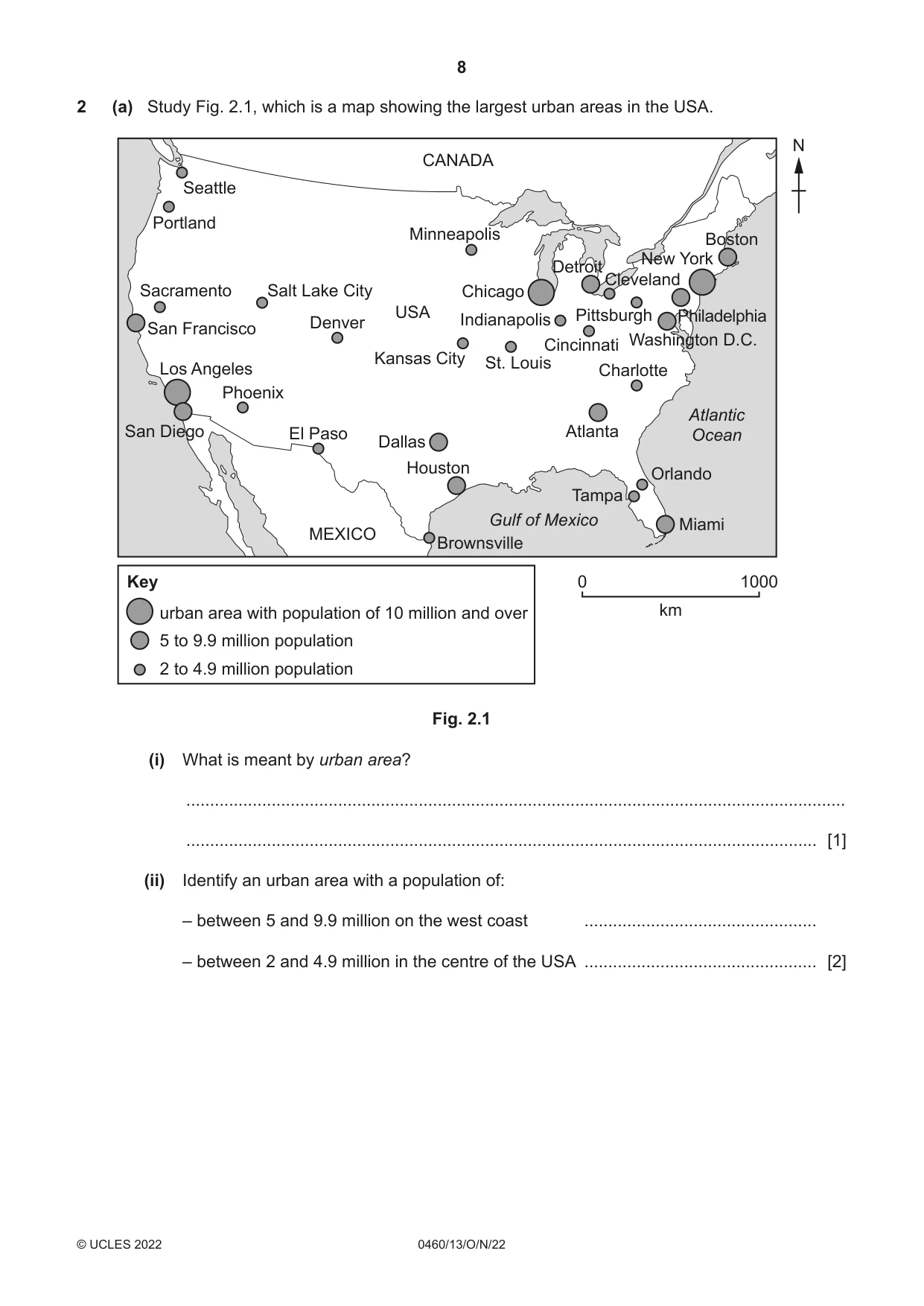
8 0460/13/O/N/22 © UCLES 2022 2 (a) Study Fig. 2.1, which is a map showing the largest urban areas in the USA. N urban area with population of 10 million and over 5 to 9.9 million population Key CANADA USA Miami Orlando Tampa Dallas Denver San Francisco Sacramento Portland Seattle Salt Lake City Kansas City St. Louis Cincinnati Charlotte Pittsburgh Cleveland Minneapolis Indianapolis Houston Phoenix El Paso Brownsville Atlanta Washington D.C. Philadelphia New York Boston Chicago Detroit Los Angeles San Diego MEXICO Gulf of Mexico Atlantic Ocean 2 to 4.9 million population 0 1000 km Fig. 2.1 (i) What is meant by urban area? … … [1] (ii) Identify an urban area with a population of: – between 5 and 9.9 million on the west coast … – between 2 and 4.9 million in the centre of the USA … [2]
Question paper, page 9
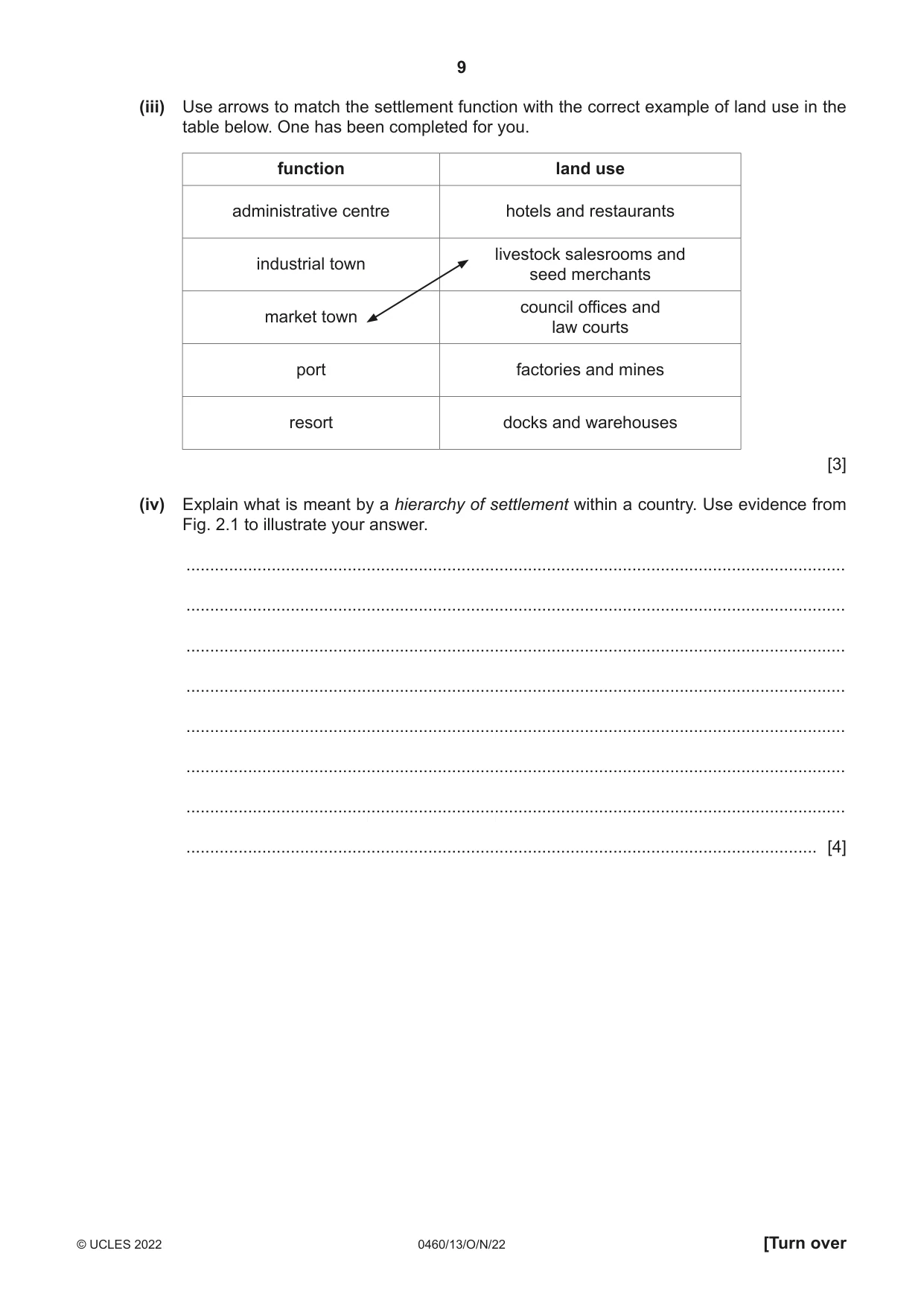
9 0460/13/O/N/22 © UCLES 2022 [Turn over (iii) Use arrows to match the settlement function with the correct example of land use in the table below. One has been completed for you. function land use administrative centre hotels and restaurants industrial town livestock salesrooms and seed merchants market town council offices and law courts port factories and mines resort docks and warehouses [3] (iv) Explain what is meant by a hierarchy of settlement within a country. Use evidence from Fig. 2.1 to illustrate your answer. … … … … … … … … [4]
Question paper, page 10
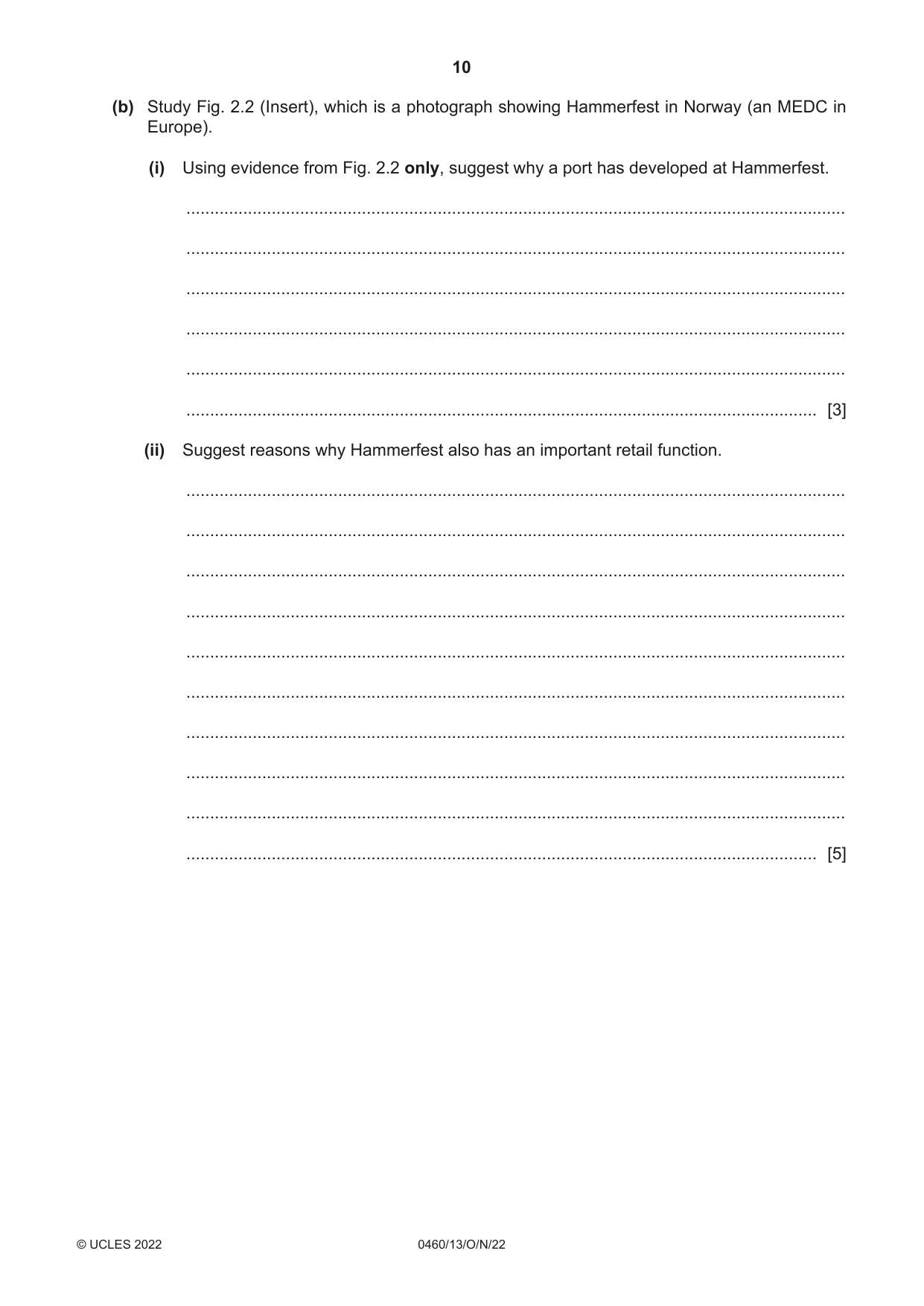
10 0460/13/O/N/22 © UCLES 2022 (b) Study Fig. 2.2 (Insert), which is a photograph showing Hammerfest in Norway (an MEDC in Europe). (i) Using evidence from Fig. 2.2 only, suggest why a port has developed at Hammerfest. … … … … … … [3] (ii) Suggest reasons why Hammerfest also has an important retail function. … … … … … … … … … … [5]
Question paper, page 11
11 0460/13/O/N/22 © UCLES 2022 [Turn over (c) A major problem faced by people living in urban areas is traffic congestion. For a named urban area you have studied, describe the strategies which have been used to reduce the problems caused by traffic. Name of urban area … … … … … … … … … … … … … … … … … … … … … … … … … [7] [Total: 25]
Question paper, page 12
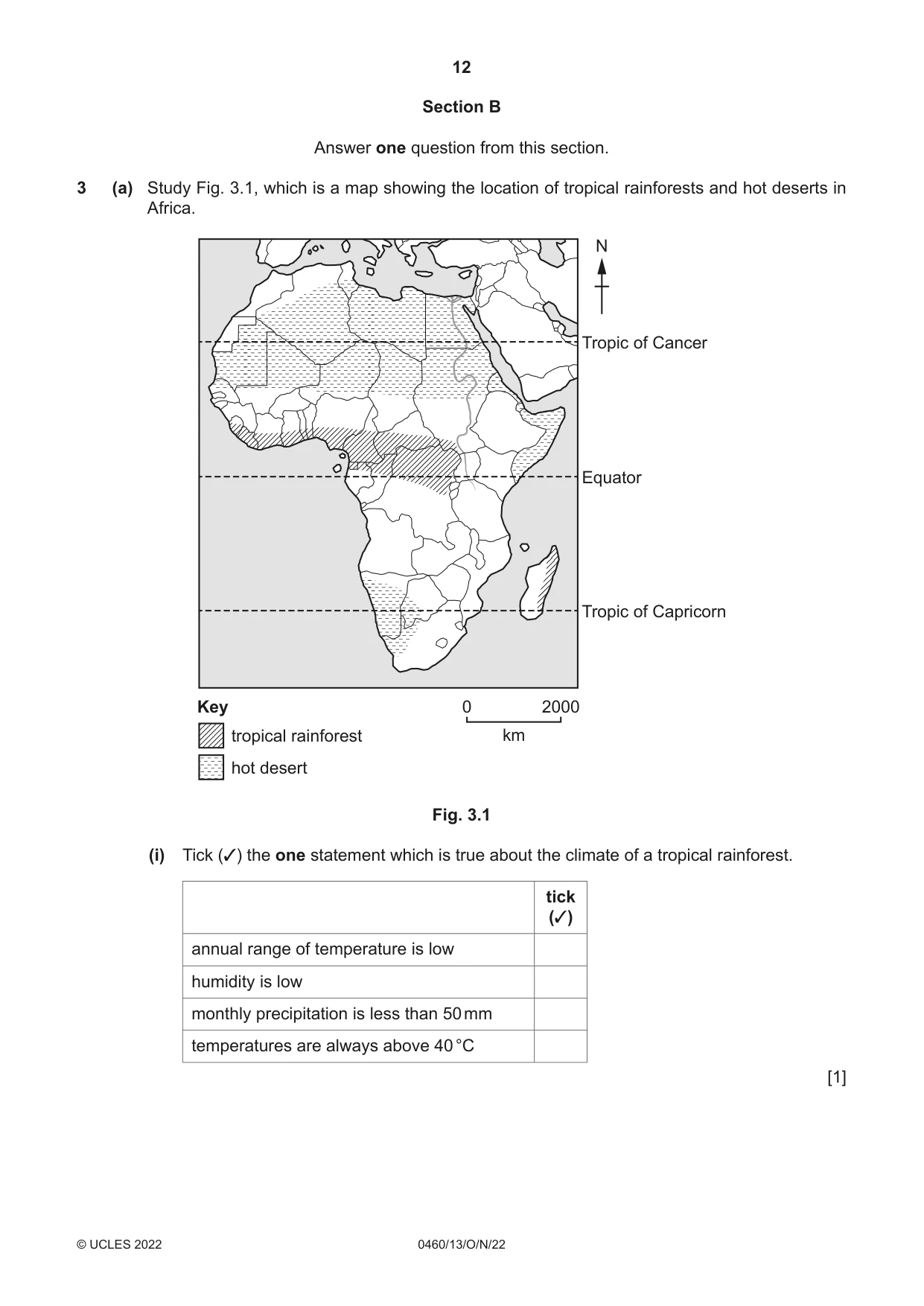
12 0460/13/O/N/22 © UCLES 2022 Section B Answer one question from this section. 3 (a) Study Fig. 3.1, which is a map showing the location of tropical rainforests and hot deserts in Africa. Equator Tropic of Cancer Tropic of Capricorn hot desert tropical rainforest Key N 0 2000 km Fig. 3.1 (i) Tick (✓) the one statement which is true about the climate of a tropical rainforest. tick (✓) annual range of temperature is low humidity is low monthly precipitation is less than 50 mm temperatures are always above 40 °C [1]
Question paper, page 13
13 0460/13/O/N/22 © UCLES 2022 [Turn over (ii) Describe the distribution of areas of tropical rainforest in Africa. … … … … [2] (iii) Explain why hot deserts have a high diurnal (daily) range of temperature. … … … … … … [3] (iv) Explain why hot deserts receive less rainfall than tropical rainforests. … … … … … … … … [4]
Question paper, page 14
14 0460/13/O/N/22 © UCLES 2022 (b) Study Fig. 3.2 and Fig. 3.3 (Insert), which are photographs showing two different plants in the Mojave Desert, USA. (i) Identify three differences between the plants shown in Figs. 3.2 and 3.3. 1 … … 2 … … 3 … … [3] (ii) Explain how plants, such as those shown in Figs. 3.2 and 3.3, are able to survive in the Mojave Desert. … … … … … … … … … … [5]
Question paper, page 15
15 0460/13/O/N/22 © UCLES 2022 [Turn over (c) For a named area of tropical rainforest you have studied, describe and explain the characteristics of its vegetation. Name of area of tropical rainforest … … … … … … … … … … … … … … … … … … … … … … … … … … [7] [Total: 25]
Question paper, page 16
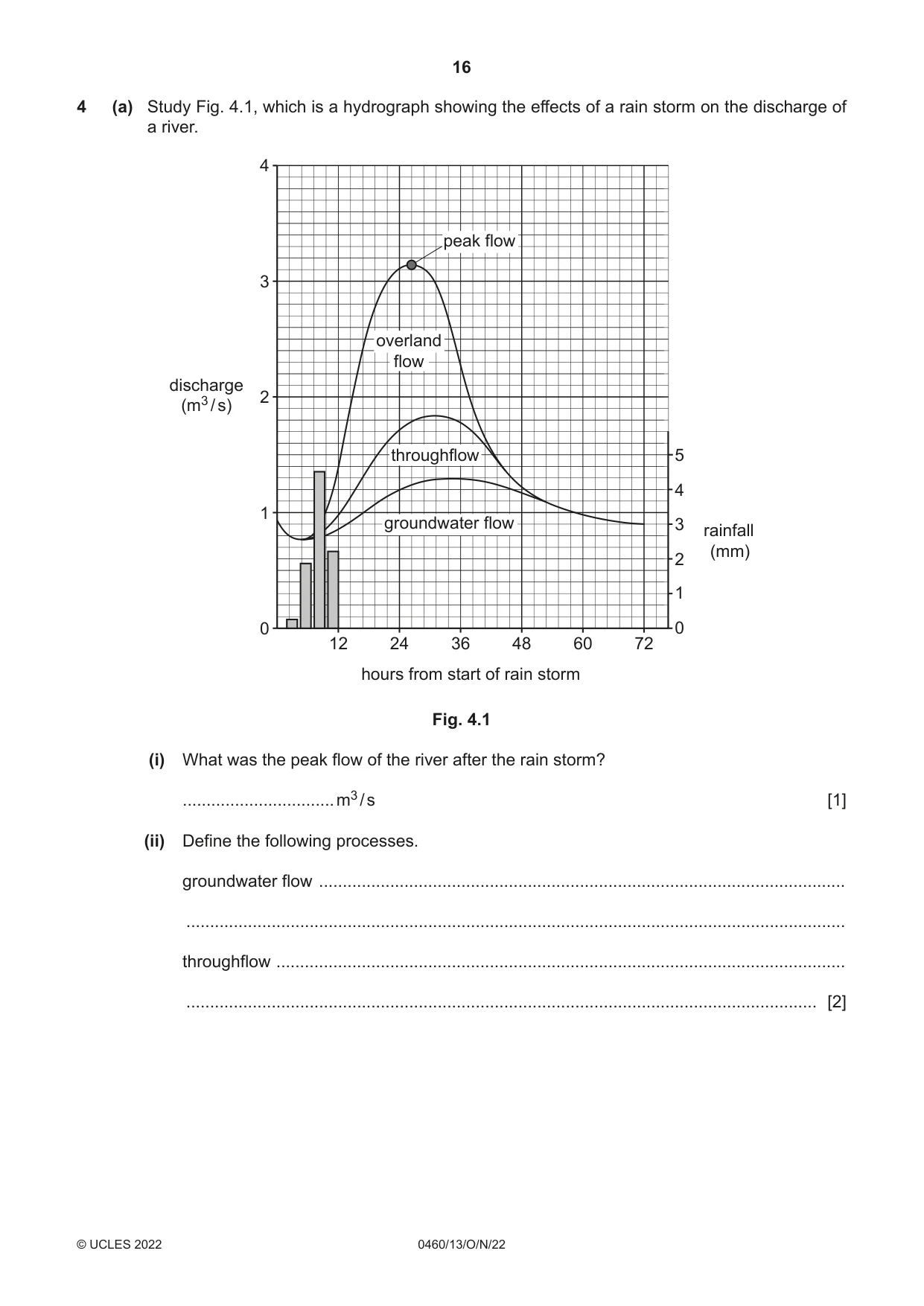
16 0460/13/O/N/22 © UCLES 2022 4 (a) Study Fig. 4.1, which is a hydrograph showing the effects of a rain storm on the discharge of a river. 12 0 1 2 3 4 24 36 hours from start of rain storm discharge (m3 / s) 48 60 72 peak flow overland flow throughflow groundwater flow 2 1 0 3 4 5 rainfall (mm) Fig. 4.1 (i) What was the peak flow of the river after the rain storm? … m3 / s [1] (ii) Define the following processes. groundwater flow … … throughflow … … [2]
Question paper, page 17
17 0460/13/O/N/22 © UCLES 2022 [Turn over (iii) Explain why the river’s peak flow does not occur until approximately 26 hours after the start of the rain storm. … … … … … … [3] (iv) Explain how the following will influence river discharge. building large areas of housing in the valleys … … … … afforestation on the slopes of the valleys … … … … [4]
Question paper, page 18
18 0460/13/O/N/22 © UCLES 2022 (b) Study Fig. 4.2 (Insert), which is a photograph of part of a meander. (i) Describe the differences between the two banks of the river, which are labelled A and B in Fig. 4.2. … … … … … … [3] (ii) Explain why the two banks of the river shown in Fig. 4.2 are different from each other. You should refer to river processes. … … … … … … … … … … [5]
Question paper, page 19
19 0460/13/O/N/22 © UCLES 2022 [Turn over (c) Describe the opportunities provided by a named river you have studied for people who live close to it. Name of river … … … … … … … … … … … … … … … … … … … … … … … … … … [7] [Total: 25]
Question paper, page 20
20 0460/13/O/N/22 © UCLES 2022 Section C Answer one question from this section. 5 (a) Study Fig. 5.1, which shows an irrigation system used by subsistence farmers in an LEDC. Fig. 5.1 (i) What is meant by a subsistence farmer? … … [1] (ii) Explain why irrigation enables subsistence farmers to grow more food. … … … … [2] Content removed due to copyright restrictions.
Question paper, page 21
21 0460/13/O/N/22 © UCLES 2022 [Turn over (iii) Explain why the method of irrigation shown in Fig. 5.1 is suitable for farmers in an LEDC. … … … … … … [3] (iv) Give two other methods which farmers can use to increase food production. For each method explain why it increases output. Do not write about irrigation. 1 … … … … 2 … … … … [4]
Question paper, page 22
22 0460/13/O/N/22 © UCLES 2022 (b) Study Fig. 5.2 (Insert), which is a photograph taken on a commercial, arable farm. (i) State three processes which will take place on the farm shown in Fig. 5.2. 1 … 2 … 3 … [3] (ii) Suggest why the area shown in Fig. 5.2 is suitable for arable farming. … … … … … … … … … … [5]
Question paper, page 23
23 0460/13/O/N/22 © UCLES 2022 [Turn over (c) For a named country or region you have studied, explain why many people have suffered malnutrition and starvation. Name of country or region … … … … … … … … … … … … … … … … … … … … … … … … … … [7] [Total: 25]
Question paper, page 24
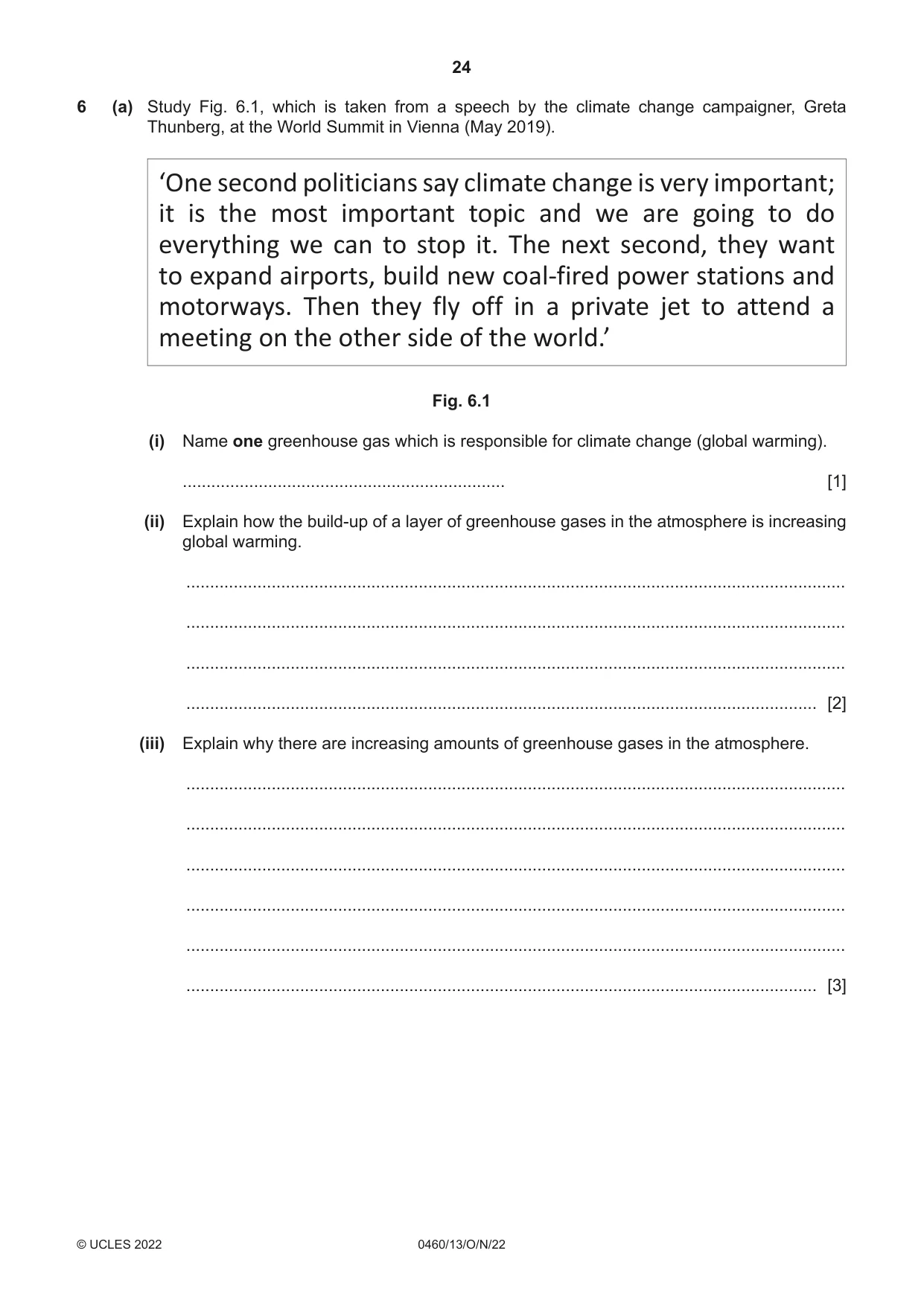
24 0460/13/O/N/22 © UCLES 2022 6 (a) Study Fig. 6.1, which is taken from a speech by the climate change campaigner, Greta Thunberg, at the World Summit in Vienna (May 2019). ‘One second politicians say climate change is very important; it is the most important topic and we are going to do everything we can to stop it. The next second, they want to expand airports, build new coal-fired power stations and motorways. Then they fly off in a private jet to attend a meeting on the other side of the world.’ Fig. 6.1 (i) Name one greenhouse gas which is responsible for climate change (global warming). … [1] (ii) Explain how the build‑up of a layer of greenhouse gases in the atmosphere is increasing global warming. … … … … [2] (iii) Explain why there are increasing amounts of greenhouse gases in the atmosphere. … … … … … … [3]
Question paper, page 25
25 0460/13/O/N/22 © UCLES 2022 [Turn over (iv) Describe the global problems which campaigners claim may result from the increase in the amounts of greenhouse gases in the atmosphere. … … … … … … … … [4]
Question paper, page 26
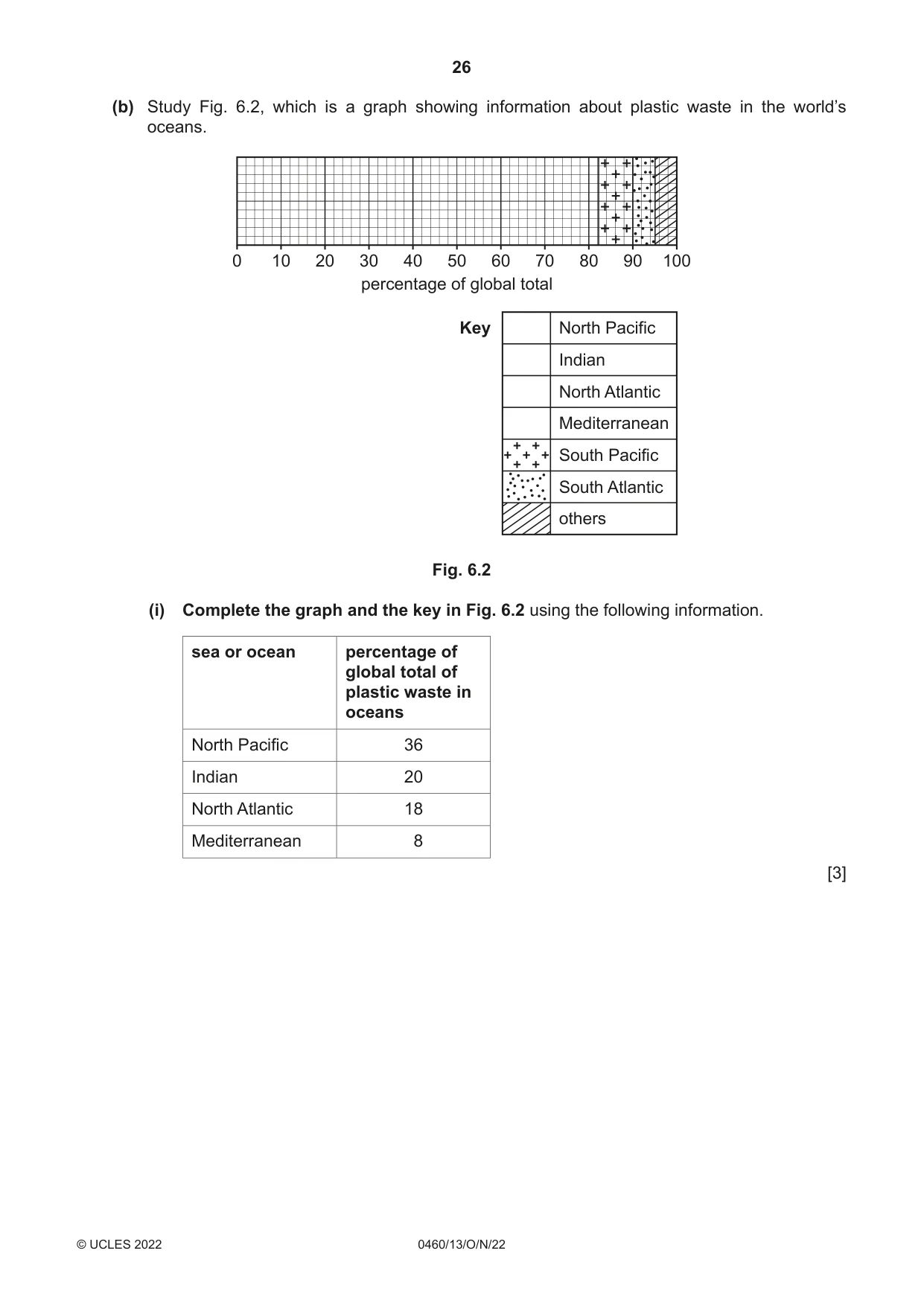
26 0460/13/O/N/22 © UCLES 2022 (b) Study Fig. 6.2, which is a graph showing information about plastic waste in the world’s oceans. 0 10 20 30 40 50 percentage of global total 60 70 80 90 100 Key North Pacific Indian North Atlantic Mediterranean South Pacific South Atlantic others Fig. 6.2 (i) Complete the graph and the key in Fig. 6.2 using the following information. sea or ocean percentage of global total of plastic waste in oceans North Pacific 36 Indian 20 North Atlantic 18 Mediterranean 8 [3]
Question paper, page 27
27 0460/13/O/N/22 © UCLES 2022 [Turn over (ii) Explain why pollution of the seas and oceans causes problems for the natural environment and people. … … … … … … … … … … [5]
Question paper, page 28
28 0460/13/O/N/22 © UCLES 2022 (c) For a named area you have studied, name one economic activity which is a threat to the local natural environment and explain how these environmental risks are being managed. Name of area … Economic activity … … … … … … … … … … … … … … … … … … … … … … … … … [7] [Total: 25]
Question paper, page 29
29 0460/13/O/N/22 © UCLES 2022 Additional pages If you use the following pages to complete the answer to any question, the question number must be clearly shown. … … … … … … … … … … … … … … … … … … … … … … … … … …
Question paper, page 30
30 0460/13/O/N/22 © UCLES 2022 … … … … … … … … … … … … … … … … … … … … … … … … … … … …
Question paper, page 31
31 0460/13/O/N/22 © UCLES 2022 BLANK PAGE
Question paper, page 32
32 0460/13/O/N/22 © UCLES 2022 The boundaries and names shown, the designations used and the presentation of material on any maps contained in this question paper/insert do not imply official endorsement or acceptance by Cambridge Assessment International Education concerning the legal status of any country, territory, or area or any of its authorities, or of the delimitation of its frontiers or boundaries. Permission to reproduce items where third‑party owned material protected by copyright is included has been sought and cleared where possible. Every reasonable effort has been made by the publisher (UCLES) to trace copyright holders, but if any items requiring clearance have unwittingly been included, the publisher will be pleased to make amends at the earliest possible opportunity. To avoid the issue of disclosure of answer‑related information to candidates, all copyright acknowledgements are reproduced online in the Cambridge Assessment International Education Copyright Acknowledgements Booklet. This is produced for each series of examinations and is freely available to download at www.cambridgeinternational.org after the live examination series. Cambridge Assessment International Education is part of Cambridge Assessment. Cambridge Assessment is the brand name of the University of Cambridge Local Examinations Syndicate (UCLES), which is a department of the University of Cambridge. BLANK PAGE
Mark scheme, page 1
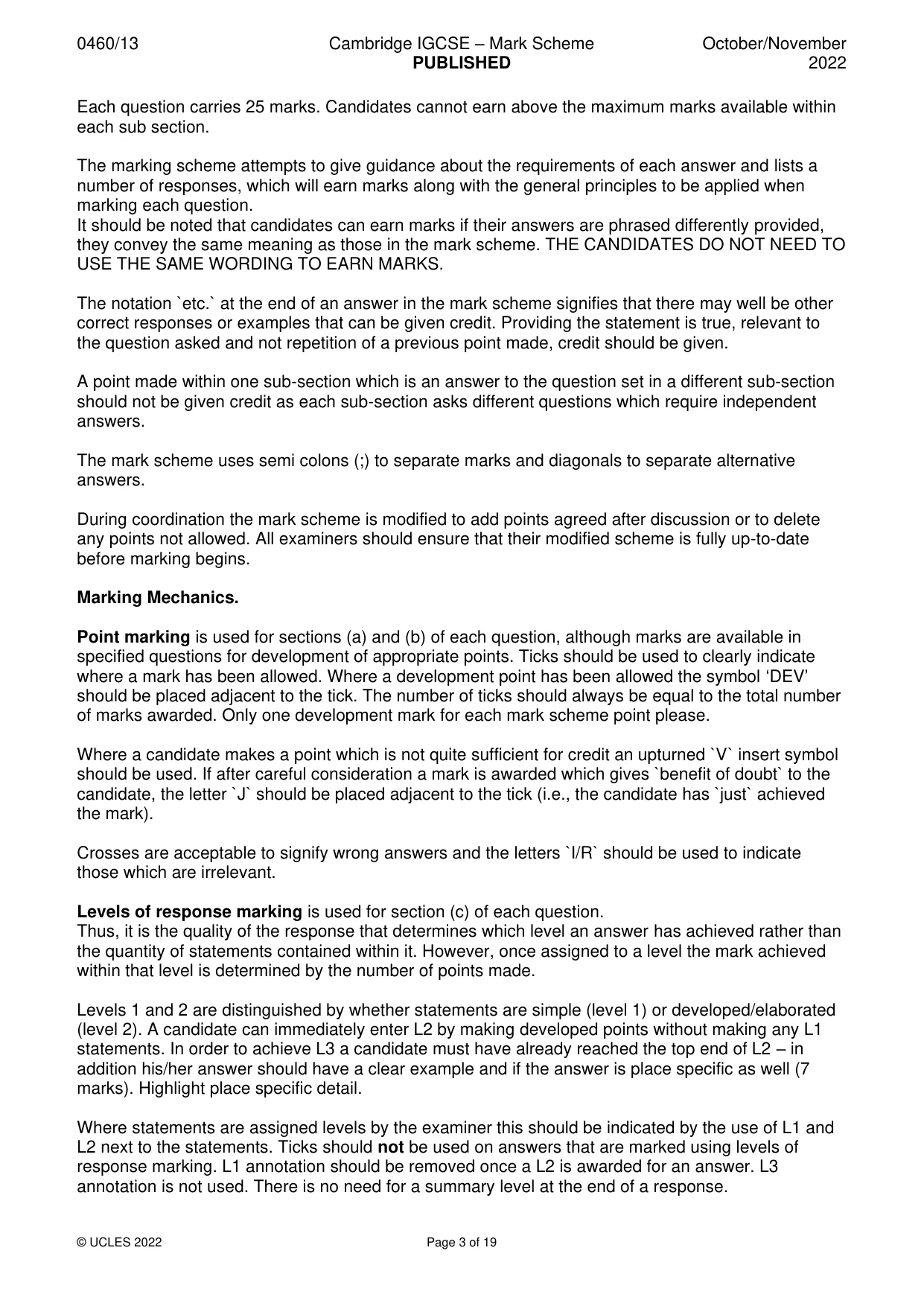
This document consists of 19 printed pages. © UCLES 2022 [Turn over Cambridge IGCSE™ GEOGRAPHY 0460/13 Paper 1 Geographical Themes October/November 2022 MARK SCHEME Maximum Mark: 75 Published This mark scheme is published as an aid to teachers and candidates, to indicate the requirements of the examination. It shows the basis on which Examiners were instructed to award marks. It does not indicate the details of the discussions that took place at an Examiners’ meeting before marking began, which would have considered the acceptability of alternative answers. Mark schemes should be read in conjunction with the question paper and the Principal Examiner Report for Teachers. Cambridge International will not enter into discussions about these mark schemes. Cambridge International is publishing the mark schemes for the October/November 2022 series for most Cambridge IGCSE™, Cambridge International A and AS Level components and some Cambridge O Level components.
Mark scheme, page 2
0460/13 Cambridge IGCSE – Mark Scheme PUBLISHED October/November 2022 © UCLES 2022 Page 2 of 19 Generic Marking Principles These general marking principles must be applied by all examiners when marking candidate answers. They should be applied alongside the specific content of the mark scheme or generic level descriptors for a question. Each question paper and mark scheme will also comply with these marking principles. GENERIC MARKING PRINCIPLE 1: Marks must be awarded in line with: • the specific content of the mark scheme or the generic level descriptors for the question • the specific skills defined in the mark scheme or in the generic level descriptors for the question • the standard of response required by a candidate as exemplified by the standardisation scripts. GENERIC MARKING PRINCIPLE 2: Marks awarded are always whole marks (not half marks, or other fractions). GENERIC MARKING PRINCIPLE 3: Marks must be awarded positively: • marks are awarded for correct/valid answers, as defined in the mark scheme. However, credit is given for valid answers which go beyond the scope of the syllabus and mark scheme, referring to your Team Leader as appropriate • marks are awarded when candidates clearly demonstrate what they know and can do • marks are not deducted for errors • marks are not deducted for omissions • answers should only be judged on the quality of spelling, punctuation, and grammar when these features are specifically assessed by the question as indicated by the mark scheme. The meaning, however, should be unambiguous. GENERIC MARKING PRINCIPLE 4: Rules must be applied consistently, e.g., in situations where candidates have not followed instructions or in the application of generic level descriptors. GENERIC MARKING PRINCIPLE 5: Marks should be awarded using the full range of marks defined in the mark scheme for the question (however; the use of the full mark range may be limited according to the quality of the candidate responses seen). GENERIC MARKING PRINCIPLE 6: Marks awarded are based solely on the requirements as defined in the mark scheme. Marks should not be awarded with grade thresholds or grade descriptors in mind.
Mark scheme, page 3
0460/13 Cambridge IGCSE – Mark Scheme PUBLISHED October/November 2022 © UCLES 2022 Page 3 of 19 Each question carries 25 marks. Candidates cannot earn above the maximum marks available within each sub section. The marking scheme attempts to give guidance about the requirements of each answer and lists a number of responses, which will earn marks along with the general principles to be applied when marking each question. It should be noted that candidates can earn marks if their answers are phrased differently provided, they convey the same meaning as those in the mark scheme. THE CANDIDATES DO NOT NEED TO USE THE SAME WORDING TO EARN MARKS. The notation `etc.` at the end of an answer in the mark scheme signifies that there may well be other correct responses or examples that can be given credit. Providing the statement is true, relevant to the question asked and not repetition of a previous point made, credit should be given. A point made within one sub-section which is an answer to the question set in a different sub-section should not be given credit as each sub-section asks different questions which require independent answers. The mark scheme uses semi colons (;) to separate marks and diagonals to separate alternative answers. During coordination the mark scheme is modified to add points agreed after discussion or to delete any points not allowed. All examiners should ensure that their modified scheme is fully up-to-date before marking begins. Marking Mechanics. Point marking is used for sections (a) and (b) of each question, although marks are available in specified questions for development of appropriate points. Ticks should be used to clearly indicate where a mark has been allowed. Where a development point has been allowed the symbol ‘DEV’ should be placed adjacent to the tick. The number of ticks should always be equal to the total number of marks awarded. Only one development mark for each mark scheme point please. Where a candidate makes a point which is not quite sufficient for credit an upturned `V` insert symbol should be used. If after careful consideration a mark is awarded which gives `benefit of doubt` to the candidate, the letter `J` should be placed adjacent to the tick (i.e., the candidate has `just` achieved the mark). Crosses are acceptable to signify wrong answers and the letters `I/R` should be used to indicate those which are irrelevant. Levels of response marking is used for section (c) of each question. Thus, it is the quality of the response that determines which level an answer has achieved rather than the quantity of statements contained within it. However, once assigned to a level the mark achieved within that level is determined by the number of points made. Levels 1 and 2 are distinguished by whether statements are simple (level 1) or developed/elaborated (level 2). A candidate can immediately enter L2 by making developed points without making any L1 statements. In order to achieve L3 a candidate must have already reached the top end of L2 – in addition his/her answer should have a clear example and if the answer is place specific as well (7 marks). Highlight place specific detail. Where statements are assigned levels by the examiner this should be indicated by the use of L1 and L2 next to the statements. Ticks should not be used on answers that are marked using levels of response marking. L1 annotation should be removed once a L2 is awarded for an answer. L3 annotation is not used. There is no need for a summary level at the end of a response.
Mark scheme, page 4
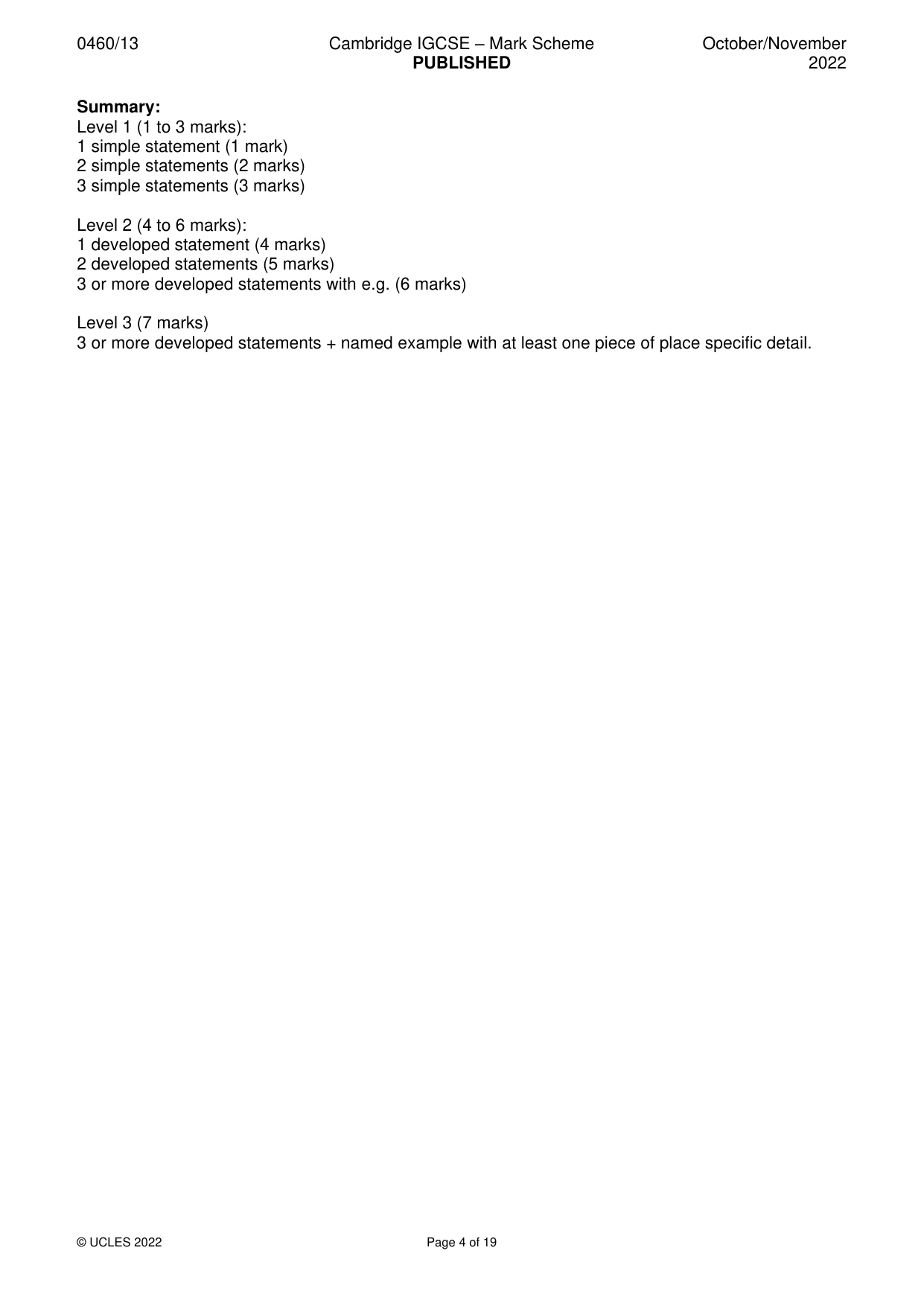
0460/13 Cambridge IGCSE – Mark Scheme PUBLISHED October/November 2022 © UCLES 2022 Page 4 of 19 Summary: Level 1 (1 to 3 marks): 1 simple statement (1 mark) 2 simple statements (2 marks) 3 simple statements (3 marks) Level 2 (4 to 6 marks): 1 developed statement (4 marks) 2 developed statements (5 marks) 3 or more developed statements with e.g. (6 marks) Level 3 (7 marks) 3 or more developed statements + named example with at least one piece of place specific detail.
Mark scheme, page 5
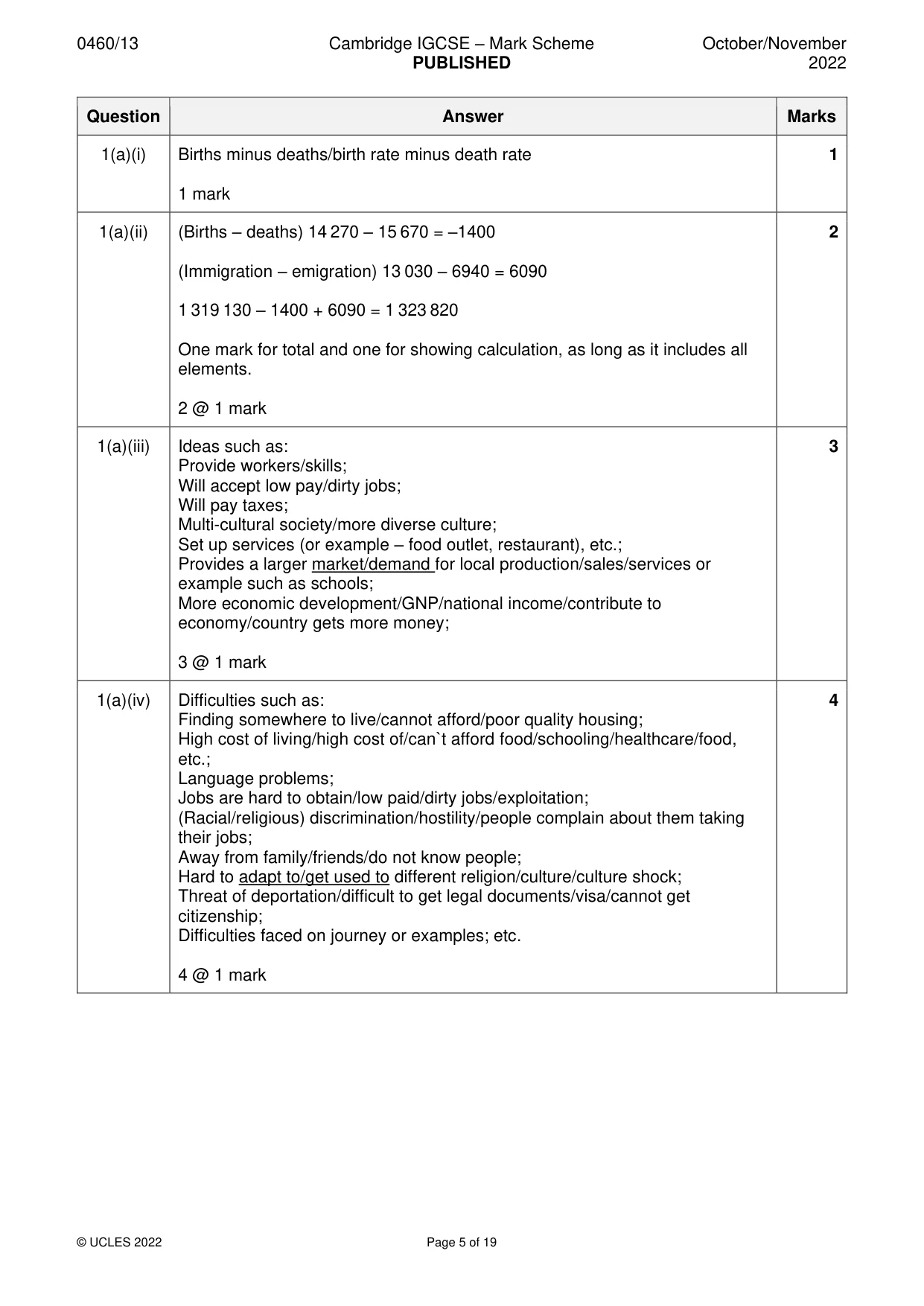
0460/13 Cambridge IGCSE – Mark Scheme PUBLISHED October/November 2022 © UCLES 2022 Page 5 of 19 Question Answer Marks 1(a)(i) Births minus deaths/birth rate minus death rate 1 mark 1 1(a)(ii) (Births – deaths) 14 270 – 15 670 = –1400 (Immigration – emigration) 13 030 – 6940 = 6090 1 319 130 – 1400 + 6090 = 1 323 820 One mark for total and one for showing calculation, as long as it includes all elements. 2 @ 1 mark 2 1(a)(iii) Ideas such as: Provide workers/skills; Will accept low pay/dirty jobs; Will pay taxes; Multi-cultural society/more diverse culture; Set up services (or example – food outlet, restaurant), etc.; Provides a larger market/demand for local production/sales/services or example such as schools; More economic development/GNP/national income/contribute to economy/country gets more money; 3 @ 1 mark 3 1(a)(iv) Difficulties such as: Finding somewhere to live/cannot afford/poor quality housing; High cost of living/high cost of/can`t afford food/schooling/healthcare/food, etc.; Language problems; Jobs are hard to obtain/low paid/dirty jobs/exploitation; (Racial/religious) discrimination/hostility/people complain about them taking their jobs; Away from family/friends/do not know people; Hard to adapt to/get used to different religion/culture/culture shock; Threat of deportation/difficult to get legal documents/visa/cannot get citizenship; Difficulties faced on journey or examples; etc. 4 @ 1 mark 4
Mark scheme, page 6
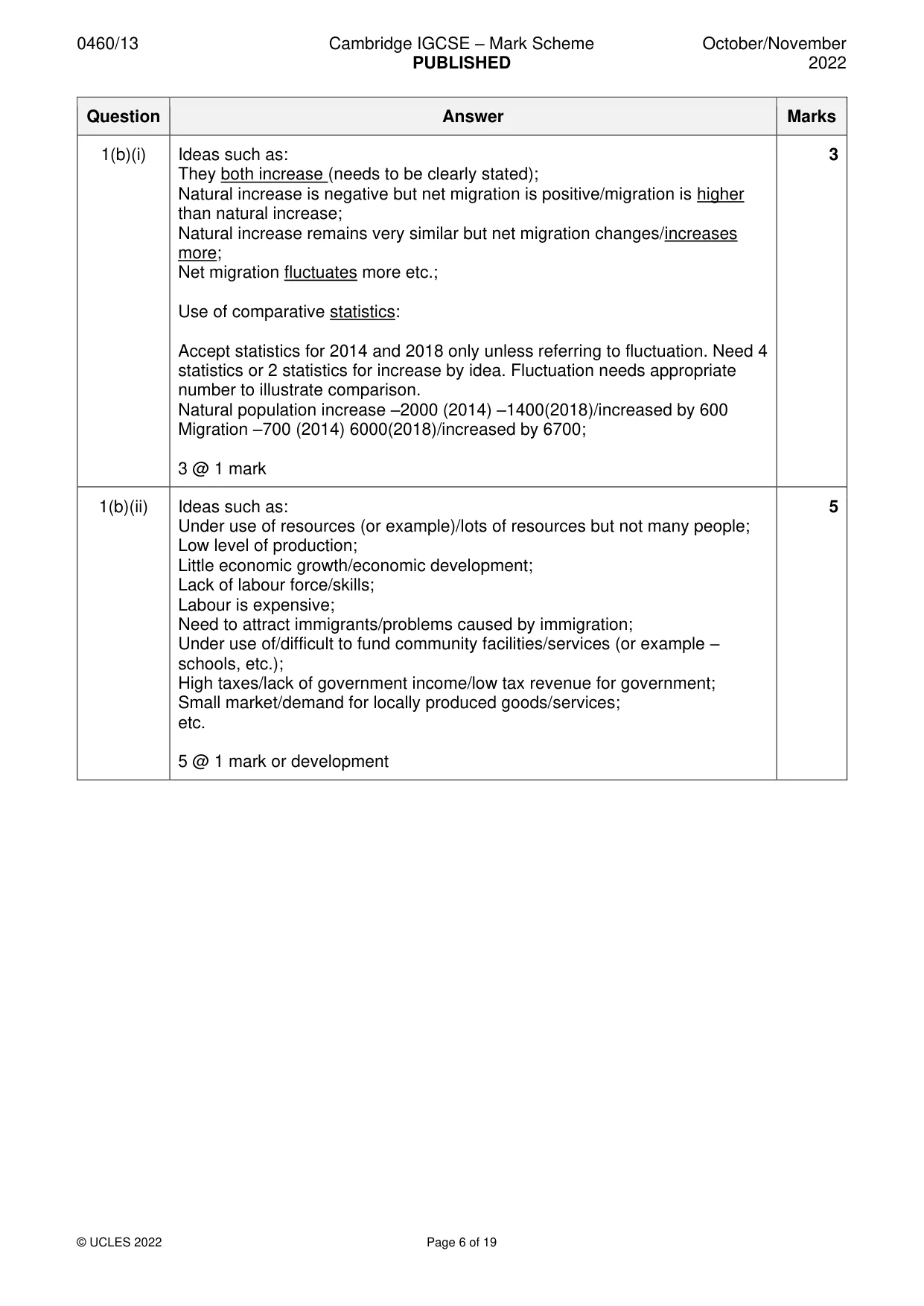
0460/13 Cambridge IGCSE – Mark Scheme PUBLISHED October/November 2022 © UCLES 2022 Page 6 of 19 Question Answer Marks 1(b)(i) Ideas such as: They both increase (needs to be clearly stated); Natural increase is negative but net migration is positive/migration is higher than natural increase; Natural increase remains very similar but net migration changes/increases more; Net migration fluctuates more etc.; Use of comparative statistics: Accept statistics for 2014 and 2018 only unless referring to fluctuation. Need 4 statistics or 2 statistics for increase by idea. Fluctuation needs appropriate number to illustrate comparison. Natural population increase –2000 (2014) –1400(2018)/increased by 600 Migration –700 (2014) 6000(2018)/increased by 6700; 3 @ 1 mark 3 1(b)(ii) Ideas such as: Under use of resources (or example)/lots of resources but not many people; Low level of production; Little economic growth/economic development; Lack of labour force/skills; Labour is expensive; Need to attract immigrants/problems caused by immigration; Under use of/difficult to fund community facilities/services (or example – schools, etc.); High taxes/lack of government income/low tax revenue for government; Small market/demand for locally produced goods/services; etc. 5 @ 1 mark or development 5
Mark scheme, page 7
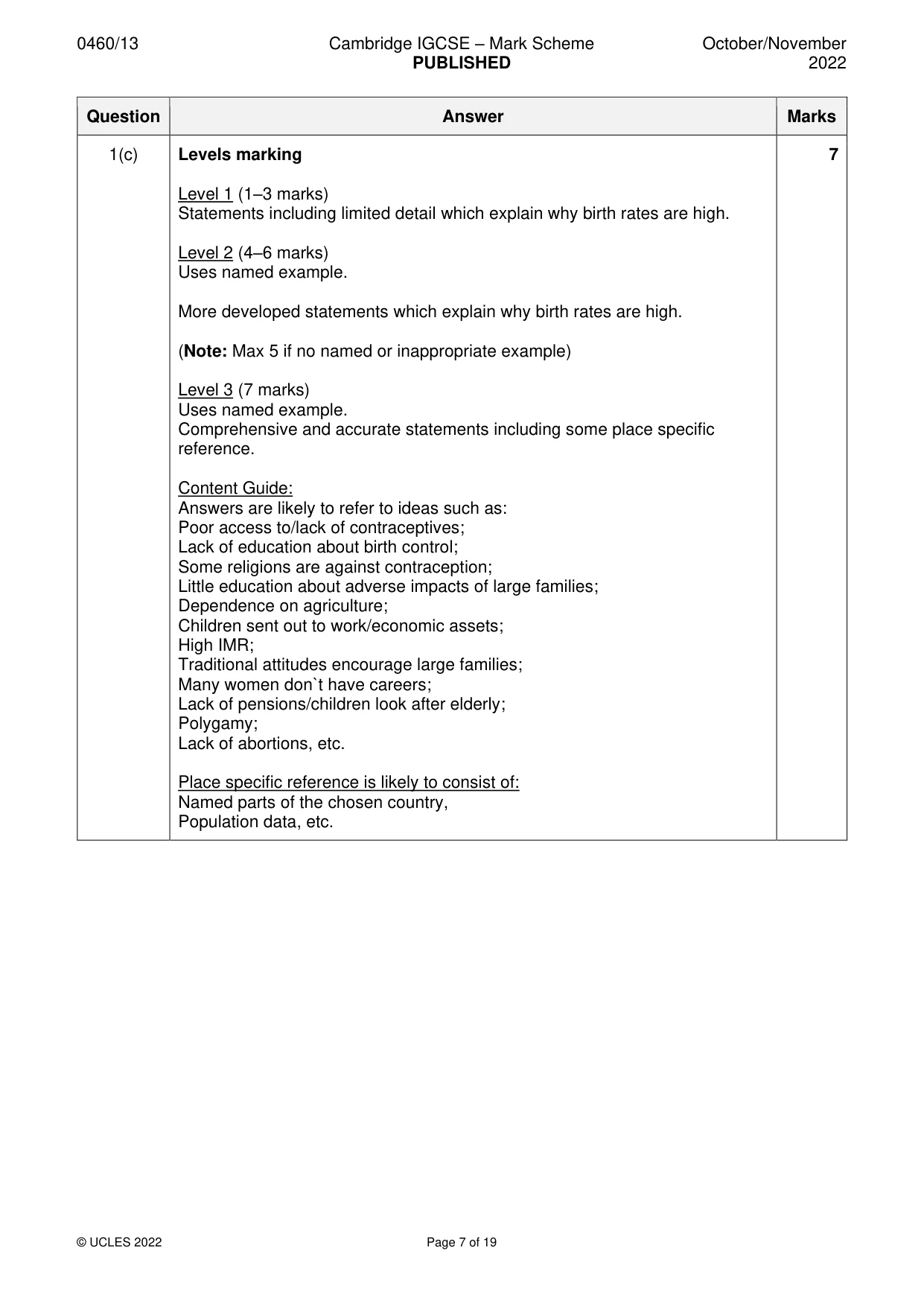
0460/13 Cambridge IGCSE – Mark Scheme PUBLISHED October/November 2022 © UCLES 2022 Page 7 of 19 Question Answer Marks 1(c) Levels marking Level 1 (1–3 marks) Statements including limited detail which explain why birth rates are high. Level 2 (4–6 marks) Uses named example. More developed statements which explain why birth rates are high. (Note: Max 5 if no named or inappropriate example) Level 3 (7 marks) Uses named example. Comprehensive and accurate statements including some place specific reference. Content Guide: Answers are likely to refer to ideas such as: Poor access to/lack of contraceptives; Lack of education about birth control; Some religions are against contraception; Little education about adverse impacts of large families; Dependence on agriculture; Children sent out to work/economic assets; High IMR; Traditional attitudes encourage large families; Many women don`t have careers; Lack of pensions/children look after elderly; Polygamy; Lack of abortions, etc. Place specific reference is likely to consist of: Named parts of the chosen country, Population data, etc. 7
Mark scheme, page 8
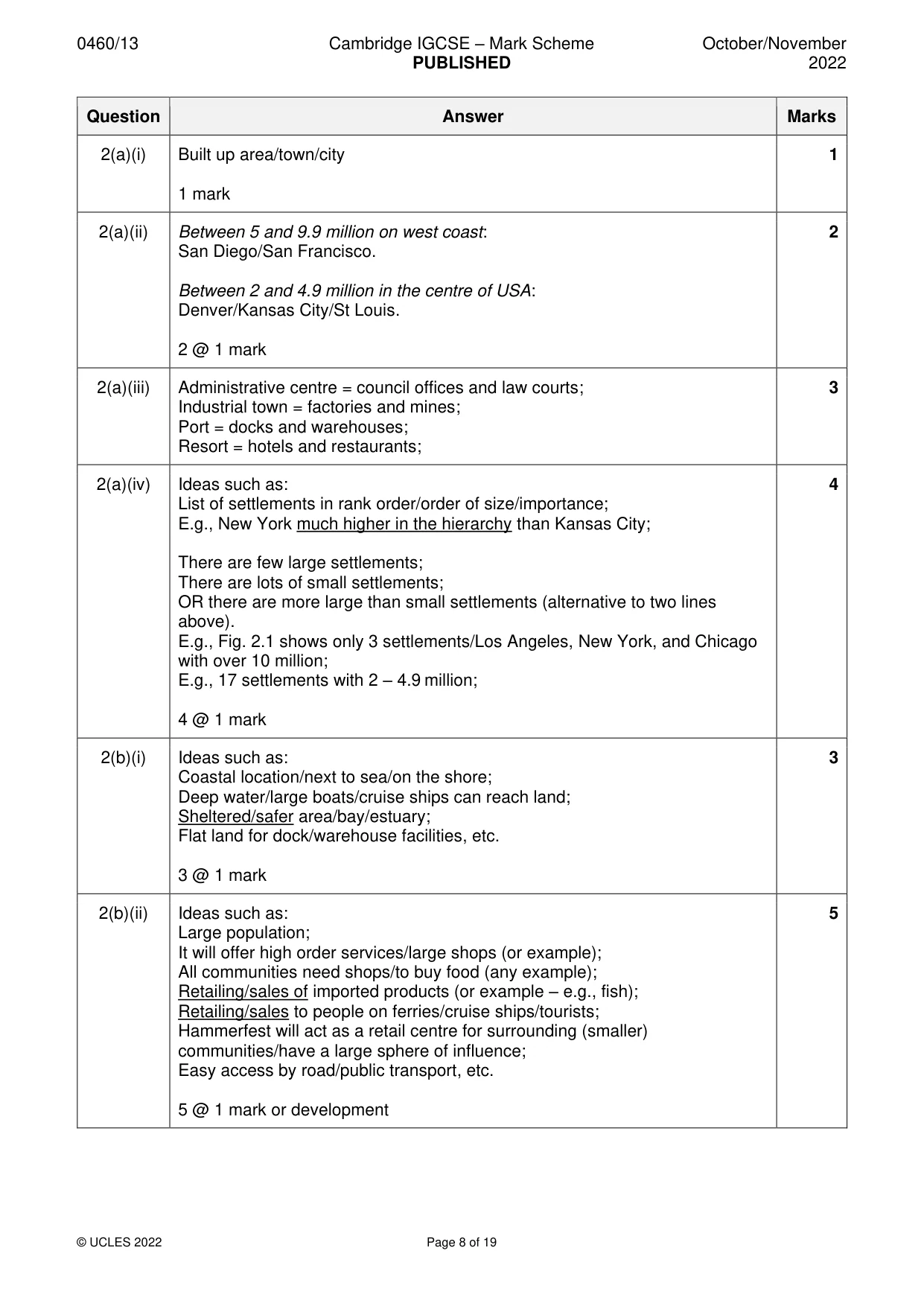
0460/13 Cambridge IGCSE – Mark Scheme PUBLISHED October/November 2022 © UCLES 2022 Page 8 of 19 Question Answer Marks 2(a)(i) Built up area/town/city 1 mark 1 2(a)(ii) Between 5 and 9.9 million on west coast: San Diego/San Francisco. Between 2 and 4.9 million in the centre of USA: Denver/Kansas City/St Louis. 2 @ 1 mark 2 2(a)(iii) Administrative centre = council offices and law courts; Industrial town = factories and mines; Port = docks and warehouses; Resort = hotels and restaurants; 3 2(a)(iv) Ideas such as: List of settlements in rank order/order of size/importance; E.g., New York much higher in the hierarchy than Kansas City; There are few large settlements; There are lots of small settlements; OR there are more large than small settlements (alternative to two lines above). E.g., Fig. 2.1 shows only 3 settlements/Los Angeles, New York, and Chicago with over 10 million; E.g., 17 settlements with 2 – 4.9 million; 4 @ 1 mark 4 2(b)(i) Ideas such as: Coastal location/next to sea/on the shore; Deep water/large boats/cruise ships can reach land; Sheltered/safer area/bay/estuary; Flat land for dock/warehouse facilities, etc. 3 @ 1 mark 3 2(b)(ii) Ideas such as: Large population; It will offer high order services/large shops (or example); All communities need shops/to buy food (any example); Retailing/sales of imported products (or example – e.g., fish); Retailing/sales to people on ferries/cruise ships/tourists; Hammerfest will act as a retail centre for surrounding (smaller) communities/have a large sphere of influence; Easy access by road/public transport, etc. 5 @ 1 mark or development 5
Mark scheme, page 9
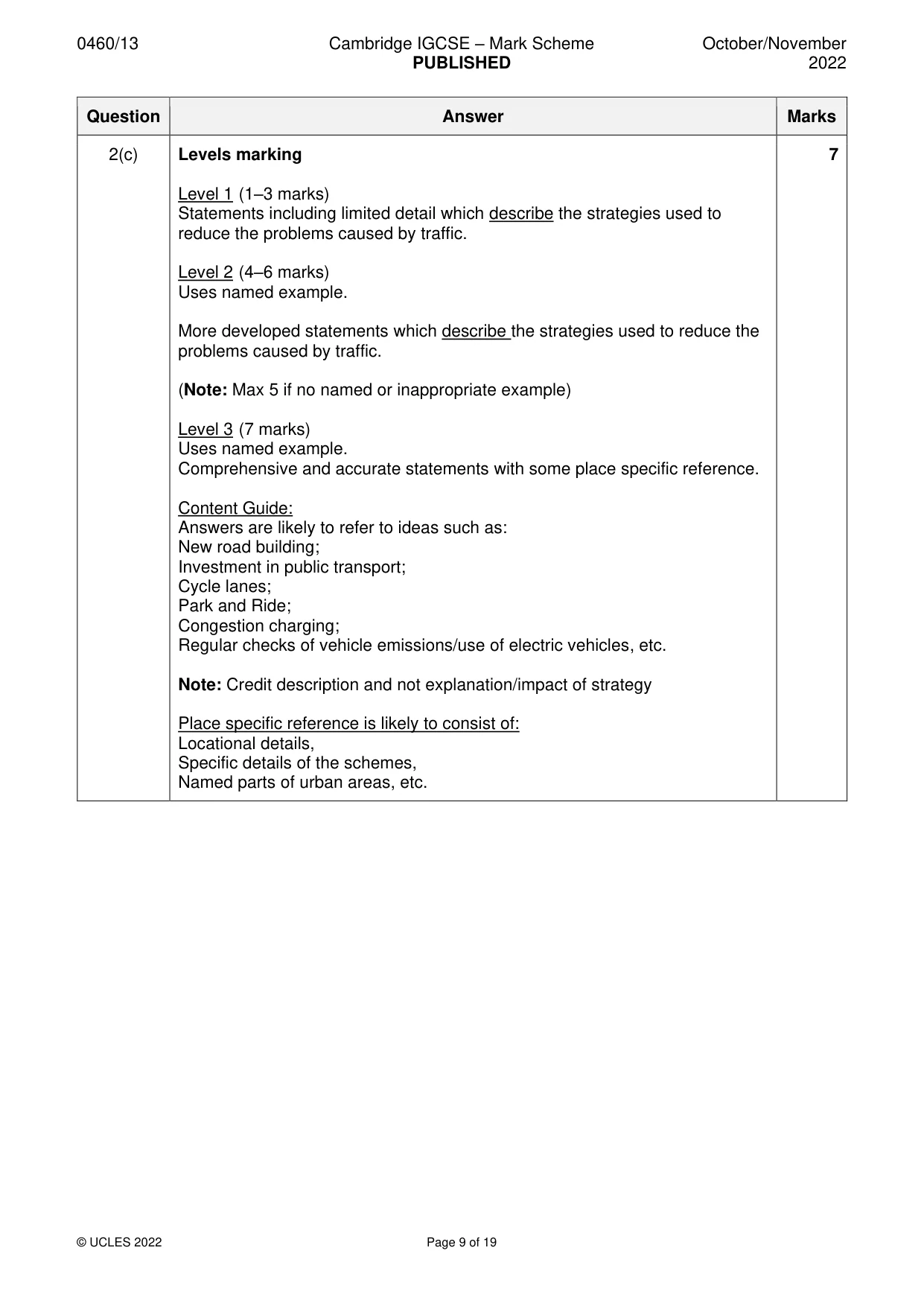
0460/13 Cambridge IGCSE – Mark Scheme PUBLISHED October/November 2022 © UCLES 2022 Page 9 of 19 Question Answer Marks 2(c) Levels marking Level 1 (1–3 marks) Statements including limited detail which describe the strategies used to reduce the problems caused by traffic. Level 2 (4–6 marks) Uses named example. More developed statements which describe the strategies used to reduce the problems caused by traffic. (Note: Max 5 if no named or inappropriate example) Level 3 (7 marks) Uses named example. Comprehensive and accurate statements with some place specific reference. Content Guide: Answers are likely to refer to ideas such as: New road building; Investment in public transport; Cycle lanes; Park and Ride; Congestion charging; Regular checks of vehicle emissions/use of electric vehicles, etc. Note: Credit description and not explanation/impact of strategy Place specific reference is likely to consist of: Locational details, Specific details of the schemes, Named parts of urban areas, etc. 7
Mark scheme, page 10
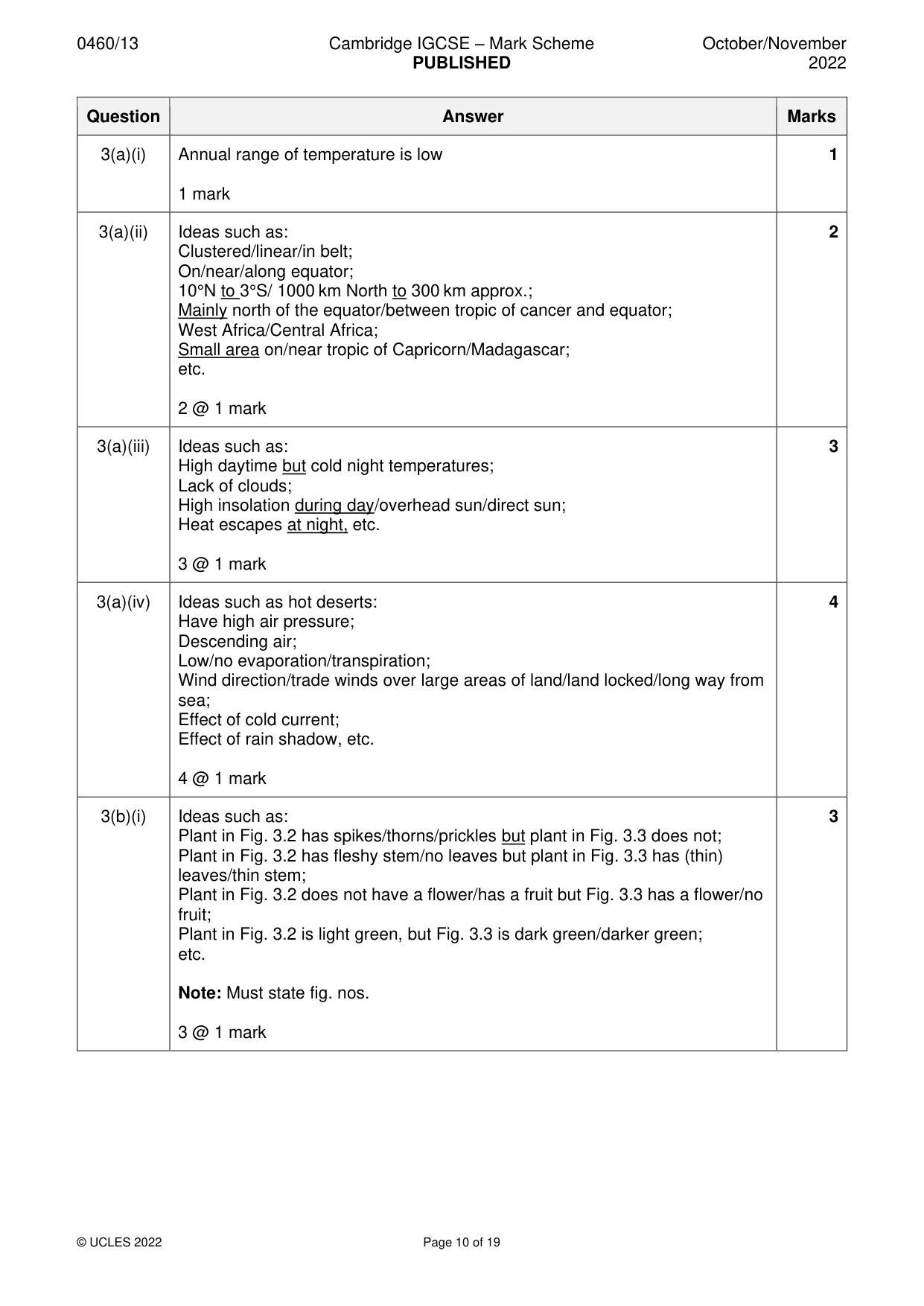
0460/13 Cambridge IGCSE – Mark Scheme PUBLISHED October/November 2022 © UCLES 2022 Page 10 of 19 Question Answer Marks 3(a)(i) Annual range of temperature is low 1 mark 1 3(a)(ii) Ideas such as: Clustered/linear/in belt; On/near/along equator; 10°N to 3°S/ 1000 km North to 300 km approx.; Mainly north of the equator/between tropic of cancer and equator; West Africa/Central Africa; Small area on/near tropic of Capricorn/Madagascar; etc. 2 @ 1 mark 2 3(a)(iii) Ideas such as: High daytime but cold night temperatures; Lack of clouds; High insolation during day/overhead sun/direct sun; Heat escapes at night, etc. 3 @ 1 mark 3 3(a)(iv) Ideas such as hot deserts: Have high air pressure; Descending air; Low/no evaporation/transpiration; Wind direction/trade winds over large areas of land/land locked/long way from sea; Effect of cold current; Effect of rain shadow, etc. 4 @ 1 mark 4 3(b)(i) Ideas such as: Plant in Fig. 3.2 has spikes/thorns/prickles but plant in Fig. 3.3 does not; Plant in Fig. 3.2 has fleshy stem/no leaves but plant in Fig. 3.3 has (thin) leaves/thin stem; Plant in Fig. 3.2 does not have a flower/has a fruit but Fig. 3.3 has a flower/no fruit; Plant in Fig. 3.2 is light green, but Fig. 3.3 is dark green/darker green; etc. Note: Must state fig. nos. 3 @ 1 mark 3
Mark scheme, page 11
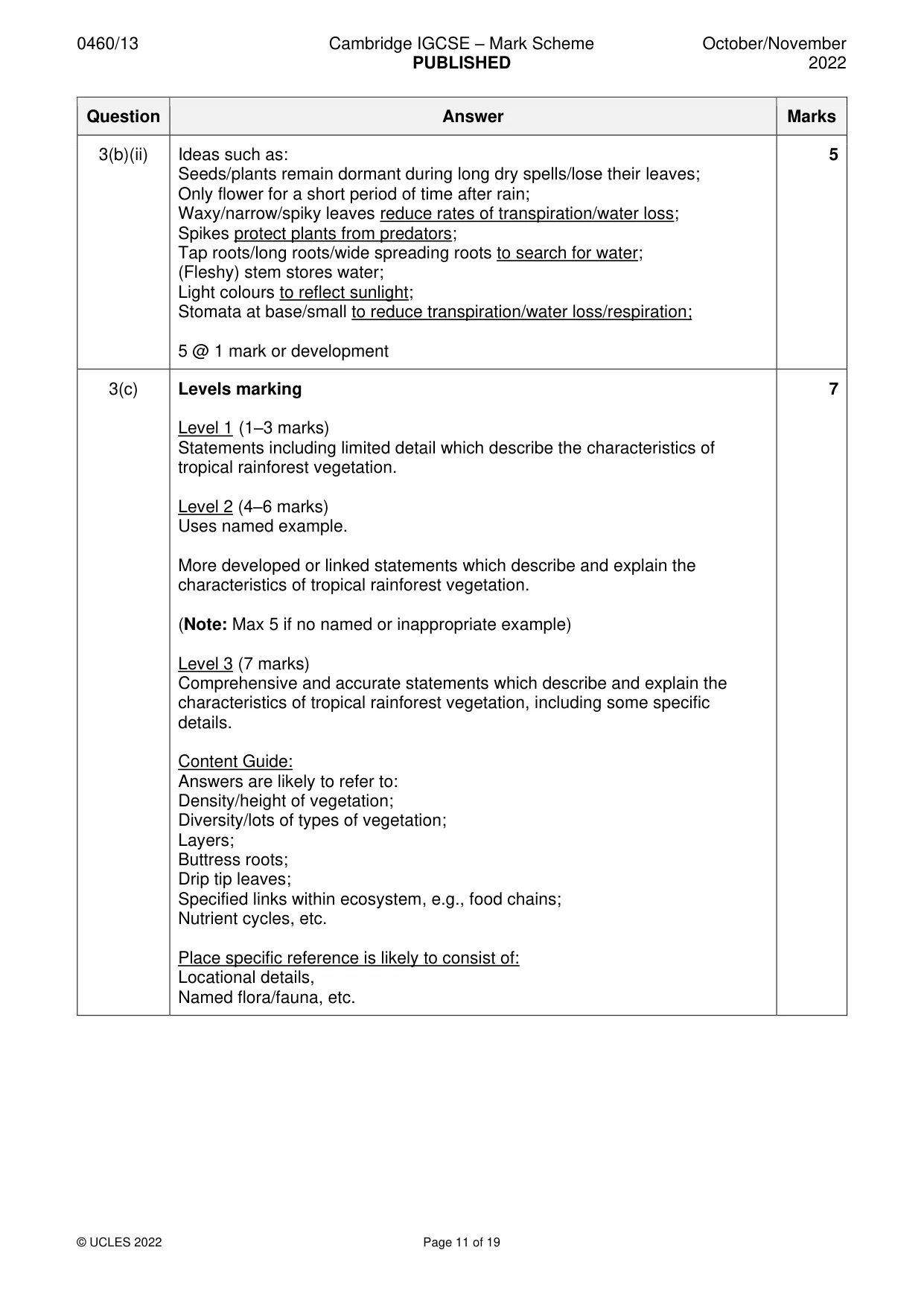
0460/13 Cambridge IGCSE – Mark Scheme PUBLISHED October/November 2022 © UCLES 2022 Page 11 of 19 Question Answer Marks 3(b)(ii) Ideas such as: Seeds/plants remain dormant during long dry spells/lose their leaves; Only flower for a short period of time after rain; Waxy/narrow/spiky leaves reduce rates of transpiration/water loss; Spikes protect plants from predators; Tap roots/long roots/wide spreading roots to search for water; (Fleshy) stem stores water; Light colours to reflect sunlight; Stomata at base/small to reduce transpiration/water loss/respiration; 5 @ 1 mark or development 5 3(c) Levels marking Level 1 (1–3 marks) Statements including limited detail which describe the characteristics of tropical rainforest vegetation. Level 2 (4–6 marks) Uses named example. More developed or linked statements which describe and explain the characteristics of tropical rainforest vegetation. (Note: Max 5 if no named or inappropriate example) Level 3 (7 marks) Comprehensive and accurate statements which describe and explain the characteristics of tropical rainforest vegetation, including some specific details. Content Guide: Answers are likely to refer to: Density/height of vegetation; Diversity/lots of types of vegetation; Layers; Buttress roots; Drip tip leaves; Specified links within ecosystem, e.g., food chains; Nutrient cycles, etc. Place specific reference is likely to consist of: Locational details, Named flora/fauna, etc. 7
Mark scheme, page 12
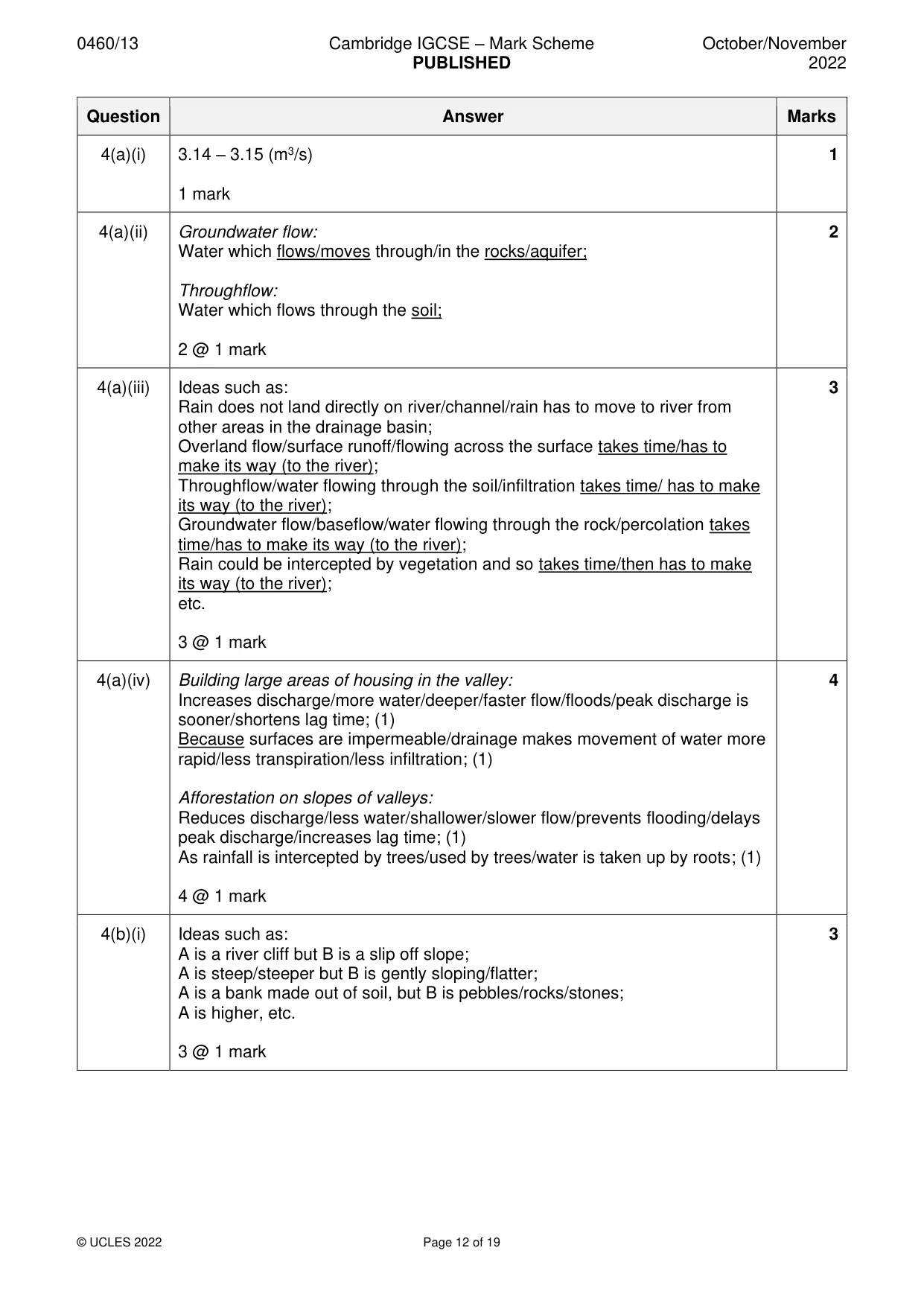
0460/13 Cambridge IGCSE – Mark Scheme PUBLISHED October/November 2022 © UCLES 2022 Page 12 of 19 Question Answer Marks 4(a)(i) 3.14 – 3.15 (m3/s) 1 mark 1 4(a)(ii) Groundwater flow: Water which flows/moves through/in the rocks/aquifer; Throughflow: Water which flows through the soil; 2 @ 1 mark 2 4(a)(iii) Ideas such as: Rain does not land directly on river/channel/rain has to move to river from other areas in the drainage basin; Overland flow/surface runoff/flowing across the surface takes time/has to make its way (to the river); Throughflow/water flowing through the soil/infiltration takes time/ has to make its way (to the river); Groundwater flow/baseflow/water flowing through the rock/percolation takes time/has to make its way (to the river); Rain could be intercepted by vegetation and so takes time/then has to make its way (to the river); etc. 3 @ 1 mark 3 4(a)(iv) Building large areas of housing in the valley: Increases discharge/more water/deeper/faster flow/floods/peak discharge is sooner/shortens lag time; (1) Because surfaces are impermeable/drainage makes movement of water more rapid/less transpiration/less infiltration; (1) Afforestation on slopes of valleys: Reduces discharge/less water/shallower/slower flow/prevents flooding/delays peak discharge/increases lag time; (1) As rainfall is intercepted by trees/used by trees/water is taken up by roots; (1) 4 @ 1 mark 4 4(b)(i) Ideas such as: A is a river cliff but B is a slip off slope; A is steep/steeper but B is gently sloping/flatter; A is a bank made out of soil, but B is pebbles/rocks/stones; A is higher, etc. 3 @ 1 mark 3
Mark scheme, page 13
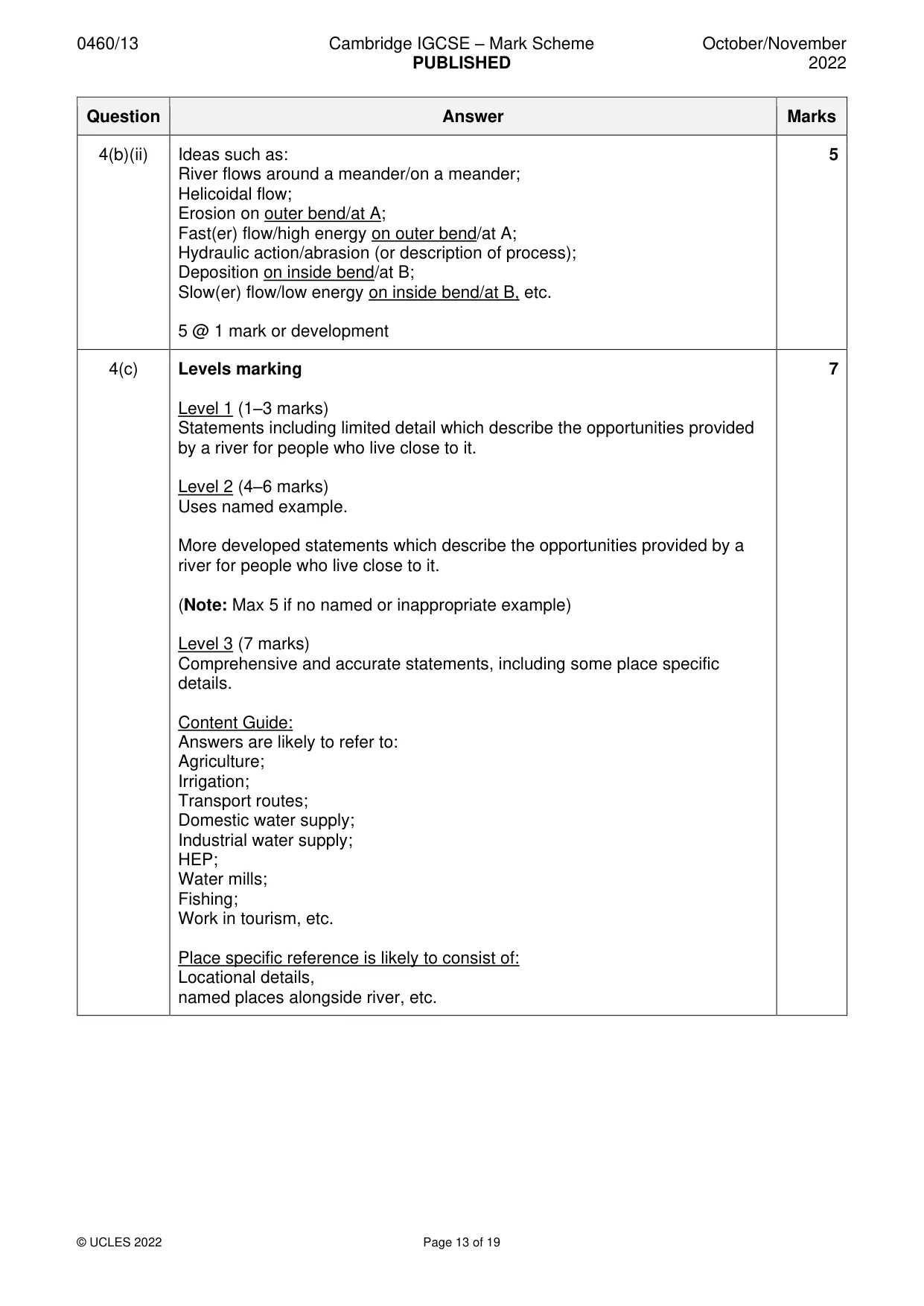
0460/13 Cambridge IGCSE – Mark Scheme PUBLISHED October/November 2022 © UCLES 2022 Page 13 of 19 Question Answer Marks 4(b)(ii) Ideas such as: River flows around a meander/on a meander; Helicoidal flow; Erosion on outer bend/at A; Fast(er) flow/high energy on outer bend/at A; Hydraulic action/abrasion (or description of process); Deposition on inside bend/at B; Slow(er) flow/low energy on inside bend/at B, etc. 5 @ 1 mark or development 5 4(c) Levels marking Level 1 (1–3 marks) Statements including limited detail which describe the opportunities provided by a river for people who live close to it. Level 2 (4–6 marks) Uses named example. More developed statements which describe the opportunities provided by a river for people who live close to it. (Note: Max 5 if no named or inappropriate example) Level 3 (7 marks) Comprehensive and accurate statements, including some place specific details. Content Guide: Answers are likely to refer to: Agriculture; Irrigation; Transport routes; Domestic water supply; Industrial water supply; HEP; Water mills; Fishing; Work in tourism, etc. Place specific reference is likely to consist of: Locational details, named places alongside river, etc. 7
Mark scheme, page 14
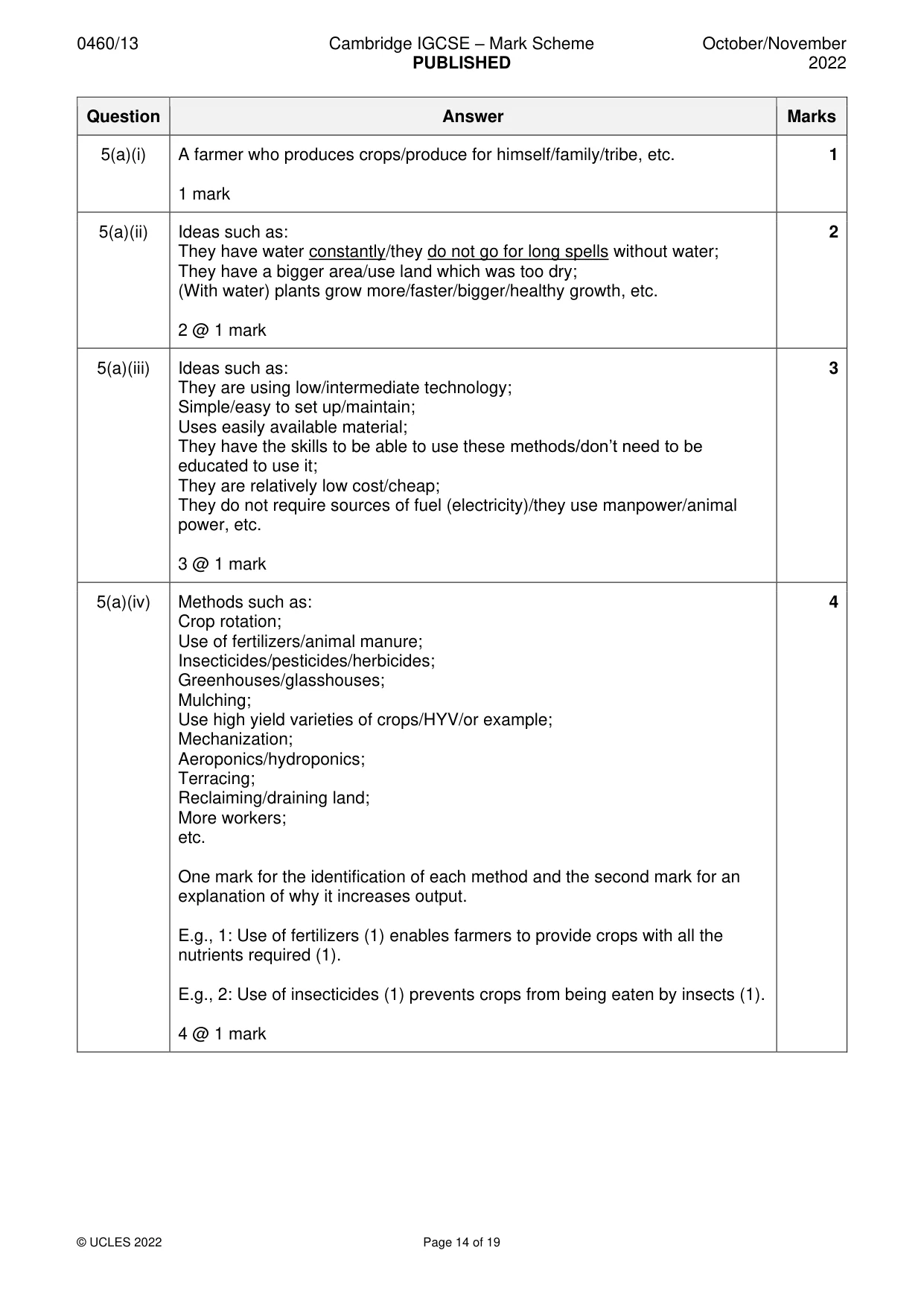
0460/13 Cambridge IGCSE – Mark Scheme PUBLISHED October/November 2022 © UCLES 2022 Page 14 of 19 Question Answer Marks 5(a)(i) A farmer who produces crops/produce for himself/family/tribe, etc. 1 mark 1 5(a)(ii) Ideas such as: They have water constantly/they do not go for long spells without water; They have a bigger area/use land which was too dry; (With water) plants grow more/faster/bigger/healthy growth, etc. 2 @ 1 mark 2 5(a)(iii) Ideas such as: They are using low/intermediate technology; Simple/easy to set up/maintain; Uses easily available material; They have the skills to be able to use these methods/don’t need to be educated to use it; They are relatively low cost/cheap; They do not require sources of fuel (electricity)/they use manpower/animal power, etc. 3 @ 1 mark 3 5(a)(iv) Methods such as: Crop rotation; Use of fertilizers/animal manure; Insecticides/pesticides/herbicides; Greenhouses/glasshouses; Mulching; Use high yield varieties of crops/HYV/or example; Mechanization; Aeroponics/hydroponics; Terracing; Reclaiming/draining land; More workers; etc. One mark for the identification of each method and the second mark for an explanation of why it increases output. E.g., 1: Use of fertilizers (1) enables farmers to provide crops with all the nutrients required (1). E.g., 2: Use of insecticides (1) prevents crops from being eaten by insects (1). 4 @ 1 mark 4
Mark scheme, page 15
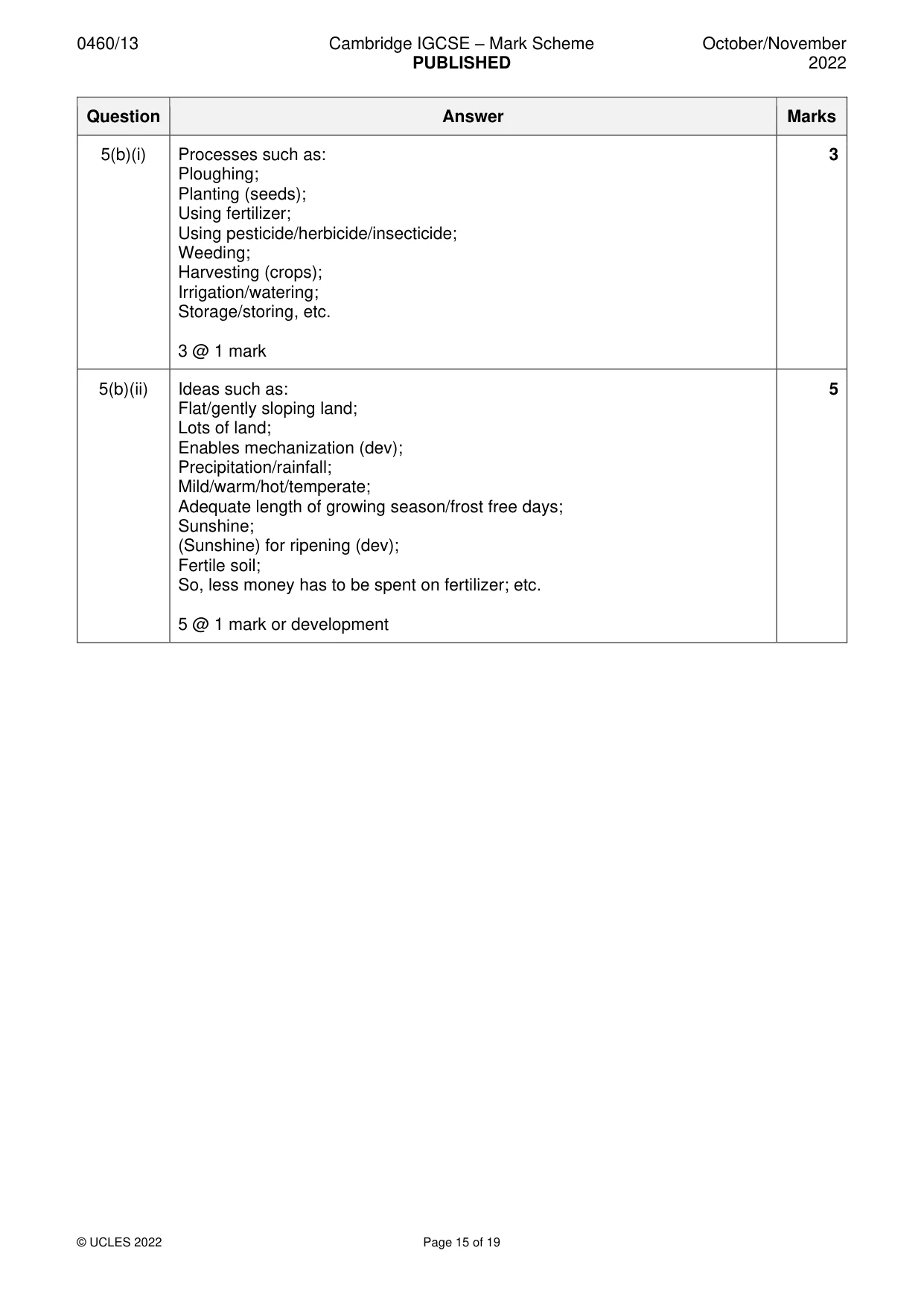
0460/13 Cambridge IGCSE – Mark Scheme PUBLISHED October/November 2022 © UCLES 2022 Page 15 of 19 Question Answer Marks 5(b)(i) Processes such as: Ploughing; Planting (seeds); Using fertilizer; Using pesticide/herbicide/insecticide; Weeding; Harvesting (crops); Irrigation/watering; Storage/storing, etc. 3 @ 1 mark 3 5(b)(ii) Ideas such as: Flat/gently sloping land; Lots of land; Enables mechanization (dev); Precipitation/rainfall; Mild/warm/hot/temperate; Adequate length of growing season/frost free days; Sunshine; (Sunshine) for ripening (dev); Fertile soil; So, less money has to be spent on fertilizer; etc. 5 @ 1 mark or development 5
Mark scheme, page 16
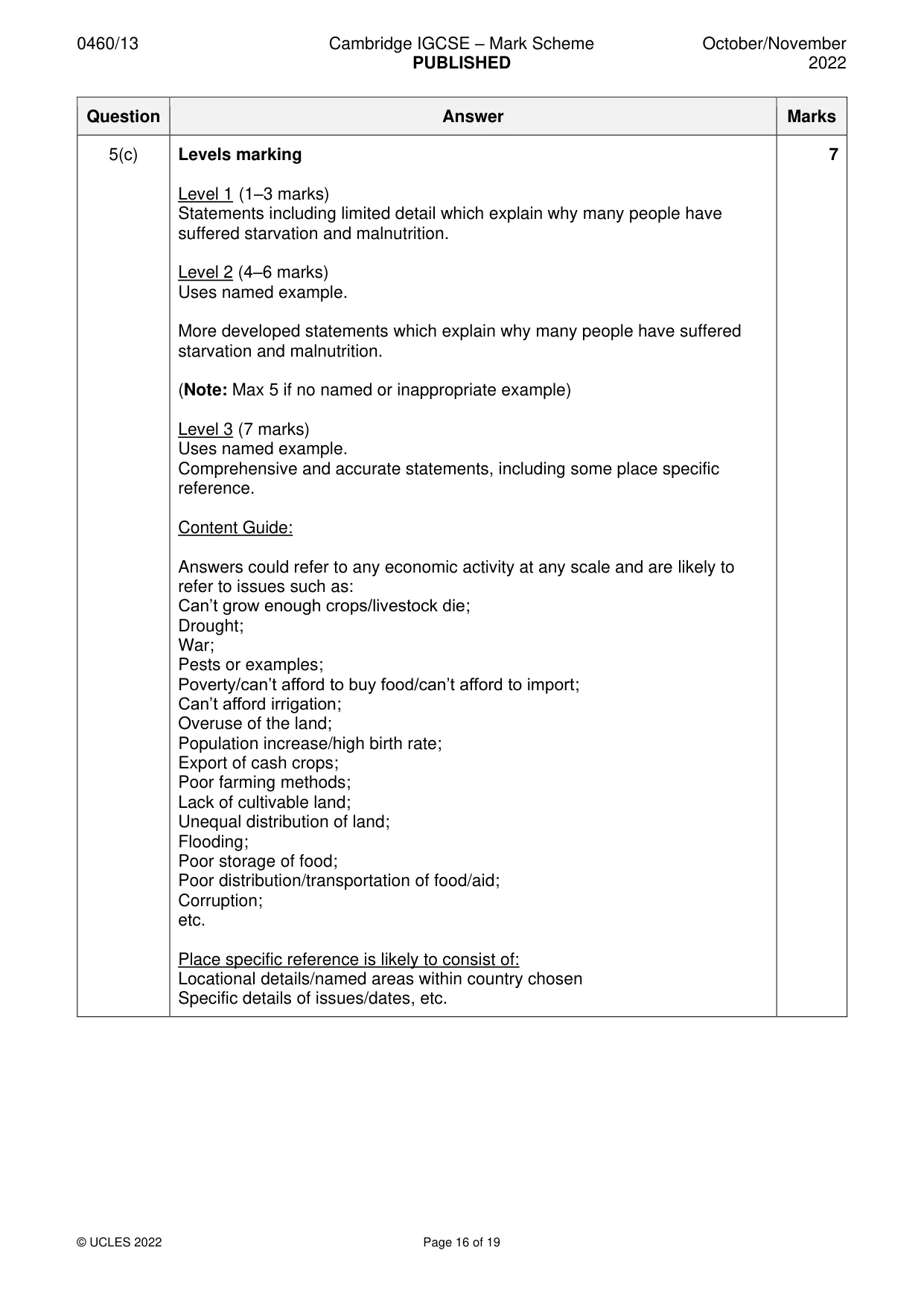
0460/13 Cambridge IGCSE – Mark Scheme PUBLISHED October/November 2022 © UCLES 2022 Page 16 of 19 Question Answer Marks 5(c) Levels marking Level 1 (1–3 marks) Statements including limited detail which explain why many people have suffered starvation and malnutrition. Level 2 (4–6 marks) Uses named example. More developed statements which explain why many people have suffered starvation and malnutrition. (Note: Max 5 if no named or inappropriate example) Level 3 (7 marks) Uses named example. Comprehensive and accurate statements, including some place specific reference. Content Guide: Answers could refer to any economic activity at any scale and are likely to refer to issues such as: Can’t grow enough crops/livestock die; Drought; War; Pests or examples; Poverty/can’t afford to buy food/can’t afford to import; Can’t afford irrigation; Overuse of the land; Population increase/high birth rate; Export of cash crops; Poor farming methods; Lack of cultivable land; Unequal distribution of land; Flooding; Poor storage of food; Poor distribution/transportation of food/aid; Corruption; etc. Place specific reference is likely to consist of: Locational details/named areas within country chosen Specific details of issues/dates, etc. 7
Mark scheme, page 17
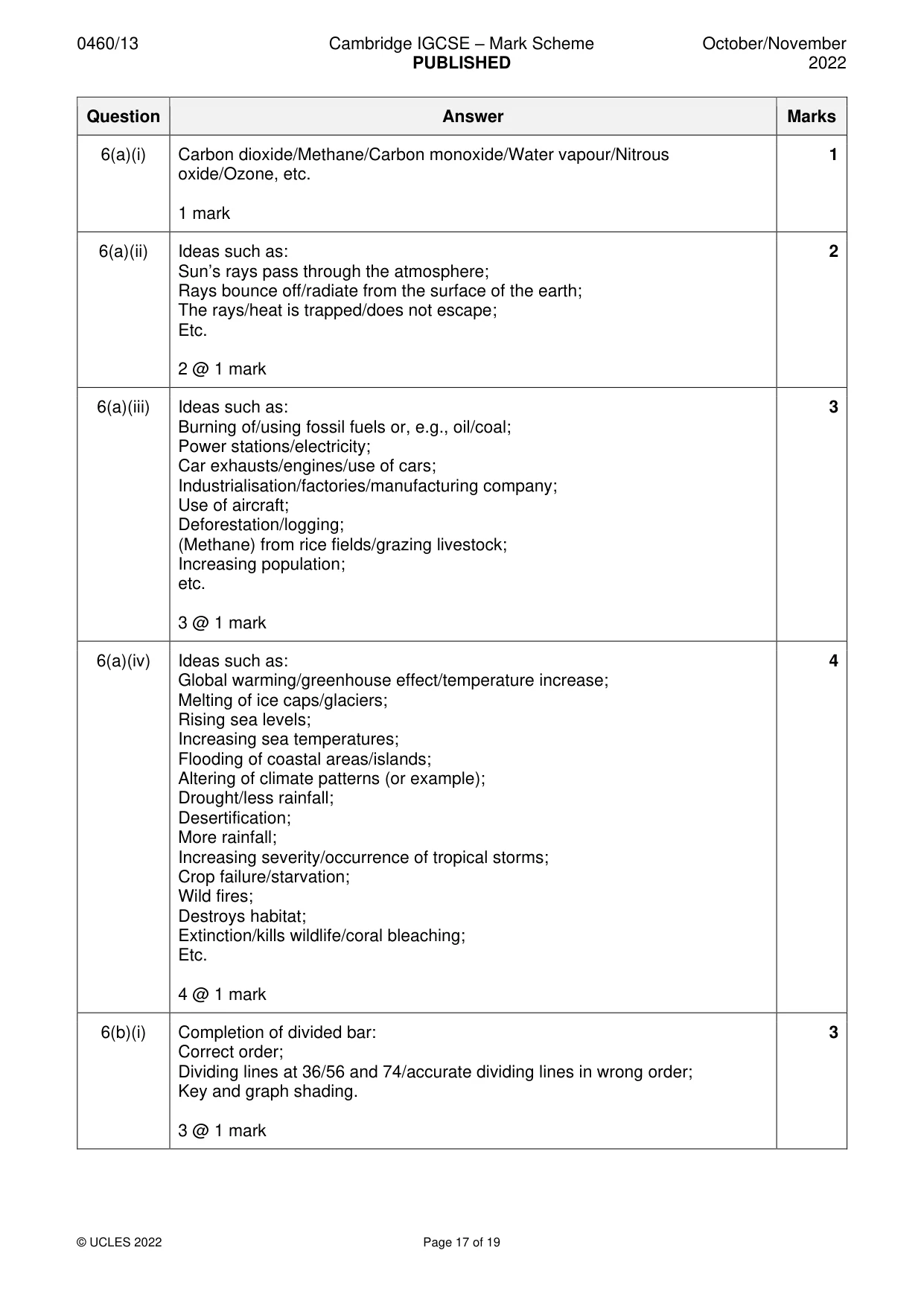
0460/13 Cambridge IGCSE – Mark Scheme PUBLISHED October/November 2022 © UCLES 2022 Page 17 of 19 Question Answer Marks 6(a)(i) Carbon dioxide/Methane/Carbon monoxide/Water vapour/Nitrous oxide/Ozone, etc. 1 mark 1 6(a)(ii) Ideas such as: Sun’s rays pass through the atmosphere; Rays bounce off/radiate from the surface of the earth; The rays/heat is trapped/does not escape; Etc. 2 @ 1 mark 2 6(a)(iii) Ideas such as: Burning of/using fossil fuels or, e.g., oil/coal; Power stations/electricity; Car exhausts/engines/use of cars; Industrialisation/factories/manufacturing company; Use of aircraft; Deforestation/logging; (Methane) from rice fields/grazing livestock; Increasing population; etc. 3 @ 1 mark 3 6(a)(iv) Ideas such as: Global warming/greenhouse effect/temperature increase; Melting of ice caps/glaciers; Rising sea levels; Increasing sea temperatures; Flooding of coastal areas/islands; Altering of climate patterns (or example); Drought/less rainfall; Desertification; More rainfall; Increasing severity/occurrence of tropical storms; Crop failure/starvation; Wild fires; Destroys habitat; Extinction/kills wildlife/coral bleaching; Etc. 4 @ 1 mark 4 6(b)(i) Completion of divided bar: Correct order; Dividing lines at 36/56 and 74/accurate dividing lines in wrong order; Key and graph shading. 3 @ 1 mark 3
Mark scheme, page 18
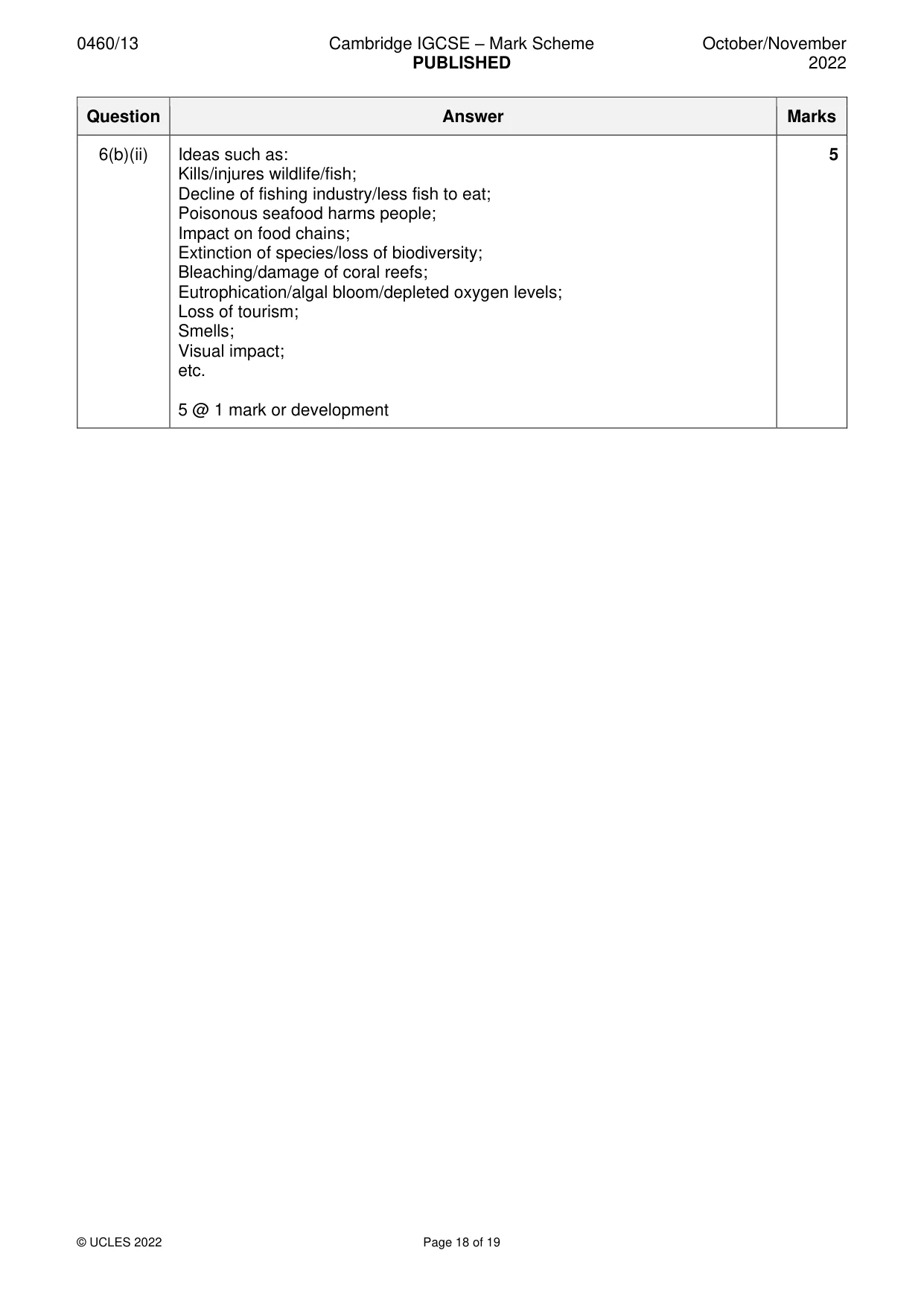
0460/13 Cambridge IGCSE – Mark Scheme PUBLISHED October/November 2022 © UCLES 2022 Page 18 of 19 Question Answer Marks 6(b)(ii) Ideas such as: Kills/injures wildlife/fish; Decline of fishing industry/less fish to eat; Poisonous seafood harms people; Impact on food chains; Extinction of species/loss of biodiversity; Bleaching/damage of coral reefs; Eutrophication/algal bloom/depleted oxygen levels; Loss of tourism; Smells; Visual impact; etc. 5 @ 1 mark or development 5
Mark scheme, page 19
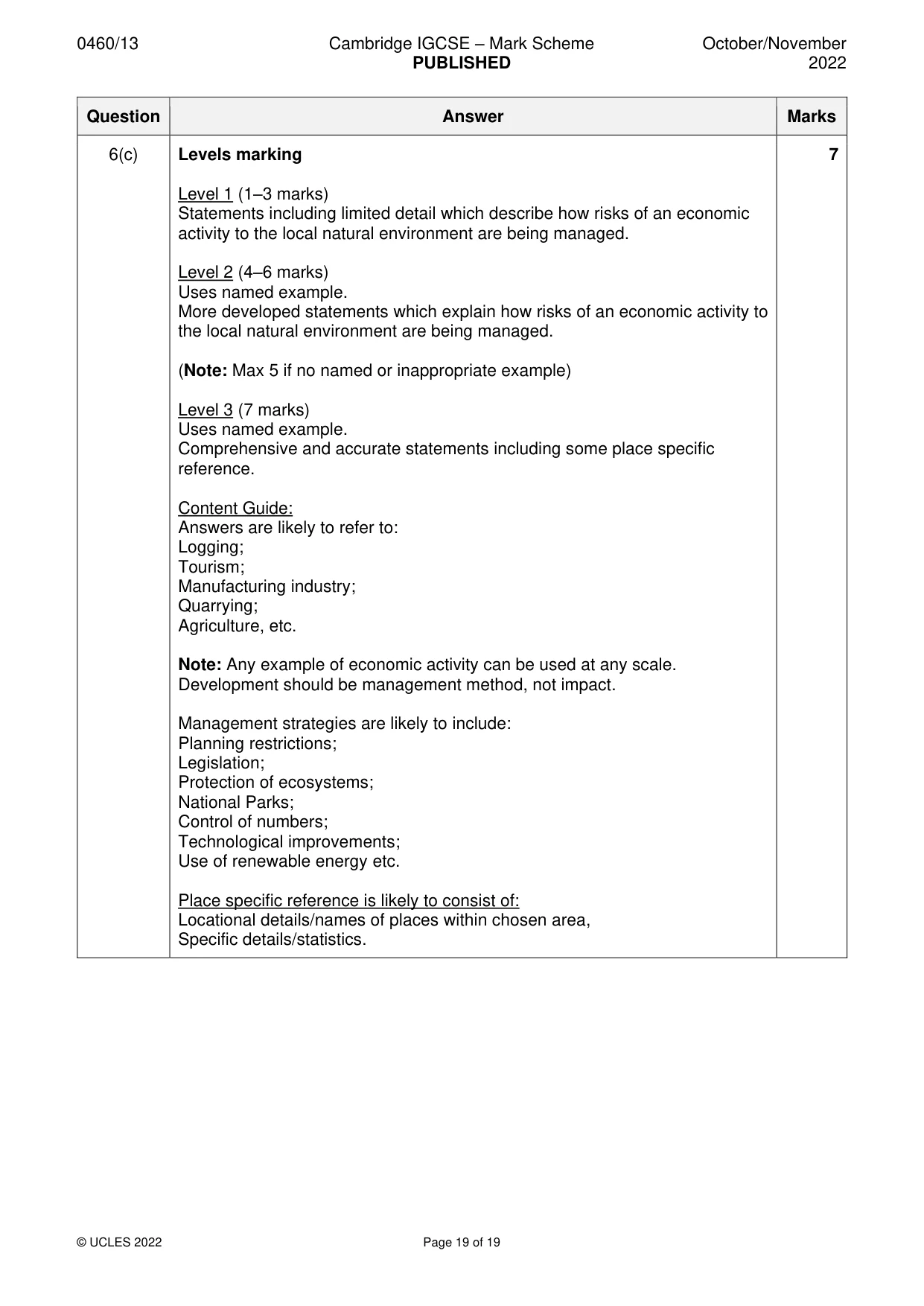
0460/13 Cambridge IGCSE – Mark Scheme PUBLISHED October/November 2022 © UCLES 2022 Page 19 of 19 Question Answer Marks 6(c) Levels marking Level 1 (1–3 marks) Statements including limited detail which describe how risks of an economic activity to the local natural environment are being managed. Level 2 (4–6 marks) Uses named example. More developed statements which explain how risks of an economic activity to the local natural environment are being managed. (Note: Max 5 if no named or inappropriate example) Level 3 (7 marks) Uses named example. Comprehensive and accurate statements including some place specific reference. Content Guide: Answers are likely to refer to: Logging; Tourism; Manufacturing industry; Quarrying; Agriculture, etc. Note: Any example of economic activity can be used at any scale. Development should be management method, not impact. Management strategies are likely to include: Planning restrictions; Legislation; Protection of ecosystems; National Parks; Control of numbers; Technological improvements; Use of renewable energy etc. Place specific reference is likely to consist of: Locational details/names of places within chosen area, Specific details/statistics. 7
What you needed in this session
Cambridge’s own grade thresholds for 2022 Oct/Nov, Paper 1 · Variant 3. A higher threshold means an easier paper — the bar moves with how the cohort did.