Cambridge IGCSE French - Foreign Language 0520 — 2017 Oct/Nov Paper 2 · Variant 2
0520/22/O/N/17 · 45 marks · ≈51 min
The question paper and its mark scheme, free to read here and free to download. This is Cambridge’s own paper, exactly as it was sat.
Question paper16 pages


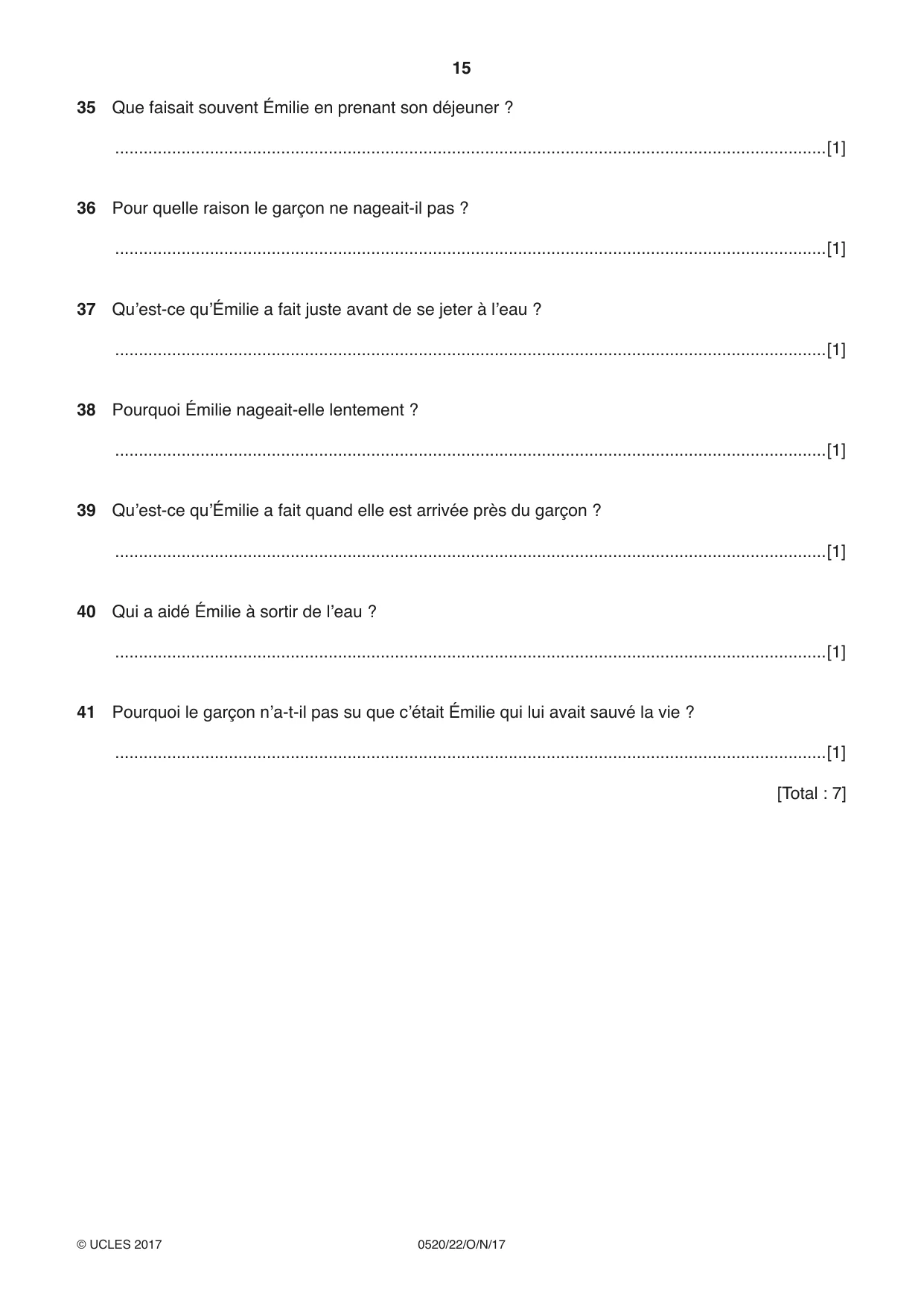
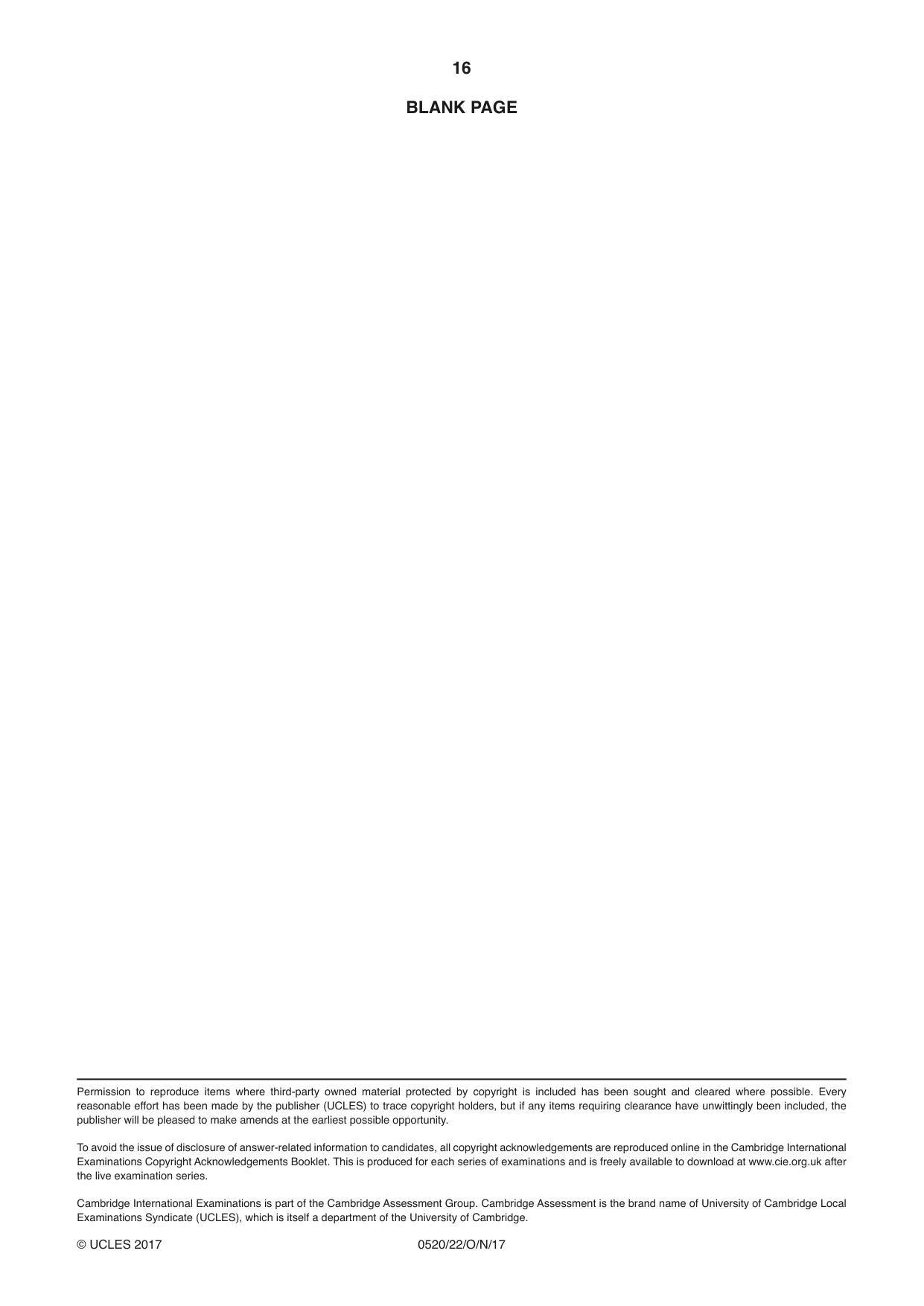
Mark scheme13 pages
Answers below. Sit the paper first if you are practising.
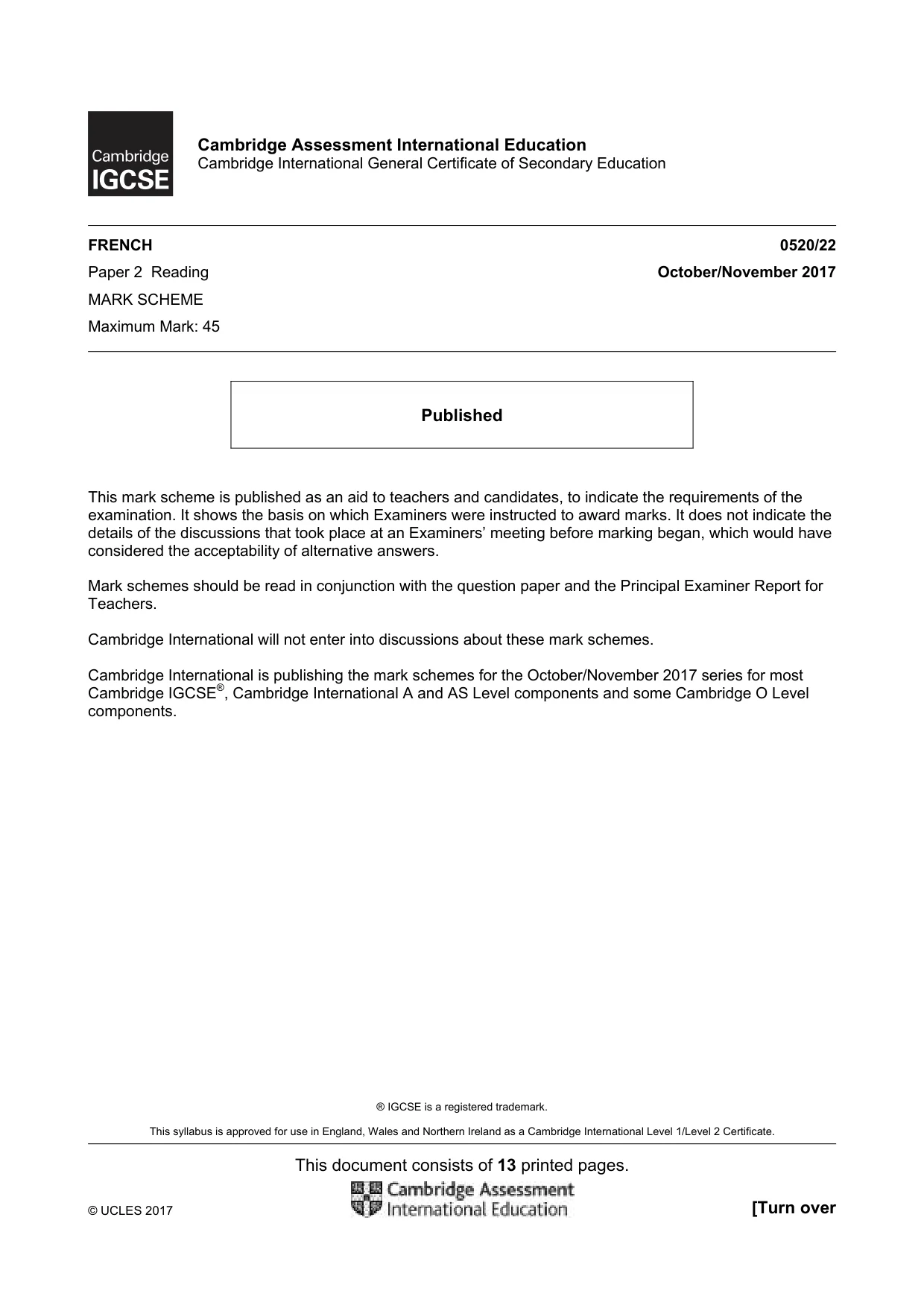
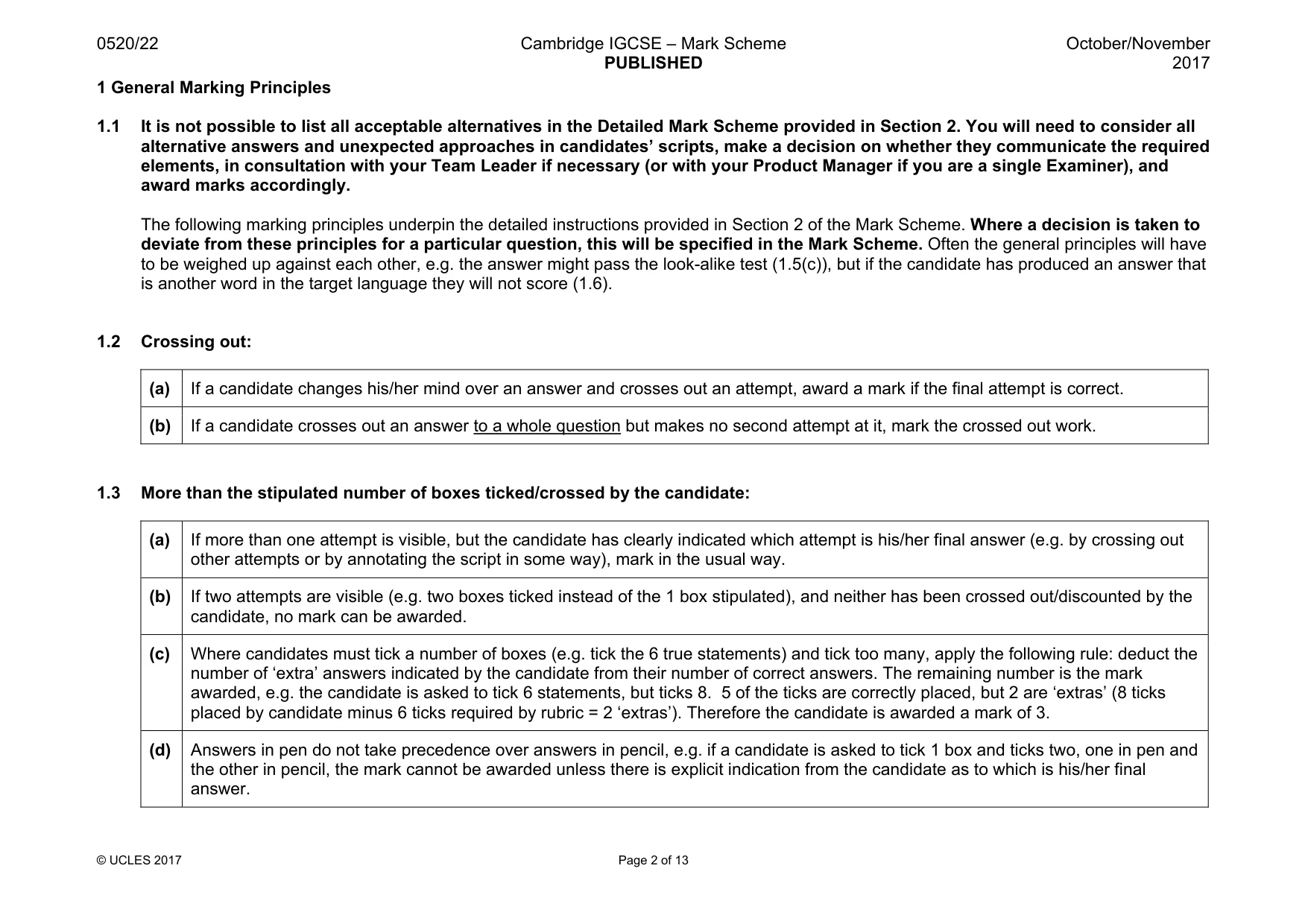
Paper as text
Question paper, page 1
* 5 1 8 5 5 9 3 9 0 2 * This document consists of 14 printed pages and 2 blank pages. DC (ST/FC) 137722/2 © UCLES 2017 [Turn over Cambridge International Examinations Cambridge International General Certificate of Secondary Education FRENCH 0520/22 Paper 2 Reading October/November 2017 1 hour Candidates answer on the Question Paper. No Additional Materials are required. READ THESE INSTRUCTIONS FIRST Write your Centre number, candidate number and name in the spaces at the top of this page. Write in dark blue or black pen. Do not use staples, paper clips, glue or correction fluid. DO NOT WRITE IN ANY BARCODES. Answer all questions. The number of marks is given in brackets [ ] at the end of each question or part question. The syllabus is approved for use in England, Wales and Northern Ireland as a Cambridge International Level 1/Level 2 Certificate.
Question paper, page 2
2 0520/22/O/N/17 © UCLES 2017 BLANK PAGE
Question paper, page 3
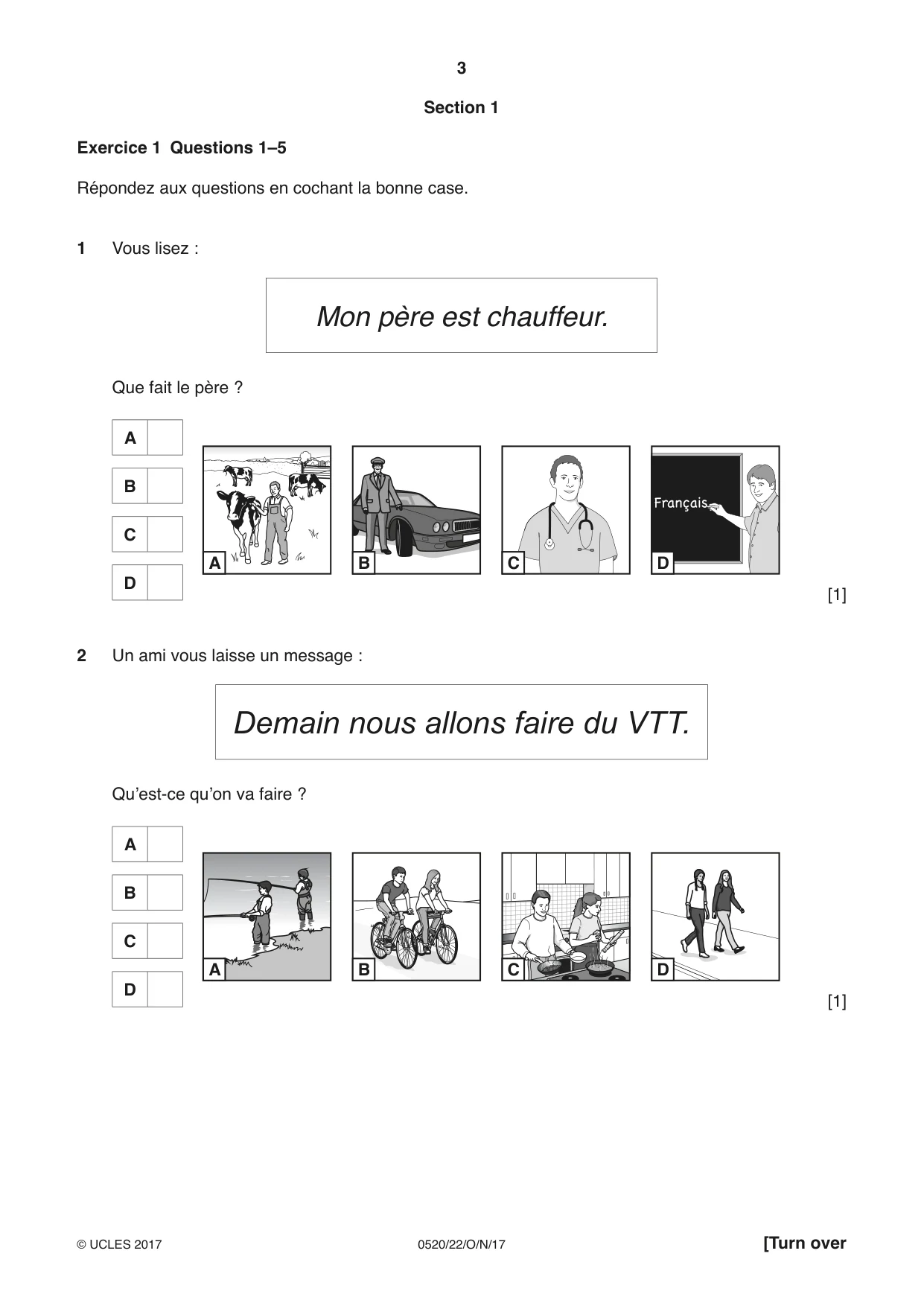
3 0520/22/O/N/17 © UCLES 2017 [Turn over Section 1 Exercice 1 Questions 1–5 Répondez aux questions en cochant la bonne case. 1 Vous lisez : Mon père est chauffeur. Que fait le père ? A A B C D [1] B C D 2 Un ami vous laisse un message : Demain nous allons faire du VTT. Qu’est-ce qu’on va faire ? A A B C D [1] B C D
Question paper, page 4
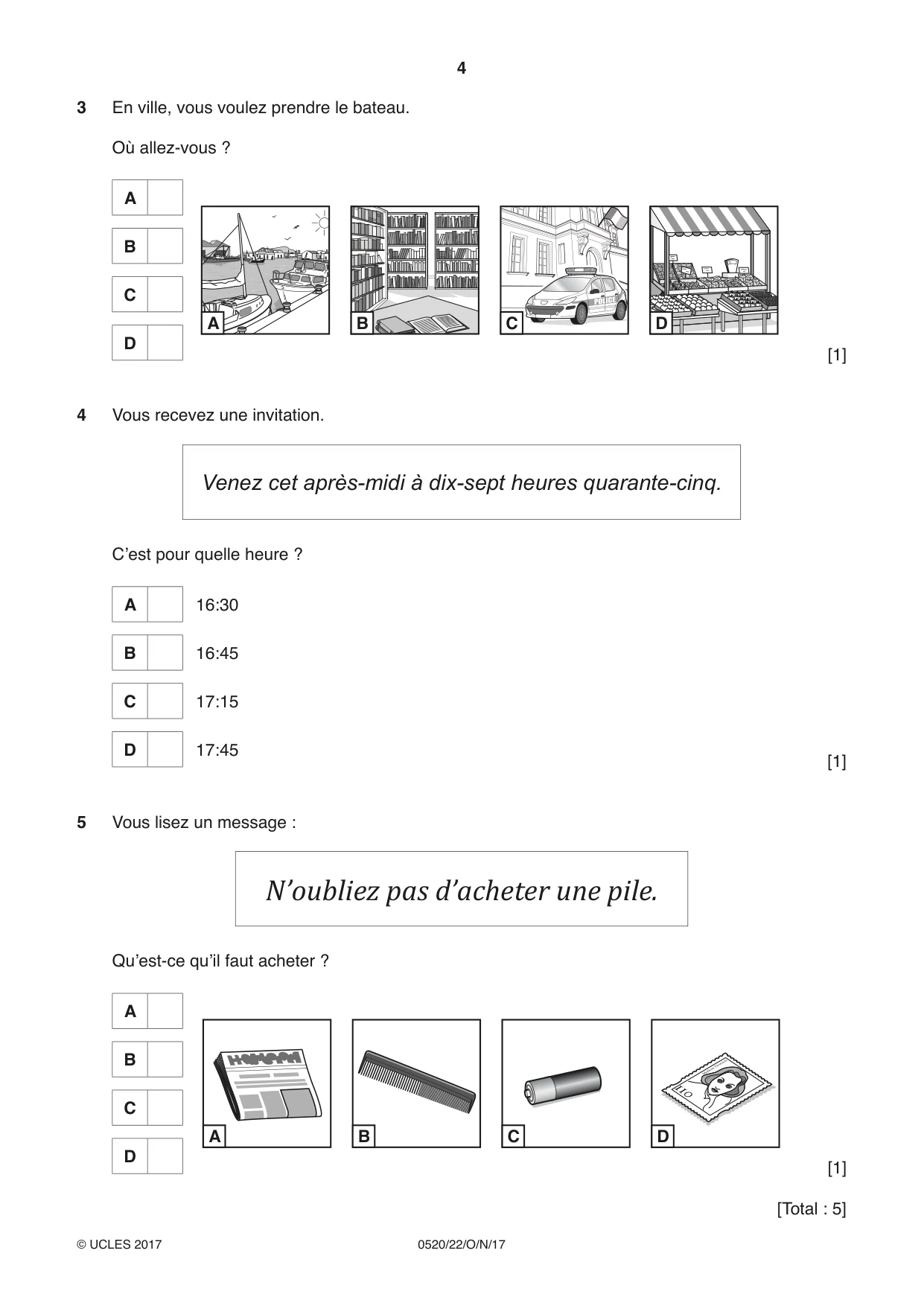
4 0520/22/O/N/17 © UCLES 2017 3 En ville, vous voulez prendre le bateau. Où allez-vous ? A A B C D [1] B C D 4 Vous recevez une invitation. Venez cet après-midi à dix-sept heures quarante-cinq. C’est pour quelle heure ? A 16:30 [1] B 16:45 C 17:15 D 17:45 5 Vous lisez un message : N’oubliez pas d’acheter une pile. Qu’est-ce qu’il faut acheter ? A A B C D [1] B C D [Total : 5]
Question paper, page 5
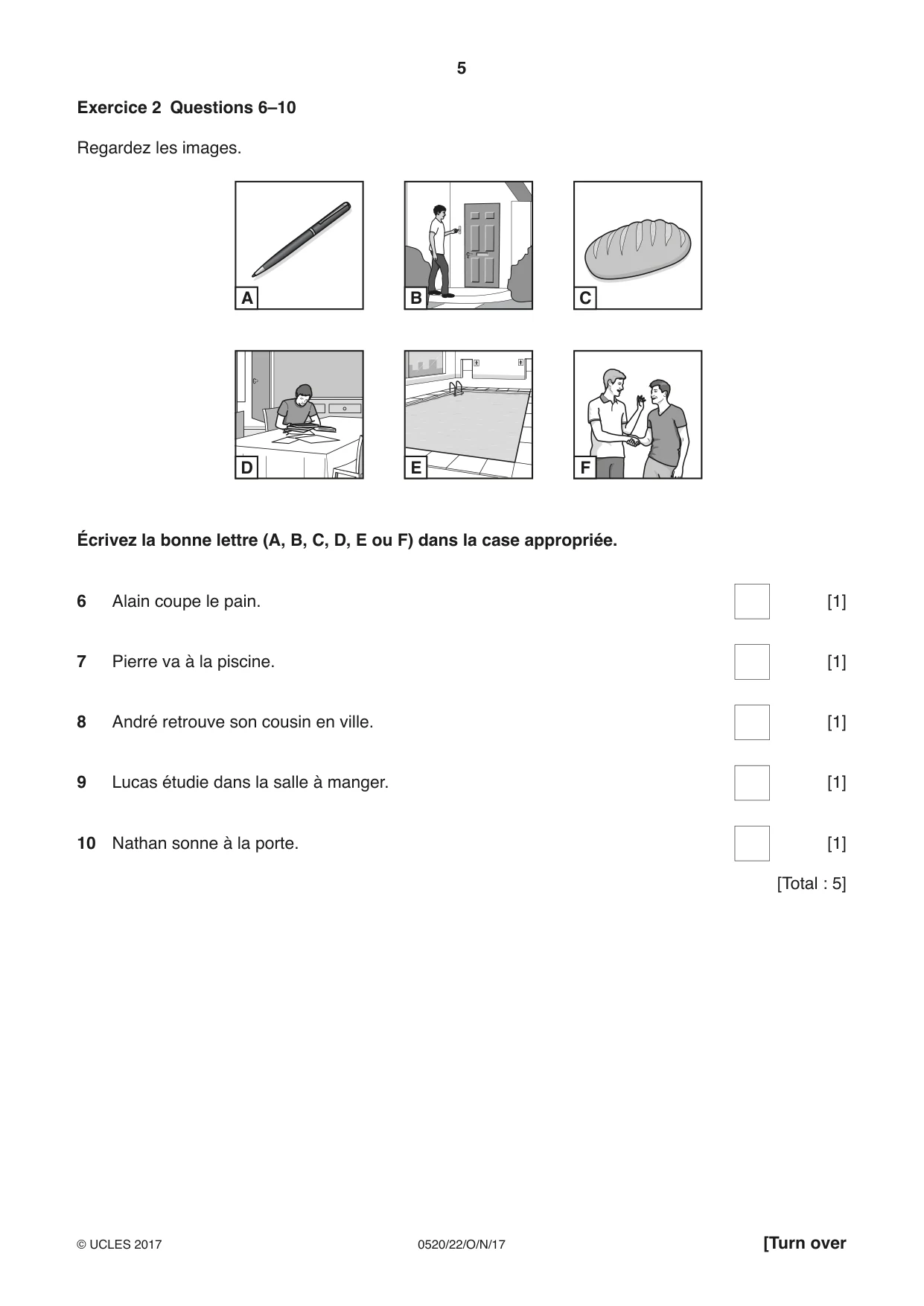
5 0520/22/O/N/17 © UCLES 2017 [Turn over Exercice 2 Questions 6–10 Regardez les images. A B C D E F Écrivez la bonne lettre (A, B, C, D, E ou F) dans la case appropriée. 6 Alain coupe le pain. [1] 7 Pierre va à la piscine. [1] 8 André retrouve son cousin en ville. [1] 9 Lucas étudie dans la salle à manger. [1] 10 Nathan sonne à la porte. [1] [Total : 5]
Question paper, page 6
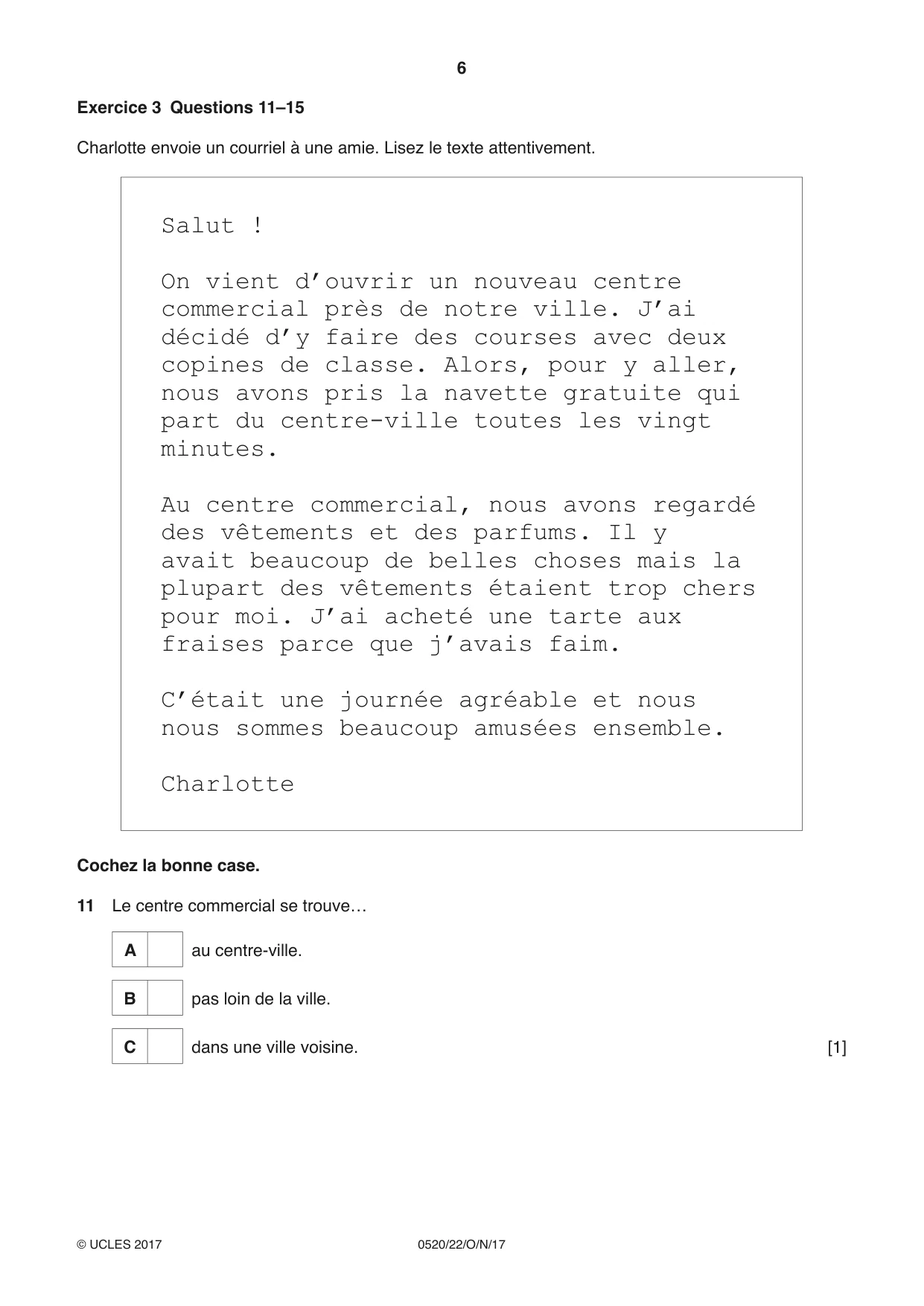
6 0520/22/O/N/17 © UCLES 2017 Exercice 3 Questions 11–15 Charlotte envoie un courriel à une amie. Lisez le texte attentivement. Salut ! On vient d’ouvrir un nouveau centre commercial près de notre ville. J’ai décidé d’y faire des courses avec deux copines de classe. Alors, pour y aller, nous avons pris la navette gratuite qui part du centre-ville toutes les vingt minutes. Au centre commercial, nous avons regardé des vêtements et des parfums. Il y avait beaucoup de belles choses mais la plupart des vêtements étaient trop chers pour moi. J’ai acheté une tarte aux fraises parce que j’avais faim. C’était une journée agréable et nous nous sommes beaucoup amusées ensemble. Charlotte Cochez la bonne case. 11 Le centre commercial se trouve… A au centre-ville. B pas loin de la ville. C dans une ville voisine. [1]
Question paper, page 7
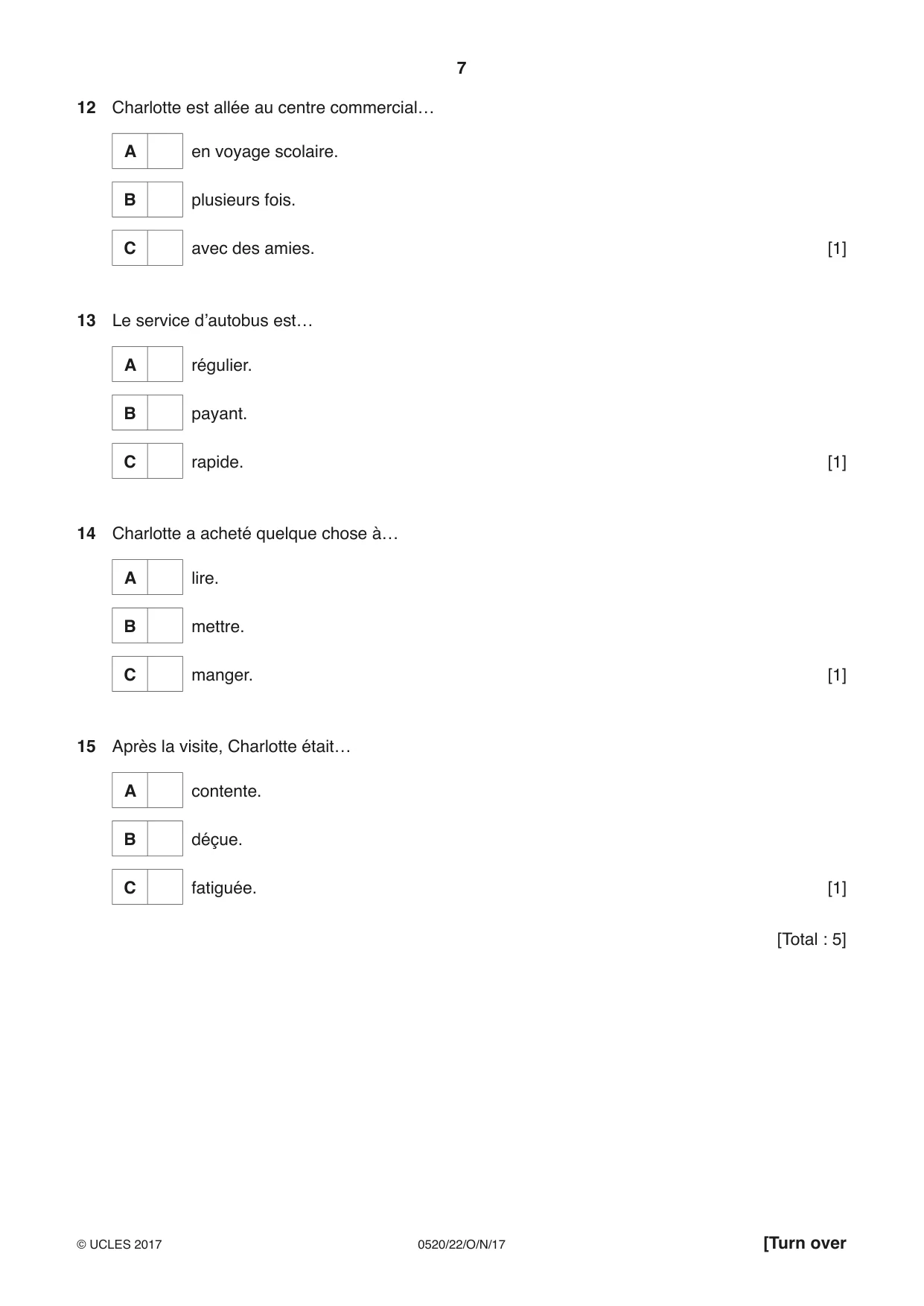
7 0520/22/O/N/17 © UCLES 2017 [Turn over 12 Charlotte est allée au centre commercial… A en voyage scolaire. B plusieurs fois. C avec des amies. [1] 13 Le service d’autobus est… A régulier. B payant. C rapide. [1] 14 Charlotte a acheté quelque chose à… A lire. B mettre. C manger. [1] 15 Après la visite, Charlotte était… A contente. B déçue. C fatiguée. [1] [Total : 5]
Question paper, page 8
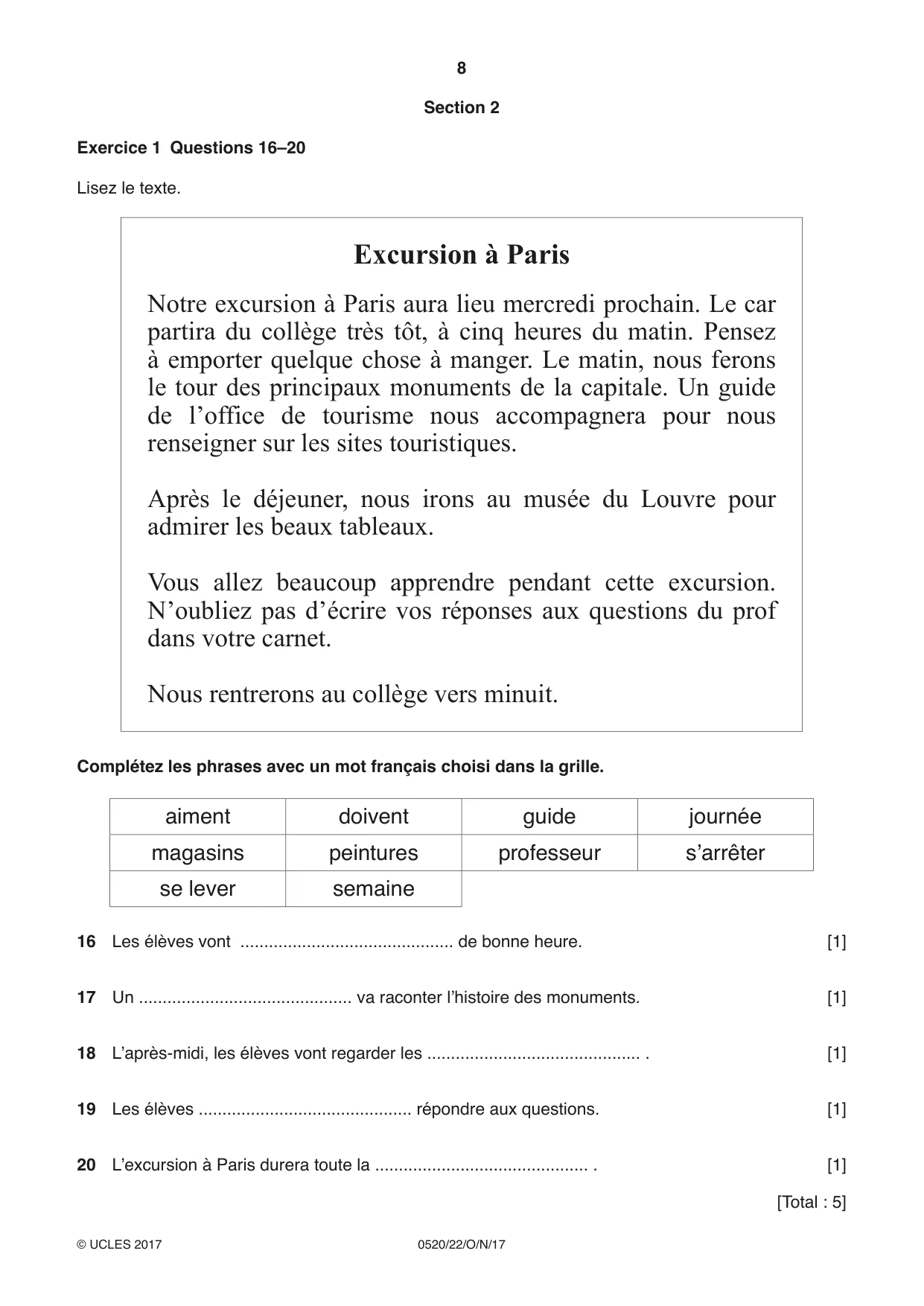
8 0520/22/O/N/17 © UCLES 2017 Section 2 Exercice 1 Questions 16–20 Lisez le texte. Excursion à Paris Notre excursion à Paris aura lieu mercredi prochain. Le car partira du collège très tôt, à cinq heures du matin. Pensez à emporter quelque chose à manger. Le matin, nous ferons le tour des principaux monuments de la capitale. Un guide de l’office de tourisme nous accompagnera pour nous renseigner sur les sites touristiques. Après le déjeuner, nous irons au musée du Louvre pour admirer les beaux tableaux. Vous allez beaucoup apprendre pendant cette excursion. N’oubliez pas d’écrire vos réponses aux questions du prof dans votre carnet. Nous rentrerons au collège vers minuit. Complétez les phrases avec un mot français choisi dans la grille. aiment doivent guide journée magasins peintures professeur s’arrêter se lever semaine 16 Les élèves vont … de bonne heure. [1] 17 Un … va raconter l’histoire des monuments. [1] 18 L’après-midi, les élèves vont regarder les … . [1] 19 Les élèves … répondre aux questions. [1] 20 L’excursion à Paris durera toute la … . [1] [Total : 5]
Question paper, page 9
9 0520/22/O/N/17 © UCLES 2017 [Turn over Tournez la page pour l’Exercice 2.
Question paper, page 10
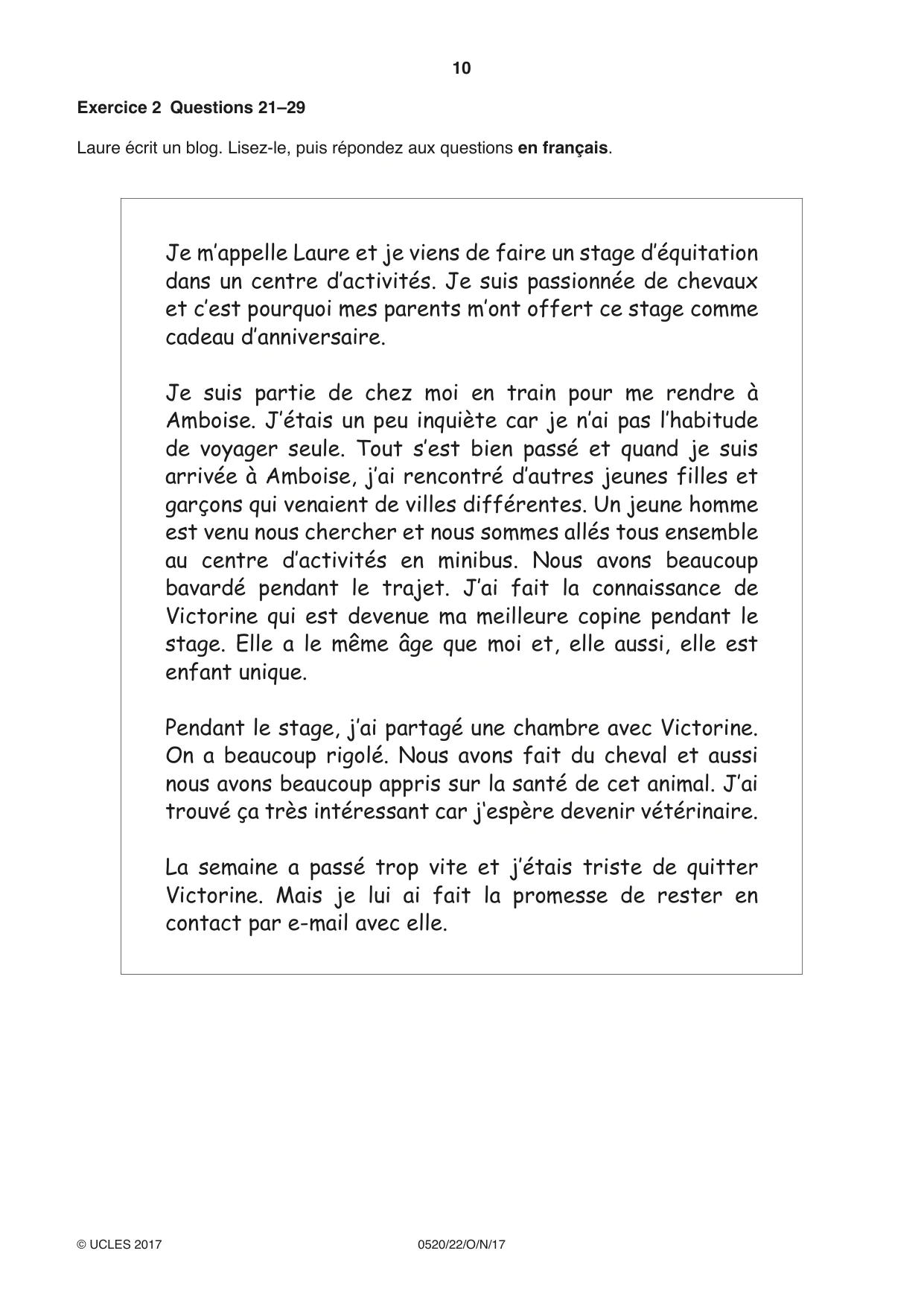
10 0520/22/O/N/17 © UCLES 2017 Exercice 2 Questions 21–29 Laure écrit un blog. Lisez-le, puis répondez aux questions en français. Je m’appelle Laure et je viens de faire un stage d’équitation dans un centre d’activités. Je suis passionnée de chevaux et c’est pourquoi mes parents m’ont offert ce stage comme cadeau d’anniversaire. Je suis partie de chez moi en train pour me rendre à Amboise. J’étais un peu inquiète car je n’ai pas l’habitude de voyager seule. Tout s’est bien passé et quand je suis arrivée à Amboise, j’ai rencontré d’autres jeunes filles et garçons qui venaient de villes différentes. Un jeune homme est venu nous chercher et nous sommes allés tous ensemble au centre d’activités en minibus. Nous avons beaucoup bavardé pendant le trajet. J’ai fait la connaissance de Victorine qui est devenue ma meilleure copine pendant le stage. Elle a le même âge que moi et, elle aussi, elle est enfant unique. Pendant le stage, j’ai partagé une chambre avec Victorine. On a beaucoup rigolé. Nous avons fait du cheval et aussi nous avons beaucoup appris sur la santé de cet animal. J’ai trouvé ça très intéressant car j‘espère devenir vétérinaire. La semaine a passé trop vite et j’étais triste de quitter Victorine. Mais je lui ai fait la promesse de rester en contact par e-mail avec elle.
Question paper, page 11
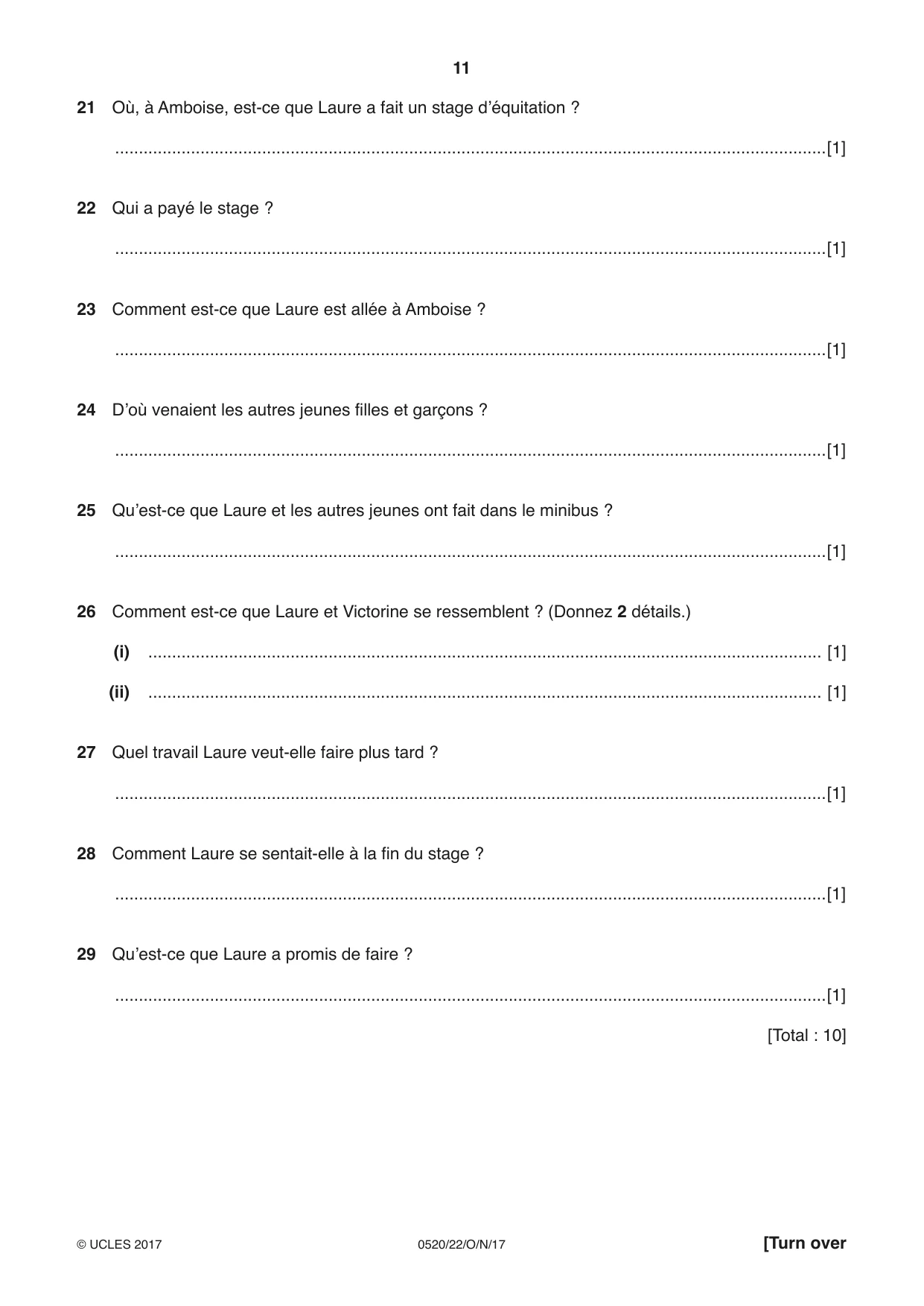
11 0520/22/O/N/17 © UCLES 2017 [Turn over 21 Où, à Amboise, est-ce que Laure a fait un stage d’équitation ? …[1] 22 Qui a payé le stage ? …[1] 23 Comment est-ce que Laure est allée à Amboise ? …[1] 24 D’où venaient les autres jeunes filles et garçons ? …[1] 25 Qu’est-ce que Laure et les autres jeunes ont fait dans le minibus ? …[1] 26 Comment est-ce que Laure et Victorine se ressemblent ? (Donnez 2 détails.) (i) … [1] (ii) … [1] 27 Quel travail Laure veut-elle faire plus tard ? …[1] 28 Comment Laure se sentait-elle à la fin du stage ? …[1] 29 Qu’est-ce que Laure a promis de faire ? …[1] [Total : 10]
Question paper, page 12
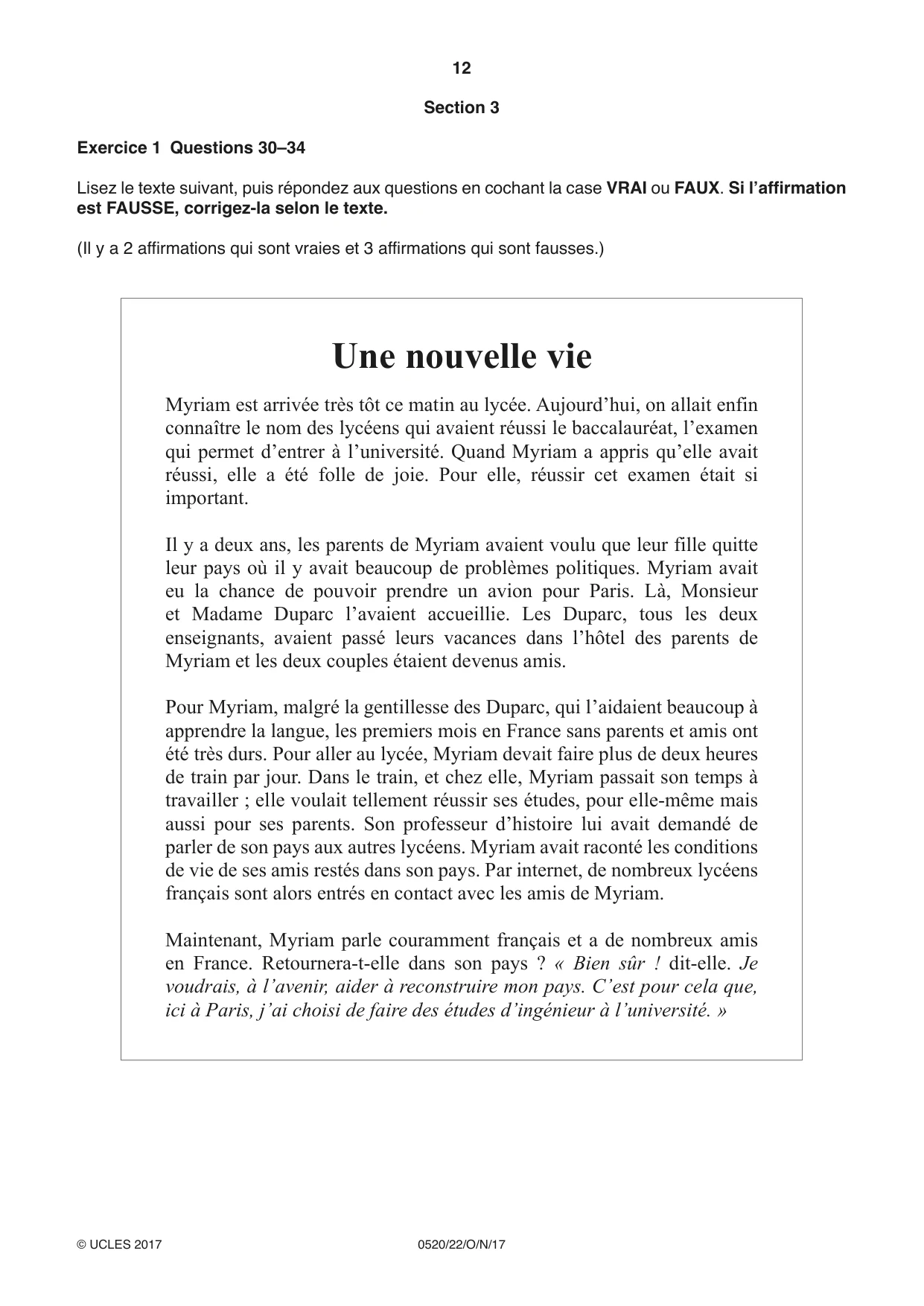
12 0520/22/O/N/17 © UCLES 2017 Section 3 Exercice 1 Questions 30–34 Lisez le texte suivant, puis répondez aux questions en cochant la case VRAI ou FAUX. Si l’affirmation est FAUSSE, corrigez-la selon le texte. (Il y a 2 affirmations qui sont vraies et 3 affirmations qui sont fausses.) Une nouvelle vie Myriam est arrivée très tôt ce matin au lycée. Aujourd’hui, on allait enfin connaître le nom des lycéens qui avaient réussi le baccalauréat, l’examen qui permet d’entrer à l’université. Quand Myriam a appris qu’elle avait réussi, elle a été folle de joie. Pour elle, réussir cet examen était si important. Il y a deux ans, les parents de Myriam avaient voulu que leur fille quitte leur pays où il y avait beaucoup de problèmes politiques. Myriam avait eu la chance de pouvoir prendre un avion pour Paris. Là, Monsieur et Madame Duparc l’avaient accueillie. Les Duparc, tous les deux enseignants, avaient passé leurs vacances dans l’hôtel des parents de Myriam et les deux couples étaient devenus amis. Pour Myriam, malgré la gentillesse des Duparc, qui l’aidaient beaucoup à apprendre la langue, les premiers mois en France sans parents et amis ont été très durs. Pour aller au lycée, Myriam devait faire plus de deux heures de train par jour. Dans le train, et chez elle, Myriam passait son temps à travailler ; elle voulait tellement réussir ses études, pour elle-même mais aussi pour ses parents. Son professeur d’histoire lui avait demandé de parler de son pays aux autres lycéens. Myriam avait raconté les conditions de vie de ses amis restés dans son pays. Par internet, de nombreux lycéens français sont alors entrés en contact avec les amis de Myriam. Maintenant, Myriam parle couramment français et a de nombreux amis en France. Retournera-t-elle dans son pays ? « Bien sûr ! dit-elle. Je voudrais, à l’avenir, aider à reconstruire mon pays. C’est pour cela que, ici à Paris, j’ai choisi de faire des études d’ingénieur à l’université. »
Question paper, page 13
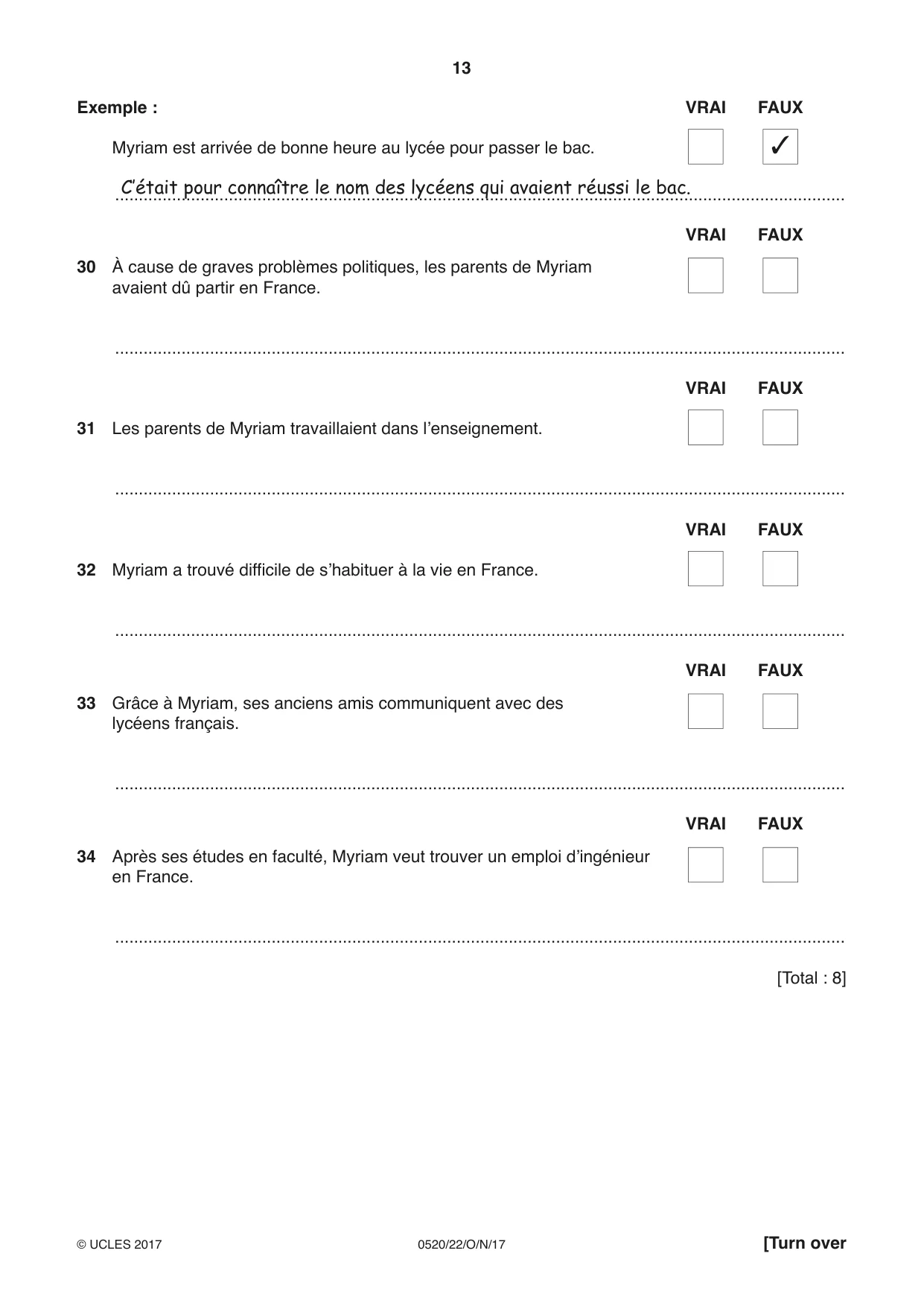
13 0520/22/O/N/17 © UCLES 2017 [Turn over Exemple : VRAI FAUX Myriam est arrivée de bonne heure au lycée pour passer le bac. ✓ C’était pour connaître le nom des lycéens qui avaient réussi le bac. … VRAI FAUX 30 À cause de graves problèmes politiques, les parents de Myriam avaient dû partir en France. … VRAI FAUX 31 Les parents de Myriam travaillaient dans l’enseignement. … VRAI FAUX 32 Myriam a trouvé difficile de s’habituer à la vie en France. … VRAI FAUX 33 Grâce à Myriam, ses anciens amis communiquent avec des lycéens français. … VRAI FAUX 34 Après ses études en faculté, Myriam veut trouver un emploi d’ingénieur en France. … [Total : 8]
Question paper, page 14
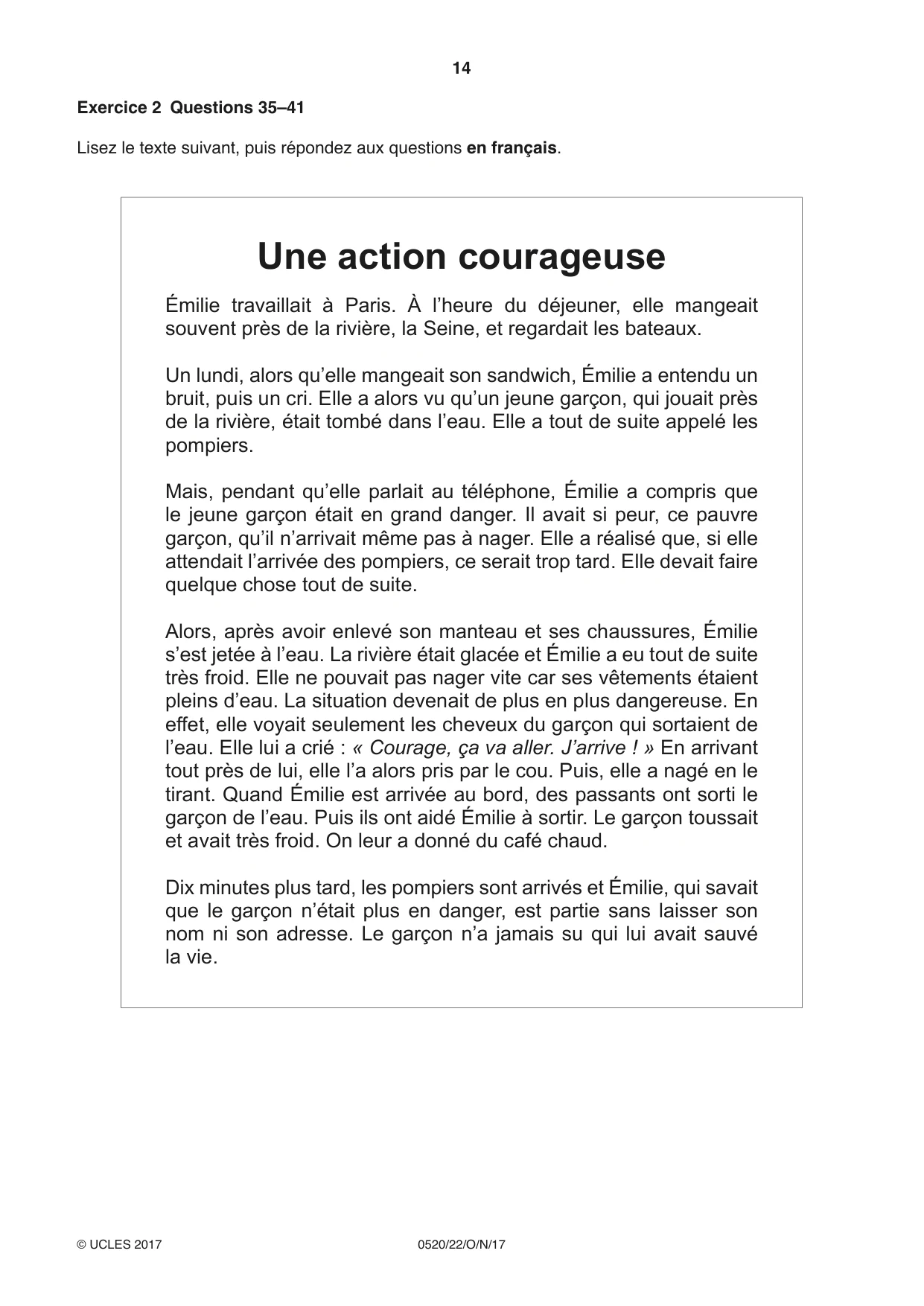
14 0520/22/O/N/17 © UCLES 2017 Exercice 2 Questions 35–41 Lisez le texte suivant, puis répondez aux questions en français. Une action courageuse Émilie travaillait à Paris. À l’heure du déjeuner, elle mangeait souvent près de la rivière, la Seine, et regardait les bateaux. Un lundi, alors qu’elle mangeait son sandwich, Émilie a entendu un bruit, puis un cri. Elle a alors vu qu’un jeune garçon, qui jouait près de la rivière, était tombé dans l’eau. Elle a tout de suite appelé les pompiers. Mais, pendant qu’elle parlait au téléphone, Émilie a compris que le jeune garçon était en grand danger. Il avait si peur, ce pauvre garçon, qu’il n’arrivait même pas à nager. Elle a réalisé que, si elle attendait l’arrivée des pompiers, ce serait trop tard. Elle devait faire quelque chose tout de suite. Alors, après avoir enlevé son manteau et ses chaussures, Émilie s’est jetée à l’eau. La rivière était glacée et Émilie a eu tout de suite très froid. Elle ne pouvait pas nager vite car ses vêtements étaient pleins d’eau. La situation devenait de plus en plus dangereuse. En effet, elle voyait seulement les cheveux du garçon qui sortaient de l’eau. Elle lui a crié : « Courage, ça va aller. J’arrive ! » En arrivant tout près de lui, elle l’a alors pris par le cou. Puis, elle a nagé en le tirant. Quand Émilie est arrivée au bord, des passants ont sorti le garçon de l’eau. Puis ils ont aidé Émilie à sortir. Le garçon toussait et avait très froid. On leur a donné du café chaud. Dix minutes plus tard, les pompiers sont arrivés et Émilie, qui savait que le garçon n’était plus en danger, est partie sans laisser son nom ni son adresse. Le garçon n’a jamais su qui lui avait sauvé la vie.
Question paper, page 15
15 0520/22/O/N/17 © UCLES 2017 35 Que faisait souvent Émilie en prenant son déjeuner ? …[1] 36 Pour quelle raison le garçon ne nageait-il pas ? …[1] 37 Qu’est-ce qu’Émilie a fait juste avant de se jeter à l’eau ? …[1] 38 Pourquoi Émilie nageait-elle lentement ? …[1] 39 Qu’est-ce qu’Émilie a fait quand elle est arrivée près du garçon ? …[1] 40 Qui a aidé Émilie à sortir de l’eau ? …[1] 41 Pourquoi le garçon n’a-t-il pas su que c’était Émilie qui lui avait sauvé la vie ? …[1] [Total : 7]
Question paper, page 16
16 0520/22/O/N/17 © UCLES 2017 Permission to reproduce items where third-party owned material protected by copyright is included has been sought and cleared where possible. Every reasonable effort has been made by the publisher (UCLES) to trace copyright holders, but if any items requiring clearance have unwittingly been included, the publisher will be pleased to make amends at the earliest possible opportunity. To avoid the issue of disclosure of answer-related information to candidates, all copyright acknowledgements are reproduced online in the Cambridge International Examinations Copyright Acknowledgements Booklet. This is produced for each series of examinations and is freely available to download at www.cie.org.uk after the live examination series. Cambridge International Examinations is part of the Cambridge Assessment Group. Cambridge Assessment is the brand name of University of Cambridge Local Examinations Syndicate (UCLES), which is itself a department of the University of Cambridge. BLANK PAGE
Mark scheme, page 1
® IGCSE is a registered trademark. This syllabus is approved for use in England, Wales and Northern Ireland as a Cambridge International Level 1/Level 2 Certificate. This document consists of 13 printed pages. © UCLES 2017 [Turn over Cambridge Assessment International Education Cambridge International General Certificate of Secondary Education FRENCH 0520/22 Paper 2 Reading October/November 2017 MARK SCHEME Maximum Mark: 45 Published This mark scheme is published as an aid to teachers and candidates, to indicate the requirements of the examination. It shows the basis on which Examiners were instructed to award marks. It does not indicate the details of the discussions that took place at an Examiners’ meeting before marking began, which would have considered the acceptability of alternative answers. Mark schemes should be read in conjunction with the question paper and the Principal Examiner Report for Teachers. Cambridge International will not enter into discussions about these mark schemes. Cambridge International is publishing the mark schemes for the October/November 2017 series for most Cambridge IGCSE®, Cambridge International A and AS Level components and some Cambridge O Level components.
Mark scheme, page 2
0520/22 Cambridge IGCSE – Mark Scheme PUBLISHED October/November 2017 © UCLES 2017 Page 2 of 13 1 General Marking Principles 1.1 It is not possible to list all acceptable alternatives in the Detailed Mark Scheme provided in Section 2. You will need to consider all alternative answers and unexpected approaches in candidates’ scripts, make a decision on whether they communicate the required elements, in consultation with your Team Leader if necessary (or with your Product Manager if you are a single Examiner), and award marks accordingly. The following marking principles underpin the detailed instructions provided in Section 2 of the Mark Scheme. Where a decision is taken to deviate from these principles for a particular question, this will be specified in the Mark Scheme. Often the general principles will have to be weighed up against each other, e.g. the answer might pass the look-alike test (1.5(c)), but if the candidate has produced an answer that is another word in the target language they will not score (1.6). 1.2 Crossing out: (a) If a candidate changes his/her mind over an answer and crosses out an attempt, award a mark if the final attempt is correct. (b) If a candidate crosses out an answer to a whole question but makes no second attempt at it, mark the crossed out work. 1.3 More than the stipulated number of boxes ticked/crossed by the candidate: (a) If more than one attempt is visible, but the candidate has clearly indicated which attempt is his/her final answer (e.g. by crossing out other attempts or by annotating the script in some way), mark in the usual way. (b) If two attempts are visible (e.g. two boxes ticked instead of the 1 box stipulated), and neither has been crossed out/discounted by the candidate, no mark can be awarded. (c) Where candidates must tick a number of boxes (e.g. tick the 6 true statements) and tick too many, apply the following rule: deduct the number of ‘extra’ answers indicated by the candidate from their number of correct answers. The remaining number is the mark awarded, e.g. the candidate is asked to tick 6 statements, but ticks 8. 5 of the ticks are correctly placed, but 2 are ‘extras’ (8 ticks placed by candidate minus 6 ticks required by rubric = 2 ‘extras’). Therefore the candidate is awarded a mark of 3. (d) Answers in pen do not take precedence over answers in pencil, e.g. if a candidate is asked to tick 1 box and ticks two, one in pen and the other in pencil, the mark cannot be awarded unless there is explicit indication from the candidate as to which is his/her final answer.
Mark scheme, page 3
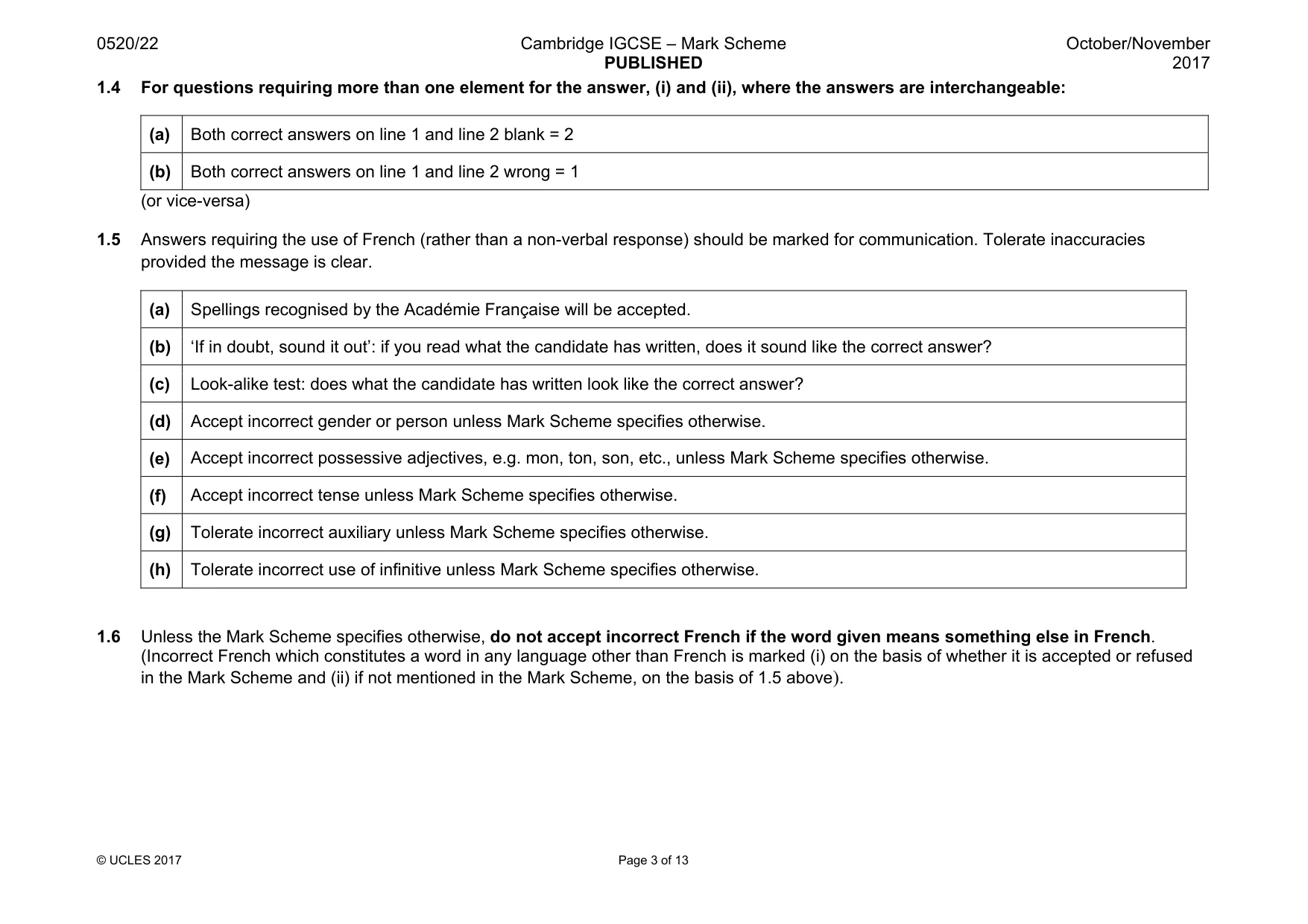
0520/22 Cambridge IGCSE – Mark Scheme PUBLISHED October/November 2017 © UCLES 2017 Page 3 of 13 1.4 For questions requiring more than one element for the answer, (i) and (ii), where the answers are interchangeable: (a) Both correct answers on line 1 and line 2 blank = 2 (b) Both correct answers on line 1 and line 2 wrong = 1 (or vice-versa) 1.5 Answers requiring the use of French (rather than a non-verbal response) should be marked for communication. Tolerate inaccuracies provided the message is clear. (a) Spellings recognised by the Académie Française will be accepted. (b) ‘If in doubt, sound it out’: if you read what the candidate has written, does it sound like the correct answer? (c) Look-alike test: does what the candidate has written look like the correct answer? (d) Accept incorrect gender or person unless Mark Scheme specifies otherwise. (e) Accept incorrect possessive adjectives, e.g. mon, ton, son, etc., unless Mark Scheme specifies otherwise. (f) Accept incorrect tense unless Mark Scheme specifies otherwise. (g) Tolerate incorrect auxiliary unless Mark Scheme specifies otherwise. (h) Tolerate incorrect use of infinitive unless Mark Scheme specifies otherwise. 1.6 Unless the Mark Scheme specifies otherwise, do not accept incorrect French if the word given means something else in French. (Incorrect French which constitutes a word in any language other than French is marked (i) on the basis of whether it is accepted or refused in the Mark Scheme and (ii) if not mentioned in the Mark Scheme, on the basis of 1.5 above).
Mark scheme, page 4
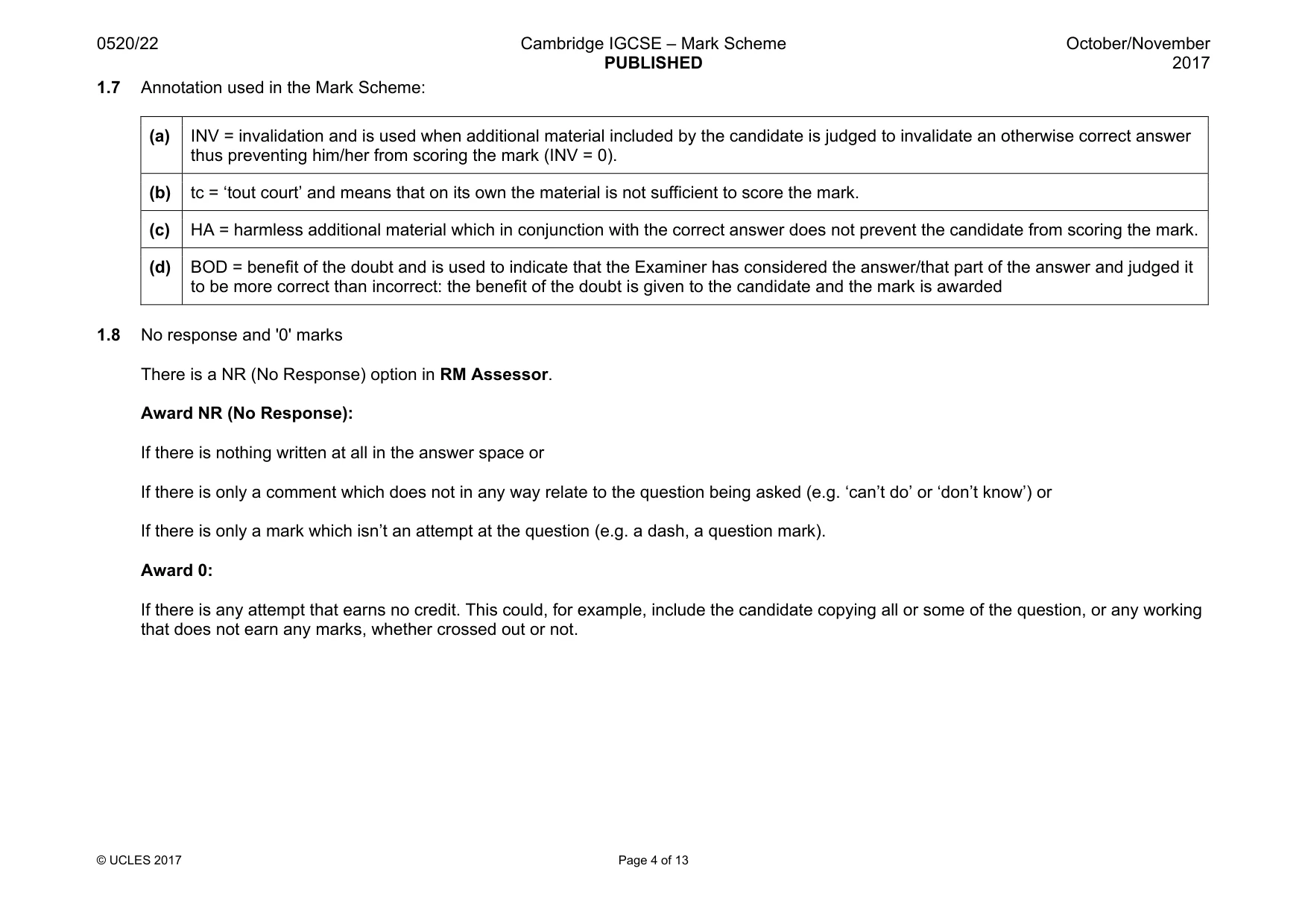
0520/22 Cambridge IGCSE – Mark Scheme PUBLISHED October/November 2017 © UCLES 2017 Page 4 of 13 1.7 Annotation used in the Mark Scheme: (a) INV = invalidation and is used when additional material included by the candidate is judged to invalidate an otherwise correct answer thus preventing him/her from scoring the mark (INV = 0). (b) tc = ‘tout court’ and means that on its own the material is not sufficient to score the mark. (c) HA = harmless additional material which in conjunction with the correct answer does not prevent the candidate from scoring the mark. (d) BOD = benefit of the doubt and is used to indicate that the Examiner has considered the answer/that part of the answer and judged it to be more correct than incorrect: the benefit of the doubt is given to the candidate and the mark is awarded 1.8 No response and '0' marks There is a NR (No Response) option in RM Assessor. Award NR (No Response): If there is nothing written at all in the answer space or If there is only a comment which does not in any way relate to the question being asked (e.g. ‘can’t do’ or ‘don’t know’) or If there is only a mark which isn’t an attempt at the question (e.g. a dash, a question mark). Award 0: If there is any attempt that earns no credit. This could, for example, include the candidate copying all or some of the question, or any working that does not earn any marks, whether crossed out or not.
Mark scheme, page 5
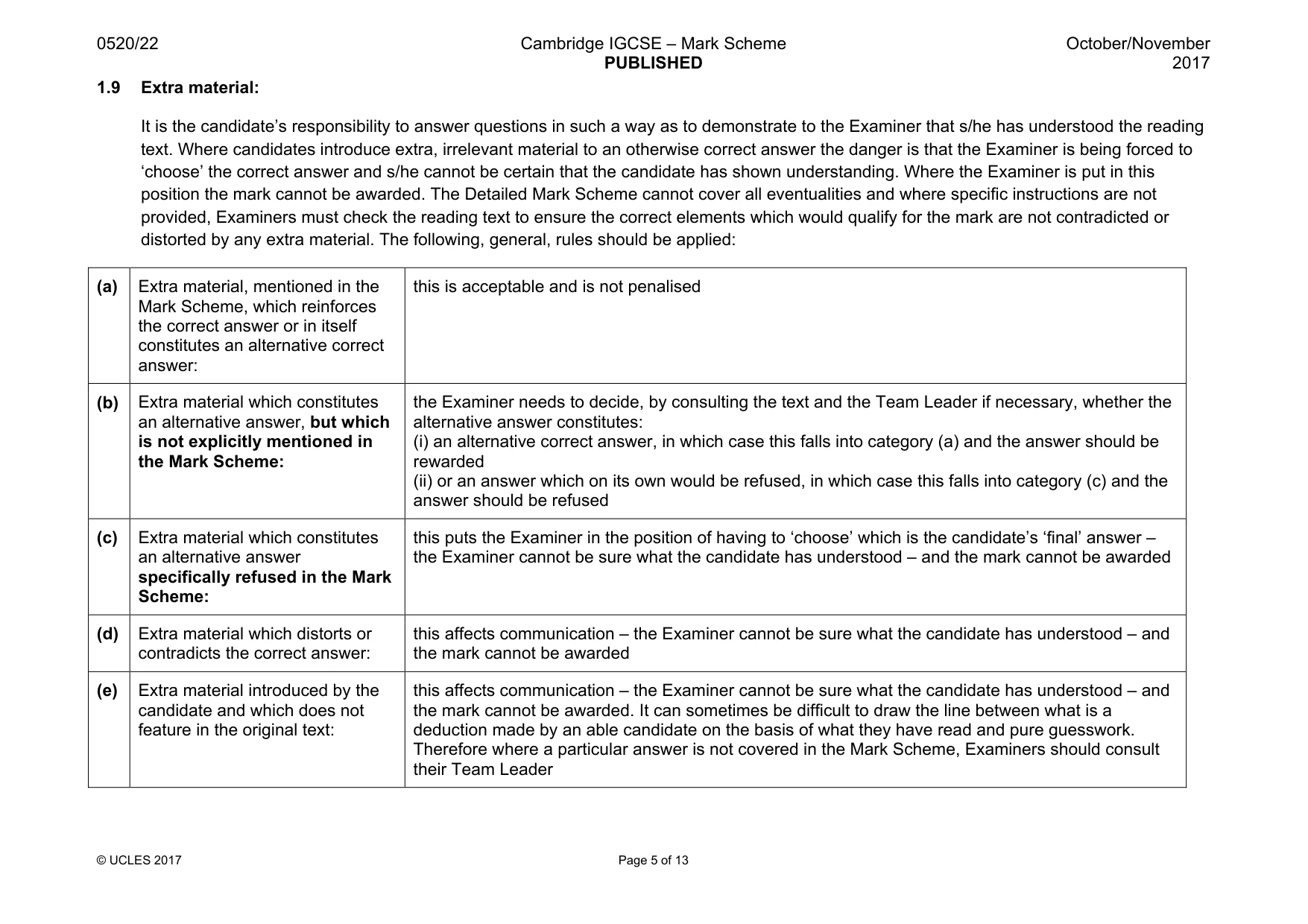
0520/22 Cambridge IGCSE – Mark Scheme PUBLISHED October/November 2017 © UCLES 2017 Page 5 of 13 1.9 Extra material: It is the candidate’s responsibility to answer questions in such a way as to demonstrate to the Examiner that s/he has understood the reading text. Where candidates introduce extra, irrelevant material to an otherwise correct answer the danger is that the Examiner is being forced to ‘choose’ the correct answer and s/he cannot be certain that the candidate has shown understanding. Where the Examiner is put in this position the mark cannot be awarded. The Detailed Mark Scheme cannot cover all eventualities and where specific instructions are not provided, Examiners must check the reading text to ensure the correct elements which would qualify for the mark are not contradicted or distorted by any extra material. The following, general, rules should be applied: (a) Extra material, mentioned in the Mark Scheme, which reinforces the correct answer or in itself constitutes an alternative correct answer: this is acceptable and is not penalised (b) Extra material which constitutes an alternative answer, but which is not explicitly mentioned in the Mark Scheme: the Examiner needs to decide, by consulting the text and the Team Leader if necessary, whether the alternative answer constitutes: (i) an alternative correct answer, in which case this falls into category (a) and the answer should be rewarded (ii) or an answer which on its own would be refused, in which case this falls into category (c) and the answer should be refused (c) Extra material which constitutes an alternative answer specifically refused in the Mark Scheme: this puts the Examiner in the position of having to ‘choose’ which is the candidate’s ‘final’ answer – the Examiner cannot be sure what the candidate has understood – and the mark cannot be awarded (d) Extra material which distorts or contradicts the correct answer: this affects communication – the Examiner cannot be sure what the candidate has understood – and the mark cannot be awarded (e) Extra material introduced by the candidate and which does not feature in the original text: this affects communication – the Examiner cannot be sure what the candidate has understood – and the mark cannot be awarded. It can sometimes be difficult to draw the line between what is a deduction made by an able candidate on the basis of what they have read and pure guesswork. Therefore where a particular answer is not covered in the Mark Scheme, Examiners should consult their Team Leader
Mark scheme, page 6
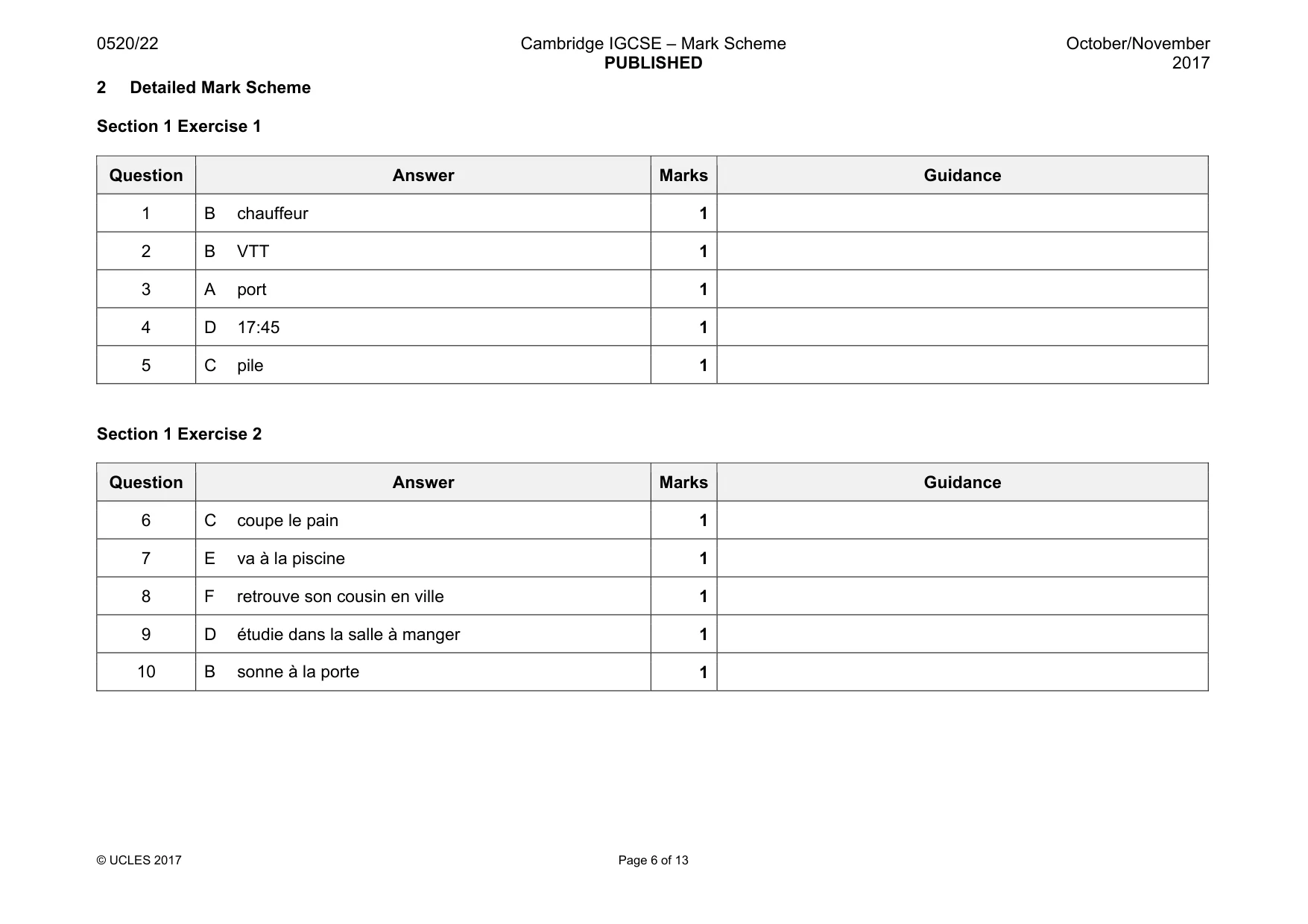
0520/22 Cambridge IGCSE – Mark Scheme PUBLISHED October/November 2017 © UCLES 2017 Page 6 of 13 2 Detailed Mark Scheme Section 1 Exercise 1 Question Answer Marks Guidance 1 B chauffeur 1 2 B VTT 1 3 A port 1 4 D 17:45 1 5 C pile 1 Section 1 Exercise 2 Question Answer Marks Guidance 6 C coupe le pain 1 7 E va à la piscine 1 8 F retrouve son cousin en ville 1 9 D étudie dans la salle à manger 1 10 B sonne à la porte 1
Mark scheme, page 7
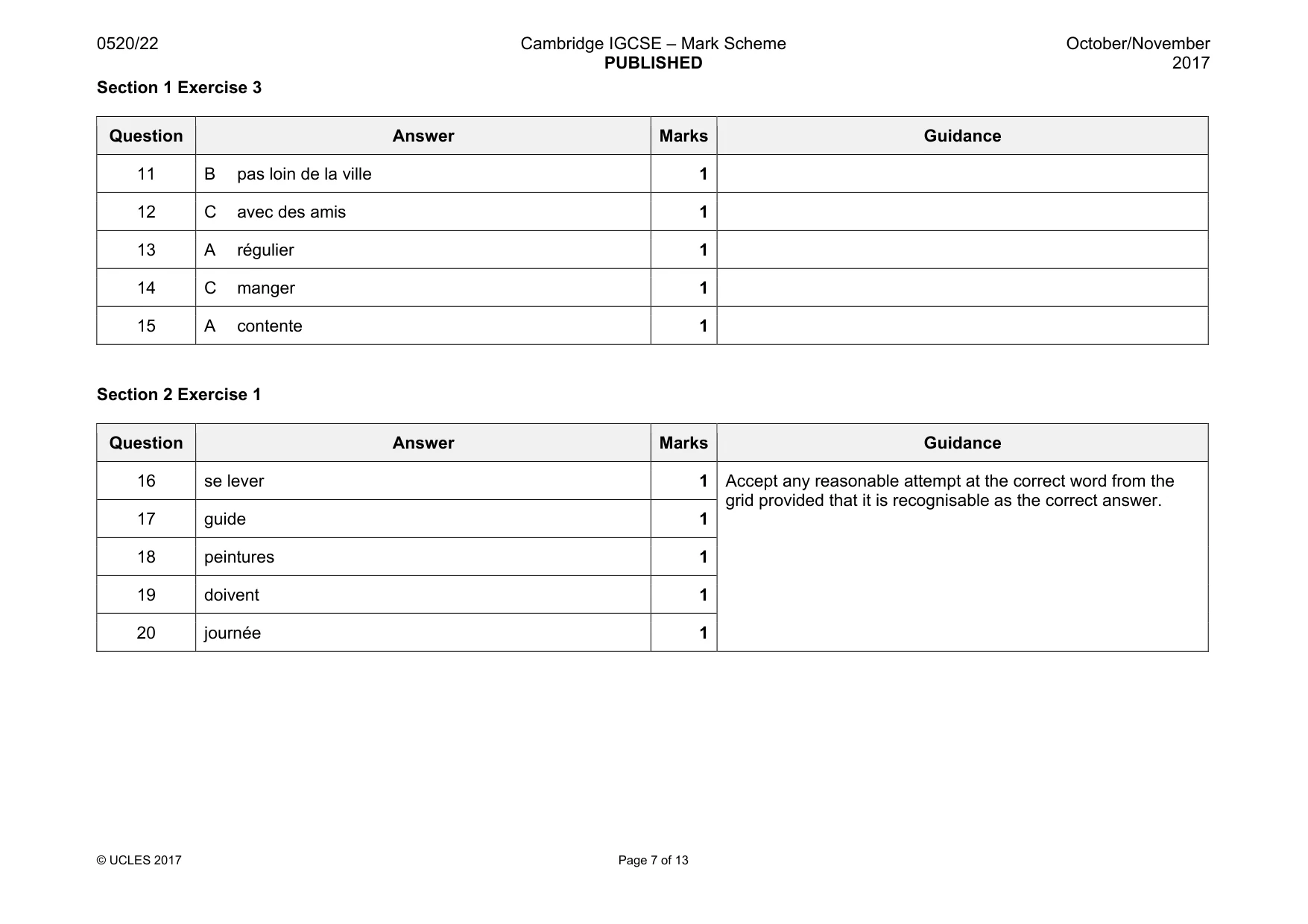
0520/22 Cambridge IGCSE – Mark Scheme PUBLISHED October/November 2017 © UCLES 2017 Page 7 of 13 Section 1 Exercise 3 Question Answer Marks Guidance 11 B pas loin de la ville 1 12 C avec des amis 1 13 A régulier 1 14 C manger 1 15 A contente 1 Section 2 Exercise 1 Question Answer Marks Guidance 16 se lever 1 Accept any reasonable attempt at the correct word from the grid provided that it is recognisable as the correct answer. 17 guide 1 18 peintures 1 19 doivent 1 20 journée 1
Mark scheme, page 8
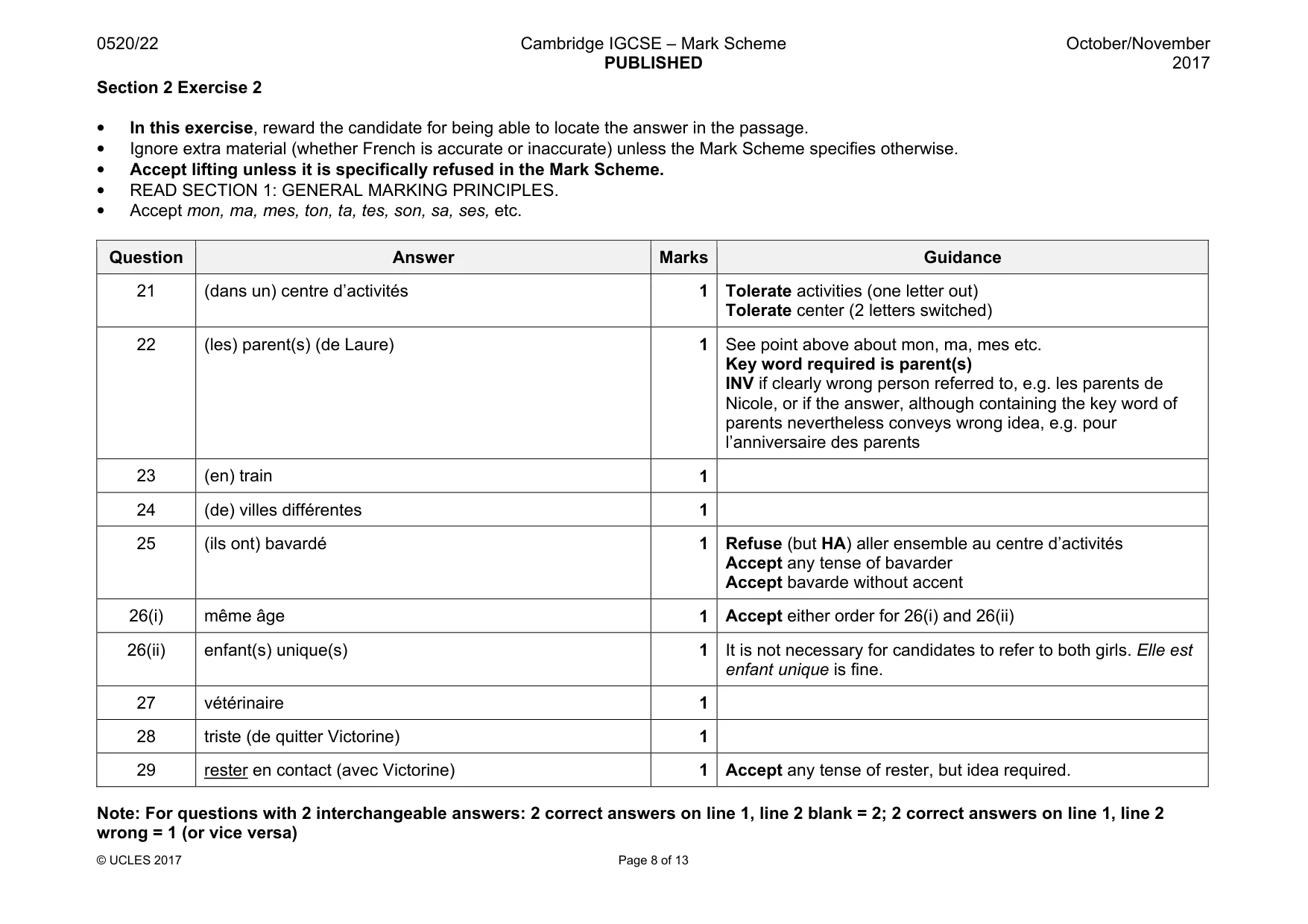
0520/22 Cambridge IGCSE – Mark Scheme PUBLISHED October/November 2017 © UCLES 2017 Page 8 of 13 Section 2 Exercise 2 • In this exercise, reward the candidate for being able to locate the answer in the passage. • Ignore extra material (whether French is accurate or inaccurate) unless the Mark Scheme specifies otherwise. • Accept lifting unless it is specifically refused in the Mark Scheme. • READ SECTION 1: GENERAL MARKING PRINCIPLES. • Accept mon, ma, mes, ton, ta, tes, son, sa, ses, etc. Question Answer Marks Guidance 21 (dans un) centre d’activités 1 Tolerate activities (one letter out) Tolerate center (2 letters switched) 22 (les) parent(s) (de Laure) 1 See point above about mon, ma, mes etc. Key word required is parent(s) INV if clearly wrong person referred to, e.g. les parents de Nicole, or if the answer, although containing the key word of parents nevertheless conveys wrong idea, e.g. pour l’anniversaire des parents 23 (en) train 1 24 (de) villes différentes 1 25 (ils ont) bavardé 1 Refuse (but HA) aller ensemble au centre d’activités Accept any tense of bavarder Accept bavarde without accent 26(i) même âge 1 Accept either order for 26(i) and 26(ii) 26(ii) enfant(s) unique(s) 1 It is not necessary for candidates to refer to both girls. Elle est enfant unique is fine. 27 vétérinaire 1 28 triste (de quitter Victorine) 1 29 rester en contact (avec Victorine) 1 Accept any tense of rester, but idea required. Note: For questions with 2 interchangeable answers: 2 correct answers on line 1, line 2 blank = 2; 2 correct answers on line 1, line 2 wrong = 1 (or vice versa)
Mark scheme, page 9
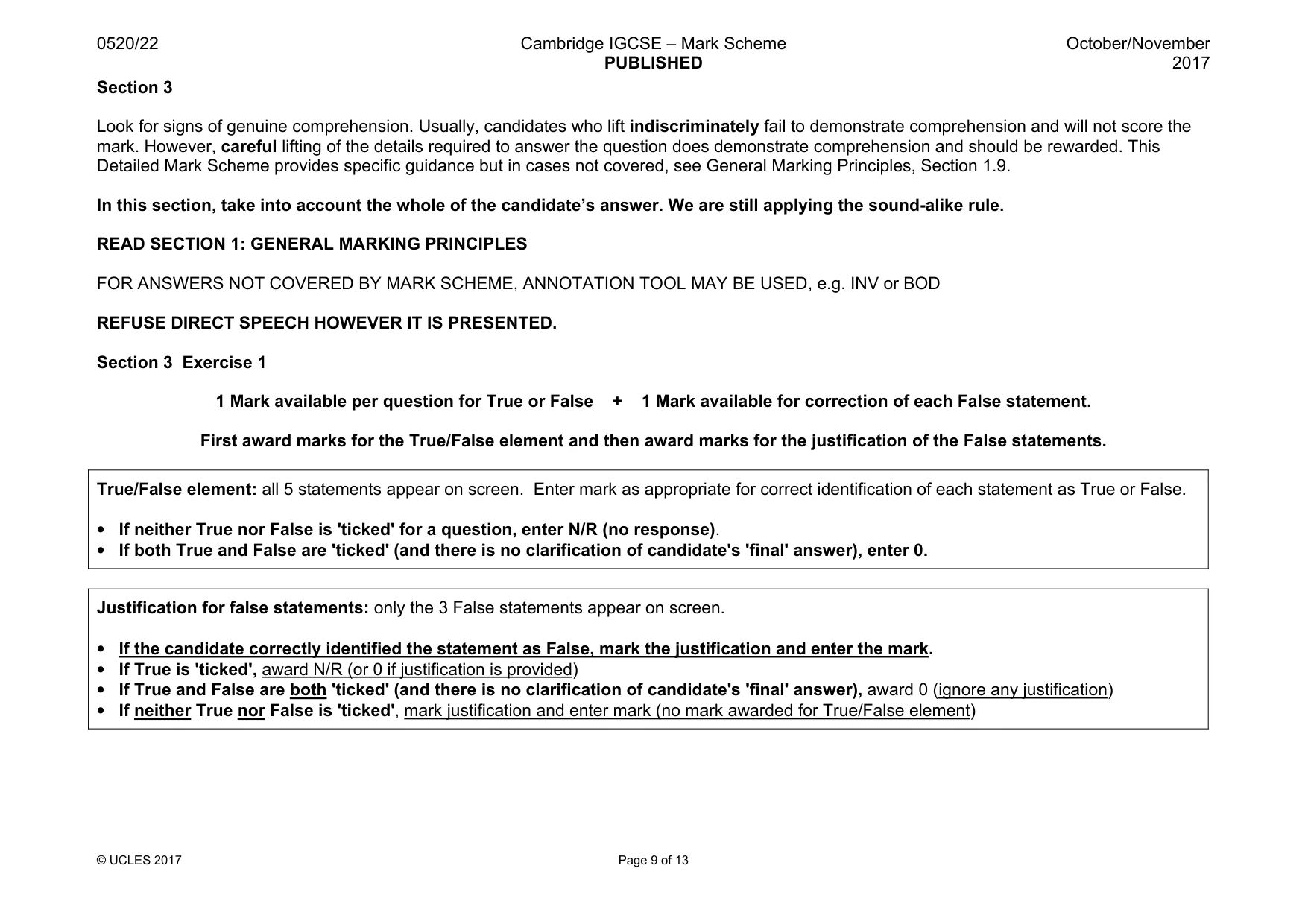
0520/22 Cambridge IGCSE – Mark Scheme PUBLISHED October/November 2017 © UCLES 2017 Page 9 of 13 Section 3 Look for signs of genuine comprehension. Usually, candidates who lift indiscriminately fail to demonstrate comprehension and will not score the mark. However, careful lifting of the details required to answer the question does demonstrate comprehension and should be rewarded. This Detailed Mark Scheme provides specific guidance but in cases not covered, see General Marking Principles, Section 1.9. In this section, take into account the whole of the candidate’s answer. We are still applying the sound-alike rule. READ SECTION 1: GENERAL MARKING PRINCIPLES FOR ANSWERS NOT COVERED BY MARK SCHEME, ANNOTATION TOOL MAY BE USED, e.g. INV or BOD REFUSE DIRECT SPEECH HOWEVER IT IS PRESENTED. Section 3 Exercise 1 1 Mark available per question for True or False + 1 Mark available for correction of each False statement. First award marks for the True/False element and then award marks for the justification of the False statements. True/False element: all 5 statements appear on screen. Enter mark as appropriate for correct identification of each statement as True or False. • If neither True nor False is 'ticked' for a question, enter N/R (no response). • If both True and False are 'ticked' (and there is no clarification of candidate's 'final' answer), enter 0. Justification for false statements: only the 3 False statements appear on screen. • If the candidate correctly identified the statement as False, mark the justification and enter the mark. • If True is 'ticked', award N/R (or 0 if justification is provided) • If True and False are both 'ticked' (and there is no clarification of candidate's 'final' answer), award 0 (ignore any justification) • If neither True nor False is 'ticked', mark justification and enter mark (no mark awarded for True/False element)
Mark scheme, page 10
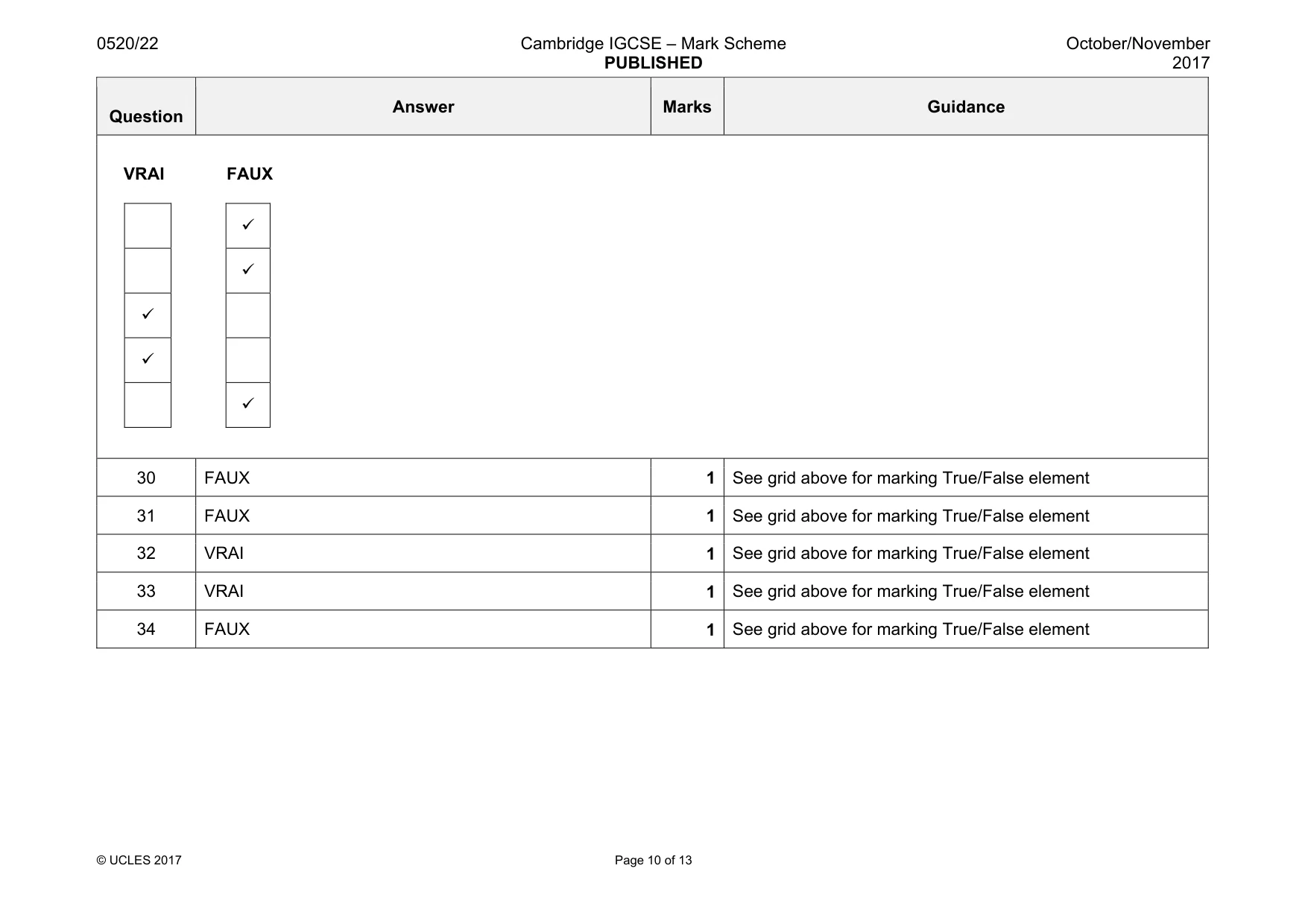
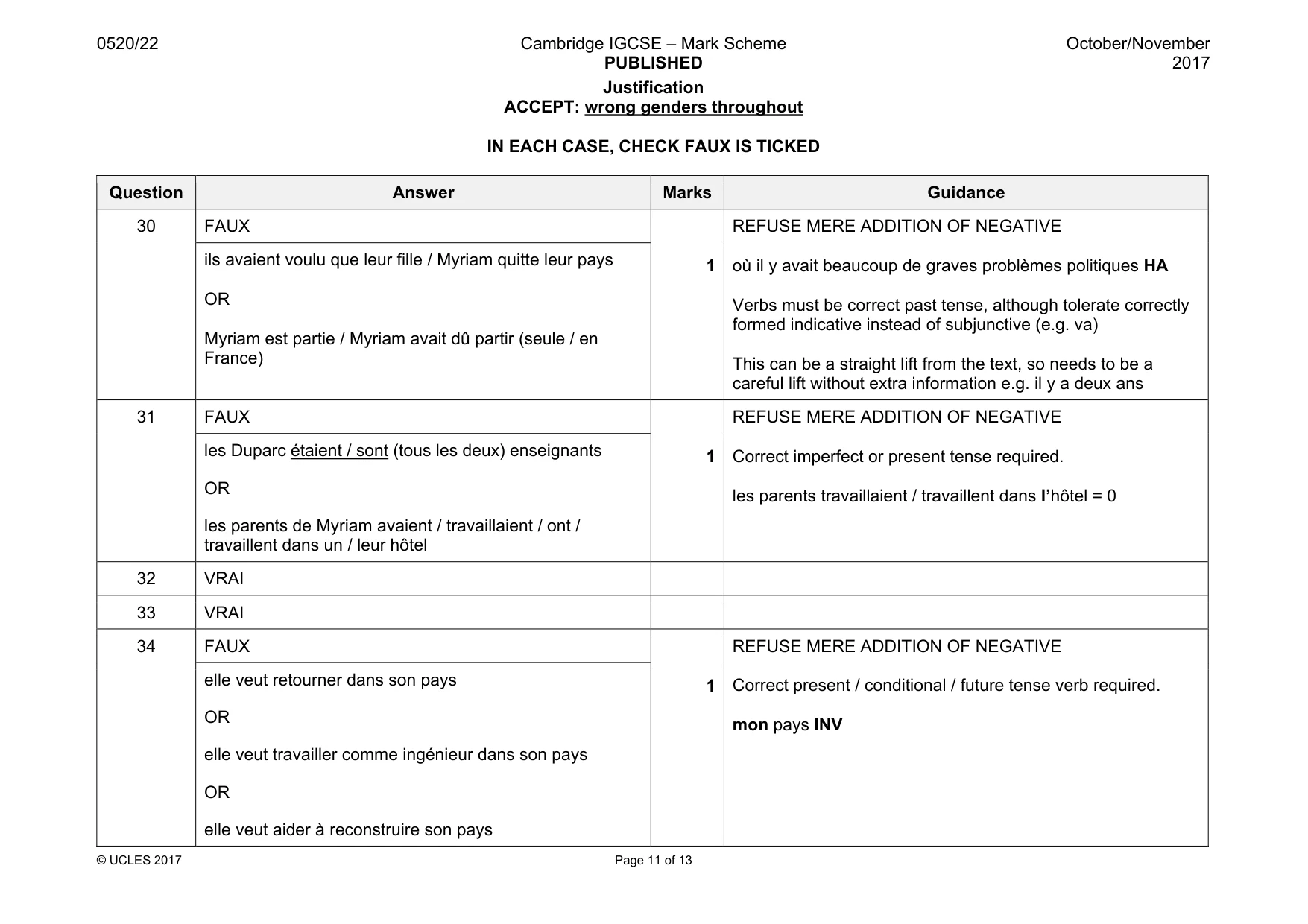
0520/22 Cambridge IGCSE – Mark Scheme PUBLISHED October/November 2017 © UCLES 2017 Page 10 of 13 Question Answer Marks Guidance VRAI FAUX 9 9 9 9 9 30 FAUX 1 See grid above for marking True/False element 31 FAUX 1 See grid above for marking True/False element 32 VRAI 1 See grid above for marking True/False element 33 VRAI 1 See grid above for marking True/False element 34 FAUX 1 See grid above for marking True/False element
Mark scheme, page 11
0520/22 Cambridge IGCSE – Mark Scheme PUBLISHED October/November 2017 © UCLES 2017 Page 11 of 13 Justification ACCEPT: wrong genders throughout IN EACH CASE, CHECK FAUX IS TICKED Question Answer Marks Guidance 30 FAUX 1 REFUSE MERE ADDITION OF NEGATIVE où il y avait beaucoup de graves problèmes politiques HA Verbs must be correct past tense, although tolerate correctly formed indicative instead of subjunctive (e.g. va) This can be a straight lift from the text, so needs to be a careful lift without extra information e.g. il y a deux ans ils avaient voulu que leur fille / Myriam quitte leur pays OR Myriam est partie / Myriam avait dû partir (seule / en France) 31 FAUX 1 REFUSE MERE ADDITION OF NEGATIVE Correct imperfect or present tense required. les parents travaillaient / travaillent dans l’hôtel = 0 les Duparc étaient / sont (tous les deux) enseignants OR les parents de Myriam avaient / travaillaient / ont / travaillent dans un / leur hôtel 32 VRAI 33 VRAI 34 FAUX 1 REFUSE MERE ADDITION OF NEGATIVE Correct present / conditional / future tense verb required. mon pays INV elle veut retourner dans son pays OR elle veut travailler comme ingénieur dans son pays OR elle veut aider à reconstruire son pays
Mark scheme, page 12
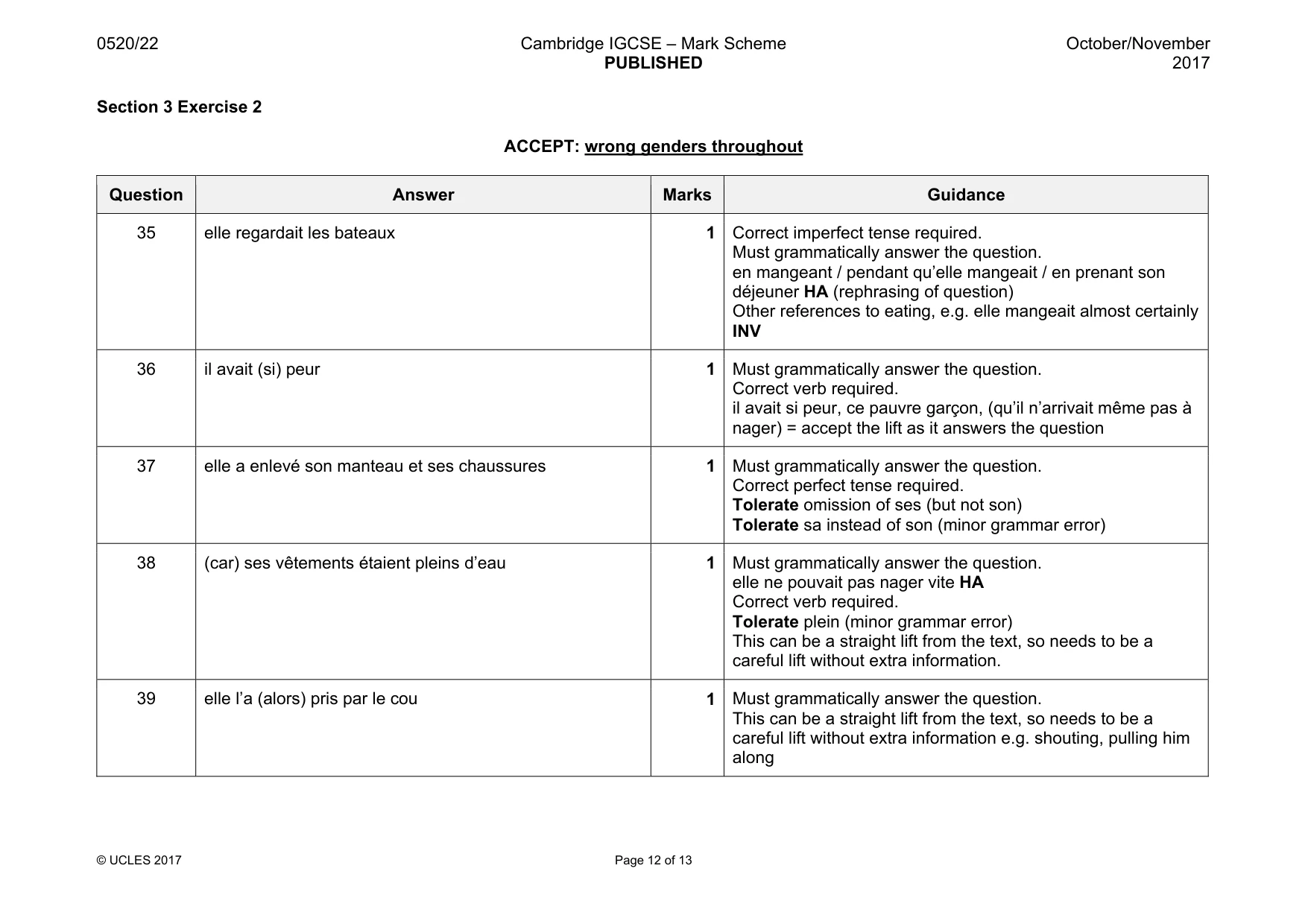
0520/22 Cambridge IGCSE – Mark Scheme PUBLISHED October/November 2017 © UCLES 2017 Page 12 of 13 Section 3 Exercise 2 ACCEPT: wrong genders throughout Question Answer Marks Guidance 35 elle regardait les bateaux 1 Correct imperfect tense required. Must grammatically answer the question. en mangeant / pendant qu’elle mangeait / en prenant son déjeuner HA (rephrasing of question) Other references to eating, e.g. elle mangeait almost certainly INV 36 il avait (si) peur 1 Must grammatically answer the question. Correct verb required. il avait si peur, ce pauvre garçon, (qu’il n’arrivait même pas à nager) = accept the lift as it answers the question 37 elle a enlevé son manteau et ses chaussures 1 Must grammatically answer the question. Correct perfect tense required. Tolerate omission of ses (but not son) Tolerate sa instead of son (minor grammar error) 38 (car) ses vêtements étaient pleins d’eau 1 Must grammatically answer the question. elle ne pouvait pas nager vite HA Correct verb required. Tolerate plein (minor grammar error) This can be a straight lift from the text, so needs to be a careful lift without extra information. 39 elle l’a (alors) pris par le cou 1 Must grammatically answer the question. This can be a straight lift from the text, so needs to be a careful lift without extra information e.g. shouting, pulling him along
Mark scheme, page 13
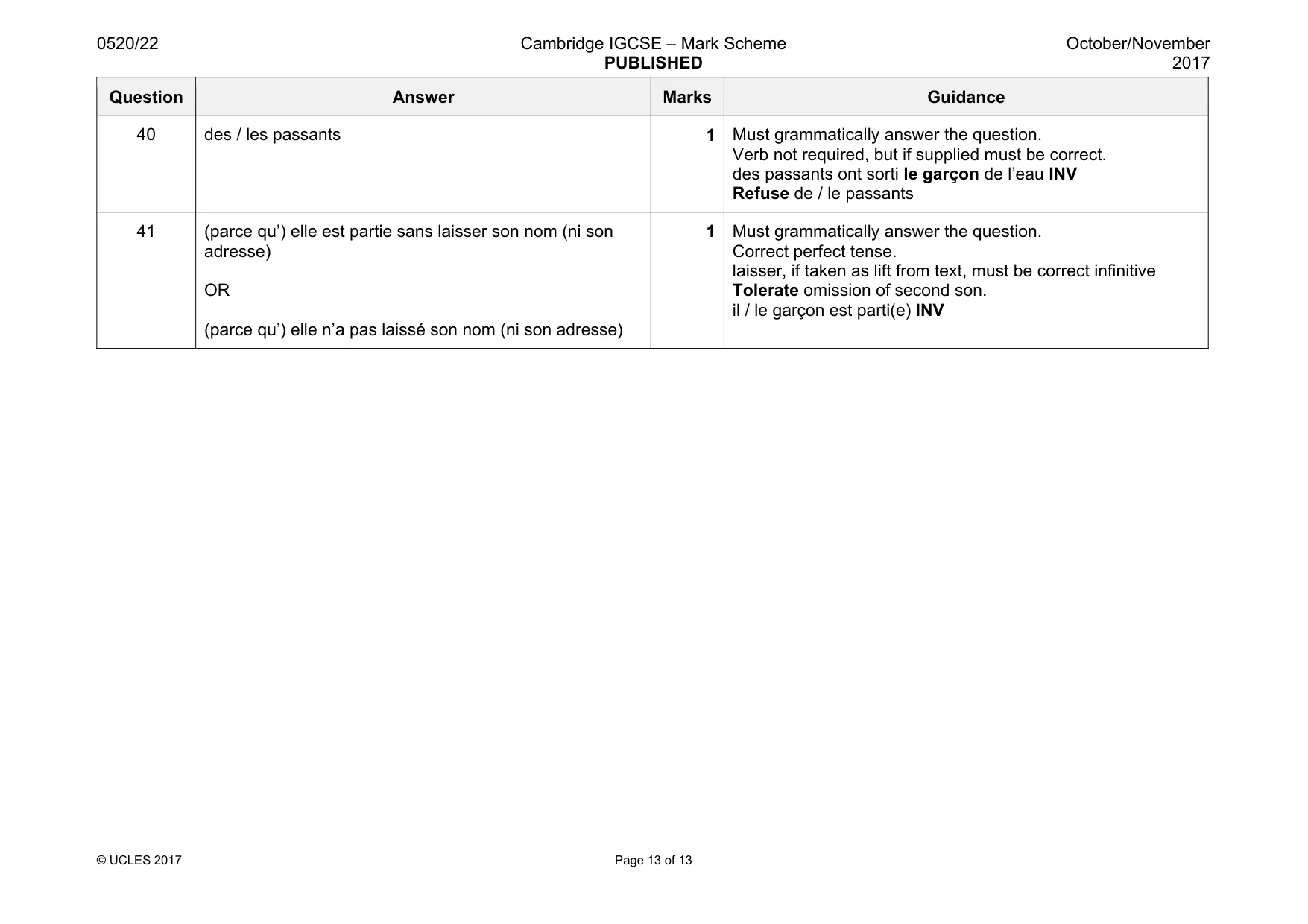
0520/22 Cambridge IGCSE – Mark Scheme PUBLISHED October/November 2017 © UCLES 2017 Page 13 of 13 Question Answer Marks Guidance 40 des / les passants 1 Must grammatically answer the question. Verb not required, but if supplied must be correct. des passants ont sorti le garçon de l’eau INV Refuse de / le passants 41 (parce qu’) elle est partie sans laisser son nom (ni son adresse) OR (parce qu’) elle n’a pas laissé son nom (ni son adresse) 1 Must grammatically answer the question. Correct perfect tense. laisser, if taken as lift from text, must be correct infinitive Tolerate omission of second son. il / le garçon est parti(e) INV
What you needed in this session
Cambridge’s own grade thresholds for 2017 Oct/Nov, Paper 2 · Variant 2. A higher threshold means an easier paper — the bar moves with how the cohort did.