Cambridge IGCSE Food and Nutrition 0648 — 2021 Oct/Nov Paper 1 · Variant 2
0648/12/O/N/21 · 100 marks · ≈113 min
The question paper and its mark scheme, free to read here and free to download. This is Cambridge’s own paper, exactly as it was sat.
Question paper12 pages

Mark scheme15 pages
Answers below. Sit the paper first if you are practising.
Paper as text
Question paper, page 1
This document has 12 pages. Cambridge IGCSE™ DC (KN/SG) 201819/2 © UCLES 2021 [Turn over * 2 2 3 4 9 8 2 9 7 2 * FOOD & NUTRITION 0648/12 Paper 1 Theory October/November 2021 2 hours You must answer on the question paper. No additional materials are needed. INSTRUCTIONS ● Section A: answer all questions. ● Section B: answer all questions. ● Section C: answer one question. ● Use a black or dark blue pen. You may use an HB pencil for any diagrams or graphs. ● Write your name, centre number and candidate number in the boxes at the top of the page. ● Write your answer to each question in the space provided. ● Do not use an erasable pen or correction fluid. ● Do not write on any bar codes. INFORMATION ● The total mark for this paper is 100. ● The number of marks for each question or part question is shown in brackets [ ].
Question paper, page 2
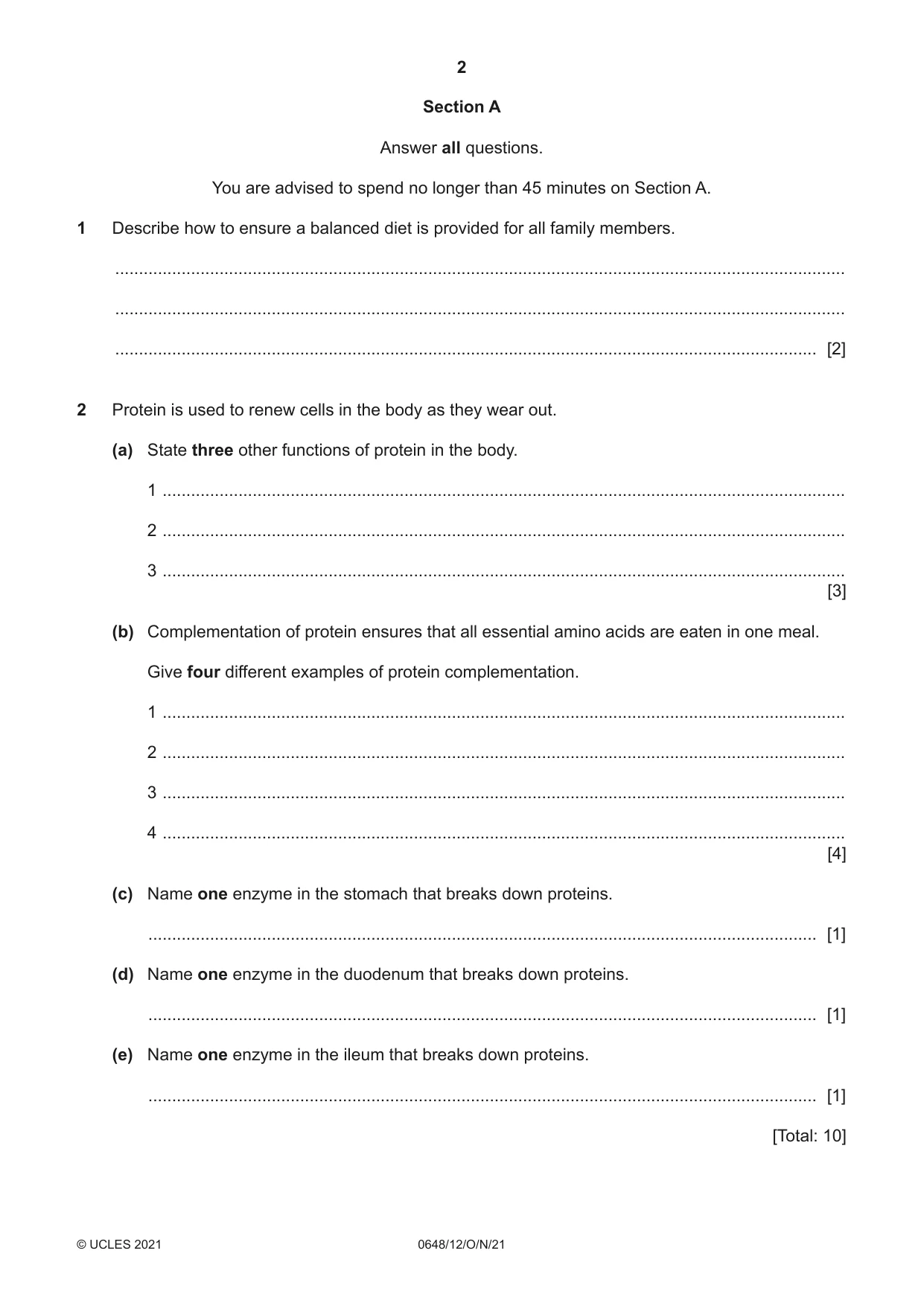
2 0648/12/O/N/21 © UCLES 2021 Section A Answer all questions. You are advised to spend no longer than 45 minutes on Section A. 1 Describe how to ensure a balanced diet is provided for all family members. … … … [2] 2 Protein is used to renew cells in the body as they wear out. (a) State three other functions of protein in the body. 1 … 2 … 3 … [3] (b) Complementation of protein ensures that all essential amino acids are eaten in one meal. Give four different examples of protein complementation. 1 … 2 … 3 … 4 … [4] (c) Name one enzyme in the stomach that breaks down proteins. … [1] (d) Name one enzyme in the duodenum that breaks down proteins. … [1] (e) Name one enzyme in the ileum that breaks down proteins. … [1] [Total: 10]
Question paper, page 3
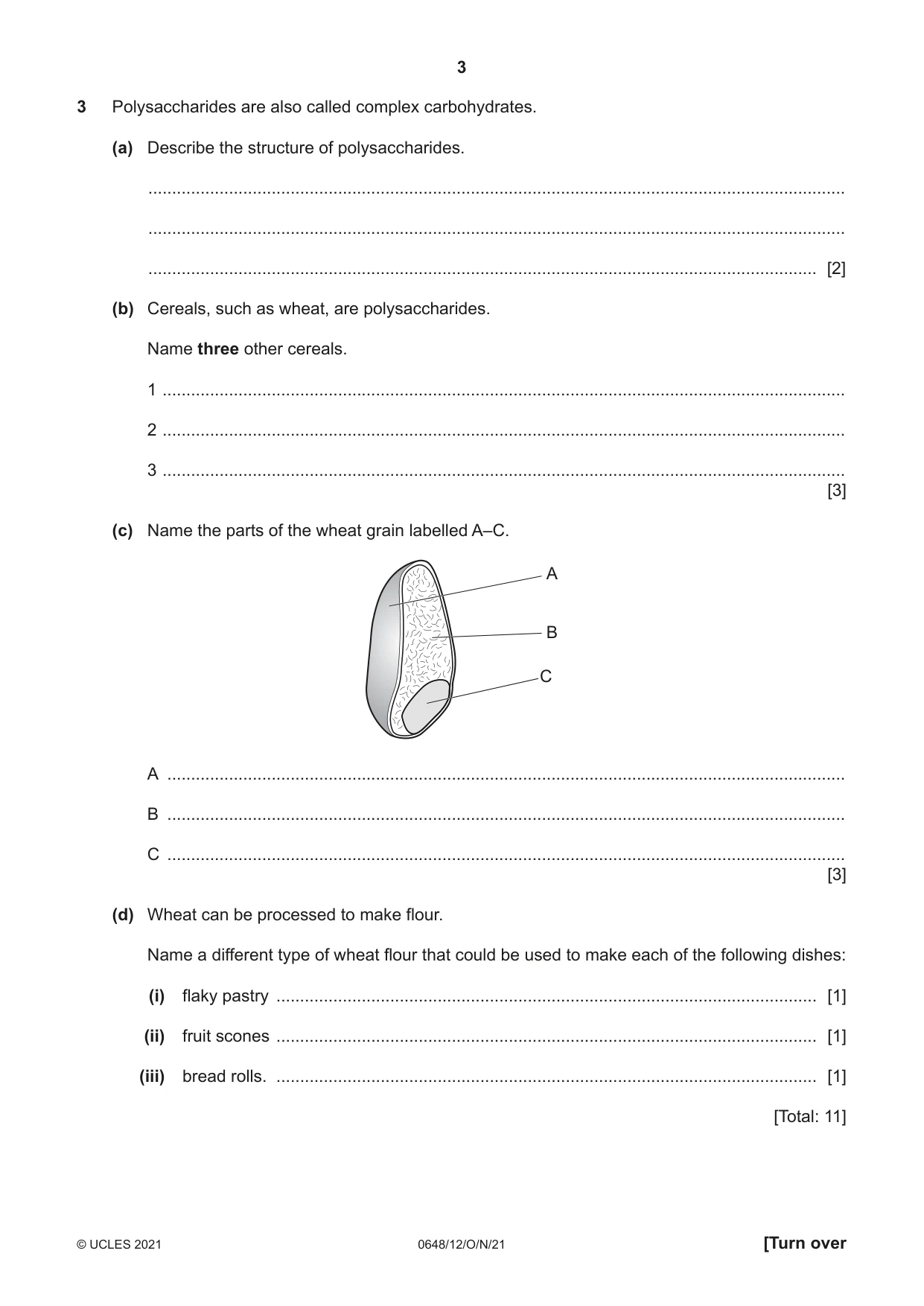
3 0648/12/O/N/21 © UCLES 2021 [Turn over 3 Polysaccharides are also called complex carbohydrates. (a) Describe the structure of polysaccharides. … … … [2] (b) Cereals, such as wheat, are polysaccharides. Name three other cereals. 1 … 2 … 3 … [3] (c) Name the parts of the wheat grain labelled A–C. A B C A … B … C … [3] (d) Wheat can be processed to make flour. Name a different type of wheat flour that could be used to make each of the following dishes: (i) flaky pastry … [1] (ii) fruit scones … [1] (iii) bread rolls. … [1] [Total: 11]
Question paper, page 4
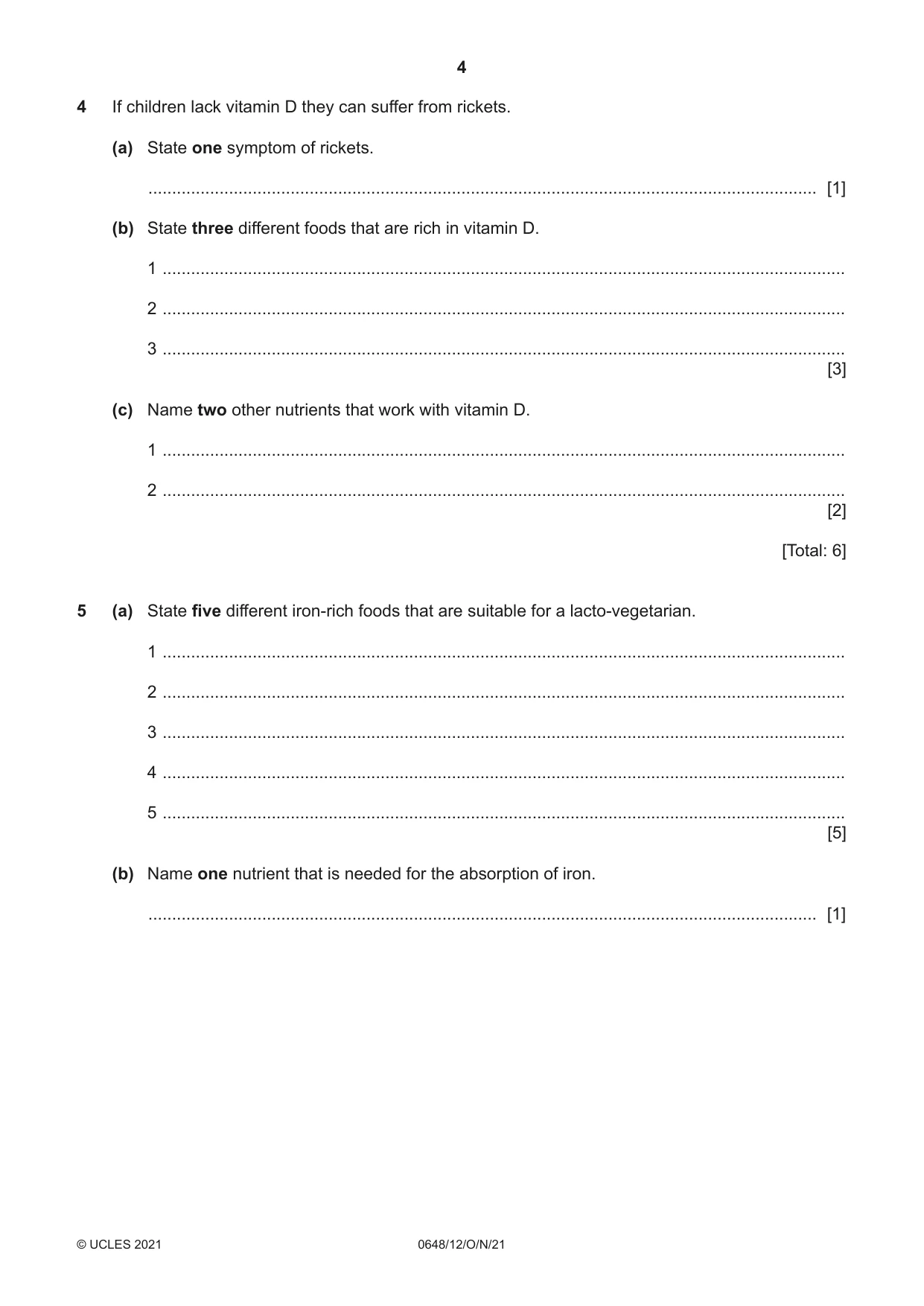
4 0648/12/O/N/21 © UCLES 2021 4 If children lack vitamin D they can suffer from rickets. (a) State one symptom of rickets. … [1] (b) State three different foods that are rich in vitamin D. 1 … 2 … 3 … [3] (c) Name two other nutrients that work with vitamin D. 1 … 2 … [2] [Total: 6] 5 (a) State five different iron-rich foods that are suitable for a lacto-vegetarian. 1 … 2 … 3 … 4 … 5 … [5] (b) Name one nutrient that is needed for the absorption of iron. … [1]
Question paper, page 5
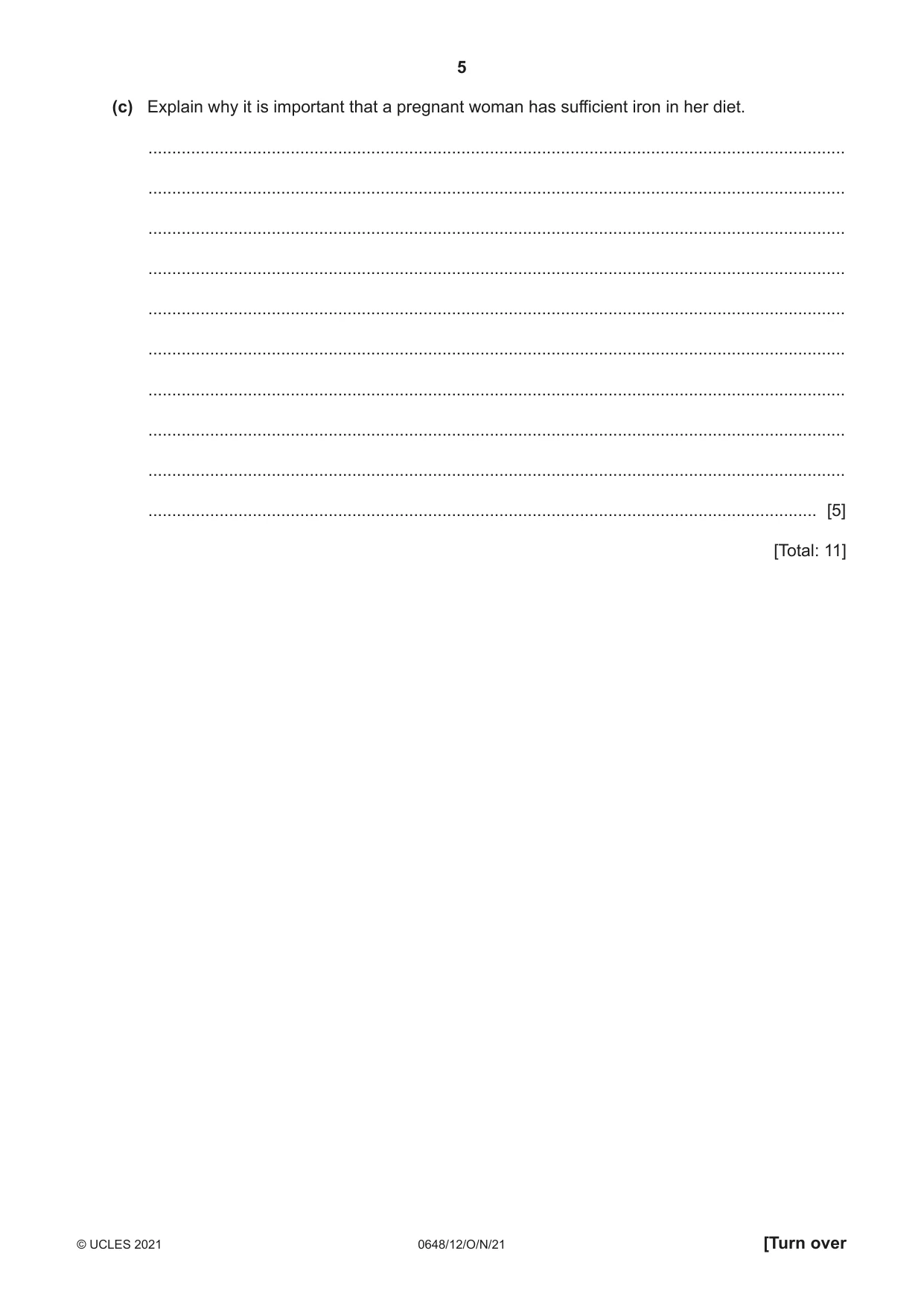
5 0648/12/O/N/21 © UCLES 2021 [Turn over (c) Explain why it is important that a pregnant woman has sufficient iron in her diet. … … … … … … … … … … [5] [Total: 11]
Question paper, page 6
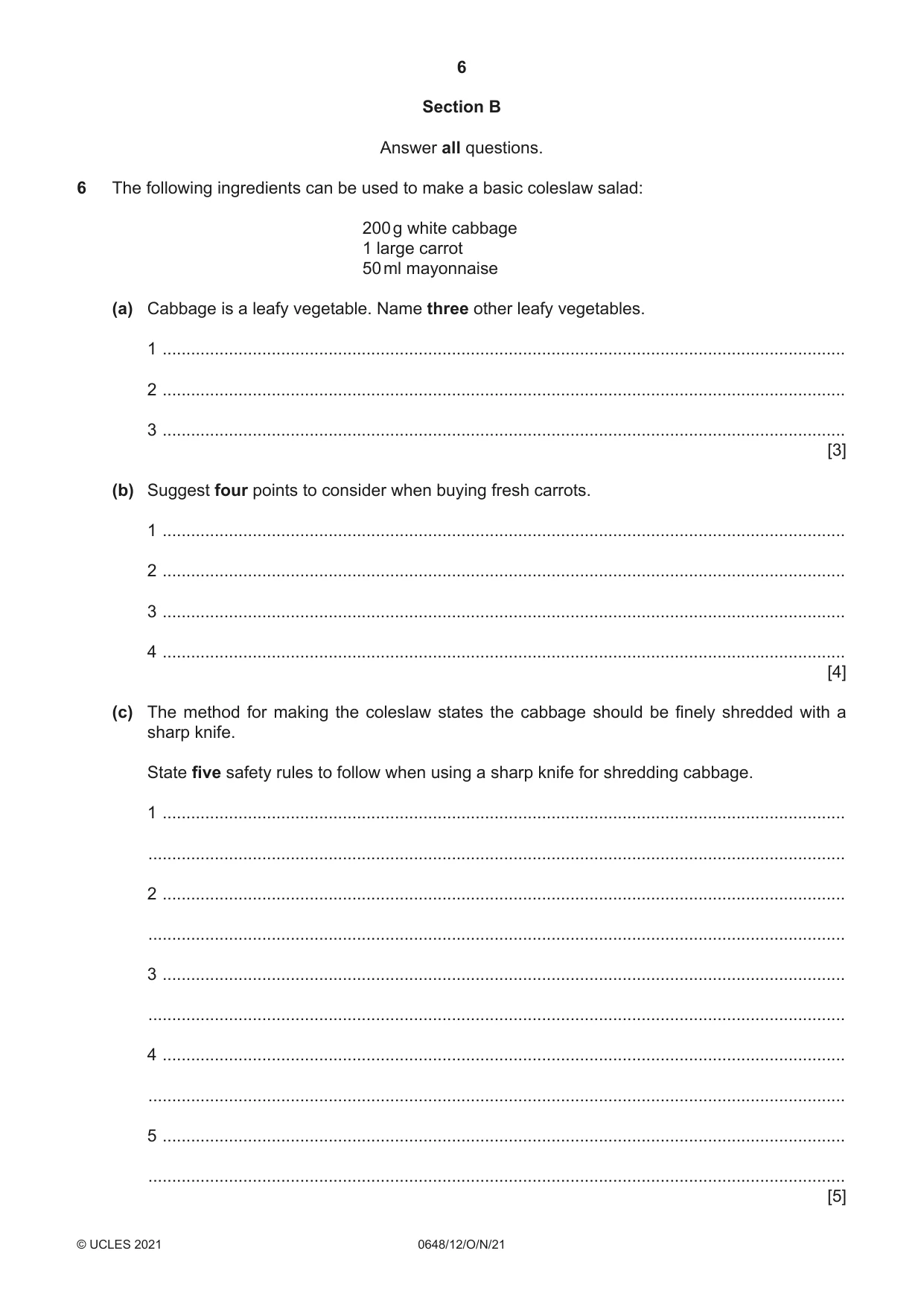
6 0648/12/O/N/21 © UCLES 2021 Section B Answer all questions. 6 The following ingredients can be used to make a basic coleslaw salad: 200 g white cabbage 1 large carrot 50 ml mayonnaise (a) Cabbage is a leafy vegetable. Name three other leafy vegetables. 1 … 2 … 3 … [3] (b) Suggest four points to consider when buying fresh carrots. 1 … 2 … 3 … 4 … [4] (c) The method for making the coleslaw states the cabbage should be finely shredded with a sharp knife. State five safety rules to follow when using a sharp knife for shredding cabbage. 1 … … 2 … … 3 … … 4 … … 5 … … [5]
Question paper, page 7
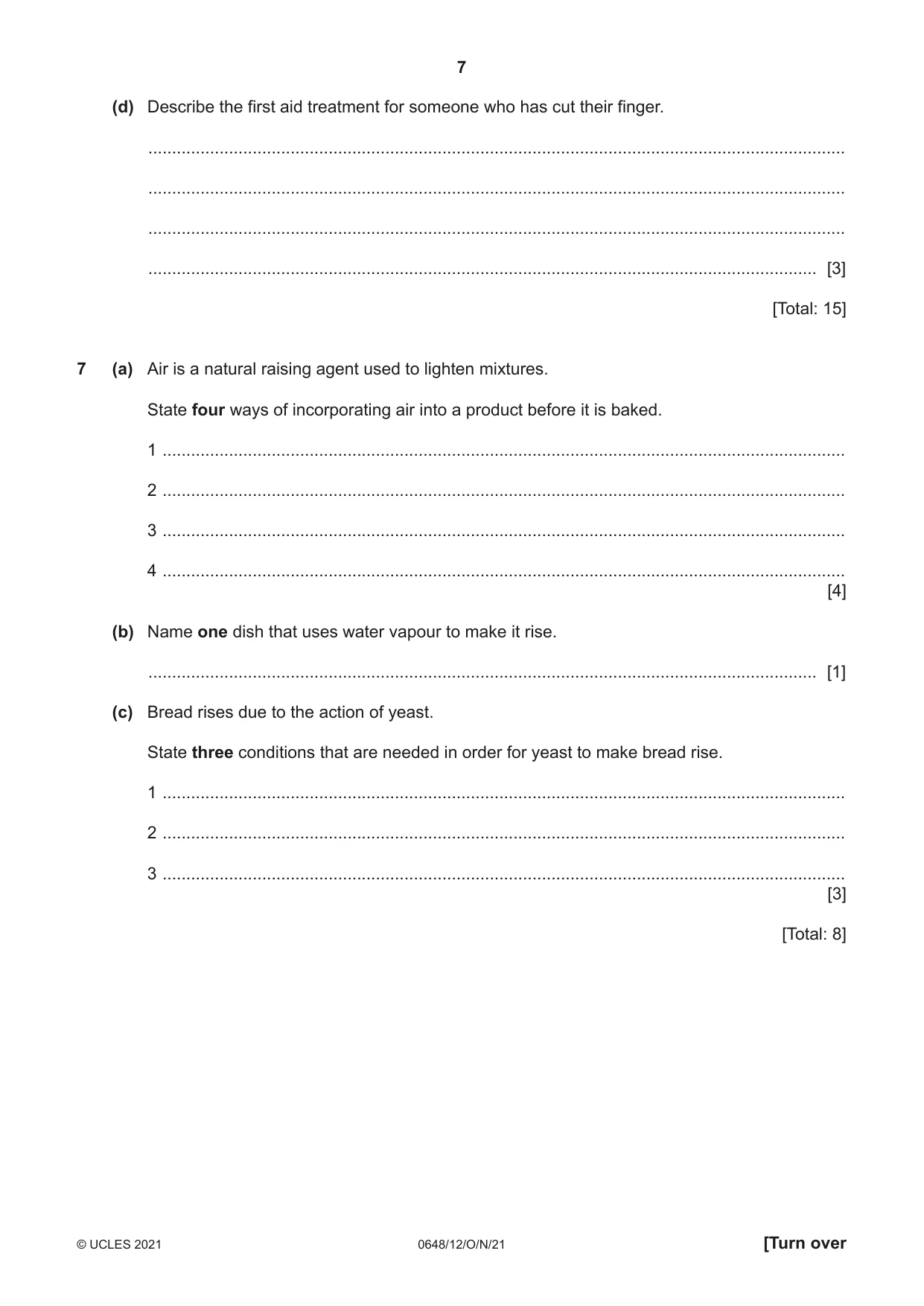
7 0648/12/O/N/21 © UCLES 2021 [Turn over (d) Describe the first aid treatment for someone who has cut their finger. … … … … [3] [Total: 15] 7 (a) Air is a natural raising agent used to lighten mixtures. State four ways of incorporating air into a product before it is baked. 1 … 2 … 3 … 4 … [4] (b) Name one dish that uses water vapour to make it rise. … [1] (c) Bread rises due to the action of yeast. State three conditions that are needed in order for yeast to make bread rise. 1 … 2 … 3 … [3] [Total: 8]
Question paper, page 8
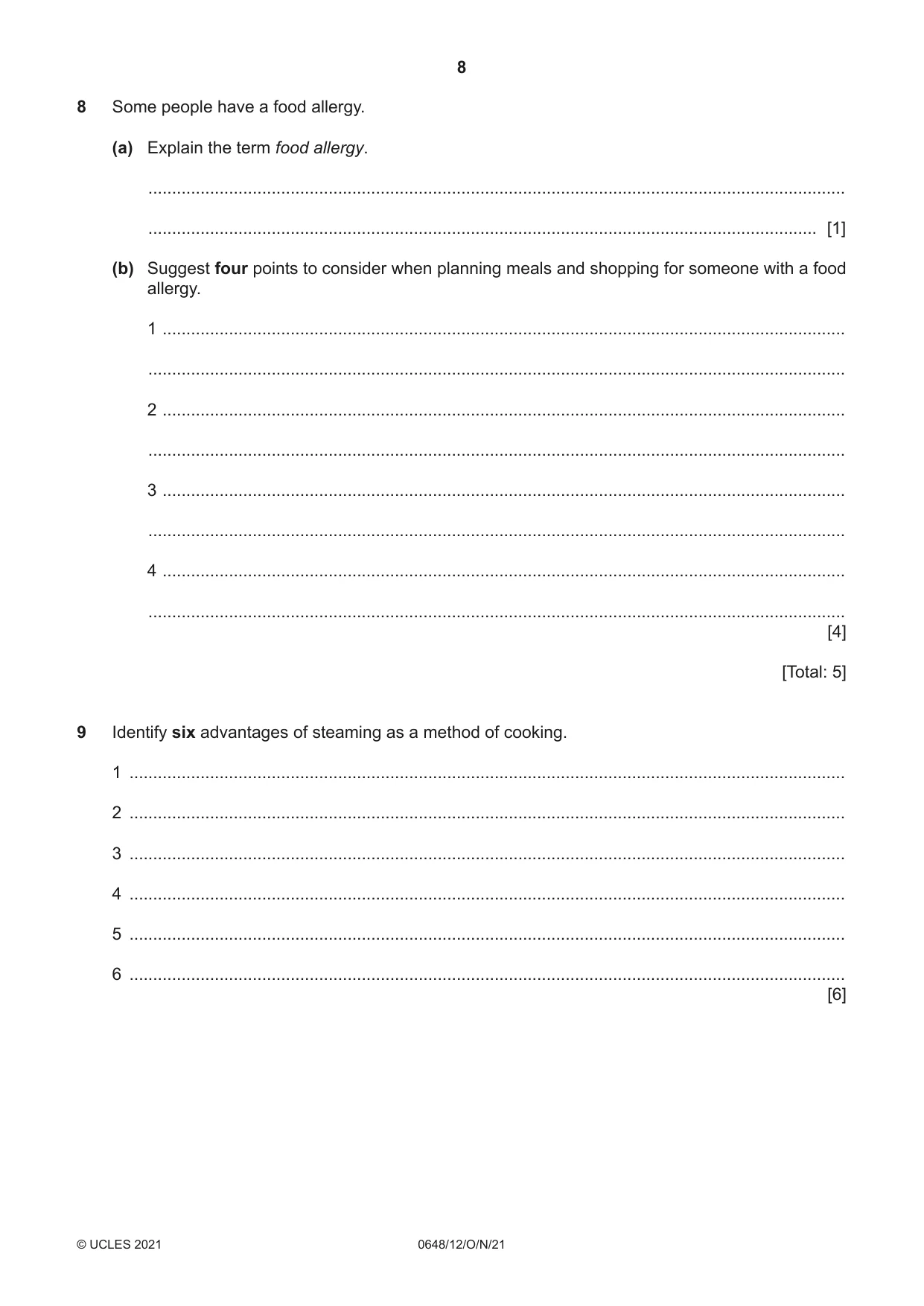
8 0648/12/O/N/21 © UCLES 2021 8 Some people have a food allergy. (a) Explain the term food allergy. … … [1] (b) Suggest four points to consider when planning meals and shopping for someone with a food allergy. 1 … … 2 … … 3 … … 4 … … [4] [Total: 5] 9 Identify six advantages of steaming as a method of cooking. 1 … 2 … 3 … 4 … 5 … 6 … [6]
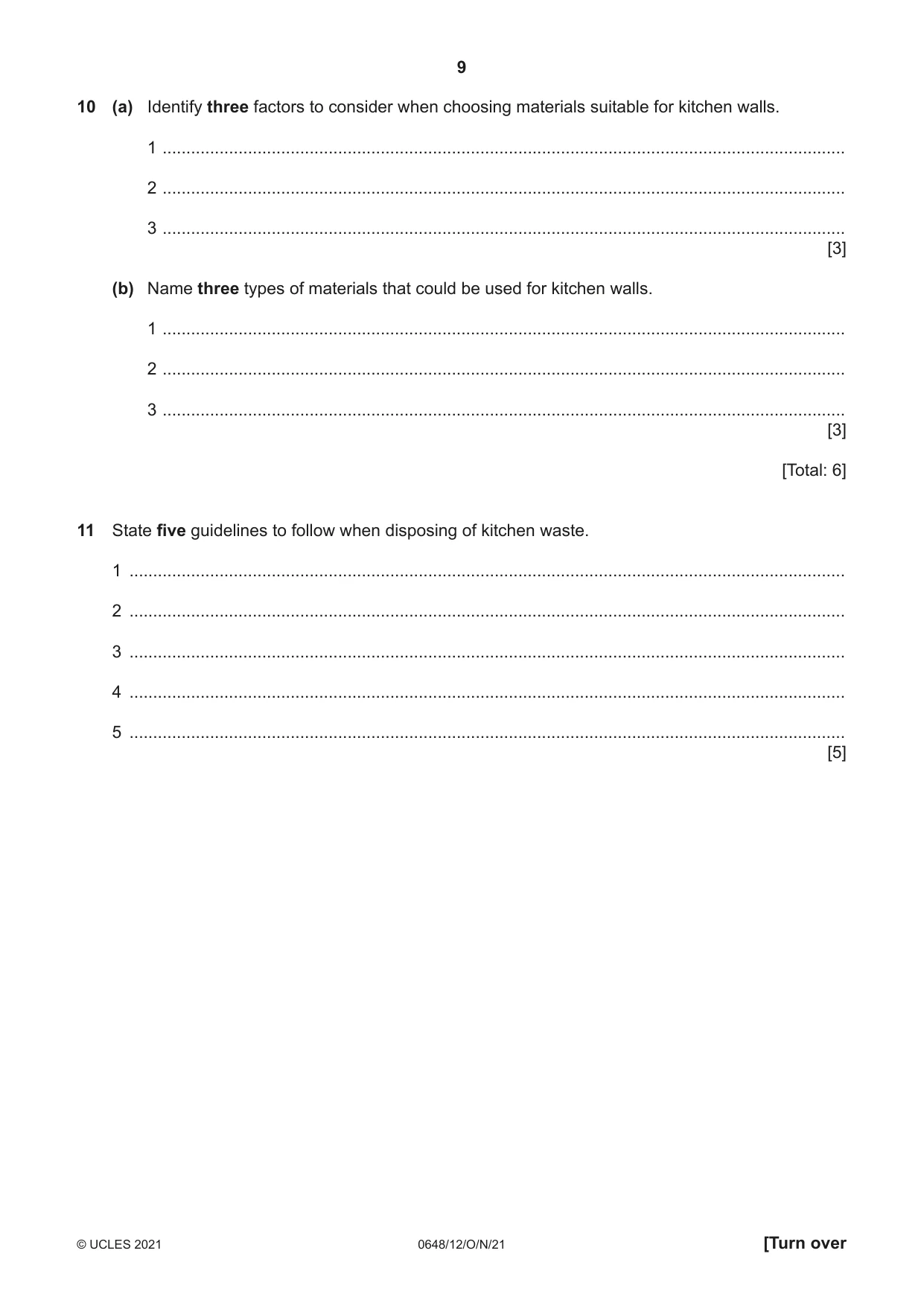
Question paper, page 9
9 0648/12/O/N/21 © UCLES 2021 [Turn over 10 (a) Identify three factors to consider when choosing materials suitable for kitchen walls. 1 … 2 … 3 … [3] (b) Name three types of materials that could be used for kitchen walls. 1 … 2 … 3 … [3] [Total: 6] 11 State five guidelines to follow when disposing of kitchen waste. 1 … 2 … 3 … 4 … 5 … [5]
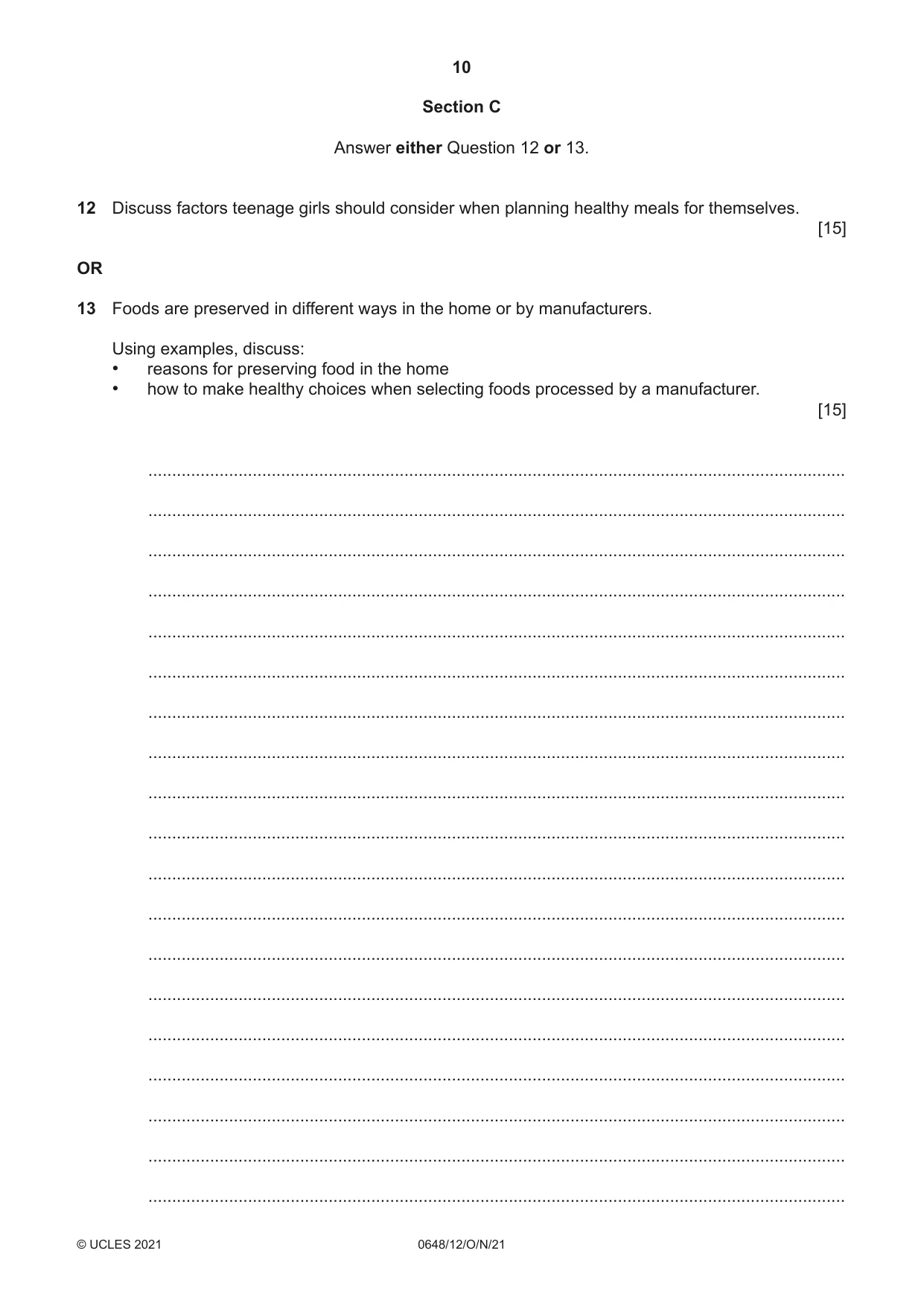
Question paper, page 10
10 0648/12/O/N/21 © UCLES 2021 Section C Answer either Question 12 or 13. 12 Discuss factors teenage girls should consider when planning healthy meals for themselves. [15] OR 13 Foods are preserved in different ways in the home or by manufacturers. Using examples, discuss: • reasons for preserving food in the home • how to make healthy choices when selecting foods processed by a manufacturer. [15] … … … … … … … … … … … … … … … … … … …
Question paper, page 11
11 0648/12/O/N/21 © UCLES 2021 [Turn over … … … … … … … … … … … … … … … … … … … … … … … … … … … …
Question paper, page 12
12 0648/12/O/N/21 © UCLES 2021 Permission to reproduce items where third-party owned material protected by copyright is included has been sought and cleared where possible. Every reasonable effort has been made by the publisher (UCLES) to trace copyright holders, but if any items requiring clearance have unwittingly been included, the publisher will be pleased to make amends at the earliest possible opportunity. To avoid the issue of disclosure of answer-related information to candidates, all copyright acknowledgements are reproduced online in the Cambridge Assessment International Education Copyright Acknowledgements Booklet. This is produced for each series of examinations and is freely available to download at www.cambridgeinternational.org after the live examination series. Cambridge Assessment International Education is part of the Cambridge Assessment Group. Cambridge Assessment is the brand name of the University of Cambridge Local Examinations Syndicate (UCLES), which itself is a department of the University of Cambridge. … … … … … … … … … … … … … … … … … … … … … … … …
Mark scheme, page 1
This document consists of 15 printed pages. © UCLES 2021 [Turn over Cambridge IGCSE™ FOOD & NUTRITION 0648/12 Paper 1 Theory October/November 2021 MARK SCHEME Maximum Mark: 100 Published This mark scheme is published as an aid to teachers and candidates, to indicate the requirements of the examination. It shows the basis on which Examiners were instructed to award marks. It does not indicate the details of the discussions that took place at an Examiners’ meeting before marking began, which would have considered the acceptability of alternative answers. Mark schemes should be read in conjunction with the question paper and the Principal Examiner Report for Teachers. Cambridge International will not enter into discussions about these mark schemes. Cambridge International is publishing the mark schemes for the October/November 2021 series for most Cambridge IGCSE™, Cambridge International A and AS Level components and some Cambridge O Level components.
Mark scheme, page 2
0648/12 Cambridge IGCSE – Mark Scheme PUBLISHED October/November 2021 © UCLES 2021 Page 2 of 15 Generic Marking Principles These general marking principles must be applied by all examiners when marking candidate answers. They should be applied alongside the specific content of the mark scheme or generic level descriptors for a question. Each question paper and mark scheme will also comply with these marking principles. GENERIC MARKING PRINCIPLE 1: Marks must be awarded in line with: • the specific content of the mark scheme or the generic level descriptors for the question • the specific skills defined in the mark scheme or in the generic level descriptors for the question • the standard of response required by a candidate as exemplified by the standardisation scripts. GENERIC MARKING PRINCIPLE 2: Marks awarded are always whole marks (not half marks, or other fractions). GENERIC MARKING PRINCIPLE 3: Marks must be awarded positively: • marks are awarded for correct/valid answers, as defined in the mark scheme. However, credit is given for valid answers which go beyond the scope of the syllabus and mark scheme, referring to your Team Leader as appropriate • marks are awarded when candidates clearly demonstrate what they know and can do • marks are not deducted for errors • marks are not deducted for omissions • answers should only be judged on the quality of spelling, punctuation and grammar when these features are specifically assessed by the question as indicated by the mark scheme. The meaning, however, should be unambiguous. GENERIC MARKING PRINCIPLE 4: Rules must be applied consistently, e.g. in situations where candidates have not followed instructions or in the application of generic level descriptors.
Mark scheme, page 3
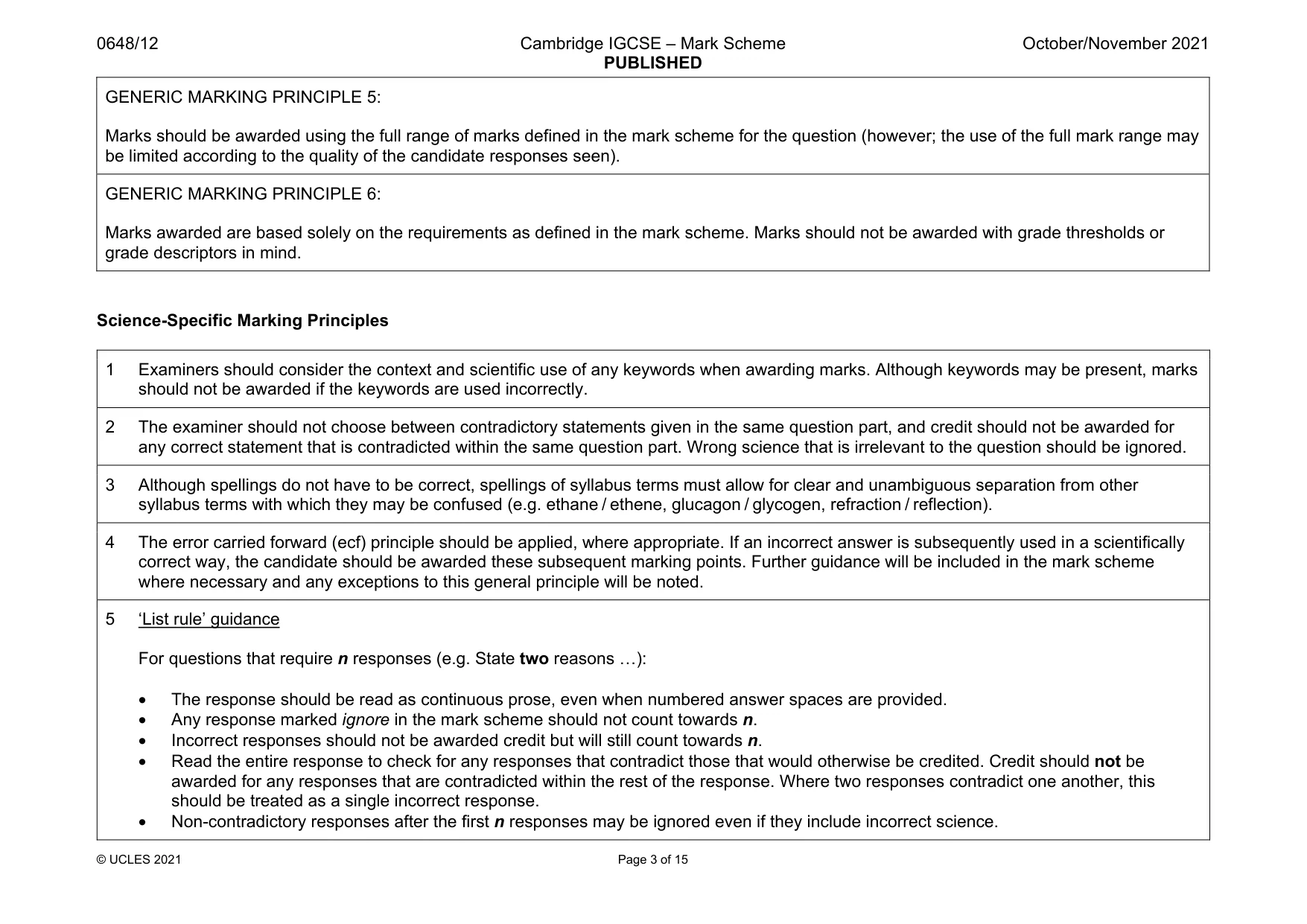
0648/12 Cambridge IGCSE – Mark Scheme PUBLISHED October/November 2021 © UCLES 2021 Page 3 of 15 GENERIC MARKING PRINCIPLE 5: Marks should be awarded using the full range of marks defined in the mark scheme for the question (however; the use of the full mark range may be limited according to the quality of the candidate responses seen). GENERIC MARKING PRINCIPLE 6: Marks awarded are based solely on the requirements as defined in the mark scheme. Marks should not be awarded with grade thresholds or grade descriptors in mind. Science-Specific Marking Principles 1 Examiners should consider the context and scientific use of any keywords when awarding marks. Although keywords may be present, marks should not be awarded if the keywords are used incorrectly. 2 The examiner should not choose between contradictory statements given in the same question part, and credit should not be awarded for any correct statement that is contradicted within the same question part. Wrong science that is irrelevant to the question should be ignored. 3 Although spellings do not have to be correct, spellings of syllabus terms must allow for clear and unambiguous separation from other syllabus terms with which they may be confused (e.g. ethane / ethene, glucagon / glycogen, refraction / reflection). 4 The error carried forward (ecf) principle should be applied, where appropriate. If an incorrect answer is subsequently used in a scientifically correct way, the candidate should be awarded these subsequent marking points. Further guidance will be included in the mark scheme where necessary and any exceptions to this general principle will be noted. 5 ‘List rule’ guidance For questions that require n responses (e.g. State two reasons …): • The response should be read as continuous prose, even when numbered answer spaces are provided. • Any response marked ignore in the mark scheme should not count towards n. • Incorrect responses should not be awarded credit but will still count towards n. • Read the entire response to check for any responses that contradict those that would otherwise be credited. Credit should not be awarded for any responses that are contradicted within the rest of the response. Where two responses contradict one another, this should be treated as a single incorrect response. • Non-contradictory responses after the first n responses may be ignored even if they include incorrect science.
Mark scheme, page 4
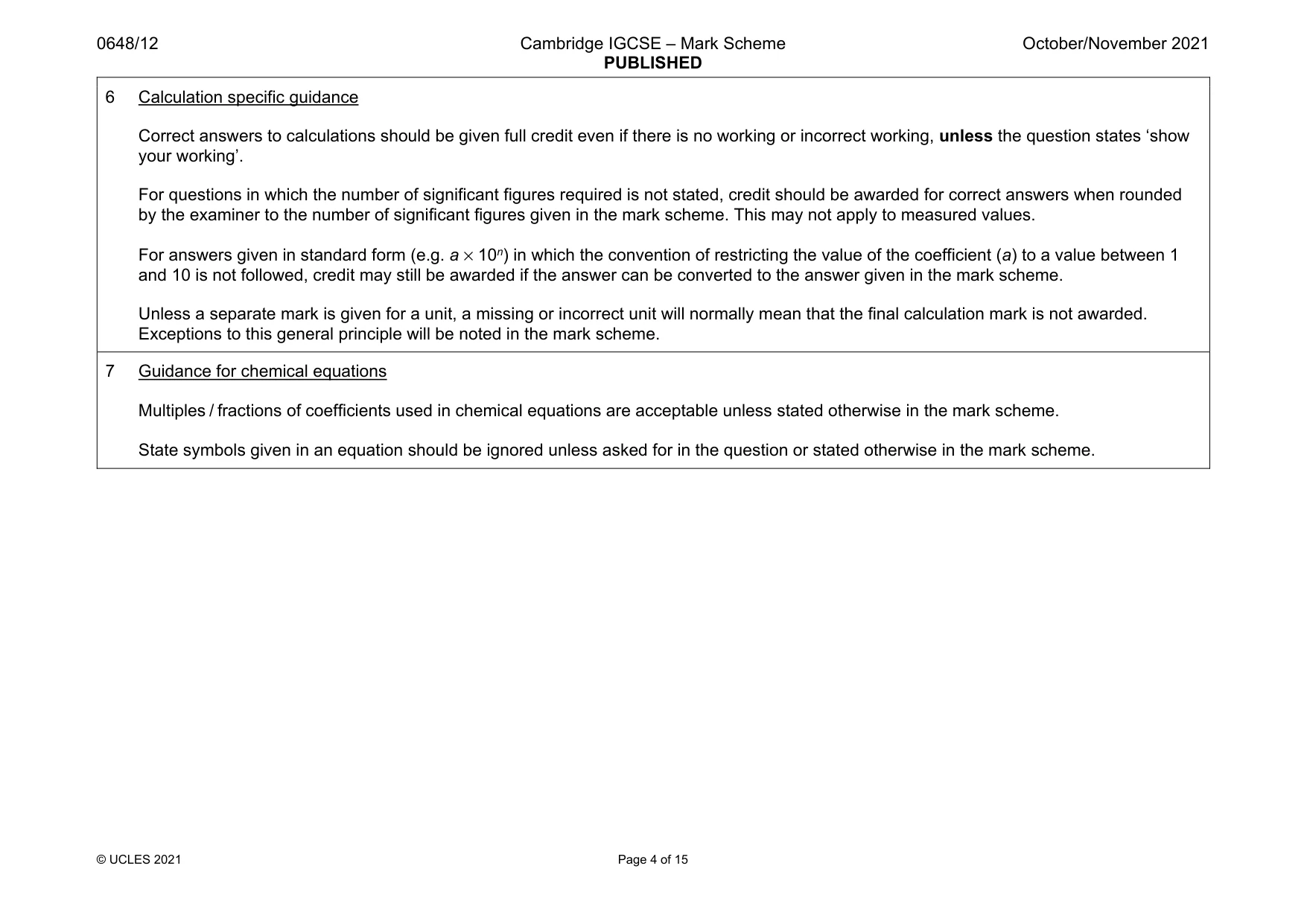
0648/12 Cambridge IGCSE – Mark Scheme PUBLISHED October/November 2021 © UCLES 2021 Page 4 of 15 6 Calculation specific guidance Correct answers to calculations should be given full credit even if there is no working or incorrect working, unless the question states ‘show your working’. For questions in which the number of significant figures required is not stated, credit should be awarded for correct answers when rounded by the examiner to the number of significant figures given in the mark scheme. This may not apply to measured values. For answers given in standard form (e.g. a × 10n) in which the convention of restricting the value of the coefficient (a) to a value between 1 and 10 is not followed, credit may still be awarded if the answer can be converted to the answer given in the mark scheme. Unless a separate mark is given for a unit, a missing or incorrect unit will normally mean that the final calculation mark is not awarded. Exceptions to this general principle will be noted in the mark scheme. 7 Guidance for chemical equations Multiples / fractions of coefficients used in chemical equations are acceptable unless stated otherwise in the mark scheme. State symbols given in an equation should be ignored unless asked for in the question or stated otherwise in the mark scheme.
Mark scheme, page 5
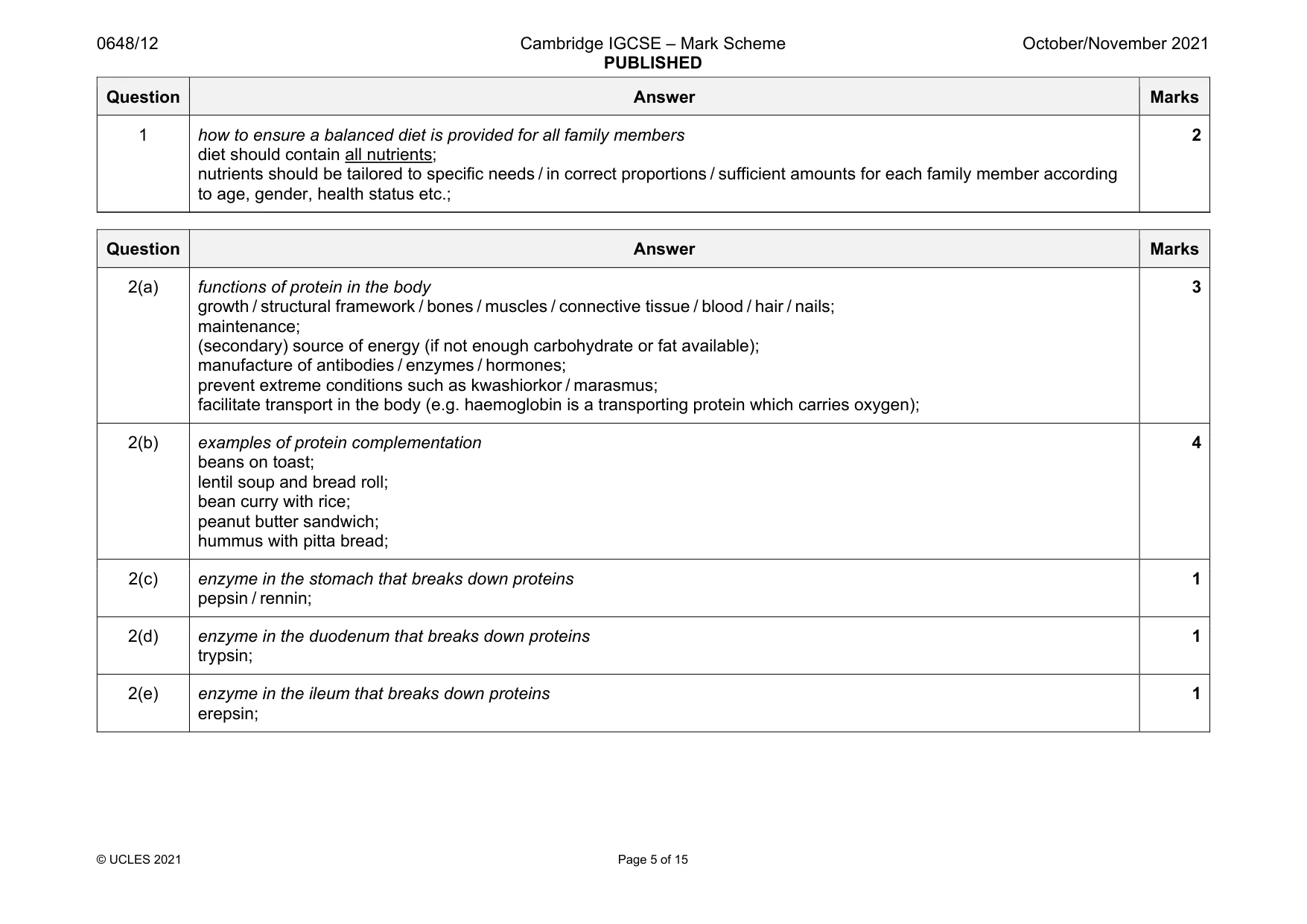
0648/12 Cambridge IGCSE – Mark Scheme PUBLISHED October/November 2021 © UCLES 2021 Page 5 of 15 Question Answer Marks 1 how to ensure a balanced diet is provided for all family members diet should contain all nutrients; nutrients should be tailored to specific needs / in correct proportions / sufficient amounts for each family member according to age, gender, health status etc.; 2 Question Answer Marks 2(a) functions of protein in the body growth / structural framework / bones / muscles / connective tissue / blood / hair / nails; maintenance; (secondary) source of energy (if not enough carbohydrate or fat available); manufacture of antibodies / enzymes / hormones; prevent extreme conditions such as kwashiorkor / marasmus; facilitate transport in the body (e.g. haemoglobin is a transporting protein which carries oxygen); 3 2(b) examples of protein complementation beans on toast; lentil soup and bread roll; bean curry with rice; peanut butter sandwich; hummus with pitta bread; 4 2(c) enzyme in the stomach that breaks down proteins pepsin / rennin; 1 2(d) enzyme in the duodenum that breaks down proteins trypsin; 1 2(e) enzyme in the ileum that breaks down proteins erepsin; 1
Mark scheme, page 6
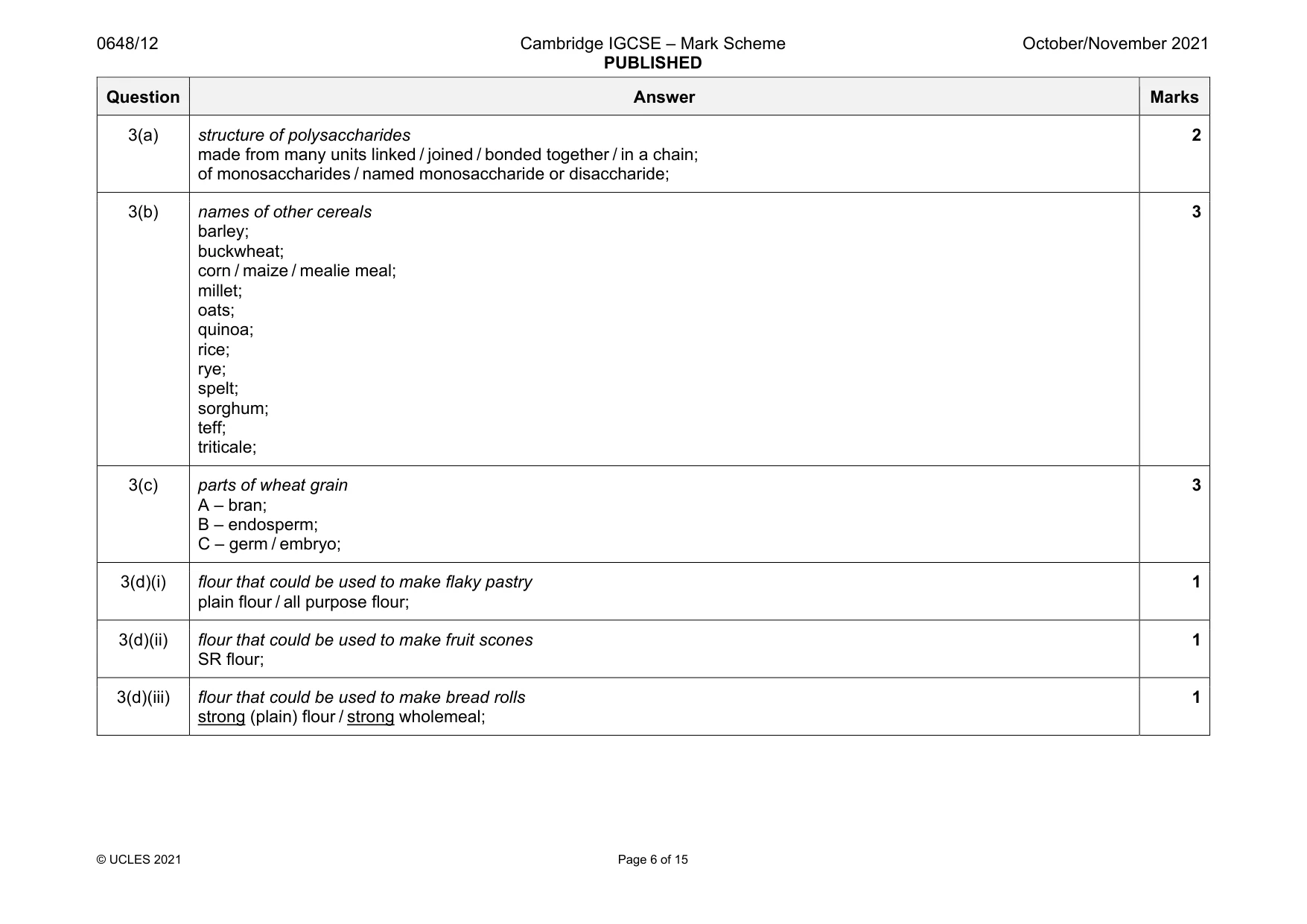
0648/12 Cambridge IGCSE – Mark Scheme PUBLISHED October/November 2021 © UCLES 2021 Page 6 of 15 Question Answer Marks 3(a) structure of polysaccharides made from many units linked / joined / bonded together / in a chain; of monosaccharides / named monosaccharide or disaccharide; 2 3(b) names of other cereals barley; buckwheat; corn / maize / mealie meal; millet; oats; quinoa; rice; rye; spelt; sorghum; teff; triticale; 3 3(c) parts of wheat grain A – bran; B – endosperm; C – germ / embryo; 3 3(d)(i) flour that could be used to make flaky pastry plain flour / all purpose flour; 1 3(d)(ii) flour that could be used to make fruit scones SR flour; 1 3(d)(iii) flour that could be used to make bread rolls strong (plain) flour / strong wholemeal; 1
Mark scheme, page 7
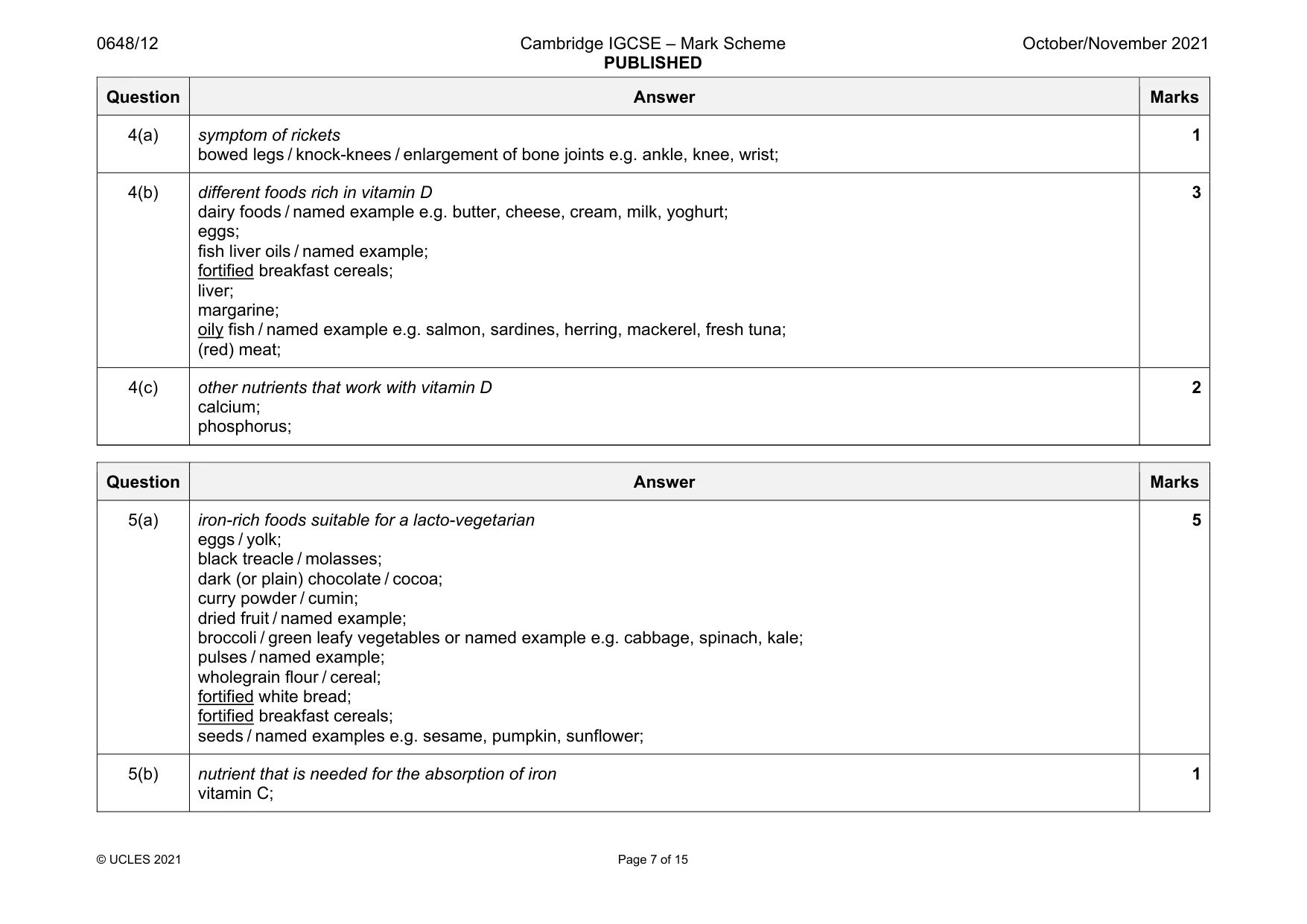
0648/12 Cambridge IGCSE – Mark Scheme PUBLISHED October/November 2021 © UCLES 2021 Page 7 of 15 Question Answer Marks 4(a) symptom of rickets bowed legs / knock-knees / enlargement of bone joints e.g. ankle, knee, wrist; 1 4(b) different foods rich in vitamin D dairy foods / named example e.g. butter, cheese, cream, milk, yoghurt; eggs; fish liver oils / named example; fortified breakfast cereals; liver; margarine; oily fish / named example e.g. salmon, sardines, herring, mackerel, fresh tuna; (red) meat; 3 4(c) other nutrients that work with vitamin D calcium; phosphorus; 2 Question Answer Marks 5(a) iron-rich foods suitable for a lacto-vegetarian eggs / yolk; black treacle / molasses; dark (or plain) chocolate / cocoa; curry powder / cumin; dried fruit / named example; broccoli / green leafy vegetables or named example e.g. cabbage, spinach, kale; pulses / named example; wholegrain flour / cereal; fortified white bread; fortified breakfast cereals; seeds / named examples e.g. sesame, pumpkin, sunflower; 5 5(b) nutrient that is needed for the absorption of iron vitamin C; 1
Mark scheme, page 8
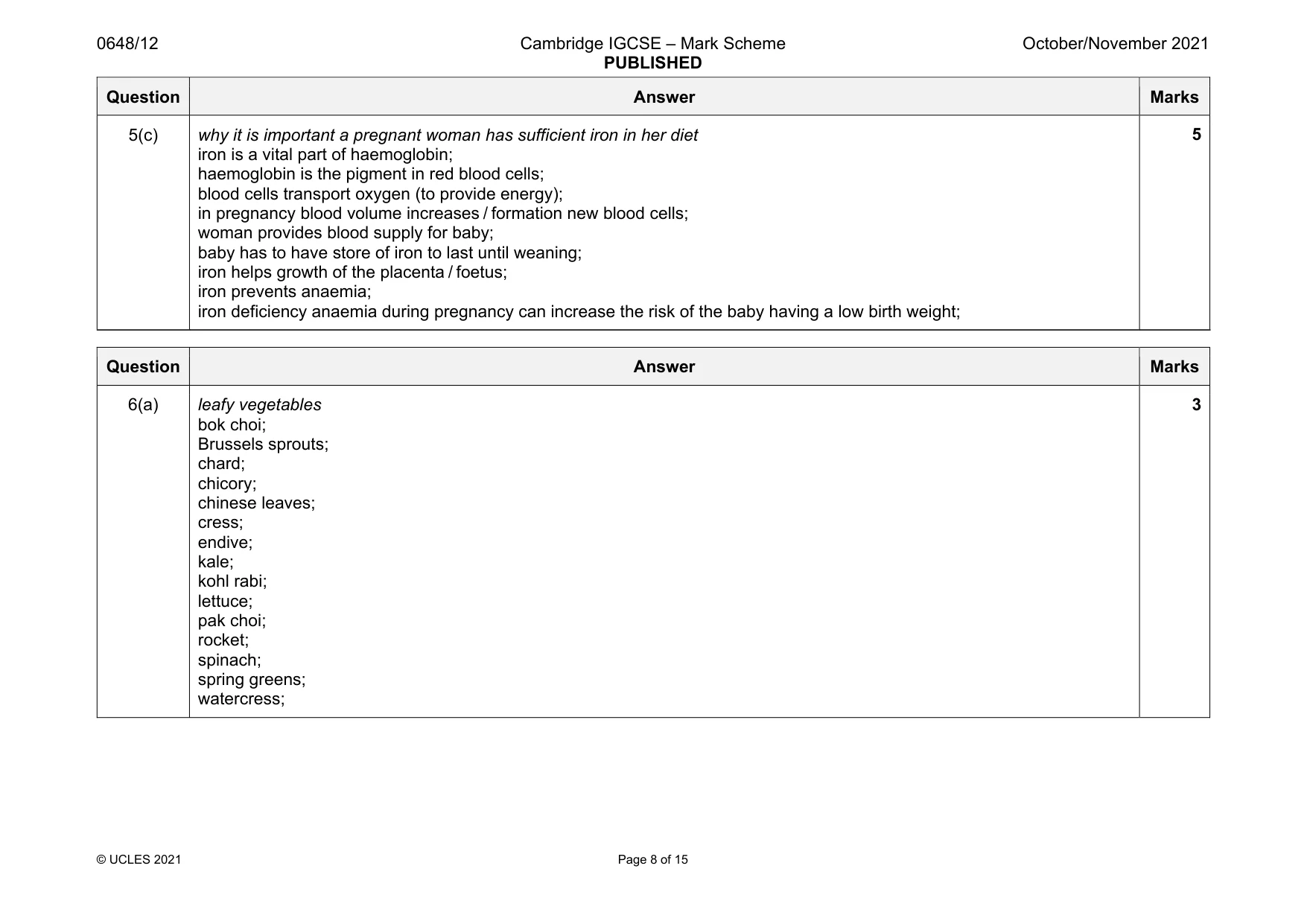
0648/12 Cambridge IGCSE – Mark Scheme PUBLISHED October/November 2021 © UCLES 2021 Page 8 of 15 Question Answer Marks 5(c) why it is important a pregnant woman has sufficient iron in her diet iron is a vital part of haemoglobin; haemoglobin is the pigment in red blood cells; blood cells transport oxygen (to provide energy); in pregnancy blood volume increases / formation new blood cells; woman provides blood supply for baby; baby has to have store of iron to last until weaning; iron helps growth of the placenta / foetus; iron prevents anaemia; iron deficiency anaemia during pregnancy can increase the risk of the baby having a low birth weight; 5 Question Answer Marks 6(a) leafy vegetables bok choi; Brussels sprouts; chard; chicory; chinese leaves; cress; endive; kale; kohl rabi; lettuce; pak choi; rocket; spinach; spring greens; watercress; 3
Mark scheme, page 9
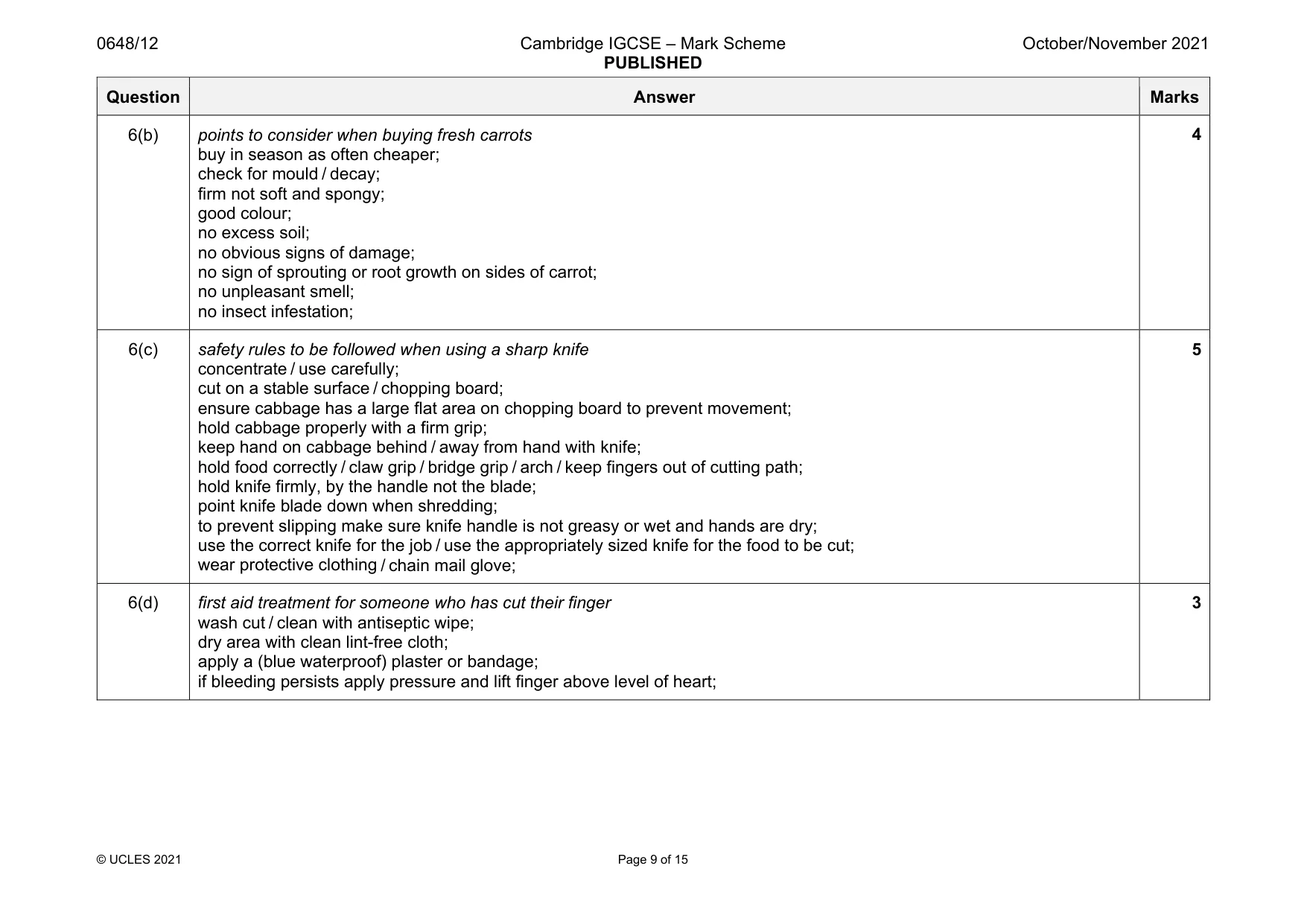
0648/12 Cambridge IGCSE – Mark Scheme PUBLISHED October/November 2021 © UCLES 2021 Page 9 of 15 Question Answer Marks 6(b) points to consider when buying fresh carrots buy in season as often cheaper; check for mould / decay; firm not soft and spongy; good colour; no excess soil; no obvious signs of damage; no sign of sprouting or root growth on sides of carrot; no unpleasant smell; no insect infestation; 4 6(c) safety rules to be followed when using a sharp knife concentrate / use carefully; cut on a stable surface / chopping board; ensure cabbage has a large flat area on chopping board to prevent movement; hold cabbage properly with a firm grip; keep hand on cabbage behind / away from hand with knife; hold food correctly / claw grip / bridge grip / arch / keep fingers out of cutting path; hold knife firmly, by the handle not the blade; point knife blade down when shredding; to prevent slipping make sure knife handle is not greasy or wet and hands are dry; use the correct knife for the job / use the appropriately sized knife for the food to be cut; wear protective clothing / chain mail glove; 5 6(d) first aid treatment for someone who has cut their finger wash cut / clean with antiseptic wipe; dry area with clean lint-free cloth; apply a (blue waterproof) plaster or bandage; if bleeding persists apply pressure and lift finger above level of heart; 3
Mark scheme, page 10
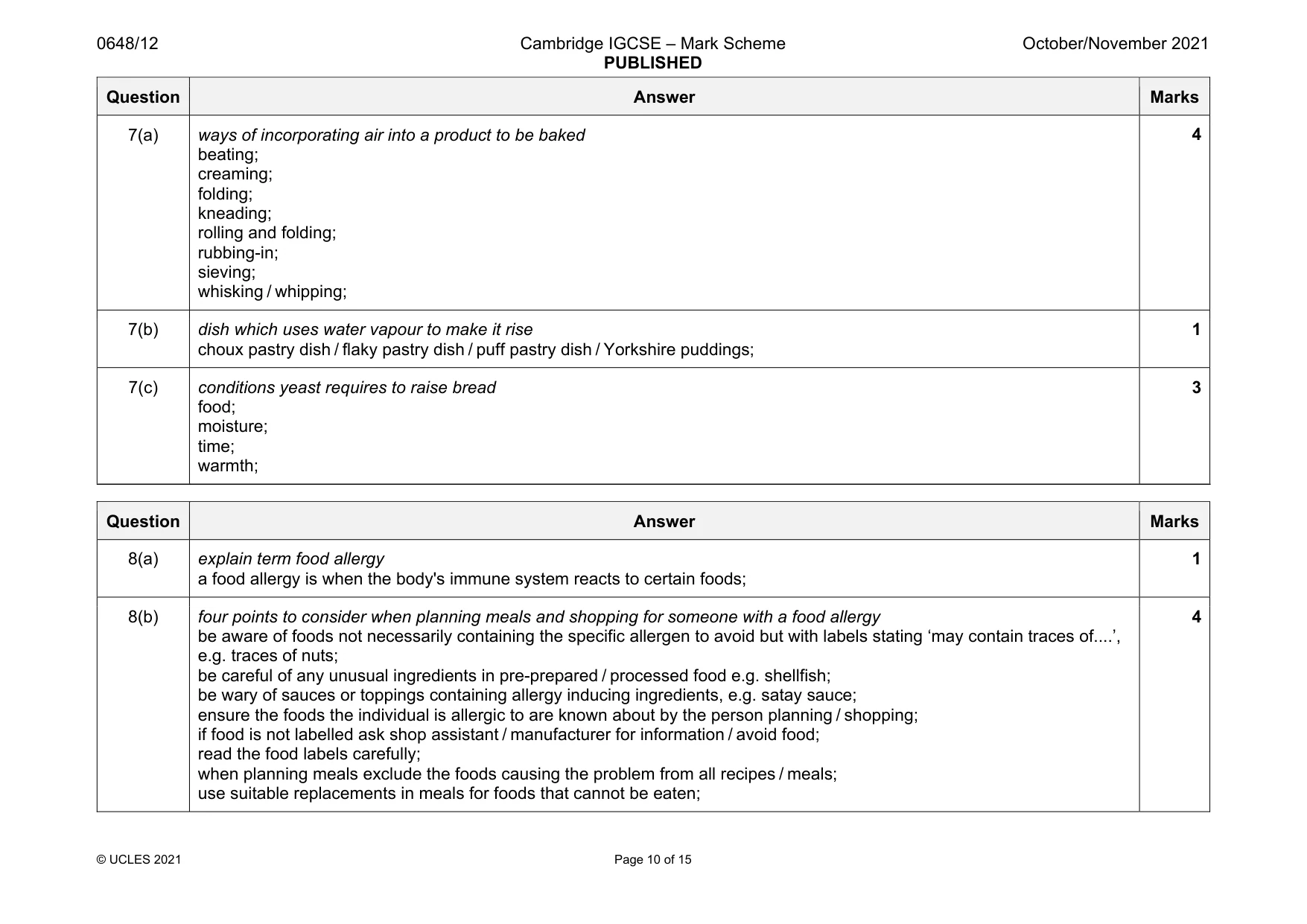
0648/12 Cambridge IGCSE – Mark Scheme PUBLISHED October/November 2021 © UCLES 2021 Page 10 of 15 Question Answer Marks 7(a) ways of incorporating air into a product to be baked beating; creaming; folding; kneading; rolling and folding; rubbing-in; sieving; whisking / whipping; 4 7(b) dish which uses water vapour to make it rise choux pastry dish / flaky pastry dish / puff pastry dish / Yorkshire puddings; 1 7(c) conditions yeast requires to raise bread food; moisture; time; warmth; 3 Question Answer Marks 8(a) explain term food allergy a food allergy is when the body's immune system reacts to certain foods; 1 8(b) four points to consider when planning meals and shopping for someone with a food allergy be aware of foods not necessarily containing the specific allergen to avoid but with labels stating ‘may contain traces of…’, e.g. traces of nuts; be careful of any unusual ingredients in pre-prepared / processed food e.g. shellfish; be wary of sauces or toppings containing allergy inducing ingredients, e.g. satay sauce; ensure the foods the individual is allergic to are known about by the person planning / shopping; if food is not labelled ask shop assistant / manufacturer for information / avoid food; read the food labels carefully; when planning meals exclude the foods causing the problem from all recipes / meals; use suitable replacements in meals for foods that cannot be eaten; 4
Mark scheme, page 11
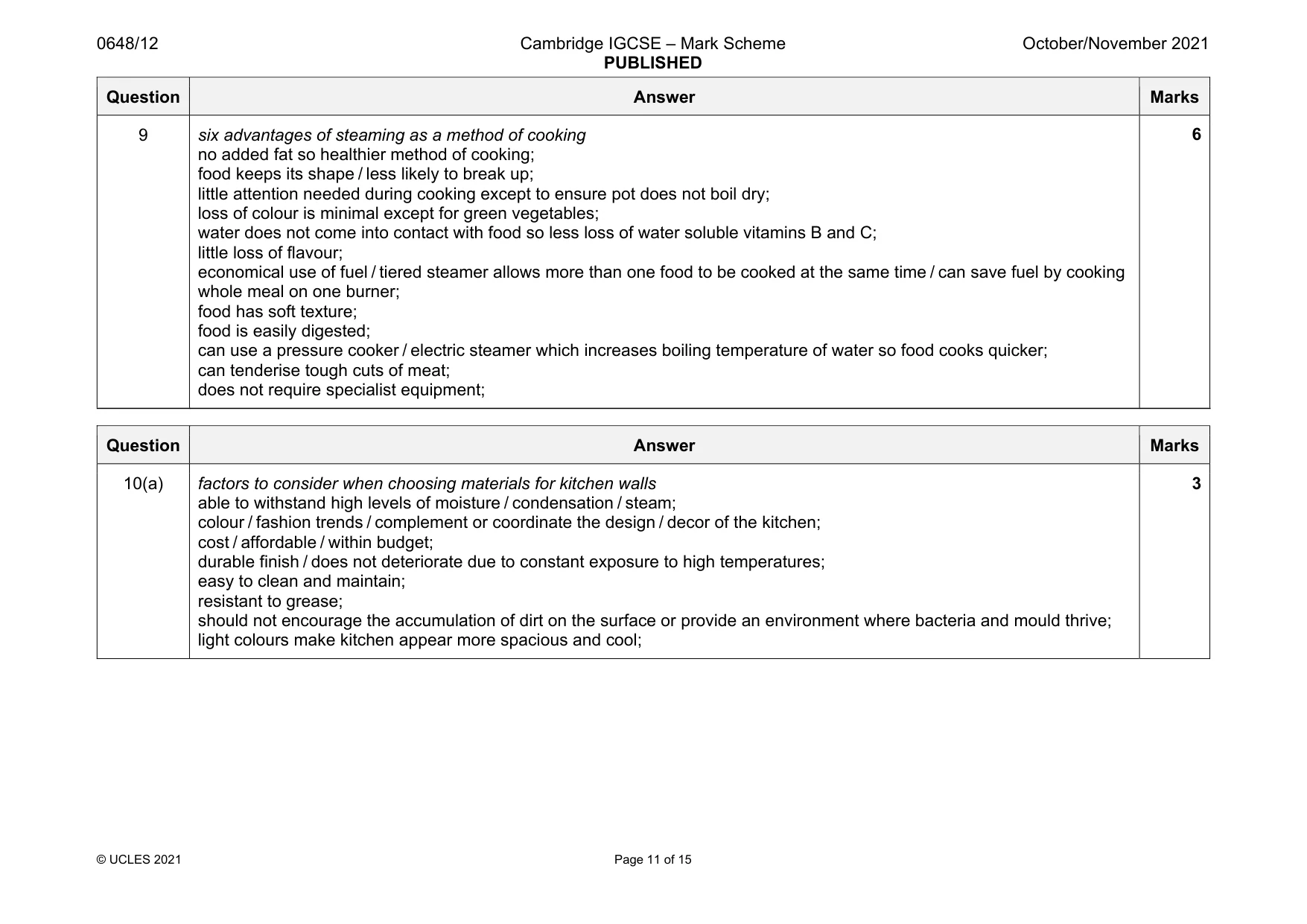
0648/12 Cambridge IGCSE – Mark Scheme PUBLISHED October/November 2021 © UCLES 2021 Page 11 of 15 Question Answer Marks 9 six advantages of steaming as a method of cooking no added fat so healthier method of cooking; food keeps its shape / less likely to break up; little attention needed during cooking except to ensure pot does not boil dry; loss of colour is minimal except for green vegetables; water does not come into contact with food so less loss of water soluble vitamins B and C; little loss of flavour; economical use of fuel / tiered steamer allows more than one food to be cooked at the same time / can save fuel by cooking whole meal on one burner; food has soft texture; food is easily digested; can use a pressure cooker / electric steamer which increases boiling temperature of water so food cooks quicker; can tenderise tough cuts of meat; does not require specialist equipment; 6 Question Answer Marks 10(a) factors to consider when choosing materials for kitchen walls able to withstand high levels of moisture / condensation / steam; colour / fashion trends / complement or coordinate the design / decor of the kitchen; cost / affordable / within budget; durable finish / does not deteriorate due to constant exposure to high temperatures; easy to clean and maintain; resistant to grease; should not encourage the accumulation of dirt on the surface or provide an environment where bacteria and mould thrive; light colours make kitchen appear more spacious and cool; 3
Mark scheme, page 12
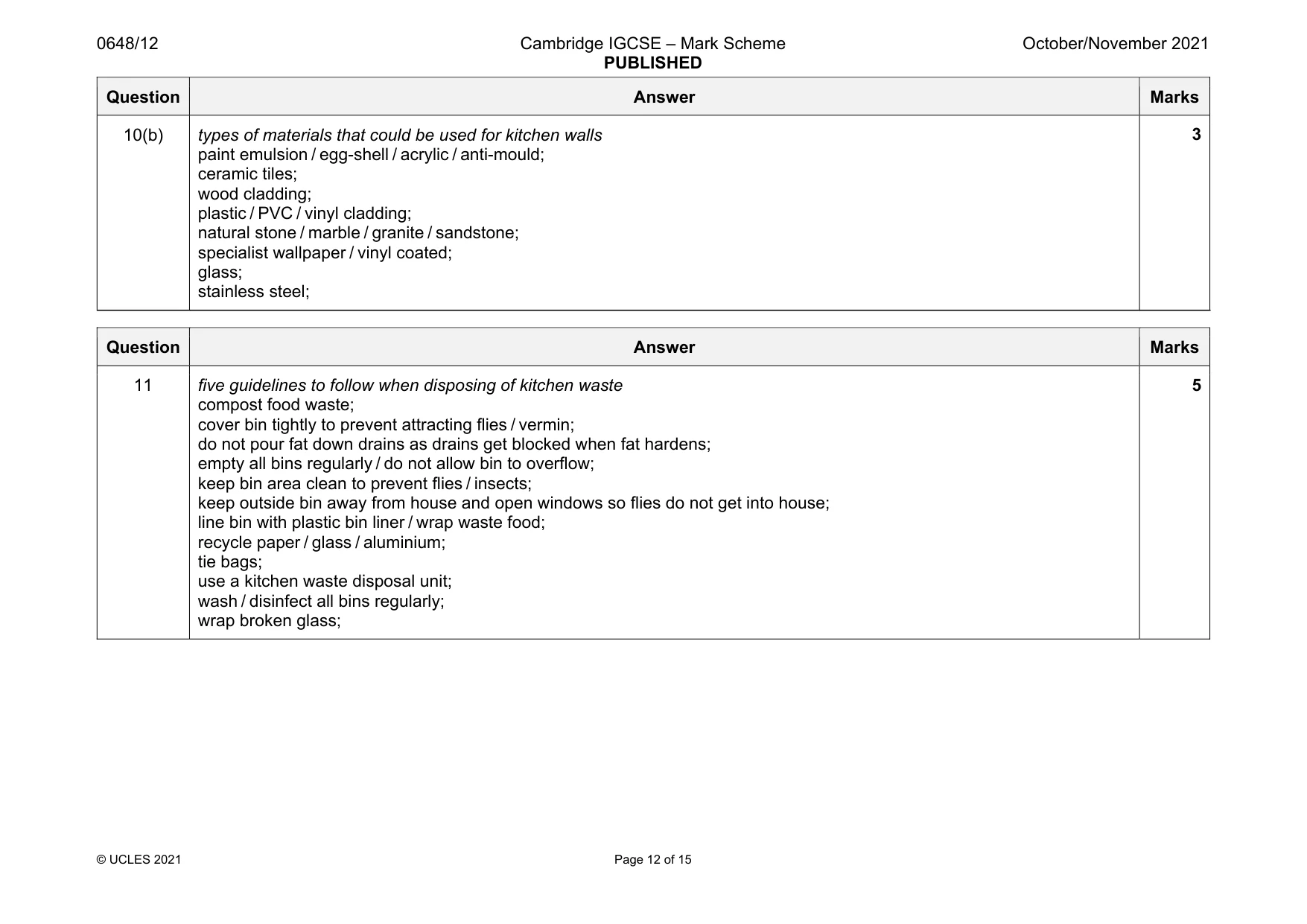
0648/12 Cambridge IGCSE – Mark Scheme PUBLISHED October/November 2021 © UCLES 2021 Page 12 of 15 Question Answer Marks 10(b) types of materials that could be used for kitchen walls paint emulsion / egg-shell / acrylic / anti-mould; ceramic tiles; wood cladding; plastic / PVC / vinyl cladding; natural stone / marble / granite / sandstone; specialist wallpaper / vinyl coated; glass; stainless steel; 3 Question Answer Marks 11 five guidelines to follow when disposing of kitchen waste compost food waste; cover bin tightly to prevent attracting flies / vermin; do not pour fat down drains as drains get blocked when fat hardens; empty all bins regularly / do not allow bin to overflow; keep bin area clean to prevent flies / insects; keep outside bin away from house and open windows so flies do not get into house; line bin with plastic bin liner / wrap waste food; recycle paper / glass / aluminium; tie bags; use a kitchen waste disposal unit; wash / disinfect all bins regularly; wrap broken glass; 5
Mark scheme, page 13
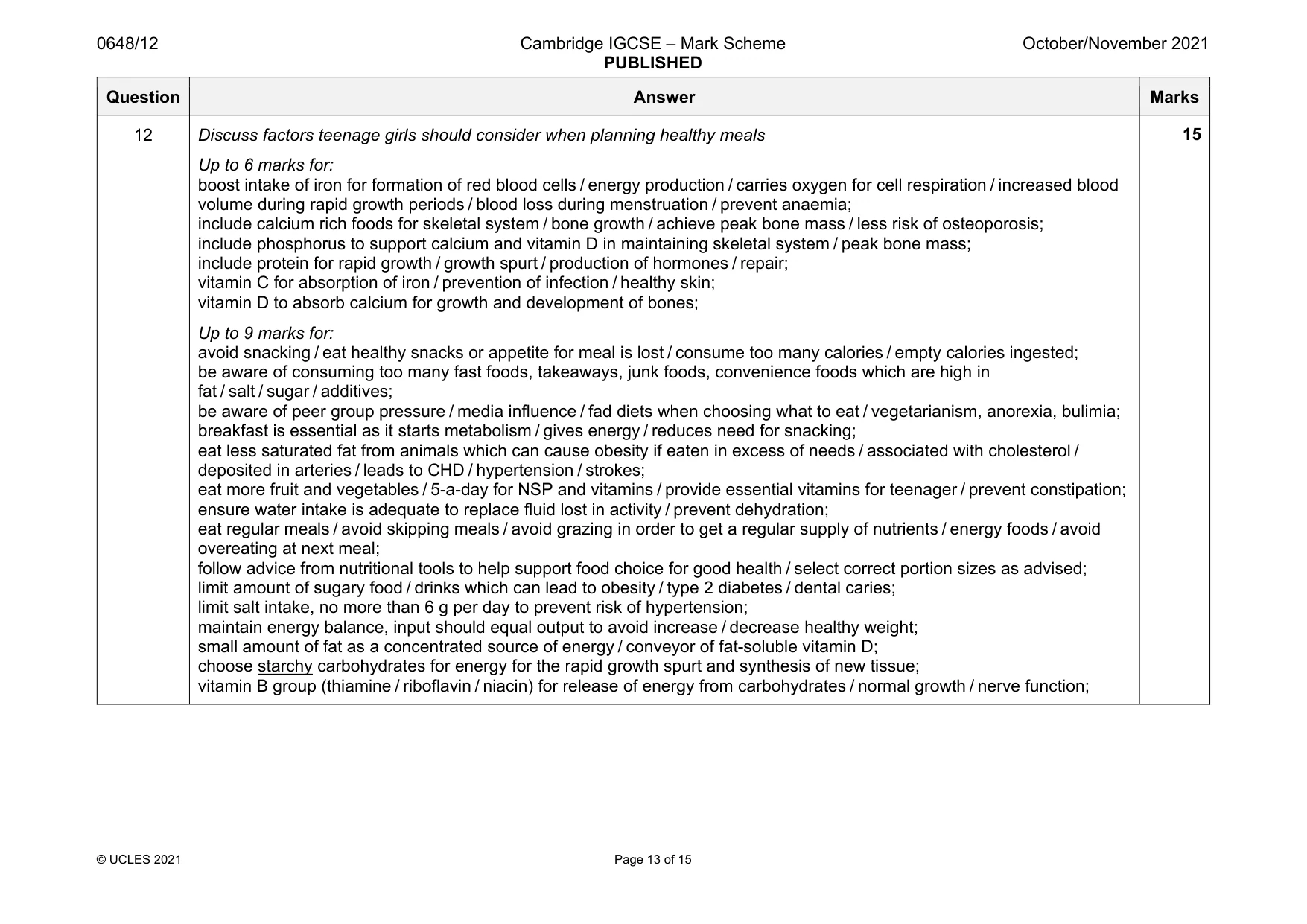
0648/12 Cambridge IGCSE – Mark Scheme PUBLISHED October/November 2021 © UCLES 2021 Page 13 of 15 Question Answer Marks 12 Discuss factors teenage girls should consider when planning healthy meals Up to 6 marks for: boost intake of iron for formation of red blood cells / energy production / carries oxygen for cell respiration / increased blood volume during rapid growth periods / blood loss during menstruation / prevent anaemia; include calcium rich foods for skeletal system / bone growth / achieve peak bone mass / less risk of osteoporosis; include phosphorus to support calcium and vitamin D in maintaining skeletal system / peak bone mass; include protein for rapid growth / growth spurt / production of hormones / repair; vitamin C for absorption of iron / prevention of infection / healthy skin; vitamin D to absorb calcium for growth and development of bones; Up to 9 marks for: avoid snacking / eat healthy snacks or appetite for meal is lost / consume too many calories / empty calories ingested; be aware of consuming too many fast foods, takeaways, junk foods, convenience foods which are high in fat / salt / sugar / additives; be aware of peer group pressure / media influence / fad diets when choosing what to eat / vegetarianism, anorexia, bulimia; breakfast is essential as it starts metabolism / gives energy / reduces need for snacking; eat less saturated fat from animals which can cause obesity if eaten in excess of needs / associated with cholesterol / deposited in arteries / leads to CHD / hypertension / strokes; eat more fruit and vegetables / 5-a-day for NSP and vitamins / provide essential vitamins for teenager / prevent constipation; ensure water intake is adequate to replace fluid lost in activity / prevent dehydration; eat regular meals / avoid skipping meals / avoid grazing in order to get a regular supply of nutrients / energy foods / avoid overeating at next meal; follow advice from nutritional tools to help support food choice for good health / select correct portion sizes as advised; limit amount of sugary food / drinks which can lead to obesity / type 2 diabetes / dental caries; limit salt intake, no more than 6 g per day to prevent risk of hypertension; maintain energy balance, input should equal output to avoid increase / decrease healthy weight; small amount of fat as a concentrated source of energy / conveyor of fat-soluble vitamin D; choose starchy carbohydrates for energy for the rapid growth spurt and synthesis of new tissue; vitamin B group (thiamine / riboflavin / niacin) for release of energy from carbohydrates / normal growth / nerve function; 15
Mark scheme, page 14
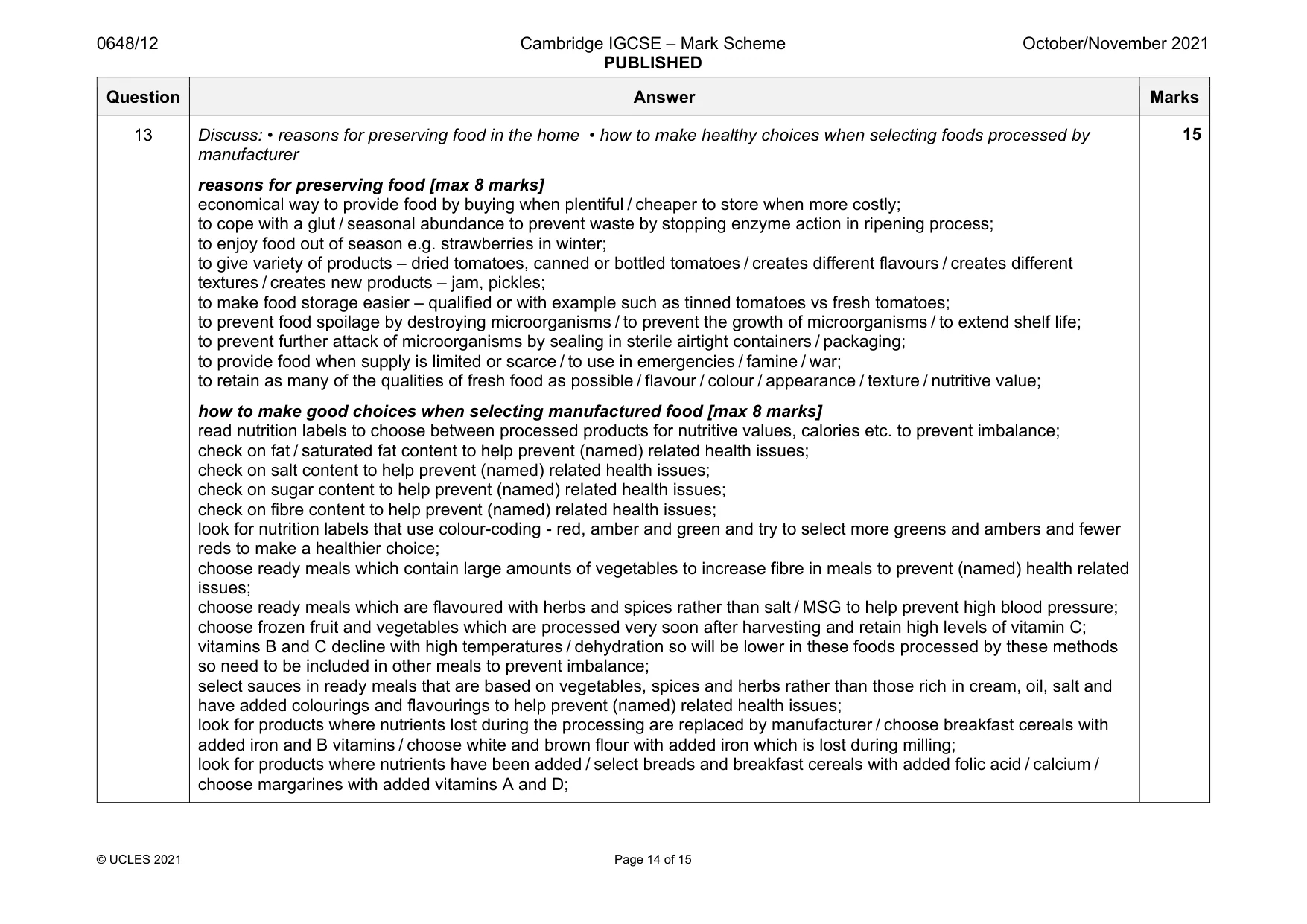
0648/12 Cambridge IGCSE – Mark Scheme PUBLISHED October/November 2021 © UCLES 2021 Page 14 of 15 Question Answer Marks 13 Discuss: • reasons for preserving food in the home • how to make healthy choices when selecting foods processed by manufacturer reasons for preserving food [max 8 marks] economical way to provide food by buying when plentiful / cheaper to store when more costly; to cope with a glut / seasonal abundance to prevent waste by stopping enzyme action in ripening process; to enjoy food out of season e.g. strawberries in winter; to give variety of products – dried tomatoes, canned or bottled tomatoes / creates different flavours / creates different textures / creates new products – jam, pickles; to make food storage easier – qualified or with example such as tinned tomatoes vs fresh tomatoes; to prevent food spoilage by destroying microorganisms / to prevent the growth of microorganisms / to extend shelf life; to prevent further attack of microorganisms by sealing in sterile airtight containers / packaging; to provide food when supply is limited or scarce / to use in emergencies / famine / war; to retain as many of the qualities of fresh food as possible / flavour / colour / appearance / texture / nutritive value; how to make good choices when selecting manufactured food [max 8 marks] read nutrition labels to choose between processed products for nutritive values, calories etc. to prevent imbalance; check on fat / saturated fat content to help prevent (named) related health issues; check on salt content to help prevent (named) related health issues; check on sugar content to help prevent (named) related health issues; check on fibre content to help prevent (named) related health issues; look for nutrition labels that use colour-coding - red, amber and green and try to select more greens and ambers and fewer reds to make a healthier choice; choose ready meals which contain large amounts of vegetables to increase fibre in meals to prevent (named) health related issues; choose ready meals which are flavoured with herbs and spices rather than salt / MSG to help prevent high blood pressure; choose frozen fruit and vegetables which are processed very soon after harvesting and retain high levels of vitamin C; vitamins B and C decline with high temperatures / dehydration so will be lower in these foods processed by these methods so need to be included in other meals to prevent imbalance; select sauces in ready meals that are based on vegetables, spices and herbs rather than those rich in cream, oil, salt and have added colourings and flavourings to help prevent (named) related health issues; look for products where nutrients lost during the processing are replaced by manufacturer / choose breakfast cereals with added iron and B vitamins / choose white and brown flour with added iron which is lost during milling; look for products where nutrients have been added / select breads and breakfast cereals with added folic acid / calcium / choose margarines with added vitamins A and D; 15
Mark scheme, page 15
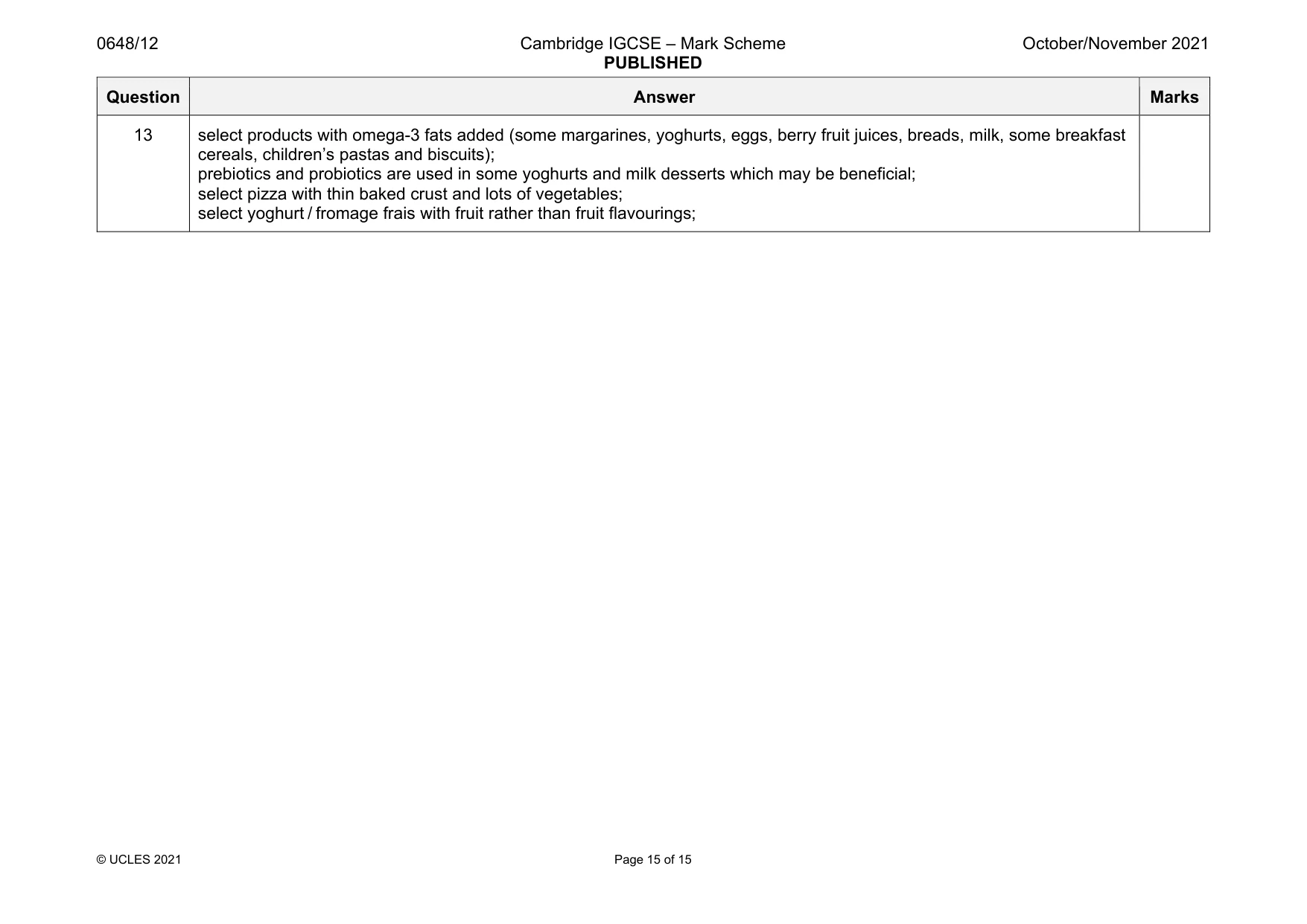
0648/12 Cambridge IGCSE – Mark Scheme PUBLISHED October/November 2021 © UCLES 2021 Page 15 of 15 Question Answer Marks 13 select products with omega-3 fats added (some margarines, yoghurts, eggs, berry fruit juices, breads, milk, some breakfast cereals, children’s pastas and biscuits); prebiotics and probiotics are used in some yoghurts and milk desserts which may be beneficial; select pizza with thin baked crust and lots of vegetables; select yoghurt / fromage frais with fruit rather than fruit flavourings;
What you needed in this session
Cambridge’s own grade thresholds for 2021 Oct/Nov, Paper 1 · Variant 2. A higher threshold means an easier paper — the bar moves with how the cohort did.