Cambridge IGCSE Food and Nutrition 0648 — 2023 Oct/Nov Paper 1 · Variant 2
0648/12/O/N/23 · 100 marks · ≈113 min
The question paper and its mark scheme, free to read here and free to download. This is Cambridge’s own paper, exactly as it was sat.
Question paper12 pages



Mark scheme16 pages
Answers below. Sit the paper first if you are practising.
Paper as text
Question paper, page 1
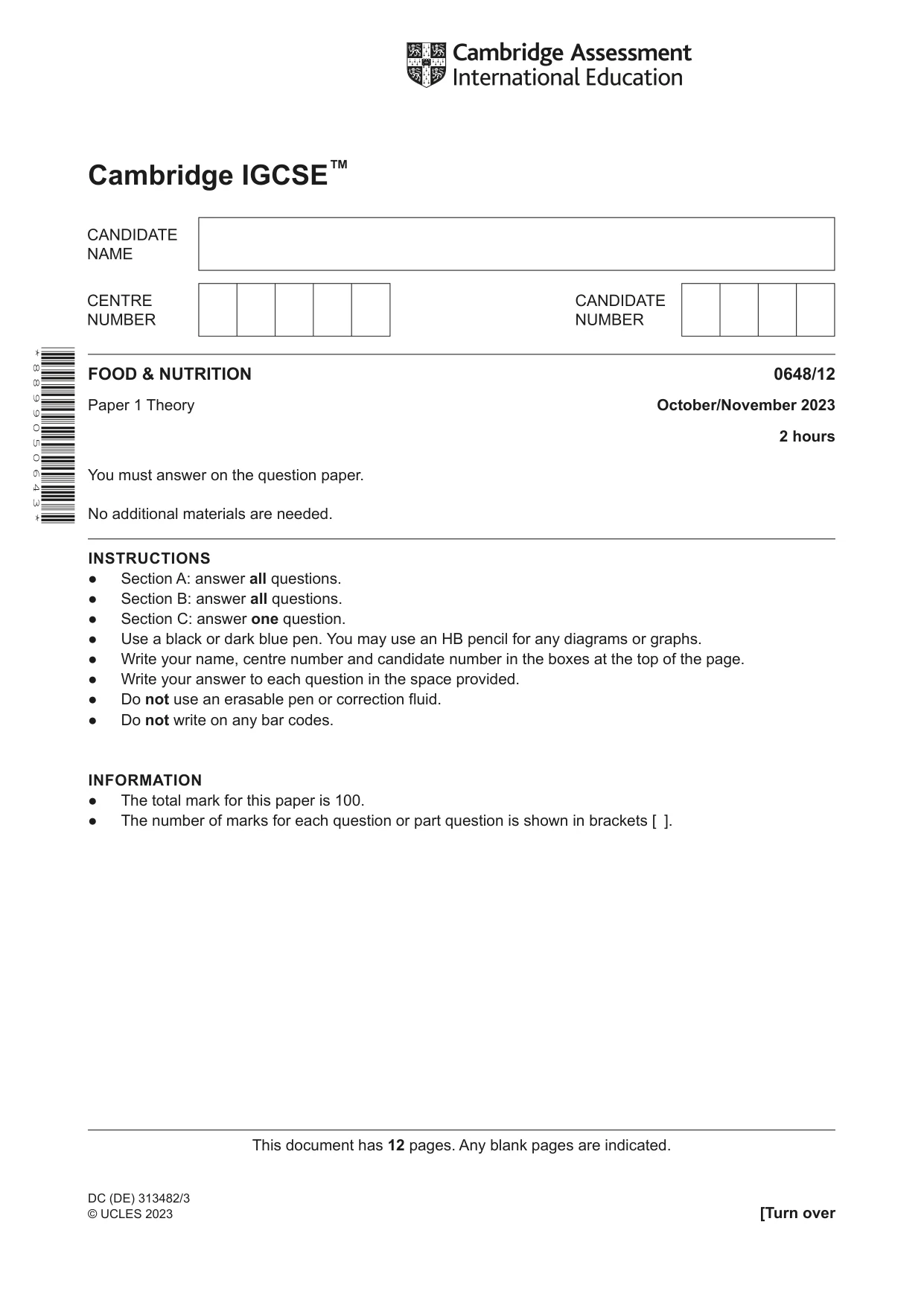
This document has 12 pages. Any blank pages are indicated. [Turn over * 8 8 9 9 0 5 0 6 4 3 * Cambridge IGCSE™ DC (DE) 313482/3 © UCLES 2023 FOOD & NUTRITION 0648/12 Paper 1 Theory October/November 2023 2 hours You must answer on the question paper. No additional materials are needed. INSTRUCTIONS ● Section A: answer all questions. ● Section B: answer all questions. ● Section C: answer one question. ● Use a black or dark blue pen. You may use an HB pencil for any diagrams or graphs. ● Write your name, centre number and candidate number in the boxes at the top of the page. ● Write your answer to each question in the space provided. ● Do not use an erasable pen or correction fluid. ● Do not write on any bar codes. INFORMATION ● The total mark for this paper is 100. ● The number of marks for each question or part question is shown in brackets [ ].
Question paper, page 2
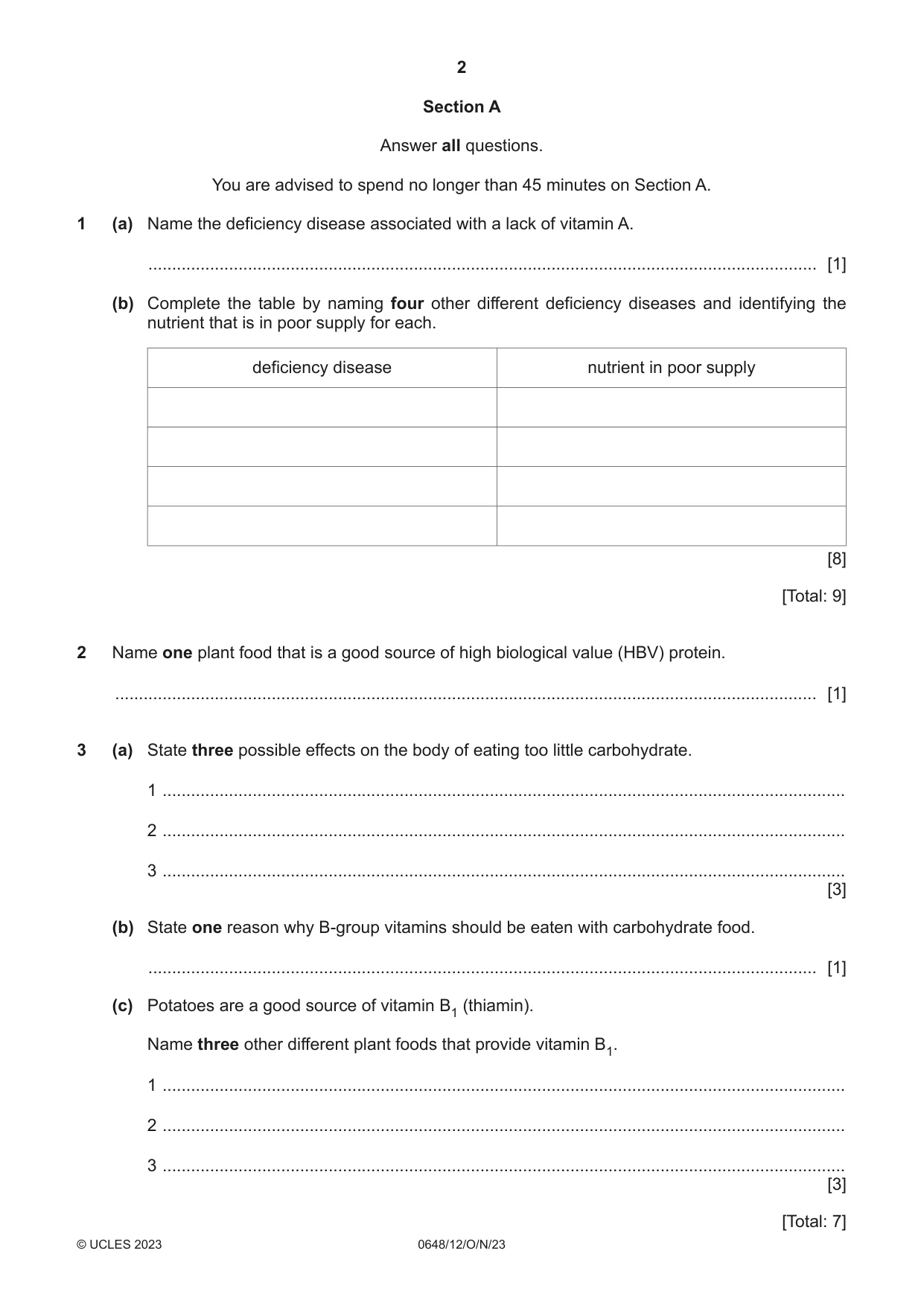
2 0648/12/O/N/23 © UCLES 2023 Section A Answer all questions. You are advised to spend no longer than 45 minutes on Section A. 1 (a) Name the deficiency disease associated with a lack of vitamin A. … [1] (b) Complete the table by naming four other different deficiency diseases and identifying the nutrient that is in poor supply for each. deficiency disease nutrient in poor supply [8] [Total: 9] 2 Name one plant food that is a good source of high biological value (HBV) protein. … [1] 3 (a) State three possible effects on the body of eating too little carbohydrate. 1 … 2 … 3 … [3] (b) State one reason why B-group vitamins should be eaten with carbohydrate food. … [1] (c) Potatoes are a good source of vitamin B1 (thiamin). Name three other different plant foods that provide vitamin B1. 1 … 2 … 3 … [3] [Total: 7]
Question paper, page 3
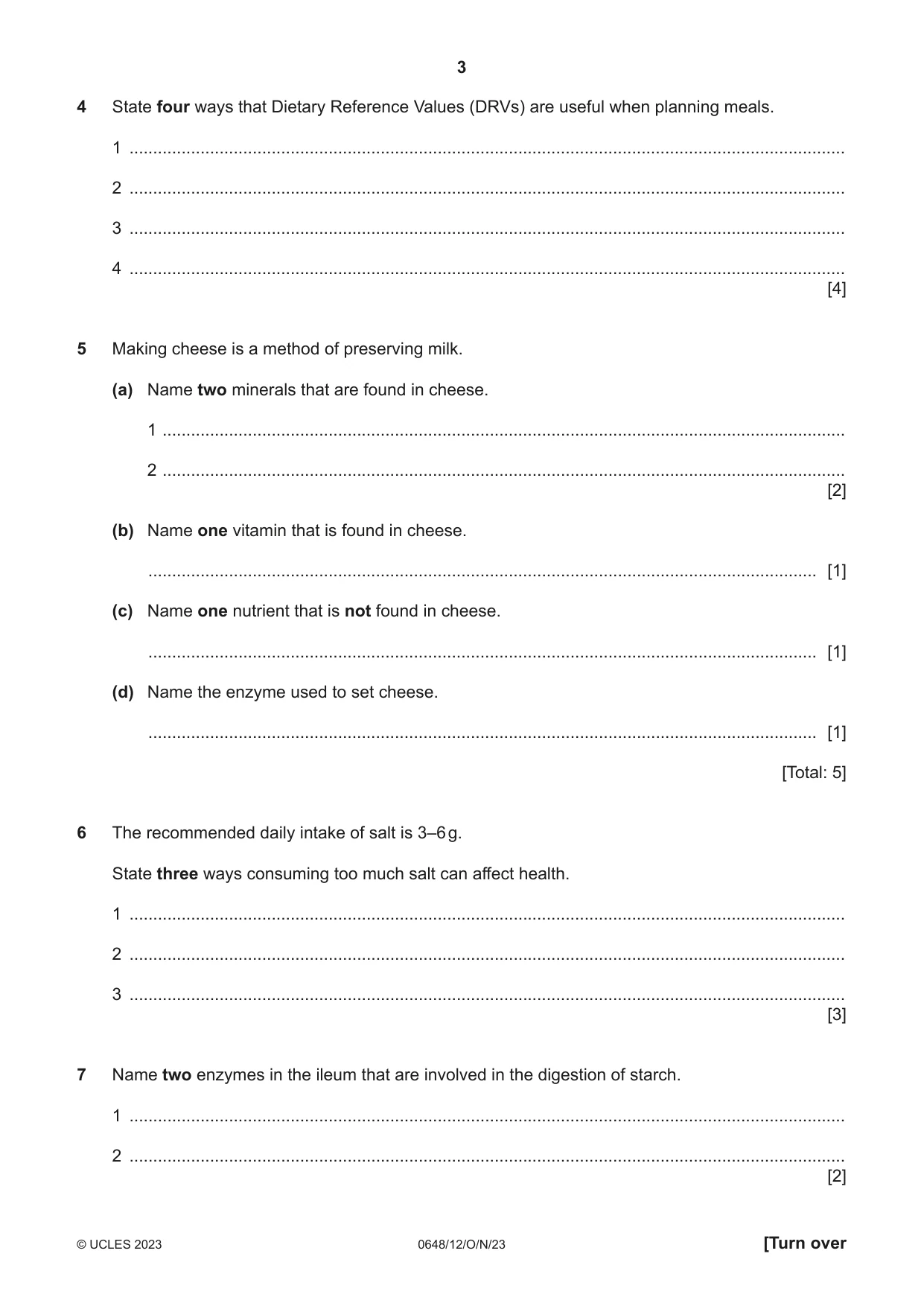
3 0648/12/O/N/23 © UCLES 2023 [Turn over 4 State four ways that Dietary Reference Values (DRVs) are useful when planning meals. 1 … 2 … 3 … 4 … [4] 5 Making cheese is a method of preserving milk. (a) Name two minerals that are found in cheese. 1 … 2 … [2] (b) Name one vitamin that is found in cheese. … [1] (c) Name one nutrient that is not found in cheese. … [1] (d) Name the enzyme used to set cheese. … [1] [Total: 5] 6 The recommended daily intake of salt is 3–6 g. State three ways consuming too much salt can affect health. 1 … 2 … 3 … [3] 7 Name two enzymes in the ileum that are involved in the digestion of starch. 1 … 2 … [2]
Question paper, page 4
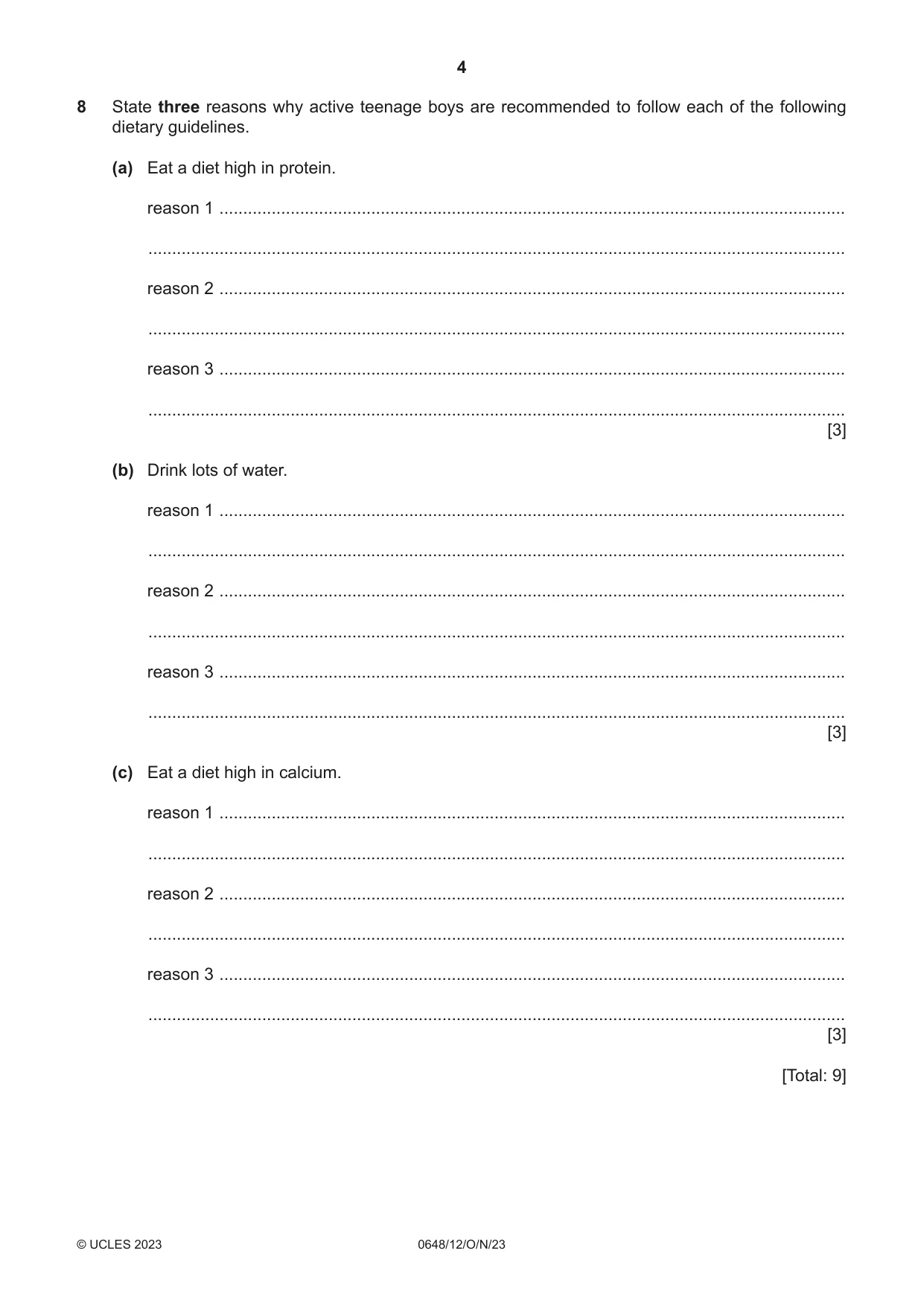
4 0648/12/O/N/23 © UCLES 2023 8 State three reasons why active teenage boys are recommended to follow each of the following dietary guidelines. (a) Eat a diet high in protein. reason 1 … … reason 2 … … reason 3 … … [3] (b) Drink lots of water. reason 1 … … reason 2 … … reason 3 … … [3] (c) Eat a diet high in calcium. reason 1 … … reason 2 … … reason 3 … … [3] [Total: 9]
Question paper, page 5
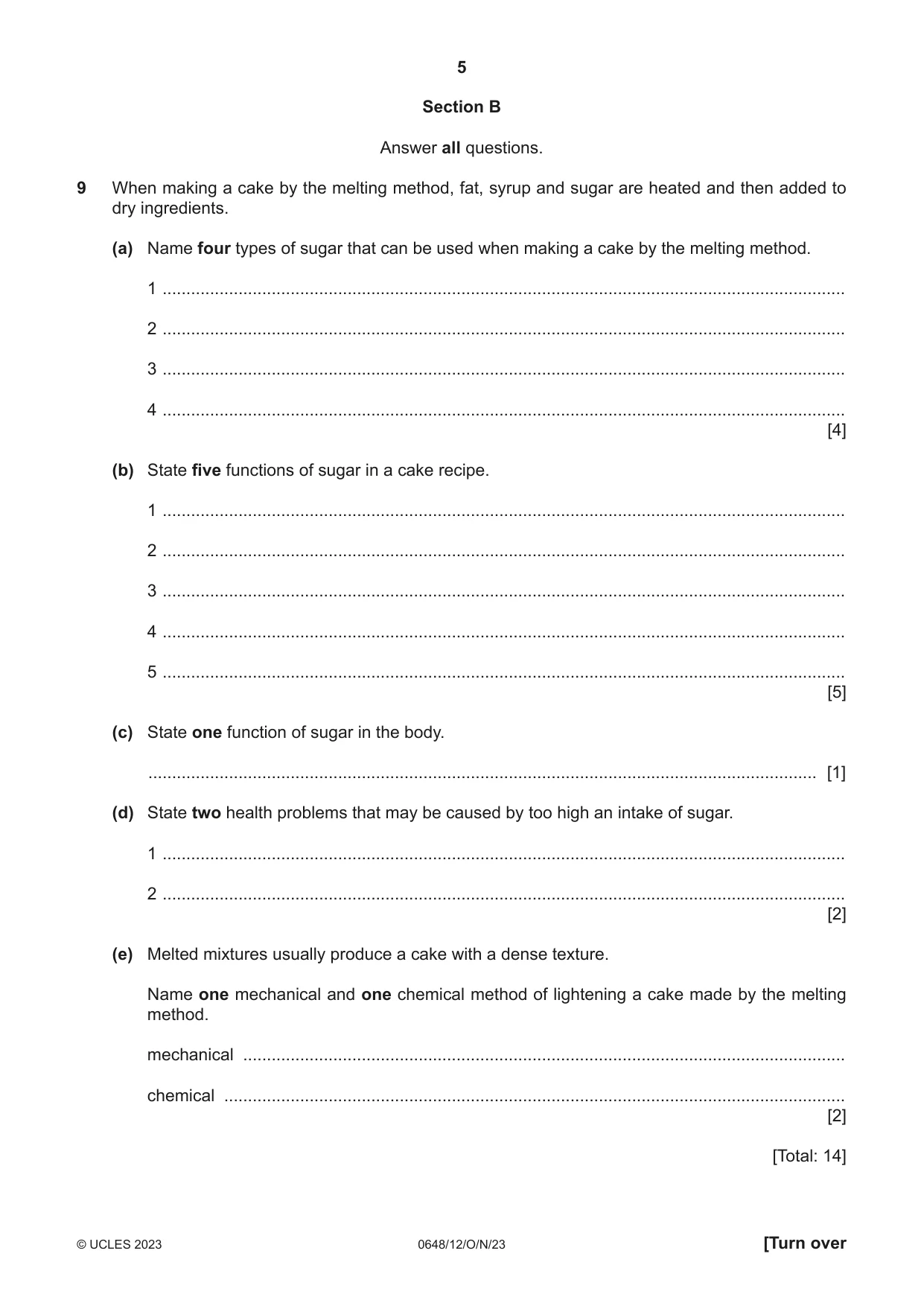
5 0648/12/O/N/23 © UCLES 2023 [Turn over Section B Answer all questions. 9 When making a cake by the melting method, fat, syrup and sugar are heated and then added to dry ingredients. (a) Name four types of sugar that can be used when making a cake by the melting method. 1 … 2 … 3 … 4 … [4] (b) State five functions of sugar in a cake recipe. 1 … 2 … 3 … 4 … 5 … [5] (c) State one function of sugar in the body. … [1] (d) State two health problems that may be caused by too high an intake of sugar. 1 … 2 … [2] (e) Melted mixtures usually produce a cake with a dense texture. Name one mechanical and one chemical method of lightening a cake made by the melting method. mechanical … chemical … [2] [Total: 14]
Question paper, page 6
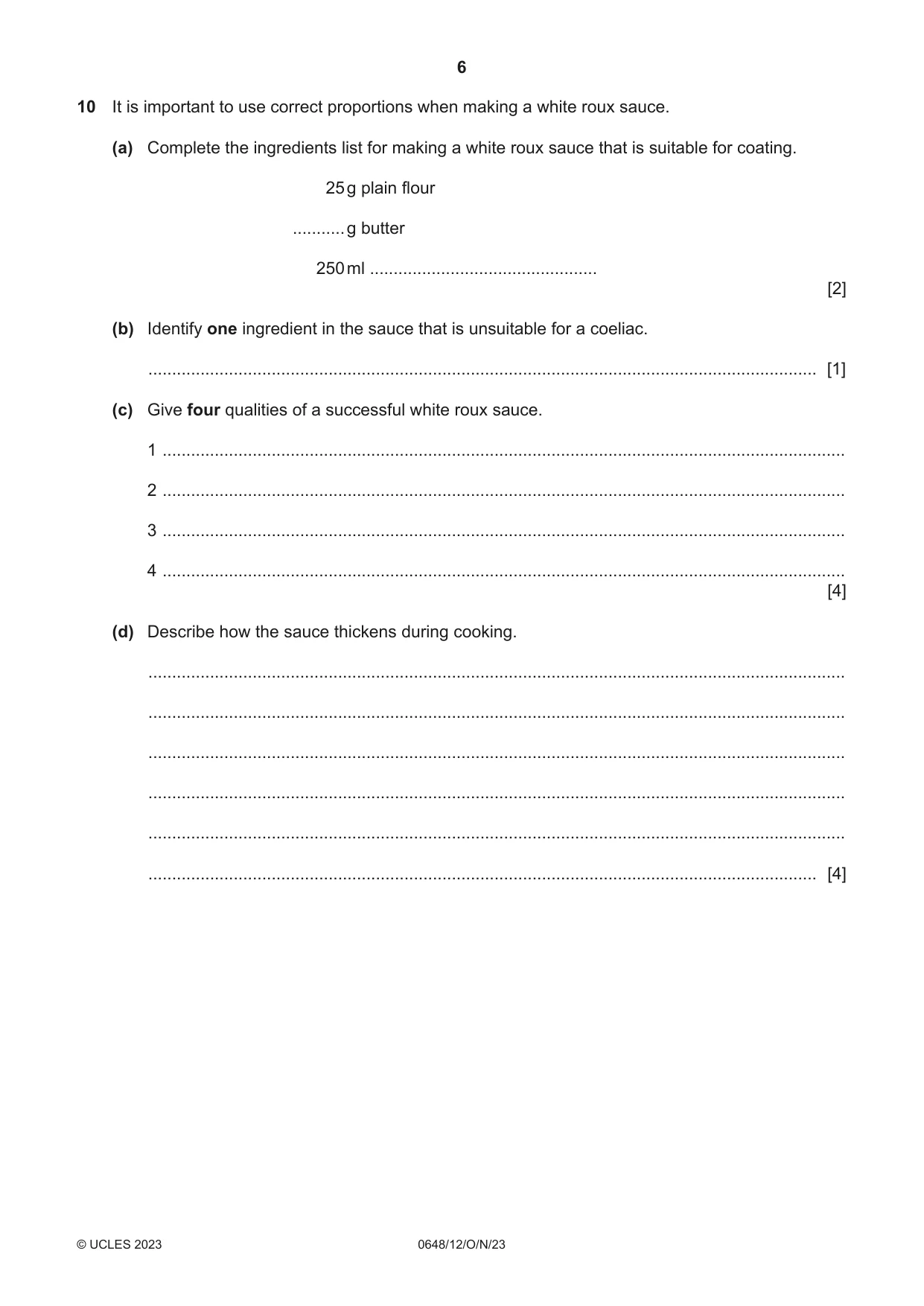
6 0648/12/O/N/23 © UCLES 2023 10 It is important to use correct proportions when making a white roux sauce. (a) Complete the ingredients list for making a white roux sauce that is suitable for coating. 25 g plain flour … g butter 250 ml … [2] (b) Identify one ingredient in the sauce that is unsuitable for a coeliac. … [1] (c) Give four qualities of a successful white roux sauce. 1 … 2 … 3 … 4 … [4] (d) Describe how the sauce thickens during cooking. … … … … … … [4]
Question paper, page 7
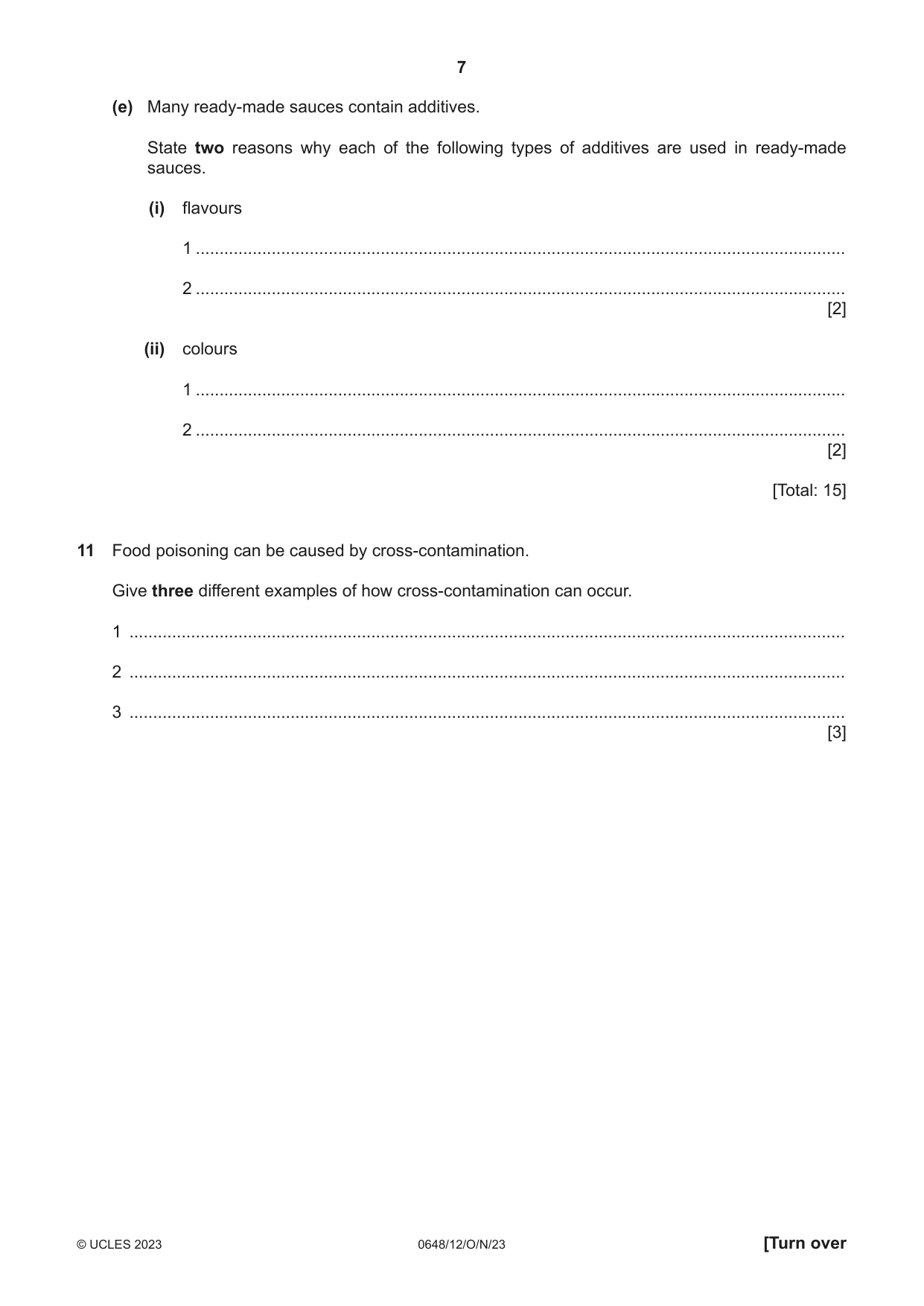
7 0648/12/O/N/23 © UCLES 2023 [Turn over (e) Many ready-made sauces contain additives. State two reasons why each of the following types of additives are used in ready-made sauces. (i) flavours 1 … 2 … [2] (ii) colours 1 … 2 … [2] [Total: 15] 11 Food poisoning can be caused by cross-contamination. Give three different examples of how cross-contamination can occur. 1 … 2 … 3 … [3]
Question paper, page 8
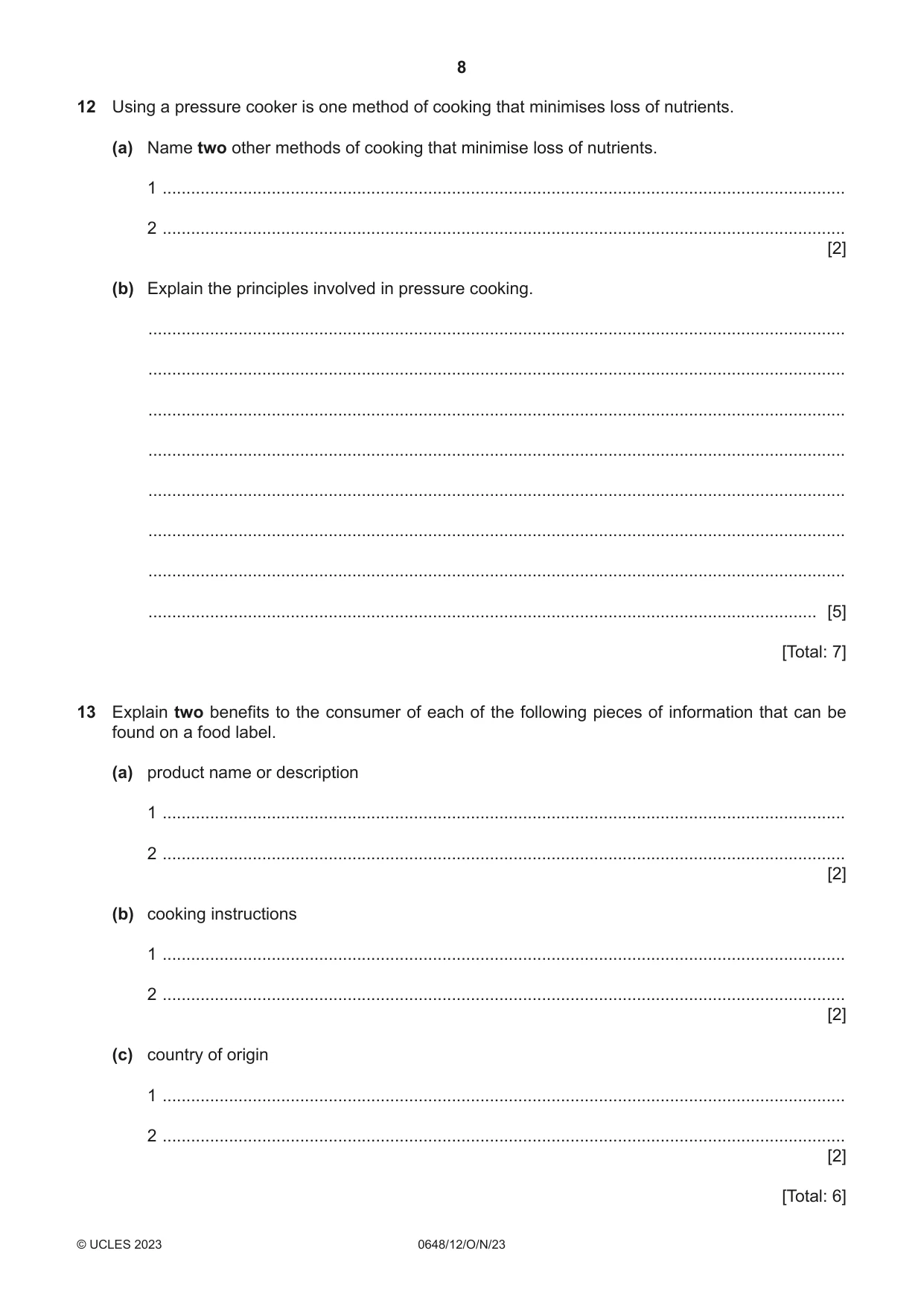
8 0648/12/O/N/23 © UCLES 2023 12 Using a pressure cooker is one method of cooking that minimises loss of nutrients. (a) Name two other methods of cooking that minimise loss of nutrients. 1 … 2 … [2] (b) Explain the principles involved in pressure cooking. … … … … … … … … [5] [Total: 7] 13 Explain two benefits to the consumer of each of the following pieces of information that can be found on a food label. (a) product name or description 1 … 2 … [2] (b) cooking instructions 1 … 2 … [2] (c) country of origin 1 … 2 … [2] [Total: 6]
Question paper, page 9
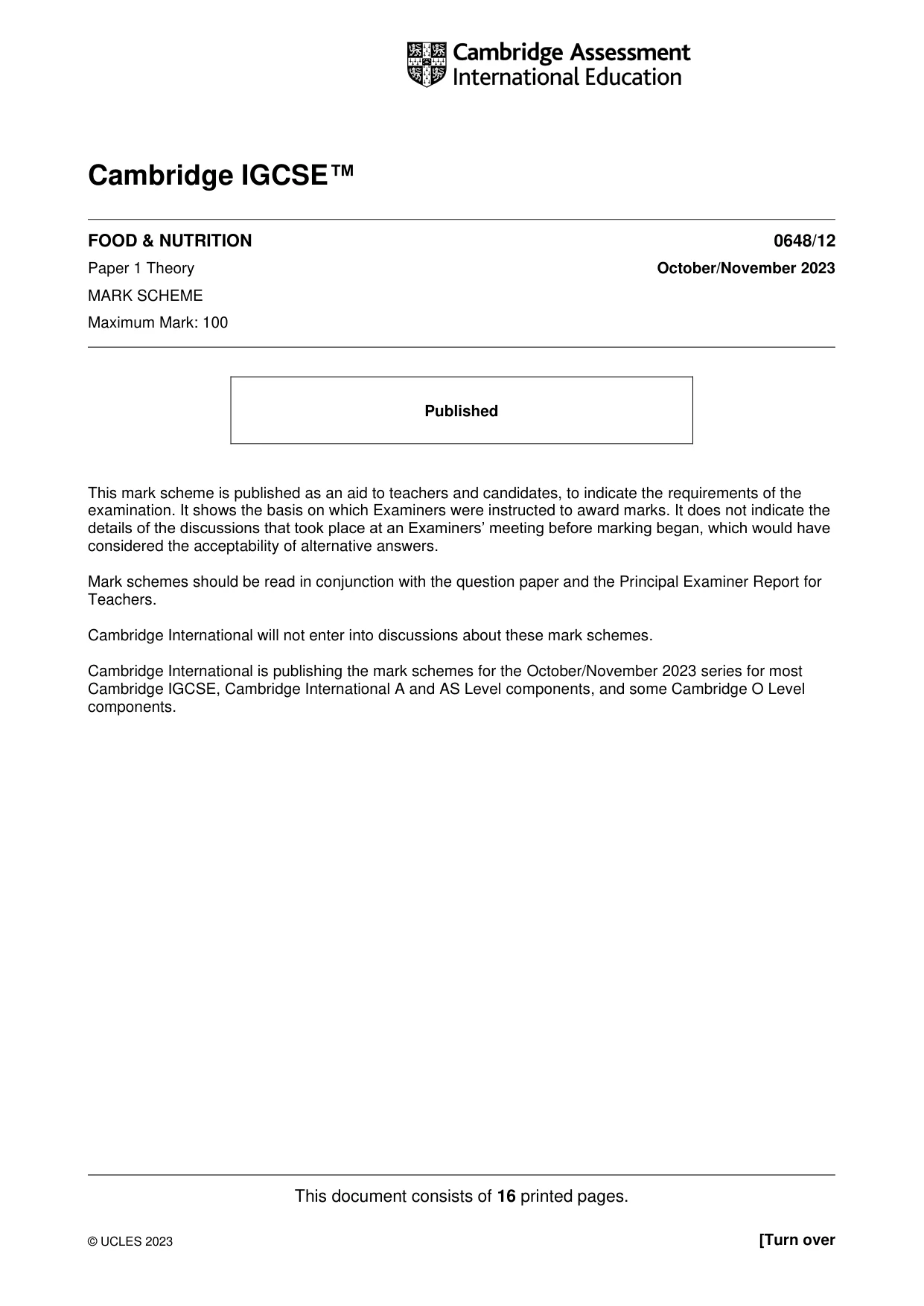
9 0648/12/O/N/23 © UCLES 2023 [Turn over Section C Answer either Question 14 or 15. 14 Fats and oils are an important commodity. • Discuss the chemical composition of different types of fats and oils. • Discuss the functions of fats and oils in the body. [15] OR 15 Discuss methods of reducing or conserving fuel energy when cooking family meals. [15] … … … … … … … … … … … … … … … … … … … … … …
Question paper, page 10
10 0648/12/O/N/23 © UCLES 2023 … … … … … … … … … … … … … … … … … … … … … … … … … … … …
Question paper, page 11
11 0648/12/O/N/23 © UCLES 2023 … … … … … … … … … … … … … … … … … … … … … … … … … … … …
Question paper, page 12
12 0648/12/O/N/23 © UCLES 2023 Permission to reproduce items where third-party owned material protected by copyright is included has been sought and cleared where possible. Every reasonable effort has been made by the publisher (UCLES) to trace copyright holders, but if any items requiring clearance have unwittingly been included, the publisher will be pleased to make amends at the earliest possible opportunity. To avoid the issue of disclosure of answer-related information to candidates, all copyright acknowledgements are reproduced online in the Cambridge Assessment International Education Copyright Acknowledgements Booklet. This is produced for each series of examinations and is freely available to download at www.cambridgeinternational.org after the live examination series. Cambridge Assessment International Education is part of Cambridge Assessment. Cambridge Assessment is the brand name of the University of Cambridge Local Examinations Syndicate (UCLES), which is a department of the University of Cambridge. BLANK PAGE
Mark scheme, page 1
This document consists of 16 printed pages. © UCLES 2023 [Turn over Cambridge IGCSE™ FOOD & NUTRITION 0648/12 Paper 1 Theory October/November 2023 MARK SCHEME Maximum Mark: 100 Published This mark scheme is published as an aid to teachers and candidates, to indicate the requirements of the examination. It shows the basis on which Examiners were instructed to award marks. It does not indicate the details of the discussions that took place at an Examiners’ meeting before marking began, which would have considered the acceptability of alternative answers. Mark schemes should be read in conjunction with the question paper and the Principal Examiner Report for Teachers. Cambridge International will not enter into discussions about these mark schemes. Cambridge International is publishing the mark schemes for the October/November 2023 series for most Cambridge IGCSE, Cambridge International A and AS Level components, and some Cambridge O Level components.
Mark scheme, page 2
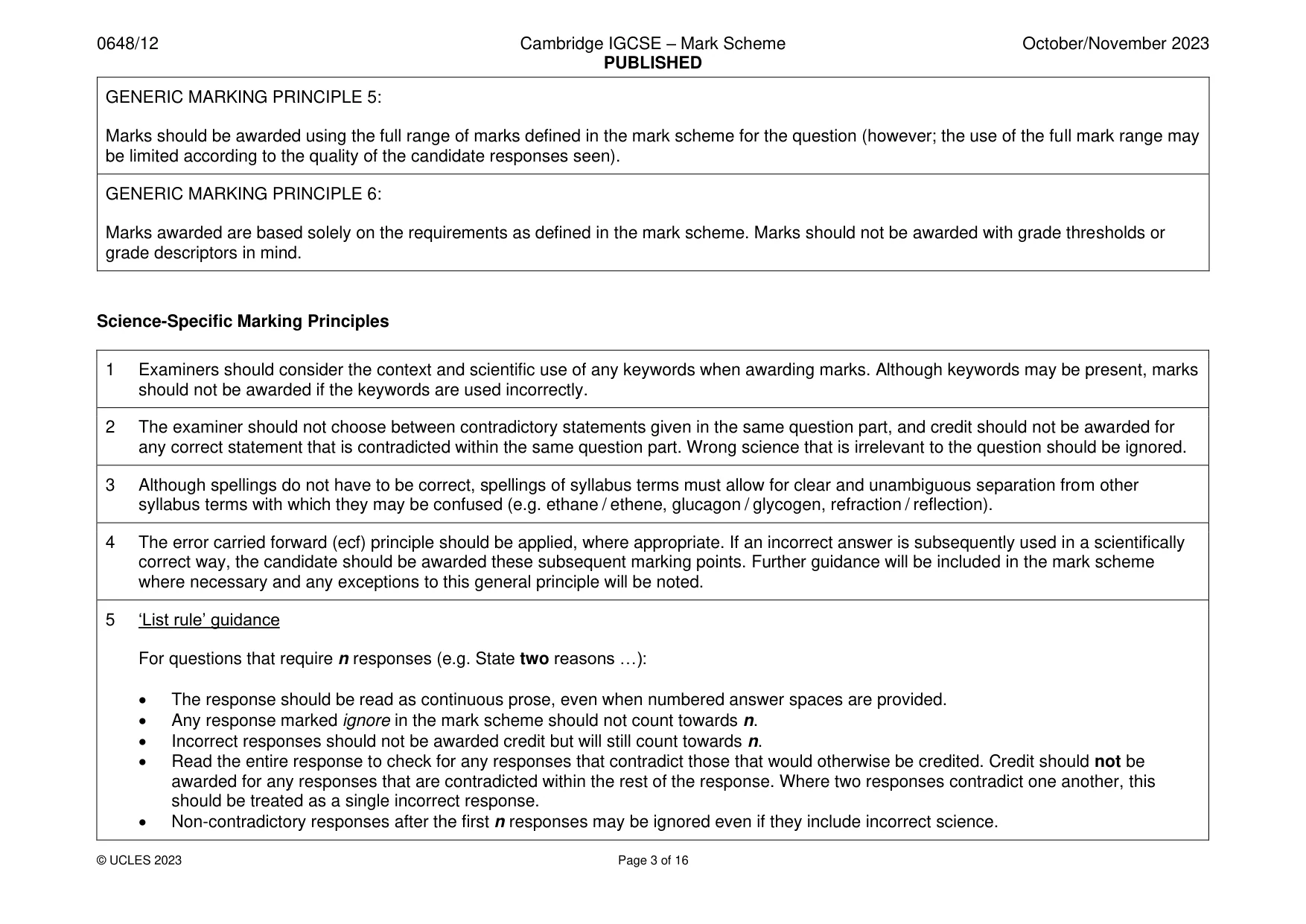
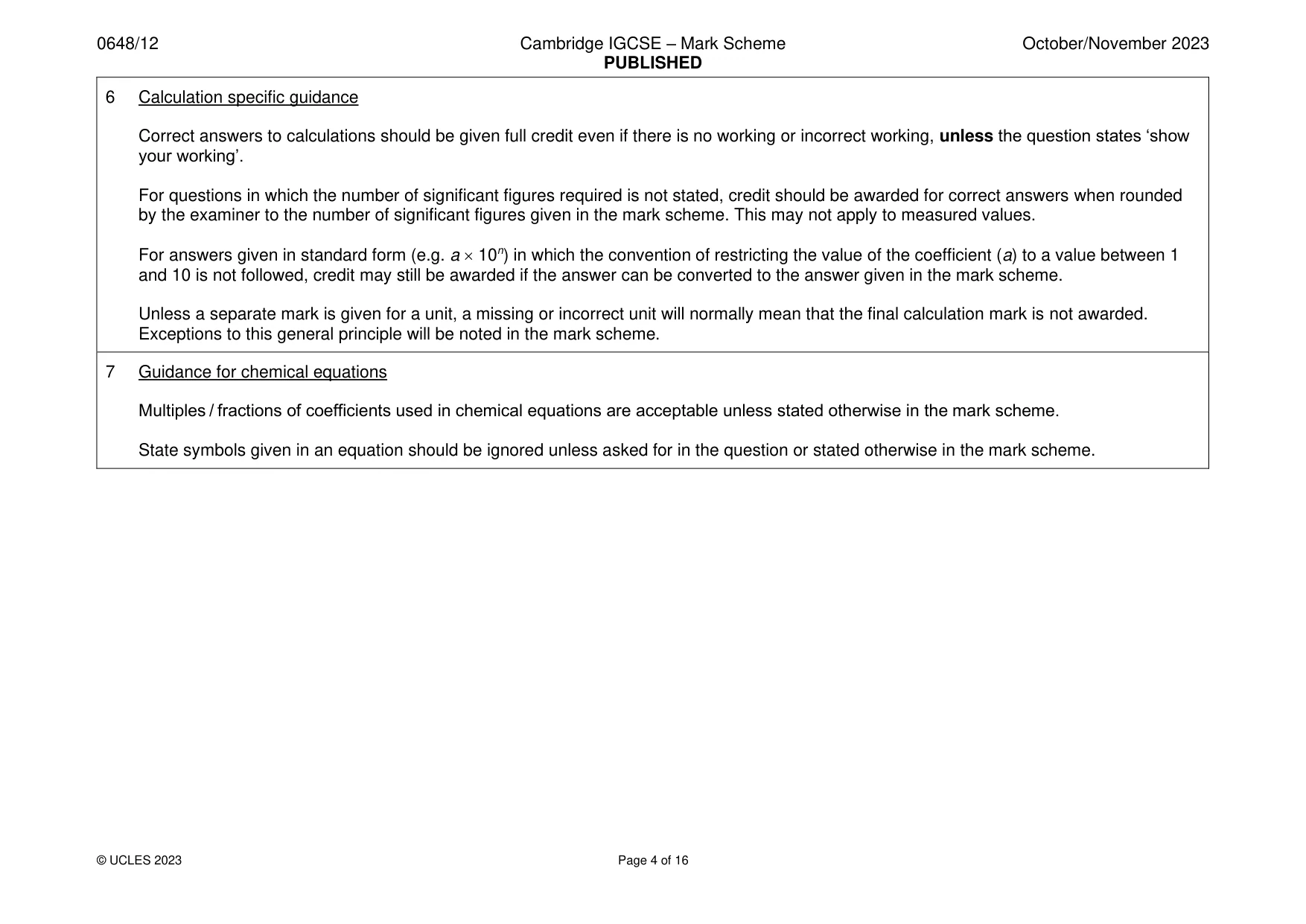
0648/12 Cambridge IGCSE – Mark Scheme PUBLISHED October/November 2023 © UCLES 2023 Page 2 of 16 Generic Marking Principles These general marking principles must be applied by all examiners when marking candidate answers. They should be applied alongside the specific content of the mark scheme or generic level descriptors for a question. Each question paper and mark scheme will also comply with these marking principles. GENERIC MARKING PRINCIPLE 1: Marks must be awarded in line with: • the specific content of the mark scheme or the generic level descriptors for the question • the specific skills defined in the mark scheme or in the generic level descriptors for the question • the standard of response required by a candidate as exemplified by the standardisation scripts. GENERIC MARKING PRINCIPLE 2: Marks awarded are always whole marks (not half marks, or other fractions). GENERIC MARKING PRINCIPLE 3: Marks must be awarded positively: • marks are awarded for correct/valid answers, as defined in the mark scheme. However, credit is given for valid answers which go beyond the scope of the syllabus and mark scheme, referring to your Team Leader as appropriate • marks are awarded when candidates clearly demonstrate what they know and can do • marks are not deducted for errors • marks are not deducted for omissions • answers should only be judged on the quality of spelling, punctuation and grammar when these features are specifically assessed by the question as indicated by the mark scheme. The meaning, however, should be unambiguous. GENERIC MARKING PRINCIPLE 4: Rules must be applied consistently, e.g. in situations where candidates have not followed instructions or in the application of generic level descriptors.
Mark scheme, page 3
0648/12 Cambridge IGCSE – Mark Scheme PUBLISHED October/November 2023 © UCLES 2023 Page 3 of 16 GENERIC MARKING PRINCIPLE 5: Marks should be awarded using the full range of marks defined in the mark scheme for the question (however; the use of the full mark range may be limited according to the quality of the candidate responses seen). GENERIC MARKING PRINCIPLE 6: Marks awarded are based solely on the requirements as defined in the mark scheme. Marks should not be awarded with grade thresholds or grade descriptors in mind. Science-Specific Marking Principles 1 Examiners should consider the context and scientific use of any keywords when awarding marks. Although keywords may be present, marks should not be awarded if the keywords are used incorrectly. 2 The examiner should not choose between contradictory statements given in the same question part, and credit should not be awarded for any correct statement that is contradicted within the same question part. Wrong science that is irrelevant to the question should be ignored. 3 Although spellings do not have to be correct, spellings of syllabus terms must allow for clear and unambiguous separation from other syllabus terms with which they may be confused (e.g. ethane / ethene, glucagon / glycogen, refraction / reflection). 4 The error carried forward (ecf) principle should be applied, where appropriate. If an incorrect answer is subsequently used in a scientifically correct way, the candidate should be awarded these subsequent marking points. Further guidance will be included in the mark scheme where necessary and any exceptions to this general principle will be noted. 5 ‘List rule’ guidance For questions that require n responses (e.g. State two reasons …): • The response should be read as continuous prose, even when numbered answer spaces are provided. • Any response marked ignore in the mark scheme should not count towards n. • Incorrect responses should not be awarded credit but will still count towards n. • Read the entire response to check for any responses that contradict those that would otherwise be credited. Credit should not be awarded for any responses that are contradicted within the rest of the response. Where two responses contradict one another, this should be treated as a single incorrect response. • Non-contradictory responses after the first n responses may be ignored even if they include incorrect science.
Mark scheme, page 4
0648/12 Cambridge IGCSE – Mark Scheme PUBLISHED October/November 2023 © UCLES 2023 Page 4 of 16 6 Calculation specific guidance Correct answers to calculations should be given full credit even if there is no working or incorrect working, unless the question states ‘show your working’. For questions in which the number of significant figures required is not stated, credit should be awarded for correct answers when rounded by the examiner to the number of significant figures given in the mark scheme. This may not apply to measured values. For answers given in standard form (e.g. a 10n) in which the convention of restricting the value of the coefficient (a) to a value between 1 and 10 is not followed, credit may still be awarded if the answer can be converted to the answer given in the mark scheme. Unless a separate mark is given for a unit, a missing or incorrect unit will normally mean that the final calculation mark is not awarded. Exceptions to this general principle will be noted in the mark scheme. 7 Guidance for chemical equations Multiples / fractions of coefficients used in chemical equations are acceptable unless stated otherwise in the mark scheme. State symbols given in an equation should be ignored unless asked for in the question or stated otherwise in the mark scheme.
Mark scheme, page 5
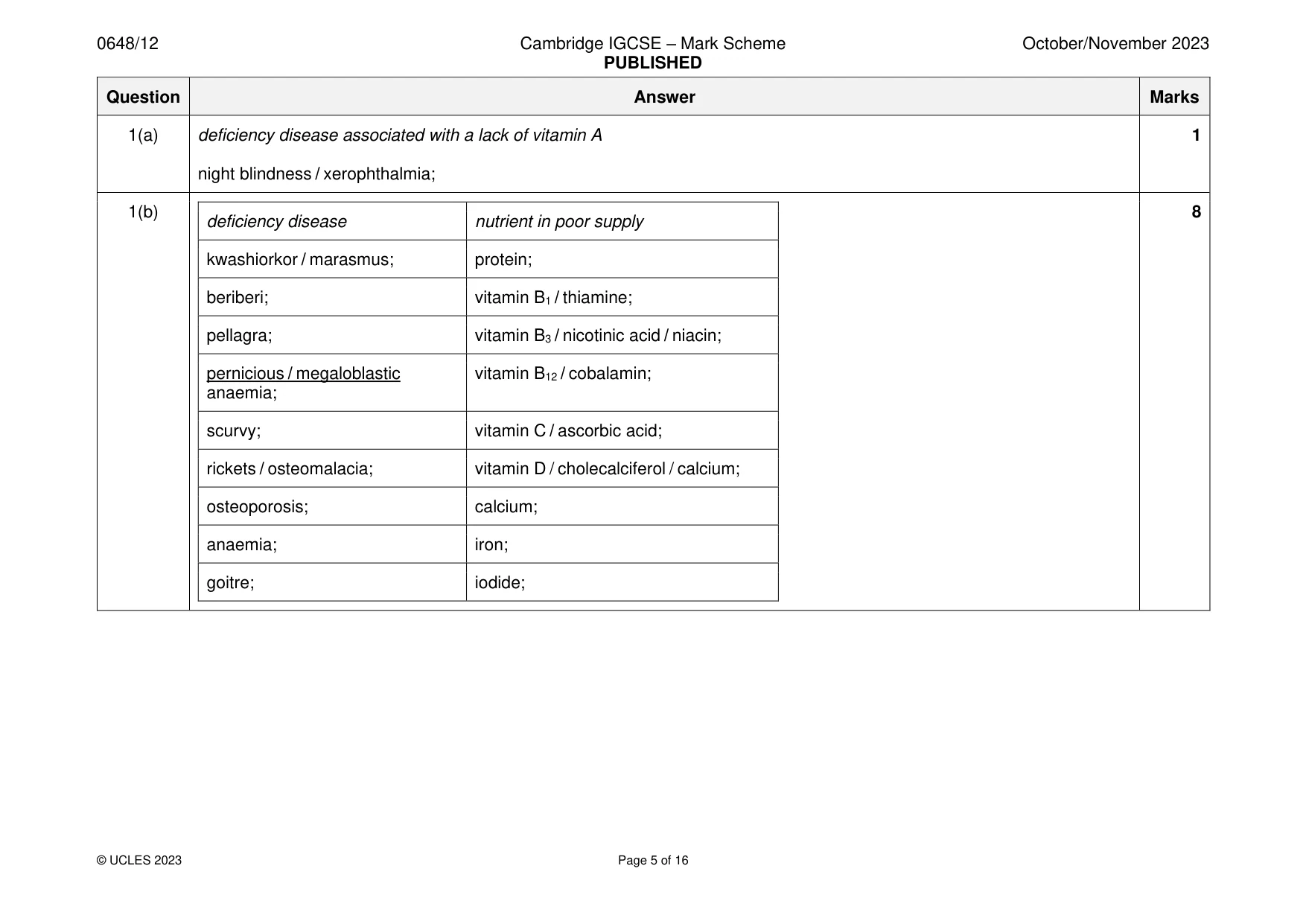
0648/12 Cambridge IGCSE – Mark Scheme PUBLISHED October/November 2023 © UCLES 2023 Page 5 of 16 Question Answer Marks 1(a) deficiency disease associated with a lack of vitamin A night blindness / xerophthalmia; 1 1(b) deficiency disease nutrient in poor supply kwashiorkor / marasmus; protein; beriberi; vitamin B1 / thiamine; pellagra; vitamin B3 / nicotinic acid / niacin; pernicious / megaloblastic anaemia; vitamin B12 / cobalamin; scurvy; vitamin C / ascorbic acid; rickets / osteomalacia; vitamin D / cholecalciferol / calcium; osteoporosis; calcium; anaemia; iron; goitre; iodide; 8
Mark scheme, page 6
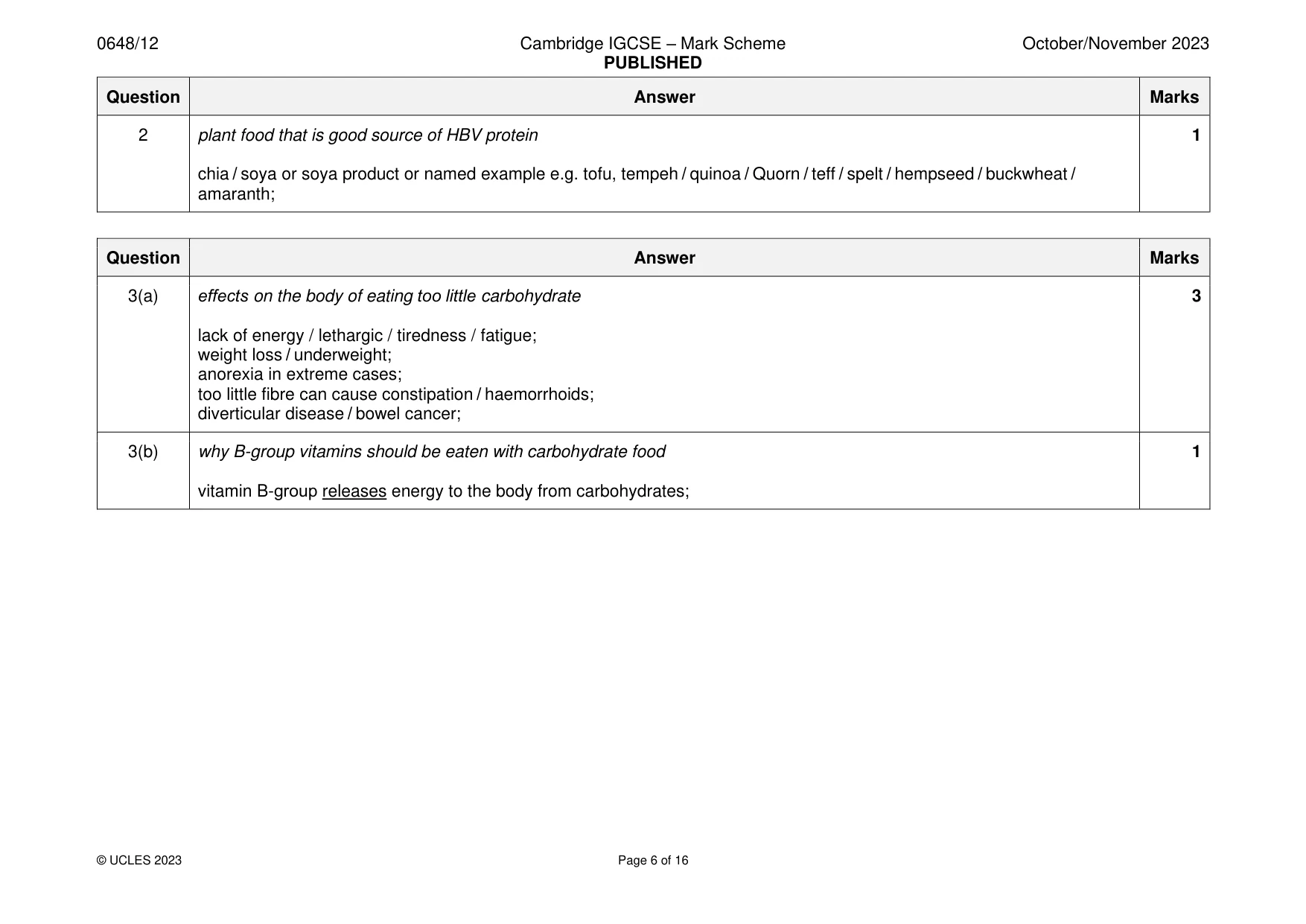
0648/12 Cambridge IGCSE – Mark Scheme PUBLISHED October/November 2023 © UCLES 2023 Page 6 of 16 Question Answer Marks 2 plant food that is good source of HBV protein chia / soya or soya product or named example e.g. tofu, tempeh / quinoa / Quorn / teff / spelt / hempseed / buckwheat / amaranth; 1 Question Answer Marks 3(a) effects on the body of eating too little carbohydrate lack of energy / lethargic / tiredness / fatigue; weight loss / underweight; anorexia in extreme cases; too little fibre can cause constipation / haemorrhoids; diverticular disease / bowel cancer; 3 3(b) why B-group vitamins should be eaten with carbohydrate food vitamin B-group releases energy to the body from carbohydrates; 1
Mark scheme, page 7
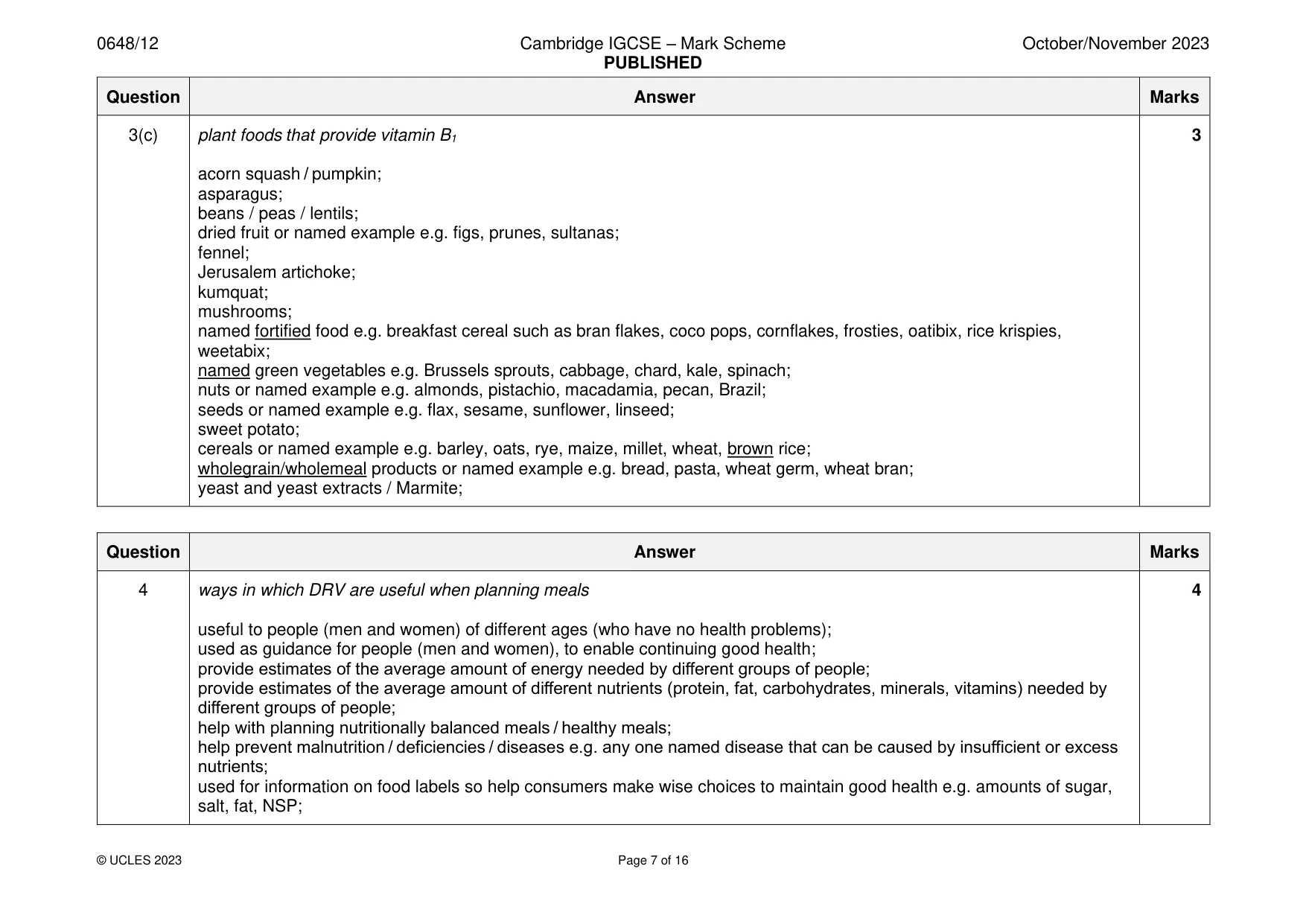
0648/12 Cambridge IGCSE – Mark Scheme PUBLISHED October/November 2023 © UCLES 2023 Page 7 of 16 Question Answer Marks 3(c) plant foods that provide vitamin B1 acorn squash / pumpkin; asparagus; beans / peas / lentils; dried fruit or named example e.g. figs, prunes, sultanas; fennel; Jerusalem artichoke; kumquat; mushrooms; named fortified food e.g. breakfast cereal such as bran flakes, coco pops, cornflakes, frosties, oatibix, rice krispies, weetabix; named green vegetables e.g. Brussels sprouts, cabbage, chard, kale, spinach; nuts or named example e.g. almonds, pistachio, macadamia, pecan, Brazil; seeds or named example e.g. flax, sesame, sunflower, linseed; sweet potato; cereals or named example e.g. barley, oats, rye, maize, millet, wheat, brown rice; wholegrain/wholemeal products or named example e.g. bread, pasta, wheat germ, wheat bran; yeast and yeast extracts / Marmite; 3 Question Answer Marks 4 ways in which DRV are useful when planning meals useful to people (men and women) of different ages (who have no health problems); used as guidance for people (men and women), to enable continuing good health; provide estimates of the average amount of energy needed by different groups of people; provide estimates of the average amount of different nutrients (protein, fat, carbohydrates, minerals, vitamins) needed by different groups of people; help with planning nutritionally balanced meals / healthy meals; help prevent malnutrition / deficiencies / diseases e.g. any one named disease that can be caused by insufficient or excess nutrients; used for information on food labels so help consumers make wise choices to maintain good health e.g. amounts of sugar, salt, fat, NSP; 4
Mark scheme, page 8
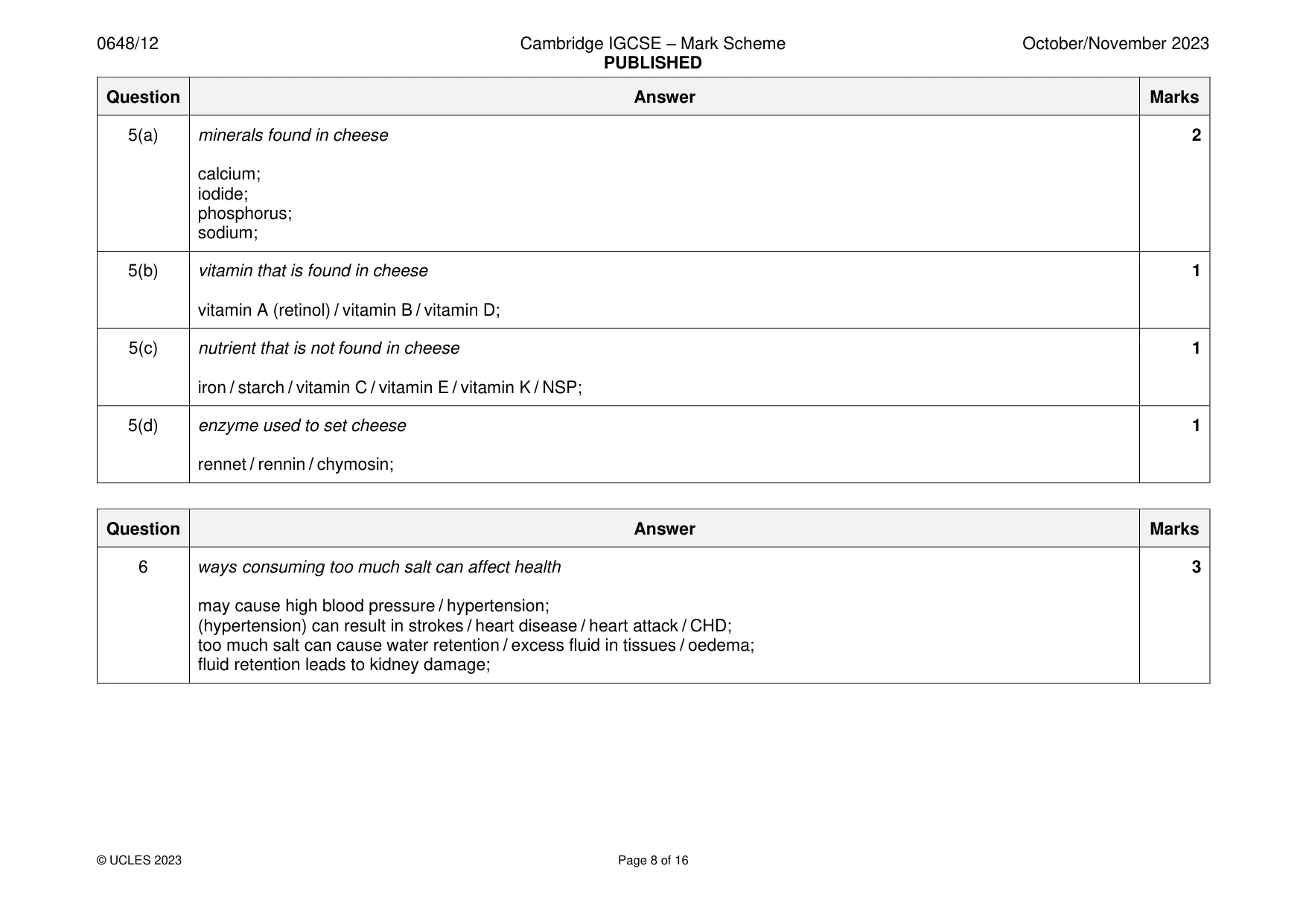
0648/12 Cambridge IGCSE – Mark Scheme PUBLISHED October/November 2023 © UCLES 2023 Page 8 of 16 Question Answer Marks 5(a) minerals found in cheese calcium; iodide; phosphorus; sodium; 2 5(b) vitamin that is found in cheese vitamin A (retinol) / vitamin B / vitamin D; 1 5(c) nutrient that is not found in cheese iron / starch / vitamin C / vitamin E / vitamin K / NSP; 1 5(d) enzyme used to set cheese rennet / rennin / chymosin; 1 Question Answer Marks 6 ways consuming too much salt can affect health may cause high blood pressure / hypertension; (hypertension) can result in strokes / heart disease / heart attack / CHD; too much salt can cause water retention / excess fluid in tissues / oedema; fluid retention leads to kidney damage; 3
Mark scheme, page 9
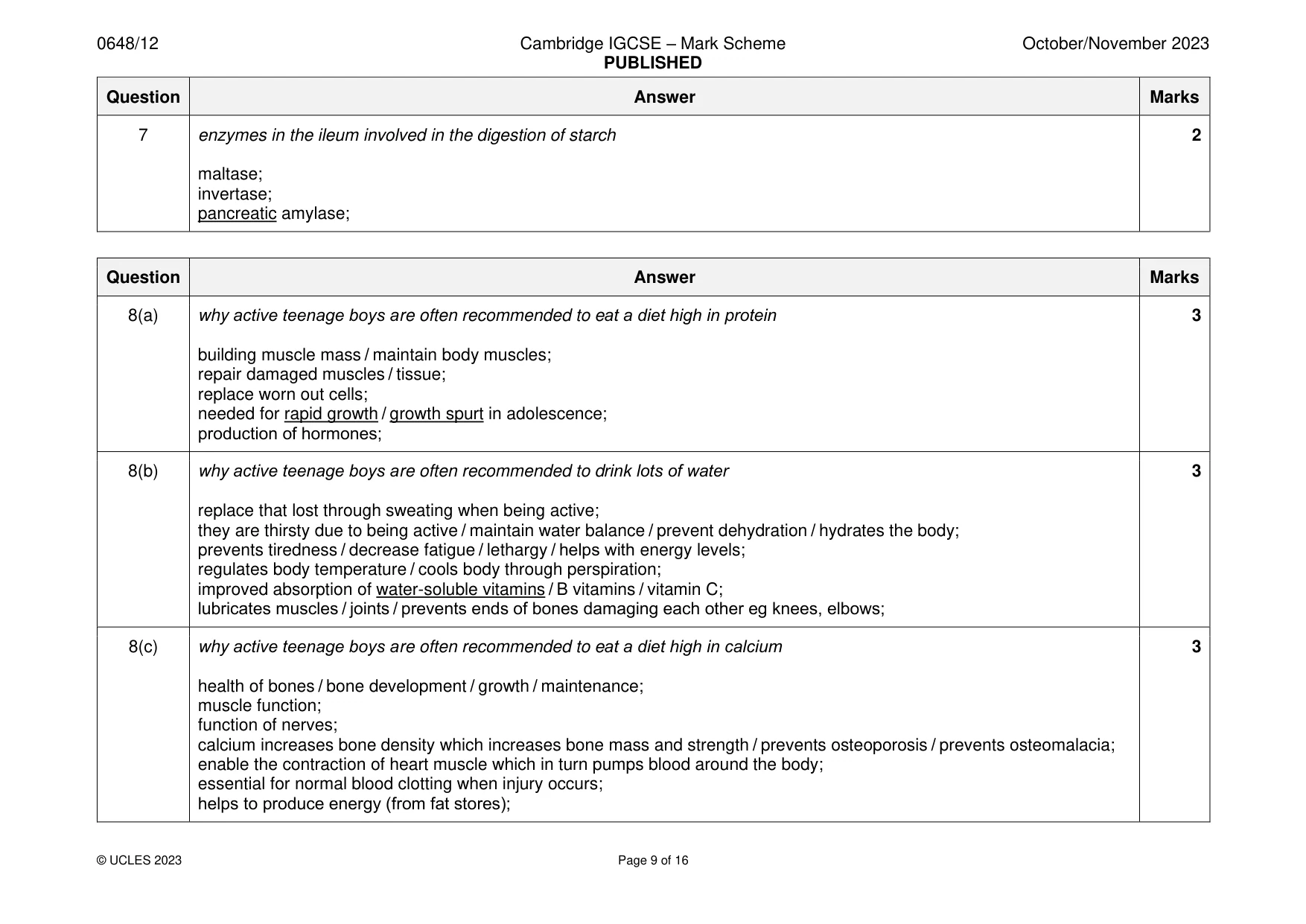
0648/12 Cambridge IGCSE – Mark Scheme PUBLISHED October/November 2023 © UCLES 2023 Page 9 of 16 Question Answer Marks 7 enzymes in the ileum involved in the digestion of starch maltase; invertase; pancreatic amylase; 2 Question Answer Marks 8(a) why active teenage boys are often recommended to eat a diet high in protein building muscle mass / maintain body muscles; repair damaged muscles / tissue; replace worn out cells; needed for rapid growth / growth spurt in adolescence; production of hormones; 3 8(b) why active teenage boys are often recommended to drink lots of water replace that lost through sweating when being active; they are thirsty due to being active / maintain water balance / prevent dehydration / hydrates the body; prevents tiredness / decrease fatigue / lethargy / helps with energy levels; regulates body temperature / cools body through perspiration; improved absorption of water-soluble vitamins / B vitamins / vitamin C; lubricates muscles / joints / prevents ends of bones damaging each other eg knees, elbows; 3 8(c) why active teenage boys are often recommended to eat a diet high in calcium health of bones / bone development / growth / maintenance; muscle function; function of nerves; calcium increases bone density which increases bone mass and strength / prevents osteoporosis / prevents osteomalacia; enable the contraction of heart muscle which in turn pumps blood around the body; essential for normal blood clotting when injury occurs; helps to produce energy (from fat stores); 3
Mark scheme, page 10
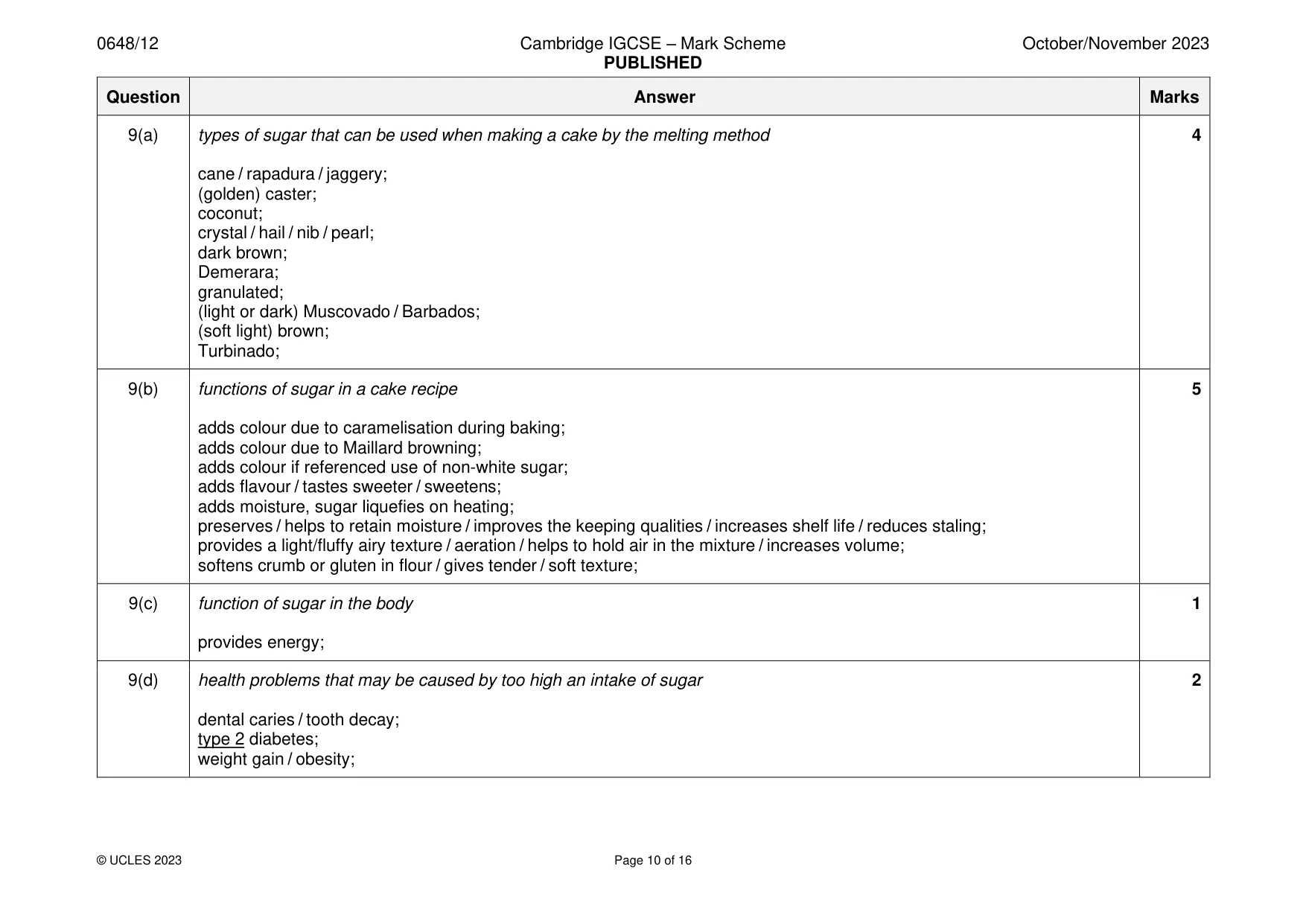
0648/12 Cambridge IGCSE – Mark Scheme PUBLISHED October/November 2023 © UCLES 2023 Page 10 of 16 Question Answer Marks 9(a) types of sugar that can be used when making a cake by the melting method cane / rapadura / jaggery; (golden) caster; coconut; crystal / hail / nib / pearl; dark brown; Demerara; granulated; (light or dark) Muscovado / Barbados; (soft light) brown; Turbinado; 4 9(b) functions of sugar in a cake recipe adds colour due to caramelisation during baking; adds colour due to Maillard browning; adds colour if referenced use of non-white sugar; adds flavour / tastes sweeter / sweetens; adds moisture, sugar liquefies on heating; preserves / helps to retain moisture / improves the keeping qualities / increases shelf life / reduces staling; provides a light/fluffy airy texture / aeration / helps to hold air in the mixture / increases volume; softens crumb or gluten in flour / gives tender / soft texture; 5 9(c) function of sugar in the body provides energy; 1 9(d) health problems that may be caused by too high an intake of sugar dental caries / tooth decay; type 2 diabetes; weight gain / obesity; 2
Mark scheme, page 11
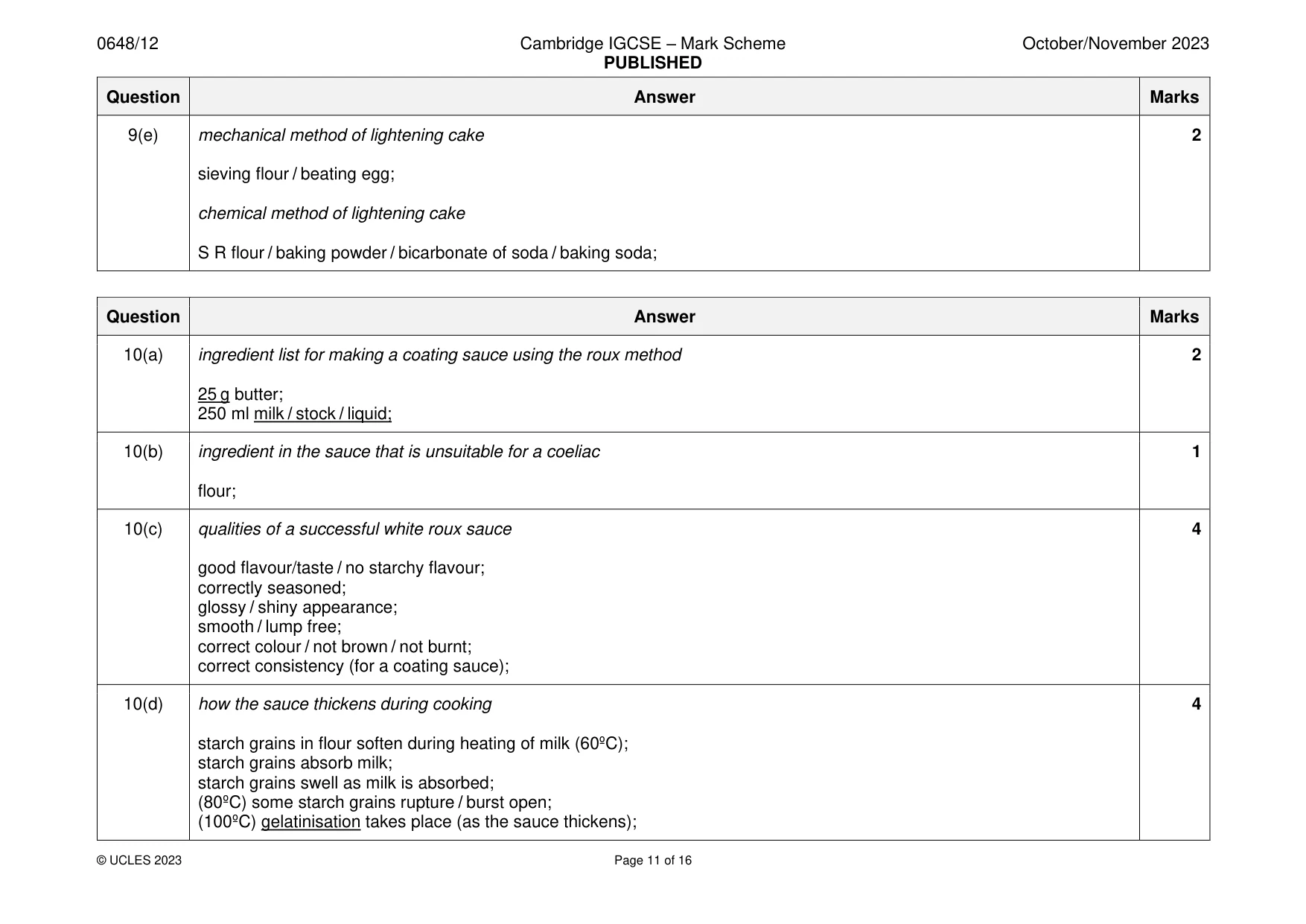
0648/12 Cambridge IGCSE – Mark Scheme PUBLISHED October/November 2023 © UCLES 2023 Page 11 of 16 Question Answer Marks 9(e) mechanical method of lightening cake sieving flour / beating egg; chemical method of lightening cake S R flour / baking powder / bicarbonate of soda / baking soda; 2 Question Answer Marks 10(a) ingredient list for making a coating sauce using the roux method 25 g butter; 250 ml milk / stock / liquid; 2 10(b) ingredient in the sauce that is unsuitable for a coeliac flour; 1 10(c) qualities of a successful white roux sauce good flavour/taste / no starchy flavour; correctly seasoned; glossy / shiny appearance; smooth / lump free; correct colour / not brown / not burnt; correct consistency (for a coating sauce); 4 10(d) how the sauce thickens during cooking starch grains in flour soften during heating of milk (60ºC); starch grains absorb milk; starch grains swell as milk is absorbed; (80ºC) some starch grains rupture / burst open; (100ºC) gelatinisation takes place (as the sauce thickens); 4
Mark scheme, page 12
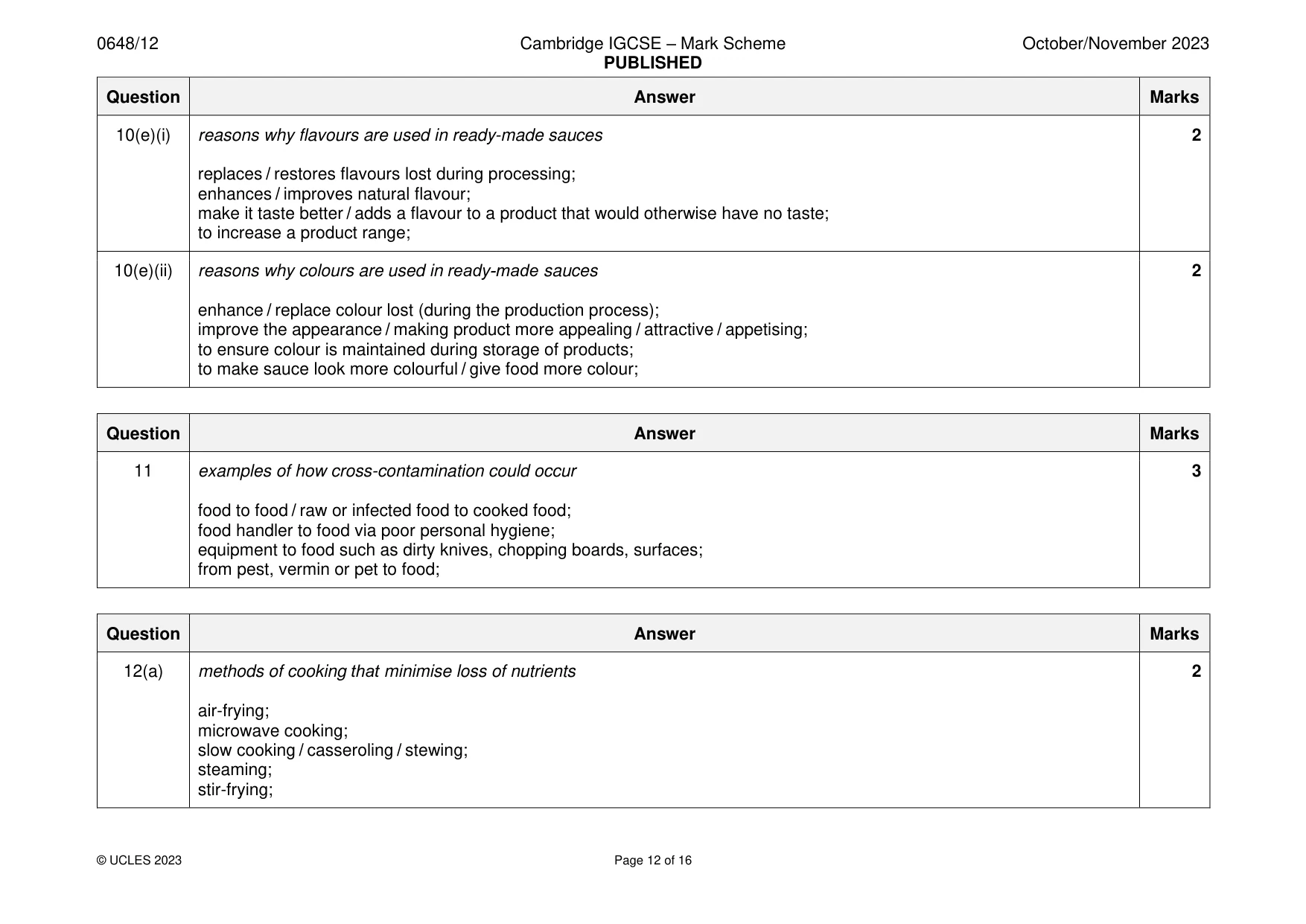
0648/12 Cambridge IGCSE – Mark Scheme PUBLISHED October/November 2023 © UCLES 2023 Page 12 of 16 Question Answer Marks 10(e)(i) reasons why flavours are used in ready-made sauces replaces / restores flavours lost during processing; enhances / improves natural flavour; make it taste better / adds a flavour to a product that would otherwise have no taste; to increase a product range; 2 10(e)(ii) reasons why colours are used in ready-made sauces enhance / replace colour lost (during the production process); improve the appearance / making product more appealing / attractive / appetising; to ensure colour is maintained during storage of products; to make sauce look more colourful / give food more colour; 2 Question Answer Marks 11 examples of how cross-contamination could occur food to food / raw or infected food to cooked food; food handler to food via poor personal hygiene; equipment to food such as dirty knives, chopping boards, surfaces; from pest, vermin or pet to food; 3 Question Answer Marks 12(a) methods of cooking that minimise loss of nutrients air-frying; microwave cooking; slow cooking / casseroling / stewing; steaming; stir-frying; 2
Mark scheme, page 13
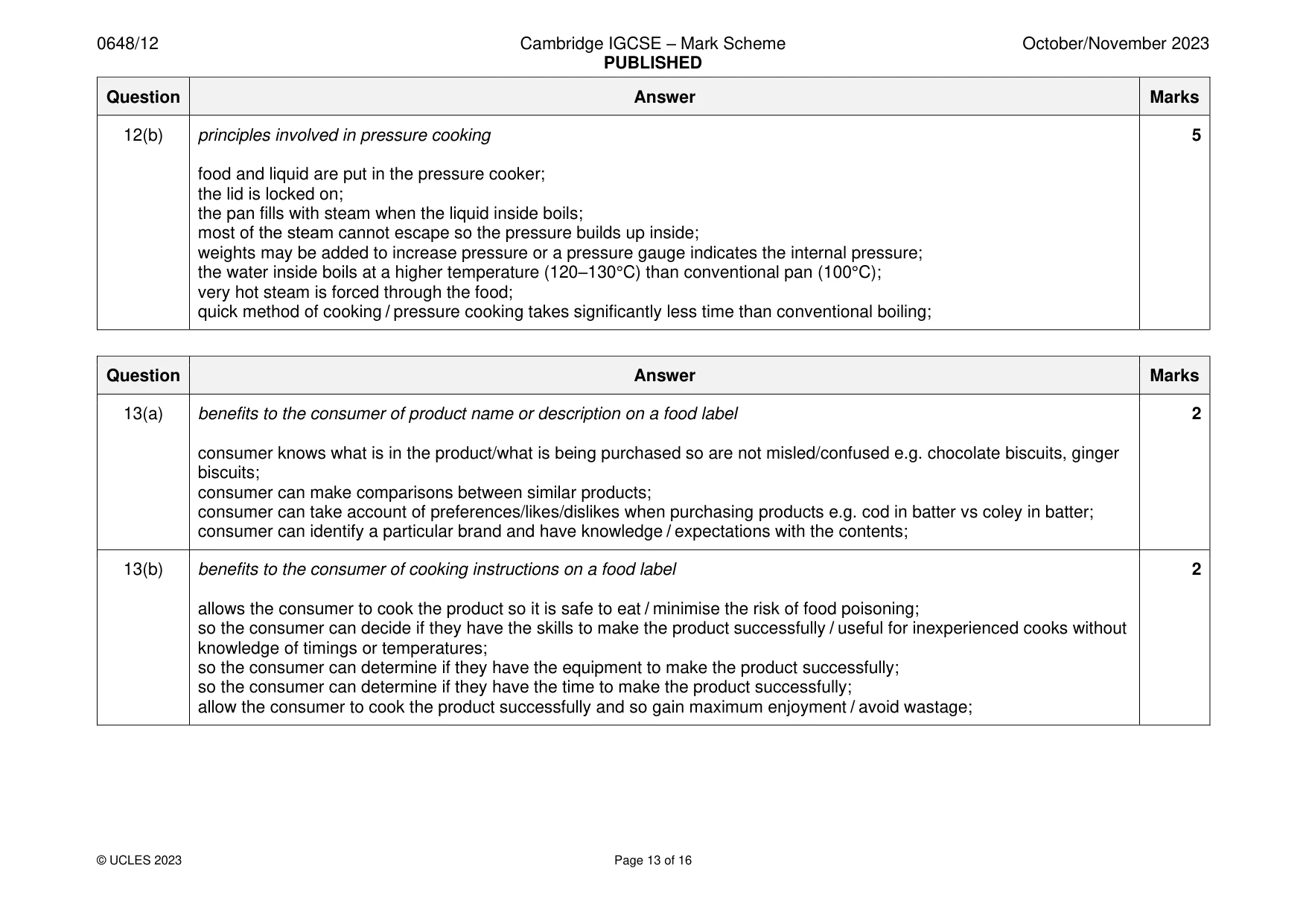
0648/12 Cambridge IGCSE – Mark Scheme PUBLISHED October/November 2023 © UCLES 2023 Page 13 of 16 Question Answer Marks 12(b) principles involved in pressure cooking food and liquid are put in the pressure cooker; the lid is locked on; the pan fills with steam when the liquid inside boils; most of the steam cannot escape so the pressure builds up inside; weights may be added to increase pressure or a pressure gauge indicates the internal pressure; the water inside boils at a higher temperature (120–130°C) than conventional pan (100°C); very hot steam is forced through the food; quick method of cooking / pressure cooking takes significantly less time than conventional boiling; 5 Question Answer Marks 13(a) benefits to the consumer of product name or description on a food label consumer knows what is in the product/what is being purchased so are not misled/confused e.g. chocolate biscuits, ginger biscuits; consumer can make comparisons between similar products; consumer can take account of preferences/likes/dislikes when purchasing products e.g. cod in batter vs coley in batter; consumer can identify a particular brand and have knowledge / expectations with the contents; 2 13(b) benefits to the consumer of cooking instructions on a food label allows the consumer to cook the product so it is safe to eat / minimise the risk of food poisoning; so the consumer can decide if they have the skills to make the product successfully / useful for inexperienced cooks without knowledge of timings or temperatures; so the consumer can determine if they have the equipment to make the product successfully; so the consumer can determine if they have the time to make the product successfully; allow the consumer to cook the product successfully and so gain maximum enjoyment / avoid wastage; 2
Mark scheme, page 14
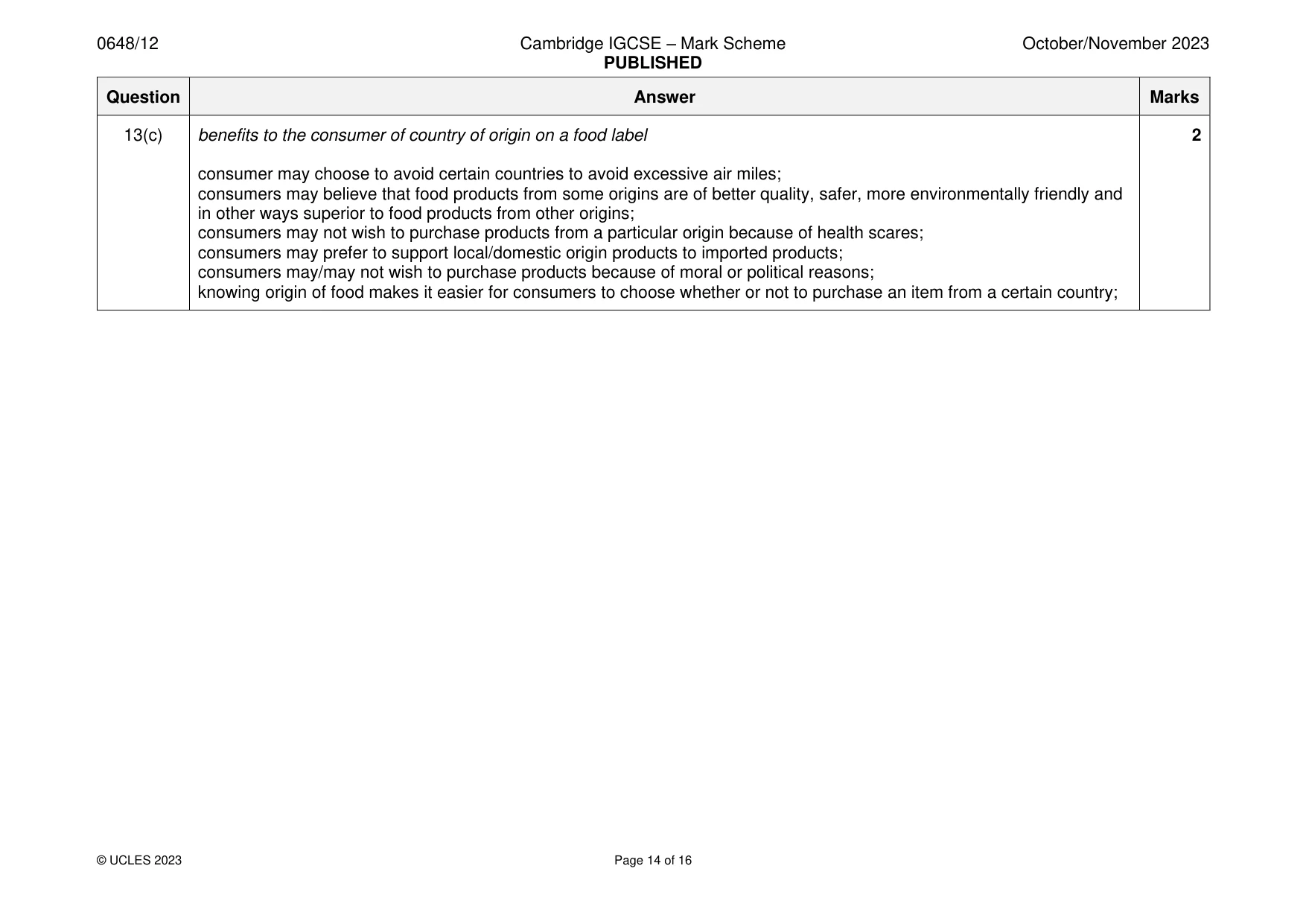
0648/12 Cambridge IGCSE – Mark Scheme PUBLISHED October/November 2023 © UCLES 2023 Page 14 of 16 Question Answer Marks 13(c) benefits to the consumer of country of origin on a food label consumer may choose to avoid certain countries to avoid excessive air miles; consumers may believe that food products from some origins are of better quality, safer, more environmentally friendly and in other ways superior to food products from other origins; consumers may not wish to purchase products from a particular origin because of health scares; consumers may prefer to support local/domestic origin products to imported products; consumers may/may not wish to purchase products because of moral or political reasons; knowing origin of food makes it easier for consumers to choose whether or not to purchase an item from a certain country; 2
Mark scheme, page 15
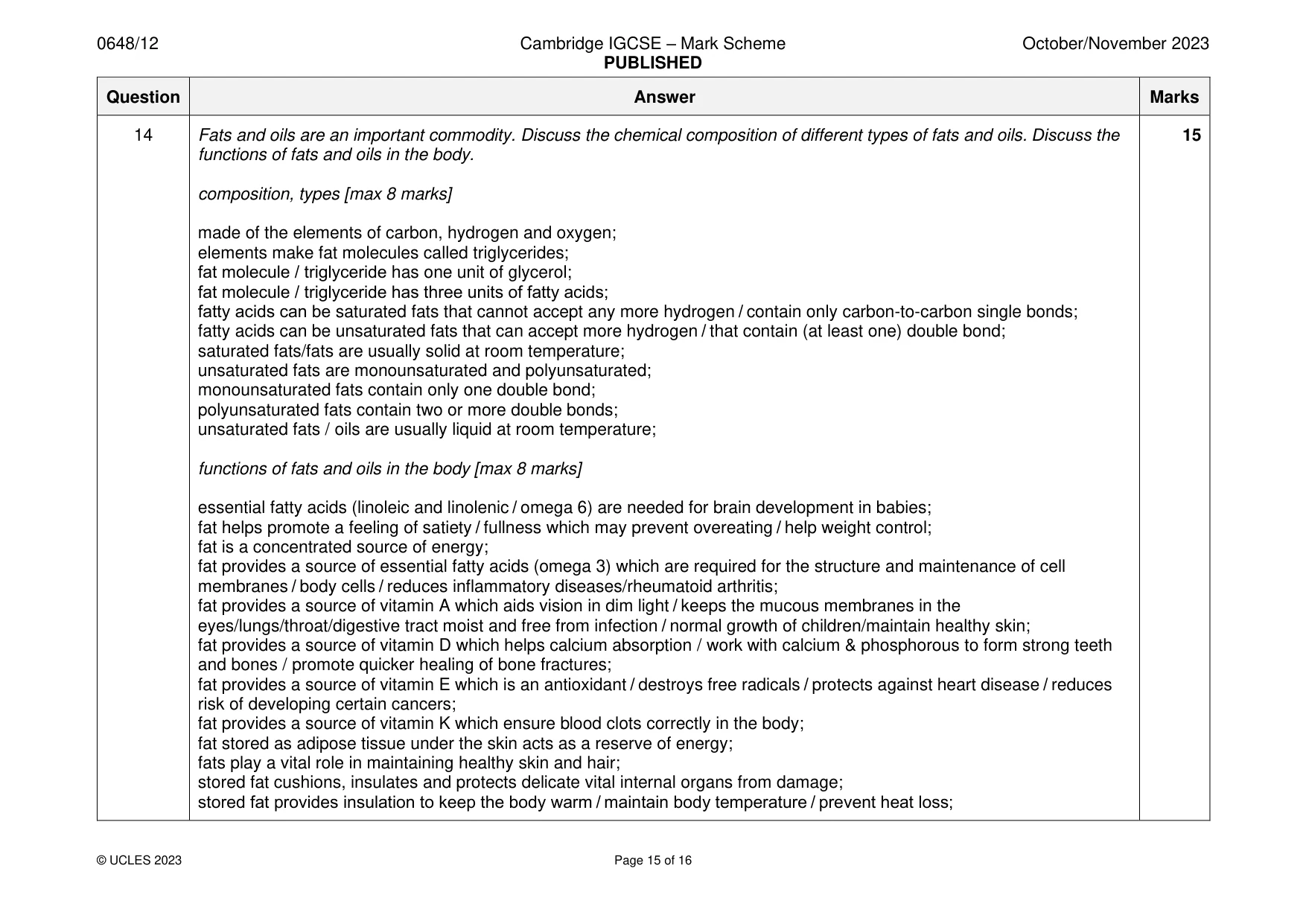
0648/12 Cambridge IGCSE – Mark Scheme PUBLISHED October/November 2023 © UCLES 2023 Page 15 of 16 Question Answer Marks 14 Fats and oils are an important commodity. Discuss the chemical composition of different types of fats and oils. Discuss the functions of fats and oils in the body. composition, types [max 8 marks] made of the elements of carbon, hydrogen and oxygen; elements make fat molecules called triglycerides; fat molecule / triglyceride has one unit of glycerol; fat molecule / triglyceride has three units of fatty acids; fatty acids can be saturated fats that cannot accept any more hydrogen / contain only carbon-to-carbon single bonds; fatty acids can be unsaturated fats that can accept more hydrogen / that contain (at least one) double bond; saturated fats/fats are usually solid at room temperature; unsaturated fats are monounsaturated and polyunsaturated; monounsaturated fats contain only one double bond; polyunsaturated fats contain two or more double bonds; unsaturated fats / oils are usually liquid at room temperature; functions of fats and oils in the body [max 8 marks] essential fatty acids (linoleic and linolenic / omega 6) are needed for brain development in babies; fat helps promote a feeling of satiety / fullness which may prevent overeating / help weight control; fat is a concentrated source of energy; fat provides a source of essential fatty acids (omega 3) which are required for the structure and maintenance of cell membranes / body cells / reduces inflammatory diseases/rheumatoid arthritis; fat provides a source of vitamin A which aids vision in dim light / keeps the mucous membranes in the eyes/lungs/throat/digestive tract moist and free from infection / normal growth of children/maintain healthy skin; fat provides a source of vitamin D which helps calcium absorption / work with calcium & phosphorous to form strong teeth and bones / promote quicker healing of bone fractures; fat provides a source of vitamin E which is an antioxidant / destroys free radicals / protects against heart disease / reduces risk of developing certain cancers; fat provides a source of vitamin K which ensure blood clots correctly in the body; fat stored as adipose tissue under the skin acts as a reserve of energy; fats play a vital role in maintaining healthy skin and hair; stored fat cushions, insulates and protects delicate vital internal organs from damage; stored fat provides insulation to keep the body warm / maintain body temperature / prevent heat loss; 15
Mark scheme, page 16
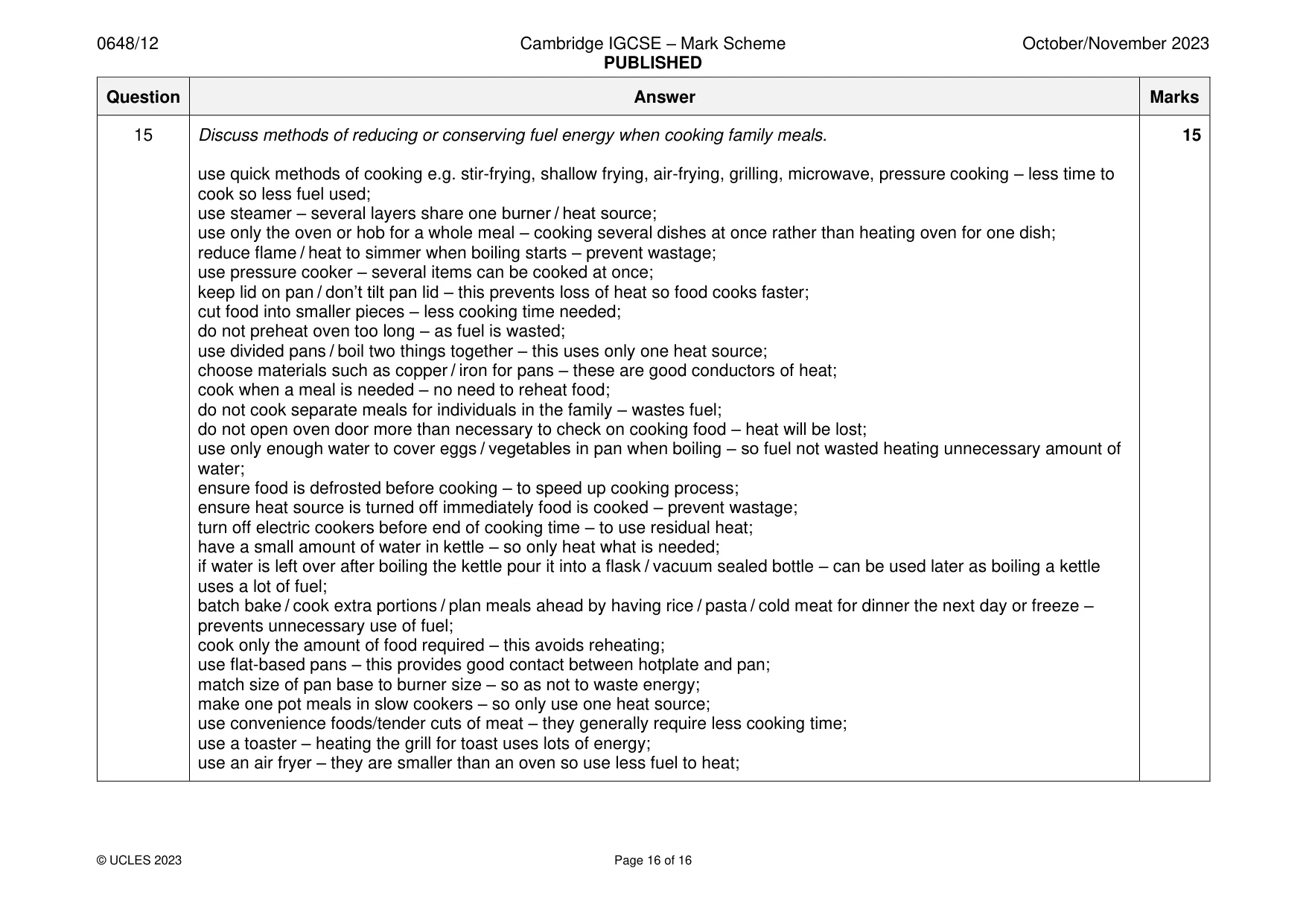
0648/12 Cambridge IGCSE – Mark Scheme PUBLISHED October/November 2023 © UCLES 2023 Page 16 of 16 Question Answer Marks 15 Discuss methods of reducing or conserving fuel energy when cooking family meals. use quick methods of cooking e.g. stir-frying, shallow frying, air-frying, grilling, microwave, pressure cooking – less time to cook so less fuel used; use steamer – several layers share one burner / heat source; use only the oven or hob for a whole meal – cooking several dishes at once rather than heating oven for one dish; reduce flame / heat to simmer when boiling starts – prevent wastage; use pressure cooker – several items can be cooked at once; keep lid on pan / don’t tilt pan lid – this prevents loss of heat so food cooks faster; cut food into smaller pieces – less cooking time needed; do not preheat oven too long – as fuel is wasted; use divided pans / boil two things together – this uses only one heat source; choose materials such as copper / iron for pans – these are good conductors of heat; cook when a meal is needed – no need to reheat food; do not cook separate meals for individuals in the family – wastes fuel; do not open oven door more than necessary to check on cooking food – heat will be lost; use only enough water to cover eggs / vegetables in pan when boiling – so fuel not wasted heating unnecessary amount of water; ensure food is defrosted before cooking – to speed up cooking process; ensure heat source is turned off immediately food is cooked – prevent wastage; turn off electric cookers before end of cooking time – to use residual heat; have a small amount of water in kettle – so only heat what is needed; if water is left over after boiling the kettle pour it into a flask / vacuum sealed bottle – can be used later as boiling a kettle uses a lot of fuel; batch bake / cook extra portions / plan meals ahead by having rice / pasta / cold meat for dinner the next day or freeze – prevents unnecessary use of fuel; cook only the amount of food required – this avoids reheating; use flat-based pans – this provides good contact between hotplate and pan; match size of pan base to burner size – so as not to waste energy; make one pot meals in slow cookers – so only use one heat source; use convenience foods/tender cuts of meat – they generally require less cooking time; use a toaster – heating the grill for toast uses lots of energy; use an air fryer – they are smaller than an oven so use less fuel to heat; 15
What you needed in this session
Cambridge’s own grade thresholds for 2023 Oct/Nov, Paper 1 · Variant 2. A higher threshold means an easier paper — the bar moves with how the cohort did.