Cambridge IGCSE Food and Nutrition 0648 — 2021 Oct/Nov Paper 1 · Variant 3
0648/13/O/N/21 · 100 marks · ≈113 min
The question paper and its mark scheme, free to read here and free to download. This is Cambridge’s own paper, exactly as it was sat.
Question paper12 pages



Mark scheme16 pages
Answers below. Sit the paper first if you are practising.
Paper as text
Question paper, page 1
This document has 12 pages. Any blank pages are indicated. DC (JP/SG) 201820/2 © UCLES 2021 [Turn over * 8 1 2 3 0 6 2 4 7 6 * FOOD & NUTRITION 0648/13 Paper 1 Theory October/November 2021 2 hours You must answer on the question paper. No additional materials are needed. INSTRUCTIONS ● Section A: answer all questions. ● Section B: answer all questions. ● Section C: answer one question. ● Use a black or dark blue pen. You may use an HB pencil for any diagrams or graphs. ● Write your name, centre number and candidate number in the boxes at the top of the page. ● Write your answer to each question in the space provided. ● Do not use an erasable pen or correction fluid. ● Do not write on any bar codes. INFORMATION ● The total mark for this paper is 100. ● The number of marks for each question or part question is shown in brackets [ ]. Cambridge IGCSE™
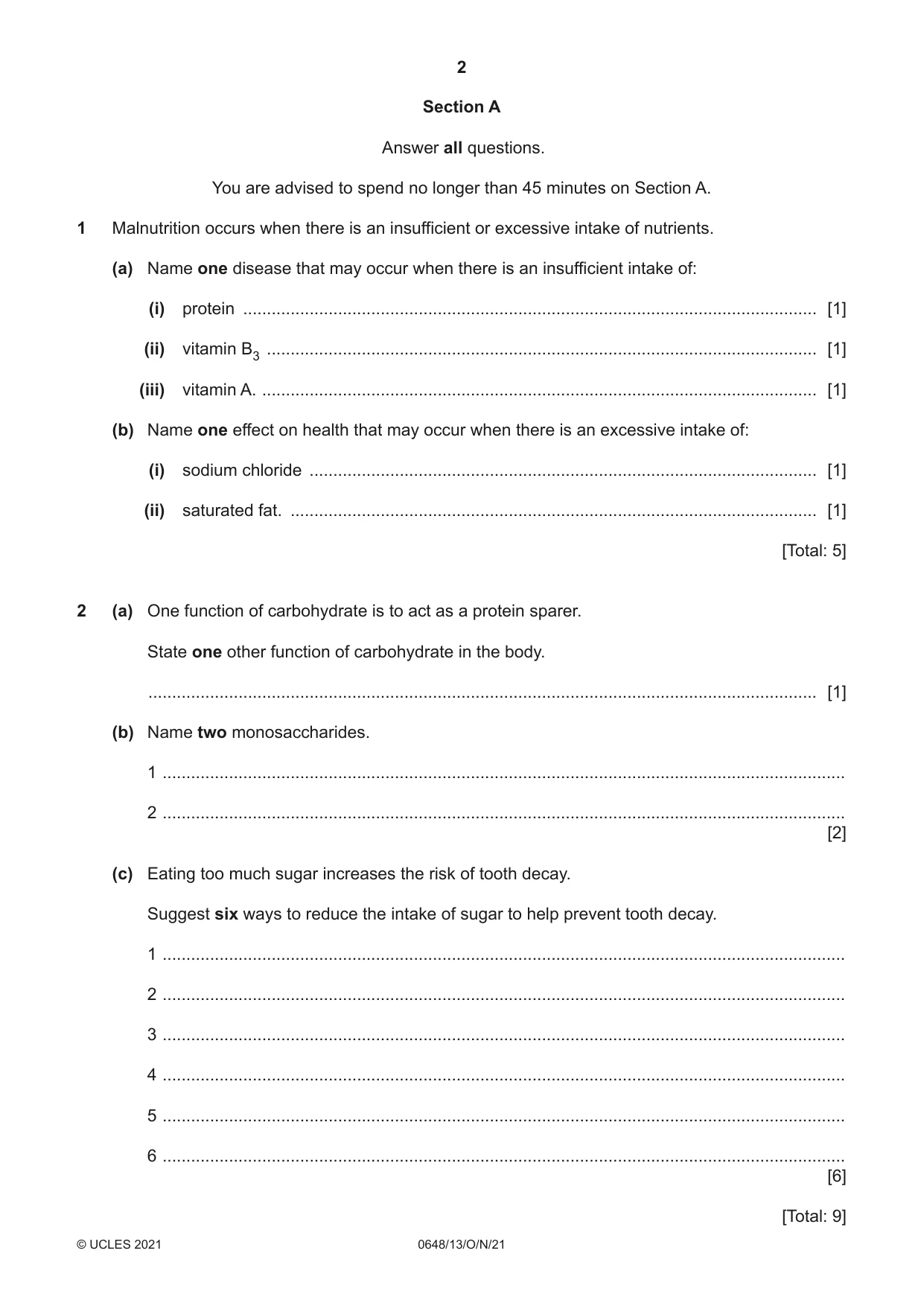
Question paper, page 2
2 0648/13/O/N/21 © UCLES 2021 Section A Answer all questions. You are advised to spend no longer than 45 minutes on Section A. 1 Malnutrition occurs when there is an insufficient or excessive intake of nutrients. (a) Name one disease that may occur when there is an insufficient intake of: (i) protein … [1] (ii) vitamin B3 … [1] (iii) vitamin A. … [1] (b) Name one effect on health that may occur when there is an excessive intake of: (i) sodium chloride … [1] (ii) saturated fat. … [1] [Total: 5] 2 (a) One function of carbohydrate is to act as a protein sparer. State one other function of carbohydrate in the body. … [1] (b) Name two monosaccharides. 1 … 2 … [2] (c) Eating too much sugar increases the risk of tooth decay. Suggest six ways to reduce the intake of sugar to help prevent tooth decay. 1 … 2 … 3 … 4 … 5 … 6 … [6] [Total: 9]
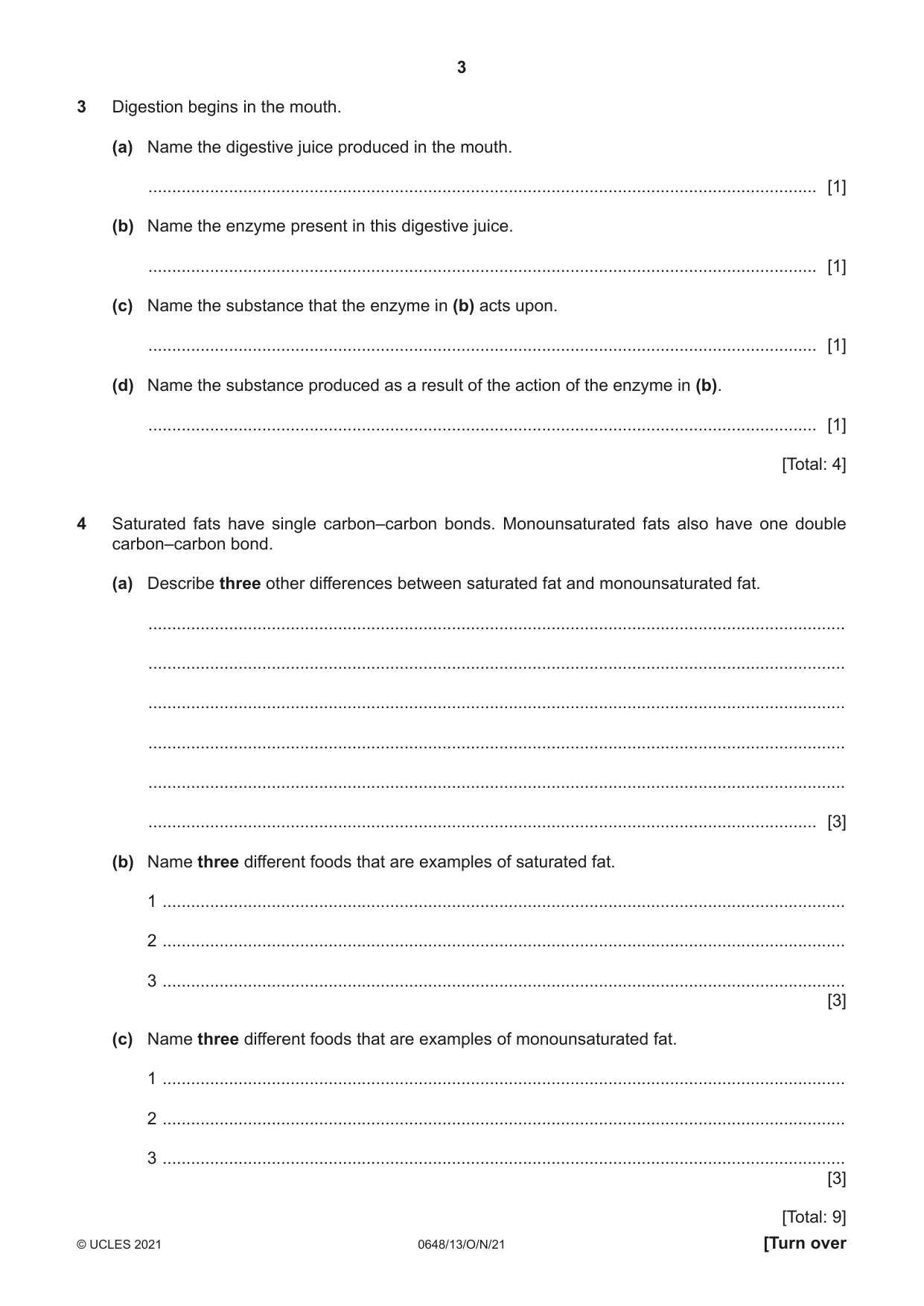
Question paper, page 3
3 0648/13/O/N/21 © UCLES 2021 [Turn over 3 Digestion begins in the mouth. (a) Name the digestive juice produced in the mouth. … [1] (b) Name the enzyme present in this digestive juice. … [1] (c) Name the substance that the enzyme in (b) acts upon. … [1] (d) Name the substance produced as a result of the action of the enzyme in (b). … [1] [Total: 4] 4 Saturated fats have single carbon–carbon bonds. Monounsaturated fats also have one double carbon–carbon bond. (a) Describe three other differences between saturated fat and monounsaturated fat. … … … … … … [3] (b) Name three different foods that are examples of saturated fat. 1 … 2 … 3 … [3] (c) Name three different foods that are examples of monounsaturated fat. 1 … 2 … 3 … [3] [Total: 9]
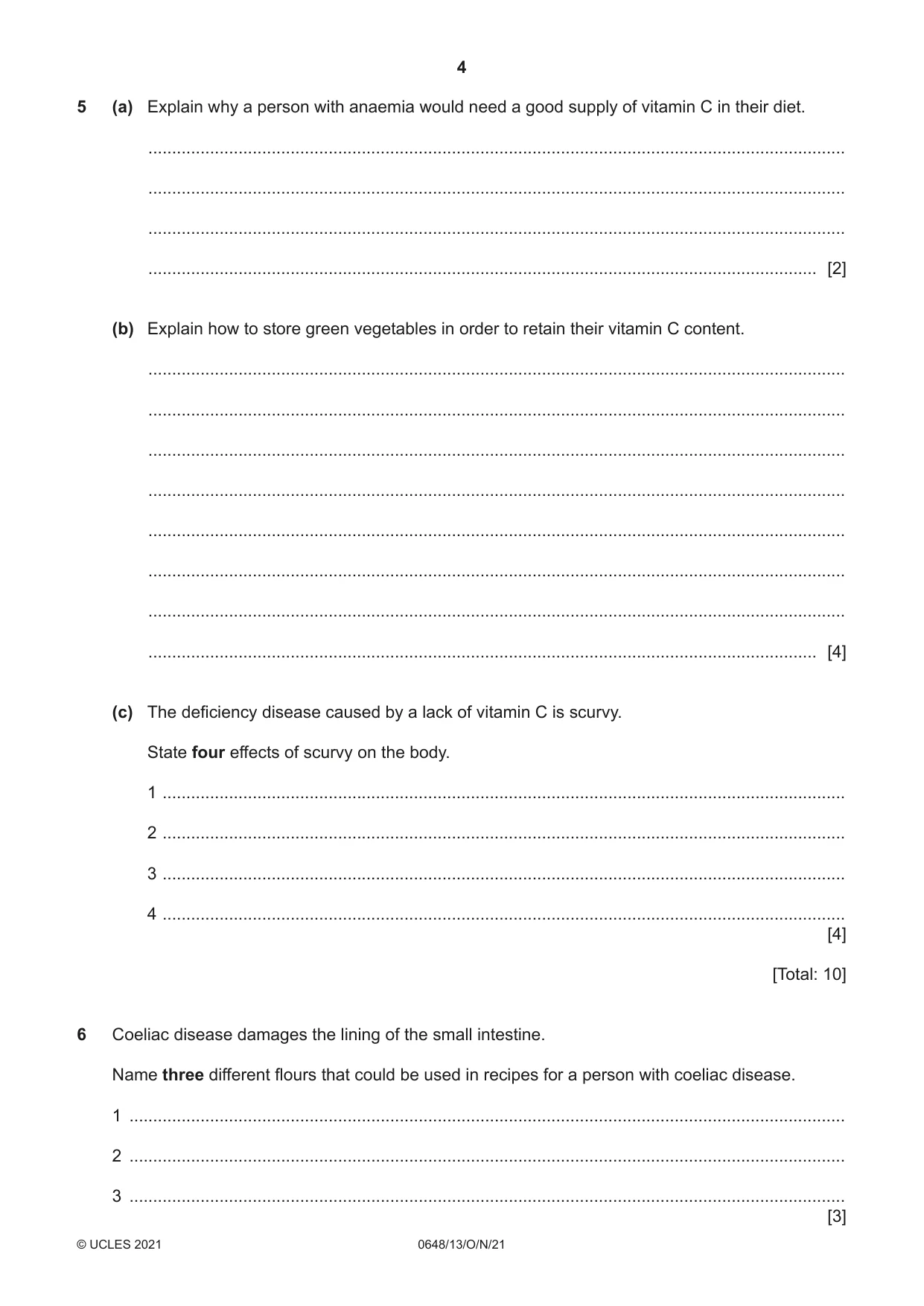
Question paper, page 4
4 0648/13/O/N/21 © UCLES 2021 5 (a) Explain why a person with anaemia would need a good supply of vitamin C in their diet. … … … … [2] (b) Explain how to store green vegetables in order to retain their vitamin C content. … … … … … … … … [4] (c) The deficiency disease caused by a lack of vitamin C is scurvy. State four effects of scurvy on the body. 1 … 2 … 3 … 4 … [4] [Total: 10] 6 Coeliac disease damages the lining of the small intestine. Name three different flours that could be used in recipes for a person with coeliac disease. 1 … 2 … 3 … [3]
Question paper, page 5
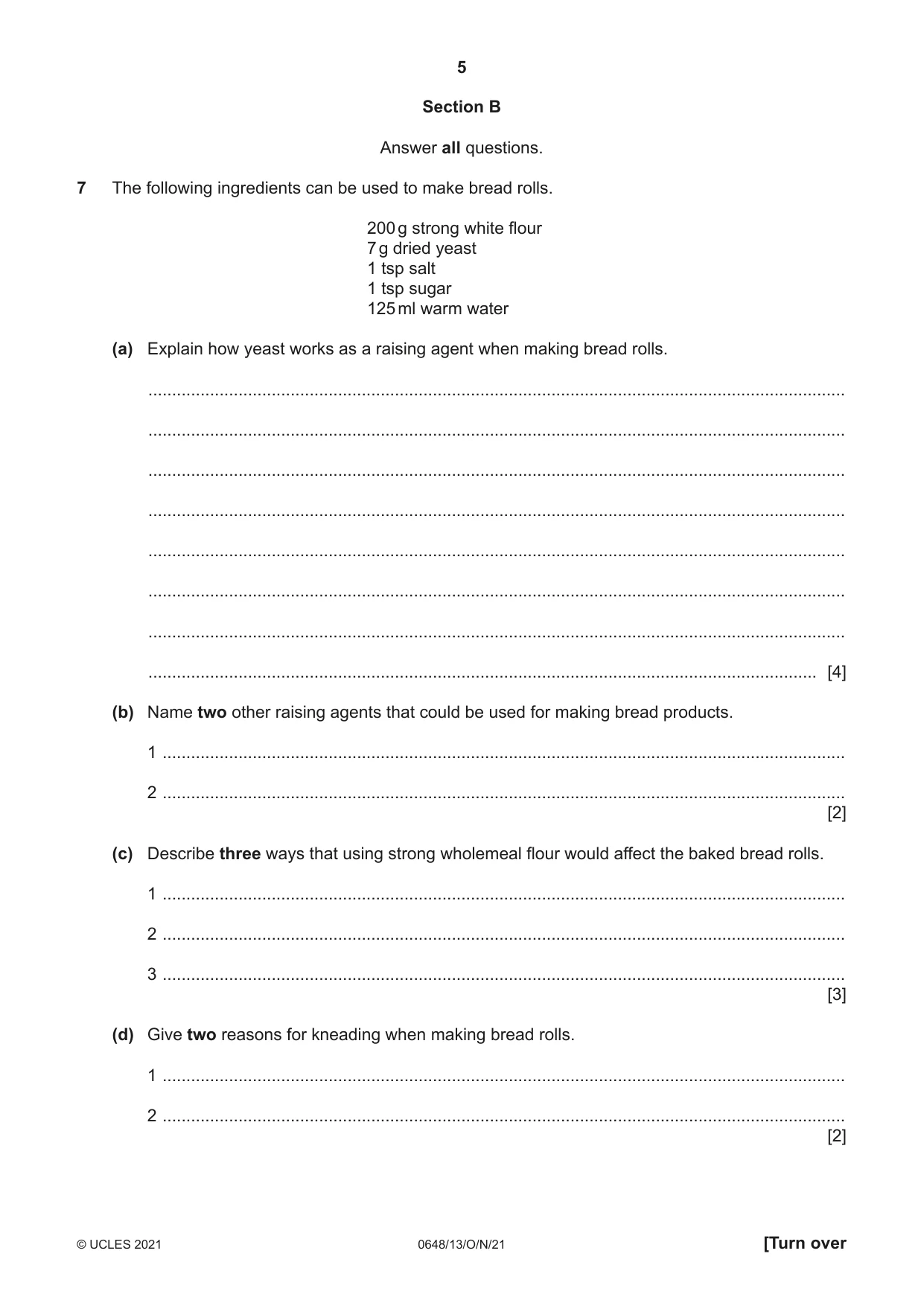
5 0648/13/O/N/21 © UCLES 2021 [Turn over Section B Answer all questions. 7 The following ingredients can be used to make bread rolls. 200 g strong white flour 7 g dried yeast 1 tsp salt 1 tsp sugar 125 ml warm water (a) Explain how yeast works as a raising agent when making bread rolls. … … … … … … … … [4] (b) Name two other raising agents that could be used for making bread products. 1 … 2 … [2] (c) Describe three ways that using strong wholemeal flour would affect the baked bread rolls. 1 … 2 … 3 … [3] (d) Give two reasons for kneading when making bread rolls. 1 … 2 … [2]
Question paper, page 6
6 0648/13/O/N/21 © UCLES 2021 (e) Name two chemical reactions that cause bread to change colour during baking. 1 … 2 … [2] (f) Suggest six reasons why a packet bread mix can be useful. 1 … 2 … 3 … 4 … 5 … 6 … [6] [Total: 19] 8 Food irradiation is a safe method of preservation that exposes food to ionising radiation. Give four benefits of irradiating food. 1 … … 2 … … 3 … … 4 … … [4]
Question paper, page 7
7 0648/13/O/N/21 © UCLES 2021 [Turn over 9 Ventilation makes working in the kitchen more pleasant by removing excess heat and steam. Identify and describe four different ways to ventilate a kitchen. 1 … … 2 … … 3 … … 4 … … [8]
Question paper, page 8
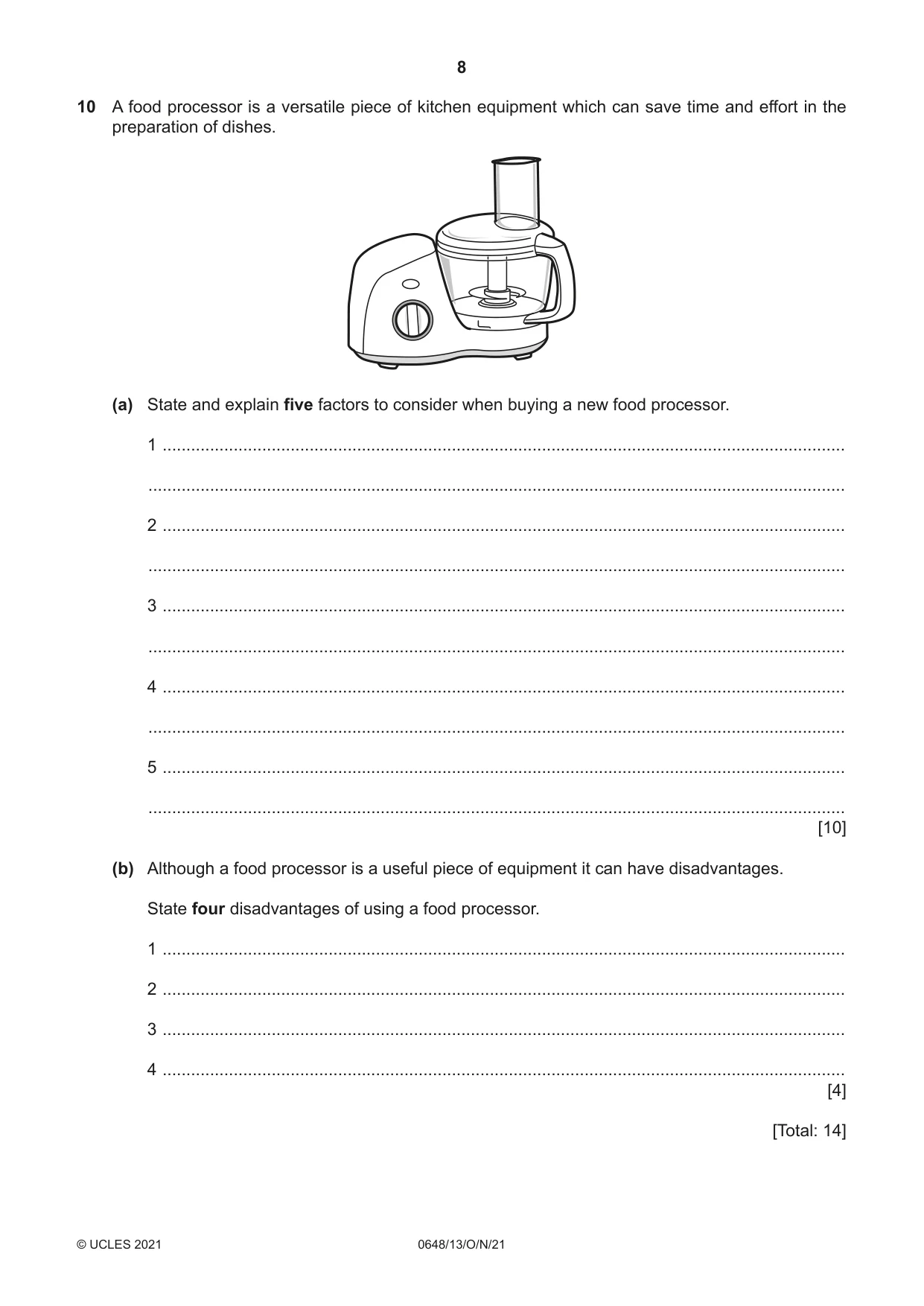
8 0648/13/ O/ N/21 © UCLES 2021 10 A food processor is a versatile piece of kitchen equipment which can save time and effort in the preparation of dishes. (a) State and explain five factors to consider when buying a new food processor. 1 … … 2 … … 3 … … 4 … … 5 … … [10] (b) Although a food processor is a useful piece of equipment it can have disadvantages. State four disadvantages of using a food processor. 1 … 2 … 3 … 4 … [4] [Total: 14]
Question paper, page 9
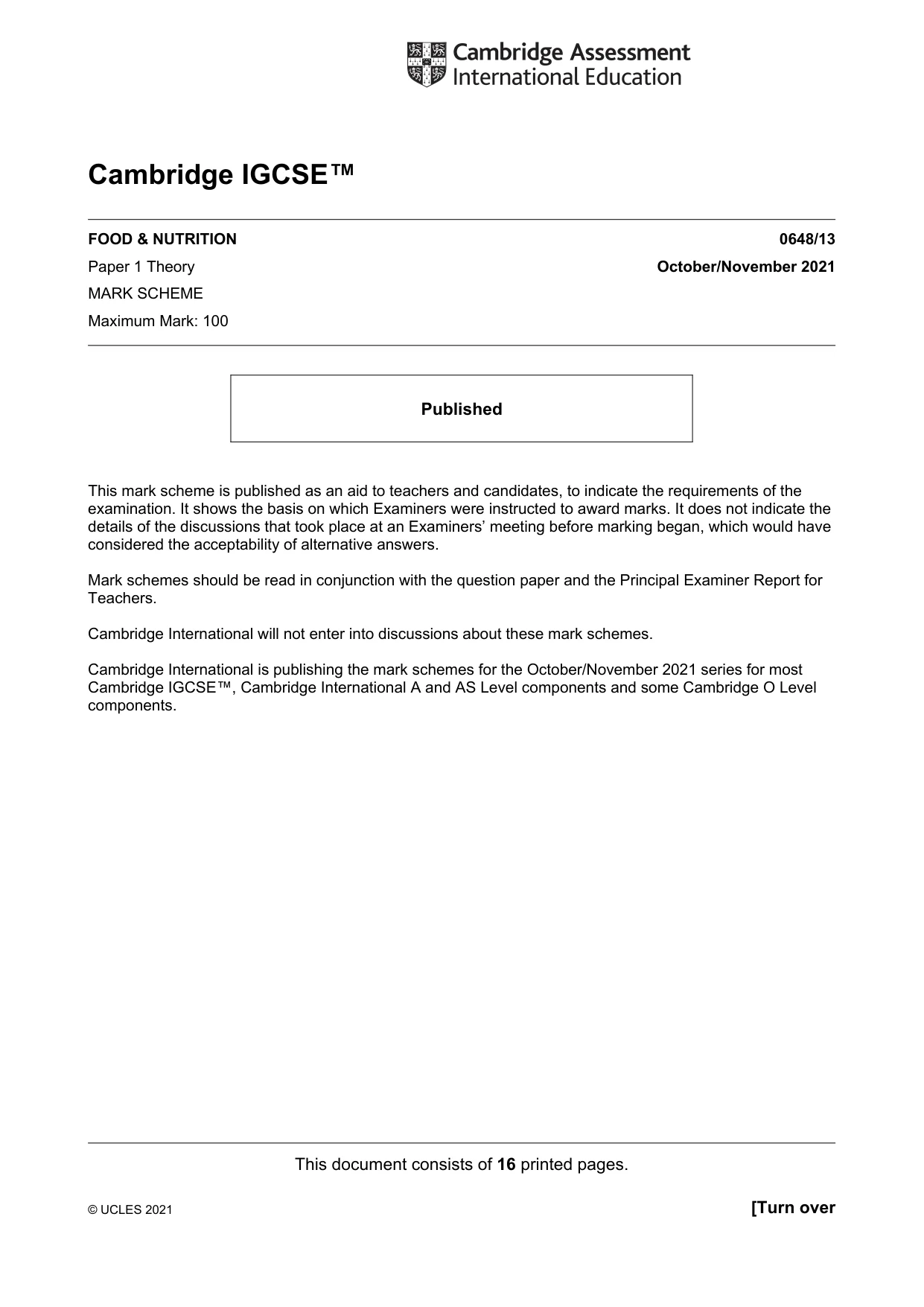
9 0648/13/O/N/21 © UCLES 2021 [Turn over Section C Answer either Question 11 or 12. 11 Slips, trips and falls are common causes of accidents in the kitchen. Explain ways to reduce the risk of a slip, trip or fall in the kitchen. [15] OR 12 During pregnancy it is important to ensure the mother has good dietary health. • Explain the importance of increasing the intake of iron, folate and calcium during pregnancy. • Suggest, with reasons, types of food that should be avoided during pregnancy. [15] [Total: 15] … … … … … … … … … … … … … … … … … … …
Question paper, page 10
10 0648/13/O/N/21 © UCLES 2021 … … … … … … … … … … … … … … … … … … … … … … … … … … … …
Question paper, page 11
11 0648/13/O/N/21 © UCLES 2021 … … … … … … … … … … … … … … … … … … … … … … … … … … … …
Question paper, page 12
12 0648/13/O/N/21 © UCLES 2021 Permission to reproduce items where third-party owned material protected by copyright is included has been sought and cleared where possible. Every reasonable effort has been made by the publisher (UCLES) to trace copyright holders, but if any items requiring clearance have unwittingly been included, the publisher will be pleased to make amends at the earliest possible opportunity. To avoid the issue of disclosure of answer-related information to candidates, all copyright acknowledgements are reproduced online in the Cambridge Assessment International Education Copyright Acknowledgements Booklet. This is produced for each series of examinations and is freely available to download at www.cambridgeinternational.org after the live examination series. Cambridge Assessment International Education is part of the Cambridge Assessment Group. Cambridge Assessment is the brand name of the University of Cambridge Local Examinations Syndicate (UCLES), which itself is a department of the University of Cambridge. BLANK PAGE
Mark scheme, page 1
This document consists of 16 printed pages. © UCLES 2021 [Turn over Cambridge IGCSE™ FOOD & NUTRITION 0648/13 Paper 1 Theory October/November 2021 MARK SCHEME Maximum Mark: 100 Published This mark scheme is published as an aid to teachers and candidates, to indicate the requirements of the examination. It shows the basis on which Examiners were instructed to award marks. It does not indicate the details of the discussions that took place at an Examiners’ meeting before marking began, which would have considered the acceptability of alternative answers. Mark schemes should be read in conjunction with the question paper and the Principal Examiner Report for Teachers. Cambridge International will not enter into discussions about these mark schemes. Cambridge International is publishing the mark schemes for the October/November 2021 series for most Cambridge IGCSE™, Cambridge International A and AS Level components and some Cambridge O Level components.
Mark scheme, page 2
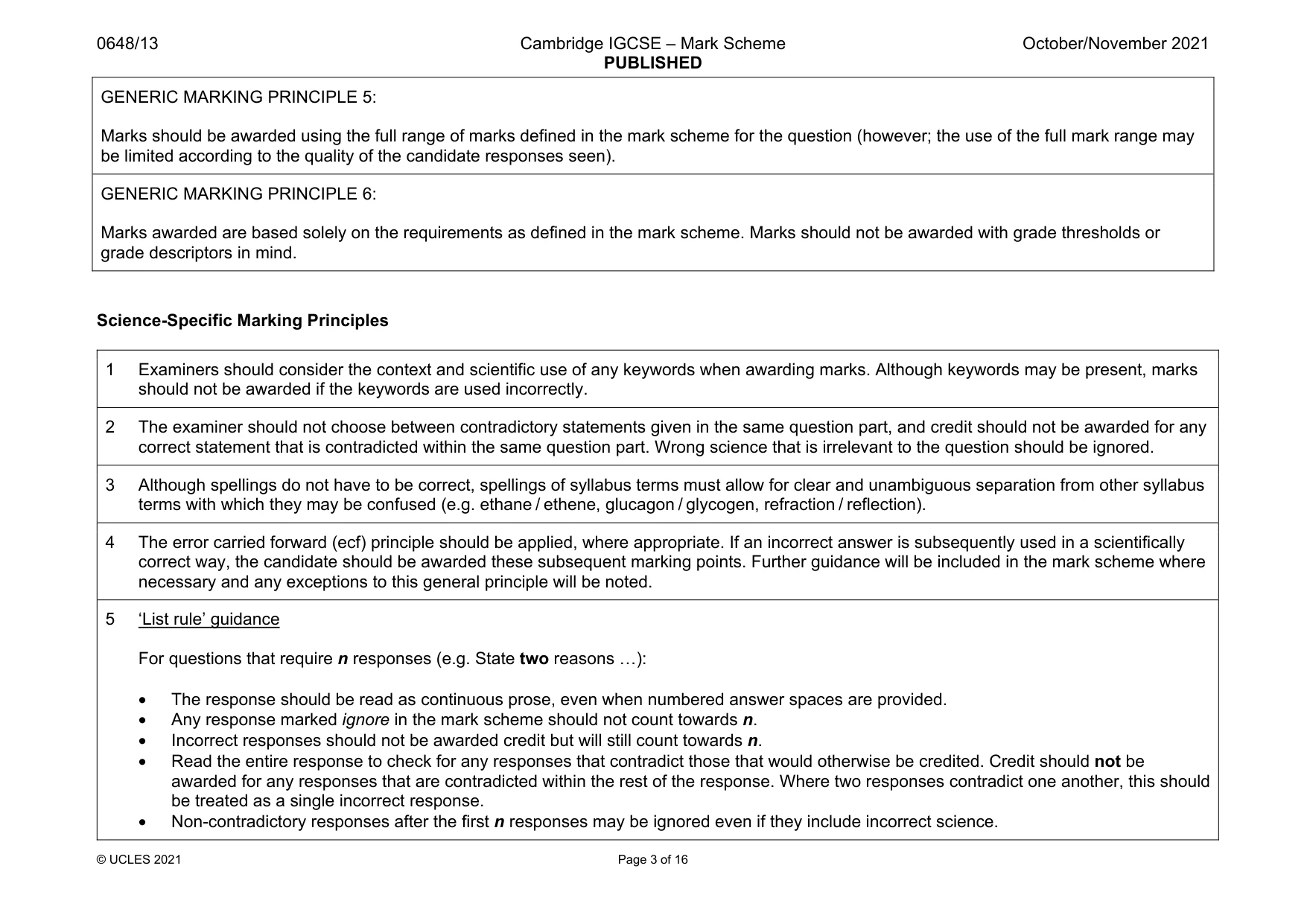
0648/13 Cambridge IGCSE – Mark Scheme PUBLISHED October/November 2021 © UCLES 2021 Page 2 of 16 Generic Marking Principles These general marking principles must be applied by all examiners when marking candidate answers. They should be applied alongside the specific content of the mark scheme or generic level descriptors for a question. Each question paper and mark scheme will also comply with these marking principles. GENERIC MARKING PRINCIPLE 1: Marks must be awarded in line with: • the specific content of the mark scheme or the generic level descriptors for the question • the specific skills defined in the mark scheme or in the generic level descriptors for the question • the standard of response required by a candidate as exemplified by the standardisation scripts. GENERIC MARKING PRINCIPLE 2: Marks awarded are always whole marks (not half marks, or other fractions). GENERIC MARKING PRINCIPLE 3: Marks must be awarded positively: • marks are awarded for correct/valid answers, as defined in the mark scheme. However, credit is given for valid answers which go beyond the scope of the syllabus and mark scheme, referring to your Team Leader as appropriate • marks are awarded when candidates clearly demonstrate what they know and can do • marks are not deducted for errors • marks are not deducted for omissions • answers should only be judged on the quality of spelling, punctuation and grammar when these features are specifically assessed by the question as indicated by the mark scheme. The meaning, however, should be unambiguous. GENERIC MARKING PRINCIPLE 4: Rules must be applied consistently, e.g. in situations where candidates have not followed instructions or in the application of generic level descriptors.
Mark scheme, page 3
0648/13 Cambridge IGCSE – Mark Scheme PUBLISHED October/November 2021 © UCLES 2021 Page 3 of 16 GENERIC MARKING PRINCIPLE 5: Marks should be awarded using the full range of marks defined in the mark scheme for the question (however; the use of the full mark range may be limited according to the quality of the candidate responses seen). GENERIC MARKING PRINCIPLE 6: Marks awarded are based solely on the requirements as defined in the mark scheme. Marks should not be awarded with grade thresholds or grade descriptors in mind. Science-Specific Marking Principles 1 Examiners should consider the context and scientific use of any keywords when awarding marks. Although keywords may be present, marks should not be awarded if the keywords are used incorrectly. 2 The examiner should not choose between contradictory statements given in the same question part, and credit should not be awarded for any correct statement that is contradicted within the same question part. Wrong science that is irrelevant to the question should be ignored. 3 Although spellings do not have to be correct, spellings of syllabus terms must allow for clear and unambiguous separation from other syllabus terms with which they may be confused (e.g. ethane / ethene, glucagon / glycogen, refraction / reflection). 4 The error carried forward (ecf) principle should be applied, where appropriate. If an incorrect answer is subsequently used in a scientifically correct way, the candidate should be awarded these subsequent marking points. Further guidance will be included in the mark scheme where necessary and any exceptions to this general principle will be noted. 5 ‘List rule’ guidance For questions that require n responses (e.g. State two reasons …): • The response should be read as continuous prose, even when numbered answer spaces are provided. • Any response marked ignore in the mark scheme should not count towards n. • Incorrect responses should not be awarded credit but will still count towards n. • Read the entire response to check for any responses that contradict those that would otherwise be credited. Credit should not be awarded for any responses that are contradicted within the rest of the response. Where two responses contradict one another, this should be treated as a single incorrect response. • Non-contradictory responses after the first n responses may be ignored even if they include incorrect science.
Mark scheme, page 4
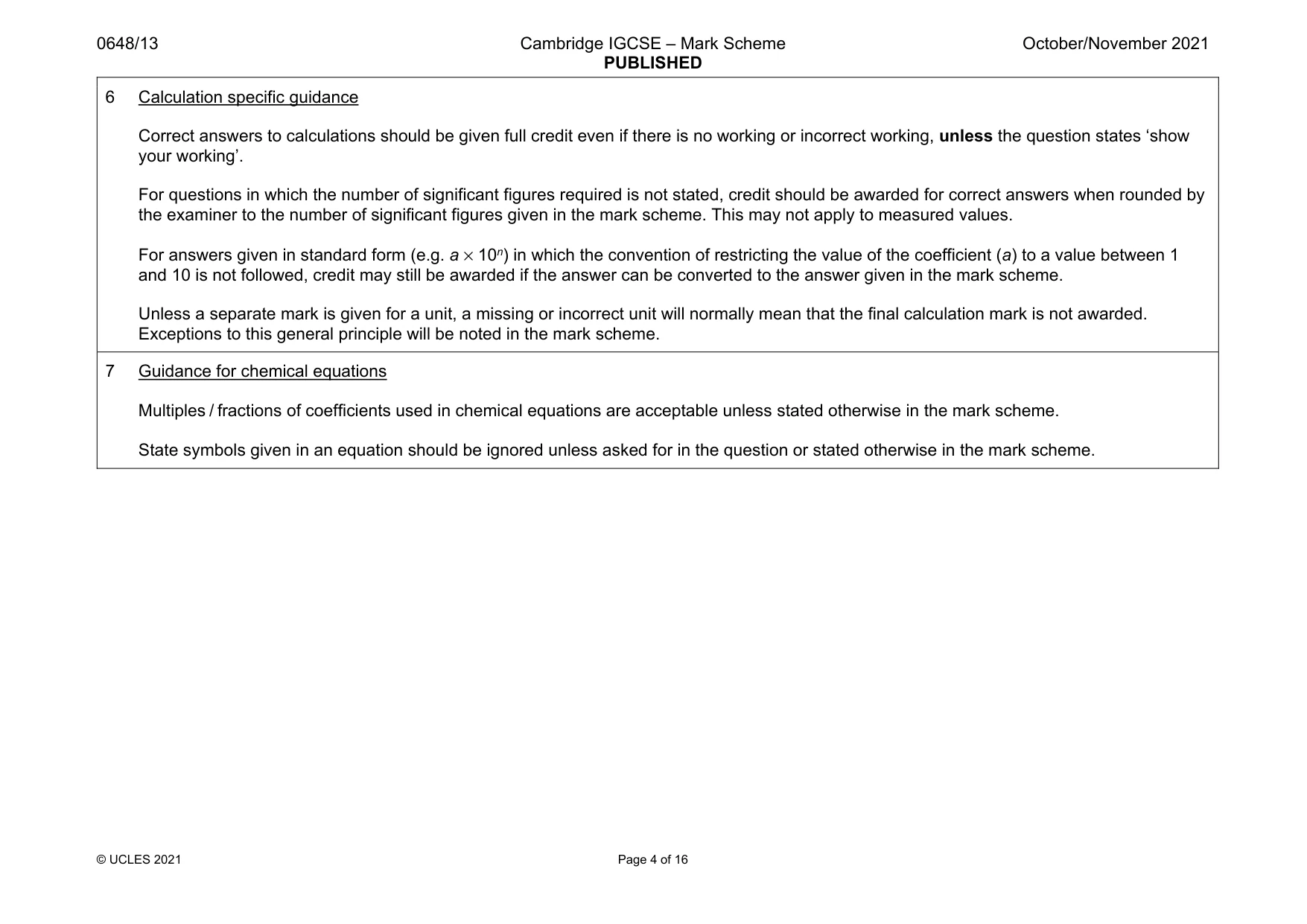
0648/13 Cambridge IGCSE – Mark Scheme PUBLISHED October/November 2021 © UCLES 2021 Page 4 of 16 6 Calculation specific guidance Correct answers to calculations should be given full credit even if there is no working or incorrect working, unless the question states ‘show your working’. For questions in which the number of significant figures required is not stated, credit should be awarded for correct answers when rounded by the examiner to the number of significant figures given in the mark scheme. This may not apply to measured values. For answers given in standard form (e.g. a × 10n) in which the convention of restricting the value of the coefficient (a) to a value between 1 and 10 is not followed, credit may still be awarded if the answer can be converted to the answer given in the mark scheme. Unless a separate mark is given for a unit, a missing or incorrect unit will normally mean that the final calculation mark is not awarded. Exceptions to this general principle will be noted in the mark scheme. 7 Guidance for chemical equations Multiples / fractions of coefficients used in chemical equations are acceptable unless stated otherwise in the mark scheme. State symbols given in an equation should be ignored unless asked for in the question or stated otherwise in the mark scheme.
Mark scheme, page 5
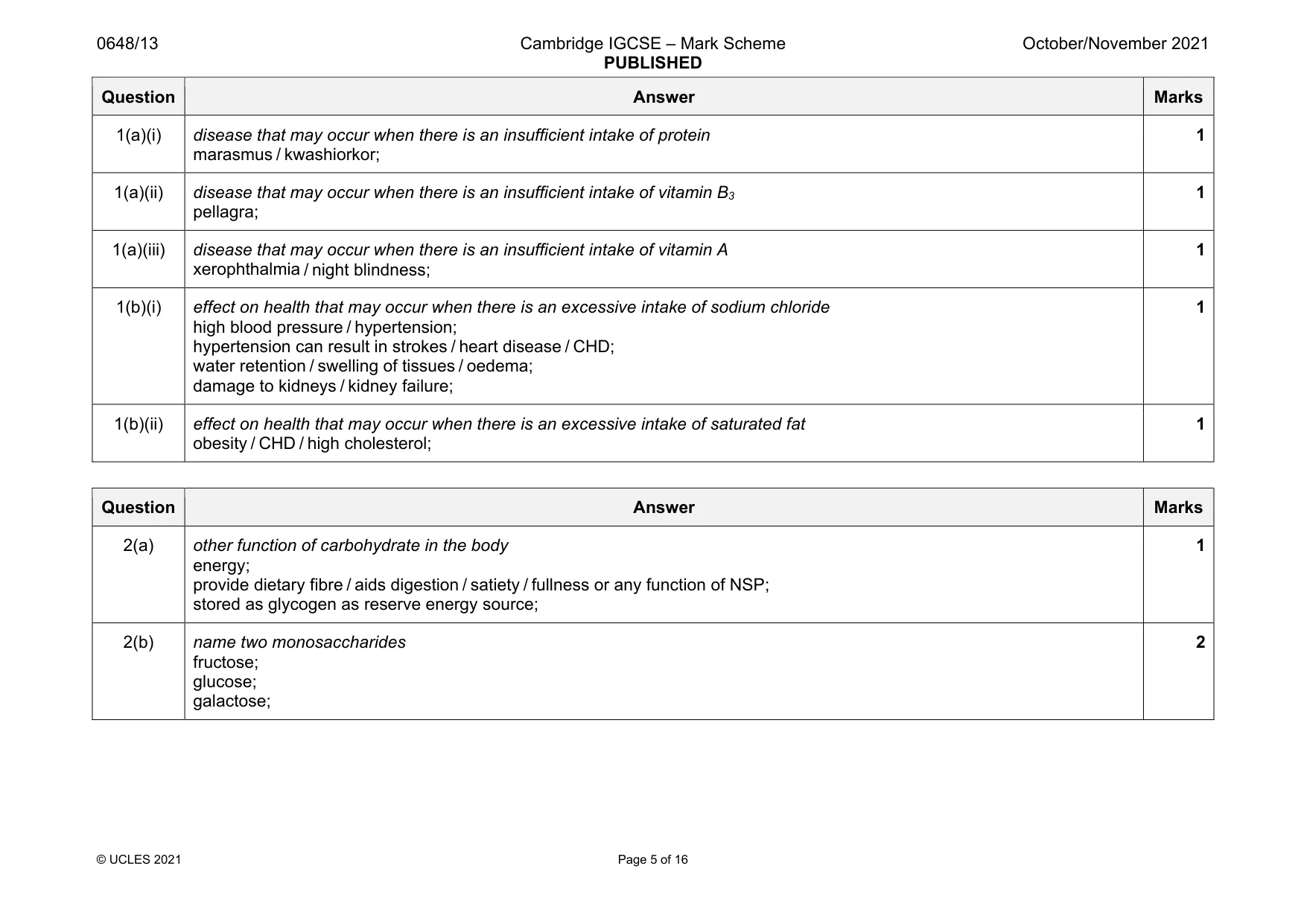
0648/13 Cambridge IGCSE – Mark Scheme PUBLISHED October/November 2021 © UCLES 2021 Page 5 of 16 Question Answer Marks 1(a)(i) disease that may occur when there is an insufficient intake of protein marasmus / kwashiorkor; 1 1(a)(ii) disease that may occur when there is an insufficient intake of vitamin B3 pellagra; 1 1(a)(iii) disease that may occur when there is an insufficient intake of vitamin A xerophthalmia / night blindness; 1 1(b)(i) effect on health that may occur when there is an excessive intake of sodium chloride high blood pressure / hypertension; hypertension can result in strokes / heart disease / CHD; water retention / swelling of tissues / oedema; damage to kidneys / kidney failure; 1 1(b)(ii) effect on health that may occur when there is an excessive intake of saturated fat obesity / CHD / high cholesterol; 1 Question Answer Marks 2(a) other function of carbohydrate in the body energy; provide dietary fibre / aids digestion / satiety / fullness or any function of NSP; stored as glycogen as reserve energy source; 1 2(b) name two monosaccharides fructose; glucose; galactose; 2
Mark scheme, page 6
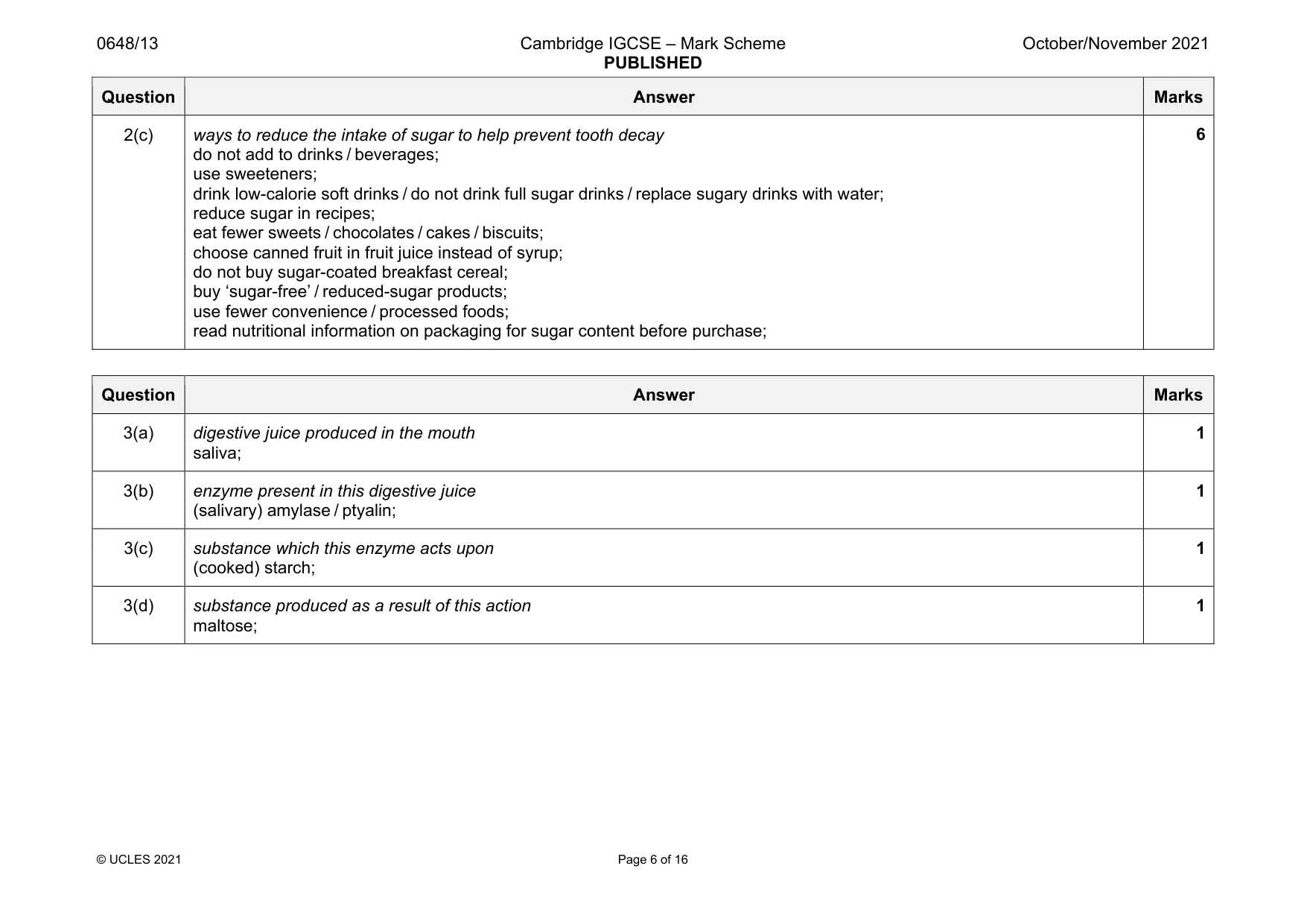
0648/13 Cambridge IGCSE – Mark Scheme PUBLISHED October/November 2021 © UCLES 2021 Page 6 of 16 Question Answer Marks 2(c) ways to reduce the intake of sugar to help prevent tooth decay do not add to drinks / beverages; use sweeteners; drink low-calorie soft drinks / do not drink full sugar drinks / replace sugary drinks with water; reduce sugar in recipes; eat fewer sweets / chocolates / cakes / biscuits; choose canned fruit in fruit juice instead of syrup; do not buy sugar-coated breakfast cereal; buy ‘sugar-free’ / reduced-sugar products; use fewer convenience / processed foods; read nutritional information on packaging for sugar content before purchase; 6 Question Answer Marks 3(a) digestive juice produced in the mouth saliva; 1 3(b) enzyme present in this digestive juice (salivary) amylase / ptyalin; 1 3(c) substance which this enzyme acts upon (cooked) starch; 1 3(d) substance produced as a result of this action maltose; 1
Mark scheme, page 7
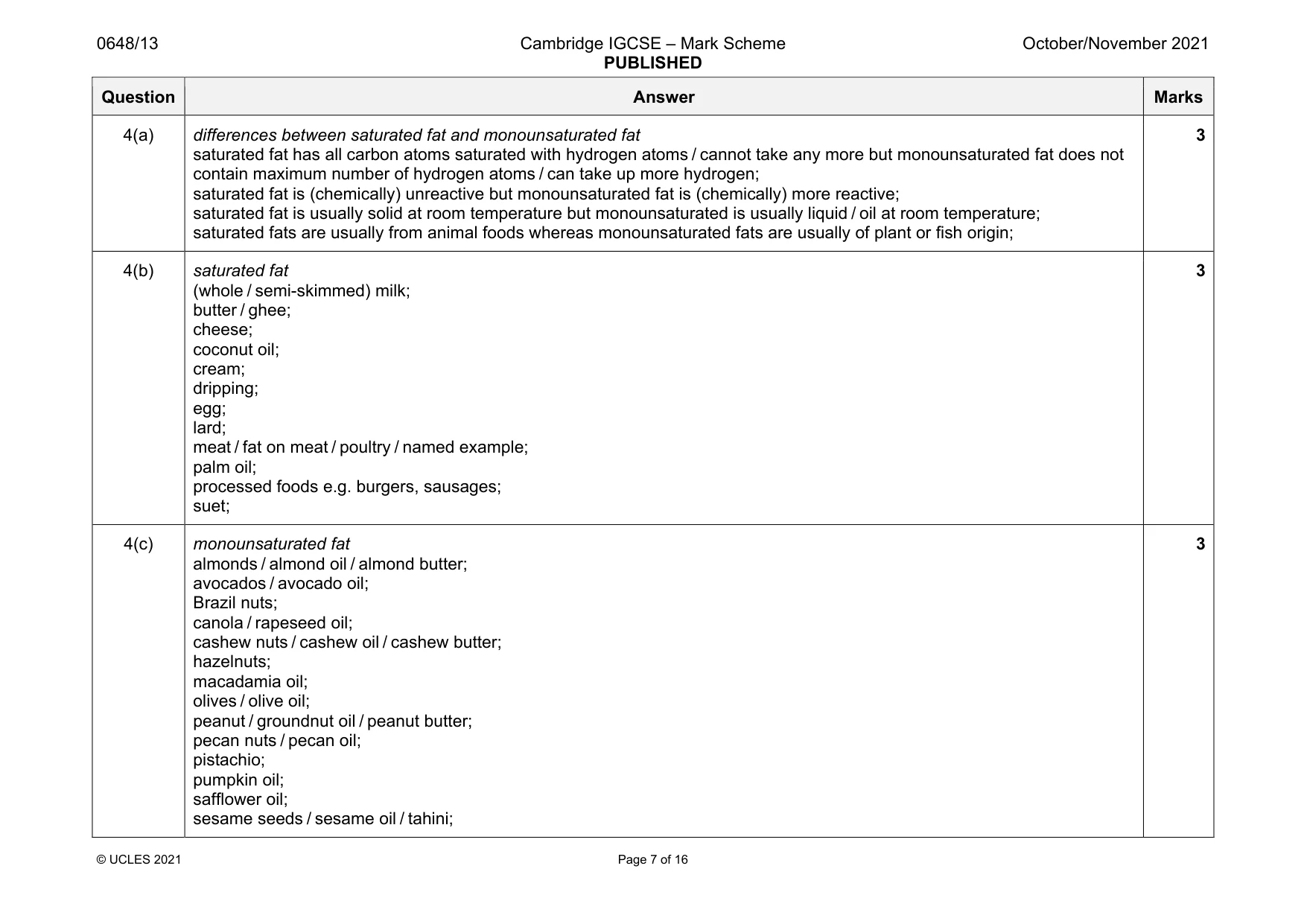
0648/13 Cambridge IGCSE – Mark Scheme PUBLISHED October/November 2021 © UCLES 2021 Page 7 of 16 Question Answer Marks 4(a) differences between saturated fat and monounsaturated fat saturated fat has all carbon atoms saturated with hydrogen atoms / cannot take any more but monounsaturated fat does not contain maximum number of hydrogen atoms / can take up more hydrogen; saturated fat is (chemically) unreactive but monounsaturated fat is (chemically) more reactive; saturated fat is usually solid at room temperature but monounsaturated is usually liquid / oil at room temperature; saturated fats are usually from animal foods whereas monounsaturated fats are usually of plant or fish origin; 3 4(b) saturated fat (whole / semi-skimmed) milk; butter / ghee; cheese; coconut oil; cream; dripping; egg; lard; meat / fat on meat / poultry / named example; palm oil; processed foods e.g. burgers, sausages; suet; 3 4(c) monounsaturated fat almonds / almond oil / almond butter; avocados / avocado oil; Brazil nuts; canola / rapeseed oil; cashew nuts / cashew oil / cashew butter; hazelnuts; macadamia oil; olives / olive oil; peanut / groundnut oil / peanut butter; pecan nuts / pecan oil; pistachio; pumpkin oil; safflower oil; sesame seeds / sesame oil / tahini; 3
Mark scheme, page 8
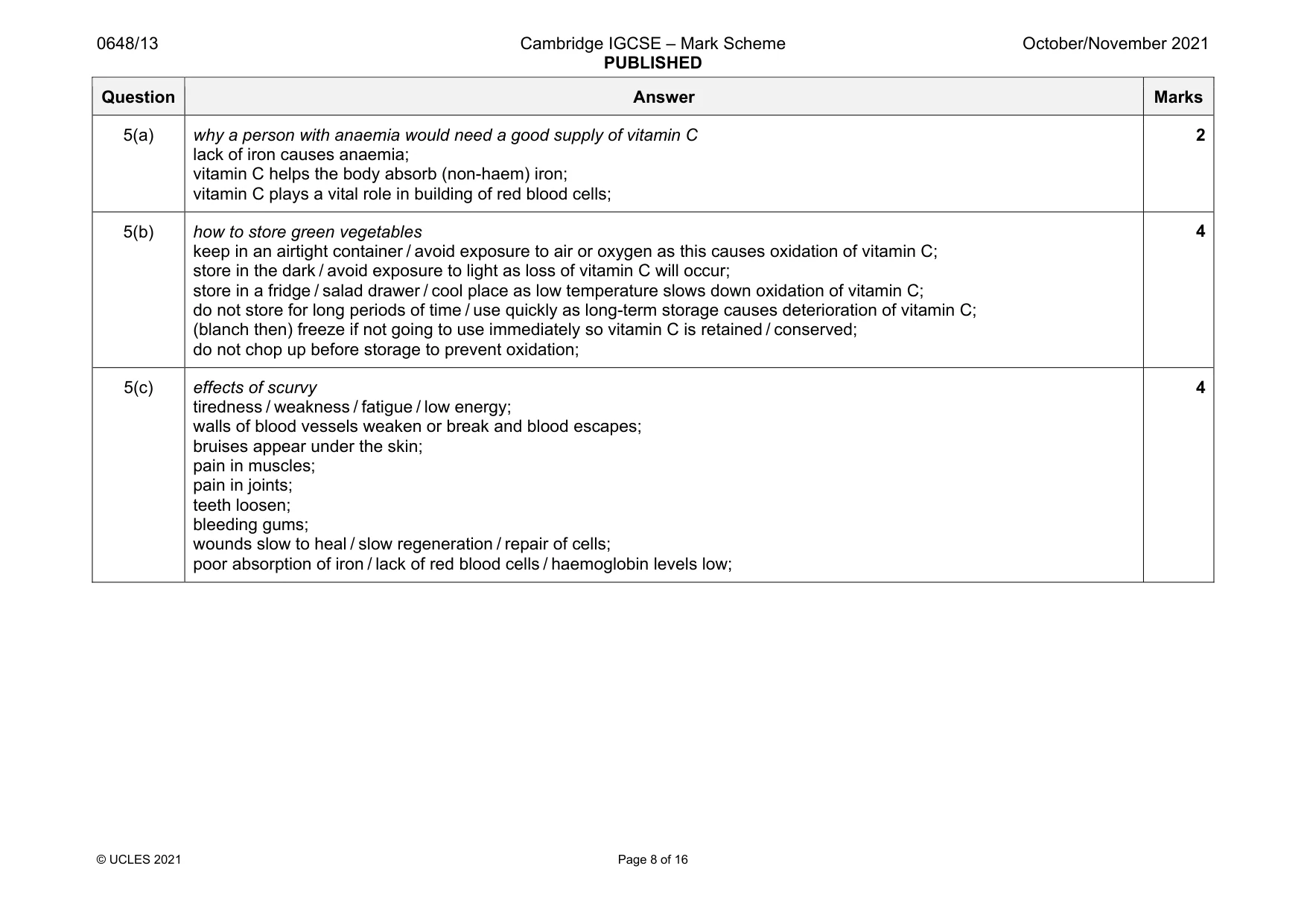
0648/13 Cambridge IGCSE – Mark Scheme PUBLISHED October/November 2021 © UCLES 2021 Page 8 of 16 Question Answer Marks 5(a) why a person with anaemia would need a good supply of vitamin C lack of iron causes anaemia; vitamin C helps the body absorb (non-haem) iron; vitamin C plays a vital role in building of red blood cells; 2 5(b) how to store green vegetables keep in an airtight container / avoid exposure to air or oxygen as this causes oxidation of vitamin C; store in the dark / avoid exposure to light as loss of vitamin C will occur; store in a fridge / salad drawer / cool place as low temperature slows down oxidation of vitamin C; do not store for long periods of time / use quickly as long-term storage causes deterioration of vitamin C; (blanch then) freeze if not going to use immediately so vitamin C is retained / conserved; do not chop up before storage to prevent oxidation; 4 5(c) effects of scurvy tiredness / weakness / fatigue / low energy; walls of blood vessels weaken or break and blood escapes; bruises appear under the skin; pain in muscles; pain in joints; teeth loosen; bleeding gums; wounds slow to heal / slow regeneration / repair of cells; poor absorption of iron / lack of red blood cells / haemoglobin levels low; 4
Mark scheme, page 9
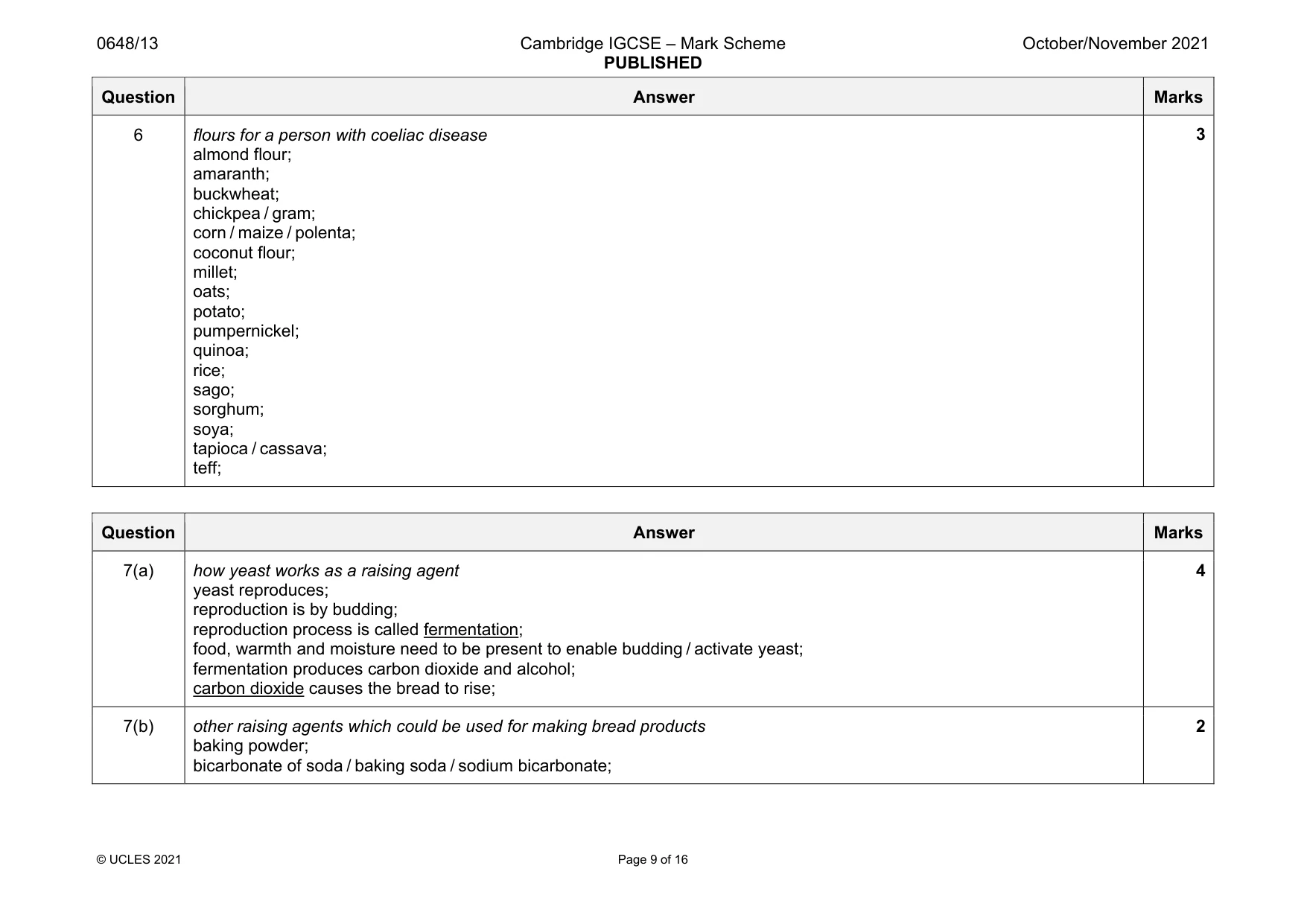
0648/13 Cambridge IGCSE – Mark Scheme PUBLISHED October/November 2021 © UCLES 2021 Page 9 of 16 Question Answer Marks 6 flours for a person with coeliac disease almond flour; amaranth; buckwheat; chickpea / gram; corn / maize / polenta; coconut flour; millet; oats; potato; pumpernickel; quinoa; rice; sago; sorghum; soya; tapioca / cassava; teff; 3 Question Answer Marks 7(a) how yeast works as a raising agent yeast reproduces; reproduction is by budding; reproduction process is called fermentation; food, warmth and moisture need to be present to enable budding / activate yeast; fermentation produces carbon dioxide and alcohol; carbon dioxide causes the bread to rise; 4 7(b) other raising agents which could be used for making bread products baking powder; bicarbonate of soda / baking soda / sodium bicarbonate; 2
Mark scheme, page 10
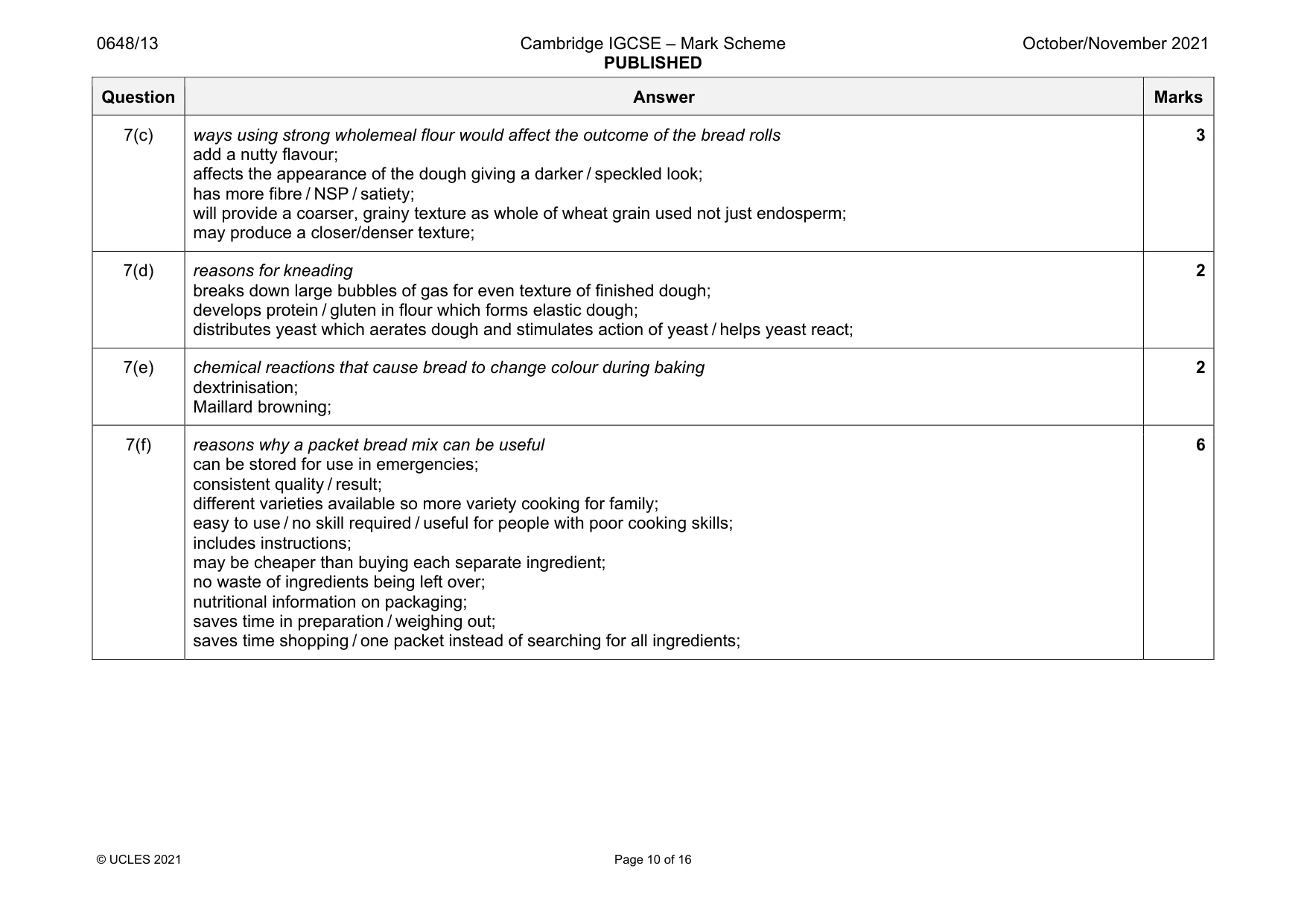
0648/13 Cambridge IGCSE – Mark Scheme PUBLISHED October/November 2021 © UCLES 2021 Page 10 of 16 Question Answer Marks 7(c) ways using strong wholemeal flour would affect the outcome of the bread rolls add a nutty flavour; affects the appearance of the dough giving a darker / speckled look; has more fibre / NSP / satiety; will provide a coarser, grainy texture as whole of wheat grain used not just endosperm; may produce a closer/denser texture; 3 7(d) reasons for kneading breaks down large bubbles of gas for even texture of finished dough; develops protein / gluten in flour which forms elastic dough; distributes yeast which aerates dough and stimulates action of yeast / helps yeast react; 2 7(e) chemical reactions that cause bread to change colour during baking dextrinisation; Maillard browning; 2 7(f) reasons why a packet bread mix can be useful can be stored for use in emergencies; consistent quality / result; different varieties available so more variety cooking for family; easy to use / no skill required / useful for people with poor cooking skills; includes instructions; may be cheaper than buying each separate ingredient; no waste of ingredients being left over; nutritional information on packaging; saves time in preparation / weighing out; saves time shopping / one packet instead of searching for all ingredients; 6
Mark scheme, page 11
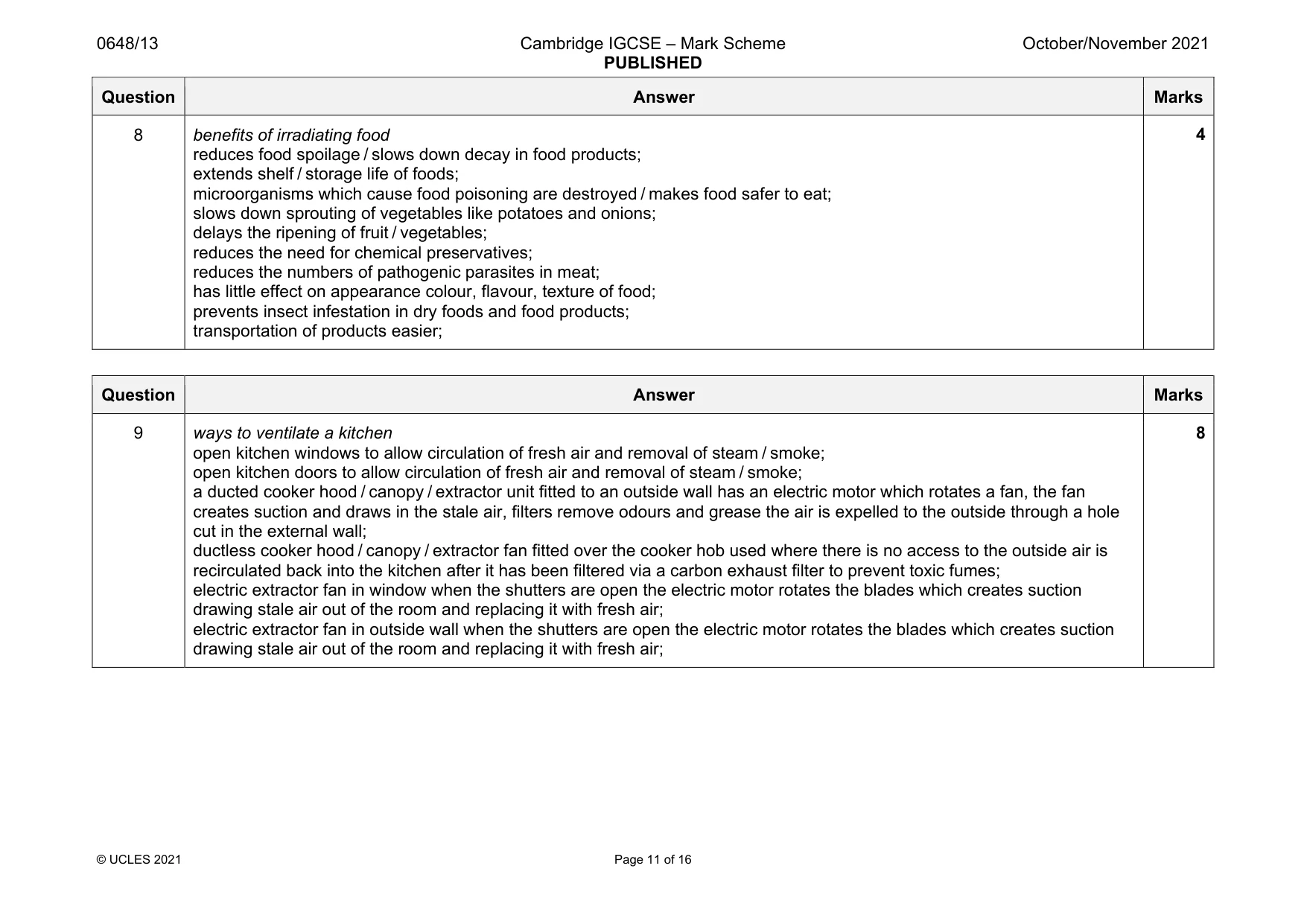
0648/13 Cambridge IGCSE – Mark Scheme PUBLISHED October/November 2021 © UCLES 2021 Page 11 of 16 Question Answer Marks 8 benefits of irradiating food reduces food spoilage / slows down decay in food products; extends shelf / storage life of foods; microorganisms which cause food poisoning are destroyed / makes food safer to eat; slows down sprouting of vegetables like potatoes and onions; delays the ripening of fruit / vegetables; reduces the need for chemical preservatives; reduces the numbers of pathogenic parasites in meat; has little effect on appearance colour, flavour, texture of food; prevents insect infestation in dry foods and food products; transportation of products easier; 4 Question Answer Marks 9 ways to ventilate a kitchen open kitchen windows to allow circulation of fresh air and removal of steam / smoke; open kitchen doors to allow circulation of fresh air and removal of steam / smoke; a ducted cooker hood / canopy / extractor unit fitted to an outside wall has an electric motor which rotates a fan, the fan creates suction and draws in the stale air, filters remove odours and grease the air is expelled to the outside through a hole cut in the external wall; ductless cooker hood / canopy / extractor fan fitted over the cooker hob used where there is no access to the outside air is recirculated back into the kitchen after it has been filtered via a carbon exhaust filter to prevent toxic fumes; electric extractor fan in window when the shutters are open the electric motor rotates the blades which creates suction drawing stale air out of the room and replacing it with fresh air; electric extractor fan in outside wall when the shutters are open the electric motor rotates the blades which creates suction drawing stale air out of the room and replacing it with fresh air; 8
Mark scheme, page 12
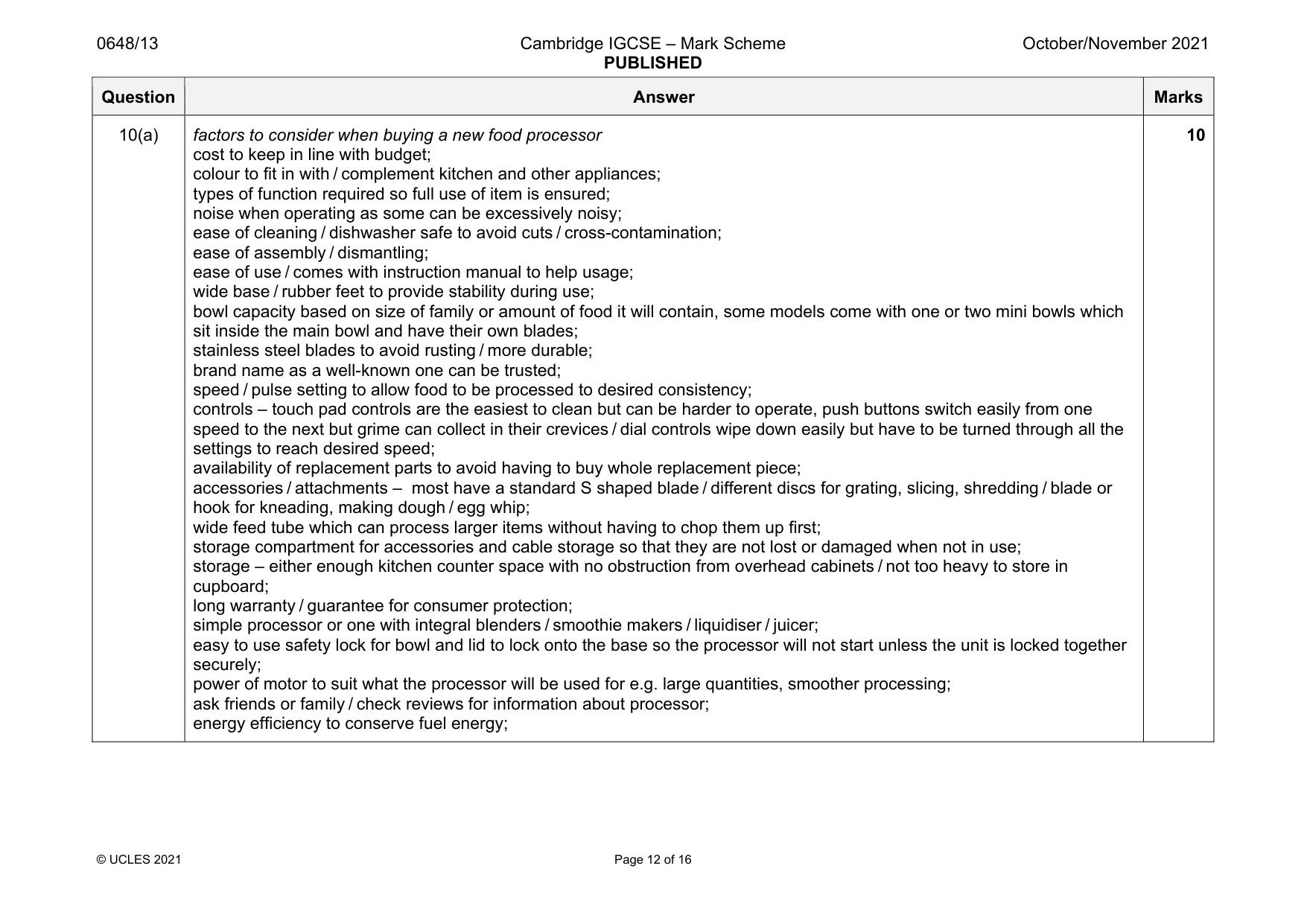
0648/13 Cambridge IGCSE – Mark Scheme PUBLISHED October/November 2021 © UCLES 2021 Page 12 of 16 Question Answer Marks 10(a) factors to consider when buying a new food processor cost to keep in line with budget; colour to fit in with / complement kitchen and other appliances; types of function required so full use of item is ensured; noise when operating as some can be excessively noisy; ease of cleaning / dishwasher safe to avoid cuts / cross-contamination; ease of assembly / dismantling; ease of use / comes with instruction manual to help usage; wide base / rubber feet to provide stability during use; bowl capacity based on size of family or amount of food it will contain, some models come with one or two mini bowls which sit inside the main bowl and have their own blades; stainless steel blades to avoid rusting / more durable; brand name as a well-known one can be trusted; speed / pulse setting to allow food to be processed to desired consistency; controls – touch pad controls are the easiest to clean but can be harder to operate, push buttons switch easily from one speed to the next but grime can collect in their crevices / dial controls wipe down easily but have to be turned through all the settings to reach desired speed; availability of replacement parts to avoid having to buy whole replacement piece; accessories / attachments – most have a standard S shaped blade / different discs for grating, slicing, shredding / blade or hook for kneading, making dough / egg whip; wide feed tube which can process larger items without having to chop them up first; storage compartment for accessories and cable storage so that they are not lost or damaged when not in use; storage – either enough kitchen counter space with no obstruction from overhead cabinets / not too heavy to store in cupboard; long warranty / guarantee for consumer protection; simple processor or one with integral blenders / smoothie makers / liquidiser / juicer; easy to use safety lock for bowl and lid to lock onto the base so the processor will not start unless the unit is locked together securely; power of motor to suit what the processor will be used for e.g. large quantities, smoother processing; ask friends or family / check reviews for information about processor; energy efficiency to conserve fuel energy; 10
Mark scheme, page 13
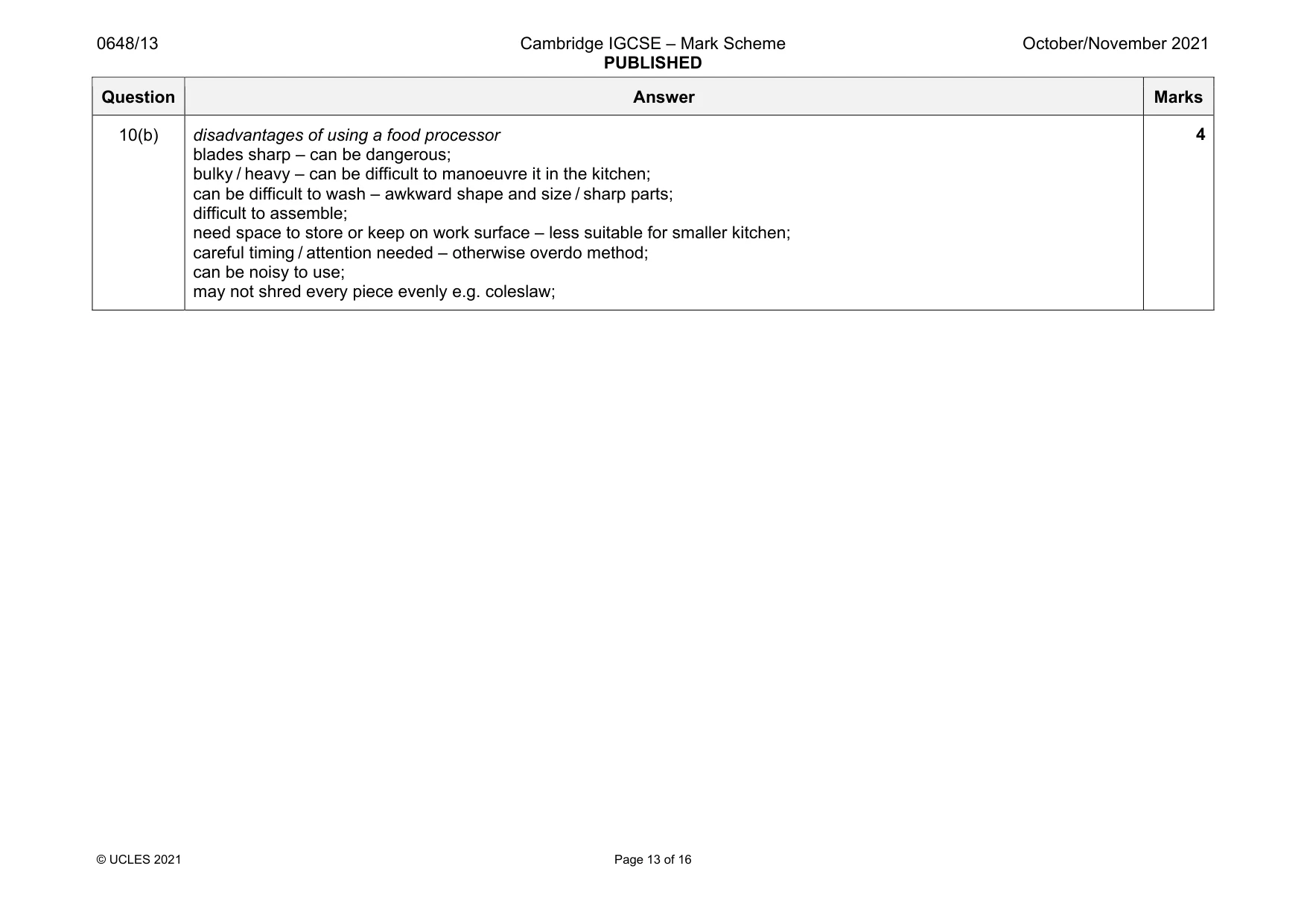
0648/13 Cambridge IGCSE – Mark Scheme PUBLISHED October/November 2021 © UCLES 2021 Page 13 of 16 Question Answer Marks 10(b) disadvantages of using a food processor blades sharp – can be dangerous; bulky / heavy – can be difficult to manoeuvre it in the kitchen; can be difficult to wash – awkward shape and size / sharp parts; difficult to assemble; need space to store or keep on work surface – less suitable for smaller kitchen; careful timing / attention needed – otherwise overdo method; can be noisy to use; may not shred every piece evenly e.g. coleslaw; 4
Mark scheme, page 14
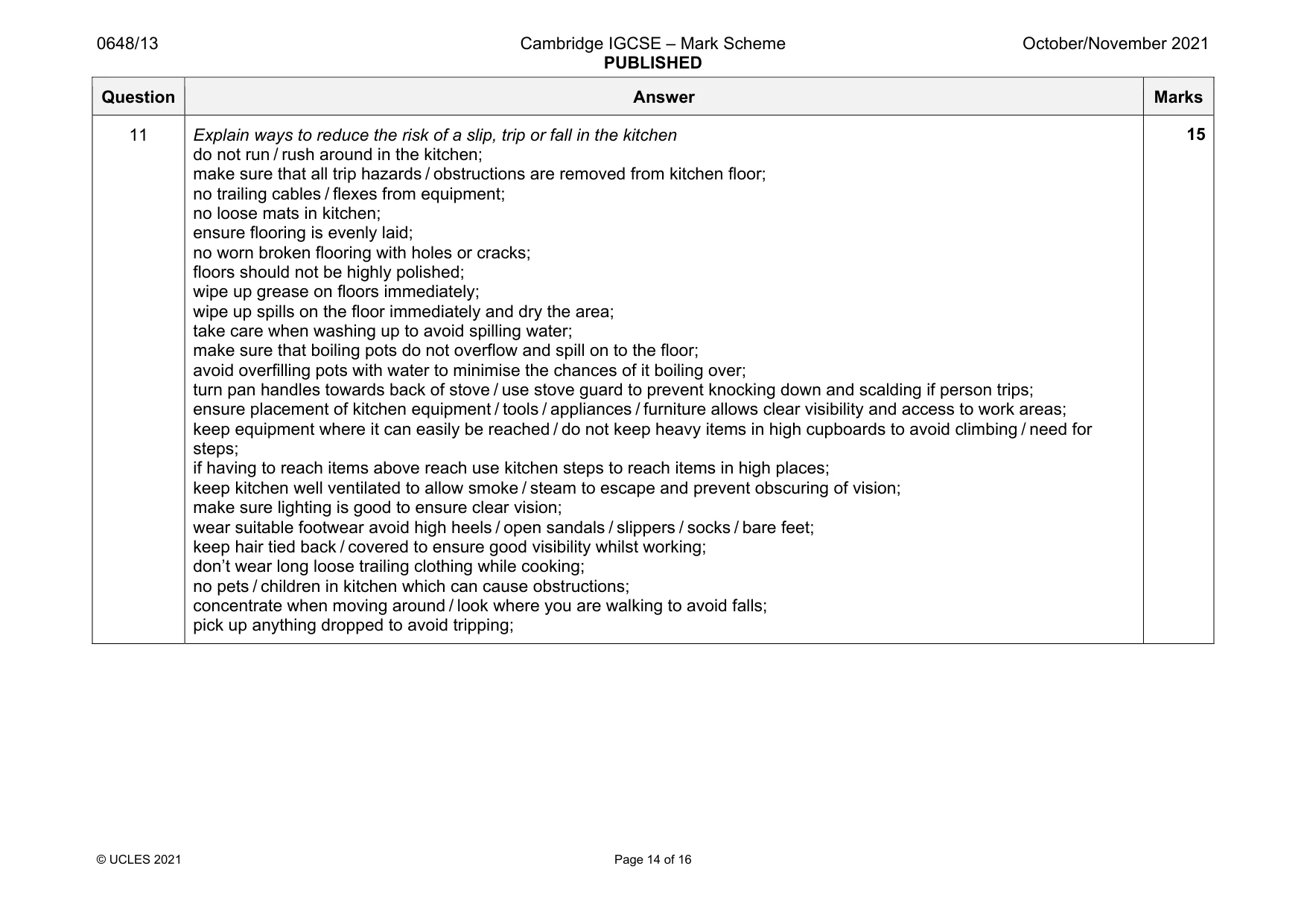
0648/13 Cambridge IGCSE – Mark Scheme PUBLISHED October/November 2021 © UCLES 2021 Page 14 of 16 Question Answer Marks 11 Explain ways to reduce the risk of a slip, trip or fall in the kitchen do not run / rush around in the kitchen; make sure that all trip hazards / obstructions are removed from kitchen floor; no trailing cables / flexes from equipment; no loose mats in kitchen; ensure flooring is evenly laid; no worn broken flooring with holes or cracks; floors should not be highly polished; wipe up grease on floors immediately; wipe up spills on the floor immediately and dry the area; take care when washing up to avoid spilling water; make sure that boiling pots do not overflow and spill on to the floor; avoid overfilling pots with water to minimise the chances of it boiling over; turn pan handles towards back of stove / use stove guard to prevent knocking down and scalding if person trips; ensure placement of kitchen equipment / tools / appliances / furniture allows clear visibility and access to work areas; keep equipment where it can easily be reached / do not keep heavy items in high cupboards to avoid climbing / need for steps; if having to reach items above reach use kitchen steps to reach items in high places; keep kitchen well ventilated to allow smoke / steam to escape and prevent obscuring of vision; make sure lighting is good to ensure clear vision; wear suitable footwear avoid high heels / open sandals / slippers / socks / bare feet; keep hair tied back / covered to ensure good visibility whilst working; don’t wear long loose trailing clothing while cooking; no pets / children in kitchen which can cause obstructions; concentrate when moving around / look where you are walking to avoid falls; pick up anything dropped to avoid tripping; 15
Mark scheme, page 15
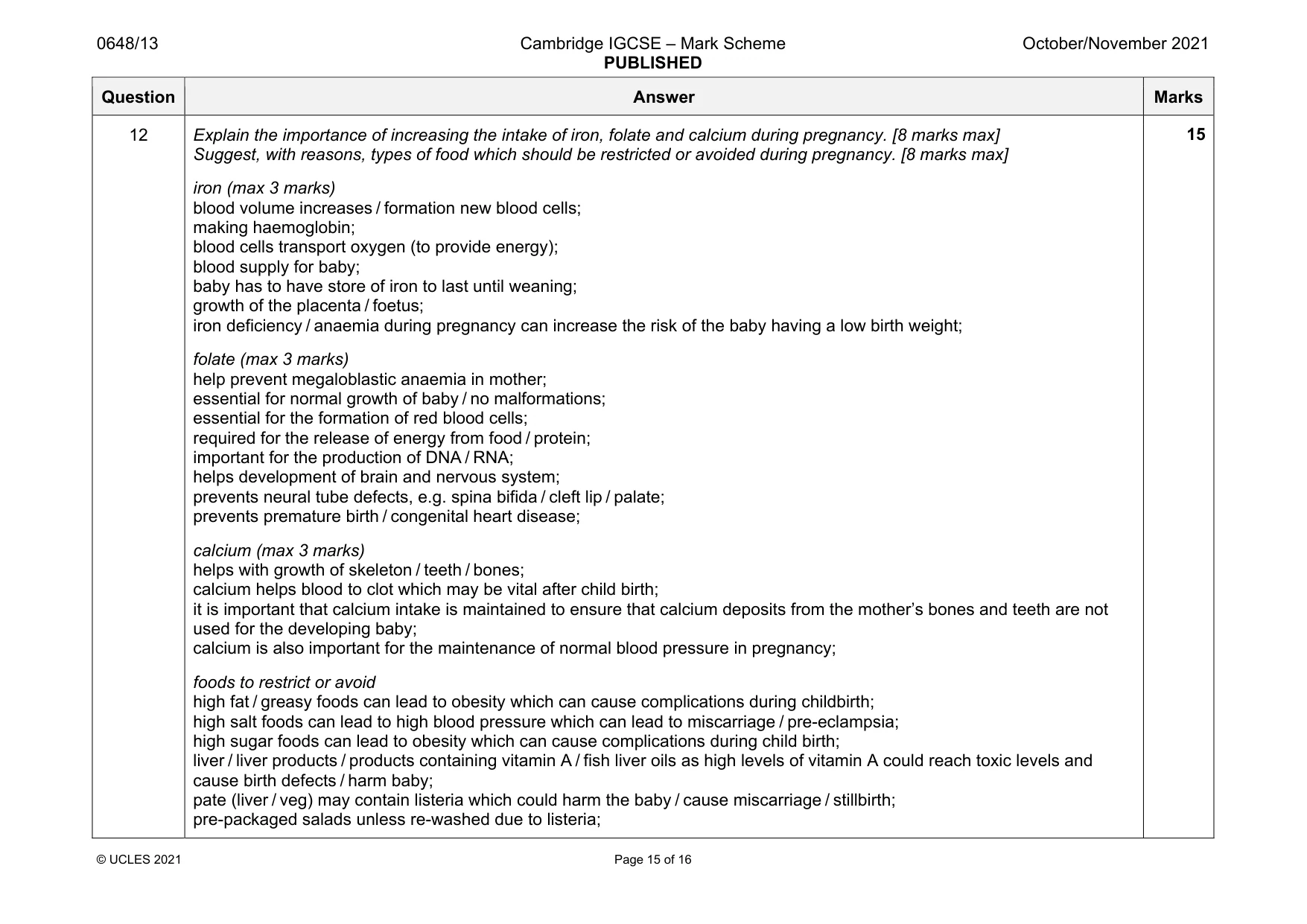
0648/13 Cambridge IGCSE – Mark Scheme PUBLISHED October/November 2021 © UCLES 2021 Page 15 of 16 Question Answer Marks 12 Explain the importance of increasing the intake of iron, folate and calcium during pregnancy. [8 marks max] Suggest, with reasons, types of food which should be restricted or avoided during pregnancy. [8 marks max] iron (max 3 marks) blood volume increases / formation new blood cells; making haemoglobin; blood cells transport oxygen (to provide energy); blood supply for baby; baby has to have store of iron to last until weaning; growth of the placenta / foetus; iron deficiency / anaemia during pregnancy can increase the risk of the baby having a low birth weight; folate (max 3 marks) help prevent megaloblastic anaemia in mother; essential for normal growth of baby / no malformations; essential for the formation of red blood cells; required for the release of energy from food / protein; important for the production of DNA / RNA; helps development of brain and nervous system; prevents neural tube defects, e.g. spina bifida / cleft lip / palate; prevents premature birth / congenital heart disease; calcium (max 3 marks) helps with growth of skeleton / teeth / bones; calcium helps blood to clot which may be vital after child birth; it is important that calcium intake is maintained to ensure that calcium deposits from the mother’s bones and teeth are not used for the developing baby; calcium is also important for the maintenance of normal blood pressure in pregnancy; foods to restrict or avoid high fat / greasy foods can lead to obesity which can cause complications during childbirth; high salt foods can lead to high blood pressure which can lead to miscarriage / pre-eclampsia; high sugar foods can lead to obesity which can cause complications during child birth; liver / liver products / products containing vitamin A / fish liver oils as high levels of vitamin A could reach toxic levels and cause birth defects / harm baby; pate (liver / veg) may contain listeria which could harm the baby / cause miscarriage / stillbirth; pre-packaged salads unless re-washed due to listeria; 15
Mark scheme, page 16
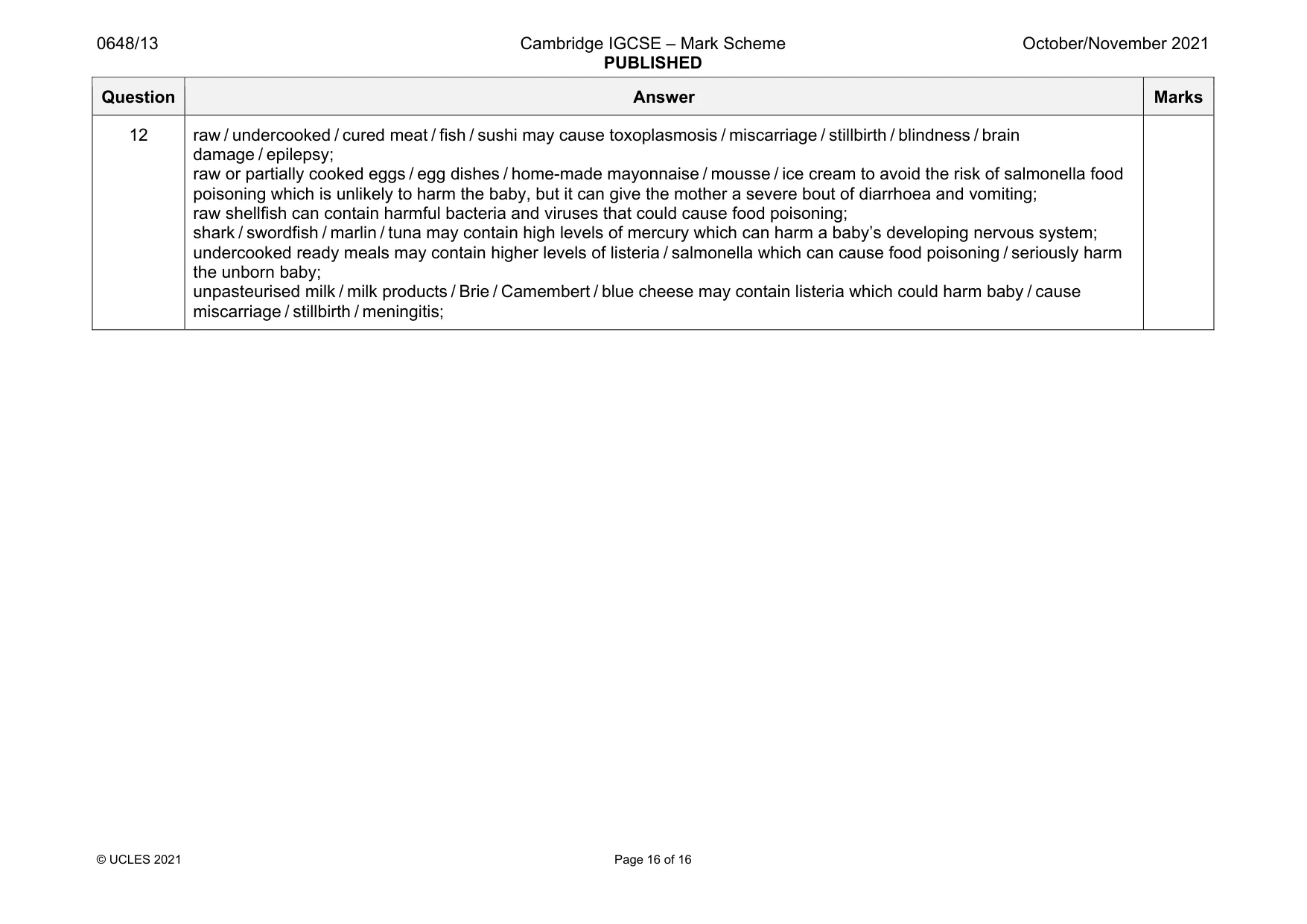
0648/13 Cambridge IGCSE – Mark Scheme PUBLISHED October/November 2021 © UCLES 2021 Page 16 of 16 Question Answer Marks 12 raw / undercooked / cured meat / fish / sushi may cause toxoplasmosis / miscarriage / stillbirth / blindness / brain damage / epilepsy; raw or partially cooked eggs / egg dishes / home-made mayonnaise / mousse / ice cream to avoid the risk of salmonella food poisoning which is unlikely to harm the baby, but it can give the mother a severe bout of diarrhoea and vomiting; raw shellfish can contain harmful bacteria and viruses that could cause food poisoning; shark / swordfish / marlin / tuna may contain high levels of mercury which can harm a baby’s developing nervous system; undercooked ready meals may contain higher levels of listeria / salmonella which can cause food poisoning / seriously harm the unborn baby; unpasteurised milk / milk products / Brie / Camembert / blue cheese may contain listeria which could harm baby / cause miscarriage / stillbirth / meningitis;
What you needed in this session
Cambridge’s own grade thresholds for 2021 Oct/Nov, Paper 1 · Variant 3. A higher threshold means an easier paper — the bar moves with how the cohort did.