Cambridge IGCSE Food and Nutrition 0648 — 2021 Oct/Nov Paper 1 · Variant 1
0648/11/O/N/21 · 100 marks · ≈113 min
The question paper and its mark scheme, free to read here and free to download. This is Cambridge’s own paper, exactly as it was sat.
Question paper12 pages


Mark scheme14 pages
Answers below. Sit the paper first if you are practising.
Paper as text
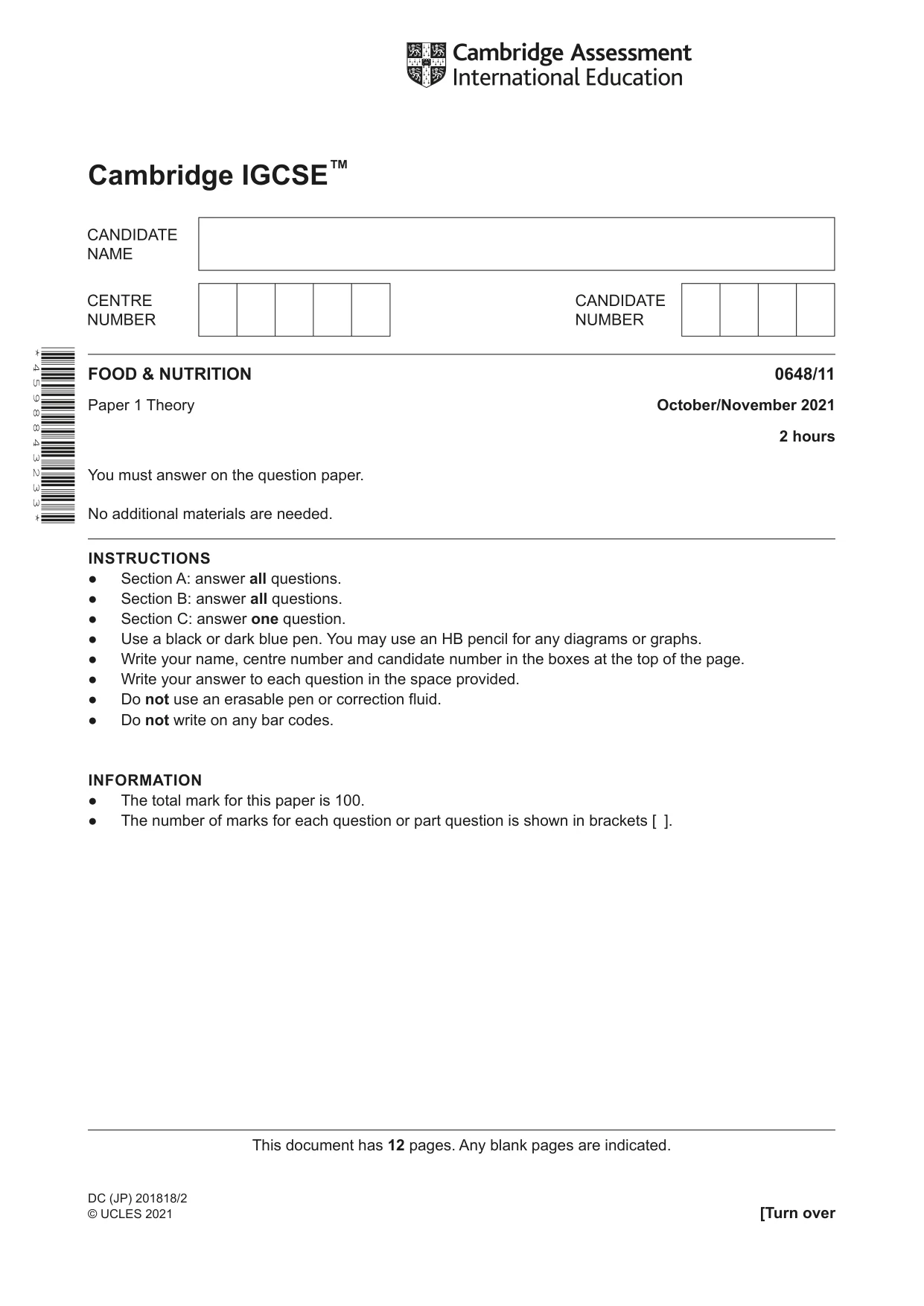
Question paper, page 1
This document has 12 pages. Any blank pages are indicated. DC (JP) 201818/2 © UCLES 2021 [Turn over * 4 5 9 8 8 4 3 2 3 3 * FOOD & NUTRITION 0648/11 Paper 1 Theory October/November 2021 2 hours You must answer on the question paper. No additional materials are needed. INSTRUCTIONS ● Section A: answer all questions. ● Section B: answer all questions. ● Section C: answer one question. ● Use a black or dark blue pen. You may use an HB pencil for any diagrams or graphs. ● Write your name, centre number and candidate number in the boxes at the top of the page. ● Write your answer to each question in the space provided. ● Do not use an erasable pen or correction fluid. ● Do not write on any bar codes. INFORMATION ● The total mark for this paper is 100. ● The number of marks for each question or part question is shown in brackets [ ]. Cambridge IGCSE™
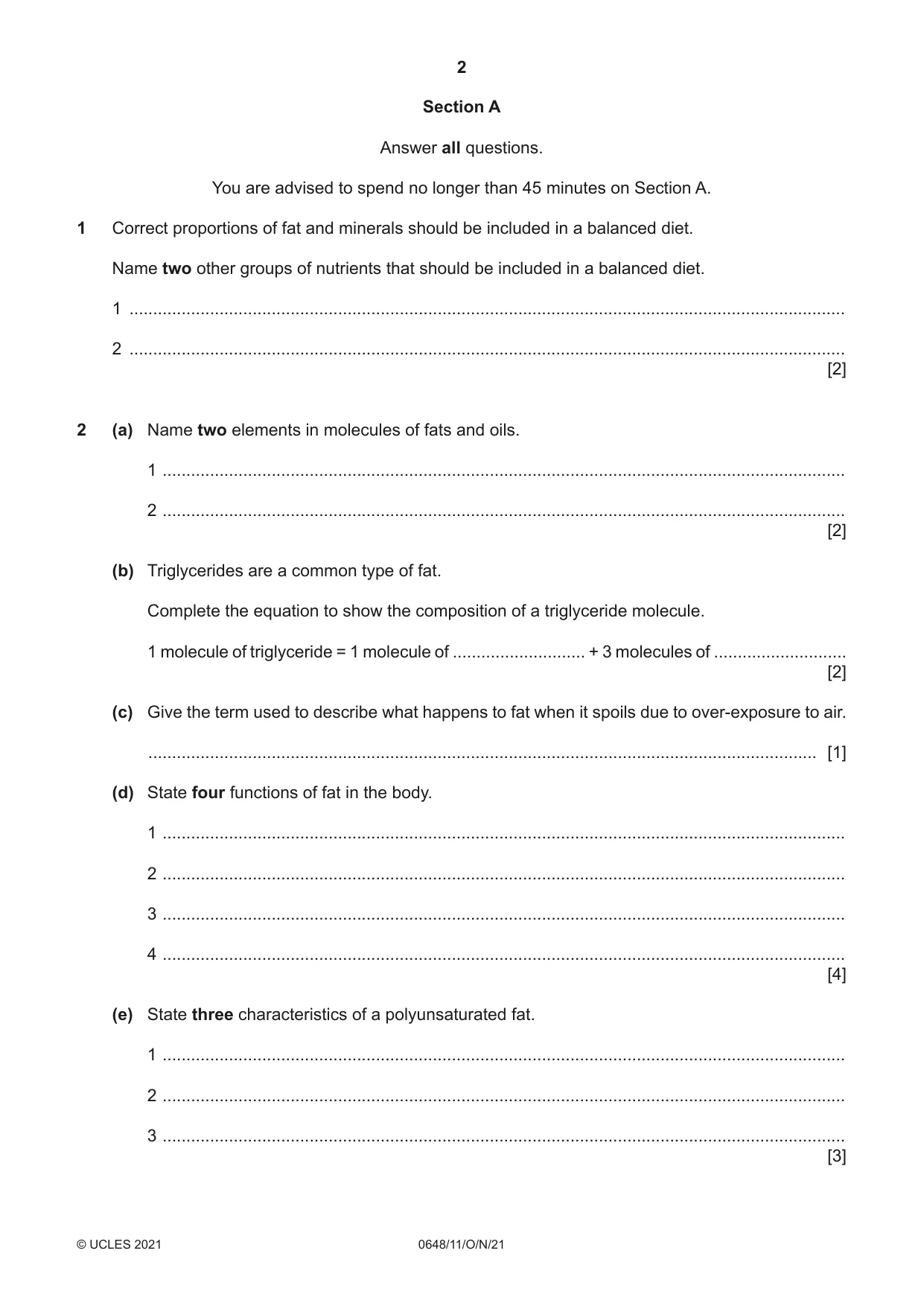
Question paper, page 2
2 0648/11/O/N/21 © UCLES 2021 Section A Answer all questions. You are advised to spend no longer than 45 minutes on Section A. 1 Correct proportions of fat and minerals should be included in a balanced diet. Name two other groups of nutrients that should be included in a balanced diet. 1 … 2 … [2] 2 (a) Name two elements in molecules of fats and oils. 1 … 2 … [2] (b) Triglycerides are a common type of fat. Complete the equation to show the composition of a triglyceride molecule. 1 molecule of triglyceride = 1 molecule of … + 3 molecules of … [2] (c) Give the term used to describe what happens to fat when it spoils due to over-exposure to air. … [1] (d) State four functions of fat in the body. 1 … 2 … 3 … 4 … [4] (e) State three characteristics of a polyunsaturated fat. 1 … 2 … 3 … [3]
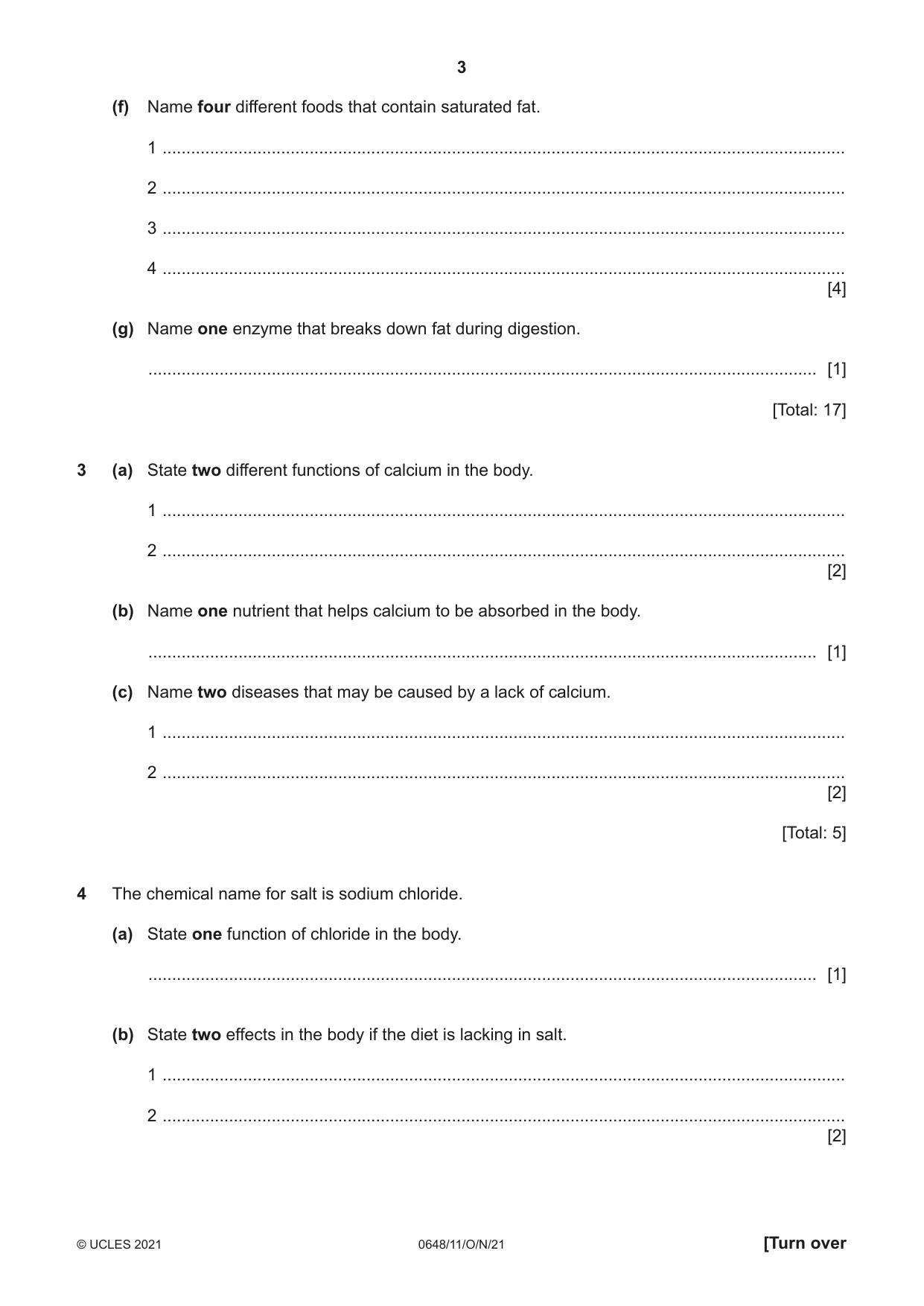
Question paper, page 3
3 0648/11/O/N/21 © UCLES 2021 [Turn over (f) Name four different foods that contain saturated fat. 1 … 2 … 3 … 4 … [4] (g) Name one enzyme that breaks down fat during digestion. … [1] [Total: 17] 3 (a) State two different functions of calcium in the body. 1 … 2 … [2] (b) Name one nutrient that helps calcium to be absorbed in the body. … [1] (c) Name two diseases that may be caused by a lack of calcium. 1 … 2 … [2] [Total: 5] 4 The chemical name for salt is sodium chloride. (a) State one function of chloride in the body. … [1] (b) State two effects in the body if the diet is lacking in salt. 1 … 2 … [2]
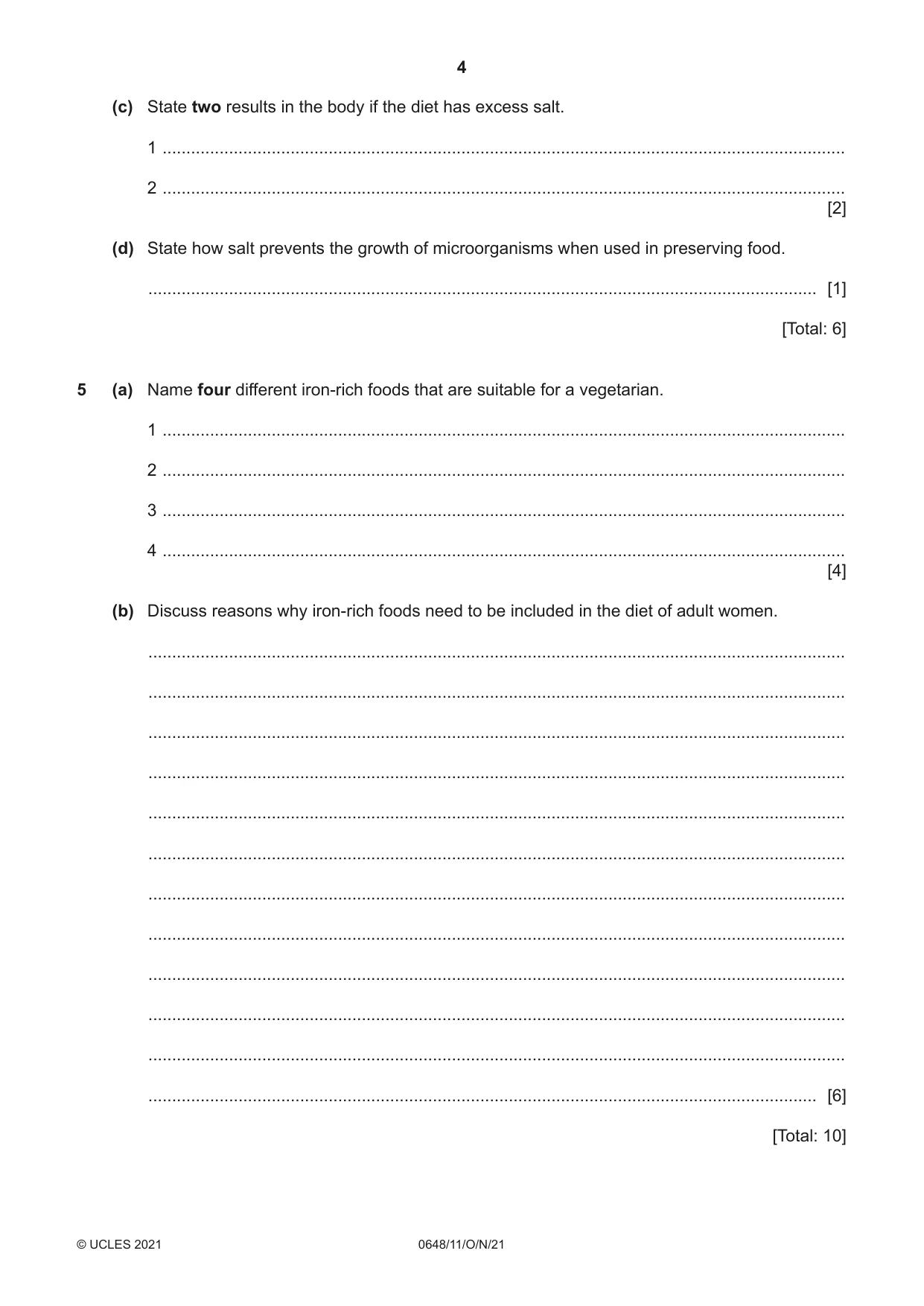
Question paper, page 4
4 0648/11/O/N/21 © UCLES 2021 (c) State two results in the body if the diet has excess salt. 1 … 2 … [2] (d) State how salt prevents the growth of microorganisms when used in preserving food. … [1] [Total: 6] 5 (a) Name four different iron-rich foods that are suitable for a vegetarian. 1 … 2 … 3 … 4 … [4] (b) Discuss reasons why iron-rich foods need to be included in the diet of adult women. … … … … … … … … … … … … [6] [Total: 10]
Question paper, page 5
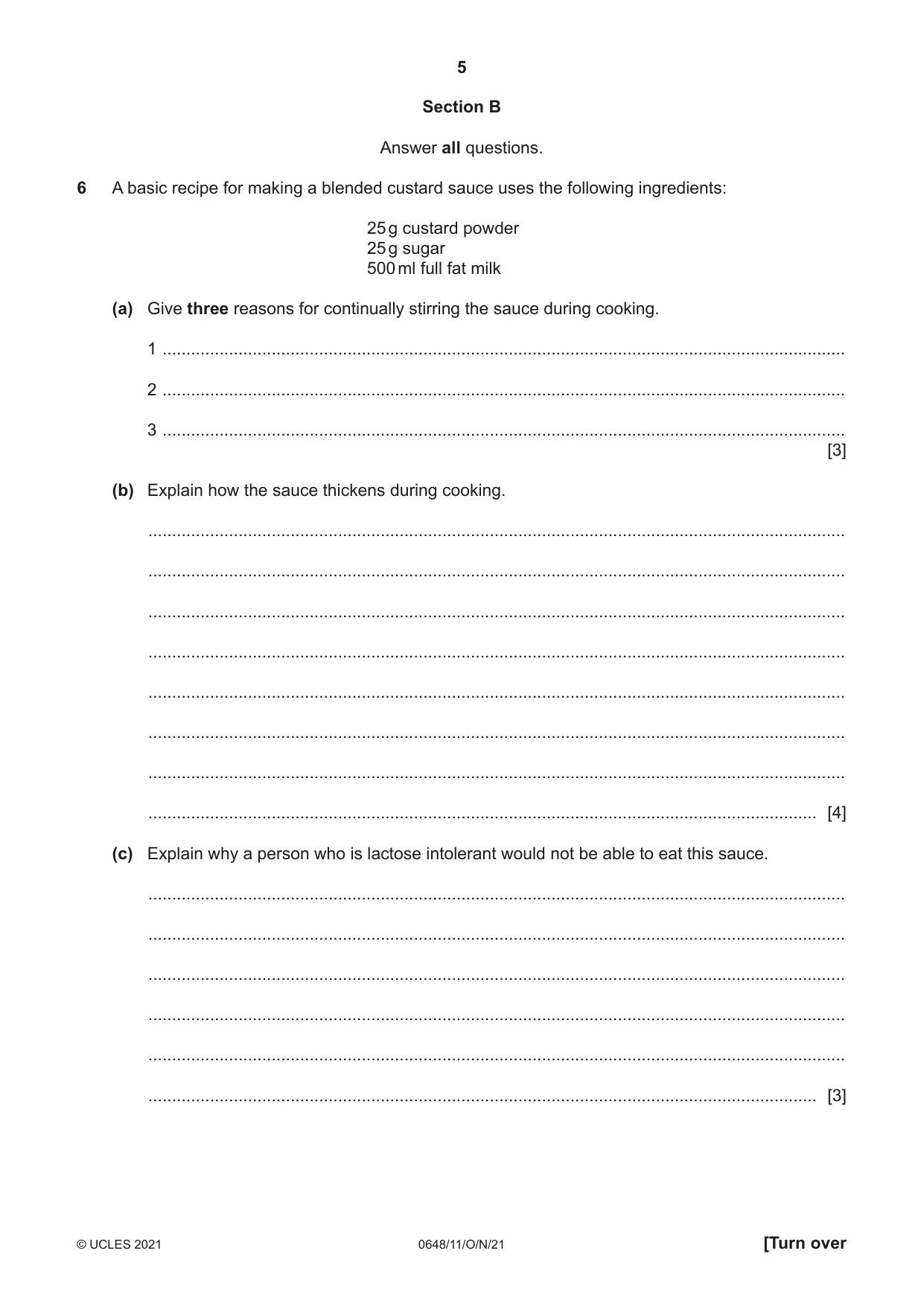
5 0648/11/O/N/21 © UCLES 2021 [Turn over Section B Answer all questions. 6 A basic recipe for making a blended custard sauce uses the following ingredients: 25 g custard powder 25 g sugar 500 ml full fat milk (a) Give three reasons for continually stirring the sauce during cooking. 1 … 2 … 3 … [3] (b) Explain how the sauce thickens during cooking. … … … … … … … … [4] (c) Explain why a person who is lactose intolerant would not be able to eat this sauce. … … … … … … [3]
Question paper, page 6
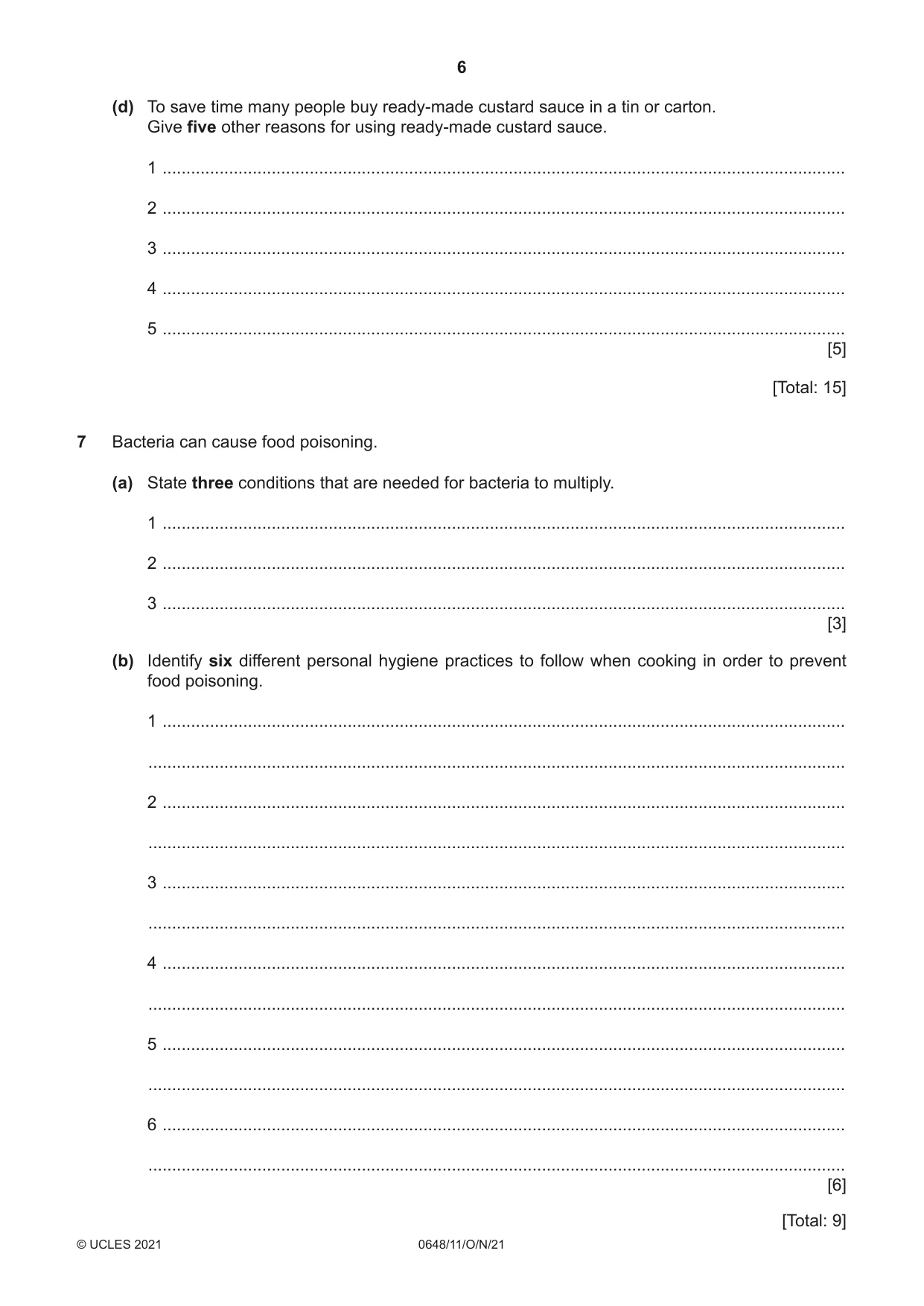
6 0648/11/O/N/21 © UCLES 2021 (d) To save time many people buy ready-made custard sauce in a tin or carton. Give five other reasons for using ready-made custard sauce. 1 … 2 … 3 … 4 … 5 … [5] [Total: 15] 7 Bacteria can cause food poisoning. (a) State three conditions that are needed for bacteria to multiply. 1 … 2 … 3 … [3] (b) Identify six different personal hygiene practices to follow when cooking in order to prevent food poisoning. 1 … … 2 … … 3 … … 4 … … 5 … … 6 … … [6] [Total: 9]
Question paper, page 7
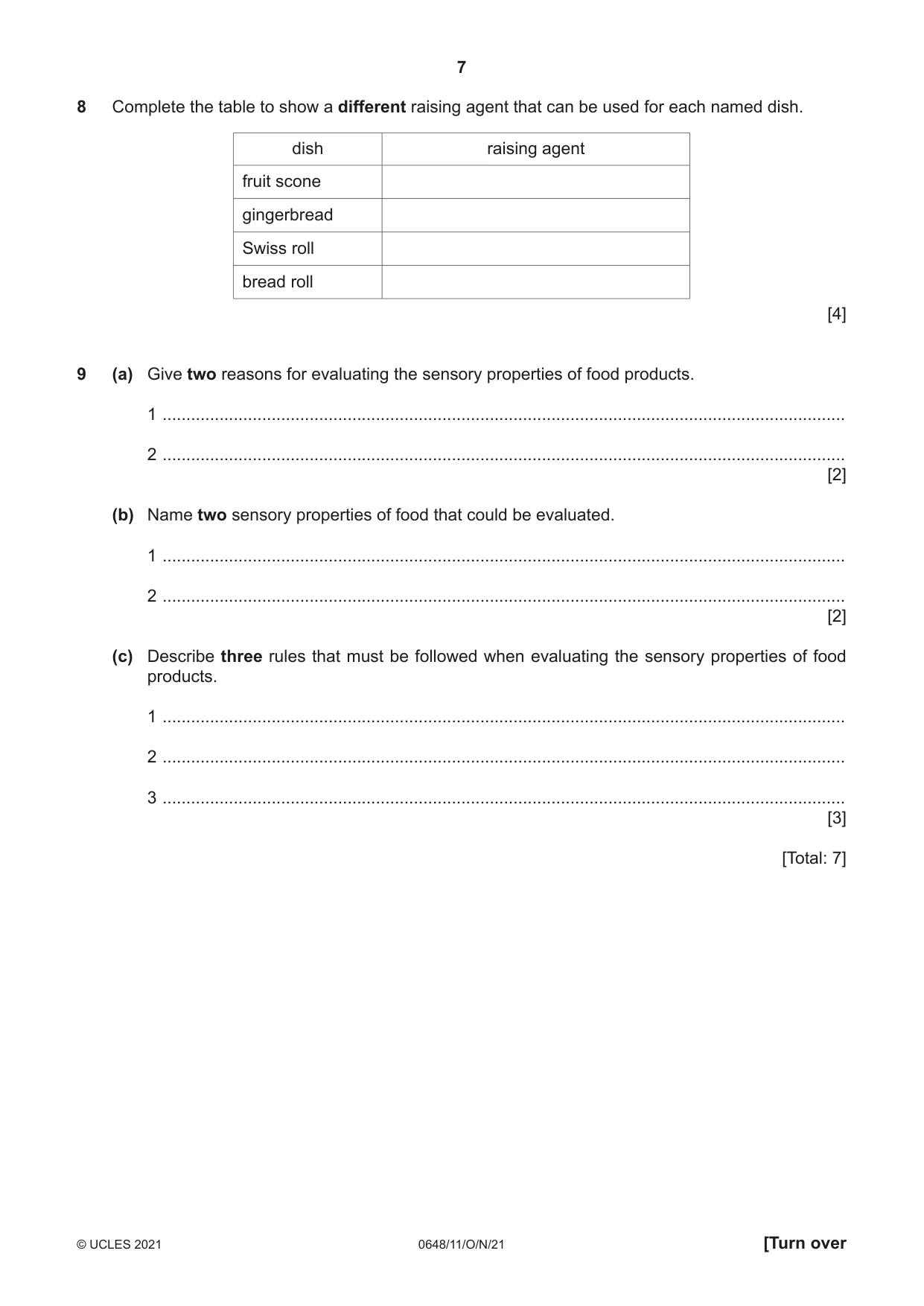
7 0648/11/O/N/21 © UCLES 2021 [Turn over 8 Complete the table to show a different raising agent that can be used for each named dish. dish raising agent fruit scone gingerbread Swiss roll bread roll [4] 9 (a) Give two reasons for evaluating the sensory properties of food products. 1 … 2 … [2] (b) Name two sensory properties of food that could be evaluated. 1 … 2 … [2] (c) Describe three rules that must be followed when evaluating the sensory properties of food products. 1 … 2 … 3 … [3] [Total: 7]
Question paper, page 8
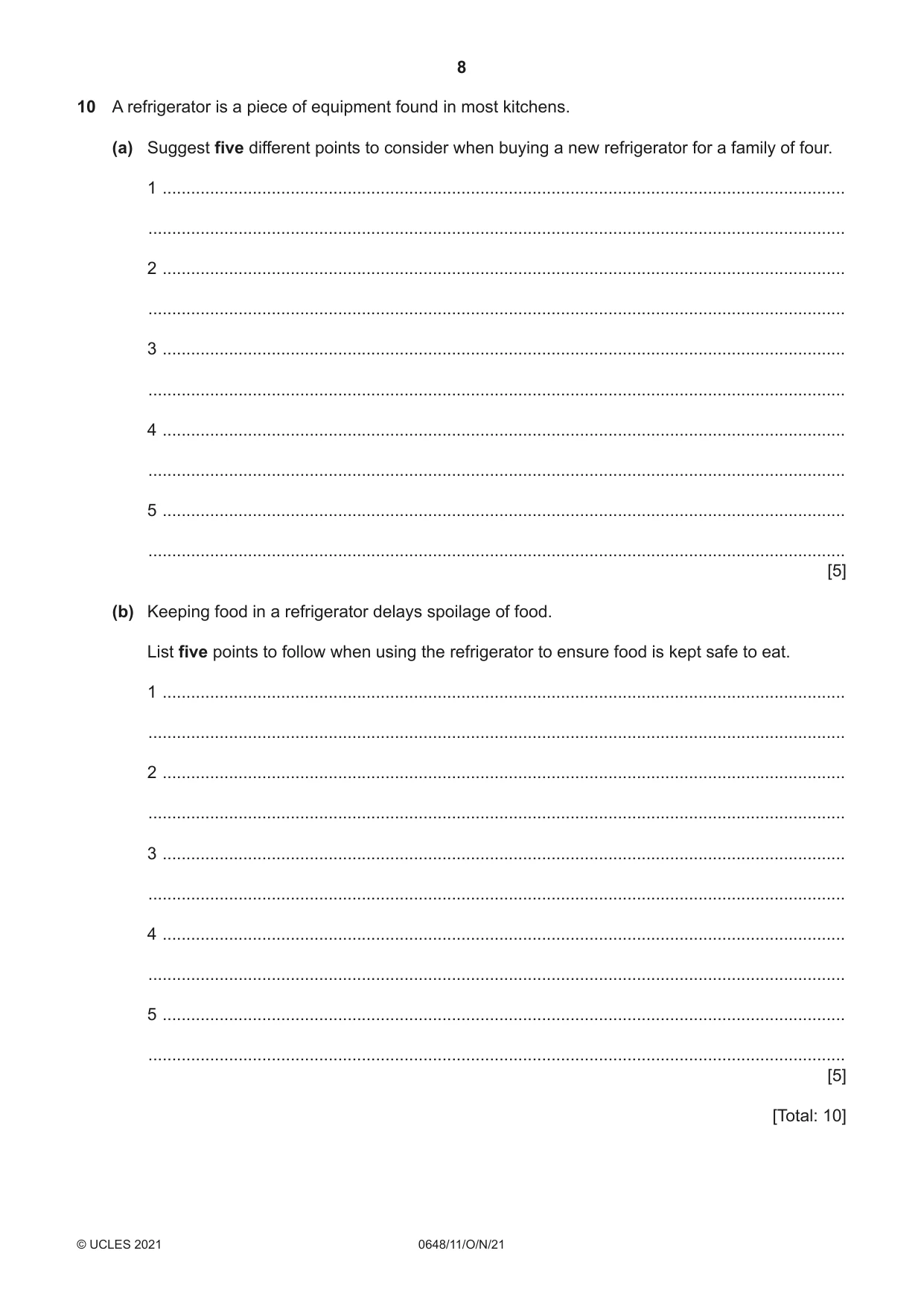
8 0648/11/O/N/21 © UCLES 2021 10 A refrigerator is a piece of equipment found in most kitchens. (a) Suggest five different points to consider when buying a new refrigerator for a family of four. 1 … … 2 … … 3 … … 4 … … 5 … … [5] (b) Keeping food in a refrigerator delays spoilage of food. List five points to follow when using the refrigerator to ensure food is kept safe to eat. 1 … … 2 … … 3 … … 4 … … 5 … … [5] [Total: 10]
Question paper, page 9
9 0648/11/O/N/21 © UCLES 2021 [Turn over Section C Answer either Question 11 or 12. 11 Electrical equipment must be used safely in the kitchen in order to prevent accidents. Discuss, with examples, ways to prevent other causes of accidents in the kitchen. [15] OR 12 Some foods are cooked before being eaten. Using examples, discuss: • the reasons for cooking food • roasting as a method of cooking different foods. [15] … … … … … … … … … … … … … … … … … … … …
Question paper, page 10
10 0648/11/O/N/21 © UCLES 2021 … … … … … … … … … … … … … … … … … … … … … … … … … … … …
Question paper, page 11
11 0648/11/O/N/21 © UCLES 2021 … … … … … … … … … … … … … … … … … … … … … … … … … … … …
Question paper, page 12
12 0648/11/O/N/21 © UCLES 2021 Permission to reproduce items where third-party owned material protected by copyright is included has been sought and cleared where possible. Every reasonable effort has been made by the publisher (UCLES) to trace copyright holders, but if any items requiring clearance have unwittingly been included, the publisher will be pleased to make amends at the earliest possible opportunity. To avoid the issue of disclosure of answer-related information to candidates, all copyright acknowledgements are reproduced online in the Cambridge Assessment International Education Copyright Acknowledgements Booklet. This is produced for each series of examinations and is freely available to download at www.cambridgeinternational.org after the live examination series. Cambridge Assessment International Education is part of the Cambridge Assessment Group. Cambridge Assessment is the brand name of the University of Cambridge Local Examinations Syndicate (UCLES), which itself is a department of the University of Cambridge. BLANK PAGE
Mark scheme, page 1
This document consists of 14 printed pages. © UCLES 2021 [Turn over Cambridge IGCSE™ FOOD & NUTRITION 0648/11 Paper 1 Theory October/November 2021 MARK SCHEME Maximum Mark: 100 Published This mark scheme is published as an aid to teachers and candidates, to indicate the requirements of the examination. It shows the basis on which Examiners were instructed to award marks. It does not indicate the details of the discussions that took place at an Examiners’ meeting before marking began, which would have considered the acceptability of alternative answers. Mark schemes should be read in conjunction with the question paper and the Principal Examiner Report for Teachers. Cambridge International will not enter into discussions about these mark schemes. Cambridge International is publishing the mark schemes for the October/November 2021 series for most Cambridge IGCSE™, Cambridge International A and AS Level components and some Cambridge O Level components.
Mark scheme, page 2
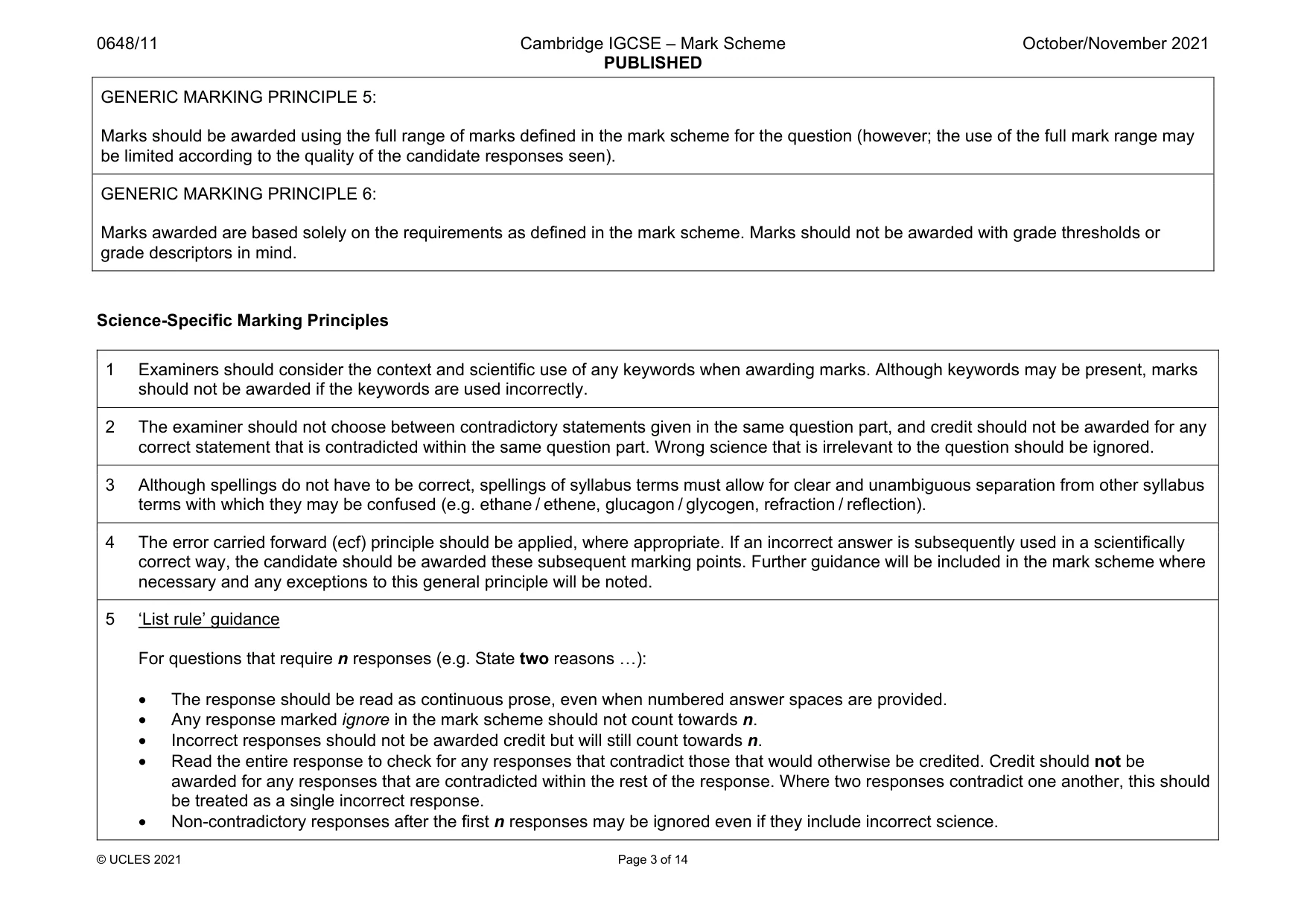
0648/11 Cambridge IGCSE – Mark Scheme PUBLISHED October/November 2021 © UCLES 2021 Page 2 of 14 Generic Marking Principles These general marking principles must be applied by all examiners when marking candidate answers. They should be applied alongside the specific content of the mark scheme or generic level descriptors for a question. Each question paper and mark scheme will also comply with these marking principles. GENERIC MARKING PRINCIPLE 1: Marks must be awarded in line with: • the specific content of the mark scheme or the generic level descriptors for the question • the specific skills defined in the mark scheme or in the generic level descriptors for the question • the standard of response required by a candidate as exemplified by the standardisation scripts. GENERIC MARKING PRINCIPLE 2: Marks awarded are always whole marks (not half marks, or other fractions). GENERIC MARKING PRINCIPLE 3: Marks must be awarded positively: • marks are awarded for correct/valid answers, as defined in the mark scheme. However, credit is given for valid answers which go beyond the scope of the syllabus and mark scheme, referring to your Team Leader as appropriate • marks are awarded when candidates clearly demonstrate what they know and can do • marks are not deducted for errors • marks are not deducted for omissions • answers should only be judged on the quality of spelling, punctuation and grammar when these features are specifically assessed by the question as indicated by the mark scheme. The meaning, however, should be unambiguous. GENERIC MARKING PRINCIPLE 4: Rules must be applied consistently, e.g. in situations where candidates have not followed instructions or in the application of generic level descriptors.
Mark scheme, page 3
0648/11 Cambridge IGCSE – Mark Scheme PUBLISHED October/November 2021 © UCLES 2021 Page 3 of 14 GENERIC MARKING PRINCIPLE 5: Marks should be awarded using the full range of marks defined in the mark scheme for the question (however; the use of the full mark range may be limited according to the quality of the candidate responses seen). GENERIC MARKING PRINCIPLE 6: Marks awarded are based solely on the requirements as defined in the mark scheme. Marks should not be awarded with grade thresholds or grade descriptors in mind. Science-Specific Marking Principles 1 Examiners should consider the context and scientific use of any keywords when awarding marks. Although keywords may be present, marks should not be awarded if the keywords are used incorrectly. 2 The examiner should not choose between contradictory statements given in the same question part, and credit should not be awarded for any correct statement that is contradicted within the same question part. Wrong science that is irrelevant to the question should be ignored. 3 Although spellings do not have to be correct, spellings of syllabus terms must allow for clear and unambiguous separation from other syllabus terms with which they may be confused (e.g. ethane / ethene, glucagon / glycogen, refraction / reflection). 4 The error carried forward (ecf) principle should be applied, where appropriate. If an incorrect answer is subsequently used in a scientifically correct way, the candidate should be awarded these subsequent marking points. Further guidance will be included in the mark scheme where necessary and any exceptions to this general principle will be noted. 5 ‘List rule’ guidance For questions that require n responses (e.g. State two reasons …): • The response should be read as continuous prose, even when numbered answer spaces are provided. • Any response marked ignore in the mark scheme should not count towards n. • Incorrect responses should not be awarded credit but will still count towards n. • Read the entire response to check for any responses that contradict those that would otherwise be credited. Credit should not be awarded for any responses that are contradicted within the rest of the response. Where two responses contradict one another, this should be treated as a single incorrect response. • Non-contradictory responses after the first n responses may be ignored even if they include incorrect science.
Mark scheme, page 4
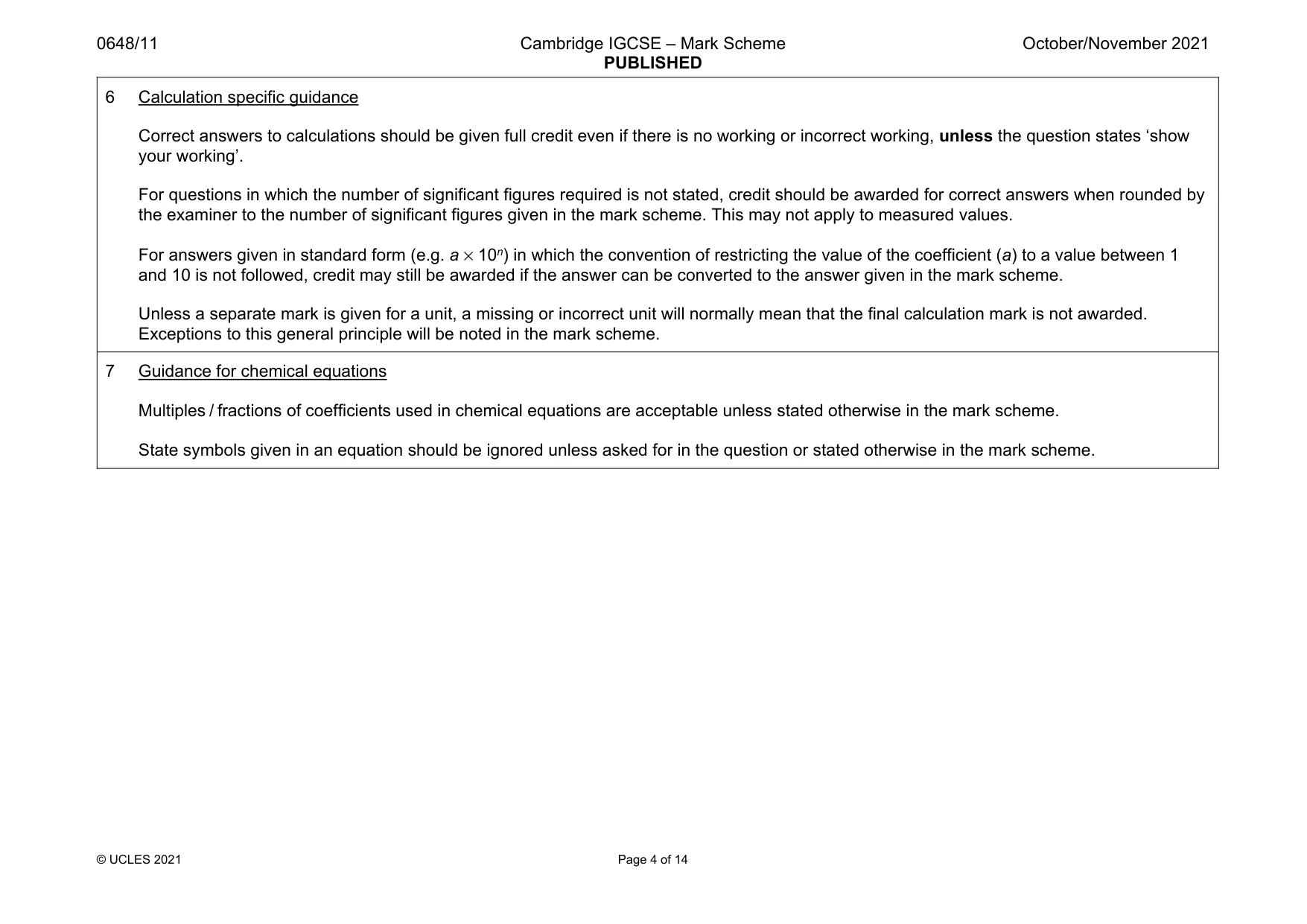
0648/11 Cambridge IGCSE – Mark Scheme PUBLISHED October/November 2021 © UCLES 2021 Page 4 of 14 6 Calculation specific guidance Correct answers to calculations should be given full credit even if there is no working or incorrect working, unless the question states ‘show your working’. For questions in which the number of significant figures required is not stated, credit should be awarded for correct answers when rounded by the examiner to the number of significant figures given in the mark scheme. This may not apply to measured values. For answers given in standard form (e.g. a × 10n) in which the convention of restricting the value of the coefficient (a) to a value between 1 and 10 is not followed, credit may still be awarded if the answer can be converted to the answer given in the mark scheme. Unless a separate mark is given for a unit, a missing or incorrect unit will normally mean that the final calculation mark is not awarded. Exceptions to this general principle will be noted in the mark scheme. 7 Guidance for chemical equations Multiples / fractions of coefficients used in chemical equations are acceptable unless stated otherwise in the mark scheme. State symbols given in an equation should be ignored unless asked for in the question or stated otherwise in the mark scheme.
Mark scheme, page 5
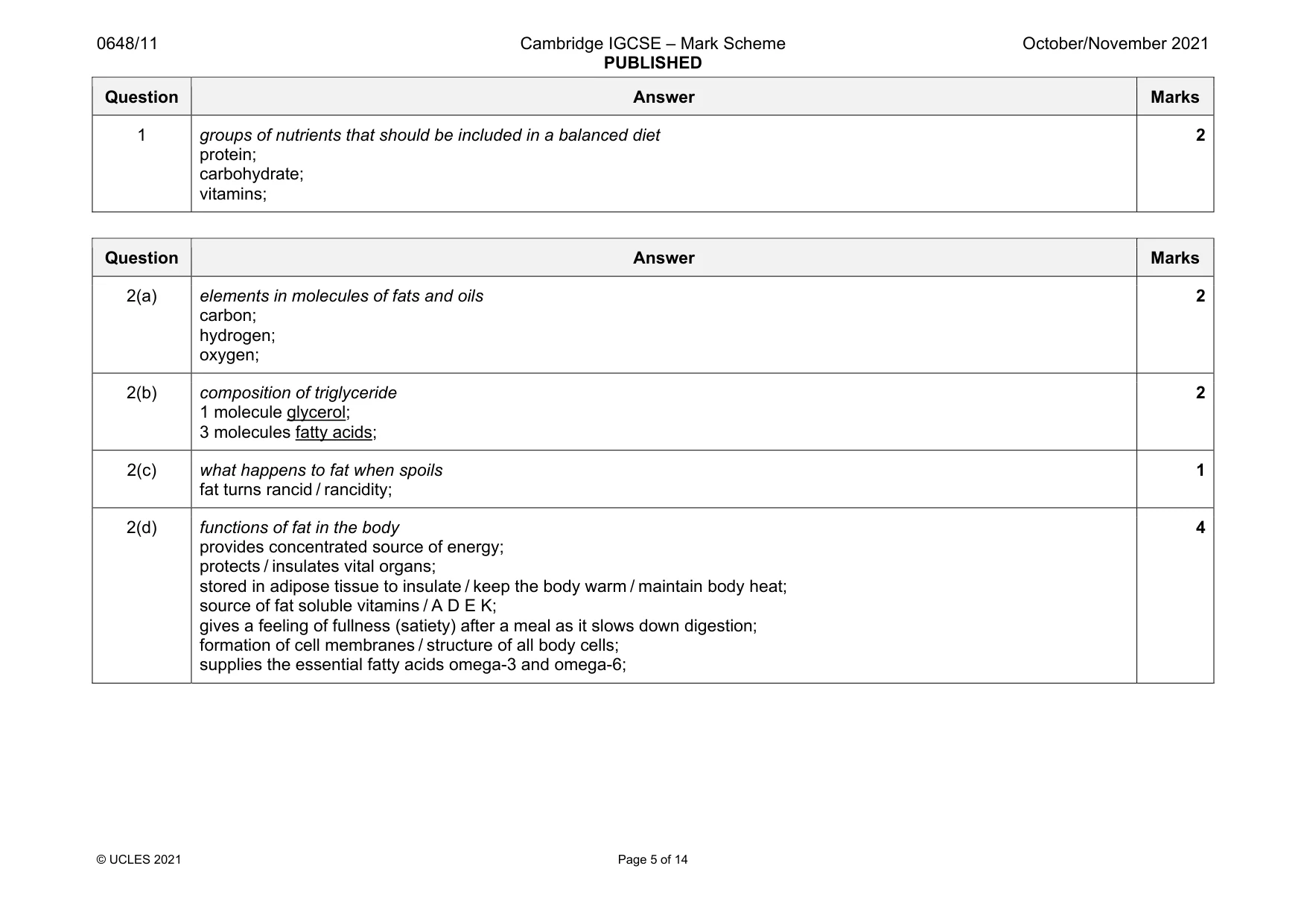
0648/11 Cambridge IGCSE – Mark Scheme PUBLISHED October/November 2021 © UCLES 2021 Page 5 of 14 Question Answer Marks 1 groups of nutrients that should be included in a balanced diet protein; carbohydrate; vitamins; 2 Question Answer Marks 2(a) elements in molecules of fats and oils carbon; hydrogen; oxygen; 2 2(b) composition of triglyceride 1 molecule glycerol; 3 molecules fatty acids; 2 2(c) what happens to fat when spoils fat turns rancid / rancidity; 1 2(d) functions of fat in the body provides concentrated source of energy; protects / insulates vital organs; stored in adipose tissue to insulate / keep the body warm / maintain body heat; source of fat soluble vitamins / A D E K; gives a feeling of fullness (satiety) after a meal as it slows down digestion; formation of cell membranes / structure of all body cells; supplies the essential fatty acids omega-3 and omega-6; 4
Mark scheme, page 6
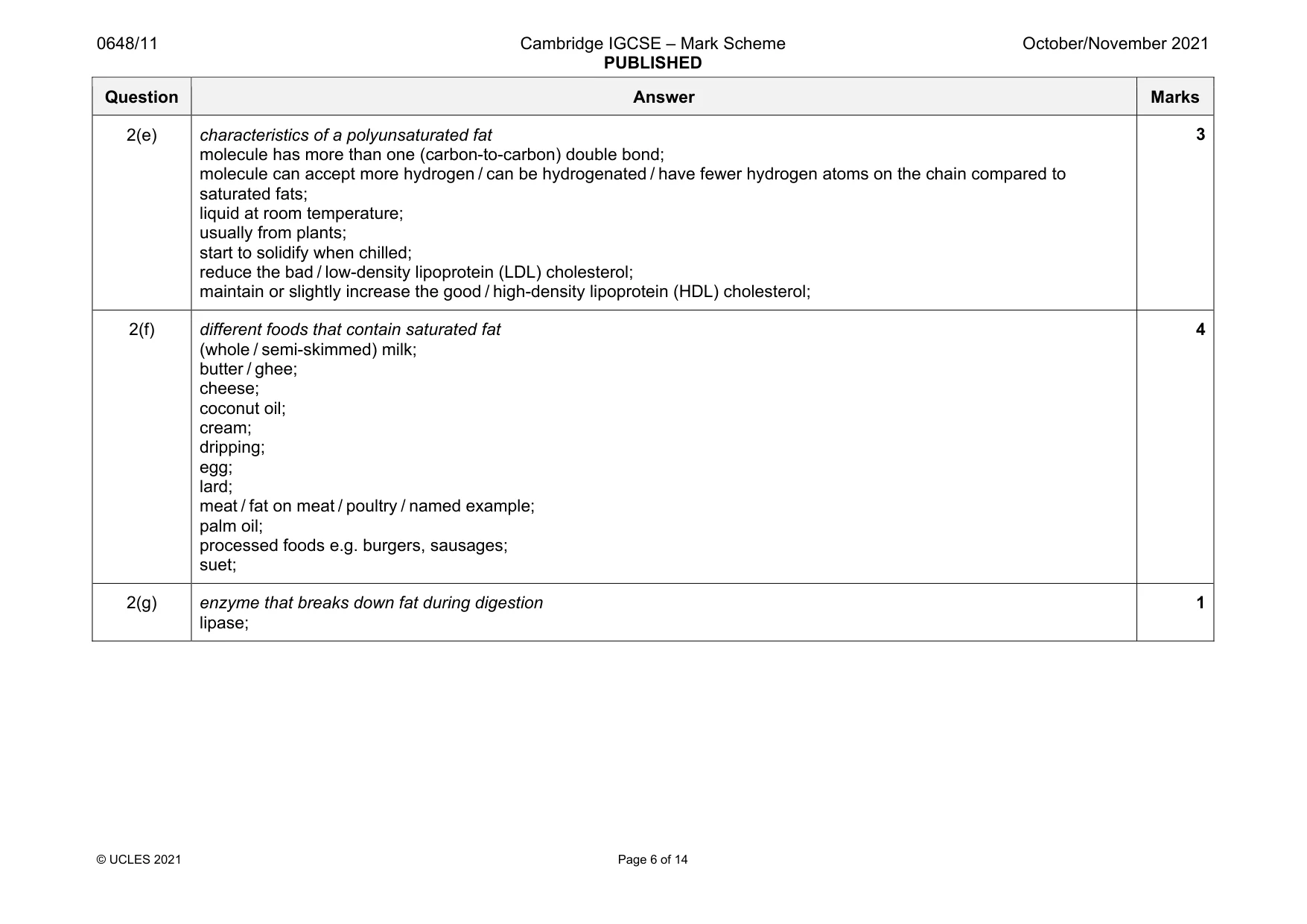
0648/11 Cambridge IGCSE – Mark Scheme PUBLISHED October/November 2021 © UCLES 2021 Page 6 of 14 Question Answer Marks 2(e) characteristics of a polyunsaturated fat molecule has more than one (carbon-to-carbon) double bond; molecule can accept more hydrogen / can be hydrogenated / have fewer hydrogen atoms on the chain compared to saturated fats; liquid at room temperature; usually from plants; start to solidify when chilled; reduce the bad / low-density lipoprotein (LDL) cholesterol; maintain or slightly increase the good / high-density lipoprotein (HDL) cholesterol; 3 2(f) different foods that contain saturated fat (whole / semi-skimmed) milk; butter / ghee; cheese; coconut oil; cream; dripping; egg; lard; meat / fat on meat / poultry / named example; palm oil; processed foods e.g. burgers, sausages; suet; 4 2(g) enzyme that breaks down fat during digestion lipase; 1
Mark scheme, page 7
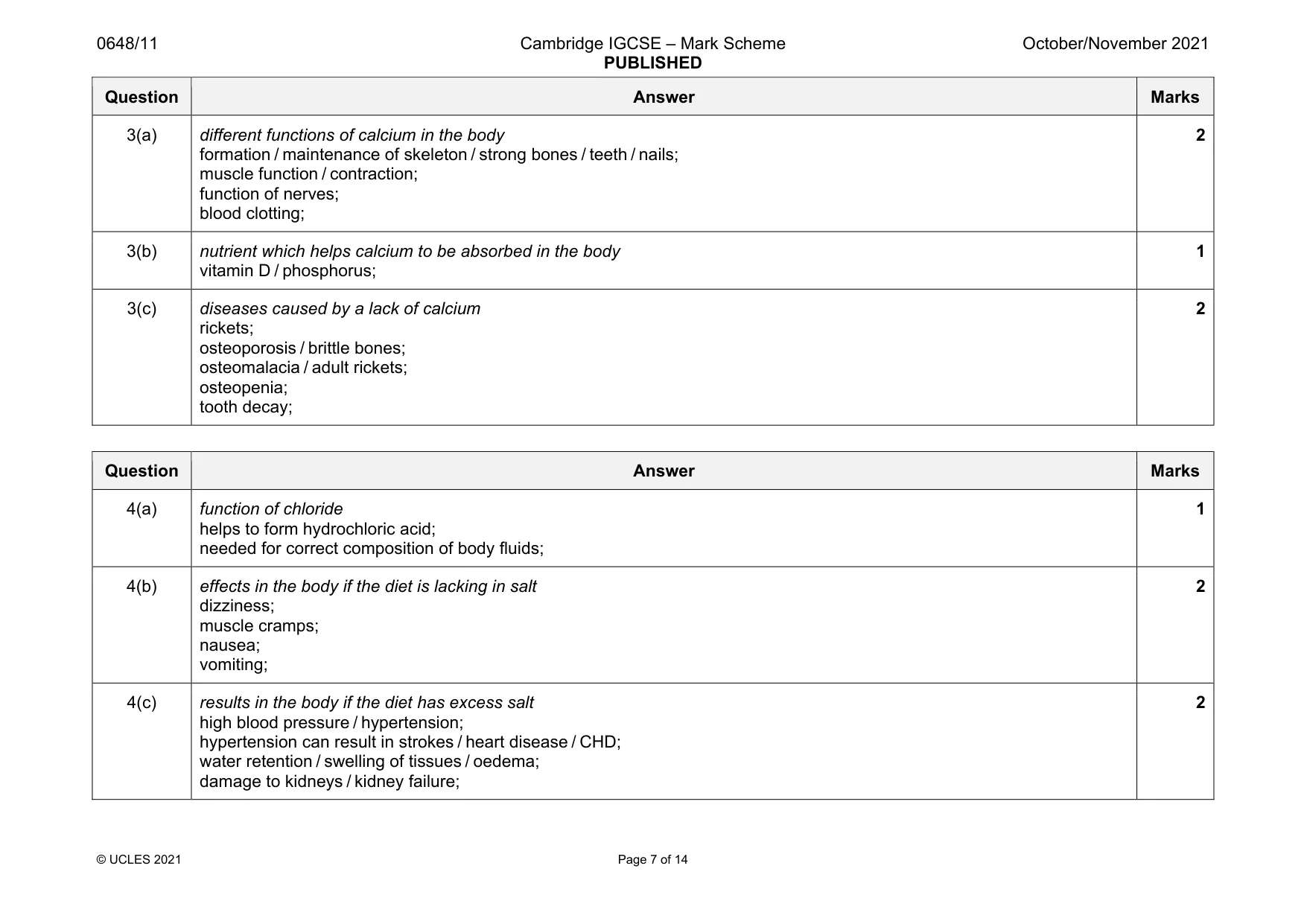
0648/11 Cambridge IGCSE – Mark Scheme PUBLISHED October/November 2021 © UCLES 2021 Page 7 of 14 Question Answer Marks 3(a) different functions of calcium in the body formation / maintenance of skeleton / strong bones / teeth / nails; muscle function / contraction; function of nerves; blood clotting; 2 3(b) nutrient which helps calcium to be absorbed in the body vitamin D / phosphorus; 1 3(c) diseases caused by a lack of calcium rickets; osteoporosis / brittle bones; osteomalacia / adult rickets; osteopenia; tooth decay; 2 Question Answer Marks 4(a) function of chloride helps to form hydrochloric acid; needed for correct composition of body fluids; 1 4(b) effects in the body if the diet is lacking in salt dizziness; muscle cramps; nausea; vomiting; 2 4(c) results in the body if the diet has excess salt high blood pressure / hypertension; hypertension can result in strokes / heart disease / CHD; water retention / swelling of tissues / oedema; damage to kidneys / kidney failure; 2
Mark scheme, page 8
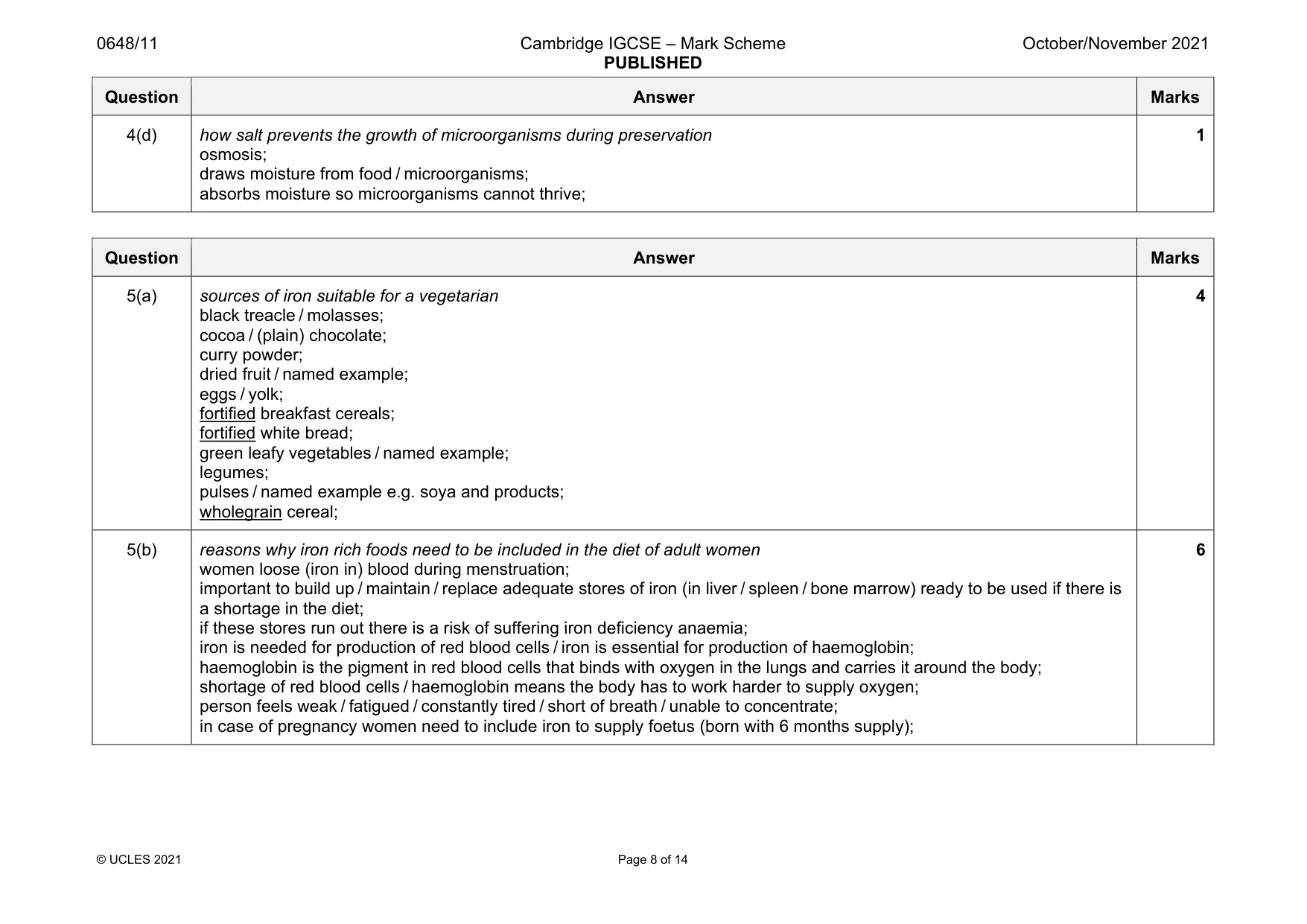
0648/11 Cambridge IGCSE – Mark Scheme PUBLISHED October/November 2021 © UCLES 2021 Page 8 of 14 Question Answer Marks 4(d) how salt prevents the growth of microorganisms during preservation osmosis; draws moisture from food / microorganisms; absorbs moisture so microorganisms cannot thrive; 1 Question Answer Marks 5(a) sources of iron suitable for a vegetarian black treacle / molasses; cocoa / (plain) chocolate; curry powder; dried fruit / named example; eggs / yolk; fortified breakfast cereals; fortified white bread; green leafy vegetables / named example; legumes; pulses / named example e.g. soya and products; wholegrain cereal; 4 5(b) reasons why iron rich foods need to be included in the diet of adult women women loose (iron in) blood during menstruation; important to build up / maintain / replace adequate stores of iron (in liver / spleen / bone marrow) ready to be used if there is a shortage in the diet; if these stores run out there is a risk of suffering iron deficiency anaemia; iron is needed for production of red blood cells / iron is essential for production of haemoglobin; haemoglobin is the pigment in red blood cells that binds with oxygen in the lungs and carries it around the body; shortage of red blood cells / haemoglobin means the body has to work harder to supply oxygen; person feels weak / fatigued / constantly tired / short of breath / unable to concentrate; in case of pregnancy women need to include iron to supply foetus (born with 6 months supply); 6
Mark scheme, page 9
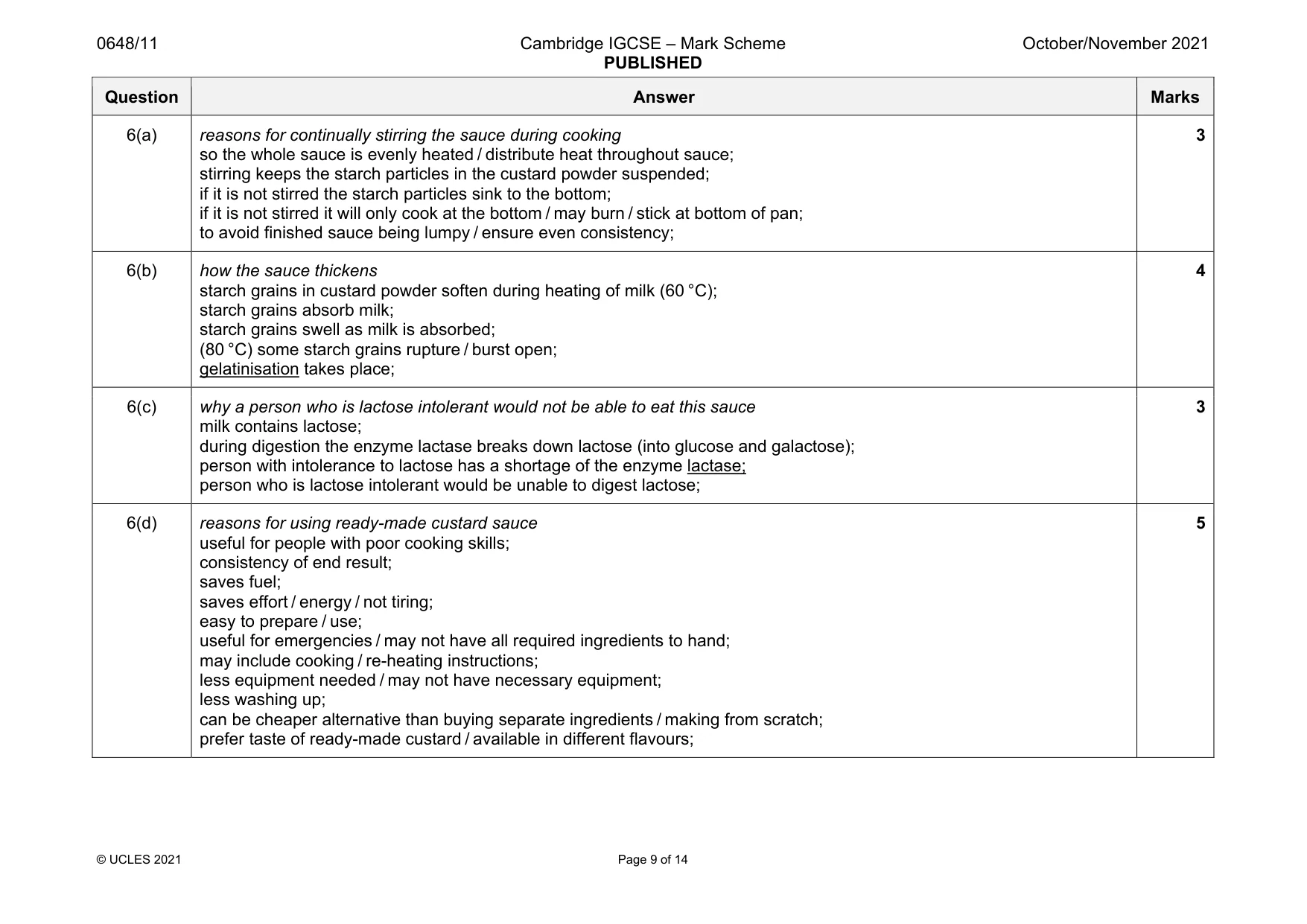
0648/11 Cambridge IGCSE – Mark Scheme PUBLISHED October/November 2021 © UCLES 2021 Page 9 of 14 Question Answer Marks 6(a) reasons for continually stirring the sauce during cooking so the whole sauce is evenly heated / distribute heat throughout sauce; stirring keeps the starch particles in the custard powder suspended; if it is not stirred the starch particles sink to the bottom; if it is not stirred it will only cook at the bottom / may burn / stick at bottom of pan; to avoid finished sauce being lumpy / ensure even consistency; 3 6(b) how the sauce thickens starch grains in custard powder soften during heating of milk (60 °C); starch grains absorb milk; starch grains swell as milk is absorbed; (80 °C) some starch grains rupture / burst open; gelatinisation takes place; 4 6(c) why a person who is lactose intolerant would not be able to eat this sauce milk contains lactose; during digestion the enzyme lactase breaks down lactose (into glucose and galactose); person with intolerance to lactose has a shortage of the enzyme lactase; person who is lactose intolerant would be unable to digest lactose; 3 6(d) reasons for using ready-made custard sauce useful for people with poor cooking skills; consistency of end result; saves fuel; saves effort / energy / not tiring; easy to prepare / use; useful for emergencies / may not have all required ingredients to hand; may include cooking / re-heating instructions; less equipment needed / may not have necessary equipment; less washing up; can be cheaper alternative than buying separate ingredients / making from scratch; prefer taste of ready-made custard / available in different flavours; 5
Mark scheme, page 10
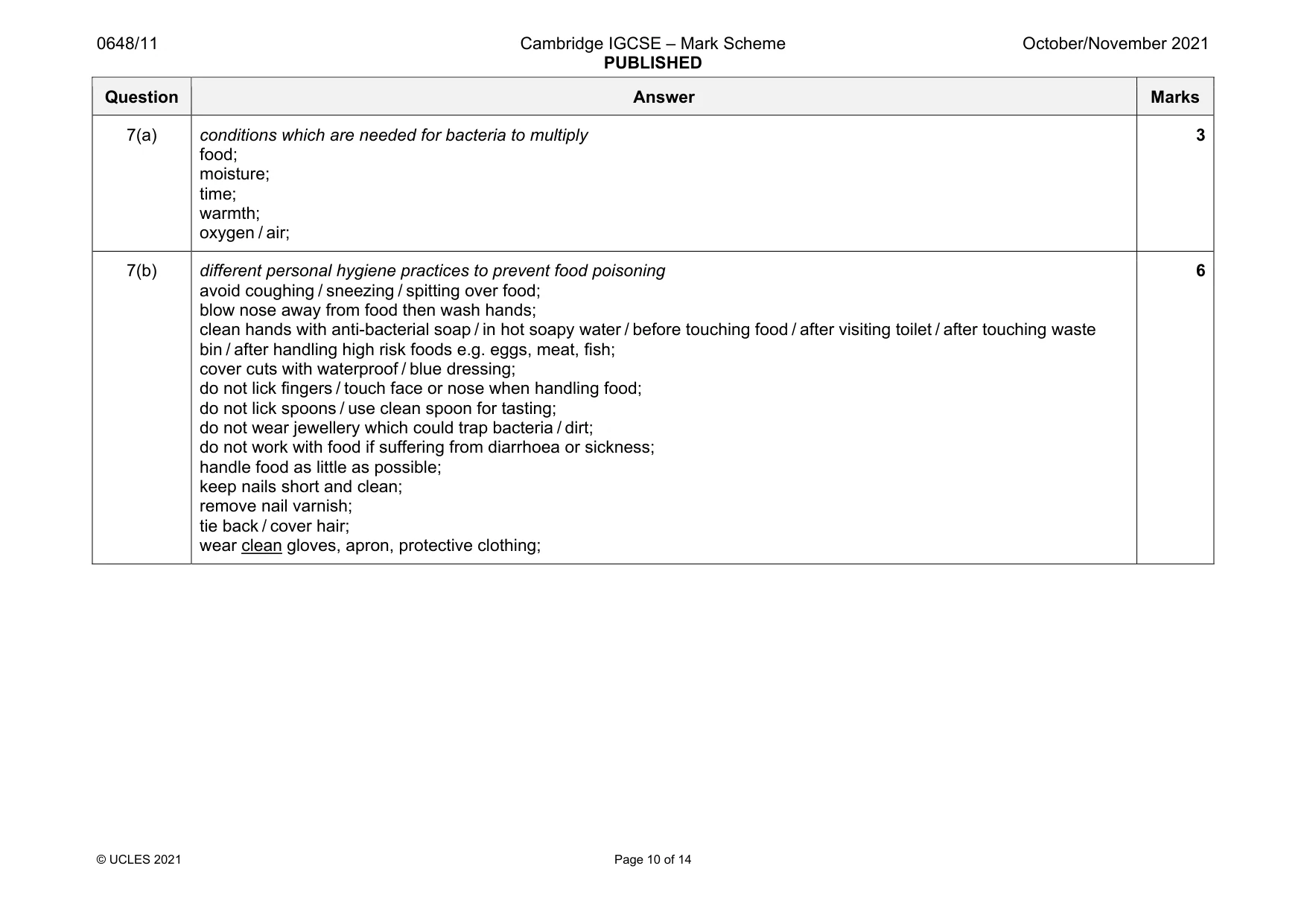
0648/11 Cambridge IGCSE – Mark Scheme PUBLISHED October/November 2021 © UCLES 2021 Page 10 of 14 Question Answer Marks 7(a) conditions which are needed for bacteria to multiply food; moisture; time; warmth; oxygen / air; 3 7(b) different personal hygiene practices to prevent food poisoning avoid coughing / sneezing / spitting over food; blow nose away from food then wash hands; clean hands with anti-bacterial soap / in hot soapy water / before touching food / after visiting toilet / after touching waste bin / after handling high risk foods e.g. eggs, meat, fish; cover cuts with waterproof / blue dressing; do not lick fingers / touch face or nose when handling food; do not lick spoons / use clean spoon for tasting; do not wear jewellery which could trap bacteria / dirt; do not work with food if suffering from diarrhoea or sickness; handle food as little as possible; keep nails short and clean; remove nail varnish; tie back / cover hair; wear clean gloves, apron, protective clothing; 6
Mark scheme, page 11
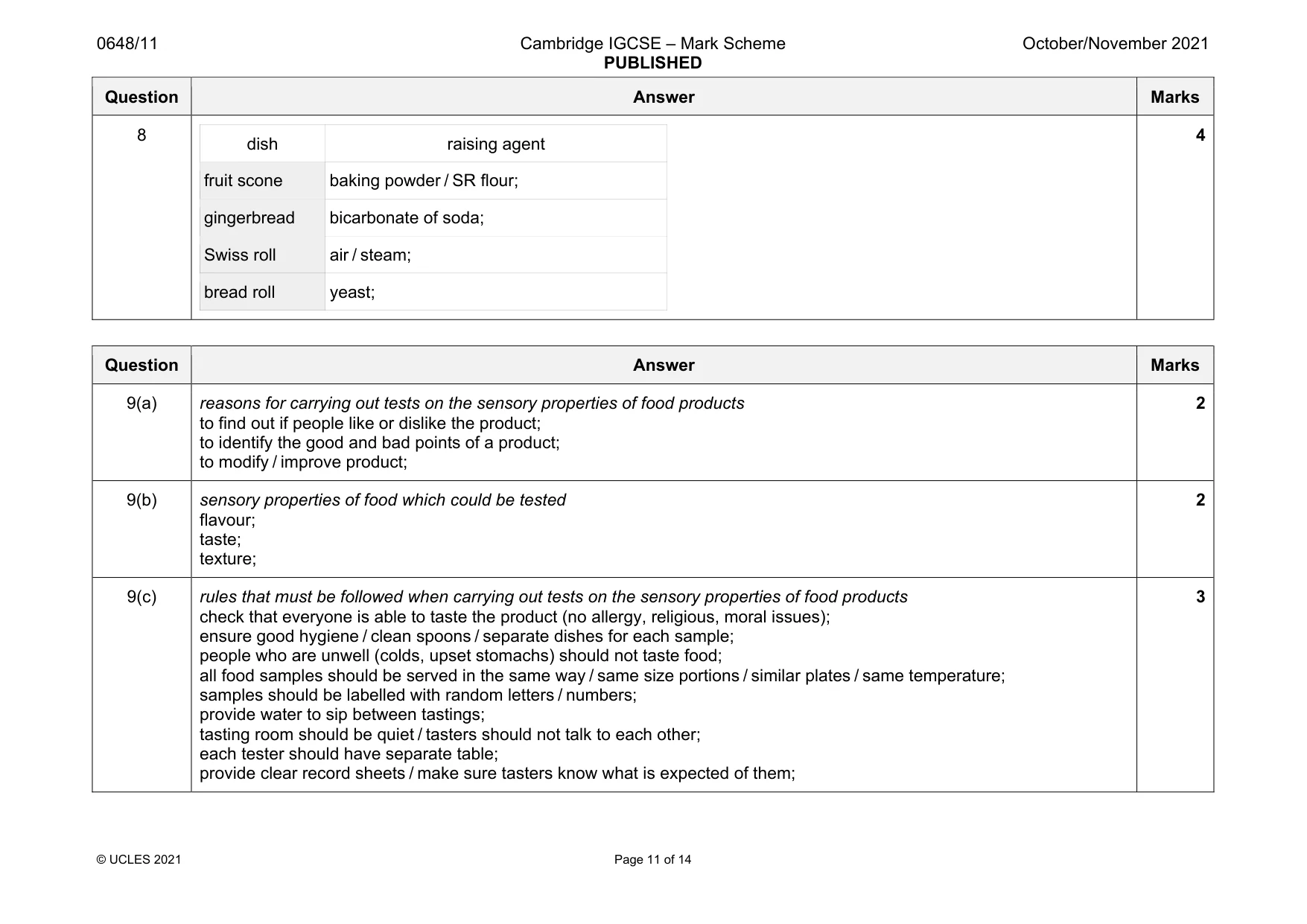
0648/11 Cambridge IGCSE – Mark Scheme PUBLISHED October/November 2021 © UCLES 2021 Page 11 of 14 Question Answer Marks 8 dish raising agent fruit scone baking powder / SR flour; gingerbread bicarbonate of soda; Swiss roll air / steam; bread roll yeast; 4 Question Answer Marks 9(a) reasons for carrying out tests on the sensory properties of food products to find out if people like or dislike the product; to identify the good and bad points of a product; to modify / improve product; 2 9(b) sensory properties of food which could be tested flavour; taste; texture; 2 9(c) rules that must be followed when carrying out tests on the sensory properties of food products check that everyone is able to taste the product (no allergy, religious, moral issues); ensure good hygiene / clean spoons / separate dishes for each sample; people who are unwell (colds, upset stomachs) should not taste food; all food samples should be served in the same way / same size portions / similar plates / same temperature; samples should be labelled with random letters / numbers; provide water to sip between tastings; tasting room should be quiet / tasters should not talk to each other; each tester should have separate table; provide clear record sheets / make sure tasters know what is expected of them; 3
Mark scheme, page 12
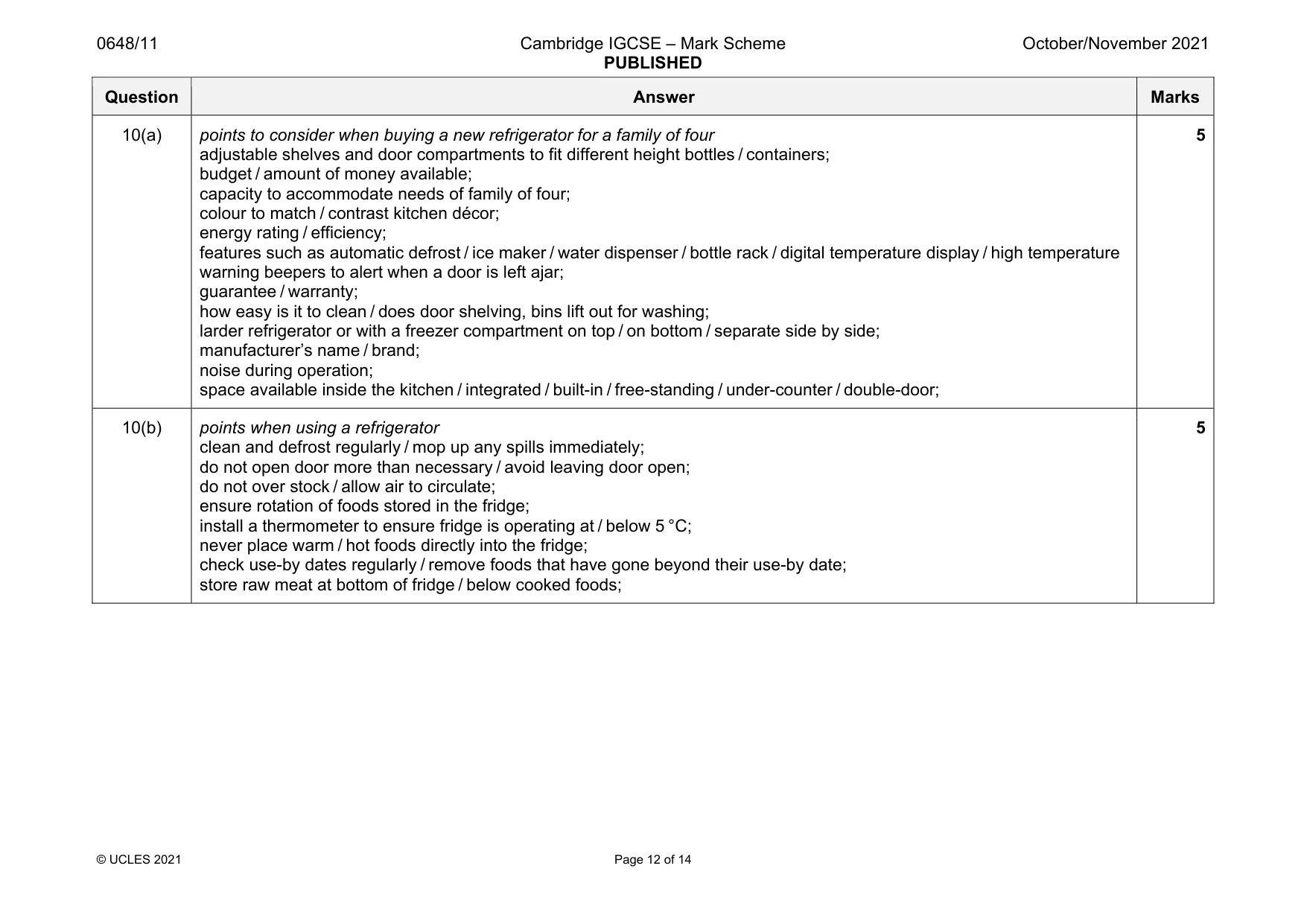
0648/11 Cambridge IGCSE – Mark Scheme PUBLISHED October/November 2021 © UCLES 2021 Page 12 of 14 Question Answer Marks 10(a) points to consider when buying a new refrigerator for a family of four adjustable shelves and door compartments to fit different height bottles / containers; budget / amount of money available; capacity to accommodate needs of family of four; colour to match / contrast kitchen décor; energy rating / efficiency; features such as automatic defrost / ice maker / water dispenser / bottle rack / digital temperature display / high temperature warning beepers to alert when a door is left ajar; guarantee / warranty; how easy is it to clean / does door shelving, bins lift out for washing; larder refrigerator or with a freezer compartment on top / on bottom / separate side by side; manufacturer’s name / brand; noise during operation; space available inside the kitchen / integrated / built-in / free-standing / under-counter / double-door; 5 10(b) points when using a refrigerator clean and defrost regularly / mop up any spills immediately; do not open door more than necessary / avoid leaving door open; do not over stock / allow air to circulate; ensure rotation of foods stored in the fridge; install a thermometer to ensure fridge is operating at / below 5 °C; never place warm / hot foods directly into the fridge; check use-by dates regularly / remove foods that have gone beyond their use-by date; store raw meat at bottom of fridge / below cooked foods; 5
Mark scheme, page 13
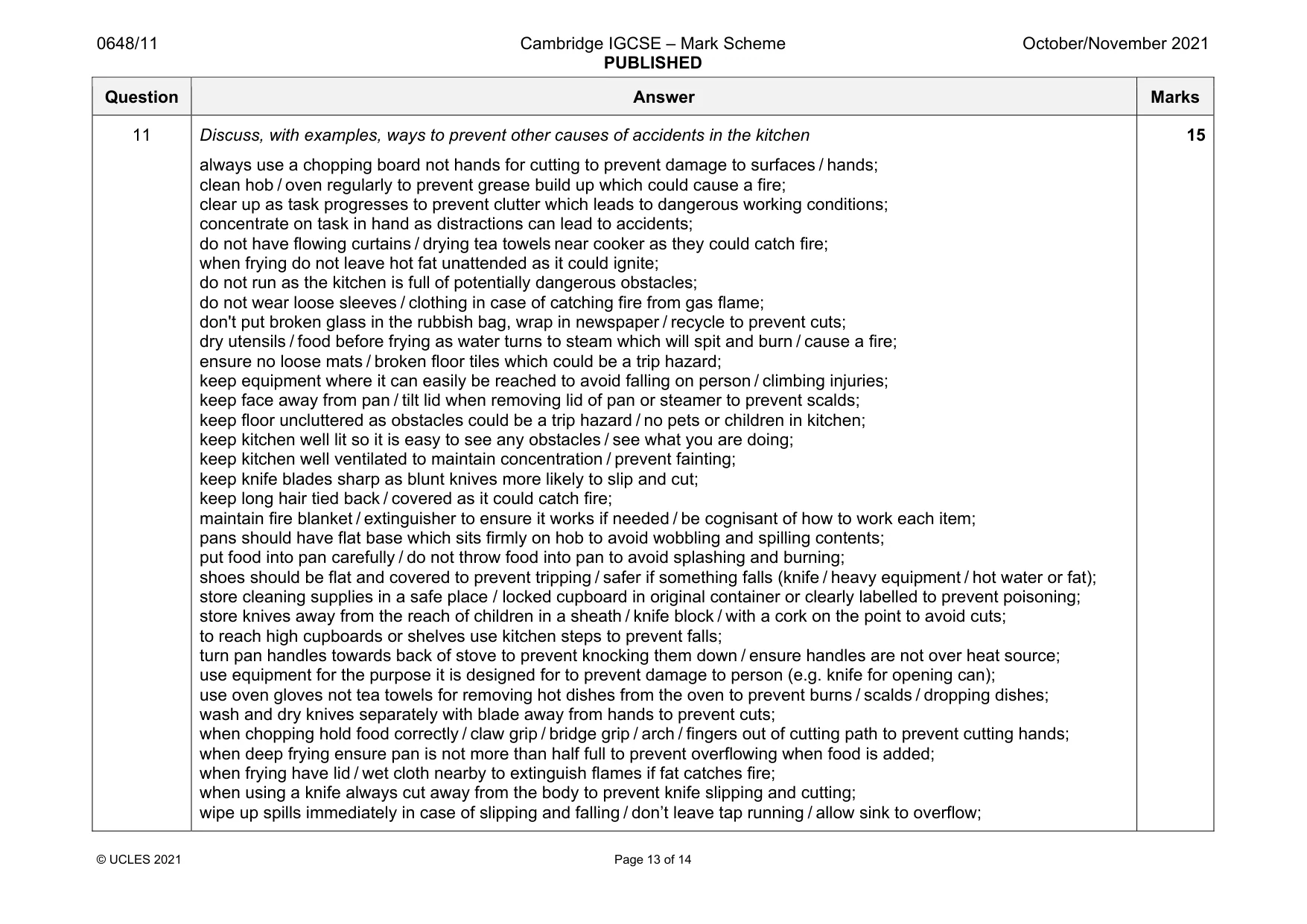
0648/11 Cambridge IGCSE – Mark Scheme PUBLISHED October/November 2021 © UCLES 2021 Page 13 of 14 Question Answer Marks 11 Discuss, with examples, ways to prevent other causes of accidents in the kitchen always use a chopping board not hands for cutting to prevent damage to surfaces / hands; clean hob / oven regularly to prevent grease build up which could cause a fire; clear up as task progresses to prevent clutter which leads to dangerous working conditions; concentrate on task in hand as distractions can lead to accidents; do not have flowing curtains / drying tea towels near cooker as they could catch fire; when frying do not leave hot fat unattended as it could ignite; do not run as the kitchen is full of potentially dangerous obstacles; do not wear loose sleeves / clothing in case of catching fire from gas flame; don't put broken glass in the rubbish bag, wrap in newspaper / recycle to prevent cuts; dry utensils / food before frying as water turns to steam which will spit and burn / cause a fire; ensure no loose mats / broken floor tiles which could be a trip hazard; keep equipment where it can easily be reached to avoid falling on person / climbing injuries; keep face away from pan / tilt lid when removing lid of pan or steamer to prevent scalds; keep floor uncluttered as obstacles could be a trip hazard / no pets or children in kitchen; keep kitchen well lit so it is easy to see any obstacles / see what you are doing; keep kitchen well ventilated to maintain concentration / prevent fainting; keep knife blades sharp as blunt knives more likely to slip and cut; keep long hair tied back / covered as it could catch fire; maintain fire blanket / extinguisher to ensure it works if needed / be cognisant of how to work each item; pans should have flat base which sits firmly on hob to avoid wobbling and spilling contents; put food into pan carefully / do not throw food into pan to avoid splashing and burning; shoes should be flat and covered to prevent tripping / safer if something falls (knife / heavy equipment / hot water or fat); store cleaning supplies in a safe place / locked cupboard in original container or clearly labelled to prevent poisoning; store knives away from the reach of children in a sheath / knife block / with a cork on the point to avoid cuts; to reach high cupboards or shelves use kitchen steps to prevent falls; turn pan handles towards back of stove to prevent knocking them down / ensure handles are not over heat source; use equipment for the purpose it is designed for to prevent damage to person (e.g. knife for opening can); use oven gloves not tea towels for removing hot dishes from the oven to prevent burns / scalds / dropping dishes; wash and dry knives separately with blade away from hands to prevent cuts; when chopping hold food correctly / claw grip / bridge grip / arch / fingers out of cutting path to prevent cutting hands; when deep frying ensure pan is not more than half full to prevent overflowing when food is added; when frying have lid / wet cloth nearby to extinguish flames if fat catches fire; when using a knife always cut away from the body to prevent knife slipping and cutting; wipe up spills immediately in case of slipping and falling / don’t leave tap running / allow sink to overflow; 15
Mark scheme, page 14
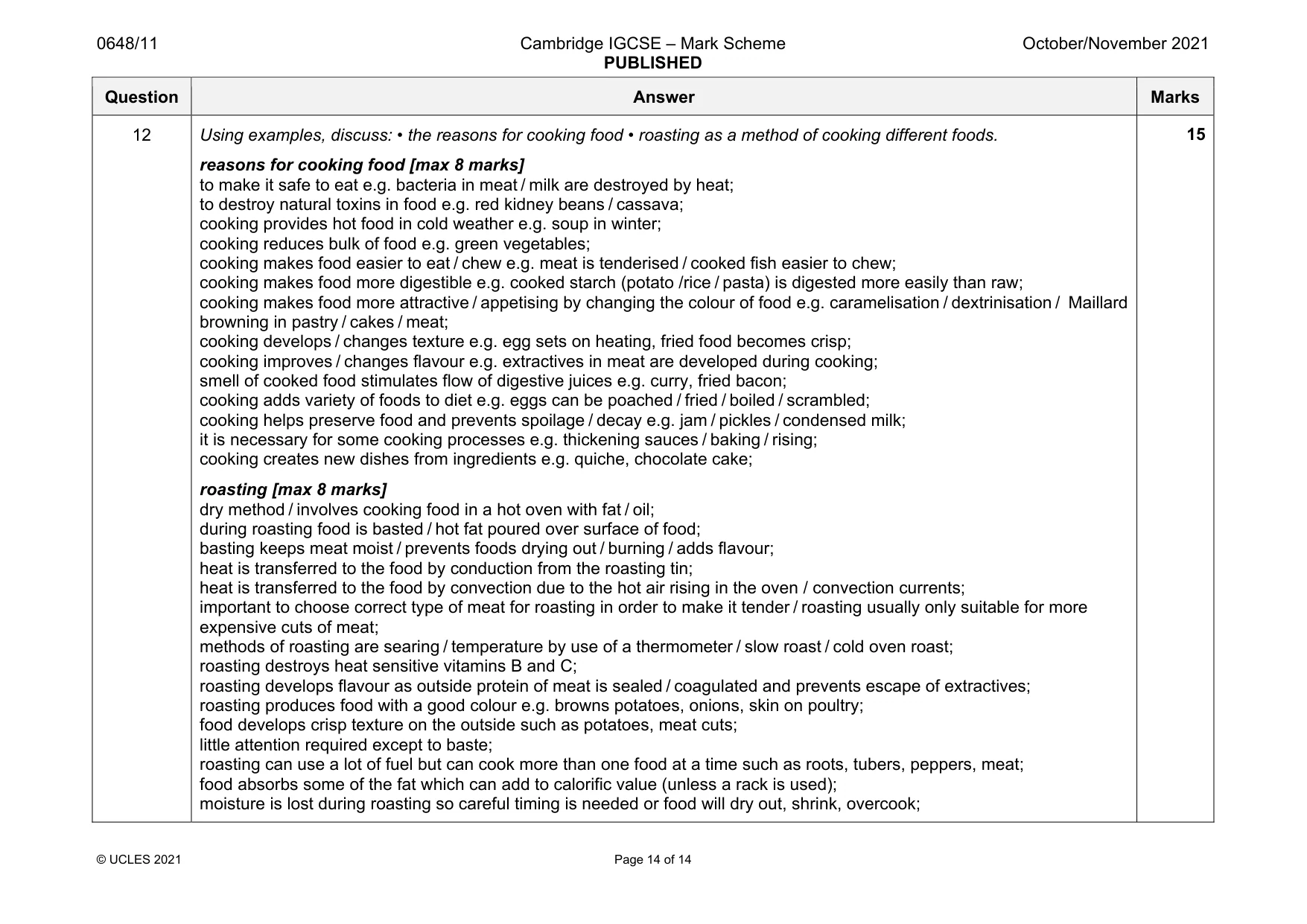
0648/11 Cambridge IGCSE – Mark Scheme PUBLISHED October/November 2021 © UCLES 2021 Page 14 of 14 Question Answer Marks 12 Using examples, discuss: • the reasons for cooking food • roasting as a method of cooking different foods. reasons for cooking food [max 8 marks] to make it safe to eat e.g. bacteria in meat / milk are destroyed by heat; to destroy natural toxins in food e.g. red kidney beans / cassava; cooking provides hot food in cold weather e.g. soup in winter; cooking reduces bulk of food e.g. green vegetables; cooking makes food easier to eat / chew e.g. meat is tenderised / cooked fish easier to chew; cooking makes food more digestible e.g. cooked starch (potato /rice / pasta) is digested more easily than raw; cooking makes food more attractive / appetising by changing the colour of food e.g. caramelisation / dextrinisation / Maillard browning in pastry / cakes / meat; cooking develops / changes texture e.g. egg sets on heating, fried food becomes crisp; cooking improves / changes flavour e.g. extractives in meat are developed during cooking; smell of cooked food stimulates flow of digestive juices e.g. curry, fried bacon; cooking adds variety of foods to diet e.g. eggs can be poached / fried / boiled / scrambled; cooking helps preserve food and prevents spoilage / decay e.g. jam / pickles / condensed milk; it is necessary for some cooking processes e.g. thickening sauces / baking / rising; cooking creates new dishes from ingredients e.g. quiche, chocolate cake; roasting [max 8 marks] dry method / involves cooking food in a hot oven with fat / oil; during roasting food is basted / hot fat poured over surface of food; basting keeps meat moist / prevents foods drying out / burning / adds flavour; heat is transferred to the food by conduction from the roasting tin; heat is transferred to the food by convection due to the hot air rising in the oven / convection currents; important to choose correct type of meat for roasting in order to make it tender / roasting usually only suitable for more expensive cuts of meat; methods of roasting are searing / temperature by use of a thermometer / slow roast / cold oven roast; roasting destroys heat sensitive vitamins B and C; roasting develops flavour as outside protein of meat is sealed / coagulated and prevents escape of extractives; roasting produces food with a good colour e.g. browns potatoes, onions, skin on poultry; food develops crisp texture on the outside such as potatoes, meat cuts; little attention required except to baste; roasting can use a lot of fuel but can cook more than one food at a time such as roots, tubers, peppers, meat; food absorbs some of the fat which can add to calorific value (unless a rack is used); moisture is lost during roasting so careful timing is needed or food will dry out, shrink, overcook; 15
What you needed in this session
Cambridge’s own grade thresholds for 2021 Oct/Nov, Paper 1 · Variant 1. A higher threshold means an easier paper — the bar moves with how the cohort did.