Cambridge IGCSE Food and Nutrition 0648 — 2024 May/June Paper 1 · Variant 2
0648/12/M/J/24 · 100 marks · ≈113 min
The question paper and its mark scheme, free to read here and free to download. This is Cambridge’s own paper, exactly as it was sat.
Question paper12 pages


Mark scheme16 pages
Answers below. Sit the paper first if you are practising.
Paper as text
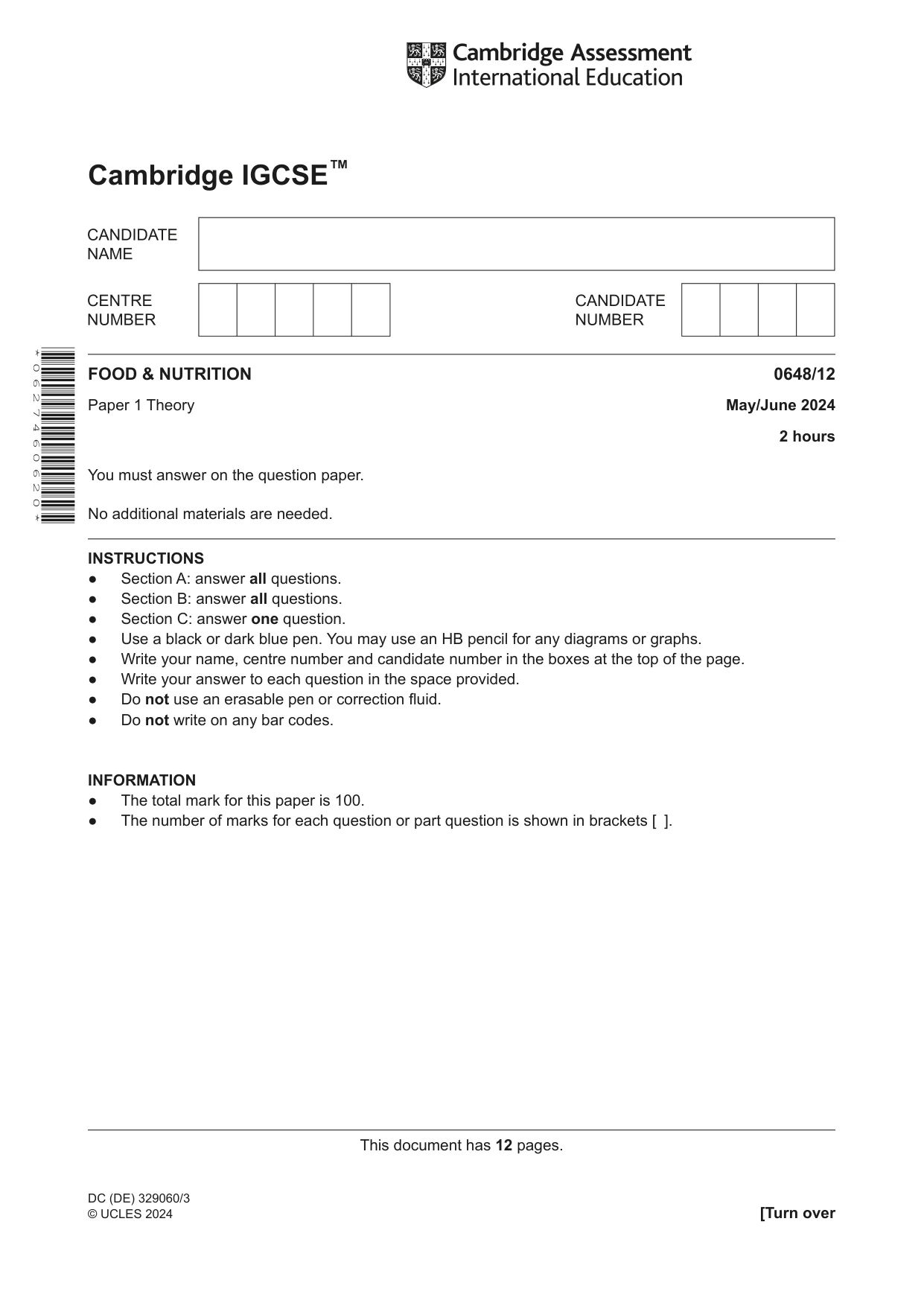
Question paper, page 1
This document has 12 pages. [Turn over * 0 6 2 7 4 6 0 6 2 0 * Cambridge IGCSE™ FOOD & NUTRITION 0648/12 Paper 1 Theory May/June 2024 2 hours You must answer on the question paper. No additional materials are needed. INSTRUCTIONS ● Section A: answer all questions. ● Section B: answer all questions. ● Section C: answer one question. ● Use a black or dark blue pen. You may use an HB pencil for any diagrams or graphs. ● Write your name, centre number and candidate number in the boxes at the top of the page. ● Write your answer to each question in the space provided. ● Do not use an erasable pen or correction fluid. ● Do not write on any bar codes. INFORMATION ● The total mark for this paper is 100. ● The number of marks for each question or part question is shown in brackets [ ]. DC (DE) 329060/3 © UCLES 2024
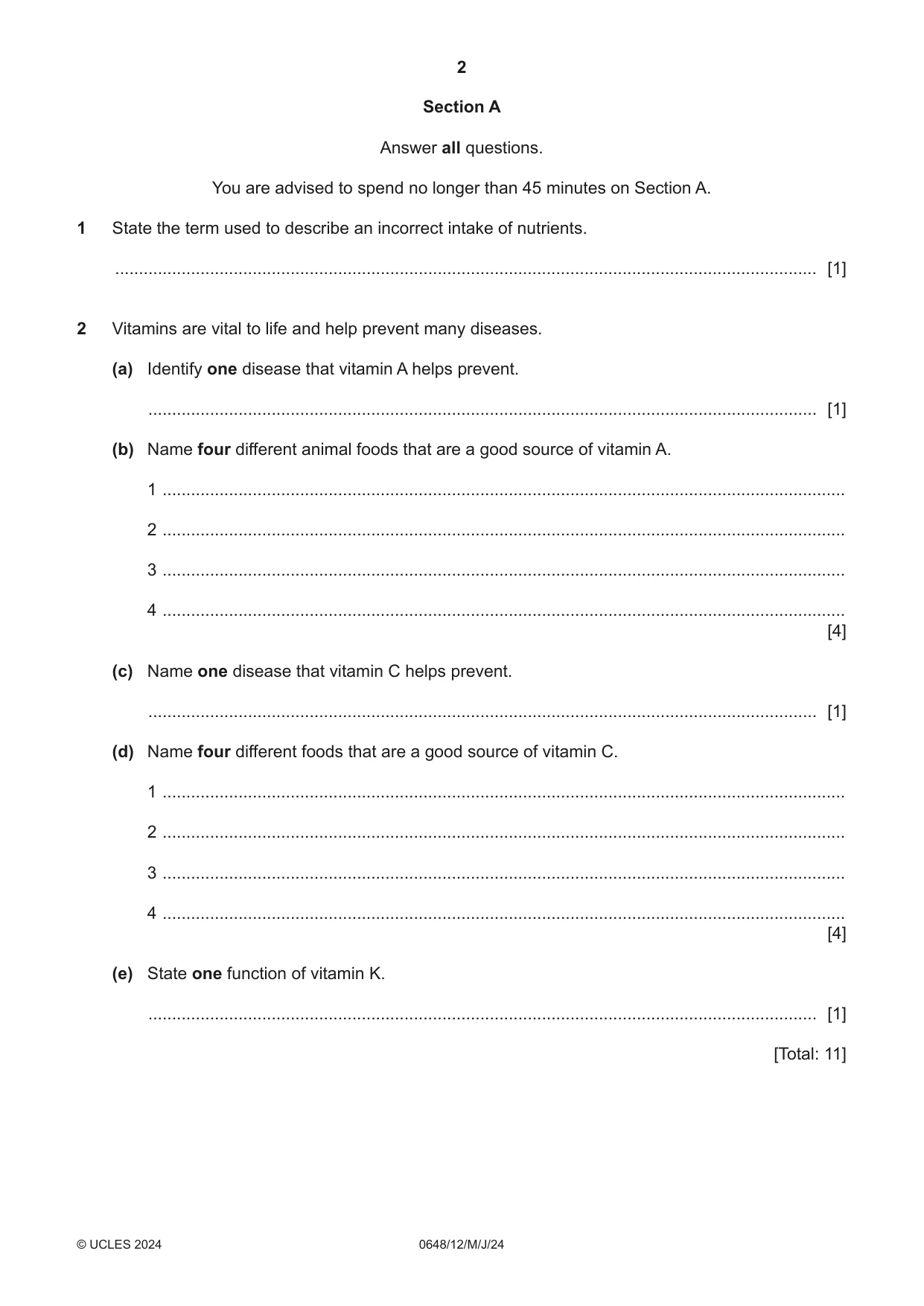
Question paper, page 2
2 0648/12/M/J/24 © UCLES 2024 Section A Answer all questions. You are advised to spend no longer than 45 minutes on Section A. 1 State the term used to describe an incorrect intake of nutrients. … [1] 2 Vitamins are vital to life and help prevent many diseases. (a) Identify one disease that vitamin A helps prevent. … [1] (b) Name four different animal foods that are a good source of vitamin A. 1 … 2 … 3 … 4 … [4] (c) Name one disease that vitamin C helps prevent. … [1] (d) Name four different foods that are a good source of vitamin C. 1 … 2 … 3 … 4 … [4] (e) State one function of vitamin K. … [1] [Total: 11]
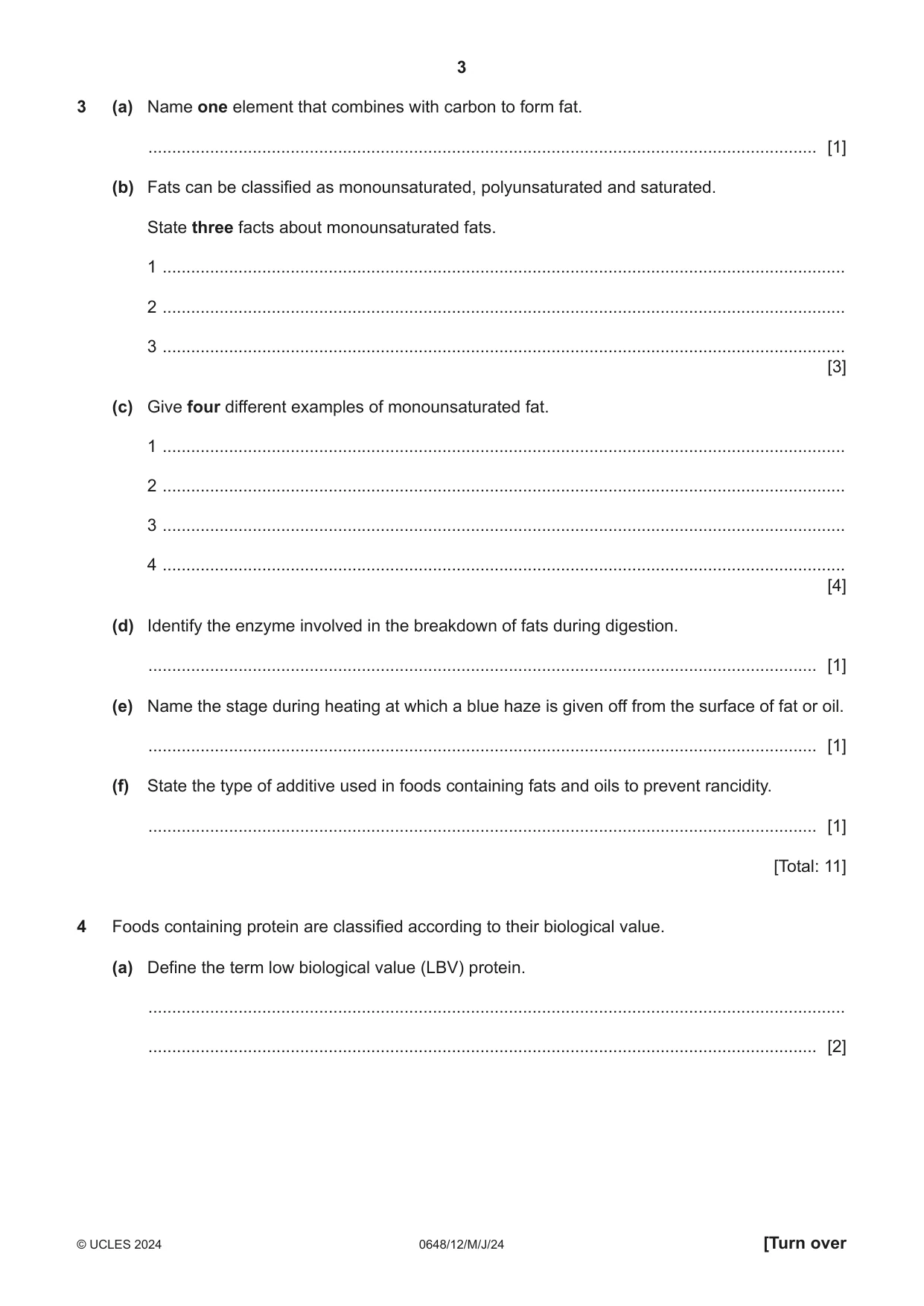
Question paper, page 3
3 0648/12/M/J/24 © UCLES 2024 [Turn over 3 (a) Name one element that combines with carbon to form fat. … [1] (b) Fats can be classified as monounsaturated, polyunsaturated and saturated. State three facts about monounsaturated fats. 1 … 2 … 3 … [3] (c) Give four different examples of monounsaturated fat. 1 … 2 … 3 … 4 … [4] (d) Identify the enzyme involved in the breakdown of fats during digestion. … [1] (e) Name the stage during heating at which a blue haze is given off from the surface of fat or oil. … [1] (f) State the type of additive used in foods containing fats and oils to prevent rancidity. … [1] [Total: 11] 4 Foods containing protein are classified according to their biological value. (a) Define the term low biological value (LBV) protein. … … [2]
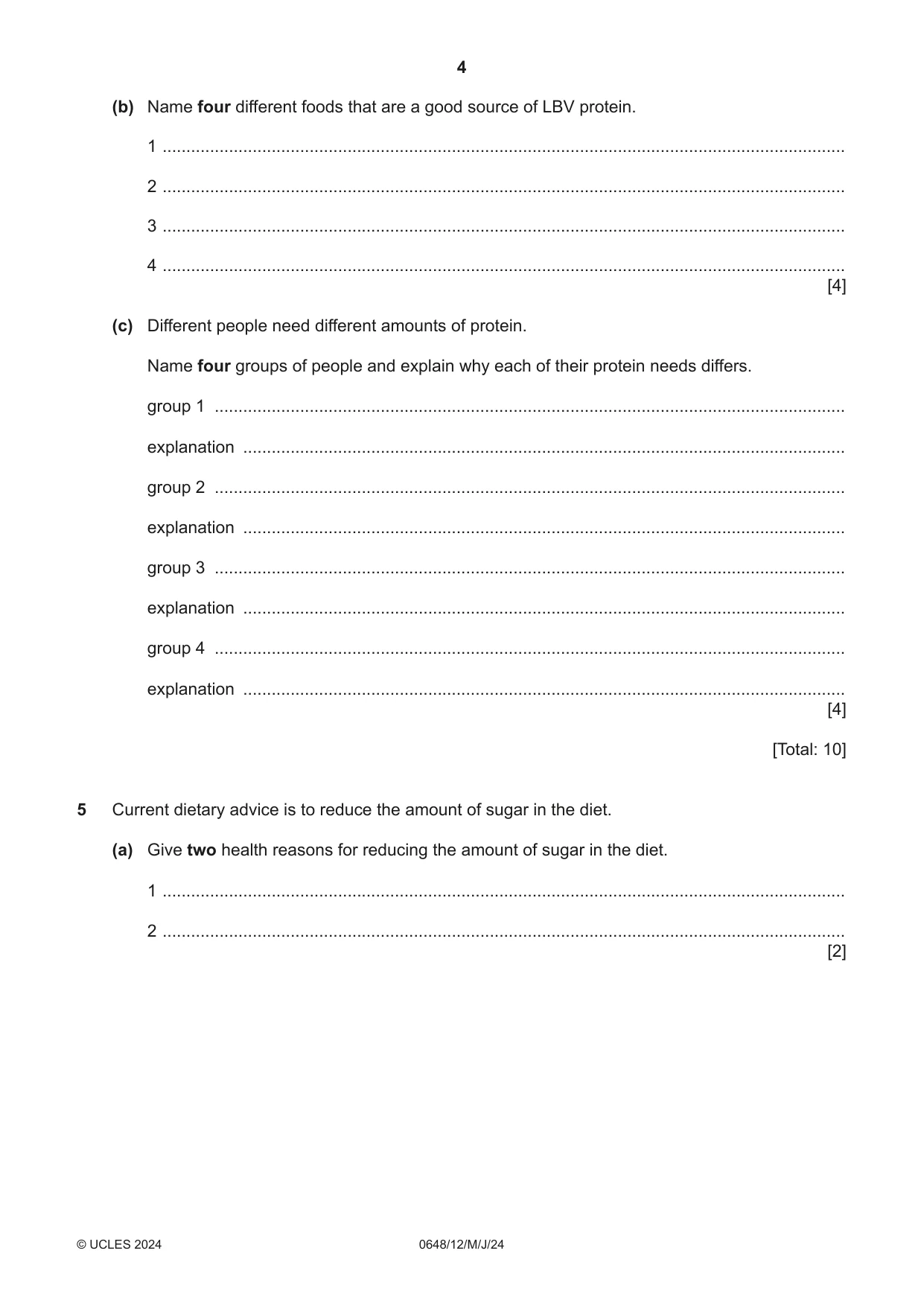
Question paper, page 4
4 0648/12/M/J/24 © UCLES 2024 (b) Name four different foods that are a good source of LBV protein. 1 … 2 … 3 … 4 … [4] (c) Different people need different amounts of protein. Name four groups of people and explain why each of their protein needs differs. group 1 … explanation … group 2 … explanation … group 3 … explanation … group 4 … explanation … [4] [Total: 10] 5 Current dietary advice is to reduce the amount of sugar in the diet. (a) Give two health reasons for reducing the amount of sugar in the diet. 1 … 2 … [2]
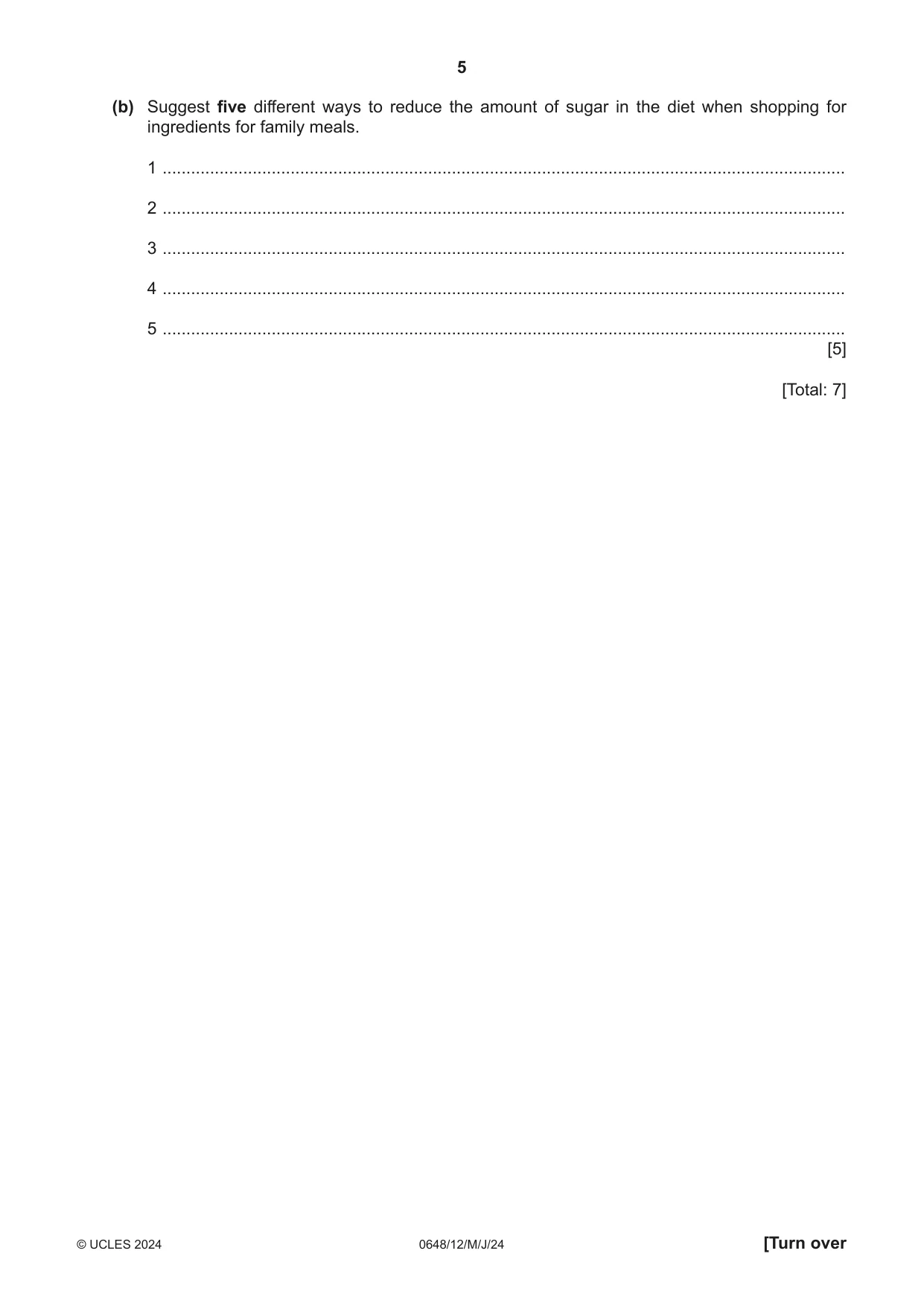
Question paper, page 5
5 0648/12/M/J/24 © UCLES 2024 [Turn over (b) Suggest five different ways to reduce the amount of sugar in the diet when shopping for ingredients for family meals. 1 … 2 … 3 … 4 … 5 … [5] [Total: 7]
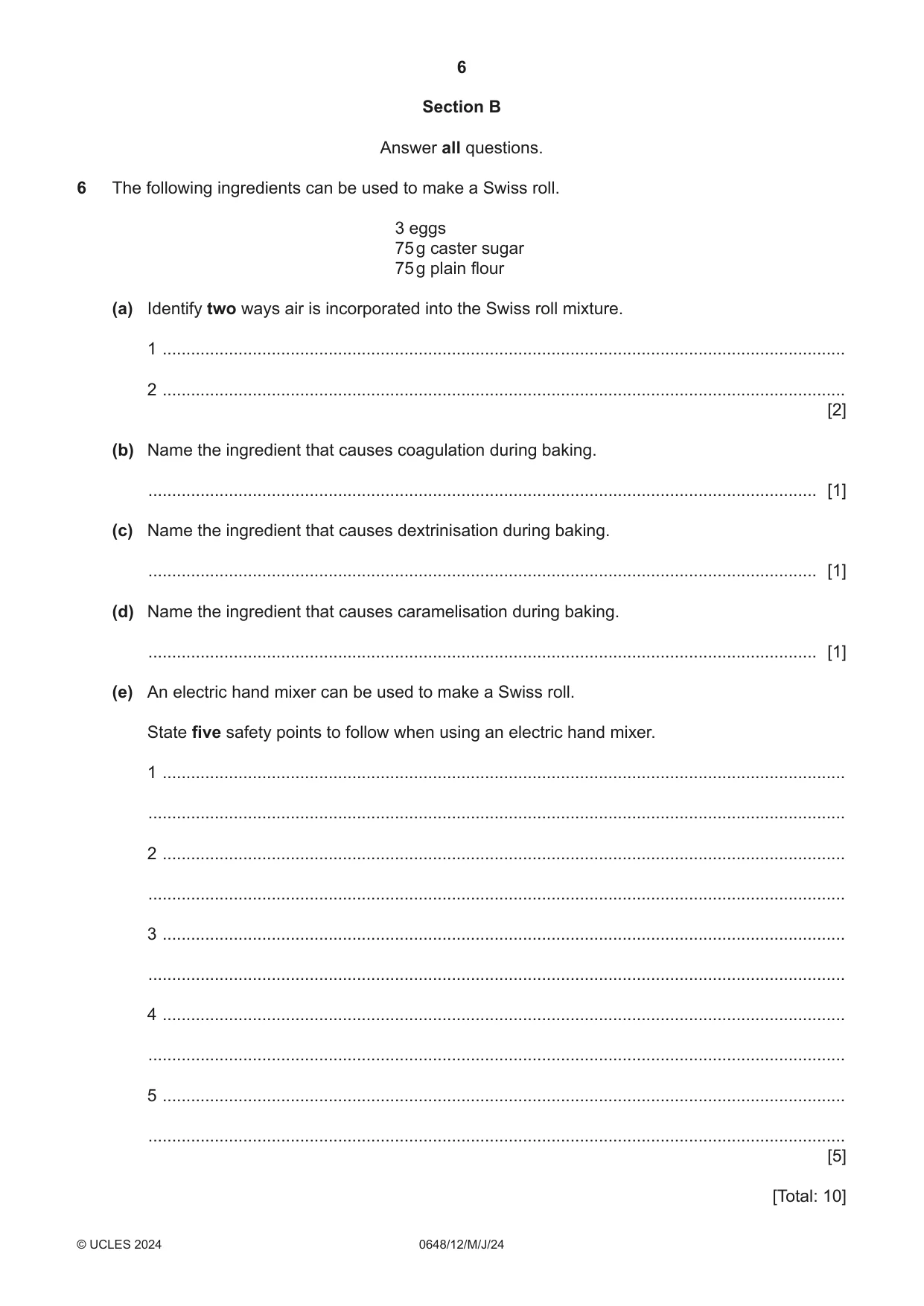
Question paper, page 6
6 0648/12/M/J/24 © UCLES 2024 Section B Answer all questions. 6 The following ingredients can be used to make a Swiss roll. 3 eggs 75 g caster sugar 75 g plain flour (a) Identify two ways air is incorporated into the Swiss roll mixture. 1 … 2 … [2] (b) Name the ingredient that causes coagulation during baking. … [1] (c) Name the ingredient that causes dextrinisation during baking. … [1] (d) Name the ingredient that causes caramelisation during baking. … [1] (e) An electric hand mixer can be used to make a Swiss roll. State five safety points to follow when using an electric hand mixer. 1 … … 2 … … 3 … … 4 … … 5 … … [5] [Total: 10]
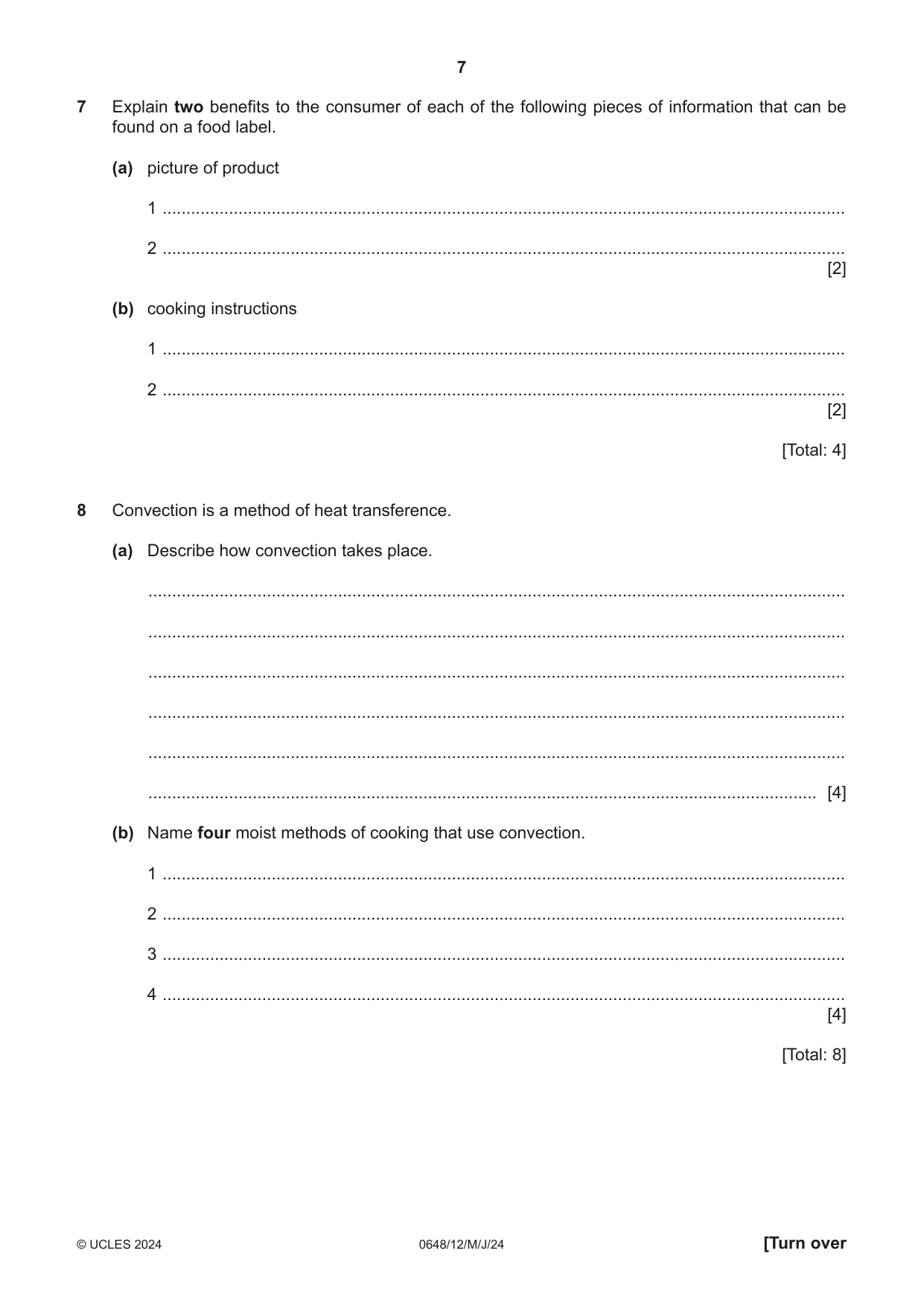
Question paper, page 7
7 0648/12/M/J/24 © UCLES 2024 [Turn over 7 Explain two benefits to the consumer of each of the following pieces of information that can be found on a food label. (a) picture of product 1 … 2 … [2] (b) cooking instructions 1 … 2 … [2] [Total: 4] 8 Convection is a method of heat transference. (a) Describe how convection takes place. … … … … … … [4] (b) Name four moist methods of cooking that use convection. 1 … 2 … 3 … 4 … [4] [Total: 8]
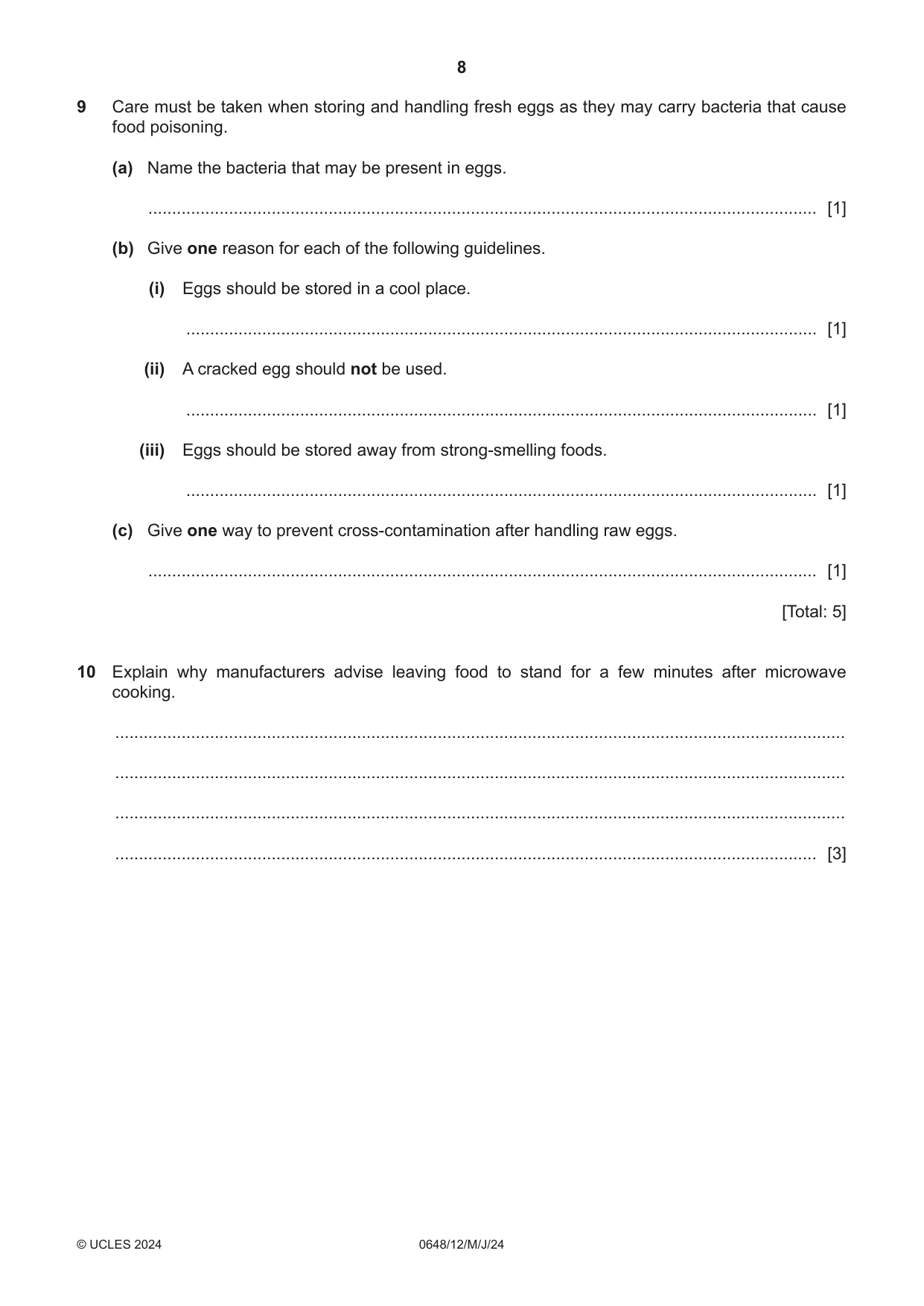
Question paper, page 8
8 0648/12/M/J/24 © UCLES 2024 9 Care must be taken when storing and handling fresh eggs as they may carry bacteria that cause food poisoning. (a) Name the bacteria that may be present in eggs. … [1] (b) Give one reason for each of the following guidelines. (i) Eggs should be stored in a cool place. … [1] (ii) A cracked egg should not be used. … [1] (iii) Eggs should be stored away from strong-smelling foods. … [1] (c) Give one way to prevent cross-contamination after handling raw eggs. … [1] [Total: 5] 10 Explain why manufacturers advise leaving food to stand for a few minutes after microwave cooking. … … … … [3]
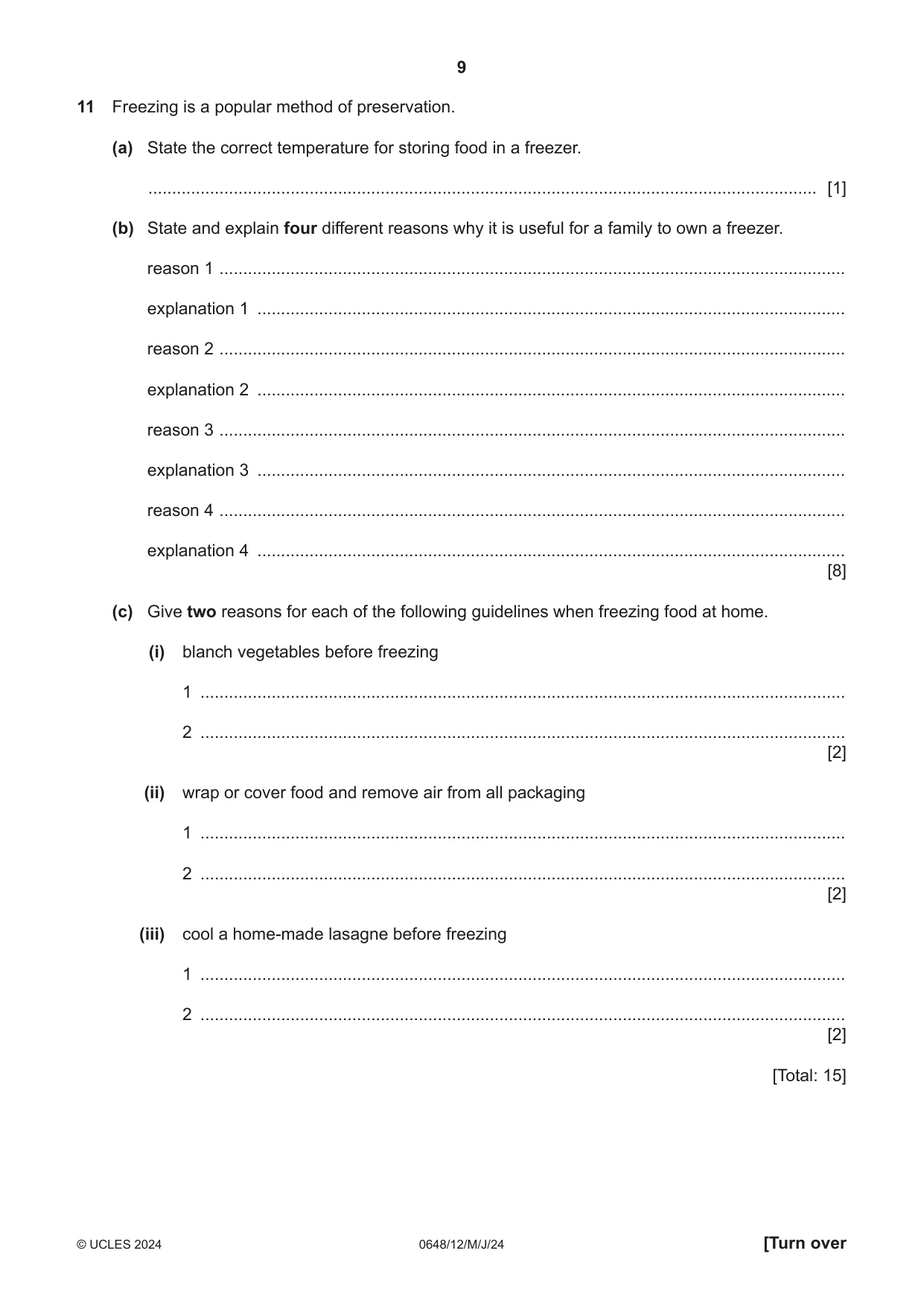
Question paper, page 9
9 0648/12/M/J/24 © UCLES 2024 [Turn over 11 Freezing is a popular method of preservation. (a) State the correct temperature for storing food in a freezer. … [1] (b) State and explain four different reasons why it is useful for a family to own a freezer. reason 1 … explanation 1 … reason 2 … explanation 2 … reason 3 … explanation 3 … reason 4 … explanation 4 … [8] (c) Give two reasons for each of the following guidelines when freezing food at home. (i) blanch vegetables before freezing 1 … 2 … [2] (ii) wrap or cover food and remove air from all packaging 1 … 2 … [2] (iii) cool a home-made lasagne before freezing 1 … 2 … [2] [Total: 15]
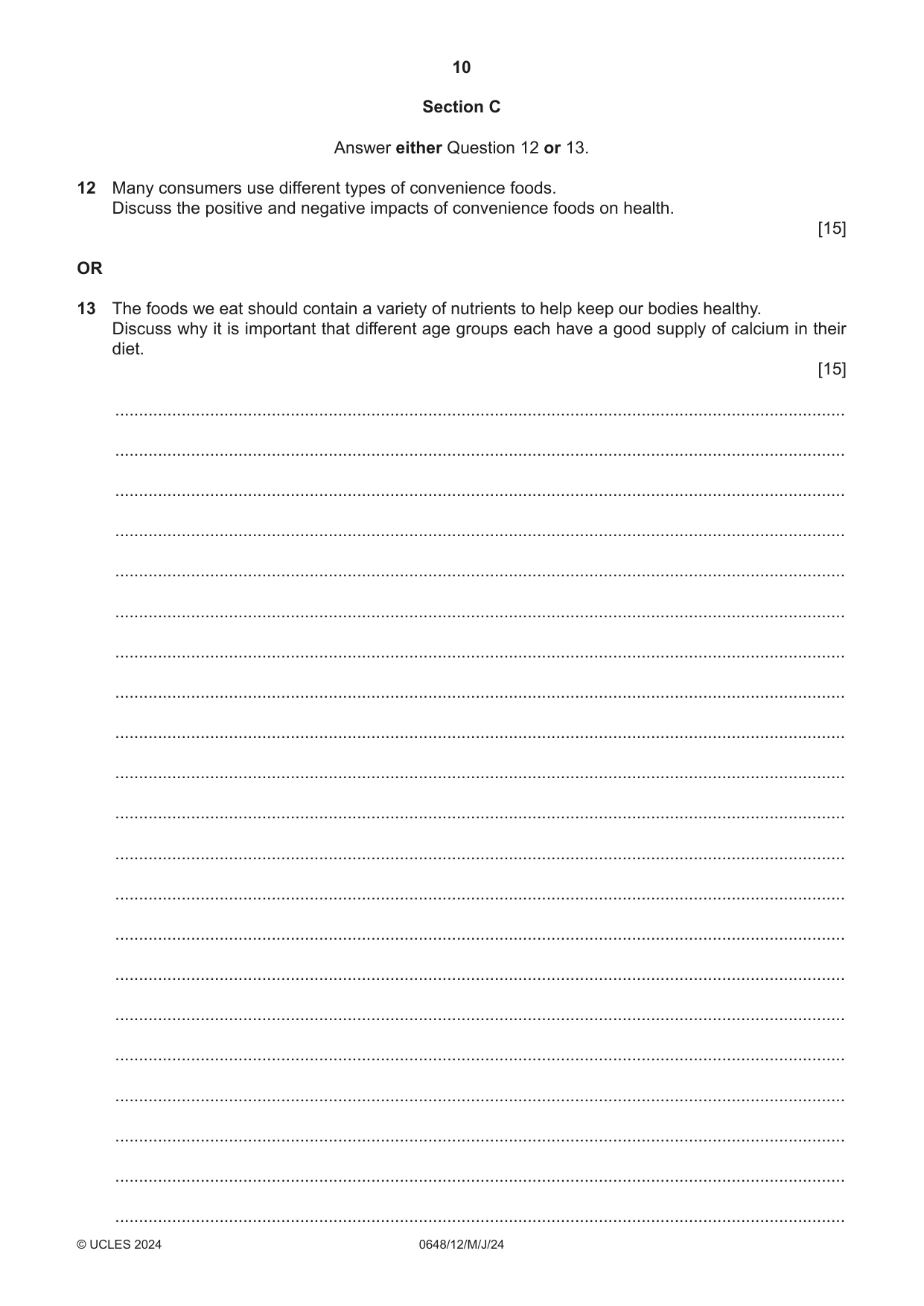
Question paper, page 10
10 0648/12/M/J/24 © UCLES 2024 Section C Answer either Question 12 or 13. 12 Many consumers use different types of convenience foods. Discuss the positive and negative impacts of convenience foods on health. [15] OR 13 The foods we eat should contain a variety of nutrients to help keep our bodies healthy. Discuss why it is important that different age groups each have a good supply of calcium in their diet. [15] … … … … … … … … … … … … … … … … … … … … …
Question paper, page 11
11 0648/12/M/J/24 © UCLES 2024 [Turn over … … … … … … … … … … … … … … … … … … … … … … … … … … … …
Question paper, page 12
12 0648/12/M/J/24 © UCLES 2024 … … … … … … … … … … … … … … … … … … … … … … … Permission to reproduce items where third-party owned material protected by copyright is included has been sought and cleared where possible. Every reasonable effort has been made by the publisher (UCLES) to trace copyright holders, but if any items requiring clearance have unwittingly been included, the publisher will be pleased to make amends at the earliest possible opportunity. To avoid the issue of disclosure of answer-related information to candidates, all copyright acknowledgements are reproduced online in the Cambridge Assessment International Education Copyright Acknowledgements Booklet. This is produced for each series of examinations and is freely available to download at www.cambridgeinternational.org after the live examination series. Cambridge Assessment International Education is part of Cambridge Assessment. Cambridge Assessment is the brand name of the University of Cambridge Local Examinations Syndicate (UCLES), which is a department of the University of Cambridge.
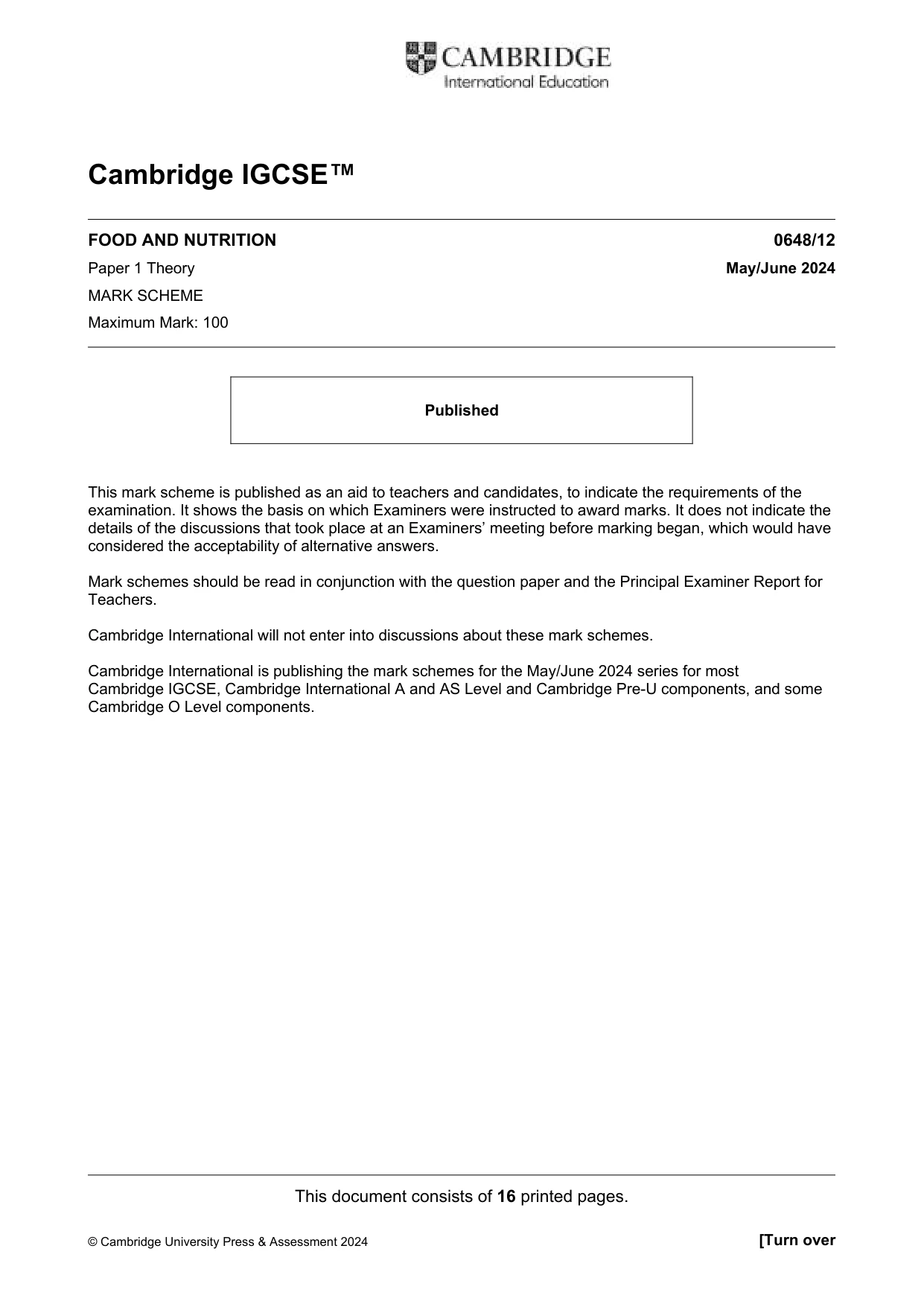
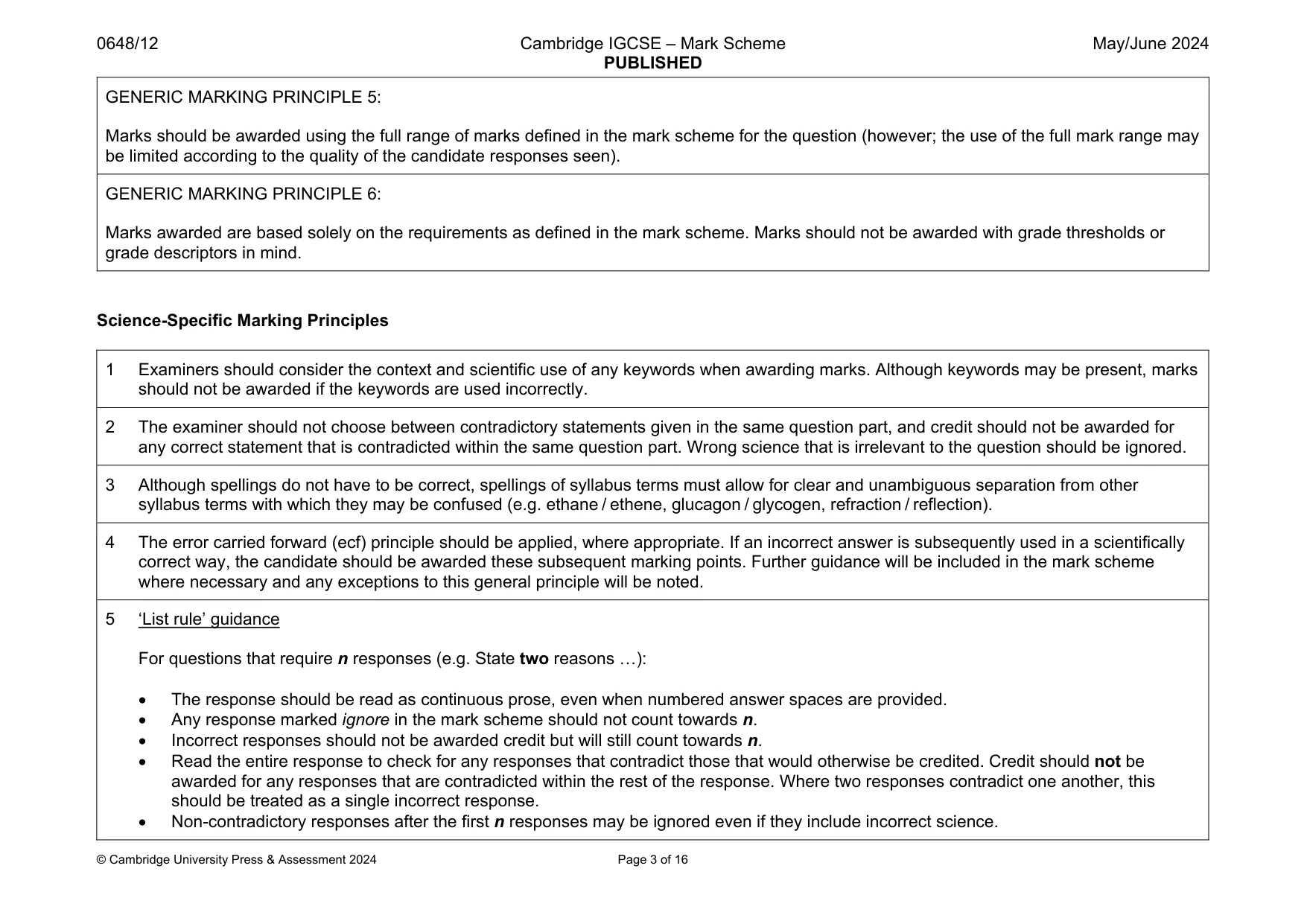
Mark scheme, page 1
This document consists of 16 printed pages. © Cambridge University Press & Assessment 2024 [Turn over Cambridge IGCSE™ FOOD AND NUTRITION 0648/12 Paper 1 Theory May/June 2024 MARK SCHEME Maximum Mark: 100 Published This mark scheme is published as an aid to teachers and candidates, to indicate the requirements of the examination. It shows the basis on which Examiners were instructed to award marks. It does not indicate the details of the discussions that took place at an Examiners’ meeting before marking began, which would have considered the acceptability of alternative answers. Mark schemes should be read in conjunction with the question paper and the Principal Examiner Report for Teachers. Cambridge International will not enter into discussions about these mark schemes. Cambridge International is publishing the mark schemes for the May/June 2024 series for most Cambridge IGCSE, Cambridge International A and AS Level and Cambridge Pre-U components, and some Cambridge O Level components.
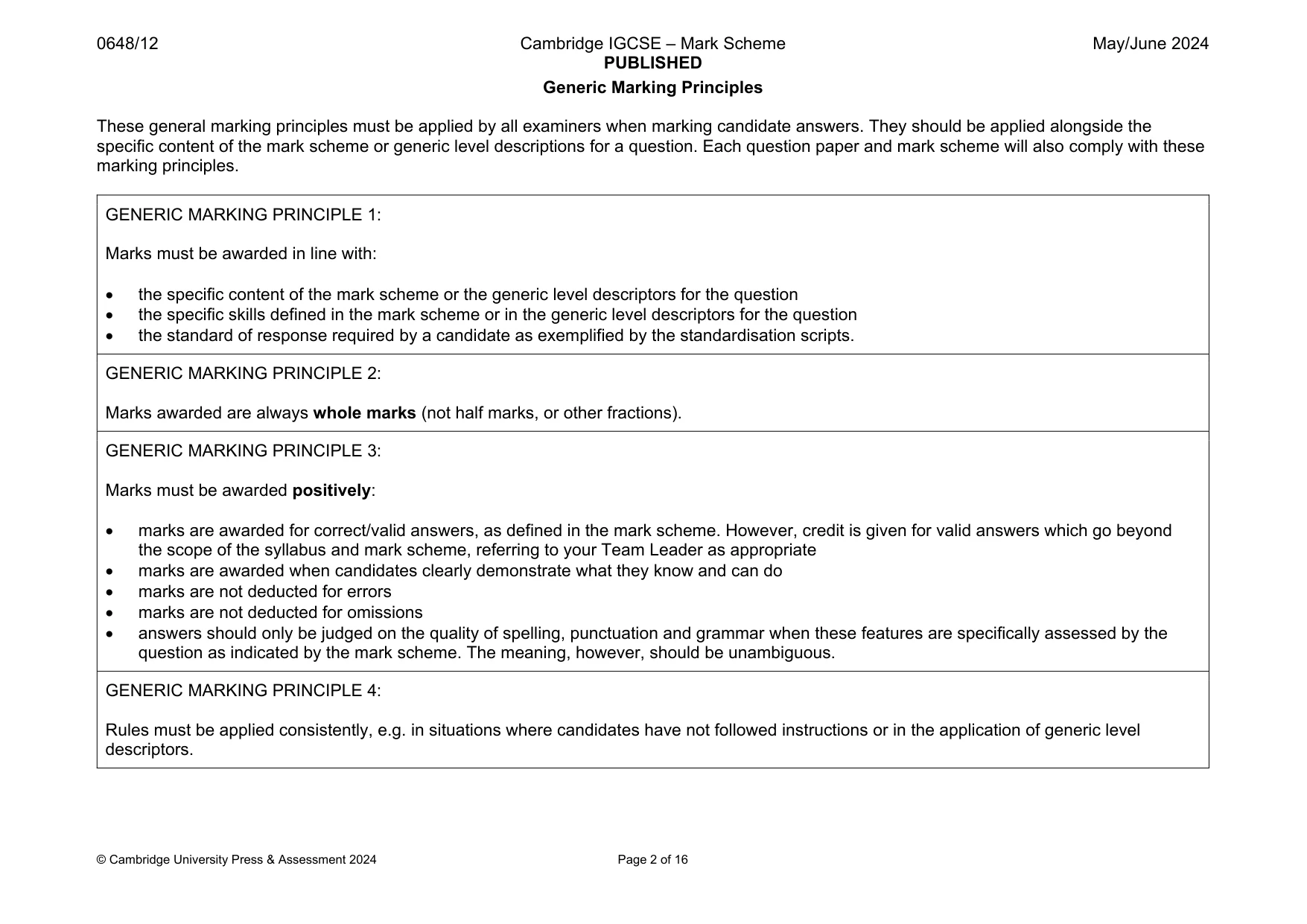
Mark scheme, page 2
0648/12 Cambridge IGCSE – Mark Scheme PUBLISHED May/June 2024 © Cambridge University Press & Assessment 2024 Page 2 of 16 Generic Marking Principles These general marking principles must be applied by all examiners when marking candidate answers. They should be applied alongside the specific content of the mark scheme or generic level descriptions for a question. Each question paper and mark scheme will also comply with these marking principles. GENERIC MARKING PRINCIPLE 1: Marks must be awarded in line with: the specific content of the mark scheme or the generic level descriptors for the question the specific skills defined in the mark scheme or in the generic level descriptors for the question the standard of response required by a candidate as exemplified by the standardisation scripts. GENERIC MARKING PRINCIPLE 2: Marks awarded are always whole marks (not half marks, or other fractions). GENERIC MARKING PRINCIPLE 3: Marks must be awarded positively: marks are awarded for correct/valid answers, as defined in the mark scheme. However, credit is given for valid answers which go beyond the scope of the syllabus and mark scheme, referring to your Team Leader as appropriate marks are awarded when candidates clearly demonstrate what they know and can do marks are not deducted for errors marks are not deducted for omissions answers should only be judged on the quality of spelling, punctuation and grammar when these features are specifically assessed by the question as indicated by the mark scheme. The meaning, however, should be unambiguous. GENERIC MARKING PRINCIPLE 4: Rules must be applied consistently, e.g. in situations where candidates have not followed instructions or in the application of generic level descriptors.
Mark scheme, page 3
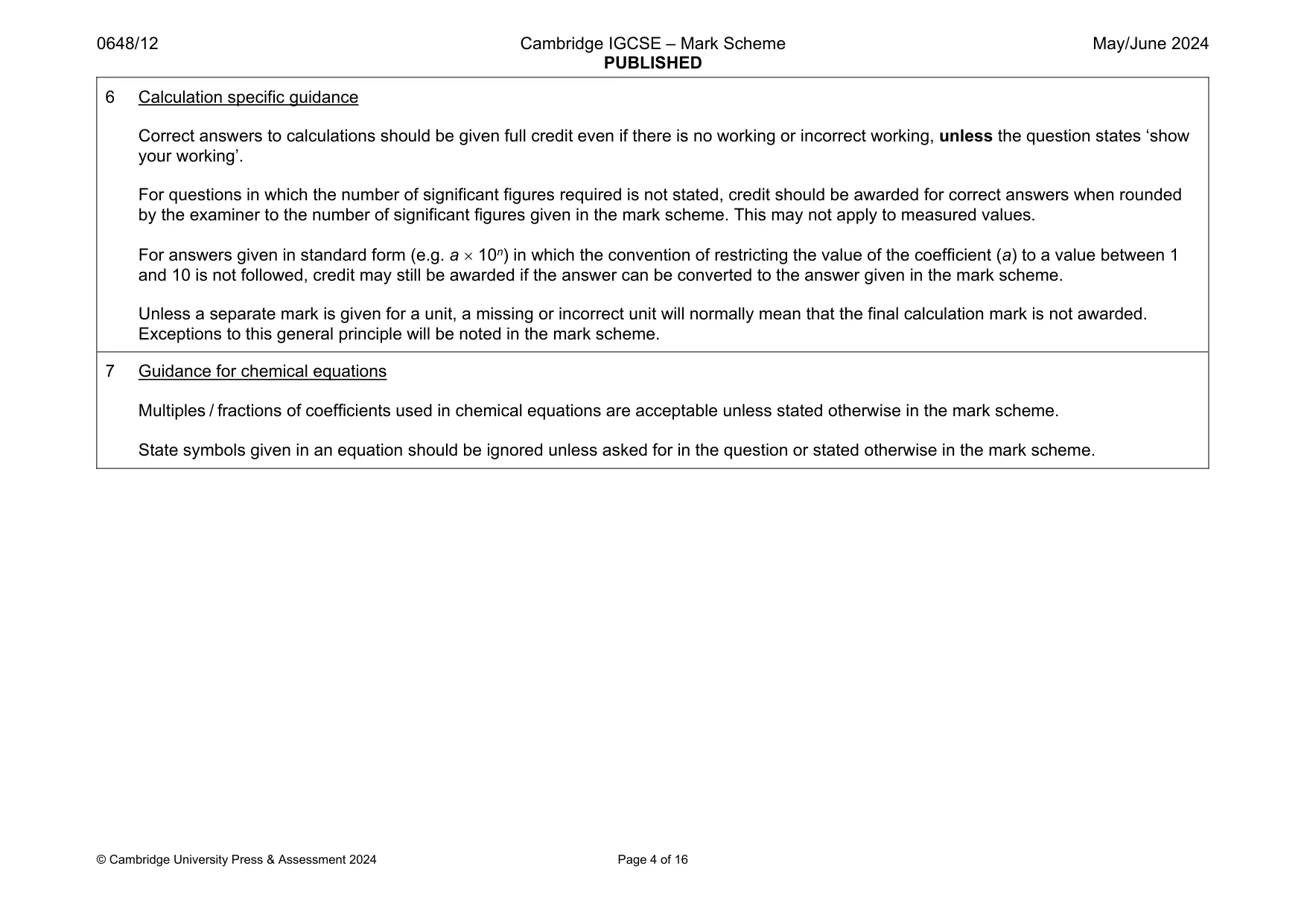
0648/12 Cambridge IGCSE – Mark Scheme PUBLISHED May/June 2024 © Cambridge University Press & Assessment 2024 Page 3 of 16 GENERIC MARKING PRINCIPLE 5: Marks should be awarded using the full range of marks defined in the mark scheme for the question (however; the use of the full mark range may be limited according to the quality of the candidate responses seen). GENERIC MARKING PRINCIPLE 6: Marks awarded are based solely on the requirements as defined in the mark scheme. Marks should not be awarded with grade thresholds or grade descriptors in mind. Science-Specific Marking Principles 1 Examiners should consider the context and scientific use of any keywords when awarding marks. Although keywords may be present, marks should not be awarded if the keywords are used incorrectly. 2 The examiner should not choose between contradictory statements given in the same question part, and credit should not be awarded for any correct statement that is contradicted within the same question part. Wrong science that is irrelevant to the question should be ignored. 3 Although spellings do not have to be correct, spellings of syllabus terms must allow for clear and unambiguous separation from other syllabus terms with which they may be confused (e.g. ethane / ethene, glucagon / glycogen, refraction / reflection). 4 The error carried forward (ecf) principle should be applied, where appropriate. If an incorrect answer is subsequently used in a scientifically correct way, the candidate should be awarded these subsequent marking points. Further guidance will be included in the mark scheme where necessary and any exceptions to this general principle will be noted. 5 ‘List rule’ guidance For questions that require n responses (e.g. State two reasons …): The response should be read as continuous prose, even when numbered answer spaces are provided. Any response marked ignore in the mark scheme should not count towards n. Incorrect responses should not be awarded credit but will still count towards n. Read the entire response to check for any responses that contradict those that would otherwise be credited. Credit should not be awarded for any responses that are contradicted within the rest of the response. Where two responses contradict one another, this should be treated as a single incorrect response. Non-contradictory responses after the first n responses may be ignored even if they include incorrect science.
Mark scheme, page 4
0648/12 Cambridge IGCSE – Mark Scheme PUBLISHED May/June 2024 © Cambridge University Press & Assessment 2024 Page 4 of 16 6 Calculation specific guidance Correct answers to calculations should be given full credit even if there is no working or incorrect working, unless the question states ‘show your working’. For questions in which the number of significant figures required is not stated, credit should be awarded for correct answers when rounded by the examiner to the number of significant figures given in the mark scheme. This may not apply to measured values. For answers given in standard form (e.g. a 10n) in which the convention of restricting the value of the coefficient (a) to a value between 1 and 10 is not followed, credit may still be awarded if the answer can be converted to the answer given in the mark scheme. Unless a separate mark is given for a unit, a missing or incorrect unit will normally mean that the final calculation mark is not awarded. Exceptions to this general principle will be noted in the mark scheme. 7 Guidance for chemical equations Multiples / fractions of coefficients used in chemical equations are acceptable unless stated otherwise in the mark scheme. State symbols given in an equation should be ignored unless asked for in the question or stated otherwise in the mark scheme.
Mark scheme, page 5
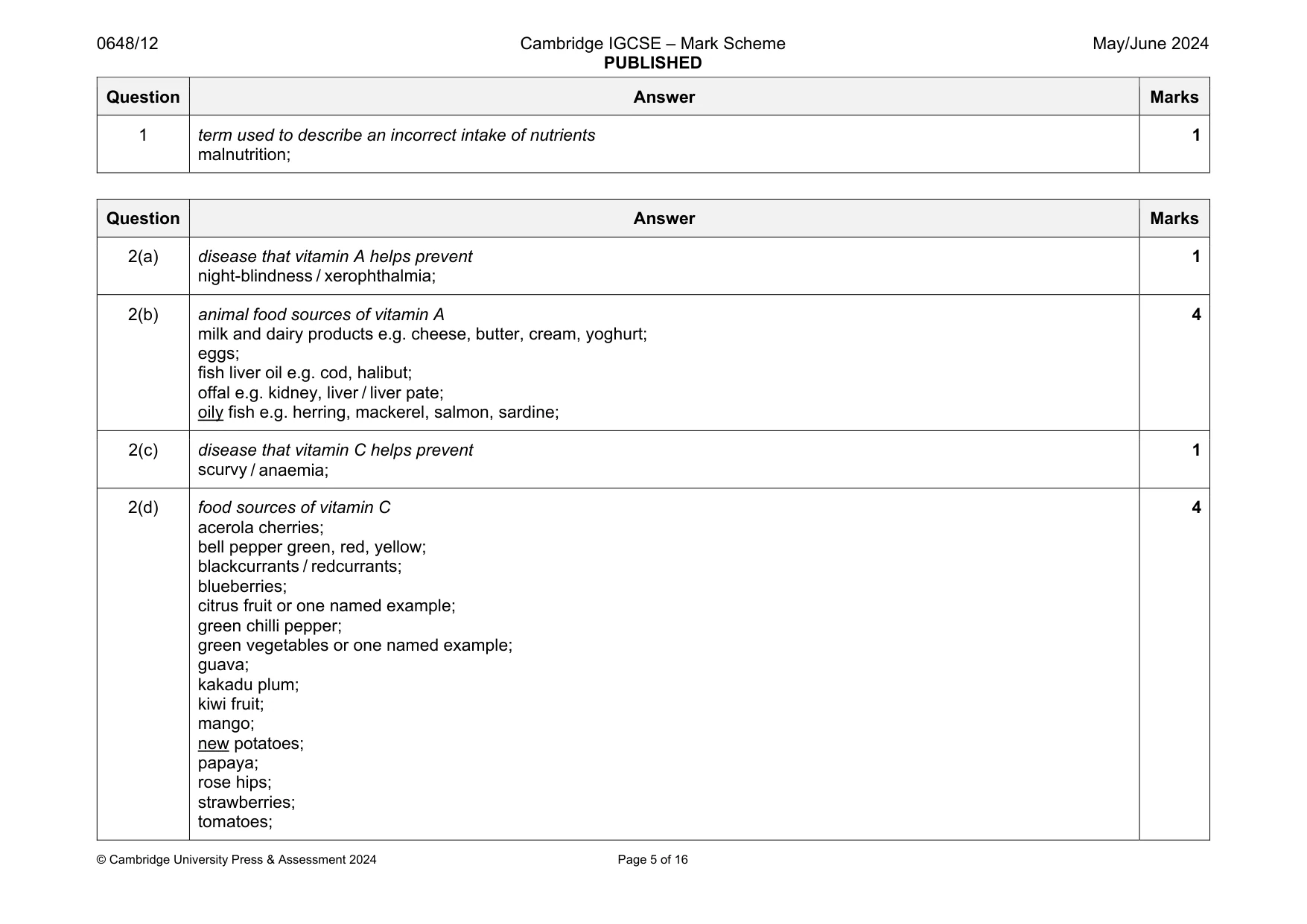
0648/12 Cambridge IGCSE – Mark Scheme PUBLISHED May/June 2024 © Cambridge University Press & Assessment 2024 Page 5 of 16 Question Answer Marks 1 term used to describe an incorrect intake of nutrients malnutrition; 1 Question Answer Marks 2(a) disease that vitamin A helps prevent night-blindness / xerophthalmia; 1 2(b) animal food sources of vitamin A milk and dairy products e.g. cheese, butter, cream, yoghurt; eggs; fish liver oil e.g. cod, halibut; offal e.g. kidney, liver / liver pate; oily fish e.g. herring, mackerel, salmon, sardine; 4 2(c) disease that vitamin C helps prevent scurvy / anaemia; 1 2(d) food sources of vitamin C acerola cherries; bell pepper green, red, yellow; blackcurrants / redcurrants; blueberries; citrus fruit or one named example; green chilli pepper; green vegetables or one named example; guava; kakadu plum; kiwi fruit; mango; new potatoes; papaya; rose hips; strawberries; tomatoes; 4
Mark scheme, page 6
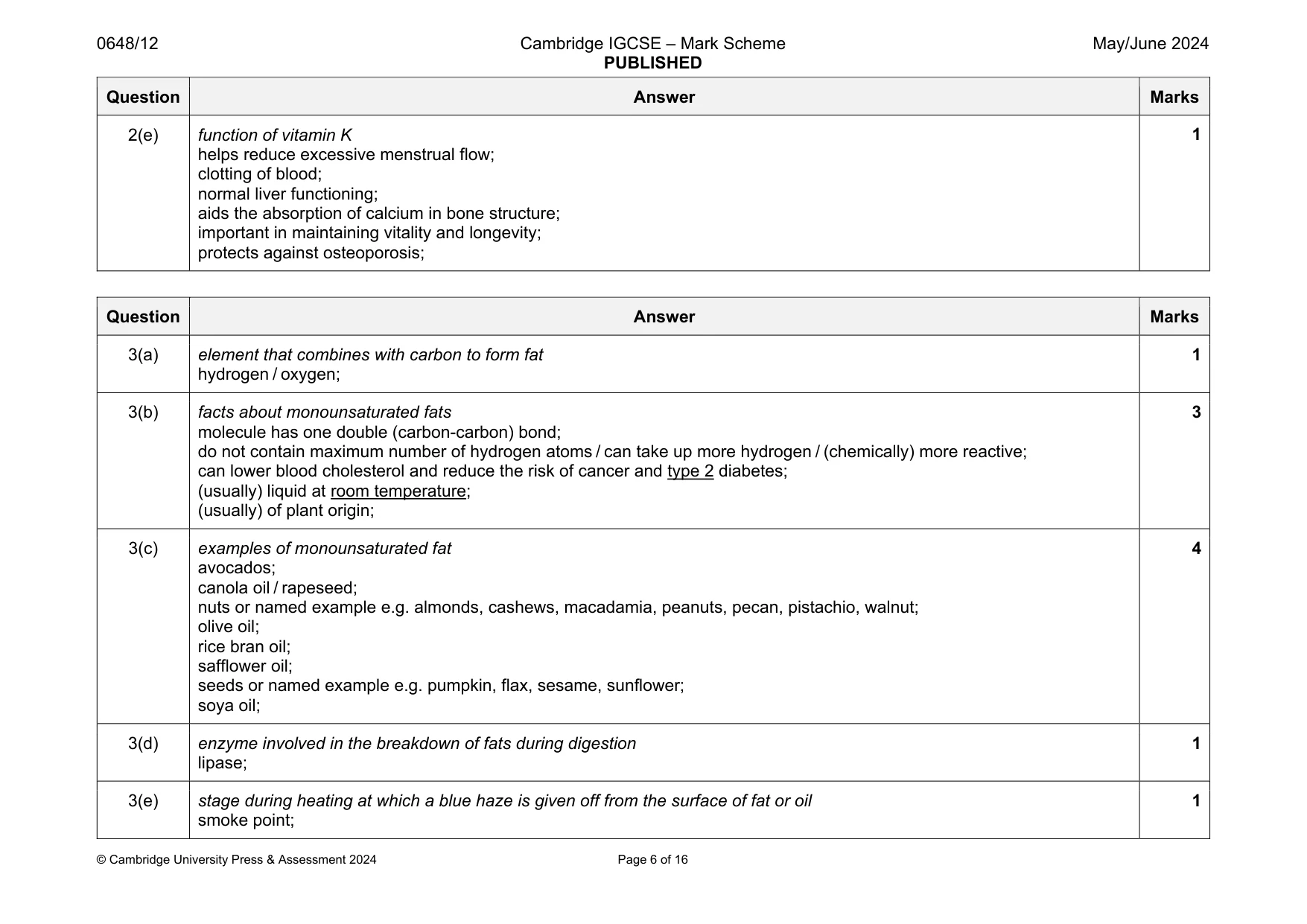
0648/12 Cambridge IGCSE – Mark Scheme PUBLISHED May/June 2024 © Cambridge University Press & Assessment 2024 Page 6 of 16 Question Answer Marks 2(e) function of vitamin K helps reduce excessive menstrual flow; clotting of blood; normal liver functioning; aids the absorption of calcium in bone structure; important in maintaining vitality and longevity; protects against osteoporosis; 1 Question Answer Marks 3(a) element that combines with carbon to form fat hydrogen / oxygen; 1 3(b) facts about monounsaturated fats molecule has one double (carbon-carbon) bond; do not contain maximum number of hydrogen atoms / can take up more hydrogen / (chemically) more reactive; can lower blood cholesterol and reduce the risk of cancer and type 2 diabetes; (usually) liquid at room temperature; (usually) of plant origin; 3 3(c) examples of monounsaturated fat avocados; canola oil / rapeseed; nuts or named example e.g. almonds, cashews, macadamia, peanuts, pecan, pistachio, walnut; olive oil; rice bran oil; safflower oil; seeds or named example e.g. pumpkin, flax, sesame, sunflower; soya oil; 4 3(d) enzyme involved in the breakdown of fats during digestion lipase; 1 3(e) stage during heating at which a blue haze is given off from the surface of fat or oil smoke point; 1
Mark scheme, page 7
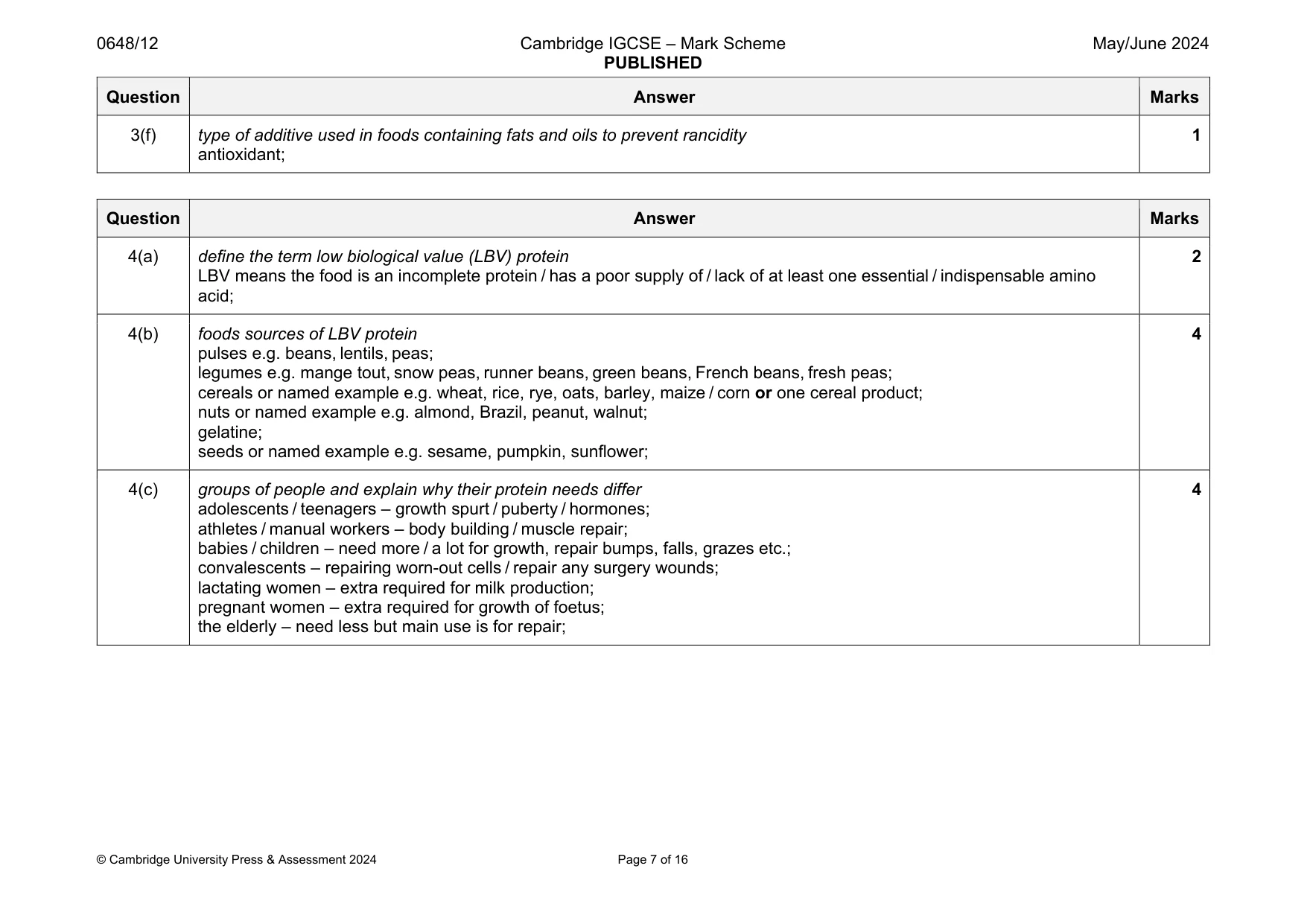
0648/12 Cambridge IGCSE – Mark Scheme PUBLISHED May/June 2024 © Cambridge University Press & Assessment 2024 Page 7 of 16 Question Answer Marks 3(f) type of additive used in foods containing fats and oils to prevent rancidity antioxidant; 1 Question Answer Marks 4(a) define the term low biological value (LBV) protein LBV means the food is an incomplete protein / has a poor supply of / lack of at least one essential / indispensable amino acid; 2 4(b) foods sources of LBV protein pulses e.g. beans, lentils, peas; legumes e.g. mange tout, snow peas, runner beans, green beans, French beans, fresh peas; cereals or named example e.g. wheat, rice, rye, oats, barley, maize / corn or one cereal product; nuts or named example e.g. almond, Brazil, peanut, walnut; gelatine; seeds or named example e.g. sesame, pumpkin, sunflower; 4 4(c) groups of people and explain why their protein needs differ adolescents / teenagers – growth spurt / puberty / hormones; athletes / manual workers – body building / muscle repair; babies / children – need more / a lot for growth, repair bumps, falls, grazes etc.; convalescents – repairing worn-out cells / repair any surgery wounds; lactating women – extra required for milk production; pregnant women – extra required for growth of foetus; the elderly – need less but main use is for repair; 4
Mark scheme, page 8
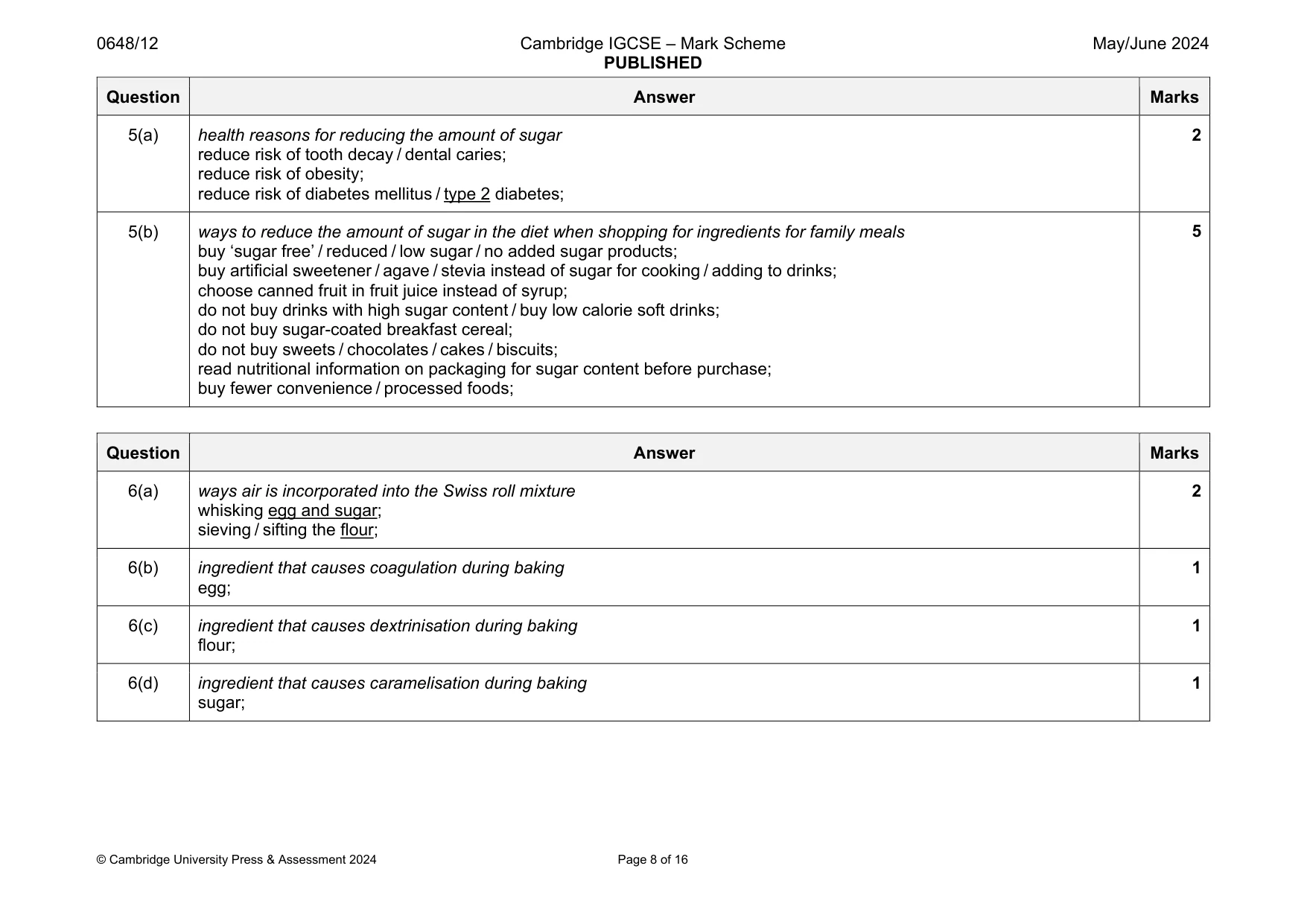
0648/12 Cambridge IGCSE – Mark Scheme PUBLISHED May/June 2024 © Cambridge University Press & Assessment 2024 Page 8 of 16 Question Answer Marks 5(a) health reasons for reducing the amount of sugar reduce risk of tooth decay / dental caries; reduce risk of obesity; reduce risk of diabetes mellitus / type 2 diabetes; 2 5(b) ways to reduce the amount of sugar in the diet when shopping for ingredients for family meals buy ‘sugar free’ / reduced / low sugar / no added sugar products; buy artificial sweetener / agave / stevia instead of sugar for cooking / adding to drinks; choose canned fruit in fruit juice instead of syrup; do not buy drinks with high sugar content / buy low calorie soft drinks; do not buy sugar-coated breakfast cereal; do not buy sweets / chocolates / cakes / biscuits; read nutritional information on packaging for sugar content before purchase; buy fewer convenience / processed foods; 5 Question Answer Marks 6(a) ways air is incorporated into the Swiss roll mixture whisking egg and sugar; sieving / sifting the flour; 2 6(b) ingredient that causes coagulation during baking egg; 1 6(c) ingredient that causes dextrinisation during baking flour; 1 6(d) ingredient that causes caramelisation during baking sugar; 1
Mark scheme, page 9
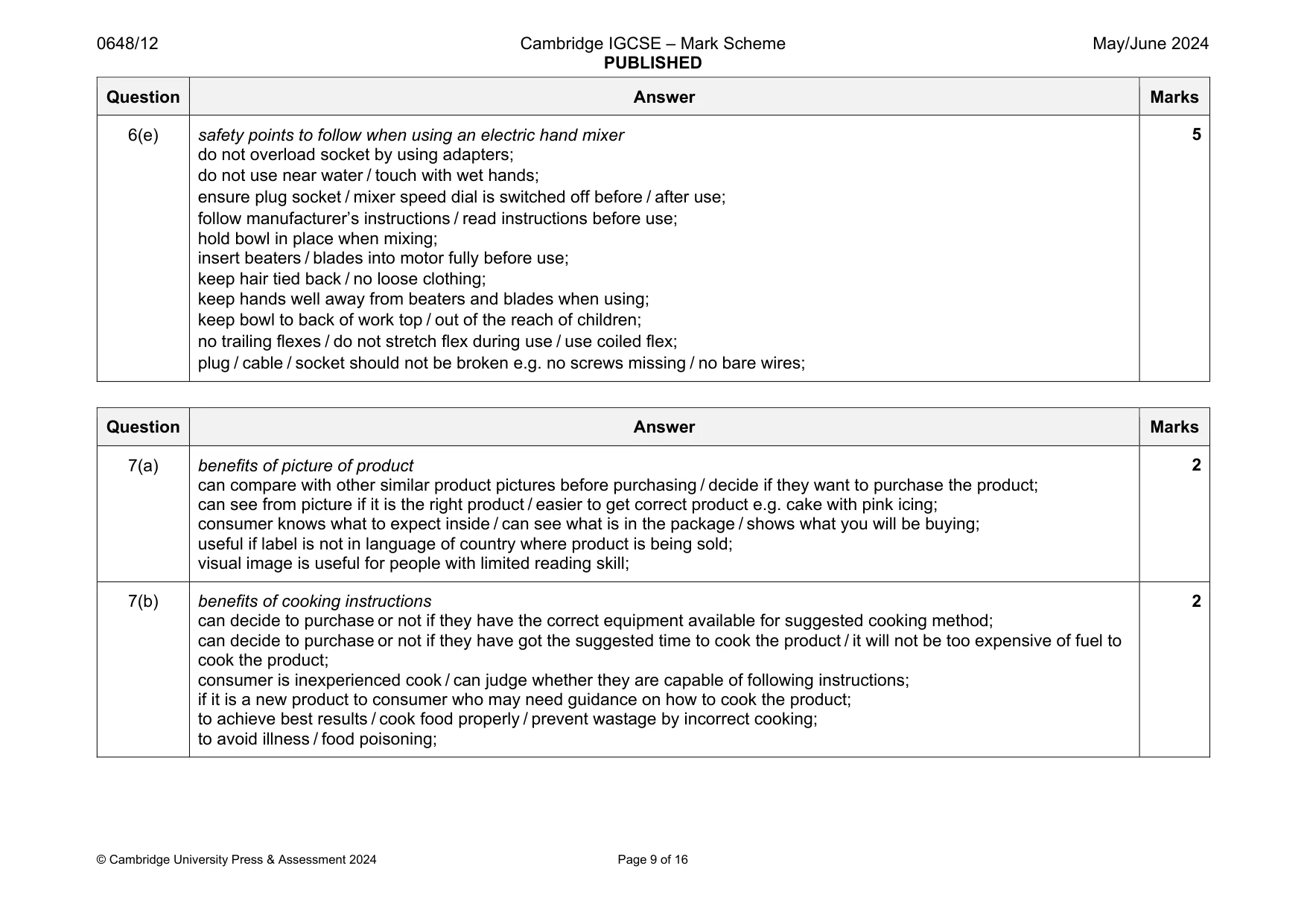
0648/12 Cambridge IGCSE – Mark Scheme PUBLISHED May/June 2024 © Cambridge University Press & Assessment 2024 Page 9 of 16 Question Answer Marks 6(e) safety points to follow when using an electric hand mixer do not overload socket by using adapters; do not use near water / touch with wet hands; ensure plug socket / mixer speed dial is switched off before / after use; follow manufacturer’s instructions / read instructions before use; hold bowl in place when mixing; insert beaters / blades into motor fully before use; keep hair tied back / no loose clothing; keep hands well away from beaters and blades when using; keep bowl to back of work top / out of the reach of children; no trailing flexes / do not stretch flex during use / use coiled flex; plug / cable / socket should not be broken e.g. no screws missing / no bare wires; 5 Question Answer Marks 7(a) benefits of picture of product can compare with other similar product pictures before purchasing / decide if they want to purchase the product; can see from picture if it is the right product / easier to get correct product e.g. cake with pink icing; consumer knows what to expect inside / can see what is in the package / shows what you will be buying; useful if label is not in language of country where product is being sold; visual image is useful for people with limited reading skill; 2 7(b) benefits of cooking instructions can decide to purchase or not if they have the correct equipment available for suggested cooking method; can decide to purchase or not if they have got the suggested time to cook the product / it will not be too expensive of fuel to cook the product; consumer is inexperienced cook / can judge whether they are capable of following instructions; if it is a new product to consumer who may need guidance on how to cook the product; to achieve best results / cook food properly / prevent wastage by incorrect cooking; to avoid illness / food poisoning; 2
Mark scheme, page 10
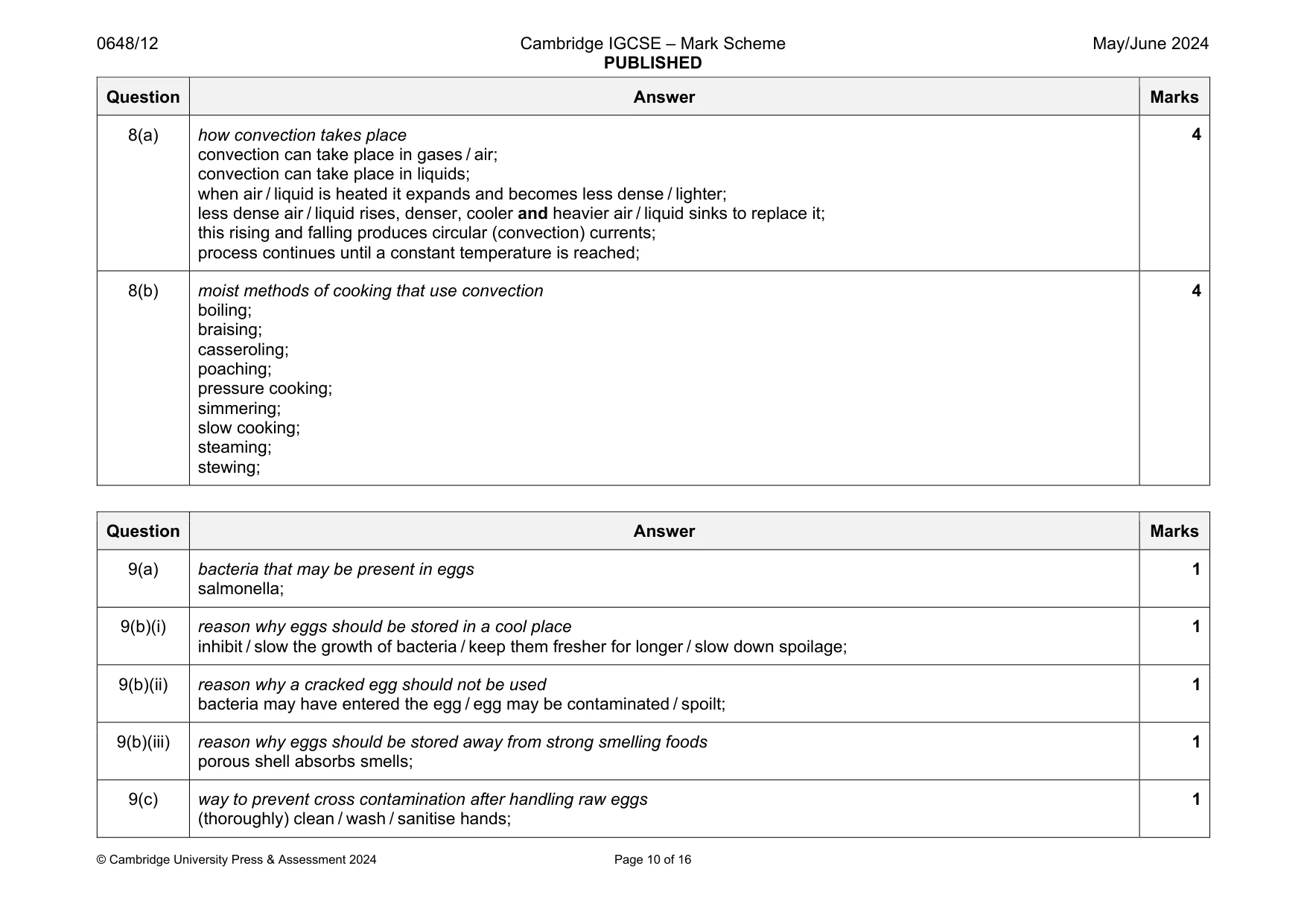
0648/12 Cambridge IGCSE – Mark Scheme PUBLISHED May/June 2024 © Cambridge University Press & Assessment 2024 Page 10 of 16 Question Answer Marks 8(a) how convection takes place convection can take place in gases / air; convection can take place in liquids; when air / liquid is heated it expands and becomes less dense / lighter; less dense air / liquid rises, denser, cooler and heavier air / liquid sinks to replace it; this rising and falling produces circular (convection) currents; process continues until a constant temperature is reached; 4 8(b) moist methods of cooking that use convection boiling; braising; casseroling; poaching; pressure cooking; simmering; slow cooking; steaming; stewing; 4 Question Answer Marks 9(a) bacteria that may be present in eggs salmonella; 1 9(b)(i) reason why eggs should be stored in a cool place inhibit / slow the growth of bacteria / keep them fresher for longer / slow down spoilage; 1 9(b)(ii) reason why a cracked egg should not be used bacteria may have entered the egg / egg may be contaminated / spoilt; 1 9(b)(iii) reason why eggs should be stored away from strong smelling foods porous shell absorbs smells; 1 9(c) way to prevent cross contamination after handling raw eggs (thoroughly) clean / wash / sanitise hands; 1
Mark scheme, page 11
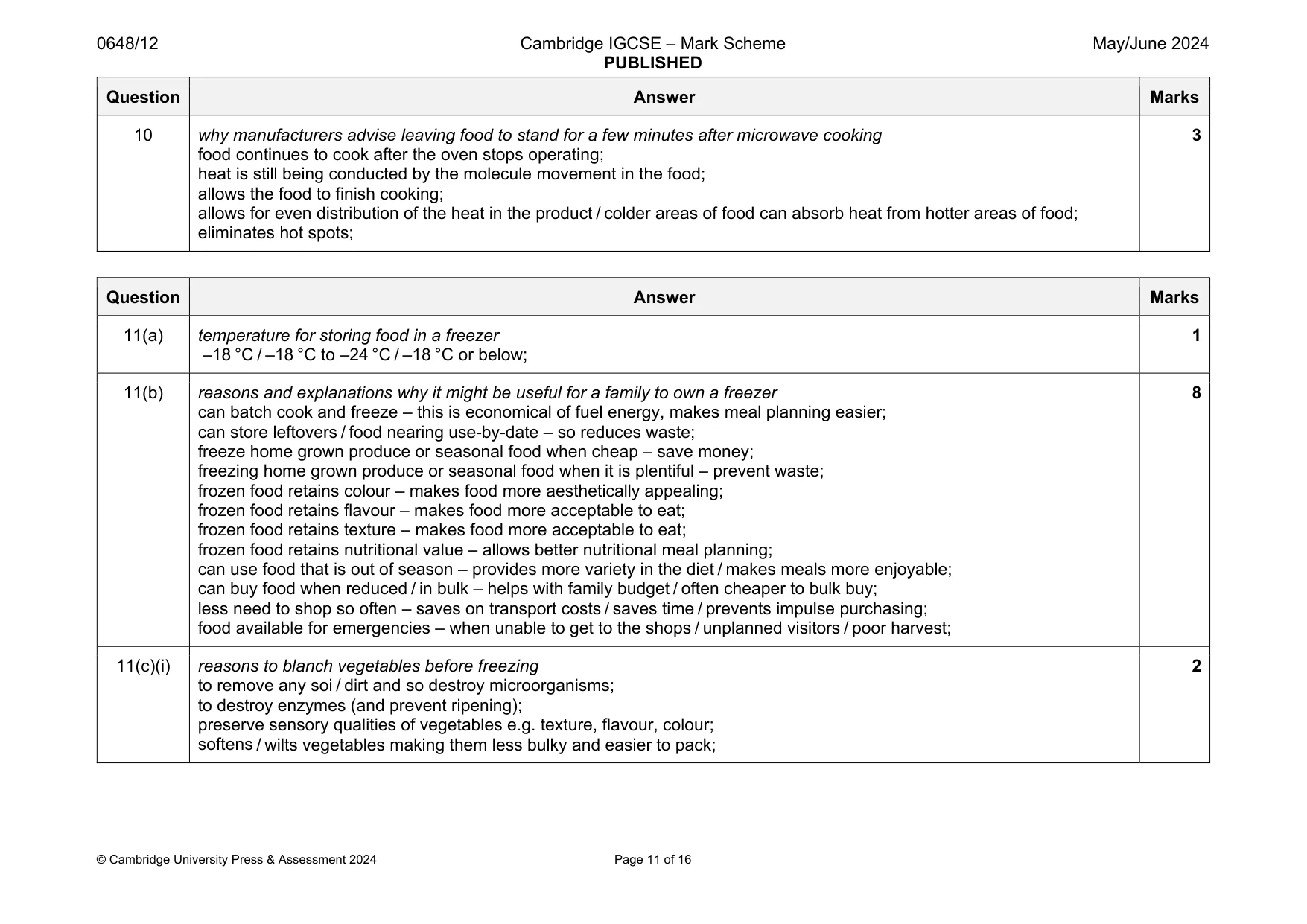
0648/12 Cambridge IGCSE – Mark Scheme PUBLISHED May/June 2024 © Cambridge University Press & Assessment 2024 Page 11 of 16 Question Answer Marks 10 why manufacturers advise leaving food to stand for a few minutes after microwave cooking food continues to cook after the oven stops operating; heat is still being conducted by the molecule movement in the food; allows the food to finish cooking; allows for even distribution of the heat in the product / colder areas of food can absorb heat from hotter areas of food; eliminates hot spots; 3 Question Answer Marks 11(a) temperature for storing food in a freezer –18 °C / –18 °C to –24 °C / –18 °C or below; 1 11(b) reasons and explanations why it might be useful for a family to own a freezer can batch cook and freeze – this is economical of fuel energy, makes meal planning easier; can store leftovers / food nearing use-by-date – so reduces waste; freeze home grown produce or seasonal food when cheap – save money; freezing home grown produce or seasonal food when it is plentiful – prevent waste; frozen food retains colour – makes food more aesthetically appealing; frozen food retains flavour – makes food more acceptable to eat; frozen food retains texture – makes food more acceptable to eat; frozen food retains nutritional value – allows better nutritional meal planning; can use food that is out of season – provides more variety in the diet / makes meals more enjoyable; can buy food when reduced / in bulk – helps with family budget / often cheaper to bulk buy; less need to shop so often – saves on transport costs / saves time / prevents impulse purchasing; food available for emergencies – when unable to get to the shops / unplanned visitors / poor harvest; 8 11(c)(i) reasons to blanch vegetables before freezing to remove any soi / dirt and so destroy microorganisms; to destroy enzymes (and prevent ripening); preserve sensory qualities of vegetables e.g. texture, flavour, colour; softens / wilts vegetables making them less bulky and easier to pack; 2
Mark scheme, page 12
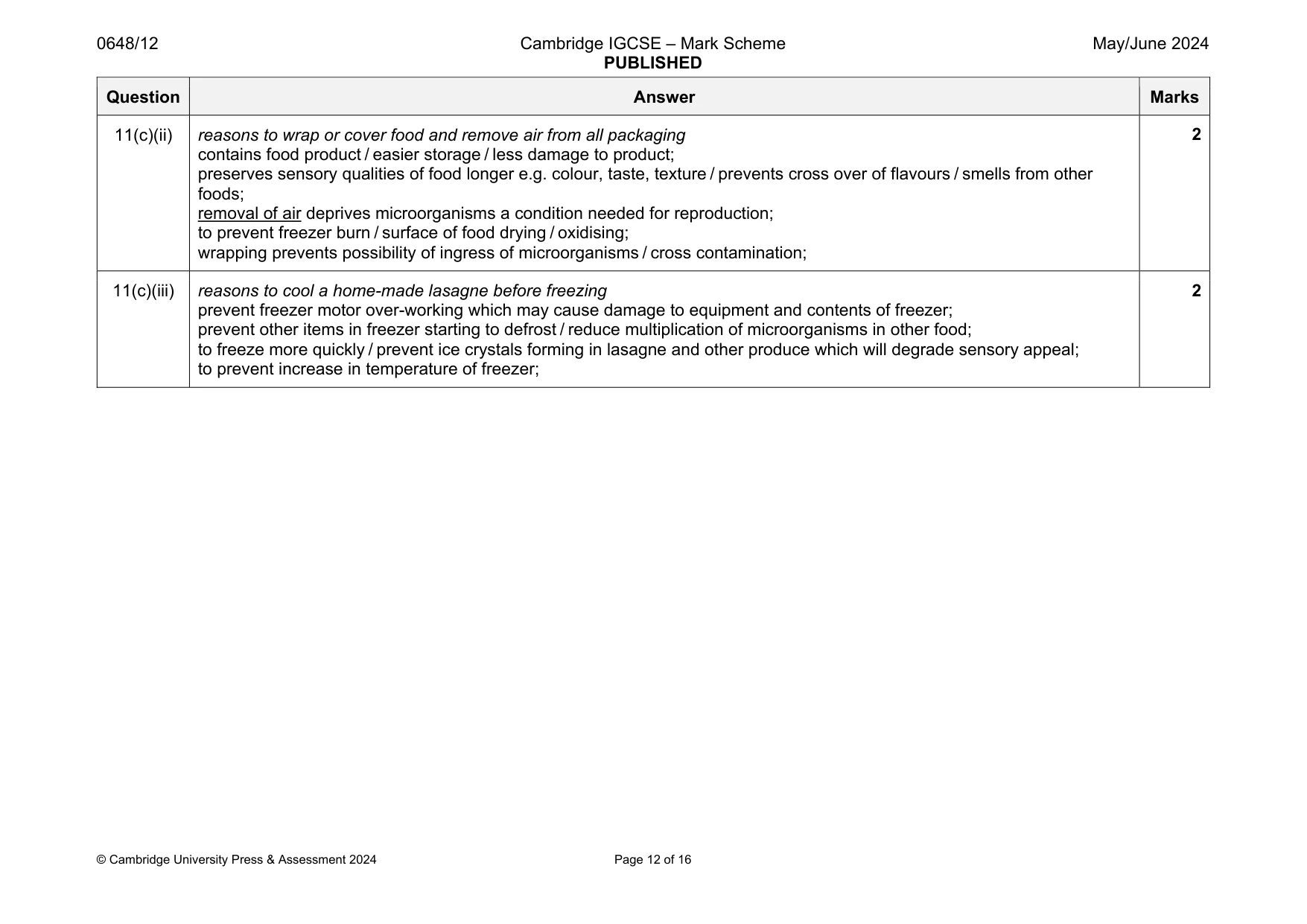
0648/12 Cambridge IGCSE – Mark Scheme PUBLISHED May/June 2024 © Cambridge University Press & Assessment 2024 Page 12 of 16 Question Answer Marks 11(c)(ii) reasons to wrap or cover food and remove air from all packaging contains food product / easier storage / less damage to product; preserves sensory qualities of food longer e.g. colour, taste, texture / prevents cross over of flavours / smells from other foods; removal of air deprives microorganisms a condition needed for reproduction; to prevent freezer burn / surface of food drying / oxidising; wrapping prevents possibility of ingress of microorganisms / cross contamination; 2 11(c)(iii) reasons to cool a home-made lasagne before freezing prevent freezer motor over-working which may cause damage to equipment and contents of freezer; prevent other items in freezer starting to defrost / reduce multiplication of microorganisms in other food; to freeze more quickly / prevent ice crystals forming in lasagne and other produce which will degrade sensory appeal; to prevent increase in temperature of freezer; 2
Mark scheme, page 13
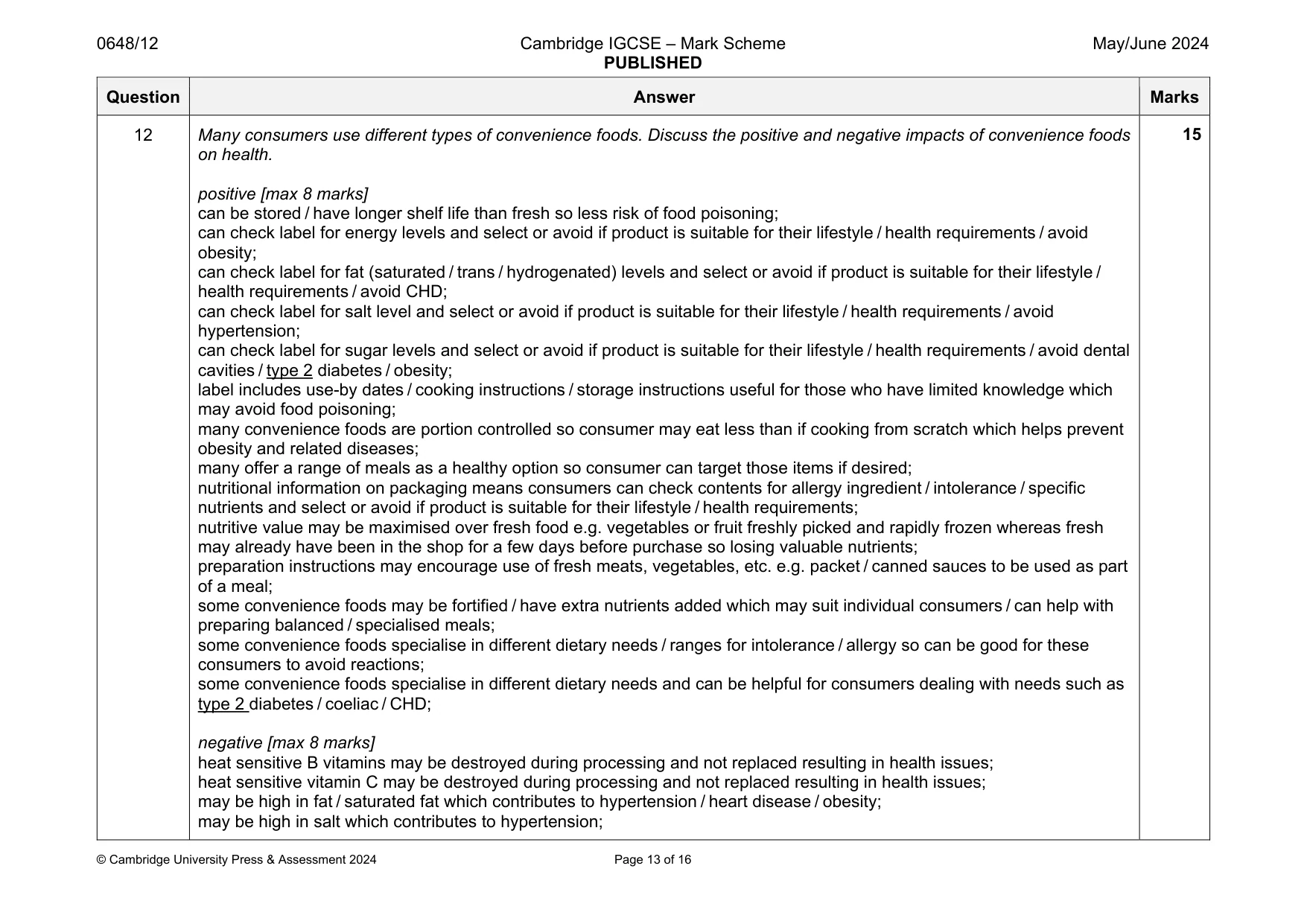
0648/12 Cambridge IGCSE – Mark Scheme PUBLISHED May/June 2024 © Cambridge University Press & Assessment 2024 Page 13 of 16 Question Answer Marks 12 Many consumers use different types of convenience foods. Discuss the positive and negative impacts of convenience foods on health. positive [max 8 marks] can be stored / have longer shelf life than fresh so less risk of food poisoning; can check label for energy levels and select or avoid if product is suitable for their lifestyle / health requirements / avoid obesity; can check label for fat (saturated / trans / hydrogenated) levels and select or avoid if product is suitable for their lifestyle / health requirements / avoid CHD; can check label for salt level and select or avoid if product is suitable for their lifestyle / health requirements / avoid hypertension; can check label for sugar levels and select or avoid if product is suitable for their lifestyle / health requirements / avoid dental cavities / type 2 diabetes / obesity; label includes use-by dates / cooking instructions / storage instructions useful for those who have limited knowledge which may avoid food poisoning; many convenience foods are portion controlled so consumer may eat less than if cooking from scratch which helps prevent obesity and related diseases; many offer a range of meals as a healthy option so consumer can target those items if desired; nutritional information on packaging means consumers can check contents for allergy ingredient / intolerance / specific nutrients and select or avoid if product is suitable for their lifestyle / health requirements; nutritive value may be maximised over fresh food e.g. vegetables or fruit freshly picked and rapidly frozen whereas fresh may already have been in the shop for a few days before purchase so losing valuable nutrients; preparation instructions may encourage use of fresh meats, vegetables, etc. e.g. packet / canned sauces to be used as part of a meal; some convenience foods may be fortified / have extra nutrients added which may suit individual consumers / can help with preparing balanced / specialised meals; some convenience foods specialise in different dietary needs / ranges for intolerance / allergy so can be good for these consumers to avoid reactions; some convenience foods specialise in different dietary needs and can be helpful for consumers dealing with needs such as type 2 diabetes / coeliac / CHD; negative [max 8 marks] heat sensitive B vitamins may be destroyed during processing and not replaced resulting in health issues; heat sensitive vitamin C may be destroyed during processing and not replaced resulting in health issues; may be high in fat / saturated fat which contributes to hypertension / heart disease / obesity; may be high in salt which contributes to hypertension; 15
Mark scheme, page 14
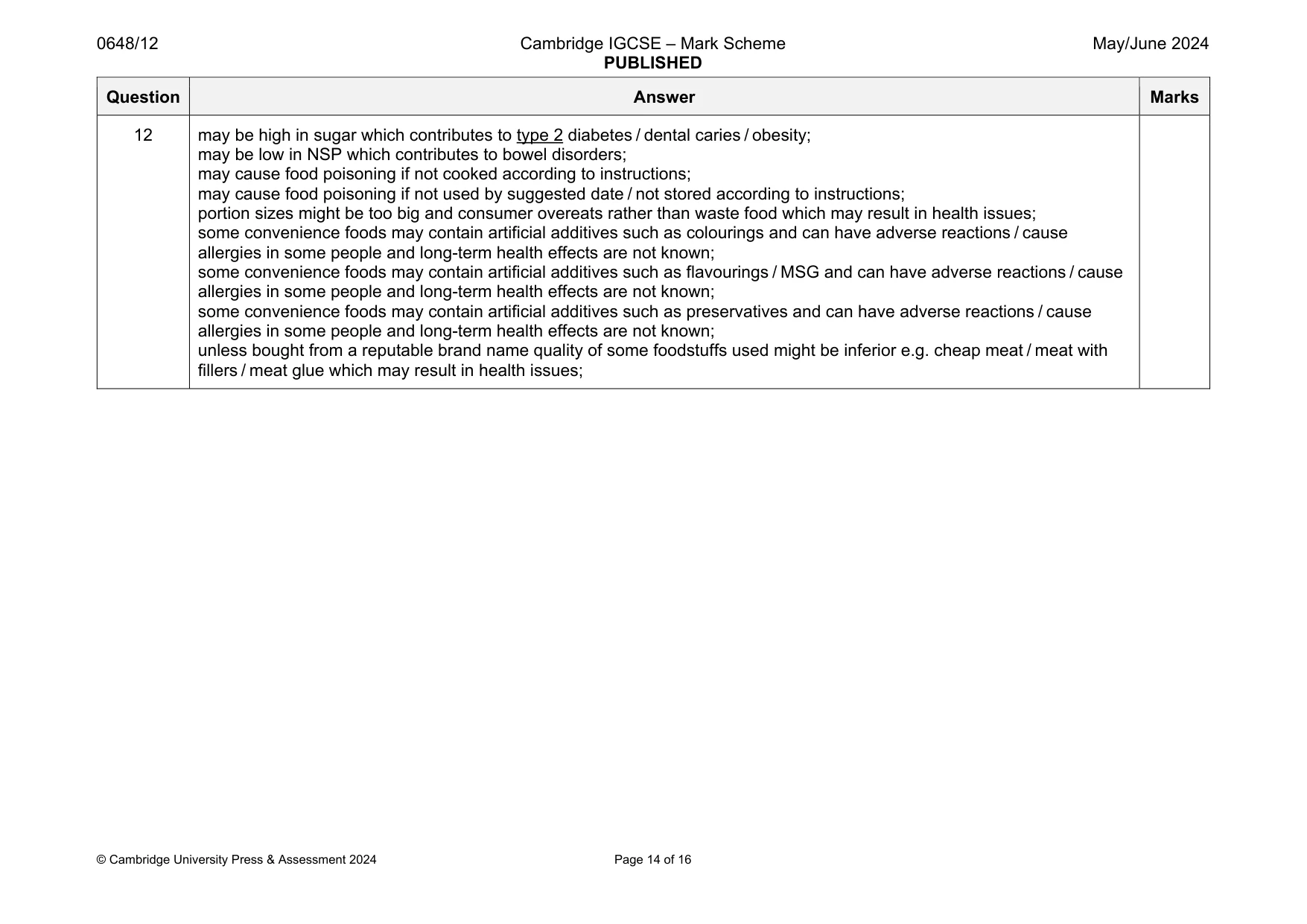
0648/12 Cambridge IGCSE – Mark Scheme PUBLISHED May/June 2024 © Cambridge University Press & Assessment 2024 Page 14 of 16 Question Answer Marks 12 may be high in sugar which contributes to type 2 diabetes / dental caries / obesity; may be low in NSP which contributes to bowel disorders; may cause food poisoning if not cooked according to instructions; may cause food poisoning if not used by suggested date / not stored according to instructions; portion sizes might be too big and consumer overeats rather than waste food which may result in health issues; some convenience foods may contain artificial additives such as colourings and can have adverse reactions / cause allergies in some people and long-term health effects are not known; some convenience foods may contain artificial additives such as flavourings / MSG and can have adverse reactions / cause allergies in some people and long-term health effects are not known; some convenience foods may contain artificial additives such as preservatives and can have adverse reactions / cause allergies in some people and long-term health effects are not known; unless bought from a reputable brand name quality of some foodstuffs used might be inferior e.g. cheap meat / meat with fillers / meat glue which may result in health issues;
Mark scheme, page 15
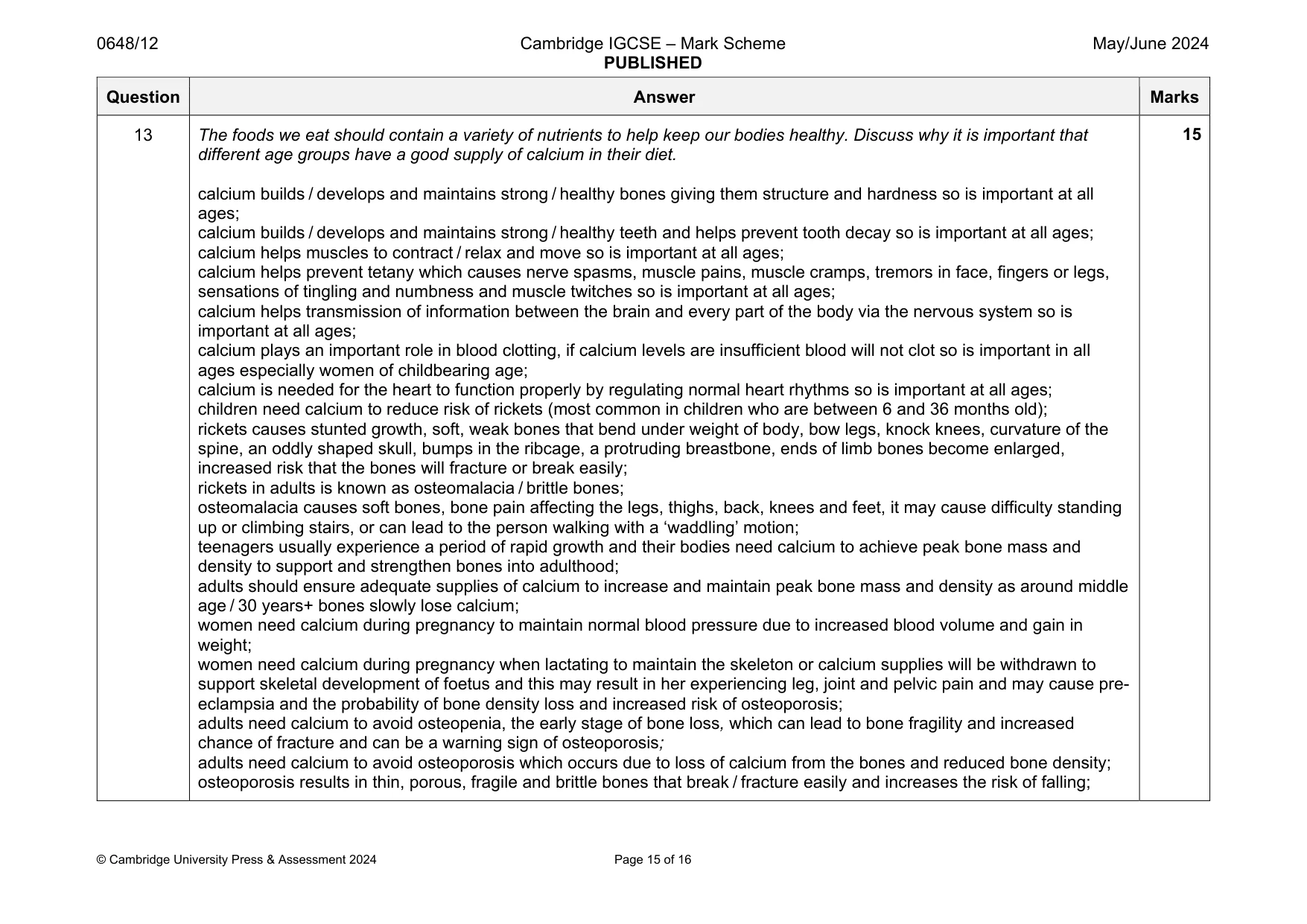
0648/12 Cambridge IGCSE – Mark Scheme PUBLISHED May/June 2024 © Cambridge University Press & Assessment 2024 Page 15 of 16 Question Answer Marks 13 The foods we eat should contain a variety of nutrients to help keep our bodies healthy. Discuss why it is important that different age groups have a good supply of calcium in their diet. calcium builds / develops and maintains strong / healthy bones giving them structure and hardness so is important at all ages; calcium builds / develops and maintains strong / healthy teeth and helps prevent tooth decay so is important at all ages; calcium helps muscles to contract / relax and move so is important at all ages; calcium helps prevent tetany which causes nerve spasms, muscle pains, muscle cramps, tremors in face, fingers or legs, sensations of tingling and numbness and muscle twitches so is important at all ages; calcium helps transmission of information between the brain and every part of the body via the nervous system so is important at all ages; calcium plays an important role in blood clotting, if calcium levels are insufficient blood will not clot so is important in all ages especially women of childbearing age; calcium is needed for the heart to function properly by regulating normal heart rhythms so is important at all ages; children need calcium to reduce risk of rickets (most common in children who are between 6 and 36 months old); rickets causes stunted growth, soft, weak bones that bend under weight of body, bow legs, knock knees, curvature of the spine, an oddly shaped skull, bumps in the ribcage, a protruding breastbone, ends of limb bones become enlarged, increased risk that the bones will fracture or break easily; rickets in adults is known as osteomalacia / brittle bones; osteomalacia causes soft bones, bone pain affecting the legs, thighs, back, knees and feet, it may cause difficulty standing up or climbing stairs, or can lead to the person walking with a ‘waddling’ motion; teenagers usually experience a period of rapid growth and their bodies need calcium to achieve peak bone mass and density to support and strengthen bones into adulthood; adults should ensure adequate supplies of calcium to increase and maintain peak bone mass and density as around middle age / 30 years+ bones slowly lose calcium; women need calcium during pregnancy to maintain normal blood pressure due to increased blood volume and gain in weight; women need calcium during pregnancy when lactating to maintain the skeleton or calcium supplies will be withdrawn to support skeletal development of foetus and this may result in her experiencing leg, joint and pelvic pain and may cause pre- eclampsia and the probability of bone density loss and increased risk of osteoporosis; adults need calcium to avoid osteopenia, the early stage of bone loss, which can lead to bone fragility and increased chance of fracture and can be a warning sign of osteoporosis; adults need calcium to avoid osteoporosis which occurs due to loss of calcium from the bones and reduced bone density; osteoporosis results in thin, porous, fragile and brittle bones that break / fracture easily and increases the risk of falling; 15
Mark scheme, page 16
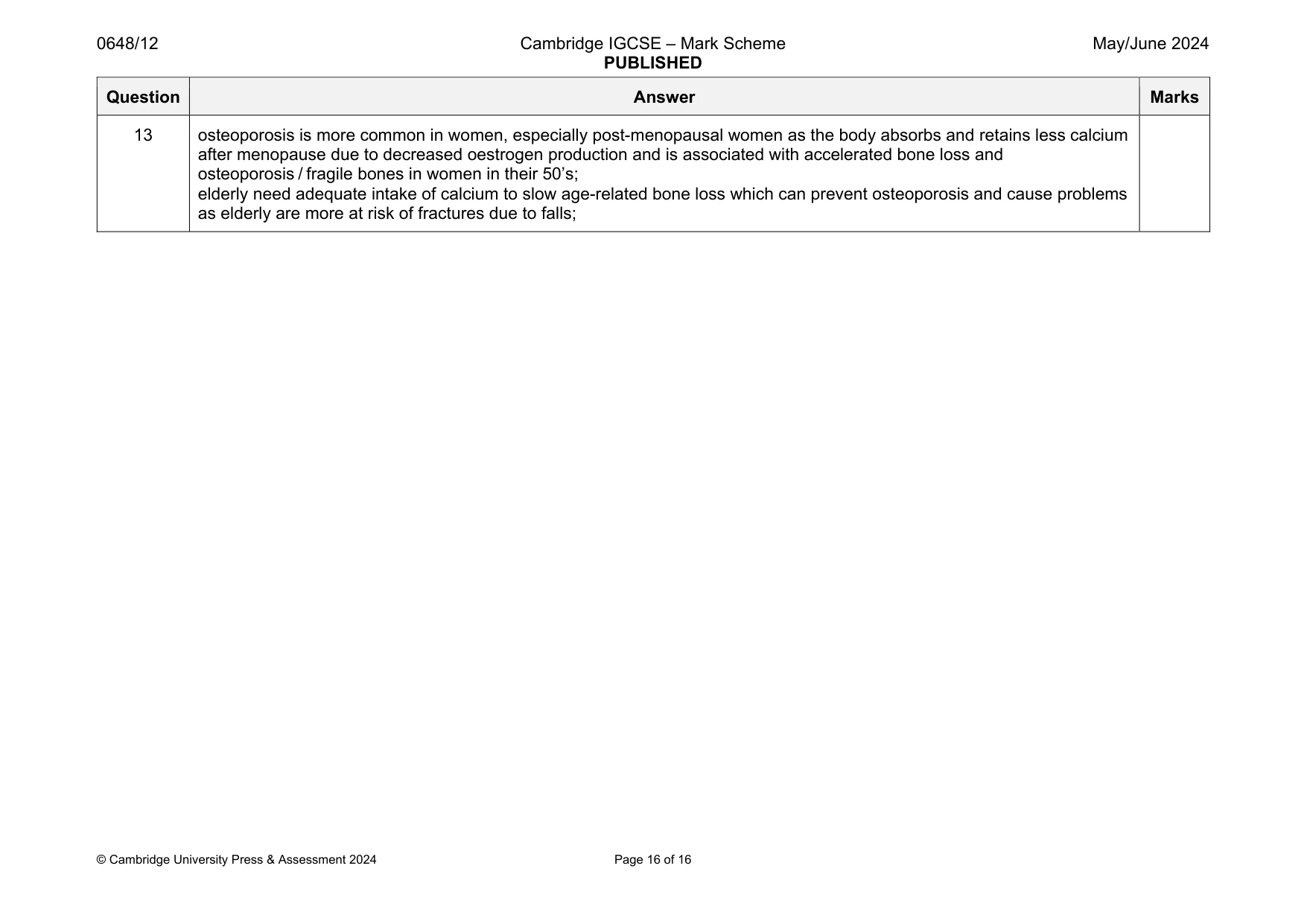
0648/12 Cambridge IGCSE – Mark Scheme PUBLISHED May/June 2024 © Cambridge University Press & Assessment 2024 Page 16 of 16 Question Answer Marks 13 osteoporosis is more common in women, especially post-menopausal women as the body absorbs and retains less calcium after menopause due to decreased oestrogen production and is associated with accelerated bone loss and osteoporosis / fragile bones in women in their 50’s; elderly need adequate intake of calcium to slow age-related bone loss which can prevent osteoporosis and cause problems as elderly are more at risk of fractures due to falls;
What you needed in this session
Cambridge’s own grade thresholds for 2024 May/June, Paper 1 · Variant 2. A higher threshold means an easier paper — the bar moves with how the cohort did.