Cambridge IGCSE Food and Nutrition 0648 — 2023 May/June Paper 1 · Variant 2
0648/12/M/J/23 · 100 marks · ≈113 min
The question paper and its mark scheme, free to read here and free to download. This is Cambridge’s own paper, exactly as it was sat.
Question paper12 pages
Mark scheme18 pages
Answers below. Sit the paper first if you are practising.
Paper as text
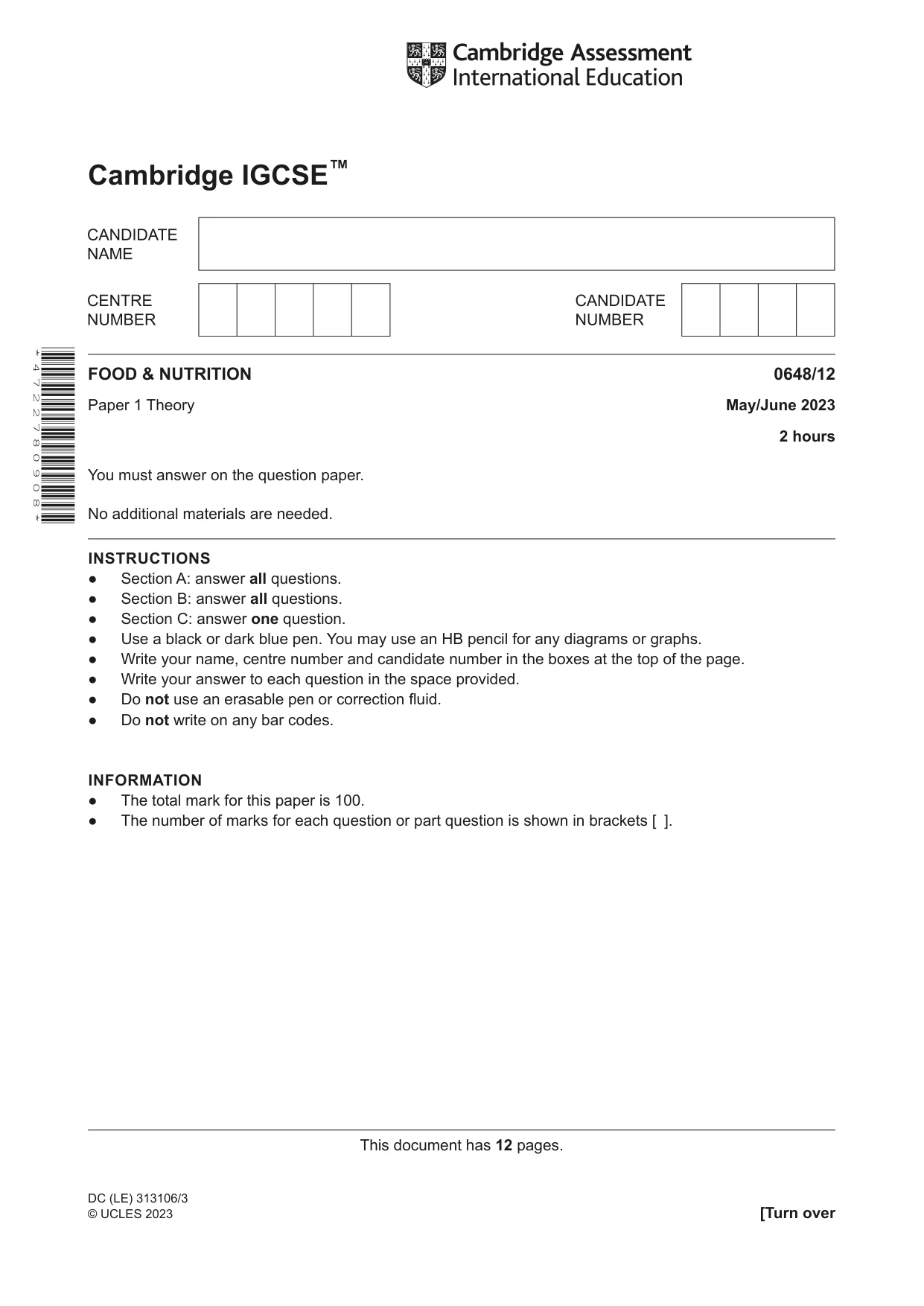
Question paper, page 1
This document has 12 pages. [Turn over Cambridge IGCSE™ DC (LE) 313106/3 © UCLES 2023 * 4 7 2 2 7 8 0 9 0 8 * FOOD & NUTRITION 0648/12 Paper 1 Theory May/June 2023 2 hours You must answer on the question paper. No additional materials are needed. INSTRUCTIONS ● Section A: answer all questions. ● Section B: answer all questions. ● Section C: answer one question. ● Use a black or dark blue pen. You may use an HB pencil for any diagrams or graphs. ● Write your name, centre number and candidate number in the boxes at the top of the page. ● Write your answer to each question in the space provided. ● Do not use an erasable pen or correction fluid. ● Do not write on any bar codes. INFORMATION ● The total mark for this paper is 100. ● The number of marks for each question or part question is shown in brackets [ ].
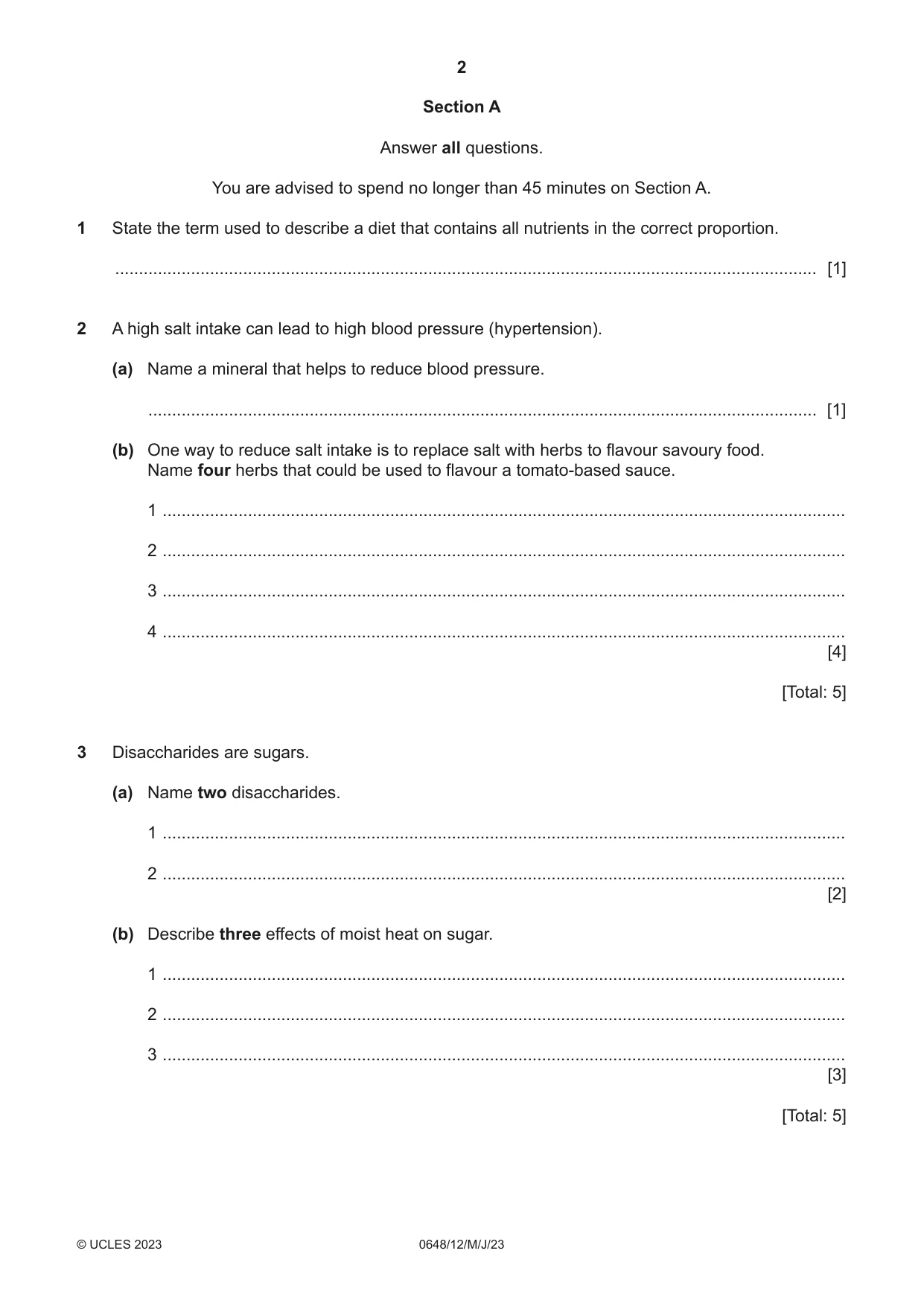
Question paper, page 2
2 0648/12/M/J/23 © UCLES 2023 Section A Answer all questions. You are advised to spend no longer than 45 minutes on Section A. 1 State the term used to describe a diet that contains all nutrients in the correct proportion. … [1] 2 A high salt intake can lead to high blood pressure (hypertension). (a) Name a mineral that helps to reduce blood pressure. … [1] (b) One way to reduce salt intake is to replace salt with herbs to flavour savoury food. Name four herbs that could be used to flavour a tomato-based sauce. 1 … 2 … 3 … 4 … [4] [Total: 5] 3 Disaccharides are sugars. (a) Name two disaccharides. 1 … 2 … [2] (b) Describe three effects of moist heat on sugar. 1 … 2 … 3 … [3] [Total: 5]
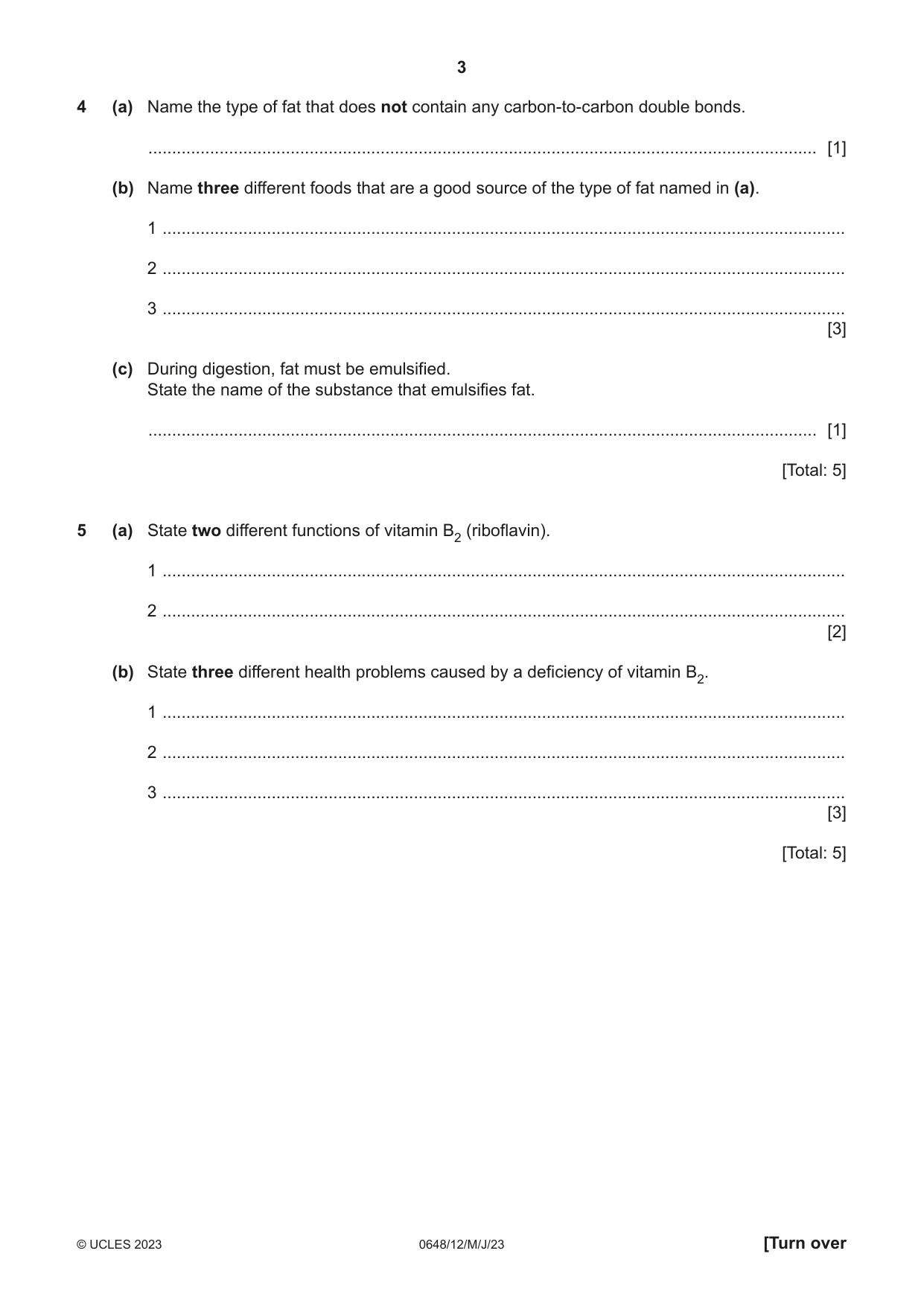
Question paper, page 3
3 0648/12/M/J/23 © UCLES 2023 [Turn over 4 (a) Name the type of fat that does not contain any carbon-to-carbon double bonds. … [1] (b) Name three different foods that are a good source of the type of fat named in (a). 1 … 2 … 3 … [3] (c) During digestion, fat must be emulsified. State the name of the substance that emulsifies fat. … [1] [Total: 5] 5 (a) State two different functions of vitamin B2 (riboflavin). 1 … 2 … [2] (b) State three different health problems caused by a deficiency of vitamin B2. 1 … 2 … 3 … [3] [Total: 5]
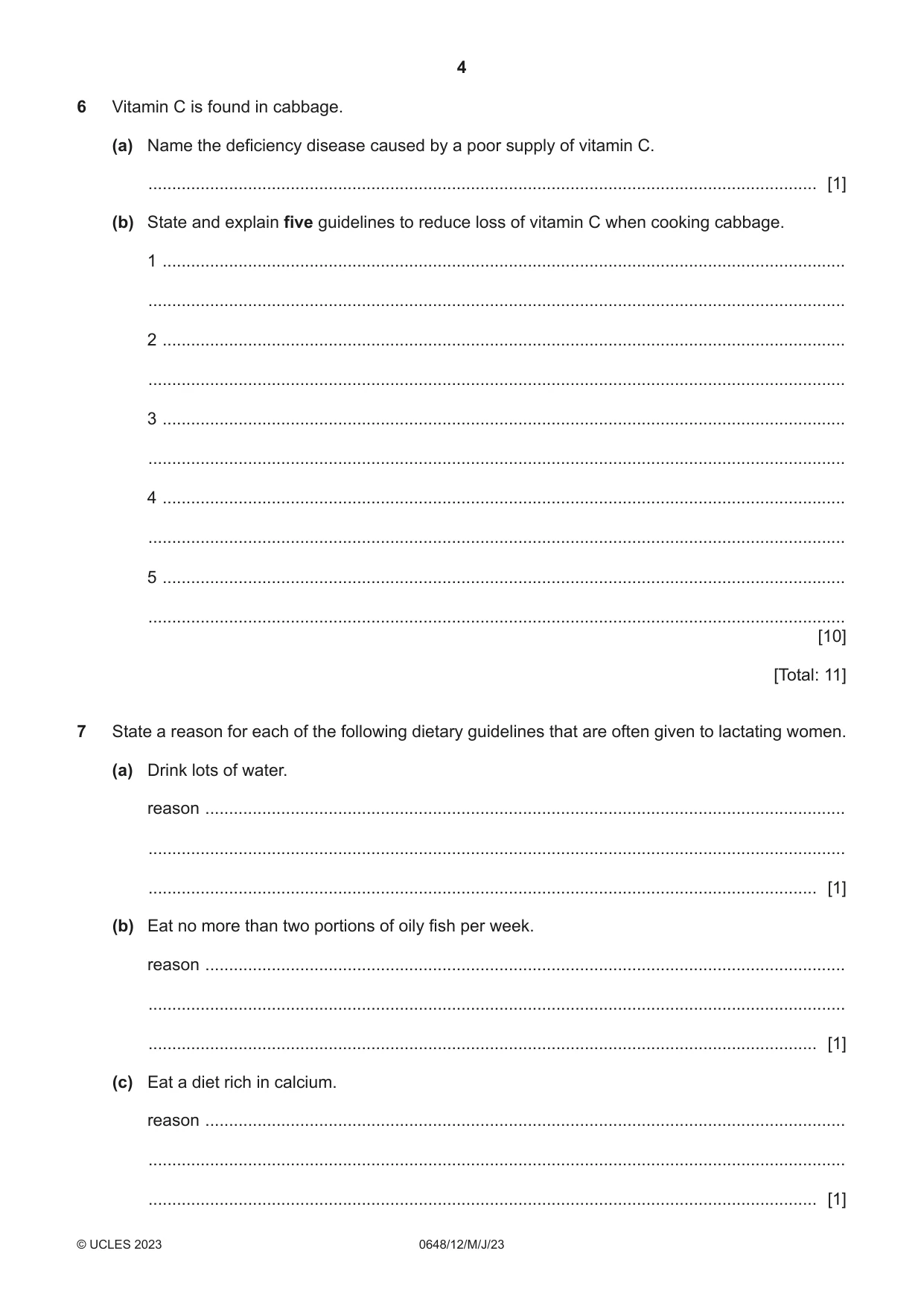
Question paper, page 4
4 0648/12/M/J/23 © UCLES 2023 6 Vitamin C is found in cabbage. (a) Name the deficiency disease caused by a poor supply of vitamin C. … [1] (b) State and explain five guidelines to reduce loss of vitamin C when cooking cabbage. 1 … … 2 … … 3 … … 4 … … 5 … … [10] [Total: 11] 7 State a reason for each of the following dietary guidelines that are often given to lactating women. (a) Drink lots of water. reason … … … [1] (b) Eat no more than two portions of oily fish per week. reason … … … [1] (c) Eat a diet rich in calcium. reason … … … [1]
Question paper, page 5
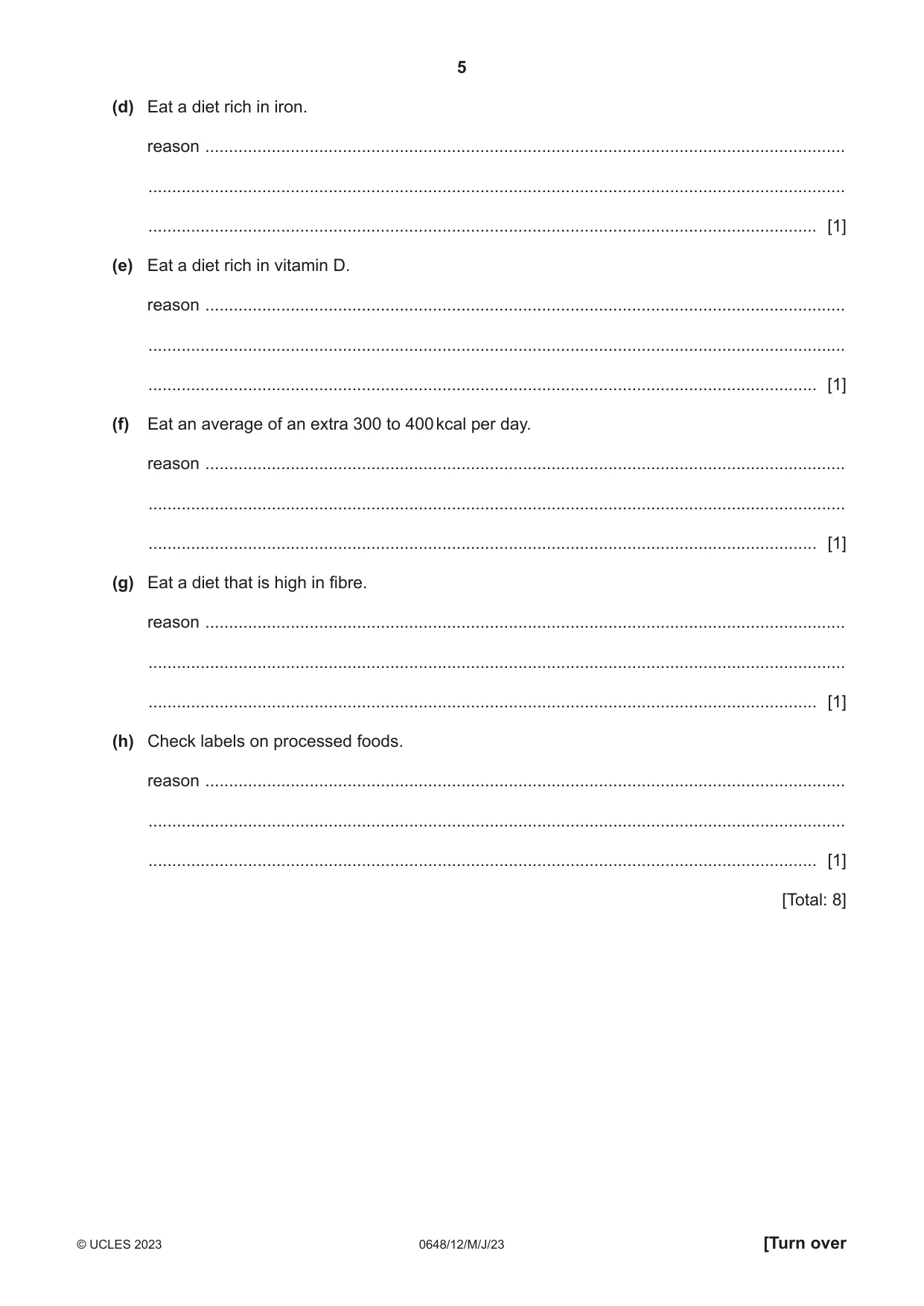
5 0648/12/M/J/23 © UCLES 2023 [Turn over (d) Eat a diet rich in iron. reason … … … [1] (e) Eat a diet rich in vitamin D. reason … … … [1] (f) Eat an average of an extra 300 to 400 kcal per day. reason … … … [1] (g) Eat a diet that is high in fibre. reason … … … [1] (h) Check labels on processed foods. reason … … … [1] [Total: 8]
Question paper, page 6
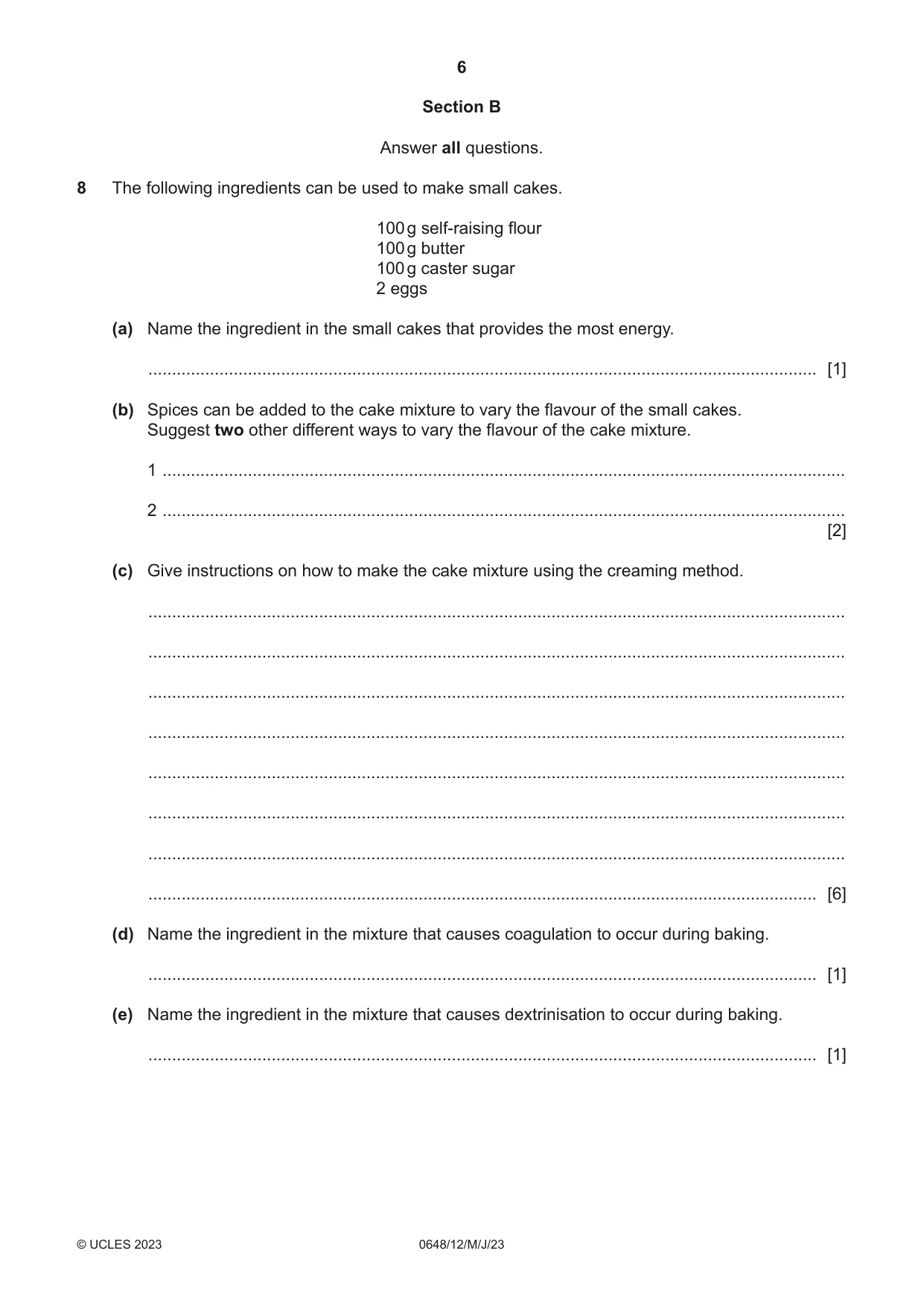
6 0648/12/M/J/23 © UCLES 2023 Section B Answer all questions. 8 The following ingredients can be used to make small cakes. 100 g self-raising flour 100 g butter 100 g caster sugar 2 eggs (a) Name the ingredient in the small cakes that provides the most energy. … [1] (b) Spices can be added to the cake mixture to vary the flavour of the small cakes. Suggest two other different ways to vary the flavour of the cake mixture. 1 … 2 … [2] (c) Give instructions on how to make the cake mixture using the creaming method. … … … … … … … … [6] (d) Name the ingredient in the mixture that causes coagulation to occur during baking. … [1] (e) Name the ingredient in the mixture that causes dextrinisation to occur during baking. … [1]
Question paper, page 7
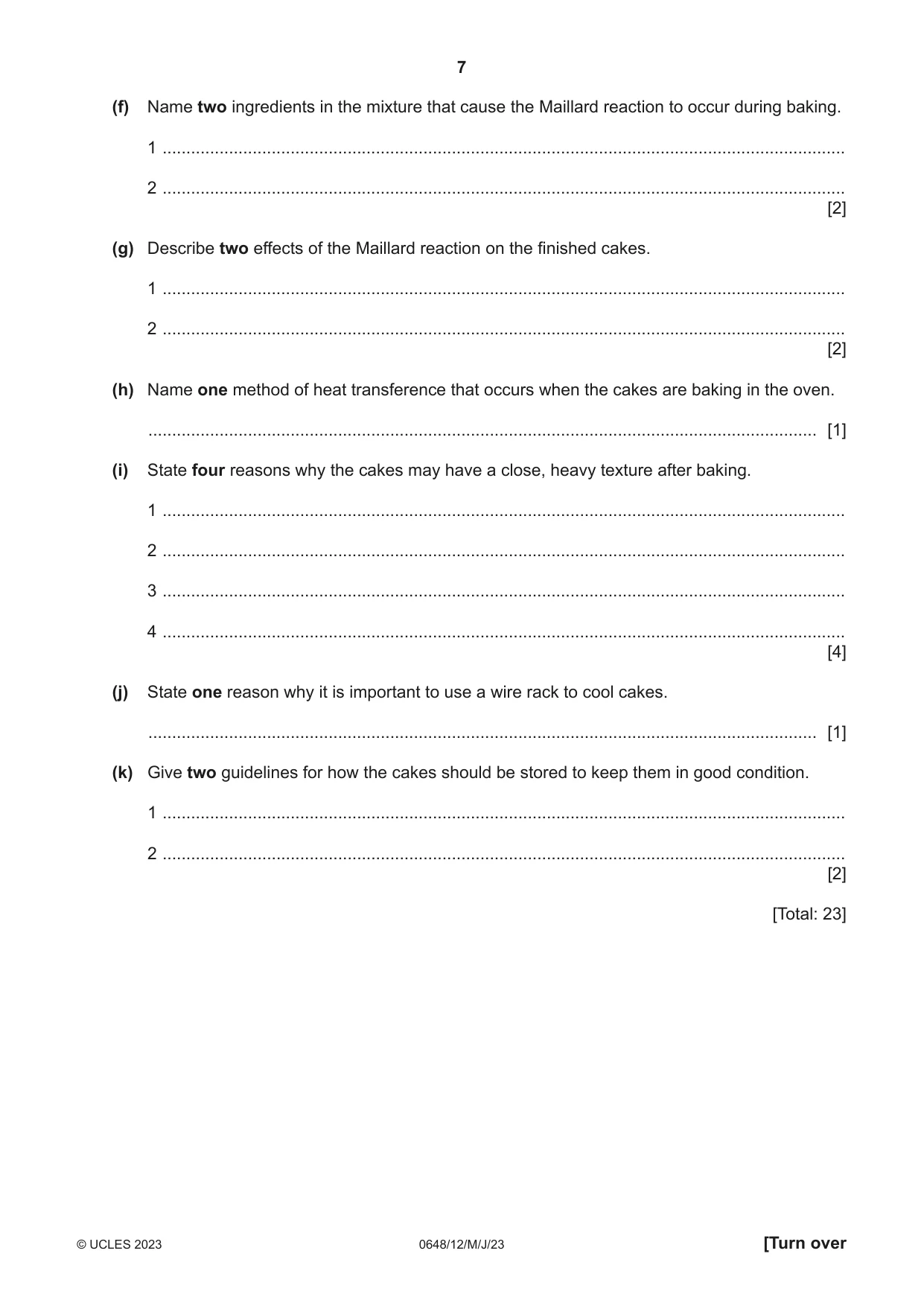
7 0648/12/M/J/23 © UCLES 2023 [Turn over (f) Name two ingredients in the mixture that cause the Maillard reaction to occur during baking. 1 … 2 … [2] (g) Describe two effects of the Maillard reaction on the finished cakes. 1 … 2 … [2] (h) Name one method of heat transference that occurs when the cakes are baking in the oven. … [1] (i) State four reasons why the cakes may have a close, heavy texture after baking. 1 … 2 … 3 … 4 … [4] (j) State one reason why it is important to use a wire rack to cool cakes. … [1] (k) Give two guidelines for how the cakes should be stored to keep them in good condition. 1 … 2 … [2] [Total: 23]
Question paper, page 8
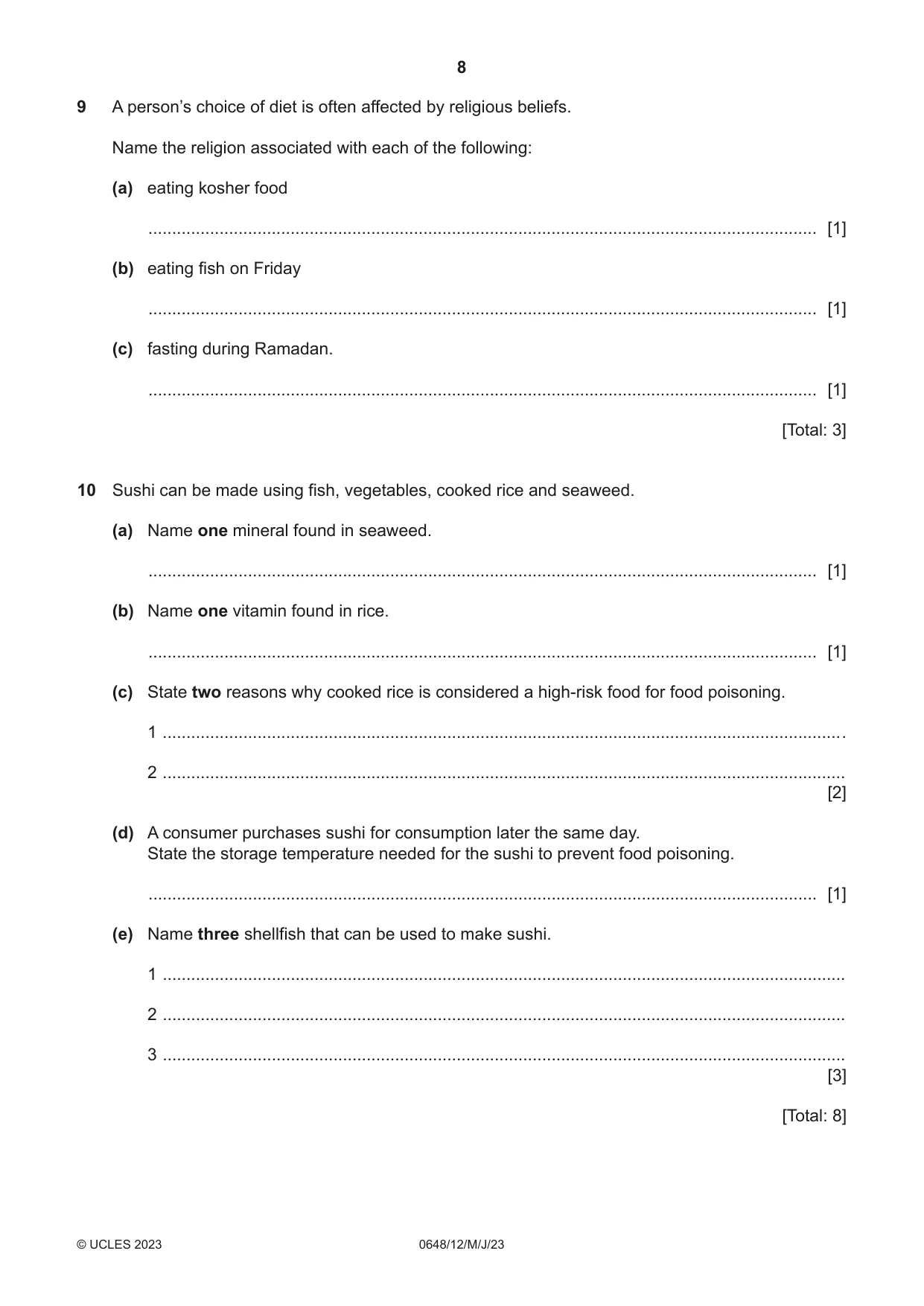
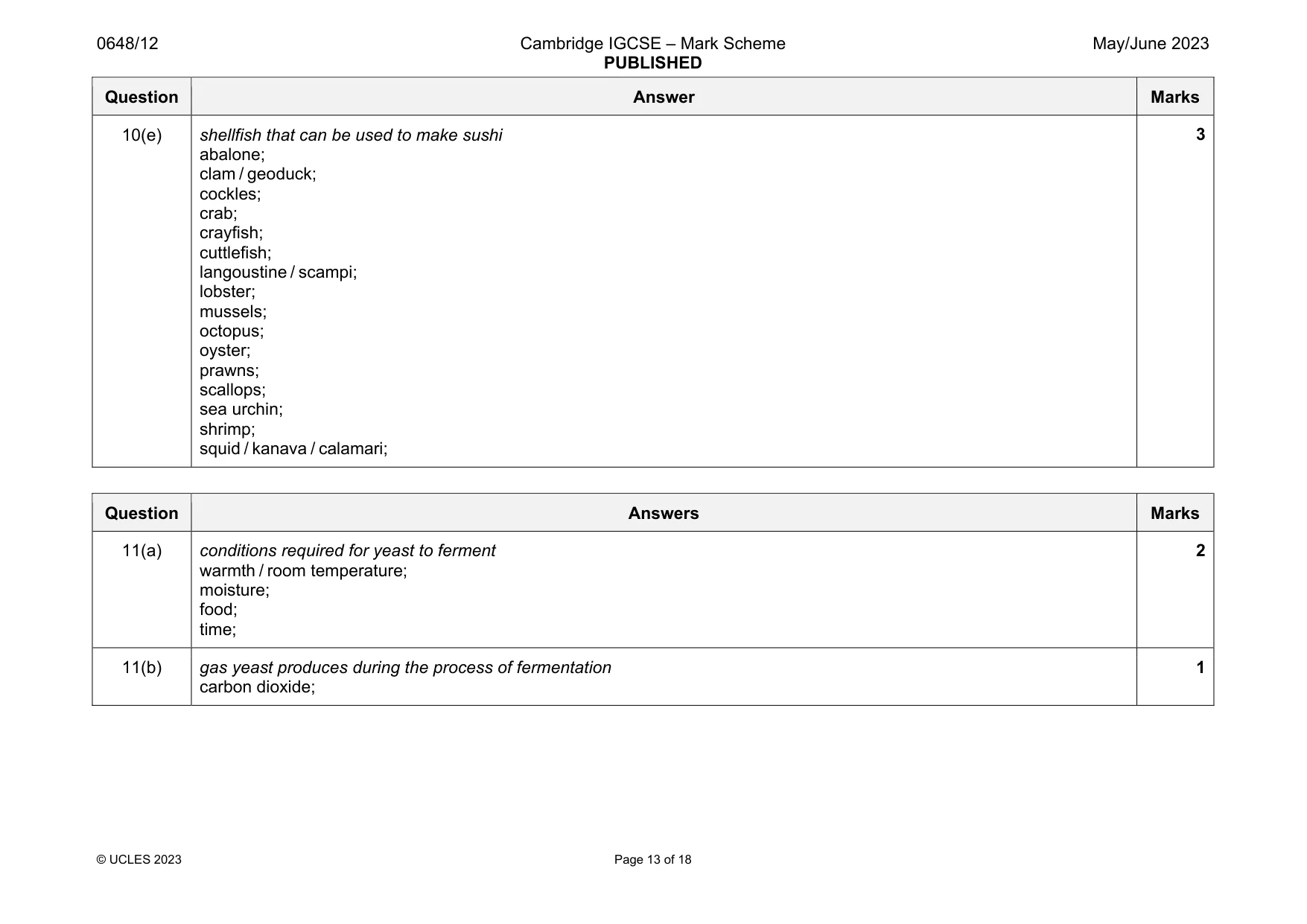
8 0648/12/M/J/23 © UCLES 2023 9 A person’s choice of diet is often affected by religious beliefs. Name the religion associated with each of the following: (a) eating kosher food … [1] (b) eating fish on Friday … [1] (c) fasting during Ramadan. … [1] [Total: 3] 10 Sushi can be made using fish, vegetables, cooked rice and seaweed. (a) Name one mineral found in seaweed. … [1] (b) Name one vitamin found in rice. … [1] (c) State two reasons why cooked rice is considered a high-risk food for food poisoning. 1 … 2 … [2] (d) A consumer purchases sushi for consumption later the same day. State the storage temperature needed for the sushi to prevent food poisoning. … [1] (e) Name three shellfish that can be used to make sushi. 1 … 2 … 3 … [3] [Total: 8]
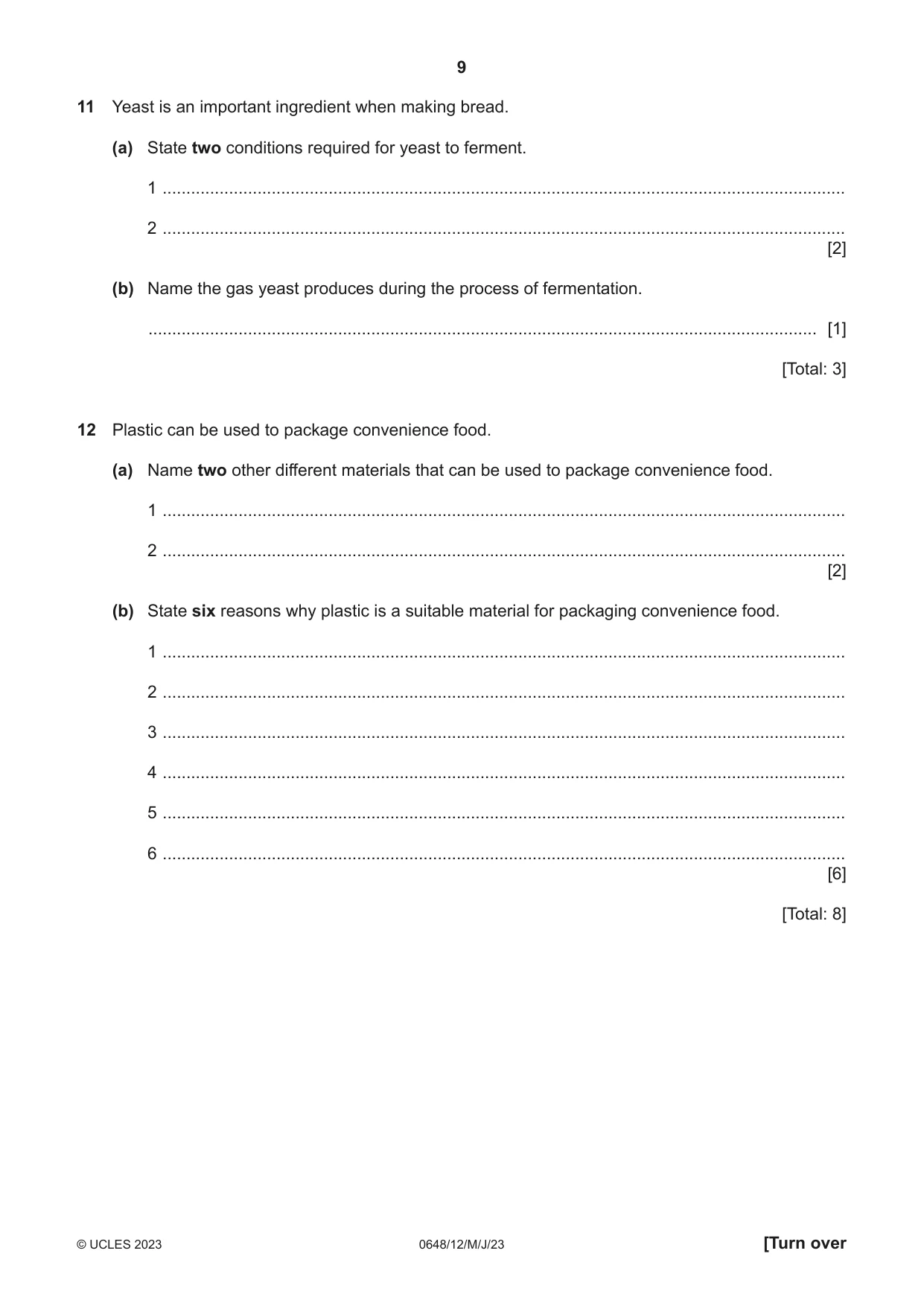
Question paper, page 9
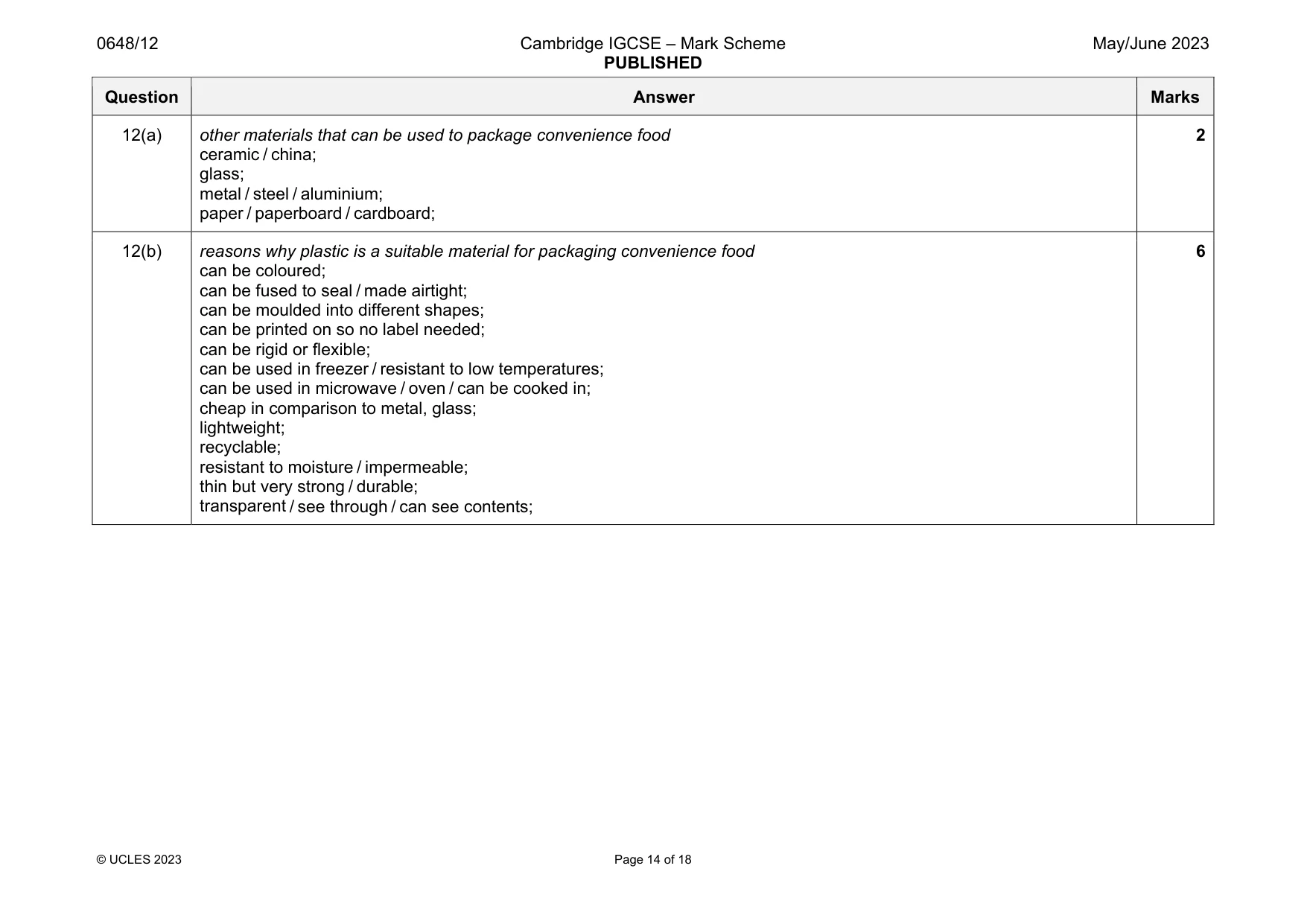
9 0648/12/M/J/23 © UCLES 2023 [Turn over 11 Yeast is an important ingredient when making bread. (a) State two conditions required for yeast to ferment. 1 … 2 … [2] (b) Name the gas yeast produces during the process of fermentation. … [1] [Total: 3] 12 Plastic can be used to package convenience food. (a) Name two other different materials that can be used to package convenience food. 1 … 2 … [2] (b) State six reasons why plastic is a suitable material for packaging convenience food. 1 … 2 … 3 … 4 … 5 … 6 … [6] [Total: 8]
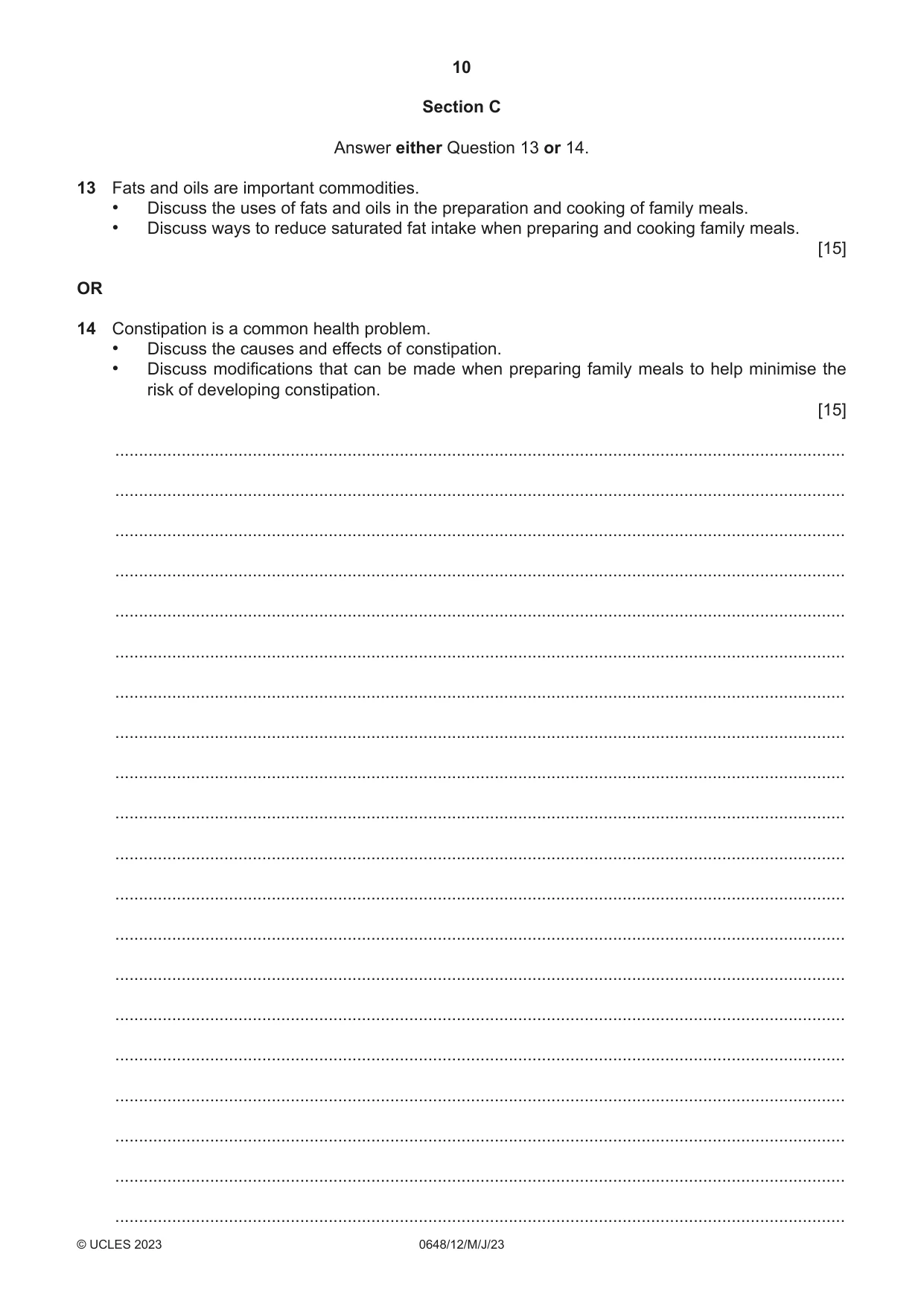
Question paper, page 10
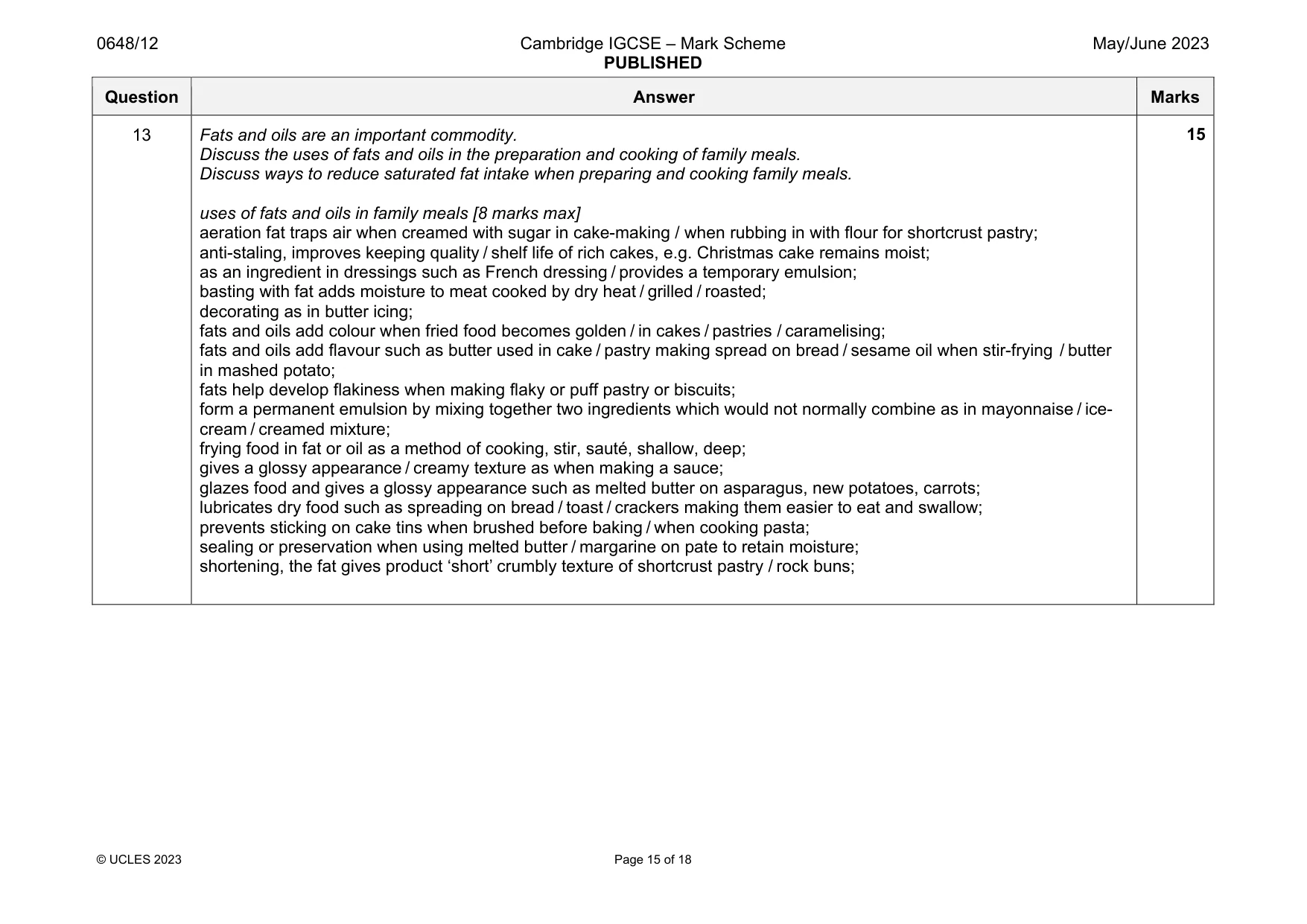
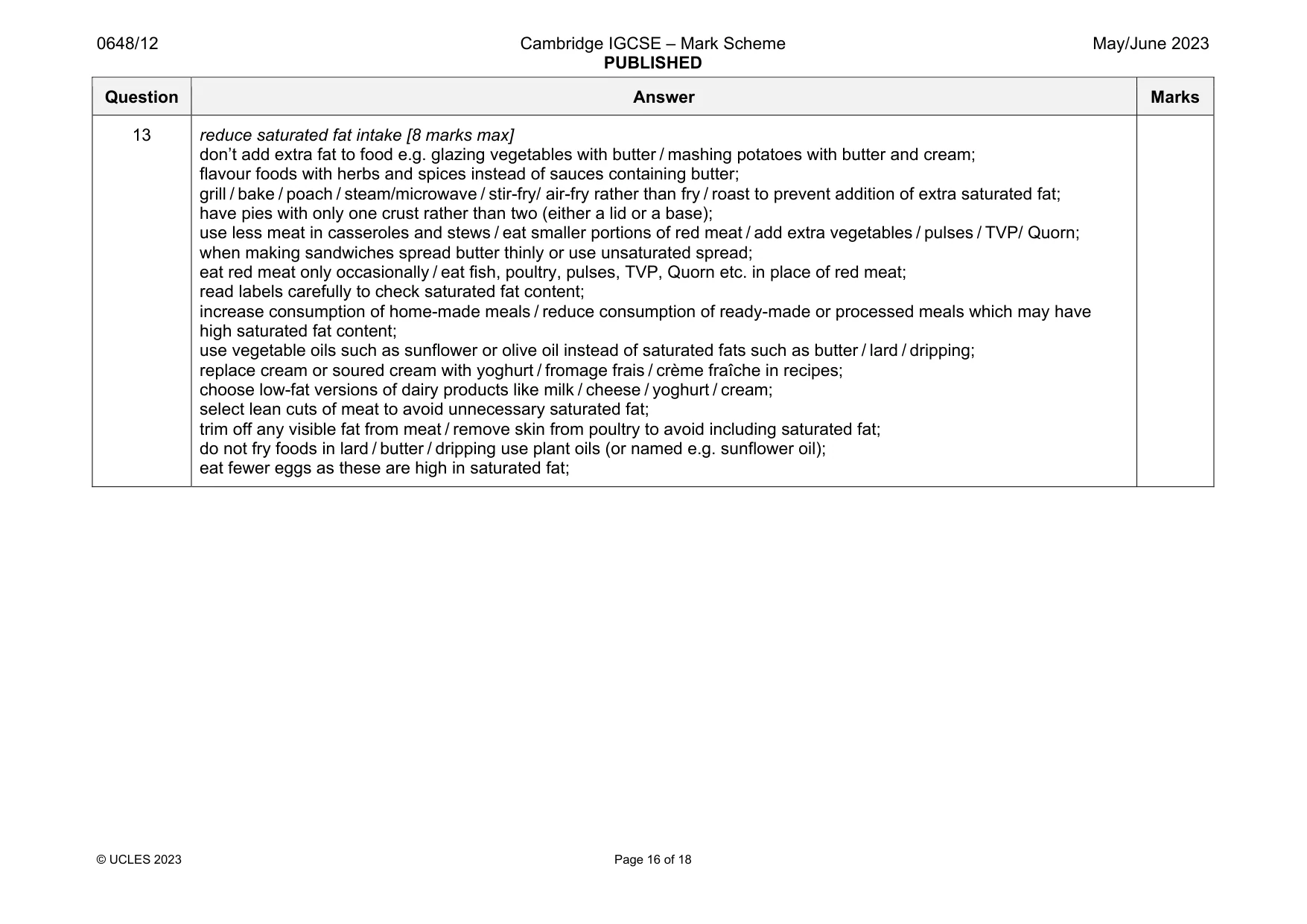
10 0648/12/M/J/23 © UCLES 2023 Section C Answer either Question 13 or 14. 13 Fats and oils are important commodities. • Discuss the uses of fats and oils in the preparation and cooking of family meals. • Discuss ways to reduce saturated fat intake when preparing and cooking family meals. [15] OR 14 Constipation is a common health problem. • Discuss the causes and effects of constipation. • Discuss modifications that can be made when preparing family meals to help minimise the risk of developing constipation. [15] … … … … … … … … … … … … … … … … … … … …
Question paper, page 11
11 0648/12/M/J/23 © UCLES 2023 [Turn over … … … … … … … … … … … … … … … … … … … … … … … … … … … …
Question paper, page 12
12 0648/12/M/J/23 © UCLES 2023 Permission to reproduce items where third-party owned material protected by copyright is included has been sought and cleared where possible. Every reasonable effort has been made by the publisher (UCLES) to trace copyright holders, but if any items requiring clearance have unwittingly been included, the publisher will be pleased to make amends at the earliest possible opportunity. To avoid the issue of disclosure of answer-related information to candidates, all copyright acknowledgements are reproduced online in the Cambridge Assessment International Education Copyright Acknowledgements Booklet. This is produced for each series of examinations and is freely available to download at www.cambridgeinternational.org after the live examination series. Cambridge Assessment International Education is part of Cambridge Assessment. Cambridge Assessment is the brand name of the University of Cambridge Local Examinations Syndicate (UCLES), which is a department of the University of Cambridge. … … … … … … … … … … … … … … … … … … … … … … …
Mark scheme, page 1
This document consists of 18 printed pages. © UCLES 2023 [Turn over Cambridge IGCSE™ FOOD AND NUTRITION 0648/12 Paper 1 Theory May/June 2023 MARK SCHEME Maximum Mark: 100 Published This mark scheme is published as an aid to teachers and candidates, to indicate the requirements of the examination. It shows the basis on which Examiners were instructed to award marks. It does not indicate the details of the discussions that took place at an Examiners’ meeting before marking began, which would have considered the acceptability of alternative answers. Mark schemes should be read in conjunction with the question paper and the Principal Examiner Report for Teachers. Cambridge International will not enter into discussions about these mark schemes. Cambridge International is publishing the mark schemes for the May/June 2023 series for most Cambridge IGCSE, Cambridge International A and AS Level and Cambridge Pre-U components, and some Cambridge O Level components.
Mark scheme, page 2
0648/12 Cambridge IGCSE – Mark Scheme PUBLISHED May/June 2023 © UCLES 2023 Page 2 of 18 Generic Marking Principles These general marking principles must be applied by all examiners when marking candidate answers. They should be applied alongside the specific content of the mark scheme or generic level descriptors for a question. Each question paper and mark scheme will also comply with these marking principles. GENERIC MARKING PRINCIPLE 1: Marks must be awarded in line with: the specific content of the mark scheme or the generic level descriptors for the question the specific skills defined in the mark scheme or in the generic level descriptors for the question the standard of response required by a candidate as exemplified by the standardisation scripts. GENERIC MARKING PRINCIPLE 2: Marks awarded are always whole marks (not half marks, or other fractions). GENERIC MARKING PRINCIPLE 3: Marks must be awarded positively: marks are awarded for correct/valid answers, as defined in the mark scheme. However, credit is given for valid answers which go beyond the scope of the syllabus and mark scheme, referring to your Team Leader as appropriate marks are awarded when candidates clearly demonstrate what they know and can do marks are not deducted for errors marks are not deducted for omissions answers should only be judged on the quality of spelling, punctuation and grammar when these features are specifically assessed by the question as indicated by the mark scheme. The meaning, however, should be unambiguous. GENERIC MARKING PRINCIPLE 4: Rules must be applied consistently, e.g. in situations where candidates have not followed instructions or in the application of generic level descriptors.
Mark scheme, page 3
0648/12 Cambridge IGCSE – Mark Scheme PUBLISHED May/June 2023 © UCLES 2023 Page 3 of 18 GENERIC MARKING PRINCIPLE 5: Marks should be awarded using the full range of marks defined in the mark scheme for the question (however; the use of the full mark range may be limited according to the quality of the candidate responses seen). GENERIC MARKING PRINCIPLE 6: Marks awarded are based solely on the requirements as defined in the mark scheme. Marks should not be awarded with grade thresholds or grade descriptors in mind.
Mark scheme, page 4
0648/12 Cambridge IGCSE – Mark Scheme PUBLISHED May/June 2023 © UCLES 2023 Page 4 of 18 Science-Specific Marking Principles 1 Examiners should consider the context and scientific use of any keywords when awarding marks. Although keywords may be present, marks should not be awarded if the keywords are used incorrectly. 2 The examiner should not choose between contradictory statements given in the same question part, and credit should not be awarded for any correct statement that is contradicted within the same question part. Wrong science that is irrelevant to the question should be ignored. 3 Although spellings do not have to be correct, spellings of syllabus terms must allow for clear and unambiguous separation from other syllabus terms with which they may be confused (e.g. ethane / ethene, glucagon / glycogen, refraction / reflection). 4 The error carried forward (ecf) principle should be applied, where appropriate. If an incorrect answer is subsequently used in a scientifically correct way, the candidate should be awarded these subsequent marking points. Further guidance will be included in the mark scheme where necessary and any exceptions to this general principle will be noted. 5 ‘List rule’ guidance For questions that require n responses (e.g. State two reasons …): The response should be read as continuous prose, even when numbered answer spaces are provided. Any response marked ignore in the mark scheme should not count towards n. Incorrect responses should not be awarded credit but will still count towards n. Read the entire response to check for any responses that contradict those that would otherwise be credited. Credit should not be awarded for any responses that are contradicted within the rest of the response. Where two responses contradict one another, this should be treated as a single incorrect response. Non-contradictory responses after the first n responses may be ignored even if they include incorrect science.
Mark scheme, page 5
0648/12 Cambridge IGCSE – Mark Scheme PUBLISHED May/June 2023 © UCLES 2023 Page 5 of 18 6 Calculation specific guidance Correct answers to calculations should be given full credit even if there is no working or incorrect working, unless the question states ‘show your working’. For questions in which the number of significant figures required is not stated, credit should be awarded for correct answers when rounded by the examiner to the number of significant figures given in the mark scheme. This may not apply to measured values. For answers given in standard form (e.g. a 10n) in which the convention of restricting the value of the coefficient (a) to a value between 1 and 10 is not followed, credit may still be awarded if the answer can be converted to the answer given in the mark scheme. Unless a separate mark is given for a unit, a missing or incorrect unit will normally mean that the final calculation mark is not awarded. Exceptions to this general principle will be noted in the mark scheme. 7 Guidance for chemical equations Multiples / fractions of coefficients used in chemical equations are acceptable unless stated otherwise in the mark scheme. State symbols given in an equation should be ignored unless asked for in the question or stated otherwise in the mark scheme.
Mark scheme, page 6
0648/12 Cambridge IGCSE – Mark Scheme PUBLISHED May/June 2023 © UCLES 2023 Page 6 of 18 Question Answer Marks 1 term used to describe a diet that contains all nutrients in the correct proportion balanced (diet); 1 Question Answer Marks 2(a) mineral that helps to reduce blood pressure potassium; 1 2(b) herbs that could be used to flavour a tomato-based sauce basil; bay; chervil; chives; cilantro; coriander; curry leaves; dill; mint; oregano; parsley; rosemary; sage; tarragon; thyme; 4 Question Answers Marks 3(a) examples of disaccharides maltose; lactose; sucrose; 2
Mark scheme, page 7
0648/12 Cambridge IGCSE – Mark Scheme PUBLISHED May/June 2023 © UCLES 2023 Page 7 of 18 Question Answer Marks 3(b) effects of moist heat on sugar dissolves / melts / becomes liquid; becomes syrup / sticky; changes colour / turns brown / darkens; caramelises; prolonged heating will cause it to burn; 3 Question Answer Marks 4(a) type of fat that does not contain carbon-to-carbon double bonds saturated; 1 4(b) different foods that are a good source of the type of fat in (a) (full fat) milk or one named product e.g. butter / ghee, cheese, cream, yogurt; (red) meat / one named example / meat products e.g. pies, sausages; biscuits / cakes / pastries or one named example; cocoa butter; coconut oil; dripping; egg (yolk); fish liver oil / oily fish / one named example; lard; milk; palm oil; suet; 3 4(c) name of the substance that emulsifies fat bile; 1
Mark scheme, page 8
0648/12 Cambridge IGCSE – Mark Scheme PUBLISHED May/June 2023 © UCLES 2023 Page 8 of 18 Question Answer Marks 5(a) functions of vitamin B₂ (riboflavin) antioxidant / helps immune system / fights free radicals; maintenance / repair of the nails / skin / hair / mucous membranes including digestive system; normal growth; prevents conjunctivitis; prevents dermatitis; prevents mouth, lips, tongue swelling and soreness; production of red blood cells / haemoglobin; release energy from food / carbohydrate / protein / fat; 2 5(b) health problems caused by a deficiency of vitamin B₂ burning / itching / reddening of the cornea; cracks at corners of mouth; eyes sensitive to light; inflammation of mouth and throat / sore throat; oily dermatitis affecting the nose / cheeks / forehead; slow growth / retarded growth / failure to grow; swollen / sore / burning lips; swollen tongue / glossitis; tiredness / fatigue / lack of energy; weakened immune system; 3 Question Answer Marks 6(a) deficiency disease caused by a poor supply of vitamin C scurvy; 1
Mark scheme, page 9
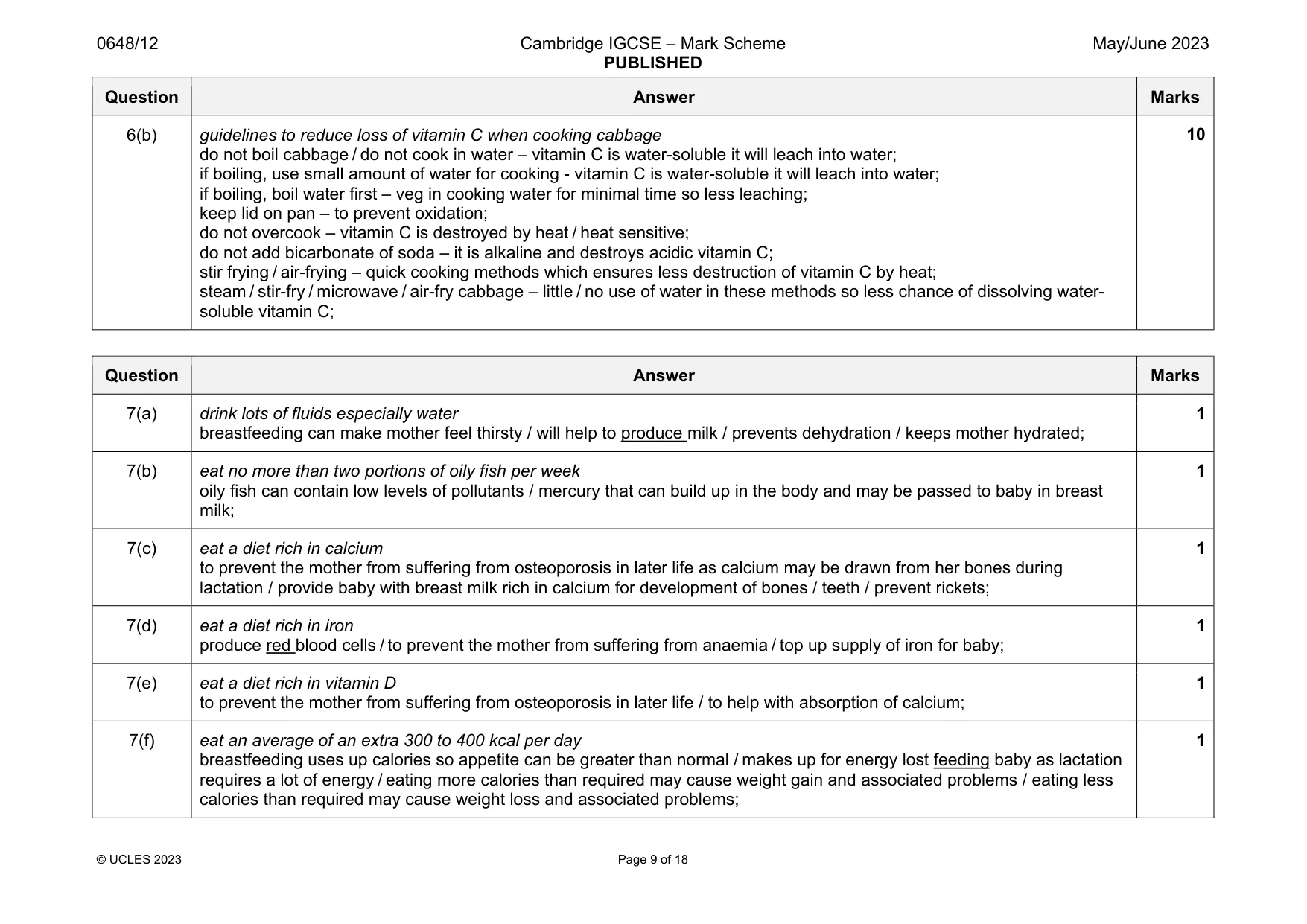
0648/12 Cambridge IGCSE – Mark Scheme PUBLISHED May/June 2023 © UCLES 2023 Page 9 of 18 Question Answer Marks 6(b) guidelines to reduce loss of vitamin C when cooking cabbage do not boil cabbage / do not cook in water – vitamin C is water-soluble it will leach into water; if boiling, use small amount of water for cooking - vitamin C is water-soluble it will leach into water; if boiling, boil water first – veg in cooking water for minimal time so less leaching; keep lid on pan – to prevent oxidation; do not overcook – vitamin C is destroyed by heat / heat sensitive; do not add bicarbonate of soda – it is alkaline and destroys acidic vitamin C; stir frying / air-frying – quick cooking methods which ensures less destruction of vitamin C by heat; steam / stir-fry / microwave / air-fry cabbage – little / no use of water in these methods so less chance of dissolving water- soluble vitamin C; 10 Question Answer Marks 7(a) drink lots of fluids especially water breastfeeding can make mother feel thirsty / will help to produce milk / prevents dehydration / keeps mother hydrated; 1 7(b) eat no more than two portions of oily fish per week oily fish can contain low levels of pollutants / mercury that can build up in the body and may be passed to baby in breast milk; 1 7(c) eat a diet rich in calcium to prevent the mother from suffering from osteoporosis in later life as calcium may be drawn from her bones during lactation / provide baby with breast milk rich in calcium for development of bones / teeth / prevent rickets; 1 7(d) eat a diet rich in iron produce red blood cells / to prevent the mother from suffering from anaemia / top up supply of iron for baby; 1 7(e) eat a diet rich in vitamin D to prevent the mother from suffering from osteoporosis in later life / to help with absorption of calcium; 1 7(f) eat an average of an extra 300 to 400 kcal per day breastfeeding uses up calories so appetite can be greater than normal / makes up for energy lost feeding baby as lactation requires a lot of energy / eating more calories than required may cause weight gain and associated problems / eating less calories than required may cause weight loss and associated problems; 1
Mark scheme, page 10
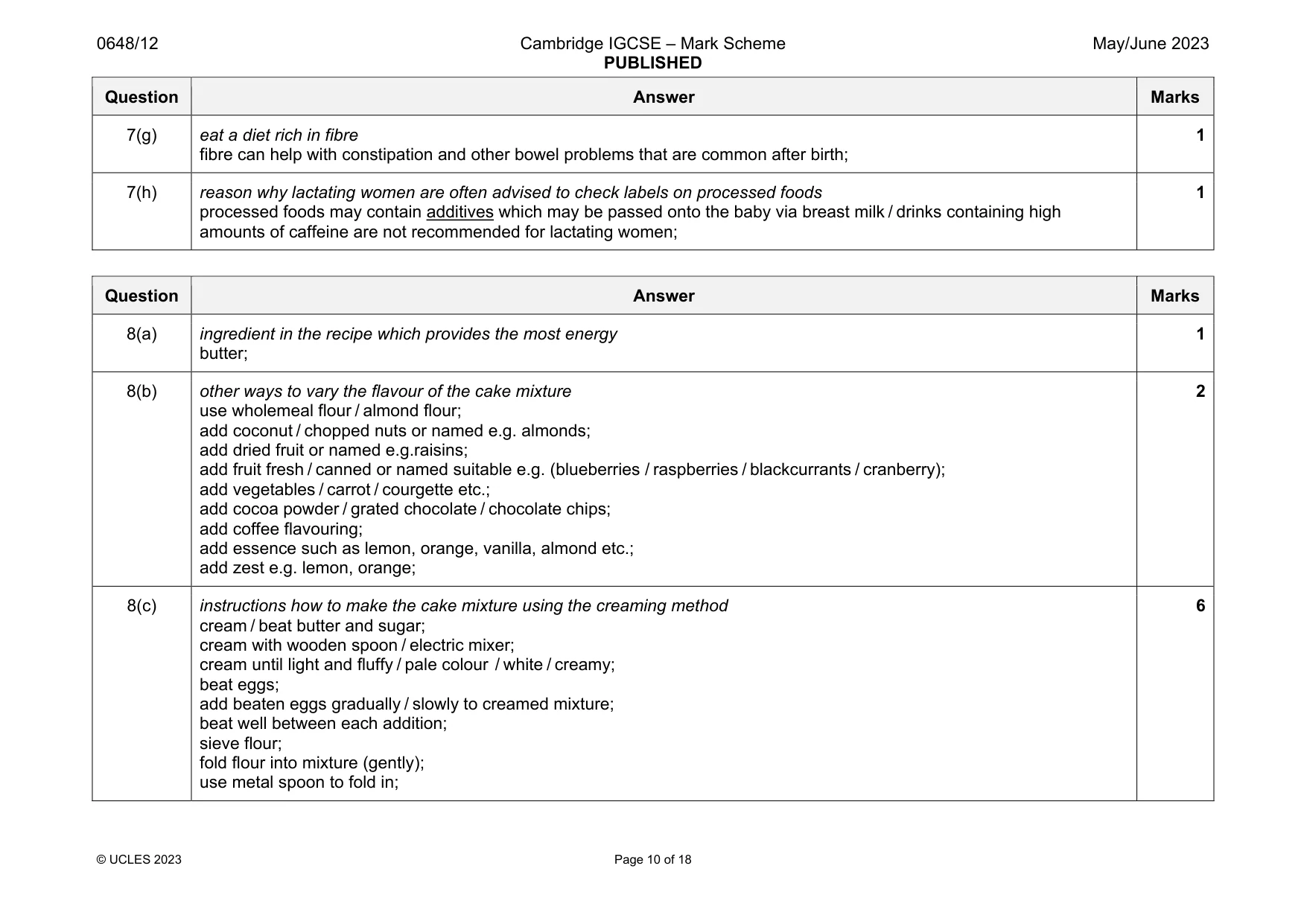
0648/12 Cambridge IGCSE – Mark Scheme PUBLISHED May/June 2023 © UCLES 2023 Page 10 of 18 Question Answer Marks 7(g) eat a diet rich in fibre fibre can help with constipation and other bowel problems that are common after birth; 1 7(h) reason why lactating women are often advised to check labels on processed foods processed foods may contain additives which may be passed onto the baby via breast milk / drinks containing high amounts of caffeine are not recommended for lactating women; 1 Question Answer Marks 8(a) ingredient in the recipe which provides the most energy butter; 1 8(b) other ways to vary the flavour of the cake mixture use wholemeal flour / almond flour; add coconut / chopped nuts or named e.g. almonds; add dried fruit or named e.g.raisins; add fruit fresh / canned or named suitable e.g. (blueberries / raspberries / blackcurrants / cranberry); add vegetables / carrot / courgette etc.; add cocoa powder / grated chocolate / chocolate chips; add coffee flavouring; add essence such as lemon, orange, vanilla, almond etc.; add zest e.g. lemon, orange; 2 8(c) instructions how to make the cake mixture using the creaming method cream / beat butter and sugar; cream with wooden spoon / electric mixer; cream until light and fluffy / pale colour / white / creamy; beat eggs; add beaten eggs gradually / slowly to creamed mixture; beat well between each addition; sieve flour; fold flour into mixture (gently); use metal spoon to fold in; 6
Mark scheme, page 11
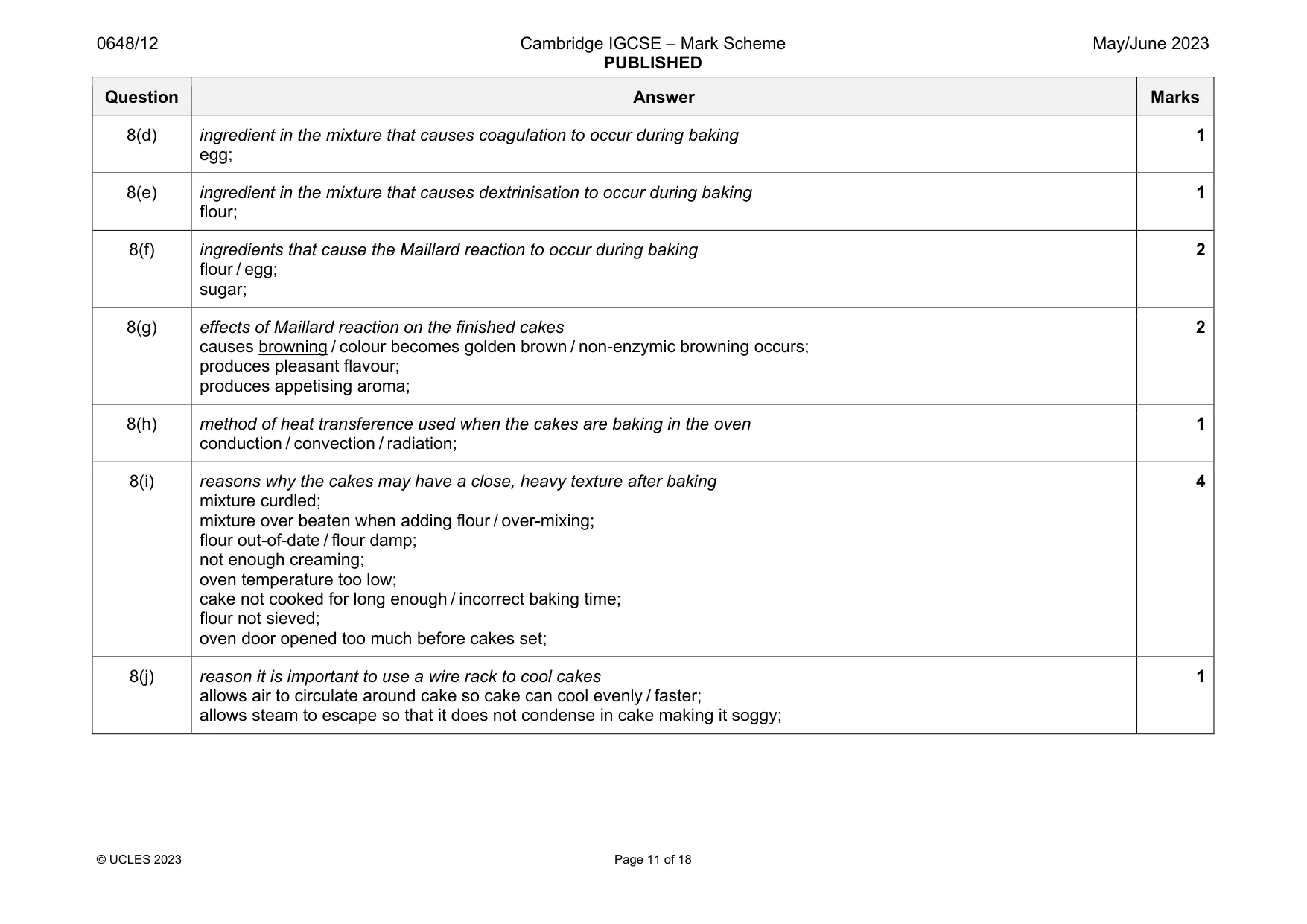
0648/12 Cambridge IGCSE – Mark Scheme PUBLISHED May/June 2023 © UCLES 2023 Page 11 of 18 Question Answer Marks 8(d) ingredient in the mixture that causes coagulation to occur during baking egg; 1 8(e) ingredient in the mixture that causes dextrinisation to occur during baking flour; 1 8(f) ingredients that cause the Maillard reaction to occur during baking flour / egg; sugar; 2 8(g) effects of Maillard reaction on the finished cakes causes browning / colour becomes golden brown / non-enzymic browning occurs; produces pleasant flavour; produces appetising aroma; 2 8(h) method of heat transference used when the cakes are baking in the oven conduction / convection / radiation; 1 8(i) reasons why the cakes may have a close, heavy texture after baking mixture curdled; mixture over beaten when adding flour / over-mixing; flour out-of-date / flour damp; not enough creaming; oven temperature too low; cake not cooked for long enough / incorrect baking time; flour not sieved; oven door opened too much before cakes set; 4 8(j) reason it is important to use a wire rack to cool cakes allows air to circulate around cake so cake can cool evenly / faster; allows steam to escape so that it does not condense in cake making it soggy; 1
Mark scheme, page 12
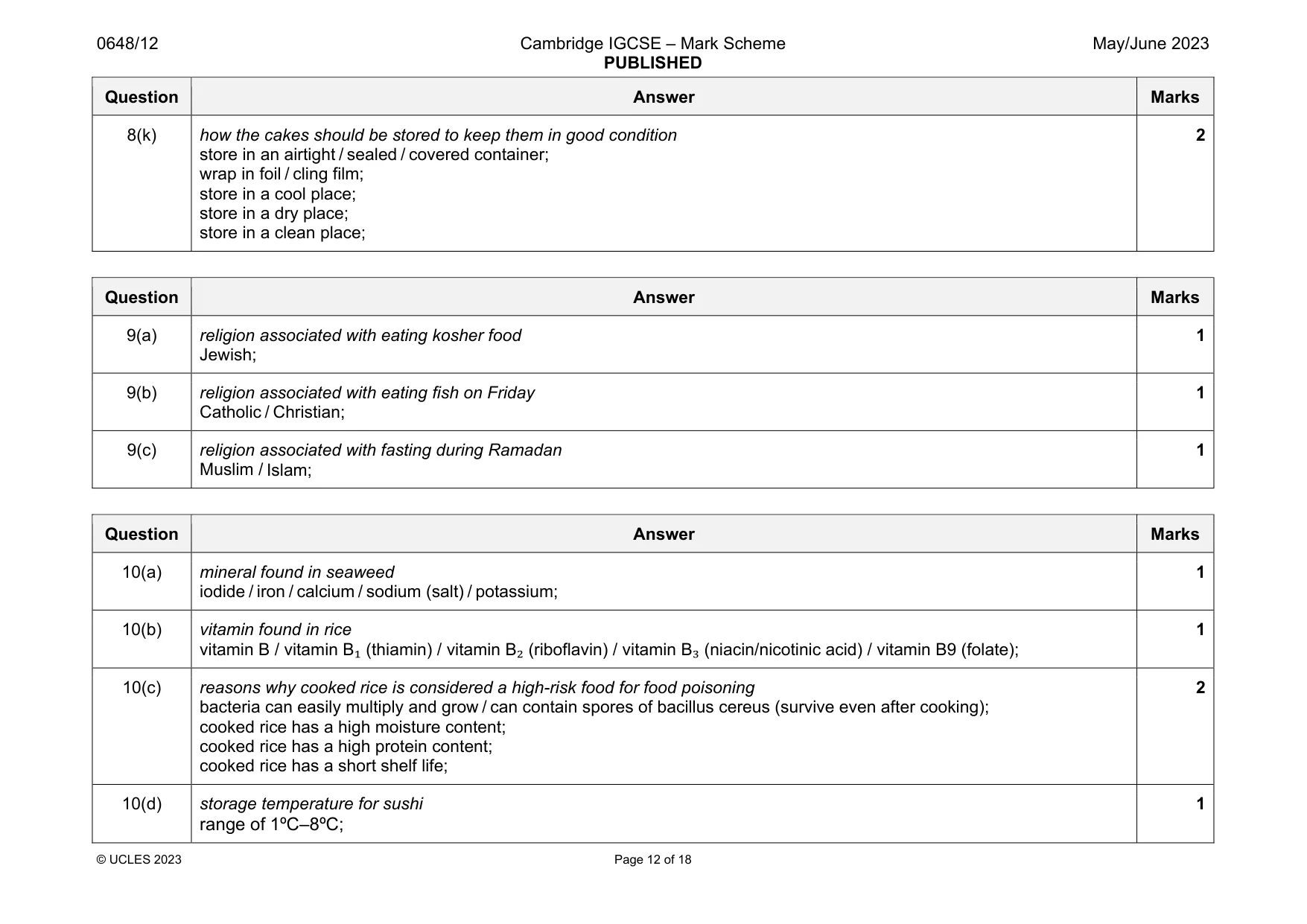
0648/12 Cambridge IGCSE – Mark Scheme PUBLISHED May/June 2023 © UCLES 2023 Page 12 of 18 Question Answer Marks 8(k) how the cakes should be stored to keep them in good condition store in an airtight / sealed / covered container; wrap in foil / cling film; store in a cool place; store in a dry place; store in a clean place; 2 Question Answer Marks 9(a) religion associated with eating kosher food Jewish; 1 9(b) religion associated with eating fish on Friday Catholic / Christian; 1 9(c) religion associated with fasting during Ramadan Muslim / Islam; 1 Question Answer Marks 10(a) mineral found in seaweed iodide / iron / calcium / sodium (salt) / potassium; 1 10(b) vitamin found in rice vitamin B / vitamin B₁ (thiamin) / vitamin B₂ (riboflavin) / vitamin B₃ (niacin/nicotinic acid) / vitamin B9 (folate); 1 10(c) reasons why cooked rice is considered a high-risk food for food poisoning bacteria can easily multiply and grow / can contain spores of bacillus cereus (survive even after cooking); cooked rice has a high moisture content; cooked rice has a high protein content; cooked rice has a short shelf life; 2 10(d) storage temperature for sushi range of 1ºC–8ºC; 1
Mark scheme, page 13
0648/12 Cambridge IGCSE – Mark Scheme PUBLISHED May/June 2023 © UCLES 2023 Page 13 of 18 Question Answer Marks 10(e) shellfish that can be used to make sushi abalone; clam / geoduck; cockles; crab; crayfish; cuttlefish; langoustine / scampi; lobster; mussels; octopus; oyster; prawns; scallops; sea urchin; shrimp; squid / kanava / calamari; 3 Question Answers Marks 11(a) conditions required for yeast to ferment warmth / room temperature; moisture; food; time; 2 11(b) gas yeast produces during the process of fermentation carbon dioxide; 1
Mark scheme, page 14
0648/12 Cambridge IGCSE – Mark Scheme PUBLISHED May/June 2023 © UCLES 2023 Page 14 of 18 Question Answer Marks 12(a) other materials that can be used to package convenience food ceramic / china; glass; metal / steel / aluminium; paper / paperboard / cardboard; 2 12(b) reasons why plastic is a suitable material for packaging convenience food can be coloured; can be fused to seal / made airtight; can be moulded into different shapes; can be printed on so no label needed; can be rigid or flexible; can be used in freezer / resistant to low temperatures; can be used in microwave / oven / can be cooked in; cheap in comparison to metal, glass; lightweight; recyclable; resistant to moisture / impermeable; thin but very strong / durable; transparent / see through / can see contents; 6
Mark scheme, page 15
0648/12 Cambridge IGCSE – Mark Scheme PUBLISHED May/June 2023 © UCLES 2023 Page 15 of 18 Question Answer Marks 13 Fats and oils are an important commodity. Discuss the uses of fats and oils in the preparation and cooking of family meals. Discuss ways to reduce saturated fat intake when preparing and cooking family meals. uses of fats and oils in family meals [8 marks max] aeration fat traps air when creamed with sugar in cake-making / when rubbing in with flour for shortcrust pastry; anti-staling, improves keeping quality / shelf life of rich cakes, e.g. Christmas cake remains moist; as an ingredient in dressings such as French dressing / provides a temporary emulsion; basting with fat adds moisture to meat cooked by dry heat / grilled / roasted; decorating as in butter icing; fats and oils add colour when fried food becomes golden / in cakes / pastries / caramelising; fats and oils add flavour such as butter used in cake / pastry making spread on bread / sesame oil when stir-frying / butter in mashed potato; fats help develop flakiness when making flaky or puff pastry or biscuits; form a permanent emulsion by mixing together two ingredients which would not normally combine as in mayonnaise / ice- cream / creamed mixture; frying food in fat or oil as a method of cooking, stir, sauté, shallow, deep; gives a glossy appearance / creamy texture as when making a sauce; glazes food and gives a glossy appearance such as melted butter on asparagus, new potatoes, carrots; lubricates dry food such as spreading on bread / toast / crackers making them easier to eat and swallow; prevents sticking on cake tins when brushed before baking / when cooking pasta; sealing or preservation when using melted butter / margarine on pate to retain moisture; shortening, the fat gives product ‘short’ crumbly texture of shortcrust pastry / rock buns; 15
Mark scheme, page 16
0648/12 Cambridge IGCSE – Mark Scheme PUBLISHED May/June 2023 © UCLES 2023 Page 16 of 18 Question Answer Marks 13 reduce saturated fat intake [8 marks max] don’t add extra fat to food e.g. glazing vegetables with butter / mashing potatoes with butter and cream; flavour foods with herbs and spices instead of sauces containing butter; grill / bake / poach / steam/microwave / stir-fry/ air-fry rather than fry / roast to prevent addition of extra saturated fat; have pies with only one crust rather than two (either a lid or a base); use less meat in casseroles and stews / eat smaller portions of red meat / add extra vegetables / pulses / TVP/ Quorn; when making sandwiches spread butter thinly or use unsaturated spread; eat red meat only occasionally / eat fish, poultry, pulses, TVP, Quorn etc. in place of red meat; read labels carefully to check saturated fat content; increase consumption of home-made meals / reduce consumption of ready-made or processed meals which may have high saturated fat content; use vegetable oils such as sunflower or olive oil instead of saturated fats such as butter / lard / dripping; replace cream or soured cream with yoghurt / fromage frais / crème fraîche in recipes; choose low-fat versions of dairy products like milk / cheese / yoghurt / cream; select lean cuts of meat to avoid unnecessary saturated fat; trim off any visible fat from meat / remove skin from poultry to avoid including saturated fat; do not fry foods in lard / butter / dripping use plant oils (or named e.g. sunflower oil); eat fewer eggs as these are high in saturated fat;
Mark scheme, page 17
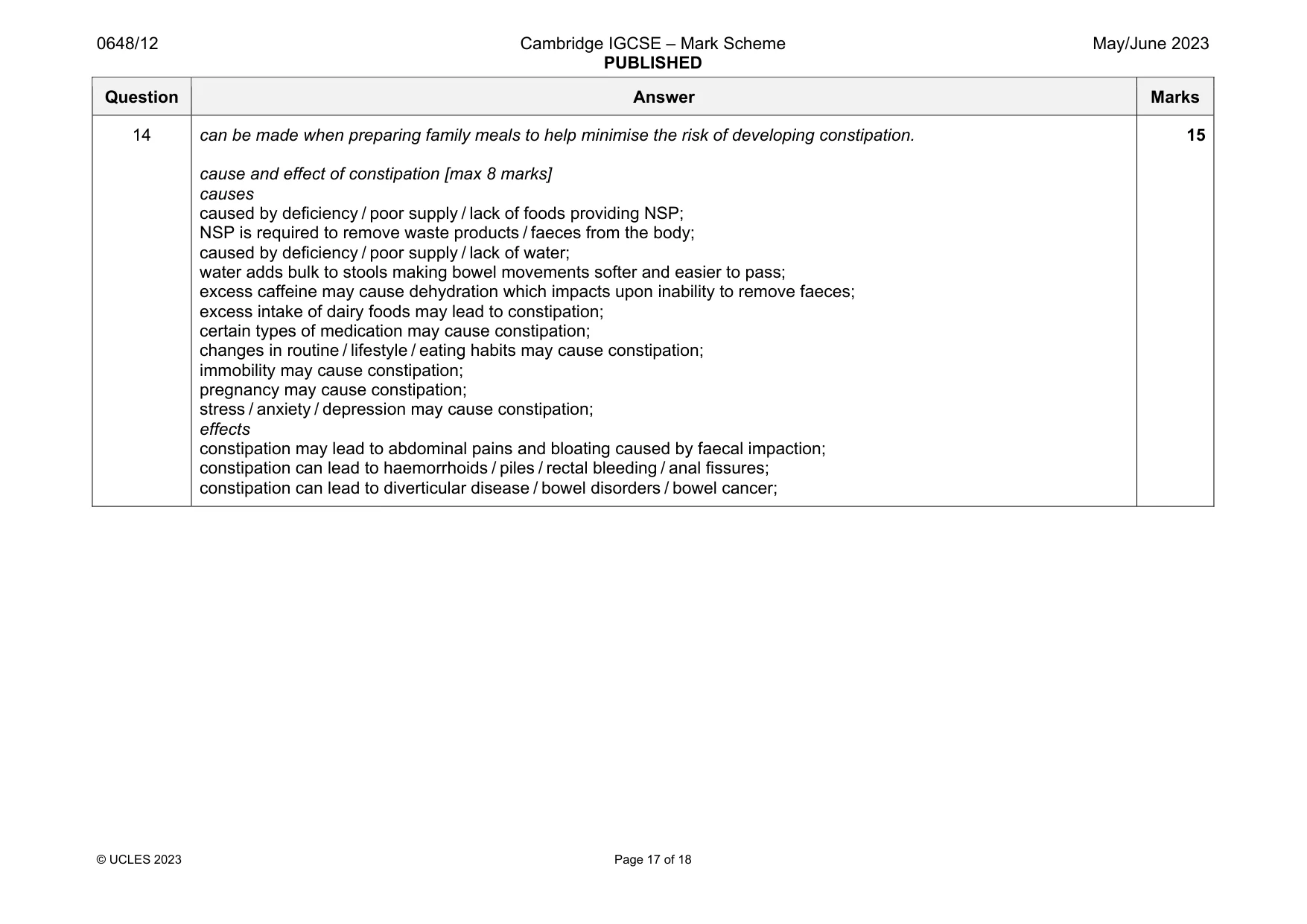
0648/12 Cambridge IGCSE – Mark Scheme PUBLISHED May/June 2023 © UCLES 2023 Page 17 of 18 Question Answer Marks 14 can be made when preparing family meals to help minimise the risk of developing constipation. cause and effect of constipation [max 8 marks] causes caused by deficiency / poor supply / lack of foods providing NSP; NSP is required to remove waste products / faeces from the body; caused by deficiency / poor supply / lack of water; water adds bulk to stools making bowel movements softer and easier to pass; excess caffeine may cause dehydration which impacts upon inability to remove faeces; excess intake of dairy foods may lead to constipation; certain types of medication may cause constipation; changes in routine / lifestyle / eating habits may cause constipation; immobility may cause constipation; pregnancy may cause constipation; stress / anxiety / depression may cause constipation; effects constipation may lead to abdominal pains and bloating caused by faecal impaction; constipation can lead to haemorrhoids / piles / rectal bleeding / anal fissures; constipation can lead to diverticular disease / bowel disorders / bowel cancer; 15
Mark scheme, page 18
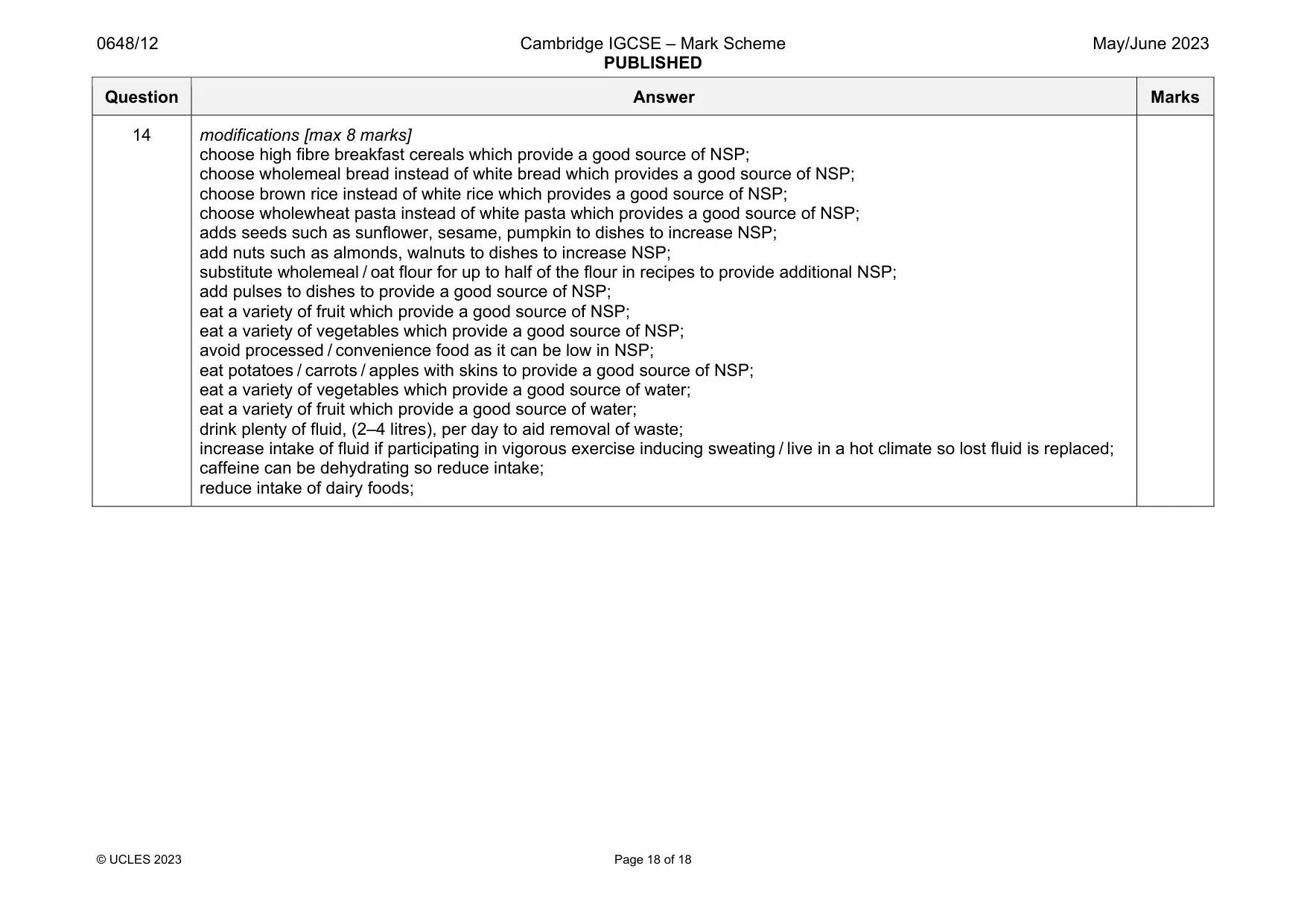
0648/12 Cambridge IGCSE – Mark Scheme PUBLISHED May/June 2023 © UCLES 2023 Page 18 of 18 Question Answer Marks 14 modifications [max 8 marks] choose high fibre breakfast cereals which provide a good source of NSP; choose wholemeal bread instead of white bread which provides a good source of NSP; choose brown rice instead of white rice which provides a good source of NSP; choose wholewheat pasta instead of white pasta which provides a good source of NSP; adds seeds such as sunflower, sesame, pumpkin to dishes to increase NSP; add nuts such as almonds, walnuts to dishes to increase NSP; substitute wholemeal / oat flour for up to half of the flour in recipes to provide additional NSP; add pulses to dishes to provide a good source of NSP; eat a variety of fruit which provide a good source of NSP; eat a variety of vegetables which provide a good source of NSP; avoid processed / convenience food as it can be low in NSP; eat potatoes / carrots / apples with skins to provide a good source of NSP; eat a variety of vegetables which provide a good source of water; eat a variety of fruit which provide a good source of water; drink plenty of fluid, (2–4 litres), per day to aid removal of waste; increase intake of fluid if participating in vigorous exercise inducing sweating / live in a hot climate so lost fluid is replaced; caffeine can be dehydrating so reduce intake; reduce intake of dairy foods;
What you needed in this session
Cambridge’s own grade thresholds for 2023 May/June, Paper 1 · Variant 2. A higher threshold means an easier paper — the bar moves with how the cohort did.