Cambridge IGCSE Food and Nutrition 0648 — 2019 May/June Paper 1 · Variant 2
0648/12/M/J/19 · 100 marks · ≈113 min
The question paper and its mark scheme, free to read here and free to download. This is Cambridge’s own paper, exactly as it was sat.
Question paper12 pages

Mark scheme19 pages
Answers below. Sit the paper first if you are practising.
Paper as text
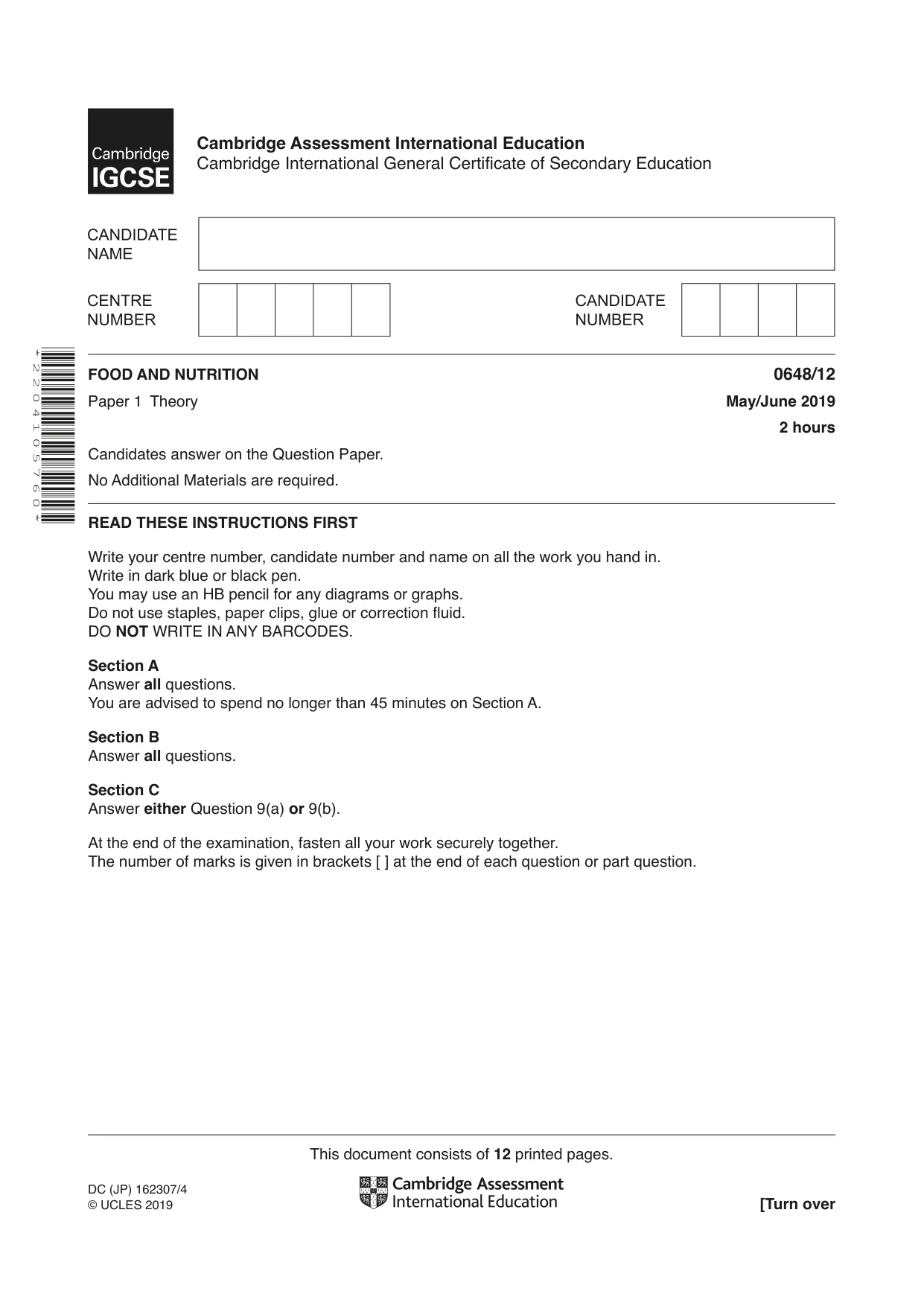
Question paper, page 1
This document consists of 12 printed pages. DC (JP) 162307/4 © UCLES 2019 [Turn over Cambridge Assessment International Education Cambridge International General Certificate of Secondary Education * 2 2 0 4 1 0 5 7 6 0 * FOOD AND NUTRITION 0648/12 Paper 1 Theory May/June 2019 2 hours Candidates answer on the Question Paper. No Additional Materials are required. READ THESE INSTRUCTIONS FIRST Write your centre number, candidate number and name on all the work you hand in. Write in dark blue or black pen. You may use an HB pencil for any diagrams or graphs. Do not use staples, paper clips, glue or correction fluid. DO NOT WRITE IN ANY BARCODES. Section A Answer all questions. You are advised to spend no longer than 45 minutes on Section A. Section B Answer all questions. Section C Answer either Question 9(a) or 9(b). At the end of the examination, fasten all your work securely together. The number of marks is given in brackets [ ] at the end of each question or part question.
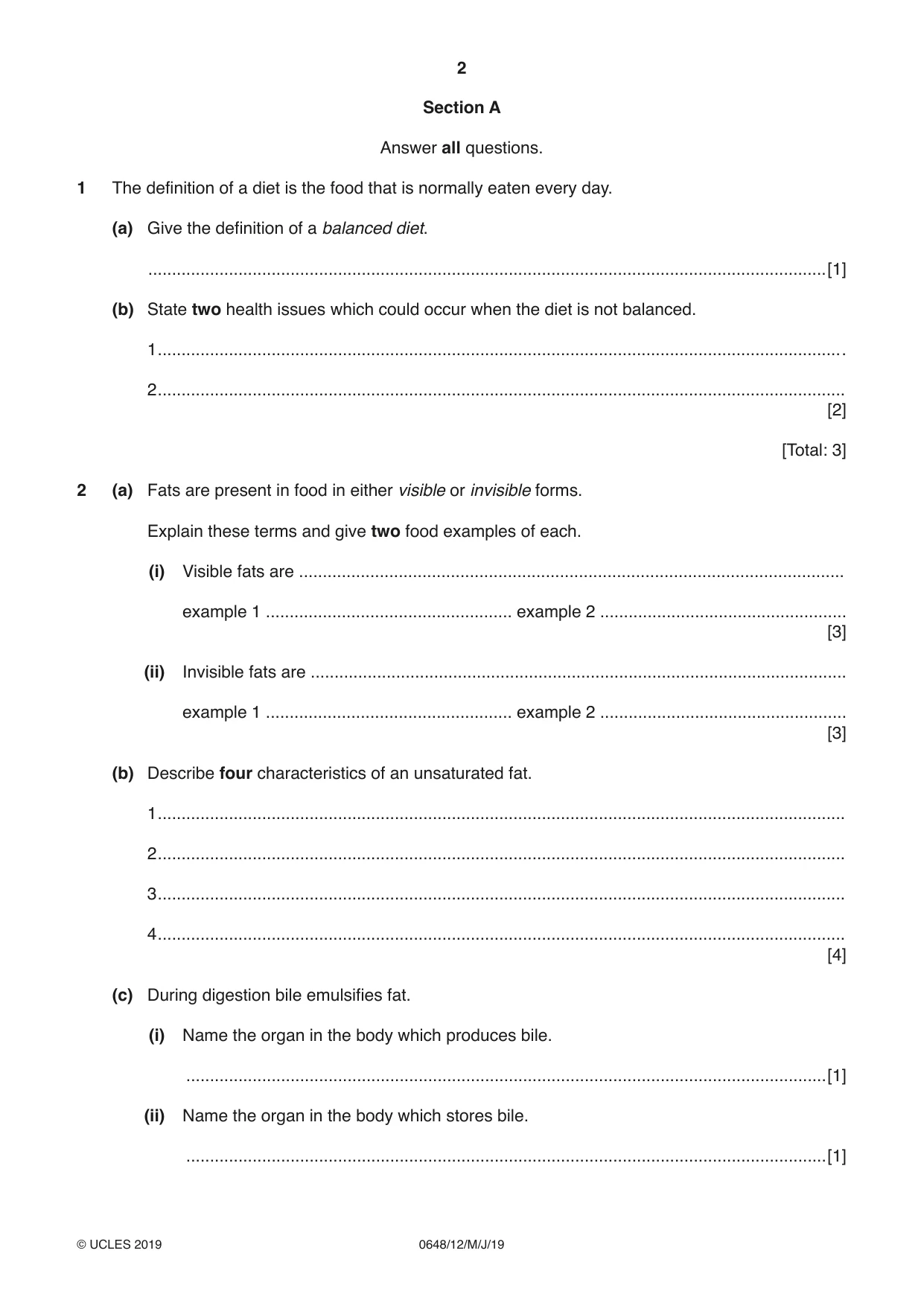
Question paper, page 2
2 0648/12/M/J/19 © UCLES 2019 Section A Answer all questions. 1 The definition of a diet is the food that is normally eaten every day. (a) Give the definition of a balanced diet. …[1] (b) State two health issues which could occur when the diet is not balanced. 1 … 2 … [2] [Total: 3] 2 (a) Fats are present in food in either visible or invisible forms. Explain these terms and give two food examples of each. (i) Visible fats are … example 1 … example 2 … [3] (ii) Invisible fats are … example 1 … example 2 … [3] (b) Describe four characteristics of an unsaturated fat. 1 … 2 … 3 … 4 … [4] (c) During digestion bile emulsifies fat. (i) Name the organ in the body which produces bile. …[1] (ii) Name the organ in the body which stores bile. …[1]
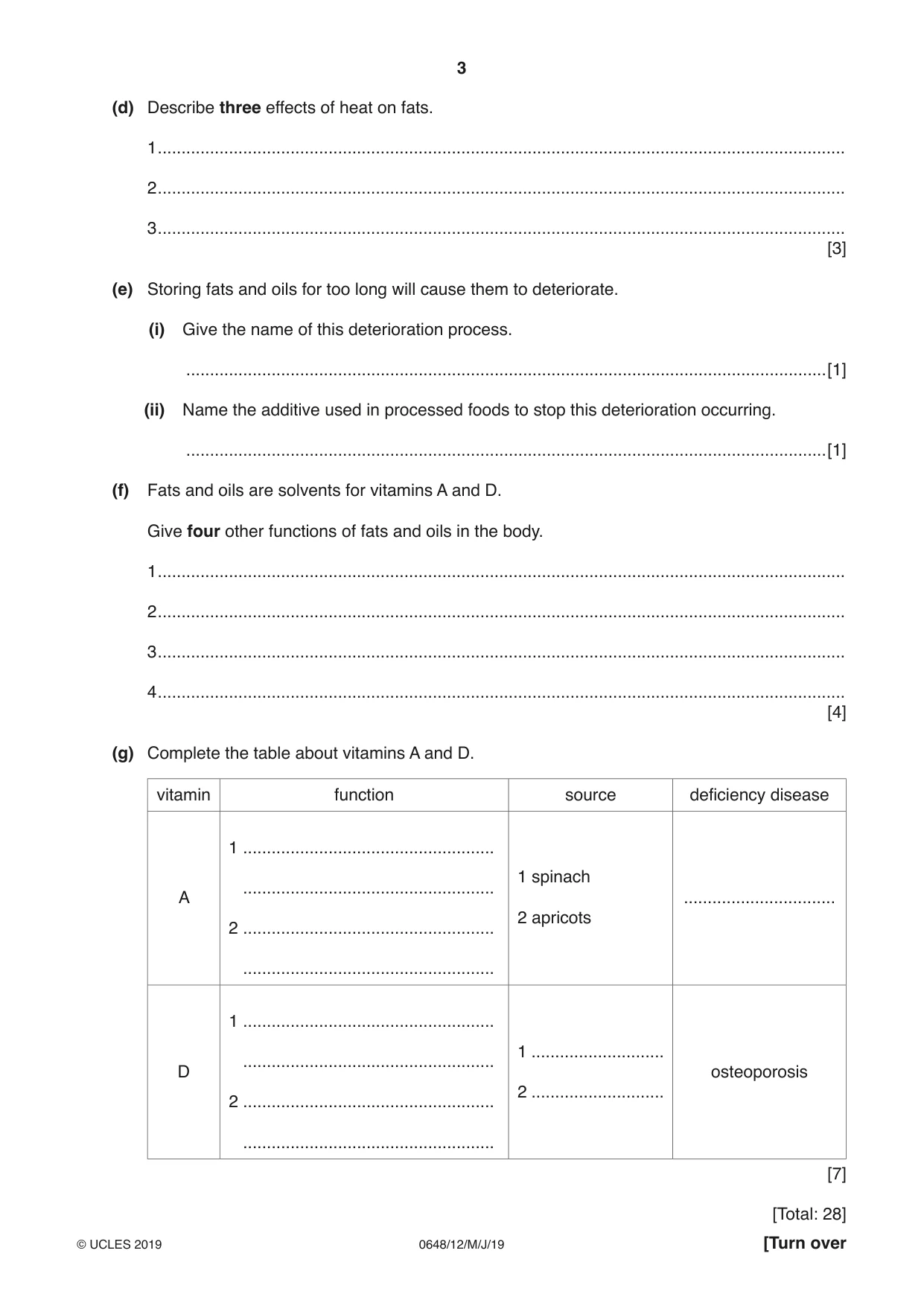
Question paper, page 3
3 0648/12/M/J/19 © UCLES 2019 [Turn over (d) Describe three effects of heat on fats. 1 … 2 … 3 … [3] (e) Storing fats and oils for too long will cause them to deteriorate. (i) Give the name of this deterioration process. …[1] (ii) Name the additive used in processed foods to stop this deterioration occurring. …[1] (f) Fats and oils are solvents for vitamins A and D. Give four other functions of fats and oils in the body. 1 … 2 … 3 … 4 … [4] (g) Complete the table about vitamins A and D. vitamin function source deficiency disease A 1 … … 2 … … 1 spinach 2 apricots … D 1 … … 2 … … 1 … 2 … osteoporosis [7] [Total: 28]
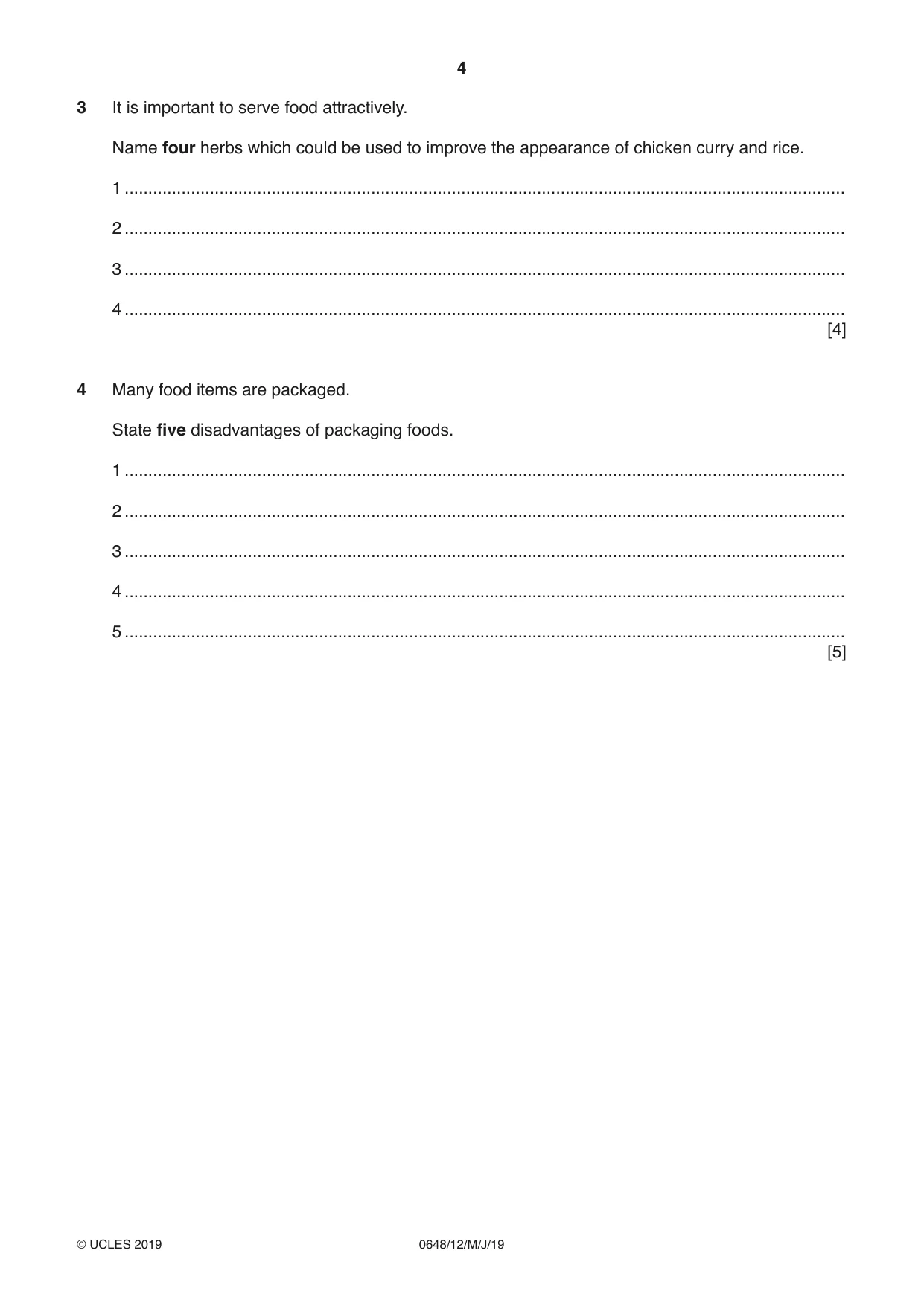
Question paper, page 4
4 0648/12/M/J/19 © UCLES 2019 3 It is important to serve food attractively. Name four herbs which could be used to improve the appearance of chicken curry and rice. 1 … 2 … 3 … 4 … [4] 4 Many food items are packaged. State five disadvantages of packaging foods. 1 … 2 … 3 … 4 … 5 … [5]
Question paper, page 5
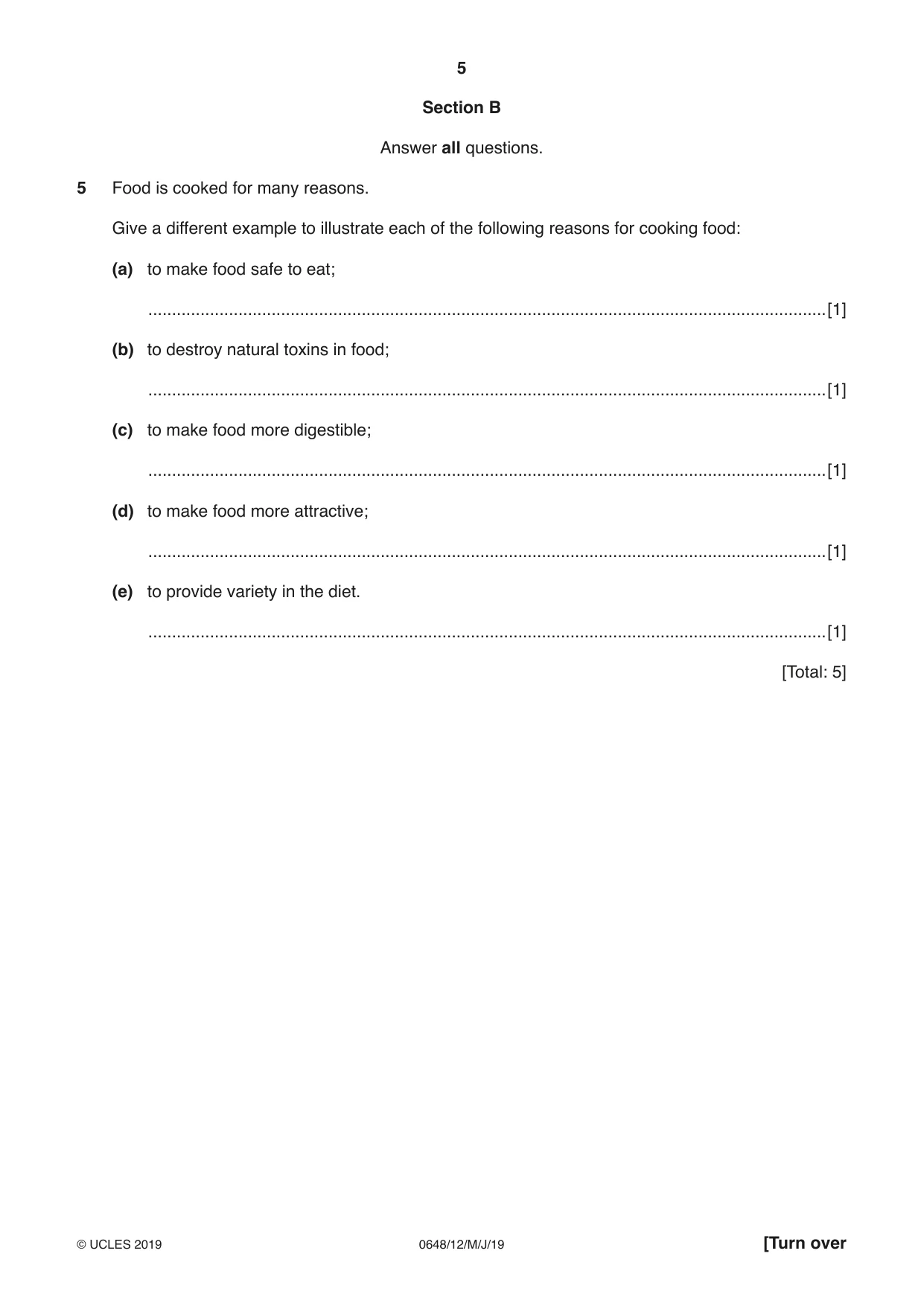
5 0648/12/M/J/19 © UCLES 2019 [Turn over Section B Answer all questions. 5 Food is cooked for many reasons. Give a different example to illustrate each of the following reasons for cooking food: (a) to make food safe to eat; …[1] (b) to destroy natural toxins in food; …[1] (c) to make food more digestible; …[1] (d) to make food more attractive; …[1] (e) to provide variety in the diet. …[1] [Total: 5]
Question paper, page 6
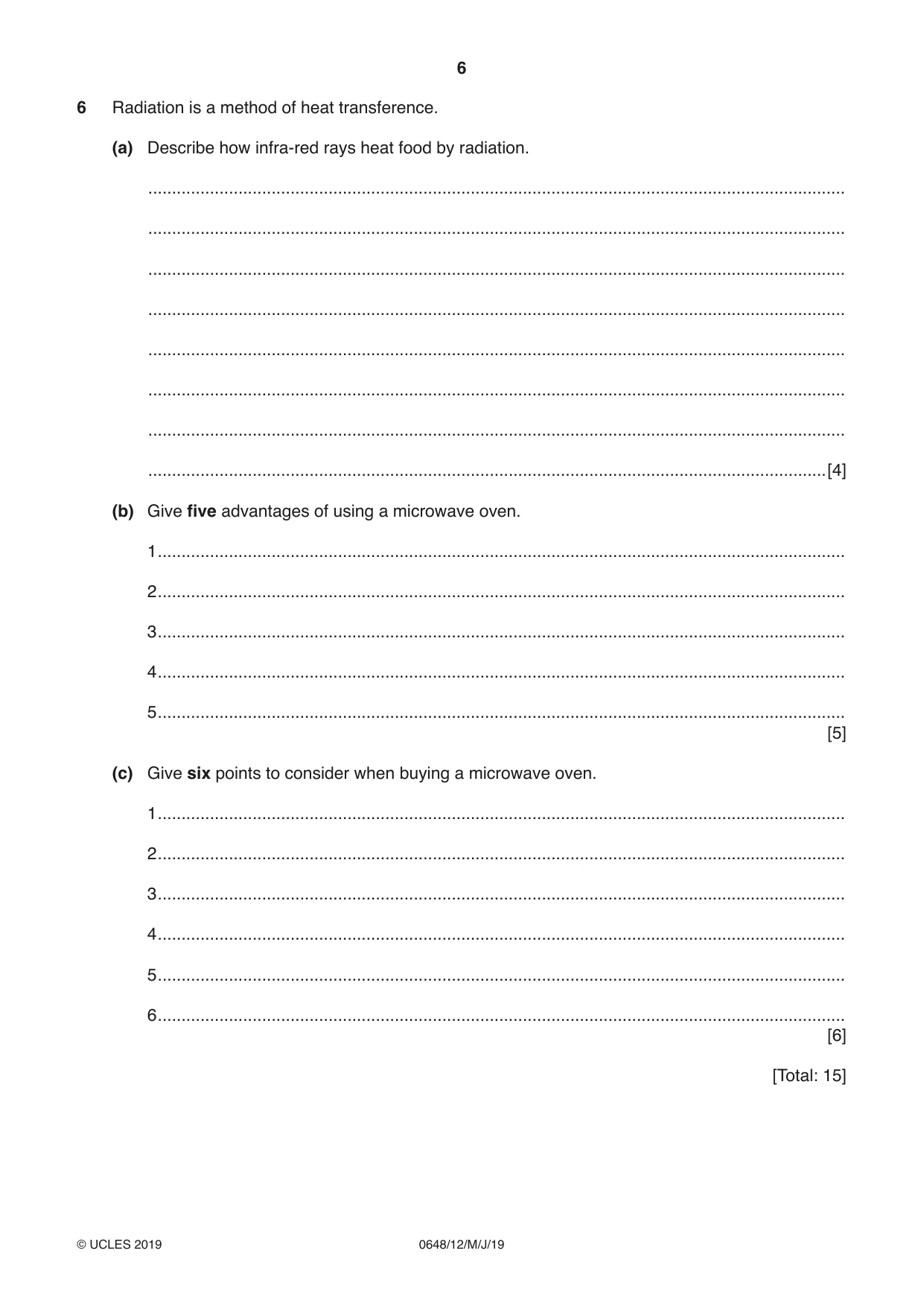
6 0648/12/M/J/19 © UCLES 2019 6 Radiation is a method of heat transference. (a) Describe how infra-red rays heat food by radiation. … … … … … … … …[4] (b) Give five advantages of using a microwave oven. 1 … 2 … 3 … 4 … 5 … [5] (c) Give six points to consider when buying a microwave oven. 1 … 2 … 3 … 4 … 5 … 6 … [6] [Total: 15]
Question paper, page 7
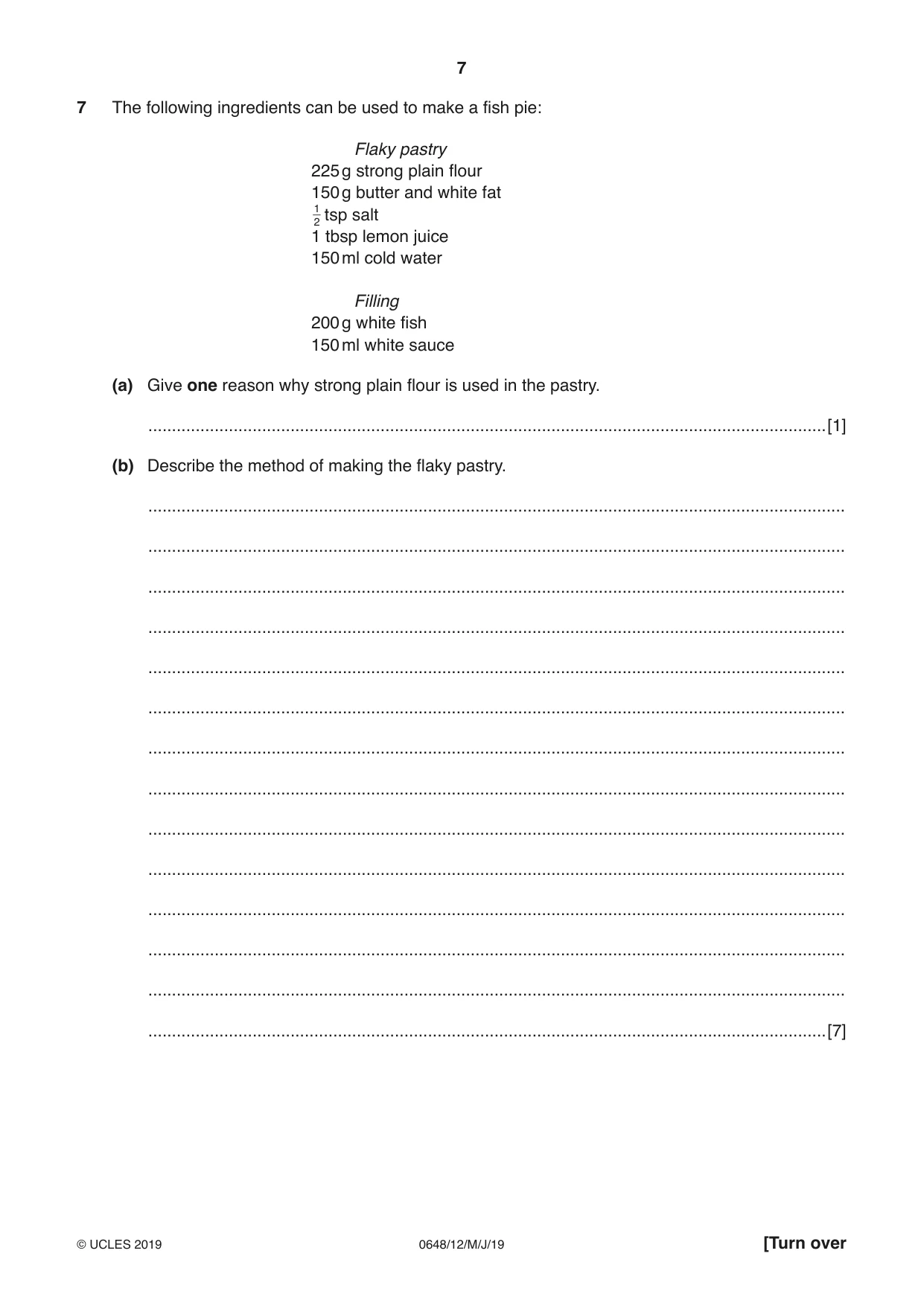
7 0648/12/M/J/19 © UCLES 2019 [Turn over 7 The following ingredients can be used to make a fish pie: Flaky pastry 225 g strong plain flour 150 g butter and white fat 2 1 tsp salt 1 tbsp lemon juice 150 ml cold water Filling 200 g white fish 150 ml white sauce (a) Give one reason why strong plain flour is used in the pastry. …[1] (b) Describe the method of making the flaky pastry. … … … … … … … … … … … … … …[7]
Question paper, page 8
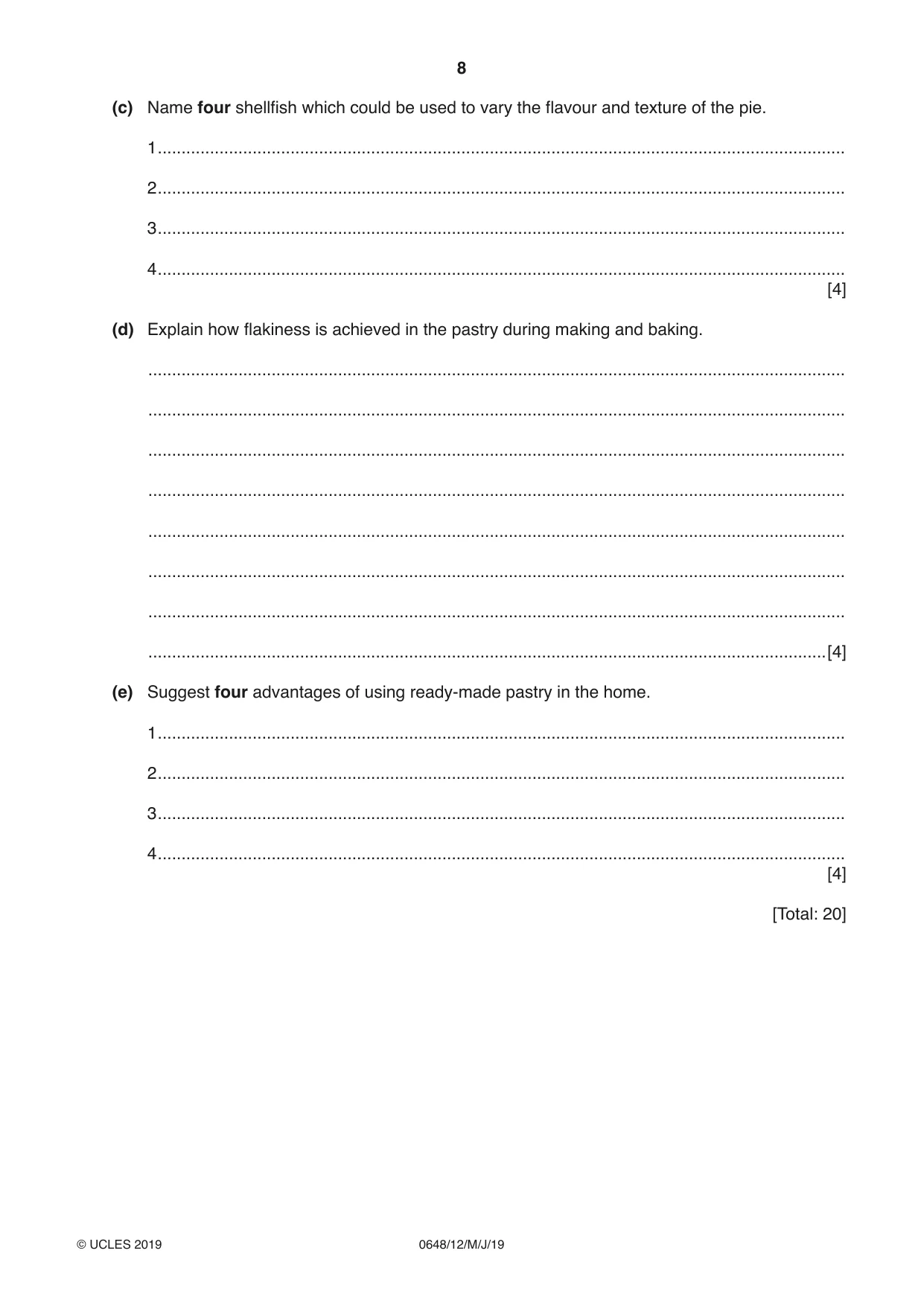
8 0648/12/M/J/19 © UCLES 2019 (c) Name four shellfish which could be used to vary the flavour and texture of the pie. 1 … 2 … 3 … 4 … [4] (d) Explain how flakiness is achieved in the pastry during making and baking. … … … … … … … …[4] (e) Suggest four advantages of using ready-made pastry in the home. 1 … 2 … 3 … 4 … [4] [Total: 20]
Question paper, page 9
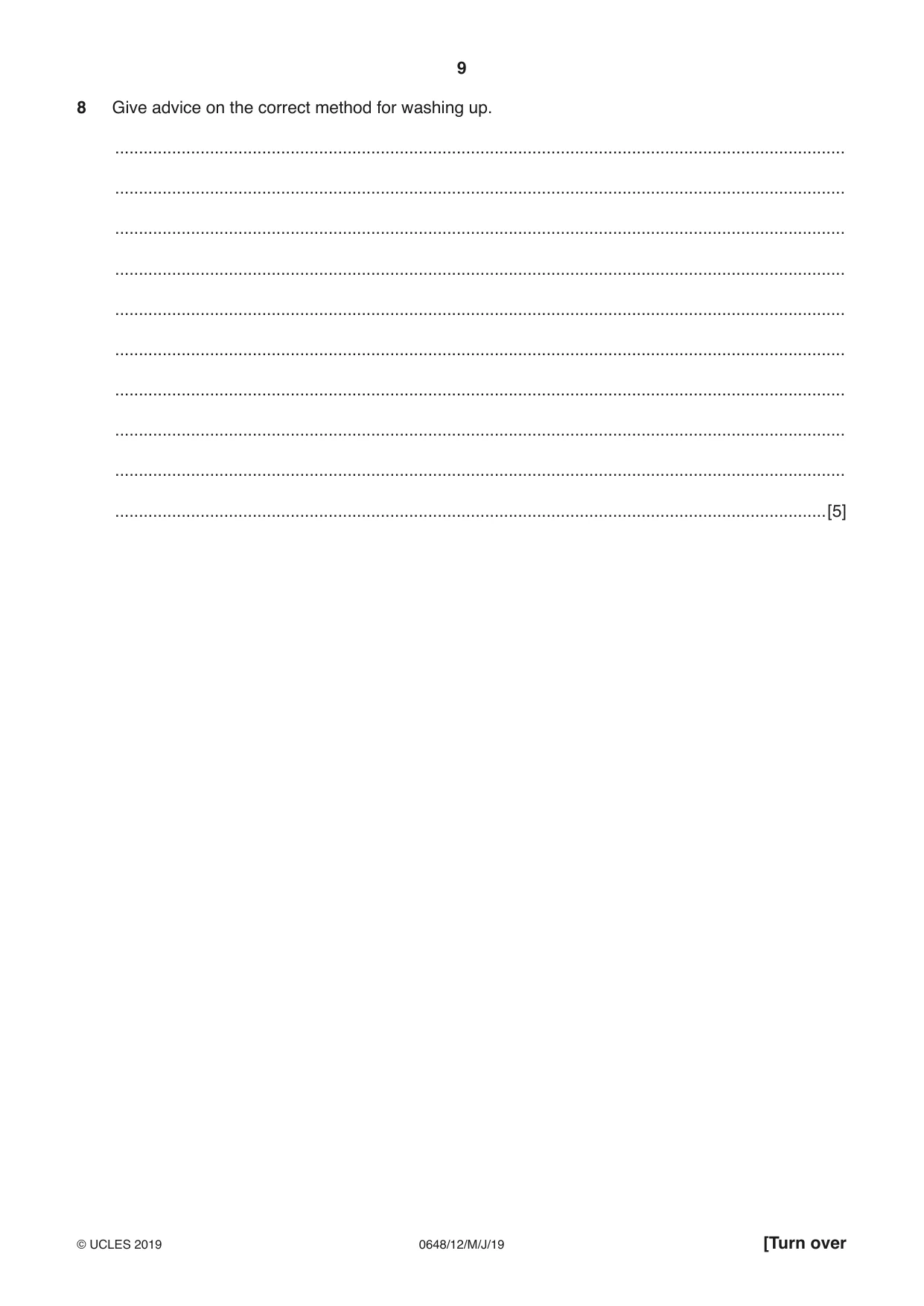
9 0648/12/M/J/19 © UCLES 2019 [Turn over 8 Give advice on the correct method for washing up. … … … … … … … … … …[5]
Question paper, page 10
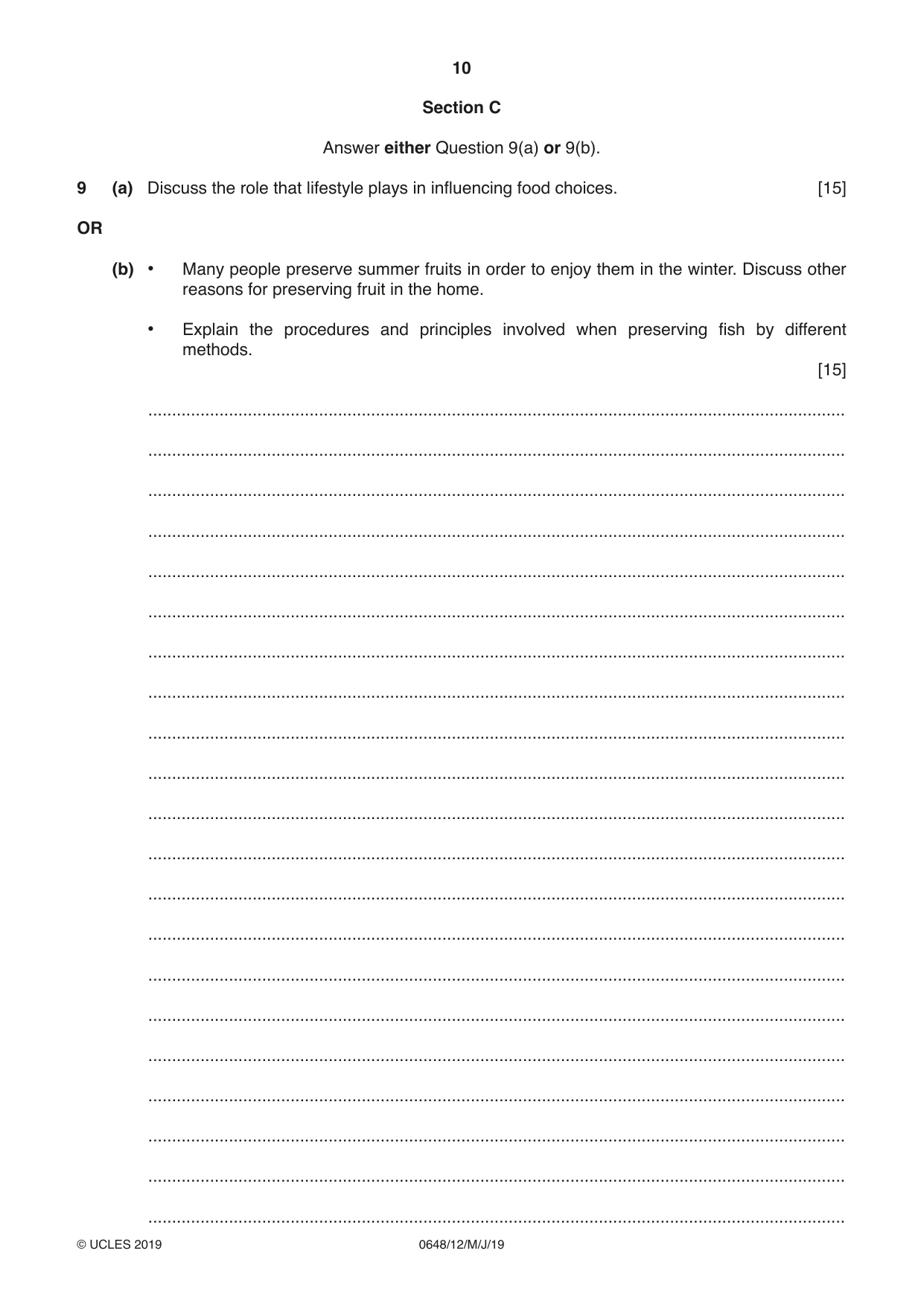
10 0648/12/M/J/19 © UCLES 2019 Section C Answer either Question 9(a) or 9(b). 9 (a) Discuss the role that lifestyle plays in influencing food choices. [15] OR (b) • Many people preserve summer fruits in order to enjoy them in the winter. Discuss other reasons for preserving fruit in the home. • Explain the procedures and principles involved when preserving fish by different methods. [15] … … … … … … … … … … … … … … … … … … … … …
Question paper, page 11
11 0648/12/M/J/19 © UCLES 2019 [Turn over … … … … … … … … … … … … … … … … … … … … … … … … … … … …
Question paper, page 12
12 0648/12/M/J/19 © UCLES 2019 Permission to reproduce items where third-party owned material protected by copyright is included has been sought and cleared where possible. Every reasonable effort has been made by the publisher (UCLES) to trace copyright holders, but if any items requiring clearance have unwittingly been included, the publisher will be pleased to make amends at the earliest possible opportunity. To avoid the issue of disclosure of answer-related information to candidates, all copyright acknowledgements are reproduced online in the Cambridge Assessment International Education Copyright Acknowledgements Booklet. This is produced for each series of examinations and is freely available to download at www.cambridgeinternational.org after the live examination series. Cambridge Assessment International Education is part of the Cambridge Assessment Group. Cambridge Assessment is the brand name of the University of Cambridge Local Examinations Syndicate (UCLES), which itself is a department of the University of Cambridge. … … … … … … … … … … … … … … … … … … … … … … …
Mark scheme, page 1
This document consists of 19 printed pages. © UCLES 2019 [Turn over Cambridge Assessment International Education Cambridge International General Certificate of Secondary Education FOOD AND NUTRITION 0648/12 Paper 1 Theory May/June 2019 MARK SCHEME Maximum Mark: 100 Published This mark scheme is published as an aid to teachers and candidates, to indicate the requirements of the examination. It shows the basis on which Examiners were instructed to award marks. It does not indicate the details of the discussions that took place at an Examiners’ meeting before marking began, which would have considered the acceptability of alternative answers. Mark schemes should be read in conjunction with the question paper and the Principal Examiner Report for Teachers. Cambridge International will not enter into discussions about these mark schemes. Cambridge International is publishing the mark schemes for the May/June 2019 series for most Cambridge IGCSE™, Cambridge International A and AS Level and Cambridge Pre-U components, and some Cambridge O Level components.
Mark scheme, page 2
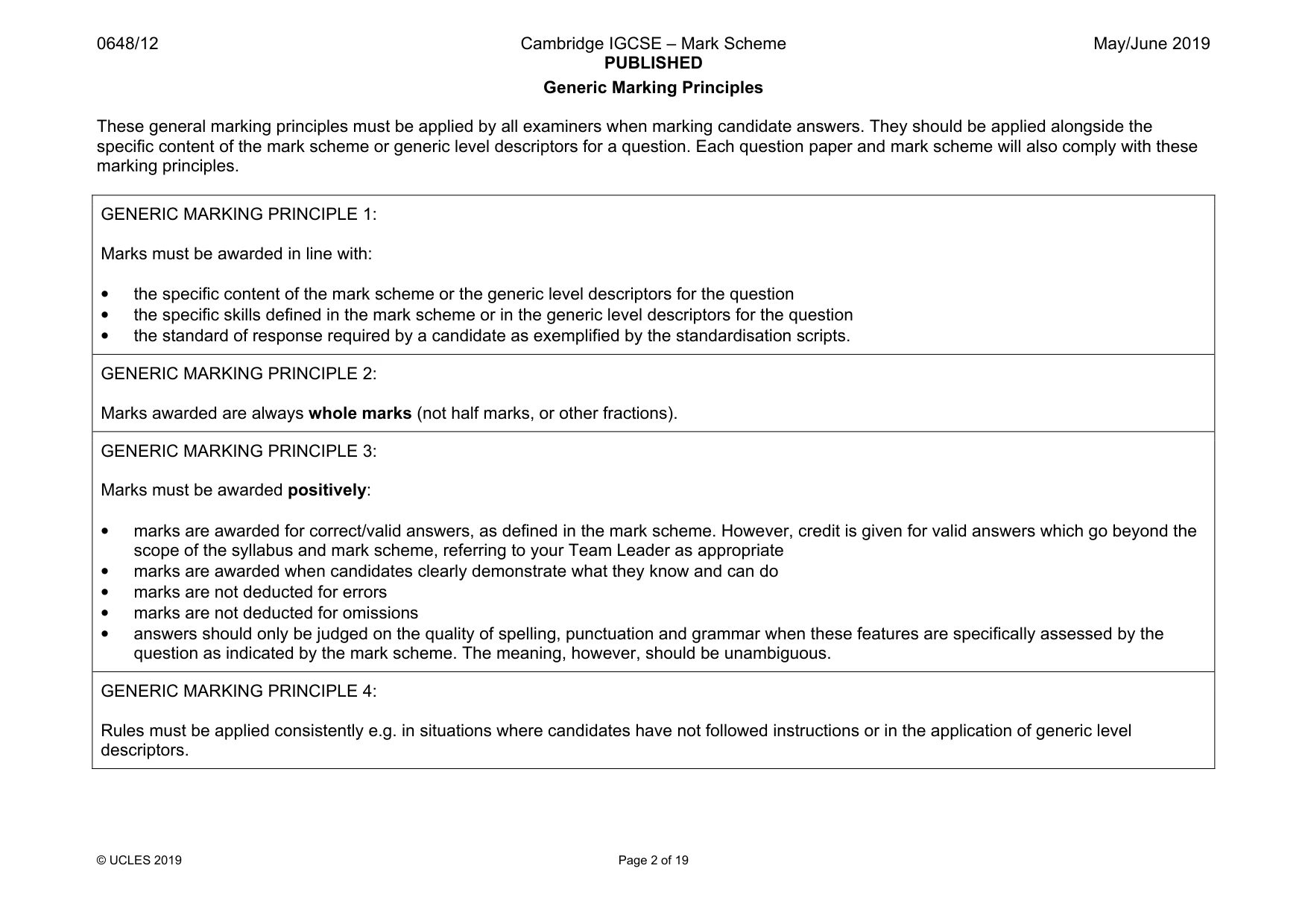
0648/12 Cambridge IGCSE – Mark Scheme PUBLISHED May/June 2019 © UCLES 2019 Page 2 of 19 Generic Marking Principles These general marking principles must be applied by all examiners when marking candidate answers. They should be applied alongside the specific content of the mark scheme or generic level descriptors for a question. Each question paper and mark scheme will also comply with these marking principles. GENERIC MARKING PRINCIPLE 1: Marks must be awarded in line with: • the specific content of the mark scheme or the generic level descriptors for the question • the specific skills defined in the mark scheme or in the generic level descriptors for the question • the standard of response required by a candidate as exemplified by the standardisation scripts. GENERIC MARKING PRINCIPLE 2: Marks awarded are always whole marks (not half marks, or other fractions). GENERIC MARKING PRINCIPLE 3: Marks must be awarded positively: • marks are awarded for correct/valid answers, as defined in the mark scheme. However, credit is given for valid answers which go beyond the scope of the syllabus and mark scheme, referring to your Team Leader as appropriate • marks are awarded when candidates clearly demonstrate what they know and can do • marks are not deducted for errors • marks are not deducted for omissions • answers should only be judged on the quality of spelling, punctuation and grammar when these features are specifically assessed by the question as indicated by the mark scheme. The meaning, however, should be unambiguous. GENERIC MARKING PRINCIPLE 4: Rules must be applied consistently e.g. in situations where candidates have not followed instructions or in the application of generic level descriptors.
Mark scheme, page 3
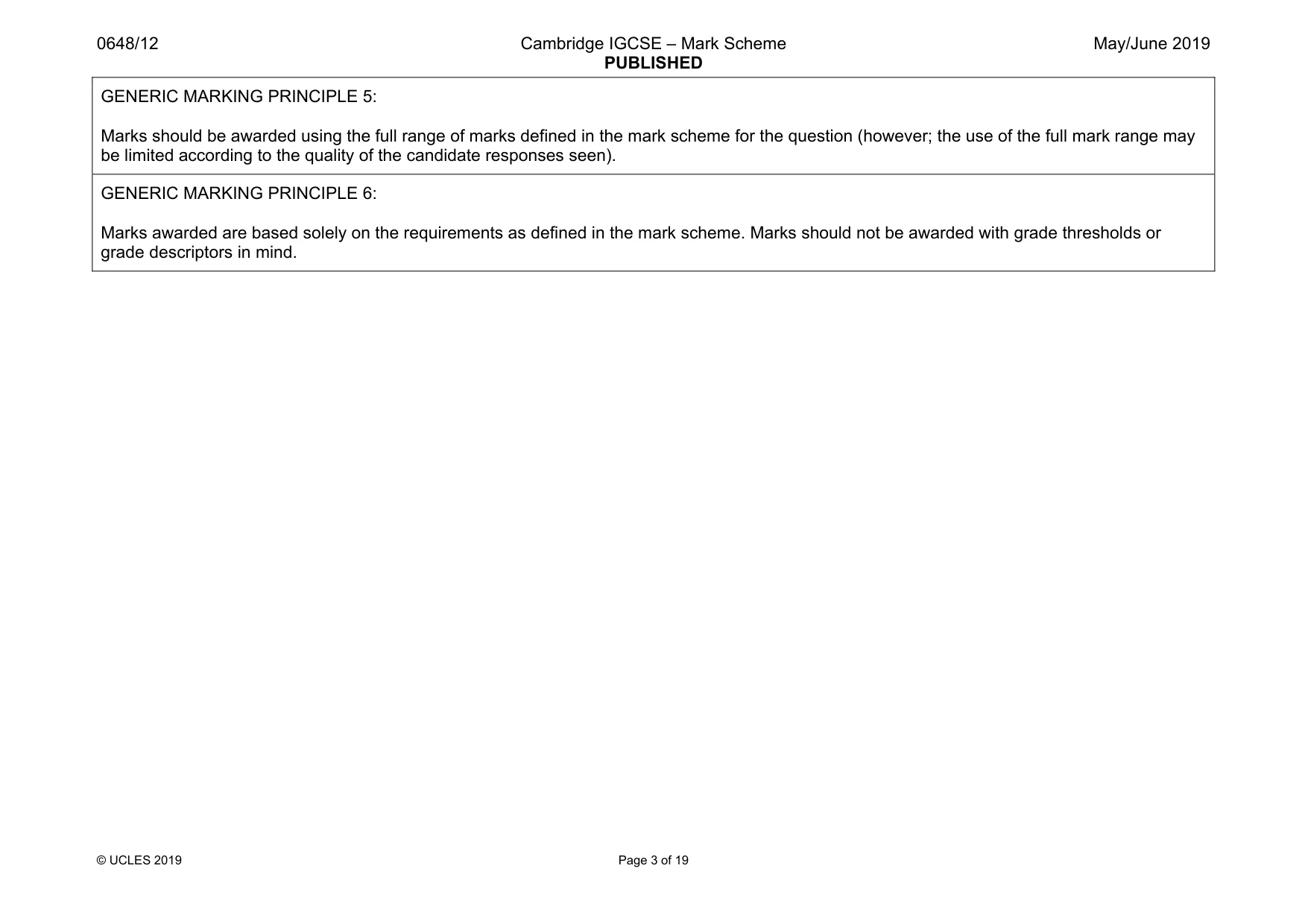
0648/12 Cambridge IGCSE – Mark Scheme PUBLISHED May/June 2019 © UCLES 2019 Page 3 of 19 GENERIC MARKING PRINCIPLE 5: Marks should be awarded using the full range of marks defined in the mark scheme for the question (however; the use of the full mark range may be limited according to the quality of the candidate responses seen). GENERIC MARKING PRINCIPLE 6: Marks awarded are based solely on the requirements as defined in the mark scheme. Marks should not be awarded with grade thresholds or grade descriptors in mind.
Mark scheme, page 4
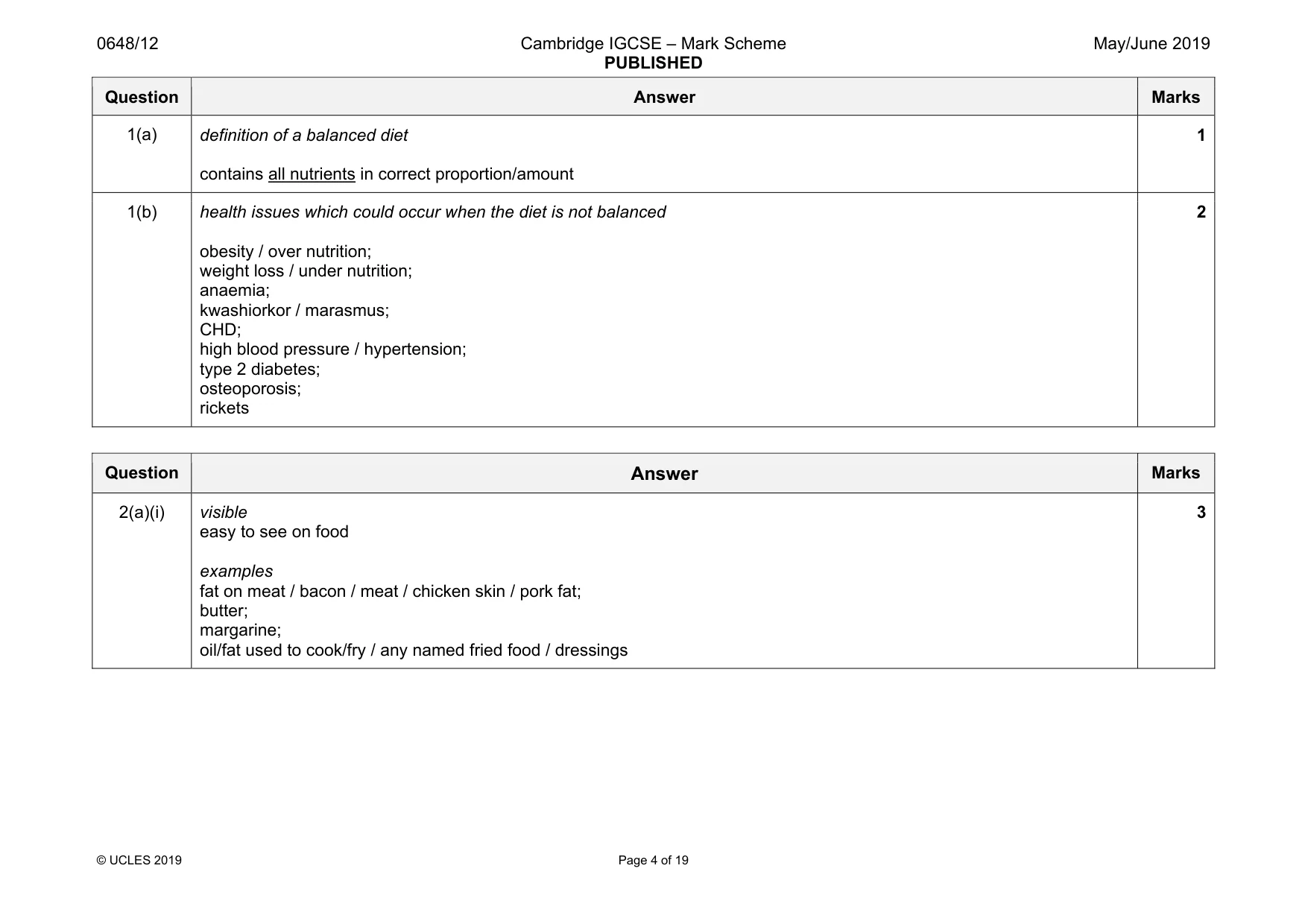
0648/12 Cambridge IGCSE – Mark Scheme PUBLISHED May/June 2019 © UCLES 2019 Page 4 of 19 Question Answer Marks 1(a) definition of a balanced diet contains all nutrients in correct proportion/amount 1 1(b) health issues which could occur when the diet is not balanced obesity / over nutrition; weight loss / under nutrition; anaemia; kwashiorkor / marasmus; CHD; high blood pressure / hypertension; type 2 diabetes; osteoporosis; rickets 2 Question Answer Marks 2(a)(i) visible easy to see on food examples fat on meat / bacon / meat / chicken skin / pork fat; butter; margarine; oil/fat used to cook/fry / any named fried food / dressings 3
Mark scheme, page 5
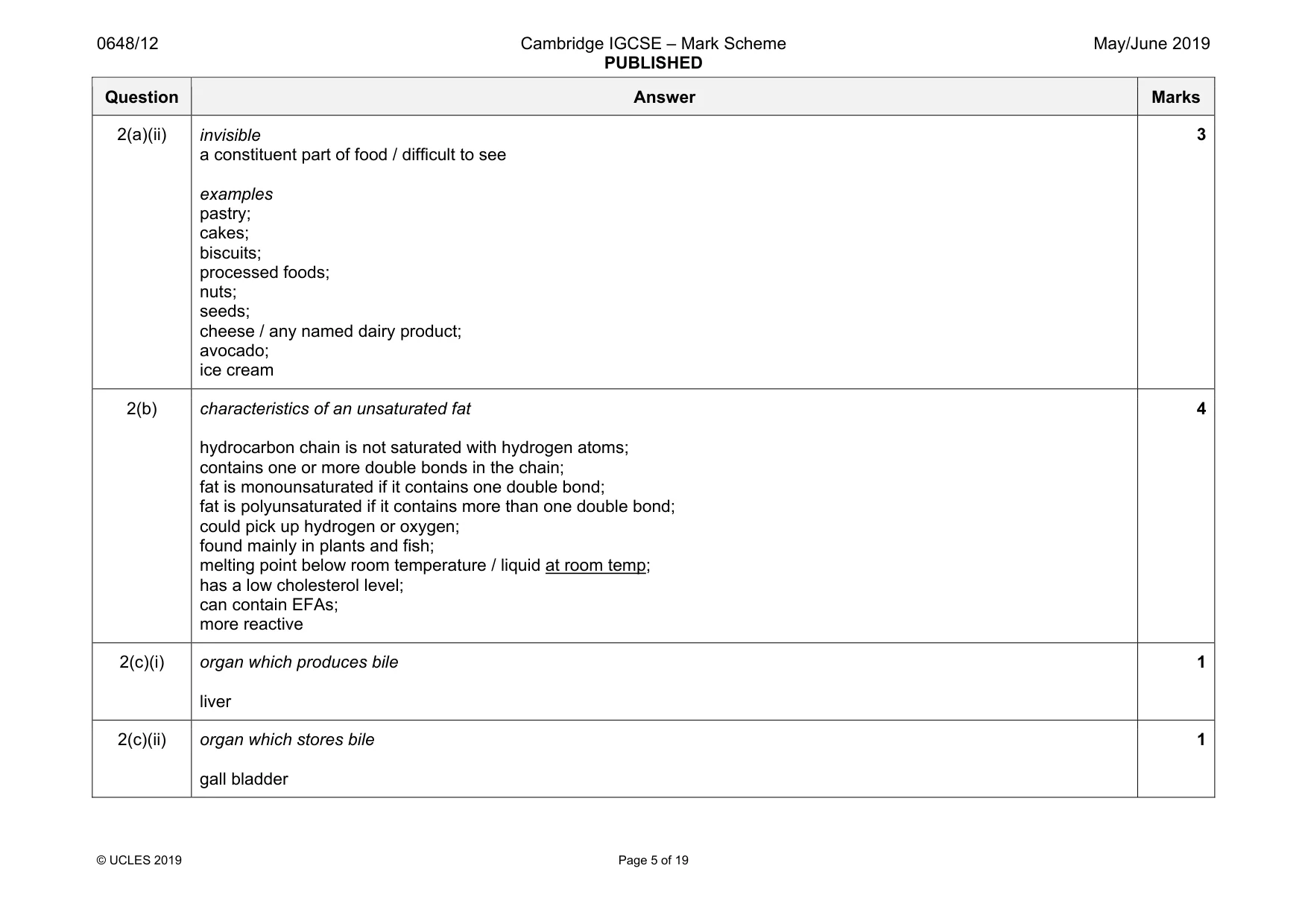
0648/12 Cambridge IGCSE – Mark Scheme PUBLISHED May/June 2019 © UCLES 2019 Page 5 of 19 Question Answer Marks 2(a)(ii) invisible a constituent part of food / difficult to see examples pastry; cakes; biscuits; processed foods; nuts; seeds; cheese / any named dairy product; avocado; ice cream 3 2(b) characteristics of an unsaturated fat hydrocarbon chain is not saturated with hydrogen atoms; contains one or more double bonds in the chain; fat is monounsaturated if it contains one double bond; fat is polyunsaturated if it contains more than one double bond; could pick up hydrogen or oxygen; found mainly in plants and fish; melting point below room temperature / liquid at room temp; has a low cholesterol level; can contain EFAs; more reactive 4 2(c)(i) organ which produces bile liver 1 2(c)(ii) organ which stores bile gall bladder 1
Mark scheme, page 6
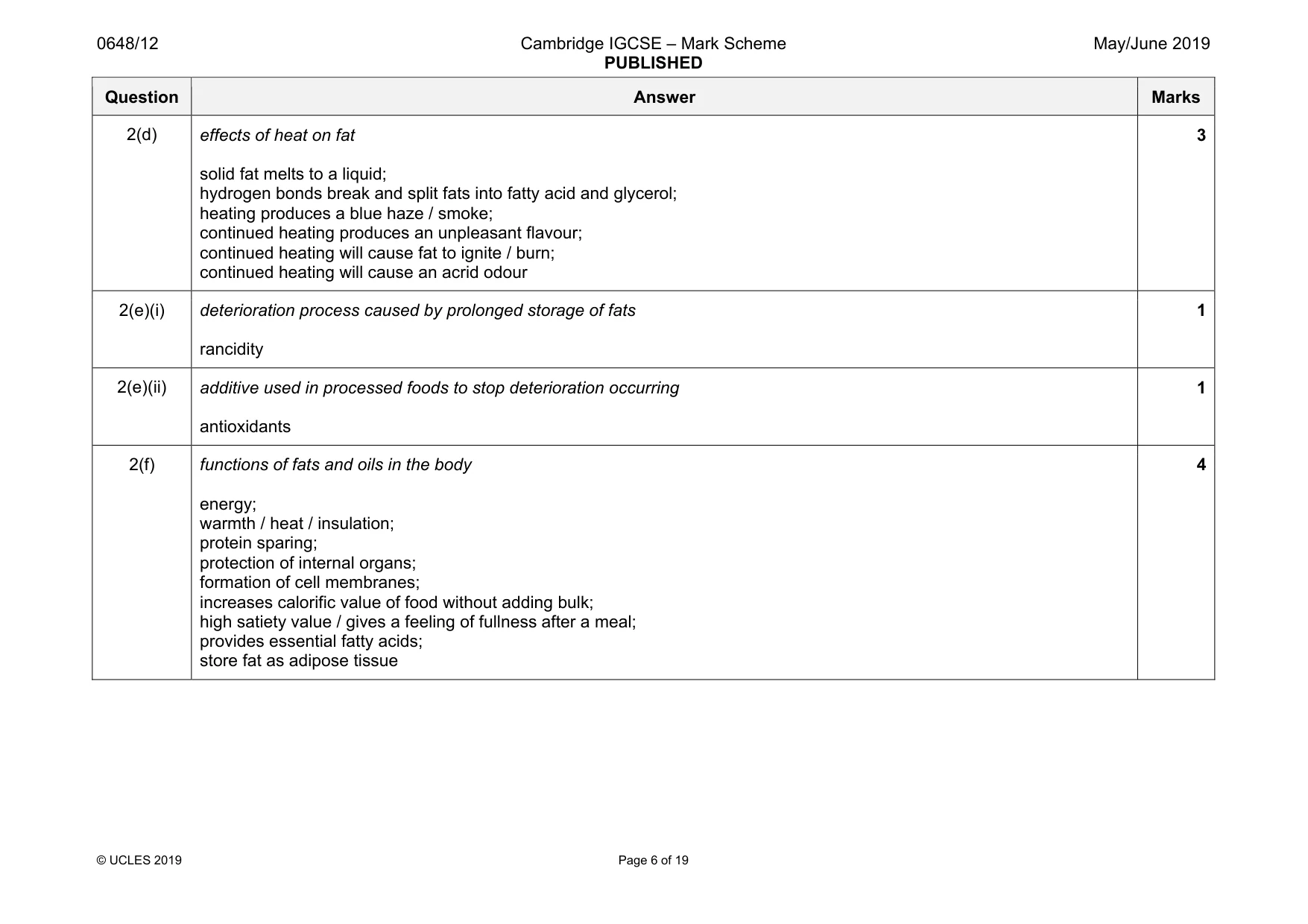
0648/12 Cambridge IGCSE – Mark Scheme PUBLISHED May/June 2019 © UCLES 2019 Page 6 of 19 Question Answer Marks 2(d) effects of heat on fat solid fat melts to a liquid; hydrogen bonds break and split fats into fatty acid and glycerol; heating produces a blue haze / smoke; continued heating produces an unpleasant flavour; continued heating will cause fat to ignite / burn; continued heating will cause an acrid odour 3 2(e)(i) deterioration process caused by prolonged storage of fats rancidity 1 2(e)(ii) additive used in processed foods to stop deterioration occurring antioxidants 1 2(f) functions of fats and oils in the body energy; warmth / heat / insulation; protein sparing; protection of internal organs; formation of cell membranes; increases calorific value of food without adding bulk; high satiety value / gives a feeling of fullness after a meal; provides essential fatty acids; store fat as adipose tissue 4
Mark scheme, page 7
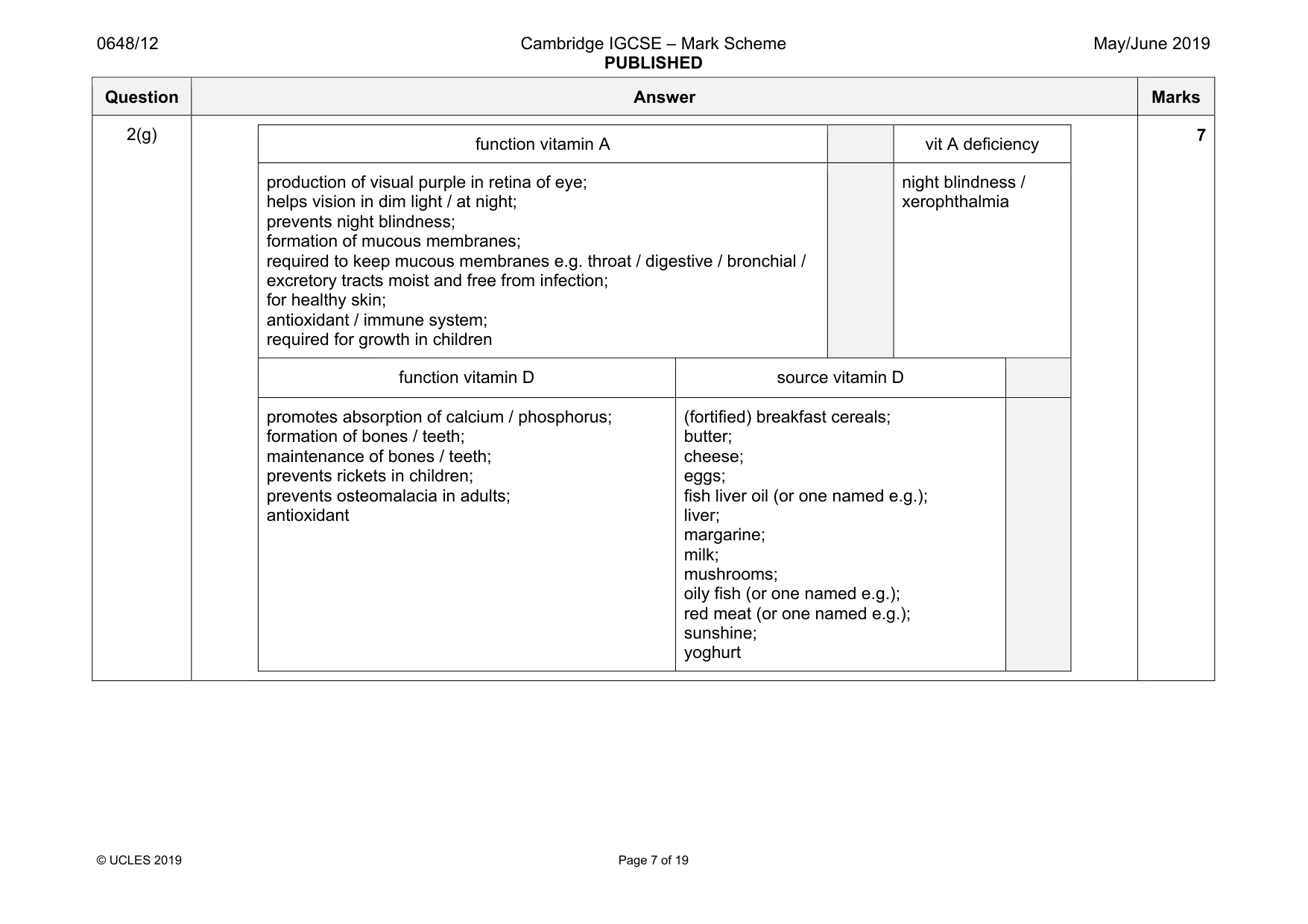
0648/12 Cambridge IGCSE – Mark Scheme PUBLISHED May/June 2019 © UCLES 2019 Page 7 of 19 Question Answer Marks 2(g) function vitamin A vit A deficiency production of visual purple in retina of eye; helps vision in dim light / at night; prevents night blindness; formation of mucous membranes; required to keep mucous membranes e.g. throat / digestive / bronchial / excretory tracts moist and free from infection; for healthy skin; antioxidant / immune system; required for growth in children night blindness / xerophthalmia function vitamin D source vitamin D promotes absorption of calcium / phosphorus; formation of bones / teeth; maintenance of bones / teeth; prevents rickets in children; prevents osteomalacia in adults; antioxidant (fortified) breakfast cereals; butter; cheese; eggs; fish liver oil (or one named e.g.); liver; margarine; milk; mushrooms; oily fish (or one named e.g.); red meat (or one named e.g.); sunshine; yoghurt 7
Mark scheme, page 8
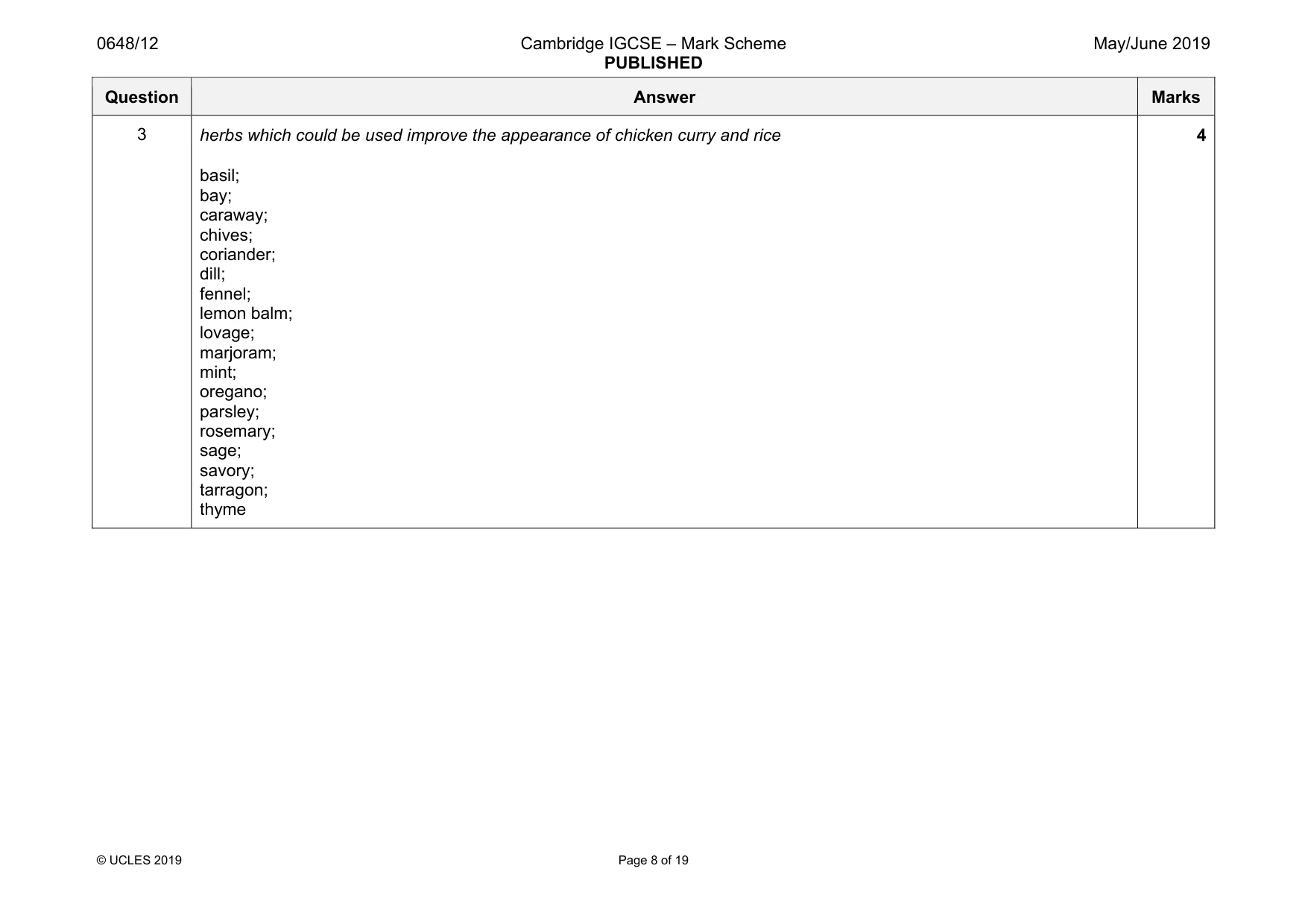
0648/12 Cambridge IGCSE – Mark Scheme PUBLISHED May/June 2019 © UCLES 2019 Page 8 of 19 Question Answer Marks 3 herbs which could be used improve the appearance of chicken curry and rice basil; bay; caraway; chives; coriander; dill; fennel; lemon balm; lovage; marjoram; mint; oregano; parsley; rosemary; sage; savory; tarragon; thyme 4
Mark scheme, page 9
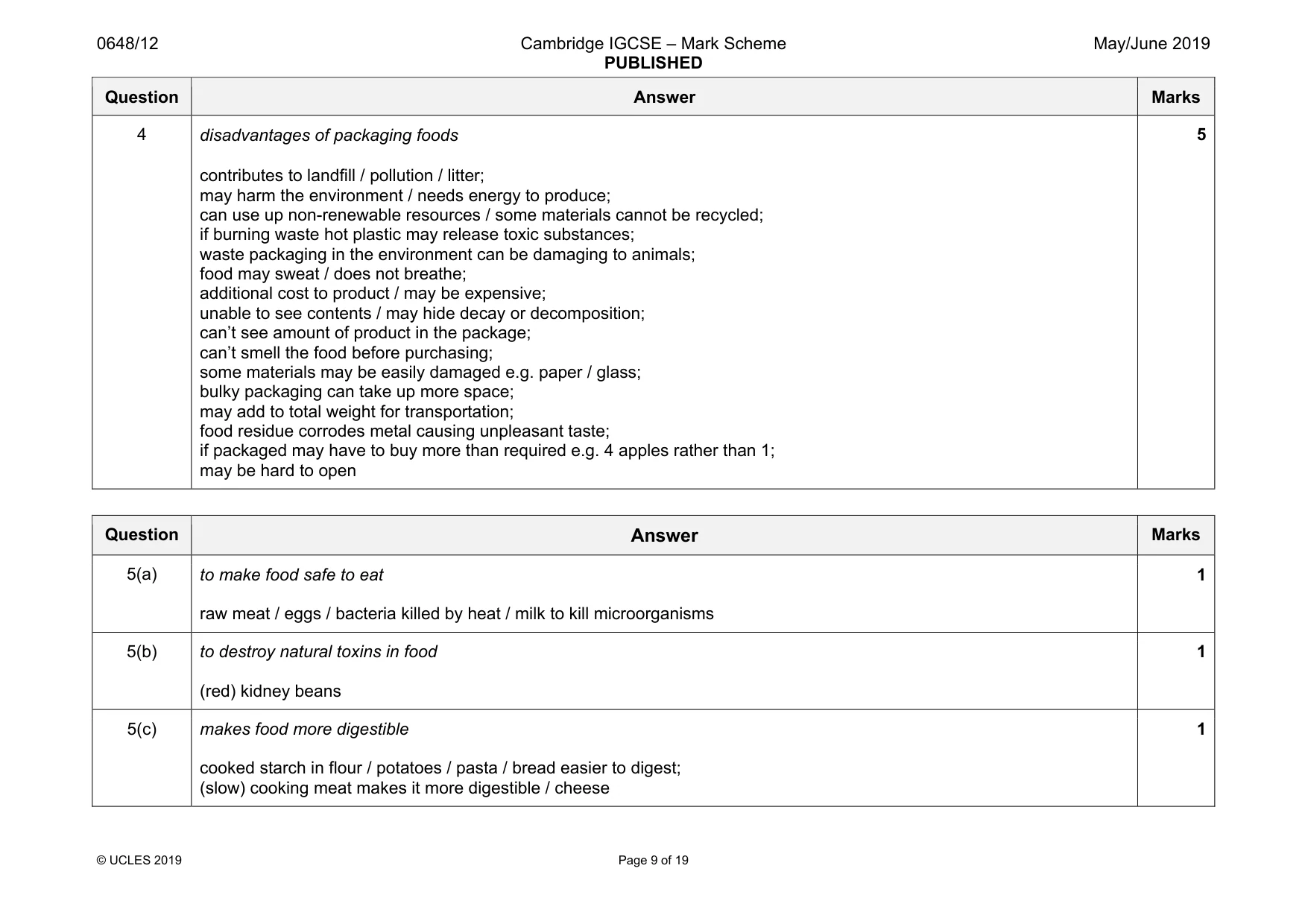
0648/12 Cambridge IGCSE – Mark Scheme PUBLISHED May/June 2019 © UCLES 2019 Page 9 of 19 Question Answer Marks 4 disadvantages of packaging foods contributes to landfill / pollution / litter; may harm the environment / needs energy to produce; can use up non-renewable resources / some materials cannot be recycled; if burning waste hot plastic may release toxic substances; waste packaging in the environment can be damaging to animals; food may sweat / does not breathe; additional cost to product / may be expensive; unable to see contents / may hide decay or decomposition; can’t see amount of product in the package; can’t smell the food before purchasing; some materials may be easily damaged e.g. paper / glass; bulky packaging can take up more space; may add to total weight for transportation; food residue corrodes metal causing unpleasant taste; if packaged may have to buy more than required e.g. 4 apples rather than 1; may be hard to open 5 Question Answer Marks 5(a) to make food safe to eat raw meat / eggs / bacteria killed by heat / milk to kill microorganisms 1 5(b) to destroy natural toxins in food (red) kidney beans 1 5(c) makes food more digestible cooked starch in flour / potatoes / pasta / bread easier to digest; (slow) cooking meat makes it more digestible / cheese 1
Mark scheme, page 10
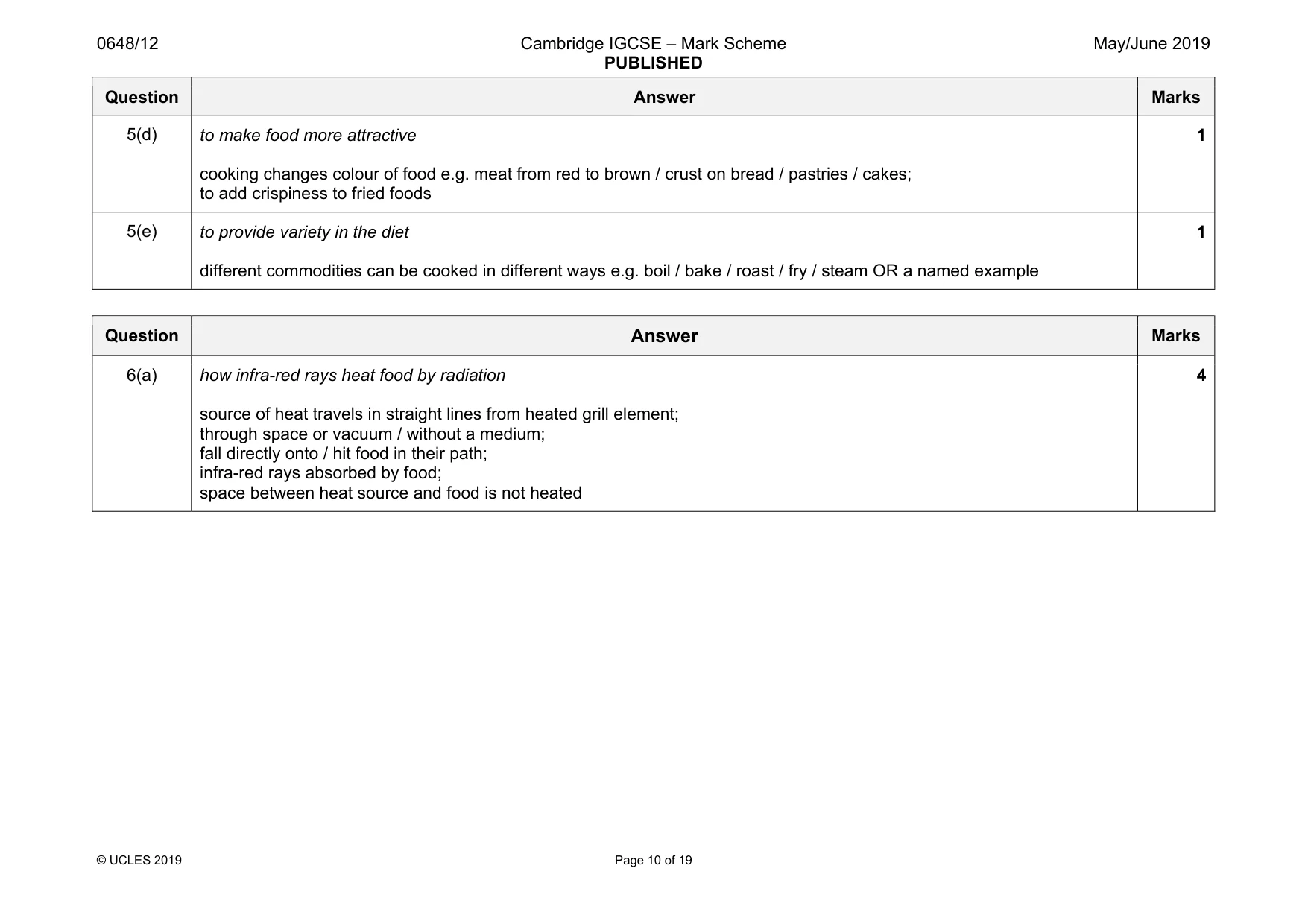
0648/12 Cambridge IGCSE – Mark Scheme PUBLISHED May/June 2019 © UCLES 2019 Page 10 of 19 Question Answer Marks 5(d) to make food more attractive cooking changes colour of food e.g. meat from red to brown / crust on bread / pastries / cakes; to add crispiness to fried foods 1 5(e) to provide variety in the diet different commodities can be cooked in different ways e.g. boil / bake / roast / fry / steam OR a named example 1 Question Answer Marks 6(a) how infra-red rays heat food by radiation source of heat travels in straight lines from heated grill element; through space or vacuum / without a medium; fall directly onto / hit food in their path; infra-red rays absorbed by food; space between heat source and food is not heated 4
Mark scheme, page 11
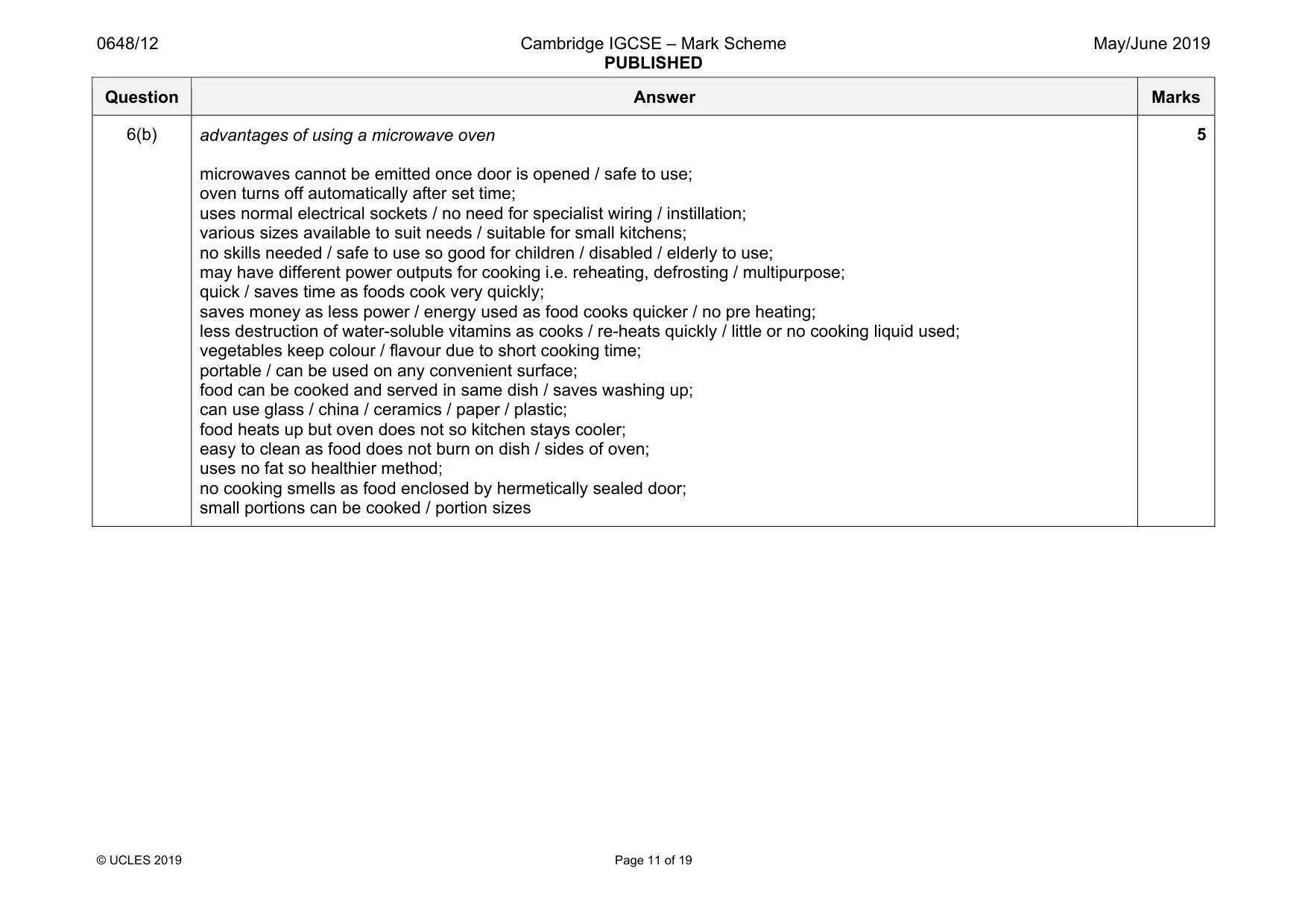
0648/12 Cambridge IGCSE – Mark Scheme PUBLISHED May/June 2019 © UCLES 2019 Page 11 of 19 Question Answer Marks 6(b) advantages of using a microwave oven microwaves cannot be emitted once door is opened / safe to use; oven turns off automatically after set time; uses normal electrical sockets / no need for specialist wiring / instillation; various sizes available to suit needs / suitable for small kitchens; no skills needed / safe to use so good for children / disabled / elderly to use; may have different power outputs for cooking i.e. reheating, defrosting / multipurpose; quick / saves time as foods cook very quickly; saves money as less power / energy used as food cooks quicker / no pre heating; less destruction of water-soluble vitamins as cooks / re-heats quickly / little or no cooking liquid used; vegetables keep colour / flavour due to short cooking time; portable / can be used on any convenient surface; food can be cooked and served in same dish / saves washing up; can use glass / china / ceramics / paper / plastic; food heats up but oven does not so kitchen stays cooler; easy to clean as food does not burn on dish / sides of oven; uses no fat so healthier method; no cooking smells as food enclosed by hermetically sealed door; small portions can be cooked / portion sizes 5
Mark scheme, page 12
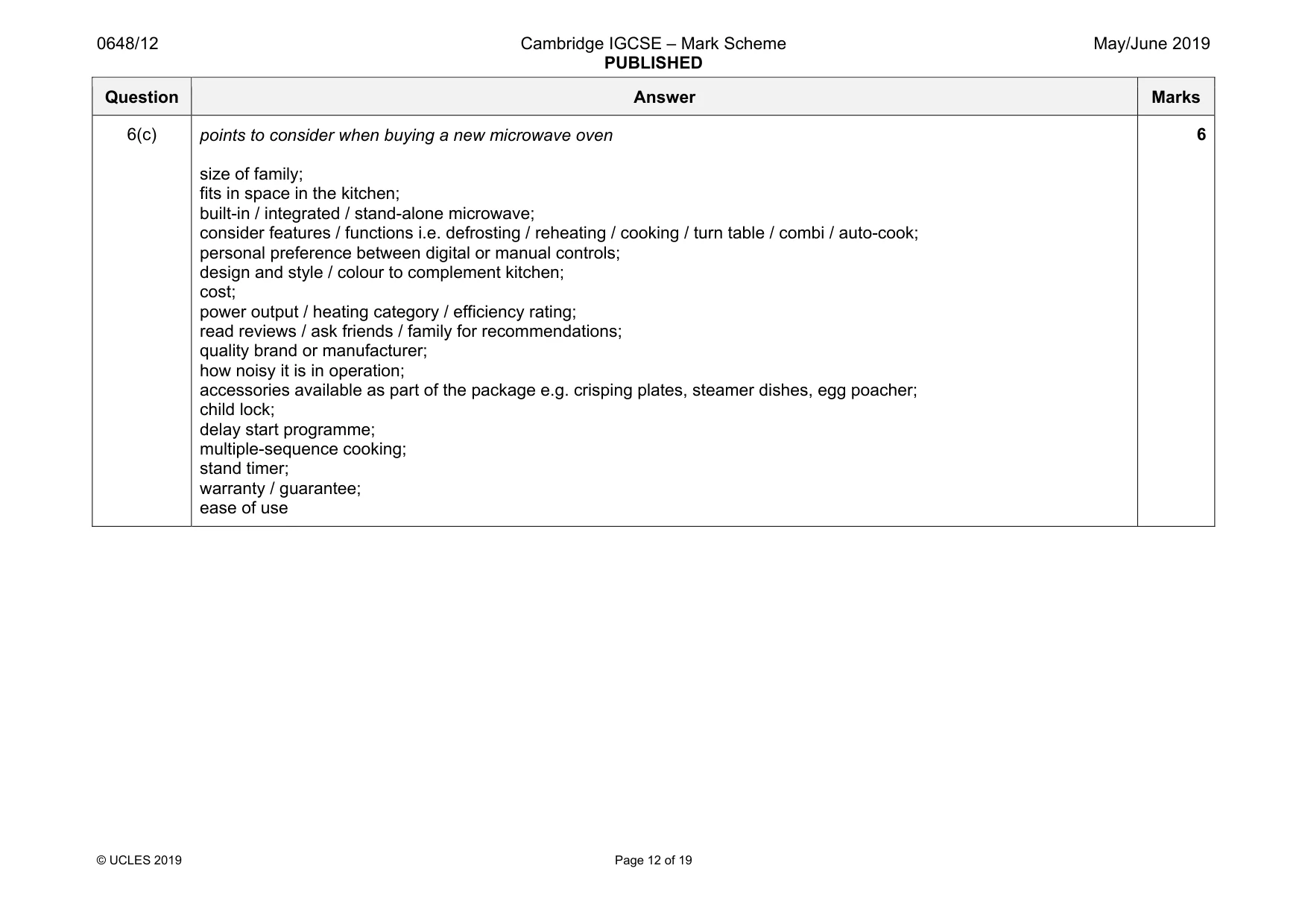
0648/12 Cambridge IGCSE – Mark Scheme PUBLISHED May/June 2019 © UCLES 2019 Page 12 of 19 Question Answer Marks 6(c) points to consider when buying a new microwave oven size of family; fits in space in the kitchen; built-in / integrated / stand-alone microwave; consider features / functions i.e. defrosting / reheating / cooking / turn table / combi / auto-cook; personal preference between digital or manual controls; design and style / colour to complement kitchen; cost; power output / heating category / efficiency rating; read reviews / ask friends / family for recommendations; quality brand or manufacturer; how noisy it is in operation; accessories available as part of the package e.g. crisping plates, steamer dishes, egg poacher; child lock; delay start programme; multiple-sequence cooking; stand timer; warranty / guarantee; ease of use 6
Mark scheme, page 13
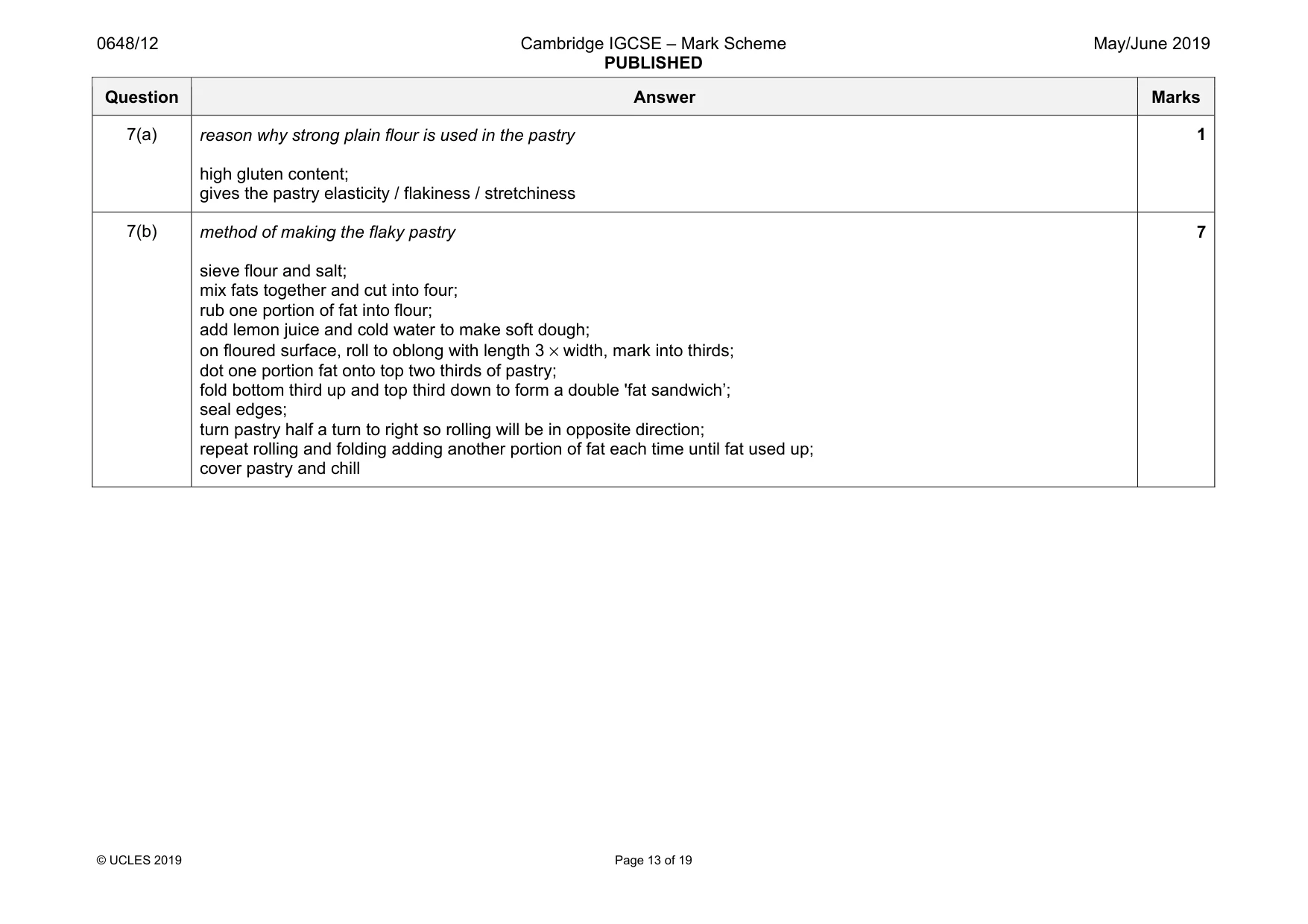
0648/12 Cambridge IGCSE – Mark Scheme PUBLISHED May/June 2019 © UCLES 2019 Page 13 of 19 Question Answer Marks 7(a) reason why strong plain flour is used in the pastry high gluten content; gives the pastry elasticity / flakiness / stretchiness 1 7(b) method of making the flaky pastry sieve flour and salt; mix fats together and cut into four; rub one portion of fat into flour; add lemon juice and cold water to make soft dough; on floured surface, roll to oblong with length 3 × width, mark into thirds; dot one portion fat onto top two thirds of pastry; fold bottom third up and top third down to form a double 'fat sandwich’; seal edges; turn pastry half a turn to right so rolling will be in opposite direction; repeat rolling and folding adding another portion of fat each time until fat used up; cover pastry and chill 7
Mark scheme, page 14
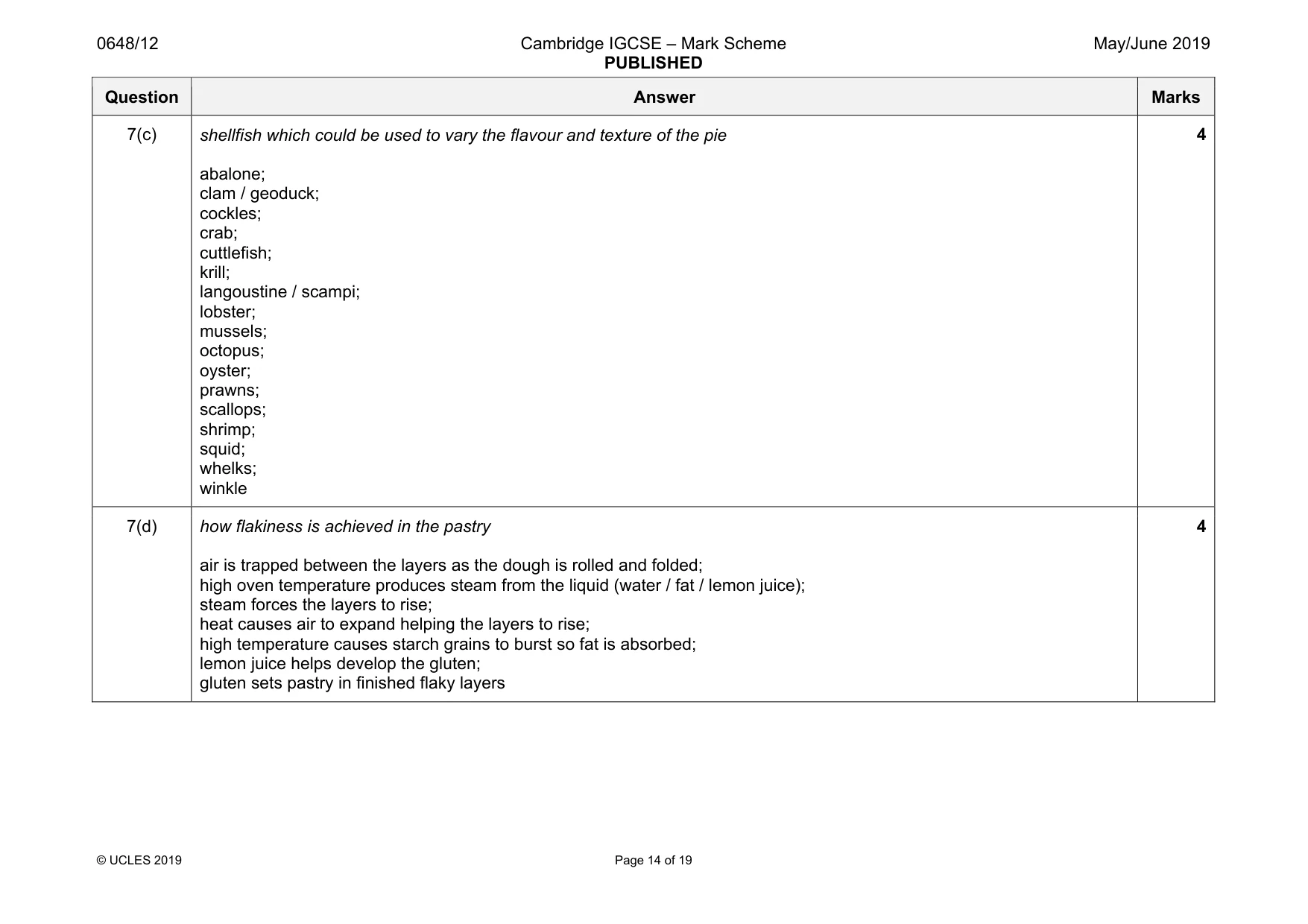
0648/12 Cambridge IGCSE – Mark Scheme PUBLISHED May/June 2019 © UCLES 2019 Page 14 of 19 Question Answer Marks 7(c) shellfish which could be used to vary the flavour and texture of the pie abalone; clam / geoduck; cockles; crab; cuttlefish; krill; langoustine / scampi; lobster; mussels; octopus; oyster; prawns; scallops; shrimp; squid; whelks; winkle 4 7(d) how flakiness is achieved in the pastry air is trapped between the layers as the dough is rolled and folded; high oven temperature produces steam from the liquid (water / fat / lemon juice); steam forces the layers to rise; heat causes air to expand helping the layers to rise; high temperature causes starch grains to burst so fat is absorbed; lemon juice helps develop the gluten; gluten sets pastry in finished flaky layers 4
Mark scheme, page 15
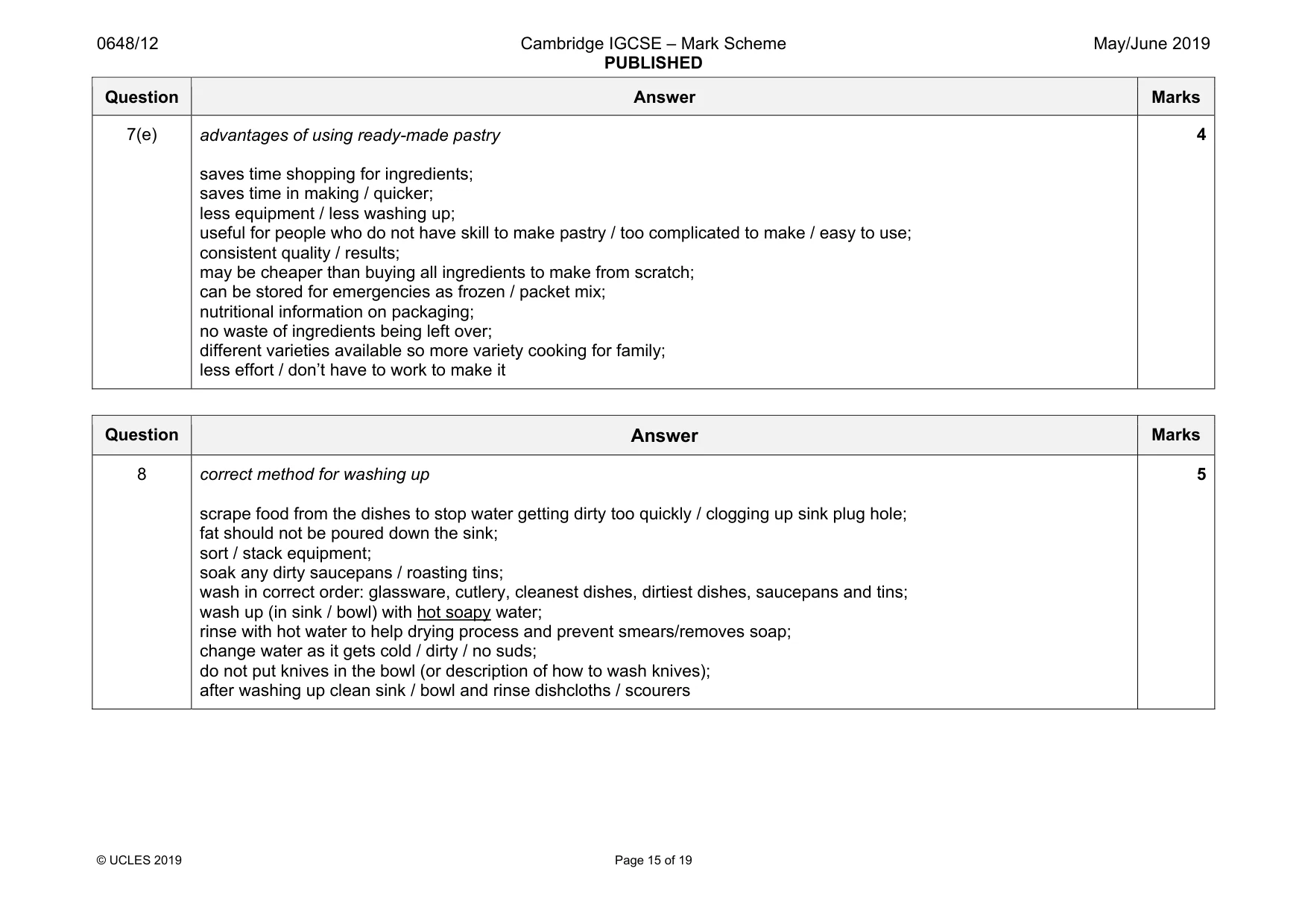
0648/12 Cambridge IGCSE – Mark Scheme PUBLISHED May/June 2019 © UCLES 2019 Page 15 of 19 Question Answer Marks 7(e) advantages of using ready-made pastry saves time shopping for ingredients; saves time in making / quicker; less equipment / less washing up; useful for people who do not have skill to make pastry / too complicated to make / easy to use; consistent quality / results; may be cheaper than buying all ingredients to make from scratch; can be stored for emergencies as frozen / packet mix; nutritional information on packaging; no waste of ingredients being left over; different varieties available so more variety cooking for family; less effort / don’t have to work to make it 4 Question Answer Marks 8 correct method for washing up scrape food from the dishes to stop water getting dirty too quickly / clogging up sink plug hole; fat should not be poured down the sink; sort / stack equipment; soak any dirty saucepans / roasting tins; wash in correct order: glassware, cutlery, cleanest dishes, dirtiest dishes, saucepans and tins; wash up (in sink / bowl) with hot soapy water; rinse with hot water to help drying process and prevent smears/removes soap; change water as it gets cold / dirty / no suds; do not put knives in the bowl (or description of how to wash knives); after washing up clean sink / bowl and rinse dishcloths / scourers 5
Mark scheme, page 16
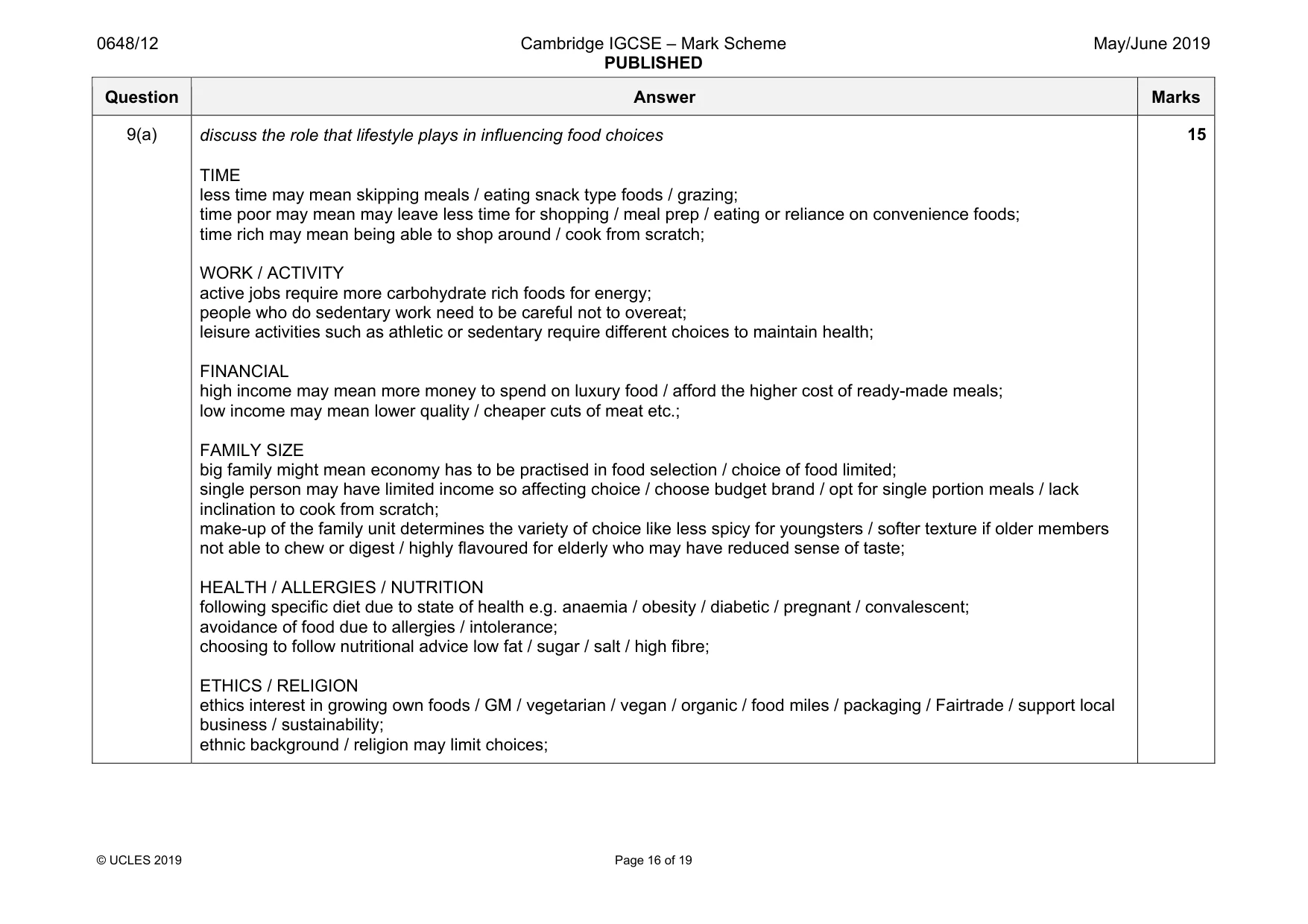
0648/12 Cambridge IGCSE – Mark Scheme PUBLISHED May/June 2019 © UCLES 2019 Page 16 of 19 Question Answer Marks 9(a) discuss the role that lifestyle plays in influencing food choices TIME less time may mean skipping meals / eating snack type foods / grazing; time poor may mean may leave less time for shopping / meal prep / eating or reliance on convenience foods; time rich may mean being able to shop around / cook from scratch; WORK / ACTIVITY active jobs require more carbohydrate rich foods for energy; people who do sedentary work need to be careful not to overeat; leisure activities such as athletic or sedentary require different choices to maintain health; FINANCIAL high income may mean more money to spend on luxury food / afford the higher cost of ready-made meals; low income may mean lower quality / cheaper cuts of meat etc.; FAMILY SIZE big family might mean economy has to be practised in food selection / choice of food limited; single person may have limited income so affecting choice / choose budget brand / opt for single portion meals / lack inclination to cook from scratch; make-up of the family unit determines the variety of choice like less spicy for youngsters / softer texture if older members not able to chew or digest / highly flavoured for elderly who may have reduced sense of taste; HEALTH / ALLERGIES / NUTRITION following specific diet due to state of health e.g. anaemia / obesity / diabetic / pregnant / convalescent; avoidance of food due to allergies / intolerance; choosing to follow nutritional advice low fat / sugar / salt / high fibre; ETHICS / RELIGION ethics interest in growing own foods / GM / vegetarian / vegan / organic / food miles / packaging / Fairtrade / support local business / sustainability; ethnic background / religion may limit choices; 15
Mark scheme, page 17
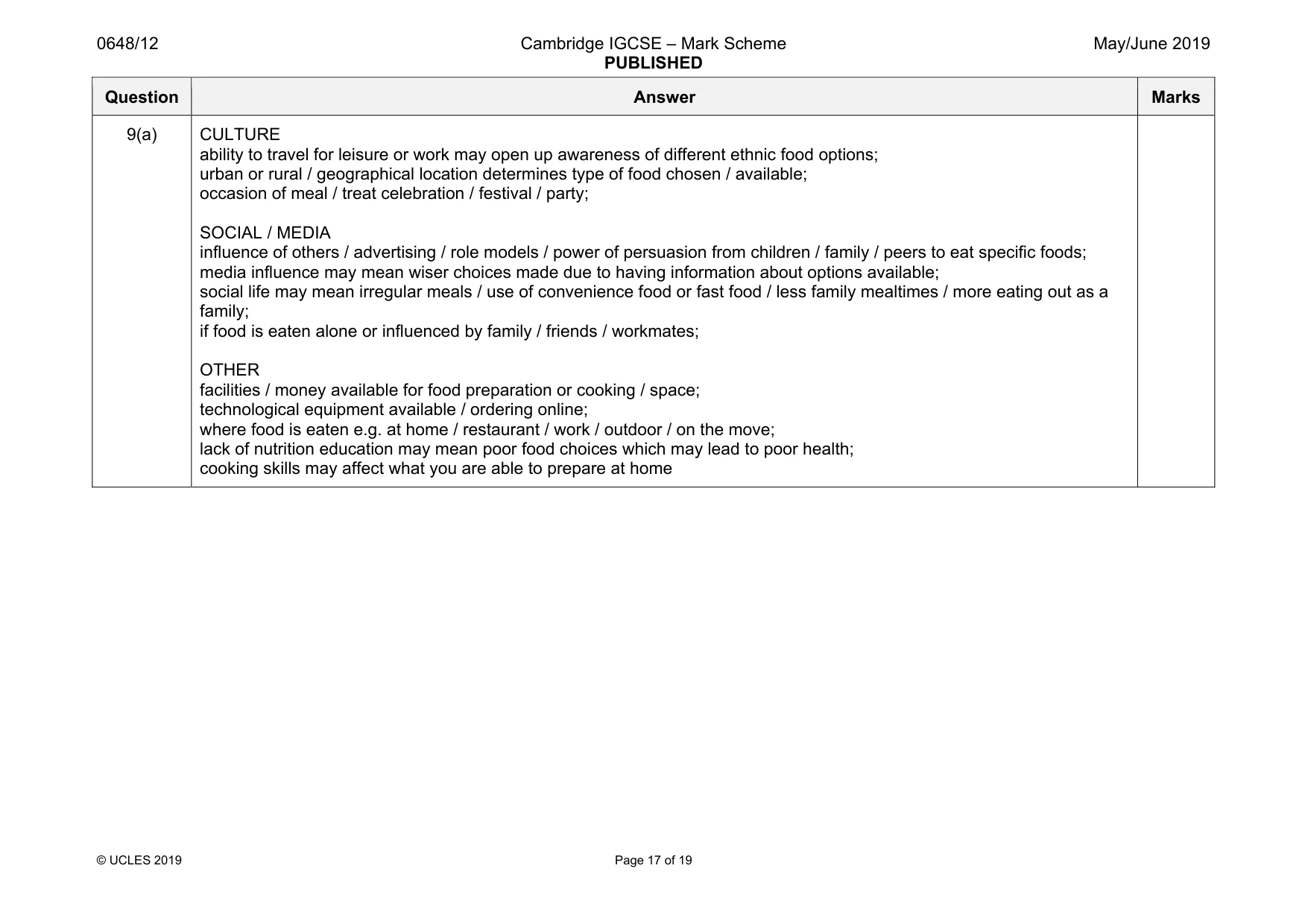
0648/12 Cambridge IGCSE – Mark Scheme PUBLISHED May/June 2019 © UCLES 2019 Page 17 of 19 Question Answer Marks 9(a) CULTURE ability to travel for leisure or work may open up awareness of different ethnic food options; urban or rural / geographical location determines type of food chosen / available; occasion of meal / treat celebration / festival / party; SOCIAL / MEDIA influence of others / advertising / role models / power of persuasion from children / family / peers to eat specific foods; media influence may mean wiser choices made due to having information about options available; social life may mean irregular meals / use of convenience food or fast food / less family mealtimes / more eating out as a family; if food is eaten alone or influenced by family / friends / workmates; OTHER facilities / money available for food preparation or cooking / space; technological equipment available / ordering online; where food is eaten e.g. at home / restaurant / work / outdoor / on the move; lack of nutrition education may mean poor food choices which may lead to poor health; cooking skills may affect what you are able to prepare at home
Mark scheme, page 18
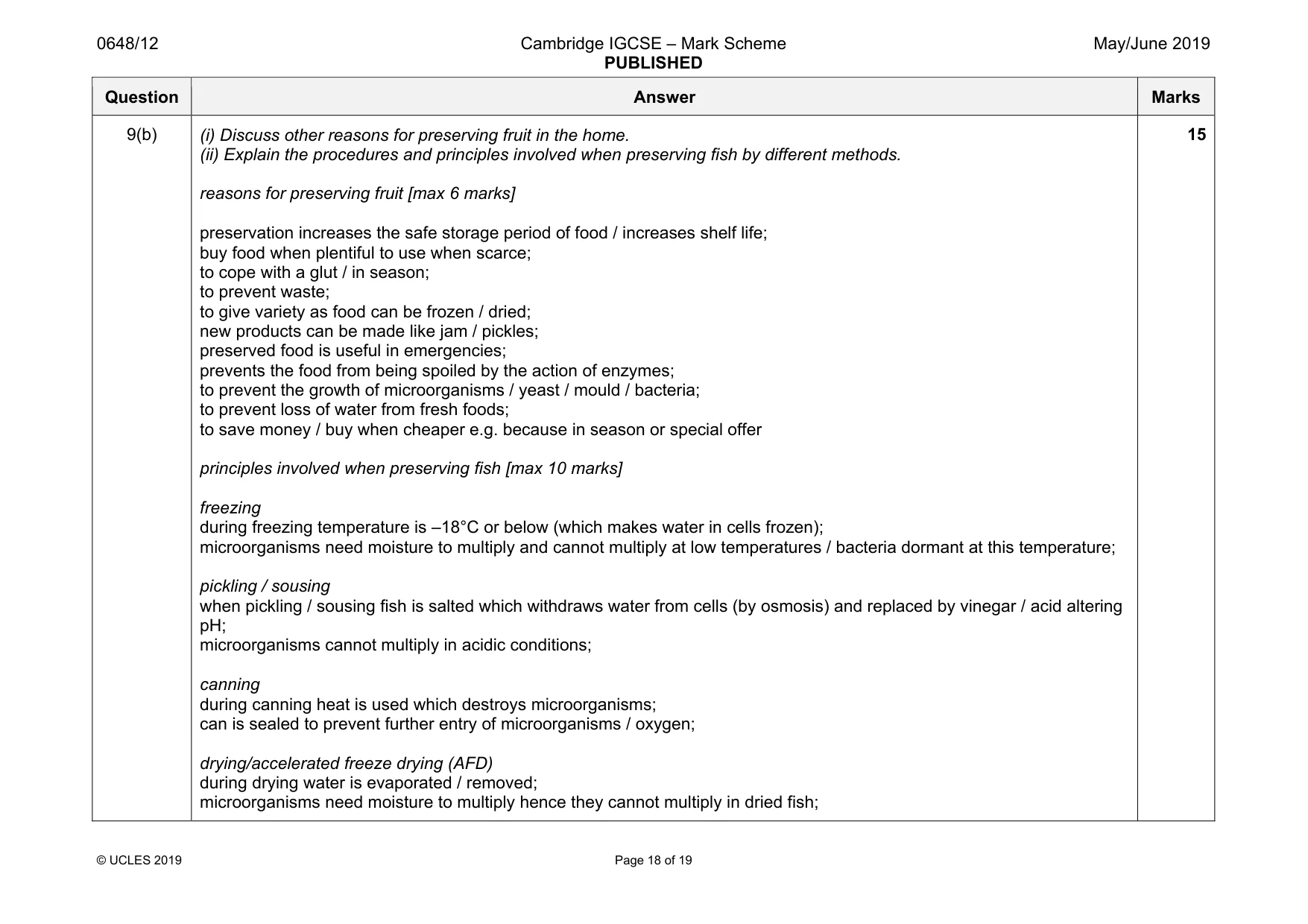
0648/12 Cambridge IGCSE – Mark Scheme PUBLISHED May/June 2019 © UCLES 2019 Page 18 of 19 Question Answer Marks 9(b) (i) Discuss other reasons for preserving fruit in the home. (ii) Explain the procedures and principles involved when preserving fish by different methods. reasons for preserving fruit [max 6 marks] preservation increases the safe storage period of food / increases shelf life; buy food when plentiful to use when scarce; to cope with a glut / in season; to prevent waste; to give variety as food can be frozen / dried; new products can be made like jam / pickles; preserved food is useful in emergencies; prevents the food from being spoiled by the action of enzymes; to prevent the growth of microorganisms / yeast / mould / bacteria; to prevent loss of water from fresh foods; to save money / buy when cheaper e.g. because in season or special offer principles involved when preserving fish [max 10 marks] freezing during freezing temperature is –18°C or below (which makes water in cells frozen); microorganisms need moisture to multiply and cannot multiply at low temperatures / bacteria dormant at this temperature; pickling / sousing when pickling / sousing fish is salted which withdraws water from cells (by osmosis) and replaced by vinegar / acid altering pH; microorganisms cannot multiply in acidic conditions; canning during canning heat is used which destroys microorganisms; can is sealed to prevent further entry of microorganisms / oxygen; drying/accelerated freeze drying (AFD) during drying water is evaporated / removed; microorganisms need moisture to multiply hence they cannot multiply in dried fish; 15
Mark scheme, page 19
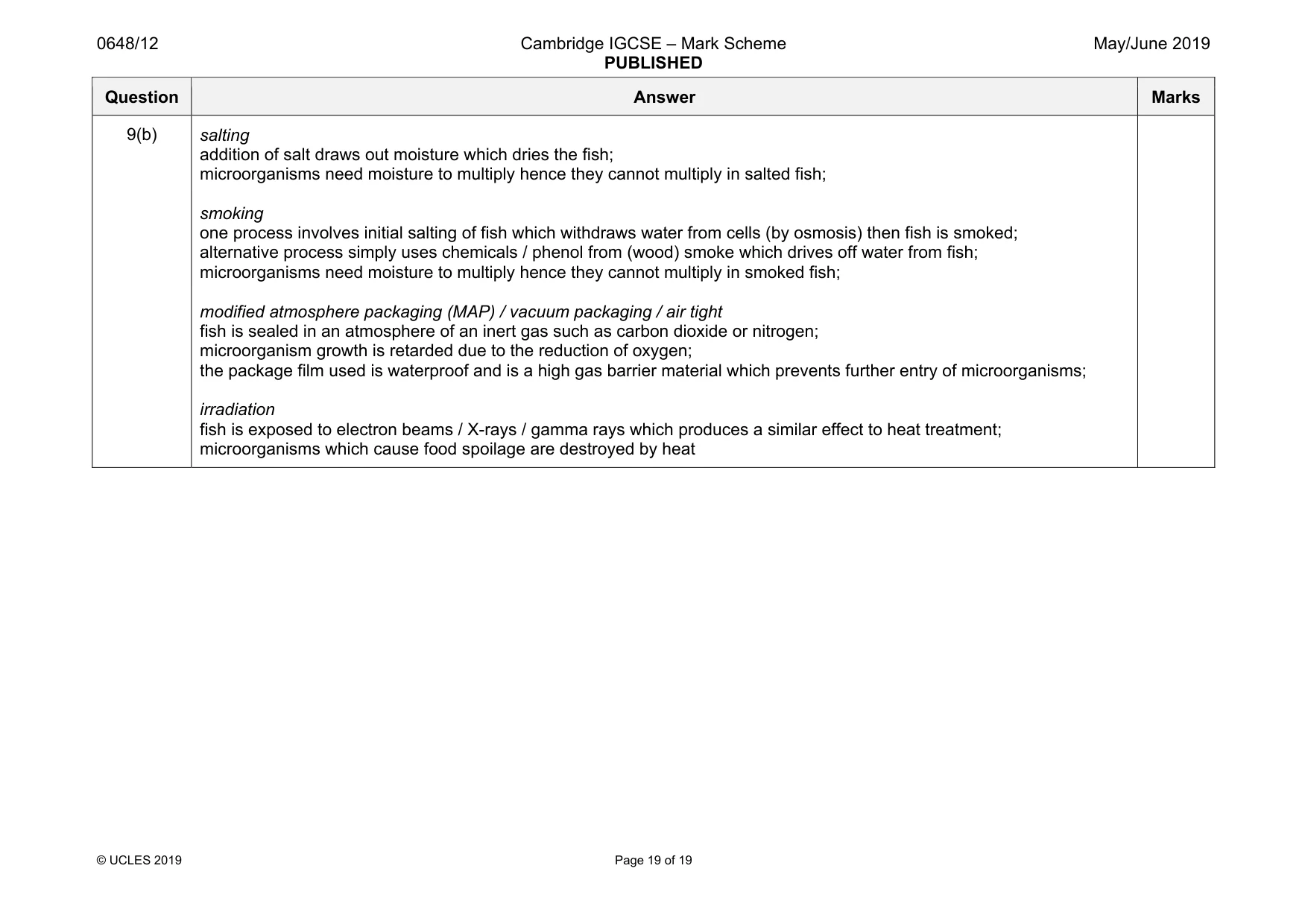
0648/12 Cambridge IGCSE – Mark Scheme PUBLISHED May/June 2019 © UCLES 2019 Page 19 of 19 Question Answer Marks 9(b) salting addition of salt draws out moisture which dries the fish; microorganisms need moisture to multiply hence they cannot multiply in salted fish; smoking one process involves initial salting of fish which withdraws water from cells (by osmosis) then fish is smoked; alternative process simply uses chemicals / phenol from (wood) smoke which drives off water from fish; microorganisms need moisture to multiply hence they cannot multiply in smoked fish; modified atmosphere packaging (MAP) / vacuum packaging / air tight fish is sealed in an atmosphere of an inert gas such as carbon dioxide or nitrogen; microorganism growth is retarded due to the reduction of oxygen; the package film used is waterproof and is a high gas barrier material which prevents further entry of microorganisms; irradiation fish is exposed to electron beams / X-rays / gamma rays which produces a similar effect to heat treatment; microorganisms which cause food spoilage are destroyed by heat
What you needed in this session
Cambridge’s own grade thresholds for 2019 May/June, Paper 1 · Variant 2. A higher threshold means an easier paper — the bar moves with how the cohort did.