Cambridge IGCSE Food and Nutrition 0648 — 2019 May/June Paper 1 · Variant 3
0648/13/M/J/19 · 100 marks · ≈113 min
The question paper and its mark scheme, free to read here and free to download. This is Cambridge’s own paper, exactly as it was sat.
Question paper12 pages


Mark scheme15 pages
Answers below. Sit the paper first if you are practising.
Paper as text
Question paper, page 1
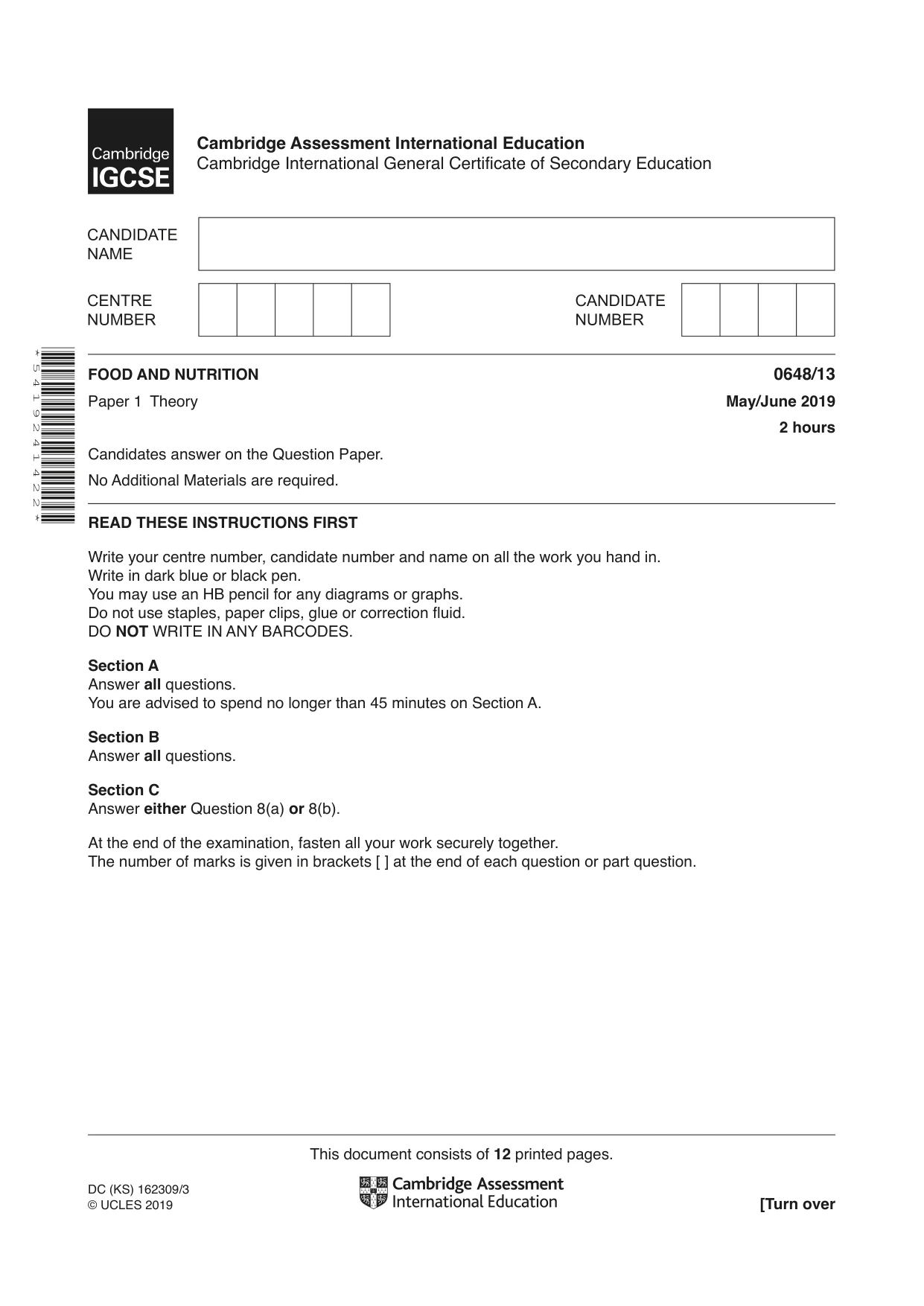
This document consists of 12 printed pages. DC (KS) 162309/3 © UCLES 2019 [Turn over Cambridge Assessment International Education Cambridge International General Certificate of Secondary Education * 5 4 1 9 2 4 1 4 2 2 * FOOD AND NUTRITION 0648/13 Paper 1 Theory May/June 2019 2 hours Candidates answer on the Question Paper. No Additional Materials are required. READ THESE INSTRUCTIONS FIRST Write your centre number, candidate number and name on all the work you hand in. Write in dark blue or black pen. You may use an HB pencil for any diagrams or graphs. Do not use staples, paper clips, glue or correction fluid. DO NOT WRITE IN ANY BARCODES. Section A Answer all questions. You are advised to spend no longer than 45 minutes on Section A. Section B Answer all questions. Section C Answer either Question 8(a) or 8(b). At the end of the examination, fasten all your work securely together. The number of marks is given in brackets [ ] at the end of each question or part question.
Question paper, page 2
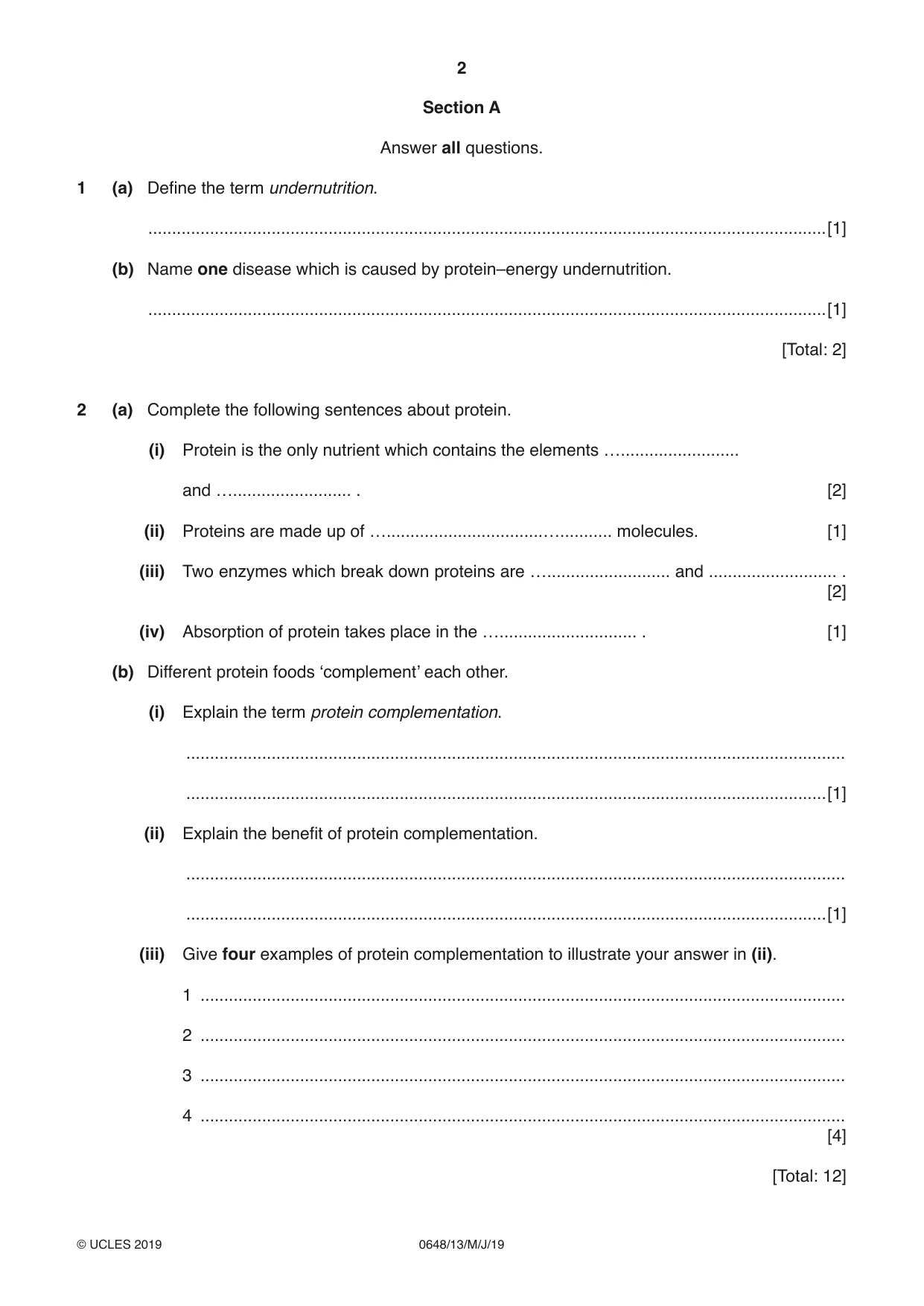
2 0648/13/M/J/19 © UCLES 2019 Section A Answer all questions. 1 (a) Define the term undernutrition. …[1] (b) Name one disease which is caused by protein–energy undernutrition. …[1] [Total: 2] 2 (a) Complete the following sentences about protein. (i) Protein is the only nutrient which contains the elements …… and …… . [2] (ii) Proteins are made up of ………… molecules. [1] (iii) Two enzymes which break down proteins are …… and … . [2] (iv) Absorption of protein takes place in the …… . [1] (b) Different protein foods ‘complement’ each other. (i) Explain the term protein complementation. … …[1] (ii) Explain the benefit of protein complementation. … …[1] (iii) Give four examples of protein complementation to illustrate your answer in (ii). 1 … 2 … 3 … 4 … [4] [Total: 12]
Question paper, page 3
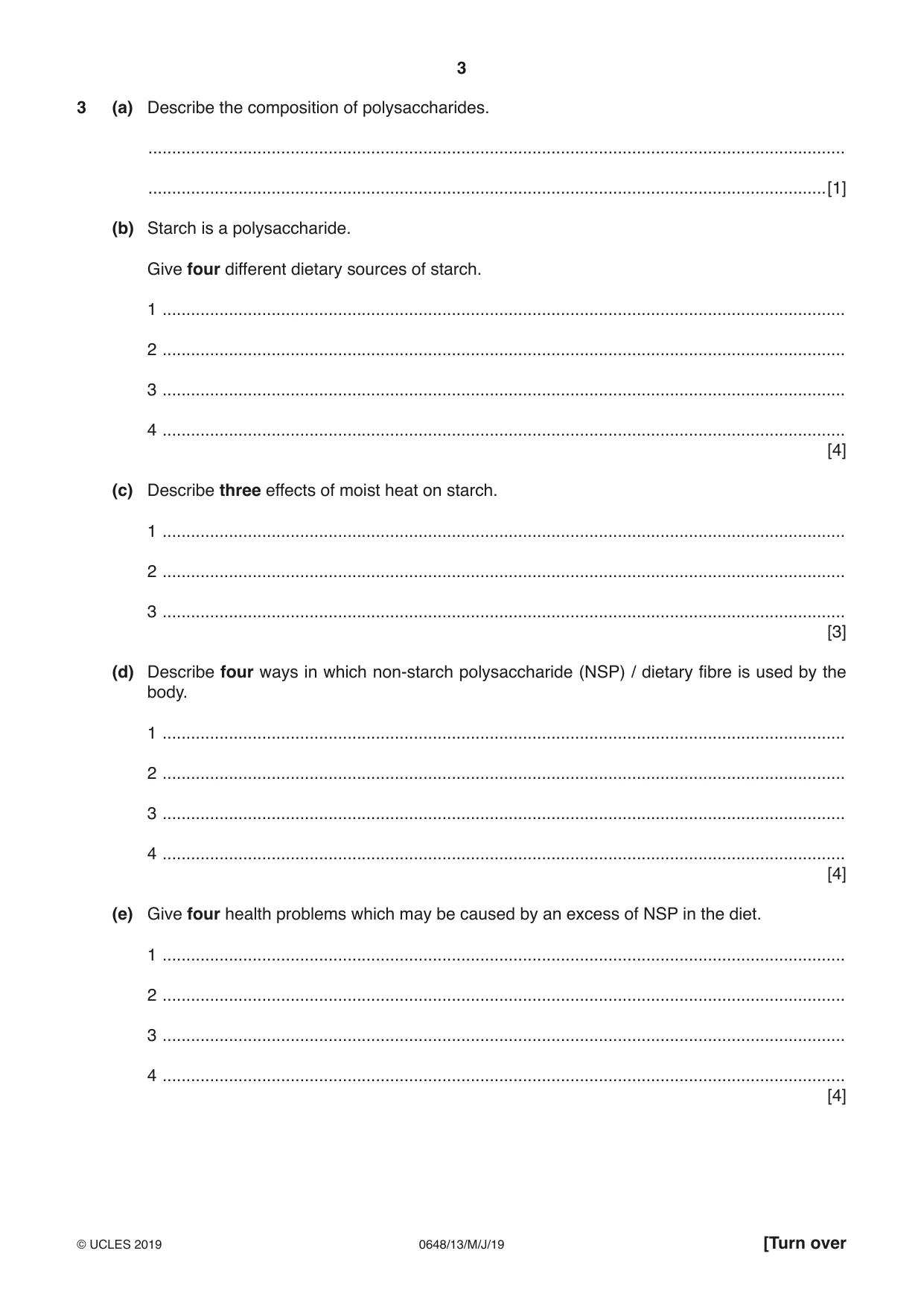
3 0648/13/M/J/19 © UCLES 2019 [Turn over 3 (a) Describe the composition of polysaccharides. … …[1] (b) Starch is a polysaccharide. Give four different dietary sources of starch. 1 … 2 … 3 … 4 … [4] (c) Describe three effects of moist heat on starch. 1 … 2 … 3 … [3] (d) Describe four ways in which non-starch polysaccharide (NSP) / dietary fibre is used by the body. 1 … 2 … 3 … 4 … [4] (e) Give four health problems which may be caused by an excess of NSP in the diet. 1 … 2 … 3 … 4 … [4]
Question paper, page 4
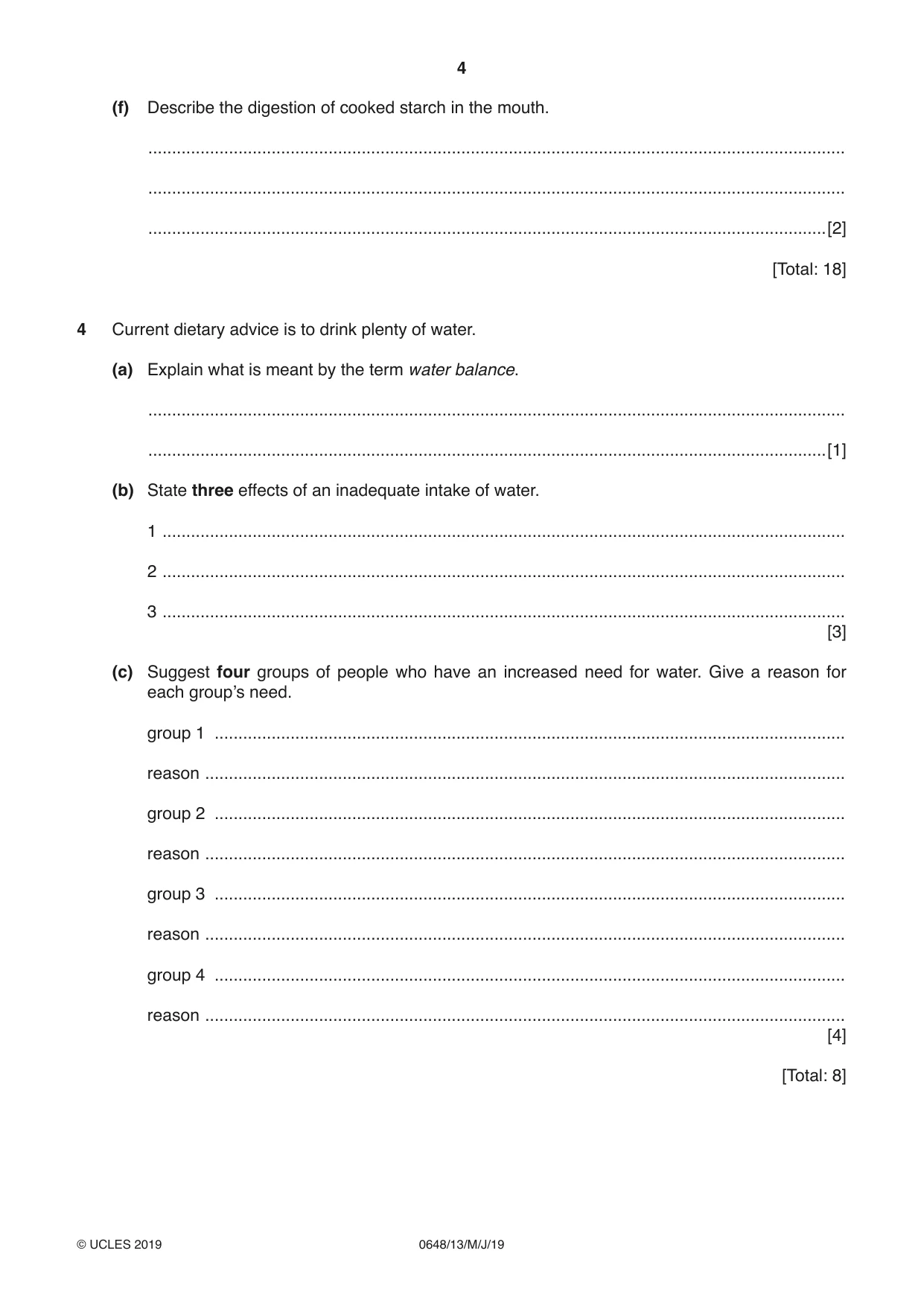
4 0648/13/M/J/19 © UCLES 2019 (f) Describe the digestion of cooked starch in the mouth. … … …[2] [Total: 18] 4 Current dietary advice is to drink plenty of water. (a) Explain what is meant by the term water balance. … …[1] (b) State three effects of an inadequate intake of water. 1 … 2 … 3 … [3] (c) Suggest four groups of people who have an increased need for water. Give a reason for each group’s need. group 1 … reason … group 2 … reason … group 3 … reason … group 4 … reason … [4] [Total: 8]
Question paper, page 5
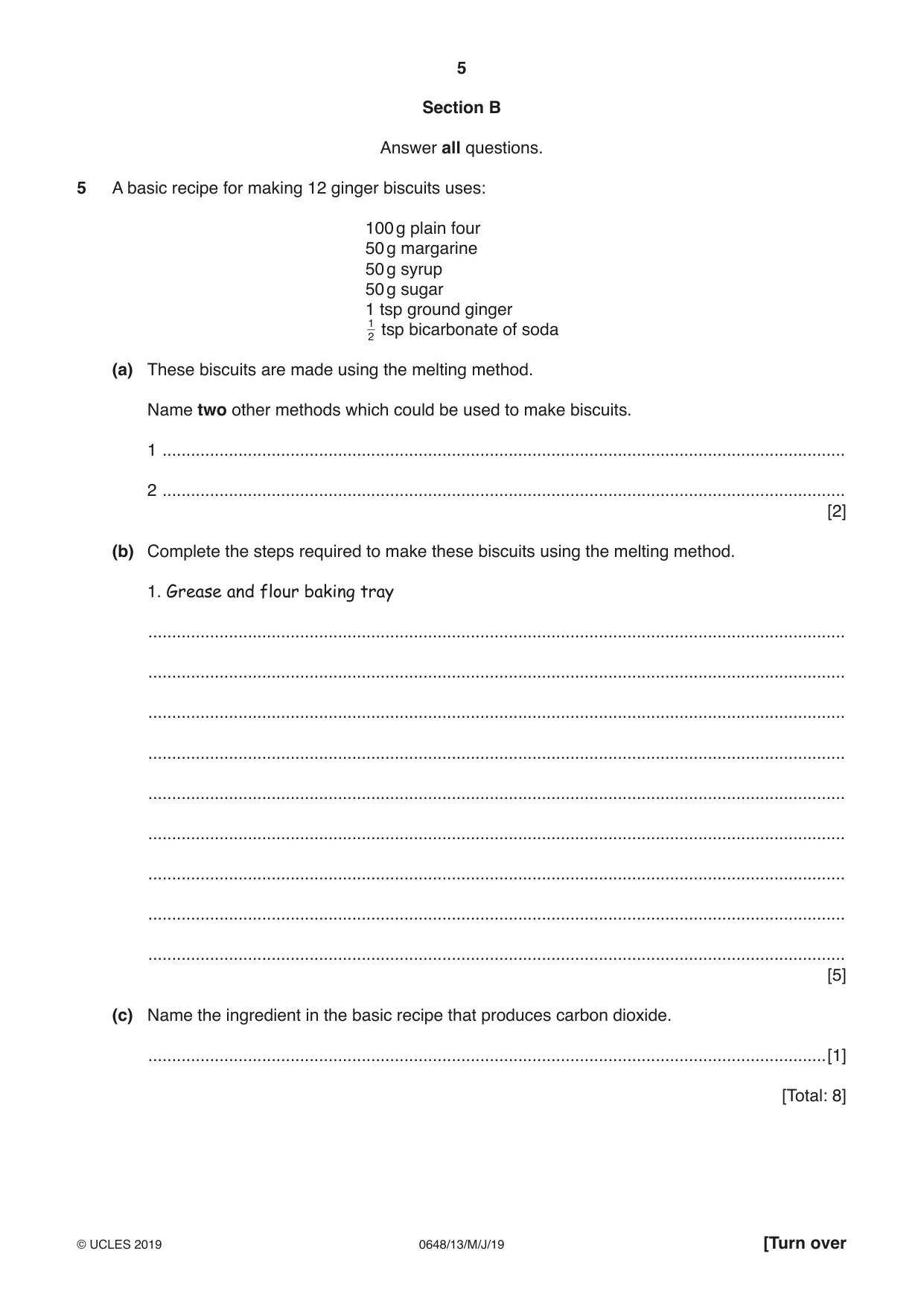
5 0648/13/M/J/19 © UCLES 2019 [Turn over Section B Answer all questions. 5 A basic recipe for making 12 ginger biscuits uses: 100 g plain four 50 g margarine 50 g syrup 50 g sugar 1 tsp ground ginger 2 1 tsp bicarbonate of soda (a) These biscuits are made using the melting method. Name two other methods which could be used to make biscuits. 1 … 2 … [2] (b) Complete the steps required to make these biscuits using the melting method. 1. Grease and flour baking tray … … … … … … … … … [5] (c) Name the ingredient in the basic recipe that produces carbon dioxide. …[1] [Total: 8]
Question paper, page 6
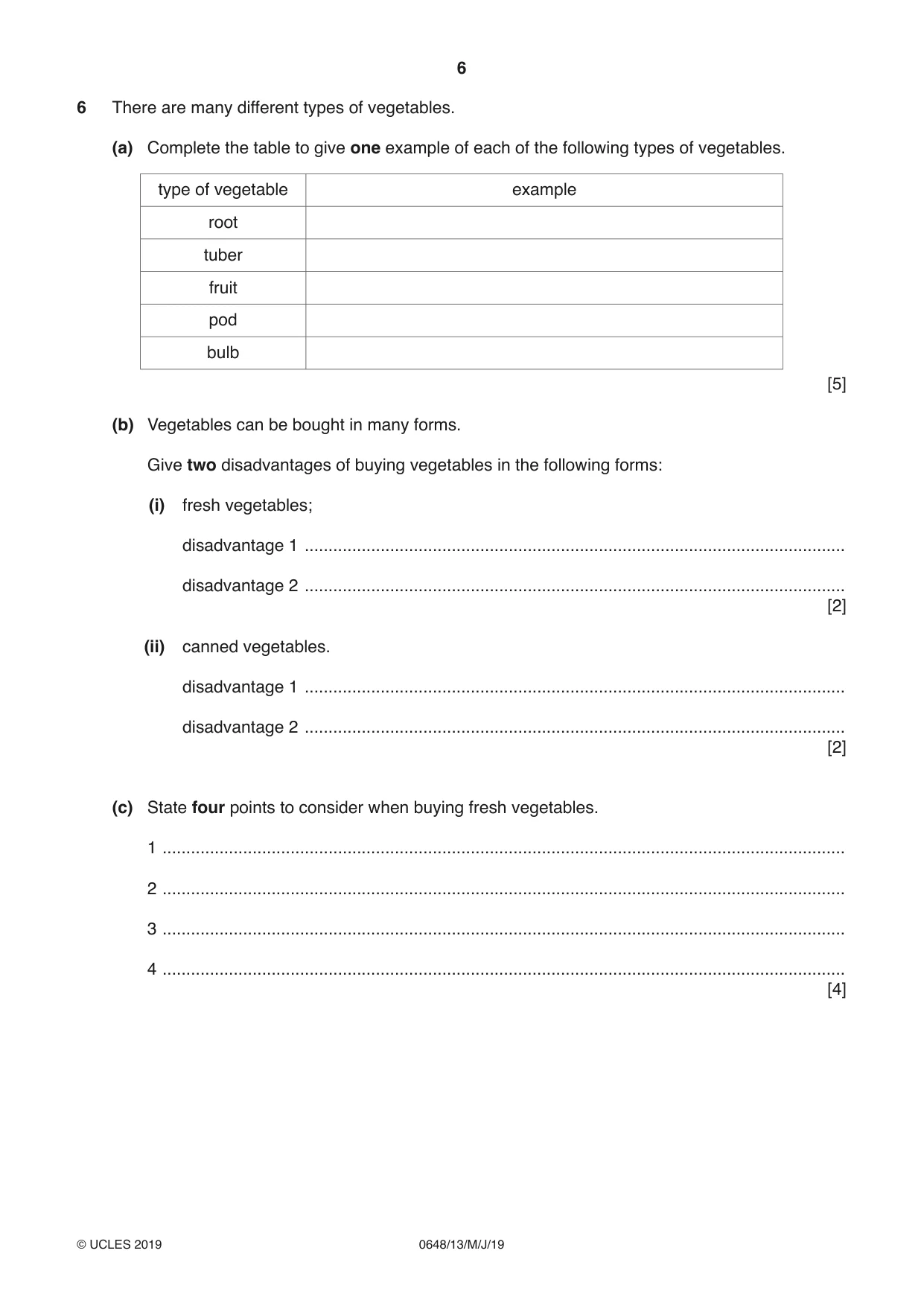
6 0648/13/M/J/19 © UCLES 2019 6 There are many different types of vegetables. (a) Complete the table to give one example of each of the following types of vegetables. type of vegetable example root tuber fruit pod bulb [5] (b) Vegetables can be bought in many forms. Give two disadvantages of buying vegetables in the following forms: (i) fresh vegetables; disadvantage 1 … disadvantage 2 … [2] (ii) canned vegetables. disadvantage 1 … disadvantage 2 … [2] (c) State four points to consider when buying fresh vegetables. 1 … 2 … 3 … 4 … [4]
Question paper, page 7
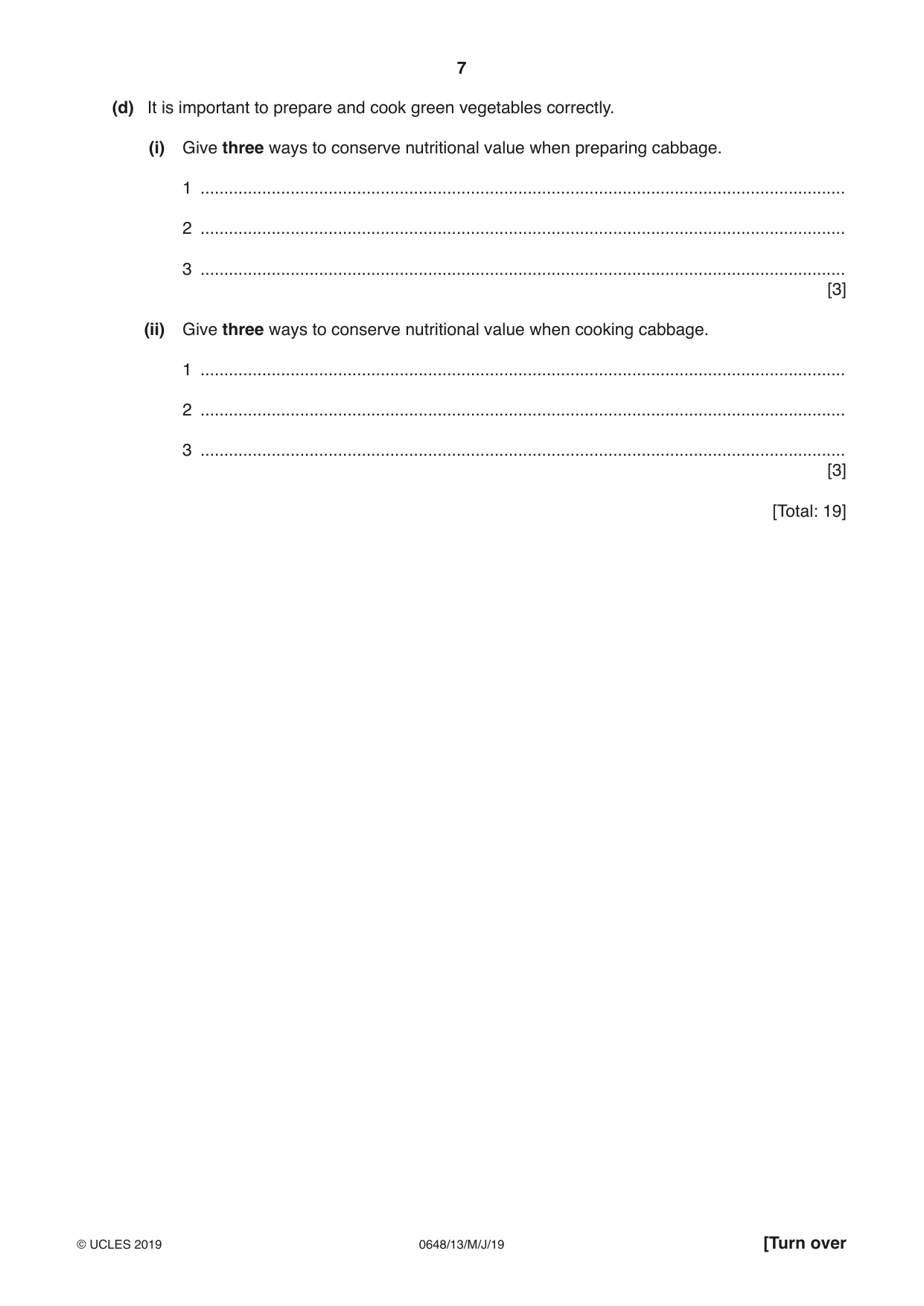
7 0648/13/M/J/19 © UCLES 2019 [Turn over (d) It is important to prepare and cook green vegetables correctly. (i) Give three ways to conserve nutritional value when preparing cabbage. 1 … 2 … 3 … [3] (ii) Give three ways to conserve nutritional value when cooking cabbage. 1 … 2 … 3 … [3] [Total: 19]
Question paper, page 8
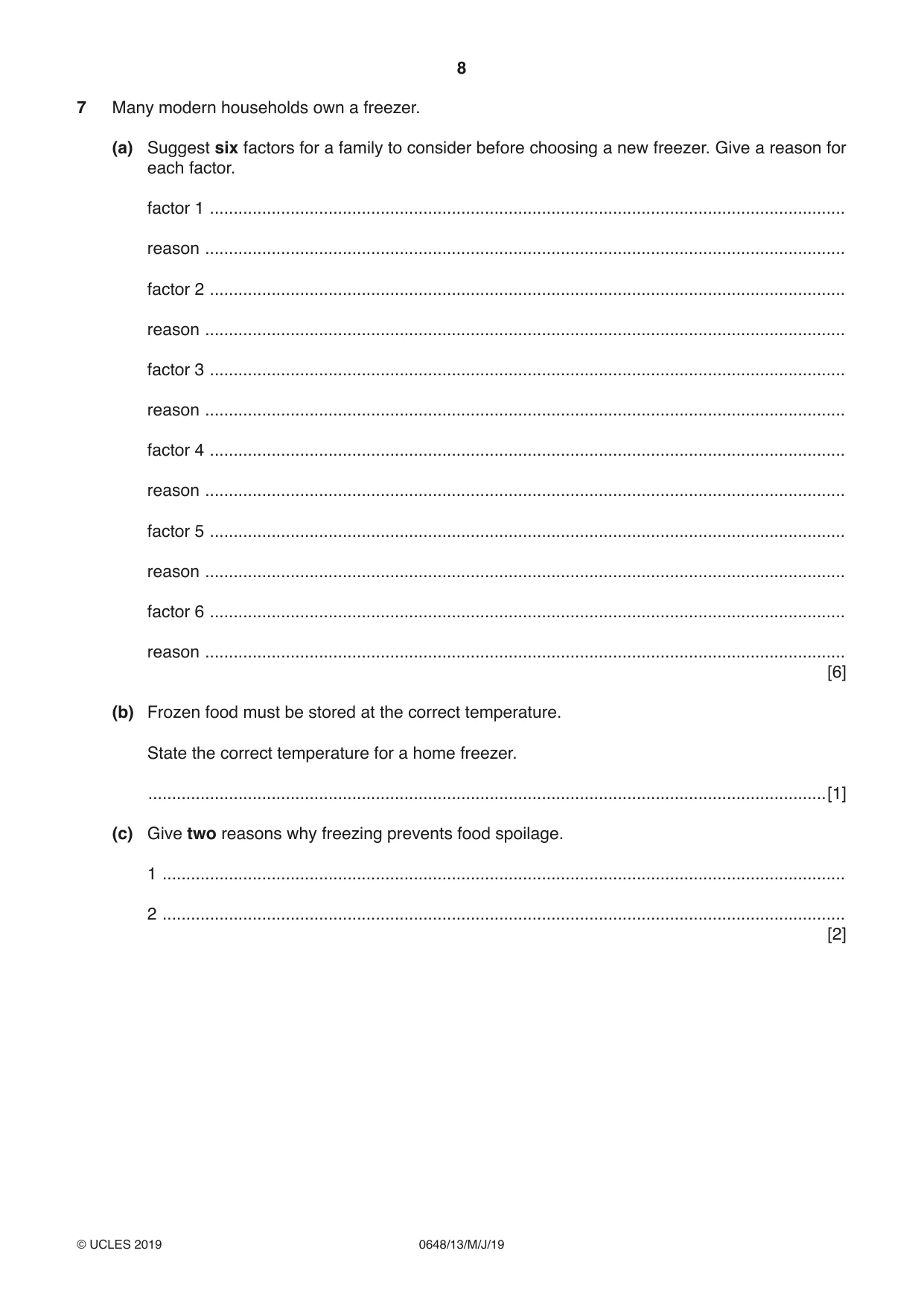
8 0648/13/M/J/19 © UCLES 2019 7 Many modern households own a freezer. (a) Suggest six factors for a family to consider before choosing a new freezer. Give a reason for each factor. factor 1 … reason … factor 2 … reason … factor 3 … reason … factor 4 … reason … factor 5 … reason … factor 6 … reason … [6] (b) Frozen food must be stored at the correct temperature. State the correct temperature for a home freezer. …[1] (c) Give two reasons why freezing prevents food spoilage. 1 … 2 … [2]
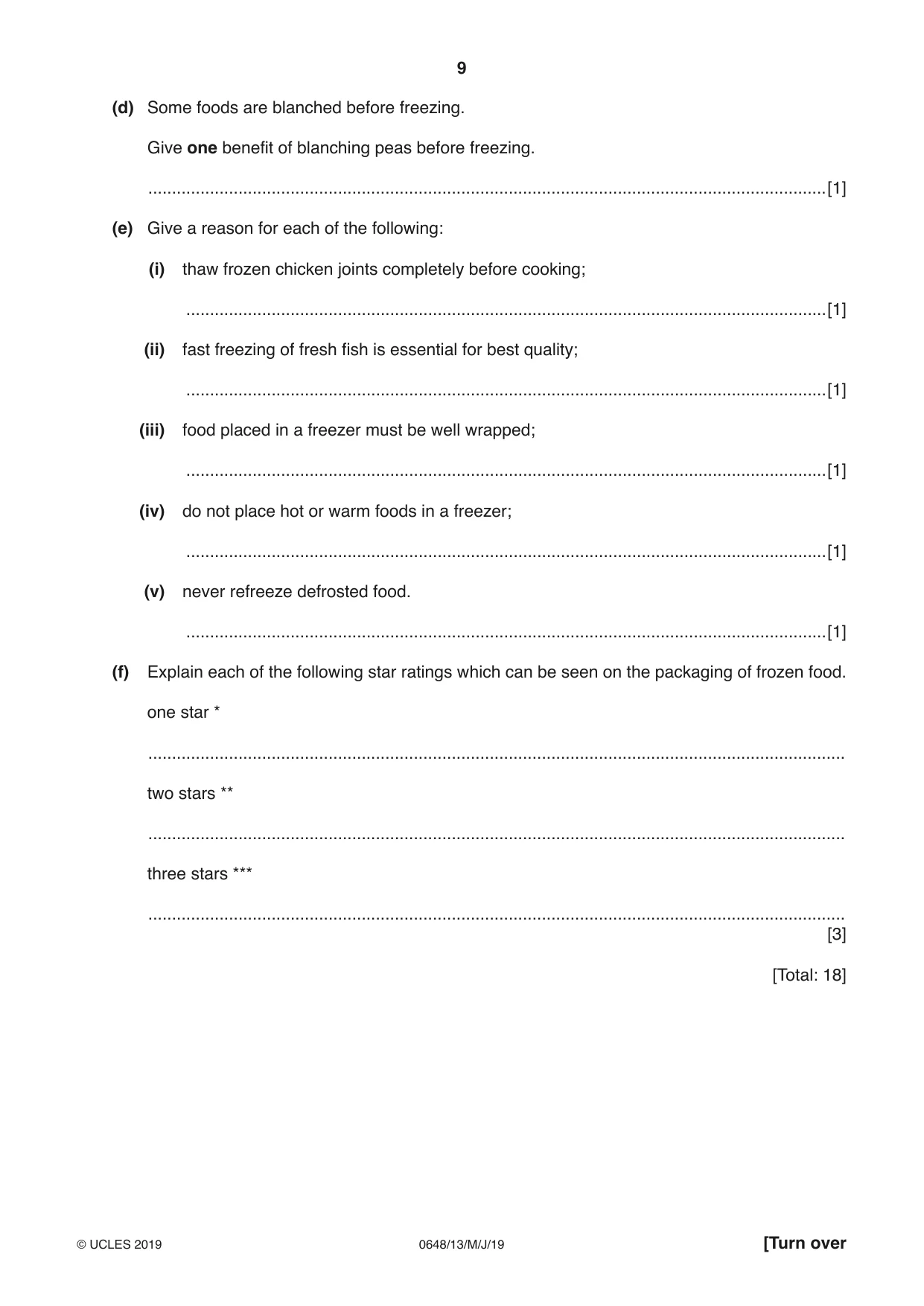
Question paper, page 9
9 0648/13/M/J/19 © UCLES 2019 [Turn over (d) Some foods are blanched before freezing. Give one benefit of blanching peas before freezing. …[1] (e) Give a reason for each of the following: (i) thaw frozen chicken joints completely before cooking; …[1] (ii) fast freezing of fresh fish is essential for best quality; …[1] (iii) food placed in a freezer must be well wrapped; …[1] (iv) do not place hot or warm foods in a freezer; …[1] (v) never refreeze defrosted food. …[1] (f) Explain each of the following star ratings which can be seen on the packaging of frozen food. one star * … two stars ** … three stars *** … [3] [Total: 18]
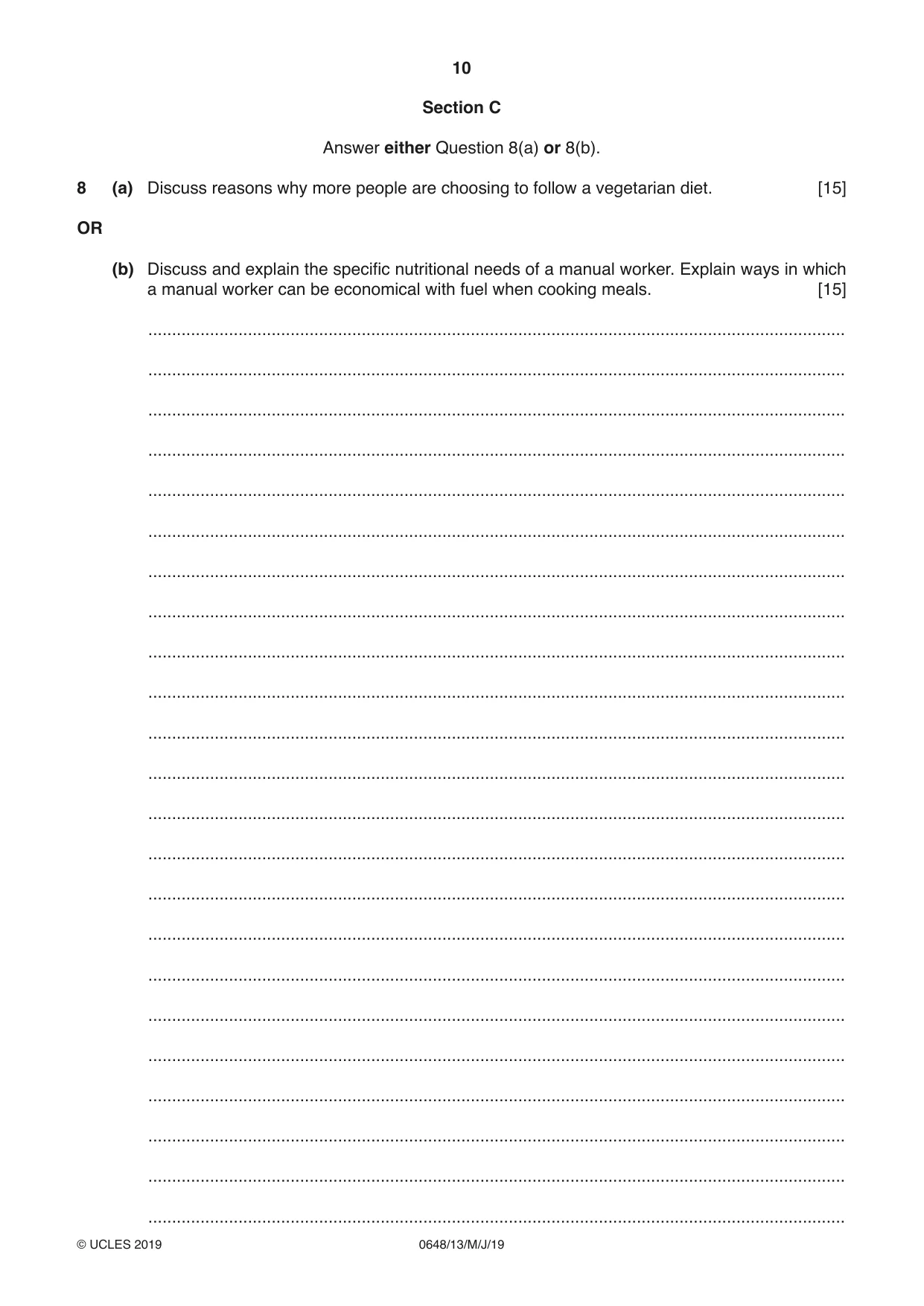
Question paper, page 10
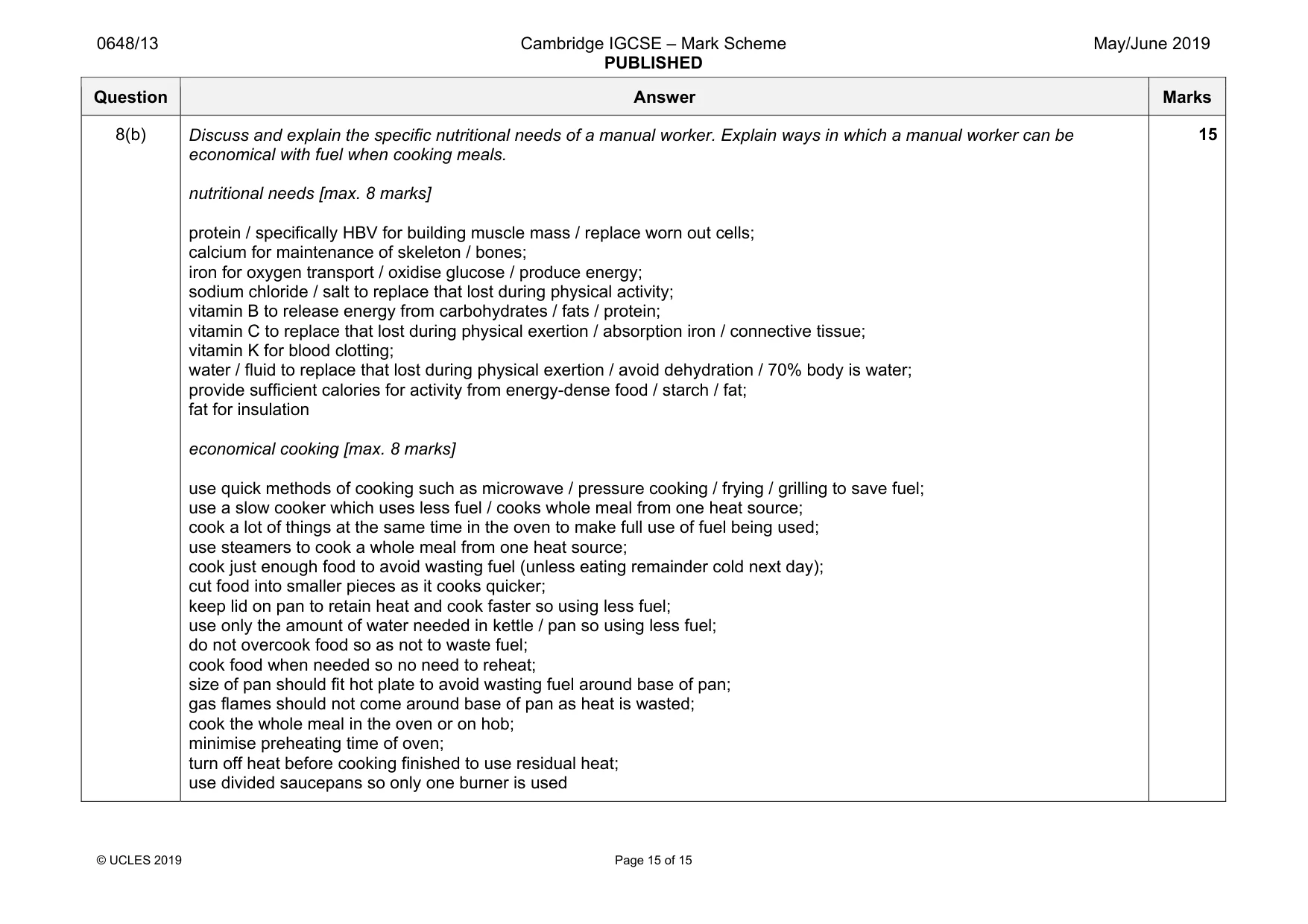
10 0648/13/M/J/19 © UCLES 2019 Section C Answer either Question 8(a) or 8(b). 8 (a) Discuss reasons why more people are choosing to follow a vegetarian diet. [15] OR (b) Discuss and explain the specific nutritional needs of a manual worker. Explain ways in which a manual worker can be economical with fuel when cooking meals. [15] … … … … … … … … … … … … … … … … … … … … … … …
Question paper, page 11
11 0648/13/M/J/19 © UCLES 2019 [Turn over … … … … … … … … … … … … … … … … … … … … … … … … … … … …
Question paper, page 12
12 0648/13/M/J/19 © UCLES 2019 Permission to reproduce items where third-party owned material protected by copyright is included has been sought and cleared where possible. Every reasonable effort has been made by the publisher (UCLES) to trace copyright holders, but if any items requiring clearance have unwittingly been included, the publisher will be pleased to make amends at the earliest possible opportunity. To avoid the issue of disclosure of answer-related information to candidates, all copyright acknowledgements are reproduced online in the Cambridge Assessment International Education Copyright Acknowledgements Booklet. This is produced for each series of examinations and is freely available to download at www.cambridgeinternational.org after the live examination series. Cambridge Assessment International Education is part of the Cambridge Assessment Group. Cambridge Assessment is the brand name of the University of Cambridge Local Examinations Syndicate (UCLES), which itself is a department of the University of Cambridge. … … … … … … … … … … … … … … … … … … … … … … …
Mark scheme, page 1
This document consists of 15 printed pages. © UCLES 2019 [Turn over Cambridge Assessment International Education Cambridge International General Certificate of Secondary Education FOOD AND NUTRITION 0648/13 Paper 1 Theory May/June 2019 MARK SCHEME Maximum Mark: 100 Published This mark scheme is published as an aid to teachers and candidates, to indicate the requirements of the examination. It shows the basis on which Examiners were instructed to award marks. It does not indicate the details of the discussions that took place at an Examiners’ meeting before marking began, which would have considered the acceptability of alternative answers. Mark schemes should be read in conjunction with the question paper and the Principal Examiner Report for Teachers. Cambridge International will not enter into discussions about these mark schemes. Cambridge International is publishing the mark schemes for the May/June 2019 series for most Cambridge IGCSE™, Cambridge International A and AS Level and Cambridge Pre-U components, and some Cambridge O Level components.
Mark scheme, page 2
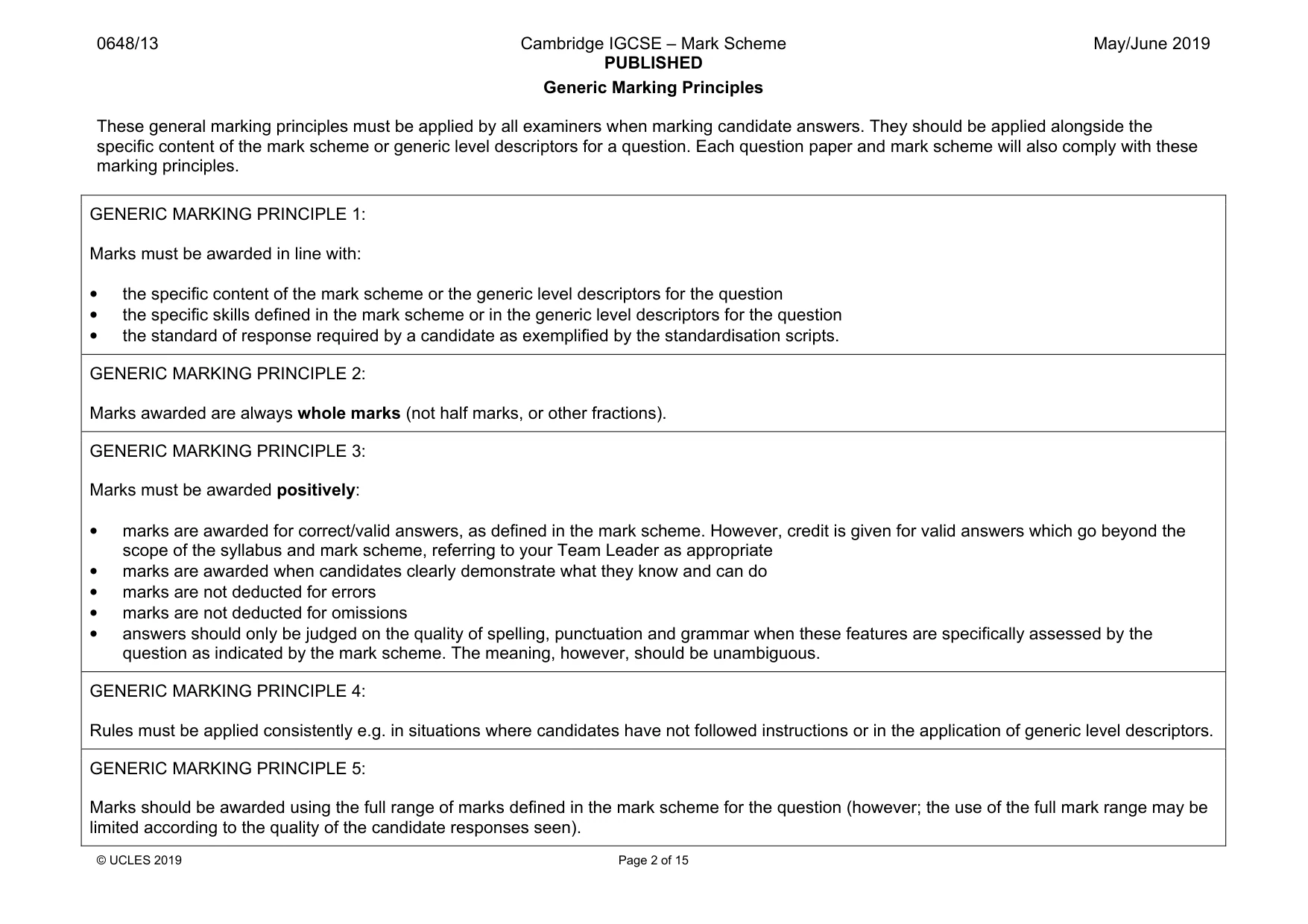
0648/13 Cambridge IGCSE – Mark Scheme PUBLISHED May/June 2019 © UCLES 2019 Page 2 of 15 Generic Marking Principles These general marking principles must be applied by all examiners when marking candidate answers. They should be applied alongside the specific content of the mark scheme or generic level descriptors for a question. Each question paper and mark scheme will also comply with these marking principles. GENERIC MARKING PRINCIPLE 1: Marks must be awarded in line with: • the specific content of the mark scheme or the generic level descriptors for the question • the specific skills defined in the mark scheme or in the generic level descriptors for the question • the standard of response required by a candidate as exemplified by the standardisation scripts. GENERIC MARKING PRINCIPLE 2: Marks awarded are always whole marks (not half marks, or other fractions). GENERIC MARKING PRINCIPLE 3: Marks must be awarded positively: • marks are awarded for correct/valid answers, as defined in the mark scheme. However, credit is given for valid answers which go beyond the scope of the syllabus and mark scheme, referring to your Team Leader as appropriate • marks are awarded when candidates clearly demonstrate what they know and can do • marks are not deducted for errors • marks are not deducted for omissions • answers should only be judged on the quality of spelling, punctuation and grammar when these features are specifically assessed by the question as indicated by the mark scheme. The meaning, however, should be unambiguous. GENERIC MARKING PRINCIPLE 4: Rules must be applied consistently e.g. in situations where candidates have not followed instructions or in the application of generic level descriptors. GENERIC MARKING PRINCIPLE 5: Marks should be awarded using the full range of marks defined in the mark scheme for the question (however; the use of the full mark range may be limited according to the quality of the candidate responses seen).
Mark scheme, page 3
0648/13 Cambridge IGCSE – Mark Scheme PUBLISHED May/June 2019 © UCLES 2019 Page 3 of 15 GENERIC MARKING PRINCIPLE 6: Marks awarded are based solely on the requirements as defined in the mark scheme. Marks should not be awarded with grade thresholds or grade descriptors in mind.
Mark scheme, page 4
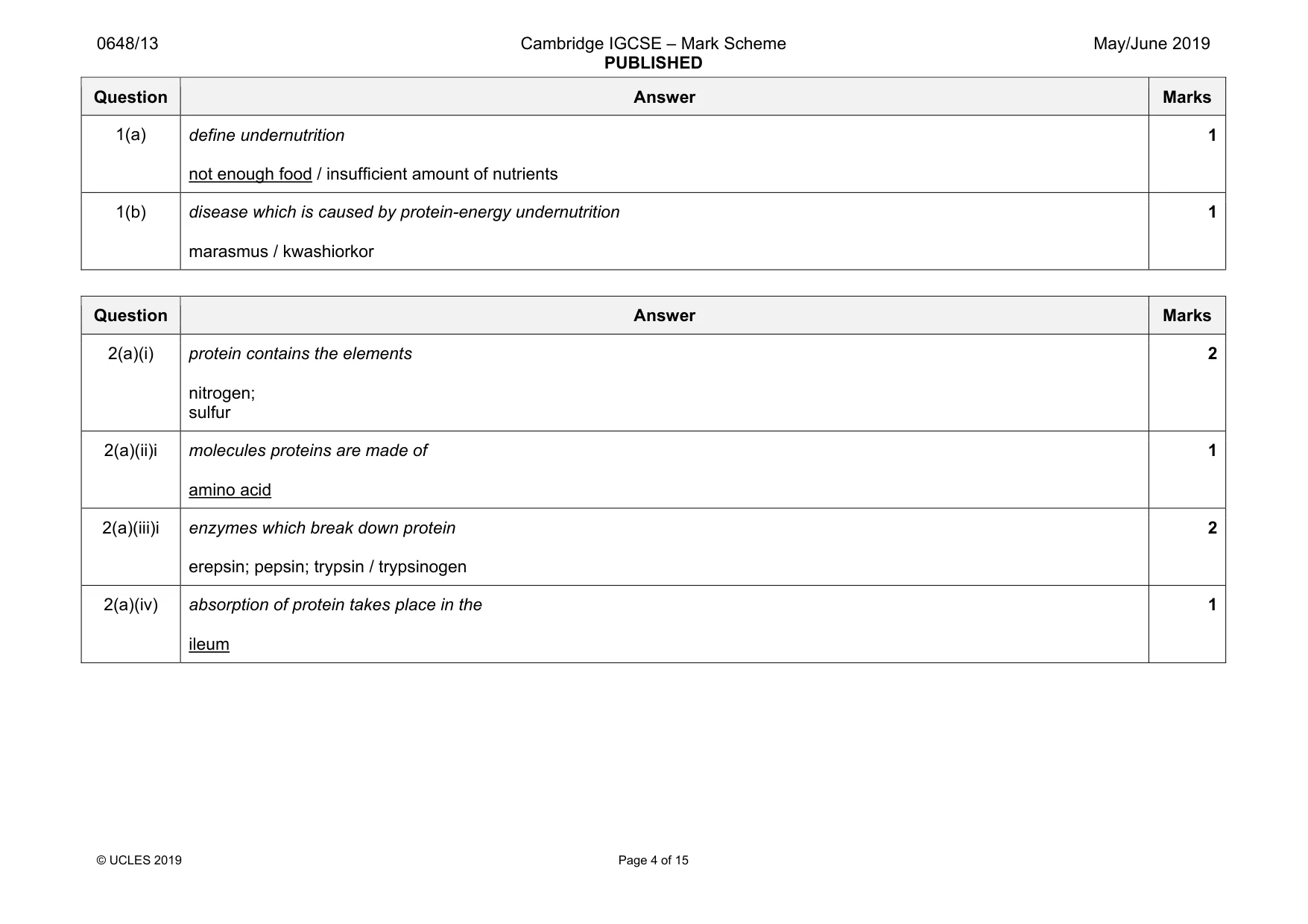
0648/13 Cambridge IGCSE – Mark Scheme PUBLISHED May/June 2019 © UCLES 2019 Page 4 of 15 Question Answer Marks 1(a) define undernutrition not enough food / insufficient amount of nutrients 1 1(b) disease which is caused by protein-energy undernutrition marasmus / kwashiorkor 1 Question Answer Marks 2(a)(i) protein contains the elements nitrogen; sulfur 2 2(a)(ii)i molecules proteins are made of amino acid 1 2(a)(iii)i enzymes which break down protein erepsin; pepsin; trypsin / trypsinogen 2 2(a)(iv) absorption of protein takes place in the ileum 1
Mark scheme, page 5
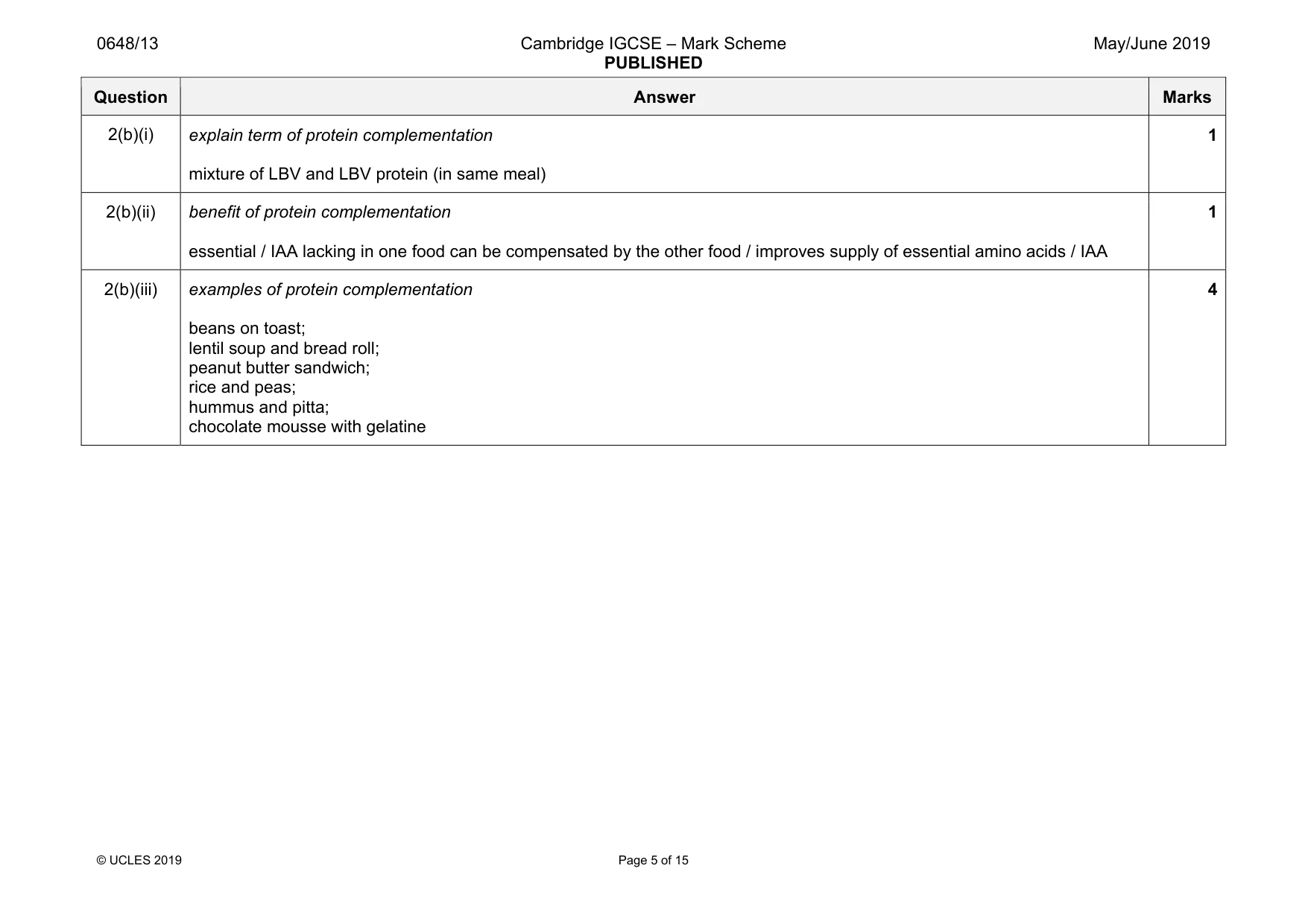
0648/13 Cambridge IGCSE – Mark Scheme PUBLISHED May/June 2019 © UCLES 2019 Page 5 of 15 Question Answer Marks 2(b)(i) explain term of protein complementation mixture of LBV and LBV protein (in same meal) 1 2(b)(ii) benefit of protein complementation essential / IAA lacking in one food can be compensated by the other food / improves supply of essential amino acids / IAA 1 2(b)(iii) examples of protein complementation beans on toast; lentil soup and bread roll; peanut butter sandwich; rice and peas; hummus and pitta; chocolate mousse with gelatine 4
Mark scheme, page 6
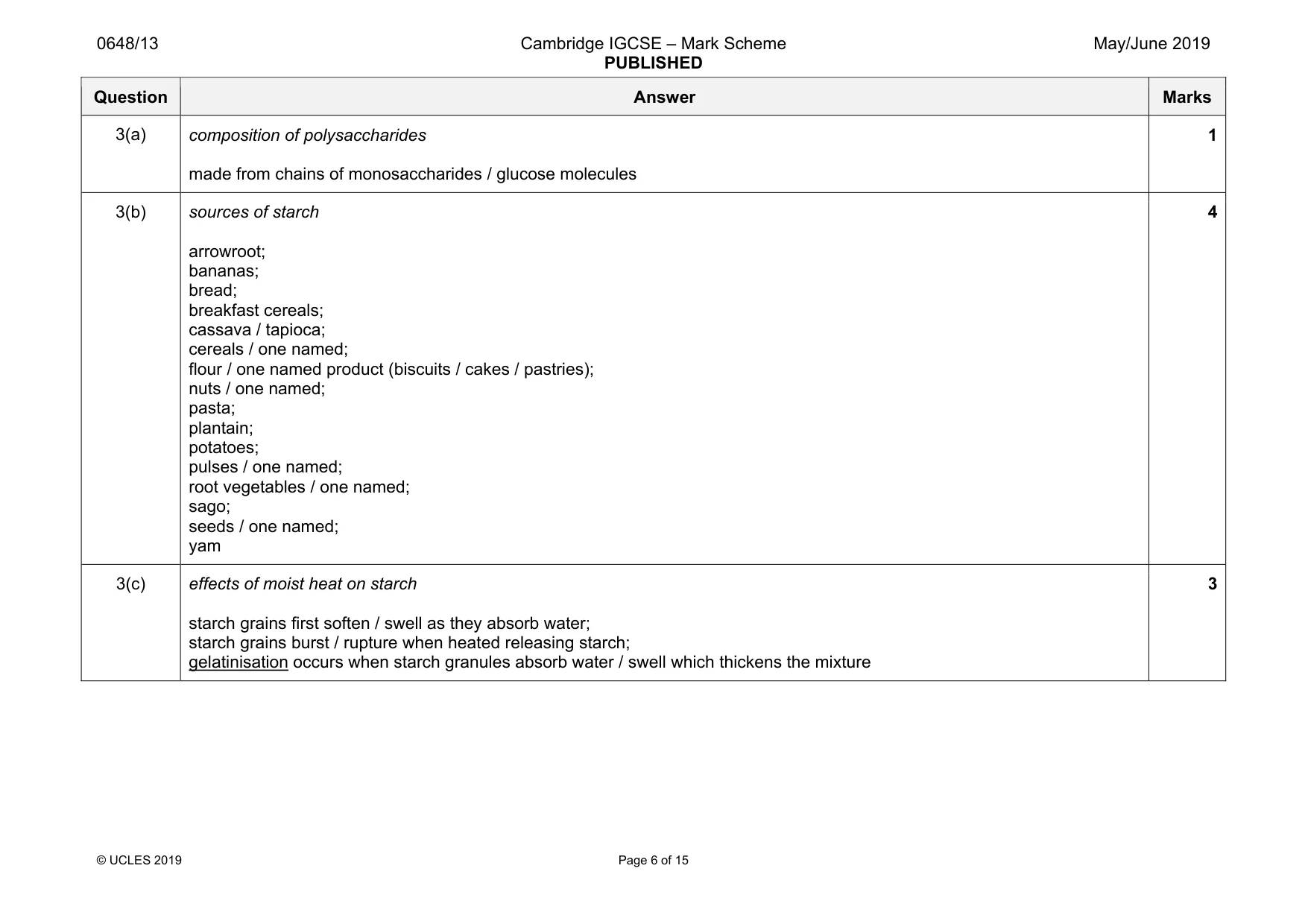
0648/13 Cambridge IGCSE – Mark Scheme PUBLISHED May/June 2019 © UCLES 2019 Page 6 of 15 Question Answer Marks 3(a) composition of polysaccharides made from chains of monosaccharides / glucose molecules 1 3(b) sources of starch arrowroot; bananas; bread; breakfast cereals; cassava / tapioca; cereals / one named; flour / one named product (biscuits / cakes / pastries); nuts / one named; pasta; plantain; potatoes; pulses / one named; root vegetables / one named; sago; seeds / one named; yam 4 3(c) effects of moist heat on starch starch grains first soften / swell as they absorb water; starch grains burst / rupture when heated releasing starch; gelatinisation occurs when starch granules absorb water / swell which thickens the mixture 3
Mark scheme, page 7
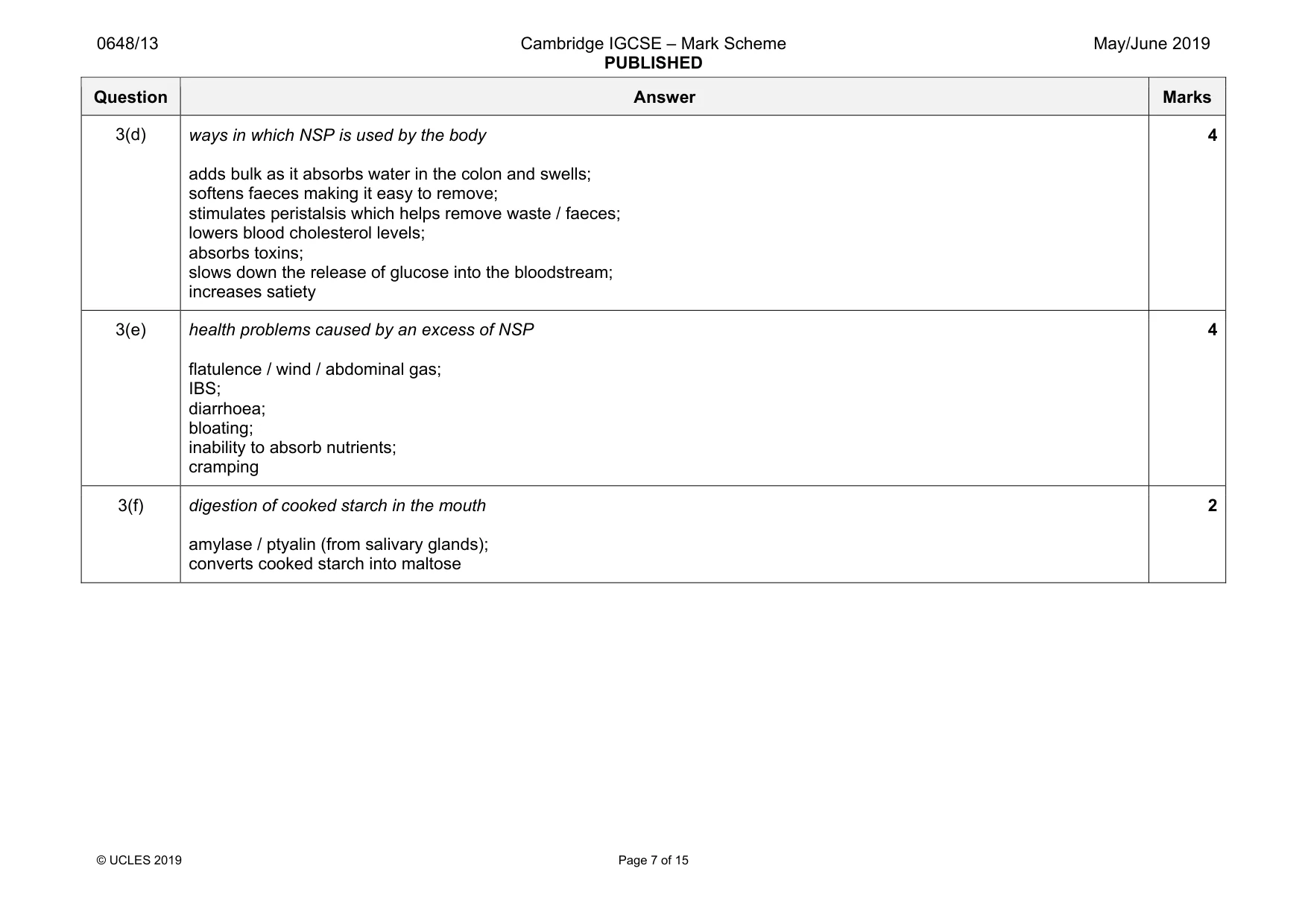
0648/13 Cambridge IGCSE – Mark Scheme PUBLISHED May/June 2019 © UCLES 2019 Page 7 of 15 Question Answer Marks 3(d) ways in which NSP is used by the body adds bulk as it absorbs water in the colon and swells; softens faeces making it easy to remove; stimulates peristalsis which helps remove waste / faeces; lowers blood cholesterol levels; absorbs toxins; slows down the release of glucose into the bloodstream; increases satiety 4 3(e) health problems caused by an excess of NSP flatulence / wind / abdominal gas; IBS; diarrhoea; bloating; inability to absorb nutrients; cramping 4 3(f) digestion of cooked starch in the mouth amylase / ptyalin (from salivary glands); converts cooked starch into maltose 2
Mark scheme, page 8
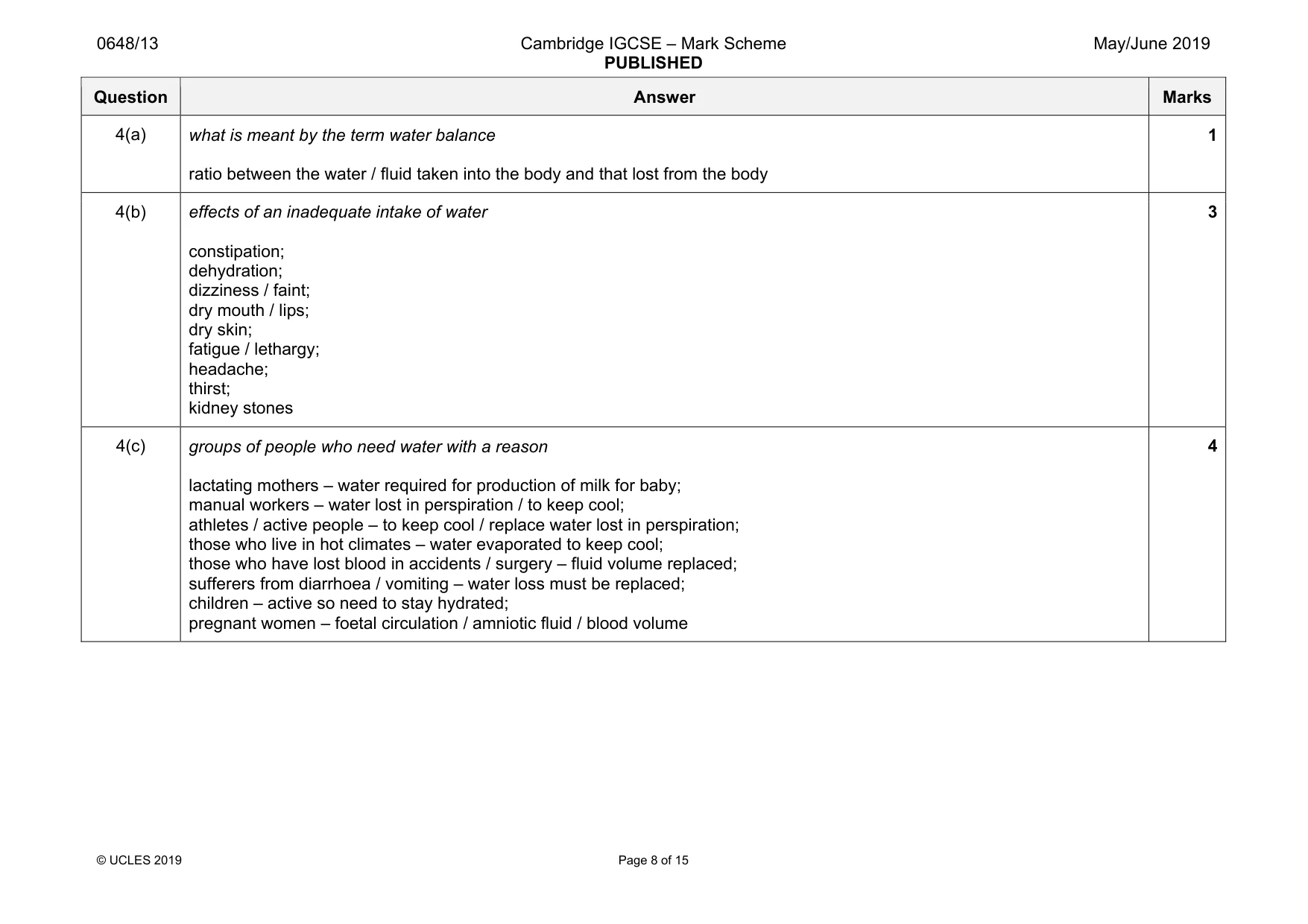
0648/13 Cambridge IGCSE – Mark Scheme PUBLISHED May/June 2019 © UCLES 2019 Page 8 of 15 Question Answer Marks 4(a) what is meant by the term water balance ratio between the water / fluid taken into the body and that lost from the body 1 4(b) effects of an inadequate intake of water constipation; dehydration; dizziness / faint; dry mouth / lips; dry skin; fatigue / lethargy; headache; thirst; kidney stones 3 4(c) groups of people who need water with a reason lactating mothers – water required for production of milk for baby; manual workers – water lost in perspiration / to keep cool; athletes / active people – to keep cool / replace water lost in perspiration; those who live in hot climates – water evaporated to keep cool; those who have lost blood in accidents / surgery – fluid volume replaced; sufferers from diarrhoea / vomiting – water loss must be replaced; children – active so need to stay hydrated; pregnant women – foetal circulation / amniotic fluid / blood volume 4
Mark scheme, page 9
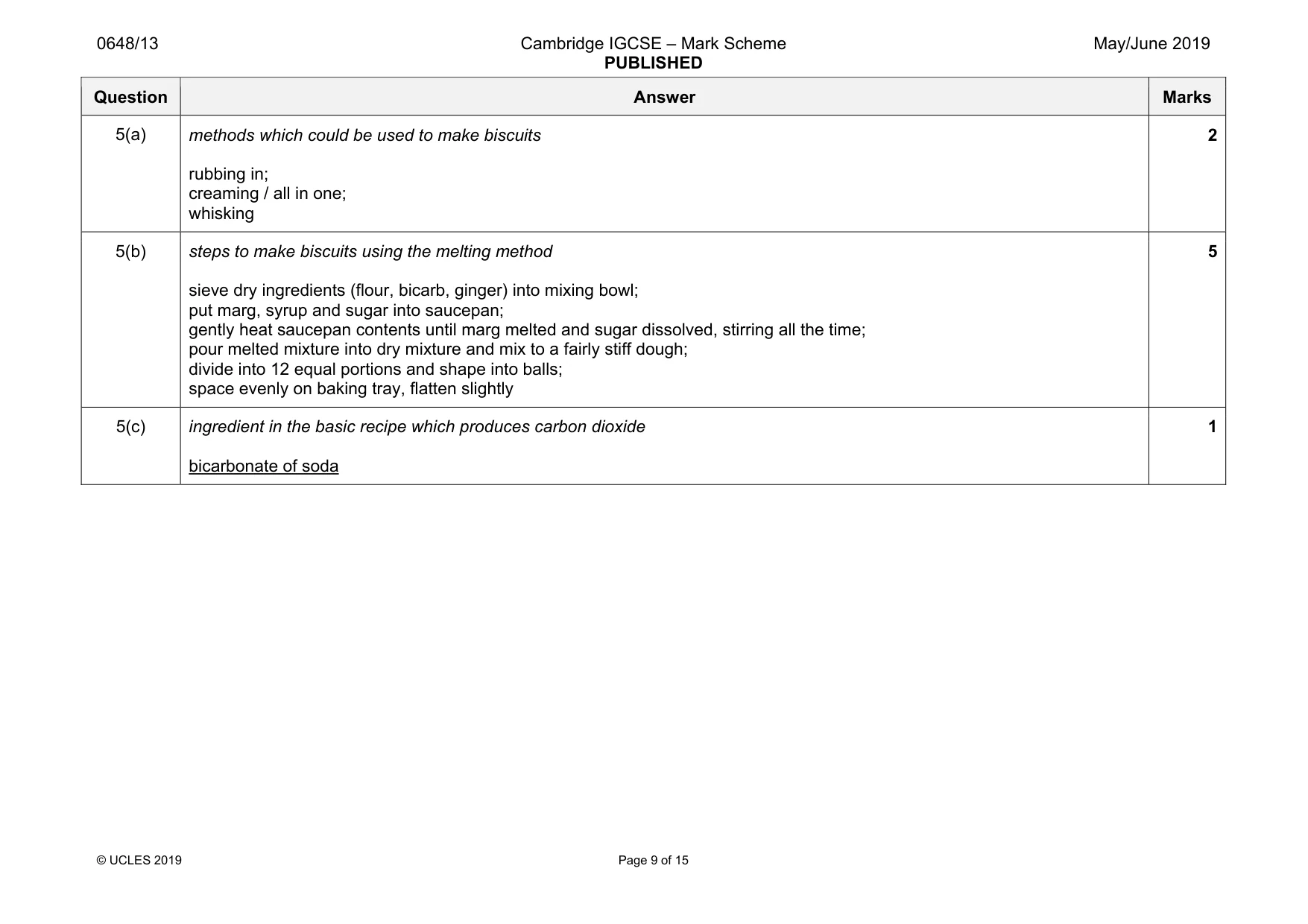
0648/13 Cambridge IGCSE – Mark Scheme PUBLISHED May/June 2019 © UCLES 2019 Page 9 of 15 Question Answer Marks 5(a) methods which could be used to make biscuits rubbing in; creaming / all in one; whisking 2 5(b) steps to make biscuits using the melting method sieve dry ingredients (flour, bicarb, ginger) into mixing bowl; put marg, syrup and sugar into saucepan; gently heat saucepan contents until marg melted and sugar dissolved, stirring all the time; pour melted mixture into dry mixture and mix to a fairly stiff dough; divide into 12 equal portions and shape into balls; space evenly on baking tray, flatten slightly 5 5(c) ingredient in the basic recipe which produces carbon dioxide bicarbonate of soda 1
Mark scheme, page 10
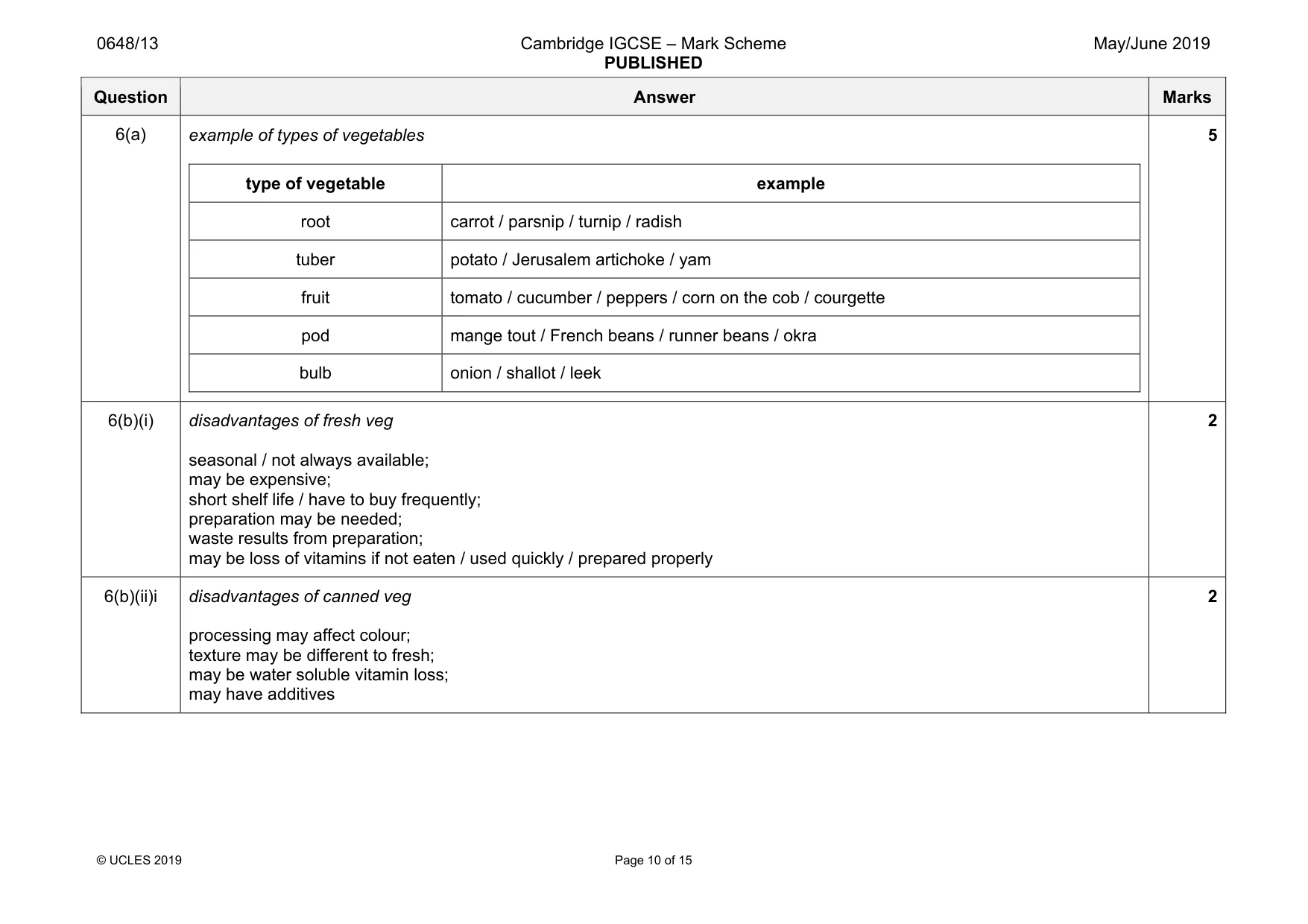
0648/13 Cambridge IGCSE – Mark Scheme PUBLISHED May/June 2019 © UCLES 2019 Page 10 of 15 Question Answer Marks 6(a) example of types of vegetables type of vegetable example root carrot / parsnip / turnip / radish tuber potato / Jerusalem artichoke / yam fruit tomato / cucumber / peppers / corn on the cob / courgette pod mange tout / French beans / runner beans / okra bulb onion / shallot / leek 5 6(b)(i) disadvantages of fresh veg seasonal / not always available; may be expensive; short shelf life / have to buy frequently; preparation may be needed; waste results from preparation; may be loss of vitamins if not eaten / used quickly / prepared properly 2 6(b)(ii)i disadvantages of canned veg processing may affect colour; texture may be different to fresh; may be water soluble vitamin loss; may have additives 2
Mark scheme, page 11
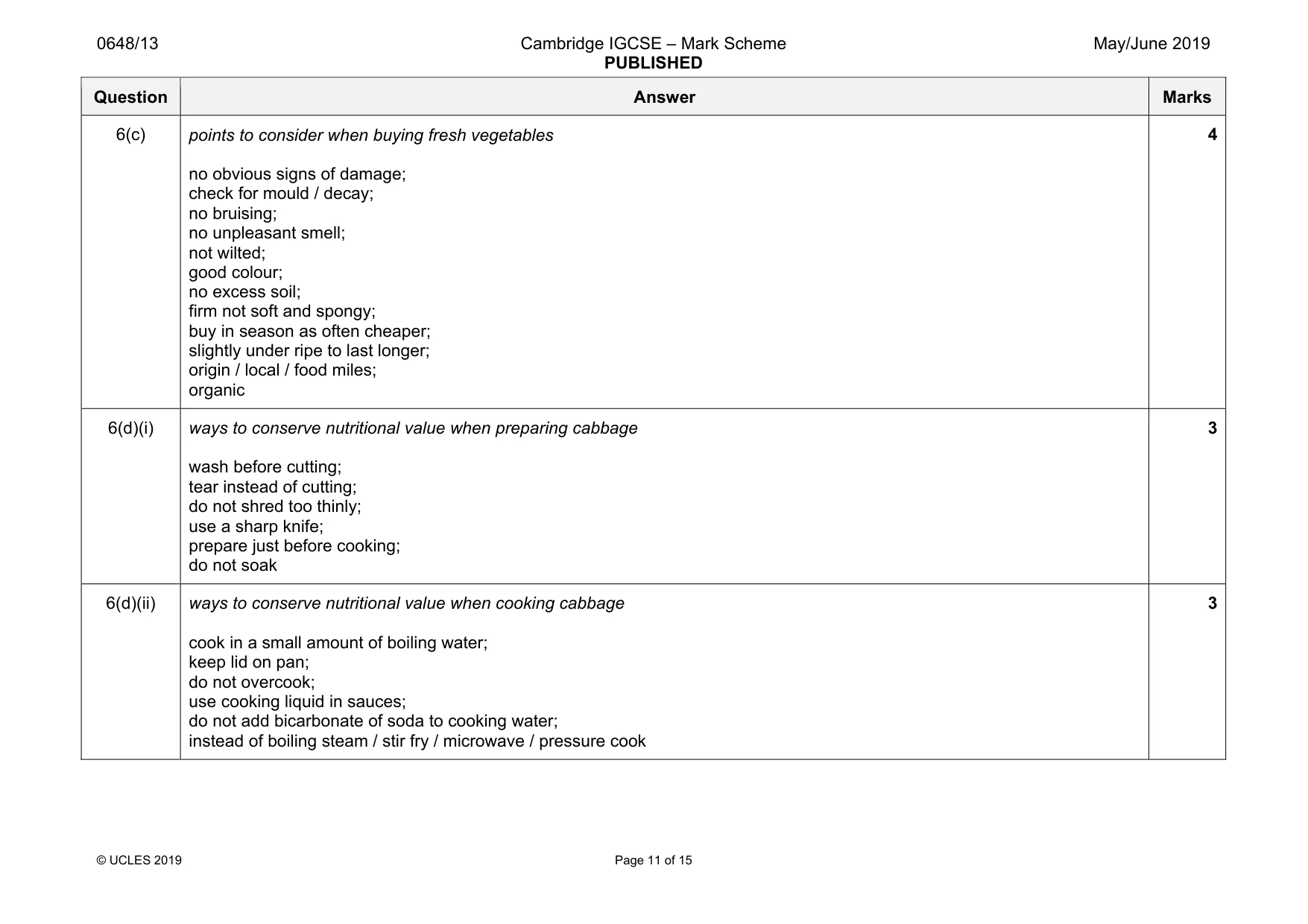
0648/13 Cambridge IGCSE – Mark Scheme PUBLISHED May/June 2019 © UCLES 2019 Page 11 of 15 Question Answer Marks 6(c) points to consider when buying fresh vegetables no obvious signs of damage; check for mould / decay; no bruising; no unpleasant smell; not wilted; good colour; no excess soil; firm not soft and spongy; buy in season as often cheaper; slightly under ripe to last longer; origin / local / food miles; organic 4 6(d)(i) ways to conserve nutritional value when preparing cabbage wash before cutting; tear instead of cutting; do not shred too thinly; use a sharp knife; prepare just before cooking; do not soak 3 6(d)(ii) ways to conserve nutritional value when cooking cabbage cook in a small amount of boiling water; keep lid on pan; do not overcook; use cooking liquid in sauces; do not add bicarbonate of soda to cooking water; instead of boiling steam / stir fry / microwave / pressure cook 3
Mark scheme, page 12
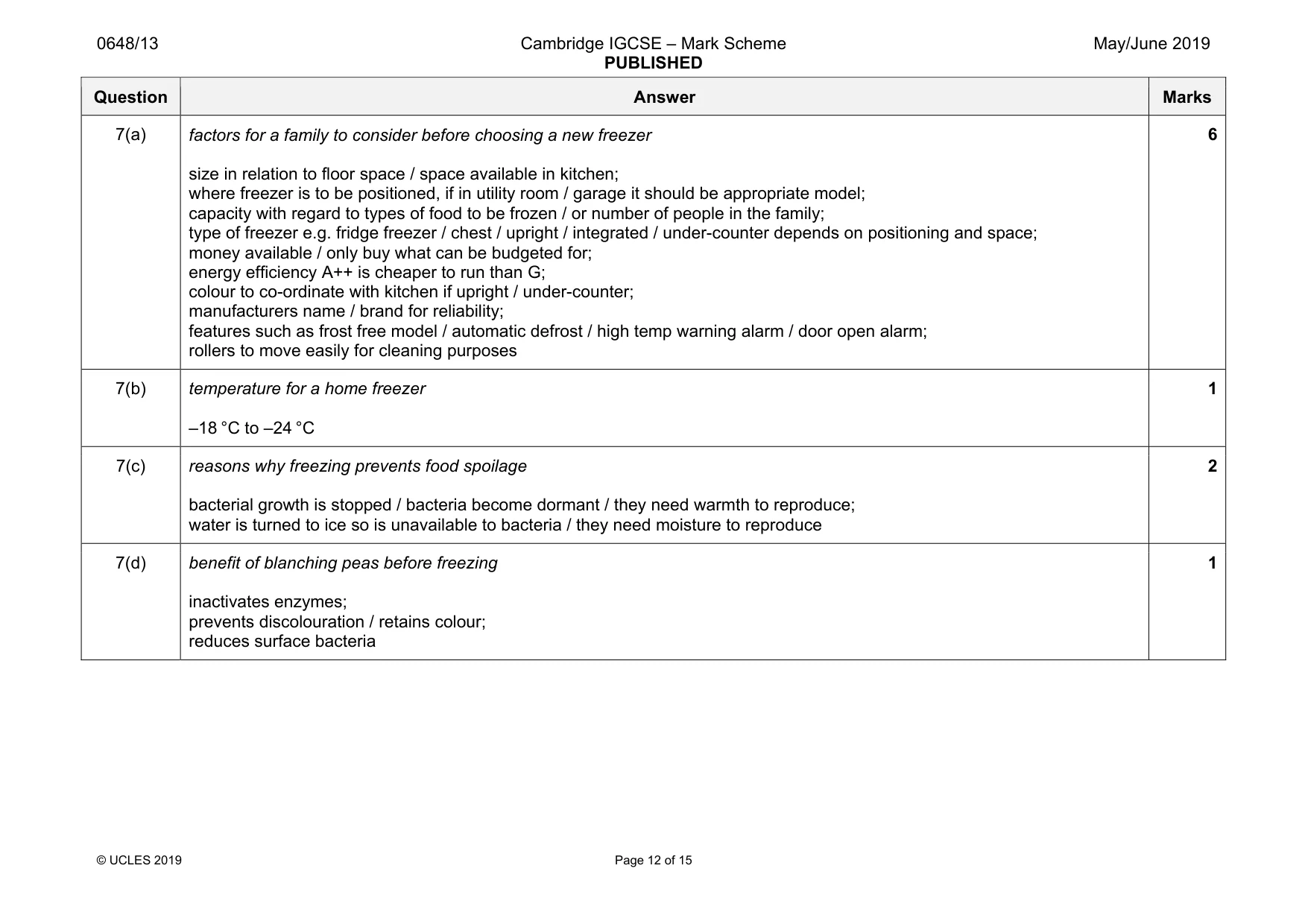
0648/13 Cambridge IGCSE – Mark Scheme PUBLISHED May/June 2019 © UCLES 2019 Page 12 of 15 Question Answer Marks 7(a) factors for a family to consider before choosing a new freezer size in relation to floor space / space available in kitchen; where freezer is to be positioned, if in utility room / garage it should be appropriate model; capacity with regard to types of food to be frozen / or number of people in the family; type of freezer e.g. fridge freezer / chest / upright / integrated / under-counter depends on positioning and space; money available / only buy what can be budgeted for; energy efficiency A++ is cheaper to run than G; colour to co-ordinate with kitchen if upright / under-counter; manufacturers name / brand for reliability; features such as frost free model / automatic defrost / high temp warning alarm / door open alarm; rollers to move easily for cleaning purposes 6 7(b) temperature for a home freezer –18 °C to –24 °C 1 7(c) reasons why freezing prevents food spoilage bacterial growth is stopped / bacteria become dormant / they need warmth to reproduce; water is turned to ice so is unavailable to bacteria / they need moisture to reproduce 2 7(d) benefit of blanching peas before freezing inactivates enzymes; prevents discolouration / retains colour; reduces surface bacteria 1
Mark scheme, page 13
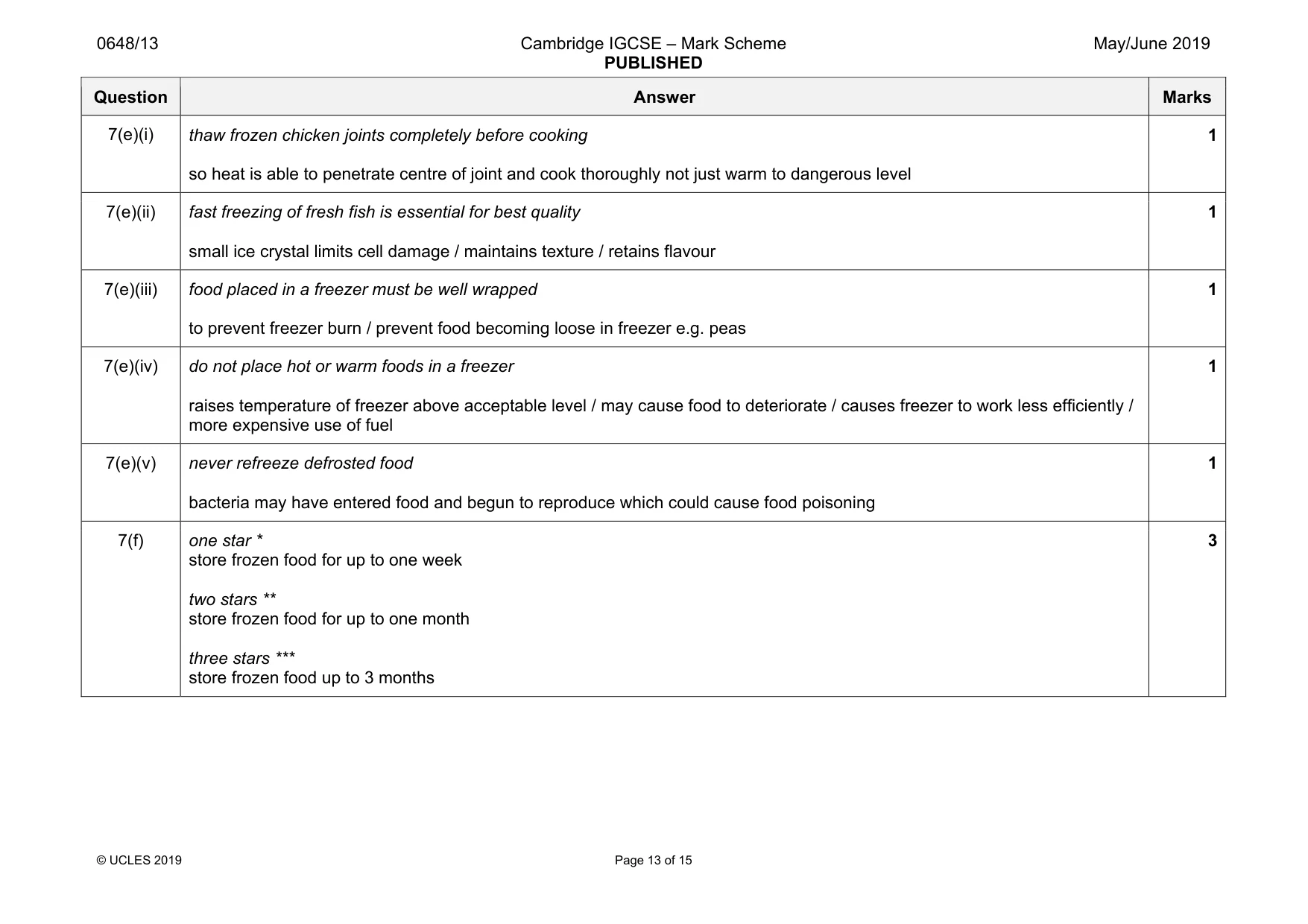
0648/13 Cambridge IGCSE – Mark Scheme PUBLISHED May/June 2019 © UCLES 2019 Page 13 of 15 Question Answer Marks 7(e)(i) thaw frozen chicken joints completely before cooking so heat is able to penetrate centre of joint and cook thoroughly not just warm to dangerous level 1 7(e)(ii) fast freezing of fresh fish is essential for best quality small ice crystal limits cell damage / maintains texture / retains flavour 1 7(e)(iii) food placed in a freezer must be well wrapped to prevent freezer burn / prevent food becoming loose in freezer e.g. peas 1 7(e)(iv) do not place hot or warm foods in a freezer raises temperature of freezer above acceptable level / may cause food to deteriorate / causes freezer to work less efficiently / more expensive use of fuel 1 7(e)(v) never refreeze defrosted food bacteria may have entered food and begun to reproduce which could cause food poisoning 1 7(f) one star * store frozen food for up to one week two stars ** store frozen food for up to one month three stars *** store frozen food up to 3 months 3
Mark scheme, page 14
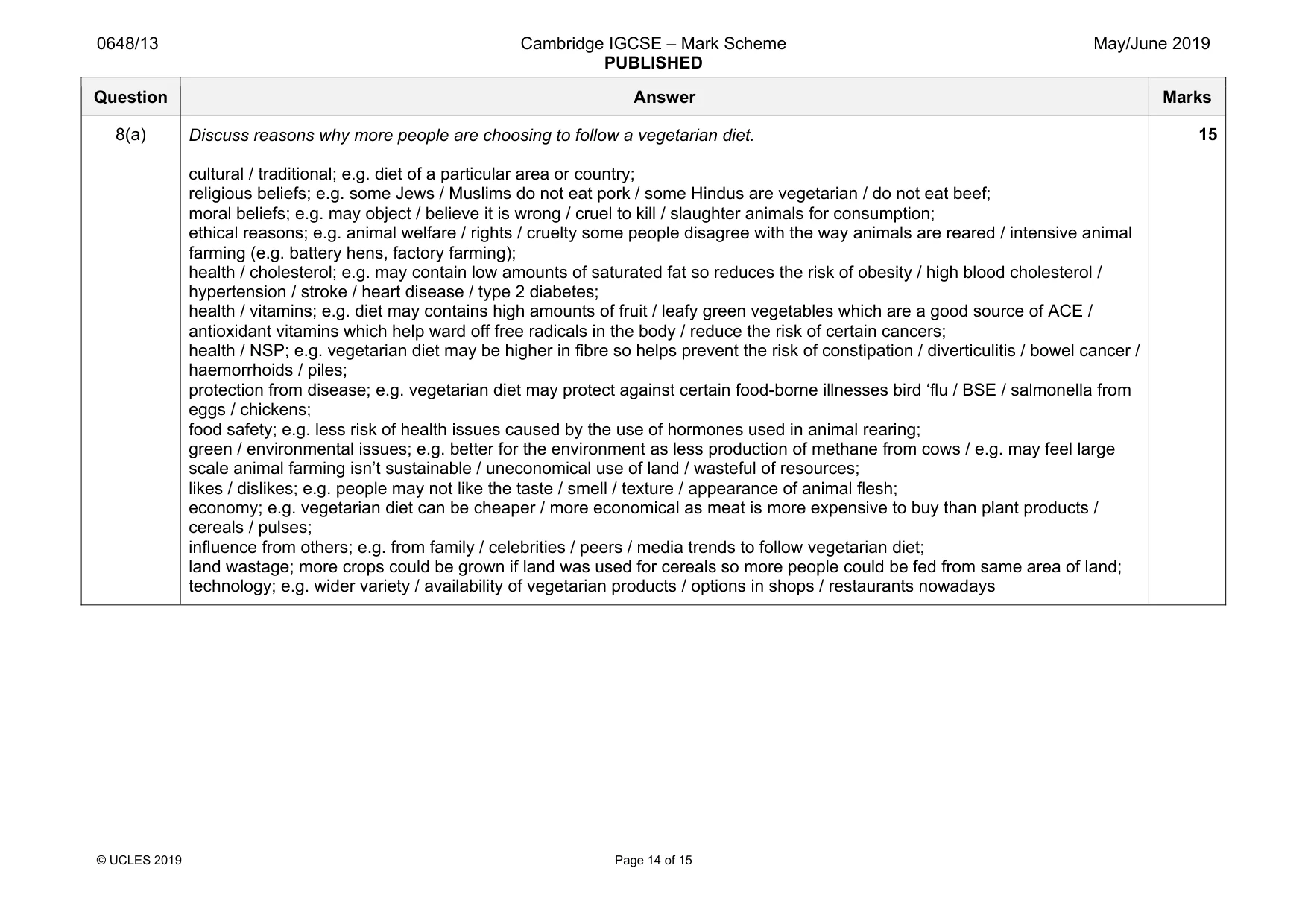
0648/13 Cambridge IGCSE – Mark Scheme PUBLISHED May/June 2019 © UCLES 2019 Page 14 of 15 Question Answer Marks 8(a) Discuss reasons why more people are choosing to follow a vegetarian diet. cultural / traditional; e.g. diet of a particular area or country; religious beliefs; e.g. some Jews / Muslims do not eat pork / some Hindus are vegetarian / do not eat beef; moral beliefs; e.g. may object / believe it is wrong / cruel to kill / slaughter animals for consumption; ethical reasons; e.g. animal welfare / rights / cruelty some people disagree with the way animals are reared / intensive animal farming (e.g. battery hens, factory farming); health / cholesterol; e.g. may contain low amounts of saturated fat so reduces the risk of obesity / high blood cholesterol / hypertension / stroke / heart disease / type 2 diabetes; health / vitamins; e.g. diet may contains high amounts of fruit / leafy green vegetables which are a good source of ACE / antioxidant vitamins which help ward off free radicals in the body / reduce the risk of certain cancers; health / NSP; e.g. vegetarian diet may be higher in fibre so helps prevent the risk of constipation / diverticulitis / bowel cancer / haemorrhoids / piles; protection from disease; e.g. vegetarian diet may protect against certain food-borne illnesses bird ‘flu / BSE / salmonella from eggs / chickens; food safety; e.g. less risk of health issues caused by the use of hormones used in animal rearing; green / environmental issues; e.g. better for the environment as less production of methane from cows / e.g. may feel large scale animal farming isn’t sustainable / uneconomical use of land / wasteful of resources; likes / dislikes; e.g. people may not like the taste / smell / texture / appearance of animal flesh; economy; e.g. vegetarian diet can be cheaper / more economical as meat is more expensive to buy than plant products / cereals / pulses; influence from others; e.g. from family / celebrities / peers / media trends to follow vegetarian diet; land wastage; more crops could be grown if land was used for cereals so more people could be fed from same area of land; technology; e.g. wider variety / availability of vegetarian products / options in shops / restaurants nowadays 15
Mark scheme, page 15
0648/13 Cambridge IGCSE – Mark Scheme PUBLISHED May/June 2019 © UCLES 2019 Page 15 of 15 Question Answer Marks 8(b) Discuss and explain the specific nutritional needs of a manual worker. Explain ways in which a manual worker can be economical with fuel when cooking meals. nutritional needs [max. 8 marks] protein / specifically HBV for building muscle mass / replace worn out cells; calcium for maintenance of skeleton / bones; iron for oxygen transport / oxidise glucose / produce energy; sodium chloride / salt to replace that lost during physical activity; vitamin B to release energy from carbohydrates / fats / protein; vitamin C to replace that lost during physical exertion / absorption iron / connective tissue; vitamin K for blood clotting; water / fluid to replace that lost during physical exertion / avoid dehydration / 70% body is water; provide sufficient calories for activity from energy-dense food / starch / fat; fat for insulation economical cooking [max. 8 marks] use quick methods of cooking such as microwave / pressure cooking / frying / grilling to save fuel; use a slow cooker which uses less fuel / cooks whole meal from one heat source; cook a lot of things at the same time in the oven to make full use of fuel being used; use steamers to cook a whole meal from one heat source; cook just enough food to avoid wasting fuel (unless eating remainder cold next day); cut food into smaller pieces as it cooks quicker; keep lid on pan to retain heat and cook faster so using less fuel; use only the amount of water needed in kettle / pan so using less fuel; do not overcook food so as not to waste fuel; cook food when needed so no need to reheat; size of pan should fit hot plate to avoid wasting fuel around base of pan; gas flames should not come around base of pan as heat is wasted; cook the whole meal in the oven or on hob; minimise preheating time of oven; turn off heat before cooking finished to use residual heat; use divided saucepans so only one burner is used 15
What you needed in this session
Cambridge’s own grade thresholds for 2019 May/June, Paper 1 · Variant 3. A higher threshold means an easier paper — the bar moves with how the cohort did.